Setting the scene: the song was first released in 2006 in the We Shall Overcome: the Seeger Sessions album as a bonus live track on a special edition of the album. The recorded version was added in 2012 to the Wrecking Ball album. The song has a long genesis: it is based on Pete Seeger's "He Lies in the American Land" (1956), which, in its turn, was the translation of a text originally written by a Slovak steelworker, Andrew Kovaly, at the beginning of the 20th century.
 Consequently, Springsteen recovers and adapts a song that deals with a timeless topic: immigration and, ultimately, the lack of equality for those who migrate to the United States. The music itself is a mixture of typical "American" sounds (rock 'n' roll, the electric guitar...) and an Irish-like folk motive.
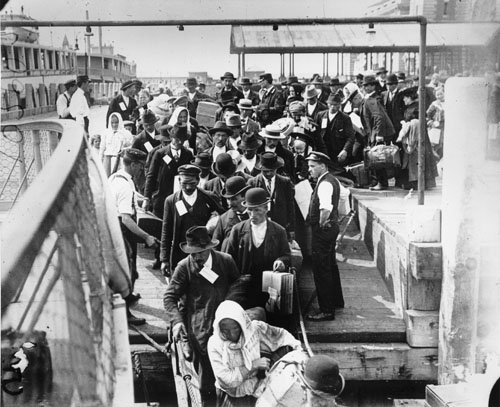
Since its "discovery", America has been a land of immigration; in particular, the major wave of immigrants landed in America at the end of the 19th century and the beginning of the following one. Indeed, between 1870 and 1900, nearly 12 million people arrived in the United States. Simultaneously, xenophobia and anti-immigration actions gained momentum: differentiations between "desirable" and "undesirable" immigrants based on racist assumptions around ethnicity and religion laid the foundations for the Immigration Act of 1917, which restricted immigration by imposing literacy tests and by preventing immigration from Asia and almost the entire Middle East. Context around this specific period of time is important because it is exactly in those years that Kovaly wrote "He lies in the American Land".
Compared to the previous songs, which focus mainly on African Americans and racism, this song shifts attention to inequality due to being an immigrant.
https://immigrationhistory.org/lesson-plan/european-migration/
https://voices.pitt.edu/TeachersGuide/Unit10/American%20Land.htm
https://alessandroportelli.blogspot.com/2012/03/bruce-springsteen-wrecking-ball.html
https://library.law.howard.edu/civilrightshistory/immigration/history


 https://klagenfurtmigrationstudies.home.blog/understanding-barriers-to-immigration-by-listening-to-ellis-island-oral-histories/


 * White supremacy movements and groups (such as the Ku Klux Klan) reignited and engaged in violent acts against African Americans, firebombing of churches and campaigns against affirmative actions programs and integration in schools. "Millions of white Americans had become convinced that “too much” had been given to blacks".
* Poverty, hunger and hopelessness paved the way to the abuse of drugs; crack was especially consumed by poor Americans as it was inexpensive and easily available. As a consequence of the combination of low employment, educational poverty and drug popularity, drug dealing became the source of income for young people and violence increased significantly in Black neighborhoods.
* White supremacy movements and groups (such as the Ku Klux Klan) reignited and engaged in violent acts against African Americans, firebombing of churches and campaigns against affirmative actions programs and integration in schools. "Millions of white Americans had become convinced that “too much” had been given to blacks".
* Poverty, hunger and hopelessness paved the way to the abuse of drugs; crack was especially consumed by poor Americans as it was inexpensive and easily available. As a consequence of the combination of low employment, educational poverty and drug popularity, drug dealing became the source of income for young people and violence increased significantly in Black neighborhoods. <br />
"There's also a reference here to a specific dove: the biblical dove of Noah's Ark, which flew out from the Ark to seek dry land and returned bearing a hopeful olive branch. The symbolism of the dove here suggests that the change the speaker hopes for may not be easy to come by" (
<br />
"There's also a reference here to a specific dove: the biblical dove of Noah's Ark, which flew out from the Ark to seek dry land and returned bearing a hopeful olive branch. The symbolism of the dove here suggests that the change the speaker hopes for may not be easy to come by" ( * On June 12, President Kennedy announced he would present a civil rights bill to Congress, which was eventually passed the following year under the name of the Civil Rights Act.