Reading Fitzgerald From Across The Room
Here is a link to the scalar version of this page: http://scalar.paxiplace.com/education/how-not-to-read-f-scott-fitzgerald/index
Reading Fitzgerald From Across The Room
Here is a link to the scalar version of this page: http://scalar.paxiplace.com/education/how-not-to-read-f-scott-fitzgerald/index
She had spoken also of the Black Man
No critique of Lovecraft can be truly complete without addressing his racism. While some of his scholars insist that the aliens and monsters in his work should be taken at face value, many critics of Lovecraft argue that the monsters in his stories are really just stand-ins for foreigners, women, and people of non-white (specifically non-Northern European) descent. Lovecraft’s racism was well documented in many of his stories and in his letters to friends, so his critics have a wealth of literature to prove that he fiercely disliked minorities, foreigners, and ethnic groups like Jewish people. Comparing his notes to the subject matter in many of his stories, like the horror of alien encounters, the dangers of the unknown, or the unnaturalness of interspecies breeding (“The Shadow Over Innsmouth”), many critics feel justified in saying that these aliens are really just placeholders for minorities and ethnic groups. It is undeniable that all of his stories are told from the perspective of an educated, upper-class white male. Furthermore, his stories often feature ethnic minorities, who are described as less civilized, worshiping and summoning the alien deities that break the mind of his protagonists, with “The Call of Cthulu” and “The Horror at Red Hook,” following these themes almost verbatim.
the mouldy, unhallowed garret gable
A common thread in criticism of Lovecraft’s work centers around the fluency and beauty of his prose. Although nearly all critics of Lovecraft agree that he effectively creates an atmosphere of gloom and despair, many authors, scholars, and critics of his work deride his writing as clunky, verbose, and ugly. Authors Charles Baxter and Peter Damien justify this criticism by pointing to Lovecraft’s habit of telling rather than showing, his swampy verbosity, and the lack of effective characterization and dialogue in his stories. For many, the combination of all of these things outweighs whatever interesting ideas Lovecraft may be putting forth, or as American literary critic Edmund Wilson said, “The only real horror in most of these fictions is the horror of bad taste and bad art. Lovecraft was not a good writer,” summing up what many critics of Lovecraft, felt about his writing.
Of course, there are those who disagree with these statements and see the above criticisms as a fundamental misunderstanding of Lovecraft’s work. In an essay, Professor Geoffrey Reiter argue that Lovecraft’s prose, while clunky, serves to create an effective atmosphere of dread, which is the entire point of his writing. Taking this point even further, Joshi, Reiter, and other supporters of Lovecraft’s work argue that he intentionally created bland and shallow characters to deemphasize the importance of humanity in comparison to the unknowable aliens and hammer home the idea that humanity’s ideas of self-importance are cosmically meaningless.
“Weird Tales,”July 1933
Critics have always been divided on the literary merits of Lovecraft's works. In his 1945 critique, “Tales of the Marvellous and the Ridiculous,” American literary critic Edmund Wilson, helped establish the idea that Lovecraft was a subpar author whose work could not be considered "true literature". Wilson argues that, among other things, Lovecraft’s work cannot be considered good literature because his stories dealt with fantasy, rather than reality. Likeminded scholars echoed this thought, arguing that Lovecraft’s focus on fantasy and escapism was antithetical to the American literary movement of his time, citing how successful and critically acclaimed authors like F. Scott Fitzgerald and Earnest Hemingway chose to focus on reality, relationships, and rich characterization.
Supporters of H.P Lovecraft's work, like the scholar S.T. Joshi, argue that his critics are missing the point, and that his "flaws" as a writer are all actually there to serve the plot and atmosphere of his stories. Furthermore, Joshi argues that, while Lovecraft may be unpopular with a certain strain of critics, the enduring sales and growing popularity of his works, in addition to the influence of his style of horror in movies, television, and video games, proves that Lovecraft's work speaks to the general public, and thus is good literature.
Azathoth” in the Necronomicon
Critics of Lovecraft have a hard time agreeing if his work is truly "horrifying." On the one hand, his supporters argue that his themes of "cosmic horror," namely that man is an ultimately insignificant and meaningless part of a much larger universe, have and will always be relevant. Some even argue that it is his oppressive atmosphere, full of despair and a total lack of hope, that is the true source of horror in his fiction.
Other critics argue that Lovecraft's horror is ineffective because his protagonists are often just escaping the reality of their adult lives. They argue that this, "anathematizing of day-to-day adult reality,"is ineffective, because it is somewhat adolescent, and does not deal with the difficulties faced by real adults, in real situations.
Others still argue that it is his verbosity that kills any pretense of horror in his stories. They argue that, good horror comes from a lack of knowing, and that Lovecraft's abundance of description can subvert his intention of inducing horror in the reader.
Walter Gilman was dead
Like the Faust of legend, the price for his knowledge, and the breaking of his pact, must be paid. Unlike many retellings of the Faust legend, however, Gilman's fate is never revealed. Does he just die? Or does he remain a slave to Azathoth forever?
finally biting him sharply in the wrist
In a completion of the Faustian pact, Gilman's blood has been drawn, and his fate has been sealed. Whether he likes it or not, Gilman is now tied to Keziah, Brown Jenkin, the Black Man, and Azathoth. He now plays a part in the folk-lore he once studied.
He must sign in his own blood the book of Azathoth and take a new secret name now that his independent delvings had gone so far.
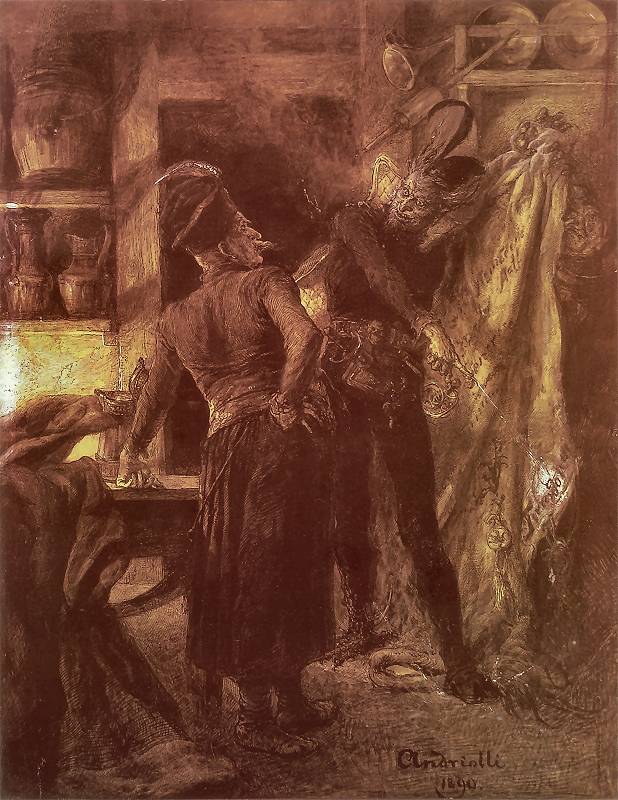 "You guys want me to sign what?" - Walter Gilman
Much like Faust, Gilman is coerced to sign a blood-pact with otherworldly forces. Although they are not actually demons, it is implied that beings like the Black Man and Azathoth served as humanities inspiration for beings like the Devil, or Mephistopheles. Gilman does not actually sign the book, but as we have seen, he does not need to physically sign anything to be drawn into the plot of Keziah, the Black Man, and Azathoth.
Again mustering his resolution, Gilman turned and dragged himself back to the sinister old house.
At this point, Gilman's quest for knowledge is beyond his control. Initially, he did anything possible to learn the secret if Keziah Mason, and non-Euclidean calculus. Now, his quest for knowledge is out of his control. The more he tries to flee from that which he once sought, the more he ends up running strait towards it.
Looking at Lovecraft: The Dreams in the Witch House (1933)
Here is a link that has all of my annotations on one page. Just make sure to click the post with this title (Looking at Lovecraft: The Dreams in the Witch House (1933)).
his slow fever did not abate.
Again, the more Gilman learns, the more his body deteriorates. His health will only continue to deteriorate as he learns more.
prisms, labyrinths, clusters of cubes and planes
Kubrick's *2001: A Space Odyssey seems to share a great deal in common with many of the themes present in Lovecraft's work. In this case, the double-edged sword of knowledge, which is both awesome, and dangerous.
Several times in the movie, mysterious alien technology spurs human evolution, implying that human intelligence and advancement is partly alien in origin. This alien technology also serves as proof that humanity is quite primitive in comparison to other beings in the universe.
Similarly, Gilman learned about non-Euclidean calculus, and traveling through vast distances of space and time, from the Necronomicon, an ancient book filled with knowledge from beings beyond human conception. This knowledge gained pushes his understanding of physics and reality beyond even the most brilliant scientists of his day.
Planck, Heisenberg, Einstein, and de Sitter.
In 1915 Albert Einstein published his theory of General Relativity and fundamentally changed how people understood space and time. As his theories were validated by other scientists, his popularity exploded into fame by the early 1920's, where he appeared in numerous news articles across the country. In December of 1930, "several thousand" New York citizens greeted his arrival at City Hall where he was awarded the "keys to the city of New York," a testament to the his widespread popularity in American culture. To a reader of Lovecraft, these names would serve to tie the story to real people and events, but also underline just how brilliant, and at the cutting edge, Gilman was.
Necronomicon of Abdul Alhazred
A frequent prop in Lovecraft's stories, the Necronomicon is the physical manifestation of all forbidden knowledge. Any who read the contents of this book, are eventually driven to madness by the knowledge, or results of the knowledge, contained in the book. By the start of this story, Gilman has already read from the forbidden Necronomicon, and he likely learned or intuited Non-Euclidean calculus from the book. There is, however, a price for his knowledge. Although he does not know it, by reading the book, Gilman entered a pact of sorts with the otherworldly beings who gave him knowledge. As a price, he will have to participate in their cultish rites late each Arkham night.
professors at Miskatonic had urged him to slacken up

A common undercurrent in Lovecraft's stories is the danger of pursuing too much knowledge, and this tale is no exception. Like the scholar Faust before him, Gilman is never satisfied with his current level of knowledge, and has an obsessive drive to keep learning, even if it will be his undoing. The more Gilman learns, the more his physical health deteriorates. Despite warnings from professors, friends, and others in the story, he continues to investigate the dark history of Arkham and the non-Euclidean geometry of his room, regardless of the danger.
Non-Euclidean calculus
On May 29th, 1919, Sir Arthur Eddington put Albert Einstein's theory of relativity to the test by measuring how the sun's gravitational field distorted the light from the stars during a solar eclipse. The results matched perfectly with Einstein's theory and his mathematical prediction, cementing Einstein as the foremost physician of his day.
Einstein was already quite famous by that point, and his ideas and mathematics were already being discussed quite frequently, both in the news and in popular culture. The following decades were no different, and newspapers would often print simplified explanations of his theories for the general public. For example, in 1923, the Los Angeles Times wrote the article, "Easy-Chair Science," briefly overviewing his theories, and his proofs. Eight years later, The New York Times was still publishing similar articles, like, "Einstein Expounds His View," providing an overview of his lecture at Oxford University. The general public just couldn't get enough of his theories.
Einstein's theory of relativity is built off the idea of non-Euclidean geometry, that is, geometry that measures curved surfaces. For a reader at the time this story was written, non-Euclidean wouldn't be such an unfamiliar term. Einstein's theory, that massive objects in space distort (curve) gravity, light, and time, was built off of non-Euclidean geometry, which measures the area and length of curved surfaces. For the average reader of the day, this line would likely place Gilman on the cutting edge of scientific study. It would also cement the fact that Gilman is quite brilliant, as he quickly understands and expands upon the theories of Einstein, a man held to be a genius in popular culture.
legend-haunted city of Arkham
Arkham is a fictional city in Massachusetts that, along with the local Miskatonic University, served as the setting for several of H.P. Lovecraft's horror stories. Arkham was often thought to be a stand-in for Salem Massachusetts, a fact that Lovecraft later confirmed in a letter to one of his fans F. Lee Baldwin. Indeed at the time this story was written, Salem was still playfully considered a "haunted" city in popular culture. Indeed in December of 1926 an opera, "A Witch of Salem" premiered in Chicago, and six years later, then President Franklin Delano Roosevelt would visit Salem during a Halloween pageant where several witches were "hanged."
The ridged, barrel-shaped centre, the thin, radiating arms, the knobs at each end, and the flat, slightly outward-curving starfish-arms spreading from those knobs
The being depicted belongs to the same alien race described in Lovecraft's longest tale, "At the Mountains of Madness." The professors at the Miskatonic University cannot identify the statue, placing this story some time before the group professors who encountered those aliens in the flesh returned from their tragic Antarctic expedition.
"At the Mountains of Madness" takes place in 1930/1931, and this story likely takes place around the year of 1927. (Keziah Mason disappears in 1692, and the building she once inhabited, where Gilman now lives, has been standing for 235 years)
Sometimes he and Paul Choynski and Landlord Dombrowski thought they saw that light seeping out of cracks in the sealed loft above the young gentleman’s room, but they had all agreed not to talk about that.
Again, Gilman is haunted and everyone knows it, but no one assists him, or acknowledges it. Do they fear repercussions from the supernatural? Do they fear the implications of admitting these supernatural occurrences are real?
Its rhythm did not correspond to anything on earth
Recently NASA has released recordings of Radio Emissions captured by the spacecraft Cassani. These recordings were captured in by planets like Jupiter, Saturn, and Neptune, and in interplanetary space. Of course, these radio emissions would not normally be in the audible frequency spectrum for humans, NASA sped up and "downshifted them downward by a factor of 44," giving us a taste of the unearthly rhythms Gilman may have been hearing.
He would be lying in the dark fighting to keep awake
Gilman's nightly experiences are eerily reminiscent of sleep paralysis the phenomenon when an individual's brain wakes up before their body has completely removed the paralysis of REM sleep. Normally, the body is mostly paralyzed while in REM sleep, to avoid the dangers of moving around while unconscious. Many people who experience sleep paralysis report both auditory and visual hallucinations. Indeed many cultures have name for sleep paralysis, and common hallucinations involve a "demon" sitting on one's chest, or an old woman. The hallucinations are shockingly realistic, and may be the source of many cultural depictions of ghosts and demons.
Book of Eibon
Lovecraft was friends with many of the science fiction writers who appeared in Weird Tales, including, Robert E. Howard, the author of Conan the Barbarian, Clark Ashton Smith, and August Derleth.
These writers often shared ideas and created a loose fictional universe with many overlapping references, and motifs. Not only did this create a vague sense of verismillitude for the reader of the magazine, who was suddenly seeing these books cross referenced by multiple authors, but it was a fun homage between friends.
The Book of Eibon, for example, was Smith's creation, while the unpronounceable Unaussprechlichen was Howard's invention. The Necronomicon meanwhile, appears in stories by Howard, Smith, Derleth and others.
earth is calling in her little ones
Reminds me of current pictures of Chernobyl, where many buildings, roads, and plazas have been "reclaimed" by nature and are now overgrown: https://www.theatlantic.com/photo/2016/04/still-cleaning-up-30-years-after-the-chernobyl-disaster/476748/
Mothers hardening like pounded stumps
This line always reminds me of steel mills and the giant presses and they have in there: https://en.wikipedia.org/wiki/Stamping_press
It brings up some questions too: Are people's dreams getting squashed by the difficulty of the labor or the death of manufacturing (which was happening in places like Detroit around the 70s)? Are people loosing their lives or limbs working in these dangerous factories? What toll does that have on the parents?
out of bus ride
The bus has a weird amount of symbolism behind it. From Rosa Parks, to commuters. to people complaining about Techie Busses, they can symbolize things that are good and bad.
For some reason, this line reminded me of how trolleys and cablecars used to be in place of bus lines and routes in the city. In the 50s/60s they started getting replaced by the busses we know today. This article has some neat insights about why trolleys and cable cars started disappearing around the USA: http://www.latimes.com/me-2003-los-angeles-streetcar-history-story.html
Out of burlap sacks, out of bearing butter,
Phil Levine explaining a bit about how/why he wrote this poem, and then reading the poem to an audience (2013)
Come they Lion from the reeds of shovels
I'm not too sure what this means. Are the reeds of shovels the handles of shovels? Is the lion some kind of product of work?
Earth is eating trees, fence posts, Gutted cars, earth is calling in her little ones, “Come home, Come home!
It seems like parts of the setting have been forgotten by people and are now becoming overgrown with vegetation. Interestingly enough, the land is reclaiming natural things like trees, and man-made things like cars and fence posts. How does this relate to the previous sections on industry?