4 Matching Annotations
  1. Jul 2022
    1. gave her no further audible greeting and offered her no hand

      went forward to open the door […] gave her no further audible greeting and offered her no hand: Mr Osmond’s manners are selectively applied in this paragraph. While seeing guests to the door was and still is a common courtesy, failing to greet and announce a new visitor to one’s home is notably impolite and improper. For Mr Osmond and his honouring of convention, this type of overlooked obligation is irregular – especially when those in his company are women to whom proper conduct must be even more carefully observed[1]. To a modern audience, it might be the same as overtly ignoring another, or offering some comparable insult due to temporary confusion or apathy. Moreover, James’ analysis of the social constraints imposed by this era is explored through manners, which serve as a proxy for the respect individuals in society are shown and their relative status[2]. In the case of Mr. Osmond and Madame Merle, for two characters so refined and mannered to forego their normal etiquette is highly unusual and suspicious. This is especially true because of the heightened symbolic importance of this interaction – greeting after an extended period of absence, and accepting entry into a home[3]. [1] Afsahi, Ilian. "The New World and the Old: Class, Gender and Manners in Henry James' The Portrait of a Lady and Edith Wharton's The Age of Innocence." (2013). [2] Schriber, Mary S. "Isabel Archer and Victorian Manners." Studies in the Novel 8.4 (1976): 441-457. [3] Ibid
    2. a young girl and two good sisters from a religious house

      a young girl and two good sisters from a religious house: The practice of educating children in private Catholic schools was popular among the upper classes of Italian society in the 19th-century. Specifically, as convents of nuns rapidly increased during this period, young women were sent to receive their education even throughout adolescence[1]. During this same period, however, the Italian government mandated four years of primary education through Law 3725 in 1859 and centralised Italian education in the Casati Law. Thus, at the time of the novel’s publication in 1881, there were increasing options for a child’s education in Italy. Mr Osmond’s subsequent decision to send his daughter the ruling-class route is revealing of his reverence for tradition. Indeed, the method of education involved in these schools would have contrasted with Henry James’ own second-hand experience of women’s education through his sister. Alice James was a teacher for the Society to Encourage Studies at Home, providing an education in history for women from 1873 to 1876. Not only was this a correspondence school, and therefore different to an intimate Catholic boarding environment, but it focused more on academics than polishing the mannerisms and habits of polite social interaction. [1] McAdam, Gloria. "Willing women and the rise of convents in nineteenth-century England." Women's History Review 8.3 (1999): 411-441.

    3. looked off behind, into splendid openness and the range of the afternoon light

      looked off behind, into splendid openness and the range of the afternoon light: The West-facing design of Mr Osmond’s villa is anachronistic in its 19th-century context. Though some Roman structures opted for West-facing windows that could be opened and regulate temperature in cooler months, during the time James wrote the morning sun was considered preferable[1]. It was far less intense and helped one get out of bed. Indeed, there is copious scientific evidence demonstrating the importance of directly exposing one’s eye to sunlight in the early morning as a way to wake up and begin work at sunrise[2]. Thus, West-facing houses symbolise the past in several ways. They look backwards, watching the sun sink below the horizon, and the end of a day or period. They also represent an out-of-date architectural style and logistical emphasis on keeping a house warm. Finally, they are constructed for the purpose of leisure. Though offering excellent views late in the day, this would overheat most after work and come at the cost of being woken up to attend to business in the morning. James therefore parallels the preferences of this house’s tenant – Osmond’s indolence and pre-occupation with antiquity and tradition. [1] Verticchio, Elena, et al. "Conservation risks for paper collections induced by the microclimate in the repository of the Alessandrina Library in Rome (Italy)." Heritage Science 10.1 (2022): Pp. 1-15. [2] Ode, Koji L., and Hiroki R. Ueda. "The Flow of Time Inside the Cell: The Time of Days Given by Molecules Driving the Circadian Clocks." Minorities and Small Numbers from Molecules to Organisms in Biology. Springer, Singapore, 2018. 135-143

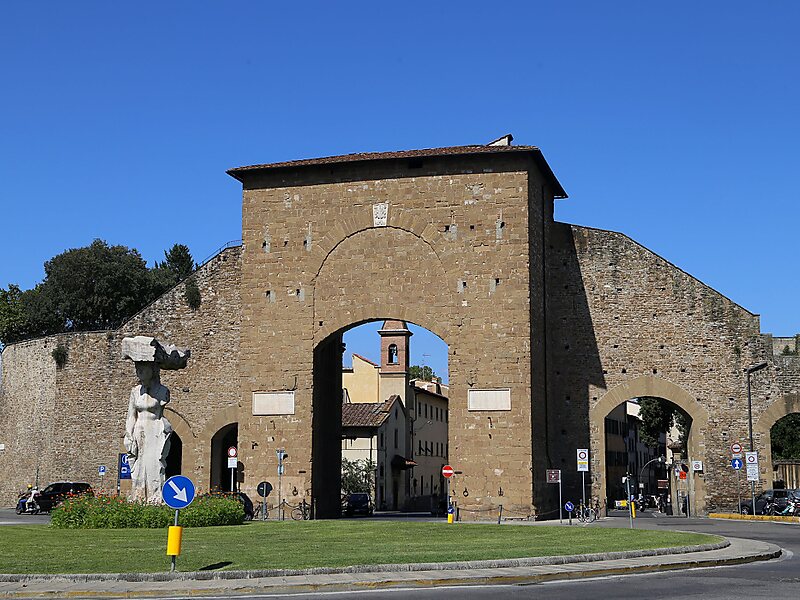
    4. outside of the Roman gate of Florence

      outside of the Roman gate of Florence: Locally known as the Porta Romana, this 13th-century historical monument was constructed to fortify the famous Italian city. It’s considered one of the foremost tourist attractions in Florence today. It boasts an impressive stone arc with a radius of approximately 2.5 metres, but more relevantly for James’ literary purpose, it has welcomed new peoples and civilisations throughout history[1]. Not only did it serve the Romans, but it remained in use and was even developed during the city’s time of Byzantine influence and independent rule. The gate’s complex history invites the international; a twenty-year-old Italian government now saw Americans such as Madame Merle and Isabel walk through it. It represents a literal threshold, beyond which Europe’s rich past could be accessed. Henry James himself wrote at length about other monuments and their capacity to encourage participation in a society’s history, even in the relatively brief chronicles of colonial America[2]. This gate therefore transports us into antiquity. Additionally, as a locus of foot traffic and site of historical reverence, the surrounding real estate was not pricey but still fashionable. This reflects Mr. Osmond’s own discerning taste and collecting instincts.<br /> [1] Hardie, Colin. "The origin and plan of Roman Florence." The Journal of Roman Studies 55 (1965): P. 138 [2] Follini, Tamara L. "Speaking Monuments: Henry James, Walt Whitman, and the Civil War Statues of Augustus Saint-Gaudens." Journal of American Studies 48.1 (2014): P. 25