10 Matching Annotations
  1. Jul 2017
    1. The Uninhabitable Earth

      There are many arguments in this article at the interface of climate instability, socio-political disruption, and general global security. They are, however, clumsily wrapped together and doesn't reflect well the actual risk posed by climate change.

      A general comment concerning the climate response to future carbon emissions- one of the emergent insights from decades of research is that linearity is too powerful of a tool to be abandoned lightly. In this context, it is better to think of future warming as smoothly monotonic in our total carbon emissions rather than behaving erratically due to significant non-linearities in the system.

      There is no evidence that a very abrupt methane source(s) will be readily mobilized into the atmosphere. Such scenarios are not supported by process studies, it is not emerging observationally, and is not borne out paleoclimatically (particularly in the mid-Holocene or Eemian interglacial, where high latitude summers were hotter than today). A small trickle of CH4 release is very plausible, but methane becomes converted to CO2 pretty quickly in Earth's atmosphere, and there's already some 200 times more CO2 in the air than CH4. These types of carbon cycle feedbacks will likely give the direct anthropogenic carbon input just a small boost in the near future.

      Similarly, it's not obvious that there are any significantly missing feedbacks that should radically alter the linear perspective (certainly, any under-representation of surface albedo feedbacks in current models are unlikely to be the difference maker, since the polar regions make up a very small percentage of the globe and the surface contribution to the planetary albedo is somewhat masked by clouds).

      A Younger Dryas event today would likely be quite disruptive (the global mean temperature changes were quite modest, but the extratropical temperature re-organizations would still be significant); however, the processes leading to an event like this are pretty unique to a glacial climate undergoing melting, and is unlikely to occur in a warming world during our present interglacial.

      Actual numbers are important here. The global temperature increase could indeed reach 4-5 degrees by 2100, if humans don't do anything to our emissions, and beyond this patches of uninhabitable areas (for humans) could start to open up in the tropics, due to heat stress limits imposed by the evaporative limits of our body. Indeed, a world 5+ degrees warmer is a big cause for alarm, even if the world takes a linear path to that mark. The world also does not end in 2100, and while it is tempting to think of later dates as "very far off," it is worth reminding ourselves that we would live on a different planet had people of the Viking era industrialized and emitted carbon uncontrollably.

      Nonetheless, the near future climatic fate of New York probably looks more like the climate of South Carolina or Georgia than something from a Mad Max movie. This is still an important basis for concern given that the socio-political infrastructure that exists around the world is biased toward the modern climate.

      Many of the nightmare scenarios in this article, such as no more food, unbreathable air, poisoned oceans, perpetual warfare, etc. are simply ridiculous, although food security is indeed an issue at stake (see David Battisti's comments). A "business-as-usual" climate in 1-2 centuries still looks markedly different than the current one, but there's no reason yet to think much of the world will become uninhabitable or look like a science fiction novel.
  2. May 2017
    1. Historically, increases in atmospheric CO2 followed increases in temperature, they did not precede them. Therefore, CO2 levels could not have forced temperatures to rise.

      This is both false and irrelevant.

      Claims that "CO2 led temperature in the past, therefore cannot have caused it to rise" originated over a decade ago from a misrepresentation of ice core research (that itself has been subject to significant refinements in dating). It was based on the fallacy that since other factors influence climate (in this case, changes in the Earth-Sun geometry) and that the carbon cycle is affected by climate, the converse cannot be true. Of course, this is not logically coherent, and in practice is wrong since the radiative effect of CO2 is well-established. Indeed, CO2 would not be expected to fluctuate on its own 100,000 year timescale on its own, independent of the climate.

      In fact, more recent research (e.g., Shakun et al. shows that CO2 still led global temperatures and the full deglacial process, unlike in older literature that examined only Antarctic sites.

      CO2 has also "led" global temperature on geologic timescales, and is largely responsible for how Earth's temperature evolved over the last 50 million years. There are many ways to change the partitioning of carbon between the Earth and atmosphere, and how this happens is not relevant for the fact that if more CO2 is in the atmosphere, the planet will get warmer. Today, however, the excess source of carbon to the atmosphere is from humans.

  3. Mar 2017
    1. One of the most troubling ideas about climate change just found new evidence in its favor

      A general comment about everything here-

      The relevant framing concerning this work is not in gauging its "credibility," since the research is sound and at the frontier of our knowledge of the topic. It will not, however, be the last word on the subject.

      The subject of how climate change affects mid-latitude weather at the synoptic scale (roughly the scale of ~1000 kilometers, i.e., smaller than the tropical scale circulation such as the Hadley cell, but much larger than a tornado for instance) is complex for a number of reasons.

      One of which is that these are some of the "noisiest" regions on the planet, somewhat less so in summer than in winter, but still subject to considerable internal variability. Therefore, for problems at the synoptic scale, it is often the case that initial condition uncertainty is of more importance than the expected forced component. Indeed, it is well known that 50 realizations of weather in a suite of model runs will not be in phase with reality's weather, but even decadal trends in dynamical aspects of the mid-latitude atmosphere may differ among the 50 individual members of the model ensemble.

    2. I do not believe that this theory is fully developed or that the implications have been fully explored, but I do think that Mann et al.  study is a very good start.”

      I agree with this. There are many competing components involved in how the jet stream will change in the future, and changing pole-to-equator temperature gradients is just one (in fact, the pole-to-equator temperature gradient increases near the tropopause, complicating the physics). Elizabeth Barnes and James Screen have a good essay here that serves as a useful entry point into these complications.

    1. Yet for all the hyperventilating, Pruitt’s answer to the question he was asked — whether carbon dioxide is the climate’s “primary control knob” — was entirely sound. “We don’t know that yet,” he said. We don’t. CO2 is certainly a heat-trapping greenhouse gas, but hardly the primary one: Water vapor accounts for about 95 percent of greenhouse gases. By contrast, carbon dioxide is only a trace component in the atmosphere: about 400 ppm (parts per million), or 0.04 percent. Moreover, its warming impact decreases sharply after the first 20 or 30 ppm. Adding more CO2 molecules to the atmosphere is like painting over a red wall with white paint — the first coat does most of the work of concealing the red. A second coat of paint has much less of an effect, while adding a third or fourth coat has almost no impact at all.

      This paragraph is a mixture of irrelevancy and error.

      First, it is true that water vapor constitutes the bulk of Earth's present-day greenhouse effect (measured in terms of infrared absorption). Quantitatively, however, Jacoby is off by quite a bit. In fact, water vapor constitutes ~50% of the terrestrial greenhouse effect, not 95% (see here). Clouds (solid and liquid water that form when the vapor condenses) constitute another ~25%, but CO2 contributes to almost all of the remaining fraction (only ~5% or so from all of the other combined gases). This is because CO2 still absorbs well in spectral regions where water vapor doesn't, and also because the upper troposphere is very dry; the ability to absorb intense surface emission and re-emit it at colder, higher layers of the atmosphere is critical for the maintenance of a planetary greenhouse effect.

      Secondly, the water vapor greenhouse effect is not independent of the CO2 in the atmosphere (see next reply).

      Jacoby stresses that CO2 is only a trace component of the atmosphere, an argument that is irritatingly unoriginal and provides useless context when describing the flow of radiation through the atmosphere. As before, CO2 accounts for ~20% of Earth's greenhouse effect. N2 and O2 account for nearly all of Earth's atmospheric mass. However, if the atmosphere were purely N2 and O2, the planet would likely be in a snowball state due to the lack of greenhouse trapping. This is where the equations of radiative transfer must be applied, rather than a naive intuition about proportions.

      Finally, Jacoby emphasizes the logarithmic nature of how CO2 affects the energy balance of Earth, and hence surface temperature (i.e., going from 10 ppm of CO2 to 11 ppm would have a much larger impact than going from 300 to 301 ppm). This is correct, but has been known for well over half a century now, and is fully accounted for in even simple estimates of future warming. This is therefore a distraction.

      • chris colose
    2. There is a popular theory that atmospheric CO2 amplifies the creation of water vapor, thereby increasing warming through a “positive feedback loop.” But that theory so far is mostly speculative; climate projections using models based on it have consistently failed, nearly always predicting far more warming than has occurred. It should go without saying that if scientists cannot yet make accurate predictions about future climate change, then their understanding of climate science remains highly incomplete.

      Jacoby discusses the so-called water vapor feedback, in which warming caused by CO2 (or anything) results in more water vapor in the atmosphere, increasing heating. However, his discussion is confused.

      First, models are not based on a water vapor feedback. Such a feedback is result, not an assumption. There is no FORTRAN code written that tells a model to increase the water vapor concentration when the CO2 is going up. However, there is incredibly well-established thermodynamics assuring us that a warmer atmosphere can theoretically hold more water vapor.

      This doesn't mean it will--- after all, deserts are very hot, but not very moist. This is because atmospheric dynamics (especially the rising and sinking motions of air) keep most of Earth's atmosphere beneath its maximum vapor holding capacity. However, it turns out that observations and complex models (as well as more simple theoretical work) suggest that this degree of "subsaturation" (or relative humidity) doesn't change much, so the actual water vapor concentration still goes up in a similar way that it would if it just behaved like a simple thermodynamic equation (see e.g., here and here and here). Indeed, this has been a robust result going back to at least the 1960's in observational and model-based syntheses of the problem, and is now very well understood.

      Indeed, CO2 is the fundamental control knob on Earth's climate over relatively long timescales, since the water vapor concentration is shackled to temperature in a very fundamental way, because the Sun's output does not change very much except on geologic time intervals, and because CO2 is the principle non-condensing greenhouse gas capable of changing in response to geologic (or anthropogenic) sources and sinks on climate timescales. -chris colose

    3. The list of variables that shape climate includes cloud formation, topography, altitude, proximity to the equator, plate tectonics, sunspot cycles, volcanic activity, expansion or contraction of sea ice, conversion of land to agriculture, deforestation, reforestation, direction of winds, soil quality, El Niño and La Niña ocean cycles, prevalence of aerosols (airborne soot, dust, and salt) — and, of course, atmospheric greenhouse gases, both natural and manmade. A comprehensive list would run to hundreds, if not thousands, of elements, none of which scientists would claim to understand with absolute precision.

      The basic argument in the remainder of the article is one of 'complexity' and the notion that climatologists cannot perfectly understand thousands of variables, and hence the behavior of the system under investigation.

      Jacoby is not completely wrong- climate is extremely complex, and poses no shortage of interesting research questions.

      However, it is sometimes difficult for non-specialists to appreciate the emergent simplicity that can arise in an incredibly complex system. After all, how do we know summer will be warmer than winter, that the top of Mt. Everest is colder than the base, or that Arizona is expected to be on average drier than Florida, or that the equator ought to be hotter than New York, or that the climate will cool following a large volcanic eruption?

      These statements are not just based on prior observations, but in fact can be predicted by applying fundamental equations to a rotating planet. Part of the beauty in studying atmospheric science is in gaining an appreciation for where complexity is counterbalanced by an almost eery predictability, much like how the outcome of a single spin in roulette is hopelessly unpredictable (and certainly influenced by every slight detail at the time the dealer releases the ball), but casino's have no problem with such complexity because the statistical behavior of the roulette wheel is well-posed. Similarly, the statistical behavior of the atmosphere, while unsolved, is not actually that complex.

      The appeal to complexity is a compelling one. Nonetheless, progress has been in many complex sciences (astrophysics, geology) in which the system under investigation cannot be experimentally isolated, and yet where so much is known.

      However, it turns out to be incredibly simple to rule out El Niño, volcanic eruptions, soil quality, sunspot cycles, plate tectonics, etc. to the trend in global temperatures since 1950. Just as geologists can inform you of the glacial history of a region, sometimes with little more than a trained eye, CO2 leaves behind "fingerprints" in the atmospheric warming that other "forcing agents" do not.

      Another perhaps surprising component is that this result is not extremely sensitive to unknown variables. Suppose, for example, that the Andes mountains were abruptly flattened. This would almost certainly important aspects of the global and regional climate, but many of the critical phenomena of the climate system (e.g., that the equator is wet where air rises, that storm tracks develop in the mid-latitudes, the presence of a jet stream, etc) would still remain. Furthermore, adding CO2 to a "flat-Andes hypothetical Earth" would still result in warming. It's physics, and it's unavoidable.

      It is true that the exact magnitude of future warming, even if we knew future carbon emissions perfectly, is still not known to within even 10%. However, that uncertainty range does not overlap with "very little warming" or "make the planet uninhabitable warming." In any case, if one's argument is based on how complex the system is, surely perturbing that complex system is not something they ought to advocate for!

  4. Jan 2017
    1. “It is the second year in a row that the annual global temperature has been more than 1 Celsius degree higher than the pre-industrial level, and shows that the world is moving ever closer to the warming threshold of 1.5 Celsius degrees, beyond which many scientists have concluded the impacts of climate change will be unacceptably dangerous,” said Bob Ward, who is director of policy and communications director at the Grantham Research Institute on Climate Change and the Environment, part of the London School of Economics and Political Science.

      It is important to stress that 'targets' for global temperature, while politically useful, do not represent a magical physical threshold; the impacts are not minimal at 1.49 C and catastrophic at 1.51 C. Rather, the impacts will grow for each new degree of global warming.

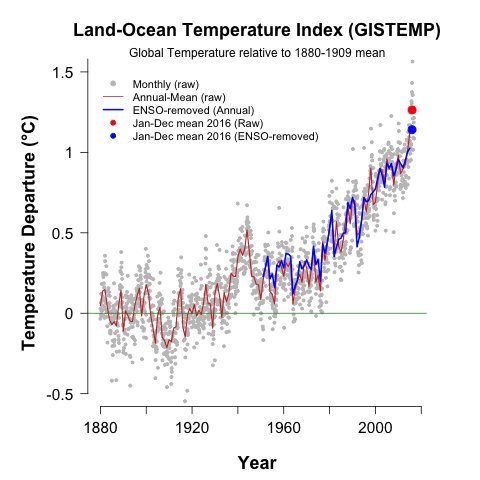
    2. “This El Niño might have contributed about a quarter or a third” of the record in 2016, said Deke Arndt, chief of the global monitoring branch at NOAA’s National Centers for Environmental Information, on a press call Wednesday.

      I find this part confusing. The "percentage of the anomaly" caused by El Nino depends of course on the anomaly, which depends on the baseline. So it's not really a useful number. El Nino caused a much larger fraction if you only look at a very recent baseline (e.g., just compare to 2014-15). A more straightforward number is the 2016 anomaly relative to what it would have been if ENSO were in a neutral phase. I calculated this to be ~0.13 C (0.23 F).-chris colose

    3. 58.69 Fahrenheit

      This absolute number may be the nominal value used by one agency, but we don't know Earth's absolute temperature to within even a degree accuracy. This is why we typically deal with anomalies- the length scale of weather patterns on Earth is such that anomalies are communicated over rather large distances, allowing for more robust estimates than the absolute value itself.-chris colose