Cycling should mean a fitter population and a longer life expectancy, which would take pressure off the National Health Service and bring huge economic benefits. It would of course also reduce energy consumption.
the advantages of cycling
Cycling should mean a fitter population and a longer life expectancy, which would take pressure off the National Health Service and bring huge economic benefits. It would of course also reduce energy consumption.
the advantages of cycling
By the late 1850s the scale of the city was making things worse: London’s sewage was deposited into the River Thames, out of which the city’s drinking water was being collected. Bazalgette’s solution was to construct a series of sewers that would run parallel to the Thames, both north and south of the river, collecting the sewage and ensuring the drinking water that was drawn from the river was clean.
Joseph Bazalgette solve the problems about the pollution of the River Thames.
Joseph Bazalgette
the tabula rasa model
An Act of Parliament was passed that introduced building inspectors to ensure that buildings be built from brick and not timber (a law which predated the fire, but that hadn’t been enforced). Of course, the fire and resulting devastation meant that much of London had to be rebuilt, and that these buildings would be brick.
the building of London since 1667 are not using timber anymore.
the Great Fire of 1666
The Great Fire of London was a major conflagration that swept through the central parts of the English city of London, from Sunday, 2 September to Wednesday, 5 September 1666.
However, the real question is: will cycling actually change the city? Will it result in new urban forms or, as the title of Australian academic Dr Steven Fleming’s new book predicts, a “Cycle Space”? Like Fleming, I believe so. I believe that cycling might just be the catalyst for a 21st Century urban renaissance.
Try to using cycling to change the social atmosphere.
Boris Bike
The scheme's bicycles are popularly known as Boris Bikes, after Boris Johnson, who was the Mayor of London when the scheme was launched. The operation of the scheme is contracted by Transport for London to Serco. The scheme is sponsored, with Santander UK being the main sponsor from April 2015.
Denise Gonzales Crisp, Chair of Graphic Design at the College of Design, North Carolina State University, shared “[Look at] salary discrepancy between males and females in education. Almost every institution I’ve looked at, the women earned on average anywhere from $5,000 to $10,000 less in the same positions [held by men]. So that inequality we experience generally out in the world is also reflected in education.
The serious problems are not only on the education, are also on the salary.
“Not enough women designers are given the recognition that they deserve,” says graphic designer Antonio Carusone. “Take for example Jacqueline S. Casey. She is primarily responsible for bringing the International Typographic Style to the US, and her work is just as brilliant as Muller-Brockmann’s, Crouwel’s, Ruder’s…. But for some reason, her name is left out most of the time.”
Women designers didn't have lots of respect from the society.
Hitchcock adds, “Why does design history still teach about male designers 80% more than women designers? Why do we have 80 % women in the student body (in our [RISD] department) and 80% men in the faculty?”
why does the unevenly-distributed gender proportion have different?
There is a line of forgotten women in our history. I argue that sexism is somewhat less obvious in our workplace today, far subtler than it might have been in the 1950s and 60s, but perhaps we still accept some mores of old, underlying currents that flow through our design culture, much like that lecture in 2011.
Now there is still gender discrimination, but it is better than 1950s and 1960s.
Forty or fifty years ago, the workforce was overwhelmingly a man’s world. In the design field, many women may have been assistants or “office girls” and so few held the top titles, such as art director or creative director. In a basic sense, women’s careers have rarely followed the same path of men’s, since there has historically been immense pressure placed on women to be solely homemakers and nurture families
There is the Patriarchal society。
three hundred and twenty-three independent designers listed — twenty-two women.
There are only a small percentage of girls in the lecture course at design school.
It is often discussed, academically and informally, that the presence of female designers missing from the history of graphic design is a sore oversight of the profession. And while we can claim more progressive (and equal) laws and beliefs in present day society, the disparity between male and female representation in design lingers on. But why is retrospective accreditation important? And if it is getting better, do we need to keep talking about it? Tori Hinn, of Women of Graphic Design, talks through some of the issues facing women in the past, and regrettably, in our industry today.
this paragraph let us know about the different about the disparity of male and female.
“The Three Girls,” which Leyland had commissioned but which Whistler never completed. (A tantalizing oil sketch and figure studies for the proposed masterpiece are among the Freer’s many Whistlers, the largest representation of his work anywhere.) The mural is both funny and gorgeous, but its expression of personal pique disrupts the room’s serenity like a street noise in the night.
People have a different opinion about this work.
Peacock Room,
The Peacock Room is James McNeill Whistler's masterpiece of interior decorative mural art. He painted the panelled room in a rich and unified palette of brilliant blue-greens with over-glazing and metallic gold leaf.
Nearly all the most adventurous artists in Whistler’s generation responded avidly to Japanese aesthetics.
the artists are more interest about japanese aesthetics.
The Princess from the Land of Porcelain”
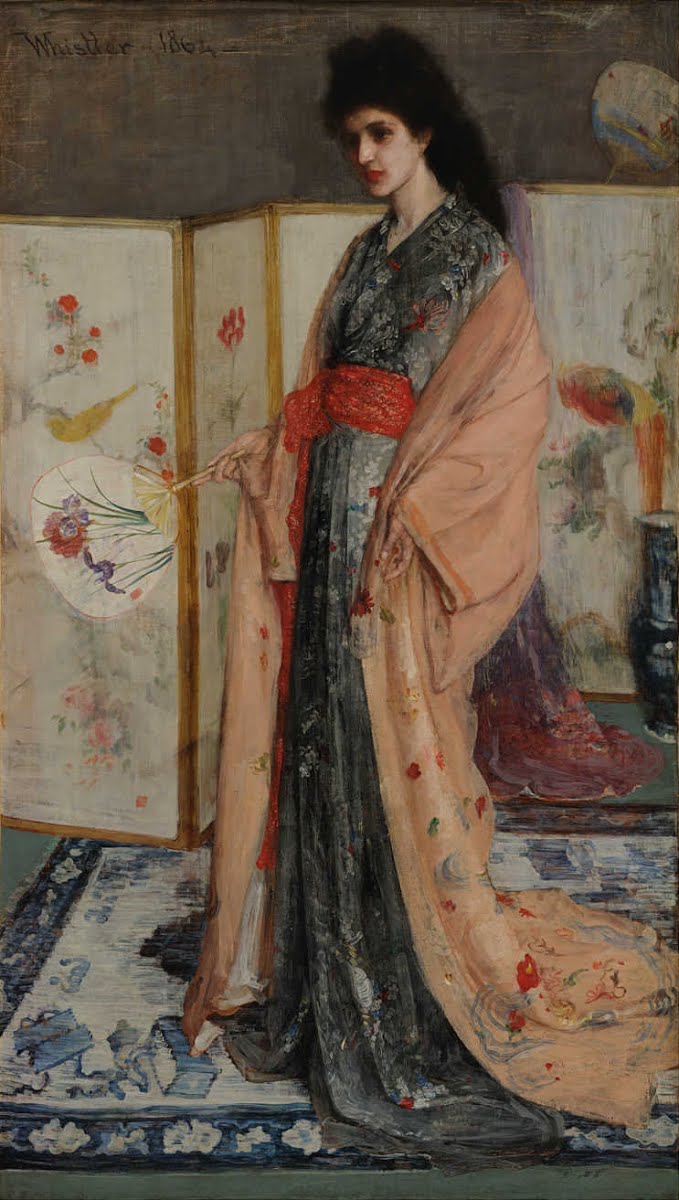
Symphony in Flesh Color and Pink

James McNeill Whistler
The reasons why people still going to shopping mall is the online shopping you can't feel and touch the items or even see it.
“In the mid-century, convenience was defined as a place to shop within your town, within a 5- or 10-minute drive from your house,” Wood says. “Whereas our notion of convenience now is not leaving our houses. These ideas of self-sufficiency and self-service have been pushed so far that you go on Amazon and you just say, ‘This is what I want.’ Amazon says, ‘Okay, here’s everything we have that matches that description,’ and then you choose. In actuality, I think Amazon is highly inefficient if you don’t know what you’re buying because you don’t have anyone to help you and say, ‘No, actually, this is better than that.’ Today, we shop as if we know about everything that we’re shopping for, but in the mid-century, you trusted that your department store was going to sell you something that was good.”
The consumer can browse more quickly than strolling down the aisles, and can do so 24 hours a day, without ever having to head to the mall. But the experience is far from perfect, and I’m not talking about the obvious downsides, like that you can’t try something on if you’re only looking at it on a computer screen.
elf-checkout debuted in 1992, just a few years before the World Wide Web made online shopping widely accessible to everyone. Amazon and eBay, both launched in 1995, taught us to be even more self-sufficient shoppers—at this point, the two Internet giants offer everything you’d find at Wal-Mart and more. O
online shopping become popular bring about Amazon and Ebay become two internet giants.
“In the 1950s and ’60s, you see this shift where shopping becomes a pastime and a hobby, especially in the suburbs,” Wood says. “The mall would have the grocery store, a liquor store, a pharmacy, a bakery, and then your department stores. You could drive there, take your little children around in a carriage, and spend the whole day there because there would be at least one restaurant in the department store.”
shopping mall change the mode.
n addition to the escalators and new forms of lighting, new department stores featured another marvel of modern technology: central air. The heating, air-conditioning, and bright lights eliminated the need for windows, so in the 1950s and ’60s, stores without windows were built inside new shopping malls.
Using infrastructure such as air conditioning to attract customer.
“Escalators have this weird history of being thought of as low-brow,” Wood says. “I’ve seen multiple references to the fact that women of a higher class did not want to use escalators.
The 50s people's concept and the contemporary people's concept are not the same.
For example, Loewy employed a combination of incandescent and new fluorescent lighting, as well as spotlights, to emphasize particular items for sale. Wood says, “he created an atmosphere where people’s eyes would feel relaxed, and they could be directed towards certain products.”
Lighting design influence customer.
Because the experience of the design was such a priority, clothes and accessories were displayed in flat glass cases on rosewood stands or on live mannequins so that hanging racks wouldn’t interfere with the view.
Department stores using lots of innovative designs to develop themselves.
Of course, markets and bazaars featuring different vendors selling a variety of goods existed long before the department store. The big difference was at a department store, all the individual shops belonged to the same business, so they had consistent policies. (To small-time shopkeepers, these new department stores threatened their livelihood the way Amazon upsets brick-and-mortar retail today.)
The individual shops have been impact, they try some way to solve this problem.
“In the mid-century, Americans were wanting and buying more,” Wood says. “In response, the department stores offered and displayed more, like the same purse in five colors.
Needs of the market, so the shopping mall is introduction of a large number of products.
And Loewy’s plan wasn’t just about how shoppers experienced the space, but how the stores could more efficiently sell their merchandise.”
Loewy want to using design to influence consumer.
Raymond Loewy
Historians often talk about Loewy as the designer of the modern world, thanks to objects like the Coke bottle and Lucky Strike pack. His reach extended from one of IBM's card punchers to three massive cargo ships, from sewing machines to NASA habitats.
As the Computer Age thrusts us into the future, would-be mall rats are spending all their time on Facebook, and the breath-taking range of products, once so meticulously displayed for our delight, is being crammed into our PCs, tablets, and smartphones.
As the rapid development of computer technology, online shopping has become easy to operate.
About 20 percent of the 2,000 largest U.S. malls were failing in 2008, and by 2012, only 1,513 remained in operation. Current numbers predict more than 200 existing big malls will collapse in the next 10 years.
Using data to support the main idea.
The once-vibrant shopping mall has one foot in the grave these days.
It is main idea that is means shopping mall have been facing a crisis.
