SANDBURG
This lone word in all caps stands out from the rest of the poem; but, not sure what it's doing here ...
SANDBURG
This lone word in all caps stands out from the rest of the poem; but, not sure what it's doing here ...
“She jes’ catch hold of us, somekindaway. She sang Backwater Blues one day:
“somekindaway” is a fascinating word. Linguistically I guess it’s an example of compounding. And this word is clearly more accepted in an African American dialect than in “standard” English. But that’s kind of a shame ...
O Ma Rainey, Sing yo’ song;
Brown calls out to Ma Rainey in the same way that Hughes calls out to the blues:
"O Blues! Swaying to and fro ... "
The fiction is that the life of the races is separate and increasingly so.
Locke may have been a bit idealistic here. He seems to have underestimated how much different races were in fact going to want to stay separate, and the lengths some would go to in order to achieve that end.
In this new group psychology we note the lapse of sentimental appeal, then the development of a more positive self-respect and self-reliance; the repudiation of social dependence, and then the gradual recovery from hyper-sensitiveness and “touchy” nerves, the repudiation of the double standard of judgment with its special philanthropic allowances and then the sturdier desire for objective and scientific appraisal; and finally the rise from social disillusionment to race pride
The references to self-respect and race pride do seem to be similar to what Hughes has in mind. But Locke is also interested in staying positive and repudiating judgement. The two writers appear to be somewhat different in tone.
And many an upper -class Negro church, even now, would not dream of employing a spiritual in its services. The drab melodies in white folks’ hymnbooks are much to be preferred.
Hughes prefers and advocates his for own culture. But he also seems to hold negative views of the "drab" culture of white people. Locke appears to have a different approach when he advocates for a race pride that is a "more positive achievement than a feeling based upon a realization of the shortcomings of others."
Don West, “Southern Lullaby”
It’s highly ironic to call this poem a “lullaby.” The genre (if it can be called that) of the lullaby is usually understood to be simple but also soothing. And while the poetic structure of these lines is indeed simple, the content is anything but soothing. By the end of this “lullaby” the poet is openly advocating for the “little baby” to “hate deeply.” This poor child is going to need a therapist someday. So this approach would appear to be a subversion of an established form for a different end than that form is really intended. And that seems like a “modern” approach.
I am Ivan, the peasant
Hughes uses different voices and personas throughout this poem and that approach feels similar to Eliot’s use of multiple voices in “The Wasteland.” Eliot perhaps goes a bit further, incorporating multiple languages to express many of his different voices, but the overall approach of fracturing the poetic voice into voices seems familiar.
the image looms and casts a huger image on the growing screen, projection of our lives and struggles.
I’m not certain exactly what the poet is trying to say about images here; nevertheless, his emphasis on the idea of “the image,” and the importance it seems to play as it “looms” and projects, does remind me of Ezra Pound. Pound also stressed the importance of poetic images.
Datta: what have we given?
The first of three Sanskrit terms. Datta is later followed by Dayadhvam and Damyata. Perhaps Eliot, or the Thunder, is trying to impart a spiritual teaching. But it's interesting that "foreign," or "eastern," sources would be chosen for that message. One does not encounter terms like "Datta," "Dayadhvam," and "Damyata" in the Bible.
And bats with baby faces in the violet light Whistled, and beat their wings And crawled head downward down a blackened wall And upside down in air were towers Tolling reminiscent bells, that kept the hours And voices singing out of empty cisterns and exhausted wells.
Bats join other dubious sources of sound. In this case they seem to remind the poet of village or city (church) bells and singing voices. But the voices, like the other sound sources in this section, arise from the "empty" and the "exhausted."
Shantih shantih shantih
The poem ends with what I believe are more Sanskrit words: an invocation of Peace. "Shanti" shows up at the end of some Indian (sanskrit) prayers, so it may be similar to "amen." But in that case, why put it at the end of this poem?
the grass is singing Over the tumbled graves
Thunder crashes in the distance without bringing water and (dry) grass sings in a graveyard. All of nature's sounds seem to indicate a loss, a disappointment, or a failed expectation in some way.
What the Thunder Said
Speaking, singing, or just creating sound in some way comes up a lot in this section. But there often seems to be something odd about the manner or origin of the sound. Thunder is speaking. Or, later, grass is singing.
And I will show you something different from either Your shadow at morning striding behind you Or your shadow at evening rising to meet you;
The shadow may echo the idea, later in the stanza, of something "neither/Living nor dead".
I see crowds of people, walking round in a ring.
"Crowds," or a "crowd," come up in this line and also in the next stanza. Here there are crowds of people apparently walking around in a circle. And later: "A crowd flowed over London Bridge". The crowds may reference "the Dead" in the name of this section of the poem.
stirring Dull roots with spring rain.
"Roots" are brought up more than once in this section. In the next stanza, Eliot writes: "What are the roots that clutch, what branches grow/Out of this stony rubbish?" Perhaps Eliot does this to emphasize his theme of Spring.
Brightness.
Odilon Redon
French, 1840-1916
The Light of Day (Le Jour),
Plate VI from Songes, 1891
lithograph, 8 1/4 x 6 1/8 (M 115).
Mere colors.
Robert Delaunay
French, 1885-1941
Window on the City, No. 4
(Les Fenêtres sur la ville), 1910-11 (1912)
oil, 44 3/4 x 51 1/2.

Do I make faces like that at you.
Alexander Archipenko
American, born Russia, 1887-1964
Salomé, (1910)
cement, 36 high.

Thimble of everything.
Wassily Kandinsky
Russian, 1886-1944
Improvisation No. 27 (Garden of Love), 1912
oil, 47 3/8 x 55 1/4.

“This is just to say” (1934)
Williams was from New Jersey. He wrote a poem about the NJ city of Paterson. The 2016 movie of the same name remembers him:
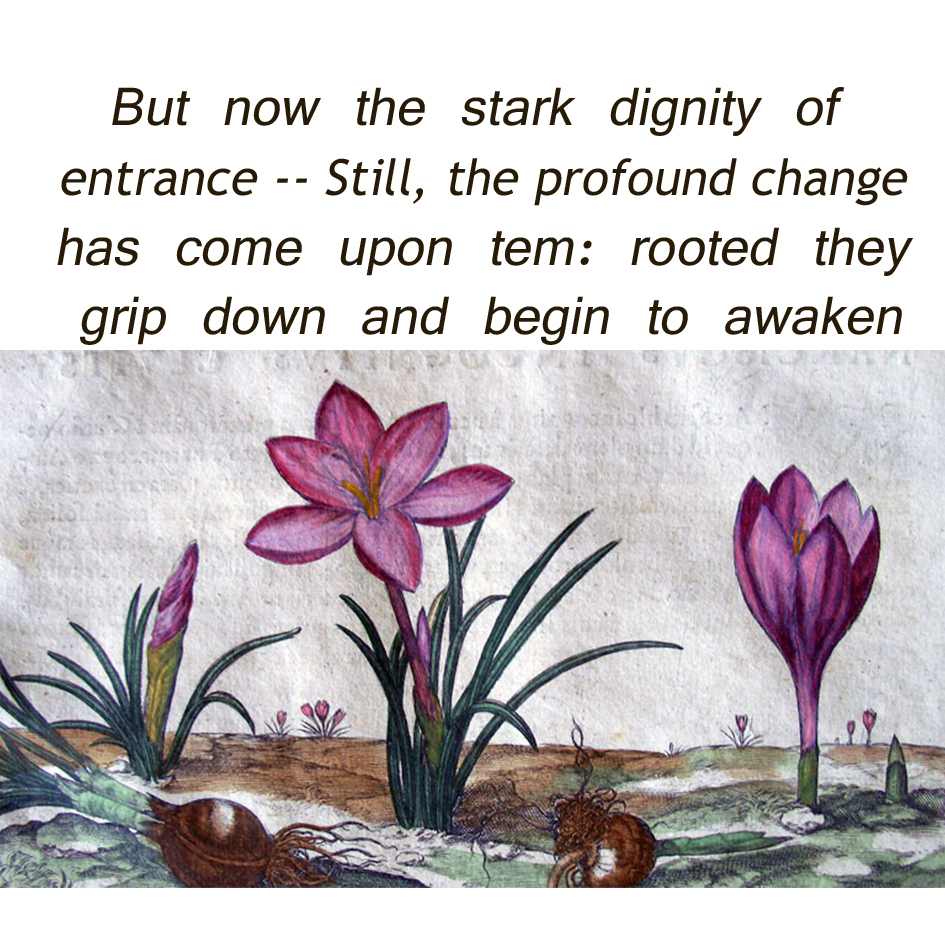
But now the stark dignity of entrance—
An artistic interpretation of the this verse:
the icebox
What did an ice box look like in the 1930s? And how did it work? Apparently, they really did, more or less, put ice in a box ...

Criticism is not a circumscription or a set of prohibitions.
I do not know enough about the art of criticism to judge this comment; but, I can say that I find it ironic for Pound to make this statement just a few paragraphs after offering some circumscriptions and a set of prohibitions.
(His three principles listed above)
As regarding rhythm: to compose in the sequence of the musical phrase, not in sequence of a metronome
Sounds like Pound may not have liked a poem like “Stopping by the woods on a snowy evening.” The iambic tetrameter there is unrelenting.
To use absolutely no word that does not contribute to the presentation.
This strikes me as a potentially problematic and possibly irksome recommendation. Pound does comment later on some concrete criteria for determining excess word usage (such as not mixing an abstraction with the concrete). But, in general, it would ultimately seem to be a largely subjective determination. Who is to say what words are, or really are not, contributing to a presentation? In some cases that may indeed be obvious but in most instances I suspect it would largely just come down to a personal judgement call based on individual tastes. I would probably be on the side of excessive word usage myself, as demonstrated in this paragraph.
It well may be that in a difficult hour, Pinned down by pain and moaning for release, Or nagged by want past resolution’s power, I might be driven to sell your love for peace,
Similar to a Shakespearean style of sonnet, the first eight lines contain some ideas (about Love) and then, starting with the ninth line, the thought process starts to develop towards a potential conclusion. At this point, the poet is getting tired of all the trouble and suffering of Love and is ready to give it up, or "sell" it, for some peace of mind.
No memory of having starred Atones for later disregard, Or keeps the end from being hard.
From Shakespeare’s Julius Caesar:
"The evil that men do lives after them; The good is oft interred with their bones."
And, honestly, it’s quite a comment for our present moment where we seem willing to toss a person’s entire life away over an allegation.
Then took the other, as just as fair, And having perhaps the better claim, Because it was grassy and wanted wear; Though as for that the passing there Had worn them really about the same,
I think this is the passage that creates a lot of the ambiguity about this poem. Was there really a road less traveled or wasn’t there? At this point in the poem, Frost is pretty clear (about as clear as he gets) that the two paths are “really about the same” (whatever that means). But at the end of the poem he states that he did take a path that was less travelled. So which is it? Were the two roads the same or was one less traveled than the other? I’m not sure, but I wonder if this doesn’t touch upon themes of memory. Are we really certain how accurate our recollections are? What really constitutes the truth of a situation, a story, or a memory? I don’t know, but I’m inclined to take the poet’s word for it at the end that he really did find a less traveled path. I simply like that ending better, so I’ll go with it.
He moves in darkness as it seems to me, Not of woods only and the shade of trees.
What a great line. I can think of quite a few people who move in darkness, “as it seems to me.” We probably all could. In fact, sometimes I get the feeling that I’m related to a few such people. But what exactly is Frost getting at with this neighbor in particular? The neighbor seems to be the type that doesn’t think things through carefully; or, maybe he doesn’t think much at all. Hence, the darkness. He repeats his phrase about good fences making good neighbors without thinking to examine its significance as Frost tries to do.
Enjoying, working, raising the twelve children, Eight of whom we lost Ere I had reached the age of sixty
This is an interesting window into the times being written about. I suspect that in every day and age we tend to focus on the negative and that may in fact be a perfectly reasonable thing to do. Identifying our problems helps us to solve them. But, on the other hand, I think we often lose perspective on how far we've come. There aren't all that many places left in the developed world where a mother of 12 will lose 8 of her children. That doesn't mean we live in utopia, but it is something to appreciate.
Seeds in a dry pod, tick, tick, tick, Tick, tick, tick, what little iambics, While Homer and Whitman roared in the pines?
I like the shout-out to Whitman. I believe Walt Whitman is considered to have been quite an original poet. His style and topics were unusual for their time and earned him quite a lot of scorn (as well as a little praise from the likes of Emerson). E.L. Masters seems to be comparing standard poetry to inconsequential noise (like seeds in a pod) whereas poets like (Homer and) Whitman were equivalent to a much greater roar in the pines.
The weary throat gave out, The last word wavered, and the song was done. He raised again the jug regretfully And shook his head, and was again alone.
The full name of the character in this poem is given in the first line: Eben Flood. So when Eben speaks to "Mr. Flood" he appears to be talking to himself. Apparently he has no one left to talk with. In this annotated section of the poem the dialog ends and Eben "was again alone." But he seems to be just as alone as he was at the start of the poem.
I wonder if they all come out of that wall-paper as I did?
So this is clearly on odd statement. The wife did not come out of the wall-paper, at least not in the consensus version of “reality.” But at this point she starts viewing herself as a character, she sees herself as one of the crazy old women she has “seen” in the wallpaper. And even though Gilman is using the first person (‘I”) here, it still reminds me of the way Adams also wrote about himself as a character (in the third person “he”). In both cases, it opens up an unusual perspective around a given character.
Then he took me in his arms and called me a blessed little goose, and said he would go down to the cellar, if I wished, and have it whitewashed into the bargain.
Throughout this story, the husband and wife seem to be talking past each other. Rarely do they ever attempt a direct communication in which they actually say what they think, and never are those meager attempts successful. In the case of this annotated segment, I get the sense that the husband is actually quite annoyed with the wife and considers her to be somewhat lacking in discriminatory ability. But he refers to her as a little goose (instead of a dim-wit). This reminds me of Du Bois’ observation that no one ever really addressed to him the issue(s) that were actually on their minds. In both Du Bois and Gilman, dialog seems effective mainly in covering up what’s actually going on, rather than revealing it.
the revolution of 1876 came, and left the half-free serf weary, wondering, but still inspired.
I think this may be a reference to the end of Reconstruction in the south after the Civil War. The situation deteriorated for African Americans in the south after Reconstruction ended and Federal troops withdrew.
The ideal of liberty demanded for its attainment powerful means, and these the Fifteenth Amendment gave him.
The 15th amendment to the U.S. Constitution was passed in 1870. It was one of the "Reconstruction Amendments" (along with the 13th and 14th) that were passed after the Civil War. The 15th is the amendment that prohibits governments in the U.S. from barring citizens from voting due to considerations such as race.
—a world which yields him no true self-consciousness, but only lets him see himself through the revelation of the other world. It is a peculiar sensation, this double-consciousness, this sense of always looking at one’s self through the eyes of others, of measuring one’s soul by the tape of a world that looks on in amused contempt and pity. One ever feels his twoness,—an American, a Negro; two souls, two thoughts, two unreconciled strivings;
With the term "double-consciousness," Du Bois seems to be referring to the experience of individuals who simultaneously know themselves but also know the contradictory and largely mistaken ideas others hold of them. I suspect that other groups that have experienced vast historical periods where they suffered through some form of discrimination, such as Jewish people and homosexuals, may have similar experiences to the one Du Bois describes.
In these seven years man had translated himself into a new universe which had no common scale of measurement with the old. He had entered a supersensual world, in which he could measure nothing except by chance collisions of movements imperceptible to his senses, perhaps even imperceptible to his instruments, but perceptible to each other, and so to some known ray at the end of the scale.
This appears to be an eloquent description of massive change. And the chance collisions of imperceptible movements sounds like modern physics. Adams may have been uncomfortable with or trying to adjust to the radical new (scientific?) ideas of his time.
Satisfied that the sequence of men led to nothing and that the sequence of their society could lead no further, while the mere sequence of time was artificial, and the sequence of thought was chaos, he turned at last to the sequence of force; and thus it happened that, after ten years’ pursuit, he found himself lying in the Gallery of Machines at the Great Exposition of 1900
I think it may be safe to say that there will be people in any age who say that things have reached their low point. In this case, I wonder if the sentiments expressed here were unique to Adams or if they were shared widely in his society. Is this comment revealing something about his own somewhat pessimistic state of mind or is it in fact a reflection of the world around him?
Adams haunted it, aching to absorb knowledge, and helpless to find it. He would have liked to know how much of it could have been grasped by the best-informed man in the world.
So, this is written by Henry Adams and it’s about Henry Adams but it’s not in the first person. Adams seems to be referring to himself throughout in the third person (“he”). That’s an interesting approach but I’m not sure what he’s aiming for with it. It does definitely strike me as a bit of an unusual style for a personal book about one’s own life.
They Lion grow.
"They Lion" seems to be used differently throughout the poem. Sometimes it's "They Lion grow." Sometimes it's just "They Lion" set apart within commas. And at the end it's "They feed they Lion and he comes." These unusual word combination(s) make it difficult to discern what the poet means by "They Lion." Was it intended to be left up for interpretation?
From my five arms and all my hands, From all my white sins forgiven, they feed,
The poem seems to change here and it gets self-referential on the poet's part (or on the part of the "speaker in the poem"). The mention of his white sins being forgiven strikes me as a decisive point in the poem: he seems to be differentiating himself from the "they" that he's been writing about. Hence, "they" do not seem to be white. It's not clear to me who has forgiven who. If "they feed" and "they Lion" then I'm not sure if "they" have really forgiven anything.
Out of the gray hills Of industrial barns
I'm not sure what industrial barns referred to at that time. At present it brings to mind industrial farming which treats animals badly and forces them to live together in squalid conditions. Does this line imply that people had to live that way?