saturnine
moody, gloomy
saturnine
moody, gloomy
She moved her hand about here and there in the air and descended on one of the saucers. She felt a soft wet substance with her fingers and was surprised that nobody spoke or took off her bandage. There was a pause for a few seconds; and then a great deal of scuffling and whispering. Somebody said something about the garden, and at last Mrs Donnelly said something very cross to one of the next-door girls and told her to throw it out at once: that was no play. Maria understood that it was wrong that time and so she had to do it over again: and this time she got the prayer-book.
What is Maria's life?
First she touches clay, symbolizing an early death. Then she touches a prayer book, symbolizing life in a convent.
This relates somewhat to how her life has been up to this point: uneventful, static, monotonous. She's never even been married, although she wishes for companionship and love, evidenced in the way she quickly latched on and let her guard down to the man on the tram. Maria choosing the convent symbolizes how she is destined to never find the love she wishes for, as nuns are celibate, and that her life is destined to always be this way. Though she longs for change, it is clear that nothing ever will.
when she came to the second verse she sang again
The second verse goes,
"I dreamt that suitors sought my hand / That knights upon bended knee / And with vows no maidens heart could withstand / They pledged their faith to me / And I dreamt that one of that noble host / Came forth my hand to claim."
The fact that she omitted this perhaps points to shame on her part, for not ever having had a suitor even at her age. She feels singing this verse would be far too personal to sing aloud. She has likely, over the years, also desperately dreamed that someone would come forth to pledge themselves to her. She is afraid of unwittingly revealing her sorrows through the song; that the people around her might see her as lonely or disgraceful, after seeing the parallels between Maria and the singer of the song. In fact, the only other person in the scene who probably knew the exact reason for Maria's choice of repeating the first verse is Joe, the man that Maria is close with because she raised him as a child.
I Dreamt that I Dwelt,
Suddenly, as he was fingering his watch-chain, he thought of Terry Kelly’s pawn-office in Fleet Street
Desperation, foolhardiness.
Now Farrington no longer has to worry about his 5:30 deadline from work. He has left work to go drink; literally letting go of time, something that is usually liberating. However, in Farrington's case, his "letting go of time" or "selling of his watch" only further chains him to the cycle of alcoholism, by allowing him money to buy drinks when he would not have had any funds in the first place.
COUNTERPARTS
Means the job that has to do with copying. Extremely boring. Makes Farrington dream of alcohol, excitement, which of course, is a cycle of its own. The story shows how destructive the repetitions of mundane daily life are.
I’ll say a Hail Mary for you.... I’ll say a Hail Mary for you, pa, if you don’t beat me.... I’ll say a Hail Mary....
The boy offers to say a prayer for his father. "Hail Mary" in particular has the connotation of desperation with it, but in this scene, it is difficult to compare which one of the two people is more desperate.
Farrington, angry and abusive, cannot seem to escape the life which has made him so. He is stuck in a cycle of alcoholism, but is too cowardly to correct his behavior for the better. He would rather live day-to-day, trying to satisfy his dependency on liquor, than take a bigger step to abandon alcohol (aka abandon his one source of joy), which would allow him to perform better at work, and thus become a better husband and father. Ultimately, Farrington does not realize he is the cause of his own unhappiness and instead blames circumstances around him for his failures.
“Who is that?” said the man, peering through the darkness. “Me, pa.” “Who are you? Charlie?” “No, pa. Tom.”
sad
“What the hell do you know about it?” said Farrington fiercely, turning on the man. “What do you put in your gab for?”
losing at the arm wrestling match was shameful
He was so angry that he lost count of the conversation of his friends.
failure to be noticed was shameful
she answered his gaze he admired still more her large dark brown eyes. The oblique staring expression in them fascinated him.
Farrington's flirting fails. Also he never talks to her AND WYD UR MARRIED FFS
As he walked on he preconsidered the terms in which he would narrate the incident to the boys:
in a way to impress, but certainly to hide his own shame of the incident (after having apologized)
ever since the day Mr Alleyne had overheard him mimicking his North of Ireland accent to amuse Higgins and Miss Parker
idiot
He had been obliged to offer an abject apology
he was made to apologize, which was humiliating
the author of the witticism
he was not planning on saying it
All the indignities of his life enraged him
Indignity: circumstances that cause on to feel shame. Maybe the indignities of his life are working at a boring job and not having enough money to drink...although his drinking negatively impacts his ability work. Vicious cycle?
execrate
curse
He hoped Mr Alleyne would not discover that the last two letters were missing.
I THOUGHT u wanted a paycheck THO
“Five times in one day is a little bit....
skived to go drinking
motivation for getting work done is alcohol
where ashes take the forms of houses and chimneys and rising smoke and, finally, with a transcendent effort, of men who move dimly and already crumbling through the powdery air.
The ashy description of this town made me think of Pompeii - gray, dusty, not quite alive. This is a great contrast to Tom's mansion, which is lively and beautiful. This exhibits the vast difference between the wealthy vs. the unfortunates in 1920s America.
She was in the middle thirties, and faintly stout, but she carried her surplus flesh sensuously as some women can.
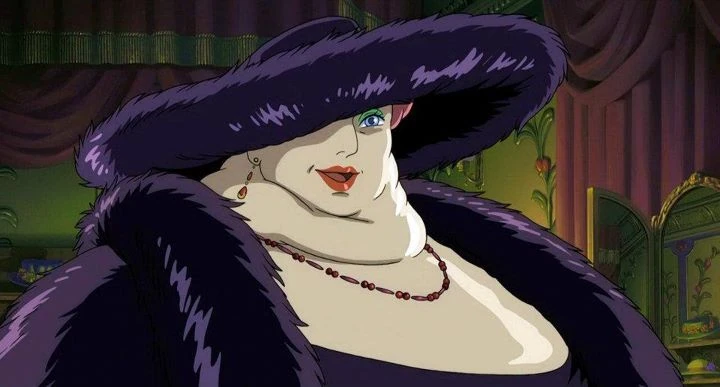
The description of Mrs. Wilson when Nick first meets her reminds me a lot of the Witch of the Waste from Howl's Moving Castle. I think the similarities between the two might run deeper than just physical appearance, however. Both are secretive, deceptive, and have romantic issues; the Witch is obsessed with pursuing her previous lover while Mrs. Wilson has an ongoing affair with Tom Buchanan. I predict that her relationship with Tom Buchanan will be her undoing, just as the Witch was eventually defeated by her ex-lover.