3 Matching Annotations
  1. Nov 2017
    1. Yukon and the Northwest Territories

      The Yukon and the Northwest territories are known as The Canadian North and are characterized by the “physical landscape, [which is], baffling in its ability to transcend whatever we would make of it. It is as subtle in its expression as turns of the mind, and larger than our grasp; yet it is still knowable” (Morrison 12). The physicality of these regions is important to acknowledge because it was the defining factor with which the aboriginal people identified with and the basis for their cultural and legal claims.

      Yukon and the Northwest territories were not separated until the Klondike Gold Rush in 1897, which lead to the formation of the Yukon territory because of an increase in population. In the Yukon territory, the Gwich’in were the predominant occupiers in the basin of the Yukon River, as well as the known Dene and Inuit populations. The peoples were reliant on fish and caribou as well as roots and berries. The Yukon economy shifted to Gold after the gold rush, which also put Dawson City on the map, making it one of the largest cities in the Northwest. It became stable in the mining industry and became a destination for people throughout Canada and, more so United States looking for wealth. It was also successful in the fur trade, supplying furs to markets in Asia, Europe and North America. As with other native peoples, federal government imposed their existence on the Yukon land territory, disrupting the lives of those who inhabited the area and felt as though their way of life was not to be tampered with. An example of this is when “liberal and conservative national governments felt compelled to take the extraordinary step of introducing legislation into parliament that would require the Yukon and the Northwest territories to become officially bilingual,” (Smyth 160) meaning that the government was applying their own culture upon the natives, even if the natives would in fact benefit from being bilingual. According to Smyth, “this occurred in spite of the fact that the Yukon Government continuously sought to demonstrate good faith and to negotiate a fair and equitable solution for both francophone and aboriginal residents of the territory” (Smyth 120). The natives fought for their right to pass on their form of education to their next generations in order to keep their culture alive, and Berger refers to this concept in his report. This is just one of the conflicts in addition to the pipeline proposal that the natives tried to fairly solve, however, “the federal governments ability to amend territorial constitutions without the consent of the people of the territories is in stark contrast to its powers with respect to the provinces” (Smyth 120). In most cases, the government cared less about the beliefs and desires of native people and more about the economic success and improvement to Canada as a whole. 
      
      The Northwest territories is another region of Canada that identifies with their geographical location and their wilderness characteristics, being one of the most northern regions of Canada. The Northwest territories are bordered by Yukon, Nunavut, British Columbia, Alberta, and Saskatchewan and it consists of arctic and boreal forest landscapes, encompassing the Mackenzie River delta and the Mackenzie Mountains. Concentrated in this area were the Dene, Inuit (which the Americans call Eskimos) and the Metis tribes. Like the natives in Yukon, the Europeans interfered with their nomadic lifestyle by attempting to hunt the caribou with their more sophisticated technology.  Jack C. Stabler says that after the 1950’s, “development was the option chosen, and universal education was seen as a necessity in preparing native people for the jobs that the approach for economic development was expected to provide eventually” (Stabler 807). This decision and many conducted explorations brought “the Canadian north to the attention of Europe” (Morrison 43).
      
      This interest in the North sparked optimism for the Europeans, optimism for wealth, which is why it is important to recognize these two regions and their history in relation to the pipeline proposal. The Canadian north consists of a land that the “aboriginal people gain a sense of achievement and identity from their traditional economy of hunting, trapping, and fishing. The land and the people are one” (Wonders 193). The physicality of these regions is important to acknowledge because it could be considered the defining factor of which the aboriginal people identified with and based their argument for fair treatment off of. With the pipeline proposal, this land and culture was put on the spotlight because it was the main source of conflict when fighting for approval of the pipeline. While the aboriginals were defending their right to their land, they used it to identify their way of life and their cultures. Disturbing this land would be disturbing their culture, for the sake of the wealth and prosperity of Canada. 
      

      Yukon http://collectionscanada.gc.ca/pam_archives/index.php?fuseaction=genitem.displayItem&rec_nbr=3325052&lang=eng

      Two men in the Northwest Territories http://collectionscanada.gc.ca/pam_archives/index.php?fuseaction=genitem.displayItem&rec_nbr=3376432&lang=eng

      Map of Yukon and the Northwest Territories http://collectionscanada.gc.ca/pam_archives/index.php?fuseaction=genitem.displayItem&rec_nbr=3699403&lang=eng

      Citations:

      Morrison, William R. 1998. True North : The Yukon and Northwest Territories. The Illustrated History of Canada. Toronto: Oxford University Press.

      Smyth, Steven. "Colonialism and Language in Canada's North: A Yukon Case Study." Arctic 49, no. 2 (1996): 155-61. http://www.jstor.org/stable/40512325.

      Wonders, William C. 2003. Canada's Changing North. Rev. ed. Montreal, Que.: McGill-Queen's University Press.

      Stabler, Jack C. "Dualism and Development in the Northwest Territories." Economic Development and Cultural Change 37, no. 4 (1989): 805-39. http://www.jstor.org/stable/1154129.
    2. Klondike gold rush of 1898

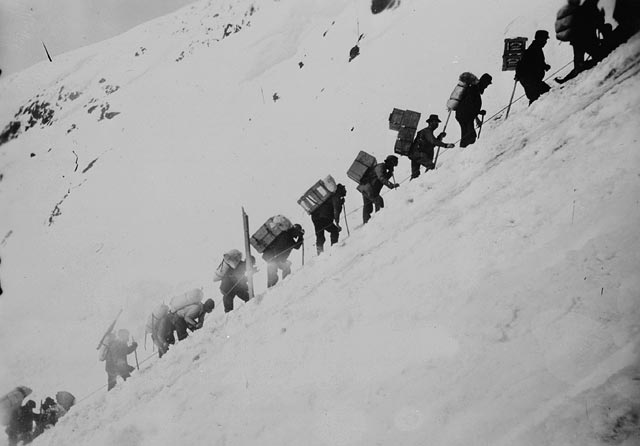
      The Klondike Gold Rush was an important event in Canadian history because it symbolized the prosperity that Canada possessed. In August of 1896, three men, Skookum Jim Mason, Dawson Charlie and George Washington Carmack, contributed to “the great discovery of gold [which] was made on Bonanza Creek, a few miles from the present town of Dawson, which is located at the confluence of the Yukon and klondike rivers” (Morrison 93). This discovery sparked a surge of people from the United States. According to James Hamil, as he wrote home from the Chilkoot in October of 1897, “it would be an utter impossibility for me to attempt to describe the hardships one must endure on this trail. One must climb high peaks over jagged rocks down through deep canyons and over mountains of ice which never disappear” (Morse 4). This gold rush would be much different for the Americans because they were venturing away from industrialized mining and into the simple methods of mining that were still practiced in the Yukon. This difference in technology represents an aspect of Canada that defined their culture and lifestyle. This area was still very much underdeveloped and inhabited by natives who were entranced by the simplicity of their way of life. This endeavor was indeed a huge risk because of the danger that the trail itself entailed and the chance of coming up short, resulting in a loss of wealth for those searchers. Also, because “most of the early miners in the Yukon were Americans,” (Morrison 94) Americans had a huge impact on the area and on the indigenous people and Canada itself, considering “this remote part of the Dominion of Canada operated at that time under a system came from the American idea of the self-governing community, unhampered by external controls and conducting its affairs as it saw fit” (Morrison 94). As a result, the natives and Canadians were being undermined by the “ideology of Anglo-Saxonism as a set of beliefs reflecting the self-proclaimed ethnic, political, and moral superiority of individuals and traditions of British origin” (Arenson 378). Similarly, “In the Klondike, Americans connected their notions of Manifest Destiny and continental expansion to a global imperialist calling through a sense of racial dominance that went beyond national differences” (Arenson 378). With these superior motives in mind, natives would become affected simply on the basis that their land and their homes were being disrupted by the opportunistic actions of others. This event is important in terms of the Berger report because it lead to the making of a treaty, Treaty 8 specifically. This treaty drew boundaries to include the area in which gold may be found, however it did not include the area inhabited by the indians north of Great Slave Lake. The treaty making reflected another effort to make peace with native peoples and to try and express a sense of empathy toward them. Even though Berger says that, “The indian people did not see treaty 8 as a surrender of their aboriginal rights: they considered it to be a treat of peace and friendship,” (Berger 167). Chief Drygeese still wanted a promise that land would not be taken from them and that their rights would be protected; and if that promise were broken, there would be a problem between the cultures. Overall, the Klondike gold rush was a double edged sword. It advertised the potential that Canada had to become an economic success story, but it also posed to be problematic in the sense that the aboriginal people would become distressed and conflict could have been created.

      People trekking up the Chilkoot Path http://collectionscanada.gc.ca/pam_archives/index.php?fuseaction=genitem.displayItem&rec_nbr=3194557&lang=eng

      Citations ARENSON, ADAM. "Anglo-Saxonism in the Yukon: The Klondike Nugget and American-British Relations in the “Two Wests,” 1898–1901." Pacific Historical Review 76, no. 3 (2007): 373-404. doi:10.1525/phr.2007.76.3.373.

      Morrison, W. R. "The North-West Mounted Police and the Klondike Gold Rush." Journal of Contemporary History 9, no. 2 (1974): 93-105. http://www.jstor.org/stable/260048.

      Morse, Kathryn Taylor. 2003. The Nature of Gold : An Environmental History of the Klondike Gold Rush. Weyerhaeuser Environmental Books. Seattle: University of Washington Press.

      Berger, Thomas R. “Native Claims.” Northern Frontier Northern Homeland, vol. 1. Minister of Supply and Services Canada, 1977, 167.

    3. Frank T’Seleie

      Frank T’Seleie was Chief of the Fort Good Hope Band, which was composed of an aboriginal group of people that inhabited mostly the Northwest Territories of Canada. T’Seleie was the leading contester of the Mckenzie Pipeline Proposal. He was a huge advocate for the rights of all natives and supported the proposed land claims and treaties that were in the process of being formed because of the pipeline proposal. After the Dene signed treaties 8, in 1899 and 11, in 1921, which covered the territory northward to Great Slave Lake and dealt with the land from Great Slave Lake down the Mackenzie River to the Mackenzie Delta, covering the whole of Northern Alberta and the western part of the Northwest Territories, including the Mackenzie Valley, they believed that they would have control over hunting and fishing and would be allowed to continue their traditional practices; however, white traders invaded the country and took advantage of the Dene land. These treaties said that in exchange for the land, the indians would receive cash payments. In response to this, T’Seleie spoke on behalf of the natives of Fort Good Hope and said, “the indians are in fear of too many outside trappers getting into the districts outline…and should these preserves be granted…the indians would be more likely to endeavor to preserve the game in their own way. They at present are afraid of leaving the beaver colonies to breed up as the white man would in all likelihood come in and hunt them” (Berger 100).

      The Dene in general, as a group of natives, dealt with a vast amount of conflict stemming from the interruption of settlers. The Sayisi Dene, located in Manitoba, were completely displaced. For more than a thousand years, “The Sayisi Dene had lived in what’s now northern Manitoba and the Northwest Territories, between the open tundra and the tree line along the Churchill River, but in 1956, the Government of Canada moved the Sayisi Dene away from their traditional homeland and their way of life” (Bussidor XI). This story of displacement can be related to the struggles that Chief T’Seleie and his people faced. In both cases, fair treatment of native peoples and their culture was compromised in some way, and had an immediate effect on the identity and security of their individuality. In addition, the Dene nation and culture started to blossom “at a time when southern whites were prosperous and concerned about both the welfare of the environment and the plight of the aboriginal peoples of Canada” (Posluns). However, “the federal government was not buckling under Dene pressure for self-government and was still demanding extinguishment of aboriginal land rights in return for a land claims settlement” (Posluns).  Overall, the European involvement was based off of the goal to “to train Indians to cope with persons of European ancestry and eventually 'civilize' them” (Whyte 178). T’Seleie was trying to stop this assimilation in order to preserve the culture and traditions of native peoples such as the Dene tribes. The pipeline proposal is a perfect example of how the settlers tried to impose their desires and aspirations for wealth upon aboriginal peoples without their acceptance.
      
      T’Seleie was the main spokesperson of the rejection of the pipeline as long as land claim conflicts were still being debated. He “denounced the president of one gas company for being a "modern-day General Custer" and threatened an explosion of violent resistance if the companies and the government proceeded with the pipeline project” (Sabin 40). He preached that the pipeline construction would be stealing the land of the Dene and their history while he campaigned for the right for the Dene to continue to spread the pride of their culture through the right to have the freedom of their land. To Berger, he respectfully reported that he would not stand for the pipeline as it would intrude on the plans for the Dene people’s land and their future in order to make someone else rich. He considered this construction a genocide, a mass murder of history, culture, pride, and a nation all together. T’Seleie made a big impact on the opinion and result of the pipeline proposal by expressing leadership with distain in regard to the disruption of the land of the aboriginal people. After T’Seleie fought for his people, “Fort Good Hope and other opponents of the pipeline won their battle. A natural gas pipeline from either Prudhoe Bay or the Mackenzie Delta has yet to be built” (Sabin 40). 
      

      Video of Frank T’Seleie Speaking on Behalf of the Pipeline Proposal: www.cbc.ca/archives/entry/dene-chief-my-nation-will-stop-the-pipeline.

      Citations

      Posluns, Michael, Bruce W. Hodgins, S. L. Osborne, TotalBoox, and TBX. 2014. The Dundurn Arctic Culture and Sovereignty Library.

      Bussidor, Ila, and Üstün Bilgen-Reinart. 1997. Night Spirits : The Story of the Relocation of the Sayisi Dene. Winnipeg, Man: University of Manitoba Press, 1997. eBook Collection (EBSCOhost), EBSCOhost (accessed October 31, 2017).

      Sabin, Paul. "Voices from the Hydrocarbon Frontier: Canada's Mackenzie Valley Pipeline Inquiry (1974-1977)." Environmental History Review 19, no. 1 (1995): 17-48. doi:10.2307/3984772.

      Whyte, Kenn. "Aboriginal Rights: The Native American's Struggle for Survival." Human Organization 41, no. 2 (1982): 178-84. http://www.jstor.org/stable/44125898

      Berger, Thomas R. “Native Claims.” Northern Frontier Northern Homeland, vol. 1. Minister of Supply and Services Canada, 1977

      “Dene Chief: ‘My Nation Will Stop the Pipeline’ - CBC Archives.” CBCnews, CBC/Radio Canada, 9 Mar. 2017. www.cbc.ca/archives/entry/dene-chief-my-nation-will-stop-the-pipeline.