- Jul 2016
-
narrateannotate.wordpress.com narrateannotate.wordpress.com
-
second DS106 Daily Create
Daily Create 1655: Contrasting Emotions!

-
Daily Create
TDC1654 Daily Create: Bad Logo!

-
-
hybridpedagogy.org hybridpedagogy.org
-
These students wrote not merely to fulfill their course requirements, but also to fill gaps in information they considered vital to new students.
Real world value strikes again!
-
-
narrateannotate.wordpress.com narrateannotate.wordpress.com
-
second Daily Create
Second Daily Create TDC1649 Line Drawing

-
Daily Create
tdc1646
This is not America

-
-
medium.com medium.com
-
feedback from some of our committee members
What are they really afraid of here? Who are they answering to?
-
-
-
“If a person is alone in the forest when a tree falls, but they don’t notice it because they’re texting, does it still count as solitude?”
But what if they are taking a selfie in the forest when the tree falls? Then do they have solitude with their selfie?
-
Since that foundation was laid, times have changed, as have the possibilities for “being with” others.
As a stay at home mom there have been times where I have been lonely but haven't had any solitude. Engaging online has helped the former but not the latter.
-
-
narrateannotate.wordpress.com narrateannotate.wordpress.com
-
second DS106 Daily Create
Daily Create #1642](http://daily.ds106.us/tdc1642/) National Goadeling Day

-
DS106 Daily Create
Daily Create #1641 Oh Yeah ! https://soundcloud.com/user-740887244-367418043/oh-yeah-tdc1641

-
-
gamesandlearning.wordpress.com gamesandlearning.wordpress.com
-
Maybe it is this lack of summative assessment that motivates, in part, instances of honesty in open a
It is nice knowing that I can be honest or responsive according to my thought process without having an assessment motive behind it. I feel more compelled to learn for more professional reasons.
-
-
narrateannotate.wordpress.com narrateannotate.wordpress.com
-
second DS106 Daily Create
Second Daily Create 1636

-
- Jun 2016
-
hybridpedagogy.org hybridpedagogy.org
-
And this is what I mean when I say that it would be a mistake to think that what I do is digital. What I do is human
The digital is just a tool like a pencil or a ruler. Its always been about the student.
-
Because in the digital, there’s wonder enough.
For many who can only communicate digitally it is magic and wonder.
-
-
-
the textbook company Pearson Education recently penned an op-ed attacking the idea that open educational resources (which are produced on an emergent, open-source model) could ever compete with the factory precision of a company like Pearson.
I think it is odd that Pearson is fighting the inevitable instead finding a way to profit from this.
-
Instead, evolution must proceed through a series of stable, intermediate forms, via a pattern Simon calls “aggregation of subassemblies.”
I think the "stable" aspect of each form is what is critical. Its allows for usefulness and purposefulness.
-
-
narrateannotate.wordpress.com narrateannotate.wordpress.com
-
first Daily Create
Daily Create 1632: Carrot People

-
-
kzetland.wordpress.com kzetland.wordpress.com
-
She also uses these images to poke fun at herself and bring in humor and wit.
This is a really good storytelling technique and makes the audience feel comfortable.
-
She believed she could control, measure, and push the messy away and compartmentalize it.
This is something that comes up a lot in Buddhism. Pema Chodron speaks about it often. Meditating on our discomfort can be challenging. http://www.soulfulliving.com/learning_to_stay.htm
-
-
narrateannotate.wordpress.com narrateannotate.wordpress.com
-
DS106 Daily Create
Daily Create #2: TDC1628 My 3 year old's walking feet with the cutest chubby legs! https://youtu.be/qrrgmR6ltdY
-
-
gamesandlearning.wordpress.com gamesandlearning.wordpress.com
-
My decision not to formally assess learners’ participation
Thank you! I lose some of my enthusiasm for class material when I have had requirements for reading responses/participation.
-
It appears as if personal identification (and, in some cases, concern) may be related to comfort owning learning in the open:
Concern about what exactly? It's terrible that people feel like they can't freely express themselves in a platform such as this.
-
-
robinderosa.net robinderosa.net
-
People often ask me how students can create textbooks when they are only just beginning to learn about the topics that the textbooks cover. My answer to this is that unlike many other scholarly materials, textbooks are primarily designed to be accessible to students– to new scholars in a particular academic area or sub-specialty. Students are the perfect people to help create textbooks, since they are the most keenly tuned in to what other students will need in order to engage with the material in meaningful ways.
This is a great question and a great answer. I like that the material is broken down or related-able to the students. But, is there a point when a more experienced person might be able to explain the concepts better?
-
-
narrateannotate.wordpress.com narrateannotate.wordpress.com
-
first Daily Create
True love is like a sandwich. - Miracle Max
 TDC1626
Tags
Annotators
URL
-
-
narrateannotate.wordpress.com narrateannotate.wordpress.com
-
Daily Create
Daily Create Chicken Meme TDC1622
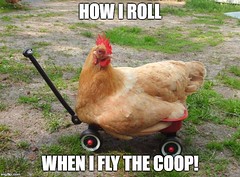 <script async="" src="//<a href=" http:="" embedr.flickr.com="" assets="" client-code.js"="" target="_blank" rel="nofollow noopener">embedr.flickr.com/assets/client-code.js" charset="utf-8"></script>
 -
Daily Create
Daily Create: Paperback Paradise #TDC1618

-
-
dmlcentral.net dmlcentral.net
-
From this perspective, reading has become equative with slowing down and stepping away. And, in a problematic sense, this understanding has lead to reading being relegated to an act of purposeful (yet temporary) disengagement with the rest of the world.
This is why I love pleasure reading so much. I want to disengage with the world. But, there is a distinction between reading for academic purposes and for pleasure and students should learn this lesson.
-
-
narrateannotate.wordpress.com narrateannotate.wordpress.com
-
Daily Create
Things that make me happy! https://flic.kr/p/HWAePP
-