weary, weary feet
The word weary immediately reminds me of Langston's poem "weary blues"
weary, weary feet
The word weary immediately reminds me of Langston's poem "weary blues"
Its veil
The veil also mentioned by Dubois in reference to double consciousness
Her brain allows one half-formed thought to pass: “Well now that’s done: and I’m glad it’s over.”
Again I am seeing little moments of humor is Eliot's writing. To me, this these two lines are describing a woman who is frantic in thought, and is glad that her brain has only allowed "one half-formed thought to pass" so quickly.
“That corpse you planted last year in your garden, “Has it begun to sprout? Will it bloom this year?
T.S. Eliot uses contradiction and duality in a very interesting way in his poems. Before I noticed the duality in the line "winter kept us warm" where the words were actively contradicting one another, yet here it seems that the tone of these lines is contradicting with the subject matter. I love the carelessness and casual tone that is being used to describe a buried corpse. It makes these lines more humorous and strange.
Winter kept us warm
I love the duality of this line. Warmth and winter are not normally associated with one another yet in this context it makes sense, as the snow is described as covering the Earth. Instead of the winter making the Earth cold, it seems to be covering it instead and keeping it warm.
A blow is delighted.
the formatting of this piece is fascinating; I just wonder what made Stein choose the placement of each line. It seems as though most of the lines can stand on their own as independent statements, so I wonder if the piece could still stand if the lines were ordered completely differently. I wonder if this was Stein's intention with the formatting.
cow curtain.
to anyone also thinking to themselves, "hmm, I'm going to google "cow curtain" real fast to make some sense of this" dont, because the first image you will see is this:
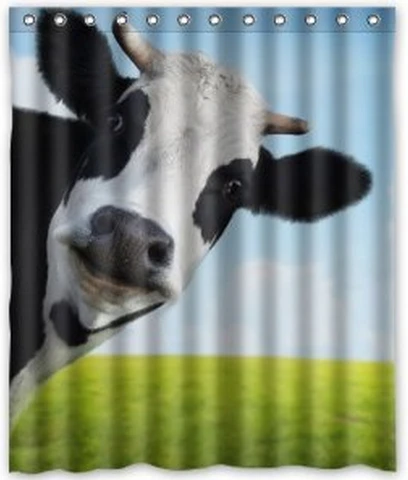 and you will also feel dumb. (although, WHO KNOWS! Maybe this is the cow curtain Stein is writing about.)
Cousin tip nicely. Cousin tip. Nicely.
while I am unsure of the meaning of these lines, for some reason I immediately read them as dialogue. As if the speaker was directly speaking to their cousin in the poem.
I have eaten the plums that were in the icebox and which you were probably saving for breakfast

her great ungainly hips and flopping breasts

house in the suburbs
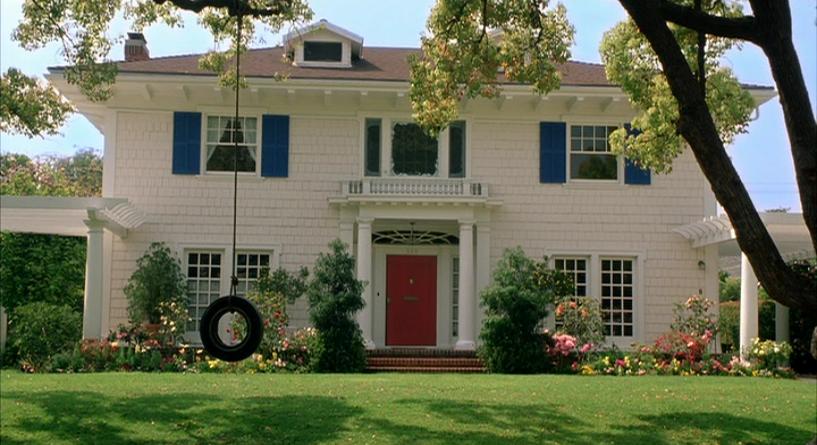 Whenever I hear someone mention a house in the suburbs, I always picture this house from the movie Mr. Deeds.
Here lies, and none to mourn him but the sea,
The title and first line of this poem is very striking and really immediately creates an image. The line seems to be describing a man who has died alone at sea, so only the ocean is there to mourn him. I find it interesting how Millay chose to not give the man a name, and simply put "here lies," almost as if he has no identity at all because there is no one there to identify him. There is no one there to know his name, only the ocean.
I might be driven to sell your love for peace, Or trade the memory of this night for food. It well may be. I do not think I would.
I like the double-ness that is played out in this poem. The beginning of this poem is filled multiple examples of physical tasks that love cannot do (it cannot feed you or keep you dry in the rain or cure illness). However by the end, we see that the speaker still values love, despite its limitations and its lack of dire necessity. Love can't do many things and there may be many things that are more important than love, but she still wouldn't go without it.
And on a day we meet to walk the line And set the wall between us once again. We keep the wall between us as we go.
It's interesting to think that if the wall was for the purpose of separating the two neighbors, by the two of them mending the wall together, it is also the very thing that brings them together. I wonder if there were no wall between the neighbors, if they would have any other reason to meet.
Whose woods these are I think I know. His house is in the village though; He will not see me stopping here To watch his woods fill up with snow.
I find it interesting that the entire first stanza is dedicated to the owner of the woods and specifically the speaker worrying/wondering whether or not the owner would see him admiring the woods. Who is the owner of the woods and why didn't the speaker mention him anywhere else in the poem?
Poets and kings are but the clerks of Time,
I am finding Robinson's work to be a little more difficult to understand than Master's. I wonder what Robinson means with this line in particularly? What is the significance of "the clerks", to make it both the title of the poem as well as compare them to kings and poets?
Life is too strong for you– It takes life to love Life.
A really realistic and sinister look at the end of life that I feel like I have not seen before. As the poem seems to go through the long life of the speaker, at the end we see them willfully embracing the end of their life. We are seeing someone who is the past the enjoyment of life and lived enough to be ready for the end.
Choose your own good and call it good. For I could never make you see That no one knows what is good Who knows not what is evil;
What an amazing end to this poem, particularly the last six lines. I really like how Edgar Lee Masters is working with opposites in this poems and the power of knowledge. To me this seems to be fighting the idea that "ignorance is bliss", because here he is saying if you never know what you don't know, how will you ever know what you do know?
He asked me all sorts of questions, too, and pretended to be very loving and kind.
here we see the women's opinion of John shift completely from how she originally felt towards his care taking. While before she had an almost blind trust in his abilities to care for her, now she is realizing he may be the cause of her repression, and is in fact not as kind and loving as he might have seemed. Before she was comfortable with his decision making upon her health because she believed it was from love, now she is suspicious of his motives.
There are things in that paper that nobody knows but me, or ever will.
This is probably my favorite line in the story. To me this is the point where the story turns abruptly. The fact that this sentence follows the woman having just done her best at being reasonable and making sense as to why it's okay for her to be with the wall paper instead of the baby, it makes this line punch even more. After trying to prove herself to be healthy, she lets the reader know she is actually sinking deeper and deeper into her madness.
He simply wishes to make it possible for a man to be both a Negro and an American, without being cursed and spit upon by his fellows, without having the doors of Opportunity closed roughly in his face.
This idea of double consciousness immediately reminds me of the beginning of The Dynamo and the Virgin when we are introduced to the duality between religion and technology. However, while religion is shown as being threatened by the rise of technology, Du Bois doesn't wish for either halves of his identity to be ignored, merely exist as one.
How does it feel to be a problem?
Wow this line hit hard. I find it fascinating how Du Bois has identified himself as "the problem" (or not identifies himself so much as recognizes society's racist mentality towards African Americans as being seen as a hinderance) or as Adams may label the problem, "the thing". I find it fascinating because naturally I would associate a person as being effected by the problem, not a problem itself; and perhaps that is a testament to the society I live in today. While Du Bois's society would label African Americans as the problem and then everyone else bearing the effects, today's society would label racism as the problem while African Americans and other people of color are forced to feel the effects. I wonder how Adams would react to Du Bois labeling himself as "the thing" and not as being effected by "the thing"? (p.s. I'm not sure any of that made sense but i tired...)
All the rest had used sex for sentiment, never for force; to them, Eve was a tender flower, and Herodias an unfeminine horror. American art, like the American language and American education, was as far as possible sexless.
I wonder how Adam's opinion on America's relationship to sex would change if he could see it currently. Would he think America has changed at all in the last 100 years when it comes to the power given to sex in our current society?
than between the Cross and the cathedral
Again, another comparison made between technology and religious symbolism. it would be interesting to count how many religious metaphors and comparisons are seen throughout the entire piece.
much as the early Christians felt the Cross
I feel as though the inclusion of this religious comparison is very intensional as Adams begins to look at a piece of machinery in a similar fashion as one does towards a religious figure. I think this does an interesting job of introducing the duality of technology and religion seen during this time period.
They feed they Lion and he comes.
Throughout the poem I kept questioning what the lion represented, debating between "the working class" in which Levine grew up in, or the rage igniting within the working class. For the majority, I read the poem as symbolizing the lion symbolizing the rage of the working class and because of that I felt the suspense building as the poem went on--the rage growing and growing until the end--however, in the end I wondered is this is the satisfying ending I had been hoping for; had the rage been released or must the lion still submit? To me the ending reveals the unfortunate reality of the American working class where the rage is still present, but they must still accept their circumstances in order to live and survive.