12 Matching Annotations
  1. Dec 2025
    1. Author response:

      The following is the authors’ response to the original reviews

      Public Reviews:

      Reviewer #1 (Public review):

      Summary:

      In this manuscript, Chengjian Zhao et al. focused on the interactions between vascular, biliary, and neural networks in the liver microenvironment, addressing the critical bottleneck that the lack of high-resolution 3D visualization has hindered understanding of these interactions in liver disease.

      Strengths:

      This study developed a high-resolution multiplex 3D imaging method that integrates multicolor metallic compound nanoparticle (MCNP) perfusion with optimized CUBIC tissue clearing. This method enables the simultaneous 3D visualization of spatial networks of the portal vein, hepatic artery, bile ducts, and central vein in the mouse liver. The authors reported a perivascular structure termed the Periportal Lamellar Complex (PLC), which is identified along the portal vein axis. This study clarifies that the PLC comprises CD34⁺Sca-1⁺ dual-positive endothelial cells with a distinct gene expression profile, and reveals its colocalization with terminal bile duct branches and sympathetic nerve fibers under physiological conditions.<br />

      Weaknesses:

      This manuscript is well-written, organized, and informative. However, there are some points that need to be clarified.

      (1) After MCNP-dye injection, does it remain in the blood vessels, adsorb onto the cell surface, or permeate into the cells? Does the MCNP-dye have cell selectivity?

      The experimental results showed that after injection, the MCNP series nanoparticles predominantly remained within the lumens of blood vessels and bile ducts, with their tissue distribution determined by physical perfusion. No diffusion of the dye signal into the surrounding parenchymal tissue was observed, nor was there any evidence of adsorption onto the cell surface or entry into cells. The newly added Supplementary Figure S2A–H further confirmed this feature, demonstrating that the dye signals were strictly confined to the luminal space, clearly delineating the continuous course of blood vessels and the branching morphology of bile ducts. These findings strongly support the conclusion that “MCNP dyes are distributed exclusively within the luminal compartments.”

      Therefore, the MCNP dyes primarily serve as intraluminal tracers within the tissue rather than as labels for specific cell types.

      (2) All MCNP-dyes were injected after the mice were sacrificed, and the mice's livers were fixed with PFA. After the blood flow had ceased, how did the authors ensure that the MCNP-dyes were fully and uniformly perfused into the microcirculation of the liver?

      Thank you for the reviewer’s valuable comments. Indeed, since all MCNP dyes were perfused after the mice were euthanized and blood circulation had ceased, we cannot fully ensure a homogeneous distribution of the dye within the hepatic microcirculation. The vascular labeling technique based on metallic nanoparticle dyes used in this study offers clear imaging, stable fluorescence intensity, and multiplexing advantages; however, it also has certain limitations. The main issue is that the dye distribution within the hepatic parenchyma can be affected by factors such as lobular overlap, local tissue compression, and variations in vascular pathways, resulting in regional inhomogeneity of dye perfusion. This is particularly evident in areas where multiple lobes converge or where anatomical structures are complex, leading to local dye accumulation or over-perfusion.

      In our experiments, we attempted to minimize local blockage or over-perfusion by performing PBS pre-flushing and low-pressure, constant-speed perfusion. Nevertheless, localized dye accumulation or uneven distribution may still occur in lobe junctions or structurally complex regions. Such variation represents one of the methodological limitations. Overall, the dye signals in most samples remained confined to the vascular and biliary lumens, and the distribution pattern was highly reproducible.

      We have addressed this issue in the Discussion section but would like to emphasize here that, although this system has clear advantages, it remains sensitive to anatomical variability in the liver—such as lobular overlap and vascular heterogeneity. At vascular junctions, local perfusion inhomogeneity or dye accumulation may occur; therefore, injection strategies and perfusion parameters should be adjusted according to liver size and vascular condition to improve reproducibility and imaging quality. It should also be noted that the results obtained using this method primarily aim to visualize the overall and fine anatomical structures of the hepatic vascular system rather than to quantitatively reflect hemodynamic processes. In the future, we plan to combine in vivo perfusion or dynamic fluid modeling to further validate the diffusion characteristics of the dyes within the hepatic microcirculation.

      (3) It is advisable to present additional 3D perspective views in the article, as the current images exhibit very weak 3D effects. Furthermore, it would be better to supplement with some videos to demonstrate the 3D effects of the stained blood vessels.

      Thank you for the reviewer’s valuable comments. In response to the suggestion, we have added perspective-rendered images generated from the 3D staining datasets to provide a more intuitive visualization of the spatial morphology of the hepatic vasculature. These images have been included in Figure S2A–J. In addition, we have prepared supplementary videos (available upon request) that dynamically display the three-dimensional distribution of the stained vessels, further enhancing the spatial perception and visualization of the results.

      (4) In Figure 1-I, the authors used MCNP-Black to stain the central veins; however, in addition to black, there are also yellow and red stains in the image. The authors need to explain what these stains are in the legend.

      Thank you for the reviewer’s constructive comment. In Figure 1I, MCNP-Black labels the central vein (black), MCNP-Yellow labels the portal vein (yellow), MCNP-Pink labels the hepatic artery (pink), and MCNP-Green labels the bile duct (green). We have revised the Figure 1 legend to include detailed descriptions of the color signals and their corresponding structures to avoid any potential confusion.

      (5) There is a typo in the title of Figure 4F; it should be "stem cell".

      Thank you for the reviewer’s careful correction. We have corrected the spelling error in the title of Figure 4F to “stem cell” and updated it in the revised manuscript.

      (6) Nuclear staining is necessary in immunofluorescence staining, especially for Figure 5e. This will help readers distinguish whether the green color in the image corresponds to cells or dye deposits.

      We thank the reviewer for the valuable suggestion. We understand that nuclear staining can help determine the origin of fluorescence signals. However, in our three-dimensional imaging system, the deep signal acquisition range after tissue clearing often causes nuclear dyes such as DAPI to generate highly dense and widespread fluorescence, especially in regions rich in vascular structures, which can obscure the fine vascular and perivascular details of interest. Therefore, this study primarily focuses on high-resolution visualization of the spatial architecture of the vascular and biliary systems. We have added an explanation regarding this point in Figures S2I–J.

      Reviewer #2 (Public review):

      Summary:

      The present manuscript of Xu et al. reports a novel clearing and imaging method focusing on the liver. The authors simultaneously visualized the portal vein, hepatic artery, central vein, and bile duct systems by injecting metal compound nanoparticles (MCNPs) with different colors into the portal vein, heart left ventricle, inferior vena cava, and the extrahepatic bile duct, respectively. The method involves: trans-cardiac perfusion with 4% PFA, the injection of MCNPs with different colors, clearing with the modified CUBIC method, cutting 200 micrometer thick slices by vibratome, and then microscopic imaging. The authors also perform various immunostaining (DAB or TSA signal amplification methods) on the tissue slices from MCNP-perfused tissue blocks. With the application of this methodical approach, the authors report dense and very fine vascular branches along the portal vein. The authors name them as 'periportal lamellar complex (PLC)' and report that PLC fine branches are directly connected to the sinusoids. The authors also claim that these structures co-localize with terminal bile duct branches and sympathetic nerve fibers, and contain endothelial cells with a distinct gene expression profile. Finally, the authors claim that PLC-s proliferate in liver fibrosis (CCl4 model) and act as a scaffold for proliferating bile ducts in ductular reaction and for ectopic parenchymal sympathetic nerve sprouting.

      Strengths:

      The simultaneous visualization of different hepatic vascular compartments and their combination with immunostaining is a potentially interesting novel methodological approach.

      Weaknesses:

      This reviewer has several concerns about the validity of the microscopic/morphological findings as well as the transcriptomics results. In this reviewer's opinion, the introduction contains overstatements regarding the potential of the method, there are severe caveats in the method descriptions, and several parts of the Results are not fully supported by the documentation. Thus, the conclusions of the paper may be critically viewed in their present form and may need reconsideration by the authors.

      We sincerely thank the reviewer for the thorough evaluation and constructive comments on our study. We fully understand and appreciate the reviewer’s concerns regarding the methodological validity and interpretation of the results. In response, we have made comprehensive revisions and additions to the manuscript as follows:

      First, we have carefully revised the Introduction and Discussion sections to provide a more balanced description of the methodological potential, removing statements that might be considered overstated, and clarifying the applicable scope and limitations of our approach (see the revised Introduction and Discussion).

      Second, we have substantially expanded the Methods section with detailed information on model construction, imaging parameters, data processing workflow, and technical aspects of the single-cell transcriptomic reanalysis, to enhance the transparency and reproducibility of the study.

      Third, we have added additional references and explanatory notes in the Results section to better support the main conclusions (see Section 6 of the Results).

      Finally, we have rechecked and validated all experimental data, and conducted a verification analysis using an independent single-cell RNA-seq dataset (Figure S6). The results confirm that the morphological observations and transcriptomic findings are consistent and reproducible across independent experiments.

      We believe these revisions have greatly strengthened the reliability of our conclusions and the overall scientific rigor of the manuscript. Once again, we sincerely appreciate the reviewer’s valuable comments, which have been very helpful in improving the logic and clarity of our work.

      Reviewer #3 (Public review):

      Summary:

      In the reviewed manuscript, researchers aimed to overcome the obstacles of high-resolution imaging of intact liver tissue. They report successful modification of the existing CUBIC protocol into Liver-CUBIC, a high-resolution multiplex 3D imaging method that integrates multicolor metallic compound nanoparticle (MCNP) perfusion with optimized liver tissue clearing, significantly reducing clearing time and enabling simultaneous 3D visualization of the portal vein, hepatic artery, bile ducts, and central vein spatial networks in the mouse liver. Using this novel platform, the researchers describe a previously unrecognized perivascular structure they termed Periportal Lamellar Complex (PLC), regularly distributed along the portal vein axis. The PLC originates from the portal vein and is characterized by a unique population of CD34⁺Sca-1⁺ dual-positive endothelial cells. Using available scRNAseq data, the authors assessed the CD34⁺Sca-1⁺ cells' expression profile, highlighting the mRNA presence of genes linked to neurodevelopment, biliary function, and hematopoietic niche potential. Different aspects of this analysis were then addressed by protein staining of selected marker proteins in the mouse liver tissue. Next, the authors addressed how the PLC and biliary system react to CCL4-induced liver fibrosis, implying PLC dynamically extends, acting as a scaffold that guides the migration and expansion of terminal bile ducts and sympathetic nerve fibers into the hepatic parenchyma upon injury.

      The work clearly demonstrates the usefulness of the Liver-CUBIC technique and the improvement of both resolution and complexity of the information, gained by simultaneous visualization of multiple vascular and biliary systems of the liver at the same time. The identification of PLC and the interpretation of its function represent an intriguing set of observations that will surely attract the attention of liver biologists as well as hepatologists; however, some claims need more thorough assessment by functional experimental approaches to decipher the functional molecules and the sequence of events before establishing the PLC as the key hub governing the activity of biliary, arterial, and neuronal liver systems. Similarly, the level of detail of the methods section does not appear to be sufficient to exactly recapitulate the performed experiments, which is of concern, given that the new technique is a cornerstone of the manuscript.

      Nevertheless, the work does bring a clear new insight into the liver structure and functional units and greatly improves the methodological toolbox to study it even further, and thus fully deserves the attention of readers.

      Strengths:

      The authors clearly demonstrate an improved technique tailored to the visualization of the liver vasulo-biliary architecture in unprecedented resolution.

      This work proposes a new biological framework between the portal vein, hepatic arteries, biliary tree, and intrahepatic innervation, centered at previously underappreciated protrusions of the portal veins - the Periportal Lamellar Complexes (PLCs).

      Weaknesses:

      Possible overinterpretation of the CD34+Sca1+ findings was built on re-analysis of one scRNAseq dataset.

      Lack of detail in the materials and methods section greatly limits the usefulness of the new technique to other researchers.

      We thank the reviewer for this important comment. We agree that when conclusions are mainly based on a single dataset, overinterpretation should be avoided. In response to this concern, we have carefully re-evaluated and clearly limited the scope of our interpretation of the scRNA-seq analysis. In addition, we performed a validation analysis using an independent single-cell RNA-seq dataset (see new Figure S6), which consistently confirmed the presence and characteristic transcriptional profile of the periportal CD34⁺Sca1⁺ endothelial cell population. These supplementary analyses strengthen the robustness of our findings and address the reviewer’s concern regarding potential overinterpretation.

      In the revised manuscript, we have also greatly expanded the Materials and Methods section by providing detailed information on sample preparation, imaging parameters, data processing workflow, and single-cell reanalysis procedures. These revisions substantially improve the transparency and reproducibility of our methodology, thereby enhancing the usability and reference value of this technique for other researchers.

      Recommendations for the authors:

      Reviewer #2 (Recommendations for the authors):

      Introduction

      (1) In general, the Introduction is very lengthy and repetitive. It needs extensive shortening to a maximum of 2 A4 pages.

      We thank the reviewer for the valuable suggestions. We have thoroughly condensed and restructured the Introduction, removing redundant content and merging related paragraphs to make the theme more focused and the logic clearer. The revised Introduction has been shortened to within two A4 pages, emphasizing the scientific question, innovation, and technical approach of the study.

      (2) Please correct this erroneous sentence:

      '...the liver has evolved the most complex and densely n organized vascular network in the body, consisting primarily of the portal vein system, central vein system, hepatic artery system, biliary system, and intrahepatic autonomic nerve network [6, 7].'

      We thank the reviewer for pointing out this spelling error. The revised sentence is as follows:

      “…the liver has evolved the most complex and densely organized ductal-vascular network in the body, consisting primarily of the portal vein system, central vein system, hepatic artery system, biliary system, and intrahepatic autonomic nerve network [6, 7].”

      (3) '...we achieved a 63.89% improvement in clearing efficiency and a 20.12% increase in tissue transparency'

      Please clarify what you exactly mean by 'clearing efficiency' and 'increased tissue transparency'.

      We thank the reviewer for the valuable comments and have clarified the relevant terminology in the revised manuscript.

      “Clearing efficiency” refers to the improvement in the time required for the liver tissue to become completely transparent when treated with the optimized Liver-CUBIC protocol (40% urea + H₂O₂), compared with the conventional CUBIC method. In this study, the clearing time was reduced from 9 days to 3.25 days, representing a 63.89% increase in time efficiency.

      “Tissue transparency” refers to the ability of the cleared tissue to transmit visible light. We quantified the optical transparency by measuring light transmittance across the 400–900 nm wavelength range using a microplate reader. The results showed that the average transmittance increased by 20.12%, indicating that Liver-CUBIC treatment markedly enhanced the optical clarity of the liver tissue.

      (4) I am concerned about claiming this imaging method as real '3D imaging'. Namely, while the authors clear full lobes, they actually cut the cleared lobes into 200-micrometer-thick slices and perform further microscopy imaging on these slices. Considering that they focus on ductular structures of the liver (such as vasculature, bile duct system, and innervations), 200 micrometer allows a very limited 3D overview, particularly in comparison with the whole-mount immuno-imaging methods combined with light sheet microscopy (such as Adori 2021, Liu 2021, etc). In this context, I feel several parts of the Introduction to be an overstatement: besides of emphasizing the advantages of the technique (such as simultaneous visualization of different hepatic vascular compartments and the bile duct system by MCNPs, the combination with immunostainings), the authors must honestly discuss the limitations (such as limited tissue overview, potential dye perfusion problems - uneven distribution of the dye etc).

      We appreciate the reviewer’s insightful comments. It is true that most of the imaging depth in this study was limited to approximately 200 μm, and thus it could not achieve whole-liver three-dimensional imaging comparable to light-sheet microscopy. However, the primary focus of our study was to resolve the microscopic intrahepatic architecture, particularly the spatial relationships among blood vessels, bile ducts, and nerve fibers. Through high-resolution imaging of thick tissue sections, combined with MCNP-based multichannel labeling and immunofluorescence co-staining, we were able to accurately delineate the three-dimensional distribution of these microstructures within localized regions.

      In addition to thick-section imaging, we also obtained whole-lobe dye perfusion data (as shown in Figure S1F), which comprehensively depict the three-dimensional branching patterns and distribution of the vascular systems within the liver lobe. These images were acquired from intact liver lobes perfused with MCNP dyes, revealing a continuous vascular network extending from major trunks to peripheral branches, thereby demonstrating that our approach is also capable of achieving organ-level visualization.

      We have added this image and a corresponding description in the revised manuscript to more comprehensively present the coverage of our imaging system, and we have incorporated this clarification into the Discussion section.

      Method

      (5) More information may be needed about MCNPs:

      a) As reported, there are nanoparticles with different colors in brightfield microscopy, but the particles are also excitable in fluorescence microscopy. Would you please provide a summary about excitation/emission wavelengths of the different MCNPs? This is crucial to understand to what extent the method is compatible with fluorescence immunohistochemistry.

      We thank the reviewer for the careful attention and professional suggestion. We fully agree that this issue is critical for evaluating the compatibility of our method with fluorescent immunohistochemistry. Different types of metal compound nanoparticles (MCNPs) have clearly distinguishable spectral properties:

      - MCNP-Green and MCNP-Yellow: AF488-matched spectra, with excitation/emission wavelengths of 495/519 nm.

      - MCNP-Pink: Designed for far-red spectra, with excitation/emission wavelengths of 561/640 nm.

      - MCNP-Black: Non-fluorescent, appearing black under bright-field microscopy only.

      The above information has been added to the Materials and Methods section.

      b) Also, is there more systematic information available concerning the advantage of these particles compared to 'traditional' fluorescence dyes, such as Alexa fluor or Cy-dyes, in fluorescence microscopy and concerning their compatibility with various tissue clearing methods (e.g., with the frequently used organic-solvent-based methods)?

      We thank the reviewer for the detailed question. Compared with conventional organic fluorescent dyes, MCNP offers the following advantages:

      - Enhanced photostability: Its inorganic core-shell structure resists fading even after hydrogen peroxide bleaching.

      - High signal stability: Fluorescence is maintained during aqueous-based clearing (e.g., CUBIC) and multiple rounds of staining without quenching.

      We appreciate the reviewer’s suggestion. In our Liver-CUBIC system, MCNP nanoparticles exhibited excellent multi-channel labeling stability and fluorescence signal retention. Regarding compatibility with other clearing methods (e.g., SCAFE, SeeDB, CUBIC), since these methods have limited effectiveness for whole-liver clearing (see Figure 2 of Tainaka, et al. 2014) and cannot meet the requirements for high-resolution microstructural imaging in this study, we consider further testing of their compatibility unnecessary.

      In summary, MCNP dye demonstrates superior signal stability and spectral separation compared with conventional organic fluorescent dyes in multi-channel, long-term, high-transparency three-dimensional tissue imaging.

      c) When you perfuse these particles, to which structures do they bind inside the ducts (vessels, bile ducts)? Is the 48h post-fixation enough to keep them inside the tubes/bind them to the vessel walls? Is there any 'wash-out' during the complex cutting/staining procedure? E.g., in Figure 2D: the 'classical' hepatic artery in the portal triad is not visible - but the MCNP apparently penetrated to the adjacent sinusoids at the edge of the lobulus. Also, in Figure 3B, there is a significant mismatch between the MNCP-green (bile duct) signal and the CD19 (epithelium marker) immunostaining. Please discuss these.

      The experimental results showed that following injection, MCNP nanoparticles primarily remained within the vascular and biliary lumens, and their tissue distribution depended on physical perfusion. No dye signal was observed to diffuse into the surrounding parenchyma, nor did the particles adhere to cell surfaces or enter cells. The newly added Supplementary Figures S2A–H further confirm this feature: the dye signal is strictly confined within the lumens, clearly delineating continuous vascular paths and biliary branching patterns, strongly supporting the conclusion that “MCNP dye is distributed only within luminal spaces.”

      Thus, MCNP dye mainly serves as an intraluminal tracer rather than a label for specific cell types.

      We provide the following explanations and analyses regarding MCNP distribution in the hepatic vascular and biliary systems and its post-fixation stability:

      - Potential signal displacement during sectioning/immunostaining: During slicing and immunostaining, a small number of particles may be washed away due to mechanical cutting or washing steps; however, the overall three-dimensional structure retains high spatial fidelity.

      - Observation in Figure 2D: MCNP was seen entering the sinusoidal spaces at the lobule periphery, but hepatic arteries were not visible, likely due to limitations in section thickness. Although arteries were not apparent in this slice, arterial distribution around the portal vein is visible in Figure 2C. It should be noted that Figures 2C, D, and E do not represent whole-liver imaging, so not all regions necessarily contain visible hepatic arteries. For easier identification, the main hepatic artery trunk is highlighted in cyan in Figure 2E.

      - Incomplete biliary signal in Figure 3B: This may be because CK19 labeling only covers biliary epithelial cells, whereas MCNP-green distributes throughout the biliary lumen. In Figure 3B, the terminal MCNP-green signal exhibits irregular polygonal structures, which we interpret as the canalicular regions.

      (6) Which fixative was used for 48h of postfixation (step 6) after MCNP injections?

      After MCNP injection, mouse livers were post-fixed in 4% paraformaldehyde (PFA) for 48 hours. This fixation condition effectively “locks” the MCNP particles within the vascular and biliary lumens, maintaining their spatial positions, while also being compatible with subsequent sectioning and multi-channel immunostaining analyses.

      The above information has been added to the Materials and Methods section

      (7) What is the 'desired thickness' in step 7? In the case of immunostained tissue, a 200-micrometer slice thickness is mentioned. However, based on the Methods, it is not completely clear what the actual thickness of the tissue was that was examined ultimately in the microscopes, and whether or not the clearing preceded the cutting or vice versa.

      We appreciate the reviewer’s question. The “desired thickness” referred to in step 7 of the manuscript corresponds to the thickness of tissue sections used for immunostaining and high-resolution microscopic imaging, which is typically around 200 µm. We selected 200 µm because this thickness is sufficient to observe the PLC structure in its entirety, allows efficient staining, and preserves tissue architecture well. Other researchers may choose different section thicknesses according to their experimental needs.

      In this study, the processing order for immunostained tissue samples was sectioning followed by clearing, as detailed below:

      Section Thickness

      To ensure antibody penetration and preservation of three-dimensional structure, tissue sections were typically cut to ~200 µm. Thicker sections can be used if more complete three-dimensional structures are required, but adjustments may be needed based on antibody penetration and fluorescence detection conditions.

      Clearing Sequence

      After sectioning, slices were processed using the Liver-CUBIC aqueous-based clearing system.

      (8) More information is needed concerning the 'deep-focus microscopy' (Keyence), the applied confocal system, and the THUNDER 'high resolution imaging system': basic technical information, resolutions, objectives (N.A., working distance), lasers/illumination, filters, etc.

      In this study, all liver lobes (left, right, caudate, and quadrate lobes) were subjected to Liver-CUBIC aqueous-based clearing to ensure uniform visualization of MCNP fluorescence and immunolabeling throughout the three-dimensional imaging of the entire liver.

      The above information has been added to the Materials and Methods section.

      Imaging Systems and Settings

      VHX-6000 Extended Depth-of-Field Microscope: Objective: VH-Z100R, 100×–1000×; resolution: 1 µm (typical); illumination: coaxial reflected; transmitted illumination on platform: ON.

      Zeiss Confocal Microscope (980): Objectives: 20× or 40×; image size: 1024 × 1024. Fluorescence detection was set up in three channels:

      - Channel 1: 639 nm laser, excitation 650 nm, emission 673 nm, detection range 673–758 nm, corresponding to Cy5-T1 (red).

      - Channel 2: 561 nm laser, excitation 548 nm, emission 561 nm, detection range 547–637 nm, corresponding to Cy3-T2 (orange).

      - Channel 3: 488 nm laser, excitation 493 nm, emission 517 nm, detection range 490–529 nm, corresponding to AF488-T3 (green).

      Leica THUNDER Imager 3D Tissue: Fluorescence detection in two channels:

      - Channel 1: FITC channel (excitation 488 nm, emission ~520 nm).

      - Channel 2: Orange-red channel (excitation/emission 561/640 nm).<br /> Equipped with matching filter sets to ensure signal separation.

      The above information has been added to the Materials and Methods section.

      (9) Liver-CUBIC, step 2: which lobe(s) did you clear (...whole liver lobes...).

      In this study, all liver lobes (left, right, caudate, and quadrate lobes) were subjected to Liver-CUBIC aqueous-based clearing to ensure uniform visualization of MCNP fluorescence and immunolabeling throughout the three-dimensional imaging of the entire liver.

      The above information has been added to the Materials and Methods section.

      (10) For the DAB and TSA IHC stainings, did you use free-floating slices, or did you mount the vibratome sections and do the staining on mounted sections?

      In this study, fixed livers were first sectioned into thick slices (~200 µm) using a vibratome. Subsequently, DAB and TSA immunohistochemical (IHC) staining were performed on free-floating sections. During the entire staining process, the slices were kept floating in the solutions, ensuring thorough antibody penetration in the thick sections while preserving the three-dimensional tissue architecture, thereby facilitating multiple rounds of staining and three-dimensional imaging.

      (11) Regarding the 'transmission quantification': this was measured on 1 mm thick slices. While it is interesting to make a comparison between different clearing methods in general, one must note that it is relatively easy to clear 1mm thick tissue slices with almost any kind of clearing technique and in any tissues. The 'real' differences come with thicker blocks, such as >5mm in the thinnest dimension. Do you have such experiences (e.g., comparison in whole 'left lateral liver lobes')?

      In this study, we performed three-dimensional visualization of entire liver lobes to depict the distribution of MCNPs and the overall spatial architecture of the vascular and biliary systems (Figure S1F). However, due to the limitations of the plate reader and fluorescence imaging systems in terms of spatial resolution and light penetration depth, quantitative analyses were conducted only on tissue sections approximately 1 mm thick.

      Regarding the comparative quantification of different clearing methods, as the reviewer noted, nearly all aqueous- or organic solvent–based clearing techniques can achieve relatively uniform transparency in 1 mm-thick tissue sections, so differences at this thickness are limited. We have not yet conducted systematic comparisons on whole-lobe sections thicker than 5 mm and therefore cannot provide “true” difference data for thicker tissues.

      (12) There is no method description for the ELMI studies in the Methods.

      Transmission Electron Microscopy (TEM) Analysis of MCNPs

      Before imaging, the MCNP dye solution was centrifuged at 14,000 × g for 10 minutes at 4 °C to remove aggregates and impurities. The supernatant was collected, diluted 50-fold, and 3–4 μL of the sample was applied onto freshly glow-discharged Quantifoil R1.2/1.3 copper grids (Electron Microscopy Sciences, 300 mesh). The sample was allowed to sit for 30 seconds to enable particle adsorption, after which excess liquid was gently wicked away with filter paper and the grid was air-dried at room temperature. The sample was then negatively stained with 1% uranyl acetate for 30 seconds and air-dried again before imaging.

      Negative-stain TEM images were acquired using a JEOL JEM-1400 transmission electron microscope operating at 120 kV and equipped with a CCD camera. Data acquisition followed standard imaging conditions.

      The above information has been added to the Materials and Methods section.

      (13) Please, provide a method description for the applied CCl4 cirrhosis model. This is completely missing.

      (1) Under a fume hood, carbon tetrachloride (CCl₄) was dissolved in corn oil at a 1:3 volume ratio to prepare a working solution, which was filtered through a 0.2 μm filter into a 30 mL glass vial. In our laboratory, to mimic chronic injury, mice in the experimental group were intraperitoneally injected at a dose of 1 mL/kg body weight per administration.

      (2) Mice were carefully removed from the cage and placed on a scale to record body weight for calculation of the injection volume.

      (3) The needle cap was carefully removed, and the required volume of the pre-prepared CCl₄ solution was drawn into the syringe. The syringe was gently flicked to remove any air bubbles.

      (4) Mice were placed on a textured surface (e.g., wire cage) and restrained. When the mouse was properly positioned, ideally with the head lowered about 30°, the left lower or right lower abdominal quadrant was identified.

      (5) Holding the syringe at a 45° angle, with the bevel facing up, the needle was inserted approximately 4–5 mm into the abdominal wall, and the calculated volume of CCl₄ was injected.

      (6) Mice were returned to their cage and observed for any signs of discomfort.

      (7) Needles and syringes were disposed of in a sharps container without recapping. A new syringe or needle was used for each mouse.

      (8) To establish a progressive liver fibrosis model, injections were administered twice per week (e.g., Monday and Thursday) for 3 or 6 consecutive weeks (n=3 per group). Control mice were injected with an equal volume of corn oil for 3 or 6 weeks (n=3 per group).

      (9) Forty-eight hours after the last injection, mice were euthanized by cervical dislocation, and livers were rapidly harvested. Portions of the liver were processed for paraffin embedding and histological sectioning, while the remaining tissue was either immediately frozen or used for subsequent molecular biology analyses.

      The above information has been added to the Materials and Methods section.

      (14) Please provide a method description for the quantifications reported in Figures 5D, 5F, and 6E.

      ImageJ software was used to analyze 3D stained images (Figs. 5F, 6E), and the ultra-depth-of-field 3D analysis module was used to analyze 3D DAB images (Fig. 5D). The specific steps are as follows:

      Figure 5D: DAB-stained 3D images from the control group and the CCl<sub>4</sub> 6-week (CCl<sub>4</sub>-6W) group were analyzed. For each group, 20 terminal bile duct branch nodes were randomly selected, and the actual path distance along the branch to the nearest portal vein surface was measured. All measurements were plotted as scatter plots to reflect the spatial extension of bile ducts relative to the portal vein under different conditions.

      Figure 5F: TSA 3D multiplex-stained images from the control group, CCl<sub>4</sub> 3-week (CCl<sub>4</sub>-3W), and CCl<sub>4</sub> 6-week (CCl<sub>4</sub>-6W) groups were analyzed. For each group, 5 terminal bile duct branch nodes were randomly selected, and the actual path distance along the branch to the nearest portal vein surface was measured. Measurements were plotted as scatter plots to illustrate bile duct spatial extension.

      Figure 6E: TSA 3D multiplex-stained images from the control, CCl<sub>4</sub>-3W, and CCl<sub>4</sub>-6W groups were analyzed. For each group, 5 terminal nerve branch nodes were randomly selected, and the actual path distance along the branch to the nearest portal vein surface was measured. Scatter plots were generated to depict the spatial distribution of nerves under different treatment conditions.

      (15) Please provide a method description for the human liver samples you used in Figure S6. Patient data, fixation, etc...

      The human liver tissue samples shown in Figure S6 were obtained from adjacent non-tumor liver tissues resected during surgical operations at West China Hospital, Sichuan University. All samples used were anonymized archived tissues, which were applied for scientific research in accordance with institutional ethical guidelines and did not involve any identifiable patient information. After being fixed in 10% neutral formalin for 24 hours, the tissues were routinely processed for paraffin embedding (FFPE), and sectioned into 4 μm-thick slices for immunostaining and fluorescence imaging.

      Results

      (16) While it is stated in the Methods that certain color MCNPs were used for labelling different structures (i.e., yellow: hepatic artery; green: bile duct; portal vein: pink; central veins: black), in some figures, apparently different color MCNPs are used for the respective structures. E.g., in Figure 1J, the artery is pink and the portal vein is green. Please clarify this.

      The color assignment of MCNP dyes is not fixed across different experiments or schematic illustrations. MCNP dyes of different colors are fundamentally identical in their physical and chemical properties and do not exhibit specific binding or affinity for particular vascular structures. We select different colors based on experimental design and imaging presentation needs to facilitate distinction and visualization, thereby enhancing recognition in 3D reconstruction and image display. Therefore, the color labeling in Figure 1F is primarily intended to illustrate the distribution of different vascular systems, rather than indicating a fixed correspondence to a specific dye or injection color.

      (17) In Figure 1J, the hepatic artery is extremely shrunk, while the portal vein is extremely dilated - compared to the physiological situation. Does it relate to the perfusion conditions?

      We appreciate the reviewer’s attention. In fact, under normal physiological conditions, the hepatic arteries labeled by CD31 are naturally narrow. Therefore, the relatively thin hepatic arteries and thicker portal veins shown in Figure 1J are normal and unrelated to the perfusion conditions. See figure 1E of Adori et al., 2021.

      (18) Re: MCNP-black labelled 'oval fenestrae': the Results state 50-100 nm, while they are apparently 5-10-micron diameter in Figure 1I. Accordingly, the comparison with the ELMI studies in the subsequent paragraph is inappropriate.

      We thank the reviewer for the correction. The previous statement was a typographical error. In fact, the diameter of the “elliptical windows” marked by MCNP-black is 5–10 μm, so the diameter of 5–10 μm shown in Figure 1I is correct.

      (19) Please, correct this erroneous sentence: 'Pink marked the hepatic arterial system by injection extrahepatic duct (Figure 2B).'

      Original sentence: “The hepatic arterial system was labeled in pink by injection through the extrahepatic duct (Figure 2B).”

      Revised sentence: “The hepatic arterial system was labeled in pink by injection through the left ventricle (Figure 2B).”

      (20) How do you define the 'primary portal vein tract'?

      We thank the reviewer for the question. The term “primary portal vein tract” refers to the first-order branches of the portal vein that enter the liver from the hepatic hilum. These are the major branches arising directly from the main portal vein trunk and are responsible for supplying blood to the respective hepatic lobes. This definition corresponds to the concept of the first-order portal vein in hepatic anatomy.

      (21) I am concerned that the 'periportal lamellar complex (PLC)' that the Authors describe really exists as a distinct anatomical or functional unit. I also see these in 3D scans - in my opinion, these are fine, lower-order portal vein branches that connect the portal veins to the adjacent sinusoid. The strong MCNP-labelling of these structures may be caused by the 'sticking' of the perfused MCNP solutions in these 'pockets' during the perfusion process. What do these structures look like with SMA or CD31 immunostaining? Also, one may consider that the anatomical evaluation of these structures may have limitations in tissue slices. Have you ever checked MCNP-perfused, cleared full live lobes in light sheet microscope scans? I think this would be very useful to have a comprehensive morphological overview. Unfortunately, based on the presented documentation, I am also not convinced that PLCs are 'co-localize' with fine terminal bile duct branches (Figure 3E, S3C), or with TH+ 'neuronal bead chain networks' (Fig 6C). More detailed and more convincing documentation is needed here.

      We thank the reviewer for the detailed comments. Regarding the existence and function of the periportal lamellar complex (PLC), our observations are based on MCNP-Pink labeling of the portal vein, through which we were able to identify the PLC structure surrounding the portal branches. It should be noted that the PLC represents a very small anatomical structure. Although we have not yet performed light-sheet microscopy scanning, we anticipate that such imaging would primarily visualize larger portal vein branches. Nevertheless, this does not affect our overall conclusions.

      We also appreciate the reviewer’s suggestion that the observed structures might result from MCNP adherence during perfusion. To verify the structural characteristics of the PLC, we performed immunostaining for SMA and CD31, which revealed a specific arrangement pattern of smooth muscle and endothelial markers rather than simple perfusion-induced deposition (Figures 4F and S6B).

      Regarding the apparent colocalization of the PLC with terminal bile duct branches (Figures 3E and S3C) and TH⁺ neuronal bead-like networks (Figure 6C), we acknowledge that current literature evidence remains limited. Therefore, we have carefully described these observations as possible spatial associations rather than definitive conclusions. Future studies integrating high-resolution three-dimensional imaging with functional analyses will help to further clarify the anatomical and physiological significance of the PLC.

      (22) 'Extended depth-of-field three-dimensional bright-field imaging revealed a strict 1:1 anatomical association between the primary portal vein trunk (diameter 280 {plus minus} 32 μm) and the first-order bile duct (diameter 69 {plus minus} 8 μm) (Figures 3A and S3A)'.

      How do you define '1:1 anatomical association'? How do you define and identify the 'order' (primary, secondary) of vessel and bile duct branches in 200-micrometer slices?

      We thank the reviewer for the question. In this study, the term “1:1 anatomical correlation” refers to the stable paired spatial relationship between the main portal vein trunk and its corresponding primary bile duct within the same portal territory. In other words, each main portal vein branch is accompanied by a primary bile duct of matching branching order and trajectory, together forming a “vascular–biliary bundle.”

      The definitions of “primary” and “secondary” branches were based on extended-depth 3D bright-field reconstructions, considering both branching hierarchy and vessel/duct diameters: primary branches arise directly from the main trunk at the hepatic hilum and exhibit the largest diameters (averaging 280 ± 32 μm for the portal vein and 69 ± 8 μm for the bile duct), whereas secondary branches extend from the primary branches toward the lobular interior with smaller calibers.

      (23) In my opinion, the applied methodical approach in the single cell transcriptomics part (data mining in the existing liver single cell database and performing Venn diagram intersection analysis in hepatic endothelial subpopulations) is largely inappropriate and thus, all the statements here are purely speculative. In my opinion, to identify the molecular characteristics of such small and spatially highly organized structures like those fine radial portal branches, the only way is to perform high-resolution spatial transcriptomic.

      We thank the reviewer for the comment. We fully acknowledge the importance of high-resolution spatial transcriptomics in identifying the fine structural characteristics of portal vein branches. Due to current funding and technical limitations, we were unable to perform such high-resolution spatial transcriptomic analyses. However, we validated the molecular features of the PLC using another publicly available liver single-cell RNA-sequencing dataset, which provided preliminary supporting evidence (Figures S6B and S6C). In the manuscript, we have carefully stated that this analysis is exploratory in nature and have avoided overinterpretation. In future studies, high-resolution spatial omics approaches will be invaluable for more precisely delineating the molecular characteristics of these fine structures.

      (24) 'How the autonomic nervous system regulates liver function in mice despite the apparent absence of substantive nerve fiber invasion into the parenchyma remains unclear.'

      Please consider the role of gap junctions between hepatocytes (e.g., Miyashita, 1991; Seseke, 1992).

      In this study, we analyzed the spatial distribution of hepatic nerves in mice using immunofluorescence staining and found that nerve fibers were almost exclusively confined to the portal vein region (Figure S6A). Notably, this distribution pattern differs markedly from that in humans. Previous studies have shown that, in human livers, nerves are not only located around the portal veins but also present along the central veins, interlobular septa, and within the parenchymal connective tissue (Miller et al., 2021; Yi, la Fleur, Fliers & Kalsbeek, 2010).

      Further research has provided a physiological explanation for this interspecies difference: even among species with distinct sympathetic innervation patterns in the parenchyma—i.e., with or without direct sympathetic input—the sympathetic efferent regulatory functions may remain comparable (Beckh, Fuchs, Ballé & Jungermann, 1990). This is because signals released from aminergic and peptidergic nerve terminals can be transmitted to hepatocytes through gap junctions as electrical signals (Hertzberg & Gilula, 1979; Jensen, Alpini & Glaser, 2013; Seseke, Gardemann & Jungermann, 1992; Taher, Farr & Adeli, 2017).

      However, the scarcity of nerve fibers within the mouse hepatic parenchyma suggests that the mechanisms by which the autonomic nervous system regulates liver function in mice may differ from those in humans. This observation prompted us to further investigate the potential role of PLC endothelial cells in this process.

      (25) Please, correct typos throughout the text.

      We thank the reviewer for this comment. We have carefully proofread the entire manuscript and corrected all typographical errors and minor language issues throughout the text.

      Reviewer #3 (Recommendations for the authors):

      (1) A strong recommendation - the authors ought to challenge their scRNAsq- re-analysis with another scRNAseq dataset, namely a recently published atlas of adult liver endothelial, but also mesenchymal, immune, and parenchymal cell populations https://pubmed.ncbi.nlm.nih.gov/40954217/, performed with Smart-seq2 approach, which is perfectly suitable as it brings higher resolution data, and extensive cluster identity validation with stainings. Pietilä et al. indicate a clear distinction of portal vein endothelial cells into two populations that express Adgrg6, Jag1 (e2c), from Vegfc double-positive populations (e5c and e2c). Moreover, the dataset also includes the arterial endothelial cells that were shown to be part of the PLC, but were not followed up with the scRNAseq analysis. This distinction could help the authors to further validate their results, better controlling for cross-contaminations that may occur during scRNAseq preparation.

      We thank the reviewer for the valuable suggestion. As noted, we have further validated the molecular characteristics of the PLC using a recently published atlas of adult liver endothelial cells (Pietilä et al., 2023, PMID: 40954217). This dataset, generated using the Smart-seq2 technique, provides high-resolution transcriptomic profiles. By analyzing this dataset, we identified a CD34⁺LY6A⁺ portal vein endothelial cell population within the e2 cluster, which is localized around the portal vein. We then examined pathways and gene expression patterns related to hematopoiesis, bile duct formation, and neural signaling within these cells. The results revealed gene enrichment patterns consistent with those observed in our primary dataset, further supporting the robustness of our analysis of the PLC’s molecular characteristics.

      (2) Improving the methods section is highly recommended, this includes more detailed information for material and protocols used - catalog numbers; protocol details of the usage - rocking platforms, timing, and tubes used for incubations; GitHub or similar page with code used for the scRNA seq re-analysis.

      We thank the reviewer for the valuable suggestion. We have added more detailed information regarding the materials and experimental procedures in the Methods section, including catalog numbers, incubation conditions (such as the type of shaker, incubation time, and tube specifications), and other relevant parameters.

      (3) In Figure 2A, the authors claim the size of the nanoparticle is 100nm, while based on the image, the size is ~150-180nm. A more thorough quantification of the particle size would help users estimate the usability of their method for further applications.

      We thank the reviewer for the comment. In the TEM image shown in Figure 2A, the nanoparticles indeed appear to be approximately 150–200 nm in size. We have re-verified the particle dimensions and will update the corresponding description in the Methods section to allow readers to more accurately assess the applicability of this approach.

      (4) In Figure 3E, it is not clear what is labeled by the pink signal. Please consider labeling the structures in the figure.

      We thank the reviewer for the valuable comment. The pink signal in Figure 3E was originally intended to label the hepatic artery. However, a slight spatial misalignment occurred during the labeling process, making its position appear closer to the central vein rather than the portal vein in the image. To avoid misunderstanding, we will add clear annotations to the image and clarify this deviation in the figure legend in the revised version. It should also be noted that this figure primarily aims to illustrate the spatial relationship between the bile duct and the portal vein, and this minor deviation does not affect the reliability of our experimental conclusions.

      (5) The following statement is not backed by quantification as it ought to be „Dual-channel three-dimensional confocal imaging combined with CK19 immunostaining revealed that the sites of dye leakage did not coincide with the CK19-positive terminal bile duct epithelium, but instead were predominantly localized within regions adjacent to the PLC structures".

      We thank the reviewer for the valuable comment. We have added the corresponding quantitative analysis to support this conclusion. Quantitative assessment of the extended-depth imaging data revealed that dye leakage predominantly occurred in regions adjacent to the PLC structure, rather than in the perivenous sinusoidal areas. The corresponding results have been presented in the revised Figure 3G.

      (6) Similarly, Figure 4F is central to the Sca1CD34 cell type identification but lacks any quantification, providing it would strengthen the key statement of the article. A possible way to approach this is also by FACS sorting the double-positive cells and bluk/qRT validation.

      We thank the reviewer for raising this point. We agree that quantitative validation of the Sca1⁺CD34⁺ population by FACS sorting could further support our conclusions. However, the primary focus of this study is on the spatial localization and transcriptional features of PLC endothelial cells. The identification of the Sca1⁺CD34⁺ subset is robustly supported by multiple complementary approaches, including three-dimensional imaging, co-staining with pan-endothelial markers, and projection mapping analyses. Collectively, these lines of evidence provide a solid basis for characterizing this unique endothelial population.

      (7) The images in Figure S4D are not comparable, as the Sca1-stained image shows a longitudinal section of the PV, but the other stainings are cross-sections of PVs.

      We thank the reviewer for the careful comment. We agree that the original Sca1-stained image, being a longitudinal section of the portal vein, was not optimal for direct comparison with other cross-sectional images. We have replaced it with a cross-sectional image of the portal vein to ensure comparability across all images. The updated image has been included in the revised Supplementary Figure S4D.

      (8) I might be wrong, but Figure 4J is entirely missing, and only a cartoon is provided. Either remove the results part or provide the data.

      We appreciate the reviewer’s careful observation. Figure 4J was intentionally designed as a schematic illustration to summarize the structural relationships and spatial organization of the portal vein, hepatic artery, and PLC identified in the previous panels (Figures 4A–4I). It does not represent newly acquired experimental data, but rather serves to provide a conceptual overview of the findings.

      To avoid misunderstanding, we have clarified this point in the figure legend and the main text, stating that Figure 4J is a schematic summary rather than an experimental image. Therefore, we respectfully prefer to retain the schematic figure to aid readers’ interpretation of the preceding results.

      (9) The methods section lacks information about the CCL4concentration, and it is thus hard to estimate the dosage of CCL4 received (ml/kg). This is important for the interpretation of the severity of the fibrosis and presence of cirrhosis, as different doses may or may not lead to cirrhosis within the short regimen performed by the authors [PMID: 16015684 DOI: 10.3748/wjg.v11.i27.4167]. Validation of the fibrosis/cirrhosis severity is, in this case, crucial for the correct interpretation of the results. If the level of cirrhosis is not confirmed, only progressive fibrosis should be mentioned in the manuscript, as these two terms cannot be used interchangeably.

      Thank you for the reviewer’s comment. We indeed omitted the information on the concentration of carbon tetrachloride (CCl<sub>4</sub>) in the Methods section. In our experiments, mice received intraperitoneal injections of CCl<sub>4</sub> at a dose of 1 mL/kg body weight, twice per week, for a total of six weeks. We have revised the manuscript accordingly, using the term “progressive fibrosis” to avoid confusion between fibrosis and cirrhosis.

      (10) The following statement is not backed by any correlation analysis: "Particularly during liver fibrosis progression, the PLC exhibits dynamic structural extension correlating with fibrosis severity,.. ".

      We thank the reviewer for the comment. The original statement that the “PLC correlates with fibrosis severity” lacked support from quantitative analysis. To ensure a precise description, we have revised the sentence as follows: “During liver fibrosis progression, the PLC exhibits dynamic structural extension.”

      (11) Similarly, the following statement is not followed by data that would address the impact of innervation on liver function: "How the autonomic nervous system regulates liver function in mice despite the apparent absence of substantive nerve fiber invasion into the parenchyma remains unclear.".

      This section has been revised. In this study, we analyzed the spatial distribution of nerves in the mouse liver using immunofluorescence staining. The results showed that nerve fibers were almost entirely confined to the portal vein region (Figure S6A). Notably, this distribution pattern differs significantly from that in humans. Previous studies have demonstrated that in the human liver, nerves are not only distributed around the portal vein but also present in the central vein, interlobular septa, and connective tissue of the hepatic parenchyma (Miller et al., 2021; Yi, la Fleur, Fliers & Kalsbeek, 2010).

      Previous studies have further explained the physiological basis for this difference: even among species with differences in parenchymal sympathetic innervation (i.e., species with or without direct sympathetic input), their sympathetic efferent regulatory functions may still be similar (Beckh, Fuchs, Ballé & Jungermann, 1990). This is because signals released by adrenergic and peptidergic nerve terminals can be transmitted to hepatocytes as electrical signals through intercellular gap junctions (Hertzberg & Gilula, 1979; Jensen, Alpini & Glaser, 2013; Seseke, Gardemann & Jungermann, 1992; Taher, Farr & Adeli, 2017). However, the scarcity of nerve fibers in the mouse hepatic parenchyma suggests that the mechanism by which the autonomic nervous system regulates liver function in mice may differ from that in humans. This finding also prompts us to further explore the potential role of PLC endothelial cells in this process.

      (12) Could the authors discuss their interpretation of the results in light of the fact that the innervation is lower in cirrhotic patients? https://pmc.ncbi.nlm.nih.gov/articles/PMC2871629/. Also, while ADGRG6 (Gpr126) may play important roles in liver Schwann cells, it is likely not through affecting myelination of the nerves, as the liver nerves are not myelinated https://pubmed.ncbi.nlm.nih.gov/2407769/ and https://www.pnas.org/doi/10.1073/pnas.93.23.13280.

      We have revised the text to state that although most hepatic nerves are unmyelinated, GPR126 (ADGRG6) may regulate hepatic nerve distribution via non-myelination-dependent mechanisms. Studies have shown that GPR126 exerts both Schwann cell–dependent and –independent functions during peripheral nerve repair, influencing axon guidance, mechanosensation, and ECM remodeling (Mogha et al., 2016; Monk et al., 2011; Paavola et al., 2014).

      (13) The manuscript would benefit from text curation that would:

      a) Unify the language describing the PLC, so it is clear that (if) it represents protrusions of the portal veins.

      We have standardized the description of the PLC throughout the manuscript, clearly specifying its anatomical relationship with the portal vein. Wherever appropriate, we indicate that the PLC represents protrusions associated with the portal vein, avoiding ambiguous or inconsistent statements.

      b) Increase the accuracy of the statements.

      Examples: "bile ducts, and the central vein in adult mouse livers."

      We have refined all statements for accuracy.

      c) Reduce the space given to discussion and results in the introduction, moving them to the respective parts. The same applies to the results section, where discussion occurs at more places than in the Discussion part itself.

      We have edited the Introduction, removing detailed results and functional explanations, and retaining only a concise overview.

      Examples: "The formation of PLC structures in the adventitial layer may participate in local blood flow regulation, maintenance of microenvironmental homeostasis, and vascular-stem cell interactions."

      "This finding suggests that PLC endothelial cells not only regulate the periportal microcirculatory blood flow, but also establish a specialized microenvironment that supports periportal hematopoietic regulation, contributing to stem cell recruitment, vascular homeostasis, and tissue repair. "

      "Together, these findings suggest the PLC endothelium may act as a key regulator of bile duct branching and fibrotic microenvironment remodeling in liver cirrhosis. " This one in particular would require further validation with protein stainings and similar, directly in your model.

      d) Provide a clear reference for the used scRNA seq so it's clear that the data were re-analyzed.

      Example: "single-cell transcriptomic analysis revealed significant upregulation of bile duct-related genes in the CD34<sup>+</sup>Sca-1<sup>+</sup> endothelium of PLC in cirrhotic liver, with notably high expression of Lgals1 (Galectin-1) and HGF(Figure 5G) "

      When describing the transcriptional analysis of PLC endothelial cells, we explicitly cited the original scRNA-seq dataset (Su et al., 2021), clarifying that these data were reanalyzed rather than newly generated.

      e) Introducing references for claims that, in places, are crucial for further interpretation of experiments.

      Examples: "It not only guides bile duct branching during development but also"; the authors show no data from liver development.

      Thank you for pointing this out. We have revised the relevant statement to ensure that the claim is accurate and well-supported.

      f) Results sentence "Instead, bile duct epithelial cells at the terminal ducts extended partially along the canalicular network without directly participating in the formation of the bile duct lumen." Lacks a callout to the respective Figure.

      We would like to thank the reviewers for pointing out this issue. In the revised manuscript, the relevant image (Figure 3D) has been clearly annotated with white arrows to indicate the phenomenon of terminal cholangiocytes extending along the bile canaliculi network. Additionally, the schematic diagram on the right side clearly shows the bile canaliculi, cholangiocytes, and bile flow direction using arrows and color coding, thus intuitively corresponding to the textual description.

      (14) Formal text suggestions: The manuscript text contains a lot of missed or excessive spaces and several typos that ought to be fixed. A few examples follow:

      a) "densely n organized vascular network "

      b) "analysis, while offering high spatial "

      c) "specific differences, In the human liver, "

      d) Figure 4F has a typo in the description.

      e) "generation of high signal-to-noise ratio, multi-target " SNR abbreviation was introduced earlier.

      f) Canals of Hering, CoH abbreviation comes much later than the first mention of the Canals of Hering.

      We thank the reviewer for the helpful comment regarding textual consistency. We have carefully reviewed and revised the entire manuscript to improve the accuracy, clarity, and consistency of the text.

  2. Nov 2025
    1. Author Response:

      Reviewer #1 (Public Review):

      In this article, Bollmann and colleagues demonstrated both theoretically and experimentally that blood vessels could be targeted at the mesoscopic scale with time-of-flight magnetic resonance imaging (TOF-MRI). With a mathematical model that includes partial voluming effects explicitly, they outline how small voxels reduce the dependency of blood dwell time, a key parameter of the TOF sequence, on blood velocity. Through several experiments on three human subjects, they show that increasing resolution improves contrast and evaluate additional issues such as vessel displacement artifacts and the separation of veins and arteries.

      The overall presentation of the main finding, that small voxels are beneficial for mesoscopic pial vessels, is clear and well discussed, although difficult to grasp fully without a good prior understanding of the underlying TOF-MRI sequence principles. Results are convincing, and some of the data both raw and processed have been provided publicly. Visual inspection and comparisons of different scans are provided, although no quantification or statistical comparison of the results are included.

      Potential applications of the study are varied, from modeling more precisely functional MRI signals to assessing the health of small vessels. Overall, this article reopens a window on studying the vasculature of the human brain in great detail, for which studies have been surprisingly limited until recently.

      In summary, this article provides a clear demonstration that small pial vessels can indeed be imaged successfully with extremely high voxel resolution. There are however several concerns with the current manuscript, hopefully addressable within the study.

      Thank you very much for this encouraging review. While smaller voxel sizes theoretically benefit all blood vessels, we are specifically targeting the (small) pial arteries here, as the inflow-effect in veins is unreliable and susceptibility-based contrasts are much more suited for this part of the vasculature. (We have clarified this in the revised manuscript by substituting ‘vessel’ with ‘artery’ wherever appropriate.) Using a partial-volume model and a relative contrast formulation, we find that the blood delivery time is not the limiting factor when imaging pial arteries, but the voxel size is. Taking into account the comparatively fast blood velocities even in pial arteries with diameters ≤ 200 µm (using t_delivery=l_voxel/v_blood), we find that blood dwell times are sufficiently long for the small voxel sizes considered here to employ the simpler formulation of the flow-related enhancement effect. In other words, small voxels eliminate blood dwell time as a consideration for the blood velocities expected for pial arteries.

      We have extended the description of the TOF-MRA sequence in the revised manuscript, and all data and simulations/analyses presented in this manuscript are now publicly available at https://osf.io/nr6gc/ and https://gitlab.com/SaskiaB/pialvesseltof.git, respectively. This includes additional quantifications of the FRE effect for large vessels (adding to the assessment for small vessels already included), and the effect of voxel size on vessel segmentations.

      Main points:

      1) The manuscript needs clarifying through some additional background information for a readership wider than expert MR physicists. The TOF-MRA sequence and its underlying principles should be introduced first thing, even before discussing vascular anatomy, as it is the key to understanding what aspects of blood physiology and MRI parameters matter here. MR physics shorthand terms should be avoided or defined, as 'spins' or 'relaxation' are not obvious to everybody. The relationship between delivery time and slab thickness should be made clear as well.

      Thank you for this valuable comment that the Theory section is perhaps not accessible for all readers. We have adapted the manuscript in several locations to provide more background information and details on time-of-flight contrast. We found, however, that there is no concise way to first present the MR physics part and then introduce the pial arterial vasculature, as the optimization presented therein is targeted towards this structure. To address this comment, we have therefore opted to provide a brief introduction to TOF-MRA first in the Introduction, and then a more in-depth description in the Theory section.

      Introduction section:

      "Recent studies have shown the potential of time-of-flight (TOF) based magnetic resonance angiography (MRA) at 7 Tesla (T) in subcortical areas (Bouvy et al., 2016, 2014; Ladd, 2007; Mattern et al., 2018; Schulz et al., 2016; von Morze et al., 2007). In brief, TOF-MRA uses the high signal intensity caused by inflowing water protons in the blood to generate contrast, rather than an exogenous contrast agent. By adjusting the imaging parameters of a gradient-recalled echo (GRE) sequence, namely the repetition time (T_R) and flip angle, the signal from static tissue in the background can be suppressed, and high image intensities are only present in blood vessels freshly filled with non-saturated inflowing blood. As the blood flows through the vasculature within the imaging volume, its signal intensity slowly decreases. (For a comprehensive introduction to the principles of MRA, see for example Carr and Carroll (2012)). At ultra-high field, the increased signal-to-noise ratio (SNR), the longer T_1 relaxation times of blood and grey matter, and the potential for higher resolution are key benefits (von Morze et al., 2007)."

      Theory section:

      "Flow-related enhancement

      Before discussing the effects of vessel size, we briefly revisit the fundamental theory of the flow-related enhancement effect used in TOF-MRA. Taking into account the specific properties of pial arteries, we will then extend the classical description to this new regime. In general, TOF-MRA creates high signal intensities in arteries using inflowing blood as an endogenous contrast agent. The object magnetization—created through the interaction between the quantum mechanical spins of water protons and the magnetic field—provides the signal source (or magnetization) accessed via excitation with radiofrequency (RF) waves (called RF pulses) and the reception of ‘echo’ signals emitted by the sample around the same frequency. The T1-contrast in TOF-MRA is based on the difference in the steady-state magnetization of static tissue, which is continuously saturated by RF pulses during the imaging, and the increased or enhanced longitudinal magnetization of inflowing blood water spins, which have experienced no or few RF pulses. In other words, in TOF-MRA we see enhancement for blood that flows into the imaging volume."

      "Since the coverage or slab thickness in TOF-MRA is usually kept small to minimize blood delivery time by shortening the path-length of the vessel contained within the slab (Parker et al., 1991), and because we are focused here on the pial vasculature, we have limited our considerations to a maximum blood delivery time of 1000 ms, with values of few hundreds of milliseconds being more likely."

      2) The main discussion of higher resolution leading to improvements rather than loss presented here seems a bit one-sided: for a more objective understanding of the differences it would be worth to explicitly derive the 'classical' treatment and show how it leads to different conclusions than the present one. In particular, the link made in the discussion between using relative magnetization and modeling partial voluming seems unclear, as both are unrelated. One could also argue that in theory higher resolution imaging is always better, but of course there are practical considerations in play: SNR, dynamics of the measured effect vs speed of acquisition, motion, etc. These issues are not really integrated into the model, even though they provide strong constraints on what can be done. It would be good to at least discuss the constraints that 140 or 160 microns resolution imposes on what is achievable at present.

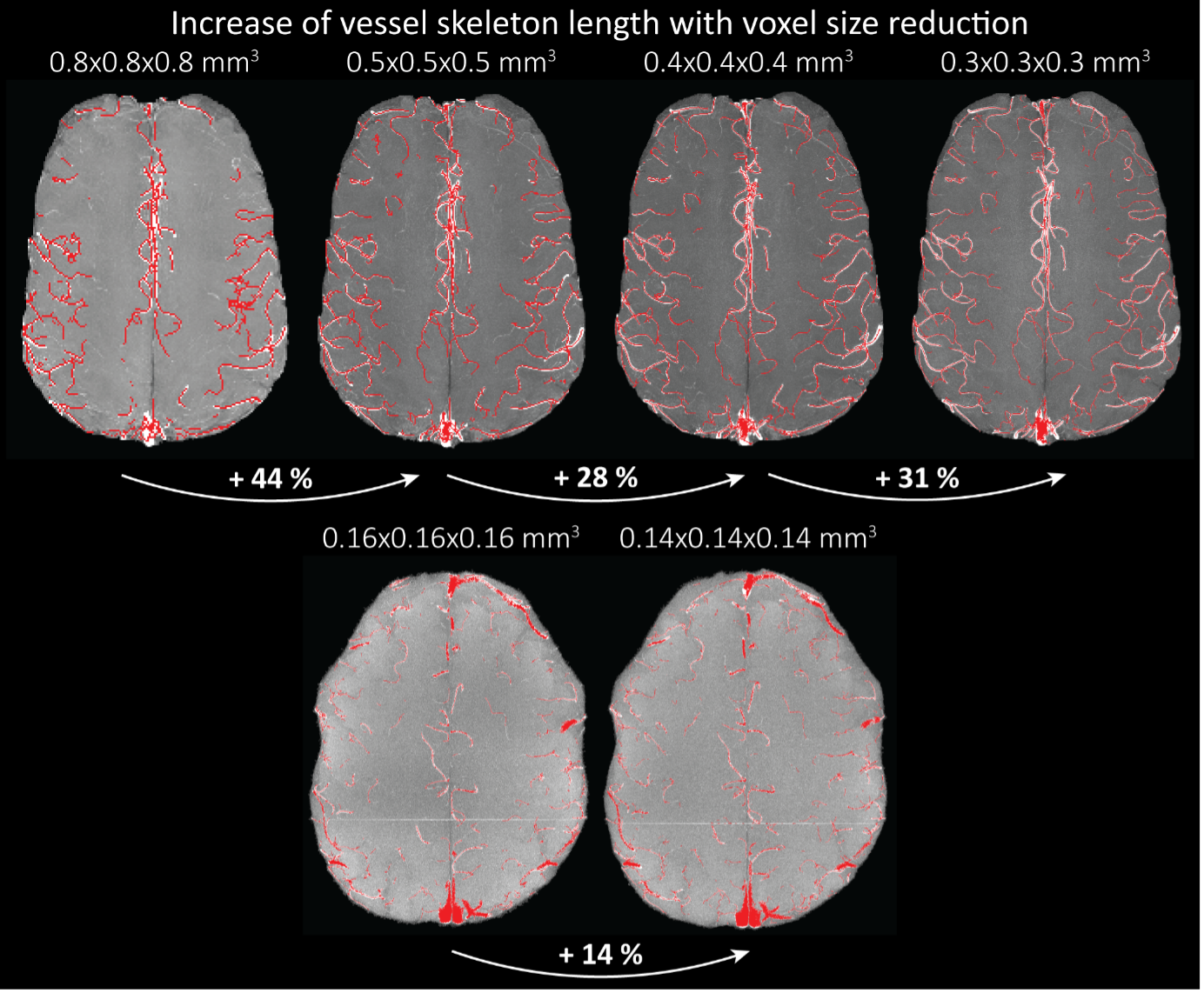
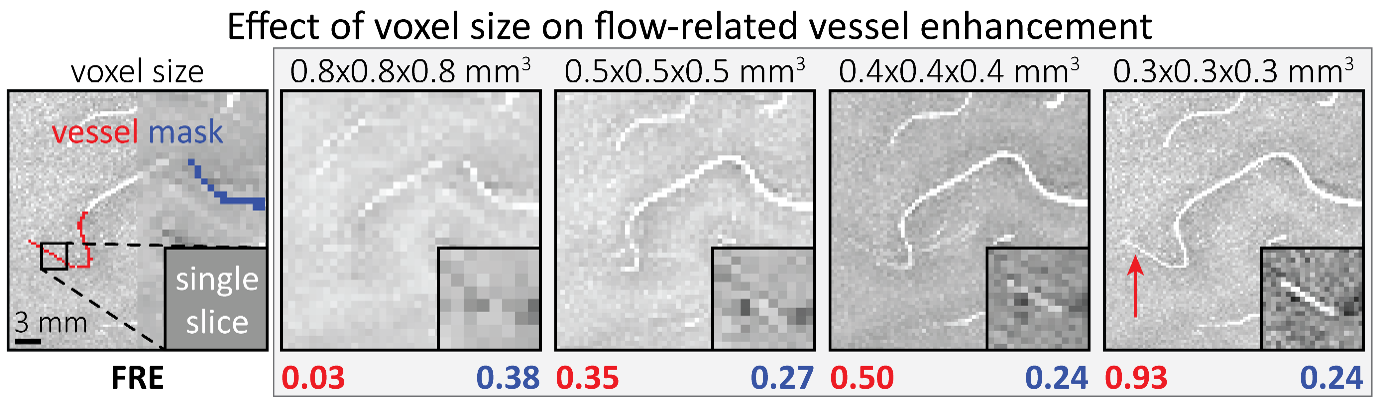
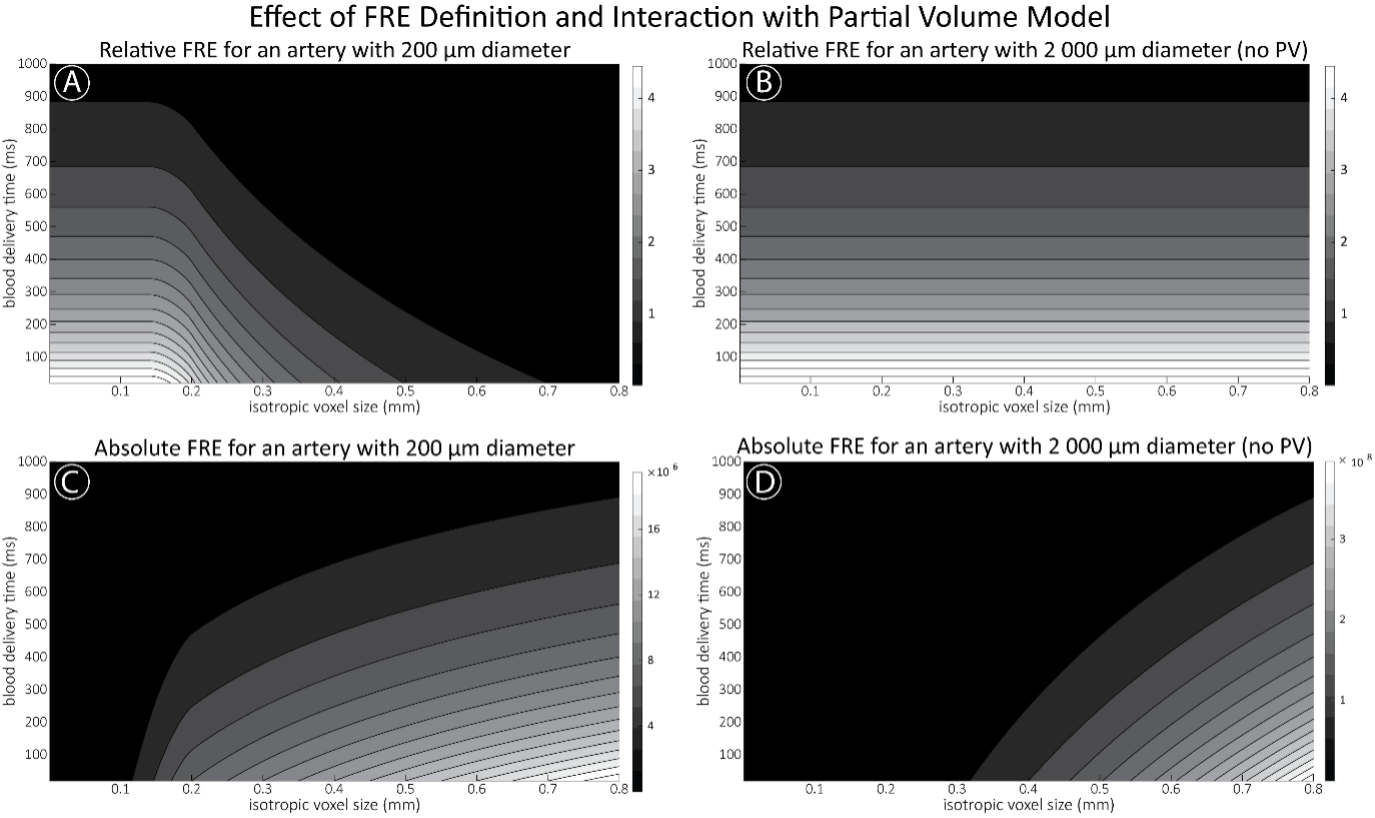
      Thank you for this excellent suggestion. We found it instructive to illustrate the different effects separately, i.e. relative vs. absolute FRE, and then partial volume vs. no-partial volume effects. In response to comment R2.8 of Reviewer 2, we also clarified the derivation of the relative FRE vs the ‘classical’ absolute FRE (please see R2.8). Accordingly, the manuscript now includes the theoretical derivation in the Theory section and an explicit demonstration of how the classical treatment leads to different conclusions in the Supplementary Material. The important insight gained in our work is that only when considering relative FRE and partial-volume effects together, can we conclude that smaller voxels are advantageous. We have added the following section in the Supplementary Material:

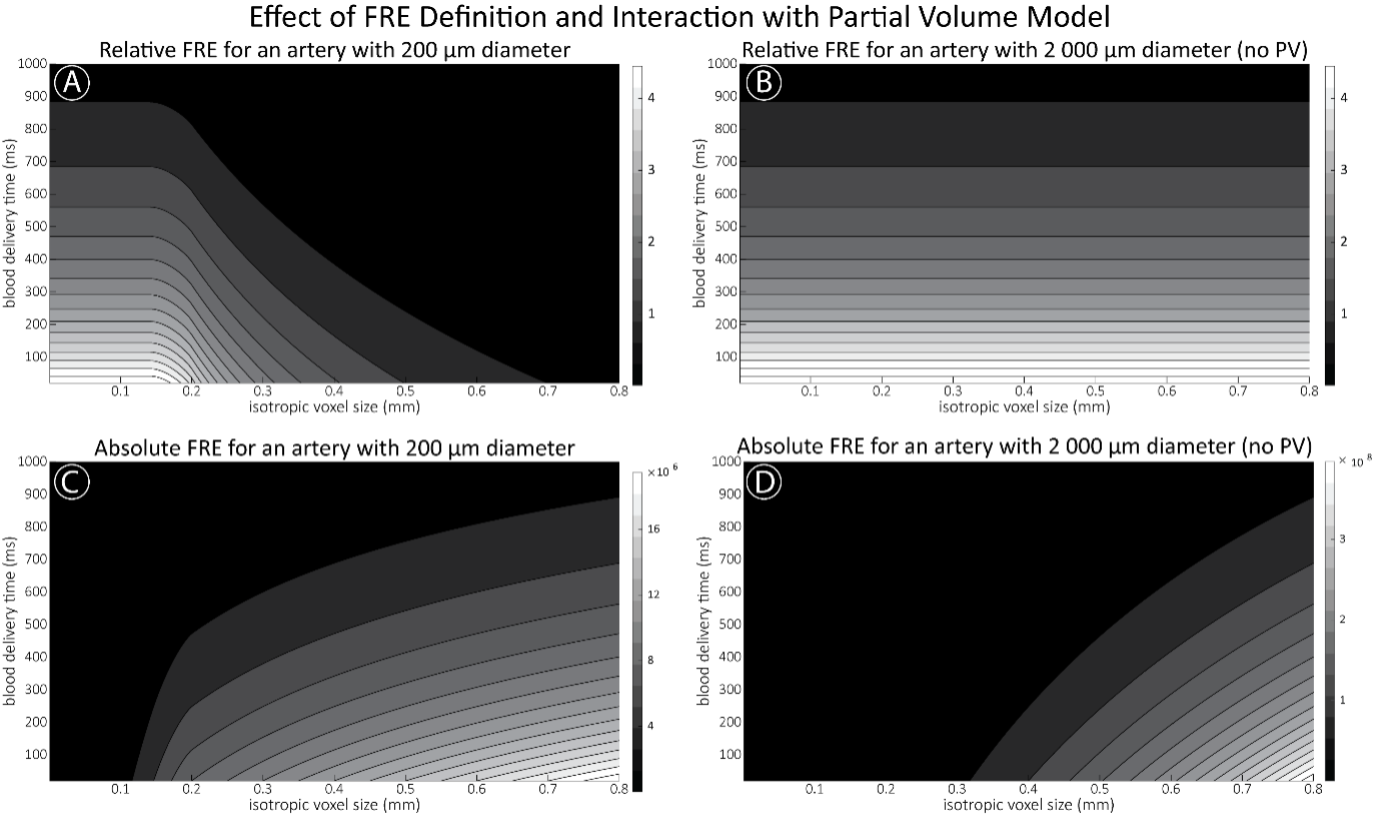
      "Effect of FRE Definition and Interaction with Partial-Volume Model

      For the definition of the FRE effect employed in this study, we used a measure of relative FRE (Al-Kwifi et al., 2002) in combination with a partial-volume model (Eq. 6). To illustrate the implications of these two effects, as well as their interaction, we have estimated the relative and absolute FRE for an artery with a diameter of 200 µm or 2 000 µm (i.e. no partial-volume effects at the centre of the vessel). The absolute FRE expression explicitly takes the voxel volume into account, and so instead of Eq. (6) for the relative FRE we used"

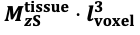
      Eq. (1)

      "Note that the division by M_zS^tissue⋅l_voxel^3 to obtain the relative FRE from this expression removes the contribution of the total voxel volume (l_voxel^3). Supplementary Figure 2 shows that, when partial volume effects are present, the highest relative FRE arises in voxels with the same size as or smaller than the vessel diameter (Supplementary Figure 2A), whereas the absolute FRE increases with voxel size (Supplementary Figure 2C). If no partial-volume effects are present, the relative FRE becomes independent of voxel size (Supplementary Figure 2B), whereas the absolute FRE increases with voxel size (Supplementary Figure 2D). While the partial-volume effects for the relative FRE are substantial, they are much more subtle when using the absolute FRE and do not alter the overall characteristics."

      Supplementary Figure 2: Effect of voxel size and blood delivery time on the relative flow-related enhancement (FRE) using either a relative (A,B) (Eq. (3)) or an absolute (C,D) (Eq. (12)) FRE definition assuming a pial artery diameter of 200 μm (A,C) or 2 000 µm, i.e. no partial-volume effects at the central voxel of this artery considered here.

      In addition, we have also clarified the contribution of the two definitions and their interaction in the Discussion section. Following the suggestion of Reviewer 2, we have extended our interpretation of relative FRE. In brief, absolute FRE is closely related to the physical origin of the contrast, whereas relative FRE is much more concerned with the “segmentability” of a vessel (please see R2.8 for more details):

      "Extending classical FRE treatments to the pial vasculature

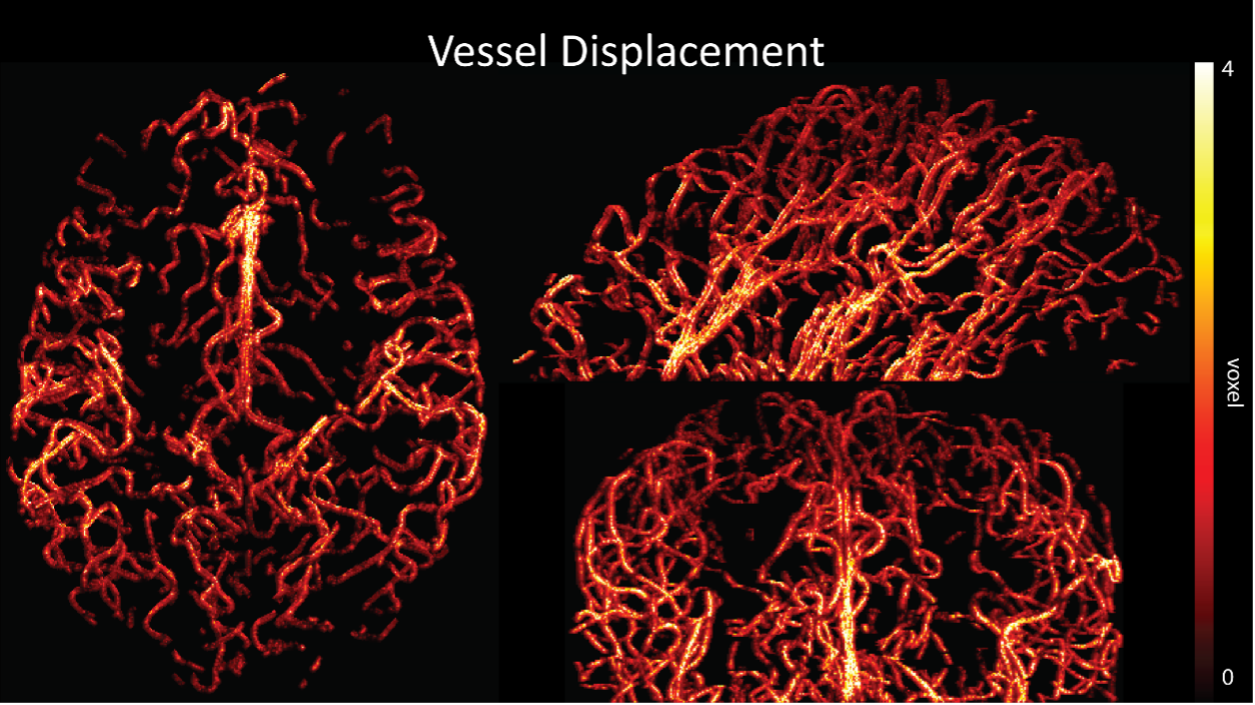
      There are several major modifications in our approach to this topic that might explain why, in contrast to predictions from classical FRE treatments, it is indeed possible to image pial arteries. For instance, the definition of vessel contrast or flow-related enhancement is often stated as an absolute difference between blood and tissue signal (Brown et al., 2014a; Carr and Carroll, 2012; Du et al., 1993, 1996; Haacke et al., 1990; Venkatesan and Haacke, 1997). Here, however, we follow the approach of Al-Kwifi et al. (2002) and consider relative contrast. While this distinction may seem to be semantic, the effect of voxel volume on FRE for these two definitions is exactly opposite: Du et al. (1996) concluded that larger voxel size increases the (absolute) vessel-background contrast, whereas here we predict an increase in relative FRE for small arteries with decreasing voxel size. Therefore, predictions of the depiction of small arteries with decreasing voxel size differ depending on whether one is considering absolute contrast, i.e. difference in longitudinal magnetization, or relative contrast, i.e. contrast differences independent of total voxel size. Importantly, this prediction changes for large arteries where the voxel contains only vessel lumen, in which case the relative FRE remains constant across voxel sizes, but the absolute FRE increases with voxel size (Supplementary Figure 2). Overall, the interpretations of relative and absolute FRE differ, and one measure may be more appropriate for certain applications than the other. Absolute FRE describes the difference in magnetization and is thus tightly linked to the underlying physical mechanism. Relative FRE, however, describes the image contrast and segmentability. If blood and tissue magnetization are equal, both contrast measures would equal zero and indicate that no contrast difference is present. However, when there is signal in the vessel and as the tissue magnetization approaches zero, the absolute FRE approaches the blood magnetization (assuming no partial-volume effects), whereas the relative FRE approaches infinity. While this infinite relative FRE does not directly relate to the underlying physical process of ‘infinite’ signal enhancement through inflowing blood, it instead characterizes the segmentability of the image in that an image with zero intensity in the background and non-zero values in the structures of interest can be segmented perfectly and trivially. Accordingly, numerous empirical observations (Al-Kwifi et al., 2002; Bouvy et al., 2014; Haacke et al., 1990; Ladd, 2007; Mattern et al., 2018; von Morze et al., 2007) and the data provided here (Figure 5, 6 and 7) have shown the benefit of smaller voxel sizes if the aim is to visualize and segment small arteries."

      Note that our formulation of the FRE—even without considering SNR—does not suggest that higher resolution is always better, but instead should be matched to the size of the target arteries:

      "Importantly, note that our treatment of the FRE does not suggest that an arbitrarily small voxel size is needed, but instead that voxel sizes appropriate for the arterial diameter of interest are beneficial (in line with the classic “matched-filter” rationale (North, 1963)). Voxels smaller than the arterial diameter would not yield substantial benefits (Figure 5) and may result in SNR reductions that would hinder segmentation performance."

      Further, we have also extended the concluding paragraph of the Imaging limitation section to also include a practical perspective:

      "In summary, numerous theoretical and practical considerations remain for optimal imaging of pial arteries using time-of-flight contrast. Depending on the application, advanced displacement artefact compensation strategies may be required, and zero-filling could provide better vessel depiction. Further, an optimal trade-off between SNR, voxel size and acquisition time needs to be found. Currently, the partial-volume FRE model only considers voxel size, and—as we reduced the voxel size in the experiments—we (partially) compensated the reduction in SNR through longer scan times. This, ultimately, also required the use of prospective motion correction to enable the very long acquisition times necessary for 140 µm isotropic voxel size. Often, anisotropic voxels are used to reduce acquisition time and increase SNR while maintaining in-plane resolution. This may indeed prove advantageous when the (also highly anisotropic) arteries align with the anisotropic acquisition, e.g. when imaging the large supplying arteries oriented mostly in the head-foot direction. In the case of pial arteries, however, there is not preferred orientation because of the convoluted nature of the pial arterial vasculature encapsulating the complex folding of the cortex (see section Anatomical architecture of the pial arterial vasculature). A further reduction in voxel size may be possible in dedicated research settings utilizing even longer acquisition times and/or larger acquisition volumes to maintain SNR. However, if acquisition time is limited, voxel size and SNR need to be carefully balanced against each other."

      3) The article seems to imply that TOF-MRA is the only adequate technique to image brain vasculature, while T2 mapping, UHF T1 mapping (see e.g. Choi et al., https://doi.org/10.1016/j.neuroimage.2020.117259) phase (e.g. Fan et al., doi:10.1038/jcbfm.2014.187), QSM (see e.g. Huck et al., https://doi.org/10.1007/s00429-019-01919-4), or a combination (Bernier et al., https://doi.org/10.1002/hbm.24337​, Ward et al., https://doi.org/10.1016/j.neuroimage.2017.10.049) all depict some level of vascular detail. It would be worth quickly reviewing the different effects of blood on MRI contrast and how those have been used in different approaches to measure vasculature. This would in particular help clarify the experiment combining TOF with T2 mapping used to separate arteries from veins (more on this question below).

      We apologize if we inadvertently created the impression that TOF-MRA is a suitable technique to image the complete brain vasculature, and we agree that susceptibility-based methods are much more suitable for venous structures. As outlined above, we have revised the manuscript in various sections to indicate that it is the pial arterial vasculature we are targeting. We have added a statement on imaging the venous vasculature in the Discussion section. Please see our response below regarding the use of T2* to separate arteries and veins.

      "The advantages of imaging the pial arterial vasculature using TOF-MRA without an exogenous contrast agent lie in its non-invasiveness and the potential to combine these data with various other structural and functional image contrasts provided by MRI. One common application is to acquire a velocity-encoded contrast such as phase-contrast MRA (Arts et al., 2021; Bouvy et al., 2016). Another interesting approach utilises the inherent time-of-flight contrast in magnetization-prepared two rapid acquisition gradient echo (MP2RAGE) images acquired at ultra-high field that simultaneously acquires vasculature and structural data, albeit at lower achievable resolution and lower FRE compared to the TOF-MRA data in our study (Choi et al., 2020). In summary, we expect high-resolution TOF-MRA to be applicable also for group studies to address numerous questions regarding the relationship of arterial topology and morphometry to the anatomical and functional organization of the brain, and the influence of arterial topology and morphometry on brain hemodynamics in humans. In addition, imaging of the pial venous vasculature—using susceptibility-based contrasts such as T2-weighted magnitude (Gulban et al., 2021) or phase imaging (Fan et al., 2015), susceptibility-weighted imaging (SWI) (Eckstein et al., 2021; Reichenbach et al., 1997) or quantitative susceptibility mapping (QSM) (Bernier et al., 2018; Huck et al., 2019; Mattern et al., 2019; Ward et al., 2018)—would enable a comprehensive assessment of the complete cortical vasculature and how both arteries and veins shape brain hemodynamics.*"

      4) The results, while very impressive, are mostly qualitative. This seems a missed opportunity to strengthen the points of the paper: given the segmentations already made, the amount/density of detected vessels could be compared across scans for the data of Fig. 5 and 7. The minimum distance between vessels could be measured in Fig. 8 to show a 2D distribution and/or a spatial map of the displacement. The number of vessels labeled as veins instead of arteries in Fig. 9 could be given.

      We fully agree that estimating these quantitative measures would be very interesting; however, this would require the development of a comprehensive analysis framework, which would considerably shift the focus of this paper from data acquisition and flow-related enhancement to data analysis. As noted in the discussion section Challenges for vessel segmentation algorithms, ‘The vessel segmentations presented here were performed to illustrate the sensitivity of the image acquisition to small pial arteries’, because the smallest arteries tend to be concealed in the maximum intensity projections. Further, the interpretation of these measures is not straightforward. For example, the number of detected vessels for the artery depicted in Figure 5 does not change across resolutions, but their length does. We have therefore estimated the relative increase in skeleton length across resolutions for Figures 5 and 7. However, these estimates are not only a function of the voxel size but also of the underlying vasculature, i.e. the number of arteries with a certain diameter present, and may thus not generalise well to enable quantitative predictions of the improvement expected from increased resolutions. We have added an illustration of these analyses in the Supplementary Material, and the following additions in the Methods, Results and Discussion sections.

      "For vessel segmentation, a semi-automatic segmentation pipeline was implemented in Matlab R2020a (The MathWorks, Natick, MA) using the UniQC toolbox (Frässle et al., 2021): First, a brain mask was created through thresholding which was then manually corrected in ITK-SNAP (http://www.itksnap.org/) (Yushkevich et al., 2006) such that pial vessels were included. For the high-resolution TOF data (Figures 6 and 7, Supplementary Figure 4), denoising to remove high frequency noise was performed using the implementation of an adaptive non-local means denoising algorithm (Manjón et al., 2010) provided in DenoiseImage within the ANTs toolbox, with the search radius for the denoising set to 5 voxels and noise type set to Rician. Next, the brain mask was applied to the bias corrected and denoised data (if applicable). Then, a vessel mask was created based on a manually defined threshold, and clusters with less than 10 or 5 voxels for the high- and low-resolution acquisitions, respectively, were removed from the vessel mask. Finally, an iterative region-growing procedure starting at each voxel of the initial vessel mask was applied that successively included additional voxels into the vessel mask if they were connected to a voxel which was already included and above a manually defined threshold (which was slightly lower than the previous threshold). Both thresholds were applied globally but manually adjusted for each slab. No correction for motion between slabs was applied. The Matlab code describing the segmentation algorithm as well as the analysis of the two-echo TOF acquisition outlined in the following paragraph are also included in our github repository (https://gitlab.com/SaskiaB/pialvesseltof.git). To assess the data quality, maximum intensity projections (MIPs) were created and the outline of the segmentation MIPs were added as an overlay. To estimate the increased detection of vessels with higher resolutions, we computed the relative increase in the length of the segmented vessels for the data presented in Figure 5 (0.8 mm, 0.5 mm, 0.4 mm and 0.3 mm isotropic voxel size) and Figure 7 (0.16 mm and 0.14 mm isotropic voxel size) by computing the skeleton using the bwskel Matlab function and then calculating the skeleton length as the number of voxels in the skeleton multiplied by the voxel size."

      "To investigate the effect of voxel size on vessel FRE, we acquired data at four different voxel sizes ranging from 0.8 mm to 0.3 mm isotropic resolution, adjusting only the encoding matrix, with imaging parameters being otherwise identical (FOV, TR, TE, flip angle, R, slab thickness, see section Data acquisition). The total acquisition time increases from less than 2 minutes for the lowest resolution scan to over 6 minutes for the highest resolution scan as a result. Figure 5 shows thin maximum intensity projections of a small vessel. While the vessel is not detectable at the largest voxel size, it slowly emerges as the voxel size decreases and approaches the vessel size. Presumably, this is driven by the considerable increase in FRE as seen in the single slice view (Figure 5, small inserts). Accordingly, the FRE computed from the vessel mask for the smallest part of the vessel (Figure 5, red mask) increases substantially with decreasing voxel size. More precisely, reducing the voxel size from 0.8 mm, 0.5 mm or 0.4 mm to 0.3 mm increases the FRE by 2900 %, 165 % and 85 %, respectively. Assuming a vessel diameter of 300 μm, the partial-volume FRE model (section Introducing a partial-volume model) would predict similar ratios of 611%, 178% and 78%. However, as long as the vessel is larger than the voxel (Figure 5, blue mask), the relative FRE does not change with resolution (see also Effect of FRE Definition and Interaction with Partial-Volume Model in the Supplementary Material). To illustrate the gain in sensitivity to detect smaller arteries, we have estimated the relative increase of the total length of the segmented vasculature (Supplementary Figure 9): reducing the voxel size from 0.8 mm to 0.5 mm isotropic increases the skeleton length by 44 %, reducing the voxel size from 0.5 mm to 0.4 mm isotropic increases the skeleton length by 28 %, and reducing the voxel size from 0.4 mm to 0.3 mm isotropic increases the skeleton length by 31 %. In summary, when imaging small pial arteries, these data support the hypothesis that it is primarily the voxel size, not the blood delivery time, which determines whether vessels can be resolved."

      "Indeed, the reduction in voxel volume by 33 % revealed additional small branches connected to larger arteries (see also Supplementary Figure 8). For this example, we found an overall increase in skeleton length of 14 % (see also Supplementary Figure 9)."

      "We therefore expect this strategy to enable an efficient image acquisition without the need for additional venous suppression RF pulses. Once these challenges for vessel segmentation algorithms are addressed, a thorough quantification of the arterial vasculature can be performed. For example, the skeletonization procedure used to estimate the increase of the total length of the segmented vasculature (Supplementary Figure 9) exhibits errors particularly in the unwanted sinuses and large veins. While they are consistently present across voxel sizes, and thus may have less impact on relative change in skeleton length, they need to be addressed when estimating the absolute length of the vasculature, or other higher-order features such as number of new branches. (Note that we have also performed the skeletonization procedure on the maximum intensity projections to reduce the number of artefacts and obtained comparable results: reducing the voxel size from 0.8 mm to 0.5 mm isotropic increases the skeleton length by 44 % (3D) vs 37 % (2D), reducing the voxel size from 0.5 mm to 0.4 mm isotropic increases the skeleton length by 28 % (3D) vs 26 % (2D), reducing the voxel size from 0.4 mm to 0.3 mm isotropic increases the skeleton length by 31 % (3D) vs 16 % (2D), and reducing the voxel size from 0.16 mm to 0.14 mm isotropic increases the skeleton length by 14 % (3D) vs 24 % (2D).)"

      Supplementary Figure 9: Increase of vessel skeleton length with voxel size reduction. Axial maximum intensity projections for data acquired with different voxel sizes ranging from 0.8 mm to 0.3 mm (TOP) (corresponding to Figure 5) and 0.16 mm to 0.14 mm isotropic (corresponding to Figure 7) are shown. Vessel skeletons derived from segmentations performed for each resolution are overlaid in red. A reduction in voxel size is accompanied by a corresponding increase in vessel skeleton length.

      Regarding further quantification of the vessel displacement presented in Figure 8, we have estimated the displacement using the Horn-Schunck optical flow estimator (Horn and Schunck, 1981; Mustafa, 2016) (https://github.com/Mustafa3946/Horn-Schunck-3D-Optical-Flow). However, the results are dominated by the larger arteries, whereas we are mostly interested in the displacement of the smallest arteries, therefore this quantification may not be helpful.

      Because the theoretical relationship between vessel displacement and blood velocity is well known (Eq. 7), and we have also outlined the expected blood velocity as a function of arterial diameter in Figure 2, which provided estimates of displacements that matched what was found in our data (as reported in our original submission), we believe that the new quantification in this form does not add value to the manuscript. What would be interesting would be to explore the use of this displacement artefact as a measure of blood velocities. This, however, would require more substantial analyses in particular for estimation of the arterial diameter and additional validation data (e.g. phase-contrast MRA). We have outlined this avenue in the Discussion section. What is relevant to the main aim of this study, namely imaging of small pial arteries, is the insight that blood velocities are indeed sufficiently fast to cause displacement artefacts even in smaller arteries. We have clarified this in the Results section:

      "Note that correction techniques exist to remove displaced vessels from the image (Gulban et al., 2021), but they cannot revert the vessels to their original location. Alternatively, this artefact could also potentially be utilised as a rough measure of blood velocity."

      "At a delay time of 10 ms between phase encoding and echo time, the observed displacement of approximately 2 mm in some of the larger vessels would correspond to a blood velocity of 200 mm/s, which is well within the expected range (Figure 2). For the smallest arteries, a displacement of one voxel (0.4 mm) can be observed, indicative of blood velocities of 40 mm/s. Note that the vessel displacement can be observed in all vessels visible at this resolution, indicating high blood velocities throughout much of the pial arterial vasculature. Thus, assuming a blood velocity of 40 mm/s (Figure 2) and a delay time of 5 ms for the high-resolution acquisitions (Figure 6), vessel displacements of 0.2 mm are possible, representing a shift of 1–2 voxels."

      Regarding the number of vessels labelled as veins, please see our response below to R1.5.

      In the main quantification given, the estimation of FRE increase with resolution, it would make more sense to perform the segmentation independently for each scan and estimate the corresponding FRE: using the mask from the highest resolution scan only biases the results. It is unclear also if the background tissue measurement one voxel outside took partial voluming into account (by leaving a one voxel free interface between vessel and background). In this analysis, it would also be interesting to estimate SNR, so you can compare SNR and FRE across resolutions, also helpful for the discussion on SNR.

      The FRE serves as an indicator of the potential performance of any segmentation algorithm (including manual segmentation) (also see our discussion on the interpretation of FRE in our response to R1.2). If we were to segment each scan individually, we would, in the ideal case, always obtain the same FRE estimate, as FRE influences the performance of the segmentation algorithm. In practice, this simply means that it is not possible to segment the vessel in the low-resolution image to its full extent that is visible in the high-resolution image, because the FRE is too low for small vessels. However, we agree with the core point that the reviewer is making, and so to help address this, a valuable addition would be to compare the FRE for the section of a vessel that is visible at all resolutions, where we found—within the accuracy of the transformations and resampling across such vastly different resolutions—that the FRE does not increase any further with higher resolution if the vessel is larger than the voxel size (page 18 and Figure 5). As stated in the Methods section, and as noted by the reviewer, we used the voxels immediately next to the vessel mask to define the background tissue signal level. Any resulting potential partial-volume effects in these background voxels would affect all voxel sizes, introducing a consistent bias that would not impact our comparison. However, inspection of the image data in Figure 5 showed partial-volume effects predominantly within those voxels intersecting the vessel, rather than voxels surrounding the vessel, in agreement with our model of FRE.

      "All imaging data were slab-wise bias-field corrected using the N4BiasFieldCorrection (Tustison et al., 2010) tool in ANTs (Avants et al., 2009) with the default parameters. To compare the empirical FRE across the four different resolutions (Figure 5), manual masks were first created for the smallest part of the vessel in the image with the highest resolution and for the largest part of the vessel in the image with the lowest resolution. Then, rigid-body transformation parameters from the low-resolution to the high-resolution (and the high-resolution to the low-resolution) images were estimated using coregister in SPM (https://www.fil.ion.ucl.ac.uk/spm/), and their inverse was applied to the vessel mask using SPM’s reslice. To calculate the empirical FRE (Eq. (3)), the mean of the intensity values within the vessel mask was used to approximate the blood magnetization, and the mean of the intensity values one voxel outside of the vessel mask was used as the tissue magnetization."

      "To investigate the effect of voxel size on vessel FRE, we acquired data at four different voxel sizes ranging from 0.8 mm to 0.3 mm isotropic resolution, adjusting only the encoding matrix, with imaging parameters being otherwise identical (FOV, TR, TE, flip angle, R, slab thickness, see section Data acquisition). The total acquisition time increases from less than 2 minutes for the lowest resolution scan to over 6 minutes for the highest resolution scan as a result. Figure 5 shows thin maximum intensity projections of a small vessel. While the vessel is not detectable at the largest voxel size, it slowly emerges as the voxel size decreases and approaches the vessel size. Presumably, this is driven by the considerable increase in FRE as seen in the single slice view (Figure 5, small inserts). Accordingly, the FRE computed from the vessel mask for the smallest part of the vessel (Figure 5, red mask) increases substantially with decreasing voxel size. More precisely, reducing the voxel size from 0.8 mm, 0.5 mm or 0.4 mm to 0.3 mm increases the FRE by 2900 %, 165 % and 85 %, respectively. Assuming a vessel diameter of 300 μm, the partial-volume FRE model (section Introducing a partial-volume model) would predict similar ratios of 611%, 178% and 78%. However, if the vessel is larger than the voxel (Figure 5, blue mask), the relative FRE remains constant across resolutions (see also Effect of FRE Definition and Interaction with Partial-Volume Model in the Supplementary Material). To illustrate the gain in sensitivity to smaller arteries, we have estimated the relative increase of the total length of the segmented vasculature (Supplementary Figure 9): reducing the voxel size from 0.8 mm to 0.5 mm isotropic increases the skeleton length by 44 %, reducing the voxel size from 0.5 mm to 0.4 mm isotropic increases the skeleton length by 28 %, and reducing the voxel size from 0.4 mm to 0.3 mm isotropic increases the skeleton length by 31 %. In summary, when imaging small pial arteries, these data support the hypothesis that it is primarily the voxel size, not blood delivery time, which determines whether vessels can be resolved."

      Figure 5: Effect of voxel size on flow-related vessel enhancement. Thin axial maximum intensity projections containing a small artery acquired with different voxel sizes ranging from 0.8 mm to 0.3 mm isotropic are shown. The FRE is estimated using the mean intensity value within the vessel masks depicted on the left, and the mean intensity values of the surrounding tissue. The small insert shows a section of the artery as it lies within a single slice. A reduction in voxel size is accompanied by a corresponding increase in FRE (red mask), whereas no further increase is obtained once the voxel size is equal or smaller than the vessel size (blue mask).

      After many internal discussions, we had to conclude that deducing a meaningful SNR analysis that would benefit the reader was not possible given the available data due to the complex relationship between voxel size and other imaging parameters in practice. In detail, we have reduced the voxel size but at the same time increased the acquisition time by increasing the number of encoding steps—which we have now also highlighted in the manuscript. We have, however, added additional considerations about balancing SNR and segmentation performance. Note that these considerations are not specific to imaging the pial arteries but apply to all MRA acquisitions, and have thus been discussed previously in the literature. Here, we wanted to focus on the novel insights gained in our study. Importantly, while we previously noted that reducing voxel size improves contrast in vessels whose diameters are smaller than the voxel size, we now explicitly acknowledge that, for vessels whose diameters are larger than the voxel size reducing the voxel size is not helpful---since it only reduces SNR without any gain in contrast---and may hinder segmentation performance, and thus become counterproductive.

      "In general, we have not considered SNR, but only FRE, i.e. the (relative) image contrast, assuming that segmentation algorithms would benefit from higher contrast for smaller arteries. Importantly, the acquisition parameters available to maximize FRE are limited, namely repetition time, flip angle and voxel size. SNR, however, can be improved via numerous avenues independent of these parameters (Brown et al., 2014b; Du et al., 1996; Heverhagen et al., 2008; Parker et al., 1991; Triantafyllou et al., 2011; Venkatesan and Haacke, 1997), the simplest being longer acquisition times. If the aim is to optimize a segmentation outcome for a given acquisition time, the trade-off between contrast and SNR for the specific segmentation algorithm needs to be determined (Klepaczko et al., 2016; Lesage et al., 2009; Moccia et al., 2018; Phellan and Forkert, 2017). Our own—albeit limited—experience has shown that segmentation algorithms (including manual segmentation) can accommodate a perhaps surprising amount of noise using prior knowledge and neighborhood information, making these high-resolution acquisitions possible. Importantly, note that our treatment of the FRE does not suggest that an arbitrarily small voxel size is needed, but instead that voxel sizes appropriate for the arterial diameter of interest are beneficial (in line with the classic “matched-filter” rationale (North, 1963)). Voxels smaller than the arterial diameter would not yield substantial benefits (Figure 5) and may result in SNR reductions that would hinder segmentation performance."

      5) The separation of arterial and venous components is a bit puzzling, partly because the methodology used is not fully explained, but also partly because the reasons invoked (flow artefact in large pial veins) do not match the results (many small vessels are included as veins). This question of separating both types of vessels is quite important for applications, so the whole procedure should be explained in detail. The use of short T2 seemed also sub-optimal, as both arteries and veins result in shorter T2 compared to most brain tissues: wouldn't a susceptibility-based measure (SWI or better QSM) provide a better separation? Finally, since the T2* map and the regular TOF map are at different resolutions, masking out the vessels labeled as veins will likely result in the smaller veins being left out.

      We agree that while the technical details of this approach were provided in the Data analysis section, the rationale behind it was only briefly mentioned. We have therefore included an additional section Inflow-artefacts in sinuses and pial veins in the Theory section of the manuscript. We have also extended the discussion of the advantages and disadvantages of the different susceptibility-based contrasts, namely T2, SWI and QSM. While in theory both T2 and QSM should allow the reliable differentiation of arterial and venous blood, we found T2* to perform more robustly, as QSM can fail in many places, e.g., due to the strong susceptibility sources within superior sagittal and transversal sinuses and pial veins and their proximity to the brain surface, dedicated processing is required (Stewart et al., 2022). Further, we have also elaborated in the Discussion section why the interpretation of Figure 9 regarding the absence or presence of small veins is challenging. Namely, the intensity-based segmentation used here provides only an incomplete segmentation even of the larger sinuses, because the overall lower intensity found in veins combined with the heterogeneity of the intensities in veins violates the assumptions made by most vascular segmentation approaches of homogenous, high image intensities within vessels, which are satisfied in arteries (page 29f) (see also the illustration below). Accordingly, quantifying the number of vessels labelled as veins (R1.4a) would provide misleading results, as often only small subsets of the same sinus or vein are segmented.

      "Inflow-artefacts in sinuses and pial veins

      Inflow in large pial veins and the sagittal and transverse sinuses can cause flow-related enhancement in these non-arterial vessels. One common strategy to remove this unwanted signal enhancement is to apply venous suppression pulses during the data acquisition, which saturate bloods spins outside the imaging slab. Disadvantages of this technique are the technical challenges of applying these pulses at ultra-high field due to constraints of the specific absorption rate (SAR) and the necessary increase in acquisition time (Conolly et al., 1988; Heverhagen et al., 2008; Johst et al., 2012; Maderwald et al., 2008; Schmitter et al., 2012; Zhang et al., 2015). In addition, optimal positioning of the saturation slab in the case of pial arteries requires further investigation, and in particular supressing signal from the superior sagittal sinus without interfering in the imaging of the pial arteries vasculature at the top of the cortex might prove challenging. Furthermore, this venous saturation strategy is based on the assumption that arterial blood is traveling head-wards while venous blood is drained foot-wards. For the complex and convoluted trajectory of pial vessels this directionality-based saturation might be oversimplified, particularly when considering the higher-order branches of the pial arteries and veins on the cortical surface. Inspired by techniques to simultaneously acquire a TOF image for angiography and a susceptibility-weighted image for venography (Bae et al., 2010; Deistung et al., 2009; Du et al., 1994; Du and Jin, 2008), we set out to explore the possibility of removing unwanted venous structures from the segmentation of the pial arterial vasculature during data postprocessing. Because arteries filled with oxygenated blood have T2-values similar to tissue, while veins have much shorter T2-values due to the presence of deoxygenated blood (Pauling and Coryell, 1936; Peters et al., 2007; Uludağ et al., 2009; Zhao et al., 2007), we used this criterion to remove vessels with short T2* values from the segmentation (see Data Analysis for details). In addition, we also explored whether unwanted venous structures in the high-resolution TOF images—where a two-echo acquisition is not feasible due to the longer readout—can be removed based on detecting them in a lower-resolution image."

      "Removal of pial veins

      Inflow in large pial veins and the superior sagittal and transverse sinuses can cause a flow-related enhancement in these non-arterial vessels (Figure 9, left). The higher concentration of deoxygenated haemoglobin in these vessels leads to shorter T2 values (Pauling and Coryell, 1936), which can be estimated using a two-echo TOF acquisition (see also Inflow-artefacts in sinuses and pial veins). These vessels can be identified in the segmentation based on their T2 values (Figure 9, left), and removed from the angiogram (Figure 9, right) (Bae et al., 2010; Deistung et al., 2009; Du et al., 1994; Du and Jin, 2008). In particular, the superior and inferior sagittal and the transversal sinuses and large veins which exhibited an inhomogeneous intensity profile and a steep loss of intensity at the slab boundary were identified as non-arterial (Figure 9, left). Further, we also explored the option of removing unwanted venous vessels from the high-resolution TOF image (Figure 7) using a low-resolution two-echo TOF (not shown). This indeed allowed us to remove the strong signal enhancement in the sagittal sinuses and numerous larger veins, although some small veins, which are characterised by inhomogeneous intensity profiles and can be detected visually by experienced raters, remain."

      Figure 9: Removal of non-arterial vessels in time-of-flight imaging. LEFT: Segmentation of arteries (red) and veins (blue) using T_2^ estimates. RIGHT: Time-of-flight angiogram after vein removal.*

      Our approach also assumes that the unwanted veins are large enough that they are also resolved in the low-resolution image. If we consider the source of the FRE effect, it might indeed be exclusively large veins that are present in TOF-MRA data, which would suggest that our assumption is valid. Fundamentally, the FRE depends on the inflow of un-saturated spins into the imaging slab. However, small veins drain capillary beds in the local tissue, i.e. the tissue within the slab. (Note that due to the slice oversampling implemented in our acquisition, spins just above or below the slab will also be excited.) Thus, small veins only contain blood water spins that have experienced a large number of RF pulses due to the long transit time through the pial arterial vasculature, the capillaries and the intracortical venules. Hence, their longitudinal magnetization would be similar to that of stationary tissue. To generate an FRE effect in veins, “pass-through” venous blood from outside the imaging slab is required. This is only available in veins that are passing through the imaging slab, which have much larger diameters. These theoretical considerations are corroborated by the findings in Figure 9, where large disconnected vessels with varying intensity profiles were identified as non-arterial. Due to the heterogenous intensity profiles in large veins and the sagittal and transversal sinuses, the intensity-based segmentation applied here may only label a subset of the vessel lumen, creating the impression of many small veins. This is particularly the case for the straight and inferior sagittal sinus in the bottom slab of Figure 9. Nevertheless, future studies potentially combing anatomical prior knowledge, advanced segmentation algorithms and susceptibility measures would be capable of removing these unwanted veins in post-processing to enable an efficient TOF-MRA image acquisition dedicated to optimally detecting small arteries without the need for additional venous suppression RF pulses.

      6) A more general question also is why this imaging method is limited to pial vessels: at 140 microns, the larger intra-cortical vessels should be appearing (group 6 in Duvernoy, 1981: diameters between 50 and 240 microns). Are there other reasons these vessels are not detected? Similarly, it seems there is no arterial vasculature detected in the white matter here: it is due to the rather superior location of the imaging slab, or a limitation of the method? Likewise, all three results focus on a rather homogeneous region of cerebral cortex, in terms of vascularisation. It would be interesting for applications to demonstrate the capabilities of the method in more complex regions, e.g. the densely vascularised cerebellum, or more heterogeneous regions like the midbrain. Finally, it is notable that all three subjects appear to have rather different densities of vessels, from sparse (participant II) to dense (participant I), with some inhomogeneities in density (frontal region in participant III) and inconsistencies in detection (sinuses absent in participant II). All these points should be discussed.

      While we are aware that the diameter of intracortical arteries has been suggested to be up to 240 µm (Duvernoy et al., 1981), it remains unclear how prevalent intracortical arteries of this size are. For example, note that in a different context in the Duvernoy study (in teh revised manuscript), the following values are mentioned (which we followed in Figure 1):

      “Central arteries of the Iobule always have a large diameter of 260 µ to 280 µ, at their origin. Peripheral arteries have an average diameter of 150 µ to 180 µ. At the cortex surface, all arterioles of 50 µ or less, penetrate the cortex or form anastomoses. The diameter of most of these penetrating arteries is approximately 40 µ.”

      Further, the examinations by Hirsch et al. (2012) (albeit in the macaque brain), showed one (exemplary) intracortical artery belonging to group 6 (Figure 1B), whose diameter appears to be below 100 µm. Given these discrepancies and the fact that intracortical arteries in group 5 only reach 75 µm, we suspect that intracortical arteries with diameters > 140 µm are a very rare occurrence, which we might not have encountered in this data set.

      Similarly, arteries in white matter (Nonaka et al., 2003) and the cerebellum (Duvernoy et al., 1983) are beyond our resolution at the moment. The midbrain is an interesting suggesting, although we believe that the cortical areas chosen here with their gradual reduction in diameter along the vascular tree, provide a better illustration of the effect of voxel size than the rather abrupt reduction in vascular diameter found in the midbrain. We have added the even higher resolution requirements in the discussion section:

      "In summary, we expect high-resolution TOF-MRA to be applicable also for group studies, to address numerous questions regarding the relationship of arterial topology and morphometry to the anatomical and functional organization of the brain, and the influence of arterial topology and morphometry on brain hemodynamics in humans. Notably, we have focused on imaging pial arteries of the human cerebrum; however, other brain structures such as the cerebellum, subcortex and white matter are of course also of interest. While the same theoretical considerations apply, imaging the arterial vasculature in these structures will require even smaller voxel sizes due to their smaller arterial diameters (Duvernoy et al., 1983, 1981; Nonaka et al., 2003)."

      Regarding the apparent sparsity of results from participant II, this is mostly driven by the much smaller coverage in this subject (19.6 mm in Participant II vs. 50 mm and 58 mm in Participant I and III, respectively). The reduction in density in the frontal regions might indeed constitute difference in anatomy or might be driven by the presence or more false-positive veins in Participant I than Participant III in these areas. Following the depiction in Duvernoy et al. (1981), one would not expect large arteries in frontal areas, but large veins are common. Thus, the additional vessels in Participant I in the frontal areas might well be false-positive veins, and their removal would result in similar densities for both participants. Indeed, as pointed out in section Future directions, we would expect a lower arterial density in frontal and posterior areas than in middle areas. The sinuses (and other large false-positive veins) in Participant II have been removed as outlined and discussed in sections Removal of pial veins and Challenges for vessel segmentation algorithms, respectively.

      7) One of the main practical limitations of the proposed method is the use of a very small imaging slab. It is mentioned in the discussion that thicker slabs are not only possible, but beneficial both in terms of SNR and acceleration possibilities. What are the limitations that prevented their use in the present study? With the current approach, what would be the estimated time needed to acquire the vascular map of an entire brain? It would also be good to indicate whether specific processing was needed to stitch together the multiple slab images in Fig. 6-9, S2.

      Time-of-flight acquisitions are commonly performed with thin acquisition slabs, following initial investigations by Parker et al. (1991) to maximise vessel sensitivity and minimize noise. We therefore followed this practice for our initial investigations but wanted to point out in the discussion that thicker slabs might provide several advantages that need to be evaluated in future studies. This would include theoretical and empirical evaluations balancing SNR gains from larger excitation volumes and SNR losses due to more acceleration. For this study, we have chosen the slab thickness such as to keep the acquisition time at a reasonable amount to minimize motion artefacts (as outlined in the Discussion). In addition, due to the extreme matrix sizes in particular for the 0.14 mm acquisition, we were also limited in the number of data points per image that can be indexed. This would require even more substantial changes to the sequence than what we have already performed. With 16 slabs, assuming optimal FOV orientation, full-brain coverage including the cerebellum of 95 % of the population (Mennes et al., 2014) could be achieved with an acquisition time of (16  11 min 42 s = 3 h 7 min 12 s) at 0.16 mm isotropic voxel size. No stitching of the individual slabs was performed, as subject motion was minimal. We have added a corresponding comment in the Data Analysis.

      "Both thresholds were applied globally but manually adjusted for each slab. No correction for motion between slabs was applied as subject motion was minimal. The Matlab code describing the segmentation algorithm as well es the analysis of the two-echo TOF acquisition outlined in the following paragraph are also included in the github repository (https://gitlab.com/SaskiaB/pialvesseltof.git)."

      8) Some researchers and clinicians will argue that you can attain best results with anisotropic voxels, combining higher SNR and higher resolution. It would be good to briefly mention why isotropic voxels are preferred here, and whether anisotropic voxels would make sense at all in this context.

      Anisotropic voxels can be advantageous if the underlying object is anisotropic, e.g. an artery running straight through the slab, which would have a certain diameter (imaged using the high-resolution plane) and an ‘infinite’ elongation (in the low-resolution direction). However, the vessels targeted here can have any orientation and curvature; an anisotropic acquisition could therefore introduce a bias favouring vessels with a particular orientation relative to the voxel grid. Note that the same argument applies when answering the question why a further reduction slab thickness would eventually result in less increase in FRE (section Introducing a partial-volume model). We have added a corresponding comment in our discussion on practical imaging considerations:

      "In summary, numerous theoretical and practical considerations remain for optimal imaging of pial arteries using time-of-flight contrast. Depending on the application, advanced displacement artefact compensation strategies may be required, and zero-filling could provide better vessel depiction. Further, an optimal trade-off between SNR, voxel size and acquisition time needs to be found. Currently, the partial-volume FRE model only considers voxel size, and—as we reduced the voxel size in the experiments—we (partially) compensated the reduction in SNR through longer scan times. This, ultimately, also required the use of prospective motion correction to enable the very long acquisition times necessary for 140 µm isotropic voxel size. Often, anisotropic voxels are used to reduce acquisition time and increase SNR while maintaining in-plane resolution. This may indeed prove advantageous when the (also highly anisotropic) arteries align with the anisotropic acquisition, e.g. when imaging the large supplying arteries oriented mostly in the head-foot direction. In the case of pial arteries, however, there is not preferred orientation because of the convoluted nature of the pial arterial vasculature encapsulating the complex folding of the cortex (see section Anatomical architecture of the pial arterial vasculature). A further reduction in voxel size may be possible in dedicated research settings utilizing even longer acquisition times and a larger field-of-view to maintain SNR. However, if acquisition time is limited, voxel size and SNR need to be carefully balanced against each other."

      Reviewer #2 (Public Review):

      Overview

      This paper explores the use of inflow contrast MRI for imaging the pial arteries. The paper begins by providing a thorough background description of pial arteries, including past studies investigating the velocity and diameter. Following this, the authors consider this information to optimize the contrast between pial arteries and background tissue. This analysis reveals spatial resolution to be a strong factor influencing the contrast of the pial arteries. Finally, experiments are performed on a 7T MRI to investigate: the effect of spatial resolution by acquiring images at multiple resolutions, demonstrate the feasibility of acquiring ultrahigh resolution 3D TOF, the effect of displacement artifacts, and the prospect of using T2* to remove venous voxels.

      Impression

      There is certainly interest in tools to improve our understanding of the architecture of the small vessels of the brain and this work does address this. The background description of the pial arteries is very complete and the manuscript is very well prepared. The images are also extremely impressive, likely benefiting from motion correction, 7T, and a very long scan time. The authors also commit to open science and provide the data in an open platform. Given this, I do feel the manuscript to be of value to the community; however, there are concerns with the methods for optimization, the qualitative nature of the experiments, and conclusions drawn from some of the experiments.

      Specific Comments :

      1) Figure 3 and Theory surrounding. The optimization shown in Figure 3 is based fixing the flip angle or the TR. As is well described in the literature, there is a strong interdependency of flip angle and TR. This is all well described in literature dating back to the early 90s. While I think it reasonable to consider these effects in optimization, the language needs to include this interdependency or simply reference past work and specify how the flip angle was chosen. The human experiments do not include any investigation of flip angle or TR optimization.

      We thank the reviewer for raising this valuable point, and we fully agree that there is an interdependency between these two parameters. To simplify our optimization, we did fix one parameter value at a time, but in the revised manuscript we clarified that both parameters can be optimized simultaneously. Importantly, a large range of parameter values will result in a similar FRE in the small artery regime, which is illustrated in the optimization provided in the main text. We have therefore chosen the repetition time based on encoding efficiency and then set a corresponding excitation flip angle. In addition, we have also provided additional simulations in the supplementary material outlining the interdependency for the case of pial arteries.

      "Optimization of repetition time and excitation flip angle

      As the main goal of the optimisation here was to start within an already established parameter range for TOF imaging at ultra-high field (Kang et al., 2010; Stamm et al., 2013; von Morze et al., 2007), we only needed to then further tailor these for small arteries by considering a third parameter, namely the blood delivery time. From a practical perspective, a TR of 20 ms as a reference point was favourable, as it offered a time-efficient readout minimizing wait times between excitations but allowing low encoding bandwidths to maximize SNR. Due to the interdependency of flip angle and repetition time, for any one blood delivery time any FRE could (in theory) be achieved. For example, a similar FRE curve at 18 ° flip angle and 5 ms TR can also be achieved at 28 ° flip angle and 20 ms TR; or the FRE curve at 18 ° flip angle and 30 ms TR is comparable to the FRE curve at 8 ° flip angle and 5 ms TR (Supplementary Figure 3 TOP). In addition, the difference between optimal parameter settings diminishes for long blood delivery times, such that at a blood delivery time of 500 ms (Supplementary Figure 3 BOTTOM), the optimal flip angle at a TR of 15 ms, 20 ms or 25 ms would be 14 °, 16 ° and 18 °, respectively. This is in contrast to a blood delivery time of 100 ms, where the optimal flip angles would be 32 °, 37 ° and 41 °. In conclusion, in the regime of small arteries, long TR values in combination with low flip angles ensure flow-related enhancement at blood delivery times of 200 ms and above, and within this regime there are marginal gains by further optimizing parameter values and the optimal values are all similar."

      Supplementary Figure 3: Optimal imaging parameters for small arteries. This assessment follows the simulations presented in Figure 3, but in addition shows the interdependency for the corresponding third parameter (either flip angle or repetition time). TOP: Flip angles close to the Ernst angle show only a marginal flow-related enhancement; however, the influence of the blood delivery time decreases further (LEFT). As the flip angle increases well above the values used in this study, the flow-related enhancement in the small artery regime remains low even for the longer repetition times considered here (RIGHT). BOTTOM: The optimal excitation flip angle shows reduced variability across repetition times in the small artery regime compared to shorter blood delivery times.

      "Based on these equations, optimal T_R and excitation flip angle values (θ) can be calculated for the blood delivery times under consideration (Figure 3). To better illustrate the regime of small arteries, we have illustrated the effect of either flip angle or T_R while keeping the other parameter values fixed to the value that was ultimately used in the experiments; although both parameters can also be optimized simultaneously (Haacke et al., 1990). Supplementary Figure 3 further delineates the interdependency between flip angle and T_R within a parameter range commonly used for TOF imaging at ultra-high field (Kang et al., 2010; Stamm et al., 2013; von Morze et al., 2007). Note how longer T_R values still provide an FRE effect even at very long blood delivery times, whereas using shorter T_R values can suppress the FRE effect (Figure 3, left). Similarly, at lower flip angles the FRE effect is still present for long blood delivery times, but it is not available anymore at larger flip angles, which, however, would give maximum FRE for shorter blood delivery times (Figure 3, right). Due to the non-linear relationships of both blood delivery time and flip angle with FRE, the optimal imaging parameters deviate considerably when comparing blood delivery times of 100 ms and 300 ms, but the differences between 300 ms and 1000 ms are less pronounced. In the following simulations and measurements, we have thus used a T_R value of 20 ms, i.e. a value only slightly longer than the readout of the high-resolution TOF acquisitions, which allowed time-efficient data acquisition, and a nominal excitation flip angle of 18°. From a practical standpoint, these values are also favorable as the low flip angle reduces the specific absorption rate (Fiedler et al., 2018) and the long T_R value decreases the potential for peripheral nerve stimulation (Mansfield and Harvey, 1993)."

      2) Figure 4 and Theory surrounding. A major limitation of this analysis is the lack of inclusion of noise in the analysis. I believe the results to be obvious that the FRE will be modulated by partial volume effects, here described quadratically by assuming the vessel to pass through the voxel. This would substantially modify the analysis, with a shift towards higher voxel volumes (scan time being equal). The authors suggest the FRE to be the dominant factor effecting segmentation; however, segmentation is limited by noise as much as contrast.

      We of course agree with the reviewer that contrast-to-noise ratio is a key factor that determines the detection of vessels and the quality of the segmentation, however there are subtleties regarding the exact inter-relationship between CNR, resolution, and segmentation performance.

      The main purpose of Figure 4 is not to provide a trade-off between flow-related enhancement and signal-to-noise ratio—in particular as SNR is modulated by many more factors than voxel size alone, e.g. acquisition time, coil geometry and instrumentation—but to decide whether the limiting factor for imaging pial arteries is the reduction in flow-related enhancement due to long blood delivery times (which is the explanation often found in the literature (Chen et al., 2018; Haacke et al., 1990; Masaryk et al., 1989; Mut et al., 2014; Park et al., 2020; Parker et al., 1991; Wilms et al., 2001; Wright et al., 2013)) or due to partial volume effects. Furthermore, when reducing voxel size one will also likely increase the number of encoding steps to maintain the imaging coverage (i.e., the field-of-view) and so the relationship between voxel size and SNR in practice is not straightforward. Therefore, we had to conclude that deducing a meaningful SNR analysis that would benefit the reader was not possible given the available data due to the complex relationship between voxel size and other imaging parameters. Note that these considerations are not specific to imaging the pial arteries but apply to all MRA acquisitions, and have thus been discussed previously in the literature. Here, we wanted to focus on the novel insights gained in our study, namely that it provides an expression for how relative FRE contrast changes with voxel size with some assumptions that apply for imaging pial arteries.

      Further, depending on the definition of FRE and whether partial-volume effects are included (see also our response to R2.8), larger voxel volumes have been found to be theoretically advantageous even when only considering contrast (Du et al., 1996; Venkatesan and Haacke, 1997), which is not in line with empirical observations (Al-Kwifi et al., 2002; Bouvy et al., 2014; Haacke et al., 1990; Ladd, 2007; Mattern et al., 2018; von Morze et al., 2007).

      The notion that vessel segmentation algorithms perform well on noisy data but poorly on low-contrast data was mainly driven by our own experiences. However, we still believe that the assumption that (all) segmentation algorithms are linearly dependent on contrast and noise (which the formulation of a contrast-to-noise ratio presumes) is similarly not warranted. Indeed, the necessary trade-off between FRE and SNR might be specific to the particular segmentation algorithm being used than a general property of the acquisition. Please also note that our analysis of the FRE does not suggest that an arbitrarily high resolution is needed. Importantly, while we previously noted that reducing voxel size improves contrast in vessels whose diameters are smaller than the voxel size, we now explicitly acknowledge that, for vessels whose diameters are larger than the voxel size reducing the voxel size is not helpful---since it only reduces SNR without any gain in contrast---and may hinder segmentation performance, and thus become counterproductive. But we take the reviewer’s point and also acknowledge that these intricacies need to be mentioned, and therefore we have rephrased the statement in the discussion in the following way:

      "In general, we have not considered SNR, but only FRE, i.e. the (relative) image contrast, assuming that segmentation algorithms would benefit from higher contrast for smaller arteries. Importantly, the acquisition parameters available to maximize FRE are limited, namely repetition time, flip angle and voxel size. SNR, however, can be improved via numerous avenues independent of these parameters (Brown et al., 2014b; Du et al., 1996; Heverhagen et al., 2008; Parker et al., 1991; Triantafyllou et al., 2011; Venkatesan and Haacke, 1997), the simplest being longer acquisition times. If the aim is to optimize a segmentation outcome for a given acquisition time, the trade-off between contrast and SNR for the specific segmentation algorithm needs to be determined (Klepaczko et al., 2016; Lesage et al., 2009; Moccia et al., 2018; Phellan and Forkert, 2017). Our own—albeit limited—experience has shown that segmentation algorithms (including manual segmentation) can accommodate a perhaps surprising amount of noise using prior knowledge and neighborhood information, making these high-resolution acquisitions possible. Importantly, note that our treatment of the FRE does not suggest that an arbitrarily small voxel size is needed, but instead that voxel sizes appropriate for the arterial diameter of interest are beneficial (in line with the classic “matched-filter” rationale (North, 1963)). Voxels smaller than the arterial diameter would not yield substantial benefits (Figure 5) and may result in SNR reductions that would hinder segmentation performance."

      3) Page 11, Line 225. "only a fraction of the blood is replaced" I think the language should be reworded. There are certainly water molecules in blood which have experience more excitation B1 pulses due to the parabolic flow upstream and the temporal variation in flow. There is magnetization diffusion which reduces the discrepancy; however, it seems pertinent to just say the authors assume the signal is represented by the average arrival time. This analysis is never verified and is only approximate anyways. The "blood dwell time" is also an average since voxels near the wall will travel more slowly. Overall, I recommend reducing the conjecture in this section.

      We fully agree that our treatment of the blood dwell time does not account for the much more complex flow patterns found in cortical arteries. However, our aim was not do comment on these complex patterns, but to help establish if, in the simplest scenario assuming plug flow, the often-mentioned slow blood flow requires multiple velocity compartments to describe the FRE (as is commonly done for 2D MRA (Brown et al., 2014a; Carr and Carroll, 2012)). We did not intend to comment on the effects of laminar flow or even more complex flow patterns, which would require a more in-depth treatment. However, as the small arteries targeted here are often just one voxel thick, all signals are indeed integrated within that voxel (i.e. there is no voxel near the wall that travels more slowly), which may average out more complex effects. We have clarified the purpose and scope of this section in the following way:

      "In classical descriptions of the FRE effect (Brown et al., 2014a; Carr and Carroll, 2012), significant emphasis is placed on the effect of multiple “velocity segments” within a slice in the 2D imaging case. Using the simplified plug-flow model, where the cross-sectional profile of blood velocity within the vessel is constant and effects such as drag along the vessel wall are not considered, these segments can be described as ‘disks’ of blood that do not completely traverse through the full slice within one T_R, and, thus, only a fraction of the blood in the slice is replaced. Consequently, estimation of the FRE effect would then need to accommodate contribution from multiple ‘disks’ that have experienced 1 to k RF pulses. In the case of 3D imaging as employed here, multiple velocity segments within one voxel are generally not considered, as the voxel sizes in 3D are often smaller than the slice thickness in 2D imaging and it is assumed that the blood completely traverses through a voxel each T_R. However, the question arises whether this assumption holds for pial arteries, where blood velocity is considerably lower than in intracranial vessels (Figure 2). To answer this question, we have computed the blood dwell time , i.e. the average time it takes the blood to traverse a voxel, as a function of blood velocity and voxel size (Figure 2). For reference, the blood velocity estimates from the three studies mentioned above (Bouvy et al., 2016; Kobari et al., 1984; Nagaoka and Yoshida, 2006) have been added in this plot as horizontal white lines. For the voxel sizes of interest here, i.e. 50–300 μm, blood dwell times are, for all but the slowest flows, well below commonly used repetition times (Brown et al., 2014a; Carr and Carroll, 2012; Ladd, 2007; von Morze et al., 2007). Thus, in a first approximation using the plug-flow model, it is not necessary to include several velocity segments for the voxel sizes of interest when considering pial arteries, as one might expect from classical treatments, and the FRE effect can be described by equations (1) – (3), simplifying our characterization of FRE for these vessels. When considering the effect of more complex flow patterns, it is important to bear in mind that the arteries targeted here are only one-voxel thick, and signals are integrated across the whole artery."

      4) Page 13, Line 260. "two-compartment modelling" I think this section is better labeled "Extension to consider partial volume effects" The compartments are not interacting in any sense in this work.

      Thank you for this suggestion. We have replaced the heading with Introducing a partial-volume model (page 14) and replaced all instances of ‘two-compartment model’ with ‘partial-volume model’.

      5) Page 14, Line 284. "In practice, a reduction in slab …." "reducing the voxel size is a much more promising avenue" There is a fair amount on conjecture here which is not supported by experiments. While this may be true, the authors also use a classical approach with quite thin slabs.

      The slab thickness used in our experiments was mainly limited by the acquisition time and the participants ability to lie still. We indeed performed one measurement with a very experienced participant with a thicker slab, but found that with over 20 minutes acquisition time, motion artefacts were unavoidable. The data presented in Figure 5 were acquired with similar slab thickness, supporting the statement that reducing the voxel size is a promising avenue for imaging small pial arteries. However, we indeed have not provided an empirical comparison of the effect of slab thickness. Nevertheless, we believe it remains useful to make the theoretical argument that due to the convoluted nature of the pial arterial vascular geometry, a reduction in slab thickness may not reduce the acquisition time if no reduction in intra-slab vessel length can be achieved, i.e. if the majority of the artery is still contained in the smaller slab. We have clarified the statement and removed the direct comparison (‘much more’ promising) in the following way:

      "In theory, a reduction in blood delivery time increases the FRE in both regimes, and—if the vessel is smaller than the voxel—so would a reduction in voxel size. In practice, a reduction in slab thickness―which is the default strategy in classical TOF-MRA to reduce blood delivery time―might not provide substantial FRE increases for pial arteries. This is due to their convoluted geometry (see section Anatomical architecture of the pial arterial vasculature), where a reduction in slab thickness may not necessarily reduce the vessel segment length if the majority of the artery is still contained within the smaller slab. Thus, given the small arterial diameter, reducing the voxel size is a promising avenue when imaging the pial arterial vasculature."

      6) Figure 5. These image differences are highly exaggerated by the lack of zero filling (or any interpolation) and the fact that the wildly different. The interpolation should be addressed, and the scan time discrepancy listed as a limitation.

      We have extended the discussion around zero-filling by including additional considerations based on the imaging parameters in Figure 5 and highlighted the substantial differences in voxel volume. Our choice not to perform zero-filling was driven by the open question of what an ‘optimal’ zero-filling factor would be. We have also highlighted the substantial differences in acquisition time when describing the results.

      Changes made to the results section:

      "To investigate the effect of voxel size on vessel FRE, we acquired data at four different voxel sizes ranging from 0.8 mm to 0.3 mm isotropic resolution, adjusting only the encoding matrix, with imaging parameters being otherwise identical (FOV, TR, TE, flip angle, R, slab thickness, see section Data acquisition). The total acquisition time increases from less than 2 minutes for the lowest resolution scan to over 6 minutes for the highest resolution scan as a result."

      Changes made to the discussion section:

      "Nevertheless, slight qualitative improvements in image appearance have been reported for higher zero-filling factors (Du et al., 1994), presumably owing to a smoother representation of the vessels (Bartholdi and Ernst, 1973). In contrast, Mattern et al. (2018) reported no improvement in vessel contrast for their high-resolution data. Ultimately, for each application, e.g. visual evaluation vs. automatic segmentation, the optimal zero-filling factor needs to be determined, balancing image appearance (Du et al., 1994; Zhu et al., 2013) with loss in statistical independence of the image noise across voxels. For example, in Figure 5, when comparing across different voxel sizes, the visual impression might improve with zero-filling. However, it remains unclear whether the same zero-filling factor should be applied for each voxel size, which means that the overall difference in resolution remains, namely a nearly 20-fold reduction in voxel volume when moving from 0.8-mm isotropic to 0.3-mm isotropic voxel size. Alternatively, the same ’zero-filled’ voxel sizes could be used for evaluation, although then nearly 94 % of the samples used to reconstruct the image with 0.8-mm voxel size would be zero-valued for a 0.3-mm isotropic resolution. Consequently, all data presented in this study were reconstructed without zero-filling."

      7) Figure 7. Given the limited nature of experiment may it not also be possible the subject moved more, had differing brain blood flow, etc. Were these lengthy scans acquired in the same session? Many of these differences could be attributed to other differences than the small difference in spatial resolution.

      The scans were acquired in the same session using the same prospective motion correction procedure. Note that the acquisition time of the images with 0.16 mm isotropic voxel size was comparatively short, taking just under 12 minutes. Although the difference in spatial resolution may seem small, it still amounts to a 33% reduction in voxel volume. For comparison, reducing the voxel size from 0.4 mm to 0.3 mm also ‘only’ reduces the voxel volume by 58 %—not even twice as much. Overall, we fully agree that additional validation and optimisation of the imaging parameters for pial arteries are beneficial and have added a corresponding statement to the Discussion section.

      Changes made to the results section (also in response to Reviewer 1 (R1.22))

      "We have also acquired one single slab with an isotropic voxel size of 0.16 mm with prospective motion correction for this participant in the same session to compare to the acquisition with 0.14 mm isotropic voxel size and to test whether any gains in FRE are still possible at this level of the vascular tree."

      Changes made to the discussion section:

      "Acquiring these data at even higher field strengths would boost SNR (Edelstein et al., 1986; Pohmann et al., 2016) to partially compensate for SNR losses due to acceleration and may enable faster imaging and/or smaller voxel sizes. This could facilitate the identification of the ultimate limit of the flow-related enhancement effect and identify at which stage of the vascular tree does the blood delivery time become the limiting factor. While Figure 7 indicates the potential for voxel sizes below 0.16 mm, the singular nature of this comparison warrants further investigations."

      8) Page 22, Line 395. Would the analysis be any different with an absolute difference? The FRE (Eq 6) divides by a constant value. Clearly there is value in the difference as other subtractive inflow imaging would have infinite FRE (not considering noise as the authors do).

      Absolutely; using an absolute FRE would result in the highest FRE for the largest voxel size, whereas in our data small vessels are more easily detected with the smallest voxel size. We also note that relative FRE would indeed become infinite if the value in the denominator representing the tissue signal was zero, but this special case highlights how relative FRE can help characterize “segmentability”: a vessel with any intensity surrounded by tissue with an intensity of zero is trivially/infinitely segmentatble. We have added this point to the revised manuscript as indicated below.

      Following the suggestion of Reviewer 1 (R1.2), we have included additional simulations to clarify the effects of relative FRE definition and partial-volume model, in which we show that only when considering both together are smaller voxel sizes advantageous (Supplementary Material).

      "Effect of FRE Definition and Interaction with Partial-Volume Model

      For the definition of the FRE effect in this study, we used a measure of relative FRE (Al-Kwifi et al., 2002) in combination with a partial-volume model (Eq. 6). To illustrate the effect of these two definitions, as well as their interaction, we have estimated the relative and absolute FRE for an artery with a diameter of 200 µm and 2 000 µm (i.e. no partial-volume effects). The absolute FRE explicitly takes the voxel volume into account, i.e. instead of Eq. (6) for the relative FRE we used"

      Eq. (1)

      Note that the division by

      to obtain the relative FRE removes the contribution of the total voxel volume

      "Supplementary Figure 2 shows that, when partial volume effects are present, the highest relative FRE arises in voxels with the same size as or smaller than the vessel diameter (Supplementary Figure 2A), whereas the absolute FRE increases with voxel size (Supplementary Figure 2C). If no partial-volume effects are present, the relative FRE becomes independent of voxel size (Supplementary Figure 2B), whereas the absolute FRE increases with voxel size (Supplementary Figure 2D). While the partial-volume effects for the relative FRE are substantial, they are much more subtle when using the absolute FRE and do not alter the overall characteristics."

      Supplementary Figure 2: Effect of voxel size and blood delivery time on the relative flow-related enhancement (FRE) using either a relative (A,B) (Eq. (3)) or an absolute (C,D) (Eq. (12)) FRE definition assuming a pial artery diameter of 200 μm (A,C) or 2 000 µm, i.e. no partial-volume effects at the central voxel of this artery considered here.

      Following the established literature (Brown et al., 2014a; Carr and Carroll, 2012; Haacke et al., 1990) and because we would ultimately derive a relative measure, we have omitted the effect of voxel volume on the longitudinal magnetization in our derivations, which make it appear as if we are dividing by a constant in Eq. 6, as the effect of total voxel volume cancels out for the relative FRE. We have now made this more explicit in our derivation of the partial volume model.

      "Introducing a partial-volume model

      To account for the effect of voxel volume on the FRE, the total longitudinal magnetization M_z needs to also consider the number of spins contained within in a voxel (Du et al., 1996; Venkatesan and Haacke, 1997). A simple approximation can be obtained by scaling the longitudinal magnetization with the voxel volume (Venkatesan and Haacke, 1997) . To then include partial volume effects, the total longitudinal magnetization in a voxel M_z^total becomes the sum of the contributions from the stationary tissue M_zS^tissue and the inflowing blood M_z^blood, weighted by their respective volume fractions V_rel:"

      A simple approximation can be obtained by scaling the longitudinal magnetization with the voxel volume (Venkatesan and Haacke, 1997) . To then include partial volume effects, the total longitudinal magnetization in a voxel M_z^total becomes the sum of the contributions from the stationary tissue M_zS^tissue and the inflowing blood M_z^blood, weighted by their respective volume fractions V_rel:

      Eq. (4)

      For simplicity, we assume a single vessel is located at the center of the voxel and approximate it to be a cylinder with diameter d_vessel and length l_voxel of an assumed isotropic voxel along one side. The relative volume fraction of blood V_rel^blood is the ratio of vessel volume within the voxel to total voxel volume (see section Estimation of vessel-volume fraction in the Supplementary Material), and the tissue volume fraction V_rel^tissue is the remainder that is not filled with blood, or

      Eq. (5)

      We can now replace the blood magnetization in equation Eq. (3) with the total longitudinal magnetization of the voxel to compute the FRE as a function of vessel-volume fraction:

      Eq. (6)

      Based on your suggestion, we have also extended our interpretation of relative and absolute FRE. Indeed, a subtractive flow technique where no signal in the background remains and only intensities in the object are present would have infinite relative FRE, as this basically constitutes a perfect segmentation (bar a simple thresholding step).

      "Extending classical FRE treatments to the pial vasculature

      There are several major modifications in our approach to this topic that might explain why, in contrast to predictions from classical FRE treatments, it is indeed possible to image pial arteries. For instance, the definition of vessel contrast or flow-related enhancement is often stated as an absolute difference between blood and tissue signal (Brown et al., 2014a; Carr and Carroll, 2012; Du et al., 1993, 1996; Haacke et al., 1990; Venkatesan and Haacke, 1997). Here, however, we follow the approach of Al-Kwifi et al. (2002) and consider relative contrast. While this distinction may seem to be semantic, the effect of voxel volume on FRE for these two definitions is exactly opposite: Du et al. (1996) concluded that larger voxel size increases the (absolute) vessel-background contrast, whereas here we predict an increase in relative FRE for small arteries with decreasing voxel size. Therefore, predictions of the depiction of small arteries with decreasing voxel size differ depending on whether one is considering absolute contrast, i.e. difference in longitudinal magnetization, or relative contrast, i.e. contrast differences independent of total voxel size. Importantly, this prediction changes for large arteries where the voxel contains only vessel lumen, in which case the relative FRE remains constant across voxel sizes, but the absolute FRE increases with voxel size (Supplementary Figure 9). Overall, the interpretations of relative and absolute FRE differ, and one measure may be more appropriate for certain applications than the other. Absolute FRE describes the difference in magnetization and is thus tightly linked to the underlying physical mechanism. Relative FRE, however, describes the image contrast and segmentability. If blood and tissue magnetization are equal, both contrast measures would equal zero and indicate that no contrast difference is present. However, when there is signal in the vessel and as the tissue magnetization approaches zero, the absolute FRE approaches the blood magnetization (assuming no partial-volume effects), whereas the relative FRE approaches infinity. While this infinite relative FRE does not directly relate to the underlying physical process of ‘infinite’ signal enhancement through inflowing blood, it instead characterizes the segmentability of the image in that an image with zero intensity in the background and non-zero values in the structures of interest can be segmented perfectly and trivially. Accordingly, numerous empirical observations (Al-Kwifi et al., 2002; Bouvy et al., 2014; Haacke et al., 1990; Ladd, 2007; Mattern et al., 2018; von Morze et al., 2007) and the data provided here (Figure 5, 6 and 7) have shown the benefit of smaller voxel sizes if the aim is to visualize and segment small arteries."

      9) Page 22, Line 400. "The appropriateness of " This also ignores noise. The absolute enhancement is the inherent magnetization available. The results in Figure 5, 6, 7 don't readily support a ratio over and absolute difference accounting for partial volume effects.

      We hope that with the additional explanations on the effects of relative FRE definition in combination with a partial-volume model and the interpretation of relative FRE provided in the previous response (R2.8) and that Figures 5, 6 and 7 show smaller arteries for smaller voxels, we were able to clarify our argument why only relative FRE in combination with a partial volume model can explain why smaller voxel sizes are advantageous for depicting small arteries.

      While we appreciate that there exists a fundamental relationship between SNR and voxel volume in MR (Brown et al., 2014b), this relationship is also modulated by many more factors (as we have argued in our responses to R2.2 and R1.4b).

      We hope that the additional derivations and simulations provided in the previous response have clarified why a relative FRE model in combination with a partial-volume model helps to explain the enhanced detectability of small vessels with small voxels.

      10) Page 24, Line 453. "strategies, such as radial and spiral acquisitions, experience no vessel displacement artefact" These do observe flow related distortions as well, just not typically called displacement.

      Yes, this is a helpful point, as these methods will also experience a degradation of spatial accuracy due to flow effects, which will propagate into errors in the segmentation.

      As the reviewer suggests, flow-related artefacts in radial and spiral acquisitions usually manifest as a slight blur, and less as the prominent displacement found in Cartesian sampling schemes. We have added a corresponding clarification to the Discussion section:

      "Other encoding strategies, such as radial and spiral acquisitions, experience no vessel displacement artefact because phase and frequency encoding take place in the same instant; although a slight blur might be observed instead (Nishimura et al., 1995, 1991). However, both trajectories pose engineering challenges and much higher demands on hardware and reconstruction algorithms than the Cartesian readouts employed here (Kasper et al., 2018; Shu et al., 2016); particularly to achieve 3D acquisitions with 160 µm isotropic resolution."

      11) Page 24, Line 272. "although even with this nearly ideal subject behaviour approximately 1 in 4 scans still had to be discarded and repeated" This is certainly a potential source of bias in the comparisons.

      We apologize if this section was written in a misleading way. For the comparison presented in Figure 7, we acquired one additional slab in the same session at 0.16 mm voxel size using the same prospective motion correction procedure as for the 0.14 mm data. For the images shown in Figure 6 and Supplementary Figure 4 at 0.16 mm voxel size, we did not use a motion correction system and, thus, had to discard a portion of the data. We have clarified that for the comparison of the high-resolution data, prospective motion correction was used for both resolutions. We have clarified this in the Discussion section:

      "This allowed for the successful correction of head motion of approximately 1 mm over the 60-minute scan session, showing the utility of prospective motion correction at these very high resolutions. Note that for the comparison in Figure 7, one slab with 0.16 mm voxel size was acquired in the same session also using the prospective motion correction system. However, for the data shown in Figure 6 and Supplementary Figure 4, no prospective motion correction was used, and we instead relied on the experienced participants who contributed to this study. We found that the acquisition of TOF data with 0.16 mm isotropic voxel size in under 12 minutes acquisition time per slab is possible without discernible motion artifacts, although even with this nearly ideal subject behaviour approximately 1 in 4 scans still had to be discarded and repeated."

      12) Page 25, Line 489. "then need to include the effects of various analog and digital filters" While the analysis may benefit from some of this, most is not at all required for analysis based on optimization of the imaging parameters.

      We have included all four correction factors for completeness, given the unique acquisition parameter and contrast space our time-of-flight acquisition occupies, e.g. very low bandwidth of only 100 Hz, very large matrix sizes > 1024 samples, ideally zero SNR in the background (fully supressed tissue signal). However, we agree that probably the most important factor is the non-central chi distribution of the noise in magnitude images from multiple-channel coil arrays, and have added this qualification in the text:

      "Accordingly, SNR predictions then need to include the effects of various analog and digital filters, the number of acquired samples, the noise covariance correction factor, and—most importantly—the non-central chi distribution of the noise statistics of the final magnitude image (Triantafyllou et al., 2011)."

      Al-Kwifi, O., Emery, D.J., Wilman, A.H., 2002. Vessel contrast at three Tesla in time-of-flight magnetic resonance angiography of the intracranial and carotid arteries. Magnetic Resonance Imaging 20, 181–187. https://doi.org/10.1016/S0730-725X(02)00486-1

      Arts, T., Meijs, T.A., Grotenhuis, H., Voskuil, M., Siero, J., Biessels, G.J., Zwanenburg, J., 2021. Velocity and Pulsatility Measures in the Perforating Arteries of the Basal Ganglia at 3T MRI in Reference to 7T MRI. Frontiers in Neuroscience 15. Avants, B.B., Tustison, N., Song, G., 2009. Advanced normalization tools (ANTS). Insight j 2, 1–35. Bae, K.T., Park, S.-H., Moon, C.-H., Kim, J.-H., Kaya, D., Zhao, T., 2010. Dual-echo arteriovenography imaging with 7T MRI: CODEA with 7T. J. Magn. Reson. Imaging 31, 255–261. https://doi.org/10.1002/jmri.22019

      Bartholdi, E., Ernst, R.R., 1973. Fourier spectroscopy and the causality principle. Journal of Magnetic Resonance (1969) 11, 9–19. https://doi.org/10.1016/0022-2364(73)90076-0

      Bernier, M., Cunnane, S.C., Whittingstall, K., 2018. The morphology of the human cerebrovascular system. Human Brain Mapping 39, 4962–4975. https://doi.org/10.1002/hbm.24337

      Bouvy, W.H., Biessels, G.J., Kuijf, H.J., Kappelle, L.J., Luijten, P.R., Zwanenburg, J.J.M., 2014. Visualization of Perivascular Spaces and Perforating Arteries With 7 T Magnetic Resonance Imaging: Investigative Radiology 49, 307–313. https://doi.org/10.1097/RLI.0000000000000027

      Bouvy, W.H., Geurts, L.J., Kuijf, H.J., Luijten, P.R., Kappelle, L.J., Biessels, G.J., Zwanenburg, J.J.M., 2016. Assessment of blood flow velocity and pulsatility in cerebral perforating arteries with 7-T quantitative flow MRI: Blood Flow Velocity And Pulsatility In Cerebral Perforating Arteries. NMR Biomed. 29, 1295–1304. https://doi.org/10.1002/nbm.3306

      Brown, R.W., Cheng, Y.-C.N., Haacke, E.M., Thompson, M.R., Venkatesan, R., 2014a. Chapter 24 - MR Angiography and Flow Quantification, in: Magnetic Resonance Imaging. John Wiley & Sons, Ltd, pp. 701–737. https://doi.org/10.1002/9781118633953.ch24

      Brown, R.W., Cheng, Y.-C.N., Haacke, E.M., Thompson, M.R., Venkatesan, R., 2014b. Chapter 15 - Signal, Contrast, and Noise, in: Magnetic Resonance Imaging. John Wiley & Sons, Ltd, pp. 325–373. https://doi.org/10.1002/9781118633953.ch15

      Carr, J.C., Carroll, T.J., 2012. Magnetic resonance angiography: principles and applications. Springer, New York. Cassot, F., Lauwers, F., Fouard, C., Prohaska, S., Lauwers-Cances, V., 2006. A Novel Three-Dimensional Computer-Assisted Method for a Quantitative Study of Microvascular Networks of the Human Cerebral Cortex. Microcirculation 13, 1–18. https://doi.org/10.1080/10739680500383407

      Chen, L., Mossa-Basha, M., Balu, N., Canton, G., Sun, J., Pimentel, K., Hatsukami, T.S., Hwang, J.-N., Yuan, C., 2018. Development of a quantitative intracranial vascular features extraction tool on 3DMRA using semiautomated open-curve active contour vessel tracing: Comprehensive Artery Features Extraction From 3D MRA. Magn. Reson. Med 79, 3229–3238. https://doi.org/10.1002/mrm.26961

      Choi, U.-S., Kawaguchi, H., Kida, I., 2020. Cerebral artery segmentation based on magnetization-prepared two rapid acquisition gradient echo multi-contrast images in 7 Tesla magnetic resonance imaging. NeuroImage 222, 117259. https://doi.org/10.1016/j.neuroimage.2020.117259

      Conolly, S., Nishimura, D., Macovski, A., Glover, G., 1988. Variable-rate selective excitation. Journal of Magnetic Resonance (1969) 78, 440–458. https://doi.org/10.1016/0022-2364(88)90131-X

      Deistung, A., Dittrich, E., Sedlacik, J., Rauscher, A., Reichenbach, J.R., 2009. ToF-SWI: Simultaneous time of flight and fully flow compensated susceptibility weighted imaging. J. Magn. Reson. Imaging 29, 1478–1484. https://doi.org/10.1002/jmri.21673

      Detre, J.A., Leigh, J.S., Williams, D.S., Koretsky, A.P., 1992. Perfusion imaging. Magnetic Resonance in Medicine 23, 37–45. https://doi.org/10.1002/mrm.1910230106

      Du, Y., Parker, D.L., Davis, W.L., Blatter, D.D., 1993. Contrast-to-Noise-Ratio Measurements in Three-Dimensional Magnetic Resonance Angiography. Investigative Radiology 28, 1004–1009. Du, Y.P., Jin, Z., 2008. Simultaneous acquisition of MR angiography and venography (MRAV). Magn. Reson. Med. 59, 954–958. https://doi.org/10.1002/mrm.21581

      Du, Y.P., Parker, D.L., Davis, W.L., Cao, G., 1994. Reduction of partial-volume artifacts with zero-filled interpolation in three-dimensional MR angiography. J. Magn. Reson. Imaging 4, 733–741. https://doi.org/10.1002/jmri.1880040517

      Du, Y.P., Parker, D.L., Davis, W.L., Cao, G., Buswell, H.R., Goodrich, K.C., 1996. Experimental and theoretical studies of vessel contrast-to-noise ratio in intracranial time-of-flight MR angiography. Journal of Magnetic Resonance Imaging 6, 99–108. https://doi.org/10.1002/jmri.1880060120

      Duvernoy, H., Delon, S., Vannson, J.L., 1983. The Vascularization of The Human Cerebellar Cortex. Brain Research Bulletin 11, 419–480. Duvernoy, H.M., Delon, S., Vannson, J.L., 1981. Cortical blood vessels of the human brain. Brain Research Bulletin 7, 519–579. https://doi.org/10.1016/0361-9230(81)90007-1

      Eckstein, K., Bachrata, B., Hangel, G., Widhalm, G., Enzinger, C., Barth, M., Trattnig, S., Robinson, S.D., 2021. Improved susceptibility weighted imaging at ultra-high field using bipolar multi-echo acquisition and optimized image processing: CLEAR-SWI. NeuroImage 237, 118175. https://doi.org/10.1016/j.neuroimage.2021.118175

      Edelstein, W.A., Glover, G.H., Hardy, C.J., Redington, R.W., 1986. The intrinsic signal-to-noise ratio in NMR imaging. Magn. Reson. Med. 3, 604–618. https://doi.org/10.1002/mrm.1910030413

      Fan, A.P., Govindarajan, S.T., Kinkel, R.P., Madigan, N.K., Nielsen, A.S., Benner, T., Tinelli, E., Rosen, B.R., Adalsteinsson, E., Mainero, C., 2015. Quantitative oxygen extraction fraction from 7-Tesla MRI phase: reproducibility and application in multiple sclerosis. J Cereb Blood Flow Metab 35, 131–139. https://doi.org/10.1038/jcbfm.2014.187

      Fiedler, T.M., Ladd, M.E., Bitz, A.K., 2018. SAR Simulations & Safety. NeuroImage 168, 33–58. https://doi.org/10.1016/j.neuroimage.2017.03.035

      Frässle, S., Aponte, E.A., Bollmann, S., Brodersen, K.H., Do, C.T., Harrison, O.K., Harrison, S.J., Heinzle, J., Iglesias, S., Kasper, L., Lomakina, E.I., Mathys, C., Müller-Schrader, M., Pereira, I., Petzschner, F.H., Raman, S., Schöbi, D., Toussaint, B., Weber, L.A., Yao, Y., Stephan, K.E., 2021. TAPAS: An Open-Source Software Package for Translational Neuromodeling and Computational Psychiatry. Front. Psychiatry 12. https://doi.org/10.3389/fpsyt.2021.680811

      Gulban, O.F., Bollmann, S., Huber, R., Wagstyl, K., Goebel, R., Poser, B.A., Kay, K., Ivanov, D., 2021. Mesoscopic Quantification of Cortical Architecture in the Living Human Brain. https://doi.org/10.1101/2021.11.25.470023

      Haacke, E.M., Masaryk, T.J., Wielopolski, P.A., Zypman, F.R., Tkach, J.A., Amartur, S., Mitchell, J., Clampitt, M., Paschal, C., 1990. Optimizing blood vessel contrast in fast three-dimensional MRI. Magn. Reson. Med. 14, 202–221. https://doi.org/10.1002/mrm.1910140207

      Helthuis, J.H.G., van Doormaal, T.P.C., Hillen, B., Bleys, R.L.A.W., Harteveld, A.A., Hendrikse, J., van der Toorn, A., Brozici, M., Zwanenburg, J.J.M., van der Zwan, A., 2019. Branching Pattern of the Cerebral Arterial Tree. Anat Rec 302, 1434–1446. https://doi.org/10.1002/ar.23994

      Heverhagen, J.T., Bourekas, E., Sammet, S., Knopp, M.V., Schmalbrock, P., 2008. Time-of-Flight Magnetic Resonance Angiography at 7 Tesla. Investigative Radiology 43, 568–573. https://doi.org/10.1097/RLI.0b013e31817e9b2c

      Hirsch, S., Reichold, J., Schneider, M., Székely, G., Weber, B., 2012. Topology and Hemodynamics of the Cortical Cerebrovascular System. J Cereb Blood Flow Metab 32, 952–967. https://doi.org/10.1038/jcbfm.2012.39

      Horn, B.K.P., Schunck, B.G., 1981. Determining optical flow. Artificial Intelligence 17, 185–203. https://doi.org/10.1016/0004-3702(81)90024-2

      Huck, J., Wanner, Y., Fan, A.P., Jäger, A.-T., Grahl, S., Schneider, U., Villringer, A., Steele, C.J., Tardif, C.L., Bazin, P.-L., Gauthier, C.J., 2019. High resolution atlas of the venous brain vasculature from 7 T quantitative susceptibility maps. Brain Struct Funct 224, 2467–2485. https://doi.org/10.1007/s00429-019-01919-4

      Johst, S., Wrede, K.H., Ladd, M.E., Maderwald, S., 2012. Time-of-Flight Magnetic Resonance Angiography at 7 T Using Venous Saturation Pulses With Reduced Flip Angles. Investigative Radiology 47, 445–450. https://doi.org/10.1097/RLI.0b013e31824ef21f

      Kang, C.-K., Park, C.-A., Kim, K.-N., Hong, S.-M., Park, C.-W., Kim, Y.-B., Cho, Z.-H., 2010. Non-invasive visualization of basilar artery perforators with 7T MR angiography. Journal of Magnetic Resonance Imaging 32, 544–550. https://doi.org/10.1002/jmri.22250

      Kasper, L., Engel, M., Barmet, C., Haeberlin, M., Wilm, B.J., Dietrich, B.E., Schmid, T., Gross, S., Brunner, D.O., Stephan, K.E., Pruessmann, K.P., 2018. Rapid anatomical brain imaging using spiral acquisition and an expanded signal model. NeuroImage 168, 88–100. https://doi.org/10.1016/j.neuroimage.2017.07.062

      Klepaczko, A., Szczypiński, P., Deistung, A., Reichenbach, J.R., Materka, A., 2016. Simulation of MR angiography imaging for validation of cerebral arteries segmentation algorithms. Computer Methods and Programs in Biomedicine 137, 293–309. https://doi.org/10.1016/j.cmpb.2016.09.020

      Kobari, M., Gotoh, F., Fukuuchi, Y., Tanaka, K., Suzuki, N., Uematsu, D., 1984. Blood Flow Velocity in the Pial Arteries of Cats, with Particular Reference to the Vessel Diameter. J Cereb Blood Flow Metab 4, 110–114. https://doi.org/10.1038/jcbfm.1984.15

      Ladd, M.E., 2007. High-Field-Strength Magnetic Resonance: Potential and Limits. Top Magn Reson Imaging 18, 139–152. Lesage, D., Angelini, E.D., Bloch, I., Funka-Lea, G., 2009. A review of 3D vessel lumen segmentation techniques: Models, features and extraction schemes. Medical Image Analysis 13, 819–845. https://doi.org/10.1016/j.media.2009.07.011

      Maderwald, S., Ladd, S.C., Gizewski, E.R., Kraff, O., Theysohn, J.M., Wicklow, K., Moenninghoff, C., Wanke, I., Ladd, M.E., Quick, H.H., 2008. To TOF or not to TOF: strategies for non-contrast-enhanced intracranial MRA at 7 T. Magn Reson Mater Phy 21, 159. https://doi.org/10.1007/s10334-007-0096-9

      Manjón, J.V., Coupé, P., Martí‐Bonmatí, L., Collins, D.L., Robles, M., 2010. Adaptive non-local means denoising of MR images with spatially varying noise levels. Journal of Magnetic Resonance Imaging 31, 192–203. https://doi.org/10.1002/jmri.22003

      Mansfield, P., Harvey, P.R., 1993. Limits to neural stimulation in echo-planar imaging. Magn. Reson. Med. 29, 746–758. https://doi.org/10.1002/mrm.1910290606

      Masaryk, T.J., Modic, M.T., Ross, J.S., Ruggieri, P.M., Laub, G.A., Lenz, G.W., Haacke, E.M., Selman, W.R., Wiznitzer, M., Harik, S.I., 1989. Intracranial circulation: preliminary clinical results with three-dimensional (volume) MR angiography. Radiology 171, 793–799. https://doi.org/10.1148/radiology.171.3.2717754

      Mattern, H., Sciarra, A., Godenschweger, F., Stucht, D., Lüsebrink, F., Rose, G., Speck, O., 2018. Prospective motion correction enables highest resolution time-of-flight angiography at 7T: Prospectively Motion-Corrected TOF Angiography at 7T. Magn. Reson. Med 80, 248–258. https://doi.org/10.1002/mrm.27033

      Mattern, H., Sciarra, A., Lüsebrink, F., Acosta‐Cabronero, J., Speck, O., 2019. Prospective motion correction improves high‐resolution quantitative susceptibility mapping at 7T. Magn. Reson. Med 81, 1605–1619. https://doi.org/10.1002/mrm.27509

      Mennes, M., Jenkinson, M., Valabregue, R., Buitelaar, J.K., Beckmann, C., Smith, S., 2014. Optimizing full-brain coverage in human brain MRI through population distributions of brain size. NeuroImage 98, 513–520. https://doi.org/10.1016/j.neuroimage.2014.04.030 Moccia, S., De Momi, E., El Hadji, S., Mattos, L.S., 2018. Blood vessel segmentation algorithms — Review of methods, datasets and evaluation metrics. Computer Methods and Programs in Biomedicine 158, 71–91. https://doi.org/10.1016/j.cmpb.2018.02.001

      Mustafa, M.A.R., 2016. A data-driven learning approach to image registration. Mut, F., Wright, S., Ascoli, G.A., Cebral, J.R., 2014. Morphometric, geographic, and territorial characterization of brain arterial trees. International Journal for Numerical Methods in Biomedical Engineering 30, 755–766. https://doi.org/10.1002/cnm.2627

      Nagaoka, T., Yoshida, A., 2006. Noninvasive Evaluation of Wall Shear Stress on Retinal Microcirculation in Humans. Invest. Ophthalmol. Vis. Sci. 47, 1113. https://doi.org/10.1167/iovs.05-0218

      Nishimura, D.G., Irarrazabal, P., Meyer, C.H., 1995. A Velocity k-Space Analysis of Flow Effects in Echo-Planar and Spiral Imaging. Magnetic Resonance in Medicine 33, 549–556. https://doi.org/10.1002/mrm.1910330414

      Nishimura, D.G., Jackson, J.I., Pauly, J.M., 1991. On the nature and reduction of the displacement artifact in flow images. Magnetic Resonance in Medicine 22, 481–492. https://doi.org/10.1002/mrm.1910220255

      Nonaka, H., Akima, M., Hatori, T., Nagayama, T., Zhang, Z., Ihara, F., 2003. Microvasculature of the human cerebral white matter: Arteries of the deep white matter. Neuropathology 23, 111–118. https://doi.org/10.1046/j.1440-1789.2003.00486.x

      North, D.O., 1963. An Analysis of the factors which determine signal/noise discrimination in pulsed-carrier systems. Proceedings of the IEEE 51, 1016–1027. https://doi.org/10.1109/PROC.1963.2383

      Park, C.S., Hartung, G., Alaraj, A., Du, X., Charbel, F.T., Linninger, A.A., 2020. Quantification of blood flow patterns in the cerebral arterial circulation of individual (human) subjects. Int J Numer Meth Biomed Engng 36. https://doi.org/10.1002/cnm.3288

      Parker, D.L., Goodrich, K.C., Roberts, J.A., Chapman, B.E., Jeong, E.-K., Kim, S.-E., Tsuruda, J.S., Katzman, G.L., 2003. The need for phase-encoding flow compensation in high-resolution intracranial magnetic resonance angiography. J. Magn. Reson. Imaging 18, 121–127. https://doi.org/10.1002/jmri.10322

      Parker, D.L., Yuan, C., Blatter, D.D., 1991. MR angiography by multiple thin slab 3D acquisition. Magn. Reson. Med. 17, 434–451. https://doi.org/10.1002/mrm.1910170215

      Pauling, L., Coryell, C.D., 1936. The magnetic properties and structure of hemoglobin, oxyhemoglobin and carbonmonoxyhemoglobin. Proceedings of the National Academy of Sciences 22, 210–216. https://doi.org/10.1073/pnas.22.4.210

      Payne, S.J., 2017. Cerebral Blood Flow And Metabolism: A Quantitative Approach. World Scientific. Peters, A.M., Brookes, M.J., Hoogenraad, F.G., Gowland, P.A., Francis, S.T., Morris, P.G., Bowtell, R., 2007. T2* measurements in human brain at 1.5, 3 and 7 T. Magnetic Resonance Imaging 25, 748–753. https://doi.org/10.1016/j.mri.2007.02.014

      Pfeifer, R.A., 1930. Grundlegende Untersuchungen für die Angioarchitektonik des menschlichen Gehirns. Berlin: Julius Springer. Phellan, R., Forkert, N.D., 2017. Comparison of vessel enhancement algorithms applied to time-of-flight MRA images for cerebrovascular segmentation. Medical Physics 44, 5901–5915. https://doi.org/10.1002/mp.12560

      Pohmann, R., Speck, O., Scheffler, K., 2016. Signal-to-Noise Ratio and MR Tissue Parameters in Human Brain Imaging at 3, 7, and 9.4 Tesla Using Current Receive Coil Arrays. Magn. Reson. Med. 75, 801–809. https://doi.org/10.1002/mrm.25677

      Reichenbach, J.R., Venkatesan, R., Schillinger, D.J., Kido, D.K., Haacke, E.M., 1997. Small vessels in the human brain: MR venography with deoxyhemoglobin as an intrinsic contrast agent. Radiology 204, 272–277. https://doi.org/10.1148/radiology.204.1.9205259 Schmid, F., Barrett, M.J.P., Jenny, P., Weber, B., 2019. Vascular density and distribution in neocortex. NeuroImage 197, 792–805. https://doi.org/10.1016/j.neuroimage.2017.06.046

      Schmitter, S., Bock, M., Johst, S., Auerbach, E.J., Uğurbil, K., Moortele, P.-F.V. de, 2012. Contrast enhancement in TOF cerebral angiography at 7 T using saturation and MT pulses under SAR constraints: Impact of VERSE and sparse pulses. Magnetic Resonance in Medicine 68, 188–197. https://doi.org/10.1002/mrm.23226

      Schulz, J., Boyacioglu, R., Norris, D.G., 2016. Multiband multislab 3D time-of-flight magnetic resonance angiography for reduced acquisition time and improved sensitivity. Magn Reson Med 75, 1662–8. https://doi.org/10.1002/mrm.25774

      Shu, C.Y., Sanganahalli, B.G., Coman, D., Herman, P., Hyder, F., 2016. New horizons in neurometabolic and neurovascular coupling from calibrated fMRI, in: Progress in Brain Research. Elsevier, pp. 99–122. https://doi.org/10.1016/bs.pbr.2016.02.003

      Stamm, A.C., Wright, C.L., Knopp, M.V., Schmalbrock, P., Heverhagen, J.T., 2013. Phase contrast and time-of-flight magnetic resonance angiography of the intracerebral arteries at 1.5, 3 and 7 T. Magnetic Resonance Imaging 31, 545–549. https://doi.org/10.1016/j.mri.2012.10.023

      Stewart, A.W., Robinson, S.D., O’Brien, K., Jin, J., Widhalm, G., Hangel, G., Walls, A., Goodwin, J., Eckstein, K., Tourell, M., Morgan, C., Narayanan, A., Barth, M., Bollmann, S., 2022. QSMxT: Robust masking and artifact reduction for quantitative susceptibility mapping. Magnetic Resonance in Medicine 87, 1289–1300. https://doi.org/10.1002/mrm.29048

      Stucht, D., Danishad, K.A., Schulze, P., Godenschweger, F., Zaitsev, M., Speck, O., 2015. Highest Resolution In Vivo Human Brain MRI Using Prospective Motion Correction. PLoS ONE 10, e0133921. https://doi.org/10.1371/journal.pone.0133921

      Szikla, G., Bouvier, G., Hori, T., Petrov, V., 1977. Angiography of the Human Brain Cortex. Springer Berlin Heidelberg, Berlin, Heidelberg. https://doi.org/10.1007/978-3-642-81145-6

      Triantafyllou, C., Polimeni, J.R., Wald, L.L., 2011. Physiological noise and signal-to-noise ratio in fMRI with multi-channel array coils. NeuroImage 55, 597–606. https://doi.org/10.1016/j.neuroimage.2010.11.084

      Tustison, N.J., Avants, B.B., Cook, P.A., Zheng, Y., Egan, A., Yushkevich, P.A., Gee, J.C., 2010. N4ITK: Improved N3 Bias Correction. IEEE Transactions on Medical Imaging 29, 1310–1320. https://doi.org/10.1109/TMI.2010.2046908

      Uludağ, K., Müller-Bierl, B., Uğurbil, K., 2009. An integrative model for neuronal activity-induced signal changes for gradient and spin echo functional imaging. NeuroImage 48, 150–165. https://doi.org/10.1016/j.neuroimage.2009.05.051

      Venkatesan, R., Haacke, E.M., 1997. Role of high resolution in magnetic resonance (MR) imaging: Applications to MR angiography, intracranial T1-weighted imaging, and image interpolation. International Journal of Imaging Systems and Technology 8, 529–543. https://doi.org/10.1002/(SICI)1098-1098(1997)8:6<529::AID-IMA5>3.0.CO;2-C

      von Morze, C., Xu, D., Purcell, D.D., Hess, C.P., Mukherjee, P., Saloner, D., Kelley, D.A.C., Vigneron, D.B., 2007. Intracranial time-of-flight MR angiography at 7T with comparison to 3T. J. Magn. Reson. Imaging 26, 900–904. https://doi.org/10.1002/jmri.21097

      Ward, P.G.D., Ferris, N.J., Raniga, P., Dowe, D.L., Ng, A.C.L., Barnes, D.G., Egan, G.F., 2018. Combining images and anatomical knowledge to improve automated vein segmentation in MRI. NeuroImage 165, 294–305. https://doi.org/10.1016/j.neuroimage.2017.10.049

      Wilms, G., Bosmans, H., Demaerel, Ph., Marchal, G., 2001. Magnetic resonance angiography of the intracranial vessels. European Journal of Radiology 38, 10–18. https://doi.org/10.1016/S0720-048X(01)00285-6

      Wright, S.N., Kochunov, P., Mut, F., Bergamino, M., Brown, K.M., Mazziotta, J.C., Toga, A.W., Cebral, J.R., Ascoli, G.A., 2013. Digital reconstruction and morphometric analysis of human brain arterial vasculature from magnetic resonance angiography. NeuroImage 82, 170–181. https://doi.org/10.1016/j.neuroimage.2013.05.089

      Yushkevich, P.A., Piven, J., Hazlett, H.C., Smith, R.G., Ho, S., Gee, J.C., Gerig, G., 2006. User-guided 3D active contour segmentation of anatomical structures: Significantly improved efficiency and reliability. NeuroImage 31, 1116–1128. https://doi.org/10.1016/j.neuroimage.2006.01.015

      Zhang, Z., Deng, X., Weng, D., An, J., Zuo, Z., Wang, B., Wei, N., Zhao, J., Xue, R., 2015. Segmented TOF at 7T MRI: Technique and clinical applications. Magnetic Resonance Imaging 33, 1043–1050. https://doi.org/10.1016/j.mri.2015.07.002

      Zhao, J.M., Clingman, C.S., Närväinen, M.J., Kauppinen, R.A., van Zijl, P.C.M., 2007. Oxygenation and hematocrit dependence of transverse relaxation rates of blood at 3T. Magn. Reson. Med. 58, 592–597. https://doi.org/10.1002/mrm.21342

      Zhu, X., Tomanek, B., Sharp, J., 2013. A pixel is an artifact: On the necessity of zero-filling in fourier imaging. Concepts Magn. Reson. 42A, 32–44. https://doi.org/10.1002/cmr.a.21256

  3. Oct 2025
    1. Author response:

      The following is the authors’ response to the original reviews.

      Public Reviews:

      Reviewer #1 (Public Review):

      Summary:

      TMC7 knockout mice were generated by the authors and the phenotype was analyzed. They found that Tmc7 is localized to Golgi and is needed for acrosome biogenesis.

      Strengths:

      The phenotype of infertility is clear, and the results of TMC7 localization and the failed acrosome formation are highly reliable. In this respect, they made a significant discovery regarding spermatogenesis.

      Weaknesses:

      There are also some concerns, which are mainly related to the molecular function of TMC7 and Figure 5.

      (1) It is understandable that TMC7 exhibits some channel activity in the Golgi and somehow affects luminal pH or Ca2+, leading to the failure of acrosome formation. On the other hand, since they are conducting the pH and calcium imaging from the cytoplasm, I do not think that the effect of TMC7 channel function in Golgi is detectable with their methods.

      We agree with the reviewer that there are no direct evidences showing the effect of TMC7 channel function in Golgi. We have changed the description in the revised manuscript.

      (2) Rather, it is more likely that they are detecting apoptotic cells that have no longer normal ion homeostasis.

      We thank the reviewer for raising this concern. We apologize for not labeling the postnatal stage in original Figure 5. We measured intracellular Ca2+, pH and ROS in PD30 testes (revised Fig. S6a-c), no apoptotic cells were observed at this stage (revised Fig. S6e, f). Apoptotic cells were found in the seminiferous tubules and cauda epididymis of 9-week-old Tmc7–/– mice (revised Fig. 5e-f). We have included TUNEL data in testis of PD21, PD30 and 9-week-old mice (revised Fig. 5e, f and Fig. S6e, f). In accordance with our findings, Tmc1 mutation has also been shown to result in reduced Ca2+ permeability, thus triggering hair cell apoptosis (Fettiplace, R, PNAS. 2022) [1].

      (3) Another concern is that n is only 3 for these imaging experiments.

      As suggested by the reviewer, more replicates were included in imaging experiments.

      Reviewer #2 (Public Review):

      Summary:

      This study presents a significant finding that enhances our understanding of spermatogenesis. TMC7 belongs to a family of transmembrane channel-like proteins (TMC1-8), primarily known for their role in the ear. Mutations to TMC1/2 are linked to deafness in humans and mice and were originally characterized as auditory mechanosensitive ion channels. However, the function of the other TMC family members remains poorly characterized. In this study, the authors begin to elucidate the function of TMC7 in acrosome biogenesis during spermatogenesis. Through analysis of transcriptomics datasets, they identify TMC7 as a transmembrane channel-like protein with elevated transcript levels in round spermatids in both mouse and human testis. They then generate Tmc7-/- mice and find that male mice exhibit smaller testes and complete infertility. Examination of different developmental stages reveals spermatogenesis defects, including reduced sperm count, elongated spermatids, and large vacuoles. Additionally, abnormal acrosome morphology is observed beginning at the early-stage Golgi phase, indicating TMC7's involvement in proacrosomal vesicle trafficking and fusion. They observed localization of TMC7 in the cis-Golgi and suggest that its presence is required for maintaining Golgi integrity, with Tmc7-/- leading to reduced intracellular Ca2+, elevated pH, and increased ROS levels, likely resulting in spermatid apoptosis. Overall, the work delineates a new function of TMC7 in spermatogenesis and the authors suggest that its ion channel activity is likely important for Golgi homeostasis. This work is of significant interest to the community and is of high quality.

      Strengths:

      The biggest strength of the paper is the phenotypic characterization of the TMC7-/- mouse model, which has clear acrosome biogenesis/spermatogenesis defects. This is the main claim of the paper and it is supported by the data that are presented.

      Weaknesses:

      The claim is that TMC7 functions as an ion channel. It is reasonable to assume this given what has been previously published on the more well-characterized TMCs (TMC1/2), but the data supporting this is preliminary here, and more needs to be done to solidify this hypothesis. The authors are careful in their interpretation and present this merely as a hypothesis supporting this idea.

      We appreciate the insightful comment. It is indeed a limitation of our study that we lack strong evidences to support that TMC7 functions as an ion channel. We have planned to conduct cellular electrophysiology in GC-1 cells heterologous expression of TMC7. However, TMC7 was trapped in the endoplasmic reticulum like TMC1 and TMC2 (Yu X, PNAS. 2020)[2], and failed to localize to the Golgi. According to the reviewer’s suggestion, we have made careful and more detailed interpretation the molecular function of TMC7 in the revised manuscript.

      Reviewer #3 (Public Review):

      Summary:

      In this study, Wang et al. have demonstrated that TMC7, a testis-enriched multipass transmembrane protein, is essential for male reproduction in mice. Tmc7 KO male mice are sterile due to reduced sperm count and abnormal sperm morphology. TMC7 co-localizes with GM130, a cis-Golgi marker, in round spermatids. The absence of TMC7 results in reduced levels of Golgi proteins, elevated abundance of ER stress markers, as well as changes of Ca2+ and pH levels in the KO testis. However, further confirmation is required because the analyses were performed with whole testis samples in spite of the differences in the germ cell composition in WT and KO testis. In addition, the causal relationships between the reported anomalies await thorough interrogation.

      Strengths:

      The microscopic images are of great quality, all figures are properly arranged, and the entire manuscript is very easy to follow.

      Weaknesses:

      (1) Tmc7 KO male mice show multiple anomalies in sperm production and morphogenesis, such as reduced sperm count, abnormal sperm head, and deformed midpiece. Thus, it is confusing that the authors focused solely on impaired acrosome biogenesis.

      We are grateful to your comments and suggestions. We agree and have added these defects in spermiogenesis of Tmc7–/– mice in the abstract and discussion sections of revised manuscript.

      (2) Further investigations are warranted to determine whether the abnormalities reported in this manuscript (e.g., changes in protein, Ca2+, and pH levels) are directly associated with the molecular function of TMC7 or are the byproducts of partially arrested spermiogenesis. Please find additional comments in "Recommendations for the authors".

      Thank you for raising this concern. Per your comments, we have included data of intracellular Ca2+, pH and ROS in PD21 testes. The intracellular homeostasis was impaired as early as PD21, indicating TMC7 depletion impairs cellular homeostasis which in turn results in arrested spermiogenesis.

      Recommendations for the authors:

      Reviewing Editor (Recommendations For The Authors):

      As noted by all three reviewers, current flow cytometry data does not necessarily support the 'ion channel' hypothesis, thus the phenotypic analysis is compelling but the molecular mechanism of how TMC7 facilitates acrosome biogenesis remains incomplete. It is highly recommended for the authors to at least discuss or test alternative hypotheses (as reviewer #2 suggested) such as the possibility of acting as 'lipid scramblase'. Also, the authors need to provide further explanation for other morphological defects if TMC7 is truly a functional ion channel in Golgi (and thus later at acrosome), which is also related to the key question of whether TMC7 is a functional ion channel.

      We thank the reviewing editor for the comments and suggestions. We agree that our study lack strong evidences to support that TMC7 functions as an ion channel. We have discussed the possibility of TMC7 acting as 'lipid scramblase' as suggested. We have also included data of intracellular Ca2+, pH and ROS in PD21, PD30 testes.

      Indeed, Tmc7–/– mice exhibits other defects including abnormal head morphology and disorganized mitochondrial sheaths. As TMC7 is localized to the cis-Golgi apparatus and is required for maintaining Golgi integrity. Previous studies on Golgi localized proteins including GOPC (Yao R, PNAS. 2002)[2], HRB (Kang-Decker N. Science. 2001)[3] and PICK1(Xiao N, JCI. 2009)[4] exhibit similar defects in spermiogenesis with Tmc7–/– mice. It is possible that defects morphologies in Tmc7–/– mice might be due to impaired function of Golgi.

      Reviewer #1 (Recommendations For The Authors):

      (1) The authors should provide more details about the imaging experiments using FACS. Since they only describe catalog numbers (Beyotime, S1056, S1006, S0033S) for imaging reagents, it is not immediately clear what reagents they actually used. Since they used Fluo3, BCECF, and DCFH, it would be better to mention their names.

      Thanks. We have provided more detailed antibody information as suggested.

      (2) I am also concerned that in the FACS there is no information at all about laser wavelength and filter properties. This is especially important for BCECF because the wavelength spectrum changes with pH. Also, if there are any positive controls for these imaging reagents, such as ionophores, it would be more convincing to include them.

      Thank you for your comment. Excitation wavelength is 488nm for detecting Ca2+, pH and ROS in FACS. BCECF is the most popular pH probe to monitor cellular pH and the reagent from Beyotime (S1006) has been used by other studies (Chen S, Blood. 2016)[5], (Liu H, Cell Death Dis. 2022)[6]. To make the results more reliable, we have repeated these experiments in PD21 testes (revised Figure 5a-c). No positive controls for these reagents were used in our experiments.

      (3) As noted above, it is better to avoid directly linking the cell's abnormal ion homeostasis to TMC7 ion channel function in the text. The discussion should be changed to emphasize that the TMC7-deficient cells are apoptotic and that these physiological phenomena are occurring as a side effect of this apoptosis.

      Thank you for raising this concern. We agree with the reviewer that there are no direct evidences showing the effect of TMC7 channel function in Golgi and we have changed the description in the revised manuscript.

      We performed new experiment to measure apoptosis and intracellular Ca2+, pH and ROS in PD21 testes. No apoptotic cells were observed at this stage. However, impaired cellular homeostasis was still found in testis of PD21 Tmc7-/- mice. These data suggest that TMC7 depletion impairs cellular homeostasis and hence induces spermatid apoptosis.

      (4) While I understand that it appears to be difficult to experimentally verify the ion channel function of TMC7, it may be supportive to compare its amino acid sequence and/or 3D predicted structure with that of TMC1/2. Including a supplemental figure for this purpose would emphasize the possibility that TMC7 functions as an ion channel.

      We thank the reviewer for making this great suggestion. We compared the amino acid sequence and structure of TMC1, TMC2 with TMC7 respectively. TMC1 had 81% sequence similarity with TMC7 and the RMSD (Root Mean Square Deviation) was 3.079. TMC2 had 82% sequence similarity with TMC7, the RMSD was 2.176. These data suggest that TMC7 has similar amino acid sequence and predicted structure with TMC1/2 and might functions as an ion channel. We have included the predicted structures in revised Fig. S7.

      Author response image 1.

      Reviewer #2 (Recommendations For The Authors):

      I do not have any experimental comments or concerns to address, but I do ask that the authors consider an alternative hypothesis. Based on prior data demonstrating that TMC1 is a mechanosensitive ion channel, the authors reasonably assume that TMC7 may also function as an ion channel. Although the authors observe alterations in cytosolic Ca2+ and pH upon loss of TMC7 by flow cytometry, which begins to support this hypothesis, these data do not directly demonstrate ion channel activity.

      I was wondering if the authors had considered whether TMC7 could also function as a lipid scramblase. TMC1 has also been proposed to function as a Ca2+-inhibited scramblase, where knockout of TMC1 leads to a loss of phosphatidylserine (PS) exposure and membrane blebbing at the apical region of hair cells (Ballesteros, A. and Swartz, K., Science Advances, 2022). Furthermore, TMC proteins are structurally related to the Anoctamin/TMEM16 family of chloride channels and lipid scramblases, where TMEM16A-B are bona fide Ca2+-activated chloride channels, and TMEM16C-H are characterized as Ca2+-dependent scramblases. Based on their structural similarity and the observation that TMC1 may also exhibit lipid scrambling properties based on the PS exposure, I wonder if the authors may have data that support a TMC7 scramblase hypothesis. I was intrigued by this idea, especially given the authors' observations of large vacuoles in the seminiferous tubules and cauda epididymis and the vesicle accumulation phenotype in their TEM data. Incorporating this hypothesis into the discussion section, at minimum, could provide a valuable perspective, and this line of thought may lead to interesting data interpretation throughout the paper.

      We thank the reviewer for the valuable suggestion. We have discussed the possibility of TMC7 acting as 'lipid scramblase' as suggested.

      Reviewer #3 (Recommendations For The Authors):

      (1) Gene symbols should be italicized, and protein symbols should be capitalized.

      Thanks. We have made changes to the manuscript as recommended.

      (2) Tmc7 KO males show reduced sperm count, which alters the germ cell composition in the testis (Figure 2g). Thus, it is inappropriate to compare protein levels using whole testis lysates (Figure 3e, 4h, 5d, 5f). Instead, the same immunoblotting analyses could be done with purified round spermatids or 3-wk-old testis. Likewise, the significance of the intracellular Ca2+ and pH measurements is potentially diminished by the differences in the germ cell composition in WT and KO mice.

      We appreciate this constructive suggestion. We agree with the reviewer that whole testis lysates diminished the differences between WT and _Tmc7-/-_mice. However, we are unable purify round spermatids due to the lack of specific markers.

      (3) Figures 2i, 2j: How sperm motility was measured should be specified in the Methods.

      We thank you for your significant reminding and have added sperm motility assessment in Methods section.

      (4) Figure 4g: It does not make sense to compare the fluorescence intensity of these proteins without making sure that the seminiferous tubules are in the same stage. As shown in Figures S5a and S5b, TMC7 exhibits varied abundance in spermatids at different steps.

      We thank the reviewer for the insightful comment. We have replaced images in the same stage seminiferous tubules and compared the fluorescence intensity of new images as suggested.

      (5) Figure 4h: How were the band intensities measured? The third band from the left is visually stronger than the first one, but it does not seem to be so according to the column graph. The reviewer measured the intensity of GRASP65 bands relative to alpha-tubulin by ImageJ and obtained relative intensities of 0.35, 0.87, 0.6, and 0.08 for the bands from left to right. Additional replicates of the western blots should be included in the supplementary figures.

      Thank you for this insightful comment. The density and size of the blots were quantified by Image J. We have checked the first band from the left of GRASP65 and it seems that the protein was not fully transferred onto the PVDF membrane. We have performed new experiments and replaced the original bands (Revised Fig. 4h). Additional replicates of the western blots have been included in revised Fig. S8.

      (6) Figures 5a, 5b: Based on the observation of abnormal intracellular Ca2+ and pH levels in the KO germ cells, the authors concluded that TMC7 maintains the homeostasis of Golgi pH and ion (Lines 223-224, 263-264). However, intracellular Ca2+ and pH levels do not directly reflect those in the Golgi apparatus.

      We thank the reviewer for this important comment. We agree and have changed “Golgi” to “intracellular” as suggested.

      (7) Figure 5c: ROS is produced during apoptosis. Thus, it is not appropriate to conclude that the increased ROS levels in Tmc7 KO germ cells lead to apoptosis.

      According to the reviewer’s comment, we measured ROS and apoptosis in testis of PD21 and PD30 mice. ROS levels were increased, but no apoptotic cells were observed in testis of PD21 and PD30 Tmc7–/– mice. Apoptotic cells were observed in testis of 9-week-old Tmc7–/– mice (Revised Fig. 5e-f). These data suggest that TMC7 depletion results in the accumulation of ROS, thereby leads to apoptosis.

      (1) Fettiplace, R., D.N. Furness, and M. Beurg, The conductance and organization of the TMC1-containing mechanotransducer channel complex in auditory hair cells. Proc Natl Acad Sci U S A, 2022. 119(41): p. e2210849119.

      (2) Yu, X., et al., Deafness mutation D572N of TMC1 destabilizes TMC1 expression by disrupting LHFPL5 binding. Proc Natl Acad Sci U S A, 2020. 117(47): p. 29894-29903.

      (3) Kang-Decker, N., et al., Lack of acrosome formation in Hrb-deficient mice. Science, 2001. 294(5546): p. 1531-3.

      (4) Xiao, N., et al., PICK1 deficiency causes male infertility in mice by disrupting acrosome formation. J Clin Invest, 2009. 119(4): p. 802-12.

      (5) Chen, S., et al., Sympathetic stimulation facilitates thrombopoiesis by promoting megakaryocyte adhesion, migration, and proplatelet formation. Blood, 2016. 127(8): p. 1024-35.

      (6) Liu, H., et al., PRMT5 critically mediates TMAO-induced inflammatory response in vascular smooth muscle cells. Cell Death Dis, 2022. 13(4): p. 299.

    1. Author Response

      The following is the authors’ response to the original reviews.

      We sincerely thank the reviewers for their in-depth consideration of our manuscript and their helpful reviews. Their efforts have made the paper much better. We have responded to each point. The previously provided public responses have been updated they are included after the private response for convenience.

      Reviewer #1 (Recommendations For The Authors):

      1. In general, the manuscript will benefit from copy editing and proof reading. Some obvious edits;

      2. Page 6 line 140. Do the authors mean Cholera toxin B?

      Response: We corrected this error and went through the entire paper carefully correcting for grammar and increased clarity.

      • Page 8 line 173. Methylbetacyclodextrin is misspelled.

      Response: Yes, corrected.

      • Figure 4c is missing representative traces for electrophysiology data.

      • Figure 4. Please check labeling ordering in figure legend as it does not match the panels in the figure.

      Thank you for the correction and we apologize for the confusion in figure 4. We uploaded an incomplete figure legend, and the old panel ‘e’ was not from an experiment that was still in the figure. It was removed and the figure legends are now corrected.

      • Please mention the statistical analysis used in all figure legends.

      Response: Thank you for pointing out this omission, statistics have been added.

      • Although the schematics in each figure helps guide readers, they are very inconsistent and sometimes confusing. For example, in Figure 5 the gating model is far-reaching without conclusive evidence, whereas in Figure 6 it is over simplified and unclear what the image is truly representing (granted that the downstream signaling mechanism and channel is not known).

      Response: Figure 5d is the summary figure for the entire paper. We have made this clearer in the figure legend and we deleted the title above the figure that gave the appearance that the panel relates to swell only. It is the proposed model based on what we show in the paper and what is known about the activation mechanism of TREK-1.

      Figure 6 is supposed to be simple. It is to help the reader understand that when PA is low mechanical sensitivity is high. Without the graphic, previous reviewers got confused about threshold going down and mechanosensitivity going up and how the levels of PA relate. Low PA= high sensitivity. We’ve added a downstream effector to the right side of the panel to avoid any biased to a putative downstream channel effector. The purpose of the experiment is to show PLD has a mechanosensitive phenotype in vivo.

      Reviewer #2 (Recommendations For The Authors):

      This manuscript outlines some really interesting findings demonstrating a mechanism by which mechanically driven alterations in molecular distributions can influence a) the activity of the PLD2 molecule and subsequently b) the activation of TREK-1 when mechanical inputs are applied to a cell or cell membrane.

      The results presented here suggest that this redistribution of molecules represents a modulatory mechanism that alters either the amplitude or the sensitivity of TREK-1 mediated currents evoked by membrane stretch. While the authors do present values for the pressure required to activate 50% of channels (P50), the data presented provides incomplete evidence to conclude a shift in threshold of the currents, given that many of the current traces provided in the supplemental material do not saturate within the stimulus range, thus limiting the application of a Boltzmann fit to determine the P50. I suggest adding additional context to enable readers to better assess the limitations of this use of the Boltzmann fit to generate a P50, or alternately repeating the experiments to apply stimuli up to lytic pressures to saturate the mechanically evoked currents, enabling use of the Boltzmann function to fit the data.

      Response: We thank the reviewer for pointing this out. We agree the currents did not reach saturation. Hence the term P50 could be misleading, so we have removed it from the paper. We now say “half maximal” current measured from non-saturating pressures of 0-60 mmHg. We also deleted the xPLD data in supplemental figure 3C since there is insufficient current to realistically estimate a half maximal response.

      In my opinion, the conclusions presented in this manuscript would be strengthened by an assessment of the amount of TREK-1 in the plasma membrane pre and post application of shear. While the authors do present imaging data in the supplementary materials, these data are insufficiently precise to comment on expression levels in the membrane. To strengthen this conclusion the authors could conduct cell surface biotinylation assays, as a more sensitive and quantitative measure of membrane localisation of the proteins of interest.

      1. Response: as mentioned previously, we do not have an antibody to the extracellular domain. Nonetheless to better address this concern we directly compared the levels of TREK-1, PIP2, and GM1; in xPLD2, mPLD2, enPLD2 with and without shear. The results are in supplemental figure 2. PLD2 is known to increase endocytosis1 and xPLD2 is known to block both agonist induced and constitutive endocytosis of µ-opioid receptor2. The receptor is trapped on the surface. This is true of many proteins including Rho3, ARF4, and ACE21 among others. In agreement with this mechanism, in Figure S2C,G we show that TREK increases with xPLD and the localization can clearly be seen at the plasma membrane just like in all of the other publications with xPLD overexpression. xPLD2 would be expected to inhibit the basal current but we presume the increased expression likely has compensated and there is sufficient PA and PG from other sources to allow for the basal current. It is in this state that we then conduct our ephys and monitor with a millisecond time resolution and see no activation. We are deriving conclusion from a very clear response—Figure 1b shows almost no current, even at 1-10 ms after applying pressure. There is little pressure current when we know the channel is present and capable of conducting ion (Figure 1d red bar). After shear there is a strong decrease in TREK-1 currents on the membrane in the presence of xPLD2. But it is not less than TREK-1 expression with mPLD2. And since mouse PLD2 has the highest basal current and pressure activation current. The amount of TREK-1 present is sufficient to conduct large current. To have almost no detective current would require at least a 10 fold reduction compared to mPLD2 levels before we would lack the sensitivity to see a channel open. Lasty endocytosis typically in on the order of seconds to minutes, no milliseconds.

      2. We have shown an addition 2 independent ways that TREK-1 is on the membrane during our stretch experiments. Figure 1d shows the current immediately prior to applying pressure for wt TREK-1. When catalytically dead PLD is present (xPLD2) there is almost normal basal current. The channel is clearly present. And then in figure 1a we show within a millisecond there is no pressure current. As a control we added a functionally dead TREK-1 truncation (xTREK). Compared to xPLD2 there is clearly normal basal current. If this is not strong evidence the channel was available on the surface for mechanical activation please help us understand why. And if you think within 2.1 ms 100% of the channel is gone by endocytosis please provide some evidence that this is possible so we can reconsider.

      3. We have TIRF super resolution imaging with ~20 nm x-y resolution and ~ 100nm z resolution and Figure 2b clearly shows the channel on the membrane. When we apply pressure in 1b, the channel is present.

      4. Lastly, In our previous studies we showed activation of PLD2 by anesthetics was responsible for all of TREK-1’s anesthetic sensitivity and this was through PLD2 binding to the C-terminus of TREK-15. We showed this was the case by transferring anesthetic sensitivity to an anesthetic insensitive homolog TRAAK. This established conclusively the basic premise of our mechanism. Here we show the same C-terminal region and PLD2 are responsible for the mechanical current observed by TREK-1. TRAAK is already mechanosensitive so the same chimera will not work for our purposes here. But anesthetic activation and mechanical activation are dramatically different stimuli, and the fact that the role of PLD is robustly observed in both should be considered.

      The authors discuss that the endogenous levels of TREK-1 and PLD2 are "well correlated: in C2C12 cells, that TREK-1 displayed little pair correlation with GM1 and that a "small amount of TREK-1 trafficked to PIP2". As such, these data suggest that the data outlined for HEK293T cells may be hampered by artefacts arising from overexpression. Can TREK-1 currents be activated by membrane stretch in these cells C2C12 cells and are they negatively impacted by the presence of xPLD2? Answering this question would provide more insight into the proposed mechanism of action of PLD2 outlined by the authors in this manuscript. If no differences are noted, the model would be called into question. It could be that there are additional cell-specific factors that further regulate this process.

      Response: The low pair correlation of TREK-1 and GM1 in C2C12 cells was due to insufficient levels of cholesterol in the cell membrane to allow for robust domain formation. In Figure 4b we loaded C2C12 cells with cholesterol using the endogenous cholesterol transport protein apoE and serum (an endogenous source of cholesterol). As can be seen in Fig. 4b, the pair correlation dramatically increased (purple line). This was also true in neuronal cells (N2a) (Fig 4d, purple bar). And shear (3 dynes/cm2) caused the TREK-1 that was in the GM1 domains to leave (red bar) reversing the effect of high cholesterol. This demonstrates our proposed mechanism is working as we expect with endogenously expressed proteins.

      There are many channels in C2C12 cells, it would be difficult to isolate TREK-1 currents, which is why we replicated the entire system (ephys and dSTORM) in HEK cells. Note, in figure 4c we also show that adding cholesterol inhibits TREK-1 whole cell currents in HEK293cells.

      As mentioned in the public review, the behavioural experiments in D. melanogaster can not solely be attributed to a change in threshold. While there may be a change in the threshold to drive a different behaviour, the writing is insufficiently precise to make clear that conclusions cannot be drawn from these experiments regarding the functional underpinnings of this outcome. Are there changes in resting membrane potential in the mutant flys? Alterations in Nav activity? Without controlling for these alternate explanations it is difficult to see what this last piece of data adds to the manuscript, particularly given the lack of TREK-1 in this organism. At the very least, some editing of the text to more clearly indicate that these data can only be used to draw conclusions on the change in threshold for driving the behaviour not the change in threshold of the actual mechanotransduction event (i.e. conversion of the mechanical stimulus into an electrochemical signal).

      Response: We agree; features other than PLDs direct mechanosensitivity are likely contributing. This was shown in figure 6g left side. We have an arrow going to ion channel and to other downstream effectors. We’ve added the putative alteration to downstream effectors to the right side of the panel. This should make it clear that we no more speculate the involvement of a channel than any of the other many potential downstream effectors. As mentioned above, the figure helps the reader coordinate low PA with increased mechanosensitivity. Without the graphic reviewers got confused that PA increased the threshold which corresponds to a decreased sensitivity to pain. Nonetheless we removed our conclusion about fly thresholds from the abstract and made clearer in the main text the lack of mechanism downstream of PLD in flies including endocytosis. Supplemental Figure S2H also helps emphasize this. .

      Nav channels are interesting, and since PLD contribute to endocytosis and Nav channels are also regulated by endocytosis there is likely a PLD specific effect using Nav channels. There are many ways PA likely regulates mechanosensitive thresholds, but we feel Nav is beyond the scope of our paper. Someone else will need to do those studies. We have amended a paragraph in the conclusion which clearly states we do not know the specific mechanism at work here with the suggestions for future research to discover the role of lipid and lipid-modifying enzymes in mechanosensitive neurons.

      There may be fundamental flaws in how the statistics have been conducted. The methods section indicates that all statistical testing was performed with a Student's t-test. A visual scan of many of the data sets in the figures suggests that they are not normally distributed, thus a parametric test such as a Student's t-test is not valid. The authors should assess if each data set is normally distributed, and if not, a non-parametric statistical test should be applied. I recommend assessing the robustness of the statistical analyses and adjusting as necessary.

      Response: We thank the reviewer for pointing this out, indeed there is some asymmetry in Figure 6C-d. The p values with Mann Whitney were slightly improved p=0.016 and p=0.0022 for 6c and 6d respectively. For reference, the students t-test had slightly worse statistics p=0.040 and p=0.0023. The score remained the same 1 and 2 stars respectively.

      The references provided for the statement regarding cascade activation of the TRPs are incredibly out of date. While it is clear that TRPV4 can be activated by a second messenger cascade downstream of osmotic swelling of cells, TRPV4 has also been shown to be activated by mechanical inputs at the cell-substrate interface, even when the second messenger cascade is inhibited. Recommend updating the references to reflect more current understanding of channel activation.

      Response: We thank the reviewer for pointing this out. We have updated the references and changed the comment to “can be” instead of “are”. The reference is more general to multiple ion channel types including KCNQ4. This should avoid any perceived conflict with the cellsubstrate interface mechanism which we very much agree is a correct mechanism for TRP channels.

      Minor comments re text editing etc:

      The central messages of the manuscript would benefit from extensive work to increase the precision of the writing of the manuscript and the presentation of data in the figures, such textual changes alone would help address a number of the concerns outlined in this review, by clarifying some ambiguities. There are numerous errors throughout, ranging from grammatical issues, ambiguities with definitions, lack of scale bars in images, lack of labels on graph axes, lack of clarity due to the mode of presentation of sample numbers (it would be far more precise to indicate specific numbers for each sample rather than a range, which is ambiguous and confusing), unnecessary and repeat information in the methods section. Below are some examples but this list is not exhaustive.

      Response: Thank you, reviewer # 1 also had many of these concerns. We have gone through the entire paper and improved the precision of the writing of the manuscript. We have also added the missing error bar to Figure 6. And axis labels have been added to the inset images. The redundancy in cell culture methods has been removed. Where a range is small and there are lots of values, the exact number of ‘n’ are graphically displayed in the dot plot for each condition.

      Text:

      I recommend considering how to discuss the various aspects of channel activation. A convention in the field is to use mechanical activation or mechanical gating to describe that process where the mechanical stimulus is directly coupled to the channel gating mechanism. This would be the case for the activation of TREK-1 by membrane stretch alone. The increase in activation by PLD2 activity then reflects a modulation of the mechanical activation of the channel, because the relevant gating stimulus is PA, rather than force/stretch. The sum of these events could be described as shear-evoked or mechanically-evoked, TREK-1 mediated currents (thus making it clear that the mechanical stimulus initiates the relevant cascade, but the gating stimulus may be other than direct mechanical input.) Given the interesting and compelling data offered in this manuscript regarding the sensitisation of TREK-1 dependent mechanicallyevoked currents by PLD2, an increase in the precision of the language would help convey the central message of this work.

      Response; We agree there needs to be convention. We have taken the suggestion of mechanically evoked and we suggest the following definitions:

      1. Mechanical activation of PLD2: direct force on the lipids releasing PLD2 from nonactivating lipids.

      2. Mechanical activation/gating of TREK1: direct force from lipids from either tension or hydrophobic mismatch that opens the channel.

      3. Mechanically evoked: a mechanical event that leads to a downstream effect. The effect is mechanically “evoked”.

      4. Spatial patterning/biochemistry: nanoscopic changes in the association of a protein with a nanoscopic lipid cluster or compartment.

      An example of where discussion of mechanical activation is ambiguous in the text is found at line 109: "channel could be mechanically activated by a movement from GM1 to PIP2 lipids." In this case, the sentence could be suggesting that the movement between lipids provides the mechanical input that activates the channel, which is not what the data suggest.

      Response: Were possible we have replaced “movement” with “spatial patterning” and “association” and “dissociation” from specific lipid compartment. This better reflects the data we have in this paper. However, we do think that a movement mechanically activates the channel, GM1 lipids are thick and PIP2 lipids are thin, so movement between the lipids could activate the channel through direct lipid interaction. We will address this aspect in a future paper.

      Inconsistencies with usage:

      • TREK1 versus TREK-1

      Response: corrected to TREK-1

      • mPLD2 versus PLD2

      Response: where PLD2 represents mouse this has been corrected.

      • K758R versus xPLD2

      Response: we replaced K758R in the methods with xPLD2.

      • HEK293T versus HEK293t Response: we have changed all instances to read HEK293T.

      • Drosophila melanogaster and D. melanogaster used inconsistently and in many places incorrectly

      Response: we have read all to read the common name Drosophila.

      Line 173: misspelled methylbetacyclodextrin

      Response corrected

      Line 174: degree symbol missing

      Response corrected

      Line 287: "the decrease in cholesterol likely evolved to further decrease the palmate order in the palmitate binding site"... no evidence, no support for this statement, falsely attributes intention to evolutionary processes .

      Response: we have removed the reference to evolution at the request of the reviewer, it is not necessary. But we do wish to note that to our knowledge, all biological function is scientifically attributed to evolution. The fact that cholesterol decreases in response to shear is evidence alone that the cell evolved to do it.

      Line 307: grammatical error

      Response: the redundant Lipid removed.

      Line 319: overinterpreted - how is the mechanosensitivy of GPCRs explained by this translocation?

      Response: all G-alpha subunits of the GPCR complex are palmitoylated. We showed PLD (which has the same lipidation) is mechanically activated. If the palmitate site is disrupted for PLD2, then it is likely disrupted for every G-alpha subunit as well.

      Line 582: what is the wild type referred to here?

      Response: human full length with a GFP tag.

      Methods:

      • Sincere apologies if I missed something but I do not recall seeing any experiments using purified TREK-1 or flux assays. These details should be removed from the methods section

      Response: Removed.

      • There is significant duplication of detail across the methods (three separate instances of electrophysiology details) these could definitely be consolidated.

      Response: Duplicates removed.

      Figures:

      • Figure 2- b box doesn't correspond to inset. Bottom panel should provide overview image for the cell that was assessed with shear. In bottom panel, circle outlines an empty space.

      Response: We have widened the box slightly to correspond so the non shear box corresponds to the middle panel. We have also added the picture for the whole cell to Fig S2g and outlined the zoom shown in the bottom panel of Fig 2b as requested. The figure is of the top of a cell. We also added the whole cell image of a second sheared cell.

      Author response image 1.

      • Figure 3 b+c: inset graph lacking axis labels

      Response; the inset y axis is the same as the main axis. We added “pair corr. (5nM)” and a description in the figure legend to make this clearer. The purpose of the inset is to show statistical significance at a single point. The contrast has been maximized but without zooming in points can be difficult to see.

      • Figure 5: replicate numbers missing and individual data points lacking in panels b + c, no labels of curve in b + c, insets, unclear what (5 nm) refers to in insets.

      Response: Thank you for pointing out these errors. The N values have been added. Similar to figure 3, the inset is a bar graph of the pair correlation data at 5 nm. A better explanation of the data has been added to the figure legend.

      • Figure 6: no scale bar, no clear membrane localization evident from images presented, panel g offers virtually nothing in terms of insight

      Response: We have added scale bars to figure 6b. Figure 6g is intentionally simplistic, we found that correlating decreased threshold with increased pain was confusing. A previous reviewer claimed our data was inconsistent. The graphic avoids this confusion. We also added negative effects of low PA on downstream effects to the right panel. This helps graphically show we don’t know the downstream effects.

      Reviewer #3 (Recommendations For The Authors):

      Minor suggestions:

      1. line 162, change 'heat' to 'temperature'.

      Response: changed.

      1. in figure 1, it would be helpful to keep the unit for current density consistent among different panels. 1e is a bit confusing: isn't the point of Figure 1 that most of TREK1 activation is not caused by direct force-sensing?

      Response: Yes, the point of figure 1 is to show that in a biological membrane over expressed TREK-1 is a downstream effector of PLD2 mechanosensation which is indirect. We agree the figure legend in the previous version of the paper is very confusing.

      There is almost no PLD2 independent current in our over expressed system, which is represented by no ions in the conduction pathway of the channel despite there being tension on the membrane.

      Purified TREK-1 is only mechanosensitive in a few select lipids, primarily crude Soy PC. It was always assumed that HEK293 and Cos cells had the correct lipids since over expressed TREK-1 responded to mechanical force in these lipids. But that does not appear to be correct, or at least only a small amount of TREK-1 is in the mechanosensitive lipids. Figure 1e graphically shows this. The arrows indicate tension, but the channel isn’t open with xPLD2 present. We added a few sentences to the discussion to further clarify.

      Panels c has different units because the area of the tip was measured whereas in d the resistance of the tip was measured. They are different ways for normalizing for small differences in tip size.

      1. line 178, ~45 of what?

      Response: Cells were fixed for ~30 sec.

      1. line 219 should be Figure 4f?

      Response: thank you, yes Figure 4f.

      Previous public reviews with minor updates.

      Reviewer #1 (Public Review):

      Force sensing and gating mechanisms of the mechanically activated ion channels is an area of broad interest in the field of mechanotransduction. These channels perform important biological functions by converting mechanical force into electrical signals. To understand their underlying physiological processes, it is important to determine gating mechanisms, especially those mediated by lipids. The authors in this manuscript describe a mechanism for mechanically induced activation of TREK-1 (TWIK-related K+ channel. They propose that force induced disruption of ganglioside (GM1) and cholesterol causes relocation of TREK-1 associated with phospholipase D2 (PLD2) to 4,5-bisphosphate (PIP2) clusters, where PLD2 catalytic activity produces phosphatidic acid that can activate the channel. To test their hypothesis, they use dSTORM to measure TREK-1 and PLD2 colocalization with either GM1 or PIP2. They find that shear stress decreases TREK-1/PLD2 colocalization with GM1 and relocates to cluster with PIP2. These movements are affected by TREK-1 C-terminal or PLD2 mutations suggesting that the interaction is important for channel re-location. The authors then draw a correlation to cholesterol suggesting that TREK-1 movement is cholesterol dependent. It is important to note that this is not the only method of channel activation and that one not involving PLD2 also exists. Overall, the authors conclude that force is sensed by ordered lipids and PLD2 associates with TREK-1 to selectively gate the channel. Although the proposed mechanism is solid, some concerns remain.

      1) Most conclusions in the paper heavily depend on the dSTORM data. But the images provided lack resolution. This makes it difficult for the readers to assess the representative images.

      Response: The images were provided are at 300 dpi. Perhaps the reviewer is referring to contrast in Figure 2? We are happy to increase the contrast or resolution.

      As a side note, we feel the main conclusion of the paper, mechanical activation of TREK-1 through PLD2, depended primarily on the electrophysiology in Figure 1b-c, not the dSTORM. But both complement each other.

      2) The experiments in Figure 6 are a bit puzzling. The entire premise of the paper is to establish gating mechanism of TREK-1 mediated by PLD2; however, the motivation behind using flies, which do not express TREK-1 is puzzling.

      Response: The fly experiment shows that PLD mechanosensitivity is more evolutionarily conserved than TREK-1 mechanosensitivity. We have added this observation to the paper.

      -Figure 6B, the image is too blown out and looks over saturated. Unclear whether the resolution in subcellular localization is obvious or not.

      Response: Figure 6B is a confocal image, it is not dSTORM. There is no dSTORM in Figure 6. We have added the error bars to make this more obvious. For reference, only a few cells would fit in the field of view with dSTORM.

      -Figure 6C-D, the differences in activity threshold is 1 or less than 1g. Is this physiologically relevant? How does this compare to other conditions in flies that can affect mechanosensitivity, for example?

      Response: Yes, 1g is physiologically relevant. It is almost the force needed to wake a fly from sleep (1.2-3.2g). See ref 33. Murphy Nature Pro. 2017.

      3) 70mOsm is a high degree of osmotic stress. How confident are the authors that a cell health is maintained under this condition and b. this does indeed induce membrane stretch? For example, does this stimulation activate TREK-1?

      Response: Yes, osmotic swell activates TREK1. This was shown in ref 19 (Patel et al 1998). We agree the 70 mOsm is a high degree of stress. This needs to be stated better in the paper.

      Reviewer #2 (Public Review):

      This manuscript by Petersen and colleagues investigates the mechanistic underpinnings of activation of the ion channel TREK-1 by mechanical inputs (fluid shear or membrane stretch) applied to cells. Using a combination of super-resolution microticopy, pair correlation analysis and electrophysiology, the authors show that the application of shear to a cell can lead to changes in the distribution of TREK-1 and the enzyme PhospholipaseD2 (PLD2), relative to lipid domains defined by either GM1 or PIP2. The activation of TREK-1 by mechanical stimuli was shown to be sensi>zed by the presence of PLD2, but not a catalytically dead xPLD2 mutant. In addition, the activity of PLD2 is increased when the molecule is more associated with PIP2, rather than GM1 defined lipid domains. The presented data do not exclude direct mechanical activation of TREK-1, rather suggest a modulation of TREK-1 activity, increasing sensitivity to mechanical inputs, through an inherent mechanosensitivity of PLD2 activity. The authors additionally claim that PLD2 can regulate transduction thresholds in vivo using Drosophila melanogaster behavioural assays. However, this section of the manuscript overstates the experimental findings, given that it is unclear how the disruption of PLD2 is leading to behavioural changes, given the lack of a TREK-1 homologue in this organism and the lack of supporting data on molecular function in the relevant cells.

      Response: We agree, the downstream effectors of PLD2 mechanosensitivity are not known in the fly. Other anionic lipids have been shown to mediate pain see ref 46 and 47. We do not wish to make any claim beyond PLD2 being an in vivo contributor to a fly’s response to mechanical force. We have removed the speculative conclusions about fly thresholds from the abstract.

      That said we do believe we have established a molecular function at the cellular level. We showed PLD is robustly mechanically activated in a cultured fly cell line (BG2-c2) Figure 6a of the manuscript. And our previous publication established mechanosensation of PLD (Petersen et. al. Nature Com 2016) through mechanical disruption of the lipids. At a minimum, the experiments show PLDs mechanosensitivity is evolutionarily better conserved across species than TREK1.

      This work will be of interest to the growing community of scientists investigating the myriad mechanisms that can tune mechanical sensitivity of cells, providing valuable insight into the role of functional PLD2 in sensi>zing TREK-1 activation in response to mechanical inputs, in some cellular systems.

      The authors convincingly demonstrate that, post application of shear, an alteration in the distribution of TREK-1 and mPLD2 (in HEK293T cells) from being correlated with GM1 defined domains (no shear) to increased correlation with PIP2 defined membrane domains (post shear). These data were generated using super-resolution microticopy to visualise, at sub diffraction resolution, the localisation of labelled protein, compared to labelled lipids. The use of super-resolution imaging enabled the authors to visualise changes in cluster association that would not have been achievable with diffraction limited microticopy. However, the conclusion that this change in association reflects TREK-1 leaving one cluster and moving to another overinterprets these data, as the data were generated from sta>c measurements of fixed cells, rather than dynamic measurements capturing molecular movements.

      When assessing molecular distribution of endogenous TREK-1 and PLD2, these molecules are described as "well correlated: in C2C12 cells" however it is challenging to assess what "well correlated" means, precisely in this context. This limitation is compounded by the conclusion that TREK-1 displayed little pair correlation with GM1 and the authors describe a "small amount of TREK-1 trafficked to PIP2". As such, these data may suggest that the findings outlined for HEK293T cells may be influenced by artefacts arising from overexpression.

      The changes in TREK-1 sensitivity to mechanical activation could also reflect changes in the amount of TREK-1 in the plasma membrane. The authors suggest that the presence of a leak currently accounts for the presence of TREK-1 in the plasma membrane, however they do not account for whether there are significant changes in the membrane localisation of the channel in the presence of mPLD2 versus xPLD2. The supplementary data provide some images of fluorescently labelled TREK-1 in cells, and the authors state that truncating the c-terminus has no effect on expression at the plasma membrane, however these data provide inadequate support for this conclusion. In addition, the data reporting the P50 should be noted with caution, given the lack of saturation of the current in response to the stimulus range.

      Response: We thank the reviewer for his/her concern about expression levels. We did test TREK-1 expression. mPLD decreases TREK-1 expression ~two-fold (see Author response image 2 below). We did not include the mPLD data since TREK-1 was mechanically activated with mPLD. For expression to account for the loss of TREK-1 stretch current (Figure 1b), xPLD would need to block surface expression of TREK-1 prior to stretch. The opposite was true, xPLD2 increased TREK-1 expression (see Figure S2c). Furthermore, we tested the leak current of TREK-1 at 0 mV and 0 mmHg of stretch. Basal leak current was no different with xPLD2 compared to endogenous PLD (Figure 1d; red vs grey bars respectively) suggesting TREK-1 is in the membrane and active when xPLD2 is present. If anything, the magnitude of the effect with xPLD would be larger if the expression levels were equal.

      Author response image 2.

      TREK expression at the plasma membrane. TREK-1 Fluorescence was measured by GFP at points along the plasma membrane. Over expression of mouse PLD2 (mPLD) decrease the amount of full-length TREK-1 (FL TREK) on the surface more than 2-fold compared to endogenously expressed PLD (enPLD) or truncated TREK (TREKtrunc) which is missing the PLD binding site in the C-terminus. Over expression of mPLD had no effect on TREKtrunc.

      Finally, by manipulating PLD2 in D. melanogaster, the authors show changes in behaviour when larvae are exposed to either mechanical or electrical inputs. The depletion of PLD2 is concluded to lead to a reduction in activation thresholds and to suggest an in vivo role for PA lipid signaling in setting thresholds for both mechanosensitivity and pain. However, while the data provided demonstrate convincing changes in behaviour and these changes could be explained by changes in transduction thresholds, these data only provide weak support for this specific conclusion. As the authors note, there is no TREK-1 in D. melanogaster, as such the reported findings could be accounted for by other explanations, not least including potential alterations in the activation threshold of Nav channels required for action potential generation. To conclude that the outcomes were in fact mediated by changes in mechanotransduction, the authors would need to demonstrate changes in receptor potential generation, rather than deriving conclusions from changes in behaviour that could arise from alterations in resting membrane potential, receptor potential generation or the activity of the voltage gated channels required for action potential generation.

      Response: We are willing to restrict the conclusion about the fly behavior as the reviewers see fit. We have shown PLD is mechanosensitivity in a fly cell line, and when we knock out PLD from a fly, the animal exhibits a mechanosensation phenotype. We tried to make it clear in the figure and in the text that we have no evidence of a particular mechanism downstream of PLD mechanosensation.

      This work provides further evidence of the astounding flexibility of mechanical sensing in cells. By outlining how mechanical activation of TREK-1 can be sensitised by mechanical regulation of PLD2 activity, the authors highlight a mechanism by which TREK-1 sensitivity could be regulated under distinct physiological conditions.

      Reviewer #3 (Public Review):

      The manuscript "Mechanical activation of TWIK-related potassium channel by nanoscopic movement and second messenger signaling" presents a new mechanism for the activation of TREK-1 channel. The mechanism suggests that TREK1 is activated by phosphatidic acids that are produced via a mechanosensitive motion of PLD2 to PIP2-enriched domains. Overall, I found the topic interesting, but several typos and unclarities reduced the readability of the manuscript. Additionally, I have several major concerns on the interpretation of the results. Therefore, the proposed mechanism is not fully supported by the presented data. Lastly, the mechanism is based on several previous studies from the Hansen lab, however, the novelty of the current manuscript is not clearly stated. For example, in the 2nd result section, the authors stated, "fluid shear causes PLD2 to move from cholesterol dependent GM1 clusters to PIP2 clusters and this activated the enzyme". However, this is also presented as a new finding in section 3 "Mechanism of PLD2 activation by shear."

      For PLD2 dependent TREK-1 activation. Overall, I found the results compelling. However, two key results are missing.

      1. Does HEK cells have endogenous PLD2? If so, it's hard to claim that the authors can measure PLD2-independent TREK1 activation.

      Response: yes, there is endogenous PLD (enPLD). We calculated the relative expression of xPLD2 vs enPLD. xPLD2 is >10x more abundant (Fig. S3d of Pavel et al PNAS 2020, ref 14 of the current manuscript). Hence, as with anesthetic sensitivity, we expect the xPLD to out compete the endogenous PLD, which is what we see. We added the following sentence and reference : “The xPLD2 expression is >10x the endogenous PLD2 (enPLD2) and out computes the TREK-1 binding site for PLD25.”

      1. Does the plasma membrane trafficking of TREK1 remain the same under different conditions (PLD2 overexpression, truncation)? From Figure S2, the truncated TREK1 seem to have very poor trafficking. The change of trafficking could significantly contribute to the interpretation of the data in Figure 1.

      Response: If the PLD2 binding site is removed (TREK-1trunc), yes, the trafficking to the plasma membrane is unaffected by the expression of xPLD and mPLD (Author response image 2 above). For full length TREK1 (FL-TREK-1), co-expression of mPLD decreases TREK expression (Author response image 2) and coexpression with xPLD increases TREK expression (Figure S2f). This is exactly opposite of what one would expect if surface expression accounted for the change in pressure currents. Hence, we conclude surface expression does not account for loss of TREK-1 mechanosensitivity with xPLD2. A few sentences was added to the discussion. We also performed dSTORM on the TREKtruncated using EGFP. TREK-truncated goes to PIP2 (see figure 2 of 6)

      Author response image 3.

      To better compare the levels of TREK-1 before and after shear, we added a supplemental figure S2f where the protein was compared simultaneously in all conditions. 15 min of shear significantly decreased TREK-1 except with mPLD2 where the levels before shear were already lowest of all the expression levels tested.

      For shear-induced movement of TREK1 between nanodomains. The section is convincing, however I'm not an expert on super-resolution imaging. Also, it would be helpful to clarify whether the shear stress was maintained during fixation. If not, what is the >me gap between reduced shear and the fixed state. lastly, it's unclear why shear flow changes the level of TREK1 and PIP2.

      Response: Shear was maintained during the fixing. xPLD2 blocks endocytosis, presumably endocytosis and or release of other lipid modifying enzymes affect the system. The change in TREK-1 levels appears to be directly through an interaction with PLD as TREK trunc is not affected by over expression of xPLD or mPLD.

      For the mechanism of PLD2 activation by shear. I found this section not convincing. Therefore, the question of how does PLD2 sense mechanical force on the membrane is not fully addressed. Par>cularly, it's hard to imagine an acute 25% decrease cholesterol level by shear - where did the cholesterol go? Details on the measurements of free cholesterol level is unclear and additional/alternative experiments are needed to prove the reduction in cholesterol by shear.

      Response: The question “how does PLD2 sense mechanical force on the membrane” we addressed and published in Nature Comm. In 2016. The title of that paper is “Kinetic disruption of lipid rafts is a mechanosensor for phospholipase D” see ref 13 Petersen et. al. PLD is a soluble protein associated to the membrane through palmitoylation. There is no transmembrane domain, which narrows the possible mechanism of its mechanosensation to disruption.

      The Nature Comm. reviewer identified as “an expert in PLD signaling” wrote the following of our data and the proposed mechanism:

      “This is a provocative report that identi0ies several unique properties of phospholipase D2 (PLD2). It explains in a novel way some long established observations including that the enzyme is largely regulated by substrate presentation which 0its nicely with the authors model of segregation of the two lipid raft domains (cholesterol ordered vs PIP2 containing). Although PLD has previously been reported to be involved in mechanosensory transduction processes (as cited by the authors) this is the 0irst such report associating the enzyme with this type of signaling... It presents a novel model that is internally consistent with previous literature as well as the data shown in this manuscript. It suggests a new role for PLD2 as a force transduction tied to the physical structure of lipid rafts and uses parallel methods of disrup0on to test the predic0ons of their model.”

      Regarding cholesterol. We use a fluorescent cholesterol oxidase assay which we described in the methods. This is an appropriate assay for determining cholesterol levels in a cell which we use routinely. We have published in multiple journals using this method, see references 28, 30, 31. Working out the metabolic fate of cholesterol after sheer is indeed interesting but well beyond the scope of this paper. Furthermore, we indirectly confirmed our finding using dSTORM cluster analysis (Figure 3d-e). The cluster analysis shows a decrease in GM1 cluster size consistent with our previous experiments where we chemically depleted cholesterol and saw a similar decrease in cluster size (see ref 13). All the data are internally consistent, and the cholesterol assay is properly done. We see no reason to reject the data.

      Importantly, there is no direct evidence for "shear thinning" of the membrane and the authors should avoid claiming shear thinning in the abstract and summary of the manuscript.

      Response: We previously established a kinetic model for PLD2 activation see ref 13 (Petersen et al Nature Comm 2016). In that publication we discussed both entropy and heat as mechanisms of disruption. Here we controlled for heat which narrowed that model to entropy (i.e., shear thinning) (see Figure 3c). We provide an overall justification below. But this is a small refinement of our previous paper, and we prefer not to complicate the current paper. We believe the proper rheological term is shear thinning. The following justification, which is largely adapted from ref 13, could be added to the supplement if the reviewer wishes.

      Justification: To establish shear thinning in a biological membrane, we initially used a soluble enzyme that has no transmembrane domain, phospholipase D2 (PLD2). PLD2 is a soluble enzyme and associated with the membrane by palmitate, a saturated 16 carbon lipid attached to the enzyme. In the absence of a transmembrane domain, mechanisms of mechanosensation involving hydrophobic mismatch, tension, midplane bending, and curvature can largely be excluded. Rather the mechanism appears to be a change in fluidity (i.e., kinetic in nature). GM1 domains are ordered, and the palmate forms van der Waals bonds with the GM1 lipids. The bonds must be broken for PLD to no longer associate with GM1 lipids. We established this in our 2016 paper, ref 13. In that paper we called it a kinetic effect, however we did not experimentally distinguish enthalpy (heat) vs. entropy (order). Heat is Newtonian and entropy (i.e., shear thinning) is non-Newtonian. In the current study we paid closer attention to the heat and ruled it out (see Figure 3c and methods). We could propose a mechanism based on kinetic disruption, but we know the disruption is not due to melting of the lipids (enthalpy), which leaves shear thinning (entropy) as the plausible mechanism.

      The authors should also be aware that hypotonic shock is a very dirty assay for stretching the cell membrane. Ouen, there is only a transient increase in membrane tension, accompanied by many biochemical changes in the cells (including acidification, changes of concentration etc). Therefore, I would not consider this as definitive proof that PLD2 can be activated by stretching membrane.

      Response: Comment noted. We trust the reviewer is correct. In 1998 osmotic shock was used to activate the channel. We only intended to show that the system is consistent with previous electrophysiologic experiments.

      References cited:

      1 Du G, Huang P, Liang BT, Frohman MA. Phospholipase D2 localizes to the plasma membrane and regulates angiotensin II receptor endocytosis. Mol Biol Cell 2004;15:1024–30. htps://doi.org/10.1091/mbc.E03-09-0673.

      2 Koch T, Wu DF, Yang LQ, Brandenburg LO, Höllt V. Role of phospholipase D2 in the agonist-induced and constistutive endocytosis of G-protein coupled receptors. J Neurochem 2006;97:365–72. htps://doi.org/10.1111/j.1471-4159.2006.03736.x.

      3 Wheeler DS, Underhill SM, Stolz DB, Murdoch GH, Thiels E, Romero G, et al. Amphetamine activates Rho GTPase signaling to mediate dopamine transporter internalization and acute behavioral effects of amphetamine. Proc Natl Acad Sci U S A 2015;112:E7138–47. htps://doi.org/10.1073/pnas.1511670112.

      4 Rankovic M, Jacob L, Rankovic V, Brandenburg L-OO, Schröder H, Höllt V, et al. ADP-ribosylation factor 6 regulates mu-opioid receptor trafficking and signaling via activation of phospholipase D2. Cell Signal 2009;21:1784–93. htps://doi.org/10.1016/j.cellsig.2009.07.014.

      5 Pavel MA, Petersen EN, Wang H, Lerner RA, Hansen SB. Studies on the mechanism of general anesthesia. Proc Natl Acad Sci U S A 2020;117:13757–66. htps://doi.org/10.1073/pnas.2004259117.

      6 Call IM, Bois JL, Hansen SB. Super-resolution imaging of potassium channels with genetically encoded EGFP. BioRxiv 2023. htps://doi.org/10.1101/2023.10.13.561998.

    1. Author response:

      The following is the authors’ response to the current reviews.

      Public Reviews:

      Reviewer #2 (Public review):

      Summary:

      In this manuscript, the authors investigated how partial loss of SynGap1 affects inhibitory neurons derived from the MGE in the auditory cortex, focusing on their synaptic inputs and excitability. While haplo-insufficiently of SynGap1 is known to lead to intellectual disabilities, the underlying mechanisms remain unclear.

      Strengths:

      The questions are novel

      Weaknesses:

      Despite the interesting and novel questions, there are significant issues regarding the experimental design and potential misinterpretations of key findings. Consequently, the manuscript contributes little to our understanding of SynGap1 loss mechanisms.

      Major issues in the second version of the manuscript:

      In the review of the first version there were major issues and contradictions with the sEPSC and mEPSC data, and were not resolved after the revision, and the new control experiments rather confirmed the contradiction.

      In the original review I stated: "One major concern is the inconsistency and confusion in the intermediate conclusions drawn from the results. For instance, while the sEPSC data indicates decreased amplitude in PV+ and SOM+ cells in cHet animals, the frequency of events remains unchanged. In contrast, the mEPSC data shows no change in amplitudes in PV+ cells, but a significant decrease in event frequency. The authors conclude that the former observation implies decreased excitability. However, traditionally, such observations on mEPSC parameters are considered indicative of presynaptic mechanisms rather than changes of network activity.‎ The subsequent synapse counting experiments align more closely with the traditional conclusions. This issue can be resolved by rephrasing the text. However, it would remain unexplained why the sEPSC frequency shows no significant difference. If the majority of sEPSC events were indeed mediated by spiking (which is blocked by TTX), the average amplitudes and frequency of mEPSCs should be substantially lower than those of sEPSCs. Yet, they fall within a very similar range, suggesting that most sEPSCs may actually be independent of action potentials. But if that was indeed the case, the changes of purported sEPSC and mEPSC results should have been similar."<br /> Contradictions remained after the revision of the manuscript. On one hand, the authors claimed in the revised version that "We found no difference in mEPSC amplitude between the two genotypes (Fig. 1g), indicating that the observed difference in sEPSC amplitude (Figure 1b) could arise from decreased network excitability". On the other hand, later they show "no significative difference in either amplitude or inter-event intervals between sEPSC and mEPSC, suggesting that in acute slices from adult A1, most sEPSCs may actually be AP independent." The latter means that sEPSCs and mEPSCs are the same type of events, which should have the same sensitivity to manipulations.

      We understand that the data are confusing. Our results suggest a diverse population of PV+ cells, with varying reliance on action potential-dependent and -independent release. Several PV+ cells indeed show TTX sensitivity (reduced EPSC event amplitudes following TTX application: See Fig.1c-f, at the end of this document), but their individual responses are diluted when all cells are pooled together. To account for this variability, we are currently recording sEPSC followed by mEPSC from more mice of both genotypes. We will rephrase the text to reflect the updated data accordingly, keeping with the editors and reviewers’ suggestions.

      Concerns about the quality of the synapse counting experiments were addressed by showing additional images in a different and explaining quantification. However, the admitted restriction of the analysis of excitatory synapses to the somatic region represent a limitation, as they include only a small fraction of the total excitation - even if, the slightly larger amplitudes of their EPSPs are considered.

      We agree with the reviewer that restricting the anatomical analysis of excitatory synapses to PV cell somatic region is a limitation, which is what we have already highlighted in the discussion of the revised manuscript. Recent studies, based on serial block-face scanning electron microscopy, suggest that cortical PV+ interneurons receive more robust excitatory inputs to their perisomatic region as compared to pyramidal neurons (see for example, Hwang et al. 2021, Cerebral Cortex, http://doi.org/10.1093/cercor/bhaa378). It is thus possible that putative glutamatergic synapses, analysed by vGlut1/PSD95 colocalisation around PV+ cell somata, may be representative of a substantially major excitatory input population. Similar immunolabeling and quantification approach coupled with mEPSC analysis have been reported in several publications by other labs (for example Bernard et al 2022, Science 378, doi: 10.1126/science.abm7466; Exposito-Alonso et al, 2020 eLife, doi: 10.7554/eLife.57000). Since analysing putative excitatory synapses onto PV+ dendrites would be difficult and require a much longer time, we will re-phrase the text to more clearly highlight the rationale and limitation of this approach.

      New experiments using paired-pulse stimulation provided an answer to issues 3 and 4. Note that the numbering of the Figures in the responses and manuscript are not consistent.

      We are glad that the reviewer found that the new paired-pulse experiments answered previously raised concerns. We will correct the discrepancy in figure numbers in the manuscript.

      I agree that low sampling rate of the APs does not change the observed large differences in AP threshold, however, the phase plots are still inconsistent in a sense that there appears to be an offset, as all values are shifted to more depolarized membrane potentials, including threshold, AP peak, AHP peak. This consistent shift may be due to a non-biological differences in the two sets of recordings, and, importantly, it may negate the interpretation of the I/f curves results (Fig. 5e).

      We agree with the reviewers that higher sampling rate would allow to more accurately assess different parameters, such as AP height, half-width, rise time, etc., while it would not affect the large differences in AP threshold we observed between control and mutant mice. Since the phase plots to not add to our result analysis, we will remove them. The offset shown in Fig.5 was due to the unfortunate choice of two random neurons; this offset is not present in the different examples shown in Fig.7. We apologize for the confusion.

      Additional issues:

      The first paragraph of the Results mentioned that the recorded cells were identified by immunolabelling and axonal localization. However, neither the Results nor the Methods mention the criteria and levels of measurements of axonal arborization.

      As suggested, we will add this information in the revised manuscript.

      The other issues of the first review were adequately addressed by the Authors and the manuscript improved by these changes.

      Reviewer #3 (Public review):

      This paper compares the synaptic and membrane properties of two main subtypes of interneurons (PV+, SST+) in the auditory cortex of control mice vs mutants with Syngap1 haploinsufficiency. The authors find differences between control and mutants in both interneuron populations, although they claim a predominance in PV+ cells. These results suggest that altered PV-interneuron functions in the auditory cortex may contribute to the network dysfunctions observed in Syngap1 haploinsufficiency-related intellectual disability.

      The subject of the work is interesting, and most of the approach is rather direct and straightforward, which are strengths. There are also some methodological weaknesses and interpretative issues that reduce the impact of the paper.

      (1) Supplementary Figure 3: recording and data analysis. The data of Supplementary Figure 3 show no differences either in the frequency or amplitude of synaptic events recorded from the same cell in control (sEPSCs) vs TTX (mEPSCs). This suggests that, under the experimental conditions of the paper, sEPSCs are AP-independent quantal events. However, I am concerned by the high variability of the individual results included in the Figure. Indeed, several datapoints show dramatically different frequencies in control vs TTX, which may be explained by unstable recording conditions. It would be important to present these data as time course plots, so that stability can be evaluated. Also, the claim of lack of effect of TTX should be corroborated by positive control experiments verifying that TTX is working (block of action potentials, for example). Lastly, it is not clear whether the application of TTX was consistent in time and duration in all the experiments and the paper does not clarify what time window was used for quantification.

      We understand the reviewer’s concern about high variability. To account for this variability, we are currently recording sEPSC followed by mEPSC from more mice of both genotypes.

      Indeed, we confirmed that TTX was working several times through the time course of this study, in different aliquots prepared from the same TTX vial used for all experiments. The results of the last test we performed, showing that TTX application blocks action potentials (2 recordings, one from a SST+ and one from a PV+ interneuron), are shown in Fig.1a,b at the end of this document. TTX was applied using the same protocol for all recorded neurons. In particular, sEPSCs were first sampled over a 2 min period. TTX (1μM; Alomone Labs) was then perfused into the recording chamber at a flow rate of 2 mL/min. We then waited for 5 min before sampling mEPSCs over a 2 min period. We will add this information in the revised manuscript methods. Finally, Fig.1g-j shows series resistance (Rs) over time for 4 different PV+ interneurons, indicating recording stability. These results are representative of the entire population of recorded neurons, which we have meticulously analysed one by one.

      (2) Figure 1 and Supplementary Figure 3: apparent inconsistency. If, as the authors claim, TTX does not affect sEPSCs (either in the control or mutant genotype, Supplementary Figure 3 and point 1 above), then comparing sEPSC and mEPSC in control vs mutants should yield identical results. In contrast, Figure 1 reports a _selective_ reduction of sEPSCs amplitude (not in mEPSCs) in mutants, which is difficult to understand. The proposed explanation relying on different pools of synaptic vesicles mediating sEPSCs and mEPSCs does not clarify things. If this was the case, wouldn't it also imply a decrease of event frequency following TTX addition? However, this is not observed in Supplementary Figure 3. My understanding is that, according to this explanation, recordings in control solution would reflect the impact of two separate pools of vesicles, whereas, in the presence of TTX, only one pool would be available for release. Therefore, TTX should cause a decrease in the frequency of the recorded events, which is not what is observed in Supplementary Figure 3.

      Our results suggest a diverse population of PV+ cells, with varying reliance on action potential-dependent and -independent release. Several PV+ cells indeed show TTX sensitivity (reduced EPSC event amplitudes following TTX application: See Fig.1c-f, at the end of this document), but their individual responses are diluted when all cells are pooled together. As mentioned above, we are currently recording sEPSCs followed by mEPSCs from more mice of both genotypes, to account for the large variability. We will rephrase the text in the revised manuscript according to the updated data and reviewers’ suggestions.

      (3) Figure 1: statistical analysis. Although I do appreciate the efforts of the authors to illustrate both cumulative distributions and plunger plots with individual data, I am confused by how the cumulative distributions of Figure 1b (sEPSC amplitude) may support statistically significant differences between genotypes, but this is not the case for the cumulative distributions of Figure 1g (inter mEPSC interval), where the curves appear even more separated. A difference in mEPSC frequency would also be consistent with the data of Supplementary Fig 2b, which otherwise are difficult to reconciliate. I would encourage the authors to use the Kolmogorov-Smirnov rather than a t-test for the comparison of cumulative distributions.

      We thank the reviewer for this suggestion. We used both cumulative distribution and plunger plots with individual data because they convey 2 different kinds of information. Cumulative distributions highlight where the differences lie (the deltas between the groups), while plunger plots with individual data show the variability between data points. In histogram 1g, the variability is greater than in 1b (due to the smaller sample size in 1g), which leads to larger error bars and directly impacts the statistical outcome. So, while the delta is larger in 1g, the variability is also greater. In contrast, the delta in 1b is smaller, as is the variability, which in turn affects the statistical outcome. To address this issue, we are currently increasing N of recordings.

      We will include Kolmogorov-Smirnov analysis in the revision, as suggested; nevertheless, we will base our conclusions on statistical results generated by the linear mixed model (LMM), modelling animal as a random effect and genotype as the fixed effect. We used this statistical analysis since we considered the number of mice as independent replicates and the number of cells in each mouse as repeated/correlated measures. The reason we decided to use LMM for our statistical analyses is based on the growing concern over reproducibility in biomedical research and the ongoing discussion on how data are analysed (see for example, Yu et al (2022), Neuron 110:21-35 https://doi: 10.1016/j.neuron.2021.10.030; Aarts et al. (2014). Nat Neurosci 17, 491–496. https://doi.org/10.1038/nn.3648). We acknowledge that patch-clamp data has been historically analysed using t-test and analysis of variance (ANOVA), or equivalent non-parametric tests. However, these tests assume that individual observations (recorded neurons in this case) are independent of each other. Whether neurons from the same mouse are independent or correlated variables is an unresolved question, but does not appear to be likely from a biological point of view. Statisticians have developed effective methods to analyze correlated data, including LMM. In parallel, we also tested the data by using the standard parametric and non-parametric analyses and reported these results as well (Tables 1-9, and S1-S2).

      (4) Methods. I still maintain that a threshold at around -20/-15 mV for the first action potential of a train seems too depolarized (see some datapoints of Fig 5c and Fig7c) for a healthy spike. This suggest that some cells were either in precarious conditions or that the capacitance of the electrode was not compensated properly.

      As suggested by the reviewer, we will exclude the neurons with threshold at -20/-15 mV. In addition, we performed statistical analysis with and without these cells (data reported below) and found that whether these cells are included or excluded, the statistical significance of the results does not change.

      Fig.5c: including the 2 outliers from cHet group with values of -16.5 and 20.6 mV: -42.6±1.01 mV in control, n=33 cells from 15 mice vs -35.3±1.2 mV in cHet, n=40 cells from 17 mice, ***p<0.001, LMM; excluding the 2 outliers from cHet group -42.6±1.01 mV in control, n=33 cells from 15 mice vs -36.2±1.1 mV in cHet, n=38 cells from 17 mice, ***p<0.001, LMM.

      Fig.7c: including the 2 outliers from cHet group with values of -16.5 and 20.6 mV: -43.4±1.6 mV in control, n=12 cells from 9 mice vs -33.9±1.8 mV in cHet, n=24 cells from 13 mice, **p=0.002, LMM; excluding the 2 outliers from cHet group -43.4±1.6 mV in control, n=12 cells from 9 mice vs -35.4±1.7 mV in cHet, n=22 cells from 13 mice, *p=0.037, LMM.

      (5) The authors claim that "cHet SST+ cells showed no significant changes in active and passive membrane properties (Figure 8d,e); however, their evoked firing properties were affected with fewer AP generated in response to the same depolarizing current injection".<br /> This sentence is intrinsically contradictory. Action potentials triggered by current injections are dependent on the integration of passive and active properties. If the curves of Figure 8f are different between genotypes, then some passive and/or active property MUST have changed. It is an unescapable conclusion. The general _blanket_ statement of the authors that there are no significant changes in active and passive properties is in direct contradiction with the current/#AP plot.

      We shall rephrase the text according to the reviewer’s suggestion to better represent the data. As discussed in the first revision, it's possible that other intrinsic factors, not assessed in this study, may have contributed to the effect shown in the current/#AP plot.

      (6) The phase plots of Figs 5c, 7c, and 7h suggest that the frequency of acquisition/filtering of current-clamp signals was not appropriate for fast waveforms such as spikes. The first two papers indicated by the authors in their rebuttal (Golomb et al., 2007; Stevens et al., 2021) did not perform a phase plot analysis (like those included in the manuscript). The last work quoted in the rebuttal (Zhang et al., 2023) did perform phase plot analysis, but data were digitized at a frequency of 20KHz (not 10KHz as incorrectly indicated by the authors) and filtered at 10 kHz (not 2-3 kHz as by the authors in the manuscript). To me, this remains a concern.

      We agree with the reviewer that higher sampling rate would allow to more accurately assess different AP parameters, such as AP height, half-width, rise time, etc. The papers were cited in context of determining AP threshold, not performing phase plot analysis. We apologize for the confusion and error. Further, as mentioned above, we will remove the phase plots since they do not add relevant information.

      (7) The general logical flow of the manuscript could be improved. For example, Fig 4 seems to indicate no morphological differences in the dendritic trees of control vs mutant PV cells, but this conclusion is then rejected by Fig 6. Maybe Fig 4 is not necessary. Regarding Fig 6, did the authors check the integrity of the entire dendritic structure of the cells analyzed (i.e. no dendrites were cut in the slice)? This is critical as the dendritic geometry may affect the firing properties of neurons (Mainen and Sejnowski, Nature, 1996).

      As suggested by the reviewer, we will remove Fig.4. All the reconstructions used for dendritic analysis contained intact cells with no evidently cut dendrites.

      Author response image 1.

      (a, b) Representative voltage responses of a SST+ cell (a) and a PV+ cell (b) in absence (left) and presence (right) of TTX in response to depolarizing current injections corresponding to threshold current and 2x threshold current. (c-f) Cumulative histograms of sEPSCs/mEPSCs amplitude (bin width 0.5 pA) and frequency (bin width 10 ms) recorded from four PV+ cells.  sEPSC were recorded for 2 minutes, then TTX (1μM; Alomone Labs) was perfused into the recording chamber. After 5 minutes, mEPSC were recorded for 2 minutes. (g, h, i, j) Time course plots of series resistance (Rs) of the four representative PV+ cells shown in c-f before (sEPSC) and during the application of TTX (mEPSC).


      The following is the authors’ response to the original reviews.

      Public Reviews:

      Reviewer #1 (Public Review):

      The study is designed to assess the role of Syngap1 in regulating the physiology of the MGE-derived PV+ and SST+ interneurons. Syngap1 is associated with some mental health disorders, and PV+ and SST+ cells are the focus of many previous and likely future reports from studies of interneuron biology, highlighting the translational and basic neuroscience relevance of the authors' work.

      Strengths of the study are using well-established electrophysiology methods and the highly controlled conditions of ex vivo brain slice experiments combined with a novel intersectional mouse line, to assess the role of Syngap1 in regulating PV+ and SST+ cell properties. The findings revealed that in the mature auditory cortex, Syngap1 haploinsufficiency decreases both the intrinsic excitability and the excitatory synaptic drive onto PV+ neurons from Layer 4. In contrast, SST+ interneurons were mostly unaffected by Syngap1 haploinsufficiency. Pharmacologically manipulating the activity of voltagegated potassium channels of the Kv1 family suggested that these channels contributed to the decreased PV+ neuron excitability by Syngap insufficiency. These results therefore suggest that normal Syngap1 expression levels are necessary to produce normal PV+ cell intrinsic properties and excitatory synaptic drive, albeit, perhaps surprisingly, inhibitory synaptic        transmission was not affected by Syngap1 haploinsufficiency.

      Since the electrophysiology experiments were performed in the adult auditory cortex, while Syngap1 expression was potentially affected since embryonic stages in the MGE, future studies should address two important points that were not tackled in the present study. First, what is the developmental time window in which Syngap1 insufficiency disrupted PV+ neuron properties? Albeit the embryonic Syngap1 deletion most likely affected PV+ neuron maturation, the properties of Syngap-insufficient PV+ neurons do not resemble those of immature PV+ neurons. Second, whereas the observation that Syngap1 haploinsufficiency affected PV+ neurons in auditory cortex layer 4 suggests auditory processing alterations, MGE-derived PV+ neurons populate every cortical area. Therefore, without information on whether Syngap1 expression levels are cortical area-specific, the data in this study would predict that by regulating PV+ neuron electrophysiology, Syngap1 normally controls circuit function in a wide range of cortical areas, and therefore a range of sensory, motor and cognitive functions. These are relatively minor weaknesses regarding interpretation of the data in the present study that the authors could discuss.

      We agree with the reviewer on the proposed open questions, which we now discuss in the revised manuscript. We do have experimental evidence suggesting that Syngap1 mRNA is expressed by PV+ and SST+ neurons in different cortical areas, during early postnatal development and in adulthood (Jadhav et al., 2024); therefore, we agree that it will be important, in future experiments, to tackle the question of when the observed phenotypes arise.

      Reviewer #2 (Public Review):

      Summary:

      In this manuscript, the authors investigated how partial loss of SynGap1 affects inhibitory neurons derived from the MGE in the auditory cortex, focusing on their synaptic inputs and excitability. While haplo-insufficiently of SynGap1 is known to lead to intellectual disabilities, the underlying mechanisms remain unclear.

      Strengths:

      The questions are novel

      Weaknesses:

      Despite the interesting and novel questions, there are significant concerns regarding the experimental design and data quality, as well as potential misinterpretations of key findings. Consequently, the current manuscript fails to contribute substantially to our understanding of SynGap1 loss mechanisms and may even provoke unnecessary controversies.

      Major issues:

      (1) One major concern is the inconsistency and confusion in the intermediate conclusions drawn from the results. For instance, while the sEPSC data indicates decreased amplitude in PV+ and SOM+ cells in cHet animals, the frequency of events remains unchanged. In contrast, the mEPSC data shows no change in amplitudes in PV+ cells, but a significant decrease in event frequency. The authors conclude that the former observation implies decreased excitability. However, traditionally, such observations on mEPSC parameters are considered indicative of presynaptic mechanisms rather than changes of network activity. The subsequent synapse counting experiments align more closely with the traditional conclusions. This issue can be resolved by rephrasing the text. However, it would remain unexplained why the sEPSC frequency shows no significant difference. If the majority of sEPSC events were indeed mediated by spiking (which is blocked by TTX), the average amplitudes and frequency of mEPSCs should be substantially lower than those of sEPSCs. Yet, they fall within a very similar range, suggesting that most sEPSCs may actually be independent of action potentials. But if that was indeed the case, the changes of purported sEPSC and mEPSC results should have been similar.

      We understand the reviewer’s perspective; indeed, we asked ourselves the very same question regarding why the sEPSC and mEPSC frequency fall within a similar range when we analysed neuron means (bar graphs). We thus recorded sEPSCs followed by mEPSCs from several PV neurons (control and cHet) and included this data to the revised version of the manuscript (new Supplementary Figure 3). We found that the average amplitudes and frequency of mEPSCs together with their respective cumulative probability curves were not significantly different than those of sEPSCs. We rephrased the manuscript to present potential interpretations of the data.

      We hope that we have correctly interpreted the reviewer's concern. If the question is why we do not observe a significant difference in the average frequency when comparing sEPSC and mEPSC in control mice, this could be explained by the fact that increased mean amplitude of sEPSCs was primarily driven by alterations in large sEPSCs (>9-10pA, as shown in cumulative probability in Fig. 1b right), with smaller ones being relatively unaffected. Consequently, a reduction in sEPSC amplitude may not necessarily result in a significant decrease in frequency since their values likely remain above the detection threshold of 3 pA. 

      If the question is whether we should see the same parameters affected by the genetic manipulation in both sEPSC and mEPSC, then another critical consideration is the involvement of the releasable pool in mEPSCs versus sEPSCs. Current knowledge suggests that activity-dependent and -independent release may not necessarily engage the same pool of vesicles or target the same postsynaptic sites. This concept has been extensively explored (Sara et al., 2005; Sara et al., 2011; reviewed in Ramirez and Kavalali, 2011; Kavalali, 2015). Consequently, while we may have traditionally interpreted activitydependent and -independent data assuming they utilize the same pool, this is no longer accurate. The current discussion in the field revolves around understanding the mechanisms underlying such phenomena. Therefore, comparisons between sEPSCs and mEPSCs may not yield conclusive data but rather speculative interpretations. 

      (2) Another significant concern is the quality of synapse counting experiments. The authors attempted to colocalize pre- and postsynaptic markers Vglut1 and PSD95 with PV labelling. However, several issues arise. Firstly, the PV labelling seems confined to soma regions, with no visible dendrites. Given that the perisomatic region only receives a minor fraction of excitatory synapses, this labeling might not accurately represent the input coverage of PV cells. Secondly, the resolution of the images is insufficient to support clear colocalization of the synaptic markers. Thirdly, the staining patterns are peculiar, with PSD95 puncta appearing within regions clearly identified as somas by Vglut1, hinting at possible intracellular signals. Furthermore, PSD95 seems to delineate potential apical dendrites of pyramidal cells passing through the region, yet Vglut1+ partners are absent in these segments, which are expected to be the marker of these synapses here. Additionally, the cumulative density of Vglut2 and Vglut1 puncta exceeds expectations, and it's surprising that subcortical fibers labeled by Vglut2 are comparable in number to intracortical Vglut1+ axon terminals. Ideally, N(Vglut1)+N(Vglut2) should be equal or less than N(PSD95), but this is not the case here. Consequently, these results cannot be considered reliable due to these issues.

      We apologize, as it appears that the images we provided in the first submission have caused confusion. The selected images represent a single focal plane of a confocal stack, which was visually centered on the PV cell somata. We chose just one confocal plane because we thought it showed more clearly the apposition of presynaptic and postsynaptic immunolabeling around the somata. In the revised version of the manuscript, we now provide higher magnification images, which will clearly show how we identified and selected the region of interest for the quantification of colocalized synaptic markers (Supplemental Figure 2). In our confocal stacks, we can also identify PV immunolabeled dendrites and colocalized vGlut1/PSD95 or vGlut2/PSD95 puncta on them; but these do not appear in the selected images because, as explained, only one focal plane, centered on the PV cell somata, was shown. 

      We acknowledge the reviewer's point that in PV+ cells the majority of excitatory inputs are formed onto dendrites; however, we focused on the somatic excitatory inputs to PV cells, because despite their lower number, they produce much stronger depolarization in PV neurons than dendritic excitatory inputs (Hu et al., 2010; Norenberg et al., 2010). Further, quantification of perisomatic putative excitatory synapses is more reliable since by using PV immunostaining, we can visualize the soma and larger primary dendrites, but smaller, higher order dendrites are not be always detectable. Of note, PV positive somata receive more excitatory synapses than SST positive and pyramidal neuron somata as found by electron microscopy studies in the visual cortex (Hwang et al., 2021; Elabbady et al., 2024).

      Regarding the comment on the density of vGlut1 and vGlut2 puncta, the reason that the numbers appear high and similar between the two markers is because we present normalized data (cHet normalized to their control values for each set of immunolabelling) to clearly represent the differences between genotypes. We now provide a more detailed explanation of our methods in the revised manuscript.  Briefly, immunostained sections were imaged using a Leica SP8-STED confocal microscope, with an oil immersion 63x (NA 1.4) at 1024 X 1024, z-step =0.3 μm, stack size of ~15 μm. Images were acquired from the auditory cortex from at least 3 coronal sections per animal. All the confocal parameters were maintained constant throughout the acquisition of an experiment. All images shown in the figures are from a single confocal plane. To quantify the number of vGlut1/PSD95 or vGlut2/PSD95 putative synapses, images were exported as TIFF files and analyzed using Fiji (Image J) software. We first manually outlined the profile of each PV cell soma (identified by PV immunolabeling). At least 4 innervated somata were selected in each confocal stack. We then used a series of custom-made macros in Fiji as previously described (Chehrazi et al, 2023). After subtracting background (rolling value = 10) and Gaussian blur (σ value = 2) filters, the stacks were binarized and vGlut1/PSD95 or vGlut2/PSD95 puncta were independently identified around the perimeter of a targeted soma in the focal plane with the highest soma circumference. Puncta were quantified after filtering particles for size (included between 0-2μm2) and circularity (included between 01). Data quantification was done by investigators blind to the genotype, and presented as normalized data over control values for each experiment.

      (3) One observation from the minimal stimulation experiment was concluded by an unsupported statement. Namely, the change in the onset delay cannot be attributed to a deficit in the recruitment of PV+ cells, but it may suggest a change in the excitability of TC axons.

      We agree with the reviewer, please see answer to point below.

      (4) The conclusions drawn from the stimulation experiments are also disconnected from the actual data. To make conclusions about TC release, the authors should have tested release probability using established methods, such as paired-pulse changes. Instead, the only observation here is a change in the AMPA components, which remained unexplained.

      As suggested, we performed additional paired-pulse ratio experiments at different intervals. We found that, in contrast with Control mice, evoked excitatory inputs to layer IV PV+ cells showed paired-pulse facilitation in cHet mice (Figure 3g, h), suggesting that thalamocortical presynaptic sites likely have decreased release probability in mutant compared to control mice.  We rephrased the text according to the data obtained from this new experiment.

      (5) The sampling rate of CC recordings is insufficient to resolve the temporal properties of the APs. Therefore, the phase-plots cannot be interpreted (e.g. axonal and somatic AP components are not clearly separated), raising questions about how AP threshold and peak were measured. The low sampling rate also masks the real derivative of the AP signals, making them apparently faster.

      We acknowledge that a higher sampling rate would provide a more detailed and smoother phase-plot. However, in the context of action potential parameters analysis here, it is acceptable to use sampling rates ranging from 10 kHz to 20 kHz (Golomb et al., 2007; Stevens et al., 2021; Zhang et al., 2023), which are considered adequate in the context of the present study. Indeed, our study aims to evaluate "relative" differences in the electrophysiological phenotype when comparing groups following a specific genetic manipulation. A sampling rate of 10 kHz is commonly employed in similar studies, including those conducted by our collaborator and co-author S. Kourrich (e.g., Kourrich and Thomas 2009, Kourrich et al., 2013), as well as others (Russo et al., 2013; Ünal et al., 2020; Chamberland et al., 2023). Despite being acquired at a lower sampling rate than potentially preferred by the reviewer, our data clearly demonstrate significant differences between the experimental groups, especially for parameters that are negligibly or not affected by the sampling rate used here (e.g., #spikes/input, RMP, Rin, Cm, Tm, AP amplitude, AP latency, AP rheobase).

      Regarding the phase-plots, a higher sampling rate would indeed have resulted in smoother curves. However, the differences were sufficiently pronounced to discern the relative variations in action potential waveforms between the experimental groups.

      A related issue is that the Methods section lacks essential details about the recording conditions, such as bridge balance and capacitance neutralization.

      We indeed performed bridge balance and neutralized the capacitance before starting every recording. We added the information in the methods.

      (6) Interpretation issue: One of the most fundamental measures of cellular excitability, the rheobase, was differentially affected by cHet in BCshort and BCbroad. Yet, the authors concluded that the cHet-induced changes in the two subpopulations are common.

      We are uncertain if we have correctly interpreted the reviewer's comment. While we observed distinct impacts on the rheobase (Fig. 7d and 7i), there seems to be a common effect on the AP threshold (Fig. 7c and 7h), as interpreted and indicated in the final sentence of the results section for Figure 7. If our response does not address the reviewer's comment adequately, we would greatly appreciate it if the reviewer could rephrase their feedback.

      (7) Design issue:

      The Kv1 blockade experiments are disconnected from the main manuscript. There is no experiment that shows the causal relationship between changes in DTX and cHet cells. It is only an interesting observation on AP halfwidth and threshold. However, how they affect rheobase, EPSCs, and other topics of the manuscript are not addressed in DTX experiments.

      Furthermore, Kv1 currents were never measured in this work, nor was the channel density tested. Thus, the DTX effects are not necessarily related to changes in PV cells, which can potentially generate controversies.

      While we acknowledge the reviewer's point that Kv1 currents and density weren't specifically tested, an important insight provided by Fig. 5 is the prolonged action potential latency. This delay is significantly influenced by slowly inactivating subthreshold potassium currents, namely the D-type K+ current. It's worth noting that D-type current is primarily mediated by members of the Kv1 family. The literature supports a role for Kv1.1containing channels in modulating responses to near-threshold stimuli in PV cells (Wang et al., 1994; Goldberg et al., 2008; Zurita et al., 2018). However, we recognize that besides the Kv1 family, other families may also contribute to the observed changes.

      To address this concern, we revised the manuscript by referring to the more accurate term "D-type K+ current", and rephrased the discussion to clarify the limit of our approach. It is not our intention to open unnecessary controversy, but present the data we obtained. We believe this approach and rephrasing the discussion as proposed will prevent unnecessary controversy and instead foster fruitful discussions.

      (8) Writing issues:

      Abstract:

      The auditory system is not mentioned in the abstract.

      One statement in the abstract is unclear. What is meant by "targeting Kv1 family of voltagegated potassium channels was sufficient..."? "Targeting" could refer to altered subcellular targeting of the channels, simple overexpression/deletion in the target cell population, or targeted mutation of the channel, etc. Only the final part of the Results revealed that none of the above, but these channels were blocked selectively.

      We agree with the reviewer and we will rephrase the abstract accordingly.

      Introduction:

      There is a contradiction in the introduction. The second paragraph describes in detail the distinct contribution of PV and SST neurons to auditory processing. But at the end, the authors state that "relatively few reports on PV+ and SST+ cell-intrinsic and synaptic properties in adult auditory cortex". Please be more specific about the unknown properties.

      We agree with the reviewer and we will rephrase more specifically.

      (9) The introduction emphasizes the heterogeneity of PV neurons, which certainly influences the interpretation of the results of the current manuscript. However, the initial experiments did not consider this and handled all PV cell data as a pooled population.

      In the initial experiments, we handled all PV cell data together because we wanted to be rigorous and not make assumptions on the different PV cells, which in later experiments we distinguished based on the intrinsic properties alone. Nevertheless, based on this and other reviewers’ comments, we completely rewrote the introduction in the revised manuscript to increase both focus and clarity.

      (10) The interpretation of the results strongly depends on unpublished work, which potentially provide the physiological and behavioral contexts about the role of GABAergic neurons in SynGap-haploinsufficiency. The authors cite their own unpublished work, without explaining the specific findings and relation to this manuscript.

      We agree with the reviewer and provided more information and updated references in the revised version of this manuscript. Our work is now in press in Journal of Neuroscience.

      (11) The introduction of Scholl analysis experiments mentions SOM staining, however, there is no such data about this cell type in the manuscript.

      We thank the reviewer for noticing the error; we changed SOM with SST (SOM and SST are two commonly used acronyms for Somatostatin expressing interneurons).

      Reviewer #3 (Public Review):

      This paper compares the synaptic and membrane properties of two main subtypes of interneurons (PV+, SST+) in the auditory cortex of control mice vs mutants with Syngap1 haploinsufficiency. The authors find differences at both levels, although predominantly in PV+ cells. These results suggest that altered PV-interneuron functions in the auditory cortex may contribute to the network dysfunction observed in Syngap1 haploinsufficiencyrelated intellectual disability. The subject of the work is interesting, and most of the approach is direct and quantitative, which are major strengths. There are also some weaknesses that reduce its impact for a broader field.

      (1) The choice of mice with conditional (rather than global) haploinsufficiency makes the link between the findings and Syngap1 relatively easy to interpret, which is a strength. However, it also remains unclear whether an entire network with the same mutation at a global level (affecting also excitatory neurons) would react similarly.

      We agree with the reviewer and now discuss this important caveat in the revised manuscript.

      (2) There are some (apparent?) inconsistencies between the text and the figures. Although the authors appear to have used a sophisticated statistical analysis, some datasets in the illustrations do not seem to match the statistical results. For example, neither Fig 1g nor Fig 3f (eNMDA) reach significance despite large differences. 

      We respectfully disagree, we do not think the text and figures are inconsistent. In the cited example, large apparent difference in mean values does not show significance due to the large variability in the data; further, we did not exclude any data points, because we wanted to be rigorous. In particular, for Fig.1g, statistical analysis shows a significant increase in the inter-mEPSC interval (*p=0.027, LMM) when all events are considered (cumulative probability plots), while there is no significant difference in the inter-mEPSCs interval for inter-cell mean comparison (inset, p=0.354, LMM).  Inter-cell mean comparison does not show difference with Mann-Whitney test either (p=0.101, the data are not normally distributed, hence the choice of the Mann-Whitney test). For Fig. 3f (eNMDA), the higher mean value for the cHet versus the control is driven by two data points which are particularly high, while the other data points overlap with the control values. The MannWhitney test show also no statistical difference (p=0.174).

      In the manuscript, discussion of the data is based on the results of the LMM analysis, which takes in account both the number of cells and the numbers of mice from which these cells are recorded. We chose this statistical approach because it does not rely on the assumption that cells recorded from same mouse are independent variables. In the supplemental tables, we provided the results of the statistical analysis done with both LMM and the most commonly used Mann Whitney (for not normally distributed) or t-test (for normally distributed), for each data set.

      Also, the legend to Fig 9 indicates the presence of "a significant decrease in AP half-width from cHet in absence or presence of a-DTX", but the bar graph does not seem to show that.

      We apologize for our lack of clarity. In legend 9, we reported the statistical comparisons between 1) vehicle-treated cHET vs control PV+ cells and 2) a-DTX-treated cHET vs control PV+ cells. We rephrased the legend of the figure to avoid confusion.

      (3) The authors mention that the lack of differences in synaptic current kinetics is evidence against a change in subunit composition. However, in some Figures, for example, 3a, the kinetics of the recorded currents appear dramatically different. It would be important to know and compare the values of the series resistance between control and mutant animals.

      We agree with the reviewer that there appears to be a qualitative difference in eNMDA decay between conditions, although quantified eNMDA decay itself is similar between groups. We have used a cutoff of 15 % for the series resistance (Rs), which is significantly more stringent as compared to the cutoff typically used in electrophysiology, which are for the vast majority between 20 and 30%. To answer this concern, we re-examined the Rs, we compared Rs between groups and found no difference for Rs in eAMPA (Control mice: 13.2±0.5, n=16 cells from 7 mice vs cHet mice: 13.7±0.3, n=14 cells from 7 mice; LMM, p=0.432) and eNMDA (Control mice: 12.7±0.7, n=6 cells from 3 mice vs cHet mice: 13.8±0.7 in cHet n=6 cells from 5 mice: LMM, p=0.231). Thus, the apparent qualitative difference in eNMDA decay stems from inter-cell variability rather than inter-group differences. Notably, this discrepancy between the trace (Fig. 3a) and the data (Fig. 3f, right) is largely due to inter-cell variability, particularly in eNMDA, where a higher but non-significant decay rate is driven by a couple of very high values (Fig. 3f, right). In the revised manuscript, we now show traces that better represent our findings.

      (4) A significant unexplained variability is present in several datasets. For example, the AP threshold for PV+ includes points between -50-40 mV, but also values at around -20/-15 mV, which seems too depolarized to generate healthy APs (Fig 5c, Fig7c).

      We acknowledge the variability in AP threshold data, with some APs appearing too depolarized to generate healthy spikes. However, we meticulously examined each AP that spiked at these depolarized thresholds and found that other intrinsic properties (such as Rin, Vrest, AP overshoot, etc.) all indicate that these cells are healthy. Therefore, to maintain objectivity and provide unbiased data to the community, we opted to include them in our analysis. It's worth noting that similar variability has been observed in other studies (Bengtsson Gonzales et al., 2020; Bertero et al., 2020).

      Further, we conducted a significance test on AP threshold excluding these potentially unhealthy cells and found that the significant differences persist. After removing two outliers from the cHet group with values of -16.5 and 20.6 mV, we obtain: -42.6±1.01 mV in control, n=33, 15 mice vs -36.2±1.1 mV in cHet, n=38 cells, 17 mice (LMM, ***p<0.001). Thus, whether these cells are included or excluded, our interpretations and conclusions remain unchanged.

      We would like to clarify that these data have not been corrected with the junction potential, as described in the revised version.

      (5) I am unclear as to how the authors quantified colocalization between VGluts and PSD95 at the low magnification shown in Supplementary Figure 2.

      We apologize for our lack of clarity. Although the analysis was done at high resolution, the figures were focused on showing multiple PV somata receiving excitatory inputs. We added higher magnification figures and more detailed information in the methods of the revised version. Please also see our response to reviewer #2.

      (6) The authors claim that "cHet SST+ cells showed no significant changes in active and passive membrane properties", but this claim would seem to be directly refused by the data of Fig 8f. In the absence of changes in either active or passive membrane properties shouldn't the current/#AP plot remain unchanged?

      While we acknowledge the theoretical expectation that changes in intrinsic parameters should correlate with alterations in neuronal firing, the absence of differences in the parameters analyzed in this study is not incompatible with the clear and significant decrease in firing rate observed in cHet SST+ cells. It's indeed possible that other intrinsic factors, not assessed in this study, may have contributed to this effect. However, exploring these mechanisms is beyond the scope of our current investigation. We rephrased the discussion and added this limitation of our study in the revised version.

      (7) The plots used for the determination of AP threshold (Figs 5c, 7c, and 7h) suggest that the frequency of acquisition of current-clamp signals may not have been sufficient, this value is not included in the Methods section.

      This study utilized a sampling rate of 10 kHz, which is a standard rate for action potential analysis in the present context. While we acknowledge that a higher sampling rate could have enhanced the clarity of the phase plot, our recording conditions, as detailed in our response to Rev#2/comment#5, were suitable for the objectives of this study.

      Reference list

      Bengtsson Gonzales C, Hunt S, Munoz-Manchado AB, McBain CJ, Hjerling-Leffler J (2020) Intrinsic electrophysiological properties predict variability in morphology and connectivity among striatal Parvalbumin-expressing Pthlh-cells Scientific Reports 10: 15680 https://doi.org/10.1038/s41598-020-72588-1

      Bertero A, Zurita H, Normandin M, Apicella AJ (2020) Auditory long-range parvalbumin cortico-striatal neurons. Frontiers in Neural Circuits 14:45 http://doi.org/10.3389/fncir.2020.00045

      Chamberland S, Nebet ER, Valero M, Hanani M, Egger R, Larsen SB, Eyring KW, Buzsáki G, Tsien RW (2023) Brief synaptic inhibition persistently interrupts firing of fastspiking interneurons Neuron 111:1264–1281 http://doi.org/10.1016/j.neuron.2023.01.017 

      Chehrazi P, Lee KKY, Lavertu-Jolin M, Abbasnejad Z, Carreño-Muñoz MI, Chattopadhyaya B, Di Cristo G (2023). The p75 neurotrophin receptor in preadolescent prefrontal parvalbumin interneurons promotes cognitive flexibility in adult mice Biological Psychiatry 94:310-321 doi: https://doi.org/10.1016/j.biopsych.2023.04.019

      Elabbady L, Seshamani S, Mu S, Mahalingam G, Schneider-Mizell C, Bodor AL, Bae JA, Brittain D, Buchanan J, Bumbarger DJ, Castro MA, Dorkenwald S, Halageri A, Jia Z, Jordan C, Kapner D, Kemnitz N, Kinn S, Lee K, Li K, Lu R, Macrina T, Mitchell E, Mondal SS,  Popovych S, Silversmith W, Takeno M, Torres R,  Turner NL, Wong W,  Wu J, Yin W, Yu SC, The MICrONS Consortium,  Seung S,  Reid C,  Da Costa NM,  Collman F (2024) Perisomatic features enable efficient and dataset wide cell-type classifications across large-scale electron microscopy volumes bioRxiv, https://doi.org/10.1101/2022.07.20.499976

      Goldberg EM, Clark BD, Zagha E, Nahmani M, Erisir A, Rudy B (2008) K+ Channels at the axon initial segment dampen near-threshold excitability of neocortical fastspiking GABAergic interneurons. Neuron 58 :387–400 https://doi.org/10.1016/j.neuron.2008.03.003

      Golomb D, Donner K, Shacham L, Shlosberg D, Amitai Y, Hansel D. (2007). Mechanisms of firing patterns in fast-spiking cortical interneurons PLoS Computational Biology 38:e156 http://doi.org/10.1371/journal.pcbi.0030156

      Hu H, Martina M, Jonas P (2010). Dendritic mechanisms underlying rapid synaptic activation of fast-spiking hippocampal interneurons. Science 327:52–58. http://doi.org/10.1126/science.1177876

      Hwang YS, Maclachlan C, Blanc J, Dubois A, Petersen CH, Knott G, Lee SH (2021). 3D ultrastructure of synaptic inputs to distinct gabaergic neurons in the mouse primary visual cortex. Cerebral Cortex 31:2610–2624 http://doi.org/10.1093/cercor/bhaa378

      Jadhav V, Carreno-Munoz MI, Chehrazi P, Michaud JL, Chattopadhyaya B, Di Cristo G (2024) Developmental Syngap1 haploinsufficiency in medial ganglionic eminencederived interneurons impairs auditory cortex activity, social behavior and extinction of fear memory The Journal of Neuroscience in press.

      Kavalali E (2015) The mechanisms and functions of spontaneous neurotransmitter release Nature Reviews Neuroscience 16:5–16. https://doi.org/10.1038/nrn3875

      Kourrich S, Thomas MJ (2009) Similar neurons, opposite adaptations: psychostimulant experience differentially alters firing properties in accumbens core versus shell Journal of Neuroscience 29:12275-12283 http://doi.org:10.1523/JNEUROSCI.302809.2009

      Kourrich S, Hayashi T, Chuang JY, Tsai SY, Su TP, Bonci A (2013) Dynamic interaction between sigma-1 receptor and Kv1.2 shapes neuronal and behavioral responses to cocaine Cell 152:236–247. http://doi.org/10.1016/j.cell.2012.12.004 

      Norenberg A, Hu H, Vida I, Bartos M, Jonas P (2010) Distinct nonuniform cable properties optimize rapid and efficient activation of fast-spiking GABAergic interneurons Proceedings of the National Academy of Sciences 107:894–9. http://doi.org/10.1073/pnas.0910716107

      Ramirez DM, Kavalali ET (2011) Differential regulation of spontaneous and evoked neurotransmitter release at central synapses Current Opinion in Neurobiology 21:275282 https://doi.org/10.1016/j.conb.2011.01.007

      Russo G, Nieus TR, Maggi S, Taverna S (2013) Dynamics of action potential firing in electrically connected striatal fast-spiking interneurons Frontiers in Cellular Neuroscience 7:209 https://doi.org/10.3389/fncel.2013.00209

      Sara Y, Virmani T, Deák F, Liu X, Kavalali ET (2005) An isolated pool of vesicles recycles at rest and drives spontaneous neurotransmission Neuron 45:563-573 https://doi.org/10.1016/j.neuron.2004.12.056

      Sara Y, Bal M, Adachi M, Monteggia LM, Kavalali ET (2011) Use-dependent AMPA receptor block reveals segregation of spontaneous and evoked glutamatergic neurotransmission Journal of Neuroscience 14:5378-5382 https://doi.org/10.1523/JNEUROSCI.5234-10.2011

      Stevens SR, Longley CM, Ogawa Y, Teliska LH, Arumanayagam AS, Nair S, Oses-Prieto JA, Burlingame AL, Cykowski MD, Xue M, Rasband MN (2021) Ankyrin-R regulates fast-spiking interneuron excitability through perineuronal nets and Kv3.1b K+ channels eLife 10:e66491 http://doi.org/10.7554/eLife.66491  

      Ünal CT, Ünal B, Bolton MM (2020) Low-threshold spiking interneurons perform feedback inhibition in the lateral amygdala Brain Structure and Function 225:909–923. http://doi.org/10.1007/s00429-020-02051-4

      Wang H, Kunkel DD, Schwartzkroin PA, Tempel BL (1994) Localization of Kv1.1 and Kv1.2, two K channel proteins, to synaptic terminals, somata, and dendrites in the mouse brain. The Journal of Neuroscience 14:4588-4599. https://doi.org/10.1523/JNEUROSCI.14-08-04588.1994

      Zhang YZ, Sapantzi S, Lin A, Doelfel SR, Connors BW, Theyel BB (2023) Activitydependent ectopic action potentials in regular-spiking neurons of the neocortex. Frontiers in Cellular Neuroscience 17 https://doi.org/10.3389/fncel.2023.1267687

      Zurita H, Feyen PLC, Apicella AJ (2018) Layer 5 callosal parvalbumin-expressing neurons: a distinct functional group of GABAergic neurons. Frontiers in Cellular Neuroscience 12:53 https://doi.org/10.3389/fncel.2018.00053

      Recommendations for the authors:

      Reviewer #1 (Recommendations For The Authors):

      Major points:

      (1) The introduction nicely summarizes multiple aspects of cortical auditory physiology and auditory stimulus processing, but the experiments in this study are performed ex vivo in acute slices. I wonder if it would be beneficial to shorten the initial parts of the introduction and consider a more focused approach highlighting, for example, to what extent Syngap1 expression levels change during development and/or vary across cortical areas. What cortical cell types express Syngap1 in addition to PV+ and SST+ cells? If multiple cell types normally express Syngap1, the introduction could clarify that the present study investigated Syngap1 insufficiency by isolating its effects in PV+ and SST+ neurons, a condition that may not reflect the situation in mental health disorders, but that would allow to better understand the global effects of Syngap1 deficiency.

      We thank the reviewer for this very helpful suggestion. We have changed the introduction as suggested.

      (2) Because mEPSCs are not affected in Syngap+/- interneurons, the authors conclude that the lower sEPSC amplitude is due to decreased network activity. However, it is likely that the absence of significant difference (Fig 1g), is due to lack of statistical power (control: 18 cells from 7 mice, cHet: 8 cells from 4 mice). By contrast, the number of experiments recording sIPSCs and mIPSCs (Fig 2) is much larger. Hence, it seems that adding mEPSC data would allow the authors to more to convincingly support their conclusions. To more directly test whether Syngap insufficiency affects excitatory inputs by reducing network activity, ideally the authors would want to record sEPSCs followed by mEPSCs from each PV+ neuron (control or cHet). Spontaneous event frequency and amplitude should be higher for sEPSCs than mEPSCs, and Syngap1 deficiency should affect only sEPSCs, since network activity is abolished following tetrodotoxin application for mEPSC recordings.

      We agreed with the reviewer’s suggestion, and recorded sEPSCs followed by mEPSCs from PV+ neurons in control and cHet mice (Figure supplement 3). In both genotypes, we found no significative difference in either amplitude or inter-event intervals between sEPSC and mEPSC, suggesting that in acute slices from adult A1, most sEPSCs may actually be action potentialindependent. While perhaps surprisingly at first glance, this result can be explained by recent published work suggesting that action potentials-dependent (sEPSC) and -independent (mEPSC) release may not necessarily engage the same pool of vesicles or target the same postsynaptic sites (Sara et al., 2005; Sara et al., 2011; reviewed in Ramirez and Kavalali, 2011; Kavalali, 2015). Consequently, while we may have traditionally interpreted activity-dependent and -independent data assuming they utilize the same pool, this is no longer accurate; and indeed, the current discussion in the field revolves around understanding the mechanisms underlying such phenomena.

      Therefore, comparisons between sEPSCs and mEPSCs may not yield conclusive data but rather speculative interpretations. We have added this caveat in the result section.

      (3) The interpretation of the data of experiments studying thalamic inputs and single synapses should be clarified and/or rewritten. First, it is not clear why the authors assume they are selectively activating thalamic fibers with electrical stimulation. Presumably the authors applied electrical stimulation to the white matter, but the methods not clearly explained? Furthermore, the authors could clarify how stimulation of a single axon was verified and how could they distinguish release failures from stimulation failures, since the latter are inherent to using minimal stimulation conditions. Interpretations of changes in potency, quantal content, failure rate, etc, depend on the ability to distinguish release failures from stimulation failures. In addition, can the authors provide information on how many synapses a thalamic axon does establish with each postsynaptic PV+ cell from control or Syngap-deficient mice? Even if stimulating a single thalamic axon would be possible, if the connections from single thalamic axons onto single PV+ or SST+ cells are multisynaptic, this would make the interpretation of minimal stimulation experiments in terms of single synapses very difficult or unfeasible. In the end, changes in EPSCs evoked by electrical stimulation may support the idea that Syngap1 insufficiency decreases action potential evoked release, that in part mediates sEPSC, but without indicating the anatomical identity of the stimulated inputs (thalamic, other subcortical or cortico-cortical?

      We agree with the reviewer, our protocol does not allow the stimulation of single synapses/axons, but rather bulk stimulation of multiple axons. We thank the reviewer for bringing up this important point.  In our experiment, we reduced the stimulus intensity until no EPSC was observed, then increased it until we reached the minimum intensity at which we could observe an EPSC. We now explain this approach more clearly in the method and changed the results section by removing any reference to “minimal” stimulation.

      Electrical stimulation of thalamic radiation could indeed activate not only monosynaptic thalamic fibers but also polysynaptic (corticothalamic and/or corticocortical) EPSC component. To identify monosynaptic thalamocortical connections, we used as criteria the onset latencies of EPSC and the variability jitter obtained from the standard deviation of onset latencies, as previously published by other studies (Richardson et al., 2009; Blundon et al., 2011; Chun et al., 2013). Onset latencies were defined as the time interval between the beginning of the stimulation artifact and the onset of the EPSC. Monosynaptic connections are characterized by short onset latencies and low jitter variability (Richardson et al., 2009; Blundon et al., 2011; Chun et al., 2013). In our experiments, the initial slopes of EPSCs evoked by white matter stimulation had short onset latencies (mean onset latency, 4.27 ± 0.11 ms, N=16 neurons in controls, and 5.07 ± 0.07 ms, N=14 neurons in cHet mice) and low onset latency variability jitter (0.24 ± 0.03 ms in controls vs 0.31 ± 0.03 ms in cHet mice), suggestive of activation of monosynaptic thalamocortical monosynaptic connections (Richardson et al., 2009; Blundon et al., 2011; Chun et al., 2013). Of note, a previous study in adult mice (Krause et al., 2014) showed that local field potentials evoked by electrical stimulation of medial geniculate nucleus or thalamic radiation were comparable. The information is included in the revised manuscript, in the methods section.

      (4) The data presentation in Fig 6 is a bit confusing and could be clarified. First, in cluster analysis (Fig 6a), the authors may want to clarify why a correlation between Fmax and half width is indicative of the presence of subgroups. Second, performing cluster analysis based on two variables alone (Fmax and half-width) might not be very informative, but perhaps the authors could better explain why they chose two variables and particularly these two variables? For reference, see the study by Helm et al. 2013 (cited by the authors) using multivariate cluster analysis. Additionally, the authors may want to clarify, for non-expert readers, whether or not finding correlations between variables (heatmap in the left panel of Fig 6b) is a necessary condition to perform PCA (Fig 6b right panel).

      We apologize for the confusion and thank the reviewer for the comment. The choice of Fmax and half width to cluster PV+ subtypes was based on past observation of atypical PV+ cells characterized by a slower AP half-width and lower maximal AP firing frequency (Nassar et al., 2015; Bengtsson Gonzales et al., 2018; Ekins et al., 2020; Helm et al., 2013). Based on these previous studies we performed hierarchical clustering of AP half-width and Fmax-initial values based on Euclidean distance. However, in our case some control PV+ cells showed no correlation between these parameters (as it appears in Fig 6a left, right, and 6b left), requiring the use of additional 11 parameters to perform Principal Component Analysis (PCA). PCA takes a large data set with many variables per observation and reduces them to a smaller set of summary indices (Murtagh and Heck 1987).  We choose in total 13 parameters that are largely unrelated, while excluding others that are highly correlated and represent similar features of membrane properties (e.g., AP rise time and AP half-width). PCA applies a multiexponential fit to the data, and each new uncorrelated variable [principal component (PC)] can describe more than one original parameter (Helm et al., 2013). We added information in the methods section as suggested.

      Minor points:

      (1) In Fig 3a, the traces illustrating the effects of syngap haplo-insufficiency on AMPA and NMDA EPSCs do not seem to be the best examples? For instance, the EPSCs in syngap-deficient neurons show quite different kinetics compared with control EPSCs, however Fig 3f suggests similar kinetics.

      We changed the traces as suggested.

      (2) In the first paragraph of results, it would be helpful to clarify that the experiments are performed in acute brain slices and state the age of animals.

      Done as suggested.

      (3) The following two sentences are partly redundant and could be synthesized or merged to shorten the text: "Recorded MGE-derived interneurons, identified by GFP expression, were filled with biocytin, followed by posthoc immunolabeling with anti-PV and anti-SST antibodies. PV+ and SST+ interneuron identity was confirmed using neurochemical marker (PV or SST) expression and anatomical properties (axonal arborisation location, presence of dendritic spines)."

      We rewrote the paragraph to avoid redundancy, as suggested.

      (4) In the following sentence, the mention of dendritic spines is not sufficiently clear, does it mean that spine density or spine morphology differ between PV and SST neurons?: "PV+ and SST+ interneuron identity was confirmed using neurochemical marker (PV or SST) expression and anatomical properties (axonal arborisation location, presence of dendritic spines)."

      We meant absence or presence of spines. PV+ cells typically do not have spines, while SST+ interneurons do. We corrected the sentence to improve clarity.

      (5) The first sentence of the discussion might be a bit of an overinterpretation of the data? Dissecting the circuit mechanisms of abnormal auditory function with Syngap insufficiency requires experiments very different from those reported in this paper. Moreover, that PV+ neurons from auditory cortex are particularly vulnerable to Syngap deficiency is possible, but this question is not addressed directly in this study because the effects on auditory cortex PV+ neurons were not thoroughly compared with those on PV+ cells from other cortical areas.

      We agreed with the reviewer and changed this sentence accordingly.

      Reviewer #2 (Recommendations For The Authors):

      Minor issues:

      "glutamatergic synaptic inputs to Nkx2.1+ interneurons from adult layer IV (LIV) auditory cortex" it would be more correct if this sentence used "in adult layer IV" instead of "from".

      We made the suggested changes.

      It would be useful information to provide whether the slice quality and cellular health was affected in the cHet animals.

      We did not observe any difference between control and cHet mice in terms of slices quality, success rate of recordings and cellular health. We added this sentence in the methods.

      Were BCshort and BCbroad observed within the same slice, same animals? This information is important to exclude the possibility of experimental origin of the distint AP width.

      We have indeed found both type of BCs in the same animal, and often in the same slice.

      Reviewer #3 (Recommendations For The Authors):

      (1) The introduction is rather diffuse but should be more focused on Syngap1, cellular mechanisms and interneurons. For example, the authors do not even define what Syngap1 is.

      We thank the reviewer for this very helpful suggestion. We have changed the introduction as suggested.

      (2) Some of the figures appear very busy with small fonts that are difficult to read. Also, it is very hard to appreciate the individual datapoints in the blue bars. Could a lighter color please be used?

      We thank the reviewer for this helpful suggestion. We made the suggested changes.

      (3)     The strength/limit of using a conditional knockout should be discussed.

      Done as suggested, in the revised Discussion.

      (4) Statistical Methods should be described more in depth and probably some references should be added. Also, do (apparent?) inconsistencies between the text and the figures depend on the analysis used? For example, neither Fig 1g nor Fig 3f (eNMDA) reach significance despite large differences in the illustration. Maybe the authors could acknowledge this trend and discuss potential reasons for not reaching significance. Also, the legend to Fig 9 indicates the presence of "a significant decrease in AP half-width from cHet in absence or presence of a-DTX", but the bar graph does not show that.

      The interpretation of the data is based on the results of the LMM analysis, which takes in account both the number of cells and the numbers of mice from which these cells are recorded. We chose this statistical approach because it does not rely on the assumption that cells recorded from same mouse are independent variables. We further provided detailed information about statistical analysis done in the tables associated to each figure where we show both LMM and the most commonly used Mann Whitney (for not normally distributed) or t-test (for normally distributed), for each data set.  As suggested, we added reference about LMM in Methods section.

      (5) Were overall control and mutant mice of the same average postnatal age? Is there a reason for the use of very young animals? Was any measured parameter correlated with age?

      Control and mutant mice were of the same postnatal age. In particular, the age range was 75.5 ± 1.8 postnatal days for control group and 72.1 ± 1.7 postnatal days in cHet group (mean ± S.E.M.). We did not use any young mice. We have added this information in the methods.

      (6) Figure 6. First, was the dendritic arborization of all cells fully intact? Second, if Figure 7 uses the same data of Figure 5 after a reclassification of PV+ cells into the two defined subpopulations, then Figure 5 should probably be eliminated as redundant. Also, if the observed changes impact predominantly one PV+ subpopulation, maybe one could argue that the synaptic changes could be (at least partially) explained by the more limited dendritic surface of BC-short (higher proportion in mutant animals) rather than only cellular mechanisms.

      All the reconstructions used for dendritic analysis contained intact cells with no evidently cut dendrites. We added this information in the methods section.

      Regarding Figure 5 we recognize the reviewer’s point of view; however, we think both figures are informative. In particular, Figure 5 shows the full data set, avoiding assumptions on the different PV cells subtype classification, and can be more readily compared with several previously published studies.

      We apologize for our lack of clarity, which may have led to a misunderstanding. In Figure 6i our data show that BC-short from cHet mice have a larger dendritic surface and a higher number of branching points compared to BC-short from control mice. 

      (7) I am rather surprised by the AP threshold of ~-20/-15 mV observed in the datapoints of some figures. Did the authors use capacitance neutralization for their current-clamp recordings? What was the sampling rate used? Some of the phase plots (Vm vs dV/dT) suggests that it may have been too low.

      See responses to public review.

      (8) Please add the values of the series resistance of the recordings and a comparison between control and mutant animals.

      As suggested, we re-examined the series resistance values (Rs), comparing Rs between groups and found no difference for Rs in eAMPA (Control mice: 13.2±0.5,  n=16 cells from 7 mice; cHet mice: 13.7±0.3, n=14 cells from 7 mice; LMM, p=0.432) and eNMDA (Control mice: 12.7±0.7, n=6 cells from 3 mice; cHet mice: 13.8±0.7, n=6 cells from 5 mice;  LMM, p=0.231).

      (9) I am unclear as to how the authors quantified colocalization between VGluts and PSD95 at the low magnification shown in Supplementary Figure 2. Could they please show images at higher magnification?

      Quantification was done on high resolution images. Immunostained sections were imaged using a Leica SP8-STED confocal microscope, with an oil immersion 63x (NA 1.4) at 1024 X 1024, zoom=1, z-step =0.3 μm, stack size of ~15 μm. As suggested by the reviewer, we changed the figure by including images at higher magnification.

      (10) The authors claim that "cHet SST+ cells showed no significant changes in active and passive membrane properties", but this claim would seem to be directly refused by the data of Fig 8f. In the absence of changes in either active or passive membrane properties shouldn't the current/#AP plot remain unchanged?

      The reduction in intrinsic excitability observed in SST+ cells from cHet mice could be due to intrinsic factors not assessed in this study. However, exploring these mechanisms is beyond the scope of our current investigation. We rephrased the discussion and added this limitation of our study in the revised version.

      (11) Please check references as some are missing from the list.

      Thank you for noticing this issue, which is now corrected.

      References  

      Bengtsson Gonzales C, Hunt S, Munoz-Manchado AB, McBain CJ, Hjerling-Leffler J (2020) Intrinsic electrophysiological properties predict variability in morphology and connectivity among striatal Parvalbumin-expressing Pthlh-cells Scientific Reports 10:15680 https://doi.org/10.1038/s41598-020-72588-1

      Blundon JA, Bayazitov IT, Zakharenko SS (2011) Presynaptic gating of postsynaptically expressed plasticity at mature thalamocortical synapses The Journal of Neuroscience 31:1601225 https://doi.org/10.1523/JNEUROSCI.3281-11.2011

      Chun S, Bayazitov IT, Blundon JA, Zakharenko SS (2013) Thalamocortical long-term potentiation becomes gated after the early critical period in the auditory cortex The journal of Neuroscience 33:7345-57 https://doi.org/10.1523/JNEUROSCI.4500-12.2013.

      Ekins TG, Mahadevan V, Zhang Y, D’Amour JA, Akgül G, Petros TJ, McBain CJ (2020) Emergence of non-canonical parvalbumin-containing interneurons in hippocampus of a murine model of type I lissencephaly eLife 9:e62373 https://doi.org/10.7554/eLife.62373

      Helm J, Akgul G, Wollmuth LP (2013) Subgroups of parvalbumin-expressing interneurons in layers 2/3 of the visual cortex Journal of Neurophysiology 109:1600–1613 https://doi.org/10.1152/jn.00782.2012

      Kavalali E (2015) The mechanisms and functions of spontaneous neurotransmitter release Nature Reviews Neuroscience 16:5–16 https://doi.org/10.1038/nrn3875

      Krause BM, Raz A, Uhlrich DJ, Smith PH, Banks MI (2014) Spiking in auditory cortex following thalamic stimulation is dominated by cortical network activity Frontiers in Systemic Neuroscience 8:170. https://doi.org/10.3389/fnsys.2014.00170

      Murtagh F, Heck A (1987) Multivariate Data Analysis. Dordrecht, The Netherlands: Kluwer Academic.

      Nassar M, Simonnet J, Lofredi R, Cohen I, Savary E, Yanagawa Y, Miles R, Fricker D (2015) Diversity and overlap of Parvalbumin and Somatostatin expressing interneurons in mouse presubiculum Frontiers in Neural Circuits 9:20. https://doi.org/10.3389/fncir.2015.00020

      Ramirez DM, Kavalali ET (2011) Differential regulation of spontaneous and evoked neurotransmitter release at central synapses Current Opinion in Neurobiology 21:275-282 https://doi.org/10.1016/j.conb.2011.01.007

      Richardson RJ, Blundon JA, Bayazitov IT, Zakharenko SS (2009) Connectivity patterns revealed by mapping of active inputs on dendrites of thalamorecipient neurons in the auditory cortex. The Journal of Neuroscience 29:6406-17 https://doi.org/10.1523/JNEUROSCI.3028-09.2009

      Sara Y, Virmani T, Deák F, Liu X, Kavalali ET (2005) An isolated pool of vesicles recycles at rest and drives spontaneous neurotransmission Neuron 45:563-573 https://doi.org/10.1016/j.neuron.2004.12.056

      Sara Y, Bal M, Adachi M, Monteggia LM, Kavalali ET (2011) Use-dependent AMPA receptor block reveals segregation of spontaneous and evoked glutamatergic neurotransmission Journal of Neuroscience 14:5378-5382 https://doi.org/10.1523/JNEUROSCI.5234-10.2011

    1. Author response:

      The following is the authors’ response to the original reviews.

      Public Reviews: 

      Reviewer #1 (Public Review): 

      Summary: 

      The authors aimed to investigate the contribution of antigenic drift in the HA and NA genes of seasonal influenza A(H3N2) virus to their epidemic dynamics. Analyzing 22 influenza seasons before the COVID-19 pandemic, the study explored various antigenic and genetic markers, comparing them against indicators characterizing the epidemiology of annual outbreaks. The central findings highlight the significant influence of genetic distance on A(H3N2) virus epidemiology and emphasize the role of A(H1N1) virus incidence in shaping A(H3N2) epidemics, suggesting subtype interference as a key factor. 

      Major Strengths: 

      The paper is well-organized, written with clarity, and presents a comprehensive analysis. The study design, incorporating a span of 22 seasons, provides a robust foundation for understanding influenza dynamics. The inclusion of diverse antigenic and genetic markers enhances the depth of the investigation, and the exploration of subtype interference adds valuable insights. 

      Major Weaknesses: 

      While the analysis is thorough, some aspects require deeper interpretation, particularly in the discussion of certain results. Clarity and depth could be improved in the presentation of findings. Furthermore, the evolving dynamics of H3N2 predominance post-2009 need better elucidation.  

      Reviewer #2 (Public Review): 

      Summary: This paper aims to achieve a better understanding of how the antigenic or genetic compositions of the dominant influenza A viruses in circulation at a given time are related to key features of seasonal influenza epidemics in the US. To this end, the authors analyze an extensive dataset with a range of statistical, data science and machine learning methods. They find that the key drivers of influenza A epidemiological dynamics are interference between influenza A subtypes and genetic divergence, relative to the previous one or two seasons, in a broader range of antigenically related sites than previously thought. 

      Strengths: A thorough investigation of a large and complex dataset. 

      Weaknesses: The dataset covers a 21 year period which is substantial by epidemiological standards, but quite small from a statistical or machine learning perspective. In particular, it was not possible to follow the usual process and test predictive performance of the random forest model with an independent dataset. 

      Reviewer #3 (Public Review): 

      Summary: 

      This paper explores the relationships among evolutionary and epidemiological quantities in influenza, using a wide range of datasets and features, and using both correlations and random forests to examine, primarily, what are the drivers of influenza epidemics. It's a strong paper representing a thorough and fascinating exploration of potential drivers, and it makes a trove of relevant data readily available to the community. 

      Strengths: 

      This paper makes links between epidemiological and evolutionary data for influenza. Placing each in the context of the other is crucial for understanding influenza dynamics and evolution and this paper does a thorough job of this, with many analyses and nuances. The results on the extent to which evolutionary factors relate to epidemic burden, and on interference among influenza types, are particularly interesting. The github repository associated with the paper is clear, comprehensive, and well-documented. 

      Weaknesses: 

      The format of the results section can be hard to follow, and we suggest improving readability by restructuring and simplifying in some areas. There are a range of choices made about data preparation and scaling; the authors could explore sensitivity of the results to some of these. 

      Response to public reviews

      We appreciate the positive comments from the reviewers and have implemented or responded to all of the reviewers’ recommendations.

      In response to Reviewer 1, we expand on the potential drivers and biological implications of the findings pointed out in their specific recommendations. For example, we now explicitly mention that antigenically distinct 3c.2a and 3c.3a viruses began to co-circulate in 2012 and underwent further diversification during subsequent seasons in our study. We note that, after the 2009 A(H1N1) pandemic, the mean fraction of influenza positive cases typed as A(H3N2) in A(H3N2) dominant seasons is lower compared to A(H3N2) dominant seasons prior to 2009. We propose that the weakening of A(H3N2) predominance may be linked to the diversification of A(H3N2) viruses during the 2010s, wherein multiple antigenically distinct clades with similar fitness circulated in each season, as opposed to a single variant with high fitness.

      In response to Reviewer 2, we agree that it would be ideal and best practice to measure model performance with an independent test set, but our dataset includes only ~20 seasons. Predictions of independent test sets of 2-3 seasons had unstable performance, which indicates we do not have sufficient power to measure model performance with a test set this small. In the revised manuscript, we provide more justification and clarification of our methodology. Instead of testing model performance on an independent test set, we use leave-one-season-out cross-validation to train models and measure model performance, wherein each “assessment” set contains one season of data (predicted by the model), and the corresponding “analysis” set (“fold”) contains the remaining seasons. This approach is roughly analogous to splitting data into training and test sets, but all seasons are used at some point in the training of the model (Kuhn & Johnson, 2019).

      In response to Reviewer 3, we follow the reviewer’s advice to put the Methods section before the Results section. Concerning Reviewer 3’s question about the sensitivity of our results to data preparation and rescaling, we provide more justification and clarification of our methodology in the revised manuscript. In our study, we adjust influenza type/subtype incidences for differences in reporting between the pre- and post-2009 pandemic periods and across HHS regions. We adjust for differences in reporting between the pre- and post-2009 periods because the US CDC and WHO increased laboratory testing capacity in response to the 2009 A(H1N1) pandemic, which led to substantial, long-lasting improvements to influenza surveillance that are still in place today. Figure 1 - figure supplement 2 shows systematic increases in influenza test volume in all HHS regions after the 2009 pandemic. Given the substantial increase in test volume after 2009, we opted to keep the time trend adjustment for the pre- and post-2009 pandemic periods and evaluate whether adjusting for regional reporting differences affects our results. When estimating univariate correlations between various A(H3N2) epidemic metrics and evolutionary indicators, we found qualitatively equivalent results when adjusting for both pre- and post-2009 pandemic reporting and regional reporting versus only adjusting for the pre- and post-2009 pandemic reporting.

      Reviewer #1 (Recommendations For The Authors): 

      Specific comments: 

      (1) Line 155-156. Request for a reference for: "Given that protective immunity wanes after 1-4 years" 

      We now include two references (He et al. 2015 and Wraith et al. 2022), which were cited at the beginning of the introduction when referring to the duration of protective immunity for antigenically homologous viruses. (Lines 640-642 in revised manuscript)

      (2) Line 162-163: Request a further explanation of the negative correlation between seasonal diversity of HA and NA LBI values and NA epitope distance. Clarify biological implications to aid reader understanding. 

      In the revised manuscript we expand on the biological implications of A(H3N2) virus populations characterized by high antigenic novelty and low LBI diversity.

      Lines 649-653:

      “The seasonal diversity of HA and NA LBI values was negatively correlated with NA epitope distance (Figure 2 – figure supplements 5 – 6), with high antigenic novelty coinciding with low genealogical diversity. This association suggests that selective sweeps tend to follow the emergence of drifted variants with high fitness, resulting in seasons dominated by a single A(H3N2) variant rather than multiple cocirculating clades.”

      (3) Figure S3 legend t-2 may be marked as t-1. 

      Thank you for catching this. We have fixed this typo. Note: Figure S3 is now Figure 2 – figure supplement 5.

      (4) Lines 201-214. The key takeaways from the analysis of subtype dominance are ultimately not clear. It also misses the underlying dynamics that H3N2 predominance following an evolutionary change has waned since 2009.

      In the revised manuscript we elaborate on key takeaways concerning the relationship between antigenic drift and A(H3N2) dominance. We also add a caveat noting that A(H3N2) predominance is weaker during the post-2009 period, which may be linked to the diversification of A(H3N2) lineages after 2012. We do not know of a reference that links the diversification of A(H3N2) viruses in the 2010s to a particular evolutionary change. Therefore, we do not attribute the diversification of A(H3N2) viruses to a specific evolutionary change in A(H3N2) variants circulating at the time (A/Perth/16/2009-like strains (PE09)). Instead, we allude to the potential role of A(H3N2) diversification in creating multiple co-circulating lineages that may have less of a fitness advantage.

      Lines 681-703:

      “We explored whether evolutionary changes in A(H3N2) may predispose this subtype to dominate influenza virus circulation in a given season. A(H3N2) subtype dominance – the proportion of influenza positive samples typed as A(H3N2) – increased with H3 epitope distance (t – 2) (R2 = 0.32, P = 0.05) and N2 epitope distance (t – 1) (R2 = 0.34, P = 0.03) (regression results: Figure 4; Spearman correlations: Figure 3 – figure supplement 1). Figure 4 illustrates this relationship at the regional level across two seasons in which A(H3N2) was nationally dominant, but where antigenic change differed. In 2003-2004, we observed widespread dominance of A(H3N2) viruses after the emergence of the novel antigenic cluster, FU02 (A/Fujian/411/2002-like strains). In contrast, there was substantial regional heterogeneity in subtype circulation during 2007-2008, a season in which A(H3N2) viruses were antigenically similar to those circulating in the previous season. Patterns in type/subtype circulation across all influenza seasons in our study period are shown in Figure 4 – figure supplement 1. As observed for the 2003-2004 season, widespread A(H3N2) dominance tended to coincide with major antigenic transitions (e.g.,

      A/Sydney/5/1997 (SY97) seasons, 1997-1998 to 1999-2000; A/California/7/2004 (CA04) season, 20042005), though this was not universally the case (e.g., A/Perth/16/2009 (PE09) season, 2010-2011). 

      After the 2009 A(H1N1) pandemic, A(H3N2) dominant seasons still occurred more frequently than A(H1N1) dominant seasons, but the mean fraction of influenza positive cases typed as A(H3N2) in A(H3N2) dominant seasons was lower compared to A(H3N2) dominant seasons prior to 2009. Antigenically distinct 3c.2a and 3c.3a viruses began to co-circulate in 2012 and underwent further diversification during subsequent seasons in our study (https://nextstrain.org/seasonal-

      flu/h3n2/ha/12y@2024-05-13) (Dhanasekaran et al., 2022; Huddleston et al., 2020; Yan et al., 2019). The decline in A(H3N2) predominance during the post-2009 period may be linked to the genetic and antigenic diversification of A(H3N2) viruses, wherein multiple lineages with similar fitness co-circulated in each season.”

      (5) Line 253-255: It would be beneficial to provide a more detailed interpretation of the statement that "pre-2009 seasonal A(H1N1) viruses may limit the circulation of A(H3N2) viruses to a greater extent than A(H1N1)pdm09 viruses." Elaborate on the cause-and-effect relationship within this statement.

      In the revised manuscript we suggest that seasonal A(H1N1) viruses may interfere with the circulation of A(H3N2) viruses to a greater extent than A(H1N1)pdm09 viruses, because seasonal A(H1N1) viruses and A(H3N2) are more closely related, and thus may elicit stronger cross-reactive T cell responses.

      Lines 738-745:

      “The internal gene segments NS, M, NP, PA, and PB2 of A(H3N2) viruses and pre-2009 seasonal A(H1N1) viruses share a common ancestor (Webster et al., 1992) whereas A(H1N1)pdm09 viruses have a combination of gene segments derived from swine and avian reservoirs that were not reported prior to the 2009 pandemic (Garten et al., 2009; Smith et al., 2009). Non-glycoprotein genes are highly conserved between influenza A viruses and elicit cross-reactive antibody and T cell responses (Grebe et al., 2008; Sridhar, 2016). Because pre-2009 seasonal A(H1N1) viruses and A(H3N2) are more closely related, we hypothesized that seasonal A(H1N1) viruses could potentially limit the circulation of A(H3N2) viruses to a greater extent than A(H1N1)pdm09 viruses, due to greater T cell-mediated cross-protective immunity.”

      (6) In the results section, many statements report statistical results of correlation analyses. Consider providing further interpretations of these results, such as the implications of nonsignificant correlations and how they support or contradict the hypothesis or previous studies. For example, the statement on line 248 regarding the lack of significant correlation between influenza B epidemic size and A(H3N2) epidemic metrics would benefit from additional discussion on what this non-significant correlation signifies and how it relates to the hypothesis or previous research. 

      In the Discussion section, we suggest that the lack of an association between influenza B circulation and A(H3N2) epidemic metrics is due to few T and B cell epitopes shared between influenza A and B viruses (Terajima et al., 2013).

      Lines 1005-1007 in revised manuscript (Lines 513-515 in original manuscript): 

      “Overall, we did not find any indication that influenza B incidence affects A(H3N2) epidemic burden or timing, which is not unexpected, given that few T and B cell epitopes are shared between the two virus types (Terajima et al., 2013).”

      Minor comments: 

      (1) Line 116-122: Include a summary statistical description of all collected data sets, detailing the number of HA and NA sequence data and their sources. Briefly describe subsampled data sets, specifying preferences (e.g., the number of HA or NA sequence data collected from each region). 

      In our revised manuscript we now include supplementary tables that summarize the number of A/H3 and

      A/N2 sequences in each subsampled dataset, aggregated by world region, for all seasons combined (Figure 2 - table supplements 1 - 2). We also include supplementary figures showing the number of sequences collected in each month and each season in North America versus the other nine world regions combined (Figure 2 - figure supplements 1 - 2). Subsampled datasets are plotted individually in the figures below but individual time series are difficult to discern due to minor differences in sequence counts across the datasets.

      (2) Figure 7A: Due to space limitations, consider rounding numbers on the x-axis to whole numbers for clarity. 

      Thank you for this suggestion. In the revised manuscript we round numbers in the axes of Figure 7A (Figure 9A in the revised manuscript) so that the axes are less crowded.

      (3) Figure 4C & Figure 4D: Note that Region 10 (purple) data were unavailable for seasons before 2009 (lines 1483-1484). Label each region on the map with its respective region number (1 to 10) and indicate this in the legend for easy identification. 

      In our original submission, the legend for Figure 4 included “Data for Region 10 (purple) were not available for seasons prior to 2009” at the end of the caption. We have moved this sentence, as well as other descriptions that apply to both C and D, so that they follow the sentence “C-D. Regional patterns of influenza type and subtype incidence during two seasons when A(H3N2) was nationally dominant.”

      In our revised manuscript, Figure 4, and Figure 4 - figure supplement 1 (Figure S10 in original submission) include labels for each HHS region.

      We did not receive specific recommendations from Reviewer #2. However, our responses to Reviewer #3 addresses the study’s weaknesses mentioned by Reviewer #2.

      Reviewer #3 (Recommendations For The Authors): 

      This paper explores the relationships among evolutionary and epidemiological quantities in influenza, using a wide range of datasets and features, and using both correlations and random forests to examine, primarily, what are the drivers of influenza epidemics. 

      This is a work horse of paper, in the volumes of data that are analyzed and the extensive analysis that is done. The data that are provided are a treasure trove resource for influenza modelers and for anyone interested in seeing influenza surveillance data in the context of evolution, and evolutionary information in the context of epidemiology. 

      L53 - end of sentence "and antigenic drift": not sure this fits, explain? I thought this sentence was in contrast to antigenic drift.

      Thank you for catching this. We did not intend to include “and antigenic drift” at the end of this sentence and have removed it (Line 59).

      Para around L115: would using primarily US data be a limitation, because it's global immunity that shapes success of strains? Or, how much does each country's immunity and vaccination and so on actually shape what strains succeed there, compared to global/international factors? 

      The HA and NA phylogenetic trees in our study are enriched with US sequences because our study focuses on epidemiological dynamics in the US, and we wanted to prioritize A(H3N2) viruses that the US human population encountered in each season. We agree with the reviewer that the world population may be the right scale to understand how immunity, acquired by vaccination or natural infection, may shape the emergence and success of new lineages that will go on to circulate globally. However, our study assesses the overall impact of antigenic drift on regional A(H3N2) epidemic dynamics in the US. In other words, our driving question is whether we can predict the population-level impact of an A(H3N2) variant in the US, conditional on this particular lineage having established in the US and circulating at relatively high levels. We do not assess the global or population-level factors that may influence which A(H3N2) virus lineages are successful in a given location or season.

      We have added a clarifying sentence to the end of the Introduction to narrow the scope of the paper for the reader. 

      Line 114-116: “Rather than characterize in situ evolution of A(H3N2) lineages circulating in the U.S., we study the epidemiological impacts of antigenic drift once A(H3N2) variants have arrived on U.S. soil and managed to establish and circulate at relatively high levels.”

      In the Results section, I found the format hard to follow, because of the extensive methodological details, numbers with CIs and long sentences. Sentences sometimes included the question, definitions of variables, and lists. For example at line 215 we have: "Next, we tested for associations between A(H3N2) evolution and epidemic timing, including onset week, defined as the winter changepoint in incidence [16], and peak week, defined as the first week of maximum incidence; spatiotemporal synchrony, measured as the variation (standard deviation, s.d.) in regional onset and peak timing; and epidemic speed, including seasonal duration and the number of weeks from onset to peak (Table 2, Figure S11)". I would suggest putting the methods section first, using shorter sentences, separating lists from the question being asked, and stating what was found without also putting in all the extra detail. Putting the methods section before the results might reduce the sense that you have to explain what you did and how in the results section too.

      Thank you for suggesting how to improve the readability of the Results section. In the revised manuscript, we follow the reviewer’s advice to put the Methods section before the Results section. Although eLife formatting requirements specify the order: Introduction, Results, Discussion, and Methods, the journal allows for the Methods section to follow the Introduction when it makes sense to do so. We agree with the reviewer that putting the Methods section before the Results section makes our results easier to follow because we no longer need to introduce methodological details at the beginning of each set of results.

      L285 in the RF you remove variables without significant correlations with the target variables, but isn't one of the aims of RF to uncover relationships where a correlation might not be evident, and in part to reveal combinations of features that give the targeted outcome? Also with the RF, I am a bit concerned that you could not use the leave-one-out approach because it was "unstable" - presumably that means that you obtain quite different results if you leave out a season. How robust are these results, and what are the most sensitive aspects? Are the same variables typically high in importance if you leave out a season, for example? What does the scatterplot of observed vs predicted epidemic size (as in Fig 7) look like if each prediction is for the one that was left out (i.e. from a model trained on all the rest)? In my experience, where the RF is "unstable", that can look pretty terrible even if the model trained on all the data looks great (as does Figure 7). In any case I think it's worth discussing sensitivity.

      (1) In response to the reviewer’s first question, we explain our rationale for not including all candidate predictors in random forest and penalized regression models. 

      Models trained with different combinations of predictors can have similar performance, and these combinations of predictors can include variables that do not necessarily have strong univariate associations with the target variable. The performance of random forest and LASSO regression models are not sensitive to redundant or irrelevant predictors (see Figure 10.2 in Kuhn & Johnson, 2019). However,  if our goal is variable selection rather than strictly model performance, it is considered best practice to remove collinear, redundant, and/or irrelevant variables prior to training models (see section 11.3 in Kuhn & Johnson, 2019). In both random forest and LASSO regression models, if there are highly collinear variables that are useful for predicting the target variable, the predictor chosen by the model becomes a random selection. In random forest models, these highly collinear variables will be used in all splits across the forest of decision trees, and this redundancy dilutes variable importance scores. Thus, failing to minimize multicollinearity prior to model training could result in some variables having low rankings and the appearance of being unimportant, because their importance scores are overshadowed by those of the highly correlated variables. Our rationale for preprocessing predictor data follows the philosophy of Kuhn & Johnson, 2019, who recommend including the minimum possible set of variables that does not compromise model performance. Even if a particular model is insensitive to extra predictors, Kuhn and John explain that “removing predictors can reduce the cost of acquiring data or improve the throughput of the software used to make predictions.”

      In the revised manuscript, we include more details about our steps for preprocessing predictor data. We also follow the reviewer’s suggestion to include all evolutionary predictors in variable selection analyses, regardless of whether they have strong univariate correlations with target outcomes, because the performance of random forest and LASSO regression models is not affected by redundant predictors. 

      Including additional predictors in our variable selection analyses does not change our conclusions. As reported in our original manuscript, predictors with strong univariate correlations with various epidemic metrics were the highest ranked features in both random forest and LASSO regression models.

      Lines 523-563:

      “Preprocessing of predictor data: The starting set of candidate predictors included all viral fitness metrics: genetic and antigenic distances between current and previously circulating strains and the standard deviation and Shannon diversity of H3 and N2 LBI values in the current season. To account for potential type or subtype interference, we included A(H1N1) or A(H1N1)pdm09 epidemic size and B epidemic size in the current and prior season and the dominant IAV subtype in the prior season (Lee et al., 2018). We included A(H3N2) epidemic size in the prior season as a proxy for prior natural immunity to A(H3N2). To account for vaccine-induced immunity, we considered four categories of predictors and included estimates for the current and prior seasons: national vaccination coverage among adults (18-49 years coverage × ≥ 65 years coverage), adjusted A(H3N2) vaccine effectiveness (VE), a combined metric of vaccination coverage and A(H3N2) VE (18-49 years coverage × ≥ 65 years coverage × VE), and H3 and N2 epitope distances between naturally circulating A(H3N2) viruses and the U.S. A(H3N2) vaccine strain in each season. We could not include a predictor for vaccination coverage in children or consider cladespecific VE estimates, because these data were not available for most seasons in our study.

      Random forest and LASSO regression models are not sensitive to redundant (highly collinear) features (Kuhn & Johnson, 2019), but we chose to downsize the original set of candidate predictors to minimize the impact of multicollinearity on variable importance scores. For both types of models, if there are highly collinear variables that are useful for predicting the target variable, the predictor chosen by the model becomes a random selection (Kuhn & Johnson, 2019). In random forest models, these highly collinear variables will be used in all splits across the forest of decision trees, and this redundancy dilutes variable importance scores (Kuhn & Johnson, 2019). We first confirmed that none of the candidate predictors had zero variance or near-zero variance. Because seasonal lags of each viral fitness metric are highly collinear, we included only one lag of each evolutionary predictor, with a preference for the lag that had the strongest univariate correlations with various epidemic metrics. We checked for multicollinearity among the remaining predictors by examining Spearman’s rank correlation coefficients between all pairs of predictors. If a particular pair of predictors was highly correlated (Spearman’s 𝜌 > 0.8), we retained only one predictor from that pair, with a preference for the predictor that had the strongest univariate correlations with various epidemic metrics. Lastly, we performed QR decomposition of the matrix of remaining predictors to determine if the matrix is full rank and identify sets of columns involved in linear dependencies. This step did not eliminate any additional predictors, given that we had already removed pairs of highly collinear variables based on Spearman correlation coefficients. 

      After these preprocessing steps, our final set of model predictors included 21 variables, including 8 viral evolutionary indicators: H3 epitope distance (t – 2), HI log2 titer distance (t – 2), H3 RBS distance (t – 2), H3 non-epitope distance (t – 2), N2 epitope distance (t – 1), N2 non-epitope distance (t – 1), and H3 and N2 LBI diversity (s.d.) in the current season; 6 proxies for type/subtype interference and prior immunity:

      A(H1N1) and B epidemic sizes in the current and prior season, A(H3N2) epidemic size in the prior season, and the dominant IAV subtype in the prior season; and 7 proxies for vaccine-induced immunity: A(H3N2) VE in the current and prior season, H3 and N2 epitope distances between circulating strains and the vaccine strain in each season, the combined metric of adult vaccination coverage × VE in the current and prior season, and adult vaccination coverage in the prior season.”

      (2) Next, we clarify our model training methodology to address the reviewer’s second point about using a leave-one-out cross-validation approach.

      We believe the reviewer is mistaken; we use a leave-one-season-out validation approach which lends some robustness to the predictions. In our original submission, we stated “We created each forest by generating 3,000 regression trees from 10 repeats of a leave-one-season-out (jackknife) cross-validated sample of the data. Due to the small size of our dataset, evaluating the predictive accuracy of random forest models on a quasi-independent test set produced unstable estimates.” (Lines 813-816 in the original manuscript)

      To clarify, we use leave-one-season-out cross-validation to train models and measure model performance, wherein each “assessment” set contains one season of data (predicted by the model), and the corresponding “analysis” set (“fold”) contains the remaining seasons. This approach is roughly analogous to splitting data into training and test sets, but all seasons are used at some point in the training of the model (see Section 3.4 in Kuhn & Johnson, 2019). To reduce noise, we generated 10 bootstrap resamples of each fold and averaged the RMSE and R2 values of model predictions from resamples. 

      Although it would be ideal and best practice to measure model performance with an independent test set, our dataset includes only ~20 seasons. We found that predictions of independent test sets of 2-3 seasons had unstable performance, which indicates we do not have sufficient power to measure model performance with a test set this small. Further, we suspect that large antigenic jumps in a small subset of seasons further contribute to variation in prediction accuracy across randomly selected test sets. Our rationale for using cross-validation instead of an independent test set is best described in Section 4.3 of Kuhn and Johnson’s book “Applied Predictive Modeling” (Kuhn & Johnson, 2013):

      “When the number of samples is not large, a strong case can be made that a test set should be avoided because every sample may be needed for model building. Additionally, the size of the test set may not have sufficient power or precision to make reasonable judgements. Several researchers (Molinaro 2005; Martin and Hirschberg 1996; Hawkins et al. 2003) show that validation using a single test set can be a poor choice. Hawkins et al. (2003) concisely summarize this point: “holdout samples of tolerable size [...] do not match the cross-validation itself for reliability in assessing model fit and are hard to motivate. “Resampling methods, such as cross-validation, can be used to produce appropriate estimates of model performance using the training set. These are discussed in length in Sect.4.4. Although resampling techniques can be misapplied, such as the example shown in Ambroise and McLachlan (2002), they often produce performance estimates superior to a single test set because they evaluate many alternate versions of the data.”

      In our revised manuscript, we provide additional clarification of our methods (Lines 574-590):

      “We created each forest by generating 3,000 regression trees. To determine the best performing model for each epidemic metric, we used leave-one-season-out (jackknife) cross-validation to train models and measure model performance, wherein each “assessment” set is one season of data predicted by the model, and the corresponding “analysis” set contains the remaining seasons. This approach is roughly analogous to splitting data into training and test sets, but all seasons are used at some point in the training of each model (Kuhn & Johnson, 2019). Due to the small size of our dataset (~20 seasons), evaluating the predictive accuracy of random forest models on a quasi-independent test set of 2-3 seasons produced unstable estimates. Instead of testing model performance on an independent test set, we generated 10 bootstrap resamples (“repeats”) of each analysis set (“fold”) and averaged the predictions of models trained on resamples (Kuhn & Johnson, 2013, 2019). For each epidemic metric, we report the mean root mean squared error (RMSE) and R2 of predictions from the best tuned model. We used permutation importance (N = 50 permutations) to estimate the relative importance of each predictor in determining target outcomes. Permutation importance is the decrease in prediction accuracy when a single feature (predictor) is randomly permuted, with larger values indicating more important variables. Because many features were collinear, we used conditional permutation importance to compute feature importance scores, rather than the standard marginal procedure (Altmann et al., 2010; Debeer & Strobl, 2020; Strobl et al., 2008; Strobl et al., 2007).”

      (3) In response to the reviewer’s question about the sensitivity of results when one season is left out, we clarify that the variable importance scores in Figure 8 and model predictions in Figure 9 were generated by models tuned using leave-one-season-out cross-validation. 

      As explained above, in our leave-one-season-out cross-validation approach, each “assessment” set contains one season of data predicted by the model, and the corresponding “analysis” set (“fold”) contains the remaining seasons. We generated predictions of epidemic metrics and variable importance rankings by averaging the model output of 10 bootstrap resamples of each cross-validation fold. 

      In Lines 791-806, we describe which epidemic metrics have the highest prediction accuracy and report that random forest models tend to underpredict most epidemic metrics in seasons with high antigenic novelty:

      “We measured correlations between observed values and model-predicted values at the HHS region level. Among the various epidemic metrics, random forest models produced the most accurate predictions of A(H3N2) subtype dominance (Spearman’s 𝜌 = 0.95, regional range = 0.85 – 0.97), peak incidence (𝜌 = 0.91, regional range = 0.72 – 0.95), and epidemic size (𝜌 = 0.9, regional range = 0.74 – 0.95), while predictions of effective 𝑅! and epidemic intensity were less accurate (𝜌 = 0.81, regional range = 0.65 – 0.91; 𝜌 = 0.78, regional range = 0.63 – 0.92, respectively) (Figure 9). Random forest models tended to underpredict most epidemic targets in seasons with substantial H3 antigenic transitions, in particular the SY97 cluster seasons (1998-1999, 1999-2000) and the FU02 cluster season (2003-2004) (Figure 9). 

      For epidemic size and peak incidence, seasonal predictive error – the root-mean-square error (RMSE) across all regional predictions in a season – increased with H3 epitope distance (epidemic size, Spearman’s 𝜌 = 0.51, P = 0.02; peak incidence, 𝜌 = 0.63, P = 0.004) and N2 epitope distance (epidemic size, 𝜌 = 0.48, P = 0.04; peak incidence, 𝜌 = 0.48, P = 0.03) (Figure 9 – figure supplements 1 – 2). For models of epidemic intensity, seasonal RMSE increased with N2 epitope distance (𝜌 = 0.64, P = 0.004) but not H3 epitope distance (𝜌 = 0.06, P = 0.8) (Figure 9 – figure supplements 1 – 2). Seasonal RMSE of effective 𝑅! and subtype dominance predictions did not correlate with H3 or N2 epitope distance (Figure 9 – figure supplements 1 – 2).”

      I think the competition (interference) results are really interesting, perhaps among the most interesting aspects of this work. 

      Thank you! We agree that our finding that subtype interference has a greater impact than viral evolution on A(H3N2) epidemics is one of the more interesting results in the study.

      Have you seen the paper by Barrat-Charlaix et al? They found that LBI was not good predicting frequency dynamics (see https://pubmed.ncbi.nlm.nih.gov/33749787/); instead, LBI was high for sequences like the consensus sequence, which was near to future strains. LBI also was not positively correlated with epidemic impact in Figure S7.

      The local branching index (LBI) measures the rate of recent phylogenetic branching and approximates relative fitness among viral clades, with high LBI values representing greater fitness (Neher et al. 2014).

      Two of this study’s co-authors (John Huddleston and Trevor Bedford) are also co-authors of BarratCharlaix et al. 2021. Barrat-Charlaix et al. 2021 assessed the performance of LBI in predicting the frequency dynamics and fixation of individual amino acid substitutions in A(H3N2) viruses. Our study is not focused on predicting the future success of A(H3N2) clades or the frequency dynamics or probability of fixation of individual substitutions. Instead, we use the standard deviation and Shannon diversity of LBI values in each season as a proxy for genealogical (clade-level) diversity. We find that, at a seasonal level, low diversity of H3 or N2 LBI values in the current season correlates with greater epidemic intensity, higher transmission rates, and shorter seasonal duration.

      In the Discussion we provide an explanation for these correlation results (Lines 848-857): 

      “The local branching index (LBI) is traditionally used to predict the success of individual clades, with high LBI values indicating high viral fitness (Huddleston et al., 2020; Neher et al., 2014). In our epidemiological analysis, low diversity of H3 or N2 LBI in the current season correlated with greater epidemic intensity, higher transmission rates, and shorter seasonal duration. These associations suggest that low LBI diversity is indicative of a rapid selective sweep by one successful clade, while high LBI diversity is indicative of multiple co-circulating clades with variable seeding and establishment times over the course of an epidemic. A caveat is that LBI estimation is more sensitive to sequence sub-sampling schemes than strain-level measures. If an epidemic is short and intense (e.g., 1-2 months), a phylogenetic tree with our sub-sampling scheme (50 sequences per month) may not incorporate enough sequences to capture the true diversity of LBI values in that season.”

      Figure 1 - LBI goes up over time. Is that partly to do with sampling? Overall how do higher sampling volumes in later years impact this analysis? (though you choose a fixed number of sequences so I guess you downsample to cope with that). I note that LBI is likely to be sensitive to sequencing density. 

      Thank you for pointing this out. We realized that increasing LBI Shannon diversity over the course of the study period was indeed an artefact of increasing sequence volume over time. Our sequence subsampling scheme involves selecting a random sample of up to 50 viruses per month, with up to 25 viruses selected from North America (if available) and the remaining sequences evenly divided across nine other global regions. In early seasons of the study (late 1990s/early 2000s), sampling was often too sparse to meet the 25 viruses/month threshold for North America or for the other global regions combined (H3: Figure 2 - figure supplement 1; N2: Figure 2 - figure supplement 2). Ecological diversity metrics are sensitive to sample size, which explains why LBI Shannon diversity appeared to steadily increase over time in our original submission. In our revised manuscript, we correct for uneven sample sizes across seasons before estimating Shannon diversity and clarify our methodology. 

      Lines 443-482: 

      “Clade growth: The local branching index (LBI) measures the relative fitness of co-circulating clades, with high LBI values indicating recent rapid phylogenetic branching (Huddleston et al., 2020; Neher et al., 2014). To calculate LBI for each H3 and N2 sequence, we applied the LBI heuristic algorithm as originally described by Neher et al., 2014 to H3 and N2 phylogenetic trees, respectively. We set the neighborhood parameter 𝜏 to 0.4 and only considered viruses sampled between the current season 𝑡 and the previous season 𝑡 – 1 as contributing to recent clade growth in the current season 𝑡.  

      Variation in the phylogenetic branching rates of co-circulating A(H3N2) clades may affect the magnitude, intensity, onset, or duration of seasonal epidemics. For example, we expected that seasons dominated by a single variant with high fitness might have different epidemiological dynamics than seasons with multiple co-circulating clades with varying seeding and establishment times. We measured the diversity of clade growth rates of viruses circulating in each season by measuring the standard deviation (s.d.) and Shannon diversity of LBI values in each season. Given that LBI measures relative fitness among cocirculating clades, we did not compare overall clade growth rates (e.g., mean LBI) across seasons.

      Each season’s distribution of LBI values is right-skewed and does not follow a normal distribution. We therefore bootstrapped the LBI values of each season in each replicate dataset 1000 times (1000 samples with replacement) and estimated the seasonal standard deviation of LBI from resamples, rather than directly from observed LBI values. We also tested the seasonal standard deviation of LBI from log transformed LBI values, which produced qualitatively equivalent results to bootstrapped LBI values in downstream analyses.

      As an alternative measure of seasonal LBI diversity, we binned raw H3 and N2 LBI values into categories based on their integer values (e.g., an LBI value of 0.5 is assigned to the (0,1] bin) and estimated the exponential of the Shannon entropy (Shannon diversity) of LBI categories (Hill, 1973; Shannon, 1948). The Shannon diversity of LBI considers both the richness and relative abundance of viral clades with different growth rates in each season and is calculated as follows:  

      where 𝑞 𝐷 is the effective number of categories or Hill numbers of order 𝑞 (here, clades with different growth rates), with 𝑞 defining the sensitivity of the true diversity to rare versus abundant categories (Hill,

      1973). exp is the exponential function, 𝑝# is the proportion of LBI values belonging to the 𝑖th category, and 𝑅 is richness (the total number of categories). Shannon diversity 1𝐷 (𝑞 = 1) estimates the effective number of categories in an assemblage using the geometric mean of their proportional abundances 𝑝# (Hill, 1973).  

      Because ecological diversity metrics are sensitive to sampling effort, we rarefied H3 and N2 sequence datasets prior to estimating Shannon diversity so that seasons had the same sample size. For each season in each replicate dataset, we constructed rarefaction and extrapolation curves of LBI Shannon diversity and extracted the Shannon diversity estimate of the sample size that was twice the size of the reference sample size (the smallest number of sequences obtained in any season during the study) (iNEXT R package) (Chao et al., 2014). Chao et al. found that their diversity estimators work well for rarefaction and short-range extrapolation when the extrapolated sample size is up to twice the reference sample size. For H3, we estimated seasonal diversity using replicate datasets subsampled to 360 sequences/season; For N2, datasets were subsampled to 230 sequences/season.”

      Estimating the Shannon diversity of LBI from datasets with even sampling across seasons removes the previous secular trend of increasing LBI diversity over time (Figure 2 in revised manuscript).

      Figure 3 - I wondered what about the co-dominant times? 

      In Figure 3, orange points correspond to seasons in which A(H3N2) and A(H1N1) were codominant. We are not sure of the reviewer’s specific question concerning codominant seasons, but if it concerns whether antigenic drift is linked to epidemic magnitude among codominant seasons alone, we cannot perform separate regression analyses for these seasons because there are only two codominant seasons during the 22 season study period.

      Figure 4 - Related to drift and epidemic size, dominance, etc. -- when is drift measured, and (if it's measured in season t), would larger populations create more drift, simply by having access to more opportunity (via a larger viral population size)? This is a bit 'devil's advocate' but what if some epidemiological/behavioural process causes a larger and/or later peak, and those gave rise to higher drift?

      Seasonal drift is measured as the genetic or antigenic distance between viruses circulating during season t and viruses circulating in the prior season (𝑡 – 1) or two seasons ago (𝑡 – 2).

      Concerning the question about whether larger human populations lead to greater rates of antigenic drift, phylogeographic studies have repeatedly found that East-South-Southeast Asia are the source populations for A(H3N2) viruses (Bedford et al., 2015; Lemey et al., 2014), in part because these regions have tropical or subtropical climates and larger human populations, which enable year-round circulation and higher background infection rates. Larger viral populations (via larger host population sizes) and uninterrupted transmission may increase the efficiency of selection and the probability of strain survival and global spread (Wen et al., 2016). After A(H3N2) variants emerge in East-South-Southeast Asia and spread to other parts of the world, A(H3N2) viruses circulate via overlapping epidemics rather than local persistence (Bedford et al., 2015; Rambaut et al., 2008). Each season, A(H3N2) outbreaks in the US (and other temperate regions) are seeded by case importations from outside the US, genetic diversity peaks during the winter, and a strong genetic bottleneck typically occurs at the end of the season (Rambaut et al., 2008).

      Due to their faster rates of antigenic evolution, A(H3N2) viruses undergo more rapid clade turnover and dissemination than A(H1N1) and B viruses, despite similar global migration networks across A(H3N2), A(H1N1), and B viruses (Bedford et al., 2015). Bedford et al. speculate that there is typically little geographic differentiation in A(H3N2) viruses circulating in each season because A(H3N2) viruses tend to infect adults, and adults are more mobile than children. Compared to A(H3N2) viruses, A(H1N1) and B viruses tend to have greater genealogical diversity, geographic differentiation, and longer local persistence times (Bedford et al., 2015; Rambaut et al., 2008). Thus, some A(H1N1) and B epidemics are reseeded by viruses that have persisted locally since prior epidemics (Bedford et al., 2015).

      Theoretical models have shown that epidemiological processes can influence rates of antigenic evolution (Recker et al., 2007; Wen et al., 2016; Zinder et al., 2013), though the impact of flu epidemiology on viral evolution is likely constrained by the virus’s intrinsic mutation rate. 

      In conclusion, larger host population sizes and flu epidemiology can indeed influence rates of antigenic evolution. However, given that our study is US-centric and focuses on A(H3N2) viruses, these factors are likely not at play in our study, due to intrinsic biological characteristics of A(H3N2) viruses and the geographic location of our study.

      We have added a clarifying sentence to the end of the Introduction to narrow the scope of the paper for the reader.

      Line 114-116: “Rather than characterize in situ evolution of A(H3N2) lineages circulating in the U.S., we study the epidemiological impacts of antigenic drift once A(H3N2) variants have arrived on U.S. soil and managed to establish and circulate at relatively high levels.”

      Methods -- 

      L 620 about rescaling and pre- vs post-pandemic times : tell us more - how has reporting changed? could any of this not be because of reporting but because of NPIs or otherwise? Overall there is a lot of rescaling going on. How sensitive are the results to it? 

      it would be unreasonable to ask for a sensitivity analysis for all the results for all the choices around data preparation, but some idea where there is a reason to think there might be a dependence on one of these choices would be great.

      In response to the 2009 A(H1N1) pandemic, the US CDC and WHO increased laboratory testing capacity and strengthened epidemiological networks, leading to substantial, long-lasting improvements to influenza surveillance that are still in place today (https://www.cdc.gov/flu/weekly/overview.htm). At the beginning of the COVID-19 pandemic, influenza surveillance networks were quickly adapted to detect and understand the spread of SARS-CoV-2. The 2009 pandemic occurred over a time span of less than one year, and strict non-pharmaceutical interventions (NPIs), such as lockdowns and mask mandates, were not implemented. Thus, we attribute increases in test volume during the post-2009 period to improved virologic surveillance and laboratory testing capacity rather than changes in care-seeking behavior. In the revised manuscript, we include a figure (Figure 1 - figure supplement 2) that shows systematic increases in test volume in all HHS regions after the 2009 pandemic.

      Given the substantial increase in influenza test volume after 2009, we opted to keep the time trend adjustment for the pre- and post-2009 pandemic periods and evaluate whether adjusting for regional reporting differences affects our results. When estimating univariate correlations between various

      A(H3N2) epidemic metrics and evolutionary indicators, we found qualitatively equivalent results for Spearman correlations and regression models, when adjusting for the pre- and post-2009 pandemic time periods and regional reporting versus only adjusting for the pre-/post-2009 pandemic time periods. Below, we share adjusted versions of Figure 3 (regression results) and Figure 3 - figure supplement 1 (Spearman correlations). Each figure only adjusts for differences in pre- and post-2009 pandemic reporting.

      Author response image 1.

      Adjustment for pre- and post-2009 pandemic only

      Author response image 2.

      Adjustment for pre- and post-2009 pandemic only

      L635 - Why discretize the continuous LBI distribution and then use Shannon entropy when you could just use the variance and/or higher moments? (or quantiles)? Similarly, why not use the duration of the peak, rather than Shannon entropy? (though there, because presumably data are already binned weekly, and using duration would involve defining start and stop times, it's more natural than with LBI)

      We realize that we failed to mention in the methods that we calculated the standard deviation of LBI in each season, in addition to the exponential of the Shannon entropy (Shannon diversity) of LBI. Both the Shannon diversity of LBI values and the standard deviation of LBI values were negatively correlated with effective Rt and epidemic intensity and positively correlated with seasonal duration. The two measures were similarly correlated with effective Rt and epidemic intensity (Figure 3 - figure supplements 2 - 3), while the Shannon diversity of LBI had slightly stronger correlations with seasonal duration than s.d. LBI (Figure 5). Thus, both measures of LBI diversity appear to capture potentially biologically important heterogeneities in clade growth rates.

      Separately, we use the inverse Shannon entropy of the incidence distribution to measure the spread of an A(H3N2) epidemic during the season, following the methods of Dalziel et al. 2018. The peak of an epidemic is a single time point at which the maximum incidence occurs. We have not encountered “the duration of the peak” before in epidemiology terminology, and, to our knowledge, there is not a robust way to measure the “duration of a peak,” unless one were to measure the time span between multiple points of maximum incidence or designate an arbitrary threshold for peak incidence that is not strictly the maximum incidence. Given that Shannon entropy is based on the normalized incidence distribution over the course of the entire influenza season (week 40 to week 20), it does not require designating an arbitrary threshold to describe epidemic intensity.

      L642 - again why normalize epidemic intensities, and how sensitive are the results to this? I would imagine given that the RF results were unstable under leave-one-out analysis that some of those results could be quite sensitive to choices of normalization and scaling.

      Epidemic intensity, defined as the inverse Shannon entropy of the incidence distribution, measures the spread of influenza cases across the weeks in a season. Following Dalziel et al. 2018, we estimated epidemic intensity from normalized incidence distributions rather than raw incidences so that epidemic intensity is invariant under differences in reporting rates and/or attack rates across regions and seasons. If we were to use raw incidences instead, HHS regions or seasons could have the appearance of greater or lower epidemic intensity (i.e., incidence concentrated within a few weeks or spread out over several weeks), due to differences in attack rates or test volume, rather than fundamental differences in the shapes of their epidemic curves. In other words, epidemic intensity is intended to measure the shape and spread of an epidemic, regardless of the actual volume of cases in a given region or season.

      In the methods section, we provide further clarification for why epidemic intensities are based on normalized incidence distributions rather than raw incidences.

      Lines 206-209: “Epidemic intensity is intended to measure the shape and spread of an epidemic, regardless of the actual volume of cases in a given region or season. Following the methodology of Dalziel et al. 2018, epidemic intensity values were normalized to fall between 0 and 1 so that epidemic intensity is invariant to differences in reporting rates and/or attack rates across regions and seasons.”  

      L643 - more information about what goes into Epidemia (variables, priors) such that it's replicable/understandable without the code would be good. 

      We now include additional information concerning the epidemic models used to estimate Rt, including all model equations, variables, and priors (Lines 210-276 in Methods).

      L667 did you do breakpoint detection? Why linear models? Was log(incidence) used? 

      In our original submission, we estimated epidemic onsets using piecewise regression models (Lines 666674 in original manuscript), which model non-linear relationships with breakpoints by iteratively fitting linear models (Muggeo, 2003). Piecewise regression falls under the umbrella of parametric methods for breakpoint detection.

      We did not include results from linear models fit to log(incidence) or GLMs with Gaussian error distributions and log links, due to two reasons. First, models fit to log-transformed data require non-zero values as inputs. Although breakpoint detection does not necessarily require weeks of zero incidence leading up to the start of an outbreak, limiting the time period for breakpoint detection to weeks with nonzero incidence (so that we could use log transformed incidence) substantially pushed back previous more biologically plausible estimates of epidemic onset weeks. Second, as an alternative to limiting the dataset to weeks with non-zero incidence, we tried adding a small positive number to weekly incidences so that we could fit models to log transformed incidence for the whole time period spanning epidemic week 40 (the start of the influenza season) to the first week of maximum incidence. Fitting models to log

      transformed incidences produced unrealistic breakpoint locations, potentially because log transformations 1) linearize data, and 2) stabilize variance by reducing the impact of extreme values. Due to the short time span used for breakpoint detection, log transforming incidence diminishes abrupt changes in incidence at the beginning of outbreaks, making it difficult for models to estimate biologically plausible breakpoint locations. Log transformations of incidence may be more useful when analyzing time series spanning multiple seasons, rather than short time spans with sharp changes in incidence (i.e., the exponential growth phase of a single flu outbreak).

      As an alternative to piecewise regression, our revised manuscript also estimates epidemic onsets using a Bayesian ensemble algorithm that accounts for the time series nature of incidence data and allows for complex, non-linear trajectories interspersed with change points (BEAST - a Bayesian estimator of Abrupt change, Seasonal change, and Trend; Zhao et al., 2019). Although a few regional onset time times differed across the two methods, our conclusions did not change concerning correlations between viral fitness and epidemic onset timing.

      We have rewritten the methods section for estimating epidemic onsets to clarify our methodology and to include the BEAST method (Lines 292-308):

      “We estimated the regional onsets of A(H3N2) virus epidemics by detecting breakpoints in A(H3N2) incidence curves at the beginning of each season. The timing of the breakpoint in incidence represents epidemic establishment (i.e., sustained transmission) rather than the timing of influenza introduction or arrival (Charu et al., 2017). We used two methods to estimate epidemic onsets: 1) piecewise regression, which models non-linear relationships with break points by iteratively fitting linear models to each segment (segmented R package) (Muggeo, 2008; Muggeo, 2003), and 2) a Bayesian ensemble algorithm (BEAST – a Bayesian estimator of Abrupt change, Seasonal change, and Trend) that explicitly accounts for the time series nature of incidence data and allows for complex, non-linear trajectories interspersed with change points (Rbeast R package) (Zhao et al., 2019). For each region in each season, we limited the time period of breakpoint detection to epidemic week 40 to the first week of maximum incidence and did not estimate epidemic onsets for regions with insufficient signal, which we defined as fewer than three weeks of consecutive incidence and/or greater than 30% of weeks with missing data. We successfully estimated A(H3N2) onset timing for most seasons, except for three A(H1N1) dominant seasons: 20002001 (0 regions), 2002-2003 (3 regions), and 2009-2010 (0 regions). Estimates of epidemic onset weeks were similar when using piecewise regression versus the BEAST method, and downstream analyses of correlations between viral fitness indicators and onset timing produced equivalent results. We therefore report results from onsets estimated via piecewise regression.”

      L773 national indicators -- presumably this is because you don't have regional-level information, but it might be worth saying that earlier so it doesn't read like there are other indicators now, called national indicators, that we should have heard of 

      In the revised manuscript, we move a paragraph that was at the beginning of the Results to the beginning of the Methods.

      Lines 123-132: 

      “Our study focuses on the impact of A(H3N2) virus evolution on seasonal epidemics from seasons 19971998 to 2018-2019 in the U.S.; whenever possible, we make use of regionally disaggregated indicators and analyses. We start by identifying multiple indicators of influenza evolution each season based on changes in HA and NA. Next, we compile influenza virus subtype-specific incidence time series for U.S. Department of Health and Human Service (HHS) regions and estimate multiple indicators characterizing influenza A(H3N2) epidemic dynamics each season, including epidemic burden, severity, type/subtype dominance, timing, and the age distribution of cases. We then assess univariate relationships between national indicators of evolution and regional epidemic characteristics. Lastly, we use multivariable regression models and random forest models to measure the relative importance of viral evolution, heterosubtypic interference, and prior immunity in predicting regional A(H3N2) epidemic dynamics.”

      In Lines 484-487 in the Methods, we now mention that measures of seasonal antigenic and genetic distance are at the national level. 

      “For each replicate dataset, we estimated national-level genetic and antigenic distances between influenza viruses circulating in consecutive seasons by calculating the mean distance between viruses circulating in the current season 𝑡 and viruses circulating during the prior season (𝑡 – 1 year; one season lag) or two prior seasons ago (𝑡 – 2 years; two season lag).”

      L782 Why Beta regression and what is "the resampled dataset" ? 

      Beta regression is appropriate for models of subtype dominance, epidemic intensity, and age-specific proportions of ILI cases because these data are continuous and restricted to the interval (0, 1) (Ferrari & Cribari-Neto, 2004). “The resampled dataset” refers to the “1000 bootstrap replicates of the original dataset (1000 samples with replacement)” mentioned in Lines 777-778 of the original manuscript. 

      In the revised manuscript, we include more background information about Beta regression models, and explicitly mention that regression models were fit to 1000 bootstrap replicates of the original dataset.

      Lines 503-507: 

      “For subtype dominance, epidemic intensity, and age-specific proportions of ILI cases, we fit Beta regression models with logit links. Beta regression models are appropriate when the variable of interest is continuous and restricted to the interval (0, 1) (Ferrari & Cribari-Neto, 2004). For each epidemic metric, we fit the best-performing regression model to 1000 bootstrap replicates of the original dataset.”

      The github is clear, comprehensive and well-documented, at least at a brief glance. 

      Thank you! At the time of resubmission, our GitHub repository is updated to incorporate feedback from the reviewers.

      References

      Altmann, A., Tolosi, L., Sander, O., & Lengauer, T. (2010). Permutation importance: a corrected feature importance measure. Bioinformatics, 26(10), 1340-1347.

      https://doi.org/10.1093/bioinformatics/btq134  

      Barrat-Charlaix, P., Huddleston, J., Bedford, T., & Neher, R. A. (2021). Limited Predictability of Amino Acid Substitutions in Seasonal Influenza Viruses. Mol Biol Evol, 38(7), 2767-2777.

      https://doi.org/10.1093/molbev/msab065  

      Bedford, T., Riley, S., Barr, I. G., Broor, S., Chadha, M., Cox, N. J., Daniels, R. S., Gunasekaran, C. P.,

      Hurt, A. C., Kelso, A., Klimov, A., Lewis, N. S., Li, X., McCauley, J. W., Odagiri, T., Potdar, V., Rambaut, A., Shu, Y., Skepner, E., . . . Russell, C. A. (2015). Global circulation patterns of seasonal influenza viruses vary with antigenic drift. Nature, 523(7559), 217-220.

      https://doi.org/10.1038/nature14460  

      Chao, A., Gotelli, N. J., Hsieh, T. C., Sander, E. L., Ma, K. H., Colwell, R. K., & Ellison, A. M. (2014). Rarefaction and extrapolation with Hill numbers: a framework for sampling and estimation in species diversity studies. Ecological Monographs, 84(1), 45-67. https://doi.org/10.1890/13-0133.1  Charu, V., Zeger, S., Gog, J., Bjornstad, O. N., Kissler, S., Simonsen, L., Grenfell, B. T., & Viboud, C. (2017). Human mobility and the spatial transmission of influenza in the United States. PLoS

      Comput Biol, 13(2), e1005382. https://doi.org/10.1371/journal.pcbi.1005382  

      Dalziel, B. D., Kissler, S., Gog, J. R., Viboud, C., Bjornstad, O. N., Metcalf, C. J. E., & Grenfell, B. T.

      (2018). Urbanization and humidity shape the intensity of influenza epidemics in U.S. cities.

      Science, 362(6410), 75-79. https://doi.org/10.1126/science.aat6030  

      Debeer, D., & Strobl, C. (2020). Conditional permutation importance revisited. BMC Bioinformatics, 21(1), 307. https://doi.org/10.1186/s12859-020-03622-2  

      Dhanasekaran, V., Sullivan, S., Edwards, K. M., Xie, R., Khvorov, A., Valkenburg, S. A., Cowling, B. J., & Barr, I. G. (2022). Human seasonal influenza under COVID-19 and the potential consequences of influenza lineage elimination. Nat Commun, 13(1), 1721. https://doi.org/10.1038/s41467-02229402-5  

      Ferrari, S., & Cribari-Neto, F. (2004). Beta Regression for Modelling Rates and Proportions. Journal of Applied Statistics, 31(7), 799-815. https://doi.org/10.1080/0266476042000214501  

      Garten, R. J., Davis, C. T., Russell, C. A., Shu, B., Lindstrom, S., Balish, A., Sessions, W. M., Xu, X., Skepner, E., Deyde, V., Okomo-Adhiambo, M., Gubareva, L., Barnes, J., Smith, C. B., Emery, S. L., Hillman, M. J., Rivailler, P., Smagala, J., de Graaf, M., . . . Cox, N. J. (2009). Antigenic and genetic characteristics of swine-origin 2009 A(H1N1) influenza viruses circulating in humans.

      Science, 325(5937), 197-201. https://doi.org/10.1126/science.1176225  

      Grebe, K. M., Yewdell, J. W., & Bennink, J. R. (2008). Heterosubtypic immunity to influenza A virus:

      where do we stand? Microbes Infect, 10(9), 1024-1029.

      https://doi.org/10.1016/j.micinf.2008.07.002  

      Hill, M. O. (1973). Diversity and Evenness: A Unifying Notation and Its Consequences. Ecology, 54(2), 427-432. https://doi.org/https://doi.org/10.2307/1934352  

      Huddleston, J., Barnes, J. R., Rowe, T., Xu, X., Kondor, R., Wentworth, D. E., Whittaker, L., Ermetal, B., Daniels, R. S., McCauley, J. W., Fujisaki, S., Nakamura, K., Kishida, N., Watanabe, S., Hasegawa, H., Barr, I., Subbarao, K., Barrat-Charlaix, P., Neher, R. A., & Bedford, T. (2020).

      Integrating genotypes and phenotypes improves long-term forecasts of seasonal influenza

      A/H3N2 evolution. Elife, 9, e60067. https://doi.org/10.7554/eLife.60067  Kuhn, M., & Johnson, K. (2013). Applied predictive modeling (Vol. 26). Springer. 

      Kuhn, M., & Johnson, K. (2019). Feature engineering and selection: A practical approach for predictive models. Chapman and Hall/CRC. 

      Lee, E. C., Arab, A., Goldlust, S. M., Viboud, C., Grenfell, B. T., & Bansal, S. (2018). Deploying digital health data to optimize influenza surveillance at national and local scales. PLoS Comput Biol,

      14(3), e1006020. https://doi.org/10.1371/journal.pcbi.1006020  

      Lemey, P., Rambaut, A., Bedford, T., Faria, N., Bielejec, F., Baele, G., Russell, C. A., Smith, D. J., Pybus,

      O. G., Brockmann, D., & Suchard, M. A. (2014). Unifying viral genetics and human transportation

      data to predict the global transmission dynamics of human influenza H3N2. PLoS Pathog, 10(2), e1003932. https://doi.org/10.1371/journal.ppat.1003932  

      Muggeo, V. (2008). Segmented: An R Package to Fit Regression Models With Broken-Line Relationships. R News, 8, 20-25. 

      Muggeo, V. M. (2003). Estimating regression models with unknown break-points. Stat Med, 22(19), 30553071. https://doi.org/10.1002/sim.1545  

      Neher, R. A., Russell, C. A., & Shraiman, B. I. (2014). Predicting evolution from the shape of genealogical trees. Elife, 3, e03568. https://doi.org/10.7554/eLife.03568  

      Rambaut, A., Pybus, O. G., Nelson, M. I., Viboud, C., Taubenberger, J. K., & Holmes, E. C. (2008). The genomic and epidemiological dynamics of human influenza A virus. Nature, 453(7195), 615-619.

      https://doi.org/10.1038/nature06945  

      Recker, M., Pybus, O. G., Nee, S., & Gupta, S. (2007). The generation of influenza outbreaks by a network of host immune responses against a limited set of antigenic types. Proceedings of the National Academy of Sciences, 104(18), 7711-7716.

      https://doi.org/doi:10.1073/pnas.0702154104  

      Shannon, C. E. (1948). A mathematical theory of communication. The Bell system technical journal, 27(3), 379-423. 

      Smith, G. J., Vijaykrishna, D., Bahl, J., Lycett, S. J., Worobey, M., Pybus, O. G., Ma, S. K., Cheung, C. L., Raghwani, J., Bhatt, S., Peiris, J. S., Guan, Y., & Rambaut, A. (2009). Origins and evolutionary genomics of the 2009 swine-origin H1N1 influenza A epidemic. Nature, 459(7250), 1122-1125. https://doi.org/10.1038/nature08182  

      Sridhar, S. (2016). Heterosubtypic T-Cell Immunity to Influenza in Humans: Challenges for Universal TCell Influenza Vaccines. Front Immunol, 7, 195. https://doi.org/10.3389/fimmu.2016.00195  

      Strobl, C., Boulesteix, A. L., Kneib, T., Augustin, T., & Zeileis, A. (2008). Conditional variable importance for random forests. BMC Bioinformatics, 9, 307. https://doi.org/10.1186/1471-2105-9-307  

      Strobl, C., Boulesteix, A. L., Zeileis, A., & Hothorn, T. (2007). Bias in random forest variable importance measures: illustrations, sources and a solution. BMC Bioinformatics, 8, 25.

      https://doi.org/10.1186/1471-2105-8-25  

      Terajima, M., Babon, J. A., Co, M. D., & Ennis, F. A. (2013). Cross-reactive human B cell and T cell epitopes between influenza A and B viruses. Virol J, 10, 244. https://doi.org/10.1186/1743-422x10-244  

      Webster, R. G., Bean, W. J., Gorman, O. T., Chambers, T. M., & Kawaoka, Y. (1992). Evolution and ecology of influenza A viruses. Microbiological Reviews, 56(1), 152-179.

      https://doi.org/doi:10.1128/mr.56.1.152-179.1992  

      Wen, F., Bedford, T., & Cobey, S. (2016). Explaining the geographical origins of seasonal influenza A

      (H3N2). Proc Biol Sci, 283(1838). https://doi.org/10.1098/rspb.2016.1312  

      Yan, L., Neher, R. A., & Shraiman, B. I. (2019). Phylodynamic theory of persistence, extinction and speciation of rapidly adapting pathogens. Elife, 8. https://doi.org/10.7554/eLife.44205  

      Zhao, K., Wulder, M. A., Hu, T., Bright, R., Wu, Q., Qin, H., Li, Y., Toman, E., Mallick, B., Zhang, X., & Brown, M. (2019). Detecting change-point, trend, and seasonality in satellite time series data to track abrupt changes and nonlinear dynamics: A Bayesian ensemble algorithm. Remote Sensing

      of Environment, 232, 111181. https://doi.org/10.1016/j.rse.2019.04.034  

      Zinder, D., Bedford, T., Gupta, S., & Pascual, M. (2013). The Roles of Competition and Mutation in Shaping Antigenic and Genetic Diversity in Influenza. PLOS Pathogens, 9(1).

      https://doi.org/10.1371/journal.ppat.1003104

  4. Jan 2025
    1. Skip to contentAdvertisementAdvertisementBritish Broadcasting CorporationRegisterSign InHomeNewsSportBusinessInnovationCultureArtsTravelEarthVideoLive<details class="sc-c8fbcff-0 jLNykE"><summary class="sc-c8fbcff-2 kmUJiQ"><svg viewBox="0 0 32 32" width="20" height="20" category="actions" icon="list-view-text" class="sc-735e4804-0 cCvcou"><path d="M1 7.5h30V1.9H1v5.6zm0 22.6h30v-5.6H1v5.6zm0-11.3h30v-5.6H1v5.6z"></path></svg></summary><ul class="sc-c8fbcff-1 kPEgTc"><li class="sc-c8fbcff-3 jtEFxm"><a href="/home" class="sc-f116bf72-4 eqTiTw">Home</a></li><ul class="sc-c8fbcff-1 lgTkUi"></ul><li class="sc-c8fbcff-3 jtEFxm"><a href="/news" class="sc-f116bf72-4 eqTiTw">News</a></li><ul class="sc-c8fbcff-1 lgTkUi"><li class="sc-c8fbcff-3 jtEFxm"><a href="/news/topics/c2vdnvdg6xxt" class="sc-f116bf72-4 eqTiTw">Israel-Gaza War</a></li><ul class="sc-c8fbcff-1 bXKLZA"></ul><li class="sc-c8fbcff-3 jtEFxm"><a href="/news/war-in-ukraine" class="sc-f116bf72-4 eqTiTw">War in Ukraine</a></li><ul class="sc-c8fbcff-1 bXKLZA"></ul><li class="sc-c8fbcff-3 jtEFxm"><a href="/news/us-canada" class="sc-f116bf72-4 eqTiTw">US &amp; Canada</a></li><ul class="sc-c8fbcff-1 bXKLZA"></ul><li class="sc-c8fbcff-3 jtEFxm"><a href="/news/uk" class="sc-f116bf72-4 eqTiTw">UK</a></li><ul class="sc-c8fbcff-1 bXKLZA"><li class="sc-c8fbcff-3 jtEFxm"><a href="/news/politics" class="sc-f116bf72-4 eqTiTw">UK Politics</a></li><ul class="sc-c8fbcff-1 khALxp"></ul><li class="sc-c8fbcff-3 jtEFxm"><a href="/news/england" class="sc-f116bf72-4 eqTiTw">England</a></li><ul class="sc-c8fbcff-1 khALxp"></ul><li class="sc-c8fbcff-3 jtEFxm"><a href="/news/northern_ireland" class="sc-f116bf72-4 eqTiTw">N. Ireland</a></li><ul class="sc-c8fbcff-1 khALxp"><li class="sc-c8fbcff-3 jtEFxm"><a href="/news/northern_ireland/northern_ireland_politics" class="sc-f116bf72-4 eqTiTw">N. Ireland Politics</a></li><ul class="sc-c8fbcff-1 bLMSxz"></ul></ul><li class="sc-c8fbcff-3 jtEFxm"><a href="/news/scotland" class="sc-f116bf72-4 eqTiTw">Scotland</a></li><ul class="sc-c8fbcff-1 khALxp"><li class="sc-c8fbcff-3 jtEFxm"><a href="/news/scotland/scotland_politics" class="sc-f116bf72-4 eqTiTw">Scotland Politics</a></li><ul class="sc-c8fbcff-1 bLMSxz"></ul></ul><li class="sc-c8fbcff-3 jtEFxm"><a href="/news/wales" class="sc-f116bf72-4 eqTiTw">Wales</a></li><ul class="sc-c8fbcff-1 khALxp"><li class="sc-c8fbcff-3 jtEFxm"><a href="/news/wales/wales_politics" class="sc-f116bf72-4 eqTiTw">Wales Politics</a></li><ul class="sc-c8fbcff-1 bLMSxz"></ul></ul></ul><li class="sc-c8fbcff-3 jtEFxm"><a href="/news/world/africa" class="sc-f116bf72-4 eqTiTw">Africa</a></li><ul class="sc-c8fbcff-1 bXKLZA"></ul><li class="sc-c8fbcff-3 jtEFxm"><a href="/news/world/asia" class="sc-f116bf72-4 eqTiTw">Asia</a></li><ul class="sc-c8fbcff-1 bXKLZA"><li class="sc-c8fbcff-3 jtEFxm"><a href="/news/world/asia/china" class="sc-f116bf72-4 eqTiTw">China</a></li><ul class="sc-c8fbcff-1 khALxp"></ul><li class="sc-c8fbcff-3 jtEFxm"><a href="/news/world/asia/india" class="sc-f116bf72-4 eqTiTw">India</a></li><ul class="sc-c8fbcff-1 khALxp"></ul></ul><li class="sc-c8fbcff-3 jtEFxm"><a href="/news/world/australia" class="sc-f116bf72-4 eqTiTw">Australia</a></li><ul class="sc-c8fbcff-1 bXKLZA"></ul><li class="sc-c8fbcff-3 jtEFxm"><a href="/news/world/europe" class="sc-f116bf72-4 eqTiTw">Europe</a></li><ul class="sc-c8fbcff-1 bXKLZA"></ul><li class="sc-c8fbcff-3 jtEFxm"><a href="/news/world/latin_america" class="sc-f116bf72-4 eqTiTw">Latin America</a></li><ul class="sc-c8fbcff-1 bXKLZA"></ul><li class="sc-c8fbcff-3 jtEFxm"><a href="/news/world/middle_east" class="sc-f116bf72-4 eqTiTw">Middle East</a></li><ul class="sc-c8fbcff-1 bXKLZA"></ul><li class="sc-c8fbcff-3 jtEFxm"><a href="/news/in_pictures" class="sc-f116bf72-4 eqTiTw">In Pictures</a></li><ul class="sc-c8fbcff-1 bXKLZA"></ul><li class="sc-c8fbcff-3 jtEFxm"><a href="/news/bbcindepth" class="sc-f116bf72-4 eqTiTw">BBC InDepth</a></li><ul class="sc-c8fbcff-1 bXKLZA"></ul><li class="sc-c8fbcff-3 jtEFxm"><a href="/news/reality_check" class="sc-f116bf72-4 eqTiTw">BBC Verify</a></li><ul class="sc-c8fbcff-1 bXKLZA"></ul></ul><li class="sc-c8fbcff-3 jtEFxm"><a href="/sport" class="sc-f116bf72-4 eqTiTw">Sport</a></li><ul class="sc-c8fbcff-1 lgTkUi"></ul><li class="sc-c8fbcff-3 jtEFxm"><a href="/business" class="sc-f116bf72-4 eqTiTw">Business</a></li><ul class="sc-c8fbcff-1 lgTkUi"><li class="sc-c8fbcff-3 jtEFxm"><a href="/business/executive-lounge" class="sc-f116bf72-4 eqTiTw">Executive Lounge</a></li><ul class="sc-c8fbcff-1 bXKLZA"></ul><li class="sc-c8fbcff-3 jtEFxm"><a href="/business/technology-of-business" class="sc-f116bf72-4 eqTiTw">Technology of Business</a></li><ul class="sc-c8fbcff-1 bXKLZA"></ul><li class="sc-c8fbcff-3 jtEFxm"><a href="/business/future-of-business" class="sc-f116bf72-4 eqTiTw">Future of Business</a></li><ul class="sc-c8fbcff-1 bXKLZA"></ul></ul><li class="sc-c8fbcff-3 jtEFxm"><a href="/innovation" class="sc-f116bf72-4 eqTiTw">Innovation</a></li><ul class="sc-c8fbcff-1 lgTkUi"><li class="sc-c8fbcff-3 jtEFxm"><a href="/innovation/technology" class="sc-f116bf72-4 eqTiTw">Technology</a></li><ul class="sc-c8fbcff-1 bXKLZA"></ul><li class="sc-c8fbcff-3 jtEFxm"><a href="/innovation/science" class="sc-f116bf72-4 eqTiTw">Science &amp; Health</a></li><ul class="sc-c8fbcff-1 bXKLZA"></ul><li class="sc-c8fbcff-3 jtEFxm"><a href="/innovation/artificial-intelligence" class="sc-f116bf72-4 eqTiTw">Artificial Intelligence</a></li><ul class="sc-c8fbcff-1 bXKLZA"></ul><li class="sc-c8fbcff-3 jtEFxm"><a href="/innovation/ai-v-the-mind" class="sc-f116bf72-4 eqTiTw">AI v the Mind</a></li><ul class="sc-c8fbcff-1 bXKLZA"></ul></ul><li class="sc-c8fbcff-3 jtEFxm"><a href="/culture" class="sc-f116bf72-4 eqTiTw">Culture</a></li><ul class="sc-c8fbcff-1 lgTkUi"><li class="sc-c8fbcff-3 jtEFxm"><a href="/culture/film-tv" class="sc-f116bf72-4 eqTiTw">Film &amp; TV</a></li><ul class="sc-c8fbcff-1 bXKLZA"></ul><li class="sc-c8fbcff-3 jtEFxm"><a href="/culture/music" class="sc-f116bf72-4 eqTiTw">Music</a></li><ul class="sc-c8fbcff-1 bXKLZA"></ul><li class="sc-c8fbcff-3 jtEFxm"><a href="/culture/art" class="sc-f116bf72-4 eqTiTw">Art &amp; Design</a></li><ul class="sc-c8fbcff-1 bXKLZA"></ul><li class="sc-c8fbcff-3 jtEFxm"><a href="/culture/style" class="sc-f116bf72-4 eqTiTw">Style</a></li><ul class="sc-c8fbcff-1 bXKLZA"></ul><li class="sc-c8fbcff-3 jtEFxm"><a href="/culture/books" class="sc-f116bf72-4 eqTiTw">Books</a></li><ul class="sc-c8fbcff-1 bXKLZA"></ul><li class="sc-c8fbcff-3 jtEFxm"><a href="/culture/entertainment-news" class="sc-f116bf72-4 eqTiTw">Entertainment News</a></li><ul class="sc-c8fbcff-1 bXKLZA"></ul></ul><li class="sc-c8fbcff-3 jtEFxm"><a href="/arts" class="sc-f116bf72-4 eqTiTw">Arts</a></li><ul class="sc-c8fbcff-1 lgTkUi"><li class="sc-c8fbcff-3 jtEFxm"><a href="/arts/arts-in-motion" class="sc-f116bf72-4 eqTiTw">Arts in Motion</a></li><ul class="sc-c8fbcff-1 bXKLZA"></ul></ul><li class="sc-c8fbcff-3 jtEFxm"><a href="/travel" class="sc-f116bf72-4 eqTiTw">Travel</a></li><ul class="sc-c8fbcff-1 lgTkUi"><li class="sc-c8fbcff-3 jtEFxm"><a href="/travel/destinations" class="sc-f116bf72-4 eqTiTw">Destinations</a></li><ul class="sc-c8fbcff-1 bXKLZA"><li class="sc-c8fbcff-3 jtEFxm"><a href="/travel/destinations/africa" class="sc-f116bf72-4 eqTiTw">Africa</a></li><ul class="sc-c8fbcff-1 khALxp"></ul><li class="sc-c8fbcff-3 jtEFxm"><a href="/travel/destinations/antarctica" class="sc-f116bf72-4 eqTiTw">Antarctica</a></li><ul class="sc-c8fbcff-1 khALxp"></ul><li class="sc-c8fbcff-3 jtEFxm"><a href="/travel/destinations/asia" class="sc-f116bf72-4 eqTiTw">Asia</a></li><ul class="sc-c8fbcff-1 khALxp"></ul><li class="sc-c8fbcff-3 jtEFxm"><a href="/travel/destinations/australia-and-pacific" class="sc-f116bf72-4 eqTiTw">Australia and Pacific</a></li><ul class="sc-c8fbcff-1 khALxp"></ul><li class="sc-c8fbcff-3 jtEFxm"><a href="/travel/destinations/caribbean" class="sc-f116bf72-4 eqTiTw">Caribbean &amp; Bermuda</a></li><ul class="sc-c8fbcff-1 khALxp"></ul><li class="sc-c8fbcff-3 jtEFxm"><a href="/travel/destinations/central-america" class="sc-f116bf72-4 eqTiTw">Central America</a></li><ul class="sc-c8fbcff-1 khALxp"></ul><li class="sc-c8fbcff-3 jtEFxm"><a href="/travel/destinations/europe" class="sc-f116bf72-4 eqTiTw">Europe</a></li><ul class="sc-c8fbcff-1 khALxp"></ul><li class="sc-c8fbcff-3 jtEFxm"><a href="/travel/destinations/middle-east" class="sc-f116bf72-4 eqTiTw">Middle East</a></li><ul class="sc-c8fbcff-1 khALxp"></ul><li class="sc-c8fbcff-3 jtEFxm"><a href="/travel/destinations/north-america" class="sc-f116bf72-4 eqTiTw">North America</a></li><ul class="sc-c8fbcff-1 khALxp"></ul><li class="sc-c8fbcff-3 jtEFxm"><a href="/travel/destinations/south-america" class="sc-f116bf72-4 eqTiTw">South America</a></li><ul class="sc-c8fbcff-1 khALxp"></ul></ul><li class="sc-c8fbcff-3 jtEFxm"><a href="/travel/worlds-table" class="sc-f116bf72-4 eqTiTw">World’s Table</a></li><ul class="sc-c8fbcff-1 bXKLZA"></ul><li class="sc-c8fbcff-3 jtEFxm"><a href="/travel/cultural-experiences" class="sc-f116bf72-4 eqTiTw">Culture &amp; Experiences</a></li><ul class="sc-c8fbcff-1 bXKLZA"></ul><li class="sc-c8fbcff-3 jtEFxm"><a href="/travel/adventures" class="sc-f116bf72-4 eqTiTw">Adventures</a></li><ul class="sc-c8fbcff-1 bXKLZA"></ul><li class="sc-c8fbcff-3 jtEFxm"><a href="/travel/specialist" class="sc-f116bf72-4 eqTiTw">The SpeciaList</a></li><ul class="sc-c8fbcff-1 bXKLZA"></ul></ul><li class="sc-c8fbcff-3 jtEFxm"><a href="/future-planet" class="sc-f116bf72-4 eqTiTw">Earth</a></li><ul class="sc-c8fbcff-1 lgTkUi"><li class="sc-c8fbcff-3 jtEFxm"><a href="/future-planet/natural-wonders" class="sc-f116bf72-4 eqTiTw">Natural Wonders</a></li><ul class="sc-c8fbcff-1 bXKLZA"></ul><li class="sc-c8fbcff-3 jtEFxm"><a href="/future-planet/weather-science" class="sc-f116bf72-4 eqTiTw">Weather &amp; Science</a></li><ul class="sc-c8fbcff-1 bXKLZA"></ul><li class="sc-c8fbcff-3 jtEFxm"><a href="/future-planet/solutions" class="sc-f116bf72-4 eqTiTw">Climate Solutions</a></li><ul class="sc-c8fbcff-1 bXKLZA"></ul><li class="sc-c8fbcff-3 jtEFxm"><a href="/future-planet/sustainable-business" class="sc-f116bf72-4 eqTiTw">Sustainable Business</a></li><ul class="sc-c8fbcff-1 bXKLZA"></ul><li class="sc-c8fbcff-3 jtEFxm"><a href="/future-planet/green-living" class="sc-f116bf72-4 eqTiTw">Green Living</a></li><ul class="sc-c8fbcff-1 bXKLZA"></ul></ul><li class="sc-c8fbcff-3 jtEFxm"><a href="/video" class="sc-f116bf72-4 eqTiTw">Video</a></li><ul class="sc-c8fbcff-1 lgTkUi"></ul><li class="sc-c8fbcff-3 jtEFxm"><a href="/live" class="sc-f116bf72-4 eqTiTw">Live</a></li><ul class="sc-c8fbcff-1 lgTkUi"><li class="sc-c8fbcff-3 jtEFxm"><a href="/live/news" class="sc-f116bf72-4 eqTiTw">Live News</a></li><ul class="sc-c8fbcff-1 bXKLZA"></ul><li class="sc-c8fbcff-3 jtEFxm"><a href="/live/sport" class="sc-f116bf72-4 eqTiTw">Live Sport</a></li><ul class="sc-c8fbcff-1 bXKLZA"></ul></ul></ul></details>RegisterSign InHomeNewsSportBusinessInnovationCultureArtsTravelEarthVideoLiveAudioWeatherNewslettersLIVETrump threatens to disband emergency agency during visit to hurricane-hit North CarolinaThe new president repeated criticisms of the Federal Emergency Management Agency (Fema) while visiting areas devastated by Hurricane Helene.Trump revokes security protection for Covid adviser FauciThe former top US health official has faced death threats since leading the country's COVID-19 response. 3 hrs agoUS & CanadaLIVETrump threatens to disband emergency agency during visit to hurricane-hit North CarolinaThe new president repeated criticisms of the Federal Emergency Management Agency (Fema) while visiting areas devastated by Hurricane Helene.Trump revokes security protection for Covid adviser FauciThe former top US health official has faced death threats since leading the country's COVID-19 response. 3 hrs agoUS & CanadaHamas names next Israeli hostages set to be releasedFour are due to be freed in a second exchange of hostages for Palestinian prisoners held in Israel.5 hrs agoUkraine claims drone strike on Russian oil refineryRussia says it shot down more than 120 drones overnight, in what would be one of the largest attacks of the war.3 hrs agoEuropeGiant pandas chew bamboo at Washington DC debutQing Bao and Bao Li made their first appearance at the Smithsonian National Zoo after three months of adapting to life in the US.3 hrs agoChina hands death sentence to man who killed Japanese boyIt is the latest punishment imposed by the Chinese authorities following a series of mass attacks.9 hrs agoAsiaMarilyn Manson sexual assault investigation dropped by lawyersProsecutors said the allegations against Manson exceeded the statute of limitations and they could not prove them "beyond a reasonable doubt". 46 mins agoAdvertisementOnly from the BBCThe man who revealed Auschwitz's atrocities to the worldIn 1940, Witold Pilecki infiltrated the camp and began smuggling out reports of what was happening inside, at the same time inspiring an underground resistance movement from within.9 hrs agoTravelWhat Trump has done since taking powerThe Republican has started his second term at a fast pace. Here's a handy guide to what he's done so far.10 hrs agoUS & CanadaArts in MotionInside the studio of Britain's most celebrated sculptorThe BBC visits the studio of British sculptor Antony Gormley to learn how art evolves as a communal practice.See moreMore newsBank of Japan raises rates to highest in 17 years15 hrs agoBusinessCaptain Cook statue vandalised ahead of Australia Day18 hrs agoAustraliaAfghan refugees feel 'betrayed' by Trump order blocking move to US22 hrs agoAsiaLIVEMan dies as Storm Éowyn batters UK and Ireland leaving one million without power'Hot garbage': Australians react to smell of 'corpse flower' in bloom16 hrs agoAustraliaMust watchDrone footage shows Canadian cargo ship trapped in iceThe ship became stuck on Lake Erie while departing Buffalo, New York on 22 January. 5 hrs agoUS & CanadaThe future of self-driving vehiclesBBC Click checks out the latest self-driving vehicle innovations on show at CES 2025 in Las Vegas.13 hrs agoInnovationWatch in 83 seconds: Storm Éowyn sweeps into ScotlandScotland has been battered with wind gusts reaching 100mph, causing disruption and damage across the country. 7 hrs agoScotland'You can always become a state', Trump tells Canada at DavosTrump told business and political leaders at the World Economic Forum that firms manufacturing in the US would enjoy "among the lowest taxes of any nation on Earth".1 day agoUS & CanadaTaxi dashcam shows assailant before Southport attackTaxi dashcam footage shows the moment Axel Rudakubana arrived at a Taylor Swift-themed dance class.1 day agoUKWatch Air National Guard tackle Hughes wildfire in LAThe new wildfire grew quickly overnight and was dubbed an "immediate threat to life" by the California Fire Department.1 day agoUS & CanadaLGBT couples say 'I do' as Thailand legalises marriage equalityThe BBC spoke to couples who married at a Bangkok mall to ask what the legalisation means to them.2 days agoAsiaWatch: Crossbow killer leaving murder sceneKyle Clifford is seen carrying a large white sheet which had the crossbow underneath.1 day agoBeds, Herts & BucksAdvertisementCultureFrom The Apprentice to Wicked, the 2025 Oscars nominees are the most political everThe films nominated this year take on contentious topics with ferocious energy.See moreHealth and wellness'Grief apps' are turning death into dataPeople are turning to 'grief apps' to cope with the loss of family and friends. But the new world of death data raises troubling questions.See moreWhy you feel exhausted all the time17 Jan 2024FutureHow to properly brush your teeth1 Apr 2024FutureHow to keep fit during the winter months1 day agoFutureDiscover more from the BBCTech DecodedGet timely, trusted tech news from BBC correspondents around the world, every Monday and Friday.Download the BBC appClick here to download the BBC app for Apple and Android devices.US Politics UnspunNo noise. No agenda. Just expert analysis of the issues that matter most from Anthony Zurcher, every Wednesday.Listen to The Global StoryGlobal perspectives on one big story. In-depth insights from the BBC, the world's most trusted international news provider.Register for a BBC accountDon't have time to read everything right now? Your BBC account lets you save articles and videos for later. Subscribe to the Essential ListThe week’s best stories, handpicked by BBC editors, in your inbox every Tuesday and Friday.Sign up to News BriefingNews and expert analysis for every schedule. Get the morning and evening editions of our flagship newsletter in your inbox.US & Canada newsNew fires erupt in southern California ahead of Trump visit 3 hrs agoUS & CanadaOpening statements begin in A$AP Rocky's trial in Los Angeles6 hrs agoUS & CanadaTrump pardons anti-abortion activists ahead of rally9 hrs agoUS & CanadaEven before the LA fires, Californians fled for 'climate havens'Some are moving to so-called "climate havens" in the Great Lakes region to avoid climate disasters. 20 hrs agoUS & CanadaIsrael-Gaza warStories of the hostages taken by Hamas from Israel6 hrs agoMiddle EastWho are Israeli hostages released and rescued from Gaza?6 hrs agoMiddle EastWhy are Israel and Hamas fighting in Gaza?3 days agoMiddle EastKey events that led to Israel-Hamas ceasefire deal in GazaThe ceasefire agreement in the Gaza war follows 15 months of fighting between Israel and Hamas.6 days agoMiddle EastWar in UkraineUkraine claims drone strike on Russian oil refinery3 hrs agoEurope'I fled Ukraine as a refugee - now I've won investment on Dragons' Den'6 hrs agoWest Yorkshire'Unbelievable' race track convoy for Ukraine2 days agoEnglandDark humour for dark times: How comedy helps in UkraineUkrainian stand-up comedians say humour can help people cope and raise money for the war effort.2 days agoEuropeMore world newsMan dies after tree falls on his car during Storm Éowyn49 mins agoEuropeTens of thousands protest in Slovakia against PM Fico 1 hr agoEuropeBulgarian woman based in UK denies spying for Russia2 hrs agoEuropeRebels kill DR Congo governor as fighting intensifies Conflict in eastern DR Congo's has forced 400,000 people to flee their homes this year alone, the UN says.3 hrs agoAfricaVideoWhy being a 'loner' could be good for youEmerging research suggests that spending time alone is beneficial for our health and creativity.See moreSportMan City captain Walker completes AC Milan loan move2 hrs agoMan CityLIVEEFL: Hull City stun Sheffield United to move out of drop zoneDjokovic unsure of Australian Open return10 hrs agoTennisEmbracing the chaos - breaking down Bournemouth's riseWith Bournemouth challenging for a top-four place in the Premier League this season, BBC Sport analyses how the Cherries are doing it.5 hrs agoBournemouthBusinessTrump urged not to put massive tariffs on UK4 hrs agoBusinessBank of Japan raises rates to highest in 17 years15 hrs agoBusinessClampdown on fake Google reviews announced7 hrs agoTechnologyUS doesn't need Canadian energy or cars, says TrumpSpeaking to business leaders in Davos, Trump also repeated his jibe that Canada could become a US state and would avoid tariffs if it did. 1 day agoUS & CanadaTech'A mockery': Trump's new meme-coin sparks anger in crypto world1 day agoUS & CanadaHow to make oxygen on the moon22 hrs agoChatGPT back online after outage which hit thousands worldwide1 day agoTechnologyScammers using my face to con people, warns Namibia's ex-first ladyIn a video message Monica Geingos warns people not to be duped into investing in fake schemes.1 day agoAfricaScience & health'I had anti-government views so they treated me for schizophrenia'2 days agoAsiaUnitedHealthcare names new boss after former CEO killed21 hrs agoUS & CanadaPurdue and Sackler family agree $7.4bn opioid settlement1 day agoUS & CanadaHair loss drug finasteride 'biggest mistake of my life'Some online sites prescribe a potentially risky hair loss drug without consistent safety checks, BBC finds.21 hrs agoHealthCultureLola Young's Messy hits number one: My songs are as real as it gets4 hrs agoCultureHarry v the tabloids. What next, if anything? 4 hrs agoUKTwists, turns and betrayals: The standout moments from The Traitors Series 34 hrs agoCultureHow Scandinavian dressing can make us happierNordic style is easy to wear – and can even cheer us up, say its fans. As Copenhagen Fashion Week approaches, we explore the fun, functional Scandi-girl style movement.1 day agoCultureArtsAlan Cumming: 'I'm the Pied Piper of Pitlochry'2 days agoTayside & Central ScotlandHow a performance lab is putting musicians to the test8 days agoInnovationThe 1645 painting that unlocks Trump's portrait4 days agoCultureHow to transform your home with art"It's about what speaks to you": Displaying paintings, prints, textiles and sculptures can all help create a fresh living space for the new year – here's how, according to the experts.9 Jan 2025CultureTravelThe nation that wants you to embrace your sleepy side1 day agoTravelA beauty mogul's guide to luxury self-care in Dubai2 days agoTravelA new life for abandoned US railway stations2 days agoTravelHow to celebrate Jane Austen on her 250th birthdayAs travellers flock to the English countryside to celebrate the renowned novelist, we asked experts to weigh in on the best Austen-themed festivals, reenactments and balls of the year.3 days agoTravelEarthRussia suffering 'environmental catastrophe' after oil spill in Kerch Strait22 hrs agoEuropeGiant iceberg on crash course with island, putting penguins and seals in danger2 days agoScience & EnvironmentStinky bloom of 'corpse flower' enthrals thousands2 days agoAustraliaWhat is hiding under Greenland's ice?The riches thought to lie beneath Greenland's icy terrain have been coveted for more than a century. But how easy are they to access, and will climate change make any difference?2 days agoFutureBritish Broadcasting CorporationHomeNewsSportBusinessInnovationCultureArtsTravelEarthVideoLiveAudioWeatherBBC ShopBBC in other languagesFollow BBC on:Terms of UseAbout the BBCPrivacy PolicyCookiesAccessibility HelpContact the BBCAdvertise with usDo not share or sell my infoContact technical supportCopyright 2025 BBC. All rights reserved.  The BBC is not responsible for the content of external sites. Read about our approach to external linking. {"props":{"pageProps":{"page":{"@\"home\",":{"sections":[{"type":"vermont","content":[{"title":"Hamas names next Israeli hostages set to be released","href":"/news/articles/c8xqv5rqpyjo","isLiveNow":false,"metadata":{"contentType":"article","subtype":"news","lastUpdated":1737739442096,"firstUpdated":1737714764216,"topics":[]},"tags":[],"description":"Four are due to be freed in a second exchange of hostages for Palestinian prisoners held in Israel.","image":{"type":"indexImage","model":{"blocks":{"src":"https://ichef.bbci.co.uk/news/480/cpsprodpb/9e9c/live/d4b0ed30-da6d-11ef-bc01-8f2c83dad217.jpg","altText":"A composite photo of Karina Ariev, Naama Levy, Daniella Gilboa and Liri Albag","width":976,"height":549}}},"relatedUrls":[],"id":"urn:bbc:optimo:asset:c8xqv5rqpyjo","brandName":"","seriesName":"","seriesId":"","brandId":""},{"title":"Trump threatens to disband emergency agency during visit to hurricane-hit North Carolina","href":"https://www.bbc.com/news/live/ce8y3yk00yjt","isLiveNow":true,"metadata":{"contentType":"live","subtype":"news","lastUpdated":1737935160000,"firstUpdated":1737681720000,"topics":[],"isLiveNow":true},"tags":[],"description":"The new president repeated criticisms of the Federal Emergency Management Agency (Fema) while visiting areas devastated by Hurricane Helene.","image":{"type":"indexImage","model":{"blocks":{"src":"https://ichef.bbci.co.uk/ace/standard/480/cpsprodpb/bab4/live/78867e00-da7a-11ef-902e-cf9b84dc1357.jpg","altText":"Trump speaks to reporters in a fire station","width":1000,"height":563}}},"relatedUrls":[],"id":"urn:bbc:tipo:topic:ce8y3yk00yjt","brandName":"","seriesName":"","seriesId":"","brandId":""},{"title":"Trump revokes security protection for Covid adviser Fauci","href":"/news/articles/cvg49jz7v8no","isLiveNow":false,"metadata":{"contentType":"article","subtype":"news","lastUpdated":1737745672803,"firstUpdated":1737745672803,"topics":["US \u0026 Canada"]},"tags":[],"description":"The former top US health official has faced death threats since leading the country's COVID-19 response. ","image":{"type":"indexImage","model":{"blocks":{"src":"https://ichef.bbci.co.uk/news/480/cpsprodpb/56bd/live/0863dd50-da86-11ef-bf21-81c5146ef2ab.jpg","altText":"Anthony Fauci","width":1005,"height":565}}},"relatedUrls":[],"id":"urn:bbc:optimo:asset:cvg49jz7v8no","brandName":"","seriesName":"","seriesId":"","brandId":""},{"title":"Ukraine claims drone strike on Russian oil refinery","href":"/news/articles/cvg84r5g8d0o","isLiveNow":false,"metadata":{"contentType":"article","subtype":"news","lastUpdated":1737744509515,"firstUpdated":1737717548345,"topics":["Europe"]},"tags":[],"description":"Russia says it shot down more than 120 drones overnight, in what would be one of the largest attacks of the war.","image":{"type":"indexImage","model":{"blocks":{"src":"https://ichef.bbci.co.uk/news/480/cpsprodpb/943e/live/dc451080-da4f-11ef-902e-cf9b84dc1357.png","altText":"A man stands in the foreground as a fireball erupts at the Ryazan oil refinery","width":821,"height":462}}},"relatedUrls":[],"id":"urn:bbc:optimo:asset:cvg84r5g8d0o","brandName":"","seriesName":"","seriesId":"","brandId":""},{"title":"Giant pandas chew bamboo at Washington DC debut","href":"/news/videos/cy5kw1nrnqpo","isLiveNow":false,"metadata":{"contentType":"video","subtype":"clip news","lastUpdated":1737743872922,"firstUpdated":1737743872922,"topics":[]},"tags":[],"description":"Qing Bao and Bao Li made their first appearance at the Smithsonian National Zoo after three months of adapting to life in the US.","image":{"type":"indexImage","model":{"blocks":{"src":"https://ichef.bbci.co.uk/news/480/cpsprodpb/3aba/live/76d42b60-da80-11ef-a37f-eba91255dc3d.jpg","altText":"A giant panda chews bamboo leaves.","width":1920,"height":1080}}},"relatedUrls":[],"id":"urn:bbc:optimo:asset:cy5kw1nrnqpo","brandName":"","seriesName":"","seriesId":"","brandId":""},{"title":"China hands death sentence to man who killed Japanese boy","href":"/news/articles/c9d5gq5420yo","isLiveNow":false,"metadata":{"contentType":"article","subtype":"news","lastUpdated":1737721957316,"firstUpdated":1737697402731,"topics":["Asia"]},"tags":[],"description":"It is the latest punishment imposed by the Chinese authorities following a series of mass attacks.","image":{"type":"indexImage","model":{"blocks":{"src":"https://ichef.bbci.co.uk/news/480/cpsprodpb/460d/live/aee99410-da10-11ef-8059-f5274e04c93f.jpg","altText":"The Chinese national flag is raised in front of a court in China.","width":1012,"height":569}}},"relatedUrls":[],"id":"urn:bbc:optimo:asset:c9d5gq5420yo","brandName":"","seriesName":"","seriesId":"","brandId":""},{"title":"Marilyn Manson sexual assault investigation dropped by lawyers","href":"/news/articles/cge7q0z5nz0o","isLiveNow":false,"metadata":{"contentType":"article","subtype":"news","lastUpdated":1737753097272,"firstUpdated":1737753097272,"topics":[]},"tags":[],"description":"Prosecutors said the allegations against Manson exceeded the statute of limitations and they could not prove them \"beyond a reasonable doubt\". ","image":{"type":"indexImage","model":{"blocks":{"src":"https://ichef.bbci.co.uk/news/480/cpsprodpb/e261/live/c7b30070-da84-11ef-bc01-8f2c83dad217.jpg","altText":"Brian Warner aka Marilyn Manson","width":1024,"height":682}}},"relatedUrls":[],"id":"urn:bbc:optimo:asset:cge7q0z5nz0o","brandName":"","seriesName":"","seriesId":"","brandId":""}],"collectionId":"news-home-top-stories-us-tipo","sectionTitleProps":{},"paginationData":{"page":0,"pageSize":7,"total":16},"title":"","summary":"","disableAutoPlay":false,"innerCollections":[],"playlistMode":false},{"type":"advertisement","model":{"adType":"horizontal"},"incrementedType":"mid_1"},{"type":"indiana","content":[{"title":"The man who revealed Auschwitz's atrocities to the world","href":"/travel/article/20250113-the-man-who-volunteered-for-auschwitz","isLiveNow":false,"metadata":{"contentType":"article","subtype":"features","lastUpdated":1737723721145,"firstUpdated":1737723721145,"topics":["Travel"]},"tags":[],"description":"In 1940, Witold Pilecki infiltrated the camp and began smuggling out reports of what was happening inside, at the same time inspiring an underground resistance movement from within.","image":{"type":"indexImage","model":{"blocks":{"src":"https://ichef.bbci.co.uk/images/ic/1920xn/p0kj8nsh.jpg","altText":"Witold Pilecki, Auschwitz (Credit: Archive of The State Museum Auschwitz-Birkenau in Ou015bwiu0119cim)","width":1920,"height":1080}}},"relatedUrls":[],"id":"urn:pubpipe:wwverticals:article:travel/article/20250113-the-man-who-volunteered-for-auschwitz","brandName":"","seriesName":"","seriesId":"","brandId":""},{"title":"What Trump has done since taking power","href":"/news/articles/ced961egp65o","isLiveNow":false,"metadata":{"contentType":"article","subtype":"news","lastUpdated":1737720366262,"firstUpdated":1731466675119,"topics":["US \u0026 Canada"]},"tags":[],"description":"The Republican has started his second term at a fast pace. Here's a handy guide to what he's done so far.","image":{"type":"indexImage","model":{"blocks":{"src":"https://ichef.bbci.co.uk/news/480/cpsprodpb/684b/live/9c218b60-d8e1-11ef-902e-cf9b84dc1357.png","altText":"Donald Trump, seated, holds up an executive order that he has signed. The photo illusrtration has red and blue in the background with white stripes","width":1920,"height":1080}}},"relatedUrls":[],"id":"urn:bbc:optimo:asset:ced961egp65o","brandName":"","seriesName":"","seriesId":"","brandId":""}],"collectionId":"59f59883-43b2-4844-b38d-7ac28b1de830","sectionTitleProps":{},"paginationData":{"page":0,"pageSize":2,"total":50},"title":"Only from the BBC","summary":"","disableAutoPlay":false,"innerCollections":[],"playlistMode":false},{"type":"montana","content":[{"title":"Inside the studio of Britain's most celebrated sculptor","href":"https://www.bbc.com/arts/arts-in-motion?id=p0kktcrp","isLiveNow":false,"metadata":{"contentType":"customCard","topics":[]},"tags":[],"description":"The BBC visits the studio of British sculptor Antony Gormley to learn how art evolves as a communal practice.","image":{"type":"indexImage","model":{"blocks":{"src":"https://ichef.bbci.co.uk/images/ic/1920x1080/p0kktfyp.jpg","altText":"Inside the studio of Britain's most celebrated sculptor","width":1920,"height":1080}}},"relatedUrls":[],"id":"custom-card:b8f01f89-2948-4097-96c3-9fc3ffbea163:0","brandName":"","seriesName":"","seriesId":"","brandId":""}],"collectionId":"","sectionTitleProps":{"link":"https://www.bbc.com/arts/arts-in-motion","linkType":"internal"},"paginationData":{"page":0,"pageSize":1,"total":1},"title":"Arts in Motion","summary":"","disableAutoPlay":false,"isSponsored":true,"style":"dark","innerCollections":[],"playlistMode":false},{"type":"ohio","content":[{"title":"Bank of Japan raises rates to highest in 17 years","href":"/news/articles/cpqln2gwvxlo","isLiveNow":false,"metadata":{"contentType":"article","subtype":"news","lastUpdated":1737702958298,"firstUpdated":1737690724715,"topics":["Business"]},"tags":[],"description":"The move comes hours after economic data showed prices rose last month at the fastest pace in 16 months.","image":{"type":"indexImage","model":{"blocks":{"src":"https://ichef.bbci.co.uk/news/480/cpsprodpb/1a6a/live/4a72b310-da04-11ef-bd8f-090bb3c281f3.jpg","altText":"Pedestrians carry shopping bags in the Harajuku district of Tokyo, Japan.","width":3157,"height":1776}}},"relatedUrls":[],"id":"urn:bbc:optimo:asset:cpqln2gwvxlo","brandName":"","seriesName":"","seriesId":"","brandId":""},{"title":"Captain Cook statue vandalised ahead of Australia Day","href":"/news/articles/c70qxq49ejlo","isLiveNow":false,"metadata":{"contentType":"article","subtype":"news","lastUpdated":1737689584820,"firstUpdated":1737680805538,"topics":["Australia"]},"tags":[],"description":"The statue in Sydney has been splashed with red paint and had its nose and hand removed.","image":{"type":"indexImage","model":{"blocks":{"src":"https://ichef.bbci.co.uk/news/480/cpsprodpb/a840/live/fe4e0350-da02-11ef-902e-cf9b84dc1357.jpg","altText":"Red paint covers a statue of Captain Cook in Sydney","width":1261,"height":710}}},"relatedUrls":[],"id":"urn:bbc:optimo:asset:c70qxq49ejlo","brandName":"","seriesName":"","seriesId":"","brandId":""},{"title":"Afghan refugees feel 'betrayed' by Trump order blocking move to US","href":"/news/articles/cz0l97ee2xmo","isLiveNow":false,"metadata":{"contentType":"article","subtype":"news","lastUpdated":1737677476252,"firstUpdated":1737677476252,"topics":["Asia"]},"tags":[],"description":"Several Afghans tell the BBC the US has \"turned its back\" on them, despite years of working alongside Americans in Afghanistan.","image":{"type":"indexImage","model":{"blocks":{"src":"https://ichef.bbci.co.uk/news/480/cpsprodpb/f2d3/live/62a8fee0-d9c2-11ef-9ab6-81e42a41155d.jpg","altText":"A group of people including women and children arriving at Dulles airport after fleeing the Taliban takeover of Afghanistan August 27, 2021.","width":1024,"height":576}}},"relatedUrls":[],"id":"urn:bbc:optimo:asset:cz0l97ee2xmo","brandName":"","seriesName":"","seriesId":"","brandId":""},{"title":"Man dies as Storm Éowyn batters UK and Ireland leaving one million without power","href":"https://www.bbc.com/news/live/cy5kwlpzlnkt","isLiveNow":true,"metadata":{"contentType":"live","subtype":"news","lastUpdated":1738005360000,"firstUpdated":1737695880000,"topics":[],"isLiveNow":true},"tags":[],"description":"One of the strongest storms in decades leads to cancelled flights, suspended rail services, and closed schools.","image":{"type":"indexImage","model":{"blocks":{"src":"https://ichef.bbci.co.uk/ace/standard/480/cpsprodpb/6c57/live/e7ddee60-da8d-11ef-bc01-8f2c83dad217.jpg","altText":"A man walks his dog in front of a police car, which is parked in front of a fallen tree","width":1200,"height":674}}},"relatedUrls":[],"id":"urn:bbc:tipo:topic:cy5kwlpzlnkt","brandName":"","seriesName":"","seriesId":"","brandId":""},{"title":"'Hot garbage': Australians react to smell of 'corpse flower' in bloom","href":"/news/videos/c07kdd1g0e7o","isLiveNow":false,"metadata":{"contentType":"video","subtype":"clip news","lastUpdated":1737699193491,"firstUpdated":1737699193491,"topics":["Australia"]},"tags":[],"description":"Almost 20,000 people visited Sydney's Botanic Gardens to catch a whiff of a rare plant in bloom.","image":{"type":"indexImage","model":{"blocks":{"src":"https://ichef.bbci.co.uk/news/480/cpsprodpb/fb09/live/2ae4f3e0-da19-11ef-902e-cf9b84dc1357.jpg","altText":"Split screen of \"corpse flower\" in bloom and woman scrunching her nose in disgust","width":1920,"height":1080}}},"relatedUrls":[],"id":"urn:bbc:optimo:asset:c07kdd1g0e7o","brandName":"","seriesName":"","seriesId":"","brandId":""}],"collectionId":"news-home-top-stories-asia-tipo","sectionTitleProps":{"link":"https://www.bbc.com/news","linkType":"internal"},"paginationData":{"page":0,"pageSize":5,"total":9},"title":"More news","summary":"","disableAutoPlay":false,"innerCollections":[],"playlistMode":false},{"type":"texas","content":[{"title":"Drone footage shows Canadian cargo ship trapped in ice","href":"/news/videos/cy0pw3g02p8o","isLiveNow":false,"metadata":{"contentType":"video","subtype":"clip news","lastUpdated":1737737212161,"firstUpdated":1737737212161,"topics":["US \u0026 Canada"]},"tags":[],"description":"The ship became stuck on Lake Erie while departing Buffalo, New York on 22 January. ","image":{"type":"indexImage","model":{"blocks":{"src":"https://ichef.bbci.co.uk/news/480/cpsprodpb/7a93/live/64947290-da6f-11ef-a37f-eba91255dc3d.jpg","altText":"Shot from behind, a large cargo ship is stuck, surrounded by ice on Lake Erie","width":1920,"height":1080}}},"relatedUrls":[],"id":"urn:bbc:optimo:asset:cy0pw3g02p8o","brandName":"","seriesName":"","seriesId":"","brandId":""},{"title":"The future of self-driving vehicles","href":"/reel/video/p0kl4msn/the-future-of-self-driving-vehicles","isLiveNow":false,"metadata":{"contentType":"video","subtype":"reels","lastUpdated":1737710400000,"firstUpdated":1737710400000,"topics":["Innovation"]},"tags":[],"description":"BBC Click checks out the latest self-driving vehicle innovations on show at CES 2025 in Las Vegas.","image":{"type":"indexImage","model":{"blocks":{"src":"https://ichef.bbci.co.uk/images/ic/1920xn/p0kl4r6n.jpg","altText":"The future of self-driving vehicles","width":1920,"height":1080,"duration":218}}},"relatedUrls":[],"id":"urn:pubpipe:gnlvideoproject:video:p0kl4msn","brandName":"","seriesName":"","seriesId":"","brandId":""},{"title":"Watch in 83 seconds: Storm Éowyn sweeps into Scotland","href":"/news/videos/cvg84p9v2e1o","isLiveNow":false,"metadata":{"contentType":"video","subtype":"clip news","lastUpdated":1737730109418,"firstUpdated":1737730109418,"topics":["Scotland"]},"tags":[],"description":"Scotland has been battered with wind gusts reaching 100mph, causing disruption and damage across the country.\n","image":{"type":"indexImage","model":{"blocks":{"src":"https://ichef.bbci.co.uk/news/480/cpsprodpb/0353/live/47973730-da61-11ef-a37f-eba91255dc3d.jpg","altText":"Waves crash onto a road in Troon, with water sweeping over a bench","width":1920,"height":1080}}},"relatedUrls":[],"id":"urn:bbc:optimo:asset:cvg84p9v2e1o","brandName":"","seriesName":"","seriesId":"","brandId":""},{"title":"'You can always become a state', Trump tells Canada at Davos","href":"/news/videos/c5y7lmr4j50o","isLiveNow":false,"metadata":{"contentType":"video","subtype":"clip news","lastUpdated":1737660635270,"firstUpdated":1737660635270,"topics":["US \u0026 Canada"]},"tags":[],"description":"Trump told business and political leaders at the World Economic Forum that firms manufacturing in the US would enjoy \"among the lowest taxes of any nation on Earth\".","image":{"type":"indexImage","model":{"blocks":{"src":"https://ichef.bbci.co.uk/news/480/cpsprodpb/a8d8/live/492c2c20-d9be-11ef-902e-cf9b84dc1357.jpg","altText":"President Donald Trump speaks into a microphone.","width":1920,"height":1080}}},"relatedUrls":[],"id":"urn:bbc:optimo:asset:c5y7lmr4j50o","brandName":"","seriesName":"","seriesId":"","brandId":""},{"title":"Taxi dashcam shows assailant before Southport attack","href":"/news/videos/cvg49wxq0pjo","isLiveNow":false,"metadata":{"contentType":"video","subtype":"clip news","lastUpdated":1737658225832,"firstUpdated":1737658225832,"topics":["UK"]},"tags":[],"description":"Taxi dashcam footage shows the moment Axel Rudakubana arrived at a Taylor Swift-themed dance class.","image":{"type":"indexImage","model":{"blocks":{"src":"https://ichef.bbci.co.uk/news/480/cpsprodpb/469b/live/d7c60230-d9b9-11ef-a37f-eba91255dc3d.jpg","altText":"Axel Rudakubana","width":690,"height":388}}},"relatedUrls":[],"id":"urn:bbc:optimo:asset:cvg49wxq0pjo","brandName":"","seriesName":"","seriesId":"","brandId":""},{"title":"Watch Air National Guard tackle Hughes wildfire in LA","href":"/news/videos/c77rvl3e6g8o","isLiveNow":false,"metadata":{"contentType":"video","subtype":"clip news","lastUpdated":1737650073062,"firstUpdated":1737650073062,"topics":["US \u0026 Canada"]},"tags":[],"description":"The new wildfire grew quickly overnight and was dubbed an \"immediate threat to life\" by the California Fire Department.","image":{"type":"indexImage","model":{"blocks":{"src":"https://ichef.bbci.co.uk/news/480/cpsprodpb/fff6/live/4ac9fc70-d9a4-11ef-a37f-eba91255dc3d.jpg","altText":"A large cloud of orange smoke is seen through the window of a plane with a pilot inside.","width":1920,"height":1080}}},"relatedUrls":[],"id":"urn:bbc:optimo:asset:c77rvl3e6g8o","brandName":"","seriesName":"","seriesId":"","brandId":""},{"title":"LGBT couples say 'I do' as Thailand legalises marriage equality","href":"/news/videos/cwypjle469zo","isLiveNow":false,"metadata":{"contentType":"video","subtype":"clip news","lastUpdated":1737615992044,"firstUpdated":1737615992044,"topics":["Asia"]},"tags":[],"description":"The BBC spoke to couples who married at a Bangkok mall to ask what the legalisation means to them.","image":{"type":"indexImage","model":{"blocks":{"src":"https://ichef.bbci.co.uk/news/480/cpsprodpb/711c/live/a949e870-d957-11ef-a37f-eba91255dc3d.jpg","altText":"Couple with heads pressed together holding marriage certificate","width":1920,"height":1080}}},"relatedUrls":[],"id":"urn:bbc:optimo:asset:cwypjle469zo","brandName":"","seriesName":"","seriesId":"","brandId":""},{"title":"Watch: Crossbow killer leaving murder scene","href":"/news/videos/c897pz7n82qo","isLiveNow":false,"metadata":{"contentType":"video","subtype":"clip news","lastUpdated":1737633277615,"firstUpdated":1737633277615,"topics":["Beds, Herts \u0026 Bucks"]},"tags":[],"description":"Kyle Clifford is seen carrying a large white sheet which had the crossbow underneath.","image":{"type":"indexImage","model":{"blocks":{"src":"https://ichef.bbci.co.uk/news/480/cpsprodpb/a4ac/live/d63ac260-d979-11ef-a37f-eba91255dc3d.jpg","altText":"Kyle Clifford dressed in black and walking with a crossbow under his arms covered in a white sheet","width":1920,"height":1080}}},"relatedUrls":[],"id":"urn:bbc:optimo:asset:c897pz7n82qo","brandName":"","seriesName":"","seriesId":"","brandId":""}],"collectionId":"a8e12a71-6ca7-443b-b5c9-fbb6dae69127","sectionTitleProps":{"link":"https://www.bbc.com/video","linkType":"internal"},"paginationData":{"page":0,"pageSize":8,"total":15},"title":"Must watch","summary":"","disableAutoPlay":false,"innerCollections":[],"playlistMode":false},{"type":"advertisement","model":{"adType":"horizontal"},"incrementedType":"mid_2"},{"type":"montana","content":[{"title":"From The Apprentice to Wicked, the 2025 Oscars nominees are the most political ever","href":"/culture/article/20250123-the-most-political-oscar-nominations-ever","isLiveNow":false,"metadata":{"contentType":"article","subtype":"features","lastUpdated":1737666000000,"firstUpdated":1737666000000,"topics":["Culture"]},"tags":[],"description":"The films nominated this year take on contentious topics with ferocious energy.","image":{"type":"indexImage","model":{"blocks":{"src":"https://ichef.bbci.co.uk/images/ic/1024xn/p0hyddxb.jpg","altText":"Still from The Apprentice (Credit: Mongrel Media)","width":1920,"height":1080}}},"relatedUrls":[],"id":"urn:pubpipe:wwverticals:article:culture/article/20250123-the-most-political-oscar-nominations-ever","brandName":"","seriesName":"","seriesId":"","brandId":""}],"collectionId":"7186783c-de5b-4d6e-be68-2120de684a6f","sectionTitleProps":{"link":"https://www.bbc.com/culture","linkType":"internal"},"paginationData":{"page":0,"pageSize":1,"total":49},"title":"Culture","summary":"","disableAutoPlay":false,"innerCollections":[],"playlistMode":false},{"type":"oregon","content":[{"title":"'Grief apps' are turning death into data","href":"/future/article/20250123-the-apps-turning-grief-into-data-points","isLiveNow":false,"metadata":{"contentType":"article","subtype":"features","lastUpdated":1737712800000,"firstUpdated":1737712800000,"topics":["Future"]},"tags":[],"description":"People are turning to 'grief apps' to cope with the loss of family and friends. But the new world of death data raises troubling questions.","image":{"type":"indexImage","model":{"blocks":{"src":"https://ichef.bbci.co.uk/images/ic/1920xn/p0klpkzk.jpg","altText":"Mannequin heads with hands holding phones coming out of them with a blue background (Credit: Serenity Strull/BBC/Getty Images)","width":1920,"height":1080}}},"relatedUrls":[],"id":"urn:pubpipe:wwverticals:article:future/article/20250123-the-apps-turning-grief-into-data-points","brandName":"","seriesName":"","seriesId":"","brandId":""}],"collectionId":"977f5b04-8c92-4e64-a50d-f4c827f6cd37","sectionTitleProps":{},"paginationData":{"page":0,"pageSize":1,"total":30},"title":"Health and wellness","summary":"","disableAutoPlay":false,"innerCollections":[],"playlistMode":false},{"type":"ohio","content":[{"title":"Why you feel exhausted all the time","href":"/future/article/20240117-extreme-exhaustion-the-truth-about-burnout","isLiveNow":false,"metadata":{"contentType":"article","subtype":"features","lastUpdated":1705500008000,"firstUpdated":1705500008000,"topics":["Future"]},"tags":[],"description":"Feelings of fatigue are worryingly common, and in some cases, burnout can be extremely debilitating. So what might we do to treat this malaise?","image":{"type":"indexImage","model":{"blocks":{"src":"https://ichef.bbci.co.uk/images/ic/1920xn/p0h5gk69.jpg","altText":null,"width":2500,"height":1406}}},"relatedUrls":[],"id":"urn:pubpipe:wwverticals:article:future/article/20240117-extreme-exhaustion-the-truth-about-burnout","brandName":"","seriesName":"","seriesId":"","brandId":""},{"title":"How to properly brush your teeth","href":"/future/article/20220718-the-best-way-to-brush-your-teeth","isLiveNow":false,"metadata":{"contentType":"article","subtype":"features","lastUpdated":1711958452989,"firstUpdated":1711958452989,"topics":["Future"]},"tags":[],"description":"Brushing your teeth effectively lowers your chances of getting a host of chronic diseases, as well as keeping your teeth and gums healthy. But the majority of us are doing it wrong.","image":{"type":"indexImage","model":{"blocks":{"src":"https://ichef.bbci.co.uk/images/ic/1920xn/p0cmkx1x.jpg","altText":null,"width":2000,"height":1125}}},"relatedUrls":[],"id":"urn:pubpipe:wwverticals:article:future/article/20220718-the-best-way-to-brush-your-teeth","brandName":"","seriesName":"","seriesId":"","brandId":""},{"title":"How to keep fit during the winter months","href":"/future/article/20250122-expert-tips-on-how-to-keep-exercising-during-cold-winter-weather","isLiveNow":false,"metadata":{"contentType":"article","subtype":"features","lastUpdated":1737626400000,"firstUpdated":1737626400000,"topics":["Future"]},"tags":[],"description":"It can be difficult to find motivation to keep fit when it's cold and dark outside. Here are some expert tips on how to stay active during the winter months.","image":{"type":"indexImage","model":{"blocks":{"src":"https://ichef.bbci.co.uk/images/ic/1024xn/p0klcf1n.jpg","altText":"Someone runs through snowy terrain","width":1920,"height":1080}}},"relatedUrls":[],"id":"urn:pubpipe:wwverticals:article:future/article/20250122-expert-tips-on-how-to-keep-exercising-during-cold-winter-weather","brandName":"","seriesName":"","seriesId":"","brandId":""}],"collectionId":"977f5b04-8c92-4e64-a50d-f4c827f6cd37","sectionTitleProps":{},"paginationData":{"page":0,"pageSize":3,"total":29},"title":"","summary":"","disableAutoPlay":false,"innerCollections":[],"playlistMode":false},{"type":"texas","content":[{"title":"Tech Decoded","href":"https://cloud.email.bbc.com/techdecoded-newsletter-signup?\u0026at_bbc_team=studios\u0026at_medium=display\u0026at_objective=acquisition\u0026at_ptr_type=\u0026at_ptr_name=bbc.comhp\u0026at_format=Module\u0026at_link_origin=homepage\u0026at_campaign=techdecoded\u0026at_campaign_type=owned","isLiveNow":false,"metadata":{"contentType":"customCard","topics":[]},"tags":[],"description":"Get timely, trusted tech news from BBC correspondents around the world, every Monday and Friday.","image":{"type":"indexImage","model":{"blocks":{"src":"https://ichef.bbci.co.uk/images/ic/raw/p0hdrsmy.jpg","altText":"Tech Decoded","width":1920,"height":1080}}},"relatedUrls":[],"id":"custom-card:dc05622e-adfd-4217-a460-ee221724c306:0","brandName":"","seriesName":"","seriesId":"","brandId":""},{"title":"Download the BBC app","href":"https://bbc-global.onelink.me/Ezi6/n4y4nlv7","isLiveNow":false,"metadata":{"contentType":"customCard","topics":[]},"tags":[],"description":"Click here to download the BBC app for Apple and Android devices.","image":{"type":"indexImage","model":{"blocks":{"src":"https://ichef.bbci.co.uk/images/ic/raw/p0kd4xrj.png","altText":"Download the BBC app","width":1920,"height":1080}}},"relatedUrls":[],"id":"custom-card:dc05622e-adfd-4217-a460-ee221724c306:1","brandName":"","seriesName":"","seriesId":"","brandId":""},{"title":"US Politics Unspun","href":"https://cloud.email.bbc.com/US_Politics_Unspun_Newsletter_Signup?\u0026at_bbc_team=studios\u0026at_medium=display\u0026at_objective=acquisition\u0026at_ptr_type=\u0026at_ptr_name=bbc.comhp\u0026at_format=Module\u0026at_link_origin=homepage\u0026at_campaign=uselectionunspun\u0026at_campaign_type=owned","isLiveNow":false,"metadata":{"contentType":"customCard","topics":[]},"tags":[],"description":"No noise. No agenda. Just expert analysis of the issues that matter most from Anthony Zurcher, every Wednesday.","image":{"type":"indexImage","model":{"blocks":{"src":"https://ichef.bbci.co.uk/images/ic/raw/p0kkgb4b.jpg","altText":"US Politics Unspun","width":1920,"height":1080}}},"relatedUrls":[],"id":"custom-card:dc05622e-adfd-4217-a460-ee221724c306:2","brandName":"","seriesName":"","seriesId":"","brandId":""},{"title":"Listen to The Global Story","href":"https://www.bbc.co.uk/programmes/w13xtvsd","isLiveNow":false,"metadata":{"contentType":"customCard","topics":[]},"tags":[],"description":"Global perspectives on one big story. In-depth insights from the BBC, the world's most trusted international news provider.","image":{"type":"indexImage","model":{"blocks":{"src":"https://ichef.bbci.co.uk/images/ic/640x360/p0gstygv.jpg","altText":"Listen to The Global Story","width":1920,"height":1080}}},"relatedUrls":[],"id":"custom-card:dc05622e-adfd-4217-a460-ee221724c306:3","brandName":"","seriesName":"","seriesId":"","brandId":""},{"title":"Register for a BBC account","href":"https://account.bbc.com/auth/register/email?ab=o13\u0026action=register\u0026clientId=Account\u0026context=international\u0026isCasso=false\u0026nonce=ZhRJnl8N-Nzg4mlepfcUAP3WaQY2IhgqHUUw\u0026ptrt=https%3A%2F%2Fwww.bbc.com%2F\u0026realm=%2F\u0026redirectUri=https%3A%2F%2Fsession.bbc.com%2Fsession%2Fcallback%3Frealm%3D%2F\u0026sequenceId=afd616da-9f13-432d-a54d-95c9f32d1f0b\u0026service=IdRegisterService\u0026userOrigin=BBCS_BBC","isLiveNow":false,"metadata":{"contentType":"customCard","topics":[]},"tags":[],"description":"Don't have time to read everything right now? Your BBC account lets you save articles and videos for later. ","image":{"type":"indexImage","model":{"blocks":{"src":"https://ichef.bbci.co.uk/images/ic/raw/p0k21mq7.jpg","altText":"Register for a BBC account","width":1920,"height":1080}}},"relatedUrls":[],"id":"custom-card:dc05622e-adfd-4217-a460-ee221724c306:4","brandName":"","seriesName":"","seriesId":"","brandId":""},{"title":"Subscribe to the Essential List","href":"https://cloud.email.bbc.com/SignUp10_08?\u0026at_bbc_team=studios\u0026at_medium=display\u0026at_objective=acquisition\u0026at_ptr_type=\u0026at_ptr_name=bbc.comhp\u0026at_format=Module\u0026at_link_origin=homepage\u0026at_campaign=essentiallist\u0026at_campaign_type=owned","isLiveNow":false,"metadata":{"contentType":"customCard","topics":[]},"tags":[],"description":"The week’s best stories, handpicked by BBC editors, in your inbox every Tuesday and Friday.","image":{"type":"indexImage","model":{"blocks":{"src":"https://ichef.bbci.co.uk/images/ic/1920x1080/p0h74xp9.jpg","altText":"Subscribe to the Essential List","width":1920,"height":1080}}},"relatedUrls":[],"id":"custom-card:dc05622e-adfd-4217-a460-ee221724c306:5","brandName":"","seriesName":"","seriesId":"","brandId":""},{"title":"Sign up to News Briefing","href":"https://cloud.email.bbc.com/bbcnewsignup2?\u0026at_bbc_team=studios\u0026at_medium=display\u0026at_objective=acquisition\u0026at_ptr_type=\u0026at_ptr_name=bbc.comhp\u0026at_format=Module\u0026at_link_origin=homepage\u0026at_campaign=newsbriefing\u0026at_campaign_type=owned","isLiveNow":false,"metadata":{"contentType":"customCard","topics":[]},"tags":[],"description":"News and expert analysis for every schedule. Get the morning and evening editions of our flagship newsletter in your inbox.","image":{"type":"indexImage","model":{"blocks":{"src":"https://ichef.bbci.co.uk/images/ic/1920x1080/p0h74xqs.jpg","altText":"Sign up to News Briefing","width":1920,"height":1080}}},"relatedUrls":[],"id":"custom-card:dc05622e-adfd-4217-a460-ee221724c306:6","brandName":"","seriesName":"","seriesId":"","brandId":""}],"collectionId":"","sectionTitleProps":{},"paginationData":{"page":0,"pageSize":10,"total":7},"title":"Discover more from the BBC","summary":"","disableAutoPlay":false,"innerCollections":[],"playlistMode":false},{"type":"advertisement","model":{"adType":"horizontal"},"incrementedType":"mid_3"},{"type":"wyoming","content":[],"collectionId":"","sectionTitleProps":{},"paginationData":{"page":0,"pageSize":0,"total":0},"title":"","summary":"","disableAutoPlay":false,"innerCollections":[{"title":"US \u0026 Canada news","data":[{"title":"New fires erupt in southern California ahead of Trump visit ","href":"/news/articles/c0rqv7evp2ko","isLiveNow":false,"metadata":{"contentType":"article","subtype":"news","lastUpdated":1737743701596,"firstUpdated":1737717290040,"topics":["US \u0026 Canada"]},"tags":[],"description":"The blazes - named Laguna, Sepulveda, Gibbel, Gilman and Border 2 - flared up on Thursday in Los Angeles, San Diego, Ventura and Riverside. ","image":{"type":"indexImage","model":{"blocks":{"src":"https://ichef.bbci.co.uk/news/480/cpsprodpb/a59e/live/a685d5d0-da5c-11ef-902e-cf9b84dc1357.jpg","altText":"Firefighters work as the Hughes Fire burns","width":1024,"height":577}}},"relatedUrls":[],"id":"urn:bbc:optimo:asset:c0rqv7evp2ko","brandName":"","seriesName":"","seriesId":"","brandId":""},{"title":"Opening statements begin in A$AP Rocky's trial in Los Angeles","href":"/news/articles/czj3nr7nrp1o","isLiveNow":false,"metadata":{"contentType":"article","subtype":"news","lastUpdated":1737732732582,"firstUpdated":1737732732582,"topics":["US \u0026 Canada"]},"tags":[],"description":"The rapper could face up to 24 years in prison if convicted in the Hollywood shooting case.","image":{"type":"indexImage","model":{"blocks":{"src":"https://ichef.bbci.co.uk/news/480/cpsprodpb/8606/live/f118b670-da67-11ef-bb08-a77ffb70a682.jpg","altText":"Rapper A$AP Rocky is photographed outside a courthouse in California wearing sunglasses and a suit. ","width":877,"height":494}}},"relatedUrls":[],"id":"urn:bbc:optimo:asset:czj3nr7nrp1o","brandName":"","seriesName":"","seriesId":"","brandId":""},{"title":"Trump pardons anti-abortion activists ahead of rally","href":"/news/articles/cn0yzg9pj97o","isLiveNow":false,"metadata":{"contentType":"article","subtype":"news","lastUpdated":1737725115599,"firstUpdated":1737725098174,"topics":["US \u0026 Canada"]},"tags":[],"description":"The president will address the anti-abortion March for Life in Washington DC by videolink.","image":{"type":"indexImage","model":{"blocks":{"src":"https://ichef.bbci.co.uk/news/480/cpsprodpb/a16e/live/6ec14650-da4a-11ef-a37f-eba91255dc3d.jpg","altText":"Lauren Handy, pictured in 2022 wearing glasses and a sleeveless denim jacket covered in anti-abortion campaign badges","width":1024,"height":683}}},"relatedUrls":[],"id":"urn:bbc:optimo:asset:cn0yzg9pj97o","brandName":"","seriesName":"","seriesId":"","brandId":""},{"title":"Even before the LA fires, Californians fled for 'climate havens'","href":"/news/articles/c4g334eppm7o","isLiveNow":false,"metadata":{"contentType":"article","subtype":"news","lastUpdated":1737685608816,"firstUpdated":1737678024323,"topics":["US \u0026 Canada"]},"tags":[],"description":"Some are moving to so-called \"climate havens\" in the Great Lakes region to avoid climate disasters. ","image":{"type":"indexImage","model":{"blocks":{"src":"https://ichef.bbci.co.uk/news/480/cpsprodpb/610c/live/f42e90f0-d9c2-11ef-a37f-eba91255dc3d.jpg","altText":"Christina Welch wears a green sweater while standing near the water in Deluth","width":1024,"height":576}}},"relatedUrls":[],"id":"urn:bbc:optimo:asset:c4g334eppm7o","brandName":"","seriesName":"","seriesId":"","brandId":""}],"sectionTitleProps":{"link":"https://www.bbc.com/news/us-canada","linkType":"internal"}},{"title":"Israel-Gaza war","data":[{"title":"Stories of the hostages taken by Hamas from Israel","href":"/news/world-middle-east-67053011","isLiveNow":false,"metadata":{"contentType":"article","subtype":"news","lastUpdated":1737735426000,"firstUpdated":1696853083000,"topics":["Middle East"]},"tags":[],"description":"A total of 91 hostages, taken captive after the 7 October attacks, still remain unaccounted for.","image":{"type":"indexImage","model":{"blocks":{"src":"https://ichef.bbci.co.uk/news/480/cpsprodpb/D3F3/production/_133595245_hostage3.jpg","altText":"Composite picture of three hostages: Daniela Gilboa, Elkana Bohbot and Naama Levy","width":1920,"height":1080}}},"relatedUrls":[],"id":"urn:bbc:cps:curie:asset:2b405dc9-0ec7-45ae-9179-47323e368587","brandName":"","seriesName":"","seriesId":"","brandId":""},{"title":"Who are Israeli hostages released and rescued from Gaza?","href":"/news/world-middle-east-67477240","isLiveNow":false,"metadata":{"contentType":"article","subtype":"news","lastUpdated":1737735165000,"firstUpdated":1700847651000,"topics":["Middle East"]},"tags":[],"description":"A total of 120 people captured during the 7 October attacks have been released or freed.","image":{"type":"indexImage","model":{"blocks":{"src":"https://ichef.bbci.co.uk/news/480/cpsprodpb/17CA0/production/_133704479_emily.jpg","altText":"19 January 2025: Emily Damari smiles broadly from the back seat of a car, which has just arrived in Israel-occupied territory - she has just been released after spending 15 months as a hostage in Gaza","width":976,"height":549}}},"relatedUrls":[],"id":"urn:bbc:cps:curie:asset:6785b65b-5dcf-43e3-a6be-e6ed5921de7c","brandName":"","seriesName":"","seriesId":"","brandId":""},{"title":"Why are Israel and Hamas fighting in Gaza?","href":"/news/world-middle-east-67039975","isLiveNow":false,"metadata":{"contentType":"article","subtype":"news","lastUpdated":1737479336000,"firstUpdated":1696694085000,"topics":["Middle East"]},"tags":[],"description":" ","image":{"type":"indexImage","model":{"blocks":{"src":"https://ichef.bbci.co.uk/news/480/cpsprodpb/12B6B/production/_133615667_gettyimages-1541943689.jpg","altText":"Hamas fighters wearing balaclavas hold weapons","width":976,"height":549}}},"relatedUrls":[],"id":"urn:bbc:cps:curie:asset:2aff1e1b-fe44-40e4-ad7c-e4e4eba093e9","brandName":"","seriesName":"","seriesId":"","brandId":""},{"title":"Key events that led to Israel-Hamas ceasefire deal in Gaza","href":"/news/articles/cvg4ryde7q5o","isLiveNow":false,"metadata":{"contentType":"article","subtype":"news","lastUpdated":1737278859022,"firstUpdated":1737058377388,"topics":["Middle East"]},"tags":[],"description":"The ceasefire agreement in the Gaza war follows 15 months of fighting between Israel and Hamas.","image":{"type":"indexImage","model":{"blocks":{"src":"https://ichef.bbci.co.uk/news/480/cpsprodpb/c9f8/live/1fa1f7b0-d408-11ef-9993-d9e5e808492c.jpg","altText":"Woman protesting against the government and showing support for the 7 October hostages holds up both hands, with the words \"Stop the War\" written on her palms, as demonstrators with banners stand in the background","width":988,"height":556}}},"relatedUrls":[],"id":"urn:bbc:optimo:asset:cvg4ryde7q5o","brandName":"","seriesName":"","seriesId":"","brandId":""}],"sectionTitleProps":{"link":"https://www.bbc.com/news/topics/c2vdnvdg6xxt","linkType":"internal"}},{"title":"War in Ukraine","data":[{"title":"Ukraine claims drone strike on Russian oil refinery","href":"/news/articles/cvg84r5g8d0o","isLiveNow":false,"metadata":{"contentType":"article","subtype":"news","lastUpdated":1737744509515,"firstUpdated":1737717548345,"topics":["Europe"]},"tags":[],"description":"Russia says it shot down more than 120 drones overnight, in what would be one of the largest attacks of the war.","image":{"type":"indexImage","model":{"blocks":{"src":"https://ichef.bbci.co.uk/news/480/cpsprodpb/943e/live/dc451080-da4f-11ef-902e-cf9b84dc1357.png","altText":"A man stands in the foreground as a fireball erupts at the Ryazan oil refinery","width":821,"height":462}}},"relatedUrls":[],"id":"urn:bbc:optimo:asset:cvg84r5g8d0o","brandName":"","seriesName":"","seriesId":"","brandId":""},{"title":"'I fled Ukraine as a refugee - now I've won investment on Dragons' Den'","href":"/news/articles/cn8x1v5g924o","isLiveNow":false,"metadata":{"contentType":"article","subtype":"news","lastUpdated":1737734291199,"firstUpdated":1737734291199,"topics":["West Yorkshire"]},"tags":[],"description":"Yana resettled in Huddersfield and set up business importing clothing from Ukraine to distribute.","image":{"type":"indexImage","model":{"blocks":{"src":"https://ichef.bbci.co.uk/news/480/cpsprodpb/7281/live/4f65e0c0-da6a-11ef-902e-cf9b84dc1357.jpg","altText":"Yana Smaglo","width":1162,"height":651}}},"relatedUrls":[],"id":"urn:bbc:optimo:asset:cn8x1v5g924o","brandName":"","seriesName":"","seriesId":"","brandId":""},{"title":"'Unbelievable' race track convoy for Ukraine","href":"/news/articles/cm273dlmp9jo","isLiveNow":false,"metadata":{"contentType":"article","subtype":"news","lastUpdated":1737612725743,"firstUpdated":1737612725743,"topics":["England"]},"tags":[],"description":"The 12 vehicles leave the UK on Thursday to arrive in Ukraine on Saturday.","image":{"type":"indexImage","model":{"blocks":{"src":"https://ichef.bbci.co.uk/news/480/cpsprodpb/9d26/live/bccd0910-d8ec-11ef-a6f5-8719fc3c9191.jpg","altText":"Twelve vehicles, including two ambulances, in formation on a Grand Prix race track.","width":4032,"height":2268}}},"relatedUrls":[],"id":"urn:bbc:optimo:asset:cm273dlmp9jo","brandName":"","seriesName":"","seriesId":"","brandId":""},{"title":"Dark humour for dark times: How comedy helps in Ukraine","href":"/news/articles/czx80edlrxjo","isLiveNow":false,"metadata":{"contentType":"article","subtype":"news","lastUpdated":1737590810510,"firstUpdated":1737590810510,"topics":["Europe"]},"tags":[],"description":"Ukrainian stand-up comedians say humour can help people cope and raise money for the war effort.","image":{"type":"indexImage","model":{"blocks":{"src":"https://ichef.bbci.co.uk/news/480/cpsprodpb/aa90/live/a1cb7170-d8f0-11ef-902e-cf9b84dc1357.jpg","altText":"Nastya Zukhvala next to a leafy bush with red flower looking directly into the camera. ","width":804,"height":452}}},"relatedUrls":[],"id":"urn:bbc:optimo:asset:czx80edlrxjo","brandName":"","seriesName":"","seriesId":"","brandId":""}],"sectionTitleProps":{"link":"https://www.bbc.com/news/war-in-ukraine","linkType":"internal"}},{"title":"More world news","data":[{"title":"Man dies after tree falls on his car during Storm Éowyn","href":"/news/articles/cx2qln43e07o","isLiveNow":false,"metadata":{"contentType":"article","subtype":"news","lastUpdated":1737752905998,"firstUpdated":1737715541430,"topics":["Europe"]},"tags":[],"description":"ESB Networks says it has never experienced so many power cuts in the country at once during a storm.","image":{"type":"indexImage","model":{"blocks":{"src":"https://ichef.bbci.co.uk/news/480/cpsprodpb/f98f/live/fd9a2390-da79-11ef-a37f-eba91255dc3d.jpg","altText":"An image of a garda officer taken from behind","width":3719,"height":2249}}},"relatedUrls":[],"id":"urn:bbc:optimo:asset:cx2qln43e07o","brandName":"","seriesName":"","seriesId":"","brandId":""},{"title":"Tens of thousands protest in Slovakia against PM Fico ","href":"/news/articles/c17ew2lzkyvo","isLiveNow":false,"metadata":{"contentType":"article","subtype":"news","lastUpdated":1737751139037,"firstUpdated":1737751139037,"topics":["Europe"]},"tags":[],"description":"Tens of thousands come onto the streets, as Robert Fico threatens to deport foreigners he says are fomenting a coup.","image":{"type":"indexImage","model":{"blocks":{"src":"https://ichef.bbci.co.uk/news/480/cpsprodpb/5435/live/d705f000-da89-11ef-902e-cf9b84dc1357.jpg","altText":"An evening protest in Bratislava, where several demonstrators with their backs to the camera give victory salutes and one holds up a rose. They face a much larger group of protesters behind barriers holding banners and Slovakian and Ukrainian flags","width":5242,"height":2948}}},"relatedUrls":[],"id":"urn:bbc:optimo:asset:c17ew2lzkyvo","brandName":"","seriesName":"","seriesId":"","brandId":""},{"title":"Bulgarian woman based in UK denies spying for Russia","href":"/news/articles/cp9x0vvgj72o","isLiveNow":false,"metadata":{"contentType":"article","subtype":"news","lastUpdated":1737749433418,"firstUpdated":1737749433418,"topics":["Europe"]},"tags":[],"description":"Katrin Ivanova denied knowing that information she gathered would be sent to Moscow.","image":{"type":"indexImage","model":{"blocks":{"src":"https://ichef.bbci.co.uk/news/480/cpsprodpb/dcbd/live/6f82fbf0-da87-11ef-bf21-81c5146ef2ab.jpg","altText":"Composite image of Vanya Gaberova, Katrin Ivanova and Tihomir Ivanchev","width":1183,"height":665}}},"relatedUrls":[],"id":"urn:bbc:optimo:asset:cp9x0vvgj72o","brandName":"","seriesName":"","seriesId":"","brandId":""},{"title":"Rebels kill DR Congo governor as fighting intensifies ","href":"/news/articles/ckgy6qlv5kro","isLiveNow":false,"metadata":{"contentType":"article","subtype":"news","lastUpdated":1737744304981,"firstUpdated":1737722703186,"topics":["Africa"]},"tags":[],"description":"Conflict in eastern DR Congo's has forced 400,000 people to flee their homes this year alone, the UN says.","image":{"type":"indexImage","model":{"blocks":{"src":"https://ichef.bbci.co.uk/news/480/cpsprodpb/b646/live/44e13a90-da43-11ef-a37f-eba91255dc3d.jpg","altText":"Two women flee a camp for displaced people with their belongings. They carry a mattress, a large thermos flash and more.","width":1000,"height":562}}},"relatedUrls":[],"id":"urn:bbc:optimo:asset:ckgy6qlv5kro","brandName":"","seriesName":"","seriesId":"","brandId":""}],"sectionTitleProps":{"link":"https://www.bbc.com/news/world","linkType":"internal"}}],"playlistMode":false},{"type":"montana","content":[{"title":"Why being a 'loner' could be good for you","href":"/reel/video/p0kkxh7x/why-being-a-loner-could-be-good-for-you","isLiveNow":false,"metadata":{"contentType":"video","subtype":"reels","lastUpdated":1737627900000,"firstUpdated":1737627900000,"topics":["Health Decoded"]},"tags":[],"description":"Emerging research suggests that spending time alone is beneficial for our health and creativity.","image":{"type":"indexImage","model":{"blocks":{"src":"https://ichef.bbci.co.uk/images/ic/1920xn/p0klhv3w.jpg","altText":"The benefits of being alone","width":1920,"height":1080,"duration":110}}},"relatedUrls":[],"id":"urn:pubpipe:gnlvideoproject:video:p0kkxh7x","brandName":"","seriesName":"","seriesId":"","brandId":""}],"collectionId":"895d3e77-e6a3-41b3-bf71-6b9bd00f94ef","sectionTitleProps":{"link":"https://www.bbc.com/video","linkType":"internal"},"paginationData":{"page":0,"pageSize":1,"total":50},"title":"Video","summary":"","disableAutoPlay":false,"style":"dark","innerCollections":[],"playlistMode":false},{"type":"advertisement","model":{"adType":"horizontal"},"incrementedType":"mid_4"},{"type":"wyoming","content":[],"collectionId":"","sectionTitleProps":{},"paginationData":{"page":0,"pageSize":0,"total":0},"title":"","summary":"","disableAutoPlay":false,"innerCollections":[{"title":"Sport","data":[{"title":"Man City captain Walker completes AC Milan loan move","href":"/sport/football/articles/cwy1k3mnyy1o","isLiveNow":false,"metadata":{"contentType":"article","subtype":"sport","lastUpdated":1737747184677,"firstUpdated":1737747184677,"topics":["Man City"]},"tags":[],"description":"Manchester City captain Kyle Walker completes a loan move to Italian club AC Milan.","image":{"type":"indexImage","model":{"blocks":{"src":"https://ichef.bbci.co.uk/news/480/cpsprodpb/585f/live/92401fc0-da8b-11ef-bf21-81c5146ef2ab.jpg","altText":"Kyle Walker","width":2868,"height":1613}}},"relatedUrls":[],"id":"urn:bbc:optimo:asset:cwy1k3mnyy1o","brandName":"","seriesName":"","seriesId":"","brandId":""},{"title":"EFL: Hull City stun Sheffield United to move out of drop zone","href":"https://www.bbc.com/sport/football/live/ckgryj7km53t","isLiveNow":true,"metadata":{"contentType":"live","subtype":"sport","lastUpdated":1737759600000,"firstUpdated":1737747000000,"topics":[],"isLiveNow":true},"tags":[],"description":"Follow reaction after Hull City beat Sheffield United 3-0 at Bramall Lane to move out of the Championship drop zone.","image":{"type":"indexImage","model":{"blocks":{"src":"https://ichef.bbci.co.uk/ace/standard/480/cpsprodpb/a796/live/e33d0320-da9a-11ef-bc01-8f2c83dad217.jpg","altText":"Hull celebrate scoring","width":2626,"height":1477}}},"relatedUrls":[],"id":"urn:bbc:tipo:topic:ckgryj7km53t","brandName":"","seriesName":"","seriesId":"","brandId":""},{"title":"Djokovic unsure of Australian Open return","href":"/sport/tennis/articles/c20pnn83ywgo","isLiveNow":false,"metadata":{"contentType":"article","subtype":"sport","lastUpdated":1737719196619,"firstUpdated":1737701253531,"topics":["Tennis"]},"tags":[],"description":"Novak Djokovic says he will return to the Australian Open next year if he is \"fit, healthy and motivated\" after retiring from his semi-final with injury.","image":{"type":"indexImage","model":{"blocks":{"src":"https://ichef.bbci.co.uk/news/480/cpsprodpb/3e5c/live/6383c9e0-da43-11ef-bc01-8f2c83dad217.jpg","altText":"Novak Djokovic reacts during his Australian Open news conference","width":2846,"height":1601}}},"relatedUrls":[],"id":"urn:bbc:optimo:asset:c20pnn83ywgo","brandName":"","seriesName":"","seriesId":"","brandId":""},{"title":"Embracing the chaos - breaking down Bournemouth's rise","href":"/sport/football/articles/c5y2kpkdxylo","isLiveNow":false,"metadata":{"contentType":"article","subtype":"sport","lastUpdated":1737737957511,"firstUpdated":1737737957511,"topics":["Bournemouth"]},"tags":[],"description":"With Bournemouth challenging for a top-four place in the Premier League this season, BBC Sport analyses how the Cherries are doing it.","image":{"type":"indexImage","model":{"blocks":{"src":"https://ichef.bbci.co.uk/news/480/cpsprodpb/8a2a/live/87961610-da4a-11ef-a37f-eba91255dc3d.jpg","altText":"Bournemouth tactics","width":720,"height":405}}},"relatedUrls":[],"id":"urn:bbc:optimo:asset:c5y2kpkdxylo","brandName":"","seriesName":"","seriesId":"","brandId":""}],"sectionTitleProps":{"link":"https://www.bbc.com/sport","linkType":"external"}},{"title":"Business","data":[{"title":"Trump urged not to put massive tariffs on UK","href":"/news/articles/cp8k2jknn8zo","isLiveNow":false,"metadata":{"contentType":"article","subtype":"news","lastUpdated":1737741952408,"firstUpdated":1737689826791,"topics":["Business"]},"tags":[],"description":"Business Secretary Jonathan Reynolds says there is no need for tariffs because the US has no goods trade deficit with the UK.","image":{"type":"indexImage","model":{"blocks":{"src":"https://ichef.bbci.co.uk/news/480/cpsprodpb/abcb/live/cccd5680-da2c-11ef-95b0-9ba717ab19ce.jpg","altText":"Jonathan Reynolds, business secretary for the UK government, wearing a dark coat and a dark red tie.","width":942,"height":530}}},"relatedUrls":[],"id":"urn:bbc:optimo:asset:cp8k2jknn8zo","brandName":"","seriesName":"","seriesId":"","brandId":""},{"title":"Bank of Japan raises rates to highest in 17 years","href":"/news/articles/cpqln2gwvxlo","isLiveNow":false,"metadata":{"contentType":"article","subtype":"news","lastUpdated":1737702958298,"firstUpdated":1737690724715,"topics":["Business"]},"tags":[],"description":"The move comes hours after economic data showed prices rose last month at the fastest pace in 16 months.","image":{"type":"indexImage","model":{"blocks":{"src":"https://ichef.bbci.co.uk/news/480/cpsprodpb/1a6a/live/4a72b310-da04-11ef-bd8f-090bb3c281f3.jpg","altText":"Pedestrians carry shopping bags in the Harajuku district of Tokyo, Japan.","width":3157,"height":1776}}},"relatedUrls":[],"id":"urn:bbc:optimo:asset:cpqln2gwvxlo","brandName":"","seriesName":"","seriesId":"","brandId":""},{"title":"Clampdown on fake Google reviews announced","href":"/news/articles/c4gx8pn798qo","isLiveNow":false,"metadata":{"contentType":"article","subtype":"news","lastUpdated":1737731961226,"firstUpdated":1737725903454,"topics":["Technology"]},"tags":[],"description":"Businesses which boost their star ratings will have warnings attached to them - fake reviewers will be banned.","image":{"type":"indexImage","model":{"blocks":{"src":"https://ichef.bbci.co.uk/news/480/cpsprodpb/e63f/live/766d8d10-da4e-11ef-9101-0340529baaeb.jpg","altText":"A woman sitting at her computer and using her phone","width":2102,"height":1183}}},"relatedUrls":[],"id":"urn:bbc:optimo:asset:c4gx8pn798qo","brandName":"","seriesName":"","seriesId":"","brandId":""},{"title":"US doesn't need Canadian energy or cars, says Trump","href":"/news/articles/c5y725r90k5o","isLiveNow":false,"metadata":{"contentType":"article","subtype":"news","lastUpdated":1737662419846,"firstUpdated":1737659556163,"topics":["US \u0026 Canada"]},"tags":[],"description":"Speaking to business leaders in Davos, Trump also repeated his jibe that Canada could become a US state and would avoid tariffs if it did. ","image":{"type":"indexImage","model":{"blocks":{"src":"https://ichef.bbci.co.uk/news/480/cpsprodpb/b50f/live/6d89fda0-da30-11ef-bc01-8f2c83dad217.jpg","altText":"Close up portrait of Donald Trump looking at the camera","width":976,"height":549}}},"relatedUrls":[],"id":"urn:bbc:optimo:asset:c5y725r90k5o","brandName":"","seriesName":"","seriesId":"","brandId":""}],"sectionTitleProps":{"link":"https://www.bbc.com/business","linkType":"internal"}},{"title":"Tech","data":[{"title":"'A mockery': Trump's new meme-coin sparks anger in crypto world","href":"/news/articles/crlkjejpwr8o","isLiveNow":false,"metadata":{"contentType":"article","subtype":"news","lastUpdated":1737650939519,"firstUpdated":1737649981523,"topics":["US \u0026 Canada"]},"tags":[],"description":"The president's meme-coin launch is being criticised as a stunt, while impatience grows for deregulation.","image":{"type":"indexImage","model":{"blocks":{"src":"https://ichef.bbci.co.uk/news/480/cpsprodpb/1ee2/live/41680d50-d91a-11ef-902e-cf9b84dc1357.png","altText":"An image for the Trump coin on its website\n","width":721,"height":407}}},"relatedUrls":[],"id":"urn:bbc:optimo:asset:crlkjejpwr8o","brandName":"","seriesName":"","seriesId":"","brandId":""},{"title":"How to make oxygen on the moon","href":"/news/articles/cd7nr8wv5r9o","isLiveNow":false,"metadata":{"contentType":"article","subtype":"news","lastUpdated":1737676930976,"firstUpdated":1737676930976,"topics":[]},"tags":[],"description":"Engineers are working on systems that can turn lunar regolith into useful elements like oxygen.","image":{"type":"indexImage","model":{"blocks":{"src":"https://ichef.bbci.co.uk/news/480/cpsprodpb/75ae/live/717c86e0-d967-11ef-902e-cf9b84dc1357.jpg","altText":"Artists impression of Nasa's Artemis moon mission","width":2028,"height":1141}}},"relatedUrls":[],"id":"urn:bbc:optimo:asset:cd7nr8wv5r9o","brandName":"","seriesName":"","seriesId":"","brandId":""},{"title":"ChatGPT back online after outage which hit thousands worldwide","href":"/news/articles/c30d80lg579o","isLiveNow":false,"metadata":{"contentType":"article","subtype":"news","lastUpdated":1737646562147,"firstUpdated":1737640188148,"topics":["Technology"]},"tags":[],"description":"It comes a day after owner OpenAI announced a massive investment in artificial intelligence (AI).","image":{"type":"indexImage","model":{"blocks":{"src":"https://ichef.bbci.co.uk/news/480/cpsprodpb/4062/live/c7857e20-d98f-11ef-a7d7-813810cd836f.jpg","altText":"ChatGPT logo on a mobile phone","width":922,"height":518}}},"relatedUrls":[],"id":"urn:bbc:optimo:asset:c30d80lg579o","brandName":"","seriesName":"","seriesId":"","brandId":""},{"title":"Scammers using my face to con people, warns Namibia's ex-first lady","href":"/news/articles/cx24x8we2l7o","isLiveNow":false,"metadata":{"contentType":"article","subtype":"news","lastUpdated":1737655874322,"firstUpdated":1737655874322,"topics":["Africa"]},"tags":[],"description":"In a video message Monica Geingos warns people not to be duped into investing in fake schemes.","image":{"type":"indexImage","model":{"blocks":{"src":"https://ichef.bbci.co.uk/news/480/cpsprodpb/91dd/live/52c00a80-d9b5-11ef-bc01-8f2c83dad217.jpg","altText":"A head shot of Monica Geingos.","width":976,"height":549}}},"relatedUrls":[],"id":"urn:bbc:optimo:asset:cx24x8we2l7o","brandName":"","seriesName":"","seriesId":"","brandId":""}],"sectionTitleProps":{"link":"https://www.bbc.com/innovation/technology","linkType":"internal"}},{"title":"Science \u0026 health","data":[{"title":"'I had anti-government views so they treated me for schizophrenia'","href":"/news/articles/cr46npx1e73o","isLiveNow":false,"metadata":{"contentType":"article","subtype":"news","lastUpdated":1737591001246,"firstUpdated":1737591001246,"topics":["Asia"]},"tags":[],"description":"Student among dozens who challenged China’s authorities to have been sent to psychiatric units, BBC finds.","image":{"type":"indexImage","model":{"blocks":{"src":"https://ichef.bbci.co.uk/news/1024/cpsprodpb/0889/live/7ba33c60-d8cf-11ef-902e-cf9b84dc1357.jpg","altText":"Zhang Junjie speaking to the BBC indoors - he gazes intently at the reporter and is dressed casually. He has short brown hair, slightly shaved at the sides.","width":1920,"height":1080}}},"relatedUrls":[],"id":"urn:bbc:optimo:asset:cr46npx1e73o","brandName":"","seriesName":"","seriesId":"","brandId":""},{"title":"UnitedHealthcare names new boss after former CEO killed","href":"/news/articles/cre8n8rjp5yo","isLiveNow":false,"metadata":{"contentType":"article","subtype":"news","lastUpdated":1737679177945,"firstUpdated":1737679177945,"topics":["US \u0026 Canada"]},"tags":[],"description":"The company's former chief executive Brian Thompson was shot and killed in December.","image":{"type":"indexImage","model":{"blocks":{"src":"https://ichef.bbci.co.uk/news/480/cpsprodpb/3422/live/e086ad10-d9e7-11ef-87e5-f1aa7935f4d2.jpg","altText":"An outside the United Healthcare corporate headquarters on 4 December, 2024 in Minnetonka, Minnesota. United Healthcare CEO Brian Thompson was shot dead on the street in New York City before he was to attend the company's annual investors meeting.","width":1024,"height":576}}},"relatedUrls":[],"id":"urn:bbc:optimo:asset:cre8n8rjp5yo","brandName":"","seriesName":"","seriesId":"","brandId":""},{"title":"Purdue and Sackler family agree $7.4bn opioid settlement","href":"/news/articles/ceq97nvjv0wo","isLiveNow":false,"metadata":{"contentType":"article","subtype":"news","lastUpdated":1737661520928,"firstUpdated":1737657445539,"topics":["US \u0026 Canada"]},"tags":[],"description":"Under the terms, the opioid maker agreed to pay $900m, and the family behind it agreed to pay up to $6.5bn.","image":{"type":"indexImage","model":{"blocks":{"src":"https://ichef.bbci.co.uk/news/480/cpsprodpb/6915/live/6203aa10-d9b5-11ef-abf7-8b2a99c77ef2.jpg","altText":"Bottles of prescription painkiller OxyContin pills, made by Purdue Pharma LP","width":2991,"height":1682}}},"relatedUrls":[],"id":"urn:bbc:optimo:asset:ceq97nvjv0wo","brandName":"","seriesName":"","seriesId":"","brandId":""},{"title":"Hair loss drug finasteride 'biggest mistake of my life'","href":"/news/articles/c05p1pnvymvo","isLiveNow":false,"metadata":{"contentType":"article","subtype":"news","lastUpdated":1737680241566,"firstUpdated":1737680241566,"topics":["Health"]},"tags":[],"description":"Some online sites prescribe a potentially risky hair loss drug without consistent safety checks, BBC finds.","image":{"type":"indexImage","model":{"blocks":{"src":"https://ichef.bbci.co.uk/news/480/cpsprodpb/10f5/live/28bf5000-d740-11ef-9db6-657c5dd191fb.png","altText":"Kyle stands outside, next to the canal, looking towards the camera","width":760,"height":427}}},"relatedUrls":[],"id":"urn:bbc:optimo:asset:c05p1pnvymvo","brandName":"","seriesName":"","seriesId":"","brandId":""}],"sectionTitleProps":{"link":"https://www.bbc.com/innovation/science","linkType":"internal"}}],"playlistMode":false},{"type":"advertisement","model":{"adType":"horizontal"},"incrementedType":"mid_5"},{"type":"wyoming","content":[],"collectionId":"","sectionTitleProps":{},"paginationData":{"page":0,"pageSize":0,"total":0},"title":"","summary":"","disableAutoPlay":false,"innerCollections":[{"title":"Culture","data":[{"title":"Lola Young's Messy hits number one: My songs are as real as it gets","href":"/news/articles/ceq9ge90y1lo","isLiveNow":false,"metadata":{"contentType":"article","subtype":"news","lastUpdated":1737740802207,"firstUpdated":1737740802207,"topics":["Culture"]},"tags":[],"description":"The star discusses how she feels about blowing up on TikTok and the trademark honesty in her lyrics.","image":{"type":"indexImage","model":{"blocks":{"src":"https://ichef.bbci.co.uk/news/480/cpsprodpb/06e9/live/50428720-da54-11ef-a37f-eba91255dc3d.jpg","altText":"Lola Young performing on stage with a finger raised, in front of a red and white backdrop","width":976,"height":549}}},"relatedUrls":[],"id":"urn:bbc:optimo:asset:ceq9ge90y1lo","brandName":"","seriesName":"","seriesId":"","brandId":""},{"title":"Harry v the tabloids. What next, if anything? ","href":"/news/articles/c07kdj8181jo","isLiveNow":false,"metadata":{"contentType":"article","subtype":"news","lastUpdated":1737741387353,"firstUpdated":1737741387353,"topics":["UK"]},"tags":[],"description":"As the dust settles on the prince's epic legal battle with The Sun, who has come out on top, and what happens now?","image":{"type":"indexImage","model":{"blocks":{"src":"https://ichef.bbci.co.uk/news/480/cpsprodpb/dd6a/live/2bed1ad0-da76-11ef-bd96-095eab67c5b7.jpg","altText":"Prince Harry, dressed in a blue suit and grey tie, gives a thumbs up to supporters as he leaves the High Court's Rolls Building in 2023, with media cameras in the background, during his evidence against the Mirror Group titles who he was suing at the time for unlawful intrusion. ","width":2056,"height":1156}}},"relatedUrls":[],"id":"urn:bbc:optimo:asset:c07kdj8181jo","brandName":"","seriesName":"","seriesId":"","brandId":""},{"title":"Twists, turns and betrayals: The standout moments from The Traitors Series 3","href":"/news/articles/ckgyngdqlveo","isLiveNow":false,"metadata":{"contentType":"article","subtype":"news","lastUpdated":1737741173538,"firstUpdated":1737741173538,"topics":["Culture"]},"tags":[],"description":"Here's a look back at the 13 most memorable moments of epic treachery in series three. ","image":{"type":"indexImage","model":{"blocks":{"src":"https://ichef.bbci.co.uk/news/480/cpsprodpb/be92/live/9453d7d0-da7b-11ef-9da9-9f71ceaf81c9.png","altText":"Linda on The Traitors","width":1116,"height":627}}},"relatedUrls":[],"id":"urn:bbc:optimo:asset:ckgyngdqlveo","brandName":"","seriesName":"","seriesId":"","brandId":""},{"title":"How Scandinavian dressing can make us happier","href":"/culture/article/20250121-how-scandinavian-dressing-can-make-us-happier","isLiveNow":false,"metadata":{"contentType":"article","subtype":"features","lastUpdated":1737630000000,"firstUpdated":1737630000000,"topics":["Culture"]},"tags":[],"description":"Nordic style is easy to wear – and can even cheer us up, say its fans. As Copenhagen Fashion Week approaches, we explore the fun, functional Scandi-girl style movement.","image":{"type":"indexImage","model":{"blocks":{"src":"https://ichef.bbci.co.uk/images/ic/1920xn/p0kl3vb2.jpg","altText":"Copenhagen Fashion Week guests showcase the layering and bright colours typical of Scandi-girl chic (Credit: Getty Images)","width":1920,"height":1080}}},"relatedUrls":[],"id":"urn:pubpipe:wwverticals:article:culture/article/20250121-how-scandinavian-dressing-can-make-us-happier","brandName":"","seriesName":"","seriesId":"","brandId":""}],"sectionTitleProps":{"link":"https://www.bbc.com/culture","linkType":"internal"}},{"title":"Arts","data":[{"title":"Alan Cumming: 'I'm the Pied Piper of Pitlochry'","href":"/news/articles/cwyp6y9w4r7o","isLiveNow":false,"metadata":{"contentType":"article","subtype":"news","lastUpdated":1737556151303,"firstUpdated":1737500444333,"topics":["Tayside \u0026 Central Scotland"]},"tags":[],"description":"The US Traitors host and Hollywood star took over at Pitlochry Festival Theatre last year.","image":{"type":"indexImage","model":{"blocks":{"src":"https://ichef.bbci.co.uk/news/1024/cpsprodpb/3d3e/live/e9f006b0-d836-11ef-ba26-ef826ed919d4.jpg","altText":"Alan Cumming celebrates the Traitors winning two Emmys in 2024 - he is grinning broadly while holding two Emmy awards up, one in each hand. He is wearing a suit with a tartan plaid design.","width":1920,"height":1080}}},"relatedUrls":[],"id":"urn:bbc:optimo:asset:cwyp6y9w4r7o","brandName":"","seriesName":"","seriesId":"","brandId":""},{"title":"How a performance lab is putting musicians to the test","href":"/reel/video/p0kjgpgq/how-a-performance-lab-is-putting-musicians-to-the-test","isLiveNow":false,"metadata":{"contentType":"video","subtype":"reels","lastUpdated":1737103800000,"firstUpdated":1737103800000,"topics":["Innovation"]},"tags":[],"description":" BBC Click visits a simulator lab that allows musicians to practice performance in real-world conditions.","image":{"type":"indexImage","model":{"blocks":{"src":"https://ichef.bbci.co.uk/images/ic/1920xn/p0kjgrpp.jpg","altText":"How a performance lab is putting musicians to the test","width":960,"height":639,"duration":408}}},"relatedUrls":[],"id":"urn:pubpipe:gnlvideoproject:video:p0kjgpgq","brandName":"","seriesName":"","seriesId":"","brandId":""},{"title":"The 1645 painting that unlocks Trump's portrait","href":"/culture/article/20250120-donald-trumps-official-portrait-the-17th-century-painting-that-unlocks-this-mysterious-image","isLiveNow":false,"metadata":{"contentType":"article","subtype":"features","lastUpdated":1737378000000,"firstUpdated":1737378000000,"topics":["Culture"]},"tags":[],"description":"Following the release of the US president-elect's official portrait, an expert reveals how scouring the pages of art history can help decode its meaning.","image":{"type":"indexImage","model":{"blocks":{"src":"https://ichef.bbci.co.uk/images/ic/1920xn/p0kkw68y.jpg","altText":"Side by side portraits Philosophy and Donald Trump (Credit: The National Gallery, London/ Trump and Vance transition team)","width":1920,"height":1080}}},"relatedUrls":[],"id":"urn:pubpipe:wwverticals:article:culture/article/20250120-donald-trumps-official-portrait-the-17th-century-painting-that-unlocks-this-mysterious-image","brandName":"","seriesName":"","seriesId":"","brandId":""},{"title":"How to transform your home with art","href":"/culture/article/20250108-how-to-transform-your-home-with-art","isLiveNow":false,"metadata":{"contentType":"article","subtype":"features","lastUpdated":1736420400000,"firstUpdated":1736420400000,"topics":["Culture"]},"tags":[],"description":"\"It's about what speaks to you\": Displaying paintings, prints, textiles and sculptures can all help create a fresh living space for the new year – here's how, according to the experts.","image":{"type":"indexImage","model":{"blocks":{"src":"https://ichef.bbci.co.uk/images/ic/1920xn/p0khdtwd.jpg","altText":"A decorated living space with art hanging on the walls, glass table and a yellow couch (Credit: Artfully Walls)","width":1920,"height":1080}}},"relatedUrls":[],"id":"urn:pubpipe:wwverticals:article:culture/article/20250108-how-to-transform-your-home-with-art","brandName":"","seriesName":"","seriesId":"","brandId":""}],"sectionTitleProps":{"link":"https://www.bbc.com/arts","linkType":"internal"}},{"title":"Travel","data":[{"title":"The nation that wants you to embrace your sleepy side","href":"/travel/article/20250113-how-sweden-is-embracing-its-sleepy-side","isLiveNow":false,"metadata":{"contentType":"article","subtype":"features","lastUpdated":1737637200000,"firstUpdated":1737637200000,"topics":["Travel"]},"tags":[],"description":"Sweden's long, cold nights might put you off going there in winter, unless, that is, you are in search of that elusive 21st-Century luxury: a good night's sleep.","image":{"type":"indexImage","model":{"blocks":{"src":"https://ichef.bbci.co.uk/images/ic/1920xn/p0kj8j7j.jpg","altText":"Wooden red cabin in Sweden and snow at sunset (Credit: Getty Images)","width":1920,"height":1080}}},"relatedUrls":[],"id":"urn:pubpipe:wwverticals:article:travel/article/20250113-how-sweden-is-embracing-its-sleepy-side","brandName":"","seriesName":"","seriesId":"","brandId":""},{"title":"A beauty mogul's guide to luxury self-care in Dubai","href":"/travel/article/20250121-huda-kattans-guide-to-self-care-in-dubai","isLiveNow":false,"metadata":{"contentType":"article","subtype":"features","lastUpdated":1737565200000,"firstUpdated":1737565200000,"topics":["Travel"]},"tags":[],"description":"Dubai is synonymous with luxury and pampering, and Huda Beauty founder Huda Kattan knows where to find it. Here are her Dubai picks, from heavenly massages to crystal shopping.","image":{"type":"indexImage","model":{"blocks":{"src":"https://ichef.bbci.co.uk/images/ic/1920xn/p0kkgd1r.jpg","altText":"Huda Kattan (Credit: Courtesy of Huda Kattan)","width":1920,"height":1080}}},"relatedUrls":[],"id":"urn:pubpipe:wwverticals:article:travel/article/20250121-huda-kattans-guide-to-self-care-in-dubai","brandName":"","seriesName":"","seriesId":"","brandId":""},{"title":"A new life for abandoned US railway stations","href":"/travel/article/20250121-a-new-life-for-abandoned-us-railway-stations","isLiveNow":false,"metadata":{"contentType":"article","subtype":"features","lastUpdated":1737552600000,"firstUpdated":1737552600000,"topics":["Travel"]},"tags":[],"description":"Train stations were once the centrepieces of many US cities. After decades of neglect, many places are now reviving them in new, creative ways.","image":{"type":"indexImage","model":{"blocks":{"src":"https://ichef.bbci.co.uk/images/ic/1920xn/p0kl4xt8.jpg","altText":"The front of the Crawford Hotel (former Union Station) in Denver, CO (Credit: The Crawford)","width":1920,"height":1080}}},"relatedUrls":[],"id":"urn:pubpipe:wwverticals:article:travel/article/20250121-a-new-life-for-abandoned-us-railway-stations","brandName":"","seriesName":"","seriesId":"","brandId":""},{"title":"How to celebrate Jane Austen on her 250th birthday","href":"/travel/article/20250116-how-to-celebrate-jane-austens-250th-birthday","isLiveNow":false,"metadata":{"contentType":"article","subtype":"features","lastUpdated":1737466200000,"firstUpdated":1737466200000,"topics":["Travel"]},"tags":[],"description":"As travellers flock to the English countryside to celebrate the renowned novelist, we asked experts to weigh in on the best Austen-themed festivals, reenactments and balls of the year.","image":{"type":"indexImage","model":{"blocks":{"src":"https://ichef.bbci.co.uk/images/ic/1920xn/p0kk6pxc.jpg","altText":"People walking in Regency-era costumes (Credit: Alamy)","width":1920,"height":1080}}},"relatedUrls":[],"id":"urn:pubpipe:wwverticals:article:travel/article/20250116-how-to-celebrate-jane-austens-250th-birthday","brandName":"","seriesName":"","seriesId":"","brandId":""}],"sectionTitleProps":{"link":"https://www.bbc.com/travel","linkType":"internal"}},{"title":"Earth","data":[{"title":"Russia suffering 'environmental catastrophe' after oil spill in Kerch Strait","href":"/news/articles/c23ngk5vgmpo","isLiveNow":false,"metadata":{"contentType":"article","subtype":"news","lastUpdated":1737677768262,"firstUpdated":1737677768262,"topics":["Europe"]},"tags":[],"description":"Activists say the spill - caused after two ships ran were battered by a storm - could cover an area of 400 sq km. ","image":{"type":"indexImage","model":{"blocks":{"src":"https://ichef.bbci.co.uk/news/480/cpsprodpb/f6b6/live/efc0b7e0-d9b4-11ef-abf7-8b2a99c77ef2.jpg","altText":"Volunteers work to clean up spilled oil on the shoreline following an incident involving two tankers damaged in a storm in the Kerch Strait. The men are wearing camouflage uniforms. One holds a shovel and is putting oil into a bag, which the other man holds. In the background the sea is seen. ","width":1920,"height":1080}}},"relatedUrls":[],"id":"urn:bbc:optimo:asset:c23ngk5vgmpo","brandName":"","seriesName":"","seriesId":"","brandId":""},{"title":"Giant iceberg on crash course with island, putting penguins and seals in danger","href":"/news/articles/cd64vvg4z6go","isLiveNow":false,"metadata":{"contentType":"article","subtype":"news","lastUpdated":1737590493450,"firstUpdated":1737590493450,"topics":["Science \u0026 Environment"]},"tags":[],"description":"More than twice the size of greater London, the expanse of ice is unpredictable and dangerous.","image":{"type":"indexImage","model":{"blocks":{"src":"https://ichef.bbci.co.uk/news/480/cpsprodpb/a9df/live/7dd12c90-d956-11ef-9dcf-978aff2fdcba.jpg","altText":"Iceberg A23a drifting in the southern ocean having broken free from the Larsen Ice Shelf.\n","width":2090,"height":1176}}},"relatedUrls":[],"id":"urn:bbc:optimo:asset:cd64vvg4z6go","brandName":"","seriesName":"","seriesId":"","brandId":""},{"title":"Stinky bloom of 'corpse flower' enthrals thousands","href":"/news/articles/cvgpnqe91j1o","isLiveNow":false,"metadata":{"contentType":"article","subtype":"news","lastUpdated":1737608318551,"firstUpdated":1737539556725,"topics":["Australia"]},"tags":[],"description":"A livestream of an endangered plant's rare bloom in Sydney has captivated the internet.","image":{"type":"indexImage","model":{"blocks":{"src":"https://ichef.bbci.co.uk/news/480/cpsprodpb/952a/live/f061ff60-d950-11ef-902e-cf9b84dc1357.jpg","altText":"Two visitors pose for a selfie in front of Amorphophallus titanum, famously known as the Corpse Flower seen at the Royal Botanic Garden Sydney","width":4999,"height":2812}}},"relatedUrls":[],"id":"urn:bbc:optimo:asset:cvgpnqe91j1o","brandName":"","seriesName":"","seriesId":"","brandId":""},{"title":"What is hiding under Greenland's ice?","href":"/future/article/20250121-the-enormous-challenge-of-mining-greenland","isLiveNow":false,"metadata":{"contentType":"article","subtype":"features","lastUpdated":1737554400000,"firstUpdated":1737554400000,"topics":["Future"]},"tags":[],"description":"The riches thought to lie beneath Greenland's icy terrain have been coveted for more than a century. But how easy are they to access, and will climate change make any difference?","image":{"type":"indexImage","model":{"blocks":{"src":"https://ichef.bbci.co.uk/images/ic/1920xn/p0kl5m3l.jpg","altText":"Greenland is rich in mineral resources (Credit: Nigel Baker and GEUS)","width":1920,"height":1080}}},"relatedUrls":[],"id":"urn:pubpipe:wwverticals:article:future/article/20250121-the-enormous-challenge-of-mining-greenland","brandName":"","seriesName":"","seriesId":"","brandId":""}],"sectionTitleProps":{"link":"https://www.bbc.com/future-planet","linkType":"internal"}}],"playlistMode":false},{"type":"advertisement","model":{"adType":"horizontal"},"incrementedType":"mid_6"}],"hideBannerAdvert":false,"isPreCurated":false,"id":"urn:bbc:xpress:page:8","slug":"home","title":"","seo":{"title":"BBC Home - Breaking News, World News, US News, Sports, Business, Innovation, Climate, Culture, Travel, Video \u0026 Audio","description":"Visit BBC for trusted reporting on the latest world and US news, sports, business, climate, innovation, culture and much more.","openGraph":{"title":"BBC Home - Breaking News, World News, US News, Sports, Business, Innovation, Climate, Culture, Travel, Video \u0026 Audio","description":"Visit BBC for trusted reporting on the latest world and US news, sports, business, climate, innovation, culture and much more."},"twitter":{"title":"BBC Home - Breaking News, World News, US News, Sports, Business, Innovation, Climate, Culture, Travel, Video \u0026 Audio","description":"Visit BBC for trusted reporting on the latest world and US news, sports, business, climate, innovation, culture and much more."},"hreflang":{"en-gb":"https://www.bbc.co.uk"}}}},"country":"ca","isUkHeader":"no","featureFlags":{"audio-all-pages":false,"authentication":true,"bookmarking":true,"client-side-routing":false,"client-side-uk-redirect":true,"comments":false,"election-banner-us":true,"election-banner-us-client-refresh":true,"follow-brand-function":false,"legacy-api":false,"legacy-byline":false,"live-articles-in-same-tab":true,"nevada-ad":true,"optimizely-web":true,"piano-composer":false,"playlists":true,"radio-page-progress-bar":false,"seo-allow-indexing":true,"virginia-ad":true,"webvitals":true,"wntv-au":true,"wntv-au-preroll-ad":false,"wntv-us":true,"wntv-us-preroll-ad":false,"zephr":false},"authInfo":{"signInUrl":"https://session.bbc.com/session","signOutUrl":"https://session.bbc.com/session/signout?switchTld=true\u0026ptrt=https%3A%2F%2Faccount.bbc.com%2Fsignout","registerUrl":"https://session.bbc.com/session?action=register","statusUrl":"https://account.bbc.com/account","idSignedInCookieName":"ckns_id","accessTokenRefreshUrl":"https://session.bbc.com/session?ptrt=https%3A%2F%2Fsession.bbc.com%2Fsession%2Fannounce","accessTokenExpiredAt":0,"idAvailability":"GREEN","accountMaintenanceMode":"off"},"mainNavigation":[{"id":"77f6237e-1091-4956-a51f-713c715aeeea","title":"Home","isSpecial":false,"inOverlay":false,"slug":"home","path":"/home","externalTarget":"_self","subMenus":[]},{"id":"a723adca-09cd-459a-b023-0d8c1ca8050b","title":"News","isSpecial":false,"inOverlay":false,"slug":"news","path":"/news","externalTarget":"_self","subMenus":[{"id":"84a3f915-833e-447d-a5a6-157b6984e345","title":"Israel-Gaza War","isSpecial":false,"inOverlay":false,"slug":"israel-gaza-war","path":"/news/topics/c2vdnvdg6xxt","externalTarget":"_self","subMenus":[]},{"id":"1224d914-fc19-4128-b08f-e63393d45f08","title":"War in Ukraine","isSpecial":false,"inOverlay":false,"slug":"war-in-ukraine","path":"/news/war-in-ukraine","externalTarget":"_self","subMenus":[]},{"id":"f762f213-2f87-496a-9bce-5e695e6e106f","title":"US \u0026 Canada","isSpecial":false,"inOverlay":false,"slug":"us-canada","path":"/news/us-canada","externalTarget":"_self","subMenus":[]},{"id":"19b687a4-74af-4809-b00a-4ac7da5f587c","title":"UK","isSpecial":false,"inOverlay":false,"slug":"uk","path":"/news/uk","externalTarget":"_self","subMenus":[{"id":"ee25ad11-eb24-43bd-a14c-ecd7e767bae8","title":"UK Politics","isSpecial":false,"inOverlay":false,"slug":"uk-politics","path":"/news/politics","externalTarget":"_self","subMenus":[]},{"id":"bcace7d7-eb12-4acd-8be9-80ba578c6357","title":"England","isSpecial":false,"inOverlay":false,"slug":"england","path":"/news/england","externalTarget":"_self","subMenus":[]},{"id":"3199afcf-479c-4008-9c79-973ba54311b3","title":"N. Ireland","isSpecial":false,"inOverlay":false,"slug":"n-ireland","path":"/news/northern_ireland","externalTarget":"_self","subMenus":[{"id":"d63f54aa-4b24-45a0-879b-96e61fb967f2","title":"N. Ireland Politics","isSpecial":false,"inOverlay":false,"slug":"n-ireland-politics","path":"/news/northern_ireland/northern_ireland_politics","externalTarget":"_self","subMenus":[]}]},{"id":"4b3871e5-b352-4b20-9a3b-e86be0cb92d4","title":"Scotland","isSpecial":false,"inOverlay":false,"slug":"scotland","path":"/news/scotland","externalTarget":"_self","subMenus":[{"id":"78476582-8167-4636-b6af-d677ef73445e","title":"Scotland Politics","isSpecial":false,"inOverlay":false,"slug":"scotland-politics","path":"/news/scotland/scotland_politics","externalTarget":"_self","subMenus":[]}]},{"id":"496789ee-8ee7-4cef-b0d6-9492232858e3","title":"Wales","isSpecial":false,"inOverlay":false,"slug":"wales","path":"/news/wales","externalTarget":"_self","subMenus":[{"id":"bac0a782-8f9d-4c2c-a716-317c5be25244","title":"Wales Politics","isSpecial":false,"inOverlay":false,"slug":"wales-politics","path":"/news/wales/wales_politics","externalTarget":"_self","subMenus":[]}]}]},{"id":"bed54295-2815-4d9d-a091-6baf0754625e","title":"Africa","isSpecial":false,"inOverlay":false,"slug":"africa","path":"/news/world/africa","externalTarget":"_self","subMenus":[]},{"id":"8bd8f901-ebab-4d5c-aa44-937ab6136a67","title":"Asia","isSpecial":false,"inOverlay":false,"slug":"asia","path":"/news/world/asia","externalTarget":"_self","subMenus":[{"id":"73373376-cd07-4fdc-b1b0-a9ff949d13c8","title":"China","isSpecial":false,"inOverlay":false,"slug":"china","path":"/news/world/asia/china","externalTarget":"_self","subMenus":[]},{"id":"eb0c2f21-6ab5-4832-99c7-0ddc3dd3d353","title":"India","isSpecial":false,"inOverlay":false,"slug":"india","path":"/news/world/asia/india","externalTarget":"_self","subMenus":[]}]},{"id":"c52ff803-9fcb-445d-b8ca-9edfe36e1c86","title":"Australia","isSpecial":false,"inOverlay":false,"slug":"australia","path":"/news/world/australia","externalTarget":"_self","subMenus":[]},{"id":"7b1e9b68-6856-460e-93fd-db75efd8a5ac","title":"Europe","isSpecial":false,"inOverlay":false,"slug":"europe","path":"/news/world/europe","externalTarget":"_self","subMenus":[]},{"id":"64e20d11-8335-495f-9e9f-0a0dadcd7da1","title":"Latin America","isSpecial":false,"inOverlay":false,"slug":"latin-america","path":"/news/world/latin_america","externalTarget":"_self","subMenus":[]},{"id":"9a1914e5-c139-4f65-86a0-f7dc5c959031","title":"Middle East","isSpecial":false,"inOverlay":false,"slug":"middle-east","path":"/news/world/middle_east","externalTarget":"_self","subMenus":[]},{"id":"26cfc082-ec1c-4371-af40-a60a7aa972a5","title":"In Pictures","isSpecial":false,"inOverlay":false,"slug":"in-pictures","path":"/news/in_pictures","externalTarget":"_self","subMenus":[]},{"id":"a7cca41a-fc5e-48b6-8499-c3727308ab00","title":"BBC InDepth","isSpecial":false,"inOverlay":false,"slug":"bbc-indepth","path":"/news/bbcindepth","externalTarget":"_self","subMenus":[]},{"id":"0bf8a2cf-bba6-46ba-a387-f46dce7f3274","title":"BBC Verify","isSpecial":false,"inOverlay":false,"slug":"bbc-verify","path":"/news/reality_check","externalTarget":"_self","subMenus":[]}]},{"id":"b9fef6aa-dfdf-4b8b-8571-48165bef1a93","title":"Sport","isSpecial":false,"inOverlay":false,"slug":"sport","path":"/sport","externalTarget":"_self","subMenus":[]},{"id":"feab6032-18e8-4250-bb85-08a5a6b1448b","title":"Business","isSpecial":false,"inOverlay":false,"slug":"business","path":"/business","externalTarget":"_self","subMenus":[{"id":"25423ec1-2763-4f8a-a665-b8a4602280ec","title":"Executive Lounge","isSpecial":false,"inOverlay":false,"slug":"executive-lounge","path":"/business/executive-lounge","externalTarget":"_self","subMenus":[]},{"id":"6d7c517a-8ab6-4233-95d2-48a5183f688e","title":"Technology of Business","isSpecial":false,"inOverlay":false,"slug":"technology-of-business","path":"/business/technology-of-business","externalTarget":"_self","subMenus":[]},{"id":"63d2d5d4-674d-4069-b7ae-63b85c9eff69","title":"Future of Business","isSpecial":false,"inOverlay":false,"slug":"future-of-business","path":"/business/future-of-business","externalTarget":"_self","subMenus":[]}]},{"id":"74d17192-88e5-4798-baef-81130a2bc5bf","title":"Innovation","isSpecial":false,"inOverlay":false,"slug":"innovation","path":"/innovation","externalTarget":"_self","subMenus":[{"id":"af9e3ee5-50a1-46ae-85bd-3d7c02f65e06","title":"Technology","isSpecial":false,"inOverlay":false,"slug":"technology","path":"/innovation/technology","externalTarget":"_self","subMenus":[]},{"id":"c45a4fd2-e162-4b48-907f-23576556be83","title":"Science \u0026 Health","isSpecial":false,"inOverlay":false,"slug":"science-health","path":"/innovation/science","externalTarget":"_self","subMenus":[]},{"id":"066613bb-6f13-475a-bc42-7681bafaa988","title":"Artificial Intelligence","isSpecial":false,"inOverlay":false,"slug":"artificial-intelligence","path":"/innovation/artificial-intelligence","externalTarget":"_self","subMenus":[]},{"id":"4e2b64a6-1a14-4523-9ac4-9fd26e57a54f","title":"AI v the Mind","isSpecial":false,"inOverlay":false,"slug":"ai-v-the-mind","path":"/innovation/ai-v-the-mind","externalTarget":"_self","subMenus":[]}]},{"id":"69b7031a-8a59-43f5-b340-6322fe92cc87","title":"Culture","isSpecial":false,"inOverlay":false,"slug":"culture","path":"/culture","externalTarget":"_self","subMenus":[{"id":"765e9772-2631-4ff9-a311-5744c62b3261","title":"Film \u0026 TV","isSpecial":false,"inOverlay":false,"slug":"film-tv","path":"/culture/film-tv","externalTarget":"_self","subMenus":[]},{"id":"a22f7b48-0faf-4522-ae17-e3c3ca8ffb93","title":"Music","isSpecial":false,"inOverlay":false,"slug":"music","path":"/culture/music","externalTarget":"_self","subMenus":[]},{"id":"14a68703-318c-44cf-9e3f-9fad5db6a2d9","title":"Art \u0026 Design","isSpecial":false,"inOverlay":false,"slug":"art-design","path":"/culture/art","externalTarget":"_self","subMenus":[]},{"id":"b90ec377-8407-4c6c-9252-6be17c379a7c","title":"Style","isSpecial":false,"inOverlay":false,"slug":"style","path":"/culture/style","externalTarget":"_self","subMenus":[]},{"id":"7c53957e-54b2-496b-a1ce-28eaf621a87b","title":"Books","isSpecial":false,"inOverlay":false,"slug":"books","path":"/culture/books","externalTarget":"_self","subMenus":[]},{"id":"23073890-0af9-4039-b6f3-c79a0f03fa0a","title":"Entertainment News","isSpecial":false,"inOverlay":false,"slug":"entertainment-news","path":"/culture/entertainment-news","externalTarget":"_self","subMenus":[]}]},{"id":"2c564fa3-4d25-47f3-a9f0-9a6975825f90","title":"Arts","isSpecial":false,"inOverlay":false,"slug":"arts","path":"/arts","externalTarget":"_self","subMenus":[{"id":"e2df553a-7415-489d-a6d0-bccab5c49319","title":"Arts in Motion","isSpecial":false,"inOverlay":false,"slug":"arts-in-motion","path":"/arts/arts-in-motion","externalTarget":"_self","subMenus":[]}]},{"id":"ba1e9c57-089f-47b5-86a1-e830157efefd","title":"Travel","isSpecial":false,"inOverlay":false,"slug":"travel","path":"/travel","externalTarget":"_self","subMenus":[{"id":"2d5cfc53-9cdb-45df-a96b-c35e7c428ac9","title":"Destinations","isSpecial":false,"inOverlay":false,"slug":"destinations","path":"/travel/destinations","externalTarget":"_self","subMenus":[{"id":"6cace107-6e39-48f1-9e4c-ffcd1f3fb6f9","title":"Africa","isSpecial":false,"inOverlay":false,"slug":"africa","path":"/travel/destinations/africa","externalTarget":"_self","subMenus":[]},{"id":"83d4b7e3-d7bf-4d32-b42d-417f20316c51","title":"Antarctica","isSpecial":false,"inOverlay":false,"slug":"antarctica","path":"/travel/destinations/antarctica","externalTarget":"_self","subMenus":[]},{"id":"24504a1f-5104-464d-9bfe-d271d3cd11c2","title":"Asia","isSpecial":false,"inOverlay":false,"slug":"asia","path":"/travel/destinations/asia","externalTarget":"_self","subMenus":[]},{"id":"c0ac88de-e193-4072-a17f-0052eac535d8","title":"Australia and Pacific","isSpecial":false,"inOverlay":false,"slug":"australia-and-pacific","path":"/travel/destinations/australia-and-pacific","externalTarget":"_self","subMenus":[]},{"id":"c468b33c-46bb-4472-a5b1-04d08223817d","title":"Caribbean \u0026 Bermuda","isSpecial":false,"inOverlay":false,"slug":"caribbean-bermuda","path":"/travel/destinations/caribbean","externalTarget":"_self","subMenus":[]},{"id":"70dfb7f7-6466-4e99-94f0-75cd955248f7","title":"Central America","isSpecial":false,"inOverlay":false,"slug":"central-america","path":"/travel/destinations/central-america","externalTarget":"_self","subMenus":[]},{"id":"8bfbac8c-5630-4271-a8f1-ba88f69fd876","title":"Europe","isSpecial":false,"inOverlay":false,"slug":"europe","path":"/travel/destinations/europe","externalTarget":"_self","subMenus":[]},{"id":"20b4c8f3-67f4-4bb6-84e4-1d67abe9e3e0","title":"Middle East","isSpecial":false,"inOverlay":false,"slug":"middle-east","path":"/travel/destinations/middle-east","externalTarget":"_self","subMenus":[]},{"id":"902bd777-5625-4d80-8a8d-99c4f5cfda77","title":"North America","isSpecial":false,"inOverlay":false,"slug":"north-america","path":"/travel/destinations/north-america","externalTarget":"_self","subMenus":[]},{"id":"f9176c64-0dfa-4c1b-9f8c-e1977def6956","title":"South America","isSpecial":false,"inOverlay":false,"slug":"south-america","path":"/travel/destinations/south-america","externalTarget":"_self","subMenus":[]}]},{"id":"4f48e2d6-c31f-4a09-a022-0895243e3957","title":"World’s Table","isSpecial":false,"inOverlay":false,"slug":"world’s-table","path":"/travel/worlds-table","externalTarget":"_self","subMenus":[]},{"id":"d26a7cd4-ccc1-4a67-8653-9b8e4845ef92","title":"Culture \u0026 Experiences","isSpecial":false,"inOverlay":false,"slug":"culture-experiences","path":"/travel/cultural-experiences","externalTarget":"_self","subMenus":[]},{"id":"c6226d60-14fe-4a00-bd7f-b2360c9a4c1b","title":"Adventures","isSpecial":false,"inOverlay":false,"slug":"adventures","path":"/travel/adventures","externalTarget":"_self","subMenus":[]},{"id":"6682c5c9-e360-4dae-91de-037f6c0b3216","title":"The SpeciaList","isSpecial":false,"inOverlay":false,"slug":"the-specialist","path":"/travel/specialist","externalTarget":"_self","subMenus":[]}]},{"id":"8380e209-023e-479b-bfd6-e2a4c9ef06c3","title":"Earth","isSpecial":false,"inOverlay":false,"slug":"earth","path":"/future-planet","externalTarget":"_self","subMenus":[{"id":"db13b586-f1eb-4011-9b0b-33624500ebb3","title":"Natural Wonders","isSpecial":false,"inOverlay":false,"slug":"natural-wonders","path":"/future-planet/natural-wonders","externalTarget":"_self","subMenus":[]},{"id":"fe868ace-9323-44d1-8b92-cbc2d456d710","title":"Weather \u0026 Science","isSpecial":false,"inOverlay":false,"slug":"weather-science","path":"/future-planet/weather-science","externalTarget":"_self","subMenus":[]},{"id":"ebe4b8c9-95b9-451b-b048-771e9d8b7226","title":"Climate Solutions","isSpecial":false,"inOverlay":false,"slug":"climate-solutions","path":"/future-planet/solutions","externalTarget":"_self","subMenus":[]},{"id":"be93c748-9b09-4cd1-9bc3-ab8379a5b383","title":"Sustainable Business","isSpecial":false,"inOverlay":false,"slug":"sustainable-business","path":"/future-planet/sustainable-business","externalTarget":"_self","subMenus":[]},{"id":"1723eb44-f072-44ec-b544-342b83f500d1","title":"Green Living","isSpecial":false,"inOverlay":false,"slug":"green-living","path":"/future-planet/green-living","externalTarget":"_self","subMenus":[]}]},{"id":"7cf5e5fc-cbb0-4999-9e49-dbf2a518c15f","title":"Video","isSpecial":true,"inOverlay":false,"slug":"video","path":"/video","externalTarget":"_self","subMenus":[]},{"id":"48c569b1-d8c6-45bc-a268-3b70fe7b8cc0","title":"Live","isSpecial":false,"inOverlay":false,"slug":"live","path":"/live","externalTarget":"_self","subMenus":[{"id":"bf0342e6-128c-4cb4-b3be-c7e3ea491488","title":"Live News","isSpecial":false,"inOverlay":false,"slug":"live-news","path":"/live/news","externalTarget":"_self","subMenus":[]},{"id":"0ca7a535-4068-411d-90c9-0e51a1675b2c","title":"Live Sport","isSpecial":false,"inOverlay":false,"slug":"live-sport","path":"/live/sport","externalTarget":"_self","subMenus":[]}]}],"hamburgerNavigation":[{"id":"e7004d51-1e52-42fa-ae73-698cbdbeed97","title":"Home","isSpecial":false,"inOverlay":false,"slug":"home","path":"/home","externalTarget":"_self","subMenus":[]},{"id":"83ad1775-a7fc-4718-95a9-09bbc1cb5926","title":"News","isSpecial":false,"inOverlay":false,"slug":"news","path":"/news","externalTarget":"_self","subMenus":[{"id":"08beafef-4415-4950-82b6-979206216d8e","title":"News","isSpecial":false,"inOverlay":false,"slug":"news","path":"/news","externalTarget":"_self","subMenus":[]},{"id":"3a1deead-04ad-43c1-87fa-ccbb8defa505","title":"Israel-Gaza War","isSpecial":false,"inOverlay":false,"slug":"c2vdnvdg6xxt","path":"/news/topics/c2vdnvdg6xxt","externalTarget":"_self","subMenus":[]},{"id":"26b1f6ad-2c3c-4921-ac5d-239570ae58a3","title":"War in Ukraine","isSpecial":false,"inOverlay":false,"slug":"war-in-ukraine","path":"/news/war-in-ukraine","externalTarget":"_self","subMenus":[]},{"id":"bd278088-282b-40d4-af82-c5e9dae3806f","title":"US \u0026 Canada","isSpecial":false,"inOverlay":false,"slug":"us-canada","path":"/news/us-canada","externalTarget":"_self","subMenus":[]},{"id":"bb4c3e7c-5eba-48e9-9cec-0b8a06eb0ae9","title":"UK","isSpecial":false,"inOverlay":false,"slug":"uk","path":"/news/uk","externalTarget":"_self","subMenus":[{"id":"ffb3af99-6833-4416-a44a-bfb5c706e475","title":"UK","isSpecial":false,"inOverlay":false,"slug":"uk","path":"/news/uk","externalTarget":"_self","subMenus":[]},{"id":"bb2c1fff-7faf-43d0-879d-47333c5448d2","title":"England","isSpecial":false,"inOverlay":false,"slug":"england","path":"/news/england","externalTarget":"_self","subMenus":[]},{"id":"267b42df-c7c2-4759-acd0-c39434369bd0","title":"N. Ireland","isSpecial":false,"inOverlay":false,"slug":"northern_ireland","path":"/news/northern_ireland","externalTarget":"_self","subMenus":[]},{"id":"133cd65c-5cb3-4224-9790-5fa14f6a101f","title":"Scotland","isSpecial":false,"inOverlay":false,"slug":"scotland","path":"/news/scotland","externalTarget":"_self","subMenus":[]},{"id":"2fcb16e1-4f33-498e-bd3a-127f7c353c54","title":"Wales","isSpecial":false,"inOverlay":false,"slug":"wales","path":"/news/wales","externalTarget":"_self","subMenus":[]},{"id":"8d3c0fa0-cf61-4d65-b01e-ad40e6ded4a6","title":"UK Nations and Regions","isSpecial":false,"inOverlay":false,"externalUrl":"https://www.bbc.com/news/regions","externalTarget":"_self","subMenus":[]}]},{"id":"d89aedab-c992-4b66-8241-dfa46dd0f5f4","title":"Africa","isSpecial":false,"inOverlay":false,"slug":"africa","path":"/news/world/africa","externalTarget":"_self","subMenus":[]},{"id":"e7e8b76c-27d2-4d2a-b12b-eef71f7bcb64","title":"Asia","isSpecial":false,"inOverlay":false,"slug":"asia","path":"/news/world/asia","externalTarget":"_self","subMenus":[]},{"id":"d250a68d-3658-4274-8578-b63ccf9d5b74","title":"Australia","isSpecial":false,"inOverlay":false,"slug":"australia","path":"/news/world/australia","externalTarget":"_self","subMenus":[]},{"id":"eacbf965-9955-4c6e-a4ae-dfc43c95fba1","title":"Europe","isSpecial":false,"inOverlay":false,"slug":"europe","path":"/news/world/europe","externalTarget":"_self","subMenus":[]},{"id":"b153d2b2-2e40-493a-a157-124a9ca2419d","title":"Latin America","isSpecial":false,"inOverlay":false,"slug":"latin_america","path":"/news/world/latin_america","externalTarget":"_self","subMenus":[]},{"id":"82304ec6-9cd1-49d1-b997-80a8120ab900","title":"Middle East","isSpecial":false,"inOverlay":false,"slug":"middle_east","path":"/news/world/middle_east","externalTarget":"_self","subMenus":[]},{"id":"a1aae916-9b90-4f15-b5b1-68118b012f1e","title":"In Pictures","isSpecial":false,"inOverlay":false,"slug":"in_pictures","path":"/news/in_pictures","externalTarget":"_self","subMenus":[]},{"id":"273c53ef-d1e7-4edc-9e73-de4b87d577d4","title":"BBC InDepth","isSpecial":false,"inOverlay":false,"slug":"bbcindepth","path":"/news/bbcindepth","externalTarget":"_self","subMenus":[]},{"id":"b3a82daa-76b4-4283-9757-f49efbba412c","title":"BBC Verify","isSpecial":false,"inOverlay":false,"slug":"reality_check","path":"/news/reality_check","externalTarget":"_self","subMenus":[]}]},{"id":"baf4afbb-0ff7-4ad1-a68f-779e493506a2","title":"Sport","isSpecial":false,"inOverlay":false,"slug":"sport","path":"/sport","externalTarget":"_self","subMenus":[]},{"id":"9857aa8c-a022-410f-8b46-aeeeb1dd8b1b","title":"Business","isSpecial":false,"inOverlay":false,"slug":"business","path":"/business","externalTarget":"_self","subMenus":[{"id":"14a7ec1f-5596-4a91-978b-f11cc9e7242c","title":"Business","isSpecial":false,"inOverlay":false,"slug":"business","path":"/business","externalTarget":"_self","subMenus":[]},{"id":"6e835948-6d35-4d67-872d-102362f833ae","title":"Executive Lounge","isSpecial":false,"inOverlay":false,"slug":"executive-lounge","path":"/business/executive-lounge","externalTarget":"_self","subMenus":[]},{"id":"d3783902-42c6-4ab5-a380-cff36d0b6a9a","title":"Technology of Business","isSpecial":false,"inOverlay":false,"slug":"technology-of-business","path":"/business/technology-of-business","externalTarget":"_self","subMenus":[]},{"id":"96db5a57-d9c9-4b2c-831a-6c6765400250","title":"Future of Business","isSpecial":false,"inOverlay":false,"slug":"future-of-business","path":"/business/future-of-business","externalTarget":"_self","subMenus":[]}]},{"id":"547bc5a6-c66c-44b6-b8ea-1a5509ebe518","title":"Innovation","isSpecial":false,"inOverlay":false,"slug":"innovation","path":"/innovation","externalTarget":"_self","subMenus":[{"id":"9ce011be-5908-4592-ae7c-9f0be080a1ac","title":"Innovation","isSpecial":false,"inOverlay":false,"slug":"innovation","path":"/innovation","externalTarget":"_self","subMenus":[]},{"id":"283d5b1d-31e6-486f-96ed-522d653378ac","title":"Technology","isSpecial":false,"inOverlay":false,"slug":"technology","path":"/innovation/technology","externalTarget":"_self","subMenus":[]},{"id":"1780371e-e20d-4da9-80d9-c7acd86e542c","title":"Science \u0026 Health","isSpecial":false,"inOverlay":false,"slug":"science","path":"/innovation/science","externalTarget":"_self","subMenus":[]},{"id":"1ff9c5bf-4993-43e8-822f-bac855f90cbf","title":"AI v the Mind","isSpecial":false,"inOverlay":false,"slug":"ai-v-the-mind","path":"/innovation/ai-v-the-mind","externalTarget":"_self","subMenus":[]},{"id":"f8e2f54f-6d85-4a90-897d-4ec03d8e529a","title":"Artificial Intelligence","isSpecial":false,"inOverlay":false,"slug":"artificial-intelligence","path":"/innovation/artificial-intelligence","externalTarget":"_self","subMenus":[]}]},{"id":"7f992b44-3c18-4ab4-9446-0d229a37531d","title":"Culture","isSpecial":false,"inOverlay":false,"slug":"culture","path":"/culture","externalTarget":"_self","subMenus":[{"id":"3480a778-414c-48ed-b63c-0a8fb9ee8951","title":"Culture","isSpecial":false,"inOverlay":false,"slug":"culture","path":"/culture","externalTarget":"_self","subMenus":[]},{"id":"ed9c7051-d22b-405b-95bb-de8e6d8d737e","title":"Film \u0026 TV","isSpecial":false,"inOverlay":false,"slug":"film-tv","path":"/culture/film-tv","externalTarget":"_self","subMenus":[]},{"id":"a3e2dab7-1cd8-4e56-be2d-c3e3f43718a2","title":"Music","isSpecial":false,"inOverlay":false,"slug":"music","path":"/culture/music","externalTarget":"_self","subMenus":[]},{"id":"d1e35099-f9f4-436f-a676-894bd920d537","title":"Art \u0026 Design","isSpecial":false,"inOverlay":false,"slug":"art","path":"/culture/art","externalTarget":"_self","subMenus":[]},{"id":"cb047a2b-20a1-487a-a722-398a0f410508","title":"Style","isSpecial":false,"inOverlay":false,"slug":"style","path":"/culture/style","externalTarget":"_self","subMenus":[]},{"id":"8c786d38-0e60-4f86-9e2f-1c2e402450e8","title":"Books","isSpecial":false,"inOverlay":false,"slug":"books","path":"/culture/books","externalTarget":"_self","subMenus":[]},{"id":"7b015272-1778-4c1b-a2f1-350259e98379","title":"Entertainment News","isSpecial":false,"inOverlay":false,"slug":"entertainment-news","path":"/culture/entertainment-news","externalTarget":"_self","subMenus":[]}]},{"id":"8ca86bbd-0752-48a3-9a9b-3e7cdfcbebb5","title":"Arts","isSpecial":false,"inOverlay":false,"slug":"arts","path":"/arts","externalTarget":"_self","subMenus":[{"id":"aaf831c0-56f1-4dfc-b62d-1f29e1cd8926","title":"Arts","isSpecial":false,"inOverlay":false,"slug":"arts","path":"/arts","externalTarget":"_self","subMenus":[]},{"id":"88cd294a-55d0-42be-8154-0fc370f71b7a","title":"Arts in Motion","isSpecial":false,"inOverlay":false,"slug":"arts-in-motion","path":"/arts/arts-in-motion","externalTarget":"_self","subMenus":[]}]},{"id":"820745b1-684e-4053-86d5-028078d8a14f","title":"Travel","isSpecial":false,"inOverlay":false,"slug":"travel","path":"/travel","externalTarget":"_self","subMenus":[{"id":"7f7dbf41-3353-4963-8013-ea8468afed78","title":"Travel","isSpecial":false,"inOverlay":false,"slug":"travel","path":"/travel","externalTarget":"_self","subMenus":[]},{"id":"10721ad0-d22b-414c-af11-b6bf8e0649d9","title":"Destinations","isSpecial":false,"inOverlay":false,"slug":"destinations","path":"/travel/destinations","externalTarget":"_self","subMenus":[]},{"id":"5f3fa9c1-5e83-4687-9ab8-48abe161b2ee","title":"World’s Table","isSpecial":false,"inOverlay":false,"slug":"worlds-table","path":"/travel/worlds-table","externalTarget":"_self","subMenus":[]},{"id":"982b35a3-62a4-4d0f-bb69-74f01db8a6f1","title":"Culture \u0026 Experiences","isSpecial":false,"inOverlay":false,"slug":"cultural-experiences","path":"/travel/cultural-experiences","externalTarget":"_self","subMenus":[]},{"id":"5884cea2-73a7-465f-8773-68c9b473236a","title":"Adventures","isSpecial":false,"inOverlay":false,"slug":"adventures","path":"/travel/adventures","externalTarget":"_self","subMenus":[]},{"id":"b9f59f32-d44c-4a30-b161-f144816a53f1","title":"The SpeciaList","isSpecial":false,"inOverlay":false,"slug":"specialist","path":"/travel/specialist","externalTarget":"_self","subMenus":[]}]},{"id":"1b0f6338-56fb-4199-b243-f073387ef864","title":"Earth","isSpecial":false,"inOverlay":false,"slug":"future-planet","path":"/future-planet","externalTarget":"_self","subMenus":[{"id":"5d7dd66e-06a8-44c8-8518-e4a31968bb71","title":"Earth","isSpecial":false,"inOverlay":false,"slug":"future-planet","path":"/future-planet","externalTarget":"_self","subMenus":[]},{"id":"115a79a1-b9f2-44da-85a2-421a7267ac79","title":"Natural Wonders","isSpecial":false,"inOverlay":false,"slug":"natural-wonders","path":"/future-planet/natural-wonders","externalTarget":"_self","subMenus":[]},{"id":"84626e49-ad39-4f08-a904-ce95ca4c27f4","title":"Weather \u0026 Science","isSpecial":false,"inOverlay":false,"slug":"weather-science","path":"/future-planet/weather-science","externalTarget":"_self","subMenus":[]},{"id":"141a19e7-ff08-42bc-b029-191fe0631f7d","title":"Climate Solutions","isSpecial":false,"inOverlay":false,"slug":"solutions","path":"/future-planet/solutions","externalTarget":"_self","subMenus":[]},{"id":"46385720-5443-49aa-9a8f-757d97062d6b","title":"Sustainable Business","isSpecial":false,"inOverlay":false,"slug":"sustainable-business","path":"/future-planet/sustainable-business","externalTarget":"_self","subMenus":[]},{"id":"3bf3227b-d0d2-4150-bd1b-efbab8c63dfc","title":"Green Living","isSpecial":false,"inOverlay":false,"slug":"green-living","path":"/future-planet/green-living","externalTarget":"_self","subMenus":[]}]},{"id":"e6f4d02e-d46b-465c-ae72-25e474367ba5","title":"Video","isSpecial":false,"inOverlay":false,"slug":"video","path":"/video","externalTarget":"_self","subMenus":[]},{"id":"b6fbf1d4-4d0f-480c-ac5f-08e7c366531f","title":"Live","isSpecial":false,"inOverlay":false,"slug":"live","path":"/live","externalTarget":"_self","subMenus":[{"id":"baeaa3f5-2dc9-44b3-9894-312b6f1dfe7b","title":"Live","isSpecial":false,"inOverlay":false,"slug":"live","path":"/live","externalTarget":"_self","subMenus":[]},{"id":"a5708ba6-b30d-4644-9bcd-d053f5c8e591","title":"Live News","isSpecial":false,"inOverlay":false,"slug":"news","path":"/live/news","externalTarget":"_self","subMenus":[]},{"id":"b458d4fb-c2e5-4101-a707-c8c394980d23","title":"Live Sport","isSpecial":false,"inOverlay":false,"slug":"sport","path":"/live/sport","externalTarget":"_self","subMenus":[]}]},{"id":"f560dd48-2c5b-4a20-be2b-8f9ef1282bd4","title":"Audio","isSpecial":false,"inOverlay":false,"externalUrl":"https://www.bbc.co.uk/sounds","externalTarget":"_self","subMenus":[]},{"id":"204ac7a5-c93b-4942-8866-45661c7d289e","title":"Weather","isSpecial":false,"inOverlay":false,"externalUrl":"https://www.bbc.com/weather","externalTarget":"_self","subMenus":[]},{"id":"2ff77742-7dbe-4fd1-bf44-074384e313d0","title":"Newsletters","isSpecial":false,"inOverlay":false,"externalUrl":"https://www.bbc.com/newsletters","externalTarget":"_self","subMenus":[]}],"footer":{"contentLinks":[{"id":"b6222dc7-91ef-4ebf-96f0-294259abd0ac","title":"Home","isSpecial":false,"inOverlay":false,"externalUrl":"https://www.bbc.com/","externalTarget":"_self"},{"id":"26b0b2ff-628a-4254-bc76-b59364200768","title":"News","isSpecial":false,"inOverlay":false,"slug":"news","path":"/news","externalTarget":"_self"},{"id":"a82184d5-922b-48dc-9359-3823b2804ef9","title":"Sport","isSpecial":false,"inOverlay":false,"slug":"sport","path":"/sport","externalTarget":"_self"},{"id":"30f36026-d611-4651-b759-e8eabbe5bfa1","title":"Business","isSpecial":false,"inOverlay":false,"slug":"business","path":"/business","externalTarget":"_self"},{"id":"9f0b63f1-b9da-4757-9782-39f81b7bb9b2","title":"Innovation","isSpecial":false,"inOverlay":false,"slug":"innovation","path":"/innovation","externalTarget":"_self"},{"id":"233e0567-2f59-44a5-85db-6a4f49cef450","title":"Culture","isSpecial":false,"inOverlay":false,"slug":"culture","path":"/culture","externalTarget":"_self"},{"id":"37bf4b89-d6b9-4262-93ce-08ea32eb77ed","title":"Arts","isSpecial":false,"inOverlay":false,"slug":"arts","path":"/arts","externalTarget":"_self"},{"id":"b8c21de7-485c-4a44-adef-48e4fa98628d","title":"Travel","isSpecial":false,"inOverlay":false,"slug":"travel","path":"/travel","externalTarget":"_self"},{"id":"c8506a4e-ec73-41c6-9dda-79cda5bc02bf","title":"Earth","isSpecial":false,"inOverlay":false,"slug":"future-planet","path":"/future-planet","externalTarget":"_self"},{"id":"9f2d1d44-73bf-4543-9a33-6b8fc19bf7be","title":"Video","isSpecial":false,"inOverlay":false,"slug":"video","path":"/video","externalTarget":"_self"},{"id":"b4007e08-9181-4dc0-87de-7c5bdbcb00ad","title":"Live","isSpecial":false,"inOverlay":false,"slug":"live","path":"/live","externalTarget":"_self"},{"id":"ee76a82e-75d2-4ea3-958c-641b0e442c57","title":"Audio","isSpecial":false,"inOverlay":false,"externalUrl":"https://www.bbc.co.uk/sounds","externalTarget":"_self"},{"id":"67e6bc82-34d7-45fe-9936-466f0f34a570","title":"Weather","isSpecial":false,"inOverlay":false,"externalUrl":"https://www.bbc.com/weather","externalTarget":"_self"},{"id":"b4eb37f5-c0dd-4461-9adc-d94934e19c8e","title":"BBC Shop","isSpecial":false,"inOverlay":false,"externalUrl":"https://shop.bbc.com/","externalTarget":"_self"}],"languages":[{"id":"0adfea96-9684-473f-875e-ddfd87466a25","title":"Oduu Afaan Oromootiin","isSpecial":false,"inOverlay":false,"externalUrl":"https://www.bbc.com/afaanoromoo","externalTarget":"_self"},{"id":"ad1671b7-1436-47e4-8385-cc2082c6206a","title":"Amharic ዜና በአማርኛ","isSpecial":false,"inOverlay":false,"externalUrl":"https://www.bbc.com/amharic","externalTarget":"_self"},{"id":"71f6a85d-4134-451c-9795-98d79ef307a4","title":"Arabic عربي","isSpecial":false,"inOverlay":false,"externalUrl":"https://www.bbc.com/arabic","externalTarget":"_self"},{"id":"5692a658-31d5-40b2-b21f-5f3ea7a7f068","title":"Azeri AZƏRBAYCAN","isSpecial":false,"inOverlay":false,"externalUrl":"https://www.bbc.com/azeri","externalTarget":"_self"},{"id":"d473a558-4c31-41cd-8cdd-adee2e0a1e4e","title":"Bangla বাংলা","isSpecial":false,"inOverlay":false,"externalUrl":"https://www.bbc.com/bengali","externalTarget":"_self"},{"id":"197ca417-5494-4297-afc5-30ec668acd4e","title":"Burmese မြန်မာ","isSpecial":false,"inOverlay":false,"externalUrl":"https://www.bbc.com/burmese","externalTarget":"_self"},{"id":"2d495cc5-a11a-464c-bc0a-479a29b22ef2","title":"Chinese 中文网","isSpecial":false,"inOverlay":false,"externalUrl":"https://www.bbc.com/zhongwen/simp","externalTarget":"_self"},{"id":"855a4e59-0692-4d85-a9e0-7c84b33d3893","title":"French AFRIQUE","isSpecial":false,"inOverlay":false,"externalUrl":"https://www.bbc.com/afrique","externalTarget":"_self"},{"id":"d3904284-a3fa-4859-9252-4a6ff73f5d99","title":"Hausa HAUSA","isSpecial":false,"inOverlay":false,"externalUrl":"https://www.bbc.com/hausa","externalTarget":"_self"},{"id":"271eda09-7601-48c7-9770-6eeea8bb7cee","title":"Hindi हिन्दी","isSpecial":false,"inOverlay":false,"externalUrl":"https://www.bbc.com/hindi","externalTarget":"_self"},{"id":"0b5804af-a45b-417f-9bb5-2e72bd58d294","title":"Gaelic NAIDHEACHDAN","isSpecial":false,"inOverlay":false,"externalUrl":"https://www.bbc.com/naidheachdan","externalTarget":"_self"},{"id":"706e9df7-5e94-45be-8311-dc8bacdd05a7","title":"Gujarati ગુજરાતીમાં સમાચાર","isSpecial":false,"inOverlay":false,"externalUrl":"https://www.bbc.com/gujarati","externalTarget":"_self"},{"id":"921f8c61-1c3a-4709-a5c1-e06cd1b74450","title":"Igbo AKỤKỌ N’IGBO","isSpecial":false,"inOverlay":false,"externalUrl":"https://www.bbc.com/igbo","externalTarget":"_self"},{"id":"7d8f4953-a0f8-490a-8326-1455cd0a9ba0","title":"Indonesian INDONESIA","isSpecial":false,"inOverlay":false,"externalUrl":"https://www.bbc.com/indonesia","externalTarget":"_self"},{"id":"7aaea091-7890-43ec-a9e6-b774f0095d0b","title":"Japanese 日本語","isSpecial":false,"inOverlay":false,"externalUrl":"https://www.bbc.com/japanese","externalTarget":"_self"},{"id":"c3a4a9ce-2ba8-4045-b40d-e1882a23f470","title":"Kinyarwanda GAHUZA","isSpecial":false,"inOverlay":false,"externalUrl":"https://www.bbc.com/gahuza","externalTarget":"_self"},{"id":"b2d1e39a-0ef8-4eee-ad4e-dffa89d33e43","title":"Kirundi KIRUNDI","isSpecial":false,"inOverlay":false,"externalUrl":"https://www.bbc.com/gahuza","externalTarget":"_self"},{"id":"7cacdb1b-6223-42b0-8a86-a3f3ea04c60d","title":"Korean 한국어","isSpecial":false,"inOverlay":false,"externalUrl":"https://www.bbc.com/korean","externalTarget":"_self"},{"id":"77754bf0-f9bd-4deb-aa4e-ea0a40a29a72","title":"Kyrgyz Кыргыз","isSpecial":false,"inOverlay":false,"externalUrl":"https://www.bbc.com/kyrgyz","externalTarget":"_self"},{"id":"0ef416f6-f010-4f62-96ea-2d77b0b51b40","title":"Marathi मराठी","isSpecial":false,"inOverlay":false,"externalUrl":"https://www.bbc.com/marathi","externalTarget":"_self"},{"id":"1a4f6711-d456-4bb2-8501-46a9bf2efa39","title":"Nepali नेपाली","isSpecial":false,"inOverlay":false,"externalUrl":"https://www.bbc.com/nepali","externalTarget":"_self"},{"id":"8f4f198b-3591-44ff-ba56-a27ad5cdac39","title":"Noticias para hispanoparlantes","isSpecial":false,"inOverlay":false,"externalUrl":"https://www.bbc.com/mundo","externalTarget":"_self"},{"id":"060c0515-2a94-4746-b50e-ce5e885acc26","title":"Pashto پښتو","isSpecial":false,"inOverlay":false,"externalUrl":"https://www.bbc.com/pashto","externalTarget":"_self"},{"id":"ca9abb4b-6299-41b7-8898-52f4784d5184","title":"Persian فارسی","isSpecial":false,"inOverlay":false,"externalUrl":"https://www.bbc.com/persian","externalTarget":"_self"},{"id":"5813c6ef-91af-4efc-86f3-009040419d57","title":"Pidgin","isSpecial":false,"inOverlay":false,"externalUrl":"https://www.bbc.com/pidgin","externalTarget":"_self"},{"id":"c9102037-59dc-4a9d-976b-5af6e2c3dcc1","title":"Portuguese BRASIL","isSpecial":false,"inOverlay":false,"externalUrl":"https://www.bbc.com/portuguese","externalTarget":"_self"},{"id":"50e4cefe-1dc7-43be-a63a-423ce69314a2","title":"Punjabi ਪੰਜਾਬੀ ਖ਼ਬਰਾਂ","isSpecial":false,"inOverlay":false,"externalUrl":"https://www.bbc.com/punjabi","externalTarget":"_self"},{"id":"2cce32c3-aa28-4bb4-a9e5-db0c136cf69f","title":"Russian НА РУССКОМ","isSpecial":false,"inOverlay":false,"externalUrl":"https://www.bbc.com/russian","externalTarget":"_self"},{"id":"5e656813-d89c-417c-bead-8150552bc5aa","title":"Serbian NA SRPSKOM","isSpecial":false,"inOverlay":false,"externalUrl":"https://www.bbc.com/serbian/lat","externalTarget":"_self"},{"id":"8825a82a-4296-4113-80a1-10f3cf93991d","title":"Sinhala සිංහල","isSpecial":false,"inOverlay":false,"externalUrl":"https://www.bbc.com/sinhala","externalTarget":"_self"},{"id":"bfd5b10f-cf78-46c7-9715-3c800bf37840","title":"Somali SOMALI","isSpecial":false,"inOverlay":false,"externalUrl":"https://www.bbc.com/somali","externalTarget":"_self"},{"id":"107b59f2-978b-4656-b877-178ce1e1c321","title":"Swahili HABARI KWA KISWAHILI","isSpecial":false,"inOverlay":false,"externalUrl":"https://www.bbc.com/swahili","externalTarget":"_self"},{"id":"347831f8-858f-47b3-a855-d5c361c5350a","title":"Tamil தமிழில் செய்திகள்","isSpecial":false,"inOverlay":false,"externalUrl":"https://www.bbc.com/tamil","externalTarget":"_self"},{"id":"b9134c6a-f1c6-4c10-8fef-3bcb48c26236","title":"Telugu తెలుగు వార్తలు","isSpecial":false,"inOverlay":false,"externalUrl":"https://www.bbc.com/telugu","externalTarget":"_self"},{"id":"c52aff33-b0db-42bb-9d40-28d5a50969ad","title":"Thai ข่าวภาษาไทย","isSpecial":false,"inOverlay":false,"externalUrl":"https://www.bbc.com/thai","externalTarget":"_self"},{"id":"4d944540-3fde-4abf-a332-c9f24b3dee1e","title":"Tigrinya ዜና ብትግርኛ","isSpecial":false,"inOverlay":false,"externalUrl":"https://www.bbc.com/tigrinya","externalTarget":"_self"},{"id":"fb90cc43-667b-428d-95f8-1fb1ac02c3ba","title":"Turkish TÜRKÇE","isSpecial":false,"inOverlay":false,"externalUrl":"https://www.bbc.com/turkce","externalTarget":"_self"},{"id":"1f880389-77bb-4966-92f3-7b4cbc1596d5","title":"Ukrainian УКРАЇНСЬКA","isSpecial":false,"inOverlay":false,"externalUrl":"https://www.bbc.com/ukrainian","externalTarget":"_self"},{"id":"9739b1a8-c656-4b3c-a99a-2dfda73ff93e","title":"Urdu اردو","isSpecial":false,"inOverlay":false,"externalUrl":"https://www.bbc.com/urdu","externalTarget":"_self"},{"id":"6c9c394b-4506-4457-8982-a5cefc0bb28e","title":"Uzbek O'ZBEK","isSpecial":false,"inOverlay":false,"externalUrl":"https://www.bbc.com/uzbek","externalTarget":"_self"},{"id":"78457d16-8af5-4fa8-bb4c-a6498700af05","title":"Vietnamese TIẾNG VIỆT","isSpecial":false,"inOverlay":false,"externalUrl":"https://www.bbc.com/vietnamese","externalTarget":"_self"},{"id":"a5c49d7a-37af-4dec-a402-e42ff0f94159","title":"Welsh NEWYDDION","isSpecial":false,"inOverlay":false,"externalUrl":"https://www.bbc.com/cymrufyw","externalTarget":"_self"},{"id":"3f0faaa6-d574-4cfa-85a7-6d0765d0546a","title":"Yoruba ÌRÒYÌN NÍ YORÙBÁ","isSpecial":false,"inOverlay":false,"externalUrl":"https://www.bbc.com/yoruba","externalTarget":"_self"}],"legalLinks":[{"id":"9c7e6d42-66f5-4bb1-9910-81ecd19767be","title":"Terms of Use","isSpecial":false,"inOverlay":false,"externalUrl":"https://www.bbc.co.uk/usingthebbc/terms","externalTarget":"_self"},{"id":"8197c42a-1aca-4e82-8903-975939b4bee0","title":"About the BBC","isSpecial":false,"inOverlay":false,"externalUrl":"https://www.bbc.co.uk/aboutthebbc","externalTarget":"_self"},{"id":"05b4955e-1ecf-47b4-bd7a-aa1165ab1de3","title":"Privacy Policy","isSpecial":false,"inOverlay":false,"externalUrl":"https://www.bbc.com/usingthebbc/privacy/","externalTarget":"_self"},{"id":"462d1fde-33b8-4837-94f6-fb0b661ab02f","title":"Cookies","isSpecial":false,"inOverlay":false,"externalUrl":"https://www.bbc.com/usingthebbc/cookies/","externalTarget":"_self"},{"id":"e93f11a1-b48e-4ca4-bfc3-27f22b805b1e","title":"Accessibility Help","isSpecial":false,"inOverlay":false,"externalUrl":"https://www.bbc.co.uk/accessibility/","externalTarget":"_self"},{"id":"87be02ac-4035-45e8-a6f1-5eccdcfdc941","title":"Contact the BBC","isSpecial":false,"inOverlay":false,"externalUrl":"https://www.bbc.co.uk/contact","externalTarget":"_self"},{"id":"cb2af6b7-baf6-498b-a7bb-0d33b04ba1a9","title":"Advertise with us","isSpecial":false,"inOverlay":false,"externalUrl":"https://www.bbc.com/advertisingcontact","externalTarget":"_self"},{"id":"b54aa43f-7010-4e14-962b-7d4de2e7fab7","title":"Do not share or sell my info","isSpecial":false,"inOverlay":true,"externalUrl":"https://www.bbc.com/usingthebbc/cookies/how-can-i-change-my-bbc-cookie-settings/","externalTarget":"_self"},{"id":"735917bd-465d-4d5c-9395-89496aef258f","title":"Contact technical support","isSpecial":false,"inOverlay":false,"externalUrl":"https://www.bbc.com/contact-bbc-com-help","externalTarget":"_self"}],"languageButtonText":"BBC in other languages","languageHeadline":"The BBC is in multiple languages","languageSubHeadline":"Read the BBC In your own language","legalTextContent":[{"type":"paragraph","model":{"text":"Copyright current_year BBC. All rights reserved.  The BBC is not responsible for the content of external sites. Read about our approach to external linking.","blocks":[{"type":"fragment","model":{"text":"Copyright current_year BBC. All rights reserved. ","attributes":[]}},{"type":"fragment","model":{"text":" ","attributes":["italic"]}},{"type":"fragment","model":{"text":"The","attributes":[]}},{"type":"fragment","model":{"text":" BBC ","attributes":["italic"]}},{"type":"fragment","model":{"text":"is","attributes":[]}},{"type":"fragment","model":{"text":" not responsible for the content of external sites.","attributes":["italic"]}},{"type":"fragment","model":{"text":" ","attributes":[]}},{"type":"urlLink","model":{"text":" not responsible for the content of external sites.","locator":"https://www.bbc.co.uk/editorialguidelines/guidance/feeds-and-links","blocks":[{"type":"fragment","model":{"text":"Read about our approach to external linking.","attributes":["bold"]}}]}}]}},{"type":"paragraph","model":{"text":" ","blocks":[{"type":"fragment","model":{"text":" ","attributes":[]}}]}}],"legalText":"[{\"type\":\"paragraph\",\"model\":{\"text\":\"Copyright current_year BBC. All rights reserved.  The BBC is not responsible for the content of external sites. Read about our approach to external linking.\",\"blocks\":[{\"type\":\"fragment\",\"model\":{\"text\":\"Copyright current_year BBC. All rights reserved. \",\"attributes\":[]}},{\"type\":\"fragment\",\"model\":{\"text\":\" \",\"attributes\":[\"italic\"]}},{\"type\":\"fragment\",\"model\":{\"text\":\"The\",\"attributes\":[]}},{\"type\":\"fragment\",\"model\":{\"text\":\" BBC \",\"attributes\":[\"italic\"]}},{\"type\":\"fragment\",\"model\":{\"text\":\"is\",\"attributes\":[]}},{\"type\":\"fragment\",\"model\":{\"text\":\" not responsible for the content of external sites.\",\"attributes\":[\"italic\"]}},{\"type\":\"fragment\",\"model\":{\"text\":\" \",\"attributes\":[]}},{\"type\":\"urlLink\",\"model\":{\"text\":\" not responsible for the content of external sites.\",\"locator\":\"https://www.bbc.co.uk/editorialguidelines/guidance/feeds-and-links\",\"blocks\":[{\"type\":\"fragment\",\"model\":{\"text\":\"Read about our approach to external linking.\",\"attributes\":[\"bold\"]}}]}}]}},{\"type\":\"paragraph\",\"model\":{\"text\":\" \",\"blocks\":[{\"type\":\"fragment\",\"model\":{\"text\":\" \",\"attributes\":[]}}]}}]"},"worldNewsTvPath":null,"worldNewsTvScheduleId":null,"worldNewsFullScheduleUrl":null,"flagPoles":{"ops":{"Metadata":{"FlagpoleBucketPrefix":"","FlagpoleDate":"31 Jul 24 08:19 UTC","FlagpoleFileID":"gn-flagpoles/gnlops","FlagpoleIdentity":"gnlops","FlagpoleSystem":"gn-flagpoles","Guid":"8dfe60a2-4322-411c-8a71-04dc7084fec4","urn":"urn:pubpipe:gnflagpoles:gnlops:gn-flagpoles/gnlops"},"Urn":"urn:pubpipe:gnflagpoles:gnlops:gn-flagpoles/gnlops","adverts":"true","analytics":"true","wwhp_feeds":"true","wwhp_obituary":"false","xproxy":"false","zephr":"false","zephrx":"true"},"ngas":{"Metadata":{"FlagpoleBucketPrefix":"","FlagpoleDate":"28 Nov 24 14:39 UTC","FlagpoleFileID":"gn-flagpoles/ngas","FlagpoleIdentity":"ngas","FlagpoleSystem":"gn-flagpoles","Guid":"e229d810-0dcd-45f0-a61b-ff6a4178aff7","urn":"urn:pubpipe:gnflagpoles:ngas:gn-flagpoles/ngas"},"Urn":"urn:pubpipe:gnflagpoles:ngas:gn-flagpoles/ngas","aps":"true","banner":"true","beta":"true","brandmetrics":"true","cmp":"true","comscoremmx":"true","comscoremmxeea":"true","content_rec":"true","covatic":"true","covatic_admeta":"true","doubleverify":"true","fedid":"true","fedid_all":"true","fedid_google":"true","fedid_permutive":"true","fedid_piano":"true","fedid_signed":"true","fpd":"true","gpp":"true","grapeshot":"false","ias_publisher":"false","load_gpt":"true","name":"ngas","native_size":"true","newadunit":"true","newkeys":"true","nielsen":"true","ozone":"true","permutive":"true","permutive_cohort":"true","piano":"true","speedcurve":"true","spo":"true","survey":"true","surveyx":"true","tmt_media_filter":"true","version":"1.28"}},"isMobileWebview":false,"os":{"name":null,"version":null},"browser":{"name":null,"version":null},"rolexPlaylistPath":"/arts/arts-in-motion","rolexSponsorClipId":"p0g364b3","rolexSponsorClipIdSummary":"Advertisement","metadata":{},"pageKey":"@\"home\",","type":"indexPage","subtype":null,"slug":"home"},"__N_SSP":true},"page":"/[[...slug]]","query":{},"buildId":"TZncNGhTRlzFmeal666Ra","assetPrefix":"/bbcx","isFallback":false,"gssp":true,"customServer":true,"appGip":true,"scriptLoader":[]} window._sf_async_config = (window._sf_async_config || {"uid":50924,"domain":"bbc.com","useCanonical":true,"useCanonicalDomain":true,"authors":"NewsMediaOrganization","type":"indexPage","idSync":{}}); window._cbq = (window._cbq || ["_acct","anon"]);

      Perceivability Issue – Low Contrast

      The text on website lacks sufficient contrast against the white or light-coloured background. This makes it harder for users with visual impairments or low contrast sensitivity to read and navigate the website effectively. Improving the contrast between the text and background would align with WCAG standards and ensure that all users can perceive the content clearly.

  5. Apr 2024
    1. Author response:

      eLife assessment

      This study provides valuable evidence indicating that Syngap1 regulates the synaptic drive and membrane excitability of parvalbumin- and somatostatin-positive interneurons in the auditory cortex. Since haplo-insufficiency of Syngap1 has been linked to intellectual disabilities without a well-defined underlying cause, the central question of this study is timely. However, the support for the authors' conclusions is incomplete in general and some parts of the experimental evidence are inadequate. Specifically, the manuscript requires further work to properly evaluate the impact on synaptic currents, intrinsic excitability parameters, and morphological features.

      We are happy that the editors found that our study provides valuable evidence and that the central question is timely. We thank the reviewers for their detailed comments and suggestions. Below, we provide a point-by-point answer (in blue) to the specific comments and indicate the changes to the manuscript and the additional experiments we plan to perform to answer these comments.

      Public Reviews:

      Reviewer #1 (Public Review):

      The study is designed to assess the role of Syngap1 in regulating the physiology of the MGE-derived PV+ and SST+ interneurons. Syngap1 is associated with some mental health disorders, and PV+ and SST+ cells are the focus of many previous and likely future reports from studies of interneuron biology, highlighting the translational and basic neuroscience relevance of the authors' work.

      Strengths of the study are using well-established electrophysiology methods and the highly controlled conditions of ex vivo brain slice experiments combined with a novel intersectional mouse line, to assess the role of Syngap1 in regulating PV+ and SST+ cell properties. The findings revealed that in the mature auditory cortex, Syngap1 haploinsufficiency decreases both the intrinsic excitability and the excitatory synaptic drive onto PV+ neurons from Layer 4. In contrast, SST+ interneurons were mostly unaffected by Syngap1 haploinsufficiency. Pharmacologically manipulating the activity of voltage-gated potassium channels of the Kv1 family suggested that these channels contributed to the decreased PV+ neuron excitability by Syngap insufficiency. These results therefore suggest that normal Syngap1 expression levels are necessary to produce normal PV+ cell intrinsic properties and excitatory synaptic drive, albeit, perhaps surprisingly, inhibitory synaptic transmission was not affected by Syngap1 haploinsufficiency.

      Since the electrophysiology experiments were performed in the adult auditory cortex, while Syngap1 expression was potentially affected since embryonic stages in the MGE, future studies should address two important points that were not tackled in the present study. First, what is the developmental time window in which Syngap1 insufficiency disrupted PV+ neuron properties? Albeit the embryonic Syngap1 deletion most likely affected PV+ neuron maturation, the properties of Syngap-insufficient PV+ neurons do not resemble those of immature PV+ neurons. Second, whereas the observation that Syngap1 haploinsufficiency affected PV+ neurons in auditory cortex layer 4 suggests auditory processing alterations, MGE-derived PV+ neurons populate every cortical area. Therefore, without information on whether Syngap1 expression levels are cortical area-specific, the data in this study would predict that by regulating PV+ neuron electrophysiology, Syngap1 normally controls circuit function in a wide range of cortical areas, and therefore a range of sensory, motor and cognitive functions. These are relatively minor weaknesses regarding interpretation of the data in the present study that the authors could discuss.

      We agree with the reviewer on the proposed open questions, which we will certainly discuss in the revised manuscript we are preparing. We do have experimental evidence suggesting that Syngap1 mRNA is expressed by PV+ and SST+ neurons in different cortical areas, during early postnatal development and in adulthood; therefore, we agree that it will be important, in future experiments, to tackle the question of when the observed phenotypes arise.

      Reviewer #2 (Public Review):

      Summary:

      In this manuscript, the authors investigated how partial loss of SynGap1 affects inhibitory neurons derived from the MGE in the auditory cortex, focusing on their synaptic inputs and excitability. While haplo-insufficiently of SynGap1 is known to lead to intellectual disabilities, the underlying mechanisms remain unclear.

      Strengths:

      The questions are novel

      Weaknesses:

      Despite the interesting and novel questions, there are significant concerns regarding the experimental design and data quality, as well as potential misinterpretations of key findings. Consequently, the current manuscript fails to contribute substantially to our understanding of SynGap1 loss mechanisms and may even provoke unnecessary controversies.

      Major issues:

      (1) One major concern is the inconsistency and confusion in the intermediate conclusions drawn from the results. For instance, while the sEPSC data indicates decreased amplitude in PV+ and SOM+ cells in cHet animals, the frequency of events remains unchanged. In contrast, the mEPSC data shows no change in amplitudes in PV+ cells, but a significant decrease in event frequency. The authors conclude that the former observation implies decreased excitability. However, traditionally, such observations on mEPSC parameters are considered indicative of presynaptic mechanisms rather than changes of network activity.‎ The subsequent synapse counting experiments align more closely with the traditional conclusions. This issue can be resolved by rephrasing the text. However, it would remain unexplained why the sEPSC frequency shows no significant difference. If the majority of sEPSC events were indeed mediated by spiking (which is blocked by TTX), the average amplitudes and frequency of mEPSCs should be substantially lower than those of sEPSCs. Yet, they fall within a very similar range, suggesting that most sEPSCs may actually be independent of action potentials. But if that was indeed the case, the changes of purported sEPSC and mEPSC results should have been similar.

      We understand the reviewer’s perspective; indeed, we asked ourselves the very same question regarding why the sEPSC and mEPSC frequency fall within a similar range when we analysed neuron means (bar graphs). We have already recorded sEPSCs followed by mEPSCs from several PV neurons (control and cHet) and are in the process of analyzing the data. We will add this data to the revised version of the manuscript. We will also rephrase the manuscript to present multiple potential interpretations of the data.

      We hope that we have correctly interpreted the reviewer's concern. However, if the question is why sEPSC amplitude but not frequency is affected in cHet vs ctrl then the reviewer’s comment is perhaps based on the assumption that the amplitude and frequency of miniature events should be lower for all events compared to those observed for spontaneous events. However, it's essential to note that changes in the mean amplitude of sEPSCs are primarily driven by alterations in large sEPSCs (>9-10pA, as shown in cumulative probability in Fig. 1b right), with smaller ones being relatively unaffected. Consequently, a reduction in sEPSC amplitude may not necessarily result in a significant decrease in frequency since their values likely remain above the detection threshold of 3 pA. This could explain the lack of a significant decrease in average inter-interval event of sEPSCs (as depicted in Fig. 1b left).

      If the question is whether we should see the same parameters affected by the genetic manipulation in both sEPSC and mEPSC, then another critical consideration is the involvement of the releasable pool in mEPSCs versus sEPSCs. Current knowledge suggests that activity-dependent and -independent release may not necessarily engage the same pool of vesicles or target the same postsynaptic sites. This concept has been extensively explored (reviewed in Kavalali, 2015). Consequently, while we may have traditionally interpreted activity-dependent and -independent data assuming they utilize the same pool, this is no longer accurate. The current discussion in the field revolves around understanding the mechanisms underlying such phenomena. Therefore, comparisons between sEPSCs and mEPSCs may not yield conclusive data but rather speculative interpretations. For a rigorous analysis, particularly in this context involving thousands of events, it is essential to assess these data sets (mEPSCs vs sEPSCs) separately and provide cumulative probability curves. This approach allows for a more comprehensive understanding of the underlying distributions and helps to elucidate any potential differences between the two types of events. We will rephrase the text, and as mentioned above, add additional data, to better reflect these considerations.

      (2) Another significant concern is the quality of synapse counting experiments. The authors attempted to colocalize pre- and postsynaptic markers Vglut1 and PSD95 with PV labelling. However, several issues arise. Firstly, the PV labelling seems confined to soma regions, with no visible dendrites. Given that the perisomatic region only receives a minor fraction of excitatory synapses, this labeling might not accurately represent the input coverage of PV cells. Secondly, the resolution of the images is insufficient to support clear colocalization of the synaptic markers. Thirdly, the staining patterns are peculiar, with PSD95 puncta appearing within regions clearly identified as somas by Vglut1, hinting at possible intracellular signals. Furthermore, PSD95 seems to delineate potential apical dendrites of pyramidal cells passing through the region, yet Vglut1+ partners are absent in these segments, which are expected to be the marker of these synapses here. Additionally, the cumulative density of Vglut2 and Vglut1 puncta exceeds expectations, and it's surprising that subcortical fibers labeled by Vglut2 are comparable in number to intracortical Vglut1+ axon terminals. Ideally, N(Vglut1)+N(Vglut2) should be equal or less than N(PSD95), but this is not the case here. Consequently, these results cannot be considered reliable due to these issues.

      We apologize, as it appears that the images we provided have caused confusion. The selected images represent a single focal plane of a confocal stack, which was visually centered on the PV cell somata. We chose just one confocal plane because we thought it showed more clearly the apposition of presynaptic and postsynaptic immunolabeling around the somata. In the revised version of the manuscript, we will provide higher magnification images, which will clearly show how we identified and selected the region of interest for the quantification of colocalized synaptic markers. In our confocal stacks, we can also identify PV immunolabeled dendrites and colocalized vGlut1/PSD95 or vGlut2/PSD95 puncta on them; but these do not appear in the selected images because, as explained, only one focal plane, centered on the PV cell somata, was shown.

      We acknowledge the reviewer's point that in PV+ cells the majority of excitatory inputs are formed onto dendrites; however, we focused on the somatic excitatory inputs to PV cells, because despite their lower number, they produce much stronger depolarization in PV neurons than dendritic excitatory inputs (Hu et al., 2010; Norenberg et al., 2010). Further, quantification of perisomatic putative excitatory synapses is more reliable since by using PV immunostaining, we can visualize the soma and larger primary dendrites, but smaller, higher order dendrites are not be always detectable. Of note, PV positive somata receive more excitatory synapses than SST positive and pyramidal neuron somata as found by electron microscopy studies in the visual cortex (Hwang et al., 2021; Elabbady et al., 2024).

      Regarding the comment on the density of vGlut1 and vGlut2 puncta, the reason that the numbers appear high and similar between the two markers is because we present normalized data (cHet normalized to their control values for each set of immunolabelling) to clearly represent the differences between genotypes. This information is present in the legends but we apologize for not clearly explaining it the methods section. We will provide a more detailed explanation of our methods in the revised manuscript.

      Briefly, immunostained sections were imaged using a Leica SP8-STED confocal microscope, with a 63x (NA 1.4) at 1024 X 1024, z-step =0.3 μm, stack size of ~15 μm. Images were acquired from the auditory cortex from at least 3 coronal sections per animal. All the confocal parameters were maintained constant throughout the acquisition of an experiment. All images shown in the figures are from a single confocal plane. To quantify the number of vGlut1/PSD95 or vGlut2/PSD95 putative synapses, images were exported as TIFF files and analyzed using Fiji (Image J) software. We first manually outlined the profile of each PV cell soma (identified by PV immunolabeling). At least 4 innervated somata were selected in each confocal stack. We then used a series of custom-made macros in Fiji as previously described (Chehrazi et al, 2023). After subtracting background (rolling value = 10) and Gaussian blur (σ value = 2) filters, the stacks were binarized and vGlut1/PSD95 or vGlut2/PSD95 puncta were independently identified around the perimeter of a targeted soma in the focal plane with the highest soma circumference. Puncta were quantified after filtering particles for size (included between 0-2μm2) and circularity (included between 0-1). Data quantification was done by investigators blind to the genotype, and presented as normalized data over control values for each experiment.

      (3) One observation from the minimal stimulation experiment was concluded by an unsupported statement. Namely, the change in the onset delay cannot be attributed to a deficit in the recruitment of PV+ cells, but it may suggest a change in the excitability of TC axons.

      We agree with the reviewer, please see answer to point below.

      (‎4) The conclusions drawn from the stimulation experiments are also disconnected from the actual data. To make conclusions about TC release, the authors should have tested release probability using established methods, such as paired-pulse changes. Instead, the only observation here is a change in the AMPA components, which remained unexplained.

      We agree with the reviewer and we will perform additional paired-pulse ratio experiments at different intervals. We will rephrase the discussion and our interpretation and potential hypothesis according to the data obtained from this new experiment.

      (5) The sampling rate of CC recordings is insufficient ‎to resolve the temporal properties of the APs. Therefore, the phase-plots cannot be interpreted (e.g. axonal and somatic AP components are not clearly separated), raising questions about how AP threshold and peak were measured. The low sampling rate also masks the real derivative of the AP signals, making them apparently faster.

      We acknowledge that a higher sampling rate could offer a more detailed analysis of the action potential waveform. However, in the context of action potential analysis, it is acceptable to use sampling rates ranging from 10 kHz to 20 kHz (Golomb et al., 2007; Stevens et al., 2021; Zhang et al., 2023), which are considered adequate in the context of the present study. Indeed, our study aims to evaluate "relative" differences in the electrophysiological phenotype when comparing groups following a specific genetic manipulation. A sampling rate of 10 kHz is commonly employed in similar studies, including those conducted by our collaborator and co-author S. Kourrich (e.g., Kourrich and Thomas 2009, Kourrich et al., 2013), as well as others (Russo et al., 2013; Ünal et al., 2020; Chamberland et al., 2023).

      Despite being acquired at a lower sampling rate than potentially preferred by the reviewer, our data clearly demonstrate significant differences between the experimental groups, especially for parameters that are negligibly or not affected by the sampling rate used here (e.g., #spikes/input, RMP, Rin, Cm, Tm, AP amplitude, AP latency, AP rheobase).

      Regarding the phase-plots, we agree that a higher sampling rate would have resulted in smoother curves and more accurate absolute values. However, the differences were sufficiently pronounced to discern the relative variations in action potential waveforms between the experimental groups.

      A related issue is that the Methods section lacks essential details about the recording conditions, such as bridge balance and capacitance neutralization.

      We indeed performed bridge balance and neutralized the capacitance before starting every recording. We will add the information in the methods.

      (6) Interpretation issue: One of the most fundamental measures of cellular excitability, the rheobase, was differentially affected by cHet in BCshort and BCbroad. Yet, the authors concluded that the cHet-induced changes in the two subpopulations are common.

      We are uncertain if we have correctly interpreted the reviewer's comment. While we observed distinct impacts on the rheobase (Fig. 7d and 7i), there seems to be a common effect on the AP threshold (Fig. 7c and 7h), as interpreted and indicated in the final sentence of the results section for Figure 7 (page 12). If our response does not address the reviewer's comment adequately, we would greatly appreciate it if the reviewer could rephrase their feedback.

      (7) Design issue:

      The Kv1 blockade experiments are disconnected from the main manuscript. There is no experiment that shows the causal relationship between changes in DTX and cHet cells. It is only an interesting observation on AP halfwidth and threshold. However, how they affect rheobase, EPSCs, and other topics of the manuscript are not addressed in DTX experiments.

      Furthermore, Kv1 currents were never measured in this work, nor was the channel density tested. Thus, the DTX effects are not necessarily related to changes in PV cells, which can potentially generate controversies.

      While we acknowledge the reviewer's point that Kv1 currents and density weren't specifically tested, an important insight provided by Fig. 5 is the prolonged action potential latency. This delay is significantly influenced by slowly inactivating subthreshold potassium currents, namely the D-type K+ current. It's worth noting that D-type current is primarily mediated by members of the Kv1 family. The literature supports a role for Kv1.1-containing channels in modulating responses to near-threshold stimuli in PV cells (Wang et al., 1994; Goldberg et al., 2008; Zurita et al., 2018). However, we recognize that besides the Kv1 family, other families may also contribute to the observed changes.

      To address this concern, we will revise our interpretation. We will opt for the more accurate term "D-type K+ current" and only speculate about the involved channel family in the discussion. It is not our intention to open unnecessary controversy, but present the data we obtained. We believe this approach and rephrasing the discussion as proposed will prevent unnecessary controversy and instead foster fruitful discussions.

      (8) Writing issues:

      Abstract:

      The auditory system is not mentioned in the abstract.

      One statement in the abstract is unclear‎. What is meant by "targeting Kv1 family of voltage-gated potassium channels was sufficient..."? "Targeting" could refer to altered subcellular targeting of the channels, simple overexpression/deletion in the target cell population, or targeted mutation of the channel, etc. Only the final part of the Results revealed that none of the above, but these channels were blocked selectively.

      We agree with the reviewer and we will rephrase the abstract accordingly.

      Introduction:

      There is a contradiction in the introduction. The second paragraph describes in detail the distinct contribution of PV and SST n‎eurons to auditory processing. But at the end, the authors state that "relatively few reports on PV+ and SST+ cell-intrinsic and synaptic properties in adult auditory cortex". Please be more specific about the unknown properties.

      We agree with the reviewer and we will rephrase more specifically.

      (9) The introduction emphasizes the heterogeneity of PV neurons, which certainly influences the interpretation of the results of the current manuscript. However, the initial experiments did not consider this and handled all PV cell data as a pooled population.

      In the initial experiments, we handled all PV cell data together because we wanted to be rigorous and not make assumptions/biases on the different PV cells, which in later experiments we were to distinguish based on the intrinsic properties alone. We will make this point clear in the revised manuscript.

      (10) The interpretation of the results strongly depends on unpublished work, which potentially provide the physiological and behavioral contexts about the role of GABAergic neurons in SynGap-haploinsufficiency. The authors cite their own unpublished work, without explaining the specific findings and relation to this manuscript.

      We agree with the reviewer and apologize for the lack of clarity. Our unpublished work is in revision right now. We will provide more information and update references in the revised version of this manuscript.

      (11) The introduction of Scholl analysis ‎experiments mentions SOM staining, however, there is no such data about this cell type in the manuscript.

      We apologize for the error, we will change SOM with SST (SOM and SST are two commonly used acronyms for Somatostatin expressing interneurons).

      Reviewer #3 (Public Review):

      This paper compares the synaptic and membrane properties of two main subtypes of interneurons (PV+, SST+) in the auditory cortex of control mice vs mutants with Syngap1 haploinsufficiency. The authors find differences at both levels, although predominantly in PV+ cells. These results suggest that altered PV-interneuron functions in the auditory cortex may contribute to the network dysfunction observed in Syngap1 haploinsufficiency-related intellectual disability. The subject of the work is interesting, and most of the approach is direct and quantitative, which are major strengths. There are also some weaknesses that reduce its impact for a broader field.

      (1) The choice of mice with conditional (rather than global) haploinsufficiency makes the link between the findings and Syngap1 relatively easy to interpret, which is a strength. However, it also remains unclear whether an entire network with the same mutation at a global level (affecting also excitatory neurons) would react similarly.

      The reviewer raises an interesting and pertinent open question which we will address in the discussion of the revised paper.

      (2) There are some (apparent?) inconsistencies between the text and the figures. Although the authors appear to have used a sophisticated statistical analysis, some datasets in the illustrations do not seem to match the statistical results. For example, neither Fig 1g nor Fig 3f (eNMDA) reach significance despite large differences.

      We respectfully disagree, we do not think the text and figures are inconsistent. In the cited example, large apparent difference in mean values does not show significance due to the large variability in the data; further, we did not exclude any data points, because we wanted to be rigorous. In particular, for Fig.1g, statistical analysis shows a significant increase in the inter-mEPSC interval (*p=0.027, LMM) when all events are considered (cumulative probability plots), while there is no significant difference in the inter-mEPSCs interval for inter-cell mean comparison (inset, p=0.354, LMM). Inter-cell mean comparison does not show difference with Mann-Whitney test either (p=0.101, the data are not normally distributed, hence the choice of the Mann-Whitney test). For Fig. 3f (eNMDA), the higher mean value for the cHet versus the control is driven by two data points which are particularly high, while the other data points overlap with the control values. The Mann-Whitney test show also no statistical difference (p=0.174).

      In the manuscript, discussion of the data is based on the results of the LMM analysis, which takes in account both the number of cells and the numbers of mice from which these cells are recorded. We chose this statistical approach because it does not rely on the assumption that cells recorded from same mouse are independent variables. In the supplemental tables, we provided the results of the statistical analysis done with both LMM and the most commonly used Mann Whitney (for not normally distributed) or t-test (for normally distributed), for each data set.

      Also, the legend to Fig 9 indicates the presence of "a significant decrease in AP half-width from cHet in absence or presence of a-DTX", but the bar graph does not seem to show that.

      We apologize for our lack of clarity. In legend 9, we reported the statistical comparisons between 1) cHET mice in absence of a-DTX and control mice and 2) cHET mice in presence of a-DTX and control mice. We will rephrase result description and the legend of the figure to avoid confusion.

      (3) The authors mention that the lack of differences in synaptic current kinetics is evidence against a change in subunit composition. However, in some Figures, for example, 3a, the kinetics of the recorded currents appear dramatically different. It would be important to know and compare the values of the series resistance between control and mutant animals.

      We agree with the reviewer that there appears to be a qualitative difference in eNMDA decay between conditions, although quantified eNMDA decay itself is similar between groups. We have used a cutoff of 15 % for the series resistance (Rs), which is significantly more stringent as compared to the cutoff typically used in electrophysiology, which are for the vast majority between 20 and 30%. To answer this concern, we re-examined the Rs, we compared Rs between groups and found no difference for Rs in eAMPA (13.2±0.5 in WT n=16 cells, 7 mice vs 13.7±0.3 in cHet n=14 cells, 7 mice, p=0.432 LMM) and eNMDA (12.7±0.7 in WT n=6 cells, 3 mice vs 13.8±0.7 in cHet n=6 cells, 5 mice, p=0.231, LMM). Thus, the apparent qualitative difference in eNMDA decay stems from inter-cell variability rather than inter-group differences. Notably, this discrepancy between the trace (Fig. 3a) and the data (Fig. 3f, right) is largely due to inter-cell variability, particularly in eNMDA, where a higher but non-significant decay rate is driven by a couple of very high values (Fig. 3f, right). In the revised manuscript, we will show traces that better represent our findings.

      (4) A significant unexplained variability is present in several datasets. For example, the AP threshold for PV+ includes points between -50-40 mV, but also values at around -20/-15 mV, which seems too depolarized to generate healthy APs (Fig 5c, Fig7c).

      We acknowledge the variability in AP threshold data, with some APs appearing too depolarized to generate healthy spikes. However, we meticulously examined each AP that spiked at these depolarized thresholds and found that other intrinsic properties (such as Rin, Vrest, AP overshoot, etc.) all indicate that these cells are healthy. Therefore, to maintain objectivity and provide unbiased data to the community, we opted to include them in our analysis. It's worth noting that similar variability has been observed in other studies (Bengtsson Gonzales et al., 2020; Bertero et al., 2020).

      Further, we conducted a significance test on AP threshold excluding these potentially unhealthy cells and found that the significant differences persist. After removing two outliers from the cHet group with values of -16.5 and 20.6 mV, we obtain: -42.6±1.01 mV in control, n=33, 15 mice vs -36.2±1.1 mV in cHet, n=38 cells, 17 mice, ***p<0.001, LMM. Thus, whether these cells are included or excluded, our interpretations and conclusions remain unchanged.

      We would like to clarify that these data have not been corrected with the junction potential. We will add this info in the revised version.

      (5) I am unclear as to how the authors quantified colocalization between VGluts and PSD95 at the low magnification shown in Supplementary Figure 2.

      We apologize for our lack of clarity. Although the analysis was done at high resolution, the figures were focused on showing multiple PV somata receiving excitatory inputs. We will add higher magnification figures and more detailed information in the methods of the revised version. Please also see our response to reviewer #2.

      (6) The authors claim that "cHet SST+ cells showed no significant changes in active and passive membrane properties", but this claim would seem to be directly refused by the data of Fig 8f. In the absence of changes in either active or passive membrane properties shouldn't the current/#AP plot remain unchanged?

      While we acknowledge the theoretical expectation that changes in intrinsic parameters should correlate with alterations in neuronal firing, the absence of differences in the parameters analyzed in this study should not overshadow the clear and significant decrease in firing rate observed in cHet SST+ cells. This decrease serves as a compelling indication of reduced intrinsic neuronal excitability. It's certainly possible that other intrinsic factors, not assessed in this study, may have contributed to this effect. However, exploring these mechanisms is beyond the scope of our current investigation. We will rephrase the discussion and add this limitation of our study in the revised version.

      (7) The plots used for the determination of AP threshold (Figs 5c, 7c, and 7h) suggest that the frequency of acquisition of current-clamp signals may not have been sufficient, this value is not included in the Methods section.

      This study utilized a sampling rate of 10 kHz, which is a standard rate for action potential analysis in the present context. We will describe more extensively the technical details in the method section of the revised manuscript we are preparing. While we acknowledge that a higher sampling rate could have enhanced the clarity of the phase plot, our recording conditions, as detailed in our response to Rev#2/comment#5, were suitable for the objectives of this study.

      Reference list

      Bengtsson Gonzales C, Hunt S, Munoz-Manchado AB, McBain CJ, Hjerling-Leffler J (2020) Intrinsic electrophysiological properties predict variability in morphology and connectivity among striatal Parvalbumin-expressing Pthlh-cells. Scientific Reports, 10, 15680. https://doi.org/10.1038/s41598-020-72588-1

      Bertero A, Zurita H, Normandin M, Apicella AJ (2020) Auditory long-range parvalbumin cortico-striatal neurons. Frontiers in Neural Circuits, 14, 45. http://doi.org/ 10.3389/fncir.2020.00045

      Chamberland S, Nebet ER, Valero M, Hanani M, Egger R, Larsen SB, Eyring KW, Buzsáki G, Tsien RW (2023) Brief synaptic inhibition persistently interrupts firing of fast-spiking interneurons. Neuron, 111, 1264–1281. http://doi.org/10.1016/j.neuron.2023.01.017

      Chehrazi P, Lee KKY, Lavertu-Jolin M, Abbasnejad Z, Carreño-Muñoz MI, Chattopadhyaya B, Di Cristo G (2023). The p75 Neurotrophin Receptor in Preadolescent Prefrontal Parvalbumin Interneurons Promotes Cognitive Flexibility in Adult Mice. Biol Psychiatry, 94, 310-321. doi: 10.1016/j.biopsych.2023.04.019.

      Elabbady L, Seshamani S, Mu S, Mahalingam G, Schneider-Mizell C, Bodor AL, Bae JA, Brittain D, Buchanan J, Bumbarger DJ, Castro MA, Dorkenwald S, Halageri A, Jia Z, Jordan C, Kapner D, Kemnitz N, Kinn S, Lee K, Li K…Collman F (2024) Perisomatic features enable efficient and dataset wide cell-type classifications across large-scale electron microscopy volumes. bioRxiv, https://doi.org/10.1101/2022.07.20.499976

      Goldberg EM, Clark BD, Zagha E, Nahmani M, Erisir A, Rudy B (2008) K+ Channels at the axon initial segment dampen near-threshold excitability of neocortical fast-spiking GABAergic interneurons. Neuron, 58, 387–400. https://doi.org/10.1016/j.neuron.2008.03.003

      Golomb D, Donner K, Shacham L, Shlosberg D, Amitai Y, Hansel D. (2007). Mechanisms of firing patterns in fast-spiking cortical interneurons. PLoS Computational Biology, 38, e156. http://doi.org/10.1371/journal.pcbi.0030156

      Hu H, Martina M, Jonas P (2010). Dendritic mechanisms underlying rapid synaptic activation of fast-spiking hippocampal interneurons. Science, 327, 52–58. http://doi.org/10.1126/science.1177876

      Hwang YS, Maclachlan C, Blanc J, Dubois A, Petersen CH, Knott G, Lee SH (2021). 3D ultrastructure of synaptic inputs to distinct gabaergic neurons in the mouse primary visual cortex. Cerebral Cortex, 31, 2610–2624. http://doi.org/10.1093/cercor/bhaa378

      Kavalali E (2015) The mechanisms and functions of spontaneous neurotransmitter release. Nature Reviews Neuroscience, 16, 5–16. https://doi.org/10.1038/nrn3875

      Kourrich S, Thomas MJ (2009) Similar neurons, opposite adaptations: psychostimulant experience differentially alters firing properties in accumbens core versus shell. Journal of Neuroscience, 29, 12275-12283. http://doi.org:10.1523/JNEUROSCI.3028-09.2009

      Kourrich S, Hayashi T, Chuang JY, Tsai SY, Su TP, Bonci A (2013) Dynamic interaction between sigma-1 receptor and Kv1.2 shapes neuronal and behavioral responses to cocaine. Cell, 152, 236–247. http://doi.org/10.1016/j.cell.2012.12.004

      Norenberg A, Hu H, Vida I, Bartos M, Jonas P (2010) Distinct nonuniform cable properties optimize rapid and efficient activation of fast-spiking GABAergic interneurons. Proceedings of the National Academy of Sciences, 107, 894–9. http://doi.org/10.1073/pnas.0910716107

      Stevens SR, Longley CM, Ogawa Y, Teliska LH, Arumanayagam AS, Nair S, Oses-Prieto JA, Burlingame AL, Cykowski MD, Xue M, Rasband MN (2021) Ankyrin-R regulates fast-spiking interneuron excitability through perineuronal nets and Kv3.1b K+ channels. Elife, 10, e66491. http://doi.org/10.7554/eLife.66491

      Russo G, Nieus TR, Maggi S, Taverna S (2013) Dynamics of action potential firing in electrically connected striatal fast-spiking interneurons. Frontiers in Cellular Neuroscience, 7, 209. https://doi.org/10.3389/fncel.2013.00209

      Ünal CT, Ünal B, Bolton MM (2020) Low-threshold spiking interneurons perform feedback inhibition in the lateral amygdala. Brain Structure and Function, 225, 909–923. http://doi.org/10.1007/s00429-020-02051-4

      Wang H, Kunkel DD, Schwartzkroin PA, Tempel BL (1994) Localization of Kv1.1 and Kv1.2, two K channel proteins, to synaptic terminals, somata, and dendrites in the mouse brain. The Journal of Neuroscience, 14, 4588-4599. https://doi.org/10.1523/JNEUROSCI.14-08-04588.1994

      Zhang YZ, Sapantzi S, Lin A, Doelfel SR, Connors BW, Theyel BB (2023) Activity-dependent ectopic action potentials in regular-spiking neurons of the neocortex. Frontiers in Cellular Neuroscience, 17. https://doi.org/10.3389/fncel.2023.1267687

      Zurita H, Feyen PLC, Apicella AJ (2018) Layer 5 callosal parvalbumin-expressing neurons: a distinct functional group of GABAergic neurons. Frontiers in Cellular Neuroscience, 12, 53. https://doi.org/10.3389/fncel.2018.00053

  6. Jun 2023
    1. Author Response

      Reviewer #2 (Public Review):

      Here, a simple model of cerebellar computation is used to study the dependence of task performance on input type: it is demonstrated that task performance and optimal representations are highly dependent on task and stimulus type. This challenges many standard models which use simple random stimuli and concludes that the granular layer is required to provide a sparse representation. This is a useful contribution to our understanding of cerebellar circuits, though, in common with many models of this type, the neural dynamics and circuit architecture are not very specific to the cerebellum, the model includes the feedforward structure and the high dimension of the granule layer, but little else. This paper has the virtue of including tasks that are more realistic, but by the paper’s own admission, the same model can be applied to the electrosensory lateral line lobe and it could, though it is not mentioned in the paper, be applied to the dentate gyrus and large pyramidal cells of CA3. The discussion does not include specific elements related to, for example, the dynamics of the Purkinje cells or the role of Golgi cells, and, in a way, the demonstration that the model can encompass different tasks and stimuli types is an indication of how abstract the model is. Nonetheless, it is useful and interesting to see a generalization of what has become a standard paradigm for discussing cerebellar function.

      We appreciate the Reviewer’s positive comments. Regarding the simplifications of our model, we agree that we have taken a modeling approach that abstracts away certain details to permit comparisons across systems. We now include an in-depth discussion of our simplifying assumptions (Assumptions & Extensions section in the Discussion) and have further noted the possibility that other biophysical mechanisms we have not accounted for may also underlie differences across systems.

      Our results predict that qualitative differences in the coding levels of cerebellum-like systems, across brain regions or across species, reflect an optimization to distinct tasks (Figure 7). However, it is also possible that differences in coding level arise from other physiological differences between systems.

      Reviewer #3 (Public Review):

      1) The paper by Xie et al is a modelling study of the mossy fiber-to-granule cell-to-Purkinje cell network, reporting that the optimal type of representations in the cerebellar granule cell layer depends on the type task. The paper stresses that the findings indicate a higher overall bias towards dense representations than stated in the literature, but it appears the authors have missed parts of the literature that already reported on this. While the modelling and analysis appear mathematically solid, the model is lacking many known constraints of the cerebellar circuitry, which makes the applicability of the findings to the biological counterpart somewhat limited.

      We thank the Reviewer for suggesting additional references to include in our manuscript, and for encouraging us to extend our model toward greater biological plausibility and more critically discuss simplifying assumptions we have made. We respond to both the comment about previous literature and about applicability to cerebellar circuitry in detail below.

      2) I have some concerns with the novelty of the main conclusion, here from the abstract: ’Here, we generalize theories of cerebellar learning to determine the optimal granule cell representation for tasks beyond random stimulus discrimination, including continuous input-output transformations as required for smooth motor control. We show that for such tasks, the optimal granule cell representation is substantially denser than predicted by classic theories.’ Stated like this, this has in principle already been shown, i.e. for example: Spanne and Jo¨rntell (2013) Processing of multi-dimensional sensorimotor information in the spinal and cerebellar neuronal circuitry: a new hypothesis. PLoS Comput Biol. 9(3):e1002979. Indeed, even the 2 DoF arm movement control that is used in the present paper as an application, was used in this previous paper, with similar conclusions with respect to the advantage of continuous input-output transformations and dense coding. Thus, already from the beginning of this paper, the novelty aspect of this paper is questionable. Even the conclusion in the last paragraph of the Introduction: ‘We show that, when learning input-output mappings for motor control tasks, the optimal granule cell representation is much denser than predicted by previous analyses.’ was in principle already shown by this previous paper.

      We thank the Reviewer for drawing our attention to Spanne and Jo¨rntell (2013). Our study shares certain similarities with this work, including the consideration of tasks with smooth input-output mappings, such as learning the dynamics of a two-joint arm. However, our study differs substantially, most notably the fact that we focus our study on parametrically varying the degree of sparsity in the granule cell layer to determine the circumstances under which dense versus sparse coding is optimal. To the best of our ability, we can find no result in Spanne and J¨orntell (2013) that indicates the performance of a network as a function of average coding level. Instead, Spanne and Jo¨rntell (2013) propose that inhibition from Golgi cells produces heterogeneity in coding level which can improve performance, which is an interesting but complementary finding to ours. We therefore do not believe that the quantitative computations of optimal coding level that we present are redundant with the results of this previous study. We also note that a key contribution of our study is mathemetical analysis of the inductive bias of networks with different coding levels which supports our conclusions.

      We have included a discussion of Spanne and Jo¨rntell (2013) and (2015) in the revised version of our manuscript:

      "Other studies have considered tasks with smooth input-output mappings and low-dimensional inputs, finding that heterogeneous Golgi cell inhibition can improve performance by diversifying individual granule cell thresholds (Spanne and J¨orntell, 2013). Extending our model to include heterogeneous thresholds is an interesting direction for future work. Another proposal states that dense coding may improve generalization (Spanne and Jo¨rntell, 2015). Our theory reveals that whether or not dense coding is beneficial depends on the task."

      3) However, the present paper does add several more specific investigations/characterizations that were not previously explored. Many of the main figures report interesting new model results. However, the model is implemented in a highly generic fashion. Consequently, the model relates better to general neural network theory than to specific interpretations of the function of the cerebellar neuronal circuitry. One good example is the findings reported in Figure 2. These represent an interesting extension to the main conclusion, but they are also partly based on arbitrariness as the type of mossy fiber input described in the random categorization task has not been observed in the mammalian cerebellum under behavior in vivo, whereas in contrast, the type of input for the motor control task does resemble mossy fiber input recorded under behavior (van Kan et al 1993).

      We agree that the tasks we consider in Figure 2 are simplified compared to those that we consider elsewhere in the paper. The choice of random mossy fiber input was made to provide a comparison to previous modeling studies that also use random input as a benchmark (Marr 1969, Albus 1971, Brunel 2004, Babadi and Sompolinsky 2014, Billings 2014, LitwinKumar et al., 2017). This baseline permits us to specifically evaluate the effects of lowdimensional inputs (Figure 2) and richer input-output mappings (Figure 2, Figure 7). We agree with the Reviewer that the random and uncorrelated mossy fiber activity that has been extensively used in previous studies is almost certainly an unrealistic idealization of in vivo neural activity—this is a motivating factor for our study, which relaxes this assumption and examines the consequences. To provide additional context, we have updated the following paragraph in the main text Results section:

      "A typical assumption in computational theories of the cerebellar cortex is that inputs are randomly distributed in a high-dimensional space (Marr, 1969; Albus, 1971; Brunel et al., 2004; Babadi and Sompolinsky, 2014; Billings et al., 2014; Litwin-Kumar et al., 2017). While this may be a reasonable simplification in some cases, many tasks, including cerebellumdependent tasks, are likely best-described as being encoded by a low-dimensional set of variables. For example, the cerebellum is often hypothesized to learn a forward model for motor control (Wolpert et al., 1998), which uses sensory input and motor efference to predict an effector’s future state. Mossy fiber activity recorded in monkeys correlates with position and velocity during natural movement (van Kan et al., 1993). Sources of motor efference copies include motor cortex, whose population activity lies on a lowdimensional manifold (Wagner et al., 2019; Huang et al., 2013; Churchland et al., 2010; Yu et al., 2009). We begin by modeling the low dimensionality of inputs and later consider more specific tasks."

      4) The overall conclusion states: ‘Our results....suggest that optimal cerebellar representations are task-dependent.’ This is not a particularly strong or specific conclusion. One could interpret this statement as simply saying: ‘if I construct an arbitrary neural network, with arbitrary intrinsic properties in neurons and synapses, I can get outputs that depend on the intensity of the input that I provide to that network.’ Further, the last sentence of the Introduction states: ‘More broadly, we show that the sparsity of a neural code has a task-dependent influence on learning...’ This is very general and unspecific, and would likely not come as a surprise to anyone interested in the analysis of neural networks. It doesn’t pinpoint any specific biological problem but just says that if I change the density of the input to a [generic] network, then the learning will be impacted in one way or another.

      We agree with the Reviewer that our conclusions are quite general, and we have removed the final sentence as we agree it was unspecific. However, we disagree with the Reviewer’s paraphrasing of our results.

      First, we do not select arbitrary intrinsic properties of neurons and synapses. Rather, we construct a simplified model with a key quantity, the neuronal threshold, that we vary parametrically in order to assess the effect of the resulting changes in the representation on performance. Second, we do not vary the intensity/density of inputs provided to the network – this is fixed throughout our study for all key comparisons we perform. Instead, we vary the density (coding level) of the expansion layer representation and quantify its effect on inductive bias and generalization. Finally, our study’s key contribution is an explanation of the heterogeneity in average coding level observed across behaviors and cerebellum-like systems. We go beyond the empirical statement that there is a dependence of performance on the parameter that we vary by developing an analytical theory. Our theory describes the performance of the class of networks that we study and the properties of learning tasks that determine the optimal expansion layer representation.

      To clarify our main contributions, we have updated the final paragraph of the Introduction. We have also removed the sentence that the Reviewer objects to, as it was less specific than the other points we make here.

      "We propose that these differences can be explained by the capacity of representations with different levels of sparsity to support learning of different tasks. We show that the optimal level of sparsity depends on the structure of the input-output relationship of a task. When learning input-output mappings for motor control tasks, the optimal granule cell representation is much denser than predicted by previous analyses. To explain this result, we develop an analytic theory that predicts the performance of cerebellum-like circuits for arbitrary learning tasks. The theory describes how properties of cerebellar architecture and activity control these networks’ inductive bias: the tendency of a network toward learning particular types of input-output mappings (Sollich, 1998; Jacot et al., 2018; Bordelon et al., 2020; Canatar et al., 2021; Simon et al., 2021). The theory shows that inductive bias, rather than the dimension of the representation alone, is necessary to explain learning performance across tasks. It also suggests that cerebellar regions specialized for different functions may adjust the sparsity of their granule cell representations depending on the task."

      5) The interpretation of the distribution of the mossy fiber inputs to the granule cells, which would have a crucial impact on the results of a study like this, is likely incorrect. First, unlike the papers that the authors cite, there are many studies indicating that there is a topographic organization in the mossy fiber termination, such that mossy fibers from the same inputs, representing similar types of information, are regionally co-localized in the granule cell layer. Hence, there is no support for the model assumption that there is a predominantly random termination of mossy fibers of different origins. This risks invalidating the comparisons that the authors are making, i.e. such as in Figure 3. This is a list of example papers, there are more: van Kan, Gibson and Houk (1993) Movement-related inputs to intermediate cerebellum of the monkey. Journal of Neurophysiology. Garwicz et al (1998) Cutaneous receptive fields and topography of mossy fibres and climbing fibres projecting to cat cerebellar C3 zone. The Journal of Physiology. Brown and Bower (2001) Congruence of mossy fiber and climbing fiber tactile projections in the lateral hemispheres of the rat cerebellum. The Journal of Comparative Neurology. Na, Sugihara, Shinoda (2019) The entire trajectories of single pontocerebellar axons and their lobular and longitudinal terminal distribution patterns in multiple aldolase C-positive compartments of the rat cerebellar cortex. The Journal of Comparative Neurology.

      6) The nature of the mossy fiber-granule cell recording is also reviewed here: Gilbert and Miall (2022) How and Why the Cerebellum Recodes Input Signals: An Alternative to Machine Learning. The Neuroscientist. Further, considering the re-coding idea, the following paper shows that detailed information, as it is provided by mossy fibers, is transmitted through the granule cells without any evidence of re-coding: Jo¨rntell and Ekerot (2006) Journal of Neuroscience; and this paper shows that these granule inputs are powerfully transmitted to the molecular layer even in a decerebrated animal (i.e. where only the ascending sensory pathways remains) Jo¨rntell and Ekerot 2002, Neuron.

      We agree that there is strong evidence for a topographic organization in mossy fiber to granule cell connectivity at the microzonal level. We thank the Reviewer for pointing us to specific examples. We acknowledge that our simplified model does not capture the structure of connectivity observed in these studies.

      However, the focus of our model is on cerebellar neurons presynaptic to a single Purkinje cell. Random or disordered distribution of inputs at this local scale is compatible with topographic organization at the microzonal scale. Furthermore, while there is evidence of structured connections at the local scale, models with random connectivity are able to reproduce the dimensionality of granule cell activity within a small margin of error (Nguyen et al., 2022). Finally, our finding that dense codes are optimal for learning slowly varying tasks is consistent with evidence for the lack of re-coding – for such tasks, re-coding may absent because it is not required.

      We have dedicated a section on this issue in the Assumptions and Extensions portion of our Discussion:

      "Another key assumption concerning the granule cells is that they sample mossy fiber inputs randomly, as is typically assumed in Marr-Albus models (Marr, 1969; Albus, 1971; LitwinKumar et al., 2017; Cayco-Gajic et al., 2017). Other studies instead argue that granule cells sample from mossy fibers with highly similar receptive fields (Garwicz et al., 1998; Brown and Bower, 2001; J¨orntell and Ekerot, 2006) defined by the tuning of mossy fiber and climbing fiber inputs to cerebellar microzones (Apps et al., 2018). This has led to an alternative hypothesis that granule cells serve to relay similarly tuned mossy fiber inputs and enhance their signal-to-noise ratio (Jo¨rntell and Ekerot, 2006; Gilbert and Chris Miall, 2022) rather than to re-encode inputs. Another hypothesis is that granule cells enable Purkinje cells to learn piece-wise linear approximations of nonlinear functions (Spanne and J¨orntell, 2013). However, several recent studies support the existence of heterogeneous connectivity and selectivity of granule cells to multiple distinct inputs at the local scale (Huang et al., 2013; Ishikawa et al., 2015). Furthermore, the deviation of the predicted dimension in models constrained by electron-microscopy data as compared to randomly wired models is modest (Nguyen et al., 2022). Thus, topographically organized connectivity at the macroscopic scale may coexist with disordered connectivity at the local scale, allowing granule cells presynaptic to an individual Purkinje cell to sample heterogeneous combinations of the subset of sensorimotor signals relevant to the tasks that Purkinje cell participates in. Finally, we note that the optimality of dense codes for learning slowly varying tasks in our theory suggests that observations of a lack of mixing (J¨orntell and Ekerot, 2002) for such tasks are compatible with Marr-Albus models, as in this case nonlinear mixing is not required."

      7) I could not find any description of the neuron model used in this paper, so I assume that the neurons are just modelled as linear summators with a threshold (in fact, Figure 5 mentions inhibition, but this appears to be just one big lump inhibition, which basically is an incorrect implementation). In reality, granule cells of course do have specific properties that can impact the input-output transformation, PARTICULARLY with respect to the comparison of sparse versus dense coding, because the low-pass filtering of input that occurs in granule cells (and other neurons) as well as their spike firing stochasticity (Saarinen et al (2008). Stochastic differential equation model for cerebellar granule cell excitability. PLoS Comput. Biol. 4:e1000004) will profoundly complicate these comparisons and make them less straight forward than what is portrayed in this paper. There are also several other factors that would be present in the biological setting but are lacking here, which makes it doubtful how much information in relation to the biological performance that this modelling study provides: What are the types of activity patterns of the inputs? What are the learning rules? What is the topography? What is the impact of Purkinje cell outputs downstream, as the Purkinje cell output does not have any direct action, it acts on the deep cerebellar nuclear neurons, which in turn act on a complex sensorimotor circuitry to exert their effect, hence predictive coding could only become interpretable after the PC output has been added to the activity in those circuits. Where is the differentiated Golgi cell inhibition?

      Thank you for these critiques. We have made numerous edits to improve the presentation of the details of our model in the main text of the manuscript. Indeed, granule cells in the main text are modeled as linear sums of mossy fiber inputs with a threshold-linear activation function. A more detailed description of the model for granule cells can now be found in Equation 1 in the Results section:

      "The activity of neurons in the expansion layer is given by: h = φ(Jeffx − θ), (1) where φ is a rectified linear activation function φ(u) = max(u,0) applied element-wise. Our results also hold for other threshold-polynomial activation functions. The scalar threshold θ is shared across neurons and controls the coding level, which we denote by f, defined as the average fraction of neurons in the expansion layer that are active."

      Most of our analyses use the firing rate model we describe above, but several Supplemental Figures show extensions to this model. As we mention in the Discussion, our results do not depend on the specific choice of nonlinearity (Figure 2-figure supplement 2). We have also considered the possibility that the stochastic nature of granule cell spikes could impact our measures of coding level. In Figure 7-figure supplement 1 we test the robustness of our main conclusion using a spiking model where we model granule cell spikes with Poisson statistics. When measuring coding level in a population of spiking neurons, a key question is at what time window the Purkinje cell integrates spikes. For several choices of integration time windows, we show that dense coding remains optimal for learning smooth tasks. However, we agree with the Reviewer that there are other biological details our model does not address. For example, our spiking model does not capture some of the properties the Saarinen et al. (2008) model captures, including random sub-threshold oscillations and clusters of spikes. Modeling biophysical phenomena at this scale is beyond the scope of our study. We have added this reference to the relevant section of the Discussion:

      "We also note that coding level is most easily defined when neurons are modeled as rate, rather than spiking units. To investigate the consistency of our results under a spiking code, we implemented a model in which granule cell spiking exhibits Poisson variability and quantify coding level as the fraction of neurons that have nonzero spike counts (Figure 7-figure supplement 1; Figure 7C). In general, increased spike count leads to improved performance as noise associated with spiking variability is reduced. Granule cells have been shown to exhibit reliable burst responses to mossy fiber stimulation (Chadderton et al., 2004), motivating models using deterministic responses or sub-Poisson spiking variability. However, further work is needed to quantitatively compare variability in model and experiment and to account for more complex biophysical properties of granule cells (Saarinen et al., 2008)."

      A second concern the Reviewer raises is our implementation of Golgi cell inhibition as a homogeneous rather than heterogeneous input onto granule cells. In simplified models, adding heterogeneous inhibition does not dramatically change the qualitative properties of the expansion layer representation, in particular the dimensionality of the representation (Billings et al., 2014, Cayco-Gajic et al., 2017, Litwin-Kumar et al., 2017). We have added a section about inhibition to our Discussion:

      "We also have not explicitly modeled inhibitory input provided by Golgi cells, instead assuming such input can be modeled as a change in effective threshold, as in previous studies (Billings et al., 2014; Cayco-Gajic et al., 2017; Litwin-Kumar et al., 2017). This is appropriate when considering the dimension of the granule cell representation (Litwin-Kumar et al., 2017), but more work is needed to extend our model to the case of heterogeneous inhibition."

      Regarding the mossy fiber inputs, as we state in response to paragraph 3, we agree with the Reviewer that the random and uncorrelated mossy fiber activity that has been used in previous studies is an unrealistic idealization of in vivo neural activity. One of the motivations for our model was to relax this assumption and examine the consequences: we introduce correlations in the mossy fiber activity by projecting low-dimensional patterns into the mossy fiber layer (Figure 1B):

      "A typical assumption in computational theories of the cerebellar cortex is that inputs are randomly distributed in a high-dimensional space (Marr, 1969; Albus, 1971; Brunel et al., 2004; Babadi and Sompolinsky, 2014; Billings et al., 2014; Litwin-Kumar et al., 2017). While this may be a reasonable simplification in some cases, many tasks, including cerebellumdependent tasks, are likely best-described as being encoded by a low-dimensional set of variables. For example, the cerebellum is often hypothesized to learn a forward model for motor control (Wolpert et al., 1998), which uses sensory input and motor efference to predict an effector’s future state. Mossy fiber activity recorded in monkeys correlates with position and velocity during natural movement (van Kan et al., 1993). Sources of motor efference copies include motor cortex, whose population activity lies on a low-dimensional manifold (Wagner et al., 2019; Huang et al., 2013; Churchland et al., 2010; Yu et al., 2009). We begin by modeling the low dimensionality of inputs and later consider more specific tasks.

      We therefore assume that the inputs to our model lie on a D-dimensional subspace embedded in the N-dimensional input space, where D is typically much smaller than N (Figure 1B). We refer to this subspace as the “task subspace” (Figure 1C)."

      The Reviewer also mentions the learning rule at granule cell to Purkinje cell synapses. We agree that considering online, climbing-fiber-dependent learning is an important generalization. We therefore added a new supplemental figure investigating whether we would still see a difference in optimal coding levels across tasks if online learning were used instead of the least squares solution (Figure 7-figure supplement 2). Indeed, we observed a similar task dependence as we saw in Figure 2F. We have added a new paragraph in the Discussion under Assumptions and Extensions describing our rationale and approach in detail:

      "For the Purkinje cells, our model assumes that their responses to granule cell input can be modeled as an optimal linear readout. Our model therefore provides an upper bound to linear readout performance, a standard benchmark for the quality of a neural representation that does not require assumptions on the nature of climbing fiber-mediated plasticity, which is still debated. Electrophysiological studies have argued in favor of a linear approximation (Brunel et al., 2004). To improve the biological applicability of our model, we implemented an online climbing fiber-mediated learning rule and found that optimal coding levels are still task-dependent (Figure 7-figure supplement 2). We also note that although we model several timing-dependent tasks (Figure 7), our learning rule does not exploit temporal information, and we assume that temporal dynamics of granule cell responses are largely inherited from mossy fibers. Integrating temporal information into our model is an interesting direction for future investigation."

      Finally, regarding the function of the Purkinje cell, our model defines a learning task as a mapping from inputs to target activity in the Purkinje cell and is thus agnostic to the cell’s downstream effects. We clarify this point when introducing the definition of a learning task:

      "In our model, a learning task is defined by a mapping from task variables x to an output f(x), representing a target change in activity of a readout neuron, for example a Purkinje cell. The limited scope of this definition implies our results should not strongly depend on the influence of the readout neuron on downstream circuits."

      8) The problem of these, in my impression, generic, arbitrary settings of the neurons and the network in the model becomes obvious here: ‘In contrast to the dense activity in cerebellar granule cells, odor responses in Kenyon cells, the analogs of granule cells in the Drosophila mushroom body, are sparse...’ How can this system be interpreted as an analogy to granule cells in the mammalian cerebellum when the model does not address the specifics lined up above? I.e. the ‘inductive bias’ that the authors speak of, defined as ‘the tendency of a network toward learning particular types of input-output mappings’, would be highly dependent on the specifics of the network model.

      We agree with the Reviewer that our model makes several simplifying assumptions for mathematical tractability. However, we note that our study is not the first to draw analogies between cerebellum-like systems, including the mushroom body (Bell et al., 2008; Farris, 2011). All the systems we study feature a sparsely connected, expanded granule-like layer that sends parallel fiber axons onto densely connected downstream neurons known to exhibit powerful synaptic plasticity, thus motivating the key architectural assumptions of our model. We have constrained anatomical parameters of the model using data as available (Table 1). However, we agree with the Reviewer that when making comparisons across species there is always a possibility that differences are due to physiological mechanisms we have not fully understood or captured with a model. As such, we can only present a hypothesis for these differences. We have modified our Discussion section on this topic to clearly state this.

      "Our results predict that qualitative differences in the coding levels of cerebellum-like systems, across brain regions or across species, reflect an optimization to distinct tasks (Figure 7). However, it is also possible that differences in coding level arise from other physiological differences between systems."

      9) More detailed comments: Abstract: ‘In these models [Marr-Albus], granule cells form a sparse, combinatorial encoding of diverse sensorimotor inputs. Such sparse representations are optimal for learning to discriminate random stimuli.’ Yes, I would agree with the first part, but I contest the second part of this statement. I think what is true for sparse coding is that the learning of random stimuli will be faster, as in a perceptron, but not necessarily better. As the sparsification essentially removes information, it could be argued that the quality of the learning is poorer. So from that perspective, it is not optimal. The authors need to specify from what perspective they consider sparse representations optimal for learning.

      This is an important point that we would like to clarify. It is not the case that sparse coding simply speeds up learning. In our study and many related works (Barak et al. 2013; Babadi and Sompolinsky 2014; Litwin-Kumar et al. 2017), learning performance is measured based on the generalization ability of the network – the ability to predict correct labels for previously unseen inputs. As our study and previous studies show, sparse codes are optimal in the sense that they minimize generalization error, independent of any effect on learning speed. To communicate this more effectively, we have added the following sentence to the first paragraph of the Introduction:

      "Sparsity affects both learning speed (Cayco-Gajic et al., 2017), and generalization, the ability to predict correct labels for previously unseen inputs (Barak et al., 2013; Babadi and Sompolinsky, 2014; Litwin-Kumar et al., 2017)."

      10) Introduction: ‘Indeed, several recent studies have reported dense activity in cerebellar granule cells in response to sensory stimulation or during motor control tasks (Knogler et al., 2017; Wagner et al., 2017; Giovannucci et al., 2017; Badura and De Zeeuw, 2017; Wagner et al., 2019), at odds with classic theories (Marr, 1969; Albus, 1971).’ In fact, this was precisely the issue that was addressed already by Jo¨rntell and Ekerot (2006) Journal of Neuroscience. The conclusion was that these actual recordings of granule cells in vivo provided essentially no support for the assumptions in the Marr-Albus theories.

      In our reading, the main finding of J¨orntell and Ekerot (2006) is that individual granule cells are activated by mossy fibers with overlapping receptive fields driven by a single type of somatosensory input. However, there is also evidence of nonlinear mixed selectivity in granule cells in support of the re-coding hypothesis (Huang et al., 2013; Ishikawa et al., 2015). Jo¨rntell and Ekerot (2006) also suggest that the granule cell layer shares similar topographic organization as mossy fibers, organized into microzones. The existence of topographic organization does not invalidate Marr-Albus theories. As we have suggested earlier, a local combinatorial expansion can coexist with a global topographic organization.

      We have described these considerations in the Assumptions and Extensions portion of the Discussion:

      "Another key assumption concerning the granule cells is that they sample mossy fiber inputs randomly, as is typically assumed in Marr-Albus models (Marr, 1969; Albus, 1971; LitwinKumar et al., 2017; Cayco-Gajic et al., 2017). Other studies instead argue that granule cells sample from mossy fibers with highly similar receptive fields (Garwicz et al., 1998; Brown and Bower, 2001; J¨orntell and Ekerot, 2006) defined by the tuning of mossy fiber and climbing fiber inputs to cerebellar microzones (Apps et al., 2018). This has led to an alternative hypothesis that granule cells serve to relay similarly tuned mossy fiber inputs and enhance their signal-to-noise ratio (Jo¨rntell and Ekerot, 2006; Gilbert and Chris Miall, 2022) rather than to re-encode inputs. Another hypothesis is that granule cells enable Purkinje cells to learn piece-wise linear approximations of nonlinear functions (Spanne and J¨orntell, 2013). However, several recent studies support the existence of heterogeneous connectivity and selectivity of granule cells to multiple distinct inputs at the local scale (Huang et al., 2013; Ishikawa et al., 2015). Furthermore, the deviation of the predicted dimension in models constrained by electron-microscopy data as compared to randomly wired models is modest (Nguyen et al., 2022). Thus, topographically organized connectivity at the macroscopic scale may coexist with disordered connectivity at the local scale, allowing granule cells presynaptic to an individual Purkinje cell to sample heterogeneous combinations of the subset of sensorimotor signals relevant to the tasks that Purkinje cell participates in. Finally, we note that the optimality of dense codes for learning slowly varying tasks in our theory suggests that observations of a lack of mixing (J¨orntell and Ekerot, 2002) for such tasks are compatible with Marr-Albus models, as in this case nonlinear mixing is not required."

      We have also included the Jo¨rntell and Ekerot (2006) study as a citation in the Introduction:

      "Indeed, several recent studies have reported dense activity in cerebellar granule cells in response to sensory stimulation or during motor control tasks (Jo¨rntell and Ekerot, 2006; Knogler et al., 2017; Wagner et al., 2017; Giovannucci et al., 2017; Badura and De Zeeuw, 2017; Wagner et al., 2019), at odds with classic theories (Marr, 1969; Albus, 1971)."

      11) Results: 1st para: There is no information about how the granule cells are modelled.

      We agree that this should information should have been more readily available. We now more completely describe the model in the main text. Our model for granule cells can be found in Equation 1 in the Results section and also the Methods (Network Model):

      "The activity of neurons in the expansion layer is given by: h = φ(Jeffx − θ), (2)

      where φ is a rectified linear activation function φ(u) = max(u,0) applied element-wise. Our results also hold for other threshold-polynomial activation functions. The scalar threshold θ is shared across neurons and controls the coding level, which we denote by f, defined as the average fraction of neurons in the expansion layer that are active."

      12) 2nd para: ‘A typical assumption in computational theories of the cerebellar cortex is that inputs are randomly distributed in a high-dimensional space.’ Yes, I agree, and this is in fact in conflict with the known topographical organization in the cerebellar cortex (see broader comment above). Mossy fiber inputs coding for closely related inputs are co-localized in the cerebellar cortex. I think for this model to be of interest from the point of view of the mammalian cerebellar cortex, it would need to pay more attention to this organizational feature.

      As we discuss in our response to paragraphs 5 and 6, we see the random distribution assumption at the local scale (inputs presynaptic to a single Purkinje cell) as being compatible with topographic organization occurring at the microzone scale. Furthermore, as discussed earlier, we specifically model low-dimensional input as opposed to the random and high-dimensional inputs typically studied in prior models.

      "A typical assumption in computational theories of the cerebellar cortex is that inputs are randomly distributed in a high-dimensional space (Marr, 1969; Albus, 1971; Brunel et al., 2004; Babadi and Sompolinsky, 2014; Billings et al., 2014; Litwin-Kumar et al., 2017). While this may be a reasonable simplification in some cases, many tasks, including cerebellumdependent tasks, are likely best-described as being encoded by a low-dimensional set of variables. For example, the cerebellum is often hypothesized to learn a forward model for motor control (Wolpert et al., 1998), which uses sensory input and motor efference to predict an effector’s future state. Mossy fiber activity recorded in monkeys correlates with position and velocity during natural movement (van Kan et al., 1993). Sources of motor efference copies include motor cortex, whose population activity lies on a low-dimensional manifold (Wagner et al., 2019; Huang et al., 2013; Churchland et al., 2010; Yu et al., 2009). We begin by modeling the low dimensionality of inputs and later consider more specific tasks. We therefore assume that the inputs to our model lie on a D-dimensional subspace embedded in the N-dimensional input space, where D is typically much smaller than N (Figure 1B). We refer to this subspace as the “task subspace” (Figure 1C)."

      References

      Albus, J.S. (1971). A theory of cerebellar function. Mathematical Biosciences 10, 25–61.

      Apps, R., et al. (2018). Cerebellar Modules and Their Role as Operational Cerebellar Processing Units. Cerebellum 17, 654–682.

      Babadi, B. and Sompolinsky, H. (2014). Sparseness and expansion in sensory representations. Neuron 83, 1213–1226.

      Badura, A. and De Zeeuw, C.I. (2017). Cerebellar granule cells: dense, rich and evolving representations. Current Biology 27, R415–R418.

      Barak, O., Rigotti, M., and Fusi, S. (2013). The sparseness of mixed selectivity neurons controls the generalization–discrimination trade-off. Journal of Neuroscience 33, 3844– 3856.

      Bell, C.C., Han, V., and Sawtell, N.B. (2008). Cerebellum-like structures and their implications for cerebellar function. Annual Review of Neuroscience 31, 1–24.

      Billings, G., Piasini, E., Lo˝rincz, A., Nusser, Z., and Silver, R.A. (2014). Network structure within the cerebellar input layer enables lossless sparse encoding. Neuron 83, 960–974.

      Bordelon, B., Canatar, A., and Pehlevan, C. (2020). Spectrum dependent learning curves in kernel regression and wide neural networks. International Conference on Machine Learning 1024–1034.

      Brown, I.E. and Bower, J.M. (2001). Congruence of mossy fiber and climbing fiber tactile projections in the lateral hemispheres of the rat cerebellum. Journal of Comparative Neurology 429, 59–70.

      Brunel, N., Hakim, V., Isope, P., Nadal, J.P., and Barbour, B. (2004). Optimal information storage and the distribution of synaptic weights: perceptron versus Purkinje cell. Neuron 43, 745–757.

      Canatar, A., Bordelon, B., and Pehlevan, C. (2021). Spectral bias and task-model alignment explain generalization in kernel regression and infinitely wide neural networks. Nature Communications 12, 1–12.

      Cayco-Gajic, N.A., Clopath, C., and Silver, R.A. (2017). Sparse synaptic connectivity is required for decorrelation and pattern separation in feedforward networks. Nature Communications 8, 1–11.

      Chadderton, P., Margrie, T.W., and Ha¨usser, M. (2004). Integration of quanta in cerebellar granule cells during sensory processing. Nature 428, 856–860.

      Churchland, M.M., et al. (2010). Stimulus onset quenches neural variability: a widespread cortical phenomenon. Nature Neuroscience 13, 369–378.

      Farris, S.M. (2011). Are mushroom bodies cerebellum-like structures? Arthropod structure & development 40, 368–379.

      Garwicz, M., Jorntell, H., and Ekerot, C.F. (1998). Cutaneous receptive fields and topography of mossy fibres and climbing fibres projecting to cat cerebellar C3 zone. The Journal of Physiology 512 ( Pt 1), 277–293.

      Gilbert, M. and Chris Miall, R. (2022). How and Why the Cerebellum Recodes Input Signals: An Alternative to Machine Learning. The Neuroscientist 28, 206–221.

      Giovannucci, A., et al. (2017). Cerebellar granule cells acquire a widespread predictive feedback signal during motor learning. Nature Neuroscience 20, 727–734.

      Huang, C.C., et al. (2013). Convergence of pontine and proprioceptive streams onto multimodal cerebellar granule cells. eLife 2, e00400.

      Ishikawa, T., Shimuta, M., and Ha¨usser, M. (2015). Multimodal sensory integration in single cerebellar granule cells in vivo. eLife 4, e12916.

      Jacot, A., Gabriel, F., and Hongler, C. (2018). Neural tangent kernel: Convergence and generalization in neural networks. Advances in Neural Information Processing Systems 31.

      Jo¨rntell, H. and Ekerot, C.F. (2002). Reciprocal Bidirectional Plasticity of Parallel Fiber Receptive Fields in Cerebellar Purkinje Cells and Their Afferent Interneurons. Neuron 34, 797–806.

      Jorntell, H. and Ekerot, C.F. (2006). Properties of Somatosensory Synaptic Integration in Cerebellar Granule Cells In Vivo. Journal of Neuroscience 26, 11786–11797.

      Knogler, L.D., Markov, D.A., Dragomir, E.I., Stih, V., and Portugues, R. (2017). Senso-ˇ rimotor representations in cerebellar granule cells in larval zebrafish are dense, spatially organized, and non-temporally patterned. Current Biology 27, 1288–1302.

      Litwin-Kumar, A., Harris, K.D., Axel, R., Sompolinsky, H., and Abbott, L.F. (2017). Optimal degrees of synaptic connectivity. Neuron 93, 1153–1164. Marr, D. (1969). A theory of cerebellar cortex. Journal of Physiology 202, 437–470.

      Nguyen, T.M., et al. (2022). Structured cerebellar connectivity supports resilient pattern separation. Nature 1–7.

      Saarinen, A., Linne, M.L., and Yli-Harja, O. (2008). Stochastic Differential Equation Model for Cerebellar Granule Cell Excitability. PLOS Computational Biology 4, e1000004.

      Simon, J.B., Dickens, M., and DeWeese, M.R. (2021). A theory of the inductive bias and generalization of kernel regression and wide neural networks. arXiv: 2110.03922.

      Sollich, P. (1998). Learning curves for Gaussian processes. Advances in Neural Information Processing Systems 11.

      Spanne, A. and Jo¨rntell, H. (2013). Processing of Multi-dimensional Sensorimotor Information in the Spinal and Cerebellar Neuronal Circuitry: A New Hypothesis. PLOS Computational Biology 9, e1002979.

      Spanne, A. and Jo¨rntell, H. (2015). Questioning the role of sparse coding in the brain. Trends in Neurosciences 38, 417–427.

      van Kan, P.L., Gibson, A.R., and Houk, J.C. (1993). Movement-related inputs to intermediate cerebellum of the monkey. Journal of Neurophysiology 69, 74–94.

      Wagner, M.J., Kim, T.H., Savall, J., Schnitzer, M.J., and Luo, L. (2017). Cerebellar granule cells encode the expectation of reward. Nature 544, 96–100.

      Wagner, M.J., et al. (2019). Shared cortex-cerebellum dynamics in the execution and learning of a motor task. Cell 177, 669–682.e24.

      Wolpert, D.M., Miall, R.C., and Kawato, M. (1998). Internal models in the cerebellum. Trends in Cognitive Sciences 2, 338–347.

      Yu, B.M., et al. (2009). Gaussian-process factor analysis for low-dimensional single-trial analysis of neural population activity. Journal of Neurophysiology 102, 614–635.

  7. Aug 2022
    1. Note: This rebuttal was posted by the corresponding author to Review Commons. Content has not been altered except for formatting.

      Learn more at Review Commons


      Reply to the reviewers

      Manuscript number: RC-2022-01481R

      Corresponding author(s): Sebastian Voigt. Mirko Trilling, David Schwefel

      1. General Statements [optional]

      -

      2. Description of the planned revisions

      Reviewer #1: Evidence, reproducibility and clarity

      Using proteome profiling of rat CMV infected cells, the authors of this study identify the E27 protein of rat cytomegalovirus as being crucial for proteasomal degradation of STAT2. Since E27 shares 56% sequence identity to the previously characterized STAT2 antagonist M27 of murine CMV the authors investigated association of E27 with the Cullin4-RING UbL CRL4. Using gel filtration chromatography they provide evidence that E27 forms a stable ternary complex with DDB1 and STAT2 suggesting that E27 bridges STAT2 to DDB1 which is further corroborated by data from cross-linking mass spectrometry. A cross-linked DDB1/DDA1/E27/STAT2 complex was then used for cryo-EM imaging experiments. The subsequent single particle analysis yielded a density map at 3.8 A resolution that was further used to generate an E27 molecular model. At this point it should be noted that resolution was not very high and data form AlphaFold2 prediction and CLMS experiments were necessary to build a model which was described as having "sufficient quality", however, no quality parameters are included for this model. In this model, a cryptic zinc-binding motif was identified that turned out to be well conserved in M27. At this point the study switches to a mutational analysis of M27: MCMV mutants either lacking M27 or bearing an AxAxxAA triple mutation were investigated both in cell culture and in animal models. Surprisingly, the M27-AxAxxA mutant while exhibiting attenuated IFN inhibition was still more active than an M27 deletion mutant. Later during the study it is postulated that this may be due to the fact that E27 binding to STAT2 abrogates the interaction with IRF9, however, this is only predicted from modeling and no experimental data are provided for this hypothesis. Furthermore, modeling approaches were used to predict how E27 replaces endogenous CRL4 substrate receptors and how E27 recruits STAT2 to mediate CRL4-catalysed ubiquitin transfer.

      Reviewer #1: Significance

      __Reviewer #1: __This is an interesting and well written paper describing for the first time in molecular detail how a cytomegalovirus-encoded interferon antagonist degrades STAT2 by mimicking the molecular surface properties of cellular CRL4 substrate receptors.

      This study should be of broad interest for both virologists and structural biologists.

      Authors Response: We thank the reviewer for the insightful and constructive evaluation. We are very grateful for highlighting the significance of our work.

      Reviewer #1: Major points

      __Reviewer #1: __To my opinion the authors should perform mutational analysis in the context of E27 and RCMV. I accept that switching to M27 may be easier due to established procedures for MCMV mutagenesis and analysis, however, since all structural work is primarily done on E27 it would be consequent to confirm these structural predictions in the context of E27 before switching to a related protein.

      Authors Response: As the Reviewer appreciated, there were multiple reasons for the switch from RCMV-E E27 to MCMV M27. Most importantly, the MCMV in vivo infection model in mice is very well-established. Please also note that MCMV is applied far more often by virologists and immunologist as a standard model. Thus, the extension of our findings from RCMV to MCMV increases the relevance and outreach of the study. By performing the experiments in the MCMV context, we also aimed to emphasise that the function of the zinc-binding motif, which structurally organises the DDB1-binding domain, is functionally conserved among E27/M27-like proteins. Obviously, Reviewer #1 could ask why we do not solve the structure of M27 parallel to E27. With the sole exception of E27, none of the rodent M27 homologues could be produced recombinantly in a soluble form, preventing the purification and structure analysis of M27.

      Since we agree with Reviewer #1 that the extension from E27 to M27 may read “a bit rough” without a mutational analysis in the E27 context, we will construct RCMV-E E27 mutants leading to Cys=>Ala exchanges in the Zn-binding motif. An analysis of the interaction between DDB1 and these E27 mutants will be included in the revised manuscript.

      __Reviewer #1: __Moreover, data on the replication of the generated E27 deletion RCMV should be included in the manuscript (i.e. growth curves).

      Authors Response: RCMV mutants lacking the E27 gene exhibit an impaired replication. According to the suggestion, the growth curves will be part of the revised manuscript.

      Reviewer #1: The hypothesis that STAT2/E27 interaction is sterically incompatible with IRF9 binding is only based on structural prediction. It would help if the authors could present experimental evidence for such a mechanism.

      Authors Response: The hypothesis is based on three lines of argumentation: (i) structural data regarding the binding interface between STAT2 and E27 covering the known STAT2-IRF9 interface (Fig. 7F) (Rengachari et al., 2018). (ii) The finding that M27 mutants incapable to bind DDB1 and induce STAT2 degradation along the ubiquitin proteasome pathway retain a residual capacity to inhibit ISRE signaling, suggesting that the binding of M27 to STAT2 suffices to elicit some signaling inhibitory functions (Fig. 7G). (iii) To elicit their function, CRL4 substrate receptors such as E27 interact with two partners. As we discussed elsewhere (Le-Trilling and Trilling, 2020), a simultaneous development of two independent traits violates evolutionary and probability theories. Thus, these receptors must acquire their binding interfaces sequentially, and the first interaction must provide an evolutionary advantage allowing the fixation of the allele in the population. Afterwards, the second binding interface evolves. Thus, a hypothesis in which E27/M27 precursors evolved the capacity to bind STAT2, preventing its association with IRF9 thereby establishing relevant but incomplete IFN inhibition (before the DDB1 interface was invented leading to STAT2 degradation by the proteasome), provides a parsimonious explanation for all these findings without violating evolutionary constraints. To corroborate our argumentation, we will analyse if E27 indeed displaces IRF9 from STAT2 by analytical gel filtration and/or co-immunoprecipitation experiments.

      Reviewer #2: Evidence, reproducibility and clarity

      __Reviewer #2: __The manuscript entitled "Structure and mechanism of a novel cytomegaloviral DCAF mediating interferon antagonism" by Dr. Schwefel and colleagues cleverly combines biochemistry, mass-spectrometry, Cryo-EM and cell biology to dissect how RCMV-E hijacks its hosts ubiquitylation machinery to mediate proteasomal degradation of STAT2, a key player driving the antiviral IFN response. They identify E27 as DDB1-binding element, which is able promote CRL4-dependent ubiquitylation of STAT2, and demonstrate its effect on STAT2 levels by knockout RCMV-E strains. These findings are supported by in vitro reconstitution of the DDB1/E27/STAT2 complex and analyses via XL-MS and Cryo-EM. The obtained data are then powerfully validated and analysed in mutational strains via infection of homologue in vivo models. The results collectively explain how E27 mimics endogenous CRL4 substrate receptors, thereby recruiting STAT2 to be targeted by CLR4 for ubiquitylation in a NEDD8-dependent manner.

      Overall this is an important study that provides convincing insights on how rodent CMVs antagonize their host interferon response by exploiting its ubiquitin-proteasome system.

      The manuscript is well written and its introduction is extraordinarily comprehensive. There are a few minor points for the authors to consider below.

      Authors Response: We thank the reviewer for this very positive assessment.

      Reviewer #2: Significance

      Reviewer #2: The work of Schwefel and colleagues combines several powerful state-of-the art techniques to dissect the mechanism of the viral protein E27 and, for the first time, provides a rational for its ability to act as STAT2 antagonist. They performed outstanding structure-function analyses of the ubiquitin system, including the first global proteomic profiling of RCMV-infected cells, setting the standard for its human counterpart as rodent CMVs are commonly used as infection models. The manuscript is highly suitable for publication in any of the journals associated with the review commons platform.

      Authors Response: Again, we thank the reviewer for these kind words and the appreciation of our work.

      Reviewer #2: CROSS-CONSULTATION COMMENTS

      Reviewer #2: This reviewer agrees that at least testing mutants in the E27 in some assays would be appropriate.

      Authors Response: As detailed in the response to Reviewer #1, we will generate RCMV-E E27 mutants targeting the Zn-binding motif by site-directed mutagenesis. An analysis of the interaction between DDB1 and these E27 mutants will be included in the revised manuscript.

      Reviewer #3: Evidence, reproducibility and clarity

      __Reviewer #3: __Le-Trilling et al. present the first proteomic analysis of RCMV-infected cells, where they identified STAT2 as one of the most heavily downregulated (and degraded) proteins. This analysis showed that RCMV mediated degradation of STAT2 is conserved in closely related species used as animal models (rat and mouse) and human, despite the intra-host adaptation of each CMV. They also identify E27 as the RCMV factor that targets STAT2 for degradation, that exhibits ~50% homology with MCMV pM27. This study also identifies a Zinc binding motif in E27 using Cryo-EM which is conserved in other CMV species and is potentially involved in antagonising Type I and III responses.

      Reviewer #3: Significance

      __Reviewer #3: __The present work provides the first proteomics analysis of RCMV infection in rat cells, comparing infected vs non-infected rat fibroblasts to access potential RCMV targets. Then, it focuses on the characterisation of RCMV E27 and its role targeting and interacting with STAT2 (plus recruiting the Cul4 complex for STAT2 degradation). Finally, it provides the Cryo-EM structure of E27 and its CMV homologues, and the structure of the complex of E27 with elements of the CUL4 complex and STAT2. This is the first time that E27 function and structure are characterised. These are all novel findings - although the mouse homologue M27 has previously been found to interact with and degrade STAT2 (published by some of the same authors in Plos pathogens in 2011, (https://doi.org/10.1371/journal.ppat.1002069). Therefore the chief novel information is the structural studies.

      The manuscript will be of interest to researchers working with human and animal herpesviruses.

      My field of expertise is in Virology, Innate Immunity and host-virus interactions from an evolutionary perspective. I do not have expertise in Cryo-EM, so I could not evaluate the methods used in the section.

      __Authors Response: __We thank the reviewer for the positive evaluation of our work and its significance.

      Reviewer #3: Major points

      __Reviewer #3: __1. The authors claim the identification of a Zinc-binding motif in the protein E27 (RCMV) using Cryo-EM, then validation of the phenotype with MCMV WT, delM27 and M27 AxAxxA. To justify the change to MCMV to perform the functional validation, they stated "MCMV M27, the closest E27 homologue, exhibits 56% and 76% amino acid sequence identity and similarity, respectively (Fig. S4B). E27 and M27 AlphaFold2 structure predictions are almost indistinguishable (RMSD of 1.195 Å, 6652 aligned atoms) (Figs. 3B, S4A), and structural alignment of these predictions demonstrated conservation of side chain positions involved in zinc-binding (Fig. 3C). Thus, M27 represents a valid model to study functional consequences of interference with the zinc coordination motif through site-directed mutagenesis, and to test the predictive power of our E27/M27 model". Although they rationalise the change to MCMV to validate the functional outcomes of the newly identified zinc binding motif with alignments and Cryo-EM data, it falls within the DDB1 binding region that is less conserved (Fig S4B). The addition of a mouse model here provides a solid result but given the aim of the paper is to provide a proper characterisation of RCMV and elucidate some inter-species adaptations, I strongly recommend the validation with E27 here given the potential impact of this motif. Rather than having to repeat this in a rat model (which would clearly be a large amount of work), this could simply be achieved by constructing the relevant deletion / mutant viruses and assessing in vitro in a relevant cell line (readout - either virus titre or luciferase assay as shown in Figure 3G/H).

      __Authors Response: __Please also see our responses to the other reviewers. Briefly, we will apply side-directed mutagenesis to alter the CxCxxC motif in E27 that binds the zinc ion, and analyse the interaction of these E27 mutants with DDB1. In this context, we would like to add that almost two thirds of E27 residues in direct contact with DDB1 are at least type-conserved in M27, and the zinc-coordinating side chains are totally conserved (Fig. 3C). Together with a predicted similar structural organization of the respective binding regions (Fig. S11), and in light of our MCMV mutagenesis results (Fig. 7), it is highly likely that the DDB1-binding mode is conserved between E27 and M27. As mentioned above, we will put this assumption to the test in the revision process.

      __Reviewer #3: __Furthermore, in Figure 2, the GF assay was performed using full-length DDB1, however CLMS was performed using DDB1 delBPB (interchange between these two proteins continues in the remainder of the paper). This should be at least justified, and preferably one or other of wt DDB1 and DDB1 delBPB used in the GF or CLMS assay where this has not yet been performed. Later on in the results section (Fig 5E), the authors use wt DDB1 while in fig 4 they used the delBPB to describe the interaction with E27 - would be relevant to have consistency across the paper and some supplementary data that could support using one or the other in each assay.

      __Authors Response: __Protein complex preparations including full length DDB1 did not yield cryo-EM reconstructions at appropriate resolution for model building, almost certainly due to the known flexibility of the DDB1 BPB, impeding proper alignment of the cryo-EM particle images. This is why we switched to DDB1ΔBPB. Importantly, the structure model including full length DDB1 (Fig. S12B) clearly demonstrates that the BPB is located on the opposite side of the E27 binding interface on DDB1 (where it is situated to flexibly connect to the CUL4 scaffold to create the ubiquitination zone around immobilised substrates [Fig. 6]). This rules out an involvement of DDB1 BPB in E27- and/or STAT2-binding processes. Several previous studies have employed DDB1ΔBPB to facilitate structure determination, and have successfully applied the resulting structural models for functional follow-up experiments in the context of complete CRL4 assemblies (Bussiere et al., 2020; Petzold et al., 2016; Slabicki et al., 2020). Nevertheless, we will repeat GF experiments with DDB1ΔBPB for consistency and include these data in the revised manuscript.

      Reviewer #3: Minor points

      __Reviewer #3: __2. Although they present sufficient detail in the methods, further details in the text should be given as to the number of repeats performed in each case, and whether the data shown is representative or based on an average of repeats (preferably the latter; if representative, the data for other repeats should be shown in supplementary information).

      Authors Response: We will add this information in the revised version of the manuscript.

      3. Description of the revisions that have already been incorporated in the transferred manuscript

      Reviewer #1: Major points

      __Reviewer #1: __Resolution of the cryoEM structure is rather low and many predictions of the manuscript are based on modeling using AlphaFold2 prediction. The authors describe their model as of "sufficient quality", however, no quality measures are included in the manuscript. At least the discussion should address limitations of the used approach.

      Authors Response: While we apologize for not sufficiently describing our quality measures, we respectfully disagree regarding the conclusion. Our resolution (3.8 Å, map 1) lies well within the 3–4 Å resolution range of the vast majority of structures deposited to the Electron Microscopy Data Bank during the last five years (https://www.emdataresource.org/statistics.html). Nevertheless, de novo modelling in this resolution regime is challenging. This is why we sought additional guidance through cross-linking mass spectrometry (XL-MS) restraints and AlphaFold2. Please also note that modelling of E27 was not based solely on the AlphaFold2 prediction. Instead, a partial model corresponding to the α-domain was manually built in map 1, guided by XL-MS information (see Methods - “Model building and refinement” and Fig. S5B, grey cartoon). This partial model proved to be in very good agreement with AlphaFold2 predictions (RMSD of 1.489 Å, 2764 aligned atoms). Only after this initial sanity check, the computational prediction was used for model completion, adjustment, and refinement.

      We now added graphical overviews of model fits in Figs. S5 and S10. Furthermore, we included detailed views of the fit of relevant side chains involved in intermolecular interaction to the experimental density (Fig. S7, S9). We also calculated and listed quality indicators of the model-to-map fit in Table S1 (correlation coefficients and model resolution based upon model-map FSC). To ensure the validity of our atomic model using an alternative method besides cryo-EM and XL-MS, we have performed site-directed mutagenesis of critical binding regions in E27, followed by in vitro reconstitution and analytical GF (Fig. S7B, C, S9B, C). The text was revised accordingly (see p10 [ll22] and p14 [ll26]).


      __Reviewer #1: __The authors identify a cryptic zinc-binding motif in E27 that is conserved in homologous proteins. For this reviewer it is not clear: is there experimental evidence for zinc binding of E27 or can the presence of zinc reliably be detected in their structural data? If not, it would be worth to confirm zinc binding.

      Authors Response: Our structural data show a tetragonal metal coordination geometry, involving three cysteine side chains and one histidine side chain, with coordination bond lengths of 2.2 Å between the histidine nitrogen and the metal ion, and of 2.4 Å between the cysteine sulfurs and the metal ion. The density feature cannot be explained by another type of side chain interaction, e.g. a disulfide bond, because this would lead to a steric clash with the remaining adjacent side chains. Based on the knowledge on metal-binding sites in proteins and metal-coordination chemistry, these characteristics indicate the presence of a structural zinc-binding site for the following reasons: (i) after magnesium, zinc is the second most prevalent metal in the Protein Data Bank (https://metalpdb.cerm.unifi.it/getSummary), however, magnesium is coordinated octahedrally by oxygen ligands (Tang and Yang, 2013); (ii) the most abundant zinc ligands are cysteine and histidine; (iii) the most abundant zinc coordination number is four ligands; (iv) the average coordination bond lengths are 2.12±0.19 Å and 2.33±0.12Å for nitrogen-zinc and sulfur-zinc interactions, respectively (Ireland and Martin, 2019; Laitaoja et al., 2013), which is in very good agreement with our structural observations. We included this argumentation in the revised manuscript (see p9 [ll21]), and added Fig. S5C for visualization.


      Reviewer #2: Minor points


      Reviewer #2: Page 2, line 3. "Here," should be inserted before "Global proteome profiling..." to highlight the work of this manuscript.

      Authors Response: We changed the text accordingly.

      Reviewer #2: Page 3, line 21. "IFNs" instead of "IFN"

      Authors Response: We changed the text accordingly.

      Reviewer #2: Page 4, lines 9,15,27. "Ubiquitin Ligases (UbL)" is not a common abbreviation and could be mistaken for Ubl (Ubiquitin-like proteins). Possible abbreviation is "E3s" for Ubiquitin E3 ligases

      Authors Response: We have amended the respective abbreviations accordingly.

      Reviewer #2: Page 4 line 25. "RBX1" is the more common term for "ROC1"

      Authors Response: This has been corrected throughout the manuscript.

      Reviewer #2: Page 5 lines 1-9. Citing of the first structure of DDB1 in complex with a viral protein is recommended. (Ti Li et al. Cell 2006)

      Authors Response: We thank the reviewer for this important suggestions and cited this landmark publication.

      Reviewer #2: Figure 1 a) STAT2 dot is cut off in second panel. I recommend highlighting STAT2 in both panels.

      We amended the figure accordingly. We furthermore additionally highlighted the “STAT2” text in both panels by increasing the font size and putting it in bold type.

      Reviewer #2: Page 7 line 17. "Cross-linking MS (CLMS)" is commonly abbreviated as (XL-MS)

      Authors Response: We changed the text accordingly.

      Reviewer #2: Figure 2 a-c) These panels could benefit from thinner lines in order to increase visibility of chromatograms and cross-links.

      Authors Response: The panels were changed accordingly.

      Reviewer #2: Figure 2 a-b) Could the authors elaborate on why STAT2 is stoichiometrically

      underrepresented in the SDS-PAGE of the E27/DDB1/STAT2 complex?

      Authors Response: We applaud Reviewer #2 for their in-depth examination. Honestly, we were also puzzled by this. Based on the cryo-EM single particle analysis, we found an explanation: We separated a major contamination in silico during 2D classification (~12% of all particles). Out of curiosity, we reconstructed a density map from these particles (now shown in Fig. S3). The map was identical to a previous cryo-EM structure of the E. coli protein ArnA (Yang et al., 2019), a notorious contaminant in E. coli Ni-NTA protein purifications (Andersen et al., 2013). ArnA migrates similar to E27 on the SDS-PAGE, the band runs just a little bit faster (compare fraction 6 [ArnA] and fractions 8/9 [E27] from the SDS-PAGE of the analytical GF run of E27 in isolation, Fig. 2A, green trace). However, in analytical GF, ArnA elutes at higher molecular weight fractions, since it forms a hexamers (Ve~10.2 ml). Incidentally, this elution volume of the ArnA hexamer almost equals the one of DDB1 or DDB1ΔBPB/DDA1/E27/STAT2 complexes. This leads to a superposition of ArnA and E27 bands in the respective SDS-PAGE lanes corresponding to GF fraction 6. Accordingly, we conclude that it is actually not STAT2 that is underrepresented, but rather E27 seems overrepresented due to SDS-PAGE band overlap with the ArnA contaminant. We have now indicated the contaminant in Fig. 2A, amended the legend, and extended Fig. S3 to indicate at which point of the cryo-EM analysis the contaminating ArnA particles were separated, and to show the ArnA model to map fit.

      In addition to this, it might be that potential STAT2 degradation products (marked by ** in Fig. 2), which seem to co-migrate with STAT2/E27 complexes, occupy FL STAT2 binding sites on E27.

      Reviewer #2: Paragraph "The E27 structure.." page 9. Placing this paragraph after the overall

      structure is recommended.

      Authors Response: Accordingly, we have now moved this section to the end of the results section.

      Reviewer #2: Figure 3 a) The grey mesh being laid over the ribbon structures is not contributing to the overall visibility. Adding a panel of the cryo-EM structure alone in cost of alphafold models is recommended.

      Figure 4a) same issue with grey mesh

      Authors Response: Thank you very much for the very good suggestions. We have removed the mesh representation, and included panels just showing the segmented cryo-EM map in the new Fig. 3A.

      Reviewer #2: c) panels could benefit from fewer amino acids being labeled/shown

      Authors Response: We understand the motives of the Reviewer. However, we would prefer to depict all relevant side chain interactions in these panels. The rearrangement of the figure, i.e. showing the overview of the interacting regions before the detailed panels, should make them more accessible (new Fig. 3B).

      __Reviewer #2: __d) may want to avoid red-green coloring to improve for colorblindness

      Authors Response: We are deeply sorry for our ignorance in this regard. We changed the colors accordingly (see new Fig. 3B, C).

      __Reviewer #2: __Figure 6a) s.a grey mesh

      Authors Response: We removed the mesh representations and included panels just showing the segmented cryo-EM density in the new Fig. 5C.


      Reviewer #2: CROSS-CONSULTATION COMMENTS

      __Reviewer #2: __A 3.8 A overall resolution map and the approach to fitting may be suitable, but it is unclear from the authors' figures whether the side-chains shown in the figures are clearly visible in the map or if they are modeled by some other approach. Side chains should ideally be visible in the maps if shown in figures, and if not, close-ups of the corresponding regions of the maps should be shown with sufficient depthcue to allow the reader to gauge how the map corresponds to the model.

      Authors Response: This is a crucial point. As mentioned in the response to Reviewer #1, major point 2, we have now included very detailed views of the fit of relevant side chains involved in intermolecular interaction to the experimental density (Fig. S7, S9).

      __Reviewer #2: __Along these lines, the figures with the mesh maps do not clearly show how well the model fits the map. This needs to be clearly visible in figures, and ideally maps and models provided to reviewers in order for the reviewers to gauge the level of accuracy of the fit.

      Authors Response: Please see our response to Reviewer #1, major point 2. Briefly, we have now included graphical overviews of model fits in Figs. S5 and S10. We also calculated and listed quality indicators of the model-to-map fit in Table S1 (correlation coefficients and model resolution based upon model-map FSC). To ensure the validity of our atomic model using an alternative method besides cryo-EM and XL-MS, we have performed site-directed mutagenesis of critical binding regions in E27, followed by in vitro reconstitution and analytical GF (Fig. S7B, C, S9B, C). The text was extended accordingly (see p10 [ll22] and p14 [ll26]).

      __Reviewer #2: __At minimum, the authors have nicely assembled proteomics and cell biological data indicating that E27 hijacks CRL4 to turn over Stat2 in rat cells in a manner paralagous to M27 hijacking in mouse cells, biophysical/structural data for a model of a CUL4-DDB1-E27-Stat2 complex, and mutagenesis of a putative zinc binding site in M27.

      I feel most of the issues raised by all 3 reviewers could be addressed in the text, with more clarity about the structural models, and better explanation for why the construct with proteins from various organisms were used for structural studies (the authors had made human DDB1 before, and it expressed well, and perhaps didn't consider to make from rat? Or this mixture expressed, purified best? Gave best quality EM data?).

      Authors Response: We thank Reviewer #2 for her/his overall assessment. As mentioned in the two cross-consultation comments before, and in the response to Reviewer #1, major point 2, we strived to provide adequate measures allowing to judge the quality of our structural models in the present updated version of the manuscript. In addition, as indicated in the response to reviewer #3, major point 2, we have now added Fig. S12 and extended the Discussion to explain and justify the use of different protein constructs.

      __Reviewer #2: __Also, the presentation of the zinc binding site should come after the overall structure. As for the use of MCMV to assess the role of the zinc binding site, placing this last in the text might allow this to flow better.

      Authors Response: Thank you very much for this suggestion. The manuscript has been restructured as recommended: details of the zinc-binding motif and the MCMV assays are now shown in Fig. 7 and described in the text just before the Discussion.


      Reviewer #3: Major points

      __Reviewer #3: __2. Given that previous data in mice showed that the E27 homologue pM27 binds a component of host Cullin4-RING UbLs (CRL4), to induce the poly-ubiquitination of STAT2, the current study also addressed if this mechanism was preserved in RCMV. Yet, they seemed to do this with E27, rnSTAT2 and hsDDB1 - Page 7 lines 1 to 3: "These results prompted us to explore the association of E27 with Rattus norvegicus (rn) STAT2 and Homo sapiens (hs) DDB1 in vitro. Importantly, 1128 of 1140 amino acids are identical between hsDDB1 and rnDDB1 (...)". They identify the residues and regions where the DDB1 is different between both species, but should provide a structure/alignment with this highlighted. In addition, DDB1 is a DNA damage protein that is annotated in the Rattus norvegicus genome. The authors should justify the assays between rnSTAT2-hsDDB1 instead of using the both proteins from rn, and present the equivalent data for rnDDB1 in the paper.

      Authors Response: Among the 12 alterations between human and rat DDB1, 4 are type-conserved (Fig. S12A). Thus, >99% of amino acids are identical or similar. We mapped all exchanges on a model of full length human DDB1 bound to E27 and the rat STAT2 CCD. None are involved in intermolecular interactions (Fig. S12B, C). Please note that due to the high conservation of DDB1 across eukaryotes, this inter-species approach has been used by us and others to study DDB1-containing complexes (e.g., the SV5V, WHX, SIV Vpx and Vpr, zebrafish DDB2, and chicken CRBN proteins have been in vitro reconstituted with human DDB1 for structural characterisation) and valid biological conclusions have been drawn from these studies (Angers et al., 2006; Banchenko et al., 2021; Fischer et al., 2014; Fischer et al., 2011; Li et al., 2006; Li et al., 2010; Schwefel et al., 2015; Schwefel et al., 2014; Wu et al., 2015).


      Reviewer #3: Minor points

      __Reviewer #3: __1. In fig 5D, the authors present the H-box alignment, where it is clear that this motif is not conserved. The lack of H-box conservation should be discussed in the results and discussion, to provide an explanation for the competition/binding observed.

      Authors Response: We respectfully disagree. There is conservation of amino acid side chains, regarding their physicochemical properties, observable in the H-box motif. Furthermore, the secondary structure is conserved. Please note, that the H-box is not our invention but rather represented a well-accepted motif known in the field, see e.g., (Li et al., 2010). We extended the discussion to cover this point (p21 [ll15]).


      __Reviewer #3: __3. The authors commence their abstract justifying the study on the grounds of the usefulness of rodent HCMV counterparts as common infection models for HCMV. They should return to this theme in the discussion - what is the usefulness of their findings with regards to HCMV (particularly given the relatively low homology between E27 and HCMV pUL27, and the alternative mechanism for STAT2 antagonism encoded by HCMV UL145)?

      Authors Response: We extended the discussion in this regard. Briefly, our data, to our knowledge for the first time, reveal that RCMV (like MCMV) exploits CRL4 to induce proteasomal degradation of STAT2. With pUL145, HCMV relies on an analogous protein. In clear contrast to HCMV, RMCV and MCMV are both amenable to in vivo experiments in small animal models. Over 40 years ago, HCMV has been called the troll of transplantation due to its grim impact on immunosuppressed individuals after transplantation surgery (Balfour, 1979). Despite tremendous efforts, HCMV still harms and kills graft recipients. While MCMV allows various experiments regarding general principles of cytomegaloviral pathogenesis and antiviral immunity, one shortcoming is that the mouse obviously is a rather small animal, preventing various chirurgical and solid organ transplantation (SOT) procedures. In clear contrast, SOT procedures that are indispensable for human medicine can be recapitulated in rat models. Thus, according to our opinion, our work lays the molecular foundation for future studies addressing the relevance of STAT2 and CMV-induced STAT2 degradation in rat SOT models.

      4. Description of analyses that authors prefer not to carry out

      -

      • *

      References

      Andersen, K.R., Leksa, N.C., and Schwartz, T.U. (2013). Optimized E. coli expression strain LOBSTR eliminates common contaminants from His-tag purification. Proteins 81, 1857-1861.

      Angers, S., Li, T., Yi, X., MacCoss, M.J., Moon, R.T., and Zheng, N. (2006). Molecular architecture and assembly of the DDB1-CUL4A ubiquitin ligase machinery. Nature 443, 590-593.

      Balfour, H.H., Jr. (1979). Cytomegalovirus: the troll of transplantation. Arch Intern Med 139, 279-280.

      Banchenko, S., Krupp, F., Gotthold, C., Burger, J., Graziadei, A., O'Reilly, F.J., Sinn, L., Ruda, O., Rappsilber, J., Spahn, C.M.T., et al. (2021). Structural insights into Cullin4-RING ubiquitin ligase remodelling by Vpr from simian immunodeficiency viruses. PLoS pathogens 17, e1009775.

      Bussiere, D.E., Xie, L., Srinivas, H., Shu, W., Burke, A., Be, C., Zhao, J., Godbole, A., King, D., Karki, R.G., et al. (2020). Structural basis of indisulam-mediated RBM39 recruitment to DCAF15 E3 ligase complex. Nat Chem Biol 16, 15-23.

      Fischer, E.S., Bohm, K., Lydeard, J.R., Yang, H., Stadler, M.B., Cavadini, S., Nagel, J., Serluca, F., Acker, V., Lingaraju, G.M., et al. (2014). Structure of the DDB1-CRBN E3 ubiquitin ligase in complex with thalidomide. Nature 512, 49-53.

      Fischer, E.S., Scrima, A., Bohm, K., Matsumoto, S., Lingaraju, G.M., Faty, M., Yasuda, T., Cavadini, S., Wakasugi, M., Hanaoka, F., et al. (2011). The molecular basis of CRL4DDB2/CSA ubiquitin ligase architecture, targeting, and activation. Cell 147, 1024-1039.

      Ireland, S.M., and Martin, A.C.R. (2019). ZincBind-the database of zinc binding sites. Database (Oxford) 2019.

      Laitaoja, M., Valjakka, J., and Janis, J. (2013). Zinc coordination spheres in protein structures. Inorg Chem 52, 10983-10991.

      Le-Trilling, V.T.K., and Trilling, M. (2020). Ub to no good: How cytomegaloviruses exploit the ubiquitin proteasome system. Virus Res 281, 197938.

      Li, T., Chen, X., Garbutt, K.C., Zhou, P., and Zheng, N. (2006). Structure of DDB1 in complex with a paramyxovirus V protein: viral hijack of a propeller cluster in ubiquitin ligase. Cell 124, 105-117.

      Li, T., Robert, E.I., van Breugel, P.C., Strubin, M., and Zheng, N. (2010). A promiscuous alpha-helical motif anchors viral hijackers and substrate receptors to the CUL4-DDB1 ubiquitin ligase machinery. Nature structural & molecular biology 17, 105-111.

      Petzold, G., Fischer, E.S., and Thoma, N.H. (2016). Structural basis of lenalidomide-induced CK1alpha degradation by the CRL4(CRBN) ubiquitin ligase. Nature 532, 127-130.

      Rengachari, S., Groiss, S., Devos, J.M., Caron, E., Grandvaux, N., and Panne, D. (2018). Structural basis of STAT2 recognition by IRF9 reveals molecular insights into ISGF3 function. Proceedings of the National Academy of Sciences of the United States of America 115, E601-E609.

      Schwefel, D., Boucherit, V.C., Christodoulou, E., Walker, P.A., Stoye, J.P., Bishop, K.N., and Taylor, I.A. (2015). Molecular Determinants for Recognition of Divergent SAMHD1 Proteins by the Lentiviral Accessory Protein Vpx. Cell host & microbe 17, 489-499.

      Schwefel, D., Groom, H.C., Boucherit, V.C., Christodoulou, E., Walker, P.A., Stoye, J.P., Bishop, K.N., and Taylor, I.A. (2014). Structural basis of lentiviral subversion of a cellular protein degradation pathway. Nature 505, 234-238.

      Slabicki, M., Kozicka, Z., Petzold, G., Li, Y.D., Manojkumar, M., Bunker, R.D., Donovan, K.A., Sievers, Q.L., Koeppel, J., Suchyta, D., et al. (2020). The CDK inhibitor CR8 acts as a molecular glue degrader that depletes cyclin K. Nature 585, 293-297.

      Tang, S., and Yang, J.J. (2013). Magnesium Binding Sites in Proteins. In Encyclopedia of Metalloproteins, R.H. Kretsinger, V.N. Uversky, and E.A. Permyakov, eds. (New York, NY: Springer New York), pp. 1243-1250.

      Wu, Y., Koharudin, L.M., Mehrens, J., DeLucia, M., Byeon, C.H., Byeon, I.J., Calero, G., Ahn, J., and Gronenborn, A.M. (2015). Structural Basis of Clade-specific Engagement of SAMHD1 (Sterile alpha Motif and Histidine/Aspartate-containing Protein 1) Restriction Factors by Lentiviral Viral Protein X (Vpx) Virulence Factors. The Journal of biological chemistry 290, 17935-17945.

      Yang, M., Chen, Y.S., Ichikawa, M., Calles-Garcia, D., Basu, K., Fakih, R., Bui, K.H., and Gehring, K. (2019). Cryo-electron microscopy structures of ArnA, a key enzyme for polymyxin resistance, revealed unexpected oligomerizations and domain movements. J Struct Biol 208, 43-50.

  8. Jul 2022
    1. Note: This rebuttal was posted by the corresponding author to Review Commons. Content has not been altered except for formatting.

      Learn more at Review Commons


      Reply to the reviewers

      We are sincerely grateful to the reviewers for several key comments that led us to correct some mistakes and better appreciate how to put our findings in the context of recently published data. These changes undoubtedly improved the manuscript.

      Many other reviewer comments seem to equate chaperone binding with a functional chaperone role in de novo folding. These are not the same. Cytosolic chaperones presumably “sample” nearly every protein that is synthesized by cytoplasmic ribosomes. This does not mean that every such protein would misfold if even one of those chaperones failed to bind it. If we want to understand what chaperone mutations might cause human disease due to septin misfolding, for example, it will not be enough to catalog all the chaperones that bind septins. We have already done that. What will help is to understand which chaperones make functional contributions to septin folding and complex assembly. Our study is the first to experimentally address chaperone roles in de novo septin folding, period. We take responsibility for not being sufficiently clear about the goals of our work, and, to emphasize these points, we added one sentence to the Introduction and revised another.

      Another consistent criticism was that the use of the E. coli system, both in vivo and in vitro, limited our ability to gain insight into the folding of septins in eukaryotic cells and led to a “tessellated view”. For example, reviewers claimed that our model about translation elongation rates for Cdc12 were “based mainly on the E. coli system and bioinformatics analysis”. We disagree with this interpretation. Key evidence in support of our model come from published data in yeast, specifically the much higher density of ribosomes on Cdc12 and the accumulation of ribosomes on the Pro-rich cluster near the Cdc12 N terminus. These are precisely the kinds of “more stringent analysis” in “authentic yeast” (to use Reviewers’ language) that we would have wanted to do to test our model, had they not already been done by others. Without specific suggestions, we struggle to imagine what other kinds of experiments the Reviewers have in mind, apart from a eukaryotic version of a reconstituted cell-free translation system, which Reviewer #1 admits “would be substantially difficult” and “time consuming”. While we are intrigued by the reconstituted eukaryotic cell-free translation system that was published last year (which we mentioned on lines 994-995) and look forward to exploring it in future studies, it is not commercially available and we agree that the amount of effort required to prepare it ourselves is unrealistic for the current study. Most importantly, we do not find in the critiques provided any specific reason why our E. coli-based systems experiments are intrinsically less “stringent” or “rigorous”.

      Accordingly, we think that, together with the results of multiple new experiments (detailed below), the extensive re-writing and re-ordering that we have done in the revised manuscript will be enough to better emphasize the importance and rigor of our findings and thus to address all of the Reviewers’ specific concerns.

      Reviewer 1 thought that our manuscript “does not even provide new information, since the involvement of CCT and the Hsp70 system is not novel” and thought that “the key finding of this manuscript is how chaperones are involved in the de novo folding of septins, which is not conceptually new because of previous findings, including those of the authors”. Reviewer #3 also stated that “the function of Tric/CCT in septin folding and assembly is well documented”.

      We were quite surprised at this reaction, since we dedicated a significant portion of the original manuscript (lines 68-76 and 319-322) to explicitly discussing the only other paper in the literature that specifically addresses the question of whether or not CCT is required for de novo septin folding. As a reminder, that paper explicitly stated that “it is unlikely that CCT is required to fold septins de novo” and “septins probably do not need CCT for biogenesis or folding”. With regard to involvement of the Hsp70 system, the only existing evidence in the literature on this subject is the aggregation of some septins in ssb1∆ ssb2∆ cells. Like the CCT study, that study did not distinguish whether this was a result of problems during septin synthesis and before septin complex assembly, or, alternatively, whether pre-folded and assembled septins were subject to disassembly, misfolding, and aggregation. Our experiments specifically test the fate of newly-synthesized septins prior to assembly in living cells. Our previous findings documented physical interactions between wild-type septins and multiple chaperones but did not address whether these interactions had any functional relevance. We previously reported functional effects of interactions between chaperones and MUTANT septins but, again, these studies did not address functional chaperone requirements for WILD-TYPE septins. While we did our best to highlight these points in the original document without devoting excessive amounts of text, we accept responsibility for not making these points sufficiently clear and to address this issue we added additional text, including the text quoted above, to the Introduction.

      While Reviewer #3 commented that the manuscript “is overall well presented”, Reviewer 1 thought that the manuscript was “complicated to read” with “no logical connections, just a list of many results” and mentioned that part of the difficulty was “that it contains many negative results”.

      In addition to reorganizing the manuscript, as suggested by the reviewers, we added more text at the beginning and end of nearly every section to even more explicitly state the logical connections between results. In our opinion, negative results of properly controlled experiments are valuable to the research community, and we do not understand what it is about negative results that makes them difficult to read about. Many of the extra experiments we performed were in anticipation of being asked to perform them by reviewers, some of which generated negative results. We are reluctant to remove negative results unless there is a more compelling reason. For example, to address another reviewer concern, we did remove the negative results with the Ydj1–Ssa2 compensatory mutants.

      Reviewer #2: “4) Figure 2: The labeling on the protein structure makes it seem like the exact region for Ydj1 and Hsp70 was experimentally identified, when it hasn’t.”

      We acknowledge that the first sentence of the figure legend (“the colored ribbon follows the color scheme in the sequences at right for overlapping β-aggregation, Ydj1 and Hsp70-binding sites”) could be misinterpreted, since only in the second sentence does it say “Sequence alignments show predicted binding sites”. We corrected this mistake, and added the text “Predicted chaperone binding sites” as the first words in the legend to this figure.

      Reviewer #2: “8) The authors confusingly jump back and forth between different Septins and different chaperone (Ssa1-4, Ydj1, Sis1, Hsp104). We would ask the authors to re-arrange the manuscript, collating all the yeast work in one section and bacterial work in another.”

      We re-arranged the manuscript and put all the yeast work in one section and all the bacterial work in another, with the exception of the studies of individually purified Cdc3 and Cdc12, which we put in between the yeast studies of the kinetics of de novo assembly and the yeast studies of post-translational assembly. Our reasoning is that the studies with the purified proteins demonstrate challenges with maintaining native conformations in the absence of chaperones and other septins, which flows naturally into the yeast studies asking about the ability of “excess” septins to maintain oligomerization-competent conformations in the absence of other septins and when we experimentally eliminate specific chaperones. All of the work actually manipulating E. coli genes/proteins is now together.

      Reviewer #3: “1. The co-translational binding of CCT to nascent polypeptide chains has been studied (Stein et al., Mol Cell 2019). While the authors indicate that septin subunits are engaged co-translationally, they do not comment which ones are interacting with CCT and at which state of translation. This information is crucial and should also be mentioned in the discussion section.”

      We are grateful to the Reviewer for bringing up this point, which we had overlooked. We hadn’t noticed that, in the end, only Cdc3 met the CCT confidence threshold to be included in the supplemental data of the Stein et al. paper. All septins co-purified with CCT in an earlier Dekker et al proteomic study, so we strongly suspect that the failure of the other septins to meet the confidence threshold in the Stein et al paper reflects the sensitivity of that assay, rather than a significant difference in how septin GTPase domains interact with CCT. We also hadn’t appreciated that according to that study, the main sites in the Cdc3 GTPase domain bound by CCT and Ssb are the same. Hence our statement that Ssb bound to septins “earlier” during translation, and CCT bound “later” was wrong. Instead, the overlapping Ssb and CCT site in Cdc3 turns out to be remarkably consistent with a conclusion from Stein et al paper, that CCT binds Rossmann-fold proteins like septins at sites where “early” beta strands have been translated and expose a chaperone-binding surface that later becomes buried by an alpha helix. We corrected our mistake in the text and in our model figure and added: (1) a new supplemental figure with predicted septin structures and a sequence alignment indicating where CCT and Ssb bound; and (2) text discussing the confidence thresholds for “calling” septin-CCT interaction, the Rossmann-fold binding, and how we interpret Ssb and CCT binding to the same site.

      Reviewer #3 “3. Figure 3: It is recommended to also follow Cdc10-GFP and Cdc12-GFP fluorescence. This will on the one hand generalize the presented findings and provide a direct link to other parts of the study (e.g. crosslinking analysis of Cdc10).

      We carried out the requested experiment for Cdc12, using Cdc12-mCherry rather than Cdc12-GFP because of the formation of non-native foci that we observed with Cdc12-GFP. We also attempted to analyze Cdc10, using an existing GAL1/10-promoter-driven Cdc10-mCherry plasmid that we’d made a few years ago, but it did not behave as expected, with high expression even in the absence of galactose (not shown), which prevented us from performing the requested experiment. We have a Cdc10-GFP plasmid with the inducible MET15 promoter, but this promoter does not provide sufficiently low levels of expression in repressive conditions, so there would be too much expression at the beginning of the experiment for us to accurately follow accumulation thereafter. Instead, we tried the only other plasmid we had with the GAL1/10-promoter controlling a tagged septin: Cdc11-GFP. Above a certain threshold of expression, Cdc11-GFP formed unexpected cortical foci, but we were still able to perform the analysis and found a clear delay in septin ring signal in cct4 cells, providing the requested generalization to other septins, if not Cdc10.

      Reviewer #3 “5. Figure 4C: The finding that only ssb1 but not ssb2 knockouts have an effect on joining of free Cdc12-mCherry subunits into septin rings is puzzling. Similarly, Ssb1 largely acts co-translationally, while in this assay post-translational septin ring assembly is monitored. The authors need to comment on these two points.”

      We did not examine ssb2 knockouts, so we do not know to what the Reviewer is referring in the first point. If the Reviewer means that they are puzzled by the fact that we saw a phenotype in cells in which only SSB1 was deleted and SSB2 remained, we offer two explanations. As can be seen in the Saccharomyces Genome Database entry for SSB1 (https://yeastgenome.org/locus/S000002388/phenotype), there are at least a dozen known phenotypes associated with deletion of SSB1 in cells with wild-type SSB2. We even showed a very clear septin misfolding/mislocalization phenotype in Supplemental Figure 4D. Thus while our findings are new and provide novel insights into Ssb function, they are not unprecedented. The Reviewer is correct that most Ssb is ribosome-bound and thus Ssb1 “largely acts co-translationally” but ~25% of Ssb is not ribosome-associated (PMID: 1394434). Furthermore, the lack of a strong phenotype for ssb1∆ cells in our new kinetics-of-folding experiment (see below), plus the realization that Ssb and CCT both bind the same site in Cdc3, leads us to a new model: Ssb acts both co- and post-translationally in septin folding, but only the post-translational function is associated with a phenotype in ssb1∆ cells, because in that assay we drastically overexpress a tagged septin and thereby exceed the Ssb chaperone capacity that remains when we delete SSB1. This logic also explains the first ssb1∆ phenotype we saw, when overexpressing Cdc10(D182N)-GFP. In the kinetics-of-folding assay, on the other hand, tagged septin expression is much lower and reducing the amount of total Ssb by ~50% (via SSB1 deletion) likely does not compromise Ssb function in folding the tagged septin. We therefore removed our statement that “Ssb dysfunction leaves nascent septins in non-native conformations that are aggregation-prone and unrecognizable to CCT”, revised our model figure accordingly, and added new text and citations to explain our new model.

      Reviewer #3 “Additionally, they should test whether the appearance of septin ring fluorescence is slowed down in ssb1 mutants (as shown for cct4-1 mutant cells in Figure 3B).”

      We agree that slower septin folding in ssb1∆ cells is a prediction of our model, and we performed the requested experiment and include the results in our revised manuscript. The new data show that the appearance of septin ring fluorescence is not delayed in ssb1∆ mutants, which is easily explained by the ability of Ssb2 to chaperone the folding of the low levels of tagged septin that we express in these kinds of experiments (see above).

      Reviewer #3: “7. Figure 5G: The data is not convincing. This reviewer cannot detect a specific Cdc12 band accumulating in presence of GroEL/ES.”

      We re-ran the reactions again with fresh reagents and this time ran the gel longer to reduce excess signal from free fluorescent puromycin and the bright Cdc10 bands. We now see a very clear band for full-length Cdc12 in the reaction with added GroEL/ES, fully consistent with our mass spectrometry results. We updated the figure with the new results.

      Reviewer #3: “Furthermore, the activity tests done for the chaperonin system are confusing (Supplemental Figure 7). The ATPase rate (slope!) of GroEL/GroES seems higher as compared to GroEL but according to the authors it should be opposite.”

      In our assays, the ATPase activity is so fast that for our “time 0” timepoint, much of it has already occurred by the time the reaction can be physically stopped and measured. In other words, the handling time is such that we can’t visualize what happened in the earliest stages of the reaction, where the rates could accurately be estimated as slopes. This is obvious from the fact that at time 0, the absorbance for the “GroEL alone” reaction is already more than twice the absorbance for GroEL+ES. We added clarifying text to the figure legend.

      Reviewer #3: “The refolding assay using Rhodanese as substrate is also confusing: What is the activity of native Rhodanese? The aggregated Rhodanese sample seems to have substantial activity that is not too different from a GroEL/ES-treated one. From the presented data it is not clear to the reviewer to which extend GroEL/ES prevents aggregation and supports folding of denatured Rhodanese.”

      We thank the Reviewer for bringing this to our attention, because made we mistakenly left out the values for native Rhodanese with the reporter. With regard to the aggregated Rhodanese, we failed to note that this sample contains urea. When the urea absorbance is subtracted, it is clear that the GroEL/ES-treated sample has higher activity. Furthermore, some native enzyme is likely still active within the aggregated sample, explaining the “substantial activity” that the Reviewer correctly notes. We corrected the figure and added clarifying text to the figure legend.

      Reviewer #3: “the study goes astray following aspects that does not seem relevant to this reviewer (e.g. the role of N-terminal proline residues for Cdc12 translation, Fig. 5E/F).”

      We acknowledge that we did a poor job of introducing the N-terminal Pro-rich cluster in Cdc12 with relation to our model of slow Cdc12 translation. Instead, we have revised and reorganized the manuscript to set up these experiments as a direct test of our model: if ribosome collisions on the body of the ORF drive mRNA decay, then decreasing the spacing of those ribosomes should exacerbate the problem, and eliminating the Pro-rich cluster (where published yeast data already show ribosomes accumulate) is the most logical way to test the prediction. Far from being irrelevant, the results fit the prediction perfectly and thus support the model. We expect that this change will highlight the importance of these experiments for the reader.

      Reviewer #2: “1) Fig. 1 Is the folding of Cdc3 being measured in cells lacking chaperones mentioned towards the end of the paper or are the authors referring to the lack of yeast proteins?”

      We are unclear as to what the Reviewer is asking here. The title of Figure 1 states that these are “purified yeast septins” and the figure legend further emphasizes this fact. Additionally, the Coomassie-stained gel in Figure 1A shows a single band, corresponding to purified 6xHis-Cdc3. The proteins were purified from wild-type E. coli cells, so all E. coli chaperones were present when Cdc3 initially folded, but chaperones and all other proteins were removed during the purification and prior to the analysis. We do not know what change to make.

      Reviewer #2 asked “How do the authors account for the septin defect in Ssa4 delete cells in unstressed conditions where Ssa4 would be very low already? According to the authors previous work, Ssa2 and 3 should be able to compensate.”

      We explicitly addressed this point in the original manuscript (lines 893-898). Again, we think here the Reviewer is equating chaperone binding with chaperone function. According to our previous work, Ssa2 and Ssa3 are able to bind septins, but this does not mean that they can fold septins the same way as Ssa4. We cite several papers that discuss the distinct functional roles for the different Ssa proteins. We do not think that additional clarification of this point would strengthen the manuscript.

      Reviewer #3: “6. Figure 5B: It is unclear why Cdc3 is observed in the pulldown of His-tagged Cdc12 (37˚C), although no Cdc12 was isolated under these conditions. How is that possible?”

      That is not possible. As we indicate in the figure legend and with the red asterisk, the only band appearing in that lane is a non-specific band that cross-reacts with the anti-Cdc3 and/or anti-Cdc11 antibodies. This is why it is also present in the “No septins” control lanes. We made the asterisk larger to help accentuate this point.

      Reviewer #3: “Furthermore, the authors observe a specific effect on Cdc12-Cdc11 assembly in the E. coli groEL mutant. How do they rationalize this specific effect as Cdc12-Cdc3 assembly remained unchanged? This observation also seems in conflict with the suggestion of the authors that Cdc12 preferentially recruits Cdc11 before interacting with Cdc3 (page 45, lane 1024).”

      Cdc11 was not expressed in the groEL mutants because no Cdc11 gene was present in those cells, as explained in the body text and indicated in the labeling above the lanes in Figure 5A. The band near the size of Cdc11 is a non-septin protein that bound to the beads in the groEL-mutant cells, as is shown in the immunoblot using anti-Cdc11 antibodies in Figure 5B. Thus there is no conflict to rationalize.

      Reviewer #1: “The only evidence that CCT binds to septin is the list of LC-MS/MS. Western blotting would provide more solid data.” and “2) The cross-linking experiments appears not to have been successful. Why are the Ssas, Ydjs etc not detected here? “

      First, CCT subunits are relatively low-abundance, expressed at 5- to 50-fold lower levels than other chaperone families in the yeast cytosol (see PMID: 23420633). To the Reviewer’s second point, we did in fact detect other chaperones in our crosslinking mass spectrometry experiments, including Ydj1, multiple Ssa and Ssb chaperones, Hsp104, etc., as can be seen in Table S1. However, they were also detected in negative control experiments. This is not surprising, given that these chaperones are among the most common “contaminants” of affinity-based purification schemes (see the CRAPome database at https://reprint-apms.org/). It was for this reason we had to perform so many negative control experiments, which likely produced some false negative results, as some “real” interactions were likely discarded when the same chaperone showed up in our controls. We added a figure panel with a Venn diagram of overlap between experimental and control samples, and text pointing out this caveat of our approach.

      Second, in this experiment we attempted to identify proteins that transiently interact with a specific region of Cdc10 that will later become buried in a septin-septin oligomerization interface. Due to the transient nature of the interaction, we do not expect to detect high levels of crosslinked chaperones. Mass spectrometry is significantly more sensitive than immunoblotting, so there is no guarantee that we would be able to detect a band even if the crosslinking works as desired. Indeed, the crosslinked bands we saw by immunoblot for GroEL were quite faint (see Figure 2F), despite the fact that GroEL and the T7-promoter-driven Cdc10 were among the most abundant proteins in those E. coli cells.

      Third, there is no commercially available, verified antibody recognizing yeast Cct3 for which to perform the requested immunoblot experiment. Since both the N and C termini of CCT subunits project into the folding chamber, it is unwise to use a standard epitope tagging approach, as the tags may compromise function. Indeed, for purification purposes others inserted an affinity tag in an internal loop in Cct3 (PMID: 16762366). We have a yeast strain with Cct6 tagged in an analogous way, but to perform the requested immunoblot experiment with Cct3 would require creating or obtaining the Cct3-tagged strain, deleting NAM1/UPF1, and introducing our Bpa tRNA/synthetase and GST-6xHis-Cdc10 plasmids. Given the sensitivity of detection concerns stated above, we doubt this would help.

      In summary, we prefer not to attempt the requested immunoblot experiments.

      Reviewer #1: “-Fig. 3B ant related Figures: The experiment to see if GFP-tagged septin accumulates in the bud neck is important, but only the graphs after the analysis are shown. The authors should provide the readers with representative examples from imaging data.”

      We are confused, because the images at the bottom of Figure 3A already show what the Reviewer requests. As stated in the figure legend, these are representative examples of the imaging data from a middle timepoint of one of the experiments. It would be nearly impossible (for space reasons) to provide representative images for all of the timepoints for all of the genotypes for all of the experiments. Since in our new experiments we introduce new tagged septins (Cdc11-GFP and Cdc12-mCherry), we also now include representative images of cells expressing these proteins, as well.

      Reviewer #2: “3) If the authors had evidence of chaperone interaction from their previous study, why did they not simply do IPs with fragments of the septins/chaperones?”

      We are unclear why the Reviewer is suggesting IPs after referring to our previous study. IPs are a poor choice for transient interactions, which is why we mostly avoided them in previous studies, and instead used a novel approach (BiFC) to “trap” chaperone–septin interactions. Moreover, we seek to identify chaperones that bind wild-type septins at future septin-septin interfaces on the path towards the native conformation. Fragments of septin proteins would likely misfold and would therefore likely attract chaperones that wouldn’t normally bind the full-length septin. Indeed, our previous studies demonstrated that even a single non-conservative amino acid substitution was sufficient to alter chaperone-septin binding. Thus IPs with fragments of septins or chaperones would be highly unlikely to yield informative results for the questions we seek to answer. We strongly prefer not to attempt these suggested experiments.

      Reviewer #2: “5) While differences between Ssa paralogs are highly interesting, using deletions of Ssas is not useful, given that yeast compensate by overexpressing other paralogs. The yeast GFP Septin assays should be repeated in yeast lacking all Ssas and expressing one paralog on a constitutive promoter (See numerous papers by Sharma and Masison).”

      We disagree that ssa deletions are “not useful”, since if the overexpressed paralogs cannot fulfill the same function as the deleted SSA, then we will see a phenotype. Which we do. Furthermore, we had already obtained and thoroughly tested a strain like the ones mentioned by the reviewer (ECY487, a.k.a. JN516, from Betty Craig’s lab, with ssa2∆ ssa3∆ ssa4∆ and SSA1, which is constitutively expressed, PMID: 8754838), but we found that, as published, it divides slightly more slowly even under the most permissive of conditions. The requested strain cannot be analyzed using our method, because slow accumulation of ring fluorescence could be attributed to other defects unrelated to septin folding. Thus we strongly prefer not to attempt the suggested experiments.

      Reviewer #2: “7) The authors need to clarify the experiment with the Ydj1 D36N and Ssa2 R169H. In Reidy et al, they never fully biochemically test this system and it was never examined for Ssa2-Ydj1. The authors would need to do some fundamental experiments to demonstrate the validity and functionality of this double mutant in yeast.”

      Given that this experiment was unable to generate meaningful data, since the mutations affected the kinetics of induction of the GAL1/10 promoter, we do not think the requested biochemical experiments would add any value to the study. Instead, we removed these studies from the manuscript.

      Reviewer #3: “4. Figure 3B: The difference between wt and cct4-1 cells in appearance of septin ring fluorescence is observed at one timepoint. Since this experiment is considered highly relevant, the authors are asked to include another timepoint to bolster the conclusion that Cdc3-GFP folding and thus septin ring assembly is delayed in the CCT mutant.”

      We carried out new experiments with cct4-1 cells using Cdc12-mCherry and Cdc11-GFP with more timepoints than in our original cct4-1 experiments with Cdc3-GFP. Since these experiments provide the same kinds of results, but at multiple timepoints, we do not see the value in repeating the Cdc3-GFP experiment.

      Reviewer #3: “If Ssb1 functions to maintain Cdc12 in an assembly competent state preventing misfolding, one would expect either enhanced degradation or aggregation of Cdc12-mCherry in ssb1 mutant cells. Did the authors check for such scenario? Septin aggregation has been shown in a ssb1 ssb2 double deletion strain (Willmund et al., 2013), yet the data shown here predict that aggregation might already occur in single ssb1 mutants.”

      We already examined septin aggregation in single ssb1 mutants and showed these data (Supplementary Figure 4D). Indeed, this phenotype was the rationale for testing post-translational septin assembly in ssb1 single mutants. We have seen no evidence of septin degradation in any context (as we mentioned on line 889), so we would not expect it here. While we added new text and a very new citation showing that many “misfolded” conformations of wild-type E. coli proteins avoid aggregation and degradation, we do not think that the suggested experiments would add enough value to the current study to justify the effort, time and expense.

      Reviewer #3: “Fig. 3C: The figure showing septin ring fluorescence does not include error bars. This is crucial, also because the difference between wt and ssa4 mutant cells is not large.”

      There are, in fact, error bars included in the figure, as can be most clearly seen for the final timepoint for the ssa4∆ cells. For most of the other timepoints the error bars are smaller than the data point symbols (the circles and squares). We do not think that adjusting the size or opacity of the symbols to better show the error bars will be sufficiently valuable to justify the effort.

    2. Note: This preprint has been reviewed by subject experts for Review Commons. Content has not been altered except for formatting.

      Learn more at Review Commons


      Referee #3

      Evidence, reproducibility and clarity

      In the presented work the authors studied the folding and assembly of septin subunits and the role of molecular chaperones in this process. They used a variety of diverse in vitro and in vivo assays to study the interaction between septin subunits and chaperones and to characterize their conformational states. The manuscript includes a huge amount of work that is overall well presented. Yet, the diverse approaches also lead to a tessellated view. While the combined study of septin folding in E. coli and S. cerevisiae cells has advantages, a more stringent analysis in one organism (authentic yeast) would increase rigor. The manuscript also suffers from overinterpretation of data in parts (e.g. translation rate of Cdc12 and how this might be affected by folding and chaperones) and occasionally the study goes astray following aspects that does not seem relevant to this reviewer (e.g. the role of N-terminal proline residues for Cdc12 translation, Fig. 5E/F). The paper will therefore substantially benefit from streamlining and major rewriting. Concerning the roles of chaperones: the function of Tric/CCT in septin folding and assembly is well documented, the involvement of other chaperones (e.g. Hsp70: Ssb2 or Ssa4) remains less clear and was not fully explored. Considering these limitations, a major revision of the study will be necessary.

      Major points:

      1. The co-translational binding of CCT to nascent polypeptide chains has been studied (Stein et al., Mol Cell 2019). While the authors indicate that septin subunits are engaged co-translationally, they do not comment which ones are interacting with CCT and at which state of translation. This information is crucial and should also be mentioned in the discussion section.
      2. The evidence for direct interaction between Cdc10 and CCT is rather weak as it is based on CCT absence in a mass spec list of proteins from a control experiment.
      3. Figure 3: It is recommended to also follow Cdc10-GFP and Cdc12-GFP fluorescence. This will on the one hand generalize the presented findings and provide a direct link to other parts of the study (e.g. crosslinking analysis of Cdc10).
      4. Figure 3B: The difference between wt and cct4-1 cells in appearance of septin ring fluorescence is observed at one timepoint. Since this experiment is considered highly relevant, the authors are asked to include another timepoint to bolster the conclusion that Cdc3-GFP folding and thus septin ring assembly is delayed in the CCT mutant.
      5. Figure 4C: The finding that only ssb1 but not ssb2 knockouts have an effect on joining of free Cdc12-mCherry subunits into septin rings is puzzling. Similarly, Ssb1 largely acts co-translationally, while in this assay post-translational septin ring assembly is monitored. The authors need to comment on these two points. Additionally, they should test whether the appearance of septin ring fluorescence is slowed down in ssb1 mutants (as shown for cct4-1 mutant cells in Figure 3B). If Ssb1 functions to maintain Cdc12 in an assembly competent state preventing misfolding, one would expect either enhanced degradation or aggregation of Cdc12-mCherry in ssb1 mutant cells. Did the authors check for such scenario? Septin aggregation has been shown in a ssb1 ssb2 double deletion strain (Willmund et al., 2013), yet the data shown here predict that aggregation might already occur in single ssb1 mutants.
      6. Figure 5B: It is unclear why Cdc3 is observed in the pulldown of His-tagged Cdc12 (37{degree sign}C), although no Cdc12 was isolated under these conditions. How is that possible? Is the appearance of Cdc3 reflecting non-specific binding to the used resin? Furthermore, the authors observe a specific effect on Cdc12-Cdc11 assembly in the E. coli groEL mutant. How do they rationalize this specific effect as Cdc12-Cdc3 assembly remained unchanged? This observation also seems in conflict with the suggestion of the authors that Cdc12 preferentially recruits Cdc11 before interacting with Cdc3 (page 45, lane 1024).
      7. Figure 5G: The data is not convincing. This reviewer cannot detect a specific Cdc12 band accumulating in presence of GroEL/ES. Furthermore, the activity tests done for the chaperonin system are confusing (Supplemental Figure 7). The ATPase rate (slope!) of GroEL/GroES seems higher as compared to GroEL but according to the authors it should be opposite. The refolding assay using Rhodanese as substrate is also confusing: What is the activity of native Rhodanese? The aggregated Rhodanese sample seems to have substantial activity that is not too different from a GroEL/ES-treated one. From the presented data it is not clear to the reviewer to which extend GroEL/ES prevents aggregation and supports folding of denatured Rhodanese.

      Minor points:

      Fig. 3C: The figure showing septin ring fluorescence does not include error bars. This is crucial, also because the difference between wt and ssa4 mutant cells is not large.

      Review Cross-commenting:

      I also concur with the comments of the other reviewers. The manuscript is in need of extensive revision.

      Significance

      see statement above