involve some hocus-pocus
Wood-cut image (1598) of Mathematician and Astronomer Johannes Kepler defending his mother, Katharina Kepler, who was accused of witchcraft by potion brewing. This potion was said to create an illness in the accuser.
involve some hocus-pocus
Wood-cut image (1598) of Mathematician and Astronomer Johannes Kepler defending his mother, Katharina Kepler, who was accused of witchcraft by potion brewing. This potion was said to create an illness in the accuser.
discourse of those Egyptian magicians

Egyptians often saw rhetoric as an important part of life. They viewed the ability to utilize speech efficiently as magical, and magic was speech based. Here, Thomasius is playing with this fact and allowing his audience to understand his use of rhetoric.
And the devil cannot bring about things that are self-contradicting either, because even the divine power, greater than all others, cannot bring about self-contradictory things.
From Matthew Hopkins' The Discovery of Witches, 1647.

"God suffers the Devill many times to doe much hurt, and the devill doth play many times the deluder and impostor with these Witches, in perswading them that they are the cause of such and such a murder wrought by him with their consents, when and indeed neither he nor they had any hand in it, as thus: We must needs argue, he is of a long standing, above 6000. yeers, then he must needs be the best Scholar in all knowledges of arts and tongues, & so have the best skill in Physicke, judgment in Physiognomie, and knowledge of what disease is reigning or predominant in this or that mans body, (and so for cattell too) by reason of his long experience. This subtile tempter knowing such a man lyable to some sudden disease, (as by experience I have found) as Plurisie, Imposthume, &c. he resorts to divers Witches; if they know the man, and seek to make a difference between the Witches and the party, it may be by telling them he hath threatned to have them very shortly searched, and so hanged for Witches, then they all consult with Satan to save themselves, and Satan stands ready prepared, with a What will you have me doe for you, my deare and nearest children, covenanted and compacted with me in my hellish league, and sealed with your blood, my delicate firebrand-darlings.
The Divells speech to the Witches. Oh thou (say they) that at the first didst promise to save us thy servants from any of out deadly enemies discovery, and didst promise to avenge and flay all those, we pleased, that did offend us; Murther that wretch suddenly who threatens the down-fall of your loyall subjects. He then promiseth to effect it. Next newes is heard the partie is dead, he comes to the witch, and gets a world of reverence, credence and respect for his power and activeness, when and indeed the disease kills the party, not the Witch, nor the Devill, (onely the Devill knew that such a disease was predominant) and the witch aggravates her damnation by her familiarity and consent to the Devill, and so comes likewise in compass of the Lawes. This is Satans usuall impostring and deluding, but not his constant course of proceeding, for he and the witch doe mischiefe too much. But I would that Magistrates and Jurats would a little examine witnesses when they heare witches confess such and such a murder, whether the party had not long time before, or at the time when the witch grew suspected, some disease or other predominant, which might cause that issue or effect of death."
crystal-gazers, exorcists, and conjurors
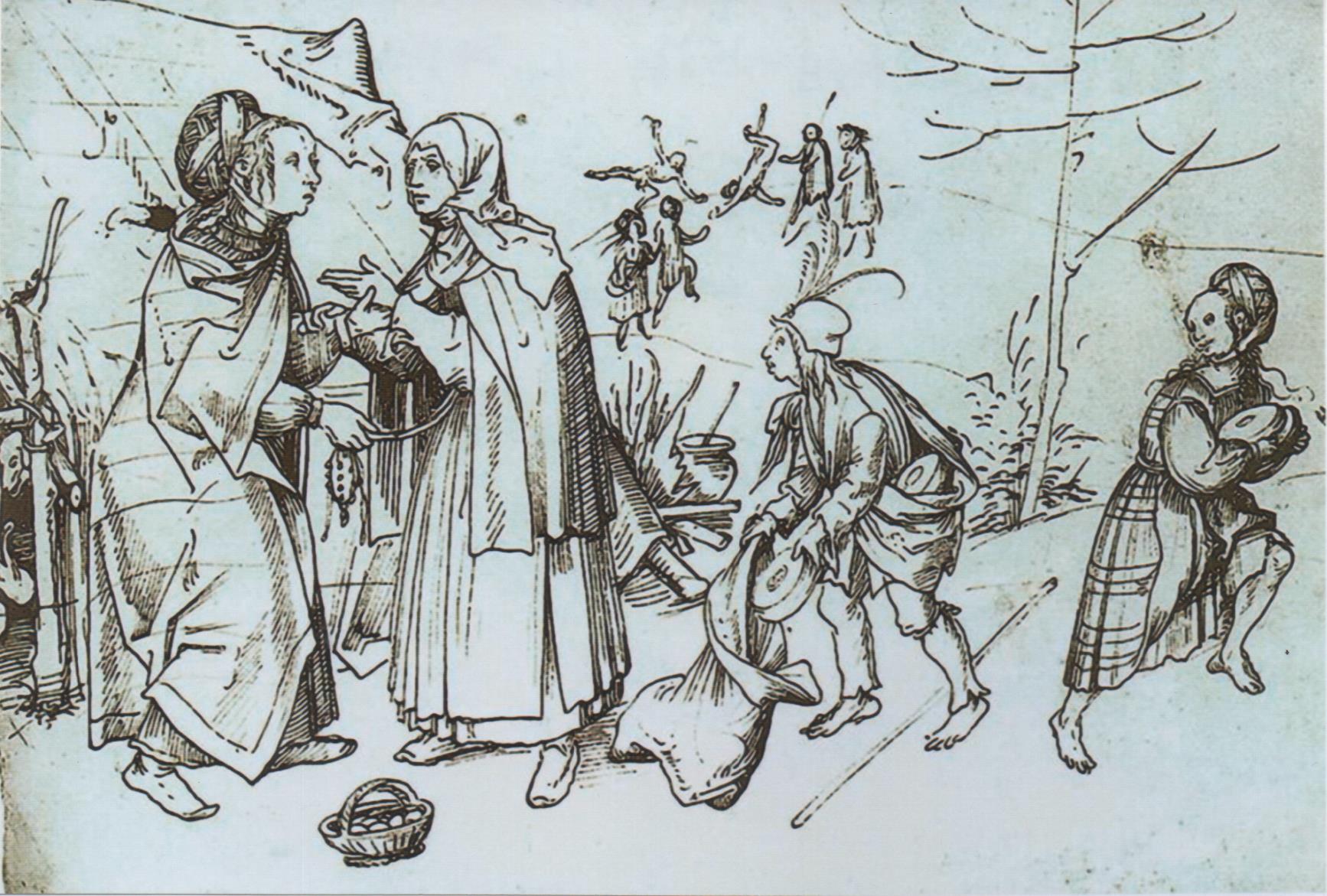 Gypsies in the Market by Hans Burgkmair, 1473-1531, Germany
but sorcerers and witches only tried to commit them by their spells and deceit
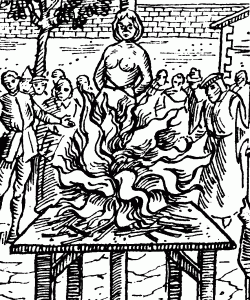
The last witch burning in Germany took place in 1775, nearly 50 years after Thomasius' death. The "witch" on trial was Anna Maria Schwegelin. She was said to have freely confessed to Satanism
supernaturally induced diseases
From King James I Daemonologie, 1587
"This word of Sorcerie is a Latine worde, which is taken from casting of the lot, & therefore he that vseth it, is called Sortiarius à sorte. As to the word of Witchcraft, it is nothing but a proper name giuen in our language. The cause wherefore they were called sortiarij, proceeded of their practicques seeming to come of lot or chance: Such as the turning of the riddle: the knowing of the forme of prayers, or such like tokens: If a person diseased woulde liue or dye. And in generall, that name was giuen them for vsing of such charmes, and freites, as that Crafte teacheth them. Manie poynts of their craft and practicques are common [pg 032] betuixt the Magicians and them: for they serue both one Master, althought in diuerse fashions. And as I deuided the Necromancers, into two sorts, learned and vnlearned; so must I denie them in other two, riche and of better accompt, poore and of basser degree. These two degrees now of persones, that practises this craft, answers to the passions in them, which (I told you before) the Deuil vsed as meanes to intyse them to his seruice, for such of them as are in great miserie and pouertie, he allures to follow him, by promising vnto them greate riches, and worldlie commoditie."
Code of Criminal Law
From Malleus Maleficarum: Who are the Fit and Proper Judges in the Trial of Witches?, 1486.
"Again, the laws decree that clerics shall be corrected by their own Judges, and not by the temporal or secular Courts, because their crimes are considered to be purely ecclesiastical. But the crime of witches is partly civil and partly ecclesiastical, because they commit temporal harm and violate the faith; therefore it belongs to the Judges of both Courts to try, sentence, and punish them. This opinion is substantiated by the Authentics, where it is said: If it is an ecclesiastical crime needing ecclesiastical punishment and fine, it shall be tried by a Bishop who stands in favour with God, and not even the most illustrious Judges of the Province shall have a hand in it. And we do not wish the civil Judges to have any knowledge of such proceedings; for such matters must be examined ecclesiastically and the souls of the offenders must be corrected by ecclesiastical penalties, according to the sacred and divine rules which our laws worthily follow. So it is said. Therefore it follows that on the other hand a crime which is of a mixed nature must be tried and punished by both courts. We make our answer to all the above as follows. Our main object here is to show how, with God's pleasure, we Inquisitors of Upper Germany may be relieved of the duty of trying witches, and leave them to be punished by their own provincial Judges; and this because of the arduousness of the work: provided always that such a course shall in no way endanger the preservation of the faith and the salvation of souls. And therefore we engaged upon this work, that we might leave to the Judges themselves the methods of trying, judging and sentencing in such cases. Therefore in order to show that the Bishops can in many cases proceed against witches without the Inquisitors; although they cannot so proceed without the temporal and civil Judges in cases involving capital punishment; it is expedient that we set down the opinions of certain other Inquisitors in parts of Spain, and (saving always the reverence due to them), since we all belong to one and the same Order of Preachers, to refute them, so that each detail may be more clearly understood. Their opinion is, then, that all witches, diviners, necromancers, and in short all who practise any kind of divination, if they have once embraced and professed the Holy Faith, are liable to the Inquisitorial Court, as in the three cases noted in the beginning of the chapter, Multorum querela, in the decretals of Pope Clement concerning heresy; in which it says that neither must the Inquisitor proceed without the Bishop, nor the Bishop without the Inquisitor: although there are five other cases in which one may proceed without the other, as anyone who reads the chapter may see. But in one case it is definitively stated that one must not proceed without the other, and that is when the above diviners are to be considered as heretics. In the same category they place blasphemers, and those who in any way invoke devils, and those who are excommunicated and have contumaciously remained under the ban of excommunication for a whole year, either because of some matter concerning faith or, in certain circumstances, not on account of the faith; and they further include several other such offences. And by reason of this the authority of the Ordinary is weakened, since so many more burdens are placed upon us Inquisitors which we cannot safely bear in the sight of the terrible Judge who will demand from us a strict account of the duties imposed upon us."
beasts in various ways
The first use of the word "Witch" in Germany was in 1450, and it was rarely used in association with a trial. By 1532 the views of witches had change dramatically. Cases of witch-craft harming citizens became more pronounced. Of these cases it was not uncommon for the witch to have caused a hail-storm to ruin the victims crops or for the witch to have bewitched cattle or farm animals. While this impacted the citizens and the local society, this kind of witch-craft did not interested the courts.
a broomor a goa
From Howard William's The Superstitions of Witchcraft, 1865.
"They ride in sieves on the sea, on brooms, spits magically prepared; and by these modes of conveyance are borne, without trouble or loss of time, to their destination. By these means they attend the periodical sabbaths, the great meetings of the witch-tribe, where they assemble at stated times to do homage, to recount their services, and to receive the commands of their lord. They are held on the night between Friday and Saturday; and every year a grand sabbath is ordered for celebration on the Blocksberg mountains, for the night before the first day of May. In those famous mountains the obedient vassals congregate from all parts of Christendom—from Italy, Spain, Germany, France, England, and Scotland. A place where four roads meet, a rugged mountain range, or perhaps the neighbourhood of a secluded lake or some dark forest, is usually the spot selected for the meeting."
and so forth

confession
From Ann Foster's Trial Documents in Salem, Mass.,1692
"18 July 1692. Ann Foster Examined confesed that the devill in shape of a #[black] man apeared to her w'th Goody carier about six yeare since when they made her awitch & that she promised to serve the divill two yeares: upon w'ch the Divill promised her prosperity & many things but never performed it, that she & martha Carier did both ride on a stick or pole when they went to the witch meeting at Salem Village & that the stick broak: as they ware caried in the aire above the tops of the trees & they fell but she did hang fast about the neck of Goody Carier & ware presently at the vilage, that she was then much hurt of her Leg, she further saith that she hard some of the witches say that their was three hundred & five in the whole Country, & that they would ruin that place the Vilige, also saith ther was present at that metting two men besides mr Buroughs the minister & one of them had gray haire, she saith that she formerly frequented the publique metting to worship god. but the divill had such power over her that she could not profit there & that was her undoeing: she saith that above three or foure yeares agoe Martha Carier told her she would bewitch James Hobbs child to death & the child dyed in twenty four howers"
hat Jews
Practical Kabbalah is a sect of the Judaism in which the use of "white magic" is common place by more elite members of the church. However, within this belief system, mostly amulets and incantations are utilized in associations with the divine.
Rather, perhaps Thomasius is referring to the custom of abstaining from bread during Passover. This is physically symbolized by those of the Jewish faith throwing bread into the fire.
Who does not know that Gypsies can set fire to stables and barns and that nevertheless this does not cause injury?
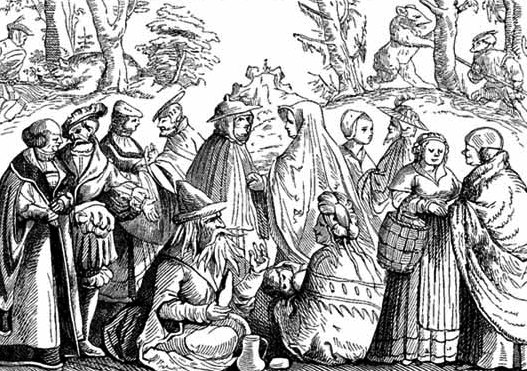 (1552 image of the Romani people)
Blocksberg [sabbat]
During the witch trials, a common accusation was that a witch had taken sabbath with the devil. Sabbaths were often perceived as meetings between witches, demons, and the devil in which the latter would examine witches and sorcerers for his mark. If his mark, described as a mark of pain, was not present, then the devil would proceed to mark them. In 1670, this accusation of attending a sabbath had been the cause of multiple women getting the death sentence.
However, King Louis XIV instead ruled that they be banished instead of being burnt at the stake. The parliament appealed once more for the condemned witches to be burned, stating, “It has been the general feeling of all nations that such criminals ought to be condemned to death, and all the ancients were of the same opinion.” However, King Louis held fast to his order of the witches’ punishment to be exile rather than that of death. This political event made a huge impact on how witch trials and accused sabbath attenders were viewed, as reflective in Thomasius’ clear opinion on the sabbath.
witch-master who inflicted this disease on the patient

Wittenberg

In Wittenburg, during the early 1500s, Martin Luther began his vocal and written renouncement against the Catholic Church as corrupt and inherently sinful due to the indulgences associated with the church.
Despite how enlightened Martin Luther hoped to portray his Protestant teaching, Luther was an advent believer in witch-hunts. His rhetoric influenced followers into fearing the sinful natures of neighbors, homeless, and outcasts. This would eventually help stoke the fire of fear against witches and "devil's whores", as Luther put it, within Germany.
Pharise

I hold that he is responsible for the first sinful fall of the first human beings (that is, original sin).
It is commonly believed that the serpent in the Garden of Eden, which led Eve and Adam to sin against God’s orders, was representative of the Devil. This moment in the Bible is what Thomasius is referring to:
3 Now the serpent was more subtil than any beast of the field which the Lord God had made. And he said unto the woman, Yea, hath God said, Ye shall not eat of every tree of the garden?
2 And the woman said unto the serpent, We may eat of the fruit of the trees of the garden:
3 But of the fruit of the tree which is in the midst of the garden, God hath said, Ye shall not eat of it, neither shall ye touch it, lest ye die.
4 And the serpent said unto the woman, Ye shall not surely die:
5 For God doth know that in the day ye eat thereof, then your eyes shall be opened, and ye shall be as gods, knowing good and evil.
6 And when the woman saw that the tree was good for food, and that it was pleasant to the eyes, and a tree to be desired to make one wise, she took of the fruit thereof, and did eat, and gave also unto her husband with her; and he did eat.
7 And the eyes of them both were opened, and they knew that they were naked; and they sewed fig leaves together, and made themselves aprons.
8 And they heard the voice of the Lord God walking in the garden in the cool of the day: and Adam and his wife hid themselves from the presence of the Lord God amongst the trees of the garden.
9 And the Lord God called unto Adam, and said unto him, Where art thou?
10 And he said, I heard thy voice in the garden, and I was afraid, because I was naked; and I hid myself.
11 And he said, Who told thee that thou wast naked? Hast thou eaten of the tree, whereof I commanded thee that thou shouldest not eat?
12 And the man said, The woman whom thou gavest to be with me, she gave me of the tree, and I did eat.
13 And the Lord God said unto the woman, What is this that thou hast done? And the woman said, The serpent beguiled me, and I did eat. (KJV)
However, within Genesis there is no specific mention of the Devil by name.
sleep [that is, sexual intercourse] with them,
 In the Fifteenth century there were eighteen witch executioned in Augsburg, Germany alone during this time period. One of which is the case of Anna Ebeler, an elderly lying-in maid who was convicted for witchcraft in 1669. All her victims were infants under the age of six months and the new mothers to these children. During her interrogation, or torture, Ebeler confessed to having intercourse with the devil on multiple occasions. This portrayal of “marriage” to the devil is not uncommon during this time period. However, Thomasius refused to acknowledge these admittances. He could not believe that a being of divine nature, as the devil was, could or would be intimate with a mortal.
that the devil has horns, claws, or talons,
 Art from the Renaissance often portrayed the devil as a horned figure with claws. As a new concept during this time-period, due to the sudden interest in the devil and demons, inspiration was often taken from originally Pagan imagery. This can be seen in the similarity of “horned-gods”, like that of Cernunnos of Celtic origin, and the depiction of the devil in Knight, Death and the Devil by German artist Albrecht Dürer. Christian Thomasius understood the implications of this imagery, as the Bible gives no description of the devil, and rejects the concepts as kindling to the fire of fear.
crystal-gazers
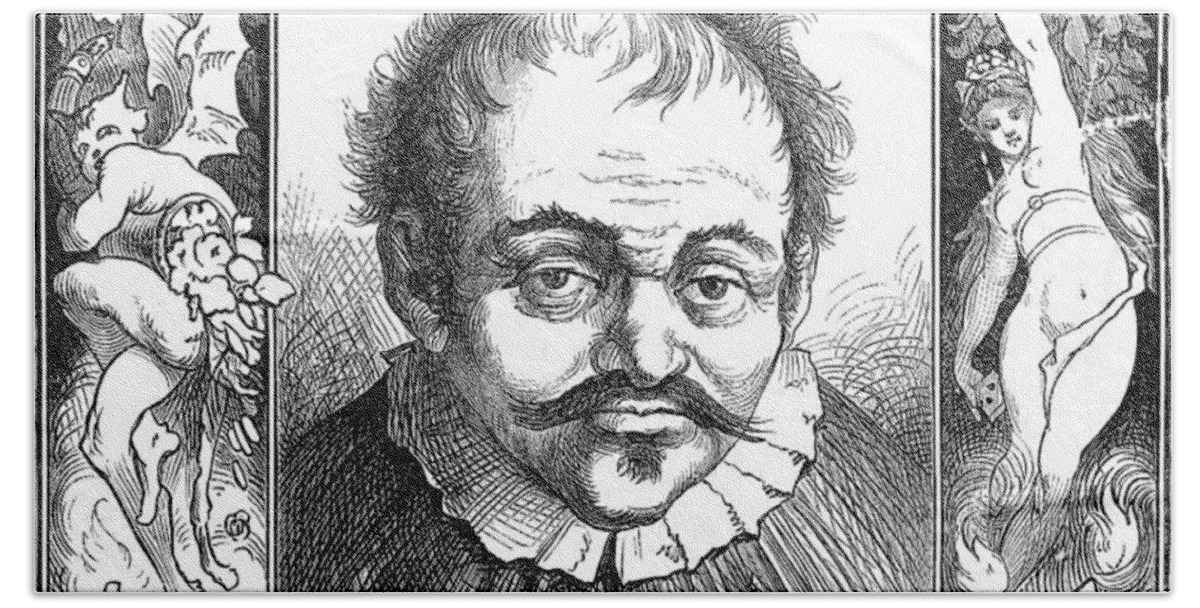 Johann Georg Faust was a scientist, physician, astrologer, and magician during the early 1500’s in Germany. Folklore grew around him and his abilities during this time period as he toured through Germany reading horoscopes and crystals, until the 1530’s when he was denounced by the church as being in league with the devil. This accusation caused cities and villages to bar his entry. In 1540, Faust died due to one of his experiments exploding, which caused mutilations to his body. The church interpreted these wounds as representative that the devil was taking him back to hell. This death, and the attention garnered to him after his burial, immortalized Faust in Germany. Growing up with these stories, Christian Thomasius was no stranger to this type of supernatural which he acknowledges as not only plausible, but very real, despite his views on witchcraft.
since I was forced to learn
 Although in English-speaking society, Christian Thomasius is a barely known advocator of ending the witch trials, within German society his name is often brought up as one of the founders of modern-day philosophy and politics. Part of his fame is due to his creation of the first successful public journals within a society which intellectuals often only spoke to other intellectuals. By doing this, Thomasius opened the door for something that was virtually unheard of, a conscious public. Barnard states that, “[i]n order to arouse a civic consciousness among people who hitherto knew or cared for nothing but their private concerns, Thomasius took up issues few dared to touch upon, and his language was bold and incisive” (584).
By informing the public, Thomasius took a stance that he fully believed; each human is an individual with individualistic reasonings why they would not obey any one’s but their own will. Further, he argued that each of these individuals should be told why they had to submit to a certain authority (law). Not only should the public have a say in their own behaviors, but each person’s morals are separate from their neighbors and should not be governed through politics. This belief system is echoed in his political works in which he touches on heresy and witch craft, and the need to allow their moral codes to catch up with them upon death and the afterlife, and, thus, allow law to deal with their physical crimes.
Throughout Christian Thomasius’ career as a jurist and academic, he was seen as the dawn of a new time for intellectual thinkers. However, very little is known or taught about him in the modern day, leaving academics of today to wonder if his beliefs were as truly influential as once thought. F.M. Barnard explores Thomasius’ work throughout his lifetime to consider whether this is truly a great thinker that was overlooked or simply an eclectic man who was given some form of power over the academic population and, thus, the political sphere.
One aspect of Thomasius’ work that greatly impacts how modern- day intellectuals see him is the content in which many of his beliefs are built upon. Thomasius had no qualms against repeating discoursed made by “Hobbes and Locke, Grotius and Pufendorf, and Descartes and Bayle […] Indeed, he was disarmingly open about his borrowings and almost excessively generous with praise for his ‘creditors’” (222). Utilizing these teaching of others, Thomasius created schools with the basis of “non-intellectual” rhetoric, in which the teacher taught, and the student followed. These lessons and beliefs were meant to be not stagnant, but rather continuously evolve and change when he deemed fit. This led to Christian Thomasius to question beliefs he once had and reopen questions that seemed already fully answered in the philosophical realm. This ability was one that was unheard of in the early modern period.
In a word, I consider that witch trials are useless, that the bodily horned devil with his pitch-ladle and his mother is a pure fabrication of popish priests, and that it is their greatest secret in order to frighten people with such devils so that they will pay money for masses for their souls, contribute rich inheritances and money to the endowments of monasteries or other pious causes and treat innocent people who cry “Father, what do you do?” as if they were sorcerers.
Christian Thomasius’ work is inherently framed as political due to content of governmental witchcraft trials and the unlikely-hood of the validity of the official statements that come from them. However, upon closer examination, there is a deep connection to what we would consider modern-day politics and the early modern period’s political issues within his work. One of the main points made by Thomasius’ in his discourse is on the subject of witchcraft (and heresy) being a moral error rather than a political one. He states that despite how a crime was committed, the criminal should be treated as any other criminal of the same crime. For instance: if a woman utilizes a pact with the devil to kill an infant, the woman should be punished for infanticide, but not the pact she made.
This opinion on morals vs law points towards the need of separation between church and state. Ian Hunter comments that, “Given this separation of law and morality, and the limitation of state action to the former, it is not surprising that Thomasius’ campaign against witch trials has been seen as a proto-liberal effort to set limits to government in the name of individual freedom and human reason” (257). Further, Thomasius’ views the witchcraft as a fallacy pushed by the church in order to ordain more power over the political sphere.
These instances seem to fuel his disdain towards the religious atmosphere and is easily found in his work, “ In a word, I consider that witch trials are useless, that the bodily horned devil with his pitch-ladle and his mother is a pure fabrication of popish priests, and that it is their greatest secret in order to frighten people with such devils so that they will pay money for masses for their souls, contribute rich inheritances and money to the endowments of monasteries or other pious causes and treat innocent people who cry “Father, what do you do?” as if they were sorcerers” (Thomasius).
De crimine magiae
Published in 1701, in this disputation Christian Thomasius rejects the idea of a “Devil’s alliances”. He calls for the end of witch trials, as he believes that it goes against the law. Thomasius also touched on atheism and claimed that executing atheist is unjust.
high wages
From "Lowell Mills and the 'Mill Girls,'" Massachusetts Historical Society, (2018):
"For this, mill owners and investors--led by men like Abbott Lawrence, John Amory Lowell, and Nathan Appleton--turned to New England's young women: accustomed to hard work and textile production in the home, educated, and serious-minded. Agents of the textile corporations ranged rural villages throughout New England, attracting young women to work in the mills with offers of high wages; once established, the mill girls themselves often recruited friends and relatives to come to Lowell and work alongside them."
From "Lowell Mills and the 'Mill Girls,'" Massachusetts Historical Society, (2018):
"In exchange, work in the mills provided good wages--from $1.85 to $3.00 per week--the highest in the country for women (although men working in the same mills were generally paid at least two times the salaries of women)."
From “Lowell Mill Girl Letters: Sarah George Bagley Letters” (1846):
“With the mean and paltry sum allowed to females, who work for the rich, you may be assured that I am obliged to make the most of my time and means as I possibly can.”
neat speec
From "Sarah Bagley Laboring for Life" by Teresa Murphy (2003):
"The public speaking that took place at the labor conventions was a particularly sensitive arena. Women who spoke in public at this time were commonly regarded as little better than prostitutes, and women who spoke in public to challenge economic or political arrangements were considered particularly vile examples of the species" (4).
Many of them educated the younger children of the family and young men were sent to college with the money furnished by the untiring industry of their women relatives.
From "Pleasures of Factory Life" in Lowell Offering by Sarah G. Bagley (1840):
"Another great source of pleasure is, that by becoming operatives, we are often to assist aged parents who have become too infirm to provide for themselves; or perhaps to educate some orphan brother or sister, and fit them for future usefulness."
From "Sarah Bagley Laboring for Life" by Teresa Murphy (2003):
"Sarah noted another benefit that would provide the theme for later articles: the ability to financially support one's parents, one's siblings, or oneself" (2).
seven vocations
From "Bennett Letters: M.M. Edwards" (1839):
"There are many young Ladies at work in the factories that have given up milinary dessmaking & shool keeping for to work in the mill."
From "Bennett Letters: Persis Edwards" (1840):
"I thought of learning the Milleners & Dressmakers trade but have failed in the attempt..."
From "Bennett Letters: Ann Blake" (1843):
"I think it would be best for me to work in the mill a year and then I should be better prepared to learn a traid."
From "Sarah Bagley Laboring for Life" by Teresa Murphy (2003):
"The rise of factories expanded women's economic roles and opportunities and increased their independence from their immediate families, but at the same time it rendered these new wage workers vulnerable to the vagaries of the economy, the health of their industry, and the control of their employers" (1).
aid of the family purse
From "Pleasures of Factory Life" in Lowell Offering by Sarah G. Bagley (1840):
"Another great source of pleasure is, that by becoming operatives, we are often to assist aged parents who have become too infirm to provide for themselves; or perhaps to educate some orphan brother or sister, and fit them for future usefulness."
From "Bennett Letters: Jemima W. Sandborn" (1843):
"You will probely want to know the cause of our moveing here which are many. I will menshion a few of them. One of them is the hard times to get aliving off the farm for so large famely so we have devided our famely...The rest of us have moved here to Nashvill thinking the girls and Charles they would probely work in the Mill."
From "Sarah Bagley Laboring for Life" by Teresa Murphy (2003):
"The Lowell, Massachusetts, mills relied overwhelmingly on the labor of young, unmarried, native-born white farm women - so called farmers' daughters and mill girls - whose families' financial situation propelled them into the new world of wage labor, at least until they married" (1).
five o’clock in the morning until seven in the evening, with one half-hour each, for breakfast and dinner.
From "An Account of a Visitor to Lowell" in The Harbinger (1836):
"The operatives work thirteen hours a day in the summer time, and from daylight to dark in the winter. At half past four in the morning the factory bell rings, and at five the girls must be in the mills. A clerk, placed as a watch, observes those who are a few minutes behind the time, and effectual means are taken to stimulate to punctuality. This is the morning commencement of the industrial discipline (should we not rather say industrial tyranny?) which is established in these associations of this moral and Christian community.
At seven the girls are allowed thirty minutes for breakfast, and at noon thirty minutes more for dinner, except during the first quarter of the year, when the time is extended to forty-five minutes. But within this time they must hurry to their boardinghouses and return to the factory, and that through the hot sun or the rain or the cold. A meal eaten under such circumstances must be quite unfavorable to digestion and health, as any medical man will inform us. At seven o'clock in the evening the factory bell sounds the close of the day's work.
Thus thirteen hours per day of close attention and monotonous labor are exacted from the young women in these manufactories. . . . So fatigued--we should say, exhausted and worn out, but we wish to speak of the system in the simplest language--are numbers of girls that they go to bed soon after their evening meal, and endeavor by a comparatively long sleep to resuscitate their weakened frames for the toil of the coming day."
Troops of young girls came
From "An Account of a Visitor to Lowell" in The Harbinger (1836):
"In Lowell live between seven and eight thousand young women, who are generally daughters of farmers of the different states of New England. Some of them are members of families that were rich in the generation before. . . ."
These boarding-houses were considered so attractive that strangers, by invitation, often came to look in upon them
From "An Account of a Visitor to Lowell" in The Harbinger (1836):
"We have lately visited the cities of Lowell and Manchester and have had an opportunity of examining the factory system more closely than before. We had distrusted the accounts which we had heard from persons engaged in the labor reform now beginning to agitate New England. We could scarcely credit the statements made in relation to the exhausting nature of the labor in the mills, and to the manner in which the young women - the operatives - lived in their boardinghouses, six sleeping in a room, poorly ventilated. We went through many of the mills, talked particularly to a large number of the operatives, and ate at their boardinghouses, on purpose to ascertain by personal inspection the facts of the case."
Sarah Bagley
Published "Pleasures of Factory Life" in December 1840.
Picture of Sarah George Bagley:
From "Sarah Bagley, the Voice of America's Early Women's Labor Movement" by Cara Giamo (2017):
"Twenty-eight-year-old Sarah Bagley made her way to Lowell in 1835, leaving her home in New Hampshire in the hope that she’d be able to send some extra money back to her struggling family. Like many of the mill girls, she embraced the cultural environment in Lowell, and in 1840, Bagley published a short essay in the Lowell Offering, a monthly literary magazine written and edited largely by mill girls. In the piece, called “Pleasures of Factory Life,” Bagley ruminated on the various good parts of her job—the new friends, the learning opportunities, the potted plants the women placed around the factory floor—but she gave special weight to the space the job left for thinking. As the body goes through the motions of twisting, pulling, and plucking, Bagley wrote, “all the powers of the mind are made active.” The looms themselves inspired further thought: “Who can closely examine all the movements of the complicated, curious machinery, and not be led to the reflection, that the mind is boundless,” she wrote, “and that it can accomplish almost any thing on which it fixes its attention!” (1-2).
From “Lowell Notes: Sarah Bagley.” Lowell National Historical Park, National Park Service:
"In 1844, the Lowell Female Labor Reform Association (LFLRA) was founded, becoming one of the earliest successful organizations of working women in the United States, with Sarah Bagley as its president” (2).
"The year 1845 also saw Sarah taking on new responsibilities as a writer and editor for the Voice of Industry, founded in 1844 by the New England Workingmen's Association."
From “Lowell Mill Girl Letters: Sarah George Bagley Letters” (1846):
"As I am President..."
Picture of “Constitution of the Lowell Factory Girls Association,” (1836):
http://americanantiquarian.org/millgirls/files/original/f91aeff28dda1b3eb89d82015a62c01b.jpg
wages were to be cut down
From “Lowell Notes: Sarah Bagley.” Lowell National Historical Park, National Park Service:
“By 1842 the pressure that Bagley had experienced as a weaver began to erupt in the form of labor conflict. In that year the Middlesex Manufacturing Company, one of Lowell’s textile giants, announced a speedup and subsequent 20% pay cut. In protest, seventy female workers walked out. All were fired and blacklisted” (1).
From "Sarah Bagley, the Voice of America's Early Women's Labor Movement" by Cara Giamo (2017):
"A few years later, exactly where Bagley had fixed her attention became clear. In the early 1840s, as factory owners tried to maximize profits in the face of a recession, the already-high demands of mill work ramped up. Many of these changes were sexist: In one mill, management cut wages for everyone; when the need for austerity ended, pay was raised again, but only for men. Another mill tried to double the number of looms that each weaver was responsible for. When a group of 70 women went on strike in response, they were not only fired, but blacklisted from ever getting another mill job. Earlier strikes by women workers—in 1834 and 1836—had ended similarly" (2).
first strikes
From “Lowell Mill Women Create the First Union of Working Women,” American Federation of Labor-Congress of Industrial Organizations, (2018):
“In the 1830s, half a century before the better-known mass movements for workers’ rights in the United States, the Lowell women organized, went on strike and mobilized in politics…and created the first union of working women in American history” (1).
“In 1834, when their bosses decided to cut their wages, the mill girls had enough…The mill girls ‘turned out’ – in other words, went on strike – to protest” (1).
“Management had enough power and resources to crush the strike” (1).
From "Sarah Bagley, the Voice of America's Early Women's Labor Movement" by Cara Giamo (2017):
"Driven by the foresight of the so-called 'Lowell Mill Girls,' American women have been going on strike at least since the 1830s, and thanks to the powerful rhetoric of one woman, Sarah Bagley, they began officially organizing not long after" (1).
legislative committee on the subject and plead, by their presence, for a reduction of the hours of labor
From “Lowell Notes: Sarah Bagley.” Lowell National Historical Park, National Park Service:
"In 1844, the Lowell Female Labor Reform Association (LFLRA) was founded, becoming one of the earliest successful organizations of working women in the United States, with Sarah Bagley as its president” (2).
"Working in cooperation with the New England Workingmen’s Association (NEWA) and spurred by a recent extension of work hours, the organizations submitted petitions totaling 2,139 names to the Massachusetts state legislature in 1845” (2).
“In response, the legislature called a hearing and asked Bagley, among eight others, to testify…the legislators ultimately refused to act against the powerful mills” (2).
"The year 1845 also saw Sarah taking on new responsibilities as a writer and editor for the Voice of Industry, founded in 1844 by the New England Workingmen's Association.
education
From "Pleasures of Factory Life" in Lowell Offering by Sarah G. Bagley (1840):
"In Lowell, we enjoy abundant means of information, especially in the way of public lectures. The time of lecturing is appointed to suit the convenience of the operatives; and sad indeed would be the picture of our Lyceums, Institutes, and scientific Lecture rooms, if all the operatives should absent themselves."
but their thoughts were free
From A New England Girlhood by Lucy Larcom (1889):
"I know that sometimes the confinement of the mill became very wearisome to me. In the sweet June weather I would lean far out of the window, and try not to hear the unceasing clash of sound inside. Looking away to the hills, my whole stifled being would cry out 'Oh, that I had wings!'" (54).
"Even the long hours, the early rising and the regularity enforced by the clangor of the bell were good discipline for one who was naturally inclined to dally and to dream, and who loved her own personal liberty with a willful rebellion against control" (57).
"I discovered, too, that I could so accustom myself to the noise that it became like a silence to me. And I defied the machinery to make me its slave. Its incessant discords could not drown the music of my thoughts if I would let them fly high enough" (57).
From "Pleasures of Factory Life" in Lowell Offering by Sarah G. Bagley (1840):
"But, aside from the talking, where can you find a more pleasant place for contemplation? There all the powers of the mind are made active by our animating exercise; and having but one kind of labor to perform, we need not give all our thoughts to that, but leave them measurably free for reflection on other matters. The subjects for pleasurable contemplation, while attending to our work, are numerous and various. many of them are immediately around us. For example: In the mill we see displays of the wonderful power of the mind. who can closely examine all the movements of the complicated, curious machinery, and not be led to the reflection, that the mind is boundless, and is destined to rise higher and still higher: and that it can accomplish almost any thing on which it fixes its attention!"
From "Bennett Letters: Persis Edwards" (1839):
"I work in the mill like very well enjoy myself much better than I expected am very confined could wish to have my liberty a little more but however I can put up with that as I am favored with other priveleges."
This was the greatest hardship
From “Lowell Mill Girl Letters: Sarah George Bagley Letters” (1846):
“Why by compelling females of New England to labor thirteen hours per day in rooms heated by hot air furnaces and sleep on the average from six to ten in a room. These very men are…mere partisans and not lovers of human rights."
ten-hour law
From “Lowell Mill Women Create the First Union of Working Women,” American Federation of Labor-Congress of Industrial Organizations, (2018):
“In 1847, New Hampshire became the first state to pass a 10-hour workday law – but it wasn’t enforceable” (2).
From “Lowell Notes: Sarah Bagley.” Lowell National Historical Park, National Park Service:
"The ten-hour workday was signed into law in 1874; only in 1920 did women gain a legal voice in national politics” (2).
Lucy Larcom
From “Lowell Mill Women Create the First Union of Working Women,” American Federation of Labor-Congress of Industrial Organizations, (2018):
"Lucy Larcom started as a doffer of bobbins when she was only 12 and 'hated the confinement, noise, and lint-filled air, and regretted the time lost to education,' according to one historian."
precedent
From “Lowell Mill Women Create the First Union of Working Women,” American Federation of Labor-Congress of Industrial Organizations, (2018):
“A second strike in 1836 – also sparked by wage cuts – was better organized and made a bigger dent in the mills’ operation. But in the end, the results were the same” (2).
From “A Quiet Strike.” Voice of Industry, by Cabolville Chronotype, 21 Nov. 1845:
“The ladies employed in the Spinning Room of Mill No. 2, Dwight Corporation, made a very quiet and successful “strike,” on Monday. The spinning machinery was set in motion in the morning, but there was no girls to tend it. They had heard a rumor that their wages were to be cut down, upon which they determined to quit" (1).
"They silently kept their resolve…when they were requested to return…[they received] an addition to their previous wage of fifty cents per week” (1).
“We think the girls have acted rightly, and by way of encouragement…we say ‘stick to your text,’ and pursue a steady course, with a determined spirit, and you will come off victorious” (1).
s Saul also among the prophets?
Found in Series II, Volume 4, 1843-1844 of the Lowell Offering
we are so tired
From "Lowell Mills and the 'Mill Girls,'" Massachusetts Historical Society, (2018):
"Over the years, working conditions in the mills deteriorated and wages decreased. Although the end of the war saw a temporary return of the mill girls to Lowell as factories rehired experienced hands to restart their factories, never again would young American women form the majority of the textile workforce."
foreign parentage
From "Lowell Mills and the 'Mill Girls,'" Massachusetts Historical Society, (2018):
"Beginning in about 1845, immigrants displaced by the Irish Potato Famine began flocking to Lowell in search of work. Willing to work for even lower wages (and to have their children work in the factories as well), they began to supplant Lowell's women workers. Successive waves of immigrants from other countries would take their place at the bottom of the mill hierarchy in turn."
Lowell Offering
From "Lowell Mills and the 'Mill Girls,'" Massachusetts Historical Society, (2018):
"Between 1840 and 1845, a literary magazine called the Lowell Offering published writings by the mill girls, edited and produced by their fellow workers."
social or literary advantages
From "Lowell Mills and the 'Mill Girls,'" Massachusetts Historical Society, (2018):
"Young women working in the Lowell mills availed themselves of circulating libraries, evening classes, lecture series, and literary and self-improvement clubs."
working hours
From "Regulations to be Observed by Persons Employed in the Boott Cotton Mills" (1866):
"All persons entering into the employ of the Company are considered as engaged to work twelve months, if the Company require their services so long."
From "Lowell Mills and the 'Mill Girls,'" Massachusetts Historical Society, (2018):
"Despite working an average of 73 hours per week."
good moral character,
From "Regulations to be Observed by Persons Employed in the Boott Cotton Mills" (1866):
"Any one who shall take from the mills, or the yard, any yarn, cloth or other article belonging to the Company, will be considered guilty of stealing, and prosecuted accordingly."
From "Lowell Mills and the 'Mill Girls,'" Massachusetts Historical Society, (2018):
"High standards of behavior were expected."
required her to attend regularly some place of public worship
From "Regulations to be Observed by Persons Employed in the Boott Cotton Mills" (1866):
"A regular attendance on public worship on the Sabbath, is necessary for the preservation of good order."
From "Pleasures of Factory Life" in Lowell Offering by Sarah G. Bagley (1840):
"In the mills, we are not so far from God and nature, as many person might suppose...And last, though not least, is the pleasure of being associated with the institutions of religion, and thereby availing ourselves of the Library, Bible Class, Sabbath School, and all other means of religious instruction."
From "Lowell Mills and the 'Mill Girls,'" Massachusetts Historical Society, (2018):
"The mill girls were subject to curfews and required to attend church, and signed contracts to that effect."
boarding-houses
From "Regulations to be Observed by Persons Employed in the Boott Cotton Mills" (1866):
"They are to board in one of the boarding-houses belonging to the Company, and conform to the regulations of the house where they board."
From "Lowell Mills and the 'Mill Girls,'" Massachusetts Historical Society, (2018):
"To this end, corporations established their own boardinghouses, supervised by women of good standing, where unmarried textile workers were required to live."
these needy people began to pour
From "Lowell Mills and the 'Mill Girls,'" Massachusetts Historical Society, (2018):
"In 1820, the town of East Chelmsford, Massachusetts, was a sleepy farming hamlet of 200 people. Just thirty years later, the renamed city of Lowell was home to thirty-two textile mills and a population that had grown to 33,000."
caste of the factory girl
From "Bennett Letters: M.M. Edwards" (1839):
"You have been informed I suppose that I am a factory girl...I suppose your mother would think it far beneith your dignity to be a factory girl."
From "Bennett Letters: Persis Edwards" (1840):
"I do not know what my employment will be this Summer. Mother is not willing I should go to the Factory."
From A New England Girlhood by Lucy Larcom (1889):
"His courtesy was genuine. Still, we did not call ourselves ladies. We did not forget that we were working-girls, wearing coarse aprons suitable to our work, and that there was some danger of our becoming drudges" (50).
The society of one another was of great advantage to these girls.
From A New England Girlhood by Lucy Larcom (1889):
"I found that the crowd was made up of single human lives, not one of them wholly uninteresting, when separately known. I learned also that there are many things which belong to the whole world of us together, that no one of us, nor any few of us, can claim or enjoy for ourselves alone" (57).
From "Pleasures of Factory Life" in Lowell Offering by Sarah G. Bagley (1840):
"Another source is found in the fact of our becoming acquainted with some person or persons that reside in almost every part of the country. And through these we become familiar with some incidents that interest and amuse us wherever we journey; and cause us to feel a greater interest in the scenery, inasmuch as there are gathered pleasant associations about every town, and almost every house and tree that may meet our view."
health
From "Regulations to be Observed by Persons Employed in the Boott Cotton Mills" (1866):
"They are not to be absent from their work without consent, except in case of sickness, and then they are to send the Overseer word of the cause of their absence."
From "Bennett Letters: M.M. Edwards" (1839):
"I would not advise any one to do it for I was so sick of it at first I wished a factory had never been thought of...My health is very poor indeed but it is better than it was when I left home."
From "Bennett Letters: Jemima W. Sandborn" (1843):
"Our famely is all in good health except myself. I have been qite out of health this spring but am much better now. The Doctor says I have the liver complaint."
From "Bennett Letters: Lucy Davis" (1846):
"After I had been there a number of days I was obliged to stay out sick but I did not mean to give it up so and tried it again but was obliged to give it up altogether. I have now been out about one week and am some better than when I left but not verry well. I think myself cured of my Mill fever as I cannot stand it to work there...My head is considerably affected since I went into the Mill...Next time I write I hope my head will feel better and I will write more..."
From "Pleasures of Factory Life" in Lowell Offering by Sarah G. Bagley (1840):
"We are placed in the care of overseers who feel under moral obligations to look after our interests; and, if we are sick to acquaint themselves with our situation and wants; and, if need be, to remove us to the Hospital, where we are sure to have the best attendance, provided by the benevolence of our Agents and Superintendents."
hours of labor were long
From A New England Girlhood by Lucy Larcom (1889):
"Even the long hours, the early rising and the regularity enforced by the clangor of the bell were good discipline for one who was naturally inclined to dally and to dream, and who loved her own personal liberty with a willful rebellion against control" (57).
five o’clock in the morning
From A New England Girlhood by Lucy Larcom (1889):
"No matter if we must get up at five the next morning and go back to our hum-drum toil" (50).
spinning-frames
From A New England Girlhood by Lucy Larcom (1889):
"My return to mill-work involved making acquaintance with a new kind of machinery. The spinning-room was the only one I had hitherto known anything about. Now my sister Emilie found a place for me in the dressing-room, beside herself. It was more airy, and fewer girls were in the room, for the dressing-frame itself was a large, clumsy affair, that occupied a great deal of space. Mine seemed to me as unmanageable as an overgrown spoilt child. It had to be watched in a dozen directions every minute, and even then it was always getting itself and me into trouble. I felt as if the half-live creature, with its great, groaning joints and whizzing fan, was aware of my incapacity to manage it, and had a fiendish spite against me. I contracted an unconquerable dislike to it; indeed, I had never liked, and never could learn to like, any kind of machinery. And this machine finally conquered me. It was humiliating, but I had to acknowledge that there were some things I could not do, and I retired from the field, vanquished" (71).
paid accordingly
From "Regulations to be Observed by Persons Employed in the Boott Cotton Mills" (1866):
"The time of the persons employed and the amount of labor performed by them, will be made up to the first Saturday of every month inclusive, and the sums due therefor, including board and wages, will be paid in the course of the following week."
overseers
From "Regulations to be Observed by Persons Employed in the Boott Cotton Mills" (1866):
"The Overseers are be punctually in their rooms at the starting of the mill, and not to be absent unnecessarily during work hours. They are to see that all those employed in their rooms are in their places in due season. They may grant leave of absence to those employed under them, when there are spare hands in the room to supply their places; otherwise they are not to grant leave of absence except in cases of absolute necessity."
regulation paper,
From "Regulations to be Observed by Persons Employed in the Boott Cotton Mills" (1866):
"These Regulations are considered a part of the contract with all persons entering into the employment of the Boott Cotton Mills."
regulation paper
Link for "Regulations to be Observed by Persons Employed in the Boott Cotton Mills" (1866):
Albert Parsons

unrelated misery
From "Pleasures of Factory Life" by Sarah Bagley in Lowell Offering, December 1840:
"And then you have so little leisure - I could not bear such a life of fatigue."
overruling hum of the iron animals
From A New England Girlhood by Lucy Larcom:
"I never cared much for machinery. The buzzing and hissing and whizzing of pulleys and rollers and spindles and flyers around me often grew tiresome" (47).
"I loved quietness. The noise of machinery was particularly distasteful to me...I discovered, too, that I could so accustom myself to the noise that it became like a silence to me. And I defied the machinery to make me its slave. Its incessant discords could not drown the music of my thoughts if I would let them fly high enough" (57).
From "Pleasures of Factory Life" by Sarah Bagley in Lowell Offering, December 1840:
"I could not endure such a constant clatter of machinery, that I could neither speak to be heard, nor think to be understood, even by myself."
three hundred and sixty-five days
From Early Factory Labor in New England by Harriet H. Robinson (1889):
"Those of the mill-girls who generally had homes generally worked from eight to ten months in the year; the rest of the time was spent with parents or friends" (6).
From "Regulations to be Observed by Persons Employed in the Boott Cotton Mills" (1866):
"All persons entering into the employ of the Company are considered as engaged to work twelve months, if the Company require their services so long."
married women;
From Early Factory Labor in New England by Harriet H. Robinson (1889):
"It may be said here that at one time the fame of the Lowell Offering caused the mill-girls to be considered very desirable for wives; and young men came from near and far to pick and choose for themselves, and generally with good success" (22).
The air swam with the fine, poisonous particles
From Early Factory Labor in New England by Harriet H. Robinson (1889):
"The health of the early mill-girls was good. The regularity and simplicity of their lives and the plain and substantial food provided for them kept them free from illness. From their Puritan ancestry they had inherited sound bodies and a fair share of endurance. Fevers and similar diseases were rare among them, and they had no time to pet small ailments" (15).
From "The Bennett Letters" (1839) by Melinda Blodgett:
"But I would not advise any one to do it for I was so sick of it at first I wished a factory had never been thought of. But the longer I stay the better I like and I think if nothing unforesene calls me away I shall stay here till fall...My health is very poor indeed but it is better than it was when I left home."
From "The Bennett Letters" (1846) by Lucy Davis:
"I could not get a chance to suit me, so I came here to work in the Mill. The work was much harder than I expected and quite new to me. After I had been there a number of days I was obliged to stay out sick but I did not mean to give it up so and tried it again but was obliged to give it up altogether. I have now been out about one week and am some better than when I left but not very well. I think myself cured of my Mill fever as I cannot stand it to work there...My head has been considerably affected since I went into the Mill...will you pleas to ask Miss Forbs to excuse me for not paying my bill...Pleas tell her if I do not come to H soon I shal send to you when I pay my assessments...Next time I write I hope my head will feel better and I will write more..."
It was subordinately surrounded by a cluster of other and smaller buildings, some of which, from their cheap, blank air, great length, gregarious windows, and comfortless expression, no doubt were boarding-houses of the operatives.
From Early Factory Labor in New England by Harriet H. Robinson (1889):
"Life in the boarding-houses was very agreeable. These houses belonged to the corporation, and were usually kept by widows (mothers of some of the mill-girls), who were often friends and advisers of their boarders. Each house was a village or community itself. There fifty or sixty young women from different parts of New England met and lived together...These boarding-houses were considered so attractive that strangers, by invitation, often came to look in upon them, and see for themselves how the mill-girls lived" (8-9).
"It was their [the mill-girls] custom the first of every month, after paying their board bill 9$1.25 a week0, to put their wages in the savings bank" (10).
girls
From A New England Girlhood by Lucy Larcom:
"Still, we did not call ourselves ladies. We did not forget that we were working-girls" (57).
From Early Factory Labor in New England by Harriet H. Robinson (1889): "Evening schools were soon established...Here might often be seen a little girl of ten puzzling over her sums in Colburn's Arithmetic, and at her side another 'girl' of fifty poring over her lesson in Pierpoint's National Reader" (8).
twelve hours to the day
From the "Sarah George Bagley" Letters:
"Why by compelling the females of New England to labor thirteen hours per day in rooms heated by hot air furnaces and sleep on the average from six to tn in a room" (1 Jan. 1846).
From "Sarah Bagley, the Voice of America's Early Women's Labor Movement" by Cara Giaimo (2017):
"Over Bagley's three-year term, the Association [Lowell Labor Female Reform Association, est. 1844] took on multiple projects. The most pressing of these was the 'Ten Hour Movement,' an attempt to get the grueling mill workday, which often lasted 12 to 14 hours, down to a slightly more manageable ten" (2).
From "Lowell Mill Women Create the First Union of Working Women" by the AFL-CIO (2018):
"A mill worker named Amelia - we don't know her full name - wrote that mill girls worked an average of nearly 13 hours a day" (1).
From Early Factory Labor in New England by Harriet H. Robinson (1889):
"The working hours of all girls extended from five o'clock in the morning until seven in the evening, with one-half hour each, for breakfast and dinner. Even the doffers ["very young girls" who "doffed, or took off, the full bobbins from the spinning-frames, and replaced them with empty ones" (6). Robinson worked as a doffer as a child in the mills.] were forced to be on duty nearly fourteen hours a day. This was the greatest hardship in the lives of these children" (6).
served mutely and cringingly as the slave serves the Sultan
A Week on the Concord and Merrimack Rivers by Henry David Thoreau
In a section of Thoreau’s novel, A Week on the Concord and Merrimack Rivers, he describes the fate of the shad fish as caused by the Billerica dam. Thoreau describes how the dam and factories along the river are destroying the river and the fish. He describes the shad thus, “Armed with no sword, no electric shock, but mere Shad, armed only with innocence and a just cause, with tender dumb mouth only forward, and scales easy to be detached.” This description of the “poor shad” is reminiscent of the description of the girls in the factory. The narrator describes the girls as “blank-looking girls” which parallels “innocence.” The narrator also describes the machine that makes the paper, “Nothing was heard but the low, steady, overruling hum of the iron animals. The human voice was banished from the spot. Machinery--that vaunted slave of humanity--here stood menially served by human beings, who served mutely and cringingly as the slave serves the Sultan.” This quote can be compared to how Thoreau describes the shad, “with tender dumb mouth only forward, and scales easy to be detached.” The shad are slaves of the Billerica dam, to serves human needs, just as the girls are slaves to the machinery in the mill to serve the bachelors. Thoreau also asks, “Who hears the fishes when they cry?” Who hears the girls working in the factory? No one. For none of the dialogue in the story belongs to a female character. Those who are oppressed do not have a voice to stand up for themselves.
M.J. Tortessi
haggard
Pioneer Paper-making In Berkshire: Life, Life Work And Influence of Zenas Crane by Joseph Edward Adams Smith
This source is a book about the life of Zenas Crane and his work with his paper mill (the same paper mill that Melville visited in 1851). This book helps to inform Melville’s story because it describes the scenery of where the paper mill was located. The book states that Crane “reached a region of superb natural beauty, and moreover discovered a location exactly suited to his purpose as a paper-maker. In the town of Dalton...lies a sheltered valley through which flows the largest of the eastern branches of the Housatonic river, affording in its rapid descent several fine water powers” (16). In the story, the paper mill is also in a valley, though the scenery is not described as “superb natural beauty,” but as “bleak,” “violent,” and “haggard,” and the river, aptly named “Blood River,” is described as “brick-colored,” and “strange-colored,” implying that the river in 1851 is much more polluted from the factory than it was in 1799 when Crane first chose the spot for his mill.
M.J. Tortessi
are indiscriminately called girls, never women?"
This wanted advertisement is from the Berkshire County Whig in 1842. It states, “Wanted. 10 OR 12 GIRLS to work in the Paper Mill of the subscribers at Dalton. Z. CRANE & SONS.” This advertisement informs Melville’s story because the advertisement is looking for workers and uses the word “GIRLS” in all capital letters. The narrator asks the proprietor, “Why is it, Sir, that in most factories, female operatives, of whatever age, are indiscriminately called girls, never women?” This is an ad for workers for the very same mill that Melville will visit in just nine years. And clearly the workers are all “girls.”
M.J. Tortessi
he business is poor in these parts
From Early Factory Labor in New England (1889) by Harriet H. Robinson:
"Troops of young girls came from different parts of New England...some of these were daughters of sea captions (like Lucy Larcom), of professional men or teachers, whose mothers, left widows, were struggling to maintain the younger children. a few were the daughters of reduced circumstances, who had left home 'on a visit' to sent their wages surreptitiously in the aid of the family purse" (4).
"Some of the mill-girls helped maintain widowed mothers, or drunken, incompetent, or invalid fathers. Many of them educated the younger children of the family and young men were sent to college with the money furnished by the untiring industry of their women relatives. The most prevailing incentive to labor was to secure the means of education for some male member of the family. To make a gentleman of the brother or a son, to give him a college education, was the dominant thought in the minds of a great many of the better class of mill-girls. I have known more than one to give every cent of her wages, month after month, to her brother, that he might get the education necessary to enter some profession" (11).
"Its is well to digress here a little, and speak of the influence the possession of money had on the characters of some of these women. We can hardly realize what a change the cotton factory made in the status of the working women. Hitherto woman had always been a money saving rather than a money earning, member of the community. Her labor could command but small return. If she worked out as servant, or 'help,' her wages were from 50 cents to $1.00 a week; or, if she went from house to house by the day to spin and weave, or do tailoress work, she could get but 75 cents a week and her meals. As teacher her services were not in demand, and the arts, the professions, and even the trades and industries, were nearly all closed to her" (11-12).
"As late as 1840 there were only seven vocations outside the home into which the women of New England had entered. At this time woman had no property rights. A widow could be left without her share of her husband's (or the family) property, an "incumbrance" to his estate. A share of the inheritance. He usually left her a home on the farm as long as she remained single. A woman was not supposed to be capable of spending her own, or of using other people's money" (12).
From "The Bennett Letters" (1839) by Melinda Blodgett:
"There are many young Ladies at work in the factories that have given up milinary dessmaking & shool keeping for to work in the mill."
From "The Bennett Letters" (1843) by Jemima Sandborn:
"You will probely want to know the cause of our moveing here which are many. I will menshion a few of them. One of them is the hard times to get aliving off the farm for so large famely so we have devided our family...The rest of us have moved here to Nashvill thinking the girls and Charles they would probely work in the Mill but we have had bad luck giting them in."
These rapid waters unite at last in one turbid brick-colored stream, boiling through a flume among enormous boulders. They call this strange-colored torrent Blood River.
Singh, P., Katiyar, D., Gupta, M. and Singh, A. (2011) ‘Removal of pollutants from pulp and paper mill effluent by anaerobic and aerobic treatment in pilot-scale bioreactor’, Int. J. Environment and Waste Management, Vol. 7, Nos. 3/4, pp.436–444.
This scientific essay discusses the effluent (chemical waste) that is produced during the paper-making process. The essay states that a pulp and paper mill produces effluent that is “highly polluted and is characterised by parameters unique to these waste such as colour.” The essay continues to describe the color that water turns due to the pollutants being released: “The discharge of untreated effluents from pulp and paper mills into water bodies damage the water quality (Singh et al., 2002). The brown colour imparted to water due to the addition of effluents is detectable over long distances (Crawford et al., 1987).” The significance of this research is when the essay describes the color of the water as “brown.” This informs Melville’s story because the narrator describes the river that powers the paper mill as a “brick-colored stream” and “strange-colored.” This parallels the description of polluted water from the essay. The river that powered the mill that Melville actually visited in 1851 is the Housatonic River, but when writing the story, Melville changes the name of the river to “Blood River,” which again emphasizes the brown color of the water that occurs from the pulp and paper effluent that is released into the river during the paper-making process.
M.J. Tortessi
"'Tis not unlikely, then," murmured I, "that among these heaps of rags there may be some old shirts, gathered from the dormitories of the Paradise of Bachelors.
money.cnn.com/2010/08/09/smallbusiness/cranes/index.htm
This article, published by CNN Money, provides a history of the paper mill Crane & Co.--the same mill that Melville visited in 1851. The company has been in business for over 200 years and prides itself on the claim that the company, “supplied Paul Revere with the paper that served as the American colonies’ first non-coin money.” During the mill’s early days, the company made “drafting paper,” “stock certificate,” and “highly combustible rifle paper.” This informs the text because when Cupid is taking the narrator around the facility, the narrator notes that the paper the girls make will become “sermons, lawyer’s briefs...love-letters, marriage certificates...and so on,” just like the article states. However, the girls in the story will never be able use paper for such things as “love-letters,” much like the current workers at Crane & Co. who make American currency, will never see the amount of money in their personal lives that they see being created in the mill. The article also states that the mill created “men’s paper shirt collars--which were the wave of fashion in the 1800s.” In the story, when Cupid and the narrator are coughing in the “rag-room,” the narrator whispers, “Tis not unlikely, then...that among these heaps of rags there may be some old shirts, gathered from the dormitories of the Paradise of Bachelors.” This phrase is really interesting in relation to the article because the “girls” working in the mill were making the paper collars for the bachelors across the ocean. For surely, the Bachelors were up with the “wave of fashion.”
M.J. Tortessi
an eye supernatural with unrelated misery
www.cranecurrency.com/company/history/
This article, which can be found on the Crane & Co. website, describes the history of the company through a very patriotic lens. The history, according to their website, says that the company began in 1775. The company associates itself with Paul Revere and American independence. This is interesting, because according to the novel, Pioneer Paper-making In Berkshire: Life, Life Work And Influence of Zenas Crane, Crane & Co. wasn’t founded until 1799, well after 1775 and the war for independence. However, the company is adamant about associating itself with independence and the “American Dream.” Therefore, it is shocking when compared to the state of the mill and its workers as described in Melville’s text. The girls have no independence and the girls will never be able to achieve the “American Dream.”
M.J. Tortessi
condemned state-prisoners
www.britannica.com/technology/papermaking
This article describes the paper-making process from the early days through the 19th century. This article is very informative because it describes the different chemicals used throughout the process. According to the article, these chemicals started being used in the 19th century. When further research is performed about the negative effects of these chemicals it starts to make a lot of sense about why Melville described the girls in the factory as “pallid,” “blank,” and “condemned state-prisoners.” Below is a list of some of the chemicals used in the paper-making process and their ill effects:
Praxair. Sulfur dioxide. 2016, p. 1, Safety Data Sheet P-4655.
Sulfur dioxide
Occidental Chemical Corporation. Caustic Soda Liquid (All Grades). 2015, p. 1-2, Safety Data Sheet M32415.
Caustic soda
Science Lab: Chemicals & Laboratory Equipment. Sulfurous Acid. 2013, p. 1, Safety Data Sheet SLS3352.
Sulfurous acid
Science Lab: Chemicals & Laboratory Equipment. Calcium Hypochlorite. 2013, p. 1, Safety Data Sheet SLC3310.
Calcium hypochlorite (bleach)
Science Lab: Chemicals & Laboratory Equipment. Sodium Hypochlorite. 2013, p. 1, Safety Data Sheet SLS1654.
Sodium hypochlorite (bleach)
Airgas: An Air Liquide Company. Chlorine. 2017, p. 1, Safety Data Sheet 001015.
Gaseous chlorine (an ingredient for Mustard Gas)
M.J. Tortessi
But foolscap being in chief demand, we turn out foolscap most
Foolscap is a highly used size of paper with specific dimensions and varying quality, and was popular with letter writers. This type of paper was smaller, so it was more manageable for writing and folding for envelops. Despite what people often think, foolscap wasn't a reference to the quality of paper, but instead was named after the watermark traditionally used for this paper.

Annotation: Vicci
Lawyer

Herman Melville was said to have been inspired by the Inns of Court in crafting Part I of The Paradise of Bachelors and the Tartarus of Maids. The Inns of Court were four societies in London whole members were lawyers and were called to the bar as barristers.
Briana
Westminster

Provisions of Westminster and Statues of Westminster were landmark legal acts. The Provisions of Westminster were legislative improvements that were made after Henry III of England and his barons became at odds with one another. The Statutes of Westminster described how much power English Commonwealths were to have.
Briana
Temple Church
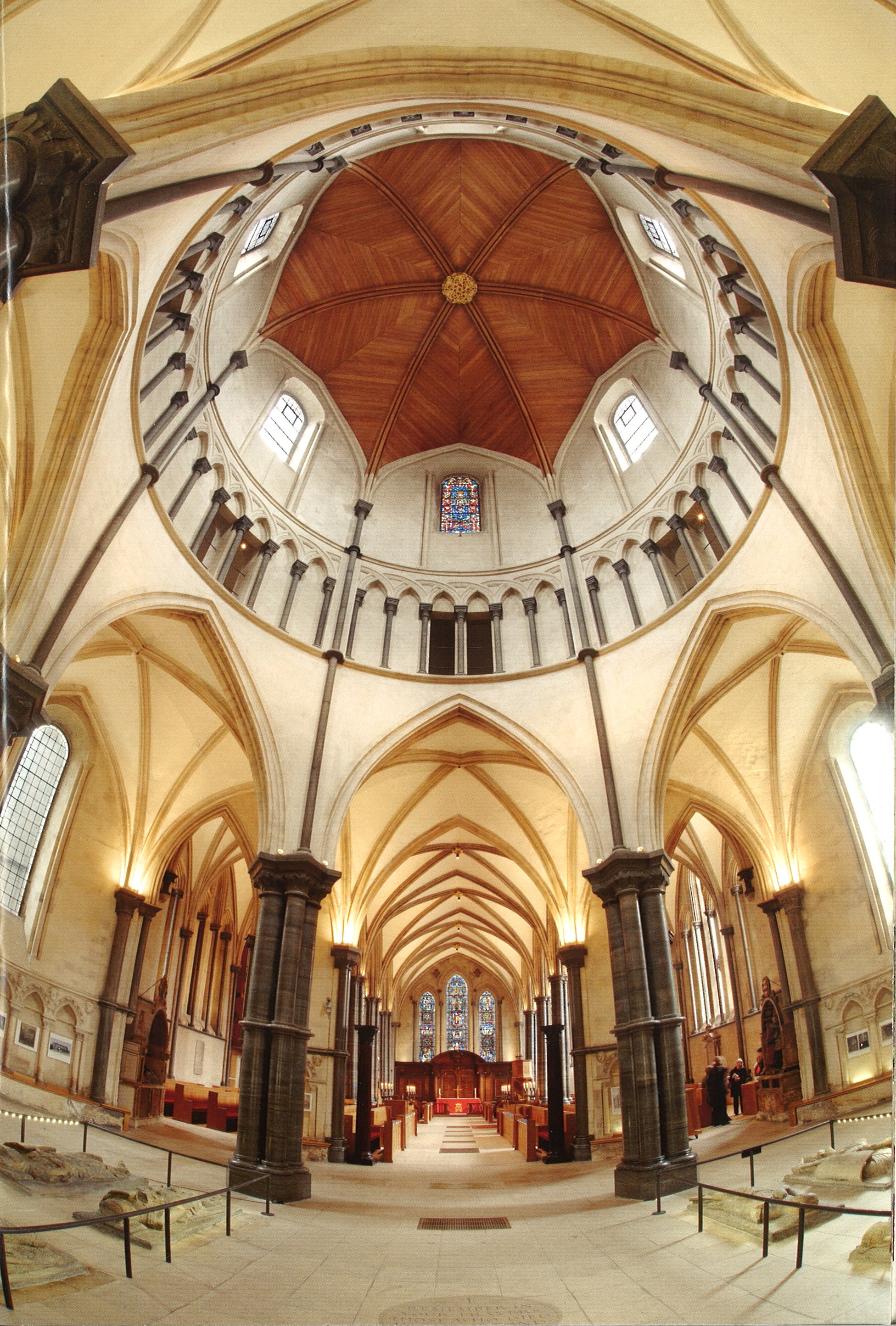
The Temple Church owes its name to the Middle and Inner Temple, which are two of the four Inns of Court.
Briana
elderly person
From Early Factory Labor in New England (1889) by Harriet H. Robinson:
"The early mill-girls were of different ages. Some (like the writer) were not over ten years of age: a few were in middle life, but the majority were between the ages of sixteen and twenty-five" (6).
stunted wood
In a brief diary entry by Susan Fenimore Cooper in November of 1849, she describes crossing the Oakdale River. She states, “Its broad shallow stream turns several mills, one of them a paper-mill, where rags from over the ocean are turned into sheets for Yankee newspapers.” This section is interesting in that it implies that Europe is sending old rags to this paper-mill to create newspapers. This coincides with Melville’s story when the narrator whispers, “Tis not unlikely, then...that among these heaps of rags there may be some old shirts, gathered from the dormitories of the Paradise of Bachelors.” The Paradise of Bachelors is located in London--over the ocean. Cooper also describes the area around the mill. She states, “One of the few sycamores in the neighborhood stands by the bridge.” The important part of this quote is “one of the few,” implying that there are not many sycamore trees remaining because the paper-mill has cleaned the area of most trees for use in the mill. This description of the landscape correlates to Melville’s description of the land around the mill that the narrator visits. He describes it as “bleak hills,” “haggard rock,” and “stunted wood.” The only evidence of trees are in the description “the sullen background of mountain-side firs, and other hardy evergreens, inaccessibly rising in grim terraces for some two thousand feet.” Implying that these trees are the only ones that remain merely because they are inaccessible. Again, the paper-mill has destroyed and cleaned out the landscape.
M.J. Tortessi
John Locke
Let us then suppose the mind to be, as we say, white paper void of all characters, without any ideas. How comes it to be furnished? Whence comes it by that vast store which the busy and boundless fancy of man has painted on it with an almost endless variety? Whence has it all the materials of reason and knowledge? To this I answer, in one word, from EXPERIENCE.
Essay Concerning Human Understanding (1690)
Templar's

The Knights of Templar were a Catholic military order composed of men who pledged to protect pilgrims on their journey to the Holy Land. They were known for their bravery and quickly gained power and wealth.
Briana
whited sepulchre
Matthew 23:27 Woe unto you, scribes and Pharisees, hypocrites! for ye are like unto whited sepulchres, which indeed appear beautiful outward, but are within full of dead men's bones, and of all uncleanness.
blank-looking girls
In a brief entry in Ellen Birdseye Wheaton’s diary, dated 18 April 1851, she describes a presentation that she attended by H. Mann. His presentation described the “condition, & resources of Great Britain.” She summarizes his presentation as describing the great “power and wealth of England…--& then the contrasts exhibited in her manufactories & collieries--her crowded cities and her destitute farming districts, were dark dark as night.” She goes on to lament, “Surely there is scarcely any earthly condition, so utterly hopeless & helpless as that of the English operative, completely, as he is, the slave of a proud aristocracy, & doomed to toil & wretchedness, that others, mere drones upon the earth may live in splendour.” This compares to Melville’s story because the girl are also described as hopeless and helpless, and also as slave to the machine. However, this is also important, because Melville was writing this story to prove that working conditions in America were no better off than they were in Great Britain, as many believed. The way Wheaton describes the operative is exactly how the female operatives are described in Melville’s story, “blank-looking,” “pallid,” “pale,” and “slave.” As Melville actually visited this mill in 1851, the same year that Wheaton is writing this entry, it proves that American working conditions were not better that the working conditions in Great Britain.
M.J. Tortessi
f I remember right, ox-tail soup inaugurated the affair.
Ox-tail soup is a traditional Huguenot dish that was brought to England before being brought to America. Huguenots were inspired by Calvinistic ideals for reformed Protestantism, which is what Melville learned as a child.
Is the oxtail soup Calvinism and is the affair Western Christianity? The independence of America from British control? American consumerism?

Annotation: Vicci
Round and round here went the enormous revolutions of the dark colossal waterwheel, grim with its one immutable purpose
From A New England Girlhood by Lucy Larcom:
"But in a room below us we were sometimes allowed to peer in through a sort of blind door at the great water-wheel that carried the works of the whole mill. It was so huge that we could only watch a few of its spokes at a time, and part of its dripping rim, moving with a slow, measured strength through the darkness that shut it in. It impressed me with something of the awe which comes to us in thinking of the great Power which keeps the mechanism of the universe in motion. Even now, the remembrance of its large, mysterious movement, in which every little motion of every noisy little wheel was involved, brings back to me a verse from one of my favorite hymns" (47-48).
Pulci's

Luigi Pulci was from Padua and was a protege of Cosimo de' Medici. He wrote Il Morgante Maggiore, which was an epic featuring Roland as the hero. It was considered valuable for its use of early Tuscan dialect.
Briana
you must needs be a lawyer
This obituary for Zenas Crane, printed in 1887, describes Crane’s accomplishments. The article focuses on his monetary worth as a businessman. It states that he is “attributed with the idea of first introducing into the fiber of bank bills numbers corresponding to their value, to prevent the fraudulent raising of their denomination.” It continues, “He is said to have been dissuaded from the patenting of this idea, at least he never did do so...his failure to obtain a patent thereon probably causes the considerable fortune he leaves to be much less than it otherwise would have been.” These two quotes are very telling about this man and the time period. It focuses on how much money he earned through his paper-mill, but upon diligent searching, there was no information about how much money the “girls” who worked in Crane’s factory made. This just proves to me that Zenas Crane was one of Melville’s “bachelors,” while his workers were slowly dying to produce the paper that made Crane rich. The narrator ponders about how the girls make the paper to become “lawyers briefs,” emphasizing how the girls are making paper for the bachelors, much like the girls in Crane’s factory.
M.J. Tortessi
Charles Lamb

Charles Lamb was an English essayist and poet who was born at the Temple in London.
Briana
Blucher's army

Several weeks after a crushing defeat and after hemorrhaging soldiers, Napolean led what was left of his army into Paris to oversee the mobilization of a new army. Those who were left prepared to defend France's Rhine frontier against an Allied invasion. The Grand Army of Bohemia crossed the Upper Rhine, and the twelve days later an Allied force of Field Marshal Gebhard Leberecht von Blucher's army crossed the Rhine. Napolean was forced to retreat due to the Coalition's overwhelming numbers. Failing to defeat a significant amount of Blucher's army was a catastrophic error on Napolean's part.
Briana
MAIDS
From A New England Girlhood by Lucy Larcom:
"I heard somebody say one day that there must always be one 'old maid' in every family of girls, and I accepted the prophecy of some of my elders, that I was to be that one. I was rather glad to know that freedom of choice in the matter was possible" (38).
blue with cold;
From A New England Girlhood by Lucy Larcom:
"When we came in shivering from our work, through a snowstorm, complaining of numb hands and feet, she [Lucy's older sister Emeline], would say cheerily, 'But it doesn't make you any warmer to say you are cold;' and this was typical of the way she took life generally, and tried to have us take it" (51).
-Keragan Ettleman
Black, my good horse, but six years old, started at a sudden turn, where, right across the track --not ten minutes fallen --an old distorted hemlock lay, darkly undulatory as an anaconda.
Within his 1850 letter to Evert A. Duyckinck, Melville retells a story about a colt whose leg was injured. He writes that the horse belonged to his neighbor, poet Sarah Morewood, and that the leg was snapped in two due to being ran into by Melville’s own cousin’s, Doolittle, sled while going over a track. In The Writing of Herman Melville: Correspondence editor Lynn Horth mentions that in a letter from Augusta Melville to her sister Helen, Augusta writes that the colt who was injured, Black Quake, did not survive its injury. In Herman Melville’s 1855 The Paradise of Bachelors and the Tartarus of Maids Melville names the narrator’s horse “Black”. This horse first appears at the beginning of the Tartarus of Maids as the narrator appears to enter the underworld. The horse, who the narrator tells us is six years old, is frightened across a track by a fallen hemlock plant which “lay, darkly undulatory as an anaconda”.
While the appearance of what looks like an anaconda frightens the horse “Black” away, the use of hemlock as the plant is interesting. Hemlock, a white flowering plant, is attractive to horses and cattle. These animals won’t hesitate to eat the flowers and leaves. However, hemlock is very toxic to both animals and humans. If eaten, even in a small dose, the ill effects of hemlock will begin within one hour. The symptoms of poisoning can include: respiratory paralysis, bloating, dilation of pupils, loss of appetite, salivation, and blue coloration around mouth. These symptoms are very similar to what the “maids” of papermill show.

The emergence of a horse—who died as a colt—mentioned only after the narrator seemingly passes through the underworld created an interesting new perspective to this story. The colt dies in Melville’s natural world stumbling across a track, only to reappear as a full-grown horse stumbling across a track five years later in the underworld (Tartarus) of Melville’s fictional world. The connection occurring between the natural world and Melville’s fictional one leaves a haunting aspect to this work.

Annotation: Vicci
"Oh! you mean theflowersso called --the Bachelor's Buttons?"
It was not uncommon for men who were in love to wear bachelor's buttons (cornflowers). Bachelor’s buttons were also traditionally a sign of celibacy, fidelity, reliability.
Cornflower was an inexpensive way to create blue in textiles and paper. However, this form of dye was unstable, and faded easily. The Strasbourg Manuscript. A Medieval Tradition of Artists' Recipe Collections (1400-1570) is where this recipe was originally documented.
Throughout paper-making history, blue paper has been popular by artists and publishers in France. By the 18th century, the use of blue dyes to correct the tone of paper pulp, due to the yellow tint caused by discolored rags, spread throughout the paper-making industry. This was a common practice by the 19th century.

Annotation: Vicci
Anacreon
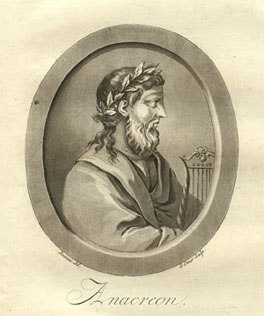
Anacreon was considered the last great Greek lyric poet. The anacreontic meter in poetry is named after him.
Briana
hrowing her thin apron over her bare head
From A New England Girlhood by Lucy Larcom:
"We did not forget that we were working-girls, wearing coarse aprons suitable to our work, and that there was some danger of our becoming drudges" (57).
Lord Verulam

Lord Verulam refers to Francis Bacon. Bacon was influential in developing the scientific method during the scientific revolution. Briana
The building is a paper-mill.
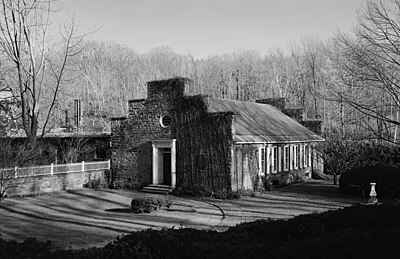
This image (unknown date) is the Crane Paper Mill in Dalton, Massachusetts. It is, apparently, the building where the “rags” were purified during the paper-making process. It is this building in Melville’s story in which the narrator describes the process. He states, “...the girls forever dragged long strips of rags, washed white…” across a sharp scythe. He also describes the air in the room as “(it) swam with the fine poisonous particles…” into the lungs. Both Cupid, and the narrator cough in this scene from the “poisonous particles.” But Cupid claims that the girls “are used to it.” This image emphasizes how secluded the mill was as stated in the story.
M.J. Tortessi
Temple-Bar

The Temple Bar is positioned on Fleet Street in London. It was commissioned by Charles II and was completed in 1672. This gate stood as the boundary between the City and Westminster. Prince Regent passed under the Bar after the defeat of Napolean. Queen Victoria passed through it on her first visit to the City. Elizabeth I passed through it after the defeat of the Spanish Armada.
Briana
THE PARADISE OF BACHELORS AND THE TARTARUS OF MAIDS
“TO HARPER BROTHERS 25 MAY 1854
Pittsfield May 25th 1854 Harper & Brothers:-- Gentlemen--
I have receivd your letter enclosing $100 on acct: of the "Paradise of Batchelors &c."
When you write me concerning the "Tortoises" extract, you may, if you choose, inform me at about what time you would be prepared to commence the publication of another Serial in your Magazine--supposing you had one, in prospect, that suited you.
Yours Very Truly
H Melvill
By writing soon, on the latter subject, you will greatly oblige.”
Annotation: Vicci
PARADISE OF BACHELORS
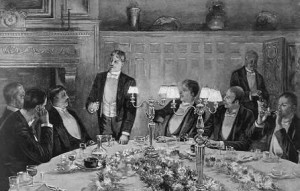
THE TARTARUS OF MAIDS
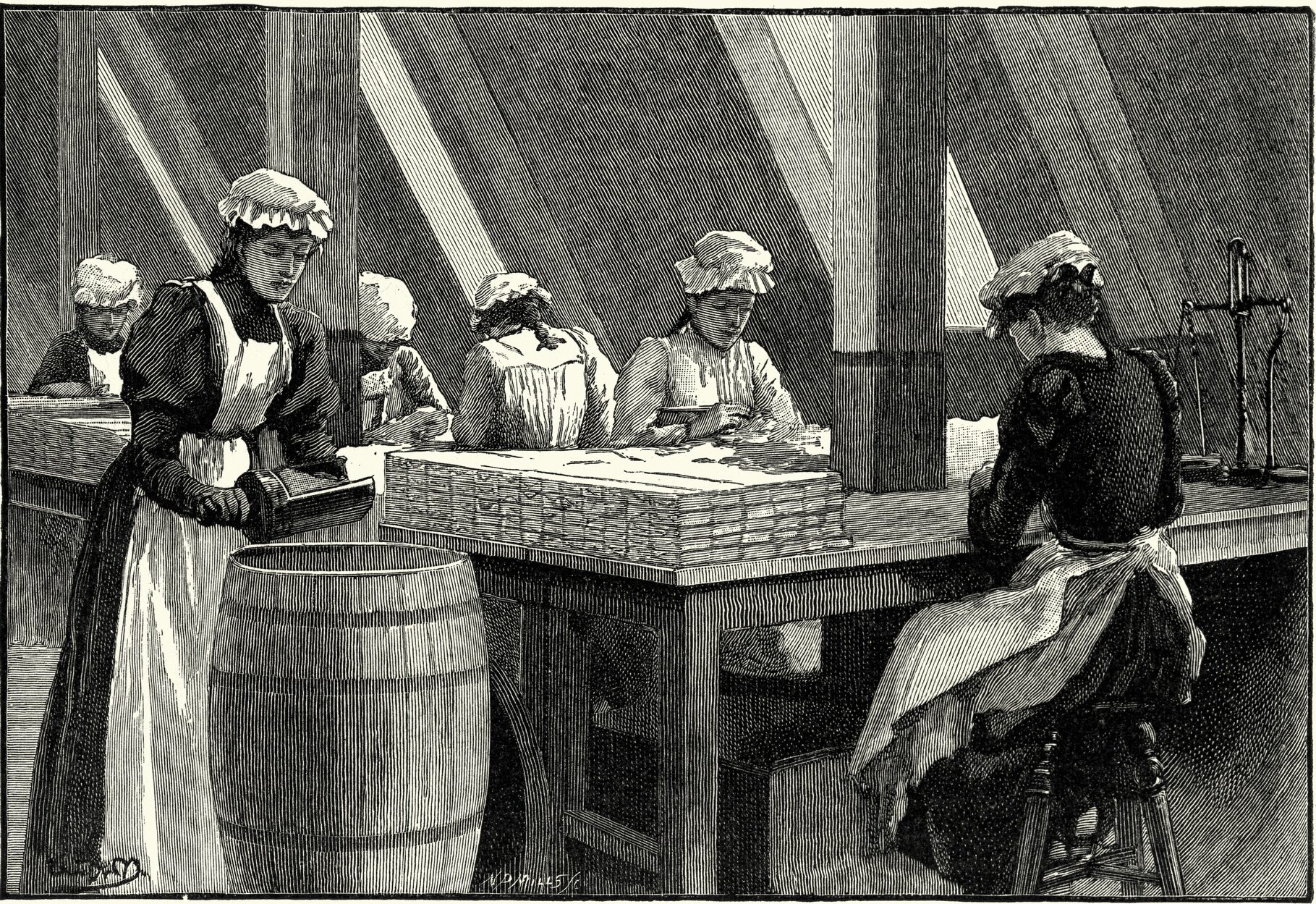
A Grey Friar, who was my confessor, easily seduced me
Consider Michel Foucault’s commentary in The History of Sexuality, where he writes, “Little by little, the nakedness of the questions formulated by the confession manuals of the Middle Ages, and a good number of those still in use in the seventeenth century, was veiled. One avoided entering into that degree of detail which some authors, such as Sanchez or Tamburini, had for a long time believed indispensable for the confession to be complete: description of the respective positions of the partners, the postures assumed, gestures, places touched, caresses, the precise moment of pleasure-an entire painstaking review of the sexual act in its very unfolding” (18-9).
auto-da-fé

for the sake of which they would murder us to the last man
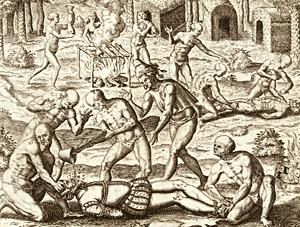
CANDIDE
Candide: or, All for the Best (1759)
VOLTAIRE

I figure that if Major de Spain can stand a ninety five dollar loss on something he paid cash for, you can stand a five-dollar loss you haven't earned yet. I hold you in damages to Major de Spain to the amount of ten bushels of corn over and above your contract with him, to be paid to him out of your crop at gathering time. Court adjourned.
Gayle Wilson says that "at its best, the law is moderate, even, and impartial. It protects as well as punishes; it is an elaborately worked out system designated to join men together in a common purpose, to ensure the presumption of innocence until guilt is proven, and to make the punishment commensurate with the crime" (60). In the first case, no proof can be brought against Abner, so the case is dismissed. In the second case, Abner admits to ruining the rug. Though Abner is guilty, the judge lessens the penalty to make it bearable. According to Wilson's definition, the law was "moderate, even, and impartial" in the story. I would contend, however, that justice turned a blind eye to the greater injustices in the story. Looking at primary documents on tenant farming at the time, society enabled gross injustices against the poor.
Wilson, Gayle Edward. "‘Being Pulled Two Ways’: The Nature of Sarty’s Choice in ‘Barn Burning’." Short Story Criticism, edited by Lawrence J. Trudeau, vol. 204, Gale, 2015. Short Story Criticism Online, go.galegroup.com/ps/i.do?p=LCO&sw=w&u=usc&v=2.1&id=YBFZRP012138472&it=r&asid=97cd4aa06dd3baebf9d8254057c0bbce. Accessed 11 Nov. 2017. Originally published in Mississippi Quarterly, vol. 24, no. 3, 1971, pp. 279-288.
But you never had a hundred dollars. You never will.
Senator John Bankhead says that "the Farmer's Home Corporation could work out the connecting link that would enable the farmer to sell, and the tenant to buy. (. . .) The program is so flexible that it can be made to meet most any sort of worthy need" (50). He furthers that "this program does not create a burden upon the tax payers of the country. It merely provides credit facilities by the government on which little if any loss will accrue. If a purchaser fails to make good and to meet his payments, other good and worthy tenants will be ready to take the farm home and pay the mortgage under the easy long term payment plan" (50). Senator John Bankhead gave this address on the radio in 1935. This provides quite a contrast to the Snopes's situation. It ignores all the racial and class struggles between tenants and their landlords.
Reading between the lines, one can see the power mainstream society has to define who is good and worthy enough to be given the "opportunity" to receive a loan and be given the option to buy. This certainly would not have applied to Abner Snopes or anyone who was interested in subverting the system that suppressed them. To get the benefits of society, one had to submit.
Bankhead, John. "Will Government Aid for Small Farm Purchasers Solve the Tenancy Problem?: Pro." Congressional Digest, vol. 16, no. 2, Feb. 1937, p. 49. EBSCOhost, search.ebscohost.com/login.aspx?direct=true&db=pwh&AN=11889848&site=pov-live. Accessed 12 Nov. 2017.
peace
In an article from 1935, freedom and triumph are defined in the following: "To be gripped by an iron-handed necessity from without is slavery; to be borne along a path of duty by an inward force, which we would not resist if we could, is freedom, peace, triumph" (2). Sarty sees the de Spain house as a place of peace, freedom, and joy. According to the newspaper's definition, however, de Spain is gripped by necessity. He is dependent on society and his tenants for his success.
"Freedom and Triumph." Eagle Valley Enterprise, 24 May 1935, https://www.coloradohistoricnewspapers.org/cgi-bin/imageserver.pl?oid=EVE19350524&getpdf=true. Accessed 20 November 2017.
Hit's big as a courthouse he thought quietly
Wilson Gayle claims that the "Harris and de Spain barns represent productivity and fertility, permanence and continuity, because they house the equipment, stock, and seed by which a society produces the goods to sustain and perpetuate itself. A barn and its contents are the effects of a society which is built upon the willingness of men to subordinate their unfettered desires to a communal consensus in order to develop a permanent community" (60). This interpretation of the short story falls short, however, as it disregards the evils of the affluent society which imposes its ideas and values on weaker people.
This reading of "Barn Burning" reflects Enlightenment thought as it presupposes that there is a communal, natural consensus that all people should come to. Dorinda Outram phrases this the following way: “the Enlightenment, for all its universalist claims, had much difficulty in finding a place for social groups—not just women, but also lower social classes, and other races—which previous historical periods had equally defined outside the central human community” (97-98). If the communal consensus is inherent, it should include all people; if it does not include all people, one has to ask--who gets to decide who is included and why do they have the power to decide. If the "in-group" claims it is a mere matter of force, anyone has the right to use force to their own benefit.
Outram, Dorinda. The Enlightenment. Cambridge University Press, 2013.
Wilson, Gayle Edward. "‘Being Pulled Two Ways’: The Nature of Sarty’s Choice in ‘Barn Burning’." Short Story Criticism, edited by Lawrence J. Trudeau, vol. 204, Gale, 2015. Short Story Criticism Online, go.galegroup.com/ps/i.do?p=LCO&sw=w&u=usc&v=2.1&id=YBFZRP012138472&it=r&asid=97cd4aa06dd3baebf9d8254057c0bbce. Accessed 11 Nov. 2017. Originally published in Mississippi Quarterly, vol. 24, no. 3, 1971, pp. 279-288.
Barn Burning
The article, "Incendiaries Use Torches" shows "barn burning" from the perspective of mainstream society. Barn burning causes great loss physically and emotionally. The "perpetrators" are depicted as destructive, reigning terror on an otherwise peaceful society. Instead of speculating why a person would burn a barn, society deemed the action unjust and illegal, appealing to the legal system to end the abuse. If the people, who burned the barn in the article, had an agenda similar to Abner Snopes's, society (at least as represented in the article) never sought to understand the motive behind the action. Like Sarty, society only saw the destruction.
This article further shows the power mainstream society has to define the actions of others. Burning barns, though destructive and attention getting, does little to change the mainstream culture when mainstream society maintains the control to define the actions of others.

Persistent link: http://chroniclingamerica.loc.gov/lccn/sn83045211/1922-12-12/ed-1/seq-7/
“Lancaster County Asks Fire Patrol.” Evening Public Ledger, Dec. 1922, p. 7. Chronicling America: Historic American Newspapers, https://chroniclingamerica.loc.gov/lccn/sn83045211/1922-12-12/ed-1/seq-7/#. Accessed 24 November 2017.
He went on down the hill, toward the dark woods within which the liquid silver voices of the birds called unceasing the rapid and urgent beating of the urgent and quiring heart of the late spring night. He did not look back.
Timothy Keller says, “Constraints . . . liberate us only when they fit with the reality of our nature and capacities. A fish, because it absorbs oxygen from water rather than air, is only free if it is restricted and limited to water. If we put it out on the grass, its freedom to move and even live is not enhanced, but destroyed. The fish dies if we do not honor the reality of its nature” (47). Many claim that Sarty is finally free at the end of the story. He flees from society and his family, throwing off limitations and restrictions. With Keller's definition of freedom, however, Sarty was less free when he was alone in the woods than he was in society.
Keller, Timothy. The Reason for God. Riverhead Books, 2008.
He went on down the hill, toward the dark woods within which the liquid silver voices of the birds called unceasing the rapid and urgent beating of the urgent and quiring heart of the late spring night. He did not look back.
Emmanuel Kant says, "A lesser degree of civil freedom . . . creates the room for spiritual freedom to spread to its full capacity. When nature has, under this hard shell, developed the seed for which she cares most tenderly—namely, the inclination and vocation for free thinking—this works back upon the character of people . . . and finally even on the principles of government, which finds it to its advantage to treat man, who is now more than a machine, in accord with his dignity (63). Looking at Abner's raising of Sarty, it appears as if he is selfishly trying to mold Sarty for his own purposes. Looking through the lens of Kant's argument, one has to wonder if each "restricting" lesson taught by Abner was actually liberating as it taught Sarty to think apart from white, hegemonic society.
Schmidt, James, ed. What is Enlightenment? Eighteenth-Century Answers and Twentieth Century Questions. Berkeley: Univ. of California Press, 1996.
emptying the reservoir of the lamp back into the five-gallon kerosene can from which it had been filled,
In this scene, Abner prepares to burn Major de Spain's barn.
Reginal Dyck says, "Abner Snopes illustrates the problem [of reducing human relationships to market relationships]. With its inevitable economic inequality, rural Southern society offered little positive incentive for sharecroppers like Snopes to follow its mores and laws. The negative incentives of economic necessity and state force represented by the legal system generally motivated sharecroppers' acquiescence" (125). Both times we see Abner confronting a landlord, he burns or attempts to burn their barns down. Reading about positive incentives for sharecroppers, one has to consider what, if anything, would have kept Abner from burning the barns. Was he evil at his core, as many sources speculate, or did he simply want to be treated with dignity?
Dyck, Reginald. "The Social Construction of Conscience in Faulkner’s ‘Barn Burning’." Short Story Criticism, edited by Lawrence J. Trudeau, vol. 204, Gale, 2015. Short Story Criticism Online, go.galegroup.com/ps/i.do?p=LCO&sw=w&u=usc&v=2.1&id=LEEGIS599124271&it=r&asid=8365814b9c760a4ea29b66cfecc4b65c. Accessed 13 Nov. 2017. Originally published in Misrecognition, Race and the Real in Faulkner’s Fiction, edited by Michael Zeitlin, et al., PU de Rennes, 2004, pp. 65-74.
tenants,
John Shute claims that sharecropping and tenant farming in the South, post-Civil War, was the only economic system that would have worked. The landowners needed laborers. The farmers needed land and tools to farm. According to Shute, the economic system benefited both parties—landowners and tenant farmers. John Shute speaks of tenant farming much like Senator Bankhead. If the white, affluent landowners were ethical, the system could have worked. Many, as seen from the primary documents of the time, were unethical and greedy. In reality tenant farmers obtained few benefits from tenant farming.
Shute, John R. “Sharecropping as the South’s only post-Civil War option.” Oral Histories of the American South. 25 June 1982.
whippoorwills
"The whippoorwill is common in the E. United States. Ornithologists have discovered that the whippoorwill, unlike other birds, hibernates during the winter instead of migrating. Its body temperature drops from 102F° (39C°) to 65F° (18.3C°), its breathing slows, and its digestion ceases until spring brings the return of the insects that constitute its diet. The whippoorwill's flight, like that of the swift, is graceful and erratic; it sometimes swoops downward and then stops abruptly, producing a booming sound as it spreads its wings to brake." The whippoorwills in the story are much like Abner and his family. Instead of fleeing harsh times, the birds remain and adapt. The birds draw attention by their graceful flying "out-of-season," but they also draw attention by their erratic motions.
"Goatsucker." Columbia Electronic Encyclopedia, 6Th Edition, Mar. 2017, p. 1. EBSCOhost, login.ezproxy.csupueblo.edu/login?url=http://search.ebscohost.com/login.aspx?direct=true&db=aph&AN=39009047&login.asp&site=ehost-live&scope=site.
"Pretty and white, ain't it?" he said. "That's sweat. Nigger sweat. Maybe it ain't white enough yet to suit him. Maybe he wants to mix some white sweat with it.
Karl Zender interprets Abner's lesson to Sarty as the following: "There can be no pure whiteness . . . because all whiteness--all peace and dignity--is a distillation of someone's sweat--not of his own" (53). If something must be added to it to make it white, it cannot be natural or normal. Rather, it is manufactured. Zender compares Abner's quote about sweat to a scene in Ralph Ellison's Invisible Man. At Liberty Paints, black drops are mixed into the white paint to create an "optic white" paint. In both narratives, white, affluent society is dependent on others to manufacture their pristine white identities.
Zender, Karl F. "Character and Symbol in ‘Barn Burning’." Short Story Criticism, edited by Lawrence J. Trudeau, vol. 204, Gale, 2015. Short Story Criticism Online, go.galegroup.com/ps/i.do?p=LCO&sw=w&u=usc&v=2.1&id=WXOMJY907845401&it=r&asid=f785615ea2dab5796c99bb09d46ea59d. Accessed 11 Nov. 2017. Originally published in College Literature, vol. 16, no. 1, 1989, pp. 48-59.
"Get out of my way, nigger,"
Elise Isely recalls that “it has been so long since slave days that today we have forgotten that the institution [of slavery] was a handicap to white men as it was to the negroes. Poor white people of the South who had no slaves were forced to compete in the labor market with slave labor” (81). Abner's hatred towards de Spain's black worker is contextualized by Isely's journal entry.
Isely, Elise D. “Sunbonnet Days.” North American Immigrant Letters, Diaries, and Oral Histories, Caxton Printers, 1935, http://imld.alexanderstreet.com.ezproxy.csupueblo.edu/cgi-bin/asp/philo/imld/getdoc.pl?S9994-D007. Accessed 4 Nov. 2017.
"Get out of my way, nigger,"
John Duvall speaks of white tenant farmers who were unwilling to unionize because they would not unite with black tenant farmers (112). Even though the "nigger" has a "better" position in society, Abner speaks to him in a demeaning way to establish his own preeminence. Abner simultaneously subverts the system on one hand while upholding it with the other. Although Abner rightly acknowledges the injustices of society, his treatment of the black man signifies that he does not understand the root of the problem. Reading of tenant hardships of the time, it is hard not to have some sympathy for Abner, but watching how he treats the black man, his children, and his wife, one has to wonder if he would be as outraged at the injustices if his and de Spain's roles were reversed.
Duvall, John N. "'A Strange Nigger': Faulkner and the Minstrel Performance of Whiteness." The Faulkner Journal, vol. 22, no. 1-2, 2006, p. 106-119. Academic OneFile, go.galegroup.com.ezproxy.csupueblo.edu/ps/i.do?p=AONE&sw=w&u=usc&v=2.1&it=r&id=GALE%7CA171020113&asid=ba56b356dcb929249d37b5d5755d870e. Accessed 7 Nov. 2017.
"I reckon I'll have a word with the man that aims to begin tomorrow owning me body and soul for the next eight months.
Kyra Goritzina provides a lens through which to study “Barn Burning” as she writes about her experience as a working class woman trying to get work in America in 1939. She recalls, "We sat there amidst this group of people, considered the lowest in the social scale because they are servants. (. . .) I could not help but consider how indispensable they were to the happiness and well-being of their fellow men who happened to be more fortunate financially. (. . .) On the spur of the moment, I turned to my husband and said: "Please, let's go away from here. I just can't stay any longer. I can never become a social outcast or a slave for someone else." He took my hand and pulled me back to the chair from which I had risen. "What kind of slavery are you talking about? We are in a free and democratic country where one hundred and sixty years ago the people fought and won their independence, suppressing the caste system" (62). Goritzina’s conversation with her husband reveals the dissociation between ideas and reality. The caste system in America was theoretically abolished. In reality, the caste system persists to the present. Reading of Goritzina's reaction to society places Abner's actions in context. Unlike Goritzina, Abner and his family had no place to go. Though they had moved twelve times and could move again, they were trapped in the same system that treated them as "artificial niggers."
Goritzina, Kyra. “Service Entrance Memoirs of a Park Avenue Cook.” North American Immigrant Letters, Diaries, and Oral Histories, Carrick & Evans, 1939, http://imld.alexanderstreet.com.ezproxy.csupueblo.edu/cgi-bin/asp/philo/imld/getvolume.pl?S9847#DIV7. Accessed 4 Nov. 2017.
n the early afternoon the wagon stopped before a paintless two-room house identical almost with the dozen others it had stopped before even in the boy's ten years
Senator John Bankhead says that "a man can not [sic] well take the same interest in a community when he is a tenant as he does when he owns his own home" (49). Again, Senator Bankhead glosses over deeper issues. The issue is not in the ownership of land, but rather the issue is societies' treatment of people who were not landowners. Society equated wealth with worth, dismissing those who had little.
Bankhead, John. "Will Government Aid for Small Farm Purchasers Solve the Tenancy Problem?: Pro." Congressional Digest, vol. 16, no. 2, Feb. 1937, p. 49. EBSCOhost, search.ebscohost.com/login.aspx?direct=true&db=pwh&AN=11889848&site=pov-live. Accessed 12 Nov. 2017.
In the early afternoon the wagon stopped before a paintless two-room house identical almost with the dozen others it had stopped before even in the boy's ten years
Senator John Bankhead says that "you can't build a community, or a country, or a section when so large a percentage of its people move out every year, and their places are taken by new people who follow the same practice. (. . .) Tenants move entirely too often for their own good, as well as for the good of the community. Whether they move voluntarily or for other reasons, the results are the same" (49). In 1937, Senator Bankhead presented his case for why the government should aid tenant farmers. He wanted the government to provide loans to tenant farmers, so they could buy the land they worked and become established in the community. Although this plan may help establish more permanent communities, Senator Bankhead's plan fails to address the real problems and the "other reasons" tenant farmers move. He fails to address social injustice.
Bankhead, John. "Will Government Aid for Small Farm Purchasers Solve the Tenancy Problem?: Pro." Congressional Digest, vol. 16, no. 2, Feb. 1937, p. 49. EBSCOhost, search.ebscohost.com/login.aspx?direct=true&db=pwh&AN=11889848&site=pov-live. Accessed 12 Nov. 2017.
strange nigger
John Duvall suggests that the “strange nigger” in the text is actually Abner Snopes in blackface. The town is small, as evidenced by the fact that the town store seconds as a courtroom. This being the case, a "strange nigger," thirty years after the Civil War, would not have the freedom to come and go without being noticed and questioned. According to Duvall, race in the story is not simply the color of one's skin; "race" is also determined by one's performance.
Duvall, John N. "'A Strange Nigger': Faulkner and the Minstrel Performance of Whiteness." The Faulkner Journal, vol. 22, no. 1-2, 2006, p. 106-119. Academic OneFile, go.galegroup.com.ezproxy.csupueblo.edu/ps/i.do?p=AONE&sw=w&u=usc&v=2.1&it=r&id=GALE%7CA171020113&asid=ba56b356dcb929249d37b5d5755d870e. Accessed 7 Nov. 2017.

strange nigger
John Duvall suggests that Faulkner reveals the Southern racial binary to be insufficient to deal with the complexities of society. Complicating the binary, “Faulkner’s use of figurative blackness . . . allows him a way to map imbricated relations between one form of otherness (racial) and other forms of otherness (gender/sexuality and class)” (108). According to Duvall, Abner is an "artificial nigger." He is continually referenced by his black coat and dark figure. As many blacks left the South after the Civil War, poor, white farmers assume the role of blacks, farming the land of landowners ("masters"). By giving Abner this role as a white man, Faulkner is able to critique race relations outside of the context of race.
Duvall, John N. "'A Strange Nigger': Faulkner and the Minstrel Performance of Whiteness." The Faulkner Journal, vol. 22, no. 1-2, 2006, p. 106-119. Academic OneFile, go.galegroup.com.ezproxy.csupueblo.edu/ps/i.do?p=AONE&sw=w&u=usc&v=2.1&it=r&id=GALE%7CA171020113&asid=ba56b356dcb929249d37b5d5755d870e. Accessed 7 Nov. 2017.
"I told you. The hog got into my corn. I caught it up and sent it back to him. He had no fence that would hold it. I told him so, warned him. The next time I put the hog in my pen. When he came to get it I gave him enough wire to patch up his pen. The next time I put the hog up and kept it. I rode down to his house and saw the wire I gave him still rolled onto the spool in his yard. I told him he could have the hog when he paid me a dollar pound fee.
Rousseau dismantles preconceived notions about the “self-evident” nature and authority of mankind and society, as he presents his ideas about mankind in the beginning of time. Rather than adopting the belief that the world was created by a sovereign God, who created mankind to live in community and under authority, Rousseau imagines early mankind living in isolation. For him, mankind's happiness rested in the fact that each person could fulfill his or her own desires and needs. He states, “earth’s products provided . . . [man] with all necessary support, instinct moved him to use them. Hunger . . . caus[ed] him by turns to experience different ways of existing” (107). Man, as Rousseau describes him in his natural state, was his own authority. He relied on no one to tell him what his needs were or how to fulfill those needs. In Rousseau’s narrative, mankind's autonomy began to dissolve the moment he entered into community. Rather than obtaining all one's needs by oneself, mankind "split-up" responsibilities. One person would protect the community and another would gather food for the community. As this became a normal practice, individuals became comfortable with the extra amenities provided by others and began to lose their instinctual ability to live alone and provide for themselves. As societies expanded, it became necessary to establish hierarchy and authority to maintain order. Originally, men did not act according to rules to please or be accepted by others, but rather “love of well-being [wa]s the sole springs of human actions” (108). When “everyone began to look at everyone else and to wish to be looked at himself . . . [man took] the first step towards inequality and vice, (. . .) [producing] compounds fatal to happiness and innocence” (111).
Turning to look at the text from this perspective, it could be argued that Abner is attempting to obtain happiness by destroying the inequality and vice created by society. He attempts to live his life detached from "neighborly rules of conduct," not caring what his neighbors or society thinks of him. Abner, however, falls short of accomplishing this worldview as he is concerned with Sarty's view of him.
If one adopts Rousseau's worldview, Abner is not the main antagonist in the story--society is. Abner is not evil, as "what is evil" is a construct of society. Depending on one's worldview, one will either see Abner as the savior or the villain. In either case, the conflicts throughout the story run much deeper than ruined corn and rugs. They go to the very core of the essence of man and God.
Williams, David, editor. The Enlightenment. Cambridge University Press, 1999.
scarlet devils amid the silver curve of fish
This is an advertisement for deviled ham from the 1930's.
Faulkner's choice of food cannot be overlooked. The scarlet devils and silver fish historically symbolize evil and good, respectively. Instead of adopting the symbols and labels as inherent, Faulkner unveils how they are socially constructed. Neither the scarlet devils nor the silver curve of fish labels depicts the reality of good or evil contained in the package. Each label is manufactured. One does not know the true contents until one peels the labels off.
Faulkner further complicates ideas of good and evil by making the labels unreadable to Sarty. For if the labels were natural reflections of reality, surely a boy of ten could "read" them. Instead, the labels will only become "readable" to Sarty when society educates him.
from where he sat he could see the ranked shelves close-packed with the solid, squat, dynamic shapes of tin cans whose labels his stomach rea
Reginald Dyck says that the general store/courtroom "entices Sarty to desire society's rewards, both tangible (material goods) and intangible (a sense of connectedness to something more powerful than his own impoverished family)" (124). As tenant farmers had to become dependent on the system to provide for their families, if one wished to obtain the benefits of society, one had to give up one's independence. Similar to Sarty's ability to smell the food but his inability to read the labels, the benefits of society came with "small print" contracts that included "non-compete clauses." If one wished to gain the benefits, one had to assimilate completely, leaving it up to society to "label and define."
Dyck, Reginald. "The Social Construction of Conscience in Faulkner’s ‘Barn Burning’." Short Story Criticism, edited by Lawrence J. Trudeau, vol. 204, Gale, 2015. Short Story Criticism Online, go.galegroup.com/ps/i.do?p=LCO&sw=w&u=usc&v=2.1&id=LEEGIS599124271&it=r&asid=8365814b9c760a4ea29b66cfecc4b65c. Accessed 13 Nov. 2017. Originally published in Misrecognition, Race and the Real in Faulkner’s Fiction, edited by Michael Zeitlin, et al., PU de Rennes, 2004, pp. 65-74.
THE STORE in which the Justice of the Peace's court was
Reginald Dyck says that "dependency is embodied in the opening setting, a general store that would have operated as a sharecroppers' and small farmers' credit agency" (124). Waiting for the crops to come in, tenant farmers had no money to pay for food and goods. Instead, they credited goods to their account and paid when their crops came in. This dependency deepened as stores were able to create monopolies and charge interest. In "Barn Burning," it is important to realize the opening setting was in "the store," not "a store." Abner and his family could not extricate themselves from the store any more than they could extract themselves from the legal system. Economics and justice were inextricably intertwined.
Dyck, Reginald. "The Social Construction of Conscience in Faulkner’s ‘Barn Burning’." Short Story Criticism, edited by Lawrence J. Trudeau, vol. 204, Gale, 2015. Short Story Criticism Online, go.galegroup.com/ps/i.do?p=LCO&sw=w&u=usc&v=2.1&id=LEEGIS599124271&it=r&asid=8365814b9c760a4ea29b66cfecc4b65c. Accessed 13 Nov. 2017. Originally published in Misrecognition, Race and the Real in Faulkner’s Fiction, edited by Michael Zeitlin, et al., PU de Rennes, 2004, pp. 65-74.
Barn Burning
In the article, "Incendiaries Flee in Car," the author says that on average three to four barns were burned each week for the past two months. Reading the information in the article is important to understanding the story from mainstream societies' perspective, but it is just as important to "read" what is not included in the article. There is no mention of the arsonists' possible motive. There is no speculation as to why certain "victims" were targeted. There is certainly no speculation about a class war, if indeed this was the motive. The author presupposes a collective conscience that deems acts of violence to be unethical.
Persistent link: http://chroniclingamerica.loc.gov/lccn/sn83045211/1922-12-12/ed-1/seq-7/
“Lancaster County Asks Fire Patrol.” Evening Public Ledger, Dec. 1922, p. 7. Chronicling America: Historic American Newspapers, https://chroniclingamerica.loc.gov/lccn/sn83045211/1922-12-12/ed-1/seq-7/#. Accessed 24 November 2017.
Barn Burning
In the article "Clues in Spencer Burning," the barn which burned cost the owner $20,000. Today that is the equivalent of $344,902. Though the story does not indicate how much Major de Spain's barn was worth, we do know he spent $100 on a rug (equivalent to $1724 today). There is great disparity between Major de Spain and Abner Snopes. On one hand Major de Spain's wealth gives him power to oppress Abner. On the other hand, however, de Spain's wealth gives Abner power, as he is able to take much from de Spain, and de Spain can take very little from Abner.
tenants,
In 1940, there was a movement to give tenants a degree of protection. The Advanced News records the first step “to formalize and legalize the relationship between farmer and tenant by bringing in a simple uniform lease to bind the relation between them” (7). In 1940, “over 80 per cent [sic] of all tenants . . . ha[d] only verbal agreements with their landlords” (The Advanced News 7). Tenant farmers relied heavily upon their landlords to treat them with equality and fairness. The attempt to give tenants protection suggests a history of abuse.
“Sharecropping Security.” The Advanced News, 11 August 1940, p. 7.
tenants,
In 1940, attention was turned to tenant farmers’ plights and efforts were made by AAA to assist tenant farmers. The Advanced News records efforts to give money to farmers to get them to stop farming, thinking reducing product would prevent price reducing surpluses (7). The money given went to landlords, however, leaving tenants “without proportional benefits of AAA payments” (7). Although preventing price reducing surpluses would help the tenant farmer, the underlining problem of social injustice was not prevented.
“Tennant Farmers.” The Advanced News, 11 August 1940, p. 7.
notlikewindowsbutlikedoors.
Doors are capable of being walked through. The landscape can be accessed, Atwood seems to be saying. Perhaps she is even saying that wrongs can be righted. Bruhn claims that "the art that [Atwood] is now creating, with its profound elaboration of the idea of otherness (whether thematic or formal/generic, or both) and its denaturalization and reconstruction of foundational concepts inherited from modernity, the postmodern artist is extending our under- standing of that ‘large Mansion of Many Apartments’ which is ourselves, helping us to see, as Atwood puts it in the concluding words of ‘Death by Landscape,’ into the ‘holes that open inward, not like windows but like doors’" (458). Perhaps this means that the battle against colonialism must be won internally first, that looking inward first, and seeing ourselves as both the colonizer, and the colonized, as Atwood appears to be doing, is the only way to end the cycle.
hoknowshowmanytreestherewereonthecliffjustbeforeLucydis-appeared?Whocounted?Maybetherewasonemore,afterward.
Here is the final piece of evidence that Atwood intended for Lucy to replace the "trace or cultural deposit" left behind by the Group of Seven in their paintings. Lucy, not the artist, resides in the trace of a tree. She has replaced them within the cultural memory, and through the conflation of Lucy and the aboriginal people, they have replaced the white, nationalistic artists as well. Brock argues that “Death by Landscape” is counter-discursive, combating the colonial rhetoric embedded in the Group of Seven’s landscapes. Atwood, he argues, uses the trace (the tree) as a point to unravel the colonial rhetoric in the paintings.
Becausetherearen'tanylandscapesupthere,notintheold,tidyEuropeansense,withagentlehill,acurvingriver,acottage,amountaininthebackground,agoldeneveningsky.
 Aside from the lack of a mountain, this picture fairly accurately fits Atwood's description of a landscape "in the old, tidy European sense" of the word.
"YOUgoonbigwater,"saysCappie.Thisisheridea–alltheirideas–ofhowIndianstalk."Yougowherenomanhasevertrod.Yougomanymoons."
In his book The Colonizer and the Colonized, Albert Memmi explains that the colonizer "endeavors to falsify history, he rewrites laws, he would extinguish memories-anything to succeed in transforming his usurpation into legitimacy" (96). The appropriation of customs and language and the reframing of aboriginal peoples as unsophisticated and uncivilized are actions we see evidence of throughout this story, and are classic examples of the perspective of the colonizers. This belief comes from many places, but one place in particular which is important for this story is the erasure of history in the landscapes of the Group of Seven.
Shewantedtobeadventurousandpure,andaboriginal.
Here is another level of connection between Lucy's disappearance and the erasure of Aboriginal people from Canada's landscape. In his essay "Margaret Atwood's Lucy Poem: The Postmodern Art of Otherness in 'Death by Landscape'", Mark Bruhn states that "Lucy is not what Lois once was; she’s what Lois once wanted to be, and wanted to be precisely because it was what she was not" (453). The same is true for aboriginal people. They were "what Lois once wanted to be" and "what she was not." Rule claims that "'Death by Landscape,' refusing to hold the dualities of white and Indian in suspension, collapses the identities of Lucy and the Indian she pretends to be into the figure of Lois's other who disappears into the landscape. Rather than privileging either Lucy or the Indian as Lois's other persona, "Death by Landscape" conflates the two personae and...ground[s] this persona in the landscape" (640). This again causes the amplified anxiety which Lois feels when looking at the paintings in the future. The loss of her friend, who represented everything she wanted to be as a child, is directly connected to the disappearance of the people who were displaced by her ancestors, and the erasure of both is on display in the paintings.
Lookingbackonthis,Loisfindsitdisquieting.
This passage is evidence that Lois is at some level aware of why, other than the disappearance of her friend, the paintings make her so uncomfortable. She is aware that the Cappie, the other campers, and herself were "stealing" from aboriginal people, and she is aware of her childhood self's lack of awareness, but she hasn't quite put it all together.
OnthisfiretheyburnedoneofLucy'susedsanitarynapkins.Loisisnotsurewhytheydidthisorwhoseideaitwas.Butshecanrememberthefeelingofdeepsatisfactionitgaveherasthewhitefluffsingedandthebloodsizzled,asifsomewordlessritualhadbeenfulfilled.
Unlike the intentional appropriation on Aboriginal practices and customs which take place at Camp Manitou, this seems to be a spontaneous ritual that the girls do on their own. I see it as an act of defiance by Lucy and Lois. They are pushing back against the colonization of their own power and sexuality by patriarchal forces. Brock and others consider Atwood’s conflation of the genocide of Indigenous people with the disappearance (and by way of synecdoche, figurative and literal colonization) of an upper-middleclass white girl to be problematic, but I disagree. Atwood sees women as being located in what Nadine Gordimer calls colonialism's middle ground. Gordimer was Tunisian, and along with all other Tunisians was among the colonized, but he was also Jewish, and therefore had privileges that Muslim Tunisians did not. He was still oppressed, but slightly less than others. In many ways, though, he was more connected to the French colonizers. Though Canadian and American women of European descent are of the colonists, they have also been perpetually colonized by the patriarchal structure of Western Society. I believe this conflation by Atwood was intentionally subversive, and meant to challenge a persistent dismissal by western males of the continued colonization of women.
Manitou
In her essay "Not Fading into Another Landscape: Specters of American Empire in Margaret Atwood"s Fiction," Lauren A. Rule states that "Lois first meets Lucy at Camp Manitou, a summer camp for girls, which, like others of its type, "favored Indian names" (50). The name "Manitou" itself has significance for the story. For many Native North American tribes, the term "Manitou" denotes "the manifestation of spiritual power, a manifestation that could occur in almost any form" (Salisbury 38–39). In the story, "Manitou" can simultaneously represent both figures of the landscape and what is "unknown" or other (Dowd 17–18). Neal Salisbury explains that conceptualizing what is other in terms of Manitou allowed Native peoples, "without experiencing a radical discontinuity in world-view," to "accommodate themselves to the more abrupt changes accompanying European colonization" (39). In "Death by Landscape," Atwood invokes the conception of Manitou as she landscapes the story to account for the worldview of the aboriginal peoples whom European colonization has displaced and virtually erased from the North American body politic" (638).
Theyarepicturesofconvolutedtreetrunksonanislandofpinkwave-smoothedstone,withmoreislandsbehind;ofalakewithrough,bright,sparselywoodedcliffs;ofavividrivershorewithatangleofbushandtwobeachedcanoes,onered,onegray;ofayellowautumnwoodswiththeice-bluegleamofapondhalf-seenthroughtheinterlacedbranches
According to Jonathan Bordo, these landscapes, painted by the Group of Seven, are framed in such a way to create wilderness. It is the framing of the painting which determines what the image is, and what it isn't. Framing out a human presence is a choice. In addition to this, says Bordo, the artists left a deposit or trace of their own presence, usually in the form of a tree. Notice that in all of the paintings there is one central marker which stands apart from the rest of the landscape. This figure represents the artist himself. In his essay "Envoicing Silent Objects: Art and Literature at the Site of the Canadian Landscape," Richard Brock argues that the Group of Seven artists used this trace much like a flag-pole, claiming these supposedly empty and unsullied landscapes. In doing so, argues Brock, the artists have tamed the dangerous and hostile, masculine landscapes. In effect, emasculating them. In addition to "planting their flag" in the terra nullius, the artists also erase aboriginal presence from the landscape, and any claim they may have on the land which European colonists have claimed for themselves. Others have seen this action slightly differently, seeing the harsh Canadian landscapes as feminine, and the "planting the flag" as an act of claiming the virgin landscape. The result is the same either way.
DavidMilne
 The tree here is positioned differently than in the other artists' work, but it still stands out from the rest, especially in its reflection on the water.
J.E.H.MacDonald
 Another landscape, another tree.
ArthurLismer
 Again we have a central tree figure. Also notice how desolate, harsh and empty the landscapes are. Only the hardiest could survive here.
LawrenHarris
 In this example of Lawren Harris's work, the central figure of a tree has been replaced by an arrow shaped reflection on the lake. This central figure has the same purpose as the trees of representing the artist's presence, and therefor claim on the landscape.
TomThompsons

Tom Thomson actually wasn't in the Group of Seven, but was more like their guru/inspiration. The style used in his painting, "The Jack Pine" (top) was emulated by the Group in much of their work.
Sheisrelievednottohavetoworryaboutthelawn,orabouttheivypushingitsmuscularlittlesuckersintothebrickwork,orthesquirrelsgnawingtheirwayintotheatticandeatingtheinsulationoffthewiring,oraboutstrangenoises.Thisbuildinghasasecuritysystem,andtheonlyplantlifeisinpotsinthesolarium.
Lois wants nothing to do with the wilderness. The memories she has equates wilderness with danger, loss, and despair. Hiding from nature is one of the ways in which she tries to contain her memories.
Europeanlook
The paintings themselves were done way which defied European conventions. The landscapes are wild and untamed as opposed to the sublime pastorals of the European convention. Lois's attempt to frame them in a European way is an attempt to contain the wilderness captured within the paintings, and through that action, contain her memories of what happened to her and her friend Lucy.
"Youbringbackmuchwampum,"saysCappie:"Dogoodinwar,mybraves,andcapturemanyscalps."Thisisanotherofherpretenses:thattheyareboys,andbloodthirsty.Butsuchagamecannotbeplayedbysubstitutingthewordsquaw.Itwouldnotworkatall.
Rule notes that when Atwood writes "such a game cannot be played by substituting the word 'squaw. It would not work at all," that "substituting 'the word squaw' would not work because the role-playing implies the conquest of virgin land, which has traditionally been figured in terms of a female who is, in turn, deflowered by the male conqueror/explorer" (649). Additionally, throughout the history of the colonization of women by patriarchal forces, women can sometimes gain power and status by siding with on masculine ideologies and assuming identities, just as is the case with other colonizer/colonized cases.
Shecanhardlyremember,now,havinghertwoboysinthehospital,nursingthemasbabies
Lois's memories have no place to reside. They are pushed aside by the memories held within the paintings.
asifshewaslivingnotonelifebuttwo:herown,andanother,shadowylifethathoveredaroundherandwouldnotletitselfberealized,thelifeofwhatwouldhavehappenedifLucyhadnotsteppedsidewaysanddisappearedfromtime.
The other that was created by Lois's desire to be both Lucy and aboriginal haunts Lois like a specter. It disappeared into the forrest that day when Lucy vanished, but it never really went away. Lois tried to contain it within the paintings, but wound up trapping herself there as well.
Shehasgoneoverandoveritinhermindsince,somanytimesthatthefirst,realshouthasbeenobliterated
Maurice Halbwachs argues in his book On Collective Memory, “that our conceptions of the past are affected by the mental images we employ to solve present problems, so that collective memory is essentially a reconstruction of the past in the light of the present" (34). Lois has gone over this memory so many times, each time changing it slightly to suit the present moment, creating a new memory every time.
Theystoppedforlunchatthenextofthenamedcampsites,LookoutPoint.Itwascalledthisbecause,althoughthesiteitselfwasdownnearthewateronaflatshelfofrock,therewasasheercliffnearbyandatrailthatleduptothetop.Thetopwasthelookout,althoughwhatyouweresupposedtoseefromtherewasnotclear.Kipsaiditwasjustaview.
Rule claims that "To signal her opposition to colonially motivated ekphrasis, Atwood revises the language of Romantic landscape poems to rhetorically reconfigure the "Prospect" within the story and to call into question the idea of the prospect itself. She underscores her revision of the prospect with the names of key locations that pertain to Lucy's disappearance: Camp Manitou is located on the edge of "Lake Prospect," and the site where Lucy was last seen is called "Lookout Point" (50, 54). Defying Romantic expectations, "Lookout Point" is not the location for a scenic prospect, but the site of Lucy's disappearance. Rather than allowing Lucy to see the bigger picture, Atwood hides Lucy in the picture itself."
LucywasfromtheUnitedStates,wherecomicbookscamefrom,andthemovies.Shewasn'tfromNewYorkorHollywoodorBuffalo,theonlyAmericancitiesLoisknewof,butfromChicago.Herhousewasonthelakeshoreandhadgatestoit,andgrounds.Theyhadamaid,allofthetime.Lois'sfamilyonlyhadacleaningladytwiceaweek.
The relationship between Lucy and Lois can be seen as a colonization of the Canadian mind by American ideals. Eva Mackey, in her essay "Death by Landscape: Race, Nature, and Gender in Canadian Nationalist Mythology" states that "a constant theme in debates about Canadian identity is the notion that Canada is marginal to and victimized by various forms of colonialism, most recently American cultural imperialism" (6). Lois's identity is being altered by Lucy's American identity. In this process, Lucy is becoming an "other" identity for Lois. Something she is not, but wants to be.
Lookingatthemfillsherwithawordlessunease.
Pierre Nora, in his essay "Between Memory and History: Les Lieux de Memoire," states that "memory is a perpetually actual phenomenon, a bond tying us to the eternal present." Nora goes on to say that "something fundamentally unsettling happens when history begins to write its own history. A historiographical anxiety arises when history assigns itself the task of tracing alien impulses within itself and discovers that it is the victim of memories which it has sought to master" (8, 10). Lois sits, staring at the paintings which "perpetually...tie [her] to the eternal present" moment of when her friend Lucy disappeared, and it fills her with anxiety. This anxiety is multiplied by millions through the rhetoric Atwood is employing by tying Lucy's disappearance to the multitudes of Aboriginal people who have been figuratively erased from the Canadian landscapes by the Group of Seven, and literally erased from the earth by European colonists. Lois is unaware of why she feels this way. "There are no people in them or even animals" the narrator tells us, but Lois feels "as if there is something, or someone, looking back out." Her memory has been altered by the paintings, along with everyone else who has gazed upon them. The paintings create a memory that erased Lucy from existence, along with all of the people who were there before colonists arrived from Europe. But no amount of efforts by Lois to arrange the landscapes in a "European" fashion, nor efforts to erase aboriginal people by the Group of Seven, can contain the ghosts in the wilderness which are looking back out at Lois, and through her the audience.
A.Y.Jacksons
Theseartists
The Group of Seven, as the artists are known, were a group of landscape painters in Canada. In his essay "Framing Theory: Toward an Ekphrastic Postcolonial Methodology," Richard Brock calls the Group of Seven "an overtly nationalist Canadian art collective active in the 1920s." Brock says that the group used an "empty wilderness aesthetic" which came from "a desire to establish a terra nullius, virgin territory for the exploitation and recreation of white settlers, and has frequently been linked to the discursive erasure of aboriginal populations that one critic has gone so far to label 'cultural genocide'" (135).
I married early, and was happy to find in my wife a disposition not uncongenial with my own.
The similarity of the wife's character to that of the narrator's becomes an issue. His wife shares his disposition so much so that she is a replica of himself. She is the one true link to the person he once was prior to his obsession evil intimate thoughts.
I had walled the monster up
Earlier the narrator spoke about the soul's need to vex itself in order to cause harm to itself. The cat and the narrator's wife were an external embodiment of the narrator's internal being. By physically harming the cats and murdering both Pluto and his wife, the narrator has essentially killed himself. Perverseness did not lead him to commit the crimes, rather, the dark will within caused him to act against the norm. Gargano states, "If any perverseness exists in the story, it is the protagonist's perverseness in being able to dismiss a transparently moral adventure as a mere sequence of inexplicable events" (178). Morality is not an issue for the narrator because he fails to rationalize the cause of the events that lead to his imprisonment and eventual death sentencing.
But may God shield and deliver me from the fangs of the Arch-Fiend!
Another reference to the oppression of a dark presence in the narrator's confession. The arch-fiend in question is the cat that compelled the desire within for murderous rage. The arch-fiend is often a name given to the Devil which invokes again the connotation of demonic possession.
I started, hourly, from dreams of unutterable fear, to find the hot breath ofthe thingupon my face, and its vast weight—an incarnate Night-Mare that I had no power to shake off—incumbent eternally upon myheart!
Kent Ljungquist compares the lingering of the second cat over the narrator to that of a demonic possession. He claims that the use of daemonic elements in the tale are exhibited externally by the use of the black cat. "The daemonic qualities of Pluto are further underscored by the narrator's suspicion that the cat is sapping his energy. His moral vitality steadily diminishes, and by incremental turns, such power is absorbed by the cat" (Ljungquist, 35). Demonic possession begins with obsession and becomes final with the possession of an individual. The cat sapping the narrator's energy is similar to that of a demonic presence draining a persons energy. Obsession over the cat drives the narrator to madness until he is possessed by his obsession. Possession then becomes internal when the narrator's dark perversity becomes his drive for action. Ljungquist also states that "the narrator's allusions to daemonology, like his blaming of alcohol, may be another means of explaining away his moral responsibility" (36). While the demonic possession theory does explain to some extent the sudden change in disposition of the narrator, it over simplifies the motives that drive his impulses.
Ljungquist, Kent. “USES OF THE DAEMON IN SELECTED WORKS OF EDGAR ALLAN POE.” Interpretations, vol. 12, no. 1, 1980, pp. 31–39. JSTOR, JSTOR, www.jstor.org/stable/23240548.
What added, no doubt, to my hatred of the beast, was the discovery, on the morning after I brought it home, that, like Pluto, it also had been deprived of one of its eyes.
The resurgence of Pluto in the form of another black cat is symbolic of the psychological struggle eating away with the narrator. His paranoia of Pluto reincarnate haunting him signifies the degree of internal guilt and hatred of the self.
barroques.
Barroques is defined as grotesque and extravagant in style. The "homely" tale the narrator pens details the brutal and gruesome crimes against his cats and wife. The confession given by the narrator seems little more than an ornate construction of the imagination.
Pluto—this was the cat's name—was my favorite pet and playmate.
In Greek mythology, Pluto was the god of the underworld. Poe's use of the cat's coloring and name embody the evil temptations that guide the narrator to his final acts of violence and eventual death sentence. The death of the cat later in the tale and his suggested reincarnation and reinsertion into the narrator's life illustrate the power, even if only over the mind, the cat held in the tale.
When I first beheld this apparition—for I could scarcely regard it as less—my wonder and my terror were extreme.
Haunts of the crime fill the narrator with guilt which lead to the madness and obsession that drives his career of crime. The apparition of the cat was an externalization of the inner turmoil of the narrator's psyche; his inner struggle to maintain a docile disposition at odds with the temptations of a corrupt world.
Beneath the pressure of torments such as these, the feeble remnantof the good within me succumbed.
Acknowledgement of the destruction of good within the narrator finally allows for the full embracing of evil inclinations.
I made no doubt that I could readily displace the bricks at this point, insert the corpse, and wall the whole up as before, so that no eye could detect any thing suspicious.
The immurement of victims was a form of punishment, usually a life sentence, in which victims were walled up alive and meant to suffer a slow death.

Have we not a perpetual inclination, in the teeth of our best judgment, to violate that which isLaw, merely because we understand it to be such? This spirit of perverseness, I say, came to my final overthrow.
We have no explanation that can account for the natural desire to do wrong for wrongs sake. Our narrator has no understanding for the perverseness within him, he only knows that he is helpless to its call. Joseph Stark states, "Not only does philosophy fail to account for this possibility, but he himself offers no ultimate explanation for the cause behind the perversity" thus furthering the ambiguity of motives and reason in the tale (260). Neither excuse of alcoholism or perversity serve as a logical explanation of the sudden decent into crime. The tale can be read then as "more a statement on the insufficiency of human reason than the nature of the human will" (Stark, 263). The inability to rationalize the actions of man is more taxing than to understand the nature of man. In this story, the nature of the narrator is so conflicted between his early conditioning by his parents and his new social influences of society. The inclination to violate the law requires the human will to bend to ambiguous reasoning.
Stark, Joseph. "Motive and Meaning: The Mystery of the Will in Poe's "The Black Cat." Mississippi Quarterly, vol. 57, no. 2, Spring2004, pp. 255-263. EBSCOhost, login.ezproxy.csupueblo.edu/login?url=http://search.ebscohost.com/login.aspx?direct=true&db=aph&AN=14856337&login.asp&site=ehost-live&scope=site.
Yet I am not more sure that my soul lives, than I am that perverseness is one of the primitive impulses of the human heart—one of the indivisible primary faculties, or sentiments, which give direction to the character of Man.
The mutilation of Pluto is symbolic of the narrator's desire to inflict harm upon his moral being. Perverseness means to be in opposition to what is good and right. Having committed the brutal offence to Pluto, the narrator knew his wrong doing but offers little genuine remorse. His cause for violence, perverseness. The impulsive drive deep within compelled him to fury and therefore absolves his moral sense of any accountability.
The fury of a demon instantly possessed me.
Magdalen Wing-Chi Ki writes that "Poe does not give us any reason why the narrator jettisons all traditional notions of good to become a fully fledged alcoholic." (570). We have no indication of why the narrator is overcome by intemperance, only that this intemperance situates his ensuing actions. She continues on stating that "We only know that his new self foregrounds the drive" based on an evil that controls his morals and actions. The narrator blames alcohol for his initial decent into evil and then turns his obsession of the black cats into his next scapegoat for evil. The moral corruption of the narrator is more so an adoption of evil. The possession of the narrator's morality by a diabolical evil becomes a drive that challenges the narrator's moral understanding.
WING-CHI KI, MAGDALEN. "Diabolical Evil and "The Black Cat.." Mississippi Quarterly, vol. 62, no. 3/4, Summer/Fall2009, pp. 569-589. EBSCOhost, login.ezproxy.csupueblo.edu/login?url=http://search.ebscohost.com/login.aspx?direct=true&db=aph&AN=50991814&login.asp&site=ehost-live&scope=site.
My original soul seemed, at once, to take its flight from my body; and a more than fiendish malevolence, gin-nurtured, thrilled every fibre of my frame.
The guise of personal innocence that once blinded the narrator is now at odds with an inexplicable inner evil. With the aid of alcohol, the enticement into experimentation with this evil side places the narrator on a slippery path toward a negative self discovery. Gargano comments, "this helplessness under the power of "the Fiend Intemperance" symbolizes his susceptibility to evil through his own divided nature." (174). The division of the self, the inner and outer ego, drives the narrator into a delusion of paranoia and destruction.
With these I spent most of my time, and never was so happy as when feeding and caressing them. This peculiarity of character grew with my growth, and, in my manhood, I derived from it one of my principal sources of pleasure.
James Gargano notes that the professed tenderness of heart expressed by the narrator and his inordinate affection for animals, specifically his many pets, is a sign of the need for gratification and pleasure. “He lives snugly and self-delusively in a world of private gratifications, making his intimacy with his pets a substitute for "the paltry friendship and gossamer fidelity of mere Man"(173). The early devotion to sensual pleasure brought on by his pets, secured for the narrator a world of delusion which corrupted his ability to reason. Furthermore, the struggle within the narrator's psyche is due in part to that predisposition to be docile and human.
spirit ofPERVERSENESS
The act of violence against Pluto, according to the narrator, was due to an innate perverseness that compels his actions. According to James Gargano, "Far from being a mere treatise on perverseness, "The Black Cat" is on one level an intense study of the protagonist's discovery of, and infatuated immersion in, evil" (173). The perverseness that dwells deep within man is suppressed by the conditioning between good and bad, right and wrong. Gargano claims that the narrator blames perverseness as a means to explain his lacking morality and reasoning.
Gargano, James W. “‘The Black Cat’: Perverseness Reconsidered.” Texas Studies in Literature and Language, vol. 2, no. 2, 1960, pp. 172–178. JSTOR, JSTOR, www.jstor.org/stable/40753670.
From my infancy I was noted for the docility and humanity of my disposition
The Transcendental movement of the early nineteenth century believed that man is at his most purest state when he is free of the influences of society. Ralph Waldo Emerson wrote in "Self-Reliance", Whoso would be a man, must be a nonconformist... Nothing is at last sacred but the integrity of your own mind." (50). The corruption of society and its institutions is the cause for the decay of man and his nature. Emerson continues, "No law can be sacred to me but that of my nature. Good and bad are but names very readily transferable to that or this; the only right is what is after my constitution; the only wrong what is against it" (50). The values and laws that govern us are socially constructed and therefore predispose man to a life of dependence and conformity.
Poe's tale embodies the concept of transcendentalism in that the narrator begins his life pure and innocent but transcends into a life of evil. The narrator's contact with an evil society leads him to alcohol, mental madness, and crime. His transcendence was one of evil evolution rather than Emerson's transcendentalism.
Emerson, Ralph Waldo, 1803-1882. "The Complete Works of Ralph Waldo Emerson". Ann Arbor, Michigan: University of Michigan Library, 2006. http://name.umdl.umich.edu/4957107.0002.001
deliberately cut one of its eyes from the socket!
Shulman states, “in cutting out the eye of the black demon, the narrator is also irrationally slashing and seeking to destroy his own demons” (256). The significance of the cat can be related to the phrase, “beauty is in the eye of the beholder”. The narrator must then believe to some extent that the cat somehow can see the inner truth of the narrator’s psyche. Deep within the narrator, there is an affinity for evil and violence, a nature that was suppressed from his youth. The cat embodies that darkness within and is an outward reminder that the inclination for evil lives within.
I fancied that the cat avoided my presence.
The narrator’s psyche fantasizes, assumedly out of paranoia induced by the alcohol, that the cat has betrayed his affections. In this altered state of consciousness, the violence that befalls Pluto is due to the power of the state of mind of the narrator. Robert Shulman states, “Poe dramatizes the triumph of the powers of imagination” and their ability to overcome characters in Poe’s “stories about the destructive, not the creative, power of the human mind, as in his studies of the cruel dynamics of obsession and self-punishment” (256).
which regarded all black cats as witches in disguise.
The popular belief surrounding black cats is that they are either, as the narrator states, witches in disguise or a demon. Folklores have represented the black cat as a sign of misfortune, death, or witchery.
The fact that the narrator remembers his wife’s allusion to this notion speaks to the degree of subconscious obsession that drives the narrator’s actions. Shulman states, “The narrator has endowed the black cat with a complex significance he does not consciously recognize” (257). This significance sets the tone for the events and rationality for the remainder of the tale.
I determined to wall it up in the cellar—as the monks of the middle ages are recorded to have walled up their victims.
This article could serve as a possible source of inspiration for Poe's tale. There is little doubt that he pulled his inspirations from the current events, especially crime related, and used them for his stories. This news clipping details almost to a tee the immurement of a young woman in the cellar of a house. The similarities, uncanny as they may be, show the human capability for malicious actions.
I suffered myself to use intemperate language to my wife
Poster circa late 1800s that showed the role women played in the Temperance movement.

Alcohol!
Alcoholism in the 19th century had begun to be treated as a form of disease that compelled the actions of individuals. A news article titled "A Chain of Events" (1831), mentions an event in which a husband fueled by the intemperance of alcohol murdered his wife. It is noted that the man is to be hung for his inhuman actions. The chain through which the man obtained the alcohol is of focus with the intention of pointing blame for his intoxication and behavior. Rather than attributing such accountability to the, the article seems to state that the importer and retailer should be to blame for this atrocity.
This article conceptualizes the idea of alcoholism and intemperance in "The Black Cat". Just as the narrator blames his change in disposition to alcohol, so too does the news article in blaming alcohol for the act of murder. The tale can then be read as a critique against the power of human will and the influence or temptations of society. The enticement of alcohol opened the door to the possibility of evil actions.
the Columbian Star, and Journal of Humanity. "Temperance Department." Observer and Telegraph [Hudson, Ohio] 27 Jan. 1831: n.p. 19th Century U.S. Newspapers. Web. 5 Dec. 2017. http://find.galegroup.com.ezproxy.csupueblo.edu/ncnp/infomark.do &source=gale&prodId=NCNP&userGroupName=usc&tabID=T003&docPage=article&searchType=AdvancedSearchForm&docId=GT3012090280&type=multipage&contentSet=LTO&version=1.0
through the instrumentality of the Fiend Intemperance
Change in temperance for the narrator, and according to the narrator, is due greatly to the consumption of alcohol. Poe's narrator tells of a series of dastardly crimes that ensue after he indulges in alcohol.
An article from The Farmer's Cabinet (1843) blames the wrong doings of man on rum-sellers by commenting, "not only the rumsellers, but those who encourage them, must be, more or less, inculpated in the abomination of rum’s doings!" (3). The article damns alcohol distributors stating that the crimes committed by the mass of individuals while under the persuasion of intoxication are directly due to the circulation and promotion of alcohol.
"Rum's Doings". The Farmers Cabinet. 6 October 1843. p. 3.
THE BLACK CAT

well could wish that I were that happy one of the happy house you dream you see;
It is of interest to note, in this excerpt of The Piazza, a point of view change for the narrator. Instead of continuing to cast or see himself as Lazarus, the storyteller now shows the opposite human qualities of Poor Old Dives, referenced in the earlier quote from the story. This contrast could be Melville’s way of showing the hypocrisy inherently found in all humans. Melville’s orator denies the impoverished girl of the knowledge of his true identity, and with this action, or inaction, also denies himself the ability to help relieve her misery. This could be a possible nod to tendencies of the intrinsic need for self-preservation being held in highest regard, whether we are consciously aware of it or not, and despite our supposed best intentions, morals, and values. (Jeff S. Aho)
Something in those quiet words, or in that quiet act, it made me mute again; while, noting through the fairy-window a broad shadow stealing on, as cast by some gigantic condor floating at brooding poise on outstretched wings.
The narrator’s experiences with the picturesque, to this point, have pleased him and inspired within him a reality framed by the outward appearances. After having met Marianna and her gloomy life isolated in the mountain cabin, the narrator’s misconception of his illusory reality has now been shattered. While looking through the once idealistic window he had envisioned fit for a fairy queen, the narrator can now see extreme shadows which cast a new darkness upon the fantastical mountain. The sublimity of nature disconcerts the narrator's view of fairyland. -Christina V.
See, here is the curtain --this apron --I try to shut it out with then. It fades it, you see. Sun gild this house? not that ever Marianna saw."
The imagery of the sun further complicates ideas of enlightenment. The sun which illuminates Marianna’s house for the narrator, making it beautiful, is destructive to Marianna. When he sees the sun on her house, he says “I saw the golden mountain-window, dazzling like a deep-sea dolphin” (Melville 5). The illuminating of the sun effects the way each experiences the house. The “enlightening” of the house does not unveil an objective, scientific knowledge. Rather, the illumination allows each to project their own fantasy. (Elizabeth Finch)
go but by himself, and only go by daring. Through blackberry brakes that tried to pluck me back, though I but strained toward fruitless growths of mountain laurel, up slippery
This shows the copy of Dante’s Inferno in which Melville owned and annotated. It is interesting in which he inscribed on this opening canto of the Inferno. The Opening Canto of the Inferno depicts the hostility of nature. This shows the transition of fantasy into nightmare. Or in the case of the narrator in the piazza, he like Dante, is entering a nightmarish world. The first commonality we see is that both are first person narrations, Dante is narrating his journey, and so is the Narrator. Both of them are journeying into their own hells, which are reflected by the hostility of nature. In a way, Melville is using this to shatter the conventions of how nature was perceived, and by using Dante as a vessel to disrupt romantic notions of nature. Melville is doing two things by channeling Dante, 1.) He is showing the hostility of nature by echoing the thought of nature from 13th century Italy. Dante uses nature as a prelude to hell, by shattering the illusions of the look of nature, and Melville does this in the same way by shattering the view of “Fairyland” which in itself is hidden by his perception of nature. 2.) By making Nature hostile, both Melville and Dante, are preparing the reader for the journeys in hell the narrators are about to embark on. This is interesting as both men show the slow deterioration of their journeys could reflect, the slow deterioration in their own lives, as they both faced their own hells. By using forests they also use the elements of lighting in their stories. By using the forest, it represents the descent into Darkness. As the forest itself as it gets thicker it becomes darker, thus showing the descent into darkness.
Tony Fernandez
My horse hitched low his head. Red apples rolled before him --Eve's apples, seek-no-furthers.
But though the Piazza shows a world that is in many ways a fantasy, that is sort of a modern Adam and even, while the religious connotations of the story are in a way not heavily imprinted in it, the allusions mark it as a retelling of that story in many ways. The most important act of the story is when The narrator has a similar encounter as that of Adam and the Apples. But a very fundamental difference is that he eats the apples before he meets the girl, as opposed to the original story where Adam has met Eve; and she is the one who introduces him to the apples.The narrator states, "My horse hitched low his head. Red apples rolled before him -- Eve's apples, seek-no-furthers. He tasted one, I another; it tasted of the ground. Fairyland not yet, thought I, flinging my bridle to a humped old tree, that crooked out an arm to catch it. For the way now lay where path was none, and none might go but by himself, and only go by daring” (Melville). It is this allusion that the narrator knows it could be the proverbial Eve's apples, as that it is going to take him to Fairyland but this is where it starts to lead him out. The apple represents his gaining of rationality, which he had a seed of when he talked about the showers that did not allow him to see the coronation. As noted by a scholar, “ Reenacting the Central Symbolic act of Christian Mythology, the narrator eats of Eve's apples and nature at once opposes him as opposed to bolstering him”(Hinds). This is another interesting aspect, as he eats the apple the world around him changes. The hostility of nature becomes more real for him, as the apples of knowledge, spur the earlier seed in his head. It is interesting to note that while this is key for him, the seed spurs to him the reality of the world he hid from. He wanted reality to be something else, but it is starting to shatter. His love of nature and the way he at points in this story heralded it, is starting to fall apart.
At length, when pretty well again, and sitting out in the September morning upon the piazza and thinking to myself, when, just after a little flock of sheep, the farmer's banded children passed, a-nutting, and said, "How sweet a day"
During the Orphan Train movement, founded by Charles Loring Brace in 1851, when orphan children ran away from their new homes, the farmers who "rescued" the orphan children, would place a newspaper ad offering a reward for the return of their “bound children” (Riding the Rails to a New Life: The Orphan Trains, 2013). Max Mendieta
But I, though Ihad never been there, I knew better.
Though his perceived reality is lacking in legitimacy, the narrator naively bolsters his faith in the picturesque while ignoring signs of a sublime nature. The narrator declares, “how to get to fairyland, by what road, I did not know, nor could any one inform me…to reach fairyland it must be voyaged to, and with faith” (Melville, 4). In this moment, the narrator’s perception of the ideal clouds all logic or truth. -Christina V.
Potosi
Potosi was a Spanish mine, and one of the richest and deadliest in history. Most of Spanish currency was pulled from the Potosi mine, which in turned helped to finance the Spanish Empire. Our narrator, seeing the rainbow and possible gold hidden at its end, is enchanted. The narrator’s enchantment with the mine is representative of America’s enchantment with the gold in California. Another parallel, which Melville surely was aware of, is the harm that Spain’s enchantment with silver had on the indigenous peoples of the Bolivian Andes, where Potosi is located; and the certain harm that would befall the indigenous peoples of California. At Potsoi, generations of natives were forced by the Spanish into the mines as mita labor. Mita was basically slavery, where “Native Andean men aged eighteen to fifty…were drafted periodically to work in Potosi’s mines and refineries” (Lane). Countless numbers of them died in those mines. When gold was found in California, its population was almost entirely made up of Native Americans, numbering around 150,000. At that time, there were around 500-800 non-native Americans in California. In 1850, California was made an American state. By the mid 1850s, more than 300,000 people, mad with gold fever, had descended on California (Maranzani). Native Americans were pushed out, killed, or enslaved, much like the men of the Bolivian Andes. The Potosi mine was also a driver of the African slave trade. The Spanish colonists who ran the Potosi Mine requested thousands of slaves per year from the Spanish crown. The slaves were needed to replenish the Native Andean workers who were dying in great numbers in the mines (newworldencyclopedia.org). In California, Native Americans were being enslaved and killed, much like the Andean Natives. During the 19th century, America was expanding westward. The people of both slave states and free states were seeking to claim new territory. California, acquired after the Mexican war, was on the fast track to become a state, and they desired to be a free state; However, at the same time, California’s state government was passing laws making it legal to enslave Native Americans, and paying five dollars apiece for Indian heads (Native). As happened in Potosi, the indigenous slave-labor would not survive for long, and if America continued to follow in Spain’s footsteps, it wouldn’t be long before California turned from “free” to “slave” in name as well as form.
Justin Brown
bag of gold
There is gold imagery throughout “The Piazza”. The second time the narrator spots Marianna’s cabin, he sees it as a bag of gold at the end of a rainbow. Then again, “A few days after, a cheery sunrise kindled a golden sparkle in the same spot as before” (Melville 4). Another time, as the narrator is recovering from an illness, he again sees this “golden mountain window” (Melville 4). “Golden rods” act as guideposts, leading him to the “golden window,” as do “golden flights of yellowbirds” (Melville 5). Eventually, the narrator decides to investigate the golden window that keeps catching his eye, which is located somewhere on Mt. Greylock. During his trek up the mountain, the narrator comes across an old saw mill. The gold rush was set into motion by the discovery of gold at Sutter’s Mill. When examined, and considering the time during which this story takes place, “not long after 1848,” the fact that the gold rush was in full swing requires a bit of consideration (Melville 2).
Justin Brown
Fairies there, thought I; remembering that rainbows bring out the blooms
While looking towards Mt. Greylock, there appears a rainbow that casts a glistening light upon a roof within the mountainside. “This thing of beauty, which so provocatively gainsays the dark truth of the mountain, fascinates him… he sallies out to unveil the secret of that golden house, which seems to him the castle of some fairy queen” (Poenicke, 268). Drawn by the appeal of the picturesque, the narrator’s fantasy of a fairyland in a fairy cottage compels him to seek his adjudged truth. Blinding self-deception causes the narrator to deny all logic that the glistening roof was not some decaying cottage but rather a fairy realm. -Christina Vigil
Cape Horn
This article from the March 1850 edition of the Geneva Daily Gazette discusses the death of a young sailor (27) who died of a mysterious illness after traveling through Cape Horn in 1850. A very "disagreeable" trip left him with the "curse" of Cape Horn. Cape Horn is a historically treacherous area located at the southernmost point of Tierra del Fuego, Chile. Countless fatal shipwrecks have occurred there and authors often make literary allusions to the location in this time period (1700-1900.) See bottom right corner of paper to view article. -Destiny Campa Meza
During the first year of my residence, the more leisurely to witness the coronation of Charlemagne (weather permitting, they crown him every sunrise and sunset),
This paragraph demonstrates the way the world works in the Bible and in the Piazza is that of an Eden in a way. The protagonist is the creator of his world mirroring god's creation of the world in Genesis. The narrator's creation is based on his own idealistic fantasy. These worlds are created in a way to demonstrate idealism. “And God said, Let us make man in our image, after our likeness: and let them have dominion over the fish of the sea, and over the fowl of the air, and over the cattle, and over all the earth, and over every creeping thing that creepeth upon the earth”(Holy bible, Genesis Chapter 1). In this case God creates a being in the image he prefers which is himself, and in that case he can assert control over that being by having the being maintain control over the world. But the being is not in absolute control, as that they have control of their lives, but not the environment in which they live. So it puts god in control. This is contextualized in the way the control of the world is carried over in the story of the Piazza. In this case the narrator is the creator of the world; However the narrator also plays the role of god and the role of Adam. This is demonstrated when the narrator states, “During the first year of my residence, the more leisurely to witness the coronation of Charlemagne (weather permitting, they crown him every sunrise and sunset), I chose me, on the hillside bank near by, a royal lounge of turf -- a green velvet lounge, with long, moss-padded back; while at the head, strangely enough, there grew (but, I suppose, for heraldry) three tufts of blue violets in a field argent of wild strawberries; and a trellis, with honeysuckle, I set for canopy”(Melville). Through these subtle paragraphs we see that the control of the world in the piazza is also manifested through it's creation. It is here we see a stark contrast to the story in the Bible. The first hint that we see of this is when the narrator states that he witnesses the coronation of Charlemagne, and we see that manifest in his fantasy; but unlike god, he is not in total control, He states that he can only see this coronation when the weather permits. It shows the duality of the narrator, that he has control of the magical ideas that manifest the illusions, but the reality that surrounds this, is uncontrollable. In this way, Melville adds a sense of human fragility showing that the narrator is in an Eden and similar to that of god, and it is a human Eden, but not utopian Eden. So the narrator has the fragility of Adam and the ideas of god. It is just that already the reality around him limits him.