12 Matching Annotations
  1. Aug 2026
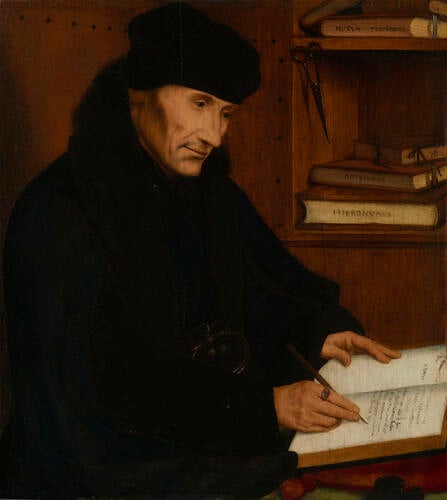
    1. The purse on Erasmus’s lap may be included in order to illustrate his generosity. Erasmus and Gillis made a point of informing More that they had split the cost of this gift because they wanted it to be a present from them both.

      Compare this suggestion of the purse as an attribute suggesting generosity to Jardine's (1996) suggestion that its meant to place Erasmus in the merchant class.

      (Of course it could be doing both.)

    2. The books on the shelf behind the scholar have inscriptions relating to his recently published works: Novum Testament[um] and Hieronymus refer to Erasmus’s editions of the New Testament and St Jerome; Lovkianos refers to Erasmus’s and More’s collaboration in translating Lucian’s Dialogues; and Hor, which originally read Mor and must have been altered during an early restoration, spells the first letters of the Englishman’s name and refers to the ‘Praise of Folly’ (Encomium Moriae), a satirical essay written whilst Erasmus stayed with More in Bucklersbury in London in 1509. The words on the paper are a paraphrase of St Paul’s Epistle to the Romans, the handwriting is a close imitation of Erasmus’s own hand, and the reed pen was Erasmus’s favourite writing tool.
    3. https://www.rct.uk/collection/405759/desiderius-erasmus-1466-1536

      One ought to notice the shears hanging on a nail or hook on the bookshelf in the background. Presumably these would have been a primary tool for Erasmus' ars excerpendi practice.

      Cross reference Lisa Jardine (1996) who calls out the purse on Erasmus' chest which identifies him as part of the merchant class.

      Also cross reference Hans Holbein's portraits of Erasmus.

  2. Dec 2023
  3. May 2023
    1. As they flit like so many little bees between Greek and Latin authors of every species, here noting down something to imitate, here culling some notable saying to put into practice in their behavior, there getting by heart some witty anecdote to relate among their friends, you would swear you were watching the Muses at graceful play in the lovely pastures of Mount Helicon, gathering flowers and marjoram to make well-woven garlands. —The Adages of Erasmus
  4. Aug 2022
  5. May 2022
    1. Popularized in a previous period of information overload, theIndustrial Revolution of the eighteenth and early nineteenthcenturies, the commonplace book was more than a diary or journalof personal reflections

      Commonplace books were popularized in the late 1400s/early 1500s in handbooks by Desiderius Erasmus, Philip Melanchthon, Rudolphus Agricola, and others along with the rise and accessibility of printed books.

      Would have been nice to have some more background and history on their development and evolution. Mentions of florilegia, vade mecum, others perhaps? Other cultures?

  6. Apr 2022
    1. She frequently cites authors second-hand(“as quoted by”, “see,” etc.) rather than primary texts, and in some instancesthis practice results in the kinds of errors for which earlier compilations werecriticized. The most egregious of these occurs when Blair cites Ann Moss on

      Guarino da Verona when making the unlikely claim that note taking begin in earnest with Francesco Sacchini in the seventeenth century rather than a hundred years earlier with Erasmus and Vives.

      I almost feel like I've arrived as I noticed this error in the text myself.

      Interesting that he calls her out for making a compilation error, something which is very meta with respect to this particular text.

    1. Although humanists like Guarino da Verona(1370–1460), Desiderius Erasmus (1466–1536), and Juan Luis Vives (1492–1540)explained the principles of the commonplace book that collected phrases worthyof imitation under topical headings, they did not offer detailed practical advice

      in print.33

      1. Moss (1996), 54–55. For Guarino’s methods, see the treatise by his son Battista in Guarino (2002); Erasmus discusses commonplacing in De copia and De ratione studii (Basel, 1512), in Erasmus (1978), 605–6, 636–38, 672; Vives does so in De tradendis disciplinis (1531), in Vives (1971), 108, 133

      Double check what Erasmus has to say as it would seem that Earle Havens contradicts this in Commonplace Books (Yale University Press, 2001). Perhaps its a difference of degree? I seem to recall that he indicated that Erasmus helped to popularize commonplacing practice.

  7. Nov 2021
    1. pedagogues in the humanist tradition, from Erasmus to Drexel,were routinely hostile to the arts of memory.

      On Erasmus’s preference for “study, order and care” over places and images, see Erasmus,De ratione studii(1512), quoted in Yates,The Art of Memory,p. 127

      What other pedagogues were hostile to memory?

      This is another point in the decline of memory traditions from the 1500s onward.

      What effect did cheaper books and paper have on this decline?

      Keep in mind that Erasmus had written a treatise on commonplacing which was also a point in the history of note taking though Blair doesn't acknowledge his contributions in her list here. Also Agricola and Melanchthon

  8. May 2021
    1. MMScotofGlasgow

      @MMScotofGlasgow, Hopefully it's not too late...

      Francis Yates discusses Petrus Ramus as an educational reformer in Chapter 10 and onward in The Art of Memory. There she outlines Ramus' crusade against images (based in part on the admonition from 4 Deuteronomy about graven images) and on their prurient use (sex, violence, etc.) which were meant to make things more memorable. Ramism caught on in the late 1500's and essentially removed memory by the root from the subject of rhetoric of which it had been an integral part. Ramus felt that structure and rote memorization would suffice in its stead. As a result the method of loci decreased in prominence in schools and disappeared from the scene based on educational reform which was primarily pushed by Huguenot/Protestants. I've not read anywhere that the practice was ever banned, it just fell out of fashion due to these reforms.

      I'm sure it didn't help that printed books became ever cheaper during/after this time and so the prior need to memorize for those reasons wasn't helped either.

      I'm sure another confounding factor was Erasmus' Copia: Foundations of the Abundant Style (1512) which dramatically popularized the keeping and use of commonplace books by the learned and literate. These became a regular place in which people collected and kept their thoughts and ideas rather than memorizing them as they may have done in the past.