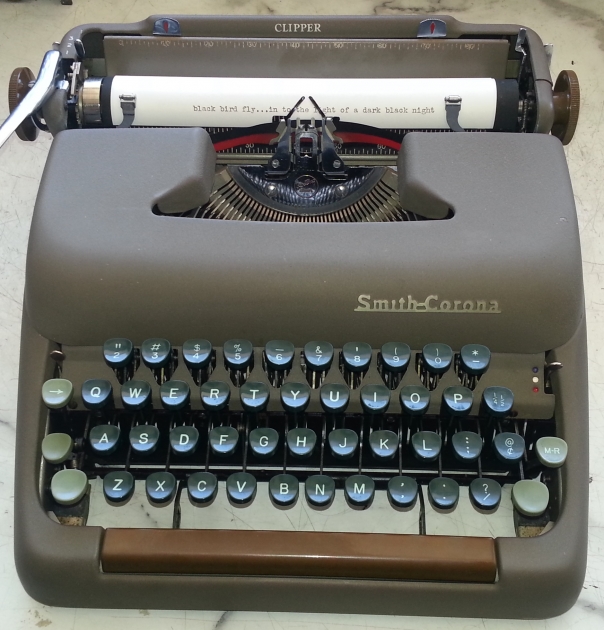
"black bird fly...in to the the light of a dark black night"<br /> —Duane Jensen, as typed on a 1949 Smith-Corona Clipper S/N: #5C 101511 which, like a phoenix from the ashes, he'd brought back to life.
RIP Duane.
"black bird fly...in to the the light of a dark black night"<br /> —Duane Jensen, as typed on a 1949 Smith-Corona Clipper S/N: #5C 101511 which, like a phoenix from the ashes, he'd brought back to life.
RIP Duane.
How can you tell when someone has real potential in pure mathematics?
question by u/OkGreen7335 at https://reddit.com/r/math/comments/1m0qe7f/how_can_you_tell_when_someone_has_real_potential/
The same way the music teacher in Liverpool who had half of The Beatles in his elementary school music class knew they had music potential—you can't possibly.
Potential is by definition the unknown part. The rest of it is interest, desire, enthusiasm, and time working at the thing itself over long periods which slowly unleashes that potential. You don't know until you try, so quit worrying about it and enjoy the area, even if it's just as a hobby you do on the side. There are garage bands that hustle on the side, why can't you be a garage mathematician?!?
Most of the smart, talented university professors in mathematics are there because they had the passion and (often had the luxury to) spend the time. Nurture your own passions and those of your students and encourage them to spend the time.
How many parents unabashedly encourage their kids to become international superstar musicians? I'll bet The Beatles' parents didn't. I'll also bet that number is close to the numbers of parents who encourage their kids to do the same thing in math.
How Books Fail Us (constraints the book format imposes)
thinking about constraints for books
3 minute constraint for music due to format in the 20th century<br /> consider rock operas like Queen or longer compositions like Beatles that cross-pollenate
Les Brünettes: The Beatles Close-Up
VÖ: 16.6.2017
Charts seit 23.6.2017