4 Matching Annotations
  1. Last 7 days
    1. The purse on Erasmus’s lap may be included in order to illustrate his generosity. Erasmus and Gillis made a point of informing More that they had split the cost of this gift because they wanted it to be a present from them both.

      Compare this suggestion of the purse as an attribute suggesting generosity to Jardine's (1996) suggestion that its meant to place Erasmus in the merchant class.

      (Of course it could be doing both.)
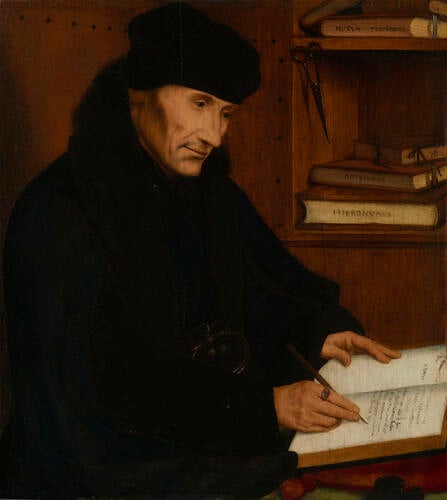
    2. The books on the shelf behind the scholar have inscriptions relating to his recently published works: Novum Testament[um] and Hieronymus refer to Erasmus’s editions of the New Testament and St Jerome; Lovkianos refers to Erasmus’s and More’s collaboration in translating Lucian’s Dialogues; and Hor, which originally read Mor and must have been altered during an early restoration, spells the first letters of the Englishman’s name and refers to the ‘Praise of Folly’ (Encomium Moriae), a satirical essay written whilst Erasmus stayed with More in Bucklersbury in London in 1509. The words on the paper are a paraphrase of St Paul’s Epistle to the Romans, the handwriting is a close imitation of Erasmus’s own hand, and the reed pen was Erasmus’s favourite writing tool.
    3. https://www.rct.uk/collection/405759/desiderius-erasmus-1466-1536

      One ought to notice the shears hanging on a nail or hook on the bookshelf in the background. Presumably these would have been a primary tool for Erasmus' ars excerpendi practice.

      Cross reference Lisa Jardine (1996) who calls out the purse on Erasmus' chest which identifies him as part of the merchant class.

      Also cross reference Hans Holbein's portraits of Erasmus.