Josh Brolin, who starred in No Country for Old Men, at his Southern California home. He became close with McCarthy and sat with the novelist right before he died. He’s also the proud owner of McCarthy’s Olivetti typewriter. Wayne Martin Belger
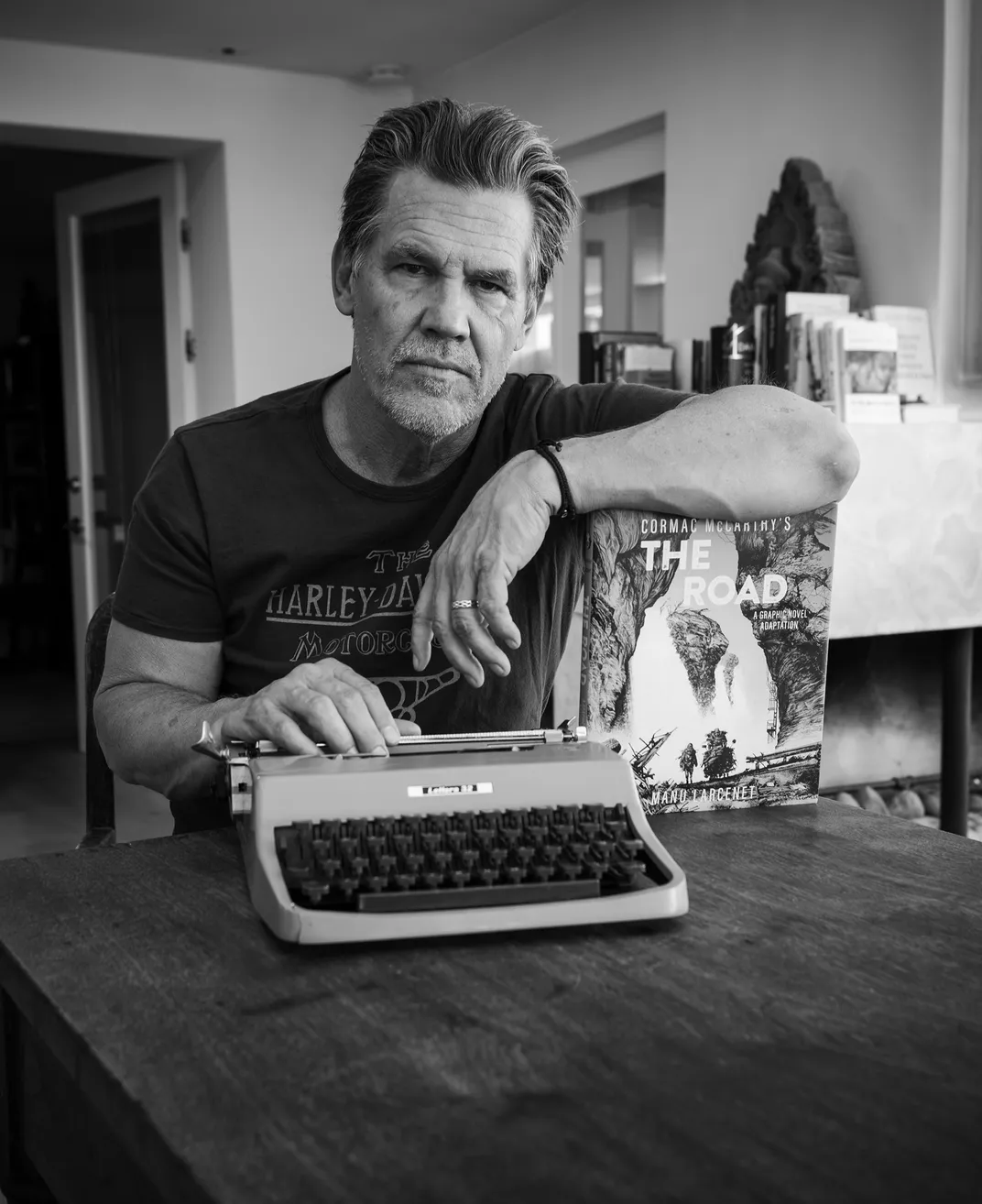
Josh Brolin, who starred in No Country for Old Men, at his Southern California home. He became close with McCarthy and sat with the novelist right before he died. He’s also the proud owner of McCarthy’s Olivetti typewriter. Wayne Martin Belger
Two Years After Cormac McCarthy's Death, Rare Access to His Personal Library Reveals the Man Behind the Myth<br /> by [[Richard Grant]]<br /> accessed on 2026-10-25T14:02:31
She was unable to calculate the total number of books because the cataloging software didn’t account for multi-volume works. McCarthy’s 36-volume history of Utah, for example, registered as a single entry. Nor did the software tally multiple editions of the same book, so McCarthy’s 13 copies of Moby-Dick registered as one entry. The total number of entries was 18,520. Taking into account duplicate copies and multi-volume works, Peebles felt confident that McCarthy’s library contained just over 20,000 books, with 2,170 annotated.
With the exception of Moby-Dick in multiple, gorgeous leather-bound editions, the scholars found hardly any novels until they started cutting open boxes that Dennis retrieved from a storage locker in El Paso. Out came the entire canon of Western literature, from ancient Greece and Rome to the best novelists, poets and essayists of the 1970s, nearly all in cheap, worn, paperback editions. “These are the books that he read in his 20s and 30s and maybe into his 40s, and he was broke that whole time,” said Dennis. “Once he got money, Cormac bought all his books in hardback if possible, and for the last 40 years of his life he read almost no fiction at all.”
As Rick Elmore, a philosophy professor at Appalachian State University with floral tattoos climbing up his neck, puts it, “Wittgenstein was always asking how the systems we use to represent the world relate to the world we want to represent. It’s one of the central questions in McCarthy’s work.”
His great friend Murray Gell-Mann, the Nobel Prize-winning physicist, invited him to join the Santa Fe Institute, serving as a sort of in-house literary intellectual.
I asked John what else his father collected apart from books, cars and kitchenware. “I would say clothes were the other big one. He had hundreds of tweed jackets, hundreds of shirts, hundreds of suits that he’d never worn.” John once spent three days dragging stuff out of a room he wanted to use as a bedroom. “When I was done, I said, ‘You ever think you might be a little bit of a hoarder?’ And he looks at me and he goes, ‘Yeah, probably.’ He attributed it to all those years when he had no money.”
An example of poverty, scarcity mindset and hoarding as a symptom.
It was John who told me that McCarthy worked in bed—a California king with high-thread-count sheets, the Olivetti on a wooden platform with a leather pillow underneath it, and piles of typed pages, magazines, books and catalogs. Writing, McCarthy once said, was not a conscious process for him. He put a blank piece of paper in the Olivetti, the words arrived, and he typed them down. But that was just the first stage of an extensive rewriting and structuring process, and some of his books took 20 years or more to get right. “Dad didn’t like being interrupted when he was working, or when he was reading,” John said. “‘No, no, no. I’m reading. Go away!’ he would say.
Oprah, knowing it was true, asked if The Road was a love story to his young son John. “In a way, I suppose, that’s kind of embarrassing,” he said. She made slightly better headway on the subject of punctuation. McCarthy didn’t use quotation marks, hated semicolons and kept commas to the barest minimum. “There’s no reason to block the page up with weird little marks,” he said. “If you write properly, you shouldn’t have to punctuate.”
After leaving her without an explanation in 1974, McCarthy drifted around cheap motels with his typewriter, a pile of books and a light bulb for good reading light.
McCarthy often had a pencil when he was reading and would make tiny vertical marks next to sentences that interested him and add comments in the margins in small print handwriting. Sometimes he jotted down thoughts on slips of paper that he left between the pages. Inside The Life of Saint Teresa of Ávila by Herself, first published in 1565, we found him musing philosophically: “There is an intelligence to the universe (of which we are fractal) and that intelligence has a character and that character is benign. Intends well toward all things. How could it not?”
McCarthy was starting to seem like a man whose talents and intelligence were without limits, yet he lived in a hoarder’s shambles and couldn’t stop buying nonstick skillets and fruit bowls.
McCarthy was a devoted carpenter and designed these nine-foot-tall shelves along the walls of his living room, with room for 1,000 books—a mere 5 percent of the author’s sprawling personal library. Wayne Martin Belger
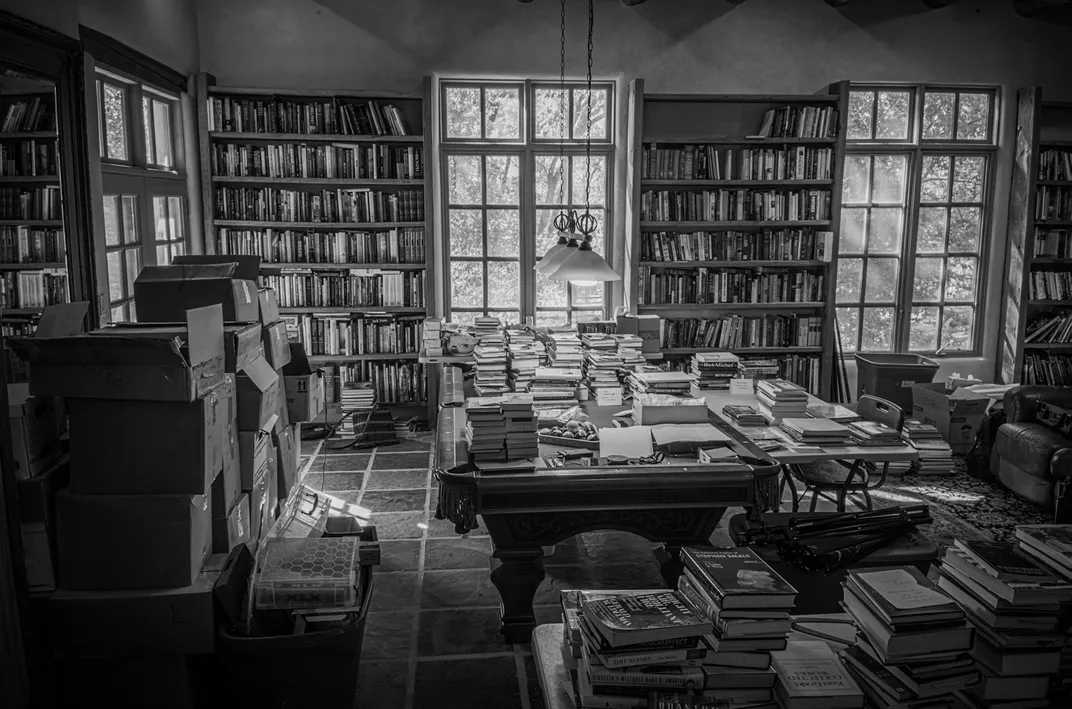
The second major discovery, discernible in his work but confirmed beyond doubt in his library, was that McCarthy was a genius-level intellectual polymath with an insatiable curiosity. His interests ranged from quantum physics, which he taught himself by reading 190 books on the notoriously challenging subject, to whale biology, violins, obscure corners of French history in the early Middle Ages, the highest levels of advanced mathematics and almost any other subject you can name.
Nor did McCarthy use a computer—ever. He typed out his pages on a cheap, durable Olivetti typewriter and, I learned later, did most of his work propped up on pillows in bed.
I was invited to the house by two McCarthy scholars who were embroiled in a herculean endeavor. Working unpaid, with help from other volunteer scholars and occasional graduate students, they had taken it upon themselves to physically examine and digitally catalog every single book in McCarthy’s enormous and chaotically disorganized personal library. They were guessing it contained upwards of 20,000 volumes. By comparison, Ernest Hemingway, considered a voracious book collector, left behind a personal library of 9,000.
Cormack McCarthy had a library of approximately 20,000 volumes
Ernest Hemingway had a personal library of approximately 9,000 volumes.