The typewriters I collect have to do with language.
Julian Plys of Haddonfield, New Jersey collects typewriters based on language.
The typewriters I collect have to do with language.
Julian Plys of Haddonfield, New Jersey collects typewriters based on language.
Don’t know if you know the term SABLE- Stash Acquired Beyond Life Expectancy. I’ve hit it too.
via real_misterrios at https://old.reddit.com/r/pencils/comments/1wrvdtz/why_am_i_like_this/
HB Lead Grades Explained + How to Select Right Pencil for Writing & Art<br /> by [[Unnecessary Detail]] on YouTube<br /> accessed on 2026-09-20T23:58:33
HB is typically the mid-point for most manufacturers <br /> H (hardness) tends to go lighter and scratchier (less graphite, more clay)<br /> B (darkness) tends to go darker and smoother (more graphite, less clay)<br /> F is typically a grade (fine/firm) between H and HB
For general writing look in the range of H / F / HB / B / 2B
Charcoal pencils tend to be much darker that clay/graphite pencils.
In the United States, pencils are often graded from #1 to #5 with the #2 being equivalent to HB.
5 Stages of Lead Holder Usage & Collection - 2mm Mechanical Pencil Buying Guide<br /> by [[Unnecessary Detail]] on YouTube<br /> accessed on 2026-09-20T23:56:00
Are typewriters becoming an elite hobby?
A: Personally, I think it's a pica hobby.
It's a lot easier to identify typefaces of typewriters if you include a few things in your photos: <br /> - Full frontal picture of the machine with clear shot of one or more of the rulers (so one can attempt to determine pitch as well as more easily identify the make/model for cross referencing).<br /> - A full typed sample of all the characters, especially some of the more unique ones like Q, 3, 5, 4, 7, &, G, A, E, and W in both upper and lower case.<br /> - A close up shot of the slugs which clearly shows the foundry marks (generally found in the middle of the slug) of both letter slugs and special character/number slugs as sometimes the latter are different.
Yes, dust can be an issue over time, especially if your machine is over-oiled and even more if you're in high dust/pollution area of the world and leave windows open regularly or have pets with lots of hair and dander production.
However, if uber-collector Martin Howard can be trusted, perhaps when designing your dream typewriter display room, dust isn't as horrible a problem as you might imagine. See: https://lumicrest.com/showcase-lighting-martin-howards-antique-typewriter-collection/ One imagines that occasional dusting and a can of compressed air will do the trick.
You could also do a nicer dust cover/mat the way Tom Hanks does: https://boffosocko.com/2025/06/16/tom-hanks-ingenious-custom-typewriter-covers-mats/
For my refurbished machines displayed in the house (where we have had a monster German Shepherd who sheds all year long and lots of exterior dust from Southern California pollution), if they're not in regular rotation, I'll drop a sheet of tinfoil or plastic wrap under the hood to prevent dust coming in through the hood and that seems to be more than enough protection while not covering up the entire machine.
reply to u/harperjones at https://old.reddit.com/r/typewriters/comments/1whqodm/closed_cabinets_for_display/
One of a handful of Professional Elite No. 41 machines in the typewriter database as of 2026-08-15:
reply to u/dazzleshipsrecords at https://old.reddit.com/r/typewriters/comments/1vhiow0/passed_this_on_up_will_i_regret_it/
You'll always regret the typewriters you don't get (or can't carry—just yesterday I had to pass up on a $44 Olympia SM3 in good condition because I couldn't physically carry it with me on vacation and I'm still irked about it).
Watch Shopgoodwill.com and surely you'll run into a few KMMs in similar condition that you can pick up at nearby shops in the $15-25 range.
via Koponewt (aka Pelicram ❤️ Slug Goblin) at https://www.reddit.com/r/typewriters/comments/1v1fcw8/comment/oyntwp4/
Get in touch with Galerie Alte Technik, they specialize in selling off collections of antique typewriters.
https://dynamicallytyped.org/ Site "released" on 2026-07-02<br /> via https://www.facebook.com/groups/4770669677/posts/10163825687234678
Looks like an expensive hobby!
reply to u/Valuable_Discount_26 at https://old.reddit.com/r/typewriters/comments/1ullgmc/first_typewriter/
It all depends on how you want to practice your individual version of a typewriter hobby.
Some only have 2 or 3 typewriters. Others have hundreds they've thrifted for $20-30 each while others only buy refurbished machines for several hundreds from repair shops. Some collect inexpensive colorful machines from the 70s while others focus on the incredibly rare machines from the 1890s. Some (like me) get them for pennies on the dollar and lovingly refurbish and restore them. Some are content to stare longingly at a single rusty old Underwood they spent $450 on and have on the shelf as decor.
Some collectors only have portables because they're easy to stack while others prefer only machines over 50 pounds with ultra-wide platens. One or two strip them down to make sculpture. Some use a different machine every day to write to a typewriter pen pal. Some take them to baseball games to score what they're sure will be the winning home run. Others only collect typewriters of famous authors. A few only collect toy typewriters. At least one collects Barbie typewriters.
Some are Royal or Remington completists. Some are Olympia maximalists and others are Hermes minimalists. Some just watch movies and tv shows with typewriters in them. Some write articles about typewriters. A handful collect typewriter ribbon tins. Some are fulfilled collecting typewriter ads out of magazines and newspapers. Others study how typewriters impacted society while a select few practice forensic document analysis.
Some collect ephemera, others serial numbers and photos of machines they've found in the wild. Others have no machines and just compare all the specs and features for the day that they decide they've found their one and only holy grail so that they can spend $1,500+ on pure perfection. Others buy a machine or two and keep them for six months before re-homing them elsewhere and acquiring a new machine to replace it. Some have six typewriters sitting around the house for various uses. Some have them hiding in the walls, in their attics or basements and blissfully live their lives not knowing what they're missing out on. Others use their machines to write poetry or create zines.
A few run typewriter shops. Some write books about typewriters. Yet others read them. Some are typewriter academicians. A handful design and create 3-D replacement parts. A rare handful are typewriter-enablers who give away functioning typewriters to aspiring young writers. Some choose to host type-ins to hang out with other typewriter-y people. A few make YouTube videos about typewriters.
If there are N typewriter hobbyists in the world, I'm positive there are at least N+1 ways of having a typewriter hobby. Speaking of which, there is also the N+1 hobbyist who always knows that the next typewriter is going to better than all the rest.
Which sort of typewriter hobbyist do you imagine yourself to be? What sort will you become?
It all starts with the inexpensive dream of a typewriter...
Some interesting typewriter hunters:<br /> - Joe Van Cleave<br /> - Richard Polt<br /> - Michael Hoehne<br /> - Robert Messenger - Ted Munk<br /> - Ian Brumfield - Sarah Everett (aka JustMyTypewriter) - Mei Travis<br /> - Currie Russell - Otto Koponen - Marcin Wichary<br /> - Martin Howard - James Grooms - Suzanne LaPierre - Chris Aldrich<br /> - Matt Watkins (Ignaciob) aka u/TC3Guy<br /> - Alexander Neff
Typewriter repair people: - Scott Connors<br /> - Elisa Makoon-Singh
I have chronic pain issues and I discovered that fixing and fiddling with typewriters helped me focus on other tasks and ignore the pain. So I ended up with about 150 typewriters. I sold about a hundred now and still wants to pare down my 'collection' to 20-25 machines.
via u/AmsterdamAssassin at https://www.reddit.com/r/typewriters/comments/1tq3nub/i_woke_up_one_day_looked_at_my_machines_and/
https://www.reddit.com/r/typewriters/comments/1tq3nub/i_woke_up_one_day_looked_at_my_machines_and/
My typewriter and typeface swatch cards are complete. I used Col-O-Dex cards from Tge swell Appointed Desk paired with a Canon Ivy printer. These will end up along my fountain pen ink swatches in my double Rolodex.
Via Derek De Weese at https://www.facebook.com/groups/705152958470148/posts/1274772944841477/


Ana Reinert from Well-Appointed Desk came out with her Col-o-ring cards, I was thrilled. I wrote a review here, and discussed the nice quality of the cards and how convenient they were for doing ink swatches.
https://www.penaddict.com/blog/2018/6/8/col-o-dex-rotary-cards-a-review
reply to u/No-Rain-4114 and tk at https://old.reddit.com/r/typewriters/comments/1ti2zu2/imperial_model_50_vs_royal_10_which_is_better/
You're likely to get more opinions than there are people who have actually used both and their opinions are going to vary wildly based on the conditions of the machines they've encountered. They're both solid machines, but generally also so old that you'd need two well-restored versions to get a serious apples to apples comparison. Even if you get 10 people with immaculate exemplars to weigh in, it's honestly not going to be helpful for determining which you ought to hunt for and purchase.
You're also going to find them with a very specific geographic distribution based on manufacturing and sales at the time. The Imperial bigger in the UK and Royal bigger in the US.
If you've got two to choose from, pick the one in the best condition and proceed from there. Otherwise choose based on aesthetics as all the other factors are so confounding as to mean little in making an informed choice here.
See also: https://boffosocko.com/2026/01/08/on-purchasing-typewriters-condition-is-king-context-is-queen/
Reply to u/Wooden-Lifeguard-636
Chris, which one do YOU prefer?
Like all serious typewriter collectors, I prefer both! 😜
Refurbished with a clean, oil, and adjust out of a typewriter repair shop, you really can't go wrong with either of these if this is the era and aesthetic you're after.
If OP gave us a ton of additional information on their context: Are they collecting? What sort of collection are they starting? Is this the one and only typewriter they're ever going to buy? Are they going to display it as decor? Use it (8 hours a day 365, once a day for a few hours, once a week, once a month)? Tinker on it to restore it themself? What's their budget? Where are they going to source it (shop, yard sale, estate sale, online auction untested)? Do they prefer the polished enamel or the crinkle paint? Are they a hunt-and-peck typist, a touch-typist, or even a speed champion? Etc., etc., etc.
With this, we might provide some semblance of advice, but honestly, even then, it's largely a coin toss. The ultimate choice will be biased and come down to the purchaser's gut reaction with a specific machine(s) in its condition in front of them to purchase.
And even then, after all this, it's worth considering the quote from Carroll Shelby in Ford v Ferrari (20th Century Fox, 2019) about the test driver at the end: "You drove it for less than an hour... ‘don’t know shit after an hour."
Hanks, Tom. 2013. “I Am TOM. I Like to TYPE. Hear That?” The New York Times. https://www.nytimes.com/2013/08/04/opinion/sunday/i-am-tom-i-like-to-type-hear-that.html (May 12, 2026).
There is no reason to own hundreds of old typewriters other than the sin of misguided avarice (guilty!).
My dad’s Underwood, bought used just after the war for his single year at U.S.C., had some keys so worn out by his punishing fingers that they were misshapen and blank. The S key was a mere nib. I sent it to a shop for what was meant to be only a cleaning, but it came back with all the keys replaced. So long, Dad, and curse you, industrious typewriter serviceperson.
a collection that started when, in 1978, the proprietor of a Cleveland business machine shop refused to service my mostly plastic typewriter. “A worthless toy!” the man yelled. Yes, yelled. He pointed to shelves full of his refurbished typewriters — already decades old yet all in perfect working order.
You can choose the typewriter to match your sound signature.Remingtons from the 1930s go THICK THICK. Midcentury Royals sound like a voice repeating the word CHALK. CHALK. CHALK CHALK. Even the typewriters made for the dawning jet age (small enough to fit on the fold-down trays of the first 707s), like the Smith Corona Skyriter and the design masterpieces by Olivetti, go FITT FITT FITT like bullets from James Bond’s silenced Walther PPK. Composing on a Groma, exported to the West from a Communist country that no longer exists, is the sound of work, hard work. Close your eyes as you touch-type and you are a blacksmith shaping sentences hot out of the forge of your mind.
Actually, that typewriter, my Olympia Report Deluxe, or rather Deluxes (I have three of them because they’re no longer manufactured, and I need one for backup and one to cannibalize for parts) are the real reason I’ve rejected switching to a computer for so long.
Oral history questions for Richard Polt on typewriter collecting:
Over the years Joe Van Cleave has done a handful of videos on selectivity and downsizing of one's typewriter collection including: <br /> - The Minimal Complete Typewriter Collection https://www.youtube.com/watch?v=0Ej6kd1FsnE <br /> - Culling the Herd https://www.youtube.com/watch?v=h_ueHE3Whjk <br /> - Downsizing Your Typewriter Collection https://www.youtube.com/watch?v=Eic4lNE0l3Y
And Sarah Everett has one "what's your deserted island typewriter?" (if I had to pick 5 typewriters....) https://www.youtube.com/watch?v=PFqJa9kD-v0
All this to ask Richard: what your downsizing experience has been? What were the criteria by which you chose what to keep? Did you more closely focus your collection into an area, era, style, other? Are you primarily keeping the things you tend to use more frequently? Things in better condition? You started out with how many to end up with how many? If you could start your collecting over from scratch what would you change? Are there things you wouldn't get the second time around? Things you would have spent more time focusing on? What will you continue to collect and at what rate? Naturally, collecting is a very personal thing with respect to individual's specific tastes and experiences (and frequently space!), but I suspect answers to some of these may help others, especially those who are just starting into collecting, or who have a dozen or two machines but who might find value on where and how to potentially focus their efforts. It may also help other collectors and their families who are dealing with appropriately disposing of significant collections, especially in cases where a deceased collector was very passionate and the family just wants to be rid of them quickly (i.e. ideas like Swedish death cleaning and related).
I'm sure reflections on these would be an interesting typecast, but if it's easier to do something like an oral history interview, I'm happy to collect these and a few dozen more questions into an interview format if you've got 30-60 minutes in the coming months to devote to a remote audio/video interviews/mini-podcast or YouTube episode or something similar?
Lego Typewriters<br /> by [[Herman Price]]<br /> accessed on 2026-05-09T17:29:08
https://www.facebook.com/groups/TypewriterCollectors/posts/10163594865434678/
Green 1958 Olympia SM3 with custom math keyboard:

I also replaced all the soundproofing material inside. I even had the old material tested for asbestos, and luckily there was no trace of that.
via Erik Bruchez at https://typewriterdatabase.com/1949-underwood-rhythm-touch.10882.typewriter
The collector in me says you ought to get a Royal 10 as your 10th machine. But what do I know? I bought a Remington 17 as my 17th and I'm looking forward to the days I'll buy the milestone Remington Ten Forty or the eventual Hermes 3000! 😁
If it helps, at Virtual Hermans 2022, Richard Polt recommended someone justify their continued typewriter collecting to their skeptical wife as an "investment" because typewriters are holding their value well.
I personally don't have a typewriter collecting problem, I have a typewriter ribbon collecting problem that's compounded by need to both store and use them in their original historical context.
Stage 1: Owner Stage 2: Collector Stage 3: Horder
Four stages of typewriter ownership: <br /> Stage 1: Owner<br /> Stage 2: Collector<br /> Stage 3: Horder<br /> Stage 4: Divorce when your significant other is tired of reminding you that you've got too many typewriters.
1-3 via u/vega480, 4 by me at https://old.reddit.com/r/typewriters/comments/1t1bvhi/im_finally_an_owner/
Mail Time With Aldo<br /> by [[Joe Van Cleave]]
https://www.facebook.com/groups/721704878218903/posts/3019304195125615/
Sarah Everett is collecting typewriter repair shop and typewriter dealer stickers
I'm at eleven typewriters now, with ten in working order and one that is a toy. I gave two machines away for free, and I sold one to a workmate for the same amount of money that I spent on it. My intentions to acquire and keep them changed through the three years of me being into typewriters. It started with finding a broken SG1 in the trash at the side of the street that I was able to repair. Then I was looking for a use for it, because it had found a place in my heart. I found two other machines in working order, also in the trash at the side of the street, of which I am keeping one and I have one away because it wasn't my liking. I received one as a gift from my brother-in-law that was owned by his grandfather, which is a very nice machine that makes it easier to keep for sentimental reasons. Then there is another machine that once belonged to my long-gone grandfather, which I keep for sentimental reasons and its nice techno pica typeface. This list keeps going on. So, there's a mixed bouquet of reasons I make up to keep machines and why I just can't give that specific piece away. I know I'm a hoarder, but the size of the machines keeps me in certain limits. Is it consumerist? Well, yesn't. I must admit, I would love to own a chocolate script Olympia SM3, and yes, I do like to show off my four different typefaces. I am looking to find a sixties SM9 to find out what the fuss is about in comparison to my late seventies SM9. But on the other hand, nothing beats the satisfactory achievement of finishing another three pages letter for one of my daughters. I hope they will read my lines one day and hear their daddy's voice through the paper that I touched before them and the imprints that my muscles caused. It is a piece of me, turned into ink on paper, that remains. And it is some obsolete tech that I curated/used/liked/hoarded, that will probably go into steel recycling after I'm gone.
brief typewriter bio for u/andrebartels1977 at https://www.reddit.com/r/typewriters/comments/1r3udld/thoughts_on_the_hobby/?sort=new
Hanssen, Geir Kihle. 2026. The Typewriter Enthusiast’s Handbook: An Introduction to Analogue Typewriters in a Digital World. https://www.amazon.com/Typewriter-Enthusiasts-Handbook-Introduction-Typewriters/dp/B0GMYYG367 (February 16, 2026).
I was in your shoes and I dove in head first. After reading, owning, and watching countless videos on the matter, here's what I have learned: Don't buy online Only buy what you can have your hands on before exchanging money Be picky, don't just get any machine on the belief you'll start fixing them. Do not view them as being "rescued" when you buy another broken machine. Start off with a solid machine with no issues. (I suggest an Olympia brand, sm-3 etc) Honorable mention: only acquire organically through yard sales, estate sales antique stores etc. It imbues your machine with magic 🪄
via u/Forge_Le_Femme
It bears mentioning that an expert/professional repair person can only tell very little of the condition of a typewriter by photos. Does it look generally clean? Are the decals in tact? Does the segment look clean (a vague proxy for the potential condition of the internals)? Is anything obvious missing (knobs, return lever, keys)? Does it look cared for or has it been neglected in a barn for half a century? Most modern typewriters made after 1930 in unknown condition are worth about $5-25 and they peak at about $500 when purchased from a solid repair shop unless some Herculean additional restoration has taken place, they've got a rarer typeface, or are inherently actually rare. Hint: unless it's a pro repair shop or very high end collector with lots of experience, don't trust anyone saying that a typewriter is "rare", run the other direction. Run faster if they say it "works, but just needs a new ribbon" as—even at the most expensive—new ribbon is only $15 and their "rare" $600+ machine should have fresh, wet ribbon. The rule of thumb I use is that no one online selling a typewriter knows anything about it, including if it actually works. Worse, they've probably priced it at professional repair shop prices because they don't know that condition is king.
The least experienced typist will know far more about the condition of a machine by putting their hands on it and trying it out. Does it generally work? Does the carriage move the full length of its travel? Can you set the margins at the extremes and space reliably from one end to another? Does it skip? Is the inside clean or full of decades of dried oil, dust, and eraser crumbs? Does the margin release work? Does it backspace properly? If typing HHHhhhHHH are the letters all printed well and on the same baseline?
Presumably a typewriter at an antique store will meet these minimum conditions (though be aware that many don't as their proprietors have no idea about typewriters other than that if they wait long enough, some sucker will spend $150 on almost anything). They've done the work of finding a machine that (barely) works, housing it, and presenting it to the public for sale. This time and effort is worth something to the beginning typewriter enthusiast, but worth much, much less to the longer term practiced collector.
If everything is present and at least generally limping along, you've got yourself a $30 typewriter. Most people can spend a few hours watching YouTube videos and then manage to clean and lubricate a typewriter to get it functioning reasonably. You can always learn to do the adjustments from Youtube videos. (Or just take it to a repair shop and fork over $200-400 to get things squared.)
If you're getting into collecting, you'll make some useful mistakes by overpaying in the beginning and those mistakes will teach you a lot.
Maybe you're a tinkerer and looking for a project? If so, then find the cheapest machine you can get your hands on (maybe a Royal KMM for $9 at thrift) and work your way through a home study course.
Otherwise, if you're just buying one or two machines to use—by far—the best value you'll find is to purchase a cleaned, oiled, and well-adjusted machine from a repair shop. Sure it might cost $350-600, but what you'll save in time, effort, heartache, repair, etc. will more than outweigh the difference. Additionally you'll have a range of machines to choose from aesthetically and you can test out their feel to find something that works best for you.
Or, you could buy a reasonable machine like this for $70 and find out it needs cleaning, oiling, and adjusting and potentially a few repairs. The repair tab might run you an additional $450. Is it worth it when a repair shop would have sold you the same or a very similar machine in excellent condition for $350?
Remember in asking about the cost and value of a typewriter, you're actually attempting to maximize a wide variety of variables including, but not limited to: upfront money, information about the current state of the market, information/knowledge about the machine itself, information about how to clean it, information about oiling it, information about adjusting, information about repairing it, cost and availability of tools and repair parts, and the time involved for both learning and doing all of these. The more time you've spent learning and doing all of these, the better "deals" you'll find, but gaining this expertise is going to cost you a few years of life. What is all this "worth" when you just want to type on a machine that actually works?
Most of the prognostication you'll find in fora like this will be generally useless to you because you're not readily aware of the context and background of the respondents with respect to all of the variables above. Similarly they're working with no context about you, your situation, where you live, what's available in your area, your level of typewriter knowledge, or your budget. You don't know what you don't know. At the end of the day, you're assuredly just as well off to use a bit of your intuition and putting your hands on a machine and trying it out. Then ask: "What is it worth to you?"
If you're simply asking: "Is this highway robbery?", the answer is no.
More resources (and some of my own context) if you need them: https://boffosocko.com/research/typewriter-collection/
Happy typing.
Reply to u/NeverTheNess at https://reddit.com/r/typewriters/comments/1q7eho6/spotted_a_royal_at_an_antique_store_good/<br /> RE: run-of-the-mill late 70s plastic Litton/Royal typewriter
I've got a couple of typewriters I mean I guess you're collector once you have more than three right? I would say that that does count if you if you buy the same item. Yeah three that's probably collecting. Right. If you have two not so much, yeah. —Keanu Reeves on collecting 7:31
The Pencil Pages<br /> by [[Doug Martin]]<br /> accessed on 2025-11-09T09:27:11
Hunting for Typewriter Accessories - YouTube<br /> by [[Just My Typewriter]] - Sarah Everett accessed on 2025-11-01T22:07:29
Estate sales often have interesting office supplies and paper in desks.
2:45 typewriter ribbon tins; made out of tin, cardboard, paper<br /> sometimes tins come with spools or spare parts
5:35 Typewriter ribbon display kits and pieces
6:58 Typewriter case keys<br /> She's collected images of case keys to know what to buy.<br /> She's got a buying guide on her website with photos.
10:04 Typewriter key tops
13:20 typewriter brushes and cleaning products, blower brushes, typeslug cleaners,
15:25 Typing books, user manuals, Typatune,
16:29 Typewriter toys; often in the $25+ range
17:23 Typewriter advertisements<br /> Sarah often purchases these online and uses them in her videos.<br /> Underwood fingernail polish advertisements
19:15 Typewriter playing cards (advertisement)
20:13 Typewriter related postcards
20:45 Typewriter books:<br /> - references; lots online; - Anthony Casillo - Typewriters (coffee books) - Michael Adler: Antique Typewriters - Paul Robert and Peter Weil - Iron Whim by Darren Werschler-Henry - non-fiction, history, - books written by other collectors<br /> - Tom Hanks' Uncommon Type<br /> - Olivetti by Allie Millington
Crescent City Books in New Orleans - has typewriters as decoration
25:03 Typewriter community collectors/creators<br /> - Lucas Dul - The Williams Typewriter (Loose Dog Press) - Loose Dog Press series<br /> - Woz Flint - The Distraction-Free First Draft<br /> - Richard Polt - The Typewriter Revolution (after thought)
28:43: Typewriter Magazines - ETCetera - Novellum Magazine (Writing related)
Collectability in typewriters is different for almost everyone. I like mid-century standards, some only like pre-1900 machines, some red typewriters, some toy typewriters, some less common typefaces, and still others prefer plastic 70s portables. Some treat them like Pokémon and "gotta catch them all".
Typewriters as a whole are all "collectibles"... What is your specific definition and criteria (value, rarity, popularity, etc.)?
In aggregate, knowledgeable pricing may help you determine the most collectible ranking them by most expensive. But by this ranking there aren't many of us who can buy even a single Sholes and Glidden or collect the typewriters of famous authors like Steve Soboroff.
ETC Magazine did a rarity versus desirability survey a while back of some serious collectors: https://www.antikeychop.com/mostwantedtypewriters
Interestingly, on this list you won't find many of the most collected typewriters out there as ranked by general "popularity" including machines like the Hermes 3000 or the Olympia SM3.
The Typewriter Database also has some data (albeit skewed) of the most "popular" machines ranked based on how many examples have been uploaded by collectors: https://typewriterdatabase.com/popular.0.typewriter-models
All these rankings are highly subjective though, so, again, you should figure out what's most interesting to you and create your collection from there. Figuring this out is half the fun of doing this as a hobby.
reply to u/WRSD605 at https://old.reddit.com/r/typewriters/comments/1n6nhts/remington_16/
So I’m sitting here drinking my tea about to get dressed and go pick up my latest typewriter; already got the heads up she’s arrived. Savouring the moment a little. I paid five dollars for her, no one else bid. And she does loOk kind of rough; rust spots everywhere, perhaps a dent in the top cover, dirty and grimy and probably smells like an old basement. But you know; I felt a little sorry for her. Although not top of the line she is a reputable model, as far as british typewriters go anyway. And I was sort of impressed by her slightly more extravagant sister. Wondering how bad can it really be? Some elbow grease, isopropyl, and Fulgentin will sort her out, surely? Worrying about did she survive the journey, did they pack her properly, or will she turn out to be a mangled pile of rusty parts when I open the box? So many questions. And I am wondering is this maybe the best part? But no - the best part is opening the case for the first time and seeing her in the flesh; or steel, I suppose, for the first time. That is the a moment I cherish. Better get going. See you in a bit, little darling! <3
https://www.reddit.com/r/typewriters/comments/1m18qlk/anticipation/
A lovely little piece on the anticipation of a new typewriter by collector u/IrmaBecx.
reply to u/FriendlyAd4234 at https://www.reddit.com/r/typewriters/comments/1cn004l/olympia_sg1_dust_cover/
Other than the traditional fabric-like dust covers, you might consider doing a thicker plastic/acrylic cover, particularly if you've got several machines and are using them for display purposes. I live in Los Angeles and there are half a dozen places that do this sort of custom work all the time for very reasonable rates. Searching for "plastic fabricator memoriabilia case" along with variations of plastics (acrylic, lucite, plexiglass) should get you what you want locally. (Here's a few examples I've used in Los Angeles before to give you an idea: https://solterplastics.com/, https://www.plasticfactoryinc.com/, https://www.customacrylicproducts.com/, https://plexidisplays.com/). Search for something similar in your area for easier communication and pick up/shipping.
If you search around for companies that make plastic displays, particularly for memorabilia (baseball bats, baseball cards, etc.), you can have them design and make a custom sized clear plastic box/enclosure that will keep the dust and dirt out, but still allow you to see the machine inside.
https://docs.google.com/spreadsheets/d/1_Wt-mzuzLVhNtRyw_Sz9iNRDn37axBO0HAePv7-_dG4/edit?gid=0#gid=0
Typewriter collection of u/JoelBerger via https://www.reddit.com/r/typewriters/comments/1ltj1eh/comment/n1tszxi/
https://old.reddit.com/r/typewriters/comments/1leoo6j/what_are_these_extra_symbols_on_this_erika_2/
Capital glyphs with ligatures can be indicators of Fraktur typefaces on German typewriters.
when 17:54 I'm looking to add to my collection now 17:56 I want something a little bit different 17:58 and this this remette is that it's not a 18:01 portable it's not an ultra portable it's 18:03 really loud it doesn't have all of its 18:06 parts the top cover doesn't belong to it 18:08 and is Rusty there's a lot not going for 18:11 this machine but that's what I like 18:13 about it
Not unusual to see regular pica spaced rulers on very small (18-21 cpi). They weren't common enough to warrant making new rulers.
via u/Koponewt (Otto)
https://www.reddit.com/r/typewriters/comments/1kzw0fk/your_typewriter_collection/?sort=old
reply to u/Back2Analog at https://old.reddit.com/r/typewriters/comments/1kzw0fk/your_typewriter_collection/?sort=old
Total: I currently have 53 with 2 incoming and 1 outbound. About 12 are standards, 7 ultra-portables, and the remainder are portables. Maybe a dozen non-standard typefaces including 2 Vogues and a Clarion Gothic. You can find most of the specifics at https://typewriterdatabase.com/typewriters.php?hunter_search=7248 or on my site at https://boffosocko.com/research/typewriter-collection/#My%20Typewriter%20Collection
Display: I've usually got eight displayed in various places around the house including three on desks, but ready to actively type on. The remainder are in cases either behind our living room couch or a closet for easy access and rotation. I'm debating a large credenza or cabinet for additional display/storage space. There are two machines out in the garage, and one currently disassembled on our dining room table (my wife isn't a fan of this one right now).
About 25 have been cleaned and mostly restored, most are functional/usable, but need to be cleaned, repaired, or restored to some level. One is a parts machine. I always have a Royal KMG, a Royal FP, and two other standards out ready to go and rotate the others on a semi-weekly basis. There's usually at least one portable in my car for typing out in the wild.
Use cases: I spend a few hours a day writing on one or more machines and use them for nearly every conceivable case from quick notes (zettels), letters, essays, lists, snide remarks, poetry, etc., etc. I should spend more time typing for the typosphere. Because I enjoy restoring machines maybe even more than collecting them, I've recently started taking mechanic/restoration commissions.
At 50 machines, I'm about at the upper limit of my collecting space. I've given away a few to interested parties, and sold a small handful that I didn't use as frequently. I'm currently trying to balance incoming versus outgoing and might like to get my collection down to a tighter 35-40 machines in excellent condition.
Next typewriters: I'm currently looking for an Olympia SG1, a Royal Ten, a Hermes Ambassador, and a Hermes 3000. I'm also passively looking for either very large (6 or 8 CPI) or very small typefaces (>12CPI). I'm definitely spending less time actively hunting these days and more time restoring. I'm tending towards being far more selective in acquisitions compared to my earlier "acquisition campaign".
Miscellaneous: I enjoy writing about typewriter collecting and repair to help out others: https://boffosocko.com/research/typewriter-collection/
A house is not a home without a typewriter.
via u/leapwolf at https://boffosocko.com/2025/05/17/acquisition-1966-underwood-touch-master-five-standard-typewriter/
https://www.reddit.com/r/typewriters/comments/1kppij9/blue_olivetti_valentine_how_rare_is_it/
In increasing order of rarity, the Olivetti Valentine was made in red, white, green, and blue.
After some continued research on the TWdB, I've come to realize that the "88" in the serial number has likely nothing to do with the palm tabulator.
The 88 is for an extra character count due to more keys (44) versus the more standard 42 or 43 keys and similarly some examples with a 92 in the serial number corresponds to 46 characters. So there isn't a designator in the serial number for a palm tabulator.
See: <br /> - https://typewriterdatabase.com/1961-royal-fp.22586.typewriter<br /> - https://www.reddit.com/r/typewriters/comments/1kg820b/just_bought_this_typewriter_for_10_at_a_charity/<br /> - https://amsterdamassassin.wordpress.com/2018/12/16/typecast-my-royal-fp-steampunk/
Cross reference: https://syracuse.craigslist.org/atq/d/syracuse-the-smith-corona-typewriter/7841959463.html
For the collectors out there, this is an excellent caveat/warning: What will you do with your collection when you're gone? Where will it go? What will happen to the work you've put in?
On longevity of collections: https://www.instagram.com/p/DJC9BwUvA8T/
And is it true that you enjoy taking typewriters apart and putting them back together? Doherty : Of course. It’s just that I’m so attracted to these objects that I want to look inside them, to understand how they work. It’s a form of learning, for me it would be a dream to have a shop specializing in repairing typewriters. Maybe one day… Among the many, I love the Valentine model by Olivetti, sooner or later I absolutely want to visit Ivrea.
The Olivetti Valentine is one of Pete Doherty's favorites.
Library Typewriter Display Case Project by [[Joe Van Cleave]]
Highest price you’d spend
reply to u/Pope_Shady at https://old.reddit.com/r/typewriters/comments/1iwrlij/highest_price_youd_spend/
Generally my cap for typewriter purchases is in the $20-35 range. Most of my favorite machines (the standards) were acquired for $5-10 and they're so much better than the portables. At these prices I'm not too worried about the level of work required. I regularly spend 3-4 times more money on a full reel of bulk typewriter ribbon than I do on a typical typewriter.
A few of my more expensive acquisitions: * I went as high as $100 on a machine (including shipping) to get a Royal Quiet De Luxe with a Vogue typeface that turned out to be in about as stunning a condition as one could hope for. * I went to $130 on an Olympia SM3 in part for it's Congress elite typeface as well as an uncommon set of mathematical characters. I'm sure I could have gotten it for significantly less, but wanted to help out the seller and it was in solid condition except for worn bushings. * I also went to around $150 for an (uncommon in the US) early 30's Orga Privat 5 that was in solid shape. I've yet to run into another Orga in the wild in the US since.
It also bears saying that I don't mind buying "barn machines" as a large portion of the fun in collecting for me is cleaning, adjusting, and restoring them to full functionality. I've been dissapointed once to have bought a Remington Quiet-Riter once for $10 only to discover it was in near mint condition and didn't need any work at all.
I am at the point where I'm going to need to start selling machines, work at a local shop, or start my own shop if I'm going to keep up with the "hobby" and maintain a sane spouse simultaneously. If I didn't enjoy wrenching on machines so much, I would definitely be buying them from local shops for significantly more money, and I'd probably have far fewer.
It's not talked about in great length in some typewriter collector spaces, but I think some of the general pricing "game", beyond just getting a "deal", is the answer to the questions: "What am I into this space for anyway? What makes it fun and interesting?" If you don't have the time, talent, tools, or inclination to do your own cleaning and restoration work, then paying $300-$600 for a nice machine in exceptional clean/restored condition from a shop is a totally valid choice and shouldn't be dismissed. Some are in it for the discussions of typewriters. Some are in it for the bargain hunt. Some just want to write. Some want rare gems. Some want common machines from famous writers. Others just want one "good" machine while others want all the machines. It's a multi-faceted space.
I only tend to give my typewriters "names" once they're fully cleaned and generally restored and have used them for a bit to know their "character". An example here is my 1950 Royal KMG (Keset Magic Gray) which I call "Sterling" after the Mad Men character Roger Sterling; I also cleaned the the interior with bourbon as an homage.
Many I refer to by year of manufacture and model name ('55 Clipper or '48 Clipper, for example), particularly when I have several similar looking ones from the same time period. A few have names based on writers who I know have used the same models from roughly the same time period (so I have a '49 Royal QDL I've named "Nabokov"). My '48 Royal QDL I call "Dreyfuss" in honor of the typewriter's industrial designer who lived a few miles away from me.
Others are referred to by shorthands featuring unique characteristics, so I have one called "The Vogue" and another I call the "Math SM3" for it's unique math symbol characters. My Remington 666 is variously either "El Diablo" or "Robert Johnson", whose music I listen to while typing on it. I have a German Orga which I call the "Wonka Machine" as one of its brethren appeared in Willy Wonka's office in Charlie and The Chocolate Factory (1971).
A few I call by the first names of their prior owners as an homage to their history before I became their caretakers.
I call my Royal HH the "HHE" as that's the serial number prefix for my machine which has an elite face.
What you call your own is entirely up to you.
More on typewriters and naming: https://boffosocko.com/2024/05/25/collective-nouns-for-typewriters-and-typists/
Reply to https://old.reddit.com/r/typewriters/comments/1id4y49/how_to_refer_to_a_typewriter/ by r/ich_mag_frettchen
what's your deserted island typewriter? (if I had to pick 5 typewriters...)<br /> by [[Just My Typewriter]]
On the value of typewriters
As a hobbyist, you'll easily obtain several hundred dollars worth of potential diversion and satisfaction out of your alluring typewriter by cleaning, properly oiling, and adjusting it. Then you're guaranteed to both give and receive thousands of dollars worth of happiness out of it by typing letters to family and friends. With practice, you may reap millions by writing stories, plays, poems, screenplays, and books.
Even if your scintillating typewriter sits on a shelf as home decor only to be viewed as a museum piece, you'll have gotten $50 of value for even that lowly function.
You'll only have wasted your money if your wondorous typewriter sits lonely and forgotten in a dusty attic or dank basement to rust and rot away.
Might you have gotten it for less? Perhaps, but you've saved yourself a huge amount of time and effort in such a hunt for a machine as desirous as this. You have it in front of you for writing right now.
So get to typing at once my friend! For time is money, and every moment your fingers aren't caressing its keys, you are losing value.
Congratulations on your stunning find.
reply to u/readysalted344 at https://old.reddit.com/r/typewriters/comments/1h3jyyt/did_i_waste_my_money/
https://old.reddit.com/r/typewriters/comments/1gu971q/whos_an_olivetti_expert/
Broad advice on the touch and feel of Olivetti's
So, though there was still some store of weapons in the Shire, these were used mostly as trophies, hanging above hearths or on walls, or gathered into the museum at Michel Delving. The Mathom-house it was called; for anything that Hobbits had no immediate use for, but were unwilling to throw away, they called a mathom. Their dwellings were apt to become rather crowded with mathoms, and many of the presents that passed from hand to hand were of that sort. — J. R. R. Tolkien, “Concerning Hobbits”
If the "Hanks Effect" was really so prominent, then we should see the commensurate rise in price of 5 Series Smith Coronas and particularly the Clipper and the Silent which he's also mentioned several times. In fact, he's said these would be the typewriter he'd keep if he had to get rid of all others. Given this fact, it has to be, in part, a variety of other factors which inflates the prices.
Personally I think that it's a combination of the fact that they were manufactured at the peak of typewriter use and manufacturing and before companies began using more plastic and cheaper manufacturing methods, but were also done in a later timeperiod when exterior design and color were on the rise as a differentiator in the marketplace. Quality, form, and function become part of a trifecta which drive desire and collectability.
Reporter John Dickerson talking about his notebook.
While he doesn't mention it, he's capturing the spirit of the commonplace book and the zettelkasten.
<div style="padding:56.25% 0 0 0;position:relative;"><iframe src="https://player.vimeo.com/video/169725470?h=778a09c06f&title=0&byline=0&portrait=0" style="position:absolute;top:0;left:0;width:100%;height:100%;" frameborder="0" allow="autoplay; fullscreen; picture-in-picture" allowfullscreen></iframe></div> <script src="https://player.vimeo.com/api/player.js"></script>[...] I see my job as basically helping people see and to grab ahold of what's going on.
You can decide to do that the minute you sit down to start writing or you can just do it all the time. And by the time you get to writing you have a notebook full of stuff that can be used.
And it's not just about the thing you're writing about at that moment or the question you're going to ask that has to do with that week's event on Face the Nation on Sunday.
If you've been collecting all week long and wondering why a thing happens or making an observation about something and using that as a piece of color to explain the political process to somebody, then you've been doing your work before you ever sat down to do your work.
Field Notes: Reporter's Notebook from Coudal Partners on Vimeo.
At first it is a mistake to think of anything elseexcept the mere jotting down of Ideas. The Ideas shouldbe jotted down, each on its own Card, and the Sub-Headings should be jotted down on their own Cards,a little way 'inland5. Afterwards there will be timeenough to subdivide the topics, and to re-arrange them ;but at the beginning you must concentrate your atten-tion on the Collection of Ideas, and must not think atall about the Arrangement.
For Miles, getting the ideas down is paramount and they can later be sub-divided or re-arranged.
you will have to Collect and make a list ofyour Ideas (Headings and Sub- Headings) for the Essayor Speech. You will have to Select, deciding whichare to be used and which are not. You will have toArrange the selected Headings. And then you willhave to Express them — in itself not a simple task.
the list of broad parts of writing an essay
I've picked up about 20 of the typewriters in my collection from ShopGoodwill.
Only two were impeccably/properly packaged and shipped and one of these was a special machine that I emailed them after purchase with written details and links to videos about how to pack and ship it just to be on the safe side.
Three were dreadful disasters: one was a 40 pound standard that was dropped and the frame bent drastically (it had almost no padding materials inside the box), two were shoved into cases (one upside down and the other right side up, but neither locked into their cases properly nor with their carriage locks engaged so they both bounced around for the entire trip) and put into boxes with almost no packing material. All three refunded portions of the price and/or all the shipping costs.
Most of the remainder (all portables with cases) were packaged with a modicum of care (some packing material in the case and some outside the case with reasonable boxes) and showed up in reasonable condition.
Two of the machines were local enough that I did a local pick up to ensure better care.
Generally, it's a crapshoot, but this is also the reason why I don't spend more than $20 on any machine I get from them (except one reasonably rare German typewriter in the US and a Royal with a Vogue typeface that still came out at less than $100 because only one other person noticed its rarity in the photos).
Only one of the machines was clean as a whistle and ready to type on day one. All the remainder required serious cleanings at a minimum. Two were missing internal pieces, two had repairable drawband issues, one had dramatically bad escapement issues, and one had a destroyed mainspring that I need to replace.
Only one of the group had a platen with any life left in it. One had a completely unusable platen, but it was also relatively obvious in the photos. Most of the rest were hard, but usable.
I live in the US and typically only bid on machines that are in the top 20% of their class cosmetically.
I'll echo the thought of others that I wouldn't have a machine from them shipped directly to someone as a present unless I knew they were a tinkerer and had the mechanical ability, the facilities/tools, and desire to clean and service their own machine. Otherwise, I'd do that myself and ship it to them directly.
reply to u/Tico_Typer at https://old.reddit.com/r/typewriters/comments/1g28v6z/i_am_curious_about_the_shopping_goodwill_websites/
I've generally found that Olympia machines with a dedicated 1 key and a 4/$ key will usually have a script font. Additionally they don't have ribbon selectors (which are most often on the right hand side of the keyboard when they are present) or only have black and stencil settings.
The lack of bichrome settings on these machines is due to the taller/lower extenders on many script glyphs.
In later units, the absence of a ribbon selector is a good clue, though later units (late ‘60s onwards) offered script with units that had ribbon selectors.
In earlier units, typewriters that have the letter 1 key is a good clue that it is a script font typewriter.
Downsizing Your Typewriter Collection by [[Joe Van Cleave]]
Similar in content and tone to his other videos: - "The Minimal Complete Typewriter Collection" https://www.youtube.com/watch?v=0Ej6kd1FsnE and <br /> - "Episode 31: Culling the Herd" https://www.youtube.com/watch?v=h_ueHE3Whjk
Sears on many of the SC rebadges have 1 1/2 line spacing. One day I’m going to get a beater Citation for the parts and put the 1 1/2 parts in a nice SC.
On some of the Sears rebranded Smith-Coronas in the 6 series (Citation, in particular) there are 1 1/2 line spacing options.
https://typewriterdatabase.com/1964-sears-citation.2600.typewriter
Sears Citations seem to have an above regular frequency for script typefaces. They shipped with red stickers next to the bichrome setting and on the right ribbon cup warning against the use of bichrome ribbon for the tallest script letters on machines which had script typefaces.
I’ve always wanted a cursive writer, and finally found one at the thrift store. It’s an electric smith corona coronet automatic.
Based on this example and several in the TWdb, the Smith-Corona Coronet Automatic has a high likelihood for having exotic typefaces.
Typewriter Collection Curation (for Novices) by [[Just My Typewriter]]
https://www.youtube.com/channel/UCScn9kxUjOfDNJk3Z-1NWKA Old Typerwriters and Calculators
The YouTube Channel of fausto tomesani https://typewriterdatabase.com/typewriters.php?hunter_search=7180
Michael: Pam, I have ideas on a daily basis. I know I do. I have a clear memory of telling people my ideas. Um, is there any chance you wrote any of my ideas down? In a folder? A "Michael-idea" folder?Pam: Sorry.Michael: That's unfortunate. How 'bout the suggestion box? There's tons of ideas in there.
via Season 2 Episode 8: “Performance Review” - The Office<br /> https://genius.com/The-office-usa-season-2-episode-8-performance-review-annotated
Here we see in Michael Scott's incompetence the potential value of writing down our ideas as we go. Had he written down his ideas, his upcoming meeting with his boss would have gone better.
Isn't it telling that he hits on the idea of leveraging a commonly used communal zettelkasten structure (the suggestion box) to dig himself out?
Kroustgrafologist Greek kroustiki is Percussion Graf for writing Ologist for study
name for typewriter collectors via LogInternational2253
I want a bookwheel for my typewriter collection.
Isaac Azimov had multiple typewriters and used each of them for work on a different writing project.
https://new.reddit.com/r/typewriters/comments/1evl8e5/how_does_one_go_about_hiding_their_typewriter/
The "difficult fourth moped".... lol!
The typewriter is a Corona made in 1926. I came across it in a yard sale and, having no real use for an old typewriter, I bought it anyway!
Typewriter Video Series Episode 31: Culling the Herd by [[Joe Van Cleave]]
Rating typewriters by:<br /> - looks<br /> - feel<br /> - print quality
Alternate systems for helping to thin out typewriter collections:
Designer William Morris' weighing system:
“Have nothing in your houses that you do not know to be useful or believe to be beautiful.”
I once had a collector friend who loved standard typewriters, so his weighing system was as follows:<br /> - If it weighs over 25 pounds, keep it<br /> - If it weighs less than 25 pounds, sell it off
And naturally, minimalist Marie Kondo's system:<br /> - Does it spark joy?
Joe Van Cleave also had another video for creating a minimal collection based on categories of typewriter which may also be useful for some: https://www.youtube.com/watch?v=0Ej6kd1FsnE
https://willowcreektypewriters.com/products/still-collecting-more-sticker
SCM could stand for Smith-Corona Marchant, but some typewriter collectors think it stands for Still Collecting More.
According to Vashik Armenikus, reading and book collecting becomes an obsession/addiction when you do it indiscriminately, without thought, without taking into account the bigger picture.
The Minimal Complete Typewriter Collection by [[Joe Van Cleave]]
Joe Van Cleave's personal six categories in a (his) typewriter collection: - Standard manual - medium-sized portable (largest segment in the collector's space) - lightweight portable or ultra-portable - typebar electric - IBM Selectric - Electronic typewriter (thermal typewriter), portable, quiet, battery operation.
Joe's minimal collection based on what he's got in his collection currently and the condition that they're in: - Royal KMM (his only standard) - Hermes 3000 (boxy middle era) - Olympia Splendid 33 (he's also got a Royal Mercury & Groma Kalibri) - Olympia Reporter - Selectric I (the only one he's got) cloth, ribbon cartridge system, no lift-off correction - Canon Typestar 220
Some of Joe's most important criteria in a typewriter: he prefers an elite face, 1 1/2 spacing, and bichrome setting.
At the time of this recording Joe had 30 typewriters.
Joe Van Cleave has tags for his typewriters which also include typeface samples. timestamp 1:31
Before You Buy a Typewriter … Six Top Things You Need to Know by [[CreateX3]]
Considerations for buying a typewriter:
reply to u/Rabbits16 at https://www.reddit.com/r/typewriters/comments/1df7o2t/request_type_writer_suggestion_please/
For that budget range, pick up something cleaned and fully serviced from a nearby shop https://site.xavier.edu/polt/typewriters/tw-repair.html
Too many resellers are pushing overpriced machines that say "works" or "may need servicing" on some online shops like ebay or Etsy for top end pricing when you can get something truly spectacular and ready for the next 50 years from a serious pro that needs the support for the same price.
As for particular machines to look at, I can't find much to fault in Joe's advice here https://youtu.be/aKMt-aCHZZk?si=CGPduwA4A3HPDm3u
Typewriter 101: The ULTIMATE TYPEFACE Guide (ft. Typewriter Chicago) by [[Just My Typewriter]]
featuring Typewriter Chicago's Lucas Dul
Hahaha you’re going to have to start slipping the UPS guy a $20 to keep it on the hush hush. “Don’t worry honey, I am getting them to fix up and sell”
reply to u/baxter1207 at https://www.reddit.com/r/typewriters/comments/1da0voq/repairsclean_ups/l7jg8nl/
I'm pretty sure those exact words have escaped my lips...
Her: "I know you've got five typewriters already, and I'm not counting the one I know you're hiding underneath the bed. Which ones are you going to sell??"
Me (in my head): Where am I going to stash the 12th machine when it arrives later today? At least it's an ultraportable, so it won't take up as much space. Why is my least favorite machine that I want to sell her favorite machine? Will selling it upset the delicate typewriter balance in the house? I can always say that the typewriter coming on Tuesday is a parts machine that I'm using to repair two of the others so I can sell them. Is this how all typewriter repair shops began?
Me: I'm trying to finish up refinishing the two executive tanker desks and the filing cabinet in the garage first so I can get them out and make some space.
😁
Smith-Corona (SCM) Font Styles – To Type, Shoot Straight, and Speak the Truth… by [[Theodore Munk]]
You should not have much trouble finding a cubist (aka techno, square, robotic, futuristic, etc.) font or even Vogue; but good luck finding an italic. Of course, if you want to use them instead of collecting typewriters, get an IBM Selectric and a collection of balls.
colloquial advice
Swiss-made Hermes (3000, Media 3) seems to top the list of the most sought after vintage manuals with script fontAnother popular choice among collectors is the script typewriter debuted by Olivetti Lettera in 1963.Other typewriter manufacturers that offered the script font were Olympia (SM3, SM7, SM8), Adler (Tippa, J4, J5), Royal (Safari, Sahara), Remington (Deluxe 5, Personal Riter), Smith-Corona (Classic 12, Sterling 5A, Galaxie Deluxe 10, Galaxie 11, Galaxie 12, Silent Super), Torpedo 18, Blickensderfer (with cylinder) and IBM (Selectric with typeball)
unreferenced here, so treat as colloquial
A field guide to hunting down script typewriters. by [[May Tobias-Papa]]
One to get rid of<br /> by [[Richard Polt]]
The Four Hobbies, and Apparent Expertise by [[Marc Brooker]]
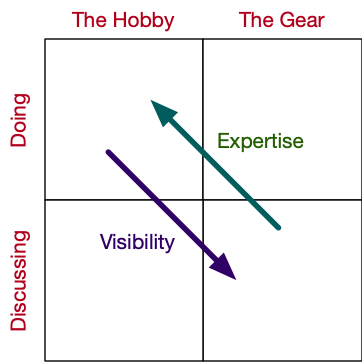
Most hobbies, sports, and areas of interest can be split into four quadrants by an individual's particular sub-interest along the lines of doing/discussing versus the activity/gear for the activity. Many people will self-select into one of the four at the expense of the other three and this can affect the type and tenor of communities around that particular activity.
Excellence in one area doesn't imply excellence in the others. "True" fanatics ought to attempt to excel in all four quadrants.
I don't collect them. They follow me home in small groups of 2 or 3...
via Glen Crookston at https://typewriterdatabase.com/1949-remington-allnew.17706.typewriter
It's a great thing to waste time. The secret of life is to waste time in ways that you like. —Jerry Seinfeld 6:18
Polt, Richard. The Typewriter Revolution: A Typist’s Companion for the 21st Century. 1st ed. Woodstock, VT: Countryman Press, 2015.
annotation URL: urn:x-pdf:65fe580cf845ed035c4e57ad02a987cf
Solan, Matthew. “Tracking Down Typewriters: Those Trusty Tools of Days Gone By.” Poets & Writers Magazine, August 19, 2009. p 31-33.
EquivalentHead3589[S] 0 points1 point2 points 2 hours ago (1 child)Yes to all that! I agree and understand.
reply to u/EquivalentHead3589 at https://www.reddit.com/r/typewriters/comments/1cbzx1n/how_do_you_price_typewriters/
The primary difference is that listing prices don't indicate actual value. That is only determined by actual sales price. Things are worse for the listings which don't indicate much about condition as you're probably more likely to need to have the machine serviced and/or replace or recondition parts. This can often add a few hundred dollars (or significant research and time, tools, and elbow grease) to the bottom line to be able to use a machine.
I do recall a burgundy Olympia SM3 which sold in the last 4 months for right at $300 which was regularly used (loved) and serviced and in excellent condition with some fantastic photos. If you compare it to this Burgundy/Gray machine (https://www.ebay.com/itm/404901285037) for $299, but which has a missing key cap, and a damaged case, and may likely have other hiding issues. If you consider that you'll likely need to put a minimum of another $100 into this to get it up to the fighting shape that the first was in and it's still got damage, you'll start seeing the stark difference. The people with listings at $550-800 know they're not selling and they're just sitting there, so why not email them and ask more specific questions about condition and get a typed typeface sample of all the keys. Then make an offer for $200 +/- with some wiggle room for service costs once you've gotten it to see if they'll sell?
As an example, look at https://www.ebay.com/itm/226016437104 which is a Gray SM3 originally listed for $549 and now on sale for $428. The seller knows it's not moving. They state that they got it at an estate sale (probably for around $25) and they definitely did no work other than quick check of the keys. If you demonstrate that you've savvy enough to know the specific machine (what shape are the rubber washers on the frame next to the feet to prevent the carriage from rubbing against the frame? how what is the durometer measurement on (how hard is) the platen?), the market (in top shape maybe $300), and what servicing/repair costs are, they'd probably accept an offer of $150-200 and you're off to the races and they've made a solid profit.
The biggest issue in the typewriter market at present is the broad lack of information and knowledge about them on both the buyer and seller side. If you can demonstrate you've got more knowledge than the other side, you'll be in a far better position to negotiate, otherwise a seller can sit and wait an undetermined amount of time waiting for a sucker who will likely never show up.
I had this discussion with Tom Hanks, who had the same typewriter repairman as I do, about how he collects for the type of typewriter and I collect for who used them.
My quick typewriter purchasing crash course: <br /> Most typewriters are solid beasts and can take a serious beating and still work really well. I've got 5 now that I bought for $10-50 and mostly really only needed small tweaks to work perfectly. One has an issue that will require some more heavy work, but having gotten it for $10, it's not really much of an issue. Several of them worked incredibly well right out of the box with no work at all. Occasionally kids will pound on the keys which can cause the linkages to come undone, but a pair of needle nose pliers and some patience to look at the mechanics of what's not working underneath can usually get them repaired without any real work. Beyond this there's a wealth of online videos and help that can get you pretty far without paying for a repair shop. Some are just old and dusty and need a quick cleaning with compressed air and/or a toothbrush.
Ebay can tend to have heavily overinflated prices because a lot of folks think that all typewriters are rare. A very small percentage of some of the oldest are, but generally as a group they're not. If you don't want to fool around with repair issues you can purchase machines from repair shops serviced in full working condition from $75-200, but at least you can expect that they're nearly perfect beyond some small blemishes due to age. Sadly, a lot of places will list broken machines in questionable shape for this much because they see others listing (great machines) for the same amount. Don't fall prey to this. Some of the best places to look for functional machines are donation shops (Goodwill, Salvation Army, etc.) as well as yard sales or estate sales. Online sites like Facebook marketplace, https://shopgoodwill.com, or https://offerup.com can have inexpensive listings, but most are listed as untested because most folks don't know how to test them fully and are scared of them, but this is usually where you can find some great deals. You can also ask for typewriters on https://buynothingproject.org/ or a Facebook group for your particular area.
If you're able to test things in person, it can help to have some blank paper or index cards and even a universal ribbon ($5-15, in case the old ribbon is missing or too old and dry to work) with you. Then you can put in paper, try out each key (with/without shift), and all the other buttons, knobs, and switches as well as the margin stops, and the bell. Most folks listing them are well aware they're not actually selling for prices over $50 and will be open for 10-25% discounts off of what they're listing them for. I will mention that I bought one machine as dirt cheap because someone had it on the stencil setting (rather than the usual black or red ribbon settings) and they didn't know that this meant it wouldn't type anything visible. A quick flip of the switch after purchase and I was on my way.
r/typewriters is a wealth of information as are https://site.xavier.edu/polt/typewriters/index.html and https://typewriterdatabase.com/. Usually, you can't go too far wrong with one of the most popular models which are generally ranked at https://typewriterdatabase.com/popular.0.typewriter-models.
Good luck!
[[Mark Lawrence Schrad]] in Why the World of Typewriter Collectors Splits Down the Middle When These Machines Come Up for Sale<br /> at 2024-03-16 12:00 PM <br /> (accessed:: 2024-03-19 10:23:08)
The largest online typewriter community currently boasts some 29,000 members, with no signs of slowing down.
Facebook group: Antique Typewriter Collectors https://www.facebook.com/groups/4770669677
Example of a small Weis steel card index which was used by a coin collector who had custom index cards made for tracking a collection.
https://www.ebay.com/itm/235342975576/

Almost any collection becomes interesting once you get enough stuff in one place,
The flip side of the collector's fallacy....
https://www.napkin.one/
Yet another collection app that belies the work of taking, making, and connecting notes.
Looks pretty and makes a promise, but how does it actually deliver? How much work and curation is involved? What are the outputs at the other end?
association copies — books once owned or annotated by the authors
An association copy is a copy of a book which belonged to the author or someone connected to them or a copy of a book that once belonged to someone particularly associated with its contents, often annotated.
I've got association copies of some information theory texts...
09:36 - From his early youth, he loved to collect stamps,09:42 and he said if all the images which are around us09:47 would have been lost,09:47 an album of stamps would help us to understand the world.
Just as Warburg's suggestion that an album of collected stamps could help us to understand the world visually if all other images were lost, perhaps subsections of traces of other cultures could do the same.
Typewriter Tips: Budgeting (AKA How to get cheap typewriters!)
Hunting tips - look for cases, folks they often don't know what's in them or think they're luggage - look under things - negotiate<br /> - bundle items as a group to negotiate<br /> - Tell friends and you'll get an army looking for you
TYPEWRITER TOUR: How I ended up with 17 typewriters (story time)
California Typewriter got Sara into collecting.
She names her typewriters.
She likes the consistency of the Corona Pacemaker, the IBM Selectric II, and the Olympia Electric.
Lisa Jacobs, the founder and chief executive of Imagine It Done, a home organization service in New York City, said that out of hundreds of projects in the past few years, she can recall only three requests to organize books. In one of those examples, the arranged books were treated as a backdrop — to be admired, but not read. “The clientele that has collected books through the years are not as numerous for us,” she said.
Any book collector worth their salt will already have in mind the way they want their collection arranged. Only someone who wants to use it as wallpaper would have a service arrange it.
I wonder what the other two cases were?
At this stage, it does not matter nearly so muchthat these things should be fully understood as that they should be knownand remembered. Remember, it is material that we are collecting.
Perhaps the collector's fallacy may turn out to be useful in this broader argument?
David Quammen on Books
Of course anyone who truly loves books buys more of them than he or she can hope to read in one fleeting lifetime. A good book, resting unopened in its slot on a shelf, full of majestic potentiality, is the most comforting sort of intellectual wallpaper.<br /> —David Quammen (1948 ― ), science, nature, and travel writer in The Boilerplate Rhino: Nature in the Eye of the Beholder
Syndication link: - https://boffosocko.com/2016/08/03/intellectual-wallpaper/
the better we can become at collecting,understanding, and remembering information, the morelikely we are to solve hard problems.
“Collect books, even if you don't plan on reading them right away. Nothing is more important than an unread library.” ― John Waters
https://en.wikipedia.org/wiki/Hodge-podge
How is this broadly related to the intellectual history of commonplace books, zettelkasten, and other note taking matters.
I recall an idea of a Hodge-podge book from my youth, but these may have been published children's activity books for fun rather than collecting tidbits as in something closer to a scrapbook.
Link to: - Eminem's stacking ammo - Thought about this randomly while editing notes for [[Forte2022]]
Here are four criteria I suggest to help you decide exactly whichnuggets of knowledge are worth keeping
Four broad criteria for collecting notes: - Is it surprising? - Is it useful? - Is it personal? - Does it inspire me?
Forte places these in the exact reverse order, but I would prefer to place them in order of importance to me, based on experience. I don't use the inspiration portion as often, but it may be more valuable for fiction writers, artists, and other creatives.
My collection (this isn’t all of it) grows at a comical pace.
Spinney, L. (2020). What are COVID archivists keeping for tomorrow’s historians? Nature, 588(7839), 578–580. https://doi.org/10.1038/d41586-020-03554-0
a private library is not an ego-boosting appendages but a research tool. The library should contain as much of what you do not know as your financial means … allow you to put there. You will accumulate more knowledge and more books as you grow older, and the growing number of unread books on the shelves will look at you menacingly. Indeed, the more you know, the larger the rows of unread books. Let us call this collection of unread books an antilibrary.
The antidote to this overconfidence boils down to our relationship with knowledge. The anti-scholar, as Taleb refers to it, is “someone who focuses on the unread books, and makes an attempt not to treat his knowledge as a treasure, or even a possession, or even a self-esteem enhancement device — a skeptical empiricist.
or
"I have, in the following little volume, collected a few of these, the Love-Songs of a single province merely, which I either took down in each county of Connacht from the lips of the Irish-speaking peasantry - a class which is disappearing with most alarming rapidity - or extracted from MSS, in my own possession, or from some lent to me, made by different scribes during this century, or which I came upon while examining the piles of modern manuscript Gaelic literature that have found their last resting-place on the shelves of the Royal Irish Academy." (iv)
The way Hyde makes reference to sources is casual and non-specific. It would be difficult for a reader to access his sources. Because we have such little insight, it is important to be alert to potential biases in the collecting and editing process.
If we can identify consistencies among the anthologized songs in terms of their depiction of love and lovers, and/or among songs which are excluded from the anthology, we will have reason to regard the very partial disclosure of sources with suspicion.
As I have already noted, part of Hyde’s project is to bring the reader into contact with language which has an ‘unbounded’ power to excite the Irish Muse. Perhaps part of the way he contrives this encounter is to control the kind of subject matter that will appear to the reader as that which occurs most naturally in the Irish language.


