10 Matching Annotations
  1. Jul 2026
    1. Monuments Without AgricultureIt used to be a truism among archaeologists that farmers build monuments, mobilizing huge amounts of labor, but foragers do not. This, we now know, is overstated. The most famous exception is Göbekli Tepe, an extraordinary cluster of sunken chambers with massive, carved stone pillars near the Turko-Syrian border. Construction began here by 9500 BCE, just as experiments with domestication were beginning not far to the south, but all the evidence suggests that the builders were hunters and gatherers.16 Stonehenge, the most famous prehistoric monument of all, was built between roughly 3000 and 2600 BCE by herders rather than farmers,17 but as early as 8000 BCE, foragers had set up a series of monumental posts (perhaps totem poles) at the site. At Locqmariaquer in Brittany, fishermen dragged a 20-meter-tall, 350-ton stone stele for 5 kilometers around 4500 BCE and then erected it over a communal tomb. In coastal Peru, other fishermen started building mounds at Aspero, Caral, and Sechin Bajo before 3700 BCE. Foragers in Louisiana heaped up giant earthworks at Watson Brake around 3400 BCE and even bigger ones, using a standardized unit of measurement, at Poverty Point around 1600 BCE.18

      Nice list of examples for early monuments here.

      How do they all fit into broader themes of mnemonic traditions potentially?
  2. Dec 2025
  3. Jul 2024
    1. when you've killed off all the big game and you're sort of running around hunting rabbits and small birds and you're starting to think this 00:11:49 really isn't good enough and probably in those those hunting societies is usually the women and children who do the gathering and they were probably uh producing 00:12:02 a bigger and bigger percentage of the food supply from their activities

      for - progress - transition from stone age hunter gatherers to agriculture - role of women and children

  4. Apr 2024
    1. Simões, Luciana G., Rita Peyroteo-Stjerna, Grégor Marchand, Carolina Bernhardsson, Amélie Vialet, Darshan Chetty, Erkin Alaçamlı, et al. “Genomic Ancestry and Social Dynamics of the Last Hunter-Gatherers of Atlantic France.” Proceedings of the National Academy of Sciences 121, no. 10 (March 5, 2024): e2310545121. https://doi.org/10.1073/pnas.2310545121.

      saw via article:<br /> Europe's last hunter-gatherers avoided inbreeding by [[Dario Radley]]

  5. Dec 2021
    1. Women’s gambling: women in many indigenous NorthAmerican societies were inveterate gamblers; the women ofadjacent villages would often meet to play dice or a gameplayed with a bowl and plum stone, and would typically bet theirshell beads or other objects of personal adornment as thestakes. One archaeologist versed in the ethnographic literature,Warren DeBoer, estimates that many of the shells and otherexotica discovered in sites halfway across the continent had gotthere by being endlessly wagered, and lost, in inter-villagegames of this sort, over very long periods of time.36
      1. DeBoer 2001

      Warren R DeBoer. 2001. ‘Of dice and women: gambling and exchange in Native North America.’ Journal of Archaeological Method and Theory 8 (3): 215–68.

      Might it be possible that these women were actually gambling information relating to their "gathering" or other cultural practices? By playing games with each other and with nearby groups of people, they would have been regularly practicing their knowledge through repetition.

      How might we provide evidence for this? Read the DeBoer reference for potential clues.

    1. we found this extraordinary paper from 1951 I think by Goldschmidt Walter Goldschmidt which nobody's read it has 00:29:14 got a very strange title something like a contribution to ethical and philosophical sociology or something which tells you very little about its content but it's about these Californian foragers who live next door to the 00:29:27 highly aristocratic slave keeping fishermen of the northwest coast and what Goldschmidt who was a student of Alfred Kroeber I believe the great sort of Dayan of 00:29:40 California anthropology what he argues there point four point is that these Californian hunter-gatherers actually had a kind of work ethic which is remarkably similar to what Max Weber 00:29:54 classically described as the Protestant work ethic of central and northern Europe

      Walter Goldschmidt had a 1951 paper about coastal Californian foragers next to aristocratic slave keeping fishermen. These hunter-gatherers apparently had a work ethic similar to that of Max Weber's Protestant work ethic.

      Did these fishermen have totem poles (aka decorated wood


      Goldschmidt was a student of Alfred Kroeber. Would he have known or worked with Milman Parry?


      Kroeber received his PhD under Franz Boas at Columbia University in 1901, the first doctorate in anthropology awarded by Columbia.

  6. Sep 2020
    1. Subsequent research produced a picture of how differently Ju/’hoansi and other small-scale forager societies organised themselves economically. It revealed, for instance, the extent to which their economy sustained societies that were at once highly individualistic and fiercely egalitarian and in which the principal redistributive mechanism was “demand sharing” — a system that gave everyone the absolute right to effectively tax anyone else of any surpluses they had. It also showed how in these societies individual attempts to either accumulate or monopolise resources or power were met with derision and ridicule.
  7. Jan 2016
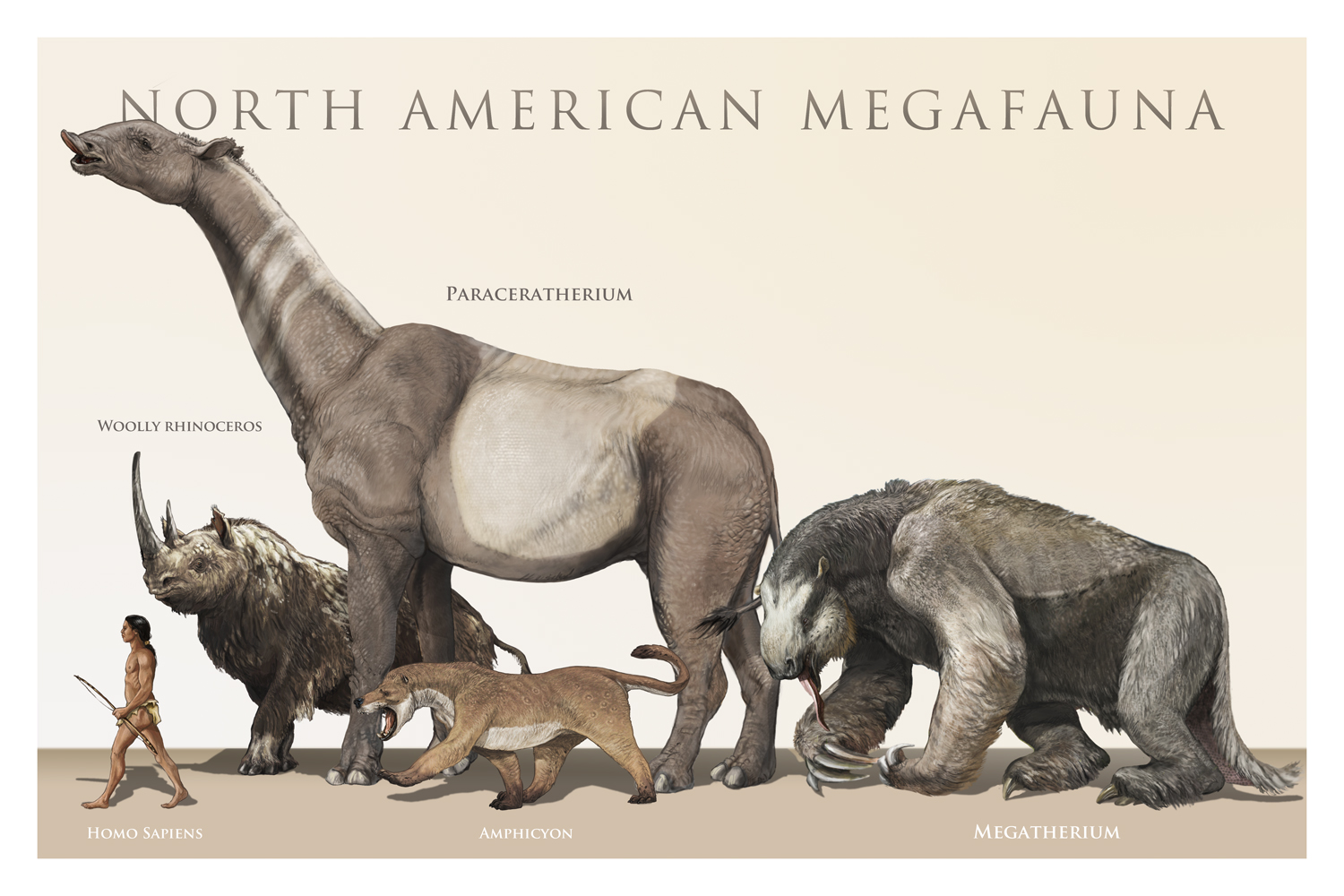
    1. Nomadic hunter-gatherers, they traveled in small bands following megafauna–enormous mammals that included mastodons and giant horses and bison–into the frozen Beringian tundra at the edge of North America.

      Image Description

      I find it amazing that the nomadic hunter-gatherers traveled in small groups, but followed these massive creatures. Looking at this photo of the size comparisons, I can only imagine what it must have been like to hunt them.