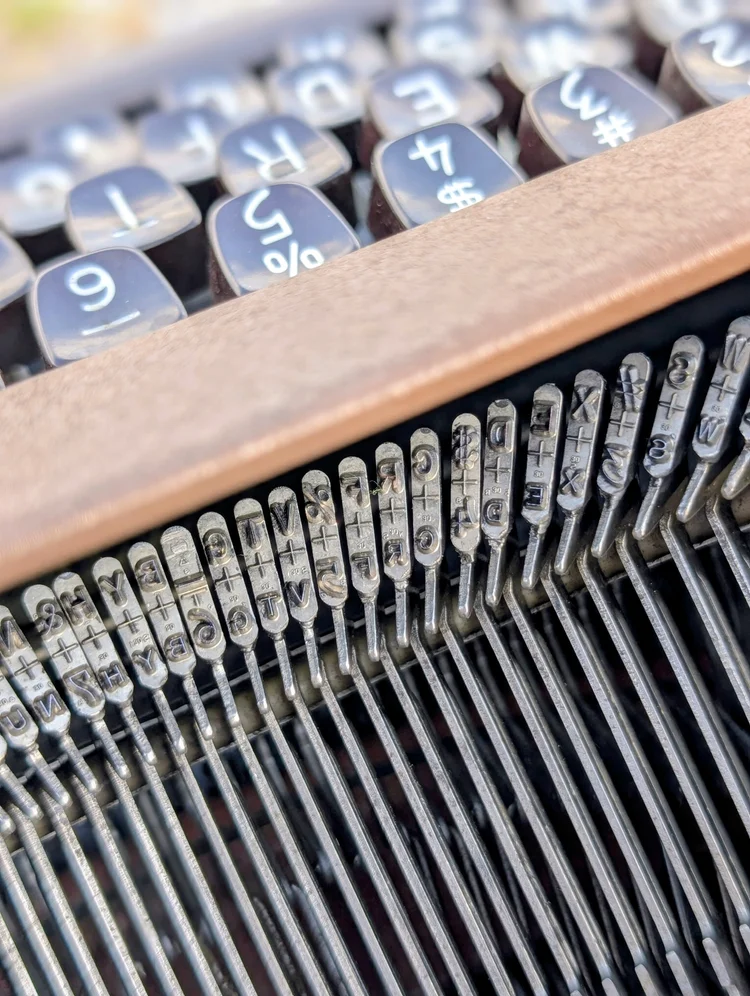
1946 Electromatic Model 01 - IBM's First Typewriter <br /> by [[Tech Tangents]]
Not the best cleaning and repair advice here for a typewriter, but some interesting tidbits of IBM history.
1946 Electromatic Model 01 - IBM's First Typewriter <br /> by [[Tech Tangents]]
Not the best cleaning and repair advice here for a typewriter, but some interesting tidbits of IBM history.
https://www.facebook.com/groups/705152958470148/posts/1264728369179268/
Custom gothic typeface on a Royal 10 made for supply/hardware settings. Uppercase is primarily fractions and abbreviations including: Dz, Gr, Bx, Bl, lb, In, Ft, Pr, Cs, Pc, Yd, and GL.
Fractions include odd numbers for the halfs, thirds, fourths, sixths, eighths, twelfths, and sixteenths,


https://typecast.munk.org/2023/02/18/1967-womda-typewriter-typefaces-smith-corona-scm-fonts/
An example of the Elite Gothic No. 16 can be found on Reddit which has a "cross" foundry mark with 1, 6, S, empty in the four quadrants from top to bottom and left to right.
ay. In the book of designs pre-pared by Burges each page shows oneaspect of the ruins as they were in 1872contrasted with his own ideas for thereconstruction of the same elevation(Fig.48) It was while working on thisproject that Burges declared 'I have beenbrought up in the thirteenth-centurybelief, and in that belief I intend to die'.Castel Coch was rebuilt as a fairy-talecastle, the like of which never existed inthe British Isles; the architect cited theprecedent of manuscript illustrations inthe British Museum to justify authentic-ity, but the castle, with its parapets,towers and soaring, conical roofs, owesmore to the inspiration of L'Aigle and theChateau de Chillon, as well as toViollet-le-Duc's restoration at Carcas-sonne, than to any British e
. The great presentation booksof Knightshayes and Castell Coch have adepth and luminosity, which, despitetheir austerely architectural presenta-tion, link them visually to the Books ofHours of the Middle Ages, which Burgesadmired so much, and to the famousthirteenth-century sketchbook of Villardde Honnecourt in the BibliothequeNationale in Pari
is use of mosaicwas based on a knowledge of medieval techniques unequalled inhis generati
nd he considered the study of antique andmedieval sculpture crucial to any architect’s training.
bur
urges was not a religious man. His religion was the art of theMiddle Ages, not its theology. The bulk of his church work wasAnglican, but two of his greatest patrons — Lord Ripon andLord Bute — were Roman Catholics. His dream was the churchcandescent, an aesthete’s version of the church militant: Faithmade manifest in Art.
religion
urges’s report on Castell Coch was prepared in 1871-2.Work began in August 1875. The structure was finished by theend of 1879.° But when Burges died in 1881 the interior hadhardly been begun.
Archaeology was a passion with Bute, second only toliturgy.
as originally built early in the thirteenth centuryby Gilbert the Red, Earl of Gloucester, to guard the Taff valley’gainst the Welsh.
background for the castle
o, the explanation must be Ruskinian:architecture as a vehicle for the decorative arts, eclectic, didactic;plus a special Burgesian gloss: architecture as fantasy, architectureas fun
Now Burges’s fascination with Islamic art was by nomeans unique. The Paris Exhibitions of 1867 and 1878 had arousedcuriosity about the style,® not least in the mind of Ludwig II ofBavaria.
e Trustees naturally looked askance at Burges’sfeudal extravaganzas. Cardiff Castle and Castell Coch had,therefore, to be paid for out of Bute’s personal income; much oftheir cost must have been floated on borrowed money
his phase of activity, however, was abruptly curtailed byfinancial difficulties in 1874-75, a book-keeping crisis in the Butefortunes which temporarily threatened the whole operation.®In 1871 and 1873 there had been major coal strikes.
Industrialisation had aided it, but also threaghtened the continuation of building!!!
he twelve signs of the zodiac appear in proxy formas their respective precious stones
same in castell coch
Bute came of age in 1868, and work began straight away
b
Some of these trips werein the nature of archaeological excursions; others were healthcures.
ritics were generallyimpressed by the integrity of his scholarship; Rosebery — forone — praised the nobility of his styl
is libraries were packedwith rare manuscripts and books. His list of writings is by anystandards prodigio
o celebrate his eventual confirmation in1869 — in the Sistine Chapel, no less — Pope Pius IX presentedhim with an image of the Sacred Heart.
relation to st lucius
By 1900 — the year the 3rd Marquess died — the total coalexports from Cardiff amounted to 7,500,000 t
ke the celebrated Duke of Bridgewater,he not only profited from but actually helped to create theindustrial revolution. An earnest, solitary, myopic, evangelicalLiberal Tory, he had all the confidence and resolution of anearly nineteenth-century industrialist, tempered by an inbornsense of paternalist responsibility.
Known in hisyouth as a profligate and dandy, he married not one heiress buttwo: firstly the ‘rich ugly Miss Windsor’, who later inheritedgreat estates in Cardiff and South Wales long owned by theHerberts, Earls of Pembroke;
nd his cautious advice atLlandaff Cathedral — against Prichard and Seddon’s re-roofing— was remarkably progressive for its date.
bout the middle of the nineteenth century two attitudestowards restoration were in conflict: the destructive and theconservative. Burges supported the conservative
as seen in castell coch!
urges made.no secret of his admiration for Viollet-le-Duc,at least as regards the Frenchman’s scholarship. He regarded theDictionnaire —‘that wonderful monument of human knowledgeand human industry’” — as quite invaluable.
evident in castell coch??
rench Gothicwas nobler, cheaper and characteristic of the modern age.‘The distinguishing characteristics of the Englishmen of thenineteenth century’, Burges concludes, ‘are our immense railwayand engineering works, our line-of-battle ships, our good andstrong machinery .. . our free constitution, our unfettered press,and our trial by jury... . [No] style of architecture can be moreappropriate to such a people than that which . . . is characterisedby boldness, breadth, strength, sternness, and virility
SLAYYYY works well with castell coch, the building was in the style he prefered?
hereas ‘the French architect of the same periodlooked more to the effect and less to the section; he left moreplain surfaces ... thus his mouldings, where he did use them, havea more telling effect’..
as seen at castell coch??
Early French, however, ‘is a style which verynearly answers our conditions, and if we go a little further backand examine what is called the Transition style, as developed inEngland and France, but especially the latter, we shall find almosteverything we want.
In the eyes of ecclesiologists their greatest achievementhad been to rescue the Gothic Revival from the smear of Popery.Pugin — that ‘wonderful man’, as Burges always thought of him— had tainted the movement with a whiff of incense. Ruskinsupplied an anti-papal deodorant.
SLAYYYY this shows how, while there were clear catholic taints to it, which was seen by Bute! not everyone saw it as catholic, with ruskin managing to get rid of the papal label associated with it, with a far greater array of anglican, and even dissenter, churches build
The repeal of the brick tax in 1850 gave the new fashiona flying sta
Did this innfluence castell coch? Enabled them to build it at a more affordable price?
Burges’s approach to religion was aesthetic rather thantheological. He was not christened until he was thirteen.
links to religion! He himself wasn't very religious, so this was bute's innfluence and shows how religion wasn't a requisite for engaging with the style, although it was typically advertised as such
t it is Burges’s collection of medieval MSS which wouldnow be deemed a veritable treasure-hoard.
clear that his collection of illuminated manuscripts innfluenced the interior, it very much gvies that vibes!
‘Money,’ he noted firmly, ‘is onlya secondary concern in the production of first-rate works. . . .There are no bargains in art.
link to industrialisation - immense wealth was needed!
y his mid-thirties Burges was — in architectural circles atleast — an international figure. He had travelled more widelythan any of his contemporaries. His learning was incontestable.His eclecticism was more broadly based than any of hisrivals; Romanesque, Gothic, Islamic, Greek, Japanese — evenFlorentine and Francois Premier — were all grist to his mill.His Gothic dreams were images of geniu
This is the fella that bute met - a highly educated and well travelled man like himself!
e had realised that what wasneeded was a collection of measured medieval details: ‘a sort ofgrammar of thirteenth-century architecture.’
Gothic ‘architecture was (and it always must be) eminently anarchitecture of figures and subjects ... part .. . [of] the greatpoem of Christian art’
urges looked about Victoria’s London, and looked in vainfor colour. Exterior polychromy seemed almost a lost art.’
In other words, the Pre-Raphaelite reaction againstacademicism, and the reaction of Puginian Gothic against thePicturesque, stemmed from a similar — if dog-eared — aestheticimpulse: the pursuit of truth
urges accepted Pre-Raphaelite principles implicitly. Thesehe defined — rather naively — as ‘to copy nature carefully, to usepleasant bright colours, and to give sentiment to the figures’.
ink here between burges and the pre-raphaelites - gothic revival was all interconnected!
The magic of the Orient was certainly part of the HighVictorian Dream.
good link to castell coch with the hint of arabic that's all around it!!
Such catholicity was too much for most Victorian Goths
‘infinitely better than any eitherin Paris or in London.” And individual mosques were stillmagnificent. Particular houses were still occasionally deckedout in characteristic gold and r
clearly seen at castell coch
Burges regarded travel as essential for any young architect. ‘Allarchitects should travel,’ he believed, ‘but more especially the art-architect; to him it is absolutely necessary to see how various artproblems have been resolved in different ages by different men.’
travel and industrialisation facilitating this
ith Clutton he travelled in France in the year of the GreatExhibition, making sketches for Clutton’s book on The Domes
link to the reasoning for the frenchy vibes of the turrets?
In the early 1850s Burges was known less as an architectthan as an archaeologist.
hence why he excavated castell coch and was able to reconstruct it as historically acurate as he could
s an articled pupil, Burges pored over books by JohnCarter and A. W. Pugin.
At the age of seventeenhe was already mixing with the vanguard of the Gothic Revival
sengineer to the Bute Docks at Cardiff, he was in a position tointroduce his son to the greatest patron in the history of theGothic Revival, the 3rd Marquess of Bute.
SLAYYYY industrialisation brought the pair togtehr, but it was their own convictions that enabled them to take the gothiv style
Alfred Burges was a rich man: he died worth £113,000, mostlyin railway stock. It was he who made possible his son’saesthetic lifestyl
link to industrialisation - thsis made his life as an architect and scholar possible!
lfred Burges presented hisson with a copy of Pugin’s Con¢rasts on his fourteenth birthday
ut he was not a political animal; hekept faith with that vision in his own studio. As early as 1856 hevowed to ‘work hard and paint visions and dreams and symbolsfor the understanding of people’.** More consciously than Rossetti,more subtly than Morris, he spent his life seeking the numinousin an alien world, groping for a symbolic language to express the _invisible, pursuing those ‘richly coloured images of a historical orlegendary past’ which might ‘serve also as metaphors for the life ofthe human spi
Good link for stained-glass becoming an artistic medium that could be accesible to all!
ike Pugin and Ruskin, however, Morris always cherishedGothic art and architecture, not just for its own sake, but as an agentof moral revolution.
This is quite good for stained-glass and stuff!!! It shows how the pre-raphaelite form was seen to be the most pious, it brought people back to the awe and reverence of the faith that appeared to be present in medieval england!
WithBurne-Jones and Rossetti in London in 1856, Morris formedwhat was in effect the second Pre-Raphaelite Brotherhood. ‘Apartfrom the desire to produce beautiful things,’ he recalled in 1894,‘the leading passion of my life has been and is hatred of moderncivilisation.’
To the young Burne-Jones, Ruskin’s writings were theauthentic voice of truth: ‘in prose what Tennyson is in poetry, andwhat the Pre-Raphaelites are in painting’.*
Captains of Industry musttake on the mantles of Arthurian heroes.
cool, did he make himself an arthurian hero? St lucian appears to be an arthur-esque hero??
“That wonderful man, asBurges called him,” was the lodestar of a generation of Goths
outhey’s edition of Malory’s Morte d’Arthur (1817) was for thePre-Raphaelites a ‘precious book’; ‘we feasted on it’, Burne-Jonesrecalled.
ndeed itwas Burne-Jones who put the whole debate in a nutshell: ‘the morematerialistic Science becomes, the more angels shall I paint’.
t is, therefore, in the realm of political ratherthan artistic theory that we must first look for the origins of HighVictorian aesthetics
High Victorian art and architecture lasted little more thantwenty years: the customary dates are 1851 to 1870
t wasa dream born in the aftermath of the Napoleonic Wars, in thehopelessness of the Hungry Forties
Theirs was a longing — far stronger than mere nostalgia— for a world of magic and fixed values; a yearning for stability inan age of change
Good quote to show how the gothic revival was something that was so old it could not be shaken by the changes of industrialisation
https://www.facebook.com/groups/1794856020751839/posts/4424498594454222/
Royal Canterbury pica - PC<br /> Royal Semi-Gothic pica - P SG
Vintage Sears Celebrity Portable Typewriter Manual With Hard Case & Instructions<br /> by [[ShopGoodwill.com]]<br /> accessed on 2026-03-13T10:33:18
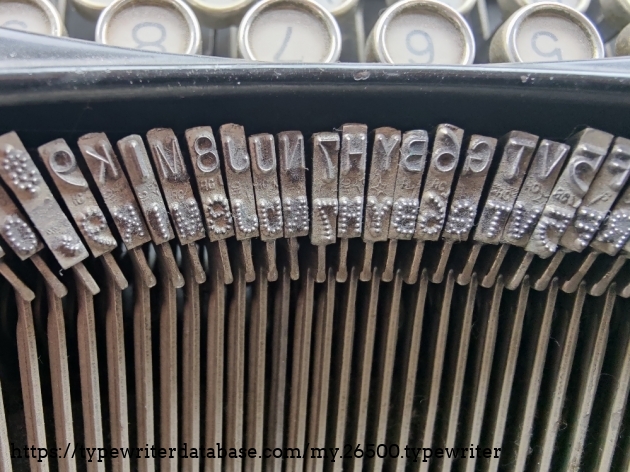
2026-03-12: 9 bids total with last minute bidding going from $82 (5 bids) to $128 with 4 additional bids for a Sears Celebrity typewriter with an obvious (photo of typebasket) double gothic typeface.
the strange, nearly indecipherable Gothic script known as kurrentschrift, which Germans used until around 1900.
obviously not strange or indecipherable to the entire population that used it daily...
Among the more specialized examples were so-called “double-gothic” typefaces. They are characterized by including a set of uppercase letters while the corresponding small-caps take the place of the lowercase. “Double” refers to the two uppercase-shaped glyph sets while “gothic” is simply the American term for sans-serif.
These words were a sufficient explication of the scene. The nature of his phrenzy, as described by my uncle, was remembered. I who had sought death, was now thrilled with horror because it was near. Death in this form, death from the hand of a brother, was thought upon with undescribable repugnance. In a state thus verging upon madness, my eye glanced upon Carwin. His astonishment appeared to have struck him motionless and dumb. My life was in danger, and my brother’s hand was about to be embrued in my blood. I firmly believed that Carwin’s was the instigation. I could rescue me from this abhorred fate; I could dissipate this tremendous illusion; I could save my brother from the perpetration of new horrors, by pointing out the devil who seduced him; to hesitate a moment was to perish. These thoughts gave strength to my limbs, and energy to my accents: I started on my feet. “O brother! spare me, spare thyself: There is thy betrayer. He counterfeited the voice and face of an angel, for the purpose of destroying thee and me. He has this moment confessed it. He is able to speak where he is not. He is leagued with hell, but will not avow it; yet he confesses that the agency was his.”
There's so much in this chapter. Firstly prudent reasoning from Carwin vs religious enthusiasm indirectly clashes in this emotion heated scene. Carwin has confessed his sins. Wieland escaped prison again to sacrifice Clara in his belief that the voice he hears is a divine messenger. Clara had thought of commiting suicide before Carwin's confessions, but once Wieland appears, she dreads the thought of dieing. The atmosphere has such eerie gothic elements. On the other hand there's a lot of character development, all 3 have changed a lot which makes them dynamic characters. Carwin seeks to clear up everything he had done out of guilt. Wieland had gone insane. But the most dramatic change is within Clara, who everyone adored, percieved as pure, brave and just and now - even though she just heard from Carwin that he had not made Wieland murder his family, Clara turns on him with a lie, a religious reasoning to save herself from her brother and to make his brother realize that "the divine messenger" is unreal. Clara is trying to use a possibly deadly trick on the two men. All three characters has reached a big turning point.
Chapter XIX
The entire chapter is a mix of overlapping sentimentalism and gothic elements in the form of religious enthusiasm: devoted and passionately religious Wieland is convinced by a hallucination that he must sacrifice his wife - and later children - to rid himself of mortal impurities, selfishness, and to prove his faith to God by it. The darkness and the torturous thoughts about death and murdering what's most precious to him are gothic elements. I think the cause - the hallucination itself - as godly as it looks is controversially gothic because it is a coverage of the madness and the horrors that will happen. The emotions are overpouring with grief, hesitation, and the urge to fulfill a "divine duty". The reasoning is far from prudent, although there are episodes where Wieland is torn between his love for his family and God. The inner conflict - although more exaggerated here - reminds me a little of "Contemplations", but unlike in Contemplations, where from the gloomy thoughts we reach peace, Weiland is "dancing with madness" in his inner battle, episodically going back and forth even after the deed is done - at first he's relieved even happy that he was able to obey a divine command and set himself free, but then he breaks down under its weight, and again his hallucinations bring him back to carry on and repeat it with his children too.
o occult cont
Macbeth has occult content, but every high school reads it! gothic literature has supernatural elements, too! How can a literary element be praised within one genre and criticized within another?
Gothic
German stories of ghosts,
These German ghost stories were translated into French for the book Mary, Percy, and Byron read during the summer; its French title was Fantasmagoria; ou Recueil d'Histoires, d'Apparitions, de Spectres, Revenans, Fantomes, etc., translated by Jean-Baptiste Benoit Eyries in 1812.
lethargic, somnambulistic character
This description got me curious about Melville's relationship to gothic literature, so I did a search in my (other) library's federated search and found that < melville benito cereno gothic > yielded 583 results.

Citing Sara Mills, Justin D. Edwards draws attention to the us vs. them narrative in Benito Cereno.
"For Melville, I suggest, the coupling of the two forms was possible because they were both filtered through a racialized lens. For instance, the structures of difference that are central to nineteenthcentury travel narratives— the narrative necessity of providing a gap between 'us' and 'them'— can also be found at the heart of Benito Cereno (Sara Mills 23)." Edwards, Justin D.. Gothic Passages : Racial Ambiguity and the American Gothic, University of Iowa Press, 2005. ProQuest Ebook Central, http://ebookcentral.proquest.com/lib/columbia/detail.action?docID=837041. Created from columbia on 2018-10-06 15:39:04.
He goes on to discuss violence, ignorance, and revolt in the power dynamic between Babo and Delano. That's not strictly gothic, but the elements are not far removed.
I shall soon leave you as far behind me as — what shall I say? — I want an appropriate simile. — as far as your friend Emily herself left poor Valancourt when she went with her aunt into Italy.
The names Emily and Valancourt are reference to characters from the gothic romance novel Mysteries of Udolpho by Mrs. Ann Radcliffe, which was published in 1794. Emily is the heroine of the novel who goes through misfortunes after the death of her father. Valancourt is a traveller who Emily falls in love with while traveling with her father. After her father's death, Emily is under the guardianship of her aunt Madame Cheron who tries to keep Valancourt and Emily from being together and eventually marrying each other. Madame Cheron goes as far as to take Emily away with her to Italy to be rid of Valancourt. Valancourt asks Emily to marry him in secret, but Emily refuses and leaves him to go with her aunt to Italy. (Regency History)
Here is a novel cover of Anne Radcliffe's Mysteries of Udolpho: