41 Matching Annotations
- Last 7 days
- Sep 2026
-
auctions.posterauctions.com auctions.posterauctions.com
-
https://auctions.posterauctions.com/lots/view/1-84GUYO/remington-1910
Original Leonetto Cappiello Remington poster sold for $31,250 on 2023-11-12
-
-
www.reddit.com www.reddit.com
-
Ad poster for the Remington typewriters, made by Leonetto Cappiello (1875-1942), France, c. 1910

Possibly inspired by the preface to the novel Penguin Island (L’Île des Pingouins. Calmann-Lévy, 1908) by Nobel prize laureate Anatole France, in which a scholar is drowned by an avalanche of index cards which formed a gigantic whirlpool streaming out of his card index (Zettelkasten)!? (See: https://boffosocko.com/2022/10/24/death-by-zettelkasten/)
-
- Aug 2026
-
www.youtube.com www.youtube.com
-
IBM Jingle: https://youtu.be/wtaI18Yq59s?si=1rexqhuKQafnOzuu&t=569
-
"Thou shalt conduct IBM's business in a responsible and ethical manner."<br /> —IBM Sales Manual #
-
-
- Jul 2026
-
www.facebook.com www.facebook.com
-
https://www.facebook.com/groups/721704878218903/posts/3068179956904705
Reddy Kilowatt as a custom slug on a Royal KHM.


-
-
clickamericana.com clickamericana.com
-
https://clickamericana.com/topics/science-technology/vintage-portable-manual-typewriters
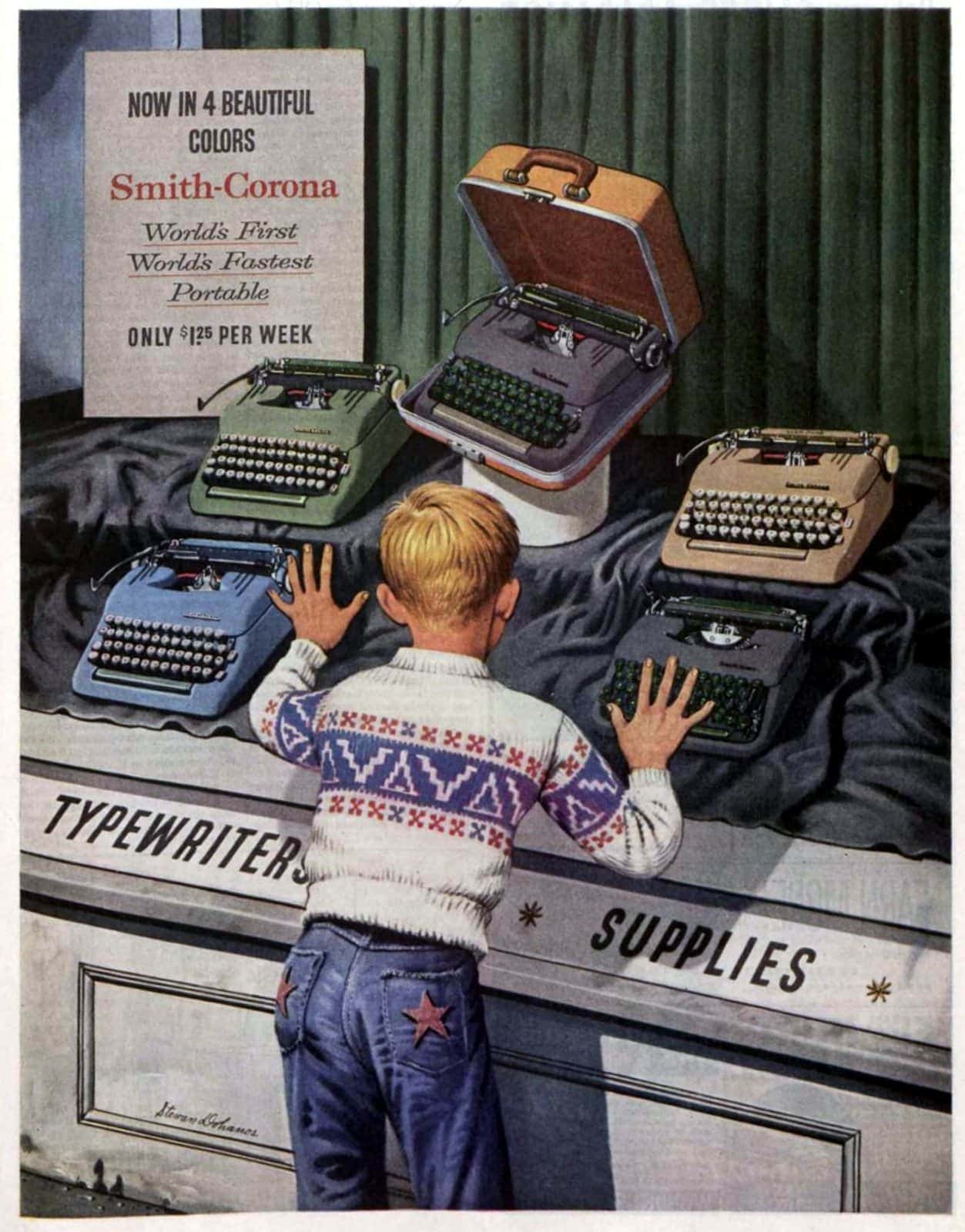
The Smith-Coronas were offered in 4 different colors.

The Remington Quiet-Riter was eventually offered in white sand, desert sage, mist green, and French gray,

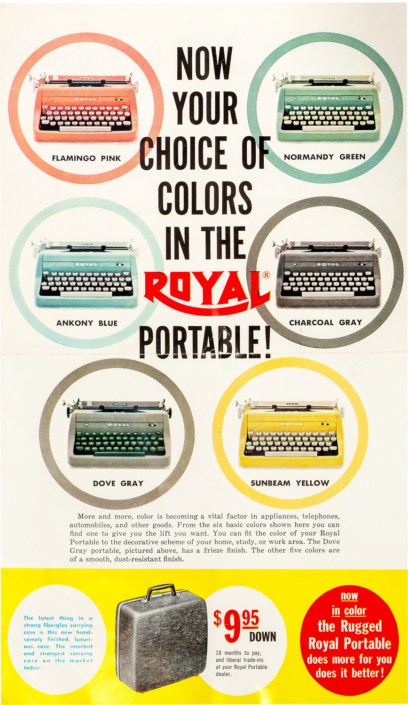
The Royal HH was offered in 6 colors including green, pink, and blue. Brown was the most ubiquitous.
-
-
www.google.com www.google.com
-
Why bother with dozens of big standards in your office when you can have a portable or two that you can move and which are always in demand?
100% The Practical Magazine of Efficient Management, November 1916, Volume 7, No. 45, p49. https://www.google.com/books/edition/Management/hqj2SD6khL4C?hl=en&gbpv=1&dq=corona&pg=RA4-PA49&printsec=frontcover
-
-
xoverit.blogspot.com xoverit.blogspot.com
-
Origin of Royal's Vogue by [[x over it]]
-
-
www.youtube.com www.youtube.com
-
Remington Quie- Riter Typewriter 1955
"students who use typewriters get up to 38% better grades."
"gives book reports and themes a professional look"
gendered sales technique - "girls particularly appreciate" the easy change ribbon system...
-
-
www.youtube.com www.youtube.com
-
www.youtube.com www.youtube.com
-
VINTAGE 1958 COMMERCIAL - REMINGTON RAND - OFFICE-RITER TYPEWRITER
Up to 10 carbons!<br /> Cuts clear, clean stencils 149.50 plus carrying case additional<br /> $1.50 a week payable monthly
-
-
www.youtube.com www.youtube.com
-
Successful Secretary Presented by Royal Office Typewriters. A Thomas Craven Film Corporation Production, 1966. https://www.youtube.com/watch?v=If5b2FiDaLk.
Script: Lee Thuna<br /> Educational Consultant: Catharine Stevens<br /> Assistant Director: Willis F. Briley<br /> Design: Francisco Reynders<br /> Director & Producer: Carl A. Carbone<br /> A Thomas Craven Film Corporation Production
"Mother the mail"
gendered subservience
"coding boobytraps"
"I think you'll like the half sheet better. It is faster." —Mr. Typewriter, timestamp
A little bit of the tone of "HAL" from 2001: A Space Odyssey (1968). This is particularly suggestive as H.A.L. was a one letter increment from I.B.M. and the 1966 Royal 660 was designed to compete with IBM's Selectric
This calm voice makes suggestions to a secretary while H.A.L. does it for a male astronaut (a heroic figure of the time period). Suddenly the populace feels the computer might be a bad actor.
"We're living in an electric world, more speed and less effort."—Mr. Typewriter<br /> (techno-utopianism)
Tags
- gendered subservience
- voice over
- techno-utopianism
- artificial intelligence as overlord
- efficiency
- effort
- quotes
- 1966
- 2001: A Space Odyssey (1968)
- power over
- Royal 660
- typewriter advertisements
- H.A.L.
- Mr. Typewriter
- productivity
- Royal typewriters
- secretaries
- IBM selectric
- typewriter shortcuts
- typewriters
Annotators
URL
-
- Jun 2026
-
search.catalog.loc.gov search.catalog.loc.gov
-
Olympia typewriter song [sound recording]. - Record details - Library of Congress Catalog <br /> accessed on 2026-06-29T13:10:26
-
-
www.reddit.com www.reddit.com
-
Chuck Goldstein, was a members of The Modernaires singing group from the early/mid 30's until 1942. In 1940, they began singing with Glenn Miller and his orchestra. The day after Glenn disbanded the orchestra in 1942 (so he could join the Army), Chuck had left The Modernaires to pursue his own career. I believe around 1945 he formed a new singing group... That being Four Chicks and Chuck! They sung a few commercials, but they also did other songs. They sung with Kate Smith a decent amount. They weren't a long lasting group though, only going until around 1953. After that, Chuck formed Chuck Goldstein Productions, which focused on commercial jingles.
See also: Olympia Typewriter Song
-
-
archive.org archive.org
-
archive.org archive.org
-
oldbobsoldtypewriters.com oldbobsoldtypewriters.com
-
https://oldbobsoldtypewriters.com/portfolio-item/1955-royal-quiet-de-luxe-blue/
Royal Quiet De Luxe in ankony Blue (AB)
-
-
www.ebay.com www.ebay.com
-
https://www.ebay.com/itm/137381943497

Sticker underneath lid of 3x5" card index (recipe-type) box:
Main section:
"Jogger 'Trade mark'<br /> No. 2<br /> 3 x 5 - closed<br /> Sectionets 'Finger-Tip' Office Systems<br /> Sectionuls Vertical Files of Big Capacity<br /> Sectionups Four Drawer Vertical Letter Files<br /> Shaw-Walker"
Advertising text:
"No matter how small your business you should have Shaw-Walker Systems and Filing Devices to help make it grow larger---systematically. When it is larger Shaw-Walker equipment will take care of it.
With Shaw-Walker Modern files your work is methodical and systematic; you obtain the best results in the shortest time; they are to your office what modern machinery is to your factory. Ask for our Big Catalog."
via photos at https://www.ebay.com/itm/137381943497 which sold for $25.00
-
-
www.reddit.com www.reddit.com
-
typewriterdatabase.com typewriterdatabase.com
- May 2026
-
www.facebook.com www.facebook.com
-
https://www.facebook.com/groups/TypewriterCollectors/posts/10163593836864678/
If typists were Robots

Resemblance to disaster girl?
-
-
www.facebook.com www.facebook.com
-
reply to https://www.facebook.com/groups/TypewriterCollectors/posts/10161712887224678/
to Steve Clancy Zach Hubbird Jean Brunet
I'm curious what the sourcing is on your differentiation of the two models? Are there manuals, advertising, or other details to back up the differences? From what I can see, the phrase "Rhythm Touch" seems to have been an advertising tag for the Underwood SS which started a few months after production of the SS began and there wasn't any difference in them other than the advertising tag.
Robert Messenger has some scant history on the machine and the differences, primarily due to a redesign at the time, at https://oztypewriter.blogspot.com/2012/11/on-this-day-in-typewriter-history_25.html. The primary change from the S to the SS seems to have been a move from a carriage shift to a basket shift and so it seems somewhat fitting that Underwood uses the phrase "Rhythm Touch" as an advertising gimmick much like Smith-Corona were doing with their "Floating Shift" marketing.
Generally standards at the time were not differentiated by different trim lines as standards had all the bells and whistles for office use (potentially aside from custom use cases like decimal tabulators or extra wide carriage). Meanwhile all the trim variations were generally seen in the portable market geared toward home use rather than office. This would seem to support the idea that there's only the SS and "Rhythm Touch" is only an advertising tag line as the SS was newly introduced in January of '46 and "Rhythm Touch" appears around July '46.
There's also some discussion on the TWdB in the commentary at https://typewriterdatabase.com/1950-underwood-ss.23202.typewriter which may add to the question.
I'm curious to hear everyone's thoughts on the idea/thesis that the only model is the Underwood SS which is being marketed as the "Rhythm Touch" or evidence to the contrary to refute the claim.
-
- Apr 2026
-
www.facebook.com www.facebook.com
-
https://www.facebook.com/photo?fbid=3565042706976081&set=pcb.1249358224049616

Signed card and headshot of Natalie wood in front of a blue series 5 Smith-Corona Silent-Super.
-
- Mar 2026
-
www.reddit.com www.reddit.com
-
static.wixstatic.com static.wixstatic.com
-

Royal QDLs from '56-59, though advertisement more likely from '57-58 due to the white.
Royal Green, Royal Star White, Royal Beige, Royal Gray, Royal Red, Royal Turquoise,
Add specifies the QDL is available in Canterbury Pica or Canterbury Elite.
-
-
www.atticpaper.com www.atticpaper.com
- Feb 2026
-
www.facebook.com www.facebook.com
-
https://www.facebook.com/groups/4770669677/?multi_permalinks=10163215089874678

Description of journalist who had blurry typing because he bottomed out the keys rather than hit them like hot coals.
-
- Oct 2025
-
www.openculture.com www.openculture.com
-
Mark Twain Wrote the First Book Ever Written With a Typewriter<br /> by [[Josh Jones]] in Open Culture<br /> accessed on 2025-10-13T23:01:35
-
- Jul 2025
-
www.youtube.com www.youtube.com
-
How to Stop A Bully So He Regrets It | Russian Mafia Advice
A clever video fronting for for a book advertisement.
Tags
Annotators
URL
-
-
-
https://archive.org/details/typewriterephemera
Typewriter ephemera on the Internet Archive<br /> Collected by Otto aka u/Koponewt
-
- Jun 2025
-
books.google.com books.google.comLIFE1
-
ohyouprettyoldthings.wordpress.com ohyouprettyoldthings.wordpress.com
-

In the late 1950s Royal released versions of the Royal Quiet De Luxe in 6 different colors.
-
-
clockhistory.com clockhistory.com
-
Westclox Style 5 Big Ben Electric Chime Alarm Introductory Ad by [[Bill Stoddard]]

-
-
clockhistory.com clockhistory.com
- May 2025
-
www.youtube.com www.youtube.com
-
Film: Typing on Robotron by [[Joe Van Cleave]]
You've got to love the "dancing hands" portion of the film which was such a product of it's timeperiod.
-
-
www.atticpaper.com www.atticpaper.com
- Sep 2022
-
firstdraftnews.org firstdraftnews.org
-
Fans’ strong emotional connection to their idols and heroes means they are often predisposed to believe them and trust their messages. This trust disarms fans in the face of mis- and disinformation spread by the celebrities and influencers they follow, nudging them to research and possibly repeat false narratives.
In my personal opinion, I do not believe we should be so surprised at the fact that influencers have such a power. They push propaganda out one way or another on a constant basis. In fact, it was my goal to to get sponsors for our podcast which meant that I would be paid to read advertisements on each episode. I would be directly influencing my audience to purchase a product and possibly be placed in a contractual agreement to only say good things about said product. If celebrities can push skin care products onto their fans, how could we not see them trying to convince their fans that a vaccine will cause bodily harm in the long-term. They built a trust that cannot be broken unless their audience can be skeptical enough to not take the bait. Influencers need to be aware of the impact they have on their audience and need to do their parts in ensuring that all information they share is validated and confirmed by trusted sources.
-
- May 2017
-
find.galegroup.com.ezproxy.lib.gla.ac.uk find.galegroup.com.ezproxy.lib.gla.ac.uk
-
Publishers' announcement of Evan Lloyd's Epistle to David Garrick, 9 Jan. 1773. McGuffie, p. 101.
-