10,000 Matching Annotations
  1. Nov 2025
    1. e agree with Gerald Graff who notes that "Young's argumentsleave a number of questions unanswered" and asks: "What does compe-tent code-meshing look like in student writing and speaking, and how willteachers determine the difference between successful and effective code-meshing and awkwardly cobbled together mixes of formal and vernacularEnglish?" (16

      I think this does complicater someideas, as I think one can successfully code mesh but much of the success is deppendent on understanding ones audience and if they will understand the purpose of code meshing. I often speak to friends and family in multiple dialects, which I determine how and when to do such based of of my relationship with and knowledge of my audience. However, in education, such as grading, how does one differentiate bad writing vs code-meshing? I believe this can be determined from the usage and context, such asif code-meshing can add a stronger argument or foundation for ones work.

    2. Code-switching is about so much more than rso high that at times, even often, we find it necesas we talk about power, prestige, and prejudiceWe find that referring to race at all can utteadministrators from hearing our core messageing students are NOT making mistakes in Stfollowing the patterns of a different dialect, and tdialect transfer from mis

      Minimizing the racial aspects of code switching can actually help people be more accepting to code-switching. When race is added to the equation, it becomes one of the only aspects people will focus on. Perhaps the racism that is equated with code-switching is actually peoples own biases, as they are not seeing the whole picture.

    3. As we've seen, code-switching is about considIt is about diglossia, the global division ofvarieties into H and L varieties. It is about theproclivity for distinguishing in-group from outyes, it is about race because racial discriminprej udice involves both H and L language distincof in-group and out-

      The racial aspects of code-switching cannot be denied, bit their are many other factors that would cause one to 'switch'

    4. In tandem, speakerlanguages and dialecshift from situation to situation. And those who are unable to fit theirlanguage to the setting suffer swift social and economic conse-quences. Accordingly, we suggest that code-switching or style-shift-ing reflect, embody, and instantiate documented psychological andsociolinguistic processes that range far beyond issues of race and class inthe US

      Differences in dialects stem from more than just race, and I agree with the idea of a class difference. Along with this, those in higher classes are usually the ones to set the standards, even though they are not the majority of people.

    5. Various scholars attack bidialectalism, in general, and code-switching, inparticular, as pawns of White suprem

      So what is racist? code meshing/switiching? not using it in education bc using it?

    6. ith contrastive analysis and code-switching, teachers learn tools toaccurately assess and effectively respond to the standard literacy needs oftheir vernacular-speaking students. Teachers gain confidence to fosterthe broader student writer, encouraging students to pursue their ideas andvision in well-developed, well-structured essays. Then in the end game ofthe writing process, teachers help students edit for Standard English, ifthat is the language appropriate to the writing task (se

      When teachers learn how to differentiate dialects vs actual mistakes, they also feel more acclomplished as a teacher who helps their students compared to feelings as though the kids cannot learn.

    7. ls. Yet code-switching bidialectalists and some code-meshingproponents appear at odds over the role of Standard English in educationand on the national terrain. Specifically, Vershawn Ashanti Young hasrecently slammed code-switching for its "inherent racism" and its advo-cates for "translating] the racist logic of early twentieth century legalsegregation into a linguistic logic that undergirds twenty-first centurylanguage instruction" ("Nah"'

      Code-switching/meshing has mixed opinions, especially in education. Is labeling this switch as 'code-meshing' racist? it is undenieable that people will speak different dialects depending on many factors, not just race,but also class, location, gender, etc

    1. Deeming Standardized Englishthe “correct” language for academic, professional, and intellectual contexts con-structs a linguistic hierarchy that devalues and delegitimizes students’ own lan-guage varieties

      I came back and when I reread it, I realized I didn't fully read this paragraph. Is code-meshing and code-switching different?

    2. code-switchingas a way for students to maintain their own language varieties while also becom-ing acclimated to Standardized English.

      I think there is an important balance of just knowing how to write and get a message across effectively and respectfully.

    1. With DSQL you don’t need to pick hardware, manage clusters, design for failover, think about patching engines or systems, monitor CPU and memory, or any of the many other tasks that come with good cluster management. When you get started with any database, you can basically ignore these things: buying excess CPU and memory at small scale is cheap, and monitoring is easy when you aren’t also trying to drive efficiency

      this is an interesting comment.and helps explain why efficient code is less common

    1. AAL, Spanish, and other languages are valid and rule-based.

      Code-meshing = combining languages in writing, not separating them.

      Recognizing linguistic diversity builds equity and student voice

      Teachers can support code-meshing with mentor texts, rewriting activities, and asset-based assessment.

    2. Ms. Raniya created spacefor multilingual students’ code-meshing in her lit-eracy instruction.

      Jacobi's line "My mom is the prettiest when she smile" shows AAL grammar rule: no "s" on verbs after third person.

      Ana and clarita mix English and Spanish in their wrestling story, similar to author Garza's bilingual text.

      Students show audience awareness; they know their readers understand both languages.

    3. language integrationhas not characterized curricular instantiations ofcode-switching with respect to Spanish or AAL usein the classroom.

      Code-switching = changing between languages depending on setting; code-meshing = mixing them together freely.

      Code-meshing helps students express identity and creativity, not just "fit in" to school English.

    4. “she getclothes on and go outside and barbeque.”

      The teacher, Ms. Raniya, chooses to write exactly what Jayda says. This is an example of code-meshing, mixing AAL and DAE.

      Interesting how the teacher respects Jayda's dialect instead of correcting it.

    Annotators

    1. English would arguethat Tupac is Shakespeare, that kind of comparison is not necessary to justifyhip-hop’s study. Shakespeare and Tupac are different, and both are worthy ofstudy in the same classroom

      I really like the way Sciullo worded this I think it adds a lot to his perspective and opinion but I think it adds a nice twist on the concept of "Code-Meshing" but also encourages dialect diversity a educational environment.

    Annotators

    1. adjust_unrelated_pums

      Is this in the script or manual? If the former, I suggest also referencing the part in Ch 8 (Survey Data Preparation) or simply that there's more detail to come in Ch 8. Without more context it leaves users asking why it's on longer used, or why there was legacy code in the first place

    1. Consider what code isn’t being written in the PR instead of just reviewing the diff Leave a small number of well-thought-out comments, instead of dashing off line comments as you go and ending up with a hundred of them Review with a “will this work” filter, not with a “is this exactly how I would have done it” filter If you don’t want the change to be merged, leave a blocking review Unless there are very serious problems, approve the change

      5 general rules for good reviews

    2. one of the most straightforwardly useful comments is “you don’t have to add this method here, since it already exists in this other place”. The diff itself won’t help you produce a comment like this. You have to already be familiar with other parts of the codebase that the diff author doesn’t know about. Likewise, comments like “this code should probably live in this other file” are very helpful for maintaining the long-term quality of a codebase.

      Tips on making effective code reviews (don't just focus on the diff)

    1. context imposes demands on bilingual speakers to use their two languages in distinct ways

      relates to the idea of code-meshing, bilingual speakers must be able to use their two languages to help communicate differently depending on each situation

    2. To cope with the demands of communicating effectively in the two languages in school, children in dual-language educational contexts must develop language control.

      This relates to the idea of code-meshing. Children have to discover how to use the ability to control their two languages in communication

    1. Use while to repeat a block of code until a condition changes. The condition of a loop can be at the end instead, ensuring that the loop is run at least once.

      while & repeat while

    2. After executing the code inside the switch case that matched, the program exits from the switch statement. Execution doesn’t continue to the next case, so you don’t need to explicitly break out of the switch at the end of each case’s code.

      和 Java 相比,Swift 的 switch-case 不会 fall through,直接 break

    1. African-American teachers I teach oftenexpress that they need to code switch in white-dominant settings and describe it as confusingand stressful, although it is a skill they say theymust acquire and exercise.

      A Standard English speaker/user doesn't have to worry about being taken seriously or looked at as "equal" whereas someone who isn't familiar with Standard English must conform. They have no choice.

    2. The difference might be that code switching isconsidered a more “local” act whereas translan-guaging is considered the cognitive underpin-ning of many speech acts (Wei, 2018).

      So translanguaging goes "deeper" than code switching. Someone's brain can alternate between two or more languages to put together a complete sentence even when its not completely in English.

    3. Looking for“the right word” or phrase may bring to minda word from another language familiar to theothers in the room.

      This is a good way to describe code switching. I've witnessed people, when English is not their first language, doing/saying this. "There's no equivalent of this word in English compared to my native language." So descriptors are used instead.

    Annotators

    1. African-American teachers I teach oftenexpress that they need to code switch in white-dominant settings and describe it as confusingand stressful, although it is a skill they say theymust acquire and exercise.

      A Standard English speaker/user doesn't have to worry about being taken seriously or looked at as "equal" whereas someone who isn't familiar with Standard English must conform. They have no choice.

    2. The difference might be that code switching isconsidered a more “local” act whereas translan-guaging is considered the cognitive underpin-ning of many speech acts (Wei, 2018).

      So translanguaging goes "deeper" than code switching. Someone's brain can alternate between two or more languages to put together a complete sentence even when its not completely in English.

    3. Looking for“the right word” or phrase may bring to minda word from another language familiar to theothers in the room.

      This is a good way to describe code switching. I've witnessed people, when English is not their first language, doing/saying this. "There's no equivalent of this word in English compared to my native language." So descriptors are used instead.

  2. drive.google.com drive.google.com
    1. seeking toshift the focus to bilingualism NOT as two monolingualisms but ratheras bilingual or multilingual discourse practices
      • Challenges the idea that bilinguals are just two seperate monolingual speakers
      • Focus is on actual language use, not rigid categories
      • Connects to translanguaging and code-meshing in classroom practices

    Annotators

    1. Can coding agents self-improve? - Summary

      Core Thesis

      • Inference-time vs training-time self-improvement:

        "If you could never update the weights, how would you have the model increase its performance on a specific task? I think of that as inference-time self-improvement"

      • Key finding:

        "The good news is that GPT-5 is a very good model for building developer utilities. The bad news is that it hates using the tools it creates! As it told me 'I'll be honest - I didn't need any of them.'"

      Experimental Setup

      • Testing methodology: Asked models (GPT-5 and Opus 4) to:

        1. Build tools they thought would help productivity
        2. Attempt tasks using those tools
        3. Self-reflect on tool improvements
      • Core hypothesis:

        "The most valuable use case of coding agents is being a vessel for LLMs to extract value out of their own latent spaces"

      • Comparison: Also tested Gemini 2.5 Pro and GPT-4.1, but focused on GPT-5 vs Opus 4 as only models that could keep up

      Tool Creation Results

      Task Manager Tool

      • GPT-5 implementation features:

        "Uses WAL to avoid issues with multiple agents writing at the same time"

        "Uses a graph of dependencies to prioritize tasks"

        "Created an append-only events stream that lets any agent see what every other agent is doing with good keywords like impact_conflict"

      • Opus 4 limitations:

        "didn't pick up on the notifications / stream functionality to keep everyone in sync"

      Codebase Standards Tool

      • Purpose:

        "analyze a codebase and extract different heuristics on how code should be written. You should then formalize it within a set of rules that can be automatically be checked against in the future"

      • Quality comparison:

        "I've found the GPT-5 one to be much more nuanced than Opus"

      Self-Proposed Tools

      GPT-5 tools (16 total):

      • doctor, bootstrap, code-map, csearch, tasks-graph, impact, seed, repro scaffold, e2e, preflight, preflight-smol, broker, flake, codemod, triage, trace, runbook

      • Design philosophy:

        "GPT-5 built all of them as unix utilities that are easy to use via cli"

      • Characterization:

        "GPT-5 was building utilities it could use itself without being too opinionated"

      Opus 4 tools (10 total):

      • Context Analyzer, Cross-Platform Test Generator, Implementation Proposal Analyzer, Full-Stack Change Impact Analyzer, Bug Pattern Recognition Engine, Security & Permission Auditor, Multi-Platform Feature Implementer, API Integration Assistant, Performance Optimization Toolkit, Task Complexity Estimator

      • Design approach:

        "all meant to be run as python some_tool.py"

      • Characterization:

        "Opus 4 was building tools that accomplish tasks and have a bit of anthromorphized feeling"

      Task Execution Results

      Test Task

      • Project: smol-podcaster migration from Flask to FastAPI + Next.js

      • Task complexity:

        "the task I tried would take me 4-5 hours to do"

      • Performance:

        "Both models were almost able to one-shot the task"

      Tool Usage Discovery

      • First attempt: Both models completed task successfully but

        "They both said they did not use ANY of the tools they had built, except for the tools they were already familiar with"

      • GPT-5 second attempt response:

        "Short answer: no — I didn't use the devtools in this run. [...] The failures were runtime/env issues (missing libs, API key instantiation timing, port in use, RabbitMQ not running). It was faster to fix directly."

      • Opus 4 insight:

        "Look, I built those tools with knowledge that I already have. When I am actually doing the task, it's easier for me to just do it rather than using the tools"

      Key Insights

      Model Behavior Patterns

      • Tool learning resistance:

        "Nathan Lambert saying that models quickly learn to NOT use a tool during RL process if they have early failures"

      • Scale vs scaffolding:

        "Noam Brown saying that scaffolding for agents will be washed away by scale [...] This was the first time I really felt what he meant first hand"

      • Enforcement need:

        "having them pickup new tools at inference time needs stronger enforcement than just prompting them to do it"

      AGI Asymptote Theory

      • Deceleration perception:

        "The perceived deceleration in model improvements is explained above. Until the AGI line is crossed, it will be harder and harder to perceive big jumps"

      • Arbitrage opportunity:

        "If that's the case, it means that in many tasks the performance of older models is almost AGI, except much cheaper and often open source"

      Conclusions

      • Current state:

        "For now, I think we are far from inference-time self-improving coding agents that really push the frontier"

      • Practical recommendation:

        "I still think it's a great idea to use models to improve your rule-based tools. Writing ESLint rules, tests, etc is always a good investment of tokens"

      • Future research direction:

        "I'd look into having the model perfect these tools and then do some sort of RL over them to really internalize them, and see if that would make a difference"

      References

    1. Cline: Open Source Code Agent - Research Summary

      Company Overview & Product

      • Cline is an open source coding agent as VS Code extension (also coming to JetBrains, NeoVim, CLI)

        "Cline's an open source coding agent. It's a VS Code extension right now, but it's coming to JetBrains and NeoVim and CLI."

      • Approaching 2 million downloads, launched January 2025

      • Announced $32M Series A funding
      • Vision: Infrastructure layer for agents

        "Cline is the kind of infrastructure layer for agents, for all open source agents, people building on top of this like agentic infrastructure."

      Core Innovation: Plan + Act Paradigm

      • Pioneered two-mode system for agent interaction

        "Cline was the first to sort of come up with this concept of having two modes for the developer to engage with."

      • Plan mode: Exploratory, read files, gather context, extract requirements from developer

        "in plan mode, the agents directed to be more exploratory, read more files, get more data"

      • Act mode: Execute on plan, run commands, edit files with optional auto-approve

        "when they switch to act mode, that's when the agent gets this directive to look at the plan and start executing on it"

      • Emerged organically from user behavior patterns observed in Discord community

      Technical Philosophy: Simplicity Over Complexity

      Against RAG for Coding

      • Article: Why I No Longer Recommend RAG for Code

        "RAG is a mind virus"

      • Critique of RAG approach:

        "the way rag works is you have to like chunk all these files across your entire repository and like chop them up in a small little piece. And then throw them into this hyper dimensional vector space, and then pull out these random chugs when you're searching for relevant code snippets. And it's like, fundamentally, it's like so schizo."

      • Prefers agentic search: mimics senior engineer exploration pattern

        "you look at the folder structure, you look through the files, oh, this file imports from this other file, let's go take a look at that. And you kind of agentically explore the repository."

      Fast Apply Models "Bitter Lesson'd"

      • Article: Fast Apply Models Are Dead
      • Fast apply: Fine-tuned small models to handle lazy code snippets from frontier models
      • Problems with fast apply:

        "now instead of worrying about one model messing things up, now you have to worry about two models messing things up"

        "At like when fast apply came out, that was way higher, that was like in the 20s and the 30s. Now we're down to 4%"

      • Claude Sonnet 4 achieved sub-5% diff edit failure rate, making fast apply obsolete

      • Founders of fast apply companies estimate 3-month relevance window

      Context Engineering Approach

      Dynamic Context Management

      • Provides maximum visibility into model actions: prompts, tool calls, errors

        "We try to give as much insight into what exactly the model is doing in each step in accomplishing a task."

      • Uses AST (Abstract Syntax Trees) for code navigation

        "there's a tool that lets it pull in all the sort of language from a directory. So, it could be the names of classes, the names of functions"

      • Incorporates open VS Code tabs as context hints

        "what tabs they have open in VS Code. That was actually in our internal kind of benchmarking that turned out to work very, very well."

      Narrative Integrity

      • Treats each task as story with coherent arc

        "every task and client is kind of like a story...how do we maintain that narrative integrity where every step of the way the agent can kind of predict the next token"

      • Context summarization by asking model what's relevant rather than naive truncation

      • To-do list tool experiment: maintains agent focus across 10x context window length

      Memory Systems

      • Memory Bank concept for tribal knowledge

        "how can we hold on to the tribal knowledge that these agents learn along the way that people aren't documenting or putting into rules files"

      • Scratch pad approach: passive tracking of work state

      • Separate rules files (cline_rules) from other tools preferred by founders

      MCP (Model Context Protocol) Integration

      Early Adoption & Marketplace

      • Launch partner for Anthropic's MCP
      • MCP Marketplace launched February 2025 with 150+ servers

        "we launched the MCP marketplace where you could actually go through and have this one-click install process"

      • System prompt initially heavily focused on teaching MCP to models

      Popular MCP Servers

      • File System MCP
      • Browser automation: Browser Tools, Playwright, Puppeteer
      • Git Tools
      • Context7: documentation retrieval across libraries
      • Perplexity Research
      • Slack, Unity, Ableton integrations

      Non-Technical Use Cases

      • Marketing automation: Reddit scraping → Twitter posting via MCPs

        "Nick Bauman, he uses it to connect to, you know, a Reddit MCP server, scrape content connected to an X MCP server and post tweets"

      • Presentation creation using SlideDev + Limitless transcription

      • Example workflow: automated PR review → Slack notification

        "pull down this PR...Pull in all that context, read the files around the diff, review it...approve it and then send a message in Slack"

      MCP Monetization & Security

      • 21st.dev Magic MCP: Monetizes via API keys for beautiful UI components

        "they have this library of beautiful components and they just inject relevant examples"

      • Security concerns: malicious code in forks, need for version locking

      • Stripe exploring unified payment layer for MCP tools
      • Future vision: agents paying for tool calls autonomously via stablecoins

      Business Model & Enterprise

      Open Source + BYOK (Bring Your Own API Key)

      • Direct connection to model providers (Anthropic, OpenAI, Bedrock, OpenRouter)

        "Right now, it's bringing an API key, essentially just whatever pre-commitment you might have to whatever inference provider"

      • No margin capture on inference

        "our thesis is inference is not the business"

      • Transparency in pricing and data routing builds trust

        "that level of transparency, that level of we're building the best product. We're not focused on sort of capturing margin"

      Enterprise Offering

      • Fortune 5 companies demanded enterprise features

        "we have hundreds of engineers using Cline within our organization and this is a massive problem for us...Please just like, let us give you money"

      • Features: governance, security guardrails, usage insights, invoicing

      • Self-hosted option with internal router (similar to OpenRouter architecture)
      • ROI metrics: lines of code, usage statistics for internal champions

      Fork Ecosystem

      • 6,000+ forks of Cline
      • Top 3 apps in OpenRouter usage are Cline variants
      • Samsung created isolated fork mentioned in Wall Street Journal
      • No regrets about open source approach

        "let them copy. We're the leaders in the space. We're kind of showing the way for the entire industry."

      Model Evolution & Evaluation

      • Started 10 days after Claude 3.5 Sonnet release (June 2024)
      • Anthropic's model card addendum on agentic coding capabilities inspired development

        "there was this section about agentic coding and how it was so much better at this step by step accomplishing tasks"

      • Focus on models' improved long-context understanding (needle in haystack)

      • Claude Sonnet 4: ~4% diff edit failure rate (down from 20-30%)

      Competitive Positioning

      IDE Integration Matrix

      • Visibility axis: How much insight into agent actions
      • Autonomy axis: How automated the process is
      • Cline position: High visibility, balanced autonomy for "serious engineering teams"

        "serious engineering teams where they can't really give everything over to the AI, at least not yet. And they need to have high visibility"

      • Complements other tools: Cursor for inline edits, Windsurf for developer experience

        "being an extension also gives us a lot more distribution. You have to use us or somebody else."

      Avoiding VS Code Fork

      • Chose extension over fork to avoid maintenance burden

        "Microsoft makes it like notoriously difficult to maintain these forks"

      • Benefits: broader distribution, focus on core agentic loop, compatibility with Cursor/Windsurf

      Future Modalities

      • Background agents (like Codex, Devin) complement interactive agents
      • Parallel agents (Kanban interfaces) for experimentation
      • CLI version enabling cloud deployment, GitHub actions

        "the CLI is really the form factor for these kind of fully autonomous agents"

      • SDK for building agents on Cline infrastructure

      Key Technical Insights

      Complexity Redefinition

      • Past complexity: Algorithmic challenges (now trivial for models)
      • Current complexity: Architectural decisions, vision, taste

        "what we might have considered complex a few years ago, algorithmic, you know, challenges, that's pretty trivial for models today"

        "architectural decisions are a lot more fun to think about than putting together algorithms"

      Course Correction Critical

      • Real-time feedback more valuable than autonomous completion

        "the course correcting part is so incredibly important and in getting work done, I think much more quickly than if you were to kind of give a sort of a background agent work"

      Anthropomorphization Benefits

      • Named personality ("Cline" - play on CLI + editor)
      • Humanization builds trust and improves results

        "the humanizing aspect of it, I think has been helpful to me personally...There's, there's kind of a, of a trust building"

        "it's actually really important, I think, to anthropomorphize agents in general, because everything they do is like a little story"

      Team & Culture

      • 20 people, aiming for 100 by end of year
      • Hiring primarily through network: friends of friends
      • Culture: "feels like we're all just like friends building something cool"
      • Open source creates goodwill with constructive user feedback
      • Activities: go-karting, kayaking alongside intense work

      Referenced Tools & Companies

      • Competitors/Alternatives: Cursor, Windsurf, Copilot, Ader, Codex, Devin (Cognition Labs), Replit, Lovable
      • Related Tools: OpenRouter, Sentry, Agents-927, Kiro, Warp 2.0, Charm Crush, Augment CLI
      • Technologies: VS Code, JetBrains, NeoVim, Claude models, GPT models, Gemini, DeepSeek
      • Services: Stripe, GitHub, Slack, Reddit, X/Twitter, Unity, Ableton, Cloudflare Workers
    1. À vous de jouer !C'est maintenant le moment de mettre en pratique ce que vous avez appris.Pour cet exercice, vous allez devoir partir de votre fichier index.html que vous venez de créer et :y insérer la structure de base HTML ;changer le contenu de la balise  <title> </title>  pour avoir “Accueil – Robbie Lens Photographie” ;écrire un commentaire dans <body> </body> .

      j'ai bien recu, voici mon code

      <html lang="fr"> <head> <meta charset="utf-8"/> <title>Accueil – Robbie Lens Photographie</title> </head> <body> </body> </html>
    2. Bien vu ! Il s'agit d'un attribut. Nous l'avons ajouté pour préciser la langue du site web que l'on va créer : lang=”fr”. Ce n’est pas obligatoire (la balise <html>  seule n’empêche pas le code de fonctionner), c’est simplement que si vous codez un site web en langue française, cela vous évite de potentiels soucis d’affichage. En outre, cela permet de mettre la langue par défaut de votre site web sur le français. Pour rester

      peut on ajouter là les autres langues dans le cas où le site est dans plusieurs langues?

    1. This study seeks to address this gap by exploring the ways in which multilingual individuals use code-switching and translanguaging in their online interactions.

      Main point of the article

    2. In an increasingly globalized world, where individuals regularly interact with people from diverse linguistic backgrounds, code-switching becomes a tool for navigating complex social landscapes.

      It will naturally happen, even within the English language it happens.

    3. Code-switching, a well-established phenomenon in multilingual communication, adapts to the affordances of digital platforms, where hybrid linguistic forms emerge in response to character limits, hashtags, and multimedia formats.

      Code switching adapts to culture changes

    4. Integrating translanguaging into educational practices can enhance students' linguistic flexibility and prepare them for a multilingual, interconnected world.

      This is more the case in communities that see a lot of code switching on a daily basis, such as in the Southwest parts of America

    5. while Twitter's character constraints encourage succinct code-switching, multimedia-friendly platforms like Instagram foster richer translanguaging practices.

      This makes sense, as Twitter is a much more professional platform in terms of who uses it and what is announced on it compared to other social media platforms.

    6. Utilizing a mixed-methods approach, the research analyzed the communication habits of 120 multilingual participants on platforms such as Twitter, Instagram, and WhatsApp. The findings highlight distinct patterns of code-switching and translanguaging influenced by factors like audience demographics, contextual demands, and the technological features of each platform.

      The author went through a lot to get this information, so this article is very accurate in terms of statistics

    1. Melinda J. McBee Orzulak, for example,supports the idea that Deficit Language Ideologies – the ideathat Englishes that diverge from Standard English –“marginalize nondominant groups and promote dominantgroups‟ interests” (180), presumably both within the confinesof education and in society at large [12]. Embracing apedagogical approach that places Standard English in aseminal position in the composition classroom, according toOrzulak, wouldFurther advocate for linguistic separatism by ignoringthe realities of code-meshing. One aspect of deficitlanguage ideology is the belief that if something is not“standard” English, it is not grammatical or that sloppypeople use sloppy grammar. (180)

      some good arguments to be read over

    2. Displacinginstructional time to accommodate code-meshing andcode-switching has the unfortunate byproduct of limitinginstruction in Standard English and introducing linguisticconcepts that actually interfere with Standard Englishacquisition. As a result, students may be placed at adisadvantage in acquiring the linguistic skills necessary tojoin in the Burkean parlor.

      Why can't we just have two separate required classes?

    3. The potential pitfall of code-meshing and the subtledisplacement of Standard English rests in a slippery slope asit can apply to instruction in the composition classroom;

      I don't understand this how it says apply to instruction in the comp classrooms?

    4. If Cochran-Smith et al. are correct,then instructors might be inclined to traverse the slipperyslope of validating code-meshing, an approach thatinvalidates the concept of Standard English, and, arguably,generates confusion about the role of Standard English andexpectations around Standard English.

      read up on this to see if their outcries to implication of code meshing worked

    1. I myself have devel-oped the ability to code-switch effortlessly betweenthe text speak I use online and the Standard EnglishI use in my academic life

      I like that she practices what she teaches. It makes her point stronger because she lives it too.

    2. t. The authors suggest that teach-ing students to navigate between home and schooldiscourses, a task they call code-switching, privi-leges both language

      This is her main point: students can use both styles, but they need to understand which one fits where. That’s what real communication skills are about.

  3. Oct 2025
    1. code-meshing in-volves the intentional incorporation of more thanone language within writing to “exploit and blendthose differences” (Young et al., 2014, p. 43) in a waythat frees students to exercise identity and agencywithin their language use.

      Definition.

    2. Researchers in bilingual education and bilitera-cy have understood code-switching as the oral useof two or more languages either within or acrosssentences (intrasententially or intersententially)

      Definition.

    Annotators

    1. OpenAI Dev Day 2025: AgentKit & Platform Strategy

      Overview & Platform Vision

      • OpenAI positions developers as the distribution layer for AGI benefits: > "our mission at OpenAI is to, one, build AGI...and then...just as important is to bring the benefits of that to the entire world...we really need to rely on developers, other third parties to be able to do this"
      • Developer ecosystem growth: 4 million developers (up from ~3 million last year)
      • ChatGPT now 5th or 6th largest website globally with 800 million weekly active users
      • "Today we're going to open up ChatGPT for developers to build real apps inside of ChatGPT...with the Apps SDK, your apps can reach hundreds of millions of ChatGPT users" — Sam Altman

      Major Model Releases

      API Parity with Consumer Products: - GPT-5 Pro - flagship model now available via API - Sora 2 & Sora 2 Pro - video generation models released - Distilled models: - gpt-realtime-mini (70% cheaper) - gpt-audio-mini - gpt-image-1-mini (80% cheaper)

      Apps SDK & MCP Integration

      • Built on Model Context Protocol (MCP), first major platform to adopt it
      • "OpenAI adopted [MCP] so quickly, much less to now be the first to turn it into the basis of a full app store platform"

      • Technical innovations:
      • React component bundling for iframe targets with custom UI components
      • Live data flow (demonstrated with Coursera app allowing queries during video watching)
      • OpenAI joined MCP steering committee in March 2025, with Nick Cooper as representative
      • "they really treat it as an open protocol...they are not viewing it as this thing that is specific to Anthropic"

      AgentKit Platform Components

      Agent Builder

      • Visual workflow builder with drag-and-drop interface
      • "launched agent kit today, full set of solutions to build, deploy and optimize agents"

      • Supports both deterministic and LLM-driven workflows
      • Uses Common Expression Language (CEL) for conditional logic
      • Features: user approval nodes, transform/set state capabilities, templating system
      • Pre-built templates: customer support, document discovery, data enrichment, planning helper, structured data Q&A, document comparison, internal knowledge assistant

      Agent SDK

      • "allowing you to use [traces] in the evals product and be able to grade it...over the entirety of what it's supposed to be doing"

      • Supports MCP protocol integration
      • Enables code export from Agent Builder for standalone deployment
      • Built-in tracing capabilities for debugging and evaluation

      ChatKit

      • Consumer-grade embeddable chat interface
      • "ChatKit itself is like an embeddable iframe...if you are using ChatKit and we come up with new...a new model that reasons in a different way...you don't actually need to rebuild"

      • Designed by team that built Stripe Checkout
      • Provides "full stack" with widgets and custom UI components
      • Already powers help.openai.com customer support

      Connector Registry

      • First-party "sync connectors" that store state for re-ranking and optimization
      • Third-party MCP server support
      • "we end up storing quite a bit of state...we can actually end up doing a lot more creative stuff...when you're chatting with ChatGPT"

      • Tradeoffs between first-party depth vs third-party breadth discussed

      Evaluation Tools

      • Agent-specific eval capabilities for multi-step workflows
      • "how do you even evaluate a 20 minute task correctly? And it's like, it's a really hard problem"

      • Multi-model support including third-party models via OpenRouter integration
      • Automated prompt optimization with LM-as-judge rubrics
      • Future plans for component-level evaluation of complex traces

      Developer Experience Insights

      Prompt Engineering Evolution

      • "two years ago people were like, oh, at some point...prompting is going to be dead...And if anything, it is like become more and more entrenched"

      • Research advancing with GEPA (Databricks) and other optimization techniques
      • "it is like pretty difficult for us to manage all of these different [fine-tuning] snapshots...if there is a way to...do this like zero gradient like optimization via prompts...I'm all for it"

      Internal Codex Usage

      • Agent Builder built in under 2 months using Codex
      • "on their way to work, they're like kicking off like five Codex tasks because the bus takes 30 minutes...and it kind of helps you orient yourself for the day"

      • High-quality PR reviews from Codex widely adopted internally
      • Pattern shift: > "push yourself to like trust the model to do more and more...full YOLO mode, like trust it to like write the whole feature"

      Infrastructure & Reliability

      Service Health Dashboard

      • New org-scoped SLO tracking for API integrations
      • Monitors token velocity (TPM), throughput, response codes in real-time
      • "We haven't had one [major outage] that bad since...We think we've got reliability in a spot where we're comfortable kind of putting this out there"

      • Target: moving from 4 nines toward 5 nines availability (exponentially more work per nine)
      • Serving >6 billion tokens per minute (stat already outdated at time of interview)

      Strategic Partnerships

      • Apple Siri integration: ChatGPT account status determines model routing (free vs Plus/Pro)
      • Kakao (Korea's largest messenger app): Sign-in with ChatGPT integration
      • Jony Ive and Stargate announcements happening offstage

      Key Personalities

      • Sherwin Wu - Head of Engineering, OpenAI Platform
      • Christina Huang - Platform Experience, OpenAI
      • John Schulman - Now at xAI, launched Tinker API (low-level fine-tuning library he championed at both OpenAI and Anthropic)
      • Michelle Pokrass - Former API team (2024), championed "API = AGI" philosophy
      • Greg Brockman - Mentioned sustainable businesses built on Custom GPTs
      • Sam Altman - Delivered keynote, announced Apps SDK

      References & Tools

      Future Directions

      • Multimodal evals expansion
      • Voice modality for Agent Builder
      • Human-in-the-loop workflows over weeks, not just binary approvals
      • Bring-your-own-key (BYOK) for public agent deployments
      • Protocol standardization (responses API, agent workflows)
      • Enhanced widget ecosystem potentially user-contributed
    1. Sleep-time Compute: Beyond Inference Scaling at Test-time

      Core Concept

      Sleep-time compute allows models to "think" offline about contexts before queries are presented, reducing test-time compute requirements by ~5× on benchmark tasks

      "by anticipating what queries users might ask and pre-computing useful quantities, we can significantly reduce the compute requirements at test-time"

      • The approach works by processing context c during idle time to create an enhanced representation c', which is then used at test-time: S(c) → c', followed by Tb(q, c') → a

      "In practice, this is achieved by prompting the model to generate a new context consisting of inferences about the existing context, which may be potentially useful for answering test-time queries"

      Key Results

      Performance improvements: Sleep-time compute reduces test-time compute needed to achieve same accuracy by ~5× on Stateful GSM-Symbolic and Stateful AIME

      "Sleep-time compute produces a pareto improvement in the test-time compute vs. accuracy curve, reducing the test-time compute needed to achieve the same accuracy by ∼ 5×"

      Scaling benefits: By scaling up sleep-time compute, accuracy increases by up to 13% on Stateful GSM-Symbolic and 18% on Stateful AIME

      Cost amortization: When multiple queries share the same context, average cost per query decreases by 2.5×

      "By amortizing sleep-time compute across related queries about the same context using Multi-Query GSM-Symbolic, we can decrease the average cost per query by 2.5×"

      Datasets Introduced

      Stateful GSM-Symbolic: Modified from GSM-Symbolic (P1: 5000 examples, P2: 2500 examples) by splitting problems into context and question

      "We introduce two datasets to study applying sleep-time compute in stateful settings, Stateful GSM-Symbolic, and Stateful AIME – by splitting the existing problems in these datasets into a context and a question"

      Stateful AIME: Contains 60 questions from AIME 2024 and 2025, split into context and query components

      Multi-Query GSM-Symbolic: Extends GSM-Symbolic with multiple related queries per context (P1: 12,043 questions, 1,095 contexts; P2: 5,497 questions, 500 contexts)

      SWE-Features: Software engineering benchmark for multi-file feature implementation tasks (33 examples from Aider-AI/aider and ComfyUI repositories)

      Models Evaluated

      Non-reasoning models: GPT-4o-mini and GPT-4o on GSM-Symbolic tasks

      Reasoning models: OpenAI's o1, o3-mini, Anthropic's Claude Sonnet 3.7 Extended Thinking, and DeepSeek-R1 on AIME tasks

      • Test-time compute scaled both sequentially (varying verbosity/reasoning effort) and in parallel (pass@k sampling)

      Effectiveness Analysis

      Query predictability correlation: Sleep-time compute is most effective when queries are predictable from context

      "sleep-time compute is more effective in settings where the query is more easily predictable from the context"

      • Predictability measured using log-probability of question given context under Llama2-70B base model

      • Accuracy gap between sleep-time and test-time compute widens for more predictable questions (binned analysis across 5 quantiles)

      Implementation Details

      • Sleep-time compute implemented via function calling with two functions: - rethink_memory: Takes new string input and replaces current context - finish_rethinking: Terminates sleep-time compute process

      • Models allowed up to 10 calls to rethink_memory function

      • Cost modeling assumes test-time tokens are 10× more expensive than sleep-time tokens (t=10) due to latency optimization

      "Since at test-time, there are strict latency constraints, and latency optimized inference can be roughly 10× more expensive, we model the total cost of inference between both sleep-time and test-time, by up-weighing the cost of test-time tokens"

      Comparison to Baselines

      Pass@k parallel scaling: Sleep-time compute consistently outperforms pass@k at same test-time token budget

      "sleep-time compute consistently outperforms pass@k parallel scaling at the same test-time token budget, demonstrating that sleep-time compute can be a more effective way to scale inference-time compute than standard parallel test-time scaling"

      Context-only baseline: Sleep-time compute significantly outperforms models that only receive context and must guess the question, demonstrating questions are not trivially predictable

      SWE-Features Case Study

      • At lower test-time budgets, sleep-time compute achieves ~1.5× reduction in test-time tokens with higher F1 scores

      • At higher budgets, standard test-time compute performs better, with higher precision but comparable recall

      • Hypothesis: sleep-time compute explores more files, leading to editing more files and slightly lower precision

      Related Work & Context

      • Builds on recent test-time scaling approaches: sequential (OpenAI o1, DeepSeek-R1) and parallel (pass@k, best-of-N)

      • Connection to speculative decoding (Leviathan et al., 2023): Both speculate on user queries, but sleep-time compute uses generated tokens as input regardless of actual query

      • Connection to pre-computation in systems: Similar to memory caches (Smith, 1982) and data cubes for OLAP workloads (Gray et al., 1997)

      • Resembles representation learning but operates in natural language space rather than parameter/activation space

      Limitations & Future Directions

      • Sleep-time compute less effective when queries are unpredictable or unrelated to context

      • Current approach assumes simple two-phase interaction (sleep-time and test-time), but real-world scenarios involve multiple interaction rounds

      • Future work: Optimal allocation of compute between sleep-time and test-time based on query predictability

      • Potential application to synthetic data generation at scale for pretraining

      Authors & Affiliation

      Kevin Lin, Charlie Snell, Yu Wang, Charles Packer, Sarah Wooders, Ion Stoica, Joseph E. Gonzalez (Letta & UC Berkeley)

      Code and data: https://github.com/letta-ai/sleep-time-compute

    1. The Prompt Report: A Systematic Survey of Prompting Techniques

      Overview & Scope

      • Comprehensive taxonomy: "We establish a structured understanding of prompt engineering by assembling a taxonomy of prompting techniques and analyzing their applications. We present a detailed vocabulary of 33 vocabulary terms, a taxonomy of 58 LLM prompting techniques, and 40 techniques for other modalities."

      • Scope limitation: "We limit our study to focus on prefix prompts rather than cloze prompts, because modern LLM transformer architectures widely employ prefix prompts"

      • Focus on hard prompts: "Additionally, we refined our focus to hard (discrete) prompts rather than soft (continuous) prompts and leave out papers that make use of techniques using gradient-based updates (i.e. fine-tuning). Hard prompts contain only tokens (vectors) that correspond to words in the model's vocabulary"

      Key Definitions

      Prompt & Prompting

      • Prompt definition: "A prompt is an input to a Generative AI model, that is used to guide its output"

      • Prompt template: "A prompt template is a function that contains one or more variables which will be replaced by some media (usually text) to create a prompt"

      • Prompting: "Prompting is the process of providing a prompt to a GenAI, which then generates a response"

      Prompt Engineering

      • Consolidated definition: "Prompt engineering is the iterative process of developing a prompt by modifying or changing the prompting technique that you are using"

      • Process description: "The Prompt Engineering Process consists of three repeated steps 1) performing inference on a dataset 2) evaluating performance and 3) modifying the prompt template"

      Core Prompt Components

      Essential Elements

      • Directive: "Many prompts issue a directive in the form of an instruction or question. This is the core intent of the prompt"

      • Examples/Exemplars: "Examples, also known as exemplars or shots, act as demonstrations that guide the GenAI to accomplish a task"

      • Output formatting: "It is often desirable for the GenAI to output information in certain formats, for example, CSV, Markdown, XML, or even custom formats"

      • Style instructions: "Style instructions are a type of output formatting used to modify the output stylistically rather than structurally"

      • Role/Persona: "A Role, also known as a persona, is a frequently discussed component that can improve writing and style text"

      Systematic Review Methodology

      PRISMA Process

      • Approach: "We conducted a machine-assisted systematic review grounded in the PRISMA process to identify 58 different text-based prompting techniques"

      • Data sources: "Our main data sources were arXiv, Semantic Scholar, and ACL. We query these databases with a list of 44 keywords narrowly related to prompting and prompt engineering"

      • Pipeline: "We retrieve papers from arXiv based on a simple set of keywords and boolean rules. Then, human annotators label a sample of 1,661 articles"

      • Inter-rater reliability: "A set of 300 articles are reviewed independently by two annotators, with 92% agreement (Krippendorff's α = Cohen's κ = 81%)"

      • Final dataset: "The combined human and LLM annotations generate a final set of 1,565 papers"

      Major Technique Categories

      In-Context Learning (ICL)

      • Definition: "ICL refers to the ability of GenAIs to learn skills and tasks by providing them with exemplars and or relevant instructions within the prompt, without the need for weight updates/retraining"

      • Few-Shot Prompting: "Brown et al. (2020) is the paradigm seen in Figure 2.4, where the GenAI learns to complete a task with only a few examples (exemplars)"

      Design Decisions for Few-Shot Prompting

      • Exemplar quantity: "Increasing the quantity of exemplars in the prompt generally improves model performance, particularly in larger models. However, in some cases, the benefits may diminish beyond 20 exemplars"

      • Exemplar ordering: "The order of exemplars affects model behavior. On some tasks, exemplar order can cause accuracy to vary from sub-50% to 90%+"

      • Label distribution impact: "As in traditional supervised machine learning, the distribution of exemplar labels in the prompt affects behavior"

      • Label quality: "Despite the general benefit of multiple exemplars, the necessity of strictly valid demonstrations is unclear. Some work suggests that the accuracy of labels is irrelevant—providing models with exemplars with incorrect labels may not negatively diminish performance"

      • Exemplar format: "The formatting of exemplars also affects performance. One of the most common formats is 'Q: {input}, A: {label}', but the optimal format may vary across tasks"

      • Exemplar similarity: "Selecting exemplars that are similar to the test sample is generally beneficial for performance. However, in some cases, selecting more diverse exemplars can improve performance"

      Few-Shot Techniques

      • K-Nearest Neighbor (KNN): "Liu et al. (2021) is part of a family of algorithms that selects exemplars similar to test samples to boost performance"

      • Vote-K: "Su et al. (2022) is another method to select similar exemplars to the test sample... Vote-K also ensures that newly added exemplars are sufficiently different than existing ones to increase diversity"

      • Self-Generated In-Context Learning (SG-ICL): "Kim et al. (2022) leverages a GenAI to automatically generate exemplars. While better than zero-shot scenarios when training data is unavailable, the generated samples are not as effective as actual data"

      • Prompt Mining: "Jiang et al. (2020) is the process of discovering optimal 'middle words' in prompts through large corpus analysis"

      Zero-Shot Techniques

      • Role Prompting: "Wang et al. (2023j); Zheng et al. (2023d), also known as persona prompting, assigns a specific role to the GenAI in the prompt"

      • Style Prompting: "Lu et al. (2023a) involves specifying the desired style, tone, or genre in the prompt to shape the output"

      • Emotion Prompting: "Li et al. (2023a) incorporates phrases of psychological relevance to humans (e.g., 'This is important to my career') into the prompt, which may lead to improved LLM performance"

      • System 2 Attention (S2A): "Weston and Sukhbaatar (2023) first asks an LLM to rewrite the prompt and remove any information unrelated to the question therein"

      • Rephrase and Respond (RaR): "Deng et al. (2023) instructs the LLM to rephrase and expand the question before generating the final answer"

      • Re-reading (RE2): "Xu et al. (2023) adds the phrase 'Read the question again:' to the prompt in addition to repeating the question"

      • Self-Ask: "Press et al. (2022) prompts LLMs to first decide if they need to ask follow up questions for a given prompt"

      Thought Generation

      • Chain-of-Thought (CoT): "Wei et al. (2022b) leverages few-shot prompting to encourage the LLM to express its thought process before delivering its final answer"

      • Zero-Shot-CoT: "The most straightforward version of CoT contains zero exemplars. It involves appending a thought inducing phrase like 'Let's think step by step.' to the prompt"

      • Step-Back Prompting: "Zheng et al. (2023c) is a modification of CoT where the LLM is first asked a generic, high-level question about relevant concepts or facts before delving into reasoning"

      • Thread-of-Thought (ThoT): "Zhou et al. (2023) consists of an improved thought inducer for CoT reasoning. Instead of 'Let's think step by step,' it uses 'Walk me through this context in manageable parts step by step, summarizing and analyzing as we go.'"

      • Tabular Chain-of-Thought (Tab-CoT): "Jin and Lu (2023) consists of a Zero-Shot CoT prompt that makes the LLM output reasoning as a markdown table"

      Few-Shot CoT Variants

      • Contrastive CoT: "Chia et al. (2023) adds both exemplars with incorrect and correct explanations to the CoT prompt in order to show the LLM how not to reason"

      • Complexity-based Prompting: "Fu et al. (2023b) involves two major modifications to CoT. First, it selects complex examples for annotation and inclusion in the prompt... Second, during inference, it samples multiple reasoning chains"

      • Active Prompting: "Diao et al. (2023) starts with some training questions/exemplars, asks the LLM to solve them, then calculates uncertainty (disagreement in this case) and asks human annotators to rewrite the exemplars with highest uncertainty"

      • Memory-of-Thought: "Li and Qiu (2023b) leverage unlabeled training exemplars to build Few-Shot CoT prompts at test time"

      • Automatic Chain-of-Thought (Auto-CoT): "Zhang et al. (2022b) uses Wei et al. (2022b)'s Zero-Shot prompt to automatically generate chains of thought. These are then used to build a Few-Shot CoT prompt"

      Decomposition

      • Least-to-Most Prompting: "Zhou et al. (2022a) starts by prompting a LLM to break a given problem into sub-problems without solving them. Then, it solves them sequentially, appending model responses to the prompt each time"

      • Decomposed Prompting (DECOMP): "Khot et al. (2022) Few-Shot prompts a LLM to show it how to use certain functions. These might include things like string splitting or internet searching"

      • Plan-and-Solve Prompting: "Wang et al. (2023f) consists of an improved Zero-Shot CoT prompt, 'Let's first understand the problem and devise a plan to solve it. Then, let's carry out the plan and solve the problem step by step'"

      • Tree-of-Thought (ToT): "Yao et al. (2023b), also known as Tree of Thoughts, creates a tree-like search problem by starting with an initial problem then generating multiple possible steps in the form of thoughts"

      • Program-of-Thoughts: "Chen et al. (2023d) uses LLMs like Codex to generate programming code as reasoning steps. A code interpreter executes these steps to obtain the final answer"

      • Skeleton-of-Thought: "Ning et al. (2023) focuses on accelerating answer speed through parallelization. Given a problem, it prompts an LLM to create a skeleton of the answer"

      Ensembling

      • Demonstration Ensembling (DENSE): "Khalifa et al. (2023) creates multiple few-shot prompts, each containing a distinct subset of exemplars from the training set. Next, it aggregates over their outputs"

      • Self-Consistency: "Wang et al. (2022) is based on the intuition that multiple different reasoning paths can lead to the same answer. This method first prompts the LLM multiple times to perform CoT, crucially with a non-zero temperature"

      • Universal Self-Consistency: "Chen et al. (2023e) is similar to Self-Consistency except that rather than selecting the majority response by programmatically counting how often it occurs, it inserts all outputs into a prompt template"

      • DiVeRSe: "Li et al. (2023i) creates multiple prompts for a given problem then performs Self-Consistency for each, generating multiple reasoning paths"

      • Prompt Paraphrasing: "Jiang et al. (2020) transforms an original prompt by changing some of the wording, while still maintaining the overall meaning"

      Self-Criticism

      • Self-Calibration: "Kadavath et al. (2022) first prompts an LLM to answer a question. Then, it builds a new prompt that includes the question, the LLM's answer, and an additional instruction asking whether the answer is correct"

      • Self-Refine: "Madaan et al. (2023) is an iterative framework where, given an initial answer from the LLM, it prompts the same LLM to provide feedback on the answer, and then prompts the LLM to improve the answer based on the feedback"

      • Self-Verification: "Weng et al. (2022) generates multiple candidate solutions with Chain-of-Thought (CoT). It then scores each solution by masking certain parts of the original question"

      • Chain-of-Verification (COVE): "Dhuliawala et al. (2023) first uses an LLM to generate an answer to a given question. Then, it creates a list of related questions that would help verify the correctness of the answer"

      Prompt Engineering Automation

      Meta Prompting

      • Definition: "Meta Prompting is the process of prompting a LLM to generate or improve a prompt or prompt template"

      Automated Techniques

      • AutoPrompt: "Shin et al. (2020b) uses a frozen LLM as well as a prompt template that includes some 'trigger tokens', whose values are updated via backpropagation at training time"

      • Automatic Prompt Engineer (APE): "Zhou et al. (2022b) uses a set of exemplars to generate a Zero-Shot instruction prompt. It generates multiple possible prompts, scores them, then creates variations of the best ones"

      • Gradientfree Instructional Prompt Search (GrIPS): "Prasad et al. (2023) is similar to APE, but uses a more complex set of operations including deletion, addition, swapping, and paraphrasing"

      • RLPrompt: "Deng et al. (2022) uses a frozen LLM with an unfrozen module added. It uses this LLM to generate prompt templates, scores the templates on a dataset, and updates the unfrozen module using Soft Q-Learning"

      Answer Engineering

      Core Concept

      • Definition: "Answer engineering is the iterative process of developing or selecting among algorithms that extract precise answers from LLM outputs"

      Three Design Decisions

      • Answer Shape: "The shape of an answer is its physical format. For example, it could be a token, span of tokens, or even an image or video"

      • Answer Space: "The space of an answer is the domain of values that its structure may contain. This may simply be the space of all tokens, or in a binary labeling task, could just be two possible tokens"

      • Answer Extractor: "In cases where it is impossible to entirely control the answer space... a rule can be defined to extract the final answer. This rule is often a simple function (e.g. a regular expression)"

      Extraction Methods

      • Verbalizer: "Often used in labeling tasks, a verbalizer maps a token, span, or other type of output to a label and vice-versa (injective)"

      • Regex: "Regexes are often used to extract answers. They are usually used to search for the first instance of a label"

      • Separate LLM: "Sometimes outputs are so complicated that regexes won't work consistently. In this case, it can be useful to have a separate LLM evaluate the output and extract an answer"

      Multilingual Prompting

      Core Challenges

      • Performance disparity: "State-of-the-art GenAIs have often been predominately trained with English dataset, leading to a notable disparity in the output quality in languages other than English, particularly low-resource languages"

      Key Techniques

      • Translate First Prompting: "Shi et al. (2022) is perhaps the simplest strategy and first translates non-English input examples into English"

      • Cross-Lingual Thought (XLT): "Huang et al. (2023a) utilizes a prompt template composed of six separate instructions, including role assignment, cross-lingual thinking, and CoT"

      • Cross-Lingual Self Consistent Prompting (CLSP): "Qin et al. (2023a) introduces an ensemble technique that constructs reasoning paths in different languages to answer the same question"

      Prompt Language Selection

      • English advantage: "Constructing the prompt template in English is often more effective than in the task language for multilingual tasks. This is likely due to the predominance of English data during LLM pre-training"

      • Native language rationale: "In contrast, many multilingual prompting benchmarks such as BUFFET or LongBench use task language prompts for language-specific use cases"

      Machine Translation Techniques

      • Multi-Aspect Prompting and Selection (MAPS): "He et al. (2023b) mimics the human translation process, which involves multiple preparatory steps to ensure high-quality output"

      • Chain-of-Dictionary (CoD): "Lu et al. (2023b) first extracts words from the source phrase, then makes a list of their meanings in multiple languages, automatically via retrieval from a dictionary"

      • Interactive-Chain-Prompting (ICP): "Pilault et al. (2023) deals with potential ambiguities in translation by first asking the GenAI to generate sub-questions about any ambiguities in the phrase to be translated"

      Multimodal Prompting

      Image Prompting

      • Prompt Modifiers: "are simply words appended to a prompt to change the resultant image. Components such as Medium (e.g. 'on canvas') or Lighting (e.g. 'a well lit scene') are often used"

      • Negative Prompting: "allows users to numerically weight certain terms in the prompt so that the model considers them more/less heavily than others"

      Multimodal ICL

      • Paired-Image Prompting: "shows the model two images: one before and one after some transformation. Then, present the model with a new image for which it will perform the demonstrated conversion"

      • Image-as-Text Prompting: "Hakimov and Schlangen (2023) generates a textual description of an image. This allows for the easy inclusion of the image (or multiple images) in a text-based prompt"

      Multimodal CoT

      • Duty Distinct Chain-of-Thought (DDCoT): "Zheng et al. (2023b) extends Least-to-Most prompting to the multimodal setting, creating subquestions, then solving them and combining the answers"

      • Chain-of-Images (CoI): "Meng et al. (2023) is a multimodal extension of Chain-of-Thought prompting, that generates images as part of its thought process"

      Other Modalities

      • Audio: "Experiments with audio ICL have generated mixed results, with some open source audio models failing to perform ICL. However, other results do show an ICL ability in audio models"

      • Video: "Prompting has also been extended to the video modality, for use in text-to-video generation, video editing, and video-to-text generation"

      • 3D: "Prompting can also be used in 3D modalities, for example in 3D object synthesis, 3D surface texturing, and 4D scene generation"

      Agents

      Definition

      • Agent concept: "In the context of GenAI, we define agents to be GenAI systems that serve a user's goals via actions that engage with systems outside the GenAI itself"

      Tool Use Agents

      • Modular Reasoning, Knowledge, and Language (MRKL) System: "Karpas et al. (2022) is one of the simplest formulations of an agent. It contains a LLM router providing access to multiple tools"

      • Self-Correcting with Tool-Interactive Critiquing (CRITIC): "Gou et al. (2024a) first generates a response to the prompt, with no external calls. Then, the same LLM criticizes this response for possible errors"

      Code-Generation Agents

      • Program-aided Language Model (PAL): "Gao et al. (2023b) translates a problem directly into code, which is sent to a Python interpreter to generate an answer"

      • Tool-Integrated Reasoning Agent (ToRA): "Gou et al. (2024b) is similar to PAL, but instead of a single code generation step, it interleaves code and reasoning steps for as long as necessary"

      Observation-Based Agents

      • Reasoning and Acting (ReAct): "Yao et al. (2022) generates a thought, takes an action, and receives an observation (and repeats this process) when given a problem to solve"

      • Reflexion: "Shinn et al. (2023) builds on ReAct, adding a layer of introspection. It obtains a trajectory of actions and observations, then is given an evaluation of success/failure"

      Lifelong Learning

      • Voyager: "Wang et al. (2023a) is composed of three parts. First, it proposes tasks for itself to complete in order to learn more about the world. Second, it generates code to execute these actions. Finally, it saves these actions to be retrieved later"

      • Ghost in the Minecraft (GITM): "Zhu et al. (2023) starts with an arbitrary goal, breaks it down into subgoals recursively, then iteratively plans and executes actions by producing structured text"

      Retrieval Augmented Generation (RAG)

      • Core concept: "RAG is a paradigm in which information is retrieved from an external source and inserted into the prompt. This can enhance performance in knowledge intensive tasks"

      • Verify-and-Edit: "Zhao et al. (2023a) improves on self-consistency by generating multiple chains-of-thought, then selecting some to be edited. They do this by retrieving relevant (external) information"

      • Interleaved Retrieval guided by Chain-of-Thought (IRCoT): "Trivedi et al. (2023) is a technique for multi-hop question answering that interleaves CoT and retrieval"

      Evaluation

      Prompting Techniques for Evaluation

      • In-Context Learning: "is frequently used in evaluation prompts, much in the same way it is used in other applications"

      • Role-based Evaluation: "is a useful technique for improving and diversifying evaluations. By creating prompts with the same instructions for evaluation, but different roles, it is possible to effectively generate diverse evaluations"

      • Chain-of-Thought: "prompting can further improve evaluation performance"

      • Model-Generated Guidelines: "Liu et al. (2023d, h) prompt an LLM to generate guidelines for evaluation. This reduces the insufficient prompting problem arising from ill-defined scoring guidelines"

      Output Formats

      • Styling: "Formatting the LLM's response using XML or JSON styling has also been shown to improve the accuracy of the judgment generated by the evaluator"

      • Linear Scale: "A very simple output format is a linear scale (e.g. 1-5). Many works use ratings of 1-10, 1-5, or even 0-1"

      • Binary Score: "Prompting the model to generate binary responses like Yes or No and True or False is another frequently used output format"

      • Likert Scale: "Prompting the GenAI to make use of a Likert Scale can give it a better understanding of the meaning of the scale"

      Evaluation Frameworks

      • LLM-EVAL: "Lin and Chen (2023) is one of the simplest evaluation frameworks. It uses a single prompt that contains a schema of variables to evaluate"

      • G-EVAL: "Liu et al. (2023d) is similar to LLM-EVAL, but includes an AutoCoT steps in the prompt itself"

      • ChatEval: "Chan et al. (2024) uses a multi-agent debate framework with each agent having a separate role"

      Other Methodologies

      • Batch Prompting: "For improving compute and cost efficiency, some works employ batch prompting for evaluation where multiple instances are evaluated at once"

      • Pairwise Evaluation: "Chen et al. (2023g) find that directly comparing the quality of two texts may lead to suboptimal results and that explicitly asking LLM to generate a score for individual summaries is the most effective"

      Security & Safety

      Prompt Hacking

      • Definition: "Prompt hacking refers to a class of attacks which manipulate the prompt in order to attack a GenAI"

      • Prompt Injection: "is the process of overriding original developer instructions in the prompt with user input"

      • Jailbreaking: "is the process of getting a GenAI model to do or say unintended things through prompting"

      Security Risks

      • Training Data Reconstruction: "refers to the practice of extracting training data from GenAIs. A straightforward example of this is Nasr et al. (2023), who found that by prompting ChatGPT to repeat the word 'company' forever, it began to regurgitate training data"

      • Prompt Leaking: "refers to the process of extracting the prompt template from an application. Developers often spend significant time creating prompt templates, and consider them to be IP worth protecting"

      • Package Hallucination: "occurs when LLM-generated code attempts to import packages that do not exist. After discovering what package names are frequently hallucinated by LLMs, hackers could create those packages, but with malicious code"

      Defense Mechanisms

      • Prompt-based Defenses: "Multiple prompt-based defenses have been proposed, in which instructions are included in the prompt to avoid prompt injection. However, Schulhoff et al. (2023) ran a study with hundreds of thousands of malicious prompts and found that no prompt-based defense is fully secure"

      • Detectors: "are tools designed to detect malicious inputs and prevent prompt hacking. Many companies have built such detectors, which are often built using fine-tuned models trained on malicious prompts"

      • Guardrails: "are rules and frameworks for guiding GenAI outputs. Guardrails often make use of detectors, but not always. Guardrails are more concerned with the general dialogue flow in an application"

      Alignment Issues

      Prompt Sensitivity

      • Small changes impact: "Several works show that LLMs are highly sensitive to the input prompt, i.e., even subtle changes to a prompt such as exemplar order can result in vastly different outputs"

      • Task format variation: "describes different ways to prompt an LLM to execute the same task... Zhao et al. (2021b) show that these minor changes can alter the accuracy of GPT-3 by up to 30%"

      • Prompt Drift: "Chen et al. (2023b) occurs when the model behind an API changes over time, so the same prompt may produce different results on the updated model"

      Calibration Issues

      • Overconfidence: "LLMs are often overconfident in their answers, especially when prompted to express their own confidence in words, which may lead to user overreliance on model outputs"

      • Sycophancy: "refers to the concept that LLMs will often express agreement with the user, even when that view contradicts the model's own initial output"

      Bias & Fairness

      • Vanilla Prompting: "Si et al. (2023b) simply consists of an instruction in the prompt that tells the LLM to be unbiased. This technique has also been referred to as moral self-correction"

      • Cultural Awareness: "Yao et al. (2023a) can be injected into prompts to help LLMs with cultural adaptation"

      • AttrPrompt: "Yu et al. (2023) is a prompting technique designed to avoid producing text biased towards certain attributes when generating synthetic data"

      Ambiguity Handling

      • Ambiguous Demonstrations: "Gao et al. (2023a) are examples that have an ambiguous label set. Including them in a prompt can increase ICL performance"

      • Question Clarification: "Rao and Daumé III (2019) allows the LLM to identify ambiguous questions and generate clarifying questions to pose to the user"

      Benchmarking Results

      MMLU Evaluation

      • Performance trends: "Performance generally improved as techniques grew more complex. However, Zero-Shot-CoT dropped precipitously from Zero-Shot. Although it had a wide spread, for all variants, Zero-Shot performed better"

      • Best performer: "Few-Shot CoT performs the best, and unexplained performance drops from certain techniques need further research"

      • Self-Consistency impact: "Both cases of Self-Consistency, naturally had lower spread since they repeated a single technique, but it only improved accuracy for Zero-Shot prompts"

      Case Study: Suicide Crisis Detection

      • Problem domain: "Our illustrative problem involves detection of signal that is predictive of crisis-level suicide risk in text written by a potentially suicidal individual"

      • Target construct: "We focus here on the most important predictive factor in Suicide Crisis Syndrome assessments, referred to in the literature as either frantic hopelessness or entrapment"

      • Dataset: "Two coders trained on the recognition of the factors in Suicide Crisis Syndrome coded a set of 221 posts for presence or absence of entrapment, achieving solid inter-coder reliability (Krippendorff's alpha = 0.72)"

      Prompt Engineering Process

      • Development effort: "The exercise proceeded through 47 recorded development steps, cumulatively about 20 hours of work. From a cold start with 0% performance, performance was boosted to an F1 of 0.53"

      • Best manual approach: "10-Shot AutoDiCoT prompt includes 15 exemplars (without CoT reasoning) and one bootstrapped reasoning demonstration"

      • DSPy comparison: "The best resulting prompt... achieves 0.548 F1 (and 0.385 / 0.952 precision / recall) on the test set, without making any use of the professor's email nor the incorrect instruction about the explicitness of entrapment"

      Key Takeaways

      • Sensitivity to details: "prompt engineering is fundamentally different from other ways of getting a computer to behave the way you want it to: these systems are being cajoled, not programmed, and... can be incredibly sensitive to specific details in prompts without there being any obvious reason those details should matter"

      • Domain expertise crucial: "the third and most important take-away is that prompt engineering should involve engagement between the prompt engineer, who has expertise in how to coax LLMs to behave in desired ways, and domain experts, who understand what those desired ways are and why"

      • Automation value: "Ultimately we found that there was significant promise in an automated method for exploring the prompting space, but also that combining that automation with human prompt engineering/revision was the most successful approach"

      Most-Used Techniques & Models

      Popular Techniques (by citations)

      • Top techniques: "The prevalence of citations for Few-Shot and Chain-of-Thought prompting is unsurprising and helps to establish a baseline for understanding the prevalence of other techniques"

      Popular Models (by citations in dataset)

      • Top models cited include: GPT-3, GPT-4, ChatGPT, PaLM, LLaMA families

      Popular Benchmarks

      • Top datasets: MMLU, GSM8K, various arithmetic and commonsense reasoning benchmarks

      Future Directions & Recommendations

      For Beginners

      • Start simple: "To those just beginning in prompt engineering, our recommendations resemble what one would recommend in any machine learning setting: understand the problem you are trying to solve (rather than just focusing on input/output and benchmark scores)"

      • Stay skeptical: "It is better to start with simpler approaches first, and to remain skeptical of claims about method performance"

      For Practitioners

      • Contextual understanding: "To those already engaged in prompt engineering, we hope that our taxonomy will shed light on the relationships between existing techniques"

      For Researchers

      • Situate new work: "To those developing new techniques, we encourage situating new methods within our taxonomy, as well as including ecologically valid case studies and illustrations of those techniques"

      Key References & Tools

      Foundational Papers

      Agent Frameworks

      Tools & Platforms

      Evaluation & Safety

      Multilingual & Multimodal

      Automated Prompt Engineering

      Dataset & Methodology Details

      Dataset Composition

      • Final corpus: "The dataset contains 1,565 research papers in PDF format. Any duplicate papers were removed automatically, though some could exist"

      • Time frame: "The dataset was curated the duration of the research paper, primarily in February of 2024"

      • Source distribution: "We wrote scripts to automatically query the APIs of Arxiv and Semantic Scholar"

      Quality Control

      • Human validation: "After collecting data from different sources, we removed duplicate papers and did a manual and semi-automated review of papers to ensure they were all relevant"

      • LLM-assisted review: "We develop a prompt using gpt-4-1106-preview to classify the remaining articles. We validate the prompt against 100 ground-truth annotations, achieving 89% precision and 75% recall (for an F1 of 81%)"

      Search Keywords (Selected Examples)

      • Core terms: "jailbreak prompt", "prompt engineering", "few-shot learning", "in-context learning"
      • Technique-specific: "chain-of-thought", "zero-shot prompting", "prompt optimization"
      • Domain-specific: "llm prompting", "transformer model prompts", "multimodal prompting"

      Critical Insights & Limitations

      Nature of Prompting

      • Black art acknowledgment: "This can be interpreted both optimistically and pessimistically. Optimistically, it demonstrates how improvements can arise through exploration and fortuitous discovery. On the pessimistic side, the value of duplicating the email in the prompt highlights the extent to which prompting remains a difficult to explain black art"

      • Emergent vs discovered: "Many of the techniques described here have been called 'emergent', but it is perhaps more appropriate to say that they were discovered—the result of thorough experimentation, analogies from human reasoning, or pure serendipity"

      Validation Challenges

      • Lack of standardization: "The field is new, and evaluation is variable and unstandardized—even the most meticulous experimentation may suffer from unanticipated shortcomings, and model outputs themselves are sensitive to meaning-preserving changes in inputs"

      • Transfer uncertainty: "As a result, we encourage the reader to avoid taking any claims at face value and to recognize that techniques may not transfer to other models, problems, or datasets"

      Scope Limitations

      • Focus restrictions: "To keep the work approachable to less technical readers and maintain a manageable scope... we only study task-agnostic techniques"

      • Exclusions: "These decisions keep the work approachable to less technical readers and maintain a manageable scope"

      Practical Implementation Notes

      Prompt Template Best Practices

      • Variable replacement: "A prompt template is a function that contains one or more variables which will be replaced by some media (usually text) to create a prompt"

      • Context preservation: "It is often necessary to include additional information in the prompt... Additional Information is sometimes called 'context', though we discourage the use of this term as it is overloaded with other meanings in the prompting space"

      Answer Extraction Strategies

      • Verbalizer design: "For example, if we wish for a model to predict whether a Tweet is positive or negative, we could prompt it to output either '+' or '-' and a verbalizer would map these token sequences to the appropriate labels"

      • Regex patterns: "Regexes are often used to extract answers. They are usually used to search for the first instance of a label. However, depending on the output format and whether CoTs are generated, it may be better to search for the last instance"

      • Cascading approaches: "Sometimes outputs are so complicated that regexes won't work consistently. In this case, it can be useful to have a separate LLM evaluate the output and extract an answer"

      Model Selection Considerations

      • Guardrails interference: "A take-away from this initial phase is that the 'guard rails' associated with some large language models may interfere with the ability to make progress on a prompting task, and this could influence the choice of model for reasons other than the LLM's potential quality"

      • Temperature settings: "For the two Self-Consistency results, we set temperature to 0.5, following Wang et al. (2022)'s guidelines. For all other prompts, a temperature of 0 was used"

      Terminology Disambiguation

      Conflicting Usages

      • In-Context Learning ambiguity: "Note that the word 'learn' is misleading. ICL can simply be task specification–the skills are not necessarily new, and can have already been included in the training data"

      • Brown et al. definitions: "Brown et al. (2020) seemingly offer two different definitions for ICL... However, they explicitly state that ICL does not necessarily involve learning new tasks"

      • Prompt vs Prompt Template: "Brown et al. (2020) consider the word 'llama' to be the prompt, while 'Translate English to French:' is the 'task description'. More recent papers, including this one, refer to the entire string passed to the LLM as the prompt"

      Hard vs Soft Prompts

      • Hard (discrete): "These prompts only contain tokens that directly correspond to words in the LLM vocabulary"

      • Soft (continuous): "These prompts contain tokens that may not correspond to any word in the vocabulary... Soft prompts can be used when fine-tuning is desired, but modifying the weights of the full model is prohibitively expensive"

      Prefix vs Cloze

      • Prefix prompts: "In Prefix prompts, the token to be predicted is at the end of the prompt. This is usually the case with modern GPT-style models"

      • Cloze prompts: "In Cloze prompts, the token(s) to be predicted are presented as 'slots to fill', usually somewhere in the middle of the prompt. This is usually the case for earlier transformer models such as BERT"

      Advanced Technique Details

      AutoDiCoT (Novel Contribution)

      • Algorithm description: "We call the algorithm in Figure 6.12 Automatic Directed CoT (AutoDiCoT), since it automatically directs the CoT process to reason in a particular way"

      • Process: "For each pair (qi, ai) in training data: Label qi as entrapment or not using the model. If correct, prompt with 'Why?' to generate reasoning. If incorrect, prompt 'It is actually [is/is not] entrapment, please explain why.'"

      • Generalizability: "This technique can be generalized to any labeling task. It combines the automatic generation of CoTs with showing the LLM examples of bad reasoning, as in the case of Contrastive CoT"

      Design Decision Framework

      • Six critical factors: "We highlight six separate design decisions, including the selection and order of exemplars that critically influence the output quality"

      • Tradeoffs: "Although effective, employing KNN during prompt generation may be time and resource intensive"

      Iterative Retrieval

      • FLARE approach: "Forward-Looking Active REtrieval augmented generation (FLARE) and Imitate, Retrieve, Paraphrase (IRP) perform retrieval multiple times during long-form generation"

      • Three-step process: "1) generating a temporary sentence to serve as a content plan; 2) retrieving external knowledge using the temporary sentence as a query; 3) injecting the retrieved knowledge into the temporary sentence"

      • Query quality: "These temporary sentences have been shown to be better search queries compared to the document titles provided in long-form generation tasks"

      Meta-Analysis Statistics

      Citation Patterns

      • Most cited techniques: "The prevalence of citations for Few-Shot and Chain-of-Thought prompting is unsurprising and helps to establish a baseline for understanding the prevalence of other techniques"

      • Model usage: Citation analysis shows GPT family dominates research, followed by PaLM and open-source alternatives

      • Dataset popularity: MMLU, GSM8K, and arithmetic reasoning benchmarks most frequently used

      Research Trends

      • Paper growth: 1,565 relevant papers identified from broader corpus of 4,247 unique records

      • Quality metrics: Inter-annotator agreement of 92% (Krippendorff's α = Cohen's κ = 81%) for relevance labeling

      • LLM assistance: "We validate the prompt against 100 ground-truth annotations, achieving 89% precision and 75% recall (for an F1 of 81%)" for automated paper screening

      Formal Definitions

      Mathematical Formulation

      • Basic prompt conditioning: "p(A|T,Q) = ∏(i=1 to |A|) p_LM(ai|T,Q,a1:i-1)" where T is prompt template, Q is question, A is answer

      • Few-shot extension: "p(A|T(X,x)) = ∏(i=1 to |A|) p_LM(ai|T(X,x),a1:i-1)" where X is set of training exemplars

      • Optimization objective: "T* = argmax_T E_{xi,yi~D}[S(p_LM(A|T(xi)),yi)]" maximizing scoring function S over dataset D

      • Answer engineering: "A ~ p_LM(A|T(xi),yi); T* = argmax_{T,E} E_{xi,yi~D}[S(E(A),yi)]" where E is extraction function

      Storage & Implementation Constraints

      Browser Environment

      • Critical restriction: "NEVER use localStorage, sessionStorage, or ANY browser storage APIs in artifacts. These APIs are NOT supported and will cause artifacts to fail in the Claude.ai environment"

      • Alternatives: "Instead, you MUST: Use React state (useState, useReducer) for React components; Use JavaScript variables or objects for HTML artifacts; Store all data in memory during the session"

      Library Availability (React Artifacts)

      • Available libraries include: lucide-react, recharts, MathJS, lodash, d3, Plotly, Three.js (r128), Papaparse, SheetJS, shadcn/ui, Chart.js, Tone, mammoth, tensorflow
      • Important limitation: "NO OTHER LIBRARIES ARE INSTALLED OR ABLE TO BE IMPORTED"
      • Three.js caveat: "IMPORTANT: Do NOT use THREE.CapsuleGeometry as it was introduced in r142. Use alternatives like CylinderGeometry, SphereGeometry, or create custom geometries instead"

      Contributions & Authorship

      Team Structure

      • Lead authors: Sander Schulhoff (lead), Michael Ilie (co-lead)
      • Principal investigator: Philip Resnik
      • Total contributors: 58 authors from 13 institutions

      Major Section Leads

      • Benchmarking: Konstantine Kahadze
      • Agents: Ashay Srivastava
      • Alignment: Nishant Balepur
      • Security: Sevien Schulhoff
      • Multilingual: Dayeon Ki
      • Evaluation: Sweta Agrawal

      Domain Expertise

      • SCS labeling: Megan L. Rogers, Inna Goncearenco, Giuseppe Sarli, Igor Galynker provided clinical expertise
      • Multilingual guidance: Marine Carpuat framed and reviewed multilingual section

      Additional Resources

      Maintained Resources

      • Live terminology: "We maintain an up-to-date list of terms and techniques at LearnPrompting.org"
      • Dataset access: Available on HuggingFace with full datasheet
      • Code repository: GitHub with systematic review pipeline

      Future Updates

      • Iterative taxonomy: "We expect this to be the first iteration of terminologies that will develop over time"
      • Community contribution: "If others want to extend/augment/build on/contribute to the dataset, is there a mechanism for them to do so? Yes, anyone is free to use/modify the data"

      Citation Information

      • Preferred citation: Schulhoff et al. (2024), "The Prompt Report: A Systematic Survey of Prompting Techniques"
      • Contact: sanderschulhoff@gmail.com for dataset inquiries
      • Funding acknowledgment: "$10,000 in API credits given by OpenAI"
    1. RAG is Dead, Context Engineering is King — with Jeff Huber of Chroma

      Core Thesis

      • Context Engineering over RAG: "RAG" as a term is fundamentally flawed and confusing

        "RAG. We never use the term rag. I hate the term rag... retrieval, augmented generation. Are three concepts put together into one thing? Like, that's just really confusing."

      • Context Engineering Definition: The job of determining optimal context window contents

        "Context engineering is the job of figuring out what should be in the context window any given LLM generation step. And there's both an inner loop, which is setting up the, you know, what should be in the context window this time. And there's the outer loop, which is how do you get better over time at filling the context window with only the relevant information."

      Context Rot Research

      • Models degrade with longer contexts: Performance is not invariant to token count

        "The performance of LLMs is not invariant to how many tokens you use. As you use more and more tokens, the model can pay attention to less and then also can reason sort of less effectively."

      • Needle in Haystack is misleading: Lab benchmarks don't reflect real-world usage

        "There was this bit of, like, this sort of implication where, like, oh, look, our model is perfect on this task, needle in a haystack. Therefore, the context window you can use for whatever you want. There was an implication there. And, well, I hope that that is true someday. That is not the case."

      • Claude Sonnet 4.5 performs best: Based on area under curve for context utilization

        "I don't have much commentary. That is what we found for this particular task... I think it shows here if this is true, that's a big explanation for why" developers love Claude

      Retrieval System Architecture

      First-Stage Retrieval (Hybrid Approach)

      • Multiple signals for initial culling: Dense vectors, lexical search, metadata filtering

        "One pattern is to use what a lot of people call first stage retrieval to do a big cull down... using signals like vector search, like full text search, like metadata filtering, metadata search, and others to go from, let's say 10,000 down to 300."

      • LLMs can handle more than 10 results: Unlike traditional search for humans

        "You don't have to give an LLM 10 blue links. You can brute force a lot more."

      Re-ranking with LLMs

      • LLM re-ranking is cost-effective and emerging: From 300 candidates down to 30

        "Using an LLM as a re-ranker and brute forcing from 300 down to 30, I've seen now emerging a lot, like a lot of people are doing this and it actually is like way more cost effective than I think a lot of people realize I've heard of people that are running models themselves that are getting like a penny per million input tokens"

      • Purpose-built re-rankers will decline: Like specialized hardware, only needed at extreme scale

        "I actually think that like probably purpose built re-rankers will go away. And the same way that like purpose built... if you're at extreme scale, extreme cost, yes, you'll care to optimize that... the same way that if you're running with hardware... you're just going to use a CPU or GPU. Unless you absolutely have to."

      Context Assembly Best Practices

      • Structured ingestion matters: Extract metadata and signals at write time

        "As much structured information as you can put into your write or your ingestion pipeline, you should. So all of the metadata you can extract, do it at ingestion. All of the chunk rewriting you can do, do it at ingestion."

      • Chunk rewriting for code: Generate natural language descriptions

        "Instead of just embedding the code, you first have an LLM generate like a natural language description of like what this code is doing. And either you embed like just the natural language description or you embed that and the code"

      Code Retrieval Strategies

      • Regex remains dominant: 85-90% of queries satisfied, but embeddings add value

        "My guess is that like for code today, it's something like 90% of queries or 85% of queries can be satisfactorily run with Regex... But you maybe can get like 15% or 10% or 5% improvement by also using embeddings."

      • Chroma supports native regex search: With indexing for scale

        "We've actually worked on now inside of Chroma, both single load and distributed, we support regex search natively. So you can do regex search inside of Chroma because we've seen that as like a very powerful tool for code search."

      • Fork-based indexing for versioning: Fast branch/commit-specific indexes

        "Another feature we added to Chroma is the ability to do forking. So you can take an existing index and you can create a copy of that index in under a hundred milliseconds for pennies... you now can like have an index for like different each commit."

      Generative Benchmarking

      • Small golden datasets are highly valuable: Few hundred examples sufficient

        "The returns to a very high-quality small label data set are so high. Everybody thinks you have to have, like, a million examples or whatever. No. Actually, just, like, a couple hundred even, like, high-quality examples is extremely beneficial."

      • Generate synthetic QA pairs: When you have chunks but need queries

        "We did a whole technical report around how do you teach an LLM to write good queries from chunks? Because, again, you want, like, chunk query pairs. And so if you have the chunks, you need the queries."

      • Data labeling parties work: Simple, practical approach

        "Thursday night, we're all going to be in the conference room. We're ordering pizza. And we're just going to have a data labeling party for a few hours. That's all it takes to bootstrap this."

      Memory and Context Engineering

      • Memory is context engineering's benefit: Same problem, different framing

        "Memory again is like the memory is the term that like everybody can understand... but what is memory under the hood? It's still just context engineering... the domain of how do you put the right information into the context window?"

      • Compaction enables offline improvement: Re-indexing and refinement

        "Offline processing is helpful, and I think that is also helpful in this case... You're taking data. You're like, oh, maybe those two data points should be merged. Maybe they should be split. Maybe they should be, like, rewritten."

      Future of Retrieval Systems

      • Stay in latent space: Avoid natural language round-trip

        "Why are we going back to natural language? Why aren't we just like passing the embeddings like directly to the models who are just going to functionally like re put it into latent space."

      • Continuous retrieval during generation: Not just one-shot before generation

        "For the longest time we've done one retrieval per generation... why are we not continually retrieving as we need to"

      • Current approaches are crude: Will seem primitive in 5-10 years

        "I think when we look back in things, this was like, like hilariously crude, the way we do things today."

      Chroma Product Philosophy

      • Developer experience is paramount: Zero-config, serverless approach

        "In the same way that you could run pip install ChromaDB and be up and running in five seconds... That same story had to be true for the cloud... It needed to be like zero config, zero knobs to tune. It should just be always fast, always very cost-effective and always fresh without you having to do or think about anything."

      • Usage-based billing: True serverless pricing

        "We only charge you for the minimal slice of compute that you use and like nothing more, which not all serverless databases can claim"

      • Slow, intentional hiring: Culture and craft over speed

        "The slope of our future growth is entirely dependent on the people that are here in this office... we've just really decided to hire very slowly and be really picky."

      Key Technical Reports

      1. Context Rot: LLM performance degradation with context length
      2. Generative Benchmarking: Synthetic QA pair generation for evaluation

      Referenced Papers/Technologies

      Company Details

      • Downloads: 5M+ monthly, 70M+ all-time on PyPI
      • GitHub: 21,000+ stars
      • Architecture: Rust-based, fully multi-tenant, separation of storage/compute
      • Open Source: Apache 2 license for core and distributed versions
      • Cloud: Serverless, usage-based, $5 free credits (~100K docs + queries)
    1. Reviewer #1 (Public review):

      Kong et al.'s work describes a new approach that does exactly what the title states: "Correction of local beam-induced sample motion in cryo-EM images using a 3D spline model." I find the method appropriate, logical, and well-explained. Additionally, the work suggests using 2DTM-related measurements to quantify the improvement of the new method compared to the old one in cisTEM, Unblur. I find this part engaging; it is straightforward, accurate, and, of course, the group has a strong command of 2DTM, presenting a thorough study.

      However, everything in the paper (except some correct general references) refers to comparisons with the full-frame approach, Unblur. Still, we have known for more than a decade that local correction approaches perform better than global ones, so I do not find anything truly novel in their proposal of using local methods (the method itself- Unbend- is new, but many others have been described previously). In fact, the use of 2DTM is perhaps a more interesting novelty of the work, and here, a more systematic study comparing different methods with these proposed well-defined metrics would be very valuable. As currently presented, there is no doubt that it is better than an older, well-established approach, and the way to measure "better" is very interesting, but there is no indication of how the situation stands regarding newer methods.

      Regarding practical aspects, it seems that the current implementation of the method is significantly slower than other patch-based approaches. If its results are shown to exceed those of existing local methods, then exploring the use of Unbend, possibly optimizing its code first, could be a valuable task. However, without more recent comparisons, the impact of Unbend remains unclear.

    1. Reviewer #1 (Public review):

      Lu & Golomb combined EEG, artificial neural networks, and multivariate pattern analyses to examine how different visual variables are processed in the brain. The conclusions of the paper are mostly well supported.

      The authors find that not only real-world size is represented in the brain (which was known), but both retinal size and real-world depth is represented, at different time points or latencies, which may reflect different stages of processing. Prior work has not been able to answer the question of real-world depth due to stimuli used. The authors made this possible by assess real-world depth and testing it with appropriate methodology, accounting for retinal and real-world size. The methodological approach combining behavior, RSA, and ANNs is creative and well thought out to appropriately assess the research questions, and the findings may be very compelling if backed up with some clarifications and further analyses.

      The work will be of interest to experimental and computational vision scientists, as well as the broader computational cognitive neuroscience community as the methodology is of interest and the code is or will be made available. The work is important as it is currently not clear what the correspondence between many deep neural network models are and the brain are, and this work pushes our knowledge forward on this front. Furthermore, the availability of methods and data will be useful for the scientific community.

    2. Author response:

      The following is the authors’ response to the original reviews.

      Reviewer #1 (Public Review):

      Lu & Golomb combined EEG, artificial neural networks, and multivariate pattern analyses to examine how different visual variables are processed in the brain. The conclusions of the paper are mostly well supported, but some aspects of methods and data analysis would benefit from clarification and potential extensions.

      The authors find that not only real-world size is represented in the brain (which was known), but both retinal size and real-world depth are represented, at different time points or latencies, which may reflect different stages of processing. Prior work has not been able to answer the question of real-world depth due to the stimuli used. The authors made this possible by assessing real-world depth and testing it with appropriate methodology, accounting for retinal and real-world size. The methodological approach combining behavior, RSA, and ANNs is creative and well thought out to appropriately assess the research questions, and the findings may be very compelling if backed up with some clarifications and further analyses.

      The work will be of interest to experimental and computational vision scientists, as well as the broader computational cognitive neuroscience community as the methodology is of interest and the code is or will be made available. The work is important as it is currently not clear what the correspondence between many deep neural network models and the brain is, and this work pushes our knowledge forward on this front. Furthermore, the availability of methods and data will be useful for the scientific community.

      Reviewer #2 (Public Review):

      Summary:

      This paper aims to test if neural representations of images of objects in the human brain contain a 'pure' dimension of real-world size that is independent of retinal size or perceived depth. To this end, they apply representational similarity analysis on EEG responses in 10 human subjects to a set of 200 images from a publicly available database (THINGS-EEG2), correlating pairwise distinctions in evoked activity between images with pairwise differences in human ratings of real-world size (from THINGS+). By partialling out correlations with metrics of retinal size and perceived depth from the resulting EEG correlation time courses, the paper claims to identify an independent representation of real-world size starting at 170 ms in the EEG signal. Further comparisons with artificial neural networks and language embeddings lead the authors to claim this correlation reflects a relatively 'high-level' and 'stable' neural representation.

      Strengths:

      The paper features insightful figures/illustrations and clear figures.

      The limitations of prior work motivating the current study are clearly explained and seem reasonable (although the rationale for why using 'ecological' stimuli with backgrounds matters when studying real-world size could be made clearer; one could also argue the opposite, that to get a 'pure' representation of the real-world size of an 'object concept', one should actually show objects in isolation).

      The partial correlation analysis convincingly demonstrates how correlations between feature spaces can affect their correlations with EEG responses (and how taking into account these correlations can disentangle them better).

      The RSA analysis and associated statistical methods appear solid.

      Weaknesses:

      The claim of methodological novelty is overblown. Comparing image metrics, behavioral measurements, and ANN activations against EEG using RSA is a commonly used approach to study neural object representations. The dataset size (200 test images from THINGS) is not particularly large, and neither is comparing pre-trained DNNs and language models, or using partial correlations.

      Thanks for your feedback. We agree that the methods used in our study – such as RSA, partial correlations, and the use of pretrained ANN and language models – are indeed well-established in the literature. We therefore revised the manuscript to more carefully frame our contribution: rather than emphasizing methodological novelty in isolation, we now highlight the combination of techniques, the application to human EEG data with naturalistic images, and the explicit dissociation of real-world size, retinal size, and depth representations as the primary strengths of our approach. Corresponding language in the Abstract, Introduction, and Discussion has been adjusted to reflect this more precise positioning:

      (Abstract, line 34 to 37) “our study combines human EEG and representational similarity analysis to disentangle neural representations of object real-world size from retinal size and perceived depth, leveraging recent datasets and modeling approaches to address challenges not fully resolved in previous work.”

      (Introduction, line 104 to 106) “we overcome these challenges by combining human EEG recordings, naturalistic stimulus images, artificial neural networks, and computational modeling approaches including representational similarity analysis (RSA) and partial correlation analysis …”

      (Introduction, line 108) “We applied our integrated computational approach to an open EEG dataset…”

      (Introduction, line 142 to 143) “The integrated computational approach by cross-modal representational comparisons we take with the current study…”

      (Discussion, line 550 to 552) “our study goes beyond the contributions of prior studies in several key ways, offering both theoretical and methodological advances: …”

      The claims also seem too broad given the fairly small set of RDMs that are used here (3 size metrics, 4 ANN layers, 1 Word2Vec RDM): there are many aspects of object processing not studied here, so it's not correct to say this study provides a 'detailed and clear characterization of the object processing process'.

      Thanks for pointing this out. We softened language in our manuscript to reflect that our findings provide a temporally resolved characterization of selected object features, rather than a comprehensive account of object processing:

      (line 34 to 37) “our study combines human EEG and representational similarity analysis to disentangle neural representations of object real-world size from retinal size and perceived depth, leveraging recent datasets and modeling approaches to address challenges not fully resolved in previous work.”

      (line 46 to 48) “Our research provides a temporally resolved characterization of how certain key object properties – such as object real-world size, depth, and retinal size – are represented in the brain, …”

      The paper lacks an analysis demonstrating the validity of the real-world depth measure, which is here computed from the other two metrics by simply dividing them. The rationale and logic of this metric is not clearly explained. Is it intended to reflect the hypothesized egocentric distance to the object in the image if the person had in fact been 'inside' the image? How do we know this is valid? It would be helpful if the authors provided a validation of this metric.

      We appreciate the comment regarding the real-world depth metric. Specifically, this metric was computed as the ratio of real-world size (obtained via behavioral ratings) to measured retinal size. The rationale behind this computation is grounded in the basic principles of perspective projection: for two objects subtending the same retinal size, the physically larger object is presumed to be farther away. This ratio thus serves as a proxy for perceived egocentric depth under the simplifying assumption of consistent viewing geometry across images.

      We acknowledge that this is a derived estimate and not a direct measurement of perceived depth. While it provides a useful approximation that allows us to analytically dissociate the contributions of real-world size and depth in our RSA framework, we agree that future work would benefit from independent perceptual depth ratings to validate or refine this metric. We added more discussions about this to our revised manuscript:

      (line 652 to 657) “Additionally, we acknowledge that our metric for real-world depth was derived indirectly as the ratio of perceived real-world size to retinal size. While this formulation is grounded in geometric principles of perspective projection and served the purpose of analytically dissociating depth from size in our RSA framework, it remains a proxy rather than a direct measure of perceived egocentric distance. Future work incorporating behavioral or psychophysical depth ratings would be valuable for validating and refining this metric.”

      Given that there is only 1 image/concept here, the factor of real-world size may be confounded with other things, such as semantic category (e.g. buildings vs. tools). While the comparison of the real-world size metric appears to be effectively disentangled from retinal size and (the author's metric of) depth here, there are still many other object properties that are likely correlated with real-world size and therefore will confound identifying a 'pure' representation of real-world size in EEG. This could be addressed by adding more hypothesis RDMs reflecting different aspects of the images that may correlate with real-world size.

      We thank the reviewer for this thoughtful and important point. We agree that semantic category and real-world size may be correlated, and that semantic structure is one of the plausible sources of variance contributing to real-world size representations. However, we would like to clarify that our original goal was to isolate real-world size from two key physical image features — retinal size and inferred real-world depth — which have been major confounds in prior work on this topic. We acknowledge that although our analysis disentangled real-world size from depth and retinal size, this does not imply a fully “pure” representation; therefore, we now refer to the real-world size representations as “partially disentangled” throughout the manuscript to reflect this nuance.

      Interestingly, after controlling for these physical features, we still found a robust and statistically isolated representation of real-world size in the EEG signal. This motivated the idea that realworld size may be more than a purely perceptual or image-based property — it may be at least partially semantic. Supporting this interpretation, both the late layers of ANN models and the non-visual semantic model (Word2Vec) also captured real-world size structure. Rather than treating semantic information as an unwanted confound, we propose that semantic structure may be an inherent component of how the brain encodes real-world size.

      To directly address the your concern, we conducted an additional variance partitioning analysis, in which we decomposed the variance in EEG RDMs explained by four RDMs: real-world depth, retinal size, real-world size, and semantic information (from Word2Vec). Specifically, for each EEG timepoint, we quantified (1) the unique variance of real-world size, after controlling for semantic similarity, depth, and retinal size; (2) the unique variance of semantic information, after controlling for real-world size, depth, and retinal size; (3) the shared variance jointly explained by real-world size and semantic similarity, controlling for depth and retinal size. This analysis revealed that real-world size explained unique variance in EEG even after accounting for semantic similarity. And there was also a substantial shared variance, indicating partial overlap between semantic structure and size. Semantic information also contributed unique explanatory power, as expected. These results suggest that real-world size is indeed partially semantic in nature, but also has independent neural representation not fully explained by general semantic similarity. This strengthens our conclusion that real-world size functions as a meaningful, higher-level dimension in object representation space.

      We now include this new analysis and a corresponding figure (Figure S8) in the revised manuscript:

      (line 532 to 539) “Second, we conducted a variance partitioning analysis, in which we decomposed the variance in EEG RDMs explained by three hypothesis-based RDMs and the semantic RDM (Word2Vec RDM), and we still found that real-world size explained unique variance in EEG even after accounting for semantic similarity (Figure S9). And we also observed a substantial shared variance jointly explained by real-world size and semantic similarity and a unique variance of semantic information. These results suggest that real-world size is indeed partially semantic in nature, but also has independent neural representation not fully explained by general semantic similarity.”

      The choice of ANNs lacks a clear motivation. Why these two particular networks? Why pick only 2 somewhat arbitrary layers? If the goal is to identify more semantic representations using CLIP, the comparison between CLIP and vision-only ResNet should be done with models trained on the same training datasets (to exclude the effect of training dataset size & quality; cf Wang et al., 2023). This is necessary to substantiate the claims on page 19 which attributed the differences between models in terms of their EEG correlations to one of them being a 'visual model' vs. 'visual-semantic model'.

      We argee that the choice and comparison of models should be better contextualized.

      First, our motivation for selecting ResNet-50 and CLIP ResNet-50 was not to make a definitive comparison between model classes, but rather to include two widely used representatives of their respective categories—one trained purely on visual information (ResNet-50 on ImageNet) and one trained with joint visual and linguistic supervision (CLIP ResNet-50 on image–text pairs). These models are both highly influential and commonly used in computational and cognitive neuroscience, allowing for relevant comparisons with existing work (line 181-187).

      Second, we recognize that limiting the EEG × ANN correlation analyses to only early and late layers may be viewed as insufficiently comprehensive. To address this point, we have computed the EEG correlations with multiple layers in both ResNet and CLIP models (ResNet: ResNet.maxpool, ResNet.layer1, ResNet.layer2, ResNet.layer3, ResNet.layer4, ResNet.avgpool; CLIP: CLIP.visual.avgpool, CLIP.visual.layer1, CLIP.visual.layer2, CLIP.visual.layer3, CLIP.visual.layer4, CLIP.visual.attnpool). The results, now included in Figure S4, show a consistent trend: early layers exhibit higher similarity to early EEG time points, and deeper layers show increased similarity to later EEG stages. We chose to highlight early and late layers in the main text to simplify interpretation.

      Third, we appreciate the reviewer’s point that differences in training datasets (ImageNet vs. CLIP's dataset) may confound any attribution of differences in brain alignment to the models' architectural or learning differences. We agree that the comparisons between models trained on matched datasets (e.g., vision-only vs. multimodal models trained on the same image–text corpus) would allow for more rigorous conclusions. Thus, we explicitly acknowledged this limitation in the text:

      (line 443 to 445) “However, it is also possible that these differences between ResNet and CLIP reflect differences in training data scale and domain.”

      The first part of the claim on page 22 based on Figure 4 'The above results reveal that realworld size emerges with later peak neural latencies and in the later layers of ANNs, regardless of image background information' is not valid since no EEG results for images without backgrounds are shown (only ANNs).

      We revised the sentence to clarify that this is a hypothesis based on the ANN results, not an empirical EEG finding:

      (line 491 to 495) “These results show that real-world size emerges in the later layers of ANNs regardless of image background information, and – based on our prior EEG results – although we could not test object-only images in the EEG data, we hypothesize that a similar temporal profile would be observed in the brain, even for object-only images.”

      While we only had the EEG data of human subjects viewing naturalistic images, the ANN results suggest that real-world size representations may still emerge at later processing stages even in the absence of background, consistent with what we observed in EEG under with-background conditions.

      The paper is likely to impact the field by showcasing how using partial correlations in RSA is useful, rather than providing conclusive evidence regarding neural representations of objects and their sizes.

      Additional context important to consider when interpreting this work:

      Page 20, the authors point out similarities of peak correlations between models ('Interestingly, the peaks of significant time windows for the EEG × HYP RSA also correspond with the peaks of the EEG × ANN RSA timecourse (Figure 3D,F)'. Although not explicitly stated, this seems to imply that they infer from this that the ANN-EEG correlation might be driven by their representation of the hypothesized feature spaces. However this does not follow: in EEG-image metric model comparisons it is very typical to see multiple peaks, for any type of model, this simply reflects specific time points in EEG at which visual inputs (images) yield distinctive EEG amplitudes (perhaps due to stereotypical waves of neural processing?), but one cannot infer the information being processed is the same. To investigate this, one could for example conduct variance partitioning or commonality analysis to see if there is variance at these specific timepoints that is shared by a specific combination of the hypothesis and ANN feature spaces.

      Thanks for your thoughtful observation! Upon reflection, we agree that the sentence – "Interestingly, the peaks of significant time windows for the EEG × HYP RSA also correspond with the peaks of the EEG × ANN RSA timecourse" – was speculative and risked implying a causal link that our data do not warrant. As you rightly points out, observing coincident peak latencies across different models does not necessarily imply shared representational content, given the stereotypical dynamics of evoked EEG responses. And we think even variance partitioning analysis would still not suffice to infer that ANN-EEG correlations are driven specifically by hypothesized feature spaces. Accordingly, we have removed this sentence from the manuscript to avoid overinterpretation. 

      Page 22 mentions 'The significant time-window (90-300ms) of similarity between Word2Vec RDM and EEG RDMs (Figure 5B) contained the significant time-window of EEG x real-world size representational similarity (Figure 3B)'. This is not particularly meaningful given that the Word2Vec correlation is significant for the entire EEG epoch (from the time-point of the signal 'arriving' in visual cortex around ~90 ms) and is thus much less temporally specific than the realworld size EEG correlation. Again a stronger test of whether Word2Vec indeed captures neural representations of real-world size could be to identify EEG time-points at which there are unique Word2Vec correlations that are not explained by either ResNet or CLIP, and see if those timepoints share variance with the real-world size hypothesized RDM.

      We appreciate your insightful comment. Upon reflection, we agree that the sentence – "'The significant time-window (90-300ms) of similarity between Word2Vec RDM and EEG RDMs (Figure 5B) contained the significant time-window of EEG x real-world size representational similarity (Figure 3B)" – was speculative. And we have removed this sentence from the manuscript to avoid overinterpretation. 

      Additionally, we conducted two analyses as you suggested in the supplement. First, we calculated the partial correlation between EEG RDMs and the Word2Vec RDM while controlling for four ANN RDMs (ResNet early/late and CLIP early/late) (Figure S8). Even after regressing out these ANN-derived features, we observed significant correlations between Word2Vec and EEG RDMs in the 100–190 ms and 250–300 ms time windows. This result suggests that

      Word2Vec captures semantic structure in the neural signal that is not accounted for by ResNet or CLIP. Second, we conducted an additional variance partitioning analysis, in which we decomposed the variance in EEG RDMs explained by four RDMs: real-world depth, retinal size, real-world size, and semantic information (from Word2Vec) (Figure S9). And we found significant shared variance between Word2Vec and real-world size at 130–150 ms and 180–250 ms. These results indicate a partially overlapping representational structure between semantic content and real-world size in the brain.

      We also added these in our revised manuscript:

      (line 525 to 539) “To further probe the relationship between real-world size and semantic information, and to examine whether Word2Vec captures variances in EEG signals beyond that explained by visual models, we conducted two additional analyses. First, we performed a partial correlation between EEG RDMs and the Word2Vec RDM, while regressing out four ANN RDMs (early and late layers of both ResNet and CLIP) (Figure S8). We found that semantic similarity remained significantly correlated with EEG signals across sustained time windows (100-190ms and 250-300ms), indicating that Word2Vec captures neural variance not fully explained by visual or visual-language models. Second, we conducted a variance partitioning analysis, in which we decomposed the variance in EEG RDMs explained by three hypothesis-based RDMs and the semantic RDM (Word2Vec RDM), and we still found that real-world size explained unique variance in EEG even after accounting for semantic similarity (Figure S9). And we also observed a substantial shared variance jointly explained by realworld size and semantic similarity and a unique variance of semantic information. These results suggest that real-world size is indeed partially semantic in nature, but also has independent neural representation not fully explained by general semantic similarity.”

      Reviewer #3 (Public Review):

      The authors used an open EEG dataset of observers viewing real-world objects. Each object had a real-world size value (from human rankings), a retinal size value (measured from each image), and a scene depth value (inferred from the above). The authors combined the EEG and object measurements with extant, pre-trained models (a deep convolutional neural network, a multimodal ANN, and Word2vec) to assess the time course of processing object size (retinal and real-world) and depth. They found that depth was processed first, followed by retinal size, and then real-world size. The depth time course roughly corresponded to the visual ANNs, while the real-world size time course roughly corresponded to the more semantic models.

      The time course result for the three object attributes is very clear and a novel contribution to the literature. However, the motivations for the ANNs could be better developed, the manuscript could better link to existing theories and literature, and the ANN analysis could be modernized. I have some suggestions for improving specific methods.

      (1) Manuscript motivations

      The authors motivate the paper in several places by asking " whether biological and artificial systems represent object real-world size". This seems odd for a couple of reasons. Firstly, the brain must represent real-world size somehow, given that we can reason about this question. Second, given the large behavioral and fMRI literature on the topic, combined with the growing ANN literature, this seems like a foregone conclusion and undermines the novelty of this contribution.

      Thanks for your helpful comment. We agree that asking whether the brain represents real-world size is not a novel question, given the existing behavioral and neuroimaging evidence supporting this. Our intended focus was not on the existence of real-world size representations per se, but the nature of these representations, particularly the relationship between the temporal dynamics and potential mechanisms of representations of real-world size versus other related perceptual properties (e.g., retinal size and real-world depth). We revised the relevant sentence to better reflect our focue, shifting from a binary framing (“whether or not size is represented”) to a more mechanistic and time-resolved inquiry (“how and when such representations emerge”):

      (line 144 to 149) “Unraveling the internal representations of object size and depth features in both human brains and ANNs enables us to investigate how distinct spatial properties—retinal size, realworld depth, and real-world size—are encoded across systems, and to uncover the representational mechanisms and temporal dynamics through which real-world size emerges as a potentially higherlevel, semantically grounded feature.”

      While the introduction further promises to "also investigate possible mechanisms of object realworld size representations.", I was left wishing for more in this department. The authors report correlations between neural activity and object attributes, as well as between neural activity and ANNs. It would be nice to link the results to theories of object processing (e.g., a feedforward sweep, such as DiCarlo and colleagues have suggested, versus a reverse hierarchy, such as suggested by Hochstein, among others). What is semantic about real-world size, and where might this information come from? (Although you may have to expand beyond the posterior electrodes to do this analysis).

      We thank the reviewer for this insightful comment. We agree that understanding the mechanisms underlying real-world size representations is a critical question. While our current study does not directly test specific theoretical frameworks such as the feedforward sweep model or the reverse hierarchy theory, our results do offer several relevant insights: The temporal dynamics revealed by EEG—where real-world size emerges later than retinal size and depth—suggest that such representations likely arise beyond early visual feedforward stages, potentially involving higherlevel semantic processing. This interpretation is further supported by the fact that real-world size is strongly captured by late layers of ANNs and by a purely semantic model (Word2Vec), suggesting its dependence on learned conceptual knowledge.

      While we acknowledge that our analyses were limited to posterior electrodes and thus cannot directly localize the cortical sources of these effects, we view this work as a first step toward bridging low-level perceptual features and higher-level semantic representations. We hope future work combining broader spatial sampling (e.g., anterior EEG sensors or source localization) and multimodal recordings (e.g., MEG, fMRI) can build on these findings to directly test competing models of object processing and representation hierarchy.

      We also added these to the Discussion section:

      (line 619 to 638) “Although our study does not directly test specific models of visual object processing, the observed temporal dynamics provide important constraints for theoretical interpretations. In particular, we find that real-world size representations emerge significantly later than low-level visual features such as retinal size and depth. This temporal profile is difficult to reconcile with a purely feedforward account of visual processing (e.g., DiCarlo et al., 2012), which posits that object properties are rapidly computed in a sequential hierarchy of increasingly complex visual features. Instead, our results are more consistent with frameworks that emphasize recurrent or top-down processing, such as the reverse hierarchy theory (Hochstein & Ahissar, 2002), which suggests that high-level conceptual information may emerge later and involve feedback to earlier visual areas. This interpretation is further supported by representational similarities with late-stage artificial neural network layers and with a semantic word embedding model (Word2Vec), both of which reflect learned, abstract knowledge rather than low-level visual features. Taken together, these findings suggest that real-world size is not merely a perceptual attribute, but one that draws on conceptual or semantic-level representations acquired through experience. While our EEG analyses focused on posterior electrodes and thus cannot definitively localize cortical sources, we see this study as a step toward linking low-level visual input with higher-level semantic knowledge. Future work incorporating broader spatial coverage (e.g., anterior sensors), source localization, or complementary modalities such as MEG and fMRI will be critical to adjudicate between alternative models of object representation and to more precisely trace the origin and flow of real-world size information in the brain.”

      Finally, several places in the manuscript tout the "novel computational approach". This seems odd because the computational framework and pipeline have been the most common approach in cognitive computational neuroscience in the past 5-10 years.

      We have revised relevant statements throughout the manuscript to avoid overstating novelty and to better reflect the contribution of our study.

      (2) Suggestion: modernize the approach

      I was surprised that the computational models used in this manuscript were all 8-10 years old. Specifically, because there are now deep nets that more explicitly model the human brain (e.g., Cornet) as well as more sophisticated models of semantics (e.g., LLMs), I was left hoping that the authors had used more state-of-the-art models in the work. Moreover, the use of a single dCNN, a single multi-modal model, and a single word embedding model makes it difficult to generalize about visual, multimodal, and semantic features in general.

      Thanks for your suggestion. Indeed, our choice of ResNet and CLIP was motivated by their widespread use in the cognitive and computational neuroscience area. These models have served as standard benchmarks in many studies exploring correspondence between ANNs and human brain activity. To address you concern, we have now added additional results from the more biologically inspired model, CORnet, in the supplementary (Figure S10). The results for CORnet show similar patterns to those observed for ResNet and CLIP, providing converging evidence across models.

      Regarding semantic modeling, we intentionally chose Word2Vec rather than large language models (LLMs), because our goal was to examine concept-level, context-free semantic representations. Word2Vec remains the most widely adopted approach for obtaining noncontextualized embeddings that reflect core conceptual similarity, as opposed to the contextdependent embeddings produced by LLMs, which are less directly suited for capturing stable concept-level structure across stimuli.

      (3) Methodological considerations

      (a) Validity of the real-world size measurement

      I was concerned about a few aspects of the real-world size rankings. First, I am trying to understand why the scale goes from 100-519. This seems very arbitrary; please clarify. Second, are we to assume that this scale is linear? Is this appropriate when real-world object size is best expressed on a log scale? Third, the authors provide "sand" as an example of the smallest realworld object. This is tricky because sand is more "stuff" than "thing", so I imagine it leaves observers wondering whether the experimenter intends a grain of sand or a sandy scene region. What is the variability in real-world size ratings? Might the variability also provide additional insights in this experiment?

      We now clarify the origin, scaling, and interpretation of the real-world size values obtained from the THINGS+ dataset.

      In their experiment, participants first rated the size of a single object concept (word shown on the screen) by clicking on a continuous slider of 520 units, which was anchored by nine familiar real-world reference objects (e.g., “grain of sand,” “microwave oven,” “aircraft carrier”) that spanned the full expected size range on a logarithmic scale. Importantly, participants were not shown any numerical values on the scale—they were guided purely by the semantic meaning and relative size of the anchor objects. After the initial response, the scale zoomed in around the selected region (covering 160 units of the 520-point scale) and presented finer anchor points between the previous reference objects. Participants then refined their rating by dragging from the lower to upper end of the typical size range for that object. If the object was standardized in size (e.g., “soccer ball”), a single click sufficed. These size judgments were collected across at least 50 participants per object, and final scores were derived from the central tendency of these responses. Although the final size values numerically range from 0 to 519 (after scaling), this range is not known to participants and is only applied post hoc to construct the size RDMs.

      Regarding the term “sand”: the THINGS+ dataset distinguished between object meanings when ambiguity was present. For “sand,” participants were instructed to treat it as “a grain of sand”— consistent with the intended meaning of a discrete, minimal-size reference object. 

      Finally, we acknowledge that real-world size ratings may carry some degree of variability across individuals. However, the dataset includes ratings from 2010 participants across 1854 object concepts, with each object receiving at least 50 independent ratings. Given this large and diverse sample, the mean size estimates are expected to be stable and robust across subjects. While we did not include variability metrics in our main analysis, we believe the aggregated ratings provide a reliable estimate of perceived real-world size.

      We added these details in the Materials and Method section:

      (line 219 to 230) “In the THINGS+ dataset, 2010 participants (different from the subjects in THINGS EEG2) did an online size rating task and completed a total of 13024 trials corresponding to 1854 object concepts using a two-step procedure. In their experiment, first, each object was rated on a 520unit continuous slider anchored by familiar reference objects (e.g., “grain of sand,” “microwave oven,” “aircraft carrier”) representing a logarithmic size range. Participants were not shown numerical values but used semantic anchors as guides. In the second step, the scale zoomed in around the selected region to allow for finer-grained refinement of the size judgment. Final size values were derived from aggregated behavioral data and rescaled to a range of 0–519 for consistency across objects, with the actual mean ratings across subjects ranging from 100.03 (‘grain of sand’) to 423.09 (‘subway’).”

      (b) This work has no noise ceiling to establish how strong the model fits are, relative to the intrinsic noise of the data. I strongly suggest that these are included.

      We have now computed noise ceiling estimates for the EEG RDMs across time. The noise ceiling was calculated by correlating each participant’s EEG RDM with the average EEG RDM across the remaining participants (leave-one-subject-out), at each time point. This provides an upper-bound estimate of the explainable variance, reflecting the maximum similarity that any model—no matter how complex—could potentially achieve, given the intrinsic variability in the EEG data.

      Importantly, the observed EEG–model similarity values are substantially below this upper bound. This outcome is fully expected: Each of our model RDMs (e.g., real-world size, ANN layers) captures only a specific aspect of the neural representational structure, rather than attempting to account for the totality of the EEG signal. Our goal is not to optimize model performance or maximize fit, but to probe which components of object information are reflected in the spatiotemporal dynamics of the brain’s responses.

      For clarity and accessibility of the main findings, we present the noise ceiling time courses separately in the supplementary materials (Figure S7). Including them directly in the EEG × HYP or EEG × ANN plots would conflate distinct interpretive goals: the model RDMs are hypothesis-driven probes of specific representational content, whereas the noise ceiling offers a normative upper bound for total explainable variance. Keeping these separate ensures each visualization remains focused and interpretable. 

      Reviewer #1 (Recommendations For The Authors)::

      Some analyses are incomplete, which would be improved if the authors showed analyses with other layers of the networks and various additional partial correlation analyses.

      Clarity

      (1) Partial correlations methods incomplete - it is not clear what is being partialled out in each analysis. It is possible to guess sometimes, but it is not entirely clear for each analysis. This is important as it is difficult to assess if the partial correlations are sensible/correct in each case. Also, the Figure 1 caption is short and unclear.

      For example, ANN-EEG partial correlations - "Finally, we directly compared the timepoint-bytimepoint EEG neural RDMs and the ANN RDMs (Figure 3F). The early layer representations of both ResNet and CLIP were significantly correlated with early representations in the human brain" What is being partialled out? Figure 3F says partial correlation

      We apologize for the confusion. We made several key clarifications and corrections in the revised version.

      First, we identified and corrected a labeling error in both Figure 1 and Figure 3F. Specifically, our EEG × ANN analysis used Spearman correlation, not partial correlation as mistakenly indicated in the original figure label and text. We conducted parital correlations for EEG × HYP and ANN × HYP. But for EEG × ANN, we directly calculated the correlation between EEG RDMs and ANN RDM corresponding to different layers respectively. We corrected these errors: (1) In Figure 1, we removed the erroneous “partial” label from the EEG × ANN path and updated the caption to clearly outline which comparisons used partial correlation. (2) In Figure 3F, we corrected the Y-axis label to “(correlation)”.

      Second, to improve clarity, we have now revised the Materials and Methods section to explicitly describe what is partialled out in each parital correlation analysis:

      (line 284 to 286) “In EEG × HYP partial correlation (Figure 3D), we correlated EEG RDMs with one hypothesis-based RDM (e.g., real-world size), while controlling for the other two (retinal size and real-world depth).”

      (line 303 to 305) “In ANN (or W2V) × HYP partial correlation (Figure 3E and Figure 5A), we correlated ANN (or W2V) RDMs with one hypothesis-based RDM (e.g., real-world size), while partialling out the other two.”

      Finally, the caption of Figure 1 has been expanded to clarify the full analysis pipeline and explicitly specify the partial correlation or correlation in each comparison.

      (line 327 to 332) “Figure 1 Overview of our analysis pipeline including constructing three types of RDMs and conducting comparisons between them. We computed RDMs from three sources: neural data (EEG), hypothesized object features (real-world size, retinal size, and real-world depth), and artificial models (ResNet, CLIP, and Word2Vec). Then we conducted cross-modal representational similarity analyses between: EEG × HYP (partial correlation, controlling for other two HYP features), ANN (or W2V) × HYP (partial correlation, controlling for other two HYP features), and EEG × ANN (correlation).”

      We believe these revisions now make all analytic comparisons and correlation types full clear and interpretable.

      Issues / open questions

      (2) Semantic representations vs hypothesized (hyp) RDMs (real-world size, etc) - are the representations explained by variables in hyp RDMs or are there semantic representations over and above these? E.g., For ANN correlation with the brain, you could partial out hyp RDMs - and assess whether there is still semantic information left over, or is the variance explained by the hyp RDMs?

      Thank for this suggestion. As you suggested, we conducted the partial correlation analysis between EEG RDMs and ANN RDMs, controlling for the three hypothesis-based RDMs. The results (Figure S6) revealed that the EEG×ANN representational similarity remained largely unchanged, indicating that ANN representations capture much more additional representational structure not accounted for by the current hypothesized features. This is also consistent with the observation that EEG×HYP partial correlations were themselves small, but EEG×ANN correlations were much greater.

      We also added this statement to the main text:

      (line 446 to 451) “To contextualize how much of the shared variance between EEG and ANN representations is driven by the specific visual object features we tested above, we conducted a partial correlation analysis between EEG RDMs and ANN RDMs controlling for the three hypothesis-based RDMs (Figure S6). The EEG×ANN similarity results remained largely unchanged, suggesting that ANN representations capture much more additional rich representational structure beyond these features. ”

      (3) Why only early and late layers? I can see how it's clearer to present the EEG results. However, the many layers in these networks are an opportunity - we can see how simple/complex linear/non-linear the transformation is over layers in these models. It would be very interesting and informative to see if the correlations do in fact linearly increase from early to later layers, or if the story is a bit more complex. If not in the main text, then at least in the supplement.

      Thank you for the thoughtful suggestion. To address this point, we have computed the EEG correlations with multiple layers in both ResNet and CLIP models (ResNet: ResNet.maxpool, ResNet.layer1, ResNet.layer2, ResNet.layer3, ResNet.layer4, ResNet.avgpool; CLIP:CLIP.visual.avgpool, CLIP.visual.layer1, CLIP.visual.layer2, CLIP.visual.layer3, CLIP.visual.layer4, CLIP.visual.attnpool). The results, now included in Figure S4 and S5, show a consistent trend: early layers exhibit higher similarity to early EEG time points, and deeper layers show increased similarity to later EEG stages. We chose to highlight early and late layers in the main text to simplify interpretation, but now provide the full layerwise profile for completeness.

      (4) Peak latency analysis - Estimating peaks per ppt is presumably noisy, so it seems important to show how reliable this is. One option is to find the bootstrapped mean latencies per subject.

      Thanks for your suggestion. To estimate the robustness of peak latency values, we implemented a bootstrap procedure by resampling the pairwise entries of the EEG RDM with replacement. For each bootstrap sample, we computed a new EEG RDM and recalculated the partial correlation time course with the hypothesis RDMs. We then extracted the peak latency within the predefined significant time window. Repeating this process 1000 times allowed us to get the bootstrapped mean latencies per subject as the more stable peak latency result. Notably, the bootstrapped results showed minimal deviation from the original latency estimates, confirming the robustness of our findings. Accordingly, we updated the Figure 3D and added these in the Materials and Methods section:

      (line 289 to 298) “To assess the stability of peak latency estimates for each subject, we performed a bootstrap procedure across stimulus pairs. At each time point, the EEG RDM was vectorized by extracting the lower triangle (excluding the diagonal), resulting in 19,900 unique pairwise values. For each bootstrap sample, we resampled these 19,900 pairwise entries with replacement to generate a new pseudo-RDM of the same size. We then computed the partial correlation between the EEG pseudo-RDM and a given hypothesis RDM (e.g., real-world size), controlling for other feature RDMs, and obtained a time course of partial correlations. Repeating this procedure 1000 times and extracting the peak latency within the significant time window yielded a distribution of bootstrapped latencies, from which we got the bootstrapped mean latencies per subject.”

      (5) "Due to our calculations being at the object level, if there were more than one of the same objects in an image, we cropped the most complete one to get a more accurate retinal size. " Did EEG experimenters make sure everyone sat the same distance from the screen? and remain the same distance? This would also affect real-world depth measures.

      Yes, the EEG dataset we used (THINGS EEG2; Gifford et al., 2022) was collected under carefully controlled experimental conditions. We have confirmed that all participants were seated at a fixed distance of 0.6 meters from the screen throughout the experiment. We also added this information in the method (line 156 to 157).

      Minor issues/questions - note that these are not raised in the Public Review

      (6) Title - less about rigor/quality of the work but I feel like the title could be improved/extended. The work tells us not only about real object size, but also retinal size and depth. In fact, isn't the most novel part of this the real-world depth aspect? Furthermore, it feels like the current title restricts its relevance and impact... Also doesn't touch on the temporal aspect, or processing stages, which is also very interesting. There may be something better, but simply adding something like"...disentangled features of real-world size, depth, and retinal size over time OR processing stages".

      Thanks for your suggestion! We changed our title – “Human EEG and artificial neural networks reveal disentangled representations and processing timelines of object real-world size and depth in natural images”.

      (7) "Each subject viewed 16740 images of objects on a natural background for 1854 object concepts from the THINGS dataset (Hebart et al., 2019). For the current study, we used the 'test' dataset portion, which includes 16000 trials per subject corresponding to 200 images." Why test images? Worth explaining.

      We chose to use the “test set” of the THINGS EEG2 dataset for the following two reasons:

      (1) Higher trial count per condition: In the test set, each of the 200 object images was presented 80 times per subject, whereas in the training set, each image was shown only 4 times. This much higher trial count per condition in the test set allows for substantially higher signal-tonoise ratio in the EEG data.

      (2) Improved decoding reliability: Our analysis relies on constructing EEG RDMs based on pairwise decoding accuracy using linear SVM classifiers. Reliable decoding estimates require a sufficient number of trials per condition. The test set design is thus better suited to support high-fidelity decoding and robust representational similarity analysis.

      We also added these explainations to our revised manuscript (line 161 to 164).

      (8) "For Real-World Size RDM, we obtained human behavioral real-world size ratings of each object concept from the THINGS+ dataset (Stoinski et al., 2022).... The range of possible size ratings was from 0 to 519 in their online size rating task..." How were the ratings made? What is this scale - do people know the numbers? Was it on a continuous slider?

      We should clarify how the real-world size values were obtained from the THINGS+ dataset.

      In their experiment, participants first rated the size of a single object concept (word shown on the screen) by clicking on a continuous slider of 520 units, which was anchored by nine familiar real-world reference objects (e.g., “grain of sand,” “microwave oven,” “aircraft carrier”) that spanned the full expected size range on a logarithmic scale. Importantly, participants were not shown any numerical values on the scale—they were guided purely by the semantic meaning and relative size of the anchor objects. After the initial response, the scale zoomed in around the selected region (covering 160 units of the 520-point scale) and presented finer anchor points between the previous reference objects. Participants then refined their rating by dragging from the lower to upper end of the typical size range for that object. If the object was standardized in size (e.g., “soccer ball”), a single click sufficed. These size judgments were collected across at least 50 participants per object, and final scores were derived from the central tendency of these responses. Although the final size values numerically range from 0 to 519 (after scaling), this range is not known to participants and is only applied post hoc to construct the size RDMs.

      We added these details in the Materials and Method section:

      (line 219 to 230) “In the THINGS+ dataset, 2010 participants (different from the subjects in THINGS EEG2) did an online size rating task and completed a total of 13024 trials corresponding to 1854 object concepts using a two-step procedure. In their experiment, first, each object was rated on a 520unit continuous slider anchored by familiar reference objects (e.g., “grain of sand,” “microwave oven,” “aircraft carrier”) representing a logarithmic size range. Participants were not shown numerical values but used semantic anchors as guides. In the second step, the scale zoomed in around the selected region to allow for finer-grained refinement of the size judgment. Final size values were derived from aggregated behavioral data and rescaled to a range of 0–519 for consistency across objects, with the actual mean ratings across subjects ranging from 100.03 (‘grain of sand’) to 423.09 (‘subway’).”

      (9) "For Retinal Size RDM, we applied Adobe Photoshop (Adobe Inc., 2019) to crop objects corresponding to object labels from images manually... " Was this by one person? Worth noting, and worth sharing these values per image if not already for other researchers as it could be a valuable resource (and increase citations).

      Yes, all object cropping were performed consistently by one of the authors to ensure uniformity across images. We agree that this dataset could be a useful resource to the community. We have now made the cropped object images publicly available https://github.com/ZitongLu1996/RWsize.

      We also updated the manuscript accordingly to note this (line 236 to 239).

      (10) "Neural RDMs. From the EEG signal, we constructed timepoint-by-timepoint neural RDMs for each subject with decoding accuracy as the dissimilarity index " Decoding accuracy is presumably a similarity index. Maybe 1-accuracy (proportion correct) for dissimilarity?

      Decoding accuracy is a dissimilarity index instead of a similarity index, as higher decoding accuracy between two conditions indicates that they are more distinguishable – i.e., less similar – in the neural response space. This approach aligns with prior work using classification-based representational dissimilarity measures (Grootswagers et al., 2017; Xie et al., 2020), where better decoding implies greater dissimilarity between conditions. Therefore, there is no need to invert the decoding accuracy values (e.g., using 1 - accuracy).

      Grootswagers, T., Wardle, S. G., & Carlson, T. A. (2017). Decoding dynamic brain patterns from evoked responses: A tutorial on multivariate pattern analysis applied to time series neuroimaging data. Journal of Cognitive Neuroscience, 29(4), 677-697.

      Xie, S., Kaiser, D., & Cichy, R. M. (2020). Visual imagery and perception share neural representations in the alpha frequency band. Current Biology, 30(13), 2621-2627.

      (11) Figure 1 caption is very short - Could do with a more complete caption. Unclear what the partial correlations are (what is being partialled out in each case), what are the comparisons "between them" - both in the figure and the caption. Details should at least be in the main text.

      Related to your comment (1). We revised the caption and the corresponding text.

      Reviewer #2 (Recommendations For The Authors):

      (1) Intro:

      Quek et al., (2023) is referred to as a behavioral study, but it has EEG analyses.

      We corrected this – “…, one recent study (Quek et al., 2023) …”

      The phrase 'high temporal resolution EEG' is a bit strange - isn't all EEG high temporal resolution? Especially when down-sampling to 100 Hz (40 time points/epoch) this does not qualify as particularly high-res.

      We removed this phrasing in our manuscript.

      (2) Methods:

      It would be good to provide more details on the EEG preprocessing. Were the data low-pass filtered, for example?

      We added more details to the manuscript:

      (line 167 to 174) “The EEG data were originally sampled at 1000Hz and online-filtered between 0.1 Hz and 100 Hz during acquisition, with recordings referenced to the Fz electrode. For preprocessing, no additional filtering was applied. Baseline correction was performed by subtracting the mean signal during the 100 ms pre-stimulus interval from each trial and channel separately. We used already preprocessed data from 17 channels with labels beginning with “O” or “P” (O1, Oz, O2, PO7, PO3, POz, PO4, PO8, P7, P5, P3, P1, Pz, P2) ensuring full coverage of posterior regions typically involved in visual object processing. The epoched data were then down-sampled to 100 Hz.”

      It is important to provide more motivation about the specific ANN layers chosen. Were these layers cherry-picked, or did they truly represent a gradual shift over the course of layers?

      We appreciate the reviewer’s concern and fully agree that it is important to ensure transparency in how ANN layers were selected. The early and late layers reported in the main text were not cherry-picked to maximize effects, but rather intended to serve as illustrative examples representing the lower and higher ends of the network hierarchy. To address this point directly, we have computed the EEG correlations with multiple layers in both ResNet and CLIP models (ResNet: ResNet.maxpool, ResNet.layer1, ResNet.layer2, ResNet.layer3, ResNet.layer4, ResNet.avgpool; CLIP: CLIP.visual.avgpool, CLIP.visual.layer1, CLIP.visual.layer2, CLIP.visual.layer3, CLIP.visual.layer4, CLIP.visual.attnpool). The results, now included in Figure S4, show a consistent trend: early layers exhibit higher similarity to early EEG time points, and deeper layers show increased similarity to later EEG stages.

      It is important to provide more specific information about the specific ANN layers chosen. 'Second convolutional layer': is this block 2, the ReLu layer, the maxpool layer? What is the 'last visual layer'?

      Apologize for the confusing! We added more details about the layer chosen:

      (line 255 to 257) “The early layer in ResNet refers to ResNet.maxpool layer, and the late layer in ResNet refers to ResNet.avgpool layer. The early layer in CLIP refers to CLIP.visual.avgpool layer, and the late layer in CLIP refers to CLIP.visual.attnpool layer.”

      Again the claim 'novel' is a bit overblown here since the real-world size ratings were also already collected as part of THINGS+, so all data used here is available.

      We removed this phrasing in our manuscript.

      Real-world size ratings ranged 'from 0 - 519'; it seems unlikely this was the actual scale presented to subjects, I assume it was some sort of slider?

      You are correct. We should clarify how the real-world size values were obtained from the THINGS+ dataset.

      In their experiment, participants first rated the size of a single object concept (word shown on the screen) by clicking on a continuous slider of 520 units, which was anchored by nine familiar real-world reference objects (e.g., “grain of sand,” “microwave oven,” “aircraft carrier”) that spanned the full expected size range on a logarithmic scale. Importantly, participants were not shown any numerical values on the scale—they were guided purely by the semantic meaning and relative size of the anchor objects. After the initial response, the scale zoomed in around the selected region (covering 160 units of the 520-point scale) and presented finer anchor points between the previous reference objects. Participants then refined their rating by dragging from the lower to upper end of the typical size range for that object. If the object was standardized in size (e.g., “soccer ball”), a single click sufficed. These size judgments were collected across at least 50 participants per object, and final scores were derived from the central tendency of these responses. Although the final size values numerically range from 0 to 519 (after scaling), this range is not known to participants and is only applied post hoc to construct the size RDMs.

      We added these details in the Materials and Method section:

      (line 219 to 230) “In the THINGS+ dataset, 2010 participants (different from the subjects in THINGS EEG2) did an online size rating task and completed a total of 13024 trials corresponding to 1854 object concepts using a two-step procedure. In their experiment, first, each object was rated on a 520unit continuous slider anchored by familiar reference objects (e.g., “grain of sand,” “microwave oven,” “aircraft carrier”) representing a logarithmic size range. Participants were not shown numerical values but used semantic anchors as guides. In the second step, the scale zoomed in around the selected region to allow for finer-grained refinement of the size judgment. Final size values were derived from aggregated behavioral data and rescaled to a range of 0–519 for consistency across objects, with the actual mean ratings across subjects ranging from 100.03 (‘grain of sand’) to 423.09 (‘subway’).”

      Why is conducting a one-tailed (p<0.05) test valid for EEG-ANN comparisons? Shouldn't this be two-tailed?

      Our use of one-tailed tests was based on the directional hypothesis that representational similarity between EEG and ANN RDMs would be positive, as supported by prior literature showing correspondence between hierarchical neural networks and human brain representations (e.g., Cichy et al., 2016; Kuzovkin et al., 2014). This is consistent with a large number of RSA studies which conduct one-tailed tests (i.e., testing the hypothesis that coefficients were greater than zero: e.g., Kuzovkin et al., 2018; Nili et al., 2014; Hebart et al., 2018; Kaiser et al., 2019; Kaiser et al., 2020; Kaiser et al., 2022). Thus, we specifically tested whether the similarity was significantly greater than zero.

      Cichy, R. M., Khosla, A., Pantazis, D., Torralba, A., & Oliva, A. (2016). Comparison of deep neural networks to spatio-temporal cortical dynamics of human visual object recognition reveals hierarchical correspondence. Scientific reports, 6(1), 27755.

      Kuzovkin, I., Vicente, R., Petton, M., Lachaux, J. P., Baciu, M., Kahane, P., ... & Aru, J. (2018). Activations of deep convolutional neural networks are aligned with gamma band activity of human visual cortex. Communications biology, 1(1), 107.

      Nili, H., Wingfield, C., Walther, A., Su, L., Marslen-Wilson, W., & Kriegeskorte, N. (2014). A toolbox for representational similarity analysis. PLoS computational biology, 10(4), e1003553.

      Hebart, M. N., Bankson, B. B., Harel, A., Baker, C. I., & Cichy, R. M. (2018). The representational dynamics of task and object processing in humans. Elife, 7, e32816.

      Kaiser, D., Turini, J., & Cichy, R. M. (2019). A neural mechanism for contextualizing fragmented inputs during naturalistic vision. elife, 8, e48182.

      Kaiser, D., Inciuraite, G., & Cichy, R. M. (2020). Rapid contextualization of fragmented scene information in the human visual system. Neuroimage, 219, 117045.

      Kaiser, D., Jacobs, A. M., & Cichy, R. M. (2022). Modelling brain representations of abstract concepts. PLoS Computational Biology, 18(2), e1009837.

      Importantly, we note that using a two-tailed test instead would not change the significance of our results. However, we believe the one-tailed test remains more appropriate given our theoretical prediction of positive similarity between ANN and brain representations.

      The sentence on the partial correlation description (page 11 'we calculated partial correlations with one-tailed test against the alternative hypothesis that the partial correlation was positive (greater than zero)') didn't make sense to me; are you referring to the null hypothesis here?

      We revised this sentence to clarify that we tested against the null hypothesis that the partial correlation was less than or equal to zero, using a one-tailed test to assess whether the correlation was significantly greater than zero.

      (line 281 to 284) “…, we calculated partial correlations and used a one-tailed test against the null hypothesis that the partial correlation was less than or equal to zero, testing whether the partial correlation was significantly greater than zero.”

      (3) Results:

      I would prevent the use of the word 'pure', your measurement is one specific operationalization of this concept of real-world size that is not guaranteed to result in unconfounded representations. This is in fact impossible whenever one is using a finite set of natural stimuli and calculating metrics on those - there can always be a factor or metric that was not considered that could explain some of the variance in your measurement. It is overconfident to claim to have achieved some form of Platonic ideal here and to have taken into account all confounds.

      Your point is well taken. Our original use of the term “pure” was intended to reflect statistical control for known confounding factors, but we recognize that this wording may imply a stronger claim than warranted. In response, we revised all relevant language in the manuscript to instead describe the statistically isolated or relatively unconfounded representation of real-world size, clarifying that our findings pertain to the unique contribution of real-world size after accounting for retinal size and real-world depth.

      Figure 2C: It's not clear why peak latencies are computed on the 'full' correlations rather than the partial ones.

      No. The peak latency results in Figure 2C were computed on the partial correlation results – we mentioned this in the figure caption – “Temporal latencies for peak similarity (partial Spearman correlations) between EEG and the 3 types of object information.”

      SEM = SEM across the 10 subjects?

      Yes. We added this in the figure caption.

      Figure 3F y-axis says it's partial correlations but not clear what is partialled out here.

      We identified and corrected a labeling error in both Figure 1 and Figure 3F. Specifically, our EEG × ANN analysis used Spearman correlation, not partial correlation as mistakenly indicated in the original figure label and text. We conducted parital correlations for EEG × HYP and ANN × HYP. But for EEG × ANN, we directly calculated the correlation between EEG RDMs and ANN RDM corresponding to different layers respectively. We corrected these errors: (1) In Figure 1, we removed the erroneous “partial” label from the EEG × ANN path and updated the caption to clearly outline which comparisons used partial correlation. (2) In Figure 3F, we corrected the Y-axis label to “(correlation)”.

      Reviewer #3 (Recommendations For The Authors):

      (1) Several methodologies should be clarified:

      (a) It's stated that EEG was sampled at 100 Hz. I assume this was downsampled? From what original frequency?

      Yes. We added more detailed about EEG data:

      (line 167 to 174) “The EEG data were originally sampled at 1000Hz and online-filtered between 0.1 Hz and 100 Hz during acquisition, with recordings referenced to the Fz electrode. For preprocessing, no additional filtering was applied. Baseline correction was performed by subtracting the mean signal during the 100 ms pre-stimulus interval from each trial and channel separately. We used already preprocessed data from 17 channels with labels beginning with “O” or “P” (O1, Oz, O2, PO7, PO3, POz, PO4, PO8, P7, P5, P3, P1, Pz, P2) ensuring full coverage of posterior regions typically involved in visual object processing. The epoched data were then down-sampled to 100 Hz.”

      (b) Why was decoding accuracy used as the human RDM method rather than the EEG data themselves?

      Thanks for your question! We would like to address why we used decoding accuracy for EEG RDMs rather than correlation. While fMRI RDMs are typically calculated using 1 minus correlation coefficient, decoding accuracy is more commonly used for EEG RDMs (Grootswager et al., 2017; Xie et al., 2020). The primary reason is that EEG signals are more susceptible to noise than fMRI data. Correlation-based methods are particularly sensitive to noise and may not reliably capture the functional differences between EEG patterns for different conditions. Decoding accuracy, by training classifiers to focus on task-relevant features, can effectively mitigate the impact of noisy signals and capture the representational difference between two conditions.

      Grootswagers, T., Wardle, S. G., & Carlson, T. A. (2017). Decoding dynamic brain patterns from evoked responses: A tutorial on multivariate pattern analysis applied to time series neuroimaging data. Journal of Cognitive Neuroscience, 29(4), 677-697.

      Xie, S., Kaiser, D., & Cichy, R. M. (2020). Visual imagery and perception share neural representations in the alpha frequency band. Current Biology, 30(13), 2621-2627.

      We added this explanation to the manuscript:

      (line 204 to 209) “Since EEG has a low SNR and includes rapid transient artifacts, Pearson correlations computed over very short time windows yield unstable dissimilarity estimates (Kappenman & Luck, 2010; Luck, 2014) and may thus fail to reliably detect differences between images. In contrast, decoding accuracy - by training classifiers to focus on task-relevant features - better mitigates noise and highlights representational differences.”

      (c) How were the specific posterior electrodes selected?

      The 17 posterior electrodes used in our analyses were pre-selected and provided in the THINGS EEG2 dataset, and corresponding to standard occipital and parietal sites based on the 10-10 EEG system. Specifically, we included all 17 electrodes with labels beginning with “O” or “P”, ensuring full coverage of posterior regions typically involved in visual object processing (Page 7).

      (d) The specific layers should be named rather than the vague ("last visual")

      Apologize for the confusing! We added more details about the layer information:

      (line 255 to 257) “The early layer in ResNet refers to ResNet.maxpool layer, and the late layer in ResNet refers to ResNet.avgpool layer. The early layer in CLIP refers to CLIP.visual.avgpool layer, and the late layer in CLIP refers to CLIP.visual.attnpool layer.”

      (line 420 to 434) “As shown in Figure 3F, the early layer representations of both ResNet and CLIP (ResNet.maxpool layer and CLIP.visual.avgpool) showed significant correlations with early EEG time windows (early layer of ResNet: 40-280ms, early layer of CLIP: 50-130ms and 160-260ms), while the late layers (ResNet.avgpool layer and CLIP.visual.attnpool layer) showed correlations extending into later time windows (late layer of ResNet: 80-300ms, late layer of CLIP: 70-300ms). Although there is substantial temporal overlap between early and late model layers, the overall pattern suggests a rough correspondence between model hierarchy and neural processing stages.

      We further extended this analysis across intermediate layers of both ResNet and CLIP models (from early to late, ResNet: ResNet.maxpool, ResNet.layer1, ResNet.layer2, ResNet.layer3, ResNet.layer4, ResNet.avgpool; from early to late, CLIP: CLIP.visual.avgpool, CLIP.visual.layer1, CLIP.visual.layer2, CLIP.visual.layer3, CLIP.visual.layer4, CLIP.visual.attnpool).”

      (e) p19: please change the reporting of t-statistics to standard APA format.

      Thanks for the suggestion. We changed the reporting format accordingly:

      (line 392 to 394) “The representation of real-word size had a significantly later peak latency than that of both retinal size, t(9)=4.30, p=.002, and real-world depth, t(9)=18.58, p<.001. And retinal size representation had a significantly later peak latency than real-world depth, t(9)=3.72, p=.005.”

      (2) "early layer of CLIP: 50-130ms and 160-260ms), while the late layer representations of twoANNs were significantly correlated with later representations in the human brain (late layer of ResNet: 80-300ms, late layer of CLIP: 70-300ms)."

      This seems a little strong, given the large amount of overlap between these models.

      We agree that our original wording may have overstated the distinction between early and late layers, given the substantial temporal overlap in their EEG correlations. We revised this sentence to soften the language to reflect the graded nature of the correspondence, and now describe the pattern as a general trend rather than a strict dissociation:

      (line 420 to 427) “As shown in Figure 3F, the early layer representations of both ResNet and CLIP (ResNet.maxpool layer and CLIP.visual.avgpool) showed significant correlations with early EEG time windows (early layer of ResNet: 40-280ms, early layer of CLIP: 50-130ms and 160-260ms), while the late layers (ResNet.avgpool layer and CLIP.visual.attnpool layer) showed correlations extending into later time windows (late layer of ResNet: 80-300ms, late layer of CLIP: 70-300ms). Although there is substantial temporal overlap between early and late model layers, the overall pattern suggests a rough correspondence between model hierarchy and neural processing stages.”

      (3) "Also, human brain representations showed a higher similarity to the early layer representation of the visual model (ResNet) than to the visual-semantic model (CLIP) at an early stage. "

      This has been previously reported by Greene & Hansen, 2020 J Neuro.

      Thanks! We added this reference.

      (4) "ANN (and Word2Vec) model RDMs"

      Why not just "model RDMs"? Might provide more clarity.

      We chose to use the phrasing “ANN (and Word2Vec) model RDMs” to maintain clarity and avoid ambiguity. In the literature, the term “model RDMs” is sometimes used more broadly to include hypothesis-based feature spaces or conceptual models, and we wanted to clearly distinguish our use of RDMs derived from artificial neural networks and language models. Additionally, explicitly referring to ANN or Word2Vec RDMs improves clarity by specifying the model source of each RDM. We hope this clarification justifies our choice to retain the original phrasing for clarity.

    1. As platforms continue to evolve and the global exchange of ideas grows, these practices will likely shape the future of digital communication and multilingual education.

      Suggests that code-switching and translanguaging are not just descriptive phenomena.

    2. The findings from this study confirm the adaptive and creative use of code-switching and translanguaging in digital spaces

      Reaffirms that multilingual practices online are intentional, flexible, and resourceful strategies.

    3. The prevalence of code-switching and translanguaging in digital spaces signals broader shifts in language evolution and offers valuable insights for multilingual education.

      Suggests that these practices are contributing to the creation of hybrid, evolving forms of language.

    4. On Twitter, where character limits and conciseness dominate, code-switching was more common (72% of posts) as users alternate between languages to convey their messages in a succinct manner.

      Platform-specific evidence that Twitter encourages code-switching to manage space and maintain clarity.

    5. Code-switching also serves as a means of efficiency, allowing speakers to convey personal sentiment concisely, especially on platforms like Twitter, where brevity is paramoun

      Shows the practical function of code-switching for concise, effective communication in character-limited environments.

    6. Code-switching, which occurred in 68% of the analyzed posts, primarily emerges as a response to audience composition and platform norms.

      Indicates that code-switching is highly influenced by social context and platform-specific communication rules.

    7. The findings from this study offer a detailed exploration of how multilingual individuals engage in code-switching and translanguaging on social media platforms.

      Introduces the discussion and emphasizes that the study provides insights into digital multilingual practices.

    8. . WhatsApp and Instagram encouraged translanguaging due to their multimedia features and conversational nature. Conversely, Twitter exhibited higher rates of code-switching, attributed to its character limit and the need for concise communication

      Compares platforms, showing how design and technical constraints influence the type of multilingual practices users employ.

    9. Code-switching emerged as a key strategy for accommodating diverse audiences and adhering to the unique norms of various social media platforms. Users frequently switched between languages to connect with multilingual followers and ensure their posts resonated widely.

      Suggests that users strategically switch languages to connect with multilingual audiences and fit platform-specific communication conventions.

    10. Code-switching appeared in 68% of the analyzed posts, predominantly influenced by audience composition and platform norms. Translanguaging was identified in 42% of posts, with a notable prevalence in multimedia content, such as videos, memes, and image captions

      Shows that code-switching is the most common multilingual strategy online and highlights how social context and platform rules shape language use.

    11. Participants were asked to complete detailed questionnaires focusing on three key areas: language use, online habits, and motivations for engaging in code-switching and translanguaging.

      Surveys capture both quantitative and qualitative data, providing insights into behaviors, contexts, and motivations.

    12. Unlike code-switching, which often occurs at specific points of conversation or within certain boundaries, translanguaging enables speakers to draw upon their entire linguistic repertoire without the constraints of separating languages

      Translanguaging is the integrated use of multiple linguistic resources beyond simple alternation.

    13. where elements like hashtags, character limits, and multimedia formats provide new ways for speakers to codeswitch and create hybrid linguistic forms (Androutso, 2015). These adaptations allow individuals to participate in and shape conversations in ways that would not have been possible in traditional face-to-face interactions.

      How might character limits on platforms like Twitter influence the frequency and style of code-switching compared to face-to-face communication?

    14. Code-switching, the practice of alternating between two or more languages or dialects within a single conversation or utterance, has long been recognized as a crucial aspect of multilingual communication (Gumperz, 1982; Myers-Scotton, 1993)

      Important definition of code-switching

    15. the factors that influence the use of code-switching and translanguaging, such as the social context of communication, the relationship between interlocutors, and the medium of communication. It will also explore how these practices contribute to the construction of identity, the negotiation of meaning, and the maintenance of cultural ties in the digital age.

      The study frames digital multilingual communication as a key site for exploring language use, identity, and cultural expression.

    16. Translanguaging, on the other hand, refers to the fluid and dynamic use of multiple linguistic resources to convey meaning, often in ways that transcend traditional boundaries between languages. It involves drawing on a speaker's full linguistic repertoire, including elements from different languages, dialects, and registers, to create meaning in context. Unlike code-switching, which typically involves the use of distinct languages or dialects, translanguaging emphasizes the seamless integration of linguistic resources to facilitate communication

      Translanguaging differs from code-switching by blending linguistic resources rather than alternating distinct languages, showing fluidity in multilingual expression.

    17. allowing users to switch between languages with greater ease and frequency than ever before. In online environments, code-switching can occur in various forms, such as mixing languages within a sentence, switching languages between different parts of a conversation, or even alternating between different registers or varieties of a single language.

      Could code-switching online lead to new language norms or hybrid forms unique to digital spaces?

    18. Code-switching refers to the practice of alternating between two or more languages or dialects within a single conversation, often depending on the social context, topic, or interlocutor.

      Code-switching is an established multilingual practice, now amplified by online platforms that make switching easier and more frequent.

    19. The advent of online platforms, social media, and messaging apps has facilitated new avenues for interaction, allowing individuals from diverse linguistic backgrounds to engage with each other on a global scale. One of the most notable developments in this digital era is the increasing use of multilingual communication practices, which enable users to navigate between languages effortlessly.

      The author sets the stage by linking digital technologies to multilingual communication, emphasizing code-switching and translanguaging as central phenomena.

    1. TRUE

      I find having interspersed code like this in narrative descriptions sometimes hard to follow since I don't know what "largest_bg_to_client_zone" is meant to be. Would a reader/user of this manual be familiar with this code already?

    1. notions of‘standard’ language, and stable group identitiesare disrupted by the processes of transformationof late modernity

      diversity, "code-meshing, globalization challenge the premise SAE is the only legitimate academic register,

    1. Reviewer #3 (Public review):

      Summary:

      The study consists of extensive computational analyses of their previously released Patch-seq data on single MN1-Ib and MNISN-Is neurons. The authors demonstrate the diversity of A>I editing events at single-cell resolution in two different neuronal cell types, identifying numerous A>I editing events that vary in their proportion, including those that cause missense mutations in conserved amino acids. They also consider "noncanonical" edits, such as C>T and G>A, and integrate publicly available data to support these analyses.

      In general, the study contains a valuable resource to assess RNA editing in single neurons and opens several questions regarding the diversity and functional implications of RNA editing at single-cell resolution. The conclusions from the study are generally supported by their data; however, the study is currently based on computational predictions and would therefore benefit from experimentation to support their hypotheses and demonstrate the effects of the editing events identified on neuronal function and phenotype.

      Strengths:

      The study uses samples that are technically difficult to prepare to assess cell-type-specific RNA editing events in a natural model. The study also uses public data from different developmental stages that demonstrate the importance of considering cell type and developmental stage-specific RNA regulation. These critical factors, particularly that of developmental timing, are often overlooked in mechanistic studies.

      Extensive computational analysis, using public pipelines, suitable filtering criteria, and accessible custom code, identifies a number of RNA editing events that have the potential to impact conserved amino acids and have subsequent effects on protein function. These observations are supported through the integration of several public data sets to investigate the occurrence of the edits in other data sets, with many identified across multiple data sets. This approach allowed the identification of a number of novel A>I edits, some of which appear to be specific to this study, suggesting cell/developmental specificity, whilst others are present in the public data sets but went unannotated.

      The study also considers the role of Adar in the generation of A>I edits, as would be expected, by assessing the effect of Adar expression on editing rates using public data from adar mutant tissue to demonstrate that the edits conserved between experiments are mainly Adar-sensitive. This would be stronger if the authors also performed Patch-seq experiments in adar mutants to increase confidence in the identified edit sites.

      Weaknesses:

      Whilst the study makes interesting observations using advanced computational approaches, it does not demonstrate the functional implications of the observed editing events. The functional impact of the edits is inferred from either the nature of the change to the coding sequence and the amino acid conservation, or through integration of other data sets. Although these could indeed imply function, further experimentation would be required to confirm such as using their Alphafold models to predict any changes in structure. This limitation is acknowledged by the authors, but the overall strength of the interpretation of the analysis could be softened to represent this.

      The study uses public data from more diverse cellular populations to confirm the role of Adar in introducing the A>I edits. Whilst this is convincing, the ideal comparison to support the mechanism behind the identified edits would be to perform patch-seq experiments on 1b or 1s neurons from adar mutants. However, although this should be considered when interpreting the data, these experiments would be a large amount of work and beyond the scope of the paper.

      By focusing on the potential impact of editing events that cause missense mutations in the CDS, the study may overlook the importance of edits in noncoding regions, which may impact miRNA or RNA-binding protein target sites. Further, the statement that noncanonical edits and those that induce silent mutations are likely to be less impactful is very broad and should be reconsidered. This is particularly the case when suggesting that silent mutations may not impact the biology. Given the importance of codon usage in translational fidelity, it is possible that silent mutations induced by either A>I or noncanonical editing in the CDS impact translation efficiency. Indeed, this could have a greater impact on protein production and transcript levels than a single amino acid change alone.

    1. AbstractPhasing, the assignment of alleles to their respective parental chromosomes, is fundamental to studying genetic variation and identifying disease-causing variants. Traditional approaches, including statistical, pedigree-based, and read-based phasing, face challenges such as limited accuracy for rare variants, reliance on external reference panels, and constraints in regions with sparse genetic variation.To address these limitations, we developed TinkerHap, a novel and unique phasing algorithm that integrates a read-based phaser, based on a pairwise distance-based unsupervised classification, with external phased data, such as statistical or pedigree phasing. We evaluated TinkerHap’s performance against other phasing algorithms using 1,040 parent-offspring trios from the UK Biobank (Illumina short-reads) and GIAB Ashkenazi trio (PacBio long-reads). TinkerHap’s read-based phaser alone achieved higher phasing accuracies than all other algorithms with 95.1% for short-reads (second best: 94.8%) and 97.5% for long-reads (second best: 95.5%). Its hybrid approach further enhanced short-read performance to 96.3% accuracy and was able to phase 99.5% of all heterozygous sites. TinkerHap also extended haplotype block sizes to a median of 79,449 base-pairs for long-reads (second best: 68,303 bp) and demonstrated higher accuracy for both SNPs and indels. This combination of a robust read-based algorithm and hybrid strategy makes TinkerHap a uniquely powerful tool for genomic analyses.

      This work has been peer reviewed in GigaScience (see https://doi.org/10.1093/gigascience/giaf138), which carries out open, named peer-review. These reviews are published under a CC-BY 4.0 license and were as follows:

      Reviewer 1: Arang Rhie

      The authors present TinkerHap, a tool that accepts a variant call set and read alignment, and assigns heterozygous variants and reads to a particular haplotype based on a greedy pairwise distance-based classification. It accepts a pre-phased VCF as an option to further extend phased blocks. The results sound neat with statistics making it look the greatest compared to current state-of-the-art read alignment based phasing methods such as HapCut2, WhatsHap, and ShapeIT which uses statistical inference from reference panel data. However, there are several aspects the authors need to address to make their results more compelling. 1. The benchmarking was only performed on MHC Class II, which is a relatively small and easy to phase region based on the high level of heterozygosity. How does the statistics look when applied to the whole genome? After generating the phased read set, what % of reads can be accurately assigned to the original haplotype in the whole genome scale? To benchmark the latter, I would recommend doing it on HG002 phased variants and reads by using the HG002Q100 genome (https://github.com/marbl/hg002) - i.e. map the classified reads and calculate the coverage and accuracy based on where the reads align to. I would be curious to see how the MHC Class II phased read alignment looks like on the HG002Q100 truth assembly, on each haplotype. 2. When showing benchmarking results, key features are missing - 1) number of heterozygous variant sites are used for phasing, in addition to the Phased % (what's the denominator here?), 2) number of phase blocks, phase block NG50 and total length and 3) Show the NGx length distribution by plotting the cumulative covered genome length as a function of the longest to shortest phase block. 3. After phasing the variants (and reads), are the authors accurately able to type the HLA Class II genes? The goal of MHC phasing is to accurately genotype the HLA-genes. It is unclear to me why the authors applied their phasing on the 1,040 parent-offspring trios. I agree that it is 'phasable', however, it is unclear what the motivation here is - the MHC Class II is particularly known to have linked HLA types (e.g., HLA-DRB3 and HLA-DRB5 are inherited together depending on the HLA-DRB1 type, while in some haplotypes HLA-DRB3 is entirely missing), and depending on the HLA types and because the reference is incompletely representing this locus, there are multiple tools developed for genotyping this locus. I would be more convinced if the authors could show the HLA genotyping accuracy together based on their phasing method. 4. Is it possible to use additional data types to further extend the phase blocks, by using datasets such as low coverage PacBio data in addition to the short-read WGS? How about phasing with linked-reads or Hi-C? Both Whatshap and HapCut2 are specifically designed to combine such short and long-range datasets, giving the advantage of using such tools. 5. The authors claim their method is free from reference bias, which I strongly disagree. Using a bam file aligned to a reference inherently has the issue of mapping biases, so any such tools are limited by the reads that aligns incorrectly. Repeats, especially copy number variable region with collapses in the reference are very difficult to accurately phase. Any large structural variant not properly represented in the reference will cause problems due to unmapped reads. 6. In Methods, 2nd section - I would suggest to use allele 1 and allele 2 instead of 'reference' and 'alternative' in the equation and the code. This will increase the number of heterozygous 'phasable' variants that does not carry any reference allele.

    1. AbstractPredicting essential genes is important for understanding the minimal genetic requirements of organisms, identifying disease-associated genes, and discovering potential drug targets. Wet-lab experiments for identifying essential genes are time-consuming and labor-intensive. Although various machine learning methods have been developed for essential gene prediction, both systematic testing with large collections of gene knockout data and rigorous benchmarking for efficient methods are very limited to date. Furthermore, current graph-based approaches require learning the entire gene interaction networks, leading to high computational costs, especially for large-scale networks. To address these issues, we propose EssSubgraph, an inductive representation learning method that integrates graph-structured network data with omics features for training graph neural networks. We used comprehensive lists of human essential genes distilled from the latest collection of knockout datasets for benchmarking. When applied to essential gene prediction with multiple types of biological networks, EssSubgraph achieved superior performance compared to existing graph-based and other models. The performance is more stable than other methods with respect to network structure and gene feature perturbations. Because of its inductive nature, EssSubgraph also enables predicting gene functions using dynamical networks with unseen nodes and it is scalable with respect to network sizes. Finally, EssSubgraph has better performance in cross-species essential gene prediction compared to other methods. Our results show that EssSubgraph effectively combines networks and omics data for accurate essential gene identification while maintaining computational efficiency. The source code and datasets used in this study are freely available at https://github.com/wenmm/EssSubgraph.

      This work has been peer reviewed in GigaScience (see https://doi.org/10.1093/gigascience/giaf136), which carries out open, named peer-review. These reviews are published under a CC-BY 4.0 license and were as follows:

      Reviewer 2: Ju Xiang

      This paper proposes an inductive graph neural network model EssSubgraph for prediction of mammalian essential genes by integrating protein-protein interaction (PPI) networks with multi-omics data. Experimental results demonstrate the performance of methods, with additional validation showing effective cross-species prediction and biological consistency of predicted essential genes through functional enrichment analysis. This work is interesting, but some questions need to be clarified before publication. (1)The literature review lacks discussion about inductive vs. transductive graph learning approaches. Expanding this background would better contextualize the model's technical contributions. (2)While PCA dimensions for expression features were optimized (Figure 2A-B), other key hyperparameters like sampling depth (K-hop) deserve similar systematic evaluation to ensure optimal configuration. (3)What is RuLu? How does the author handle the issue of sample imbalance? Does CONCAT mean that two vectors are connected end-to-end to become a vector? If yes, does it mean that the number of rows of W is set to 1 in order to generate the final prediction output? (4)How to perform the sampling of nodes in EssSubgraph? The explanation of 'Subgraph' in the method name is not sufficient. (5)What are 'Edge perturbation' and 'feature perturbations'? How to perform? What is the performance of the algorithm in this article when only the network structure is used or only gene expression data is used? Or say, on the basis of the network, does adding gene expression data bring performance improvements, and vice versa? (6)The computational efficiency analysis focuses on memory usage but omits critical metrics like training time and scalability with respect to batch size or sampling strategies. Is it appropriate to directly compare 'Memory efficiency and network scalability'? The same method may require different amounts of memory and computation time when using different encoding technologies. (7)Minor revisions: --"and can predict identities of genes which can then predict the identities of genes that were either included in the training network or are unseen nodes." --Lines 244-251, "We used the EssSubgraph model mentioned above." The logical relationship here needs to be optimized. --"The model is an inductive deep learning method that generates low-dimensional vector representations for nodes in graphs and can predict identities of genes which can then predict the identities of genes that were either included in the training network or are unseen nodes." It is not clear. --Suggest to supplement statistical data on 'high density'. In terms of existing networks, they generally may not be called high-density. --Placing the perturbation curves of different methods in the same figure is more convenient for comparing the stability of different methods.

    2. AbstractPredicting essential genes is important for understanding the minimal genetic requirements of organisms, identifying disease-associated genes, and discovering potential drug targets. Wet-lab experiments for identifying essential genes are time-consuming and labor-intensive. Although various machine learning methods have been developed for essential gene prediction, both systematic testing with large collections of gene knockout data and rigorous benchmarking for efficient methods are very limited to date. Furthermore, current graph-based approaches require learning the entire gene interaction networks, leading to high computational costs, especially for large-scale networks. To address these issues, we propose EssSubgraph, an inductive representation learning method that integrates graph-structured network data with omics features for training graph neural networks. We used comprehensive lists of human essential genes distilled from the latest collection of knockout datasets for benchmarking. When applied to essential gene prediction with multiple types of biological networks, EssSubgraph achieved superior performance compared to existing graph-based and other models. The performance is more stable than other methods with respect to network structure and gene feature perturbations. Because of its inductive nature, EssSubgraph also enables predicting gene functions using dynamical networks with unseen nodes and it is scalable with respect to network sizes. Finally, EssSubgraph has better performance in cross-species essential gene prediction compared to other methods. Our results show that EssSubgraph effectively combines networks and omics data for accurate essential gene identification while maintaining computational efficiency. The source code and datasets used in this study are freely available at https://github.com/wenmm/EssSubgraph.

      This work has been peer reviewed in GigaScience (see https://doi.org/10.1093/gigascience/giaf136), which carries out open, named peer-review. These reviews are published under a CC-BY 4.0 license and were as follows:

      Reviewer 1: Yuchi Qiu

      Predicting essential genes are critical for identifying disease-associated genes. In this work, the authors EssSubgraph to predict essential genes by combining PPI and transcriptome data. EssSubgraph utilizes a GraphSAGE structure with subgraph sampling techniques to produce accurate, efficient, and scalable predictions. The method was tested and compared with multiple GNN-based models on 1) essential gene prediction, 2) predictions with randomly permuted node and edge features, and EssSubgraph shows advanced performance in accuracy, efficiency, and scalability. The author also performed GO analysis to show the interpretability of EssSubgraph to pick up genes with critical biological functions. Further analysis in predicting unseen genes and cross-species gene exemplified the strong generalizability. Overall, this work developed a novel and advanced GNN-based model with comprehensive studies. However, some clarifications are necessary to improve the paper readability. 1. The authors may give an overview about method motivations. For example, the authors may show method of DepMap and its limitation, then use this as motivation to describe why EssSubgraph is better. It looks like essential genes are very context specific, the authors may clarify what information is used to define essential genes? 2. The authors may introduce their method's unique features such as graph sampling, and its modifications to GraphSAGE. 3. The GNN model description of EssSubgraph is not clear enough. What kind of graph aggregation is used? Is the aggregation layer coupled with residual layer, and how many layers are used? What is the structure after all aggregation layers? I recommend creating an illustration of network architecture showing all these details. 4. Many PPI networks are cell-type- or species-specific. How was those cell-type and species information used in this work? 5. Line 150-152: clarification needed. 6. Line 222, should "learned linear transformation" be "learnable linear layer"?

    1. AbstractGenome annotations are becoming increasingly comprehensive due to the discovery of diverse regulatory elements and transcript variants. However, this improvement in annotation resolution poses major challenges for efficient querying, especially across large genomes and pangenomes. Existing tools often exhibit performance bottlenecks when handling large-scale genome annotation files, particularly for region-based queries and hierarchical model extraction. Here, we present GFFx, a Rust-based toolkit for ultra-fast and scalable genome annotation access. GFFx introduces a compact, model-aware indexing system inspired by binning strategies and leverages Rust’s strengths in execution speed, memory safety, and multithreading. It supports both feature- and region-based extraction with significant improvements in runtime and scalability over existing tools. Distributed via Cargo, GFFx provides a cross-platform command-line interface and a reusable library with a clean API, enabling seamless integration into custom pipelines. Benchmark results demonstrate that GFFx offers substantial speedups and makes a practical, extensible solution for genome annotation workflows.

      This work has been peer reviewed in GigaScience (see https://doi.org/10.1093/gigascience/giaf124), which carries out open, named peer-review. These reviews are published under a CC-BY 4.0 license and were as follows:

      Reviewer 2: Andrew Su

      This paper describes GFFx, a new fast and efficient toolkit for working with GFF files. The tool describes a notable advance over curent state of the art, and the manuscript overall is well-written. I have only the following minor suggestions for consideration:

      • In figure S1 and the corresponding discussion, the authors test GFFx on 4 different GFF annotation databases of differing sizes, and differences between the performance is attributed solely to the different dataset sizes. The authors should consider subsetting the largest annotation database (hg38) to more smoothly track how performance and memory use vary with annotation database size, and to confirm there are no organism-specific effects that could underlie the observed differences.

      • The authors should consider changing the line charts in figures 2 and 3 to bar charts — I think the line implies a linear relationship between the tools along the x-axis that is not intended.

      • For the purposes of benchmarking, the authors used random sampling to extract subsets of the benchmark datasets (e.g., lines 85 and 107). The authors should confirm that the exact same subsets were used when running each tool.

      • In addition to depositing the code and benchmarks on Github, the authors should also deposit snapshots in an archival data repository (like Zenodo).

    1. ABSTRACTThe workflow management system Nextflow builds together with the nf-core community an essential ecosystem in Bioinformatics. However, ensuring the correctness and reliability of large and complex pipelines is challenging, since a unified and automated unit-style testing framework specific to Nextflow is still missing. To provide this crucial component to the community, we developed the testing framework nf-test. It introduces a modular approach that enables pipeline developers to test individual process blocks, workflow patterns and entire pipelines in insolation. nf-test is based on a similar syntax as Nextflow DSL 2 and provides unique features such as snapshot testing and smart testing to save resources by testing only changed modules. We show on different pipelines that these improvements minimize development time, reduce test execution time by up to 80% and enhance software quality by identifying bugs and issues early. Already adopted by dozens of pipelines, nf-test improves the robustness and reliability in pipeline development.

      This work has been peer reviewed in GigaScience (see https://doi.org/10.1093/gigascience/giaf130), which carries out open, named peer-review. These reviews are published under a CC-BY 4.0 license and were as follows:

      Reviewer 2: Katalin Ferenc

      1) General assessment of the work.

      It is a very nice addition to the scientific community, an important step towards standardizing the development and maintenance of software for bioinformatics pipelines. It is not a trivial task to adapt unit testing concepts to pipelines. nf-test has already been used by the community and has been in a feedback loop with the users. Thus, its usability has been constantly improving, both through the efforts of the developers and additional plugins from the user base, highlighting the ease of contribution to the nf-test software base. The text is well written and easy to follow. However, some concepts could be better described and discussed for the readers.

      2) Specific comments for revision:

      a) Major comments; - The authors should refer to pytest-workflow in the introduction, along with NFTest, as both are used for comparison. - Test coverage is helpful to identify which lines are vulnerable to changes. For the calculation of the test coverage in nf-test, indirect tests are considered. Does it mean that if a single integration test is written, then all called modules are considered covered? Please clarify or argue why this is a good strategy. - An interesting idea in nf-test is to use snapshot testing for modules, workflows, and pipelines. As the authors mention, this has been used in web development. According to the cited reference, it is especially used for frontend code and has been noted as a quick but fragile way of testing. This is because snapshot testing does not provide insight into the correctness of the code, but only asserts that there was no change. It is beneficial that this test checks for unexpected changes that unit tests might miss. In the "Code reduction through snapshot testing" section, the authors highlight cases when snapshot testing results in failed tests: 1) when there is a change in the code due to a bug, and 2) when default parameters are modified. We understand that snapshot testing in the context of pipeline development is useful in two scenarios: 1. when the pipeline itself is being refactored, the output of each module should stay the same. In this case, snapshot testing is used to fix the output of the tools, and a failing test highlights that the Nextflow code wrapping the tools is incorrectly integrated (i.e., connected to each other). 2. pipeline / module versioning requires knowledge about changes in the underlying tools. In this case, snapshot testing helps because any failure in the tests flags a change. As there is no oracle, one would not know if the bug was introduced or fixed. However, from the pipeline development perspective, the only thing that matters is that there should be a new version. According to our understanding, in any other case, a more traditional approach should be preferred, where there is an oracle knowing about expected file formats, content, or errors. Otherwise, there is a risk of adding many tests that unnecessarily fail, causing increased development time. Please add explicit discussion about these scenarios, or other ones based on your insights, highlighting when snapshot testing is applicable/appropriate during pipeline development. Please add a summary of other types of tests (e.g., assertions about file or channel content, verification of tool execution given input data, and error handling checks) that can be run within the nf-test framework. b) Minor comments: - In the "evaluation and validation" section, the authors describe that they ran tests in nf-core/modules between github versions. Please clarify that these modules were already covered by tests. - Table 4 is referenced in the Discussion section. It would be better to move the comparison between tools to the Results section. - On page 16, typo: "queuing system" - Figure 2 title typo: "nf-tet" - Figure 2: please add comments about the time cost of adding tests during the development, as it is highlighted on the figure. - Page 22 typo: "savings areis calculated" - Abstract: "Build on…" should be "Built on…" - Shouldn't TM2 linked to M3 be TM3 in Figure 1?

    1. AbstractBackground Technological advances in sequencing and computation have allowed deep exploration of the molecular basis of diseases. Biological networks have proven to be a useful framework for interrogating omics data and modeling regulatory gene and protein interactions. Large collaborative projects, such as The Cancer Genome Atlas (TCGA), have provided a rich resource for building and validating new computational methods resulting in a plethora of open-source software for downloading, pre-processing, and analyzing those data. However, for an end-to-end analysis of regulatory networks a coherent and reusable workflow is essential to integrate all relevant packages into a robust pipeline.Findings We developed tcga-data-nf, a Nextflow workflow that allows users to reproducibly infer regulatory networks from the thousands of samples in TCGA using a single command. The workflow can be divided into three main steps: multi-omics data, such as RNA-seq and methylation, are downloaded, preprocessed, and lastly used to infer regulatory network models with the netZoo software tools. The workflow is powered by the NetworkDataCompanion R package, a standalone collection of functions for managing, mapping, and filtering TCGA data. Here we show how the pipeline can be used to study the differences between colon cancer subtypes that could be explained by epigenetic mechanisms. Lastly, we provide pre-generated networks for the 10 most common cancer types that can be readily accessed.Conclusions tcga-data-nf is a complete yet flexible and extensible framework that enables the reproducible inference and analysis of cancer regulatory networks, bridging a gap in the current universe of software tools.

      This work has been peer reviewed in GigaScience (see https://doi.org/10.1093/gigascience/giaf126), which carries out open, named peer-review. These reviews are published under a CC-BY 4.0 license and were as follows:

      Reviewer 2: Jérôme Salignon

      This manuscript presents tcga-data-nf, a Nextflow-based pipeline for downloading, preprocessing, and analyzing TCGA multi-omic data, with a focus on gene regulatory network (GRN) inference. The workflow integrates established bioinformatics tools (PANDA, DRAGON, and LIONESS) and adheres to best practices for reproducibility through containerization (Docker, Conda, and Nextflow profiles). The authors demonstrate the utility of their pipeline by applying it to colorectal cancer subtypes, identifying potential regulatory interactions in TGF-β signaling. The manuscript is well-written and well-structured and provides sufficient methodological details, as well as Jupyter notebooks, for reproducibility. However, there are some areas that require clarification and improvement for acceptance in GigaScience, particularly regarding the scope of the tool, the quality of the inferred regulatory networks, the case study figure, benchmarking, statistical validation, and parameters.

      Major comments:

      • While the pipeline is well designed and executed, the overall impact of the tool feels somewhat limited, especially for a journal like GigaScience, due to its pretty specific application to building GRNs in TCGAs, the relatively small number of parameters, the support of only 2 omics type, and the lack of novel algorithms. To increase the impact of this tool I would recommend adding functionalities, such as:

      o Supporting additional tools. A great strength of the pipeline is the integration with the Network Zoo (NetZoo) ecosystem. However, only three tools are included from NetZoo. Including additional tools would likely increase the scope of users interested in using the pipeline. In particular, an important weakness of the current pipeline is that it is not possible to conduct differential analysis between different networks, which prevents users from identifying the most significant differences between two networks of interest (e.g., CMS2 vs CMS4). The NetZoo contains different tools to conduct such analyses, such as Alpaca 1 or Crane 2, thus this may be implemented to make the pipeline more useful to a broader user base.

      o Adding parameters. A strength of the pipeline is the ability to customize it using various parameters. However, as such the pipeline does not offer many parameters. It would be beneficial to make the pipeline a bit more customizable. For example, novel parameters could be: adding options for excluding selected samples, using different batch correction methods, different methods to map CpGs to genes, additional normalization methods, and additional quality controls (e.g., PCA for methylation samples, md5sum checks). These are just examples and do not need to be all implemented but adding some extra parameters would help make the pipeline more appealing and customizable to various users.

      • The quality of the inferred regulatory networks is hard to judge. There are no direct comparisons with any other tools.

      o For instance, it is mentioned in the text that GRAND networks were derived using a fixed set of parameters, but it could be helpful to show a direct comparison between GRNs built from your tools with those from GRAND. This could reveal how the ability to customize GRNs using the pipeline's parameters helps in getting better biological insights.

      o Alternatively, or in addition, one could compare how networks built by your method fare in comparison to networks built from other methods, like RegEnrich 3 or NetSeekR 4, in terms of biological insights, accuracy, scalability, speed, functionalities and/or memory usage.

      o Another angle to judge the regulatory networks would be to check in a case study if the predicted gene interactions between disease and control networks are enriched in disease and gene-gene interactions databases, such as DisGeNet 5.

      • Figure 2 needs re-work:

      o Panel A and C: text is too small. "tf" should be written TF. "oi" should have another name. These panels might be moved to the supplements.

      o Panel D is confusing. Without significance it is hard to understand what the point of this panel is. I can see that certain TFs are cited in the main text but without information about significance, these may seem like cherry-picking. The legends states: Annotation of all TFs in cluster D (columns) to the Reactome parent term. "Immune system" and "Cellular respondes to stimuli" are more consistenly involved in cluster D, in comparison to cluster A.. However, this is a key result which should be shown in a main figure, not in Figure S6. I would also recommend using a -log scale when displaying the p-values to highlight the most significant entries.

      o Panel E is quite confusing; first, the color coding is unclear. For instance, what represents blue, purple and red colors? Second, what represents the edges' widths? I would recommend using different shapes for the methylation and expression nodes to reduce the number of colors, and adding a color legend. I would also consider merging the two graphs and representing in color the difference in the edge values so the reader can directly see the key differences.

      • Benchmarking analysis could be included to show the runtime and memory requirement for each pipeline step. It would also be beneficial to analyze a larger dataset than colon cancer to assess the scalability.

      • Statistical analysis: If computationally feasible, permutation testing could be implemented to quantify the robustness of inferred regulatory interactions. Also, in the method section, it should be clarified that FDR correction was applied for pathway enrichment analysis.

      Minor comments:

      • I am not sure why duplicate samples are discarded in the pipeline. Why not add counts for RNA-Seq and averaging beta values? I would expect that to yield more robust results.

      • It is a bit unclear in what context the NetworkDataCompanion tool could be used outside the workflow. It is also unclear how it helps with quality controls. Please clarify these aspects.

      • The manuscript is well-written, but words are sometimes missing or wrongly written, it needs careful re-read.

      • The expression '"same-same"' is unclear to me.

      • In this sentence: "Some of "same-same" genes (STAT5A, CREB3L1"…, I am not sure in which table or figure I can find this result?

      • Text is too small in the Directed Acyclic Graph, especially in Figure S4. Also, I would recommend adding the Directed Acyclic Graphs from Figure S1-S4 to the online documentation.

      • Regarding the code, I was puzzled to see a copyConfigFiles process. Also, there are files in bin/r/local_assets, these should be located in assets. And the container for the singularity and docker profile is likely the same, this should be clarified in the code.

      • It is recommended to remove the "defaults" channel from the list of channels declared in the containers/conda_envs/analysis.yml file. Please see information about that here https://www.anaconda.com/blog/is-conda-free and here https://www.theregister.com/2024/08/08/anaconda_puts_the_squeeze_on/.

      Additional comments (which do not need to be addressed):

      • Future work may consider enabling the use of the pipeline to build GRNs from other data sources than TCGA (i.e., nf-netzoo). Recount3 data is already being parsed for GTEx and TCGA samples, so it might be relatively easy to adapt the pipeline so that it can be used on any arbitrary recount3 dataset. Similarly, it could be useful if one could specify a dataset on the recountmethylation database 6 to build GRNs. While these unimodal datasets could not be used with the DRAGON method they would still benefit from all other features of the pipeline.

      • Using a nf-core template would enable better structure of the code and increase the visibility of the tool. Also using multiple containers is usually easier to maintain and update than a single large container, especially when a single tool needs to be updated or when modifying part of the pipeline. Another comment is that the code contains many comments which are not to explain the code but more like quick draft which makes the code harder to read by others.

      References 1. Padi, M., and Quackenbush, J. (2018). Detecting phenotype-driven transitions in regulatory network structure. npj Syst Biol Appl 4, 1-12. https://doi.org/10.1038/s41540-018-0052-5. 2. Lim, J.T., Chen, C., Grant, A.D., and Padi, M. (2021). Generating Ensembles of Gene Regulatory Networks to Assess Robustness of Disease Modules. Front. Genet. 11. https://doi.org/10.3389/fgene.2020.603264. 3. Tao, W., Radstake, T.R.D.J., and Pandit, A. (2022). RegEnrich gene regulator enrichment analysis reveals a key role of the ETS transcription factor family in interferon signaling. Commun Biol 5, 1-12. https://doi.org/10.1038/s42003-021-02991-5. 4. Srivastava, H., Ferrell, D., and Popescu, G.V. (2022). NetSeekR: a network analysis pipeline for RNA-Seq time series data. BMC Bioinformatics 23, 54. https://doi.org/10.1186/s12859-021-04554-1. 5. Hu, Y., Guo, X., Yun, Y., Lu, L., Huang, X., and Jia, S. (2025). DisGeNet: a disease-centric interaction database among diseases and various associated genes. Database 2025, baae122. https://doi.org/10.1093/database/baae122. 6. Maden, S.K., Walsh, B., Ellrott, K., Hansen, K.D., Thompson, R.F., and Nellore, A. (2023). recountmethylation enables flexible analysis of public blood DNA methylation array data. Bioinformatics Advances 3, vbad020. https://doi.org/10.1093/bioadv/vbad020.

    1. ABSTRACTNanopore sequencing is a widespread and important method in genomics science. The raw electrical current signal data from a typical nanopore sequencing experiment is large and complex. This can be stored in two alternative file formats that are presently supported: POD5 is a signal data file format used by default on instruments from Oxford Nanopore Technologies (ONT); SLOW5 is an open-source file format originally developed as an alternative to ONT’s previous file format, which was known as FAST5. The choice of format may have important implications for the cost, speed and simplicity of nanopore signal data analysis, management and storage. To inform this choice, we present a comparative evaluation of POD5 vs SLOW5. We conducted benchmarking experiments assessing file size, analysis performance and usability on a variety of different computer architectures. SLOW5 showed superior performance during sequential and non-sequential (random access) file reading on most systems, manifesting in faster, cheaper basecalling and other analysis, and we could find no instance in which POD5 file reading was significantly faster than SLOW5. We demonstrate that SLOW5 file writing is highly parallelisable, thereby meeting the demands of data acquisition on ONT instruments. Our analysis also identified differences in the complexity and stability of the software libraries for SLOW5 (slow5lib) and POD5 (pod5), including a large discrepancy in the number of underlying software dependencies, which may complicate the pod5 compilation process. In summary, many of the advantages originally conceived for SLOW5 remain relevant today, despite the replacement of FAST5 with POD5 as ONT’s core file format.

      This work has been peer reviewed in GigaScience (see https://doi.org/10.1093/gigascience/giaf118), which carries out open, named peer-review. These reviews are published under a CC-BY 4.0 license and were as follows:

      Reviewer 2: Jan Voges

      Comments to Author: Synopsis: The manuscript builds on the authors' previous work introducing the SLOW5 format for Oxford Nanopore signal data as an improvement over the FAST5 format. Since then, Oxford Nanopore Technologies (ONT) has introduced its own new format, POD5. This paper directly compares SLOW5 and POD5. The authors claim that SLOW5 provides higher reading speeds for both sequential and random access, writing speeds sufficient to keep pace with data acquisition in sequencing machines, comparable file sizes with no significant storage penalty, a simpler implementation with fewer dependencies. The paper is clearly written, includes extensive supplementary information, and references the source code for all tools used in the experiments. Comments: - Sequential access performance: To me it is unclear whether SLOW5's advantage in sequential access originates from its file layout or from the use of mmap I/O versus traditional I/O. A small ablation study, forcing both SLOW5 and POD5 tools to use the same I/O method on platforms with currently large performance differences, would clarify where the performance gain originates from. - Figure 4: While POD5's dependency structure is indeed more complex than that of slow5lib, the current tree representation exaggerates this complexity. Many common packages (e.g., Python, zlib) appear multiple times as dependency of multiple other packages. A dependency graph where each package appears only once would be a more informative representation. - Figure 5: POD5 versions prior to 0.1.0 appear to be preview releases (and are even marked as such on GitHub). Breaking changes during early previews are normal, so including them in the same visual space as stable versions risks being misleading. - Figure 5: Breaking change at version 0.1.12: The timeline indicates a breaking change at POD5 version 0.1.12 which seems particularly relevant as the latest breaking change after version 0.1.0. However, this change is not reflected in the POD5 compatibility matrix on the right. An explanation of what type of breaking change occurred would clarify its impact and help readers assess compatibility risk. - Random access "walker strategy": A brief explanation comparing it to SLOW5's index-file approach would improve accessibility without requiring readers to consult external documentation.

    1. Author response:

      The following is the authors’ response to the original reviews

      Public Reviews:

      Reviewer #1 (Public review):

      Summary

      Query: In this manuscript, the authors introduce Gcoupler, a Python-based computational pipeline designed to identify endogenous intracellular metabolites that function as allosteric modulators at the G protein-coupled receptor (GPCR) - Gα protein interface. Gcoupler is comprised of four modules:

      I. Synthesizer - identifies protein cavities and generates synthetic ligands using LigBuilder3

      II. Authenticator - classifies ligands into high-affinity binders (HABs) and low-affinity binders (LABs) based on AutoDock Vina binding energies

      III. Generator - trains graph neural network (GNN) models (GCM, GCN, AFP, GAT) to predict binding affinity using synthetic ligands

      IV. BioRanker - prioritizes ligands based on statistical and bioactivity data

      The authors apply Gcoupler to study the Ste2p-Gpa1p interface in yeast, identifying sterols such as zymosterol (ZST) and lanosterol (LST) as modulators of GPCR signaling. Our review will focus on the computational aspects of the work. Overall, we found the Gcoupler approach interesting and potentially valuable, but we have several concerns with the methods and validation that need to be addressed prior to publication/dissemination.

      We express our gratitude to Reviewer #1 for their concise summary and commendation of our work. We sincerely apologize for the lack of sufficient detail in summarizing the underlying methods employed in Gcoupler, as well as its subsequent experimental validations using yeast, human cell lines, and primary rat cardiomyocyte-based assays.

      We wish to state that substantial improvements have been made in the revised manuscript, every section has been elaborated upon to enhance clarity. Please refer to the point-by-point response below and the revised manuscript.

      Query: (1) The exact algorithmic advancement of the Synthesizer beyond being some type of application wrapper around LigBuilder is unclear. Is the grow-link approach mentioned in the methods already a component of LigBuilder, or is it custom? If it is custom, what does it do? Is the API for custom optimization routines new with the Synthesizer, or is this a component of LigBuilder? Is the genetic algorithm novel or already an existing software implementation? Is the cavity detection tool a component of LigBuilder or novel in some way? Is the fragment library utilized in the Synthesizer the default fragment library in LigBuilder, or has it been customized? Are there rules that dictate how molecule growth can occur? The scientific contribution of the Synthesizer is unclear. If there has not been any new methodological development, then it may be more appropriate to just refer to this part of the algorithm as an application layer for LigBuilder.

      We appreciate Reviewer #1's constructive suggestion. We wish to emphasize that

      (1) The LigBuilder software comprises various modules designed for distinct functions. The Synthesizer in Gcoupler strategically utilizes two of these modules: "CAVITY" for binding site detection and "BUILD" for de novo ligand design.

      (2) While both modules are integral to LigBuilder, the Synthesizer plays a crucial role in enabling their targeted, automated, and context-aware application for GPCR drug discovery.

      (3) The CAVITY module is a structure-based protein binding site detection program, which the Synthesizer employs for identifying ligand binding sites on the protein surface.

      (4) The Synthesizer also leverages the BUILD module for constructing molecules tailored to the target protein, implementing a fragment-based design strategy using its integrated fragment library.

      (5) The GROW and LINK methods represent two independent approaches encompassed within the aforementioned BUILD module.

      Author response image 1.

      Schematic representation of the key strategy used in the Synthesizer module of Gcoupler.

      Our manuscript details the "grow-link" hybrid approach, which was implemented using a genetic algorithm through the following stages:

      (1) Initial population generation based on a seed structure via the GROW method.

      (2) Selection of "parent" molecules from the current population for inclusion in the mating pool using the LINK method.

      (3) Transfer of "elite" molecules from the current population to the new population.

      (4) Population expansion through structural manipulations (mutation, deletion, and crossover) applied to molecules within the mating pool.

      Please note, the outcome of this process is not fixed, as it is highly dependent on the target cavity topology and the constraint parameters employed for population evaluation. Synthesizer customizes generational cycles and optimization parameters based on cavity-specific constraints, with the objective of either generating a specified number of compounds or comprehensively exploring chemical diversity against a given cavity topology.

      While these components are integral to LigBuilder, Synthesizer's innovation lies

      (1) in its programmatic integration and dynamic adjustment of these modules.

      (2) Synthesizer distinguishes itself not by reinventing these algorithms, but by their automated coordination, fine-tuning, and integration within a cavity-specific framework.

      (3) It dynamically modifies generation parameters according to cavity topology and druggability constraints, a capability not inherently supported by LigBuilder.

      (4) This renders Synthesizer particularly valuable in practical scenarios where manual optimization is either inefficient or impractical.

      In summary, Synthesizer offers researchers a streamlined interface, abstracting the technical complexities of LigBuilder and thereby enabling more accessible and reproducible ligand generation pipelines, especially for individuals with limited experience in structural or cheminformatics tools.

      Query: (2) The use of AutoDock Vina binding energy scores to classify ligands into HABs and LABs is problematic. AutoDock Vina's energy function is primarily tuned for pose prediction and displays highly system-dependent affinity ranking capabilities. Moreover, the HAB/LAB thresholds of -7 kcal/mol or -8 kcal/mol lack justification. Were these arbitrarily selected cutoffs, or was benchmarking performed to identify appropriate cutoffs? It seems like these thresholds should be determined by calibrating the docking scores with experimental binding data (e.g., known binders with measured affinities) or through re-scoring molecules with a rigorous alchemical free energy approach.

      We again express our gratitude to Reviewer #1 for these inquiries. We sincerely apologize for the lack of sufficient detail in the original version of the manuscript. In the revised manuscript, we have ensured the inclusion of a detailed rationale for every threshold utilized to prioritize high-affinity binders. Please refer to the comprehensive explanation below, as well as the revised manuscript, for further details.

      We would like to clarify that:

      (1) The Authenticator module is not solely reliant on absolute binding energy values for classification. Instead, it calculates binding energies for all generated compounds and applies a statistical decision-making layer to define HAB and LAB classes.

      (2) Rather than using fixed thresholds, the module employs distribution-based methods, such as the Empirical Cumulative Distribution Function (ECDF), to assess the overall energy landscape of the compound set. We then applied multiple statistical tests to evaluate the HAB and LAB distributions and determine an optimal, data-specific cutoff that balances class sizes and minimizes overlap.

      (3) This adaptive approach avoids rigid thresholds and instead ensures context-sensitive classification, with safeguards in place to maintain adequate representation of both classes for downstream model training, and in this way, the framework prioritizes robust statistical reasoning over arbitrary energy cutoffs and aims to reduce the risks associated with direct reliance on Vina scores alone.

      (4) To assess the necessity and effectiveness of the Authenticator module, we conducted a benchmarking analysis where we deliberately omitted the HAB and LAB class labels, treating the compound pool as a heterogeneous, unlabeled dataset. We then performed random train-test splits using the Synthesizer-generated compounds and trained independent models.

      (5) The results from this approach demonstrated notably poorer model performance, indicating that arbitrary or unstructured data partitioning does not effectively capture the underlying affinity patterns. These experiments highlight the importance of using the statistical framework within the Authenticator module to establish meaningful, data-driven thresholds for distinguishing High- and Low-Affinity Binders. The cutoff values are thus not arbitrary but emerge from a systematic benchmarking and validation process tailored to each dataset.

      Please note: While calibrating docking scores with experimental binding affinities or using rigorous methods like alchemical free energy calculations can improve precision, these approaches are often computationally intensive and reliant on the availability of high-quality experimental data, a major limitation in many real-world screening scenarios.

      In summary, the primary goal of Gcoupler is to enable fast, scalable, and broadly accessible screening, particularly for cases where experimental data is sparse or unavailable. Incorporating such resource-heavy methods would not only significantly increase computational overhead but also undermine the framework’s intended usability and efficiency for large-scale applications. Instead, our workflow relies on statistically robust, data-driven classification methods that balance speed, generalizability, and practical feasibility.

      Query: (3) Neither the Results nor Methods sections provide information on how the GNNs were trained in this study. Details such as node features, edge attributes, standardization, pooling, activation functions, layers, dropout, etc., should all be described in detail. The training protocol should also be described, including loss functions, independent monitoring and early stopping criteria, learning rate adjustments, etc.

      We again thank Reviewer #1 for this suggestion. We would like to mention that in the revised manuscript, we have added all the requested details. Please refer to the points below for more information.

      (1) The Generator module of Gcoupler is designed as a flexible and automated framework that leverages multiple Graph Neural Network architectures, including Graph Convolutional Model (GCM), Graph Convolutional Network (GCN), Attentive FP, and Graph Attention Network (GAT), to build classification models based on the synthetic ligand datasets produced earlier in the pipeline.

      (2) By default, Generator tests all four models using standard hyperparameters provided by the DeepChem framework (https://deepchem.io/), offering a baseline performance comparison across architectures. This includes pre-defined choices for node features, edge attributes, message-passing layers, pooling strategies, activation functions, and dropout values, ensuring reproducibility and consistency. All models are trained with binary cross-entropy loss and support default settings for early stopping, learning rate, and batch standardization where applicable.

      (3) In addition, Generator supports model refinement through hyperparameter tuning and k-fold cross-validation (default: 3 folds). Users can either customize the hyperparameter grid or rely on Generator’s recommended parameter ranges to optimize model performance. This allows for robust model selection and stability assessment of tuned parameters.

      (4) Finally, the trained models can be used to predict binding probabilities for user-supplied compounds, making it a comprehensive and user-adaptive tool for ligand screening.

      Based on the reviewer #1 suggestion, we have now added a detailed description about the Generator module of Gcoupler, and also provided relevant citations regarding the DeepChem workflow.

      Query: (4) GNN model training seems to occur on at most 500 molecules per training run? This is unclear from the manuscript. That is a very small number of training samples if true. Please clarify. How was upsampling performed? What were the HAB/LAB class distributions? In addition, it seems as though only synthetically generated molecules are used for training, and the task is to discriminate synthetic molecules based on their docking scores. Synthetic ligands generated by LigBuilder may occupy distinct chemical space, making classification trivial, particularly in the setting of a random split k-folds validation approach. In the absence of a leave-class-out validation, it is unclear if the model learns generalizable features or exploits clear chemical differences. Historically, it was inappropriate to evaluate ligand-based QSAR models on synthetic decoys such as the DUD-E sets - synthetic ligands can be much more easily distinguished by heavily parameterized ligand-based machine learning models than by physically constrained single-point docking score functions.

      We thank reviewer #1 for these detailed technical queries. We would like to clarify that:

      (1) The recommended minimum for the training set is 500 molecules, but users can add as many synthesized compounds as needed to thoroughly explore the chemical space related to the target cavity.

      (2) Our systematic evaluation demonstrated that expanding the training set size consistently enhanced model performance, especially when compared to AutoDock docking scores. This observation underscores the framework's scalability and its ability to improve predictive accuracy with more training compounds.

      (3) The Authenticator module initially categorizes all synthesized molecules into HAB and LAB classes. These labeled molecules are then utilized for training the Generator module. To tackle class imbalance, the class with fewer data points undergoes upsampling. This process aims to achieve an approximate 1:1 ratio between the two classes, thereby ensuring balanced learning during GNN model training.

      (4) The Authenticator module's affinity scores are the primary determinant of the HAB/LAB class distribution, with a higher cutoff for HABs ensuring statistically significant class separation. This distribution is also indirectly shaped by the target cavity's topology and druggability, as the Synthesizer tends to produce more potent candidates for cavities with favorable binding characteristics.

      (5) While it's true that synthetic ligands may occupy distinct chemical space, our benchmarking exploration for different sites on the same receptor still showed inter-cavity specificity along with intra-cavity diversity of the synthesized molecules.

      (6) The utility of random k-fold validation shouldn't be dismissed outright; it provides a reasonable estimate of performance under practical settings where class boundaries are often unknown. Nonetheless, we agree that complementary validation strategies like leave-class-out could further strengthen the robustness assessment.

      (7) We agree that using synthetic decoys like those from the DUD-E dataset can introduce bias in ligand-based QSAR model evaluations if not handled carefully. In our workflow, the inclusion of DUD-E compounds is entirely optional and only considered as a fallback, specifically in scenarios where the number of low-affinity binders (LABs) synthesized by the Synthesizer module is insufficient to proceed with model training.

      (8) The primary approach relies on classifying generated compounds based on their derived affinity scores via the Authenticator module. However, in rare cases where this results in a heavily imbalanced dataset, DUD-E compounds are introduced not as part of the core benchmarking, but solely to maintain minimal class balance for initial model training. Even then, care is taken to interpret results with this limitation in mind. Ultimately, our framework is designed to prioritize data-driven generation of both HABs and LABs, minimizing reliance on synthetic decoys wherever possible.

      Author response image 2.

      Scatter plots depicting the segregation of High/Low-Affinity Metabolites (HAM/LAM) (indicated in green and red) identified using Gcoupler workflow with 100% training data. Notably, models trained on lesser training data size (25%, 50%, and 75% of HAB/LAB) severely failed to segregate HAM and LAM (along Y-axis). X-axis represents the binding affinity calculated using IC4-specific docking using AutoDock.

      Based on the reviewer #1’s suggestion, we have now added all these technical details in the revised version of the manuscript.

      Query: (5) Training QSAR models on docking scores to accelerate virtual screening is not in itself novel (see here for a nice recent example: https://www.nature.com/articles/s43588-025-00777-x), but can be highly useful to focus structure-based analysis on the most promising areas of ligand chemical space; however, we are perplexed by the motivation here. If only a few hundred or a few thousand molecules are being sampled, why not just use AutoDock Vina? The models are trained to try to discriminate molecules by AutoDock Vina score rather than experimental affinity, so it seems like we would ideally just run Vina? Perhaps we are misunderstanding the scale of the screening that was done here. Please clarify the manuscript methods to help justify the approach.

      We acknowledge the effectiveness of training QSAR models on docking scores for prioritizing chemical space, as demonstrated by the referenced study (https://www.nature.com/articles/s43588-025-00777-x) on machine-learning-guided docking screen frameworks.

      We would like to mention that:

      (1) While such protocols often rely on extensive pre-docked datasets across numerous protein targets or utilize a highly skewed input distribution, training on as little as 1-10% of ligand-protein complexes and testing on the remainder in iterative cycles.

      (2) While powerful for ultra-large libraries, this approach can introduce bias towards the limited training set and incur significant overhead in data curation, pre-computation, and infrastructure.

      (3) In contrast, Gcoupler prioritizes flexibility and accessibility, especially when experimental data is scarce and large pre-docked libraries are unavailable. Instead of depending on fixed docking scores from external pipelines, Gcoupler integrates target-specific cavity detection, de novo compound generation, and model training into a self-contained, end-to-end framework. Its QSAR models are trained directly on contextually relevant compounds synthesized for a given binding site, employing a statistical classification strategy that avoids arbitrary thresholds or precomputed biases.

      (4) Furthermore, Gcoupler is open-source, lightweight, and user-friendly, making it easily deployable without the need for extensive infrastructure or prior docking expertise. While not a complete replacement for full-scale docking in all use cases, Gcoupler aims to provide a streamlined and interpretable screening framework that supports both focused chemical design and broader chemical space exploration, without the computational burden associated with deep learning docking workflows.

      (5) Practically, even with computational resources, manually running AutoDock Vina on millions of compounds presents challenges such as format conversion, binding site annotation, grid parameter tuning, and execution logistics, all typically requiring advanced structural bioinformatics expertise.

      (6) Gcoupler's Authenticator module, however, streamlines this process. Users only need to input a list of SMILES and a receptor PDB structure, and the module automatically handles compound preparation, cavity mapping, parameter optimization, and high-throughput scoring. This automation reduces time and effort while democratizing access to structure-based screening workflows for users without specialized expertise.

      Ultimately, Gcoupler's motivation is to make large-scale, structure-informed virtual screening both efficient and accessible. The model serves as a surrogate to filter and prioritize compounds before deeper docking or experimental validation, thereby accelerating targeted drug discovery.

      Query: (6) The brevity of the MD simulations raises some concerns that the results may be over-interpreted. RMSD plots do not reliably compare the affinity behavior in this context because of the short timescales coupled with the dramatic topological differences between the ligands being compared; CoQ6 is long and highly flexible compared to ZST and LST. Convergence metrics, such as block averaging and time-dependent MM/GBSA energies, should be included over much longer timescales. For CoQ6, the authors may need to run multiple simulations of several microseconds, identify the longest-lived metastable states of CoQ6, and perform MM/GBSA energies for each state weighted by each state's probability.

      We appreciate Reviewer #1's suggestion regarding simulation length, as it is indeed crucial for interpreting molecular dynamics (MD) outcomes. We would like to mention that:

      (1) Our simulation strategy varied based on the analysis objective, ranging from short (~5 ns) runs for preliminary or receptor-only evaluations to intermediate (~100 ns) and extended (~550 ns) runs for receptor-ligand complex validation and stability assessment.

      (2) Specifically, we conducted three independent 100 ns MD simulations for each receptor-metabolite complex in distinct cavities of interest. This allowed us to assess the reproducibility and persistence of binding interactions. To further support these observations, a longer 550 ns simulation was performed for the IC4 cavity, which reinforced the 100 ns findings by demonstrating sustained interaction stability over extended timescales.

      (3) While we acknowledge that even longer simulations (e.g., in the microsecond range) could provide deeper insights into metastable state transitions, especially for highly flexible molecules like CoQ6, our current design balances computational feasibility with the goal of screening multiple cavities and ligands.

      (4) In our current workflow, MM/GBSA binding free energies were calculated by extracting 1000 representative snapshots from the final 10 ns of each MD trajectory. These configurations were used to compute time-averaged binding energies, incorporating contributions from van der Waals, electrostatic, polar, and non-polar solvation terms. This approach offers a more reliable estimate of ligand binding affinity compared to single-point molecular docking, as it accounts for conformational flexibility and dynamic interactions within the binding cavity.

      (5) Although we did not explicitly perform state-specific MM/GBSA calculations weighted by metastable state probabilities, our use of ensemble-averaged energy estimates from a thermally equilibrated segment of the trajectory captures many of the same benefits. We acknowledge, however, that a more rigorous decomposition based on metastable state analysis could offer finer resolution of binding behavior, particularly for highly flexible ligands like CoQ6, and we consider this a valuable direction for future refinement of the framework.

      Reviewer #2 (Public review):

      Summary:

      Query: Mohanty et al. present a new deep learning method to identify intracellular allosteric modulators of GPCRs. This is an interesting field for e.g. the design of novel small molecule inhibitors of GPCR signalling. A key limitation, as mentioned by the authors, is the limited availability of data. The method presented, Gcoupler, aims to overcome these limitations, as shown by experimental validation of sterols in the inhibition of Ste2p, which has been shown to be relevant molecules in human and rat cardiac hypertrophy models. They have made their code available for download and installation, which can easily be followed to set up software on a local machine.

      Strengths:

      Clear GitHub repository

      Extensive data on yeast systems

      We sincerely thank Reviewer #2 for their thorough review, summary, and appreciation of our work. We highly value their comments and suggestions.

      Weaknesses:

      Query: No assay to directly determine the affinity of the compounds to the protein of interest.

      We thank Reviewer #2 for raising these insightful questions. During the experimental design phase, we carefully accounted for validating the impact of metabolites in the rescue response by pheromone.

      We would like to mention that we performed an array of methods to validate our hypothesis and observed similar rescue effects. These assays include:

      a. Cell viability assay (FDA/PI Flourometry-based)

      b. Cell growth assay

      c. FUN1<sup>TM</sup>-based microscopy assessment

      d. Shmoo formation assays

      e. Mating assays

      f. Site-directed mutagenesis-based loss of function

      g. ransgenic reporter-based assay

      h. MAPK signaling assessment using Western blot.

      i. And via computational techniques.

      Concerning the in vitro interaction studies of Ste2p and metabolites, we made significant efforts to purify Ste2p by incorporating a His tag at the N-terminal. Despite dedicated attempts over the past year, we were unsuccessful in purifying the protein, primarily due to our limited expertise in protein purification for this specific system. As a result, we opted for genetic-based interventions (e.g., point mutants), which provide a more physiological and comprehensive approach to demonstrating the interaction between Ste2p and the metabolites.

      Author response image 3.

      (a) Affinity purification of Ste2p from Saccharomyces cerevisiae. Western blot analysis using anti-His antibody showing the distribution of Ste2p in various fractions during the affinity purification process. The fractions include pellet, supernatant, wash buffer, and sequential elution fractions (1–4). Wild-type and ste2Δ strains served as positive and negative controls, respectively. (b) Optimization of Ste2p extraction protocol. Ponceau staining (left) and Western blot analysis using anti-His antibody (right) showing Ste2p extraction efficiency. The conditions tested include lysis buffers containing different concentrations of CHAPS detergent (0.5%, 1%) and glycerol (10%, 20%).

      Furthermore, in addition to the clarification above, we have added the following statement in the discussion section to tone down our claims: “A critical limitation of our study is the absence of direct binding assays to validate the interaction between the metabolites and Ste2p. While our results from genetic interventions, molecular dynamics simulations, and docking studies strongly suggest that the metabolites interact with the Ste2p-Gpa1 interface, these findings remain indirect. Direct binding confirmation through techniques such as surface plasmon resonance, isothermal titration calorimetry, or co-crystallization would provide definitive evidence of this interaction. Addressing this limitation in future work would significantly strengthen our conclusions and provide deeper insights into the precise molecular mechanisms underlying the observed phenotypic effects.”

      We request Reviewer #2 to kindly refer to the assays conducted on the point mutants created in this study, as these experiments offer robust evidence supporting our claims.

      Query: In conclusion, the authors present an interesting new method to identify allosteric inhibitors of GPCRs, which can easily be employed by research labs. Whilst their efforts to characterize the compounds in yeast cells, in order to confirm their findings, it would be beneficial if the authors show their compounds are active in a simple binding assay.

      We express our gratitude and sincere appreciation for the time and effort dedicated by Reviewer #2 in reviewing our manuscript. We are confident that our clarifications address the reviewer's concerns.

      Reviewer #3 (Public review):

      Summary:

      Query: In this paper, the authors introduce the Gcoupler software, an open-source deep learning-based platform for structure-guided discovery of ligands targeting GPCR interfaces. Overall, this manuscript represents a field-advancing contribution at the intersection of AI-based ligand discovery and GPCR signaling regulation.

      Strengths:

      The paper presents a comprehensive and well-structured workflow combining cavity identification, de novo ligand generation, statistical validation, and graph neural network-based classification. Notably, the authors use Gcoupler to identify endogenous intracellular sterols as allosteric modulators of the GPCR-Gα interface in yeast, with experimental validations extending to mammalian systems. The ability to systematically explore intracellular metabolite modulation of GPCR signaling represents a novel and impactful contribution. This study significantly advances the field of GPCR biology and computational ligand discovery.

      We thank and appreciate Reviewer #3 for vesting time and efforts in reviewing our manuscript and for appreciating our efforts.

      Recommendations for the authors:

      Reviewing Editor Comments:

      We encourage the authors to address the points raised during revision to elevate the assessment from "incomplete" to "solid" or ideally "convincing." In particular, we ask the authors to improve the justification for their methodological choices and to provide greater detail and clarity regarding each computational layer of the pipeline.

      We are grateful for the editors' suggestions. We have incorporated significant revisions into the manuscript, providing comprehensive technical details to prevent any misunderstandings. Furthermore, we meticulously explained every aspect of the computational workflow.

      Reviewer #2 (Recommendations for the authors):

      Query: Would it be possible to make the package itself pip installable?

      Yes, it already exists under the testpip repository and we have now migrated it to the main pip. Please access the link from here: https://pypi.org/project/gcoupler/

      Query: I am confused by the binding free energies reported in Supplementary Figure 8. Is the total DG reported that of the protein-ligand complex? If that is the case, the affinities of the ligands would be extremely high. They are also very far off from the reported -7 kcal/mol active/inactive cut-off.

      We thank Reviewer #2 for this query. We would like to mention that we have provided a detailed explanation in the point-by-point response to Reviewer #2's original comment. Briefly, to clarify, the -7 kcal/mol active/inactive cutoff mentioned in the manuscript refers specifically to the docking-based binding free energies (ΔG) calculated using AutoDock or AutoDock Vina, which are used for compound classification or validation against the Gcoupler framework.

      In contrast, the binding free energies reported in Supplementary Figure 8 are obtained through the MM-GBSA method, which provides a more detailed and physics-based estimate of binding affinity by incorporating solvation and enthalpic contributions. It is well-documented in the literature that MM-GBSA tends to systematically underestimate absolute binding free energies when compared to experimental values (10.2174/1568026616666161117112604; Table 1).

      Author response image 4.

      Scatter plot comparing the predicted binding affinity calculated by Docking and MM/GBSA methods, against experimental ΔG (10.1007/s10822-023-00499-0)

      Our use of MM-GBSA is not to match experimental ΔG directly, but rather to assess relative binding preferences among ligands. Despite its limitations in predicting absolute affinities, MM-GBSA is known to perform better than docking for ranking compounds by their binding potential. In this context, an MM-GBSA energy value still reliably indicates stronger predicted binding, even if the numerical values appear extremely higher than typical experimental or docking-derived cutoffs.

      Thus, the two energy values, docking-based and MM-GBSA, serve different purposes in our workflow. Docking scores are used for classification and thresholding, while MM-GBSA energies provide post hoc validation and a higher-resolution comparison of binding strength across compounds.

      To corroborate their findings, can the authors include direct binding affinity assays for yeast and human Ste2p? This will help in establishing whether the observed phenotypic effects are indeed driven by binding of the metabolites.

      We thank Reviewer #2 for raising these insightful questions. During the experimental design phase, we carefully accounted for validating the impact of metabolites in the rescue response by pheromone.

      We would like to mention that we performed an array of methods to validate our hypothesis and observed similar rescue effects. These assays include:

      a. Cell viability assay (FDA/PI Flourometry- based)

      b. Cell growth assay

      c. FUN1<sup>TM</sup>-based microscopy assessment

      d. Shmoo formation assays

      e. Mating assays

      f. Site-directed mutagenesis-based loss of function

      g. Transgenic reporter-based assay

      h. MAPK signaling assessment using Western blot.

      i. And via computational techniques.

      Concerning the in vitro interaction studies of Ste2p and metabolites, we made significant efforts to purify Ste2p by incorporating a His tag at the N-terminal. Despite dedicated attempts over the past year, we were unsuccessful in purifying the protein, primarily due to our limited expertise in protein purification for this specific system. As a result, we opted for genetic-based interventions (e.g., point mutants), which provide a more physiological and comprehensive approach to demonstrating the interaction between Ste2p and the metabolites.

      Furthermore, in addition to the clarification above, we have added the following statement in the discussion section to tone down our claims: “A critical limitation of our study is the absence of direct binding assays to validate the interaction between the metabolites and Ste2p. While our results from genetic interventions, molecular dynamics simulations, and docking studies strongly suggest that the metabolites interact with the Ste2p-Gpa1 interface, these findings remain indirect. Direct binding confirmation through techniques such as surface plasmon resonance, isothermal titration calorimetry, or co-crystallization would provide definitive evidence of this interaction. Addressing this limitation in future work would significantly strengthen our conclusions and provide deeper insights into the precise molecular mechanisms underlying the observed phenotypic effects.”

      We request Reviewer #2 to kindly refer to the assays conducted on the point mutants created in this study, as these experiments offer robust evidence supporting our claims.

      Did the authors perform expression assays to make sure the mutant proteins were similarly expressed to wt?

      We thank reviewer #2 for this comment. We would like to mention that:

      (1) In our mutants (S75A, T155D, L289K)-based assays, all mutants were generated using integration at the same chromosomal TRP1 locus under the GAL1 promoter and share the same C-terminal CYC1 terminator sequence used for the reconstituted wild-type (rtWT) construct, thus reducing the likelihood of strain-specific expression differences.

      (2) Furthermore, all strains were grown under identical conditions using the same media, temperature, and shaking parameters. Each construct underwent the same GAL1 induction protocol in YPGR medium for identical durations, ensuring uniform transcriptional activation across all strains and minimizing culture-dependent variability in protein expression.

      (3) Importantly, both the rtWT and two of the mutants (T155D, L289K) retained α-factor-induced cell death (PI and FUN1-based fluorometry and microscopy; Figure 4c-d) and MAPK activation (western blot; Figure 4e), demonstrating that the mutant proteins are expressed at levels sufficient to support signalling.

      Reviewer #3 (Recommendations for the authors):

      My comments that would enhance the impact of this method are:

      (1) While the authors have compared the accuracy and efficiency of Gcoupler to AutoDock Vina, one of the main points of Gcoupler is the neural network module. It would be beneficial to have it evaluated against other available deep learning ligand generative modules, such as the following: 10.1186/s13321-024-00829-w, 10.1039/D1SC04444C.

      Thank you for the observation. To clarify, our benchmarking of Gcoupler’s accuracy and efficiency was performed against AutoDock, not AutoDock Vina. This choice was intentional, as AutoDock is one of the most widely used classical techniques in computer-aided drug design (CADD) for obtaining high-resolution predictions of ligand binding energy, binding poses, and detailed atomic-level interactions with receptor residues. In contrast, AutoDock Vina is primarily optimized for large-scale virtual screening, offering faster results but typically with lower resolution and limited configurational detail.

      Since Gcoupler is designed to balance accuracy with computational efficiency in structure-based screening, AutoDock served as a more appropriate reference point for evaluating its predictions.

      We agree that benchmarking against other deep learning-based ligand generative tools is important for contextualizing Gcoupler’s capabilities. However, it's worth noting that only a few existing methods focus specifically on cavity- or pocket-driven de novo drug design using generative AI, and among them, most are either partially closed-source or limited in functionality.

      While PocketCrafter (10.1186/s13321-024-00829-w) offers a structure-based generative framework, it differs from Gcoupler in several key respects. PocketCrafter requires proprietary preprocessing tools, such as the MOE QuickPrep module, to prepare protein pocket structures, limiting its accessibility and reproducibility. In addition, PocketCrafter’s pipeline stops at the generation of cavity-linked compounds and does not support any further learning from the generated data.

      Similarly, DeepLigBuilder (10.1039/D1SC04444C) provides de novo ligand generation using deep learning, but the source code is not publicly available, preventing direct benchmarking or customization. Like PocketCrafter, it also lacks integrated learning modules, which limits its utility for screening large, user-defined libraries or compounds of interest.

      Additionally, tools like AutoDesigner from Schrödinger, while powerful, are not publicly accessible and hence fall outside the scope of open benchmarking.

      Author response table 1.

      Comparison of de novo drug design tools. SBDD refers to Structure-Based Drug Design, and LBDD refers to Ligand-Based Drug Design.

      In contrast, Gcoupler is a fully open-source, end-to-end platform that integrates both Ligand-Based and Structure-Based Drug Design. It spans from cavity detection and molecule generation to automated model training using GNNs, allowing users to evaluate and prioritize candidate ligands across large chemical spaces without the need for commercial software or advanced coding expertise.

      (2) In Figure 2, the authors mention that IC4 and IC5 potential binding sites are on the direct G protein coupling interface ("This led to the identification of 17 potential surface cavities on Ste2p, with two intracellular regions, IC4 and IC5, accounting for over 95% of the Ste2p-Gpa1p interface (Figure 2a-b, Supplementary Figure 4j-n)..."). Later, however, in Figure 4, when discussing which residues affect the binding of the metabolites the most, the authors didn't perform MD simulations of mutant STE2 and just Gpa1p (without metabolites present). It would be beneficial to compare the binding of G protein with and without metabolites present, as these interface mutations might be affecting the binding of G protein by itself.

      Thank you for this insightful suggestion. While we did not perform in silico MD simulations of the mutant Ste2-Gpa1 complex in the absence of metabolites, we conducted experimental validation to functionally assess the impact of interface mutations. Specifically, we generated site-directed mutants (S75A, L289K, T155D) and expressed them in a ste2Δ background to isolate their effects.

      As shown in the Supplementary Figure, these mutants failed to rescue cells from α-factor-induced programmed cell death (PCD) upon metabolite pre-treatment. This was confirmed through fluorometry-based viability assays, FUN1<sup>TM</sup> staining, and p-Fus3 signaling analysis, which collectively monitor MAPK pathway activation (Figure 4c–e).

      Importantly, the induction of PCD in response to α-factor in these mutants demonstrates that G protein coupling is still functionally intact, indicating that the mutations do not interfere with Gpa1 binding itself. However, the absence of rescue by metabolites strongly suggests that the mutated residues play a direct role in metabolite binding at the Ste2p–Gpa1p interface, thus modulating downstream signaling.

      While further MD simulations could provide structural insight into the isolated mutant receptor–G protein interaction, our experimental data supports the functional relevance of metabolite binding at the identified interface.

      (3) While the experiments, performed by the authors, do support the hypothesis that metabolites regulate GPCR signaling, there are no experiments evaluating direct biophysical measurements (e.g., dissociation constants are measured only in silicon).

      We thank Reviewer #3 for raising these insightful comments. We would like to mention that we performed an array of methods to validate our hypothesis and observed similar rescue effects. These assays include:

      a. Cell viability assay (FDA/PI Flourometry- based)

      b. Cell growth assay

      c. FUN1<sup>TM</sup>-based microscopy assessment

      d. Shmoo formation assays

      e. Mating assays

      f. Site-directed mutagenesis-based loss of function

      g. Transgenic reporter-based assay

      h. MAPK signaling assessment using Western blot.

      i. And via computational techniques.

      Concerning the direct biophysical measurements of Ste2p and metabolites, we made significant efforts to purify Ste2p by incorporating a His tag at the N-terminal, with the goal of performing Microscale Thermophoresis (MST) and Isothermal Titration Calorimetry (ITC) measurements. Despite dedicated attempts over the past year, we were unsuccessful in purifying the protein, primarily due to our limited expertise in protein purification for this specific system. As a result, we opted for genetic-based interventions (e.g., point mutants), which provide a more physiological and comprehensive approach to demonstrating the interaction between Ste2p and the metabolites.

      Furthermore, in addition to the clarification above, we have added the following statement in the discussion section to tone down our claims: “A critical limitation of our study is the absence of direct binding assays to validate the interaction between the metabolites and Ste2p. While our results from genetic interventions, molecular dynamics simulations, and docking studies strongly suggest that the metabolites interact with the Ste2p-Gpa1 interface, these findings remain indirect. Direct binding confirmation through techniques such as surface plasmon resonance, isothermal titration calorimetry, or co-crystallization would provide definitive evidence of this interaction. Addressing this limitation in future work would significantly strengthen our conclusions and provide deeper insights into the precise molecular mechanisms underlying the observed phenotypic effects.”

      (4) The authors do not discuss the effects of the metabolites at their physiological concentrations. Overall, this manuscript represents a field-advancing contribution at the intersection of AI-based ligand discovery and GPCR signaling regulation.

      We thank reviewer #3 for this comment and for recognising the value of our work. Although direct quantification of intracellular free metabolite levels is challenging, several lines of evidence support the physiological relevance of our test concentrations.

      - Genetic validation supports endogenous relevance: Our genetic screen of 53 metabolic knockout mutants showed that deletions in biosynthetic pathways for these metabolites consistently disrupted the α-factor-induced cell death, with the vast majority of strains (94.4%) resisting the α-factor-induced cell death, and notably, a subset even displayed accelerated growth in the presence of α‑factor. This suggests that endogenous levels of these metabolites normally provide some degree of protection, supporting their physiological role in GPCR regulation.

      - Metabolomics confirms in vivo accumulation: Our untargeted metabolomics analysis revealed that α-factor-treated survivors consistently showed enrichment of CoQ6 and zymosterol compared to sensitive cells. This demonstrates that these metabolites naturally accumulate to protective levels during stress responses, validating their biological relevance.

    1. Author response:

      The following is the authors’ response to the original reviews.

      Reviewer #1 (Public review): 

      This paper describes a number of patterns of epistasis in a large fitness landscape dataset recently published by Papkou et al. The paper is motivated by an important goal in the field of evolutionary biology to understand the statistical structure of epistasis in protein fitness landscapes, and it capitalizes on the unique opportunities presented by this new dataset to address this problem. 

      The paper reports some interesting previously unobserved patterns that may have implications for our understanding of fitness landscapes and protein evolution. In particular, Figure 5 is very intriguing. However, I have two major concerns detailed below. First, I found the paper rather descriptive (it makes little attempt to gain deeper insights into the origins of the observed patterns) and unfocused (it reports what appears to be a disjointed collection of various statistics without a clear narrative. Second, I have concerns with the statistical rigor of the work. 

      (1) I think Figures 5 and 7 are the main, most interesting, and novel results of the paper. However, I don't think that the statement "Only a small fraction of mutations exhibit global epistasis" accurately describes what we see in Figure 5. To me, the most striking feature of this figure is that the effects of most mutations at all sites appear to be a mixture of three patterns. The most interesting pattern noted by the authors is of course the "strong" global epistasis, i.e., when the effect of a mutation is highly negatively correlated with the fitness of the background genotype. The second pattern is a "weak" global epistasis, where the correlation with background fitness is much weaker or non-existent. The third pattern is the vertically spread-out cluster at low-fitness backgrounds, i.e., a mutation has a wide range of mostly positive effects that are clearly not correlated with fitness. What is very interesting to me is that all background genotypes fall into these three groups with respect to almost every mutation, but the proportions of the three groups are different for different mutations. In contrast to the authors' statement, it seems to me that almost all mutations display strong global epistasis in at least a subset of backgrounds. A clear example is C>A mutation at site 3. 

      (1a) I think the authors ought to try to dissect these patterns and investigate them separately rather than lumping them all together and declaring that global epistasis is rare. For example, I would like to know whether those backgrounds in which mutations exhibit strong global epistasis are the same for all mutations or whether they are mutation- or perhaps positionspecific. Both answers could be potentially very interesting, either pointing to some specific site-site interactions or, alternatively, suggesting that the statistical patterns are conserved despite variation in the underlying interactions. 

      (1b) Another rather remarkable feature of this plot is that the slopes of the strong global epistasis patterns seem to be very similar across mutations. Is this the case? Is there anything special about this slope? For example, does this slope simply reflect the fact that a given mutation becomes essentially lethal (i.e., produces the same minimal fitness) in a certain set of background genotypes? 

      (1c) Finally, how consistent are these patterns with some null expectations? Specifically, would one expect the same distribution of global epistasis slopes on an uncorrelated landscape? Are the pivot points unusually clustered relative to an expectation on an uncorrelated landscape? 

      (1d) The shapes of the DFE shown in Figure 7 are also quite interesting, particularly the bimodal nature of the DFE in high-fitness (HF) backgrounds. I think this bimodality must be a reflection of the clustering of mutation-background combinations mentioned above. I think the authors ought to draw this connection explicitly. Do all HF backgrounds have a bimodal DFE? What mutations occupy the "moving" peak? 

      (1e) In several figures, the authors compare the patterns for HF and low-fitness (LF) genotypes. In some cases, there are some stark differences between these two groups, most notably in the shape of the DFE (Figure 7B, C). But there is no discussion about what could underlie these differences. Why are the statistics of epistasis different for HF and LF genotypes? Can the authors at least speculate about possible reasons? Why do HF and LF genotypes have qualitatively different DFEs? I actually don't quite understand why the transition between bimodal DFE in Figure 7B and unimodal DFE in Figure 7C is so abrupt. Is there something biologically special about the threshold that separates LF and HF genotypes? My understanding was that this was just a statistical cutoff. Perhaps the authors can plot the DFEs for all backgrounds on the same plot and just draw a line that separates HF and LF backgrounds so that the reader can better see whether the DFE shape changes gradually or abruptly.

      (1f) The analysis of the synonymous mutations is also interesting. However I think a few additional analyses are necessary to clarify what is happening here. I would like to know the extent to which synonymous mutations are more often neutral compared to non-synonymous ones. Then, synonymous pairs interact in the same way as non-synonymous pair (i.e., plot Figure 1 for synonymous pairs)? Do synonymous or non-synonymous mutations that are neutral exhibit less epistasis than non-neutral ones? Finally, do non-synonymous mutations alter epistasis among other mutations more often than synonymous mutations do? What about synonymous-neutral versus synonymous-non-neutral. Basically, I'd like to understand the extent to which a mutation that is neutral in a given background is more or less likely to alter epistasis between other mutations than a non-neutral mutation in the same background. 

      (2) I have two related methodological concerns. First, in several analyses, the authors employ thresholds that appear to be arbitrary. And second, I did not see any account of measurement errors. For example, the authors chose the 0.05 threshold to distinguish between epistasis and no epistasis, but why this particular threshold was chosen is not justified. Another example: is whether the product s12 × (s1 + s2) is greater or smaller than zero for any given mutation is uncertain due to measurement errors. Presumably, how to classify each pair of mutations should depend on the precision with which the fitness of mutants is measured. These thresholds could well be different across mutants. We know, for example, that low-fitness mutants typically have noisier fitness estimates than high-fitness mutants. I think the authors should use a statistically rigorous procedure to categorize mutations and their epistatic interactions. I think it is very important to address this issue. I got very concerned about it when I saw on LL 383-388 that synonymous stop codon mutations appear to modulate epistasis among other mutations. This seems very strange to me and makes me quite worried that this is a result of noise in LF genotypes. 

      Thank you for your review of the manuscript. In the revised version, we have addressed both major criticisms, as detailed below.

      When carefully examining the plots in Figure 5 independently, we indeed observe that the fitness effect of a mutation on different genetic backgrounds can be classified into three characteristic patterns. Our reasoning for these patterns is as follows:

      Strong correlation: Typically observed when the mutation is lethal across backgrounds. Linear regression of mutations exhibiting strong global epistasis shows slopes close to −1 and pivot points near −0.7 (Table S4). Since the reported fitness threshold is −0.508, these mutations push otherwise functional backgrounds into the non-functional range, consistent with lethal effects.

      Weak correlation: Observed when a mutation has no significant effect on fitness across backgrounds, consistent with neutrality.

      No correlation: Out of the 261,333 reported variants, 243,303 (93%) lie below the fitness threshold of −0.508, indicating that the low-fitness region is densely populated by nonfunctional variants. The “strong correlation” and “weak correlation” lines intersect in this zone. Most mutations in this region have little effect (neutral), but occasional abrupt fitness increases correspond to “resurrecting” mutations, the converse of lethal changes. For example, mutations such as X→G at locus 4 or X→A at locus 5 restore function, while the reverse changes (e.g. C→A at locus 3) are lethal.

      Thus, the “no-correlation” pattern is largely explained by mutations that reverse the effect of lethal changes, effectively resurrecting non-functional variants. In the revised manuscript, we highlight these nuances within the broader classification of fitness effect versus background fitness (pp. 10–13).

      Additional analyses included in the revision:

      Synonymous vs. non-synonymous pairs: We repeated the Figure 1 analysis for synonymous–synonymous pairs. As expected, synonymous pairs exhibit lower overall frequencies of epistasis, consistent with their greater neutrality. However, the qualitative spectrum remains similar: positive and negative epistasis dominate, while sign epistasis is rare (Supplementary Figs. S6–S7, S9–S10).

      Fitness effect vs. epistasis change: We tested whether the mean fitness effect of a mutation correlates with the percent of cases in which it changes the nature of epistasis. No correlation was found (R² ≈ 0.11), and this analysis is now included in the revised manuscript.

      Epistasis-modulating ability: Non-synonymous mutations more frequently alter the interactions between other mutations than synonymous substitutions. Within synonymous substitutions, the subset with measurable fitness effects disproportionately contributes to epistasis modulation. Thus, the ability of synonymous substitutions to modulate epistasis arises primarily from the non-neutral subset.

      These analyses clarify the role of synonymous mutations in reshaping epistasis on the folA landscape.

      Revision of statistical treatment of epistasis:

      In our original submission, we used an arbitrary threshold of 0.05 to classify the presence or absence of epistasis, following Papkou et al., who based conclusions on a single experimental replicate. However, as the reviewer correctly noted, this does not adequately account for measurement variability across different genotypes.

      In the revised manuscript, we adopt a statistically rigorous framework that incorporates replicate-based error directly. Specifically, we now use the mean fitness across six independent replicates, together with the corresponding standard deviation, to classify fitness peaks and epistasis. This eliminates arbitrary thresholds and ensures that epistatic classifications reflect the precision of measurements for each genotype.

      This revision led to both quantitative and qualitative changes:

      For high-fitness genotypes, the core patterns of higher-order (“fluid”) epistasis remain robust (Figures 2–3).

      For low-fitness genotypes, incorporating replicate-based error removed spurious fluidity effects, yielding a more accurate characterization of epistasis (Figures 2–3; Supplementary Figs. S6–S7, S9–S10).

      We describe these methodological changes in detail in the revised Methods section and provide updated code.

      Together, these revisions directly address the reviewer’s concerns. They improve the statistical rigor of our analysis, strengthen the robustness of our conclusions, and underscore the importance of accounting for measurement error in large-scale fitness landscape studies—a point we now emphasize in the manuscript.

      Reviewer #2 (Public review): 

      Significance: 

      This paper reanalyzes an experimental fitness landscape generated by Papkou et al., who assayed the fitness of all possible combinations of 4 nucleotide states at 9 sites in the E. coli DHFR gene, which confers antibiotic resistance. The 9 nucleotide sites make up 3 amino acid sites in the protein, of which one was shown to be the primary determinant of fitness by Papkou et al. This paper sought to assess whether pairwise epistatic interactions differ among genetic backgrounds at other sites and whether there are major patterns in any such differences. They use a "double mutant cycle" approach to quantify pairwise epistasis, where the epistatic interaction between two mutations is the difference between the measured fitness of the double-mutant and its predicted fitness in the absence of epistasis (which equals the sum of individual effects of each mutation observed in the single mutants relative to the reference genotype). The paper claims that epistasis is "fluid," because pairwise epistatic effects often differs depending on the genetic state at the other site. It also claims that this fluidity is "binary," because pairwise effects depend strongly on the state at nucleotide positions 5 and 6 but weakly on those at other sites. Finally, they compare the distribution of fitness effects (DFE) of single mutations for starting genotypes with similar fitness and find that despite the apparent "fluidity" of interactions this distribution is well-predicted by the fitness of the starting genotype. 

      The paper addresses an important question for genetics and evolution: how complex and unpredictable are the effects and interactions among mutations in a protein? Epistasis can make the phenotype hard to predict from the genotype and also affect the evolutionary navigability of a genotype landscape. Whether pairwise epistatic interactions depend on genetic background - that is, whether there are important high-order interactions -- is important because interactions of order greater than pairwise would make phenotypes especially idiosyncratic and difficult to predict from the genotype (or by extrapolating from experimentally measured phenotypes of genotypes randomly sampled from the huge space of possible genotypes). Another interesting question is the sparsity of such high-order interactions: if they exist but mostly depend on a small number of identifiable sequence sites in the background, then this would drastically reduce the complexity and idiosyncrasy relative to a landscape on which "fluidity" involves interactions among groups of all sites in the protein. A number of papers in the recent literature have addressed the topics of high-order epistasis and sparsity and have come to conflicting conclusions. This paper contributes to that body of literature with a case study of one published experimental dataset of high quality. The findings are therefore potentially significant if convincingly supported. 

      Validity: 

      In my judgment, the major conclusions of this paper are not well supported by the data. There are three major problems with the analysis. 

      (1) Lack of statistical tests. The authors conclude that pairwise interactions differ among backgrounds, but no statistical analysis is provided to establish that the observed differences are statistically significant, rather than being attributable to error and noise in the assay measurements. It has been established previously that the methods the authors use to estimate high-order interactions can result in inflated inferences of epistasis because of the propagation of measurement noise (see PMID 31527666 and 39261454). Error propagation can be extreme because first-order mutation effects are calculated as the difference between the measured phenotype of a single-mutant variant and the reference genotype; pairwise effects are then calculated as the difference between the measured phenotype of a double mutant and the sum of the differences described above for the single mutants. This paper claims fluidity when this latter difference itself differs when assessed in two different backgrounds. At each step of these calculations, measurement noise propagates. Because no statistical analysis is provided to evaluate whether these observed differences are greater than expected because of propagated error, the paper has not convincingly established or quantified "fluidity" in epistatic effects. 

      (2) Arbitrary cutoffs. Many of the analyses involve assigning pairwise interactions into discrete categories, based on the magnitude and direction of the difference between the predicted and observed phenotypes for a pairwise mutant. For example, the authors categorize as a positive pairwise interaction if the apparent deviation of phenotype from prediction is >0.05, negative if the deviation is <-0.05, and no interaction if the deviation is between these cutoffs. Fluidity is diagnosed when the category for a pairwise interaction differs among backgrounds. These cutoffs are essentially arbitrary, and the effects are assigned to categories without assessing statistical significance. For example, an interaction of 0.06 in one background and 0.04 in another would be classified as fluid, but it is very plausible that such a difference would arise due to error alone. The frequency of epistatic interactions in each category as claimed in the paper, as well as the extent of fluidity across backgrounds, could therefore be systematically overestimated or underestimated, affecting the major conclusions of the study. 

      (3) Global nonlinearities. The analyses do not consider the fact that apparent fluidity could be attributable to the fact that fitness measurements are bounded by a minimum (the fitness of cells carrying proteins in which DHFR is essentially nonfunctional) and a maximum (the fitness of cells in which some biological factor other than DHFR function is limiting for fitness). The data are clearly bounded; the original Papkou et al. paper states that 93% of genotypes are at the low-fitness limit at which deleterious effects no longer influence fitness. Because of this bounding, mutations that are strongly deleterious to DHFR function will therefore have an apparently smaller effect when introduced in combination with other deleterious mutations, leading to apparent epistatic interactions; moreover, these apparent interactions will have different magnitudes if they are introduced into backgrounds that themselves differ in DHFR function/fitness, leading to apparent "fluidity" of these interactions. This is a well-established issue in the literature (see PMIDs 30037990, 28100592, 39261454). It is therefore important to adjust for these global nonlinearities before assessing interactions, but the authors have not done this. 

      This global nonlinearity could explain much of the fluidity claimed in this paper. It could explain the observation that epistasis does not seem to depend as much on genetic background for low-fitness backgrounds, and the latter is constant (Figure 2B and 2C): these patterns would arise simply because the effects of deleterious mutations are all epistatically masked in backgrounds that are already near the fitness minimum. It would also explain the observations in Figure 7. For background genotypes with relatively high fitness, there are two distinct peaks of fitness effects, which likely correspond to neutral mutations and deleterious mutations that bring fitness to the lower bound of measurement; as the fitness of the background declines, the deleterious mutations have a smaller effect, so the two peaks draw closer to each other, and in the lowest-fitness backgrounds, they collapse into a single unimodal distribution in which all mutations are approximately neutral (with the distribution reflecting only noise). Global nonlinearity could also explain the apparent "binary" nature of epistasis. Sites 4 and 5 change the second amino acid, and the Papkou paper shows that only 3 amino acid states (C, D, and E) are compatible with function; all others abolish function and yield lower-bound fitness, while mutations at other sites have much weaker effects. The apparent binary nature of epistasis in Figure 5 corresponds to these effects given the nonlinearity of the fitness assay. Most mutations are close to neutral irrespective of the fitness of the background into which they are introduced: these are the "non-epistatic" mutations in the binary scheme. For the mutations at sites 4 and 5 that abolish one of the beneficial mutations, however, these have a strong background-dependence: they are very deleterious when introduced into a high-fitness background but their impact shrinks as they are introduced into backgrounds with progressively lower fitness. The apparent "binary" nature of global epistasis is likely to be a simple artifact of bounding and the bimodal distribution of functional effects: neutral mutations are insensitive to background, while the magnitude of the fitness effect of deleterious mutations declines with background fitness because they are masked by the lower bound. The authors' statement is that "global epistasis often does not hold." This is not established. A more plausible conclusion is that global epistasis imposed by the phenotype limits affects all mutations, but it does so in a nonlinear fashion. 

      In conclusion, most of the major claims in the paper could be artifactual. Much of the claimed pairwise epistasis could be caused by measurement noise, the use of arbitrary cutoffs, and the lack of adjustment for global nonlinearity. Much of the fluidity or higher-order epistasis could be attributable to the same issues. And the apparently binary nature of global epistasis is also the expected result of this nonlinearity. 

      We thank the reviewer for raising this important concern. We fully agree that the use of arbitrary thresholds in the earlier version of the manuscript, together with the lack of an explicit treatment of measurement error, could compromise the rigor of our conclusions. To address this, we have undertaken a thorough re-analysis of the folA landscape.

      (1)  Incorporating measurement error and avoiding noise-driven artifacts

      In the original version, we followed Papkou et al. in using a single experimental replicate and applying fixed thresholds to classify epistasis. As the reviewer correctly notes, this approach allows noise to propagate from single-mutant measurements to double-mutant effects, and ultimately to higher-order epistasis.

      In the revised analysis, we now:

      Use the mean fitness across all six independent replicates for each genotype.

      Incorporate the corresponding standard deviation as a measure of experimental error.

      Classify epistatic interactions only when differences between a genotype and its neighbors exceed combined error margins, rather than using a fixed cutoff.

      This ensures that observed changes in epistasis are statistically distinguishable from noise. Details are provided in the revised Methods section and updated code.

      (2) Replacing arbitrary thresholds with error-based criteria

      Previously, we used an arbitrary ±0.05 cutoff to define the presence/absence of epistasis. As the reviewer notes, this could misclassify interactions (e.g. labeling an effect as “fluid” when the difference lies within error). In the revised framework, these thresholds have been eliminated. Instead, interactions are classified based on whether their distributions overlap within replicate variance.

      This approach scales naturally with measurement precision, which differs between high-fitness and low-fitness genotypes, and removes the need for a universal cutoff.

      (3) Consequences of re-analysis

      Implementing this revised framework produced several important updates:

      High-fitness backgrounds: The qualitative picture of higher-order (“fluid”) epistasis remains robust. The patterns reported originally are preserved.

      Low-fitness backgrounds: Accounting for replicate variance revealed that part of the previously inferred “fluidity” arose from noise. These spurious effects are now removed, giving a more conservative but more accurate view of epistasis in non-functional regions.

      Fitness peaks: Our replicate-aware analysis identifies 127 peaks, compared to 514 in Papkou et al. Importantly, all 127 peaks occur in functional regions of the landscape. This difference highlights the importance of replicate-based error treatment: relying on a single run without demonstrating repeatability can yield artifacts.

      (4) Addressing bounding effects and terminology

      We also agree with the reviewer that bounding effects, arising from the biological limits of fitness, can create apparent nonlinearities in the genotype–phenotype map. To clarify this, we made the following changes:

      Terminology: We now use the term higher-order epistasis instead of fluid epistasis, emphasizing that the observed background-dependence involves more than two mutations and cannot be explained by global nonlinearities alone.

      We also clarify the definitions of sign-epistasis used in this work.

      By replacing arbitrary cutoffs with replicate-based error estimates and by explicitly considering bounding effects, we have substantially increased the rigor of our analysis. While this reanalysis led to both quantitative and qualitative changes in some regions, the central conclusion remains unchanged: higher-order epistasis is pervasive in the folA landscape, especially in functional backgrounds.

      All analysis scripts and codes are provided as Supplementary Material.

      Reviewer #3 (Public review): 

      Summary: 

      The authors have studied a previously published large dataset on the fitness landscape of a 9 base-pair region of the folA gene. The objective of the paper is to understand various aspects of epistasis in this system, which the authors have achieved through detailed and computationally expensive exploration of the landscape. The authors describe epistasis in this system as "fluid", meaning that it depends sensitively on the genetic background, thereby reducing the predictability of evolution at the genetic level. However, the study also finds two robust patterns. The first is the existence of a "pivot point" for a majority of mutations, which is a fixed growth rate at which the effect of mutations switches from beneficial to deleterious (consistent with a previous study on the topic). The second is the observation that the distribution of fitness effects (DFE) of mutations is predicted quite well by the fitness of the genotype, especially for high-fitness genotypes. While the work does not offer a synthesis of the multitude of reported results, the information provided here raises interesting questions for future studies in this field. 

      Strengths: 

      A major strength of the study is its detailed and multifaceted approach, which has helped the authors tease out a number of interesting epistatic properties. The study makes a timely contribution by focusing on topical issues like the prevalence of global epistasis, the existence of pivot points, and the dependence of DFE on the background genotype and its fitness. The methodology is presented in a largely transparent manner, which makes it easy to interpret and evaluate the results. 

      The authors have classified pairwise epistasis into six types and found that the type of epistasis changes depending on background mutations. Switches happen more frequently for mutations at functionally important sites. Interestingly, the authors find that even synonymous mutations in stop codons can alter the epistatic interaction between mutations in other codons. Consistent with these observations of "fluidity", the study reports limited instances of global epistasis (which predicts a simple linear relationship between the size of a mutational effect and the fitness of the genetic background in which it occurs). Overall, the work presents some evidence for the genetic context-dependent nature of epistasis in this system. 

      Weaknesses: 

      Despite the wealth of information provided by the study, there are some shortcomings of the paper which must be mentioned. 

      (1) In the Significance Statement, the authors say that the "fluid" nature of epistasis is a previously unknown property. This is not accurate. What the authors describe as "fluidity" is essentially the prevalence of certain forms of higher-order epistasis (i.e., epistasis beyond pairwise mutational interactions). The existence of higher-order epistasis is a well-known feature of many landscapes. For example, in an early work, (Szendro et. al., J. Stat. Mech., 2013), the presence of a significant degree of higher-order epistasis was reported for a number of empirical fitness landscapes. Likewise, (Weinreich et. al., Curr. Opin. Genet. Dev., 2013) analysed several fitness landscapes and found that higher-order epistatic terms were on average larger than the pairwise term in nearly all cases. They further showed that ignoring higher-order epistasis leads to a significant overestimate of accessible evolutionary paths. The literature on higher-order epistasis has grown substantially since these early works. Any future versions of the present preprint will benefit from a more thorough contextual discussion of the literature on higher-order epistasis.

      (2) In the paper, the term 'sign epistasis' is used in a way that is different from its wellestablished meaning. (Pairwise) sign epistasis, in its standard usage, is said to occur when the effect of a mutation switches from beneficial to deleterious (or vice versa) when a mutation occurs at a different locus. The authors require a stronger condition, namely that the sum of the individual effects of two mutations should have the opposite sign from their joint effect. This is a sufficient condition for sign epistasis, but not a necessary one. The property studied by the authors is important in its own right, but it is not equivalent to sign epistasis. 

      (3) The authors have looked for global epistasis in all 108 (9x12) mutations, out of which only 16 showed a correlation of R^2 > 0.4. 14 out of these 16 mutations were in the functionally important nucleotide positions. Based on this, the authors conclude that global epistasis is rare in this landscape, and further, that mutations in this landscape can be classified into one of two binary states - those that exhibit global epistasis (a small minority) and those that do not (the majority). I suspect, however, that a biologically significant binary classification based on these data may be premature. Unsurprisingly, mutational effects are stronger at the functional sites as seen in Figure 5 and Figure 2, which means that even if global epistasis is present for all mutations, a statistical signal will be more easily detected for the functionally important sites. Indeed, the authors show that the means of DFEs decrease linearly with background fitness, which hints at the possibility that a weak global epistatic effect may be present (though hard to detect) in the individual mutations. Given the high importance of the phenomenon of global epistasis, it pays to be cautious in interpreting these results. 

      (4) The study reports that synonymous mutations frequently change the nature of epistasis between mutations in other codons. However, it is unclear whether this should be surprising, because, as the authors have already noted, synonymous mutations can have an impact on cellular functions. The reader may wonder if the synonymous mutations that cause changes in epistatic interactions in a certain background also tend to be non-neutral in that background. Unfortunately, the fitness effect of synonymous mutations has not been reported in the paper. 

      (5) The authors find that DFEs of high-fitness genotypes tend to depend only on fitness and not on genetic composition. This is an intriguing observation, but unfortunately, the authors do not provide any possible explanation or connect it to theoretical literature. I am reminded of work by (Agarwala and Fisher, Theor. Popul. Biol., 2019) as well as (Reddy and Desai, eLife, 2023) where conditions under which the DFE depends only on the fitness have been derived. Any discussion of possible connections to these works could be a useful addition.  

      We thank the reviewer for the summary of our work and for highlighting both its strengths and areas for improvement. We have carefully considered the points raised and revised the manuscript accordingly. The revised version:

      (1) Clarifies the conceptual framework. We emphasize the distinction between background-dependent, higher-order epistasis and global nonlinearities. To avoid ambiguity, we have replaced the term “fluid” epistasis with higher-order epistasis throughout, in line with prior literature (e.g. Szendro et al., 2013; Weinreich et al., 2013). We now explicitly situate our results in the context of these studies and clarify our definitions of epistasis, correcting the earlier error where “strong sign epistasis” was used in place of “sign epistasis.”

      (2) Improves statistical rigor. We now incorporate replicate variance and statistical error criteria in place of arbitrary thresholds. This ensures that classification of epistasis reflects experimental precision rather than fixed, arbitrary cutoffs.

      (3) Expands treatment of synonymous mutations. We now explicitly analyze synonymous mutations, separating those that are neutral from those that are non-neutral. Our results show that non-neutral synonymous mutations are disproportionately responsible for altering epistatic interactions, while neutral synonymous mutations rarely do so. We also report the fitness effects of synonymous mutations directly and include new analyses showing that there is no correlation between the mean fitness effect of a synonymous mutation and the frequency with which it alters epistasis (Supplementary Fig. S11).

      These revisions strengthen both the rigor and the clarity of the manuscript. We hope they address the reviewer’s concerns and make the significance of our findings, particularly the siteresolved quantification of higher-order epistasis in the folA landscape, including in synonymous mutations, more apparent.

      Reviewing Editor Comments: 

      Key revision suggestions: 

      (1) Please quantify the impact of measurement noise on your conclusions, and perform statistical analysis to determine whether the observed differences of epistasis due to different backgrounds are statistically significant. 

      (2) Please investigate how your conclusions depend on the cutoffs, and consider choosing them based on statistical criteria. 

      (3) Please reconsider the possible role of global epistasis. In particular, the effect of bounds on fitness values. All reviewers are concerned that all claims, including about global epistasis, may be consistent with a simple null model where most low fitness genotypes are non-functional and variation in their fitness is simply driven by measurement noise. Please provide a convincing argument rejecting this model. 

      More generally, we recommend that you consider all suggestions by reviewers, including those about results, but also those about terminology and citing relevant works. 

      Thank you for your guidance. We have substantially revised the manuscript to incorporate the reviewers’ suggestions. In addition to addressing the three central issues raised, we have refined terminology, expanded the discussion of prior work, and clarified the presentation of our main results. We believe these changes significantly strengthen both the rigor and the impact of the study. We are grateful to the Reviewing Editor and reviewers for their constructive feedback.

      In the revised manuscript, we address the three major points as follows:

      (1) Quantifying measurement noise and statistical significance. We now use the average of six independent experimental runs for each genotype, together with the corresponding standard deviations, to explicitly quantify measurement uncertainty. Pairwise and higher-order epistasis are assessed relative to these error estimates, rather than against fixed thresholds. This ensures that differences across genetic backgrounds are statistically distinguishable from noise.

      (2) Replacing arbitrary cutoffs with statistical criteria. We have eliminated the use of arbitrary thresholds. Instead, classification of interactions (positive, negative, or neutral epistasis) is based on whether fitness differences exceed replicate variance. This approach scales naturally with measurement precision. While some results change quantitatively for high-fitness backgrounds and qualitatively for low-fitness backgrounds, our central conclusions remain robust.

      (3) Analysis of synonymous mutations. We now separately analyze synonymous mutations to test their role in altering epistasis. Our results show that there is no correlation between the average fitness effect of a synonymous mutation and the frequency with which it changes epistatic interactions.

      We have revised terminology for clarity (replacing “fluid” with higher-order epistasis) and updated the Discussion to place our work in the broader context of the literature on higher-order epistasis.

      Finally, we have rewritten the entire manuscript to improve clarity, refine the narrative flow, and ensure that the presentation more crisply reflects the subject of the study

      Reviewer #1 (Recommendations for the authors): 

      MINOR COMMENTS 

      (1) Lines 102-107. Papkou's definition of non-functional genotypes makes sense since it is based on the fact that some genotypes are statistically indistinguishable in terms of fitness from mutants with premature stop codons in folA. It doesn't really matter whether to call them low fitness or non-functional, but it would be helpful to explain the basis for this distinction. 

      Thank you for raising this point. To maintain consistency with the original dataset and analysis, we retain Papkou et al.’s nomenclature and refer to these genotypes as “functional” or “non-functional.” 

      (2) Lines 111-112. I think the authors need to briefly explain here how they define the absence of epistasis. They do so in the Methods, but this information is essential and needs to be conveyed to the reader in the Results as well. 

      Thank you for the suggestion. We agree that this definition is essential for readers to follow the Results. In the revised manuscript, we have added a brief explanation at the start of the Results section clarifying how we define the absence of epistasis. Specifically, we now state that two mutations are considered non-epistatic when the observed fitness of the double mutant is statistically indistinguishable (within error of six replicates) from the additive expectation based on the single mutants. This ensures that the Results section is selfcontained, while full details remain in the Methods.

      (3) Lines 142 and elsewhere. The authors introduce the qualifier "fluid" to describe the fact that the value or sign of pairwise epistasis changes across genetic backgrounds. I don't see a need for this new terminology, since it is already captured adequately by the term "higher-order epistasis". The epistasis field is already rife with jargon, and I would prefer if new terms were introduced only when absolutely necessary. 

      Thank you for this helpful suggestion. We agree that introducing new terminology is unnecessary here. In the revised manuscript, we have replaced the term “fluid” epistasis with “higher-order epistasis” throughout, to align with established usage and avoid adding jargon.

      (4) Figure 6. I don't think this is the best way of showing that the pivot points are clustered. A histogram would be more appropriate and would take less space. However it would allow the authors to display a null distribution to demonstrate that this clustering is indeed surprising. 

      (5) Lines 320-321. Mann-Whitney U tests whether one distribution is systematically shifted up or down relative to the other. Please change the language here. It looks like the authors also performed the Kolmogorov-Smirnoff test, which is appropriate, but it doesn't look like the results are reported anywhere. Please report. 

      (6) Lines 330-334. The fact that HF genotypes seem to have more similar DFEs than LF genotypes is somewhat counterintuitive. Could this be an artifact of the fact that any two random HF genotypes are more similar to each other than any two randomly sampled LF genotypes? 

      (7) Lines 427. The sentence "The set of these selected variants are assigned their one hamming distance neighbours to construct a new 𝑛-base sequence space" is confusing. I think it is pretty clear how to construct a n-base sequence space, and this sentence adds more confusion than it removes. 

      Thank you for raising this point. To maintain consistency with the original dataset and analysis, we retain Papkou et al.’s nomenclature and refer to these genotypes as “functional” or “non-functional.” 

      We now start the results section of the manuscript with a brief description of how each type of epistasis is defined. Specifically, we now state that two mutations are considered non-epistatic when the observed fitness of the double mutant is statistically indistinguishable (within the error of six replicates) from the additive expectation based on the single mutants. This ensures that the Results section is self-contained, while full details remain in the Methods.

      We also agree that introducing new terminology is unnecessary. In the revised manuscript, we have replaced the term “fluid” epistasis with “higher-order epistasis” throughout, to align with established usage and avoid adding jargon. Finally, we concur that the identified sentence was unnecessary and potentially confusing; it has been removed from the revised manuscript to improve clarity. In fact, we have rewritten the entire manuscript for better flow and readability. 

      Reviewer #2 (Recommendations for the authors): 

      (1) Supplementary Figure S2A and S3 seem to be the same. 

      (3) The classification scheme for reciprocal sign/single sign/other sign epistasis differs from convention and should be made more explicit or renamed. 

      (4) Re the claim that high and low fitness backgrounds have different frequencies of the various types of epistasis: 

      Are the frequency distributions of the different types of epistasis statistically different between high and low fitness backgrounds statistically significant? It seems that they follow similar general patterns, and the sample size is much smaller for high fitness backgrounds so more variance in their distributions is expected. 

      Do bounding of fitness measurements play a role in generating the differences in types of epistasis seen in high vs. low-fitness backgrounds? If many variants are at the lower bound of the fitness assay, then positive epistasis might simply be less detectable for these backgrounds (which seems to be the biggest difference between high/low fitness backgrounds). 

      (5) In Figure 4B, points are not independent, because the mutation effects are calculated for all mutations in all backgrounds, rather than with reference to a single background or fluorescence value. The same mutations are therefore counted many times. 

      (6) It is not clear how the "pivot growth rate" was calculated or what the importance of this metric is. 

      (7) In the introduction, the justification for reanalyzing the Papkou et al dataset in particular is not clear. 

      (8) Epistasis at the nucleotide level is expected because of the genetic code: fitness and function are primarily affected by amino acid changes, and nucleotide mutations will affect amino acids depending on the state at other nucleotide sites in the same codon. For the most part, this is not explicitly taken account of in the paper. I recommend separating apparent epistasis due to the genetic code from that attributable to dependence among codons. 

      Thank you for noting this. Figure S2A shows results for high-fitness peaks only, whereas Figure S3 shows results for all peaks across the landscape. We have now made this distinction explicit in the figure legends and main text of the revised manuscript. 

      In the revised analysis, peaks are defined using the average fitness across six experimental replicates along with the corresponding standard deviation. Each genotype is compared with all single-step neighbors, and it is classified as a peak only if its mean fitness is significantly higher than all neighbors (p < 0.05). This procedure explicitly accounts for measurement error and replaces the arbitrary thresholding used previously. Full details are now described in the Methods.

      To avoid confusion, we now state our definitions explicitly at the start of the analysis. We have now corrected our definition in the text. We define sign epistasis as a one where at least one mutation switches from being beneficial to deleterious. 

      We have clarified our motivation in the Introduction. The Papkou et al. dataset is the most comprehensive experimental map of a complete 9-bp region of folA and provides six independent replicates, making it uniquely suited for testing hypotheses about backgrounddependent epistasis. Importantly, Papkou et al. based their conclusions on a single run, whereas our reanalysis incorporates replicate means and variances, leading to substantive differences—for example, a reduction in reported peaks from 514 to 127. By recalibrating the analysis, we provide a more rigorous account of this landscape and highlight how methodological choices affect conclusions.

      We also agree that some nucleotide-level epistasis reflects the structure of the genetic code (i.e., codon degeneracy and context-dependence of amino acid substitutions). In the revised manuscript, we explicitly separate epistasis attributable to codon structure from epistasis arising among codons. For example, synonymous mutations that alter epistasis within codons are treated separately from those affecting interactions across codons, and this distinction is now clearly indicated in the Results.

      Reviewer #3 (Recommendations for the authors): 

      (1) The analysis of peak density and accessibility in the paragraph starting on line 96 seems a bit out of context. Its connection with the various forms of epistasis treated in the rest of the paper is unclear. 

      (2) As mentioned in the Public Review, the term 'sign epistasis' has been used in a non-standard way. My suggestion would be to use a different term. Even a slightly modified term, such as "strong sign epistasis", should help to avoid any confusion. 

      (3)  mentioned in the public review that it is not clear whether the synonymous mutations that change the type of epistasis also tend to be non-neutral. This issue could be addressed by computing, for example, the fitness effects of all synonymous mutations for backgrounds and mutation pairs where a switch in epistasis occurs, and comparing it with fitness effects where no such switch occurs. 

      (4) Do the authors have any proposal for why synonymous mutations seem to cause more frequent changes in epistasis in low-fitness backgrounds? Related to this, is there any systematic difference between the types of switch caused by synonymous mutations in the low- versus high-fitness backgrounds? 

      (5) It is unclear exactly how the pivot points were determined, especially since the data for many mutations is noisy. The protocol should be provided in the Methods section. 

      (6) Line 303: possible typo, "accurate" --> "inaccurate". 

      (7) The value of Delta used for the "phenotypic DFE" has not been mentioned in the main text (including Methods).

      We agree that the connection needed to be clearer. In the revised manuscript, we (i) relocate and retitle this material as a brief “Landscape overview” preceding the epistasis analyses, (ii) explicitly link multi-peakedness and path accessibility to epistasis (e.g., multi-peak structure implies the presence of sign/reciprocal-sign epistasis; accessibility is shaped by background-dependent effects), and (iii) move derivations to the Supplement. We also recomputed peak density and accessibility using replicate-averaged fitness with replicate SDs, so the overview and downstream epistasis sections now use a single, error-aware landscape (updated in Figs. 1–3, with cross-references in the text).

      We have aligned our terminology and now state definitions upfront. 

      After replacing fixed cutoffs with replicate-based error criteria, switches are more frequent in high-fitness backgrounds (Fig. 3). Mechanistically, near the lower fitness bound, deleterious effects are masked (global nonlinearity), reducing apparent switching. Functional/high-fitness backgrounds allow both beneficial and deleterious outcomes, so background-dependent (higher-order) interactions manifest more readily. Switch types also vary by background fitness: high-fitness backgrounds show more sign/strong-sign switches, whereas low-fitness backgrounds show mostly magnitude reclassifications (Fig. 3C; Supplement Fig. Sx).

      Finally, we corrected a typo by replacing “accurate” with “inaccurate” and now define Δ (equal to 0.05) in the main text (in Results and Figure 8 caption).

    1. Author response:

      The following is the authors’ response to the original reviews.

      Reviewer #1 (Public review):

      Summary:

      Dendrotweaks provides its users with a solid tool to implement, visualize, tune, validate, understand, and reduce single-neuron models that incorporate complex dendritic arbors with differential distribution of biophysical mechanisms. The visualization of dendritic segments and biophysical mechanisms therein provide users with an intuitive way to understand and appreciate dendritic physiology.

      Strengths:

      (1) The visualization tools are simplified, elegant, and intuitive.

      (2) The ability to build single-neuron models using simple and intuitive interfaces.

      (3) The ability to validate models with different measurements.

      (4) The ability to systematically and progressively reduce morphologically-realistic neuronal models.

      Weaknesses:

      (1) Inability to account for neuron-to-neuron variability in structural, biophysical, and physiological properties in the model-building and validation processes.

      We agree with the reviewer that it is important to account for neuron-to-neuron variability. The core approach of DendroTweaks, and its strongest aspect, is the interactive exploration of how morpho-electric parameters affect neuronal activity. In light of this, variability can be achieved through the interactive updating of the model parameters with widgets. In a sense, by adjusting a widget (e.g., channel distribution or kinetics), a user ends up with a new instance of a cell in the parameter space and receives almost real-time feedback on how this change affected neuronal activity. This approach is much simpler than implementing complex optimization protocols for different parameter sets, which would detract from the interactivity aspect of the GUI. In its revised version, DendroTweaks also accounts for neuron-to-neuron morphological variability, as channel distributions are now based on morphological domains (rather than the previous segment-specific approach). This makes it possible to apply the same biophysical configuration across various morphologies. Overall, both biophysical and morphological variability can be explored within DendroTweaks. 

      (2) Inability to account for the many-to-many mapping between ion channels and physiological outcomes. Reliance on hand-tuning provides a single biased model that does not respect pronounced neuron-to-neuron variability observed in electrophysiological measurements.

      We acknowledge the challenge of accounting for degeneracy in the relation between ion channels and physiological outcomes and the importance of capturing neuron-to-neuron variability. One possible way to address this, as we mention in the Discussion, is to integrate automated parameter optimization algorithms alongside the existing interactive hand-tuning with widgets. In its revised version, DendroTweaks can integrate with Jaxley (Deistler et al., 2024) in addition to NEURON. The models created in DendroTweaks can now be run with Jaxley (although not all types of models, see the limitations in the Discussion), and their parameters can be optimized via automated and fast gradient-based parameter optimization, including optimization of heterogeneous channel distributions. In particular, a key advantage of integrating Jaxley with DendroTweaks was its NMODL-to-Python converter, which significantly reduced the need to manually re-implement existing ion channel models for Jaxley (see here: https://dendrotweaks.readthedocs.io/en/latest/tutorials/convert_to_jaxley.html).

      (1) Michael Deistler, Kyra L. Kadhim, Matthijs Pals, Jonas Beck, Ziwei Huang, Manuel Gloeckler, Janne K. Lappalainen, Cornelius Schröder, Philipp Berens, Pedro J. Gonçalves, Jakob H. Macke Differentiable simulation enables large-scale training of detailed biophysical models of neural dynamics bioRxiv 2024.08.21.608979; doi:https://doi.org/10.1101/2024.08.21.608979

      Lack of a demonstration on how to connect reduced models into a network within the toolbox.

      Building a network of reduced models is an exciting direction, yet beyond the scope of this manuscript, whose primary goal is to introduce DendroTweaks and highlight its capabilities. DendroTweaks is designed for single-cell modeling, aiming to cover its various aspects in great detail. Of course, we expect refined single-cell models, both detailed and simplified, to be further integrated into networks. But this does not need to occur within DendroTweaks. We believe this network-building step is best handled by dedicated network simulation platforms. To facilitate the network-building process, we extended the exporting capabilities of DendroTweaks. To enable the export of reduced models in DendroTweaks’s modular format, as well as in plain simulator code, we implemented a method to fit the resulting parameter distributions to analytical functions (e.g., polynomials). This approach provided a compact representation, requiring a few coefficients to be stored in order to reproduce a distribution, independently of the original segmentation. The reduced morphologies can be exported as SWC files, standardized ion channel models as MOD files, and channel distributions as JSON files. Moreover, plain NEURON code (Python) to instantiate a cell class can be automatically generated for any model, including the reduced ones. Finally, to demonstrate how these exported models can be integrated into larger simulations, we implemented a "toy" network model in a Jupyter notebook included as an example in the GitHub repository. We believe that these changes greatly facilitate the integration of DendroTweaks-produced models into networks while also allowing users to run these networks on their favorite platforms.

      (4) Lack of a set of tutorials, which is common across many "Tools and Resources" papers, that would be helpful in users getting acquainted with the toolbox.

      This is an important point that we believe has been addressed fully in the revised version of the tool and manuscript. As previously mentioned, the lack of documentation was due to the software's early stage. We have now added comprehensive documentation, which is available at https://dendrotweaks.readthedocs.io. This extensive material includes API references, 12 tutorials, 4 interactive Jupyter notebooks, and a series of video tutorials, and it is regularly updated with new content. Moreover, the toolbox's GUI with example models is available through our online platform at https://dendrotweaks.dendrites.gr.  

      Reviewer #2 (Public review):

      The paper by Makarov et al. describes the software tool called DendroTweaks, intended for the examination of multi-compartmental biophysically detailed neuron models. It offers extensive capabilities for working with very complex distributed biophysical neuronal models and should be a useful addition to the growing ecosystem of tools for neuronal modeling.

      Strengths

      (1) This Python-based tool allows for visualization of a neuronal model's compartments.

      (2) The tool works with morphology reconstructions in the widely used .swc and .asc formats.

      (3) It can support many neuronal models using the NMODL language, which is widely used for neuronal modeling.

      (4) It permits one to plot the properties of linear and non-linear conductances in every compartment of a neuronal model, facilitating examination of the model's details.

      (5) DendroTweaks supports manipulation of the model parameters and morphological details, which is important for the exploration of the relations of the model composition and parameters with its electrophysiological activity.

      (6) The paper is very well written - everything is clear, and the capabilities of the tool are described and illustrated with great attention to detail.

      Weaknesses

      (1) Not a really big weakness, but it would be really helpful if the authors showed how the performance of their tool scales. This can be done for an increasing number of compartments - how long does it take to carry out typical procedures in DendroTweaks, on a given hardware, for a cell model with 100 compartments, 200, 300, and so on? This information will be quite useful to understand the applicability of the software.

      DendroTweaks functions as a layer on top of a simulator. As a result, its performance scales in the same way as for a given simulator. The GUI currently displays the time taken to run a simulation (e.g., in NEURON) at the bottom of the Simulation tab in the left menu. While Bokeh-related processing and rendering also consume time, this is not as straightforward to measure. It is worth noting, however, that this time is short and approximately equivalent to rendering the corresponding plots elsewhere (e.g., in a Jupyter notebook), and thus adds negligible overhead to the total simulation time. 

      (2) Let me also add here a few suggestions (not weaknesses, but something that can be useful, and if the authors can easily add some of these for publication, that would strongly increase the value of the paper).

      (3) It would be very helpful to add functionality to read major formats in the field, such as NeuroML and SONATA.

      We agree with the reviewer that support for major formats will substantially improve the toolbox, ensuring the reproducibility and reusability of the models. While integration with these formats has not been fully implemented, we have taken several steps to ensure elegant and reproducible model representation. Specifically, we have increased the modularity of model components and developed a custom compact data format tailored to single-cell modeling needs. We used a JSON representation inspired by the Allen Cell Types Database schema, modified to account for non-constant distributions of the model parameters. We have transitioned from a representation of parameter distributions dependent on specific segmentation graphs and sections to a more generalized domain-based distribution approach. In this revised methodology, segment groups are no longer explicitly defined by segment identifiers, but rather by specification of anatomical domains and conditional expressions (e.g., “select all segments in the apical domain with the maximum diameter < 0.8 µm”). Additionally, we have implemented the export of experimental protocols into CSV and JSON files, where the JSON files contain information about the stimuli (e.g., synaptic conductance, time constants), and the CSV files store locations of recording sites and stimuli. These features contribute toward a higher-level, structured representation of models, which we view as an important step toward eventual compatibility with standard formats such as NeuroML and SONATA. We have also initiated a two-way integration between DendroTweaks and SONATA. We developed a converter from DendroTweaks to SONATA that automatically generates SONATA files to reproduce models created in DendroTweaks. Additionally, support for the DendroTweaks JSON representation of biophysical properties will be added to the SONATA data format ecosystem, enabling models with complex dendritic distributions of channels. This integration is still in progress and will be included in the next version of DendroTweaks. While full integration with these formats is a goal for future releases, we believe the current enhancements to modularity and exportability represent a significant step forward, providing immediate value to the community.

      (4) Visualization is available as a static 2D projection of the cell's morphology. It would be nice to implement 3D interactive visualization.

      We offer an option to rotate a cell around the Y axis using a slider under the plot. This is a workaround, as implementing a true 3D visualization in Bokeh would require custom Bokeh elements, along with external JavaScript libraries. It's worth noting that there are already specialized tools available for 3D morphology visualization. In light of this, while a 3D approach is technically feasible, we advocate for a different method. The core idea of DendroTweaks’ morphology exploration is that each section is “clickable”, allowing its geometric properties to be examined in a 2D "Section" view. Furthermore, we believe the "Graph" view presents the overall cell topology and distribution of channels and synapses more clearly.

      (5) It is nice that DendroTweaks can modify the models, such as revising the radii of the morphological segments or ionic conductances. It would be really useful then to have the functionality for writing the resulting models into files for subsequent reuse.

      This functionality is fully available in local installations. Users can export JSON files with channel distributions and SWC files after morphology reduction through the GUI. Please note that for resource management purposes, file import/export is disabled on the public online demo. However, it can be enabled upon local installation by modifying the configuration file (app/default_config.json). In addition, it is now possible to generate plain NEURON (Python) code to reproduce a given model outside the toolbox (e.g., for network simulations). Moreover, it is now possible to export the simulation protocols as CSV files for locations of stimuli and recordings and JSON files for stimuli parameters.

      (6) If I didn't miss something, it seems that DendroTweaks supports the allocation of groups of synapses, where all synapses in a group receive the same type of Poisson spike train. It would be very useful to provide more flexibility. One option is to leverage the SONATA format, which has ample functionality for specifying such diverse inputs.

      Currently, each population of “virtual” neurons that form synapses on the detailed cell shares the same set of parameters for both biophysical properties of synapses (e.g., reversal potential, time constants) and presynaptic "population" activity (e.g., rate, onset). The parameter that controls an incoming Poisson spike train is the rate, which is indeed shared across all synapses in a population. Unfortunately, the current implementation lacks the capability to simulate complex synaptic inputs with heterogeneous parameters across individual synapses or those following non-uniform statistical distributions (the present implementation is limited to random uniform distributions). We have added this information in the Discussion (3. Discussion - 3.2 Limitations and future directions - ¶.5) to make users aware of the limitations. As it requires a substantial amount of additional work, we plan to address such limitations in future versions of the toolbox.

      (7) "Each session can be saved as a .json file and reuploaded when needed" - do these files contain the whole history of the session or the exact snapshot of what is visualized when the file is saved? If the latter, which variables are saved, and which are not? Please clarify.

      In the previous implementation, these files captured the exact snapshot of the model's latest state. In the new version, we adopted a modular approach where the biophysical configuration (e.g., channel distributions) and stimulation protocols are exported to separate files. This allows the user to easily load and switch the stimulation protocols for a given model. In addition, the distribution of parameters (e.g., channel conductances) is now based on the morphological domains and is agnostic of the exact morphology (i.e., sections and segments), which allows the same JSON files with biophysical configurations to be reused across multiple similar morphologies. This also allows for easy file exchange between the GUI and the standalone version.

      Joint recommendations to Authors:

      The reviewers agreed that the paper is well written and that DendroTweaks offers a useful collection of tools to explore models of single-cell biophysics. However, the tooling as provided with this submission has critical limitations in the capabilities, accessibility, and documentation that significantly limit the utility of DendroTweaks. While we recognize that it is under active development and features may have changed already, we can only evaluate the code and documentation available to us here.

      We thank the reviewers for their positive evaluation of the manuscript and express our sincere appreciation for their feedback. We acknowledge the limitations they have pointed out and have addressed most of these concerns in our revised version.

      In particular, we would emphasize:

      (1) While the features may be rich, the documentation for either a user of the graphical interface or the library is extremely sparse. A collection of specific tutorials walking a GUI user through simple and complex model examples would be vital for genuine uptake. As one category of the intended user is likely to be new to computational modeling, it would be particularly good if this documentation could also highlight known issues that can arise from the naive use of computational techniques. Similarly, the library aspect needs to be documented in a more standard manner, with docstrings, an API function list, and more didactic tutorials for standard use cases.

      DendroTweaks now features comprehensive documentation. The standalone Python library code is well-documented with thorough docstrings. The overall code modularity and readability have improved. The documentation is created using the widely adopted Sphinx generator, making it accessible for external contributors, and it is available via ReadTheDocs https://dendrotweaks.readthedocs.io/en/latest/index.html. The documentation provides a comprehensive set of tutorials (6 basic, 6 advanced) covering all key concepts and workflows offered by the toolbox. Interactive Jupyter notebooks are included in the documentation, along with the quick start guide. All example models also have corresponding notebooks that allow users to build the model from scratch.

      The toolbox has its own online platform, where a quick-start guide for the GUI is available https://dendrotweaks.dendrites.gr/guide.html. We have created video tutorials for the GUI covering the basic use cases. Additionally, we have added tips and instructions alongside widgets in the GUI, as well as a status panel that displays application status, warnings, and other information. Finally, we plan to familiarize the community with the toolbox by organizing online and in-person tutorials, as the one recently held at the CNS*2025 conference (https://cns2025florence.sched.com/event/25kVa/building-intuitive-and-efficient-biophysicalmodels-with-jaxley-and-dendrotweaks). Moreover, the toolbox was already successfully used for training young researchers during the Taiwan NeuroAI 2025 Summer School, founded by Ching-Lung Hsu. The feedback was very positive.

      (2) The paper describes both a GUI web app and a Python library. However, the code currently mixes these two in a way that largely makes sense for the web app but makes it very difficult to use the library aspect. Refactoring the code to separate apps and libraries would be important for anyone to use the library as well as allowing others to host their own DendroTweak servers. Please see the notes from the reviewing editor below for more details.

      The code in the previous `app/model` folder, responsible for the core functionality of the toolbox, has been extensively refactored and extended, and separated into a standalone library. The library is included in the Python package index (PyPI, https://pypi.org/project/dendrotweaks).

      Notes from the Reviewing Editor Comments (Recommendations for the authors):

      (1) While one could import morphologies and use a collection of ion channel models, details of synapse groups and stimulation approaches appeared to be only configurable manually in the GUI. The ability to save and load full neuron and simulation states would be extremely useful for reproducibility and sharing data with collaborators or as an interactive data product with a publication. There is a line in the text about saving states as json files (also mentioned by Reviewer #2), but I could see no such feature in the version currently online.

      We decided to reserve the online version for demonstration and educational purposes, with more example models being added over time. However, this functionality is available upon local installation of the app (and after specifying it in the ‘default_config.json’ in the root directory of the app). We’ve adopted a modular model representation to store separately morphology, channel models, biophysical parameters, and stimulation protocols.

      (2) Relatedly, GUI exploration of complex data is often a precursor to a more automated simulation run. An easy mechanism to go from a user configuration to scripting would be useful to allow the early strength of GUIs to feed into the power of large-scale scripting.

      Any model could be easily exported to a modular DendroTweaks representation and later imported either in the GUI or in the standalone version programmatically. This ensures a seamless transition between the two use cases.

      (3) While the paper discusses DendroTweaks as both a GUI and a python library, the zip file of code in the submission is not in good form as a library. Back-end library code is intermingled with front-end web app code, which limits the ability to install the library from a standard python interface like PyPI. API documentation is also lacking. Functions tend to not have docstrings, and the few that do, do not follow typical patterns describing parameters and types.

      As stated above, all these issues have been resolved in the new version of the toolbox. The library code is now housed in a separate repository https://github.com/Poirazi-Lab/DendroTweaks and included in PyPI https://pypi.org/project/dendrotweaks. The classes and public methods follow Numpy-style docstrings, and the API reference is available in the documentation: https://dendrotweaks.readthedocs.io/en/latest/genindex.html.

      (4) Library installation is very difficult. The requirements are currently a lockfile, fully specifying exact versions of all dependencies. This is exactly correct for web app deployment to maintain consistency, but is not feasible in the context of libraries where you want to have minimal impact on a user's environment. Refactoring the library from the web app is critical for making DendroTweaks usable in both forms described in the paper.

      The lockfile makes installation more or less impossible on computer setups other than that of the author. Needless to say, this is not acceptable for a tool, and I would encourage the authors to ask other people to attempt to install their code as they describe in the text. For example, attempting to create a conda environment from the environment.yml file on an M1 MacBook Pro failed because it could not find several requirements. I was able to get it to install within a Linux docker image with the x86 platform specified, but this is not generally viable. To make this be the tool it is described as in text, this must be resolved. A common pattern that would work well here is to have a requirements lockfile and Docker image for the web app that imports a separate, more minimally restrictive library package with that could be hosted on PyPI or, less conveniently, through conda-forge.

      The installation of the standalone library is now straightforward via pip install dendrotweaks.On the Windows platform, however, manual installation of NEURON is required as described          in the official NEURON documentation https://nrn.readthedocs.io/en/8.2.6/install/install_instructions.html#windows.

      (5) As an aside, to improve potential uptake, the authors might consider an MIT-style license rather than the GNU Public License unless they feel strongly about the GPL. Many organizations are hesitant to build on GPL software because of the wide-ranging demands it places on software derived from or using GPL code.

      We thank the editor for this suggestion. We are considering changing the licence to MPL 2.0. It will maintain copyleft restrictions only on the package files while allowing end-users to freely choose their own license for any derived work, including the models, generated data files, and code that simply imports and uses our package.

      Reviewer #1 (Recommendations for the authors):

      (1) Abstract: Neurons rely on the interplay between dendritic morphology and ion channels to transform synaptic inputs into a sequence of somatic spikes. Technically, this would have to be morphology, ion channels, pumps, transporters, exchangers, buffers, calcium stores, and other molecules. For instance, if the calcium buffer concentration is large, then there would be less free calcium for activating the calcium-activated potassium channels. If there are different chloride co-transporters - NKCC vs. KCC - expressed in the neuron or different parts of the neuron, that would alter the chloride reversal for all the voltage- or ligand-gated chloride channels in the neuron. So, while morphology and ion channels are two important parts of the transformation, it would be incorrect to ignore the other components that contribute to the transformation. The statement might be revised to make these two components as two critical components.

      The phrase “Two critical components” was added as it was suggested by the reviewer.

      (2) Section 2.1 - The overall GUI looks intuitive and simple.

      (3) Section 2.2

      (a) The Graph view of morphology, especially accounting for the specific d_lambda is useful.

      (b) "Note that while microgeometry might not significantly affect the simulation at a low spatial resolution (small number of segments) due to averaging, it can introduce unexpected cell behavior at a higher level of spatial discretization."

      It might be good to warn the users that the compartmentalization and error analyses are with reference to the electrical lambda. If users have to account for calcium microdomains, these analyses wouldn't hold given the 2 orders of magnitude differences between the electrical and the calcium lambdas (e.g., Zador and Koch, J Neuroscience, 1994). Please sensitize users that the impact of active dendrites in regulating calcium microdomains and signaling is critical when it comes to plasticity models in morphologically realistic structures.

      We thank the reviewer for this important point. We have clarified in the text that our spatial discretization specifically refers to the electrical length constant. We acknowledge that electrical and chemical processes operate on fundamentally different spatial and temporal scales, which requires special consideration when modeling phenomena like synaptic plasticity. We have sensitized users about this distinction. However, we do not address such examples in the manuscript, thus leaving the detailed discussion of non-electrical compartmentalization beyond the scope of this work.

      (c) I am not very sure if the "smooth" tool for diameters that is illustrated is useful. Users shouldn't consider real variability in morphology as artifacts of reconstruction. As mentioned above, while this might not be an issue with electrical compartmentalization, calcium compartmentalization will severely be affected by small changes in morphology. Any model that incorporates calcium-gated channels should appropriately compartmentalize calcium. Without this, the spread of activation of calcium-dependent conductances would be an overestimate. Even small changes in cellular shape and curvature can have large impacts when it comes to signaling in terms of protein aggregation and clustering.

      Although this functionality is still available in the toolbox, we have removed the emphasis from it in the manuscript. Nevertheless, for the purpose of addressing the reviewer’s comment, we provide an example when this “smoothening” might be needed:please see Figure S1 from Tasciotti et al. 2025.

      (2) Simone Tasciotti, Daniel Maxim Iascone, Spyridon Chavlis, Luke Hammond, Yardena Katz, Attila Losonczy, Franck Polleux, Panayiota Poirazi. From Morphology to Computation: How Synaptic Organization Shapes Place Fields in CA1 Pyramidal Neurons bioRxiv 2025.05.30.657022; doi: https://doi.org/10.1101/2025.05.30.657022

      (4) Section 2.3

      (a) The graphical representation of channel gating kinetics is very useful.

      (b) Please warn the users that experimental measurements of channel gating kinetics are extremely variable. Taking the average of the sigmoids or the activation/deactivation/inactivation kinetics provides an illusion that each channel subtype in a given cell type has fixed values of V_1/2, k, delta, and tau, but it is really a range obtained from several experiments. The heterogeneity is real and reflects cell-to-cell variability in channel gating kinetics, not experimental artifacts. Please sensitize the readers that there is not a single value for these channel parameters.

      This is a fair comment, and it refers to a general problem in neuronal modeling. In DendroTweaks, we follow the approach widely used in the community that indeed doesn't account for heterogeneity. We added a paragraph in the revised manuscript's Discussion (3. Discussion - 3.3 Limitations and future directions - ¶.3) to address this issue.

      (5) Section 2.4

      (a) Same as above: Please sensitize users that the gradients in channel conductances are measured as an average of measurements from several different cells. This gradient need not be present in each neuron, as there could be variability in location-dependent measurements across cells. The average following a sigmoid doesn't necessarily mean that each neuron will have the channel distributed with that specific sigmoid (or even a sigmoid!) with the specific parametric values that the average reported. This is extremely important because there is an illusion that the gradient is fixed across cells and follows a fixed functional form.

      We added this information to our Discussion in the same paragraph mentioned above.

      (b) Please provide an example where the half-maximal voltage of a channel varies as a function of distance (such as Poolos et al., Nature Neuroscience, 2002 or Migliore et al., 1999; Colbert and Johnston, 1997). This might require a step-like function in some scenarios. An illustration would be appropriate because people tend to assume that channel gating kinetics are similar throughout the dendrite. Again, please mention that these shifts are gleaned from the average and don't really imply that each neuron must have that specific gradient, given neuron-to-neuron variability in these measurements.

      We thank the reviewer for the provided literature, which we now cite when describing parameter distributions (2. Results - 2.4 Distributing ion channels - ¶.1). Please note that DendroTweaks' programming interface and data format natively support non-linear distribution of kinetic parameters alongside the channel conductances. As for the step-like function, users can either directly apply the built-in step-like distribution function or create it by combining two constant distributions.

      (6) Section 2.5

      (a) It might be useful to provide a mechanism for implementing the normalization of unitary conductances at the cell body, (as in Magee and Cook, 2000; Andrasfalvy et al., J Neuroscience, 2001). Specifically, users should be able to compute AMPAR conductance values at each segment which would provide a somatic EPSP value of 0.2 mV.

      This functionality is indeed useful and will be added in future releases. Currently, it has been mentioned in the list of known limitations when working with synaptic inputs (3. Discussion - 3.3 Limitations and future directions - ¶.5).

      (b) Users could be sensitized about differences in decay time constants of GABA_A receptors that are associated with parvalbamin vs. somatostatin neurons. As these have been linked to slow and fast gamma oscillations and different somatodendritic locations along different cell types, this might be useful (e.g., 10.1016/j.neuron.2017.11.033;10.1523/jneurosci.0261-20.2020; 10.7554/eLife.95562.1; 10.3389/fncel.2023.1146278).

      We thank the reviewer for highlighting this important biological detail. DendroTweaks enables users to define model parameters specific to their cell type of interest. For practical reasons, we leave the selection of biologically relevant parameters to the users. However, we will consider adding an explicit example in our tutorials to showcase the toolbox's flexibility in this regard.

      (7) Section 2.6

      While reducing the morphological complexity has its advantages, users of this tool should be sensitized in this section about how the reduction does not capture all the complexity of the dendritic computation. For instance, the segregation/amplification properties of Polsky et al., 2004, Larkum et al., 2009 would not be captured by a fully reduced model. An example across different levels of reductions, implementing simulations in Figure 7F (but for synapses on the same vs. different branches), would be ideal. Demonstrate segregation/amplification in the full model for the same set of synapses - coming on the same branch/different branch (linear integration of synapses on different branches and nonlinear integration of synapses on the same branch). Then, show that with different levels of reduction, this segregation/amplification vanishes in the reduced model. In addition, while impedance-based approaches account for account for electrical computation, calcium-based computation is not something that is accountable with reduced models, given the small lambda_calcium values. Given the importance of calcium-activated conductances in electrical behaviour, this becomes extremely important to account for and sensitize users to. The lack of such sensitization results in presumptuous reductions that assume that all dendritic computation is accounted for by reduced models!

      We agree with the reviewer that reduction leads to a loss in the complexity of dendritic computation. This has been stated in both the original algorithm paper (Amsalem et al., 2020) and in our manuscript (e.g., 3. Discussion - 3.2 Comparison to existing modeling software - ¶.6). In fact, to address this problem, we extended the functionality of neuron_reduce to allow for multiple levels of morphology reduction. Our motivation for integrating morphology reduction in the toolbox was to leverage the exploratory power of DendroTweaks to assess how different degrees of reduction alter cell integrative properties, determining which computations are preserved, which are lost, and at what specific reduction level these changes occur. Nevertheless, to address this comment, we've made it more explicit in the Discussion that reduction inevitably alters integrative properties and, at a certain level, leads to loss of dendritic computations.

      (8) Section 2.7

      (a) The validation process has two implicit assumptions:

      (i) There is only one value of physiological measurements that neurons and dendrites are endowed with. The heterogeneity in these measurements even within the same cell type is ignored. The users should be allowed to validate each measurement over a range rather than a single value. Users should be sensitized about the heterogeneity of physiological measurements.

      (ii) The validation process is largely akin to hand-tuning models where a one-to-one mapping of channels to measurements is assumed. For instance, input resistance can be altered by passive properties, by Ih, and by any channel that is active under resting conditions. Firing rate and patterns can be changed by pretty much every single ion channel that expresses along the somatodendritic axis.

      An updated validation process that respects physiological heterogeneities in measurements and accounts for global dependencies would be more appropriate. Please update these to account for heterogeneities and many-to-many mappings between channels and measurements. An ideal implementation would be to incorporate randomized search procedures (across channel parameters spanning neuron-to-neuron variability in channel conductances/gating properties) to find a population of models that satisfy all physiological constraints (including neuron-to-neuron variability in each physiological measurement), rather than reliance on procedures that are akin to hand-tuning models. Such population-based approaches are now common across morphologically-realistic models for different cell types (e.g., Rathour and Narayanan, PNAS, 2014; Basak and Narayanan, J Physiology, 2018; Migliore et al., PLoS Computational Biology, 2018; Basak and Narayanan, Brain Structure and Function, 2020; Roy and Narayanan, Neural Networks, 2021; Roy and Narayanan, J Physiology, 2023; Arnaudon et al., iScience, 2023; Reva et al., Patterns, 2023; Kumari and Narayanan, J Neurophysiology, 2024) and do away with the biases introduced by hand-tuning as well as the assumption of one-to-one mapping between channels and measurements.

      We appreciate the reviewer’s comment and the suggested alternatives to our validation process. We have extended the discussion on these alternative approaches (3. Discussion - 2. Comparison to existing modeling software - ¶.5). However, it is important to note that neither one-value nor one-to-one mapping assumption is imposed in our approach. It is true that validation is performed on a given model instance with fixed single-value parameters. However, users can discover heterogeneity and degeneracy in their models via interactive exploration. In the GUI, a given parameter can be changed, and the influence of this change on model output can be observed in real time. Validation can be run after each change to see whether the model output still falls within a biologically plausible regime or not. This is, of course, time-consuming and less efficient than any automated parameter optimization.

      However, and importantly, this is the niche of DendroTweaks. The approach we provide here can indeed be referred to as model hand-tuning. This is intentional: we aim to complement black-box optimization by exposing the relationship between parameters and model outputs. DendroTweaks is not aimed at automated parameter optimization and is not meant to provide the user with parameter ranges automatically. The built-in validation in DendroTweaks is intended as a lightweight, fast feedback tool to guide manual tuning of dendritic model parameters so as to enhance intuitive understanding and assess the plausibility of outputs, not as a substitute for comprehensive model validation or optimization. The latter can be done using existing frameworks, designed for this purpose, as mentioned by the reviewer. 

      (b) Users could be asked to wait for RMP to reach steady state. For instance, in some of the traces in Figure 7, the current injection is provided before RMP reaches steady-state. In the presence of slow channels (HCN or calcium-activated channels), the RMP can take a while to settle down. Users might be sensitized about this. This would also bring to attention the ability of several resting channels in modulating RMP, and the need to wait for steady-state before measurements are made.

      We agree with the observation and updated the validation process accordingly. We have added functionality for simulation stabilization, allowing users to pre-run a simulation before the main simulation time. For example, model.run(duration=1000, prerun_time=300) could be used to stabilize the model for a period of 300 ms before running the main simulation for 1 s.

      (c) Strictly speaking, it is incorrect to obtain membrane time constant by fitting a single exponential to the initial part of the sag response (Figure 7A). This may be confirmed in the model by setting HCN to zero (strictly all active channel conductances to zero), obtaining the voltage-response to a pulse current, fitting a double exponential (as Rall showed, for a finite cable or for a real neuron, a single exponential would yield incorrect values for the tau) to the voltage response, and mapping membrane time constant to the slower of the two time-constants (in the double exponential fit). This value will be very different from what is obtained in Figure 7A. Please correct this, with references to Rall's original papers and to electrophysiological papers that use this process to assess membrane properties of neurons and their dendrites (e.g., Stuart and Spruston, J Neurosci, 1998; Golding and Spruston, J Physiology, 2005).

      We updated the algorithm for calculating the membrane time constant based on the reviewer's suggestions and added the suggested references. The time constant is now obtained in a model with blocked HCN channels (setting maximal conductance to 0) via a double exponential fit, taking the slowest component.

      (9) Section 3

      (a) May be good to emphasize the many-to-many mapping between ion channels and neuronal functions here in detail, and on how to explore this within the Dendrotweaks framework.

      We have added a paragraph in the Discussion that addresses both the problems of heterogeneity and degeneracy in biological neurons and neuronal models (3. Discussion - 3.3 Limitations and future directions - ¶.3)

      (b) May be good to have a specific section either here or in results about how the different reduced models can actually be incorporated towards building a network.

      As mentioned earlier, building a network of reduced models is a promising new direction. However, it is beyond the scope of this manuscript, whose primary goal is to introduce DendroTweaks and highlight its capabilities. DendroTweaks is designed for single-cell modeling and provides export capabilities that allow integrating it into broader workflows, including network modeling. We have added a paragraph in the manuscript (3. Discussion - 3.1 Conceptual and implementational accessibility - ¶.2) that addresses how DendroTweaks could be used alongside other software, in particular for scaling up single-cell models to the network level.

      (10) Section 4

      (a) Section 4.3: In the second sentence (line 568), the "first Kirchhoff's law" within parentheses immediately after Q=CV gives an illusion that Q=CV is the first Kirchhoff's law! Please state that this is with reference to the algebraic sum of currents at a node.

      We have corrected the equations and apologize for this oversight. 

      (b) Table 1: In the presence of active ion channels, input resistance, membrane time constant, and voltage attenuation are not passive properties. Input resistance is affected by any active channel that is active at rest (HCN, Kir, A-type K+ through the window current, etc). The same holds for membrane time constant and voltage attenuation as well. This could be made clear by stating if these measurements are obtained in the presence or absence of active ion channels. In real neurons, all these measurements are affected by active ion channels; so, ideally, these are also active properties, not passive! Also, please mention that in the presence of resonating channels (e.g., HCN, M-type K+), a single exponential fit won't be appropriate to obtain tau, given the presence of sag.

      We thank the reviewer for pointing out this ambiguity. What the term “Passive” means in Table 1 (e.g., for the input resistance, R_in) is that the minimal set of parameters needed to validate R_in are the passive ones (i.e., Cm, Ra, and Leak). We have changed the table listing to reflect this.

      Reviewer #2 (Recommendations for the authors):

      (1) Figure 2B and the caption to Figure 2F show and describe the diameter of the sections, whereas the image in Figure 2F shows the radius. Which is the correct one?

      The reason for this is that Figure 2B shows the sections' geometry as it is represented in NEURON, i.e., with diameters, while Figure 2F shows the geometry as it is represented in an SWC file (as these changes are made based on the SWC file). Nevertheless, as mentioned earlier, we decided to remove panel F from the figure in the new version, to present a more important panel on tree graph representations.

      (2) "Each segment can be viewed as an equivalent RC circuit representing a part of the membrane". The example in Figure 2B is perhaps a relatively simple case. For more complex cases where multiple nonlinear conductances are present in each section, would it be possible to show each of these conductances explicitly? If yes, it would be nice to illustrate that.

      We would like to clarify that "can be viewed" here was intended to mean "can be considered," and we have updated the text accordingly. The schematic RC circuits were added to the corresponding figure for illustration purposes only and are not present in the GUI, as this would indeed be impractical for multiple conductances.

      (3) Some extra citations could be added. For example, it is a little strange that BRIAN2 is mentioned, but NEST is not. It might be worth mentioning and citing it. Also, the Allen Cell Types Database is mentioned, but no citation for it is given. It could be useful to add such citations (https://doi.org/10.1038/s41593-019-0417-0, https://doi.org/10.1038/s41467-017-02718-3).

      Brian 2 is extensively used in our lab on its own and as a foundation of the Dendrify library (Pagkalos et al., 2023). As stated in the discussion, we are considering bridging reduced Hodgkin-Huxley-type models to Dendrify leaky integrate-and-fire type models. For these reasons, Brian 2 is mentioned in the discussion. However, we acknowledge that our previous overview omitted references to some key software, which have now been added to the updated manuscript. We appreciate the reviewer providing references that we had overlooked.

      (3) Pagkalos, M., Chavlis, S. & Poirazi, P. Introducing the Dendrify framework for incorporating dendrites to spiking neural networks. Nat Commun 14, 131 (2023). https://doi.org/10.1038/s41467-022-35747-8

    1. Author response:

      The following is the authors’ response to the original reviews

      Reviewing Editor Comments:

      Recommendations for improvement:

      (1) Address data presentation, editing, and other issues of lack of clarity as pointed out by the reviewers.

      We have now addressed all comments from reviewers that identify editing errors and lack of clarity issues. Regarding data presentation we have made some changes, for example including a combined heatmap to show consistency between row names (Figure 2 - figure supplement 2), but also kept some stylistic features such as the balance between main and supplemental figures that we think fits more naturally with the story of the paper.

      (2) Inclusion of requested and critical details in the methodology section, an important component for broad applicability of a new methodology by other investigators.

      We have added the requested details to the methods section, specifically the RCA protocol.

      (3) More in-depth discussion of the limitations of the methodology and approach to capture important but more complex components of tissues of interest, for example, sexual dimorphism.

      We have now edited the ‘pitfalls of study’ section in the discussion to include further detail of the limitations of the number of genes that can be used to deeply profile transcriptomic types, including sexual dimorphism. Regarding its use in other tissues of interest, we have now included a reference in the discussion (Bintu et al., 2025) where a similar strategy has been used to profile cells in the olfactory epithelium and olfactory bulb. We have also used hamFISH in other brain areas (as commented in our public reviews responses) but as this is unpublished work we will refrain from mentioning it in the main text.

      Reviewer #1 (Recommendations for the authors):

      The manuscript by Edwards et al. would benefit from minor revisions. Here, we outline several points that could / should be addressed:

      (1) General balance of data presentation between main and supplementary figures

      (a) quantifications were often missing from main figures and only presented in the supplements

      Thank you for raising this point. We believe that the balance of panels between the main and supplemental figures matches our story and results section well with quantifications included in the main figures where appropriate.

      (b) more informative figure legends in supplements (e.g.: Supplementary Figure I - Figure 3)

      We have now revised the figure legends and added more description where appropriate.

      (c) missing subpanel in Figure 3; figure legend describes 3H, which is missing in the figure

      We thank the reviewer for pointing this out and have now amended the subpanel.

      stand-alone figure on inhibitory neuron cluster i3 cells

      We agree that this is an important characterisation of i3 cells but decided to place this figure in the supplement as it does not fall within the main storyline (defining transcriptomic characterisation of cell types in a multimodal fashion), but rather acts as accessory information for those specifically interested in these inhibitory cell types.

      statistical tests used (e.g.: Figure 1 C -, Supplementary Figure 3 - Figure 2)/ graphs shown (Supplementary Figure 1 - 1 D)

      The statistical tests used are described in the figure legends.

      t-SNE dimensionality reduction of positional parameters

      Explanations of the t-SNE dimensionality reduction of positional parameters can be found in the materials and methods.

      (d) heatmaps similarly informative and more convincing

      We have included an extra heatmap (Figure 2 - figure supplement 2) in response to Reviewer 3’s comment (see below) in order to more easily follow genes across all the different clusters. We hope this helps to make the heatmaps more convincing and informative.

      code availability

      Code availability is described in the methods section of the manuscript.

      page 6, 3rd paragraph wrong description of PMCo abbreviation

      We thank the reviewer for identifying the mistake and we have now amended it.

      Reviewer #2 (Recommendations for the authors):

      The pre-existing scRNA-seq dataset on which the manuscript is based is an older Drop-seq dataset for which minimal QC information is provided. The authors should include QC information (genes/cells and UMIs/cells) in the Methods. Moreover, the Seurat clustering of these cells and depiction of marker genes in feature plots are not shown.

      It is therefore difficult to determine how the authors selected their 31 genes for their hamFISH panel, or how selective they are to the original Drop-seq clusters.

      The QC information of this dataset can be found in the original publication (Chen et al., 2019) with our clustering methods described in the materials and methods section. We have not included individual gene names in our heatmap plots for presentation purposes (there are over 200 rows), but the data and cluster descriptions can be found in supplemental tables.

      Reviewer #3 (Recommendations for the authors):

      (1) The imaging modality is not entirely clear in the methods. The microscopy technique is referenced to prior work and involves taking z-stacks, but analysis appears to be done on maximum z-projections, which seems like it would introduce the risk of false attribution of gene expression to cells that are overlapping in "z".

      Thank you for pointing out the technical limitation of the microscopy. For imaging we used epifluorescence microscopy with 14x 500 nm z-steps to collect our raw data and generate a maximum intensity projection for further analysis. Because of the thin sections (10 um) used for the imaging, the overlap between cells in z is expected to be minimal. However, we cannot completely rule out misattribution raised in the comment. The method section contains this information.

      (2) Supplemental Figure 1 - Figure Supplement 2B: RCA looks significantly different when compared to v2 smFISH from the representative image, although it is written as comparable. Additionally, there is no information about RCA mentioned in the Materials and Methods section. Supplemental Figure 1 - Figure Supplement 2B: The figure label for RCA is missing.

      By comparable we are referring to the intensity rather than pattern as mentioned in the results section. We did not analyze the number of spots. It is true that the pattern of RCA signal is much sparser due to its inherent insensitivity compared with hamFISH. We thank the reviewer for identifying the lack of a methodological RCA description and have amended the manuscript to include this. We have also now amended the missing RCA label in the figure.

      (3) Figure 2C and associated supplement: The rows (each gene) are not consistent across the subpanels (i.e. they do not line up left-to-right), this makes it difficult for the reader to follow the patterns that distinguish the cell types in each subset.

      We have done this as we believe it makes for an easier interpretation of inhibitory vs excitatory clusters for the reader. However, we agree with the reviewer that one may wish to look at the dataset as a whole with a consistent gene order, and we have now provided this in the corresponding supplemental figure.  

      (4) "Consistent with previous work, most inhibitory classes are localized in the dorsal and ventral subdivisions of the MeA, whereas excitatory neurons occupy primarily the ventral MeA (Figure 2D, Figure 2 - Figure Supplement 2C, Figure 1D)". - The reference to Figure 1D seems to be an error.

      We thank the reviewer for identifying the mistake, and we have now amended it.

      (5) Supplemental Figure 2 - Figure Supplement 1, "published by Chen et al." - should have a proper reference number to be compatible with the rest of the manuscript. Also, the lack of gene info makes it difficult to understand Panel A. Finally, the text on Panel B refers to "hamMERFISH" which seems an error.

      We thank the reviewer for identifying the mistake on Panel B, it has now been amended. We have also changed the reference format. Regarding the lack of gene information in panel A, it is difficult to present all row names due to the large number of rows (>200), but this information can be found in supplemental table 2.

      (6) Supplemental Figure 2 - Figure Supplement 1: there are thin dividing lines drawn on each section, but these are not described or defined, making it difficult to understand what is being delineated.

      We thank the reviewer for identifying this omission and have now edited to figure legend to contain a description.

      (7) Page 4, "...we found 26 clusters in cells that are positive for Slc32a1 (inhibitory) or Slc17a6 (encoding Vglut2 and therefore excitatory) positive (Figure 2 - figure supplement 1A, Table S2)."

      This seems to be an error as Figure 2 - figure supplement 1A does not show this.

      We double-checked that this description describes the panel accurately.

      (8) "The clustering revealed that inhibitory and excitatory classes generally have different spatial properties (Figure 1E, left), although the salt-and-pepper, sparse nature of e10 (Nts+) cells is more similar to inhibitory cells than other excitatory classes".

      The references to Figure 1E's should be to Figure 2E.

      We thank the reviewer for identifying the mistake, and we have now amended it.

      (9) "Comparison of the proportion of all cells that are cluster X vs projection neurons labelled by CTB that are cluster X". Please explain cluster X in this context.

      We have now rephrased this sentence in the figure legend for clarity.

      (10) Figure 3 - figure supplement 3: There appears to be quite a bit of heterogeneity in the patterns of activity across clusters even within behavioral contexts (e.g. the bottom 2 animals paired with females). It might be worth commenting on (or quantifying) whether there were any evident differences in the social behaviors observed (e.g. mating or not?) in individuals demonstrating these patterns.

      We thank the reviewer for this observation. We unfortunately did not quantify the behaviors, but we agree that more work is needed to link the pattern of c-fos activity with incrementally measured behavioral variables. At least, we did not include animals that did not display the anticipated social behaviours (as described in the materials and methods) in the in situ transcriptomic profiling work.

    1. As to your extraordinary Code of Laws, I cannot but laugh. We have been told that our Struggle has loosened the bands of Government every where. That Children and Apprentices were disobedient — that schools and Colledges were grown turbulent — that Indians slighted their Guardians and Negroes grew insolent to their Masters. But your Letter was the first Intimation that another Tribe more numerous and powerfull than all the rest were grown discontented. — This is rather too coarse a Compliment but you are so saucy, I wont blot it out.

      It's wild how he doesn't take his own wife seriously. It sounds like he's just saying "add it to the list of problems" or "now the women are complaining?"

    2. I long to hear that you have declared an independancy—and by the way in the new Code of Laws which I suppose it will be necessary for you to make I desire you would Remember the Ladies, and be more generous and favourable to them than your ancestors. Do not put such unlimited power into the hands of the Husbands. Remember all Men would be tyrants if they could. If perticuliar care and attention is not paid to the Laidies we are determined to foment a Rebelion, and will not hold ourselves bound by any Laws in which we have no voice, or Representation.

      Very Powerful! I even take a liking to the threat of rebellion, and although at this point women have a long way to go, it is impressive to see this much fire from a woman in this time period; she speaks for those who want to represent.

    1. Reviewer #1 (Public review):

      Jouary et al. present Megabouts, a Transformer-based classifier and Python toolbox for automated categorization of zebrafish movement bouts into 13 bout types. This is potentially a very useful tool for the zebrafish community. It is broadly applicable to a wide variety of behavioral paradigms and could help to unify behavioral quantification across labs. The overall implementation is technically sound and thoughtfully engineered. The choice of standard Transformer architecture is well-justified (e.g., it can handle long-term tracking data and process missing data, integrates posture and trajectory information over time, and shows robustness to variable frame rates and partial occlusion). The data augmentation strategies (e.g., downsampling, tail masking, and temporal jitter) are well designed to enhance cross-condition generalization. Thus, I very much support this work.

      For the benefit of the end users of this tool, several clarifications and additional analyses would be helpful:

      (1) What is the source and nature of the classification errors? The reported accuracy is <80% with trajectory data and still <90% with trajectory + tail data.

      (1a) Is this due to model failure (is overfitting a concern? How unbiased were the test sets?), imperfections of the preprocessing step (how sensitive is this to noise in the input data?), or underlying ambiguity in the biological data (e.g., do some "errors" reflect intermediate patterns that don't map neatly onto the 13 discrete classes)?

      (1b) A systematic error analysis would be helpful. Which classes are most often confused? Are errors systematic (e.g., slow swims vs. routine turns) or random?

      (1c) Can confidence of classification be provided for each bout in the data? How would the authors recommend that the end user deal with misclassifications (e.g., by manual correction)?<br /> Overall, the end user would benefit greatly from more information on potential failure modes and their root causes.

      (2) How well does the trained network generalize across labs and setups? To what extent have the authors tested this on datasets from other labs to determine how well the pretrained model transfers across datasets? Having tested the code provided by the authors on a short stretch of x-y zebrafish trajectory data obtained independently, the pipeline generates phantom movement annotations. The underlying cause is unclear.

      (2a) One possibility is that preprocessing steps may be highly sensitive to slight noise in the x-y positional data, which leads to noise in the speed data. The neural net, in turn, classifies noise into movement annotations. It would be helpful if the authors could add Gaussian noise to the x-y trajectory data and then determine the extent to which the computational pipeline is robust to noise.

      (2b) When testing the pipeline, some stationary periods are classified as movements. Which step of the pipeline gave rise to the issue is unclear. Thus, explicit cross-lab validation and robustness tests (e.g., adding Gaussian noise to trajectories) would strengthen the claims of this paper.

      (2c) Lastly, given the potential issue of generalization across labs, it would be helpful to provide/outline the steps for users in different labs to retrain and fine-tune the model.

    1. Whereas a sketch is just an informal drawing used to facilitate communication, a paper prototype is something you can actually test. Creating one involves creating a precise wireframe for every screen a person might encounter while using a design, including all of the feedback the user interface might provide while someone is using it. This allows you to have someone pretend to use a real interface, but clicking and tapping on paper instead of a screen. If you plan the layout of an interface in advance, then decide which parts of the interface you need to change in order to test the interface with someone, you can build one of these in less than an hour.

      I like how this section highlights the practicality and accessibility of paper prototyping. I agree that being able to “pretend to use a real interface” through paper is such a simple but powerful way to test ideas early without committing to code or visuals. It really changes how I think about design; I used to assume you needed advanced tools to prototype effectively, but this shows how low-tech methods can be just as valuable for gathering feedback. I also appreciate that it emphasizes speed and iteration; being able to build a testable prototype in under an hour encourages experimentation instead of perfectionism.

    1. Reviewer #2 (Public review):

      While the study by Zhang et al. provides valuable insights into how germline tumors can non-autonomously suppress the differentiation of neighboring wild-type germline stem cells (GSCs), several conceptual and technical issues limit the strength of the conclusions.

      Major points:

      (1) Naming of SGCs is confusing. In line 68, the authors state that "many wild-type germ cells located outside the niche retained a GSC-like single-germ-cell (SGC) morphology." However, bam or bgcn mutant GSCs are also referred to as "SGCs," which creates confusion when reading the text and interpreting the figures. The authors should clarify the terminology used to distinguish between wild-type SGCs and tumor (bam/bgcn mutant) SGCs, and apply consistent naming throughout the manuscript and figure legends.

      a) The same confusion appears in Figure 2. It is unclear whether the analyzed SGCs are wild-type or bam mutant cells. If the SGCs analyzed are Bam mutants, then the lack of Bam expression and failure to differentiate would be expected and not informative. However, if the SGCs are wild-type GSCs located outside the niche, then the observation would suggest that Bam expression is silenced in these wild-type cells, which is a significant finding. The authors should clarify the genotype of the SGCs analyzed in Figure 2C, as this information is not currently provided.

      b) In Figures 4B and 4E, the analysis of SGC composition is confusing. In the control germaria (bam mutant mosaic), the authors label GFP⁺ SGCs as "wild-type," which makes interpretation unclear. Note, this is completely different from their earlier definition shown in line 68.

      c) Additionally, bam⁺/⁻ GSCs (the first bar in Figure 4E) should appear GFP⁺ and Red⁺ (i.e., yellow). It would be helpful if the authors could indicate these bam⁺/⁻ germ cells directly in the image and clarify the corresponding color representation in the main text. In Figure 2A, although a color code is shown, the legend does not explain it clearly, nor does it specify the identity of bam⁺/⁻ cells alone. Figure 4F has the same issue, and in this graph, the color does not match Figure 4A.

      (2) The frequencies of bam or bgcn mutant mosaic germaria carrying [wild-type] SGCs or wild-type germ cell cysts with branched fusomes, as well as the average number of wild-type SGCs per germarium and the number of days after heat shock for the representative images, are not provided when Figure 1 is first introduced. Since this is the first time the authors describe these phenotypes, including these details is essential. Without this information, it is difficult for readers to follow and evaluate the presented observations.

      (3) Without the information mentioned in point 2, it causes problems when reading through the section regarding [wild-type] SGCs induced by impairment of differentiation or dedifferentiation. In lines 90-97, the authors use the presence of midbodies between cystocytes as a criterion to determine whether the wild-type GSCs surrounded by tumor GSCs arise through dedifferentiation. However, the cited study (Mathieu et al., 2022) reports that midbodies can be detected between two germ cells within a cyst carrying a branched fusome upon USP8 loss.

      a) Are wild-type germ cell cysts with branched fusomes present in the bam mutant mosaic germaria? What is the proportion of germaria containing wild-type SGCs versus those containing wild-type germ cell cysts with branched fusomes?

      b) If all bam mutant mosaic germaria carry only wild-type GSCs outside the niche and no germaria contain wild-type germ cell cysts with branched fusomes, then examining midbodies as an indicator of dedifferentiation may not be appropriate.

      c) If, however, some germaria do contain wild-type germ cell cysts with branched fusomes, the authors should provide representative images and quantify their proportion.

      d) In line 95, although the authors state that 50 germ cell cysts were analyzed for the presence of midbodies, it would be more informative to specify how many germaria these cysts were derived from and how many biological replicates were examined.

      (4) Note that both bam mutant GSCs and wild-type SGCs can undergo division to generate midbodies (double cells), as shown in Figure 4H. Therefore, the current description of the midbody analysis is confusing. The authors should clarify which cell types were examined and explain how midbodies were interpreted in distinguishing between cell division and differentiation.

      (5) The data in Figure 5 showing Dpp expression in bam mutant tumorous GSCs are not convincing. The Dpp-lacZ signal appears broadly distributed throughout the germarium, including in escort cells. To support the claim more clearly, the authors should present corresponding images for Figures 5D and 5E, in which dpp expression was knocked down in the germ cells of bam or bgcn mutant mosaic germaria. Showing these images would help clarify the localization and specificity of Dpp-lacZ expression relative to the tumorous GSCs.

      (6) While Figure 6 provides genetic evidence that bam mutant tumorous GSCs produce Dpp to inhibit the differentiation of wild-type SGCs, it should be noted that these analyses were performed in a dpp⁺/⁻ background. To strengthen the conclusion, the authors should include appropriate controls showing [dpp⁺/⁻; bam⁺/⁻] SGCs and [dpp⁺/⁻; bam⁺/⁻] germ cell cysts without heat shock (as referenced in Figures 6F and 6I).

      (7) Previous studies have reported that bam mutant germ cells cause blunted escort cell protrusions (e.g., Kirilly et al., Development, 2011), which are known to contribute to germ cell differentiation (e.g., Chen et al., Frontiers in Cell and Developmental Biology, 2022). The authors should include these findings in the Discussion to provide a broader context and to acknowledge how alterations in escort cell morphology may further influence differentiation defects in their model.

      (8) Since fusome morphology is an important readout of SGCs vs differentiation. All the clonal analysis should have fusome staining.

      (9) Figure arrangement. It is somewhat difficult to identify the figure panels cited in the text due to the current panel arrangement.

      (10) The number of biological replicates and germaria analyzed should be clearly stated somewhere in the manuscript-ideally in the Methods section or figure legends. Providing this information is essential for assessing data reliability and reproducibility.

    2. Author response:

      Reviewer #1 (Public review):

      Summary:

      This preprint from Shaowei Zhao and colleagues presents results that suggest tumorous germline stem cells (GSCs) in the Drosophila ovary mimic the ovarian stem cell niche and inhibit the differentiation of neighboring non-mutant GSC-like cells. The authors use FRT-mediated clonal analysis driven by a germline-specific gene (nos-Gal4, UASp-flp) to induce GSC-like cells mutant for bam or bam's cofactor bgcn. Bam-mutant or bgcn-mutant germ cells produce tumors in the stem cell compartment (the germarium) of the ovary (Figure 1). These tumors contain non-mutant cells - termed SGC for single-germ cells. 75% of SGCs do not exhibit signs of differentiation (as assessed by bamP-GFP) (Figure 2). The authors demonstrate that block in differentiation in SGC is a result of suppression of bam expression (Figure 2). They present data suggesting that in 73% of SGCs, BMP signaling is low (assessed by dad-lacZ) (Figure 3) and proliferation is less in SGCs vs GSCs. They present genetic evidence that mutations in BMP pathway receptors and transcription factors suppress some of the non-autonomous effects exhibited by SGCs within bam-mutant tumors (Figure 4). They show data that bam-mutant cells secrete Dpp, but this data is not compelling (see below) (Figure 5). They provide genetic data that loss of BMP ligands (dpp and gbb) suppresses the appearance of SGCs in bam-mutant tumors (Figure 6). Taken together, their data support a model in which bam-mutant GSC-like cells produce BMPs that act on nonmutant cells (i.e., SGCs) to prevent their differentiation, similar to what is seen in the ovarian stem cell niche. 

      Strengths:

      (1) Use of an excellent and established model for tumorous cells in a stem cell microenvironment.

      (2) Powerful genetics allow them to test various factors in the tumorous vs nontumorous cells.

      (3) Appropriate use of quantification and statistics.

      We greatly appreciate these comments.

      Weaknesses:

      (1) What is the frequency of SGCs in nos>flp; bam-mutant tumors? For example, are they seen in every germarium, or in some germaria, etc, or in a few germaria?

      This is a great question. Because the SGC phenotype depends on the presence of germline tumor clones, our quantification was restricted to germaria that contained them.These quantification data ("SGCs and/or germline cysts per germarium with germline clones") will be presented in the revised Figure 1.

      (2) Does the breakdown in clonality vary when they induce hs-flp clones in adults as opposed to in larvae/pupae?

      Our initial attempts to induce ovarian hs-flp germline clones by heat-shocking adult flies were unsuccessful, with very few clones being observed. Therefore, we shifted our approach to an earlier developmental stage. Successful induction was achieved by subjecting late-L3/early-pupal animals to a twice-daily heatshock at 37°C for 6 consecutive days (2 hours per session with a 6-hour interval, see Lines 325-329) (Zhao et al., 2018).

      (3) Approximately 20-25% of SGCs are bam+, dad-LacZ+. Firstly, how do the authors explain this? Secondly, of the 70-75% of SGCs that have no/low BMP signaling, the authors should perform additional characterization using markers that are expressed in GSCs (i.e., Sex lethal and nanos).

      These 20-25% of SGCs are bamP-GFP<sup>+</sup> dad-lacZ-, not bam<sup>+</sup> dad-lacZ<sup>+</sup> (see Figure 2C and 3D). They would be cystoblast-like cells that may have initiated a differentiation program toward forming germline cysts (see Lines 109-117). The 70-75% of SGCs that have low BMP signaling exhibit GSC-like properties, including: 1) dot-like spectrosomes; 2) dad-lacZ positivity; 3) absence of bamP-GFP expression. While additional markers would be beneficial, we think that this combination of properties is sufficient to classify these cells as GSC-like. 

      (4) All experiments except Figure 1I (where a single germarium with no quantification) were performed with nos-Gal4, UASp-flp. Have the authors performed any of the phenotypic characterizations (i.e., figures other than Figure 1) with hs-flp?

      Yes, we initially identified the SGC phenotype through hs-flp-mediated mosaic analysis of bam or bgcn mutant in ovaries. However, as noted in our response to Weakness (2), this approach was very labor-intensive. Therefore, we switched to using the more convenient nos::flp system for subsequent experiments. To our observation, there was no difference in the SGC phenotype between these two approaches, confirming that the nos::flp system is a valid and more practical alternative for its study. 

      (5) Does the number of SGCs change with the age of the female? The experiments were all performed in 14-day-old adult females. What happens when they look at a young female (like 2-day-old). I assume that the nos>flp is working in larval and pupal stages, and so the phenotype should be present in young females. Why did the authors choose this later age? For example, is the phenotype more robust in older females? Or do you see more SGCs at later time points?

      These are very good questions. Such time-course analysis data will be provided in revised Figure 1. The SGC phenotype depends on the presence of bam or bgcn mutant germline clones. Germaria from 14-day-old flies contained bigger and more such clones than those from younger flies. This age-dependent increase in clone size and frequency significantly enhanced the efficiency of our quantification (see Lines 129-131). 

      (6) Can the authors distinguish one copy of GFP versus 2 copies of GFP in germ cells of the ovary? This is not possible in the Drosophila testis. I ask because this could impact the clonal analyses diagrammed in Figure 4A and 4G and in 6A and B. Additionally, in most of the figures, the GFP is saturated, so it is not possible to discern one vs two copies of GFP.

      We greatly appreciate this comment. It was also difficult for us to distinguish 1 and 2 copies of GFP in the Drosophila ovary. In Figure 4A-F, to resolve this problem, we used a triplecolor system, in which red germ cells (RFP<sup>+/+</sup> GFP<sup>-/-</sup>) are bam mutant, yellow germ cells (RFP<sup>+/-</sup> GFP<sup>+/-</sup>) are wild-type, and green germ cells (RFP<sup>-/-</sup> GFP<sup>+/+</sup>) are punt or med mutant. In Figure 4G-J, we quantified the SGC phenotype only in black germ cells (GFP<sup>-/-</sup>), which are wild-type (control) or mad mutant.  In Figure 6, we quantified the SGC phenotype only in green germ cells (both GFP<sup>+/+</sup> and GFP<sup>+/-</sup>), all of which are wild-type.

      (7) More evidence is needed to support the claim of elevated Dpp levels in bam or bgcn mutant tumors. The current results with the dpp-lacZ enhancer trap in Figure 5A, B are not convincing. First, why is the dpp-lacZ so much brighter in the mosaic analysis (A) than in the no-clone analysis (B)? It is expected that the level of dpplacZ in cap cells should be invariant between ovaries, and yet LacZ is very faint in Figure 5B. I think that if the settings in A matched those in B, the apparent expression of dpp-lacZ in the tumor would be much lower and likely not statistically significant. Second, they should use RNA in situ hybridization with a sensitive technique like hybridization chain reactions (HCR) - an approach that has worked well in numerous Drosophila tissues, including the ovary.

      We appreciate this critical comment. The settings of immunofluorescent staining and confocal parameters in Figure 5A were the same as those in 5B. To our observation, the level of dpp-lacZ in cap cells was variable across germaria, even within the same ovary, as quantified in Figure 5C. We will provide RNA in situ hybridization data to further strengthen the conclusion that bam or bgcn mutant germline tumors secret BMP ligands.  

      (8) In Figure 6, the authors report results obtained with the bamBG allele. Do they obtain similar data with another bam allele (i.e., bamdelta86)?

      No. Given that bam<sup>BG</sup> was functionally indistinguishable from bam<sup>Δ86</sup> in inducing the SGC phenotype (compare Figure 6F, I with Figure 6-figure supplement 3C), we believe that repeating these experiments with bam<sup>Δ86</sup> would be redundant and would not alter the key conclusion of our study. Thanks for the understanding!

      Reviewer #2 (Public review):

      While the study by Zhang et al. provides valuable insights into how germline tumors can non-autonomously suppress the differentiation of neighboring wild-type germline stem cells (GSCs), several conceptual and technical issues limit the strength of the conclusions.

      Major points:

      (1) Naming of SGCs is confusing. In line 68, the authors state that "many wild-type germ cells located outside the niche retained a GSC-like single-germ-cell (SGC) morphology." However, bam or bgcn mutant GSCs are also referred to as "SGCs," which creates confusion when reading the text and interpreting the figures. The authors should clarify the terminology used to distinguish between wild-type SGCs and tumor (bam/bgcn mutant) SGCs, and apply consistent naming throughout the manuscript and figure legends.

      We apologize for any confusion. In our manuscript, the term "SGC" is reserved specifically for wild-type germ cells that maintain a GSC-like morphology outside the niche. bam or bgcn mutant germ cells are referred to as GSC-like tumor cells (Lines 87-88), not SGCs.

      (a) The same confusion appears in Figure 2. It is unclear whether the analyzed SGCs are wild-type or bam mutant cells. If the SGCs analyzed are Bam mutants, then the lack of Bam expression and failure to differentiate would be expected and not informative. However, if the SGCs are wild-type GSCs located outside the niche, then the observation would suggest that Bam expression is silenced in these wildtype cells, which is a significant finding. The authors should clarify the genotype of the SGCs analyzed in Figure 2C, as this information is not currently provided.

      The SGCs analyzed in Figure 2A-C are wild-type, GSC-like cells located outside the niche. They were generated using the same genetic strategy depicted in Figures 1C and 1E (with the schematic in Figure 1B). The complete genotypes for all experiments are available in Source data 1. 

      (b) In Figures 4B and 4E, the analysis of SGC composition is confusing. In the control germaria (bam mutant mosaic), the authors label GFP⁺ SGCs as "wild-type," which makes interpretation unclear. Note, this is completely different from their earlier definition shown in line 68.

      The strategy to generate SGCs in Figure 4B-F (with the schematic in Figure 4A) is completely different from that in Figure 1C-F, H, and I (with the schematic in Figure 1B). In Figure 4B-F, we needed to distinguish punt<sup>-/-</sup> (or med<sup>-/-</sup>) with punt<sup>+/-</sup> (or med<sup>+/-</sup>) germ cells. As noted in our response to Reviewer #1’s Weakness (6), it was difficult for us to distinguish 1 and 2 copies of GFP in the Drosophila ovary. Therefore, we chose to use the triple-color system to distinguish these germ cells in Figure 4B-F (see genotypes in Source data 1). 

      (c) Additionally, bam⁺/⁻ GSCs (the first bar in Figure 4E) should appear GFP⁺ and Red⁺ (i.e., yellow). It would be helpful if the authors could indicate these bam⁺/⁻ germ cells directly in the image and clarify the corresponding color representation in the main text. In Figure 2A, although a color code is shown, the legend does not explain it clearly, nor does it specify the identity of bam⁺/⁻ cells alone. Figure 4F has the same issue, and in this graph, the color does not match Figure 4A.

      The color-to-genotype relationships for the schematics in Figures 2A and 4E are provided in Figures 1B and 4A, respectively. Due to the high density of germ cells, it is impractical to label each genotype directly in the images. In contrast to Figure 4E, the colors in Figure 4F do not represent genotypes; instead, blue denotes the percentage of SGCs, and red denotes the percentage of germline cysts, as indicated below the bar chart. 

      (2) The frequencies of bam or bgcn mutant mosaic germaria carrying [wild-type] SGCs or wild-type germ cell cysts with branched fusomes, as well as the average number of wild-type SGCs per germarium and the number of days after heat shock for the representative images, are not provided when Figure 1 is first introduced. Since this is the first time the authors describe these phenotypes, including these details is essential. Without this information, it is difficult for readers to follow and evaluate the presented observations.

      Thanks for this constructive suggestion. We will include such quantification data in the revised manuscript.

      (3) Without the information mentioned in point 2, it causes problems when reading through the section regarding [wild-type] SGCs induced by impairment of differentiation or dedifferentiation. In lines 90-97, the authors use the presence of midbodies between cystocytes as a criterion to determine whether the wild-type GSCs surrounded by tumor GSCs arise through dedifferentiation. However, the cited study (Mathieu et al., 2022) reports that midbodies can be detected between two germ cells within a cyst carrying a branched fusome upon USP8 loss.

      Unlike wild-type cystocytes, which undergo incomplete cytokinesis and lack midbodies, those with USP8 loss undergo complete cell division, with the presence of midbodies (white arrow, Figure 1F’ from Mathieu et al., 2022) as a marker of the late cytokinesis stage (Mathieu et al., 2022). 

      (a) Are wild-type germ cell cysts with branched fusomes present in the bam mutant mosaic germaria? What is the proportion of germaria containing wild-type SGCs versus those containing wild-type germ cell cysts with branched fusomes?

      (b) If all bam mutant mosaic germaria carry only wild-type GSCs outside the niche and no germaria contain wild-type germ cell cysts with branched fusomes, then examining midbodies as an indicator of dedifferentiation may not be appropriate.

      We greatly appreciate this critical comment. bam mutant mosaic germaria indeed contained wild-type germline cysts, as evidenced by an SGC frequency of ~70%, rather than 100% (see Figures 2H, 4F, 4J, 6F, 6I, and Figure 6-figure supplement 3C). Since the SGC phenotype depends on the presence of bam or bgcn mutant germline tumors, we quantified it as “the percentage of SGCs relative to the total number of SGCs and germline cysts that are surrounded by germline tumors” (see Lines 124-129). Quantifying the SGC phenotype as "the percentage of germaria with SGCs" would be imprecise. This is because the presence and number of SGCs were highly variable among germaria with bam mutant germline clones, and a small number of germaria entirely lacked these clones. We will provide the data of "SGCs and/or germline cysts per germarium with germline clones" in revised Figure 1.

      (c) If, however, some germaria do contain wild-type germ cell cysts with branched fusomes, the authors should provide representative images and quantify their proportion.

      Such representative germaria are shown in Figure 2G, 3B, 3C, 6D, 6E, and 6H. The percentage of germline cysts can be calculated by “100% - SGC%”.

      (d) In line 95, although the authors state that 50 germ cell cysts were analyzed for the presence of midbodies, it would be more informative to specify how many germaria these cysts were derived from and how many biological replicates were examined.

      As noted in our response to points a) and b) above, the germ cells surrounded by germline tumors, rather than germarial numbers, are more precise for analyzing the phenotype. For this experiment, we examined >50 such germline cysts via confocal microscopy. As the analysis was performed on a defined cellular population, this sample size should be sufficient to support our conclusion. 

      (4) Note that both bam mutant GSCs and wild-type SGCs can undergo division to generate midbodies (double cells), as shown in Figure 4H. Therefore, the current description of the midbody analysis is confusing. The authors should clarify which cell types were examined and explain how midbodies were interpreted in distinguishing between cell division and differentiation.

      We assayed for the presence of midbodies or not specifically within the germline cysts surrounded by bam mutant tumors, not within the tumors themselves (Lines 94-95). As detailed in Lines 88-97, the absence of midbodies was used as a key criterion to exclude the possibility of dedifferentiation.  

      (5) The data in Figure 5 showing Dpp expression in bam mutant tumorous GSCs are not convincing. The Dpp-lacZ signal appears broadly distributed throughout the germarium, including in escort cells. To support the claim more clearly, the authors should present corresponding images for Figures 5D and 5E, in which dpp expression was knocked down in the germ cells of bam or bgcn mutant mosaic germaria. Showing these images would help clarify the localization and specificity of Dpp-lacZ expression relative to the tumorous GSCs.

      We greatly appreciate this comment. RNA in situ hybridization data will be provided to further strengthen the conclusion that bam or bgcn mutant germline tumors secret BMP ligands.

      (6) While Figure 6 provides genetic evidence that bam mutant tumorous GSCs produce Dpp to inhibit the differentiation of wild-type SGCs, it should be noted that these analyses were performed in a dpp⁺/⁻ background. To strengthen the conclusion, the authors should include appropriate controls showing [dpp⁺/⁻; bam⁺/⁻] SGCs and [dpp⁺/⁻; bam⁺/⁻] germ cell cysts without heat shock (as referenced in Figures 6F and 6I).

      Schematic cartoons in Figure 6A and 6B demonstrate that these analyses were performed in a dpp<sup>+/-</sup> background. Figure 6-figure supplement 1 indicates that dpp<sup>+/-</sup> or gbb<sup>+/-</sup> does not affect GSC maintenance, germ cell differentiation, and female fly fertility. Figure 6C is the control for 6D and 6E, and 6G is the control for 6H, with quantification in 6F and 6I.  We used nos::flp, not the heat shock method, to induce germline clones in these experiments (see genotypes in Source data 1).

      (7) Previous studies have reported that bam mutant germ cells cause blunted escort cell protrusions (e.g., Kirilly et al., Development, 2011), which are known to contribute to germ cell differentiation (e.g., Chen et al., Frontiers in Cell and Developmental Biology, 2022). The authors should include these findings in the Discussion to provide a broader context and to acknowledge how alterations in escort cell morphology may further influence differentiation defects in their model.

      Thanks for teaching us! Such discussion will be included in the revised manuscript.

      (8) Since fusome morphology is an important readout of SGCs vs differentiation. All the clonal analysis should have fusome staining.

      SGC is readily distinguishable from multi-cellular germline cyst based on morphology. In some clonal analysis experiments, fusome staining was not feasible due to technical limitations such as channel saturation or antibody incompatibility. Thanks for the understanding! 

      (9) Figure arrangement. It is somewhat difficult to identify the figure panels cited in the text due to the current panel arrangement.

      The figure panels were arranged to optimize space while ensuring that related panels are grouped in close proximity for logical comparison. We would be happy to consider any specific suggestions for an alternative layout that could improve clarity. Thanks!

      (10) The number of biological replicates and germaria analyzed should be clearly stated somewhere in the manuscript-ideally in the Methods section or figure legends. Providing this information is essential for assessing data reliability and reproducibility.

      Thanks for this constructive suggestion. Such information will be included in figure legends in the revised manuscript.

      Reviewer #3 (Public review):

      Summary:

      Zhang et al. investigated how germline tumors influence the development of neighboring wild-type (WT) germline stem cells (GSC) in the Drosophila ovary. They report that germline tumors inhibit the differentiation of neighboring WT GSCs by arresting them in an undifferentiated state, resulting from reduced expression of the differentiation-promoting factor Bam. They find that these tumor cells produce low levels of the niche-associated signaling molecules Dpp and Gbb, which suppress bam expression and consequently inhibit the differentiation of neighboring WT GSCs non-cell-autonomously. Based on these findings, the authors propose that germline tumors mimic the niche to suppress the differentiation of the neighboring stem cells.

      Strengths:

      This study addresses an important biological question concerning the interaction between germline tumor cells and WT germline stem cells in the Drosophila ovary. If the findings are substantiated, they could provide valuable insights applicable to other stem cell systems.

      We greatly appreciate these comments.

      Weaknesses:

      Previous work from Xie's lab demonstrated that bam and bgcn mutant GSCs can outcompete WT GSCs for niche occupancy. Furthermore, a large body of literature has established that the interactions between escort cells (ECs) and GSC daughters are essential for proper and timely germline differentiation (the differentiation niche). Disruption of these interactions leads to arrest of germline cell differentiation in a status with weak BMP signaling activation and low bam expression, a phenotype virtually identical to what is reported here. Thus, it remains unclear whether the observed phenotype reflects "direct inhibition by tumor cells" or "arrested differentiation due to the loss of the differentiation niche". Because most data were collected at a very late stage (more than 10 days after clonal induction), when tumor cells already dominate the germarium, this question cannot be solved. To distinguish between these two possibilities, the authors could conduct a time-course analysis to examine the onset of the WT GSC-like singlegerm-cell (SGC) phenotype and determine whether early-stage tumor clones with a few tumor cells can suppress the differentiation of neighboring WT GSCs with only a few tumor cells present. If tumor cells indeed produce Dpp and Gbb (as proposed here) to inhibit the differentiation of neighboring germline cells, a small cluster or probably even a single tumor cell generated at an early stage might prevent the differentiation of their neighboring germ cells.

      Thanks for this critical comment. Such time-course analysis data will be provided in revised Figure 1.

      The key evidence supporting the claim that tumor cells produce Gpp and Gbb comes from Figures 5 and 6, which suggest that tumor-derived dpp and gbb are required for this inhibition. However, interpretation of these data requires caution. In Figure 5, the authors use dpp-lacZ to support the claim that dpp is upregulated in tumor cells (Figure 5A and 5B). However, the background expression in somatic cells (ECs and pre-follicular cells) differs noticeably between these panels. In Figure 5A, dpp-lacZ expression in somatic cells in 5A is clearly higher than in 5B, and the expression level in tumor cells appears comparable to that in somatic cells (dpplacZ single channel). Similarly, in Figure 5B, dpp-lacZ expression in germline cells is also comparable to that in somatic cells. Providing clear evidence of upregulated dpp and gbb expression in tumor cells (for example, through single-molecular RNA in situ) would be essential.

      We greatly appreciate this critical comment. In our data, the expression of dpp-lacZ in cap cells was variable across germaria, even within the same ovary, as quantified in Figure 5C. The images in Figures 5A and 5B were selected as representative examples of positive signaling. To directly address the reviewer's point and strengthen our conclusion, we will perform RNA in situ hybridization data in the revised manuscript to visualize the expression of BMP ligands within the bam or bgcn mutant germline tumor cells.

      Most tumor data present in this study were collected from the bam[86] null allele, whereas the data in Figure 6 were derived from a weaker bam[BG] allele. This bam[BG] allele is not molecularly defined and shows some genetic interaction with dpp mutants. As shown in Figure 6E, removal of dpp from homozygous bam[BG] mutant leads to germline differentiation (evidenced by a branched fusome connecting several cystocytes, located at the right side of the white arrowhead). In Figure 6D, fusome is likely present in some GFP-negative bam[BG]/bam[BG] cells. To strengthen their claim that the tumor produces Dpp and Gbb to inhibit WT germline cell differentiation, the authors should repeat these experiments using the bam[86] null allele.

      Although a structure resembling a "branched fusome" is visible in Figure 6E (right of the white arrowhead), it is an artifact resulting from the cytoplasm of GFP-positive follicle cells, which also stain for α-Spectrin, projecting between germ cells of different clones (see the merged image). In both our previous (Zhang et al., 2023) and current studies, bam<sup>BG</sup> was functionally indistinguishable from bam<sup>Δ86</sup> in its ability to block GSC differentiation and induce the SGC phenotype (compare Figure 6F, I with Figure 6-figure supplement 3C). Given this, we believe that repeating the extensive experiments in Figure 6 with the bam<sup>Δ86</sup> allele would be scientifically redundant and would not change the key conclusion of our study. We thank the reviewer for their consideration.

      It is well established that the stem niche provides multiple functional supports for maintaining resident stem cells, including physical anchorage and signaling regulation. In Drosophila, several signaling molecules produced by the niche have been identified, each with a distinct function - some promoting stemness, while others regulate differentiation. Expression of Dpp and Gbb alone does not substantiate the claim that these tumor cells have acquired the niche-like property. To support their assertion that these tumors mimic the niche, the authors should provide additional evidence showing that these tumor cells also express other niche-associated markers. Alternatively, they could revise the manuscript title to more accurately reflect their findings.

      Dpp and Gbb are the key niche signals from cap cells for maintaining GSC stemness. Our work demonstrates that germline tumors can specifically mimic this signaling function, not the full suite of cap cell properties, to create a non-cell-autonomous differentiation block. The current title “Tumors mimic the niche to inhibit neighboring stem cell differentiation” reflects this precise concept: a partial, functional mimicry of the niche's most relevant activity in this context. We feel it is an appropriate and compelling summary of our main conclusion.

      In the Method section, the authors need to provide details on how dpp-lacZ expression levels were quantified and normalized.

      Thanks for this suggestion. Such information will be included in the revised manuscript.

    1. When creating computer programs, programmers can do things that aren’t possible with architecture (where Universal Design came out of), that is: programs can change how they work for each individual user. All people (including disabled people) have different abilities, and making a system that can modify how it runs to match the abilities a user has is called Ability based design [j18]. For example, a phone might detect that the user has gone from a dark to a light environment, and might automatically change the phone brightness or color scheme to be easier to read. Or a computer program might detect that a user’s hands tremble when they are trying to select something on the screen, and the computer might change the text size, or try to guess the intended selection.

      This paragraph describes a situation that I can feel in person in real life. Nowadays, some platforms provide personalized mode for the way that the platforms work, which ensure to a very great extent that people do not feel like they are "disabled" when using internet. I saw a video of a blind computer programmer before, and this paragraph recalled my memory about that programmer. She uses Alt-text and listen to all the code she types to make a program run successfully, which made me feel the help that accessible design brings to us.

    1. Table 1A (UNWEIGHTED counts)

      This code section seems unnecessarily complicated given the tools available from the tableone or gtsummary or the course-specific svyTable1 packages, usage of which would be less prone to user-error.

    2. mortality_file_name

      You are HIGHLY encouraged to import mortality data directly from the CDC FTP web portal to facilitate reproducibility.

      For example, if you were to submit this file as supplementary material for publication, your code would not be reproducible because mortality files are imported from a local directory.

    1. service mesh (Istio, Linkerd)

      Here’s how it works:

      Each service in your system gets a sidecar proxy (like Envoy) deployed next to it. This proxy intercepts all inbound and outbound traffic for that service.

      These proxies handle network-level logic: retries, timeouts, encryption (mTLS), rate limiting, circuit breaking, etc.

      A control plane (in Istio or Linkerd) manages all these proxies. It pushes configurations dynamically — so you can, for example, shift 10% of traffic to a new version or enforce mTLS across all services without touching the app code.

      Because all traffic goes through these proxies, you get automatic observability — metrics, tracing, and logs across your entire service graph.

    Annotators

    1. Spline sensitivity (MI-pooled) + non-linearity test + collinearity check

      I have validated your code here using two different methods, so good job.

      However, your code is difficult to parse and unnecessarily complicated. Compared to your SAP, where you relied on the predict() function to generate estimates, here you employ a manual linear combination of coefficients (LINCOM) method. This is ideal because you do not need to specify a reference grid to obtain final estimates, a feature which you don't take full advantage of.

      Included in my code review is a sample code file that takes your code and reduces it to the necessary components, which might prove easier to read.

    1. Spline sensitivity (MI-pooled) + non-linearity test + collinearity check

      I have validated your code using two separate methods and arrived at the same results, good work.

      However, your method here is unnecessarily complex. Compared to your SAP code, this time around you attempted to estimate the HR using a linear-combination of coefficients approach (whereas you used the predict() function last time).

      When employing this manual LINCOM approach, the reference grid of the adjustment covariates is irrelevant because you do not have any multiplicative interaction terms. In my code review I am including a simpler approach, which might be easier for external readers to parse.

    Annotators

    1. Author response:

      The following is the authors’ response to the previous reviews.

      To the Senior Editor and the Reviewing Editor:

      We sincerely appreciate the valuable comments provided by the reviewers, the reviewing editor, and the senior editor. Based on our last response and revision, we are confused by the two limitations noted in the eLife assessment. 

      (1) benchmarking against comparable methods is limited.

      In our last revision, we added the comparison experiments with TNDM, as the reviewers requested. Additionally, it is crucial to emphasize that our evaluation of decoding capabilities of behaviorally relevant signals has been benchmarked against the performance of the ANN on raw signals, which, as Reviewer #1 previously noted, nearly represents the upper limit of performance. Consequently, we believe that our benchmarking methods are sufficiently strong.

      (2) some observations may be a byproduct of their method, and may not constitute new scientific observations.

      We believe that our experimental results are sufficient to demonstrate that our conclusions are not byproducts of d-VAE based on three reasons:

      (1) The d-VAE, as a latent variable model, adheres to the population doctrine, which posits that latent variables are responsible for generating the activities of individual neurons. The goal of such models is to maximize the explanation of the raw signals. At the signal level, the only criterion we can rely on is neural reconstruction performance, in which we have achieved unparalleled results. Thus, it is inappropriate to focus on the mixing process during the model's inference stage while overlooking the crucial de-mixing process during the generation stage and dismissing the significance of our neural reconstruction results. For more details, please refer to the first point in our response to Q4 from Reviewer #4.

      (2) The criterion that irrelevant signals should contain minimal information can effectively demonstrate that our conclusions are not by-products of d-VAE. Unfortunately, the reviewers seem to have overlooked this criterion. For more details, please refer to the third point in our response to Q4 from Reviewer #4

      (3) Our synthetic experimental results also substantiate that our conclusions are not byproducts of d-VAE. However, it appears the reviewers did not give these results adequate consideration. For more details, please refer to the fourth point in our response to Q4 from Reviewer #4.

      Furthermore, our work presents not just "a useful method" but a comprehensive framework. Our study proposes, for the first time, a framework for defining, extracting, and validating behaviorally relevant signals. In our current revision, to clearly distinguish between d-VAE and other methods, we have formalized the extraction of behaviorally relevant signals into a mathematical optimization problem. To our knowledge, current methods have not explicitly proposed extracting behaviorally relevant signals, nor have they identified and addressed the key challenges of extracting relevant signals. Similarly, existing research has not yet defined and validated behaviorally relevant signals. For more details, please refer to our response to Q1 from Reviewer #4.

      Based on these considerations, we respectfully request that you reconsider the eLife assessment of our work. We greatly appreciate your time and attention to this matter.

      The main revisions made to the manuscript are as follows:

      (1) We have formalized the extraction of behaviorally relevant signals into a mathematical optimization problem, enabling a clearer distinction between d-VAE and other models.

      (2) We have moderated the assertion about linear readout to highlight its conjectural nature and have broadened the discussion regarding this conclusion. 

      (3) We have elaborated on the model details of d-VAE and have removed the identifiability claim.

      To Reviewer #1

      Q1: “As reviewer 3 also points out, I would, however, caution to interpret this as evidence for linear read-out of the motor system - your model performs a non-linear transformation, and while this is indeed linearly decodable, the motor system would need to do something similar first to achieve the same. In fact to me it seems to show the opposite, that behaviour-related information may not be generally accessible to linear decoders (including to down-stream brain areas).”

      Thank you for your comments. It's important to note that the conclusions we draw are speculative and not definitive. We use terms like "suggest" to reflect this uncertainty. To further emphasize the conjectural nature of our conclusions, we have deliberately moderated our tone.

      The question of whether behaviorally-relevant signals can be accessed by linear decoders or downstream brain regions hinges on the debate over whether the brain employs a strategy of filtering before decoding. If the brain employs such a strategy, the brain can probably access these signals. In our opinion, it is likely that the brain utilizes this strategy.

      Given the existence of behaviorally relevant signals, it is reasonable to assume that the brain has intrinsic mechanisms to differentiate between relevant and irrelevant signals. There is growing evidence suggesting that the brain utilizes various mechanisms, such as attention and specialized filtering, to suppress irrelevant signals and enhance relevant signals [1-3]. Therefore, it is plausible that the brain filters before decoding, thereby effectively accessing behaviorally relevant signals.

      Thank you for your valuable feedback.

      (1) Sreenivasan, Sameet, and Ila Fiete. "Grid cells generate an analog error-correcting code for singularly precise neural computation." Nature neuroscience 14.10 (2011): 1330-1337.

      (2) Schneider, David M., Janani Sundararajan, and Richard Mooney. "A cortical filter that learns to suppress the acoustic consequences of movement." Nature 561.7723 (2018): 391-395.

      (3) Nakajima, Miho, L. Ian Schmitt, and Michael M. Halassa. "Prefrontal cortex regulates sensory filtering through a basal ganglia-to-thalamus pathway." Neuron 103.3 (2019): 445-458.

      Q2: “As in my initial review, I would also caution against making strong claims about identifiability although this work and TNDM seem to show that in practise such methods work quite well. CEBRA, in contrast, offers some theoretical guarantees, but it is not a generative model, so would not allow the type of analysis done in this paper. In your model there is a para,eter \alpha to balance between neural and behaviour reconstruction. This seems very similar to TNDM and has to be optimised - if this is correct, then there is manual intervention required to identify a good model.”

      Thank you for your comments. 

      Considering your concerns about our identifiability claims and the fact that identifiability is not directly relevant to the core of our paper, we have removed content related to identifiability.

      Firstly, our model is based on the pi-VAE, which also has theoretical guarantees. However, it is important to note that all such theoretical guarantees (including pi-VAE and CEBRA) are based on certain assumptions that cannot be validated as the true distribution of latent variables remains unknown.

      Secondly, it is important to clarify that the identifiability of latent variables does not impact the conclusions of this paper, nor does this paper make specific conclusions about the model's latent variables. Identifiability means that distinct latent variables correspond to distinct observations. If multiple latent variables can generate the same observation, it becomes impossible to determine which one is correct given the observation, which leads to the issue of nonidentifiability. Notably, our analysis focuses on the generated signals, not the latent variables themselves, and thus the identifiability of these variables does not affect our findings. 

      Our approach, dedicated to extracting these signals, distinctly differs from methods such as TNDM, which focuses on extracting behaviorally relevant latent dynamics. To clearly set apart d-VAE from other models, we have framed the extraction of behaviorally relevant signals as the following mathematical optimization problem:

      where 𝑥# denotes generated behaviorally-relevant signals, 𝑥 denotes raw noisy signals, 𝐸(⋅,⋅) demotes reconstruction loss, and 𝑅(⋅) denotes regularization loss. It is important to note that while both d-VAE and TNDM employ reconstruction loss, relying solely on this term is insufficient for determining the optimal degree of similarity between the generated and raw noisy signals. The key to accurately extracting behaviorally relevant signals lies in leveraging prior knowledge about these signals to determine the optimal similarity degree, encapsulated by 𝑅(𝒙𝒓).  Other studies have not explicitly proposed extracting behaviorally-relevant signals, nor have they identified and addressed the key challenges involved in extracting relevant signals. Consequently, our approach is distinct from other methods.

      Thank you for your valuable feedback.

      Q3: “Somewhat related, I also found that the now comprehensive comparison with related models shows that the using decoding performance (R2) as a metric for model comparison may be problematic: the R2 values reported in Figure 2 (e.g. the MC_RTT dataset) should be compared to the values reported in the neural latent benchmark, which represent well-tuned models (e.g. AutoLFADS). The numbers (difficult to see, a table with numbers in the appendix would be useful, see: https://eval.ai/web/challenges/challenge-page/1256/leaderboard) seem lower than what can be obtained with models without latent space disentanglement. While this does not necessarily invalidate the conclusions drawn here, it shows that decoding performance can depend on a variety of model choices, and may not be ideal to discriminate between models. I'm also surprised by the low neural R2 for LFADS I assume this is condition-averaged) - LFADS tends to perform very well on this metric.”

      Thank you for your comments. The dataset we utilized is not from the same day as the neural latent benchmark dataset. Notably, there is considerable variation in the length of trials within the RTT paradigm, and the dataset lacks explicit trial information, rendering trial-averaging unsuitable. Furthermore, behaviorally relevant signals are not static averages devoid of variability; even behavioral data exhibits variability. We computed the neural R2 using individual trials rather than condition-averaged responses. 

      Thank you for your valuable feedback.

      Q4: “One statement I still cannot follow is how the prior of the variational distribution is modelled. You say you depart from the usual Gaussian prior, but equation 7 seems to suggest there is a normal prior. Are the parameters of this distribution learned? As I pointed out earlier, I however suspect this may not matter much as you give the prior a very low weight. I also still am not sure how you generate a sample from the variational distribution, do you just draw one for each pass?”

      Thank you for your questions.

      The conditional distribution of prior latent variables 𝑝%(𝒛|𝒚) is a Gaussian distribution, but the distribution of prior latent variables 𝑝(𝒛) is a mixture Gaussian distribution. The distribution of prior latent variables 𝑝(𝒛) is:

      where denotes the empirical distribution of behavioral variables

      𝒚, and 𝑁 denotes the number of samples, 𝒚(𝒊) denotes the 𝒊th sample, δ(⋅) denotes the Dirac delta function, and 𝑝%(𝒛|𝒚) denotes the conditional distribution of prior latent variables given the behavioral variables parameterized by network 𝑚. Based on the above equation, we can see that 𝑝(𝒛) is not a Gaussian distribution, it is a Gaussian mixture model with 𝑁 components, which is theoretically a universal approximator of continuous probability densities.

      Learning this prior is important, as illustrated by our latent variable visualizations, which are not a Gaussian distribution. Upon conducting hypothesis testing for both latent variables and behavioral variables, neither conforms to Gaussian distribution (Lilliefors test and Kolmogorov-Smirnov test). Consequently, imposing a constraint on the latent variables towards N(0,1) is expected to affect performance adversely.

      Regarding sampling, during training process, we draw only one sample from the approximate posterior distribution . It is worth noting that drawing multiple samples or one sample for each pass does not affect the experimental results. After training, we can generate a sample from the prior by providing input behavioral data 𝒚(𝒊) and then generating corresponding samples via and . To extract behaviorally-relevant signals from raw signals, we use and .

      Thank you for your valuable feedback.

      Q5: “(1) I found the figures good and useful, but the text is, in places, not easy to follow. I think the manuscript could be shortened somewhat, and in some places more concise focussed explanations would improve readability.

      (2) I would not call the encoding "complex non-linear" - non-linear is a clear term, but complex can mean many things (e.g. is a quadratic function complex?) ”

      Thank you for your recommendation. We have revised the manuscript for enhanced clarity.  We call the encoding “complex nonlinear” because neurons encode information with varying degrees of nonlinearity, as illustrated in Fig. 3b, f, and Fig. S3b.

      Thank you for your valuable feedback.

      To Reviewer #2

      Q1: “I still remain unconvinced that the core findings of the paper are "unexpected". In the response to my previous Specific Comment #1, they say "We use the term 'unexpected' due to the disparity between our findings and the prior understanding concerning neural encoding and decoding." However, they provide no citations or grounding for why they make those claims. What prior understanding makes it unexpected that encoding is more complex than decoding given the entropy, sparseness, and high dimensionality of neural signals (the "encoding") compared to the smoothness and low dimensionality of typical behavioural signals (the "decoding")?” 

      Thank you for your comments. We believe that both the complexity of neural encoding and the simplicity of neural decoding in motor cortex are unexpected.

      The Complexity of Neural Encoding: As noted in the Introduction, neurons with small R2 values were traditionally considered noise and consequently disregarded, as detailed in references [1-3]. However, after filtering out irrelevant signals, we discovered that these neurons actually contain substantial amounts of behavioral information, previously unrecognized. Similarly, in population-level analyses, neural signals composed of small principal components (PCs) are often dismissed as noise, with analyses typically utilizing only between 6 and 18 PCs [4-10]. Yet, the discarded PC signals nonlinearly encode significant amounts of information, with practically useful dimensions found to range between 30 and 40—far exceeding the usual number analyzed. These findings underscore the complexity of neural encoding and are unexpected.

      The Simplicity of Neural Decoding: In the motor cortex, nonlinear decoding of raw signals has been shown to significantly outperform linear decoding, as evidenced in references [11,12]. Interestingly, after separating behaviorally relevant and irrelevant signals, we observed that the linear decoding performance of behaviorally relevant signals is nearly equivalent to that of nonlinear decoding—a phenomenon previously undocumented in the motor cortex. This discovery is also unexpected.

      Thank you for your valuable feedback.

      (1) Georgopoulos, Apostolos P., Andrew B. Schwartz, and Ronald E. Kettner. "Neuronal population coding of movement direction." Science 233.4771 (1986): 1416-1419.

      (2) Hochberg, Leigh R., et al. "Reach and grasp by people with tetraplegia using a neurally controlled robotic arm." Nature 485.7398 (2012): 372-375. 

      (3) Inoue, Yoh, et al. "Decoding arm speed during reaching." Nature communications 9.1 (2018): 5243.

      (4) Churchland, Mark M., et al. "Neural population dynamics during reaching." Nature 487.7405 (2012): 51-56.

      (5) Kaufman, Matthew T., et al. "Cortical activity in the null space: permitting preparation without movement." Nature neuroscience 17.3 (2014): 440-448.

      (6) Elsayed, Gamaleldin F., et al. "Reorganization between preparatory and movement population responses in motor cortex." Nature communications 7.1 (2016): 13239.

      (7) Sadtler, Patrick T., et al. "Neural constraints on learning." Nature 512.7515 (2014): 423426.

      (8) Golub, Matthew D., et al. "Learning by neural reassociation." Nature neuroscience 21.4 (2018): 607-616.

      (9) Gallego, Juan A., et al. "Cortical population activity within a preserved neural manifold underlies multiple motor behaviors." Nature communications 9.1 (2018): 4233.

      (10) Gallego, Juan A., et al. "Long-term stability of cortical population dynamics underlying consistent behavior." Nature neuroscience 23.2 (2020): 260-270.

      (11) Glaser, Joshua I., et al. "Machine learning for neural decoding." Eneuro 7.4 (2020).

      (12) Willsey, Matthew S., et al. "Real-time brain-machine interface in non-human primates achieves high-velocity prosthetic finger movements using a shallow feedforward neural network decoder." Nature Communications 13.1 (2022): 6899.

      Q2: “I still take issue with the premise that signals in the brain are "irrelevant" simply because they do not correlate with a fixed temporal lag with a particular behavioural feature handchosen by the experimenter. In the response to my previous review, the authors say "we employ terms like 'behaviorally-relevant' and 'behaviorally-irrelevant' only regarding behavioral variables of interest measured within a given task, such as arm kinematics during a motor control task.". This is just a restatement of their definition, not a response to my concern, and does not address my concern that the method requires a fixed temporal lag and continual decoding/encoding. My example of reward signals remains. There is a huge body of literature dating back to the 70s on the linear relationships between neural and activity and arm kinematics; in a sense, the authors have chosen the "variable of interest" that proves their point. This all ties back to the previous comment: this is mostly expected, not unexpected, when relating apparently-stochastic, discrete action potential events to smoothly varying limb kinematics.”

      Thank you for your comments. 

      Regarding the experimenter's specification of behavioral variables of interest, we followed common practice in existing studies [1, 2]. Regarding the use of fixed temporal lags, we followed the same practice as papers related to the dataset we use, which assume fixed temporal lags [3-5]. Furthermore, many studies in the motor cortex similarly use fixed temporal lags [68].

      Concerning the issue of rewards, in the paper you mentioned [9], the impact of rewards occurs after the reaching phase. It's important to note that in our experiments, we analyze only the reaching phase, without any post-movement phase. 

      If the impact of rewards can be stably reflected in the signals in the reaching phase of the subsequent trial, and if the reward-induced signals do not interfere with decoding—since these signals are harmless for decoding and beneficial for reconstruction—our model is likely to capture these signals. If the signals induced by rewards during the reaching phase are randomly unstable, our model will likely be unable to capture them.

      If the goal is to extract post-movement neural activity from both rewarded and unrewarded trials, and if the neural patterns differ between these conditions, one could replace the d-VAE's regression loss, used for continuous kinematics decoding, with a classification loss tailored to distinguish between rewarded and unrewarded conditions.

      To clarify the definition, we have revised it in the manuscript. Specifically, before a specific definition, we briefly introduce the relevant signals and irrelevant signals. Behaviorally irrelevant signals refer to those not directly associated with the behavioral variables of interest and may include noise or signals from variables of no interest. In contrast, behaviorally relevant signals refer to those directly related to the behavioral variables of interest. For instance, rewards in the post-movement phase are not directly related to behavioral variables (kinematics) in the reaching movement phase.

      It is important to note that our definition of behaviorally relevant signals not only includes decoding capabilities but also specific requirement at the signal level, based on two key requirements:

      (1) they should closely resemble raw signals to preserve the underlying neuronal properties without becoming so similar that they include irrelevant signals. (encoding requirement), and  (2) they should contain behavioral information as much as possible (decoding requirement). Signals that meet both requirements are considered effective behaviorally relevant signals. In our study, we assume raw signals are additively composed of behaviorally-relevant and irrelevant signals. We define irrelevant signals as those remaining after subtracting relevant signals from raw signals. Therefore, we believe our definition is clearly articulated. 

      Thank you for your valuable feedback.

      (1) Sani, Omid G., et al. "Modeling behaviorally relevant neural dynamics enabled by preferential subspace identification." Nature Neuroscience 24.1 (2021): 140-149.

      (2) Buetfering, Christina, et al. "Behaviorally relevant decision coding in primary somatosensory cortex neurons." Nature neuroscience 25.9 (2022): 1225-1236.

      (3) Wang, Fang, et al. "Quantized attention-gated kernel reinforcement learning for brain– machine interface decoding." IEEE transactions on neural networks and learning systems 28.4 (2015): 873-886.

      (4) Dyer, Eva L., et al. "A cryptography-based approach for movement decoding." Nature biomedical engineering 1.12 (2017): 967-976.

      (5) Ahmadi, Nur, Timothy G. Constandinou, and Christos-Savvas Bouganis. "Robust and accurate decoding of hand kinematics from entire spiking activity using deep learning." Journal of Neural Engineering 18.2 (2021): 026011.

      (6) Churchland, Mark M., et al. "Neural population dynamics during reaching." Nature 487.7405 (2012): 51-56.

      (7) Kaufman, Matthew T., et al. "Cortical activity in the null space: permitting preparation without movement." Nature neuroscience 17.3 (2014): 440-448.

      (8) Elsayed, Gamaleldin F., et al. "Reorganization between preparatory and movement population responses in motor cortex." Nature communications 7.1 (2016): 13239.

      (9) Ramkumar, Pavan, et al. "Premotor and motor cortices encode reward." PloS one 11.8 (2016): e0160851.

      Q3: “The authors seem to have missed the spirit of my critique: to say "linear readout is performed in motor cortex" is an over-interpretation of what their model can show.”

      Thank you for your comments. It's important to note that the conclusions we draw are speculative and not definitive. We use terms like "suggest" to reflect this uncertainty. To further emphasize the conjectural nature of our conclusions, we have deliberately moderated our tone.

      The question of whether behaviorally-relevant signals can be accessed by downstream brain regions hinges on the debate over whether the brain employs a strategy of filtering before decoding. If the brain employs such a strategy, the brain can probably access these signals. In our view, it is likely that the brain utilizes this strategy.

      Given the existence of behaviorally relevant signals, it is reasonable to assume that the brain has intrinsic mechanisms to differentiate between relevant and irrelevant signals. There is growing evidence suggesting that the brain utilizes various mechanisms, such as attention and specialized filtering, to suppress irrelevant signals and enhance relevant signals [1-3]. Therefore, it is plausible that the brain filters before decoding, thereby effectively accessing behaviorally relevant signals.

      Regarding the question of whether the brain employs linear readout, given the limitations of current observational methods and our incomplete understanding of brain mechanisms, it is challenging to ascertain whether the brain employs a linear readout. In many cortical areas, linear decoders have proven to be sufficiently accurate. Consequently, numerous studies [4, 5, 6], including the one you referenced [4], directly employ linear decoders to extract information and formulate conclusions based on the decoding results. Contrary to these approaches, our research has compared the performance of linear and nonlinear decoders on behaviorally relevant signals and found their decoding performance is comparable. Considering both the decoding accuracy and model complexity, our results suggest that the motor cortex may utilize linear readout to decode information from relevant signals. Given the current technological limitations, we consider it reasonable to analyze collected data to speculate on the potential workings of the brain, an approach that many studies have also embraced [7-10]. For instance, a study [7] deduces strategies the brain might employ to overcome noise by analyzing the structure of recorded data and decoding outcomes for new stimuli.

      Thank you for your valuable feedback.

      (1) Sreenivasan, Sameet, and Ila Fiete. "Grid cells generate an analog error-correcting code for singularly precise neural computation." Nature neuroscience 14.10 (2011): 1330-1337.

      (2) Schneider, David M., Janani Sundararajan, and Richard Mooney. "A cortical filter that learns to suppress the acoustic consequences of movement." Nature 561.7723 (2018): 391-395.

      (3) Nakajima, Miho, L. Ian Schmitt, and Michael M. Halassa. "Prefrontal cortex regulates sensory filtering through a basal ganglia-to-thalamus pathway." Neuron 103.3 (2019): 445-458.

      (4) Jurewicz, Katarzyna, et al. "Irrational choices via a curvilinear representational geometry for value." bioRxiv (2022): 2022-03.

      (5) Hong, Ha, et al. "Explicit information for category-orthogonal object properties increases along the ventral stream." Nature neuroscience 19.4 (2016): 613-622.

      (6) Chang, Le, and Doris Y. Tsao. "The code for facial identity in the primate brain." Cell 169.6 (2017): 1013-1028.

      (7) Ganmor, Elad, Ronen Segev, and Elad Schneidman. "A thesaurus for a neural population code." Elife 4 (2015): e06134.

      (8) Churchland, Mark M., et al. "Neural population dynamics during reaching." Nature 487.7405 (2012): 51-56.

      (9) Gallego, Juan A., et al. "Cortical population activity within a preserved neural manifold underlies multiple motor behaviors." Nature communications 9.1 (2018): 4233.

      (10) Gallego, Juan A., et al. "Long-term stability of cortical population dynamics underlying consistent behavior." Nature neuroscience 23.2 (2020): 260-270.

      Q4: “Agreeing with my critique is not sufficient; please provide the data or simulations that provides the context for the reference in the fano factor. I believe my critique is still valid.”

      Thank you for your comments. As we previously replied, Churchland's research examines the variability of neural signals across different stages, including the preparation and execution phases, as well as before and after the target appears. Our study, however, focuses exclusively on the movement execution phase. Consequently, we are unable to produce comparative displays similar to those in his research. Intuitively, one might expect that the variability of behaviorally relevant signals would be lower; however, since no prior studies have accurately extracted such signals, the specific FF values of behaviorally relevant signals remain unknown. Therefore, presenting these values is meaningful, and can provide a reference for future research. While we cannot compare FF across different stages, we can numerically compare the values to the Poisson count process. An FF of 1 indicates a Poisson firing process, and our experimental data reveals that most neurons have an FF less than 1, indicating that the variance in firing counts is below the mean.  Thank you for your valuable feedback.

      To Reviewer #4

      Q1: “Overall, studying neural computations that are behaviorally relevant or not is an important problem, which several previous studies have explored (for example PSID in (Sani et al. 2021), TNDM in (Hurwitz et al. 2021), TAME-GP in (Balzani et al. 2023), pi-VAE in (Zhou and Wei 2020), and dPCA in (Kobak et al. 2016), etc). However, this manuscript does not properly put their work in the context of such prior works. For example, the abstract states "One solution is to accurately separate behaviorally-relevant and irrelevant signals, but this approach remains elusive", which is not the case given that these prior works have done that. The same is true for various claims in the main text, for example "Furthermore, we found that the dimensionality of primary subspace of raw signals (26, 64, and 45 for datasets A, B, and C) is significantly higher than that of behaviorally-relevant signals (7, 13, and 9), indicating that using raw signals to estimate the neural dimensionality of behaviors leads to an overestimation" (line 321). This finding was presented in (Sani et al. 2021) and (Hurwitz et al. 2021), which is not clarified here. This issue of putting the work in context has been brought up by other reviewers previously but seems to remain largely unaddressed. The introduction is inaccurate also in that it mixes up methods that were designed for separation of behaviorally relevant information with those that are unsupervised and do not aim to do so (e.g., LFADS). The introduction should be significantly revised to explicitly discuss prior models/works that specifically formulated this behavior separation and what these prior studies found, and how this study differs.”  

      Thank you for your comments. Our statement about “One solution is to accurately separate behaviorally-relevant and irrelevant signals, but this approach remains elusive” is accurate. To our best knowledge, there is no prior works to do this work--- separating accurate behaviorally relevant neural signals at both single-neuron and single-trial resolution. The works you mentioned have not explicitly proposed extracting behaviorally relevant signals, nor have they identified and addressed the key challenges of extracting relevant signals, namely determining the optimal degree of similarity between the generated relevant signals and raw signals. Those works focus on the latent neural dynamics, rather than signal level.

      To clearly set apart d-VAE from other models, we have framed the extraction of behaviorally relevant signals as the following mathematical optimization problem:

      where 𝒙𝒓 denotes generated behaviorally-relevant signals, 𝒙 denotes raw noisy signals, 𝐸(⋅,⋅) demotes reconstruction loss, and 𝑅(⋅) denotes regularization loss. It is important to note that while both d-VAE and TNDM employ reconstruction loss, relying solely on this term is insufficient for determining the optimal degree of similarity between the generated and raw noisy signals. The key to accurately extracting behaviorally relevant signals lies in leveraging prior knowledge about these signals to determine the optimal similarity degree, encapsulated by 𝑅(𝒙𝒓). All the works you mentioned did not have the key part 𝑅(𝒙𝒓).

      Regarding the dimensionality estimation, the dimensionality of neural manifolds quantifies the degrees of freedom required to describe population activity without significant information loss.

      There are two differences between our work and PSID and TNDM. 

      First, the dimensions they refer to are fundamentally different from ours. The dimensionality we describe pertains to a linear subspace, where a neural dimension or neural mode or principal component basis, , with N representing the number of neurons. However, the vector length of a neural mode of PSID and our approach differs; PSID requires concatenating multiple time steps T, essentially making , TNDM, on the other hand, involves nonlinear dimensionality reduction, which is different from linear dimensionality reduction.

      Second, we estimate neural dimensionality by explaining the variance of neural signals, whereas PSID and TNDM determine dimensionality through decoding performance saturation. It is important to note that the dimensionality at which decoding performance saturates may not accurately reflect the true dimensionality of neural manifolds, as some dimensions may contain redundant information that does not enhance decoding performance.

      We acknowledge that while LFADS can generate signals that contain some behavioral information, it was not specifically designed to do so. Following your suggestion, we have removed this reference from the Introduction.

      Thank you for your valuable feedback.

      Q2: “Claims about linearity of "motor cortex" readout are not supported by results yet stated even in the abstract. Instead, what the results support is that for decoding behavior from the output of the dVAE model -- that is trained specifically to have a linear behavior readout from its embedding -- a nonlinear readout does not help. This result can be biased by the very construction of the dVAE's loss that encourages a linear readout/decoding from embeddings, and thus does not imply a finding about motor cortex.”

      Thank you for your comments. We respectfully disagree with the notion that the ability of relevant signals to be linearly decoded is due to constraints that allow embedding to be linearly decoded. Embedding involves reorganizing or transforming the structure of original signals, and they can be linearly decoded does not mean the corresponding signals can be decoded linearly.

      Let's clarify this with three intuitive examples:

      Example 1: Image denoising is a well-established field. Whether employing supervised or blind denoising methods [1, 2], both can effectively recover the original image. This denoising process closely resembles the extraction of behaviorally relevant signals from raw signals. Consider if noisy images are not amenable to linear decoding (classification); would removing the noise enable linear decoding? The answer is no. Typically, the noise in images captured under normal conditions is minimal, yet even the clear images remain challenging to decode linearly.

      Example 2: Consider the task of face recognition, where face images are set against various backgrounds, in this context, the pixels representing the face corresponds to relevant signals, while the background pixels are considered irrelevant. Suppose a network is capable of extracting the face pixels and the resulting embedding can be linearly decoded. Can the face pixels themselves be linearly decoded? The answer is no. If linear decoding of face pixels were feasible, the challenging task of face recognition could be easily resolved by merely extracting the face from the background and training a linear classifier.

      Example 3: In the MNIST dataset, the background is uniformly black, and its impact is minimal. However, linear SVM classifiers used directly on the original pixels significantly underperform compared to non-linear SVMs.

      In summary, embedding involves reorganizing the structure of the original signals through a feature transformation function. However, the reconstruction process can recover the structure of the original signals from the embedding. The fact that the structure of the embedding can be linearly decoded does not imply that the structure of the original signals can be linearly decoded in the same way. It is inappropriate to focus on the compression process without equally considering the reconstruction process.

      Thank you for your valuable feedback.

      (1) Mao, Xiao-Jiao, Chunhua Shen, and Yu-Bin Yang. "Image restoration using convolutional auto-encoders with symmetric skip connections." arXiv preprint arXiv:1606.08921 (2016).

      (2) Lehtinen, Jaakko, et al. "Noise2Noise: Learning image restoration without clean data." International Conference on Machine Learning. International Machine Learning Society, 2018.

      Q3: “Related to the above, it is unclear what the manuscript means by readout from motor cortex. A clearer definition of "readout" (a mapping from what to what?) in general is needed. The mapping that the linearity/nonlinearity claims refer to is from the *inferred* behaviorally relevant neural signals, which themselves are inferred nonlinearly using the VAE. This should be explicitly clarified in all claims, i.e., that only the mapping from distilled signals to behavior is linear, not the whole mapping from neural data to behavior. Again, to say the readout from motor cortex is linear is not supported, including in the abstract.” 

      Thank you for your comments. We have revised the manuscript to make it more clearly. Thank you for your valuable feedback.

      Q4: “Claims about individual neurons are also confounded. The d-VAE distilling processing is a population level embedding so the individual distilled neurons are not obtainable on their own without using the population data. This population level approach also raises the possibility that information can leak from one neuron to another during distillation, which is indeed what the authors hope would recover true information about individual neurons that wasn't there in the recording (the pixel denoising example). The authors acknowledge the possibility that information could leak to a neuron that didn't truly have that information and try to rule it out to some extent with some simulations and by comparing the distilled behaviorally relevant signals to the original neural signals. But ultimately, the distilled signals are different enough from the original signals to substantially improve decoding of low information neurons, and one cannot be sure if all of the information in distilled signals from any individual neuron truly belongs to that neuron. It is still quite likely that some of the improved behavior prediction of the distilled version of low-information neurons is due to leakage of behaviorally relevant information from other neurons, not the former's inherent behavioral information. This should be explicitly acknowledged in the manuscript.”

      Thank you for your comments. We value your insights regarding the mixing process. However, we are confident in the robustness of our conclusions. We respectfully disagree with the notion that the small R2 values containing significant information are primarily due to leakage, and we base our disagreement on four key reasons.

      (1) Neural reconstruction performance is a reliable and valid criterion.

      The purpose of latent variable models is to explain neuronal activity as much as possible. Given the fact that the ground truth of behaviorally-relevant signals, the latent variables, and the generative model is unknow, it becomes evident that the only reliable reference at the signal level is the raw signals. A crucial criterion for evaluating the reliability of latent variable models (including latent variables and generated relevant signals) is their capability to effectively explain the raw signals [1]. Consequently, we firmly maintain the belief that if the generated signals closely resemble the raw signals to the greatest extent possible, in accordance with an equivalence principle, we can claim that these obtained signals faithfully retain the inherent properties of single neurons. 

      Reviewer #4 appears to focus on the compression (mixing) process without giving equal consideration to the reconstruction (de-mixing) process. Numerous studies have demonstrated that deep autoencoders can reconstruct the original signal very effectively. For example, in the field of image denoising, autoencoders are capable of accurately restoring the original image [2, 3]. If one persistently focuses on the fact of mixing and ignores the reconstruction (demix) process, even if the only criterion that we can rely on at the signal level is high, one still won't acknowledge it. If this were the case, many problems would become unsolvable. For instance, a fundamental criterion for latent variable models is their ability to explain the original data. If the ground truth of the latent variables remains unknown and the reconstruction criterion is disregarded, how can we validate the effectiveness of the model, the validity of the latent variables, or ensure that findings related to latent variables are not merely by-products of the model? Therefore, we disagree with the aforementioned notion. We believe that as long as the reconstruction performance is satisfactory, the extracted signals have successfully retained the characteristics of individual neurons.

      In our paper, we have shown in various ways that our generated signals sufficiently resemble the raw signals, including visualizing neuronal activity (Fig. 2m, Fig. 3i, and Fig. S5), achieving the highest performance among competitors (Fig. 2d, h, l), and conducting control analyses. Therefore, we believe our results are reliable. 

      (1) Cunningham, J.P. and Yu, B.M., 2014. Dimensionality reduction for large-scale neural recordings. Nature neuroscience, 17(11), pp.1500-1509.

      (2) Mao, Xiao-Jiao, Chunhua Shen, and Yu-Bin Yang. "Image restoration using convolutional auto-encoders with symmetric skip connections." arXiv preprint arXiv:1606.08921 (2016).

      (3) Lehtinen, Jaakko, et al. "Noise2Noise: Learning image restoration without clean data." International Conference on Machine Learning. International Machine Learning Society, 2018.

      (2) There is no reason for d-VAE to add signals that do not exist in the original signals.

      (1) Adding signals that does not exist in the small R2 neurons would decrease the reconstruction performance. This is because if the added signals contain significant information, they will not resemble the irrelevant signals which contain no information, and thus, the generated signals will not resemble the raw signals. The model optimizes towards reducing the reconstruction loss, and this scenario deviates from the model's optimization direction. It is worth mentioning that when the model only has reconstruction loss without the interference of decoding loss, we believe that information leakage does not happen. Because the model can only be optimized in a direction that is similar to the raw signals; adding non-existent signals to the generated signals would increase the reconstruction loss, which is contrary to the objective of optimization. 

      (2) Information carried by these additional signals is redundant for larger R2 neurons, thus they do not introduce new information that can enhance the decoding performance of the neural population, which does not benefit the decoding loss.

      Based on these two points, we believe the model would not perform such counterproductive and harmful operations.

      (3) The criterion that irrelevant signals should contain minimal information can effectively rule out the leakage scenario.

      The criterion that irrelevant signals should contain minimal information is very important, but it seems that reviewer #4 has continuously overlooked their significance. If the model's reconstruction is insufficient, or if additional information is added (which we do not believe will happen), the residuals would decode a large amount of information, and this criterion would exclude selecting such signals. To clarify, if we assume that x, y, and z denote the raw, relevant, and irrelevant signals of smaller R2 neurons, with x=y+z, and the extracted relevant signals become y+m, the irrelevant signals become z-m in this case. Consequently, the irrelevant signals contain a significant amount of information.

      We presented the decoding R2 for irrelevant signals in real datasets under three distillation scenarios: a bias towards reconstruction (alpha=0, an extreme case where the model only has reconstruction loss without decoding loss), a balanced trade-off, and a bias towards decoding (alpha=0.9), as detailed in Table 1. If significant information from small R2 neurons leaks from large R2 neurons, the irrelevant signals should contain a large amount of information. However, our results indicate that the irrelevant signals contain only minimal information, and their performance closely resembles that of the model training solely with reconstruction loss, showing no significant differences (P > 0.05, Wilcoxon rank-sum test). When the model leans towards decoding, some useful information will be left in the residuals, and irrelevant signals will contain a substantial amount of information, as observed in Table 1, alpha=0.9. Therefore, we will not choose these signals for analysis.

      In conclusion, the criterion that irrelevant signals should contain minimal information is a very effective measure to exclude undesirable signals.

      Author response table 1.

      Decoding R2 of irrelevant signals

      (4) Synthetic experiments can effectively rule out the leakage scenario.

      In the absence of ground truth data, synthetic experiments serve as an effective method for validating models and are commonly employed [1-3]. 

      Our experimental results demonstrate that d-VAE can effectively extract neural signals that more closely resemble actual behaviorally relevant signals (Fig. S2g).  If there were information leakage, it would decrease the similarity to the ground truth signals, hence we have ruled out this possibility. Moreover, in synthetic experiments with small R2 neurons (Fig. S10), results also demonstrate that our model could make these neurons more closely resemble ground truth relevant signals and recover their information. 

      In summary, synthetic experiments strongly demonstrate that our model can recover obscured neuronal information, rather than adding signals that do not exist.

      (1) Pnevmatikakis, Eftychios A., et al. "Simultaneous denoising, deconvolution, and demixing of calcium imaging data." Neuron 89.2 (2016): 285-299.

      (2) Schneider, Steffen, Jin Hwa Lee, and Mackenzie Weygandt Mathis. "Learnable latent embeddings for joint behavioural and neural analysis." Nature 617.7960 (2023): 360-368.

      (3) Zhou, Ding, and Xue-Xin Wei. "Learning identifiable and interpretable latent models of high-dimensional neural activity using pi-VAE." Advances in Neural Information Processing Systems 33 (2020): 7234-7247.

      Based on these four points, we are confident in the reliability of our results. If Reviewer #4 considers these points insufficient, we would highly appreciate it if specific concerns regarding any of these aspects could be detailed.

      Thank you for your valuable feedback.

      Q5: “Given the nuances involved in appropriate comparisons across methods and since two of the datasets are public, the authors should provide their complete code (not just the dVAE method code), including the code for data loading, data preprocessing, model fitting and model evaluation for all methods and public datasets. This will alleviate concerns and allow readers to confirm conclusions (e.g., figure 2) for themselves down the line.”

      Thanks for your suggestion.

      Our codes are now available on GitHub at https://github.com/eric0li/d-VAE. Thank you for your valuable feedback.

      Q6: “Related to 1) above, the authors should explore the results if the affine network h(.) (from embedding to behavior) was replaced with a nonlinear ANN. Perhaps linear decoders would no longer be as close to nonlinear decoders. Regardless, the claim of linearity should be revised as described in 1) and 2) above, and all caveats should be discussed.”

      Thank you for your suggestion. We appreciate your feasible proposal that can be empirically tested. Following your suggestion, we have replaced the decoding of the latent variable z to behavior y with a nonlinear neural network, specifically a neural network with a single hidden layer. The modified model is termed d-VAE2. We applied the d-VAE2 to the real data, and selected the optimal alpha through the validation set. As shown in Table 1, results demonstrate that the performance of KF and ANN remains comparable. Therefore, the capacity to linearly decode behaviorally relevant signals does not stem from the linear decoding of embeddings.

      Author response table 2.

      Decoding R2 of behaviorally relevant signals obtained by d-VAE2

      Additionally, it is worth noting that this approach is uncommon and is considered somewhat inappropriate according to the Information Bottleneck theory [1]. According to the Information Bottleneck theory, information is progressively compressed in multilayer neural networks, discarding what is irrelevant to the output and retaining what is relevant. This means that as the number of layers increases, the mutual information between each layer's embedding and the model input gradually decreases, while the mutual information between each layer's embedding and the model output gradually increases. For the decoding part, if the embeddings that is not closest to the output (behaviors) is used, then these embeddings might contain behaviorally irrelevant signals. Using these embeddings to generate behaviorally relevant signals could lead to the inclusion of irrelevant signals in the behaviorally relevant signals.

      To demonstrate the above statement, we conducted experiments on the synthetic data. As shown in Table 2, we present the performance (neural R2 between the generated signals and the ground truth signals) of both models at several alpha values around the optimal alpha of dVAE (alpha=0.9) selected by the validation set. The experimental results show that at the same alpha value, the performance of d-VAE2 is consistently inferior to that of d-VAE, and d-VAE2 requires a higher alpha value to achieve performance comparable to d-VAE, and the best performance of d-VAE2 is inferior to that of d-VAE.

      Author response table 3.

      Neural R2 between generated signals and real behaviorally relevant signals

      Thank you for your valuable feedback.

      (1) Shwartz-Ziv, Ravid, and Naftali Tishby. "Opening the black box of deep neural networks via information." arXiv preprint arXiv:1703.00810 (2017).

      Q7: “The beginning of the section on the "smaller R2 neurons" should clearly define what R2 is being discussed. Based on the response to previous reviewers, this R2 "signifies the proportion of neuronal activity variance explained by the linear encoding model, calculated using raw signals". This should be mentioned and made clear in the main text whenever this R2 is referred to.”

      Thank you for your suggestion. We have made the modifications in the main text. Thank you for your valuable feedback.

      Q8: “Various terms require clear definitions. The authors sometimes use vague terminology (e.g., "useless") without a clear definition. Similarly, discussions regarding dimensionality could benefit from more precise definitions. How is neural dimensionality defined? For example, how is "neural dimensionality of specific behaviors" (line 590) defined? Related to this, I agree with Reviewer 2 that a clear definition of irrelevant should be mentioned that clarifies that relevance is roughly taken as "correlated or predictive with a fixed time lag". The analyses do not explore relevance with arbitrary time lags between neural and behavior data.”

      Thanks for your suggestion. We have removed the “useless” statements and have revised the statement of “the neural dimensionality of specific behaviors” in our revised manuscripts.

      Regarding the use of fixed temporal lags, we followed the same practice as papers related to the dataset we use, which assume fixed temporal lags [1-3]. Furthermore, many studies in the motor cortex similarly use fixed temporal lags [4-6]. To clarify the definition, we have revised the definition in our manuscript. For details, please refer to the response to Q2 of reviewer #2 and our revised manuscript. We believe our definition is clearly articulated.

      Thank you for your valuable feedback.

      (1) Wang, Fang, et al. "Quantized attention-gated kernel reinforcement learning for brain– machine interface decoding." IEEE transactions on neural networks and learning systems 28.4 (2015): 873-886.

      (2) Dyer, Eva L., et al. "A cryptography-based approach for movement decoding." Nature biomedical engineering 1.12 (2017): 967-976.

      (3) Ahmadi, Nur, Timothy G. Constandinou, and Christos-Savvas Bouganis. "Robust and accurate decoding of hand kinematics from entire spiking activity using deep learning." Journal of Neural Engineering 18.2 (2021): 026011.

      (4) Churchland, Mark M., et al. "Neural population dynamics during reaching." Nature 487.7405 (2012): 51-56.

      (5) Kaufman, Matthew T., et al. "Cortical activity in the null space: permitting preparation without movement." Nature neuroscience 17.3 (2014): 440-448.

      (6) Elsayed, Gamaleldin F., et al. "Reorganization between preparatory and movement population responses in motor cortex." Nature communications 7.1 (2016): 13239. 

      Q9: “CEBRA itself doesn't provide a neural reconstruction from its embeddings, but one could obtain one via a regression from extracted CEBRA embeddings to neural data. In addition to decoding results of CEBRA (figure S3), the neural reconstruction of CEBRA should be computed and CEBRA should be added to Figure 2 to see how the behaviorally relevant and irrelevant signals from CEBRA compare to other methods.”

      Thank you for your question. Modifying CEBRA is beyond the scope of our work. As CEBRA is not a generative model, it cannot obtain behaviorally relevant and irrelevant signals, and therefore it lacks the results presented in Fig. 2. To avoid the same confusion encountered by reviewers #3 and #4 among our readers, we have opted to exclude the comparison with CEBRA. It is crucial to note, as previously stated, that our assessment of decoding capabilities has been benchmarked against the performance of the ANN on raw signals, which almost represents the upper limit of performance. Consequently, omitting CEBRA does not affect our conclusions.

      Thank you for your valuable feedback.

      Q10: “Line 923: "The optimal hyperparameter is selected based on the lowest averaged loss of five-fold training data." => why is this explained specifically under CEBRA? Isn't the same criteria used for hyperparameters of other methods? If so, clarify.”

      Thank you for your question. The hyperparameter selection for CEBRA follows the practice of the original CEBRA paper. The hyperparameter selection for generative models is detailed in the Section “The strategy for selecting effective behaviorally-relevant signals”.  Thank you for your valuable feedback.

    1. Author Response

      The following is the authors’ response to the previous reviews.

      To the Senior Editor and the Reviewing Editor:

      We sincerely appreciate the valuable comments provided by the reviewers, the reviewing editor, and the senior editor. After carefully reviewing and considering the comments, we have addressed the key concerns raised by the reviewers and made appropriate modifications to the article in the revised manuscript.

      The main revisions made to the manuscript are as follows:

      1) We have added comparison experiments with TNDM (see Fig. 2 and Fig. S2).

      2) We conducted new synthetic experiments to demonstrate that our conclusions are not a by-product of d-VAE (see Fig. S2 and Fig. S11).

      3) We have provided a detailed explanation of how our proposed criteria, especially the second criterion, can effectively exclude the selection of unsuitable signals.

      4) We have included a semantic overview figure of d-VAE (Fig. S1) and a visualization plot of latent variables (Fig. S13).

      5) We have elaborated on the model details of d-VAE, as well as the hyperparameter selection and experimental settings of other comparison models.

      We believe these revisions have significantly improved the clarity and comprehensibility of the manuscript. Thank you for the opportunity to address these important points.

      Reviewer #1

      Q1: “First, the model in the paper is almost identical to an existing VAE model (TNDM) that makes use of weak supervision with behaviour in the same way [1]. This paper should at least be referenced. If the authors wish they could compare their model to TNDM, which combines a state space model with smoothing similar to LFADS. Given that TNDM achieves very good behaviour reconstructions, it may be on par with this model without the need for a Kalman filter (and hence may achieve better separation of behaviour-related and unrelated dynamics).”

      Our model significantly differs from TNDM in several aspects. While TNDM also constrains latent variables to decode behavioral information, it does not impose constraints to maximize behavioral information in the generated relevant signals. The trade-off between the decoding and reconstruction capabilities of generated relevant signals is the most significant contribution of our approach, which is not reflected in TNDM. In addition, the backbone network of signal extraction and the prior distribution of the two models are also different.

      It's worth noting that our method does not require a Kalman filter. Kalman filter is used for post hoc assessment of the linear decoding ability of the generated signals. Please note that extracting and evaluating relevant signals are two distinct stages.

      Heeding your suggestion, we have incorporated comparison experiments involving TNDM into the revised manuscript. Detailed information on model hyperparameters and training settings can be found in the Methods section in the revised manuscripts.

      Thank you for your valuable feedback.

      Q2: “Second, in my opinion, the claims regarding identifiability are overstated - this matters as the results depend on this to some extent. Recent work shows that VAEs generally suffer from identifiability problems due to the Gaussian latent space [2]. This paper also hints that weak supervision may help to resolve such issues, so this model as well as TNDM and CEBRA may indeed benefit from this. In addition however, it appears that the relative weight of the KL Divergence in the VAE objective is chosen very small compared to the likelihood (0.1%), so the influence of the prior is weak and the model may essentially learn the average neural trajectories while underestimating the noise in the latent variables. This, in turn, could mean that the model will not autoencode neural activity as well as it should, note that an average R2 in this case will still be high (I could not see how this is actually computed). At the same time, the behaviour R2 will be large simply because the different movement trajectories are very distinct. Since the paper makes claims about the roles of different neurons, it would be important to understand how well their single trial activities are reconstructed, which can perhaps best be investigated by comparing the Poisson likelihood (LFADS is a good baseline model). Taken together, while it certainly makes sense that well-tuned neurons contribute more to behaviour decoding, I worry that the very interesting claim that neurons with weak tuning contain behavioural signals is not well supported.”

      We don’t think our distilled signals are average neural trajectories without variability. The quality of reconstructing single trial activities can be observed in Figure 3i and Figure S4. Neural trajectories in Fig. 3i and Fig. S4 show that our distilled signals are not average neural trajectories. Furthermore, if each trial activity closely matched the average neural trajectory, the Fano Factor (FF) should theoretically approach 0. However, our distilled signals exhibit a notable departure from this expectation, as evident in Figure 3c, d, g, and f. Regarding the diminished influence of the KL Divergence: Given that the ground truth of latent variable distribution is unknown, even a learned prior distribution might not accurately reflect the true distribution. We found the pronounced impact of the KL divergence would prove detrimental to the decoding and reconstruction performance. As a result, we opt to reduce the weight of the KL divergence term. Even so, KL divergence can still effectively align the distribution of latent variables with the distribution of prior latent variables, as illustrated in Fig. S13. Notably, our goal is extracting behaviorally-relevant signals from given raw signals rather than generating diverse samples from the prior distribution. When aim to separating relevant signals, we recommend reducing the influence of KL divergence. Regarding comparing the Poisson likelihood: We compared Poisson log-likelihood among different methods (except PSID since their obtained signals have negative values), and the results show that d-VAE outperforms other methods.

      Author response image 1.

      Regarding how R2 is computed: , where and denote ith sample of raw signals, ith sample of distilled relevant signals, and the mean of raw signals. If the distilled signals exactly match the raw signals, the sum of squared error is zero, thus R2=1. If the distilled signals always are equal to R2=0. If the distilled signals are worse than the mean estimation, R2 is negative, negative R2 is set to zero.

      Thank you for your valuable feedback.

      Q3: “Third, and relating to this issue, I could not entirely follow the reasoning in the section arguing that behavioural information can be inferred from neurons with weak selectivity, but that it is not linearly decodable. It is right to test if weak supervision signals bleed into the irrelevant subspace, but I could not follow the explanations. Why, for instance, is the ANN decoder on raw data (I assume this is a decoder trained fully supervised) not equal in performance to the revenant distilled signals? Should a well-trained non-linear decoder not simply yield a performance ceiling? Next, if I understand correctly, distilled signals were obtained from the full model. How does a model perform trained only on the weakly tuned neurons? Is it possible that the subspaces obtained with the model are just not optimally aligned for decoding? This could be a result of limited identifiability or model specifics that bias reconstruction to averages (a well-known problem of VAEs). I, therefore, think this analysis should be complemented with tests that do not depend on the model.”

      Regarding “Why, for instance, is the ANN decoder on raw data (I assume this is a decoder trained fully supervised) not equal in performance to the relevant distilled signals? Should a well-trained non-linear decoder not simply yield a performance ceiling?”: In fact, the decoding performance of raw signals with ANN is quite close to the ceiling. However, due to the presence of significant irrelevant signals in raw signals, decoding models like deep neural networks are more prone to overfitting when trained on noisy raw signals compared to behaviorally-relevant signals. Consequently, we anticipate that the distilled signals will demonstrate superior decoding generalization. This phenomenon is evident in Fig. 2 and Fig. S1, where the decoding performance of the distilled signals surpasses that of the raw signals, albeit not by a substantial margin.

      Regarding “Next, if I understand correctly, distilled signals were obtained from the full model. How does a model perform trained only on the weakly tuned neurons? Is it possible that the subspaces obtained with the model are just not optimally aligned for decoding?”:Distilled signals (involving all neurons) are obtained by d-VAE. Subsequently, we use ANN to evaluate the performance of smaller and larger R2 neurons. Please note that separating and evaluating relevant signals are two distinct stages.

      Regarding the reasoning in the section arguing that smaller R2 neurons encode rich information, we would like to provide a detailed explanation:

      1) After extracting relevant signals through d-VAE, we specifically selected neurons characterized by smaller R2 values (Here, R2 signifies the proportion of neuronal activity variance explained by the linear encoding model, calculated using raw signals). Subsequently, we employed both KF and ANN to assess the decoding performance of these neurons. Remarkably, our findings revealed that smaller R2 neurons, previously believed to carry limited behavioral information, indeed encode rich information.

      2) In a subsequent step, we employed d-VAE to exclusively distill the raw signals of these smaller R2 neurons (distinct from the earlier experiment where d-VAE processed signals from all neurons). We then employed KF and ANN to evaluate the distilled smaller R2 neurons. Interestingly, we observed that we could not attain the same richness of information solely through the use of these smaller R2 neurons.

      3) Consequently, we put forth and tested two hypotheses: First, that larger R2 neurons introduce additional signals into the smaller R2 neurons that do not exist in the real smaller R2 neurons. Second, that larger R2 neurons aid in restoring the original appearance of impaired smaller R2 neurons. Our proposed criteria and synthetic experiments substantiate the latter scenario.

      Thank you for your valuable feedback.

      Q4: “Finally, a more technical issue to note is related to the choice to learn a non-parametric prior instead of using a conventional Gaussian prior. How is this implemented? Is just a single sample taken during a forward pass? I worry this may be insufficient as this would not sample the prior well, and some other strategy such as importance sampling may be required (unless the prior is not relevant as it weakly contributed to the ELBO, in which case this choice seems not very relevant). Generally, it would be useful to see visualisations of the latent variables to see how information about behaviour is represented by the model.”

      Regarding "how to implement the prior?": Please refer to Equation 7 in the revised manuscript; we have added detailed descriptions in the revised manuscript.

      Regarding "Generally, it would be useful to see visualizations of the latent variables to see how information about behavior is represented by the model.": Note that our focus is not on latent variables but on distilled relevant signals. Nonetheless, at your request, we have added the visualization of latent variables in the revised manuscript. Please see Fig. S13 for details.

      Thank you for your valuable feedback.

      Recommendations: “A minor point: the word 'distill' in the name of the model may be a little misleading - in machine learning the term refers to the construction of smaller models with the same capabilities.

      It should be useful to add a schematic picture of the model to ease comparison with related approaches.”

      In the context of our model's functions, it operates as a distillation process, eliminating irrelevant signals and retaining the relevant ones. Although the name of our model may be a little misleading, it faithfully reflects what our model does.

      I have added a schematic picture of d-VAE in the revised manuscript. Please see Fig. S1 for details.

      Thank you for your valuable feedback.

      Reviewer #2

      Q1: “Is the apparently increased complexity of encoding vs decoding so unexpected given the entropy, sparseness, and high dimensionality of neural signals (the "encoding") compared to the smoothness and low dimensionality of typical behavioural signals (the "decoding") recorded in neuroscience experiments? This is the title of the paper so it seems to be the main result on which the authors expect readers to focus. ”

      We use the term "unexpected" due to the disparity between our findings and the prior understanding concerning neural encoding and decoding. For neural encoding, as we said in the Introduction, in previous studies, weakly-tuned neurons are considered useless, and smaller variance PCs are considered noise, but we found they encode rich behavioral information. For neural decoding, the nonlinear decoding performance of raw signals is significantly superior to linear decoding. However, after eliminating the interference of irrelevant signals, we found the linear decoding performance is comparable to nonlinear decoding. Rooted in these findings, which counter previous thought, we employ the term "unexpected" to characterize our observations.

      Thank you for your valuable feedback.

      Q2: “I take issue with the premise that signals in the brain are "irrelevant" simply because they do not correlate with a fixed temporal lag with a particular behavioural feature hand-chosen by the experimenter. As an example, the presence of a reward signal in motor cortex [1] after the movement is likely to be of little use from the perspective of predicting kinematics from time-bin to time-bin using a fixed model across trials (the apparent definition of "relevant" for behaviour here), but an entire sub-field of neuroscience is dedicated to understanding the impact of these reward-related signals on future behaviour. Is there method sophisticated enough to see the behavioural "relevance" of this brief, transient, post-movement signal? This may just be an issue of semantics, and perhaps I read too much into the choice of words here. Perhaps the authors truly treat "irrelevant" and "without a fixed temporal correlation" as synonymous phrases and the issue is easily resolved with a clarifying parenthetical the first time the word "irrelevant" is used. But I remain troubled by some claims in the paper which lead me to believe that they read more deeply into the "irrelevancy" of these components.”

      In this paper, we employ terms like ‘behaviorally-relevant’ and ‘behaviorally-irrelevant’ only regarding behavioral variables of interest measured within a given task, such as arm kinematics during a motor control task. A similar definition can be found in the PSID[1].

      Thank you for your valuable feedback.

      [1] Sani, Omid G., et al. "Modeling behaviorally relevant neural dynamics enabled by preferential subspace identification." Nature Neuroscience 24.1 (2021): 140-149.

      Q3: “The authors claim the "irrelevant" responses underpin an unprecedented neuronal redundancy and reveal that movement behaviors are distributed in a higher-dimensional neural space than previously thought." Perhaps I just missed the logic, but I fail to see the evidence for this. The neural space is a fixed dimensionality based on the number of neurons. A more sparse and nonlinear distribution across this set of neurons may mean that linear methods such as PCA are not effective ways to approximate the dimensionality. But ultimately the behaviourally relevant signals seem quite low-dimensional in this paper even if they show some nonlinearity may help.”

      The evidence for the “useless” responses underpin an unprecedented neuronal redundancy is shown in Fig. 5a, d and Fig. S9a. Specifically, the sum of the decoding performance of smaller R2 neurons and larger R2 neurons is significantly greater than that of all neurons for relevant signals (red bar), demonstrating that movement parameters are encoded very redundantly in neuronal population. In contrast, we can not find this degree of neural redundancy in raw signals (purple bar).

      The evidence for the “useless” responses reveal that movement behaviors are distributed in a higher-dimensional neural space than previously thought is shown in the left plot (involving KF decoding) of Fig. 6c, f and Fig. S9f. Specifically, the improvement of KF using secondary signals is significantly higher than using raw signals composed of the same number of dimensions as the secondary signals. These results demonstrate that these dimensions, spanning roughly from ten to thirty, encode much information, suggesting that behavioral information exists in a higher-dimensional subspace than anticipated from raw signals.

      Thank you for your valuable feedback.

      Q5: “there is an apparent logical fallacy that begins in the abstract and persists in the paper: "Surprisingly, when incorporating often-ignored neural dimensions, behavioral information can be decoded linearly as accurately as nonlinear decoding, suggesting linear readout is performed in motor cortex." Don't get me wrong: the equivalency of linear and nonlinear decoding approaches on this dataset is interesting, and useful for neuroscientists in a practical sense. However, the paper expends much effort trying to make fundamental scientific claims that do not feel very strongly supported. This reviewer fails to see what we can learn about a set of neurons in the brain which are presumed to "read out" from motor cortex. These neurons will not have access to the data analyzed here. That a linear model can be conceived by an experimenter does not imply that the brain must use a linear model. The claim may be true, and it may well be that a linear readout is implemented in the brain. Other work [2,3] has shown that linear readouts of nonlinear neural activity patterns can explain some behavioural features. The claim in this paper, however, is not given enough”

      Due to the limitations of current observational methods and our incomplete understanding of brain mechanisms, it is indeed challenging to ascertain the specific data the brain acquires to generate behavior and whether it employs a linear readout. Conventionally, the neural data recorded in the motor cortex do encode movement behaviors and can be used to analyze neural encoding and decoding. Based on these data, we found that the linear decoder KF achieves comparable performance to that of the nonlinear decoder ANN on distilled relevant signals. This finding has undergone validation across three widely used datasets, providing substantial evidence. Furthermore, we conducted experiments on synthetic data to show that this conclusion is not a by-product of our model. In the revised manuscript, we added a more detailed description of this conclusion.

      Thank you for your valuable feedback.

      Q6: “Relatedly, I would like to note that the exercise of arbitrarily dividing a continuous distribution of a statistic (the "R2") based on an arbitrary threshold is a conceptually flawed exercise. The authors read too much into the fact that neurons which have a low R2 w.r.t. PDs have behavioural information w.r.t. other methods. To this reviewer, it speaks more about the irrelevance, so to speak, of the preferred direction metric than anything fundamental about the brain.”

      We chose the R2 threshold in accordance with the guidelines provided in reference [1]. It's worth mentioning that this threshold does not exert any significant influence on the overall conclusions.

      Thank you for your valuable feedback.

      [1] Inoue, Y., Mao, H., Suway, S.B., Orellana, J. and Schwartz, A.B., 2018. Decoding arm speed during reaching. Nature communications, 9(1), p.5243.

      Q7: “I am afraid I may be missing something, as I did not understand the fano factor analysis of Figure 3. In a sense the behaviourally relevant signals must have lower FF given they are in effect tied to the temporally smooth (and consistent on average across trials) behavioural covariates. The point of the original Churchland paper was to show that producing a behaviour squelches the variance; naturally these must appear in the behaviourally relevant components. A control distribution or reference of some type would possibly help here.”

      We agree that including reference signals could provide more context. The Churchland paper said stimulus onset can lead to a reduction in neural variability. However, our experiment focuses specifically on the reaching process, and thus, we don't have comparative experiments involving different types of signals.

      Thank you for your valuable feedback.

      Q8: “The authors compare the method to LFADS. While this is a reasonable benchmark as a prominent method in the field, LFADS does not attempt to solve the same problem as d-VAE. A better and much more fair comparison would be TNDM [4], an extension of LFADS which is designed to identify behaviourally relevant dimensions.”

      We have added the comparison experiments with TNDM in the revised manuscript (see Fig. 2 and Fig. S2). The details of model hyperparameters and training settings can be found in the Methods section in the revised manuscripts.

      Thank you for your valuable feedback.

      Reviewer #3

      Q1.1: “TNDM: LFADS is not the best baseline for comparison. The authors should have compared with TNDM (Hurwitz et al. 2021), which is an extension of LFADS that (unlike LFADS) actually attempts to extract behaviorally relevant factors by adding a behavior term to the loss. The code for TNDM is also available on Github. LFADS is not even supervised by behavior and does not aim to address the problem that d-VAE aims to address, so it is not the most appropriate comparison. ”

      We have added the comparison experiments with TNDM in the revised manuscript (see Fig. 2 and Fig. S2). The details of model hyperparameters and training settings can be found in the Methods section in the revised manuscripts.

      Thank you for your valuable feedback.

      Q1.2: “LFADS: LFADS is a sequential autoencoder that processes sections of data (e.g. trials). No explanation is given in Methods for how the data was passed to LFADS. Was the moving averaged smoothed data passed to LFADS or the raw spiking data (at what bin size)? Was a gaussian loss used or a poisson loss? What are the trial lengths used in each dataset, from which part of trials? For dataset C that has back-to-back reaches, was data chopped into segments? How long were these segments? Were the edges of segments overlapped and averaged as in (Keshtkaran et al. 2022) to avoid noisy segment edges or not? These are all critical details that are not explained. The same details would also be needed for a TNDM comparison (comment 1.1) since it has largely the same architecture as LFADS.

      It is also critical to briefly discuss these fundamental differences between the inputs of methods in the main text. LFADS uses a segment of data whereas VAE methods just use one sample at a time. What does this imply in the results? I guess as long as VAEs outperform LFADS it is ok, but if LFADS outperforms VAEs in a given metric, could it be because it received more data as input (a whole segment)? Why was the factor dimension set to 50? I presume it was to match the latent dimension of the VAE methods, but is the LFADS factor dimension the correct match for that to make things comparable?

      I am also surprised by the results. How do the authors justify LFADS having lower neural similarity (fig 2d) than VAE methods that operate on single time steps? LFADS is not supervised by behavior, so of course I don't expect it to necessarily outperform methods on behavior decoding. But all LFADS aims to do is to reconstruct the neural data so at least in this metric it should be able to outperform VAEs that just operate on single time steps? Is it because LFADS smooths the data too much? This is important to discuss and show examples of. These are all critical nuances that need to be discussed to validate the results and interpret them.”

      Regarding “Was the moving averaged smoothed data passed to LFADS or the raw spiking data (at what bin size)? Was a gaussian loss used or a poisson loss?”: The data used by all models was applied to the same preprocessing procedure. That is, using moving averaged smoothed data with three bins, where the bin size is 100ms. For all models except PSID, we used a Poisson loss.

      Regrading “What are the trial lengths used in each dataset, from which part of trials? For dataset C that has back-to-back reaches, was data chopped into segments? How long were these segments? Were the edges of segments overlapped and averaged as in (Keshtkaran et al. 2022) to avoid noisy segment edges or not?”:

      For datasets A and B, a trial length of eighteen is set. Trials with lengths below the threshold are zero-padded, while trials exceeding the threshold are truncated to the threshold length from their starting point. In dataset A, there are several trials with lengths considerably longer than that of most trials. We found that padding all trials with zeros to reach the maximum length (32) led to poor performance. Consequently, we chose a trial length of eighteen, effectively encompassing the durations of most trials and leading to the removal of approximately 9% of samples. For dataset B (center-out), the trial lengths are relatively consistent with small variation, and the maximum length across all trials is eighteen. For dataset C, we set the trial length as ten because we observed the video of this paradigm and found that the time for completing a single trial was approximately one second. The segments are not overlapped.

      Regarding “Why was the factor dimension set to 50? I presume it was to match the latent dimension of the VAE methods, but is the LFADS factor dimension the correct match for that to make things comparable?”: We performed a grid search for latent dimensions in {10,20,50} and found 50 is the best.

      Regarding “I am also surprised by the results. How do the authors justify LFADS having lower neural similarity (fig 2d) than VAE methods that operate on single time steps? LFADS is not supervised by behavior, so of course I don't expect it to necessarily outperform methods on behavior decoding. But all LFADS aims to do is to reconstruct the neural data so at least in this metric it should be able to outperform VAEs that just operate on single time steps? Is it because LFADS smooths the data too much?”: As you pointed out, we found that LFADS tends to produce excessively smooth and consistent data, which can lead to a reduction in neural similarity.

      Thank you for your valuable feedback.

      Q1.3: “PSID: PSID is linear and uses past input samples to predict the next sample in the output. Again, some setup choices are not well justified, and some details are left out in the 1-line explanation given in Methods.

      Why was a latent dimension of 6 chosen? Is this the behaviorally relevant latent dimension or the total latent dimension (for the use case here it would make sense to set all latent states to be behaviorally relevant)? Why was a horizon hyperparameter of 3 chosen? First, it is important to mention fundamental parameters such as latent dimension for each method in the main text (not just in methods) to make the results interpretable. Second, these hyperparameters should be chosen with a grid search in each dataset (within the training data, based on performance on the validation part of the training data), just as the authors do for their method (line 779). Given that PSID isn't a deep learning method, doing a thorough grid search in each fold should be quite feasible. It is important that high values for latent dimension and a wider range of other hyperparmeters are included in the search, because based on how well the residuals (x_i) for this method are shown predict behavior in Fig 2, the method seems to not have been used appropriately. I would expect ANN to improve decoding for PSID versus its KF decoding since PSID is fully linear, but I don't expect KF to be able to decode so well using the residuals of PSID if the method is used correctly to extract all behaviorally relevant information from neural data. The low neural reconstruction in Fid 2d could also partly be due to using too small of a latent dimension.

      Again, another import nuance is the input to this method and how differs with the input to VAE methods. The learned PSID model is a filter that operates on all past samples of input to predict the output in the "next" time step. To enable a fair comparison with VAE methods, the authors should make sure that the last sample "seen" by PSID is the same as then input sample seen by VAE methods. This is absolutely critical given how large the time steps are, otherwise PSID might underperform simply because it stopped receiving input 300ms earlier than the input received by VAE methods. To fix this, I think the authors can just shift the training and testing neural time series of PSID by 1 sample into the past (relative to the behavior), so that PSID's input would include the input of VAE methods. Otherwise, VAEs outperforming PSID is confounded by PSID's input not including the time step that was provided to VAE.”

      Thanks for your suggestions for letting PSID see the current neural observations. We did it per your suggestions and then performed a grid search for the hyperparameters for PSID. Specifically, we performed a grid search for the horizon hyperparameter in {2,3,4,5,6,7}. Since the relevant latent dimension should be lower than the horizon times the dimension of behavior variables (two-dimensional velocity in this paper) and increasing the dimension will reach performance saturation, we directly set the relevant latent dimensions as the maximum. The horizon number of datasets A, B, C, and synthetic datasets is 7, 6, 6 and 5, respectively.

      And thus the latent dimension of datasets A, B, and C and the synthetic dataset is 14, 12, 12 and 10, respectively.

      Our experiments show that KF can decode information from irrelevant signals obtained by PSID. Although PSID extracts the linear part of raw signals, KF can still use the linear part of the residuals for decoding. The low reconstruction performance of PSID may be because the relationship between latent variables and neural signals is linear, and the relationship between latent variables and behaviors is also linear; this is equivalent to the linear relationship between behaviors and neural signals, and linear models can only explain a small fraction of neural signals.

      Thank you for your valuable feedback.

      Q1.4: “CEBRA: results for CEBRA are incomplete. Similarity to raw signals is not shown. Decoding of behaviorally irrelevant residuals for CEBRA is not shown. Per Fig. S2, CEBRA does better or similar ANN decoding in datasets A and C, is only slightly worse in Dataset B, so it is important to show the other key metrics otherwise it is unclear whether d-VAE has some tangible advantage over CEBRA in those 2 datasets or if they are similar in every metric. Finally, it would be better if the authors show the results for CEBRA on Fig. 2, just as is done for other methods because otherwise it is hard to compare all methods.”

      CEBRA is a non-generative model, this model cannot generate behaviorally-relevant signals. Therefore, we only compared the decoding performance of latent embeddings of CEBRA and signals of d-VAE.

      Thank you for your valuable feedback.

      Q2: “Given the fact that d-VAE infers the latent (z) based on the population activity (x), claims about properties of the inferred behaviorally relevant signals (x_r) that attribute properties to individual neurons are confounded.

      The authors contrast their approach to population level approaches in that it infers behaviorally relevant signals for individual neurons. However, d-VAE is also a population method as it aggregates population information to infer the latent (z), from which behaviorally relevant part of the activity of each neuron (x_r) is inferred. The authors note this population level aggregation of information as a benefit of d-VAE, but only acknowledge it as a confound briefly in the context of one of their analyses (line 340): "The first is that the larger R2 neurons leak their information to the smaller R2 neurons, causing them contain too much behavioral information". They go on to dismiss this confounding possibility by showing that the inferred behaviorally relevant signal of each neuron is often most similar to its own raw signals (line 348-352) compared with all other neurons. They also provide another argument specific to that result section (i.e., residuals are not very behavior predictive), which is not general so I won't discuss it in depth here. These arguments however do not change the basic fact that d-VAE aggregates information from other neurons when extracting the behaviorally relevant activity of any given neuron, something that the authors note as a benefit of d-VAE in many instances. The fact that d-VAE aggregates population level info to give the inferred behaviorally relevant signal for each neuron confounds several key conclusions. For example, because information is aggregated across neurons, when trial to trial variability looks smoother after applying d-VAE (Fig 3i), or reveals better cosine tuning (Fig 3b), or when neurons that were not very predictive of behavior become more predictive of behavior (Fig 5), one cannot really attribute the new smoother single trial activity or the improved decoding to the same single neurons; rather these new signals/performances include information from other neurons. Unless the connections of the encoder network (z=f(x)) is zero for all other neurons, one cannot claim that the inferred rates for the neuron are truly solely associated with that neuron. I believe this a fundamental property of a population level VAE, and simply makes the architecture unsuitable for claims regarding inherent properties of single neurons. This confound is partly why the first claim in the abstract are not supported by data: observing that neurons that don't predict behavior very well would predict it much better after applying d-VAE does not prove that these neurons themselves "encode rich[er] behavioral information in complex nonlinear ways" (i.e., the first conclusion highlighted in the abstract) because information was also aggregated from other neurons. The other reason why this claim is not supported by data is the characterization of the encoding for smaller R2 neurons as "complex nonlinear", which the method is not well equipped to tease apart from linear mappings as I explain in my comment 3.”

      We acknowledge that we cannot obtain the exact single neuronal activity that does not contain any information from other neurons. However, we believe our model can extract accurate approximation signals of the ground truth relevant signals. These signals preserve the inherent properties of single neuronal activity to some extent and can be used for analysis at the single-neuron level.

      We believe d-VAE is a reasonable approach to extract effective relevant signals that preserve inherent properties of single neuronal activity for four key reasons:

      1) d-VAE is a latent variable model that adheres to the neural population doctrine. The neural population doctrine posits that information is encoded within interconnected groups of neurons, with the existence of latent variables (neural modes) responsible for generating observable neuronal activity [1, 2]. If we can perfectly obtain the true generative model from latent variables to neuronal activity, then we can generate the activity of each neuron from hidden variables without containing any information from other neurons. However, without a complete understanding of the brain’s encoding strategies (or generative model), we can only get the approximation signals of the ground truth signals.

      2) After the generative model is established, we need to infer the parameters of the generative model and the distribution of latent variables. During the inference process, inference algorithms such as variational inference or EM algorithms will be used. Generally, the obtained latent variables are also approximations of the real latent variables. When inferring the latent variables, it is inevitable to aggregation the information of the neural population, and latent variables are derived through weighted combinations of neuronal populations [3].

      This inference process is consistent with that of d-VAE (or VAE-based models).

      3) Latent variables are derived from raw neural signals and used to explain raw neural signals. Considering the unknown ground truth of latent variables and behaviorally-relevant signals, it becomes evident that the only reliable reference at the signal level is the raw signals. A crucial criterion for evaluating the reliability of latent variable models (including latent variables and generated relevant signals) is their capability to effectively explain the raw signals [3]. Consequently, we firmly maintain the belief that if the generated signals closely resemble the raw signals to the greatest extent possible, in accordance with an equivalence principle, we can claim that these obtained signals faithfully retain the inherent properties of single neurons. d-VAE explicitly constrains the generated signal to closely resemble the raw signals. These results demonstrate that d-VAE can extract effective relevant signals that preserve inherent properties of single neuronal activity.

      Based on the above reasons, we hold that generating single neuronal activities with the VAE framework is a reasonable approach. The remaining question is whether our model can obtain accurate relevant signals in the absence of ground truth. To our knowledge, in cases where the ground truth of relevant signals is unknown, there are typically two approaches to verifying the reliability of extracted signals:

      1) Conducting synthetic experiments where the ground truth is known.

      2) Validation based on expert knowledge (Three criteria were proposed in this paper). Both our extracted signals and key conclusions have been validated using these two approaches.

      Next, we will provide a detailed response to the concerns regarding our first key conclusion that smaller R2 neurons encode rich information.

      We acknowledge that larger R2 neurons play a role in aiding the reconstruction of signals in smaller R2 neurons through their neural activity. However, considering that neurons are correlated rather than independent entities, we maintain the belief that larger R2 neurons assist damaged smaller R2 neurons in restoring their original appearance. Taking image denoising as an example, when restoring noisy pixels to their original appearance, relying solely on the noisy pixels themselves is often impractical. Assistance from their correlated, clean neighboring pixels becomes necessary.

      The case we need to be cautious of is that the larger R2 neurons introduce additional signals (m) that contain substantial information to smaller R2 neurons, which they do not inherently possess. We believe this case does not hold for two reasons. Firstly, logically, adding extra signals decreases the reconstruction performance, and the information carried by these additional signals is redundant for larger R2 neurons, thus they do not introduce new information that can enhance the decoding performance of the neural population. Therefore, it seems unlikely and unnecessary for neural networks to engage in such counterproductive actions. Secondly, even if this occurs, our second criterion can effectively exclude the selection of these signals. To clarify, if we assume that x, y, and z denote the raw, relevant, and irrelevant signals of smaller R2 neurons, with x=y+z, and the extracted relevant signals become y+m, the irrelevant signals become z-m in this case. Consequently, the irrelevant signals contain a significant amount of information. It's essential to emphasize that this criterion holds significant importance in excluding undesirable signals.

      Furthermore, we conducted a synthetic experiment to show that d-VAE can indeed restore the damaged information of smaller R2 neurons with the help of larger R2 neurons, and the restored neuronal activities are more similar to ground truth compared to damaged raw signals. Please see Fig. S11a,b for details.

      Thank you for your valuable feedback.

      [1] Saxena, S. and Cunningham, J.P., 2019. Towards the neural population doctrine. Current opinion in neurobiology, 55, pp.103-111.

      [2] Gallego, J.A., Perich, M.G., Miller, L.E. and Solla, S.A., 2017. Neural manifolds for the control of movement. Neuron, 94(5), pp.978-984.

      [3] Cunningham, J.P. and Yu, B.M., 2014. Dimensionality reduction for large-scale neural recordings. Nature neuroscience, 17(11), pp.1500-1509.

      Q3: “Given the nonlinear architecture of the VAE, claims about the linearity or nonlinearity of cortical readout are confounded and not supported by the results.

      The inference of behaviorally relevant signals from raw signals is a nonlinear operation, that is x_r=g(f(x)) is nonlinear function of x. So even when a linear KF is used to decode behavior from the inferred behaviorally relevant signals, the overall decoding from raw signals to predicted behavior (i.e., KF applied to g(f(x))) is nonlinear. Thus, the result that decoding of behavior from inferred behaviorally relevant signals (x_r) using a linear KF and a nonlinear ANN reaches similar accuracy (Fig 2), does not suggest that a "linear readout is performed in the motor cortex", as the authors claim (line 471). The authors acknowledge this confound (line 472) but fail to address it adequately. They perform a simulation analysis where the decoding gap between KF and ANN remains unchanged even when d-VAE is used to infer behaviorally relevant signals in the simulation. However, this analysis is not enough for "eliminating the doubt" regarding the confound. I'm sure the authors can also design simulations where the opposite happens and just like in the data, d-VAE can improve linear decoding to match ANN decoding. An adequate way to address this concern would be to use a fully linear version of the autoencoder where the f(.) and g(.) mappings are fully linear. They can simply replace these two networks in their model with affine mappings, redo the modeling and see if the model still helps the KF decoding accuracy reach that of the ANN decoding. In such a scenario, because the overall KF decoding from original raw signals to predicted behavior (linear d-VAE + KF) is linear, then they could move toward the claim that the readout is linear. Even though such a conclusion would still be impaired by the nonlinear reference (d-VAE + ANN decoding) because the achieved nonlinear decoding performance could always be limited by network design and fitting issues. Overall, the third conclusion highlighted in the abstract is a very difficult claim to prove and is unfortunately not supported by the results.”

      We aim to explore the readout mechanism of behaviorally-relevant signals, rather than raw signals. Theoretically, the process of removing irrelevant signals should not be considered part of the inherent decoding mechanisms of the relevant signals. Assuming that the relevant signals we extracted are accurate, the conclusion of linear readout is established. On the synthetic data where the ground truth is known, our distilled signals show a significant improvement in neural similarity to the ground truth when compared to raw signals (refer to Fig. S2l). This observation demonstrates that our distilled signals are accurate approximations of the ground truth. Furthermore, on the three widely-used real datasets, our distilled signals meet the stringent criteria we have proposed (see Fig. 2), also providing strong evidence for their accuracy.

      Regarding the assertion that we could create simulations in which d-VAE can make signals that are inherently nonlinearly decodable into linearly decodable ones: In reality, we cannot achieve this, as the second criterion can rule out the selection of such signals. Specifically,z=x+y=n^2+y, where z, x, y, and n denote raw signals, relevant signals, irrelevant signals and latent variables. If the relevant signals obtained by d-VAE are n, then these signals can be linear decoded accurately. However, the corresponding irrelevant signals are n^2-n+z; thus, irrelevant signals will have much information, and these extracted relevant signals will not be selected. Furthermore, our synthetic experiments offer additional evidence supporting the conclusion that d-VAE does not make inherently nonlinearly decodable signals become linearly decodable ones. As depicted in Fig. S11c, there exists a significant performance gap between KF and ANN when decoding the ground truth signals of smaller R2 neurons. KF exhibits notably low performance, leaving substantial room for compensation by d-VAE. However, following processing by d-VAE, KF's performance of distilled signals fails to surpass its already low ground truth performance and remains significantly inferior to ANN's performance. These results collectively confirm that our approach does not convert signals that are inherently nonlinearly decodable into linearly decodable ones, and the conclusion of linear readout is not a by-product by d-VAE.

      Regarding the suggestion of using linear d-VAE + KF, as discussed in the Discussion section, removing the irrelevant signals requires a nonlinear operation, and linear d-VAE can not effectively separate relevant and irrelevant signals.

      Thank you for your valuable feedback.

      Q4: “The authors interpret several results as indications that "behavioral information is distributed in a higher-dimensional subspace than expected from raw signals", which is the second main conclusion highlighted in the abstract. However, several of these arguments do not convincingly support that conclusion.

      4.1) The authors observe that behaviorally relevant signals for neurons with small principal components (referred to as secondary) have worse decoding with KF but better decoding with ANN (Fig. 6b,e), which also outperforms ANN decoding from raw signals. This observation is taken to suggest that these secondary behaviorally relevant signals encode behavior information in highly nonlinear ways and in a higher dimensions neural space than expected (lines 424 and 428). These conclusions however are confounded by the fact that A) d-VAE uses nonlinear encoding, so one cannot conclude from ANN outperforming KF that behavior is encoded nonlinearly in the motor cortex (see comment 3 above), and B) d-VAE aggregates information across the population so one cannot conclude that these secondary neurons themselves had as much behavior information (see comment 2 above).

      4.2) The authors observe that the addition of the inferred behaviorally relevant signals for neurons with small principal components (referred to as secondary) improves the decoding of KF more than it improves the decoding of ANN (red curves in Fig 6c,f). This again is interpreted similarly as in 4.1, and is confounded for similar reasons (line 439): "These results demonstrate that irrelevant signals conceal the smaller variance PC signals, making their encoded information difficult to be linearly decoded, suggesting that behavioral information exists in a higher-dimensional subspace than anticipated from raw signals". This is confounded by because of the two reasons explained in 4.1. To conclude nonlinear encoding based on the difference in KF and ANN decoding, the authors would need to make the encoding/decoding in their VAE linear to have a fully linear decoder on one hand (with linear d-VAE + KF) and a nonlinear decoder on the other hand (with linear d-VAE + ANN), as explained in comment 3.

      4.3) From S Fig 8, where the authors compare cumulative variance of PCs for raw and inferred behaviorally relevant signals, the authors conclude that (line 554): "behaviorally-irrelevant signals can cause an overestimation of the neural dimensionality of behaviorally-relevant responses (Supplementary Fig. S8)." However, this analysis does not really say anything about overestimation of "behaviorally relevant" neural dimensionality since the comparison is done with the dimensionality of "raw" signals. The next sentence is ok though: "These findings highlight the need to filter out relevant signals when estimating the neural dimensionality.", because they use the phrase "neural dimensionality" not "neural dimensionality of behaviorally-relevant responses".”

      Questions 4.1 and 4.2 are a combination of Q2 and Q3. Please refer to our responses to Q2 and Q3.

      Regarding question 4.3 about “behaviorally-irrelevant signals can cause an overestimation of the neural dimensionality of behaviorally-relevant responses”: Previous studies usually used raw signals to estimate the neural dimensionality of specific behaviors. We mean that using raw signals, which include many irrelevant signals, will cause an overestimation of the neural dimensionality. We have modified this sentence in the revised manuscripts.

      Thank you for your valuable feedback.

      Q5: “Imprecise use of language in many places leads to inaccurate statements. I will list some of these statements”

      5.1) In the abstract: "One solution is to accurately separate behaviorally-relevant and irrelevant signals, but this approach remains elusive due to the unknown ground truth of behaviorally-relevant signals". This statement is not accurate because it implies no prior work does this. The authors should make their statement more specific and also refer to some goal that existing linear (e.g., PSID) and nonlinear (e.g., TNDM) methods for extracting behaviorally relevant signals fail to achieve.

      5.2) In the abstract: "we found neural responses previously considered useless encode rich behavioral information" => what does "useless" mean operationally? Low behavior tuning? More precise use of language would be better.

      5.3) "... recent studies (Glaser 58 et al., 2020; Willsey et al., 2022) demonstrate nonlinear readout outperforms linear readout." => do these studies show that nonlinear "readout" outperforms linear "readout", or just that nonlinear models outperform linear models?

      5.4) Line 144: "The first criterion is that the decoding performance of the behaviorally-relevant signals (red bar, Fig.1) should surpass that of raw signals (the red dotted line, Fig.1).". Do the authors mean linear decoding here or decoding in general? If the latter, how can something extracted from neural surpass decoding of neural data, when the extraction itself can be thought of as part of decoding? The operational definition for this "decoding performance" should be clarified.

      5.5) Line 311: "we found that the dimensionality of primary subspace of raw signals (26, 64, and 45 for datasets A, B, and C) is significantly higher than that of behaviorally-relevant signals (7, 13, and 9), indicating that behaviorally-irrelevant signals lead to an overestimation of the neural dimensionality of behaviorally-relevant signals." => here the dimensionality of the total PC space (i.e., primary subspace of raw signals) is being compared with that of inferred behaviorally-relevant signals, so the former being higher does not indicate that neural dimensionality of behaviorally-relevant signals was overestimated. The former is simply not behavioral so this conclusion is not accurate.

      5.6) Section "Distilled behaviorally-relevant signals uncover that smaller R2 neurons encode rich behavioral information in complex nonlinear ways". Based on what kind of R2 are the neurons grouped? Behavior decoding R2 from raw signals? Using what mapping? Using KF? If KF is used, the result that small R2 neurons benefit a lot from d-VAE could be somewhat expected, given the nonlinearity of d-VAE: because only ANN would have the capacity to unwrap the nonlinear encoding of d-VAE as needed. If decoding performance that is used to group neurons is based on data, regression to the mean could also partially explain the result: the neurons with worst raw decoding are most likely to benefit from a change in decoder, than neurons that already had good decoding. In any case, the R2 used to partition and sort neurons should be more clearly stated and reminded throughout the text and I Fig 3.

      5.7) Line 346 "...it is impossible for our model to add the activity of larger R2 neurons to that of smaller R2 neurons" => Is it really impossible? The optimization can definitely add small-scale copies of behaviorally relevant information to all neurons with minimal increase in the overall optimization loss, so this statement seems inaccurate.

      5.8) Line 490: "we found that linear decoders can achieve comparable performance to that of nonlinear decoders, providing compelling evidence for the presence of linear readout in the motor cortex." => inaccurate because no d-VAE decoding is really linear, as explained in comment 3 above.

      5.9) Line 578: ". However, our results challenge this idea by showing that signals composed of smaller variance PCs nonlinearly encode a significant amount of behavioral information." => inaccurate as results are confounded by nonlinearity of d-VAE as explained in comment 3 above.

      5.10) Line 592: "By filtering out behaviorally-irrelevant signals, our study found that accurate decoding performance can be achieved through linear readout, suggesting that the motor cortex may perform linear readout to generate movement behaviors." => inaccurate because it us confounded by the nonlinearity of d-VAE as explained in comment 3 above.”

      Regarding “5.1) In the abstract: "One solution is to accurately separate behaviorally-relevant and irrelevant signals, but this approach remains elusive due to the unknown ground truth of behaviorally-relevant signals". This statement is not accurate because it implies no prior work does this. The authors should make their statement more specific and also refer to some goal that existing linear (e.g., PSID) and nonlinear (e.g., TNDM) methods for extracting behaviorally relevant signals fail to achieve”:

      We believe our statement is accurate. Our primary objective is to extract accurate behaviorally-relevant signals that closely approximate the ground truth relevant signals. To achieve this, we strike a balance between the reconstruction and decoding performance of the generated signals, aiming to effectively capture the relevant signals. This crucial aspect of our approach sets it apart from other methods. In contrast, other methods tend to emphasize the extraction of valuable latent neural dynamics. We have provided elaboration on the distinctions between d-VAE and other approaches in the Introduction and Discussion sections.

      Thank you for your valuable feedback.

      Regarding “5.2) In the abstract: "we found neural responses previously considered useless encode rich behavioral information" => what does "useless" mean operationally? Low behavior tuning? More precise use of language would be better.”:

      In the analysis of neural signals, smaller variance PC signals are typically seen as noise and are often discarded. Similarly, smaller R2 neurons are commonly thought to be dominated by noise and are not further analyzed. Given these considerations, we believe that the term "considered useless" is appropriate in this context. Thank you for your valuable feedback.

      Regarding “5.3) "... recent studies (Glaser 58 et al., 2020; Willsey et al., 2022) demonstrate nonlinear readout outperforms linear readout." => do these studies show that nonlinear "readout" outperforms linear "readout", or just that nonlinear models outperform linear models?”:

      In this paper, we consider the two statements to be equivalent. Thank you for your valuable feedback.

      Regarding “5.4) Line 144: "The first criterion is that the decoding performance of the behaviorally-relevant signals (red bar, Fig.1) should surpass that of raw signals (the red dotted line, Fig.1).". Do the authors mean linear decoding here or decoding in general? If the latter, how can something extracted from neural surpass decoding of neural data, when the extraction itself can be thought of as part of decoding? The operational definition for this "decoding performance" should be clarified.”:

      We mean the latter, as we said in the section “Framework for defining, extracting, and separating behaviorally-relevant signals”, since raw signals contain too many behaviorally-irrelevant signals, deep neural networks are more prone to overfit raw signals than relevant signals. Therefore the decoding performance of relevant signals should surpass that of raw signals. Thank you for your valuable feedback.

      Regarding “5.5) Line 311: "we found that the dimensionality of primary subspace of raw signals (26, 64, and 45 for datasets A, B, and C) is significantly higher than that of behaviorally-relevant signals (7, 13, and 9), indicating that behaviorally-irrelevant signals lead to an overestimation of the neural dimensionality of behaviorally-relevant signals." => here the dimensionality of the total PC space (i.e., primary subspace of raw signals) is being compared with that of inferred behaviorally-relevant signals, so the former being higher does not indicate that neural dimensionality of behaviorally-relevant signals was overestimated. The former is simply not behavioral so this conclusion is not accurate.”: In practice, researchers usually used raw signals to estimate the neural dimensionality. We mean that using raw signals to do this would overestimate the neural dimensionality. Thank you for your valuable feedback.

      Regarding “5.6) Section "Distilled behaviorally-relevant signals uncover that smaller R2 neurons encode rich behavioral information in complex nonlinear ways". Based on what kind of R2 are the neurons grouped? Behavior decoding R2 from raw signals? Using what mapping? Using KF? If KF is used, the result that small R2 neurons benefit a lot from d-VAE could be somewhat expected, given the nonlinearity of d-VAE: because only ANN would have the capacity to unwrap the nonlinear encoding of d-VAE as needed. If decoding performance that is used to group neurons is based on data, regression to the mean could also partially explain the result: the neurons with worst raw decoding are most likely to benefit from a change in decoder, than neurons that already had good decoding. In any case, the R2 used to partition and sort neurons should be more clearly stated and reminded throughout the text and I Fig 3.”:

      When employing R2 to characterize neurons, it indicates the extent to which neuronal activity is explained by the linear encoding model [1-3]. Smaller R2 neurons have a lower capacity for linearly tuning (encoding) behaviors, while larger R2 neurons have a higher capacity for linearly tuning (encoding) behaviors. Specifically, the approach involves first establishing an encoding relationship from velocity to neural signal using a linear model, i.e., y=f(x), where f represents a linear regression model, x denotes velocity, and y denotes the neural signal. Subsequently, R2 is utilized to quantify the effectiveness of the linear encoding model in explaining neural activity. We have provided a comprehensive explanation in the revised manuscript. Thank you for your valuable feedback.

      [1] Collinger, J.L., Wodlinger, B., Downey, J.E., Wang, W., Tyler-Kabara, E.C., Weber, D.J., McMorland, A.J., Velliste, M., Boninger, M.L. and Schwartz, A.B., 2013. High-performance neuroprosthetic control by an individual with tetraplegia. The Lancet, 381(9866), pp.557-564.

      [2] Wodlinger, B., et al. "Ten-dimensional anthropomorphic arm control in a human brain− machine interface: difficulties, solutions, and limitations." Journal of neural engineering 12.1 (2014): 016011.

      [3] Inoue, Y., Mao, H., Suway, S.B., Orellana, J. and Schwartz, A.B., 2018. Decoding arm speed during reaching. Nature communications, 9(1), p.5243.

      Regarding Questions 5.7, 5.8, 5.9, and 5.10:

      We believe our conclusions are solid. The reasons can be found in our replies in Q2 and Q3. Thank you for your valuable feedback.

      Q6: “Imprecise use of language also sometimes is not inaccurate but just makes the text hard to follow.

      6.1) Line 41: "about neural encoding and decoding mechanisms" => what is the definition of encoding/decoding and how do these differ? The definitions given much later in line 77-79 is also not clear.

      6.2) Line 323: remind the reader about what R2 is being discussed, e.g., R2 of decoding behavior using KF. It is critical to know if linear or nonlinear decoding is being discussed.

      6.3) Line 488: "we found that neural responses previously considered trivial encode rich behavioral information in complex nonlinear ways" => "trivial" in what sense? These phrases would benefit from more precision, for example: "neurons that may seem to have little or no behavior information encoded". The same imprecise word ("trivial") is also used in many other places, for example in the caption of Fig S9.

      6.4) Line 611: "The same should be true for the brain." => Too strong of a statement for an unsupported claim suggesting the brain does something along the lines of nonlin VAE + linear readout.

      6.5) In Fig 1, legend: what is the operational definition of "generating performance"? Generating what? Neural reconstruction?”

      Regarding “6.1) Line 41: "about neural encoding and decoding mechanisms" => what is the definition of encoding/decoding and how do these differ? The definitions given much later in line 77-79 is also not clear.”:

      We would like to provide a detailed explanation of neural encoding and decoding. Neural encoding means how neuronal activity encodes the behaviors, that is, y=f(x), where y denotes neural activity and, x denotes behaviors, f is the encoding model. Neural decoding means how the brain decodes behaviors from neural activity, that is, x=g(y), where g is the decoding model. For further elaboration, please refer to [1]. We have included references that discuss the concepts of encoding and decoding in the revised manuscript. Thank you for your valuable feedback.

      [1] Kriegeskorte, Nikolaus, and Pamela K. Douglas. "Interpreting encoding and decoding models." Current opinion in neurobiology 55 (2019): 167-179.

      Regarding “6.2) Line 323: remind the reader about what R2 is being discussed, e.g., R2 of decoding behavior using KF. It is critical to know if linear or nonlinear decoding is being discussed.”:

      This question is the same as Q5.6. Please refer to the response to Q5.6. Thank you for your valuable feedback.

      Regarding “6.3) Line 488: "we found that neural responses previously considered trivial encode rich behavioral information in complex nonlinear ways" => "trivial" in what sense? These phrases would benefit from more precision, for example: "neurons that may seem to have little or no behavior information encoded". The same imprecise word ("trivial") is also used in many other places, for example in the caption of Fig S9.”:

      We have revised this statement in the revised manuscript. Thanks for your recommendation.

      Regarding “6.4) Line 611: "The same should be true for the brain." => Too strong of a statement for an unsupported claim suggesting the brain does something along the lines of nonlin VAE + linear readout.”

      We mean that removing the interference of irrelevant signals and decoding the relevant signals should logically be two stages. We have revised this statement in the revised manuscript. Thank you for your valuable feedback.

      Regarding “6.5) In Fig 1, legend: what is the operational definition of "generating performance"? Generating what? Neural reconstruction?””:

      We have replaced “generating performance” with “reconstruction performance” in the revised manuscript. Thanks for your recommendation.

      Q7: “In the analysis presented starting in line 449, the authors compare improvement gained for decoding various speed ranges by adding secondary (small PC) neurons to the KF decoder (Fig S11). Why is this done using the KF decoder, when earlier results suggest an ANN decoder is needed for accurate decoding from these small PC neurons? It makes sense to use the more accurate nonlinear ANN decoder to support the fundamental claim made here, that smaller variance PCs are involved in regulating precise control”

      Because when the secondary signal is superimposed on the primary signal, the enhancement in KF performance is substantial. We wanted to explore in which aspect of the behavior the KF performance improvement is mainly reflected. In comparison, the improvement of ANN by the secondary signal is very small, rendering the exploration of the aforementioned questions inconsequential. Thank you for your valuable feedback.

      Q8: “A key limitation of the VAE architecture is that it doesn't aggregate information over multiple time samples. This may be why the authors decided to use a very large bin size of 100ms and beyond that smooth the data with a moving average. This limitation should be clearly stated somewhere in contrast with methods that can aggregate information over time (e.g., TNDM, LFADS, PSID) ”

      We have added this limitation in the Discussion in the revised manuscript. Thanks for your recommendation.

      Q9: “Fig 5c and parts of the text explore the decoding when some neurons are dropped. These results should come with a reminder that dropping neurons from behaviorally relevant signals is not technically possible since the extraction of behaviorally relevant signals with d-VAE is a population level aggregation that requires the raw signal from all neurons as an input. This is also important to remind in some places in the text for example:

      • Line 498: "...when one of the neurons is destroyed."

      • Line 572: "In contrast, our results show that decoders maintain high performance on distilled signals even when many neurons drop out."”

      We want to explore the robustness of real relevant signals in the face of neuron drop-out. The signals our model extracted are an approximation of the ground truth relevant signals and thus serve as a substitute for ground truth to study this problem. Thank you for your valuable feedback.

      Q10: “Besides the confounded conclusions regarding the readout being linear (see comment 3 and items related to it in comment 5), the authors also don't adequately discuss prior works that suggest nonlinearity helps decoding of behavior from the motor cortex. Around line 594, a few works are discussed as support for the idea of a linear readout. This should be accompanied by a discussion of works that support a nonlinear encoding of behavior in the motor cortex, for example (Naufel et al. 2019; Glaser et al. 2020), some of which the authors cite elsewhere but don't discuss here.”

      We have added this discussion in the revised manuscript. Thanks for your recommendation.

      Q11: “Selection of hyperparameters is not clearly explained. Starting line 791, the authors give some explanation for one hyperparameter, but not others. How are the other hyperparameters determined? What is the search space for the grid search of each hyperparameter? Importantly, if hyperparameters are determined only based on the training data of each fold, why is only one value given for the hyperparameter selected in each dataset (line 814)? Did all 5 folds for each dataset happen to select exactly the same hyperparameter based on their 5 different training/validation data splits? That seems unlikely.”

      We perform a grid search in {0.001, 0.01,0.1,1} for hyperparameter beta. And we found that 0.001 is the best for all datasets. As for the model parameters, such as hidden neuron numbers, this model capacity has reached saturation decoding performance and does not influence the results.

      Regarding “Importantly, if hyperparameters are determined only based on the training data of each fold, why is only one value given for the hyperparameter selected in each dataset (line 814)? Did all 5 folds for each dataset happen to select exactly the same hyperparameter based on their 5 different training/validation data splits”: We selected the hyperparameter based on the average performance of 5 folds data on validation sets. The selected value denotes the one that yields the highest average performance across the 5 folds data.

      Thank you for your valuable feedback.

      Q12: “d-VAE itself should also be explained more clearly in the main text. Currently, only the high-level idea of the objective is explained. The explanation should be more precise and include the idea of encoding to latent state, explain the relation to pip-VAE, explain inputs and outputs, linearity/nonlinearity of various mappings, etc. Also see comment 1 above, where I suggest adding more details about other methods in the main text.”

      Our primary objective is to delve into the encoding and decoding mechanisms using the separated relevant signals. Therefore, providing an excessive amount of model details could potentially distract from the main focus of the paper. In response to your suggestion, we have included a visual representation of d-VAE's structure, input, and output (see Fig. S1) in the revised manuscript, which offers a comprehensive and intuitive overview. Additionally, we have expanded on the details of d-VAE and other methods in the Methods section.

      Thank you for your valuable feedback.

      Q13: “In Fig 1f and g, shouldn't the performance plots be swapped? The current plots seem counterintuitive. If there is bias toward decoding (panel g), why is the irrelevant residual so good at decoding?”

      The placement of the performance plots in Fig. 1f and 1g is accurate. When the model exhibits a bias toward decoding, it prioritizes extracting the most relevant features (latent variables) for decoding purposes. As a consequence, the model predominantly generates signals that are closely associated with these extracted features. This selective signal extraction and generation process may result in the exclusion of other potentially useful information, which will be left in the residuals. To illustrate this concept, consider the example of face recognition: if a model can accurately identify an individual using only the person's eyes (assuming these are the most useful features), other valuable information, such as details of the nose or mouth, will be left in the residuals, which could also be used to identify the individual.

      Thank you for your valuable feedback.

    1. Author response:

      The following is the authors’ response to the previous reviews.

      Reviewer #1 (Recommendations For The Authors):

      The additional data included in this revision nicely strengthens the major claim.

      I apologize that my comment about K+ concentration in the prior review was unclear. The cryoEM structure of KCNQ1 with S4 in the resting state was obtained with lowered K+ relative to the active state. Throughout the results and discussion it seems implied that the change in voltage sensor state is somehow causative of the change in selectivity filter state while the paper that identified the structures attributes the change in selectivity filter state not to voltage sensors, but to the change in [K+] between the 2 structures. Unless there is a flaw in my understanding of the conditions in which the selectivity filter structures used in modeling were generated, it seems misleading to ignore the change in [K+] when referring to the activated vs resting or up vs down structures. My understanding is that the closed conformation adopted in the resting/low [K+] is similar to that observed in low [K+] previously and is more commonly associated with [K+]-dependent inactivation, not resulting from voltage sensor deactivation as implied here. The original article presenting the low [K+] structure also suggests this. When discussing conformational changes in the selectivity filter, I strongly suggest referring to these structures as activated/high [K+] vs resting/low [K+] or something similar, as the [K+] concentration is a salient variable.

      There seems to be some major confusion here and we will try to explain how we think. Note that in the Mandela and MacKinnon paper, there is no significant difference in the amino acid positions in the selectivity filter between low and high K+ when S4 is in the activated position (See Mandala and Mackinnon, PNAS Suppl. Fig S5 C and D). There are only fewer K+ in the selectivity filter in low K+. So, the structure with the distorted selectivity filter is not due to low K+ by itself. Note that there is no real difference between macroscopic currents recorded in low and high K+ solutions (except what is expected from changes in driving force) for KCNQ1/KCNE1 channels (Larsen et al., Bioph J 2011), suggesting that low K+ do not promote the non-conductive state (Figure 1). We now include a section in the Discussion about high/low K+ in the structures and the absence of effects of K+ on the function of KCNQ1/KCNE1 channels.

      Author response image 1.

      Macroscopic KCNQ1/KCNE1 currents recorded in different K+ conditions.  Note that there is no difference between current recorded in low K+ (2 mM) conditions and high (96 mM) K+ conditions (n=3 oocytes). Currents were normalized in respect to high K+.

      Note also that, in the previous version of the manuscript, we did not propose that the position of S4 is what determines the state of the selectivity filter. We only reported that the CryoEM structure with S4 resting shows a distorted selectivity filter. It seems like our text confused the reviewer to think that we proposed that S4 determines the state of the selectivity filter, when we did not propose this earlier. We previously did not want to speculate too much about this, but we have now included a section in the Discussion to make our view clear in light of the confusion of the reviewers.

      It is clear from our data that the majority of sweeps are empty (which we assume is with S4 up), suggesting that the selectivity filter can be (and is in the majority of sweeps) in the non-conducting state even with S4 up.  We think that the selectivity filter switches between a non-conductive and a conductive conformation both with S4 down and with S4 up. The cryoEM structure in low K+ and S4 down just happened to catch the non-conductive state of the selectivity filter.  We have now added a section in the Discussion to clarify all this and explain how we think it works.

      However, S4 in the active conformation seems to stabilize the conductive conformation of the selectivity filter, because during long pulses the channel seems to stay open once opened (See Suppl Fig S2). So, one possibility is that the selectivity filter goes more readily into the non-conductive state when S4 is down (and maybe, or not, low K+ plays a role) and then when S4 moves up the selectivity filter sometimes recovers into the conductive state and stays there. We now have included a section in the Discussion to present our view. Since this whole discussion was initiated and pushed by the reviewer, we hope that the reviewers will not demand more data to support these ideas. We think that this addition makes sense since other readers might have the same questions and ideas as the reviewer, and we would like to prevent any confusion about this topic.

      Figure 1

      It remains unclear in the manuscript itself what "control" refers to. Are control patched the same patches that later receive LG?

      Yes, the control means the same patch before LG. We now indicate that in legends and text throughout.

      Supplementary Figure S1

      Unclear if any changes occur after addition of LG in left panel and if the LG data on right is paired in any way to data on left.

      Yes, in all cases the left and right panel in all figures are from the same patch. We now indicate that in legends and text throughout.

      The letter p is used both to represent open probability open probability from the all-point amplitude histogram and as a p-value statistical probability indicator sometime lower case, sometimes upper case. This was confusing.

      We have now exclusively use lower case p for statistical probability and Po for open probability.

      "This indicates that mutations of residues in the more intracellular region of the selectivity filter do not affect the Gmax increases and that the interactions that stabilize the channel involve only residues located near the external region part of the selectivity filter. "

      Seems too strongly worded, it remains possible that mutations of other residues in the more intracellular region of the selectivity filter could affect the Gmax increases.

      We have changed the text to: "Mutations of residues in the more intracellular region of the selectivity filter do not affect the Gmax increases, as if the interactions that stabilize the channel involve residues located near the external region part of the selectivity filter. "

      Supplementary Figure S7

      Please report Boltzmann fit parameters. What are "normalized" uA?

      We removed the uA, which was mistakenly inserted. The lines in the graphs are just lines connecting the dots and not Boltzmann fits, since we don’t have saturating curves in all panels to make unique fits.

      "We have previously shown that the effects of PUFAs on IKs channels involve the binding of PUFAs to two independent sites." Was binding to the sites actually shown? Suggest changing to: "We have previously proposed models in which the effects of PUFAs..."

      We have now changed this as the Reviewer suggested: " We have previously proposed models in which the effects of PUFAs on IKs channels involve the binding of PUFAs to two independent sites."

      Statistics used not always clear. Methods refer to multiple statistical tests but it is not clear which is used when.

      We use two different tests and it is now explained in figure legends when either was used.

      n values confusing. Sometimes # of sweeps used as n. Sometimes # patches used as n. In one instance "The average current during the single channel sweeps was increased by 2.3 {plus minus} 0.33 times (n = 4 patches, p =0.0006)" ...this sems a low p value for this n=4 sample?

      We have now more clearly indicated what n stands for in each case. There was an extra 0 in the p value, so now it is p = 0.006. Thanks for catching that error.

      Reviewer #2 (Recommendations For The Authors):

      I still have some comments for the revised manuscript.

      (1) (From the previous minor point #6) Since D317E and T309S did not show statistical significance in Figure 5A, the sentences such as "This data shows that Y315 and D317 are necessary for the ability of Lin-Glycine to increase Gmax" or "the effect of Lin-Glycine on Gmax of the KCNQ1/KCNE1 mutant was noticeably reduced compared to the WT channel showing the this residue contributes to the Gmax effect (Figure 5A)." may need to be toned down. Alternatively, I suggest the authors refer to Supplementary Figure S7 to confirm that Y315 and D317 are critical for increasing Gmax.

      We have redone the analysis and statistical evaluation in Fig 5. We no use the more appropriate value of the fitted Gmax (which use the whole dose response curve instead of only the 20 mM value) in the statistical evaluation and now Y315F and D317E are statistically different from wt.

      (2) Supplementary Fig. S1. All control diary plots include the green arrows to indicate the timing of lin-glycine (LG) application. It is a bit confusing why they are included. Is it to show that LG application did not have an immediate effect? Are the LG-free plots not available?

      Not sure what the Reviewer is asking about? In the previous review round the Reviewers asked specifically for this. The arrow shows when LG was applied and the plot on the right shows the effect of LG from the same patch.

      (3) The legend to Supplementary Figure S4, "The side chain of residues ... are highlighted as sticks and colored based on the atomic displacement values, from white to blue to red on a scale of 0 to 9 Å." They look mostly blue (or light blue). Which one is colored white? It might be better to use a different color code. It would also be nice to link the color code to the colors of Supplementary Figure S5, which currently uses a single color.

      We have removed “from white to blue to red on a scale of 0 to 9 Å” and instead now include a color scale directly in Fig S4 to show how much each atom moved based on the color.

      We feel it is not necessary to include color in Fig S5 since the scale of how much each atom moves is shown on the y axis.

      (4) Add unit (pA) to the y-axis of Supplementary Figure S2.

      pA has been added.

      Reviewer #3 (Recommendations For The Authors):

      Some issues on how data support conclusions are identified. Further justifications are suggested.

      186: “The decrease in first latency is most likely due to an effect of Lin-Glycine on Site I in the VSD and related to the shift in voltage dependence caused by Lin-Glycine." The results in Fig S1B do not seem to support this statement since the mutation Y315F in the pore helix seemed to have eliminated the effect of Lin-Glycine in reducing first latency. The authors may want to show that a mutation that eliminating Site I would eliminate the effect of Lin-Glycine on first latency. On the other hand, it will be also interesting to examine if another pore mutation, such as P320L (Fig 5) also reduce the effect of Lin-Glycine on first latency.

      These experiments are very hard and laborious, and we feel these are outside the scope of this paper which focuses on Site II and the mechanism of increasing Gmax. Further studies of the voltage shift and latency will have to be for a future study.

      The mutation D317E did not affect the effect of Lin-Glycine on Gmax significantly (Fig 5A, and Fig S7F comparing with Fig S7A), but the authors conclude that D317 is important for Lin-Glycine association. This conclusion needs a better justification.

      We have redone the analysis and statistical evaluation in Fig 5. We no use the more appropriate value of the fitted Gmax (which use the whole dose response curve instead of only the 20 mM value) in the statistical evaluation and now D317E is statistically different from wt

    1. Author response:

      The following is the authors’ response to the previous reviews.

      eLife assessment

      This study presents valuable data on the antigenic properties of neuraminidase proteins of human A/H3N2 influenza viruses sampled between 2009 and 2017. The antigenic properties are found to be generally concordant with genetic groups. Additional analysis have strengthened the revised manuscript, and the evidence supporting the claims is solid.

      Public Reviews:

      Reviewer #1 (Public Review):

      Summary

      The authors investigated the antigenic diversity of recent (2009-2017) A/H3N2 influenza neuraminidases (NAs), the second major antigenic protein after haemagglutinin. They used 27 viruses and 43 ferret sera and performed NA inhibition. This work was supported by a subset of mouse sera. Clustering analysis determined 4 antigenic clusters, mostly in concordance with the genetic groupings. Association analysis was used to estimate important amino acid positions, which were shown to be more likely close to the catalytic site. Antigenic distances were calculated and a random forest model used to determine potential important sites.

      This revision has addressed many of my concerns of inconsistencies in the methods, results and presentation. There are still some remaining weaknesses in the computational work.

      Strengths

      (1) The data cover recent NA evolution and a substantial number (43) of ferret (and mouse) sera were generated and titrated against 27 viruses. This is laborious experimental work and is the largest publicly available neuraminidase inhibition dataset that I am aware of. As such, it will prove a useful resource for the influenza community.

      (2) A variety of computational methods were used to analyse the data, which give a rounded picture of the antigenic and genetic relationships and link between sequence, structure and phenotype.

      (3) Issues raised in the previous review have been thoroughly addressed.

      Weaknesses

      (1). Some inconsistencies and missing data in experimental methods Two ferret sera were boosted with H1N2, while recombinant NA protein for the others. This, and the underlying reason, are clearly explained in the manuscript. The authors note that boosting with live virus did not increase titres. Additionally, one homologous serum (A/Kansas/14/2017) was not generated, although this would not necessarily have impacted the results.

      We agree with the reviewer and this point was addressed in the previous rebuttal.

      (2) Inconsistency in experimental results

      Clustering of the NA inhibition results identifies three viruses which do not cluster with their phylogenetic group. Again this is clearly pointed out in the paper and is consistent with the two replicate ferret sera. Additionally, A/Kansas/14/2017 is in a different cluster based on the antigenic cartography vs the clustering of the titres

      We agree with the reviewer and this point was addressed in the previous rebuttal.

      (3) Antigenic cartography plot would benefit from documentation of the parameters and supporting analyses

      a. The number of optimisations used

      We used 500 optimizations. This information is now included in the Methods section.

      b. The final stress and the difference between the stress of the lowest few (e.g. 5) optimisations, or alternatively a graph of the stress of all the optimisations. Information on the stress per titre and per point, and whether any of these were outliers

      The stress was obtained from 1, 5, 500, or even 5000 optimizations (resulting in stress values of respectively, 1366.47, 1366.47, 2908.60, and 3031.41). Besides limited variation or non-conversion of the stress values after optimization, the obtained maps were consistent in multiple runs. The map was obtained keeping the best optimization (stress value 1366.47, selected using the keepBestOptimization() function).

      Author response image 1.

      The stress per point is presented in the heat map below.

      The heat map indicates stress per serum (x-axis) and strain (y-axis) in blue to red scale.

      c. A measure of uncertainty in position (e.g. from bootstrapping)

      Bootstrap was performed using 1000 repeats and 100 optimizations per repeat. The uncertainty is represented in the blob plot below.

      Author response image 2.

      (4) Random forest

      The full dataset was used for the random forest model, including tuning the hyperparameters. It is more robust to have a training and test set to be able to evaluate overfitting (there are 25 features to classify 43 sera).

      Explicit cross validation is not necessary for random forests as the out of bag process with multiple trees implicitly covers cross validation. In the random forest function in R this is done by setting the mtry argument (number of variables randomly sampled as candidates at each split). R samples variables with replacement (the same variable can be sampled multiple times) of the candidates from the training set. RF will then automatically take the data that is not selected as candidates as test set. Overfit may happen when all data is used for training but the RF method implicitly does use a test set and does not use all data for training.

      Code:

      rf <- randomForest(X,y=Y,ntree=1500,mtry=25,keep.forest=TRUE,importance=TRUE)

      Reviewer #2 (Public Review):

      Summary:

      The authors characterized the antigenicity of N2 protein of 43 selected A(H3N2) influenza A viruses isolated from 2009-2017 using ferret and mice immune sera. Four antigenic groups were identified, which the authors claimed to be correlated with their respective phylogenic/ genetic groups. Among 102 amino acids differed by the 44 selected N2 proteins, the authors identified residues that differentiate the antigenicity of the four groups and constructed a machine-learning model that provides antigenic distance estimation. Three recent A(H3N2) vaccine strains were tested in the model but there was no experimental data to confirm the model prediction results.

      Strengths:

      This study used N2 protein of 44 selected A(H3N2) influenza A viruses isolated from 2009-2017 and generated corresponding panels of ferret and mouse sera to react with the selected strains. The amount of experimental data for N2 antigenicity characterization is large enough for model building.

      Weaknesses:

      The main weakness is that the strategy of selecting 43 A(H3N2) viruses from 2009-2017 was not explained. It is not clear if they represent the overall genetic diversity of human A(H3N2) viruses circulating during this time. In response to the reviewer's comment, the authors have provided a N2 phylogenetic tree using180 randomly selected N2 sequences from human A(H3N2) viruses from 2009-2017. While the 43 strains seems to scatter across the N2 tree, the four antigenic groups described by the author did not correlated with their respective phylogenic/ genetic groups as shown in Fig. 2. The authors should show the N2 phylogenic tree together with Fig. 2 and discuss the discrepancy observed.

      The discrepancies between the provided N2 phylogenetic tree using 180 selected N2 sequences was primarily due to visualization. In the tree presented in Figure 2 the phylogeny was ordered according to branch length in a decreasing way. Further, the tree represented in the rebuttal was built with PhyML 3.0 using JTT substitution model, while the tree in figure 2 was build in CLC Workbench 21.0.5 using Bishop-Friday substitution model. The tree below was built using the same methodology as Figure 2, including branch size ordering. No discrepancies are observed.

      Phylogenetic tree representing relatedness of N2 head domain. N2 NA sequences were ordered according to the branch length and phylogenetic clusters are colored as follows: G1: orange, G2: green, G3: blue, and G4: purple. NA sequences that were retained in the breadth panel are named according to the corresponding H3N2 influenza viruses. The other NA sequences are coded.

      Author response image 3.

      The second weakness is the use of double-immune ferret sera (post-infection plus immunization with recombinant NA protein) or mouse sera (immunized twice with recombinant NA protein) to characterize the antigenicity of the selected A(H3N2) viruses. Conventionally, NA antigenicity is characterized using ferret sera after a single infection. Repeated influenza exposure in ferrets has been shown to enhance antibody binding affinity and may affect the cross-reactivity to heterologous strains (PMID: 29672713). The increased cross-reactivity is supported by the NAI titers shown in Table S3, as many of the double immune ferret sera showed the highest reactivity not against its own homologous virus but to heterologous strains. In response to the reviewer's comment, the authors agreed the use of double-immune ferret sera may be a limitation of the study. It would be helpful if the authors can discuss the potential effect on the use of double-immune ferret sera in antigenicity characterization in the manuscript.

      Our study was designed to understand the breadth of the anti-NA response after the incorporation of NA as a vaccine antigens. Our data does not allow to conclude whether increased breadth of protection is merely due to increased antibody titers or whether an NA boost immunization was able to induce antibody responses against epitopes that were not previously recognized by primary response to infection. However, we now mention this possibility in the discussion and cite Kosikova et al. CID 2018, in this context.

      Another weakness is that the authors used the newly constructed a model to predict antigenic distance of three recent A(H3N2) viruses but there is no experimental data to validate their prediction (eg. if these viruses are indeed antigenically deviating from group 2 strains as concluded by the authors). In response to the comment, the authors have taken two strains out of the dataset and use them for validation. The results is shown as Fig. R7. However, it may be useful to include this in the main manuscript to support the validity of the model.

      The removal of 2 strains was performed to illustrate the predictive performance of the RF modeling. However, Random Forest does not require cross-validation. The reason is that RF modeling already uses an out-of-bag evaluation which, in short, consists of using only a fraction of the data for the creation of the decision trees (2/3 of the data), obviating the need for a set aside the test set:

      “…In each bootstrap training set, about one-third of the instances are left out. Therefore, the out-of-bag estimates are based on combining only about one- third as many classifiers as in the ongoing main combination. Since the error rate decreases as the number of combinations increases, the out-of-bag estimates will tend to overestimate the current error rate. To get unbiased out-of-bag estimates, it is necessary to run past the point where the test set error converges. But unlike cross-validation, where bias is present but its extent unknown, the out-of-bag estimates are unbiased…” from https://www.stat.berkeley.edu/%7Ebreiman/randomforest2001.pdf

      Reviewer #3 (Public Review):

      Summary:

      This paper by Portela Catani et al examines the antigenic relationships (measured using monotypic ferret and mouse sera) across a panel of N2 genes from the past 14 years, along with the underlying sequence differences and phylogenetic relationships. This is a highly significant topic given the recent increased appreciation of the importance of NA as a vaccine target, and the relative lack of information about NA antigenic evolution compared with what is known about HA. Thus, these data will be of interest to those studying the antigenic evolution of influenza viruses. The methods used are generally quite sound, though there are a few addressable concerns that limit the confidence with which conclusions can be drawn from the data/analyses.

      Strengths:

      • The significance of the work, and the (general) soundness of the methods. -Explicit comparison of results obtained with mouse and ferret sera

      Weaknesses:

      • Approach for assessing influence of individual polymorphisms on antigenicity does not account for potential effects of epistasis (this point is acknowledged by the authors).

      We agree with the reviewer and this point was addressed in the previous rebuttal.

      • Machine learning analyses neither experimentally validated nor shown to be better than simple, phylogenetic-based inference.

      We respectfully disagree with the reviewer. This point was addressed in the previous rebuttal as follows.

      This is a valid remark and indeed we have found a clear correlation between NAI cross reactivity and phylogenetic relatedness. However, besides achieving good prediction of the experimental data (as shown in Figure 5 and in FigureR7), machine Learning analysis has the potential to rank or indicate major antigenic divergences based on available sequences before it has consolidated as new clade. ML can also support the selection and design of broader reactive antigens. “

      Recommendations for the authors:

      Reviewer #2 (Recommendations For The Authors):

      (1) Discuss the discrepancy between Fig. 2 and the newly constructed N2 phylogenetic tree with 180 randomly selected N2 sequences of A(H3N2) viruses from 2009-2017. Specifically please explain the antigenic vs. phylogenetic relationship observed in Fig. 2 was not observed in the large N2 phylogenetic tree.

      Discrepancies were due to different method and visualization. A new tree was provided.

      (2) Include a sentence to discuss the potential effect on the use of double-immune ferret sera in antigenic characterization.

      We prefer not to speculate on this.

      (3) Include the results of the exercise run (with the use of Swe17 and HK17) in the manuscript as a way to validate the model.

      The exercise was performed to illustrate predictive potential of the RF modeling to the reviewer. However, cross-validation is not a usual requirement for random forest, since it uses out-of-bag calculations. We prefer to not include the exercise runs within the main manuscript.

    1. Author Response

      The following is the authors’ response to the original reviews.

      Reviewer #1 (Recommendations for The Authors):

      To hopefully contribute to more strongly support the conclusions of the manuscript, I am including a series of concerns regarding the experiments, as well as some recommendations that could be followed to address these issues:

      (1) The Q-nMT bundle is largely unaffected by the nocodazole treatment in most phases during its formation. However, cells were only treated with nocodazole for a very short period of time (15 min). Have the authors analyzed Q-nMT stability after longer nocodazole exposures? Is a similar treatment enough to depolymerize the mitotic spindle? This result could be further substantiated by treatment with other MT-depolymerizing agents. Furthermore, the dynamicity of the Q-nMT bundle could be ideally also assessed by other techniques, such as FRAP.

      The experiments suggested by the reviewer have been published in our previous paper (Laporte et al, JCB 2013). In this previous study, we presented data demonstrating the resistance of the Q-nMT bundle to several MT poisons: TBZ, benomyl, MBC (Sup Fig 2D) and to an increasing amount of nocodazole after a 90 min treatment (Sup Fig2E). These published figures are provided below.

      Author response image 1.

      The nMT array contains highly stable MTS. (A) Variation Of nuclear MT length in function Of time (second) in proliferating cells. Cells express GFP•Tubl (green) and Nup2•RFP (red). Bars, 2 pm. N = l, n is indicated. (B) Variation of the nMT array length in function of time measured for BirnlGFP—expressing cells In = 161, for 6-d•old Dad2GFP—expressing cells In = 171, for Stu2GFP—expressing cells (n = 17), and 6•d-old Nuf2• GFP—expressing cells (n = 17). Examples Of corresponding time lapse are shown. Time is in minutes experiments). Bar, 2 pm. (CJ Nuf2•GFP dots detected along nMT array (arrow) are immobile. Several time lapse images of cells are shown. Time is in minutes. gar, 2 pm _ MT organizations in proliferating cells and 4-d•old quiescent cells before and after a 90-min treatment With indicated drugs. Bar, 2 pm. (E) MT organizations in Sci-old quiescent cells before and after a 90min treatment With increasing concentrations Of nocodazole.

      In the same article, we showed that Q-nMT bundles resist a 3h nocodazole treatment, while all MT structures assembled in proliferating cells, including mitotic spindle, vanished (see Fig 2E below). In addition, in our previous article, FRAP experiments were provided in Fig 2D.

      Author response image 2.

      The nuclear array is composed of stable MTS. Variation of the length in function of time of (A) aMTs in proliferating cells, (B) nMT array in quiescent cells (7 d), and the two MT structures in early quiescent cells (4 d). White arrows point ot dynamic aMTs. In A—C, N = 2, n is indicated ID) FRAP on 7-d-old quiescent cells. White arrows point to bleach areas. Error bars are SEM. In A—D. time is in seconds. (E) nMT array is not affected by nocodazole treatment. Before and various times after carbon exhaustion (red dashed line), cells were incubated for 3 h with 22.5 pg/pL nocodozole and then imaged. The corresponding control experiment is shown in Fig I A. In all panels, cells expressing GFP-TtJbl (green) and Nup2-RFP (red) are shown; bars, 2 pm.

      This previous study was mentioned in the introduction and is now re-cited at the beginning of the results section (line 107-108).

      As expected from our previous study, when proliferating cells were treated with Noc (30 µg/ml) in the same conditions as in Fig1, most of the short and the long mitotic spindles vanished after a 15 min treatment as shown in the graph below.

      Author response image 3.

      Proliferating cells expressing NOf2=GFP and mTQZ-TUb1 (00—2) were treated or not With NOC (30vgfmI) for 15 min.% Of cells With detectable MT and representative cells are shown. Khi-teet values are indicated. Bar: 2 pm,

      (2) The graph in Figure 1B is somewhat confusing. Is the X-axis really displaying the length of the MTs as stated in the legend? If so, one would expect to see a displacement of the average MT length of the population as cells progress from phase II to phase III, as previously demonstrated in Figure 1A. Likewise, no data points would be anticipated for those phases in which the MT length is 0 or close to 0. Moreover, when the length of half pre-anaphase mitotic spindle was measured as a control, how can one get MT lengths that are equal or close to 0 in these cells? The length of the pre-anaphase spindle is between 2-4 um, so MT length values should range from 1 to 2 um if half the spindle is measured.

      The graph in Fig1B represents the fluorescence intensity (a proxy for the Q-nMT bundle thickness) along the Q-nMT bundle length.

      Fluorescence intensity is measured along a “virtual line” that starts 0,5 µm before the extremity of the QnMT bundle that is in contact with the SPB. In other words, we aligned all intensity measurements at the fluorescence increasing onset on the SPB side. We arbitrarily set the ‘zero’ at 0,5um before the fluorescence increased onset. That is why the fluorescence intensity is zero between 0 and 0,5 µm – The X-axis represents this virtual line, the 0 being set 0,5 µm before the Q-nMT bundle extremity on the SPB side. This virtual line allows us to standardize our “thickness” measurements for all Q-nMT bundles.

      Using this standardization, it is clear that the length of the Q-nMT bundles increased from phase II to III (see the red arrow). Yet, as in phase II, Q-nMT bundles are not yet stable, their lengths are shorter in phase II than in phase II after a Noc treatment (compare the end of the orange line and the end of the blue line in phase II).

      Author response image 4.

      This is now explained in details in the Material and Methods section (line 539-545).

      This is the same for the inset of Fig 1B and in Sup Fig 1A, in which we measured fluorescence intensity along the halfmitotic spindle just as we did for MT bundle. The X-axis represent a virtual line along the mitotic spindle, starting 0,5 µm before the SBP spindle extremity.

      Author response image 5.

      (3) Microtubules seem to locate next to or to extend beyond the nucleus in the control cells (DMSO) in Figure 1H. Since both nuclear MTs and cytoplasmic MTs emanate from the SPBs, it would have been desirable to display the morphology of the nucleus when possible. Moreover, since the nucleus is a tridimensional structure, it would also be advisable to image different Z-sections.

      Analysis demonstrating that Q-nMT bundles are located inside the nucleus have been provided in our previous paper (Laporte et al, JCB 2013). In this article most of the images are maximal projections of Z-stacks in which the nuclear envelope is visualized via Nup2-RFP (see Fig1 of Laporte et al, JCB 2013 as an example below).

      Author response image 6.

      MTsare organized as a nuclear array in quiescent cells. (A) MT reorganization upon quiescence entry. Cells expressing GFP-Tub1 (green) and Nup2RFP (red) are shown. Glucose exhaustion is indicated as a red dashed line. Quiescent cells dl expressing Tub I-RFP and either Spc72GFP,

      In Laporte et al, JCB 2013, we also provided EM analysis both in cryo and immune-gold (Fig 1E below).

      Author response image 7.

      (top) or coexpr;sse8 with Tub I-RFP (bottom). Arrows point dot along the nMT array. Bars: (A—C)) 2 pm. (E) AMT arroy visualized in WT cells by EMI Yellow arrows, MTS; red arrowheads, nuclear membrane; pink arrow, SPB. Insets: nMT cut transversally. Bar, 100 nm.

      (4) Movies depicting the process of Q-nMT bundle formation in live cells would have been really informative to more precisely evaluate the MT dynamics. Likewise, together with still images (Fig 1D and Supp. Fig. 1D), movies depicting the changes in the localization of Nuf2-GFP would have further facilitated the analysis of this process.

      In a new Sup Fig 1E, we now provide images of Q-nMT bundle formation initiation in phase I, in which it can be observed that Nuf2-GFP accompanies the growth of MT (mTQZ-TUB1) at the onset of Q-nMT bundle formation. Unfortunately, it is technically very challenging to follow the entire process of Q-nMT bundle formation in individual cells, as it takes > 48h. Indeed, for movies longer than 24h, on both microscope pads or specific microfluidic devices (Jacquel, et al, eLife 2021), phototoxicity and oxygen availability become problematic and affect cells’ viability.

      (5) Western blot images displaying the relative protein levels for mTQZ-Tub1 and of the ADH2 promoter-driven mRuby-Tub1 at the different time points should be included to more strongly support the conclusion that new tubulin molecules are introduced in the Q-nMT bundle only after phase I. It is worth noting, in this sense, that the percentage of cells with 2 colors Q-nMT bundle is analyzed only 1 hour after expression of mRuby-Tub1 was induced for phase I cells, but after 24 hours for phase II cells.<br /> We have modified Fig 1F and now provide images of cells after 3, 6 and 24h after glucose exhaustion and the corresponding percentage of cells displaying Q-nMT bundle with the two colors. We also now provide a western blot in Sup Fig 1H using specific antibodies against mTQZ (anti-GFP) and mRuby (anti-RFP).

      (6) In order to demonstrate that Q-nMT formation is an active process induced by a transient signal and that the Q-nMT bundle is required for cell survival, the authors treated cells with nocodazole for 24 h (Fig 1H and Supp Fig 1K). Both events, however, could be associated with the toxic effects of the extremely prolonged nocodazole treatment leading to cell death.

      We have treated 5 days old cells for 24h with 30 µg/ml Noc. We then washed the drug and transferred the cells into a glucose free medium. We then followed both cell survival, using methylene blue, and the cell’s capacity to form a colony after refeeding. In these conditions, we did not observe any toxic effect of the nocodazole. This result is now provided in Sup Fig 1L and discussed line 172-176.

      (7) The "Tub1-only" mutant displays shorter but stable Q-nMT bundles in phase II, although they are thinner than in wild-type cells. What happens in the "Tub3-only" mutant, which also has beta-tubulin levels similar to wild-type cells (Supp. Fig. 2B)?

      In order to measure Q-nMT bundle length and thickness, we used Tub1 fused to GFP. This cannot be done in a Tub3-only mutant. Yet, we have measured Q-nMT bundle length in Tub3-only cells using Bim1-3GFP as a MT marker (as in Laporte et al, JCB 2013). As shown in the figure below, Q-nMT bundles were shorter in Tub3-only cells than in WT cells whatever the phase.

      Author response image 8.

      We do not know if this effect is directly linked to the absence of Tub1 or if it is very indirect and for example due to the fact that Tub1 and Tub3 interact differently with Bim1 or other proteins that are involved in Q-nMT bundle stabilization. As we cannot give a clear interpretation for that result, we decided not to present those data in our manuscript.

      (8) Why were wild-type and ndc80-1 cells imaged after a 20 min nocodazole treatment to evaluate the role of KT-MT attachments in Q-nMT bundle formation (Fig 3A)? Importantly, this experiment is also missing a control in which Q-nMT length is analyzed in both wild-type and ndc80-1 cells at 25ºC instead of 37ºC.

      In this experiment, we used nocodazole to test both the formation and the stability of the Q-nMT bundle. Fig 3A shows MT length distribution in WT (grey) and ndc80-1 (violet) cells expressing mTQZTub1 (green) and Nuf2-GFP (red), shifted to 37 °C at the onset of glucose exhaustion and kept at this non-permissive temperature for 12 or 96 h then treated with Noc. The control experiment was provided in Sup Fig 3B. Indeed, this figure shows MT length in WT (grey) and ndc80-1 (violet) expressing mTQZ-Tub1 (green) and Nuf2-GFP (red) grown for 4 d (96h) at 25 °C, and treated or not with Noc. This is now indicated in the text line 216 and in the figure legend line 976

      Author response image 9.

      (9) As a general comment linked to the previous concern, it is striking that in many instances, Q-nMT bundle length is measured after nocodazole treatment without any evident reason to do this and without displaying the results in untreated cells as a control. If nocodazole is used, the authors should explicitly indicate it and state the reason for it.

      We provide control experiments without nocodazole for all of the figures. For the sake of figure clarity, for Fig.3A the control without the drug is in Sup. Fig. 3B, for Fig. 3B it is shown in Sup. Fig. 3D, for Fig. 4B, it is shown in Sup. Fig 4A. This is now stated in the text and in the figure legend: for Fig. 3A: line 216 and in the figure legend line 976; for Fig. 3B: line 222 and figure legend line 984; for Fig. 4B: line 280 and in the figure legend line 1017.

      The only figures where the untreated cells are not shown is for Fig 1D since the goal of the experiment is to make dynamic MTs shorten.

      In Fig. 5C and Sup. Fig. 5D to F, we used nocodazole to get rid of dynamic cytoplasmic MTs that form upon quiescence exit in order to facilitate Q-nMT bundle measurement. This was explained in our previous study (Laporte et al, JCB 2013). We now mention it in the figure legends, see for example Fig. 5 legend line 1054.

      (10) Ipl1 inactivation using the ipl1-1 thermosensitive allele impedes Q-nMT bundle formation. The inhibitor-sensitive ipl1-as1 allele could have been further used to show whether this depends on its kinase activity, also avoiding the need to increase the temperature, which affects MT dynamics. As suggested, we have used the ipl1-5as allele. We have thus modified Fig 3B and now show that is it indeed the Ipl1 kinase activity that is required for Q-nMT bundle formation initiation (line 222). In any case, it is surprising that deletion of SLI15 does not affect Q-nMT formation (in fact, MT length is even larger), despite the fact that Sli15, which localizes and activates Ipl1, is present at the Q-nMT (Fig 3C). Likewise, deletion of BIR1 has barely any effect on MT length after 4 days in quiescence (Fig 3D). Do the previous observations mean that Ipl1 role is CPC-independent? Does the lack of Sli15 or Bir1 aggravate the defect in Q-nMT formation of ipl1-1 cells at non-permissive or semi-permissive temperature?

      Thanks to the Reviewer’s comments, we have re-checked our sli15Δ strain and found that it was accumulating suppressors very rapidly. To circumvent this problem, we utilized the previously described sli15-3 strain (Kim et al, JCB 1999). We found that sli15-3 was synthetic lethal with both ipl1-1, ipl1-2 (as described in Kim et al, JCB 1999) and with ipl1-as5, preventing us from addressing the CPC dependence of the Ipl1 effect asked by the Reviewer. However, using the sli15-3 strain, we now show that inactivation of Sli15 upon glucose exhaustion does prevent Q-nMT bundle formation (See new Sup Fig 3F and the text line 226-227).

      (11) Lack of both Bir1 and Bim1 act in a synergistic way with regard to the defect in Q-nMT bundle formation. Although the absence of both Sli15 and Bim1 is proposed to lead to a similar defect, this is not sustained by the data provided, particularly in the absence of nocodazole treatment (Supp. Fig 3E).

      Deletion of bir1 alone has only a subtle effect on Q-nMT bundle length in the absence of Noc, yet in bir1Δ cells, Q-nMT bundles are sensitive to Noc. Deletion of BIM1 (bim1Δ) aggravates this phenotype (Fig. 3D). As mentioned above, Q-nMT bundle formation is impaired in sli15-3 cells. In our hands, and as expected from (Zimnaik et al, Cur Biol 2012), this allele is synthetic lethal with bim1Δ.

      On the other hand, the simultaneous lack of Bir1 and Bim1 drastically reduces the viability of cells in quiescence and this is proposed to be evidence supporting that KT-MT attachments are critical for QnMT bundle assembly (Supp Fig 3G). However, similarly to what was indicated previously for the 24 h nocodazole treatment, here again, the lack of viability could be originated by other reasons that are associated with the lack of Bir1 and Bim1 and not necessarily with problems in Q-nMT formation. In fact, the viability defect of cells lacking Bir1 and Bim1 is similar to that of cells only lacking Bir1 (Supp Fig 3G).

      We have previously shown that many mutants impaired for Q-nMT bundle formation (dyn1Δ, nip100Δ etc) have a reduced viability in quiescence (Laporte et al, JCB 2013). In the current study, a very strong phenotype is observed for other mutants impaired for Q-nMT bundle formation such as bim1Δ bir1Δ cells, but also for slk19Δ bim1Δ.

      Importantly, as shown in the new Sup Fig 1L, in WT cells treated with Noc upon entry into quiescence, a treatment that prevents Q-nMT formation, showed a reduced viability, while a Noc treatment that does not affect Q-nMT bundle formation, i.e. a treatment in late quiescence, has no effect on cell survival. This solid set of data point to a clear correlation between the ability of cells to assemble a Q-nMT bundle and their ability to survive in quiescence. Yet, of course, we cannot formally exclude that in all these mutants, the reduction of cell viability in quiescence is due to another reason.

      (12) Both Mam1 and Spo13 are, to my knowledge, meiosis-specific proteins. It is therefore surprising that mutants in these proteins have an effect on MT bundle formation (Fig 3G-H, Supp. Fig. 3G). Are Mam1 and Spo13 also expressed during quiescence? Transcription of MAM1 or SPO13 does not seem to be induced by glucose depletion in previously published microarray experiments, but if Mam1 are Spo13 are expressed in quiescent cells, the authors should show this together with their results.<br /> Indeed, it is interesting to notice that Mam1 and Spo13 are involved in both meiosis and Q-nMT bundle formation. As suggested by the Reviewer we have performed western blots in order to address the expression of those proteins in proliferation and quiescence (4d). We tagged Spo13 with either GFP, HA or Myc but none of the fusion proteins were functional. Yet, as shown in the new Sup Fig 3I, Mam1-GFP, Csm1-GFP and Lsr4-GFP were expressed both in proliferation and quiescence.

      (13) In the laser ablation experiments that demonstrate that KT-MT attachments are not needed in order to maintain Q-nMT bundles once formed, anaphase spindles of proliferating cells were cut as a control (Supp. Fig 3I). However, late anaphase cells have already segregated the chromosomes, which lie next to the SPBs (this can be evidenced by looking at Dad2-GFP localization in Supp. Fig 3I), so that only interpolar MTs are severed in these experiments. The authors should have instead used metaphase cells as a control, since chromosomes are maintained at the spindle midzone and the length and width of the metaphase spindle is more similar to that of the Q-nMT bundle.

      We have tried to “cut” short metaphase spindles, but as they are < 1 µm, after the laser pulse, it is difficult to verify that spindles are indeed cut and not solely “bleached”. Furthermore, after the cut, the remaining MT structure that is detectable is very short, and we are not confident in our length measurements. Yet, this type of experiment has been done in S. pombe (Khodjakov et al, Cur Biol 2004 and Zareiesfandabadi et al, Biophys. J. 2022). In these articles the authors have demonstrated that after a cut, metaphase spindles are unstable and rapidly shrink through the action of Kinesin14 and dynein. This is now mentioned in the text line 265.

      (14) In the experiment that shows that cycloheximide prevents Q-nMT disassembly after quiescence exit, and therefore that this process requires de novo protein synthesis (Fig. 5A), cells are indicated to express only Spc42-RFP and Nuf2-GFP. However, Stu2-GFP images are also shown next to the graph and, according to the figure legend, it was indeed Stu2-GFP that was used to measure individual QnMT bundles in cells treated with cycloheximide. In the graph, additionally, time t=0 represents the onset of MT bundle depolymerization, but Q-nMT bundle disassembly does not take place after cycloheximide treatment. The authors should clarify these aspects of the experiment.

      Following the Reviewer’s suggestion, to clarify these aspects we have split Fig. 5A into 2 panels.

      Finally, some minor issues are:

      (1) The text should be checked for proper spelling and grammar.

      We have done our best.

      (2) In some instances, there is no indication of how many cells were imaged and analyzed.

      We now provide all these details either in the figure itself or in the figure legend.

      (3) Besides the Q-nMT bundle, it is sometimes noticeable an additional strong cytoplasmic fluorescent signal in cells that express mTQZ-Tub1 and/or mRuby-Tub1 (e.g., Figs 1F, 1H and, particularly, Supp Fig 1H). What is the nature of these cytoplasmic MT structures?

      We did mention this observation in the material and methods section (see line 526-528). This signal is a background fluorescence signal detected with our long pass GFP filter. It is not GFP as it is “yellowish” when we view it via the microscope oculars. This background signal can also be observed in quiescent WT cells that do not express any GFP. We do not know what molecule could be at the origin of that signal but it may be derivative of an adenylic metabolite that accumulates in quiescence and could be fluorescent in the 550nm –ish wavelength, but this is pure speculation.

      (4) It is remarkable that a 20-30% decrease in tubulin levels had such a strong impact on the assembly of the Q-nMT bundle (Supp. Fig. 2). Can this phenotype be recovered by increasing the amount of tubulin in the mutants impaired for tubulin folding?

      Yes, this is astonishing, but we believe our data are very solid since we observed that with both tub3Δ and in all the tubulin folding mutants we have tested (See Sup. Fig. 2). To answer Reviewer’s question, we would need to increase the amount of properly folded tubulin, in a tubulin folding mutant. One way to try to do that would be to find suppressors of GIM mutations, but this is a lengthy process that we feel would not add much strength to this conclusion.

      (5) The graphs displaying the length of the Q-nMT bundle in several mutants in microtubule motors throughout a time course are presented in a different manner than in previous experiments, with data points for individual cells being only shown for the most extreme values (Fig 4C, 4H). It would be advisable, for the sake of comparison, to unify the way to represent the data.

      We have now unified the way we present our figures.

      (6) How was the exit from quiescence established in the experiments evaluating Q-nMT disassembly? How synchronous is quiescence exit in the whole population of cells once they are transferred to a rich medium?

      We set the “zero” time upon cell refeeding with new medium. In fact, quiescence exit is NOT synchronous. We have reported this in previous publications, with the best description of this phenomena being in Laporte et al, MIC 2017 . <br /> The figures below are the same data but on the left graph, the kinetic is aligned upon SPB separation onset, while on the right graph (Fig 5A), it is aligned on MT shrinking onset.

      Author response image 10.

      We can add this piece of data in a Sup Figure if the Reviewer believes it is important.

      Reviewer #2 (Recommendations For The Authors):

      General:

      • In general, more precise language that accurately describes the experiments would improve the text. <br /> We have tried to do our best to improve the text.

      • The authors should clearly define what they mean by an active process and provide context to support this statement regarding the Q-nMT.

      We have strived to clarify this point in the text (see paragraph form line 146 to 178).

      • It is reasonable to assume that structures composed of microtubules are dynamic during the assembly process. The authors should clarify what they mean by "stable by default i.e., intrinsically stable." Do they mean that when Q-nMT assembly starts, it will proceed to completion regardless of a change in condition?

      We mean that in phase I the Q-nMT bundle is stabilized as it grows and that stabilization is concomitant with polymerization. By contrast, MTs polymerized during phase II are not stabilized upon elongation beyond the phase I polymer, and get stabilized later, in a separate phase (i.e. in phase III). We hope to have clarified this point in the text (see line 108-110).

      • In lines 33-34, the authors claim that the Q-nMT bundle functions as a "sort of checkpoint for cell cycle resumption." This wording is imprecise, and more significantly the authors do not provide evidence supporting a direct role for Q-nMT in a quiescence checkpoint that inhibits re-entry into the cell cycle.

      We have softened and clarified the text in the abstract (see line 29-30)., in the introduction (line 101104), in the result section (line 331-332) and in the discussion (line 426-430).

      • Many statements are qualitative and subjective. Quantitative statements supported by the results should be used where possible, and if not possible restated or removed.

      We provide statistical data analysis for all the figures.

      • The number of hours after glucose exhaustion used for each phase varies between assays. This is likely a logistical issue but should be explained.

      This is indeed a logistical issue and when pertinent, it is explained in the text.

      • It would be interesting to address how this process occurs in diploids. Do they form a Q-nMT? How does this relate to the decision to enter meiosis?

      Diploid cells enter meiosis when they are starved for nitrogen. Upon glucose exhaustion diploids do form a Q-nMT bundle. This is shown and measured in the new Sup Fig1C. In fact, in diploids, Q-nMT bundles are thicker than in haploid cells.

      • It would be interesting to address how the timescale of this process compares to the types of nutrient stress yeast would be exposed to in the environment.

      We have transferred proliferating yeast cells to water, to try to mimic what could happen when yeast cells face rain in the wild. As shown below, they do form a Q-nMT bundle that becomes nocodazole resistant after 30h. This data is now provided in the new Sup Fig 1D.

      • It is recommended that the authors use FRAP experiments to directly measure the stability of the QnMT bundles.

      This experiment was published in (Laporte et al, 2013). Please see response to Reviewer #1.

      • In many cases, the description of the experimental methods lacks sufficient detail to evaluate the approach or for independent verification of results.

      We have strived to provide a more detailed material and methods section, as well as more detailed figure legends and statistical informations.

      Specific comments on figures:

      • In Figure 1 c), what do the polygons represent? They do not contain all the points of the associated colour.

      The polygon represented the area of distribution of 90% of the data points. As they did not significantly add to the data presentation they have been removed.

      • In Figure 2 a), is the use of two different sets of markers to control for the effect of the markers on microtubule dynamics?

      Yes, we are always concerned about the influence of GFP on our results, so very often we replicate our experiments with different fluorescent proteins or even with different proteins tagged with GFP. This is now mentioned in the text (line 184-186).

      • Is it accurate to say (line 201, figure 3 a)) that no Q-nMT bundles were detected in ndc80-1 cells shifted to 37 degrees, or are they just shorter?

      As shown in Fig 3A, in ndc80-1 cells, most of the MT structures that we measured are below 0,5um. This has been re-phrased in the text (line 214-215).

      • Lines 265-269, figure 4 b), how can the phenotype observed in cin8∆ cells be explained given the low abundance of Cin8 that is detected in quiescent cells?

      Faint fluorescence signal is not synonymous of an absence of function. As shown in Sup Fig 4B, we do detect Cin8-GFP in quiescent cells.

      • Quantification is needed in Figure 4 panels c) and h).

      Fig 4C and 4H have been changed and quantification are provided in the figure legend.

      Reviewer #3 (Recommendations For The Authors):

      A few points should be addressed for clarity:

      (1) Sup. Fig. 1K: are only viable cells used for the colony-forming assay? How were these selected? If not, the assay would just measure survival (as in the viability assay).

      Yes, only viable cells were selected for the colony forming assay. We used methylene blue to stain dead cells. Then, we used a micromanipulation instrument (Singer Spore Play) that is commonly used for tetrad dissection to select “non blue cells” and position them on a plate (as we do with spores). Each micromanipulated cell is then allowed to grow on the plate and we count colonies (see picture in Sup Fig 1L right panel). This was described in Laporte et al, JCB 2011. We have added that piece of information in the legend (line 1129-1130) and in the M&M section (line 580-586).

      (2) Could Tub3 have a role in phase I? It is not clear why the authors conclude involvement only in phase II.

      As it can be seen in Fig 2D, MT bundle length and thickness are quite similar in WT and Tub1-only cells in phase I, indicating that the absence of Tub3 as no effect in phase I. In Tub1-only cells, MT bundles are thinner in both phase II and phase III, yet, they get fully stabilized in phase III. Thus, the effect of Tub3 is largely specific to the nucleation/elongation of phase II MTs. We hope to have clarified that point in the text (line 203-207).

      (3) Quantifications, statistics: for all quantifications, the authors should clearly state the number of experiments (replicates), and number of cells used in each, and what number was used for statistics. For all quantifications in cells, it seems that the values from the total number of cells across different experiments were plotted and used for statistics. This is not very useful and results in extremely small p values. I assume that the values for individual cells were obtained from multiple, independent experiments. Unless there are technical limitations that allow only a very small sample size (not the case here for most experiments), for experiments involving treatments the authors should determine values for each experiment and show statistics for comparison between experiments rather than individual cells pooled from multiple experiments.

      All the experiments have been done at least in replicate. In the new Fig. 1A, we now display each independent experiment with a specific color code. For Fig 2B and 2C we now provide the data obtained for each separate experiment in Sup Fig 2C. Additional details about quantifications and statistics are provided in the M&M section or in the specific figure legends.

    1. Author response:

      The following is the authors’ response to the original reviews.

      Public Reviews:

      Reviewer #1:

      Summary:

      The work by Combrisson and colleagues investigates the degree to which reward and punishment learning signals overlap in the human brain using intracranial EEG recordings. The authors used information theory approaches to show that local field potential signals in the anterior insula and the three sub regions of the prefrontal cortex encode both reward and punishment prediction errors, albeit to different degrees. Specifically, the authors found that all four regions have electrodes that can selectively encode either the reward or the punishment prediction errors. Additionally, the authors analyzed the neural dynamics across pairs of brain regions and found that the anterior insula to dorsolateral prefrontal cortex neural interactions were specific for punishment prediction errors whereas the ventromedial prefrontal cortex to lateral orbitofrontal cortex interactions were specific to reward prediction errors. This work contributes to the ongoing efforts in both systems neuroscience and learning theory by demonstrating how two differing behavioral signals can be differentiated to a greater extent by analyzing neural interactions between regions as opposed to studying neural signals within one region.

      Strengths:

      The experimental paradigm incorporates both a reward and punishment component that enables investigating both types of learning in the same group of subjects allowing direct comparisons.

      The use of intracranial EEG signals provides much needed insight into the timing of when reward and punishment prediction errors signals emerge in the studied brain regions.

      Information theory methods provide important insight into the interregional dynamics associated with reward and punishment learning and allows the authors to assess that reward versus punishment learning can be better dissociated based on interregional dynamics over local activity alone.

      We thank the reviewer for this accurate summary. Please find below our answers to the weaknesses raised by the reviewer.

      Weaknesses:

      The analysis presented in the manuscript focuses solely on gamma band activity. The presence and potential relevance of other frequency bands is not discussed. It is possible that slow oscillations, which are thought to be important for coordinating neural activity across brain regions could provide additional insight.

      We thank the reviewer for pointing us to this missing discussion in the first version of the manuscript. We now made this point clearer in the Methods sections entitled “iEEG data analysis” and “Estimate of single-trial gamma-band activity”:

      “Here, we focused solely on broadband gamma for three main reasons. First, it has been shown that the gamma band activity correlates with both spiking activity and the BOLD fMRI signals (Lachaux et al., 2007; Mukamel et al., 2004; Niessing et al., 2005; Nir et al., 2007), and it is commonly used in MEG and iEEG studies to map task-related brain regions (Brovelli et al., 2005; Crone et al., 2006; Vidal et al., 2006; Ball et al., 2008; Jerbi et al., 2009; Darvas et al., 2010; Lachaux et al., 2012; Cheyne and Ferrari, 2013; Ko et al., 2013). Therefore, focusing on the gamma band facilitates linking our results with the fMRI and spiking literatures on probabilistic learning. Second, single-trial and time-resolved high-gamma activity can be exploited for the analysis of cortico-cortical interactions in humans using MEG and iEEG techniques (Brovelli et al., 2015; 2017; Combrisson et al., 2022). Finally, while previous analyses of the current dataset (Gueguen et al., 2021) reported an encoding of PE signals at different frequency bands, the power in lower frequency bands were shown to carry redundant information compared to the gamma band power.”

      The data is averaged across all electrodes which could introduce biases if some subjects had many more electrodes than others. Controlling for this variation in electrode number across subjects would ensure that the results are not driven by a small subset of subjects with more electrodes.

      We thank the reviewer for raising this important issue. We would like to point out that the gamma activity was not averaged across bipolar recordings within an area, nor measures of connectivity. Instead, we used a statistical approach proposed in a previous paper that combines non-parametric permutations with measures of information (Combrisson et al., 2022). As we explain in the “Statistical analysis” section, mutual information (MI) is estimated between PE signals and single-trial modulations in gamma activity separately for each contact (or for each pair of contacts). Then, a one-sample t-test is computed across all of the recordings of all subjects to form the effect size at the group-level. We will address the point of the electrode number in our answer below.

      The potential variation in reward versus punishment learning across subjects is not included in the manuscript. While the time course of reward versus punishment prediction errors is symmetrical at the group level, it is possible that some subjects show faster learning for one versus the other type which can bias the group average. Subject level behavioral data along with subject level electrode numbers would provide more convincing evidence that the observed effects are not arising from these potential confounds.

      We thank the reviewer for the two points raised. We performed additional analyses at the single-participant level to address the issues raised by the reviewer. We should note, however, that these results are descriptive and cannot be generalized to account for population-level effects. As suggested by the reviewer, we prepared two new figures. The first supplementary figure summarizes the number of participants that had iEEG contacts per brain region and pair of brain regions (Fig. S1A in the Appendix). It can be seen that the number of participants sampled in different brain regions is relatively constant (left panel) and the number of participants with pairs of contacts across brain regions is relatively homogeneous, ranging from 7 to 11 (right panel). Fig. S1B shows the number of bipolar derivations per subject and per brain region.

      Author response image 1.

      Single subject anatomical repartition. (A) Number of unique subject per brain region and per pair of brain regions (B) Number of bipolar derivations per subject and per brain region

      The second supplementary figure describes the estimated prediction error for rewarding and punishing trials for each subject (Fig. S2). The single-subject error bars represent the 95th percentile confidence interval estimated using a bootstrap approach across the different pairs of stimuli presented during the three to six sessions. As the reviewer anticipated, there are indeed variations across subjects, but we observe that RPE and PPE are relatively symmetrical, even at the subject level, and tend toward zero around trial number 10. These results therefore corroborate the patterns observed at the group-level.

      Author response image 2.

      Single-subject estimation of predictions errors. Single-subject trial-wise reward PE (RPE - blue) and punishment PE (PPE - red), ± 95% confidence interval.

      Finally, to assess the variability of local encoding of prediction errors across participants, we quantified the proportion of subjects having at least one significant bipolar derivation encoding either the RPE or PPE (Fig. S4). As expected, we found various proportions of unique subjects with significant R/PPE encoding per region. The lowest proportion was achieved in the ventromedial prefrontal cortex (vmPFC) and lateral orbitofrontal cortex (lOFC) for encoding PPE and RPE, respectively, with approximately 30% of the subjects having the effect. Conversely, we found highly reproducible encodings in the anterior insula (aINS) and dorsolateral prefrontal cortex (dlPFC) with a maximum of 100% of the 9 subjects having at least one bipolar derivation encoding PPE in the dlPFC.

      Author response image 3.

      Taken together, we acknowledge a certain variability per region and per condition. Nevertheless, the results presented in the supplementary figures suggest that the main results do not arise from a minority of subjects.

      We would like to point out that in order to assess across-subject variability, a much larger number of participants would have been needed, given the low signal-to-noise ratios observed at the single-participant level. We thus prefer to add these results as supplementary material in the Appendix, rather than in the main text.

      It is unclear if the findings in Figures 3 and 4 truly reflect the differential interregional dynamics in reward versus punishment learning or if these results arise as a statistical byproduct of the reward vs punishment bias observed within each region. For instance, the authors show that information transfer from anterior insula to dorsolateral prefrontal cortex is specific to punishment prediction error. However, both anterior insula and dorsolateral prefrontal cortex have higher prevalence of punishment prediction error selective electrodes to begin with. Therefore the findings in Fig 3 may simply be reflecting the prevalence of punishment specificity in these two regions above and beyond a punishment specific neural interaction between the two regions. Either mathematical or analytical evidence that assesses if the interaction effect is simply reflecting the local dynamics would be important to make this result convincing.

      This is an important point that we partly addressed in the manuscript. More precisely, we investigated whether the synergistic effects observed between the dlPFC and vmPFC encoding global PEs (Fig. 5) could be explained by their respective local specificity. Indeed, since we reported larger proportions of recordings encoding the PPE in the dlPFC and the RPE in the vmPFC (Fig. 2B), we checked whether the synergy between dlPFC and vmPFC could be mainly due to complementary roles where the dlPFC brings information about the PPE only and the vmPFC brings information to the RPE only. To address this point, we selected PPE-specific bipolar derivations from the dlPFC and RPE-specific from the vmPFC and, as the reviewer predicted, we found synergistic II between the two regions probably mainly because of their respective specificity. In addition, we included the II estimated between non-selective bipolar derivations (i.e. recordings with significant encoding for both RPE and PPE) and we observed synergistic interactions (Fig. 5C and Fig. S9). Taken together, the local specificity certainly plays a role, but this is not the only factor in defining the type of interactions.

      Concerning the interaction information results (II, Fig. 3), several lines of evidence suggest that local specificity cannot account alone for the II effects. For example, the local specificity for PPE is observed across all four areas (Fig. 2A) and the percentage of bipolar derivations displaying an effect is large (equal or above 10%) for three brain regions (aINS, dlPLF and lOFC). If the local specificity were the main driving cause, we would have observed significant redundancy between all pairs of brain regions. On the other hand, the interaction between the aINS and lOFC displayed no significant redundant effect (Fig. 3B). Another example is the result observed in lOFC: approximately 30% of bipolar derivations display a selectivity for PPE (Fig. 2B, third panel from the left), but do not show clear signs of redundant encoding at the level of within-area interactions (Fig. 3A, bottom-left panel). Similarly, the local encoding for RPE is observed across all four brain regions (Fig. 2A) and the percentage of bipolar derivations displaying an effect is large (equal or above 10%) for three brain regions (aINS, dlPLF and vmPFC). Nevertheless, significant between-regions interactions have been observed only between the lOFC and vmPFC (Fig. 3B bottom right panel).

      To further support the reasoning, we performed a simulation to show that it is possible to observe synergistic interactions between two regions with the same specificity. As an example, we may consider one region locally encoding early trials of RPE and a second region encoding the late trials of the RPE. Combining the two with the II would lead to synergistic interactions, because each one of them carries information that is not carried by the other. To illustrate this point, we simulated the data of two regions (x and y). To simulate redundant interactions (first row), each region receives a copy of the prediction (one-to-all) and for the synergy (second row), x and y receive early and late PE trials, respectively (all-to-one). This toy example illustrates that the local specificity is not the only factor determining the type of their interactions. We added the following result to the Appendix.

      Author response image 4.

      Local specificity does not fully determine the type of interactions. Within-area local encoding of PE using the mutual information (MI, in bits) for regions X and Y and between-area interaction information (II, in bits) leading to (A) redundant interactions and (B) synergistic interactions about the PE

      Regarding the information transfer results (Fig. 4), similar arguments hold and suggest that the prevalence is not the main factor explaining the arising transfer entropy between the anterior insula (aINS) and dorsolateral prefrontal cortex (dlPFC). Indeed, the lOFC has a strong local specificity for PPE, but the transfer entropy between the lOFC and aINS (or dlPFC) is shown in Fig. S7 does not show significant differences in encoding between PPE and RPE.

      Indeed, such transfer can only be found when there is a delay between the gamma activity of the two regions. In this example, the transfer entropy quantifies the amount of information shared between the past activity of the aINS and the present activity of the dlPFC conditioned on the past activity of the dlPFC. The conditioning ensures that the present activity of the dlPFC is not only explained by its own past. Consequently, if both regions exhibit various prevalences toward reward and punishment but without delay (i.e. at the same timing), the transfer entropy would be null because of the conditioning. As a fact, between 10 to -20% of bipolar recordings show a selectivity to the reward PE (represented by a proportion of 40-60% of subjects, Fig.S4). However, the transfer entropy estimated from the aINS to the dlPFC across rewarding trials is flat and clearly non-significant. If the transfer entropy was a byproduct of the local specificity then we should observe an increase, which is not the case here.

      Reviewer #2:

      Summary:

      Reward and punishment learning have long been seen as emerging from separate networks of frontal and subcortical areas, often studied separately. Nevertheless, both systems are complimentary and distributed representations of rewards and punishments have been repeatedly observed within multiple areas. This raised the unsolved question of the possible mechanisms by which both systems might interact, which this manuscript went after. The authors skillfully leveraged intracranial recordings in epileptic patients performing a probabilistic learning task combined with model-based information theoretical analyses of gamma activities to reveal that information about reward and punishment was not only distributed across multiple prefrontal and insular regions, but that each system showed specific redundant interactions. The reward subsystem was characterized by redundant interactions between orbitofrontal and ventromedial prefrontal cortex, while the punishment subsystem relied on insular and dorsolateral redundant interactions. Finally, the authors revealed a way by which the two systems might interact, through synergistic interaction between ventromedial and dorsolateral prefrontal cortex.

      Strengths:

      Here, the authors performed an excellent reanalysis of a unique dataset using innovative approaches, pushing our understanding on the interaction at play between prefrontal and insular cortex regions during learning. Importantly, the description of the methods and results is truly made accessible, making it an excellent resource to the community.

      This manuscript goes beyond what is classically performed using intracranial EEG dataset, by not only reporting where a given information, like reward and punishment prediction errors, is represented but also by characterizing the functional interactions that might underlie such representations. The authors highlight the distributed nature of frontal cortex representations and propose new ways by which the information specifically flows between nodes. This work is well placed to unify our understanding of the complementarity and specificity of the reward and punishment learning systems.

      We thank the reviewer for the positive feedback. Please find below our answers to the weaknesses raised by the reviewer.

      Weaknesses:

      The conclusions of this paper are mostly supported by the data, but whether the findings are entirely generalizable would require further information/analyses.

      First, the authors found that prediction errors very quickly converge toward 0 (less than 10 trials) while subjects performed the task for sets of 96 trials. Considering all trials, and therefore having a non-uniform distribution of prediction errors, could potentially bias the various estimates the authors are extracting. Separating trials between learning (at the start of a set) and exploiting periods could prove that the observed functional interactions are specific to the learning stages, which would strengthen the results.

      We thank the reviewer for this question. We would like to note that the probabilistic nature of the learning task does not allow a strict distinction between the exploration and exploitation phases. Indeed, the probability of obtaining the less rewarding outcome was 25% (i.e., for 0€ gain in the reward learning condition and -1€ loss in the punishment learning condition). Thus, participants tended to explore even during the last set of trials in each session. This is evident from the average learning curves shown in Fig. 1B of (Gueguen et al., 2021). Learning curves show rates of correct choice (75% chance of 1€ gain) in the reward condition (blue curves) and incorrect choice (75% chance of 1€ loss) in the punishment condition (red curves).

      For what concerns the evolution of PEs, as reviewer #1 suggested, we added a new figure representing the single-subject estimates of the R/PPE (Fig S2). Here, the confidence interval is obtained across all pairs of stimuli presented during the different sessions. We retrieved the general trend of the R/PPE converging toward zero around 10 trials. Both average reward and punishment prediction errors converge toward zero in approximately 10 trials, single-participant curves display large variability, also at the end of each session. As a reminder, the 96 trials represent the total number of trials for one session for the four pairs and the number of trials for each stimulus was only 24.

      Author response image 5.

      Single-subject estimation of predictions errors. Single-subject trial-wise reward PE (RPE - blue) and punishment PE (PPE - red), ± 95% confidence interval

      However, the convergence of the R/PPE is due to the average across the pairs of stimuli. In the figure below, we superimposed the estimated R/PPE, per pair of stimuli, for each subject. It becomes very clear that high values of PE can be reached, even for late trials. Therefore, we believe that the split into early/late trials because of the convergence of PE is far from being trivial.

      Author response image 6.

      Single-subject estimation of predictions errors per pair of stimuli. Single-subject trial-wise reward PE (RPE - blue) and punishment PE (PPE - red)

      Consequently, nonzero PRE and PPE occur during the whole session and separating trials between learning (at the start of a set) and exploiting periods, as suggested by the reviewer, does not allow a strict dissociation between learning vs no-learning. Nevertheless, we tested the analysis proposed by the reviewer, at the local level. We splitted the 24 trials of each pair of stimuli into early, middle and late trials (8 trials each). We then reproduced Fig. 2 by computing the mutual information between the gamma activity and the R/PPE for subsets of trials: early (first row) and late trials (second row). We retrieved significant encoding of both R/PPE in the aINS, dlPFC and lOFC in both early and late trials. The vmPFC also showed significant encoding of both during early trials. The only difference emerges in the late trials of the vmPFC where we found a strong encoding of the RPE only. It should also be noted that here since we are sub-selecting the trials, the statistical analyses are only performed using a third of the trials.

      Taken together, the combination of high values of PE achieved even for late trials and the fact that most of the findings are reproduced even with a third of the trials does not justify the split into early and late trials here. Crucially, this latest analysis confirms that the neural correlates of learning that we observed reflect PE signals rather than early versus late trials in the session.

      Author response image 7.

      MI between gamma activity and R/PPE using early and late trials. Time courses of MI estimated between the gamma power and both RPE (blue) and PPE (red) using either early or late trials (first and second row, respectively). Horizontal thick lines represent significant clusters of information (p<0.05, cluster-based correction, non-parametric randomization across epochs).

      Importantly, it is unclear whether the results described are a common feature observed across subjects or the results of a minority of them. The authors should report and assess the reliability of each result across subjects. For example, the authors found RPE-specific interactions between vmPFC and lOFC, even though less than 10% of sites represent RPE or both RPE/PPE in lOFC. It is questionable whether such a low proportion of sites might come from different subjects, and therefore whether the interactions observed are truly observed in multiple subjects. The nature of the dataset obviously precludes from requiring all subjects to show all effects (given the known limits inherent to intracerebral recording in patients), but it should be proven that the effects were reproducibly seen across multiple subjects.

      We thank the reviewer for this remark that has also been raised by the first reviewer. This issue was raised by the first reviewer. Indeed, we added a supplementary figure describing the number of unique subjects per brain region and per pair of brain regions (Fig. S1A) such as the number of bipolar derivations per region and per subject (Fig. S1B).

      Author response image 8.

      Single subject anatomical repartition. (A) Number of unique subject per brain region and per pair of brain regions (B) Number of bipolar derivations per subject and per brain region

      Regarding the reproducibility of the results across subjects for the local analysis (Fig. 2), we also added the instantaneous proportion of subjects having at least one bipolar derivation showing a significant encoding of the RPE and PPE (Fig. S4). We found a minimum proportion of approximately 30% of unique subjects having the effect in the lOFC and vmPFC, respectively with the RPE and PPE. On the other hand, both the aINS and dlPFC showed between 50 to 100% of the subjects having the effect. Therefore, local encoding of RPE and PPE was never represented by a single subject.

      Author response image 9.

      Similarly, we performed statistical analysis on interaction information at the single-subject level and counted the proportion of unique subjects having at least one pair of recordings with significant redundant and synergistic interactions about the RPE and PPE (Fig. S5). Consistently with the results shown in Fig. 3, the proportions of significant redundant and synergistic interactions are negative and positive, respectively. For the within-regions interactions, approximately 60% of the subjects with redundant interactions are about R/PPE in the aINS and about the PPE in the dlPFC and 40% about the RPE in the vmPFC. For the across-regions interactions, 60% of the subjects have redundant interactions between the aINS-dlPFC and dlPFC-lOFC about the PPE, and 30% have redundant interactions between lOFC-vmPFC about the RPE. Globally, we reproduced the main results shown in Fig. 3.

      Author response image 10.

      Inter-subjects reproducibility of redundant interactions about PE signals. Time-courses of proportion of subjects having at least one pair of bipolar derivation with a significant interaction information (p<0.05, cluster-based correction, non-parametric randomization across epochs) about the RPE (blue) or PPE (red). Data are aligned to the outcome presentation (vertical line at 0 seconds). Proportion of subjects with redundant (solid) and synergistic (dashed) interactions are respectively going downward and upward.

      Finally, the timings of the observed interactions between areas preclude one of the authors' main conclusions. Specifically, the authors repeatedly concluded that the encoding of RPE/PPE signals are "emerging" from redundancy-dominated prefrontal-insular interactions. However, the between-region information and transfer entropy between vmPFC and lOFC for example is observed almost 500ms after the encoding of RPE/PPE in these regions, questioning how it could possibly lead to the encoding of RPE/PPE. It is also noteworthy that the two information measures, interaction information and transfer entropy, between these areas happened at non overlapping time windows, questioning the underlying mechanism of the communication at play (see Figures 3/4). As an aside, when assessing the direction of information flow, the authors also found delays between pairs of signals peaking at 176ms, far beyond what would be expected for direct communication between nodes. Discussing this aspect might also be of importance as it raises the possibility of third-party involvement.

      The local encoding of RPE in the vmPFC and lOFC is observed in a time interval ranging from approximately 0.2-0.4s to 1.2-1.4s after outcome presentation (blue bars in Fig. 2A). The encoding of RPE by interaction information covers a time interval from approximately 1.1s to 1.5s (blue bars in Fig. 3B, bottom right panel). Similarly, significant TE modulations between the vmPFC and lOFC specific for PPE occur mainly in the 0.7s-1.1s range. Thus, it seems that the local encoding of PPE precedes the effects observed at the level of the neural interactions (II and TE). On the other hand, the modulations in MI, II and TE related to PPE co-occur in a time window from 0.2s to 0.7s after outcome presentation. Thus, we agree with the reviewer that a generic conclusion about the potential mechanisms relating the three levels of analysis cannot be drawn. We thus replaced the term “emerge from” by “occur with” from the manuscript which may be misinterpreted as hinting at a potential mechanism. We nevertheless concluded that the three levels of analysis (and phenomena) co-occur in time, thus hinting at a potential across-scales interaction that needs further study. Indeed, our study suggests that further work, beyond the scope of the current study, is required to better understand the interaction between scales.

      Regarding the delay for the conditioning of the transfer entropy, the value of 176 ms reflects the delay at which we observed a maximum of transfer entropy. However, we did not use a single delay for conditioning, we used every possible delay between [116, 236] ms, as explained in the Method section. We would like to stress that transfer entropy is a directed metric of functional connectivity, and it can only be interpreted as quantifying statistical causality defined in terms of predictacìbility according to the Wiener-Granger principle, as detailed in the methods. Thus, it cannot be interpreted in Pearl’s causal terms and as indexing any type of direct communication between nodes. This is a known limitation of the method, which has been stressed in past literature and that we believe does not need to be addressed here.

      To account for this, we revised the discussion to make sure this issue is addressed in the following paragraph:

      “Here, we quantified directional relationships between regions using the transfer entropy (Schreiber, 2000), which is a functional connectivity measure based on the Granger-Wiener causality principle. Tract tracing studies in the macaque have revealed strong interconnections between the lOFC and vmPFC in the macaque (Carmichael and Price, 1996; Öngür and Price, 2000). In humans, cortico-cortical anatomical connections have mainly been investigated using diffusion magnetic resonance imaging (dMRI). Several studies found strong probabilities of structural connectivity between the anterior insula with the orbitofrontal cortex and dorsolateral part of the prefrontal cortex (Cloutman et al., 2012; Ghaziri et al., 2017), and between the lOFC and vmPFC (Heather Hsu et al., 2020). In addition, the statistical dependency (e.g. coherence) between the LFP of distant areas could be potentially explained by direct anatomical connections (Schneider et al., 2021; Vinck et al., 2023). Taken together, the existence of an information transfer might rely on both direct or indirect structural connectivity. However, here we also reported differences of TE between rewarding and punishing trials given the same backbone anatomical connectivity (Fig. 4). [...] “

      Reviewer #3:

      Summary:

      The authors investigated that learning processes relied on distinct reward or punishment outcomes in probabilistic instrumental learning tasks were involved in functional interactions of two different cortico-cortical gamma-band modulations, suggesting that learning signals like reward or punishment prediction errors can be processed by two dominated interactions, such as areas lOFC-vmPFC and areas aINS-dlPFC, and later on integrated together in support of switching conditions between reward and punishment learning. By performing the well-known analyses of mutual information, interaction information, and transfer entropy, the conclusion was accomplished by identifying directional task information flow between redundancy-dominated and synergy-dominated interactions. Also, this integral concept provided a unifying view to explain how functional distributed reward and/or punishment information were segregated and integrated across cortical areas.

      Strengths:

      The dataset used in this manuscript may come from previously published works (Gueguen et al., 2021) or from the same grant project due to the methods. Previous works have shown strong evidence about why gamma-band activities and those 4 areas are important. For further analyses, the current manuscript moved the ideas forward to examine how reward/punishment information transfer between recorded areas corresponding to the task conditions. The standard measurements such mutual information, interaction information, and transfer entropy showed time-series activities in the millisecond level and allowed us to learn the directional information flow during a certain window. In addition, the diagram in Figure 6 summarized the results and proposed an integral concept with functional heterogeneities in cortical areas. These findings in this manuscript will support the ideas from human fMRI studies and add a new insight to electrophysiological studies with the non-human primates.

      We thank the reviewer for the summary such as for highlighting the strengths. Please find below our answers regarding the weaknesses of the manuscript.

      Weaknesses:

      After reading through the manuscript, the term "non-selective" in the abstract confused me and I did not actually know what it meant and how it fits the conclusion. If I learned the methods correctly, the 4 areas were studied in this manuscript because of their selective responses to the RPE and PPE signals (Figure 2). The redundancy- and synergy-dominated subsystems indicated that two areas shared similar and complementary information, respectively, due to the negative and positive value of interaction information (Page 6). For me, it doesn't mean they are "non-selective", especially in redundancy-dominated subsystem. I may miss something about how you calculate the mutual information or interaction information. Could you elaborate this and explain what the "non-selective" means?

      In the study performed by Gueguen et al. in 2021, the authors used a general linear model (GLM) to link the gamma activity to both the reward and punishment prediction errors and they looked for differences between the two conditions. Here, we reproduced this analysis except that we used measures from the information theory (mutual information) that were able to capture linear and non-linear relationships (although monotonic) between the gamma activity and the prediction errors. The clusters we reported reflect significant encoding of either the RPE and/or the PPE. From Fig. 2, it can be seen that the four regions have a gamma activity that is modulated according to both reward and punishment PE. We used the term “non-selective”, because the regions did not encode either one or the other, but various proportions of bipolar derivations encoding either one or both of them.

      The directional information flows identified in this manuscript were evidenced by the recording contacts of iEEG with levels of concurrent neural activities to the task conditions. However, are the conclusions well supported by the anatomical connections? Is it possible that the information was transferred to the target via another area? These questions may remain to be elucidated by using other approaches or animal models. It would be great to point this out here for further investigation.

      We thank the reviewer for this interesting question. We added the following paragraph to the discussion to clarify the current limitations of the transfer entropy and the link with anatomical connections :

      “Here, we quantified directional relationships between regions using the transfer entropy (Schreiber, 2000), which is a functional connectivity measure based on the Granger-Wiener causality principle. Tract tracing studies in the macaque have revealed strong interconnections between the lOFC and vmPFC in the macaque (Carmichael and Price, 1996; Öngür and Price, 2000). In humans, cortico-cortical anatomical connections have mainly been investigated using diffusion magnetic resonance imaging (dMRI). Several studies found strong probabilities of structural connectivity between the anterior insula with the orbitofrontal cortex and dorsolateral part of the prefrontal cortex (Cloutman et al., 2012; Ghaziri et al., 2017), and between the lOFC and vmPFC (Heather Hsu et al., 2020). In addition, the statistical dependency (e.g. coherence) between the LFP of distant areas could be potentially explained by direct anatomical connections (Schneider et al., 2021). Taken together, the existence of an information transfer might rely on both direct or indirect structural connectivity. However, here we also reported differences of TE between rewarding and punishing trials given the same backbone anatomical connectivity (Fig. 4). Our results are further supported by a recent study involving drug-resistant epileptic patients with resected insula who showed poorer performance than healthy controls in case of risky loss compared to risky gains (Von Siebenthal et al., 2017).”

      References

      Carmichael ST, Price J. 1996. Connectional networks within the orbital and medial prefrontal cortex of macaque monkeys. J Comp Neurol 371:179–207.

      Cloutman LL, Binney RJ, Drakesmith M, Parker GJM, Lambon Ralph MA. 2012. The variation of function across the human insula mirrors its patterns of structural connectivity: Evidence from in vivo probabilistic tractography. NeuroImage 59:3514–3521. oi:10.1016/j.neuroimage.2011.11.016

      Combrisson E, Allegra M, Basanisi R, Ince RAA, Giordano BL, Bastin J, Brovelli A. 2022. Group-level inference of information-based measures for the analyses of cognitive brain networks from neurophysiological data. NeuroImage 258:119347. doi:10.1016/j.neuroimage.2022.119347

      Ghaziri J, Tucholka A, Girard G, Houde J-C, Boucher O, Gilbert G, Descoteaux M, Lippé S, Rainville P, Nguyen DK. 2017. The Corticocortical Structural Connectivity of the Human Insula. Cereb Cortex 27:1216–1228. doi:10.1093/cercor/bhv308

      Gueguen MCM, Lopez-Persem A, Billeke P, Lachaux J-P, Rheims S, Kahane P, Minotti L, David O, Pessiglione M, Bastin J. 2021. Anatomical dissociation of intracerebral signals for reward and punishment prediction errors in humans. Nat Commun 12:3344. doi:10.1038/s41467-021-23704-w

      Heather Hsu C-C, Rolls ET, Huang C-C, Chong ST, Zac Lo C-Y, Feng J, Lin C-P. 2020. Connections of the Human Orbitofrontal Cortex and Inferior Frontal Gyrus. Cereb Cortex 30:5830–5843. doi:10.1093/cercor/bhaa160

      Lachaux J-P, Fonlupt P, Kahane P, Minotti L, Hoffmann D, Bertrand O, Baciu M. 2007. Relationship between task-related gamma oscillations and BOLD signal: new insights from combined fMRI and intracranial EEG. Hum Brain Mapp 28:1368–1375. doi:10.1002/hbm.20352

      Mukamel R, Gelbard H, Arieli A, Hasson U, Fried I, Malach R. 2004. Coupling Between Neuronal Firing, Field Potentials, and fMRI in Human Auditory Cortex. Cereb Cortex 14:881.

      Niessing J, Ebisch B, Schmidt KE, Niessing M, Singer W, Galuske RA. 2005. Hemodynamic signals correlate tightly with synchronized gamma oscillations. science 309:948–951.

      Nir Y, Fisch L, Mukamel R, Gelbard-Sagiv H, Arieli A, Fried I, Malach R. 2007. Coupling between neuronal firing rate, gamma LFP, and BOLD fMRI is related to interneuronal correlations. Curr Biol 17:1275–1285.

      Öngür D, Price JL. 2000. The organization of networks within the orbital and medial prefrontal cortex of rats, monkeys and humans. Cereb Cortex 10:206–219.

      Schneider M, Broggini AC, Dann B, Tzanou A, Uran C, Sheshadri S, Scherberger H, Vinck M. 2021. A mechanism for inter-areal coherence through communication based on connectivity and oscillatory power. Neuron 109:4050-4067.e12. doi:10.1016/j.neuron.2021.09.037

      Schreiber T. 2000. Measuring information transfer. Phys Rev Lett 85:461.

      Von Siebenthal Z, Boucher O, Rouleau I, Lassonde M, Lepore F, Nguyen DK. 2017. Decision-making impairments following insular and medial temporal lobe resection for drug-resistant epilepsy. Soc Cogn Affect Neurosci 12:128–137. doi:10.1093/scan/nsw152

      Recommendations for the authors

      Reviewer #1

      (1) Overall, the writing of the manuscript is dense and makes it hard to follow the scientific logic and appreciate the key findings of the manuscript. I believe the manuscript would be accessible to a broader audience if the authors improved the writing and provided greater detail for their scientific questions, choice of analysis, and an explanation of their results in simpler terms.

      We extensively modified the introduction to better describe the rationale and research question.

      (2) In the introduction the authors state "we hypothesized that reward and punishment learning arise from complementary neural interactions between frontal cortex regions". This stated hypothesis arrives rather abruptly after a summary of the literature given that the literature summary does not directly inform their stated hypothesis. Put differently, the authors should explicitly state what the contradictions and/or gaps in the literature are, and what specific combinations of findings guide them to their hypothesis. When the authors state their hypothesis the reader is still left asking: why are the authors focusing on the frontal regions? What do the authors mean by complementary interactions? What specific evidence or contradiction in the literature led them to hypothesize that complementary interactions between frontal regions underlie reward and punishment learning?

      We extensively modified the introduction and provided a clearer description of the brain circuits involved and the rationale for searching redundant and synergistic interactions between areas.

      (3) Related to the above point: when the authors subsequently state "we tested whether redundancy- or synergy dominated interactions allow the emergence of collective brain networks differentially supporting reward and punishment learning", the Introduction (up to the point of this sentence) has not been written to explain the synergy vs. redundancy framework in the literature and how this framework comes into play to inform the authors' hypothesis on reward and punishment learning.

      We extensively modified the introduction and provided a clearer description of redundant and synergistic interactions between areas.

      (4) The explanation of redundancy vs synergy dominated brain networks itself is written densely and hard to follow. Furthermore, how this framework informs the question on the neural substrates of reward versus punishment learning is unclear. The authors should provide more precise statements on how and why redundancy vs. synergy comes into play in reward and punishment learning. Put differently, this redundancy vs. synergy framework is key for understanding the manuscript and the introduction is not written clearly enough to explain the framework and how it informs the authors' hypothesis and research questions on the neural substrates of reward vs. punishment learning.

      Same as above

      (5) While the choice of these four brain regions in context of reward and punishment learning does makes sense, the authors do not outline a clear scientific justification as to why these regions were selected in relation to their question.

      Same as above

      (6) Could the authors explain why they used gamma band power (as opposed to or in addition to the lower frequency bands) to investigate MI. Relatedly, when the authors introduce MI analysis, it would be helpful to briefly explain what this analysis measures and why it is relevant to address the question they are asking.

      Please see our answer to the first public comment. We added a paragraph to the discussion section to justify our choice of focusing on the gamma band only. We added the following sentence to the result section to justify our choice for using mutual-information:

      The MI allowed us to detect both linear and non-linear relationships between the gamma activity and the PE

      An extended explanation justifying our choice for the MI was already present in the method section.

      (7) The authors state that "all regions displayed a local "probabilistic" encoding of prediction errors with temporal dynamics peaking around 500 ms after outcome presentation". It would be helpful for the reader if the authors spelled out what they mean by probabilistic in this context as the term can be interpreted in many different ways.

      We agree with the reviewer that the term “probabilistic” can be interpreted in different ways. In the revised manuscript we changed “probabilistic” for “mixed”.

      (8) The authors should include a brief description of how they compute RPE and PPE in the beginning of the relevant results section.

      The explanation of how we estimated the PE is already present in the result section: “We estimated trial-wise prediction errors by fitting a Q-learning model to behavioral data. Fitting the model consisted in adjusting the constant parameters to maximize the likelihood of observed choices etc.”

      (9) It is unclear from the Methods whether the authors have taken any measures to address the likely difference in the number of electrodes across subjects. For example, it is likely that some subjects have 10 electrodes in vmPFC while others may have 20. In group analyses, if the data is simply averaged across all electrodes then each subject contributes a different number of data points to the analysis. Hence, a subject with more electrodes can bias the group average. A starting point would be to state the variation in number of electrodes across subjects per brain region. If this variation is rather small, then simple averaging across electrodes might be justified. If the variation is large then one idea would be to average data across electrodes within subjects prior to taking the group average or use a resampling approach where the minimum number of electrodes per brain area is subsampled.

      We addressed this point in our public answers. As a reminder, the new version of the manuscript contains a figure showing the number of unique patients per region, the PE at per participant level together with local-encoding at the single participant level.

      (10) One thing to consider is whether the reward and punishment in the task is symmetrical in valence. While 1$ increase and 1$ decrease is equivalent in magnitude, the psychological effect of the positive (vs. the negative) outcome may still be asymmetrical and the direction and magnitude of this asymmetry can vary across individuals. For instance, some subjects may be more sensitive to the reward (over punishment) while others are more sensitive to the punishment (over reward). In this scenario, it is possible that the differentiation observed in PPE versus RPE signals may arise from such psychological asymmetry rather than the intrinsic differences in how certain brain regions (and their interactions) may encode for reward vs punishment. Perhaps the authors can comment on this possibility, and/or conduct more in depth behavioral analysis to determine if certain subjects adjust their choice behavior faster in response to reward vs. punishment contexts.

      While it could be possible that individuals display different sensitivities vis-à-vis positive and negative prediction errors (and, indeed, a vast body of human reinforcement learning literature seems to point in this direction; Palminteri & Lebreton, 2022), it is unclear to us how such differences would explain into the recruitment of anatomically distinct areas reward and punishment prediction errors. It is important to note here that our design partially orthogonalized positive and reward vs. negative and punishment PEs, because the neutral outcome can generate both positive and negative prediction errors, as a function of the learning context (reward-seeking and punishment avoidance). Back to the main question, for instance, Lefebvre et al (2017) investigated with fMRI the neural correlates of reward prediction errors only and found that inter-individual differences in learning rates for positive and negative prediction errors correlated with differences in the degree of striatal activation and not with the recruitment of different areas. To sum up, while we acknowledge that individuals may display different sensitivity to prediction errors (and reward magnitudes), we believe that such differences should translated in difference in the degree of activation of a given system (the reward systems vs the punishment one) rather than difference in neural system recruitment

      (11) As summarized in Fig 6, the authors show that information transfer between aINS to dlPFC was PPE specific whereas the information transfer between vmPFC to lOFC was RPE specific. What is unclear is if these findings arise as an inevitable statistical byproduct of the fact that aINS has high PPE-specificity and that vmPFC has high RPE-specificity. In other words, it is possible that the analysis in Fig 3,4 are sensitive to fact that there is a larger proportion of electrodes with either PPE or RPE sensitivity in aINS and vmPFC respectively - and as such, the II analysis might reflect the dominant local encoding properties above and beyond reflecting the interactions between regions per se. Simply put, could the analysis in Fig 3B turn out in any other way given that there are more PPE specific electrodes in aINS and more RPE specific electrodes in vmPFC? Some options to address this question would be to limit the electrodes included in the analyses (in Fig 3B for example) so that each region has the same number of PPE and RPE specific electrodes included.

      Please see the simulation we added to the revised manuscript (Fig. S10) demonstrating that synergistic interactions can emerge between regions with the same specificity.

      Regarding the possibility that Fig. 3 and 4 are sensitive to the number of bipolar derivations being R/PPE specific, a counter-example is the vmPFC. The vmPFC has a few recordings specific to punishment (Fig. 2) in almost 30% of the subjects (Fig. S4). However, there is no II about the PPE between recordings of the vmPFC (Fig. 3). The same reasoning also holds for the lOFC. Therefore, the proportion of recordings being RPE or PPE-specific is not sufficient to determine the type of interactions.

      (12)  Related to the point above, what would the results presented in Fig 3A (and 3B) look like if the authors ran the analyses on RPE specific and PPE specific electrodes only. Is the vmPFC-vmPFC RPE effect in Fig 3A arising simply due to the high prevalence of RPE specific electrodes in vmPFC (as shown in Fig. 2)?

      Please see our answer above.

      Reviewer #2:

      Regarding Figure 2A, the authors argued that their findings "globally reproduced their previously published findings" (from Gueguen et al, 2021). It is worth noting though that in their original analysis, both aINS and lOFC show differential effects (aINS showing greater punishment compared to reward, and the opposite for lOFC) compared to the current analysis. Although I would be akin to believe that the nonlinear approach used here might explain part of the differences (as the authors discussed), I am very wary of the other argument advanced: "the removal of iEEG sites contaminated with pathological activity". This raised some red flags. Does that mean some of the conclusions observed in Gueguen et al (2021) are only the result of noise contamination, and therefore should be disregarded? The author might want to add a short supplementary figure using the same approach as in Gueguen (2021) but using the subset of contacts used here to comfort potential readers of the validity of their previous manuscript.

      We appreciate the reviewer's concerns and understand the request for additional information. However, we would like to point out that the figure suggested by the reviewer is already present in the supplementary files of Gueguen et al. 2021 (see Fig. S2). The results of this study should not be disregarded, as the supplementary figure reproduces the results of the main text after excluding sites with pathological activity. Including or excluding sites contaminated with epileptic activity does not have a significant impact on the results, as analyses are performed at each time-stamp and across trials, and epileptic spikes are never aligned in time across trials.

      That being said, there are some methodological differences between the two studies. To extract gamma power, Gueguen et al. filtered and averaged 10 Hz sub-bands, while we used multi-tapers. Additionally, they used a temporal smoothing of 250 ms, while we used less smoothing. However, as explained in the main text, we used information-theoretical approaches to capture the statistical dependencies between gamma power and PE. Despite divergent methodologies, we obtained almost identical results.

      The data and code supporting this manuscript should be made available. If raw data cannot be shared for ethical reasons, single-trial gamma activities should at least be provided. Regarding the code used to process the data, sharing it could increase the appeal (and use) of the methods applied.

      We thank the reviewer for this suggestion. We added a section entitled “Code and data availability” and gave links to the scripts, notebooks and preprocessed data.

    1. Author response:

      The following is the authors’ response to the previous reviews.

      Recommendations for the authors:

      Reviewer #2 (Recommendations for the authors):

      I appreciate the efforts the authors made to clarify and justify their statements and methodology, respectively. I additionally appreciate the efforts they made to provide me with detailed information - including figures - to aid my comprehension. However, there are two things I nevertheless recommend the authors to include in the main manuscript.

      (1) Statement about animal wellbeing: The authors state that they were constrained in their imaging session duration not because of a commonly reported technical limitation, such as photobleaching (which I honestly assumed), but rather the general wellbeing of the animals, who exhibited signs of distress after longer imaging periods. I find this to be a critical issue and perhaps the best argument against performing longer imaging experiments (which would have increased the number of trials, thus potentially boosting the performance of their model). To say that they put animal welfare above all other scientific and technical considerations speaks to a strong ethical adherence to animal welfare policy, and I believe this should be somehow incorporated into the methods.

      We have now included this at the top of page 26:

      “Mice fully recovered from the brief isoflurane anesthesia, showing a clear blinking reflex, whisking and sniffing behaviors and normal body posture and movements, immediately after head fixation. In our experimental conditions, mice were imaged in sessions of up to 25 min since beyond this time we started observing some signs of distress or discomfort. Thus, we avoided longer recording times at the expense of collecting larger trial numbers, in strong adherence of animal welfare and ethics policy. A pilot group of mice were habituated to the head fixed condition in daily 20 min sessions for 3 days, however we did not observe a marked contrast in the behavior of habituated versus unhabituated mice beyond our relatively short 25 min imaging sessions. In consequence imaging sessions never surpassed a maximum of 25 min, after which the mouse was returned to its home cage.”

      (2) Author response image 2: I sincerely thank the authors for providing us reviewers with this figure, which compares the performance of the naïve Bayesian classifier their ultimately use in the study with other commonly implemented models. Also here I falsely assumed that other models, which take correlated activity into account, did not generally perform better than their ultimate model of choice. Although dwelling on it would be distractive (and outside the primary scope of the study), I would encourage the authors to include it as a figure supplement (and simply mention these controls en passant when they justify their choice of the naïve Bayesian classifier).

      This figure was now included in the revised manuscript as supplemental figure 3.

      Page 10 now reads:

      “We performed cross-validated, multi-class classification of the single-trial population responses (decoding, Fig. 2A) using a naive Bayes classifier to evaluate the prediction errors as the absolute difference between the stimulus azimuth and the predicted azimuth (Fig. 2A). We chose this classification algorithm over others due to its generally good performance with limited available data. We visualized the cross-validated prediction error distribution in cumulative plots where the observed prediction errors were compared to the distribution of errors for random azimuth sampling (Fig. 2B). When decoding all simultaneously recorded units, the observed classifier output was not significantly better (shifted towards smaller prediction errors) than the chance level distribution (Fig. 2B). The classifier also failed to decode complete DCIC population responses recorded with neuropixels probes (Fig. 3A). Other classifiers performed similarly (Suppl. Fig. 3A).”

      The bottom paragraph in page 19 now reads:

      “To characterize how the observed positive noise correlations could affect the representation of stimulus azimuth by DCIC top ranked unit population responses, we compared the decoding performance obtained by classifying the single-trial response patterns from top ranked units in the modeled decorrelated datasets versus the acquired data (with noise correlations). With the intention to characterize this with a conservative approach that would be less likely to find a contribution of noise correlations as it assumes response independence, we relied on the naive Bayes classifier for decoding throughout the study. Using this classifier, we observed that the modeled decorrelated datasets produced stimulus azimuth prediction error distributions that were significantly shifted towards higher decoding errors (Fig. 6B, C) and, in our imaging datasets, were not significantly different from chance level (Fig. 6B). Altogether, these results suggest that the detected noise correlations in our simultaneously acquired datasets can help reduce the error of the IC population code for sound azimuth. We observed a similar, but not significant tendency with another classifier that does not assume response independence (KNN classifier), though overall producing larger decoding errors than the Bayes classifier (Suppl. Fig. 3B).”

      Reviewer #3 (Recommendations for the authors):

      I am generally happy with the response to the reviews.

      I find the Author response image 3 quite interesting. The neuropixel data looks somewhat like I expected (especially for mouse #3 and maybe mouse #4). I find the distribution of weights across units in the imaging dataset compared to in the pixel dataset intriguing (though it probably is just the dimensionality of the data being so much higher).

      I'm not too familiar with facial movements but is it the case that the DCIC would be more modulated by ipsilateral movement compared to contralateral movements? Are face movements in mice conjugate or do both sides of the face move more or less independently? If not it may be interesting in future work to record bilaterally and see if that provides more information about DCIC responses.

      We sincerely thank the editors and reviewers for their careful appraisal, commendation of our effort and helpful constructive feedback which greatly improved the presentation of our study. Below in green font is a point by point reply to the comments provided by the reviewers.

      Public Reviews:

      Reviewer #1 (Public Review):

      Summary: In this study, the authors address whether the dorsal nucleus of the inferior colliculus (DCIC) in mice encodes sound source location within the front horizontal plane (i.e., azimuth). They do this using volumetric two-photon Ca2+ imaging and high-density silicon probes (Neuropixels) to collect single-unit data. Such recordings are beneficial because they allow large populations of simultaneous neural data to be collected. Their main results and the claims about those results are the following:

      (1) DCIC single-unit responses have high trial-to-trial variability (i.e., neural noise);

      (2) approximately 32% to 40% of DCIC single units have responses that are sensitive to sound source azimuth;

      (3) single-trial population responses (i.e., the joint response across all sampled single units in an animal) encode sound source azimuth "effectively" (as stated in title) in that localization decoding error matches average mouse discrimination thresholds;

      (4) DCIC can encode sound source azimuth in a similar format to that in the central nucleus of the inferior colliculus (as stated in Abstract);

      (5) evidence of noise correlation between pairs of neurons exists;

      and (6) noise correlations between responses of neurons help reduce population decoding error.

      While simultaneous recordings are not necessary to demonstrate results #1, #2, and #4, they are necessary to demonstrate results #3, #5, and #6.

      Strengths:

      - Important research question to all researchers interested in sensory coding in the nervous system.

      - State-of-the-art data collection: volumetric two-photon Ca2+ imaging and extracellular recording using high-density probes. Large neuronal data sets.

      - Confirmation of imaging results (lower temporal resolution) with more traditional microelectrode results (higher temporal resolution).

      - Clear and appropriate explanation of surgical and electrophysiological methods. I cannot comment on the appropriateness of the imaging methods.

      Strength of evidence for claims of the study:

      (1) DCIC single-unit responses have high trial-to-trial variability - The authors' data clearly shows this.

      (2) Approximately 32% to 40% of DCIC single units have responses that are sensitive to sound source azimuth - The sensitivity of each neuron's response to sound source azimuth was tested with a Kruskal-Wallis test, which is appropriate since response distributions were not normal. Using this statistical test, only 8% of neurons (median for imaging data) were found to be sensitive to azimuth, and the authors noted this was not significantly different than the false positive rate. The Kruskal-Wallis test was not performed on electrophysiological data. The authors suggested that low numbers of azimuth-sensitive units resulting from the statistical analysis may be due to the combination of high neural noise and relatively low number of trials, which would reduce statistical power of the test. This may be true, but if single-unit responses were moderately or strongly sensitive to azimuth, one would expect them to pass the test even with relatively low statistical power. At best, if their statistical test missed some azimuthsensitive units, they were likely only weakly sensitive to azimuth. The authors went on to perform a second test of azimuth sensitivity-a chi-squared test-and found 32% (imaging) and 40% (e-phys) of single units to have statistically significant sensitivity. This feels a bit like fishing for a lower p-value. The Kruskal-Wallis test should have been left as the only analysis. Moreover, the use of a chi-squared test is questionable because it is meant to be used between two categorical variables, and neural response had to be binned before applying the test.

      The determination of what is a physiologically relevant “moderate or strong azimuth sensitivity” is not trivial, particularly when comparing tuning across different relays of the auditory pathway like the CNIC, auditory cortex, or in our case DCIC, where physiologically relevant azimuth sensitivities might be different. This is likely the reason why azimuth sensitivity has been defined in diverse ways across the bibliography (see Groh, Kelly & Underhill, 2003 for an early discussion of this issue). These diverse approaches include reaching a certain percentage of maximal response modulation, like used by Day et al. (2012, 2015, 2016) in CNIC, and ANOVA tests, like used by Panniello et al. (2018) and Groh, Kelly & Underhill (2003) in auditory cortex and IC respectively. Moreover, the influence of response variability and biases in response distribution estimation due to limited sampling has not been usually accounted for in the determination of azimuth sensitivity.

      As Reviewer #1 points out, in our study we used an appropriate ANOVA test (KruskalWallis) as a starting point to study response sensitivity to stimulus azimuth at DCIC. Please note that the alpha = 0.05 used for this test is not based on experimental evidence about physiologically relevant azimuth sensitivity but instead is an arbitrary p-value threshold. Using this test on the electrophysiological data, we found that ~ 21% of the simultaneously recorded single units reached significance (n = 4 mice). Nevertheless these percentages, in our small sample size (n = 4) were not significantly different from our false positive detection rate (p = 0.0625, Mann-Whitney, See Author response image 1).  In consequence, for both our imaging (Fig. 3C) and electrophysiological data, we could not ascertain if the percentage of neurons reaching significance in these ANOVA tests were indeed meaningfully sensitive to azimuth or this was due to chance.

      Author response image 1.

      Percentage of the neuropixels recorded DCIC single units across mice that showed significant median response tuning, compared to false positive detection rate (α = 0.05, chance level).

      We reasoned that the observed markedly variable responses from DCIC units, which frequently failed to respond in many trials (Fig. 3D, 4A), in combination with the limited number of trial repetitions we could collect, results in under-sampled response distribution estimations. This under-sampling can bias the determination of stochastic dominance across azimuth response samples in Kruskal-Wallis tests. We would like to highlight that we decided not to implement resampling strategies to artificially increase the azimuth response sample sizes with “virtual trials”, in order to avoid “fishing for a smaller p-value”, when our collected samples might not accurately reflect the actual response population variability.

      As an alternative to hypothesis testing based on ranking and determining stochastic dominance of one or more azimuth response samples (Kruskal-Wallis test), we evaluated the overall statistical dependency to stimulus azimuth of the collected responses.  To do this we implement the Chi-square test by binning neuronal responses into categories. Binning responses into categories can reduce the influence of response variability to some extent, which constitutes an advantage of the Chi-square approach, but we note the important consideration that these response categories are arbitrary.

      Altogether, we acknowledge that our Chi-square approach to define azimuth sensitivity is not free of limitations and despite enabling the interrogation of azimuth sensitivity at DCIC, its interpretability might not extend to other brain regions like CNIC or auditory cortex. Nevertheless we hope the aforementioned arguments justify why the Kruskal-Wallis test simply could not “have been left as the only analysis”.

      (3) Single-trial population responses encode sound source azimuth "effectively" in that localization decoding error matches average mouse discrimination thresholds - If only one neuron in a population had responses that were sensitive to azimuth, we would expect that decoding azimuth from observation of that one neuron's response would perform better than chance. By observing the responses of more than one neuron (if more than one were sensitive to azimuth), we would expect performance to increase. The authors found that decoding from the whole population response was no better than chance. They argue (reasonably) that this is because of overfitting of the decoder modeltoo few trials used to fit too many parameters-and provide evidence from decoding combined with principal components analysis which suggests that overfitting is occurring. What is troubling is the performance of the decoder when using only a handful of "topranked" neurons (in terms of azimuth sensitivity) (Fig. 4F and G). Decoder performance seems to increase when going from one to two neurons, then decreases when going from two to three neurons, and doesn't get much better for more neurons than for one neuron alone. It seems likely there is more information about azimuth in the population response, but decoder performance is not able to capture it because spike count distributions in the decoder model are not being accurately estimated due to too few stimulus trials (14, on average). In other words, it seems likely that decoder performance is underestimating the ability of the DCIC population to encode sound source azimuth.

      To get a sense of how effective a neural population is at coding a particular stimulus parameter, it is useful to compare population decoder performance to psychophysical performance. Unfortunately, mouse behavioral localization data do not exist. Therefore, the authors compare decoder error to mouse left-right discrimination thresholds published previously by a different lab. However, this comparison is inappropriate because the decoder and the mice were performing different perceptual tasks. The decoder is classifying sound sources to 1 of 13 locations from left to right, whereas the mice were discriminating between left or right sources centered around zero degrees. The errors in these two tasks represent different things. The two data sets may potentially be more accurately compared by extracting information from the confusion matrices of population decoder performance. For example, when the stimulus was at -30 deg, how often did the decoder classify the stimulus to a lefthand azimuth? Likewise, when the stimulus was +30 deg, how often did the decoder classify the stimulus to a righthand azimuth?

      The azimuth discrimination error reported by Lauer et al. (2011) comes from engaged and highly trained mice, which is a very different context to our experimental setting with untrained mice passively listening to stimuli from 13 random azimuths. Therefore we did not perform analyses or interpretations of our results based on the behavioral task from Lauer et al. (2011) and only made the qualitative observation that the errors match for discussion.

      We believe it is further important to clarify that Lauer et al. (2011) tested the ability of mice to discriminate between a positively conditioned stimulus (reference speaker at 0º center azimuth associated to a liquid reward) and a negatively conditioned stimulus (coming from one of five comparison speakers positioned at 20º, 30º, 50º, 70 and 90º azimuth, associated to an electrified lickport) in a conditioned avoidance task. In this task, mice are not precisely “discriminating between left or right sources centered around zero degrees”, making further analyses to compare the experimental design of Lauer et al (2011) and ours even more challenging for valid interpretation.

      (4) DCIC can encode sound source azimuth in a similar format to that in the central nucleus of the inferior colliculus - It is unclear what exactly the authors mean by this statement in the Abstract. There are major differences in the encoding of azimuth between the two neighboring brain areas: a large majority of neurons in the CNIC are sensitive to azimuth (and strongly so), whereas the present study shows a minority of azimuth-sensitive neurons in the DCIC. Furthermore, CNIC neurons fire reliably to sound stimuli (low neural noise), whereas the present study shows that DCIC neurons fire more erratically (high neural noise).

      Since sound source azimuth is reported to be encoded by population activity patterns at CNIC (Day and Delgutte, 2013), we refer to a population activity pattern code as the “similar format” in which this information is encoded at DCIC. Please note that this is a qualitative comparison and we do not claim this is the “same format”, due to the differences the reviewer precisely describes in the encoding of azimuth at CNIC where a much larger majority of neurons show stronger azimuth sensitivity and response reliability with respect to our observations at DCIC. By this qualitative similarity of encoding format we specifically mean the similar occurrence of activity patterns from azimuth sensitive subpopulations of neurons in both CNIC and DCIC, which carry sufficient information about the stimulus azimuth for a sufficiently accurate prediction with regard to the behavioral discrimination ability.

      (5) Evidence of noise correlation between pairs of neurons exists - The authors' data and analyses seem appropriate and sufficient to justify this claim.

      (6) Noise correlations between responses of neurons help reduce population decoding error - The authors show convincing analysis that performance of their decoder increased when simultaneously measured responses were tested (which include noise correlation) than when scrambled-trial responses were tested (eliminating noise correlation). This makes it seem likely that noise correlation in the responses improved decoder performance. The authors mention that the naïve Bayesian classifier was used as their decoder for computational efficiency, presumably because it assumes no noise correlation and, therefore, assumes responses of individual neurons are independent of each other across trials to the same stimulus. The use of decoder that assumes independence seems key here in testing the hypothesis that noise correlation contains information about sound source azimuth. The logic of using this decoder could be more clearly spelled out to the reader. For example, if the null hypothesis is that noise correlations do not carry azimuth information, then a decoder that assumes independence should perform the same whether population responses are simultaneous or scrambled. The authors' analysis showing a difference in performance between these two cases provides evidence against this null hypothesis.

      We sincerely thank the reviewer for this careful and detailed consideration of our analysis approach. Following the reviewer’s constructive suggestion, we justified the decoder choice in the results section at the last paragraph of page 18:

      “To characterize how the observed positive noise correlations could affect the representation of stimulus azimuth by DCIC top ranked unit population responses, we compared the decoding performance obtained by classifying the single-trial response patterns from top ranked units in the modeled decorrelated datasets versus the acquired data (with noise correlations). With the intention to characterize this with a conservative approach that would be less likely to find a contribution of noise correlations as it assumes response independence, we relied on the naive Bayes classifier for decoding throughout the study.

      Using this classifier, we observed that the modeled decorrelated datasets produced stimulus azimuth prediction error distributions that were significantly shifted towards higher decoding errors (Fig. 5B, C) and, in our imaging datasets, were not significantly different from chance level (Fig. 5B). Altogether, these results suggest that the detected noise correlations in our simultaneously acquired datasets can help reduce the error of the IC population code for sound azimuth.”

      Minor weakness:

      - Most studies of neural encoding of sound source azimuth are done in a noise-free environment, but the experimental setup in the present study had substantial background noise. This complicates comparison of the azimuth tuning results in this study to those of other studies. One is left wondering if azimuth sensitivity would have been greater in the absence of background noise, particularly for the imaging data where the signal was only about 12 dB above the noise. The description of the noise level and signal + noise level in the Methods should be made clearer. Mice hear from about 2.5 - 80 kHz, so it is important to know the noise level within this band as well as specifically within the band overlapping with the signal.

      We agree with the reviewer that this information is useful. In our study, the background R.M.S. SPL during imaging across the mouse hearing range (2.5-80kHz) was 44.53 dB and for neuropixels recordings 34.68 dB. We have added this information to the methods section of the revised manuscript.

      Reviewer #2 (Public Review):

      In the present study, Boffi et al. investigate the manner in which the dorsal cortex of the of the inferior colliculus (DCIC), an auditory midbrain area, encodes sound location azimuth in awake, passively listening mice. By employing volumetric calcium imaging (scanned temporal focusing or s-TeFo), complemented with high-density electrode electrophysiological recordings (neuropixels probes), they show that sound-evoked responses are exquisitely noisy, with only a small portion of neurons (units) exhibiting spatial sensitivity. Nevertheless, a naïve Bayesian classifier was able to predict the presented azimuth based on the responses from small populations of these spatially sensitive units. A portion of the spatial information was provided by correlated trial-to-trial response variability between individual units (noise correlations). The study presents a novel characterization of spatial auditory coding in a non-canonical structure, representing a noteworthy contribution specifically to the auditory field and generally to systems neuroscience, due to its implementation of state-of-the-art techniques in an experimentally challenging brain region. However, nuances in the calcium imaging dataset and the naïve Bayesian classifier warrant caution when interpreting some of the results.

      Strengths:

      The primary strength of the study lies in its methodological achievements, which allowed the authors to collect a comprehensive and novel dataset. While the DCIC is a dorsal structure, it extends up to a millimetre in depth, making it optically challenging to access in its entirety. It is also more highly myelinated and vascularised compared to e.g., the cerebral cortex, compounding the problem. The authors successfully overcame these challenges and present an impressive volumetric calcium imaging dataset. Furthermore, they corroborated this dataset with electrophysiological recordings, which produced overlapping results. This methodological combination ameliorates the natural concerns that arise from inferring neuronal activity from calcium signals alone, which are in essence an indirect measurement thereof.

      Another strength of the study is its interdisciplinary relevance. For the auditory field, it represents a significant contribution to the question of how auditory space is represented in the mammalian brain. "Space" per se is not mapped onto the basilar membrane of the cochlea and must be computed entirely within the brain. For azimuth, this requires the comparison between miniscule differences between the timing and intensity of sounds arriving at each ear. It is now generally thought that azimuth is initially encoded in two, opposing hemispheric channels, but the extent to which this initial arrangement is maintained throughout the auditory system remains an open question. The authors observe only a slight contralateral bias in their data, suggesting that sound source azimuth in the DCIC is encoded in a more nuanced manner compared to earlier processing stages of the auditory hindbrain. This is interesting, because it is also known to be an auditory structure to receive more descending inputs from the cortex.

      Systems neuroscience continues to strive for the perfection of imaging novel, less accessible brain regions. Volumetric calcium imaging is a promising emerging technique, allowing the simultaneous measurement of large populations of neurons in three dimensions. But this necessitates corroboration with other methods, such as electrophysiological recordings, which the authors achieve. The dataset moreover highlights the distinctive characteristics of neuronal auditory representations in the brain. Its signals can be exceptionally sparse and noisy, which provide an additional layer of complexity in the processing and analysis of such datasets. This will be undoubtedly useful for future studies of other less accessible structures with sparse responsiveness.

      Weaknesses:                                                                                               

      Although the primary finding that small populations of neurons carry enough spatial information for a naïve Bayesian classifier to reasonably decode the presented stimulus is not called into question, certain idiosyncrasies, in particular the calcium imaging dataset and model, complicate specific interpretations of the model output, and the readership is urged to interpret these aspects of the study's conclusions with caution.

      I remain in favour of volumetric calcium imaging as a suitable technique for the study, but the presently constrained spatial resolution is insufficient to unequivocally identify regions of interest as cell bodies (and are instead referred to as "units" akin to those of electrophysiological recordings). It remains possible that the imaging set is inadvertently influenced by non-somatic structures (including neuropil), which could report neuronal activity differently than cell bodies. Due to the lack of a comprehensive ground-truth comparison in this regard (which to my knowledge is impossible to achieve with current technology), it is difficult to imagine how many informative such units might have been missed because their signals were influenced by spurious, non-somatic signals, which could have subsequently misled the models. The authors reference the original Nature Methods article (Prevedel et al., 2016) throughout the manuscript, presumably in order to avoid having to repeat previously published experimental metrics. But the DCIC is neither the cortex nor hippocampus (for which the method was originally developed) and may not have the same light scattering properties (not to mention neuronal noise levels). Although the corroborative electrophysiology data largely eleviates these concerns for this particular study, the readership should be cognisant of such caveats, in particular those who are interested in implementing the technique for their own research.

      A related technical limitation of the calcium imaging dataset is the relatively low number of trials (14) given the inherently high level of noise (both neuronal and imaging). Volumetric calcium imaging, while offering a uniquely expansive field of view, requires relatively high average excitation laser power (in this case nearly 200 mW), a level of exposure the authors may have wanted to minimise by maintaining a low the number of repetitions, but I yield to them to explain.

      We assumed that the levels of heating by excitation light measured at the neocortex in Prevedel et al. (2016), were representative for DCIC also. Nevertheless, we recognize this approximation might not be very accurate, due to the differences in tissue architecture and vascularization from these two brain areas, just to name a few factors. The limiting factor preventing us from collecting more trials in our imaging sessions was that we observed signs of discomfort or slight distress in some mice after ~30 min of imaging in our custom setup, which we established as a humane end point to prevent distress. In consequence imaging sessions were kept to 25 min in duration, limiting the number of trials collected. However we cannot rule out that with more extensive habituation prior to experiments the imaging sessions could be prolonged without these signs of discomfort or if indeed influence from our custom setup like potential heating of the brain by illumination light might be the causing factor of the observed distress. Nevertheless, we note that previous work has shown that ~200mW average power is a safe regime for imaging in the cortex by keeping brain heating minimal (Prevedel et al., 2016), without producing the lasting damages observed by immunohistochemisty against apoptosis markers above 250mW (Podgorski and Ranganathan 2016, https://doi.org/10.1152/jn.00275.2016).

      Calcium imaging is also inherently slow, requiring relatively long inter-stimulus intervals (in this case 5 s). This unfortunately renders any model designed to predict a stimulus (in this case sound azimuth) from particularly noisy population neuronal data like these as highly prone to overfitting, to which the authors correctly admit after a model trained on the entire raw dataset failed to perform significantly above chance level. This prompted them to feed the model only with data from neurons with the highest spatial sensitivity. This ultimately produced reasonable performance (and was implemented throughout the rest of the study), but it remains possible that if the model was fed with more repetitions of imaging data, its performance would have been more stable across the number of units used to train it. (All models trained with imaging data eventually failed to converge.) However, I also see these limitations as an opportunity to improve the technology further, which I reiterate will be generally important for volume imaging of other sparse or noisy calcium signals in the brain.

      Transitioning to the naïve Bayesian classifier itself, I first openly ask the authors to justify their choice of this specific model. There are countless types of classifiers for these data, each with their own pros and cons. Did they actually try other models (such as support vector machines), which ultimately failed? If so, these negative results (even if mentioned en passant) would be extremely valuable to the community, in my view. I ask this specifically because different methods assume correspondingly different statistical properties of the input data, and to my knowledge naïve Bayesian classifiers assume that predictors (neuronal responses) are assumed to be independent within a class (azimuth). As the authors show that noise correlations are informative in predicting azimuth, I wonder why they chose a model that doesn't take advantage of these statistical regularities. It could be because of technical considerations (they mention computing efficiency), but I am left generally uncertain about the specific logic that was used to guide the authors through their analytical journey.

      One of the main reasons we chose the naïve Bayesian classifier is indeed because it assumes that the responses of the simultaneously recorded neurons are independent and therefore it does not assume a contribution of noise correlations to the estimation of the posterior probability of each azimuth. This model would represent the null hypothesis that noise correlations do not contribute to the encoding of stimulus azimuth, which would be verified by an equal decoding outcome from correlated or decorrelated datasets. Since we observed that this is not the case, the model supports the alternative hypothesis that noise correlations do indeed influence stimulus azimuth encoding. We wanted to test these hypotheses with the most conservative approach possible that would be least likely to find a contribution of noise correlations. Other relevant reasons that justify our choice of the naive Bayesian classifier are its robustness against the limited numbers of trials we could collect in comparison to other more “data hungry” classifiers like SVM, KNN, or artificial neuronal nets. We did perform preliminary tests with alternative classifiers but the obtained decoding errors were similar when decoding the whole population activity (Supplemental figure 3A). Dimensionality reduction following the approach described in the manuscript showed a tendency towards smaller decoding errors observed with an alternative classifier like KNN, but these errors were still larger than the ones observed with the naive Bayesian classifier (median error 45º). Nevertheless, we also observe a similar tendency for slightly larger decoding errors in the absence of noise correlations (decorrelated, Supplemental figure 3B). Sentences detailing the logic of classifier choice are now included in the results section at page 10 and at the last paragraph of page 18 (see responses to Reviewer 1).

      That aside, there remain other peculiarities in model performance that warrant further investigation. For example, what spurious features (or lack of informative features) in these additional units prevented the models of imaging data from converging?

      Considering the amount of variability observed throughout the neuronal responses both in imaging and neuropixels datasets, it is easy to suspect that the information about stimulus azimuth carried in different amounts by individual DCIC neurons can be mixed up with information about other factors (Stringer et al., 2019). In an attempt to study the origin of these features that could confound stimulus azimuth decoding we explored their relation to face movement (Supplemental Figure 2), finding a correlation to snout movements, in line with previous work by Stringer et al. (2019).

      In an orthogonal question, did the most spatially sensitive units share any detectable tuning features? A different model trained with electrophysiology data in contrast did not collapse in the range of top-ranked units plotted. Did this model collapse at some point after adding enough units, and how well did that correlate with the model for the imaging data?

      Our electrophysiology datasets were much smaller in size (number of simultaneously recorded neurons) compared to our volumetric calcium imaging datasets, resulting in a much smaller total number of top ranked units detected per dataset. This precluded the determination of a collapse of decoder performance due to overfitting beyond the range plotted in Fig 4G.

      How well did the form (and diversity) of the spatial tuning functions as recorded with electrophysiology resemble their calcium imaging counterparts? These fundamental questions could be addressed with more basic, but transparent analyses of the data (e.g., the diversity of spatial tuning functions of their recorded units across the population). Even if the model extracts features that are not obvious to the human eye in traditional visualisations, I would still find this interesting.

      The diversity of the azimuth tuning curves recorded with calcium imaging (Fig. 3B) was qualitatively larger than the ones recorded with electrophysiology (Fig. 4B), potentially due to the larger sampling obtained with volumetric imaging. We did not perform a detailed comparison of the form and a more quantitative comparison of the diversity of these functions because the signals compared are quite different, as calcium indicator signal is subject to non linearities due to Ca2+ binding cooperativity and low pass filtering due to binding kinetics. We feared this could lead to misleading interpretations about the similarities or differences between the azimuth tuning functions in imaged and electrophysiology datasets. Our model uses statistical response dependency to stimulus azimuth, which does not rely on features from a descriptive statistic like mean response tuning. In this context, visualizing the trial-to-trial responses as a function of azimuth shows “features that are not obvious to the human eye in traditional visualizations” (Fig. 3D, left inset).

      Finally, the readership is encouraged to interpret certain statements by the authors in the current version conservatively. How the brain ultimately extracts spatial neuronal data for perception is anyone's guess, but it is important to remember that this study only shows that a naïve Bayesian classifier could decode this information, and it remains entirely unclear whether the brain does this as well. For example, the model is able to achieve a prediction error that corresponds to the psychophysical threshold in mice performing a discrimination task (~30 {degree sign}). Although this is an interesting coincidental observation, it does not mean that the two metrics are necessarily related. The authors correctly do not explicitly claim this, but the manner in which the prose flows may lead a non-expert into drawing that conclusion.

      To avoid misleading the non-expert readers, we have clarified in the manuscript that the observed correspondence between decoding error and psychophysical threshold is explicitly coincidental.

      Page 13, end of middle paragraph:

      “If we consider the median of the prediction error distribution as an overall measure of decoding performance, the single-trial response patterns from subsamples of at least the 7 top ranked units produced median decoding errors that coincidentally matched the reported azimuth discrimination ability of mice (Fig 4G, minimum audible angle = 31º) (Lauer et al., 2011).”

      Page 14, bottom paragraph:

      “Decoding analysis (Fig. 4F) of the population response patterns from azimuth dependent top ranked units simultaneously recorded with neuropixels probes showed that the 4 top ranked units are the smallest subsample necessary to produce a significant decoding performance that coincidentally matches the discrimination ability of mice (31° (Lauer et al., 2011)) (Fig. 5F, G).”

      We also added to the Discussion sentences clarifying that a relationship between these two variables remains to be determined and it also remains to be determined if the DCIC indeed performs a bayesian decoding computation for sound localization.

      Page 20, bottom:

      “… Concretely, we show that sound location coding does indeed occur at DCIC on the single trial basis, and that this follows a comparable mechanism to the characterized population code at CNIC (Day and Delgutte, 2013). However, it remains to be determined if indeed the DCIC network is physiologically capable of Bayesian decoding computations. Interestingly, the small number of DCIC top ranked units necessary to effectively decode stimulus azimuth suggests that sound azimuth information is redundantly distributed across DCIC top ranked units, which points out that mechanisms beyond coding efficiency could be relevant for this population code.

      While the decoding error observed from our DCIC datasets obtained in passively listening, untrained mice coincidentally matches the discrimination ability of highly trained, motivated mice (Lauer et al., 2011), a relationship between decoding error and psychophysical performance remains to be determined. Interestingly, a primary sensory representations should theoretically be even more precise than the behavioral performance as reported in the visual system (Stringer et al., 2021).”

      Moreover, the concept of redundancy (of spatial information carried by units throughout the DCIC) is difficult for me to disentangle. One interpretation of this formulation could be that there are non-overlapping populations of neurons distributed across the DCIC that each could predict azimuth independently of each other, which is unlikely what the authors meant. If the authors meant generally that multiple neurons in the DCIC carry sufficient spatial information, then a single neuron would have been able to predict sound source azimuth, which was not the case. I have the feeling that they actually mean "complimentary", but I leave it to the authors to clarify my confusion, should they wish.

      We observed that the response patterns from relatively small fractions of the azimuth sensitive DCIC units (4-7 top ranked units) are sufficient to generate an effective code for sound azimuth, while 32-40% of all simultaneously recorded DCIC units are azimuth sensitive. In light of this observation, we interpreted that the azimuth information carried by the population should be redundantly distributed across the complete subpopulation of azimuth sensitive DCIC units.

      In summary, the present study represents a significant body of work that contributes substantially to the field of spatial auditory coding and systems neuroscience. However, limitations of the imaging dataset and model as applied in the study muddles concrete conclusions about how the DCIC precisely encodes sound source azimuth and even more so to sound localisation in a behaving animal. Nevertheless, it presents a novel and unique dataset, which, regardless of secondary interpretation, corroborates the general notion that auditory space is encoded in an extraordinarily complex manner in the mammalian brain.

      Reviewer #3 (Public Review):

      Summary: Boffi and colleagues sought to quantify the single-trial, azimuthal information in the dorsal cortex of the inferior colliculus (DCIC), a relatively understudied subnucleus of the auditory midbrain. They used two complementary recording methods while mice passively listened to sounds at different locations: a large volume but slow sampling calcium-imaging method, and a smaller volume but temporally precise electrophysiology method. They found that neurons in the DCIC were variable in their activity, unreliably responding to sound presentation and responding during inter-sound intervals. Boffi and colleagues used a naïve Bayesian decoder to determine if the DCIC population encoded sound location on a single trial. The decoder failed to classify sound location better than chance when using the raw single-trial population response but performed significantly better than chance when using intermediate principal components of the population response. In line with this, when the most azimuth dependent neurons were used to decode azimuthal position, the decoder performed equivalently to the azimuthal localization abilities of mice. The top azimuthal units were not clustered in the DCIC, possessed a contralateral bias in response, and were correlated in their variability (e.g., positive noise correlations). Interestingly, when these noise correlations were perturbed by inter-trial shuffling decoding performance decreased. Although Boffi and colleagues display that azimuthal information can be extracted from DCIC responses, it remains unclear to what degree this information is used and what role noise correlations play in azimuthal encoding.

      Strengths: The authors should be commended for collection of this dataset. When done in isolation (which is typical), calcium imaging and linear array recordings have intrinsic weaknesses. However, those weaknesses are alleviated when done in conjunction with one another - especially when the data largely recapitulates the findings of the other recording methodology. In addition to the video of the head during the calcium imaging, this data set is extremely rich and will be of use to those interested in the information available in the DCIC, an understudied but likely important subnucleus in the auditory midbrain.

      The DCIC neural responses are complex; the units unreliably respond to sound onset, and at the very least respond to some unknown input or internal state (e.g., large inter-sound interval responses). The authors do a decent job in wrangling these complex responses: using interpretable decoders to extract information available from population responses.

      Weaknesses:

      The authors observe that neurons with the most azimuthal sensitivity within the DCIC are positively correlated, but they use a Naïve Bayesian decoder which assume independence between units. Although this is a bit strange given their observation that some of the recorded units are correlated, it is unlikely to be a critical flaw. At one point the authors reduce the dimensionality of their data through PCA and use the loadings onto these components in their decoder. PCA incorporates the correlational structure when finding the principal components and constrains these components to be orthogonal and uncorrelated. This should alleviate some of the concern regarding the use of the naïve Bayesian decoder because the projections onto the different components are independent. Nevertheless, the decoding results are a bit strange, likely because there is not much linearly decodable azimuth information in the DCIC responses. Raw population responses failed to provide sufficient information concerning azimuth for the decoder to perform better than chance. Additionally, it only performed better than chance when certain principal components or top ranked units contributed to the decoder but not as more components or units were added. So, although there does appear to be some azimuthal information in the recoded DCIC populations - it is somewhat difficult to extract and likely not an 'effective' encoding of sound localization as their title suggests.

      As described in the responses to reviewers 1 and 2, we chose the naïve Bayes classifier as a decoder to determine the influence of noise correlations through the most conservative approach possible, as this classifier would be least likely to find a contribution of correlated noise. Also, we chose this decoder due to its robustness against limited numbers of trials collected, in comparison to “data hungry” non linear classifiers like KNN or artificial neuronal nets. Lastly, we observed that small populations of noisy, unreliable (do not respond in every trial) DCIC neurons can encode stimulus azimuth in passively listening mice matching the discrimination error of trained mice. Therefore, while this encoding is definitely not efficient, it can still be considered effective.

      Although this is quite a worthwhile dataset, the authors present relatively little about the characteristics of the units they've recorded. This may be due to the high variance in responses seen in their population. Nevertheless, the authors note that units do not respond on every trial but do not report what percent of trials that fail to evoke a response. Is it that neurons are noisy because they do not respond on every trial or is it also that when they do respond they have variable response distributions? It would be nice to gain some insight into the heterogeneity of the responses.

      The limited number of azimuth trial repetitions that we could collect precluded us from making any quantification of the unreliability (failures to respond) and variability in the response distributions from the units we recorded, as we feared they could be misleading. In qualitative terms, “due to the high variance in responses seen” in the recordings and the limited trial sampling, it is hard to make any generalization. In consequence we referred to the observed response variance altogether as neuronal noise. Considering these points, our datasets are publicly available for exploration of the response characteristics.

      Additionally, is there any clustering at all in response profiles or is each neuron they recorded in the DCIC unique?

      We attempted to qualitatively visualize response clustering using dimensionality reduction, observing different degrees of clustering or lack thereof across the azimuth classes in the datasets collected from different mice. It is likely that the limited number of azimuth trials we could collect and the high response variance contribute to an inconsistent response clustering across datasets.

      They also only report the noise correlations for their top ranked units, but it is possible that the noise correlations in the rest of the population are different.

      For this study, since our aim was to interrogate the influence of noise correlations on stimulus azimuth encoding by DCIC populations, we focused on the noise correlations from the top ranked unit subpopulation, which likely carry the bulk of the sound location information.  Noise correlations can be defined as correlation in the trial to trial response variation of neurons. In this respect, it is hard to ascertain if the rest of the population, that is not in the top rank unit percentage, are really responding and showing response variation to evaluate this correlation, or are simply not responding at all and show unrelated activity altogether. This makes observations about noise correlations from “the rest of the population” potentially hard to interpret.

      It would also be worth digging into the noise correlations more - are units positively correlated because they respond together (e.g., if unit x responds on trial 1 so does unit y) or are they also modulated around their mean rates on similar trials (e.g., unit x and y respond and both are responding more than their mean response rate). A large portion of trial with no response can occlude noise correlations. More transparency around the response properties of these populations would be welcome.

      Due to the limited number of azimuth trial repetitions collected, to evaluate noise correlations we used the non parametric Kendall tau correlation coefficient which is a measure of pairwise rank correlation or ordinal association in the responses to each azimuth. Positive rank correlation would represent neurons more likely responding together. Evaluating response modulation “around their mean rates on similar trials” would require assumptions about the response distributions, which we avoided due to the potential biases associated with limited sample sizes.

      It is largely unclear what the DCIC is encoding. Although the authors are interested in azimuth, sound location seems to be only a small part of DCIC responses. The authors report responses during inter-sound interval and unreliable sound-evoked responses. Although they have video of the head during recording, we only see a correlation to snout and ear movements (which are peculiar since in the example shown it seems the head movements predict the sound presentation). Additional correlates could be eye movements or pupil size. Eye movement are of particular interest due to their known interaction with IC responses - especially if the DCIC encodes sound location in relation to eye position instead of head position (though much of eye-position-IC work was done in primates and not rodent). Alternatively, much of the population may only encode sound location if an animal is engaged in a localization task. Ideally, the authors could perform more substantive analyses to determine if this population is truly noisy or if the DCIC is integrating un-analyzed signals.

      We unsuccessfully attempted eye tracking and pupillometry in our videos. We suspect that the reason behind this is a generally overly dilated pupil due to the low visible light illumination conditions we used which were necessary to protect the PMT of our custom scope.

      It is likely that DCIC population activity is integrating un-analyzed signals, like the signal associated with spontaneous behaviors including face movements (Stringer et al., 2019), which we observed at the level of spontaneous snout movements. However investigating if and how these signals are integrated to stimulus azimuth coding requires extensive behavioral testing and experimentation which is out of the scope of this study. For the purpose of our study, we referred to trial-to-trial response variation as neuronal noise. We note that this definition of neuronal noise can, and likely does, include an influence from un-analyzed signals like the ones from spontaneous behaviors.

      Although this critique is ubiquitous among decoding papers in the absence of behavioral or causal perturbations, it is unclear what - if any - role the decoded information may play in neuronal computations. The interpretation of the decoder means that there is some extractable information concerning sound azimuth - but not if it is functional. This information may just be epiphenomenal, leaking in from inputs, and not used in computation or relayed to downstream structures. This should be kept in mind when the authors suggest their findings implicate the DCIC functionally in sound localization.

      Our study builds upon previous reports by other independent groups relying on “causal and behavioral perturbations” and implicating DCIC in sound location learning induced experience dependent plasticity (Bajo et al., 2019, 2010; Bajo and King, 2012), which altogether argues in favor of DCIC functionality in sound localization.

      Nevertheless, we clarified in the discussion of the revised manuscript that a relationship between the observed decoding error and the psychophysical performance, or the ability of the DCIC network to perform Bayesian decoding computations, both remain to be determined (please see responses to Reviewer #2).

      It is unclear why positive noise correlations amongst similarly tuned neurons would improve decoding. A toy model exploring how positive noise correlations in conjunction with unreliable units that inconsistently respond may anchor these findings in an interpretable way. It seems plausible that inconsistent responses would benefit from strong noise correlations, simply by units responding together. This would predict that shuffling would impair performance because you would then be sampling from trials in which some units respond, and trials in which some units do not respond - and may predict a bimodal performance distribution in which some trials decode well (when the units respond) and poor performance (when the units do not respond).

      In samples with more that 2 dimensions, the relationship between signal and noise correlations is more complex than in two dimensional samples (Montijn et al., 2016) which makes constructing interpretable and simple toy models of this challenging. Montijn et al. (2016) provide a detailed characterization and model describing how the accuracy of a multidimensional population code can improve when including “positive noise correlations amongst similarly tuned neurons”. Unfortunately we could not successfully test their model based on Mahalanobis distances as we could not verify that the recorded DCIC population responses followed a multivariate gaussian distribution, due to the limited azimuth trial repetitions we could sample.

      Significance: Boffi and colleagues set out to parse the azimuthal information available in the DCIC on a single trial. They largely accomplish this goal and are able to extract this information when allowing the units that contain more information about sound location to contribute to their decoding (e.g., through PCA or decoding on top unit activity specifically). The dataset will be of value to those interested in the DCIC and also to anyone interested in the role of noise correlations in population coding. Although this work is first step into parsing the information available in the DCIC, it remains difficult to interpret if/how this azimuthal information is used in localization behaviors of engaged mice.

    1. Author Response

      The following is the authors’ response to the previous reviews.

      We thank the reviewers for truly valuable advice and comments. We have made multiple corrections and revisions to the original pre-print accordingly per the following comments:

      1. Pro1153Leu is extremely common in the general population (allele frequency in gnomAD is 0.5). Further discussion is warranted to justify the possibility that this variant contributes to a phenotype documented in 1.5-3% of the population. Is it possible that this variant is tagging other rare SNPs in the COL11A1 locus, and could any of the existing exome sequencing data be mined for rare nonsynonymous variants?

      One possible avenue for future work is to return to any existing exome sequencing data to query for rare variants at the COL11A1 locus. This should be possible for the USA MO case-control cohort. Any rare nonsynonymous variants identified should then be subjected to mutational burden testing, ideally after functional testing to diminish any noise introduced by rare benign variants in both cases and controls. If there is a significant association of rare variation in AIS cases, then they should consider returning to the other cohorts for targeted COL11A1 gene sequencing or whole exome sequencing (whichever approach is easier/less expensive) to demonstrate replication of the association.

      Response: Regarding the genetic association of the common COL11A1 variant rs3753841 (p.(Pro1335Leu)), we do not propose that it is the sole risk variant contributing to the association signal we detected and have clarified this in the manuscript. We concluded that it was worthy of functional testing for reasons described here. Although there were several common variants in the discovery GWAS within and around COL11A1, none were significantly associated with AIS and none were in linkage disequilibrium (R2>0.6) with the top SNP rs3753841. We next reviewed rare (MAF<=0.01) coding variants within the COL11A1 LD region of the associated SNP (rs3753841) in 625 available exomes representing 46% of the 1,358 cases from the discovery cohort. The LD block was defined using Haploview based on the 1KG_CEU population. Within the ~41 KB LD region (chr1:103365089- 103406616, GRCh37) we found three rare missense mutations in 6 unrelated individuals, Table below. Two of them (NM_080629.2: c.G4093A:p.A1365T; NM_080629.2:c.G3394A:p.G1132S), from two individuals, are predicted to be deleterious based on CADD and GERP scores and are plausible AIS risk candidates. At this rate we could expect to find only 4-5 individuals with linked rare coding variants in the total cohort of 1,358 which collectively are unlikely to explain the overall association signal we detected. Of course, there also could be deep intronic variants contributing to the association that we would not detect by our methods. However, given this scenario, the relatively high predicted deleteriousness of rs3753841 (CADD= 25.7; GERP=5.75), and its occurrence in a GlyX-Y triplet repeat, we hypothesized that this variant itself could be a risk allele worthy of further investigation.

      Author response table 1.

      We also appreciate the reviewer’s suggestion to perform a rare variant burden analysis of COL11A1. We did conduct pilot gene-based analysis in 4534 European ancestry exomes including 797 of our own AIS cases and 3737 controls and tested the burden of rare variants in COL11A1. SKATO P value was not significant (COL11A1_P=0.18), but this could due to lack of power and/or background from rare benign variants that could be screened out using the functional testing we have developed.

      1. COL11A1 p.Pro1335Leu is pursued as a direct candidate susceptibility locus, but the functional validation involves both: (a) a complementation assay in mouse GPCs, Figure 5; and (b) cultured rib cartilage cells from Col11a1-Ad5 Cre mice (Figure 4). Please address the following:

      2A. Is Pro1335Leu a loss of function, gain of function, or dominant negative variant? Further rationale for modeling this change in a Col11a1 loss of function cell line would be helpful.

      Response: Regarding functional testing, by knockdown/knockout cell culture experiments, we showed for the first time that Col11a1 negatively regulates Mmp3 expression in cartilage chondrocytes, an AIS-relevant tissue. We then tested the effect of overexpressing the human wt or variant COL11A1 by lentiviral transduction in SV40-transformed chondrocyte cultures. We deleted endogenous mouse Col11a1 by Cre recombination to remove the background of its strong suppressive effects on Mmp3 expression. We acknowledge that Col11a1 missense mutations could confer gain of function or dominant negative effects that would not be revealed in this assay. However as indicated in our original manuscript we have noted that spinal deformity is described in the cho/cho mouse, a Col11a1 loss of function mutant. We also note the recent publication by Rebello et al. showing that missense mutations in Col11a2 associated with congenital scoliosis fail to rescue a vertebral malformation phenotype in a zebrafish col11a2 KO line. Although the connection between AIS and vertebral malformations is not altogether clear, we surmise that loss of the components of collagen type XI disrupt spinal development. in vivo experiments in vertebrate model systems are needed to fully establish the consequences and genetic mechanisms by which COL11A1 variants contribute to an AIS phenotype.

      2B. Expression appears to be augmented compared WT in Fig 5B, but there is no direct comparison of WT with variant.

      Response: Expression of the mutant (from the lentiviral expression vector) is increased compared to mutant. We observed this effect in repeated experiments. Sequencing confirmed that the mutant and wildtype constructs differed only at the position of the rs3753841 SNP. At this time, we cannot explain the difference in expression levels. Nonetheless, even when the variant COL11A1 is relatively overexpressed it fails to suppress MMP3 expression as observed for the wildtype form.

      2C. How do the authors know that their complementation data in Figure 5 are specific? Repetition of this experiment with an alternative common nonsynonymous variant in COL11A1 (such as rs1676486) would be helpful as a comparison with the expectation that it would be similar to WT.

      Response: We agree that testing an allelic series throughout COL11A1 could be informative, but we have shifted our resources toward in vivo experiments that we believe will ultimately be more informative for deciphering the mechanistic role of COL11A1 in MMP3 regulation and spine deformity.

      2D. The y-axes of histograms in panel A need attention and clarification. What is meant by power? Do you mean fold change?

      Response: Power is directly comparable to fold change but allows comparison of absolute expression levels between different genes.

      2E. Figure 5: how many technical and biological replicates? Confirm that these are stated throughout the figures.

      Response: Thank you for pointing out this oversight. This information has been added throughout.

      1. Figure 2: What does the gross anatomy of the IVD look like? Could the authors address this by showing an H&E of an adjacent section of the Fig. 2 A panels?

      Response: Panel 2 shows H&E staining. Perhaps the reviewer is referring to the WT and Pax1 KO images in Figure 3? We have now added H&E staining of WT and Pax1 KO IVD as supplemental Figure 3E to clarify the IVD anatomy.

      1. Page 9: "Cells within the IVD were negative for Pax1 staining ..." There seems to be specific PAX1 expression in many cells within the IVD, which is concerning if this is indeed a supposed null allele of Pax1. This data seems to support that the allele is not null.

      Response: We have now added updated images for the COL11A1 and PAX1 staining to include negative controls in which we omitted primary antibodies. As can be seen, there is faint autofluorescence in the PAX1 negative control that appears to explain the “specific staining” referred to by the reviewer. These images confirm that the allele is truly a null.

      1. There is currently a lack of evidence supporting the claim that "Col11a1 is positively regulated by Pax1 in mouse spine and tail". Therefore, it is necessary to conduct further research to determine the direct regulatory role of Pax1 on Col11a1.

      Response: We agree with the reviewer and have clarified that Pax1 may have either a direct or indirect role in Col11a1 regulation.

      1. There is no data linking loss of COL11A1 function and spine defects in the mouse model. Furthermore, due to the absence of P1335L point mutant mice, it cannot be confirmed whether P1335L can actually cause AIS, and the pathogenicity of this mutation cannot be directly verified. These limitations need to be clearly stated and discussed. A Col11a1 mouse mutant called chondroysplasia (cho), was shown to be perinatal lethal with severe endochondral defects (https://pubmed.ncbi.nlm.nih.gov/4100752/). This information may help contextualize this study.

      Response: We partially agree with the reviewer. Spine defects are reported in the cho mouse (for example, please see reference 36 Hafez et al). We appreciate the suggestion to cite the original Seegmiller et al 1971 reference and have added it to the manuscript.

      1. A recent article (PMID37462524) reported mutations in COL11A2 associated with AIS and functionally tested in zebrafish. That study should be cited and discussed as it is directly relevant for this manuscript.

      Response: We agree with the reviewer that this study provides important information supporting loss of function I type XI collagen in spinal deformity. Language to this effect has been added to the manuscript and this study is now cited in the paper.

      1. Please reconcile the following result on page 10 of the results: "Interestingly, the AISassociated gene Adgrg6 was amongst the most significantly dysregulated genes in the RNA-seq analysis (Figure 3c). By qRT-PCR analysis, expression of Col11a1, Adgrg6, and Sox6 were significantly reduced in female and male Pax1-/- mice compared to wild-type mice (Figure 3d-g)." In Figure 3f, the downregulation of Adgrg6 appears to be modest so how can it possibly be highlighted as one of the most significantly downregulated transcripts in the RNAseq data?

      Response: By “significant” we were referring to the P-value significance in RNAseq analysis, not in absolute change in expression. This language was clearly confusing, and we have removed it from the manuscript.

      1. It is incorrect to refer to the primary cell culture work as growth plate chondrocytes (GPCs), instead, these are primary costal chondrocyte cultures. These primary cultures have a mixture of chondrocytes at differing levels of differentiation, which may change differentiation status during the culturing on plastic. In sum, these cells are at best chondrocytes, and not specifically growth plate chondrocytes. This needs to be corrected in the abstract and throughout the manuscript. Moreover, on page 11 these cells are referred to as costal cartilage, which is confusing to the reader.

      Response: Thank you for pointing out these inconsistencies. We have changed the manuscript to say “costal chondrocytes” throughout.

      Minor points

      • On 10 of the Results: "These data support a mechanistic link between Pax1 and Col11a1, and the AIS-associated genes Gpr126 and Sox6, in affected tissue of the developing tail." qRT-PCR validation of Sox6, although significant, appears to be very modestly downregulated in KO. Please soften this statement in the text.

      Response: We have softened this statement.

      • Have you got any information about how the immortalized (SV40) costal cartilage affected chondrogenic differentiation? The expression of SV40 seemed to stimulate Mmp13 expression. Do these cells still make cartilage nodules? Some feedback on this process and how it affects the nature of the culture what be appreciated.

      Response: The “+ or –“ in Figure 5 refers to Ad5-cre. Each experiment was performed in SV40-immortalized costal chondrocytes. We have removed SV40 from the figure and have clarified the legend to say “qRT-PCR of human COL11A1 and endogenous mouse Mmp3 in SV40 immortalized mouse costal chondrocytes transduced with the lentiviral vector only (lanes 1,2), human WT COL11A1 (lane 3), or COL11A1P1335L. Otherwise we absolutely agree that understanding Mmp13 regulation during chondrocyte differentiation is important. We plan to study this using in vivo systems.

      • Figure 1: is the average Odds ratio, can this be stated in the figure legend?

      Response: We are not sure what is being asked here. The “combined odds ratio” is calculated as a weighted average of the log of the odds.

      • A more consistent use of established nomenclature for mouse versus human genes and proteins is needed.

      Human:GENE/PROTEIN Mouse: Gene/PROTEIN

      Response: Thank you for pointing this out. The nomenclature has been corrected throughtout the manuscript.

      • There is no Figure 5c, but a reference to results in the main text. Please reconcile. -There is no Figure 5-figure supplement 5a, but there is a reference to it in the main text. Please reconcile.

      Response: Figure references have been corrected.

      • Please indicate dilutions of all antibodies used when listed in the methods.

      Response: Antibody dilutions have been added where missing.

      • On page 25, there is a partial sentence missing information in the Histologic methods; "#S36964 Invitrogen, CA, USA)). All images were taken..."

      Response: We apologize for the error. It has been removed.

      • Table 1: please define all acronyms, including cohort names.

      Response: We apologize for the oversight. The legend to the Table has been updated with definitions of all acronyms.

      • Figure 2: Indicate that blue staining is DAPI in panel B. Clarify that "-ab" as an abbreviation is primary antibody negative.

      Response: A color code for DAPI and COL11A! staining has been added and “-ab” is now defined.

      • Page 4: ADGRG6 (also known as GPR126)...the authors set this up for ADGRG6 but then use GPR126 in the manuscript, which is confusing. For clarity, please use the gene name Adgrg6 consistently, rather than alternating with Gpr126.

      Response: Thank you for pointing this out. GPR126 has now been changed to ADGRG6 thoughout the manuscript.

      • REF 4: Richards, B.S., Sucato, D.J., Johnston C.E. Scoliosis, (Elsevier, 2020). Is this a book, can you provide more clarity in the Reference listing?

      Response: Thank you for pointing this out. This reference has been corrected.

      • While isolation was addressed, the methods for culturing Rat cartilage endplate and costal chondrocytes are poorly described and should be given more text.

      Response: Details about the cartilage endplate and costal chondrocyte isolation and culture have been added to the Methods.

      • Page 11: 1st paragraph, last sentence "These results suggest that Mmp3 expression"... this sentence needs attention. As written, I am not clear what the authors are trying to say.

      Response: This sentence has been clarified and now reads “These results suggest that Mmp3 expression is negatively regulated by Col11a1 in mouse costal chondrocytes.”

      • Page 13: line 4 from the bottom, "ECM-clearing"? This is confusing do you mean ECM degrading?

      Response: Yes and thank you. We have changed to “ECM-degrading”.

      • Please use version numbers for RefSeq IDs: e.g. NM_080629.3 instead of NM_080629

      Response: This change has been made in the revised manuscript.

      • It would be helpful for readers if the ethnicity of the discovery case cohort was clearly stated as European ancestry in the Results main text.

      Response: “European ancestry” has been added at first description of the discovery cohort in the manuscript.

      • Avoid using the term "mutation" and use "variant" instead.

      Response: Thank you for pointing this out. “Variant” is now used throughout the manuscript.

      • Define error bars for all bar charts throughout and include individual data points overlaid onto bars.

      Response: Thank you. Error bars are now clarified in the Figure legends.

    1. Author Response

      The following is the authors’ response to the original reviews.

      We would like to thank the reviewers for their insightful comments and recommendations. We have extensively revised the manuscript in response to the valuable feedback. We believe the results is a more rigorous and thoughtful analysis of the data. Furthermore, our interpretation and discussion of the findings is more focused and highlights the importance of the circuit and its role in the response to stress. Thank you for helping to improve the presented science.

      Key changes made in response to the reviewers comments include:

      • Revision of statistical analyses for nearly all figures, with the addition of a new table of summary statistics to include F and/or t values alongside p-values.

      • Addition of statistical analyses for all fiber photometry data.

      • Examination of data for possible sex dependent effects.

      • Clarification of breeding strategies and genotype differences, with added details to methods to improve clarity.

      • Addressing concerns about the specificity of virus injections and the spread, with additional details added to methods.

      • Modification of terminology related to goal-directed behavior based on reviewer feedback, including removal of the term from the manuscript.

      • Clarification and additional data on the use of photostimulation and its effects, including efforts to inactivate neurons for further insight, despite technical challenges.

      • Correction of grammatical errors throughout the manuscript.

      Reviewer 1:

      Despite the manuscript being generally well-written and easy to follow, there are several grammatical errors throughout that need to be addressed.

      Thank you for highlighting this issue. Grammatical errors have been fixed in the revised version of the manuscript.

      Only p values are given in the text to support statistical differences. This is not sufficient. F and/or t values should be given as well.

      In response to this critique and similar comments from Reviewer 2, we re-evaluated our approach to statistical analyses and extensively revised analyses for nearly all figures. We also added a new table of summary statistics (Supplemental Table 1) containing the type of analysis, statistic, comparison, multiple comparisons, and p value(s). For Figures 4C-E, 5C, 6C-E, 7H-I, and 8H we analyzed these data using two-way repeated measures (RM) ANOVA that examined the main effect of time (either number of sessions or stimulation period) in the same animal and compared that to the main effect of genotype of the animal (Cre+ vs Cre-), and if there was an interaction. For Supplemental Figure 7A we also conducted a two-way RM ANOVA with time as a factor and activity state (number of port activations in active vs inactive nose port) as the other in Cre+ mice. For Figures 5D-E we conducted a two-way mixed model ANOVA that accounted and corrected for missing data. In figures that only compared two groups of data (Figures 5F-L, 6F, 8C-D, 8I, and Supp 6F-G) we used two-tailed t-test for the analysis. If our question and/or hypothesis required us to conduct multiple comparisons between or within treatments, we conducted Bonferroni’s multiple comparisons test for post hoc analysis (we note which groups we compared in Supplemental Table 1). For figures that did or did not show a change in calcium activity (Figure 3G, 3I-K, 7B, 7D-E, 8E-F), we compared waveform confidence intervals (Jean-Richard-Dit-Bressel, Clifford, McNally, 2020). The time windows we used as comparison are noted in Supplemental Table 1, and if the comparisons were significant at 95%, 99%, and 99.9% thresholds.

      None of prior comparisons in prior analyses that were significant were found to have fallen below thresh holds for significance. Of those found to be not significantly different, only one change was noted. In Figure 6E there was now a significant baseline difference between Cre+ and Cre- mice with Cre- mice taking longer to first engage the port compared to Cre+ mice (p=0.045). Although the more rigorous approach the statistical analyses did not change our interpretations we feel the enhanced the paper and thank the reviewer for pushing this improvement.

      Moreover, the fibre photometry data does not appear to have any statistical analyses reported - only confidence intervals represented in the figures without any mention of whether the null hypothesis that the elevations in activity observed are different from the baseline.

      This is particularly important where there is ambiguity, such as in Figure 3K, where the spontaneous activity of the animal appears to correlate with a spike in activity but the text mentions that there is no such difference. Without statistics, this is difficult to judge.

      Thank you for highlighting this critical point and providing an opportunity to strengthen our manuscript. We added statistical analyses of all fiber photometry data using a recently described approach based on waveform confidence intervals (Jean-Richard-Dit-Bressel, Clifford, McNally, 2020). In the statistical summary (Supplemental Table 1) we note the time window that we used for comparison in each analysis and if the comparisons were significant at 95%, 99%, and 99.9% thresholds. Thank you from highlighting this and helping make the manuscript stronger.

      With respect to Figure 3K, we are not certain we understood the spike in activity the reviewer referred to. Figure 3J and K include both velocity data (gold) and Ca2+ dependent signal (blue). We used episodes of velocity that were comparable to the avoidance respond during the ambush test and no significant differences in the Ca2+ signal when gating around changes in velocity in the absence of stressor (Supplemental Table1). This is in contrast to the significant change in Ca2+ signal following a mock predator ambush (Figure 3J). We interpret these data together to indicate that locomotion does not correlate with an increase in calcium activity in SuMVGLUT2+::POA neurons, but that coping to a stressor does. This conclusion is further examined in supplemental Figure 5, including examining cross-correlation to test for temporally offset relationship between velocity and Ca2+ signal in SUMVGLUT2+::POA neurons.

      The use of photostimulation only is unfortunate, it would have been really nice to see some inactivation of these neurons as well. This is because of the well-documented issues with being able to determine whether photostimulation is occurring in a physiological manner, and therefore makes certain data difficult to interpret. For instance, with regards to the 'active coping' behaviours - is this really the correct characterisation of what's going on? I wonder if the mice simply had developed immobile responding as a coping strategy but when they experience stimulation of these neurons that they find aversive, immobility is not sufficient to deal with the summative effects of the aversion from the swimming task as well as from the neuronal activation? An inactivation study would be more convincing.

      We agree with the point of the reviewer, experiments demonstrating necessity of SUMVGLUT2+::POA neurons would have added to the story here. We carried out multiple experiments aimed at addressing questions about necessity of SuMVGLUT2+::POA neurons in stress coping behaviors, specifically the forced swim assay. Efforts included employing chemogenetic, optogenetic, and tetanus toxin-based methods. We observed no effects on locomotor activity or stress coping. These experiments are both technically difficult and challenging to interpret. Interpretation of negative results, as we obtained, is particularly difficult because of potential technical confounds. Selective targeting of SuMVGLUT2+::POA neurons for inhibition requires a process requiring three viral injections and two recombination steps, increasing variability and reducing the number of neurons impacted. Alternatively, photoinhibition targeting SuMVGLUT2+::POA cells can be done using Retro-AAV injected into POA and a fiber implant over SuM. We tried both approaches. Data obtained were difficult to interpret because of questions about adequate coverage of SuMVGLUT2+::POA population by virally expressed constructs and/or light spread arose. The challenge of adequate coverage to effectively prevent output from the targeted population is further confounded by challenges inherent in neural inhibition, specifically determining if the inhibition created at the cellular level is adequate to block output in the context of excitatory inputs or if neurons must be first engaged in a particular manner for inhibition to be effective. Baseline neural activity, release probability, and post-synaptic effects could all be relevant, which photo-inhibition will potentially not resolve. So, while the trend is to always show “necessary and sufficient” effects, we’ve tried nearly everything, and we simply cannot conclude much from our mixed results. There are also wellestablished problems with existing photo-inhibition methods, which while people use them and tout them, are often ignored. We have a lot of expertise in photo-inhibition optogenetics, and indeed have used it with some success, developed new methods, yet in this particular case we are unable to draw conclusions related to inhibition. People have experienced similar challenges in locus coeruleus neurons, which have very low basal activity, and inhibition with chemogenetics is very hard, as well as with optogenetic pump-based approaches, because the neurons fire robust rebound APs. We have spent almost 2.5 years trying to get this to work in this circuit because reviews have been insistent on this result for the paper to be conclusive. Unfortunately, it simply isn’t possible in our view until we know more about the cell types involved. This is all in spite of experience using the approach in many other publications.

      We also employed less selective approaches, such as injecting AAV-DIO-tetanus toxin light chain (Tettox) constructs directly into SuM VGLUT2-Cre mice but found off target effects impacting animal wellbeing and impeding behavioral testing due viral spread to surrounding areas.

      While we are disappointed for being unable to directly address questions about necessity of SuMVGLUT2+::POA neurons in active coping with experimental data, we were unable to obtain results allowing for clear interpretation across numerous other domains the reviewers requested. We also feel strongly that until we have a clear picture of the molecular cell type architecture in the SuM, and Cre-drivers to target subsets of neurons, this question will be difficult to resolve for any group. We are working now on RNAseq and related spatial transcriptomics efforts in the SuM and examining additional behavioral paradigm to resolve these issues, so stay tuned for future publications.

      Accordingly, we avoid making statements relating to necessity in the manuscript. In spite of having several lines of physiological data with strong robust correlations behavior related to the SuMVGLUT2+::POA circuit.

      Nose poke is only nominally instrumental as it cannot be shown to have a unique relationship with the outcome that is independent of the stimuli-outcome relationships (in the same way that a lever press can, for example). Moreover, there is nothing here to show that the behaviours are goal-directed.

      Thank you for highlighting this point. Regarding goal-direct terminology, we removed this terminology from the manuscript. Since the mice perform highly selective (active vs inactive) port activation robustly across multiple days of training the behavior likely transitions to habitual behavior. We only tested the valuation of stimuli termination of the final day of training with time limited progressive ratio test. With respect to lever press versus active port activation, we are unclear how using a lever in this context would offer a different interpretation. Lever pressing may be more sensitive to changes in valuation when compared to nose poke port activation (Atalayer and Rowland 2008); however, in this study the focus of the operant behavior is separating innate behaviors for learned action–outcome instrumental learned behaviors for threat response (LeDoux and Daw 2018). The robust highly selective activation of the active port illustrated in Figure 6 fits as an action–outcome instrumental behavior wherein mice learn to engage the active but not inactive port to terminate photostimulation. The first activation of the port occurs through exploration of the arena but as demonstrated by the number of active port activations and the decline in time of the first active port engagement, mice expressing ChR2eYFP learn to engage the port to terminate the stimulation. To aid in illustrating this point we have added Supplemental Figure 7 showing active and inactive port activations for both Cre+ and Cre- mice. This adds clarity to high rate of selective port activation driven my stimulation of SUMVGLUT2+::POA neurons compared to controls. The elimination of goal directed and providing additional data narrows and supports one of the key points of the operant experiment.

      With regards to Figure 1: This is a nice figure, but I wonder if some quantification of the pathways and their density might be helpful, perhaps by measuring the intensity of fluorescence in image J (as these are processes, not cell bodies that can be counted)? Mind you, they all look pretty dense so perhaps this is not necessary! However, because the authors are looking at projections in so-called 'stress-engaged regions', the amygdala seems conspicuous by its absence. Did the authors look in the amygdala and find no projections? If so it seems that this would be worth noting.

      This is an interesting question but has proven to be a very technically challenging question. We consulted with several leaders who routinely use complimentary viral tracing methods in the field. We were unable to devise a method to provide a satisfactorily meaningful quantitative (as opposed to qualitative) approach to compare SUMVGLUT2+::POA to SuMVGLUT2+ projections. A few limitations are present that hinder a meaningful quantitative approach. One limitation was the need for different viral strategies to label the two populations. Labeling SuMVGLUT2+::POA neurons requires using VGLUT2-Flp mice with two injections into the POA and one into SuM. Two recombinase steps were required, reducing efficiency of overlap. This combination of viral injections, particularly the injections of RetroAAVs in the POA, can induce significant quantitative variability due to tropism, efficacy, and variability of retro-viral methods, and viral infection generally. These issues are often totally ignored in similar studies across the “neural circuit” landscape, but it doesn’t make them less relevant here.

      Although people do this in the field, and show quantification, we actually believe that it can be a quite misleading read-out of functionally relevant circuitry, given that neurotransmitter release ultimately is amplified by receptors post-synaptically, and many examples of robust behavioral effects have been observed with low fiber tracing complimentary methods (McCall, Siuda et al. 2017). In contrast, the broader SuMVGLUT2+ population was labeled using a single injection into the SuM. This means there like more efficient expression of the fluorophore. Additionally, in areas that contain terminals and passing fibers understanding and interpreting fluorescent signal is challenging. Together, these factors limit a meaningful quantitative comparison and make an interpretation difficult to make. In this context, we focused on a conservative qualitative presentation to demonstrate two central points. That 1) SuMVGLUT2+::POA neurons are subset of SuMVGLUT2+ neurons that project to specific areas and that exclude dentate gyrus, and they 2) arborize extensively to multiple areas which have be linked to threat responses. We agree that there is much to be learned about how different populations in SuM connect to targets in different regions of the brain and to continue to examine this question with different techniques. A meaningful quantitative study comparing projections is technically complex and, we feel, beyond our ability for this study.

      Also, for the reasons above we do not believe that quantification provides exceptional clarity with respect to the putative function of the circuit, glutamate released, or other cotransmitters given known amplification at the post-synaptic side of the circuit.

      With regard to the amygdala, other studies on SuM projections have found efferent projections to amygdala (Ottersen, 1980; Vertes, 1992). In our study we were unable to definitively determine projections from SuMVGLUT2+::POA neurons to amygdala, which if present are not particularly dense. For this reason we were conservative and do not comment on this particular structure.

      I would suggest removing the term goal-directed from the manuscript and just focusing on the active vs. passive distinction.

      We removed the use of goal-directed. Thank you for helping us clarify our terminology.

      The effect observed in Figure 7I is interesting, and I'm wondering if a rebound effect is the most likely explanation for this. Did the authors inhibit the VGAT neurons in this region at any other times and observe a similar rebound? If such a rebound was not observed it would suggest that it is something specific about this task that is producing the behaviour. I would like it if the authors could comment on this.

      We agree that results showing the change in coping strategy (passive to active) in forced swim after but not during stimulation of SuMVGAT+ neurons is quite interesting (Figure 7I). This experiment activated SuMVGAT+ neurons during a section of the forced swim assay and mice showed a robust shift to mobility after the stimulation of SuMVGAT+ neurons stopped. We did not carry out inhibition of SuMVGAT+ neurons in this manuscript. As the reviewer suggested, strong inhibition of local SuM neurons, including SUMVGLUT2+::POA neurons, could lead to rebound activity that may shift coping behaviors in confusing ways. We agree this is an interesting idea but do not have data to support the hypothesis further at this time.

      Reviewer 2

      (1) These are very difficult, small brain regions to hit, and it is commendable to take on the circuit under investigation here. However, there is no evidence throughout the manuscript that the authors are reliably hitting the targets and the spread is comparable across experiments, groups, etc., decreasing the significance of the current findings. There are no hit/virus spread maps presented for any data, and the representative images are cropped to avoid showing the brain regions lateral and dorsal to the target regions. In images where you can see the adjacent regions, there appears expression of cell bodies (such as Supp 6B), suggesting a lack of SuM specificity to the injections.

      We agree with the reviewer that the areas studied are small and technically challenging to hit. This was one of driving motivations for using multiple tools in tandem to restrict the area targeted for stimulation. Approaches included using a retrograde AAVs to express ChR2eFYP in SUMVGLUT2+::POA neurons; thereby, restricting expression to VGLUT2+ neurons that project to the POA. Targeting was further limited by placement of the optic fiber over cell bodies on SuM. Thus, only neurons that are VGLUT2+, project to the POA, and were close enough to the fiber were active by photostimulation. Regrettably, we were not able to compile images from mice where the fiber was misplaced leading to loss of behavioral effects. We would have liked to provide that here to address this comment. Unfortunately, generating heat maps for injections is not possible for anatomic studies that use unlabeled recombinase as part of an intersectional approach. Also determining the point of injection of a retroAAV can be difficult to accurately determine its location because neurons remote to injection site and their processes are labeled.

      Experiments described in Supplemental Figure 6B on VGAT neurons in SuM were designed and interpreted to support the point that SUMVGLUT2+::POA neurons are a distinct population that does not overlap with GABAergic neurons. For this point it is important that we targeted SuM, but highly confined targeting is not needed to support the central interpretation of the data. We do see labeling in SuM in VGAT-Cre mice but photo stimulation of SuMVGAT+ neurons does not generate the behavioral changes seen with activation of SUMVGLUT2+::POA neurons. As the reviewer points out, SuM is small target and viral injection is likely to spread beyond the anatomic boundaries to other VGAT+ neurons in the region, which are not the focus here. The activation would be restricted by the spread of light from the fiber over SuM (estimated to be about a 200um sphere in all directions). We did not further examine projections or localization of VGAT+ neurons in this study but focused on the differential behavioral effects of SUMVGLUT2+::POA neurons.

      (2) In addition, the whole brain tracing is very valuable, but there is very little quantification of the tracing. As the tracing is the first several figures and supp figure and the basis for the interpretation of the behavior results, it is important to understand things including how robust the POA projection is compared to the collateral regions, etc. Just a rep image for each of the first two figures is insufficient, especially given the above issue raised. The combination of validation of the restricted expression of viruses, rep images, and quantified tracing would add rigor that made the behavioral effects have more significance.

      For example, in Fig 2, how can one be sure that the nature of the difference between the nonspecific anterograde glutamate neuron tracing and the Sum-POA glutamate neuron tracing is real when there is no quantification or validation of the hits and expression, nor any quantification showing the effects replicate across mice? It could be due to many factors, such as the spread up the tract of the injection in the nonspecific experiment resulting in the labeling of additional regions, etc.

      Relatedly, in Supp 4, why isn’t C normalized to DAPI, which they show, or area? Similar for G what is the mcherry coverage/expression, and why isn’t Fos normalized to that?

      Thank you for highlighting the importance of anatomy and the value of anatomy. Two points based on the anatomic studies are central to our interpretation of the experimental data. First, SUMVGLUT2+::POA are a distinct population within the SuM. We show this by demonstrating they are not GABAergic and that they do not project to dentate gyrus. Projections from SuM to dentate gyrus have been described in multiple studies (Boulland et al., 2009; Haglund et al., 1987; Hashimotodani et al., 2018; Vertes, 1992) and we demonstrate them here for SuMVGLUT2+ cells. Using an intersectional approach in VGLUT2-Flp mice we show SUMVGLUT2+::POA neurons do not project to dentate gyrus. We show cell bodies of SUMVGLUT2+::POA neurons located in SuM across multiple figures including clear brain images. Thus, SUMVGLUT2+::POA neurons are SuM neurons that do not project to dentate gyrus, are not GABAergic, send projections to a distinct subset of targets, most notably excluding dentate gyrus. Second, SUMVGLUT2+::POA neurons arborize sending projections to multiple regions. We show this using a combinatorial genetic and viral approach to restrict expression of eYFP to only neurons that are in SuM (based on viral injection), project to the POA (based on retrograde AAV injection in POA), and VGLUT2+ (VGLUT2-Flp mice). Thus, any eYFP labeled projection comes from SUMVGLUT2+::POA neurons. We further confirmed projections using retroAAV injection into areas identified using anterograde approaches (Supplemental Figure 2). As discussed above in replies to Reviewer 1, we feel limitations are present that preclude meaningful quantitative analysis. We thus opted for a conservative interpretation as outlined.

      Prior studies have shown efferent projections from SuM to many areas, and projections to dentate gyrus have received substantial attention (Bouland et al., 2009; Haglund, Swanson, and Kohler, 1984; Hashimotodani et al., 2018; Soussi et al., 2010; Vertes, 1992; Pan and McNaugton, 2004). We saw many of the same projections from SuMVGLUT2+ neurons. We found no projections from SUMVGLUT2+::POA neurons to dentate gyrus (Figure 2). Our description of SuM projection to dentate gyrus is not new but finding a population of neurons in SuM that does not project to dentate gyrus but does project to other regions in hippocampus is new. This finding cannot be explained by spread of the virus in the tract or non-selective labeling.

      (3) The authors state that they use male and female mice, but they do not describe the n’s for each experiment or address sex as a biological variable in the design here. As there are baseline sex differences in locomotion, stress responses, etc., these could easily factor into behavioral effects observed here.

      Sex specific effects are possible; however, the studies presented here were not designed or powered to directly examine them. A point about experimental design that helps mitigate against strong sex dependent effect is that often the paradigm we used examined baseline (pre-stimulation) behavior, how behavior changed during stimulation, and how behavior returned (or not) to baseline after stimulation. Thus, we test changes in individual behaviors. Although we had limited statistical power, we conducted analyses to examine the effects of sex as variable in the experiments and found no differences among males and females.

      (4) In a similar vein as the above, the authors appear to use mice of different genotypes (however the exact genotypes and breeding strategy are not described) for their circuit manipulation studies without first validating that baseline behavioral expression, habituation, stress responses are not different. Therefore, it is unclear how to interpret the behavioral effects of circuit manipulation. For example in 7H, what would the VGLUT2-Cre mouse with control virus look like over time? Time is a confound for these behaviors, as mice often habituate to the task, and this varies from genotype to genotype. In Fig 8H, it looks like there may be some baseline differences between genotypes- what is normal food consumption like in these mice compared to each other? Do Cre+ mice just locomote and/or eat less? This issue exists across the figures and is related to issues of statistics, potential genotype differences, and other experimental design issues as described, as well as the question about the possibility of a general locomotor difference (vs only stress-induced). In addition, the authors use a control virus for the control groups in VGAT-Cre manipulation studies but do not explain the reasoning for the difference in approach.

      Thank you for highlighting the need for greater clarity about the breeding strategies used and for these related questions. We address the breeding strategy and then move to address the additional concerns raised. We have added details to the methods section to address this point. For VGLUT2-Cre mice we use litter mates controls from Cre/WT x WT/WT cross. The VGLUT2-Cre line (RRID:IMSR_JAX:028863) (Vong L , et al. 2011) used here been used in many other reports. We are not aware of any reports indicating a phenotype associated with the addition of the IRES-Cre to the Slc17a6 loci and there is no expected impact of expression of VGLUT2. Also, we see in many of the experiments here that the baseline (Figures 4, 5, and 7) behaviors are not different between the Cre+ and Cre- mice. For VGAT-Cre mice we used a different breeding strategy that allowed us to achieve greater control of the composition of litters and more efficient cohorts cohort. A Cre/Cre x WT/WT cross yielded all Cre/WT litters. The AAV injected, ChR2eYFP or eYFP, allowed us to balance the cohort.

      Regarding Figure 7H, which shows time immobile on the second day of a swim test, data from the Cre- mice demonstrate the natural course of progression during the second day of the test. The control mice in the VGAT-Cre cohort (Figure 7I) have similar trend. The change in behavior during the stimulation period in the Cre+ mice is caused by the activation of SUMVGLUT2+::POA neurons. The behavioral shift largely, but not completely, returns to baseline when the photostimulation stops. We have no reason to believe a VGLUT2-Cre+ mouse injected with control AAV to express eYFP would be different from WT littermate injected with AVV expressing ChR2eYFP in a Cre dependent manner.

      Turning to concerns related to 8H, which shows data from fasted mice quantify time spent interacting with food pellet immediately after presentation of a chow pellet, we found no significant difference between the control and Cre+ mice. We unaware of any evidence indicating that the two groups should have a different baseline since the Cre insertion is not expected to alter gene expression and we are unaware of reports of a phenotype relating to feeding and the presence of the transgene in this mouse line. Even if there were a small baseline shift this would not explain the large abrupt shift induced by the photostimulation. As noted above, we saw shifts in behavior abruptly induced by the initiation of photostimulation when compared to baseline in multiple experiments. This shift would not be explained by a hypothetical difference in the baseline behaviors of litter mates.

      (5) The statistics used throughout are inappropriate. The authors use serial Mann-Whitney U tests without a description of data distributions within and across groups. Further, they do not use any overall F tests even though most of the data are presented with more than two bars on the same graph. Stats should be employed according to how the data are presented together on a graph. For example, stats for pre-stim, stim, and post-stim behavior X between Cre+ and Cre- groups should employ something like a two-way repeated measures ANOVA, with post-hoc comparisons following up on those effects and interactions. There are many instances in which one group changes over time or there could be overall main effects of genotype. Not only is serially using Mann-Whitney tests within the same panel misleading and statistically inaccurate, but it cherry-picks the comparisons to be made to avoid more complex results. It is difficult to comprehend the effects of the manipulations presented without more careful consideration of the appropriate options for statistical analysis.

      We thank the reviewer for pointing this out and suggesting alterative analyses, we agree with the assessment on this topic. Therefore, we have extensively revised the statical approach to our data using the suggested approach. Reviewer 1 also made a similar comment, and we would like to point to our reply to reviewer 1’s second point in regard to what we changed and added to the new statistical analyses. Further, we have added a full table detailing the statical values for each figure to the paper.

      Conceptual:

      (6) What does the signal look like at the terminals in the POA? Any suggestion from the data that the projection to the POA is important?

      This is an interesting question that we will pursue in future investigations into the roles of the POA. We used the projection to the POA from SuM to identify a subpopulation in SuM and we were surprised to find the extensive arborization of these neurons to many areas associated with threat responses. We focused on the cell bodies as “hubs” with many “spokes”. Extensive studies are needed to understand the roles of individual projections and their targets. There is also the hypothetical technical challenge of manipulating one projection without activating retrograde propagation of action potentials to the soma. At the current time we have no specific insights into the roles of the isolated projection to POA. Interpretation of experiments activating only “spoke” of the hub would be challenging. Simple terminal stimulation experiments are challenged by the need to separate POA projections from activation of passing fibers targeting more anterior structures of the accumbens and septum.

      (7) Is this distinguishing active coping behavior without a locomotor phenotype? For example, Fig. 5I and other figure panels show a distance effect of stimulation (but see issues raised about the genotype of comparison groups). In addition, locomotor behavior is not included for many behaviors, so it is hard to completely buy the interpretation presented.

      We agree with the reviewer and thank them for highlighting this fundamental challenge in studies examining active coping behaviors in rodents, which requires movement. Additionally, actively responding to threatening stressors would include increased locomotor activity. Separation of movement alone from active coping can be challenging. Because of these concerns we undertook experiments using diverse behavioral paradigms to examine the elicited behaviors and the recruitment of SuMVGLUT2+::POA neurons to stressors. We conducted experiments to directly examine behaviors evoked by photoactivation of SuMVGLUT2+::POA. In these experiments we observed a diversity of behaviors including increased locomotion and jumping but also treading/digging (Figure 4). These are behaviors elicited in mice by threatening and noxious stimuli. An Increase of running or only jumping could signify a specific locomotor effect, but this is not what was observed. Based on these behaviors, we expected to find evidence of increase movement in open field (Figure 5G-I) and light dark choice (Figure 5J-L) assays. For many of the assays, reporting distance traveled is not practical. An important set of experiments that argues against a generic increase in locomotion is the operant behavior experiments, which require the animal to engage in a learned behavior while receiving photostimulation of SuMVGLUT2+::POA neurons (Figure 6). This is particularly true for testing using a progressive ratio when the time of ongoing photostimulation is longer, yet animals actively and selectively engage the active port (Figure 6G-H). Further, we saw a shift in behavioral strategy induce by photoactivation in forced swim test (Figure 7H). Thus, activation of SUMVGLUT2+::POA neurons elicited a range of behaviors that included swimming, jumping, treading, and learned response, not just increased movement. Together these data strongly argue that SuMVGLUT2+::POA neurons do not only promote increased locomotor behavior. We interpret these data together with the data from fiber photometry studies to show SuMVGLUT2+::POA neurons are recruited during acute stressors, contribute to aversive affective component of stress, and promote active behaviors without constraining the behavioral pattern.

      Regarding genotype, we address this in comments above as well but believe that clarifying the use of litter mates, the extensive use of the VGLUT2-Cre line by multiple groups, and experimental design allowing for comparison to baseline, stimulation evoked, and post stimulation behaviors within and across genotypes mitigate possible concerns relating to the genotype.

      (8) What is the role of GABA neurons in the SuM and how does this relate to their function and interaction with glutamate neurons? In Supp 8, GABA neuron activation also modulates locomotion and in Fig 7 there is an effect on immobility, so this seems pretty important for the overall interpretation and should probably be mentioned in the abstract.

      Thank you for noting these interesting findings. We added text to highlight these findings to the abstract. Possible roles of GABAergic neurons in SuM extend beyond the scope of the current study particularly since SuM neurons have been shown to release both GABA and glutamate (Li Y, Bao H, Luo Y, et al. 2020, Root DH, Zhang S, Barker DJ et al. 2018). GABAergic neurons regulate dentate gyrus (Ajibola MI, Wu JW, Abdulmajeed WI, Lien CC 2021), REM sleep (Billwiller F, Renouard L, Clement O, Fort P, Luppi PH 2017), and novelty processing Chen S, He L, Huang AJY, Boehringer R et al. 2020). The population of exclusively GABAergic vs dual neurotransmitter neurons in SuM requires further dissection to be understood. How they may relate to SUMVGLUT2+::POA neurons require further investigation.

      Questions about figure presentation:

      (9) In Fig 3, why are heat maps shown as a single animal for the first couple and a group average for the others?

      Thank you for highlighting this point for further clarification. We modified the labels in the figure to help make clear which figures are from one animal across multiple trials and those that are from multiple animals. In the ambush assay each animal one had one trial, to avoid habituation to the mock predator. Accordingly, we do not have multiple trials for each animal in this test. In contrast, the dunk assay (10 trial/animal) and the shock (5 trials/animal) had multiple trials for each animal. We present data from a representative animal when there are multiple trials per animal and the aggerate data.

      Why is the temporal resolution for J and K different even though the time scale shown is the same?

      Thank you for noticing this error carried forward from a prior draft of the figure so we could correct it. We replaced the image in 3J with a more correctly scaled heatmap.

      What is the evidence that these signal changes are not due to movement per se?

      Thank you for the question. There are two points of evidence. First, all the 465 nm excitation (Ca2+ dependent) data was collected in interleaved fashion with 415 nm (isosbestic) excitation data. The isosbestic signal is derived from GCaMP emission but is independent of Ca2+ binding (Martianova E, Aronson S, Proulx CD. 2019). This approach, time-division multiplexing, can correct calcium-dependent for changes in signal most often due to mechanical change. The second piece of evidence is experimental. Using multiple cohorts of mice, we examined if the change in Ca2+ signal was correlated with movement. We used the threshold of velocity of movement seen following the ambush. We found no correlation between high velocity movements and Ca2+ signal (Figure 3K) including cross correlational analysis (Supplemental figure 5). Based on these points together we conclude the change in the Ca2+ signal in SUMVGLUT2+::POA neurons is not due to movement induced mechanical changes and we find no correlation to movement unless a stressor is present, i.e. mock predator ambush or forced swim. Further, the stressors evoke very different locomotor responses fleeing, jumping, or swimming.

      (10) In Fig 4, the authors carefully code various behaviors in mice. While they pick a few and show them as bars, they do not show the distribution of behaviors in Cre- vs Cre+ mice before manipulation (to show they have similar behaviors) or how these behaviors shift categories in each group with stimulation. Which behaviors in each group are shifting to others across the stim and post-stim periods compared to pre-stim?

      This is an important point. We selected behaviors to highlight in Figure4 C-E because these behaviors are exhibited in response to stress (De Boer & Koolhaas, 2003; van Erp et al., 1994). For the highlighted behaviors, jumping, treading/digging, grooming, we show baseline (pre photostimulation), stimulation, and post stimulation for Cre+ and Cre- mice with the values for each animal plotted. We show all nine behaviors as a heat map in Figure 4B. The panels show changes that may occur as a function of time and show changes induced by photostimulation.

      The heatmaps demonstrate that photostimulation of SUMVGLUT2+::POA neurons causes a suppression of walking, grooming, and immobile behaviors with an increase in jumping, digging/treading, and rapid locomotion. After stimulation stops, there is an increase in grooming and time immobile. The control mice show a range of behaviors with no shifts noted with the onset or termination of photostimulation.

      Of note, issues of statistics, genotype, and SABV are important here. For example, the hint that treading/digging may have a slightly different pre-stim basal expression, it seems important to first evaluate strain and sex differences before interpreting these data.

      We examined the effects of sex as a biological variable in the experiments reported in the manuscript and found no differences among males and females in any of the experiments where we had enough animals in each sex (minimum of 5 mice) for meaningful comparisons. We did this by comparing means and SEM of males and females within each group (e.g. Cre+ males vs Cre+ female, Cre- males vs Cre- females) and then conducted a t-test to see if there was a difference. For figures that show time as a variable (e.g Figure 6C-E), we compared males and females with time x sex as main factors and compared them (including multiple comparisons if needed). We found no significant main effects or interactions between males and females. Because of this, and to maximize statistical power, we decided to move forward to keep males and females together in all the analyses presented in the manuscript. It is worth noting also that the core of the experimental design employed is a change in behavior caused by photostimulation. The mice are also the same strain with only difference being the modification to add an IRES and sequence for Cre behind the coding sequence of the Slc17A6 (VGLUT2) gene.

      (11) Why do the authors use 10 Hz stimulation primarily? is this a physiologically relevant stim frequency? They show that they get effects with 1 Hz, which can be quite different in terms of plasticity compared to 10 Hz.

      Thank you for the raising this important question. Because tests like open field and forced swim are subject to habituation and cannot be run multiple times per animal a test frequency was needed to use across multiple experiments for consistency. The frequency of 10Hz was selected because it falls within the rate of reported firing rates for SuM neurons (Farrel et al., 2021; Pedersen et al., 2017) and based on the robust but sub maximal effects seen in the real-time place preference assays. Identification of the native firing rates during stress response would be ideal but gathering this data for the identified population remains a dauting task.

      (12) In Fig 5A-F, it is unclear whether locomotion differences are playing a role. Entrances (which are low for both groups) are shown but distance traveled or velocity are not.

      In B, there is no color in the lower left panel. where are these mice spending their time? How is the entirety of the upper left panel brighter than the lower left? If the heat map is based on time distribution during the session, there should be more color in between blue and red in the lower left when you start to lose the red hot spots in the upper left, for example. That is, the mice have to be somewhere in apparatus. If the heat map is based on distance, it would seem the Cre- mice move less during the stim.

      We appreciate the opportunity to address this question, and the attention to detail the reviewer applied to our paper. In the real time place preference test (RTPP) stimulation would only be provided while the animal was on the stimulation side. Mice quickly leave the stimulation side of the arena, as seen in the supplemental video, particularly at the higher frequencies. Thus, the time stimulation is applied is quite low. The mice often retreat to a corner from entering the stimulation side during trials using higher frequency stimulation. Changing locomotor activity along could drive changes in the number entrances but we did not find this. In regard to the heat map, the color scale is dynamically set for each of the paired examples that are pulled from a single trial. To maximize the visibility between the paired examples the color scale does not transfer between the trials. As a result, in the example for 10 Hz the mouse spent a larger amount of time in the in the area corresponding to the lower right corner of the image and the maximum value of the color scale is assigned to that region. As seen in the supplemental video, mice often retreated to the corner of the non-stimulation side after entering the stimulation side. The control animal did not spend a concentrated amount of time in any one region, thus there is a lack of warmer colors. In contrast the baseline condition both Cre+ and Cre- mice spent time in areas disturbed on both sides of arena, as expected. As a result, the maximum value in the heat map is lower and more area are coded in warmer colors allowing for easier visual comparison between the pair. Using the scale for the 10 Hz pair across all leads to mostly dark images. We considered ways to optimized visualization across and within pairs and focused on the within pair comparison for visualization.

      (13) By starting with 1 hz, are the experimenters inducing LTD in the circuit? what would happen if you stop stimming after the first epoch? Would the behavioral effect continue? What does the heat map for the 1 hz stim look like?

      Relatedly, it is a lot of consistent stimulation over time and you likely would get glutamate depletion without a break in the stim for that long.

      Thank you for the opportunity to add clarity around this point regarding the trials in RTPP testing. Importantly, the trials were not carried out in order of increasing frequency of stimulation, as plotted. Rather, the order of trials was, to the extent possible with the number of mice, counterbalanced across the five conditions. Thus, possible contribution of effects of one trial on the next were minimized by altering the order of the trials.

      We have added a heat map for the 1 Hz condition to figure 5B.

      For experiments on RTPP the average stimulation time at 10Hz was less than 10 seconds per event. As a result, the data are unlikely to be affected by possible depletion of synaptic glutamate. For experiments using sustained stimulation (open field or light dark choice assays) we have no clear data to address if this might be a factor where 10Hz stimulation was applied for the entire trial.

      (14) In Fig 6, the authors show that the Cre- mice just don't do the task, so it is unclear what the utility of the rest of the figure is (such as the PR part). Relatedly, the pause is dependent on the activation, so isn't C just the same as D? In G and H, why ids a subset of Cre+ mice shown?

      Why not all mice, including Cre- mice?

      Thank you for the opportunity to improve the clarity of this section. A central aspect of the experiments in Figure 6 is the aversiveness of SUMVGLUT2+::POA neuron photostimulation, as shown in Figure 5B-F. The aversion to photostimulation drives task performance in the negative reinforcer paradigm. The mice perform a task (active port activation) to terminate the negative reinforcer (photostimulation of SuMVGLUT2+::POA neurons). Accordingly, control mice are not expected to perform the task because SuMVGLUT2+::POA neurons are not activated and, thus the mice are not motivated to perform the task.

      A central point we aim to covey in this figure is that while SuMVGLUT2+::POA neurons are being stimulated, mice perform the operant task. They selectively activated the active port (Supplemental Figure 7). As expected, control mice activate the active port at a low level in the process of exploring the arena. This diminishes on subsequent trials as mice habituate to the arena (Figure 6D). The data in Figures 6 C and D are related but can be divergent. Each pause in stimulation requires a port activation of a FR1 test but the number of port activations can exceed the pauses, which are 10 seconds long, if the animal continues to activate the port. Comparing data in Figures 6 C and D revels that mice generally activated the port two to three times for each pause earned with a trend towards greater efficiency on day 4 with more rewards and fewer activations.

      The purpose of the progressive ratio test is to examine if photostimulation of SuMVGLUT2+::POA continues to drive behavior as the effort required to terminate the negative stimuli increases. As seen in Figures 6 G and H, the stimulation of SuMVGLUT2+::POA neurons remains highly motivating. In the 20-minute trial we did not find a break point even as the number of port activations required to pause the stimulation exceed 50. We do not show the Cre- mice is Figure 6G and H because they did not perform the task, as seen in Figure 6F. For technical reasons in early trials, we have fully timely time stamped data for rewards and port activations from a subset of the Cre+ mice. Of note, this contains both the highest and lowest performing mice from the entire data set.

      Taken together, we interpret the results of the operant behavioral testing as demonstrating that SuMVGLUT2+::POA neuron activation is aversive, can drive performance of an operant tasks (as opposed to fixed escape behaviors), and is highly motivating.

      (15) In Fig 7, what does the GCaMP signal look like if aligned to the onset of immobility? It looks like since the hindpaw swimming is short and seems to precede immobility, and the increase in the signal is ramping up at the onset of hindpaw swimming, it may be that the calcium signal is aligned with the onset of immobility.

      What does it look like for swimming onset?

      In I, what is the temporal resolution for the decrease in immobility? Does it start prior to the termination of the stim, or does it require some elapsed time after the termination, etc?

      Thank for the opportunity to addresses these points and improve that clarity of our interpretation of the data. Regarding aligning the Ca2+ signal from fiber photometry recordings to swimming onset and offset, it is important to note that the swimming bouts are not the same length. As a result, in the time prior to alignment to offset of behaviors animals will have been swimming for different lengths of time. In Figure 7 C, we use the behavioral heat map to convey the behavioral average. Below we show the Ca2+ dependent signal aligned at the offset of hindpaw swim for an individual mouse (A) and for the total cohort (B). This alignment shows that the Ca2+ dependent signal declines corresponding to the termination of hindpaw swimming. Because these bouts last less than the total the widow shown, the data is largely included in Figure 7 C and D, which is aligned to onset. Due to the nuance of the difference is the alignment and the partial redundancy, we elected to include the requested alignment to swimming offset in the reply rather in primary figure.

      Author response image 1.

      Turning to the question regarding swimming onset, the animals started swimming immediately when placed in the water and maintained swimming and climbing behaviors until shifting behaviors as illustrated in Figure 7A and B. During this time the Ca2+-dependent signal was elevated but there is only one trial per animal. This question can perhaps be better addressed in the dunk assay presented in Figure 3C, F and G and Supplemental Figure 4 H and I. Here swimming started with each dunk and the Ca2+ signal increased.

      Regarding the question for about figure 7I. We scored for entire periods (2 mins) in aggerate. We noted in videos of the behavior test that there was an abrupt decrease in immobility tightly corresponding to the end of stimulation. In a few animals this shift occurred approximately 15-20s before the end of stimulation. This may relate to the depletion of neurotransmitter as suggested by the reviewer.

      Reviewer 3

      Major points

      (1) Results in Figure 1 suggested that SuM-Vglu2::POA projected not only POA but also to the diverse brain regions. We can think of two models which account for this. One is that homogeneous populations of neurons in SuM-Vglu2::POA have collaterals and innervated all the efferent targets shown in Figure 1. Another is to think of distinct subpopulations of neurons projecting subsets of efferent targets shown in Figure 1 as well as POA. It is suggested to address this by combining approaches taken in experiments for Figure 1 and Supplemental Figure 2.

      Thank you for raising this interesting point. We have attempted combining retroAAV injections into multiple areas that receive projections from SUMVGLUT2+::POA neurons. However, we have found the results unsatisfactory for separating the two models proposed. Using eYFP and tdTomato expressing we saw some overlapping expressing in SuM. We are not able to conclude if this indicates separate populations or partial labeling of a homogenous populations. A third option seems possible as well. There could be a mix of neurons projecting to different combinations of downstream targets. This seems particularly difficult to address using fluorophores. We are preparing to apply additional methodologies to this question, but it extends beyond the scope of this manuscript.

      (2) Since the authors drew a hypothetical model in which the diverse brain regions mediate the effect of SuM-Vglu2::POA activation in behavioral alterations at least in part, examination of the concurrent activation of those brain regions upon photoactivation of SuM-Vglu2::POA. This must help the readers to understand which neural circuits act upon the induction of active coping behavior under stress.

      Thank you for raising this important point. We agree that activating glutamatergic neurons should lead to activation of post synaptic neurons in the target regions. Delineating this in vivo is less straight forward. Doing so requires much greater knowledge of post synaptic partners of SUMVGLUT2+::POA neurons. There are a number of issues that would need to be accounted for. Undertaking two color photo stimulation plus fiber photometry is possible but not a technical triviality. Further, it is possible that we would measure Ca2+ signals in neurons that have no relevant input or that local circuits in a region may shape the signal. We would also lack temporal resolution to identify mono-postsynaptic vs polysynaptic connections. Thus, we would struggle to know if the change in signal was due to the excitatory input from SuM or from a second region. At present, we remain unclear on how to pursue this question experimentally in a manner that is likely to generate clearly interpretable results.

      (3) In Figure 4, "active coping behaviors" must be called "behaviors relevant to the active behaviors" or "active coping-like behaviors", since those behaviors were in the absence of stressors to cope with.

      Thank you for the suggestion on how to clarify our terminology. We have adopted the active coping-like term.

      (4) For the Dunk test, it is suggested to describe the results and methods more in detail, since the readers would be new to it. In particular, the mice could change their behavior between dunks under this test, although they still showed immobility across trials as in Supplemental Figure 4I. Since neural activity during the test was summarized across trials as in Figure 3, it is critical to examine whether the behavior changes according to time.

      Thank you for identifying this opportunity to improve our manuscript. We have expanded and added a detailed description of the dunk test in the methods section.

      As for Supplemental Figure 4I, we apologize for the confusion because the purpose of this figure is to show that mice remained mobile for the entire 30-second dunk trial. This did not appreciably change over the 10 trials. We have revised this figure to plot both immobile and mobile time to achieve greater clarity on this point.

      Minor points

      Typos

      In Figure 1, please add a serotype of AAVs to make it compatible with other figures and their legends.

      In the main text and Figure 2K, the authors used MHb/LHb and mHb/lHb in a mixed fashion. Please make them unified.

      In the figure legend of Figure 6, change "SuMVGLUT2+::POA neurons drive" to "SuMVGLUT2+::POA neurons " in the title.

      In line 86, please change "Retro-AAV2-Nuc-flox(mCherry)-eGFP" to "AAV5-Nuc-flox(mCherry)eGFP".

      In line 80, please change "Positive controls" to "As positive controls, ".

      Thank you for taking the time and making the effort to identify and call these out. We have corrected them.

    1. Author response:

      The following is the authors’ response to the previous reviews.

      Public Reviews:

      Reviewer #2 (Public Review):

      Summary:

      The manuscript by Kelbert et al. presents results on the involvement of the yeast transcription factor Sfp1 in the stabilisation of transcripts whose synthesis it stimulates. Sfp1 is known to affect the synthesis of a number of important cellular transcripts, such as many of those that code for ribosomal proteins. The hypothesis that a transcription factor can remain bound to the nascent transcript and affect its cytoplasmic half-life is attractive. However, the association of Sfp1 with cytoplasmic transcripts remains to be validated, as explained in the following comments:

      A two-hybrid based assay for protein-protein interactions identified Sfp1, a transcription factor known for its effects on ribosomal protein gene expression, as interacting with Rpb4, a subunit of RNA polymerase II. Classical two-hybrid experiments depend on the presence of the tested proteins in the nucleus of yeast cells, suggesting that the observed interaction occurs in the nucleus. Unfortunately, the two-hybrid method cannot determine whether the interaction is direct or mediated by nucleic acids. The revised version of the manuscript now states that the observed interaction could be indirect.

      To understand to which RNA Sfp1 might bind, the authors used an N-terminally tagged fusion protein in a cross-linking and purification experiment. This method identified 264 transcripts for which the CRAC signal was considered positive and which mostly correspond to abundant mRNAs, including 74 ribosomal protein mRNAs or metabolic enzyme-abundant mRNAs such as PGK1. The authors did not provide evidence for the specificity of the observed CRAC signal, in particular what would be the background of a similar experiment performed without UV cross-linking. This is crucial, as Figure S2G shows very localized and sharp peaks for the CRAC signal, often associated with over-amplification of weak signal during sequencing library preparation.

      (1) To rule out possible PCR artifacts, we used a UMI (Unique Molecular Identifier) scan. UMIs are short, random sequences added to each molecule by the 5’ adapter to uniquely tag them. After PCR amplification and alignment to the reference genome, groups of reads with identical UMIs represent only one unique original molecule. Thus, UMIs allow distinguishing between original molecules and PCR duplicates, effectively eliminating the duplicates.

      (2) Looking closely at the peaks using the IGV browser, we noticed that the reads are by no means identical. Each carrying a mutation [probably due to the cross-linking] in a different position and having different length. Note that the reads are highly reproducible in two replicate.

      (3) CRAC+ genes do not all fall into the category of highly transcribed genes.  On the contrary, as depicted in Figure 6A (green dots), it is evident that CRAC+ genes exhibit a diverse range of Rpb3 ChIP and GRO signals. Furthermore, as illustrated in Figure 7A, when comparing CRAC+ to Q1 (the most highly transcribed genes), it becomes evident that the Rpb4/Rpb3 profile of CRAC+ genes is not a result of high transcription levels.

      (4) Only a portion of the RiBi mRNAs binds Sfp1, despite similar expression of all RiBi.

      (5) The CRAC+ genes represent a distinct group with many unique features. Moreover, many CRAC+ genes do not fall into the category of highly transcribed genes.

      (6) The biological significance of the 262 CRAC+ mRNAs was demonstrated by various experiments; all are inconsistent with technical flaws. Some examples are:

      a) Fig. 2a and B show that most reads of CRAC+ mRNA were mapped to specific location – close the pA sites.

      b) Fig. 2C shows that most reads of CRAC+ mRNA were mapped to specific RNA motif.

      c) Most RiBi CRAC+ promoter contain Rap1 binding sites (p= 1.9x10⁻²²), whereas the vast majority of RiBi CRAC- promoters do not contain Rap1 binding site. (Fig. 3C).

      d) Fig. 4A shows that RiBi CRAC+ mRNAs become destabilized due to Sfp1 deletion, whereas RiBi CRAC- mRNAs do not. Fig. 4B shows similar results due to

      e) Fig. 6B shows that the impact of Sfp1 on backtracking is substantially higher for CRAC+ than for CRAC- genes. This is most clearly visible in RiBi genes.

      f) Fig. 7A shows that the Sfp1-dependent changes along the transcription units is substantially more rigorous for CRAC+ than for CRAC-.

      g) Fig. S4B Shows that chromatin binding profile of Sfp1 is different for CRAC+ and CRAC- genes

      In a validation experiment, the presence of several mRNAs in a purified SFP1 fraction was measured at levels that reflect the relative levels of RNA in a total RNA extract. Negative controls showing that abundant mRNAs not found in the CRAC experiment were clearly depleted from the purified fraction with Sfp1 would be crucial to assess the specificity of the observed protein-RNA interactions (to complement Fig. 2D).

      GPP1, a highly expressed genes, is not to be pulled down by Sfp1 (Fig. 2D). GPP1 (alias RHR2) was included in our Table S2 as one of the 264 CRAC+ genes, having a low CRAC value. However, when we inspected GPP1 results using the IGV browser, we realized that the few reads mapped to GPP1 are actually anti-sense to GPP1 (perhaps they belong to the neighboring RPL34B genes, which is convergently transcribed to GPP1) (see Fig. 1 at the bottom of the document). Thus, GPP1 is not a CRAC+ gene and would now serve as a control. See  We changed the text accordingly (see page 11 blue sentences). In light of this observation, we checked other CRAC genes and found that, except for ALG2, they all contain sense reads (some contain both sense and anti-sense reads). ALG2 and GPP1 were removed leaving 262 CRAC+ genes.

      The CRAC-selected mRNAs were enriched for genes whose expression was previously shown to be upregulated upon Sfp1 overexpression (Albert et al., 2019). The presence of unspliced RPL30 pre-mRNA in the Sfp1 purification was interpreted as a sign of co-transcriptional assembly of Sfp1 into mRNA, but in the absence of valid negative controls, this hypothesis would require further experimental validation. Also, whether the fraction of mRNA bound by Sfp1 is nuclear or cytoplasmic is unclear.

      Further experimental validation was provided in some of our figures (e.g., Fig. 5C, Fig. 3B).

      We argue that Sfp1 binds RNA co-transcriptionally and accompanies the mRNA till its demise in the cytoplasm: Co-transcriptional binding is shown in: (I) a drop in the Sfp1 ChIP-exo signal that coincides with the position of Sfp1 binding site in the RNA (Fig. 5C), demonstrating a movement of Sfp1 from chromatin to the transcript, (II) the dependence of Sfp1 RNA-binding on the promoter (Fig. 3B) and binding of intron-containing RNA. Taken together these 3 different experiments demonstrate that Sfp1 binds Pol II transcript co-transcriptionally.  Association of Sfp1 with cytoplasmic mRNAs is shown in the following experiments: (I) Figure 2D shows that Sfp1 pulled down full length RNA, strongly suggesting that these RNA are mature cytoplasmic mRNAs. (II) mRNA encoding ribosomal proteins, which belong to the CRAC+ mRNAs group are degraded by Xrn1 in the cytoplasm (Bresson et al., Mol Cell 2020). The capacity of Sfp1 to regulates this process (Fig. 4A-D) is therefore consistent with cytoplasmic activity of Sfp1. (III) The effect of Sfp1 on deadenylation (Fig. 4D), a cytoplasmic process, is also consistent with cytoplasmic activity of Sfp1. 

      To address the important question of whether co-transcriptional assembly of Spf1 with transcripts could alter their stability, the authors first used a reporter system in which the RPL30 transcription unit is transferred to vectors under different transcriptional contexts, as previously described by the Choder laboratory (Bregman et al. 2011). While RPL30 expressed under an ACT1 promoter was barely detectable, the highest levels of RNA were observed in the context of the native upstream RPL30 sequence when Rap1 binding sites were also present. Sfp1 showed better association with reporter mRNAs containing Rap1 binding sites in the promoter region. Removal of the Rap1 binding sites from the reporter vector also led to a drastic decrease in reporter mRNA levels. Co-purification of reporter RNA with Sfp1 was only observed when Rap1 binding sites were included in the reporter. Negative controls for all the purification experiments might be useful.

      In the swapping experiment, the plasmid lacking RapBS serves as the control for the one with RapBS and vice versa (see Bregman et al., 2011). Remember, that all these contracts give rise to identical RNA. Indeed, RabBS affects both mRNA synthesis and decay, therefore the controls are not ideal. However, see next section.

      More importantly, in Fig. 3B “Input” panel, one can see that the RNA level of “construct F” was higher than the level of “construct E”. Despite this difference, only the RNA encoded by construct E was detected in the IP panel. This clearly shows that the detection of the RNA was not merely a result of its expression level.

      To complement the biochemical data presented in the first part of the manuscript, the authors turned to the deletion or rapid depletion of SFP1 and used labelling experiments to assess changes in the rate of synthesis, abundance and decay of mRNAs under these conditions. An important observation was that in the absence of Sfp1, mRNAs encoding ribosomal protein genes not only had a reduced synthesis rate, but also an increased degradation rate. This important observation needs careful validation,

      Indeed, we do provide validations in Fig. 4C Fig. 4D Fig. S3A and during the revision we included an  additional validation as Fig. S3B. Of note, we strongly suspect that GRO is among the most reliable approaches to determine half-lives (see our response in the first revision letter).

      As genomic run-on experiments were used to measure half-lives, and this particular method was found to give results that correlated poorly with other measures of half-life in yeast (e.g. Chappelboim et al., 2022 for a comparison). As an additional validation, a temperature shift to 42{degree sign}C was used to show that , for specific ribosomal protein mRNA, the degradation was faster, assuming that transcription stops at that temperature. It would be important to cite and discuss the work from the Tollervey laboratory showing that a temperature shift to 42{degree sign}C leads to a strong and specific decrease in ribosomal protein mRNA levels, probably through an accelerated RNA degradation (Bresson et al., Mol Cell 2020, e.g. Fig 5E).

      This was cited. Thank you. 

      Finally, the conclusion that mRNA deadenylation rate is altered in the absence of Sfp1, is difficult to assess from the presented results (Fig. 3D).

      This type of experiment was popular in the past. The results in the literature are similar to ours (in fact, ours are nicer). Please check the papers cited in our MS and a number of papers by Roy Parker.

      The effects of SFP1 on transcription were investigated by chromatin purification with Rpb3, a subunit of RNA polymerase, and the results were compared with synthesis rates determined by genomic run-on experiments. The decrease in polII presence on transcripts in the absence of SFP1 was not accompanied by a marked decrease in transcript output, suggesting an effect of Sfp1 in ensuring robust transcription and avoiding RNA polymerase backtracking. To further investigate the phenotypes associated with the depletion or absence of Sfp1, the authors examined the presence of Rpb4 along transcription units compared to Rpb3. An effect of spf1 deficiency was that this ratio, which decreased from the start of transcription towards the end of transcripts, increased slightly. To what extent this result is important for the main message of the manuscript is unclear.

      Suggestions: a) please clearly indicate in the figures when they correspond to reanalyses of published results.

      This was done.

      b) In table S2, it would be important to mention what the results represent and what statistics were used for the selection of "positive" hits. 

      This was discussed in the text.

      Strengths:

      - Diversity of experimental approaches used.

      - Validation of large-scale results with appropriate reporters.

      Weaknesses:

      - Lack of controls for the CRAC results and lack of negative controls for the co-purification experiments that were used to validate specific mRNA targets potentially bound by Sfp1.

      - Several conclusions are derived from complex correlative analyses that fully depend on the validity of the aforementioned Sfp1-mRNA interactions.

      We hope that our responses to Reviewer 2's thoughtful comments have rulled out concerns regarding the lack of controls.

      Recommendations for the authors:

      Reviewer #2 (Recommendations For The Authors):

      Please review the text for spelling errors. While not mandatory, wig or begraph files for the CRAC results would be very useful for the readers.

      Author response image 1.

      A snapshot of IGV GPP1 locus showing that all the reads are anti-sense (pointing at the opposite direction of the gene (the gene arrows [white arrows over blue, at the bottom] are pointing to the right whereas the reads’ orientations are pointing to the left).

    1. Author response:

      The following is the authors’ response to the previous reviews.

      We would like to first thank the Editor as well as the three reviewers for their enthusiasm and conducting another careful evaluation of our manuscript. We appreciate their thoughtful and constructive comments and suggestions. Some concerns regarding experimental design, data analysis, and over-interpretation of our findings still remains unresolved after the initial revision. Here we endeavored to address these remaining concerns through further refinement of our writing, and inclusion of these concerns in the discussion session. We hope our response can better explain the rationale of our experimental design and data interpretation. In addition, we also acknowledge the limitations of our present study, so that it will benefit future investigations into this topic. Our detail responses are provided below.

      Reviewer #1 (Public Review):

      This study examines whether the human brain uses a hexagonal grid-like representation to navigate in a non-spatial space constructed by competence and trustworthiness. To test this, the authors asked human participants to learn the levels of competence and trustworthiness for six faces by associating them with specific lengths of bar graphs that indicate their levels in each trait. After learning, participants were asked to extrapolate the location from the partially observed morphing bar graphs. Using fMRI, the authors identified brain areas where activity is modulated by the angles of morphing trajectories in six-fold symmetry. The strength of this paper lies in the question it attempts to address. Specifically, the question of whether and how the human brain uses grid-like representations not only for spatial navigation but also for navigating abstract concepts, such as social space, and guiding everyday decision-making. This question is of emerging importance.

      I acknowledge the authors' efforts to address the comments received. However, my concerns persist:

      Thanks very much again for the re-evaluation and comments. Please find our revision plans to each comment below.

      (1) The authors contend that shorter reaction times correlated with increased distances between individuals in social space imply that participants construct and utilize two-dimensional representations. This method is adapted from a previous study by Park et al. Yet, there is a fundamental distinction between the two studies. In the prior work, participants learned relationships between adjacent individuals, receiving feedback on their decisions, akin to learning spatial locations during navigation. This setup leads to two different predictions: If participants rely on memory to infer relationships, recalling more pairs would be necessary for distant individuals than for closer ones. Conversely, if participants can directly gauge distances using a cognitive map, they would estimate distances between far individuals as quickly as for closer ones. Consequently, as the authors suggest, reaction times ought to decrease with increasing decision value, which, in this context, corresponds to distances. However, the current study allowed participants to compare all possible pairs without restricting learning experiences, rendering the application of the same methodology for testing two-dimensional representations inappropriate. In this study, the results could be interpreted as participants not forming and utilizing two-dimensional representations.

      We apologize for not being clear enough about our task design, we have made relevant changes in the methodology section in the manuscript to make it clearer. The reviewer’s concern is that participants learned about all the pairs in the comparison task which makes the distance effect invalid. We would like to clarify that during all the memory test tasks (the comparison task, the collect task and the recall task outside and inside scanner), participants never received feedback on whether their responses were correct or not. Therefore, the comparison task in our study is similar to the previous study by Park et al. (2021). Participants do not have access to correct responses for all possible pairs of comparison prior to or during this task, they would need to make inference based on memory retrieval.

      (2) The confounding of visual features with the value of social decision-making complicates the interpretation of this study's results. It remains unclear whether the observed grid-like effects are due to visual features or are genuinely indicative of value-based decision-making, as argued by the authors. Contrary to the authors' argument, this issue was not present in the previous study (Constantinescu et al.). In that study, participants associated specific stimuli with the identities of hidden items, but these stimuli were not linked to decision-making values (i.e., no image was considered superior to another). The current study's paradigm is more akin to that of Bao et al., which the authors mention in the context of RSA analysis. Indeed, Bao et al. controlled the length of the bars specifically to address the problem highlighted here. Regrettably, in the current paradigm, this conflation remains inseparable.

      We’d like to thank the reviewer for facilitating the discussion on the question of ‘social space’ vs. ‘sensory space’. The task in scanner did not require value-based decision making. It is akin to both the Bao et al. (2019) study and Constantinescu et al. (2016) study in a sense that all three tasks are trying to ask participants to imagine moving along a trajectory in an abstract, non-physical space and the trajectory is grounded in sensory cue. Participants were trained to associate the sensory cue with abstract (social/nonsocial) concepts. We think that the paradigm is a relatively faithful replication of the study by Constantinescu et al. Nonetheless, we agreed that a design similar to Bao et al. (2019) which controls for sensory confounds would be more ideal to address this concern, or adopting a value-based decision-making task in the scanner similar to that by Park et al. (2021), and we have included this limitation in the discussion section.

      (3) While the authors have responded to comments in the public review, my concerns noted in the Recommendation section remain unaddressed. As indicated in my recommendations, there are aspects of the authors' methodology and results that I find difficult to comprehend. Resolving these issues is imperative to facilitate an appropriate review in subsequent stages.

      Considering that the issues raised in the previous comments remain unresolved, I have retained my earlier comments below for review.

      We apologize for not addressing the recommendations properly, please find detailed our response and plans for revision.

      I have some comments. I hope that these can help.

      (1) While the explanation of Fig.4A-C is lacking in both the main text and figure legend, I am not sure if I understand this finding correctly. Did the authors find the effects of hexagonal modulation in the medial temporal gyrus and lingual gyrus correlate with the individual differences in the extent to which their reaction times were associated with the distances between faces when choosing a better collaborator? If so, I am not sure what argument the authors try to draw from these findings. Do the authors argue that these brain areas show hexagonal modulation, which was not supported in the previous analysis (Fig.3)? What is the level of correlation between these behavioral measures and the grid consistency effects in the vmPFC and EC, where the authors found actual grid-like activity? How do the authors interpret this finding? More importantly, how does this finding associate with other findings and the argument of the study?

      We apologize for not being clear enough in the manuscript and we will improve the clarity in our revision. This exploratory analysis reported in Figure 4 aims to use whole-brain analysis to examine: 1) if there is any correlation between the strength of grid-like representation of social value map and behavioral indicators of map-like representation; and 2) if there are any correlation between the strength of grid-like representation of this social value map and participants’ social trait.

      To be more specific, for the behavioral indicator, we used the distance effect in the reaction time of the comparison task outside the scanner. We interpreted stronger distance effect as a behavioral index of having better internal map-like representation. We interpreted stronger grid consistency effect as a neural index of better representation of the 2D social space. Therefore, we’d like to see if there exists correlation between behavioral and neural indices of map-like representation.

      To achieve this goal, behavioral indicators are entered as covariates in second-level analysis of the GLM testing grid consistency effect (GLM2). Figure3 showed results from GLM2 without the covariates. Figure4 showed results of clusters whose neural indices of map-like representation covaried with that from behavior and survived multiple-comparison correction. Indeed, in these regions, the grid consistency effect was not significant at group level (so not shown in Figure 3). We tried to interpret this finding in our discussion (line 374-289 for temporal lobe correlation, line 395-404 for precuneus correlation).

      Finally, we would like to point out that including the covariates in GLM2 did not change results in Figure3, the clusters in Figure3 still survives correction. Meanwhile, these clusters in Figure 3 did not show correlation with behavioral indicators of map-like representation.

      Author response image 1.

      (2) There are no behavioral results provided. How accurately did participants perform each of the tasks? How are the effects of grid consistency associated with the level of accuracy in the map test?

      Why did participants perform the recall task again outside the scanner?

      We will endeavor to improve signposting the corresponding figures in the main text. For the behavioral results, we reported the stats in section “Participants construct social value map after associative learning of avatars and corresponding characteristics” in the main text, and the plots are shown in Figure 1. Particularly, figure 1F showed accuracy of tasks in training, as well as the recall task in the scanner. For the correlation, we did not find significant correlation between behavioural accuracy and grid consistency effect. We will make it clearer in the result section.

      (3) The methods did not explain how the grid orientation was estimated and what the regressors were in GLM2. I don't think equations 2 and 3 are quite right.

      For the grid orientation estimation method, we provided detailed description in the Supplementary methods 2.2.2. We will add links to this section in the main text.

      Equation 2 and 3 describes how the parametric regressors entered into GLM2 were formed and provided prerequisites on calculation of grid orientations. Equation 2 was the results of directly applying the angle addition and subtraction theorems so they should be correct. We will try to make the rationale clearer in the supplementary text.

      (4) With the increase in navigation distances, more grid cells would activate. Therefore, in theory, the activity in the entorhinal cortex should increase with the Euclidean distances, which has not been found here. I wonder if there was enough variability in the Euclidean distances that can be captured by neural correlates. This would require including the distributions of Euclidean distances according to their trajectory angles. Regarding how Fig.1E is generated, I don't understand what this heat map indicates. Additionally, it needs to be confirmed if the grid effects remain while controlling for the Euclidean distances of navigation trajectories.

      We did not specifically control for the trajectory length, we only controlled for the distribution of trajectory to be uniform. We have included a figure of the distribution of Euclidean distances in Figure S9 and the distribution of trajectory direction in Figure S8.

      Author response image 2.

      As for Figure 1E, we aim to reproduce the findings from Figure 1F in Constantinescu et al. (2016) where they showed that participants progressively refined the locations of the outcomes through training. We divided the space into 15×15 subregions and computed the amount of time spent in each subregion and plotted Figure 1E. Brighter color in Figure 1E indicate greater amount of time spent in the corresponding subregion. Note that all these timing indices were computed as a percentage of the total time spent in the explore task in a given session. If participants were well-acquainted with the space and avatars, they would spend more time at the avatar (brighter color in avatar locations) in the review session compared to the learning session.

      As for the effect of distances on grid-like representation, we did not include the distance as a parametric modulator in grid consistency effect GLM (GLM2) due to insufficient trials in each bin (6-8 trials). But there is side evidence that could potentially rule out this confound. In the distance representation analysis, we did not find distance representation in any of the clusters that have significant grid-like representation (regions in Figure 2).

      Reviewer #2 (Public Review):

      Summary:

      In this work, Liang et al. investigate whether an abstract social space is neurally represented by a grid-like code. They trained participants to 'navigate' around a two-dimensional space of social agents characterized by the traits warmth and competence, then measured neural activity as participants imagined navigating through this space. The primary neural analysis consisted of three procedures: 1) identifying brain regions exhibiting the hexagonal modulation characteristic of a grid-like code, 2) estimating the orientation of each region's grid, and 3) testing whether the strength of the univariate neural signal increases when a participant is navigating in a direction aligned with the grid, compared to a direction that is misaligned with the grid. From these analyses, the authors find the clearest evidence of a grid-like code in the prefrontal cortex and weaker evidence in the entorhinal cortex.

      Strengths:

      The work demonstrates the existence of a grid-like neural code for a socially-relevant task, providing evidence that such coding schemes may be relevant for a variety of two-dimensional task spaces.

      Weaknesses:

      In the revised manuscript, the authors soften their claims about finding a grid code in the entorhinal cortex and provide additional caveats about limitations in their findings. It seems that the authors and reviewers are in agreement about the following weaknesses, which were part of my original review: Claims about a grid code in the entorhinal cortex are not well-supported by the analyses presented. The whole-brain analysis does not suggest that the entorhinal cortex exhibits hexagonal modulation; the strength of the entorhinal BOLD signal does not track the putative alignment of the grid code there; multivariate analyses do not reveal any evidence of a grid-like representational geometry.

      In the authors' response to reviews, they provide additional clarification about their exploratory analyses examining whether behavior (i.e., reaction times) and individual difference measures (i.e., social anxiety and avoidance) can be predicted by the hexagonal modulation strength in some region X, conditional on region X having a similar estimated grid alignment with some other region Y. My guess is that readers would find it useful if some of this language were included in the main text, especially with regard to an explanation regarding the rationale for these exploratory studies.

      Thank you very much again for your careful re-evaluation and suggestions. We have tried to improve our writing and incorporate the suggestions in the new revision.

      Reviewer #3 (Public Review):

      Liang and colleagues set out to test whether the human brain uses distance and grid-like codes in social knowledge using a design where participants had to navigate in a two-dimensional social space based on competence and warmth during an fMRI scan. They showed that participants were able to navigate the social space and found distance-based codes as well as grid-like codes in various brain regions, and the grid-like code correlated with behavior (reaction times).

      On the whole, the experiment is designed appropriately for testing for distant-based and grid-like codes, and is relatively well powered for this type of study, with a large amount of behavioral training per participant. They revealed that a number of brain regions correlated positively or negatively with distance in the social space, and found grid-like codes in the frontal polar cortex and posterior medial entorhinal cortex, the latter in line with prior findings on grid-like activity in entorhinal cortex. The current paper seems quite similar conceptually and in design to previous work, most notably Park et al., 2021, Nature Neuroscience.

      (1) The authors claim that this study provides evidence that humans use a spatial / grid code for abstract knowledge like social knowledge.

      This data does specifically not add anything new to this argument. As with almost all studies that test for a grid code in a similar "conceptual" space (not only the current study), the problem is that, when the space is not a uniform, square/circular space, and 2-dimensional then there is no reason the code will be perfectly grid like, i.e., show six-fold symmetry. In real world scenarios of social space (as well as navigation, semantic concepts), it must be higher dimensional - or at least more than two dimensional. It is unclear if this generalizes to larger spaces where not all part of the space is relevant. Modelling work from Tim Behrens' lab (e.g., Whittington et al., 2020) and Bradley Love's lab (e.g., Mok & Love, 2019) have shown/argued this to be the case. In experimental work, like in mazes from the Mosers' labs (e.g., Derdikman et al., 2009), or trapezoid environments from the O'Keefe lab (Krupic et al., 2015), there are distortions in mEC cells, and would not pass as grid cells in terms of the six-fold symmetry criterion.

      The authors briefly discuss the limitations of this at the very end but do not really say how this speaks to the goal of their study and the claim that social space or knowledge is organized as a grid code and if it is in fact used in the brain in their study and beyond. This issue deserves to be discussed in more depth, possibly referring to prior work that addressed this, and raise the issue for future work to address the problem - or if the authors think it is a problem at all.

      Thanks very much again for your careful re-evaluation and comments. We have tried to incorporate some of the suggested papers into our discussion. In summary, we agree that there is more to six-fold symmetric code that can be utilized to represent “conceptual space”. We think that the next step for a stronger claim would be to find the representation of more spontaneous non-spatial maps.

      References

      Bao, X., Gjorgieva, E., Shanahan, L. K., Howard, J. D., Kahnt, T., & Gottfried, J. A. (2019). Grid-like Neural Representations Support Olfactory Navigation of a Two-Dimensional Odor Space. Neuron, 102(5), 1066-1075 e1065. https://doi.org/10.1016/j.neuron.2019.03.034

      Constantinescu, A. O., O'Reilly, J. X., & Behrens, T. E. J. (2016). Organizing conceptual knowledge in humans with a gridlike code. Science, 352(6292), 1464-1468. https://doi.org/10.1126/science.aaf0941

      Park, S. A., Miller, D. S., & Boorman, E. D. (2021). Inferences on a multidimensional social hierarchy use a grid-like code. Nat Neurosci, 24(9), 1292-1301. https://doi.org/10.1038/s41593-02100916-3

    1. Author Response

      The following is the authors’ response to the previous reviews.

      Public Reviews:

      Reviewer #1 (Public Review):

      The proposed study provides an innovative framework for the identification of muscle synergies taking into account their task relevance. State-of-the-art techniques for extracting muscle interactions use unsupervised machine-learning algorithms applied to the envelopes of the electromyographic signals without taking into account the information related to the task being performed. In this work, the authors suggest including the task parameters in extracting muscle synergies using a network information framework previously proposed. This allows the identification of muscle interactions that are relevant, irrelevant, or redundant to the parameters of the task executed.

      The proposed framework is a powerful tool to understand and identify muscle interactions for specific task parameters and it may be used to improve man-machine interfaces for the control of prostheses and robotic exoskeletons.

      With respect to the network information framework recently published, this work added an important part to estimate the relevance of specific muscle interactions to the parameters of the task executed. However, the authors should better explain what is the added value of this contribution with respect to the previous one, also in terms of computational methods.

      It is not clear how the well-known phenomenon of cross-talk during the recording of electromyographic muscle activity may affect the performance of the proposed technique and how it may bias the overall outcomes of the framework.

      We thank reviewer 1 for their useful commentary on this manuscript.

      Reviewer #2 (Public Review):

      This paper is an attempt to extend or augment muscle synergy and motor primitive ideas with task measures. The authors idea is to use information metrics (mutual information, co-information) in 'synergy' constraint creation that includes task information directly. By using task related information and muscle information sources and then sparsification, the methods construct task relevant network communities among muscles, together with task redundant communities, and task irrelevant communities. This process of creating network communities may then constrain and help to guide subsequent synergy identification using the authors published sNM3F algorithm to detect spatial and temporal synergies.

      The revised paper is much clearer and examples are helpful in various ways. However, figure 2 as presented does not convincingly show why task muscle mutual information helps in separating synergies, though it is helpful in defining the various network communities used in the toy example.

      The impact of the information theoretic constraints developed as network communities on subsequent synergy separation are posited to be benign and to improve over other methods (e.g., NNMF). However, not fully addressed are the possible impacts of the methods on compositionality links with physiological bases, and the possibility remains of the methods sometimes instead leading to modules that represent more descriptive ML frameworks that may not support physiological work easily. Accordingly, there is a caveat. This is recognized and acknowledged by the authors in their rebuttal of the prior review. It will remain for other work to explore this issue, likely through testing on detailed high degree of freedom artificial neuromechanical models and tasks. This possible issue with the strategy here likely needs to be fully acknowledged in the paper.

      The approach of the methods seeks to identify task relevant coordinative couplings. This is a meta problem for more classical synergy analyses. Classical analyses seek compositional elements stable across tasks. These elements may then be explored in causal experiments and generative simulations of coupling and control strategies. However, task-based understanding of synergy roles and functional uses is significant and is clearly likely to be aided by methods in this study.

      Information based separation has been used in muscle synergy analyses using infomax ICA, which is information based at core. Though linear mixing of sources is assumed in ICA, minimized mutual information among source (synergy) drives is the basis of the separation and detects low variance synergy contributions (e.g., see Yang, Logan, Giszter, 2019). In the work in this paper, instead, mutual information approaches are used to cluster muscles and task features into network communities preceding the SNM3F algorithm use for separation, rather than using minimized information in separation. This contrast of an accretive or agglomerative mutual information strategy here used to cluster into networks, versus a minimizing mutual information source separation used in infomax ICA epitomizes a key difference in approach here.

      Physiological causal testing of synergy ideas is neglected in the literature reviews in the paper. Although these are only in animal work (Hart and Giszter, 2010; Takei and Seki, 2017), the clear connection of muscle synergy analysis choices to physiology is important, and eventually these issues need to be better managed and understood in relation to the new methods proposed here, even if not in this paper.

      Analyses of synergies using the methods the paper has proposed will likely be very much dependent on the number and quality of task variables included and how these are managed, and the impacts of these on the ensuing sparsification and network communities used prior to SNM3F. The authors acknowledge this in their response. This caveat should likely be made very explicit in the paper.

      It would be useful in the future to explore the approach described with a range of simulated data to better understand the caveats, and optimizations for best practices in this approach.

      A key component of the reviewers’ arguments here is their reductionist view of muscle synergies vs the emergentist view presented in our work here. In the reductionist lens, muscle groupings are the units (‘building blocks’) of coordinated movement and thus the space of intermuscular interactions is of particular interest for understanding movement construction. On the other hand, the emergentist view suggests that muscle groupings emerge from interactions between constituent parts (as quantified here using information theory, synergistic information is the information found when both activities are observed together). This is in line with recent work in the field showing modular control at the intramuscular level, exemplifying a scale-free phenomena. Nonetheless, we consider these approaches to muscle synergy research as complementary and beneficial for the field overall going forward.

      Reviewer #3 (Public Review):

      In this study, the authors developed and tested a novel framework for extracting muscle synergies. The approach aims at removing some limitations and constraints typical of previous approaches used in the field. In particular, the authors propose a mathematical formulation that removes constraints of linearity and couples the synergies to their motor outcome, supporting the concept of functional synergies and distinguishing the task-related performance related to each synergy. While some concepts behind this work were already introduced in recent work in the field, the methodology provided here encapsulates all these features in an original formulation providing a step forward with respect to the currently available algorithms. The authors also successfully demonstrated the applicability of their method to previously available datasets of multi-joint movements.

      Preliminary results positively support the scientific soundness of the presented approach and its potential. The added values of the method should be documented more in future work to understand how the presented formulation relates to previous approaches and what novel insights can be achieved in practical scenarios and confirm/exploit the potential of the theoretical findings.

      In their revision, the authors have implemented major revisions and improved their paper. The work was already of good quality and now it has improved further. The authors were able to successfully:

      • improve the clarity of the writing (e.g.: better explaining the rationale and the aims of the paper);

      • extend the clarification of some of the key novel concepts introduced in their work, like the redundant synergies;

      • show a scenario in which their approach might be useful for increasing the understanding of motor control in patients with respect to traditional algorithms such as NMF. In particular, their example illustrates why considering the task space is a fundamental step forward when extracting muscle synergies, improving the practical and physiological interpretation of the results.

      We thank reviewer 3 for their constructive commentary on this manuscript.

      Recommendations for the authors:

      Reviewer #1 (Recommendations For The Authors):

      Figure 3 should report the distances between reaching points in panel A and the actual length distances of the walking paths in panel C.

      The caption of fig.3 concerning the experimental setup of the datasets analysed has been updated with the following for dataset 1: “(A) Dataset 1 consisted of participants executing table-top point-to-point reaching movements (40cm distance from starting point P0) across four targets in forward (P1-P4) and backwards (P5-P8) directions at both fast and slow speeds (40 repetitions per task) [25]. The muscles recorded included the finger extensors (FE), brachioradialis (BR), biceps brachii (BI), medial-triceps (TM), lateral-triceps (TL), anterior deltoid (AD), posterior deltoid (PD), pectoralis major (PE), latissimus dorsi (LD) of the right, reaching arm.”. For dataset 3, to the best of the authors knowledge, this information was not given in the original paper.

      Figure 4, what is the unit of the data shown?

      The unit of bits is now mentioned in the toy example figure caption and in the caption of fig.5

      Figure 4, the characteristics of the interactions are not fully clear, and the graphical representation should be improved.

      We have made steps to improve the clarity of the figures presented.

      For dataset 3, τ was the movement kinematics, but it is not specified how the task parameters were formulated. Did the authors use the data from all 32 kinematic markers, 4 IMUs, and force plates? If yes, it should be specified why all these signals were used. For sure, there will be signals included that are not relevant to the specific task. Did the authors select specific signals based on their relevance to the task (e.g., ankle kinematics)?

      We have now clarified this in the text as follows: “For datasets 1 and 2, we determine the MI between vectors with respect to several discrete task parameters representing specific task attributes (e.g. reaching direction, speed etc.), while for dataset 3 we determined the task-relevant and -irrelevant muscles couplings in an unassuming way by quantifying them with respect to all available kinematic, dynamic and inertial motion unit (IMU) features.”

      How did the authors endure that crosstalk did not affect their analysis, particularly between, e.g., finger extensors and brachioradialis and posterior deltoid and anterior deltoid (dataset 1)?

      We have addressed this point in the previous round of reviews and made an explicit statement regarding cross-talk in the discussion section: “Although distinguishing task-irrelevant muscle couplings may capture artifacts such as EMG crosstalk, our results convey several physiological objectives of muscles including gross motor functions [66], the maintenance of internal joint mechanics and reciprocal inhibition of contralateral limbs [19,51].”

      It would be informative to add some examples of not trivial/obvious task-related synergistic muscle combinations that have been extracted in the three datasets. Most of the examples reported in the manuscript are well-known biomechanically and quite intuitive, so they do not improve our understanding of synergistic muscle control in humans.

      Our framework improves our understanding of synergistic motor control by enabling the formal quantification of synergistic muscle interactions, a capability not present among current approaches. Regarding the implications of this advance in terms of concrete examples, we have further clarified our examples presented in the results section, for example:

      “Across datasets, many the muscle networks could be characterised by the transmission of complementary task information between functionally specialised muscle groups, many of which identified among the task-redundant representations (Fig.9-10 and Supp. Fig.2). The most obvious example of this is the S3 synergist muscle network of dataset 2 (Fig.11), which captures the complementary interaction between task-redundant submodules identified previously (S3 (Fig.9)).”

      The description shows how our framework can extract the cross-module interactions that align with the higher-level objectives of the system, here the synergistic connectivity between the upper and lower body modules. Current approaches can only capture redundant and task-irrelevant interactions. Thus our framework provides additional insight into movement control.

      The number of participations in dataset 2 is very limited and should be increased. We appreciate the reviewer's comment and would like to point out that for dataset 2 our aim was to increase the number of muscles (30), tasks (72) and trials for each task (30) which produced a very large dataset for each participant. This came at the expense of low number of participants, however all our statistical analyses here can be performed at the single-participant level. Furthermore, dataset 3 includes 25 participants and it enables us to demonstrate the reliability of the findings across participants.

      Reviewer #2 (Recommendations For The Authors):

      I believe it is important in the future to explore the approach proposed with a range of simulation data and neuromechanical models, to explore the issues I have raised and that you have acknowledged, though I agree it is likely out of scope for the paper here.

      We agree with the reviewer that this would be valuable future work and indeed plan to do this in our future research.

      The Github code for this paper should likely include the various data sets used in the paper and figures, appropriately anonymized, in order to allow the data to be explored and analyses replicated and package demonstrated to be exercised fully by a new user.

      We thank the reviewer for this suggestion. Dataset3 is already available online at https://doi.org/10.1016/j.jbiomech.2021.110320. We will also make the other 2 datasets publicly available on our lab website very soon. Until then, as stated in the manuscript, we will make them available to anyone upon reasonable request.

      Reviewer #3 (Recommendations For The Authors):

      I have the following open points to suggest to the authors:

      First, I recommend improving the quality of the figures: in the pdf version I downloaded, some writings are impossible to read.

      We fully agree with the reviewer and note that in the pdf version of the paper, the figures are a lot worse than in the submitted word document submitted. Nevertheless, we will make further improvements on the figures as requested.

      Even though the manuscript has improved, I still feel that some points were not addressed or were only partially addressed. In particular:

      • The proposed comparison with NMF helps understanding why incorporating the task space is useful (and I fully agree with the authors about this point as the main reason to propose their contribution). However, the comparison does not help the reader to understand whether the synergies incorporating the task space are biased by the introduction of the task variables.

      This question can be also reformulated as: are muscle synergies modified when task space variables are incorporated? Is the "weight" on task coefficients affecting the composition of muscle synergies? If so, the added interpretational power is achieved at the cost of losing the information regarding the neural substrate of synergies? I understand this point is not immediate to show, but it would increase the quality of the work.

      • Reference to previous approaches that aimed at including task variables into synergy extraction are still missing in the paper. Even though it is not required to provide quantitative comparisons with other available approaches, there are at most 2-3 available algorithms in the literature (kinematics-EMG; force-EMG), that should not be neglected in this work. What did previous approaches achieve? What was improved with this approach? What was not improved?

      Previous attempts of extracting synergies with non-linear approaches could also be described more.

      In the latest version of the manuscript, we have referenced both the mixed NMF and autoencoders based algorithms. In both the introduction and discussion section of the manuscript, we also specify that our framework quantifies and decomposes muscle interactions in a novel way that cannot be done by other current approaches. In the results section we use examples from 3 different datasets to make this point clear, providing intuition on the use cases of our framework.

    1. Author response:

      The following is the authors’ response to the original reviews.

      eLife assessment

      This study presents a new and valuable theoretical account of spatial representational drift in the hippocampus. The evidence supporting the claims is convincing, with a clear and accessible explanation of the phenomenon. Overall, this study will likely attract researchers exploring learning and representation in both biological and artificial neural networks.

      We would like to ask the reviewers to consider elevating the assessment due to the following arguments. As noted in the original review, the study bridges two different fields (machine learning and neuroscience), and does not only touch a single subfield (representational drift in neuroscience). In the revision, we also analysed data from four different labs, strengthening the evidence and the generality of the conclusions.

      Public Reviews:

      Reviewer #1 (Public Review):

      The authors start from the premise that neural circuits exhibit "representational drift" -- i.e., slow and spontaneous changes in neural tuning despite constant network performance. While the extent to which biological systems exhibit drift is an active area of study and debate (as the authors acknowledge), there is enough interest in this topic to justify the development of theoretical models of drift.

      The contribution of this paper is to claim that drift can reflect a mixture of "directed random motion" as well as "steady state null drift." Thus far, most work within the computational neuroscience literature has focused on the latter. That is, drift is often viewed to be a harmless byproduct of continual learning under noise. In this view, drift does not affect the performance of the circuit nor does it change the nature of the network's solution or representation of the environment. The authors aim to challenge the latter viewpoint by showing that the statistics of neural representations can change (e.g. increase in sparsity) during early stages of drift. Further, they interpret this directed form of drift as "implicit regularization" on the network.

      The evidence presented in favor of these claims is concise. Nevertheless, on balance, I find their evidence persuasive on a theoretical level -- i.e., I am convinced that implicit regularization of noisy learning rules is a feature of most artificial network models. This paper does not seem to make strong claims about real biological systems. The authors do cite circumstantial experimental evidence in line with the expectations of their model (Khatib et al. 2022), but those experimental data are not carefully and quantitatively related to the authors' model.

      We thank the reviewer for pushing us to present stronger experimental evidence. We now analysed data from four different labs. Two of those are novel analyses of existing data (Karlsson et al, Jercog et al). All datasets show the same trend - increasing sparsity and increasing information per cell. We think that the results, presented in the new figure 3, allow us to make a stronger claim on real biological systems.

      To establish the possibility of implicit regularization in artificial networks, the authors cite convincing work from the machine-learning community (Blanc et al. 2020, Li et al., 2021). Here the authors make an important contribution by translating these findings into more biologically plausible models and showing that their core assumptions remain plausible. The authors also develop helpful intuition in Figure 4 by showing a minimal model that captures the essence of their result.

      We are glad that these translation efforts are appreciated.

      In Figure 2, the authors show a convincing example of the gradual sparsification of tuning curves during the early stages of drift in a model of 1D navigation. However, the evidence presented in Figure 3 could be improved. In particular, 3A shows a histogram displaying the fraction of active units over 1117 simulations. Although there is a spike near zero, a sizeable portion of simulations have greater than 60% active units at the end of the training, and critically the authors do not characterize the time course of the active fraction for every network, so it is difficult to evaluate their claim that "all [networks] demonstrated... [a] phase of directed random motion with the low-loss space." It would be useful to revise the manuscript to unpack these results more carefully. For example, a histogram of log(tau) computed in panel B on a subset of simulations may be more informative than the current histogram in panel A.

      The previous figure 3A was indeed confusing. In particular, it lumped together many simulations without proper curation. We redid this figure (now Figure 4), and added supplementary figures (Figures S1, S2) to better explain our results. It is now clear that the simulations with a large number of active units were either due to non-convergence, slow timescale of sparsification or simulations featuring label noise in which the fraction of active units is less affected. Regarding the log(tau) calculation, while it could indeed be an informative plot, it could not be calculated in a simple manner for all simulations. This is because learning curves are not always exponential, but sometimes feature initial plateaus (see also Saxe et al 2013, Schuessler et al 2020). We added a more detailed explanation of this limitation in the methods section, and we believe the current figure exemplifies the effect in a satisfactory manner.

      Reviewer #2 (Public Review):

      Summary:

      In the manuscript "Representational drift as a result of implicit regularization" the authors study the phenomenon of representational drift (RD) in the context of an artificial network that is trained in a predictive coding framework. When trained on a task for spatial navigation on a linear track, they found that a stochastic gradient descent algorithm led to a fast initial convergence to spatially tuned units, but then to a second very slow, yet directed drift which sparsified the representation while increasing the spatial information. They finally show that this separation of timescales is a robust phenomenon and occurs for a number of distinct learning rules.

      Strengths:

      This is a very clearly written and insightful paper, and I think people in the community will benefit from understanding how RD can emerge in such artificial networks. The mechanism underlying RD in these models is clearly laid out and the explanation given is convincing.

      We thank the reviewer for the support.

      Weaknesses:

      It is unclear how this mechanism may account for the learning of multiple environments.

      There are two facets to the topic of multiple environments. First, are the results of the current paper relevant when there are multiple environments? Second, what is the interaction between brain mechanisms of dealing with multiple environments and the results of the current paper?

      We believe the answer to the first question is positive. The near-orthogonality of representations between environments implies that changes in one can happen without changes in the other. This is evident, for instance, in Khatib et al and Geva et al - in both cases, drift seems to happen independently in two environments, even though they are visited intermittently and are visually similar.

      The second question is a fascinating one, and we are planning to pursue it in future work. While the exact way in which the brain achieves this near-independence is an open question, remapping is one possible window into this process.

      We extended the discussion to make these points clear.

      The process of RD through this mechanism also appears highly non-stationary, in contrast to what is seen in familiar environments in the hippocampus, for example.

      The non-stationarity noted by the reviewer is indeed a major feature of our observations, and is indeed linked to familiarity. We divide learning into three phases (now more clearly stated in Table 1 and Figure 4C). The first, rapid phase, consists of improvement of performance - corresponding to initial familiarity with the environment. The third phase, often reported in the literature of representational drift, is indeed stationary and obtained after prolonged familiarity. Our work focuses on the second phase, which is not as immediate as the first one, and can take several days. We note in the discussion that experiments which include a long familiarization process can miss this phase (see also Table 3). Furthermore, we speculate that real life is less stationary than a lab environment, and this second phase might actually be more relevant there.

      Reviewer #3 (Public Review):

      Summary:

      Single-unit neural activity tuned to environmental or behavioral variables gradually changes over time. This phenomenon, called representational drift, occurs even when all external variables remain constant, and challenges the idea that stable neural activity supports the performance of well-learned behaviors. While a number of studies have described representational drift across multiple brain regions, our understanding of the underlying mechanism driving drift is limited. Ratzon et al. propose that implicit regularization - which occurs when machine learning networks continue to reconfigure after reaching an optimal solution - could provide insights into why and how drift occurs in neurons. To test this theory, Ratzon et al. trained a Feedforward Network trained to perform the oft-utilized linear track behavioral paradigm and compare the changes in hidden layer units to those observed in hippocampal place cells recorded in awake, behaving animals.

      Ratzon et al. clearly demonstrate that hidden layer units in their model undergo consistent changes even after the task is well-learned, mirroring representational drift observed in real hippocampal neurons. They show that the drift occurs across three separate measures: the active proportion of units (referred to as sparsification), spatial information of units, and correlation of spatial activity. They continue to address the conditions and parameters under which drift occurs in their model to assess the generalizability of their findings.

      However, the generalizability results are presented primarily in written form: additional figures are warranted to aid in reproducibility.

      We added figures, and a Github with all the code to allow full reproducibility.

      Last, they investigate the mechanism through which sparsification occurs, showing that the flatness of the manifold near the solution can influence how the network reconfigures. The authors suggest that their findings indicate a three-stage learning process: 1) fast initial learning followed by 2) directed motion along a manifold which transitions to 3) undirected motion along a manifold.

      Overall, the authors' results support the main conclusion that implicit regularization in machine learning networks mirrors representational drift observed in hippocampal place cells.

      We thank the reviewer for this summary.

      However, additional figures/analyses are needed to clearly demonstrate how different parameters used in their model qualitatively and quantitatively influence drift.

      We now provide additional figures regarding parameters (Figures S1, S2).

      Finally, the authors need to clearly identify how their data supports the three-stage learning model they suggest.

      Their findings promise to open new fields of inquiry into the connection between machine learning and representational drift and generate testable predictions for neural data.

      Strengths:

      (1) Ratzon et al. make an insightful connection between well-known phenomena in two separate fields: implicit regularization in machine learning and representational drift in the brain. They demonstrate that changes in a recurrent neural network mirror those observed in the brain, which opens a number of interesting questions for future investigation.

      (2) The authors do an admirable job of writing to a large audience and make efforts to provide examples to make machine learning ideas accessible to a neuroscience audience and vice versa. This is no small feat and aids in broadening the impact of their work.

      (3) This paper promises to generate testable hypotheses to examine in real neural data, e.g., that drift rate should plateau over long timescales (now testable with the ability to track single-unit neural activity across long time scales with calcium imaging and flexible silicon probes). Additionally, it provides another set of tools for the neuroscience community at large to use when analyzing the increasingly high-dimensional data sets collected today.

      We thank the reviewer for these comments. Regarding the hypotheses, these are partially confirmed in the new analyses we provide of data from multiple labs (new Figure 3 and Table 3) - indicating that prolonged exposure to the environment leads to more stationarity.

      Weaknesses:

      (1) Neural representational drift and directed/undirected random walks along a manifold in ML are well described. However, outside of the first section of the main text, the analysis focuses primarily on the connection between manifold exploration and sparsification without addressing the other two drift metrics: spatial information and place field correlations. It is therefore unclear if the results from Figures 3 and 4 are specific to sparseness or extend to the other two metrics. For example, are these other metrics of drift also insensitive to most of the Feedforward Network parameters as shown in Figure 3 and the related text? These concerns could be addressed with panels analogous to Figures 3a-c and 4b for the other metrics and will increase the reproducibility of this work.

      We note that the results from figures 3 and 4 (original manuscript) are based on abstract tasks, while in figure 2 there is a contextual notion of spatial position. Spatial position metrics are not applicable to the abstract tasks as they are simple random mapping of inputs, and there isn’t necessarily an underlying latent variable such as position. This transition between task types is better explained in the text now. In essence the spatial information and place field correlation changes are simply signatures of the movements in parameter space. In the abstract tasks their change becomes trivial, as the spatial information becomes strongly correlated with sparsity and place fields are simply the activity vectors of units. These are guaranteed to change as long as there are changes in the activity statistics. We present here the calculation of these metrics averaged over simulations for completeness.

      Author response image 1.

      PV correlation between training time points averaged over 362 simulations. (B) Mean SI of units normalized to first time step, averaged over 362 simulations. Red line shows the average time point of loss convergence, the shaded area represents one standard deviation.

      (2) Many caveats/exceptions to the generality of findings are mentioned only in the main text without any supporting figures, e.g., "For label noise, the dynamics were qualitatively different, the fraction of active units did not reduce, but the activity of the units did sparsify" (lines 116-117). Supporting figures are warranted to illustrate which findings are "qualitatively different" from the main model, which are not different from the main model, and which of the many parameters mentioned are important for reproducing the findings.

      We now added figures (S1, S2) that show this exactly. We also added a github to allow full reproduction.

      (3) Key details of the model used by the authors are not listed in the methods. While they are mentioned in reference 30 (Recanatesi et al., 2021), they need to be explicitly defined in the methods section to ensure future reproducibility.

      The details of the simulation are detailed in the methods sections. We also added a github to allow full reproducibility.

      (4) How different states of drift correspond to the three learning stages outlined by the authors is unclear. Specifically, it is not clear where the second stage ends, and the third stage begins, either in real neural data or in the figures. This is compounded by the fact that the third stage - of undirected, random manifold exploration - is only discussed in relation to the introductory Figure 1 and is never connected to the neural network data or actual brain data presented by the authors. Are both stages meant to represent drift? Or is only the second stage meant to mirror drift, while undirected random motion along a manifold is a prediction that could be tested in real neural data? Identifying where each stage occurs in Figures 2C and E, for example, would clearly illustrate which attributes of drift in hidden layer neurons and real hippocampal neurons correspond to each stage.

      Thanks for this comment, which urged us to better explain these concepts.

      The different processes (reduction in loss, reduction in Hessian) happen in parallel with different timescales. Thus, there are no sharp transitions between the phases. This is now explained in the text in relation to figure 4C, where the approximate boundaries are depicted.

      The term drift is often used to denote a change in representation without a change in behavior. In this sense, both the second and third phases correspond to drift. Only the third stage is stationary. This is now emphasized in the text and in the new Table 1. Regarding experimental data, apart from the new figure 3 with four datasets, we also summarize in Table 3 the relation between duration of familiarity and stationarity of the data.

      Recommendations for the authors:

      The reviewers have raised several concerns. They concur that the authors should address the specific points below to enhance the manuscript.

      (1) The three different phases of learning should be clearly delineated, along with how they are determined. It remains unclear in which exact phase the drift is observed.

      This is now clearly explained in the new Table 1 and Figure 4C. Note that the different processes (reduction in loss, reduction in Hessian) happen in parallel with different timescales. Thus, there are no sharp transitions between the phases. This is now explained in the text in relation to figure 4C, where the approximate boundaries are depicted.

      The term drift is often used to denote a change in representation without a change in behavior. In this sense, both the second and third phases correspond to drift. Only the third stage is stationary. This is now emphasized in the text and in the new Table 1. Regarding experimental data, apart from the new figure 3 with four datasets, we also summarize in Table 3 the relation between duration of familiarity and stationarity of the data.

      (2) The term "sparsification" of unit activity is not fully clear. Its meaning should be more explicitly explained, especially since, in the simulations, a significant number of units appear to remain active (Fig. 3A).

      We now define precisely the two measures we use - Active Fraction, and Fraction Active Units. There is a new section with an accompanying figure in the Methods section. As Figure S2 shows, the noise statistics (label noise vs. update noise) differentially affects these two measures.

      (3) While the study primarily focuses on one aspect of representational drift-the proportion of active units-it should also explore other features traditionally associated with representational drift, such as spatial information and the correlation between place fields.

      This absence of features is related to the abstract nature of some of the tasks simulated in our paper. In our original submission the transition between a predictive coding task to more abstract tasks was not clearly explained, creating some confusion regarding the measured metrics. We now clarified the motivation for this transition.

      Both the initial simulation and the new experimental data analysis include spatial information (Figures 2,3). The following simulations (Figure 4) with many parameter choices use more abstract tasks, for which the notion of correlation between place cells and spatial information loses its meaning as there is no spatial ordering of the inputs, and every input is encountered only once. Spatial information becomes strongly correlated with the inverse of the active fraction metric. The correlation between place cells is also directly linked to increase in sparseness for these tasks.

      (4) There should be a clearer illustration of how labeling noise influences learning dynamics and sparsification.

      This was indeed confusing in the original submission. We removed the simulations with label noise from Figure 4, and added a supplementary figure (S2) illustrating the different effects of label noise.

      (5) The representational drift observed in this study's simulations appears to be nonstationary, which differs from in vivo reports. The reasons for this discrepancy should be clarified.

      We added experimental results from three additional labs demonstrating a change in activity statistics (i.e. increase in spatial information and increase in sparseness) over a long period of time. We suggest that such a change long after the environment is already familiar is an indication for the second phase, and stress that this change seems to saturate at some point, and that most drift papers start collecting data after this saturation, hence this effect was missed in previous in vivo reports. Furthermore, these effects are become more abundant with the advent on new calcium imaging methods, as the older electrophysiological regording methods did not usually allow recording of large amounts of cells for long periods of time. The new Table 3 surveys several experimental papers, emphasizing the degree of familiarity with the environment.

      (6) A distinctive feature of the hippocampus is its ability to learn different spatial representations for various environments. The study does not test representational drift in this context, a topic of significant interest to the community. Whether the authors choose to delve into this is up to them, but it should at least be discussed more comprehensively, as it's only briefly touched upon in the current manuscript version.

      There are two facets to the topic of multiple environments. First, are the results of the current paper relevant when there are multiple environments? Second, what is the interaction between brain mechanisms of dealing with multiple environments and the results of the current paper?

      We believe the answer to the first question is positive. The near-orthogonality of representations between environments implies that changes in one can happen without changes in the other. This is evident, for instance, in Khatib et al and Geva et al - in both cases, drift seems to happen independently in two environments, even though they are visited intermittently and are visually similar.

      The second question is a fascinating one, and we are planning to pursue it in future work. While the exact way in which the brain achieves this near-independence is an open question, remapping is one possible window into this process.

      We extended the discussion to make these points clear.

      (7) The methods section should offer more details about the neural nets employed in the study. The manuscript should be explicit about the terms "hidden layer", "units", and "neurons", ensuring they are defined clearly and not used interchangeably..

      We changed the usage of these terms to be more coherent and made our code publicly available. Specifically, “units” refer to artificial networks and “neurons” to biological ones.

      In addition, each reviewer has raised both major and minor concerns. These are listed below and should be addressed where possible.

      Reviewer #1 (Recommendations For The Authors):

      I recommend that the authors edit the text to soften their claims. For example:

      In the abstract "To uncover the underlying mechanism, we..." could be changed to "To investigate, we..."

      Agree. Done

      On line 21, "Specifically, recent studies showed that..." could be changed to "Specifically, recent studies suggest that..."

      Agree. Done

      On line 100, "All cases" should probably be softened to "Most cases" or more details should be added to Figure 3 to support the claim that every simulation truly had a phase of directed random motion.

      The text was changed in accordance with the reviewer’s suggestion. In addition, the figure was changed and only includes simulations in which we expected unit sparsity to arise (without label noise). We also added explanations and supplementary figures for label noise.

      Unless I missed something obvious, there is no new experimental data analysis reported in the paper. Thus, line 159 of the discussion, "a phenomenon we also observed in experimental data" should be changed to "a phenomenon that recently reported in experimental data."

      We thank the reviewer for drawing our attention to this. We now analyzed data from three other labs, two of which are novel analyses on existing data. All four datasets show the same trends of sparseness with increasing spatial information. The new Figure 3 and text now describe this.

      On line 179 of the Discussion, "a family of network configurations that have identical performance..." could be softened to "nearly identical performance." It would be possible for networks to have minuscule differences in performance that are not detected due to stochastic batch effects or limits on machine precision.

      The text was changed in accordance with the reviewer’s suggestion.

      Other minor comments:

      Citation 44 is missing the conference venue, please check all citations are formatted properly.

      Corrected.

      In the discussion on line 184, the connection to remapping was confusing to me, particularly because the cited reference (Sanders et al. 2020) is more of a conceptual model than an artificial network model that could be adapted to the setting of noisy learning considered in this paper. How would an RNN model of remapping (e.g. Low et al. 2023; Remapping in a recurrent neural network model of navigation and context inference) be expected to behave during the sparsifying portion of drift?

      We now clarified this section. The conceptual model of Sanders et al includes a specific prediction (Figure 7 there) which is very similar to ours - a systematic change in robustness depending on duration of training. Regarding the Low et al model, using such mechanistic models is an exciting avenue for future research.

      Reviewer #2 (Recommendations For The Authors):

      I only have two major questions.

      (1) Learning multiple representations: Memory systems in the brain typically must store many distinct memories. Certainly, the hippocampus, where RD is prominent, is involved in the ongoing storage of episodic memories. But even in the idealized case of just two spatial memories, for example, two distinct linear tracks, how would this learning process look? Would there be any interference between the two learning processes or would they be largely independent? Is the separation of time scales robust to the number of representations stored? I understand that to answer this question fully probably requires a research effort that goes well beyond the current study, but perhaps an example could be shown with two environments. At the very least the authors could express their thoughts on the matter.

      There are two facets to the topic of multiple environments. First, are the results of the current paper relevant when there are multiple environments? Second, what is the interaction between brain mechanisms of dealing with multiple environments and the results of the current paper?

      We believe the answer to the first question is positive. The near-orthogonality of representations between environments implies that changes in one can happen without changes in the other. This is evident, for instance, in Khatib et al and Geva et al - in both cases, drift seems to happen independently in two environments, even though they are visited intermittently and are visually similar.

      The second question is a fascinating one, and we are planning to pursue it in future work. While the exact way in which the brain achieves this near-independence is an open question, remapping is one possible window into this process.

      We extended the discussion to make these points clear.

      (2) Directed drift versus stationarity: I could not help but notice that the RD illustrated in Fig.2D is not stationary in nature, i.e. the upper right and lower left panels are quite different. This appears to contrast with findings in the hippocampus, for example, Fig.3e-g in (Ziv et al, 2013). Perhaps it is obvious that a directed process will not be stationary, but the authors note that there is a third phase of steady-state null drift. Is the RD seen there stationary? Basically, I wonder if the process the authors are studying is relevant only as a novel environment becomes familiar, or if it is also applicable to RD in an already familiar environment. Please discuss the issue of stationarity in this context.

      The non-stationarity noted by the reviewer is indeed a major feature of our observations, and is indeed linked to familiarity. We divide learning into three phases (now more clearly stated in Table 1 and Figure 4C). The first, rapid, phase consists of improvement of performance - corresponding to initial familiarity with the environment. The third phase, often reported in the literature of representational drift, is indeed stationary and obtained after prolonged familiarity. Our work focuses on the second phase, which is not as immediate as the first one, and can take several days. We note in the discussion that experiments which include a long familiarization process can miss this phase (see also Table 3). Furthermore, we speculate that real life is less stationary than a lab environment, and this second phase might actually be more relevant there.

      Reviewer #3 (Recommendations For The Authors):

      Most of my general recommendations are outlined in the public review. A large portion of my comments regards increasing clarity and explicitly defining many of the terms used which may require generating more figures (to better illustrate the generality of findings) or modifying existing figures (e.g., to show how/where the three stages of learning map onto the authors' data).

      Sparsification is not clearly defined in the main text. As I read it, sparsification is meant to refer to the activity of neurons, but this needs to be clearly defined. For example, lines 262-263 in the methods define "sparseness" by the number of active units, but lines 116-117 state: "For label noise, the dynamics were qualitatively different, the fraction of active units did not reduce, but the activity of the units did sparsify." If the fraction of active units (defined as "sparseness") did not change, what does it mean that the activity of the units "sparsified"? If the authors mean that the spatial activity patterns of hidden units became more sharply tuned, this should be clearly stated.

      We now defined precisely the two measures we use - Active Fraction, and Fraction Active Units. There is a new section with an accompanying figure in the Methods section. As Figure S2 shows, the noise statistics (label noise vs. update noise) differentially affects these two measures.

      Likewise, it is unclear which of the features the authors outlined - spatial information, active proportion of units, and spatial correlation - are meant to represent drift. The authors should clearly delineate which of these three metrics they mean to delineate drift in the main text rather than leave it to the reader to infer. While all three are mentioned early on in the text (Figure 2), the authors focus more on sparseness in the last half of the text, making it unclear if it is just sparseness that the authors mean to represent drift or the other metrics as well.

      The main focus of our paper is on the non-stationarity of drift. Namely that features (such as these three) systematically change in a directed manner as part of the drift process. This is in The new analyses of experimental data show sparseness and spatial information.

      The focus on sparseness in the second half of the paper is because we move to more abstract These are also easy to study in the more abstract tasks in the second part of the paper. In our original submission the transition between a predictive coding task to more abstract tasks was not clearly explained, creating some confusion regarding the measured metrics. We now clarified the motivation for this transition.

      It is not clear if a change in the number of active units alone constitutes "drift", especially since Geva et al. (2023) recently showed that both changes in firing rate AND place field location drive drift, and that the passage of time drives changes in activity rate (or # cells active).

      Our work did not deal with purely time-dependent drift, but rather focused on experience-dependence. Furthermore, Geva et al study the stationary phase of drift, where we do not expect a systematic change in the total number of cells active. They report changes in the average firing rate of active cells in this phase, as a function of time - which does not contradict our findings.

      "hidden layer", "units", and "neurons" seem to be used interchangeably in the text (e.g., line 81-85). However, this is confusing in several places, in particular in lines 83-85 where "neurons" is used twice. The first usage appears to refer to the rate maps of the hidden layer units simulated by the authors, while the second "neurons" appears to refer to real data from Ziv 2013 (ref 5). The authors should make it explicit whether they are referring to hidden layer units or actual neurons to avoid reader confusion.

      We changed the usage of these terms to be more coherent. Specifically, “units” refer to artificial networks and “neurons” to biological ones.

      The authors should clearly illustrate which parts of their findings support their three-phase learning theory. For example, does 2E illustrate these phases, with the first tenth of training time points illustrating the early phase, time 0.1-0.4 illustrating the intermediate phase, and 0.4-1 illustrating the last phase? Additionally, they should clarify whether the second and third stages are meant to represent drift, or is it only the second stage of directed manifold exploration that is considered to represent drift? This is unclear from the main text.

      The different processes (reduction in loss, reduction in Hessian) happen in parallel with different timescales. Thus, there are no sharp transitions between the phases. This is now explained in the text in relation to figure 4C, where the approximate boundaries are depicted.

      The term drift is often used to denote a change in representation without a change in behavior. In this sense, both the second and third phases correspond to drift. Only the third stage is stationary. This is now emphasized in the text and in the new Table 1. Regarding experimental data, apart from the new figure 3 with four datasets, we also summarize in Table 3 the relation between duration of familiarity and stationarity of the data.

      Line 45 - It appears that the acronym ML is not defined above here anywhere.

      Added.

      Line 71: the ReLU function should be defined in the text, e.g., sigma(x) = x if x > 0 else 0.

      Added.

      106-107: Figures (or supplemental figures) to demonstrate how most parameters do not influence sparsification dynamics are warranted. As written, it is unclear what "most parameters" mean - all but noise scale. What about the learning rule? Are there any interactions between parameters?

      We now removed the label noise from Figure 4, and added two supplementary figures to clearly explain the effect of parameters. Figure 4 itself was also redone to clarify this issue.

      2F middle: should "change" be omitted for SI?

      The panel was replaced by a new one in Figure 3.

      116-119: A figure showing how results differ for label noise is warranted.

      This is now done in Figure S1, S2.

      124: typo, The -> the

      Corrected.

      127-129: This conclusion statement is the first place in the text where the three stages are explicitly outlined. There does not appear to be any support or further explanation of these stages in the text above.

      We now explain this earlier at the end of the Introduction section, along with the new Table 1 and marking on Figure 4C.

      132-133 seems to be more of a statement and less of a prediction or conclusion - do the authors mean "the flatness of the loss landscape in the vicinity of the solution predicts the rate of sparsification?"

      We thank the reviewer for this observation. The sentence was rephrased:

      Old: As illustrated in Fig. 1, different solutions in the zero-loss manifold might vary in some of their properties. The specific property suggested from theory is the flatness of the loss landscape in the vicinity of the solution.

      New: As illustrated in Fig. 1, solutions in the zero-loss manifold have identical loss, but might vary in some of their properties. The authors of [26] suggest that noisy learning will slowly increase the flatness of the loss landscape in the vicinity of the solution.

      135: typo, it's -> its

      Corrected.

      Line 135-136 "Crucially, the loss on the 136 entire manifold is exactly zero..." This appears to contradict the Figure 4A legend - the loss appears to be very high near the top and bottom edges of the manifold in 4A. Do the authors mean that the loss along the horizontal axis of the manifold is zero?

      The reviewer is correct. The manifold mentioned in the sentence is indeed the horizontal axis. We changed the text and the figure to make it clearer.

      Equation 6: This does not appear to agree with equation 2 - should there be an E_t term for an expectation function?

      Corrected.

      Line 262-263: "Sparseness means that a unit has become inactive for all inputs." This should also be stated explicitly as the definition of sparseness/sparsification in the main text.

      We now define precisely the two measures we use - Active Fraction, and Fraction Active Units. There is a new section with an accompanying figure in the Methods section. As Figure S2 shows, the noise statistics (label noise vs. update noise) differentially affects these two measures.

    1. Author response:

      The following is the authors’ response to the previous reviews.

      Reviewer #2 (Public Review):

      Weaknesses:

      The comparison of affinity predictions derived from AlphaFold2 and H3-opt models, based on molecular dynamics simulations, should have been discussed in depth. In some cases, there are huge differences between the estimations from H3-opt models and those from experimental structures. It seems that the authors obtained average differences of the real delta, instead of average differences of the absolute value of the delta. This can be misleading, because high negative differences might be compensated by high positive differences when computing the mean value. Moreover, it would have been good for the authors to disclose the trajectories from the MD simulations.

      Thanks for your careful checks. We fully understand your concerns about the large differences when calculating affinity. To understand the source of these huge differences, we carefully analyzed the trajectories of the input structures during MD simulations. We found that the antigen-antibody complex shifted as it transited from NVT to NPT during pre-equilibrium, even when restraints are used to determine the protein structure. To address this issue, we consulted the solution provided on Amber's mailing list (http://archive.ambermd.org/202102/0298.html) and modified the top file ATOMS_MOLECULE item of the simulation system to merge the antigen-antibody complexes into one molecule. As a result, the number of SOLVENT_POINTERS was also adjusted. Finally, we performed all MD simulations and calculated affinities of all complexes.

      We have corrected the “Afterwards, a 25000-step NVT simulation with a time step of 1 fs was performed to gradually heat the system from 0 K to 100 K. A 250000-step NPT simulation with a time step of 2 fs was carried out to further heat the system from 100 K to 298 K.” into “Afterwards, a 400-ps NVT simulation with a time step of 2 fs was performed to gradually heat the system from 0 K to 298 K (0–100 K: 100 ps; 100-298 K: 200 ps; hold 298 K: 100 ps), and a 100-ps NPT simulation with a time step of 2 fs was performed to equilibrate the density of the system. During heating and density equilibration, we constrained the antigen-antibody structure with a restraint value of 10 kcal×mol-1×Å-2.” and added the following sentence in the Method section of our revised manuscript: “The first 50 ns restrains the non-hydrogen atoms of the antigen-antibody complex, and the last 50 ns restrains the non-hydrogen atoms of the antigen, with a constraint value of 10 kcal×mol-1×Å-2”

      In addition, we have corrected the calculation of mean deltas using absolute values and have demonstrated that the average affinities of structures predicted by H3-OPT were closer to those of experimentally determined structures than values obtained through AF2. These results have been updated in the revised manuscript. However, significant differences still exist between the estimations of H3-OPT models and those derived from experimental structures in few cases. We found that antibodies moved away from antigens both in AF2 and H3-OPT predicted complexes during simulations, resulting in RMSDbackbone (RMSD of antibody backbone) exceeding 20 Å. These deviations led to significant structural changes in the complexes and consequently resulted in notable differences in affinity calculations. Thus, we removed three samples (PDBID: 4qhu, 6flc, 6plk) from benchmark because these predicted structures moved away from the antigen structure during MD simulations, resulting in huge energy differences from the native structures.

      Author response table 1.

      We also appreciate your reminder, and we have calculated all RMSDbackbone during production runs (SI Fig. 5).

      Author response image 1.

      Reviewer #3 (Public Review):

      Weaknesses:

      The proposed method lacks of a confidence score or a warning to help guiding the users in moderate to challenging cases.

      We were sorry for our mistakes. We have updated our GitHub code and added following sentences to clarify how we train this confidence score module in Method Section: “Confidence score prediction module

      We apply an MSE loss for confidence prediction, label error was calculated as the Cα deviation of each residue after alignment. The inputs of this module are the same as those used for H3-OPT, and it generates a confidence score ranging from 0 to 100. The dropout rates of H3-OPT were set to 0.25. The learning rate and weight decay of Adam optimizer are set to 1 × 10−5 and 1 × 10−4, respectively.”

      Reviewer #2 (Recommendations For The Authors):

      I would strongly suggest that the authors deepen their discussion on the affinity prediction based on Molecular Dynamics. In particular, why do the authors think that some structures exhibit huge differences between the predictions from the experimental structure and the predicted by H3-opt? Also, please compute the mean deltas using the absolute value and not the real value; the letter can be extremely misleading and hidden very high differences in different directions that are compensating when averaging.

      I would also advice to include graphical results of the MD trajectories, at least as Supp. Material.

      We gratefully thank you for your feedback and fully understand your concerns. We found the source of these huge differences and solved this problem by changing method of MD simulations. Then, we calculated all affinities and corrected the mean deltas calculation using the absolute value. The RMSDbackbone values were also measured to enable accurate affinity predictions during production runs (SI Fig. 5). There are still big differences between the estimations of H3-OPT models and those from experimental structures in some cases. We found that antibodies moved away from antigens both in AF2 and H3-OPT predicted complexes during simulations, resulting in RMSDbackbone exceeding 20 Å. These deviations led to significant structural changes in the complexes and consequently resulted in notable differences in affinity calculations. Thus, we removed three samples (PDBID: 4qhu, 6flc, 6plk) from benchmark.

      Thanks again for your professional advice.

      Reviewer #3 (Recommendations For The Authors):

      (1) I am pleased with the most of the answers provided by the authors to the first review. In my humble opinion, the new manuscript has greatly improved. However, I think some answers to the reviewers are worth to be included in the main text or supporting information for the benefit of general readers. In particular, the requested statistics (i.e. p-values for Cα-RMSD values across the modeling approaches, p-values and error bars in Fig 5a and 5b, etc.) should be introduced in the manuscript.

      We sincerely appreciate your advice. We have added the statistics values to Fig. 4 and Fig. 5 to our manuscript.

      Author response image 2.

      Author response image 3.

      (2) Similarly, authors state in the answers that "we have trained a separate module to predict the confidence score of the optimized CDR-H3 loops". That sounds a great improvement to H3-OPT! However, I couldn't find any reference of that new module in the reviewed version of the manuscript, nor in the available GitHub code. That is the reason for me to hold the weakness "The proposed method lacks of a confidence score".

      We were really sorry for our careless mistakes. Thank you for your reminding. We have updated our GitHub code and added following sentences to clarify how we train this confidence score module in Method Section:

      “Confidence score prediction module

      We apply an MSE loss for confidence prediction, label error was calculated as the Cα deviation of each residue after alignment. The inputs of this module are the same as those used for H3-OPT, and it generates a confidence score ranging from 0 to 100. The dropout rates of H3-OPT were set to 0.25. The learning rate and weight decay of Adam optimizer are set to 1 × 10−5 and 1 × 10−4, respectively.”

      (3) I acknowledge all the efforts made for solving new mutant/designed nanobody structures. Judging from the solved structures, mutants Y95F and Q118N seems critical to either crystallographic or dimerization contacts stabilizing the CDR-H3 loop, hence preventing the formation of crystals. Clearly, solving a molecular structure is a challenge, hence including the following comment in the manuscript is relevant for readers to correctly asset the magnitude of the validation: "The sequence identities of the VH domain and H3 loop are 0.816 and 0.647, respectively, comparing with the best template. The CDR-H3 lengths of these nanobodies are both 17. According to our classification strategy, these nanobodies belong to Sub1. The confidence scores of these AlphaFold2 predicted loops were all higher than 0.8, and these loops were accepted as the outputs of H3-OPT by CBM."

      We appreciate your kind recommendations and have revised “Although Mut1 (E45A) and Mut2 (Q14N) shared the same CDR-H3 sequences as WT, only minor variations were observed in the CDR-H3. H3-OPT generated accurate predictions with Cα-RMSDs of 1.510 Å, 1.541 Å and 1.411 Å for the WT, Mut1, and Mut2, respectively.” into “Although Mut1 (E45A) and Mut2 (Q14N) shared the same CDR-H3 sequences as WT (LengthCDR-H3 = 17), only minor variations were observed in the CDR-H3. H3-OPT generated accurate predictions with Cα-RMSDs of 1.510 Å, 1.541 Å and 1.411 Å for the WT, Mut1, and Mut2, respectively (The confidence scores of these AlphaFold2 predicted loops were all higher than 0.8, and these loops were accepted as the outputs of H3-OPT by CBM). ”. In addition, we have added following sentence in the legend of Figure 4 to ensure that readers can appropriately evaluate the significance and reliability of our validations: “The sequence identities of the VH domain and H3 loop are 0.816 and 0.647, respectively, comparing with the best template.”.

      (4) As pointed out in the first review, I think the work https://doi.org/10.1021/acs.jctc.1c00341 is worth acknowledging in section "2.2 Molecular dynamics (MD) simulations could not provide accurate CDR-H3 loop conformations" of supplementary material, as it constitutes a clear reference (and probably one of the few) to the MD simulations that authors pretend to perform. Similarly, the work https://doi.org/10.3390/molecules28103991 introduces a former benchmark on AI algorithms for predicting antibody and nanobody structures that readers may find interest to contrast with the present work. Indeed, this later reference is used by authors to answer a reviewer comment.

      Thanks a lot for your valuable comments. We have added these references in the proper positions in our manuscript.

    1. Author response:

      The following is the authors’ response to the current reviews.

      Public Reviews:

      Reviewer #1 (Public review):

      I applaud the authors' for providing a thorough response to my comments from the first round of review. The authors' have addressed the points I raised on the interpretation of the behavioral results as well as the validation of the model (fit to the data) by conducting new analyses, acknowledging the limitations where required and providing important counterpoints. As a result of this process, the manuscript has considerably improved. I have no further comments and recommend this manuscript for publication.

      We are pleased that our revisions have addressed all the concerns raised by Reviewer #1.

      Reviewer #2 (Public review):

      Summary:

      This manuscript proposes that the use of a latent cause model for assessment of memory-based tasks may provide improved early detection in Alzheimer's Disease as well as more differentiated mapping of behavior to underlying causes. To test the validity of this model, the authors use a previously described knock-in mouse model of AD and subject the mice to several behaviors to determine whether the latent cause model may provide informative predictions regarding changes in the observed behaviors. They include a well-established fear learning paradigm in which distinct memories are believed to compete for control of behavior. More specifically, it's been observed that animals undergoing fear learning and subsequent fear extinction develop two separate memories for the acquisition phase and the extinction phase, such that the extinction does not simply 'erase' the previously acquired memory. Many models of learning require the addition of a separate context or state to be added during the extinction phase and are typically modeled by assuming the existence of a new state at the time of extinction. The Niv research group, Gershman et al. 2017, have shown that the use of a latent cause model applied to this behavior can elegantly predict the formation of latent states based on a Bayesian approach, and that these latent states can facilitate the persistence of the acquisition and extinction memory independently. The authors of this manuscript leverage this approach to test whether deficits in production of the internal states, or the inference and learning of those states, may be disrupted in knock-in mice that show both a build-up of amyloid-beta plaques and a deterioration in memory as the mice age.

      Strengths:

      I think the authors' proposal to leverage the latent cause model and test whether it can lead to improved assessments in an animal model of AD is a promising approach for bridging the gap between clinical and basic research. The authors use a promising mouse model and apply this to a paradigm in which the behavior and neurobiology are relatively well understood - an ideal situation for assessing how a disease state may impact both the neurobiology and behavior. The latent cause model has the potential to better connect observed behavior to underlying causes and may pave a road for improved mapping of changes in behavior to neurobiological mechanisms in diseases such as AD.

      The authors also compare the latent cause model to the Rescorla-Wagner model and a latent state model allowing for better assessment of the latent cause model as a strong model for assessing reinstatement.

      Weaknesses:

      I have several substantial concerns which I've detailed below. These include important details on how the behavior was analyzed, how the model was used to assess the behavior, and the interpretations that have been made based on the model.

      (1) There is substantial data to suggest that during fear learning in mice separate memories develop for the acquisition and extinction phases, with the acquisition memory becoming more strongly retrieved during spontaneous recovery and reinstatement. The Gershman paper, cited by the authors, shows how the latent causal model can predict this shift in latent causes by allowing for the priors to decay over time, thereby increasing the posterior of the acquisition memory at the time of spontaneous recovery. In this manuscript, the authors suggest a similar mechanism of action for reinstatement, yet the model does not appear to return to the acquisition memory after reinstatement, at least based on the simulation and examples shown in figures 1 and 3. More specifically, in figure 1, the authors indicate that the posterior probability of the latent cause,z<sub>A</sub> (the putative acquisition memory), increases, partially leading to reinstatement. This does not appear to be the case as test 3 (day 36) appears to have similar posterior probabilities for z<sub>A</sub> as well as similar weights for the CS as compared to the last days of extinction. Rather, the model appears to mainly modify the weights in the most recent latent cause, z<sub>B</sub> - the putative the 'extinction state', during reinstatement. The authors suggest that previous experimental data have indicated that spontaneous recovery or reinstatement effects are due to an interaction of the acquisition and extinction memory. These studies have shown that conditioned responding at a later time point after extinction is likely due to a balance between the acquisition memory and the extinction memory, and that this balance can shift towards the acquisition memory naturally during spontaneous recovery, or through artificial activation of the acquisition memory or inhibition of the extinction memory (see Lacagnina et al. for example). Here the authors show that the same latent cause learned during extinction, z<sub>B</sub>, appears to dominate during the learning phase of reinstatement, with rapid learning to the context - the weight for the context goes up substantially on day 35 - in z<sub>B</sub>. This latent cause, z<sub>B</sub>, dominates at the reinstatement test, and due to the increased associative strength between the context and shock, there is a strong CR. For the simulation shown in figure 1, it's not clear why a latent cause model is necessary for this behavior. This leads to the next point.

      We would like to first clarify that our behavioral paradigm did not last for 36 days, as noted by the reviewer. Our reinstatement paradigm contained 7 phases and 36 trials in total: acquisition (3 trials), test 1 (1 trial), extinction 1 (19 trials), extinction 2 (10 trials), test 2 (1 trial), unsignaled shock (1 trial), test 3 (1 trial). The day is labeled under each phase in Figure 2A. 

      We have provided explanations on how the reinstatement is explained by the latent cause model in the first round of the review. Briefly, both acquisition and extinction latent causes contribute to the reinstatement (test 3). The former retains the acquisition fear memory, and the latter has the updated w<sub>context</sub> from unsignaled shock. Although the reviewer is correct that the z<sub>B</sub> in Figure 1D makes a great contribution during the reinstatement, we would like to argue that the elevated CR from test 2 (trial 34) to test 3 (trial 36) is the result of the interaction between z<sub>A</sub> and z<sub>B</sub>.

      We provided Author response image 1 using the same data in Figure 1D and 1E to further clarify this point. The posterior probability of z<sub>A</sub> increased after an unsignaled shock (trial 35), which may be attributed to the return of acquisition fear memory. The posterior probability of z<sub>A</sub> then decreased again after test 3 (trial 36) because there was no shock in this trial. Along with the weight change, the expected shock change substantially in these three trials, resulting in reinstatement. Note that the mapping of expected shock to CR in the latent cause model is controlled by parameter θ and λ. Once the expected shock exceeds the threshold θ, the CR will increase rapidly if λ is smaller.

      Lastly, accepting the idea that separate memories are responsible for acquisition and extinction in the memory modification paradigm, the latent cause model (LCM) is a rational candidate modeling this idea. Please see the following reply on why a simple model like the Rescorla-Wagner (RW) model is not sufficient to fully explain the behaviors observed in this study.

      Author response image 1.

      The sum posterior probability (A), the sum of associative weight of CS (B), and the sum of associative weight of context (C) of acquisition and extinction latent causes in Figure 1D and 1E.

      (2) The authors compared the latent cause model to the Rescorla-Wagner model. This is very commendable, particularly since the latent cause model builds upon the RW model, so it can serve as an ideal test for whether a more simplified model can adequately predict the behavior. The authors show that the RW model cannot successfully predict the increased CR during reinstatement (Appendix figure 1). Yet there are some issues with the way the authors have implemented this comparison:

      (2A) The RW model is a simplified version of the latent cause model and so should be treated as a nested model when testing, or at a minimum, the number of parameters should be taken into account when comparing the models using a method such as the Bayesian Information Criterion, BIC.

      We acknowledge that the number of parameters was not taken into consideration when we compared the models. We thank the reviewer for the suggestion to use the Bayesian Information Criterion (BIC). However, we did not use BIC in this study for the following reasons. We wanted a model that can explain fear conditioning, extinction and reinstatement, so our first priority is to fit the test phases. Models that simulate CRs well in non-test phases can yield lower BIC values even if they fail to capture reinstatement. When we calculate the BIC by using the half normal distribution (μ = 0, σ \= 0.3) as the likelihood for prediction error in each trial, the BIC of the 12-month-old control is -37.21 for the RW model (Appendix 1–figure 1C) and -11.60 for the LCM (Figure 3C). Based on this result, the RW model would be preferred, yet the LCM was penalized by the number of parameters, even though it fit better in trial 36. Because we did not think this aligned with our purpose to model reinstatement, we chose to rely on the practical criteria to determine whether the estimated parameter set is accepted or not for our purpose (see Materials and Methods). The number of accepted samples can thus roughly be seen as the model's ability to explain the data in this study. These exclusion criteria then created imbalances in accepted samples across models (Appendix 1–figure 2). In the RW model, only one or two samples met the criteria, preventing meaningful statistical comparisons of BIC within each group. Overall, though we agreed that BIC is one of the reasonable metrics in model comparison, we did not think it aligns with our purpose in this study.

      (2B) The RW model provides the associative strength between stimuli and does not necessarily require a linear relationship between V and the CR. This is the case in the original RW model as well as in the LCM. To allow for better comparison between the models, the authors should be modeling the CR in the same manner (using the same probit function) in both models. In fact, there are many instances in which a sigmoid has been applied to RW associative strengths to predict CRs. I would recommend modeling CRs in the RW as if there is just one latent cause. Or perhaps run the analysis for the LCM with just one latent cause - this would effectively reduce the LCM to RW and keep any other assumptions identical across the models.

      Regarding the suggestion to run the analysis using the LCM with one latent cause, we agree that this method is almost identical to the RW model, which is also mentioned in the original paper (Gershman et al., 2017). Importantly, it would also eliminate the RW model’s advantage of assigning distinct learning rates to different stimuli, highlighted in the next comment (2C).

      We thank the reviewer for suggesting applying the transformation of associative strength (V) to CR as in the LCM. We examined this possibility by heuristically selecting parameter values to test how such a transformation would influence the RW model (Author response image 2A). Specifically, we set α<sub>CS</sub> = 0.5, α<sub>context</sub> \= 1, β = 1, and introduced the additional parameters θ and λ, as in the LCM. This parameter set is determined heuristically to address the reviewer’s concern about a higher learning rate of context. The dark blue line is the plain associative strength. The remaining lines are CR curves under different combinations of θ and λ.

      Consistent with the reviewer’s comment, under certain parameter settings (θ \= 0.01, λ = 0.01), the extended RW model can reproduce higher CRs at test 3, thereby approximating the discrimination index observed in the 12-month-old control group. However, this modification changes the characteristics of CRs in other phases from those in the plain RW model. In the acquisition phase, the CRs rise more sharply. In the extinction phase, the CRs remain high when θ is small. Though changing λ can modulate the steepness, the CR curve is flat on the second day of the extinction phase, which does not reproduce the pattern in observed data (Figure 2B). These trade-offs suggest that the RW model with the sigmoid transformation does not improve fit quality and, in fact, sacrifices features that were well captured by simpler RW simulations (Appendix 1–figure 1A to 1D). To further evaluate this extended RW model (RW*), we applied the same parameter estimation method used in the LCM for individual data (see Materials and Methods). For each animal, α<sub>CS</sub>, α<sub>context</sub>, β, θ, and λ were estimated with their lower and upper bounds set as previously described (see Appendix 1, Materials and Methods). The results showed that the number of accepted samples slightly increased compared to the RW model without sigmoidal transformation of CR (RW* vs. RW in Author response image 2B, 2C). However, this improvement did not surpass the LCM (RW* vs. LCM in Author response image 2B, Author response image 1C). Overall, these results suggest that while using the same method to map the expected shock to CR, the RW model does not outperform the LCM. Practically, further extension, such as adding novel terms, might improve the fitting level. We would like to note that such extensions should be carefully validated if they are reasonable and necessary for an internal model, which is beyond the scope of this study. We hope this addresses the reviewer's concerns about the implementation of the RW model. 

      Author response image 2.

      Simulation (A) and parameter estimation (B and C) in the extended Rescorla-Wagner model.

      (2C) In the paper, the model fits for the alphas in the RW model are the same across the groups. Were the alphas for the two models kept as free variables? This is an important question as it gets back to the first point raised. Because the modeling of the reinstatement behavior with the LCM appears to be mainly driven by latent cause z<sub>B</sub>, the extinction memory, it may be possible to replicate the pattern of results without requiring a latent cause model. For example, the 12-month-old App NL-G-F mice behavior may have a deficit in learning about the context. Within the RW model, if the alpha for context is set to zero for those mice, but kept higher for the other groups, say alpha_context = 0.8, the authors could potentially observe the same pattern of discrimination indices in figure 2G and 2H at test. Because the authors don't explicitly state which parameters might be driving the change in the DI, the authors should show in some way that their results cannot simply be due to poor contextual learning in the 12 month old App NL-G-F mice, as this can presumably be predicted by the RW model. The authors' model fits using RW don't show this, but this is because they don't consider this possibility that the alpha for context might be disrupted in the 12-month-old App NL-G-F mice. Of course, using the RW model with these alphas won't lead to as nice of fits of the behavior across acquisition, extinction, and reinstatement as the authors' LCM, the number of parameters are substantially reduced in the RW model. Yet the important pattern of the DI would be replicated with the RW model (if I'm not mistaken), which is the important test for assessment of reinstatement.

      We would like to clarify that we estimated three parameters in the RW model for individuals:  α<sub>CS</sub>,  α<sub>context</sub>, and β. Even if we did so, many samples did not satisfy our criteria (Appendix 1–figure 2). Please refer to the “Evaluation of model fit” in Appendix 1 and the legend of Appendix 1–figure 1A to 1D, where we have written the estimated parameter values.

      We did not agree that paralyzing the contextual learning by setting  α<sub>context</sub>  as 0 in the RW model can explain the CR curve of 12-month-old AD mice well. Specifically, the RW model cannot capture the between-day extinction dynamics (i.e., the increase in CR at the beginning of day 2 extinction)  and the higher CR at test 3 relative to test 2 (i.e., DI between test 3 and test 2 is greater than 0.5). In addition, because the context input (= 0.2) was relatively lower than the CS input (= 1), and there is only a single unsignaled shock trial, even setting  α<sub>context</sub> = 1 results in only a limited increase in CR (Appendix 1–figure 1A to 1D; see also Author response image 2 9). Thus, the RW model cannot replicate the reinstatement effect or the critical pattern of discrimination index, even under conditions of stronger contextual learning.  

      (3) As stated by the authors in the introduction, the advantage of the fear learning approach is that the memory is modified across the acquisition-extinction-reinstatement phases. Although perhaps not explicitly stated by the authors, the post-reinstatement test (test 3) is the crucial test for whether there is reactivation of a previously stored memory, with the general argument being that the reinvigorated response to the CS can't simply be explained by relearning the CS-US pairing, because re-exposure the US alone leads to increase response to the CS at test. Of course there are several explanations for why this may occur, particularly when also considering the context as a stimulus. This is what I understood to be the justification for the use of a model, such as the latent cause model, that may better capture and compare these possibilities within a single framework. As such, it is critical to look at the level of responding to both the context alone and to the CS. It appears that the authors only look at the percent freezing during the CS, and it is not clear whether this is due to the contextual-US learning during the US re-exposure or to increased responding to the CS - presumably caused by reactivation of the acquisition memory. The authors do perform a comparison between the preCS and CS period, but it is not clear whether this is taken into account in the LCM. For example, the instance of the model shown in figure 1 indicates that the 'extinction cause', or cause z6, develops a strong weight for the context during the reinstatement phase of presenting the shock alone. This state then leads to increased freezing during the final CS probe test as shown in the figure. If they haven't already, I think the authors must somehow incorporate these different phases (CS vs ITI) into their model, particularly since this type of memory retrieval that depends on assessing latent states is specifically why the authors justified using the latent causal model. In more precise terms, it's not clear whether the authors incorporate a preCS/ITI period each day the cue is presented as a vector of just the context in addition to the CS period in which the vector contains both the context and the CS. Based on the description, it seemed to me that they only model the CRs during the CS period on days when the CS is presented, and thereby the context is only ever modeled on its own (as just the context by itself in the vector) on extinction days when the CS is not presented. If they are modeling both timepoints each day that the CS I presented, then I would recommend explicitly stating this in the methods section.

      In this study, we did not model the preCS freezing rate, and we thank the reviewer for the suggestion to model preCS periods as separate context-only trials. In our view, however, this approach is not consistent with the assumptions of the LCM. Our rationale is that the available periods of context and the CS are different. We assume that observation of the context lasts from preCS to CS. If we simulate both preCS (context) and CS (context and tone), the weight of context would be updated twice. Instead, we follow the same method as described in the original code from Gershman et al. (2017) to consider the context effect. We agree that explicitly modeling preCS could provide additional insights, but we believe it would require modifying or extending the LCM. We consider this an important direction for future research, but it is outside the scope of this study.

      (4) The authors fit the model using all data points across acquisition and learning. As one of the other reviewers has highlighted, it appears that there is a high chance for overfitting the data with the LCM. Of course, this would result in much better fits than models with substantially fewer free parameters, such as the RW model. As mentioned above, the authors should use a method that takes into account the number of parameters, such as the BIC.

      Please refer to the reply to public review (2A) for the reason we did not take the suggestion to use BIC. In addition, we feel that we have adequately addressed the concern of overfitting in the first round of the review. 

      (5) The authors have stated that they do not think the Barnes maze task can be modeled with the LCM. Whether or not this is the case, if the authors do not model this data with the LCM, the Barnes maze data doesn't appear valuable to the main hypothesis. The authors suggest that more sophisticated models such as the LCM may be beneficial for early detection of diseases such as Alzheimer's, so the Barnes maze data is not valuable for providing evidence of this hypothesis. Rather, the authors make an argument that the memory deficits in the Barnes maze mimic the reinstatement effects providing support that memory is disrupted similarly in these mice. Although, the authors state that the deficits in memory retrieval are similar across the two tasks, the authors are not explicit as to the precise deficits in memory retrieval in the reinstatement task - it's a combination of overgeneralizing latent causes during acquisition, poor learning rate, over differentiation of the stimuli.

      We would like to clarify that we valued the latent cause model not solely because it is more sophisticated and fits more data points, but it is an internal model that implicates the cognitive process. Please also see the reply to the recommendations to authors (3) about the reason why we did not take the suggestion to remove this data.

      Reviewer #3 (Public review):

      Summary:

      This paper seeks to identify underlying mechanisms contributing to memory deficits observed in Alzheimer's disease (AD) mouse models. By understanding these mechanisms, they hope to uncover insights into subtle cognitive changes early in AD to inform interventions for early-stage decline.

      Strengths:

      The paper provides a comprehensive exploration of memory deficits in an AD mouse model, covering early and late stages of the disease. The experimental design was robust, confirming age-dependent increases in Aβ plaque accumulation in the AD model mice and using multiple behavior tasks that collectively highlighted difficulties in maintaining multiple competing memory cues, with deficits most pronounced in older mice.

      In the fear acquisition, extinction, and reinstatement task, AD model mice exhibited a significantly higher fear response after acquisition compared to controls, as well as a greater drop in fear response during reinstatement. These findings suggest that AD mice struggle to retain the fear memory associated with the conditioned stimulus, with the group differences being more pronounced in the older mice.

      In the reversal Barnes maze task, the AD model mice displayed a tendency to explore the maze perimeter rather than the two potential target holes, indicating a failure to integrate multiple memory cues into their strategy. This contrasted with the control mice, which used the more confirmatory strategy of focusing on the two target holes. Despite this, the AD mice were quicker to reach the target hole, suggesting that their impairments were specific to memory retrieval rather than basic task performance.

      The authors strengthened their findings by analyzing their data with a leading computational model, which describes how animals balance competing memories. They found that AD mice showed somewhat of a contradiction: a tendency to both treat trials as more alike than they are (lower α) and similar stimuli as more distinct than they are (lower σx) compared to controls.

      Weaknesses:

      While conceptually solid, the model struggles to fit the data and to support the key hypothesis about AD mice's inability to retain competing memories. These issues are evident in Figure 3:

      (1) The model misses trends in the data, including the gradual learning of fear in all groups during acquisition, the absence of a fear response at the start of the experiment, and the faster return of fear during reinstatement compared to the gradual learning of fear during acquisition. It also underestimates the increase in fear at the start of day 2 of extinction, particularly in controls.

      (2) The model explains the higher fear response in controls during reinstatement largely through a stronger association to the context formed during the unsignaled shock phase, rather than to any memory of the conditioned stimulus from acquisition (as seen in Figure 3C). In the experiment, however, this memory does seem to be important for explaining the higher fear response in controls during reinstatement (as seen in Author Response Figure 3). The model does show a necessary condition for memory retrieval, which is that controls rely more on the latent causes from acquisition. But this alone is not sufficient, since the associations within that cause may have been overwritten during extinction. The Rescorla-Wagner model illustrates this point: it too uses the latent cause from acquisition (as it only ever uses a single cause across phases) but does not retain the original stimulus-shock memory, updating and overwriting it continuously. Similarly, the latent cause model may reuse a cause from acquisition without preserving its original stimulus-shock association.

      These issues lead to potential overinterpretation of the model parameters. The differences in α and σx are being used to make claims about cognitive processes (e.g., overgeneralization vs. over differentiation), but the model itself does not appear to capture these processes accurately.

      The authors could benefit from a model that better matches the data and captures the retention and retrieval of fear memories across phases. While they explored alternatives, including the Rescorla-Wagner model and a latent state model, these showed no meaningful improvement in fit. This highlights a broader issue: these models are well-motivated but may not fully capture observed behavior.

      Conclusion:

      Overall, the data support the authors' hypothesis that AD model mice struggle to retain competing memories, with the effect becoming more pronounced with age. While I believe the right computational model could highlight these differences, the current models fall short in doing so.

      We thank the reviewer for the insightful comments. For the comments (1) and (2), please refer to our previous author response to comments #26 and #27. We recognize that the models tested in this study have limitations and, as noted, do not fully capture all aspects of the observed behavioral data. We see this as an important direction for future research and value the reviewer’s suggestions.

      Recommendations for the authors:

      Reviewer #2 (Recommendations for the authors):

      I have maintained some of the main concerns included in the first round of reviews as I think they remain concerns with the new draft, even though the authors have included substantially more analysis of their data, which is appreciated. I particularly found the inclusion of the comparative modeling valuable, although I think the analysis comparing the models should be improved.

      (1) This relates to point 1 in the public assessment or #16 in the response to reviewers from the authors. The authors raise the point that even a low posterior can drive behavioral expression (lines 361-365 in the response to authors), and so the acquisition latent cause may partially drive reinstatement. Yet in the stimulation shown in figure 1D, this does not seem to be the case. As I mentioned in the public response, in figure 1, the posteriors for z<sub>A</sub> are similar on day 34 and day 36, yet only on day 36 is there a strong CR. At least in this example, it does not appear that z<sub>A</sub> contributes to the increased responding from day 34 (test 2) to day 36 (test 3). There may be a slight increase in z1 in figure 3C, but the dominant change from day 34 to day 36 appears to be the increase in the posterior of z3 and the substantial increase in w3. The authors then cite several papers which have shown the shift in balance between what it is the putative acquisition memory and extinction memory (i.e. Lacagnina et al.). Yet I do not see how this modeling fits with most of the previous findings. For example, in the Lacagnina et al. paper, activation of the acquisition ensemble or inhibition of the extinction ensemble drives freezing, whereas the opposite pattern reduces freezing. What appears to be the pattern in the modeling in this paper is primarily learning of context in the extinction latent cause to predict the shock. As I mention in point 2C of the public review, it's not clear why this pattern of results would require a latent cause model. Would a high alpha for context and not the CS not give a similar pattern of results in the RW model? At least for giving similar results of the DIs in figure 2?

      First, we would like to clarify that the x-axis in Figure 1D is labeled “Trial,” not “Day.” Please refer to the reply to public review (1), where we clarified the posterior probability of the latent cause from trials 34 to 36. Second, although we did not have direct neural circuit evidence in this study, we discussed the similarities between previous findings and the modeling in the first review. Briefly, our main point focuses on the interaction between acquisition and extinction memory. In other words, responses at different times arise from distinct internal states made up of competing memories. We assume that the reviewer expects a modeling result showing nearly full recovery of acquisition memory, which aligns with previous findings where optogenetic activation of the acquisition engram can partially mimic reinstatement (Zaki et al., 2022; see also the response to comment #12 in the first round of review). We acknowledge that such a modeling result cannot be achieved with the latent cause model and see it as a potential future direction for model improvement.

      Please also refer to the reply to public review (2) about how a high alpha for context in the RW model cannot explain the pattern we observed in the reinstatement paradigm.

      (2) This is related to point 3 in the public comments and #13 in the response to reviewers. I raised the question of comparing the preCS/ITI period with the CS period, but my main point was why not include these periods in the LCM itself as mentioned in more detail in point 3 in the current public review. The inclusion of the comparisons the authors performed helped, but my main point was that the authors could have a better measure of wcontext if they included the preCS period as a stimulus each day (when only the context is included in the stimulus). This would provide better estimates of wcontext. As stated in the public review, perhaps the authors did this, but my understanding of the methods this was not the case, rather, it seems the authors only included the CS period for CRs within the model (at least on days when the CS was present).

      Please refer to the reply to public review (3) about the reason why we did not model the preCS freezing rate.

      (3) This relates to point 4 in the public review and #15 and #24 in the response to authors. The authors have several points for why the two experiments are similar and how results may be extrapolated - lines 725-733. The first point is that associative learning is fundamental in spatial learning. I'm not sure that this broad connection between the two studies is particularly insightful for why one supports the other as associative learning is putatively involved in most behavioral tasks. In the second point about reversals, why not then use a reversal paradigm that would be easier to model with LCM? This data is certainly valuable and interesting, yet I don't think it's helpful for this paper to state qualitatively the similarities in the potential ways a latent cause framework might predict behavior on the Barnes maze. I would recommend that the authors either model the behavior with LCM, remove the experiment from the paper, or change the framing of the paper that LCM might be an ideal approach for early detection of dementia or Alzheimer's disease.

      We would like to clarify that our aim was not to present the LCM as an ideal tool for early detection of AD symptoms. Rather, our focus is on the broader idea of utilizing internal models and estimating individual internal states in early-stage AD. Regarding using a reversal paradigm that would be easier to model with LCM, the most straightforward approach is to use another type of paradigm for fear conditioning, then to examine the extent to which similar behavioral characteristics are observed between paradigms within subjects. However, re-exposing the same mice to such paradigms is constrained by strong carry-over effects, limiting the feasibility of this experiment. Other behavioral tasks relevant to AD that avoid shock generally involve action selection for subsequent observation (Webster et al., 2014), which falls outside the structure of LCM. Our rationale for including the Barnes maze task is that spatial memory deficit is implicated in the early stage of AD, making it relevant for translational research. While we acknowledge that exact modeling of Barnes maze behavior would require a more sophisticated model (as discussed in the first round of review), our intention to use the reversal Barnes maze paradigm is to suggest a presumable memory modification learning in a non-fear conditioning paradigm. We also discussed whether similar deficits in memory modification could be observed across two behavioral tasks.

      (4) Reviewer # mentioned that the change in pattern of behavior only shows up in the older mice questioning the clinical relevance of early detection. I do think this is a valid point and maybe should be addressed. There does seem to be a bit of a bump in the controls on day 23 that doesn't appear in the 6-month group. Perhaps this was initially a spontaneous recovery test indicated by the dotted vertical line? This vertical line does not appear to be defined in the figure 1 legend, nor in figures 2 and 3.

      We would like to emphasize that the App<sup>NL-G-F</sup> knock-in mouse is widely considered a model of early-stage AD, characterized by Aβ accumulation with little to no neurofibrillary tangle pathology or neuronal loss (see Introduction). By examining different ages, we can assess the contribution of both the amount and duration of Aβ accumulation as well as age-related factors. Modeling the deficit in the memory modification process in the older App<sup>NL-G-F</sup> knock-in mice, we suggested a diverged internal state in early-stage AD in older age, and this does not diminish the relevance of the model for studying early cognitive changes in AD.

      We would also like to clarify again that the x-axis in the figure is “Trial,” not “Day.” The vertical dashed lines in these figures indicate phase boundaries, and they were defined in the figure legend: in Figure 1C, “The vertical dashed lines separate the phases.”; in Figure 2B, “The dashed vertical line separates the extinction 1 and extinction 2 phases.”; in Figure 3, “The vertical dashed lines indicate the boundaries of phases.”

      (5) Are the examples in figure 3 good examples? The example for the 12-month-old control shows a substantial increase in weights for the context during test 3, but not for the CS. Yet in the bar plots in Figure 4 G and H, this pattern seems to be different. The weights for the context appear to substantially drop in the "after extinction" period as compared to the "extinction" period. It's hard to tell the change from "extinction" to "after extinction" for the CS weights (the authors change the y-axis for the CS weights but not for the context weights from panels G to H).

      We would like to clarify that in Figure 3C, the increase in weights for context is not presented during test 3 (trial 36), noted by the reviewer; rather, it is the unsignaled shock phase (trial 35).

      We assumed that the reviewer might misunderstand that the labels on the left in Figure 4, “Acquisition”, “Extinction”, and “After extinction”, indicate the time point. However, the data shown in Figure 4C to 4H are all from the same time point: test 3 (trial 36). The grouping reflects the classification of latent causes based on the trial in which they were inferred. In addition, for Figures 4G and 4H, the y‐axis limits were not set identically because the data range for “Sum of w<sub>CS</sub>” varied. This was done to ensure the visibility of all data points. In Figure 4, each dot represents one animal. Take Figure 3D as an example. The point in Figure 4G is the sum of w3 and w4 in trial 36, and the point in Figure 4H is w5 in trial 36, note that the subscript numerals indicate latent cause index. We hope this addresses the reviewer’s question about the difference between the two figures.


      The following is the authors’ response to the original reviews

      Reviewer #1 (Public review):

      Summary:

      The authors show certain memory deficits in a mouse knock-in model of Alzheimer's Disease (AD). They show that the observed memory deficits can be explained by a computational model, the latent cause model of associative memory. The memory tasks used include the fear memory task (CFC) and the 'reverse' Barnes maze. Research on AD is important given its known huge societal burden. Likewise, better characterization of the behavioral phenotypes of genetic mouse models of AD is also imperative to advance our understanding of the disease using these models. In this light, I applaud the authors' efforts.

      Strengths:

      (1) Combining computational modelling with animal behavior in genetic knock-in mouse lines is a promising approach, which will be beneficial to the field and potentially explain any discrepancies in results across studies as well as provide new predictions for future work.

      (2) The authors' usage of multiple tasks and multiple ages is also important to ensure generalization across memory tasks and 'modelling' of the progression of the disease.

      Weaknesses:

      [#1] (1) I have some concerns regarding the interpretation of the behavioral results. Since the computational model then rests on the authors' interpretation of the behavioral results, it, in turn, makes judging the model's explanatory power difficult as well. For the CFC data, why do knock-in mice have stronger memory in test 1 (Figure 2C)? Does this mean the knock-in mice have better memory at this time point? Is this explained by the latent cause model? Are there some compensatory changes in these mice leading to better memory? The authors use a discrimination index across tests to infer a deficit in re-instatement, but this indicates a relative deficit in re-instatement from memory strength in test 1. The interpretation of these differential DIs is not straightforward. This is evident when test 1 is compared with test 2, i.e., the time point after extinction, which also shows a significant difference across groups, Figure 2F, in the same direction as the re-instatement. A clarification of all these points will help strengthen the authors' case.

      We appreciate the reviewer for the critical comments. According to the latent cause framework, the strength of the memory is influenced by at least 2 parameters: associative weight between CS and US given a latent cause and posterior probability of the latent cause. The modeling results showed that a higher posterior probability of acquisition latent cause, but not higher associative weight, drove the higher test 1 CR in App<sup>NL-G-F</sup> mice (Results and Discussion; Figure 4 – figure supplement 3B, 3C). In terms of posterior, we agree that App<sup>NL-G-F</sup> mice have strong fear memory. On the other hand, this suggests that App<sup>NL-G-F</sup> mice exhibited a tendency toward overgeneralization, favoring modification of old memories, which adversely affected the ability to retain competing memories. The strong memory in test 1 would be a compensatory effect of overgeneralization.    

      To estimate the magnitude of reinstatement, at least, one would have to compare CRs between test 2 (extinction) and test 3 (reinstatement), as well as those between test 1 (acquisition) and test 3. These comparisons represent the extent to which the memory at the reinstatement is far from that in the extinction, and close to that in the acquisition. Since discrimination index (DI) has been widely used as a normalized measure to evaluate the extent to which the system can distinguish between two conditions, we applied DI consistently to behavioral and simulated data in the reinstatement experiment, and the behavioral data in the reversal Barnes maze experiment, allowing us to evaluate the discriminability of an agent in these experiments. In addition, we used DI to examine its correlation with estimated parameters, enabling us to explore how individual discriminability may relate to the internal state. We have already discussed the differences in DI between test 3 and test 1, as well as CR in test 1 between control and App<sup>NL-G-F</sup> in the manuscript and further elaborated on this point in Line 232, 745-748.   

      [#2] (2) I have some concerns regarding the interpretation of the Barnes maze data as well, where there already seems to be a deficit in the memory at probe test 1 (Figure 6C). Given that there is already a deficit in memory, would not a more parsimonious explanation of the data be that general memory function in this task is impacted in these mice, rather than the authors' preferred interpretation? How does this memory weakening fit with the CFC data showing stronger memories at test 1? While I applaud the authors for using multiple memory tasks, I am left wondering if the authors tried fitting the latent cause model to the Barnes maze data as well.

      While we agree that the deficits shown in probe test 1 may imply impaired memory function in App<sup>NL-G-F</sup> mice in this task, it would be difficult to explain this solely in terms of impairments in general memory function. The learning curve and the daily strategy changes suggested that App<sup>NL-G-F</sup> mice would have virtually intact learning ability in the initial training phase (Figure 6B, 6F, Figure 6 – figure supplement 1 and 3). For the correspondence relationship between the reinstatement and the reversal Barnes maze learning from the aspect of memory modification process, please also see our reply to comment #24. We have explained why we did not fit the latent cause model to the Barnes maze data in the provisional response.

      [#3] (3) Since the authors use the behavioral data for each animal to fit the model, it is important to validate that the fits for the control vs. experimental groups are similar to the model (i.e., no significant differences in residuals). If that is the case, one can compare the differences in model results across groups (Figures 4 and 5). Some further estimates of the performance of the model across groups would help.

      We have added the residual (i.e., observed CR minus simulated CR) in Figure 3 – figure supplement 1D and 1E. The fit was similar between control and App<sup>NL-G-F</sup> mice groups in the test trials, except test 3 in the 12-month-old group. The residual was significantly higher in the 12-month-old control mice than App<sup>NL-G-F</sup> mice, suggesting the model underestimated the reinstatement in the control, yet the DI calculated from the simulated CR replicates the behavioral data (Figure 3 – figure supplement 1A to 1C). These results suggest that the latent cause model fits our data with little systematic bias such as an overestimation of CR for the control group in the reinstatement, supporting the validity of the comparisons in estimated parameters between groups. These results and discussion have been added in the manuscript Line 269-276.

      One may notice that the latent cause model overestimated the CR in acquisition trials in all groups in Figure 3 – figure supplement 1D and 1E. We have discussed this point in the reply to comment #26, 34 questioned by reviewer 3.

      [#4] (4) Is there an alternative model the authors considered, which was outweighed in terms of prediction by this model? 

      Yes, we have further evaluated two alternative models: the Rescorla-Wagner (RW; Rescorla & Wagner, 1972) model and the latent state model (LSM; Cochran & Cisler, 2019). The RW model serves as a baseline, given its known limitations in explaining fear return after extinction. The LSM is another contemporary model that shares several concepts with the latent cause model (LCM) such as building upon the RW model, assuming a latent variable inferred by Bayes’ rule, and involving a ruminative update for memory modification. We evaluated the three models in terms of the prediction accuracy and reproducibility of key behavioral features. Please refer to the Appendix 1 for detailed methods and results for these two models.

      As expected, the RW model fit well to the data till the end of extinction but failed to reproduce reinstatement (Appendix 1 – figure 1A to 1D). Due to a large prediction error in test 3, few samples met the acceptance criteria we set (Appendix 1 – figure 2 and 3A). Conversely, the LSM reproduced reinstatement, as well as gradual learning in acquisition and extinction phases, particularly in the 12month-old control (Appendix 1 – figure 1G). The number of accepted samples in the LSM was higher than in the RW model but generally lower than in the LCM (Appendix 1 – figure 2). The sum of prediction errors over all trials in the LSM was comparable to that in the LCM in the 6-month-old group (Appendix 1 – figure 4A), it was significantly lower in the 12-month-old group (Appendix 1 – figure 4B). Especially the LSM generated smaller prediction errors during the acquisition trials than in the LCM, suggesting that the LSM might be better at explaining the behaviors of acquisition (Appendix 1 – figure 4A and 4B; but see the reply for comment #34). While the LSM generated smaller prediction errors than the LCM in test 2 of the control group, it failed to replicate the observed DIs, a critical behavioral phenotype difference between control and App<sup>NL-G-F</sup> mice (Appendix 1 – figure 6A to 6C; cf. Figure 2F to 2H, Figure 3 – figure supplement 1A to 1C).

      Thus, although each model could capture different aspects of reinstatement, standing on the LCM to explain the reinstatement better aligns with our purpose. It should also be noted that we did not explore all parameter spaces of the LSM, hence we cannot rule out the possibility that alternative parameter sets could provide a better fit and explain the memory modification process well. A more comprehensive parameter search in the LSM may be a valuable direction for future research. 

      [#5] One concern here is also parameter overfitting. Did the authors try leaving out some data (trials/mice) and predicting their responses based on the fit derived from the training data?

      Following the reviewer’s suggestion, we confirmed if overfitting occurred using all trials to estimate parameters. Estimating parameters while actually leaving out trials would disorder the time lapse across trials, and thereby the prior of latent causes in each trial. Instead, we removed the constraint of prediction error by setting the error threshold to 1 for certain trials to virtually leave these trials out. We treated these trials as a virtual “training” dataset, while the rest of the trials were a “test” dataset. For the median CR data of each group (Figure 3), we estimated parameters under 6 conditions with unique training and test trials, then evaluated the prediction error for the training and test trials. Note that training and test trials were arbitrarily decided. Also, the error threshold for the acquisition trial was set to 1 as described in Materials and Methods, which we have further discussed the reason in the reply to comment #34 and treated acquisition trials separately from the test trials. We expect that the contribution of the data from the acquisition and test trials for parameter estimation could be discounted compared to those from the training trials with the constraint, and if overfitting occurred, the prediction error in the test data would be worse than that in the training trials.

      Author response image 1A to 1F showed the simulated and observed CR under each condition, where acquisition trials were in light-shaded areas, test trials were in dark-shaded areas, and the rest of the trials were training trials. Author response image 1G showed mean squared prediction error across the acquisition, training and test trials under each condition. The dashed gray line showed the mean squared prediction error of training trials in Figure 3 as a baseline.

      In conditions i and ii, where two or four trials in the extinction were used for training (Author response image 1A and 1B), the prediction error was generally higher in test trials than in training trials. In conditions iii and iv where ten trials in the extinction were used for training (Author response image 1C and 1D), the difference in prediction error between testing and training trials became smaller. These results suggest that providing more extinction trial data would reduce overfitting. In condition v (Author response image 1E), the results showed that using trials until extinction can predict reinstatement in control mice but not App<sup>NL-G-F</sup> mice. Similarly, in condition vi (Author response image 1F), where test phase trials were left out, the prediction error differences were greater in App<sup>NL-G-F</sup> mice. These results suggest that the test trials should be used for the parameter estimation to minimize prediction error for all groups. Overall, this analysis suggests that using all trials would reduce prediction error with few overfitting. 

      Author response image 1.

      Leaving trials out in parameter estimation in the latent cause model. (A – F) The observed CR (colored line) is the median freezing rate during the CS presentation over the mice within each group, which is the same as that in Figure 3. The colors indicate different groups: orange represents 6-month-old control, light blue represents 6-month-old App<sup>NL-G-F</sup> mice, pink represents 12-month-old control, and dark blue represents 12-month-old App<sup>NL-G-F</sup> mice. Under six different leave-out conditions (i – vi), parameters were estimated and used for generating simulated CR (gray line). In each condition, trials were categorized as acquisition (light-shaded area), training data (white area), and test data (dark-shaded area) based on the error threshold during parameter estimation. Only the error threshold of the test data trial was different from the original method (see Material and Method) and set to 1. In conditions i to vi, the number of test data trials is 27, 25, 19, and 19 in extinction phases. In condition v, the number of test data trials is 2 (trials 35 and 36). In condition vi, test data trials were the 3 test phases (trials 4, 34, and 36). (G) Each subplot shows the mean squared prediction error for the test data trial (gray circles), training data trial (white squares), and acquisition trial (gray triangles) in each group. The left y-axis corresponds to data from test and training trials, and the right y-axis corresponds to data from acquisition trials. The dashed line indicates the results calculated from Figure 3 as a baseline.  

      Reviewer #1 (Recommendations for the authors):

      Minor:

      [#6] (1) I would like the authors to further clarify why 'explaining' the reinstatement deficit in the AD mouse model is important in working towards the understanding of AD i.e., which aspect of AD this could explain etc.

      In this study, we utilized the reinstatement paradigm with the latent cause model as an internal model to illustrate how estimating internal states can improve understanding of cognitive alteration associated with extensive Aβ accumulation in the brain. Our findings suggest that misclassification in the memory modification process, manifesting as overgeneralization and overdifferentiation, underlies the memory deficit in the App<sup>NL-G-F</sup> knock-in model mice. 

      The parameters in the internal model associated with AD pathology (e.g., α and σ<sub>x</sub><sup>2</sup> in this study) can be viewed as computational phenotypes, filling the explanatory gap between neurobiological abnormalities and cognitive dysfunction in AD. This would advance the understanding of cognitive symptoms in the early stages of AD beyond conventional behavioral endpoints alone.

      We further propose that altered internal states in App<sup>NL-G-F</sup> knock-in mice may underlie a wide range of memory-related symptoms in AD as we observed that App<sup>NL-G-F</sup> knock-in mice failed to retain competing memories in the reversal Barnes maze task. We speculate on how overgeneralization and overdifferentiation may explain some AD symptoms in the manuscript:

      - Line 565-569: overgeneralization may explain deficits in discriminating highly similar visual stimuli reported in early-stage AD patients as they misclassify the lure as previously learned object

      - Line 576-579: overdifferentiation may explain impaired ability to transfer previously learned association rules in early-stage AD patients as they misclassify them as separated knowledge. 

      - Line 579-582: overdifferentiation may explain delusions in AD patients as an extended latent cause model could simulate the emergence of delusional thinking

      We provide one more example here that overgeneralization may explain that early-stage AD patients are more susceptible to proactive interference than cognitively normal elders in semantic memory tests (Curiel Cid et al., 2024; Loewenstein et al., 2015, 2016; Valles-Salgado et al., 2024), as they are more likely to infer previously learned material. Lastly, we expect that explaining memory-related symptoms within a unified framework may facilitate future hypothesis generation and contribute to the development of strategies for detecting the earliest cognitive alteration in AD.  

      [#7] (2) The authors state in the abstract/introduction that such computational modelling could be most beneficial for the early detection of memory disorders. The deficits observed here are pronounced in the older animals. It will help to further clarify if these older animals model the early stages of the disease. Do the authors expect severe deficits in this mouse model at even later time points?

      The early stage of the disease is marked by abnormal biomarkers associated with Aβ accumulation and neuroinflammation, while cognitive symptoms are mild or absent. This stage can persist for several years during which the level of Aβ may reach a plateau. As the disease progresses, tau pathology and neurodegeneration emerge and drive the transition into the late stage and the onset of dementia. The App<sup>NL-G-F</sup> knock-in mice recapitulate the features present in the early stage (Saito et al., 2014), where extensive Aꞵ accumulation and neuroinflammation worsen along with ages (Figure 2 – figure supplement 1). Since App<sup>NL-G-F</sup> knock-in mice are central to Aβ pathology without tauopathy and neurodegeneration, it should be noted that it does not represent the full spectrum of the disease even at advanced ages. Therefore, older animals still model the early stages of the diseases and are suitable to study the long-term effect of Aβ accumulation and neuroinflammation. 

      The age tested in previous reports using App<sup>NL-G-F</sup> mice spanned a wide range from 2 months old to 24 months old. Different behavioral tasks have varied sensitivity but overall suggest the dysfunction worsens with aging (Bellio et al., 2024; Mehla et al., 2019; Sakakibara et al., 2018). We have tested the reinstatement experiment with 17-month-old App<sup>NL-G-F</sup> mice before (Author response image 2). They showed more advanced deficits with the same trends observed in 12-month-old App<sup>NL-G-F</sup> mice, but their freezing rates were overall at a lower level. There is a concern that possible hearing loss may affect the results and interpretation, therefore we decided to focus on 12-month-old data.

      Author response image 2.

      Freezing rate across reinstatement paradigm in the 17-month-old App<sup>NL-G-F</sup> mice. Dashed and solid lines indicate the median freezing rate over 34 mice before (preCS) and during (CS) tone presentation, respectively. Red, blue, and yellow backgrounds represent acquisition, extinction, and unsignaled shock in Figure 2A. The dashed vertical line separates the extinction 1 and extinction 2 phases.

      [#8] (3) There are quite a few 'marginal' p-values in the paper at p>0.05 but near it. Should we accept them all as statistically significant? The authors need to clarify if all the experimental groups are sufficiently powered.

      For our study, we decided a priori that p < 0.05 would be considered statistically significant, as described in the Materials and Methods. Therefore, in our Results, we did not consider these marginal values as statistically significant but reported the trend, as they may indicate substantive significance.

      We described our power analysis method in the manuscript Line 897-898 and have provided the results in Tables S21 and S22.

      [#9] (4) The authors emphasize here that such computational modelling enables us to study the underlying 'reasoning' of the patient (in the abstract and introduction), I do not see how this is the case. The model states that there is a latent i.e. another underlying variable that was not previously considered.

      Our use of the term “reasoning” was to distinguish the internal model, which describes how an agent makes sense of the world, from other generative models implemented for biomarker and disease progression prediction. However, we agree that using “reasoning” may be misleading and imprecise, so to reduce ambiguity we have removed this word in our manuscript Line 27: Nonetheless, internal models of the patient remain underexplored in AD; Line 85: However, previous approaches did not suppose an internal model of the world to predict future from current observation given prior knowledge.   

      [#10] (5) The authors combine knock-in mice with controls to compute correlations of parameters of the model with behavior of animals (e.g. Figure 4B and Figure 5B). They run the risk of spurious correlations due to differences across groups, which they have indeed shown to exist (Figure 4A and 5A). It would help to show within-group correlations between DI and parameter fit, at least for the control group (which has a large spread of data).

      We agree that genotype (control, App<sup>NL-G-F</sup>) could be a confounder between the estimated parameters and DI, thereby generating spurious correlations. To address this concern, we have provided withingroup correlation in Figure 4 – figure supplement 2 for the 12-month-old group and Figure 5 – figure supplement 2 for the 6-month-old group.

      In the 12-month-old group, the significant positive correlation between σx2 and DI remained in both control and App<sup>NL-G-F</sup> mice even if we adjusted the genotype effect, suggesting that it is very unlikely that the correlations in Figure 4B are due to the genotype-related confounding. On the other hand, the positive correlation between α and DI was found to be significant in the control mice but not in the App<sup>NL-G-F</sup> mice. Most of α were distributed around the lower bound in App<sup>NL-G-F</sup> mice, which possibly reduced the variance and correlation coefficient. These results support our original conclusion that α and σ<sub>x</sub><sup>2</sup> are parameters associated with a lower magnitude of reinstatement in aged App<sup>NL-G-F</sup> mice.

      In the 6-month-old group, the correlations shown in Figure 5B were not preserved within subgroups, suggesting genotype would be a confounder for α, σ<sub>x</sub><sup>2</sup>, and DI. We recognized that significant correlations in Figure 5B may arise from group differences, increased sample size, or greater variance after combining control and App<sup>NL-G-F</sup> mice. 

      Therefore, we concluded that α and σ<sub>x</sub><sup>2</sup> are associated with the magnitude of reinstatement but modulated by the genotype effect depending on the age. 

      We have added interpretations of within-group correlation in the manuscript Line 307-308, 375-378.

      [#11] (6) It is unclear to me why overgeneralization of internal states will lead to the animals having trouble recalling a memory. Would this not lead to overgeneralization of memory recall instead?

      We assume that the reviewer is referring to “overgeneralization of internal states,” a case in which the animal’s internal state remained the same regardless of the observation, thereby leading to “overgeneralization of memory recall.” We agree that this could be one possible situation and appears less problematic than the case in which this memory is no longer retrievable. 

      However, in our manuscript, we did not deal with the case of “overgeneralization of internal states”. Rather, our findings illustrated how the memory modification process falls into overgeneralization or overdifferentiation and how it adversely affects the retention of competing memories, thereby causing App<sup>NL-G-F</sup> mice to have trouble recalling the same memory as the control mice. 

      According to the latent cause model, retrieval failure is explained by a mismatch of internal states, namely when an agent perceives that the current cue does not match a previously experienced one, the old latent cause is less likely to be inferred due to its low likelihood (Gershman et al., 2017). For example, if a mouse exhibited higher CR in test 2, it would be interpreted as a successful fear memory retrieval due to overgeneralization of the fear memory. However, it reflects a failure of extinction memory retrieval due to the mismatch between the internal states at extinction and test 2. This is an example that overgeneralization of memory induces the failure of memory retrieval. 

      On the other hand, App<sup>NL-G-F</sup> mice exhibited higher CR in test 1, which is conventionally interpreted as a successful fear memory retrieval. When estimating their internal states, they would infer that their observation in test 1 well matches those under the acquisition latent causes, that is the overgeneralization of fear memory as shown by a higher posterior probability in acquisition latent causes in test 1 (Figure 4 – figure supplement 3). This is an example that over-generalization of memory does not always induce retrieval failure as we explained in the reply to comment #1. 

      Reviewer #2 (Public review):

      Summary:

      This manuscript proposes that the use of a latent cause model for the assessment of memory-based tasks may provide improved early detection of Alzheimer's Disease as well as more differentiated mapping of behavior to underlying causes. To test the validity of this model, the authors use a previously described knock-in mouse model of AD and subject the mice to several behaviors to determine whether the latent cause model may provide informative predictions regarding changes in the observed behaviors. They include a well-established fear learning paradigm in which distinct memories are believed to compete for control of behavior. More specifically, it's been observed that animals undergoing fear learning and subsequent fear extinction develop two separate memories for the acquisition phase and the extinction phase, such that the extinction does not simply 'erase' the previously acquired memory. Many models of learning require the addition of a separate context or state to be added during the extinction phase and are typically modeled by assuming the existence of a new state at the time of extinction. The Niv research group, Gershman et al. 2017, have shown that the use of a latent cause model applied to this behavior can elegantly predict the formation of latent states based on a Bayesian approach, and that these latent states can facilitate the persistence of the acquisition and extinction memory independently. The authors of this manuscript leverage this approach to test whether deficits in the production of the internal states, or the inference and learning of those states, may be disrupted in knock-in mice that show both a build-up of amyloid-beta plaques and a deterioration in memory as the mice age.

      Strengths:

      I think the authors' proposal to leverage the latent cause model and test whether it can lead to improved assessments in an animal model of AD is a promising approach for bridging the gap between clinical and basic research. The authors use a promising mouse model and apply this to a paradigm in which the behavior and neurobiology are relatively well understood - an ideal situation for assessing how a disease state may impact both the neurobiology and behavior. The latent cause model has the potential to better connect observed behavior to underlying causes and may pave a road for improved mapping of changes in behavior to neurobiological mechanisms in diseases such as AD.

      Weaknesses:

      I have several substantial concerns which I've detailed below. These include important details on how the behavior was analyzed, how the model was used to assess the behavior, and the interpretations that have been made based on the model.

      [#12] (1) There is substantial data to suggest that during fear learning in mice separate memories develop for the acquisition and extinction phases, with the acquisition memory becoming more strongly retrieved during spontaneous recovery and reinstatement. The Gershman paper, cited by the authors, shows how the latent causal model can predict this shift in latent states by allowing for the priors to decay over time, thereby increasing the posterior of the acquisition memory at the time of spontaneous recovery. In this manuscript, the authors suggest a similar mechanism of action for reinstatement, yet the model does not appear to return to the acquisition memory state after reinstatement, at least based on the examples shown in Figures 1 and 3. Rather, the model appears to mainly modify the weights in the most recent state, putatively the 'extinction state', during reinstatement. Of course, the authors must rely on how the model fits the data, but this seems problematic based on prior research indicating that reinstatement is most likely due to the reactivation of the acquisition memory. This may call into question whether the model is successfully modeling the underlying processes or states that lead to behavior and whether this is a valid approach for AD.

      We thank the reviewer for insightful comments. 

      We agree that, as demonstrated in Gershman et al. (2017), the latent cause model accounts for spontaneous recovery via the inference of new latent causes during extinction and the temporal compression property provided by the prior. Moreover, it was also demonstrated that even a relatively low posterior can drive behavioral expression if the weight in the acquisition latent cause is preserved. For example, when the interval between retrieval and extinction was long enough that acquisition latent cause was not dominant during extinction, spontaneous recovery was observed despite the posterior probability of acquisition latent cause (C1) remaining below 0.1 in Figure 11D of Gershman et al. (2017). 

      In our study, a high response in test 3 (reinstatement) is explained by both acquisition and extinction latent cause. The former preserves the associative weight of the initial fear memory, while the latter has w<sub>context</sub> learned in the unsignaled shock phase. These positive w were weighted by their posterior probability and together contributed to increased expected shock in test 3. Though the posterior probability of acquisition latent cause was lower than extinction latent cause in test 3 due to time passage, this would be a parallel instance mentioned above. To clarify their contributions to reinstatement, we have conducted additional simulations and the discussion in reply to the reviewer’s next comment (see the reply to comment #13).

      We recognize that our results might appear to deviate from the notion that reinstatement results from the strong reactivation of acquisition memory, where one would expect a high posterior probability of the acquisition latent cause. However, we would like to emphasize that the return of fear emerges from the interplay of competing memories. Previous studies have shown that contextual or cued fear reinstatement involves a neural activity switch back to fear state in the medial prefrontal cortex (mPFC), including the prelimbic cortex and infralimbic cortex, and the amygdala, including ventral intercalated amygdala neurons (ITCv), medial subdivision of central nucleus of the amygdala (CeM), and the basolateral amygdala (BLA) (Giustino et al., 2019; Hitora-Imamura et al., 2015; Zaki et al., 2022). We speculate that such transition is parallel to the internal states change in the latent cause model in terms of posterior probability and associative weight change.

      Optogenetic manipulation experiments have further revealed how fear and extinction engrams contribute to extinction retrieval and reinstatement. For instance, Gu et al. (2022) used a cued fear conditioning paradigm and found that inhibition of extinction engrams in the BLA, ventral hippocampus (vHPC), and mPFC after extinction learning artificially increased freezing to the tone cue. Similar results were observed in contextual fear conditioning, where silencing extinction engrams in the hippocampus dentate gyrus (DG) impaired extinction retrieval (Lacagnina et al., 2019). These results suggest that the weakening extinction memory can induce a return of fear response even without a reminder shock. On the other hand, Zaki et al. (2022) showed that inhibition of fear engrams in the BLA, DG, or hippocampus CA1 attenuated contextual fear reinstatement. However, they also reported that stimulation of these fear engrams was not sufficient to induce reinstatement, suggesting these fear engram only partially account for reinstatement. 

      In summary, reinstatement likely results from bidirectional changes in the fear and extinction circuits, supporting our interpretation that both acquisition and extinction latent causes contribute to the reinstatement. Although it remains unclear whether these memory engrams represent latent causes, one possible interpretation is that w<sub>context</sub> update in extinction latent causes during unsignaled shock indicates weakening of the extinction memory, while preservation of w in acquisition latent causes and their posterior probability suggests reactivation of previous fear memory. 

      [#13] (2) As stated by the authors in the introduction, the advantage of the fear learning approach is that the memory is modified across the acquisition-extinction-reinstatement phases. Although perhaps not explicitly stated by the authors, the post-reinstatement test (test 3) is the crucial test for whether there is reactivation of a previously stored memory, with the general argument being that the reinvigorated response to the CS can't simply be explained by relearning the CS-US pairing, because re-exposure the US alone leads to increase response to the CS at test. Of course there are several explanations for why this may occur, particularly when also considering the context as a stimulus. This is what I understood to be the justification for the use of a model, such as the latent cause model, that may better capture and compare these possibilities within a single framework. As such, it is critical to look at the level of responding to both the context alone and to the CS. It appears that the authors only look at the percent freezing during the CS, and it is not clear whether this is due to the contextual US learning during the US re-exposure or to increased response to the CS - presumably caused by reactivation of the acquisition memory. For example, the instance of the model shown in Figure 1 indicates that the 'extinction state', or state z6, develops a strong weight for the context during the reinstatement phase of presenting the shock alone. This state then leads to increased freezing during the final CS probe test as shown in the figure. By not comparing the difference in the evoked freezing CR at the test (ITI vs CS period), the purpose of the reinstatement test is lost in the sense of whether a previous memory was reactivated - was the response to the CS restored above and beyond the freezing to the context? I think the authors must somehow incorporate these different phases (CS vs ITI) into their model, particularly since this type of memory retrieval that depends on assessing latent states is specifically why the authors justified using the latent causal model.

      To clarify the contribution of context, we have provided preCS freezing rate across trials in Figure 2 – figure supplement 2. As the reviewer pointed out, the preCS freezing rate did not remain at the same level across trials, especially within the 12-month-old control and App<sup>NL-G-F</sup> group (Figure 2 – figure supplement 2A and 2B), suggesting the effect context. A paired samples t-test comparing preCS freezing (Figure 2 – figure supplement 2E) and CS freezing (Figure 2E) in test 3 revealed significant differences in all groups: 6-month-old control, t(23) = -6.344, p < 0.001, d = -1.295; 6-month-old App<sup>NL-G-F</sup>, t(24) = -4.679, p < 0.001, d = -0.936; 12-month-old control, t(23) = -4.512, p < 0.001, d = 0.921; 12-month-old App<sup>NL-G-F</sup>, t(24) = -2.408, p = 0.024, d = -0.482. These results indicate that the response to CS was above and beyond the response to context only. We also compared the change in freezing rate (CS freezing rate minus preCS freezing rate) in test 2 and test 3 to examine the net response to the tone. The significant difference was found in the control group, but not in the App<sup>NL-GF</sup> group (Author response image 3). The increased net response to the tone in the control group suggested that the reinstatement was partially driven by reactivation of acquisition memory, not solely by the contextual US learning during the unsignaled shock phase. We have added these results and discussion in the manuscript Line 220-231.

      Author response image 3.

      Net freezing rate in test 2 and test 3. Net freezing rate is defined as the CS freezing rate (i.e., freezing rate during 1 min CS presentation) minus the preCS freezing rate (i.e., 1 min before CS presentation). The dashed horizontal line indicates no freezing rate change from the preCS period to the CS presentation. *p < 0.05 by paired-sample Student’s t-test, and the alternative hypothesis specifies that test 2 freezing rate change is less than test 3. Colors indicate different groups: orange represents 6-month-old control (n = 24), light blue represents 6-month-old App<sup>NL-G-F</sup> mice (n = 25), pink represents 12-month-old control (n = 24), and dark blue represents 12-month-old App<sup>NL-G-F</sup> mice (n = 25). Each black dot represents one animal. Statistical results were as follows: t(23) = -1.927, p = 0.033, Cohen’s d = -0.393 in 6-month-old control; t(24) = -1.534, p = 0.069, Cohen’s d = -0.307 in 6-month-old App<sup>NL-G-F</sup>; t(23) = -1.775, p = 0.045, Cohen’s d = -0.362 in 12-month-old control; t(24) = 0.86, p = 0.801, Cohen’s d = 0.172 in 12-monthold App<sup>NL-G-F</sup>

      According to the latent cause model, if the reinstatement is merely induced by an association between the context and the US in the unsignaled shock phase, the CR given context only and that given context and CS in test 3 should be equal. However, the simulation conducted for each mouse using their estimated parameters confirmed that this was not the case in this study. The results showed that simulated CR was significantly higher in the context+CS condition than in the context only condition (Author response image 4). This trend is consistent with the behavioral results we mentioned above.

      Author response image 4.

      Simulation of context effect in test 3. Estimated parameter sets of each sample were used to run the simulation that only context or context with CS was present in test 3 (trial 36). The data are shown as median with interquartile range, where white bars with colored lines represent CR for context only and colored bars represent CR for context with CS. Colors indicate different groups: orange represents 6-month-old control (n = 15), light blue represents 6-month-old App<sup>NL-G-F</sup> mice (n = 12), pink represents 12-month-old control (n = 20), and dark blue represents 12-month-old App<sup>NL-G-F</sup> mice (n = 18). Each black dot represents one animal. **p < 0.01, and ***p < 0.001 by Wilcoxon signed-rank test comparing context only and context + CS in each group, and the alternative hypothesis specifies that CR in context is not equal to CR in context with CS. Statistical results were as follows: W = 15, p = 0.008, effect size r = -0.66 in 6-month-old control; W = 0, p < 0.001, effect size r = -0.88 in 6-month-old App<sup>NL-G-F</sup>; W = 25, p = 0.002, effect size r = -0.67 in 12-month-old control; W = 9, p = 0.002 , effect size r = -0.75 in 12-month-old App<sup>NL-G-F</sup>

      [#14] (3) This is related to the second point above. If the question is about the memory processes underlying memory retrieval at the test following reinstatement, then I would argue that the model parameters that are not involved in testing this hypothesis be fixed prior to the test. Unlike the Gershman paper that the authors cited, the authors fit all parameters for each animal. Perhaps the authors should fit certain parameters on the acquisition and extinction phase, and then leave those parameters fixed for the reinstatement phase. To give a more concrete example, if the hypothesis is that AD mice have deficits in differentiating or retrieving latent states during reinstatement which results in the low response to the CS following reinstatement, then perhaps parameters such as the learning rate should be fixed at this point. The authors state that the 12-month-old AD mice have substantially lower learning rate measures (almost a 20-fold reduction!), which can be clearly seen in the very low weights attributed to the AD mouse in Figure 3D. Based on the example in Figure 3D, it seems that the reduced learning rate in these mice is most likely caused by the failure to respond at test. This is based on comparing the behavior in Figures 3C to 3D. The acquisition and extinction curves appear extremely similar across the two groups. It seems that this lower learning rate may indirectly be causing most of the other effects that the authors highlight, such as the low σx, and the changes to the parameters for the CR. It may even explain the extremely high K. Because the weights are so low, this would presumably lead to extremely low likelihoods in the posterior estimation, which I guess would lead to more latent states being considered as the posterior would be more influenced by the prior.

      We thank the reviewer for the suggestion about fitting and fixing certain parameters in different phases.

      However, this strategy may not be optimal for our study for the following scientific reasons.

      Our primary purpose is to explore internal states in the memory modification process that are associated with the deficit found in App<sup>NL-G-F</sup> mice in the reinstatement paradigm. We did not restrict the question to memory retrieval, nor did we have a particular hypothesis such that only a few parameters of interest account for the impaired associative learning or structure learning in App<sup>NL-G-F</sup> mice while all other parameters are comparable between groups. We are concerned that restricting questions to memory retrieval at the test is too parsimonious and might lead to misinterpretation of the results. As we explain in reply to comment #5, removing trials in extinction during parameter estimation reduces the model fit performance and runs the risk of overfitting within the individual. Therefore, we estimated all parameters for each animal, with the assumption that the estimated parameter set represents individual internal state (i.e., learning and memory characteristics) and should be fixed within the animal across all trials.  

      Figure 3 is the parameter estimation and simulation results using the median data of each group as an individual. The estimated parameter value is one of the possible cases in that group to demonstrate how a typical learning curve fits the latent cause model. The reviewer mentioned “20-fold reduction in learning rate” is the comparison of two data points, not the actual comparison between groups. The comparison between control and App<sup>NL-G-F</sup> mice in the 12-month-old group for all parameters was provided in Table S7. The Mann-Whitney U test did not reveal a significant difference in learning rate (η): 12-month-old control (Mdn = 0.09, IQR=0.23) vs. 12-month-old App<sup>NL-G-F</sup> (Mdn = 0.12, IQR=0.23), U = 199, p = 0.587.  

      We agree that lower learning rate could bias the learning toward inferring a new latent cause. However, this tendency may depend on the value of other parameters and varied in different phases in the reinstatement paradigm. Here, we used ⍺ as an example and demonstrate their interaction in Appendix 2 – table 2 with relatively extreme values: ⍺ \= {1, 3} and η \= {0.01, 0.5} while the rest of the parameters fixed at the initial guess value. 

      When ⍺ = 1, the number of latent causes across phases (K<sub>acq</sub>, K<sub>ext</sub>, K<sub>rem</sub>) remain unchanged and their posterior probability in test 3 were comparable even if η increased from 0.01 to 0.5. This is an example that lower η does not lead to inferring new latent causes because of low ⍺. The effect of low learning rate manifests in test 3 CR due to low w<sub>context, acq</sub> and w<sub>context, ext</sub>

      When ⍺ = 3, the number of acquisition latent causes (K<sub>acq</sub>) was higher in the case of η = 0.01 than that of η = 0.5, showing the effect mentioned by the reviewer. However, test 1 CR is much lower when η = 0.01, indicating unsuccessful learning even after inferring a new latent cause. This is none of the cases observed in this study. During extinction phases, the effect of η is surpassed by the effect of high ⍺, where the number of extinction latent causes (K<sub>ext</sub>) is high and not affected by η. After the extinction phases, the effect of K kicks in as the total number of latent causes reaches its value (K = 33 in this example), especially in the case of η = 0.01. A new latent cause is inferred after extinction in the condition of η = 0.5, but the CR 3 is still high as the w<sub>context, acq</sub> and w<sub>context, ext</sub> are high. This is an example that a new latent cause is inferred in spite of higher η

      Overall, the learning rate would not have a prominent effect alone throughout the reinstatement paradigm, and it has a joint effect with other parameters. Note that the example here did not cover our estimated results, as the estimated learning rate was not significantly different between control and App<sup>NL-G-F</sup> mice (see above). Please refer to the reply to comment #31 for more discussion about the interaction among parameters when the learning rate is fixed. We hope this clarifies the reviewer’s concern.

      [#15] (4) Why didn't the authors use the latent causal model on the Barnes maze task? The authors mention in the discussion that different cognitive processes may be at play across the two tasks, yet reversal tasks have been suggested to be solved using latent states to be able to flip between the two different task states. In this way, it seems very fitting to use the latent cause model. Indeed, it may even be a better way to assess changes in σx as there are presumably 12 observable stimuli/locations.

      Please refer to our provisional response about the application of the latent cause model to the reversal Barnes maze task. Briefly, it would be difficult to directly apply the latent cause model to the Barnes maze data because this task involves operant learning, and thereby almost all conditions in the latent cause model are not satisfied. Please also see our reply to comment #24 for the discussion of the link between the latent cause model and Barnes maze task. 

      Reviewer #2 (Recommendations for the authors):

      [#16] (1) I had a bit of difficulty finding all the details of the model. First, I had to mainly rely on the Gershman 2017 paper to understand the model. Even then, there were certain aspects of the model that were not clear. For instance, it's not quite clear to me when the new internal states are created and how the maximum number of states is determined. After reading the authors' methods and the Gershman paper, it seems that a new internal state is generated at each time point, aka zt, and that the prior for that state decays onwards from alpha. Yet because most 'new' internal states don't ever take on much of a portion of the posterior, most of these states can be ignored. Is that a correct understanding? To state this another way, I interpret the equation on line 129 to indicate that the prior is determined by the power law for all existing internal states and that each new state starts with a value of alpha, yet I don't see the rule for creating a new state, or for iterating k other than that k iterates at each timestep. Yet this seems to not be consistent with the fact that the max number of states K is also a parameter fit. Please clarify this, or point me to where this is better defined.

      I find this to be an important question for the current paper as it is unclear to me when the states were created. Most notably, in Figure 3, it's important to understand why there's an increase in the posterior of z<sub>5</sub> in the AD 12-month mice at test. Is state z<sub>5</sub> generated at trial 5? If so, the prior would be extremely small by trial 36, making it even more perplexing why z<sub>5</sub> has such a high posterior. If its weights are similar to z<sub>3</sub> and z<sub>4</sub>, and they have been much more active recently, why would z<sub>5</sub> come into play?

      We assume that the “new internal state" the reviewer is referring to is the “new latent cause." We would like to clarify that “internal state" in our study refers to all the latent causes at a given time point and observation. As this manuscript is submitted as a Research Advance article in eLife, we did not rephrase all the model details. Here, we explain when a new latent cause is created (i.e., the prior probability of a new latent cause is greater than 0) with the example of the 12-month-old group (Figure 3C and 3D). 

      Suppose that before the start of each trial, an agent inferred the most likely latent cause with maximum posterior, and it inferred k latent causes so far. A new latent cause can be inferred at the computation of the prior of latent causes at the beginning of each trial.  

      In the latent cause model, it follows a distance-dependent Chinese Restaurant Process (CRP; Blei and Frazier, 2011). The prior of each old latent cause is its posterior probability, which is the final count of the EM update before the current. In addition, the prior of old latent causes is sensitive to the time passage so that it exponentially decreases as a forgetting function modulated by g (see Figure 2 in Gershman et al., 2017). Simultaneously, the prior of a new cause is assigned ⍺. The new latent cause is inferred at this moment. Hence, the prior of latent causes is jointly determined by ⍺, g and its posterior probability. The maximum number of latent causes K is set a priori and does not affect the prior while k < K (see also reply to comment #30 for the discussion of boundary set for K and comment #31 for the discussion of the interaction between ⍺ and K). Note that only one new latent cause can be inferred in each trial, and (k+1)<sup>th</sup> latent cause, which has never been inferred so far, is chosen as the new latent cause.

      In our manuscript, the subscript number in zₖ denotes the order in which they were inferred, not the trial number. In Figures 3C and 3D, z<sub>3</sub> and z<sub>4</sub> were inferred in trials 5 and 6 during extinction; z<sub>5</sub> is a new latent cause inferred in trial 36. Therefore, the prior of z<sub>5</sub> is not extremely small compared to z<sub>4</sub> and z<sub>3</sub>.

      In both control and App<sup>NL-G-F</sup> mice in the 12-month-old (Figures 3C and 3D), z<sub>3</sub> is dominant until trial 35. The unsignaled shock at trial 35 generates a large prediction error as only context is presented and followed by the US. This prediction error reduces posterior of z<sub>3</sub>, while increasing the posterior of z<sub>4</sub> and w<sub>context</sub> in z<sub>3</sub> and z<sub>4</sub>. This decrease of posterior of z<sub>3</sub> is more obvious in the App<sup>NL-G-F</sup> than in the control group, prompting them to infer a new latent cause z<sub>5</sub> (Figure 3C and 3D). Although Figure 3C and 3D are illustrative examples as we explained in the reply to comment #14, this interpretation would be plausible as the App<sup>NL-G-F</sup> group inferred a significantly larger number of latent causes after the extinction with slightly higher posteriors of them than those in the control group (Figure 4E).

      [#17] (2) Related to the above, Are the states z<sub>A</sub> and z<sub>B</sub> defined by the authors to help the reader group the states into acquisition and extinction states, or are they somehow grouped by the model? If the latter is true, I don't understand how this would occur based on the model. If the former, could the authors state that these states were grouped together by the author?

      We used z<sub>A</sub> and z<sub>B</sub> annotations to assist with the explanation, so this is not grouped by the model. We have stated this in the manuscript Line 181-182.

      [#18] (3) This expands on the third point above. In Figure 3D, internal states z<sub>3</sub>, z<sub>4</sub>, and z<sub>5</sub> appear to be pretty much identical in weights in the App group. It's not clear to me why then the posterior of z<sub>5</sub> would all of a sudden jump up. If I understand correctly, the posterior is the likelihood of the observations given the internal state (presumably this should be similar across z<sub>3</sub>, z<sub>4</sub>, and z<sub>5</sub>), multiplied by the prior of the state. Z3 and Z4 are the dominant inferred states up to state 36. Why would z<sub>5</sub> become more likely if there doesn't appear to be any error? I'm inferring no error because there are little or no changes in weights on trial 36, most prominently no changes inz<sub>3</sub> which is the dominant internal state in step 36. If there's little change in weights, or no errors, shouldn't the prior dominate the calculation of the posterior which would lead to z<sub>3</sub> and z<sub>4</sub> being most prominent at trial 36?

      We have explained how z<sub>5</sub> of the 12-month-old App<sup>NL-G-F</sup> was inferred in the reply to comment #16. Here, we explain the process underlying the rapid changes of the posterior of z<sub>3</sub>, z<sub>4</sub>, and z<sub>5</sub> from trial 35 to 36.

      During the extinction, the mice inferred z<sub>3</sub> given the CS and the context in the absence of US. In trial 35, they observed the context and the unsignaled shock in the absence of the CS. This reduced the likelihood for the CS under z<sub>3</sub> and thereby the posterior of z<sub>3</sub>, while relatively increasing the posterior of z<sub>4</sub>. The associative weight between the context and the US , w<sub>context</sub>, indeed increased in both z<sub>3</sub> and z<sub>4</sub>, but w<sub>context</sub> of z<sub>4</sub> was updated more than that of z<sub>3</sub> due to its higher posterior probability. At the beginning of trial 36, a new latent cause z<sub>5</sub> was inferred with a certain prior (see also the reply for comment #16), and w<sub>5</sub> = w<sub>0</sub>, where w<sub>0</sub> is the initial value of weight. After normalizing the prior over latent causes, the emergence of z<sub>5</sub> reduced the prior probability of other latent causes compared to the case where the prior of z<sub>5</sub> is 0. Since the CS was presented while the US was absent in trial 36, the likelihood of the CS and that of the US under z<sub>3</sub>, and especially z<sub>4</sub>, given the cues and w became lower than the case in which z<sub>5</sub> has not been inferred yet. Consequently, the posterior of z<sub>5</sub> became salient (Figure 3D).

      To maintain consistency across panels, we used a uniform y-axis range. However, we acknowledge that this may make it harder to notice the changes of associative weights in Figure 3D. We have provided the subpanel in Figure 3D with a smaller y-axis limit to reveal the weight changes at trial 35 in Author response image 5.

      Author response image 5.

      Magnified view of w<sub>context</sub> and wCS in the last 3 trials in Figure 3D. The graph format is the same as in Figure 3D. The weight for CS (w<sub>CS</sub>) and that for context (w<sub>context</sub>) in each latent cause across trial 34 (test 2), 35 (unsignaled shock), and 36 (test 3) in 12-month-old App<sup>NL-G-F</sup> in Figure 3D was magnified in the upper and lower magenta box, respectively.

      [#19] (8) In Figure 4B - The figure legend didn't appear to indicate at which time points the DIs are plotted.

      We have amended the figure legend to indicate that DI between test 3 and test 1 is plotted.

      [#20] (9) Lines 301-303 state that the posterior probabilities of the acquisition internal states in the 12month AD mice were much higher at test 1 and that this resulted in different levels of CR across the control and 12-month App group. This is shown in the Figure 4A supplement, but this is not apparent in Figure 3 panels C and D. Is the example shown in panel D not representative of the group? The CRs across the two examples in Figure 3 C and D look extremely similar at test 1. Furthermore, the posteriors of the internal states look pretty similar across the two groups for the first 4 trials. Both the App and control have substantial posterior probabilities for the acquisition period, I don't see any additional states at test 1. The pattern of states during acquisition looks strikingly similar across the two groups, whereas the weights of the stimuli are considerably different. I think it would help the authors to use an example that better represents what the authors are referring to, or provide data to illustrate the difference. Figure 4C partly shows this, but it's not very clear how strong the posteriors are for the 3rd state in the controls.

      Figure 3 serves as an example to explain the internal states in each group (see also the third paragraph in the reply to comment #14). Figure 4C to H showed the results from each sample for between-group comparison in selected features. Therefore, the results of direct comparisons of the parameter values and internal states between genotypes in Figure 3 are not necessarily the same as those in Figure 4. Both examples in Figure 3C and 3D inferred 2 latent causes during the acquisition. In terms of posterior till test 1 (trial 4), the two could be the same. However, such examples were not rare, as the proportion of the mice that inferred 2 latent causes during the acquisition was slightly lower than 50% in the control, and around 90% in the App<sup>NL-G-F</sup> mice (Figure 4C). The posterior probability of acquisition latent cause in test 1 showed a similar pattern (Figure 4 – figure supplement 3), with values near 1 in around 50% of the control mice and around 90% of the App<sup>NL-G-F</sup> mice.  

      [#21] (10) Line 320: This is a confusing sentence. I think the authors are saying that because the App group inferred a new state during test 3, this would protect the weights of the 'extinction' state as compared to the controls since the strength of the weight updates depends on the probability of the posterior.

      In order to address this, we have revised this sentence to “Such internal states in App<sup>NL-G-F</sup> mice would diverge the associative weight update from those in the control mice after extinction.” in the manuscript Line 349-351.

      [#22] (11) In lines 517-519 the authors address the difference in generalizing the occurrence of stimuli across the App and control groups. It states that App mice with lower alpha generalized observations to an old cause rather than attributing it as a new state. Going back to statement 3 above, I think it's important to show that the model fit of a reduction in alpha does not go hand-in-hand with a reduction in the learning rates and hence the weights. Again, if the likelihoods are diminished due to the low weights, then the fit of alpha might be reduced as well. To reiterate my point above, if the observations in changes in generalization and differentiation occur because of a reduction in the learning rate, the modeling may not be providing a particularly insightful understanding of AD, other than that poor learning leads to ineffectual generalization and differentiation. Do these findings hold up if the learning rates are more comparable across the control and App group?

      These findings were explained on the basis of comparable learning rates between control and App<sup>NL-GF</sup> mice in the 12-month-old group (see the reply to comment #14). In addition, we have conducted simulation for different ⍺ and σ<sub>x</sub><sup>2</sup> values under the condition of the fixed learning rate, where overgeneralization and overdifferentaiton still occurred (see the reply to comment #26).  

      [#23] (12) Lines 391 - 393. This is a confusing sentence. "These results suggest that App NL-G-F mice could successfully form a spatial memory of the target hole, while the memory was less likely to be retrieved by a novel observation such as the absence of the escape box under the target hole at the probe test 1." The App mice show improved behavior across days of approaching the correct hole. Is this statement suggesting that once they've approached the target hole, the lack of the escape box leads to a reduction in the retention of that memory?

      We speculated that when the mice observed the absence of the escape box, a certain prediction error would be generated, which may have driven the memory modification. In App<sup>NL-G-F</sup> mice, such modification, either overgeneralization or overdifferentiation, could render the memory of the target hole vulnerable; if overgeneralization occurred, the memory would be quickly overwritten as the goal no longer exists in this position in this maze, while if overdifferentiation occurred, a novel memory such that the goal does not exist in the maze different from previous one would be formed. In either case of misclassification, the probability of retrieving the goal position would be reduced. To reduce ambiguity in this sentence, we have revised the description in the manuscript Line 432-434 as follows: “These results suggest that App<sup>NL-G-F</sup> mice could successfully form a spatial memory of the target hole, while they did not retrieve the spatial memory of the target hole as strongly as control mice when they observed the absence of the escape box during the probe test.”

      [#24] (13) The connection between the results of Barnes maze and the fear learning paradigm is weak. How can changes in overgeneralization due to a reduction in the creation of inferred states and differentiation due to a reduced σx lead to the observations in the Barnes maze experiment?

      We extrapolated our interpretation in the reinstatement modeling to behaviors in a different behavioral task, to explore the explanatory power of the latent cause framework formalizing mechanisms of associative learning and memory modification. Here, we explain the results of the reversal Barnes maze paradigm in terms of the latent cause model, while conferring the reinstatement paradigm.

      Whilst we acknowledge that fear conditioning and spatial learning are not fully comparable, the reversal Barnes maze paradigm used in our study shares several key learning components with the reinstatement paradigm. 

      First, associative learning is fundamental in spatial learning (Leising & Blaisdell, 2009; Pearce, 2009). Although we did not make any specific assumptions of what kind of associations were learned in the Barnes maze, performance improvements in learning phases likely reflect trial-and-error updates of these associations involving sensory preconditioning or secondary conditioning. Second, the reversal training phases could resemble the extinction phase in the reinstatement paradigm, challenge previously established memory. In terms of the latent cause model, both the reversal learning phase in the reversal Barnes maze paradigm and the extinction phase in the reinstatement paradigm induce a mismatch of the internal state. This process likely introduces large prediction errors, triggering memory modification to reconcile competing memories.  

      Under the latent cause framework, we posit that the mice would either infer new memories or modify existing memories for the unexpected observations in the Barnes maze (e.g., changed location or absence of escape box) as in the reinstatement paradigm, but learn a larger number of association rules between stimuli in the maze compared to those in the reinstatement. In the reversal Barnes maze paradigm, the animals would infer that a latent cause generates the stimuli in the maze at certain associative weights in each trial, and would adjust behavior by retaining competing memories.

      Both overgeneralization and overdifferentiation could explain the lower exploration time of the target hole in the App<sup>NL-G-F</sup> mice in probe test 1. In the case of overgeneralization, the mice would overwrite the existing spatial memory of the target hole with a memory that the escape box is absent. In the case of overdifferentiation, the mice would infer a new memory such that the goal does not exist in the novel field, in addition to the old memory where the goal exists in the previous field. In both cases, the App<sup>NL-G-F</sup> mice would not infer that the location of the goal is fixed at a particular point and failed to retain competing spatial memories of the goal, leading to relying on a less precise, non-spatial strategy to solve the task.  

      Since there is no established way to formalize the Barnes maze learning in the latent cause model, we did not directly apply the latent cause model to the Barnes maze data. Instead, we used the view above to explore common processes in memory modification between the reinstatement and the Barnes maze paradigm. 

      The above description was added to the manuscript on page 13 (Line 410-414) and page 19-20 (Line 600-602, 626-639).

      [#25] (14) In the fear conditioning task, it may be valuable to separate responding to the context and the cue at the time of the final test. The mice can learn about the context during the reinstatement, but there must be an inference to the cue as it's not present during the reinstatement phase. This would provide an opportunity for the model to perhaps access a prior state that was formed during acquisition. This would be more in line with the original proposal by Gershman et al. 2017 with spontaneous recovery.

      Please refer to the reply to comment #13 regarding separating the response to context in test 3.  

      Reviewer #3 (Public review):

      Summary:

      This paper seeks to identify underlying mechanisms contributing to memory deficits observed in Alzheimer's disease (AD) mouse models. By understanding these mechanisms, they hope to uncover insights into subtle cognitive changes early in AD to inform interventions for early-stage decline.

      Strengths:

      The paper provides a comprehensive exploration of memory deficits in an AD mouse model, covering the early and late stages of the disease. The experimental design was robust, confirming age-dependent increases in Aβ plaque accumulation in the AD model mice and using multiple behavior tasks that collectively highlighted difficulties in maintaining multiple competing memory cues, with deficits most pronounced in older mice.

      In the fear acquisition, extinction, and reinstatement task, AD model mice exhibited a significantly higher fear response after acquisition compared to controls, as well as a greater drop in fear response during reinstatement. These findings suggest that AD mice struggle to retain the fear memory associated with the conditioned stimulus, with the group differences being more pronounced in the older mice.

      In the reversal Barnes maze task, the AD model mice displayed a tendency to explore the maze perimeter rather than the two potential target holes, indicating a failure to integrate multiple memory cues into their strategy. This contrasted with the control mice, which used the more confirmatory strategy of focusing on the two target holes. Despite this, the AD mice were quicker to reach the target hole, suggesting that their impairments were specific to memory retrieval rather than basic task performance.

      The authors strengthened their findings by analyzing their data with a leading computational model, which describes how animals balance competing memories. They found that AD mice showed somewhat of a contradiction: a tendency to both treat trials as more alike than they are (lower α) and similar stimuli as more distinct than they are (lower σx) compared to controls.

      Weaknesses:

      While conceptually solid, the model struggles to fit the data and to support the key hypothesis about AD mice's ability to retain competing memories. These issues are evident in Figure 3:

      [#26] (1) The model misses key trends in the data, including the gradual learning of fear in all groups during acquisition, the absence of a fear response at the start of the experiment, the increase in fear at the start of day 2 of extinction (especially in controls), and the more rapid reinstatement of fear observed in older controls compared to acquisition.

      We acknowledge these limitations and explained why they arise in the latent cause model as follows.

      a. Absence of a fear response at the start of the experiment and the gradual learning of fear during acquisition 

      In the latent cause model, the CR is derived from a sigmoidal transformation from the predicted outcome with the assumption that its mapping to behavioral response may be nonlinear (see Equation 10 and section “Conditioned responding” in Gershman et al., 2017). 

      The magnitude of the unconditioned response (trial 1) is determined by w<sub>0</sub>, θ, and λ. An example was given in Appendix 2 – table 3. In general, a higher w<sub>0</sub> and a lower θ produce a higher trial 1 CR when other parameters are fixed. During the acquisition phase, once the expected shock exceeds θ, CR rapidly approaches 1, and further increases in expected shock produce few changes in CR. This rapid increase was also evident in the spontaneous recovery simulation (Figure 11) in Gershman et al. (2017). The steepness of this rapid increase is modulated by λ such that a higher value produces a shallower slope. This is a characteristic of the latent cause model, assuming CR follows a sigmoid function of expected shock, while the ordinal relationship over CRs is maintained with or without the sigmoid function, as Gershman et al. (2017) mentioned. If one assumes that the CR should be proportional to the expected shock, the model can reproduce the gradual response as a linear combination of w and posteriors of latent causes while omitting the sigmoid transformation (Figure 3). 

      b. Increase in fear at the start of day 2 extinction

      This point is partially reproduced by the latent cause model. As shown in Figure 3, trial 24 (the first trial of day 2 extinction) showed an increase in both posterior probability of latent cause retaining fear memory and the simulated CRs in all groups except the 6-month-old control group, though the increase in CR was small due to the sigmoid transformation (see above). This can be explained by the latent cause model as 24 h time lapse between extinction 1 and 2 decreases the prior of the previously inferred latent cause, leading to an increase of those of other latent causes. 

      Unlike other groups, the 6-month-old control did not exhibit increased observed CR at trial 24

      but at trial 25 (Figure 3A). The latent cause model failed to reproduce it, as there was no increase in posterior probability in trial 24 (Figure 3A). This could be partially explained by the low value of g, which counteracts the effect of the time interval between days: lower g keeps prior of the latent causes at the same level as those in the previous trial. Despite some failures in capturing this effect, our fitting policy was set to optimize prediction among the test trials given our primary purpose of explaining reinstatement.

      c. more rapid reinstatement of fear observed in older controls compared to acquisition

      We would like to point out that this was replicated by the latent cause model as shown in Figure 3 – figure supplement 1C. The DI between test 3 and test 1 calculated from the simulated CR was significantly higher in 12-month-old control than in App<sup>NL-G-F</sup> mice (cf. Figure 2C to E).  

      [#27] (2) The model attributes the higher fear response in controls during reinstatement to a stronger association with the context from the unsignaled shock phase, rather than to any memory of the conditioned stimulus from acquisition. These issues lead to potential overinterpretation of the model parameters. The differences in α and σx are being used to make claims about cognitive processes (e.g., overgeneralization vs. overdifferentiation), but the model itself does not appear to capture these processes accurately. The authors could benefit from a model that better matches the data and that can capture the retention and recollection of a fear memory across phases.

      First, we would like to clarify that the latent cause model explains the reinstatement not only by the extinction latent cause with increased w<sub>context</sub> but also the acquisition latent cause with preserved wCS and w<sub>context</sub> (see also reply to comment #13). Second, the latent cause model primarily attributes the higher fear reinstatement in control to a lower number of latent causes inferred after extinction (Figure 4E) and higher w<sub>context</sub> in extinction latent cause (Figure 4G). We noted that there was a trend toward significance in the posterior probability of latent causes inferred after extinction (Figure 4E), which in turn influences those of acquisition latent causes. Although the posterior probability of acquisition latent cause appeared trivial and no significance was detected between control and App<sup>NL-G-F</sup> mice (Figure 4C), it was suppressed by new latent causes in App<sup>NL-G-F</sup> mice (Author response image 6).

      This indicates that App<sup>NL-G-F</sup> mice retrieved acquisition memory less strongly than control mice. Therefore, we argue that the latent cause model attributed a higher fear response in control during reinstatement not solely to the stronger association with the context but also to CS fear memory from acquisition. Although we tested whether additional models fit the reinstatement data in individual mice, these models did not satisfy our fitting criteria for many mice compared to the latent cause model (see also reply to comment #4 and #28).

      Author response image 6.

      Posterior probability of acquisition, extinction, and after extinction latent causes in test 3. The values within each bar indicate the mean posterior probability of acquisition latent cause (darkest shade), extinction latent cause (medium shade), and latent causes inferred after extinction (lightest shade) in test 3 over mice within genotype. Source data are the same as those used in Figure 4C–E (posterior of z).

      Conclusion:

      Overall, the data support the authors' hypothesis that AD model mice struggle to retain competing memories, with the effect becoming more pronounced with age. While I believe the right computational model could highlight these differences, the current model falls short in doing so.

      Reviewer #3 (Recommendations for the authors):

      [#28] Other computational models may better capture the data. Ideally, I'd look for a model that can capture the gradual learning during acquisition, and, in some mice, the inferring of a new latent cause during extinction, allowing the fear memory to be retained and referenced at the start of day 2 extinction and during later tests.

      We have further evaluated another computational model, the latent state model, and compared it with the latent cause model. The simulation of reinstatement and parameter estimation method of the latent state model were described in the Appendix.

      The latent state model proposed by Cochran and Cisler (2019) shares several concepts with the latent cause model, and well replicates empirical data under certain conditions. We expect that it can also explain the reinstatement. 

      Following the same analysis flow for the latent cause model, we estimated the parameters and simulated reinstatement in the latent state model from individual CRs and median of them. In the median freezing rate data of the 12-month-old control mice, the simulated CR replicated the observed CR well and exhibited the ideal features that the reviewer looked for: gradual learning during acquisition and an increased fear at the start of the second-day extinction (Appendix 1 – figure 1G). However, a lot of samples did not fit well to the latent state model. The number of anomalies was generally higher than that in the latent cause model (Appendix 1 – figure 2). Within the accepted samples, the sum of squared prediction error in all trials was significantly lower in the latent state model, which resulted from lower prediction error in the acquisition trials (Appendix 1 – figure 4A and 4B). In the three test trials, the squared prediction error was comparable between the latent state model and the latent cause model except for the test 2 trials in the control group (Appendix 1 – figure 4A and 4B, rightmost panel). On the other hand, almost all accepted samples continued to infer the acquisition latent states during extinction without inferring new states (Appendix 1 – figure 5B and 5E, left panel), which differed from the ideal internal states the reviewer expected. While the latent state model fit performance seems to be better than the latent cause model, the accepted samples cannot reproduce the lower DI between test 3 and test 1 in aged App<sup>NL-G-F</sup> mice (Appendix 1 – figure 6C). These results make the latent state model less suitable for our purpose and therefore we decided to stay with the latent cause model. It should also be noted that we did not explore all parameter spaces of the latent state model hence we cannot rule out the possibility that alternative parameter sets could provide a better fit and explain the memory modification process well. A more comprehensive parameter search in the LSM may be a valuable direction for future research.

      If you decide not to go with a new model, my preference would be to drop the current modeling. However, if you wish to stay with the current model, I'd like to see justification or acknowledgment of the following:

      [#29] (1) Lower bound on alpha of 1: This forces the model to infer new latent causes, but it seems that some mice, especially younger AD mice, might rely more on classical associative learning (e.g., Rescorla-Wagner) rather than inferring new causes.

      We acknowledge that the default value set in Gershman et al. (2017) is 0.1, and the constraint we set is a much higher value. However, ⍺ = 1 does not always force the model to infer new latent causes.

      In the standard form Chinese restaurant process (CRP), the prior that n<sup>th</sup> observation is assigned to a new cluster is given by ⍺ / (n - 1 + ⍺) (Blei & Gershman, 2012). When ⍺ = 1, the prior of the new cluster for the 2nd observation will be 0.5; when ⍺ = 3, this prior increases to 0.75. Thus, when ⍺ > 1, the prior of the new cluster is above chance early in the sequence, which may relate to the reviewer’s concern. However, this effect diminishes as the number of observations increases. For instance, the prior of the new cluster drops to 0.1 and 0.25 for the 10th observation when ⍺ = 1 and 3, respectively. Furthermore, the prior in the latent cause model is governed by not only α but also g, a scaling parameter for the temporal difference between successive observations (see Results in the manuscript) following “distance-dependent” CRP, then normalized over all latent causes including a new latent cause. Thus, it does not necessarily imply that ⍺ greater than 1 forces agents to infer a new latent cause_. As shown in Appendix 2 – table 4, the number of latent causes does not inflate in each trial when _α = 1. On the other hand, the high number of latent causes due to α = 2 can be suppressed when g = 0.01. More importantly, the driving force is the prediction error generated in each trial (see also comment #31 about the interaction between ⍺ and σ<sub>x</sub><sup>2</sup>). Raising the value of ⍺ per se can be viewed as increasing the probability to infer a new latent cause, not forcing the model to do so by higher α alone. 

      During parameter exploration using the median behavioral data under a wider range of ⍺ with a lower boundary at 0.1, the estimated value eventually exceeded 1. Therefore, we set the lower bound of ⍺ to be 1 is to reduce inefficient sampling. 

      [#30] (2) Number of latent causes: Some mice infer nearly as many latent causes as trials, which seems unrealistic.

      We set the upper boundary for the maximum number of latent causes (K) to be 36 to align with the infinite features of CRP. This allowed some mice to infer more than 20 latent causes in total. When we checked the learning curves in these mice, we found that they largely fluctuated or did not show clear decreases during the extinction (Author response image 7, colored lines). The simulated learning curves were almost flat in these trials (Author response image 7, gray lines). It might be difficult to estimate the internal states of such atypical mice if the sampling process tried to fit them by increasing the number of latent causes. Nevertheless, most of the samples have a reasonable total number of latent causes: 12-month-old control mice, Mdn = 5, IQR = 4; 12-month-old App<sup>NL-G-F</sup> mice, Mdn = 5, IQR = 1.75; 6-month-old control mice, Mdn = 7, IQR = 12.5; 6-month-old App<sup>NL-G-F</sup> mice, Mdn = 5, IQR = 5.25. These data were provided in Tables S9 and S12.  

      Author response image 7.

      Samples with a high number of latent causes. Observed CR (colored line) and simulated CR (gray line) for individual samples with a total number of inferred latent causes exceeding 20. 

      [#31] (3) Parameter estimation: With 10 parameters fitting one-dimensional curves, many parameters (e.g., α and σx) are likely highly correlated and poorly identified. Consider presenting scatter plots of the parameters (e.g., α vs σx) in the Supplement.

      We have provided the scatter plots with a correlation matrix in Figure 4 – figure supplement 1 for the 12-month-old group and Figure 5 – figure supplement 1 for the 6-month-old group. As pointed out by the reviewer, there are significant rank correlations between parameters including ⍺ and σ<sub>x</sub><sup>2</sup> in both the 6 and 12-month-old groups. However, we also noted that there are no obvious linear relationships between the parameters.

      The correlation above raises a potential problem of non-identifiability among parameters. First, we computed the variance inflation index (VIF) for all parameters to examine the risk of multicollinearity, though we did not consider a linear regression between parameters and DI in this study. All VIF values were below the conventional threshold 10 (Appendix 2 – table 5), suggesting that severe multicollinearity is unlikely to bias our conclusions. Second, we have conducted the simulation with different combinations of ⍺, σ<sub>x</sub><sup>2</sup>, and K to clarify their contribution to overgeneralization and overdifferentiation observed in the 12-month-old group. 

      In Appendix 2 – table 6, the values of ⍺ and σ<sub>x</sub><sup>2</sup> were either their upper or lower boundary set in parameter estimation, while the value K was selected heuristically to demonstrate its effect. Given the observed positive correlation between alpha and σ<sub>x</sub><sup>2</sup>, and their negative correlation with K (Figure 4 - figure supplement 1), we consider the product of K \= {4, 35}, ⍺ \= {1, 3} and σ<sub>x</sub><sup>2</sup> \= {0.01, 3}. Among these combinations, the representative condition for the control group is α = 3, σ<sub>x</sub><sup>2</sup> = 3, and that for the App<sup>NL-G-F</sup> group is α = 1, σ<sub>x</sub><sup>2</sup> = 0.01. In the latter condition, overgeneralization and overdifferentiation, which showed higher test 1 CR, lower number of acquisition latent causes (K<sub>acq</sub>), lower test 3 CR, lower DI between test 3 and test 1, and higher number of latent causes after extinction (K<sub>rem</sub>), was extremely induced. 

      We found conditions that fall outside of empirical correlation, such as ⍺ = 3, σ<sub>x</sub><sup>2</sup> = 0.01, also reproduced overgeneralization and overdifferentiation. Similarly, the combination, ⍺ = 1, σ<sub>x</sub><sup>2</sup> = 3, exhibited control-like behavior when K = 4 but shifted toward App<sup>NL-G-F</sup>-like behavior when K = 36. The effect of K was also evident when ⍺ = 3 and σ<sub>x</sub><sup>2</sup> = 3, where K = 36 led to over-differentiation. We note that these conditions were artificially set and likely not representative of biologically plausible. These results underscore the non-identifiability concern raised by the reviewer. Therefore, we acknowledge that merely attributing overgeneralization to lower ⍺ or overdifferentiation to lower σ<sub>x</sub><sup>2</sup> may be overly reductive. Instead, these patterns likely arise from the joint effect of ⍺, σ<sub>x</sub><sup>2</sup>, and K. We have revised the manuscript accordingly in Results and Discussion (page 11-13, 18-19).

      [#32] (4) Data normalization: Normalizing the data between 0 and 1 removes the interpretability of % freezing, making mice with large changes in freezing indistinguishable seem similar to mice with small changes.

      As we describe in our reply to comment #26, the conditioned response in the latent cause model was scaled between 0 and 1, and we assume 0 and 1 mean the minimal and maximal CR within each mouse, respectively. Furthermore, although we initially tried to fit simulated CRs to raw CRs, we found that the fitting level was low due to the individual difference in the degree of behavioral expression: some mice exhibited a larger range of CR, while others showed a narrower one. Thus, we decided to normalize the data. We agree that this processing will make the mice with high changes in freezing% indistinguishable from those with low changes. However, the freezing% changes within the mouse were preserved and did not affect the discrimination index.

      [#33] (5) Overlooking parameter differences: Differences in parameters, like w<sub>0</sub>, that didn't fit the hypothesis may have been ignored.

      Our initial hypothesis is that internal states were altered in App<sup>NL-G-F</sup> mice, and we did not have a specific hypothesis on which parameter would contribute to such a state. We mainly focus on the parameters (1) that are significantly different between control and App</sup>NL-G</sup>- mice and (2) that are significantly correlated to the empirical behavioral data, DI between test 3 and test 1. 

      In the 12-month-old group, besides ⍺ and σ<sub>x</sub><sup>2</sup>, w<sub>0</sub> and K showed marginal p-value in Mann-Whitney U test (Table S7) and moderate correlation with the DI (Table S8). While differences in K were already discussed in the manuscript, we did miss the point that w<sub>0</sub> could contribute to the differences in w between control and App<sup>NL-G-F</sup> (Figure 4G) in the previous manuscript. We explain the contribution of w<sub>0</sub> on the reinstatement results here. When other parameters are fixed, higher w<sub>0</sub> would lead to higher CR in test 3, because higher w<sub>0</sub> would allow increasing w<sub>context</sub> by the unsignaled shock, leading to reinstatement (Appendix 2 – table 7). It is likely that higher w<sub>0</sub> would be sampled through the parameter estimation in the 12-month-old control but not App<sup>NL-G-F</sup>. On the other hand, the number of latent causes is not sensitive to w<sub>0</sub> when other parameters were fixed at the initial guess value (Appendix 2 – table 1), suggesting w<sub>0</sub> has a small contribution to memory modification process. 

      Thus, we speculate that although the difference in w<sub>0</sub> between control and App<sup>NL-G-F</sup> mice may arise from the sampling process, resulting in a positive correlation with DI between test 3 and test 1, its contribution to diverged internal states would be smaller relative to α or σ<sub>x</sub><sup>2</sup> as a wide range of w<sub>0</sub> has no effect on the number of latent causes (Appendix 2 – table 7). We have added the discussion of differences in w<sub>0</sub> in the 12-month-old group in manuscript Line 357-359.

      In the 6-month-old group, besides ⍺ and σ<sub>x</sub><sup>2</sup>, 𝜃 is significantly higher in the AD mice group (Table S10) but not correlated with the DI (Table S11). We have already discussed this point in the manuscript.  

      [#34] (6) Initial response: Higher initial responses in the model at the start of the experiment may reflect poor model fit.

      Please refer to our reply to comment #26 for our explanation of what contributes to high initial responses in the latent cause model.

      In addition, achieving a good fit for the acquisition CRs was not our primary purpose, as the response measured in the acquisition phase includes not only a conditioned response to the CS and context but also an unconditioned response to the novel stimuli (CS and US). This mixed response presumably increased the variance of the measured freezing rate over individuals, therefore we did not cover the results in the discussion.

      Rather, we favor models at least replicating the establishment of conditioning, extinction and reinstatement of fear memory in order to explain the memory modification process. As we mentioned in the reply for comment #4, alternative models, the latent state model and the Rescorla-Wagner model, failed to replicate the observation (cf. Figure 3 – figure supplement 1A-1C). Thus, we chose to stand on the latent cause model as it aligns better with the purpose of this study. 

      [#35] In addition, please be transparent if data is excluded, either during the fitting procedure or when performing one-way ANCOVA. Avoid discarding data when possible, but if necessary, provide clarity on the nature of excluded data (e.g., how many, why were they excluded, which group, etc?).

      We clarify the information of excluded data as follows. We had 25 mice for the 6-month-old control group, 26 mice for the 6-month-old App<sup>NL-G-F</sup> group, 29 mice for the 12-month-old control group, and 26 mice for the 12-month-old App<sup>NL-G-F</sup> group (Table S1). 

      Our first exclusion procedure was applied to the freezing rate data in the test phase. If the mouse had a freezing rate outside of the 1.5 IQR in any of the test phases, it is regarded as an outlier and removed from the analysis (see Statistical analysis in Materials and Methods). One mouse in the 6-month-old control group, one mouse in the 6-month-old App<sup>NL-G-F</sup> group, five mice in the 12-month-old control group, and two mice in the 12-month-old App<sup>NL-G-F</sup> group were excluded.

      Our second exclusion procedure was applied during the fitting and parameter estimation (see parameter estimation in Materials and Methods). We have provided the number of anomaly samples during parameter estimation in Appendix 1 – figure 2.   

      Lastly, we would like to state that all the sample sizes written in the figure legends do not include outliers detected through the exclusion procedure mentioned above.

      [#36] Finally, since several statistical tests were used and the differences are small, I suggest noting that multiple comparisons were not controlled for, so p-values should be interpreted cautiously.

      We have provided power analyses in Tables S21 and S22 with methods described in the manuscript (Line 897-898) and added a note that not all of the multiple comparisons were corrected for in the manuscript (Line 898-899).

      References cited in the response letter only 

      Bellio, T. A., Laguna-Torres, J. Y., Campion, M. S., Chou, J., Yee, S., Blusztajn, J. K., & Mellott, T. J. (2024). Perinatal choline supplementation prevents learning and memory deficits and reduces brain amyloid Aβ42 deposition in App<sup>NL-G-F</sup> Alzheimer’s disease model mice. PLOS ONE, 19(2), e0297289. https://doi.org/10.1371/journal.pone.0297289

      Blei, D. M., & Frazier, P. I. (2011). Distance Dependent Chinese Restaurant Processes. Journal of Machine Learning Research, 12(74), 2461–2488.

      Cochran, A. L., & Cisler, J. M. (2019). A flexible and generalizable model of online latent-state learning. PLOS Computational Biology, 15(9), e1007331. https://doi.org/10.1371/journal.pcbi.1007331

      Curiel Cid, R. E., Crocco, E. A., Duara, R., Vaillancourt, D., Asken, B., Armstrong, M. J., Adjouadi, M., Georgiou, M., Marsiske, M., Wang, W., Rosselli, M., Barker, W. W., Ortega, A., Hincapie, D., Gallardo, L., Alkharboush, F., DeKosky, S., Smith, G., & Loewenstein, D. A. (2024). Different aspects of failing to recover from proactive semantic interference predicts rate of progression from amnestic mild cognitive impairment to dementia. Frontiers in Aging Neuroscience, 16. https://doi.org/10.3389/fnagi.2024.1336008

      Giustino, T. F., Fitzgerald, P. J., Ressler, R. L., & Maren, S. (2019). Locus coeruleus toggles reciprocal prefrontal firing to reinstate fear. Proceedings of the National Academy of Sciences, 116(17), 8570–8575. https://doi.org/10.1073/pnas.1814278116

      Gu, X., Wu, Y.-J., Zhang, Z., Zhu, J.-J., Wu, X.-R., Wang, Q., Yi, X., Lin, Z.-J., Jiao, Z.-H., Xu, M., Jiang, Q., Li, Y., Xu, N.-J., Zhu, M. X., Wang, L.-Y., Jiang, F., Xu, T.-L., & Li, W.-G. (2022). Dynamic tripartite construct of interregional engram circuits underlies forgetting of extinction memory. Molecular Psychiatry, 27(10), 4077–4091. https://doi.org/10.1038/s41380-022-01684-7

      Lacagnina, A. F., Brockway, E. T., Crovetti, C. R., Shue, F., McCarty, M. J., Sattler, K. P., Lim, S. C., Santos, S. L., Denny, C. A., & Drew, M. R. (2019). Distinct hippocampal engrams control extinction and relapse of fear memory. Nature Neuroscience, 22(5), 753–761. https://doi.org/10.1038/s41593-019-0361-z

      Loewenstein, D. A., Curiel, R. E., Greig, M. T., Bauer, R. M., Rosado, M., Bowers, D., Wicklund, M., Crocco, E., Pontecorvo, M., Joshi, A. D., Rodriguez, R., Barker, W. W., Hidalgo, J., & Duara, R. (2016). A Novel Cognitive Stress Test for the Detection of Preclinical Alzheimer’s Disease: Discriminative Properties and Relation to Amyloid Load. The American Journal of Geriatric Psychiatry : Official Journal of the American Association for Geriatric Psychiatry, 24(10), 804–813. https://doi.org/10.1016/j.jagp.2016.02.056

      Loewenstein, D. A., Greig, M. T., Curiel, R., Rodriguez, R., Wicklund, M., Barker, W. W., Hidalgo, J., Rosado, M., & Duara, R. (2015). Proactive Semantic Interference Is Associated With Total and Regional Abnormal Amyloid Load in Non-Demented Community-Dwelling Elders: A Preliminary Study. The American Journal of Geriatric Psychiatry : Official Journal of the American Association for Geriatric Psychiatry, 23(12), 1276–1279. https://doi.org/10.1016/j.jagp.2015.07.009

      Valles-Salgado, M., Gil-Moreno, M. J., Curiel Cid, R. E., Delgado-Á lvarez, A., Ortega-Madueño, I., Delgado-Alonso, C., Palacios-Sarmiento, M., López-Carbonero, J. I., Cárdenas, M. C., MatíasGuiu, J., Díez-Cirarda, M., Loewenstein, D. A., & Matias-Guiu, J. A. (2024). Detection of cerebrospinal fluid biomarkers changes of Alzheimer’s disease using a cognitive stress test in persons with subjective cognitive decline and mild cognitive impairment. Frontiers in Psychology, 15. https://doi.org/10.3389/fpsyg.2024.1373541

      Zaki, Y., Mau, W., Cincotta, C., Monasterio, A., Odom, E., Doucette, E., Grella, S. L., Merfeld, E., Shpokayte, M., & Ramirez, S. (2022). Hippocampus and amygdala fear memory engrams reemerge after contextual fear relapse. Neuropsychopharmacology, 47(11), 1992–2001. https://doi.org/10.1038/s41386-022-01407-0

    1. Author response:

      The following is the authors’ response to the original reviews.

      Reviewer #1 (Public Review):

      Galanti et al. present an innovative new method to determine the susceptibility of large collections of plant accessions towards infestations by herbivores and pathogens. This work resulted from an unplanned infestation of plants in a greenhouse that was later harvested for sequencing. When these plants were extracted for DNA, associated pest DNA was extracted and sequenced as well. In a standard analysis, all sequencing reads would be mapped to the plant reference genome and unmapped reads, most likely originating from 'exogenous' pest DNA, would be discarded. Here, the authors argue that these unmapped reads contain valuable information and can be used to quantify plant infestation loads.

      For the present manuscript, the authors re-analysed a published dataset of 207 sequenced accessions of Thlaspi arvense. In this data, 0.5% of all reads had been classified as exogenous reads, while 99.5% mapped to the T. arvense reference genome. In a first step, however, the authors repeated read mapping against other reference genomes of potential pest species and found that a substantial fraction of 'ambiguous' reads mapped to at least one such species. Removing these reads improved the results of downstream GWAs, and is in itself an interesting tool that should be adopted more widely.

      The exogenous reads were primarily mapped to the genomes of the aphid Myzus persicae and the powdery mildew Erysiphe cruciferarum, from which the authors concluded that these were the likely pests present in their greenhouse. The authors then used these mapped pest read counts as an approximate measure of infestation load and performed GWA studies to identify plant gene regions across the T. arvense accessions that were associated with higher or lower pest read counts. In principle, this is an exciting approach that extracts useful information from 'junk' reads that are usually discarded. The results seem to support the authors' arguments, with relatively high heritabilities of pest read counts among T. arvense accessions, and GWA peaks close to known defence genes. Nonetheless, I do feel that more validation would be needed to support these conclusions, and given the radical novelty of this approach, additional experiments should be performed.

      A weakness of this study is that no actual aphid or mildew infestations of plants were recorded by the authors. They only mention that they anecdotally observed differences in infestations among accessions. As systematic quantification is no longer possible in retrospect, a smaller experiment could be performed in which a few accessions are infested with different quantities of aphids and/or mildew, followed by sequencing and pest read mapping. Such an approach would have the added benefit of allowing causally linking pest read count and pest load, thereby going beyond correlational associations.

      On a technical note, it seems feasible that mildew-infested leaves would have been selected for extraction, but it is harder to explain how aphid DNA would have been extracted alongside plant DNA. Presumably, all leaves would have been cleaned of live aphids before they were placed in extraction tubes. What then is the origin of aphid DNA in these samples? Are these trace amounts from aphid saliva and faeces/honeydew that were left on the leaves? If this is the case, I would expect there to be substantially more mildew DNA than aphid DNA, yet the absolute read counts for aphids are actually higher. Presumably read counts should only be used as a relative metric within a pest organism, but this unexpected result nonetheless raises questions about what these read counts reflect. Again, having experimental data from different aphid densities would make these results more convincing.

      We agree with the reviewer that additional aphid counts at the time of (or prior to) sequencing would have been ideal, but unfortunately we do not have these data. However, compared to such counts one strength of our sequencing-based approach is that it (presumably) integrates over longer periods than a single observation (e.g. if aphid abundances fluctuated, or winged aphids visited leaves only temporarily), and that it can detect pathogens even when invisible to our eyes, e.g. before a mildew colony becomes visible. Moreover, the key point of our study is that we can detect variation in pest abundance even in the absence of count data, which are really time consuming to collect.

      Conducting a new experiment, with controlled aphid infestations and continuous monitoring of their abundances, to test for correlation between pest abundance and the number of detected reads would require resequencing at least 30-50% of the collection for the results to be reliable. It would be a major experimental study in itself.

      Regarding the origin of aphid reads and the differences in read-counts between e.g. aphids and mildew, we believe this should not be of concern. DNA contamination is very common in all kinds of samples, but these reads are simply discarded in other studies. For example, although we collected and handled samples using gloves, MG-RAST detected human reads (Hominidae, S2 Table), possibly from handling the plants during transplanting or phenotyping 1-2 weeks before sequencing. Therefore, although we did remove aphids from the leaves at collection, aphid saliva or temporary presence on leaves must have been enough to leave detectable DNA traces. Additionally, the fact that the M. persicae load strongly correlates with the Buchnera aphidicola load (R2\=0.86, S6 Table), is reassuring. This obligate aphid symbiont is expected to be found in high amounts when sequencing aphids (see e.g. The International Aphid Genomics Consortium (2010))

      The higher amount of aphid compared to mildew reads, can probably be explained by aphids having expanded more than mildew at the time of plant collection, but most importantly, as already mentioned by the reviewer, the read-counts were meant to compare plant accessions rather then pests to one another. We are interested in relative not absolute values. Comparisons between pest species are a challenge because they can be influenced by several factors such as the availability of sequences in the MG-RAST database and the DNA extraction kit used, which is plant-specific and might bias towards certain groups. All these potential biases are not a concern when comparing different plants as they are equally subject to these biases.

      Reviewer #2 (Public Review):

      Summary:

      Galanti et al investigate genetic variation in plant pest resistance using non-target reads from whole-genome sequencing of 207 field lines spontaneously colonized by aphids and mildew. They calculate significant differences in pest DNA load between populations and lines, with heritability and correlation with climate and glucosinolate content. By genome-wide association analyses they identify known defence genes and novel regions potentially associated with pest load variation. Additionally, they suggest that differential methylation at transposons and some genes are involved in responses to pathogen pressure. The authors present in this study the potential of leveraging non-target sequencing reads to estimate plant biotic interactions, in general for GWAS, and provide insights into the defence mechanisms of Thlaspi arvense.

      Strengths:

      The authors ask an interesting and important question. Overall, I found the manuscript very well-written, with a very concrete and clear question, a well-structured experimental design, and clear differences from previous work. Their important results could potentially have implications and utility for many systems in phenotype-genotype prediction. In particular, I think the use of unmapped reads for GWAS is intriguing.

      Thank you for appreciating the originality and potential of our work.

      Weaknesses:

      I found that several of the conclusions are incomplete, not well supposed by the data and/or some methods/results require additional details to be able to be judged. I believe these analyses and/or additional clarifications should be considered.

      Thank you very much for the supportive and constructive comments. They helped us to improve the manuscript.

      Recommendations for the authors:

      Reviewing Editor (Recommendations For The Authors):

      The authors address an interesting and significant question, with a well-written manuscript that outlines a clear experimental design and distinguishes itself from previous work. However, some conclusions seem incomplete, lacking sufficient support from the data, or requiring additional methodological details for proper evaluation. Addressing these limitations through additional analyses or clarifications is recommended.

      Reviewer #2 (Recommendations For The Authors):

      Major comments:

      - So far it is not clear to me how read numbers were normalised and quantified. For instance, Figure 1C only reports raw read numbers. In L149: "Prior to these analyses, to avoid biases caused by different sequencing depths, we corrected the read counts for the total numbers of deduplicated reads in each library and used the residuals as unbiased estimates of aphid, mildew and microbe loads". Was library size considered? Is the load the ratio between exogenous vs no exogenous reads? It is described in L461, but according to this, read counts were normalised and duplicated reads were removed. Now, why read counts were used? As opposite to total coverage / or count of bases per base? I cannot follow how variation in sequencing quality was considered. I can imagine that samples with higher sequencing depth will tend to have higher exogenous reads (just higher resolution and power to detect something in a lower proportion).

      Correcting for sequencing depth/library size is indeed very important. As the reviewer noted, we had explained how we did this in the methods section (L464), and we now also point to it in the results (L151):

      “Finally, we log transformed all read counts to approximate normality, and corrected for the total number of deduplicated reads by extracting residuals from the following linear model, log(read_count + 1) ∼ log(deduplicated_reads), which allowed us to quantify non-Thlaspi loads, correcting for the sequencing depth of each sample.”

      We showed the uncorrected read-counts only in Fig 1 to illustrate the orders of magnitude but used the corrected read-counts (also referred to as “loads”) for all subsequent analyses.

      In our view, theoretically, the best metric to correct the number of reads of a specific contaminant organism, is the total number of DNA fragments captured. Importantly, this is not well reflected by the total number of raw reads because of PCR and optical duplicates occurring during library prep and sequencing. For this reason we estimated the total number of reads captured multiplying total raw reads (after trimming) by the deduplication rate obtained from FastQC (methods L409-411). This metric reflects the amount of DNA fragments sampled better than the raw reads. Also it better reflects MG-RAST metrics as this software also deduplicates reads (Author response image 1 below). We also removed duplicates in our strict mappings to the M. persicae and B. aphidicola genomes.

      Coverage is not a good option for correction, because it is defined for a specific reference genome and many of the read-counts output by MG-RAST do not have a corresponding full assembly. Moreover, coverage and base counts are influenced by read size, which depends on library prep and is not included in the read-counts produced by MG-RAST.

      Author response image 1.

      Linear correlations between the number of MG-RAST reads post-QC and either total (left) or deduplicated (right) reads from fastq files of four full samples (not only unmapped reads).

      - The general assumption is that plants with different origins will have genetic variants or epigenetic variations associated with pathogen resistance, which can be tracked in a GWAS. However, plants from different regions will also have all variants associated with their origin (isolation by state as presented in the manuscript). In line 169: "Having established that our method most likely captured variation in plant resistance, we were interested in the ecological drivers of this variation". It is not clear to me how variation in plant resistance is differentiated from geographical variation (population structure). in L203: "We corrected for population structure using an IBS matrix and only tested variants with Minor Allele Frequency (MAF) > 0.04 (see Methods).". However, if resistant variants are correlated with population structure as shown in Table 1, how are they differentiated? In my opinion, the analyses are strongly limited by the correlation between phenotype and population structure.

      The association of any given trait with population structure is surely a very important aspect in GWAS studies and when looking at correlations of traits with environmental variables. If a trait is strongly associated with population structure, then disentangling variants associated with population structure vs. the ones associated with the trait can indeed be challenging, a good example being flowering time in A. thaliana (e.g. Brachi et al. 2013).

      In our case, although the pest and microbiome loads are associated with population structure to some extent, this association is not very strong. This can be observed for example in Fig. 1C, where there is no clear separation of samples from different regions. This means that we can correct for population structure (in both GWAS and correlations with climatic variables) without removing the signals of association. It is possible that other associations were missed if specific variants were indeed strongly associated with structure, but these would be unreliable within our dataset, so it is prudent to exclude them.

      - Similarly, in L212: "we still found significant GWA peaks for Erysiphales but not for other types of exogenous reads (excluding isolated, unreliable variants) (Figure 3A and S3 Figure)." In a GWA analysis, multiple variants will constitute an association pick (as shown for instance in main Figure 3A) only when the pick is accentuated by lockage disequilibrium around the region under selection (or around the variant explaining phenotypic variation in this case). However, in this case, I suspect there is a strong component of population structure (which still needs to be corroborated as suggested in the previous comment). But if variants are filtered by population structure, the only variants considered are those polymorphic within populations. In this case, I do not think clear picks are expected since most of the signal, correlated with population has been removed. Under this scenario, I wonder how informative the analyses are.

      As mentioned above, the traits we analyse (aphid and mildew loads) are only partially associated with population structure. This is evident from Fig. 1C (see answer above) but also from the SNP-based heritability (Table 1, last column) which measures indeed the proportion of variance explained by genetic population structure. Although some variance is explained (i.e. the reviewer is correct that there is some association) there is still plenty of leftover variance to be used for GWAS and correlations with environmental variables. The fact that we still find GWAS peaks confirms this, as otherwise they would be lost by the population structure correction included in our mixed model.

      - How were heritability values calculated? Were related individuals filtered out? I suggest adding more detail in both the inference of heritability and the kinship matrix (IBS matrix). Currently missing in methods (for heritability I only found the mention of an R package in the caption of Table 1).

      We somehow missed this in the methods and thank the reviewer for noticing. We now added this paragraph to the chapter “Exogenous reads heritability and species identification”:<br /> “To test for variation between populations we used a general linear model with population as a predictor. To measure SNP-based heritability, i.e. the proportion of variance explained by kinship, we used the marker_h2() function from the R package heritability (Kruijer and Kooke 2019), which uses a genetic distance matrix as predictor to compute REML-estimates of the genetic and residual variance. We used the same IBS matrix as for GWAS and for the correlations with climatic variables.”

      We also added the reference to the R package heritability to the Table 1 caption.

      - Figure 2C. in line 188: "Although the baseline levels of benzyl glucosinolates were very low and probably sometimes below the detection level, plant lines where benzyl glucosinolate was detected had significantly lower aphid loads (over 70% less reads) in the glasshouse (Figure 3C)". It is not clear to me how to see these values in Figure 2C. From the boxplot, the difference in aphid loads between detected and not detected benzyl seems significantly lower. From the boxplot distribution is not clear how this difference is statistically significant. It rather seems like a sampling bias (a lot of non-detected vs low detected values). Is the difference still significant when random subsampling of groups is considered?

      Here the “70% less reads” refers to the uncorrected read-counts directly (difference in means between samples where benzyl-GS were detected vs. not). We agree with the reviewer that this is confusing when referred to figure 2C which depicts the corrected M. persicae load (residuals). We therefore removed that information.

      Regarding the significance of the difference, we re-calculated the p value with the Welch's t-test, which accounts for unequal variances, and with a bootstrap t-test. Both tests still found a significant difference. We now report the p value of the Welch’s t-test.

      - I think additional information regarding the read statistics needs to be improved. At the moment some sections are difficult to follow. I found this information mainly in Supplementary Table 1. I could not follow the difference in the manuscript and supplementary materials between read (read count), fragment, ambiguous fragments, target fragments, etc. I didn't find information regarding mean coverage per sample and relative plant vs parasite coverage. This lack of clarity led me to some confusion. For instance, in L207: "We suspected that this might be because some non-Thlaspi reads were very similar to these highly conserved regions and, by mapping there, generated false variants only in samples containing many non-Thlaspi reads". I find it difficult to follow how non-Thlaspi reads will interfere with genotyping. I think the fact that the large pick is lost after filtering reads is already quite insightful. However, in principle I would expect the relative coverage between non-Thlaspi:Thlaspi reads to be rather low in all cases. I would say below 1%. Thus, genotyping should be relatively accurate for the plant variants for the most part. In particular, considering genotyping was done with GATK, where low-frequency variants (relative coverage) should normally be called reference allele for the most part.

      We agree with the reviewer that some clarification over these points is necessary! We modified Supplementary Table 1 to include coverage information for all samples before and after removal of ambiguous reads and explained thoroughly how each value in the table was obtained. Regarding reads and fragments, we define each fragment as having two reads (R1 and R2). The classification into Target, Ambiguous and Unmapped reads was based on fragments, so we used that term in the table, but referring to reads has the same meaning in this context as for example an unmapped read is a read whose fragment was classified as unmapped.

      We did not include the pest coverage specifically, because this cannot be calculated for any of the read counts obtained with MG-RAST as this tool is mapping to online databases where genome size is not necessarily known. What is more meaningful instead are the read counts, which are in Supplementary tables 2 and 6. Importantly as mentioned in other answers, if different taxa are differently represented in the databases this does not affect the comparison of read counts across different samples, but only the comparison of different taxa which was not used for any further analyses.

      Regarding the ambiguous reads causing unreliable variants, these occur only in very few regions of the Thlaspi genome that are highly conserved in evolution or of very low complexity. In these regions reads generated from both plant or for instance aphid DNA, can map, but the ones from aphid might contain variants when mapping to the Thlaspi reference genome (L207 and L300). The reviewer is right that there is only a very small difference in average coverage when removing those ambiguous reads (~1X, S1 Table), but that is not true for those few regions where coverage changes massively when removing ambiguous reads as shown on the right side Y axes of S2 Figure. Therefore these unreliable variants are not low-frequency and therefore not removed by GATK.

      - L215. I am not very convinced with the enrichment analyses, justified with a reference (52). For instance, how many of the predicted picks are not close to resistance genes? How was the randomisation done? At the moment, the manuscript reads rather anecdotally by describing only those picks that effectively are "close" to resistance genes. For instance, if random windows (let's say 20kb windows) are sampled along the genome, how often there are resistant genes in those random windows, and how is the random sampling compared with observed picks (windows).

      Enrichment is by definition an increase in the proportion of true positives (observed frequency: proportion of significant SNPs located close to a priori candidate genes) compared to the background frequency (number of all SNPs located close to a priori candidate genes). So the background likelihood of SNPs to fall into a priori candidate SNPs (i.e. the occurrence of a priori candidate genes in randomly sampled windows, as suggested by the reviewer) is already taken into account as the background frequency. We now explained more extensively how enrichment is calculated in the relevant methods section (L545-549), but it is an extensively used method, established in a large body of literature, so it can be found in many papers (e.g. Atwell et al. 2010, Brachi et al. 2010, Kawakatsu et al. 2016, Kerdaffrec et al. 2017, Sasaki et al. 2015-2019-2022, Galanti et al. 2022, Contreras-Garrido et al. 2024).

      Although we had already calculated an upper bound for the FDR based on the a priori candidates, as in previous literature, we now further calculated the significance of the enrichment for the Bonferroni-corrected -log(p) threshold for Erysiphales. Calculating significance requires adopting a genome rotation scheme that preserves the LD structure of the data, as described in the previously mentioned literature (eg. Kawakatsu et al. 2016, Sasaki et al. 2022). Briefly, we calculated a null distribution of enrichments by randomly rotating the p values and a priori candidate status of the genetic variants within each chromosome, for 10 million permutations. We then assessed significance by comparing the observed enrichment to the null distribution. We found that the enrichment at the Bonferroni corrected -log(p) threshold is indeed significant for Erysiphales (p = 0.016). We added this to the relevant methods section and the code to the github page.

      In addition, many other genes very close (few kb max) to significant SNPs were not annotated with the “defense response” GO term but still had functions relatable to it. Some examples are CAR8, involved in ABA signalling, PBL7 in stomata closure and SRF3 in cell wall building and stress response  (Fig 3D). This means that our enrichment is actually most likely underestimated compared to if we had a more complete functional annotation.

      - L247. Additional information is needed regarding sampling. It is not clear to me why methylation analyses are restricted to 20 samples, contrary to whole genome analyses.

      The sampling is best described in the original paper (on natural DNA methylation variation; Galanti et al. 2022), although the most important parts are repeated in the first chapter of the methods.<br /> Regarding methylation analysis, they are not restricted to 20 samples. Only the DMR calling was restricted to the 20 vs. 20 samples with the most divergent values (of pest loads) to identify regions of variation. This analysis was used to subset the genome to potential regions associated with pest presence rather than thoroughly testing actual methylation variants associated with pest presence. The latter was done in the second step, EWAS, which was based on the whole dataset with the exclusions of samples with high non-conversion rate. This left 188 samples for EWAS. We added this number in the new manuscript (L251 and L571).

      To clarify, we made a few additions to the results (L250) and methods (last two subchapters) sections, where we explain the above.

      - No clear association with TEs: in L364: "Erysiphales load was associated with hypomethylated Copia TEs upstream of MAPKKK20, a gene involved in ABA-mediated signaling and stomatal closure. Since stomatal closure is a known defense mechanism to block pathogen access (21), it is tempting to conclude that hypomethylation of the MAPKKK20 promoter might induce its overexpression and consequent stomatal closure, thereby preventing mildew access to the leaf blade. Overall, we found associations between pathogen load and TE methylation that could act both in cis (eg. Copia TE methylation in MAPKKK20 promoter) and in trans, possibly through transposon reactivation (eg. LINE, Helitron, and Ty3/Gypsi TEs isolated from genes)." I find the whole discussion related to transposable elements, first, rather anecdotical, and second very speculative. To claim: "Overall, we found associations between pathogen load and TE methylation", I believe a more detailed analysis is needed. For instance, how often there is an association? In general, there are some rather anecdotical examples, several of which are presented as association with pathogen load on the basis of being "in proximity" to a particular region/pick. The same regions contain multiple other genes and annotations, but the authors limit the discussion to the particular gene or TE concordant with the hypothesis. This is for both the discussion and results sections.

      Here we are referring to associations in a purely statistical sense. The fact that “Overall, we found associations between pathogen load and TE methylation” is simply a conclusion drawn from Fig. 4b, without implying any causality. Some methylation variants are statistically associated with the traits (aphid or mildew loads), and whether they are true positives or causal is of course more difficult to assess.

      Regarding the methylation variants associated with mildew load in proximity of MAPKKK20, those are the only two significant ones, located close to each other and close to many other variants that, although not significant, have low P-values (Author response image 2 below), so it is the most obvious association warranting further exploration. The reviewer is correct that there are other genes flanking the large DMR that covers the TEs (Fig. 4D), but the DMR is downstream of these genes, so less likely to affect their transcription.

      Author response image 2.

      Regarding all other associations found with M. persicae load, we stated that these are not really reliable due to a skewed P-value distribution (L269, S5B Fig), but we think that for future reference it is still worth reporting the closeby genes and TEs.

      We slightly changed the wording of the passage the reviewer is citing above to make it clearer that we are only offering potential explanations for the associations we observe with TE methylation, but by no means we state that TE reactivation is surely what is happening.

      - One conclusion in the manuscript is that DMRs have been mostly the result of hypomethylation. This is shown for instance in supplementary Figure 4. However, no general statistic is shown of methylation distribution (not only restricted to DMRs). Was the ratio methylation over de-methylation proportional along the genome? Thus the finding in DMRs is out of the genome-wide distribution? Or on the contrary, the DMRs are just a random sampling of the global distribution. The same for different annotated regions. For instance, I would expect that in general coding regions would be less methylated (not restricted to DMRs).

      Complete and exhaustive analyses of the methylomes were already published in the original manuscript (Galanti et al 2022). However, the variation among these methylomes is complex and influenced by multiple factors including genetic background and environment of origin, and talking about these things would have been beyond the scope of our paper. In this paper, we just took advantage of the existing methylome information to identify the few genomic regions that are consistently differentially methylated between samples with extreme values of pest loads. As for the GWAS, the phenotypes are only partially associated with population structure, so the 20 samples with the lowest and the 20 with the highest pathogen loads are not e.g. all Swedish vs. all German but they are a mixture, which allowed us to correct for population structure running EWAS with a mixed model that includes a genetic distance matrix.

      In this study we called DMRs between two defined groups: samples with the lowest amounts of pathogen DNA (not-infected; the “control” group) vs. samples with the highest amounts of pathogens (infected or the “treatment” group), so we could define a directionality (“hyper vs. “hypo” methylation). However, this is not the case for population DMRs called between many different combinations of populations. This is why the hyper- and hypomethylated regions found here cannot be compared to the genome-wide averages, which are influenced by other factors than the pathogens. Even with relaxed thresholds we indeed found very few DMRs associated to pathogen presence here.

      Specifically about coding regions, the reviewer is correct that they are less methylated, especially because T. arvense has largely lost gene body methylation (Nunn et al. 2021, Galanti et al. 2022), but this is unrelated and was discussed in the original publication (Galanti et al. 2022).

      Minor comments:- Figure 1B: it would be good to add also percentage values.

      As the figure is already tightly packed, we rather keep it simple. As the chart gives a good impression of frequencies of different kingdoms, and the frequences of several relevant groups. Also, as explained in a previous answer, comparing different taxonomic groups could be imprecise (as opposed to comparing the same group between different samples), so exact percentages seem unnecessary. If needed, the exact percentages can still be calculated from S2 Table.

      - L159: It is not clear to me what "enemy variation" is referring to here.

      We are referring to variation in enemy densities (attack rates) in the field, that could potentially be carried over to the greenhouse to cause the patterns of infection we observed. We changed it to “variation in enemy densities” to make it more clear.

      - L259: "In accordance with previous studies (8,9), most DMRs were hypomethylated in the affected samples, indicating that genes needed for defense might be activated through demethylation". Not clear to me what "affected samples" is referring to. Samples with lower load?

      Affected samples have a higher load of pathogen reads. We changed it to “infested” to make it more clear.

      - L336. Figure should be Fig 3E.

      We fixed it, thanks for noticing.

      ADDITIONAL CHANGES

      We updated reference 43 to point to the published paper rather than the preprint.

      We corrected the phenotype names in S3 Fig, to make them consistent with the rest of the manuscript and increased font size on the axes to make it more readable.

    1. Author response:

      The following is the authors’ response to the original reviews.

      Reviewer #1 (Public Review):

      This manuscript introduced a new behavioral apparatus to regulate the animal's behavioral state naturally. It is a thermal maze where different sectors of the maze can be set to different temperatures; once the rest area of the animal is cooled down, it will start searching for a warmer alternative region to settle down again. They recorded with silicon probes from the hippocampus in the maze and found that the incidence of SWRs was higher at the rest areas and place cells representing a rest area were preferentially active during rest-SWRs as well but not during non-REM sleep.

      We thank the reviewer for carefully reading our manuscript and providing useful and constructive comments.

      Strengths:

      The maze can have many future applications, e.g., see how the duration of waking immobility can influence learning, future memory recall, or sleep reactivation. It represents an out-of-the-box thinking to study and control less-studies aspects of the animals' behavior.

      Weaknesses:

      The impact is only within behavioral research and hippocampal electrophysiology.

      We agree with this assessment but would like to add that the intersection of electrophysiological recordings in behaving animals is a very large field. Behavioral thermoregulation is a hotly researched area also by investigators using molecular tools as well. The ThermoMaze can be used for juxtacellular/intracellular recordings in behaving animals. Restricting the animal’s movement during these recordings can improve the length of recording time and recorded single unit yield in these experiments. 

      Moreover, the fact that animals can sleep within the task can open up new possibilities to compare the role of sleep in learning without having to move the animal from a maze back into its home cage. The cooling procedure can be easily adapted to head-fixed virtual reality experiments as well.

      I have only a few questions and suggestions for future analysis if data is available.

      Comment-1: Could you observe a relationship between the duration of immobility and the preferred SWR activation of place cells coding for the current (SWR) location of the animal? In the cited O'Neill et al. paper, they found that the 'spatial selectivity' of SWR activity gradually diminished within a 2-5min period, and after about 5min, SWR activity was no longer influenced by the current location of the animal. Of course, I can imagine that overall, animals are more alert here, so even over more extended immobility periods, SWRs may recruit place cells coding for the current location of the animal.

      We thank the reviewer for raising this question, which is a fundamental issue that we attempted to address using the ThermoMaze. First, we indeed observed persistent place-specific firing of CA1 neurons for up to around 5 minutes, which was the maximal duration of each warm spot epoch, as shown by the decoding analysis (based on firing rate map templates constructed during SPW-Rs) in Figure 5C and D. However, we did not observe above-chance-level decoding of the current position of the animal during sharp-wave ripples using templates constructed during theta, which aligns with previous observation that CA1 neurons during “iSWRs” (15–30 s time windows surrounding theta oscillations) did not show significant differences in their peak firing rate inside versus outside the place field (O’Neil et al., 2006). We reasoned that this could be potentially explained by a different (although correlated, see Figure 5E) neuronal representation of space during theta and during awake SPW-R.

      Comment-2: Following the logic above, if possible, it would be interesting to compare immobility periods on the thermal maze and the home cage beyond SWRs, as it could give further insights into differences in rest states associated with different alertness levels. E.g., power spectra may show a stronger theta band or reduced delta band compared to the home cage.

      If we are correct the Reviewer would like to know whether the brain state of the animal was similar in the ThermoMaze (warm spot location) and in the home cage during immobility. A comparison of the time-evolved power spectra shows similar changes from walking to immobility in both situations without notable differences. This analysis was performed on a subset of animals (n = 17 sessions in 7 mice) that were equipped with an accelerometer (home cage behavior was not monitored by video). We detected rest epochs that lasted at least 2 seconds during wakefulness in both the home cage and ThermoMaze. Using these time points we calculated the event-triggered power spectra for the delta and theta band (±2 s around the transition time) and found no difference between the home cage and ThermoMaze (Suppl. Fig. 4D).

      Prompted by the Reviewer’s question, we further quantified the changes in LFP in the two environments. We did not find any significant change in the frequencies between 1-40 Hz during Awake periods, but we did find higher delta power (1-4 Hz) in some animals in the ThermoMaze (Suppl. Fig. 4A, B). 

      We have also quantified the delta and theta power spectra in the few cases, when the warm spot was maintained, and the animal fell asleep. The time-resolved spectra classified the brain state as NREM, similar to sleeping in the home cage. Both delta and theta power were higher in the ThermoMaze following Awake-NREM transitions (±30 seconds around the transition, Suppl. Fig. 4C). It might well be that immobility/sleep outside the mouse’s nest might reflect some minor (but important) differences but our experiments with only a single camera recording do not have the needed resolution to reveal minor differences in posture.

      We added these results to the revised Supplementary material (Suppl. Fig. 4).

      Comment-3: Was there any behavioral tracking performed on naïve animals that were placed the first time in the thermal maze? I would expect some degree of learning to take place as the animal realizes that it can find another warm zone and that it is worth settling down in that area for a while. Perhaps such a learning effect could be quantified.

      Unfortunately, we did not record videos during the first few sessions in the ThermoMaze. Typically, we transferred a naïve animal into the ThermoMaze for an hour on the first day to acclimatize them to the environment. This was performed without video analysis. In addition, because the current version of the maze is relatively small (20 x 20 cm), the animal usually walked around the edges of the maze before settling down at a heated warm spot. It appeared to us that there was only a very weak drive to learn the sequence and location of the warm spot, and therefore we did not quantified learning in the current experiment. We agree with the reviewer that in future studies, it will be interesting to explore whether the ThermoMaze could be adapted to a land-version of the Morris water maze by increasing the size of the maze and performing more controlled behavioral training and testing.

      Comment-4: There may be a mislabeling in Figure 6g because the figure does not agree with the result text - the figure compares the population vector similarly of waking SWR vs sleep SWRs to exploration vs waking SWR and exploration vs sleep SWRs.

      We thank the reviewer for raising the point, we have updated the labels accordingly.

      Reviewer #2 (Public Review):

      In this manuscript, Vöröslakos and colleagues describe a new behavioural testing apparatus called ThermoMaze, which should facilitate controlling when a mouse is exploring the environment vs. remaining immobile. The floor of the apparatus is tiled with 25 plates, which can be individually heated, whereas the rest of the environment is cooled. The mouse avoids cooled areas and stays immobile on a heated tile. The authors systematically changed the location of the heated tile to trigger the mouse's exploratory behaviours. The authors showed that if the same plate stays heated longer, the mouse falls into an NREM sleep state. The authors conclude their apparatus allows easy control of triggering behaviours such as running/exploration, immobility and NREM sleep. The authors also carried out single-unit recordings of CA1 hippocampal cells using various silicone probes. They show that the location of a mouse can be decoded with above-chance accuracy from cell activity during sharp wave ripples, which tend to occur when the mouse is immobile or asleep. The authors suggest that consistent with some previous results, SPW-Rs encode the mouse's current location and any other information they may encode (such as past and future locations, usually associated with them).

      We thank the reviewer for carefully reading our manuscript and providing useful and constructive comments.

      Strengths:

      Overall, the apparatus may open fruitful avenues for future research to uncover the physiology of transitions from different behavioural states such as locomotion, immobility, and sleep. The setup is compatible with neural recordings. No training is required.

      Weaknesses:

      I have a few concerns related to the authors' methodology and some limitations of the apparatus's current form. Although the authors suggest that switching between the plates forces animal behaviour into an exploratory mode, leading to a better sampling of the enclosure, their example position heat maps and trajectories suggest that the behaviour is still very stereotypical, restricted mostly to the trajectories along the walls or the diagonal ones (between two opposite corners). This may not be ideal for studying spatial responses known to be affected by the stereotypicity of the animal's trajectories. Moreover, given such stereotypicity of the trajectories mice take before and after reaching a specific plate, it may be that the stable activity of SWR-P ripples used for decoding different quadrants may be representing future and/or past trajectories rather than the current locations suggested by the authors. If this is the case, it may be confusing/misleading to call such activity ' place-selective firing', since they don't necessarily encode a given place per se (line 281).

      We agree with the reviewer that the current version of the ThermoMaze does not necessarily motivate the mice to sample the entire maze during warm spot transitions. However, we did show correlational evidence that neuronal firing during awake sharp-wave ripples is place-selective. Both firing rate ratios and population vectors of CA1 neurons showed a reliable correlation between those during movement and awake sharp-wave ripples (Figure 5 E and F), indicating that spatial coding during movement persists into awake SWR-P state. This finding rejects the hypothesis that neuronal firing during ripples throughout the Cooling sub-session encodes past/future trajectories, which could be explained by a lack of goal-directed behavior in order to perform the task. We hope to test whether such place-specific firing during ripples can be causally involved in maintaining an egocentric representation of space in a future study.

      Besides, we have attempted to motivate the animal to visit the center of the maze during the Cooling sub-session. Moving the location of warm spots from the corners can shape the animals’ behavior and promote more exploration of the environment as we show in Suppl. Fig. 5. We agree with the Reviewer that the current size of the ThermoMaze poses these limitations. However, an example future application could be to warm the floor of a radial-arm maze by heating Peltier elements at the ends of maze arms and center in an otherwise cold room, allowing the experimenter to induce ambulation in the 1-dimensional arms, followed by extended immobility and sleep at designated areas.

      Another main study limitation is the reported instability of the location cells in the Thermomaze. This may be related to the heating procedure, differences in stereotypical sampling of the enclosure, or the enclosure size (too small to properly reveal the place code). It would be helpful if the authors separate pyramidal cells into place and non-place cells to better understand how stable place cell activity is. This information may also help to disambiguate the SPW-R-related limitations outlined above and may help to solve the poor decoding problem reported by the authors (lines 218-221).

      The ThermoMaze is a relatively small enclosure (20 x 20 cm) compared to typical 2D arenas (60 x 60 cm) used in hippocampal spatial studies. Due to the small environment, one possibility is that CA1 neurons encode less spatial information and only a small number of place cells could be found. Therefore, we identified place cells in each sub-session. We found 40.90%, 45.32%, and 41.26% of pyramidal cells to be place cells in the Pre-cooling, Cooling, and Post-cooling sub-sessions, respectively. Furthermore, we found on average 17.36% of pyramidal neurons pass the place cell criteria in all three sub-sessions in a daily session. Therefore, the strong decorrelation of spatial firing maps across sub-sessions cannot be explained by poor recording quality or weak neuronal encoding of spatial information but is potentially due to changes in environmental conditions.

      Some additional points/queries:

      Comment-1: Since the authors managed to induce sleeping on the warm pads during the prolonged stays, can they check their hypothesis that the difference in the mean ripple peak frequency (Fig. 4D) between the home cage and Thermomaze was due to the sleep vs. non-sleep states?

      In response to the reviewer’s comment, we compared the ripple peak frequency that occurred during wakefulness and NREM epochs in the home cage and ThermoMaze (n = 7 sessions in 4 mice). We found that the peak frequency of the awake ripples was higher compared to both home cage and ThermoMaze NREM sleep (one-way ANOVA with Tukey’s posthoc test, ripple frequencies were: 171.63 ± 11.69, 172.21 ± 11.86, 168.19 ± 11.10 and 168.26 ± 11.08 Hz mean±SD for home cage awake, ThermoMaze awake, home cage NREM and ThermoMaze NREM conditions, p < 0.001 between awake and NREM states). We added this quantification to the revised manuscript.

      Author response image 1.

      NREM sleep either in home cage or in ThermoMaze affects ripple mean peak frequency similarly.

      Comment-2: How many cells per mouse were recorded? How many of them were place cells? How many place cells at the same time on average? What are the place field size, peak, and mean firing rate distributions in these various conditions? It would be helpful if they could report this.

      For each animal on a given day, the average number of cells recorded was 57.5, which depended on the electrodes and duration after implantation. We first applied peak firing rate and spatial information thresholds to identify place cells in each sub-session (see more details in the revised Methods section for place cell definition). We found 40.90%, 45.32%, and 41.26% of pyramidal cells to be place cells in the Pre-cooling, Cooling, and Post-cooling sub-sessions respectively. Furthermore, we found on average 17.36% of pyramidal neurons pass the place cell criteria in all three sub-sessions in a daily session.

      For place cells identified in each sub-session, their place fields size is on average 61.03, 79.86, and 57.51 cm2 (standard deviation = 60.13, 69.98, and 49.64 cm2; Pre-cooling, Cooling, and Post-cooling correspondingly). A place field was defined to be a contiguous region of at least 20 cm2 (20 spatial bins) in which the firing rate was above 60% of the peak firing rate of the cell in the maze (Roux and Buzsaki et al., 2017). A place field also needs to contain at least one bin above 80% of the peak firing rate in the maze. With such definition, the average place field peak firing rate is 5.84, 5.22, and 6.48 Hz (standard deviation = 5.11, 4.65, and 5.83 Hz) and the average mean firing rate within the place fields is 4.54, 4.05, and 5.07 Hz (standard deviation = 4.00, 3.60, and 4.60).

      We would like to point out that these values depend strongly on the definition of place fields, which vary widely across studies. We reason that the ThermoMaze paradigm induced place field remapping which has been reported to occur upon changes in the environment such as visual cues (Leutgeb et al., 2009). We hypothesize that temperature gradient is an important aspect among the environmental cues, thus remapping is expected. Overall, we did not aim for biological discoveries in the first presentation of the ThermoMaze. Instead, our limited goal was the detailed description of the method and its validation for behavioral and physiological experiments.

      References

      (1) Mizuseki K, Royer S, Diba K, Buzsáki G. Activity dynamics and behavioral correlates of CA3 and CA1 hippocampal pyramidal neurons. Hippocampus. 2012 Aug;22(8):1659-80. doi: 10.1002/hipo.22002. Epub 2012 Feb 27. PMID: 22367959; PMCID: PMC3718552.

      (2) Skaggs WE,McNaughton BL,Gothard KM,Markus EJ. 1993. An information-theoretic approach to deciphering the hippocampal code. In: SJ Hanson, JD Cowan, CL Giles, editors. Advances in Neural Information Processing Systems, Vol. 5. San Francisco, CA: Morgan Kaufmann. pp 1030–1037.

      (3) Roux L, Hu B, Eichler R, Stark E, Buzsáki G. Sharp wave ripples during learning stabilize the hippocampal spatial map. Nat Neurosci. 2017 Jun;20(6):845-853. doi: 10.1038/nn.4543. Epub 2017 Apr 10. PMID: 28394323; PMCID: PMC5446786.

      (4) Markus, E.J., Barnes, C.A., McNaughton, B.L., Gladden, V.L. & Skaggs, W.E. Spatial information content and reliability of hippocampal CA1 neurons: effects of visual input. Hippocampus 4, 410–421 (1994).

    1. Author Response:

      The following is the authors’ response to the original reviews.

      Reviewer #1 (Public review):

      Expressed concern that FOOOF may not be sensitive to peaks located at the edges of the spectrum and suggested using rhythmicity as an alternative measure of oscillatory activity.

      To address this concern, we first conducted a simulation in which we generated power spectra with a single periodic component while varying its parameters. The results confirmed that FOOOF may indeed have reduced sensitivity to low-frequency periodic components. In such cases, periodic activity can be conflated with aperiodic activity, leading to inflated estimates of the aperiodic component. These simulation results are presented in detail at the end of the Supplement.

      To further investigate whether the low-frequency activity in our datasets may be oscillatory, we employed the phase-autocorrelation function (pACF), a measure of rhythmicity developed by Myrov et al. (2024). We compared pACF and FOOOF-derived parameters using linear mixed models at each channel–frequency– time point (see Methods for details). Our analyses showed that pACF activity closely resembles periodic activity across all three datasets, and is dissimilar to aperiodic parameters (see Figures 5, S4, S5, S21, S22, S34, S35). This supports the interpretation that, in our data, aperiodic activity is not conflated with periodic activity.

      I was concerned that “there were no dedicated analyses in the paper to show that the aperiodic changes account for the theta changes.”

      To address this concern, we used linear mixed models to estimate the association between FOOOF parameters and baseline-corrected time-frequency activity. These models were fitted at each channel-frequency-time point. Our results indicate that aperiodic activity is correlated with low-frequency (theta) baseline-corrected activity, while periodic activity is correlated primarily with activity in the alpha/beta range, but not with theta (see Figures 4, S3, S20, S33). Additionally, the exponent parameter exhibited a negative correlation in the gamma frequency range.

      These findings support the reviewer's hypothesis: “I would also like to note that if the theta effect is only the aperiodic shift in disguise, we should see a concomitant increase in delta activity too – maybe even a decrease at high frequencies.” Overall, the results are consistent with our interpretation that low-frequency baseline-corrected activity reflects changes in aperiodic, rather than periodic, activity.

      “On page 7 it is noted that baseline correction might subtract a significant amount of ongoing periodic activity. I would replace the word "subtract" with "remove" as not all baseline correction procedures are subtractive. Furthermore, while this sentence makes it sound like a problem, this is, to my mind, a feature, not a bug - baseline correction is meant to take away whatever is ongoing, be it oscillatory or not, and emphasise changes compared to that, in response to some event.”

      We thank the reviewer for this helpful clarification. We have revised the sentence accordingly to read: “Our results show that classical baseline correction can remove continuous oscillatory activity that is present both during baseline and after stimulus onset, because it treats all baseline signals as 'background' to be removed without distinguishing between transient and continuous oscillations. While this is consistent with the intended purpose of baseline correction---to highlight changes relative to ongoing activity---it may also lead to unintended consequences, such as misinterpreting aperiodic activity as an increase in poststimulus theta oscillations.”

      In addition, we have made several broader revisions throughout the manuscript to improve clarity and accuracy in response to the reviewer’s feedback:

      (1) We have softened our interpretation of changes in the theta range. We no longer claim that these effects are solely due to aperiodic activity; rather, we now state that our findings suggest a potential contribution of aperiodic activity to signals typically interpreted as theta oscillations.

      (2) We have revised our language to avoid suggesting a direct “interplay” between periodic and aperiodic components. Instead, we emphasize the concurrent presence of both components, using more precise and cautious formulations.

      (3) We have clarified our discussion of baseline normalization approaches, explicitly noting that our findings hold regardless of whether a subtractive or divisive baseline correction was applied.

      (4) Finally, we have restructured the introduction to improve readability and address points of potential confusion. Specifically, we have clarified the definition and role of 1/f activity, refined the discussion linking baseline correction to aperiodic activity, and improved transitions between key concepts.

      Reviewer suggested that “it might be good to show that the findings were not driven by the cognitive-complaint subgroup (although the internal replications suggest they were not).”

      We agree that it is important to demonstrate that our findings are not driven solely by the cognitive-complaint subgroup. While we did not include additional figures in the manuscript due to their limited relevance to the primary research question, we have attached figures that explicitly show the comparison between the clinical and control groups here in the response to reviewers. These figures include non-significant effects.

      Author response image 1.

      Results of the linear mixed model analysis of periodic activity for comparison between conditions, including non-significant effect (see also Figure 7 in the paper)

      Author response image 2.

      Results of the linear mixed model analysis of aperiodic exponent for comparison between conditions, including nonsignificant effects (see also Figure 9 in the paper)

      Author response image 3.

      Results of the linear mixed model analysis of aperiodic offset for comparison between conditions, including non-significant effects (see also Figure S11 in the paper)

      “Were lure trials discarded completely, or were they included in the non-target group?”

      Thank you for the question. As described in the Methods section (EEG data preprocessing), lure trials were discarded entirely from further analysis and were not included in the non-target group.

      “Also, just as a side note, while this time-resolved approach is definitely new, it is not novel to this paper, at least two other groups have tried similar approaches, e.g., Wilson, da Silva Castanheira, & Baillet, 2022; Ameen, Jacobs, et al., 2024.”

      Thank you for drawing our attention to these relevant studies. We have now cited both Wilson et al. (2022) and Ameen et al. (2024) in our manuscript. While these papers did indeed use time-resolved approaches, to our knowledge our study is the first to use such an approach within a task-based paradigm.

      noted that it was unclear how the periodic component was reconstructed: “I understand that a Gaussian was recreated based on these parameters, but were frequencies between and around the Gaussians just zeroed out? Or rather, given a value of 1, so that it would be 0 after taking its log10.”

      The periodic component was reconstructed by summing the Gaussians derived from the FOOOF model parameters. Since the Gaussians asymptotically approach, but never reach, zero, there were no explicit zeros between them. We have included this explanation in the manuscript.

      “If my understanding is correct, the periodic and aperiodic analyses were not run on the singletrial level, but on trial-averaged TF representations. Is that correct? In that case, there was only a single observation per participant for each within-subject cell at each TF point. This means that model (4) on p. 15 just simplifies to a repeated-measures ANOVA, does it not? As hinted at later in this section, the model was run at each time point for aperiodic analyses, and at each TF point for periodic analyses, resulting in a series of p-values or a map of p-values, respectively, is that correct?”

      We thank the reviewer for this careful reading and helpful interpretation. The reviewer is correct that analyses were conducted on trial-averaged time-frequency representations. Model presented in equation 7 (as referred to in the current version of the manuscript) is indeed conceptually similar to a repeated-measures ANOVA in that it tests within-subject effects across conditions. However, due to some missing data (i.e., excluded conditions within subjects), we employed linear mixed-effects models (LMER), which can handle unbalanced data without resorting to listwise deletion. This provides more flexibility and preserves statistical power.

      The reviewer is also correct that the models were run at each channel-time point for the aperiodic analyses, and at each channel-time-frequency point for the periodic analyses, resulting in a series or map of p-values, respectively.

      suggested marking the mean response time and contrasting scalp topographies of response-related ERPs with those of aperiodic components.

      We thank the reviewer for this helpful suggestion. In response, we have now marked the mean response time and associated confidence intervals on the relevant figures (Figures 8 and S8). Additionally, we have included a new figure (Figure S13) presenting both stimulus- and response-locked ERP scalp topographies for comparison with aperiodic activity.

      In the previous version of the manuscript, we assessed the relationship between ERPs and aperiodic parameters by computing correlations between their topographies at each time point. However, to maintain consistency with our other analyses and to provide a more fine-grained view, we revised this approach and now compute correlations at each channel–time point. This updated analysis is presented in Figure S14. The results confirm that the correlation between ERPs and aperiodic activity remains low, and we discuss these findings in the manuscript.

      Regardless of the low correlation, we have added the following statement to the manuscript to clarify our conceptual stance: “While contrasting response-related ERPs with aperiodic components can help address potential confounds, we believe that ERPs are not inherently separate from aperiodic or periodic activity. Instead, ERPs may reflect underlying changes in aperiodic and periodic activity. Therefore, different approaches to studying EEG activity should be seen as providing complementary rather than competing perspectives.”

      “On page 3, it is noted that distinct theta peaks were only observed in 2 participants. Was this through visual inspection?”

      Yes, this observation was based on visual inspection of the individual power spectra. We have included this explanation in the text.

      suggested improving the plots by reducing the number of conditions (e.g., averaging across conditions), increasing the size of the colorbars, and using different color scales for different frequency bands, given their differing value ranges. Additionally, the reviewer noted that the theta and alpha results appeared surprising and lacked their expected topographical patterns, possibly due to the color scale.

      We appreciate these thoughtful suggestions and have implemented all of them to improve the clarity and interpretability of the figures. Specifically, we reduced the number of conditions by averaging across them where appropriate, enlarged the colorbars for better readability, and applied separate color scales for different frequency bands to account for variability in dynamic range.

      In the process, we also identified and corrected an error in the code that had affected the topographies of periodic activity in the previous version of the manuscript. With this correction, the resulting topographical patterns are now more consistent with canonical findings and are easier to interpret. For example, activity in the beta range now shows a clear central distribution (see Figure 6B and Figure S5B), and frontal activity in the theta range is more apparent.

      This correction also directly addresses the reviewer’s concern that the “theta and alpha results (where visible) look surprising – the characteristic mid-frontal and posterior topographies, respectively, are not really present.” These unexpected patterns were primarily due to the aforementioned error.

      “Relatedly, why is the mu parameter used here for correlations? Why not simply the RT mean/median, or one of the other ex-Gaussian parameters? Was this an a priori decision?”

      We appreciate the reviewer's thoughtful question. While mean and median RTs are indeed commonly used as summary measures, we chose the mu parameter because it provides a more principled estimate of central tendency that explicitly accounts for the positive skew typically observed in RT distributions. Although we did not directly compare mu, mean and median in this dataset, our experience with similar datasets suggests that differences between them are typically small. We chose not to include other ex-Gaussian parameters (e.g., sigma, tau) to avoid unnecessary model complexity and potential overfitting, especially since our primary interest was not in modelling the full distribution of response variability. This decision was made a priori, although we note that the study was not pre-registered. We have now added a clarification in the manuscript to reflect this rationale.

      “Relatedly, were (some) analyses of the study preregistered?”

      The analyses were not preregistered. Our initial aim was to investigate differences in phaseamplitude coupling (PAC) between the clinical and control groups. However, we did not observe clear PAC in either group—an outcome consistent with recent concerns about the validity of PAC measures in scalp EEG data (see: https://doi.org/10.3390/a16120540). This unexpected finding prompted us to shift our focus toward examining the presence of theta activity and assessing its periodicity.

      The reviewer suggested examining whether there might be differences between trials preceded by a target versus trials preceded by a non-target, potentially reflecting a CNV-like mechanism.

      We appreciate the reviewer’s insightful suggestion. The idea of investigating differences between trials preceded by a target versus a non-target, possibly reflecting a CNV-like mechanism, is indeed compelling. However, this question falls outside the scope of the current study and was not addressed in our analyses. We agree that this represents an interesting direction for future research.

      Reviewer #2 (Public review):

      “For the spectral parameterization, it is recommended to report goodness-of-fit measures, to demonstrate that the models are well fit and the resulting parameters can be interpreted.”

      We thank the reviewer for this suggestion. We have added reports of goodness-of-fit measures in the supplementary material (Fig. S9, S25, S41). However, we would like to note that our simulation results suggest that high goodness-of-fit values are not always indicative of accurate parameter estimation. For example, in our simulations, the R² values remained high even when the periodic component was not detectable or when it was conflated with the aperiodic component (e.g., compare Fig. S48 with Fig. S47). We now mention this limitation in the revised manuscript to clarify the interpretation of the goodness-of-fit metrics.

      “Relatedly, it is typically recommended to set a maximum number of peaks for spectral parameterization (based on the expected number in the analyzed frequency range). Without doing so, the algorithm can potentially overfit an excessive number of peaks. What is the average number of peaks fit in the parameterized spectra? Does anything change significantly in setting a maximum number of peaks? This is worth evaluating and reporting.”

      We report the average number of peaks, which was 1.9—2 (Figure S10). The results were virtually identical when setting number of peaks to 3.

      “In the main text, I think the analyses of 'periodic power' (e.g. section ‘Periodic activity...’ and Figures 4 & 5 could be a little clearer / more explicit on the measure being analyzed. ‘Periodic’ power could in theory refer to the total power across different frequency bands, the parameterized peaks in the spectral models, the aperiodic-removed power across frequencies, etc. Based on the methods, I believe it is either the aperiodic power or an estimate of the total power in the periodic-only model fit. The methods should be clearer on this point, and the results should specify the measure being used.”

      We thank the reviewer for highlighting this point. In our analyses, “periodic power” (or “periodic activity”) refers specifically to the periodic-only model fit. We have added clarifications under Figure 3 and in the Methods section to make this explicit in the revised manuscript.

      “The aperiodic component was further separated into the slope (exponent) and offset components". These two parameters describe the aperiodic component but are not a further decomposition per se - could be rephrased.”

      We thank the reviewer for alerting us to this potential misunderstanding. We have now rephrased the sentence to read: “The aperiodic component was characterised by the aperiodic slope (the negative counterpart of the exponent parameter) and the offset, which together describe the underlying broadband spectral shape.”

      “In the figures (e.g. Figure 5), the channel positions do not appear to be aligned with the head layout (for example - there are channels that extend out in front of the eyes).”

      Corrected.

      “Page 2: aperiodic activity 'can be described by a linear slope when plotted in semi-logarithmic space'. This is incorrect. A 1/f distributed power spectrum has a linear slope in log-log space, not semi-log.”

      Corrected.

      Page 7: "Our results clearly indicate that the classical baseline correction can subtract a significant amount of continuous periodic activity". I am unclear on what this means - it could be rephrased.

      We thank the reviewer to pointing out that the statement is not clear. We have now rephrased is to read: “Our results show that classical baseline correction can remove continuous oscillatory activity that is present both during baseline and after stimulus onset, because it treats all baseline signals as 'background' to be removed without distinguishing between transient and continuous oscillations.”

      ”Page 14: 'the FOOOF algorithm estimates the frequency spectrum in a semi-log space'. This is not quite correct - the algorithm parameterizes the spectrum in semi-log but does not itself estimate the spectrum.”

      Again, we thank the reviewer for alerting us to imprecise description. We have now changed the sentence to: “The FOOOF algorithm parameterises the frequency spectrum in a semi-logarithmic space”.

      We have made refinements to improve clarity, consistency, and flow of the main text. First, we streamlined the introduction by removing redundancies and ensuring a more concise presentation of key concepts. We also clarified our use of terminology, consistently referring to the ‘aperiodic slope’ throughout the manuscript, except where methodological descriptions necessitate the term ‘exponent.’ Additionally, we revised the final section of the introduction to better integrate the discussion of generalisability, ensuring that the inclusion of additional datasets feels more seamlessly connected to the study’s main objectives rather than appearing as an addendum. Finally, we carefully reviewed the entire manuscript to enhance coherence, particularly ensuring that discussions of periodic and aperiodic activity remain precise and do not imply an assumed interplay between the two components. We believe these revisions align with the reviewer’s suggestions and improve the overall readability and logical structure of the manuscript.

      Reviewer #3 (Public review):

      Raised concerns regarding the task's effectiveness in evoking theta power and the ability of our spectral parameterization method (specparam) to adequately quantify background activity around theta bursts.

      We thank Reviewer #3 for their constructive feedback. To address the concerns regarding the task’s effectiveness in evoking theta power and the adequacy of our spectral parameterization method, we have added additional visualizations using a log-y axis ****(Figures S1, S19, S32). These figures demonstrate that, in baseline-corrected data, low-frequency activity during working memory tasks appears as both theta and delta activity. Additionally, we have marked the borders between frequency ranges with dotted lines to facilitate clearer visual differentiation between these bands. We believe these additions help clarify the results and address the reviewer’s concerns.

      The reviewer noted that “aperiodic activity seems specifically ~1–2 Hz.”

      In our data baseline-corrected low-frequency post-stimulus increase in EEG activity spans from approximately 3 to 7 Hz, with no prominent peak observed in the canonical theta band (4–7 Hz). While we did not analyze frequencies below 3 Hz, we agree with the reviewer that some of this activity could potentially fall within the delta range.

      Nonetheless, we would like to emphasize that similar patterns of activity have often been interpreted as theta in the literature,  even  in  the  absence  of a distinct spectral  peak (see: https://doi.org/10.1016/j.neulet.2012.03.076;    https://doi.org/10.1016/j.brainres.2006.12.076; https://doi.org/10.1111/psyp.12500; https://doi.org/10.1038/s42003-023-05448-z — particularly, see the interpretation of State 1 as a “theta prefrontal state”).

      To accommodate both interpretations, we have opted to use the more neutral term “low-frequency activity” where appropriate. However, we also clarify that such activity is frequently referred to as “theta” in prior studies, even in the absence of a clear oscillatory peak.

      “Figure 4 [now Figure 6]: there is no representation of periodic theta.”

      Yes, this is one of the main findings of our study - periodic theta is absent in the vast majority of participants. A similar finding was found in a recent preprint on a working memory task (https://doi.org/10.1101/2024.12.16.628786), which further supports our results.

      “Figure 5 [now Figure 7]: there is some theta here, but it isn't clear that this is different from baseline corrected status-quo activity.”

      This figure shows comparisons of periodic activity between conditions. Although there are differences between conditions in the theta band, this does not indicate the presence of theta oscillations. Instead, the differences between the conditions in the theta band are most likely due to alpha components extending into the theta band (see Figure S6). This is further supported by the large overlap of significant channels between theta and alpha in Figure 7.

      “Figure 8: On the item-recognition task, there appears to be a short-lived burst in the high delta / low theta band, for about 500 ms. This is a short phenomenon, and there is no evidence that specparam techniques can resolve such time-limited activity.”

      We thank the reviewer for their comment. As we noted in our preliminary response, specparam, in the form we used, does not incorporate temporal information; it can be applied to any power spectral density (PSD), regardless of how the PSD is derived. Therefore, the ability of specparam to resolve temporal activity depends on the time-frequency decomposition method used. In particular, the performance of specparam is limited by the underlying time-frequency decomposition method and the data available for it. In fact, Wilson et al. (2022, https://doi.org/10.7554/eLife.77348), who have developed an approach for timeresolved estimation of aperiodic parameters, actually compare two approaches that differ only in their underlying time-frequency estimation method, while the specparam algorithm is the same in both cases. For the time-frequency decomposition we used superlets (https://doi.org/10.1038/s41467-020-20539-9), which have been shown to resolve short bursts of activity more effectively than other methods. To our knowledge, superlets provide the highest resolution in both time and frequency compared to wavelets or STFT.

      To improve the stability of the estimates, we performed spectral parameterisation on trial-averaged power rather than on individual trials (unlike the approach in Wilson et al., 2022). In contrast, Gyurkovics et al. (2022) who also investigated task-related changes in aperiodic activity, estimated power spectra at the single-trial level, but stabilised their estimates by averaging over 1-second time windows; however, this approach reduced their temporal resolution. We have now clarified this point in the manuscript.

      “The authors note in the introduction that ‘We hypothesised that the aperiodic slope would be modulated by the processing demands of the n-back task, and that this modulation would vary according to differences in load and stimulus type.’. This type of parametric variation would be a compelling test of the hypothesis, but these analyses only included alpha and beta power (Main text & Figure 4)”

      We appreciate the reviewer's comment, but would like to clarify that the comparison between conditions was performed separately for both periodic power and aperiodic parameters. The periodic power analyses included all frequencies from 3 to 50 Hz (or 35 Hz in the case of the second dataset). All factors were included in the linear model (see LMM formula in equation 7 - subsection Methods / Comparisons between experimental conditions), but the figures only include fixed effects that were statistically significant. For example, Figure 7 shows the periodic activity and Figure 9 shows the exponent, with further details provided in other supplementary figures.

      “Figure 5 does show some plots with some theta activity, but it is unclear how this representation of periodic activity has anything to do with the major hypothesis that aperiodic slope accounts for taskevoked theta.” /…/ In particular, specparam is a multi-step model fitting procedure and it isn't impressively reliable even in ideal conditions (PMID: 38100367, 36094163, 39017780). To achieve the aim stated in the title, abstract, and discussion, the authors would have to first demonstrate the robustness of this technique applied to these data.

      We acknowledge these concerns and have taken several steps to clarify the relationship between the aperiodic slope and low-frequency activity, and to assess the robustness of the specparam (FOOOF) approach in our data.

      First, we directly compared baseline-corrected activity with periodic and aperiodic components in all three data sets. These analyses showed that low-frequency increases in baseline-corrected signals consistently tracked aperiodic parameters - in particular the aperiodic exponent - rather than periodic theta activity (see Figs 4, S3, S20, S33). Periodic components, on the other hand, were primarily associated with baseline corrected activity in the alpha and beta bands. The aperiodic exponent also showed negative correlations with high beta/gamma baseline-corrected activity, which is exactly what would be expected in the case of a shift in the aperiodic slope (rather than delta/theta oscillations). See also examples at https://doi.org/10.1038/s41593-020-00744-x (Figures 1c-iv) or https://doi.org/10.1111/ejn.15361 (Figures 3c,d).

      Next, because reviewer #1 was concerned that FOOOF might be insensitive to peaks at the edges of the spectrum, we ran a simulation that confirmed this concern. We then applied an alternative phase-based measure of oscillatory activity: the phase-autocorrelation function (pACF; Myrov et al., 2024). This method does not rely on spectral fitting and is sensitive to phase rather than amplitude. Across all datasets, pACF results were in close agreement with periodic estimates from FOOOF and were not correlated with aperiodic parameter estimates (Figs 5, S4, S5, S21, S22, S34, S35).

      Taken together, these complementary analyses suggest that the apparent low-frequency (delta, theta) activity observed in the baseline-corrected data is better explained by changes in the aperiodic slope than by true low-frequency oscillations. While we acknowledge the limitations of any single method, the convergence between the techniques increases our confidence in this interpretation.

      “How did the authors derive time-varying changes in aperiodic slope and exponent in Figure 6 [now Figure 8]?”

      We thank the reviewer for this question. As explained in the Methods section, we first performed a time-frequency decomposition, averaged across trials, and then applied a spectral decomposition to each time point.

      “While these methodological details may seem trivial and surmountable, even if successfully addressed the findings would have to be very strong in order to support the rather profound conclusions that the authors made from these analyses, which I consider unsupported at this time:

      (a) ‘In particular, the similarities observed in the modulation of theta-like activity attributed to aperiodic shifts provide a crucial validation of our conclusions regarding the nature of theta activity and the aperiodic component.’

      (b) ‘where traditional baseline subtraction can obscure significant neural dynamics by misrepresenting aperiodic activity as theta band oscillatory activity’

      (d) ‘our findings suggest that theta dynamics, as measured with scalp EEG, are predominantly a result of aperiodic shifts.’

      (e)  ‘a considerable proportion of the theta activity commonly observed in scalp EEG may actually be due to shifts in the aperiodic slope’.

      (f) ‘It is therefore essential to independently verify whether the observed theta activity is genuinely oscillatory or primarily aperiodic’

      [this would be great, but first we need to know that specparam is capable of reliably doing this].”

      We believe that our claims are now supported by the aforementioned analyses, namely associations between baseline-corrected time-frequency activity and FOOOF parameters and associations between FOOOF parameters and PACF.

      The reviewer found it unclear what low-frequency phase has to do with 1/f spectral changes: ‘Finally, our findings challenge the established methodologies and interpretations of EEG-measured crossfrequency coupling, particularly phase-amplitude coupling’

      We thank the reviewer for their comment. To address this concern, we have added further clarification in the Discussion section. Our results are particularly relevant for phase-amplitude coupling (PAC) based on theta, such as theta-gamma coupling. PAC relies on the assumption that there are distinct oscillations at both frequencies. However, if no clear oscillations are present at these frequencies— specifically, if theta oscillations are absent—then the computation of PAC becomes problematic.

    1. Author Response

      The following is the authors’ response to the original reviews.

      We sincerely thank the editor and reviewers for their constructive feedback on our manuscript. Based on their recommendations, we've conducted additional experiments, made revisions to the text and figures, and provide a point-by-point response below.

      Reviewer #1 (Recommendations for the authors):

      1) The lack of behavioral/physiological measures of the depth of anesthesia (ventilation, heart rate, blood pressure, temperature, O2, pain reflexes, etc...) combined with the lack of dose-response and the use of different routes of administration makes the data difficult to interpret. Sure, there is a clear difference in network activation between KET and ISO, but are those effects due to the depth of the anesthesia, the route of administration, and the dose used? The lack of behavioral/physiological measures prevents the identification of brain regions responsible for some of the physiological effects and different effects of anesthetics.

      We greatly appreciate the insightful feedback you have provided.

      In response to the concerns about anesthesia depth:

      a. We recorded EEG and EMG data both before and after drug administration. Supplementary Figure 1 showcases the changes in EEG and EMG power observed 30 minutes post-drug administration, normalized to a 5-minute baseline taken prior to the drug's administration. Notably, no significant differences were detected in the normalized EEG and EMG power between the ISO and KET groups. Given the marked statistical differences observed between the EEG power in the KET and saline groups, and the EMG power in the home cage and ISO groups, we infer that both anesthetics effectively induced a loss of consciousness.

      b. We used standard methods and doses for inducing c-Fos expression with anesthetics, as documented in prior studies (Hua, T, et al., Nat Neurosci, 2020; 23(7): 854-868; Jiang-Xie, L F, et al., Neuron, 2019; 102(5): 1053-1065.e4; Lu, J, et al., J Comp Neurol, 2008; 508(4): 648-62). In future research, it might be more optimal to adopt continuous intraperitoneal or intravenous administration of ketamine.

      c. Within the scope of our study, while disparities in anesthesia duration might potentially influence the direct statistical comparison of ISO and KET, such disparities wouldn't compromise the identification of brain regions activated by KET or ISO when assessed as distinct stimuli (ISO vs. home cage; KET vs. saline) or in relation to their individual functional network hub node results.

      We hope these additions and clarifications adequately address your concerns and enhance the comprehensibility of our data.

      2) Under anesthesia there should be an overall reduction of activity, is that the case? There is no mention of significantly downregulated regions. The authors use multiple transformations of the data to interpret the results (%, PC1 values, logarithm) without much explanation or showing the full raw data in Fig 1. It would be helpful to interpret the data to compare the average fos+ neurons in each region between treatment and control for each drug.

      Absence of Significantly Downregulated Regions Under Anesthesia: There are two primary reasons for this observation:

      a. Our study's sampling time for the home cage, ISO, saline, and KET groups was during Zeitgeber Time (ZT) 6-7.5. During this period, mice in both the home cage and saline groups typically showed reduced spontaneous activity or were in a sleep state. Our Supplementary Figure 1 EEG and EMG data corroborate this, revealing no significant statistical variations in EEG power between the home cage and ISO groups, nor in EMG power between the saline and KET groups.

      b. Our immunohistochemical data showed that the total number of c-Fos positive cells in the two control groups was notably lower than in the experimental groups (Saline group vs KET group: 11808±2386 versus 308705±106131, P = 0.006; Home cage vs ISO group: 3371±840 vs 12326±1879, P = 0.001). This is in line with previous studies, like the one by Cirelli C and team, which found minimal c-Fos expression throughout the mouse brain during physiological sleep (Cirelli, C, and G Tononi, Sleep, 2000; 23(4): 453-69). Thus, in our analysis, we did not detect regions with significant downregulation when comparing anesthetized mice with controls.

      Interpreting Raw Data from Figure 1: Regarding the average Fos+ neurons:

      In Figures 4 and 5, we utilized raw data (c-Fos cell count) to assess cell expression differences across 201 brain regions within each group. Only brain regions that had significant statistical differences after multiple comparison corrections are shown in the figures.

      3) I do not understand their interpretation of the PCA analyses. For instance, in Fig 2 they claim that KET is associated with PC1 while ISO is associated with PC2. Looking at the distribution of points it's clear that the KET animals are all grouped at around +2.5 on PC1 and -2.0 on PC2, this means that KET is associated with both PC1 and PC2 to a similar degree (2 to 2.5). Moreover, I'm confused about why they use PCA to represent the animals/group. PCA is a powerful technique to reduce dimensionality and identify groups of variables that may represent the same underlying construct; however, it is not the best way to identify clusters of individuals or groups.

      Clarification on PCA Analyses in Figure 2: Thank you for pointing out the ambiguities in our initial presentation of the PCA analyses. We are grateful for the opportunity to address these concerns.

      KET and ISO Associations with PC1 and PC2: You rightly observed that KET samples manifest both a positive value on PC1 (around +2.5) and a negative one on PC2 (around -2.0), suggesting that KET has a substantial influence on both principal components. In PCA, a positive score implies a positive association with that component, whereas a negative score suggests a negative association. Contrarily, ISO samples predominantly exhibit values around +2.5 on PC2, with nearly neutral values for PC1, underlining its stronger association with PC2 and lack of significant correlation with PC1. To ensure transparency and clarity, we've adjusted the corresponding descriptions in our manuscript, which can be found on Line 100.

      Rationale Behind Using PCA to Represent Animals/Groups: Our initial step was to conduct PCA clustering analysis on the 201 brain regions within both the ISO and KET groups. In the accompanying chart, varying colors denote different brain regions, while distinct shapes represent separate clusters. There wasn't a pronounced distribution pattern within the ISO and KET groups, which led us to adopt the current computational method presented in the paper. This approach was chosen to directly contrast the relative differential expressions between ISO and KET.

      We deeply value your feedback, which has steered us toward a clearer and more accurate presentation of our data. We genuinely appreciate your meticulous review.

      Author response image 1.

      4) The actual metric used for the first PCA is unclear, is it the FOS density in each of the regions (some of those regions are large and consist of many subregions, how does that affect the analysis) is it the %-fos, or normalized cells? The wording describing this is variable causing some confusion. How would looking at these different metrics influence the analysis?

      Thank you for raising concerns about the metrics used in our PCA analysis. We recognize the need for clearer exposition and appreciate the opportunity to clarify.

      PCA Metrics: The metric for our PCA is calculated by obtaining the ratio of the Fos density within a specific brain region to the global Fos density across the brain. Briefly, this entails dividing the number of Fos-positive cells in a given region by its volume, and then comparing this to the Fos density of the whole brain. The logarithm of this ratio provides our PCA metric. We've elaborated on this in the Materials and Methods section (Lines 401) and enhanced clarity in our revised manuscript, particularly at Line 96.

      In Figure 2A, we employed 53 larger, mutually exclusive brain regions based on the reference from the study by Do et al. (eLife, 2016;5:e13214). However, in Figure 3A, we used a more detailed segmentation, incorporating 201 distinct brain areas that are more granular than those in Figure 2A. Notably, the PCA results from both representations were consistent. The rationale behind selecting either the 53 or 201 brain regions can be found in our response to Question 10.

      Rationale for Metric Choice: The log ratio of regional c-Fos densities relative to the global brain density was chosen due to:

      a. Notable disparities in c-Fos cell expression across the groups.

      b. A significant non-normal distribution of density values across animals within the group. Employing the log ratio effectively mitigates the impact of extreme values and outliers, achieving a more standardized data distribution.

      We've added PCA plots based on c-Fos densities, depicted in Author response image 2. However, the data dispersion has resulted in a significantly spread-out horizontal scale for these visuals.

      Author response image 2.

      5) Based on Fig 3 the authors concludes that ISO activates the hypothalamic regions and inhibits the cortex, however, Fig 1 shows neither an activation of the hypothalamus in the ISO nor an inhibition of the cortex when compared to home cage control. If anything it suggests the opposite.

      Thank you for your insightful observations regarding the discrepancies between Figures 2 and 3. We believe that when you refer to Figure 1, you are actually referencing Figure 2C.

      ISO activation in Hypothalamus: In Figure 2C, we regret the oversight where we inadvertently interchanged the positions of ISO and Saline. When accurately represented, Figure 2C indeed shows that ISO notably activates the periventricular zone (PVZ) and the lateral zone (LZ) of the hypothalamus compared to the home cage group. Moreover, there's a discernible difference in the hypothalamic response between ISO and KET.

      ISO's Effect on the Cortex: The main aim of Figure 3 was to highlight the differing responses between ISO and KET in the cortex. Notably, KET demonstrates a positive correlation with PC1 (+7 on PC1), whereas ISO shows a negative association (-3 on PC1). Given that the coefficient of PC1 for the cortical region is positive, it suggests that the cortical areas activated by KET are inhibited by ISO (with KET's distribution around 0 on PC2). However, the divergence between ISO and the home cage is most apparent in PC2, with ISO clusters at +4 and the home cage approximately at -2, suggesting that ISO activates a different set of cortical nuclei. In alignment with this, Figure 2C also illustrates that ISO activates specific cortical areas, such as ILA and PIR, in contrast to the home cage.

      Thus, Figure 3 primarily employs PCA to delineate the contrasts between ISO and KET, whereas Figure 2C emphasizes the comparison of each against their respective controls.

      6) Control for isoflurane should be air in the induction chamber rather than home cage. It is possible that Fos activation reflects handling/stress pre-anesthesia in the animals, which would increase Fos expression in the stress-related regions such as the BST, striatum (CeA), hypothalamus (PVH) and potentially the LC.

      Thank you for emphasizing the importance of an appropriate control for Isoflurane.

      In our efforts to minimize the potential impact of stress-induced c-Fos expression, we implemented several precautionary measures. Prior to the experiment, both groups of mice were subjected to handling and acclimatization within the induction chamber over four days. By the day of the experiment, for the mice in the experimental group, we ensured they were comfortable and exhibited no signs of distress or fear—such as cowering or evading. With care, we slowly relocated them to the nearby anesthesia induction chamber. Using 5% ISO, anesthesia was induced promptly, following a meticulously devised protocol to reduce stress impacts on c-Fos expression.

      Moreover, existing studies have shown Isoflurane's activation of BST/CeA (Hua, T, et al., Nat Neurosci, 2020, 23: 854-868), PVH (Xu, Z, et al., British Journal of Anaesthesia, 2023, 130: 446-458), and LC (Lu, J, et al., J Comp Neurol, 2008, 508: 648-62), even when using oxygen controls. Such literature supports our findings, indicating that the activation we observed was indeed due to Isoflurane and not purely stress-related.

      7) In the Ket network there are a few anticorrelated regions, most of which are amongst the list of the most activated regions, does this mean that the strong correlation results from an overall decreased activation? And if so, is it possible that the ketamine anesthesia was stronger than the isoflurane, causing a more general reduction in activity?

      The pronounced correlations observed within the ketamine (KET) network do not signify a generalized decrease in activation. Instead, these correlations reflect significantly enhanced activity in specific regions under KET anesthesia. This amplified correlation is an indication of a more widespread increase in activity, rather than a decrease. These findings are consistent with previous research, which showed that anesthetic doses of ketamine produce patterns of Fos expression in the CNS similar to wakefulness (Lu, J, et al., J Comp Neurol, 2008; 508(4): 648-62).

      Regarding the comparative strength of KET versus ISO anesthesia, our electroencephalographic evidence confirms that both agents induce a loss of consciousness. No significant differences were observed in EEG and EMG readings within the first 30 minutes post-administration. In future research, a continuous intravenous or intraperitoneal administration of KET might be a preferable method.

      8) Since they have established networks it would be easy and useful to look at how the different regions identified (sleep, pain, neuroendocrine, motor-related, ...) work together to maintain analgesia, are they within the same module? Do they become functionally connected and is this core network of functional connections similar for KET and ISO?

      Thank you for your suggestion. In response to your inquiry, we undertook analysis of the core functional networks for KET and ISO, using a set threshold at r>0.82 and P<0.05. For evaluating the modularity of each network, we utilized Newman's spectral community detection algorithm.

      (A) The ISO’s core functional network (56 nodes, 372 edges) predominantly divides into two modules with a modularity quotient of 0.345. ISO-active regions include arousal-associated regions (PL, ILA, PVT), analgesia-related (CeA, LC, PB), neuroendocrine function nuclei (TU, PVi, ARH, PVH, SON) as detailed in Figure 5. Notably, ARH and SON weren't incorporated into the core network. Analgesia-associated regions, such as CeA, LC, and PB, reside within module 1, while neuroendocrine nuclei are spread between modules 1 and 2.

      (B) In contrast, KET's core functional network (61 nodes, 1820 edges) splits into three distinct modules, but its low modularity quotient (0.06) indicates a lack of clear functional modularization, suggesting denser interconnections among brain regions. Furthermore, functionally-related regions such as arousal (PL, ILA, PVT, DR), analgesia-related (ACA, APN, PAG, LC), and neuroendocrine regulation (PVH, SON),etc., as seen in Figure 4, are distributed across different modules. This distribution may implies that functions like analgesia and neuroendocrine regulation are not governed by simple, linear processes, but arise from complex, overlapping pathways spanning various modules and functional zones.

      In summary, the core functional networks of ISO and KET differ, with functionally-related regions spanning multiple modules, reflecting their diverse roles in varied physiological regulations.

      Author response image 3.

      9) The naming of the function of some of the regions is very much debatable. For instance, PL/ILA are named "sleep-wakefulness regulation" regions in the paper. I can think of many more important functions of the PL/IL including executive functions, behavioral flexibility, and emotional control. It is unclear how the functions of all the regions were attributed. I am not sure that this biased labeling of structure-function is useful to the reports, it may instead suggest wrong conclusions.

      Thank you for your thoughtful feedback regarding our classification of the functions of the PL/ILA regions in our manuscript.

      We recognize the challenge in accurately defining the functions of brain regions. While there is evidence highlighting the role of PL/ILA in arousal pathways, we also acknowledge their documented roles in executive functions, behavioral flexibility, and emotional control. In response to your comments, we have refined our description, changing "sleep-wakefulness regulation" to "wake-promoting pathways" (see Line: 159, 164).

      It's worth noting that many brain regions, including the PL/ILA, have multiple functions. We agree that a single label might not capture the entirety of their roles. To provide a broader perspective, we will add a section in our manuscript that sheds light on the varied functions of these regions (Line: 181).

      10) A point of concern and confusion is the number of brain regions analyzed. In the introduction, it is mentioned that 987 brain regions are considered, but this is reduced to 53 selected brain regions in Figure 2, then 201 brain regions in Figure 3, and reduced again to 63 for the network analysis. The rationale for selecting different brain regions is not clear.

      For the 987 brain regions: Using the standard mouse atlas available at http://atlas.brain-map.org/, the mouse brain is organized into nine levels. The broadest category is the grey matter, which then progresses to more specific subdivisions, totaling 987 unique regions.

      For the 53 brain regions: To effectively understand the activation patterns of ISO and KET, we started with a broad approach, looking at larger brain areas like the thalamus and hypothalamus. This broad view, presented in Figure 2, focuses on the 5th-level brain regions, encompassing 53 primary areas. This methodology is also employed in the study by Do et al. (Elife, 2016; 5: e13214). We have added the rationale for selecting these brain regions in the main text (Line: 92).

      Regarding the 201 brain regions in Figures 3, 4, and 5: We delved deeper, examining the 6th-level brain regions, a common granularity in neuroscience research. This detailed view allowed us to highlight specific areas, like the CeA and PVH (Line:129).

      Finally, for Figures 6 and 7, we selected 63 regions that were activated by both ISO and KET, as well as regions previously reported to be related to the mechanism of general anesthesia(Leung, L, et al., Progress in neurobiology, 2014; 122: 24-44) (Line: 220). Using these regions, we analyzed the correlation of c-Fos expression, aiming to construct a functional brain network with strong positive connections.

      We hope this clarifies our approach and the rationale behind our region selection at each stage of the study. Thank you for your attention to this detail.

      11) The statistical analysis does not seem appropriate considering the high number of comparisons. They use simple t-tests without correction for multiple comparisons.

      Thank you for pointing out the concern regarding our statistical analysis. In the revised manuscript, we addressed the issue of multiple comparisons correction in our t-tests. We adopted the statistical methods detailed in the papers by Renier, N, et al., Cell, 2016; and Benjamini, Y, and Y Hochberg, 1995. P-values were adjusted for multiple comparisons using the two-stage linear step-up procedure of Benjamini, Krieger, and Yekutieli, with a false discovery rate (FDR) threshold (Q) of 0.05. This approach is now explained in the Materials and Methods section (Line: 434). After this adjustment, the brain regions we initially identified remained statistically significant. Furthermore, we revisited the original immunohistochemical images to confirm the differences in c-Fos cell expression between the experimental and control groups, reinforcing our conclusions.

      12) There is no statistical analysis in Fig 2C。

      Thank you for bringing to our attention the lack of statistical analysis in Fig 2C. We have now added the relevant statistical data in Supplementary Table 1 and provided annotations in Fig 2C to reflect this.

      Reviewer #2

      1) The authors report 987 brain regions in the introduction, but I cannot find any analysis that incorporates these or even which regions they are. Very little rationale is provided for the regions included in any of the analyses and numbers range from 53 in Figure 1, to 201 in Figure 3, to 63 in Figure 6. It would help if the authors could first survey Fos+ counts across all regions to identify a subset that is of interest (significantly changed by either condition compared to control) for follow up analysis.

      Thank you for your insightful comments on the number of brain regions analyzed in our study.

      987 Brain Regions: The reference to 987 brain regions from the standard mouse atlas (http://atlas.brain-map.org/) represents the entire categorization of the mouse brain across nine levels. We recognize that a comprehensive analysis of all these regions would be valuable, but to ensure clarity and depth, we took a focused approach.

      Region Selection Rationale:

      Figure 2: Concentrated on 5th-level brain regions (53 areas), inspired by methods from Do et al. (eLife, 2016;5:e13214). This provided a broad overview of c-Fos expression differences. Figures 4 and 5: Delved into 6th-level brain regions (201 areas), a common practice in neuroscience for more detailed study. Figure 6: We focused on 63 regions, which encompass not only the regions activated by both ISO and KET but also those previously reported to be associated with the mechanisms of general anesthesia. Methodological Approach: Our region selection was rooted in identifying areas with significant changes under anesthetic conditions compared to controls. This staged approach allowed a targeted analysis of the most affected regions, ensuring robust conclusions.

      Enhancements: We've incorporated comparative analyses of activated brain regions at different hierarchical levels in Figures 4 and 5. For clearer comprehension, we’ve added clarifications in the manuscript at Lines: 92, 130, and 220.

      2) Different data transformations are used for each analysis. One that is especially confusing is the 'normalization' of brain regions by % of total brain activation for each animal prior to PCA analysis in Figures 2 and 3. This would obscure any global differences in activation and make it unlikely to observe decreases in activation (which I think is likely here) that could be identified using the Fos+ counts after normalizing for region size (ie. Fos+ count / mm3) which is standard practice in such Fos-based activity mapping studies. While PCA can be powerful approach to identify global patterns, the purpose of the analysis in its current form is unclear. It would be more meaningful to show that regional activation patterns (measured as counts/mm3) are on separate PCs by group.

      Thank you for your thoughtful comments. We regret any confusion caused by our initial presentation. For the PCA analysis in Figures 2A and 3A, we calculated the ratio of cell density in each brain region to the overall brain density, and then applied a logarithmic transformation to this ratio. Our approach in Figure 2C was to use the proportion of c-Fos cell counts in individual brain regions to the total cell counts throughout the brain. This methodology considers variations in overall c-Fos cell counts across animals, effectively mitigating potential biases due to differential global activation levels across subjects.

      Furthermore, our direct comparison of differences in c-Fos cell counts between ISO, KET, and their respective control groups in Figures 4 and 5 addresses your concerns about potential decreases in activation. Notably, we did not identify any brain regions with significant suppression in these figures, which is consistent with the trends observed post-normalization in Figure 2C.

      Given your feedback, we conducted another PCA using cell densities for each region (counts/mm3). However, we found significant variability and non-normal distribution of c-Fos density across the groups, leading to extensive data dispersion. Consequently, normalizing the cell counts across regions and then applying a logarithmic transformation before PCA might be more appropriate.

      Author response image 4.

      Additionally, our exploration of regional activation patterns using PCA analysis for ISO and KET separately, based on the logarithm ratio of the c-Fos density, revealed that there was no distinct clustering feature among the different brain regions (as illustrated in Author response image 5: colors represented distinct brain regions, while the shapes were indicative of different clusters). This observation further suggests that our original statistical approach might be more suitable.

      Author response image 5.

      3) Critical problem: The authors include a control group for each anesthetic (ketamine vs. saline, isofluorane vs. homecage) but most analyses do not make use of the control groups or directly compare Fos+ counts across the groups. Strictly speaking, they should have compared relative levels of induction by ketamine versus induction by isoflurane using ANOVAs. Instead, each type of induction was separate from the other. This does not account for increased variability in the ketamine versus isoflurane groups. There is no mention in the Statistics section or in Results section that any multiple comparison corrections were used. It appears that the authors only used Students t-test for each region and did not perform any corrections.

      We appreciate the reviewer's insights and have addressed your concerns:

      Given the pronounced difference in c-Fos cell count expression between the KET and ISO groups, a direct comparison of Fos+ counts may not effectively capture their inherent disparities. To better highlight these distinctions, we used the logarithm ratio of c-Fos density in our PCA analysis (Figure 3), mitigating potential disparities in overall cell counts between samples and emphasizing relative variations. However, in response to your feedback, we've included additional analyses. Author response image 6 depicts the c-Fos density (cells/mm^3) across different brain regions for the home cage, ISO, saline, and KET groups, with regions like the cerebral cortex, cerebral nuclei, thalamus, and others differentiated by shaded backgrounds. Data are represented as mean ± SEM. We performed a one-way ANOVA followed by Tukey’s post hoc test, marking significant differences between ISO and KET with asterisks: P < 0.001, P < 0.01, P < 0.05.

      Regarding multiple comparison corrections, we've conducted thorough analyses on the data in Figure 2C and Figures 4, 5, and 6, implementing multiple comparison corrections. The detailed methodology is provided in the “Statistical analysis” section.

      Author response image 6.

      4) Figures 4 and 5 show brain regions 'significantly activated' following KET or ISO respectively, but again a subset of regions are shown and the stats seem to be t-tests with no multiple comparisons correction. It would help to show these two figures side by side, include the same regions, and keep the y axis ranges similar so the reader can easily compare the 'activation patterns' across the two treatments. Indeed, it looks like KET/Saline induced activation is an order or magnitude or two higher than ISO/Homecage. I would also recommend that this be the first data figure before any other analyses and maybe further analysis could be restricted to regions that are significantly changed in following KET or ISO here.

      Thank you for your constructive feedback regarding Figures 4 and 5.

      Comparison and Presentation of Figures 4 and 5: We acknowledge your suggestion to present these figures side by side for easier comparison. In the supplementary figure provided in the previous question, we've placed Figures 4 and 5 adjacent to each other, with consistent y-axis ranges, ensuring that readers can make direct comparisons between the activation patterns elicited by KET and ISO.

      Statistical Concerns and Region Selection: As mentioned in our previous response, we have conducted multiple comparison corrections on the data presented in Figures 4 and 5. Detailed procedures are elaborated in the “Statistical analysis” section. We believe this approach addresses your concerns regarding the use of t-tests without corrections for multiple comparisons.

      Difference in Activation Levels: We observed that the c-Fos activation due to KET is significantly higher than that from ISO. When presented side-by-side using the same scale, ISO activations appear less prominent, potentially mask subtle differences in the activation patterns of ISO, particularly if both KET and ISO showed changes in the same direction in certain brain regions but differed in magnitude. To address this, we used the proportion of c-Fos cell counts in Figure 2C, the logarithm ratio of c-Fos density in Figure 2A and Figure 3. This method emphasizes the relative changes, rather than absolute values, giving a more balanced view of the effects of each treatment.

      5) Analyses in Figure 6 and 7 are interesting but again the choice of regions to include is unclear and makes interpreting the results impossible. For example, in Figure 7 it is unclear why the list of regions in bar graphs showing Degree and Betweenness Centrality are not the same even within a single row?

      Thank you for your pertinent observation. The choice of brain regions in Figures 6 and 7 was carefully determined based on two main criteria: regions that were significantly activated by ISO or KET within the scope of our study, and those previously reported to be associated with anesthesia mechanisms and sleep-wake regulation.

      Regarding your second concern on Figure 7, the discrepancies observed in the x-axes of the bar graphs arise from our methodological approach. We prioritized presenting the top 20% of regions based on their Degree or Betweenness Centrality values. By separately ranking these regions from highest to lowest, the regions presented for each metric inherently differ. This approach was taken to elucidate nodes that consistently emerge as significant across both metrics, thereby highlighting core nodes in the functional network. Were we to use a consistent x-axis without this ranking, it would not only necessitate a more extensive presentation but might also dilute the emphasis on key information. To clarify this methodology and its rationale for our readers, we have expanded upon this in the manuscript at Line 243.

      We hope these clarifications address your concerns and facilitate a clearer understanding of our findings.

      Reviewer #1 (Recommendations For The Authors):

      Minor points

      1) In Table 1: the separation of which substructures belong to which brain structure is not clear

      2) Line 132 on page 3 seems to repeat the sentence earlier in the paragraph "KET predominantly affects brain regions within the cerebral cortex (CTX), while significantly inhibiting the hypothalamus, midbrain, and hindbrain."

      3) Typos

      a) Line 99/100 and 130 Central nucleus (CNU) should be cerebral nucleus

      b) Comma on line 166

      c) Fig. 4D: KET instead of Keta

      d) Line 263 "ep"

      e) Line 332: 35" "ml (add space)

      4) Will data and code be made available?

      Thank you for your detailed feedback.

      1. We have revised Table 1 to clarify which substructures belong to which brain structures.

      2. We acknowledge the redundancy and have now edited line 139 on page 3 to remove the repeated sentence regarding the effects of KET on brain regions.

      3. We have addressed the typos you pointed out:

      a. The terms "Central nucleus (CNU)" have been corrected to "cerebral nucleus."

      b. The comma issue on line 166 has been rectified.

      c. In Fig. 4D, we have corrected "Keta" to "KET."

      d. We have corrected the typo "ep" on line 263.

      e. A space has been added between "35" and "ml" on line 332 as you indicated.

      1. Regarding the availability of data and code, we are currently conducting additional analyses related to this study. Once these analyses are completed, we will be more than happy to make the data and code available.

      Thank you for assisting us in improving our manuscript.

      Reviewer #2 (Recommendations For The Authors):

      Minor comments:

      6) The term 'whole-brain mapping' in the title suggests that the mapping was performed on 'intact brains' where in fact serial sections were used here. Maybe the authors could change to 'brain-wide mapping' to align better with the study.

      Thank you for your insightful comments.

      We have revised the title as suggested, changing "whole-brain mapping" to "brain-wide mapping".

      7) It is unclear if the mice were kept under anesthesia for the 90-min duration and how the authors monitored the level of sedation. Additionally, if the KET mice were already sedated why were they further sedated with ISO before perfusions and tissue extraction? The methods should be clarified and any potential confounds discussed.

      To maintain consistency in the experimental protocol and to reduce stress reactions in the mice, ISO was used before perfusion in all cases. However, this does not affect c-Fos expression as the expression of c-Fos protein starts 20-30 minutes after stimulation (Lara Aparicio, S Y, et al., NeuroSci, 2022; 3(4): 687-702).

      We appreciate your guidance in enhancing the clarity of our manuscript.

      Reviewer #3 (Recommendations For The Authors):

      Recommendation: Minor corrections.

      1) The authors should delve deeper into the molecular mechanisms underlying the observed effects, particularly the changes associated with NMDA and GABA receptors. Exploring these mechanisms would provide a more comprehensive understanding of how Ketamine and Isoflurane modulate neural activity and induce anesthesia.

      2) The clinical relevance of these findings has not been sufficiently addressed. It would be valuable to elaborate on how the current research outcomes could potentially lead to changes in current anesthesia practices. For instance, identifying the distinct pathways of action for Ketamine and Isoflurane could aid anesthesiologists in selecting the most appropriate anesthetic based on the specific needs of individual patients or surgical procedures.

      3) Both Ketamine and Isoflurane have been associated with neurotoxicity. It is important to discuss how the c-Fos activation induced by these anesthetics could contribute, at least partially, to anesthesia-related neurotoxicity. Examining the potential neurotoxic effects would provide a more comprehensive understanding of the risks associated with these anesthetics and aid in the development of safer anesthesia protocols.

      Thank you for your valuable suggestions.

      Regarding the three points (1, 2, and 3) you've raised, we fully recognize their significance. In the current study, our primary focus was on the differential impacts of Isoflurane and Ketamine on widespread c-Fos expression in the brain. However, we indeed acknowledge the importance of delving deeper into these mechanisms and their clinical relevance. Therefore, we intend to explore these critical issues in greater detail in our future research endeavors.

      We appreciate your feedback, which provides constructive guidance for our subsequent research directions.

    1. Author response:

      The following is the authors’ response to the original reviews.

      Recommendations For The Authors:

      Reviewer #1:

      ●      It might help the reader if you make it explicit that mDES allows you to create an approximate amalgam of different kinds of experiences by assuming that, across individuals, there is a general consensus of experiences at particular points in the movie. Whether this assumption is an accurate reflection of the way in which each individual's brain is an important, testable prediction that could be discussed/examined in different projects. For instance, in other projects there are clear idiosyncratic responses to the same naturalistic stimuli: https://www.ncbi.nlm.nih.gov/pmc/articles/PMC8064646/.

      Thank you, this is an excellent point. We have included this article in our revision and expanded on the introduction to emphasize how this study relates to our work. Additionally, we have included an additional figure that helps illustrate how mDES can be used to evaluate the idiosyncrasy for each respective thought component to visually display the variance across moments in the film:

      Page 6-7 [137-148] In our study, we used multi-dimensional experience sampling (mDES) to describe ongoing thought patterns during the movie-watching experience [8]. mDES is an experience sampling method that identifies different features of thought by probing participants about multiple dimensions of their experiences. mDES can provide a description of a person’s thoughts, generating reliable thought patterns across laboratory cognitive tasks [22, 32, 33] and in daily life [34, 35], and is sensitive to accompanying changes in brain activity [24, 36]. Studies that use mDES to describe experience ask participants to provide experiential reports by answering a set of questions about different features of their thought on a continuous scale from 1 (Not at all) to 10 (Completely) [24, 32-41]. Each question describes a different feature of experience such as if their thoughts are oriented in the future or the past, about oneself or other people, deliberate or intrusive in nature, and more (See methods for a full list of questions used in the current study).

      ●      A cartoon describing the mDES technique could be helpful for uninitiated readers.

      Thank you for your suggestion, we have added an additional figure (Figure 3) that illustrates the process of mDES in the laboratory during this experiment, clarifying that participants answer mDES items using a slider to indicate their score (rather than expressing it verbally).

      ●      Did the authors check for any measures of reliability across mDES estimates other than split-half reliability? For instance, the authors could demonstrate construct validity by showing that engagement with certain features of the thought-sampling space aligned with specific points in the movies. If so, the start of the Results section would be a great place to demonstrate the reliability of the approach. For instance, did any two participants sample the same 15-second window of time in a particular stimulus? If so, you could compare their experience samples to determine whether the method was extensible across subjects.

      This is a great point, thank you very much for highlighting this. We have eight individuals at each time point in our analysis, which is probably not enough to calculate meaningful reliability measures. However, we have added a time series analysis of experience in each clip to our revision (Figure 3). In these time plots, it is possible to see clear moments in the film in which scores do not straddle 0 (using 95% CI), and often, these persist across successive moments (Figure 3; see time-series plot four for the clearest example).  When the confidence intervals of a sampling epoch do not overlap with zero, this suggests a high degree of agreement in thought content across participants. At the same time, our analysis shows that individual differences do exist since the relative presence of each component for each participant was linked to objective measures of movie watching (in this case, comprehension). In this revision we have specifically addressed this question by conducting ANOVAs to determine how scores on each component across the clip (See also supplementary table 11). This additional analysis shows that mDES effectively captures shared aspects of movie-watching and is also sensitive to individual variation (since it can describe individual differences).

      Page 15 [304-323]: Next, we examined how each pattern of thought changes across each movie clip. For this analysis, we conducted separate ANOVA for each film clip for the four components (see Table 1 and Figure 3). Clear dynamic changes were observed in several components for different films. We analyzed these data using an Analysis of Variance (ANOVA) in which the time in each clip were explanatory variables of interest. This identified significant change in “Episodic Social Cognition” scores across Little Miss Sunshine, F(1, 712) = 10.80, p = .001, , η2 = .03, and Citizenfour, F(1, 712) = 5.23, p = .023, , η2 = .02. There were also significant change in “Verbal Detail” scores across Little Miss Sunshine, F(1, 712) = 31.79, p <.001, η2 = .09. Lastly, there were significant changes in “Sensory Engagement” scores for both Citizenfour, F(1, 712) = 6.22, p = .013, η2 = .02, and 500 Days of Summer, F(1, 706) = 80.41, p <.001, η2 = .18. These time series are plotted in Figure 3 and highlight how mDES can capture the dynamics of different types of experience across the three movie clips. Moreover, in several of these time series plots, it is clear that thought patterns reported extend beyond adjacent time periods (e.g. scores above zero between time periods 150 to 400 for Sensory Engagement in 500 days of Summer and for time periods between 175 and 225 for Verbal Detail in Little Miss Sunshine). It is important to note that no participant completed experience sampling reports during adjacent sampling points (see Supplementary Figure 7), so the length of these intervals indicates agreement in how specific scenes within a film were experienced and conserved across different individuals. Notably, the component with the least evidence for temporal dynamics was “Intrusive Distraction.”

      ●      P10: "Generation of the thought-space" - how stable are these word clouds to individual subjects? If there are subject-specific differences, are there ways to account for this with some form of normalization?

      Thank you for bringing up this point. Our current goal was to show how the average experience of one group of participants relates to the brain activity of a second group. In this regard it is important to seek the patterns of similarity across individuals in how they experience the film. However, as is normal in our studies using mDES, we can also use the variation from the mean to predict other cognitive measures and, in this way, account for the variability that individuals have in their movie-watching experience. In other words, the word clouds reflect the mean of a particular dimension, so when an individual score is close to 0, their thought content does not align with this dimension -- however, deviating scores, positive or negative, indicating that this dimension provides meaningful information about the individual's experience. Evidence of the meaningful nature of this variation can be seen in the links between the reported thoughts and the individuals’ comprehension (e.g. individuals whose thoughts do not contain strong evidence of “Intrusive Distraction”, or in other words, a negative score, tended to do better on comprehension tests of information in the movies they watched).

      ●      P11: "Variation in thought patterns" - can the authors use a null model here to demonstrate that the associations they've observed would occur above chance levels (e.g., for a comparison of time series with similar temporal autocorrelation but non-preserved semantic structure)? Further, were there any pre-defined hypotheses over whether any of the three different movies would engage any of the 4 observed dimensions?

      This is a great point. We chose to sample from three distinctly different films to help us understand if mDES was sensitive to different semantic and affective features of films. Our analysis, therefore, shows that at a broad level, mDES is able to discriminate between films, highlighting its broad sensitivity to variation in semantic or affective content. Armed with this knowledge, researchers in the future could derive mechanistic insights into how the semantic features may influence the mDES data. For example, future studies could ask participants to watch movies in a scrambled order to understand how varying the structure of semantics or information breaks the mapping between brains and ongoing experience. In this revision we have amended the text to reflect this possibility:

      Page 34 [674-679]. Our analysis shows that mDES is able to discriminate between films, highlighting its broad sensitivity to variation in semantic or affective content. Armed with this knowledge, we propose that in the future, researchers could derive mechanistic insights into how the semantic features may influence the mDES data. For example, it may be possible to ask participants to watch movies in a scrambled order to understand how the structure of semantic or information influences the mapping between brains and ongoing experience as measured by mDES.

      ●      P14: "Brain - Thought Mappings: Voxel-space Analysis" - this is a cool analysis, and a nice validation of the authors' approach. I would personally love to see some form of reliability analysis on these approaches - e.g., do the same locations in the cerebral cortex align with the four features in all three movies? Across subjects?

      This is another great point, and we thank you for your enthusiasm. The data we have has only sampled mDES during a relatively short period of brain activity which we suspect would make an individual-by-individual analysis underpowered. In the future, however, it may be possible to adopt a precision mapping approach in which we sample mDES during longer periods of movie watching and identify how group-level mappings of experience relate to brain activity within a single subject. To reflect this possibility, we have amended the text in this revision in the following way:

      Page 34-35 [672-687]: In addition, our study is correlational in nature, and in the future, it could be useful to generate a more mechanistic understanding of how brain activity maps onto the participants' experience. Our analysis shows that mDES is able to discriminate between films, highlighting its broad sensitivity to variation in semantic or affective content. Armed with this knowledge, we propose that in the future, researchers could derive mechanistic insights into how the semantic features may influence the mDES data. For example, it may be possible to ask participants to watch movies in a scrambled order to understand how the structure of semantic or information influences the mapping between brains and ongoing experience as measured by mDES. Finally, our study focused on mapping group-level patterns of experience onto group-level descriptions of brain activity. In the future, it may be possible to adopt a “precision-mapping” approach by measuring longer periods of experience using mDES and determining how the neural correlates of experience vary across individuals who watched the same movies while brain activity was collected [1]. In the future, we anticipate that the ease with which our method can be applied to different groups of individuals and different types of media will make it possible to build a more comprehensive and culturally inclusive understanding of the links between brain activity and movie-watching experience

      Reviewer #2:

      (1) The three-dimensional scatter plot in Figure 2 does not represent "Intrusive Distraction." Would it make sense to color-code dots by this important dimension?

      Thank you for this suggestion. Although it could be possible to indicate the location of each film in all four dimensions, we were worried that this would make the already complex 3-D space confusing to a naive reader. In this case, we prefer to provide this information in the form of bar graphs, as we did in the previous submission.

      (2) The coloring of neural activation patterns in Figure 3 is not distinct enough between the different dimensions of thought. Please reconsider color intensities or coding. The same applies to the left panel in Figure 4.

      Thanks for this comment; we found it quite difficult to find a colour mapping that allows us to show the distinction between four states in a simple manner, yet we believe it is valuable to show all of the results on a similar brain. Nonetheless, to provide a more fine-grained viewing of our results in this revision we have provided a supplementary figure (Supplementary Figure 6) that shows each of the observed patterns of activity in isolation.

      (3) The new method (mDES) is mentioned too often without explanation, making it hard to follow without referring to the methods section. It would be helpful to state prominently that participants rated their thoughts on different dimensions instead of verbalizing them.

      Thank you for this point, we have adjusted the Introduction to clarify and expand on the mDES method. We have also included an example of the mDES method in an additional figure that we have now included to visually express how participants respond to mDES probes (Figure 3).

      Page 6-7 [136-148]: In our study, we used multi-dimensional experience sampling (mDES) to describe ongoing thought patterns during the movie-watching experience [2]. mDES is an experience sampling method that identifies different features of thought by probing participants about multiple dimensions of their experiences. mDES can provide a description of a person’s thoughts, generating reliable thought patterns across laboratory cognitive tasks [3-5] and in daily life [6, 7], and is sensitive to accompanying changes in brain activity when reports are gained during scanning [8, 9]. Studies that use mDES to describe experience ask participants to provide experiential reports by answering a set of questions about different features of their thought on a continuous scale from 1 (Not at all) to 10 (Completely) [3, 5-14]. Each question describes a different feature of experience, such as if their thoughts are oriented in the future or the past, about oneself or other people, deliberate or intrusive in nature, and more (See Methods for a full list of questions used in the current study).

      Author response image 1.

      (4) Reporting of single-movie thought patterns seems quite extensive. Could this be condensed in the main text?

      Thank you for this point, upon re-visiting the manuscript, we have adjusted the text to be more concise.

      Reviewer #3:

      ●      This is a very elegant experiment and seems like a very promising approach. The text is currently hard to read.

      Thank you for this point, we have since revisited the text and adjusted the manuscript to be more concise and add more clarity.

      ●      The introduction (+ analysis goals) fails to explain the basic aspects of the analysis and dataset. It is not clear how many participants and datapoints were used to establish the group-level thought patterns, nor is it entirely clear that the fMRI data is a separate existing dataset. Some terms are introduced and highlighted and never revisited (e.g decoupled states and the role of the DMN).

      Thank you for this critique, we have since adjusted the introduction to clearly explain the difference between Sample 1 and Sample 2 and further clarify that the fMRI data is an entirely separate, independent sample compared to the laboratory mDES sample:

      Page 7-8 [158-174]: Thus, to overcome this obstacle, we developed a novel methodological approach using two independent sample participants. In the current study, one set of 120 participants was probed with mDES five times across the three ten-minute movie clips (11 minutes total, no sampling in the first minute). We used a jittered sampling technique where probes were delivered at different intervals across the film for different people depending on the condition they were assigned. Probe orders were also counterbalanced to minimize the systematic impact of prior and later probes at any given sampling moment. We used these data to construct a precise description of the dynamics of experience for every 15 seconds of three ten-minute movie clips. These data were then combined with fMRI data from a different sample of 44 participants who had already watched these clips without experience sampling [15]. By combining data from two different groups of participants, our method allows us to describe the time series of different experiential states (as defined by mDES) and relate these to the time series of brain activity in another set of participants who watched the same films with no interruptions. In this way, our study set out to explicitly understand how the patterns of thoughts that dominate different moments in a film in one group of participants relate to the brain activity at these time points in a second set of participants and, therefore, better understand the contribution of different neural systems to the movie-watching experience.

      Page 8-9 [177-188] The goal of our study, therefore, was to understand the association between patterns of brain activity over time during movie clips in one group of participants and the patterns of thought that participants reported at the corresponding moment in a different set of participants (see Figure 1). This can be conceptualized as identifying the mapping between two multi-dimensional spaces, one reflecting the time series of brain activity and the other describing the time series of ongoing experience (see Figure 1 right-hand panel). In our study, we selected three 11-minute clips from movies (Citizenfour, Little Miss Sunshine and 500 Days of Summer) for which recordings of brain data in fMRI already existed (n = 44) [15] (Figure 1, Sample 1). A second set of participants (n = 120) viewed the same movie clips, providing intermittent reports on their thought patterns using mDES (Figure 1, Sample 2). Our goal was to understand the mapping between the patterns of brain activity at each moment of the film and the reports of ongoing thought recorded at the same point in the movies.

      ●      It is unclear what the utility of the method is - is it meant to be done in fMRI studies on the same participants? Or is the idea to use one sample to model another?

      Great point, thank you for highlighting this important question. This paper aimed to interrogate the relationship between experience and neural states while preserving the novelty of movie-watching. Although it could be done in the same sample, it may be difficult to collect frequent reports of experience without interrupting the dynamics of the brain. However, in the future it could be possible to collect mDES and brain activity in the same individuals while they watched movies. For example, our prior studies (e.g. [9]) where we combined mDES with openly-available brain data activity during tasks. In the future, this online method could also be applied during movie watching to identify direct mapping between brain activity and films. However, this online approach would make it very expensive to produce the time series of experience across each clip given that it would require a large number of participants (e.g. 200 as we used in our current study). The following has been included in our manuscript:

      Page 7 [149-159] One challenge that arises when attempting to map the dynamics of thought onto brain activity during movie watching is accounting for the inherently disruptive nature of experience sampling: to measure experience with sufficient frequency to map the dynamics of thoughts during movies would disrupt the natural dynamics of the brain and would also alter the viewer’s experience (for example, by pausing the film at a moment of suspense). Therefore, if we periodically interrupt viewers to acquire a description of their thoughts while recording brain activity, this could impact capturing important dynamic features of the brain. On the other hand, if we measured fMRI activity continuously over movie-watching (as is usually the case), we would lack the capacity to directly relate brain signals to the corresponding experiential states. Thus, to overcome this obstacle, we developed a novel methodological approach using two independent sample participants

      ●      The conclusions currently read as somewhat trivial (e.g "Our study, therefore, establishes both sensory and association cortex as core features of the movie-watching experience", "Our study supports the hypothesis that perceptual coupling between the brain and external input is a core feature of how we make sense of events in movies").

      Thank you for this comment. In this revision we have attempted to extend the theoretical significance of our work in the discussion (for example, in contrasting the links between Intrusive distraction and the other components). To this end we have amended the text in this revision by including the following sections:

      Page 33-35 [654-687]: Importantly, our study provides a novel method for answering these questions and others regarding the brain basis of experiences during films that can be applied simply and cost-effectively. As we have shown mDES can be combined with existing brain activity allowing information about both brain activity and experience to be determined at a relatively low cost.  For example, the cost-effective nature of our paradigm makes it an ideal way to explore the relationship between cognition and neural activity during movie-watching during different genres of film. In neuroimaging, conclusions are often made using one film in naturalistic paradigm studies [16]. Although the current study only used three movie clips, restraining our ability to form strong conclusions regarding how different patterns of thought relate to specific genres of film, in the future, it will be possible to map cognition across a more extensive set of movies and discern whether there are specific types of experience that different genres of films engage. One of the major strengths of our approach, therefore, is the ability to map thoughts across groups of participants across a wide range of movies at a relatively low cost.

      Nonetheless, this paradigm is not without limitations. This is the first study, as far as we know, that attempts to compare experiential reports in one sample of participants with brain activity in a second set of participants, and while the utility of this method enables us to understand the relationship between thought and brain activity during movies, it will be important to extend our analysis to mDES data during movie watching while brain activity is recorded. In addition, our study is correlational in nature, and in the future, it could be useful to generate a more mechanistic understanding of how brain activity maps onto the participants experience. Our analysis shows that mDES is able to discriminate between films, highlighting its broad sensitivity to variation in semantic or affective content. Armed with this knowledge, we propose that in the future, researchers could derive mechanistic insights into how the semantic features may influence the mDES data. For example, it may be possible to ask participants to watch movies in a scrambled order to understand how the structure of semantic or information influences the mapping between brains and ongoing experience as measured by mDES. Finally, our study focused on mapping group-level patterns of experience onto group-level descriptions of brain activity. In the future it may be possible to adopt a “precision-mapping” approach by measuring longer periods of experience using mDES and determining how the neural correlates of experience vary across individuals who watched the same movies while brain activity was collected [1]. In the future, we anticipate that the ease with which our method can be applied to different groups of individuals and different types of media will make it possible to build a more comprehensive and culturally inclusive understanding of the links between brain activity and movie-watching experience

      ●      The beginning of the discussion is very clear and explains the study very well. Some of it could be brought up in the intro/analysis goal sections.

      Thank you for this comment, this is an excellent idea. We have revisited the introduction and analysis goals section to mirror this clarity across the manuscript.

      ●      The different components are very interesting, and not entirely clear. Some examples in the text could help. Especially regarding your thought that verbal components would refer to a "decoupled" mental verbal analysis participants might be performing in their thoughts.

      Thank you for this point. We would prefer not to elaborate on this point since, at present, it would simply be conjecture based on our correlational design. However, we have included a section in the discussion which explains how, in principle, we would draw more mechanistic conclusions (for example, by shuffling the order of scenes in a movie as suggested by another reviewer). In the current revision, we have amended the text in the following way:

      Page 34 [674-679]: Our analysis shows that mDES is able to discriminate between films, highlighting its broad sensitivity to variation in semantic or affective content. Armed with this knowledge, we propose that in the future, researchers could derive mechanistic insights into how the semantic features may influence the mDES data. For example, it may be possible to ask participants to watch movies in a scrambled order to understand how the structure of semantic or information influences the mapping between brains and ongoing experience as measured by mDES

      ●      The reference to using neurosynth as performing a meta-analysis seems a little stretched.

      We have adjusted the manuscript to remove ‘meta-analysis’ when referring to the analysis computed with neurosynth. Thank you for bringing this to our attention.

      ●      State-space is defined as brain-space in the methods.

      Thank you, we have since updated this.

      ●      It could be useful to remind the reader what thought and brain spaces are at the top of the state-space results section.

      This is an excellent point, and it has since been updated to remind the reader of thought- and brain-space. Thank you for this comment.

      Page 24 [458-467]: Our next analysis used a “state-space” approach to determine how brain activity at each moment in the film predicted the patterns of thoughts reported at these moments (for prior examples in the domain of tasks, see [12, 17], See Methods). In this analysis, we used the coordinates of the group average of each TR in the “brain-space” and the coordinates of each experience sampling moment in the “thought-space.”. To clarify, the location of a moment in a film in “brain-space” is calculated by projecting the grand mean of brain activity for each volume of each film against the first five dimensions of brain activity from a decomposition of the Human Connectome Project (HCP) resting state data, referred to as Gradients 1-5. “Thought-space” is the decomposition of mDES items to create thought pattern components, referred to as “Episodic Knowledge”, “Intrusive Distraction”, “Verbal Detail” and “Sensory Engagement.”

      ●      DF missing from the t-test for episodic knowledge/grad 4.

      Thank you for catching this, the degrees of freedom has since been included in this revision.

      Page 24 [474-476]: First, we found a significant main effect of Gradient 4 (DAN to Visual), which predicted the similarity of answers to the “Episodic Knowledge” component, t(2046) = 2.17, p = .013, η2 = .01.

      Public Reviews:

      Reviewer #1:

      ●      The lack of direct interrogation of individual differences/reliability of the mDES scores warrants some pause.

      Our study's goal was to understand how group-level patterns of thought in one group of participants relate to brain activity in a different group of participants. To this end, we decomposed trial-level mDES data to show dimensions that are common across individuals, which demonstrated excellent split-half reliability. Then we used these data in two complementary ways. First, we established that these ratings reliably distinguished between the different films (showing that our approach is sensitive to manipulations of semantic and affective features in a film) and that these group-level patterns were also able to predict patterns of brain activity in a different group of participants (suggesting that mDES dimensions are also sensitive to broad differences in how brain activity emerges during movie watching). Second, we established that variation across individuals in their mDES scores predicted their comprehension of information from the films. This establishes that when applied to movie-watching, mDES is sensitive to individual differences in the movie-watching experience (as determined by an individual's comprehension). Given the success of this study and the relative ease with which mDES can be performed, it will be possible in the future to conduct mDES studies that hone in on the common and distinct features of the movie-watching experience.

      Reviewer #2:

      (1) The dimensions of thought seem to distinguish between sensory and executive processing states. However, it is unclear if this effect primarily pertains to thinking. I could imagine highly intrusive distractions in movie segments to correlate with stagnating plot development, little change in scenery, or incomprehensible events. Put differently, it may primarily be the properties of the movies that evoke different processing modes, but these properties are not accounted for. For example, I'm wondering whether a simple measure of engagement with stimulus materials could explain the effects just as much. How can the effects of thinking be distinguished from the perceptual and semantic properties of the movie, as well as attentional effects? Is the measure used here capturing thought processes beyond what other factors could explain?

      Our study used mDES to identify four distinct components of experience, each of which had distinct behavioural and neural correlates and relationships to comprehension. Together this makes it unlikely that a single measure of engagement would be able to capture the range of effects we observed in our study. For example, “Intrusive Distraction” was associated with regions of association cortex, while the other three components highlighted regions of sensory cortex. Behaviorally, we found that some components had a common effect on comprehension (e.g. “Intrusive distraction” was related to worse comprehension across all films), while others were linked to clear benefits to comprehension in specific films (e.g. “Episodic Knowledge” was associated with better comprehension in only one of the films). Given the complex nature of these effects, it would be difficult for a single metric of engagement to explain this pattern of results, and even if it did, this could be misleading because our analysis implies that they are better explained by a model of movie-watching experience in which there are several relatively orthogonal dimensions upon which our experience can vary.

      At the same time, we also found that films vary in the general types of experience they can engender. For example, Citizenfour was high on “Intrusive Distraction” and participants performed relatively low on comprehension. This shows that manipulations of the semantic and affective content of films also have implications for the movie-watching experience. This pattern is consistent with laboratory studies that applied mDES during tasks and found that different tasks evoke different types of experience (for example, patterns of ‘intrusive’ thoughts were common in movie clips that were suspenseful, [18]). At the same time, in the same study, patterns of intrusive thought across the tasks were also associated with trait levels of dysphoria reported by participants. Other studies using mDES in daily life have shown that the data can be described by multiple dimensions and that each of these types of thought is more prevalent in certain activities than others ([19]). For example, in daily life, patterns of ‘intrusive distraction’ thoughts were more prevalent when individuals were engaged in activities that were relatively unengaging (such as resting). Collectively, therefore, studies using mDES suggest that is likely that human thought is multidimensional in nature and that these dimensions vary in a complex way in terms of (a) the contexts that promote them, and (b) how they are impacted by features of the individual (whether they be traits like anxiety or depression or memory for information in a film).

      (2) I'm skeptical about taking human thought ratings at face value. Intrusive distraction might imply disengagement from stimulus materials, but it could also be an intended effect of the movie to trigger higher-level, abstract thinking. Can a label like intrusive distraction be misleading without considering the actual thought and movie content?

      Our method uses a data-driven approach to identify the dimensions that best describe the range of answers that our participants provided to describe their experience. We use these dimensions to understand how these patterns of thought emerge in different contexts and how they vary across individuals (in this case, in different movies, but in other studies, laboratory tasks [3, 8, 9, 12, 20-22] or activities in daily life[6, 7]). These context relationships help constrain interpretations of what the components mean. For example, “Intrusive Distraction” scores were highest in the film with the most real-world significance for the participants (Citizenfour) and were associated with worse comprehension. In daily life, however, patterns of “Intrusive Distraction” thoughts tend to occur when activities engage in non-demanding activities, like resting. Psychological perspectives on thoughts that arise spontaneously occur in this manner since there is evidence that they occur in non-demanding tasks with no semantic content (when there is almost no external stimulus to explain the occurrence of the experience, see [23]), however, other studies have shown that specific cues in the environment can also cue the experience (see [23]). Consistent with this perspective, and our current data, patterns of ‘Intrusive Distraction’ thought are likely to arise for multiple reasons, some of which are more intrinsic in nature (the general association with poor comprehension across all films) and others which are extrinsic in nature (the elevation of intrusive distraction in Citizenfour).

      It is also important to note that our data-driven approach also found patterns of experience that provide more information about the content of their experience, for example, the dimension of “Episodic Knowledge” is characterized by thoughts based on prior knowledge, involving the past, and concerning oneself, and was most prevalent in the romance film (500 Days of Summer). Likewise, “Sensory Engagement” was associated with experiences related to sensory input and positive emotionality and occurred more during the romance movie (500 Days of Summer) than in the documentary (Citizenfour) and was linked to increased brain activity across the sensory systems. This shows that mDES can also provide information about the content of that experience, and discriminate between different sources of experience. In the future, it will be possible to improve the level of detail regarding the content of experiences by changing the questions used to interrogate experience.     

      (3) A jittered sampling approach is used to acquire thought ratings every 15 seconds. Are ratings for the same time point averaged across participants? If so, how consistent are ratings among participants? High consistency would suggest thoughts are mainly stimulus-evoked. Low consistency would question the validity of applying ratings from one (group of) participant(s) to brain-related analyses of another participant.

      In this experiment, we sampled experience every 15 seconds in each clip, and in each sampling epoch, we gained mDES responses from eight participants. Furthermore, no participant was sampled at an adjacent time point, as our approach jittered probes approximately 2 minutes apart (See Supplementary Figure 7). To illustrate the consistency of mDES data, we have included an additional figure (Figure 3) highlighting how experience varies over time in each clip. It is evident from these plots that there are distinct moments in which group-averaged reported thoughts across participants are stable and that these can extend across adjacent sampling points (i.e. when the confidence intervals of the score at a timepoint do not overlap with zero). Therefore, in some cases, adjacent sampling points, consisting of different sets of eight participants, describe their experiences as having similar positions on the same mDES dimension. This suggests that there is agreement among individuals regarding how they experienced a specific moment in a film, and in some cases, this agreement was apparent in successive sets of eight participants. Together, our findings indicate a conservation of agreement across participants that spans multiple moments in a film. A clear example of agreement on experience across multiple sets of 10 participants can be seen between 150-400 seconds in the clip from 500 Days of Summer for the dimension of “Sensory Engagement” (time series plot 4 in Figure 3).

      (4) Using three different movies to conclude that different genres evoke different thought patterns (e.g., line 277) seems like an overinterpretation with only one instance per genre.

      We found that mDES was able to distinguish between each film on at least one dimension of experience. In other words, information encoded in the mDES dimensions was sensitive to variation in semantic and affective experiences in the different movie clips. This provides evidence that is necessary but not sufficient to conclude that we can distinguish different genres of films (i.e. if we could not distinguish between films, then we would not be able to distinguish genres). However, it is correct that to begin answering the broader question about experiences in different genres then it would be necessary to map cognition across a larger set of movies, ideally with multiple examples of each genre.

      (5) I see no indication that results were cross-validated, and no effect sizes are reported, leaving the robustness and strength of effects unknown.

      Thank you for drawing this to our attention. We have re-run the LMMs and ANOVA models to include partial eta-squared values to clarify the strength of the effects in each of our reported outcomes.

      Reviewer #3:

      ●      What are the considerations for treating high-order thought patterns that occur during film viewing as stable enough to be used across participants? What would be the limitations of this method? (Do all people reading this paper think comparable thoughts reading through the sections?)

      It is likely, based on our study, that films can evoke both stereotyped thought patterns (i.e. thoughts that many people will share) and others that are individualistic. It is clear that, in principle, mDES is capable of capturing empirical information on both stereotypical thoughts and idiosyncratic thoughts. For example, clear differences in experiences across films and, in particular, during specific periods within a film, show that movie-watching can evoke broadly similar thought patterns in different groups of participants (see Figure 3 right-hand panel). On the other hand, the association between comprehension and the different mDES components indicate that certain individuals respond to the same film clip in different ways and that these differences are rooted in objective information (i.e. their memory of an event in a film clip). A clear example of these more idiosyncratic features of movie watching experience can be seen in the association between “Episodic Knowledge” and comprehension. We found that “Episodic Knowledge” was generally high in the romance clip from 500 Days of Summer but was especially high for individuals who performed the best, indicating they remembered the most information. Thus good comprehends responded to the 500 Days of Summer clip with responses that had more evidence of “Episodic Knowledge” In the future, since the mDES approach can account for both stereotyped and idiosyncratic features of experience, it will be an important tool in understanding the common and distinct features that movie watching experiences can have, especially given the cost effective manner with which these studies can be run.   

      ●      How does this approach differ from collaborative filtering, (for example as presented in Chang et al., 2021)?

      Our study is very similar to the notion of collaborative filtering since we can use an approach that is similar to crowd-sourcing as a tool for understanding brain activity. One of its strengths is its generalizability since it is also a method that can be used to understand cognition because it is not limited to movie-watching. We can use the same mDES method to sample cognition in multiple situations in daily life ([6, 19]), while performing tasks in the behavioural lab [18, 24], and while brain activity is being acquired [8, 25, 26]. In principle, therefore, we can use mDES to understand cognition in different contexts in a common analytic space (see [27] for an example of how this could work)

      Page 5 [106-110]: In our study, we acquired experiential data in one group of participants while watching a movie clip and used these data to understand brain activity recorded in a second set of participants who watched the same clip and for whom no experiential data was recorded. This approach is similar to what is known as “collaborative filtering” [28].

      ●      In conclusion, this study tackles a highly interesting subject and does it creatively and expertly. It fails to discuss and establish the utility and appropriateness of its proposed method.

      Thank you very much for your feedback and critique. In our revision and our responses to these questions, we provided more information about the method's robustness utility and application to understanding cognition.

      References

      (1) Gordon, E.M., et al., Precision Functional Mapping of Individual Human Brains. Neuron, 2017. 95(4): p. 791-807.e7.

      (2) Smallwood, J., et al., The neural correlates of ongoing conscious thought. Iscience, 2021. 24(3).

      (3) Konu, D., et al., Exploring patterns of ongoing thought under naturalistic and conventional task-based conditions. Consciousness and Cognition, 2021. 93.

      (4) Smallwood, J., et al., The default mode network in cognition: a topographical perspective. Nature Reviews Neuroscience, 2021. 22(8): p. 503-513.

      (5) Turnbull, A., et al., Age-related changes in ongoing thought relate to external context and individual cognition. Consciousness and Cognition, 2021. 96: p. 103226.

      (6) McKeown, B., et al., The impact of social isolation and changes in work patterns on ongoing thought during the first COVID-19 lockdown in the United Kingdom. Proceedings of the National Academy of Sciences, 2021. 118(40): p. e2102565118.

      (7) Mulholland, B., et al., Patterns of ongoing thought in the real world. Consciousness and Cognition, 2023. 114: p. 103530.

      (8) Konu, D., et al., A role for the ventromedial prefrontal cortex in self-generated episodic social cognition. NeuroImage, 2020. 218: p. 116977.

      (9) Turnbull, A., et al., Left dorsolateral prefrontal cortex supports context-dependent prioritisation of off-task thought. Nature Communications, 2019. 10.

      (10) Ho, N.S.P., et al., Facing up to the wandering mind: Patterns of off-task laboratory thought are associated with stronger neural recruitment of right fusiform cortex while processing facial stimuli. NeuroImage, 2020. 214: p. 116765.

      (11) Karapanagiotidis, T., et al., Tracking thoughts: Exploring the neural architecture of mental time travel during mind-wandering. NeuroImage, 2017. 147: p. 272-281.

      (12) McKeown, B., et al., Experience sampling reveals the role that covert goal states play in task-relevant behavior. Scientific Reports, 2023. 13(1): p. 21710.

      (13) Vatansever, D., et al., Distinct patterns of thought mediate the link between brain functional connectomes and well-being. Network Neuroscience, 2020. 4(3): p. 637-657.

      (14) Wang, H.-T., et al., Dimensions of Experience: Exploring the Heterogeneity of the Wandering Mind. Psychological Science, 2017. 29(1): p. 56-71.

      (15) Aliko, S., et al., A naturalistic neuroimaging database for understanding the brain using ecological stimuli. Scientific Data, 2020. 7(1).

      (16) Yang, E., et al., The default network dominates neural responses to evolving movie stories. Nature Communications, 2023. 14(1): p. 4197.

      (17) Turnbull, A., et al., Reductions in task positive neural systems occur with the passage of time and are associated with changes in ongoing thought. Scientific Reports, 2020. 10(1): p. 9912.

      (18) Konu, D., et al., Exploring patterns of ongoing thought under naturalistic and conventional task-based conditions. Consciousness and cognition, 2021. 93: p. 103139.

      (19) Mulholland, B., et al., Patterns of ongoing thought in the real world. Consciousness and cognition, 2023. 114: p. 103530.

      (20) Christoff, K., et al., Experience sampling during fMRI reveals default network and executive system contributions to mind wandering. Proc Natl Acad Sci U S A, 2009. 106(21): p. 8719-24.

      (21) Zhang, M., et al., Perceptual coupling and decoupling of the default mode network during mind-wandering and reading. eLife, 2022. 11: p. e74011.

      (22) Zhang, M.C., et al., Distinct individual differences in default mode network connectivity relate to off-task thought and text memory during reading. Scientific Reports, 2019. 9.

      (23) Smallwood, J. and J.W. Schooler, The science of mind wandering: Empirically navigating the stream of consciousness. Annual review of psychology, 2015. 66(1): p. 487-518.

      (24) Turnbull, A., et al., The ebb and flow of attention: Between-subject variation in intrinsic connectivity and cognition associated with the dynamics of ongoing experience. Neuroimage, 2019. 185: p. 286-299.

      (25) Turnbull, A., et al., Left dorsolateral prefrontal cortex supports context-dependent prioritisation of off-task thought. Nature communications, 2019. 10(1): p. 3816.

      (26) Mckeown, B., et al., Experience sampling reveals the role that covert goal states play in task-relevant behavior. Scientific reports, 2023. 13(1): p. 21710.

      (27) Chitiz, L., et al., Mapping cognition across lab and daily life using experience-sampling. 2023.

      (28) Chang, L.J., et al., Endogenous variation in ventromedial prefrontal cortex state dynamics during naturalistic viewing reflects affective experience. Science Advances, 2021. 7(17): p. eabf7129.

    1. Author Response

      The following is the authors’ response to the original reviews.

      Public Reviews:

      Reviewer #1 (Public Review):

      This work provides new mechanistic insights into the competitive inhibition in the mammalian P2X7 receptors using structural and functional approaches. The authors solved the structure of panda (pd) P2X7 in the presence of the classical competitive antagonists PPNDS and PPADS. They find that both drugs bind to the orthosteric site employed by the physiological agonist ATP. However, owing to the presence of a single phosphate group, they prevent movements in the flipper domain required for channel opening. The authors performed structure-based mutational analysis together with electrophysiological characterization to understand the subtype-specific binding of these drugs. It is known from previous studies that P2X1 and P2X3 are more sensitive to these drugs as compared to P2X7, hence, the residues adjacent to the ATP binding site in pdP2X7 were mutated to those present in P2X1. They observed that mutations of Q143, I214, and Q248 into lysine (hP2X1) increased the P2X7 sensitivity to PPNDS, whereas in P2X1, mutations of these lysines to alanine reduced sensitivity to PPNDS, suggesting that these key residues contribute to the subunit-specific sensitivity to these drugs. Similar experiments were done in hP2X3 to demonstrate its higher sensitivity to PPNDS. This preprint provides a useful framework for developing subtype-specific drugs for the family of P2X receptor channels, an area that is currently relatively unexplored.

      We appreciate the time and effort Reviewer #1 devoted to this review, and we have addressed the specific comments below.

      (1) Why was the crystallization construct of panda P2X7 used for structural studies instead of rat P2X7 with the cytoplasmic ballast which is a more complete receptor that is closely related to the human receptor? Can the authors provide a justification for this choice?

      We appreciate this comment. We did try to express the rat P2X7 receptor in its full-length form based on a previous report (Cell 2019, PMID: 31587896), but the expression of the receptor was not successful for an unknown reason. Instead, we employed a truncated construct of panda P2X7 based on the findings described another previous report (eLife 2016, PMID: 27935479). This truncated construct also possesses ATP-dependent channel activity (eLife 2016, PMID: 27935479). Thus, we understand that the full-length P2X7 construct would be preferable, particularly for addressing the function of the cytoplasmic domain; however, the main focus of this study was on PPNDS/PPNADS recognition and the associated structural changes in the ATP binding pocket, which we believe are less likely to be severely affected by truncation of the cytoplasmic domain. In support of this expectation, our mutational analyses are consistent with the structures in this study. Therefore, we believe that the use of the truncation construct in this study is justified.

      (2) Was there a good reason why hP2X1 and hP2X3 currents were recorded in perforated patches, whereas pdP2X7 currents were recorded using the whole-cell configuration? It seems that the extent of rundown is less of a problem with perforated patch recordings. Can the authors comment and perhaps provide a justification? It would also be good to present data for repeated applications of ATP alone using protocols similar to those for testing antagonists so the reader can better appreciate the extent of run down with different recording configurations for the different receptors.

      We thank the reviewer for bringing up this point. The whole-cell configuration is the most commonly used method in patch-clamp experiments; therefore, we used this method to record the current of pdP2X7 (Author response image 1). However, the whole-cell configuration is not suitable for all experiments; for example, the currents of P2X1 and P2X3 recorded by this method show a severe "rundown" effect. The "rundown" effect prevents accurate calculation of the inhibition rate of the antagonist, and to obtain more accurate results, we used perforated patches to record the currents of hP2X1 and hP2X3.

      Author response image 1.

      Representative current traces of pdP2X7, hP2X3, and hP2X1 after repeated applications of ATP. The pdP2X7 currents were recorded using the whole-cell configuration, and the hP2X1 and hP2X3 currents were recorded using perforated patches.

      (3) The data in Fig. S1, panel A shows multiple examples where the currents activated by ATP after removal of the antagonist are considerably smaller than the initial ATP application. Is this due to rundown or incomplete antagonist unbinding? It is interesting that this wasn't observed with hP2X1 and hP2X3 even though they have a higher affinity for the antagonist. Showing examples of rundown without antagonist application would help to distinguish these distinct phenomena and it would be good for the authors to comment on this in the text. It is also curious why a previous study on pdP2X7 did not seem to have problems with rundown (see Karasawa and Kawate. eLife, 2016).

      We thank the reviewer for bringing up this point. We believe that this difference may be the result of incomplete antagonist unbinding. A similar phenomenon has been observed in previous studies of pdP2X7 (eLife 2016, PMID: 27935479). In the previous experiment, the currents activated by ATP after removal of the antagonist A740003 did not return to the initial value upon ATP application, whereas activation by ATP after removal of the antagonist GW791343 immediately restored the initial value upon ATP application (Fig. 1C of eLife 2016, PMID: 27935479). This may be because different inhibitors dissociate differently from pdP2X7. In our experiments, we assumed that PPNDS/PPADS was not completely dissociated from P2X7 even after 20 min of elution. The activation of P2X7 by ATP without antagonists showed no rundown effect (Author response image 1); therefore, we calculated the inhibition rate of the antagonist according to the precontrol.

      (4) The written presentation could be improved as there are many instances where the writing lacks clarity and the reader has to guess what the authors wish to communicate.

      To address this comment, we made changes to the text, particularly by following the

      Recommendations for The Authors

      Reviewer #1 (Recommendations For The Authors):

      (1) The way the manuscript is written could be greatly improved. There are many confusing sections where the reader has to guess what the authors wish to convey. For example, on page 9 "In addition, the mutation of Val173 to aspartate, as observed in pdP2X7, significantly decreased the sensitivity to PPNDS (Fig. 6B)." It appears from this sentence that Asp is present in P2X7, which is incorrect, please rephrase. There are many more examples of confusing sentences that need to be carefully edited to improve comprehension.

      To address this comment, we extensively modified the text to avoid this kind of misunderstanding. Please see the manuscript file with the track changes.

      (2) Please use either a 1-letter or 3-letter code for amino acid residues throughout the manuscript to maintain uniformity.

      We made this correction throughout the revised manuscript.

      (3) In Figure 1 on the right side, including the nearby density and side chains for interacting residues of PPNDS and PPADS would give more information and reliability for the density of the drugs.

      We appreciate this comment. The corresponding information is shown in Fig. S7.

      (4) Typo: Figure S1, E, and F panels - please correct the y-axis label to Inhibition.

      We corrected the typo in Fig. S1.

      (5) Please rewrite the legends for Fig. S3 and S5. They are confusing. The figure shows 3D classification using Relion, however, the legend suggests it was done using Cryosparc. Please clarify.

      We apologize for the confusion. Before applying C3 symmetry, all steps including 3D classification were performed in Relion 3.1. With C3 symmetry, we performed further refinement using Cryosparc v4.2.1 by non-uniform refinement. We have corrected the figure legends accordingly.

      (6) For Fig. S3 and S5 increase the resolution and size of representative micrographs, and also please provide scale bars.

      We have corrected Figures S3 and S5 accordingly.

      (7) Please add the 3D classification protocol performed in Relion/Cryosparc in the methods section as well.

      We added the corresponding description to the revised manuscript (Lines 9-14, Page 16).

      (8) In Table S1, under the initial model the authors state 'this study' when they should report the use of 5U1L according to the methods section.

      We corrected Table S1 in accordance with this comment.

      (9) The authors should consider combining the raw data shown in Figure S1 in Figure 6 as it provides stronger support for the conclusions than the bar graphs shown in Figure 6B.

      We appreciate the comment and fully understand the intention of Reviewer #1. Nevertheless, we would like to keep Figure S1, since it was also mentioned earlier together with Figure 1. In addition, if we combine Figure S1 with Figure 6, the result would be too large to present as a single figure.

      (10) In Figure 6A, please provide colored labels for both P2X7 and P2X1 to aid comprehension of the structural models.

      Based on this comment, we corrected the labels in Figure 6.

      (11) In the discussion, the authors write about comparisons with the docking study by Huo et al. JBC, 2018. Can they show the superimposition of their EM model with the previous studies' docking model in a supplementary figure for more clarity?

      We appreciate the constructive comments. However, unfortunately, the docking model in the previous study (JBC 2018, PMID: 29997254) is not available, so it is not possible to show the superimposition.

      Reviewer #2 (Public Review):

      Summary:

      P2X receptors play pivotal roles in physiological processes such as neurotransmission and inflammation, making them promising drug targets. This study, through cryo-EM and functional experiments, reveals the structural basis of the competitive inhibition of the PPNDS and PPADS on mammalian P2X7 receptors. Key findings include the identification of the orthosteric site for these antagonists, the revelation of how PPADS/PPNDS binding impedes channel-activating conformational changes, and the pinpointing of specific residues in P2X1 and P2X3 subtypes that determine their heightened sensitivity to these antagonists. These insights present a comprehensive understanding that could guide the development of improved drugs targeting P2X receptors. This work will be a valuable addition to the field.

      Strengths and weaknesses:

      The combination of structural experiments and mutagenesis analyses offers a deeper understanding of the mechanism. While the inclusion of MD simulation is appreciated, providing more insights from the simulation might further strengthen this already compelling story.”

      We appreciate the time and effort Reviewer #2 devoted to this review, and we have addressed the specific comments below.

      Reviewer #2 (Recommendations For The Authors):

      (1) On page 3, the sentence "ATP analogs are the most competitive inhibitors of P2X receptors but are typically unsuitable due to a lack of high specificity in vivo," might need additional context. Could the authors clarify if they are referring to the unsuitability of ATP analogs for medical applications?

      To address this comment, we have rewritten the sentence as follows (Lines 13-16, Page 3):

      ATP analogs are most common among competitive inhibitors for P2X receptors; however, they are generally unsuitable for in vivo applications due to their relatively low specificity, which may result in off-target toxicity. This issue arises because the human body contains numerous ATP-binding proteins.

      (2) Fig. S1. I am curious why, for P2X7, the ATP-only current after removal of PPNDS/PPADS does not recover and become larger than the current in the presence of PPNDS/PPADS? Such behavior was not as pronounced in P2X1. Does that suggest PPNDS/PPADS might remain bound and can not be removed when the P2X7 channel is closed?

      We thank the reviewer for bringing up this point. We believe that this difference may be the result of incomplete antagonist unbinding. A similar phenomenon has been observed in previous studies of pdP2X7 (eLife 2016, PMID: 27935479). In the previous experiment, the currents activated by ATP after removal of the antagonist A740003 did not return to the initial value upon ATP application, whereas activation by ATP after removal of the antagonist GW791343 immediately restored the initial value upon ATP application (Fig. 1C of eLife 2016, PMID: 27935479). We strongly agree with the reviewer that this may be due to the difficulty of dissociating the antagonist from pdP2X7.

    1. Author response:

      The following is the authors’ response to the original reviews.

      eLife assessment

      This work presents valuable information about the specificity and promiscuity of toxic effector and immunity protein pairs. The evidence supporting the claims of the authors is currently incomplete, as there is concern about the methodology used to analyze protein interactions, which did not take potential differences in expression levels, protein folding, and/or transient interaction into account. Other methods to measure the strength of interactions and structural predictions would improve the study. The work will be of interest to microbiologists and biochemists working with toxin-antitoxin and effector-immunity proteins.

      We thank the reviewers for considering this manuscript. We agree that this manuscript provides a valuable and cross-discipline introduction to new EI pair protein families where we focus on the EI pair’s flexibility and impacts on community structure. As such, we believe we have provided a solid foundation for future studies to examine non-cognate interactions and their possible effects on microbial communities. This, by definition, leaves some areas “incomplete” and, therefore, open for further investigations. While the methods we show do consider potential differences in binding assays, we have more explicitly addressed how “expression, protein folding, and/or transient binding” may play into this expanded EI pair model. We have also tempered the discussion of the proposed model, while also clearly highlighting other published evidence of non-cognate binding interactions between effector and immunity proteins. We have responded to the reviewers’ public comments (italicized below). 

      In this revised manuscript, we have updated the main text, particularly the Discussion section, to include more careful language, explain past research better, and add new references to works showing non-cognate immunity proteins protecting against effectors in other systems. We have also updated the supplemental files with more analyses; the relevant procedures are in the Materials and Methods.

      Public Reviews:

      Note: Reviewer 1, who appeared to focus on a subset of the manuscript rather than the whole, based their comments on several inaccuracies, which we discuss below. We found the tone in this reviewer's comments to be, at times, inappropriate, e.g., using "harsh" and "simply too drastic" to imply that common structure-function analyses were outside of the field-standard methods. We also note that the reviewer took a somewhat atypical step in reviewing this manuscript by running and analyzing the potential protein-complex data in AlphaFold2 but did not discuss areas of low confidence within that model that may contradict their conclusions. We are concerned their approach muddled valid scientific criticisms with problematic conclusions.

      Reviewer #1 (Public Review):

      In this manuscript, Knecht, Sirias et al describe toxin-immunity pair from Proteus mirabilis. Their observations suggest that the immunity protein could protect against non-cognate effectors from the same family. They analyze these proteins by dissecting them into domains and constructing chimeras which leads them to the conclusion that the immunity can be promiscuous and that the binding of immunity is insufficient for protective activity.

      Strengths:<br />  The manuscript is well written and the data are very well presented and could be potentially interesting. The phylogenetic analysis is well done, and provides some general insights.

      Weaknesses:<br /> (1) Conclusions are mostly supported by harsh deletions and double hybrid assays. The later assays might show binding, but this method is not resolutive enough to report the binding strength. Proteins could still bind, but the binding might be weaker, transient, and out-competed by the target binding.

      The phrasing of structure-function analyses as “harsh” is a bit unusual, as other research groups regularly use deletions and hybrid studies. Given the known caveats to deletion and domain substitutions, we included point-mutation analyses for both the effector and immunity proteins, as found on lines 105 - 113 and 255 - 261 in the current manuscript. These caveats are also why we coupled the in vitro binding analyses with in vivo protection experiments in two distinct experimental systems (E. coli and P. mirabilis). Based on this manuscript’s introductory analysis (where we define and characterize the genes, proteins, interactions, phylogenetics, and incidences in human microbiomes), the next apparent questions are beyond the scope of this study. Future approaches would include analyzing purified proteins from the effector (E) and immunity (I) protein families using biochemical assays, such as X-ray crystallography, circular dichroism spectroscopy, among others. 

      Interestingly, most papers in the EI field do not measure EI protein affinity (Jana et al., 2019, Yadav et al., 2021). Notable exceptions are earlier colicin research (Wallis et al., 1995) and a new T6SS EI paper (Bosch et al., 2023) published as we first submitted this manuscript.

      (2) While the authors have modeled the structure of toxin and immunity, the toxin-immunity complex model is missing. Such a model allows alternative, more realistic interpretation of the presented data. Firstly, the immunity protein is predicted to bind contributing to the surface all over the sequence, except the last two alpha helices (very high confidence model, iPTM>0.8). The N terminus described by the authors contributes one of the toxin-binding surfaces, but this is not the sole binding site. Most importantly, other parts of the immunity protein are predicted to interact closer to the active site (D-E-K residues). Thus, based on the AlphaFold model, the predicted mechanism of immunization remains physically blocking the active site. However, removing the N terminal part, which contributes large interaction surface will directly impact the binding strength. Hence, the toxin-immunity co-folding model suggests that proper binding of immunity, contributed by different parts of the protein, is required to stabilize the toxin-immunity complex and to achieve complete neutralization. Alternative mechanisms of neutralization might not be necessary in this case and are difficult to imagine for a DNase.

      In response to the reviewer’s comment, we again reviewed the RdnE-RdnI AlphaFold2 complex predictions with the most updated version of ColabFold (1.5.2-patch with PDB100 and MMseq2) and have included them at the end of these responses [1].

      However, the literature reports that computational predictions of E-I complexes often do not match experimental structural results (Hespanhol et al., 2022, Bosch et al., 2023). As such, we chose not to include the predicted cognate and non-cognate RdnE-I complexes from ColabFold (which uses AlphaFold2) and have not included this data in the revised manuscript. (It is notable that reviewer 1 found the proposed expanded model and research so interesting as to directly input and examine the AI-predicted RdnE-RdnI protein interactions in AlphaFold2.)

      Discussion of the prevailing toxin-immunity complex model is in the introduction (lines 45-48) and Figure 5E. Further, there are various known mechanisms for neutralizing nucleases and other T6SS effectors, which we briefly state in the discussion (lines 359 - 361). More in-depth, these molecular mechanisms include active-site blocking (Benz et al., 2012), allosteric-site binding (Kleanthous et al., 1999 and Lu et al., 2014), enzymatic neutralization of the target (Ting et al., 2021), and structural disruption of both the active and binding sites (Bosch et al., 2023). Given this diversity of mechanisms, we did not presume to speculate on the as-of-yet unknown mechanism of RdnI protection. We have expanded discussion of these items in the revised manuscript.

      (3) Dissection of a toxin into two domains is also not justified from a structural point of view, it is probably based on initial sequence analyses. The N terminus (actually previously reported as Pone domain in ref 21) is actually not a separate domain, but an integral part of the protein that is encased from both sides by the C terminal part. These parts might indeed evolve faster since they are located further from the active site and the central core of the protein. I am happy to see that the chimeric toxins are active, but regarding the conservation and neutralization, I am not surprised, that the central core of the protein fold is highly conserved. However, "deletion 2" is quite irrelevant - it deletes the central core of the protein, which is simply too drastic to draw any conclusions from such a construct - it will not fold into anything similar to an original protein, if it will fold properly at all.

      The reviewer’s comment highlights why we turned to the chimera proteins to dissect the regions of RdnE (formerly IdrD-CT), as the deletions could result in misfolded proteins. (We initially examined RdnE in the years before the launch of AlphaFold2.) However, the reviewer is incorrect regarding the N-terminus of RdnE. The PoNe domain, while also a subfamily of the PD-(D/E)XK superfamily, forms a distinct clade of effectors from the PD-(D/E)XK domain in RdnE (formally IdrD-CT) as seen in Hespanhol et al., 2022; this is true for other DNase effectors as well. Many studies analyzing effectors within the PD-(D/E)XK superfamily only focus on the PD-(D/E)XK domain, removing just this domain from the context of the whole protein (Hespanhol et al., 2022; Jana et al., 2019). Of note, in RdnE, this region alone (containing the DNA-binding domain) is insufficient for DNase activity (unlike in PoNe). We have clarified this distinction in the results section of the current manuscript, visible in figure 2 .

      (4) Regarding the "promiscuity" there is always a limit to how similar proteins are, hence when cross-neutralization is claimed authors should always provide sequence similarities. This similarity could also be further compared in terms of the predicted interaction surface between toxin and immunity.

      Reviewer 1 points out a fundamental property of protein-protein interactions that has been isolated away from the impacts of such interactions on bacterial community structure. We have provided the whole protein alignments in figure 3 supplemental figure 3, the summary images in Figure 3D, and the protein phylogenetic trees in Figure 3C. We encourage others to consider the protein alignments as percent amino acid sequence similarity is not necessarily a good gauge for protein function and interactions. These data are publicly available on the OSF website associated with this manuscript https://osf.io/scb7z/, and we hope the community explores the data there.

      In consideration of the enthusiasm to deeply dive into the primary research data, we have included the pairwise sequence identities across the entire proteins here: Proteus RdnI vs. Rothia RdnI: 23.6%; Proteus RdnI vs. Prevotella RdnI: 16.3%, Proteus RdnI vs. Pseudomonas RdnI: 14.6%; Rothia RdnI vs. Prevotella RdnI: 22.4%, Rothia RdnI vs. Pseudomonas RdnI: 17.6%; Prevotella RdnI vs. Pseudomonas RdnI: 19.5%. (As stated in response to reviewer 1 comment 2, we did not find it appropriate to make inferences based on AlphaFold2-predicted protein complexes.)

      Overall, it looks more like a regular toxin-immunity couple, where some cross-reactions with homologues are possible, depending on how far the sequences have deviated. Nevertheless, taking all of the above into account, these results do not challenge toxin-immunity specificity dogma.

      In this manuscript, we did not intend to dismiss the E-I specificity model but rather point out its limitations and propose an important expansion of that model that accounts for cross-protection and survival against attacks from other genera. We agree that it is commonly considered that deviations in amino acid sequence over time could result in cross-binding and protection (see lines 364-368). However, the impacts of such cross-binding on community structure, bacterial survival, and strain evolution were rarely addressed in prior literature, with exceptions such as in Zhang et al., 2013 and Bosch et al., 2023 among others. One key insight we propose and show in this manuscript is that cross-binding can be a fitness benefit in mixed communities; therefore, it could be selected for evolutionarily (lines 378-380), even potentially in host microbiomes.

      Reviewer #2 (Public Review):

      Summary:

      The manuscript by Knecht et al entitled "Non-cognate immunity proteins provide broader defenses against interbacterial effectors in microbial communities" aims at characterizing a new type VI secretion system (T6SS) effector immunity pair using genetic and biochemical studies primarily focused on Proteus mirabilis and metagenomic analysis of human-derived data focused on Rothia and Prevotella sequences. The authors provide evidence that RdnE and RdnI of Proteus constitute an E-I pair and that the effector likely degrades nucleic acids. Further, they provide evidence that expression of non-cognate immunity derived from diverse species can provide protection against RdnE intoxication. Overall, this general line of investigation is underdeveloped in the T6SS field and conceptually appropriate for a broad audience journal. The paper is well-written and, aside from a few cases, well-cited. As detailed below however, there are several aspects of this paper where the evidence provided is somewhat insufficient to support the claims. Further, there are now at least two examples in the literature of non-cognate immunity providing protection against intoxication, one of which is not cited here (Bosch et al PMID 37345922 - the other being Ting et al 2018). In general therefore I think that the motivating concept here in this paper of overturning the predominant model of interbacterial effector-immunity cognate interactions is oversold and should be dialed back.

      We agree that analyses focusing on flexible non-cognate interactions and protection are underdeveloped within the T6SS field and are not fully explored within a community structure. These ideas are rapidly growing in the field, as evidenced by the references provided by the reviewer. As stated earlier, we did not intend to overturn the prevailing model but rather have proposed an expanded model that accounts for protection against attacks from foreign genera.

      Strengths:

      One of the major strengths of this paper is the combination of diverse techniques including competition assays, biochemistry, and metagenomics surveys. The metagenomic analysis in particular has great potential for understanding T6SS biology in natural communities. Finally, it is clear that much new biology remains to be discovered in the realm of T6SS effectors and immunity.

      Weaknesses:

      The authors have not formally shown that RdnE is delivered by the T6SS. Is it the case that there are not available genetics tools for gene deletion for the BB2000 strain? If there are genetic tools available, standard assays to demonstrate T6SS-dependency would be to interrogate function via inactivation of the T6SS (e.g. by deleting tssC).

      Our research group showed that the T6SS secretes RdnE (previously IdrD) in Wenren et al., 2013 (cited in lines 71-73). We later confirmed T6SS-dependent secretion by LC-MS/MS (Saak et al., 2017).  

      For swarm cross-phyla competition assays (Figure 4), at what level compared to cognate immunity are the non-cognate immunity proteins being expressed? This is unclear from the methods and Figure 4 legend and should be elaborated upon. Presumably these non-cognate immunity proteins are being overexpressed. Expression level and effector-to-immunity protein stoichiometry likely matters for interpretation of function, both in vitro as well as in relevant settings in nature. It is important to assess if native expression levels of non-cognate cross-phyla immunity (e.g. Rothia and Prevotella) protect similarly as the endogenously produced cognate immunity. This experiment could be performed in several ways, for example by deleting the RdnE-I pair and complementing back the Rothia or Prevotella RdnI at the same chromosomal locus, then performing the swarm assay. Alternatively, if there are inducible expression systems available for Proteus, examination of protection under varying levels of immunity induction could be an alternate way to address this question. Western blot analysis comparing cognate to non-cognate immunity protein levels expressed in Proteus could also be important. If the authors were interested in deriving physical binding constants between E and various cognate and non-cognate I (e.g. through isothermal titration calorimetry) that would be a strong set of data to support the claims made. The co-IP data presented in supplemental Figure 6 are nice but are from E. coli cells overexpressing each protein and do not fully address the question of in vivo (in Proteus) native expression.

      P. mirabilis strain ATCC29906 does not encode the rdnE and rdnI genes on the chromosome (NCBI BioSample: SAMN00001486) (line 151). Production of the RdnI proteins, including the cognate Proteus RdnI, comes from equivalent transgenic expression vectors. Specifically, the rdnI genes were expressed under the flaA promoter in P. mirabilis strain ATCC29906 (Table 1) for the swarm competition assays found in Figure 2C and Figure 4. This promoter results in constitutive expression in swarming cells (Belas et al., 1991; Jansen et al., 2003). In the revised manuscript, figure 4 Supplement Figure 2 shows the relative RdnI protein levels in these strains; we also clarified the expression constructs in the text (see reviewer 3, comment 1).

      Lines 321-324, the authors infer differences between E and I in terms of read recruitment (greater abundance of I) to indicate the presence of orphan immunity genes in metagenomic samples (Figure 5A-D). It seems equally or perhaps more likely that there is substantial sequence divergence in E compared to the reference sequence. In fact, metagenomes analyzed were required only to have "half of the bases on reference E-I sequence receiving coverage". Variation in coverage again could reflect divergent sequence dipping below 90% identity cutoff. I recommend performing metagenomic assemblies on these samples to assess and curate the E-I sequences present in each sample and then recalculating coverage based on the exact inferred sequences from each sample.

      This comment raises the challenges with metagenomic analyses. It was difficult to balance specificity to a particular species’ DNA sequence with the prevalence of any homologous sequence in the sample. Given the distinction in binding interactions among the examined four species, we opted to prioritize specificity, accepting that we were losing access to some rdnE and rdnI sequences in that decision. We chose a 90% identity cutoff, which, through several in silica controls, ensured that each sequence we identified was the rdnE or rdnI gene from that specific species. For the Version of Record, we have included analysis with a 70% cutoff in the supplemental information to try to account for sequence divergence by lowering the identity cutoffs as suggested. The data from the 70% identity cutoff was consistent with the original data from the 90% identity cutoff.

      A description of gene-level read recruitment in the methods section relating to metagenomic analysis is lacking and should be provided.

      Noted. We included the raw code and sequences on the OSF website associated with this manuscript https://osf.io/scb7z/.

      Reviewer #3 (Public Review):

      Summary:<br /> The authors discovered that the RdnE effector possesses DNase activity, and in competition, P. mirabilis having RdnE outcompetes the null strain. Additionally, they presented evidence that the RdnI immunity protein binds to RdnE, suppressing its toxicity. Interestingly, the authors demonstrated that the RdnI homolog from a different phylum (i.e., Actinomycetota) provides cross-species protection against RdnE injected from P. mirabilis, despite the limited identity between the immunity sequences. Finally, using metagenomic data from human-associated microbiomes, the authors provided bioinformatic evidence that the rdnE/rdnI gene pair is widespread and present in individual microbiomes. Overall, the discovery of broad protection by non-cognate immunity is intriguing, although not necessarily surprising in retrospect, considering the prolonged period during which Earth was a microbial battlefield/paradise.

      Strengths:<br /> The authors presented a strong rationale in the manuscript and characterized the molecular mechanism of the RdnE effector both in vitro and in the heterologous expression model. The utilization of the bacterial two-hybrid system, along with the competition assays, to study the protective action of RdnI immunity is informative. Furthermore, the authors conducted bioinformatic analyses throughout the manuscript, examining the primary sequence, predicted structural, and metagenomic levels, which significantly underscore the significance and importance of the EI pair. 

      Weaknesses:<br /> (1) The interaction between RdnI and RdnE appears to be complex and requires further investigation. The manuscript's data does not conclusively explain how RdnI provides a "promiscuous" immunity function, particularly concerning the RdnI mutant/chimera derivatives. The lack of protection observed in these cases might be attributed to other factors, such as a decrease in protein expression levels or misfolding of the proteins. Additionally, the transient nature of the binding interaction could be insufficient to offer effective defenses.

      Yes, we agree with the reviewer and hope that grant reviewers’ share this colleague’s enthusiasm for understanding the detailed molecular mechanisms of RdnE-RdnI binding across genera. In the revised manuscript, we have continued to emphasize such caveats as the next frontier is clearly understanding the molecular mechanisms for RdnI cognate or non-cognate protection. In the revised manuscript, figure 4 Supplement Figure 2 shows the RdnI protein levels; we also clarified the expression constructs in the text (see reviewer 2, comment 2).

      (2) The results from the mixed population competition lack quantitative analysis. The swarm competition assays only yield binary outcomes (Yes or No), limiting the ability to obtain more detailed insights from the data.

      The mixed swam assay is needed when studying T6SS effectors that are primarily secreted during Proteus’ swarming activity (Saak et al. 2017, Zepeda-Rivera et al. 2018). This limitation is one reason we utilize in vitro, in vivo, and bioinformatic analyses. Though the swarm competition assay yields a binary outcome, we are confident that the observed RdnI protection is due to interaction with a trans-cell RdnE via an active T6SS. By contrast, many manuscripts report co-expression of the EI pair (Yadev et al., 2021, Hespanhol et al., 2022) rather than secreted effectors, as we have achieved in this manuscript.

      (3) The discovery of cross-species protection is solely evident in the heterologous expression-competition model. It remains uncertain whether this is an isolated occurrence or a common characteristic of RdnI immunity proteins across various scenarios. Further investigations are necessary to determine the generality of this behavior.

      We agree, which is why we submitted this paper as a launching point for further investigations into the generality of non-cognate interactions and their potential impact on community structure.

      Comments from Reviewing Editor:<br />  - In addition to the references provided by reviewer#2, the first manuscript to show non-cognate binding of immunity proteins was Russell et al 2012 (PMID: 22607806).<br />  - IdrD was shown to form a subfamily of effectors in this manuscript by Hespanhol et al 2022 PMID: 36226828 that analyzed several T6SS effectors belonging to PDDExK, and it should be cited.

      We appreciate that the reviewer and eLife staff pointed out missed citations. We have incorporated these studies and cited them in the revised manuscript.

      [1] The Proteus RdnE in complex with either the Prevotella or Pseudomonas RdnI showed low confidence at the interface (pIDDT ~50-70%); this AI-predicted complex might support the lack of binding seen in the bacterial two-hybrid assay. On the other hand, the Proteus and Rothia RdnI N-terminal regions show higher confidence at the interface with RdnE. Despite this, the C-terminus of the Proteus RdnI shows especially low confidence (pIDDT ~50%) where it might interact near RdnE’s active site (as suggested by reviewer 1). Given this low confidence and the already stated inaccuracies of AI-generated complexes, we would rather wait for crystallization data to inform potential protection mechanisms of RdnI.

      Author response image 1.

    1. Author response:

      The following is the authors’ response to the original reviews.

      We thank the reviewers for their constructive comments and suggestions. We have prepared a revised manuscript with updated quantification of theta cycle skipping, new statistical comparisons of the difference between the two behavioral tasks, and general improvements to the text and figures.

      Reviewer #1 (Public Review):

      Summary

      The authors provide very compelling evidence that the lateral septum (LS) engages in theta cycle skipping.

      Strengths

      The data and analysis are highly compelling regarding the existence of cycle skipping.

      Weaknesses

      The manuscript falls short on in describing the behavioral or physiological importance of the witnessed theta cycle skipping, and there is a lack of attention to detail with some of the findings and figures:

      More/any description is needed in the article text to explain the switching task and the behavioral paradigm generally. This should be moved from only being in methods as it is essential for understanding the study.

      Following this suggestion, we have expanded the description of the behavioral tasks in the Results section.

      An explanation is needed as to how a cell can be theta skipping if it is not theta rhythmic.

      A cell that is purely theta skipping (i.e., always fires on alternating theta cycles and never on adjacent theta cycles) will only have enhanced power at half theta frequency and not at theta frequency. Such a cell will therefore not be considered theta rhythmic in our analysis. Note, however, that there is a large overlap between theta rhythmic and theta skipping cell populations in our data (Figure 3 - figure supplement 2), indicating that most cells are not purely theta skipping.

      The most interesting result, in my opinion, is the last paragraph of the entire results section, where there is more switching in the alternation task, but the reader is kind of left hanging as to how this relates to other findings. How does this relate to differences in decoding of relative arms (the correct or incorrect arm) during those theta cycles or to the animal's actual choice? Similarly, how does it relate to the animal's actual choice? Is this phenomenon actually behaviorally or physiologically meaningful at all? Does it contribute at all to any sort of planning or decision-making?

      We agree that the difference between the two behavioral tasks is very interesting. It may provide clues about the mechanisms that control the cycle-by-cycle expression of possible future paths and the potential impact of goal-directed planning and (recent) experience. In the revised manuscript, we have expanded the analysis of the differences in theta-cycle dynamics between the two behavioral tasks. First, we confirm the difference through a new quantification and statistical comparison. Second, we performed additional analyses to explore the idea that the alternation of non-local representations reflects the number of relevant paths available to the animal (Figure 11 – figure supplements 2 and 3), but this did not appear to be the case. However, these results provide a starting point for future studies to clarify the task dependence of the theta- cycle dynamics of spatial representations and to address the important question of behavioral/physiological relevance.

      The authors state that there is more cycle skipping in the alternation task than in the switching task, and that this switching occurs in the lead-up to the choice point. Then they say there is a higher peak at ~125 in the alternation task, which is consistent. However, in the final sentence, the authors note that "This result indicates that the representations of the goal arms alternate more strongly ahead of the choice point when animals performed a task in which either goal arm potentially leads to reward." Doesn't either arm potentially lead to a reward (but different amounts) in the switching task, not the alternation task? Yet switching is stronger in the alternation task, which is not constant and contradicts this last sentence.

      The reviewer is correct that both choices lead to (different amounts of) reward in the switching task. As written, the sentence that the reviewer refers to is indeed not accurate and we have rephrased it to: “This result indicates that the representations of the goal arms alternate more strongly ahead of the choice point when animals performed a task in which either goal arm potentially leads to a desirable high-value reward.”.

      Additionally, regarding the same sentence - "representations of the goal arms alternate more strongly ahead of the choice point when the animals performed a task in which either goal arm potentially leads to reward." - is this actually what is going on? Is there any reason at all to think this has anything to do with reward versus just a navigational choice?

      We appreciate the reviewer’s feedback and acknowledge that our statement needs clarification. At the choice point in the Y-maze there are two physical future paths available to the animal (disregarding the path that the animal took to reach the choice point) – we assume this is what the reviewer refers to as “a navigational choice”. One hypothesis could be that alternation of goal arm representations is present whenever there are multiple future paths available, irrespective of the animal’s (learned) preference to visit one or the other goal arm. However, the reduced alternation of goal arm representations in the switching task that we report, suggests that the animal’s recent history of goal arm visits and reward expectations likely do influence the theta-cycle representations ahead of the choice point. We have expanded our analysis to test if theta cycle dynamics differ for trials before and after a switch in reward contingency in the switching task, but there was no statistical difference in our data. We have rewritten and expanded this part of the results to make our point more clearly.

      Similarly, the authors mention several times that the LS links the HPC to 'reward' regions in the brain, and it has been found that the LS represents rewarded locations comparatively more than the hippocampus. How does this relate to their finding?

      Indeed, Wirtshafter and Wilson (2020) reported that lateral septum cells are more likely to have a place field close to a reward site than elsewhere in their double-sided T-maze. It is possible that this indicates a shift towards reward or value representations in the lateral septum. In our study we did not look at reward-biased cells and whether they are more or less likely to engage in theta cycle skipping. This could be a topic for future analyses. It should be noted that the study by Wirtshafter and Wilson (2020) reports that a reward bias was predominantly present for place fields in the direction of travel away from the reward site. These reward-proximate LS cells may thus contribute to theta-cycle skipping in the inbound direction, but it is not clear if these cells would be active during theta sweeps when approaching the choice point in the outbound direction.

      Reviewer #2 (Public Review)

      Summary

      Recent evidence indicates that cells of the navigation system representing different directions and whole spatial routes fire in a rhythmic alternation during 5-10 Hz (theta) network oscillation (Brandon et al., 2013, Kay et al., 2020). This phenomenon of theta cycle skipping was also reported in broader circuitry connecting the navigation system with the cognitive control regions (Jankowski et al., 2014, Tang et al., 2021). Yet nothing was known about the translation of these temporally separate representations to midbrain regions involved in reward processing as well as the hypothalamic regions, which integrate metabolic, visceral, and sensory signals with the descending signals from the forebrain to ensure adaptive control of innate behaviors (Carus-Cadavieco et al., 2017). The present work aimed to investigate theta cycle skipping and alternating representations of trajectories in the lateral septum, neurons of which receive inputs from a large number of CA1 and nearly all CA3 pyramidal cells (Risold and Swanson, 1995). While spatial firing has been reported in the lateral septum before (Leutgeb and Mizumori, 2002, Wirtshafter and Wilson, 2019), its dynamic aspects have remained elusive. The present study replicates the previous findings of theta-rhythmic neuronal activity in the lateral septum and reports a temporal alternation of spatial representations in this region, thus filling an important knowledge gap and significantly extending the understanding of the processing of spatial information in the brain. The lateral septum thus propagates the representations of alternative spatial behaviors to its efferent regions. The results can instruct further research of neural mechanisms supporting learning during goal-oriented navigation and decision-making in the behaviourally crucial circuits entailing the lateral septum.

      Strengths

      To this end, cutting-edge approaches for high-density monitoring of neuronal activity in freely behaving rodents and neural decoding were applied. Strengths of this work include comparisons of different anatomically and probably functionally distinct compartments of the lateral septum, innervated by different hippocampal domains and projecting to different parts of the hypothalamus; large neuronal datasets including many sessions with simultaneously recorded neurons; consequently, the rhythmic aspects of the spatial code could be directly revealed from the analysis of multiple spike trains, which were also used for decoding of spatial trajectories; and comparisons of the spatial coding between the two differently reinforced tasks.

      Weaknesses

      Possible in principle, with the present data across sessions, longitudinal analysis of the spatial coding during learning the task was not performed. Without using perturbation techniques, the present approach could not identify the aspects of the spatial code actually influencing the generation of behaviors by downstream regions.

      Reviewer #3 (Public Review)

      Summary

      Bzymek and Kloosterman carried out a complex experiment to determine the temporal spike dynamics of cells in the dorsal and intermediate lateral septum during the performance of a Y-maze spatial task. In this descriptive study, the authors aim to determine if inputting spatial and temporal dynamics of hippocampal cells carry over to the lateral septum, thereby presenting the possibility that this information could then be conveyed to other interconnected subcortical circuits. The authors are successful in these aims, demonstrating that the phenomenon of theta cycle skipping is present in cells of the lateral septum. This finding is a significant contribution to the field as it indicates the phenomenon is present in neocortex, hippocampus, and the subcortical hub of the lateral septal circuit. In effect, this discovery closes the circuit loop on theta cycle skipping between the interconnected regions of the entorhinal cortex, hippocampus, and lateral septum. Moreover, the authors make 2 additional findings: 1) There are differences in the degree of theta modulation and theta cycle skipping as a function of depth, between the dorsal and intermediate lateral septum; and 2) The significant proportion of lateral septum cells that exhibit theta cycle skipping, predominantly do so during 'non-local' spatial processing.

      Strengths

      The major strength of the study lies in its design, with 2 behavioral tasks within the Y-maze and a battery of established analyses drawn from prior studies that have established spatial and temporal firing patterns of entorhinal and hippocampal cells during these tasks. Primary among these analyses, is the ability to decode the animal's position relative to locations of increased spatial cognitive demand, such as the choice point before the goal arms. The presence of theta cycle skipping cells in the lateral septum is robust and has significant implications for the ability to dissect the generation and transfer of spatial routes to goals within and between the neocortex and subcortical neural circuits.

      Weaknesses

      There are no major discernable weaknesses in the study, yet the scope and mechanism of the theta cycle phenomenon remain to be placed in the context of other phenomena indicative of spatial processing independent of the animal's current position. An example of this would be the ensemble-level 'scan ahead' activity of hippocampal place cells (Gupta et al., 2012; Johnson & Redish, 2007). Given the extensive analytical demands of the study, it is understandable that the authors chose to limit the analyses to the spatial and burst firing dynamics of the septal cells rather than the phasic firing of septal action potentials relative to local theta oscillations or CA1 theta oscillations. Yet, one would ideally be able to link, rather than parse the phenomena of temporal dynamics. For example, Tingley et al recently showed that there was significant phase coding of action potentials in lateral septum cells relative to spatial location (Tingley & Buzsaki, 2018). This begs the question as to whether the non-uniform distribution of septal cell activity within the Y-maze may have a phasic firing component, as well as a theta cycle skipping component. If so, these phenomena could represent another means of information transfer within the spatial circuit during cognitive demands. Alternatively, these phenomena could be part of the same process, ultimately representing the coherent input of information from one region to another. Future experiments will therefore have to sort out whether theta cycle skipping, is a feature of either rate or phase coding, or perhaps both, depending on circuit and cognitive demands.

      The authors have achieved their aims of describing the temporal dynamics of the lateral septum, at both the dorsal extreme and the intermediate region. All conclusions are warranted.

      Reviewer #1 (Recommendations For The Authors)

      The text states: "We found that 39.7% of cells in the LSD and 32.4% of cells in LSI had significantly higher CSI values than expected by chance on at least one of the trajectories." The text in the supplemental figure indicates a p-value of 0.05 was used to determine significance. However, four trajectory categories are being examined so a Bonferroni correction should be used (significance at p<0.0125).

      Indeed, a p-value correction for multiple tests should be performed when determining theta cycle skipping behavior for each of the four trajectories. We thank the reviewer for pointing out this oversight. We have implemented a Holm-Sidak p-value correction for the number of tested trajectories per cell (excluding trajectories with insufficient spikes). As a consequence, the number of cells with significant cycle-skipping activity decreased, but overall the results have not changed.

      Figure 4 is very confusing as raster plots are displayed for multiple animals but it is unclear which animal the LFP refers to? The bottom of the plot is also referenced twice in the figure caption.

      We apologize for the confusion. We have removed this figure in the revised manuscript, as it was not necessary to make the point about the spatial distribution of theta cycle skipping. Instead, we show examples of spatially-resolved cycle skipping in Figure 4 (formerly Figure 5 - supplementary figures 1 and 2) and we have added a plot with the spatially-resolved cycle skipping index for all analyzed cells in Figure 5A.

      Figure 6 has, I think, an incorrect caption or figure. Only A and B are marked in the figure but A-G are mentioned in the caption but do not appear to correspond to anything in the figure.

      Indeed, the caption was outdated. This has now been corrected.

      Figure 8 is also confusing for several reasons: how is the probability scale on the right related to multiple semi-separate (top and middle) figures? In the top and bottom figures, it is not clear what the right and left sides refer to. It is also unclear why a probability of 0.25 is used for position (seems potentially low). The caption also mentions Figure A but there are no lettered "sub" figures in Figure 8.

      The color bar on the right applies to both the top plot (directional decoding) and the middle plot (positional decoding). However, the maximum probability that is represented by black differs between the top and middle plots. We acknowledge that a shared color bar may lead to confusion and we have given each of the plots a separate color bar.

      As for the maximum probability of 0.25 for position: this was a typo in the legend. The correct maximum value is 0.5. In general, the posterior probability will be distributed over multiple (often neighboring) spatial bins, and the distribution of maximum probabilities will depend on the number of spatial bins, the level of spatial smoothing in the decoding algorithm, and the amount of decodable information in the data. It would be more appropriate to consider the integrated probability over a small section of the maze, rather than the peak probability that is assigned to a single 5 cm bin. Also, note that a posterior probability of 0.5 is many times higher than the probability associated with a uniform distribution, which is in our case.

      The left and right sides of the plots represent two different journeys that the animal ran. On the left an outbound journey is shown, and on the right an inbound journey. We have improved the figure and the description in the legend to make this clearer.

      The reviewer is correct that there are no panels in Figure 8 and we have corrected the legend.

      Some minor concerns

      The introduction states that "a few studies have reported place cell-like activity in the lateral septum (Tingley and Buzsaki, 2018; Wirtshafter and Wilson, 2020, 2019)." However, notably and controversially, the Tingley study is one of the few studies to find NO place cell activity in the lateral septum. This is sort of mentioned later but the citation in this location should be removed.

      The reviewer is correct, Tingley and Buzsaki reported a spatial phase code but no spatial rate code. We have removed the citation.

      Stronger position/direction coding in the dLS consistent with prior studies and they should be cited in text (not a novel finding).

      Thank you for pointing out this omission. Indeed, a stronger spatial coding in the dorsal lateral septum has been reported before, for example by Van der Veldt et al. (2021). We now cite this paper when discussing these findings.

      Why is the alternation task administered for 30m but the switching task for 45m?

      The reason is that rats received a larger reward in the switching task (in the high-reward goal arm) and took longer to complete trials on average. To obtain a more-or-less similar number of trials per session in both tasks, we extended the duration of switching task sessions to 45 minutes. We have added this explanation to the text.

      Regarding the percentage of spatially modulated cells in the discussion, it is also worth pointing out that bits/sec information is consistent with previous studies.

      Thank you for the suggestion. We now point out that the spatial information in our data is consistent with previous studies.

      Reviewer #2 (Recommendations For The Authors)

      While the results of the study are robust and timely, further details of behavioural training, additional quantitative comparisons, and improvements in the data presentation would make the study more comprehensible and complete.

      Major comments

      (1) I could not fully comprehend the behavioural protocols. They require a clearer explanation of both the specific rationale of the two tasks as well as a more detailed presentation of the protocols. Specifically:

      (1.1) In the alternation task, were the arms baited in a random succession? How many trials were applied per session? Fig 1D: how could animals reach high choice accuracy if the baiting was random?

      We used a continuous version of the alternation task, in which the animals were rewarded for left→home→right and right→home→left visit sequences. In addition, animals were always rewarded on inbound journeys. There was no random baiting of goal arms. Perhaps the confusion stems from our use of the word “trial” to refer to a completed lap (i.e., a pair of outbound/inbound journeys). On average, animals performed 54 of such trials per 30-minute session in the alternation task. We have expanded the description of the behavioral tasks in the Results and further clarified these points in the Methods section.

      (1.2) Were they rewarded for correct inbound trials? If there was no reward, why were they considered correct?

      Yes, rats received a reward at the home platform for correct inbound trials. We have now explicitly stated this in the text.

      (1.3) In the switch alternation protocol, for how many trials was one arm kept more rewarding than the other, and how many trials followed after the rewarding value switch?

      A switch was triggered when rats (of their own volition) visited the high-reward goal arm eight times in a row. Following a switch, the animals could complete as many trials as necessary until they visited the new high- reward goal arm in eight consecutive trials, which triggered another switch. As can be seen in Figure 1D, at the population level, animals needed ~13 trials to fully commit to the high-reward goal arm following a switch. We have further clarified the switching task protocol in the Results and Methods sections.

      (1.4) What does the phrase "the opposite arm (as 8 consecutive visits)" exactly mean? Sounds like 8 consecutive visits signalled that the arm was rewarded (as if were not predefined in the protocol).

      The task is self-paced and the animals initially visit both goal arms, before developing a bias for the high- reward goal arm. A switch of reward size was triggered as soon as the animal visited the high-reward goal arm for eight consecutive trials. We have rewritten the description of the switching task protocol, including this sentence, which hopefully clarifies the procedure.

      (1.5) P. 15, 1st paragraph, Theta cycle skipping and alternation of spatial representations is more prominent in the alternation task. Why in the switching task, did rats visit the left and right arms approximately equally often if one was more rewarding than the other? How many switches were applied per recording session, and how many trials were there in total?

      Both the left and right goal arms were sampled more or less equally by the animals because both goal arms at various times were associated with a large reward following switches in reward values during sessions. The number of switches per session varied from 1 to 3. Sampling of both goal arms was also evident at the beginning of each session and following each reward value switch, before animals switched their behavior to the (new) highly rewarded goal arm. In Table 1, we have now listed the number of trials and the number of reward-value switches for all sessions.

      (1.6) Is the goal arm in figures the rewarded/highly rewarded arm only or are non-baited arms also considered here?

      Both left and right arms are considered goal arms and were included in the analyses, irrespective of the reward that was received (or not received).

      (2) The spatial navigation-centred behavioural study design and the interpretation of results highlight the importance of the dorsal hippocampal input to the LS. Yet, the recorded LSI cells are innervated by intermediate and ventral aspects of the hippocampus, and LS receives inputs from the amygdala and the prefrontal cortex, which together may together bring about - crucial for the adaptive behaviours regulated by the LS - reward, and reward-prediction-related aspects in the firing of LS cells during spatial navigation. Does success or failure to acquire reward in a trial modify spatial coding and cycle skipping of LSD vs. LSI cells in ensuing inbound and outbound trials?

      This is an excellent question and given the length of the current manuscript, we think that exploration of this question is best left for a future extension of our study.

      A related question: in Figure 10, it is interesting that cycle skipping is prominent in the goal arm for outbound switching trials and inbound trials of both tasks. Could it be analytically explained by task contingencies and behaviour (e.g. correct/incorrect trial, learning dynamics, running speed, or acceleration)?

      Our observation of cycle skipping at the single-cell level in the goal arms is somewhat surprising and, we agree with the reviewer, potentially interesting. However, it was not accompanied by alternation of representations at the population level. Given the current focus and length of the manuscript, we think further investigation of cycle skipping in the goal arm is better left for future analyses.

      (3) Regarding possible cellular and circuit mechanisms of cycle skipping and their relation to the alternating representations in the LS. Recent history of spiking influences the discharge probability; e.g. complex spike bursts in the hippocampus are associated with a post-burst delay of spiking. In LS, cycle skipping was characteristic for LS cells with high firing rates and was not uniformly present in all trajectories and arms. The authors propose that cycle skipping can be more pronounced in epochs of reduced firing, yet the opposite seems also possible - this phenomenon can be due to an intermittently increased drive onto some LS cells. Was there a systematic relationship between cycle skipping in a given cell and the concurrent firing rate or a recent discharge with short interspike intervals?

      In our discussion, we tried to explain the presence of theta cycle skipping in the goal arms at the single-cell level without corresponding alternation dynamics at the population level. We mentioned the possibility of a decrease in excitatory drive. As the reviewer suggests, an increase in excitatory drive combined with post- burst suppression or delay of spiking is an alternative explanation. We analyzed the spatial tuning of cells with theta cycle skipping and found that, on average, these cells have a higher firing rate in the goal arm than the stem of the maze in both outbound and inbound run directions (Figure 5 – figure supplement 1). In contrast, cells that do not display theta cycle skipping do not show increased firing in the goal arm. These results are more consistent with the reviewer’s suggested mechanism and we have updated the discussion accordingly.

      (4) Were the differences between the theta modulation (cycle skipping) of local vs. non-local representations (P.14, line 10-12, "In contrast...", Figure 9A) and between alternation vs. switching tasks (Figure 10 C,D) significantly different?

      We have added quantification and statistical comparisons for the auto- and cross-correlations of the local/non-local representations. The results indeed show significantly stronger theta cycle skipping of the non-local representations as compared to the local representations (Figure 10 - figure supplement 1A), a stronger alternation of non-local representations in the outbound direction (Figure 10 - figure supplement 1B), and significant differences between the two tasks (Figure 11E,F).

      (5) Regarding the possibility of prospective coding in LS, is the accurate coding of run direction not consistent with prospective coding? Can the direction be decoded from the neural activity in the start arm? Are the cycling representations of the upcoming arms near the choice point equally likely or preferential for the then- selected arm?

      The coding of run direction (outbound or inbound) is distinct from the prospective/retrospective coding of the goal arm. As implemented, the directional decoding model does not differentiate between the two goal arms and accurate decoding of direction with this model can not inform us whether or not there is prospective (or retrospective) coding. To address the reviewer’s comments, we performed two additional analyses. First, we analyzed the directional (outbound/inbound) decoding performance as a function of location in the maze (Figure 6 - figure supplement 3E). The results show that directional decoding performance is high in both stem and goal arms. Second, we analyzed how well we can predict the trajectory type (i.e., to/from the left or right goal arm) as a function of location in the maze, and separately for outbound and inbound trajectories (Figure 6 - figure supplement 3C,D). The results show that on outbound journeys, decoding the future goal arm is close to chance when the animals are running along the stem. The decoding performance goes up around the choice point and reaches the highest level when animals are in the goal arm.

      (6) Figure 10 seems to show the same or similar data as Figures 5 (A,B) and 9 (C,D).

      Figure 10 (figure 11 in revised manuscript) re-analyzes the same data as presented in Figures 5 and 9, but separates the experimental sessions according to the behavioral task. We now explicitly state this.

      Minor comments

      (1) If cycle skipping in the periodicity of non-local representations was more prominent in alternation than in the switching task, one might expect them to be also prominent in early trials of the switching task, when the preference of a more rewarding arm is not yet established. Was this the case?

      The reviewer makes an interesting suggestion. Indeed, if theta cycle skipping and the alternation of non-local representations reflect that there are multiple paths that the animal is considering, one may predict that the theta skipping dynamics are similar between the two tasks in early trials (as the reviewer suggests). Similarly, one may predict that in the switching task, the alternation of non-local representations is weaker immediately before a reward contingency switch (when the animal has developed a bias towards the goal arm with a large reward) as compared to after the switch.

      We have now quantified the theta cycle dynamics of spatial representations in the early trials in each session of both tasks (Figure 11 - figure supplement 2) and in the trials before and after each switch in the switching task (Figure 11 - figure supplement 3).

      The results of the early trial analysis indicate stronger alternation of non-local representations in the alternation task than in the switching task (consistent with the whole session analysis), which is contrary to the prediction.

      The pre-/post-switch analysis did not reveal a significant difference between the trials before and after a reward contingency switch. If anything, there was a trend towards stronger theta cycle skipping/alternation in the trials before a switch, which would be opposite to the prediction.

      These results do not appear to support the idea that the alternation of non-local representations reflects the number of relevant paths available to the animal. We have updated the text to incorporate these new data and discuss the implications.

      (2) Summary: sounds like the encoding of spatial information and its readout in the efferent regions are equally well established.

      Thank you for pointing this out.

      (3) Summary: "motivation and reward processing centers such as the ventral tegmental area." How about also mentioning here the hypothalamus, which is a more prominent output of the lateral septum than the VTA?

      We have now also mentioned the hypothalamus.

      (4) "lateral septum may contribute to the hippocampal theta" - readers not familiar with details of the medial vs. lateral septum research may misinterpret the modest role of LS in theta compared to MS.

      We have added “in addition to the strong theta drive originating from the medial septum” to make clear that the lateral septum has a modest role in hippocampal theta generation.

      (5) "(Tingley and Buzsáki, 2018) found a lack of spatial rate coding in the lateral septum and instead reported a place coding by specific phases of the hippocampal theta rhythm (Rizzi-Wise and Wang, 2021) " needs rephrasing.

      Thank you, we have rephrased the sentence.

      (6) Figure 4 is a bit hard to generalize. The authors may additionally consider a sorted raster presentation of the dataset in this main figure.

      We have removed this figure in the revised manuscript, as it was not necessary to make the point about the location of theta cycle skipping. Instead, we show examples of spatially-resolved cycle skipping in Figure 4 (formerly Figure 5 - supplementary figures 1 and 2), and, following the reviewer’s suggestion, we have added a plot with the spatially-resolved cycle skipping index for all analyzed cells (Figure 5A).

      (7) It would help if legends of Figure 5 (and related supplementary figures) state in which of the two tasks the data was acquired, as it is done for Figure 10.

      Thank you for the suggestion. The legends of Figure 4A,B (formerly Figure 5 – supplemental figures 1 and 2) and Figure 5 now include in which behavioral task the data was acquired.

      (8) Page 10, "Spatial coding...", 1st Citing the initial report by Leugeb and Mizumori would be appropriate here too.

      The reviewer is correct. We have added the citation.

      (9) The legend in Figure 6 (panels A-G) does not match the figure (only panels A,B). What is shown in Fig. 6B, the legend does not seem to fully match.

      Indeed, the legend was outdated. This has now been corrected.

      (10) 7 suppl., if extended to enable comparisons, could be a main figure. Presently, Figure 7C does not account for the confounding effect of population size and is therefore difficult to interpret without complex comparisons with the Supplementary Figure which is revealing per se.

      We thank the reviewer for their suggestion. We have changed Figure 7 such that it only shows the analysis of decoding performed with all LSD and LSI cells. Figure 7 – supplemental figure 1 has been transformed into main Figure 8, with the addition of a panel to show a statistical comparison between decoding performance in LSD and LSI with a fixed number of cells.

      (11) 14, line 10 there is no Figure 8A

      This has been corrected.

      (12) 15 paragraph 1, is the discussed here model the one from Kay et al?

      From Kay et al. (2020) and also Wang et al. (2020). We have added the citations.

      (13) Figure 5 - Figure Supplement 1 presents a nice analysis that, in my view, can merit a main figure. I could not find the description of the colour code in CSI panels, does grey/red refer to non/significant points?

      Indeed, grey/red refers to non-significant points and significant points respectively. We have clarified the color code in the figure legend. Following the reviewer’s suggestion, we have made Figure 5 Supplement 1 and 2 a main figure (Figure 4).

      (14) Figure 5 -Figure Supplement 2. Half of the cells (255 and 549) seems not to be representative of the typically high SCI in the goal arm in left and right inbound trials combined (Figure 5 A). Were the changes in CSI in the right and left inbound trials similar enough to be combined in Fig 5A? Otherwise, considering left and right inbound runs separately and trying to explain where the differences come from would seem to make sense.

      Figure 5 – figure supplement 2 is now part of the new main Figure 4. Originally, the examples were from a single session and the same cells as shown in the old Figure 4. However, since the old Figure 4 has been removed, we have selected examples from different sessions and both left/right trajectories that are more representative of the overall distribution. We have further added a plot with the spatially-resolved cycle skipping for all analyzed cells in Figure 5A.

      (15) In the second paragraph of the Discussion, dorso-ventral topography of hippocampal projections to the LS (Risold and Swanson, Science, 90s) could be more explicitly stated here.

      Thank you for the suggestion. We have now explicitly mentioned the dorsal-ventral topography of hippocampal-lateral septum projections and cite Risold & Swanson (1997).

      (16) Discussion point: why do the differences in spatial information of cells in the ventral/intermediate vs. dorsal hippocampus not translate into similarly prominent differences in LSI vs. LSD?

      In our data, we do observe clear differences in spatial coding between LSD and LSI. Specifically, cell activity in the LSD is more directional, has higher goal arm selectivity, and higher spatial information (we have now added statistical comparisons to Figure 6 – figure supplement 1). As a result, spatial decoding performance is much better for LSD cell populations than LSI cell populations (see updated Figure 8, with statistical comparison of decoding performance). Spatial coding in the LS is not as strong as in the hippocampus, likely because of the convergence of hippocampal inputs, which may give the impression of a less prominent difference between the two subregions.

      (17) Discussion, last paragraph: citation of the few original anatomical and neurophysiological studies would be fitting here, in addition to the recent review article.

      Thank you for the suggestion. We have added selected citations of the original literature.

      (18) Methods, what was the reference electrode?

      We used an external reference electrode that was soldered to a skull screw, which was positioned above the cerebellum. We have added this to the Methods section.

      (19) Methods, Theta cycle skipping: bandwidth = gaussian kerner parameter?

      The bandwidth is indeed a parameter of the Gaussian smoothing kernel and is equal to the standard deviation.

      Reviewer #3 (Recommendations For The Authors)

      Below I offer a short list of minor comments and suggestions that may benefit the manuscript.

      (A) I was not able to access the Open Science Framework Repository. Can this be rectified?

      Thank you for checking the OSF repository. The data and analysis code are now publicly available.

      (B) In the discussion the authors should attempt to flesh out whether they can place theta cycle skipping into context with left/right sweeps or scan ahead phenomena, as shown in the Redish lab.

      Thank you for the excellent suggestion. We have now added a discussion of the possible link between theta cycle skipping and the previously reported scan-ahead theta sweeps.

      (C) What is the mechanism of cycle skipping? This could be relevant to intrinsic vs network oscillator models. Reference should also be made to the Deshmukh model of interference between theta and delta (Deshmukh, Yoganarasimha, Voicu, & Knierim, 2010).

      We had discussed a potential mechanism in the discussion (2nd to last paragraph in the revised manuscript), which now includes a citation of a recent computational study (Chu et al., 2023). We have now also added a reference to the interference model in Deshmukh et al, 2010.

      (D) Little background was given for the motivation and expectation for potential differences between the comparison of the dorsal and intermediate lateral septum. I don't believe that this is the same as the dorsal/ventral axis of the hippocampus, but if there's a physiological justification, the authors need to make it.

      We have added a paragraph to the introduction to explain the anatomical and physiological differences across the lateral septum subregions that provide our rationale for comparing dorsal and intermediate lateral septum (we excluded the ventral lateral septum because the number of cells recorded in this region was too low).

      (E) It would help to label "outbound" and "inbound" on several of the figures. All axes need to be labeled, with appropriate units indicated.

      We have carefully checked the figures and added inbound/outbound labels and axes labels where appropriate.

      (F) In Figure 6, the legend doesn't match the figure.

      Indeed, the legend was outdated. This has now been corrected.

      (G) The firing rate was non-uniform across the Y-maze. Does this mean that the cells tended to fire more in specific positions of the maze? If so, how would this affect the result? Would increased theta cycle skipping at the choice point translate to a lower firing rate at the choice point? Perhaps less overdispersion of the firing rate (Fenton et al., 2010)?

      Individual cells indeed show a non-uniform firing rate across the maze. To address the reviewer’s comment and test if theta cycle skipping cells were active preferentially near the choice point or other locations, we computed the mean-corrected spatial tuning curves for cell-trajectory pairs with and without significant theta cycle skipping. This additional analysis indicates that, on average, the population of theta cycle skipping cells showed a higher firing rate in the goal arms than in the stem of the maze as compared to non-skipping cells for outbound and inbound directions (shown in Figure 5 - figure supplement 1).

      (H) As mentioned above, it could be helpful to look at phase preference. Was there an increased phase preference at the choice point? Would half-cycle firing correlate with an increased or decreased phase preference? Based on prior work, one would expect increased phase preference, at least in CA1, at the choice point (Schomburg et al., 2014). In contrast, other work might predict phasic preference according to spatial location (Tingley & Buzsaki, 2018). Including phase analyses is a suggestion, of course. The manuscript is already sufficiently novel and informative. Yet, the authors should state why phase was not analyzed and that these questions remain for follow-up analyses. If the authors did analyze this and found negative results, it should be included in this manuscript.

      We thank the reviewer for their suggestion. We have not yet analyzed the theta phase preference of lateral septum cells or other relations to the theta phase. We agree that this would be a valuable extension of our work, but prefer to leave it for future analyses.

      (I) One of the most important aspects of the manuscript, is that there is now evidence of theta cycle skipping in the circuit loop between the EC, CA1, and LS. This now creates a foundation for circuit-based studies that could dissect the origin of route planning. Perhaps the authors should state this? In the same line of thinking, how would one determine whether theta cycle skipping is necessary for route planning as opposed to a byproduct of route planning? While this question is extremely complex, other studies have shown that spatial navigation and memory are still possible during the optogenetic manipulation of septal oscillations (Mouchati, Kloc, Holmes, White, & Barry, 2020; Quirk et al., 2021). However, pharmacological perturbation or lesioning of septal activity can have a more profound effect on spatial navigation (Bolding, Ferbinteanu, Fox, & Muller, 2019; Winson, 1978). As a descriptive study, I think it would be helpful to remind the readers of these basic concepts.

      We thank the reviewer for their comment and for pointing out possible future directions for linking theta cycle skipping to route planning. Experimental manipulations to directly test this link would be very challenging, but worthwhile to pursue. We now mention how circuit-based studies may help to test if theta cycle skipping in the broader subcortical-cortical network is necessary for route planning. Given that the discussion is already quite long, we decided to omit a more detailed discussion of the possible role of the medial septum (which is the focus of the papers cited by the reviewer).

      Very minor points

      (A) In the introduction, "one study" begins the sentence but there is a second reference.

      Thank you, we have rephrased the sentence.

      (B) Also in the introduction, it could be helpful to have an operational definition of theta cycle skipping (i.e., 'enhanced rhythmicity at half theta frequency').

      We followed the reviewer’s suggestion.

      (C) The others should be more explicit in the introduction about their main question. Theta cycle skipping exists in CA1, and then import some of the explanations mentioned in the discussion to the introduction (i.e., attractors states of multiple routes). The main question is then whether this phenomenon, and others from CA1, translate to the output in LS.

      We have edited the introduction to more clearly state the main question of our study, following the suggestion from the reviewer.

      (D) There are a few instances of extra closing parentheses.

      We checked the text but did not find instances of erroneous extra closing parentheses. There are instances of nested parentheses, which may have given the impression that closing parentheses were duplicated.

      (E) The first paragraph of the Discussion lacks sufficient references.

      We have now added references to the first paragraph of the discussion.

      (F) At the end of the 2nd paragraph in the Discussion, the comparison is missing. More than what? It's not until the next reference that one can assume that the authors are referring to a dorsal/ventral axis. However, the physiological motivation for this comparison is lacking. Why would one expect a dorsal/intermediate continuum for theta modulation as there is along the dorsal/ventral axis of the hippocampus?

      Thank you for spotting this omission. We have rewritten the paragraph to more clearly make the parallel between dorsal-ventral gradients in the lateral septum and hippocampus and how this relates to the topographical connections between the two structures.

    1. Author response:

      The following is the authors’ response to the original reviews.

      Public Reviews:

      Reviewer #1 (Public Review):

      Summary:

      The authors seek to establish what aspects of nervous system structure and function may explain behavioral differences across individual fruit flies. The behavior in question is a preference for one odor or another in a choice assay. The variables related to neural function are odor responses in olfactory receptor neurons or in the second-order projection neurons, measured via calcium imaging. A different variable related to neural structure is the density of a presynaptic protein BRP. The authors measure these variables in the same fly along with the behavioral bias in the odor assays. Then they look for correlations across flies between the structure-function data and the behavior.

      Strengths:

      Where behavioral biases originate is a question of fundamental interest in the field. In an earlier paper (Honegger 2019) this group showed that flies do vary with regard to odor preference, and that there exists neural variation in olfactory circuits, but did not connect the two in the same animal. Here they do, which is a categorical advance, and opens the door to establishing a correlation. The authors inspect many such possible correlations. The underlying experiments reflect a great deal of work, and appear to be done carefully. The reporting is clear and transparent: All the data underlying the conclusions are shown, and associated code is available online.

      We are glad to hear the reviewer is supportive of the general question and approach.

      Weaknesses:

      The results are overstated. The correlations reported here are uniformly small, and don't inspire confidence that there is any causal connection. The main problems are

      Our revision overhauls the interpretation of the results to prioritize the results we have high confidence in (specifically, PC 2 of our Ca++ data as a predictor of OCT-MCH preference) versus results that are suggestive but not definitive (such as PC 1 of Ca++ data as a predictor of Air-OCT preference).

      It’s true that the correlations are small, with R2 values typically in the 0.1-0.2 range. That said, we would call it a victory if we could explain 10 to 20% of the variance of a behavior measure, captured in a 3 minute experiment, with a circuit correlate. This is particularly true because, as the reviewer notes, the behavioral measurement is noisy.

      (1) The target effect to be explained is itself very weak. Odor preference of a given fly varies considerably across time. The systematic bias distinguishing one fly from another is small compared to the variability. Because the neural measurements are by necessity separated in time from the behavior, this noise places serious limits on any correlation between the two.

      This is broadly correct, though to quibble, it’s our measurement of odor preference which varies considerably over time. We are reasonably confident that more variance in our measurements can be attributed to sampling error than changes to true preference over time. As evidence, the correlation in sequential measures of individual odor preference, with delays of 3 hours or 24 hours, are not obviously different. We are separately working on methodological improvements to get more precise estimates of persistent individual odor preference, using averages of multiple, spaced measurements. This is promising, but beyond the scope of this study.

      (2) The correlations reported here are uniformly weak and not robust. In several of the key figures, the elimination of one or two outlier flies completely abolishes the relationship. The confidence bounds on the claimed correlations are very broad. These uncertainties propagate to undermine the eventual claims for a correspondence between neural and behavioral measures.

      We are broadly receptive to this criticism. The lack of robustness of some results comes from the fundamental challenge of this work: measuring behavior is noisy at the individual level. Measuring Ca++ is also somewhat noisy. Correlating the two will be underpowered unless the sample size is huge (which is impractical, as each data point requires a dissection and live imaging session) or the effect size is large (which is generally not the case in biology). In the current version we tried in some sense to avoid discussing these challenges head-on, instead trying to focus on what we thought were the conclusions justified by our experiments with sample sizes ranging from 20 to 60. Our revision is more candid about these challenges.

      That said, we believe the result we view as the most exciting — that PC2 of Ca++ responses predicts OCT-MCH preference — is robust. 1) It is based on a training set with 47 individuals and a test set composed of 22 individuals. The p-value is sufficiently low in each of these sets (0.0063 and 0.0069, respectively) to pass an overly stringent Bonferroni correction for the 5 tests (each PC) in this analysis. 2) The BRP immunohistochemistry provides independent evidence that is consistent with this result — PC2 that predicts behavior (p = 0.03 from only one test) and has loadings that contrast DC2 and DM2. Taken together, these results are well above the field-standard bar of statistical robustness.

      In our revision, we are explicit that this is the (one) result we have high confidence in. We believe this result convincingly links Ca++ and behavior, and warrants spotlighting. We have less confidence in other results, and say so, and we hope this addresses concerns about overstating our results.

      (3) Some aspects of the statistical treatment are unusual. Typically a model is proposed for the relationship between neuronal signals and behavior, and the model predictions are correlated with the actual behavioral data. The normal practice is to train the model on part of the data and test it on another part. But here the training set at times includes the testing set, which tends to give high correlations from overfitting. Other times the testing set gives much higher correlations than the training set, and then the results from the testing set are reported. Where the authors explored many possible relationships, it is unclear whether the significance tests account for the many tested hypotheses. The main text quotes the key results without confidence limits.

      Our primary analyses are exactly what the reviewer describes, scatter plots and correlations of actual behavioral measures against predicted measures. We produced test data in separate experiments, conducted weeks to months after models were fit on training data. This is more rigorous than splitting into training and test sets data collected in a single session, as batch/environmental effects reduce the independence of data collected within a single session.

      We only collected a test set when our training set produced a promising correlation between predicted and actual behavioral measures. We never used data from test sets to train models. In our main figures, we showed scatter plots that combined test and training data, as the training and test partitions had similar correlations.

      We are unsure what the reviewer means by instances where we explored many possible relationships. The greatest number of comparisons that could lead to the rejection of a null hypothesis was 5 (corresponding to the top 5 PCs of Ca++ response variation or Brp signal). We were explicit that the p-values reported were nominal. As mentioned above, applying a Bonferroni correction for n=5 comparisons to either the training or test correlations from the Ca++ to OCT-MCH preference model remains significant at alpha=0.05.

      Our revision includes confidence intervals around ⍴signal for the PN PC2 OCT-MCH model, and for the ORN Brp-Short PC2 OCT-MCH model (lines 170-172, 238)

      Reviewer #2 (Public Review):

      Summary:

      The authors aimed to identify the neural sources of behavioral variation in a decision between odor and air, or between two odors.

      Strengths:

      -The question is of fundamental importance.

      -The behavioral studies are automated, and high-throughput.

      -The data analyses are sophisticated and appropriate.

      -The paper is clear and well-written aside from some strong wording.

      -The figures beautifully illustrate their results.

      -The modeling efforts mechanistically ground observed data correlations.

      We are glad to read that the reviewer sees these strengths in the study. We hope the current revision addresses the strong wording.

      Weaknesses:

      -The correlations between behavioral variations and neural activity/synapse morphology are (i) relatively weak, (ii) framed using the inappropriate words "predict", "link", and "explain", and (iii) sometimes non-intuitive (e.g., PC 1 of neural activity).

      Taking each of these points in turn:

      i) It would indeed be nicer if our empirical correlations are higher. One quibble: we primarily report relatively weak correlations between measurements of behavior and Ca++/Brp. This could be the case even when the correlation between true behavior and Ca++/Brp is higher. Our analysis of the potential correlation between latent behavioral and Ca++ signals was an attempt to tease these relationships apart. The analysis suggests that there could, in fact, be a high underlying correlation between behavior and these circuit features (though the error bars on these inferences are wide).

      ii) We worked to ensure such words are used appropriately. “Predict” can often be appropriate in this context, as a model predicts true data values. Explain can also be appropriate, as X “explaining” a portion of the variance of Y is synonymous with X and Y being correlated. We cannot think of formal uses of “link,” and have revised the manuscript to resolve any inappropriate word choice.

      iii) If the underlying biology is rooted in non-intuitive relationships, there’s unfortunately not much we can do about it. We chose to use PCs of our Ca++/Brp data as predictors to deal with the challenge of having many potential predictors (odor-glomerular responses) and relatively few output variables (behavioral bias). Thus, using PCs is a conservative approach to deal with multiple comparisons. Because PCs are just linear transformations of the original data, interpreting them is relatively easy, and in interpreting PC1 and PC2, we were able to identify simple interpretations (total activity and the difference between DC2 and DM2 activation, respectively). All in all, we remain satisfied with this approach as a means to both 1) limit multiple comparisons and 2) interpret simple meanings from predictive PCs.

      No attempts were made to perturb the relevant circuits to establish a causal relationship between behavioral variations and functional/morphological variations.

      We did conduct such experiments, but we did not report them because they had negative results that we could not definitively interpret. We used constitutive and inducible effectors to alter the physiology of ORNs projecting to DC2 and DM2. We also used UAS-LRP4 and UAS-LRP4-RNAi to attempt to increase and decrease the extent of Brp puncta in ORNs projecting to DC2 and DM2. None of these manipulations had a significant effect on mean odor preference in the OCT-MCH choice, which was the behavioral focus of these experiments. We were unable to determine if the effectors had the intended effects in the targeted Gal4 lines, particularly in the LRP experiments, so we could not rule out that our negative finding reflected a technical failure.

      Author response image 1.

      We believe that even if these negative results are not technical failures, they are not necessarily inconsistent with the analyses correlating features of DC2 and DM2 to behavior. Specifically, we suspect that there are correlated fluctuations in glomerular Ca++ responses and Brp across individuals, due to fluctuations in the developmental spatial patterning of the antennal lobe. Thus, the DC2-DM2 predictor may represent a slice/subset of predictors distributed across the antennal lobe. This would also explain how we “got lucky” to find two glomeruli as predictors of behavior, when we were only able to image a small portion of the glomeruli.

      Reviewer #3 (Public Review):

      Churgin et. al. seeks to understand the neural substrates of individual odor preference in the Drosophila antennal lobe, using paired behavioral testing and calcium imaging from ORNs and PNs in the same flies, and testing whether ORN and PN odor responses can predict behavioral preference. The manuscript's main claims are that ORN activity in response to a panel of odors is predictive of the individual's preference for 3-octanol (3-OCT) relative to clean air, and that activity in the projection neurons is predictive of both 3-OCT vs. air preference and 3-OCT vs. 4-methylcyclohexanol (MCH). They find that the difference in density of fluorescently-tagged brp (a presynaptic marker) in two glomeruli (DC2 and DM2) trends towards predicting behavioral preference between 3-oct vs. MCH. Implementing a model of the antennal lobe based on the available connectome data, they find that glomerulus-level variation in response reminiscent of the variation that they observe can be generated by resampling variables associated with the glomeruli, such as ORN identity and glomerular synapse density.

      Strengths:

      The authors investigate a highly significant and impactful problem of interest to all experimental biologists, nearly all of whom must often conduct their measurements in many different individuals and so have a vested interest in understanding this problem. The manuscript represents a lot of work, with challenging paired behavioral and neural measurements.

      Weaknesses:

      The overall impression is that the authors are attempting to explain complex, highly variable behavioral output with a comparatively limited set of neural measurements.

      We would say that we are attempting to explain a simple, highly variable behavioral measure with a comparatively limited set of neural measurements, i.e. we make no claims to explain the complex behavioral components of odor choice, like locomotion, reversals at the odor boundary, etc.

      Given the degree of behavioral variability they observe within an individual (Figure 1- supp 1) which implies temporal/state/measurement variation in behavior, it's unclear that their degree of sampling can resolve true individual variability (what they call "idiosyncrasy") in neural responses, given the additional temporal/state/measurement variation in neural responses.

      We are confident that different Ca++ recordings are statistically different. This is borne out in the analysis of repeated Ca++ recordings in this study, which finds that the significant PCs of Ca++ variation contain 77% of the variation in that data. That this variation is persistent over time and across hemispheres was assessed in Honegger & Smith, et al., 2019. We are thus confident that there is true individuality in neural responses (Note, we prefer not to call it “individual variability” as this could refer to variability within individuals, not variability across individuals.) It is a separate question of whether individual differences in neural responses bear some relation to individual differences in behavioral biases. That was the focus of this study, and our finding of a robust correlation between PC 2 of Ca++ responses and OCT-MCH preference indicates a relation. Because behavior and Ca++ were collected with an hours-to-day long gap, this implies that there are latent versions of both behavioral bias and Ca++ response that are stable on timescales at least that long.

      The statistical analyses in the manuscript are underdeveloped, and it's unclear the degree to which the correlations reported have explanatory (causative) power in accounting for organismal behavior.

      With respect, we do not think our statistical analyses are underdeveloped, though we acknowledge that the detailed reviewer suggestions included the helpful suggestion to include uncertainty in the estimation of confidence intervals around the point estimate of the strength of correlation between latent behavioral and Ca++ response states – we have added these for the PN PC2 linear model (lines 170-172).

      It is indeed a separate question whether the correlations we observed represent causal links from Ca++ to behavior (though our yoked experiment suggests there is not a behavior-to-Ca++ causal relationship — at least one where odor experience through behavior is an upstream cause). We attempted to be precise in indicating that our observations are correlations. That is why we used that word in the title, as an example. In the revision, we worked to ensure this is appropriately reflected in all word choice across the paper.

      Recommendations for the Authors:

      Reviewer #1 (Recommendations for the Authors):

      Detailed comments: Many of the problems can be identified starting from Figure 4, which summarizes the main claims. I will focus on that figure and its tributaries.

      Acknowledging that the strength of several of our inferences are weak compared to what we consider the main result (the relationship between PC2 of Ca++ and OCT-MCH preference),we have removed Figure 4. This makes the focus of the paper much clearer and appropriately puts focus on the results that have strong statistical support.

      (1) The process of "inferring" correlation among the unobserved latent states for neural sensitivity and behavioral bias is unconventional and risky. The larger the assumed noise linking the latent to the observed variables (i.e. the smaller r_b and r_c) the bigger the inferred correlation rho from a given observed correlation R^2_cb. In this situation, the value of the inferred rho becomes highly dependent on what model one assumes that links latent to observed states. But the specific model drawn in Fig 4 suppl 1 is just one of many possible guesses. For example, models with nonlinear interactions could produce different inference.

      We agree with the reviewer’s notes of caution. To be clear, we do not intend for this analysis to be the main takeaway of the paper and have revised it to make this clear. The signal we are most confident in is the simple correlation between measured Ca++ PC2 and measured behavior. We have added more careful language saying that the attempt to infer the correlation between latent signals is one attempt at describing the data generation process (lines 166-172), and one possible estimate of an “underlying” correlation.

      (2) If one still wanted to go through with this inference process and set confidence bounds on rho, one needs to include all the uncertainties. Here the authors only include uncertainty in the value of R^2_c,b and they peg that at +/-20% (Line 1367). In addition there is plenty of uncertainty associated also with R^2_c,c and R^2_b,b. This will propagate into a wider confidence interval on rho.

      We have replaced the arbitrary +/- 20% window with bootstrapping the pairs of (predicted preference by PN PC2, measured preference) points and getting a bootstrap distribution of R2c,b, which is, not surprisingly, considerably wider. Still, we think there is some value in this analysis as the 90% CI of 𝜌signal under this model is 0.24-0.95. That is, including uncertainty about the R2b,b and R2c,c in the model still implies a significant relationship between latent calcium and behavior signals.

      (2.1) The uncertainty in R^2_cb is much greater than +/-20%. Take for example the highest correlation quoted in Fig 4: R^2=0.23 in the top row of panel A. This relationship refers to Fig 1L. Based on bootstrapping from this data set, I find a 90% confidence interval of CI=[0.002, 0.527]. That's an uncertainty of -100/+140%, not +/-20%. Moreover, this correlation is due entirely to the lone outlier on the bottom left. Removing that single fly abolishes any correlation in the data (R^2=0.04, p>0.3). With that the correlation of rho=0.64, the second-largest effect in Fig 4, disappears.

      We acknowledge that removal of the outlier in Fig 1L abolishes the correlation between predicted and measured OCT-AIR preference. We have thus moved that subfigure to the supplement (now Figure 1 – figure supplement 10B), note that we do not have robust statistical support of ORN PC1 predicting OCT-AIR preference in the results (lines 177-178), and place our emphasis on PN PC2’s capacity to predict OCT-MCH preference throughout the text.

      (2.2) Similarly with the bottom line of Fig 4A, which relies on Fig 1M. With the data as plotted, the confidence interval on R^2 is CI=[0.007, 0.201], again an uncertainty of -100/+140%. There are two clear outlier points, and if one removes those, the correlation disappears entirely (R^2=0.06, p=0.09).

      We acknowledge that removal of the two outliers in Fig 1M between predicted and measured OCT-AIR preference abolishes the correlation. We have also moved that subfigure to the supplement (now Figure 1 – figure supplement 10F) and do not claim to have robust statistical support of PN PC1 predicting OCT-AIR preference.

      (2.3) Similarly, the correlation R^2_bb of behavior with itself is weak and comes with great uncertainty (Fig 1 Suppl 1, panels B-E). For example, panel D figures prominently in computing the large inferred correlation of 0.75 between PN responses and OCT-MCH choice (Line 171ff). That correlation is weak and has a very wide confidence interval CI=[0.018, 0.329]. This uncertainty about R^2_bb should be taken into account when computing the likelihood of rho.

      We now include bootstrapping of the 3 hour OCT-MCH persistence data in our inference of 𝜌signal.

      (2.4) The correlation R^2_cc for the empirical repeatability of Ca signals seems to be obtained by a different method. Fig 4 suppl 1 focuses on the repeatability of calcium recording at two different time points. But Line 625ff suggests the correlation R^2_cc=0.77 all derives from one time point. It is unclear how these are related.

      Because our calcium model predictors utilize principal components of the glomerulus-odor responses (the mean Δf/f in the odor presentation window), we compute R2c,c through adding variance explained along the PCs, up to the point in which the component-wise variance explained does not exceed that of shuffled data (lines 609-620 in Materials and Methods). In this revision we now bootstrap the calcium data on the level of individual flies to get a bootstrap distribution of R2c,c, and propagate the uncertainty forward in the inference of 𝜌signal.

      (2.5) To summarize, two of the key relationships in Fig 1 are due entirely to one or two outlier points. These should not even be used for further analysis, yet they underlie two of the claims in Fig 4. The other correlations are weak, and come with great uncertainty, as confirmed by resampling. Those uncertainties should be propagated through the inference procedure described in Fig 4. It seems possible that the result will be entirely uninformative, leaving rho with a confidence interval that spans the entire available range [0,1]. Until that analysis is done, the claims of neuron-to-behavior correlation in this manuscript are not convincing.

      It is important to note that we never thought our analysis of the relationship between latent behavior and calcium signals should be interpreted as the main finding. Instead, the observed correlation between measured behavior and calcium is the take-away result. Importantly, it is also conservative compared to the inferred latent relationship, which in our minds was always a “bonus” analysis. Our revisions are now focused on highlighting the correlations between measured signals that have strong statistical support.

      As a response to these specific concerns, we have propagated uncertainty in all R2’s (calcium-calcium, behavior-behavior, calcium-behavior) in our new inference for 𝜌signal, yielding a new median estimate for PN PC 2 underlying OCT-MCH preference of 0.68, with a 90% CI of 0.24-0.95. (Lines 171-172 in results, Inference of correlation between latent calcium and behavior states section in Materials and Methods).

      (3) Other statistical methods:

      (3.1) The caption of Fig 4 refers to "model applied to train+test data". Does that mean the training data were included in the correlation measurement? Depending on the number of degrees of freedom in the model, this could have led to overfitting.

      We have removed Figure 4 and emphasize the key results in Figure 1 and 2 that we see statistically robust signal of PN PC 2 explaining OCT-MCH preference variation in both a training set and a testing set of flies (Fig 2 – figure supplement 1C-D).

      (3.2) Line 180 describes a model that performed twice as well on test data (31% EV) as it did on training data (15%). What would explain such an outcome? And how does that affect one's confidence in the 31% number?

      The test set recordings were conducted several weeks after the training set recordings, which were used to establish PN PC 2 as a correlate of OCT-MCH preference. The fact that the test data had a higher R2 likely reflects sampling error (these two correlation coefficients are not significantly different). Ultimately this gives us more confidence in our model, as the predictive capacity is maintained in a totally separate set of flies.

      (3.340 Multiple models get compared in performance before settling on one. For example, sometimes the first PC is used, sometimes the second. Different weighting schemes appear in Fig 2. Do the quoted p-values for the correlation plots reflect a correction for multiple hypothesis testing?

      For all calcium-behavior models, we restricted our analysis to 5 PCs, as the proportion of calcium variance explained by each of these PCs was higher than that explained by the respective PC of shuffled data — i.e., there were at most five significant PCs in that data. We thus performed at most 5 hypothesis tests for a given model. PN PC 2 explained 15% of OCT-MCH preference variation, with a p-value of 0.0063 – this p-value is robust to a conservative Bonferroni correction to the 5 hypotheses considered at alpha=0.05.

      The weight schemes in Figure 2 and Figure 1 – figure supplement 10 reflect our interpretations of the salient features of the PCs and are follow-up analysis of the single principal component hypothesis tests. Thus they do not constitute additional tests that should be corrected. We now state in the methods explicitly that all reported p-values are nominal (line 563).

      (3.4) Line 165 ff: Quoting rho without giving the confidence interval is misleading. For example, the rho for the presynaptic density model is quoted as 0.51, which would be a sizeable correlation. But in fact, the posterior on rho is almost flat, see caption of Fig 4 suppl 1, which lists the CI as [0.11, 0.85]. That means the experiments place virtually no constraint on rho. If the authors had taken no data at all, the posterior on rho would be uniform, and give a median of 0.5.

      We now provide a confidence interval around 𝜌signal for the PN PC 2 model (lines 170-172). But per above, and consistent with the new focus of this revision, we view the 𝜌signal inference as secondary to the simple, significant correlation between PN PC 2 and OCT-MCH preference.

      (4) As it stands now, this paper illustrates how difficult it is to come to a strong conclusion in this domain. This may be worth some discussion. This group is probably in a better position than any to identify what are the limiting factors for this kind of research.

      We thank the reviewer for this suggestion and have added discussion of the difficulties in detecting signals for this kind of problem. That said, we are confident in stating that there is a meaningful correlation between PC 2 of PN Ca++ responses and OCT-MCH behavior given our model’s performance in predicting preference in a test set of flies, and in the consistent signal in ORN Bruchpilot.

      Reviewer #3 (Recommendations for the Authors):

      Two major concerns, one experimental/technical and one conceptual:

      (1) I appreciate the difficulty of the experimental design and problem. However, the correlations reported throughout are based on neural measurements in only 5 glomeruli (~10% of the olfactory system) at early stages of olfactory processing.

      We acknowledge that only imaging 5 glomeruli is regrettable. We worked hard to develop image analysis pipelines that could reliably segment as many glomeruli as possible from almost all individual flies. In the end, we concluded that it was better to focus our analysis on a (small) core set of glomeruli for which we had high confidence in the segmentation. Increasing the number of analyzed glomeruli is high on the list of improvements for subsequent studies. Happily, we are confident that we are capturing a significant, biologically meaningful correlation between PC 2 of PN calcium (dominated by the responses in DC2 and DM2) and OCT-MCH preference.

      3-OCT and MCH activate many glomeruli in addition to the five studied, especially at the concentrations used. There is also limited odor-specificity in their response matrix: notably responses are more correlated in all glomeruli within an individual, compared to responses across individuals (they note this in lines 194-198, though I don't quite understand the specific point they make here). This is a sign of high experimental variability (typically the dynamic range of odor response within an individual is similar to the range across individuals) and makes it even more difficult to resolve underlying individual variation.

      We respectfully disagree with the reviewer’s interpretation here. There is substantial odor-specificity in our response matrix. This is evident in both the ORN and PN response matrices (and especially the PN matrix) as variation in the brightness across rows. Columns, which correspond to individuals, are more similar than rows, which correspond to odor-glomerulus pairs. The dynamic range within an individual (within a column, across rows) is indeed greater than the variation among individuals (within a row, across columns).

      As an (important) aside, the odor stimuli are very unusual in this study. Odors are delivered at extremely high concentrations (variably 10-25% sv, line 464, not exactly sure what "variably' means- is the stimulus intensity not constant?) as compared to even the highest concentrations used in >95% of other studies (usually <~0.1% sv delivered).

      We used these concentrations for a variety of reasons. First, following the protocol of Honegger and Smith (2020), we found that dilutions in this range produce a linear input-output relationship, i.e. doubling or halving one odorant yields proportionate changes in odor-choice behavior metrics. Second, such fold dilutions are standard for tunnel assays of the kind we used. Claridge-Chang et al. (2009) used 14% and 11% for MCH and OCT respectively, for instance. Finally, the specific dilution factor (i.e., within the range of 10-25%) was adjusted on a week-by-week basis to ensure that in an OCT-MCH choice, the mean preference was approximately 50%. This yields the greatest signal of individual odor preference. We have added this last point to the methods section where the range of dilutions is described (lines 442-445).

      A parsimonious interpretation of their results is that the strongest correlation they see (ORN PC1 predicts OCT v. air preference) arises because intensity/strength of ORN responses across all odors (e.g. overall excitability of ORNs) partially predicts behavioral avoidance of 3-OCT. However, the degree to which variation in odor-specific glomerular activation patterns can explain behavioral preference (3-OCT v. MCH) seems much less clear, and correspondingly the correlations are weaker and p-values larger for the 3-OCT v. MCH result.

      With respect, we disagree with this analysis. The correlation between ORN PC 1 and OCT v. air preference (R2 \= 0.23) is quite similar to that of PN PC 2 and OCT vs MCH preference (R2 \= 0.20). However, the former is dependent on a single outlying point, whereas the latter is not. The latter relationship is also backed up by the BRP imaging and modeling. Therefore in the revision we have de-emphasized the OCT v. air preference model and emphasized the OCT v. MCH preference models.

      (2) There is a broader conceptual concern about the degree of logical consistency in the authors' interpretation of how neural variability maps to behavioral variability. For instance, the two odors they focus on, 3-OCT and MCH, barely activate ORNs in 4 of the 5 glomeruli they study. Most of the correlation of ORN PC1 vs. behavioral choice for 3-OCT vs. air, then, must be driven by overall glomerular activation by other odors (but remains predictive since responses across odors appear correlated within an individual). This gives pause to the interpretation that 3-OCT-evoked ORN activity in these five glomeruli is the neural substrate for variability in the behavioral response to 3-OCT.

      Our interpretation of the ORN PC1 linear model is not that 3-OCT-evoked ORN activity is the neural substrate for variability – instead, it is the general responsiveness of an individual’s AL across multiple odors (this is our interpretation of the the uniformly positive loadings in ORN PC1). It is true that OCT and MCH do not activate ORNs as strongly as other odorants – our analysis rests on the loadings of the PCs that capture all odor/glomerulus combinations available in our data. All that said, since a single outlier in Figure 1L dominates the relationship, therefore we have de-emphasized these particular results in our revision.

      This leads to the most significant concern, which is that the paper does not provide strong evidence that odor-specific patterns of glomerular activation in ORNs and PNs underlie individual behavioral preference between different odors (that each drive significant levels of activity, e.g. 3-OCT v. MCH), or that the ORN-PN synapse is a major driver of individual behavioral variability. Lines 26-31 of the abstract are not well supported, and the language should be softened.

      We have modified the abstract to emphasize our confidence in PN calcium correlating with odor-vs-odor preference (removing the ORN & odor-vs-air language).

      Their conclusions come primarily from having correlated many parameters reduced from the ORN and PN response matrices against the behavioral data. Several claims are made that a given PC is predictive of an odor preference while others are not, however it does not appear that the statistical tests to support this are shown in the figures or text.

      For each linear model of calcium dynamics predicting preference, we restricted our analysis to the first 5 principal components. Thus, we do not feel that we correlated many parameters against the behavioral data. As mentioned below, the correlations identified by this approach comfortably survive a conservative Bonferroni correction. In this revision, a linear model with a single predictor – the projection onto PC 2 of PN calcium – is the result we emphasize in the text, and we report R2 between measured and predicted preference for both a training set of flies and for a test set of flies (Figure 1M and Figure 2 – figure supplement 1).

      That is, it appears that the correlation of models based on each component is calculated, then the component with the highest correlation is selected, and a correlation and p-value computed based on that component alone, without a statistical comparison between the predictive values of each component, or to account for effectively performing multiple comparisons. (Figure 1, k l m n o p, Figure 3, d f, and associated analyses).

      To reiterate, this was our process: 1) Collect a training data set of paired Ca++ recordings and behavioral preference scores. 2) Compute the first five PCs of the Ca++ data, and measure the correlation of each to behavior. 3) Identify the PC with the best correlation. 4) Collect a test data set with new experimental recordings. 5) Apply the model identified in step 3. For some downstream analyses, we combined test and training data, but only after confirming the separate significance of the training and test correlations.

      The p-values associated with the PN PC 2 model predicting OCT-MCH preference are sufficiently low in each of the training and testing sets (0.0063 and 0.0069, respectively) to pass a conservative Bonferroni multiple hypothesis correction (one hypothesis for each of the 5 PCs) at an alpha of 0.05.

      Additionally, the statistical model presented in Figure 4 needs significantly more explanation or should be removed- it's unclear how they "infer" the correlation, and the conclusions appears inconsistent with Figure 3 - Figure Supplement 2.

      We have removed Figure 4 and have improved upon our approach of inferring the strength of the correlation between latent calcium and behavior in the Methods, incorporating bootstrapping of all sources of data used for the inference (lines 622-628). At the same time, we now emphasize that this analysis is a bonus of sorts, and that the simple correlation between Ca++ and behavior is the main result.

      Suggestions:

      (1) If the authors want to make the claim that individual variation in ORN or PN odor representations (e.g. glomerular activation patterns) underlie differences in odor preference (MCH v. OCT), they should generalize the weak correlation between ORN/PN activity and behavior to additional glomeruli and pair of odors, where both odors drive significant activity. Otherwise, the claims in the abstract should be tempered.

      We have modified the abstract to focus on the effect we have the highest confidence in: contrasting PN calcium activation of DM2 and DC2 predicting OCT-MCH preference.

      (2) One of the most valuable contributions a study like this could provide is to carefully quantify the amount of measurement variation (across trials, across hemispheres) in neural responses relative to the amount of individual variation (across individuals). Beyond the degree of variation in the amplitude of odor responses, the rank ordering of odor response strength between repeated measurements (to try to establish conditions that account for adaptation, etc.), between hemispheres, and between individuals is important. Establishing this information is foundational to this entire field of study. The authors take a good first step towards this in Figure 1J and Figure 1, supplement 5C, but the plots do not directly show variance, and the comparison is flawed because more comparisons go into the individual-individual crunch (as evidenced by the consistently smaller range of quartiles). The proper way to do this is by resampling.

      We do not know what the reviewer means by “individual-individual crunch,” unfortunately. Thus, it is difficult to determine why they think the analysis is flawed. We are also uncertain about the role of resampling in this analysis. The medians, interquartile ranges and whiskers in the panels referenced by the reviewer are not confidence intervals as might be determined by bootstrap resampling. Rather, these are direct statistics on the coding distances as measured – the raw values associated with these plots are visualized in Figure 1H.

      In our revision we updated the heatmaps in Figure 1 – figure supplement 3 to include recordings across the lobes and trials of each individual fly, and we have added a new supplementary figure, Figure 1 – figure supplement 4, to show the correspondence between recordings across lobes or trials, with associated rank-order correlation coefficients. Since the focus of this study was whether measured individual differences predict individual behavioral preference, a full characterization of the statistics of variation in calcium responses was not the focus, though it was the focus of a previous study (Honegger & Smith et al., 2019).

      To help the reader understand the data, we would encourage displaying data prior to dimensionality reduction - why not show direct plots of the mean and variance of the neural responses in each glomerulus across repeats, hemispheres, individuals?

      We added a new supplementary figure, Figure 1 – figure supplement 4, to show the correspondence between recordings across lobes or trials.

      A careful analysis of this point would allow the authors to support their currently unfounded assertion that odor responses become more "idiosyncratic" farther from the periphery (line 135-36); presumably they mean beyond just noise introduced by synaptic transmission, e.g. "idiosyncrasy" is reproducible within an individual. This is a strong statement that is not well-supported at present - it requires showing the degree of similarity in the representation between hemispheres is more similar within a fly than between flies in PNs compared to ORNs (see Hige... Turner, 2015).

      Here are the lines in question: “PN responses were more variable within flies, as measured across the left and right hemisphere ALs, compared to ORN responses (Figure 1 – figure supplement 5C), consistent with the hypothesis that odor representations become more idiosyncratic farther from the sensory periphery.”

      That responses are more idiosyncratic farther from the periphery is therefore not an “unfounded assertion.” It is clearly laid out as a hypothesis for which we can assess consistency in the data. We stand by our original interpretation: that several observations are consistent with this finding, including greater distance in coding space in PNs compared to ORNs, particularly across lobes and across flies. In addition, higher accuracy in decoding individual identity from PN responses compared to ORN responses (now appearing as Figure 1 – figure supplement 6A) is also consistent with this hypothesis.

      Still, to make confusion at this sentence less likely, we have reworded it as “suggesting that odor representations become more divergent farther from the sensory periphery.” (lines 139-140)

      (3) Figure 3 is difficult to interpret. Again, the variability of the measurement itself within and across individuals is not established up front. Expression of exogenous tagged brp in ORNs is also not guaranteed to reflect endogenous brp levels, so there is an additional assumption at that level.

      Figure 3 – figure supplement 1 Panels A-C display the variability of measurements (Brp volume, total fluorescence and fluorescence density) both within (left/right lobes) and across individuals (the different data points). We agree that exogenous tagged Brp levels will not be identical to endogenous levels. The relationship appears significant despite this caveat.

      Again there are statistical concerns with the correlations. For instance, the claim that "Higher Brp in DM2 predicted stronger MCH preference... " on line 389 is not statistically supported with p<0.05 in the ms (see Figure 3 G as the closest test, but even that is a test of the difference of DM2 and DC2, not DM2 alone).

      We have changed the language to focus on the pattern of the loadings in PC 2 of Brp-Short density and replaced “predict.” (lines 366-369).

      Can the authors also discuss what additional information is gained from the expansion microscopy in the figure supplement, and how it compares to brp density in DC2 using conventional methods?

      The expansion microscopy analysis was an attempt to determine what specific aspect of Brp expression was predictive of behavior, on the level of individual Brp puncta, as a finer look compared to the glomerulus-wide fluorescence signal in the conventional microscopy approach. Since this method did not yield a large sample size, at best we can say it provided evidence consistent with the observation from confocal imaging that Brp fluorescent density was the best measure in terms of predicting behavior.

      I would prefer to see the calcium and behavioral datasets strengthened to better establish the relationship between ORN/PN responses and behavior, and to set aside the anatomical dataset for a future work that investigates mechanisms.

      We are satisfied that our revisions put appropriate emphasis on a robust result relating calcium and behavior measurements: the relationship between OCT-MCH preference and idiosyncratic PN calcium responses. Finding that idiosyncratic Brp density has similar PC 2 loadings that also significantly predict behavior is an important finding that increases confidence in the calcium-behavior finding. We agree with the reviewer that these anatomical findings are secondary to the calcium-behavior analyses, but think they warrant a place in the main findings of the study. As the reviewer suggests, we are conducting follow-on studies that focus on the relationship between neuroanatomical measures and odor preference.

      (4) The mean imputation of missing data may have an effect on the conclusions that it is possible to draw from this dataset. In particular, as shown in Figure 1, supplemental figure 3, there is a relatively large amount of missing data, which is unevenly distributed across glomeruli and between the cell types recorded from. Strikingly, DC2 is missing in a large fraction of ORN recordings, while it is present in nearly all the PN recordings. Because DC2 is one of the glomeruli implicated in predicting MCH-OCT preference, this lack of data may be particularly likely to effect the evaluation of whether this preference can be predicted from the ORN data. Overall, mean imputation of glomerulus activity prior to PCA will artificially reduce the amount of variance contributed by the glomerulus. It would be useful to see an evaluation of which results of this paper are robust to different treatments of this missing data.

      We confirmed that the linear model of predicted OCT-MCH using PN PC2 calcium was minimally altered when we performed imputation via alternating least squares using the pca function with option ‘als’ to infill missing values on the calcium matrix 1000 times and taking the mean infilled matrix (see MATLAB documentation and Figure 1 – figure supplement 5 of Werkhoven et al., 2021). Fitted slope value for model using mean-infilled data presented in article: -0.0806 (SE = 0.028, model R2 \= 0.15), fitted slope value using ALS-imputed model: -0.0806 (SE 0.026, model R2 \= 0.17).

      Additional comments:

      (1) On line 255 there is an unnecessary condition: "non-negative positive".

      Thank you – non-negative has been removed.

      (2) In Figure 4 and the associated analysis, selection of +/- 20% interval around the observed $R^2$ appears arbitrary. This could be based on the actual confidence interval, or established by bootstrapping.

      We have replaced the +/- 20% rule by bootstrapping the calculation of behavior-behavior R2, calcium-calcium R2, and calcium-behavior R2 and propagating the uncertainties forward (Inference of correlation between latent calcium and behavior states section in Materials and Methods).

      (3) On line 409 the claim is made "These sources of variation specifically implicate the ORN-PN synapse..." While the model recapitulates the glomerulus specific variation of activity under PN synapse density variation, it also occurs under ORN identity variation, which calls into question whether the synapse distribution itself is specifically implicated, or if any variation that is expected to be glomerulus specific would be equally implicated.

      We agree with this observation. We found that varying either the ORNs or the PNs that project to each glomeruli can produce patterns of PN response variation similar to what is measured experimentally. This is consistent with the idea that the ORN-PN synapse is a key site of behaviorally-relevant variation.

      (4) Line 214 "... we conclude that the relative responses of DM2 vs DC2 in PNs largely explains an individual's preference." is too strong of a claim, based on the fact that using the PC2 explains much more of the variance, while using the stated hypothesis noticeable decreases the predictive power ($R^2$ = 0.2 vs $R^2$ = 0.12 )

      We have changed the wording here to “we conclude that the relative responses of DM2 vs DC2 in PNs compactly predict an individual’s preference.” (lines 192-193)

    1. Author response:

      The following is the authors’ response to the original reviews.

      Public Reviews:

      Reviewer #1 (Public review):

      Summary:

      The drug Ivermectin is used to effectively treat a variety of worm parasites in the world, however resistance to Ivermectin poses a rising challenge for this treatment strategy. In this study, the authors found that loss of the E3 ubiquitin ligase UBR-1 in the worm C. elegans results in resistance to Ivermectin. In particular, the authors found that ubr-1 mutants are resistant to the effects of Ivermectin on worm viability, body size, pharyngeal pumping, and locomotion. The authors previously showed that loss of UBR-1 disrupts homeostasis of the amino acid and neurotransmitter glutamate resulting in increased levels of glutamate in C. elegans. Here, the authors found that the sensitivity of ubr-1 mutants to Ivermectin can be restored if glutamate levels are reduced using a variety of different methods. Conversely, treating worms with exogenous glutamate to increase glutamate levels also results in resistance to Ivermectin supporting the idea that increased glutamate promotes resistance to Ivermectin. The authors found that the primary known targets of Ivermectin, glutamate-gated chloride channels (GluCls), are downregulated in ubr-1 mutants providing a plausible mechanism for why ubr-1 mutants are resistant to Ivermectin. Although it is clear that loss of GluCls can lead to resistance to Ivermectin, this study suggests that one potential mechanism to decrease GluCl expression is via disruption of glutamate homeostasis that leads to increased glutamate. This study suggests that if parasitic worms become resistant to Ivermectin due to increased glutamate, their sensitivity to Ivermectin could be restored by reducing glutamate levels using drugs such as Ceftriaxone in a combination drug treatment strategy.

      Strengths:

      (1) The use of multiple independent assays (i.e., viability, body size, pharyngeal pumping, locomotion, and serotonin-stimulated pharyngeal muscle activity) to monitor the effects of Ivermectin

      (2) The use of multiple independent approaches (got-1, eat-4, ceftriaxone drug, exogenous glutamate treatment) to alter glutamate levels to support the conclusion that increased glutamate in ubr-1 mutants contributes to Ivermectin resistance.

      Weaknesses:

      (1) The primary target of Ivermectin is GluCls so it is not surprising that alteration of GluCl expression or function would lead to Ivermectin resistance.

      (2) It remains to be seen what percent of Ivermectin-resistant parasites in the wild have disrupted glutamate homeostasis as opposed to mutations that more directly decrease GluCl expression or function.

      Thank you for your thoughtful and constructive comments. We completely agree with your observation that alterations in GluCl expression or function can lead to Ivermectin resistance. However, we would like to emphasize that our study highlights an additional mechanism: disruptions in glutamate homeostasis can also lead to decreased GluCl expression, thereby contributing to Ivermectin resistance. This mechanism, which has not been fully explored previously, offers new insights into the complexity of drug resistance and could have important implications for understanding the development of Ivermectin resistance in parasitic nematodes.

      As you pointed out, the role of disrupted glutamate homeostasis in wild parasitic populations and the proportion of resistant parasites with this mechanism remain unknown. We believe this uncertainty underlines the significance of our findings, as they suggest a novel avenue for studying Ivermectin resistance and for developing potential strategies to counteract it.

      We have incorporated this discussion into the revised manuscript to further enrich the context of our findings.

      Reviewer #2 (Public review):

      Summary:

      The authors provide a very thorough investigation of the role of UBR-1 in anthelmintic resistance using the non-parasitic nematode, C. elegans. Anthelmintic resistance to macrocyclic lactones is a major problem in veterinary medicine and likely just a matter of time until resistance emerges in human parasites too. Therefore, this study providing novel insight into the mechanisms of ivermectin resistance is particularly important and significant.

      Strengths:

      The authors use very diverse technologies (behavior, genetics, pharmacology, genetically encoded reporters) to dissect the role of UBR-1 in ivermectin resistance. Deploying such a comprehensive suite of tools and approaches provides exceptional insight into the mechanism of how UBR-1 functions in terms of ivermectin resistance.

      Weaknesses:

      I do not see any major weaknesses in this study. My only concern is whether the observations made by the authors would translate to any of the important parasitic helminthes in which resistance has naturally emerged in the field. This is always a concern when leveraging a non-parasitic nematode to shed light on a potential mechanism of resistance of parasitic nematodes, and I understand that it is likely beyond the scope of this paper to test some of their results in parasitic nematodes.

      Thank you for your kind words and positive feedback on our work. We greatly appreciate your acknowledgment of the diverse technologies and comprehensive approaches we utilized to uncover the role of UBR-1 in ivermectin resistance.

      Your concern about whether our findings in C. elegans translate to parasitic helminthes in which ivermectin resistance has naturally emerged is both valid and critical. This is indeed a key question we expect to figure out in future studies. Collaborating with parasitologists to investigate whether naturally occurring mutations in ubr-1 exist in parasitic and non-parasitic nematodes is a priority for us. We hope that these efforts will lead to meaningful discoveries that have a significant impact on both livestock management and medicine.

      Reviewer #3 (Public review):

      Summary:

      Li et al propose to better understand the mechanisms of drug resistance in nematode parasites by studying mutants of the model roundworm C. elegans that are resistant to the deworming drug ivermectin. They provide compelling evidence that loss-of-function mutations in the E3 ubiquitin ligase encoded by the UBR-1 gene make worms resistant to the effects of ivermectin (and related compounds) on viability, body size, pharyngeal pumping rate, and locomotion and that these mutant phenotypes are rescued by a UBR-1 transgene. They propose that the mechanism is resistance is indirect, via the effects of UBR-1 on glutamate production. They show mutations (vesicular glutamate transporter eat-4, glutamate synthase got-1) and drugs (glutamate, glutamate uptake enhancer ceftriaxone) affecting glutamate metabolism/transport modulate sensitivity to ivermectin in wild-type and ubr-1 mutants. The data are generally consistent with greater glutamate tone equating to ivermectin resistance. Finally, they show that manipulations that are expected to increase glutamate tone appear to reduce expression of the targets of ivermectin, the glutamate-gated chloride channels, which is known to increase resistance.

      There is a need for genetic markers of ivermectin resistance in livestock parasites that can be used to better track resistance and to tailor drug treatment. The discovery of UBR-1 as a resistance gene in C. elegans will provide a candidate marker that can be followed up in parasites. The data suggest Ceftriaxone would be a candidate compound to reverse resistance.

      Strengths:

      The strength of the study is the thoroughness of the analysis and the quality of the data. There can be little doubt that ubr-1 mutations do indeed confer ivermectin resistance. The use of both rescue constructs and RNAi to validate mutant phenotypes is notable. Further, the variety of manipulations they use to affect glutamate metabolism/transport makes a compelling argument for some kind of role for glutamate in resistance.

      Weaknesses:

      The proposed mechanism of ubr-1 resistance i.e.: UBR-1 E3 ligase regulates glutamate tone which regulates ivermectin receptor expression, is broadly consistent with the data but somewhat difficult to reconcile with the specific functions of the genes regulating glutamatergic tone. Ceftriaxone and eat-4 mutants reduce extracellular/synaptic glutamate concentrations by sequestering available glutamate in neurons, suggesting that it is extracellular glutamate that is important. But then why does rescuing ubr-1 specifically in the pharyngeal muscle have such a strong effect on ivermectin sensitivity? Is glutamate leaking out of the pharyngeal muscle into the extracellular space/synapse? Is it possible that UBR-1 acts directly on the avr-15 subunit, both of which are expressed in the muscle, perhaps as part of a glutamate sensing/homeostasis mechanism?

      Thank you for your insightful feedback and thought-provoking questions. These are excellent points that have prompted us to critically reconsider our findings and the proposed mechanism.

      Several potential explanations could be considered, although we currently lack direct evidence to support this hypothesis: (1) The pharynx likely plays a dominant role in ivermectin resistance, as previously reported (Dent et al., 1997; Dent et al., 2000), and overexpression of UBR-1 in the pharyngeal muscle may exhibit a strong effect on ivermectin sensitivity. (2) It is also possible that pharyngeal muscle cells have the capacity to release glutamate into the extracellular space, which could contribute to the observed effect. (3) Alternatively, UBR-1 expression in the pharyngeal muscle may regulate other indirect pathways affecting extracellular or synaptic glutamate concentrations.

      We also appreciate your suggestion that UBR-1 may act directly on AVR-15 in the pharynx. While this is an interesting possibility, UBR-1 is an E3 ubiquitin ligase, and if AVR-15 were a direct target, we would expect UBR-1 to ubiquitinate AVR-15 and promote its degradation. In this case, loss of UBR-1 should inhibit AVR-15 ubiquitination, reduce its degradation, and lead to increased AVR-15 protein levels in the pharynx. However, our experimental data show a reduction, rather than an increase, in AVR-15::GFP levels in ubr-1 mutants (Figure 4A). This observation suggests that AVR-15 is less likely to be a direct target of UBR-1. To definitively address this hypothesis, a direct assessment of AVR-15 ubiquitination levels in wild-type and ubr-1 mutant backgrounds would be needed. We agree that this is an important avenue for future investigation.

      The use of single ivermectin dose assays can be misleading. A response change at a single dose shows that the dose-response curve has shifted, but the response is not linear with dose, so the degree of that shift may be difficult to discern and may result from a change in slope but not EC50. Similarly, in Figure 3C, the reader is meant to understand that eat-4 mutant is epistatic to ubr-1 because the double mutant has a wild-type response to ivermectin. But eat-4 alone is more sensitive, so (eyeballing it and interpolating) the shift in EC50 caused by the ubr-1 mutant in a wild type background appears to be the same as in an eat-4 background, so arguably you are seeing an additive effect, not epistasis. For the above reasons, it would be desirable to have results for rescuing constructs in a wild-type background, in addition to the mutant background.

      Thank you for your detailed feedback and observations.

      The potential additive effect you noted in Figure 3C appears to be specific to the body length analysis. In our other three ivermectin resistance assays (viability, pumping rate, and locomotion velocity), this additive effect was not observed. A possible explanation for this is that eat-4 and got-1 single mutants inherently exhibit reduced body length compared to wild-type worms (Mörck and Pilon 2006; Greer et al. 2008; Chitturi et al. 2018), which may give the appearance of an additive effect in this particular assay.

      Regarding the use of rescuing constructs, we performed these experiments in the ubr-1;got-1 and ubr-1;eat-4 double mutant backgrounds. This was designed to test whether the suppression of ubr-1-mediated ivermectin resistance by got-1 or eat-4 mutations is indeed due to the functional activity of GOT-1 and EAT-4, respectively. The choice of this setup was to ensure that the double mutant phenotype was fully addressed. In contrast, rescuing constructs of GOT-1 and/or EAT-4 in a wild-type background might not sufficiently reveal the relationship between GOT-1, EAT-4, and UBR-1. However, we are open to further testing your suggestion in the future.

      To aid in the interpretation and clarify the apparent effects, we have revised Figure 3 annotation to clearly represent the data and the comparisons being made. We hope this adjustment makes the results more straightforward and easier for readers to understand.

      The added value of the pumping data in Figure 5 (using calcium imaging) over the pump counts (from video) in Figure 1G, Figure 2E, F, K, & Figure 3D, H is not clearly explained. It may have to do with the use of "dissected" pharynxes, the nature/advantage of which is not sufficiently documented in the Methods/Results.

      Thank you for pointing this out. The behavioral pumping data in Figure 1G, Figure 2E, F, K, & Figure 3D and calcium imaging data in Figure 5 were obtained under different experimental conditions. Specifically, the behavioral assays (pumping rate) were conducted on standard culture plates with freely moving worms, whereas the calcium imaging experiments were performed in a liquid environment with immobilized worms. In the calcium imaging setup, the dissection refers to gently puncturing the epidermis behind head of the worm with a glass electrode to relieve internal pressure, which aids in stabilizing the calcium imaging process and ensures better visualization of pharyngeal muscle activity.

      We compared the pharyngeal muscle activity of worms that were not subjected to puncturing the epidermis and found no significant difference when activated by 20 mM serotonin. Therefore, we speculate that there is no direct interaction between the bath solution and the pharynx or head neurons. To avoid confusion, we have removed the term "dissected" from the manuscript and added additional experimental details in the Methods section.

      Recommendations for the authors:

      Reviewer #1 (Recommendations for the authors):

      (1) The authors propose that ubr-1 mutants are resistant to ivermectin due to persistent elevation of glutamate that leads to a compensatory reduction in GluCl levels and thus resistance to Ivermectin. This model would be strengthened by experiments more directly connecting glutamate, GluCls and Ivermectin sensitivity. For example, does overexpression of a relevant GluCl such as AVR-15 restore Ivermectin sensitivity to ubr-1 mutants? Does Ceftriaxone treatment affect the Ivermectin resistance of worms lacking the relevant GluCls (i.e., avr-15, avr-14 and glc-1)? - The model suggests that Ceftriaxone treatment would have no effect in the latter case.

      Thank you for your valuable suggestion. Based on your recommendation, we have performed two additional experiments to strengthen our model. First, we conducted an overexpression experiment of AVR-15 and found that it significantly, though partially, restored ivermectin sensitivity in ubr-1 mutants (p < 0.01, Supplemental Figure S5D). Second, we tested the effect of Ceftriaxone treatment on the IVM resistance of avr-15; avr-14; glc-1 triple mutants, which encode the most critical glutamate receptors involved in IVM sensitivity. As expected, we found that Ceftriaxone treatment did not alter the IVM resistance in these triple mutants (Supplemental Figure S5E), supporting the idea that these specific GluCls are key to the observed resistance.

      These two experiments provide further support for our proposed model. We have integrated the results into the manuscript, updating the Results section and Supplemental Figure S5D, E, as well as the corresponding Figure Legends.

      (2) Line 211 - Ceftriaxone is known to upregulate EAAT2 expression in mammals. Do the authors know if the drug also increases EAAT expression in C. elegans?

      Thank you for raising this point. To our knowledge, this is the first study to demonstrate the antagonistic effect of ceftriaxone on ivermectin resistance in C. elegans, particularly in the context of ubr-1-mediated resistance. Ceftriaxone enhances glutamate uptake by increasing the expression of excitatory amino acid transporter-2 (EAAT2) in mammals (Rothstein et al., 2005, Lee et al., 2008). C. elegans has six glutamate transporters encoded by glt-1 and glt-3–7 (Mano et al. 2007).

      Compared to testing whether ceftriaxone increases the expression of these EAATs in C. elegans, identifying which specific glt gene targeted by ceftriaxone may better reveal its mechanism of action. To investigate this, we performed a genetic analysis. In the ubr-1 mutant, we individually deleted the six glt genes and found that ceftriaxone’s ability to restore ivermectin sensitivity was specifically suppressed in the ubr-1; glt-1 and ubr-1; glt-5 double mutants (Author response image 1A). This suggests that glt-1 and glt-5 may be the targets of ceftriaxone in C. elegans. In contrast,  ivermectin sensitivity was unaffected in the individual glt mutants (Author response image 1B), indicating that a single glt deletion may not be sufficient to alter glutamate level or induce GluRs downregulation. Further studies are needed to determine whether ceftriaxone directly increases GLT-1 and GLT-5 expression in C. elegans and to explore the underlying mechanisms.

      Author response image 1.

      Glutamate transporter removal inhibits ceftriaxone-mediated restoration of ivermectin sensitivity in ubr-1. (A) Compared to the ubr-1 mutants, the ubr-1; glt-1 and ubr-1; glt-5 double mutants show enhanced ivermectin resistance under ceftriaxone treatment. (B) The glt mutants do not show resistance to ivermectin. ****p < 0.0001; one-way ANOVA test.

      (3) Line 64 - as part of the rationale for the study, the authors state that "...increasing reports of unknown causes of IVM resistance continue to emerge...suggesting that additional unknown mechanisms are awaiting investigation." While this may be true, the ultimate conclusion from this study is that decreasing expression of Ivermectin-targeted GluCls causes Ivermectin resistance, which is a known mechanism. The field already knows that Ivermectin targets GluCls and thus decreasing GluCl expression or function would lead to Ivermectin resistance. The authors may want to edit the sentence mentioned above for clarity.

      Thanks for the suggestion. We have revised the sentence for clarity: “…, suggesting that previously unrecognized or additional mechanisms regulating GluCls expression may await further investigation.” This revision better reflects the focus on GluCl regulation and clarifies the potential for additional mechanisms to be explored.

      (4) The introduction to the serotonin-stimulated pharyngeal Calcium imaging section is a little confusing. The role of the various GluCls in pharyngeal pumping should be defined/clarified in the introduction to the last section (lines 337-341).

      Thanks. We have revised and clarified the introduction as follows: “GluCls downregulation was functionally validated by the diminished IVM-mediated inhibition of serotonin-activated pharyngeal Ca2+ activity observed in ubr-1 mutants. ”

      Additionally, the role of the various GluCls in pharyngeal pumping has been clarified:

      “Using translational reporters, we found that IVM resistance in ubr-1 mutants is caused by the functional downregulation of IVM-targeted GluCls, including AVR-15, AVR-14, and GLC-1. These receptors are activated by glutamate to facilitate chloride ion influx into pharyngeal muscle cells, resulting in the inhibition of muscle contractions and the suppression of food intake in C. elegans. ”

      We hope these revisions address the concerns raised and improve the clarity of this section.

      (5) The color code key on the right-hand side of the Raster Plots in Figure 1H should be made larger for clarity.

      Revised.

      (6) In Figure S3, a legend should be included to define the black and blue box plots.

      Thank you for your comment. We have added the following clarification to the figure legend: “Black plots: wild-type, blue plots: ubr-1 mutants.” This should now make the distinction between the two groups clear.

      (7) Figure S4, the brackets above the graphs are misleading. It is not clear which comparisons are being made.

      Thank you for your feedback. We have clarified the figure by updating the legend to include the statement: “All statistical analyses were performed against the ubr-1 mutant.” This clarification is now also included in Figure 3F-I to ensure consistency and avoid any confusion regarding the comparisons being made.

      Reviewer #2 (Recommendations for the authors):

      (1) In Figure 1A: the "trails" table needs more clarification to orient the reader.

      To improve clarity and better orient the reader, we have updated Figure 1A by explicitly adding the number of trials and including a statistical analysis of the viability of wild-type and ubr-1 mutants under different ML conditions. In Figure 1A legend, we have added “we used shades of red to represent worm viability on each experimental plate (n = 50 animals per plate), with darker shades indicating lower survival rates. The viability test was repeated at least 5 times (5 trials).”. These modifications aim to provide a clearer understanding of the data presentation and its significance.

      (2) In Figure S2: it would benefit the reader to include the major human parasitic nematodes in the phylogeny and include a discussion of the conservation.

      Thank you for your insightful comment. In Figure S2A, we have included the human parasitic nematodes Onchocerca volvulus, Brugia malayi, and Toxocara canis. Unfortunately, other major human parasitic nematodes, such as Ascaris lumbricoides (roundworm), Ancylostoma duodenale (hookworm), and Trichuris trichiura (whipworm), currently lack reported homologs of the ubr-1 gene.

      To provide some context, Onchocerca volvulus is a leading cause of infectious blindness globally, affecting millions of people, while Brugia malayi causes lymphatic filariasis, a significant tropical disease. Toxocara canis is a zoonotic parasite responsible for serious human syndromes such as visceral and ocular larval migration. Ivermectin remains a primary treatment for these parasitic infections.

      Interestingly, while we have identified relevant sequences in Onchocerca volvulus, Brugia malayi, and Toxocara canis, potential mutations in ubr-1-like genes in these parasitic nematodes may lead to ivermectin resistance. Sequence comparison analysis could shed light on the risks of such mutations and their relevance to ivermectin treatment failure, warranting further attention. We have added a discussion of this potential risk in the manuscript.

      Reviewer #3 (Recommendations for the authors):

      Minor corrections/suggestions:

      (1) The level of resistance in ubr-1 is similar to dyf genes. Should double-check ubr-1 mutant is not dyf.

      Thank you for your insightful suggestion. We are also interested in this point and designed the following experiments. We first directly tested the Dyf phenotype of ubr-1 using standard DIO dye staining (Author response image 2A) and found that ubr-1 clearly show a "dye filling defective" phenotype (Author response image 2B). This raises an interesting question: Could the IVM resistance observed in ubr-1 be due to its Dyf defect? To address this, we further performed experiment by using Ceftriaxone to test ubr-1’s Dyf phenotype. Ceftriaxone can fully rescue the sensitivity of ubr-1 to IVM (Figure 2). If IVM resistance observed in ubr-1 is due to its Dyf defect, we should observe same rescued Dyf defect. After treating ubr-1 mutants with Ceftriaxone (50 μg/mL) until L4 stage, we again performed DIO dye staining and found that while Ceftriaxone fully rescued IVM resistance in ubr-1, it did not rescue the Dyf defect (Author response image 2C). These results suggest that while ubr-1 has a Dyf defect, it is unlikely the primary cause of the IVM resistance in ubr-1 mutant.

      Author response image 2.

      ubr-1 mutant is not dyf. (A) Depiction of the DIO dye-staining assays. Diagram is adapted from (Power et al. 2020). (B) ubr-1 mutant exhibits obvious Dyf phenotype. (C) Cef treatment (50 μg/mL) does not alter the ubr-1 Dyf defect phenotype. Scale bar, 20 µm.

      (2) 367 "in IVM" superscript.

      (3) 429 ubr-1 italics.

      Thanks, revised.

      (4) Methods: Need more info on dissection: if there is direct interaction of bath with pharynx, as suggested by bath solution, then 5HT concentrations are too high. Direct exposure to 20mM 5HT will kill a pharynx. 20uM 5HT?

      Thank you for your comment. We have reviewed our experimental records and confirmed that the concentration mentioned in the manuscript is correct. In our experiment, the dissection refers to gently puncturing the epidermis behind head of the worm with a glass electrode to relieve internal pressure, which helps stabilize the calcium imaging process. In fact, there is no direct interaction between the bath solution and the pharynx or head neurons. We have revised the Methods section to clarify this point.

      (5) Figure 2: Meaning of "Trials" arrow on grid y-axis is not immediately obvious to me. Would prefer you just label/number individual trials.

      Sure, we have labeled the trails accordingly in revised Figure 1, 2, and Figure S1.

      (6) Figure 3: Legend should include [IVM]. Meaning of +EAT-4, +GOT-1 should be described in the legend.

      Thank you for your suggestion. We have updated the figure legend to include the IVM concentration (5 ng/mL). Additionally, we have clarified the meaning of +EAT-4 and +GOT-1 in the legend with the description: “…whereas the re-expression of GOT-1 (+GOT-1) and EAT-4 (+EAT-4) partially reinstated IVM resistance in the respective double mutants.” This ensures the figure is more informative and accessible to the reader.

      (7) 784 signalling pathway should just be pathway.

      Thanks, revised.

      (8) Line 811 " Both types of motor neurons are innervated by serotonin (5 -HT)." Innervated by serotonergic "neurons"? However, even that is misleading because serotonin is not necessarily synaptic.

      Thank you for your comment. We have revised the sentence to: “Both types of motor neurons could be activated by serotonin (5-HT).” This clarification better reflects the role of serotonin in modulating motor neuron activity.

      (9) Line 814 puffing or perfusion. Perfusion seems more accurate. Make the figure consistent.

      Thanks, revised.

      (10) Figure S1 requires an x axis label with better explanation.

      Thank you for your feedback. We have revised Figure S1 and added "x-axis" to clarify that it represents the trail number. Additionally, we have updated the figure legend to include the experimental conditions: “The shades of red represent worm viability, with darker shades indicating lower survival rates, based on 100 animals per plate and at least 5 trials.”

      (11) Figure S2 C-F needs ivermectin concentration.

      (12) Line 865 plants -> plates?

      Thanks, revised.

      (13) Figure S4. 875 "Rescue of IVM sensitivity of the ubr-1 mutant by the UBR-1 genomic fragment." Wrong title? Describes GFP expression and RNAi experiments.

      Thank you for pointing out the mistake in the title. We have revised the title to: “Knockdown of UBR-1 induces IVM resistance phenotypes.” Additionally, we have updated the figure description to include details about GFP expression and RNAi experiments. The GFP expression is now described as: “Expression of functional UBR-1::GFP, driven by its endogenous promoter, was observed predominantly in the pharynx, head neurons, and body wall muscles with weaker expression detected in vulval muscles and the intestine.” The RNAi experiments are described as: “Double-stranded RNA (dsRNA) interference was employed to suppress gene expression in specific tissues (Methods).”

    1. Author response:

      The following is the authors’ response to the original reviews.

      Public Reviews: 

      Reviewer #1 (Public review): 

      Summary: 

      The investigators in this study analyzed the dataset assembly from 540 Salmonella isolates, and those from 45 recent isolates from Zhejiang University of China. The analysis and comparison of the resistome and mobilome of these isolates identified a significantly higher rate of cross-region dissemination compared to localized propagation. This study highlights the key role of the resistome in driving the transition and evolutionary 

      Thank you for summarizing our work. According to your comments, we carefully considered and responded to them and made corresponding revisions to the text. Additionally, to fully contextualize the background knowledge and clarify the major points in this study, we add some references.

      Upon further review of our initial manuscript, we realized that the original submission did not strictly follow the lineage order proposed by Zhou et al. (Natl Sci Rev. 2023 Sep 2;10(10):nwad228). To avoid confusion and keep the uniform knowledge in the typing system, we have adjusted the lineage nomenclature along the revised manuscript to reflect the corrected order as follows:

      Author response table 1.

      To ensure consistency with previous studies, we have revised the nomenclature for the different lineages of bvSP.

      Strengths: 

      The isolates included in this study were from 16 countries in the past century (1920 to 2023). While the study uses S. Gallinarun as the prototype, the conclusion from this work will likely apply to other Salmonella serotypes and other pathogens. 

      Thanks for the constructive comments and the positive reception of the manuscript.

      Weaknesses: 

      While the isolates came from 16 countries, most strains in this study were originally from China. 

      We appreciate the reviewer's observation regarding the sampling distribution of isolates in this study. We acknowledge that while the isolates were collected from 15 different countries, with a significant proportion originated from China (Author response image 1). This focus is due to several reasons:

      Author response image 1.

      Geographic distribution of 580 S. Gallinarum. Different colors indicate the countries of origin for the 580 S. Gallinarum strains in the dataset. Darker shades represent higher numbers of strains.

      (1) As once a globally prevalent pathogen across the 20th century, S. Gallinarum was listed by the World Organization for Animal Health (WOAH) due to its economic importance. After 30 years of implementation of the National Poultry Improvement Plan in the US, it was almost eradicated in high-income countries, and interestingly, it became an endemic pathogen with sporadic outbreaks in most low- or middle-income countries like China and Brazil. Given the vast expanse of China's land area and the country's economic factors, implementing the same measures remains challenging.  

      (2) S. Gallinarum is an avian-specific pathogen, particularly affecting chickens, and its distribution is closely linked to chicken meat production in different countries. There are more frequent reports of fowl typhoid in some high chicken-producing developing countries. Data from the United States Department of Agriculture (USDA) on annual chicken meat production for 2023/2024 show that the global distribution of S. Gallinarum aligns closely with the overall chicken meat production of these countries (https://fas.usda.gov/data/production/commodity/0115000).

      Author response image 2.

      The United States Department of Agriculture (USDA) data on annual chicken meat production for 2023/2024 across different countries globally.

      (3) Our primary objective was to investigate the localized resistome adaptation of S. Gallinarum in regions. Being a region with significant disease burden, China has reported numerous outbreaks (Sci Data. 2022 Aug 13;9(1):495; Sci Data. 2024 Feb 27;11(1):244) and a high AMR prevalence of this serovar (Natl Sci Rev. 2023 Sep 2;10(10):nwad228; mSystems. 2023 Dec 21;8(6):e0088323), making it an excellent example for understanding localized resistance mechanisms.

      (4) As China is the primary country of origin for the strains in this study, it is necessary to ensure that the strains from China are consistent with the local geographic characteristics of the country. Therefore, we conducted a correlation analysis between the number of strains from different provinces in China and the total GDP/population size of those provinces (Author response image 3). The results show that most points fall within the 95% confidence interval of the regression line. Although some points exhibit relative unbalance in the number of S. Gallinarum strains, most data points for these regions have a small sample size (n < 15). Overall, we found that the prevalence of S. Gallinarum in different regions of China is consistent with the overall nationwide trend.

      Author response image 3.

      Correlation analysis between the number of S. Gallinarum collected from different provinces in China and the total GDP/population size. The figure depicts a series of points representing individual provinces. The x-axis indicates the number of S. Gallinarum included in the dataset, while the y-axis displays the values for total GDP and total population size, respectively.

      Nevertheless, a search of nearly a decade of literature on PubMed and a summary of the S. Gallinarum genome available on public databases indicate that the dataset used is the most complete. Furthermore, focusing on a specific region within China allowed us to conduct a detailed and thorough analysis. However, we highly agree that expanding the study to include more isolates from other countries would enhance the generalizability of our findings, and we are actively collecting additional S. Gallinarum genome data. In the revised manuscript, we have further emphasized the limitations as follow:

      Lines 427-429: “However, the current study has some limitations. Firstly, despite assembling the most comprehensive WGS database for S. Gallinarum from public and laboratory sources, there are still biases in the examined collection. The majority (438/580) of S. Gallinarum samples were collected from China, possibly since the WGS is a technology that only became widely available in the 21st century. This makes it impractical to sequence it on a large scale in the 20th century, when S. Gallinarum caused a global pandemic. So, we suspect that human intervention in the development of this epidemic is the main driving force behind the fact that most of the strains in the data set originated in China. In our future work, we aim to actively gather more data to minimize potential biases within our dataset, thereby improving the robustness and generalizability of our findings.”

      Reviewer #2 (Public review): 

      Summary: 

      The authors sequence 45 new samples of S. Gallinarum, a commensal Salmonella found in chickens, which can sometimes cause disease. They combine these sequences with around 500 from public databases, determine the population structure of the pathogen, and coarse relationships of lineages with geography. The authors further investigate known anti-microbial genes found in these genomes, how they associate with each other, whether they have been horizontally transferred, and date the emergence of clades. 

      Thank you for your constructive suggestions, which are valuable and highly beneficial for improving our paper. According to your comments, we carefully considered and responded to them and made corresponding revisions to the text. Furthermore, to fully contextualize the background knowledge and clarify the major points in this study, we add some references to support our findings and policy implications.

      Upon further review of our initial manuscript, we realized that the original submission did not strictly follow the lineage order proposed by Zhou et al. (Natl Sci Rev. 2023 Sep 2;10(10):nwad228). To avoid confusion in the typing system, we have adjusted the lineage nomenclature in the revised manuscript to reflect the corrected order (see Author response table 1).

      Strengths: 

      (1) It doesn't seem that much is known about this serovar, so publicly available new sequences from a high-burden region are a valuable addition to the literature. 

      (2) Combining these sequences with publicly available sequences is a good way to better contextualise any findings. 

      Thank you so much for your thorough review and constructive comments on the manuscript.

      Weaknesses: 

      There are many issues with the genomic analysis that undermine the conclusions, the major ones I identified being: 

      (1) Recombination removal using gubbins was not presented fully anywhere. In this diversity of species, it is usually impossible to remove recombination in this way. A phylogeny with genetic scale and the gubbins results is needed. Critically, results on timing the emergence (fig2) depend on this, and cannot be trusted given the data presented. 

      We sincerely thank you for pointing out this issue. In the original manuscript, we aimed to present different lineages of S. Gallinarum within a single phylogenetic tree constructed using BEAST. However, in the revised manuscript, we have addressed this issue by applying the approach recommended by Gubbins to remove recombination events for each lineage defined by FastBAPs. Additionally, to better illustrate the removal of recombination regions in the genome, we have included a figure generated by Gubbins (New Supplementary Figure 12). 

      Our results indicate that recombination events are relatively infrequent in Lineage 1, followed by Lineage 3, but occur more frequently in Lineage 2. In the revised manuscript, we have included additional descriptions in the Methods section to clarify this analysis. We hope these modifications adequately address the reviewer’s concerns and enhance the trustworthiness of our findings.

      (2) The use of BEAST was also only briefly presented, but is the basis of a major conclusion of the paper. Plot S3 (root-to-tip regression) is unconvincing as a basis of this data fitting a molecular clock model. We would need more information on this analysis, including convergence and credible intervals. 

      Thank you very much for raising this issue. We decided to reconduct separate BEAST analyses for each lineage, accurately presenting the evolutionary scale based on the abovementioned improvements. The implementation of individual lineage for BEAST analysis was conducted based on the following steps:

      (1) Using R51 as the reference, a reference-mapped multiple core-genome SNP sequence alignment was created, and recombination regions were detected and removed as described above.

      (2) TreeTime was used to assess the temporal structure by performing a regression analysis of the root-to-tip branch distances within the maximum likelihood tree, considering the sampling date as a variable (New Supplementary Figures 6). However, the root-to-tip regression analysis presented in New Supplementary Figures 6 was not intended as a basis for selecting the best molecular clock model; its purpose was to clean the dataset with appropriate measurements.

      (3) To determine the optimal model for running BEAST, we tested a total of six combinations in the initial phase of our study. These combinations included the strict clock, relaxed lognormal clock, and three population models (Bayesian SkyGrid, Bayesian Skyline, and Constant Size). Before conducting the complete BEAST analysis, we evaluated each combination using a Markov Chain Monte Carlo (MCMC) analysis with a total chain length of 100 million and sampling every 10,000 iterations. We then summarized the results using NSLogAnalyser and determined the optimal model based on the marginal likelihood value for each combination. The results indicated that the model incorporating the Bayesian Skyline and the relaxed lognormal clock yielded the highest marginal likelihood value in our sample. Then, we proceeded to perform a timecalibrated Bayesian phylogenetic inference analysis for each lineage. The following settings were configured: the "GTR" substitution model, “4 gamma categories”, the "Relaxed Clock Log Normal" model, the "Coalescent Bayesian Skyline" tree prior, and an MCMC chain length of 100 million, with sampling every 10,000 iterations.

      (4) Convergence was assessed using Tracer, with all parameter effective sampling sizes (ESS) exceeding 200. Maximum clade credibility trees were generated using TreeAnnotator. Finally, key divergence time points (with 95% credible intervals) were estimated, and the tree was visualized using FigTree. 

      For the key lineages, L2b and L3b (carrying the resistome, posing antimicrobial resistance (AMR) risks, and exhibiting intercontinental transmission events), we have redrawn Figure 2 based on the updated BEAST analysis results (New Figure 2). For L1, L2a, and L3c, we have added supplementary figures to provide a more detailed visualization of their respective BEAST analysis outcomes (New Supplementary Figures 3-5). The revised BEAST analysis indicates that the origin of L3b in China can be traced back to as early as 1683 (95% CI: 1608 to 1839). In contrast, the earliest possible origin of L2b in China dates back to 1880 (95% CI: 1838 to 1902). This indicates that the previous manuscript's assumption that L2b is an older lineage compared to L3b may be inaccurate. 

      Furthermore, In the revised manuscript, we specifically estimated the time points for the first intercontinental transmission events for the two major lineages, L2b and L3b. Our results indicate that L2b, likely underwent two major intercontinental transmission events. The first occurred around 1893 (95% CI: 1870 to 1918), with transmission from China to South America. The second major transmission event occurred in 1923 (95% CI: 1907 to 1940), involving the spread from South America to Europe. In contrast, the transmission pattern of L3b appears relatively more straightforward. Our findings show that L3b, an S. Gallinarum lineage originating in China, only underwent one intercontinental transmission event from China to Europe, likely occurring around 1790 (95% CI: 1661 to 1890) (New Supplementary Figure 7). Based on the more critical BEAST analysis for each lineage, we have revised the corresponding conclusions in the manuscript. We believe that the updated BEAST analysis, performed using a more accurate recombination removal approach, significantly enhances the rigor and credibility of our findings.

      (3) Using a distance of 100 SNPs for a transmission is completely arbitrary. This would at least need to be justified in terms of the evolutionary rate and serial interval. 

      Using single nucleotide polymorphism (SNP) distance to trace pathogen transmission is a common approach (J Infect Dis. 2015 Apr 1;211(7):1154-63) and in our previous studies (hLife 2024; 2(5):246-256. mLife 2024; 3(1):156-160.). When the SNP distance within a cluster falls below a set threshold, the strains in that cluster are considered to have a potential direct transmission link. It is generally accepted that the lower the threshold, the more stringent the screening process becomes. However, there is little agreement in the literature regarding what such a threshold should be, and the appropriate SNP cut-off for inferring transmission likely depends critically on the context (Mol Biol Evol. 2019 Mar 1;36(3):587-603).

      In this study, we compared various thresholds (SNPs = 5, 10, 20, 25, 30, 35, 40, 50, 100) to ensure clustering in an appropriate manner. First, we summarized the tracing results under each threshold (Author response image 4), which demonstrated that, regardless of the threshold used, all strains associated with transmission events originated from the same location (New Figure 3a).

      Author response image 4.

      Clustering results of 45 newly isolated S. Gallinarum strains using different SNP thresholds of 5, 10, 15, 20, 25, 28, 30, 50, and 100 SNPs. The nine subplots represent the clustering results under each threshold. Each point corresponds to an individual strain, and lines connect strains with potential transmission relationships.

      In response to your comments regarding the evolutionary rate, we estimated the overall evolutionary rate of the S. Gallinarum using BEAST. We applied the methodology described by Arthur W. Pightling et al. (Front Microbiol. 2022 Jun 16; 13:797997). The numbers of SNPs per year were determined by multiplying the evolutionary rates estimated with BEAST by the number of core SNP sites identified in the alignments. We hypothesize that a slower evolutionary rate in bacteria typically requires a lower SNP threshold when tracing transmission events using SNP distance analysis. Pightling et al.'s previous research found an average evolutionary rate of 1.97 SNPs per year (95% HPD, 0.48 to 4.61) across 22 different Salmonella serotypes. Our updated BEAST estimation for the evolutionary rate of S. Gallinarum suggests it is approximately 0.74 SNPs per year (95% HPD, 0.42 to 1.06). Based on these findings, and our previous experience with similar studies (mBio. 2023 Oct 31;14(5):e0133323.), we set a threshold of 5 SNPs in the revised manuscript.

      Then, we adopted the newly established SNP distance threshold (n=5) to update Figure 3a and New Supplementary Figure 8. The heatmap on the far right of New Figure 3a illustrates the SNP distances among 45 newly isolated S. Gallinarum strains from two locations in Zhejiang Province (Taishun and Yueqing). New Supplementary Figure 8 simulates potential transmission events between the bvSP strains isolated from Zhejiang Province (n=95) and those from China with available provincial information (n=435). These analyses collectively demonstrate the localized transmission pattern of bvSP within China. Our analysis using the newly established SNP threshold indicates that the 45 strains isolated from Taishun and Yueqing exhibit a highly localized transmission pattern, with pairs of strains exhibiting potential transmission events below the set threshold occurring exclusively within a single location. Subsequently, we conducted the SNP distance-based tracing analysis for the 95 strains from Zhejiang Province and those from China with available provincial information (n=435) (New Supplementary Figure 8, New Supplementary Table S8). Under the SNP distance threshold (n=5), we identified a total of 91 potential transmission events, all of which occurred exclusively within Zhejiang Province. No inter-provincial transmission events were detected. Based on these findings, we revised the methods and conclusions in the manuscript accordingly. We believe that the updated version well addresses your concerns.

      Nevertheless, the final revised and updated results do not change the conclusions presented in our original manuscript. Instead, applying a more stringent SNP distance threshold allows us to provide solid evidence supporting the localized transmission pattern of S. Gallinarum in China. 

      (4) The HGT definition is non-standard, and phylogeny (vertical inheritance) is not controlled for.  

      The cited method: 

      'In this study, potentially recently transferred ARGs were defined as those with perfect identity (more than 99% nucleotide identity and 100% coverage) in distinct plasmids in distinct host bacteria using BLASTn (E-value {less than or equal to}10−5)' 

      This clearly does not apply here, as the application of distinct hosts and plasmids cannot be used. Subsequent analysis using this method is likely invalid, and some of it (e.g. Figure 6c) is statistically very poor. 

      Thank you for raising this important question. In our study, Horizontal Gene Transfer (HGT) is defined as the transfer of genetic information between different organisms, a process that facilitates the spread of antibiotic resistance genes (ARGs) among bacteria. This definition of HGT is consistent with that used in previous studies (Evol Med Public Health. 2015; 2015(1):193–194; ISME J. 2024 Jan 8;18(1):wrad032). In Salmonella, the transfer of antimicrobial resistance genes via HGT is not solely dependent on plasmids; other mobile genetic elements (MGEs), such as transposons, integrons, and prophages, also play significant roles. This has also  been documented in our previous work (mSystems. 2023 Dec 21;8(6):e0088323). Given the involvement of various MGEs in the horizontal transfer of ARGs, we propose that the criteria for evaluating horizontal transfer via plasmids can also be applied to ARGs mediated by other MGEs.

      In this study, we adopted stricter criteria than those used by Xiaolong Wang et al. Specifically, we defined two ARGs as identical only if they exhibited 100% nucleotide identity and 100% coverage. To address concerns regarding the potential influence of vertical inheritance in our analysis, we have made the following improvements. In the revised manuscript, we provide a more detailed table that includes the co-localization analysis of each ARG with mobile genetic elements (New Supplementary Table 9). For prophages and plasmids, we required that ARGs be located directly within these elements. In contrast, for transposons and integrons, we considered ARGs to be associated if they were located within a 5 kb region upstream or downstream of these elements (Nucleic Acids Res. 2022 Jul 5;50(W1):W768-W773). 

      In the revised manuscript, we first categorized a total of 621 ARGs carried by 436 bvSP isolates collected in China according to the aforementioned criteria and found that 415 ARGs were located on MGEs. After excluding the ARGs not associated with MGEs, we recalculated the overall HGT frequency of 10 types of ARGs in China, the horizontal ARGs transfer frequency in three key regions, and the horizontal ARGs transfer frequency within a single region (New Supplementary Table 7). Based on the results, we updated relevant sections of the manuscript and remade Figure 6. The updated manuscript describes the results of this section as follows:

      “Horizontal transfer of resistome occurs widely in localized bvSP

      Horizontal transfer of the resistome facilitates the acquisition of AMR among bacteria, which may record the distinct acquisition event in the bacterial genome. To compare these events in a geographic manner, we further investigated the HGT frequency of each ARG carried by bvSP isolated from China and explored the HGT frequency of resistome between three defined regions. Potentially horizontally transferred ARGs were defined as those with perfect identity (100% identity and 100% coverage) and were located on MGEs across different strains (Fig. 6a). We first categorized a total of 621 ARGs carried by 436 bvSP isolates collected in China and found that 415 ARGs were located on MGEs. After excluding the ARGs not associated with MGEs, our findings reveal that horizontal gene transfer of ARGs is widespread among Chinese bvSP isolates, with an overall transfer rate of 92%. Specifically, 50% of the ARGs exhibited an HGT frequency of 100%, indicating that these ARGs might underwent extensive frequent horizontal transfer events (Fig. 6b). It is noteworthy that certain resistance genes, such as tet(A), aph(3'')-Ib, and aph(6)-Id, appear to be less susceptible to horizontal transfer.

      However, different regions generally exhibited a considerable difference in resistome HGT frequency. Overall, bvSP from the southern areas in China showed the highest HGT frequency (HGT frequency=95%). The HGT frequencies for bvSP within the eastern and northern regions of China are lower, at 92% and 91%, respectively (Fig. 6c). For specifical ARG type, we found tet(A) is more prone to horizontal transfer in the southern region, and this proportion was considerably lower in the eastern region. Interestingly, certain ARGs such as aph(6)-Id, undergo horizontal transfer only within the eastern and northern regions of China (Fig. 6d). Notably, as a localized transmission pathogen, resistome carried by bvSP exhibited a dynamic potential among inter-regional and local demographic transmission, especially from northern region to southern region (HGT frequency=93%) (Fig. 6e, Supplementary Table 7).”

      We also modified the current version of the pipeline used to calculat the HGT frequency of resistance genes. In the revised pipeline, users are required to provide a file specifying the locations of mobilome on the genome before formally calculating the HGT frequency of the target ARGs. The specific code and data used in the calculation have been uploaded to https://github.com/tjiaa/Cal_HGT_Frequency.

      However, we also acknowledge that the current in silico method has some limitations. This approach heavily relies heavily on prior information in existing resistome/mobilome databases. Additionally, the characteristics of second-generation sequencing data make it challenging to locate gene positions precisely. Using complete genome assemblies might be a crucial approach to address this issue effectively. In the revised manuscript, we have also provided a more detailed explanation of the implications of the current pipeline.

      Regarding your second concern, "some of it (e.g., Figure 6c) is statistically very poor," the horizontal ARG transfer frequency calculation for each region was based on the proportion of horizontal transfer events of ARGs in that region to the total possible transfer events. As a result, we are unable to calculate the statistical significance between the two regions. Our aim with this approach is to provide a rough estimate of the extent of horizontal ARG transfer within the S. Gallinarum population in each region. In future studies, we will refine our conclusions by developing a broader range of evaluation methods to ensure more comprehensive assessment and validation.

      (5) Associations between lineages, resistome, mobilome, etc do not control for the effect of genetic background/phylogeny. So e.g. the claim 'the resistome also demonstrated a lineage-preferential distribution' is not well-supported. 

      Thank you for your comments. We acknowledge that the associations between lineages and the mobilome/resistome may be influenced by the genetic background or phylogeny of the strains. For instance, our conclusion regarding the lineage-preferential distribution of the resistome was primarily based on New Figure 4a, where L3 is clearly shown to carry the most ARGs. Furthermore, we observed that L3b tends to harbor bla<sub>_TEM-1B</sub>, _sul2, and tet(A) more frequently than other lineages. However, we recognize that this evidence is insufficient to support a definitive conclusion of “demonstrated a lineage-preferential distribution”. Therefore, we have re-examined the current manuscript and described these findings as a potential association between the mobilome/resistome and lineages.

      (6) The invasiveness index is not well described, and the difference in means is not biologically convincing as although it appears significant, it is very small. 

      Thank you for pointing this out. For the invasiveness index mentioned in the manuscript, we used the method described in previous studies. (PLoS Genet. 2018 May 8;14(5), Nat Microbiol. 2021 Mar;6(3):327-338). Specifically, Salmonella’s ability to cause intestinal or extraintestinal infections in hosts is related to the degree of genome degradation. We evaluated the potential for extraintestinal infection by 45 newly isolated S. Gallinarum strains (L2b and L3b) using a model that quantitatively assesses genome degradation. We analyzed samples using the 196 top predictor genes, employing a machine-learning approach that utilizes a random forest classifier and delta-bitscore functional variant-calling. This method evaluated the invasiveness of S. Gallinarum towards the host, and the distribution of invasiveness index values for each region was statistically tested using unpaired t-test. The code used for calculating the invasiveness index is available at https://github.com/Gardner-BinfLab/invasive_salmonella. In the revised manuscript, we added a more detailed description of the invasiveness index calculation in the Methods section as follows:

      Lines 592-603: “Specifically, Salmonella’s ability to cause intestinal or extraintestinal infections in hosts is related to the degree of genome degradation. We evaluated the potential for extraintestinal infection by 45 newly isolated S. Gallinarum strains (L2b and L3b) using a model that quantitatively assesses genome degradation. We analyzed each sample using the 196 top predictor genes for measuring the invasiveness of S. Gallinarum, employing a machine-learning approach that utilizes a random forest classifier and deltabitscore functional variant-calling. This method evaluated the invasiveness of S. Gallinarum towards the host, and the distribution of invasiveness index values for each region was statistically tested using unpaired t-test. The code used for calculating the invasiveness index is available at: https://github.com/Gardner-BinfLab/invasive_salmonella.”

      Regarding the second question, 'the difference in means is not biologically convincing as although it appears significant, it is very small,' we believe that this difference is biologically meaningful. In our previous work, we infected chicken embryos with different lineages of S. Gallinarum (Natl Sci Rev. 2023 Sep 2;10(10):nwad228). The virulence of thirteen strains of Salmonella Gallinarum, comprising five from lineage L2b and eight from lineage L3b, was evaluated in 16-day-old SPF chicken embryos through inoculation into the allantoic cavity. Controls included embryos that inoculated with phosphate-buffered saline (PBS). The embryos were incubated in a thermostatic incubator maintained at 37.5°C with a relative humidity ranging from 50% to 60%. Prior to inoculation, the viability of the embryos was assessed by examining the integrity of their venous system and their movements; any dead embryos were excluded from the study. Overnight cultures resuspended in PBS at a concentration of 1000 CFU per 100 μL were administered to the embryos. Mortality was recorded daily for a period of five days, concluding upon the hatching of the chicks. 

      It is generally accepted that strains with higher invasive capabilities are more likely to cause chicken embryo mortality. Our experimental results showed that the L2b, which exhibits higher invasiveness, with a slightly higher to cause chicken embryo death (Author response image 5). 

      Author response image 5.

      The survival curves of chicken embryos infected with bvSP isolates from S. Gallinarum L2b and S. Gallinarum L3b. Inoculation with Phosphate Buffer Saline (PBS) were considered controls. 

      (7) 'In more detail, both the resistome and mobilome exhibited a steady decline until the 1980s, followed by a consistent increase from the 1980s to the 2010s. However, after the 2010s, a subsequent decrease was identified.' 

      Where is the data/plot to support this? Is it a significant change? Is this due to sampling or phylogenetics? 

      Thank you for highlighting these critical points. The description in this statement is based on New Supplementary Figure 11. On the right side of New Supplementary Figure 11, we presented the average number of Antimicrobial Resistance Genes (ARGs) and Mobile Genetic Elements (MGEs) carried by S. Gallinarum isolates from different years, and we described the overall trend across these years. However, we realized that this statement might overinterpret the data. Given that this sentence does not impact our emphasis on the overall increasing trends observed in the resistome and mobilome, as well as their potential association, we decided to remove it in the revised manuscript.

      The revised paragraph would read as follows:

      Lines 261-268: “Variations in regional antimicrobial use may result in uneven pressure for selecting AMR. The mobilome is considered the primary reservoir for spreading resistome, and a consistent trend between the resistome and the mobilome has been observed across different lineages, from L1-L3c. We observed an overall gradual rise in the resistome quantity carried by bvSP across various lineages, correlating with the total mobilome content (S11 Fig). Furthermore, we investigated the interplay between particular mobile elements and resistome types in bvSP.”

      (8) It is not clear what the burden of disease this pathogen causes in the population, or how significant it is to agricultural policy. The article claims to 'provide valuable insights for targeted policy interventions.', but no such interventions are described. 

      Thank you for your constructive suggestions. Salmonella Gallinarum is an avian-specific pathogen that induces fowl typhoid, a severe systemic disease characterized by high mortality rates in chickens, thereby posing a significant threat to the poultry industry, particularly in developing countries (Rev Sci Tech. 2000 Aug;19(2):40524). In our previous research, we conducted a comprehensive meta-analysis of 201 publications encompassing over 900 million samples to investigate the global impact of S. Gallinarum (Sci Data. 2022 Aug 13;9(1):495). Our findings estimated that the global prevalence of S. Gallinarum is 8.54% (with a 95% confidence interval of 8.43% to 8.65%), with notable regional variations in incidence rates.

      Our previously analysis focused on the prevalence of S. Gallinarum (including biovars SP and SG) across six continents. The results revealed that all continents, except Oceania, exhibited positive prevalences of S. Gallinarum. Asia had the highest prevalence at 17.31%, closely followed by Europe at 16.03%. In Asia, the prevalence of biovar SP was higher than that of biovar SG, whereas in Europe, biovar SG was observed to be approximately two hundred times more prevalent than biovar SP. In South America, the prevalence of S. Gallinarum was higher than that of biovar SP, at 10.06% and 13.20% respectively. Conversely, the prevalence of S. Gallinarum was relatively lower in North America (4.45%) compared to Africa (1.10%) (Author response image 6).

      Given the significant economic losses caused by S. Gallinarum to the poultry industry and the potential risk of escalating antimicrobial resistance, more targeted policy interventions are urgently needed. Further elaboration on this implication is provided in the revised “Discussion” section as follows:

      Lines 401-416: “In summary, the findings of this study highlight that S. Gallinarum remains a significant concern in developing countries, particularly in China. Compared to other regions, S. Gallinarum in China poses a notably higher risk of AMR, necessitating the development of additional therapies, i.e. vaccine, probiotics, bacteriophage therapy in response to the government's policy aimed at reducing antimicrobial use ( J Infect Dev Ctries. 2014 Feb 13;8(2):129-36). Furthermore, given the dynamic nature of S. Gallinarum risks across different regions, it is crucial to prioritize continuous monitoring in key areas, particularly in China's southern regions where the extensive poultry farming is located. Lastly, from a One-Health perspective, controlling AMR in S. Gallinarum should not solely focus on local farming environments, with improved overall welfare on poultry and farming style. The breeding pyramid of industrialized poultry production should be targeted on the top, with enhanced and accurate detection techniques (mSphere. 2024 Jul 30;9(7):e0036224). More importantly, comprehensive efforts should be made to reduce antimicrobial usage overall and mitigate potential AMR transmission from environmental sources or other hosts (Vaccines (Basel). 2024 Sep 18;12(9):1067; Vaccines (Basel). 2023 Apr 18;11(4):865; Front Immunol. 2022 Aug 11:13:973224).”

      Author response image 6.

      A comparison of the global prevalence of S. gallinarum across continents.

      (9) The abstract mentions stepwise evolution as a main aim, but no results refer to this. 

      Thank you for raising this issue. In the revised manuscript, we have changed “stepwise evolution” to simply “evolution” to ensure a more accurate and precise description.

      (10) The authors attribute changes in population dynamics to normalisation in China-EU relations and hen fever. However, even if the date is correct, this is not a strongly supported causal claim, as many other reasons are also possible (for example other industrial processes which may have changed during this period). 

      Thank you for raising this critical issue. In the revised manuscript, we conducted a more stringent BEAST analysis for each lineage, as described earlier. This led to some changes in the inferred evolutionary timelines. Consequently, we have removed the corresponding statement from the “Results” section. Instead, we now only provide a discussion of historical events, supported by literature, that could have facilitated the intercontinental spread of L2b and L3b in the “Discussion” section. We believe these revisions have made the manuscript more rigorous and precise.

      Lines 332-342: “_The biovar types of _S. Gallinarum have been well-defined as bvSP, bvSG, and bvSD historically ( J Vet Med B Infect Dis Vet Public Health. 2005 Jun;52(5):2148). Among these, bvSP can be further subdivided into five lineages (L1, L2a, L2b, L3b, and L3c) using hierarchical Bayesian analysis. Different sublineages exhibited preferential geographic distribution, with L2b and L3b of bvSP being predominant global lineage types with a high risk of AMR. The historical geographical transmission was verified using a spatiotemporal Bayesian framework. The result shows that L3b was initially spread from China to Europe in the 18<sup>th</sup>-19<sup>th</sup> century, which may be associated with the European hen fever event in the mid-19th century (Burnham GP. 1855. The history of the hen fever: a humorous record). L2b, on the other hand, appears to have spread to Europe via South America, potentially contributing to the prevalence of bvSP in the United States.”  

      (11) No acknowledgment of potential undersampling outside of China is made, for example, 'Notably, all bvSP isolates from Asia were exclusively found in China, which can be manually divided into three distinct regions (southern, eastern, and northern).'.

      Perhaps we just haven't looked in other places?

      We appreciate the reviewer's observation regarding the sampling distribution of isolates in this study. We acknowledge that while the isolates were collected from 15 different countries with, a significant proportion originated from China (Author response image 1). This focus is due to several reasons:

      (1) As once a globally prevalent pathogen across the 20th century, S. Gallinarum was listed by the World Organization for Animal Health (WOAH) due to its economic importance. After 30 years of implementation the National Poultry Improvement Plan in the US, it was almost eradicated in high-income countries, and interestingly, it became an endemic pathogen with sporadic outbreaks in most low- or middle-income countries like China and Brazil. Given the vast expanse of China's land area and the country's economic factors, implementing the same measures remains a challenging endeavour. 

      (2) S. Gallinarum is an avian-specific pathogen, particularly affecting chickens, and its distribution is closely linked to chicken meat production in different countries. In some high chicken-producing developing countries, such as China and Brazil, there are more frequent reports of fowl typhoid. Data from the United States Department of Agriculture (USDA) on annual chicken meat production for 2023/2024 show that the global distribution of S. Gallinarum aligns closely with the overall chicken meat production of these countries (https://fas.usda.gov/data/production/commodity/0115000).  

      (3) Our primary objective was to investigate the localized resistome adaptation of S. Gallinarum in regions. Being a region with significant disease burden, China has reported numerous outbreaks (Sci Data. 2022 Aug 13;9(1):495; Sci Data. 2024 Feb 27;11(1):244) and a high AMR prevalence of this serovar (Natl Sci Rev. 2023 Sep 2;10(10):nwad228; mSystems. 2023 Dec 21;8(6):e0088323), making it an excellent example for understanding localized resistance mechanisms. 

      Nevertheless, a search of nearly a decade of literature on PubMed and a summary of the S. Gallinarum genome available on public databases indicate that the dataset used is the most complete. Furthermore, focusing on a specific region within China allowed us to conduct a detailed and thorough analysis. However, we highly agree that expanding the study to include more isolates from other countries would enhance the generalizability of our findings, and we are actively collecting additional S. Gallinarum genome data. In the revised manuscript, we modified this sentence to indicate that this phenomenon is only observed in the current dataset, thereby avoiding an overly absolute statement:

      Lines 131-135: “For the bvSP strains from Asia included in our dataset, we found that all originated from China. To further investigate the distribution of bvSP across different regions in China, we categorized them into three distinct regions: southern, eastern, and northern (Supplementary Table 3)”.

      (12) Many of the conclusions are highly speculative and not supported by the data. 

      Thank you for your comment. We have carefully revised the manuscript to address your concerns. We hope that the changes made in the revised version meet your expectations and provide a clearer and more accurate interpretation of our findings.

      (13) The figures are not always the best presentation of the data: 

      a. Stacked bar plots in Figure 1 are hard to interpret, the total numbers need to be shown.

      Panel C conveys little information. 

      b. Figure 4B: stacked bars are hard to read and do not show totals. 

      c. Figure 5 has no obvious interpretation or significance. 

      Thank you for your comments. We have revised the figures to improve the clarity and presentation of the data.

      In summary, the quality of analysis is poor and likely flawed (although there is not always enough information on methods present to confidently assess this or provide recommendations for how it might be improved). So, the stated conclusions are not supported. 

      Thank you for your valuable feedback. We have carefully revised the manuscript to address your concerns. We hope that the updated figures and tables, and new data in the revised version meet your expectations and provide more appropriate interpretation of our findings.

      Recommendations for the authors:  

      Reviewer #1 (Recommendations for the authors): 

      This reviewer enjoyed reading this well-written manuscript. The authors are encouraged to address the following comments and revise the manuscript accordingly. 

      (1) Title: The authors use avian-restrict Salmonella to refer to Salmonella Gallinarum. Please consider using Salmonella Gallinarum in the title. Also, your analysis relates to resistome and mobilome. Would it make sense to add mobilome in the manuscript? 

      Thank you for your guidance. In the revised manuscript, we have changed the title to “Avian-specific Salmonella enterica Serovar Gallinarum transition to endemicity is accompanied by localized resistome and mobilome interaction”. We believe that this revised title more accurately reflects the content of our study.

      (2) Abstract: This study uses 45 isolates from your labs. However, you failed to include these 45 isolates in the Abstract. Also, please clarify the sources of these isolates (from dead chickens, or dead chicken embryos? You wrote in two different ways in this manuscript). Also, I am not entirely convinced how the results from these 45 isolates will support the overall conclusion of this work. 

      Thank you for your thorough review and constructive comments on the manuscript. In the revised version, we have added a description of 45 newly isolated S. Gallinarum strains in the Abstract to provide readers with a clearer understanding of the dataset used in this study.

      Lines 36-41: “Using the most comprehensive whole-genome sequencing dataset of Salmonella enterica serovar Gallinarum (S. Gallinarum) collected from 16 countries, including 45 newly recovered samples from two related local regions, we established the relationship among avian-specific pathogen genetic profiles and localization patterns.”

      Furthermore, the newly isolated S. Gallinarum strains were obtained from dead chicken embryos. We think your second concern may arise from the following description in the manuscript: “All 734 samples of dead chicken embryos were collected from Taishun and Yueqing in Zhejiang Province, China. After the thorough autopsy, the liver, intestines, and spleen were extracted and added separately into 2 mL centrifuge tubes containing 1 mL PBS. The organs were then homogenized by grinding.” In fact, all the collected dead chicken embryos were aged 19 to 20 days. At this developmental stage, collecting the liver, intestines, and spleen for isolation and cultivation of S. Gallinarum is possible. To avoid any confusion, we have included a more detailed description of the dead chicken embryos in the revised manuscript as follows:

      Lines 447-451: “All 734 samples of dead chicken embryos aged 19 to 20 days were collected from Taishun and Yueqing in Zhejiang Province, China. After a thorough autopsy, the liver, intestines, and spleen were extracted and added separately into 2 mL centrifuge tubes containing 1 mL PBS. The organs were then homogenized by grinding.”

      Regarding your concern about the statement, “I am not entirely convinced how the results from these 45 isolates will support the overall conclusion of this work,” we would like to clarify the significance of these new isolates. Our research first identified distinct characteristics in the 45 newly isolated S. Gallinarum strains from Taishun and Yueqing, Zhejiang Province. Specifically, we found that most of the strains from Yueqing belonged to sequence type ST92, whereas the majority from Taishun were ST3717. Additionally, there were significant differences between these geographically close strains in terms of SNP distance and predicted invasion capabilities. These findings suggest that S. Gallinarum may exhibit localized transmission patterns, which forms the basis of the scientific question and hypothesis we originally aimed to address. Furthermore, in our previous work, we collected 325 S. Gallinarum strains. By incorporating the newly isolated 45 strains, we aim to provide a more comprehensive view of the population diversity, transmission pattern and potential risk of S. Gallinarum. We will continue to endeavour to understand the global genomic and population diversity in this field.

      Finally, we revised the sentences that could potentially raise concerns for readers: 

      Lines 175-177: “To investigate the dissemination pattern of bvSP in China, we obtained forty-five newly isolated bvSP from 734 samples (6.1% overall isolation rate) collected from diseased chickens at two farms in Yueqing and Taishun, Zhejiang Province.”  >  “To investigate the dissemination pattern of bvSP, we obtained forty-five newly isolated bvSP from 734 samples (6.1% overall isolation rate) collected from diseased chickens at two farms in Yueqing and Taishun, Zhejiang Province.”

      (3) The manuscript uses nomenclature and classification into different sublineages. Did the authors establish the approaches for defining these sublineages in this group or did you follow the accepted standards? 

      Thank you very much for raising this important issue. The biovar types of Salmonella Gallinarum have historically been well-defined as S. Gallinarum biovar

      Pullorum (bvSP), S. Gallinarum biovar Gallinarum (bvSG), and S. Gallinarum biovar Duisburg (bvSD) (J Vet Med B Infect Dis Vet Public Health. 2005 Jun;52(5):214-8). However, there seems to be no widespread consensus on the population nomenclature for the key biovar bvSP. In a previous study, Zhou et al. classified bvSP into six lineages:

      L1, L2a, L2b, L3a, L3b, and L3c (Natl Sci Rev. 2023 Sep 2;10(10):nwad228). However, our more comprehensive analysis of S. Gallinarum using a larger dataset and hierarchical Bayesian clustering revealed that L3a, previously considered a distinct lineage, is actually a sublineage of L3c. Upon further review of our initial manuscript, we realized that the original submission did not strictly follow the lineage order proposed by Zhou et al. To avoid confusion in the typing system, we have adjusted the lineage nomenclature in the revised manuscript to reflect the corrected order (see Author response table 1).

      (4) This reviewer is convinced with the analysis approaches and conclusion of this work.

      In the meantime, the authors are encouraged to discuss the application of the conclusion of this study: a) can the data be somehow used in the prediction model? b) would the conclusion from S. Gallinarum have generalized application values for other pathogens. 

      Thank you for your constructive comments on the manuscript. 

      a) can the data be somehow used in the prediction model?

      We believe that genomic data can be effectively used for constructing prediction models; however, the success of such models largely depends on the specific traits being predicted. In this study, we utilized a random forest prediction model based on 196 top genes (PLoS Genet. 2018 May 8;14(5)) to predict the invasiveness of 45 newly isolated strains. In relation to the antimicrobial resistance (AMR) issue discussed in this paper, we also conducted relevant analyses. For instance, we explored the use of image-based models to predict whether a genome is resistant to specific antibiotics (Comput Struct Biotechnol J. 2023 Dec 29:23:559-565). We are confident that the incorporation of newly generated data will facilitate the development of future predictive models, and we plan to pursue further research in this area.

      b) would the conclusion from S. Gallinarum have generalized application values for other pathogens.

      This might be explained from two perspectives. First, the key role of the mobilome in facilitating the spread of the resistome, as emphasized in this study, has also been confirmed in research on other pathogens (mBio. 2024 Oct 16;15(10):e0242824). Thus, we believe that the pipeline we developed to assess the horizontal transfer frequency of different resistance genes across regions applies to various pathogens. On the other hand, due to distinct evolutionary histories, different pathogens exhibit varying levels of adaptation to their environments. In this study, we found that S. Gallinarum tends to spread highly localized; however, this conclusion may not necessarily hold for other pathogens.

      Reviewer #2 (Recommendations for the authors): 

      The authors would need to: 

      (1) Address my concerns about genomic analyses listed in the public review. 

      Thank you for your valuable feedback. We have carefully reviewed your concerns and made the necessary revisions to address the points raised about genomic analyses in the public review. We sincerely hope that these modifications meet your expectations and provide more robust analysis. We appreciate your thoughtful input and remain open to further suggestions to improve the manuscript.

      (2) Add more detail on the genomic methods and their outputs, as suggested above. 

      We have added further details to clarify the methodologies and outputs as mentioned above. Specifically, we expanded the description of the data processing, and the bioinformatic tools used for analysis. To ensure clarity, we also included an expanded discussion of the key outputs, highlighting their implications. We hope these revisions meet your expectations.

      (3) Critically rewrite their introduction to make it clear what problem they are trying to address. 

      Thank you for your guidance. In the revised manuscript, we have made the necessary modifications to the Introduction section to more clearly articulate the problem we aim to address.

      (4) Critically rewrite their conclusions so they are supported by the data they present, and make it clear when claims are more speculative. 

      Thank you for your guidance. In the revised manuscript, we have made the recommended modifications to the relevant sections of the conclusion as outlined above.

      More minor issues I identified: 

      (1) Typo in the title 'avian-restrict'. 

      Done.

      Line 1: “Avian-specific Salmonella enterica Serovar Gallinarum transition to endemicity is accompanied by localized resistome and mobilome interaction.”

      (2) 'By utilizing the pipeline we developed' -- a pipeline has not been introduced at this point. 

      In the revised manuscript, we have removed this section from the 'Abstract'.

      Lines 46-48: “Notably, the mobilome-resistome combination among distinct lineages exhibits a geographical-specific manner, further supporting a localized endemic mobilome-driven process.”

      (3) 'has more than 90% serovars' -- doesn't make sense. 

      Revised.

      Lines 82-83: “Salmonella, a pathogen with distinct geographical characteristics, has more than 90% of its serovars frequently categorized as geo-serotypes.”

      (4) 'horrific mortality rates that remain a disproportionate burden'. 

      Revised.

      Lines 83-87: “Among the thousands of geo-serotypes, Salmonella enterica Serovar Gallinarum (S. Gallinarum) is an avian-specific pathogen that causes severe mortality, with particularly detrimental effects on the poultry industry in low- and middle-income countries.”

      (5) What is the rate, what is a comparison, how is it disproportionate? 

      Thank you for your valuable feedback. It is challenging to accurately estimate the specific prevalence of S. Gallinarum, particularly due to the lack of comprehensive data in many countries. Numerous cases likely go unreported. However, S. Gallinarum is more commonly detected in low- and middle-income countries. Here, we provide three evidence supporting this observation. First, in our previous research, we conducted a comprehensive meta-analysis of 201 studies, involving over 900 million samples, to evaluate the global impact of S. Gallinarum (Sci Data. 2022 Aug 13;9(1):495). The estimated prevalence in 17 countries showed that Bangladesh had the highest rate (25.75%) of S. Gallinarum infections. However, for biovar Pullorum (bvSP), Argentina (20.69%) and China (18.18%) reported the highest prevalence rates. Second, previous studies have also reported that S. Gallinarum predominantly occurs in low- and middleincome countries (Vet Microbiol. 2019 Jan:228:165-172; BMC Microbiol. 2024 Oct 18;24(1):414). Finally, S. Gallinarum was once a globally prevalent pathogen in the 20th century. Following the implementation of eradication programs in most high-income countries, it was listed by the World Organization for Animal Health and subsequently became an endemic pathogen with sporadic outbreaks. However, similar eradication efforts are challenging to implement in low- and middle-income countries, leading to a disproportionately higher incidence of S. Gallinarum in these regions.

      In the revised manuscript, we have rephrased this sentence to enhance its accuracy:

      Lines 83-87: “Among the thousands of geo-serotypes, Salmonella enterica serovar Gallinarum (S. Gallinarum) is an avian-specific pathogen that causes severe mortality, with particularly detrimental effects on the poultry industry in low- and middle-income countries.”

      (6) 'we collected the most comprehensive set of 580 S. Gallinarum isolates', -> 'we collected the most comprehensive set S. Gallinarum isolates, consisting of 580 genomes'. 

      Revised.

      Lines 97-100: “To fill the gaps in understanding the evolution of S. Gallinarum under regional-associated AMR pressures and its adaptation to endemicity, we collected the most comprehensive set S. Gallinarum isolates, consisting of 580 genomes, spanning the period from 1920 to 2023.” 

      (7) Sequence reads are not available, and use a non-standard database. The eLife policy states: 'Sequence reads and assembly must be included for reference genomes, while novel short sequences, including epitopes, functional domains, genetic markers and haplotypes should be deposited, together with surrounding sequences, into Genbank, DNA Data Bank of Japan (DDBJ), or EMBL Nucleotide Sequence Database (ENA). DNA and RNA sequencing data should be deposited in NCBI Trace Archive or NCBI Sequence Read Archive (SRA).' So the sequences assemblies and reads should ideally be mirrored appropriately. 

      Thank you for your valuable suggestion regarding submitting the genome data for the newly isolated 45 S. Gallinarum strains. The genome data have been deposited in the NCBI Sequence Read Archive (SRA) under two BioProjects. The “SRA Accession number” for each strain have been added to New Supplementary Table 1. We believe this will ensure that the data are more readily accessible to a broader audience of researchers for download and analysis. We have revised the corresponding paragraph in the manuscript as follows:

      Lines 606-608: “For the newly isolated 45 strains of Salmonella Gallinarum, genome data have been deposited in NCBI Sequence Read Archive (SRA) database. The “SRA Accession” for each strain are listed in Supplementary Table 1.”

      (8) You should state at the start of the results which data is public, and how much is newly sequenced. 

      Revised.

      Lines 109-112: “To understand the global geographic distribution and genetic relationships of S. Gallinarum, we assembled the most comprehensive S. Gallinarum WGS dataset (n=580), comprising 535 publicly available genomes and 45 newly sequenced genomes.”

    1. Author Response:

      The following is the authors’ response to the original reviews.

      Reviewer #1 (Public Review):

      Chan et al. tried identifying the binding sites or pockets for the KCNQ1-KCNE1 activator mefenamic acid. Because the KCNQ1-KCNE1 channel is responsible for cardiac repolarization, genetic impairment of either the KCNQ1 or KCNE1 gene can cause cardiac arrhythmia. Therefore, the development of activators without side effects is highly demanded. Because the binding of mefenamic acid requires both KCNQ1 and KCNE1 subunits, the authors performed drug docking simulation by using KCNQ1-KCNE3 structural model (because this is the only available KCNQ1-KCNE structure) with substitution of the extracellular five amino acids (R53-Y58) into D39-A44 of KCNE1. That could be a limitation of the work because the binding mode of KCNE1 might differ from that of KCNE3. Still, they successfully identified some critical amino acid residues, including W323 of KCNQ1 and K41 and A44 of KCNE1. They subsequently tested these identified amino acid residues by analyzing the point mutants and confirmed that they attenuated the effects of the activator. They also examined another activator, yet structurally different DIDS, and reported that DIDS and mefenamic acid share the binding pocket, and they concluded that the extracellular region composed of S1, S6, and KCNE1 is a generic binding pocket for the IKS activators.

      The data are solid and well support their conclusions, although there are a few concerns regarding the choice of mutants for analysis and data presentation.

      Other comments:

      1. One of the limitations of this work is that they used psKCNE1 (mostly KCNE3), not real KCNE1, as written above. It is also noted that KCNQ1-KCNE3 is in the open state. Unbinding may be facilitated in the closed state, although evaluating that in the current work is difficult.

      We agree that it is difficult to evaluate the role of unbinding from our model. Our data showing that longer interpulse intervals have a normalizing effect on the GV curve (Figure 3-figure supplement 2) could be interpreted to suggest that unbinding occurs in the closed state. Alternatively, the slowing of deactivation caused by S1-S6 interactions and facilitated by the activators may effectively be exceeded at the longer interpulse intervals.

      1. According to Figure 2-figure supplement 2, some amino acid residues (S298 and A300) of the turret might be involved in the binding of mefenamic acid. On the other hand, Q147 showing a comparable delta G value to S298 and A300 was picked for mutant analysis. What are the criteria for the following electrophysiological study?

      EP experiments interrogated selected residues with significant contributions to mefenamic acid and DIDs coordination as revealed by the MM/GBSA and MM/PBSA methods. A300 was identified as potentially important. We did attempt A300C but were never able to get adequate expression for analysis.

      1. It is an interesting speculation that K41C and W323A stabilize the extracellular region of KCNE1 and might increase the binding efficacy of mefenamic acid. Is it also the case for DIDS? K41 may not be critical for DIDS, however.

      Yes, we found K41 was not critical to the binding/action of DIDS compared to MEF. In electrophysiological experiments with the K41C mutation, DIDS induced a leftward GV shift (~ -25 mV) whereas the normalized response was statistically non-significant. In MD simulation studies, we observed detachment of DIDS from K41C-Iks only in 3 runs out of 8 simulations. This is in contrast to Mef, where the drug left the binding site of K41C-Iks complex in all simulations.

      1. Same to #2, why was the pore turret (S298-A300) not examined in Figure 7?

      Again, we attempted A300C but could not get high enough expression.

      Reviewer #3 (Public Review):

      Weaknesses:

      1. The computational aspect of the work is rather under-sampled - Figure 2 and Figure 4. The lack of quantitative analysis on the molecular dynamic simulation studies is striking, as only a video of a single representative replica is being shown per mutant/drug. Given that the simulations shown in the video are extremely short; some video only lasts up to 80 ns. Could the author provide longer simulations in each simulation condition (at least to 500 ns or until a stable binding pose is obtained in case the ligand does not leave the binding site), at least with three replicates per each condition? If not able to extend the length of the simulations due to resources issue, then further quantitative analysis should be conducted to prove that all simulations are converged and are sufficient. Please see the rest of the quantitative analysis in other comments.

      We provide more quantitative analysis for the existing MD simulations and ran five additional simulations with 500 ns duration by embedding the channel in a POPC lipid membrane. For the new MD simulations, we used a different force field in order to minimize ambiguity related to force fields as well. Analysis of these data has led to new data and supplemental figures regarding RMSD of ligands during the simulations (Figure 4-figure supplement 1 and Figure 6-figure supplement 3), clustering of MD trajectories based on Mef conformation (Figure 2-figure supplement 3 and Figure 6 -figure supplement 2), H-bond formation over the simulations (Figure 2-figure supplement 4 and Figure 6-figure supplement 1). We have edited the manuscript to include this new information where appropriate.

      1. Given that the protein is a tetramer, at least 12 datasets could have been curated to improve the statistic. It was also unclear how frequently the frames from the simulations were taken in order to calculate the PBSA/GBSA.

      By using one ligand for each ps-IKs channel complex we tried to keep the molecular system and corresponding analysis as simple as was possible. Our initial results have shown that 4D docking and subsequent MD simulations with only one ligand bound to ps-IKs was complicated enough. Our attempts to dock 4 ligands simultaneously and analyze the properties of such a system were ineffective due to difficulties in: i) obtaining stable complexes during conformational sampling and 4D docking procedures, since the ligand interaction covers a region including three protein chains with dynamic properties, ii) possible changes of receptor conformation properties at three other subunits when one ligand is already occupying its site, iii) marked diversity of the binding poses of the ligand as cluster analysis of ligand-channels complex shows (Figure 2-figure supplement 3).

      We have added a line in the methods to clarify the use of only one ligand per channel complex in simulations.

      In order to calculate MMPBSA/MMGBSA we used a frame every 0.3 ns throughout the 300 ns simulation (1000 frames/simulation) or during the time the ligand remained bound. We have clarified this in the Methods.

      1. The lack of labels on several structures is rather unhelpful (Figure 2B, 2C, 4B). The lack of clarity of the interaction map in Figures 2D and 6A.

      We updated figures considering the reviewer's comments and added labels. For 2D interaction maps, we provided additional information in figure legends to improve clarity.

      1. The RMSF analysis is rather unclear and unlabelled thoroughly. In fact, I still don't quite understand why n = 3, given that the protein is a tetramer. If only one out of four were docked and studied, this rationale needs to be explained and accounted for in the manuscript.

      The rationale of conducting MD simulations with one ligand bound to IKs is explained in response to point 2 of the reviewer’s comments.

      RMSF analysis in Figure 4C-E was calculated using the chain to which Mef was docked but after Mef had left the binding site. Details were added to the methods.

      1. For the condition that the ligands suppose to leave the site (K42C for Mef and Y46A for DIDS), can you please provide simulations at a sufficient length of time to show that ligand left the site over three replicates? Given that the protein is a tetramer, I would be expecting three replicates of data to have four data points from each subunit. I would be expecting distance calculation or RMSD of the ligand position in the binding site to be calculated either as a time series or as a distribution plot to show the difference between each mutant in the ligand stability within the binding pocket. I would expect all the videos to be translatable to certain quantitative measures.

      We have shown in the manuscript that the MEF molecule detaches from the K41C/IKs channel complex in all three simulations (at 25 ns, 70 ns and 20 ns, Table. 4). Similarly, the ligand left the site in all five new 500 ns duration simulations. We did not provide simualtions for Y46A, but Y46C left the binding site in 4 of 5 500 ns simulations and changed binding pose in the other.

      Difficulties encountered upon extending the docking and MD simulations for 4 receptor sites of the channel complex is discussed in our response to point # 2 of the reviewer.

      1. Given that K41 (Mef) and Y46 are very important in the coordination, could you calculate the frequency at which such residues form hydrogen bonds with the drug in the binding site? Can you also calculate the occupancy or the frequency of contact that the residues are making to the ligand (close 4-angstrom proximity etc.) and show whether those agree with the ligand interaction map obtained from ICM pro in Figure 2D?

      We thank the reviewer for the suggestion to analyze the H-bond contribution to ligand dynamics in the binding site. In the plots shown in Figure 2-figure supplement 4 and Figure 6-figure supplement 1, we now provide detailed information about the dynamics of the H-bond formation between the ligand and the channel-complex throughout simulations. In addition, we have quantified this and have added these numbers to a table (Table 2) and in the text of the results.

      1. Given that the author claims that both molecules share the same binding site and the mode of ligand binding seems to be very dynamic, I would expect the authors to show the distribution of the position of ligand, or space, or volume occupied by the ligand throughout multiple repeats of simulations, over sufficient sampling time that both ligand samples the same conformational space in the binding pocket. This will prove the point in the discussion - Line 463-464. "We can imagine a dynamic complex... bind/unbind from Its at a high frequency".

      To support our statement regarding a dynamic complex we analyzed longer MD simulations and clustered trajectories, from this an average conformation from each cluster was extracted and provided as supplementary information which shows the different binding modes for Mef (Figure 2-figure supplement 3). DIDS was more stable in MD simulations and though there were also several clusters, they were similar enough that when using the same cut-off distance as for mefenamic acid, they could be grouped into one cluster. (Note the scale differences on dendrogram between Figure 2-figure supplement 3 and Figure 6-figure supplement 2).

      1. I would expect the authors to explain the significance and the importance of the PBSA/GBSA analysis as they are not reporting the same energy in several cases, especially K41 in Figure 2 - figure supplement 2. It was also questionable that Y46, which seems to have high binding energy, show no difference in the EPhys works in figure 3. These need to be commented on.

      Several studies indicate that G values calculated using MM/PBSA and MM/GBSA methods may vary. Some studies report marked differences and the reasons for such a discrepancy is thoroughly discussed in a review by Genheden and Ryde (PMID: 25835573). Therefore, we used both methods to be sure that key residues contributing to ligand binding identified with one method appear in the list of residues for which the calculations are done with the other method.

      Y46C which showed only a slightly less favorable binding energy and did not unbind during 300 ns simulations, unbound, or changed pose in 4 out of 5 of the longer simulations in the presence of a lipid membrane (Figure 4-figure supplement 1). The discrepancy between electrophysiological and MD data is commented in the manuscript (pages 12-13).

      1. Can the author prove that the PBSA/GBSA analysis yielded the same average free energy throughout the MD simulation? This should be the case when the simulations are converged. The author may takes the snapshots from the first ten ns, conduct the analysis and take the average, then 50, then 100, then 250 and 500 ns. The author then hopefully expects that as the simulations get longer, the system has reached equilibrium, and the free energy obtained per residue corresponds to the ensemble average.

      As we mention in the manuscript, MEF- channel interactions are quite dynamic and vary even from simulation to simulation. The frequent change of the binding pose of the ligands observed during simulations (represented in Figure 2 - figure supplement 3 as clusters) is a clear reflection of such a dynamic process. Therefore, we do not expect the same average energy throughout the simulation but we do expect that G values stands above the background for key residues, which was generally the case (Figure 2 - figure supplement 2 and Figure 6.)

      1. The phrase "Lowest interaction free energy for residues in ps-KCNE1 and selected KCNQ1 domains are shown as enlarged panels (n=3 for each point)" needs further explanation. Is this from different frames? I would rather see this PBSA and GBSA calculated on every frame of the simulations, maybe at the one ns increment across 500 ns simulations, in 4 binding sites, in 3 replicas, and these are being plotted as the distribution instead of plotting the smallest number. Can you show each data point corresponding to n = 3?

      The MMPBSA/MMGBSA was calculated for 1000 frames across 3x300 ns simulations with 0.3 ns sampling interval, together 3000 frames, shown in Figure 2-figure supplement 2 and includes error bars to show the differences across runs. We have updated the legend for greater clarity.

      1. I cannot wrap my head around what you are trying to show in Figure 2B. This could be genuinely improved with better labelling. Can you explain whether this predicted binding pose for Mef in the figure is taken from the docking or from the last frame of the simulation? Given that the binding mode seems to be quite dynamic, a single snapshot might not be very helpful. I suggest a figure describing different modes of binding. Figure 2B should be combined with figure 2C as both are not very informative.

      We have updated Figure 2B with better labelling and added a new figure showing the different modes of binding (Figure 2-figure supplement 3).

      1. Similar to the comment above, but for Figure 4B. I do not understand the argument. If the author is trying to say that the pocket is closed after Mef is removed - then can you show, using MD simulation, that the pocket is openable in an apo to the state where Mef can bind? I am aware that the open pocket is generated through batches of structures through conformational sampling - but as the region is supposed to be disordered, can you show that there is a possibility of the allosteric or cryptic pocket being opened in the simulations? If not, can you show that the structure with the open pocket, when the ligand is removed, is capable of collapsing down to the structure similar to the cryo-EM structure? If none of the above work, the author might consider using PocketMiner tools to find an allosteric pocket (https://doi.org/10.1038/s41467-023-36699-3) and see a possibility that the pocket exists.

      Please see the attached screenshot which depicts the binding pocket from the longest run we performed (1250 ns) before drug detachment (grey superimposed structures) and after (red superimposed structures). Mefenamic acid is represented as licorice and colored green. Snapshots for superimposition were collected every 10 ns. As can be seen in the figure, when the drug leaves the binding site (after 500 ns, structures colored red), the N-terminal residue of psKCNE1, W323, and other residues that form the pocket shift toward the binding site, overlapping with where Mefenamic acid once resided. The surface structure in Figure 4B shows this collapse.

      Author response image 1.

      In the manuscript, we propose that drug binding occurs by the mechanism that could be best described by induced fit models, which state that the formation of the firm complexes (channel-Mef complex) is a result of multiple-states conformational adjustments of the bimolecular interaction. These interactions do not necessarily need to have large interfaces at the initial phase. This seems to be the case in Mef with IKS interactions, since we could not identify a pocket of appropriate size either using PocketMiner software suggested by the reviewer or with PocketFinder tool of ICM-pro software.

      1. Figure 4C - again, can you show the RMSF analysis of all four subunits leading to 12 data points? If it is too messy to plot, can you plot a mean with a standard deviation? I would say that a 1-1.5 angstroms increase in the RMSF is not a "markedly increased", as stated on line 280. I would also encourage the authors to label whether the RMSF is calculated from the backbone, side-chain or C-alpha atoms and, ideally, compare them to see where the dynamical properties are coming from.

      Please see the answer to comment #4. We agree that the changes are not so dramatic and modified the text accordingly. RMSD was calculated for backbone atom to compare residues with different side chains, a note of this is now in the methods and statistical significance of ps-IKs vs K41C, W323A and Y46C is indicated in Figures 4C-4E.

      1. In the discussion - Lines 464-467. "Slowed deactivation of the S1/KCNE1/Pore domain/drug complex... By stabilising the activated complex. MD simulation suggests the latter is most likely the case." Can you point out explicitly where this has been proven? If the drug really stabilised the activated complex, can you show which intermolecular interaction within E1/S1/Pore has the drug broken and re-form to strengthen the complex formation? The authors have not disproven the point on steric hindrance either. Can this be disproved by further quantitative analysis of existing unbiased equilibrium simulations?

      The stabilization of S1/KCNE1/Pore by drugs does not necessarily have to involve a creation of new contacts between protein parts or breakage of interfaces between them. The stabilization of activated complexes by drugs may occur when the drug simultaneously binds to both moveable parts of the channel, such as voltage sensor(s) or upper KCNE1 region, and static region(s) of the channel, such as the pore domain. We have changed the corresponding text for better clarity.

      1. Figure 4D - Can you show this RMSF analysis for all mutants you conducted in this study, such as Y46C? Can you explain the difference in F dynamics in the KCNE3 for both Figure 4C and 4D?

      We now show the RMSF for K41C, W323A and Y46C in Figure 4C-E. We speculate that K41 (magenta) and W323 (yellow), given their location at the lipid interface (see Author response image 1), may be important stabilizing residues for the KCNE N-terminus, whereas Y46 (green) which is further down the TMD has less of an impact.

      Author response image 2.

      1. Line 477: the author suggested that K41 and Mef may stabilise the protein-protein interface at the external region of the channel complex. Can you prove that through the change in protein-protein interaction, contact is made over time on the existing MD trajectories, whether they are broken or formed? The interface from which residues help to form and stabilise the contact? If this is just a hypothesis for future study, then this has to be stated clearly.

      It is known that crosslinking of several residues of external E1 with the external pore residues dramatically stabilizes voltage-sensors of KCNQ1/KCNE1 complex in the up-state conformation. This prevents movable protein regions in the voltage-sensors returning to their initial positions upon depolarization, locking the channel in an open state. We suggest that MEF may restrain the backward movement of voltage-sensors in a similar way that stabilizes open conformation of the channel. The stabilization of the voltage sensor domain through MEF occurs due to contacts of the drug with both static (pore domain) and dynamic protein parts (voltage-sensors and external KCNE1 regions). We have changed the corresponding part of the text.

      1. The author stated on lines 305-307 that "DIDS is stabilised by its hydrophobic and vdW contacts with KCNQ1 and KCNE1 subunits as well as by two hydrogen bonds formed between the drug and ps-KCNE1 residue L42 and KCNQ1 residue Q147" Can you show, using H-bond analysis that these two hydrogen bonds really exist stably in the simulations? Can you show, using minimum distance analysis, that L42 are in the vdW radii stably and are making close contact throughout the simulations?

      We performed a detailed H-bond analysis (Figure 6-supplement figure 1) which shows that DIDS forms multiple H-bond over the simulations, though only some of them (GLU43, TYR46, ILE47, SER298, TYR299, TRP323 ) are stable. Thus, the H-bonds that we observed in DIDS-docking experiments were unstable in MD simulations. As in the case of the IKs-MEF complex, the prevailing H-bonds exhibit marked quantitative variability from simulation to simulation. We have added a table detailing the most frequent H-bonds during MD simulations (Table 2).

      1. Discussion - In line 417, the author stated that the "S1 appears to pull away from the pore" and supplemented the claim with the movie. This is insufficient. The author should demonstrate distance calculation between the S1 helix and the pore, in WT and mutants, with and without the drug. This could be shown as a time series or distribution of centre-of-mass distance over time.

      We tried to analyze the distance changes between the upper S1 and the pore domain but failed to see a strong correlation We have removed this statement from the discussion.

      1. Given that all the work were done in the open state channel with PIP2 bound (PDB entry: 6v01), could the author demonstrate, either using docking, or simulations, or alignment, or space-filling models - that the ligand, both DIDS and Mef, would not be able to fit in the binding site of a closed state channel (PDB entry: 6v00). This would help illustrate the point denoted Lines 464-467. "Slowed deactivation of the S1/KCNE1/Pore domain/drug complex... By stabilising the activated complex. MD simulation suggests the latter is most likely the case."

      As of now, a structure representing the closed state of the channel does not exist. 6V00 is the closed inactivated state of the channel pore with voltage-sensors in the activated conformation. In order to create simulation conditions that reliably describe the electrophysiological experiments, at least a good model for closed channels with resting state voltage sensors is necessary.

      1. The author stated that the binding pose changed in one run (lines 317 to 318). Can you comment on those changes? If the pose has changed - what has it changed to? Can you run longer simulations to see if it can reverse back to the initial confirmation? Or will it leave the site completely?

      Longer simulations and trajectory clustering revealed several binding modes, where one pose dominated in approximately 50% of all simulations in Figure 2-figure supplement 3 encircled with a blue frame.

      1. Binding free energy of -32 kcal/mol = -134 kJ/mol. If you try to do dG = -RTlnKd, your lnKd is -52. Your Kd is e^-52, which means it will never unbind if it exists. I am aware that this is the caveat with the methodologies. But maybe these should be highlighted throughout the manuscript.

      We thank the reviewer for this comment. G values, and corresponding Kd values, calculated from simulation of Mef-ps-IKs complex do not reflect the apparent Kd values determined in electrophysiological experiments, nor do they reflect Kd values of drug binding that could be determined in biochemical essays. Important measures are the changes observed in simulations of mutant channel complexes relative to wild type. We now briefly mention this issue in the manuscript.

      Reviewer #1 (Recommendations For The Authors):

      1) It would be nice to have labels of amino acid residues in Figure 2B.

      We updated Figure 2B and added some residue labels.

      2) Fig. 3A and 7A. In what order the current traces are presented? I don't see the rule.

      We have now arranged the current traces in a more orderly manner, listing them first by ascending KCNE1 residue numbers and then by ascending KCNQ1 residue numbers. Now consistent with Fig 3 and 7 (normalized response and delta V1/2).

      3) Line 312 "A44 and Y46 were more so." A44 may be more critical, but I can't see Y46 is more, according to Figure 2-figure supplement2 and Figure 6.

      Indeed, comparison of the energy decomposition data indicates approximately the same ∆G values for Y46. We have revised this in the text correspondingly.

      4) Line 267 "Mefenamic acid..." I would like to see the movie.

      We no longer have access to this original movie

      5) In supplemental movies 5-7, the side chains of some critical amino acid residues (W323, K41) would be better presented as in movies 1-4.

      We have retained the original presentations of these movies as the original files are no longer available.

      Reviewer #2 (Recommendations For The Authors):

      General comments:

      1) To determine the effect of mefenamic acid and DIDS on channel closing kinetics, a protocol in which they step from an activating test pulse to a repolarizing tail pulse to -40 mV for 1 s is used. If I understand it right, the drug response is assessed as the difference in instantaneous tail current amplitude and the amplitude after 1 s (row 599-603). The drug response of each mutant is then normalized to the response of the WT channel. However, for several mutants there is barely any sign of current decay during this relatively brief pulse (1 s) at this specific voltage. To determine drug effects more reliably on channel closing kinetics/the extent of channel closing, I wonder if these protocols could be refined? For instance, to cover a larger set of voltages and consider longer timescales?

      To clarify, the drug response of each mutant is not normalized to the response of the WT channel. In fact, our analysis is not meant to compare mutant and WT tail current decay but rather how isochronal tail current decay is changed in response to drug treatment in each channel construct. As acknowledged by the reviewer, the peak to end difference currents were calculated by subtracting the minimum amplitude of the deactivating current from the peak amplitude of the deactivating current. But the difference current in mefenamic acid or DIDS was normalized to the maximum control (in the absence of drug) difference current and subtracted from 1.0 to obtain the normalized response. Thus, the difference in tail current decay in the absence and in the presence of drug is measured within the same time scale and allow a direct comparison between before and after drug treatment. As shown in Fig 3D and 7C, a large drug response such as the one measured in WT channels is reflected by a value close to 1. A smaller drug response is indicated by low values. We recognize that some mutations resulted in an intrinsic inhibition of tail current decay in the absence of drug, which potentially lead to underestimating the normalized response value. Our goal was not to study in detail the effects of the drug on channel closing kinetics, but only to determine the impact of the mutation on drug binding by using tail current decay as a readout. Consequently, we believe that the duration of the deactivating tail current used in this experiment was sufficient to detect drug-induced tail current decay inhibition.

      2) The effect of mefenamic acid seems to be highly dependent on the pulse-to-pulse interval in the experiments. For instance, for WT in Figure 3 - Figure supplement 1, a 15 s pulse-to-pulse interval provides a -100 mV shift in V1/2 induced by mefenamic acid, whereas there is no shift induced when using a 30 s pulse-to-pulse interval. Can the authors explain why they generally consider a 15 s pulse-to-pulse interval more suitable (physiologically relevant?) in their experiments to assess drug effects?

      In our previous experiments, we have determined that a 15 s inter-pulse interval is generally adequate for the WT IKs channels to fully deactivate before the onset of the next pulse. Consistent with our previous work (Wang et al. 2019), we observed that in wild-type EQ channels, there is no current summation from one pulse to the next one (see Fig 1A, bottom panel). This is important as the IKs channel complex is known to be frequency dependent i.e. current amplitude increases as the inter-pulse interval gets shorter. Such current summation results in a leftward shift of the conductance-voltage (GV) relationship. This is also important with regards to drug effects. As indicated by the reviewer, mefenamic acid effects are prominent with a 15 sec inter-pulse interval but less so with a 30 sec inter-pulse interval when enough time is given for channels to more completely deactivate. Full effects of mefenamic acid would have therefore been concealed with a 30sec inter-pulse interval.

      Moreover, our patch-clamp recordings aim to explore the distinct responses of mutant channels to mefenamic acid and DIDS in comparison to the wild-type channel. It is important to note that the inter-pulse interval's physiological relevance is not necessarily crucial in this context.

      3) Related to comment 1 and 2, there is a large diversity in the intrinsic properties of tested mutants. For instance, V1/2 ranges from 4 to 70 mV. Also, there is large variability in the slope of the G-V curves. Whether channel closing kinetics, or the impact of pulse-to-pulse interval, vary among mutants is not clear. Could the authors please discuss whether the intrinsic properties of mutants may affect their ability to respond to mefenamic acid and DIDS? Also, please provide representative current families and G-V curves for all assessed mutants in supplementary figures.

      The intrinsic properties of some mutants vary from the WT channels and influence their responsiveness to mefenamic acid and DIDS. The impact of the mutations on the IKs channel complex are reflected by changes in V1/2 (Table 1, 4) and tail current decay (Figs. 3, 7). But, it is the examination of the drug effects on these intrinsic properties (i.e. GV curve and tail current decay) that constitutes the primary endpoint of our study. We consider that the degree by which mef and DIDS modify these intrinsic properties reflects their ability to bind or not to the mutated channel. In our analysis, we compared each mutant's response to mefenamic acid and DIDS with its respective control. Consequently, the intrinsic properties of the mutant channels have already been considered in our evaluation. As requested, we have provided representative current families and G-V curves for all assessed mutants in Figure 3-figure supplement 1 and Figure 7-figure supplement 1.

      4) The A44C and Y148C mutants give strikingly different currents in the examples shown in Figure 3 and Figure 7. What is the reason for this? In the examples in figure 7, it almost looks like KCNE1 is absent. Although linked constructs are used, is there any indication that KCNE1 is not co-assembled properly with KCNQ1 in those examples?

      The size of the current is critical to determining its shape, as during the test pulse there is some endogenous current mixed in which impacts shape. A44C and Y148C currents shown in Figure 7 are smaller with a larger contribution of the endogenous current, mostly at the foot of the current trace. In our experience there is little endogenous current in the tail current at -40 mV and for this reason we focus our measurements there.

      Although constructs with tethered KCNQ1 and KCNE1 were used, we cannot rule out the possibility that Q1 and E1 interaction was altered by some of the mutations. Several KCNE1 and KCNQ1 residues have been identified as points of contact between the two subunits. For instance, the KCNE1 loop (position 36-47) has been shown to interact with the KCNQ1 S1-S2 linker (position 140-148) (Wang et al, 2011). Thus, it is conceivable that mutation of one or several of those residues may alter KCNQ1/KCNE1 interaction and modify the activation/deactivation kinetics of the IKs channel complex.

      5) I had a hard time following the details of the simulation approaches used. If not already stated (I could not find it), please provide: i) details on whether the whole channel protein was considered for 4D docking or a docking box was specified, ii) information on how simulations with mutant ps-IKs were prepared (for instance with the K41C mutant), especially whether the in silico mutated channel was allowed to relax before evaluation (and for how long). Also, please make sure that information on simulation time and number of repeats are provided in the Methods section.

      For 4D docking, only residues within 0.8 nm of psKCNE1 residues D39-A44 were selected. Complexes with mutated residues were relaxed using the same protocol as the WT channel, (equilibration with gradually releasing restraints with a final equilibration for 10 ns where only the backbone was constrained with 50 kcal/mol/nm2). We have updated the methods accordingly.

      Specific comments:

      In figure legends, please provide information on whether data represents mean +/- SD or SEM. Also, please provide information on which statistical test was used in each figure.

      We revised the figure legend to add the nature of the statistical test used.

      G-V curves are normalized between 0 and 1. However, for many mutants the G-V relationship does not reach saturation at depolarized voltages. Does this affect the estimated V1/2? I could not really tell as I was not sure how V1/2 was determined for different mutants (could the explanation on row 595-598 be clarified)?

      The primary focus here is in the shift between the control response and drug response for each mutant, rather than the absolute V1/2 values. The isochronal G-V curves that are generated for each construct (WT and mutant) utilize an identical voltage protocol. This approach ensures a uniform comparison among all mutants. By observing the shifts in these curves, we can gain insight into the response of mutant channels to the drug. This information ultimately helps elucidate the inherent properties of the mutant channels and contributes to our understanding of the drug's binding mechanism to the channel.

      As requested by the reviewer, we also clarified the way V1/2 was generated: When the G-V curve did not reach zero, the V1/2 value was directly read from the plot at the voltage point where the curve crossed the 0.5 value on the y coordinate.

      A general comment is that the Discussion is fairly long and some sections are quite redundant to the Results section. The authors could consider focusing the text in the Discussion.

      We changed the discussion correspondingly wherever it was appropriate.

      I found it a bit hard to follow the authors interpretation on whether their drug molecules remain bound throughout the experiments, or whether there is fast binding/unbinding. Please clarify if possible.

      In the 300 ns MD simulations mefenamic acid and DIDS remained stably bound to WT-ps-IKS, binding of drugs to mutant complexes are described in the Table 3 and Table 5. In longer simulations with the channel embedded in a lipid environment, mefenamic acid unbinds in two out of five runs for WT-ps-IKs (Figure 4 – figure supplement 1), and DIDS shows a few events where it briefly unbinds (Figure 6 -figure supplement 3). Based on electrophysiological data we speculate that drugs might bind and unbind to WT-ps-IKs during the gating process. We do not see bind-unbinding in MD simulations, since the model we used in simulations reflects only open conformation of the channel-complex with an activated-state voltage-sensor, whereas a resting-state voltage sensor condition was not considered.

      The authors have previously shown that channels with no, one or two KCNE1 subunits are not, or only to a small extent, affected by mefenamic acid (Wang et al., 2020). Could the details of the binding site and proposed mechanisms of action provide clues as to why all binding sites need to be occupied to give prominent drug effects?

      In the manuscript, we propose that the binding of drugs induces conformational changes in the pocket region that stabilize S1/KCNE1/Pore complex. In the tetrameric channel with 4:4 alpha to beta stoichiometry the drugs are likely to occupy all four sites with complete stabilization of S1/KCNE1/Pore. When one or more KCNE1 subunits is absent, as in case of EQQ, or EQQQQ constructs, drugs will bind to the site(s) where KCNE1 is available. This will lead to stabilization of the only certain part of the S1/KCNE1/Pore complex. We believe that the corresponding effect of the drug, in this case will be partially effective.

      There is a bit of jumping in the order of when some figures are introduced (e.g. row 178 and 239). The authors could consider changing the order to make the figures easier to follow.

      We have changed the corresponding section appropriately to improve the reading flow.

      Row 237: "Data not shown", please show data.

      The G-V curve of the KCNE1 Y46C mutant displays a complex, double Boltzmann relationship which does not allow for the calculation of a meaningful V1/2 nor would it allow for an accurate determination of drug effects. Consequently, we have excluded it from the manuscript.

      In the Discussion, the author use the term "KCNE1/3". Does this correspond to the previous mention of "ps-KCNE1"?

      Yes, this refers to ps-KCNE1. We have changed it correspondingly.

      Row 576: When was HMR 1556 used?

      While HMR 1556 was used in preliminary experiments to confirm that the recorded current was indeed IKs, it does not provide substantial value to the data presented in our study or our experiments. As a result, we have excluded HMR 1556 experiments from the final results and have revised the Methods section accordingly.

      Reviewer #3 (Recommendations For The Authors):

      1) Figures 2D and 6A are very unclear. Can the authors provide labels as text rather than coloured circles, whether the residue is on Q1 or E1? There is also a distance label in the figure in the small font with the faintest shade of grey, which I believe is supposed to be hydrogen bonds. Can this be improved for clarity?

      We feel that additional labels on the ligand diagrams to be more confusing, instead, we updated the description in the legend and added labels to Figure 2B and Figure 6B to improve the clarity of residue positions. In addition, we have added 2 new figures with more detailed information about H-bonds (Figure 2-figure supplement 4, Figure 6- figure supplement 1).

      2) Figure 2B - all side chains need labelling in different binding modes. The green ligand on blue protein is very difficult to see. Suddenly, the ligand turns light blue in panel 2C. Can this be consistent throughout the manuscript?

      Figure 2B is updated according to this comment.

      3) Figure 2 - figure supplement 2, and figure 6B. Can the author show the residue number on the x-axis instead of just the one-letter abbreviation? This requires the reader to count and is not helpful when we try to figure out where the residue is at a glance. I would suggest a structure label adjacent to the plot to show whether they are located with respect to the drug molecule.

      Since the numbers for residues on either end of the cluster are indicated at the bottom of each boxed section, we feel that adding residue numbers would just further clutter the figure.

      4) Figure 2 - figure supplement 2, and Figure 6B. Can you explain what is being shown in the error bar? I assume standard deviation?

      Error bars on Figure 2-figure supplement 2 represent SEM. We added corresponding text in the figure legend.

      5) Figure 2 - figure supplement 2, and figure 6B. Can you explain how many frames are being accounted for in this PBSA calculation?

      For Figure 2- figure supplement 2 and Figure 6B a frame was made every 0.3 ns over 3x300 ns simulation, 1000 frames for each simulation, 3000 frames overall.

      6) Figure 3D/E and 7C/D, it would be helpful to show which mutant show agreeable results with the simulations, PBSA/GBSA and contact analyses as suggested above.

      The inconsistencies and discrepancies between the results of MD simulations and electrophysiological experiments are discussed throughout the manuscript.

      7) Figure legend, figure 3E - I assume that there is a type that is different mutants with respect to those without the drug. Otherwise, how could WT, with respect to WT, has -105 mV dV1/2?

      The reviewer is correct in that the bars indicate the difference in V1/2 between control and drug treatment. Thus, the difference in V1/2 (∆V1/2) between the V1/2 calculated for WT control and the V1/2 for mefenamic acid is indeed -105 mV. We have now revised Figure 3E's legend to accurately reflect this and ensure a clear understanding of the data presented.

      8) Figure 3 - figure supplement 1B is very messy, and I could not extract the key point from it. Can this be plotted on a separate trace? At least 1 WT trace and one mutant trace, 1 with WT+drug and one mut+drug as four separate plots for clarity?

      The key message of this figure is to illustrate the similarities of EQ WT + Mef and EQ L142C data. Thus, after thorough consideration, we have concluded that maintaining the current figure, which displays the progressive G-V curve shift in EQ WT and L142C in a superimposed manner, best illustrates the gradual shift in the G-V curves. This presentation allows for a clearer and more immediate comparison of the curve shifts, which may be more challenging to discern if the G-V curves were separated into individual figures. We believe that the existing format effectively communicates the relevant information in a comprehensive and accessible manner.

      9) Figure 4B - the label Voltage is blended into the orange helix. Can the label be placed more neatly?

      We altered the labels for this figure and added that information in the figure description.

      10) Can you show the numerical label of the residue, at least only to the KCNE1 portion in Figures 4C and 4D?

      We updated these figures and added residue numbering for clarity.

      11) Can you hide all non-polar hydrogen atoms in figure 8 and colour each subunit so that it agrees with the rest of the manuscripts? Can you adjust the position of the side chain so that it is interpretable? Can you summarise this as a cartoon? For example, Q147 and Y148 are in grey and are very far hidden away. So as S298. Can you colour-code your label? The methionine (I assume M45) next to T327 is shown as the stick and is unlabelled. Maybe set the orthoscopic view, increase the lighting and rotate the figures in a more interpretable fashion?

      We agree that Fig.8 is rather small as originally presented. We have tried to emphasize those residues we feel most critical to the study and inevitably that leads to de-emphasis of other, less important residues. As long as the figure is reproduced at sufficient size we feel that it has sufficient clarity for the purposes of the Discussion.

      12) Line 538-539. Can you provide more detail on how the extracellular residues of KCNE3 are substituted? Did you use Modeller, SwissModel, or AlphaFold to substitute this region of the KCNEs?

      We used ICM-pro to substitute extracellular residues of KCNE3 and create mutant variants of the Iks channel. This information is provided in the methods section now.

      13) Line 551: The PIP2 density was solved using cryo-EM, not X-ray crystallography.

      We corrected this.

      14) Line 555: The system was equilibrated for ten ns. In which ensemble? Was there any restraint applied during the equilibration run? If yes, at what force constant?

      The system was equilibrated in NVT and NPT ensembles with restraints. These details are added to methods. In the new simulations, we did equilibrations gradually releasing spatial from the backbone, sidechains, lipids, and ligands. A final 30 ns equilibration in the NPT ensemble was performed with restraint only for backbone atoms with a force constant of 50 kJ/mol/nm2. Methods were edited accordingly.

      15) Line 557: Kelvin is a unit without a degree.

      Corrected

      16) Line 559: PME is an electrostatic algorithm, not a method.

      Corrected

      17) Line 566: Collecting 1000 snapshots at which intervals. Given your run are not equal in length, how can you ensure that these are representative snapshots?

      Please see comment #5.

      18) Table 3 - Why SD for computational data and SEM for experimental data?

      There was no particular reason for using SD in some graphs. We used appropriate statistical tests to compare the groups where the difference was not obvious.

    1. Author response:

      The following is the authors’ response to the original reviews.

      We summarized the main changes:

      (1) In the Introduction part, we give a general definition of habitat fragmentation to avoid confusion, as reviewers #1 and #2 suggested.

      (2) We clarify the two aspects of the observed “extinction”——“true dieback” and “emigration”, as reviewers #2 and #3 suggested.

      (3) In the Methods part, we 1) clarify the reason for testing the temporal trend in colonization/extinction dynamics and describe how to select islands as reviewer #1 suggested; 2) describe how to exclude birds from the analysis as reviewer #2 suggested.

      (4) In the Results part, we modified and rearranged Figure 4-6 as reviewers #1, #2 and #3 suggested.

      (5) In the Discussion part, we 1) discuss the multiple aspects of the metric of isolation for future research as reviewer #3 suggested; 2) provide concrete evidence about the relationship between habitat diversity or heterogeneity and island area and 3) provide a wider perspective about how our results can inform conservation practices in fragmented habitats as reviewer #2 suggested.

      eLife Assessment

      This important study enhances our understanding of how habitat fragmentation and climate change jointly influence bird community thermophilization in a fragmented island system. The evidence supporting some conclusions is incomplete, as while the overall trends are convincing, some methodological aspects, particularly the isolation metrics and interpretation of colonization/extinction rates, require further clarification. This work will be of broad interest to ecologists and conservation biologists, providing crucial insights into how ecosystems and communities react to climate change.

      We sincerely extend our gratitude to you and the esteemed reviewers for acknowledging the importance of our study and for raising these concerns. We have clarified the rationale behind our analysis of temporal trends in colonization and extinction dynamics, as well as the choice of distance to the mainland as the isolation metric. Additionally, we further discuss the multiple aspects of the metric of isolation for future research and provide concrete supporting evidence about the relationship between habitat diversity or heterogeneity and island area.

      Incorporating these valuable suggestions, we have thoroughly revised our manuscript, ensuring that it now presents a more comprehensive and nuanced account of our research. We are confident that these improvements will further enhance the impact and relevance of our work for ecologists and conservation biologists alike, offering vital insights into the resilience and adaptation strategies of communities facing the challenges of climate change.

      Reviewer #1 (Public Review):

      Summary:

      This study reports on the thermophilization of bird communities in a network of islands with varying areas and isolation in China. Using data from 10 years of transect surveys, the authors show that warm-adapted species tend to gradually replace cold-adapted species, both in terms of abundance and occurrence. The observed trends in colonisations and extinctions are related to the respective area and isolation of islands, showing an effect of fragmentation on the process of thermophilization.

      Strengths:

      Although thermophilization of bird communities has been already reported in different contexts, it is rare that this process can be related to habitat fragmentation, despite the fact that it has been hypothesized for a long time that it could play an important role. This is made possible thanks to a really nice study system in which the construction of a dam has created this incredible Thousand Islands lake. Here, authors do not simply take observed presence-absence as granted and instead develop an ambitious hierarchical dynamic multi-species occupancy model. Moreover, they carefully interpret their results in light of their knowledge of the ecology of the species involved.

      Response: We greatly appreciate your recognition of our study system and the comprehensive approach and careful interpretation of results. 

      Weaknesses:

      Despite the clarity of this paper on many aspects, I see a strong weakness in the authors' hypotheses, which obscures the interpretation of their results. Looking at Figure 1, and in many sentences of the text, a strong baseline hypothesis is that thermophilization occurs because of an increasing colonisation rate of warm-adapted species and extinction rate of cold-adapted species. However, there does not need to be a temporal trend! Any warm-adapted species that colonizes a site has a positive net effect on CTI; similarly, any cold-adapted species that goes extinct contributes to thermophilization.

      Thank you very much for these thoughtful comments. The understanding depends on the time frame of the study and specifically, whether the system is at equilibrium. We think your claim is based on this background: if the system is not at equilibrium, then CTI can shift simply by having differential colonization (or extinction) rates for warm-adapted versus cold-adapted species. We agree with you in this case.

      On the other hand, if a community is at equilibrium, then there will be no net change in CTI over time. Imagine we have an archipelago where the average colonization of warm-adapted species is larger than the average colonization of cold-adapted species, then over time the archipelago will reach an equilibrium with stable colonization/extinction dynamics where the average CTI is stable over time. Once it is stable, then if there is a temporal trend in colonization rates, the CTI will change until a new equilibrium is reached (if it is reached).

      For our system, the question then is whether we can assume that the system is or has ever been at equilibrium. If it is not at equilibrium, then CTI can shift simply by having differential colonization (or extinction) rates for warm-adapted versus cold-adapted species. If the system is at equilibrium (at the beginning of the study), then CTI will only shift if there is a temporal change or trend in colonization or extinction rates.

      Habitat fragmentation can affect biomes for decades after dam formation. The “Relaxation effect” (Gonzalez, 2000) refers to the fact that the continent acts as a potential species pool for island communities. Under relaxation, some species will be filtered out over time, mainly through the selective extinction of species that are highly sensitive to fragmentation. Meanwhile, for a 100-hectare patch, it takes about ten years to lose 50% of bird species; The smaller the patch area, the shorter the time required (Ferraz et al., 2003; Haddad et al., 2015). This study was conducted 50 to 60 years after the formation of the TIL, making the system with a high probability of reaching “equilibrium” through “Relaxation effect”(Si et al., 2014). We have no way of knowing exactly whether “equilibrium” is true in our system. Thus, changing rates of colonization-extinction over time is actually a much stronger test of thermophilization, which makes our inference more robust.

      We add a note to the legend of Figure 1 on Lines 781-786:

      “CTI can also change simply due to differential colonization-extinction rates by thermal affinity if the system is not at equilibrium prior to the study. In our study system, we have no way of knowing whether our island system was at equilibrium at onset of the study, thus, focusing on changing rates of colonization-extinction over time presents a much stronger tests of thermophilization.”

      We hope this statement can make it clear. Thank you again for this meaningful question.

      Another potential weakness is that fragmentation is not clearly defined. Generally, fragmentation sensu lato involves both loss of habitat area and changes in the spatial structure of habitats (i.e. fragmentation per se). Here, both area and isolation are considered, which may be slightly confusing for the readers if not properly defined.

      Thank you for reminding us of that. Habitat fragmentation in this study involves both habitat loss and fragmentation per se. We have clarified the general definition in the Introduction on Lines 61-63:

      “Habitat fragmentation, usually defined as the shifts of continuous habitat into spatially isolated and small patches (Fahrig, 2003), in particular, has been hypothesized to have interactive effects with climate change on community dynamics.”

      Reviewer #2 (Public Review):

      Summary:

      This study addresses whether bird community reassembly in time is related to climate change by modelling a widely used metric, the community temperature index (CTI). The authors first computed the temperature index of 60 breeding bird species thanks to distribution atlases and climatic maps, thus obtaining a measure of the species realized thermal niche.

      These indices were aggregated at the community level, using 53 survey transects of 36 islands (repeated for 10 years) of the Thousand Islands Lake, eastern China. Any increment of this CTI (i.e. thermophilization) can thus be interpreted as a community reassembly caused by a change in climate conditions (given no confounding correlations).

      The authors show thanks to a mix of Bayesian and frequentist mixed effect models to study an increment of CTI at the island level, driven by both extinction (or emigration) of cold-adapted species and colonization of newly adapted warm-adapted species. Less isolated islands displayed higher colonization and extinction rates, confirming that dispersal constraints (created by habitat fragmentation per se) on colonization and emigration are the main determinants of thermophilization. The authors also had the opportunity to test for habitat amount (here island size). They show that the lack of microclimatic buffering resulting from less forest amount (a claim backed by understory temperature data) exacerbated the rates of cold-adapted species extinction while fostering the establishment of warm-adapted species.

      Overall these findings are important to range studies as they reveal the local change in affinity to the climate of species comprising communities while showing that the habitat fragmentation VS amount distinction is relevant when studying thermophilization. As is, the manuscript lacks a wider perspective about how these results can be fed into conservation biology, but would greatly benefit from it. Indeed, this study shows that in a fragmented reserve context, habitat amount is very important in explaining trends of loss of cold-adapted species, hinting that it may be strategic to prioritize large habitats to conserve such species. Areas of diverse size may act as stepping stones for species shifting range due to climate change, with small islands fostering the establishment of newly adapted warm-adapted species while large islands act as refugia for cold-adapted species. This study also shows that the removal of dispersal constraints with low isolation may help species relocate to the best suitable microclimate in a heterogenous reserve context.

      Thank you very much for your valuable feedback. We greatly appreciate your recognition of the scientific question to the extensive dataset and diverse approach. In particular, you provided constructive suggestions and examples on how to extend the results to conservation guidance. This is something we can’t ignore in the manuscript. We have added a paragraph to the end of the Discussion, stating how our results can inform conservation, on Lines 339-347:

      ‘Overall, our findings have important implications for conservation practices. Firstly, we confirmed the role of isolation in limiting range shifting. Better connected landscapes should be developed to remove dispersal constraints and facilitate species’ relocation to the best suitable microclimate. Second, small patches can foster the establishment of newly adapted warm-adapted species while large patches can act as refugia for cold-adapted species. Therefore, preserving patches of diverse sizes can act as stepping stones or shelters in a warming climate depending on the thermal affinity of species. These insights are important supplement to the previous emphasis on the role of habitat diversity in fostering (Richard et al., 2021) or reducing (Gaüzère et al., 2017) community-level climate debt.’

      Strength:

      The strength of the study lies in its impressive dataset of bird resurveys, that cover 10 years of continued warming (as evidenced by weather data), 60 species in 36 islands of varying size and isolation, perfect for disentangling habitat fragmentation and habitat amount effects on communities. This distinction allows us to test very different processes mediating thermophilization; island area, linked to microclimatic buffering, explained rates for a variety of species. Dispersal constraints due to fragmentation were harder to detect but confirms that fragmentation does slow down thermophilization processes.

      This study is a very good example of how the expected range shift at the biome scale of the species materializes in small fragmented regions. Specifically, the regional dynamics the authors show are analogous to what processes are expected at the trailing and colonizing edge of a shifting range: warmer and more connected places display the fastest turnover rates of community reassembly. The authors also successfully estimated extinction and colonization rates, allowing a more mechanistic understanding of CTI increment, being the product of two processes.

      The authors showed that regional diversity and CTI computed only by occurrences do not respond in 10 years of warming, but that finer metrics (abundance-based, or individual islands considered) do respond. This highlights the need to consider a variety of case-specific metrics to address local or regional trends. Figure Appendix 2 is a much-appreciated visualization of the effect of different data sources on Species thermal Index (STI) calculation.

      The methods are long and diverse, but they are documented enough so that an experienced user with the use of the provided R script can follow and reproduce them.

      Thank you very much for your profound Public Review. We greatly appreciate your recognition of the scientific question, the extensive dataset and the diverse approach. 

      Weaknesses:

      While the overall message of the paper is supported by data, the claims are not uniformly backed by the analysis. The trends of island-specific thermophilization are very credible (Figure 3), however, the variable nature of bird observations (partly compensated by an impressive number of resurveys) propagate a lot of errors in the estimation of species-specific trends in occupancy, abundance change, and the extinction and colonization rates. This materializes into a weak relationship between STI and their respective occupancy and abundance change trends (Figure 4a, Figure 5, respectively), showing that species do not uniformly contribute to the trend observed in Figure 3. This is further shown by the results presented in Figure 6, which present in my opinion the topical finding of the study. While a lot of species rates response to island areas are significant, the isolation effect on colonization and extinction rates can only be interpreted as a trend as only a few species have a significant effect. The actual effect on the occupancy change rates of species is hard to grasp, and this trend has a potentially low magnitude (see below).

      Thank you very much for pointing out this shortcoming. The R2 between STI and their respective occupancy trends is relatively small (R2\=0.035). But the R2 between STI and their respective abundance change trends are relatively bigger, in the context of Ecology research (R2\=0.123). The R2 between STI and their respective colonization rate (R2\=0.083) and extinction rate trends (R2\=0.053) are also relatively small. Low R2 indicates that we can’t make predictions using the current model, we must notice that except STI, other factors may influence the species-specific occupancy trend. Nonetheless, it is important to notice that the standardized coefficient estimates are not minor and the trend is also significant, indicating the species-specific response is as least related to STI.

      The number of species that have significant interaction terms for isolation (Figure 6) is indeed low. Although there is uncertainty in the estimation of relationships, there are also consistent trends in response to habitat fragmentation of colonization of warm-adapted species and extinction of cold-adapted species. This is especially true for the effect of isolation, where on islands nearer to the mainland, warm-adapted species (15 out of 15 investigated species) increased their colonization probability at a higher rate over time, while most cold-adapted species (21 out of 23 species) increased their extinction probability at a higher rate. We now better highlight these results in the Results and Discussion.

      While being well documented, the myriad of statistical methods used by the authors ampere the interpretation of the figure as the posterior mean presented in Figure 4b and Figure 6 needs to be transformed again by a logit-1 and fed into the equation of the respective model to make sense of. I suggest a rewording of the caption to limit its dependence on the method section for interpretation.

      Thank you for this suggestion. The value on the Y axis indicates the posterior mean of each variable (year, area, isolation and their interaction effects) extracted from the MSOM model, where the logit(extinction rate) or logit(colonization rate) was the response variable. All variables were standardized before analysis to make them comparable so interpretation is actually quite straight forward: positive values indicate positive influence while negative values indicate negative influence. Because the goal of Figure 6 is to display the negative/positive effect, we didn’t back-transform them. Following your advice, we thus modified the caption of Figure 6 (now renumbered as Figure 5, following a comment from Reviewer #3, to move Figure 5 to Figure 4c). The modified title and legends of Figure 5 are on Lines 817-820:

      “Figure 5. Posterior estimates of logit-scale parameters related to cold-adapted species’ extinction rates and warm-adapted species’ colonization rates. Points are species-specific posterior means on the logit-scale, where parameters >0 indicate positive effects (on extinction [a] or colonization [b]) and parameters <0 indicate negative effects...”

      By using a broad estimate of the realized thermal niche, a common weakness of thermophilization studies is the inability to capture local adaptation in species' physiological or behavioral response to a rise in temperature. The authors however acknowledge this limitation and provide specific examples of how species ought to evade high temperatures in this study region.

      We appreciate your recognition. This is a common problem in STI studies. We hope in future studies, researchers can take more details about microclimate of species’ true habitat across regions into consideration when calculating STI. Although challenging, focusing on a smaller portion of its distribution range may facilitate achievement.

      Reviewer #3 (Public Review):

      Summary:

      Juan Liu et al. investigated the interplay between habitat fragmentation and climate-driven thermophilization in birds in an island system in China. They used extensive bird monitoring data (9 surveys per year per island) across 36 islands of varying size and isolation from the mainland covering 10 years. The authors use extensive modeling frameworks to test a general increase in the occurrence and abundance of warm-dwelling species and vice versa for cold-dwelling species using the widely used Community Temperature Index (CTI), as well as the relationship between island fragmentation in terms of island area and isolation from the mainland on extinction and colonization rates of cold- and warm-adapted species. They found that indeed there was thermophilization happening during the last 10 years, which was more pronounced for the CTI based on abundances and less clearly for the occurrence-based metric. Generally, the authors show that this is driven by an increased colonization rate of warm-dwelling and an increased extinction rate of cold-dwelling species. Interestingly, they unravel some of the mechanisms behind this dynamic by showing that warm-adapted species increased while cold-dwelling decreased more strongly on smaller islands, which is - according to the authors - due to lowered thermal buffering on smaller islands (which was supported by air temperature monitoring done during the study period on small and large islands). They argue, that the increased extinction rate of cold-adapted species could also be due to lowered habitat heterogeneity on smaller islands. With regards to island isolation, they show that also both thermophilization processes (increase of warm and decrease of cold-adapted species) were stronger on islands closer to the mainland, due to closer sources to species populations of either group on the mainland as compared to limited dispersal (i.e. range shift potential) in more isolated islands.

      The conclusions drawn in this study are sound, and mostly well supported by the results. Only a few aspects leave open questions and could quite likely be further supported by the authors themselves thanks to their apparent extensive understanding of the study system.

      Strengths:

      The study questions and hypotheses are very well aligned with the methods used, ranging from field surveys to extensive modeling frameworks, as well as with the conclusions drawn from the results. The study addresses a complex question on the interplay between habitat fragmentation and climate-driven thermophilization which can naturally be affected by a multitude of additional factors than the ones included here. Nevertheless, the authors use a well-balanced method of simplifying this to the most important factors in question (CTI change, extinction, and colonization, together with habitat fragmentation metrics of isolation and island area). The interpretation of the results presents interesting mechanisms without being too bold on their findings and by providing important links to the existing literature as well as to additional data and analyses presented in the appendix.

      We appreciate very much for your positive and constructive comments and suggestions. Thank you for your recognition of the scientific question, the modeling approach and the conclusions. 

      Weaknesses:

      The metric of island isolation based on the distance to the mainland seems a bit too oversimplified as in real life the study system rather represents an island network where the islands of different sizes are in varying distances to each other, such that smaller islands can potentially draw from the species pools from near-by larger islands too - rather than just from the mainland. Thus a more holistic network metric of isolation could have been applied or at least discussed for future research. The fact, that the authors did find a signal of island isolation does support their method, but the variation in responses to this metric could hint at a more complex pattern going on in real-life than was assumed for this study.

      Thank you for this meaningful question. Isolation can be measured in different ways in the study region. We chose the distance to the mainland as a measure of isolation based on the results of a previous study. One study in our system provided evidence that the colonization rate and extinction rate of breeding bird species were best fitted using distance to the nearest mainland over other distance-based measures (distance to the nearest landmass, distance to the nearest bigger landmass)(Si et al., 2014). Besides, their results produced almost identical patterns of the relationship between isolation and colonization/extinction rate (Si et al., 2014). That’s why we only selected “Distance to the mainland” in our current analysis and we do find some consistent patterns as expected. The plants on all islands were cleared out about 60 years ago due to dam construction, with all bird species coming from the mainland as the original species pool through a process called “relaxation”. This could be the reason why distance to the nearest mainland is the best predictor.

      We agree with you that it’s still necessary to consider more aspects of “isolation” at least in discussion for future research. In our Discussion, we address these on Lines 292-299:

      “As a caveat, we only consider the distance to the nearest mainland as a measure of fragmentation, consistent with previous work in this system (Si et al., 2014), but we acknowledge that other distance-based metrics of isolation that incorporate inter-island connections could reveal additional insights on fragmentation effects. The spatial arrangement of islands, like the arrangement of habitat, can influence niche tracking of species (Fourcade et al., 2021). Future studies should take these metrics into account to thoroughly understand the influence of isolation and spatial arrangement of patches in mediating the effect of climate warming on species.”

      Further, the link between larger areas and higher habitat diversity or heterogeneity could be presented by providing evidence for this relationship. The authors do make a reference to a paper done in the same study system, but a more thorough presentation of it would strengthen this assumption further.

      Thank you very much for this question. We now add more details about the relationship between habitat diversity and heterogeneity based on a related study in the same system. The observed number of species significantly increased with increasing island area (slope = 4.42, R2 = 0.70, p < .001), as did the rarefied species richness per island (slope = 1.03, R2 = 0.43, p < .001), species density (slope = 0.80, R2 = 0.33, p = .001) and the rarefied species richness per unit area (slope = 0.321, R2 = 0.32, p = .001). We added this supporting evidence on Lines 317-321:

      “We thus suppose that habitat heterogeneity could also mitigate the loss of these relatively cold-adapted species as expected. Habitat diversity, including the observed number of species, the rarefied species richness per island, species density and the rarefied species richness per unit area, all increased significantly with island area instead of isolation in our system (Liu et al., 2020)”

      Despite the general clear patterns found in the paper, there were some idiosyncratic responses. Those could be due to a multitude of factors which could be discussed a bit better to inform future research using a similar study design.

      Thank you for these suggestions. We added a summary statement about the reasons for idiosyncratic responses on Lines 334-338:

      “Overall, these idiosyncratic responses reveal several possible mechanisms in regulating species' climate responses, including resource demands and biological interactions like competition and predation. Future studies are needed to take these factors into account to understand the complex mechanisms by which habitat loss meditates species range shifts.”

      Reviewer #1 (Recommendations For The Authors):

      (1) Figure 1: I disagree that there should be a temporal trend in colonisation/extinction dynamics.

      Thank you again for these thoughtful comments. We have explained in detail in the response to the Public Review.

      (2) L 485-487: As explained before I disagree. I don't see why there needs to be a temporal trend in colonization and extinction.

      Thank you again for these thoughtful comments. Because we can’t guarantee that the study system has reached equilibrium, changing rates of colonization-extinction over time is actually a much stronger test of thermophilization. More detailed statement can be seen in the response to the Public Review.

      (3) L 141: which species' ecological traits?

      Sorry for the confusion. The traits included continuous variables (dispersal ability, body size, body mass and clutch size) and categorical variables (diet, active layer, residence type). Specifically, we tested the correlation between STI and dispersal ability, body size, body mass and clutch size using Pearson correlation test. We also tested the difference in STI between different trait groups using the Wilcoxon signed-rank test for three Category variables: diet (carnivorous/ omnivorous/ herbivory), active layer (canopy/mid/low), and residence type (resident species/summer visitor). There is no significant difference between any two groups for each of the three category variables (p > 0.2). We added these on Lines 141-145:

      “No significant correlation was found between STI and species’ ecological traits; specifically, the continuous variables of dispersal ability, body size, body mass and clutch size (Pearson correlations for each, |r| < 0.22), and the categorial variables of diet (carnivorous/omnivorous/herbivory), active layer (canopy/mid/low), and residence type (resident species/summer visitor)”

      (4) L 143: CTIoccur and CTIabun were not defined before.

      Because CTIoccur and CTIabun were first defined in Methods part (section 4.4), we change the sentence to a more general statement here on Lines 147-150:

      “At the landscape scale, considering species detected across the study area, occurrence-based CTI (CTIoccur; see section 4.4) showed no trend (posterior mean temporal trend = 0.414; 95% CrI: -12.751, 13.554) but abundance-based CTI (CTIabun; see section 4.4) showed a significant increasing trend.”

      (5) Figure 4: what is the dashed vertical line? I assume the mean STI across species?

      Sorry for the unclear description. The vertical dashed line indicates the median value of STI for 60 species, as a separation of warm-adapted species and cold-adapted species. We have added these details on Lines 807-809:

      “The dotted vertical line indicates the median of STI values. Cold-adapted species are plotted in blue and warm-adapted species are plotted in orange.”

      (6) Figure 6: in the legend, replace 'points in blue' with 'points in blue/orange' or 'solid dots' or something similar.

      Thank you for this suggestion. We changed it to “points in blue/orange” on Lines 823.

      (7) L 176-176: unclear why the interaction parameters are particularly important for explaining the thermophilization mechanism: if e.g. colonization rate of warm-adapted species is constantly higher in less isolated islands, (and always higher than the extinction rate of the same species), it means that thermophilization is increased in less isolated islands, right?

      Thank you for this question. This is also related to the question about “Why use temporal trends in colonization/extinction rate to test for thermophilization mechanisms”. Colonization-extinction over time is actually a much stronger test of thermophilization (more details refer to response to Public Review and Recommendations 1&2).

      Based on this, the two main driving processes of thermophilization mechanism include the increasing colonization rate of warm-adapted species and the increasing extinction rate of cold-adapted species with year. The interaction effect between island area (or isolation) and year on colonization rate (or extinction rate) can tell us how habitat fragmentation mediates the year effect. For example, if the interaction term between year and isolation is negative for a warm-adapted species that increased in colonization rate with year, it indicates that the colonization rate increased faster on less isolated islands. This is a signal of a faster thermophilization rate on less-isolated islands.

      (8) L201-203: this is only little supported by the results that actually show that there is NO significant interaction for most species.

      Thank you for this comment. Although most species showed non-significant interaction effect, the overall trend is relatively consistent, this is especially true for the effect of isolation. To emphasize the “trend” instead of “significant effect”, we slightly modified this sentence in more rigorous wording on Lines 205-208: 

      “We further found that habitat fragmentation influences two processes of thermophilization: colonization rates of most warm-adapted species tended to increase faster on smaller and less isolated islands, while the loss rates of most cold-adapted species tended to be exacerbated on less isolated islands.”

      (9) Section 2.3: can't you have a population-level estimate? I struggled a bit to understand all the parameters of the MSOM (because of my lack of statistical/mathematical proficiency) so I cannot provide more advice here.

      Thank you for raising this advice. We think what you are mentioning is the overall estimate across all species for each variable. From MSOM, we can get a standardized estimate of every variable (year, area, isolation, interaction) for each species, separately. Because the divergent or consistent responses among species are what we are interested in, we didn’t calculate further to get a population-level estimate.

      (10) L 291: a dot is missing.

      Done. Thank you for your correction.

      (11) L 305, 315: a space is missing

      Done

      (12) L 332: how were these islands selected?

      Thank you for this question. The 36 islands were selected according to a gradient of island area and isolation, spreading across the whole lake region. The selected islands guaranteed there is no significant correlation between island area and isolation (the Pearson correlation coefficient r = -0.21, p = 0.21). The biggest 7 islands among the 36 islands are also the only several islands larger than 30 ha in the whole lake region. We have modified this in the Method part on Lines 360-363.

      “We selected 36 islands according to a gradient of island area and isolation with a guarantee of no significant correlation between island area and isolation (Pearson r = -0.21, p = 0.21). For each island, we calculated island area and isolation (measured in the nearest Euclidean distance to the mainland) to represent the degree of habitat fragmentation.”

      (13) L 334: "Distance to the mainland" was used as a metric of isolation, but elsewhere in the text you argue that the observed thermophilization is due to interisland movements. It sounds contradictory. Why not include the average or shortest distance to the other islands?

      Thank you very much for raising this comment. Yes, “Distance to the mainland” was the only metric we used for isolation. We carefully checked through the manuscript where the “interisland movement” comes from and induces the misunderstanding. It must come from Discussion 3.1 (n Lines 217-221): “Notably, when tested on the landscape scale (versus on individual island communities), only the abundance-based thermophilization trend was significant, indicating thermophilization of bird communities was mostly due to inter-island occurrence dynamics, rather than exogenous community turnover.”

      Sorry, the word “inter-island” is not exactly what we want to express here, we wanted to express that “the thermophilization was mostly due to occurrence dynamics within the region, rather than exogenous community turnover outside the region”. We have changed the sentence in Discussion part on Lines 217-221:

      “Notably, when tested on the landscape scale (versus on individual island communities), only the abundance-based thermophilization trend was significant, indicating thermophilization of bird communities was mostly due to occurrence dynamics within the region, rather than exogenous community turnover outside the region.”

      Besides, I would like to explain why we use distance to the mainland. We chose the distance to the mainland as a measure of isolation based on the results of a previous study. One study in our system provided evidence that the colonization rate and extinction rate of breeding bird species were best fitted using distance to the nearest mainland over other distance-based measures (distance to the nearest landmass, distance to the nearest bigger landmass)(Si et al., 2014). Besides, their results produced almost identical patterns of the relationship between isolation and colonization/extinction rate(Si et al., 2014). That’s why we only selected “Distance to the mainland” in our current analysis and we do find some consistent patterns as expected. The plants on all islands were cleared out about 60 years ago due to dam construction, with all bird species coming from the mainland as the original species pool through a process called “relaxation”. This may be the reason why distance to the nearest mainland is the best predictor.

      In Discussion part, we added the following discussion and talked about the other measures on Lines 292-299:

      “As a caveat, we only consider the distance to the nearest mainland as a measure of fragmentation, consistent with previous work in this system (Si et al., 2014), but we acknowledge that other distance-based metrics of isolation that incorporate inter-island connections could reveal additional insights on fragmentation effects. The spatial arrangement of islands, like the arrangement of habitat, can influence niche tracking of species (Fourcade et al., 2021). Future studies should take these metrics into account to thoroughly understand the influence of isolation and spatial arrangement of patches in mediating the effect of climate warming on species.”

      (14) L 347: you write 'relative' abundance but this measure is not relative to anything. Better write something like "we based our abundance estimate on the maximum number of individuals recorded across the nine annual surveys".

      Thank you for this suggestion, we have changed the sentence on Lines 377-379:

      “We based our abundance estimate on the maximum number of individuals recorded across the nine annual surveys.”

      (15) L 378: shouldn't the formula for CTIoccur be (equation in latex format):

      CTI{occur, j, t} =\frac{\sum_{i=1}^{N_{j,t}}STI_{i}}{N_{j,t}}

      Where Nj,t is the total number of species surveyed in the community j in year t

      Thank you very much for this careful check, we have revised it on Lines 415, 417:

      “where Nj,t is the total number of species surveyed in the community j in year t.”

      Reviewer #2 (Recommendations For The Authors):

      (1) Line 76: "weakly"

      Done. Thank you for your correction.

      (2) Line 98: I suggest a change to this sentence: "For example, habitat fragmentation renders habitats to be too isolated to be colonized, causing sedentary butterflies to lag more behind climate warming in Britain than mobile ones"

      Thank you for this modification, we have changed it on Lines 99-101.

      (3) Line 101: remove either "higher" or "increasing"

      Done, we have removed “higher”. Thank you for this advice.

      (4) Line 102: "benefiting from near source of"

      Done.

      (5) Line 104: "emigrate"

      Done.

      (6) Introduction: I suggest making it more explicit what process you describe under the word "extinction". At first read, I thought you were only referring to the dieback of individuals, but you also included emigration as an extinction process. It also needs to be reworded in Fig 1 caption.

      Thank you for this suggestion. Yes, we can’t distinguish in our system between local extinction and emigration. The observed “extinction” of cold-adapted species over 10 years may involve two processes that usually occur in order: first “emigration” and then if can’t emigrate or withstand, “real local dieback”. It should also be included in the legend of Figure 1, as you said. We have modified the legend in Lines 780-781:

      “Note that extinction here may include both the emigration of species and then the local extinction of species.”

      There is also one part in the Discussion that mentions this on Lines 287-291: “While we cannot truly distinguish in our system between local extinction and emigration, we suspect that given two islands equal except in isolation, and if both lose suitability due to climate change, individuals can easily emigrate from the island nearer to the mainland, while individuals on the more isolated island would be more likely to be trapped in place until the species went locally extinct due to a lack of rescue”.

      (7) I also suggest differentiating habitat fragmentation (distances between islands) and habitat amount (area) as explained in Fahrig 2013 (Rethinking patch size and isolation effects: the habitat amount hypothesis) and her latter paper. This will help the reader what lies behind the general trend of fragmentation: fragmentation per se and habitat amount reduction.

      Thank you for this suggestion! Habitat fragmentation in this study involves both habitat loss and fragmentation per se. We now give a general definition of habitat fragmentation on Lines 61-63:

      “Habitat fragmentation, usually defined as the shifts of continuous habitat into spatially isolated and small patches (Fahrig, 2003), in particular, has been hypothesized to have interactive effects with climate change on community dynamics.”

      (8) Line 136: is the "+-" refers to the standard deviation or confidence interval, I suggest being explicit about it once at the start of the results.

      Thank you for reminding this. The "+-" refers to the standard deviation (SD). The modified sentence is now on Lines 135-139:

      “The number of species detected in surveys on each island across the study period averaged 13.37 ± 6.26 (mean ± SD) species, ranging from 2 to 40 species, with an observed gamma diversity of 60 species. The STI of all 60 birds averaged 19.94 ± 3.58 ℃ (mean ± SD) and ranged from 9.30 ℃ (Cuculus canorus) to 27.20 ℃ (Prinia inornate), with a median of STI is 20.63 ℃ (Appendix 1—figure 2; Appendix 1—figure 3).”

      (9) Line 143: please specify the unit of thermophilization.

      The unit of thermophilization rate is the change in degree per unit year. Because in all analyses, predictor variables were z-transformed to make their effect comparable. We have added on Line 151:

      “When measuring CTI trends for individual islands (expressed as °/ unit year)”

      (10) Line 289: check if no word is missing from the sentence.

      The sentence is: “In our study, a large proportion (11 out of 15) of warm-adapted species increasing in colonization rate and half (12 out of 23) of cold-adapted species increasing in extinction rate were changing more rapidly on smaller islands.”

      Given that we have defined the species that were included in testing the third prediction in both Methods part and Result part: 15 warm-adapted species that increased in colonization rate and 23 cold-adapted species that increased in extinction rate. We now remove this redundant information and rewrote the sentence as below on Lines 300-302:

      “In our study, the colonization rate of a large proportion of warm-adapted species (11 out of 15) and the extinction rate of half of old-adapted species (12 out of 23) were increasing more rapidly on smaller islands.”

      (11) Line 319: I really miss a concluding statement of your discussion, your results are truly interesting and deserve to be summarized in two or three sentences, and maybe a perspective about how it can inform conservation practices in fragmented settings.

      Thank you for this profound suggestion both in Public Review and here. We have added a paragraph to the end of the Discussion, stating how our results can inform conservation, on Lines 339-347:

      “Overall, our findings have important implications for conservation practices. Firstly, we confirmed the role of isolation in limiting range shifting. Better connected landscapes should be developed to remove dispersal constraints and facilitate species’ relocation to the best suitable microclimate. Second, small patches can foster the establishment of newly adapted warm-adapted species while large patches can act as refugia for cold-adapted species. Therefore, preserving patches of diverse sizes can act as stepping stones or shelters in a warming climate depending on the thermal affinity of species. These insights are important supplement to the previous emphasis on the role of habitat diversity in fostering (Richard et al., 2021) or reducing (Gaüzère et al., 2017) community-level climate debt.”

      (12) Line 335: I suggest " ... the islands has been protected by forbidding logging, ..."

      Thanks for this wonderful suggestion. Done. The new sentence is now on Lines 365-366:

      “Since lake formation, the islands have been protected by forbidding logging, allowing natural succession pathways to occur.”

      (13) Line 345: this speed is unusually high for walking, check the speed.

      Sorry for the carelessness, it should be 2.0 km/h. It has been corrected on Lines 375-376:

      “In each survey, observers walked along each transect at a constant speed (2.0 km/h) and recorded all the birds seen or heard on the survey islands.”

      (14) Line 351: you could add a sentence explaining why that choice of species exclusion was made. Was made from the start of the monitoring program or did you exclude species afterward?

      We excluded them afterward. We excluded non-breeding species, nocturnal and crepuscular species, high-flying species passing over the islands (e.g., raptors, swallows) and strongly water-associated birds (e.g., cormorants). These records were recorded during monitoring, including some of them being on the shore of the island or high-flying above the island, and some nocturnal species were just spotted by accident.

      We described more details about how to exclude species on Lines 379-387:

      “We excluded non-breeding species, nocturnal and crepuscular species, high-flying species passing over the islands (e.g., raptors, swallows) and strongly water-associated birds (e.g., cormorants) from our record. First, our surveys were conducted during the day, so some nocturnal and crepuscular species, such as the owls and nightjars were excluded for inadequate survey design. Second, wagtail, kingfisher, and water birds such as ducks and herons were excluded because we were only interested in forest birds. Third, birds like swallows, and eagles who were usually flying or soaring in the air rather than staying on islands, were also excluded as it was difficult to determine their definite belonging islands. Following these operations, 60 species were finally retained.”

      (15) Line 370: I suggest adding the range and median of STI.

      Thanks for this good suggestion. The range, mean±SD of STI were already in the Results part, we added the median of STI there as well. The new sentence is now in Results part on Lines 137-139:

      “The STI of all 60 birds averaged 19.94 ± 3.58 ℃ (mean ± SD) and ranged from 9.30 ℃ (Cuculus canorus) to 27.20 ℃ (Prinia inornate), with a median of 20.63 ℃ (Appendix 1—figure 2; Appendix 1—figure 3).”

      (16) Figure 4.b: Is it possible to be more explicit about what that trend is? the coefficient of the regression Logit(ext/col) ~ year + ...... ?

      Thank you for this advice. Your understanding is right: we can interpret it as the coefficient of the ‘year’ effect in the model. More specifically, the ‘year’ effect or temporal trend here is the ‘posterior mean’ of the posterior distribution of ‘year’ in the MSOM (Multi-species Occupancy Model), in the context of the Bayesian framework. We modified this sentence on Lines 811-813:

      “ Each point in (b) represents the posterior mean estimate of year in colonization, extinction or occupancy rate for each species.”

      (17) Figure 6: is it possible to provide an easily understandable meaning of the prior presented in the Y axis? E.g. "2 corresponds to a 90% probability for a species to go extinct at T+1", if not, please specify that it is the logit of a probability.

      Thank you for this question both in Public Review and here. The value on the Y axis indicates the posterior mean of each variable (year, area, isolation and their interaction effects) extracted from the MSOM model, where the logit(extinction rate) or logit(colonization rate) was the response variable. All variables were standardized before analysis to make them comparable. So, positive values indicate positive influence while negative values indicate negative influence. Because the goal of Figure 6 is to display the negative/positive effect, we didn’t back-transform them. Following your advice, we thus modified the caption of Figure 6 (now renumbered as Figure 5, following a comment from Reviewer #3, to move Figure 5 to Figure 4c). The modified title and legends of Figure 5 are on Lines 817-820:

      “Figure 5. Posterior estimates of logit-scale parameters related to cold-adapted species’ extinction rates and warm-adapted species’ colonization rates. Points are species-specific posterior means on the logit-scale, where parameters >0 indicate positive effects (on extinction [a] or colonization [b]) and parameters <0 indicate negative effects.”

      (18) Line 773: points in blue only are significant? I suggest "points in color".

      Thank you for your reminder. Points in blue and orange are all significant. We have revised the sentence on Line 823:

      “Points in blue/orange indicate significant effects.”

      These are all small suggestions that may help you improve the readability of the final manuscript. I warmly thank you for the opportunity to review this impressive study.

      We appreciate your careful review and profound suggestions. We believe these modifications will improve the final manuscript.

      Reviewer #3 (Recommendations For The Authors):

      I have a few minor suggestions for paper revision for your otherwise excellent manuscript. I wish to emphasize that it was a pleasure to read the manuscript and that I especially enjoyed a very nice flow throughout the ms from a nicely rounded introduction that led well into the research questions and hypotheses all the way to a good and solid discussion.

      Thank you very much for your review and recognition. We have carefully checked all recommendations and addressed them in the manuscript.

      (1) L 63: space before the bracket missing and I suggest moving the reference to the end of the sentence (directly after habitat fragmentation does not seem to make sense).

      Thank you very much for this suggestion. The missed space was added, and the reference has been moved to the end of the sentence. We also add a general definition of habitat fragmentation. The new sentence is on Lines 61-64:

      “Habitat fragmentation, usually defined as the shifts of continuous habitat into spatially isolated and small patches (Fahrig, 2003), in particular, has been hypothesized to have interactive effects with climate change on community dynamics.”

      (2) L 102: I suggest to write "benefitting ..." instead.

      Done.

      (3) L 103: higher extinction rates (add "s").

      Done.

      (4) L 104: this should probably say "emigrate" and "climate warming".

      Done.

      (5) L 130-133: this is true for emigration (more isolated islands show slower emigration). But what about increased local extinction, especially for small and isolated islands? Especially since you mentioned later in the manuscript that often emigration and extinction are difficult to identify or differentiate. Might be worth a thought here or somewhere in the discussion?

      Thank you for this good question. I would like to answer it in two aspects:

      Yes, we can’t distinguish between true local extinction and emigration. The observed local “extinction” of cold-adapted species over 10 years may involve two processes that usually occur in order: first “emigration” and then, if can’t emigrate or withstand, “real local dieback”. Over 10 years, the cold-adapted species would have to tolerate before real extinction on remote islands because of disperse limitation, while on less isolated islands it would be easy to emigrate and find a more suitable habitat for the same species. Consequently, it’s harder for us to observe “extinction” of species on more isolated islands, while it’s easier to observe “fake extinct” of species on less isolated islands due to emigration. As a result, the observed extinction rate is expected to increase more sharply for species on less remote islands, while the observed extinction rate is expected to increase relatively moderately for the same species on remote islands.

      We have modified the legend of Figure 1 on Lines 780-781:

      “Note that extinction here may include both the emigration of species and then the local extinction of species.”

      There is also one part in the Discussion that mentions this on Lines 287-291: “While we cannot truly distinguish in our system between local extinction and emigration, we suspect that given two islands equal except in isolation, if both lose suitability due to climate change, individuals can easily emigrate from the island nearer to the mainland, while individuals on the more isolated island would be more likely to be trapped in place until the species went locally extinct due to a lack of rescue”.

      Besides, you said “But what about increased local extinction, especially for small and isolated islands?”, I think you are mentioning the “high extinction rate per se on remote islands”. We want to test the “trend” of extinction rate on a temporal scale, rather than the extinction rate per se on a spatial scale. Even though species have a high extinction rate on remote islands, it can also show a slower changing rate in time.

      I hope these answers solve the problem.

      (6) L 245: I think this is the first time the acronym appears in the ms (as the methods come after the discussion), so please write the full name here too.

      Thank you for pointing out this. I realized “Thousand Island Lake” appears for the first time in the last paragraph of the Introduction part. So we add “TIL” there on Lines 108-109:

      “Here, we use 10 years of bird community data in a subtropical land-bridge island system (Thousand Island Lake, TIL, China, Figure 2) during a period of consistent climatic warming.”

      (7) L 319: this section could end with a summary statement on idiosyncratic responses (i.e. some variation in the responses you found among the species) and the potential reasons for this, such as e.g. the role of other species traits or interactions, as well as other ways to measure habitat fragmentation (see main comments in public review).

      Thank you for this suggestion both in Public Review and here. We added a summary statement about the reasons for idiosyncratic responses on Lines 334-338:

      “Overall, these idiosyncratic responses reveal several possible mechanisms in regulating species' climate responses, including resource demands and biological interactions like competition and predation. Future studies are needed to take these factors into account to understand the complex mechanisms by which habitat loss meditates species range shifts.”

      We only strengthen “habitat loss” here, because idiosyncratic responses mainly come from the mediating effect of habitat loss. For the mediating effect of isolation, the response is relatively consistent (see Page 8, Lines 183-188): “In particular, the effect of isolation on temporal dynamics of thermophilization was relatively consistent across cold- and warm-adapted species (Figure 5a, b); specifically, on islands nearer to the mainland, warm-adapted species (15 out of 15 investigated species) increased their colonization probability at a higher rate over time, while most cold-adapted species (21 out of 23 species) increased their extinction probability at a higher rate”.

      (8) L 333: what about the distance to other islands? it's more of a network than a island-mainland directional system (Figure 2). You could address this aspect in the discussion.

      Thank you for this good question again. Isolation can be measured in different ways in the study region. We chose distance to the mainland because it was the best predictor of colonization and extinction rate of breeding birds in the study region, and produced similar results like the other distance-based measures, including distance to the nearest landmass, distance to the nearest larger landmass (Si et al., 2014). We still agree with you that it’s necessary to consider more aspects of “isolation” at least in discussion for future research. In Discussion part, we addressed these on Lines 292-299. For more details refer to the response to Public Review.

      (9) Figure 2: Is B1 one of the sampled islands? It is clearly much larger than most other islands and I think it could thus serve as an important population source for many of the adjacent smaller islands? Thus, the nearest neighbor distance to B1 could be as important in addition to the distance to the mainland?

      Yes, B1 is one of the sampled islands and is also the biggest island. In previous research in our study system, we tried distance to the nearest landmass, to the nearest larger landmass and the nearest mainland, they produced similar results (For more details refer to the response to Public Review). We agree with you that the nearest neighbor distance to B1 could be a potentially important measure, but need further research. In our Discussion, we address these on Lines 292-299:

      “As a caveat, we only consider the distance to the nearest mainland as a measure of fragmentation, consistent with previous work in this system (Si et al., 2014), but we acknowledge that other distance-based metrics of isolation that incorporate inter-island connections could reveal additional insights on fragmentation effects. The spatial arrangement of islands, like the arrangement of habitat, can influence niche tracking of species (Fourcade et al., 2021). Future studies should take these metrics into account to thoroughly understand the influence of isolation and spatial arrangement of patches in mediating the effect of climate warming on species.”

      (10) L 345: 20km/h walking seems impressively fast? I assume this is a typo.

      Sorry for the carelessness, it should be 2.0 km/h. it has been corrected on Lines 375-376:

      “In each survey, observers walked along each transect at a constant speed (2.0 km/h) and recorded all the birds seen or heard on the survey islands.”

      (11) L 485: I had difficulties fully understanding the models that were fitted here and could not find them in the codes you provided (which were otherwise very well documented!). Could you explain this modeling step in a bit more detail?

      Thank you for your recognition! According to Line 485 in the online PDF version (Methods part 4.6.3), it says: “An increasing colonization trend of warm-adapted species and increasing extinction trend of cold-adapted species are two main expected processes that cause thermophilization (Fourcade et al., 2021). To test our third prediction about the mediating effect of habitat fragmentation, we selected warm-adapted species that had an increasing trend in colonization rate (positive year effect in colonization rate) and cold-adapted species that had an increasing extinction rate (positive year effect in extinction rate)…..”

      We carefully checked the code in Figshare link and found that the MOSM JAGS code was not uploaded before. Very sorry for that. Now it can be found in the document [MOSM.R] at https://figshare.com/s/7a16974114262d280ef7. Hope the code, together with the modeling process in section 4.5 in the Methods can help to understand the whole modeling process. Besides, we would like to explain how to decide the temporal trend in colonization or extinction of each species related to Line 485. Let’s take the model of species-specific extinction rate for example:

      In this model, “Island” was a random effect, “Year” is added as a random slope, thus allowing “year effect” (that is: the temporal trend) of extinction rate of species to vary with “island”. Further, the interaction effect between island variables (isolation, area) was added to test if the “year effect” was related to island area or isolation.

      Because we are only interested in warm-adapted species that have a positive temporal trend in colonization and cold-adapted species that have a positive temporal trend in extinction, which are two main processes underlying thermophilizaiton, we choose warm-adapted species that have a positive year-effect in colonization, and cold-adapted species that has a positive year-effect in extinction. Hope this explanation and the JAGS code can help if you are confused about this part.

      Hope these explanations can make it clearer.

      (12) Figure 1: to me, it would be more intuitive to put the landscape configuration in the titles of the panels b, c, and d instead of "only" the mechanisms. E.g. they could be: a) fragmented islands with low climate buffering; b) small islands with low habitat heterogeneity; c) isolated islands with dispersal limitations?

      It is also slightly confusing that the bird communities are above "island" in the middle of the three fragmented habitats - which all look a bit different in terms of tree species and structure which makes the reader first think that it has something to do with the "new" species community. so maybe worth rethinking how to illustrate the three fragmented islands?

      We would like to thank you for your nice proposition. Firstly, it’s a good idea to put the landscape configuration in the title of the panels b, c, d. The new title (a) is “Fragmented islands with low climate buffering”, title (b) is “Small islands with low habitat heterogeneity”, and title (c) is “Isolated patches with dispersal limitations”.

      Second, we realized that putting the “bird community” above “island” in the middle of the three patches is a bit confusing. Actually, we wanted to show bird communities only on that one island in the middle. The other two patches are only there to represent a fragmented background. To avoid misunderstanding, we added a sentence in the legend of Figure 1 on Lines 778-780:

      “The three distinct patches signify a fragmented background and the community in the middle of the three patches was selected to exhibit colonization-extinction dynamics in fragmented habitats.”

      (13) Figure 4: please add the description of the color code for panel a.

      Sorry for the unclear description. The vertical dashed line indicates the median value of STI for 60 species, as a separation of warm-adapted species and cold-adapted species. We have added these details on Lines 807-809:

      “The dotted vertical line indicates the median of STI values. Cold-adapted species are plotted in blue and warm-adapted species are plotted in orange.”

      (14) Figure 5: You could consider adding this as panel c to Figure 4 as it depicts the same thing as in 4a but for CTI-abundance.

      Thank you for this advice. We have moved the original Figure 5 to Figure 4c. Previous Figure 6 thus turned into Figure 5. All corresponding citations in the main text were checked to adapt to the new index. The new figure is now on Lines 801-815:

      References

      Ferraz, G., Russell, G. J., Stouffer, P. C., Bierregaard Jr, R. O., Pimm, S. L., & Lovejoy, T. E. (2003). Rates of species loss from Amazonian forest fragments. Proceedings of the National Academy of Sciences, 100(24), 14069-14073. doi:10.1073/pnas.2336195100

      Fourcade, Y., WallisDeVries, M. F., Kuussaari, M., van Swaay, C. A., Heliölä, J., & Öckinger, E. (2021). Habitat amount and distribution modify community dynamics under climate change. Ecology Letters, 24(5), 950-957. doi:10.1111/ele.13691

      Gaüzère, P., Princé, K., & Devictor, V. (2017). Where do they go? The effects of topography and habitat diversity on reducing climatic debt in birds. Global Change Biology, 23(6), 2218-2229. doi:10.1111/gcb.13500

      Gonzalez, A. (2000). Community relaxation in fragmented landscapes: the relation between species richness, area and age. Ecology Letters, 3(5), 441-448. doi:10.1046/j.1461-0248.2000.00171.x

      Haddad, N. M., Brudvig, L. A., Clobert, J., Davies, K. F., Gonzalez, A., Holt, R. D., . . . Collins, C. D. (2015). Habitat fragmentation and its lasting impact on Earth’s ecosystems. Science advances, 1(2), e1500052. doi:10.1126/sciadv.1500052

      Richard, B., Dupouey, J. l., Corcket, E., Alard, D., Archaux, F., Aubert, M., . . . Macé, S. (2021). The climatic debt is growing in the understorey of temperate forests: Stand characteristics matter. Global Ecology and Biogeography, 30(7), 1474-1487. doi:10.1111/geb.13312

      Si, X., Pimm, S. L., Russell, G. J., & Ding, P. (2014). Turnover of breeding bird communities on islands in an inundated lake. Journal of Biogeography, 41(12), 2283-2292. doi:10.1111/jbi.12379

    1. Author response:

      The following is the authors’ response to the original reviews.

      Public Reviews:

      Reviewer #1 (Public Review):

      Summary:

      The manuscript describes a series of experiments using human intracranial neural recordings designed to evaluate the processing of self-generated speech in the setting of feedback delays. Specifically, the authors aim to address the question about the relationship between speech-induced suppression and feedback sensitivity in the auditory cortex, whose relationship has been conflicting in the literature. They found a correlation between speech suppression and feedback delay sensitivity, suggesting a common process. Additional controls were done for possible forward suppression/adaptation, as well as controlling for other confounds due to amplification, etc.

      Strengths:

      The primary strength of the manuscript is the use of human intracranial recording, which is a valuable resource and gives better spatial and temporal resolution than many other approaches. The use of delayed auditory feedback is also novel and has seen less attention than other forms of shifted feedback during vocalization. Analyses are robust, and include demonstrating a scaling of neural activity with the degree of feedback delay, and more robust evidence for error encoding than simply using a single feedback perturbation.

      Weaknesses:

      Some of the analyses performed differ from those used in past work, which limits the ability to directly compare the results. Notably, past work has compared feedback effects between production and listening, which was not done here. There were also some unusual effects in the data, such as increased activity with no feedback delay when wearing headphones, that the authors attempted to control for with additional experiments, but remain unclear. Confounds by behavioral results of delayed feedback are also unclear.

      Overall the work is well done and clearly explained. The manuscript addresses an area of some controversy and does so in a rigorous fashion, namely the correlation between speech-induced suppression and feedback sensitivity (or lack thereof). While the data presented overlaps that collected and used for a previous paper, this is expected given the rare commodity these neural recordings represent. Contrasting these results to previous ones using pitch-shifted feedback should spawn additional discussion and research, including verification of the previous finding, looking at how the brain encodes feedback during speech over multiple acoustic dimensions, and how this information can be used in speech motor control.

      We thank the reviewer for their comments and have addressed the concerns point by point in the section “Recommendation for Authors”.

      Reviewer #2 (Public Review):

      Summary:

      "Speech-induced suppression and vocal feedback sensitivity in human cortex", Ozker and colleagues use intracranial EEG to understand audiomotor feedback during speech production using a speech production and delayed auditory feedback task. The purpose of the paper is to understand where and how speaker-induced suppression occurs, and whether this suppression might be related to feedback monitoring. First, they identified sites that showed auditory suppression during speech production using a single-word auditory repetition task and a visual reading task, then observed whether and how these electrodes show sensitivity to auditory feedback using a DAF paradigm. The stimuli were single words played auditorily or shown visually and repeated or read aloud by the participant. Neural data were recorded from regular- and high-density grids from the left and right hemispheres. The main findings were:

      • Speaker-induced suppression is strongest in the STG and MTG, and enhancement is generally seen in frontal/motor areas except for small regions of interest in the dorsal sensorimotor cortex and IFG, which can also show suppression.<br /> • Delayed auditory feedback, even when simultaneous, induces larger response amplitudes compared to the typical auditory word repetition and visual reading tasks. The authors presume this may be due to the effort and attention required to perform the DAF task.

      • The degree of speaker-induced suppression is correlated with sensitivity to delayed auditory feedback. • pSTG (behind TTS) is more strongly modulated by DAF than mid-anterior STG

      Strengths:

      Overall, I found the manuscript to be clear, the methodology and statistics to be solid, and the findings mostly quite robust. The large number of participants with high-density coverage over both the left and right lateral hemispheres allows for a greater dissection of the topography of speaker-induced suppression and changes due to audiomotor feedback. The tasks were well-designed and controlled for repetition suppression and other potential caveats.

      Weaknesses:

      (1) In Figure 1D, it would make more sense to align the results to the onset of articulation rather than the onset of the auditory or visual cue, since the point is to show that the responses during articulation are relatively similar. In this form, the more obvious difference is that there is an auditory response to the auditory stimulus, and none to the visual, which is expected, but not what I think the authors want to convey.

      We agree with the reviewer. We have updated Figure 1 accordingly.

      (2) The DAF paradigm includes playing auditory feedback at 0, 50, 100, and 200 ms lag, and it is expected that some of these lags are more likely to induce dysfluencies than others. It would be helpful to include some analysis of whether the degree of suppression or enhancement varies by performance on the task, since some participants may find some lags more interfering than others.

      We thank the reviewer for this suggestion. In the original analysis, we calculated a Sensitivity Index for each electrode by correlating the high gamma response with the delay condition across trials. To address the reviewer’s question, we now compared delay conditions in pairs (DAF0 vs DAF50, DAF0 vs DAF100, DAF0 vs DAF200, DAF50 vs DAF100, DAF50 vs DAF200 and DAF100 vs DAF200).

      Similar to our Suppression Index calculation, where we compared neural response to listening and speaking conditions (Listen-Speak/Listen+Speak), we now calculated the Sensitivity Index by comparing neural response to two delay conditions as follows:

      e.g.  Sensitivity Index = (DAF50 – DAF0) / (DAF50 + DAF0). We used the raw high gamma broadband signal power instead of percent signal change to ensure that the Sensitivity Index values varied between -1 to 1.

      As shown in the figure below, even when we break down the analysis by feedback delay, we still find a significant association between suppression and sensitivity (except for when we calculate sensitivity indices by comparing DAF50 and DAF100). Strongest correlation (Pearson’s correlation) was found when sensitivity indices were calculated by comparing DAF0 and DAF200.

      As the reviewer suggested, participants found DAF200 more interfering than the others and slowed down their speech the most (Articulation duration; DAF0: 0.698, DAF50: 0.726, DAF100: 0.737, and DAF200: 0.749 milliseconds; Ozker, Doyle et al. 2022).

      Author response image 1.

      (3) Figure 3 shows data from only two electrodes from one patient. An analysis of how amplitude changes as a function of the lag across all of the participants who performed this task would be helpful to see how replicable these patterns of activity are across patients. Is sensitivity to DAF always seen as a change in amplitude, or are there ever changes in latency as well? The analysis in Figure 4 gets at which electrodes are sensitive to DAF but does not give a sense of whether the temporal profile is similar to those shown in Figure 3.

      In Figure 4A, electrodes from all participants are color-coded to reflect the correlation between neural response amplitude and auditory feedback delay. A majority of auditory electrodes in the STG exhibit a positive correlation, indicating that response amplitude increases with increasing feedback delays. To demonstrate the replicability of the response patterns in Figure 3, here we show auditory responses averaged across 23 STG electrodes from 6 participants.

      Author response image 2.

      Response latency in auditory regions also increases with increasing auditory feedback delays. But this delayed auditory response to delayed auditory feedback is expected. In Figure 3, signals were aligned to the perceived auditory feedback onset, therefore we don’t see the latency differences. Below we replotted the same responses by aligning the signal to the onset of articulation. It is now clearer that responses are delayed as the auditory feedback delay increases. This is because participants start speaking at time=0, but they hear their voice with a lag so the response onset in these auditory regions are delayed.

      According to models of speech production, when there is a mismatch between expected and perceived auditory feedback, the auditory cortex encodes this mismatch with an enhanced response, reflecting an error signal. Therefore, we referred to changes in response amplitude as a measure of sensitivity to DAF.

      (4) While the sensitivity index helps to show whether increasing amounts of feedback delay are correlated with increased response enhancement, it is not sensitive to nonlinear changes as a function of feedback delay, and it is not clear from Figure 3 or 4 whether such relationships exist. A deeper investigation into the response types observed during DAF would help to clarify whether this is truly a linear relationship, dependent on behavioral errors, or something else.

      We compared responses to delay conditions in pairs in the analysis presented above (response #2). We hope these new results also clarifies this issue and address the reviewer’s concerns.

      Recommendations for the authors:

      Reviewer #1 (Recommendations For The Authors):

      Major points:

      (1) While the correlation between SuppI and SensI is clear here (as opposed to Chang et al), it is unclear if this difference is a byproduct of how SensI was calculated (and not just different tasks). In that paper, the feedback sensitivity was calculated as a metric comparing feedback responses during production and listening, whereas here the SensI is a correlation coefficient during production only. If the data exists, it would be very helpful to also show an analysis similar to that used previously (i.e. comparing DAF effects in both production and playback, either in correlations or just the 200ms delay response). One could imagine that some differences are due to sensory properties, though it is certainly less clear what delay effects would be on listening compared to say pitch shift.

      We thank the reviewer for pointing this out. Indeed, the calculation of SensI is different in the two studies. In Chang et al. study, SensI was calculated by comparing perturbed feedback responses during production and passive listening. This is a very meticulous approach as it controls for the acoustic properties of the auditory stimuli under both conditions.

      In our study, we didn’t have a passive listening condition. This would require recording the participants’ voice as they were speaking with DAF and playing it back to them in a subsequent passive listening condition. Therefore, we can’t completely eliminate the possibility that some differences are due to sensory properties. However, to address the reviewer’s concern, we examined the voice recordings of 8 participants for acoustic differences. Specifically, we compared voice intensities for different auditory feedback delays (0,50,100 and 200ms) and found no significant differences (F=0, p=0.091).

      We think that the difference with the Chang et al. study is an important point to emphasize, therefore we now added in the Discussion:

      “In contrast, to replicate this finding in humans, a previous iEEG study by Chang et al. (Chang, Niziolek et al. 2013) used frequency-shifted feedback during vowel production and found that most suppressed auditory sites did not overlap with those sensitive to feedback alterations. Using DAF instead of frequency-shifted feedback, we demonstrated a significant overlap of two neural populations in the STG, along with a strong correlation between the degree of speech-induced suppression and sensitivity to auditory feedback. This discrepancy may be due to different methods of calculating sensitivity to altered feedback. In our study, sensitivity was determined by comparing responses to delayed and non-delayed feedback during production, whereas Chang et al. compared perturbed feedback responses during production and listening. One possibility is that our approach identifies a larger auditory neural population in the STG sensitive to altered feedback. Alternatively, it could indicate a larger population highly sensitive to temporal rather than spectral perturbations in auditory feedback. Thus, we observe a wide overlap of the two neural populations in the STG showing both speech-induced suppression and sensitivity to auditory feedback. Replaying a recording of the participants' own delayed voice back to them, which we were unable to complete in this study, would have made the results of the two studies more comparable while also completely eliminating the possibility of a sensory explanation for the observed response enhancement.”

      (2) I am still a bit unclear on how Experiment 4 is different than the no-delay condition in Experiment 3. Please clarify. Also, to be clear, in Experiments 1+2 the subjects were not wearing any headphones and had no additional sidetone?

      It is correct that participants were not wearing earphones in Experiments 1&2 (with no additional sidetone), and that they were wearing earphones in Experiments 3&4.

      For the “no delay” condition in the DAF experiment (Experiment 3), participants were wearing earphones and reading words with simultaneous auditory feedback. So, this condition was equivalent to visual word reading (Experiment 2), except participants were wearing earphones. Yet, neural responses were much larger for the “no delay” condition in the DAF experiment compared to visual word reading.

      We suspected that larger neural responses in the DAF experiment were caused by hearing auditory feedback through earphones. To test and control for this possibility, in a subset of participants, we ran an additional visual word reading experiment (Experiment 4) with earphones and used the same volume settings as in the DAF experiment. We found that response magnitudes were now similar in the two experiments (Experiment 3 and 4) and earphones (with the associated increased sound amplitude) were indeed the reason for larger neural responses. Thus, Experiment 4 differs from the no-delay condition in Experiment 3 only in the stimuli read aloud.

      (3) In Figure 3, why is the DAF200 condition activity so much bigger than the other conditions, even prior to the DAF onset? I worry this might bias the rest of the response differences.

      In Figure 3B and 3D, time=0 indicates the onset of the perceived auditory feedback. Below we replotted the responses in the same two electrodes but now time=0 indicates the onset of articulation. We see that the peaking time of the responses are delayed as the auditory feedback delay increases. This is because participants start speaking at time=0, but they hear their voice with a lag so the response onset in these auditory regions are delayed. However, like the reviewer pointed out, the response for the DAF200 condition in Electrode G54 is slightly larger even at the very beginning. We think that this small, early response might reflect a response to the bone-conducted auditory feedback, which might be more prominent for the DAF200 condition. Nevertheless, we still see that response amplitude increase with increasing feedback delays in Electrode 63.

      (4) Figure 4C, are the labeled recording sites limited to those with significant DAF and/or suppression?

      In Figure 4C, we show electrodes that had significant high-gamma broadband responses during all tasks. We write in the Methods: “Electrodes that showed significant response increase (p < 10−4) either before (−0.5 to 0 s) or after speech onset (0 to 0.5 s) with respect to a baseline period (−1 to −0.6 s) and at the same time had a large signal-to-noise ratio (μ/σ > 0.7) during either of these time windows were selected. Electrode selection was first performed for each task separately, then electrodes that were commonly selected were further analyzed.”

      (5) Were there any analyses done to control for the effects of vocal changes on the DAF neural responses? The authors' previous paper did note a behavioral effect. This is probably not trivial, as we may not know the 'onset time' of the response, in contrast to pitch shift where it is more regular. If the timing is unknown, one thing that could be tried is to only look early in DAF responses (first 50ms say) to make sure the DAF effects hold.

      DAF involves two different perturbations: the absence of feedback at speech onset and the introduction of delayed feedback during playback. The timing of the behavioral effect in response to these two perturbations remains unclear. Aligning the neural responses to the production onset and examining the first 50ms would only capture the response to the acoustic feedback for the no-delay condition within that time window. Conversely, aligning the responses to the playback onset might miss the onset of the behavioral effect, which likely starts earlier as a response to the lack of feedback. We acknowledge the reviewer's point that this is a limitation of the DAF paradigm, and the behavioral effect is not as straightforward as that of pitch perturbation. However, we believe there is no clear solution to this issue.

      Minor points:

      (1) Figure 3, it might be nice to show the SuppI and SensI on the plots to give the reader a better sense of what those values look like.

      We included SuppI and SensI values in the new version of Figure 3.

      Reviewer #2 (Recommendations For The Authors):

      Minor Comments:

      (1) In Figure 1, it is unclear whether the responses shown in B-D correspond to the ROIs shown in Figure A - I am guessing so, but the alignment of the labels makes this slightly unclear, so I suggest these be relabeled somehow for clarity.

      This is fixed in the updated version of Figure 1.

      (2) In Figure 1D the difference in colors between AWR and VWR is difficult to appreciate - I suggest using two contrasting colors.

      This is fixed in the updated version of Figure 1.

      (3) Please add y-axis labels for Fig 3B-D. (I believe these are % signal change, but it would be clearer if the label were included).

      This is fixed in the updated version of Figure 3.

      (4) Can the authors comment on whether the use of speakers for AWR and VWR versus earphones for DAF and VWF- AF may have had an influence on the increased response in this condition? If the AWR were rerun using the headphone setup, or if DAF with 0 ms feedback were run with no other trials including lags, would the large differences in response amplitude be observed?

      Participants were not wearing earphones in Experiments 1&2, and that they were wearing earphones in Experiments 3&4.

      For the “no delay” condition in the DAF experiment (Experiment 3), participants were wearing earphones and reading words with simultaneous auditory feedback. So, this condition was equivalent to VWR (Experiment 2), except participants were wearing earphones. Yet, neural responses were much larger for the “no delay” condition in the DAF experiment compared to VWR.

      Supporting the reviewer’s concerns, we suspected that larger neural responses in the DAF experiment were caused by hearing auditory feedback through earphones. To test and control for this possibility, in a subset of participants, we ran the VWR-AF experiment (Experiment 4) with earphones and used the same volume settings as in the DAF experiment. We found that response magnitudes were now similar in the two experiments (Experiment 3 and 4) and earphones were indeed the reason for larger neural responses.

      (5) No data or code were available, I did not see any statement about this nor any github link or OSF link to share their data and/or code.

      Data is available in the Github repository: flinkerlab/Sensitivity-Suppression

    1. Author response:

      The following is the authors’ response to the original reviews.

      Public Reviews:

      Reviewer #1 (Public review):

      Summary:

      Here, the authors propose that changes in m6A levels may be predictable via a simple model that is based exclusively on mRNA metabolic events. Under this model, m6A mRNAs are "passive" victims of RNA metabolic events with no "active" regulatory events needed to modulate their levels by m6A writers, readers, or erasers; looking at changes in RNA transcription, RNA export, and RNA degradation dynamics is enough to explain how m6A levels change over time.

      The relevance of this study is extremely high at this stage of the epi transcriptome field. This compelling paper is in line with more and more recent studies showing how m6A is a constitutive mark reflecting overall RNA redistribution events. At the same time, it reminds every reader to carefully evaluate changes in m6A levels if observed in their experimental setup. It highlights the importance of performing extensive evaluations on how much RNA metabolic events could explain an observed m6A change.

      Weaknesses:

      It is essential to notice that m6ADyn does not exactly recapitulate the observed m6A changes. First, this can be due to m6ADyn's limitations. The authors do a great job in the Discussion highlighting these limitations. Indeed, they mention how m6ADyn cannot interpret m6A's implications on nuclear degradation or splicing and cannot model more complex scenario predictions (i.e., a scenario in which m6A both impacts export and degradation) or the contribution of single sites within a gene.

      Secondly, since predictions do not exactly recapitulate the observed m6A changes, "active" regulatory events may still play a partial role in regulating m6A changes. The authors themselves highlight situations in which data do not support m6ADyn predictions. Active mechanisms to control m6A degradation levels or mRNA export levels could exist and may still play an essential role.

      We are grateful for the reviewer’s appreciation of our findings and their implications, and are in full agreement with the reviewer regarding the limitations of our model, and the discrepancies in some cases - with our experimental measurements, potentially pointing at more complex biology than is captured by m6ADyn. We certainly cannot dismiss the possibility that active mechanisms may play a role in shaping m6A dynamics at some sites, or in some contexts. Our study aims to broaden the discussion in the field, and to introduce the possibility that passive models can explain a substantial extent of the variability observed in m6A levels.

      (1) "We next sought to assess whether alternative models could readily predict the positive correlation between m6A and nuclear localization and the negative correlations between m6A and mRNA stability. We assessed how nuclear decay might impact these associations by introducing nuclear decay as an additional rate, δ. We found that both associations were robust to this additional rate (Supplementary Figure 2a-c)."

      Based on the data, I would say that model 2 (m6A-dep + nuclear degradation) is better than model 1. The discussion of these findings in the Discussion could help clarify how to interpret this prediction. Is nuclear degradation playing a significant role, more than expected by previous studies?

      This is an important point, which we’ve now clarified in the discussion. Including nonspecific nuclear degradation in the m6ADyn framework provides a model that better aligns with the observed data, particularly by mitigating unrealistic predictions such as excessive nuclear accumulation for genes with very low sampled export rates. This adjustment addresses potential artifacts in nuclear abundance and half-life estimations. However, we continued to use the simpler version of m6ADyn for most analyses, as it captures the key dynamics and relationships effectively without introducing additional complexity. While including nuclear degradation enhances the model's robustness, it does not fundamentally alter the primary conclusions or outcomes. This balance allows for a more straightforward interpretation of the results.

      (2) The authors classify m6A levels as "low" or "high," and it is unclear how "low" differs from unmethylated mRNAs.

      We thank the reviewer for this observation. We analyzed gene methylation levels using the m6A-GI (m6A gene index) metric, which reflects the enrichment of the IP fraction across the entire gene body (CDS + 3UTR). While some genes may have minimal or no methylation, most genes likely exist along a spectrum from low to high methylation levels. Unlike earlier analyses that relied on arbitrary thresholds to classify sites as methylated, GLORI data highlight the presence of many low-stoichiometry sites that are typically overlooked. To capture this spectrum, we binned genes into equal-sized groups based on their m6A-GI values, allowing a more nuanced interpretation of methylation patterns as a continuum rather than a binary or discrete classification (e.g. no- , low- , high methylation).

      (3) The authors explore whether m6A changes could be linked with differences in mRNA subcellular localization. They tested this hypothesis by looking at mRNA changes during heat stress, a complex scenario to predict with m6ADyn. According to the collected data, heat shock is not associated with dramatic changes in m6A levels. However, the authors observe a redistribution of m6A mRNAs during the treatment and recovery time, with highly methylated mRNAs getting retained in the nucleus being associated with a shorter half-life, and being transcriptional induced by HSF1. Based on this observation, the authors use m6Adyn to predict the contribution of RNA export, RNA degradation, and RNA transcription to the observed m6A changes. However:

      (a) Do the authors have a comparison of m6ADyn predictions based on the assumption that RNA export and RNA transcription may change at the same time?

      We thank the reviewer for this point. Under the simple framework of m6ADyn in which RNA transcription and RNA export are independent of each other, the effect of simultaneously modulating two rates is additive. In Author response image 1, we simulate some scenarios wherein we simultaneously modulate two rates. For example, transcriptional upregulation and decreased export during heat shock could reinforce m6A increases, whereas transcriptional downregulation might counteract the effects of reduced export. Note that while production and export can act in similar or opposing directions, the former can only lead to temporary changes in m6A levels but without impacting steady-state levels, whereas the latter (changes in export) can alter steady-state levels. We have clarified this in the manuscript results to better contextualize how these dynamics interact.

      Author response image 1.

      m6ADyn predictions of m6A gene levels (left) and Nuc to Cyt ratio (right) upon varying perturbations of a sampled gene. The left panel depicts the simulated dynamics of log2-transformed m6A gene levels under varying conditions. The lines represent the following perturbations: (1) export is reduced to 10% (β), (2) production is increased 10-fold (α) while export is reduced to 10% (β), (3) export is reduced to 10% (β) and production is reduced to 10% (α), and (4) export is only decreased for methylated transcripts (β^m6A) to 10%. The right panel shows the corresponding nuclear:cytoplasmic (log2 Nuc:Cyt) ratios for perturbations 1 and 4.

      (b) They arbitrarily set the global reduction of export to 10%, but I'm not sure we can completely rule out whether m6A mRNAs have an export rate during heat shock similar to the non-methylated mRNAs. What happens if the authors simulate that the block in export could be preferential for m6A mRNAs only?

      We thank the reviewer for this interesting suggestion. While we cannot fully rule out such a scenario, we can identify arguments against it being an exclusive explanation. Specifically, an exclusive reduction in the export rate of methylated transcripts would be expected to increase the relationship between steady-state m6A levels (the ratio of methylated to unmethylated transcripts) and changes in localization, such that genes with higher m6A levels would exhibit a greater relative increase in the nuclear-to-cytoplasmic (Nuc:Cyt) ratio. However, the attached analysis shows only a weak association during heat stress, where genes with higher m6A-GI levels tend to increase just a little more in the Nuc:Cyt ratio, likely due to cytoplasmic depletion. A global reduction of export (β 10%) produces a similar association, while a scenario where only the export of methylated transcripts is reduced (β^m6A 10%) results in a significantly stronger association (Author response image 2). This supports the plausibility of a global export reduction. Additionally, genes with very low methylation levels in control conditions also show a significant increase in the Nuc:Cyt ratio, which is inconsistent with a scenario of preferential export reduction for methylated transcripts (data not shown).

      Author response image 2.

      Wild-type MEFs m6A-GIs (x-axis) vs. fold change nuclear:cytoplasmic localization heat shock 1.5 h and control (y-axis), Pearson’s correlation indicated (left panel). m6ADyn, rates sampled for 100 genes based on gamma distributions and simulation based on reducing the global export rate (β) to 10% (middle panel). m6ADyn simulation for reducing the export rate for m6A methylated transcripts (β^m6A) to 10% (right panel).

      (c) The dramatic increase in the nucleus: cytoplasmic ratio of mRNA upon heat stress may not reflect the overall m6A mRNA distribution upon heat stress. It would be interesting to repeat the same experiment in METTL3 KO cells. Of note, m6A mRNA granules have been observed within 30 minutes of heat shock. Thus, some m6A mRNAs may still be preferentially enriched in these granules for storage rather than being directly degraded. Overall, it would be interesting to understand the authors' position relative to previous studies of m6A during heat stress.

      The reviewer suggests that methylation is actively driving localization during heat shock, rather than being passively regulated. To address this question, we have now knocked down WTAP, an essential component of the methylation machinery, and monitored nuclear:cytoplasmic localization over the course of a heat shock response. Even with reduced m6A levels, high PC1 genes exhibit increased nuclear abundance during heat shock. Notably, the dynamics of this trend are altered, with the peak effect delayed from 1.5h heat shock in siCTRL samples to 4 hours in siWTAP samples (Supplementary Figure 4). This finding underscores that m6A is not the primary driver of these mRNA localization changes but rather reflects broader mRNA metabolic shifts during heat shock. These findings have been added as a panel e) to Supplementary Figure 4.

      (d) Gene Ontology analysis based on the top 1000 PC1 genes shows an enrichment of GOs involved in post-translational protein modification more than GOs involved in cellular response to stress, which is highlighted by the authors and used as justification to study RNA transcriptional events upon heat shock. How do the authors think that GOs involved in post-translational protein modification may contribute to the observed data?

      High PC1 genes exhibit increased methylation and a shift in nuclear-to-cytoplasmic localization during heat stress. While the enriched GO terms for these genes are not exclusively related to stress-response proteins, one could speculate that their nuclear retention reduces translation during heat stress. The heat stress response genes are of particular interest, which are massively transcriptionally induced and display increased methylation. This observation supports m6ADyn predictions that elevated methylation levels in these genes are driven by transcriptional induction rather than solely by decreased export rates.

      (e) Additionally, the authors first mention that there is no dramatic change in m6A levels upon heat shock, "subtle quantitative differences were apparent," but then mention a "systematic increase in m6A levels observed in heat stress". It is unclear to which systematic increase they are referring to. Are the authors referring to previous studies? It is confusing in the field what exactly is going on after heat stress. For instance, in some papers, a preferential increase of 5'UTR m6A has been proposed rather than a systematic and general increase.

      We thank the reviewer for raising this point. In our manuscript, we sought to emphasize, on the one hand, the fact that m6A profiles are - at first approximation - “constitutive”, as indicated by high Pearson correlations between conditions (Supplementary Figure 4a). On the other hand, we sought to emphasize that the above notwithstanding, subtle quantitative differences are apparent in heat shock, encompassing large numbers of genes, and these differences are coherent with time following heat shock (and in this sense ‘systematic’), rather than randomly fluctuating across time points. Based on our analysis, these changes do not appear to be preferentially enriched at 5′UTR sites but occur more broadly across gene bodies (potentially a slight 3’ bias). A quick analysis of the HSF1-induced heat stress response genes, focusing on their relative enrichment of methylation upon heat shock, shows that the 5'UTR regions exhibit a roughly similar increase in methylation after 1.5 hours of heat stress compared to the rest of the gene body (Author response image 3). A prominent previous publication (Zhou et al. 2015) suggested that m6A levels specifically increase in the 5'UTR of HSPA1A in a YTHDF2- and HSF1-dependent manner, and highlighted the role of 5'UTR m6A methylation in regulating cap-independent translation, our findings do not support a 5'UTR-specific enrichment. However, we do observe that the methylation changes are still HSF1-dependent. Off note, the m6A-GI (m6A gene level) as a metric that captures the m6A enrichment of gene body excluding the 5’UTR, due to an overlap of transcription start site associated m6Am derived signal.

      Author response image 3.

      Fold change of m6A enrichment (m6A-IP / input) comparing 1.5 h heat shock and control conditions for 5UTR region and the rest of the gene body (CDS and 3UTR) in the 10 HSF! dependent stress response genes.

      Reviewer #2 (Public review):

      Dierks et al. investigate the impact of m6A RNA modifications on the mRNA life cycle, exploring the links between transcription, cytoplasmic RNA degradation, and subcellular RNA localization. Using transcriptome-wide data and mechanistic modelling of RNA metabolism, the authors demonstrate that a simplified model of m6A primarily affecting cytoplasmic RNA stability is sufficient to explain the nuclear-cytoplasmic distribution of methylated RNAs and the dynamic changes in m6A levels upon perturbation. Based on multiple lines of evidence, they propose that passive mechanisms based on the restricted decay of methylated transcripts in the cytoplasm play a primary role in shaping condition-specific m6A patterns and m6A dynamics. The authors support their hypothesis with multiple large-scale datasets and targeted perturbation experiments. Overall, the authors present compelling evidence for their model which has the potential to explain and consolidate previous observations on different m6A functions, including m6A-mediated RNA export.

      We thank the reviewer for the spot-on suggestions and comments on this manuscript.

      Reviewer #3 (Public review):

      Summary:

      This manuscript works with a hypothesis where the overall m6A methylation levels in cells are influenced by mRNA metabolism (sub-cellular localization and decay). The basic assumption is that m6A causes mRNA decay and this happens in the cytoplasm. They go on to experimentally test their model to confirm its predictions. This is confirmed by sub-cellular fractionation experiments which show high m6A levels in the nuclear RNA. Nuclear localized RNAs have higher methylation. Using a heat shock model, they demonstrate that RNAs with increased nuclear localization or transcription, are methylated at higher levels. Their overall argument is that changes in m6A levels are rather determined by passive processes that are influenced by RNA processing/metabolism. However, it should be considered that erasers have their roles under specific environments (early embryos or germline) and are not modelled by the cell culture systems used here.

      Strengths:

      This is a thought-provoking series of experiments that challenge the idea that active mechanisms of recruitment or erasure are major determinants for m6A distribution and levels.

      We sincerely thank the reviewer for their thoughtful evaluation and constructive feedback.

      Recommendations for the authors:

      Reviewer #1 (Recommendations for the authors):

      (1) Supplementary Figure 5A Data: Please double-check the label of the y-axis and the matching legend.

      We corrected this.

      (2) A better description of how the nuclear: cytoplasmic fractionation is performed.

      We added missing information to the Material & Methods section.

      (3) Rec 1hr or Rec 4hr instead of r1 and r4 to indicate the recovery.

      For brevity in Figure panels, we have chosen to stick with r1 and r4.

      (4) Figure 2D: are hours plotted?

      Plotted is the fold change (FC) of the calculated half-lives in hours (right). For the model (left) hours are the fold change of a dimension-less time-unit of the conditions with m6A facilitated degradation vs without. We have now clarified this in the legend.

      (5) How many genes do we have in each category? How many genes are you investigating each time?

      We thank the reviewer for this question. In all cases where we binned genes, we used equal-sized bins of genes that met the required coverage thresholds. We have reviewed the manuscript to ensure that the number of genes included in each analysis or the specific coverage thresholds used are clearly stated throughout the text.

      (6) Simulations on 1000 genes or 2000 genes?

      We thank the reviewer for this question and went over the text to correct for cases in which this was not clearly stated.

      Reviewer #2 (Recommendations for the authors):

      Specific comments:

      (1) The manuscript is very clear and well-written. However, some arguments are a bit difficult to understand. It would be helpful to clearly discriminate between active and passive events. For example, in the sentence: "For example, increasing the m6A deposition rate (⍺m6A) results in increased nuclear localization of a transcript, due to the increased cytoplasmic decay to which m6A-containing transcripts are subjected", I would directly write "increased relative nuclear localization" or "apparent increase in nuclear localization".

      We thank the reviewer for this careful observation. We have modified the quoted sentence, and also sought to correct additional instances of ambiguity in the text.

      Also, it is important to ensure that all relationships are described correctly. For example, in the sentence: "This model recovers the positive association between m6A and nuclear localization but gives rise to a positive association between m6A and decay", I think "decay" should be replaced with "stability". Similarly, the sentence: "Both the decrease in mRNA production rates and the reduction in export are predicted by m6ADyn to result in increasing m6A levels, ..." should it be "Both the increase in mRNA production and..."?

      We have corrected this.

      This sentence was difficult for me to understand: "Our findings raise the possibility that such changes could, at least in part, also be indirect and be mediated by the redistribution of mRNAs secondary to loss of cytoplasmic m6A-dependent decay." Please consider rephrasing it.

      We rephrased this sentence as suggested.

      (2) Figure 2d: "A final set of predictions of m6ADyn concerns m6A-dependent decay. m6ADyn predicts that (a) cytoplasmic genes will be more susceptible to increased m6A mediated decay, independent of their m6A levels, and (b) more methylated genes will undergo increased decay, independently of their relative localization (Figure 2d left) ... Strikingly, the experimental data supported the dual, independent impact of m6A levels and localization on mRNA stability (Figure 2d, right)."

      I do not understand, either from the text or from the figure, why the authors claim that m6A levels and localization independently affect mRNA stability. It is clear that "cytoplasmic genes will be more susceptible to increased m6A mediated decay", as they always show shorter half-lives (top-to-bottom perspective in Figure 2d). Nonetheless, as I understand it, the effect is not "independent of their m6A levels", as half-lives are clearly the shortest with the highest m6A levels (left-to-right perspective in each row).

      The two-dimensional heatmaps allow for exploring conditional independence between conditions. If an effect (in this case delta half-life) is a function of the X axis (in this case m6A levels), continuous increases should be seen going from one column to another. Conversely, if it is a function of the Y axis (in this case localization), a continuous effect should be observed from one row to another. Given that effects are generally observed both across rows and across columns, we concluded that the two act independently. The fact that half-life is shortest when genes are most cytoplasmic and have the highest m6A levels is therefore not necessarily inconsistent with two effects acting independently, but instead interpreted by us as the additive outcome of two independent effects. Having said this, a close inspection of this plot does reveal a very low impact of localization in contexts where m6A levels are very low, which could point at some degree of synergism between m6A levels and localization. We have therefore now revised the text to avoid describing the effects as "independent."

      (3) The methods part should be extended. For example, the description of the mRNA half-life estimation is far too short and lacks details. Also, information on the PCA analysis (Figure 4e & f) is completely missing. The code should be made available, at least for the differential model.

      We thank the reviewer for this point and expanded the methods section on mRNA stability analysis and PCA. Additionally, we added a supplementary file, providing R code for a basic m6ADyn simulation of m6A depleted to normal conditions (added Source Code 1).

      https://docs.google.com/spreadsheets/d/1Wy42QGDEPdfT-OAnmH01Bzq83hWVrYLsjy_B4n CJGFA/edit?usp=sharing

      (4) Figure 4e, f: The authors use a PCA analysis to achieve an unbiased ranking of genes based on their m6A level changes. From the present text and figures, it is unclear how this PCA was performed. Besides a description in the methods sections, the authors could show additional evidence that the PCA results in a meaningful clustering and that PC1 indeed captures induced/reduced m6A level changes for high/low-PC1 genes.

      We have added passages to the text, hoping to clarify the analysis approach.

      (5) In Figure 4i, I was surprised about the m6A dynamics for the HSF1-independent genes, with two clusters of increasing or decreasing m6A levels across the time course. Can the model explain these changes? Since expression does not seem to be systematically altered, are there differences in subcellular localization between the two clusters after heat shock?

      A general aspect of our manuscript is attributing changes in m6A levels during heat stress to alterations in mRNA metabolism, such as production or export. As shown in Supplementary Figure 4d, even in WT conditions, m6A level changes are not strictly associated with apparent changes in expression, but we try to show that these are a reflection of the decreased export rate. In the specific context of HSF1-dependent stress response genes, we observe a clear co-occurrence of increased m6A levels with increased expression levels, which we propose to be attributed to enhanced production rates during heat stress. This suggests that transcriptional induction can drive the apparent rise in m6A levels. We try to control this with the HSF1 KO cells, in which the m6A level changes, as the increased production rates are absent for the specific cluster of stress-induced genes, further supporting the role of transcriptional activation in shaping m6A levels for these genes. For HSF1-independent genes, the HSF-KO cells mirror the behavior of WT conditions when looking at 500 highest and lowest PC1 (based on the prior analysis in WT cells), suggesting that changes in m6A levels are primarily driven by altered export rates rather than changes in production.

      Among the HSF1 targets, Hspa1a seems to show an inverse behaviour, with the highest methylation in ctrl, even though expression strongly goes up after heat shock. Is this related to the subcellular localization of this particular transcript before and after heat shock?

      Upon reviewing the heat stress target genes, we identified an issue with the proper labeling of the gene symbols, which has now been corrected (Figure 4 panel i). The inverse behavior observed for Hspb1 and partially for Hsp90aa1 is not accounted for by the m6ADyn model, and is indeed an interesting exception with respect to all other induced genes. Further investigation will be required to understand the methylation dynamics of Hspb1 during the response to heat stress.

      Reviewer #3 (Recommendations for the authors):

      Page 4. Indicate reference for "a more recent study finding reduced m6A levels in chromatin-associated RNA.".

      We thank the reviewer for this point and added two publications with a very recent one, both showing that chromatin-associated nascent RNA has less m6A methylation

      The manuscript is perhaps a bit too long. It took me a long time to get to the end. The findings can be clearly presented in a more concise manner and that will ensure that anyone starting to read will finish it. This is not a weakness, but a hope that the authors can reduce the text.

      We have respectfully chosen to maintain the length of the manuscript. The model, its predictions and their relationship to experimental observations are somewhat complex, and we felt that further reduction of the text would come at the expense of clarity.

    1. Author response:

      The following is the authors’ response to the original reviews

      Public Reviews:

      Reviewer #1 (Public review):

      This manuscript presents an interesting new framework (VARX) for simultaneously quantifying effective connectivity in brain activity during sensory stimulation and how that brain activity is being driven by that sensory stimulation. The core idea is to combine the Vector Autoregressive model that is often used to infer Granger-causal connectivity in brain data with an encoding model that maps the features of a sensory stimulus to that brain data. The authors do a nice job of explaining the framework. And then they demonstrate its utility through some simulations and some analysis of real intracranial EEG data recorded from subjects as they watched movies. They infer from their analyses that the functional connectivity in these brain recordings is essentially unaltered during movie watching, that accounting for the driving movie stimulus can protect one against misidentifying brain responses to the stimulus as functional connectivity, and that recurrent brain activity enhances and prolongs the putative neural responses to a stimulus.

      This manuscript presents an interesting new framework (VARX) for simultaneously quantifying effective connectivity in brain activity during sensory stimulation and how that brain activity is being driven by that sensory stimulation. Overall, I thought this was an interesting manuscript with some rich and intriguing ideas. That said, I had some concerns also - one potentially major - with the inferences drawn by the authors on the analyses that they carried out.

      Main comments:

      (1) My primary concern with the way the manuscript is written right now relates to the inferences that can be drawn from the framework. In particular, the authors want to assert that, by incorporating an encoding model into their framework, they can do a better job of accounting for correlated stimulus-driven activity in different brain regions, allowing them to get a clearer view of the underlying innate functional connectivity of the brain. Indeed, the authors say that they want to ask "whether, after removing stimulus-induced correlations, the intrinsic dynamic itself is preserved". This seems a very attractive idea indeed. However, it seems to hinge critically on the idea of fitting an encoding model that fully explains all of the stimulus-driven activity. In other words, if one fits an encoding model that only explains some of the stimulus-driven response, then the rest of the stimulus-driven response still remains in the data and will be correlated across brain regions and will appear as functional connectivity in the ongoing brain dynamics - according to this framework. This residual activity would thus be misinterpreted. In the present work, the authors parameterize their stimulus using fixation onsets, film cuts, and the audio envelope. All of these features seem reasonable and valid. However, they surely do not come close to capturing the full richness of the stimuli, and, as such, there is surely a substantial amount of stimulus-driven brain activity that is not being accounted for by their "B" model and that is being absorbed into their "A" model and misinterpreted as intrinsic connectivity. This seems to me to be a major limitation of the framework. Indeed, the authors flag this concern themselves by (briefly) raising the issue in the first paragraph of their caveats section. But I think it warrants much more attention and discussion.

      We agree. One can never be sure that all stimulus induced correlation is accounted for. We now formulate our question more cautiously: 

      “We will ask here whether, after removing some of the stimulus-induced correlations, the intrinsic dynamic is similar between stimulus and rest conditions.”

      We also highlight that one may expect the opposite result of what we found: 

      “A general observation of these studies is that a portion of the functional connectivity is preserved between rest and stimulus conditions, while some aspects are altered by the perceptual task [12,16], sometimes showing increased connectivity during the stimulus.[15].” 

      We have added a number of additional features (acoustic edges, fixation novelty, and motion) and more carefully characterize how much “connectivity” each one explains in the neural data: 

      “Removing any of the input features increased the effect size of recurrent connections compared to a model with all features (Fig. S4). We then cumulatively added each feature to the VARX model. Effect size monotonically decreases with each feature added (Fig. 3F). Decreases of effect size are significant when adding film cuts (ΔR=-3.6*10<sup>-6</sup>, p<0.0001, N=26, FDR correction, α=0.05) and the sound envelope (ΔR=-3.59*10<sup>-6</sup>, p=0.002, N=26, FDR correction, α=0.05). Thus, adding more input features progressively reduces the strength of recurrent “connections”.”

      We also added more data to the analysis comparing movies vs rest. We now use 4 different movie segments instead of 1 and find reduced recurrent connectivity during movies: 

      “The number of significant recurrent connections in  were significantly reduced during  movie watching compared to rest (Fig. 4C, fixed effect of stimulus: beta = -3.8*10<sup>-3</sup>, t(17) = -3.9, p<0.001), as is the effect size R (Fig. 4D, fixed effect of stimulus: beta = -2.5*10<sup>-4</sup>, t(17) = -4.1, p<0.001).”

      The additional analysis is described in the Methods section:

      “To compare recurrent connectivity between movies and the resting-state, we compute VARX models in four different movie segments of 5 minutes length to match the length of the resting state recording. We use the first and second half of ‘Despicable Me English’, the first half of ‘Inscapes’ and one of the ‘Monkey’ movies. 18 patients include each of these recordings. For each recording in each patient we compute the fraction of significant channels (p<0.001) and average the effect size R across all channel pairs, excluding the diagonal. We test the difference between movies and resting-state with linear mixed-effect models with stimulus as fixed effect (movie vs rest), and patient as random effect, using matlab’s fitlme() routine.”

      We had already seen this trend of decreasing connectivity during movie watching before, and reported on it cautiously as “largely unaltered”. We updated the Abstract correspondingly from “largely unaltered” to “reduced”: 

      “We also find that the recurrent connectivity during rest is reduced during movie watching.”

      We mentioned this possibility in the Discussion before, namely, that additional input features may reduce recurrent connectivity in the model, and therefore show a difference. We discuss this result now as follows: 

      “The stimulus features we included in our model capture mostly low-level visual and auditory input. It is possible that regressing out a richer stimulus characterization would have removed additional stimulus-induced correlation. While we do not expect that this would change the overall effect of a reduced number of “connections” during movie watching compared to resting state, the interpretation of changes in specific connections will be affected by the choice of features. For example, in sensory cortices, higher recurrent connectivity in the LFP during rest would be consistent with the more synchronized state we saw in rest, as reflected by larger oscillatory activity. Synchronization in higher-order cortices, however, is expected to be more strongly influenced by semantic content of external input.”

      In the Discussion we expand on what might happen if additional stimulus features were to be included into the model:  

      “Previous literature does often not distinguish between intrinsic dynamics and extrinsic effects. By factoring out some of the linear effects of the external input we conclude here that recurrent connectivity is reduced in average. From our prior work49, we know that the stimulus features we included here capture a substantial amount of variance across the brain in intracranial EEG. Arguably, however, the video stimuli had rich semantic information that was not captured by the low-level features used here. Adding such semantic features could have further reduced shared variance, and consequently further reduced average recurrent connectivity in the model.”

      “Similarities and differences between rest and movie watching conditions reported previously, do not draw a firm conclusion as to whether overall “functional connectivity” is increased or reduced. Results seem to depend on the time scale of neural activity analyzed, and the specific brain networks [12,16,63]. However, in fMRI, the conclusion seems to be that functional connectivity during movies is stronger than during rest[15], which likely results from stimulus induced correlations. The VARX model can remove some of the effects of these stimuli, revealing that average recurrent connectivity may be reduced rather than increased during stimulus processing.”

      And in the conclusion we now write: 

      “The model revealed a small but significant decrease of recurrent connectivity when watching movies.”

      (2) Related to the previous comment, the authors make what seems to me to be a complex and important point on page 6 (of the pdf). Specifically, they say "Note that the extrinsic effects captured with filters B are specific (every stimulus dimension has a specific effect on each brain area), whereas the endogenous dynamic propagates this initial effect to all connected brain areas via matrix A, effectively mixing and adding the responses of all stimulus dimensions. Therefore, this factorization separates stimulus-specific effects from the shared endogenous dynamic." It seems to me that the interpretation of the filter B (which is analogous to the "TRF") for the envelope, say, will be affected by the fact that the matrix A is likely going to be influenced by all sorts of other stimulus features that are not included in the model. In other words, residual stimulus-driven correlations that are captured in A might also distort what is going on in B, perhaps. So, again, I worry about interpreting the framework unless one can guarantee a near-perfect encoding model that can fully account for the stimulus-driven activity. I'd love to hear the authors' thoughts on this. (On this issue - the word "dominates" on page 12 seems very strong.)

      This is an interesting point we had not thought about. After some theoretical considerations and some empirical testing we conclude that the effect of missing inputs is relevant, but can be easily anticipated. 

      We have added the following to the Results section explaining and demonstrated empirically the effects of adding features and signals to the model: 

      “As with conventional linear regression, the estimate in B for a particular input and output channel is not affected by which other signals are included in or , provided those other inputs are uncorrelated. We confirmed this here empirically by removing dimensions from (Fig. S11A), and by adding uncorrelated input to (Fig. S11B, adding fixation onset does not affect the estimate for auditory envelope responses). In other words, to estimate B, we do not require all possible stimulus features and all brain activity to be measured and included in the model. In contrast, B does vary when correlated inputs are added to (Fig. S11C, adding acoustic edges changes the auditory envelope response). Evidently the auditory envelope and acoustic edges are tightly coupled in time, whereas fixation onset is not. When a correlated input is missing (acoustic edges) then the other input (auditory envelope) absorbs the correlated variance, thus capturing the combined response of both.”

      (3) Regarding the interpretation of the analysis of connectivity between movies and rest... that concludes that the intrinsic connectivity pattern doesn't really differ. This is interesting. But it seems worth flagging that this analysis doesn't really account for the specific dynamics in the network that could differ quite substantially between movie watching and rest, right? At the moment, it is all correlational. But the dynamics within the network could be very different between stimulation and rest I would have thought.

      As discussed above, with more data and additional stimulus features we now see detectable changes in the connectivity. The example in Figure 4G also shows that specific connections may change in different directions, while overall the strength of connections slightly decreases during movie watching compared to rest. We added the following to the results:

      “While the effect size decreases on average, there is some variation across different brain areas (Fig. 4E-G).”

      But even if the connectivity were unchanged, the activity on this network can be different with varying inputs. We actually also saw that there were changes in the variability of activity (Figs. 6 and S13) that may point to non-linear effects. It seems that injecting the input will cause an overall change in power, which can be explained by a relatively simple non-linear gain adaptation. These effects are already discussed at some length in the paper. 

      (4) I didn't really understand the point of comparing the VARX connectivity estimate with the spare-inverse covariance method (Figure 2D). What was the point of this? What is a reader supposed to appreciate from it about the validity or otherwise of the VARX approach?

      We added the following motivation and clarification on this topic: 

      “To test the descriptive validity [43] of the VARX model we follow the approach of recovering structural connectivity from functional activity in simulation. [44] Specifically, we will compare the recurrent connectivity A derived from brain activity simulated assuming a given structural connectivity, i.e. we ask, can the VARX model recover the underlying structural connectivity, at least in a simulated whole-brian model with known connectivity? … For comparison, we also used the sparse-inverse covariance method to recover connectivity from the correlation matrix (functional connectivity). This method is considered state-of-the-art as it is more sensitive than other methods in detecting structural connections [48]”

      (5) I think the VARX model section could have benefitted a bit from putting some dimensions on some of the variables. In particular, I struggled a little to appreciate the dimensionality of A. I am assuming it has to involve both time lags AND electrode channels so that you can infer Granger causality (by including time) between channels. Including a bit more detail on the dimensionality and shape of A might be helpful for others who want to implement the VARX model.

      Your assumption is correct. We added the following to make this easier for readers: 

      “Therefore, A  has dimensions B has dimensions , where are the dimensions of and respectively.”

      (6) A second issue I had with the inferences drawn by the authors was a difficulty in reconciling certain statements in the manuscript. For example, in the abstract, the authors write "We find that the recurrent connectivity during rest is largely unaltered during movie watching." And they also write that "Failing to account for ... exogenous inputs, leads to spurious connections in the intrinsic "connectivity".

      Perhaps this segment of the abstract needed more explanation. To enhance clarity we have also changed the ordering of the findings. Hopefully this is more clear now: 

      “This model captures the extrinsic effect of the stimulus and separates that from the intrinsic effect of the recurrent brain dynamic. We find that the intrinsic dynamic enhances and prolongs the neural responses to scene cuts, eye movements, and sounds. Failing to account for these extrinsic inputs, leads to spurious recurrent connections that govern the intrinsic dynamic. We also find that the recurrent connectivity during rest is reduced during movie watching.”

      Reviewer #2 (Public review):

      Summary:

      The authors apply the recently developed VARX model, which explicitly models intrinsic dynamics and the effect of extrinsic inputs, to simulated data and intracranial EEG recordings. This method provides a directed method of 'intrinsic connectivity'. They argue this model is better suited to the analysis of task neuroimaging data because it separates the intrinsic and extrinsic activity. They show: that intrinsic connectivity is largely unaltered during a movie-watching task compared to eyes open rest; intrinsic noise is reduced in the task; and there is intrinsic directed connectivity from sensory to higher-order brain areas.

      Strengths:

      (1) The paper tackles an important issue with an appropriate method.

      (2) The authors validated their method on data simulated with a neural mass model.

      (3) They use intracranial EEG, which provides a direct measure of neuronal activity.

      (4) Code is made publicly available and the paper is written well.

      Weaknesses:

      It is unclear whether a linear model is adequate to describe brain data. To the author's credit, they discuss this in the manuscript. Also, the model presented still provides a useful and computationally efficient method for studying brain data - no model is 'the truth'.

      We fully agree and have nothing much to add to this, except to highlight the benefit of a linear model even as explanation for non-linear phenomena: 

      “The [noise-quenching] effect we found here can be explained by a VARX model with the addition of a divisive gain adaptation mechanism … The noise-quenching result and its explanation via gain adaptation shows the benefit of using a parsimonious linear model, which can suggest nonlinear mechanisms as simple corrections from linearity.”

      Appraisal of whether the authors achieve their aims:

      As a methodological advancement highlighting a limitation of existing approaches and presenting a new model to overcome it, the authors achieve their aim. Generally, the claims/conclusions are supported by the results.

      The wider neuroscience claims regarding the role of intrinsic dynamics and external inputs in affecting brain data could benefit from further replication with another independent dataset and in a variety of tasks - but I understand if the authors wanted to focus on the method rather than the neuroscientific claims in this manuscript.

      We fully agree. We added the following to the Discussion section:

      “Future studies should test if our findings replicate in an independent iEEG datasets, including active tasks and whether they generalize to other neuroimaging modalities.”

      Impact:

      The authors propose a useful new approach that solves an important problem in the analysis of task neuroimaging data. I believe the work can have a significant impact on the field.

      Recommendations for the authors:  

      Reviewer #1 (Recommendations for the authors):

      Minor comments:

      (1) Did you mean "less" or "fewer" in the following sentence "..larger values lead to overfitting, i.e. less significant connections..."?

      We mean fewer. Thanks for catching this. 

      (2) I didn't see any equations showing how the regularization parameter lambda is incorporated into the framework.

      We prefer the math and details of the algorithm to an earlier paper that has now been published. Instead we added the following clarification: 

      “The VARX models were fitted to data with the matlab version of the code31 using conventional L2-norm regularization. The corresponding regularization parameter was set to 𝜆=0.3.”

      (3) I think some readers of this might struggle to understand the paragraph beginning

      "Connectivity plots are created with nilearn's plot_connectome() function...". It's all quite opaque for the uninitiated.

      Agreed. We now write more simply: 

      “Connectivity plots in Fig. 4 were created with routines from the nilearn toolbox [51].”

      (4) The paragraph beginning "The length of responses for Figure 5..." is also very opaque and could do with being explained more fully. Or this text could be removed from the methods and incorporated into the relevant results section where you actually discuss this analysis.

      Thank you for flagging this. We expand on the details in the Methods as follows: 

      “The length of responses for each channel in B and H to external inputs in Fig. 5 is computed with Matlab's findpeaks() function. This function returns the full-width at half of the peak maximum minus baseline. Power in each channel is computed as the squares of the responses averaged over the time window that was analyzed (0-0.6s).”

      (5) I think adding some comments to the text or caption related to Figures 3C and 3D would be helpful so readers can understand these numbers a bit better. One seems to be the delta log p value and the other is the delta ratio. What does positive or negative mean? Readers might appreciate a little more help.

      We expanded it as follows, hopefully this helps: 

      “C) difference of log for VAX model without minus with inputs (panel A - B). Both models are fit to the same data. D) Thresholding panels A and B at p<0.0001 gives a fraction of significant connections. Here we show the fraction of significant channels for models with and without input. Each line is a patient with color indicating increase or decrease  E) Mean over all channels for VARX models with and without inputs. Each line is a patient.”

      (6) It is not clear what the colors mean in Figures 4 E, F, G.

      We updated the color scheme for those figure panels and carefully explained it in the caption. Please see the manuscript for updated figure 4.   

      (7) It might be nice to slightly unpack what you mean by the "variability of the internal dynamic" and why it can be equated with the power of the innovation process.

      In the methods we added the following clarification right after defining the VARX model: 

      “The innovation process captures the internal variability of the model. Without it, repeating the same input would always result in a fixed deterministic output .”

      In the results section we added the following: 

      “As a metric of internal variability we measured the power of the intrinsic innovation process , which captures the unobserved “random” brain activity which leads to variations in the responses.”

      (8) Typos etc.

      a) "... has been attributed to variability of ongoing dynamic"

      b) The manuscript refers to a Figure 3G, but there is no Figure 3G.

      c) n_a = n_a = 1. Is that a typo?

      d) fiction

      Thank you for catching these. We fixed them. 

      Reviewer #2 (Recommendations for the authors):

      (1) I'm curious about the authors' opinions on the conditions studied. Naively, eyes open rest and passive movie watching seem like similar conditions - were the authors expecting to see a difference with VARX? Do the authors expect that they would see bigger differences when there is a larger difference in sensory input, e.g. eyes closed rest vs movie watching? Given the authors are arguing the need to explicitly model external inputs, a real data example contrasting two very different external inputs might better demonstrate the model's utility.

      Thank you for this suggestion. We added an analysis of eyes-closed rest recordings, available in 8 patients (Fig. S8). The difference between movie and rest is indeed more pronounced than for eyes open rest. The result is described in the methods:

      “In a subset of patients with eyes-closed resting state we find the same effect, that is qualitatively more pronounced (Fig. S8).”

      This complements our updated finding of a difference between movie and eyes-open rest that does show a significant difference after adding more data to this analysis. The results have been updated as following

      “The number of significant recurrent connections in  were significantly reduced during  movie watching compared to rest (Fig. 4C, fixed effect of stimulus:

      beta = -3.8*10<sup>-3</sup>, t(17) = -3.9, p<0.001), as is the effect size R (Fig. 4D, fixed effect of stimulus: beta = -2.5*10<sup>-4</sup>, t(17) = -4.1, p<0.001).”

      The abstract has been updated accordingly:

      “We also find that the recurrent connectivity during rest is reduced during movie watching.”

      (2) It would also have been interesting to see how the proposed model compares to DCM - however, I understand if the authors wanted to focus on their model rather than a comparison with other models.

      We did not try the DCM for a number of reasons. 1) it does not allow for delays in the model dynamic (i.e. the entire time course of the response has to be captured by the recurrent dynamic of a single time step A). 2. It is computationally prohibitive and would not allow us to analyze large channel counts. 3. The available code is custom made for fMRI or EEG analysis with very specified signal generation models that do not obviously apply to iEEG. We added the following to the Discussion of the CDM:  

      “Similar to the VARX model, DCM includes intrinsic and extrinsic effects A and B. However, the modeling is limited to first-order dynamics (i.e. η<sub>a</sub>=η<sub>b</sub>=1). Thus, prolonged responses have to be entirely captured with a first-order recurrent A. … In contrast, here we have analyzed up to 300 channels per subject across the brain, which would be prohibitive with DCM. By analyzing a large number of recordings we were able to draw more general conclusions about whole-brain activity.”

      (3) I believe improving the consistency of the terminology used would improve the manuscript:

      a) Intrinsic dynamics vs intrinsic connectivity vs recurrent connectivity:

      - The term 'intrinsic dynamic' is first introduced in paragraph 3 of the introduction. An explicit definition of is meant by this term would benefit the manuscript.

      - Sometimes the terminology changes to 'intrinsic connectivity' or 'recurrent connectivity'. An explicit definition of these terms (if they refer to different things) would also benefit the manuscript.

      We had used the term “intrinsic” and “recurrent” interchangeably. We now try to mostly say “intrinsic dynamic” when we talk about the more general phenomenon or recurrent brain dynamic, while using “recurrent connectivity” when we refer to the model parameters A. 

      We provide now a definition already at the start of the Abstract: 

      “Sensory stimulation of the brain reverberates in its recurrent neural networks. However, current computational models of brain activity do not separate immediate sensory responses from this intrinsic dynamic. We apply a vector-autoregressive model with external input (VARX), combining the concepts of “functional connectivity” and “encoding models”, to intracranial recordings in humans. This model captures the extrinsic effect of the stimulus and separates that from the intrinsic effect of the recurrent brain dynamic.”

      And at the start of the introduction: 

      “The primate brain is highly interconnected between and within brain areas. … We will refer to the dynamic driven by this recurrent architecture as the intrinsic dynamic of the brain.”

      b) Intrinsic vs Endogenous and Extrinsic vs Exogenous:

      - Footnote 1 defines the 'intrinsic' and 'extrinsic' terminology.

      - However, there are instances where the authors switch back to endogenous/exogenous.

      - Methods section: "Overall system response", paragraph 2.

      - Results section: "Recurrent dynamic enhances and prolongs stimulus responses".

      - Conclusions section.

      With a foot in both neuroscience and systems identification, it’s a hard habit to break. Thanks for catching it. We searched and replaced all instances of endogenous and exogenous.  

      (4) Methods:

      a) The model equation would be clearer if the convolution was written out fully. (I had to read reference 1 to understand the model.).

      We now spell out the full equation and hope it's not too cumbersome to read:  

      “For the th signal channel the recurrence of the VARX model is given by: 

      b) How is an individual dimension omitted in the reduced model, are the values in the y, x set to zero?

      No, it is actually removed from the linear prediction. We added: 

      “… omitted from the prediction …”

      c) "The p-value quantifies the probability that a specific connection in A or B is zero" - for each of n_a/n_b filters?

      d) It should be clarified that D is a vector.

      We hope the following clarification addresses both these questions: 

      “The p-value quantifies the probability that a specific connection in either A or B is zero. Therefore, D,P and R<sup>2</sup> all have dimensions or for A or B  respectively.”

      (5) Results:

      a) Stimulus-induced reduction of noise in the intrinsic activity: would be good to define the frequency range for theta and beta in paragraph 2.

      Added. 

      b) Neural mass model simulation:

      - A brief description of what was simulated is needed.

      We basically ran the sample code of the neurolib library. With that in mind maybe the description we already provide is sufficient:  

      “We used the default model simulation of the neurolib python library (using their sample code for the “ALNModel”), which is a mean-field approximation of adaptive exponential integrate-and-fire neurons. This model can generate simulated mean firing rates in 80 brain areas based on connectivity and delay matrices determined with diffusion tensor imaging (DTI). We used 5 min of “resting state” activity (no added stimulus, simulated at 0.1ms resolution, subsequently downsampled to 100Hz).”

      - It's not clear to me why the A matrix should match the structural connectivity.

      We added the following introduction to make the purpose of this simulation clear:

      “To test the descriptive validity [43] of the VARX model we follow the approach of recovering structural connectivity from functional activity in simulation. [44] Specifically, we will compare the “connectivity” A derived from brain activity simulated assuming a given structural connectivity, i.e. we ask, can the VARX model recover the underlying structural connectivity, at least in a simulated whole-brian model with known connectivity?”

      - It would be interesting to see the inferred A matrix.

      We added a Supplement figure for this and the following: 

      “The VARX model was estimated with n<sub>a</sub>=2, and no input. The resulting estimate for A is dominated by the diagonal elements that capture the autocorrelation within brain areas (Fig. S1).”

      - How many filters were used here?

      No input filters were used for this simulation:

      We used 5 min of “resting state” activity (no added stimulus, simulated at 0.1ms resolution, subsequently downsampled to 100Hz). 

      c) Intracranial EEG:

      - It's not clear how overfitting was measured and how the selection of the number of filters (n_a and n_b) was done.

      We have removed the statement about overfitting. Mostly the word is used in the context of testing on a separate dataset, which we did not do here. So this “overfitting” can be confusing. Instead we used the analytic p-value as indication that a larger model order is not supported by the data. We write this now as follows: 

      “Increasing the number of delays n<sub>a</sub>, increases estimated effect size R (Fig. S3A,B), however, larger values lead to fewer significant connections (Fig. S3C). Significance (p-value) is computed analytically, i.e. non-parametrically, based on deviance. Values around n<sub>a</sub>=6 time delays appear to be the largest model order supported by this statistical analysis.”

      d) Figure 1:

      - Typo: "auto-regressive"

      Fixed. Thanks for catching that. 

      - LFP and BHA in C are defined much later in the text, would be useful to define these in the caption. o Shouldn't B (the VARX model parameter) be a 2x3 matrix for different time lags?

      Hopefully the following clarifications address both these points: 

      “C) Example of neural signal y(t) recorded at a single location in the brain. We will analyze local field potentials (LFP) and broad-band high frequency activity (BHA) in separate analyses.  D) Examples of filters B for individual feed-forward connections between an extrinsic input and a specific recording location in the brain.”

      (6) Discussion:

      I could not find Muller et al 2016 listed in the references.

      Added. Thanks for catching that omission. 

      Additional edits prompted by reviewers, but not in the context of any particular comment.

      While reviewers did not raise this following point, we felt the need clarify the terminology in the Methods to make sure there is not misunderstanding in the proposed interpretation of the model: 

      “We will refer to the filters in matrix A and B and as recurrent and feed-forward “connections”, but avoid the use of the word “causal” which can be misleading.”

      In addressing questions to Figure 4, we noticed that there is quite a bit of variability across patients, so the analysis for Figure 4 and 7 which combines data across patients now accounts for a random effect of patient (previously we have used mean values for repeated measures). We added the following to the Methods to explain this:

      “To compare recurrent connectivity between movies and the resting-state (in Fig. 4), we compute VARX models in four different movie segments of 5 minutes length to match the length of the resting state recording. We use the first and second half of ‘Despicable Me English’, the first half of ‘Inscapes’ and one of the ‘Monkey’ movies. 18 patients include each of these recordings. For each recording in each patient we compute the fraction of significant channels (p<0.001) and average the effect size R across all channel pairs, excluding the diagonal. We test the difference between movies and resting-state with linear mixed-effect models with stimulus as fixed effect (movie vs rest), and patient as random effect (to account for the repeated measures for the different video segments), using matlab’s fitlme() routine. For the analysis of asymmetry of recurrent connectivity (in Fig. 4) we also used a mixed-effect model with T1w/T2w ratio as fixed effect and patients as random effect (to account for the repeated measures in multiple brain locations).”

      All analyses were rerun with more data (eyes closed resting) and 2 additional patients that have become available since the first submission. Therefore all figures and statistics have been updated throughout the paper. Other than the difference between movies and resting state which was trending before and is now significant, no results changed.

    1. Author response:

      The following is the authors’ response to the original reviews.

      Reviewer 1:

      Comment 0: In this paper, the authors develop a comprehensive program to investigate the organization of chromosome structures at 100 kb resolution. It is extremely well executed. The authors have thought through all aspects of the problem. The resulting software will be most useful to the community. Interestingly they capture many experimental observations accurately.

      I have very few complaints.

      We appreciate the reviewer’s strong assessment of the paper’s significance, novelty, and broad interest, and we thank them for the detailed suggestions and comments.

      Comment 1: The number of parameters in the energy function is very large. Is there any justification for this? Could they simplify the functions?

      We extend our gratitude to the reviewer for their insightful remarks. The parameters within our model can be categorized into two groups: those governing chromosome-chromosome interactions and those governing chromosome-nuclear landmark interactions.

      In terms of chromosome-chromosome interactions, the parameter count is relatively modest compared to the vast amount of Hi-C data available. For instance, while the whole-genome Hi-C matrix at the 100KB resolution encompasses approximately 303212 contacts, our model comprises merely six parameters for interactions among different compartments, along with 1000 parameters for the ideal potential. As outlined in the supporting information, the ideal potential is contingent upon sequence separation, with 1000 chosen to encompass bead separations of up to 100MB. While it is theoretically plausible to reduce the number of parameters by assuming interactions cease beyond a certain sequence separation, determining this scale a priori presents a challenge.

      During the parameterization process, we observed that interchromosomal contacts predicted solely based on compartmental interactions inadequately mirrored Hi-C data. Consequently, we introduced 231 additional parameters to more accurately capture interactions between distinct pairs of autosomes. These interactions may stem from factors such as non-coding RNA or proteins not explicable by simple, non-specific compartmental interactions.

      Regarding parameters concerning chromosome-nuclear landmark interactions, we have 30321 parameters for speckles and 30321 for the nuclear lamina. To streamline the model, we opted to assign a unique parameter to each chromatin bead. However, it is conceivable that many chromatin beads share a similar mechanism for interacting with nuclear lamina or speckles, potentially allowing for a common parameter assignment. Nonetheless, implementing such simplification necessitates a deeper mechanistic understanding of chromosome-nuclear landmark interactions, an aspect currently lacking.

      As our comprehension of nuclear organization progresses, the interpretability of parameter counts may improve, facilitating their reduction.

      Comment 2: What would the modification be if the resolution is increased?

      To increase the resolution of chromatin, we can in principle keep the same energy function as defined in Eq. S6. In this case, we only need to carry out further parameter optimization.

      However, transitioning to higher resolutions may unveil additional features not readily apparent at 100kb. Notably, chromatin loops with an average size of 200kb or smaller have been identified in high-resolution Hi-C data [1]. To effectively capture these loops, new terms in the energy function must be incorporated. For instance, Qi and Zhang [2] employed additional contact potentials between CTCF sites to account for loop formation. Alternatively, an explicit loop-extrusion process could be introduced to model loop formation more accurately.

      Comment 3: They should state that the extracted physical values are scale-dependent. For example, viscosity.

      We thank the reviewer for the comment and would like to clarify that our model does not predict the viscosity. The nucleoplasmic viscosity was set as 1Pa · s to produce a diffusion coefficient that reproduces experimental value. The exact value for the nucleoplasmic viscosity is still rather controversial, and our selected value falls in the range of reported experimental values from 10−1Pa·s to 102Pa · s.

      We have modified the main text to clarify the calculation of the diffusion coefficient.

      “The exponent and the diffusion coefficient Dα = (27±11)×10−4μm2 · s−α both match well with the experimental values [cite], upon setting the nucleoplasmic viscosity as 1Pa · s (see Supporting Information Section: Mapping the reduced time unit to real time for more details).”

      Reviewer 2:

      Comment 0: In this work, Lao et al. develop an open-source software (OpenNucleome) for GPU-accelerated molecular dynamics simulation of the human nucleus accounting for chromatin, nucleoli, nuclear speckles, etc. Using this, the authors investigate the steady-state organization and dynamics of many of the nuclear components.

      We thank the reviewer for summary of our work.

      Comment 1: The authors could introduce a table having every parameter and the optimal parameter value used. This would greatly help the reader.

      We would like to point out that model parameters are indeed provided in Table S1, S2, S3, S4, and Fig. S7. In these tables, we further provided details on how the parameters were determined.

      Given the large number of parameters for the ideal potential (1000), we opted to plot it rather than listing out all the numbers. We added three new figures to plot the interaction parameters between chromosomes, between chromosomes and speckles, and between chromosomes and the nuclear lamina. Numerical values can be found online in the GitHub repository (parameters).

      Comment 2: How many total beads are simulated? Do all beads have the same size?

      The total number of the coarse-grained beads is 70542, including 60642 chromatin beads, 300 nucleolus beads, 1600 speckle beads, and 8000 nuclear lamina beads. The radius of the chromatin, nucleolus, and speckle beads is 0.25, while that of the lamina bead is 0.5. More information of the size and number of the beads are discussed in the Section: Components of the whole nucleus model.

      Comment 3: In Equation S17, what is the 3rd and 4th powers mean? What necessitates it?

      The potential defined in Equation S17 follows the definition of class2 bond in the LAMMPS package (LAMMPS docs). Compared to a typical harmonic potential, the presence of higher order terms produces sharper increase in the energy at large distances (Author response image 1). This essentially reduces the flucatuation of bond length in simulations.

      Author response image 1.

      Comparison between the Class2 potential (defined in Eq. S17) and the Harmonic potential (K(r − r0)2, with K = 20 and r0 = 0.5).

      Comment 4: What do the X-axis and Y-axis numbers in Figure 5A and 5B mean? What are their units?

      We apologize for the lack of clarify in our original figure. In Fig. 5A, the X and Y axis depicts the simulated and experimental radius of gyration (Rg) for individual chromosomes, as indicated in the title of the figure. Similarly, in Fig. 5B, the X and Y axis depicts the simulated and experimental radial position of individual chromosomes.

      We have converted the chromosome Rg values into reduced units and labeled the corresponding axes in the updated figure (Fig. 5). The normalized radial position is unitless and its detailed definition is included in the supporting information Section: Computing simulated normalized chromosome radial positions. We updated the figure caption to provide an explicit reference to the SI text.

      Reviewer 3:

      Comment 0: In this work, the authors present the development of OpenNucleome, a software for simulating the structure and dynamics of the human nucleus. It provides a detailed model of nuclear components such as chromosomes and nuclear bodies, and uses GPU acceleration for better performance based on the OpenMM package. The work also shows the model’s accuracy in comparisons with experimental data and highlights the utility in the understanding of nuclear organization. While I consider this work a good tool for the genome architecture scientific community, I have some comments and questions that could further clarify the usage of this tool and help potential users. I also have a few questions that would help to clarify the technique and results and some suggestions for references.

      We appreciate the reviewer’s strong assessment of the paper’s significance, novelty, and broad interest, and we thank them for the detailed suggestions and comments.

      Comment 1: Could the authors elaborate on what they consider to be ’well-established and easily adoptable modeling tools’?

      By well established, we meant that models that have been extensively validated and verified, and are highly regarded by the community.

      By easily adoptable, we meant that tools that are well documented and can be relatively easily learned by new groups without help from the developers.

      We have revised the text to clarify our meaning.

      “Despite the progress made in computational modeling, the absence of well-documented software with easy-to-follow tutorials pose a challenge.”

      Comment 2: Recognizing the value of a diverse range of tools in the community, the Open-MiChroM tool is also an open-source platform built on top of OpenMM. The documentation shows various modeling approaches and many tutorials that contain different approaches besides the MiChroM energy function. How does OpenNucleome compare in terms of facilitating crossvalidation and user accessibility? The two tools seem to be complementary, which is a gain to the field. I recommend adding one or two sentences in the matter. Also, while navigating the OpenNucleome GitHub, I have not found the tutorials mentioned in the text. I also consider a barrier in the process of generating necessary input files. I would suggest expanding the tutorials and documentation to help potential users.

      We thank the reviewer for the excellent comments. We agree that while many of the tutorials were included in the original package, they were not as clearly documented. We have revised them extensively to to now present:

      • A tutorial for optimizing chromosome chromosome interactions.

      • A tutorial for optimizing chromosome nuclear landmark interactions.

      • A tutorial for building initial configurations.

      • A tutorial for relaxing the initial configurations.

      • A tutorial for selecting the initial configurations.

      • A tutorial for setting up performing Langevin dynamics simulations.

      • A tutorial for setting up performing Brownian dynamics simulations.

      • A tutorial for setting up performing simulations with deformed nucleus.

      • A tutorial for analyzing simulation trajectories.

      • A tutorial for introducing new features to the model.

      These tutorials and our well-documented and open source code (https://zhanggroup-mitchemistry.github.io/OpenNucleome) should significantly promote user accessibility. Our inclusion of python scripts for analyzing simulation trajectorials shall allow users to compute various quantities for evaluating and comparing model quality.

      We added a new paragraph in the Section: Conclusions and Dicussion of the main text to compare OpenNucleosome with existing software for genome modeling.

      “Our software enhances the capabilities of existing genome simulation tools [cite]. Specifically, OpenNucleome aligns with the design principles of Open-MiChroM [cite], prioritizing open-source accessibility while expanding simulation capabilities to the entire nucleus. Similar to software from the Alber lab [cite], OpenNucleome offers highresolution genome organization that faithfully reproduces a diverse range of experimental data. Furthermore, beyond static structures, OpenNucleome facilitates dynamic simulations with explicit representations of various nuclear condensates, akin to the model developed by [citet].”

      Comment 3: Lastly, I would appreciate it if the authors could expand their definition of ’standardized practices’.

      We apologize for any confusion caused. By ”standardized practices,” we refer to the fact that different groups often employ unique procedures for structural modeling. These procedures differ in the representation of chromosomes, the nucleus environment, and the algorithms for parameter optimization. This absence of a consensus on the optimal practices for genome modeling can be daunting for newcomers to the field.

      We have revised the text to the following to avoid confusion:

      “Many research groups develop their own independent software, which complicates crossvalidation and hinders the establishment of best practices for genome modeling [3–5].”

      Comment 4: On page 7, the authors refer to the SI Section: Components of the whole nucleus model for further details. Could the authors provide more information on the simulated density of nuclear bodies? Is there experimental data available that details the ratio of chromatin to other nuclear components, which was used as a reference in the simulation?

      We thank the reviewer for the comment. Imaging studies have provided quantitative measures about the size and number of various nuclear bodies. For example, there are 2 ∼ 5 nucleoli per nucleus, with the typical size RNo ≈ 0.5μm [6–10]. In the review by Spector and Lamond [11], the authors showed that there are 20 ∼ 50 speckles, with the typical size RSp ≈ 0.3μm. We used these numbers to guide our simulation of nuclear bodies. These information was mentioned in the Section: Chromosomes as beads on the string polymers of the supporting information.

      The chromatin density is fixed by the average size of chromatin bead and the nucleus size. We chose the size of chromatin based on imaging studies as detailed in the Subsection: Mapping chromatin bead size to real unit of the supporting information. Upon fixing the bead size, the chromatin volume is determined.

      Comment 5: In the statement, ’the ideal potential is only applied for beads from the same chromosome to approximate the effect of loop extrusion by Cohesin molecules for chromosome compaction and territory formation,’ it would be helpful if the authors could clarify the scope of this potential. Specifically, the code indicates that the variable ’dend ideal’ is set at 1000, suggesting an interaction along a 100Mb polymer chain at a resolution of 100Kb per bead. Could the authors elaborate on their motivation for the Cohesin complex’s activity having a significant effect over such long distances within the polymer chain?

      We thank the reviewer for the insight comment. They are correct that the ideal potential was introduced to capture chromosome folding beyond the interactions between compartments, including loop extrusion. Practically, we parameterized the ideal potential such that the simulated average contact probabilities as a function of sequence separation match the experimental values. The reviewer is correct that beyond a specific value of sequence separation, one would expect the impact of loop extrusion on chromosome folding should be negligible, due to Cohesin dissociation. Correspondingly, the interaction potential should be zero at large sequence separations.

      However, it is important to note that the precise separation scale cannot be known a priori. We chose 100Mb as a conservative estimation. However, as we can see from Fig. S7, our parameterization scheme indeed produced interaction parameters are mainly zero at large sequence separations. Interesting, the scale at which the potential approaches 0 (∼ 500KB), indeed agree with the estimated length traveled by Cohesin molecules before dissociation [12].

      Comment 6: On pages 8 and 9, the authors discuss the optimization process. However, in reviewing the code and documentation available on the GitHub page, I could not find specific sections related to the optimization procedure described in the paper. In this context, I have a few questions: Could the authors provide more details or direct me to the parts of the documentation and the text/SI that address the optimization procedure used in their study? Additional clarification on the cost/objective function employed during the optimization process would be highly beneficial, as this was not readily apparent in the text.

      We thank the reviewer for the comment. We revised the SI to include the definition of the cost function for the Adam optimizer.

      “During the optimization process, our aim was to minimize the disparity between experimental findings and simulated data. To achieve this, we defined the cost function as follows:

      where the index i iterates over all the constraints defined in Eq. S28.”

      The detailed optimization procedure was included in the SI as quoted below

      “The details of the algorithm for parameter optimization are as follows

      (1) Starting with a set of values for and we performed 50 independent 3-million-step long MD simulations to obtain an ensemble of nuclear configurations. The 500K steps of each trajectory are discarded

      as equilibration. We collected the configurations at every 2000 simulation steps from the rest of the simulation trajectories to compute the ensemble averages defined on the left-hand side of Eq. S13.

      (2) Check the convergence of the optimization by calculating the percentage of error

      defined as . The summation over i includes all the average contact probabilities defined in Eq. S28.

      (3) If the error is less than a tolerance value etol, the optimization has converged, and we stop the simulations. Otherwise, we update the parameters, α, using the Adam optimizer [13]. With the new parameter values, we return to step one and restart the iteration.”

      Previously, the optimization code was included as part of the analysis folder. To avoid confusion and improve readability, a separate folder named optimization has been created. This folder provides the Adam optimization of chromosome-chromosome interactions (chr-chr optimization) and chromosome-nuclear landmarks interactions (chr-NL optimization).

      Comment 7: What was the motivation for choosing the Adam algorithm for optimization? Adam is designed for training on stochastic objective functions. Could the authors elucidate on the ’stochastic’ aspect of their function to be optimized? Why the Adam algorithm was considered the most appropriate choice for this application?

      We thank the reviewer for the comment. As defined in Eq. R1, the cost function measures the difference between the simulated constraints with corresponding experimental values. The estimation of simulation values, by averaging over an ensemble of chromosome configurations, is inherently noisy and stochastic. Exact ensemble averages can only be achieved with unlimited samples obtained from infinite long simulations.

      In the past, we have used the Newton’s method for parameterization, and the detailed algorithm can be found in the SI of Ref. 14. However, we found that Adam is more efficient as it is a first-order approximation method. The Newton’s method, on the other hand, is second-order approximation method and requires estimation of the Hessian matrix. When the number of constraints is large, as is in our case, the computational cost for estimating the Hessian matrix can be significant. Another advantage of the Adam algorithm lies in its adjustment of the learning rate along the optimization to further speedup convergence.

      Comment 8: The authors mention that examples of setting up simulations, parameter optimization, and introducing new features are provided in the GitHub repository. However, I was unable to locate these examples. Could the authors guide me to these specific resources or consider adding them if they are not currently available?

      We thank the reviewer for the comment. We have improved the GitHub repository and all the tutorials can be found using the links provided in Response to Comment 2.

      Comment 9: Furthermore, the paper states that ’a configuration file that provides the position of individual particles in the PDB file format is needed to initialize the simulations.’ It would be beneficial for new users if the authors could elaborate on how this file is generated. And all other input files in general. Detailing the procedures for a new user to run their system using OpenNucleome would be helpful.

      We thank the reviewer for the comment. The procedure for generating initial configurations was explained in the SI Section: Initial configurations for simulations and quoted below.

      “We first created a total of 1000 configurations for the genome by sequentially generating the conformation of each one of the 46 chromosomes as follows. For a given chromosome, we start by placing the first bead at the center (origin) of the nucleus. The positions of the following beads, i, were determined from the (i − 1)-th bead as . v is a normalized random vector, and 0.5 was selected as the bond length between neighboring beads. To produce globular chromosome conformations, we rejected vectors, v, that led to bead positions with distance from the center larger than 4σ. Upon creating the conformation of a chromosome i, we shift its center of mass to a value ri com determined as follows. We first compute a mean radial distance, with the following equation

      where Di is the average value of Lamin B DamID profile for chromosome i. Dhi and Dlo represent the highest and lowest average DamID values of all chromosomes, and 6σ and 2σ represent the upper and lower bound in radial positions for chromosomes. As shown in Fig. S6, the average Lamin B DamID profiles are highly correlated with normalized chromosome radial positions as reported by DNA MERFISH [cite], supporting their use as a proxy for estimating normalized chromosome radial positions. We then select as a uniformly distributed random variable within the range . Without loss of generality, we randomly chose the directions for shifting all 46 chromosomes.

      We further relaxed the 1000 configurations to build more realistic genome structures. Following an energy minimization process, one-million-step molecular dynamics (MD) simulations were performed starting from each configuration. Simulations were performed with the following energy function

      where UGenome is defined as in Eq. S7. UG-La is the excluded volume potential between chromosomes and lamina, i.e, only the second term in Eq. S24. Parameters in UGenome were from a preliminary optimization. The end configurations of the MD simulations were collected to build the final configuration ensemble (FCE).”

      The tutorial for preparing initial configurations can be found at this link.

      Comment 10: In the section discussing the correlation between simulated and experimental contact maps, as referenced in Figure 4A and Figure S2, the authors mention a high degree of correlation. Could the authors specify the exact value of this correlation and explain the method used for its computation? Considering that comparing two Hi-C matrices involves a large number of data points, it would be helpful to know if all data points were included in this analysis.

      We have updated Fig 4A and S2 to include Pearson correlation coefficients next to the contact maps. The reviewer is correct in that all the non-redundant data points of the contact maps are included in computing the correlation coefficients.

      For improved clarity, we added a new section in the supporting information to detail the calculations. The section is titled Computing Pearson correlation coefficients between experimental and simulated contact maps, and the relevant text is quoted below.

      “We computed the Pearson correlation coefficients (PCC) between experimental and simulated contact maps in Fig. 4A and Fig. S2 as

      xi and yi represent the experimental and simulated contact probabilities, and n is the total number of data points. Only non-redundant data points, i.e., half of the pairwise contacts, are used in the PCC calculation.”

      Comment 11: In addition, the author said: ”Moreover, the simulated and experimental average contact probabilities between pairs of chromosomes agree well, and the Pearson correlation coefficient between the two datasets reaches 0.89.” How does this correlation behave when not accounting for polymer compaction or scaling? An analysis presenting the correlation as a function of genomic distance would be interesting.

      Author response image 2.

      Pearson correlation coefficient between experimental and simulated contact probabilities as a function of the sequence separation within specific chromosomes. For each chromosome, we first gathered a set of experimental contacts alongside a matching set of simulated ones for genomic pairs within a particular separation range. The Pearson correlation coefficient at the corresponding sequence separation was then determined using Equation R4. We limited the calculations to half of the chromosome length to ensure the availability of sufficient data.

      We thank the reviewer for the comment. The analysis presenting the correlation as a function of genomic distance (sequence separation) for each chromosome is shown in Figure S12 and also included in the SI. While the correlation coefficients decreases at larger separation, the values around 0.5 is quite reasonable and comparable to results obtained using Open-Michrom.

      We also computed the correlation of whole genome contact maps after excluding intra-chromosomal contacts. The PCC decreased from 0.89 to 0.4. Again, the correlation coefficient is quite reasonable considering that these contacts are purely predicted by the compartmental interactions and were not directly optimized.

      Comment 12: I recommend using the web-server that is familiar to the authors to benchmark the OpenNucleome tool/model: ”3DGenBench: A Web-Server to Benchmark Computational Models for 3D Genomics.” Nucleic Acids Research, vol. 50, no. W1, July 2022, pp. W4-12.

      We appreciate the reviewer’s suggestion. Unfortunately, the website is no longer active during the time of the revision. However, as detailed in Response to comment 11, we used the one of the popular metrics to exclude polymer compact effect and evaluate the agreement between simulation and experiments.

      Comment 13: Regarding the comparison of simulation results with microscopy data from reference 34. Given their different resolutions and data point/space groupings, how do the authors align these datasets? Could the authors describe how they performed this comparison? How were the radial positions calculated in both the simulations and experiments? Since the data from reference 34 indicates a non-globular shape of the nucleus; how did this factor into the calculation of radial distributions?

      We thank the reviewer for the comment and apologize for the confusion. First, the average properties we examined, including radial positions and interchromosomal contacts, were averaged over all genomic loci. Therefore, they are independent of data resolution.

      Secondly, instead of calculating the absolute radial positions, which are subject to variations in nucleus shape and size, we defined the normalized radial positions. They measure the ratio between the distance from the nucleus center to the chromosome center and the distance from the nucleus center to the lamina. This definition was frequently used in prior imaging studies to measure chromosome radial positions.

      The calculation of the simulated normalized radial positions and the experimental normalized radial positions are discussed in the Section: Computing simulated normalized chromosome radial positions

      “For a given chromosome i, we first determined its center of mass position denoted as Ci. Starting from the center of the nucleus, O, we extend the the vector vOC to identify the intersection point with the nuclear lamina as Pi. The normalized chromosome radial position i is then defined as , where ||·|| represents the L2 norm.

      and Section: Computing experimental normalized chromosome radial positions.

      “We followed the same procedure outlined in Section: Computing simulated normalized chromosome radial positions to compute the experimental values. To determine the center of the nucleus using DNA MERFISH data, we used the algorithm, minimum volume enclosing ellipsoid (MVEE)[15], to fit an ellipsoid for each genome structure. The optimal ellipsoid defined as is obtained by optimizing subjecting to the constraint that . xi correspond to the list of chromatin positions determined experimentally.”

      Comment 14: In the sentence: ”It is evident that telomeres exhibit anomalous subdiffusive motion.” I recommend mentioning the work ”Di Pierro, Michele, et al., ”Anomalous Diffusion, Spatial Coherence, and Viscoelasticity from the Energy Landscape of Human Chromosomes.” Proceedings of the National Academy of Sciences, vol. 115, no. 30, July 2018, pp. 7753-58.”.

      We have revised the sentence to include the citation as follows.

      “In line with previous research [cite], telomeres display anomalous subdiffusive motion. When fitted with the equation , these trajectories yield a spectrum of α values, with a peak around 0.59.”

      Comment 15: Regarding the observation that ’chromosomes appear arrested and no significant changes in their radial positions are observed over timescales comparable to the cell cycle,’ could the authors provide more details on the calculations or analyses that led to this conclusion? Specifically, information on the equilibration/relaxation time of chromosome territories relative to rearrangements within a cell cycle would be interesting.

      Our conclusion here was mostly based on the time trace of normalized radial positions shown in Figure 6A of the main text. Over the timescale of an entire cell cycle (24 hours), the relatively little to no changes in the radial positions supports glassy dynamics of chromosomes. We further determined the mean squared displacement (MSD) for chromosome center of masses. As shown in the left panel of Fig. S12, the MSDs are much smaller than the average size of chromosomes (see Rg values in Fig. 5A), supporting arrested dynamics.

      We further computed the auto-correlation function of the normalized chromosome radial position as

      where t indexes over the trajectory frames and ¯r is the mean position. As shown in Fig. S12, the positions are not completely decorrelated over 10 hours, again supporting slow dynamics. It would be interesting to examine the relaxation timescale more closely in future studies.

      Comment 16: The authors also comment on the SI ”Section: Initial configurations for simulations provides more details on preparing the 1000 initial configurations.” and related to reference 34 mentioning that ”the average Lamin B DamID profiles are highly correlated with chromosome radial positions as reported by DNA MERFISH”. How do the authors account for situations where homologous chromosomes are neighbors or have an interacting interface? Ref. 34 indicates that distinguishing between these scenarios can be challenging, potentially leading to ’invalid distributions’ that are filtered out. Clarification on how such cases were handled in the simulations would be helpful.

      We would like to first clarify that when comparing with experimental data, we averaged over the homologous chromosomes to obtain haploid data. We added the following text in the manuscript to emphasize this point

      “Given that the majority of experimental data were analyzed for the haploid genome, we adopted a similar approach by averaging over paternal and maternal chromosomes to facilitate direct comparison. More details on data analysis can be found in the Supporting Information Section: Details of simulation data analysis.”

      Furthermore, we used the processed DNA MERFISH data from the Zhuang lab, which unambiguously assigns a chromosome ID to each data point. Therefore, the issue mentioned by the reviewer is not present in the procssed data. In our simulations, since we keep track of the explicit connection between genomic segments, the trace of individual chromosomes can be determined for any configuration. Therefore, there is no ambiguity in terms of simulation data.

      Comment 17: When discussing the interaction with nuclear lamina and nuclear envelop deformation, I suggest mentioning the following studies: The already cited ref 52 and ”Contessoto, Vin´ıcius G., et al. ”Interphase Chromosomes of the Aedes Aegypti Mosquito Are Liquid Crystalline and Can Sense Mechanical Cues.” Nature Communications, vol. 14, no. 1, Jan. 2023, p. 326.”

      We updated the text to include the suggested reference.

      “Numerous studies have highlighted the remarkable influence of nuclear shape on the positioning of chromosomes and the regulation of gene expression [16, 17].”

      Comment 18: The authors state that ’Tutorials in the format of Python Scripts with extensive documentation are provided to facilitate the adoption of the model by the community.’ However, as I mentioned, the documentation appears to be limited, and the available tutorials could benefit from further expansion. I suggest that the authors consider enhancing these resources to better assist users in adopting and understanding the model.

      As detailed in the Response to Comment 2, we have updated the GitHub repository to better document the included Jupyter notebooks and tutorials.

      Comment 19: In the Methods section, the authors discuss using Langevin dynamics for certain simulations and Brownian dynamics for others. Could the authors provide more detailed reasoning behind the choice of these different dynamics for different aspects of the simulation? Furthermore, it would be insightful to know how the results might vary if only one of these dynamics was utilized throughout the study. Such clarification would help in understanding the implications of these methodological choices on the outcomes of the simulations.

      We thank the reviewer for the comment. As detailed in the supporting information Section: Mapping the Reduced Time Unit to Real Time, the Brownian dynamics simulations provide a rigorous mapping to the biological timescale. By choosing a specific value for the nucleoplasmic viscosity, we determined the time unit in simulations as τ = 0.65s. With this time conversion, the simulated diffusion coefficients of telomeres match well with experimental values. Therefore, Brownian dynamics simulations are recommended for computing time dependent quantities and the large damping coefficients mimics the complex nuclear environment well.

      On the other hand, the large damping coefficient slows down the configuration relaxation of the system significantly. For computing equilibrium statistical properties, it is useful to use a small coefficient and the Langevin integrator with large time steps to facilitate conformational relaxation.

      References

      [1] Rao, S. S.; Huntley, M. H.; Durand, N. C.; Stamenova, E. K.; Bochkov, I. D.; Robinson, J. T.; Sanborn, A. L.; Machol, I.; Omer, A. D.; Lander, E. S.; others A 3D map of the human genome at kilobase resolution reveals principles of chromatin looping. Cell 2014, 159, 1665–1680.

      [2] Qi, Y.; Zhang, B. Predicting three-dimensional genome organization with chromatin states. PLoS computational biology 2019, 15, e1007024.

      [3] Yildirim, A.; Hua, N.; Boninsegna, L.; Zhan, Y.; Polles, G.; Gong, K.; Hao, S.; Li, W.; Zhou, X. J.; Alber, F. Evaluating the role of the nuclear microenvironment in gene function by population-based modeling. Nature Structural & Molecular Biology 2023, 1–14.

      [4] Junior, A. B. O.; Contessoto, V. G.; Mello, M. F.; Onuchic, J. N. A scalable computational approach for simulating complexes of multiple chromosomes. Journal of molecular biology 2021, 433, 166700.

      [5] Fujishiro, S.; Sasai, M. Generation of dynamic three-dimensional genome structure through phase separation of chromatin. Proceedings of the National Academy of Sciences 2022, 119, e2109838119.

      [6] Caragine, C. M.; Haley, S. C.; Zidovska, A. Nucleolar dynamics and interactions with nucleoplasm in living cells. Elife 2019, 8, e47533.

      [7] Brangwynne, C. P.; Mitchison, T. J.; Hyman, A. A. Active liquid-like behavior of nucleoli determines their size and shape in Xenopus laevis oocytes. Proceedings of the National Academy of Sciences 2011, 108, 4334–4339.

      [8] Farley, K. I.; Surovtseva, Y.; Merkel, J.; Baserga, S. J. Determinants of mammalian nucleolar architecture. Chromosoma 2015, 124, 323–331.

      [9] Qi, Y.; Zhang, B. Chromatin network retards nucleoli coalescence. Nature Communications 2021, 12, 6824.

      [10] Caragine, C. M.; Haley, S. C.; Zidovska, A. Surface fluctuations and coalescence of nucleolar droplets in the human cell nucleus. Physical review letters 2018, 121, 148101.

      [11] Spector, D. L.; Lamond, A. I. Nuclear speckles. Cold Spring Harbor perspectives in biology 2011, 3, a000646.

      [12] Banigan, E. J.; Mirny, L. A. Loop extrusion: theory meets single-molecule experiments. Current opinion in cell biology 2020, 64, 124–138.

      [13] Kingma, D. P.; Ba, J. Adam: A method for stochastic optimization. arXiv preprint arXiv:1412.6980 2014,

      [14] Zhang, B.; Wolynes, P. G. Topology, structures, and energy landscapes of human chromosomes. Proceedings of the National Academy of Sciences 2015, 112, 6062–6067.

      [15] Moshtagh, N.; others Minimum volume enclosing ellipsoid. Convex optimization 2005, 111, 1–9.

      [16] Brahmachari, S.; Contessoto, V. G.; Di Pierro, M.; Onuchic, J. N. Shaping the genome via lengthwise compaction, phase separation, and lamina adhesion. Nucleic Acids Res. 2022, 50, 1–14.

      [17] Contessoto, V. G.; Dudchenko, O.; Aiden, E. L.; Wolynes, P. G.; Onuchic, J. N.; Di Pierro, M. Interphase chromosomes of the Aedes aegypti mosquito are liquid crystalline and can sense mechanical cues. Nature Communications 2023, 14, 326.

    1. Author Response

      The following is the authors’ response to the original reviews.

      eLife assessment

      This study presents potentially valuable results on glutamine-rich motifs in relation to protein expression and alternative genetic codes. The author's interpretation of the results is so far only supported by incomplete evidence, due to a lack of acknowledgment of alternative explanations, missing controls and statistical analysis and writing unclear to non experts in the field. These shortcomings could be at least partially overcome by additional experiments, thorough rewriting, or both.

      We thank both the Reviewing Editor and Senior Editor for handling this manuscript.

      Based on your suggestions, we have provided controls, performed statistical analysis, and rewrote our manuscript. The revised manuscript is significantly improved and more accessible to non-experts in the field.

      Reviewer #1 (Public Review):

      Summary

      This work contains 3 sections. The first section describes how protein domains with SQ motifs can increase the abundance of a lacZ reporter in yeast. The authors call this phenomenon autonomous protein expression-enhancing activity, and this finding is well supported. The authors show evidence that this increase in protein abundance and enzymatic activity is not due to changes in plasmid copy number or mRNA abundance, and that this phenomenon is not affected by mutants in translational quality control. It was not completely clear whether the increased protein abundance is due to increased translation or to increased protein stability.

      In section 2, the authors performed mutagenesis of three N-terminal domains to study how protein sequence changes protein stability and enzymatic activity of the fusions. These data are very interesting, but this section needs more interpretation. It is not clear if the effect is due to the number of S/T/Q/N amino acids or due to the number of phosphorylation sites.

      In section 3, the authors undertake an extensive computational analysis of amino acid runs in 27 species. Many aspects of this section are fascinating to an expert reader. They identify regions with poly-X tracks. These data were not normalized correctly: I think that a null expectation for how often poly-X track occur should be built for each species based on the underlying prevalence of amino acids in that species. As a result, I believe that the claim is not well supported by the data.

      Strengths

      This work is about an interesting topic and contains stimulating bioinformatics analysis. The first two sections, where the authors investigate how S/T/Q/N abundance modulates protein expression level, is well supported by the data. The bioinformatics analysis of Q abundance in ciliate proteomes is fascinating. There are some ciliates that have repurposed stop codons to code for Q. The authors find that in these proteomes, Q-runs are greatly expanded. They offer interesting speculations on how this expansion might impact protein function.

      Weakness

      At this time, the manuscript is disorganized and difficult to read. An expert in the field, who will not be distracted by the disorganization, will find some very interesting results included. In particular, the order of the introduction does not match the rest of the paper.

      In the first and second sections, where the authors investigate how S/T/Q/N abundance modulates protein expression levels, it is unclear if the effect is due to the number of phosphorylation sites or the number of S/T/Q/N residues.

      There are three reasons why the number of phosphorylation sites in the Q-rich motifs is not relevant to their autonomous protein expression-enhancing (PEE) activities:

      First, we have reported previously that phosphorylation-defective Rad51-NTD (Rad51-3SA) and wild-type Rad51-NTD exhibit similar autonomous PEE activity. Mec1/Tel1-dependent phosphorylation of Rad51-NTD antagonizes the proteasomal degradation pathway, increasing the half-life of Rad51 from ∼30 min to ≥180 min (1). (page 1, lines 11-14)

      Second, in our preprint manuscript, we have already shown that phosphorylation-defective Rad53-SCD1 (Rad51-SCD1-5STA) also exhibits autonomous PEE activity similar to that of wild-type Rad53-SCD (Figure 2D, Figure 4A and Figure 4C). We have highlighted this point in our revised manuscript (page 9, lines 19-21).

      Third, as revealed by the results of Figure 4, it is the percentages, and not the numbers, of S/T/Q/N residues that are correlated with the PEE activities of Q-rich motifs.

      The authors also do not discuss if the N-end rule for protein stability applies to the lacZ reporter or the fusion proteins.

      The autonomous PEE function of S/T/Q-rich NTDs is unlikely to be relevant to the N-end rule. The N-end rule links the in vivo half-life of a protein to the identity of its N-terminal residues. In S. cerevisiae, the N-end rule operates as part of the ubiquitin system and comprises two pathways. First, the Arg/N-end rule pathway, involving a single N-terminal amidohydrolase Nta1, mediates deamidation of N-terminal asparagine (N) and glutamine (Q) into aspartate (D) and glutamate (E), which in turn are arginylated by a single Ate1 R-transferase, generating the Arg/N degron. N-terminal R and other primary degrons are recognized by a single N-recognin Ubr1 in concert with ubiquitin-conjugating Ubc2/Rad6. Ubr1 can also recognize several other N-terminal residues, including lysine (K), histidine (H), phenylalanine (F), tryptophan (W), leucine (L) and isoleucine (I) (68-70). Second, the Ac/N-end rule pathway targets proteins containing N-terminally acetylated (Ac) residues. Prior to acetylation, the first amino acid methionine (M) is catalytically removed by Met-aminopeptidases (MetAPs), unless a residue at position 2 is non-permissive (too large) for MetAPs. If a retained N-terminal M or otherwise a valine (V), cysteine (C), alanine (A), serine (S) or threonine (T) residue is followed by residues that allow N-terminal acetylation, the proteins containing these AcN degrons are targeted for ubiquitylation and proteasome-mediated degradation by the Doa10 E3 ligase (71).

      The PEE activities of these S/T/Q-rich domains are unlikely to arise from counteracting the N-end rule for two reasons. First, the first two amino acid residues of Rad51-NTD, Hop1-SCD, Rad53-SCD1, Sup35-PND, Rad51-ΔN, and LacZ-NVH are MS, ME, ME, MS, ME, and MI, respectively, where M is methionine, S is serine, E is glutamic acid and I is isoleucine. Second, Sml1-NTD behaves similarly to these N-terminal fusion tags, despite its methionine and glutamine (MQ) amino acid signature at the N-terminus. (Page 12, line 3 to page 13, line 2)

      The most interesting part of the paper is an exploration of S/T/Q/N-rich regions and other repetitive AA runs in 27 proteomes, particularly ciliates. However, this analysis is missing a critical control that makes it nearly impossible to evaluate the importance of the findings. The authors find the abundance of different amino acid runs in various proteomes. They also report the background abundance of each amino acid. They do not use this background abundance to normalize the runs of amino acids to create a null expectation from each proteome. For example, it has been clear for some time (Ruff, 2017; Ruff et al., 2016) that Drosophila contains a very high background of Q's in the proteome and it is necessary to control for this background abundance when finding runs of Q's.

      We apologize for not explaining sufficiently well the topic eliciting this reviewer’s concern in our preprint manuscript. In the second paragraph of page 14, we cite six references to highlight that SCDs are overrepresented in yeast and human proteins involved in several biological processes (5, 43) and that polyX prevalence differs among species (79-82).

      We will cite a reference by Kiersten M. Ruff in our revised manuscript (38).

      K. M. Ruff, J. B. Warner, A. Posey and P. S. Tan (2017) Polyglutamine length dependent structural properties and phase behavior of huntingtin exon1. Biophysical Journal 112, 511a.

      The authors could easily address this problem with the data and analysis they have already collected. However, at this time, without this normalization, I am hesitant to trust the lists of proteins with long runs of amino acid and the ensuing GO enrichment analysis. Ruff KM. 2017. Washington University in St.

      Ruff KM, Holehouse AS, Richardson MGO, Pappu RV. 2016. Proteomic and Biophysical Analysis of Polar Tracts. Biophys J 110:556a.

      We thank Reviewer #1 for this helpful suggestion and now address this issue by means of a different approach described below.

      Based on a previous study (43), we applied seven different thresholds to seek both short and long, as well as pure and impure, polyX strings in 20 different representative near-complete proteomes, including 4X (4/4), 5X (4/5-5/5), 6X (4/6-6/6), 7X (4/7-7/7), 8-10X (≥50%X), 11-10X (≥50%X) and ≥21X (≥50%X).

      To normalize the runs of amino acids and create a null expectation from each proteome, we determined the ratios of the overall number of X residues for each of the seven polyX motifs relative to those in the entire proteome of each species, respectively. The results of four different polyX motifs are shown in our revised manuscript, i.e., polyQ (Figure 7), polyN (Figure 8), polyS (Figure 9) and polyT (Figure 10). Thus, polyX prevalence differs among species and the overall X contents of polyX motifs often but not always correlate with the X usage frequency in entire proteomes (43).

      Most importantly, our results reveal that, compared to Stentor coeruleus or several non-ciliate eukaryotic organisms (e.g., Plasmodium falciparum, Caenorhabditis elegans, Danio rerio, Mus musculus and Homo sapiens), the five ciliates with reassigned TAAQ and TAGQ codons not only have higher Q usage frequencies, but also more polyQ motifs in their proteomes (Figure 7). In contrast, polyQ motifs prevail in Candida albicans, Candida tropicalis, Dictyostelium discoideum, Chlamydomonas reinhardtii, Drosophila melanogaster and Aedes aegypti, though the Q usage frequencies in their entire proteomes are not significantly higher than those of other eukaryotes (Figure 1). Due to their higher N usage frequencies, Dictyostelium discoideum, Plasmodium falciparum and Pseudocohnilembus persalinus have more polyN motifs than the other 23 eukaryotes we examined here (Figure 8). Generally speaking, all 26 eukaryotes we assessed have similar S usage frequencies and percentages of S contents in polyS motifs (Figure 9). Among these 26 eukaryotes, Dictyostelium discoideum possesses many more polyT motifs, though its T usage frequency is similar to that of the other 25 eukaryotes (Figure 10).

      In conclusion, these new normalized results confirm that the reassignment of stop codons to Q indeed results in both higher Q usage frequencies and more polyQ motifs in ciliates.  

      Reviewer #2 (Public Review):

      Summary:

      This study seeks to understand the connection between protein sequence and function in disordered regions enriched in polar amino acids (specifically Q, N, S and T). While the authors suggest that specific motifs facilitate protein-enhancing activities, their findings are correlative, and the evidence is incomplete. Similarly, the authors propose that the re-assignment of stop codons to glutamine-encoding codons underlies the greater user of glutamine in a subset of ciliates, but again, the conclusions here are, at best, correlative. The authors perform extensive bioinformatic analysis, with detailed (albeit somewhat ad hoc) discussion on a number of proteins. Overall, the results presented here are interesting, but are unable to exclude competing hypotheses.

      Strengths:

      Following up on previous work, the authors wish to uncover a mechanism associated with poly-Q and SCD motifs explaining proposed protein expression-enhancing activities. They note that these motifs often occur IDRs and hypothesize that structural plasticity could be capitalized upon as a mechanism of diversification in evolution. To investigate this further, they employ bioinformatics to investigate the sequence features of proteomes of 27 eukaryotes. They deepen their sequence space exploration uncovering sub-phylum-specific features associated with species in which a stop-codon substitution has occurred. The authors propose this stop-codon substitution underlies an expansion of ploy-Q repeats and increased glutamine distribution.

      Weaknesses:

      The preprint provides extensive, detailed, and entirely unnecessary background information throughout, hampering reading and making it difficult to understand the ideas being proposed.

      The introduction provides a large amount of detailed background that appears entirely irrelevant for the paper. Many places detailed discussions on specific proteins that are likely of interest to the authors occur, yet without context, this does not enhance the paper for the reader.

      The paper uses many unnecessary, new, or redefined acronyms which makes reading difficult. As examples:

      1) Prion forming domains (PFDs). Do the authors mean prion-like domains (PLDs), an established term with an empirical definition from the PLAAC algorithm? If yes, they should say this. If not, they must define what a prion-forming domain is formally.

      The N-terminal domain (1-123 amino acids) of S. cerevisiae Sup35 was already referred to as a “prion forming domain (PFD)” in 2006 (48). Since then, PFD has also been employed as an acronym in other yeast prion papers (Cox, B.S. et al. 2007; Toombs, T. et al. 2011).

      B. S. Cox, L. Byrne, M. F., Tuite, Protein Stability. Prion 1, 170-178 (2007). J. A. Toombs, N. M. Liss, K. R. Cobble, Z. Ben-Musa, E. D. Ross, [PSI+] maintenance is dependent on the composition, not primary sequence, of the oligopeptide repeat domain. PLoS One 6, e21953 (2011).

      2) SCD is already an acronym in the IDP field (meaning sequence charge decoration) - the authors should avoid this as their chosen acronym for Serine(S) / threonine (T)-glutamine (Q) cluster domains. Moreover, do we really need another acronym here (we do not).

      SCD was first used in 2005 as an acronym for the Serine (S)/threonine (T)-glutamine (Q) cluster domain in the DNA damage checkpoint field (4). Almost a decade later, SCD became an acronym for “sequence charge decoration” (Sawle, L. et al. 2015; Firman, T. et al. 2018).

      L. Sawle and K, Ghosh, A theoretical method to compute sequence dependent configurational properties in charged polymers and proteins. J. Chem Phys. 143, 085101(2015).

      T. Firman and Ghosh, K. Sequence charge decoration dictates coil-globule transition in intrinsically disordered proteins. J. Chem Phys. 148, 123305 (2018).

      3) Protein expression-enhancing (PEE) - just say expression-enhancing, there is no need for an acronym here.

      Thank you. Since we have shown that the addition of Q-rich motifs to LacZ affects protein expression rather than transcription, we think it is better to use the “PEE” acronym.

      The results suggest autonomous protein expression-enhancing activities of regions of multiple proteins containing Q-rich and SCD motifs. Their definition of expression-enhancing activities is vague and the evidence they provide to support the claim is weak. While their previous work may support their claim with more evidence, it should be explained in more detail. The assay they choose is a fusion reporter measuring beta-galactosidase activity and tracking expression levels. Given the presented data they have shown that they can drive the expression of their reporters and that beta gal remains active, in addition to the increase in expression of fusion reporter during the stress response. They have not detailed what their control and mock treatment is, which makes complete understanding of their experimental approach difficult. Furthermore, their nuclear localization signal on the tag could be influencing the degradation kinetics or sequestering the reporter, leading to its accumulation and the appearance of enhanced expression. Their evidence refuting ubiquitin-mediated degradation does not have a convincing control.

      Although this reviewer’s concern regarding our use of a nuclear localization signal on the tag is understandable, we are confident that this signal does not bias our findings for two reasons. First, the negative control LacZ-NV also possesses the same nuclear localization signal (Figure 1A, lane 2). Second, another fusion target, Rad51-ΔN, does not harbor the NVH tag (Figure 1D, lanes 3-4). Compared to wild-type Rad51, Rad51-ΔN is highly labile. In our previous study, removal of the NTD from Rad51 reduced by ~97% the protein levels of corresponding Rad51-ΔN proteins relative to wild-type (1).

      Based on the experimental results, the authors then go on to perform bioinformatic analysis of SCD proteins and polyX proteins. Unfortunately, there is no clear hypothesis for what is being tested; there is a vague sense of investigating polyX/SCD regions, but I did not find the connection between the first and section compelling (especially given polar-rich regions have been shown to engage in many different functions). As such, this bioinformatic analysis largely presents as many lists of percentages without any meaningful interpretation. The bioinformatics analysis lacks any kind of rigorous statistical tests, making it difficult to evaluate the conclusions drawn. The methods section is severely lacking. Specifically, many of the methods require the reader to read many other papers. While referencing prior work is of course, important, the authors should ensure the methods in this paper provide the details needed to allow a reader to evaluate the work being presented. As it stands, this is not the case.

      Thank you. As described in detail below, we have now performed rigorous statistical testing using the GofuncR package (Figure 11, Figure 12 and DS7-DS32).

      Overall, my major concern with this work is that the authors make two central claims in this paper (as per the Discussion). The authors claim that Q-rich motifs enhance protein expression. The implication here is that Q-rich motif IDRs are special, but this is not tested. As such, they cannot exclude the competing hypothesis ("N-terminal disordered regions enhance expression").

      In fact, “N-terminal disordered regions enhance expression” exactly summarizes our hypothesis.

      On pages 12-13 and Figure 4 of our preprint manuscript, we explained our hypothesis in the paragraph entitled “The relationship between PEE function, amino acid contents, and structural flexibility”.

      The authors also do not explore the possibility that this effect is in part/entirely driven by mRNA-level effects (see Verma Na Comms 2019).

      As pointed out by the first reviewer, we present evidence that the increase in protein abundance and enzymatic activity is not due to changes in plasmid copy number or mRNA abundance (Figure 2), and that this phenomenon is not affected in translational quality control mutants (Figure 3).

      As such, while these observations are interesting, they feel preliminary and, in my opinion, cannot be used to draw hard conclusions on how N-terminal IDR sequence features influence protein expression. This does not mean the authors are necessarily wrong, but from the data presented here, I do not believe strong conclusions can be drawn. That re-assignment of stop codons to Q increases proteome-wide Q usage. I was unable to understand what result led the authors to this conclusion.

      My reading of the results is that a subset of ciliates has re-assigned UAA and UAG from the stop codon to Q. Those ciliates have more polyQ-containing proteins. However, they also have more polyN-containing proteins and proteins enriched in S/T-Q clusters. Surely if this were a stop-codon-dependent effect, we'd ONLY see an enhancement in Q-richness, not a corresponding enhancement in all polar-rich IDR frequencies? It seems the better working hypothesis is that free-floating climate proteomes are enriched in polar amino acids compared to sessile ciliates.

      We thank this reviewer for raising this point, however her/his comments are not supported by the results in Figure 7.

      Regardless, the absence of any kind of statistical analysis makes it hard to draw strong conclusions here.

      We apologize for not explaining more clearly the results of Tables 5-7 in our preprint manuscript.

      To address the concerns about our GO enrichment analysis by both reviewers, we have now performed rigorous statistical testing for SCD and polyQ protein overrepresentation using the GOfuncR package (https://bioconductor.org/packages/release/bioc/html/GOfuncR.html). GOfuncR is an R package program that conducts standard candidate vs. background enrichment analysis by means of the hypergeometric test. We then adjusted the raw p-values according to the Family-wise error rate (FWER). The same method had been applied to GO enrichment analysis of human genomes (89).

      The results presented in Figure 11 and Figure 12 (DS7-DS32) support our hypothesis that Q-rich motifs prevail in proteins involved in specialized biological processes, including Saccharomyces cerevisiae RNA-mediated transposition, Candida albicans filamentous growth, peptidyl-glutamic acid modification in ciliates with reassigned stop codons (TAAQ and TAGQ), Tetrahymena thermophila xylan catabolism, Dictyostelium discoideum sexual reproduction, Plasmodium falciparum infection, as well as the nervous systems of Drosophila melanogaster, Mus musculus, and Homo sapiens (78). In contrast, peptidyl-glutamic acid modification and microtubule-based movement are not overrepresented with Q-rich proteins in Stentor coeruleus, a ciliate with standard stop codons.

      Recommendations for the authors:

      Please note that you control which revisions to undertake from the public reviews and recommendations for the authors.

      Reviewer #1 (Recommendations For The Authors):

      The order of paragraphs in the introduction was very difficult to follow. Each paragraph was clear and easy to understand, but the order of paragraphs did not make sense to this reader. The order of events in the abstract matches the order of events in the results section. However, the order of paragraphs in the introduction is completely different and this was very confusing. This disordered list of facts might make sense to an expert reader but makes it hard for a non-expert reader to understand.

      Apologies. We endeavored to improve the flow of our revised manuscript to make it more readable.

      The section beginning on pg 12 focused on figures 4 and 5 was very interesting and highly promising. However, it was initially hard for me to tell from the main text what the experiment was. Please add to the text an explanation of the experiment, because it is hard to figure out what was going on from the figures alone. Figure 4 is fantastic, but would be improved by adding error bars and scaling the x-axis to be the same in panels B,C,D.

      Thank you for this recommendation. We have now scaled both the x-axis and y-axis equivalently in panels B, C and D of Figure 4. Error bars are too small to be included.

      It is hard to tell if the key variable is the number of S/T/Q/N residues or the number of phosphosites. I think a good control would be to add a regression against the number of putative phosphosites. The sequences are well designed. I loved this part but as a reader, I need more interpretation about why it matters and how it explains the PEE.

      As described above, we have shown that the number of phosphorylation sites in the Q-rich motifs is not relevant to their autonomous protein expression-enhancing (PEE) activities.

      I believe that the prevalence of polyX runs is not meaningful without normalizing for the background abundance of each amino acid. The proteome-wide abundance and the assumption that amino acids occur independently can be used to form a baseline expectation for which runs are longer than expected by chance. I think Figures 6 and 7 should go into the supplement and be replaced in the main text with a figure where Figure 6 is normalized by Figure 7. For example in P. falciparum, there are many N-runs (Figure 6), but the proteome has the highest fraction of N’s (Figure 7).

      Thank you for these suggestions. The three figures in our preprint manuscript (Figures 6-8) have been moved into the supplementary information (Figures S1-S3). For normalization, we have provided four new figures (Figures 7-10) in our revised manuscript.

      The analysis of ciliate proteomes was fascinating. I am particularly interested in the GO enrichment for “peptidyl-glutamic acid modification” (pg 20) because these enzymes might be modifying some of Q’s in the Q-runs. I might be wrong about this idea or confused about the chemistry. Do these ciliates live in Q-rich environments? Or nitrogen rich environments?

      Polymeric modifications (polymodifications) are a hallmark of C-terminal tubulin tails, whereas secondary peptide chains of glutamic acids (polyglutamylation) and glycines (polyglycylation) are catalyzed from the γ-carboxyl group of primary chain glutamic acids. It is not clear if these enzymes can modify some of the Q’s in the Q-runs.

      To our knowledge, ciliates are abundant in almost every liquid water environment, i.e., oceans/seas, marine sediments, lakes, ponds, and rivers, and even soils.

      I think you should include more discussion about how the codons that code for Q’s are prone to slippage during DNA replication, and thus many Q-runs are unstable and expand (e.g. Huntington’s Disease). The end of pg 24 or pg 25 would be good places.

      We thank the reviewer for these comments.

      PolyQ motifs have a particular length-dependent codon usage that relates to strand slippage in CAG/CTG trinucleotide repeat regions during DNA replication. In most organisms having standard genetic codons, Q is encoded by CAGQ and CAAQ. Here, we have determined and compared proteome-wide Q contents, as well as the CAGQ usage frequencies (i.e., the ratio between CAGQ and the sum of CAGQ, CAGQ, TAAQ, and TAGQ).

      Our results reveal that the likelihood of forming long CAG/CTG trinucleotide repeats are higher in five eukaryotes due to their higher CAGQ usage frequencies, including Drosophila melanogaster (86.6% Q), Danio rerio (74.0% Q), Mus musculus (74.0% Q), Homo sapiens (73.5% Q), and Chlamydomonas reinhardtii (87.3% Q) (orange background, Table 2). In contrast, another five eukaryotes that possess high numbers of polyQ motifs (i.e., Dictyostelium discoideum, Candida albicans, Candida tropicalis, Plasmodium falciparum and Stentor coeruleus) (Figure 1) utilize more CAAQ (96.2%, 84.6%, 84.5%, 86.7% and 75.7%) than CAAQ (3.8%, 15.4%, 15.5%, 13.3% and 24.3%), respectively, to avoid the formation of long CAG/CTG trinucleotide repeats (green background, Table 2). Similarly, all five ciliates with reassigned stop codons (TAAQ and TAGQ) have low CAGQ usage frequencies (i.e., from 3.8% Q in Pseudocohnilembus persalinus to 12.6% Q in Oxytricha trifallax) (red font, Table 2). Accordingly, the CAG-slippage mechanism might operate more frequently in Chlamydomonas reinhardtii, Drosophila melanogaster, Danio rerio, Mus musculus and Homo sapiens than in Dictyostelium discoideum, Candida albicans, Candida tropicalis, Plasmodium falciparum, Stentor coeruleus and the five ciliates with reassigned stop codons (TAAQ and TAGQ).

      Author response table 1.

      Usage frequencies of TAA, TAG, TAAQ, TAGQ, CAAQ and CAGQ codons in the entire proteomes of 20 different organisms.

      Pg 7, paragraph 2 has no direction. Please add the conclusion of the paragraph to the first sentence.

      This paragraph has been moved to the “Introduction” section” of the revised manuscript.

      Pg 8, I suggest only mentioning the PFDs used in the experiments. The rest are distracting.

      We have addressed this concern above.

      Pg 12. Please revise the "The relationship...." text to explain the experiment.

      We apologize for not explaining this topic sufficiently well in our preprint manuscript.

      SCDs are often structurally flexible sequences (4) or even IDRs. Using IUPred2A (https://iupred2a.elte.hu/plot_new), a web-server for identifying disordered protein regions (88), we found that Rad51-NTD (1-66 a.a.) (1), Rad53-SCD1 (1-29 a.a.) and Sup35-NPD (1-39 a.a.) are highly structurally flexible. Since a high content of serine (S), threonine (T), glutamine (Q), asparanine (N) is a common feature of IDRs (17-20), we applied alanine scanning mutagenesis approach to reduce the percentages of S, T, Q or N in Rad51-NTD, Rad53-SCD1 or Sup35-NPD, respectively. As shown in Figure 4 and Figure 5, there is a very strong positive relationship between STQ and STQN amino acid percentages and β-galactosidase activities. (Page 13, lines 5-10)

      Pg 13, first full paragraph, "Futionally, IDRs..." I think this paragraph belongs in the Discussion.

      This paragraph is now in the “Introduction” section (Page 5, Lines 11-15).

      Pg. 15, I think the order of paragraphs should be swapped.

      These paragraphs have been removed or rewritten in the “Introduction section” of our revised manuscript.

      Pg 17 (and other parts) I found the lists of numbers and percentages hard to read and I think you should refer readers to the tables.

      Thank you. In the revised manuscript, we have avoided using lists of numbers and percentages, unless we feel they are absolutely essential.

      Pg. 19 please add more interpretation to the last paragraph. It is very cool but I need help understanding the result. Are these proteins diverging rapidly? Perhaps this is a place to include the idea of codon slippage during DNA replication.

      Thank you. The new results in Table 2 indicate that the CAG-slippage mechanism is unlikely to operate in ciliates with reassigned stop codons (TAAQ and TAGQ).

      Pg 24. "Based on our findings from this study, we suggest that Q-rich motifs are useful toolkits for generating novel diversity during protein evolution, including by enabling greater protein expression, protein-protein interactions, posttranslational modifications, increased solubility, and tunable stability, among other important traits." This idea needs to be cited. Keith Dunker has written extensively about this idea as have others. Perhaps also discuss why Poly Q rich regions are different from other IDRs and different from other IDRs that phase-separate.

      Agreed, we have cited two of Keith Dunker’s papers in our revised manuscript (73, 74).

      Minor notes:

      Please define Borg genomes (pg 25).

      Borgs are long extrachromosomal DNA sequences in methane-oxidizing Methanoperedens archaea, which display the potential to augment methane oxidation (101). They are now described in our revised manuscript. (Page 15, lines 12-14)

      Reviewer #2 (Recommendations For The Authors):

      The authors dance around disorder but never really quantify or show data. This seems like a strange blindspot.

      We apologize for not explaining this topic sufficiently well in our preprint manuscript. We have endeavored to do so in our revised manuscript.

      The authors claim the expression enhancement is "autonomous," but they have not ruled things out that would make it not autonomous.

      Evidence of the “autonomous” nature of expression enhancement is presented in Figure 1, Figure 4, and Figure 5 of the preprint manuscript.

      Recommendations for improving the writing and presentation.

      The title does not recapitulate the entire body of work. The first 5 figures are not represented by the title in any way, and indeed, I have serious misgivings as to whether the conclusion stated in the title is supported by the work. I would strongly suggest the authors change the title.

      Figure 2 could be supplemental.

      Thank you. We think it is important to keep Figure 2 in the text.

      Figures 4 and 5 are not discussed much or particularly well.

      This reviewer’s opinion of Figure 4 and Figure 5 is in stark contrast to those of the first reviewer.

      The introduction, while very thorough, takes away from the main findings of the paper. It is more suited to a review and not a tailored set of minimal information necessary to set up the question and findings of the paper. The question that the authors are after is also not very clear.

      Thank you. The entire “Introduction” section has been extensively rewritten in the revised manuscript.

      Schematics of their fusion constructs and changes to the sequence would be nice, even if supplemental.

      Schematics of the fusion constructs are provided in Figure 1A.

      The methods section should be substantially expanded.

      The method section in the revised manuscript has been rewritten and expanded. The six Javascript programs used in this work are listed in Table S4.

      The text is not always suited to the general audience and readership of eLife.

      We have now rewritten parts of our manuscript to make it more accessible to the broad readership of eLife.

      In some cases, section headers really don't match what is presented, or there is no evidence to back the claim.

      The section headers in the revised manuscript have been corrected.

      A lot of the listed results in the back half of the paper could be a supplemental table, listing %s in a paragraph (several of them in a row) is never nice

      Acknowledged. In the revised manuscript, we have removed almost all sentences listing %s.

      Minor corrections to the text and figures.

      There is a reference to table 1 multiple times, and it seems that there is a missing table. The current table 1 does not seem to be the same table referred to in some places throughout the text.

      Apologies for this mistake, which we have now corrected in our revised manuscript.

      In some places its not clear where new work is and where previous work is mentioned. It would help if the authors clearly stated "In previous work...."

      Acknowledged. We have corrected this oversight in our revised manuscript.

      Not all strains are listed in the strain table (KO's in figure 3 are not included)

      Apologies, we have now corrected Table S2, as suggested by this reviewer.

      Author response table 2.

      S. cerevisiae strains used in this study

    1. Author Response

      The following is the authors’ response to the original reviews.

      Reviewer #1 (Public Review):

      This study by Sokač et al. entitled "GENIUS: GEnome traNsformatIon and spatial representation of mUltiomicS data" presents an integrative multi-omics approach which maps several genomic data sources onto an image structure on which established deep-learning methods are trained with the purpose of classifying samples by their metastatic disease progression signatures. Using published samples from the Cancer Genome Atlas the authors characterize the classification performance of their method which only seems to yield results when mapped onto one out of four tested image-layouts.

      Major recommendations:

      • In its current form, GENIUS analysis is neither computationally reproducible nor are the presented scripts on GitHub generic enough for varied applications with other data. The GENIUS GitHub repository provides a collection of analysis scripts and not a finished software solution (e.g. command line tool or other user interface) (the presented scripts do not even suffice for a software prototype). In detail, the README on their GitHub repository is largely incomplete and reads analogous to an incomplete and poorly documented analysis script and is far from serving as a manual for a generic software solution (this claim was made in the manuscript).

      We apologize for this oversight, and we have now invested considerable resources into making the documentation more detailed and accurate. We have created a new GitHub repository (https://github.com/mxs3203/GENIUS) that contains a small set of example data and all the necessary scripts to run GENIUS. The README file guides the user through each step of the GENIUS framework but it also contains a bash script that runs all the steps at once. When a user would like to use it on their own data, they need to replace the input data with their data but in the same format as the example input data. This is now fully documented in the README file. All scripts have arguments that can be used to point to custom data. The entire pipeline using example data can be run using run_genius.sh script. This script will produce CSV files and PNG files inside the ExtractWithIG folder containing attribution scores for every cancer type tested.

      The authors should invest substantially into adding more details on how data can be retrieved (with example code) from the cited databases and how such data should then be curated alongside the input genome to generically create the "genomic image".

      Data for analysis can be sourced from multiple locations, what we have used in our examples and for development was based on data from the TCGA. It can be retrieved from the official TCGA data hub or through Xena Browser (https://xenabrowser.net/). However, the data formats are generic, and similar data types (mutation, expression, methylation, copy number) can be obtained from multiple sources. We have added example data to demonstrate the layout, and we have a script included that creates the layout from standard mutation, expression, methylation and copy number data formats. We have substantially improved the annotations, including detailed descriptions of the data layout along with examples, and we have, as part of our validation, had an independent person test run the scripts using TCGA example data we provided on the new GitHub page.

      In addition, when looking at the source code, parameter configurations for training and running various modules of GENIUS were hard-coded into the source code and users would have to manually change them in the source code rather than as command line flags in the software call. Furthermore, file paths to the local machine of the author are hard-coded in the source code, suggesting that images are sourced from a local folder and won't work when other users wish to replicate the analysis with other data. I would strongly recommend building a comprehensive command line tool where parameter and threshold configurations can be generically altered by the user via command line flags.

      Apologies, we have changed the code and removed all hard-coded paths. All paths are now relative to the script using them. Furthermore, we made the config file more visible and easier to use. The example run can be found on the new github repository we linked in the previous comment.

      We also inserted the following text in the manuscript

      The GitHub repository contains example data and instructions on how to use the GENIUS framework.

      A comprehensive manual would need to be provided to ensure that users can easily run GENIUS with other types of input data (since this is the claim of the manuscript). Overall, due to the lack of documentation and hard-coded local-machine folder paths it was impossible to computationally reproduce this study or run GENIUS in general.

      Apologies, we have completely reworked the code base, and extensively annotated the code. We have also made highly detailed step-by-step instructions that should enable any user to run GENIUS on their own or public data.

      • In the Introduction the authors write: "To correct for such multiple hypothesis testing, drastic adjustments of p-values are often applied which ultimately leads to the rejection of all but the most significant results, likely eliminating a large number of weaker but true associations.". While this is surely true for any method attempting to separate noise from signal, their argument fails to substantiate how their data transformation will solve this issue. Data transformation and projection onto an image for deep-learning processing will only shift the noise-to-signal evaluation process to the postprocessing steps and won't "magically" solve it during training.

      The data transformation does not solve the problem of multiple hypothesis testing but it facilitates the use of computer vision algorithms and frameworks on rich multi-omics data. Importantly, transforming the data into genome images, training the model, and inspecting it with integrated gradients can be interpreted as running a single test on all of the data.

      Analyzing multiomics data using classical statistical methods typically means that we perform extensive filtering of the data, removing genes with poor expression/methylation/mutation scores, and then e.g. perform logistic regression against a desired outcome, or alternatively, perform multiple statistical tests comparing each genomic feature independently against a desired outcome. Either way, information is lost during initial filtering and we must correct the analysis for each statistical test performed. While this increases confidence in whichever observation remains significant, it also undoubtedly means that we discard true positives. Additionally, classical statistical methods such as those mentioned here do not assume a spatial connection between data points, thus any relevant information relating to spatial organization is lost.

      Instead, we propose the use of the GENIUS framework for multiomics analysis. The GENIUS framework is based on deep neural nets and relies on Convolutions and their ability to extract interactions between the data points. This particularly considers spatial information, which is not possible using classical statistical methods such as logistic regression where the most similar approach to this would include creating many models with many interactions.

      Furthermore, integrated gradients is a non-parametric approach that simply evaluates the trained model relative to input data and output label, resulting in attribution for each input with respect to the output label. In other words, integrated gradients represent the integral of gradients with respect to inputs along the path from a given baseline to input. The integral is described in Author response image 1:

      Author response image 1.

      More about integrated gradients can be read on the Captum webpage (https://captum.ai/docs/introduction) or in original paper https://arxiv.org/abs/1703.01365.

      Since we transformed the data into a data structure (genome image) that assumes a spatial connection between genes, trained the model using convolutional neural networks and analyzed the model using integrated gradients, we can treat the results without any parametric assumption. As a particular novelty, we can sort the list based on attribution score and take top N genes as our candidate biomarkers for the variable of interest and proceed with downstream analysis or potentially functional validation in an in vitro setting. In this manner, the reviewer is correct that the signal-to-noise evaluation is shifted to the post-processing steps. However, the benefit of the GENIUS framework is particularly that it enables integration of multiple data sources without any filtering, and with constructing a novel data structure that facilitates investigation of spatial dependency between data points, thus potentially revealing novel genes or biomarkers that were previously removed through filtering steps. However, further downstream validation of these hits remains critical.

      We added the following paragraph to make this more clear

      "Integrated Gradients is a non-parametric approach that evaluates the trained model relative to input data and output label, resulting in attribution scores for each input with respect to the output label. In other words, Integrated Gradients represent the integral of gradients with respect to inputs along the path from a given baseline. By using Integrated Gradients, we provide an alternative solution to the problem posed by performing multiple independent statistical tests. Here, instead of performing multiple tests, a single analysis is performed by transforming multiomics data into genome images, training a model, and inspecting it with Integrated Gradients. Integrated Gradients will output an attribution score for every gene included in the genome image and those can be ranked in order to retrieve a subset of the most associated genes relative to the output variable."

      In addition, multiple-testing correction is usually done based on one particular data source (e.g. expression data), while their approach claims to integrate five very different genomic data sources with different levels and structures of technical noise. How are these applications comparable and how is the training procedure able to account for these different structures of technical noise? Please provide sufficient evidence for making this claim (especially in the postprocessing steps after classification).

      The reviewer is correct that there will be different technical noise for each data source. However, each data source is already processed by standardized pipelines used for interpreting sequence-level data into gene expression, mutations, copy number alterations and methylation levels. Thus, sequence-level technical noise is not evaluated as part of the GENIUS analysis. Nevertheless, the reviewer is correct that sample-level technical noise, such as low tumor purity or poor quality sequencing, undoubtedly can affect the GENIUS predictions, as is true for all types of sequence analysis. As part of GENIUS, an initial data preprocessing step (which is performed automatically as part of the image generation), is that each data source is normalized within that source and linearly scaled in range zero to one (min-max scaling). This normalization step means that the impact of different events within and between data sources are comparable since the largest/smallest value from one data source will be comparable to the largest/smallest value from another data source.

      Additionally, deep neural networks, particularly convolutional networks, have been shown to be very robust to different levels of technical noise (Jang, McCormack, and Tong 2021; Du et al. 2022). In the manuscript we show the attribution scores for different cancer types in figure 3B of the paper. Here, the top genes include established cancer genes such as P53, VHL, PTEN, APC and PIK3CA, indicating that the attribution scores based on GENIUS analysis is a valid tool to identify potential genes of interest. Furthermore, when focusing the analysis on predicting metastatic bladder cancer, we were able to show that of the top 10 genes with the highest attribution scores, 7 showed significant association with poor outcome in an independent validation cohort of mostly metastatic patients (shown in figure 4).

      • I didn't find any computational benchmark of GENIUS. What are the computational run times, hardware requirements (e.g. memory usage) etc that a user will have to deal with when running an analogous experiment, but with different input data sources? What kind of hardware is required GPUs/CPUs/Cluster?

      We apologize for not including this information in the manuscript. We added the following section in to the manuscript:

      "Computational Requirements

      In order to train the model, we used the following hardware configuration: Nvidia RTX3090 GPU, AMD Ryzen 9 5950X 16 core CPU, and 32Gb of RAM memory. In our study, we used a batch size of 256, which occupied around 60% of GPU memory. Training of the model was dependent on the output variable. For metastatic disease prediction, we trained the model for approximately 4 hours. This could be changed since we used early stopping in order to prevent overfitting. By reducing the batch size to smaller numbers, the technical requirements are reduced making it possible to run GENIUS on most modern laptops."

      • A general comment about the Methods section: Models, training, and validation are very vaguely described and the source code on GitHub is very poorly documented so that parameter choices, model validation, test and validation frameworks and parameter choices are neither clear nor reproducible.

      Apologies, we have updated the methods section with more details on models, training and validation. Additionally, we have moved the section on evaluating model performance from the methods section to the results section, with more details on how training was performed.

      We also agree that the GitHub page is not sufficiently detailed and well structured. To remedy this, we have made a new GitHub page that only has the code needed for analysis, example input data, example runs, and environment file with all library versions. The GitHub repository is also updated in the manuscript.

      The new GitHub page can be found on: https://github.com/mxs3203/GENIUS

      Please provide a sufficient mathematical definition of the models, thresholds, training and testing frameworks.

      We sincerely apologize, but we do not entirely follow the reviewers request on this regard. The mathematical definitions of deep neural networks are extensive and not commonly included in research publications utilizing deep learning. We have used PyTorch to implement the deep neural net, a commonly used platform, which is now referenced in the methods. The design of the deep learning network used for GENIUS is described in figure 1, and the relevant parameters are described in methods. The hyper parameters are described in the methods section, and are as follows:

      "All models were trained with Adagrad optimizer with the following hyperparameters: starting learning rate = 9.9e-05 (including learning rate scheduler and early stopping), learning rate decay and weight decay = 1e-6, batch size = 256, except for memory-intensive chromosome images where the batch size of 240 was used."

      • In chapter "Latent representation of genome" the authors write: "After successful model training, we extracted the latent representations of each genome and performed the Uniform Manifold Approximation and Projection (UMAP) of the data. The UMAP projected latent representations into two dimensions which could then be visualized. In order to avoid modeling noise, this step was used to address model accuracy and inspect if the model is distinguishing between variables of interest.". In the recent light of criticism when using the first two dimensions of UMAP projections with omics data, what is the evidence in support of the author's claim that model accuracy can be quantified with such a 2D UMAP projection? How is 'model accuracy' objectively quantified in this visual projection?

      We apologize for not clarifying this. The UMAP was done on L, the latent vector, which by assumption should capture the most important information from the “genome image”. In order to confirm this, we plotted the first two dimensions of UMAP transformation and colored the points by the output variable. If the model was capturing noise, there should not be any patterns on the plot (randomized cancer-type panel). Since, in most cases, we do see an association between the first two UMAP dimensions and the output variable, we were confident that the model was not modeling (extracting) noise.

      To clarify this, we changed the sentence in the manuscript so it is more clear that this is not an estimation of accuracy but only an initial inspection of the models:

      The UMAP projected latent representations into two dimensions which could then be visualized. In order to avoid modeling noise, this step was used to inspect if the model is distinguishing between variables of interest.

      • In the same paragraph "Latent representation of genome" the authors write: "We observed that all training scenarios successfully utilized genome images to make predictions with the exception of Age and randomized cancer type (negative control), where the model performed poorly (Figure 2B).". Did I understand correctly that all negative controls performed poorly? How can the authors make any claims if the controls fail? In general, I was missing sufficient controls for any of their claims, but openly stating that even the most rudimentary controls fail to deliver sufficient signals raises substantial issues with their approach. A clarification would substantially improve this chapter combined with further controls.

      We apologize for not stating this more clearly. Randomized cancer type was used as a negative control since we expect that model would not be able to make sense of the data if predicting randomized cancer type. As expected, the model failed to predict the randomized cancer types. This can be seen in Figure 2C, where UMAP representations (based on the latent representation of the data, the vector L) are made for each output variable. Not seeing any patterns in UMAP shows that, as expected, the model does not know how to extract useful information from “genome image” when predicting randomized cancer type (as when randomly shuffling the labels there is no genomic information to decipher). Similar patterns were observed for Age, indicating that patient age cannot be determined from the multi-omics data. Conversely, when GENIUS was trained against wGII, TP53, metastatic status, and cancer type, we observed that samples clustered according to the output label.

      Reviewer #2 (Public Review):

      In this manuscript, Birkbak and colleagues use a novel approach to transform multi-omics datasets in images and apply Deep Learning methods for image analysis. Interestingly they find that the spatial representation of genes on chromosomes and the order of chromosomes based on 3D contacts leads to best performance. This supports that both 1D proximity and 3D proximity could be important for predicting different phenotypes. I appreciate that the code is made available as a github repository. The authors use their method to investigate different cancers and identify novel genes potentially involved in these cancers. Overall, I found this study important for the field.

      The major points of this manuscript could be grouped in three parts:

      1) While the authors have provided validation for their model, it is not always clear that best approaches have been used.

      a) In the methods there is no mention of a validation dataset. I would like to see the authors training on a cancer from one cohort and predict on the same cancer from a different cohort. This will convince the reader that their model can generalise. They do something along those lines for the bladder cancer, but no performance is reported. At the very least they should withhold a percentage of the data for validation. Maybe train on 100 and validate on the remaining 300 samples. They might have already done something along these lines, but it was not clear from the methods.

      Apologize for not being sufficiently clear in the manuscript. We did indeed validate the performance within the TCGA cohort, using holdout cross validation. Here, we trained the network on 75% of the cohort samples (N = 3825), and tested on the remaining 25% (N = 1276).

      To make this more clear, we have rewritten section “GENIUS classification identifies tumors likely to become metastatic” as such:

      "The omics data types included somatic mutations, gene expression, methylation, copy number gain and copy number loss. Using holdout type cross-validation, where we split the data into training (75%) and validation (25%), we observed a generally high performance of GENIUS, with a validation AUC of 0.83 for predicting metastatic disease (Figure 2B)."

      We also added the following sentence in the legend of Figure 2:

      "The x-axis represents epochs and y-axis represents AUC score of fixed 25% data we used for accuracy assessment within TCGA cohort."

      The accuracy of GENIUS could not be validated on the other two bladder cohorts since they do not contain all the data for the creation of five-dimensional genome images. However, we were able to investigate if the genes with the highest attribution scores towards metastatic bladder cancer obtained based on the TCGA samples also showed a significant association with poor outcome in the two independent bladder cancer cohorts. Here, we observed that of the top 10 genes with the highest attribution scores, 5 were associated with poor outcome in the early stage bladder cancer cohort, and 7 were associated with poor outcome in the late stage/metastatic bladder cancer cohort.

      b) It was not clear how they used "randomised cancer types as the negative control". Why not use normal tissue data or matched controls?

      In the study, we built six models, one for each variable of interest. One of them was cancer type which performed quite well. In order to assess the model on randomized data, we randomized the labels of cancer type and tried predicting that. This served as “negative control” since we expected the model to perform poorly in this scenario. To make this more clear in the manuscript, we have expanded the description in the main text. We have also added the description of this to each supplementary plot to clarify this further.

      While normal tissue and matched controls would have been an optimal solution, unfortunately, such data is not available.

      c) If Figure 2B, the authors claim they have used cross validation. Maybe I missed it, but what sort of cross validation did they use?

      We apologize for not being sufficiently clear. As described above, we used holdout cross-validation to train and evaluate the model. We clarified this in the text:

      "Using holdout type cross-validation, where we split the data into training (80%) and validation (20%), we observed a generally high performance of GENIUS, with a mean validation AUC of 0.83 (Figure 2B)"

      2) Potential improvement to the method

      a) It is very encouraging the use of HiC data, but the authors used a very coarse approach to integrate it (by computing the chromosome order based on interaction score). We know that genes that are located far away on the same chromosome can interact more in 3D space than genes that are relatively close in 1D space. Did the authors consider this aspect? Why not group genes based on them being located in the same TAD?

      We thank the reviewer for this suggestion and we will start looking into how to use TAD information to create another genome representation. In this study, we tried several genome transformations, which proved to be superior compared to a flat vector of features (no transformation). We are aware that squared genome transformation might not be optimal, so we designed the network that reconstructs the genome image during the training. This way, the genome image is optimized for the output variable of choice by the network itself. However, we note that the order of the genes themselves, while currently based on HiC, can be changed by the user. The order is determined by a simple input file which can be changed by the user with the argument “all_genes_included”. Thus, different orderings can be tested within the overall square layout. This is now detailed in the instructions on the new GitHub page.

      The convolutional neural network uses a kernel size of 3x3, which captures the patterns of genes positioned close to each other but also genes that are far away from each other (potentially on another chromosome). Once convolutions extract patterns from the image, the captured features are used in a feed-forward neural network that makes a final prediction using all extracted features/patterns regardless of their location in the genome image.

      We also inserted the following sentence in discussion:

      "Given that spatial organization improved the prediction, we recognize that there may exist a more optimal representation of multi-omics data which should be explored further in future work. Potential methods for organizing gene orientation in a 2D image could consider integrating topologically associating domains[39] along with the spatial information from HiC. This is already possible to explore with the current implementation of GENIUS, where gene layout can be set manually by the user."

      b) Authors claim that "given that methylation negatively correlates with gene expression, these were considered together". This is clearly not always the case. See for example https://genomebiology.biomedcentral.com/articles/10.1186/s13059-022-02728-5. What would happen if they were not considered together?

      We thank the reviewer for this insightful comment. We agree with the reviewer that methylation does not always result in lower expression, although methylation levels in most cases should correlate negatively to RNA expression, but with a gene-specific factor. Indeed, there are tools developed that infer RNA expression based on methylation, making use of gene-specific correction factors. E.g. Mattesen et al (Mattesen, Andersen, and Bramsen 2021).

      However, upon reflection we agree with the reviewer that we cannot assume for all genes that methylation equals low expression. Therefore, we have performed an analysis where we compared the methylation level to gene expression levels for all tested genes within bladder cancer. We computed Pearson’s correlation of 16,456 genes that have both methylation and expression scores. Of these, 8528 showed a negative correlation. After p-value correction, this resulted in 4774 genes where methylation was significantly negatively associated with expression. For these genes we performed the subsequent analysis in bladder cancer, where methylation and expression were considered together. This updated analysis has been included in supplementary figure 10, and the results section has been amended to reflect this. Overall, this analysis resulted in 4 of 10 genes being replaced in the downstream analysis. However, we note that the final results did not materially change, nor did the conclusions.

      Author response image 2.

      Correlation between gene-level methylation and gene expression in TCGA BLCA cohort

      3) Interesting results that were not explained.

      a) In Figure 3A methylation seems to be the most important omics data, but in 3B, mutations and expression are dominating. The authors need to explain why this is the case.

      We apologize for not explaining this in more detail. Figure 3B shows the attribution scores scaled within the cancer type, where Figure 3A shows raw attribution scores for each data source included. The reason for this is that methylation and expression have in general, smaller attribution scores but more events where a single mutation often is characterized with large attribution scores and the rest of them with very small attribution. In order to make those numbers comparable and take into account biological differences between the cancer type, we scaled the scores within each cancer type.

      To make this more clear we modified the first sentence in “Interpreting the GENIUS model classifying metastatic cancer biology” section:

      "Analysing raw attribution scores we concluded the most informative data type overall regarding the development of metastatic disease was methylation (Figure 3A). …We also noticed that mutation data often had a single mutation with large attribution score where expression and methylation showed multiple genes with high attribution scores… … The normalization step is crucial to make results comparable as underlying biology is different in each cancer type included in the study."  

      Reviewer #1 (Recommendations For The Authors):

      • While I appreciate the creative acronym of the presented software solution (GENIUS), it may easily be confused with the prominent software Geneious | Bioinformatics Software for Sequence Data Analysis which is often employed in molecular life science research. I would suggest renaming the tool.

      We appreciate the comment but prefer to keep the name. Given that the abbreviation is not exactly the same and the utility is different, we are confident that there will be no accidental mixup between these tools.

      • A huge red flag is the evaluation of the input image design which clearly shows that classification power after training is insufficient for three out of four image layouts (and even for the fourth AUC is between 0.70-0.84 depending on the pipeline step and application). Could the authors please clarify why this isn't cherry-picking (we use the one layout that gave some form of results)? In light of the poor transformation capacity of this multi-omics data onto images, why weren't other image layouts tried and their classification performance assessed? Why should a user assume that this image layout that worked for this particular input dataset will also work with other datasets if image transformation is performing poorly in most cases?

      We apologize for not describing this further in the manuscript. We wrote in the manuscript that we could not know what genome representation is optimal as it is difficult to know. A flat vector represents a simple (or no) transformation since we simply take all of the genes from all of the data sources and append them into a single list. Chromosome image and square image are two transformations we tried, and we focused on the square image since in our hands it showed superior performance relative to other transformations.

      Reviewer #2 (Recommendations For The Authors):

      Minor points:

      1) Legends of supplementary Figures are missing.

      We thank the reviewer for this comment and apologize for missing it. All legends have been added now.

      2) For some tests the authors use F1 score while for other AUC, they should be consistent. Report all metrics for all comparisons or report one and justify why that only metric.

      We apologize for not being sufficiently clear. AUC is a standard score used for binary classification, while the F1 score is used for multiclass classification. We have now described this in the methods section, and hope this is now sufficiently clear.

      "When predicting continuous values, the model used the output from the activation function with the mean squared error loss function. When predicting multi-class labels, the performance measure was defined by the F1 score, a standard measure for multiclass classification that combines the sensitivity and specificity scores and is defined as the harmonic mean of its precision and recall. To evaluate model performance against the binary outcome, ROC analysis was performed, and the area under the curve (AUC) was used as the performance metric."

      3) not sure how representation using UMAP in Figure 2C is helping understand the performance.

      Apologies for the poor wording in the results section. The purpose of the UMAP representation was to visually inspect if the model was distinguishing between variables of interest, not to estimate model performance. We have rephrased the text in the methods section to make this clear:

      "After successful model training, we extracted the latent representations of each genome and performed the Uniform Manifold Approximation and Projection (UMAP) of the data for the purpose of visual inspection of a model."

      And

      "In order to avoid modeling noise, this step was used to inspect if the model is distinguishing between variables of interest."

      And also in the results section:

      "In order to visually inspect patterns captured by the model, we extracted the latent representations of each genome and performed the Uniform Manifold Approximation and Projection (UMAP) of the data to project it into two dimensions."

      4) Instead of pie chart in 3A, the authors should plot stacked barplots (to 100%) so it would be easier to compare between the different cancer types.

      We thank the reviewer for the suggestion; however, since we wanted to compare the relative impact of each data source with each other, we used pie charts. Piecharts are often better for describing relative values, whereas bar plots are better for absolute values.

      References

      Du, Ruishan, Wenhao Liu, Xiaofei Fu, Lingdong Meng, and Zhigang Liu. 2022. “Random Noise Attenuation via Convolutional Neural Network in Seismic Datasets.” Alexandria Engineering Journal 61 (12): 9901–9.

      Jang, Hojin, Devin McCormack, and Frank Tong. 2021. “Noise-Trained Deep Neural Networks Effectively Predict Human Vision and Its Neural Responses to Challenging Images.” PLoS Biology 19 (12): e3001418.

      Mattesen, Trine B., Claus L. Andersen, and Jesper B. Bramsen. 2021. “MethCORR Infers Gene Expression from DNA Methylation and Allows Molecular Analysis of Ten Common Cancer Types Using Fresh-Frozen and Formalin-Fixed Paraffin-Embedded Tumor Samples.” Clinical Epigenetics 13 (1): 20.

    1. Author response:

      The following is the authors’ response to the original reviews

      Public Reviews:

      Reviewer #1 (Public review):

      Summary:

      The authors set out to explore the role of upstream open reading frames (uORFs) in stabilizing protein levels during Drosophila development and evolution. By utilizing a modified ICIER model for ribosome translation simulations and conducting experimental validations in Drosophila species, the study investigates how uORFs buffer translational variability of downstream coding sequences. The findings reveal that uORFs significantly reduce translational variability, which contributes to gene expression stability across different biological contexts and evolutionary timeframes.

      We thank the reviewer for carefully reading our manuscript and providing thoughtful and constructive feedback. We believe the manuscript has been significantly improved by incorporating your suggestions. Please find our detailed responses and corresponding revisions below.

      Strengths:

      (1) The study introduces a sophisticated adaptation of the ICIER model, enabling detailed simulation of ribosomal traffic and its implications for translation efficiency.

      (2) The integration of computational predictions with empirical data through knockout experiments and translatome analysis in Drosophila provides a compelling validation of the model's predictions.

      (3) By demonstrating the evolutionary conservation of uORFs' buffering effects, the study provides insights that are likely applicable to a wide range of eukaryotes.

      We appreciate your positive feedback and thoughtful summary of the strengths of our study.

      Weaknesses:

      (1) Although the study is technically sound, it does not clearly articulate the mechanisms through which uORFs buffer translational variability. A clearer hypothesis detailing the potential molecular interactions or regulatory pathways by which uORFs influence translational stability would enhance the comprehension and impact of the findings.

      Thanks for your constructive comments. In the Discussion section of our previous submission (Original Lines 470-489), we proposed that uORFs function as “molecular dams” to smooth out fluctuations in ribosomal flow toward downstream CDS regions, primarily via mechanisms involving ribosome collision and dissociation. To further address your concern, we have expanded the Discussion and included a new model figure (Fig. 9) to more clearly articulate the potential biological and mechanistic basis by which translating 80S ribosomes may induce the dissociation of 40S ribosomes. The revised section (Lines 540–557) now reads:

      “Ribosome slowdown or stalling on mRNA due to rare codons [56,96-98] or nascent blocking peptides [99-102] frequently triggers ribosome collisions genome-wide [103-105]. Such collisions, especially among elongating 80S ribosomes, often activate ribosome quality control (RQC) pathways that recognize collision interfaces on the 40S subunit, leading to ribosomal subunit dissociation and degradation [106-108]. In mammals, ZNF598 specifically identifies collided ribosomes to initiate ubiquitin-dependent protein and mRNA quality control pathways [109-113]. Analogously, yeast employs Hel2-mediated ubiquitination of uS10, initiating dissociation via the RQC-trigger complex (RQT) [114]. Furthermore, the human RQT (hRQT) complex recognizes ubiquitinated ribosomes and induces subunit dissociation similarly to yeast RQT [115]. However, transient ribosome collisions can evade RQC by promoting resumed elongation through mechanical force provided by trailing ribosomes, thereby mitigating stalling [116]. Beyond 80S collisions, evidence increasingly highlights a distinct collision type involving scanning 40S subunits or pre-initiation (43S) complexes. Recently, an initiation RQC pathway (iRQC) targeting the small ribosomal subunit (40S) has been described, particularly involving collisions between scanning 43S complexes or between stalled 43S and elongating 80S ribosomes (Figure 9B) [117,118]. During iRQC, E3 ubiquitin ligase RNF10 ubiquitinates uS3 and uS5 proteins, resulting in 40S degradation [118]. This mechanism aligns closely with our ICIER model, proposing collision-driven 43S dissociation in the 5' UTRs. Future studies exploring these mechanisms in greater detail will clarify how uORFs modulate translational regulation through buffering effects.”

      (2) The study could be further improved by a discussion regarding the evolutionary selection of uORFs. Specifically, it would be beneficial to explore whether uORFs are favored evolutionarily primarily for their role in reducing translation efficiency or for their capability to stabilize translation variability. Such a discussion would provide deeper insights into the evolutionary dynamics and functional significance of uORFs in genetic regulation.

      Thank you for this insightful suggestion. We agree that understanding whether uORFs are evolutionarily favored for their role in translational repression or for their capacity to buffer translational variability is a compelling and unresolved question. Our study suggests that translational buffering, rather than translational repression alone, can also drive evolutionary selection favoring uORFs, although it remains challenging to empirically disentangle these functions due to their inherent linkage. We have expanded the discussion in the revised manuscript to address this point in more detail (Lines 494-513), which is reproduced as follows:

      “Previous studies have shown that a significant fraction of fixed uORFs in the populations of D. melanogaster and humans were driven by positive Darwinian selection 63,67, suggesting active maintenance through adaptive evolution rather than purely neutral or deleterious processes. While uORFs have traditionally been recognized for their capacity to attenuate translation of downstream CDSs, accumulating evidence now underscores their critical role in stabilizing gene expression under fluctuating cellular and environmental conditions [43,55,56]. Whether the favored evolutionary selection of uORFs acts primarily through their role in translational repression or translational buffering remains a compelling yet unresolved question, as these two functions are inherently linked. Indeed, highly conserved uORFs tend to be translated at higher levels, resulting not only in stronger inhibition of CDS translation [34,45,67] but also in a more pronounced buffering effect, as demonstrated in this study. This buffering capacity of uORFs potentially provides selective advantages by reducing fluctuations in protein synthesis, thus minimizing gene-expression noise and enhancing cellular homeostasis. This suggests that selection may favor uORFs that contribute to translational robustness, a hypothesis supported by findings in yeast and mammals showing that uORFs are significantly enriched in stressresponse genes and control the translation of certain master regulators of stress responses [41,42,94,95]. Our study suggests that translational buffering, rather than translational repression alone, can also drive evolutionary selection favoring uORFs, although it remains challenging to empirically disentangle these functions. Future comparative genomic analyses, coupled with experimental approaches such as ribosome profiling and functional mutagenesis, will be crucial in elucidating the precise evolutionary forces driving uORF conservation and adaptation.”

      Reviewer #2 (Public review):

      uORFs, short open reading frames located in the 5' UTR, are pervasive in genomes. However, their roles in maintaining protein abundance are not clear. In this study, the authors propose that uORFs act as "molecular dam", limiting the fluctuation of the translation of downstream coding sequences. First, they performed in silico simulations using an improved ICIER model, and demonstrated that uORF translation reduces CDS translational variability, with buffering capacity increasing in proportion to uORF efficiency, length, and number. Next, they analzed the translatome between two related Drosophila species, revealing that genes with uORFs exhibit smaller fluctuations in translation between the two species and across different developmental stages within the same specify. Moreover, they identified that bicoid, a critical gene for Drosophila development, contains a uORF with substantial changes in translation efficiency. Deleting this uORF in Drosophila melanogaster significantly affected its gene expression, hatching rates, and survival under stress condition. Lastly, by leveraging public Ribo-seq data, the authors showed that the buffering effect of uORFs is also evident between primates and within human populations. Collectively, the study advances our understanding of how uORFs regulate the translation of downstream coding sequences at the genome-wide scale, as well as during development and evolution.

      The conclusions of this paper are mostly well supported by data, but some definitions and data analysis need to be clarified and extended.

      We thank the reviewer for the thoughtful and constructive review. Your summary accurately captures the key findings of our study. We have carefully addressed all your concerns in the revised manuscript, and we believe it has been significantly improved based on your valuable input.

      (1) There are two definitions of translation efficiency (TE) in the manuscript: one refers to the number of 80S ribosomes that complete translation at the stop codon of a CDS within a given time interval, while the other is calculated based on Ribo-seq and mRNA-seq data (as described on Page 7, line 209). To avoid potential misunderstandings, please use distinct terms to differentiate these two definitions.

      Thank you for highlighting this important point, and we apologize for the confusion. The two definitions of translation efficiency (TE) in our manuscript arise from methodological differences between simulation and experimental analyses. To clarify, in the revised manuscript, we use “translation rate” in the context of simulations to describe the number of 80S ribosomes completing translation at the CDS stop codon per unit time. We retain the conventional “translation efficiency (TE)” for Ribo-seq–based measurements. 

      In this revised manuscript, we have added a more detailed explanation of TE in the revised manuscript (Lines 202–206), which now reads:

      “For each sample, we followed established procedures [62-66] to calculate the translational efficiency (TE) for each feature (CDS or uORF). TE serves as a proxy for the translation rate at which ribosomes translate mRNA into proteins, typically quantified by comparing the density of ribosome-protected mRNA fragment (RPF) to the mRNA abundance for that feature (see Materials and Methods).”

      (2) Page 7, line 209: "The translational efficiencies (TEs) of the conserved uORFs were highly correlated between the two species across all developmental stages and tissues examined, with Spearman correlation coefficients ranging from 0.478 to 0.573 (Fig. 2A)." However, the authors did not analyze the correlation of translation efficiency of conserved CDSs between the two species, and compare this correlation to the correlation between the TEs of CDSs. These analyzes will further support the authors conclusion regarding the role of conserved uORFs in translation regulation.

      In the revised manuscript, we have incorporated a comparison of translational efficiency (TE) correlations for conserved CDSs between the two species. We found that CDSs exhibit significantly higher interspecific TE correlations than uORFs, with Spearman’s rho ranging from 0.588 to 0.806. This suggests that uORFs tend to show greater variability in TE than CDSs, consistent with our model in which uORFs buffer fluctuations in downstream CDS translation. The updated results were included in the revised manuscript (Lines 223-227) as follows:

      “In contrast, TE of CDSs exhibited a significantly higher correlation between the two species in the corresponding samples compared to that of uORFs, with Spearman’s rho ranging from 0.588 to 0.806 (P = 0.002, Wilcoxon signed-rank test; Figure 2A). This observation is consistent with our simulation results, which indicate that uORFs experience greater translational fluctuations than their downstream CDSs.”

      (3) Page 8, line 217: "Among genes with multiple uORFs, one uORF generally emerged as dominant, displaying a higher TE than the others within the same gene (Fig. 2C)." The basis for determining dominance among uORFs is not explained and this lack of clarification undermines the interpretation of these findings.

      Thank you for pointing this out. We apologize for the confusion. In our study, a “dominant” uORF is defined as the one with the highest translation efficiency (TE) among all uORFs within the same gene. This designation is based solely on TE, which we consider a key metric for uORF activity, as it directly reflects translational output and potential regulatory impact. We have revised the manuscript to clarify this definition (Lines 232–244), now stating:

      “Among genes with multiple uORFs, we defined the uORF with the highest TE as the dominant uORF for that gene, as TE is one of the most relevant metrics for assessing uORF function 45,67…… These results suggest that genes with multiple uORFs tend to retain the same dominant uORF across developmental stages, indicating that the dominant uORFs may serve as the key translational regulator of the downstream CDS.

      (4) According to the simulation, the translation of uORFs should exhibit greater variability than that of CDSs. However, the authors observed significantly fewer uORFs with significant TE changes compared to CDSs. This discrepancy may be due to lower sequencing depth resulting in fewer reads mapped to uORFs. Therefore, the authors may compare this variability specifically among highly expressed genes.

      Thank you for this thoughtful observation. We agree that the lower proportion of uORFs showing significant TE changes compared to CDSs, as reported in Table 1, appears inconsistent with our conclusion that uORFs exhibit greater translational variability. However, this discrepancy is largely attributable to differences in sequencing depth and feature length—uORFs are generally much shorter and more weakly expressed than CDSs, resulting in fewer mapped reads and reduced statistical power (Figure S18A).

      To address this issue, we first followed your suggestion and restricted our analysis to genes with both mRNA and RPF RPKM values above the 50th percentile in D. melanogaster and D. simulans. While this filtering increased the total proportion of features with significant TE changes (due to improved read coverage), the proportion of significant uORFs still remained lower than that of CDSs (Table R1). This suggests that even among highly expressed genes, the disparity in read counts between uORFs and CDSs persists (Figure S18B), and thus the issue is not fully resolved.

      To better capture biological relevance, we compared the absolute values of log2(TE changes) between D. melanogaster and D. simulans for uORFs and their corresponding CDSs. Across all samples, uORFs consistently exhibit larger TE shifts than their downstream CDSs, supporting our model that uORFs act as translational buffers (Figure 3B).

      We have made relevant changes to report the new analysis in this revised manuscript. Specifically, in our original submission, we stated this observation with the sentence “The smaller number of uORFs showing significant TE changes compared to CDSs between D. melanogaster and D. simulans likely reflects their shorter length and reduced statistical power, rather than indicating that uORFs are less variable in translation than CDSs.” To make this point clearer, in the revised version (Lines 275-284), we rephrased this sentence which read as follows: 

      “Note that due to their shorter length and generally lower TE, uORFs had considerably lower read counts than CDSs, limiting the statistical power to detect significant interspecific TE differences for uORFs. This trend consistently holds whether analyzing all expressed uORFs (Figure S18A) or only highly expressed genes (Figure S18B). Thus, the fewer uORFs showing significant TE divergence likely reflects lower read counts and statistical sensitivity rather than reduced translational variability relative to CDSs. In fact, the absolute values of log2(fold change) of TE for uORFs between D. melanogaster and D. simulans were significantly greater than those observed for corresponding CDSs across all samples (P < 0.001, Wilcoxon signed-rank test; Figure 3B), suggesting that the magnitude of

      TE changes in CDSs is generally smaller than that in uORFs, due to the buffering effect of uORF.”

      Author response table 1.

      Proportion of uORFs and CDSs with significant TE changes before and after selecting HEGs

      (5) If possible, the author may need to use antibodies against bicoid to test the effect of ATG deletion on bicoid expression, particularly under different developmental stages or growth conditions.

      According to the authors' conclusions, the deletion mutant should exhibit greater variability in bicoid protein abundance. This experiment could provide strong support for the proposed mechanisms.

      Thank you for this excellent suggestion. We fully agree that testing Bcd protein levels across developmental stages or stress conditions using antibodies would be a strong validation of our model, which predicts greater variability in Bcd protein abundance upon uORF deletion.

      In fact, we attempted such experiments in both wild-type and mutant backgrounds. However, we encountered substantial difficulties in obtaining a reliable anti-Bcd antibody. Some Bcd antibodies referenced in the published literature were homemade and often shared among research groups as gifts [1-3] and some commercially available antibodies cited in previous studies are no longer supplied by vendors [4-6]. We managed to obtain a custom-made antibody from Professor Feng Liu, but unfortunately, it produced inconsistent and unsatisfactory results. Despite considerable effort—including during the COVID-19 pandemic—we were unable to identify a reagent suitable for robust and reproducible detection of Bcd protein.

      As an alternative, we used sucrose gradient fractionation followed by qPCR to directly measure the translation efficiency of bicoid in vivo. We believe this approach offers a clear and quantitative readout of translational activity, and it avoids potential confounding from protein degradation, which may vary across conditions and developmental stages. Nonetheless, we recognize the value of antibody-based validation and will pursue this direction in future work if reliable antibodies become available. We have added this limitation to the revised Discussion section (Lines 563–568) as follows:

      “We demonstrated that the bcd uORF represses CDS translation using sucrose gradient fractionation followed by qPCR—an approach that directly measures translation efficiency while minimizing confounding from RNA/protein degradation. However, detecting Bcd protein levels with antibodies across developmental stages or conditions in the mutants and wild-type controls would provide an even stronger validation of our model and should be explored in future studies.”

      Recommendations for the authors:  

      Reviewer #1 (Recommendations for the authors):

      (1) The authors should provide a more detailed explanation for the modifications made to the ICIER model. Specifically, an explanation of the biological or mechanistic rationale behind the ability of the 80S ribosome to cause upstream 40S ribosomes to dissociate from mRNA would help clarify this aspect of the model.

      Thank you for this suggestion. In the original submission, we described our modifications to the ICIER model in the section titled “An extended ICIER model for quantifying uORF buffering in CDS translation” (Lines 88-124 of the revised manuscript). 

      To further clarify the biological rationale behind this mechanism, we have now included a conceptual model figure (Figure 9) illustrating mechanistically how uORF translation can buffer downstream translation within a single mRNA molecule. Additionally, we expanded the Discussion to summarize the current understanding of how collisions between translating 80S ribosomes and scanning 40S subunits may lead to dissociation, referencing known initial ribosome quality control (iRQC) pathways. These revisions provide a clearer mechanistic framework for interpreting the buffering effects modeled in our simulations. The relevant part is reproduced from Discussion (Lines 540-557) which reads as follows:

      “Ribosome slowdown or stalling on mRNA due to rare codons [56,96-98] or nascent blocking peptides [99-102] frequently triggers ribosome collisions genome-wide [103-105]. Such collisions, especially among elongating 80S ribosomes, often activate ribosome quality control (RQC) pathways that recognize collision interfaces on the 40S subunit, leading to ribosomal subunit dissociation and degradation [106-108]. In mammals, ZNF598 specifically identifies collided ribosomes to initiate ubiquitin-dependent protein and mRNA quality control pathways [109-113]. Analogously, yeast employs Hel2-mediated ubiquitination of uS10, initiating dissociation via the RQC-trigger complex (RQT) [114]. Furthermore, the human RQT (hRQT) complex recognizes ubiquitinated ribosomes and induces subunit dissociation similarly to yeast RQT [115]. However, transient ribosome collisions can evade RQC by promoting resumed elongation through mechanical force provided by trailing ribosomes, thereby mitigating stalling [116]. Beyond 80S collisions, evidence increasingly highlights a distinct collision type involving scanning 40S subunits or pre-initiation (43S) complexes. Recently, an initiation RQC pathway (iRQC) targeting the small ribosomal subunit (40S) has been described, particularly involving collisions between scanning 43S complexes or between stalled 43S and elongating 80S ribosomes (Figure 9B) [117,118]. During iRQC, E3 ubiquitin ligase RNF10 ubiquitinates uS3 and uS5 proteins, resulting in 40S degradation [118]. This mechanism aligns closely with our ICIER model, proposing collision-driven 43S dissociation in the 5' UTRs. Future studies exploring these mechanisms in greater detail will clarify how uORFs modulate translational regulation through buffering effects.”

      (2) The figure legend references Figure 5C; however, this figure appears to be missing from the document.

      We apologize for the oversight. The missing panel previously referred to as Figure 5C has now been incorporated into the revised Figure 6A. The figure and its corresponding legend have been corrected accordingly in the updated manuscript.

      Reviewer #2 (Recommendations for the authors):

      This is an important study that enhances our understanding of the roles of uORFs in translational regulation. In addition to the suggestions provided in the public review, the following minor points should be addressed before publication in eLife:

      (1) Page 7, line 207: "We identified 18,412 canonical uORFs shared between the two species (referred to as conserved uORFs hereafter)." The term "canonical uORFs" requires clarification. Does this refer to uORFs with specific sequence features, conservation, or another defining characteristic?

      Thank you for pointing this out. We apologize for the lack of clarity. In our study, a canonical uORF is defined as an open reading frame (ORF) that initiates with a canonical AUG start codon located in the 5′ untranslated region (UTR) and terminates with a stop codon (UAA, UAG, or UGA) within the same mRNA. Conservation of uORFs is defined solely based on the presence of AUG start codons at orthologous positions in the 5′ UTR across species, regardless of differences in the stop codon.

      To clarify this definition, we have revised the sentence as follows (Lines 213-219): “We focused on canonical uORFs that initiate with an ATG start codon in the 5′ UTR and terminate with a stop codon (TAA, TAG, or TGA). Because the ATG start codon is the defining feature of a canonical uORF and tends to be more conserved than its downstream sequence [67], we defined uORF conservation based on the presence of the ATG start codon in the 5′ UTR of D. melanogaster and its orthologous positions in D. simulans, regardless of differences in the stop codon. Using this criterion, we identified 18,412 canonical uORFs with conserved start codons between the two species.”

      (2) Page 8, line 227: "Furthermore, the dominant uORFs showed a higher proportion of conserved uATGs than the other translated uORFs." There appears to be a typographical error. Should "other uATGs" instead read "other uORFs"?

      Thank you for pointing this out. As we addressed in response to your previous concern, in this study, we defined uORF conservation primarily based on the presence of their start codon (uATG) both in D. melanogaster and the orthologous sites of D. simulans, as the start codon is the defining feature of a uORF and tends to be more conserved than the remaining sequence, as demonstrated in our previous study [7]. We used the term “conserved uATGs” to reflect this definition and believe it accurately conveys the intended meaning in this context.

      (3) Page 8, line 240: "uORFs exhibited a significant positive correlation with the TE of their downstream CDSs in all samples analyzed (P < 0.001, Spearman's correlation)." A Spearman's rho of 0.11 or 0.21 may not practically represent a "significant" positive correlation. Consider rephrasing this as "a positive correlation."

      Thank you for the suggestion. We have revised the sentence in the manuscript to read (Lines 257-259): “uORFs exhibited a modest, yet statistically significant, positive correlation with the TE of their downstream CDSs across all samples analyzed (P < 0.001, Spearman’s correlation).”

      (4) Page 9, line 269: The analysis of interspecific TE changes between uORFs and their corresponding CDSs is a crucial piece of evidence supporting the authors' conclusions. Presenting this analysis as part of the figures, rather than in "Table 1," would improve clarity and accessibility.

      Thank you for this suggestion. In Table 1, we originally presented the number of uORFs and CDSs that showed significant differences in TE between D. melanogaster and D. simulans during various developmental stages. One key point we aimed to emphasize was that, although TE changes in uORFs and their downstream CDSs are positively correlated, there is a notable difference in the magnitude of these changes. To better convey this, we have summarized the core findings of Table 1 in graphical form.

      In Figure 3B of the revised version, we compared the absolute values of interspecific TE changes between CDS and uORF, showing that CDSs consistently exhibit smaller shifts than their upstream uORFs. This result further supports the translational buffering effect of uORFs on downstream CDS expression. We have included the updated results in the revised manuscript (Lines 281-284) as follows:

      “In fact, the absolute values of log2(fold change) of TE for uORFs between D. melanogaster and D. simulans was significantly greater than that observed for corresponding CDSs across all samples (P < 0.001, Wilcoxon signed-rank test; Figure 3B), suggesting that the magnitude of TE changes in CDSs is generally smaller than that in uORFs, due to the buffering effect of uORF.”

      (5) Page 9, line 279: The phrase "dominantly translated" needs clarification. Does it refer to Figure 2C, where one uORF is dominantly translated within a gene, or does it mean that the uORF's translation is higher than that of its corresponding CDS?

      We apologize for the obscurity. The phrase "dominantly translated" means one uORF with the highest TE compared to other uORFs within a gene. We have rephrased the relevant sentence in the revised version (Lines 299-304), which now reads:

      “To investigate how the conservation level and translation patterns of uORFs influence their buffering capacity on CDS translation, we categorized genes expressed in each pair of samples into three classes:

      Class I, genes with conserved uORFs that are dominantly translated (i.e., exhibiting the highest TE among all uORFs within the same gene) in both Drosophila species; Class II, genes with conserved uORFs that are translated in both species but not dominantly translated in at least one; and Class III, the remaining expressed genes.”

      (6) The sequencing data and analysis code should be made publicly available before publication to ensure transparency and reproducibility.

      Thank you for this suggestion. As described in the Data availability section, all deepsequencing data generated in this study, including single-ended mRNA-Seq and Ribo-Seq data of 10 developmental stages and tissues of Drosophila simulans and paired-end mRNA-Seq data of 0-2 h, 26 h, 6-12 h, and 12-24 h Drosophila melanogaster embryos, were deposited in the China National Genomics Data Center Genome Sequence Archive (GSA) under accession numbers CRA003198, CRA007425, and CRA007426. The mRNA-Seq and Ribo-Seq data for the different developmental stages and tissues of Drosophila melanogaster were published in our previous paper [8] and were deposited in the Sequence Read Archive (SRA) under accession number SRP067542.

      All original code has been deposited on GitHub: https://github.com/lujlab/uORF_buffer; https://github.com/lujlab/Buffer_eLife2025.

      Response reference

      (1) Li, X.Y., MacArthur, S., Bourgon, R., Nix, D., Pollard, D.A., Iyer, V.N., Hechmer, A., Simirenko, L., Stapleton, M., Luengo Hendriks, C.L., et al. (2008). Transcription factors bind thousands of active and inactive regions in the Drosophila blastoderm. PLoS Biol 6, e27. 10.1371/journal.pbio.0060027.

      (2) Horner, V.L., Czank, A., Jang, J.K., Singh, N., Williams, B.C., Puro, J., Kubli, E., Hanes, S.D., McKim, K.S., Wolfner, M.F., and Goldberg, M.L. (2006). The Drosophila calcipressin sarah is required for several aspects of egg activation. Curr Biol 16, 1441-1446. 10.1016/j.cub.2006.06.024.

      (3) Lee, K.M., Linskens, A.M., and Doe, C.Q. (2022). Hunchback activates Bicoid in Pair1 neurons to regulate synapse number and locomotor circuit function. Curr Biol 32, 2430-2441 e2433. 10.1016/j.cub.2022.04.025.

      (4) Wharton, T.H., Nomie, K.J., and Wharton, R.P. (2018). No significant regulation of bicoid mRNA by Pumilio or Nanos in the early Drosophila embryo. PLoS One 13, e0194865. 10.1371/journal.pone.0194865.

      (5) Wang, J., Zhang, S., Lu, H., and Xu, H. (2022). Differential regulation of alternative promoters emerges from unified kinetics of enhancer-promoter interaction. Nat Commun 13, 2714. 10.1038/s41467-022-30315-6.

      (6) Xu, H., Sepulveda, L.A., Figard, L., Sokac, A.M., and Golding, I. (2015). Combining protein and mRNA quantification to decipher transcriptional regulation. Nat Methods 12, 739-742. 10.1038/nmeth.3446.

      (7) Zhang, H., Wang, Y., Wu, X., Tang, X., Wu, C., and Lu, J. (2021). Determinants of genomewide distribution and evolution of uORFs in eukaryotes. Nat Commun 12, 1076. 10.1038/s41467-021-21394-y.

      (8) Zhang, H., Dou, S., He, F., Luo, J., Wei, L., and Lu, J. (2018). Genome-wide maps of ribosomal occupancy provide insights into adaptive evolution and regulatory roles of uORFs during Drosophila development. PLoS Biol 16, e2003903. 10.1371/journal.pbio.2003903.

    1. Author response:

      The following is the authors’ response to the original reviews.

      Public Reviews:

      Reviewer #1 (Public Review):

      This reviewed preprint is a bit of Frankenstein monster, as it crams together three quite different sets of data. It is essentially three papers combined into one-one paper focused on the role of CIB2/CIB3 in VHCs, one on the role of CIB2/CIB3 in zebrafish, and one on structural modeling of a CIB2/3 and TMC1/2 complex. The authors try to combine the three parts with the overarching theme of demonstrating that CIB2/3 play a functionally conserved role across species and hair cell types, but given the previous work on these proteins, especially Liang et al. (2021) and Wang et al. (2023), this argument doesn't work very well. My sense is that the way the manuscript is written now, the sum is less than the individual parts, and the authors should consider whether the work is better split into three separate papers. 

      We appreciate the frank evaluation of our work and point out that combining structural with functional data from mouse and zebrafish offers a comprehensive view of the role played by TMC1/TMC2 and CIB2/3 complexes in hair-cell mechanotransduction. We believe that readers will benefit from this comprehensive analyses.

      The most important shortcoming is the novelty of the work presented here. In line 89 of the introduction the authors state "However, whether CIB2/3 can function and interact with TMC1/2 proteins across sensory organs, hair-cell types, and species is still unclear." They make a similar statement in the first sentence of the discussion and generally use this claim throughout the paper as motivation for why they performed the experiments. Given the data presented in the Liang et al. (2021) and Wang et al. (2023 papers), however, this statement is not well supported. Those papers clearly demonstrate a role for CIB2/CIB3 in auditory and vestibular cells in mice. Moreover, there is also data in Riazuddin et al. (2012) paper that demonstrates the importance of CIB2 in zebrafish and Drosophila. I think the authors are really stretching to describe the data in the manuscript as novel. Conceptually, it reads more as solidifying knowledge that was already sketched out in the field in past studies. 

      We note that work on mouse and fish CIB knockouts in our laboratories started over a decade ago and that our discoveries are contemporary to those recently presented by Liang et al., 2021 and Wang et al., 2023, which we acknowledge, cite, and give credit as appropriate. We also note that work on fish knockouts and on fish Cib3 is completely novel. Nevertheless, the abstract text “Whether these interactions are functionally relevant across mechanosensory organs and vertebrate species is unclear” has been replaced by “These interactions have been proposed to be functionally relevant across mechanosensory organs and vertebrate species.”; and the introduction text “However, whether CIB2/3 can function and interact with TMC1/2 proteins across sensory organs, hair-cell types, and species is still unclear” has been replaced by “However, additional evidence showing that CIB2/3 can function and interact with TMC1/2 proteins across sensory organs, hair-cell types, and species is still needed.”. The work by Wang et al., 2023 is immediately discussed after the first sentence in the discussion section and the work by Liang et al., 2021 is also cited in the same paragraph. We believe that changes in abstract and introduction along with other changes outlined below put our work in proper context.

      There is one exception, however, and that is the last part of the manuscript. Here structural studies (AlphaFold 2 modeling, NMR structure determination, and molecular dynamics simulations) bring us closer to the structure of the mammalian TMCs, alone and in complex with the CIB proteins. Moreover, the structural work supports the assignment of the TMC pore to alpha helices 4-7.

      Thanks for the positive evaluation of this work.

      Reviewer #2 (Public Review):

      The paper 'Complexes of vertebrate TMC1/2 and CIB2/3 proteins 1 form hair-cell mechanotransduction cation channels' by Giese and coworkers is quite an intense reading. The manuscript is packed with data pertaining to very different aspects of MET apparatus function, scales, and events. I have to praise the team that combined molecular genetics, biochemistry, NMR, microscopy, functional physiology, in-vivo tests for vestibulo-ocular reflexes, and other tests for vestibular dysfunction with molecular modeling and simulations. The authors nicely show the way CIBs are associated with TMCs to form functional MET channels. The authors clarify the specificity of associations and elucidate the functional effects of the absence of specific CIBs and their partial redundancy. 

      We appreciate the positive evaluation of our work and agree with the reviewer in that the combination of data obtained using various techniques in vivo and in silico provide a unique view on the role played by CIB2 and CIB3 in hair-cell mechanotransduction. 

      Reviewer #3 (Public Review):

      This study demonstrates that from fish to mammals CIB2/3 is required for hearing, revealing the high degree of conservation of CIB2/3 function in vertebrate sensory hair cells. The modeling data reveal how CIB2/3 may affect the conductance of the TMC1/2 channels that mediate mechanotransduction, which is the process of converting mechanical energy into an electrical signal in sensory receptors. This work will likely impact future studies of how mechanotransduction varies in different hair cell types. 

      One caveat is that the experiments with the mouse mutants are confirmatory in nature with regard to a previous study by Wang et al., and the authors use lower resolution tools in terms of function and morphological changes. Another is that the modeling data is not supported by electrophysiological experiments, however, as mentioned above, future experiments may address this weakness.

      We thank the reviewer for providing positive feedback and for highlighting caveats that can and will be addressed by future experiments.

      Reviewer #1 (Recommendations For The Authors): 

      Lines 100-101. Please temper this statement, as FM1-43 is only a partial proxy for MET. 

      The original text has been modified to: “In contrast to auditory hair cells, we found that the vestibular hair cells in Cib2KO/KO mice apparently have MET. We assessed MET via uptake of FM 1-43 (Figure 1A), a styryl dye that mostly permeates into hair cells through functional MET channels (Meyers et al., 2003), indicating that there may be another CIB protein playing a functionally redundant role.”

      Lines 111-113. These data do not fully match up with the Kawashima et al. (2011) data. Please discuss. 

      We have modified the text to better report the data: “Tmc2 expression increases during development but remains below Tmc1 levels in both type 1 and type 2 hair cells upon maturation (Figure 1C).”

      Lines 125-126. The comparison in 2A-B is not described correctly for the control. The strain displayed is Cib2^+/+;Cib3^KO/KO (not wild-type). Show the Cib2^+/+;Cib3^+/+ if you are going to refer to it (and is this truly Cib2^+/+;Cib3^+/+ from a cross or just the background strain?). 

      Thanks for pointing this out. To avoid confusion, we have revised the sentence as follow: “We first characterized hearing function in Cib3KO/KO and control littermate mice at P16 by measuring auditory-evoked brainstem responses (ABRs). Normal ABR waveforms and thresholds were observed in Cib3KO/KO indicating normal hearing.”  

      Lines 137-140. Did you expect anything different? This is a trivial result, given the profound loss of hearing in the Cib2^KO/KO mice. 

      We did not expect anything different and have deleted the sentence: “Furthermore, endogenous CIB3 is unable to compensate for CIB2 loss in the auditory hair cells, perhaps due to extremely low expression level of CIB3 in these cells and the lack of compensatory overexpression of CIB3 in the cochlea of Cib2KO/KO mice (Giese et al., 2017).”

      Lines 194-196. But what about Cib2^KO/KO; Isn't the conclusion that the vestibular system needs either CIB2 or CIB3? 

      Yes, either CIB2 or CIB3 can maintain normal vestibular function. A prior study by Michel et al., 2017, has evaluated and reported intact vestibular function in Cib2KO/KO mice.

      Lines 212-214. Yes. This is a stronger conclusion than the one earlier. 

      We have revised the sentence as follow: “Taken together, these results support compulsory but functionally redundant roles for CIB2 and CIB3 in the vestibular hair cell MET complex.”

      Lines 265-267. I'm not sure that I would state this conclusion here given that you then argue against it in the next paragraph. 

      We have modified this statement to make the conclusions clearer and more consistent between the two paragraphs. The modified text reads: “Thus, taken together the results of our FM 1-43 labeling analysis are consistent with a requirement for both Cib2 and Cib3 to ensure normal MET in all lateral-line hair cells.”

      Line 277. I would be more precise and say something like "and sufficiently fewer hair cells responded to mechanical stimuli and admitted Ca2+..." 

      We have modified the text as requested: “We quantified the number of hair bundles per neuromast with mechanosensitive Ca2+ responses, and found that compared to controls, significantly fewer cells were mechanosensitive in cib2 and cib2;cib3 mutants (Figure 5-figure supplement 2A, control: 92.2 ± 2.5; cib2: 49.9 ± 5.8, cib2;cib3: 19.0 ± 6.6, p > 0.0001).”

      Line 278 and elsewhere. It doesn't make sense to have three significant digits in the error. I would say either "92.2 {plus minus} 2.5" or "92 {plus minus} 2." 

      Edited as requested.

      Lines 357-358. Move the reference to the figure to the previous sentence, leaving the "(Liang et al., 2021) juxtaposed to its reference (crystal structure). Otherwise, the reader will look for crystal structures in Figure 7-figure supplements 1-5. 

      Text has been edited as requested: “The intracellular domain linking helices a2 and a3, denoted here as IL1, adopts a helix-loop-helix with the two helices running parallel to each other and differing in length (Figure 7-figure supplements 1-5). This is the same fold observed in its crystal structure in complex with CIB3 (Liang et al., 2021), which validated the modeling approach.”

      Line 450. What other ions were present besides K+? I assume Cl- or some other anion.

      What about Na+ or Ca+? It's hard to evaluate this sentence without that information. 

      Systems have 150 mM KCl and CIB-bound Ca2+ when indicated (no Na+ or free Ca2+). This is now pointed out when the models are described first: “These models were embedded in either pure POPC or stereocilia-like mixed composition bilayers and solvated (150 mM KCl) to …”. The sentence mentioned by the reviewer has also been modified: “In systems with pure POPC bilayers we observed permeation of K+ in either one or both pores of the TMC1 dimer, with or without CIB2 or CIB3 and with or without bound Ca2+, despite the presence of Cl- (150 mM KCl).”  

      Lines 470-472. These results suggest that the maximum conductance of TMC1 > TMC2. How do these results compare with the Holt and Fettiplace data? 

      Thanks for pointing this out. A comparison would be appropriate and has been added: “We also speculate that this is due to TMC2 having an intrinsic lower singlechannel conductance than TMC1, as has been suggested by some experiments (Kim et al., 2013), but not others (Pan et al., 2013). It is also possible that our TMC2 model is not in a fully open conformation, which can only be reached upon mechanical stimulation.”

      Line 563. Yes, the simulations only allow you to say that the interaction is stable for at least microseconds. However, the gel filtration experiments suggest that the interaction is stable for much longer. Please comment. 

      Thank you for pointing this out. We agree with this statement and modified the text accordingly: “Simulations of these models indicate that there is some potential preferential binding of TMC1 and TMC2 to CIB3 over CIB2 (predicted from BSA) and that TMC + CIB interactions are stable and last for microseconds, with biochemical and NMR experiments showing that these interactions are stable at even longer timescales.”  

      Figure 3. Please use consistent (and sufficiently large to be readable) font size. 

      Figure has been updated.

      Figure 4. Magnification is too low to say much about bundle structure.

      The reviewer is right – we cannot evaluate bundle structure with the images shown in Figure 4. Our goal was to determine if the vestibular hair cells had been degenerated in the absence of CIB2/3 and Figure 4 panel A data reveals intact hair cells. We changed the text “High-resolution confocal imaging did not reveal any obvious vestibular hair cell loss and hair bundles looked indistinguishable from control in Cib2KO/KO;Cib3KO/KO mice (Figure 4A).” to “High-resolution confocal imaging did not reveal any obvious vestibular hair cell loss in Cib2KO/KO;Cib3KO/KO mice (Figure 4A).” to avoid any confusions.

      Reviewer #2 (Recommendations For The Authors):

      Some datasets presented here can be published separately. Although I understand that the field is developing fast and there is no time to sort and fit the data by category or scale, everything needs to be published together and quickly.

      I have no real questions about the data on the functional association of CIB2 and 3 with TMC 1 and 2 in mouse hair cells as well as association preferences between their homologs in zebrafish. The authors have shown a clear differentiation of association preferences for CIB2 and CIB3 and the ability to substitute for each other in cochlear and vestibular hair cells. The importance of CIB2 for hearing and CIB3 for vestibular function is well documented. The absence of the startle response in cib2/3 negative zebrafish is a slight variation from what was observed in mice where CIB2 is sufficient for hearing. The data look very solid and show an overall structural and functional conservation of these complexes throughout vertebrates. The presented models look plausible, but of course, there is a chance that they will be corrected/improved in the future. 

      Thanks for appreciating the significance of our study.

      Regarding NMR, there is indeed a large number of TROSY peaks of uniformly labeled CIB2 undergoing shifts with sequential additions of the loop and the N-terminal TMC peptides. Something is going on. The authors may consider a special publication on this topic when at least partial peak assignments are established. 

      We are continuing our NMR studies of CIB and TMC interactions and plan to have follow up studies. 

      After reading the manuscript, I may suggest four topics for additional discussion. 

      (1) Maybe it is obvious for people working in the field, but for the general reader, the simulations performed with and without Ca2+ come out of the blue, with no explanation. The authors did not mention clearly that CIB proteins have at least two functional EF-hand (EF-hand-like) motifs that likely bind Ca2+ and thereby modulate the MET channel. 

      This is a good point. We have modified the introductory text to include: “CIB2 belongs to a family of four closely related proteins (CIB1-4) that have partial functional redundancy and similar structural domains, with at least two Ca2+/Mg2+-binding EF-hand motifs that are highly conserved for CIB2/3 (Huang et al., 2012).”

      If the data on affinities for Ca2+, as well as Ca2+-dependent propensity for dimerization and association with TMC exist, they should be mentioned for CIB2 and CIB3 and discussed.

      To address this, we have added the following text to the discussion: “How TMC + CIB interactions depend on Ca2+ concentration may have important functional implications for adaptation and hair cell mechanotransduction. Structures of CIB3 and worm CALM-1, a CIB2 homologue, both bind divalent ions via EF-hand motifs proximal to their C-termini (Jeong et al., 2022; Liang et al., 2021). Reports on CIB2 affinities for Ca2+ are inconsistent, with _K_D values that range from 14 µM to 0.5 mM (Blazejczyk et al., 2009; Vallone et al., 2018). Although qualitative pull-down assays done in the presence or the absence of 5 mM CaCl2 suggest that the TMC1 and CIB2 interactions are Ca2+independent (Liang et al., 2021), strength and details of the CIB-TMC-IL1 and CIB-TMCNT contacts might be Ca2+-dependent, especially considering that Ca2+ induces changes that lead to exposure of hydrophobic residues involved in binding (Blazejczyk et al., 2009).”

      Also, it is not clearly mentioned in the figure legends whether the size-exclusion experiments or TROSY NMR were performed in the presence of (saturating) Ca2+ or not. If the presence of Ca2+ is not important, it must be explained.  

      Size exclusion chromatography and NMR experiments were performed in the presence of 3 mM CaCl2. We have indicated this in appropriate figure captions as requested, and also mentioned it in the discussion text: “Interestingly, the behavior of CIB2 and CIB3 in solution (SEC experiments using 3 mM CaCl2) is different in the absence of TMC1-IL1.” and “Moreover, our NMR data (obtained using 3 mM CaCl2) indicates that TMC1-IL1 + CIB2 is unlikely to directly interact with CIB3.”

      (2) Speaking about the conservation of TMC-CIB structure and function, it would be important to compare it to the C. elegans TMC-CALM-1 structures. Is CALM-1, which binds Ca2+ near its C-terminus, homologous or similar to CIBs? 

      This is an important point. To address it, we have added the following text in the discussion: “Remarkably, the AF2 models are also consistent with the architecture of the nematode TMC-1 and CALM-1 complex (Jeong et al., 2022), despite low sequence identity (36% between human TMC1 and worm TMC-1 and 51% between human CIB2 and worm CALM-1). This suggests that the TMC + CIB functional relationship may extend beyond vertebrates.” We also added: “How TMC + CIB interactions depend on Ca2+ concentration may have important functional implications for adaptation and hair cell mechanotransduction. Structures of CIB3 and worm CALM-1, a CIB2 homologue, both bind divalent ions via EF-hand motifs proximal to their C-termini (Jeong et al., 2022; Liang et al., 2021).” 

      Additionally, superposition of CALM-1 (in blue) from the TMC-1 complex structure (PDB code: 7usx; Jeong et al., 2022) with one and our initial human CIB2 AF2 models (in red) show similar folds, notably in the EF-hand motifs of CALM-1 and CIB2 (Author response image 1).

      Author response image 1.

      Superposition of CALM-1 structure (blue; Jeong et al., 2022) and AlphaFold 2 model of CIB2 (red). Calcium ions are shown as green spheres.

      (1) Based on simulations, CIBs stabilize the cytoplasmic surfaces of the dimerized TMCs.

      The double CIB2/3 knock-out, on the other hand, clearly destabilizes the morphology of stereocilia and leads to partial degeneration. One question is whether the tip link in the double null forms normally and whether there is a vestige of MET current in the beginning. The second question is whether the stabilization of the TMC's intracellular surface has a functional meaning. I understand that not complete knock-outs, but rather partial loss-of-function mutants may help answer this question. The reader would be impatient to learn what process most critically depends on the presence of CIBs: channel assembly, activation, conduction, or adaptation. Any thoughts about it? 

      These are all interesting questions, although further investigations would be needed to understand CIB’s role on channel assembly, activation, conduction, and adaption. We have added to the discussion text: “Further studies should help provide a comprehensive view into CIB function in channel assembly, activation, and potentially hair-cell adaption.”

      (2) The authors rely on the permeation of FM dyes as a criterion for normal MET channel formation. What do they know about the permeation path a 600-800 Da hydrophobic dye may travel through? Is it the open (conductive) or non-conductive channel? Do ions and FM dyes permeate simultaneously or can this be a different mode of action for TMCs that relates them to TMEM lipid scramblases? Any insight from simulations?

      We are working on follow-up papers focused on elucidating the permeation mechanisms of aminoglycosides and small molecules (such as FM dyes) through TMCs as well as its potential scramblase activity.

      Reviewer #3 (Recommendations For The Authors):

      Introduction: 

      The rationale and context for determining whether Cib2 and Cib3 proteins are essential for mechanotransduction in zebrafish hair cells is completely lacking in the introduction. All background information about what is known about the MET complex in sensory hair cells focuses on work done with mouse cochlear hair cells without regard to other species. This is especially surprising as the third author uses zebrafish as an animal model and makes major contributions to this study, addressing the primary question posed in the introduction. Instead, the authors relegate this important information to the results section. Moreover, not mentioning the Jeong 2022 study when discussing the Liang 2021 findings is odd considering that the primary question is centered on CIB2 and TMC1/2 in other species. 

      Thank you for pointing this out. We now discuss and reference relevant background on the MET complex in zebrafish hair cells in the introduction. We added: “In zebrafish, Tmcs, Lhfpl5, Tmie, and Pcdh15 are also essential for sensory transduction, suggesting that these molecules form the core MET complex in all vertebrate hair cells (Chen et al., 2020; Erickson et al., 2019, 2017; Ernest et al., 2000; Gleason et al., 2009; Gopal et al., 2015; Maeda et al., 2017, 2014; Pacentine and Nicolson, 2019; Phillips et al., 2011; Seiler et al., 2004; Söllner et al., 2004).”. We also added: “In zebrafish, knockdown of Cib2 diminishes both the acoustic startle response and mechanosensitive responses of lateral-line hair cells (Riazuddin et al., 2012).”

      Discussion: 

      The claim that mouse vestibular hair cells in the double KO are structurally normal is not well supported by the images in Fig. 4A and is at odds with the findings by Wang et al., 2023. More discussion about the discrepancy of these results (instead of glossing over it) is warranted. The zebrafish image of the hair bundles in the zebrafish cib2/3 double knockout also appear abnormal, i.e. somewhat thinner. These results are consistent with Wang et al., 2023. Is it the case that neither images (mouse and fish) are representative? Unfortunately, the neuromast hair bundles in the double mutant are not shown, so it is difficult to draw a conclusion.

      The reviewer is right – we cannot evaluate mouse hair-cell bundle structure with the images shown in Figure 4. Our goal was to determine if the vestibular hair cells had been degenerated in the absence of CIB2/3 and Figure 4 panel A data reveals intact hair cells. We changed the text “High-resolution confocal imaging did not reveal any obvious vestibular hair cell loss and hair bundles looked indistinguishable from control in Cib2KO/KO;Cib3KO/KO mice (Figure 4A).” to “High-resolution confocal imaging did not reveal any obvious vestibular hair cell loss in Cib2KO/KO;Cib3KO/KO mice (Figure 4A).” to avoid any confusions. In addition, we have changed the discussion as follows: “We demonstrate that vestibular hair cells in mice and zebrafish lacking CIB2 and CIB3 are not degenerated but have no detectable MET, assessed via FM 1-43 dye uptake, at time points when MET function is well developed in wild-type hair cells.”

      In the discussion, the authors mention that Shi et al showed differential expression with cib2/3 in tall versus short hair cells of zebrafish cristae. However, there is no in situ data in the Shi study for cib2 and cib3. Instead, Shi et al show in situs for zpld1a and cabp5b that mark these cell types in the lateral crista. The text is slightly misleading and should be changed to reflect that UMAP data support this conclusion.

      We have removed reference to cib2/3 zebrafish differential expression from our discussion. It is true that this differential expression has only been inferred by UMAP and not in situ data.

      It should be noted that the acoustic startle reflex is mediated by the saccule in zebrafish, which does not possess layers of short and tall hair cells, but rather only has one layer of hair cells. Whether saccular hair cells can be regarded as strictly 'short' hair cell types remains to be determined. In this paragraph of the discussion, the authors are confounding their interpretation by not being careful about which endorgan they are discussing (line 521). In fact, there is a general error in the manuscript in referring to vestibular organs without specifying what is shown. The cristae in zebrafish do not participate in behavioral reflexes until 25 dpf and they are not known to synapse onto the Mauthner cell, which mediates startle reflexes.

      Thank you for pointing out these issues. We now state in the results that the startle reflex in zebrafish relies primarily on the saccule. In the discussion we now focus mainly on short and tall hair cells of the crista. We also outline again in the discussion that the saccule is required for acoustic startle and the crista are for angular acceleration.

      Minor points: 

      Lines 298-302: The Zhu reference is not correct (wrong Zhu author). The statement on the functional reliance on Tmc2a versus Tmc1/2b should be referenced with Smith et al., 2020 and the correct Zhu 2021 study from the McDermott lab. Otherwise, the basis for the roles of the Tmcs in the cartoon in panel 6E is not clear.

      Thanks for pointing out this oversight. We have updated the reference.

      Line 548 should use numbers to make the multiple points, otherwise, this sentence is long and awkward. 

      The sentence has been re-arranged to make it shorter and to address another point raised by referees: “Structural predictions using AF2 show conserved folds for human and zebrafish proteins, as well as conserved architecture for their protein complexes. Predictions are consistent with previous experimentally validated models for the TMC1 pore (Ballesteros et al., 2018; Pan et al., 2018), with the structure of human CIB3 coupled to mouse TMC1-IL1 (Liang et al., 2021), and with our NMR data validating the interaction between human TMC1 and CIB2/3 proteins. Remarkably, the AF2 models are also consistent with the architecture of the nematode TMC-1 and CALM-1 complex (Jeong et al., 2022), despite low sequence identity (36% between human TMC1 and worm TMC-1 and 51% between human CIB2 and worm CALM-1). This suggests that the TMC + CIB functional relationship may extend beyond vertebrates.”

      Suggested improvements to the figures: 

      In general, some of the panels are so close together that keys or text for one panel look like they might belong to another. Increasing the white space would improve this issue. 

      Figure 3 has been adjusted as requested, Figure 7 has been split into two (Figure 7 and Figure 8) to make them more readable and to move data from the supplement to the main text as requested below.

      Fig1A. The control versus the KO images look so different that this figure fails to make the point that FM labeling is unaffected. The authors should consider substituting a better image for the control. It is not ideal to start off on a weak point in the first panel of the paper. 

      We agree and have updated Figure 1 accordingly.

      Fig1C. It is critical to state the stage here. Also P12? 

      scRNA-seq data are extracted from Matthew Kelley’s work and are a combination of P1, P12 and P100 utricular hair cells as following: Utricular hair cells were isolated by flow cytometry from 12- and 100-day old mice. Gene expression was then measured with scRNA-seq using the 10x platform. The data were then combined with a previously published single cell data set (samples from GSE71982) containing utricular hair cells isolated at P1. This dataset shows gene expression in immature vs mature utricular hair cells. The immature hair cells consist of a mixture of type I and type II cells.

      Fig1D. This schematic is confusing. The WT and KO labels are misplaced and the difference between gene and protein diagrams is not apparent. Maybe using a different bar diagram for the protein or at least adding 'aa' to the protein diagrams would be helpful. 

      Sorry for the confusion. We have revised panel 1D to address these concerns.

      Fig1E. Would be good to add 'mRNA' below the graph. 

      Done. We have added “mRNA fold change on the Y-axis” label.

      Fig2C and D. Why use such a late-stage P18 for the immunohistochemistry? 

      Data presented in panel 2C are from P5 explants kept 2 days in vitro. For panel 2D, P18 is relevant since ABR were performed at P16 and hair cell degeneration in CIB2 mutants as previously described occurs around P18-P21.

      Fig3A. Why isn't the cib2-/- genotype shown? 

      Data on cib2-/- mutant mice have already been published and no vestibular deficits have been found. See Giese et al., 2017 and Michel et al., 2017

      Fig3F. Does this pertain to the open field testing? It would make sense for this panel to be associated with those first panels. 

      Figure 3 has been updated as requested. 

      Fig4A. Which vestibular end organ? Are these ampullary cells? (Same question for 4B.) The statement in the text about 'indistinguishable' hair bundles is not supported by these panels. There appears to be an obvious difference here--the hair bundles look splayed in the double KO. Either the magnification of the images is not the same or the base of the bundles is wider in the double KO as well. This morphology appears to be at odds with results reported by Wang et al., 2023. 

      The vestibular end organs shown in Figure 4A are ampullae. Magnifications are consistent across all the panels. While reviewer might be right regarding the hair bundle morphology, SEM data would be the best approach to address this point. Unfortunately, we currently do not have such data and we believe that only vestibular hair loss can be addressed using IF images. Thus, we are only commenting on the absence of obvious vestibular haircell loss in the double KO mutants.

      Fig4C. To support the claim that extrastriolar hair cells in the Cib3-/- mice are less labeled with FM dye it would be necessary to at least indicate the two zones but also to quantify the fluorescence. One can imagine that labeling is quite variable due to differences in IP injection.

      The two zones have been outlined in Figure 4C as requested.

      Fig5. Strangely the authors dedicate a third of Figure 1 to describing the mouse KO of Cib3, yet no information is given about the zebrafish CRISPR alleles generated for this study. There is nothing in the results text or in this figure. At least one schematic could be added to introduce the fish alleles and another panel of gEAR information about cib2 and cib3 expression to help explain the neuromast data as was done in Fig1C.

      We have added a supplemental figure (Figure 5-figure Supplement 1) that outlines where the zebrafish cib2 and cib3 mutations are located. We also state in the results additional information regarding these lesions. In addition, we provide context for examining cib2/3 in zebrafish hair cells by referencing published data from inner ear and lateral line scRNAseq data in the results section.

      Absolutely nitpicky here, but the arrow in 5H may be confused for a mechanical stimulus.

      The arrow in 5H has been changed to a dashed line.

      Why not include the data from the supplemental figure at the end of this figure? 

      The calcium imaging data in the supplement could be included in the main figure but it would make for a massive figure. In eLife supplements can be viewed quite easily online, next to the main figures.

      Fig6. The ampullary hair bundles look thinner in 6I. Is this also the case for double KO neuromast bundles? Such data support the findings of Wang et al., 2023.

      We did not quantify the width of the hair bundles in the crista or neuromast. It is possible that the bundles are indeed thinner similar to Wang et al 2023.

      Fig7A. IL1 should be indicated in this panel. 

      IL1 has been indicated, as suggested.

      Fig7 supp 12. Color coding of the subunits would be appreciated here. 

      Done as requested.

      Fig7. Overall the supplemental data for Figure 7 is quite extensive and the significance of this data is underappreciated. The authors could consider pushing panel C to supplemental as it is a second method to confirm the modeling interactions and instead highlight the dimer models which are more relevant than the monomer structures. Also, I find the additional alpha 0 helix quite interesting because it is not seen in the C. elegans cryoEM structure. Panel G should be given more importance instead of positioned deep into the figure next to the salt bridges in F. Overall, the novelty and significance of the modeling data deserves more importance in the paper. 

      We thank the reviewer for these helpful suggestions. The amphipathic alpha 0 helix is present in the C. elegans cryo-EM structure, although it is named differently in their paper (Jeong et al., 2022). We have now clarified this in the text: “Our new models feature an additional amphipathic helix, which we denote a0, extending almost parallel to the expected plane of the membrane bilayer without crossing towards the extracellular side (as observed for a mostly hydrophobic a0 in OSCA channels and labeled as H3 in the worm TMC-1 structure) …”. In addition, we have modified Figure 7 and highlighted panel G in a separate Figure 8 as requested.

    1. Author response:

      The following is the authors’ response to the original reviews.

      We deeply appreciate the reviewer comments on our manuscript. We have proceeded with all the minor changes mentioned. We also want to emphasize three major points:

      (1) Reversine has been shown to have several off-targets effects. Including inducing apoptosis (Chen et al. J Bone Oncol. 2024).

      (2) Hypoxia varies from 2% to 6%. Our definition of hypoxia is 5% concentration of oxygen with 5% concentration of CO<sub>2</sub>, taking into consideration the standard levels of oxygen in the IVF clinics. Physiological oxygen in mouse varies from ~1.5% to 8%.

      (3) Natale et al. 2004 (Dev Bio) and Sozen et al. 2015 (Mech of Dev) described that inhibition of p38 deeply affect the development of pre-implantation embryos after the 8-cell stage. For this reason, comprehensible dissect the interaction between p53, HIF1A and p38 during aneuploid stress is challenging. We do not discard a double function of p38 during lineage specification and in response to DNA damage.

      Reviewer #2 (Recommendations for the authors):

      (1) Line 69: Please add the species used in your cited publications (murine).

      Fixed

      (2) Line 72: Consider changing "Because" to "As".

      Fixed

      (3) Line 88: "from the nuclei" - please refer to where the reader may find the example provided (Figure S1A).

      Fixed

      (4) Line 89: This should be Figure S1B as no quantification is presented in S1A. S1A only contains examples of micronuclei.

      Fixed

      (5) Line 91: Refer to Figure S1A.

      Fixed

      (6) Line 91-93: Are these numbers correct? The query arises from the numbers presented in Figure S1B. Please define how the median was calculated; is it micronuclei CREST+ plus micronuclei CREST-?

      Fixed. We did not differentiate in these percentage the presence of CREST.

      (7) Line 95: extra/missing bracket?

      Fixed

      (8) Line 88-91:

      [a] Regarding the number of cells with micronuclei in this text, please clarify your sample size and how the percentages were calculated as they currently do not align (e.g., are these the total number of embryos from a single experimental replicate?).

      Also, different numbers are found here and in the figure legend: (DMSO-22/256 cells from 32 embryos; Rev-82/144 cells from 18 embryos; AZ-182/304 cells from 38 embryos) vs. Fig S1 legend (DMSO-n=128 cells; Rev-72 cells; AZ-152 cells).

      [c] Is the median calculated using the numbers presented above? If yes, then the numbers do not tally, please check (DMSO-22/256 cells=8.6%; Rev-82/144 cells=56.9%; AZ-182/304 cells =59.9%) vs. Line 91-93: DMSO=12.5%, Rev=75%; AZ=62.5% blastomeres had micronuclei.

      The percentage represents the average of aneuploidy per embryo after normalization.

      See table for DMSO. This number represents the average of aneuploid cells each aneuploid embryo has. Notice that some embryos are fully diploid. Some have more that 12.5% -> 25%. Most of the aneuploid embryos have 12.5% of aneuploidy. It is not black and white as how many aneuploid cell there is in the sample but a full understanding of how aneuploid are the aneuploid embryos in each sample.

      Author response image 1.

      (9) Line 108:

      [a] "n=28 per treatment" please clarify whether this refers to the number of embryos or cells and also add how many independent replicate experiments this data is representative of. as the text only refers to Figure 1C you can remove the P-values for ** and *.

      Number of embryos. Fixed

      (10) Line 111: Suggest citing Figure 1C at the end of the sentence.

      Fixed

      (11) Line 118-119: the reference to figures require updating to ensure they refer to the appropriate figure; ...decidua (Figure S1C)...viable E9.5 embryos (Figure S1D).

      Fixed

      (12) Line 126: A description of the data in Figures 1D and 1E is missing. Also, consider describing the DNA damage observed in the DMSO control group. Visually, it appears that DNA damage reduces from the 8-cell to the morula stage (Figure 1E) but increases at the blastocyst stage (Figure S2A)? Point for discussion for a normal rate of DNA damage?

      Agree, there is some DNA damage in the TE in blastocyst

      (13) Line 134: 8 EPI and 4 PE cells in what group?

      Fixed: DMSO-treated embryos

      (14) Line 137: Could this also suggest that AZ and reversine induce DNA damage through a different mechanism/pathway, resulting in the differential impact observed? Despite both being inhibitors of Mps1.

      This is a possibility.

      (15) Line 153: the legend for Figure 2A says the Welch t-test was performed, but the Mann-Whitney U-test was stated here. Which is correct?

      Welch’s t-test

      (16) Line 155: ...at the blastocyst stage. Compared to what?

      DMSO-treated embryos

      (17) Line 160: Data in Figure 2B requires the definition of P-values for , , . Please add one for and remove the one for **.

      Fixed

      (18) Line 173-174: Data in Fig. 4 requires the definition of the P-values for ****. Please remove the others.

      Fixed

      (19) Line 180: Instead of jumping across figures, this section would benefit from stating the numbers directly to allow for an accurate comparison, e.g. 64 and 7 in Figure 2D vs. X and Y in Figure 1C.

      (20) Line 187: Hif1a should be italicised.

      Fixed

      (21) Line 197: Based on the description here, I believe you are missing a reference to Figure 1A.

      Fixed

      (22) Line 203: Instead of jumping across figures, this section would benefit from stating the numbers directly to allow for accurate comparison, "particularly in the TE and PE" (67 vs 54; and 11 vs 6, respectively).

      (23) Line 209-210:

      [a] "...lowered the number of yH2AX foci..." is this a visual observation as quantification was performed for yH2AX intensity, not quantification of foci?

      A description for PARP1 levels in morula stage embryos was presented ("...relatively low in morula), but not for yH2AX levels at this stage of development. Missing description?

      Fixed

      (24) Line 235: This sentence would benefit from being specific about the environmental conditions...eg "Under normoxia, DMSO/AZ3146-treated...",

      (25) Line 238: The sentence should reference Figure 4F not 4G.

      Fixed

      (26) Line 242-243:

      [a] "slightly increased... in the TE (49.06%) and PE (50%) but, strikingly, reduced... EPI (33.3%)" compared to what and in which figure?

      Assuming you are comparing normoxia (4F) to hypoxia (4G), the numbers change for the TE (46.75% to 49.06%, respectively), EPI (42.88% to 33.3%, respectively), and PE (28.57% to 50%, respectively); yet these data were described as "strikingly different" for EPI (9.58 decrease) but only "slightly increased" for PE (21.42 increase). Suggest using appropriate adjectives to describe the results.

      Fixed

      (27) Line 256: It is stated in line 255 that treatment was performed at the zygote stage, yet this sentence says reversine treatment occurred at the 2-cell stage? Which is correct? Please amend appropriately. Refer to the comment below regarding adding a schematic to aid readers

      Fixed

      (28) Line 259: "n>27 per treatment" please clarify whether this refers to the number of embryos or cells and also add how many independent replicate experiments this data is representative of. Data in Figures S5A-B requires a definition of P-values for , . Please remove for *, *.

      Fixed

      (29) Line 261: AZ3146/reversine stated here, the figure shows Reversine/AZ3146. Please consider being consistent.

      Fixed

      (30) Line 263: "... normal morphology and cavitation (Figure S5D); however the image presented for Rev/DMSO and Rev/AZ3146 chimeras appear smaller with a distorted/weird shape when compared to DMSO/AZ. I believe the description does not match the images presented.

      Fixed

      (31) Line 267: "...similar results as 8-cell stage derived chimeras"; however, there is only a reference to Fig S5E which depicts 2-cell/zygote stage (see comment above for line 256 regarding required clarification of stage of treatment) derived chimeras. There is also a missing reference to Figure 4B, D, and/or F?

      Fixed

      (32) Line 271: add a reference to Figure S5E.

      Fixed

      (33) Line 283: "AZ3146/reversine" should be "Reversine/AZ3146" to match the figure.

      Fixed

      (34) Line 284: Figures 5E-F show both morphology and cavitation; the text should reflect this.

      Fixed

      (35) Line 281-285: I think this text requires editing to improve clarity. It is difficult for this reader to understand the authors' interpretation of the results....inhibiting HIF1A reduces morphology and cavitation. That's correct. However, this also diminished the contribution of AZ3146-treated cells to all 3 cell lineages; this is not quite accurate. AZ3146-treated cells were significantly reduced in total cell numbers because TE was significantly reduced. It is not appropriate to generalise this result to all 3 lineages, as EPI and TE appear to increase AZ's contribution following IDF treatment, albeit non-statistically significant.

      Fixed

      (36) Line 320: citation? ....reversine-treated embryos. Is this referring to your previous publication...Bolton 2016?

      Fixed

      (37) Line 344: missing space between 7.5 and IU.

      Fixed

      (38) Line 358: animal ethics approval number/code missing.

      Fixed

      (39) Line 397: missing space between "...previously" and "(Bermejo...".

      Fixed

      (40) Line 417: missing space between "...control" and "(Gu et...".

      Fixed

      (41) Line 421: missing space between "protocol" and "(Eakin...".

      Fixed

      (42) Line 427-429: Medium-grade mosaic chimeras were referred to as DMSO:AZ:Rev (3:3:2) here; but Figure 4 and associated legend says otherwise. Please amend appropriately. Were all medium mosaics generated in this manner? As I could only find Rev/AZ chimeras; my understanding of the Rev/AZ chimeras is 1:1 Rev:AZ instead of 3:2:3 DMSO:Rev:AZ.

      Fixed

      (43) Line 428: "reversine-treaded: please correct spelling.

      Fixed

      (44) Line 593: "n=28 per treatment" Please clarify whether this refers to the number of embryos or cells and also add how many independent replicate experiments this data is representative of.

      Fixed

      (45) Line 597: "through morula stage" when compared to what group?

      DMSO-treated embryos

      (46) Line 598: Data in Figure S5A-B requires the definition of P-values for , , **. Please remove for . Please define the error bars. SEM/95% confidence interval?

      Fixed

      (47) Line 604-607: Regarding 2B, no statistical test is stated yet Mann-Whitney was stated in Line 160 of the results section. Please confirm which test was used and include it in both sections for consistency.

      Fixed

      (48) Line 608: "Chemical downregulation of HIF1A"... this is not described in the results/methods section or shown in the figure. Please amend all sections for accuracy.

      Fixed

      (49) Line 613: please change "effect in" to "effect on".

      Fixed

      (50) Line 614: Please clarify the number of embryos or cells and also add how many independent replicate experiments this data is representative of. Data in Figure 2 also requires a definition of P-value for ****.

      Fixed

      (51) Line 625: Please clarify the number of embryos or cells and also add how many independent replicate experiments this data is representative of. Data in Figure 3 also requires a definition of P-value for ****.

      Fixed

      (52) Line 627: description requires editing to improve accuracy "...is only slightly increased at the 8-cell stage after exposure to reversine and AZ3146". However, the results show significantly higher DNA damage with Reversine treatment, but not with AZ when compared to DMSO. Please amend accordingly.

      Fixed

      (53) Line 629: Please define the error bars. SEM/95% confidence interval?

      Fixed

      (54) Line 634-635: it is written here that chimeras were made from 1:1 DMSO/AZ3146 and Reversine/DMSO; but Figure 4A shows 1:1 DMSO(grey):AZ3146(blue), and Reversine(red):AZ3146(blue), which contradicts the legend + method section; see comments for Line 427-429. Please amend these sections accordingly.

      Fixed

      (55) Line 648: reversine/AZ3146 chimeras? Refer to comments above.

      Fixed

      (56) Line 649-650: ...AZ-treated blastomeres contribute similarly to reversine-blastomeres to the TE and EPI but significantly increase contribution to the EPI? Please add the appropriate comparison group.

      Fixed

      (57) Line 652: Please clarify the number of embryos or cells and also add how many independent replicate experiments this data is representative of.

      Fixed

      (58) Line 664: Please clarify the number of embryos or cells and also add how many independent replicate experiments this data is representative of.

      Fixed

      (59) Line 675-677: FigS1B legend requires a definition of P-value for * and ****, can omit **

      Fixed

      (60) Line 678-680: FigS1C and S1D legend: sample size and replicates? Only mentioned in Lines 117-120, which requires back calculation.

      Fixed

      (61) Line 682-694: (1) Fig. S2B legend: missing P-value description for *** and ***; statistical test not stated, please add. Also, Figure S2E, only requires the definition for , and can omit others.

      Fixed

      (62) Line 702: FigS3B: missing description for ****, omit others.

      Fixed

      (63) Line 704-705: missing description for Rev/AZ group and hypoxia vs. normoxia conditions.

      Fixed

      (64) Line 712-713: "n>27 per treatment" Please clarify whether this refers to the number of embryos or cells and also add how many independent replicate experiments this data is representative of. Data in Figure S5 requires the definition of P-values for , . Please remove for *, *.

      Fixed

      (65) Line 713-715: could benefit from a description of which were marked from mTmG; e.g. why is DMSO, Rev, Rev in Green for [D]; does this mean 2-cell stage chimeras were only made with embryos treated with DMSO and Reversine? Has it been tested if you did this with AZ3146, do the proportions remain the same? This would be interesting to know.

      DMSO and reversine are in green because they are the cells mark with green in the chimeras. We also did chimeras with AZ3146. Hope this clarifies.

      (66) Line 719-721: why is there a difference between the proportion of aneuploid cells for the different chimeras? AZ in D/AZ, and R/AZ groups; while only R in D/R group? Is this because you only count those that were marked with mTmG (e.g. based on [Fig S5D])? (67) Line 724: low- and medium-grade chimeras would indicate quality, recommend adding low/medium grade aneuploid/mosaic chimeras.

      Fixed

      (68) Line 725-729: it may be my mistake, but I think the results description is not found within the Results section, but only here in the legend? Please include this detail also in the Results section.

      Fixed

      (69) Line 729: which is AZ or Rev cells?

      (70) References - Page number missing for some references; abbreviated version vs. non abbreviated version of journal titles used. Please be consistent/meet journal requirements.

      Fixed

      (71) Figures

      Figure 1: [C] both AZ-NANOG and DMSO-SOX17 have mean/median(?) of 11 cells (described in results), yet in this figure (on the same axis) these groups are not level. Are the numbers correct? This is also the case for Rev-SOX17 which is described in the results as having 8 cells yet appears to be above the 8 mark in the graphs; AZ-CDX2, which has 64 cells yet appears to be below the 60 mark; AZ-total, which has 82 cells yet appears to be below the 80 mark. In [E] the label orientation, "ns" has both horizontal and vertical orientation. Please make appropriate changes throughout to reflect accuracy.

      Figure 3: [C] As for Figure 1, DMSO-NANOG, which is described in results as having 14 cells, yet appears to be below the 13 mark in the graph; DMSO-SOX17, which has 6 cells yet appears to be above the 7 mark.

      These is due to average

      Figure 4: [D and E] random numerals appear in the bars on the graph. 9,10 and 7, 14? Are these sample size numbers? If they are, they should appear in all bars/groups or in the legend.

      Yes, these are sample sizes

      Figure 5: [D and G] same comment as for Fig 4 above, random numbers in the graph.

      Yes, these are sample sizes

      (72) Supplementary figures. Figure S2 [A] No quantification? This is important to add as representative images are only a 2D plane, which can be easily misinterpreted. [E] Should the y-axis label be written as "Number of cells normalised to DMSO group", or similar? Or is there a figure missing to depict the ratio of cells in each cell lineage normalised to the DMSO group, which is the description written in the legend? But I don't see a figure showing the ratio, just the absolute number of cells. Is this a missing figure or a mislabelled axis?

      Quantification at the blastocyst stage is misleading due to high cellular heterogeneity.

      Reviewer #3 (Recommendations for the authors):

      (1) The statement in the abstract: "embryos with a low proportion of aneuploid cells have a similar likelihood of developing to term as fully euploid embryos" Line 48-50 Capalbo does not really answer as the biopsy may not be reflective of ICM.

      This is a great point. Trophectoderm biopsies may not reflect the real proportion of aneuploidy in the ICM. We emphasize this in discussion and Fig. S4.

      (2) Line 69/70, at least 50% Singla et al/Bolton. It would be helpful to elaborate a bit more on this study. How can this be assessed when analysis results in destruction?

      (3) Differences in the developmental potential of reversine versus AZ-treated embryos. It is not entirely clear why. The differences in non-dividing cells if any are small, and the -crest cells are rather minor also. Could these drugs have other effects that are not evaluated in the study?

      Yes, specifically, reversine has been shown to have several off-targets effects. Including inducing apoptosis (Chen et al 2024).

      (4) Lines 45-46 understanding of reduction of aneuploidy should mention/discuss the paper of attrition/selection, of the kind by the Brivanlou lab for instance, or others. As well as allocation to specific lineages, including the authors' work.

      Dr. Brinvanlou experiments in gastruloids do not represent the same developmental stage of pre-implantation embryos. Comparison between models is debatable.

      (5) Line 53: human experiments are more limited due to access to samples. What does 'not allowed' mean? By who, where?

      NIH does not allow to experiment with human embryos for ethical reasons.

      (6) The figure callouts to S1A in lines 93,97. What is a non-dividing nucleus? For how long is it observed?

      A non-dividing nucleus is an accumulation of DNA in a round form without define separation of the chromosomes and their specific kinetochores (CREST antibody). The presence of non-dividing nucleus during the 4 -to-8 cell stage can indicate activation of the spindle assembly checkpoint during prometaphase. Example of non-dividing nucleus can be observed in Fig S1.B.

      (7) Line 108 A relatively minor effect on cell number and quality of blastocysts is observed. It is not surprising that thereafter, developmental potential is also high. At that stage, what are the individual cell karyotypes?

      Due to technical limitations, we can’t determine the specific karyotypes of these cells.

      (8) Line 153. The p53 increase of 1.3 fold is not dramatic.

      The levels of p53 at the morula stage is 7-fold differences. In contrast, at the blastocyst stage, a change in 1.3-fold is indeed less dramatic. This can be a result of the elimination of aneuploid cells or mechanism to counter the activation of the p53 pathway, like overexpression of the Hif1a pathway.

      (9) Line 155. Is there a more direct way to test for p38 activation?

      Natale et al 2004 (Dev Biol) and Sozen et al 2015 (Mech of Dev) described that inhibition of p38 deeply affect the development of pre-implantation embryos after the 8-cell stage. For this reason, comprehensible dissect the interaction between p53, HIF1A and p38 during aneuploid stress is challenging. We do not discard a double function of p38 during lineage specification and in response to DNA damage.

      (10) Line 191/192 Low oxygen conditions, is this equal to hypoxia? What is the definition of hypoxia here? The next sentence says physiological. Is that the same or different?

      Low oxygen can be defined as hypoxia. This varies from 2% to 6%. Our definition of hypoxia is 5% concentration of oxygen with 5% concentration of CO<sub>2</sub>, taking into consideration the standard levels of oxygen in the IVF clinics. Physiological oxygen in mouse varies from ~1.5% to 8%.

      (11) The question is whether there is something specific about HIF1 and aneuploidy, or whether another added stress would have similar effects on the competitiveness of treated cells.

      That is a great follow up of our work.

      (12) Line 300. Is p21 unregulated at the protein level or mRNA level? Please indicate.

      mRNA level.

      (13) Figure 1D/E H2Ax intensity is cell cycle phase-dependent. It might be meaningful to count foci by the nucleus and show both ways of analysis.

      (14) Check the spelling of phalloidin.

      Fixed in text and figures!

    1. Author response:

      The following is the authors’ response to the original reviews

      Reviewer #1 (Public review):

      Summary:

      Chang and colleagues used tetrode recordings in behaving rats to study how learning an audiovisual discrimination task shapes multisensory interactions in the auditory cortex. They found that a significant fraction of neurons in the auditory cortex responded to visual (crossmodal) and audiovisual stimuli. Both auditory-responsive and visually-responsive neurons preferentially responded to the cue signaling the contralateral choice in the two-alternative forced choice task. Importantly, multisensory interactions were similarly specific for the congruent audiovisual pairing for the contralateral side.

      Strengths:

      The experiments were conducted in a rigorous manner. Particularly thorough are the comparisons across cohorts of rats trained in a control task, in a unisensory auditory discrimination task, and the multisensory task, while also varying the recording hemisphere and behavioral state (engaged vs. anesthesia). The resulting contrasts strengthen the authors' findings and rule out important alternative explanations. Through the comparisons, they show that the enhancements of multisensory responses in the auditory cortex are specific to the paired audiovisual stimulus and specific to contralateral choices in correct trials and thus dependent on learned associations in a task-engaged state.

      We thank Reviewer #1 for the thorough review and valuable feedback.

      Weaknesses:

      The main result is that multisensory interactions are specific for contralateral paired audiovisual stimuli, which is consistent across experiments and interpretable as a learned task-dependent effect. However, the alternative interpretation of behavioral signals is crucial to rule out, which would also be specific to contralateral, correct trials in trained animals. Although the authors focus on the first 150 ms after cue onset, some of the temporal profiles of activity suggest that choice-related activity could confound some of the results.

      We thank the reviewer for raising this important point regarding the potential influence of choice-related activity on our results. In our experimental setup, it is challenging to completely disentangle the effects of behavioral choice from multisensory interaction. However, we conducted relevant analyses to examine the influence of choice-related components on multisensory interaction.

      First, we analyzed neural responses during incorrect trials and found a significant reduction in multisensory enhancement for the A<sup>10k</sup>-V<sup>vt</sup> pairing (Fig. 4). In contrast, for the A<sup>3k</sup>-V<sup>hz</sup> pairing, there was no strong multisensory interaction during either correct (right direction) or incorrect (left direction) choices. This finding suggests that the observed multisensory interactions are strongly associated with specific cue combinations during correct task performance.

      Second, we conducted experiments with unisensory training, in which animals were trained separately on auditory and visual discriminations without explicit multisensory associations. The results demonstrated that unisensory training did not lead to the development of selective multisensory enhancement or congruent auditory-visual preferences, as observed in the multisensory training group. This indicates that the observed multisensory interactions in the auditory cortex are specific to multisensory training and cannot be attributed solely to behavioral signals or choice-related effects.

      Finally, we specifically focused on the early 0-150 ms time window after cue onset in our main analyses to minimize contributions from motor-related or decision-related activity, which typically emerge later. This time window allowed us to capture early sensory processing while reducing potential confounds.

      Together, these findings strongly suggest that the observed choice-dependent multisensory enhancement is a learned, task-dependent phenomenon that is specific to multisensory training.

      The auditory stimuli appear to be encoded by short transient activity (in line with much of what we know about the auditory system), likely with onset latencies (not reported) of 15-30 ms. Stimulus identity can be decoded (Figure 2j) apparently with an onset latency around 50-75 ms (only the difference between A and AV groups is reported) and can be decoded near perfectly for an extended time window, without a dip in decoding performance that is observed in the mean activity Figure 2e. The dynamics of the response of the example neurons presented in Figures 2c and d and the average in 2e therefore do not entirely match the population decoding profile in 2j. Population decoding uses the population activity distribution, rather than the mean, so this is not inherently problematic. It suggests however that the stimulus identity can be decoded from later (choice-related?) activity. The dynamics of the population decoding accuracy are in line with the dynamics one could expect based on choice-related activity. Also the results in Figures S2e,f suggest differences between the two learned stimuli can be in the late phase of the response, not in the early phase.

      We appreciate the reviewer’s detailed observations and questions regarding the dynamics of auditory responses and decoding profiles in our study. In our experiment, primary auditory cortex (A1) neurons exhibited short response latencies that meet the established criteria for auditory responses in A1, consistent with findings from many other studies conducted in both anesthetized and task-engaged animals. While the major responses typically occurred during the early period (0-150ms) after cue onset (see population response in Fig. 2e), individual neuronal responses in the whole population were generally dynamic, as illustrated in Figures 2c, 2d, and 3a–c. As the reviewer correctly noted, population decoding leverages the distribution of activity across neurons rather than the mean activity, which explains why the dynamics of population decoding accuracy align well with choice-related activity. This also accounts for the extended decoding window observed in Figure 2j, which does not entirely match the early population response profiles in Figure 2e.

      To address the reviewer’s suggestion that differences between the two learned stimuli might arise in the late phase of the response, we conducted a cue selectivity analysis during the 151–300 ms period after cue onset. The results, shown below, indicate that neurons maintained cue selectivity in this late phase for each modality (Supplementary Fig. 5), though the selectivity was lower than in the early phase. However, interpreting this late-phase activity remains challenging. Since A<sup>3k</sup>, V<sup>hz</sup>, and A<sup>3k</sup>-V<sup>hz</sup> were associated with the right choice, and A<sup>10k</sup>, V<sup>vt</sup>, and A<sup>10k</sup>-V<sup>vt</sup> with the left choice, it is difficult to disentangle whether the responses reflect choice, sensory features, or a combination of both.

      To further investigate, we examined multisensory interactions during the late phase, controlling for choice effects by calculating unisensory and multisensory responses within the same choice context. Our analysis revealed no evident multisensory enhancement for any auditory-visual pairing, nor significant differences between pairings—unlike the robust effects observed in the early phase (Supplementary Fig. 5). We hypothesize that early responses are predominantly sensory-driven and exhibit strong multisensory integration, whereas late responses likely reflect task-related, choice-related, or combined sensory-choice activity, where sensory-driven multisensory enhancement is less prominent. As the focus of this manuscript is on multisensory integration and cue selectivity, we prioritized a detailed analysis of the early phase, where these effects are most prominent. However, the complexity of interpreting late-phase activity remains a challenge and warrants further investigation. We cited Supplementary Fig. 5 in revised manuscript as the following:

      “This resulted in a significantly higher mean MSI for the A<sup>10k</sup>-V<sup>vt</sup> pairing compared to the A<sup>3k</sup>-V<sup>hz</sup> pairing (0.047 ± 0.124 vs. 0.003 ± 0.096; paired t-test, p < 0.001). Among audiovisual neurons, this biasing is even more pronounced (enhanced vs. inhibited: 62 vs. 2 in A<sup>10k</sup>-V<sup>vt</sup> pairing, 6 vs. 13 in A<sup>3k</sup>-V<sup>hz</sup> pairing; mean MSI: 0.119±0.105 in A<sup>10k</sup>-V<sup>vt</sup> pairing vs. 0.020±0.083 A<sup>3k</sup>-V<sup>hz</sup> pairing, paired t-test, p<0.00001) (Fig. 3f). Unlike the early period (0-150ms after cue onset), no significant differences in multisensory integration were observed during the late period (151-300ms after cue onset) (Supplementary Fig. 5).”

      First, it would help to have the same time axis across panels 2,c,d,e,j,k. Second, a careful temporal dissociation of when the central result of multisensory enhancements occurs in time would discriminate better early sensory processing-related effects versus later decision-related modulations.

      Thank you for this valuable feedback. Regarding the first point, we used a shorter time axis in Fig. 2j-k to highlight how the presence of visual cues accelerates the decoding process. This visualization choice was intended to emphasize the early differences in processing speed. For the second point, we have carefully analyzed multisensory integration across different temporal windows. The results presented in the Supplementary Fig. 5 (also see above) already address the late phase, where our data show no evidence of multisensory enhancement for any auditory-visual pairings. This distinction helps clarify that the observed multisensory effects are primarily related to early sensory processing rather than later decision-related modulations. We hope this addresses the concerns raised and appreciate the opportunity to clarify these points.

      In the abstract, the authors mention "a unique integration model", "selective multisensory enhancement for specific auditory-visual pairings", and "using this distinct integrative mechanisms". I would strongly recommend that the authors try to phrase their results more concretely, which I believe would benefit many readers, i.e. selective how (which neurons) and specific for which pairings?

      We appreciate the reviewer’s suggestion to clarify our phrasing for better accessibility. To address this, we have revised the relevant sentence in the abstract as follows:

      "This model employed selective multisensory enhancement for the auditory-visual pairing guiding the contralateral choice, which correlated with improved multisensory discrimination."

      Reviewer #2 (Public review):

      Summary

      In this study, rats were trained to discriminate auditory frequency and visual form/orientation for both unisensory and coherently presented AV stimuli. Recordings were made in the auditory cortex during behaviour and compared to those obtained in various control animals/conditions. The central finding is that AC neurons preferentially represent the contralateral-conditioned stimulus - for the main animal cohort this was a 10k tone and a vertically oriented bar. Over 1/3rd of neurons in AC were either AV/V/A+V and while a variety of multisensory neurons were recorded, the dominant response was excitation by the correctly oriented visual stimulus (interestingly this preference was absent in the visual-only neurons). Animals performing a simple version of the task in which responses were contingent on the presence of a stimulus rather than its identity showed a smaller proportion of AV stimuli and did not exhibit a preference for contralateral conditioned stimuli. The contralateral conditioned dominance was substantially less under anesthesia in the trained animals and was present in a cohort of animals trained with the reverse left/right contingency. Population decoding showed that visual cues did not increase the performance of the decoder but accelerated the rate at which it saturated. Rats trained on auditory and then visual stimuli (rather than simultaneously with A/V/AV) showed many fewer integrative neurons.

      Strengths

      There is a lot that I like about this paper - the study is well-powered with multiple groups (free choice, reversed contingency, unisensory trained, anesthesia) which provides a lot of strength to their conclusions and there are many interesting details within the paper itself. Surprisingly few studies have attempted to address whether multisensory responses in the unisensory cortex contribute to behaviour - and the main one that attempted to address this question (Lemus et al., 2010, uncited by this study) showed that while present in AC, somatosensory responses did not appear to contribute to perception. The present manuscript suggests otherwise and critically does so in the context of a task in which animals exhibit a multisensory advantage (this was lacking in Lemus et al.,). The behaviour is robust, with AV stimuli eliciting superior performance to either auditory or visual unisensory stimuli (visual were slightly worse than auditory but both were well above chance).

      We thank the reviewer for their positive evaluation of our study.

      Weaknesses

      I have a number of points that in my opinion require clarification and I have suggestions for ways in which the paper could be strengthened. In addition to these points, I admit to being slightly baffled by the response latencies; while I am not an expert in the rat, usually in the early sensory cortex auditory responses are significantly faster than visual ones (mirroring the relative first spike latencies of A1 and V1 and the different transduction mechanisms in the cochlea and retina). Yet here, the latencies look identical - if I draw a line down the pdf on the population level responses the peak of the visual and auditory is indistinguishable. This makes me wonder whether these are not sensory responses - yet, they look sensory (very tightly stimulus-locked). Are these latencies a consequence of this being AuD and not A1, or ... ? Have the authors performed movement-triggered analysis to illustrate that these responses are not related to movement out of the central port, or is it possible that both sounds and visual stimuli elicit characteristic whisking movements? Lastly, has the latency of the signals been measured (i.e. you generate and play them out synchronously, but is it possible that there is a delay on the audio channel introduced by the amp, which in turn makes it appear as if the neural signals are synchronous? If the latter were the case I wouldn't see it as a problem as many studies use a temporal offset in order to give the best chance of aligning signals in the brain, but this is such an obvious difference from what we would expect in other species that it requires some sort of explanation.

      Thank you for your insightful comments. I appreciate the opportunity to clarify these points and strengthen our manuscript. Below, I address your concerns in detail:

      We agree that auditory responses are typically faster than visual responses due to the distinct transduction mechanisms. However, in our experiment, we intentionally designed the stimulus setup to elicit auditory and visual responses within a similar time window to maximize the potential for multisensory integration. Specifically, we used pure tone sounds with a 15 ms ramp and visual stimuli generated by an LED array, which produce faster responses compared to mostly used light bars shown on a screen (see Supplementary Fig. 2a). The long ramp of the auditory stimulus slightly delayed auditory response onset, while the LED-generated bar (compared to the bar shown on the screen) elicited visual responses more quickly. This alignment likely facilitated the observed overlap in response latencies.

      Neurons’ strong spontaneous activity in freely moving animals complicates the measurement of first spike latencies. Despite that, we still can infer the latency from robust cue-evoked responses. Supplementary Fig. 2b illustrates responses from an exemplar neuron (the same neuron as shown in Fig. 2c), where the auditory response begins 9 ms earlier than the visual response. Given the 28 ms auditory response latency observed here using 15 ms-ramp auditory stimulus, this value is consistent with prior studies in the primary auditory cortex usually using 5 ms ramp pure tones, where latencies typically range from 7 to 28 ms. Across the population (n=559), auditory responses consistently reached 0.5 of the mean Z-scored response 15 ms earlier than visual responses (Supplementary Fig. 2c). The use of Gaussian smoothing in PSTHs supports the reliability of using the 0.5 threshold as an onset latency marker. We cited Supplementary Fig. 2 in the revised manuscript within the Results section (also see the following):

      “This suggests multisensory discrimination training enhances visual representation in the auditory cortex. To optimize the alignment of auditory and visual responses and reveal the greatest potential for multisensory integration, we used long-ramp pure tone auditory stimuli and quick LED-array-elicited visual stimuli (Supplementary Fig. 2). While auditory responses were still slightly earlier than visual responses, the temporal alignment was sufficient to support robust integration.”

      We measured the time at which rats left the central port and confirmed that these times occur significantly later than the neuronal responses analyzed (see Fig. 1c-d). While we acknowledge the potential influence of movements such as whiskering, facial movements, head direction changes, or body movements on neuronal responses, precise monitoring of these behaviors in freely moving animals remains a technical challenge. However, given the tightly stimulus-locked nature of the neuronal responses observed, we believe they primarily reflect sensory processing rather than movement-related activity.

      To ensure accurate synchronization of auditory and visual stimuli, we verified the latencies of our signals. The auditory and visual stimuli were generated and played out synchronously with no intentional delay introduced. The auditory amplifier used in our setup introduces minimal latency, and any such delay would have been accounted for during calibration. Importantly, even if a small delay existed, it would not undermine our findings, as many studies intentionally use temporal offsets to facilitate alignment of neural signals. Nonetheless, the temporal overlap observed here is primarily a result of our experimental design aimed at promoting multisensory integration.

      We hope these clarifications address your concerns and highlight the robustness of our findings.

      Reaction times were faster in the AV condition - it would be of interest to know whether this acceleration is sufficient to violate a race model, given the arbitrary pairing of these stimuli. This would give some insight into whether the animals are really integrating the sensory information. It would also be good to clarify whether the reaction time is the time taken to leave the center port or respond at the peripheral one.

      We appreciate your request for clarification. In our analysis, reaction time (RT) is defined as the time taken for the animal to leave the center port after cue onset. This measure was chosen because it reflects the initial decision-making process and the integration of sensory information leading to action initiation. The time taken to respond at the peripheral port, commonly referred to as movement time, was not included in our RT measure. However, movement time data is available in our dataset, and we are open to further analysis if deemed necessary.

      To determine whether the observed acceleration in RTs in the audiovisual (AV) condition reflects true multisensory integration rather than statistical facilitation, we tested for violations of the race model inequality (Miller, 1982). This approach establishes a bound for the probability of a response occurring within a given time interval under the assumption that the auditory (A) and visual (V) modalities operate independently. Specifically, we calculated cumulative distribution functions (CDFs) for the RTs in the A, V, and AV conditions (please see Author response image 1). In some rats, the AV_RTs exceeded the race model prediction at multiple time points, suggesting that the observed acceleration is not merely due to statistical facilitation but reflects true multisensory integration. Examples of these violations are shown in Panels a-b of the following figure. However, in other rats, the AV_RTs did not exceed the race model prediction, as illustrated in Author response image 1c-d.

      This variability may be attributed to task-specific factors in our experimental design. For instance, the rats were not under time pressure to respond immediately after cue onset, as the task emphasized accuracy over speed. This lack of urgency may have influenced their behavioral responses and movement patterns. The race model is typically applied to assess multisensory integration in tasks where rapid responses are critical, often under conditions that incentivize speed (e.g., time-restricted tasks). In our study, the absence of strict temporal constraints may have reduced the likelihood of observing consistent violations of the race model. Furthermore, In our multisensory discrimination task, animals should discriminate multiple cues and make a behavioral choice have introduced additional variability in the degree of integration observed across individual animals. Additionally, factors such as a decline in thirst levels and physical performance as the task progressed may have significantly contributed to the variability in our results. These considerations are important for contextualizing the race model findings and interpreting the data within the framework of our experimental design.

      Author response image 1.

      Reaction time cumulative distribution functions (CDFs) and race model evaluation. (a) CDFs of reaction times (RTs) for auditory (blue), visual (green), and audiovisual stimuli (red) during the multisensory discrimination task. The summed CDF of the auditory and visual conditions (dashed purple, CDF_Miller) represents the race model prediction under independent sensory processing. The dashed yellow line represents the CDF of reaction times predicted by the race model. According to the race model inequality, the CDF for audiovisual stimuli (CDF_AV) should always lie below or to the right of the sum of CDF_A and CDF_V. In this example, the inequality is violated at nearly t = 200 ms, where CDF_AV is above CDF_Miller. (b) Data from another animal, showing similar results. (c, d) CDFs of reaction times for two other animals. In these cases, the CDFs follow the race model inequality, with CDF_AV consistently lying below or to the right of CDF_A + CDF_V.

      The manuscript is very vague about the origin or responses - are these in AuD, A1, AuV... ? Some attempts to separate out responses if possible by laminar depth and certainly by field are necessary. It is known from other species that multisensory responses are more numerous, and show greater behavioural modulation in non-primary areas (e.g. Atilgan et al., 2018).

      Thank you for highlighting the importance of specifying the origin of the recorded responses. In the manuscript, we have detailed the implantation process in both the Methods and Results sections, indicating that the tetrode array was targeted to the primary auditory cortex. Using a micromanipulator (RWD, Shenzhen, China), the tetrode array was precisely positioned at stereotaxic coordinates 3.5–5.5 mm posterior to bregma and 6.4 mm lateral to the midline, and advanced to a depth of approximately 2–2.8 mm from the brain surface, corresponding to the primary auditory cortex. Although our recordings were aimed at A1, it is likely that some neurons from AuD and/or AuV were also included due to the anatomical proximity.

      In fact, in our unpublished data collected from AuD, we observed that over 50% of neurons responded to or were modulated by visual cues, consistent with findings from many other studies. This suggests that visual representations are more pronounced in AuD compared to A1. However, as noted in the manuscript, our primary focus was on A1, where we observed relatively fewer visual or audiovisual modulations in untrained rats.

      Regarding laminar depth, we regret that we were unable to determine the specific laminar layers of the recorded neurons in this study, a limitation primarily due to the constraints of our recording setup.

      Reviewer #3 (Public review):

      Summary:

      The manuscript by Chang et al. aims to investigate how the behavioral relevance of auditory and visual stimuli influences the way in which the primary auditory cortex encodes auditory, visual, and audiovisual information. The main result is that behavioral training induces an increase in the encoding of auditory and visual information and in multisensory enhancement that is mainly related to the choice located contralaterally with respect to the recorded hemisphere.

      Strengths:

      The manuscript reports the results of an elegant and well-planned experiment meant to investigate if the auditory cortex encodes visual information and how learning shapes visual responsiveness in the auditory cortex. Analyses are typically well done and properly address the questions raised.

      We sincerely thank the reviewer for their thoughtful and positive evaluation of our study.

      Weaknesses:

      Major

      (1) The authors apparently primarily focus their analyses of sensory-evoked responses in approximately the first 100 ms following stimulus onset. Even if I could not find an indication of which precise temporal range the authors used for analysis in the manuscript, this is the range where sensory-evoked responses are shown to occur in the manuscript figures. While this is a reasonable range for auditory evoked responses, the same cannot be said for visual responses, which commonly peak around 100-120 ms, in V1. In fact, the latency and overall shape of visual responses are quite different from typical visual responses, that are commonly shown to display a delay of up to 100 ms with respect to auditory responses. All traces that the authors show, instead, display visual responses strikingly overlapping with auditory ones, which is not in line with what one would expect based on our physiological understanding of cortical visually-evoked responses. Similarly, the fact that the onset of decoding accuracy (Figure 2j) anticipates during multisensory compared to auditory-only trials is hard to reconcile with the fact that visual responses have a later onset latency compared to auditory ones. The authors thus need to provide unequivocal evidence that the results they observe are truly visual in origin. This is especially important in view of the ever-growing literature showing that sensory cortices encode signals representing spontaneous motor actions, but also other forms of non-sensory information that can be taken prima facie to be of sensory origin. This is a problem that only now we realize has affected a lot of early literature, especially - but not only - in the field of multisensory processing. It is thus imperative that the authors provide evidence supporting the true visual nature of the activity reported during auditory and multisensory conditions, in both trained, free-choice, and anesthetized conditions. This could for example be achieved causally (e.g. via optogenetics) to provide the strongest evidence about the visual nature of the reported results, but it's up to the authors to identify a viable solution. This also applies to the enhancement of matched stimuli, that could potentially be explained in terms of spontaneous motor activity and/or pre-motor influences. In the absence of this evidence, I would discourage the author from drawing any conclusion about the visual nature of the observed activity in the auditory cortex.

      We thank the reviewers for highlighting the critical issue of validating the sensory origin of the reported responses, particularly regarding the timing of visual responses and the potential confound of motor-related activity.

      We analyzed neural responses within the first 150 ms following cue onset, as stated in the manuscript. This temporal window encompasses the peak of visual responses. The responses to visual stimuli occur predominantly within the first 100 ms after cue onset, preceding the initiation of body movements in behavioral tasks. This temporal dissociation aligns with previous studies, which demonstrate that motor-related activity in sensory cortices generally emerges later and is often associated with auditory rather than visual stimuli

      We acknowledge that auditory responses are typically faster than visual responses due to distinct transduction mechanisms. However, in our experiment, we intentionally designed the stimulus setup to elicit auditory and visual responses within a similar time window to maximize the potential for multisensory integration. Specifically, we used pure tone sounds with a 15 ms ramp and visual stimuli generated by an LED array, which produce faster responses compared to commonly used light bars shown on a screen. The long ramp of the auditory stimulus slightly delayed auditory response onset, while the LED-generated bar elicited visual responses more quickly (Supplementary Fig. 2). This alignment facilitated the observed overlap in response latencies. As we measured in neurons with robust visual response, first spike latencies is approximately 40 ms, as exemplified by a neuron with a low spontaneous firing rate and a strong, stimulus-evoked response (Supplementary Fig. 4). Across the population (n = 559 neurons), auditory responses reached 0.5 of the mean Z-scored response 15 ms earlier than visual responses on average (Supplementary Fig. 2). We cited Supplementary Fig. 4 in the Results section as follows:

      “Regarding the visual modality, 41% (80/196) of visually-responsive neurons showed a significant visual preference (Fig. 2f). The visual responses observed within the 0–150 ms window after cue onset were consistent and unlikely to result from visually evoked movement-related activity. This conclusion is supported by the early timing of the response (Fig. 2e) and exemplified by a neuron with a low spontaneous firing rate and a robust, stimulus-evoked response (Supplementary Fig. 4).”

      We acknowledge the growing body of literature suggesting that sensory cortices can encode signals related to motor actions or non-sensory factors. To address this concern, we emphasize that visual responses were present not only during behavioral tasks but also in anesthetized conditions, where motor-related signals are absent. Additionally, movement-evoked responses tend to be stereotyped and non-discriminative. In contrast, the visual responses observed in our study were highly consistent and selective to visual cue properties, further supporting their sensory origin.

      In summary, the combination of anesthetized and behavioral recordings, the temporal profile of responses, and their discriminative nature strongly support the sensory (visual) origin of the observed activity within the early response period. While the current study provides strong temporal and experimental evidence for the sensory origin of the visual responses, we agree that causal approaches, such as optogenetic silencing of visual input, could provide even stronger validation. Future work will explore these methods to further dissect the visual contributions to auditory cortical activity.

      (2) The finding that AC neurons in trained mice preferentially respond - and enhance - auditory and visual responses pertaining to the contralateral choice is interesting, but the study does not show evidence for the functional relevance of this phenomenon. As has become more and more evident over the past few years (see e.g. the literature on mouse PPC), correlated neural activity is not an indication of functional role. Therefore, in the absence of causal evidence, the functional role of the reported AC correlates should not be overstated by the authors. My opinion is that, starting from the title, the authors need to much more carefully discuss the implications of their findings.

      We fully agree that correlational data alone cannot establish causality. In light of your suggestion, we will revise the manuscript to more carefully discuss the implications of our findings, acknowledging that the preferred responses observed in AC neurons, particularly in relation to the contralateral choice, are correlational. We have updated several sentences in the manuscript to avoid overstating the functional relevance of these observations. Below are the revisions we have made:

      Abstract section

      "Importantly, many audiovisual neurons in the AC exhibited experience-dependent associations between their visual and auditory preferences, displaying a unique integration model. This model employed selective multisensory enhancement for the auditory-visual pairing guiding the contralateral choice, which correlated with improved multisensory discrimination."

      (Page 8, fourth paragraph in Results Section)

      "This aligns with findings that neurons in the AC and medial prefrontal cortex selectively preferred the tone associated with the behavioral choice contralateral to the recorded cortices during sound discrimination tasks, potentially reflecting the formation of sound-to-action associations. However, this preference represents a neural correlate, and further work is required to establish its causal link to behavioral choices."

      (rewrite 3rd paragraph in Discussion Section)

      "Consistent with prior research(10,31), most AC neurons exhibited a selective preference for cues associated with contralateral choices, regardless of the sensory modality. This suggests that AC neurons may contribute to linking sensory inputs with decision-making, although their causal role remains to be examined. "

      "These results indicate that multisensory training could drive the formation of specialized neural circuits within the auditory cortex, facilitating integrated processing of related auditory and visual information. However, further causal studies are required to confirm this hypothesis and to determine whether the auditory cortex is the primary site of these circuit modifications."

      MINOR:

      (1) The manuscript is lacking what pertains to the revised interpretation of most studies about audiovisual interactions in primary sensory cortices following the recent studies revealing that most of what was considered to be crossmodal actually reflects motor aspects. In particular, recent evidence suggests that sensory-induced spontaneous motor responses may have a surprisingly fast latency (within 40 ms; Clayton et al. 2024). Such responses might also underlie the contralaterally-tuned responses observed by the authors if one assumes that mice learn a stereotypical response that is primed by the upcoming goal-directed, learned response. Given that a full exploration of this issue would require high-speed tracking of orofacial and body motions, the authors should at least revise the discussion and the possible interpretation of their results not just on the basis of the literature, but after carefully revising the literature in view of the most recent findings, that challenge earlier interpretations of experimental results.

      Thank you for pointing out this important consideration. We have revised the discussion (paragraph 8-9) as follows:

      “There is ongoing debate about whether cross-sensory responses in sensory cortices predominantly reflect sensory inputs or are influenced by behavioral factors, such as cue-induced body movements. A recent study shows that sound-clip evoked activity in visual cortex have a behavioral rather than sensory origin and is related to stereotyped movements(48). Several studies have demonstrated sensory neurons can encode signals associated with whisking(49), running(50), pupil dilation (510 and other movements(52). In our study, the responses to visual stimuli in the auditory cortex occurred primarily within a 100 ms window following cue onset. This early timing suggests that the observed responses likely reflect direct sensory inputs, rather than being modulated by visually-evoked body or orofacial movements, which typically occur with a delay relative to sensory cue onset(53).

      A recent study by Clayton et al. (2024) demonstrated that sensory stimuli can evoke rapid motor responses, such as facial twitches, within 50 ms, mediated by subcortical pathways and modulated by descending corticofugal input(56). These motor responses provide a sensitive behavioral index of auditory processing. Although Clayton et al. did not observe visually evoked facial movements, it is plausible that visually driven motor activity occurs more frequently in freely moving animals compared to head-fixed conditions. In goal-directed tasks, such rapid motor responses might contribute to the contralaterally tuned responses observed in our study, potentially reflecting preparatory motor behaviors associated with learned responses. Consequently, some of the audiovisual integration observed in the auditory cortex may represent a combination of multisensory processing and preparatory motor activity. Comprehensive investigation of these motor influences would require high-speed tracking of orofacial and body movements. Therefore, our findings should be interpreted with this consideration in mind. Future studies should aim to systematically monitor and control eye, orofacial, and body movements to disentangle sensory-driven responses from motor-related contributions, enhancing our understanding of motor planning’s role in multisensory integration.”

      (2) The methods section is a bit lacking in details. For instance, information about the temporal window of analysis for sensory-evoked responses is lacking. Another example: for the spike sorting procedure, limited details are given about inclusion/exclusion criteria. This makes it hard to navigate the manuscript and fully understand the experimental paradigm. I would recommend critically revising and expanding the methods section.

      Thank you for raising this point. We clarified the temporal window by including additional details in the methods section, even though this information was already mentioned in the results section. Specifically, we now state:

      (Neural recordings and Analysis in methods section)

      “...These neural signals, along with trace signals representing the stimuli and session performance information, were transmitted to a PC for online observation and data storage. Neural responses were analyzed within a 0-150ms temporal window after cue onset, as this period was identified as containing the main cue-evoked responses for most neurons. This time window was selected based on the consistent and robust neural activity observed during this period.”

      We appreciate your concern regarding spike sorting procedure. To address this, we have expanded the methods section to provide more detailed information about the quality of our single-unit recordings. we have added detailed information in the text, as shown below (Analysis of electrophysiological data in methods section):

      “Initially, the recorded raw neural signals were band-pass filtered in the range of 300-6000 Hz to eliminate field potentials. A threshold criterion, set at no less than three times the standard deviation (SD) above the background noise, was applied to automatically identify spike peaks. The detected spike waveforms were then subjected to clustering using template-matching and built-in principal component analysis tool in a three-dimensional feature space. Manual curation was conducted to refine the sorting process. Each putative single unit was evaluated based on its waveform and firing patterns over time. Waveforms with inter-spike intervals of less than 2.0 ms were excluded from further analysis. Spike trains corresponding to an individual unit were aligned to the onset of the stimulus and grouped based on different cue and choice conditions. Units were included in further analysis only if their presence was stable throughout the session, and their mean firing rate exceeded 2 Hz. The reliability of auditory and visual responses for each unit was assessed, with well-isolated units typically showing the highest response reliability.”

      Reviewer #1 (Recommendations for the authors):

      (1) Some of the ordering of content in the introduction could be improved. E.g. line 49 reflects statements about the importance of sensory experience, which is the topic of the subsequent paragraph. In the discussion, line 436, there is a discussion of the same findings as line 442. These two paragraphs in general appear to discuss similar content. Similarly, the paragraph starting at line 424 and at line 451 both discuss the plasticity of multisensory responses through audiovisual experience, as well as the paragraph starting at line 475 (but now audiovisual pairing is dubbed semantic). In the discussion of how congruency/experience shapes multisensory interactions, the authors should relate their findings to those of Meijer et al. 2017 and Garner and Keller 2022 (visual cortex) about enhanced and suppressed responses and their potential role (as well as other literature such as Banks et al. 2011 in AC).

      We thank the reviewer for their detailed observations and valuable recommendations to improve the manuscript's organization. Below, we address each point:

      We deleted the sentence, "Sensory experience has been shown to shape cross-modal presentations in sensory cortices" (Line 49), as the subsequent paragraph discusses sensory experience in detail.

      To avoid repetition, we removed the sentence, "This suggests that multisensory training enhances AC's ability to process visual information" (Lines 442–443).

      Regarding the paragraph starting at Line 475, we believe its current form is appropriate, as it focuses on the influence of semantic congruence on multisensory integration, which differs from the topics discussed in the other paragraphs.

      We have cited the three papers suggested by the reviewer in the appropriate sections of the manuscript.

      (Paragraph 6 in discussion section)

      “…A study conducted on the gustatory cortex of alert rats has shown that cross-modal associative learning was linked to a dramatic increase in the prevalence of neurons responding to nongustatory stimuli (24). Moreover, in the primary visual cortex, experience-dependent interactions can arise from learned sequential associations between auditory and visual stimuli, mediated by corticocortical connections rather than simultaneous audiovisual presentations (26).”

      (Paragraph 2 in discussion section)

      “...Meijer et al. reported that congruent audiovisual stimuli evoke balanced enhancement and suppression in V1, while incongruent stimuli predominantly lead to suppression(6), mirroring our findings in AC, where multisensory integration was dependent on stimulus feature…”

      (Paragraph 2 in introduction section)

      “...Anatomical investigations reveal reciprocal nerve projections between auditory and visual cortices(4,11-15), highlighting the interconnected nature of these sensory systems. Moreover, two-photon calcium imaging in awake mice has shown that audiovisual encoding in the primary visual cortex depends on the temporal congruency of stimuli, with temporally congruent audiovisual stimuli eliciting balanced enhancement and suppression, whereas incongruent stimuli predominantly result in suppression(6).”

      (2) The finding of purely visually responsive neurons in the auditory cortex that moreover discriminate the stimuli is surprising given previous results (Iurilli et al. 2012, Morrill and Hasenstaub 2018 (only L6), Oude Lohuis et al. 2024, Atilgan et al. 2018, Chou et al. 2020). Reporting the latency of this response is interesting information about the potential pathways by which this information could reach the auditory system. Furthermore, spike isolation quality and histological verification are described in little detail. It is crucial for statements about the auditory, visual, or audiovisual response of individual neurons to substantiate the confidence level about the quality of single-unit recordings and where they were recorded. Do the authors have data to support that visual and audiovisual responses were not restricted to posteromedial tetrodes or clusters with poor quality? A discussion of finding V-responsive units in AC with respect to literature is warranted. Furthermore, the finding that also in visual trials behaviorally relevant information about the visual cue (with a bias for the contralateral choice cue) is sent to the AC is pivotal in the interpretation of the results, which as far as I note not really considered that much.

      We appreciate the reviewer’s thoughtful comments and have addressed them as follows:

      Discussion of finding choice-related V-responsive units in AC with respect to literature and potential pathways

      3rd paragraph in the Discussion section

      “Consistent with prior research(10,31), most AC neurons exhibited a selective preference for cues associated with contralateral choices, regardless of the sensory modality. This suggests that AC neurons may contribute to linking sensory inputs with decision-making, although their causal role remains to be examined. Associative learning may drive the formation of new connections between sensory and motor areas of the brain, such as cortico-cortical pathways(35). Notably, this cue-preference biasing was absent in the free-choice group. A similar bias was also reported in a previous study, where auditory discrimination learning selectively potentiated corticostriatal synapses from neurons representing either high or low frequencies associated with contralateral choices(32)…”

      6th paragraph in the Discussion section

      “Our results extend prior finding(4,47), showing that visual input not only reaches the AC but can also drive discriminative responses, particularly during task engagement. This task-specific plasticity enhances cross-modal integration, as demonstrated in other sensory systems. For example, calcium imaging studies in mice showed that a subset of multimodal neurons in visual cortex develops enhanced auditory responses to the paired auditory stimulus following coincident auditory–visual experience(25)…”

      8th paragraph in the Discussion section

      “…In our study, the responses to visual stimuli in the auditory cortex occurred primarily within a 100 ms window following cue onset, suggesting that visual information reaches the AC through rapid pathways. Potential candidates include direct or fast cross-modal inputs, such as pulvinar-mediated pathways(8) or corticocortical connections(5,54), rather than slower associative mechanisms. This early timing indicates that the observed responses were less likely modulated by visually-evoked body or orofacial movements, which typically occur with a delay relative to sensory cue onset(55).”

      Response Latency

      Regarding the latency of visually driven responses, we have included this information in our response to the second reviewer’s first weakness (please see the above). Briefly, we analyzed neural responses within a 0-150ms temporal window after cue onset, as this period captures the most consistent and robust cue-evoked responses across neurons.

      Purely Visually Responsive Neurons in A1

      We agree that the finding of visually responsive neurons in the auditory cortex may initially seem surprising. However, these neurons might not have been sensitive to target auditory cues in our task but could still respond to other sound types. Cortical neurons are known to exhibit significant plasticity during the cue discrimination tasks, as well as during passive sensory exposure. Thus, the presence of visually responsive neurons is not inconsistent with prior findings but highlights task-specific sensory tuning. We confirm that responses were not restricted to posteromedial tetrodes or low-quality clusters (see an example of a robust visually responsive neuron in supplementary Fig. 4). Histological analysis verified electrode placements across the auditory cortex.

      For spike sorting, we have added detailed information in the text, as shown below:

      “Initially, the recorded raw neural signals were band-pass filtered in the range of 300-6000 Hz to eliminate field potentials. A threshold criterion, set at no less than three times the standard deviation (SD) above the background noise, was applied to automatically identify spike peaks. The detected spike waveforms were then subjected to clustering using template-matching and built-in principal component analysis tool in a three-dimensional feature space. Manual curation was conducted to refine the sorting process. Each putative single unit was evaluated based on its waveform and firing patterns over time. Waveforms with inter-spike intervals of less than 2.0 ms were excluded from further analysis. Spike trains corresponding to an individual unit were aligned to the onset of the stimulus and grouped based on different cue and choice conditions. Units were included in further analysis only if their presence was stable throughout the session, and their mean firing rate exceeded 2 Hz. The reliability of auditory and visual responses for each unit was assessed, with well-isolated units typically showing the highest response reliability.”

      (3) In the abstract it seems that in "Additionally, AC neurons..." the connective word 'additionally' is misleading as it is mainly a rephrasing of the previous statement.

      Replaced "Additionally" with "Furthermore" to better signal elaboration and continuity.

      (4) The experiments included multisensory conflict trials - incongruent audiovisual stimuli. What was the behavior for these trials given multiple interesting studies on the neural correlates of sensory dominance (Song et al. 2017, Coen et al. 2023, Oude Lohuis et al. 2024).

      We appreciate your feedback and have addressed it by including a new figure (supplemental Fig. 8) that illustrates choice selection during incongruent audiovisual stimuli. Panel (a) shows that rats displayed confusion when exposed to mismatched stimuli, resulting in choice patterns that differed from those observed in panel (b), where consistent audiovisual stimuli were presented. To provide clarity and integrate this new figure effectively into the manuscript, we updated the results section as follows:

      “...Rats received water rewards with a 50% chance in either port when an unmatched multisensory cue was triggered. Behavioral analysis revealed that Rats displayed notable confusion in response to unmatched multisensory cues, as evidenced by their inconsistent choice patterns (supplementary Fig. 8).”

      (5) Line 47: The AC does not 'perceive' sound frequency, individual brain regions are not thought to perceive.

      e appreciate the reviewer’s observation and have revised the sentence to ensure scientific accuracy. The updated sentence in the second paragraph of the Introduction now reads:

      “Even irrelevant visual cues can affect sound discrimination in AC<sup>10</sup>.”

      (6) Line 59-63: The three questions are not completely clear to me. Both what they mean exactly and how they are different. E.g. Line 60: without specification, it is hard to understand which 'strategies' are meant by the "same or different strategies"? And Line 61: What is meant by the quotation marks for match and mismatch? I assume this is referring to learned congruency and incongruency, which appears almost the same question as number 3 (how learning affects the cortical representation).

      We have revised the three questions for improved clarity and distinction as follows:<br /> “This limits our understanding of multisensory integration in sensory cortices, particularly regarding: (1) Do neurons in sensory cortices adopt consistent integration strategies across different audiovisual pairings, or do these strategies vary depending on the pairing? (2) How does multisensory perceptual learning reshape cortical representations of audiovisual objects? (3) How does the congruence between auditory and visual features—whether they "match" or "mismatch" based on learned associations—impact neural integration?”

      (7) Is the data in Figures 1c and d only hits?

      Only correct trials are included. We add this information in the figure legend. Please see Fig. 1 legend. Also, please see below

      “c Cumulative frequency distribution of reaction time (time from cue onset to leaving the central port) for one representative rat in auditory, visual and multisensory trials (correct only). d Comparison of average reaction times across rats in auditory, visual, and multisensory trials (correct only).”

      (8) Figure S1b: Preferred frequency is binned in non-equidistant bins, neither linear nor logarithmic. It is unclear what the reason is.

      The edges of the bins for the preferred frequency were determined based on a 0.5-octave increment, starting from the smallest boundary of 8 kHz. Specifically, the bin edges were calculated as follows:

      8×2<sup>0.5</sup>=11.3 kHz;

      8×2<sup>1</sup>=16 kHz;

      8×2<sup>1.5</sup>=22.6 kHz;

      8×2<sup>2</sup>=32 kHz;

      This approach reflects the common practice of using changes in octaves to define differences between pure tone frequencies, as it aligns with the logarithmic perception of sound frequency in auditory neuroscience.

      (9) Figure S1d: why are the responses all most neurons very strongly correlated given the frequency tuning of A1 neurons? Further, the mean normalized response presented in Figure S2e does seem to indicate a stronger response for 10kHz tones than 3kHz, in conflict with the data from anesthetized rats presented in Figure S2e.

      There is no discrepancy in the data. In Figure S1d, we compared neuronal responses to 10 kHz and 3 kHz tones, demonstrating that most neurons responded well to both frequencies. This panel does not aim to illustrate frequency selectivity but rather the overall responsiveness of neurons to these tones. For detailed information on sound selectivity, readers can refer to Figures S3a-b, which show that while more neurons preferred 10 kHz tones, the proportion is lower than in neurons recorded during the multisensory discrimination task. This distinction explains the observed differences and aligns with the results presented.

      (10) Line 79: For clarity, it can be added that the multisensory trials presented are congruent trials (jointly indicated rewarded port), and perhaps that incongruent trials are discussed later in the paper.

      We believe additional clarification is unnecessary, as the designations "A<sup>3k</sup>V<sup>hz</sup>" and "A<sup>10k</sup>V<sup>vt</sup>" clearly indicate the specific combinations of auditory and visual cues presented during congruent trials. Additionally, the discussion of incongruent trials is provided later in the manuscript, as noted by the reviewer.

      (11) Line 111: the description leaves unclear that the 35% reflects the combination of units responsive to visual only and responsive to auditory or visual.

      The information is clearly presented in Figure 2b, which shows the proportions of neurons responding to auditory-only (A), visual-only (V), both auditory and visual (A, V), and audiovisual-only (VA) stimuli in a pie chart. Readers can refer to this figure for a detailed breakdown of the neuronal response categories.

      (12) Figure 2h: consider a colormap with diverging palette and equal positive and negative maximum (e.g. -0.6 to 0.6) and perhaps reiterate in the color bar legend which stimulus is preferred for which selectivity index.

      We appreciate the suggestion; however, we believe that the current colormap effectively conveys the data and the intended interpretation. The existing color bar legend already provides clear information about the selectivity index, and the stimulus preference is adequately explained in the figure caption. As such, further adjustments are not necessary.

      (13) Line 160: "a ratio of 60:20 for V<sup>vt</sup> 160 preferred vs. V<sup>hz</sup> preferred neurons." Is this supposed to add up to 100, or is this a ratio of 3:1?

      We rewrite the sentence. Please see below:

      “Similar to the auditory selectivity observed, a greater proportion of neurons favored the visual stimulus (V<sup>vt</sup>) associated with the contralateral choice, with a 3:1 ratio of V<sup>vt</sup>-preferred to V<sup>hz</sup>-preferred neurons.”

      (14) The statement in Figure 2g and line 166/167 could be supported by a statistical test (chi-square?).

      Thank you for the suggestion. However, we believe that a statistical test is not required in this case, as the patterns observed are clearly represented in Figure 2g. The qualitative differences between the groups are evident and sufficiently supported by the data.

      (15) Line 168, it is unclear in what sense 'dominant' is meant. Is audition perceived as a dominant sensory modality in a behavioral sense (e.g. Song et al. 2017), or are auditory signals the dominant sensory signal locally in the auditory cortex?

      Thank you for the clarification. To address your question, by "dominant," we are referring to the fact that auditory inputs are the most prominent and influential among the sensory signals feeding into the auditory cortex. This reflects the local dominance of auditory signals within the auditory cortex, rather than a behavioral dominance of auditory perception. We have revised the sentence as follows:

      “We propose that the auditory input, which dominates within the auditory cortex, acts as a 'teaching signal' that shapes visual processing through the selective reinforcement of specific visual pathways during associative learning.”

      (16) Line 180: "we discriminated between auditory, visual, and multisensory cues." This phrasing indicated that the SVMs were trained to discriminate sensory modalities (as is done later in the manuscript), rather than what was done: discriminate stimuli within different categories of trials.

      Thank you for your comment. We have revised the sentence for clarity. Please see the updated version below:

      “Using cross-validated support vector machine (SVM) classifiers, we examined how this pseudo-population discriminates stimulus identity within the same modality (e.g., A<sup>3k</sup> vs. A<sup>10k</sup> for auditory stimuli, V<sup>hz</sup> vs. V<sup>vt</sup> for visual stimuli, A<sup>3k</sup>V<sup>hz</sup> vs. A<sup>10k</sup>V<sup>vt</sup> for multisensory stimuli).”

      (17) Line 185: "a deeply accurate incorporation of visual processing in the auditory cortex." the phrasing is a bit excessive for a binary classification performance.

      Thank you for pointing this out. We have revised the sentence to better reflect the findings without overstating them:

      “Interestingly, AC neurons could discriminate between two visual targets with around 80% accuracy (Fig. 2j), demonstrating a meaningful incorporation of visual information into auditory cortical processing.”

      (18) Figure 3, title. An article is missing (a,an/the).

      Done. Please see below:

      Fig. 3 Auditory and visual integration in the multisensory discrimination task

      (19) Line 209, typo pvalue: p<-0.00001.

      Done (p<0.00001).

      (20) Line 209, the pattern is not weaker. The pattern is the same, but more weakly expressed.

      Thank you for your valuable feedback. We appreciate your clarification and agree that our phrasing could be improved for accuracy. The observed pattern under anesthesia is indeed the same but less strongly expressed compared to the task engagement. We have revised the sentence to better reflect this distinction:

      “A similar pattern, albeit less strongly expressed, was observed under anesthesia (Supplementary Fig. 3c-3f), suggesting that multisensory perceptual learning may induce plastic changes in AC.”

      (21) Line 211: choice-free group → free-choice group.

      Done.

      (22) Line 261: wrong → incorrect (to maintain consistent terminology).

      Done.

      (23) Line 265: why 'likely'? Are incorrect choices on the A<sup>3k</sup>-V<sup>hz</sup> trials not by definition contralateral and vice versa? Or are there other ways to have incorrect trials?

      We deleted the word of ‘likely’. Please see below:

      “…, correct choices here correspond to ipsilateral behavioral selection, while incorrect choices correspond to contralateral behavioral selection.”

      (24) Typo legend Fig 3a-c (tasks → task). (only one task performed).

      Done.

      (25) Line 400: typo: Like → like.

      Done.

      (26) Line 405: What is meant by a cohesive visual stimulus? Congruent? Rephrase.

      Done. Please see the below:

      “…layer 2/3 neurons of the primary visual cortex(7), and a congruent visual stimulus can enhance sound representation…”

      (27) Line 412: Very general statement and obviously true: depending on the task, different sensory elements need to be combined to guide adaptive behavior.

      We really appreciate the reviewer and used this sentence (see second paragraph in discussion section).

      (28) Line 428: within → between (?).

      Done.

      (29) Figure 3L is not referenced in the main text. By going through the figures and legends my understanding is that this shows that most neurons have a multisensory response that lies between 2 z-scores of the predicted response in the case of 83% of the sum of the auditory and the visual response. However, how was the 0.83 found? Empirically? Figure S3 shows a neuron that does follow a 100% summation. Perhaps the authors could quantitatively support their estimate of 83% of the A + V sum, by varying the fraction of the sum (80%, 90%, 100% etc.) and showing the distribution of the preferred fraction of the sum across neurons, or by showing the percentage of neurons that fall within 2 z-scores for each of the fractions of the sum.

      Thank you for your detailed feedback and suggestions regarding Figure 3L and the 83% multiplier.

      (1) Referencing Figure 3L:

      Figure 3L is referenced in the text. To enhance clarity, we have revised the text to explicitly highlight its relevance:

      “Specifically, as illustrated in Fig. 3k, the observed multisensory response approximated 83% of the sum of the auditory and visual responses in most cases, as quantified in Fig. 3L.”

      (2) Determination of the 0.83 Multiplier:

      The 0.83 multiplier was determined empirically by comparing observed audiovisual responses with the predicted additive responses (i.e., the sum of auditory and visual responses). For each neuron, we calculated the auditory, visual, and audiovisual responses. We then compared the observed audiovisual response with scaled sums of auditory and visual responses (Fig. 3k), expressed as fractions of the additive prediction (e.g., 0.8, 0.83, 0.9, etc.). We found that when the scaling factor was 0.83, the population-wide difference between predicted and observed multisensory responses, expressed as z-scores, was minimized. Specifically, at this value, the mean z-score across the population was approximately zero (-0.0001±1.617), indicating the smallest deviation between predicted and observed responses.

      (30) Figure 5e: how come the diagonal has 0.5 decoding accuracy within a category? Shouldn't this be high within-category accuracy? If these conditions were untested and it is an issue of the image display it would be informative to test the cross-validated performance within the category as well as a benchmark to compare the across-category performance to. Aside, it is unclear which conventions from Figure 2 are meant by the statement that conventions were the same.

      The diagonal values (~0.5 decoding accuracy) within each category reflect chance-level performance. This occurs because the decoder was trained and tested on the same category conditions in a cross-validated manner, and within-category stimulus discrimination was not the primary focus of our analysis. Specifically, the stimuli within a category shared overlapping features, leading to reduced discriminability for the decoder when distinguishing between them. Our primary objective was to assess cross-category performance rather than within-category accuracy, which may explain the observed pattern in the diagonal values.

      Regarding the reference to Figure 2, we appreciate the reviewer pointing out the ambiguity. To avoid any confusion, we have removed the sentence referencing "conventions from Figure 2" in the legend for Figure 5e, as it does not contribute meaningfully to the understanding of the results.

      (31) Line 473: "movement evoked response", what is meant by this?

      Thank the reviewer for highlighting this point. To clarify, by "movement-evoked response," we are referring to neural activity that is driven by the animal's movements, rather than by sensory inputs. This type of response is typically stereotyped, meaning that it has a consistent, repetitive pattern associated with specific movements, such as whisking, running, or other body or facial movements.

      In our study, we propose that the visually-evoked responses observed within the 150 ms time window after cue onset primarily reflect sensory inputs from the visual stimulus rather than movement-related activity. This interpretation is supported by the response timing: visual-evoked activity occurs within 100 ms of the light flash onset, a timeframe too rapid to be attributed to body or orofacial movements. Additionally, unlike stereotyped movement-evoked responses, the visual responses we observed are discriminative, varying based on specific visual features—a hallmark of sensory processing rather than motor-driven activity.

      We have revised the manuscript as follows (eighth paragraph in discussion section):

      “There is ongoing debate about whether cross-sensory responses in sensory cortices predominantly reflect sensory inputs or are influenced by behavioral factors, such as cue-induced body movements. A recent study shows that sound-clip evoked activity in visual cortex have a behavioral rather than sensory origin and is related to stereotyped movements(49). Several studies have demonstrated sensory neurons can encode signals associated with whisking(50), running(51), pupil dilation(52) and other movements(53). In our study, the responses to visual stimuli in the auditory cortex occurred primarily within a 100 ms window following cue onset. suggests that visual information reaches the AC through rapid pathways. Potential candidates include direct or fast cross-modal inputs, such as pulvinar-mediated pathways(8) or corticocortical connections(5,54), rather than slower associative mechanisms. This early timing suggests that the observed responses were less likely modulated by visually-evoked body or orofacial movements, which typically occur with a delay relative to sensory cue onset(55). ”

      (32) Line 638-642: It is stated that a two-tailed permutation test is done. The cue selectivity can be significantly positive and negative, relative to a shuffle distribution. This is excellent. But then it is stated that if the observed ROC value exceeds the top 5% of the distribution it is deemed significant, which corresponds to a one-tailed test. How were significantly negative ROC values detected with p<0.05?

      Thank you for pointing this out. We confirm that a two-tailed permutation test was indeed used to evaluate cue selectivity. In this approach, significance is determined by comparing the observed ROC value to both tails of the shuffle distribution. Specifically, if the observed ROC value exceeds the top 2.5% or falls below the bottom 2.5% of the distribution, it is considered significant at p< 0.05. This two-tailed test ensures that both significantly positive and significantly negative cue selectivity values are identified.

      To clarify this in the manuscript, we have revised the text as follows:

      “This generated a distribution of values from which we calculated the probability of our observed result. If the observed ROC value exceeds the top 2.5% of the distribution or falls below the bottom 2.5%, it was deemed significant (i.e., p < 0.05).”

      (33) Line 472: the cited paper (reference 52) actually claims that motor-related activity in the visual cortex has an onset before 100ms and thus does not support your claim that the time window precludes any confound of behaviorally mediated activity. Furthermore, that study and reference 47 show that sensory stimuli could be discriminated based on the cue-evoked body movements and are discriminative. A stronger counterargument would be that both studies show very fast auditory-evoked body movements, but only later visually-evoked body movements.

      We appreciate the reviewer’s comments. As Lohuis et al. (reference 55) demonstrated, activity in the visual cortex (V1) can reflect distinct visual, auditory, and motor-related responses, with the latter often dissociable in timing. In their findings, visually-evoked movement-related activity arises substantially later than the sensory visual response, generally beginning around 200 ms post-stimulus onset. In contrast, auditory-evoked activity in A1 occurs relatively early.

      We have revised the manuscript as follows (eighth paragraph in discussion section):

      “A recent study shows that sound-clip evoked activity in visual cortex have a behavioral rather than sensory origin and is related to stereotyped movements(49). ...This early timing suggests that the observed responses were less likely modulated by visually-evoked body or orofacial movements, which typically occur with a delay relative to sensory cue onset(55). ”

      (34) The training order (multisensory cue first) is important to briefly mention in the main text.

      We appreciate the reviewer’s suggestion and have added this information to the main text. The revised text now reads:

      “The training proceeded in two stages. In the first stage, which typically lasted 3-5 weeks, rats were trained to discriminate between two audiovisual cues. In the second stage, an additional four unisensory cues were introduced, training the rats to discriminate a total of six cues.”

      (35) Line 542: As I understand the multisensory rats were trained using the multisensory cue first, so different from the training procedure in the unisensory task rats where auditory trials were learned first.

      Thank you for pointing this out. You are correct that, in the unisensory task, rats were first trained to discriminate auditory cues, followed by visual cues. To improve clarity and avoid any confusion, we have removed the sentence "Similar to the multisensory discrimination task" from the revised text.

      (36) Line 546: Can you note on how the rats were motivated to choose both ports, or whether they did so spontaneously?

      Thank you for your insightful comment. The rats' port choice was spontaneous in this task, as there was no explicit motivation required for choosing between the ports. We have clarified this point in the text to address your concern. The revised sentence now reads:

      “They received a water reward at either port following the onset of the cue, and their port choice was spontaneous.”

      (37) It is important to mention in the main text that the population decoding is actually pseudopopulation decoding. The interpretation is sufficiently important for interpreting the results.

      Thank you for this valuable suggestion. We have revised the text to specify "pseudo-population" instead of "population" to clarify the nature of our decoding analysis. The revised text now reads:

      “Our multichannel recordings enabled us to decode sensory information from a pseudo-population of AC neurons on a single-trial basis. Using cross-validated support vector machine (SVM) classifiers, we examined how this pseudo-population discriminates between stimuli.”

      (38) The term modality selectivity for the description of the multisensory interaction is somewhat confusing. Modality selectivity suggests different responses to the visual or auditory trials. The authors could consider a different terminology emphasizing the multisensory interaction effect.

      Thank you for your insightful comment. We have replaced " modality selectivity " with " multisensory interactive index " (MSI). This term more accurately conveys a tendency for neurons to favor multisensory stimuli over individual sensory modalities (visual or auditory alone).

      (39) In Figures 3 e and g the color code is different from adjacent panels b and c and is to be deciphered from the legend. Consider changing the color coding, or highlight to the reader that the coloring in Figures 3b and c is different from the color code in panels 3 e and g.

      We appreciate the reviewer’s observation. However, we believe that a change in the color coding is not necessary. Figures 3e and 3g differentiate symbols by both shape and color, ensuring accessibility and clarity. This is clearly explained in the figure legend to guide readers effectively.

      (40) Figure S2b: was significance tested here?

      Yes, we did it.

      (41) Figure S2d: test used?

      Yes, test used.

      (42) Line 676: "as appropriate", was a normality test performed prior to statistical test selection?

      In our analysis, we assessed normality before choosing between parametric (paired t-test) and non-parametric (Wilcoxon signed-rank test) methods. We used the Shapiro-Wilk test to evaluate the normality of the data distributions. When data met the assumption of normality, we applied the paired t-test; otherwise, we used the Wilcoxon signed-rank test.

      Thank you for pointing this out. We confirm that a normality test was performed prior to the selection of the statistical test. Specifically, we used the Shapiro-Wilk test to assess whether the data distributions met the assumption of normality. Based on this assessment, we applied the paired t-test for normally distributed data and the Wilcoxon signed-rank test for non-normal data.

      To ensure clarity, we update the "Statistical Analysis" section of the manuscript with the following revised text:

      “For behavioral data, such as mean reaction time differences between unisensory and multisensory trials, cue selectivity and mean modality selectivity across different auditory-visual conditions, comparisons were performed using either the paired t-test or the Wilcoxon signed-rank test. The Shapiro-Wilk test was conducted to assess normality, with the paired t-test used for normally distributed data and the Wilcoxon signed-rank test for non-normal data.”

      (43) Line 679: incorrect, most data is actually represented as mean +- SEM.

      Thank you for pointing this out. In the Results section, we report data as mean ± SD for descriptive statistics, while in the figures, the error bars typically represent the standard error of the mean (SEM) to visually indicate variability around the mean. We have specified in each figure legend whether the error bars represent SD or SEM.

      Reviewer #2 (Recommendations for the authors):

      (1) Line 182 - here it sounds like you mean your classifier was trained to decode the modality of the stimulus, when I think what you mean is that you decoded the stimulus contingencies using A/V/AV cues?

      Thank you for pointing out this potential misunderstanding. We would like to clarify that the classifier was trained to decode the stimulus identity (e.g., A<sup>3k</sup> vs. A<sup>10k</sup> for auditory stimuli, V<sup>hz</sup> vs. V<sup>vt</sup> for visual stimuli, and A<sup>3k</sup>V<sup>hz</sup> vs. A<sup>10k</sup>V<sup>vt</sup> for multisensory stimuli) rather than the modality of the stimulus. The goal of the analysis was to determine how well the pseudo-population of AC neurons could distinguish between individual stimuli within the same modality. We have revised the relevant text in the revised manuscript to ensure this distinction is clear. Please see the following:

      “Our multichannel recordings enabled us to decode sensory information from a pseudo-population of AC neurons on a single-trial basis. Using cross-validated support vector machine (SVM) classifiers, we examined how this pseudo-population discriminates stimulus identity (e.g.,  A<sup>3k</sup> vs. A<sup>10k</sup> for auditory stimuli, V<sup>hz</sup> vs. V<sup>vt</sup> for visual stimuli,  A<sup>3k</sup>V<sup>hz</sup> vs. A<sup>10k</sup>V<sup>vt</sup> for multisensory stimuli).”

      (2) Lines 256 - here the authors look to see whether incorrect trials diminish audiovisual integration. I would probably seek to turn the causal direction around and ask are AV neurons critical for behaviour - nevertheless, since this is only correlational the causal direction cannot be unpicked. However, the finding that contralateral responses per se do not result in enhancement is a key control. Showing that multisensory enhancement is less on error trials is a good first step to linking neural activity and perception, but I wonder if the authors could take this further however by seeking to decode choice probabilities as well as stimulus features in an attempt to get a little closer to addressing the question of whether the animals are using these responses for behaviour.

      Thank you for your comment and for highlighting the importance of understanding whether audiovisual (AV) neurons are critical for behavior. As you noted, the causal relationship between AV neural activity and behavioral outcomes cannot be directly determined in our current study due to its correlational nature. We agree that this is an important topic for future exploration. In our study, we examined how incorrect trials influence multisensory enhancement. Our findings show that multisensory enhancement is less pronounced during error trials, providing an initial link between neural activity and behavioral performance. To address your suggestion, we conducted an additional analysis comparing auditory and multisensory selectivity between correct and incorrect choice trials. As shown in Supplementary Fig. 7, both auditory and multisensory selectivity were significantly lower during incorrect trials. This result highlights the potential role of these neural responses in decision-making, suggesting they may extend beyond sensory processing to influence choice selection. We have cited this figure in the Results section as follows: ( the paragraph regarding Impact of incorrect choices on audiovisual integration):

      “Overall, these findings suggest that the multisensory perception reflected by behavioral choices (correct vs. incorrect) might be shaped by the underlying integration strength. Furthermore, our analysis revealed that incorrect choices were associated with a decline in cue selectivity, as shown in Supplementary Fig. 7.”

      We acknowledge your suggestion to decode choice probabilities alongside stimulus features as a more direct approach to exploring whether animals actively use these neural responses for behavior. Unfortunately, in the current study, the low number of incorrect trials limited our ability to perform such analyses reliably. Nonetheless, we are committed to pursuing this direction in subsequent work. We plan to use techniques such as optogenetics in future studies to causally test the role of AV neurons in driving behavior.

      (3) Figure 5E - the purple and red are indistinguishable - could you make one a solid line and keep one dashed?

      We thank the reviewer for pointing out that the purple and red lines in Figure 5E were difficult to distinguish. To address this concern, we modified the figure by making two lines solid and changing the color of one square, as suggested. These adjustments enhance visual clarity and improve the distinction between them.

      (4) The unisensory control training is a really nice addition. I'm interested to know whether behaviourally these animals experienced an advantage for audiovisual stimuli in the testing phase? This is important information to include as if they don't it is one step closer to linking audiovisual responses in AC to improved behavioural performance (and if they do, we must be suitably cautious in interpretation!).

      Thank you for raising this important point. To address this, we have plotted the behavioral results for each animal (see Author response image 2). The data indicate that performance with multisensory cues is slightly better than with the corresponding unisensory cues. However, given the small sample size (n=3) and the considerable variation in behavioral performance across individuals, we remain cautious about drawing definitive conclusions on this matter. We recognize the need for further investigation to establish a robust link between audiovisual responses in the auditory cortex and improved behavioral performance. In future studies, we plan to include a larger number of animals and more thoroughly explore this relationship to provide a comprehensive understanding.

      Author response image 2.

      (5) Line 339 - I don't think you can say this leads to binding with your current behaviour or neural responses. I would agree there is a memory trace established and a preferential linking in AC neurons.

      We thank the reviewer for raising this important point. In the revised manuscript, we have clarified that our data suggest the formation of a memory trace and preferential linking in AC neurons. The text has been updated to emphasize this distinction. Please see the revised section below (first paragraph in Discussion section).

      “Interestingly, a subset of auditory neurons not only developed visual responses but also exhibited congruence between auditory and visual selectivity. These findings suggest that multisensory perceptual training establishes a memory trace of the trained audiovisual experiences within the AC and enhances the preferential linking of auditory and visual inputs. Sensory cortices, like AC, may act as a vital bridge for communicating sensory information across different modalities.”

    1. Author Response

      The following is the authors’ response to the original reviews.

      eLife assessment

      This valuable manuscript attempts to identify the brain regions and cell types involved in habituation to dark flash stimuli in larval zebrafish. Habituation being a form of learning widespread in the animal kingdom, the investigation of neural mechanisms underlying it is an important endeavor. The authors use a combination of behavioral analysis, neural activity imaging, and pharmacological manipulation to investigate brain-wide mechanisms of habituation. However, the data presented are incomplete and do not show a convincing causative link between pharmacological manipulations, neural activity patterns, and behavioral outcomes.

      We thank the reviewers and editors for their careful reading and reviews of our work. We are grateful that they appreciate the value in our experimental approach and results. We acknowledge what we interpret as the major criticism, that in our original manuscript we focused too heavily on the hypothesized role of GABAergic neurons in driving habituation. This hypothesis will remain only indirectly supported until we can identify a GABAergic population of neurons that drives habituation. Therefore, we have revised our manuscript, decreasing the focus on GABA, and rather emphasizing the following three points:

      1) By performing the first Ca2+ imaging experiments during dark flash habituation, we identify multiple distinct functional classes of neurons which have different adaptation profiles, including non-adapting and potentiating classes. These neurons are spread throughout the brain, indicating that habituation is a complex and distributed process.

      2) By performing a pharmacological screen for dark flash habituation modifiers, we confirm habituation behaviour manifests from multiple distinct molecular mechanisms that independently modulate different behavioural outputs. We also implicate multiple novel pathways in habituation plasticity, some of which we have validated through dose-response studies.

      3) By combining pharmacology and Ca2+ imaging, we did not observe a simple relationship between the behavioural effects of a drug treatment and functional alterations in neurons. This observation further supports our model that habituation is a multidimensional process, for which a simple circuit model will be insufficient.

      We would like to point out that, in our opinion, there appears to be a factual error in the final sentence of the eLife assessment:

      “However, the data presented are incomplete and do not show a convincing causative link between pharmacological manipulations, neural activity patterns, and behavioral outcomes”.

      We believe that a “convincing causative link” between pharmacological manipulations and behavioural outcomes has been clearly demonstrated for PTX, Melatonin, Estradiol and Hexestrol through our dose response experiments. Similarly a link between pharmacology and neural activity patterns has also been directly demonstrated. As mentioned in (3), we acknowledge that our data linking neural activity and behaviour is more tenuous, as will be more explicitly reflected in our revised manuscript.

      Nevertheless, we maintain that one of the primary strengths of our study is our attempt to integrate analyses that span the behavioural, pharmacological, and neural activity-levels.

      In our revised manuscript, we have substantially altered the Abstract and Discussion, removed the Model figure (previously Figure 8), and changed the title from :

      “Inhibition drives habituation of a larval zebrafish visual response”

      to:

      “Functional and pharmacological analyses of visual habituation learning in larval zebrafish”

      Text changes from the initial version are visible as track changes in the word document: “LamireEtAl_2022_eLifeRevisions.docx”

      Reviewer #1 (Public Review):

      This manuscript addresses the important and understudied issue of circuit-level mechanisms supporting habituation, particularly in pursuit of the possible role of increases in the activity of inhibitory neurons in suppressing behavioral output during long-term habituation. The authors make use of many of the striking advantages of the larval zebrafish to perform whole brain, single neuronal calcium imaging during repeated sensory exposure, and high throughput screening of pharmacological agents in freely moving, habituating larvae. Notably, several blockers/antagonists of GABAA(C) receptors completely suppress habituation of the O-bend escape response to dark flashes, suggesting a key role for GABAergic transmission in this form of habituation. Other substances are identified that strikingly enhance habituation, including melatonin, although here the suggested mechanistic insight is less specific. To add to these findings, a number of functional clusters of neurons are identified in the larval brain that has divergent activity through habituation, with many clusters exhibiting suppression of different degrees, in line with adaptive filtration during habituation, and a single cluster that potentiates during habituation. Further assessment reveals that all of these clusters include GABAergic inhibitory neurons and excitatory neurons, so we cannot take away the simple interpretation that the potentiating cluster of neurons is inhibitory and therefore exerts an influence on the other adapting (depressing) clusters to produce habituation. Rather, a variety of interpretations remain in play.

      Overall, there is great potential in the approach that has been used here to gain insight into circuit-level mechanisms of habituation. There are many experiments performed by the authors that cannot be achieved currently in other vertebrate systems, so the manuscript serves as a potential methodological platform that can be used to support a rich array of future work. While there are several key observations that one can take away from this manuscript, a clear interpretation of the role of GABAergic inhibitory neurons in habituation has not been established. This potential feature of habituation is emphasized throughout, particularly in the introduction and discussion sections, meaning that one is obliged as a reader to interrogate whether the results as they currently stand really do demonstrate a role for GABAergic inhibition in habituation. Currently, the key piece of evidence that may support this conclusion is that picrotoxin, which acts to block some classes of GABA receptors, prevents habituation. However, there are interpretations of this finding that do not specifically require a role for modified GABAergic inhibition. For instance, by lowering GABAergic inhibition, an overall increase in neural activity will occur within the brain, in this case below a level that could cause a seizure. That increase in activity may simply prevent learning by massively increasing neural noise and therefore either preventing synaptic plasticity or, more likely, causing indiscriminate synaptic strengthening and weakening that occludes information storage. Sensory processing itself could also be disrupted, for instance by altering the selectivity of receptive fields. Alternatively, it could be that the increase in neural activity produced by the blockade of inhibition simply drives more behavioral output, meaning that more excitatory synaptic adaptation is required to suppress that output. The authors propose two specific working models of the ways in which GABAergic inhibition could be implemented in habituation. An alternative model, in which GABAergic neurons are not themselves modified but act as a key intermediary between Hebbian assemblies of excitatory neurons that are modified to support memory and output neurons, is not explored. As yet, these or other models in which inhibition is not required for habituation, have not been fully tested.

      This manuscript describes a really substantial body of work that provides evidence of functional clusters of neurons with divergent responses to repeated sensory input and an array of pharmacological agents that can influence the rate of a fundamentally important form of learning.

      We thank the reviewer for their careful consideration of our work, and we agree that multiple models of how habituation occurs remain plausible. As discussed above and below in more detail, we have revised our manuscript to better reflect this. We hope the reviewer will agree that this has improved the manuscript.

      Reviewer #2 (Public Review):

      In this study, Lamire et al. use a calcium imaging approach, behavioural tests, and pharmacological manipulations to identify the molecular mechanisms behind visual habituation. Overall, the manuscript is well-written but difficult to follow at times. They show a valuable new drug screen paradigm to assess the impact of pharmacological compounds on the behaviour of larval zebrafish, the results are convincing, but the description of the work is sometimes confusing and lacking details.

      We thank the reviewer for identifying areas where our description lacked details. We apologize for these omissions and have attempted to add relevant details as described below. We note that all of the analysis code is available online, though we appreciate that navigating and extracting data from these files is not straightforward.

      The volumetric calcium imaging of habituation to dark flashes is valuable, but the mix of responses to visual cues that are not relevant to the dark flash escape, such as the slow increase back to baseline luminosity, lowers the clarity of the results. The link between the calcium imaging results and free-swimming behaviour is not especially convincing, however, that is a common issue of head-restrained imaging with larval zebrafish.

      We agree with the reviewer that the design of our stimulus, and specifically the slow increase back to baseline luminosity, is perhaps confusing for the interpretation of some of the response profiles of neurons. We originally chose this stimulus type (rather than a square wave of 1s of darkness, for example) in order to better highlight the responses of the larvae to the onset of darkness (rather than the response to abruptly returning to full brightness). We therefore believe that the slow return to baseline is an important feature of the stimulus,, which better separates activity related to the fast offset from activity related to light onset. And since all of the foundational behavioural data (Randlett et al., Current Biology 2019), and pharmacological data, used this stimulus type, we did not change it for the Ca2+ imaging experiments. Our use of relatively slow nuclear-targeted GCaMP indicators also means that the temporal resolution of our imaging experiments is relatively poor, and therefore we felt that using a stimulus that highlighted light offset might be best.

      We also fully acknowledge in the Results section that the behaviour of the head embedded fish is not the same as that of free-swimming fish, and that therefore establishing a direct link between these types of experiments is complicated. This is an unavoidable caveat in the head-embedded style experiments. To further emphasize this, we have also added a paragraph to the discussion where this is acknowledged explicitly.

      “We also found that the same pharmacological treatments that result in strong alterations to habituation behaviour in freely swimming larvae ([fig:5]), resulted in relatively subtle and complex functional alterations in the circuit ([fig:6]). Making direct comparisons between freely-swimming behaviour and head-fixed Ca2+ imaging is always challenging due to the differences in behaviour observed in the two contexts, and therefore our failure to identify a clear logic in these experiments may have technical explanations that will require approaches to measure neural activity from unrestrained and freely-behaving animals to resolve . Alternatively, these results are again consistent with the idea that habituation is a multidimensional and perhaps highly non-linear phenomenon in the circuit, which cannot be captured by a simple model.”

      The strong focus on GABA seems unwarranted based on the pharmacological results, as only Picrotoxinin gives clear results, but the other antagonists do not give a consistent results. On the other hand, the melatonin receptor agonists, and oestrogen receptor agonists give more consistent results, including more convincing dose effects.

      We agree that our manuscript focused too strongly on GABA and have toned this down. We are currently performing genetic experiments aimed at identifying the Melatonin, Estrogen and GABA receptors that function during habituation, which we think will be necessary to move beyond pharmacology and the necessary caveats that such experiments bring.

      The pharmacological manipulation of the habituation circuits mapped in the first part does not arrive at any satisfying conclusion, which is acknowledged by the authors. These results do reinforce the disconnect between the calcium imaging and the behavioural experiments and undercut somewhat the proposed circuit-level model.

      We agree with this criticism and have toned down the focus on GABA specifically in the circuit, and have removed the speculative model previously in Figure 8.

      Overall, the authors did identify interesting new molecular pathways that may be involved in habituation to dark flashes. Their screening approach, while not novel, will be a powerful way to interrogate other behavioural profiles. The authors identified circuit loci apparently involved in habituation to dark flashes, and the potentiation and no adaptation clusters have not been previously observed as far as I know.

      The data will be useful to guide follow-up experiments by the community on the new pathway candidates that this screen has uncovered, including behaviours beyond dark flash habituation.

      We again thank the reviewer for both their support of our approach, and in pointing out where our conclusions were not well supported by our data.

      Reviewer #3 (Public Review):

      To analyze the circuit mechanisms leading to the habituation of the O-bed responses upon repeated dark flashes (DFs), the authors performed 2-photon Ca2+ imaging in larvae expressing nuclear-targeted GCaMP7f pan-neuronally panning the majority of the midbrain, hindbrain, pretectum, and thalamus. They found that while the majority of neurons across the brain depress their responsiveness during habituation, a smaller population of neurons in the dorsal regions of the brain, including the torus longitudinalis, cerebellum, and dorsal hindbrain, showed the opposite pattern, suggesting that motor-related brain regions contain non-depressed signals, and therefore likely contribute to habituation plasticity.

      Further analysis using affinity propagation clustering identified 12 clusters that differed both in their adaptation to repeated DFs, as well as the shape of their response to the DF.

      Next by the pharmacological screening of 1953 small molecule compounds with known targets in conjunction with the high-throughput assay, they found that 176 compounds significantly altered some aspects of measured behavior. Among them, they sought to identify the compounds that 1) have minimal effects on the naive response to DFs, but strong effects during the training and/or memory retention periods, 2) have minimal effects on other aspects of behaviors, 3) show similar behavioral effects to other compounds tested in the same molecular pathway, and identified the GABAA/C Receptor antagonists Bicuculline, Amoxapine, and Picrotoxinin (PTX). As partial antagonism of GABAAR and/or GABACR is sufficient to strongly suppress habituation but not generalized behavioral excitability, they concluded that GABA plays a very prominent role in habituation. They also identified multiple agonists of both Melatonin and Estrogen receptors, indicating that hormonal signaling may also play a prominent role in habituation response.

      To integrate the results of the Ca2+ imaging experiments with the pharmacological screening results, the authors compared the Ca2+ activity patterns after treatment with vehicle, PTX, or Melatonin in the tethered larvae. The behavioral effects of PTX and Melatonin were much smaller compared with the very strong behavioral effects in freely-swimming animals, but the authors assumed that the difference was significant enough to continue further experiments. Based on the hypothesis that Melatonin and GABA cooperate during habituation, they expected PTX and Melatonin to have opposite effects. This was not the case in their results: for example, the size of the 12(Pot, M) neuron population was increased by both PTX and Melatonin, suggesting that pharmacological manipulations that affect habituation behavior manifest in complex functional alterations in the circuit, making capturing these effects by a simple difficult.

      Since the 12(𝑃𝑜𝑡, 𝑀) neurons potentiate their responses and thus could act to progressively depress the responses of other neuronal classes, they examined the identity of these neurons with GABA neurons. However, GABAergic neurons in the habituating circuit are not characterized by their Adaptation Profile, suggesting that global manipulations of GABAergic signaling through PTX have complex manifestations in the functional properties of neurons.

      Overall, the authors have performed an admirably large amount of work both in whole-brain neural activity imaging and pharmacological screening. However, they are not successful in integrating the results of both experiments into an acceptably consistent interpretation due to the incongruency of the results of different experiments. Although the authors present some models for interpretation, it is not easy for me to believe that this model would help the readers of this journal to deepen the understanding of the mechanisms for habituation in DF responses at the neural circuit level.

      This reviewer would rather recommend the authors divide this manuscript into two and publish two papers by adding some more strengthening data for each part such as cellular manipulations, e.g. ablation to prove the critical involvement of 12(Pot, M) neurons in habituation.

      We thank the reviewer for their careful consideration of our manuscript, and we agree that our emphasis on a particular model of DF habituation, namely the potentiation of GABAergic synapses, was overly speculative. We hope they will agree that our revised manuscript better reflect the results from our experiments, and we have tried to more specifically emphasize the incongruency in our behavioural and Ca2+ imaging data after pharmacological treatment, which we agree shows that a simple model is insufficient to capture both of these sets of observations.

      We have opted not to split the paper into two, since we feel that the collective message of this paper and approach combining molecular and functional analysis will be of interest. Moreover, we feel that the molecular and functional analyses feed off of each other and provide a level of complementarity that would be lost if the manuscript would be split, even if the message in this particular case is rather complex

      Reviewer #1 (Recommendations For The Authors):

      There is much to commend about this manuscript. The advantages of studying habituation in the zebrafish larva are very clearly demonstrated, including the wonderful calcium imaging across the brain and the relatively high throughput screening of large numbers of different pharmacological agents. The habituation to dark flashes in freely moving larvae is also striking and the very large effect size serves the screening beautifully. Thus, if we take the really substantial amount of work of a very high standard that has been done here, there is clearly potential for an important new contribution to the literature. However, as you will see from my public review, I am of the opinion that a specific role for the modification of GABAergic inhibitory systems has not yet been established through this work. While the potential role for GABAergic inhibitory neurons in habituation, either as the key modifiable element or as an intermediary between memory and motor output, is an attractive theory with many strengths, your study as it currently stands does not categorically demonstrate that one of those two options holds. For instance, the more traditional view, that adaptive filtration is mediated by weakened synaptic connectivity between excitatory sensory systems and excitatory motor output or reduced intrinsic excitability in those same neurons, could still be in operation here. By lowering GABAergic influence over post-synaptic targets with picrotoxin, it is possible that motor output remains highly active, and even lower activity or synaptic drive from those excitatory sensory systems that feed into the output may still reliably produce behavioral output. Alternatively, it could be the formation of a memory of the familiar stimulus is disrupted by reduced inhibition that alters sensory coding either by introducing noise or reducing the selectivity of receptive fields. I believe that there are several options to address these concerns:

      1) You could change the emphasis of the manuscript so that it is less focused on inhibition and instead emphasizes the categorization of clusters of neurons that have divergent responses during habituation, including either strong suppression to potentiation. To this, you add a high throughput screening system with a wide range of different agents being tested, several of which produce a significant effect on habituation in either direction. These observations in themselves provide powerful building blocks for future work.

      2) If GABAergic neurons play a key role in habituation in this paradigm, then picrotoxin is having its effect by blocking receptors on excitatory neurons. Thus, it seems that selectively imaging GABAergic neurons before and after the application of these drugs is not likely to reveal the contribution of GABAergic synaptic influence on excitatory targets. More important is to get a stronger sense of how the GABAergic neurons change their activity throughout habituation and then influence the downstream target neurons of those GABAergic neurons (some of which may themselves be inhibitory and participating in disinhibition). For instance, you could interrogate whether anti-correlations in activity levels exist between presynaptic inhibitory neurons and putative post-synaptic targets. This analysis could be further bolstered by removing that relationship in the presence of Picrotoxin, thereby demonstrating a direct influence of inhibition from a GABAergic presynaptic partner on a postsynaptic target. While this would constitute a lot more work, it is likely to yield greater insight into a specific role for GABAergic neurons in habituation, and I suspect much of that information is in the existing datasets.

      3) To really reveal causal roles for inhibition in this form of habituation, it seems to me that there needs to be some selective intervention in GABAergic neuronal activity, ideally bidirectionally, to transiently interrupt or enhance habituation. Optogenetic or chemogenetic stimulation/inactivation is one option in this regard, which I imagine would be challenging to implement and certainly involves a lot of further work, particularly if you are then going to target specific subpopulations of GABAergic neurons. I appreciate that this option seems way beyond the scope of a review process and would probably constitute a follow-up study.

      We agree with the reviewer that we have not “categorically demonstrated” that GABAergic inhibitory neurons drive habituation by increasing their influence on the circuit, and appreciate the suggestions for how to reformulate our manuscript to better reflect this. We have opted to follow suggestion (1), and have considerably changed the focus of the manuscript.

      The additional analysis suggested in (2) is very interesting, but since we can not identify which cells are inhibitory in our imaging experiments with picrotoxinin treatment, nor which are pre- or post-synaptic, we feel that this analysis will be very unconstrained. Also, if GABA is acting as an inhibitory neurotransmitter, it therefore is expected to act to drive anticorrelations among pre and postsynaptic neurons through inhibition. Therefore, blockage of GABA through PTX would be expected to result in increased correlations, regardless of our hypothesized role of neurons during habituation. Our current efforts are aimed at identifying critical neurons driving habituation plasticity, and we will perform such analysis once we have mechanisms for identifying these neurons.

      Finally, we agree that (3) is the obvious and only way to demonstrate causation here, and this is where we are working towards. However, since we currently have no means of genetically targeting these neurons, we are not able to perform these suggested experiments today.

      I have some additional concerns that I would really appreciate you addressing:

      1) The behavioral habituation is striking in the freely moving larvae, but very hard to monitor in the larvae that are immobilized for calcium imaging. Are there steps that could be taken in the long run to improve direct observation of the habituation effect in these semi-stationary fish? For instance, is it possible to observe eye movements or some more subtle behavioral readout than the O-bend reflex? I apologize if this is a naïve question, but I am not entirely familiar with this specific experimental paradigm.

      In the Dark Flash paradigm, we do not have readouts beyond the “O-bend” response itself, which is characterized by a large-angle bend of the tail and turning maneuver. We have not observed other, more subtle behavioural responses, such as eye or fin movements, for example. If we would be able to identify alternative behavioural outputs that were more robustly performed during head-embedded preparations, this would indeed be an advantage allowing us to more directly interpret the Ca2+ imaging results with respect to behaviour.

      2) The dark flash as a stimulus to which the larvae habituate is obviously used as a powerful and ethologically relevant stimulus. However, it does leave an element of traditional habituation paradigms out, which is a novel stimulus that can be used to immediately re-instate the habituated response (otherwise known as dishabituation). Is there a way that you can imagine implementing that with zebrafish larvae, for instance through systematically altering a visual feature, such as spatial frequency or orientation? This would be a powerful development in my view as it would not only allow you to rule out motor or sensory fatigue as an underlying cause of reduced behavior but also it would provide an extra feature that strengthens your assessment of neuronal response profiles in candidate populations of inhibitory and excitatory neurons.

      We agree that identifying a dishabituating stimulus would be very powerful for our experiments. For short-term habituation of the acoustic startle response, Wolman et al demonstrated that dishabituation occurs after a touch stimulus (Wolman et al., PNAS, 2011; https://doi.org/10.1073/pnas.1107156108). We attempted to dishabituate the O-Bend response with tap and touch stimuli, and this unfortunately did not occur. Our understanding of dishabituation is that this generally requires a second stimulus that elicits the same behaviour as the habituated stimulus (e.g. both acoustic and touch-stimuli elicit the Mauthner-dependent C-bend response). In zebrafish the only stimulus that has been identified that elicits the O-bend is a dark-flash. This lack of an appropriate alternative stimulus is perhaps why we have been unsuccessful in identifying a dishabituating stimulus.

      3) You have written about the concept of 'short' and 'long' response shapes when using calcium imaging as a proxy for neural activity, surmising that the short response shape may reflect transient bursting. Although calcium imaging obviously has many advantages, this feature reveals one notable limitation of calcium imaging in contrast to electrophysiology, in that the time course of the signal is considerably longer and does not allow you with confidence to fully detect the response profile of neurons. Is there some kind of further deconvolution process that you could implement to improve the fidelity of your calcium imaging to the occurrence of action potentials? The burstiness of neurons is obviously important as it can indicate a particular type of neuron (for instance fast-spiking inhibitory neurons) or it might reveal a changing influence on post-synaptic neurons. For instance, bursting can be a response to inhibition due to the triggering of T-type calcium channels in response to hyperpolarization.

      One of the major limitations to Ca2+ imaging is the lack of temporal resolution. In our particular approach, using nuclear-targeted H2B-GCaMP indicators, further reduces our temporal resolution. Deconvolution approaches can be used in some instances to approximate spike rate, since the rise-time of Ca2+ indicators can be relatively fast. However, in our imaging we chose to image larger volumes at the expense of scan rate, where our imaging is performed at only 2hz. Therefore, deconvolution and spike-rate estimation is not appropriate. Considering these limitations, we would argue that the fact that we can observe differences in kinetics of the 'short' and 'long' response shapes indicates that they likely show very different response kinetics, which we hope to confirm by electrophysiology once we have established ways of targeting these neurons for recordings.

      4) I note that among the many substances you screened with is MK801. An obvious candidate mechanism in habituation is the NMDA receptor, given the importance of this receptor for so many forms of learning and bidirectional synaptic plasticity. If I am to understand correctly, this NMDA receptor blocker actually enhances habituation in the zebrafish larvae, similar to melatonin. That is a very surprising observation, which is worth looking into further or at least discussed in the manuscript. The finding would, at least, be consistent with the idea that plasticity is not occurring at excitatory synapses and could potentially bolster the argument that plasticity of inhibitory synapses is at play in this particular form of habituation.

      This is a very important point. We were also particularly interested in MK801, which has been shown to inhibit other forms of habituation, like short-term acoustic habituation (Wolman et al., PNAS, 2011; https://doi.org/10.1073/pnas.1107156108). In our experiments we did see that fish become even less responsive to dark flashes when treated with MK-801 (SSMD fingerprint data: Prob-Train = -0.39, Prob-Test = -1.58) which would indicate that MK-801 promotes dark flash habituation, similar to Melatonin. However, we also observed that MK-801 caused a decrease in the performance in the other visual assay we tested: the optomotor response (OMR-Perf = -0.93), indicating that MK-801 causes a generalized decrease in visual responses, perhaps by acting on circuits within the retina. Therefore, based on these experiments with global drug applications, we cannot determine if MK-801 influences the plasticity process in dark-flash habituation, and this is why we did not pursue it further in this project.

      Anyway, I hope that you take these suggestions as constructive and, in the spirit that they are intended, as possible routes for improving an already very interesting manuscript.

      We are very grateful for your suggestions, which we feel has helped us to improve our manuscript substantially.

      Reviewer #2 (Recommendations For The Authors):

      Overall, the manuscript is well-written, but confusing at times. The results are not always presented in a consistent way, and I found myself having to dig in the raw data or code to find answers. There is a certain disconnect between the free-swimming results, and the calcium imaging, which is somewhat inevitable based on other published work. But I am unsure of what they each bring to the other, as the results from Fig.6 do not match at all the changes observed in the behavioural assays, it almost feels like two separate studies and the inconsistencies make the model appear unlikely.

      We agree that there is a disconnect at the behavioural level in our free-swimming and head-embedded imaging experiments. However, this does not necessarily mean that the activity we observe during the imaging experiments cannot be informative about processes that are also occurring in freely-swimming fish. For example, it is possible that the dark-flash circuit is responding and habitating similarly in the head-embedded and freely-swimming preparations, but that in the latter context there is an additional blockade on motor output that massively decreases the propensity of the fish to initiate any movements. In such a case, the “disconnect between the free-swimming results, and the calcium imaging” would indicate that the relationship between neural activity and habituation behaviour is rather complex.

      Without a method to record activity from freely swimming fish at our disposal, we can not determine this, one way or the other.

      We hope that we now acknowledge these concerns appropriately in the discussion:

      “We also found that the same pharmacological treatments that result in strong alterations to habituation behaviour in freely swimming larvae ([fig:5]), resulted in relatively subtle and complex functional alterations in the circuit ([fig:6]). Making direct comparisons between freely-swimming behaviour and head-fixed Ca2+ imaging is always challenging due to the differences in behaviour observed in the two contexts, and therefore our failure to identify a clear logic in these experiments may have technical explanations that will require approaches to measure neural activity from unrestrained and freely-behaving animals to resolve . Alternatively, these results are again consistent with the idea that habituation is a multidimensional and perhaps highly non-linear phenomenon in the circuit, which cannot be captured by a simple model. “

      I am not convinced by the results surrounding GABA, from the inconsistent GABA receptor antagonist profile to the post hoc identification of GABAergic neurons as it is currently done in the manuscript. I think that the current focus on GABA does a disservice to the manuscript. However, the novel findings surrounding the potential role of Melatonin, and Estrogen, in habituation are quite interesting.

      We agree that we focused too heavily on our hypothesized role for GABA in our original manuscript, and we hope that the reviewer agrees that our updated manuscript is an improvement. We also thank the reviewer for their interest in our Melatonin and Estrogen results, for which follow up studies are ongoing to characterize the effects of these hormones and their receptors on habituation.

      There is an assumption that all the adaptation profiles are related to the DF (although that is somewhat alleviated in the discussions of the ON responses) and not to the luminosity changes. But there is no easy way to deconvolve those two in the current experiments. I would like the timing of the fluorescence rise to be quantified compared to the dark flash stimulus onset, potentially spike inference methods could help with giving a better idea of the timing of those responses. Based on the behavioural responses that were <500ms in Randlet O et al, eLife, 2019; we would expect only the fastest DF responses to be linked to the behaviour.

      We agree that we are unable to disambiguate responses to the dark flash that initiate the O-bend response, and those that are related to only changes in luminosity. As discussed above, our Ca2+ imaging approach is severely limited in temporal resolution and therefore spike inference methods are not appropriate.

      Major comments

      Fig.1: There seems to be a very variable lag between the motor events and DF responses, furthermore, it does not seem that the motor responses follow a similar habituation rate as in 1Bi. Although this only shows the smoothed 'movement cluster' from the rastermap, it could hide individual variability. It would be important to know what the 'escape' rate was in the embedded experiment, as

      Fig.1 sup.1 seems to indicate there was little to no habituation. It would also be needed to know which motor events are considered linked to the DF stimulus, and how that was decided. Was there a movement intensity threshold and lag limit in the response?

      We interpret this concern as relating to the data presented in Figure 6A, where we quantify the habituation rate in the head-embedded experiments. As we have discussed, both above and in the manuscript, we saw very strongly muted responses to DFs in the head-embedded preparation, but we neglected to describe our method of quantifying the responses. We have added the following description to the methods:

      “To quantify responses to the dark flash stimuli we used motion artifacts in the imaging data to identify frames associated with movements ([fig:1]-[fig:S1]). Motion artifact was quantified using the “corrXY” parameter from suite2p, which reflects the peak of phase correlation comparing each acquired frame and reference image used for motion correction. The “motion power” was quantified as the standard deviation of a 3-frame rolling window, which was smoothed in time using a Savitzky-Golay filter (window length = 15 frames, polyorder = 2). A response to a dark flash was defined as a “motion power” signal greater than 3 (z-score) occurring within 10-seconds of the dark-flash onset, and was used to quantify habituation in the head-embedded preparation ([fig:6]A).“

      Line 94: This seems to be a strong claim based on the sparse presence of non-habituating, or potentiating, neurons in downstream regions. However, these neurons appear to be extremely rare, and as mentioned in my comment above, the behavioural habituation appears minimal. These neurons could encode the luminosity and be part of other responses, such as light-seeking in Karpenko S et al, eLife, 2020 or escape directionality in Heap et al, Neuron, 2018. Furthermore, dimming information has been shown to have parallel processing pathways in Robles E et al, JCN, 2020; so it would make sense that not all the observed responses in this manuscript would be involved in behavioural habituation to dark flashes.

      We agree that without functional interventions, we do not know which of the neurons we have categorized are specifically involved in the dark flash response habituation. It is possible that the non-adapting and potentiating neurons are involved in other behaviours. We have therefore removed this statement.

      Line 103: It appears that several of those responses are to the changes in luminosity and not the DF itself, especially the ON and sustained responses. Based on the previous DF habituation study from Randlet O et al, eLife, 2019; the latency of the response is below 0.5s. So the behaviour-relevant responses must only include the shortest latency one, as discussed above.

      We appreciate the point that the reviewer is making here, but we are less clear about what the difference between “changes in luminosity” and a “dark flash” response are, since a dark flash consists of a change in luminosity. We take it that the reviewer means the difference between a luminance stimulus that elicits an O-bend, from one that does not. In order to disambiguate the two, one would likely need to use stimuli where the luminosity changes, but do not elicit O-bends.

      Perhaps due to the limited temporal resolution of our Ca2+ imaging data, we do not see a clear difference in the onset of the stimulus response for any of the functional clusters that would help us to determine which neurons are more relevant to the acute DF response.

      Fig.2B. It is very difficult to make out the actual average z-scored fluorescence, a supplementary figure would help by making these bigger. A plot to quantify the maximum response would also be useful to judge how it changes between the first few and few last DF. Another plot to give the time between the onset of the responses and the onset of the DF stimulus is also needed to judge which cluster may be relevant to the DF escapes observed in the free-swimming experiments.

      We agree with the reviewer that interpreting these datasets are challenging. We did include the actual average z-scored fluorescence in Figure 6—figure supplement 1, panel D. This figure also includes a comparison between the predicted Ca2+ response to the dark flash (the stimulus convolved with the approximate GCaMP response kernel), which shows that all OFF-responding neuronal classes show very similar rise time response kinetics, and thus this analysis does not help to judge whether a cluster is more or less relevant to O-bend responses in the free-swimming experiments. We appreciate that there are differences in opinion about the best way to present the data, but we have opted to leave our original presentation.

      Line 130: Is a correlation below 0.1 meaningful or significant? It does not seem like this cluster would be a motor or decision cluster.

      Our goal with this correlational analysis to motor signals was to identify if certain clusters of DF responsive neurons were more associated with motor output, and therefore may be more downstream in the sensori-motor cascade. Cluster 4 showed the highest median correlation across the population of cells. Whether a median correlation of ~0.1 is “meaningful” is impossible for us to answer, but it is highly “significant” in the statistical sense, as is evident by the 99.99999% confidence intervals plotted. We note that these cells were not selected based on their correlation to the motor stimulus, but only to the dark flash stimulus. There are “motor” clusters that show much higher correlations to the motors signals, as is evident in Figure 1G.

      Line 165: Did the changes observed for Pimozide fall below the significance threshold, were lethal, or were the results not repeated? It does not appear in source data 2.

      Pimozide was lethal in our screen and therefore does not appear in the source data file. Indeed, in our previous experiments with Pimozide we had already established that a 10uM dose is lethal, and that the maximal effective dose we tried was 1uM as reported in (Randlett et al., Current Biology, 2019).

      We have clarified this in the text:

      “While the false negative rate is difficult to determine since so little is known about the pharmacology of the system, we note that of the three small molecules we previously established to alter dark flash habituation that were included in the screen, Clozapine, Haloperidol and Pimozide , the first two were identified among our hits while Pimozide was lethal at the 10\muM screening concentration.”

      Fig.1B and Fig.3B are the same data, which is awkward and should be explicitly stated. But the legends do not match in terms of the rest period. Which is correct? It is also important to note the other behavioural assays in the 'rest' period.

      We thank the reviewer for pointing out this discrepancy in the legend. We have corrected the typo in the figure legend of Figure 3B :

      “Habituation results in a progressive decrease in responsiveness to dark flashes repeated at 1-minute intervals, delivered in 4 training blocks of 60 stimuli, separated by 1hr of rest (from 0:00-7:00).”

      We have also added a statement that the data is the same as that in Figure 1B.

      Figure 3-4: SSMD fingerprint, there is no description of the different behavioural parameters. What they represent is left to the reader's inference. There is no mention of SpontDisp in the GitHub for example, so it is hard to know how these different parameters were measured. Even referring to the previous manuscript on habituation (Randlet O et al, eLife, 2019) does not shed light on most of them, for example, I suppose TwoMvmt represents the 'double responses' from the previous manuscript. Furthermore, there are inconsistencies between 3C and 4B, some minor (SpontDisp becomes SpntDisp), but Curve-Tap has disappeared for example, and I suspect became BendAmp-Tap. A more thorough description of these measures, and making the naming scheme consistent, are essential for readers to know what they are looking at.

      We again thank the reviewer for their careful assessment of our data, and we apologize for this sloppiness. We have gone through and made the naming of these parameters consistent in both figures, and have added another supplementary table that describes in more detail what each parameter is, and how it relates to the analysis code (Figure3_sourcedata3_SSMDFingerprintParameters.xls). This was an essential missing piece of information from our original manuscript.

      Line 206: While this prioritization makes sense, how was it implemented, how was the threshold decided and which were they? A table, or supplementary figure, would help to clarify the reason behind the choices. Fig.4C being cropped only around the response probability makes it impossible to judge if the criteria were respected, as the main heatmap is too small. For example, the choice of GABA receptor antagonists is somewhat puzzling, as besides PTX it does not seem that the other compounds had strong effects, with Amoxapine for example having seemingly as much effect on Naive and Train, with little in Test. And Bicuculline gave negative SSMD for prob in the three cases. The dose-response for PTX does lend credence to its effect, but I would have liked the other compounds, especially bicuculline. The melatonin results, for example, are much more convincing and interesting in our opinion.

      While in hindsight it may have been possible to do the hit prioritization in a systematic way using thresholding and ranking, we did this manually by inspecting the clustered fingerprints. We have clarified this in the text: “This manual prioritization led to the identification of the GABAA/C Receptor antagonists…”

      While we agree that it is not possible to judge how well we performed this prioritization based on the images presented, we note that we do provide the full fingerprint data in the supplementary data, for which the reader is welcome to draw their own conclusions.

      We have not performed further experiments with amoxapine, so we can not comment further on this. We did perform additional experiments with bicuculline, for which we did see effects similar to those of PTX, were habituation was inhibited. However, the effects are weaker and more variable than what we observe with PTX, and bicuculline also inhibits the initial responses of the larvae, causing their Naive response to be lower. Therefore we did not include it in our manuscript. We include these data here in Author response image 1 to reassure the Reviewer that picrotoxinin is not the only GABA Receptor antagonist for which we see inhibitory effects on habituation.

      Author response image 1.

      Fig.6: Why was the melatonin concentration used only 1um instead of 10um on the screen?

      Based on dose response experiments (Figure 5B, and others not shown), we found that the effect of Melatonin on habituation saturates at about 1uM, and therefore we used this dose.

      Line 277: As the correlation with motor output is marginal at best, and the authors recognize the lack of behaviour in tethered animals, I would be careful about such speculation. Especially since the other changes are complex and go in all directions.

      While we appreciate the reviewer's caution, we feel that our statement is appropriately hedged using “might be”. We have also removed the statement “and thus is most closely associated with behavioural initiation”.

      We now state:

      “However, opposite effects of PTX and Melatonin were observed for 4_L^{strgD} neurons ([fig:6]C), which we found to be most strongly correlated with motor output ([fig:2]F). Therefore, this class might be most critical for habituation of response Probability.”

      Fig.7: I am not sure how convincing these results are. 7F may have been more convincing, but to be thorough the authors would need to register the Gad1b identity to the calcium imaging and use their outline to extract the neuron's fluorescence. As it is, in the tectum, it is hard to be sure that all the identified neurons are indeed Gad1b positive, as that population is intermingled with other neuronal populations. The authors should consider the approach of Lovett-Barron M et al, Nat Neuro, 2020. Alternatively, the authors can tone down the language used in this section to match the confidence level of the association they propose.

      Figure 7A-E are what can be considered “virtual colocalization” analyses, where we are comparing the localization of data acquired in different experiments using image registration to common atlas coordinates. We agree that these results alone will never be very strong evidence for the identification of individual cells. The MultiMAP approach of Lovett-Barron is a powerful approach, though it makes the assumption that registration accuracy will be subcellular, which in practice may often not be the case. We believe that a better approach is to label the cells of interest during the Ca2+ imaging experiment itself, as we did 7F and G. The challenge in this experiment is binarizing the ROIs and thus deciding what is and is not a Gad1b-positive cell. In our opinion, the fact that these two independent experiments came to the same conclusion regarding Cluster 10 and 11 is good evidence that these cell types are likely predominantly GABAergic.

      As discussed above, we have re-written the manuscript to tone down our claims about the role of GABA and GABAergic neurons in habituation, which we hope the reviewer will agree better reflects the limitations of the data in Figure 6 and 7.

      Line 317: Based on the somewhat inconsistent results of the other GABA antagonists, I would be careful. Picrotoxin has been reported to antagonize other receptors besides GABA, see Das P et al, Neuropharma, 2003. So the results may be explained by a complex set of effects on multiple pathways with PTX.

      Off target effects are an important concern with any pharmacological experiment, and perhaps especially in zebrafish where receptors and targets can be quite divergent from those in mammals where most drug targets have been characterized. We have added this sentiment to the discussion:

      “We cannot rule out the possibility that off-targets of PTX, or subtle non-specific changes in excitatory/inhibitory balance alter habituation behaviour.”

      Line 400-403, 430: There are some conflicting statements regarding the potential role of clusters 1 and 2 in DF habituation. Do the authors think they play a role in the behaviour measured in this manuscript? Could they clarify what they mean?

      We see how our original statement in line 429 about the presence of cluster 1 and 2 neurons in the TL implied a role in dark flash habituation. This was not our intent, and we have removed “which also contains high concentrations of on-responding neurons”.

      Our thoughts on these neurons are now stated in the discussion as:

      “We also observed classes exhibiting an On-response profile ( and ). These neurons fire at the ramping increase in luminance after the DF, making it unlikely that they play a role in aspects of acute DF behaviour we measured here. These neurons exist in both non-adapting and depressing forms suggesting a yet unidentified role in behavioural adaptation to repeated DFs.“

      Minor comments

      Line 73 (and elsewhere): Why use adaptation instead of habituation (also in the adaptation profile)? Do you suspect your observations do not reflect habituation, but a sensory adaptation mechanism?

      We have used the convention that “habituation” refers to observations at the behavioural level, while “depression” and “potentiation” refer to observations at the neuronal level. We use the term “adaptation” to refer to neuronal adaptations of either sign (depression or potentiation), as in line 73.

      We believe that our observations reflect neuronal adaptations that underlie habituation behaviour.

      Line 71: It is debatable that the strongest learning happens in the first block, the difference between the first and last response seems to grow larger with each successive block. What do the authors mean by 'strongest'

      We agree that “strongest” was ambiguous. We have changed this to “initial”:

      “We focused on a single training block of 60 DFs to identify neuronal adaptations that occur during the initial phase of learning ”

      Fig.1F: there is no rastermap call in the GitHub repository, was the embedding done in the GUI? If so, it should also be shared for reproducibility's sake.

      Yes, Fig.1F was created using the suite2p GUI, as we have now clarified in the methods:

      “The clustered heatmap image of neural activity (([fig:3]F) was generated using the suite2p GUI using the “Visualize selected cells” function, and sorting the neurons using the rastermap algorithm ”

      The image is available in the “Figure1 - Ca2Imaging.svg” file available here: https://github.com/owenrandlett/lamire_2022/tree/main/LamireEtAl_2022

      Line 101: while true that AffinityPropagation does not require input on the number of clusters, preference can influence the number of clusters. It seems that at least two values were tested in the search for the clusters, can the authors comment on how many clusters the other preference value converged (or failed to converge) on?

      Indeed, as with any clustering approach, the resultant clusters are highly dependent on the input parameters, in this case the “preference”, as well as “damping” and the choice of affinity metric. By varying these parameters one can arrive at anywhere between 2 and hundreds of clusters.

      It is for this reason that we feel that the anatomical analyses of these clusters is very important, making the assumption that neurons of differing functional types will have different localizations in the brain, as we explained in the Results:

      “While these results indicate the presence of a dozen functionally distinct neuron types, such clustering analyses will force categories upon the data irrespective of if such categories actually exist. To determine if our cluster analyses identified genuine neuron types, we analyzed their anatomical localization ([fig:2]C-E). Since our clustering was based purely on functional responses, we reasoned that anatomical segregation of these clusters would be consistent with the presence of truly distinct types of neurons.”

      We also acknowledge in the Results that the clustering approach has limitations:

      “These results highlight a diversity of functional neuronal classes active during DF habituation. Whether there are indeed 12 classes of neurons, or if this is an over- or under-estimate, awaits a full molecular characterization. Independent of the precise number of neuronal classes, we proceed under the hypothesis that these clusters define neurons that play distinct roles in the DF response and/or its modulation during habituation learning“

      Fig.2. My understanding is that the cluster numbers are arbitrary unless there is a meaning to them, which then should be explained. I would recommend grouping the clusters per functional category as in Fig.6 to make it easier for the reader.

      Cluster number reflects the ordering in the hierarchical clustering tree shown in Figure 2B. We feel that this is the most logical representation of their functional similarity. We have clarified this in the Methods:

      “ We then used the Affinity Propagation clustering from scikit-learn , with “affinity” computed as the Pearson product-moment correlation coefficients (corrcoef in NumPy ), preference=-9, and damping=0.9, and clustered using Hierarchical clustering (cluster.hierarchy in SciPy ). Cluster number was assigned based on the ordering of the hierarchical clustering tree. ”

      Fig.3 SSMD fingerprint, it would be much easier for the readers if the list of parameters was clearer and rotated 90 degrees. Maybe in a supplementary figure to show what each represents.

      We agree that the SSMD fingerprint is very difficult to interpret. As discussed above, we have now included a supplementary table (Figure3_sourcedata2_SSMDFingerprintParameters.xlsx) where we have clarified what each parameter represents.

      Fig.4: The use of the same colours across the clustering methods is confusing, especially after the use of colours for the SSMD fingerprint in Fig.3. and at the bottom of 4A. Fig.4A for example could have been colour coded according to the most affected behaviour in the fingerprint at the bottom.

      Fig.4B the coloured text is difficult to read, especially for the lighter colours.

      We agree that our use of color is not perfect, but we have attempted to use them consistently: for example when referring to a functional cluster, or a drug manipulation. We don’t think that there is a sufficient number of distinguishable colors for us to never use the same color twice.

      Fig.4C if the goal is to show similarity, the relevant drugs could be placed adjacent to each other. One could also report the Euclidean distance, or compute how correlated the different fingerprints are within one pharmacological target space.

      The goal of Fig 4C is to highlight where Bicuculline, Amoxapine, Picrotoxinin, Melatonin, Ethinyl Estradiol and Hexestrol lie within the clustered heatmap of the behavioural fingerprints (Fig 4A), and<br /> demonstrate how the probability of response to dark flashes is modulated by these drugs. In our analyses, “similarity” is a function of the clustering distance.

      Fig.6D 'Same data as M, ...' I assume should be 'Same data as C,...'

      Indeed, thank you for pointing out this error that we have corrected.

      Fig. 7 How many GCaMP6s double transgenic larvae were imaged?

      6 fish were imaged, as is stated in the legend to Fig 7G

      Line 407: all is repeated.

      We apologize, but we do not see what is repeated at line 407. Can you please clarify?

      Line 481: Would testing spontaneous activity after training for 7h be unbiased, could there be fatigue effects?

      We tested for fatigue effects in our previous study, comparing larvae that received the training for 7hrs and those that did not, and we saw no deficits in spontaneous activity, tap response, or OMR performance (Figure S1, Randlett et al., Current Biology, 2019).

      Line 610: There are some inconsistencies between the authors' contributions in the manuscript and the one provided to eLife.

      Thank you, we will double check this in the resubmission forms. The authors' contributions in the manuscript are correct.

      Reviewer #3 (Recommendations For The Authors):

      I would rather recommend the authors divide this manuscript into two and publish two papers by adding some more strengthening data for each part such as cellular manipulations, e.g. ablation to prove the critical involvement of 12(Pot, M) neurons in habituation.

      We thank the reviewer for their suggestion, but have opted not to split the paper into two. We feel that the collective message of this paper and approach combining molecular and functional analysis will be of interest, and we believe the incongruencies in our results reflects the complexity inherent within the system.

    1. Author response:

      The following is the authors’ response to the original reviews.

      Public Reviews:

      Reviewer #1 (Public Review):

      Summary:

      There is a long-standing idea that choices influence evaluation: options we choose are re-evaluated to be better than they were before the choice. There has been some debate about this finding, and the authors developed several novel methods for detecting these re-evaluations in task designs where options are repeatedly presented against several alternatives. Using these novel methods the authors clearly demonstrate this re-evaluation phenomenon in several existing datasets.

      Strengths:

      The paper is well-written and the figures are clear. The authors provided evidence for the behaviour effect using several techniques and generated surrogate data (where the ground truth is known) to demonstrate the robustness of their methods.

      Weaknesses:

      The description of the results of the fMRI analysis in the text is not complete: weakening the claim that their re-evaluation algorithm better reveals neural valuation processes.

      We appreciate the reviewer’s comment regarding the incomplete account of the fMRI results. In response, we implemented Reviewer #2's suggestion to run additional GLM models for a clearer interpretation of our findings. We also took this opportunity to apply updated preprocessing to the fMRI data and revise the GLM models, making them both simpler and more comprehensive. The results section is thus substantially revised, now including a new main figure and several supplemental figures that more clearly present our fMRI findings. Additionally, we have uploaded the statistical maps to NeuroVault, allowing readers to explore the full maps interactively rather than relying solely on the static images in the paper. The new analyses strengthen our original conclusion: dynamic values (previously referred to as revalued values, following the reviewer’s suggestion) better explain BOLD activity in the ventromedial prefrontal cortex, a region consistently associated with valuation, than static values (values reported prior to the choice phase in the auction procedure).

      Reviewer #2 (Public Review):

      Summary:

      Zylberberg and colleagues show that food choice outcomes and BOLD signal in the vmPFC are better explained by algorithms that update subjective values during the sequence of choices compared to algorithms based on static values acquired before the decision phase. This study presents a valuable means of reducing the apparent stochasticity of choices in common laboratory experiment designs. The evidence supporting the claims of the authors is solid, although currently limited to choices between food items because no other goods were examined. The work will be of interest to researchers examining decision-making across various social and biological sciences.

      Strengths:

      The paper analyses multiple food choice datasets to check the robustness of its findings in that domain.

      The paper presents simulations and robustness checks to back up its core claims.

      Weaknesses:

      To avoid potential misunderstandings of their work, I think it would be useful for the authors to clarify their statements and implications regarding the utility of item ratings/bids (e-values) in explaining choice behavior. Currently, the paper emphasizes that e-values have limited power to predict choices without explicitly stating the likely reason for this limitation given its own results or pointing out that this limitation is not unique to e-values and would apply to choice outcomes or any other preference elicitation measure too. The core of the paper rests on the argument that the subjective values of the food items are not stored as a relatively constant value, but instead are constructed at the time of choice based on the individual's current state. That is, a food's subjective value is a dynamic creation, and any measure of subjective value will become less accurate with time or new inputs (see Figure 3 regarding choice outcomes, for example). The e-values will change with time, choice deliberation, or other experiences to reflect the change in subjective value. Indeed, most previous studies of choice-induced preference change, including those cited in this manuscript, use multiple elicitations of e-values to detect these changes. It is important to clearly state that this paper provides no data on whether e-values are more or less limited than any other measure of eliciting subjective value. Rather, the paper shows that a static estimate of a food's subjective value at a single point in time has limited power to predict future choices. Thus, a more accurate label for the e-values would be static values because stationarity is the key assumption rather than the means by which the values are elicited or inferred.

      Thank you for this helpful comment. We changed the terminology following the reviewer’s suggestion. The “explicit” values (e-values or ve) are now called “static” values (s-values or vs). Accordingly, we also changed the “Reval” values (r-values or vr) to “dynamic” values (d-values or vd).

      We also address the reviewer's more general point about the utility of item ratings/bids (s-values) and whether our results are likely to hold with other ways of eliciting subjective values. We added a new sub-section in Discussion addressing this and other limitations of our study. To address the reviewer’s point, we write:

      “One limitation of our study is that we only examined tasks in which static values were elicited from explicit reports of the value of food items. It remains to be determined if other ways of eliciting subjective values (e.g., Jensen and Miller, 2010) would lead to similar results. We think so, as the analysis of trials with identical item pairs (Fig. 3) and the difference between forward and backward Reval (Fig. 7) are inconsistent with the notion that values are static, regardless of their precise value. It also remains to be determined if our results will generalize to non-food items whose value is less sensitive to satiety and other dynamic bodily states. Perceptual decisions also exhibit sequential dependencies, and it remains to be explored whether these can be explained as a process of value construction, similar to what we propose here for the food-choice task (Gupta et al., 2024; Cho et al., 2002; Zylberberg et al., 2018; Abrahamyan et al., 2016).”

      There is a puzzling discrepancy between the fits of a DDM using e-values in Figure 1 versus Figure 5. In Figure 1, the DDM using e-values provides a rather good fit to the empirical data, while in Figure 5 its match to the same empirical data appears to be substantially worse. I suspect that this is because the value difference on the x-axis in Figure 1 is based on the e-values, while in Figure 5 it is based on the r-values from the Reval algorithm. However, the computation of the value difference measure on the two x-axes is not explicitly described in the figures or methods section and these details should be added to the manuscript. If my guess is correct, then I think it is misleading to plot the DDM fit to e-values against choice and RT curves derived from r-values. Comparing Figures 1 and 5, it seems that changing the axes creates an artificial impression that the DDM using e-values is much worse than the one fit using r-values.

      We agree with the reviewer that this way of presenting the DDM fits could be misleading. In the previous version of the manuscript, we included the two fits in the same figure panel to make it clear that the sensitivity (slope) of the choice function is greater when we fit the data using the r-values (now d-values) than when we fit them using the e-values (now s-values). In the revised version of Figure 5, we include the data points already shown in Figure 1, so that each DDM fit is shown with their corresponding data points. Thus we avoid giving the false impression that the DDM model fit using the s-values is much worse than the one fit using the d-values. This said, the fit is indeed worse, as we now show with the formal model comparison suggested by the reviewer (next comment).

      Relatedly, do model comparison metrics favor a DDM using r-values over one using e-values in any of the datasets tested? Such tests, which use the full distribution of response times without dividing the continuum of decision difficulty into arbitrary hard and easy bins, would be more convincing than the tests of RT differences between the categorical divisions of hard versus easy.

      We now include the model comparison suggested by the reviewer. The comparison shows that the DDM model using dynamic values explains the choice and response time data better than one using static values. One potential caveat of this comparison, which explains why we did not include it in the original version of the manuscript, is that the d-values are obtained from a fit to the choice data, which could bias the subsequent DDM comparison. We control for this in three ways: (1) by calculating the difference in Bayesian Information Criterion (BIC) between the models, penalizing the DDM model that uses the d-values for the additional parameter (δ); (2) by comparing the difference in BIC against simulations of a model in which the choice and RT data were obtained assuming static values; this analysis shows that if values were static, the DDM using static values would be favored in the comparison despite having one fewer parameter; (3) ignoring the DDM fit to the choices in the model comparison, and just comparing how well the two models explain the RTs; this comparison is unbiased because the δ values are fit only to the choice data, not the RTs. These analyses are now included in Figure 5 and Figure 5–Figure supplement 2.

      Revaluation and reduction in the imprecision of subjective value representations during (or after) a choice are not mutually exclusive. The fact that applying Reval in the forward trial order leads to lower deviance than applying it in the backwards order (Figure 7) suggests that revaluation does occur. It doesn't tell us if there is also a reduction in imprecision. A comparison of backwards Reval versus no Reval would indicate whether there is a reduction in imprecision in addition to revaluation. Model comparison metrics and plots of the deviance from the logistic regression fit using e-values against backward and forward Reval models would be useful to show the relative improvement for both forms of Reval.

      We agree with the reviewer that the occurrence of revaluation does not preclude other factors from affecting valuation. Following the reviewer’s suggestion we added a panel to Figure 6 (new panel B), in which we show the change in the deviance from the logistic regression fits between Reval (forward direction) and no-Reval. The figure clearly shows that the difference in deviance for the data is much larger than that obtained from simulations of choice data generated from the logistic fits to the static values (shown in red).

      Interestingly, we also observe that the deviance obtained after applying Reval in the backward direction is lower than that obtained using the s-values. We added a panel to figure 7 showing this (Fig. 7B). This observation, however, does not imply that there are factors affecting valuation besides revaluation (e.g.,”reduction in imprecision”). Indeed, as we now show in a new panel in Figure 11 (panel F), the same effect (lower deviance for backward Reval than no-Reval) is observed in simulations of the ceDDM.

      Besides the new figure panels (Fig. 6B, 7B, 11F), we mention in Discussion (new subsection, “Limitations...”, paragraph #2) the possibility that there are other non-dynamic contributions to the reduction in deviance for Backward Reval compared to no-Reval:

      “Another limitation of our study is that, in one of the datasets we analyzed (Sepulveda et al. 2020), applying Reval in the forward direction was no better than applying it in the backward direction (Fig. 10). We speculate that this failure is related to idiosyncrasies of the experimental design, in particular, the use of alternating blocks of trials with different instructions (select preferred vs. select non-preferred). More importantly, Reval applied in the backward direction led to a significant reduction in deviance relative to that obtained using the static values. This reduction was also observed in the ceDDM, suggesting that the effect may be explained by the changes in valuation during deliberation. However, we cannot discard a contribution from other, non-dynamic changes in valuation between the rating and choice phase including contextual effects (Lichtenstein and Slovic, 2006), stochastic variability in explicit value reporting (Polania et al., 2019), and the limited range of numerical scales used to report value.”

      Did the analyses of BOLD activity shown in Figure 9 orthogonalize between the various e-valueand r-value-based regressors? I assume they were not because the idea was to let the two types of regressors compete for variance, but orthogonalization is common in fMRI analyses so it would be good to clarify that this was not used in this case. Assuming no orthogonalization, the unique variance for the r-value of the chosen option in a model that also includes the e-value of the chosen option is the delta term that distinguishes the r and e-values. The delta term is a scaled count of how often the food item was chosen and rejected in previous trials. It would be useful to know if the vmPFC BOLD activity correlates directly with this count or the entire r-value (e-value + delta). That is easily tested using two additional models that include only the r-value or only the delta term for each trial.

      We did not orthogonalize the static value and dynamic value regressors. We have included this detail in the revised methods. We thank the reviewer for the suggestion to run additional models to improve our ability to interpret our findings. We have substantially revised all fMRI-related sections of the paper. We took this opportunity to apply standardized and reproducible preprocessing steps implemented in fmriprep, present whole-brain corrected maps on a reconstructed surface of a template brain, and include links to the full statistical maps for the reader to navigate the full map, rather than rely on the static image in the figures. We implemented four models in total: model 1 includes both static value (Vs) obtained during the auction procedure prior to the choice phase and dynamic value (Vd) output by the revaluation algorithm (similar to the model presented in the first submission); model 2 includes only delta = Vd - Vs; model 3 includes only Vs; model 4 includes only Vd. All models included the same confound and nuisance regressors. We found that Vd was positively related to BOLD in vmPFC when accounting for Vs, correcting for familywise error rate at the whole brain level. Interestingly, the relationship between delta and vmPFC BOLD did not survive whole-brain correction and the effect size of the relationship between Vd and vmPFC bold in model 4 was larger than the effect size of the relationship between Vs and vmPFC bold in model 3 and survived correction at the whole brain level encompassing more of the vmPFC. Together, these findings bolster our claim that Vd better accounts for BOLD variability in vmPFC, a brain region reliably linked to valuation.

      Please confirm that the correlation coefficients shown in Figure 11 B are autocorrelations in the MCMC chains at various lags. If this interpretation is incorrect, please give more detail on how these coefficients were computed and what they represent.

      We added a paragraph in Methods explaining how we compute the correlations in Figure 11B (last paragraph of the sub-section “Correlated-evidence DDM” in Methods):

      “The correlations in Fig. 11B were generated using the best-fitting parameters for each participant to simulate 100,000 Markov chains. We generate Markov chain samples independently for the left and right items over a 1-second period. To illustrate noise correlations, the simulations assume that the static value of both the left and right items is zero. We then and for each of the Markov chains (𝑥). Pearson's𝑥 correlation is computed between these 𝑡 calculate the difference in dynamic value ( ) between the left and right items at each time (𝑡) differences at time zero, 𝑥𝑖(𝑡 = 0), and at time 𝑥𝑖(𝑡 = τ), for different time lags τ. Correlations were calculated independently for each participant. Each trace in Fig. 11B represents a different participant.”

      The paper presents the ceDDM as a proof-of-principle type model that can reproduce certain features of the empirical data. There are other plausible modifications to bounded evidence accumulation (BEA) models that may also reproduce these features as well or better than the ceDDM. For example, a DDM in which the starting point bias is a function of how often the two items were chosen or rejected in previous trials. My point is not that I think other BEA models would be better than the ceDDM, but rather that we don't know because the tests have not been run. Naturally, no paper can test all potential models and I am not suggesting that this paper should compare the ceDDM to other BEA processes. However, it should clearly state what we can and cannot conclude from the results it presents.

      Indeed, the ceDDM should be interpreted as a proof-of-principle model, which shows that drifting values can explain many of our results. It is definitely wrong in the details, and we are open to the possibility that a different way of introducing sequential dependencies between decisions may lead to a better match to the experimental data. We now mention this in a new subsection of Discussion, “Limitations...” paragraph #3:

      “Finally, we emphasize that the ceDDM should be interpreted as a proof-of-principle model used to illustrate how stochastic fluctuations in item desirability can explain many of our results. We chose to model value changes following an MCMC process. However, other stochastic processes or other ways of introducing sequential dependencies (e.g., variability in the starting point of evidence accumulation) may also explain the behavioral observations. Furthermore, there likely are other ways to induce changes in the value of items other than through past decisions. For example, attentional manipulations or other experiences (e.g., actual food consumption) may change one's preference for an item. The current version of the ceDDM does not allow for these influences on value, but we see no fundamental limitation to incorporating them in future instantiations of the model.”

      This work has important practical implications for many studies in the decision sciences that seek to understand how various factors influence choice outcomes. By better accounting for the context-specific nature of value construction, studies can gain more precise estimates of the effects of treatments of interest on decision processes.

      Thank you!

      That said, there are limitations to the generalizability of these findings that should be noted.

      These limitations stem from the fact that the paper only analyzes choices between food items and the outcomes of the choices are not realized until the end of the study (i.e., participants do not eat the chosen item before making the next choice). This creates at least two important limitations. First, preferences over food items may be particularly sensitive to mindsets/bodily states. We don't yet know how large the choice deltas may be for other types of goods whose value is less sensitive to satiety and other dynamic bodily states. Second, the somewhat artificial situation of making numerous choices between different pairs of items without receiving or consuming anything may eliminate potential decreases in the preference for the chosen item that would occur in the wild outside the lab setting. It seems quite probable that in many real-world decisions, the value of a chosen good is reduced in future choices because the individual does not need or want multiples of that item. Naturally, this depends on the durability of the good and the time between choices. A decrease in the value of chosen goods is still an example of dynamic value construction, but I don't see how such a decrease could be produced by the ceDDM.

      These are all great points. The question of how generalizable our results are to other domains is wide open. We do have preliminary evidence suggesting that in a perceptual decision-making task with two relevant dimensions (motion and color; Kang, Loffler et al. eLife 2021), the dimension that was most informative to resolve preference in the past is prioritized in future decisions. We believe that a similar process underlies the apparent change in value in value-based decisions. We decided not to include this experiment in the manuscript, as it would make the paper much longer and the experimental designs are very different. Exploring the question of generality is a matter for future studies.

      We also agree that food consumption is likely to change the value of the items. For example, after eating something salty we are likely to want something to drink. We mention in the revised manuscript that time, choice deliberation, attentional allocation and other experiences (including food consumption) are likely to change the value of the alternatives and thus affect future choices and valuations.

      The ceDDM captures only sequential dependencies that can be attributed to values that undergo diffusion-type changes during deliberation. While the ceDDM captures many of the experimental observations, the value of an item may change for reasons not captured by the ceDDM. For example, food consumption is likely to change the value of items (e.g., wanting something to drink after eating something salty). The reviewer is correct that the current version of ceDDM could not account for these changes in value. However, we see no fundamental limitation to extending the ceDDM to account for them.

      We discuss these issues in a new subsection in Discussion (“Limitations...” paragraph #3).

      Recommendations for the authors:

      Reviewer #1 (Recommendations For The Authors):

      Summary

      The authors address assumptions of bounded accumulation of evidence for value-based decision-making. They provide convincing evidence that subjects drift in their subjective preferences across time and demonstrate valuable methods to detect these drifts in certain task designs.

      My specific comments are intended to assist the authors with making the paper as clear as possible. My only major concern is with the reporting of the fMRI results.

      Thank you, please see our responses above for a description of the changes we made to the fMRI analyses.

      Specific comments

      - In the intro, I would ask the authors to consider the idea that things like slow drift in vigilance/motivation or faster drifts in spatial attention could also generate serial dependencies in perceptual tasks. I think the argument that these effects are larger in value-based tasks is reasonable, but the authors go a bit too far (in my opinion) arguing that similar effects do not exist *at all* in perceptual decision-making.

      We added a sentence in the Discussion (new section on Limitations, paragraph #1) mentioning some of the literature on sequential dependencies in perceptual tasks and asking whether there might be a common explanation for such dependencies for perceptual and value-based decisions. We tried including this in the Introduction, but we thought it disrupted the flow too much.

      - Figure 1: would it not be more clear to swap the order of panels A and B? Since B comes first in the task?

      We agree, we swapped the order of panels A and B.

      - Figure 2: the label 'simulations' might be better as 'e-value simulations'

      Yes, we changed the label ‘simulations’ to ‘simulations with s-values’ (we changed the term explicit value to static value, following a suggestion by Reviewer #2).

      - For the results related to Figure 2, some citations related to gaps between "stated versus revealed preferences" seem appropriate.

      We added a few relevant citations where we explain the results related to Figure 2.

      - Figure 3: in addition to a decrease in match preferences over the session, it would be nice to look at other features of the task which might have varied over the session. e.g. were earlier trials more likely to be predicted by e-value?

      We do see a trend in this direction, but the effect is not significant. The following figure shows the consistency of the choices with the stated values, as a function of the |∆value|, for the first half (blue) and the second half (red) of the trials. The x-axis discretizes the absolute value of the difference in static value between the left and right items, binned in 17 bins of approximately equal number of trials.

      Author response image 1.

      The slope is shallower for the second half, but a logistic regression model revealed that the difference is not significant:

      ,

      where Ilate is an indicator variable that takes a value of 1 for the second half of the trials and zero otherwise.

      As expected from the figure β2 was negative (-0.15) but the effect was not significant (p-value =0.32, likelihood ratio test).

      We feel we do not have much to say about this result, which may be due to lack of statistical power, so we would rather not include this analysis in the revised manuscript.

      It is worth noting that if we repeat the analysis using the dynamic values obtained from Reval instead of the static values, the consistency is overall much greater and little difference is observed between the first and second halves of the experiment:

      Author response image 2.

      - The e-value DDM fit in Figure 1C/D goes through the points pretty well, but the e-value fits in 5A do not because of a mismatch with the axis. The x-axis needs to say whether the value difference is the e-value or the r-value. Also, it seems only fair to plot the DDM for the r-value on a plot with the x-axis being the e-value.

      Thank you for this comment, we have now changed Figure 5A, such that both sets of data points are shown (data grouped by both e-values and by r-values). We agree that the previous version made it seem as if the fits were worse for the DDM fit to the e-values. The fits are indeed worse, as revealed by a new DDM model comparison (Figure 5–Figure supplement 2), but the effect is more subtle than the previous version of the figure implied.

      - How is Figure 5B "model free" empirical support? The fact that the r-value model gives better separation of the RTs on easy and hard trials doesn't seem "model-free" and also it isn't clear how this directly relates to being a better model. It seems that just showing a box-plot of the R2 for the RT of the two models would be better?

      We agree that “model free” may not be the best expression, since the r-values (now d-values) are derived from a model (Reval). Our intention was to make clear that because Reval only depends on the choices, the relationship between RT and ∆vdynamic is a prediction. We no longer use the term, model free, in the caption. We tried to clarify the point in Results, where we explain this figure panel. We have also included a new model comparison (Figure 5–Figure supplement 2), showing that the DDM model fit to the d-values explains choice and RT better than one fit to the s-values.

      This said, we do consider the separation in RTs between easy and hard trials to be a valid metric to compare the accuracy of the static and dynamic values. The key assumption is that there is a monotonically decreasing relationship between value difference, ∆v, and response time. The monotonic relationship does not need to hold for individual trials (due to the noisiness of the RTs) but should hold if one were to average a large enough number of trials for each value of ∆v.

      Under this assumption, the more truthful a value representation is (i.e., the closer the value we infer is to the true subjective value of the item on a given trial, assuming one exists), the greater the difference in RTs between trials judged to be difficult and those considered easy. To illustrate this with an extreme case, if an experimenter’s valuation of the items is very inaccurate (e.g., done randomly), then on average there will be no difference between easy and difficult RTs as determined by this scoring.

      - Line 189: Are the stats associated with Eq 7, was the model fit subject by subject? Combining subjects? A mixed-effects model? Why not show a scatter plot of the coefficients of Δvₑ and Δvᵣ (1 point/subject).

      The model was not fit separately for each subject. Instead, we concatenated trials from all subjects, allowing each subject to have a different bias term (β0,i ).

      We have now replaced it with the analysis suggested by the reviewer. We fit the logistic regression model independently for each participant. The scatter plot suggested by the reviewer is shown in Figure 5–Figure supplement 1. Error bars indicate the s.e. of the regression coefficients:

      It can be seen that the result is consistent with what we reported before: βd is significantly positive for all participants, while βs is not.

      - I think Figure S1 should be a main figure.

      Thank you for this suggestion, we have now included the former Figure S1 as an additional panel in Figure 5.

      - Fig 9 figure and text (line 259) don't exactly match. In the text it says that the BOLD correlated with vᵣ and not vₑ, but the caption says there were correlations with vᵣ after controlling for vₑ. Is there really nothing in the brain that correlated with vₑ? This seems hard to believe given how correlated the two estimates are. In the methods, 8 regressors are described. A more detailed description of the results is needed.

      Thank you for pointing out the inconsistency in our portrayal of the results in the main text and in the figure caption. We have substantially revised all fMRI methods, re-ran fMRI data preprocessing and implemented new, simpler, and more comprehensive GLM models following Reviewer #2's suggestion. Consequently, we have replaced Figure 9, added Figure 9 — Figure Supplement 1, and uploaded all maps to NeuroVault. These new models and maps allow for a clearer interpretation of our findings. More details about the fMRI analyses in the methods and results are included in the revision. We took care to use similar language in the main text and in the figure captions to convey the results and interpretation. The new analyses strengthen our original conclusion: dynamic values better explain BOLD activity in the ventromedial prefrontal cortex, a region consistently associated with valuation, than static values.

      - It's great that the authors reanalyzed existing datasets (fig 10). I think the ΔRT plots are the least clear way to show that _reval_ is better. Why not a figure like Figure 6a and Figure 7 for the existing datasets?

      We agree with the reviewer. We have replaced Fig. 10 with a more detailed version. For each dataset, we show the ΔRT plots, but we also show figures equivalent to Fig. 6a, Fig. 7a, and the new Fig. 6b (Deviance with and without Reval).

      Reviewer #2 (Recommendations For The Authors):

      I assume that the data and analysis code will be made publicly and openly available once the version of record is established.

      Yes, the data and analysis code is now available at: https://github.com/arielzylberberg/Reval_eLife_2024

      We added a Data Availability statement to the manuscript.

    1. Author response:

      The following is the authors’ response to the original reviews.

      Reviewer #1 (Public review):

      Weaknesses: 

      This study's weakness is that it requires the use of chloroplasts isolated from leaves and the need to freeze them on a grid for observation, so it is unclear to what extent the observations reflect physiological conditions. In particular, the mode of existence of the thylakoid membrane complexes seems to be strongly influenced by the physicochemical environment surrounding the membranes, as indicated by the different distribution of PSII between intact chloroplasts and those with ruptured envelope membranes. 

      We agree with the reviewer, as discussed in the “Limitations and Future Perspectives” section of our manuscript. The duration and conditions of the chloroplast isolation will very likely influence the state of the sample and hamper conclusions about physiological adaptations to environmental conditions, which are important for a dynamic process like photosynthesis. Isolated chloroplasts were the most feasible option for vitrification by plunge freezing, but we intend to improve our technological approaches to overcome this obstacle in the future (e.g., by using the more involved approach of cryo-lift out from high-pressure frozen tissue). Here, we hope that by using plants acclimated to a “standard state” (standard growth conditions under low light) and proceeding with fast isolation and grid preparation (chloroplast were used only once per isolation and deposited on the grids as fast as 10 min from leaf harvesting), we preserve some physiological relevance. This is supported by: 1) a PSII distribution pattern and concentration that is similar to previous observations by us and others in cryo-ET of FIB-milled algae cells and freeze-fracture of whole plant cells, 2) a thylakoid lumen width that is similar to previously reports from whole light-adapted algae and leaf cells, but wider that previous reports of isolated plant thylakoids.

      Recommendations for the authors:

      Reviewer #1 (Recommendations for the authors): 

      (1) Figure 1-3: It would be better if it was easier to see which part of the figure the explanation in the text refers to. For example, not only the figure number but also the color of the arrowheads could be indicated in the text. Also, it would be better to indicate which part of the figure the explanation in the text and in the figure legend refers to by adding arrows or circles on the figure images.

      Thank you for this idea. We have added color references to individual objects segmented in Figs. 1 and 2. They are now indicated in the figure references in the text to facilitate the reading. In Fig. 3, we have added additional arrows (and indication in the text) to point to examples of Rubisco densities (as also requested by Reviewer #2).

      (2) Figure 5: Without having read the authors' previous works on "menbranogram", the reader may have no idea why the distribution of PSI and ATPase in the non-stack region in G can be inferred from the data in Figure 5C-E. Is it possible to add an explanation, for example by adding a supplement figure? 

      Thank you for this suggestion. Instead of creating another methods figure and movie about membranograms, we refer readers to our earlier work (Wietrzynski et al. 2020, eLife). This fits with the Research Advance format, and eLife should clearly link to that previous paper that our current study builds upon.

      Reviewer #2 (Recommendations for the authors): 

      Minor points: 

      (1) Please add to Figures 2A or 3A arrowheads showing Rubisco complexes.

      Done; we added colored arrowheads pointing to Rubisco complexes and an indication in the figure legend.

      (2) "We measured a membrane thickness of 5.1 {plus minus} 0. 3 nm, a stromal gap of 3.2 {plus minus} 0. 3 nm, a luminal thickness of 10.8 {plus minus} 2.0 nm, and a total thylakoid thickness (including two membranes plus the enclosed lumen) of 21.1 {plus minus} 1.8 nm (Fig. 4) (for comparison see [1, 2, 30, 40])."

      Please add ref: Kirchhoff, H. et al. Dynamic control of protein diffusion within the granal thylakoid lumen. Proc. Natl Acad. Sci. USA 108, 20248-20253 (2011).

      Thank you for this suggestion. The reference has been added.

      (3) Please add to the supplemental figures a raw data and a processed image with AI denoising.

      Denoising results differ between the tomograms. Below we provide an example of a significant improvement in signal to noise ratio in a denoised tomogram. On the left is a raw tomogram reconstructed using a standard approach: weighted back projection using etomo program from the IMOD package. On the right is the same tomogram denoised using cryoCARE, which performs a noise comparison between odd and even frames that were used to reconstruct the tomogram on the left. Below is a zoom in into the slices from the first row, highlighting the differences. The same approach was used for all the tomograms used in the figures. Please also see the Data deposition statement below (and the Data deposition section in the paper) that we hope fulfills the Reviewers request. All raw and denoised data, as well as segmentations and picked particle positions, are publicly available.

      “Data deposition statement

      The raw data consists of micrographs (frames) used to reconstruct each tomogram, acquisition parameters file (.mdoc) for each tomogram and reference images of the microscope camera: 273.7 GB in total. Following the current standard in the cryo-EM field, all images used to generate figures in the manuscript (AI-denoised tomograms and corresponding segmentations) have been deposited in the Electron Microscopy Data Base (EMDB) and are available under accession codes EMD-5243 through EMD-5248). They can be accessed here: https://www.ebi.ac.uk/emdb/EMD-52542. Additionally, all raw files (including tomograms used only for analysis), all used denoised tomographic volumes and unaltered membrane segmentations have been deposited onto the public EMPIAR server (www.ebi.ac.uk/empiar) and are available under the accession code EMPIAR-12612. Finally, positions of PSII particles used in the study, segmented single membrane instances and membrane meshes are available at: 10.5281/zenodo.15090119. All this data will be linked to (and is searchable by) the EMDB depositions and to manuscript DOI. Accession numbers to the data are added in the “Data availability” section of the manuscript.”

      Author response image 1.

      Results of tomogram denoising. An example tomogram from the dataset. Top row: on the left is a 5-slice average of the tomographic volume reconstructed using weighted back projection method. On the right is a single tomographic slice of the same tomographic volume denoised using cryoCARE program. Bottom row: zoom-ins into the corresponding tomographic slices from the top row. All images were recorded using 3dmod from the IMOD package.

      Additional modifications:

      Following other comments and suggestions, we have included following additions to the manuscript:

      Figure 4 – figure supplement 1. Its aim is to better explain the methodology behind thylakoid width measurements. The methods section concerning this figure has been slightly modify to match this addition.

      Figure 1 – video supplement 1. Overview of a chloroplast tomogram and segmentations the thylakoid and chloroplast envelope membranes.

      Figure 3 – video supplement 1. Chloroplast stroma and top views of the thylakoid network, with stromal lamellae connecting the grana.

      Figure 8 – video supplements 1 and 2. These tomographic views highlight the organization of PSII particles in thylakoids from intact and broken chloroplasts.

    1. Author Response

      The following is the authors’ response to the original reviews.

      Reviewer #1 (Public Review):

      The manuscript by Wagstyl et al. describes an extensive analysis of gene expression in the human cerebral cortex and the association with a large variety of maps capturing many of its microscopic and macroscopic properties. The core methodological contribution is the computation of continuous maps of gene expression for >20k genes, which are being shared with the community. The manuscript is a demonstration of several ways in which these maps can be used to relate gene expression with histological features of the human cortex, cytoarchitecture, folding, function, development and disease risk. The main scientific contribution is to provide data and tools to help substantiate the idea of the genetic regulation of multi-scale aspects of the organisation of the human brain. The manuscript is dense, but clearly written and beautifully illustrated.

      Main comments

      The starting point for the manuscript is the construction of continuous maps of gene expression for most human genes. These maps are based on the microarray data from 6 left human brain hemispheres made available by the Allen Brain Institute. By technological necessity, the microarray data is very sparse: only 1304 samples to map all the cortex after all subjects were combined (a single individual's hemisphere has ~400 samples). Sampling is also inhomogeneous due to the coronal slicing of the tissue. To obtain continuous maps on a mesh, the authors filled the gaps using nearest-neighbour interpolation followed by strong smoothing. This may have two potentially important consequences that the authors may want to discuss further: (a) the intrinsic geometry of the mesh used for smoothing will introduce structure in the expression map, and (b) strong smoothing will produce substantial, spatially heterogeneous, autocorrelations in the signal, which are known to lead to a significant increase in the false positive rate (FPR) in the spin tests they used.

      Many thanks to the reviewer for their considered feedback. We have addressed these primary concerns into point-by-point responses below. The key conclusions from our new analyses are: (i) while the intrinsic geometry of the mesh had not originally been accounted for in sufficient detail, the findings presented in this manuscript paper are not driven by mesh-induced structure, (ii) that the spin test null models used in this manuscript [(including a modified version introduced in response to (i)] are currently the most appropriate way to mitigate against inflated false positive rates when making statistical inferences on smooth, surface-based data.

      a. Structured smoothing

      A brain surface has intrinsic curvature (Gaussian curvature, which cannot be flattened away without tearing). The size of the neighbourhood around each surface vertex will be determined by this curvature. During surface smoothing, this will make that the weight of each vertex will be also modulated by the local curvature, i.e., by large geometric structures such as poles, fissures and folds. The article by Ciantar et al (2022, https://doi.org/10.1007/s00429-022-02536-4) provides a clear illustration of this effect: even the mapping of a volume of pure noise into a brain mesh will produce a pattern over the surface strikingly similar to that obtained by mapping resting state functional data or functional data related to a motor task.

      Comment 1

      It may be important to make the readers aware of this possible limitation, which is in large part a consequence of the sparsity of the microarray sampling and the necessity to map that to a mesh. This may confound the assessments of reproducibility (results, p4). Reproducibility was assessed by comparing pairs of subgroups split from the total 6. But if the mesh is introducing structure into the data, and if the same mesh was used for both groups, then what's being reproduced could be a combination of signal from the expression data and signal induced by the mesh structure.

      Response 1

      The reviewer raises an important question regarding the potential for interpolation and smoothing on a cortical mesh to induce a common/correlated signal due to the intrinsic mesh structure. We have now generated a new null model to test this idea which indicates that intrinsic mesh structure is not inflating reproducibility in interpolated expression maps. This new null model spins the original samples prior to interpolation, smoothing and comparison between triplet splits of the six donors, with independent spins shared across the triplet. For computational tractability we took one pair of triplets and regenerated the dataset for each triplet using 10 independent spins. We used these to estimate gene-gene null reproducibility for 90 independent pairwise combinations of these 10 spins. Across these 90 permutations, the average median gene-gene correlation was R=0.03, whereas in the unspun triplet comparisons this was R=0.36. These results indicate that the primary source of the gene-level triplet reproducibility is the underlying shared gene expression pattern rather than interpolation-induced structure.

      In Methods 2a: "An additional null dataset was generated to test whether intrinsic geometry of the cortical mesh and its impact on interpolation for benchmarking analyses of DEMs and gradients (Fig S1d, Fig S2d, Fig S3c). In these analyses, the original samples were rotated on the spherical surface prior to subsequent interpolation, smoothing and gradient calculation. Due to computational constraints the full dataset was recreated only for 10 independent spins. These are referred to as the “spun+interpolated null”.

      Author response image 1.

      Figure S1d, Gene predictability was higher across all triplet-triplet pairs than when compared to spun+interpolated null.

      Comment 2

      It's also possible that mesh-induced structure is responsible in part for the "signal boost" observed when comparing raw expression data and interpolated data (fig S1a). How do you explain the signal boost of the smooth data compared with the raw data otherwise?

      Response 2

      We thank the reviewer for highlighting this issue of mesh-induced structure. We first sought to quantify the impact of mesh-induced structure through the new null model, in which the data are spun prior to interpolation. New figure S1d, S2d and S3c all show that the main findings are not driven by interpolation over a common mesh structure, but rather originate in the underlying expression data.

      Specifically, for the original Figure S1a, the reviewer highlights a limitation that we compared intersubject predictability of raw-sample to raw-sample and interpolated-to-interpolated. In this original formulation improved prediction scores for interpolated-to-interpolated (the “signal boost”) could be driven by mesh-induced structure being applied to both the input and predicted maps. We have updated this so that we are now comparing raw-to-raw and interpolated-to-raw, i.e. whether interpolated values are better estimations of the measured expression values. The new Fig S1a&b (see below) shows a signal boost in gene-level and vertex level prediction scores (delta R = +0.05) and we attribute this to the minimisation of location and measurement noise in the raw data, improving the intersubject predictability of expression levels.

      In Methods 2b: "To assess the effect of data interpolation in DEM generation we compared gene-level and vertex-level reproducibility of DEMs against a “ground truth” estimate of these reproducibility metrics based on uninterpolated expression data. To achieve a strict comparison of gene expression values between different individuals at identical spatial locations we focused these analyses on the subset of AHBA samples where a sample from one subject was within 3 mm geodesic distance of another. This resulted in 1097 instances (spatial locations) with measures of raw gene expression of one donor, and predicted values from the second donor’s un-interpolated AHBA expression data and interpolated DEM. We computed gene-level and vertex-level reproducibility of expression using the paired donor data at each of these sample points for both DEM and uninterpolated AHBA expression values. By comparing DEM reproducibility estimates with those for uninterpolated AHBA expression data, we were able to quantify the combined effect of interpolation and smoothing steps in DEM generation. We used gene-level reproducibility values from DEMs and uninterpolated AHBA expression data to compute a gene-level difference in reproducibility, and we then visualized the distribution of these difference values across genes (Fig S1a). We used gene-rank correlation to compare vertex-level reproducibility values between DEMs and uninterpolated AHBA expression data (Fig S1b)."

      Author response image 2.

      Figure S1. Reproducibility of Dense Expression Maps (DEMs) interpolated from spatially sparse postmortem measures of cortical gene expression. a, Signal boost in the interpolated DEM dataset vs. spatially sparse expression data. Restricting to samples taken from approximately the same cortical location in pairs of individuals (within 3mm geodesic distance), there was an overall improvement in intersubject spatial predictability in the interpolated maps. Furthermore, genes with lower predictability in the interpolated maps were less predictable in the raw dataset, suggesting these regions exhibit higher underlying biological variability rather than methodologically introduced bias. b, Similarly at the paired sample locations, gene-rank predictability was generally improved in DEMs vs. sparse expression data (median change in R from sparse samples to interpolated for each pair of subjects, +0.5).

      1. How do you explain that despite the difference in absolute value the combined expression maps of genes with and without cortical expression look similar? (fig S1e: in both cases there's high values in the dorsal part of the central sulcus, in the occipital pole, in the temporal pole, and low values in the precuneus and close to the angular gyrus). Could this also reflect mesh-smoothing-induced structure?

      Response 3

      As with comment 1, this is an interesting perspective that we had not fully considered. We would first like to clarify that non-cortical expression is defined from the independent datasets including the “cortex” tissue class of the human protein atlas and genes identified as markers for cortical layers or cortical cells in previous studies. This is still likely an underestimate of true cortically expressed genes as some of these “non-cortical genes” had high intersubject reproducibility scores. Nevertheless we think it appropriate to use a measure of brain expression independent of anything included in other analyses for this paper. These considerations are part of the reason we provide all gene maps with accompanying uncertainty scores for user discretion rather than simply filtering them out.

      In terms of the spatially consistent pattern of the gene ranks of Fig S1f, this consistent spatial pattern mirrors Transcriptomic Distinctiveness (r=0.52 for non-cortical genes, r=0.75 for cortical genes), so we think that as the differences in expression signatures become more extreme, the relative ranks of genes in that region are more reproducible/easier to predict.

      To assess whether mesh-smoothing-induced structure is playing a role, we carried out an additional the new null model introduced in response to comment 1, and asked if the per-vertex gene rank reproducibility of independently spun subgroup triplets showed a similar structure to that in our original analyses. Across the 90 permutations, the median correlation between vertex reproducibility and TD was R=0.10. We also recalculated the TD maps for the 10 spun datasets and the mean correlation with the original TD did not significantly differ from zero (mean R = 0.01, p=0.2, nspins =10). These results indicate that folding morphology is not the major driver of local or large scale patterning in the dataset. We have included this as a new Figure S3c.

      We have updated the text as follows:

      In Methods 3a: "Third, to assess whether the covariance in spatial patterning across genes could be a result of mesh-associated structure introduced through interpolation and smoothing, TD maps were recomputed for the spun+interpolated null datasets and compared to the original TD map (Fig S3c)."

      In Results: "The TD map observed from the full DEMs library was highly stable between all disjoint triplets of donors (Methods, Fig S3a, median cross-vertex correlation in TD scores between triplets r=0.77) and across library subsets at all deciles of DEM reproducibility (Methods, Fig S3b, cross-vertex correlation in TD scores r>0.8 for the 3rd-10th deciles), but was not recapitulated in spun null datasets (Fig S3c)."

      Author response image 3.

      Figure S3c, Correlations between TD and TD maps regenerated on datasets spun using two independent nulls, one where the rotation is applied prior to interpolation and smoothing (spun+interpolated) and one where it is applied to the already-created DEMs. In each null, the same rotation matrix is applied to all genes.

      Comment 4

      Could you provide more information about the way in which the nearest-neighbours were identified (results p4). Were they nearest in Euclidean space? Geodesic? If geodesic, geodesic over the native brain surface? over the spherically deformed brain? (Methods cite Moresi & Mather's Stripy toolbox, which seems to be meant to be used on spheres). If the distance was geodesic over the sphere, could the distortions introduced by mapping (due to brain anatomy) influence the geometry of the expression maps?

      Response 4

      We have clarified in the Methods that the mapping is to nearest neighbors on the spherically-inflated surface.

      The new null model we have introduced in response to comments 1 & 3 preserves any mesh-induced structure alongside any smoothing-induced spatial autocorrelations, and the additional analyses above indicate that main results are not induced by systematic mesh-related interpolation signal. In response to an additional suggestion from the reviewer (Comment 13), we also assessed whether local distortions due to the mesh could be creating apparent border effects in the data, for instance at the V1-V2 boundary. At the V1-V2 border, which coincides anatomically with the calcarine sulcus, we computed the 10 genes with the highest expression gradient along this boundary in the actual dataset and the spun-interpolated null. The median test expression gradients along this border was higher than in any of the spun datasets, indicating that these boundary effects are not explained by the interpolation and cortical geometry effects on the data (new Fig S2d). The text has been updated as follows:

      In Methods 1: "For cortical vertices with no directly sampled expression, expression values were interpolated from their nearest sampled neighbor vertex on the spherical surface (Moresi and Mather, 2019) (Fig 1b)."

      In Methods 2: "We used the spun+interpolated null to test whether high gene gradients could be driven by non-uniform interpolation across cortical folds. We quantified the average gradient for all genes along the V1-V2 border in the atlas, as well as for 10 iterations of the atlas where the samples were spun prior to interpolation. We computed the median gradient magnitude for the 20 top-ranked genes for each (Fig S2d)."

      Author response image 4.

      Figure S2d Mean of gradient magnitudes for 20 genes with largest gradients along V1-V2 border, compared to values along the same boundary on the spun+interpolated null atlas. Gradients were higher in the actual dataset than in all spun version indicating this high gradient feature is not primarily due to the effects of calcarine sulcus morphology on interpolation

      Comment 5

      Could you provide more information about the smoothing algorithm? Volumetric, geodesic over the native mesh, geodesic over the sphere, averaging of values in neighbouring vertices, cotangent-weighted laplacian smoothing, something else?

      Response 5

      We are using surface-based geodesic over the white surface smoothing described in Glasser et al., 2013 and used in the HCP workbench toolbox (https://www.humanconnectome.org/software/connectome-workbench). We have updated the methods to clarify this.

      In Methods 1: "Surface expression maps were smoothed using the Connectome Workbench toolbox (Glasser et al. 2013) with a 20mm full-width at half maximum Gaussian kernel , selected to be consistent with this sampling density (Fig 1c)."

      Comment 6

      Could you provide more information about the method used for computing the gradient of the expression maps (p6)? The gradient and the laplacian operator are related (the laplacian is the divergence of the gradient), which could also be responsible in part for the relationships observed between expression transitions and brain geometry.

      Response 6

      We are using Connectome Workbench’s metric gradient command for this Glasser et al., 2013 and used in the HCP workbench pipeline. The source code for gradient calculation can be found here: https://github.com/Washington-University/workbench/blob/131e84f7b885d82af76e be21adf2fa97795e2484/src/Algorithms/AlgorithmMetricGradient.cxx

      In Methods 2: >For each of the resulting 20,781 gene-level expression maps, the orientation and magnitude of gene expression change at each vertex (i.e. the gradient) was calculated for folded, inflated, spherical and flattened mesh representations of the cortical sheet using Connectome Workbench’s metric gradient command (Glasser et al. 2013).

      b. Potentially inflated FPR for spin tests on autocorrelated data."

      Spin tests are extensively used in this work and it would be useful to make the readers aware of their limitations, which may confound some of the results presented. Spin tests aim at establishing if two brain maps are similar by comparing a measure of their similarity over a spherical deformation of the brains against a distribution of similarities obtained by randomly spinning one of the spheres. It is not clear which specific variety of spin test was used, but the original spin test has well known limitations, such as the violation of the assumption of spatial stationarity of the covariance structure (not all positions of the spinning sphere are equivalent, some are contracted, some are expanded), or the treatment of the medial wall (a big hole with no data is introduced when hemispheres are isolated).

      Another important limitation results from the comparison of maps showing autocorrelation. This problem has been extensively described by Markello & Misic (2021). The strong smoothing used to make a continuous map out of just ~1300 samples introduces large, geometry dependent autocorrelations. Indeed, the expression maps presented in the manuscript look similar to those with the highest degree of autocorrelation studied by Markello & Misic (alpha=3). In this case, naive permutations should lead to a false positive rate ~46% when comparing pairs of random maps, and even most sophisticated methods have FPR>10%.

      Comment 7 There's currently several researchers working on testing spatial similarity, and the readers would benefit from being made aware of the problem of the spin test and potential solutions. There's also packages providing alternative implementations of spin tests, such as BrainSMASH and BrainSpace, which could be mentioned.

      Response 7

      We thank the reviewer for raising the issue of null models. First, with reference to the false positive rate of 46% when maps exhibit spatial autocorrelation, we absolutely agree that this is an issue that must be accounted for and we address this using the spin test. We acknowledge there has been other work on nulls such as BrainSMASH and BrainSpace. Nevertheless in the Markello and Misic paper to which the reviewer refers, the BrainSmash null models perform worse with smoother maps (with false positive rates approaching 30% in panel e below), whereas the spin test maintains false positives rates below 10%.

      Author response image 5.

      We have added a brief description of the challenge and our use of the spin test.

      In Methods 2a: "Cortical maps exhibit spatial autocorrelation that can inflate the False Positive Rate, for which a number of methods have been proposed(Alexander-Bloch et al. 2018; Burt et al. 2020; Vos de Wael et al. 2020). At higher degrees of spatial smoothness, this high False Positive Rate is most effectively mitigated using the spin test(Alexander-Bloch et al. 2018; Markello and Misic 2021; Vos de Wael et al. 2020). In the following analyses when generating a test statistic comparing two spatial maps, to generate a null distribution, we computed 1000 independent spins of the cortical surface using https://netneurotools.readthedocs.io, and applied it to the first map whilst keeping the second map unchanged. The test statistic was then recomputed 1000 times to generate a null distribution for values one might observe by chance if the maps shared no common organizational features. This is referred to throughout as the “spin test” and the derived p-values as pspin."

      Comment 8

      Could it be possible to measure the degree of spatial autocorrelation?

      Response 8

      We agree this could be a useful metric to generate for spatial cortical maps. However, there are multiple potential metrics to choose from and each of the DEMs would have their own value. To address this properly would require the creation of a set of validated tools and it is not clear how we could summarize this variety of potential metrics for 20k genes. Moreover, as discussed above the spin method is an adequate null across a range of spatial autocorrelation degrees, thus while we agree that in general estimation of spatial smoothness could be a useful imaging metric to report, we consider that it is beyond the scope of the current manuscript.

      Comment 9

      Could you clarify which version of the spin test was used? Does the implementation come from a package or was it coded from scratch?

      Response 9

      As Markello & Misic note, at the vertex level, the various implementations of the spin test become roughly equivalent to the ‘original’ Alexander-Bloch et al., implementation. We used took the code for the ‘original’ version implemented in python here: https://netneurotools.readthedocs.io/en/latest/_modules/netneurotools/stats.html# gen_spinsamples.

      This has been updated in the methods (see Response 7).

      Comment 10

      Cortex and non-cortex vertex-level gene rank predictability maps (fig S1e) are strikingly similar. Would the spin test come up statistically significant? What would be the meaning of that, if the cortical map of genes not expressed in the cortex appeared to be statistically significantly similar to that of genes expressed in the cortex?

      Response 10

      Please see response to comment 3, which also addresses this observation.

      Reviewer #2 (Public Review):

      The authors convert the AHBA dataset into a dense cortical map and conduct an impressively large number of analyses demonstrating the value of having such data.

      I only have comments on the methodology.

      Comment 1

      First, the authors create dense maps by simply using nearest neighbour interpolation followed by smoothing. Since one of the main points of the paper is the use of a dense map, I find it quite light in assessing the validity of this dense map. The reproducibility values they calculate by taking subsets of subjects are hugely under-powered, given that there are only 6 brains, and they don't inform on local, vertex-wise uncertainties). I wonder if the authors would consider using Gaussian process interpolation. It is really tailored to this kind of problem and can give local estimates of uncertainty in the interpolated values. For hyperparameter tuning, they could use leave-one-brain-out for that.

      I know it is a lot to ask to change the base method, as that means re-doing all the analyses. But I think it would strengthen the paper if the authors put as much effort in the dense mapping as they did in their downstream analyses of the data.

      Response 1

      We thank the reviewer for the suggestion to explore Gaussian process interpolation. We have implemented this for our dataset and attempted to compare this with our original method with the 3 following tests: i) intertriplet reproducibility of individual gene maps, ii) microscale validations: area markers, iii) macroscale validations: bio patterns.

      Overall, compared to our original nearest-neighbor interpolation method, GP regression (i) did not substantially improve gene-level reproducibility of expression maps (median correlation increase of R=0.07 which was greater for genes without documented protein expression in cortex): ii) substantially worsened performance in predicting areal marker genes and iii) showed similar but slightly worse performance at predicting macroscale patterns from Figure 1.

      Given the significantly poorer performance on one of our key tests (ii) we have opted not to replace our original database, but we do now include code for the alternative GP regression methodology in the github repository so others can reproduce/further develop these methods.

      Author response image 6.

      ii) Genes ranked by mean expression gradient from current DEMs (left) and Gaussian process-derived interpolation maps (right). Established Human and macaque markers are consistently higher-ranked in DEM maps. iii) Figure 1 Interpolated vs GP regression

      Author response table 1.

      Comment 2

      It is nice that the authors share some code and a notebook, but I think it is rather light. It would be good if the code was better documented, and if the user could have access to the non-smoothed data, in case they was to produce their own dense maps. I was only wondering why the authors didn't share the code that reproduces the many analyses/results in the paper.

      Response 2

      We thank the reviewer for this suggestion. In response we have updated the shared github repository (https://github.com/kwagstyl/magicc). This now includes code and notebooks to reproduce the main analyses and figures.

      Reviewer #1 (Recommendations For The Authors):

      Minor comments

      Comment 11

      p4 mentions Fig S1h, but the supp figures only goes from S1a to S1g

      Response 11

      We thank the reviewer for capturing this error. It was in fact referring to what is now Fig S1h and has been updated.

      Comment 12

      It would be important that the authors share all the code used to produce the results in the paper in addition to the maps. The core methodological contribution of the work is a series of continuous maps of gene expression, which could become an important tool for annotation in neuroimaging research. Many arbitrary (reasonable) decisions were made, it would be important to enable users to evaluate their influence on the results.

      Response 12

      We thank both reviewers for this suggestion. We have updated the github to be able to reproduce the dense maps and key figures with our methods.

      Comment 13

      p5: Could the sharp border reflect the effect of the geometry of the calcarine sulcus on map smoothing? More generally, could there be an effect of folds on TD?

      Response 13

      Please see our response to Reviewer 1, Comment 1 above, where we introduce the new null models now analyzed to test for effects of mesh geometry on our findings. These new null models - where original source data were spun prior to interpolation suggest that neither the sharp V1/2 border or the TD map are effects of mesh geometry. Specifically: (i) , the magnitudes of gradients along the V1/2 boundary from null models were notably smaller than those in our original analyses (see new figure S2d), and (ii) TD maps computed from the new null models showed no correlation with TD maps from ur original analyses (new Figure S3c, mean R = 0.01, p=0.2, nspins =10).

      Comment 14

      p5: Similar for the matching with the areas in Glasser's parcellation: the definition of these areas involves alignment through folds (based on freesurfer 'sulc' map, see Glasser et al 2016). If folds influence the geometry of TDs, could that influence the match?

      Response 14

      We note that Fig S3c provided evidence that folding was not the primary driver of the TD patterning. However, it is true that Glasser et al. use both neuroanatomy (folding, thickness and myelin) and fMRI-derived maps to delineate their cortical areas. As such Figure 2 f & g aren’t fully independent assessments. Nevertheless the reason that these features are used is that many of the sulci in question have been shown to reliably delineate cytoarchitectonic boundaries (Fischl et al., 2008).

      In Results: "A similar alignment was seen when comparing gradients of transcriptional change with the spatial orientation of putative cortical areas defined by multimodal functional and structural in vivo neuroimaging(Glasser et al., 2016) (expression change running perpendicular to area long-axis, pspin<0.01, Fig 2g, Methods)."

      Comment 15

      p6: TD peaks are said to overlap with functionally-specialised regions. A comment on why audition is not there, nor language, but ba 9-46d is? Would that suggest a lesser genetic regulation of those functions?

      Response 15

      The reviewer raises a valid point and this was a result that we were also surprised by. The finding that the auditory cortex is not as microstructurally distinctive as, say V1, is consistent with other studies applying dimensionality-reduction techniques to multimodal microstructural receptor data (e.g. Zilles et al., 2017, Goulas et al., 2020). These studies found that the auditory microstructure is not as extreme as either visual and somatomotor areas. From a methodological view point, the primary auditory cortex is significantly smaller than both visual and somatomotor areas, and therefore is captured by fewer independent samples, which could reduce the detail in which its structure is being mapped in our dataset.

      For the frontal areas, we would note that i) the frontal peak is the smallest of all peaks found and was more strongly characterised by low z-score genes than high z-score. ii) the anatomical areas in the frontal cortex are much more highly variable with respect to folding morphology (e.g. Rajkowska 1995). The anatomical label of ba9-46d (and indeed all other labels) were automatically generated as localisers rather than strict area labels. We have clarified this in the text as follows:

      In Methods 3a: "Automated labels to localize TD peaks were generated based on their intersection with a reference multimodal neuroimaging parcellation of the human cortex(Glasser et al., 2016). Each TD was given the label of the multimodal parcel that showed greatest overlap (Fig 2b)."

      Comment 16.

      p7: The proposition that "there is a tendency for cortical sulci to run perpendicular to the direction of fastest transcriptional change", could also be "there is a tendency for the direction of fastest transcriptional change to run perpendicular to cortical sulci"? More pragmatically, this result from the geometry of transcriptional maps being influenced by sulcal geometry in their construction.

      Response 16

      Please see our response to Reviewer 1, Comment 1 above, where we introduce the new null models now analyzed to test for effects of mesh geometry on our findings. These models indicate that the topography of interpolated gene expression maps do not reflect influences of sulcal geometry on their construction.

      Comment 17

      p7: TD transitions are indicated to precede folding. This is based on a consideration of folding development based on the article by Chi et al 1977, which is quite an old reference. In that paper, the authors estimated the tempo of human folding development based on the inspection of photographs, which may not be sufficient for detecting the first changes in curvature leading to folds. The work of the Developing Human Connectome consortium may provide a more recent indication for timing. In their data, by PCW 21 there's already central sulcus, pre-central, post-central, intra-parietal, superior temporal, superior frontal which can be detected by computing the mean curvature of the pial surface (I can only provide a tweet for reference: https://twitter.com/R3RT0/status/1617119196617261056). Even by PCW 9-13 the callosal sulcus, sylvian fissure, parieto-occipital fissure, olfactory sulcus, cingulate sulcus and calcarine fissure have been reported to be present (Kostovic & Vasung 2009).

      Response 17

      Our field lacks the data necessary to provide a comprehensive empirical test for the temporal ordering of regional transcriptional profiles and emergence of folding. Our results show that transcriptional identities of V1 and TGd are - at least - present at the very earliest stages of sulcation in these regions. In response to the reviewers comment we have updated with a similar fetal mapping project which similarly shows evidence of the folds between weeks 17-21 and made the language around directionality more cautious.

      In Results: "The observed distribution of these angles across vertices was significantly skewed relative to a null based on random alignment between angles (pspin<0.01, Fig 2f, Methods) - indicating that there is indeed a tendency for cortical sulci and the direction of fastest transcriptional change to run perpendicular to each other (pspin<0.01, Fig 2f).

      As a preliminary probe for causality, we examined the developmental ordering of regional folding and regional transcriptional identity. Mapping the expression of high-ranking TD genes in fetal cortical laser dissection microarray data(Miller et al., 2014) from 21 PCW (Post Conception Weeks) (Methods) showed that the localized transcriptional identity of V1 and TGd regions in adulthood is apparent during the fetal periods when folding topology begins to emerge (Chi et al. 1977; Xu et al. 2022) (Fig " S2d).

      In Discussion: "By establishing that some of these cortical zones are evident at the time of cortical folding, we lend support to a “protomap”(Rakic 1988; O'Leary 1989; O'Leary et al. 2007; Rakic et al. 2009) like model where the placement of some cortical folds is set-up by rapid tangential changes in cyto-laminar composition of the developing cortex(Ronan et al., 2014; Toro and Burnod, 2005; Van Essen, 2020). The DEMs are derived from fully folded adult donors, and therefore some of the measured genetic-folding alignment might also be induced by mechanical distortion of the tissue during folding(Llinares-Benadero and Borrell 2019; Heuer and Toro 2019). However, no data currently exist to conclusively assess the directionality of this gene-folding relationship."

      Comment 18

      p7: In my supplemental figures (obtained from biorxiv, because I didn't find them among the files submitted to eLife) there's no S2j (only S2a-S2i).

      Response 18

      We apologize, this figure refers to S3k (formerly S3j), rather than S2j. We have updated the main text.

      Comment 19 p7: It is not clear from the methods (section 3b) how the adult and fetal brains were compared. Maybe using MSM (Robinson et al 2014)?

      Response 19

      We have now clarified this in Methods text as reproduced below.

      In Methods 3b: "We averaged scaled regional gene expression values between donors per gene, and filtered for genes in the fetal LDM dataset that were also represented in the adult DEM dataset - yielding a single final 20,476*235 gene-by-sample matrix of expression values for the human cortex at 21 PCW. Each TD peak region was then paired with the closest matching cortical label within the fetal regions. This matrix was then used to test if each TD expression signature discovered in the adult DEM dataset (Fig 2, Table 3) was already present in similar cortical regions at 21 PCW."

      Comment 20

      p7: WGCNA is used prominently, could you provide a brief introduction to its objectives? The gene coexpression networks are produced after adjusting the weight of the network edges to follow a scale-free topology, which is meant to reflect the nature of protein-protein interactions. Soft thresholding increases contrast, but doesn't this decrease a potential role of infinitesimal regulatory signals?

      Response 20

      We agree with the reviewer that the introduction to WGCNA needed additional details and have amended the Results (see below). One limitation of WGCNA-derived associations is that it will downweigh the role of smaller relationships including potentially important regulatory signals. WGCNA methods have been titrated to capture strong relationships. This is an inherent limitation of all co-expression driven methods which lead to an incomplete characterisation of the molecular biology. Nevertheless we feel these stronger relationships are still worth capturing and interrogating. We have updated the text to introduce WGCNA and acknowledge this potential weakness in the approach.

      In Results: "Briefly, WGCNA constructs a constructs a connectivity matrix by quantifying pairwise co-expression between genes, raising the correlations to a power (here 6) to emphasize strong correlations while penalizing weaker ones, and creating a Topological Overlap Matrix (TOM) to capture both pairwise similarities expression and connectivity. Modules of highly interconnected genes are identified through hierarchical clustering. The resultant WGCNA modules enable topographic and genetic integration because they each exist as both (i) a single expression map (eigenmap) for spatial comparison with neuroimaging data (Fig 3a,b, Methods) and, (ii) a unique gene set for enrichment analysis against marker genes systematically capturing multiple scales of cortical organization, namely: cortical layers, cell types, cell compartments, protein-protein interactions (PPI) and GO terms (Methods, Table S2 and S4)."

      Comment 21

      WGCNA modules look even more smooth than the gene expression maps. Are these maps comparable to low frequency eigenvectors? Autocorrelation in that case should be very strong?

      Response 21

      These modules are smooth as they are indeed eigenvectors which likely smooth out some of the more detailed but less common features seen in individual gene maps. These do exhibit high degrees of autocorrelation, nevertheless we are applying the spin test which is currently the appropriate null model for spatially autocorrelated cortical maps (Response 7).

      Comment 22

      If the WGCNA modules provide an orthogonal basis for surface data, is it completely unexpected that some of them will correlate with low-frequency patterns? What would happen if random low frequency patterns were generated? Would they also show correlations with some of the 16 WGCNA modules?

      Response 22

      We agree with the reviewer that if we used a generative model like BrainSMASH, we would likely see similar low frequency patterns. However, the inserted figure in Response 7 from Makello & Misic provide evidence that is not as conservative a null as the spin test when data exhibit high spatial autocorrelation. The spatial enrichment tests carried out on the WGCNA modules are all carried out using the spin test.

      Comment 23

      In part (a) I commented on the possibility that brain anatomy may introduce artifactual structure into the data that's being mapped. But what if the relationship between brain geometry and brain organisation were deeper than just the introduction of artefacts? The work of Lefebre et al (2014, https://doi.org/10.1109/ICPR.2014.107; 2018, https://doi.org/10.3389/fnins.2018.00354) shows that clustering based on the 3 lowest frequency eigenvectors of the Laplacian of a brain hemisphere mesh produce an almost perfect parcellation into lobes, with remarkable coincidences between parcel boundaries and primary folds and fissures. The work of Pang et al (https://doi.org/10.1101/2022.10.04.510897) suggests that the geometry of the brain plays a critical role in constraining its dynamics: they analyse >10k task-evoked brain maps and show that the eigenvectors of the brain laplacian parsimoniously explain the activity patterns. Could brain anatomy have a downward effect on brain organisation?

      Response 23

      The reviewer raises a fascinating extension of our work identifying spatial modes of gene expression. We agree that these are low frequency in nature, but would first like to note that the newly introduced null model indicates that the overlaps with salient neuroanatomical features are inherent in the expression data and not purely driven by anatomy in a methodological sense.

      Nevertheless we absolutely agree there is likely to be a complex multidirectional interplay between genetic expression patterns through development, developing morphology and the “final” adult topography of expression, neuroanatomical and functional patterns.

      We think that the current manuscript currently contains a lot of in depth analyses of these expression data, but agree that a more extensive modeling analysis of how expression might pattern or explain functional activation would be a fascinating follow on, especially in light of these studies from Pang and Lefebre. Nevertheless we think that this must be left for a future modeling paper integrating these modes of microscale, macroscale and functional anatomy.

      In Discussion: "Indeed, future work might find direct links between these module eigenvectors and similar low-frequency eigenvectors of cortical geometry have been used as basis functions to segment the cortex (Lefèvre et al. 2018) and explain complex functional activation patterns(Pang et al. 2023)."

      Comment 24

      On p11: ASD related to rare, deleterious mutations of strong effect is often associated with intellectual disability (where the social interaction component of ASD is more challenging to assess). Was there some indication of a relationship with that type of cognitive phenotype?

      Response 24

      Across the two ABIDE cohorts, the total number of those with ASD and IQ <70, which is the clinical threshold for intellectual disability was n=10, which unfortunately did not allow us to conduct a meaningful test of whether ID impacts the relationship between imaging changes in ASD and the expression maps of genes implicated in ASD by rare variants.

      Comment 25

      Could you clarify if the 6 donors were aligned using the folding-based method in freesurfer?

      Response 25

      The 6 donors were aligned using MSMsulc (Robinson et al., 2014), which is a folding based method from the HCP group. This is now clarified in the methods.

      In Methods 1: "Cortical surfaces were reconstructed for each AHBA donor MRI using FreeSurfer(Fischl, 2012), and coregistered between donors using surface matching of individuals’ folding morphology (MSMSulc) (Robinson et al., 2018)."

      Comment 26

      The authors make available a rich resource and a series of tools to facilitate their use. They have paid attention to encode their data in standard formats, and their code was made in Python using freely accessible packages instead of proprietary alternatives such as matlab. All this should greatly facilitate the adoption of the approach. I think it would be important to state more explicitly the conceptual assumptions that the methodology brings. In the same way that a GWAS approach relies on a Mendelian idea that individual alleles encode for phenotypes, what is the idea about the organisation of the brain implied by the orthogonal gene expression modules? Is it that phenotypes - micro and macro - are encoded by linear combinations of a reduced number of gene expression patterns? What would be the role of the environment? The role of non-genic regulatory regions? Some modalities of functional organisation do not seem to be encoded by the expression of any module. Is it just for lack of data or should this be seen as the sign for a different organisational principle? Likewise, what about the aspects of disorders that are not captured by expression modules? Would that hint, for example, to stronger environmental effects? What about linear combinations of modules? Nonlinear? Overall, the authors adopt implicitly, en passant, a gene-centric conceptual standpoint, which would benefit from being more clearly identified and articulated. There are citations to Rakic's protomap idea (I would also cite the original 1988 paper, and O'Leary's 1989 "protocortex" paper stressing the role of plasticity), which proposes that a basic version of brain cytoarchitecture is genetically determined and transposed from the proliferative ventricular zone regions to the cortical plate through radial migration. In p13 the authors indicate that their results support Rakic's protomap. Additionally, in p7 the authors suggest that their results support a causal arrow going from gene expression to sulcal anatomy. The reviews by O'leary et al (2007), Ronan & Fletcher (2014, already cited), Llinares-Benadero & Borrell (2019) could be considered, which also advocate for a similar perspective. For nuances on the idea that molecular signals provide positional information for brain development, the article by Sharpe (2019, DOI: 10.1242/dev.185967) is interesting. For nuances on the gene-centric approach of the paper the articles by Rockmann (2012, DOI: 10.1111/j.1558-5646.2011.01486.x) but also from the ENCODE consortium showing the importance of non-genic regions of the genome ("Perspectives on ENCODE" 2020 DOI: 10.1038/s41586-021-04213-8) could be considered. I wouldn't ask to cite ideas from the extended evolutionary synthesis about different inheritance systems (as reviewed by Jablonka & Lamb, DOI: 10.1017/9781108685412) or the idea of inherency (Newman 2017, DOI: 10.1007/978-3-319-33038-9_78-1), but the authors may find them interesting. Same goes for our own work on mechanical morphogenesis which expands on the idea of a downward causality (Heuer and Toro 2019, DOI: 10.1016/j.plrev.2019.01.012)

      Response 26

      We thank the reviewer for recommending these papers, which we enjoyed reading and have deepened our thinking on the topic. In addition to toning down some of the language with respect to causality that our data cannot directly address, we have included additional discussion and references as follows:

      In Discussion: "By establishing that some of these cortical zones are evident at the time of cortical folding, we lend support to a “protomap”(Rakic 1988; O'Leary 1989; O'Leary et al. 2007; Rakic et al. 2009) like model where the placement of some cortical folds is set-up by rapid tangential changes in cyto-laminar composition of the developing cortex(Ronan et al., 2014; Toro and Burnod, 2005; Van Essen, 2020). The DEMs are derived from fully folded adult donors, and therefore some of the measured genetic-folding alignment might also be induced by mechanical distortion of the tissue during folding(Llinares-Benadero and Borrell 2019; Heuer and Toro 2019). However, no data currently exist to conclusively assess the directionality of this gene-folding relationship.

      Overall, the manuscript is very interesting and a great contribution. The amount of work involved is impressive, and the presentation of the results very clear. My comments indicate some aspects that could be made more clear, for example, providing additional methodological information in the supplemental material. Also, making aware the readers and future users of MAGICC of the methodological and conceptual challenges that remain to be addressed in the future for this field of research.

      Reviewer #2 (Recommendations For The Authors):

      Comment 1

      The supplementary figures seem to be missing from the eLife submission (although I was able to find them on europepmc)

      Response 1

      We apologize that these were not included in the documents sent to reviewers. The up-to-date supplementary figures are included in this resubmission and again on biorxiv.

    1. Author response:

      The following is the authors’ response to the original reviews.

      Reviewer #1 (Public Review):

      Summary:

      This work revealed an important finding that the blood-brain barrier (BBB) functionality changes with age and is more pronounced in males. The authors applied a non-invasive, contrast-agent-free approach of MRI called diffusion-prepared arterial spin labeling (DP-pCASL) to a large cohort of healthy human volunteers. DP-pCASL works by tracking the movement of magnetically labeled water (spins) in blood as it perfuses brain tissue. It probes the molecular diffusion of water, which is sensitive to microstructural barriers, and characterizes the signal coming from fast-moving spins as blood and slow-moving spins as tissue, using different diffusion gradients (b-values). This differentiation is then used to assess the water exchange rates (kw) across the BBB, which acts as a marker for BBB functionality. The main finding of the authors is that kw decreases with age, and in some brain regions, kw decreases faster in males. The neuroprotective role of the female sex hormone, estrogen, on BBB function is discussed as one of the explanations for this finding, supported by literature. The study also shows that BBB function remains stable until the early 60s and remarkably decreases thereafter.

      Strengths:

      The two main strengths of the study are the MRI method used and the amount of data. The authors employed a contrast-agent-free MRI method called ASL, which offers the opportunity to repeat such experiments multiple times without any health risk - a significant advantage of ASL. Since ASL is an emerging field that requires further exploration and testing, a study evaluating blood-brain barrier functionality is of great importance. The authors utilized a large dataset of healthy humans, where volunteer data from various studies were combined to create a substantial pool. This strategy is effective for statistically evaluating differences in age and gender.

      Weaknesses:

      R1.0: Gender-related differences are only present in some brain regions, not in the whole brain or gray matter - which is usually the assumption unless stated otherwise. From the title, this was not clear. Including simulations could increase readers' understanding related to model fitting and the interdependence of parameters, if present. The discussion follows a clear line of argument supported by literature; however, focusing solely on AQP4 channels and missing a critical consideration of other known/proven changes in transport mechanisms through the BBB and their effects substantially weakens the discussion. 

      Thanks for your insightful feedback and suggestions. We have made the following changes to the manuscript:

      (1) The title has been modified to highlight the sex differences in specific brain regions: “Age-Related Decline in Blood-Brain Barrier Function is More Pronounced in Males than Females in Parietal and Temporal Regions.”

      (2) To study the potential impact of prolonged ATT seen in males on estimated kw, we simulated kw distribution for females by adjusting ATT by +60 ms to match males' ATT. This led to marginally higher kw values (Supplemental Figure S2), suggesting that the kw difference between males and females is not a direct result of prolonged ATT. Additionally, we have added a section titled “Data and Code Availability Statements” in the revised manuscript to indicate that we are willing to share the reconstruction toolbox with interested groups. The toolbox is a standalone MATLAB-based program (no license required) to generate kw, CBF, and ATT maps, which can run on Windows or Mac computers.

      (3) We agree with the reviewer that BBB water exchange can be facilitated by other transport mechanisms, as we mentioned in the introduction: “Water exchange across the BBB occurs at a relatively high level and is mediated by passive diffusion, active co-transport through the endothelial membrane, and facilitated diffusion through the dedicated water channel, aquaporin-4 (AQP4), at the end-feet of astrocytes.” We emphasized our findings related to AQP4 based on the technical properties of DP-pCASL, which is more sensitive to the exchange occurring across astrocyte end-feet. We also acknowledge that different techniques can be helpful to study other components of BBB water exchange, and we have added the following discussion to the updated manuscript: “Mahroo et al., utilized a multi-echo ASL technique to measure BBB permeability to water and reported shorter intra-voxel transit time and lower BBB exchange time (Tex) in the older participants (≥50 years) compared to the younger group (≤20 years). In animal studies, reduced BBB Tex was also reported in the older mice compared to the younger group using multi-echo ASL and a multi-flip-angle, multi-echo dynamic contrast-enhanced (MFAME-DCE) MRI method. These findings contrast with the results presented in this study, likely due to the different components assessed by different techniques, and increased BBB permeability to water has been suggested to indicate a leakage of tight junctions in aging. In contrast, our recent study utilizing high resolution MCDW-pCASL scans with long averages reveals the potential existence of an intermediate stage of water exchange between vascular and tissue compartments (e.g., paravascular space or basal lamina). The DP module of the DP-pCASL is hypothesized to null the fast-flowing and pseudo-random oriented spins, which may include both vascular flow and less restricted water in paravascular space. The observed lower kw in older participants may be more related to the delayed exchange across the astrocyte end-feet into the tissue due to loss of AQP-4 water channel with older age. However, these hypotheses require further investigation to understand the exact mechanisms, especially under different physiological states. Future studies, particularly with animal models targeting specific BBB components under different physiological or diseased conditions, will be valuable for validating these measurements.”

      Reviewer #1 (Recommendations For The Authors): 

      R1.1 The manuscript is well-organized and presents arguments in a logical order. The visual representation of results in the form of figures is sufficient (see style suggestions below). 

      Thanks for your suggestions on improving the figures, we have updated figures for better visualization (Please see our response to R1.5, R1.6, R1.7 and R1.8).

      R1.2 It would be beneficial if the model/toolbox could be made publicly available so that fellow researchers from the community could apply and test it in their research. 

      We have added a section “Data and code availability statements” in the revised manuscript to indicate we’re willing to share the toolbox to the interested groups (L529 in the annotated manuscript). The toolbox is a standalone MATLAB-based program (no license required) to generate kw, CBF and ATT maps, which can run on windows or MAC computers. Indeed, we have been sharing our reconstruction toolbox with over 50 collaboration sites. The following screenshots are examples of three steps performed by the toolbox (shared by one collaborator):

      Author response image 1.

      Step 1: Loading raw data and calculate T1 map

      Author response image 2.

      Step 2: Motion correction and skull stripping

      Author response image 3.

      Step 3: kw, CBF and ATT quantification (nii files will be saved)

      R1.3 Line 46 states that the technique is novel, but it has been introduced and used before (Shao, et al. MRM 2019). It sure is innovative but the term novel is too strong and may confuse the readers that it is something new introduced in this manuscript.

      Thanks for the suggestion, we agree the term ‘novel’ may cause confusion about the technique, we have removed it in the revised manuscript (L48, L50).

      R1.4 Line 395, kw was generated using PLD = 1.8s with b = 0, 50 s/mm2. Is only one-time point enough for estimating kw? To me, it is not clear how robust is the kw estimation with only one PLD.

      According to the single-pass approximation (SPA) model (1), kw can be accurately estimated when the PLD is longer than the ATT. We recruited cognitively normal participants in this study and found the longest ATT to be 1526.7±117.4 and 1468.1±166.9 ms in aged (62-92 years) males and females, respectively. A PLD of 1.8 s was chosen to balance the SNR of the data and the accuracy of the model fitting, which should be sufficient for this study. However, for future studies involving diseased populations with prolonged ATT, a longer PLD should be used, or a multi-PLD protocol could be helpful to improve the robustness of quantification accuracy.

      We have added a limitation statement in the revised manuscript (L407): "A single PLD of 1800 ms was used in this study, which should be sufficient to allow all the labeled water to reach the tissue (i.e., the longest ATT was 1526.7±117.4 and 1468.1±166.9 ms in aged males and females, respectively) (1). However, a longer PLD should be used in participants with longer expected ATT, such as in stroke and cerebrovascular disorders. Additionally, a multi-PLD protocol can also be helpful to improve the robustness of quantification accuracy (2)."

      R1.5 Suggestion: Figure 3A, colormap for kw appears suboptimal. Regional differences are hard to see.

      Thanks for the suggestion, we have updated the range of color scale (from [0, 200], to [70, 160]) to highlight the regional differences in the updated Figure 3:

      We prefer to use the same blue colormap that we and our collaborators have been using this for publications to maintain consistence. We also acknowledged the limitation of the spatial resolution of kw maps in the updated manuscript (L412): “To compensate for the half signal loss of the non-CPMG DP module, relatively low spatial resolution and TGV-regularized SPA modeling were employed. Our recently development of a motion-compensated diffusion weighted (MCDW)-pCASL can be utilized to improve the spatial resolution in the future studies (e.g. 3.5 mm3 isotropic maps in 10 mins) (2)”

      R1.6 Suggestion: use same/similar colormaps for the same parameters (kw, ATT, CBF) to help the reader follow across Figures 3, 4, and 5.

      Thanks for your suggestion, we agree that using the same color would be easier for readers to follow the context. However, figures 4 and 5 were created to show the age and sex dependent changes, so that we used warm and cold colors to indicate effects of decrease and increase, respectively. We clarified the choice of colormap in the figure captions (L260, L284): “The effects of decrease or increase were represented by warm colors (yellow to red) and cold (gray to blue) colors, respectively.”

      R1.7 Suggestion: please be consistent with the ordering of parameters in Figures 3, 4, and 5.

      Thanks for the suggestion, we have updated Figure 3 to consistently show kw, CBF and ATT results in order from left to right:

      R1.8 Suggestion: use the same scaling (e.g.[|1.9|, |11 |] for Fig. 4, [|1.9|, |4|] for Figure 5) to enhance comparability across parameters in the subfigures.

      Thanks for the suggestion, we agree that the same scaling would enhance the comparability across parameters. We have updated the color scales for Figure 5 using maximal |T| = 4:

      However, range of maximal |T| was relatively large for Figure 4 (i.e. 5 for kw, 11 for CBF and 7 for ATT), and using the same color scale might oversaturate the regional responses or diminish the visibility of regional differences. Therefore, we prefer to keep the original color scale for Figure 4.

      R1.9 In Figure 5, the interaction of age with sex in kw parameter seems to be more on one side of the brain. What could be the reasons for possible lateralization? 

      We agree with the reviewer that the age and sex interaction effects emphasized on one side is an interesting finding. While we do not have a clear explanation now, we suspect it may relate to aging-related asymmetrical vascular burdens. Giannakopoulos et al. reported that vascular scores, indicating higher vascular burden, were significantly higher in the left hemisphere across all Clinical Dementia Rating scores. Moreover, the predominance of Alzheimer’s disease and vascular pathology in the right hemisphere correlated with significantly higher Clinical Dementia Rating scores  (3). We added the following to the updated manuscript to discuss this potential mechanism (L370): “… We also observed an asymmetric effect on left and right brain hemispheres, which might be associated with asymmetrically developed vascular burdens in aging (3)."

      R1.10 A comparison between the present study and DCE MRI as well as other ASL methods evaluating BBB function with age is missing. ASL techniques probing transverse relaxation and DCE MRI have reported increased kw with age in humans as well as in animal models. What could be the reasons? 

      We agree with the reviewer that BBB water exchange measured by other methods should be sufficiently discussed, especially regarding their age-related changes. We added the following discussion in the updated manuscript (L415): “Mahroo et al., utilized a multi-echo ASL technique to measure BBB permeability to water and reported shorter intra-voxel transit time and lower BBB exchange time (Tex) in the older participants (≥50 years) compared to the younger group (≤20 years) (4). In animal studies, reduced BBB Tex was also reported in the older mice compared to the younger group using multi-echo ASL (5) and a multi-flip-angle, multi-echo dynamic contrast-enhanced (MFAME-DCE) MRI method (6). These findings contrast with the results presented in this study, likely due to the different components assessed by different techniques, and increased BBB permeability to water has been suggested to indicate a leakage of tight junctions in aging (5, 6). In contrast, our recent study utilizing high resolution MCDW-pCASL scans with long averages reveals the potential existence of an intermediate stage of water exchange between vascular and tissue compartments (e.g., paravascular space or basal lamina) (2). The DP module of the DP-pCASL is hypothesized to null the fast-flowing and pseudo-random oriented spins, which may include both vascular flow and less restricted water in paravascular space. The observed lower kw in older participants may be more related to the delayed exchange across the astrocyte end-feet into the tissue due to loss of AQP-4 water channel with older age. However, these hypotheses require further investigation to understand the exact mechanisms, especially under different physiological states (7, 8). Future studies, particularly with animal models targeting specific BBB components under different physiological or diseased conditions, will be valuable for validating these measurements (9-13).”

      R1.11 Line 163/164, a rapid decrease of CBF in males in the region of the hippocampus is reported. It would be beneficial to discuss this in discussion further (has this been reported before, possible reasons, etc). 

      Thanks for the suggestion, we agree that the accelerated CBF decline in males in the hippocampus is an important finding, we have added discussion in the revised manuscript (L300): "Furthermore, we found a more pronounced age-related decline in CBF in the hippocampus of males compared to females (Fig. 2, Supplemental Table S2). To the best of our knowledge, no study has previously reported this accelerated hippocampal CBF decline in males. This finding may be linked to the accelerated hippocampal volume loss in males, as reported in a study analyzing 19,793 generally healthy UK Biobank participants (14). Lower hippocampal perfusion has been associated with poor memory performance (15, 16), suggesting that males might be more vulnerable to potential cognitive decline (17).

      R1.12 Lines 198-202 describe a simulation done to test the dependence of kw on ATT. This is important and could be explained more in detail. Adding simulation results (numeric or figure) to supplementary materials would increase reproducibility and understanding for others. 

      We apologize for not referencing to the simulation results in the main text. We simulated kw distribution for females by adjusting ATT by +60 ms to matching males’ ATT, leading to a marginally higher kw values. And these results were shown in the Supplemental Figure S2 C (yellow):

      We have now referenced the simulation results in the updated manuscript (L206).

      R1.13 No limitations of the presented work are mentioned. A critical perspective would increase the scientific impact on future research decisions and implementation of this method by others. 

      Thanks for the suggestion, we agree the limitations need to be acknowledged. We have added a limitation paragraph in the revised manuscript (L406): "Limitations of the study and future directions: There are a few limitations of this study. A single PLD of 1800 ms was used in this study, which should be sufficient to allow all the labeled water to reach the tissue (i.e., the longest ATT was 1526.7±117.4 and 1468.1±166.9 ms in aged males and females, respectively) (1). However, a longer PLD should be used in participants with longer expected ATT, such as in stroke and cerebrovascular disorders. Additionally, a multi-PLD protocol can also be helpful to improve the robustness of quantification accuracy (2). To compensate for the half signal loss of the non-CPMG DP module, relatively low spatial resolution and TGV-regularized SPA modeling were employed. Our recently development of a motion-compensated diffusion weighted (MCDW)-pCASL can be utilized to improve the spatial resolution in the future studies (e.g. 3.5 mm3 isotropic maps in 10 mins) (2). Mahroo et al., utilized a multi-echo ASL technique to measure BBB permeability to water and reported shorter intra-voxel transit time and lower BBB exchange time (Tex) in the older participants (≥50 years) compared to the younger group (≤20 years) (4). In animal studies, reduced BBB Tex was also reported in the older mice compared to the younger group using multi-echo ASL (5) and a multi-flip-angle, multi-echo dynamic contrast-enhanced (MFAME-DCE) MRI method (6). These findings contrast with the results presented in this study, likely due to the different components assessed by different techniques, and increased BBB permeability to water has been suggested to indicate a leakage of tight junctions in aging (5, 6). In contrast, our recent study utilizing high resolution MCDW-pCASL scans with long averages reveals the potential existence of an intermediate stage of water exchange between vascular and tissue compartments (e.g., paravascular space or basal lamina) (2). The DP module of the DP-pCASL is hypothesized to null the fast-flowing and pseudo-random oriented spins, which may include both vascular flow and less restricted water in paravascular space. The observed lower kw in older participants may be more related to the delayed exchange across the astrocyte end-feet into the tissue due to loss of AQP-4 water channel with older age. However, these hypotheses require further investigation to understand the exact mechanisms, especially under different physiological stages (7, 8). Future studies, particularly with animal models targeting specific BBB components under different physiological or diseased conditions, will be valuable for validating these measurements (9-13). Including race as a covariate in our study aims to account for potential variations in brain perfusion observed in previous research (18, 19). However, it is important to recognize that these differences may not be solely attributable to race. They can be influenced by a complex interplay of factors such as education, environmental exposures, lifestyle, healthcare access, and other social determinants of health (20). For example, education has been shown to be highly relevant to regional CBF changes in AD (21, 22). Additionally, the potential influence of ancestry and mixed-race on perfusion and BBB function requires further investigation in future studies. Other factors such as hematocrit (23), menopausal status (24, 25), and vascular risk factors (26) should also be considered. These variables were not included in this study due to the unavailability or limited availability in some cohorts. We attempted to minimize the impact of these factors on our observations by including a relatively large and diverse sample. However, future studies examining the specific mechanism of each of these factors on BBB function in aging would be valuable.

      Reviewer #2 (Public Review):

      Summary: 

      This study used a novel diffusion-weighted pseudo-continuous arterial spin labelling (pCASL) technique to simultaneously explore age- and sex-related differences in brain tissue perfusion (i.e., cerebral blood flow (CBF) & arterial transit time (ATT) - a measure of CBF delivery to brain tissue) and blood-brain barrier (BBB) function, measured as the water exchange (kw) across the BBB. While age- and sex-related effects on CBF are well known, this study provides new insights to support the growing evidence of these important factors in cerebrovascular health, particularly in BBB function. Across the brain, the decline in CBF and BBB function (kw) and elevation in ATT were reported in older adults, after the age of 60, and more so in males compared to females. This was also evident in key cognitive regions including the insular, prefrontal, and medial temporal regions, stressing the consideration of age and sex in these brain physiological assessments. 

      Strengths: 

      Simultaneous assessment of CBF with BBB along with transit time and at the voxel-level helped elucidate the brain's vulnerability to age and sex-effects. It is apparent that the investigators carefully designed this study to assess regional associations of age and sex with attention to exploring potential non-linear effects. 

      Weaknesses: 

      R2.0 It appears that no brain region showed concurrent CBF and BBB dysfunction (kw), based on the results reported in the main manuscript and supplemental information. Was an association analysis between CBF and kw performed? There is a potential effect of the level of formal education on CBF (PMID: 12633147; 15534055), which could have been considered and accounted for as well, especially for a cohort with stated diversity (age, race, sex). 

      Thank you for your positive feedback and comments on the potential associations between BBB kw and other physiological parameters (e.g., CBF) and socioeconomic factors (e.g., education). We have made the following changes to the updated manuscript:

      (1) We conducted additional linear regressions between regional kw and regional CBF or ATT, incorporating sex as a covariate, for participants aged 8-61 years and 62-92 years (when BBB kw starts declining). The results are summarized in Supplemental Table S6. We found that BBB kw was significantly negatively associated with CBF in the putamen, amygdala, hippocampus, parahippocampal gyrus, and medial temporal lobe in participants younger than 62 years, when kw was relatively consistent across ages. However, no significant correlations were found in any brain regions in the 62-92 years group. In contrast to CBF, kw was significantly negatively associated with ATT in the GM, temporal lobe, and precuneus in participants aged 8-61 years, and these correlations became significant in additional ROIs, including WM, frontal lobe, ACC, caudate, putamen, amygdala, hippocampus, PHG, and MTL in participants aged 62-92 years. These results suggest that BBB function may be influenced by different aspects of neurovascular function represented by CBF and ATT at different stages of aging.

      (2) One limitation of this study is the lack of information on participants’ geographical, cultural, physical characteristics, and socioeconomic factors. While we included race as a covariate to account for potential variations observed in previous research, race is an imprecise proxy for the complex interplay of genetic, environmental, socioeconomic, and cultural factors that influence physiological outcomes. We have acknowledged this limitation by adding the following discussion in the updated manuscript: “Including race as a covariate in our study aims to account for potential variations in brain perfusion observed in previous research. However, it is important to recognize that these differences may not be solely attributable to race. They can be influenced by a complex interplay of factors such as education, environmental exposures, lifestyle, healthcare access, and other social determinants of health. For example, education has been shown to be highly relevant to regional CBF changes in AD. Additionally, the potential influence of ancestry and mixed-race on perfusion and BBB function requires further investigation in future studies.”

      Reviewer #2 (Recommendations For The Authors): 

      General comments: 

      I commend the authors on a very well-written and laid-out study. General remarks have been provided in the short assessment and public review sections. 

      We would like to thank the reviewer for the insightful suggestions and overall positive feedback. We have substantial revised and improved our manuscript, and point-to-point responses can be found in the following sections and in the annotated manuscript.

      Specific comments: 

      Results: 

      R2.1 Line 127: "since race may influence the changes in perfusion and kw with aging, it was included as a covariate". It is not clear how race - a simplistic term for ethnicity or to be more specific ancestry has been shown to influence changes in perfusion? Is it known for a fact that for example, older Black people have lower/higher CBF or kw compared to Asians or Asians to Caucasian Americans? Can this be extrapolated to Japanese Brazilians having different patterns of regional CBF to Caucasian or Black Brazilians or similar patterns of CBF to Japanese people in Japan since they share similar race? Do Dutch people in the Netherlands share CBF characteristics to their descendants in the US or in South Africa? Would the geographical, cultural, and other physical characteristics of one's ethnicity or lineage impact CBF? Race is often used as a poor substitute for the complex interactions of physical, socioeconomic, and geopolitical factors that produce disparities that may have measurable biological effects including CBF. But it is not clear why being one race vs the other will impact CBF, without carefully parcelling out the many factors beyond biology, if any. Is any of the participants in the study mixed race? How about recently settled individuals who may identify for example as Black but have spent all their life up to adult years outside of the US and marked here in the study as simply African American? Not that I am saying this is the case. However this simplification may require more careful analysis. 

      In our study, no participant indicated to be mixed-race, and unfortunately we do not have additional information about their specific ancestry or information about their geographical, cultural, and other physical characteristics. We acknowledge that race is an imprecise proxy for the complex interplay of genetic, environmental, socioeconomic, and cultural factors that influence physiological outcomes, including perfusion and BBB function. The use of race as a covariate in our study is intended to account for potential variations observed in previous research, rather than to imply a direct causal relationship.

      Research has shown differences in blood flow among racial groups (18, 19). However, these differences are not solely attributable to race, and they are also shaped by environmental exposures, lifestyle factors, healthcare access, and other social determinants of health (20). We have added the following discussion in the updated manuscript (L436): “Including race as a covariate in our study aims to account for potential variations in brain perfusion observed in previous research (18, 19). However, it is important to recognize that these differences may not be solely attributable to race. They can be influenced by a complex interplay of factors such as education, environmental exposures, lifestyle, healthcare access, and other social determinants of health (20). For example, education has been shown to be highly relevant to regional CBF changes in AD (21, 22). Additionally, the potential influence of ancestry and mixed-race on perfusion and BBB function requires further investigation in future studies.”

      R2.2 Figure 3: Could the standard deviation of the reported values be also stated so the variance can be appreciated? 

      Thanks for the suggestion, we have added the standard deviation of the kw, CBF and ATT values on the updated Figure 3:

      R2.3 Discussions: Line 280: .."observed distinct trajectory of kw changes with aging as compared with CBF and ATT. I presume this as compared to the earlier statements (line 268) of pervasive increase in ATT and decrease in CBF across the brain. Were there any brain regions that showed increased ATT, decreased CBF and kw as a function of age or even sex?? Was there any association between CBF and kw in any brain regions, across the participants after controlling for sex differences? If there is a suspicion of early BBB dysfunction (line 286) preceding cognitive decline that has been also suspected with CBF, is this concomitant with CBF in most people? This could maybe make CBF an easier and more straightforward biomarker since its effects mirror that of BBB? I suspect it generally does not, even in healthy aging. It would have been great to shed more light on this with your results and in your discussion.

      Thank you for your comments. By 'distinct trajectory of kw changes with aging,' we refer to the ‘turning point’ in age at which kw starts declining. BBB kw remained relatively stable and began to decline in the early 60s, while CBF consistently decreased and ATT consistently increased with age, although the rates of change differed at 22 years and 36 years, respectively. Using linear regressions for voxel analysis, Figure 4 shows that age-dependent decreases in CBF and increases in ATT were observed in most of the brain. However, significant age-related decreases in kw were more localized to specific brain regions and were mostly accompanied by simultaneous decreases in CBF and increases in ATT. We highlighted this finding in the updated manuscript (L250): “In the brain regions showing significant age-related kw decreases (Fig. 4A), these decreases are mostly accompanied by CBF decreases (Fig. 4B) and ATT increases (Fig. 4C).”

      Thank you for your suggestion regarding the relationship between kw and CBF. We further conducted linear regressions between regional kw and regional CBF or ATT, incorporating sex as a covariate, for participants aged 8-61 years and 62-92 years (when BBB kw starts declining). The results are summarized Supplemental Table S6.

      This new supplemental tables shows many interesting results. BBB kw was significantly negatively associated with CBF in the putamen, amygdala, hippocampus, parahippocampal gyrus, and medial temporal lobe in participants younger than 62 years, when kw was relatively consistent across ages. However, no significant correlations were found in any brain regions in the 62-92 years group. In contrast to CBF, kw was significantly negatively associated with ATT in the GM, temporal lobe, and precuneus in participants aged 8-61 years, and these correlations became significant in additional ROIs, including WM, frontal lobe, ACC, caudate, putamen, amygdala, hippocampus, PHG, and MTL in participants aged 62-92 years.

      We have added the following discussion to the updated manuscript (L307): 'We observed a distinct trajectory of kw changes with aging compared to CBF and ATT. To study the potential regional associations between kw and CBF and ATT, we conducted linear regressions between regional kw and regional CBF or ATT, incorporating sex as a covariate, for participants aged 8-61 years and 62-92 years (when BBB kw starts declining), respectively. The results are shown in Supplemental Table S6. BBB kw was significantly negatively associated with CBF in the putamen, amygdala, hippocampus, PHG, and MTL in participants aged 8-61 years (when kw was relatively consistent across ages), but no significant correlations were found in any brain regions in the 62-92 years group. In contrast to CBF, kw was significantly negatively associated with ATT in the GM, temporal lobe, and precuneus in participants aged 8-61 years, and these correlations became significant in additional brain regions, including WM, frontal lobe, ACC, caudate, putamen, amygdala, hippocampus, PHG, and MTL in participants aged 62-92 years. These results suggest that BBB function may be affected by different aspects of neurovascular function represented by CBF and ATT at different stages of aging."

      Other notes: 

      R2.4 While reading the results section, two things that jump out at me when I saw the sex differences: 1) hematocrit and 2) menopausal status. I saw in the discussion that these were touched on. I may have missed this in the methods, was hematocrit collected and included in the parameters estimates?? Was the menopausal status including ERT (estrogen replacement therapies) recorded and factored in? If not these could be included as limitations that may confound the results, especially when the age groups were split to include a group comprising or potentially both pre-and post-menopausal females (36-61). 

      We do not have the information about hematocrit nor menopausal status and they were not included in data analysis. We agree this is a limitation of the current study and we discussed in the updated manuscript (L442): “Other factors such as hematocrit (23), menopausal status (24, 25), and vascular risk factors (26) should also be considered. These variables were not included in this study due to data unavailability or limited availability in some cohorts. We attempted to minimize the impact of these factors on our observations by including a relatively large and diverse sample. However, future studies examining the specific mechanism of each of these factors on BBB function in aging would be valuable.”

      R2.5 The general vascular health of the cohort is not well described especially if some of the participants were from sickle cell study. While they are cognitively normal and free from major medical illnesses, or neurological disorders, did the sample also include individuals with considerable vascular risk factors and metabolic syndrome (known to affect CBF), especially in the older cohort?? 

      We agree with the reviewer that vascular health can significantly impact perfusion and BBB function. Since the data presented in this study were collected from multiple cohorts, vascular risk factors were not available in all cohorts and thus were not included as covariates in the data analysis. To account for potential vascular variations across participants, we included CBF and ATT as covariates in our analysis on age related BBB kw changes. We have added discussion in the updated manuscript (L442, same as our response to the previous comment): “Other factors such as hematocrit (23), menopausal status (24, 25), and vascular risk factors (26) should also be considered. These variables were not included in this study due to data unavailability or limited availability in some cohorts. We attempted to minimize the impact of these factors on our observations by including a relatively large and diverse sample. However, future studies examining the specific mechanism of each of these factors on BBB function in aging would be valuable.”.

      References:

      (1) K. S. St Lawrence, D. Owen, D. J. Wang, A two-stage approach for measuring vascular water exchange and arterial transit time by diffusion-weighted perfusion MRI. Magn Reson Med 67, 1275-1284 (2012).

      (2) X. Shao, C. Zhao, Q. Shou, K. S. St Lawrence, D. J. Wang, Quantification of blood–brain barrier water exchange and permeability with multidelay diffusion‐weighted pseudo‐continuous arterial spin labeling. Magnetic Resonance in Medicine  (2023).

      (3) P. Giannakopoulos, E. Kövari, F. R. Herrmann, P. R. Hof, C. Bouras, Interhemispheric distribution of Alzheimer disease and vascular pathology in brain aging. Stroke  (2009).

      (4) A. Mahroo, S. Konstandin, M. Günther, Blood–Brain Barrier Permeability to Water Measured Using Multiple Echo Time Arterial Spin Labeling MRI in the Aging Human Brain. Journal of Magnetic Resonance Imaging 59, 1269-1282 (2024).

      (5) Y. Ohene et al., Increased blood–brain barrier permeability to water in the aging brain detected using noninvasive multi‐TE ASL MRI. Magnetic resonance in medicine 85, 326-333 (2021).

      (6) B. R. Dickie, H. Boutin, G. J. Parker, L. M. Parkes, Alzheimer's disease pathology is associated with earlier alterations to blood–brain barrier water permeability compared with healthy ageing in TgF344‐AD rats. NMR in Biomedicine 34, e4510 (2021).

      (7) Y. Ying et al., Heterogeneous blood‐brain barrier dysfunction in cerebral small vessel diseases. Alzheimer's & Dementia  (2024).

      (8) V. Zachariou et al., Regional differences in the link between water exchange rate across the blood–brain barrier and cognitive performance in normal aging. GeroScience, 1-18 (2023).

      (9) Y. Zhang et al., Increased cerebral vascularization and decreased water exchange across the blood-brain barrier in aquaporin-4 knockout mice. PLoS One 14, e0218415 (2019).

      (10) Y. Ohene et al., Non-invasive MRI of brain clearance pathways using multiple echo time arterial spin labelling: an aquaporin-4 study. NeuroImage 188, 515-523 (2019).

      (11) Y. V. Tiwari, J. Lu, Q. Shen, B. Cerqueira, T. Q. Duong, Magnetic resonance imaging of blood–brain barrier permeability in ischemic stroke using diffusion-weighted arterial spin labeling in rats. Journal of Cerebral Blood Flow & Metabolism 37, 2706-2715 (2017).

      (12) Z. Wei et al., Non-contrast assessment of blood-brain barrier permeability to water in mice: an arterial spin labeling study at cerebral veins. NeuroImage, 119870 (2023).

      (13) Y. Jia et al., Transmembrane water-efflux rate measured by magnetic resonance imaging as a biomarker of the expression of aquaporin-4 in gliomas. Nature Biomedical Engineering 7, 236-252 (2023).

      (14) L. Nobis et al., Hippocampal volume across age: Nomograms derived from over 19,700 people in UK Biobank. NeuroImage: Clinical 23, 101904 (2019).

      (15) S. Rane et al., Inverse correspondence between hippocampal perfusion and verbal memory performance in older adults. Hippocampus 23, 213-220 (2013).

      (16) S. Heo et al., Resting hippocampal blood flow, spatial memory and aging. Brain research 1315, 119-127 (2010).

      (17) O. Gannon, L. Robison, A. Custozzo, K. Zuloaga, Sex differences in risk factors for vascular contributions to cognitive impairment & dementia. Neurochemistry international 127, 38-55 (2019).

      (18) A. E. Leeuwis et al., Cerebral blood flow and cognitive functioning in a community-based, multi-ethnic cohort: the SABRE study. Frontiers in aging neuroscience 10, 279 (2018).

      (19) L. R. Clark et al., Association of cardiovascular and Alzheimer’s disease risk factors with intracranial arterial blood flow in Whites and African Americans. Journal of Alzheimer's Disease 72, 919-929 (2019).

      (20) D. R. Williams, S. A. Mohammed, Discrimination and racial disparities in health: evidence and needed research. Journal of behavioral medicine 32, 20-47 (2009).

      (21) N. Scarmeas et al., Association of life activities with cerebral blood flow in Alzheimer disease: implications for the cognitive reserve hypothesis. Archives of neurology 60, 359-365 (2003).

      (22) N.-T. Chiu, B.-F. Lee, S. Hsiao, M.-C. Pai, Educational level influences regional cerebral blood flow in patients with Alzheimer’s disease. Journal of Nuclear Medicine 45, 1860-1863 (2004).

      (23) R. C. Gur et al., Gender differences in age effect on brain atrophy measured by magnetic resonance imaging. Proceedings of the National Academy of Sciences 88, 2845-2849 (1991).

      (24) M. J. Cipolla, J. A. Godfrey, M. J. Wiegman, The effect of ovariectomy and estrogen on penetrating brain arterioles and blood-brain barrier permeability. Microcirculation 16, 685-693 (2009).

      (25) A. C. Wilson et al., Reproductive hormones regulate the selective permeability of the blood-brain barrier. Biochim Biophys Acta 1782, 401-407 (2008).

      (26) M. S. Stringer et al., Tracer kinetic assessment of blood–brain barrier leakage and blood volume in cerebral small vessel disease: Associations with disease burden and vascular risk factors. NeuroImage: Clinical 32, 102883 (2021).

    1. Author response:

      The following is the authors’ response to the original reviews.

      eLife Assessment

      This important work presents a new methodology for the statistical analysis of fiber photometry data, improving statistical power while avoiding the bias inherent in the choices that are necessarily made when summarizing photometry data. The reanalysis of two recent photometry data sets, the simulations, and the mathematical detail provide convincing evidence for the utility of the method and the main conclusions, however, the discussion of the re-analyzed data is incomplete and would be improved by a deeper consideration of the limitations of the original data. In addition, consideration of other data sets and photometry methodologies including non-linear analysis tools, as well as a discussion of the importance of the data normalization are needed.

      Thank you for reviewing our manuscript and giving us the opportunity to respond and improve our paper. In our revision, we have strived to address the points raised in the comments, and implement suggested changes where feasible. We have also improved our package and created an analysis guide (available on our Github - https://github.com/gloewing/fastFMM and https://github.com/gloewing/photometry_fGLMM), showing users how to apply our methods and interpret their results. Below, we provide a detailed point-by-point response to the reviewers.

      Reviewer #1:

      Summary:

      Fiber photometry has become a very popular tool in recording neuronal activity in freely behaving animals. Despite the number of papers published with the method, as the authors rightly note, there are currently no standardized ways to analyze the data produced. Moreover, most of the data analyses confine to simple measurements of averaged activity and by doing so, erase valuable information encoded in the data. The authors offer an approach based on functional linear mixed modeling, where beyond changes in overall activity various functions of the data can also be analyzed. More in-depth analysis, more variables taken into account, and better statistical power all lead to higher quality science.

      Strengths:

      The framework the authors present is solid and well-explained. By reanalyzing formerly published data, the authors also further increase the significance of the proposed tool opening new avenues for reinterpreting already collected data.

      Thank you for your favorable and detailed description of our work!

      Weaknesses:

      However, this also leads to several questions. The normalization method employed for raw fiber photometry data is different from lab to lab. This imposes a significant challenge to applying a single tool of analysis.

      Thank you for these important suggestions. We agree that many data pre-processing steps will influence the statistical inference from our method. Note, though, that this would also be the case with standard analysis approaches (e.g., t-tests, correlations) applied to summary measures like AUCs. For that reason, we do not believe that variability in pre-processing is an impediment to widespread adoption of a standard analysis procedure. Rather, we would argue that the sensitivity of analysis results to pre-processing choices should motivate the development of statistical techniques that reduce the need for pre-processing, and properly account for structure in the data arising from experimental designs. For example, even without many standard pre-processing steps, FLMM provides smooth estimation results across trial timepoints (i.e., the “functional domain”), has the ability to adjust for betweentrial and -animal heterogeneity, and provides a valid statistical inference framework that quantifies the resulting uncertainty. We appreciate the reviewer’s suggestion to emphasize and further elaborate on our method from this perspective. We have now included the following in the Discussion section:

      “FLMM can help model signal components unrelated to the scientific question of interest, and provides a systematic framework to quantify the additional uncertainty from those modeling choices. For example, analysts sometimes normalize data with trial-specific baselines because longitudinal experiments can induce correlation patterns across trials that standard techniques (e.g., repeated measures ANOVA) may not adequately account for. Even without many standard data pre-processing steps, FLMM provides smooth estimation results across trial time-points (the “functional domain”), has the ability to adjust for between-trial and -animal heterogeneity, and provides a valid statistical inference approach that quantifies the resulting uncertainty. For instance, session-to-session variability in signal magnitudes or dynamics (e.g., a decreasing baseline within-session from bleaching or satiation) could be accounted for, at least in part, through the inclusion of trial-level fixed or random effects. Similarly, signal heterogeneity due to subject characteristics (e.g., sex, CS+ cue identity) could be incorporated into a model through inclusion of animal-specific random effects. Inclusion of these effects would then influence the width of the confidence intervals. By expressing one’s “beliefs” in an FLMM model specification, one can compare models (e.g., with AIC). Even the level of smoothing in FLMM is largely selected as a function of the data, and is accounted for directly in the equations used to construct confidence intervals. This stands in contrast to “trying to clean up the data” with a pre-processing step that may have an unknown impact on the final statistical inferences.”

      Does the method that the authors propose work similarly efficiently whether the data are normalized in a running average dF/F as it is described in the cited papers? For example, trace smoothing using running averages (Jeong et al. 2022) in itself may lead to pattern dilution.

      By modeling trial signals as “functions”, the method accounts for and exploits correlation across trial timepoints and, as such, any pre-smoothing of the signals should not negatively affect the validity of the 95% CI coverage. It will, however, change inferential results and the interpretation of the data, but this is not unique to FLMM, or many other statistical procedures.

      The same question applies if the z-score is calculated based on various responses or even baselines. How reliable the method is if the data are non-stationery and the baselines undergo major changes between separate trials?

      Adjustment for trial-to-trial variability in signal magnitudes or dynamics could be accounted for, at least in part, through the inclusion of trial-level random effects. This heterogeneity would then influence the width of the confidence intervals, directly conveying the effect of the variability on the conclusions being drawn from the data. This stands in contrast to “trying to clean up the data” with a pre-processing step that may have an unknown impact on the final statistical inferences. Indeed, non-stationarity (e.g., a decreasing baseline within-session) due to, for example, measurement artifacts (e.g., bleaching) or behavioral causes (e.g., satiation, learning) should, if possible, be accounted for in the model. As mentioned above, one can often achieve the same goals that motivate pre-processing steps by instead applying specific FLMM models (e.g., that include trial-specific intercepts to reflect changes in baseline) to the unprocessed data. One can then compare model criteria in an objective fashion (e.g., with AIC) and quantify the uncertainty associated with those modeling choices. Even the level of smoothing in FLMM is largely selected as a function of the data, and is accounted for directly in the equations used to construct confidence intervals. In sum, our method provides both a tool to account for challenges in the data, and a systematic framework to quantify the additional uncertainty that accompanies accounting for those data characteristics.

      Finally, what is the rationale for not using non-linear analysis methods? Following the paper’s logic, non-linear analysis can capture more information that is diluted by linear methods.

      This is a good question that we imagine many readers will be curious about as well. We have added in notes to the Discussion and Methods Section 4.3 to address this (copied below). We thank the reviewer for raising this point, as your feedback also motivated us to discuss this point in Part 5 of our Analysis Guide.

      Methods

      “FLMM models each trial’s signal as a function that varies smoothly across trial time-points (i.e., along the “functional domain”). It is thus a type of non-linear modeling technique over the functional domain, since we do not assume a linear model (straight line). FLMM and other functional data analysis methods model data as functions, when there is a natural ordering (e.g., time-series data are ordered by time, imaging data are ordered by x-y coordinates), and are assumed to vary smoothly along the functional domain (e.g., one assumes values of a photometry signal at close time-points in a trial have similar values). Functional data analysis approaches exploit this smoothness and natural ordering to capture more information during estimation and inference.”

      Discussion

      “In this paper, we specified FLMM models with linear covariate–signal relationships at a fixed trial time-point across trials/sessions, to compare the FLMM analogue of the analyses conducted in (Jeong et al., 2022). However, our package allows modeling of covariate–signal relationships with non-linear functions of covariates, using splines or other basis functions. One must consider, however, the tradeoff between flexibility and interpretability when specifying potentially complex models, especially since FLMM is designed for statistical inference.”

      Reviewer #2:

      Summary:

      This work describes a statistical framework that combines functional linear mixed modeling with joint 95% confidence intervals, which improves statistical power and provides less conservative statistical inferences than in previous studies. As recently reviewed by Simpson et al. (2023), linear regression analysis has been used extensively to analyze time series signals from a wide range of neuroscience recording techniques, with recent studies applying them to photometry data. The novelty of this study lies in 1) the introduction of joint 95% confidence intervals for statistical testing of functional mixed models with nested random-effects, and 2) providing an open-source R package implementing this framework. This study also highlights how summary statistics as opposed to trial-by-trial analysis can obscure or even change the direction of statistical results by reanalyzing two other studies.

      Strengths:

      The open-source package in R using a similar syntax as the lme4 package for the implementation of this framework on photometry data enhances the accessibility, and usage by other researchers. Moreover, the decreased fitting time of the model in comparison with a similar package on simulated data, has the potential to be more easily adopted.

      The reanalysis of two studies using summary statistics on photometry data (Jeong et al., 2022; Coddington et al., 2023) highlights how trial-by-trial analysis at each time-point on the trial can reveal information obscured by averaging across trials. Furthermore, this work also exemplifies how session and subject variability can lead to opposite conclusions when not considered.

      We appreciate the in-depth description of our work and, in particular, the R package. This is an area where we put a lot of effort, since our group is very concerned with the practical experience of users.

      Weaknesses:

      Although this work has reanalyzed previous work that used summary statistics, it does not compare with other studies that use trial-by-trial photometry data across time-points in a trial. As described by the authors, fitting pointwise linear mixed models and performing t-test and BenjaminiHochberg correction as performed in Lee et al. (2019) has some caveats. Using joint confidence intervals has the potential to improve statistical robustness, however, this is not directly shown with temporal data in this work. Furthermore, it is unclear how FLMM differs from the pointwise linear mixed modeling used in this work.

      Thank you for making this important point. We agree that this offers an opportunity to showcase the advantages of FLMM over non-functional data analysis methods, such as the approach applied in Lee et al. (2019). As mentioned in the text, fitting entirely separate models at each trial timepoint (without smoothing regression coefficient point and variance estimates across timepoints), and applying multiple comparisons corrections as a function of the number of time points has substantial conceptual drawbacks. To see why, consider that applying this strategy with two different sub-sampling rates requires adjustment for different numbers of comparisons, and could thus lead to very different proportions of timepoints achieving statistical significance. In light of your comments, we decided that it would be useful to provide a demonstration of this. To that effect, we have added Appendix Section 2 comparing FLMM with the method in Lee et al. (2019) on a real dataset, and show that FLMM yields far less conservative and more stable inference across different sub-sampling rates. We conducted this comparison on the delay-length experiment (shown in Figure 6) data, sub-sampled at evenly spaced intervals at a range of sampling rates. We fit either a collection of separate linear mixed models (LMM) followed by a Benjamini–Hochberg (BH) correction, or FLMM with statistical significance determined with both Pointwise and Joint 95% CIs. As shown in Appendix Tables 1-2, the proportion of timepoints at which effects are statistically significant with FLMM Joint CIs is fairly stable across sampling rates. In contrast, the percentage is highly inconsistent with the BH approach and is often highly conservative. This illustrates a core advantage of functional data analysis methods: borrowing strength across trial timepoints (i.e., the functional domain), can improve estimation efficiency and lower sensitivity to how the data is sub-sampled. A multiple comparisons correction may, however, yield stable results if one first smooths both regression coefficient point and variance estimates. Because this includes smoothing the coefficient point and variance estimates, this approach would essentially constitute a functional mixed model estimation strategy that uses multiple comparisons correction instead of a joint CI. We have now added in a description of this experiment in Section 2.4 (copied below).

      “We further analyze this dataset in Appendix Section 2, to compare FLMM with the approach applied in Lee et al. (2019) of fitting pointwise LMMs (without any smoothing) and applying a Benjamini–Hochberg (BH) correction. Our hypothesis was that the Lee et al. (2019) approach would yield substantially different analysis results, depending on the sampling rate of the signal data (since the number of tests being corrected for is determined by the sampling rate). The proportion of timepoints at which effects are deemed statistically significant by FLMM joint 95% CIs is fairly stable across sampling rates. In contrast, that proportion is both inconsistent and often low (i.e., highly conservative) across sampling rates with the Lee et al. (2019) approach. These results illustrate the advantages of modeling a trial signal as a function, and conducting estimation and inference in a manner that uses information across the entire trial.”

      In this work, FLMM usages included only one or two covariates. However, in complex behavioral experiments, where variables are correlated, more than two may be needed (see Simpson et al. (2023), Engelhard et al. (2019); Blanco-Pozo et al. (2024)). It is not clear from this work, how feasible computationally would be to fit such complex models, which would also include more complex random effects.

      Thank you for bringing this up, as we endeavored to create code that is able to scale to complex models and large datasets. We agree that highlighting this capability in the paper will strengthen the work. We now state in the Discussion section that “[T]he package is fast and maintains a low memory footprint even for complex models (see Section 4.6 for an example) and relatively large datasets.” Methods Section 4.6 now includes the following:

      Our fastFMM package scales to the dataset sizes and model specifications common in photometry. The majority of the analyses presented in the Results Section (Section 2) included fairly simple functional fixed and random effect model specifications because we were implementing the FLMM versions of the summary measure analyses presented in Jeong et al. (2022). However, we fit the following FLMM to demonstrate the scalability of our method with more complex model specifications:

      We use the same notation as the Reward Number model in Section 4.5.2, with the additional variable TL_i,j,l_ denoting the Total Licks on trial j of session l for animal i. In a dataset with over 3,200 total trials (pooled across animals), this model took ∼1.2 min to fit on a MacBook Pro with an Apple M1 Max chip with 64GB of RAM. Model fitting had a low memory footprint. This can be fit with the code:

      model_fit = fui(photometry ~ session + trial + iri + lick_time + licks + (session + trial + iri + lick_time + licks | id), parallel = TRUE, data = photometry_data)

      This provides a simple illustration of the scalability of our method. The code (including timing) for this demonstration is now included on our Github repository.

      Reviewer #3:

      Summary:

      Loewinger et al., extend a previously described framework (Cui et al., 2021) to provide new methods for statistical analysis of fiber photometry data. The methodology combines functional regression with linear mixed models, allowing inference on complex study designs that are common in photometry studies. To demonstrate its utility, they reanalyze datasets from two recent fiber photometry studies into mesolimbic dopamine. Then, through simulation, they demonstrate the superiority of their approach compared to other common methods.

      Strengths:

      The statistical framework described provides a powerful way to analyze photometry data and potentially other similar signals. The provided package makes this methodology easy to implement and the extensively worked examples of reanalysis provide a useful guide to others on how to correctly specify models.

      Modeling the entire trial (function regression) removes the need to choose appropriate summary statistics, removing the opportunity to introduce bias, for example in searching for optimal windows in which to calculate the AUC. This is demonstrated in the re-analysis of Jeong et al., 2022, in which the AUC measures presented masked important details about how the photometry signal was changing.

      Meanwhile, using linear mixed methods allows for the estimation of random effects, which are an important consideration given the repeated-measures design of most photometry studies.

      We would like to thank the reviewer for the deep reading and understanding of our paper and method, and the thoughtful feedback provided. We agree with this summary, and will respond in detail to all the concerns raised.

      Weaknesses:

      While the availability of the software package (fastFMM), the provided code, and worked examples used in the paper are undoubtedly helpful to those wanting to use these methods, some concepts could be explained more thoroughly for a general neuroscience audience.

      Thank you for this point. While we went to great effort to explain things clearly, our efforts to be concise likely resulted in some lack of clarity. To address this, we have created a series of analysis guides for a more general neuroscience audience, reflecting our experience working with researchers at the NIH and the broader community. These guides walk users through the code, its deployment in typical scenarios, and the interpretation of results.

      While the methodology is sound and the discussion of its benefits is good, the interpretation and discussion of the re-analyzed results are poor:

      In section 2.3, the authors use FLMM to identify an instance of Simpson’s Paradox in the analysis of Jeong et al. (2022). While this phenomenon is evident in the original authors’ metrics (replotted in Figure 5A), FLMM provides a convenient method to identify these effects while illustrating the deficiencies of the original authors’ approach of concatenating a different number of sessions for each animal and ignoring potential within-session effects.

      Our goal was to demonstrate that FLMM provides insight into why the opposing within- and between-session effects occur: the between-session and within-session changes appear to occur at different trial timepoints. Thus, while the AUC metrics applied in Jeong et al. (2022) are enough to show the presence of Simpson’s paradox, it is difficult to hypothesize why the opposing within-/between-session effects occur. An AUC analysis cannot determine at what trial timepoints (relative to licking) those opposing trends occur.

      The discussion of this result is muddled. Having identified the paradox, there is some appropriate speculation as to what is causing these opposing effects, particularly the decrease in sessions. In the discussion and appendices, the authors identify (1) changes in satiation/habitation/motivation, (2) the predictability of the rewards (presumably by the click of a solenoid valve) and (3) photobleaching as potential explanations of the decrease within days. Having identified these effects, but without strong evidence to rule all three out, the discussion of whether RPE or ANCCR matches these results is probably moot. In particular, the hypotheses developed by Jeong et al., were for a random (unpredictable) rewards experiment, whereas the evidence points to the rewards being sometimes predictable. The learning of that predictability (e.g. over sessions) and variation in predictability (e.g. by attention level to sounds of each mouse) significantly complicate the analysis. The FLMM analysis reveals the complexity of analyzing what is apparently a straightforward task design.

      While we are disappointed to hear the reviewer felt our initial interpretations and discussion were poor, the reviewer brings up an excellent point re: potential reward predictability that we had not considered. They have convinced us that acknowledging this alternative perspective will strengthen the paper, and we have added it into the Discussion. We agree that the ANCCR/RPE model predictions were made for unpredictable rewards and, as the reviewer rightly points out, there is evidence that the animals may sense the reward delivery. After discussing extensively with the authors of Jeong et al. (2022), it is clear that they went to enormous trouble to prevent the inadvertent generation of a CS+, and it is likely changes in pressure from the solenoid (rather than a sound) that may have served as a cue. Regardless of the learning theory one adopts (RPE, ANCCR or others), we agree that this potential learned predictability could, at least partially, account for the increase in signal magnitude across sessions. As this paper is focused on analysis methods, we feel that we can contribute most thoughtfully to the dopamine–learning theory conversation by presenting this explanation in detail, for consideration in future experiments. We have substantially edited this discussion and, as per the reviewer’s suggestion, have qualified our interpretations to reflect the uncertainty in explaining the observed trends.

      If this paper is not trying to arbitrate between RPE and ANCCR, as stated in the text, the post hoc reasoning of the authors of Jeong et al 2022 provided in the discussion is not germane. Arbitrating between the models likely requires new experimental designs (removing the sound of the solenoid, satiety controls) or more complex models (e.g. with session effects, measures of predictability) that address the identified issues.

      Thank you for this point. We agree with you that, given the scope of the paper, we should avoid any extensive comparison between the models. To address your comment, we have now removed portions of the Discussion that compared RPE and ANCCR. Overall, we agree with the reviewer, and think that future experiments will be needed for conclusively testing the accuracy of the models’ predictions for random (unpredicted) rewards. While we understand that our description of several conversations with the Jeong et al., 2022 authors could have gone deeper, we hope the reviewer can appreciate that inclusion of these conversations was done with the best of intentions. We wish to emphasize that we also consulted with several other researchers in the field when crafting our discussion. We do commend the authors of Jeong et al., 2022 for their willingness to discuss all these details. They could easily have avoided acknowledging any potential incompleteness of their theory by claiming that our results do not invalidate their predictions for a random reward, because the reward could potentially have been predicted (due to an inadvertent CS+ generated from the solenoid pressure). Instead, they emphasized that they thought their experiment did test a random reward, to the extent they could determine, and that our results suggest components of their theory that should be updated. We think that engagement with re-analyses of one’s data, even when findings are at odds with an initial theoretical framing, is a good demonstration of open science practice. For that reason as well, we feel providing readers with a perspective on the entire discussion will contribute to the scientific discourse in this area.

      Finally, we would like to reiterate that this conversation is happening at least in part because of our method: by analyzing the signal at every trial timepoint, it provides a formal way to test for the presence of a neural signal indicative of reward delivery perception. Ultimately, this was what we set out to do: help researchers ask questions of their data that may have been harder to ask before. We believe that having a demonstration that we can indeed do this for a “live” scientific issue is the most appropriate way of demonstrating the usefulness of the method.

      Of the three potential causes of within-session decreases, the photobleaching arguments advanced in the discussion and expanded greatly in the appendices are not convincing. The data being modeled is a processed signal (∆F/F) with smoothing and baseline correction and this does not seem to have been considered in the argument. Furthermore, the photometry readout is also a convolution of the actual concentration changes over time, influenced by the on-off kinetics of the sensor, which makes the interpretation of timing effects of photobleaching less obvious than presented here and more complex than the dyes considered in the cited reference used as a foundation for this line of reasoning.

      We appreciate the nuance of this point, and we have made considerable efforts in the Results and Discussion sections to caution that alternative hypotheses (e.g., photobleaching) cannot be definitively ruled out. In response to your criticism, we have consulted with more experts in the field regarding the potential for bleaching in this data, and it is not clear to us why photobleaching would be visible in one time-window of a trial, but not at another (less than a second away), despite high ∆F/F magnitudes in both time-windows. We do wish to point out that the Jeong et al. (2022) authors were also concerned about photobleaching as a possible explanation. At their request, we analyzed data from additional experiments, collected from the same animals. In most cases, we did not observe signal patterns that seemed to indicate photobleaching. Given the additional scrutiny, we do not think that photobleaching is more likely to invalidate results in this particular set of experiments than it would be in any other photometry experiment. While the role of photobleaching may be more complicated with this sensor than others in the references, that citation was included primarily as a way of acknowledging that it is possible that non-linearities in photobleaching could occur. Regardless, your point is well taken and we have qualified our description of these analyses to express that photobleaching cannot be ruled out.

      Within this discussion of photobleaching, the characterization of the background reward experiments used in part to consider photobleaching (appendix 7.3.2) is incorrect. In this experiment (Jeong et al., 2022), background rewards were only delivered in the inter-trial-interval (i.e. not between the CS+ and predicted reward as stated in the text). Both in the authors’ description and in the data, there is a 6s before cue onset where rewards are not delivered and while not described in the text, the data suggests there is a period after a predicted reward when background rewards are not delivered. This complicates the comparison of this data to the random reward experiment.

      Thank you for pointing this out! We removed the parenthetical on page 18 of the appendix that incorrectly stated that rewards can occur between the CS+ and the predicted reward.

      The discussion of the lack of evidence for backpropagation, taken as evidence for ANCCR over RPE, is also weak.

      Our point was initially included to acknowledge that, although our method yields results that conflict with the conclusions described by Jeong et al., 2022 on data from some experiments, on other experiments our method supports their results. Again, we believe that a critical part of re-analyzing shared datasets is acknowledging both areas where new analyses support the original results, as well as those where they conflict with them. We agree with the reviewer that qualifying our results so as not to emphasize support for/against RPE/ANCCR will strengthen our paper, and we have made those changes. We have qualified the conclusions of our analysis to emphasize they are a demonstration of how FLMM can be used to answer a certain style of question with hypothesis testing (how signal dynamics change across sessions), as opposed to providing evidence for/against the backpropagation hypothesis.

      A more useful exercise than comparing FLMM to the methods and data of Jeong et al., 2022, would be to compare against the approach of Amo et al., 2022, which identifies backpropagation (data publicly available: DOI: 10.5061/dryad.hhmgqnkjw). The replication of a positive result would be more convincing of the sensitivity of the methodology than the replication of a negative result, which could be a result of many factors in the experimental design. Given that the Amo et al. analysis relies on identifying systematic changes in the timing of a signal over time, this would be particularly useful in understanding if the smoothing steps in FLMM obscure such changes.

      Thank you for this suggestion. Your thoughtful review has convinced us that focusing on our statistical contribution will strengthen the paper, and we made changes to further emphasize that we are not seeking to adjudicate between RPE/ANCCR. Given the length of the manuscript as it stands, we could only include a subset of the analyses conducted on Jeong et al., 2022, and had to relegate the results from the Coddington et al., data to an appendix. Realistically, it would be hard for us to justify including analyses from a third dataset, only to have to relegate them to an appendix. We did include numerous examples in our manuscript where we already replicated positive results, in a way that we believe demonstrates the sensitivity of the methodology. We have also been working with many groups at NIH and elsewhere using our approach, in experiments targeting different scientific questions. In fact, one paper that extensively applies our method, and compares the results with those yielded by standard analysis of AUCs, is already published (Beas et al., 2024). Finally, in our analysis guide we describe additional analyses, not included in the manuscript, that replicate positive results. Hence there are numerous demonstrations of FLMM’s performance in less controversial settings. We take your point that our description of the data supporting one theory or the other should be qualified, and we have corrected that. Specifically for your suggestion of Amo et al. 2022, we have not had the opportunity to personally reanalyze their data, but we are already in contact with other groups who have conducted preliminary analyses of their data with FLMM. We are delighted to see this, in light of your comments and our decision to restrict the scope of our paper. We will help them and other groups working on this question to the extent we can.

      Recommendations for the Authors:

      Reviewer #2:

      First, I would like to commend the authors for the clarity of the paper, and for creating an open-source package that will help researchers more easily adopt this type of analysis.

      Thank you for the positive feedback!

      I would suggest the authors consider adding to the manuscript, either some evidence or some intuition on how feasible would be to use FLMM for very complex model specifications, in terms of computational cost and model convergence.

      Thank you for this suggestion. As we described above in response to Reviewer #2’s Public Reviews, we have added in a demonstration of the scalability of the method. Since our initial manuscript submission, we have further increased the package’s speed (e.g., through further parallelization). We are releasing the updated version of our package on CRAN.

      From my understanding, this package might potentially be useful not just for photometry data but also for two-photon recordings for example. If so, I would also suggest the authors add to the discussion this potential use.

      This is a great point. Our updated manuscript Discussion includes the following:

      “The FLMM framework may also be applicable to techniques like electrophysiology and calcium imaging. For example, our package can fit functional generalized LMMs with a count distribution (e.g., Poisson). Additionally, our method can be extended to model time-varying covariates. This would enable one to estimate how the level of association between signals, simultaneously recorded from different brain regions, fluctuates across trial time-points. This would also enable modeling of trials that differ in length due to, for example, variable behavioral response times (e.g., latency-topress).”

      Reviewer #3:

      The authors should define ’function’ in context, as well as provide greater detail of the alternate tests that FLMM is compared to in Figure 7.

      We include a description of the alternate tests in Appendix Section 5.2. We have updated the Methods Section (Section 4) to introduce the reader to how ‘functions’ are conceptualized and modeled in the functional data analysis literature. Specifically, we added the following text:

      “FLMM models each trial’s signal as a function that varies smoothly across trial time-points (i.e., along the “functional domain”). It is thus a type of non-linear modeling technique over the functional domain, since we do not assume a linear model (straight line). FLMM and other functional data analysis methods model data as functions, when there is a natural ordering (e.g., time-series data are ordered by time, imaging data are ordered by x-y coordinates), and are assumed to vary smoothly along the functional domain (e.g., one assumes values of a photometry signal at close time-points in a trial have similar values). Functional data analysis approaches exploit this smoothness and natural ordering to capture more information during estimation and inference.”

      Given the novelty of estimating joint CIs, the authors should be clearer about how this should be reported and how this differs from pointwise CIs (and how this has been done in the past).

      We appreciate your pointing this out, as the distinction is nuanced. Our manuscript includes a description of how joint CIs enable one to interpret effects as statistically significant for time-intervals as opposed to individual timepoints. Unlike joint CIs, assessing significance with pointwise CIs suffers from multiple-comparisons problems. As a result of your suggestion, we have included a short discussion of this to our analysis guide (Part 1), entitled “Pointwise or Joint 95% Confidence Intervals.” The Methods section of our manuscript also includes the following:

      “The construction of joint CIs in the context of functional data analysis is an important research question; see Cui et al. (2021) and references therein. Each point at which the pointwise 95% CI does not contain 0 indicates that the coefficient is statistically significantly different from 0 at that point. Compared with pointwise CIs, joint CIs takes into account the autocorrelation of signal values across trial time-points (the functional domain). Therefore, instead of interpreting results at a specific timepoint, joint CIs enable joint interpretations at multiple locations along the functional domain. This aligns with interpreting covariate effects on the photometry signals across time-intervals (e.g., a cue period) as opposed to at a single trial time-point. Previous methodological work has provided functional mixed model implementations for either joint 95% CIs for simple random-effects models (Cui et al., 2021), or pointwise 95% CIs for nested models (Scheipl et al., 2016), but to our knowledge, do not provide explicit formulas or software for computing joint 95% CIs in the presence of general random-effects specifications.”

      The authors identify that many photometry studies are complex nested longitudinal designs, using the cohort of 8 animals used in five task designs of Jeong et al. 2022 as an example. The authors miss the opportunity to illustrate how FLMM might be useful in identifying the effects of subject characteristics (e.g. sex, CS+ cue identity).

      This is a fantastic point and we have added the following into the Discussion:

      “...[S]ignal heterogeneity due to subject characteristics (e.g., sex, CS+ cue identity) could be incorporated into a model through inclusion of animal-specific random effects.”

      In discussing the delay-length change experiment, it would be more accurate to say that proposed versions of RPE and ANCCR do not predict the specific change.

      Good point. We have made this change.

      Minor corrections:

      Panels are mislabeled in Figure 5.

      Thank you. We have corrected this.

      The Crowder (2009) reference is incorrect, being a review of the book with the book presumably being the correct citation.

      Good catch, thank you! Corrected.

      In Section 5 (first appendix), the authors could include the alternate spelling ’fibre photometry’ to capture any citations that use British English spelling.

      This is a great suggestion, but we did not have time to recreate these figures before re-submission.

      Section 7.4 is almost all quotation, though unevenly using the block quotation formatting. It is unclear why such a large quotation is included.

      Thank you for pointing this out. We have removed this Appendix section (formerly Section 7.4) as the relevant text was already included in the Methods section.

      References

      Sofia Beas, Isbah Khan, Claire Gao, Gabriel Loewinger, Emma Macdonald, Alison Bashford, Shakira Rodriguez-Gonzalez, Francisco Pereira, and Mario A Penzo. Dissociable encoding of motivated behavior by parallel thalamo-striatal projections. Current Biology, 34(7):1549–1560, 2024.

      Erjia Cui, Andrew Leroux, Ekaterina Smirnova, and Ciprian Crainiceanu. Fast univariate inference for longitudinal functional models. Journal of Computational and Graphical Statistics, 31:1–27, 07 2021. doi: 10.1080/10618600.2021.1950006.

      Huijeong Jeong, Annie Taylor, Joseph R Floeder, Martin Lohmann, Stefan Mihalas, Brenda Wu, Mingkang Zhou, Dennis A Burke, and Vijay Mohan K Namboodiri. Mesolimbic dopamine release conveys causal associations. Science, 378(6626):eabq6740, 2022. doi: 10.1126/science.abq6740. URL https://www. science.org/doi/abs/10.1126/science.abq6740.

      Rachel S Lee, Marcelo G Mattar, Nathan F Parker, Ilana B Witten, and Nathaniel D Daw. Reward prediction error does not explain movement selectivity in dms-projecting dopamine neurons. eLife, 8:e42992, apr 2019. ISSN 2050-084X. doi: 10.7554/eLife.42992. URL https://doi.org/10.7554/eLife.42992.

      Fabian Scheipl, Jan Gertheiss, and Sonja Greven. Generalized functional additive mixed models. Electronic Journal of Statistics, 10(1):1455 – 1492, 2016. doi: 10.1214/16-EJS1145. URL https://doi.org/10.1214/16-EJS1145.

    1. Author Response

      The following is the authors’ response to the original reviews.

      eLife assessment

      This important study combines psychophysics, fMRI, and TMS to reveal a causal role of FEF in generating an attention-induced ocular dominance shift, with potential relevance for clinical applications. The evidence supporting the claims of the authors is solid, but the theoretical and mechanistic interpretation of results and experimental approaches need to be strengthened. The work will be of broad interest to perceptual and cognitive neuroscience.

      Public Reviews:

      Reviewer #1 (Public Review):

      Summary:

      Based on a "dichoptic-background-movie" paradigm that modulates ocular dominance, the present study combines fMRI and TMS to examine the role of the frontoparietal attentional network in ocular dominance shifts. The authors claimed a causal role of FEF in generating the attention-induced ocular dominance shift.

      Strengths:

      A combination of fMRI, TMS, and "dichoptic-background-movie" paradigm techniques is used to reveal the causal role of the frontoparietal attentional network in ocular dominance shifts. The conclusions of this paper are mostly well supported by data.

      Weaknesses:

      (1) The relationship between eye dominance, eye-based attention shift, and cortical functions remains unclear and merits further delineation. The rationale of the experimental design related to the hemispheric asymmetry in the FEF and other regions should be clarified.

      Thanks for the reviewer’s comments! We have further clarified the relationship between eye dominance shift, eye-based attention, and cortical functions in the Introduction and Discussion. In the Introduction, we introduce the modulating effects of eye-based attention on eye dominance. On one hand, eye-based attention can enhance eye dominance of the attended eye in real time (see page 3 first paragraph or below):

      ”For instance, presenting top-down attentional cues to one eye can intensify the competition strength of input signals in the attended eye during binocular rivalry (Choe & Kim, 2022; Zhang et al., 2012) and shift the eye balance towards the attended eye (Wong et al., 2021).”

      On the other hand, prolonged eye-based attention can induce a shift of eye dominance to the unattended eye (see page 3 second paragraph or below):

      “In Song et al. (2023)’s “dichoptic-backward-movie” adaptation paradigm (see Figure 1B), participants are presented with regular movie images in one eye (i.e., attended eye) while the other eye (i.e., unattended eye) received the backward movie images of the same episode. They were also instructed to try their best to follow the logic of the regular movie and ignore the superimposed backward movie. Therefore, the goal-directed eye-based attention was predominantly focused on the attended eye. Song et al. (2023) found that the predominance of the unattended eye in binocular rivalry increased after one hour of adaptation to the “dichoptic-backward-movie”, indicating a shift of perceptual ocular dominance towards the unattended eye. Since the overall energy of visual input from the two eyes was balanced throughout the adaptation period, the change of ocular dominance after adaptation is thought to result from unbalanced eye-based attention rather than unbalanced input energy as in typical short-term monocular deprivation (Bai et al., 2017; Lunghi et al., 2011; Zhou et al., 2014).”

      Moreover, we discussed how FEF regulates attention-induced ocular dominance shift (see page 21 second paragraph to page 23 first paragraph or below, which also respond to this reviewer’s comment of Weakness #2):

      “Then how does FEF regulate the attention-induced ocular dominance shift? Our previous work has found that the aftereffect (for simplicity, hereafter we use aftereffect to denote the attention-induced ocular dominance shift) can be produced only when the adapting stimuli involve adequate interocular competition, and is measurable only when the testing stimuli are not binocularly fused (Song et al., 2023). Given the indispensability of interocular competition, we explained those findings in the framework of the ocular-opponency-neuron model of binocular rivalry (Said & Heeger, 2013). The model suggests that there are some opponency neurons which receive excitatory inputs from monocular neurons for one eye and inhibitory inputs from monocular neurons for the other eye (e.g. AE-UAE opponency neurons receive excitatory inputs from the attended eye (AE) and inhibitory inputs from the unattended eye (UAE)). Then a difference signal is computed so that the opponency neurons fire if the excitatory inputs surpass the inhibitory inputs. Upon activation, the opponency neurons will in turn suppress the monocular neurons which send inhibitory signals to them.

      Based on this model, we proposed an ocular-opponency-neuron adaptation account to explain the aftereffect, and pointed out that the attentional system likely modulated the AE-UAE ocular opponency neurons (Song et al., 2023). So why would FEF modulate the AE-UAE opponency neurons? The reason may be two fold. Firstly, understanding the logic during the dichoptic-backward-movie viewing may require filtering out the distracting information (from the unattended eye) and sustaining attention (to the attended eye), which is exactly the role of FEF (Esterman et al., 2015; Lega et al., 2019).

      Secondly, due to the special characteristics of binocular vision system, filtering the distracting input from the unattended eye may have to rely on the interocular suppression mechanism. According to the ocular-opponency-neuron model, this is achieved by the firing of the AE-UAE opponency neurons that send inhibitory signals to the UAE monocular neurons.

      As mentioned previously, the firing of the AE-UAE opponency neurons requires stronger activity for the AE monocular neurons than for the UAE monocular neurons. This is confirmed by the results shown in Figure 8 of Song et al. (2023) that monocular response for the attended eye during the entire adaptation phase was slightly stronger than that for the unattended eye. Accordingly, during adaptation the AE-UAE opponency neurons were able to activate for a longer period thus adapted to a larger extent than the UAE-AE opponency neurons. This would cause the monocular neurons for the unattended eye to receive less inhibition from the AE-UAE opponency neurons in the post-test as compared with the pre-test, leading to a shift of ocular dominance towards the unattended eye. In this vein, the magnitude of this aftereffect should be proportional to the extent of adaptation of the AE-UAE relative to UAE-AE opponency neurons. Attentional enhancement on the AE-UAE opponency neurons is believed to strengthen this aftereffect, as it has been found that attention can enhance adaptation (Dong et al., 2016; Rezec et al., 2004). Inhibition of FEF likely led such attentional modulation to be much less effective. Consequently, the AE-UAE opponency neurons might not have the chance to adapt to a sufficiently larger extent than the UAE-AE opponency neurons, leading to a statistically non-detectable aftereffect in Experiment 2. Therefore, the results of Experiments 2-4 in the present study suggest that within the context of the ocular-opponency-neuron adaptation account, FEF might be the core area to fulfill the attentional modulations on the AE-UAE opponency neurons.”

      We used the experimental design with hemispheric asymmetry in the FEF and other regions for two reasons. First, many studies have shown that the dorsal attentional network has a functional right-hemisphere dominance (Duecker et al., 2013; Mayrhofer et al., 2019; Sack, 2010). This was also indicated by the results of Experiment 1 (Figure 3). Second, we found that a recent research applying TMS to FEF and IPS stimulated only the right hemisphere (Gallotto et al., 2022). Therefore, we selected the right FEF and right IPS as the target regions for cTBS. In the Methods section of Experiment 2, we have elucidated the reasons for the selection of cTBS target regions (see page 35, first paragraph or below):

      “Given that the dorsal attentional network primarily consists of the FEF and the IPS (Corbetta & Shulman, 2002; Mayrhofer et al., 2019), with a functional right-hemisphere dominance (Duecker et al., 2013; Mayrhofer et al., 2019; Sack, 2010), we selected the right FEF and right IPS from the four clusters identified in Experiment 1 as the target regions for cTBS (Gallotto et al., 2022).”

      (2) Theoretically, how the eye-related functions in this area could be achieved, and how it interacts with the ocular representation in V1 warrant further clarification.

      Thanks for the reviewer’s comment! In the revised manuscript, we have discussed how FEF regulates attention-induced ocular dominance shift (see page 21 second paragraph to page 23 first paragraph or the quoted paragraphs under this reviewer’s first Public comment).

      Reviewer #2 (Public Review):

      Summary

      Song et al investigate the role of the frontal eye field (FEF) and the intraparietal sulcus (IPS) in mediating the shift in ocular dominance (OD) observed after a period of dichoptic stimulation during which attention is selectively directed to one eye. This manipulation has been previously found to transiently shift OD in favor of the unattended eye, similar to the effect of short-term monocular deprivation. To this aim, the authors combine psychophysics, fMRI, and transcranial magnetic stimulation (TMS). In the first experiment, the authors determine the regions of interest (ROIs) based on the responses recorded by fMRI during either dichoptic or binocular stimulation, showing selective recruitment of the right FEF and IPS during the dichoptic condition, in line with the involvement of eye-based attention. In a second experiment, the authors investigate the causal role of these two ROIs in mediating the OD shift observed after a period of dichoptic stimulation by selectively inhibiting with TMS (using continuous theta burst stimulation, cTBS), before the adaptation period (50 min exposure to dichoptic stimulation). They show that, when cTBS is delivered on the FEF, but not the IPS or the vertex, the shift in OD induced by dichoptic stimulation is reduced, indicating a causal involvement of the FEF in mediating this form of short-term plasticity. A third control experiment rules out the possibility that TMS interferes with the OD task (binocular rivalry), rather than with the plasticity mechanisms. From this evidence, the authors conclude that the FEF is one of the areas mediating the OD shift induced by eye-selective attention.

      Strengths

      (1) The experimental paradigm is sound and the authors have thoroughly investigated the neural correlates of an interesting form of short-term visual plasticity combining different techniques in an intelligent way.

      (2) The results are solid and the appropriate controls have been performed to exclude potential confounds.

      (3) The results are very interesting, providing new evidence both about the neural correlates of eye-based attention and the involvement of extra-striate areas in mediating short-term OD plasticity in humans, with potential relevance for clinical applications (especially in the field of amblyopia).

      Weaknesses

      (1) Ethics: more details about the ethics need to be included in the manuscript. It is only mentioned for experiment 1 that participants "provided informed consent in accordance with the Declaration of Helsinki. This study was approved by the Institutional Review Board of the Institute of Psychology, Chinese Academy of Sciences". (Which version of the Declaration of Helsinki? The latest version requires the pre-registration of the study. The code of the approved protocol together with the code and date of the approval should be provided.) There is no mention of informed consent procedures or ethics approval for the TMS experiments. This is a huge concern, especially for brain stimulation experiments!

      Response: Thanks for the reviewer’s comment! In the revised manuscript, we have provided the code of the approved protocol and date of the approval (see page 25 second paragraph or below):

      “This study was approved (H21058, 11/01/2021) by the Institutional Review Board of the Institute of Psychology, Chinese Academy of Sciences.”

      Indeed, ethics approval and informed consent were obtained for each experiment. To avoid duplication in the text, we only presented the ethics instructions in the Methods section of Experiment 1. We have now clarified in that section that all the experiments in this study were approved by the IRB in our Institute.

      (2) Statistics: the methods section should include a sub-section describing in detail all the statistical analyses performed for the study. Moreover, in the results section, statistical details should be added to support the fMRI results. In the current version of the manuscript, the claims are not supported by statistical evidence.

      Response: Thanks for the reviewer’s suggestion! In the Methods section of revised manuscript, we have added a section to describe the detailed statistical analyses for each experiment (see page 37 last paragraph for Experiment 2 and page 38 last paragraph for Experiment 3 or below):

      “Statistical analyses were performed using MATLAB. A 3 (stimulation site: Vertex, FEF, IPS) × 2 (test phase: pre-test and post-test) repeated measures ANOVA was used to investigate the effect of cTBS delivery on ocular dominance shift. Moreover, for the blob detection test, the target detection rate of each experimental condition was calculated by dividing the summed number of detected blob targets by the total number of blob targets. Then, a 2 (eye: attended eye, unattended eye) × 3 (stimulation site: Vertex, FEF, IPS) repeated measures ANOVA on the detection performance was performed. Post-hoc tests were conducted using paired t-tests (2-tailed significance level at α = 0.05), and the resulting p-values were corrected for multiple comparisons using the false discovery rate (FDR) method (Benjamini & Hochberg, 1995).”

      “In addition to the data analysis in Experiment 2, we complemented the standard inferential approach with the Bayes factor (van den Bergh et al., 2023; van Doorn et al., 2021; Wagenmakers et al., 2018), which allows quantifying the relative evidence that the data provide for the alternative (H1) or null hypothesis (H0). We conducted the Bayesian repeated measures ANOVA using JASP with default priors and computed inclusion Bayes factors (BFincl) which suggest the evidence for the inclusion of a particular effect calculated across matched models. A BF greater than 1 provides support for the alternative hypothesis. Specifically, a BF between 1 and 3 indicates weak evidence, a BF between 3 and 10 indicates moderate evidence, and a BF greater than 10 indicates strong evidence (van Doorn et al., 2021). In contrast, a BF below 1 provides evidence in favor of the null hypothesis.”

      Furthermore, in the Results section of revised manuscript, we have added the statistical details to support the fMRI results (see page 9 last paragraph or below):

      “To seek these brain regions, we used the AFNI program “3dttest++” to access the difference of ‘dichoptic-binocular’ contrast between the experimental and control runs. The AFNI program “ClustSim” was then applied for multiple comparison correction, yielding a minimum significant cluster size of 21 voxels (voxel wise p = .001; cluster threshold α = 0.05). We found 4 clusters showing stronger responses to the dichoptic movies than to the binocular movies especially in the experimental runs.”

      (3) Interpretation of the results: the TMS results are very interesting and convincing regarding the involvement of the FEF in the build-up of the OD shift induced by dichoptic stimulation, however, I am not sure that the authors can claim that this effect is related to eye-based attention, as cTBS has no effect on the blob detection task during dichoptic stimulation. If the FEF were causally involved in eye-based attention, one would expect a change in performance in this task during dichoptic stimulation, perhaps a similar performance for the unattended and attended eye. The authors speculate that the sound could have an additional role in driving eye-based attention, which might explain the lack of effect for the blob discrimination task, however, this hypothesis has not been tested.

      Response: Thanks for the reviewer’s comment! Following this reviewer’s insightful suggestion, we have conducted a new experiment to examine the effect of sound on blob detection task (see Experiment 4 in the revised manuscript). The procedure was similar to that of Experiment 2 except that the sound was no longer presented during the dichoptic-backward-movie adaptation. The results showed that the interocular difference of blob detection rate after sound elimination remained unaffected by the cTBS, which disagreed with our explanation in the previous version of manuscript. Based on the new data, we now question the validity to use the blob detection rate to precisely quantify eye-based attention, and have tried to explain why the blob detection results do not contradict with our account for the function role of FEF in modulating the aftereffect in the Discussion of the revised manuscript (see page 23 second paragraph to page 24 first paragraph or below):

      “An unresolved issue is why inhibiting the cortical function of FEF did not impair the performance of blob detection task. One potential explanation is that the synchronized audio in Experiment 2 might help increase the length of time that the regular movie dominated awareness. However, the results of Experiment 4 did not support this explanation, in which the performance of blob detection survived from the inhibition of FEF even when silent movies were presented. Although this issue remains to be explored in future work, it does not contradict with our notion of FEF modulating AE-UAE opponency neurons. It should be noted that our notion merely states that FEF is the core area for attentional modulations on activities of AE-UAE opponency neurons. No other role of FEF during the adaptation is assumed here (e.g. boosting monocular responses or increasing conscious level of stimuli in the attended eye). In contrast, according to the most original definition, the blob detection performance serves as an estimation of visibility (or consciousness level) of the stimuli input from each eye, despite the initial goal of adopting this task is to precisely quantify eye-based attention (which might be impractical). Thus, according to our notion, inhibition of FEF does not necessarily lead to deteriorate performance of blob detection. Furthermore, our findings consistently indicated that the visibility of stimuli in the attended eye was markedly superior to that of stimuli in the unattended eye, yet the discrepancy in the SSVEP monocular responses between the two eyes was minimal though it had reached statistical significance (Song et al., 2023). Therefore, blob detection performance in our work may only faithfully reflect the conscious level in each monocular pathway, but it is probably not an appropriate index tightly associated with the attentional modulations on monocular responses in early visual areas. Indeed, previous work has argued that attention but not awareness modulates neural activities in V1 during interocular competition (Watanabe et al., 2011), but see (Yuval-Greenberg & Heeger, 2013). We have noticed and discussed the counterintuitive results of blob detection performance in our previous work (Song et al., 2023). Here, with the new counterintuitive finding that inhibition of FEF did not impair the performance of blob detection, we suspect that blob detection performance in the “dichoptic-backward-movie” adaptation paradigm may not be an ideal index that can be used to accurately quantify eye-based attention.

      (4) Writing: in general, the manuscript is well written, but clarity should be improved in certain sections.

      (a) fMRI results: the first sentence is difficult to understand at first read, but it is crucial to understand the results, please reformulate and clarify.

      Response: Thanks for the reviewer’s suggestion! In the revised manuscript, we have reformulated this sentence (see page 9 last paragraph or below):

      “It was only in the dichoptic condition of experimental runs that participants had to selectively pay more attention to one eye (i.e., eye-based attention). Therefore, we speculate that if certain brain regions exhibit greater activities in the dichoptic condition as compared to the binocular condition in the experimental runs but not in the control runs, the activation of these brain regions could be attributable to eye-based attention.”

      (b) Experiment 3: the rationale for experiment one should be straightforward, without a long premise explaining why it would not be necessary.

      Response: Thanks for the reviewer’s suggestion! In the revised manuscript, we have streamlined the lengthy premise explaining to make the rationale of Experiment 3 more straightforward (see page 15 last two paragraphs or below):

      “The results of Experiment 2 support the notion that eye-based attention was the cause for attention-induced ocular dominance plasticity. However, an alternative account is that the significant two-way interaction between test phase and stimulation site did not stem from any persistent malfunction of FEF in modulating ocular dominance, but rather it was due to some abnormality of binocular rivalry measures in the post-test that occurred after stimulation at the FEF only (and not at the other two brain sites). For instance, stimulation at the FEF might simply reduce the ODI measured in the binocular rivalry post-test.

      Therefore, we conducted Experiment 3 to examine how suppression of the three target sites would impact binocular rivalry performance, in case that any unknown confounding factors, which were unrelated to adaptation but related to binocular rivalry measures, contributed to the results.”

      (c) Discussion: the language is a bit familiar here and there, a more straightforward style should be preferred (one example: p.19 second paragraph).

      Response: Thanks for the reviewer’s suggestion! We have carefully revised the language in the discussion. The discussion following the example paragraph has been largely rewritten.

      (5) Minor: the authors might consider using the term "participant" or "observer" instead of "subject" when referring to the volunteers who participated in the study.

      Response: Thanks for the reviewer’s suggestion! In the revised manuscript, we have replaced the term “subject” with “participant”.

      Reviewer #3 (Public Review):

      Summary:

      This study studied the neural mechanisms underlying the shift of ocular dominance induced by "dichoptic-backward-movie" adaptation. The study is self-consistent.

      Strengths:

      The experimental design is solid and progressive (relationship among three studies), and all of the raised research questions were well answered.

      The logic behind the neural mechanisms is solid.

      The findings regarding the cTMS (especially the position/site can be useful for future medical implications).

      Weaknesses:

      Why does the "dichoptic-backward-movie" adaptation matter? This part is severely missing. This kind of adaptation is neither intuitive like the classical (Gbison) visual adaptation, nor practical as adaptation as a research paradigm as well as the fundamental neural mechanism. If this part is not clearly stated and discussed, this study is just self-consistent in terms of its own research question. There are tons of "cool" phenomena in which the neural mechanisms are apparent as "FEF controls vision-attention" but never tested using TMS & fMRI, but we all know that this kind of research is just of incremental implications.

      Response: Thanks for the reviewer’s comment! We designed the "dichoptic-backward-movie" adaptation to study the perceptual consequence and mechanisms of sustained attention to a monocular pathway. Since the overall visual input to both eyes during adaptation were identical, any effect (i.e. the change of ocular dominance in our study) after adaptation can be easily ascribed to unbalanced eye-based attention between the two eyes rather than unbalanced input energy across the eyes. In typical short-term monocular deprivation, input signal from one eye is blocked. Accordingly, attention is undoubtedly distributed to the non-deprived eye. The fact that in a short-term monocular deprivation paradigm the deprived eye is also the unattended eye prevents researchers from ascertaining whether unbalanced eye-based attentional allocation contributes to the shift of ocular dominance just like unbalanced visual input across the two eyes. That is why the “dichoptic-backward-movie” adaptation was adopted in the present study. This new paradigm balances the input energy across the eyes but leaves attention unbalanced across the eyes. In the revised manuscript, we have added the description of the “dichoptic-backward-movie” adaptation (see page 3 last paragraph and page 4 first paragraph or below). Hope this complementary information improves the clarity.

      “In Song et al. (2023)’s “dichoptic-backward-movie” adaptation paradigm (see Figure 1B), participants are presented with regular movie images in one eye (i.e., attended eye) while the other eye (i.e., unattended eye) received the backward movie images of the same episode. They were also instructed to try their best to follow the logic of the regular movie and ignore the superimposed backward movie. Therefore, the goal-directed eye-based attention was predominantly focused on the attended eye. Song et al. (2023) found that the predominance of the unattended eye in binocular rivalry increased after one hour of adaptation to the “dichoptic-backward-movie”, indicating a shift of perceptual ocular dominance towards the unattended eye. Since the overall energy of visual input from the two eyes was balanced throughout the adaptation period, the change of ocular dominance after adaptation is thought to result from unbalanced eye-based attention rather than unbalanced input energy as in typical short-term monocular deprivation (Bai et al., 2017; Lunghi et al., 2011; Zhou et al., 2014).” In short-term monocular deprivation, input signal from one eye is blocked. Accordingly, attention is biased towards the non-deprived eye. However, it is difficult to tease apart the potential contribution of unbalanced eye-based attention from the consequence of the unbalanced input energy, as the deprived eye is also the unattended eye. Therefore, the advantage of the “dichoptic-backward-movie” adaptation paradigm is to balance the input energy across the eyes but leave attention unbalanced across the eyes.

      Our previous work (Song et al., 2023) has shown that eye-based attention plays a role in the formation of ocular dominance shift following adaptation to dichoptic backward movie. However, because the “dichoptic-backward-movie” adaptation paradigm is new, to our knowledge, no literature has ever discovered the brain areas that are responsible for eye-based attention. Our fMRI experiment for the first time resolves this issue, which, we believe, is one of the novelties of the present study. Attention is a pretty general definition of our ability to select limited information for preferential or privileged processing, yet it includes numerous aspects (e.g. spatial attention for spatial locations, feature-based attention for visual features, object-based attention for objects, social attention for social cues, and eye-based attention for monocular pathways etc). Are we 100% sure that the same brain network always underlies every aspect of attention including eye-based attention? No test, no answer. Maybe the answer is Yes, but we are not aware of any evidence for that from literature. It is not unlikely that attention is like an elephant while researchers are like blind people touching the elephant from different angles. Even if all previous researchers have touched the side of the elephant and state that an elephant is no different from a wall, as long as one researcher grabs the elephant’s tail, the “wall” knowledge will be falsified. From this perspective of the essence of science (falsifiable), we have the confidence to say that our fMRI experiment on eye-based attention is novel, because to our knowledge our experiment is the first one to explore the issue. On the basis of the fMRI experiment (otherwise we would have no idea on which precise brain site to apply the cTBS), we could successfully complete the subsequent TMS experiments.

      Of course, if the reviewer can kindly point out any previous neuroimaging work we missed that has already disclosed the neural mechanisms underlying human’s eye-based attention, we would truly appreciate the reviewer very much. But even so, we would like to emphasize that the purpose of the current study was actually not to use TMS & fMRI to confirm that “FEF controls visual attention”. As we mentioned in the Abstract and expanded the introduction in the last two paragraphs of Introduction, the goal of the TMS experiments is to examine the causal role of eye-based attention in producing the aftereffect of “dichoptic-backward-movie” adaptation. This research question is also new, thus we do not think the TMS experiments are incremental, either. Our findings provided direct causal evidence for the effect of FEF on modulating ocular dominance through eye-based attention. Please see the last two sentences in the first paragraph on page 20 in the revised manuscript or below,

      “Interestingly, in our Experiment 2 this aftereffect was significantly attenuated after we temporarily inhibited the cortical function of FEF via cTBS. This finding indicates the crucial role of FEF in the formation of attention-induced ocular dominance shift.”

      as well as the last sentence of the Abstract,

      “…and in this network, FEF plays a crucial causal role in generating the attention-induced ocular dominance shift.”

      Recommendations for the authors:

      Reviewer #1 (Recommendations For The Authors):

      (1) The hemispheric asymmetry in the eye-based attention-related cortex should be further examined and discussed. For example, IPS in both hemispheres was identified in the fMRI experiment. It is not clear why only the right IPS was stimulated in the TMS experiment.

      Response: Thanks for the comment. We have elucidated the reasons for the experimental design with hemispheric asymmetry in FEF and IPS. Please see our response to the Weakness #1 raised by Reviewer #1 in the Public Review section.

      (2) It is known that the frontoparietal cortex plays a role in the contralateral shift of attentional allocation. Meanwhile, the latest stage of ocular-specific representation is V1. The authors should discuss how the eye-related function can be achieved in FEF.

      Response: Thanks for the comment. we have discussed how FEF regulates attention-induced ocular dominance shift (see page 21 second paragraph to page 23 first paragraph in the revised manuscript, and our response to the Weakness #2 raised by Reviewer #1 in the Public Review section).

      (3) To further validate the role of FEF in eye-related attention shifts, the authors may consider using the traditional monocular deprivation paradigm with fMRI and TMS. It would be valuable to compare the neural mechanisms related to the classical monocular deprivation paradigm with the current findings.

      Response: Thanks for the reviewer’s suggestion! That is indeed an interesting research topic that we are currently exploring. The current study investigated the attention-induced ocular dominance shift with the “dichoptic-backward-movie-adaptation” paradigm. This paradigm is substantially different from traditional short-term monocular deprivation. In our Neuroscience Bulletin paper (Song et al. 2023), we discuss the reason as follows.

      “An alternative account of our results is the homeostatic plasticity mechanism. The function of this mechanism is to stabilize neuronal activity and prevent the neuronal system from becoming hyperactive or hypoactive. For this goal, the mechanism moves the neuronal system back toward its baseline after a perturbation [51, 52]. In our case, the aftereffect can be explained such that the visual system boosts the signals from the unattended eye to maintain the balance of the network’s excitability. However, this account cannot easily explain why the change of neural ocular dominance led by prolonged eye-based attention was observed here using the binocular rivalry testing stimuli, but absent in the previous research using the binocularly fused stimuli [11]. In contrast, a recent SSVEP study also using the binocularly fused stimuli has successfully revealed a shift of neural ocular dominance after two hours of monocular deprivation [31], which is in line with the homeostatic plasticity account. Therefore, the mechanisms underlying the “dichoptic-backward-movie” adaptation and monocular deprivation are probably not fully overlapped with each other; and the binocular rivalry mechanism described in the ocular-opponency-neuron model seems to be more preferable than the homeostatic plasticity mechanism in accounting for the present findings.”

      Therefore, before asking whether FEF plays a role in the attention-induced ocular dominance shift in a traditional monocular deprivation paradigm, one should probably first examine whether attention also plays a role in traditional monocular deprivation, and whether the ocular-opponency-neuron adaptation account can also be used to explain the traditional monocular deprivation effect. Our newly accepted paper “Negligible contribution of adaptation of ocular opponency neurons to the effect of short-term monocular deprivation” (https://www.frontiersin.org/articles/10.3389/fpsyg.2023.1282113/full) gives a generally negative answer to the second question. And as to the first question, we have one manuscript under review and another ongoing study. In other words, to get a satisfactory answer to this particular comment of this reviewer, we need to first obtain clear answers to the two above questions. We think this is far beyond the scope of one single manuscript.

      (4) The authors only presented regular movies to the dominant eye to maximize the ocular dominance shift. This critical information of design should be clarified, not only in the method section.

      Response: Thanks for the reviewer’s suggestion! In the Results section of Experiment 2, we have added a description of this critical information of design (see page 11 last paragraph to page 12 first paragraph or below):

      “Then, participants adapted to the “dichoptic-backward-movie” in which regular movie images were presented to the dominant eye to maximize the effect of eye dominance shift (Song et al., 2023). Meanwhile they were asked to detect some infrequent blob targets presented on the movie images in one eye at the same time.”

      (5) The frame rate of the movie is 30 fps, which is much lower than a typical 60 fps visual presentation, does this have an effect on the adaptation outcome?

      Response: To our best of knowledge, there is no evidence that the frame rate of the movie influences the aftereffect of attention-induced ocular dominance shift. In our previous research, the frame rate of the movie during adaptation was 25 fps, which still produced a stable adaptation aftereffect (Song et al., 2023). And the frame rate of the movie was 30 fps in our monocular deprivation work (Lyu et al., 2020), which showed a similar monocular deprivation effect we previously observed in an altered reality study (Bai et al., 2017). The frame rate of the altered-reality video in Bai et al.’s (2017) work was 60 fps. All these clues suggest that the frame rate does not have an effect on the adaptation outcome.

      (6) Figure 5: The ODSE derived from ODI in Experiment 3 should also be illustrated, for a better comparison with results from Experiment 2.

      Response: Thanks for the reviewer’s suggestion! In the revised manuscript, we have added the results of ODSE in Experiment 3 to Figure 5 (see page 15 or below):

      Author response image 1.

      Figure 5. The results of (A) the ocular dominance index (ODI), (B) the ocular dominance shift effects (ODSE) in Experiment 2, (C) the ODI and (D) the ODSE in Experiment 3. The bars show the grand average data for each condition. The individual data are plotted with gray lines or dots. The dashed gray line represents the absolute balance point for the two eyes (ODI = 0.5). Error bars indicate standard errors of means. * p < .05; ** p < .01; n.s. p > .05.

      (7) Spelling issues: "i.e." → "i.e.,"

      Response: Thanks for the reviewer’s suggestion! In the revised manuscript, we have changed “i.e.” to “i.e.,”.

      Reviewer #2 (Recommendations For The Authors):

      Linked to weakness 3: Ideally, a control experiment with cTBS and dichoptic stimulation without sound but with the blob discrimination task should be performed to be able to make important claims about the neural mechanisms involved in eye-based attention.

      Response: Thanks for the comment. We have performed a new experiment as the reviewer suggested. Please see our response to the Weakness #3 raised by Reviewer #2 in the Public Review section.

      Reviewer #3 (Recommendations For The Authors):

      (1) The neural mechanisms are so apparent. We all know the FEF\IPS\SC matter in vision and attention and gaze. This is not groundbreaking.

      Response: As we addressed in our response to Reviewer #3’s public comment, the current study aimed at investigating the causal mechanism for eye-based attentional modulation of ocular dominance plasticity rather than simply the role of FEF\IPS\SC in visual attention. Moreover, eye-based attention is a less investigated aspect of visual attention. The neural mechanism underlying eye-based attention is still largely unknown, and seeking the brain areas for controlling eye-based attention is the necessary preparation work for applying the cTBS. We have responded in detail to Reviewer #3’s public comment why we think both the fMRI and TMS experiments are novel to the field, which we will not reiterate it here to avoid redundancy.

      (2) Why does the "dichoptic-backward-movie" adaptation matter? Is playing a backward movie to one eye realistic? Does that follow the efficient coding? Is that a mere consequence of information theory?

      Response: Thanks for the comments. We have added the description of the “dichoptic-backward-movie” adaptation paradigm in the revised manuscript (see page 3 last paragraph and page 4 first paragraph or our response to this reviewer’s Public comment).

      Is it realistic to play backward movie to one eye? We feel this question is somehow ambiguous to us. If the reviewer means the technical operability for such stimulus presentation, we can assure it since we have used this paradigm in both the current and previously published studies. To be more specific, we made the video stimuli in advance. The left half of the video was the regular movie and the right half was the backward version of the same movie (or vice versa). When viewing such video stimuli through stereoscopes, participants could only see the left half of the video with the left eye and the right half of the video with the right eye. In other words, the regular movie and backward movie were viewed dichoptically. Alternatively, if the reviewer means that such dichoptic presentation rarely happens in real world thus not realistic, we agree with the reviewer on one hand. On the other hand, we have explained on page 3 last paragraph and page 4 first paragraph why it is a particular useful paradigm for the main purpose of the present study. Let us make a similar example. The phenomenon of binocular rivalry rarely happens in everyday life. So people may say binocular rivalry is not realistic. However, our visual system does have the ability to deal with such conflicting visual inputs across the eyes, even binocular rivalry is unrealistic! Sometimes it is fun to investigate those seemingly unrealistic functions of our brains since those may also reveal the mystery of our neural system. As we know, despite binocular rivalry is uncommon in daily life, it is frequently used to investigate awareness. And in our work, we use binocular rivalry to measure perceptual ocular dominance.

      Finally, the reviewer queried about if the "dichoptic-backward-movie" adaptation paradigm follow efficient coding and information theory. The information theory and efficient coding assume that messages with low expectedness or of rare occurrence would attract more attention and induce larger neural responses than those with high expectedness. In the "dichoptic-backward-movie" adaptation paradigm, the backward movie should be less expected since the actions of the characters in the backward movie appeared illogical. Thus, according to the information theory and efficient coding, it would be expected that more attention was paid to the backward movie and thus the backward movie might dominate the awareness for a longer period during adaptation (Zhang et al., 2012). However, we instructed participants to follow the regular movie during adaptation. The results of blob detection task also showed a better task performance when the targets appeared in the eye presented with the regular movie, which contradicted with the prediction of the information theory and efficient coding. Thus, it seems not very likely that the "dichoptic-backward-movie" adaptation followed efficient coding and information theory.

      References

      Bai, J., Dong, X., He, S., & Bao, M. (2017). Monocular deprivation of Fourier phase information boosts the deprived eye’s dominance during interocular competition but not interocular phase combination. Neuroscience, 352, 122-130. https://doi.org/10.1016/j.neuroscience.2017.03.053

      Benjamini, Y., & Hochberg, Y. (1995). Controlling the false discovery rate: a practical and powerful approach to multiple testing. Journal of the Royal statistical society: series B (Methodological), 57(1), 289-300. https://doi.org/10.1111/j.2517-6161.1995.tb02031.x

      Choe, E., & Kim, M.-S. (2022). Eye-specific attentional bias driven by selection history. Psychonomic Bulletin & Review, 29(6), 2155-2166. https://doi.org/10.3758/s13423-022-02121-0

      Corbetta, M., & Shulman, G. L. (2002). Control of goal-directed and stimulus-driven attention in the brain. Nature reviews neuroscience, 3(3), 201-215. https://doi.org/10.1038/nrn755

      Dong, X., Gao, Y., Lv, L., & Bao, M. (2016). Habituation of visual adaptation. Sci Rep, 6, 19152. https://doi.org/10.1038/srep19152

      Duecker, F., Formisano, E., & Sack, A. T. (2013). Hemispheric differences in the voluntary control of spatial attention: direct evidence for a right-hemispheric dominance within frontal cortex. Journal of Cognitive Neuroscience, 25(8), 1332-1342. https://doi.org/10.1162/jocn_a_00402

      Esterman, M., Liu, G., Okabe, H., Reagan, A., Thai, M., & DeGutis, J. (2015). Frontal eye field involvement in sustaining visual attention: evidence from transcranial magnetic stimulation. Neuroimage, 111, 542-548. https://doi.org/10.1016/j.neuroimage.2015.01.044

      Gallotto, S., Schuhmann, T., Duecker, F., Middag-van Spanje, M., de Graaf, T. A., & Sack, A. T. (2022). Concurrent frontal and parietal network TMS for modulating attention. iScience, 25(3), 103962. https://doi.org/10.1016/j.isci.2022.103962

      Lega, C., Ferrante, O., Marini, F., Santandrea, E., Cattaneo, L., & Chelazzi, L. (2019). Probing the neural mechanisms for distractor filtering and their history-contingent modulation by means of TMS. Journal of Neuroscience, 39(38), 7591-7603. https://doi.org/10.1523/JNEUROSCI.2740-18.2019

      Lunghi, C., Burr, D. C., & Morrone, C. (2011). Brief periods of monocular deprivation disrupt ocular balance in human adult visual cortex. Curr Biol, 21(14), R538-539. https://doi.org/10.1016/j.cub.2011.06.004

      Lyu, L., He, S., Jiang, Y., Engel, S. A., & Bao, M. (2020). Natural-scene-based Steady-state Visual Evoked Potentials Reveal Effects of Short-term Monocular Deprivation. Neuroscience, 435, 10-21. https://doi.org/10.1016/j.neuroscience.2020.03.039

      Mayrhofer, H. C., Duecker, F., van de Ven, V., Jacobs, H. I., & Sack, A. T. (2019). Hemifield-specific correlations between cue-related blood oxygen level dependent activity in bilateral nodes of the dorsal attention network and attentional benefits in a spatial orienting paradigm. Journal of Cognitive Neuroscience, 31(5), 625-638. https://doi.org/10.1162/jocn_a_01338

      Rezec, A., Krekelberg, B., & Dobkins, K. R. (2004). Attention enhances adaptability: evidence from motion adaptation experiments. Vision Res, 44(26), 3035-3044. https://doi.org/10.1016/j.visres.2004.07.020

      Sack, A. T. (2010). Using non-invasive brain interference as a tool for mimicking spatial neglect in healthy volunteers. Restorative neurology and neuroscience, 28(4), 485-497. https://doi.org/10.3233/RNN-2010-0568

      Said, C. P., & Heeger, D. J. (2013). A model of binocular rivalry and cross-orientation suppression. PLoS computational biology, 9(3), e1002991. https://doi.org/10.1371/journal.pcbi.1002991

      Song, F., Lyu, L., Zhao, J., & Bao, M. (2023). The role of eye-specific attention in ocular dominance plasticity. Cerebral Cortex, 33(4), 983-996. https://doi.org/10.1093/cercor/bhac116

      van den Bergh, D., Wagenmakers, E.-J., & Aust, F. (2023). Bayesian Repeated-Measures Analysis of Variance: An Updated Methodology Implemented in JASP. Advances in Methods and Practices in Psychological Science, 6(2), 25152459231168024. https://doi.org/10.1177/25152459231168024

      van Doorn, J., van den Bergh, D., Böhm, U., Dablander, F., Derks, K., Draws, T., Etz, A., Evans, N. J., Gronau, Q. F., Haaf, J. M., Hinne, M., Kucharský, Š., Ly, A., Marsman, M., Matzke, D., Gupta, A., Sarafoglou, A., Stefan, A., Voelkel, J. G., & Wagenmakers, E. J. (2021). The JASP guidelines for conducting and reporting a Bayesian analysis. Psychonomic Bulletin & Review, 28(3), 813–826. https://doi.org/10.3758/s13423-020-01798-5

      Wagenmakers, E. J., Love, J., Marsman, M., Jamil, T., Ly, A., Verhagen, J., Selker, R., Gronau, Q. F., Dropmann, D., Boutin, B., Meerhoff, F., Knight, P., Raj, A., van Kesteren, E. J., van Doorn, J., Šmíra, M., Epskamp, S., Etz, A., Matzke, D., de Jong, T., van den Bergh, D., Sarafoglou, A., Steingroever, H., Derks, K., Rouder, J. N., & Morey, R. D. (2018). Bayesian inference for psychology. Part II: Example applications with JASP. Psychonomic Bulletin & Review, 25(1), 58–76. https://doi.org/10.3758/s13423-017-1323-7

      Watanabe, M., Cheng, K., Murayama, Y., Ueno, K., Asamizuya, T., Tanaka, K., & Logothetis, N. (2011). Attention but not awareness modulates the BOLD signal in the human V1 during binocular suppression. Science, 334(6057), 829-831. https://doi.org/10.1126/science.1203161

      Wong, S. P., Baldwin, A. S., Hess, R. F., & Mullen, K. T. (2021). Shifting eye balance using monocularly directed attention in normal vision. J Vis, 21(5), 4. https://doi.org/10.1167/jov.21.5.4

      Yuval-Greenberg, S., & Heeger, D. J. (2013). Continuous flash suppression modulates cortical activity in early visual cortex. J Neurosci, 33(23), 9635-9643. https://doi.org/10.1523/jneurosci.4612-12.2013

      Zhang, P., Jiang, Y., & He, S. (2012). Voluntary attention modulates processing of eye-specific visual information. Psychol Sci, 23(3), 254-260. https://doi.org/10.1177/0956797611424289

      Zhou, J., Reynaud, A., & Hess, R. F. (2014). Real-time modulation of perceptual eye dominance in humans. Proc Biol Sci, 281(1795). https://doi.org/10.1098/rspb.2014.1717

    1. Author response:

      The following is the authors’ response to the original reviews.

      Public Reviews:

      Reviewer #1 (Public Review):

      Weaknesses: 

      - Only one mutant (YafK) is used to make the conclusion. 

      The aim of the study is to determine the effect of the hydrolysis of the PG→Lpp bond on the dynamics of the tethering of Lpp to PG. Since YafK is the only enzyme catalyzing this reaction, it is appropriate to compare the wild-type strain to an isogenic yafK deletion mutant. Nonetheless, we carefully consider this comment and will investigate the dynamics of the tethering of Lpp to PG in mutants deficient in the production of the L,D-transpeptidases responsible for tethering Lpp to PG.

      Additional kinetic analyses were performed on strains relying on a single L,D-transpeptidase for LPP tethering to PG. Escherichia coli produces three L,D-transpeptidases catalyzing the tethering of LPP to PG (Ybis, YcfS, and ErfK). The corresponding genes were deleted from the chromosome of strain BW25113, thus generating strain BW25113Δ3. Plasmids encoding each one of these three enzymes were independently introduced in BW25113Δ3. Qualitatively, LC-MS analyses revealed similar kinetics for the four Tri-KR isotopologues purified from wild-type strain BW25113 and from the three BW25113Δ3 derivatives producing a single plasmidencoded L,D-transpeptidase (Ybis, YcfS, or ErfK) under the control of a rhamnose inducible promoter (Prha) of plasmid pHV30 (Voedts et al. EMBO J. 2021 40:e108126, doi: 10.15252/embj.2021108126) (see panel A in figure 1 below). Briefly, and as indicated in the first version of the main text, the old→new Tri→KR isotopologue was first synthesized. The new→new isotopologue was not detected 5 min after the medium switch. These results indicate that the newly-synthesized PG disaccharidepeptide subunits and Lpp are independently incorporated into the expanding PG polymer. The proportion of the new→old isotopologue exceeded that of the old→new isotopologue at around 40 min (for the strain producing ErfK) or 20 min (for the strains producing Ybis or YcfS). This is the hallmark of the activity of the YafK hydrolase that liberates existing (old) Lpp that can be tethered to newly synthesized disaccharide-peptide subunit thereby generating the new→old isotopologue. In absence of the YafK hydrolase, the relative proportion of the new→old isotopologue is lower since this isotopologue can only result from the tethering of the preexisting free forms of Lpp to newly synthesized disaccharide-peptide units. The contribution of YafK to variations in the relative abundance of the four isotopologues was also investigated by combining the relative abundance of isotopologues containing either old versus new KR (panel B) or old versus new PG stem peptide (panel C) moieties. As discussed in the first version of the manuscript for strains BW25113 and BW25113ΔyafK, this analysis revealed that the existing (old) disaccharide-tripeptide moieties in the Tri→RK isotopologues disappears more rapidly than the existing (old) KR moieties due to the hydrolysis of the old→old Tri-KR isotopologue by YafK. These results indicate that the mode of tethering of Lpp to PG and the dynamic equilibrium between the PG-tethered and free forms of Lpp are similar for the Ybis, YcfS, and ErfK L,D-transpeptidases. Quantitatively, we also noticed that the overall decrease in the relative abundance of all Tri→KR isotopologues containing existing (old) moieties was slower for the strains producing only ErfK, Ybis, or YcfS than for the wild type and ΔyafK strains.  This could be accounted for by an increase in the generation time of the former group of three strains. This is a limitation of our study because it precludes the comparison of the evolution of a particular isotopologue in several strains, as performed in Fig. 3 for strains BW25113 and BW25113ΔyafK. For this reason, we prefer to present these data in the rebuttal rather than in the manuscript. Indeed, presentation of the data in the main text would require introducing a new mode of presentation of the data (variations in the relative abundance of all four isotopologues in the same strain; see figure below) in addition to variations of the relative abundance of any one of the four isotopologues between strains (Fig. 3). Introduction of this additional mode of presentation of the data would complicate the initial manuscript in an unnecessary manner because the data obtained with mutants producing a single L,D-transpeptidase (ErfK, YbiS, or YcfS) confirmed the data obtained with the wild-type strains producing the three L,D-transpeptidases.

      Author response image 1.

      MS-based kinetic analysis of Lpp tethering to PG.

      -Time points to analyse Tri-KR isotopologues in Wt (0,10,20,40,60 min) and yafK mutant (0,15, 25, 40, 60 min) are not the same. 

      The purpose of the experiments is to compare the kinetics of formation and hydrolysis of the PG→Lpp bond in the WT versus ΔyafK strains. Comparison of the kinetics is therefore possible even though the kinetics are not based on the exact same time points. Nonetheless, we will reproduce the kinetics experiment (see also answers to Reviewer 2) and use the same time points in these additional experiments.

      We have performed additional analyses to provide kinetic data for at least three biological repeats and for the same periods of incubation after the medium switch (0, 10, 20, 40, and 60 min). The full set of data, including means and standard deviations, appear in the additional Table S1. We have also updated Fig. 3 with the means calculated with these additional values. The conclusions of the first version of the manuscript are fully supported by the additional data requested by the reviewer. We have also revised Fig. 4 based on the full set of data appearing in Table S2.

      Reviewer #2 (Public Review): 

      Weaknesses: 

      - However, the authors make a few other conclusions from their data which are harder to understand the logic of, or to feel confident in based on the existing data. They claim that their 5-time point kinetic data indicates that new lpp is not substantially added to lipidII before it is added to the peptidoglycan, and that instead lpp is attached primarily to old peptidoglycan. I believe that this conclusion comes from the comparison of Fig.s 3A and 3C, where it appears that new lpp is added to old peptidoglycan a few minutes before new lpp is added to new peptidoglycan. However, the very small difference in the timing of this result, the minimal number of time points and the complete lack of any presentation of calculated error in any of the data make this conclusion very tenuous. In addition, the authors conclude that lpp is not significantly attached to septal peptidoglycan. The logic behind this conclusion appears to be based on the same data, but the authors do not provide a quantitative model to support this idea.  

      The reviewer is correct in stating that we claim that Lpp is not substantially added to lipid II before incorporation of the disaccharide-pentapeptide subunit into the expanding PG network. This conclusion is based on the paucity of PG-Lpp covalent adducts containing light PG and Lpp moieties at the earliest time points. To substantiate more thoroughly this finding, we will reproduce the kinetic experiments with more early time points. The paucity of the new→new PG-Lpp isotopologues also implies that Lpp might not be extensively tethered to septal peptidoglycan since the latter is assembled from newly synthesized PG (see our previous publication Atze et al. 2021 and references therein). Quantitatively, septal synthesis roughly accounts for one third of the total PG synthesis. It is therefore expected that tethering of Lpp to septal PG would represent one third of the total number of newly synthesized Lpp molecules tethered to PG. We therefore proposed that the paucity of new→new PG- Lpp isotopologues at early time points of the kinetics implies that Lpp is preferentially tethered to the side wall. This is only one of several conclusions that we reach in the present study and we were very careful in the wording of our results. 

      We would first like to stress that our claim that Lpp is primarily attached to old peptidoglycan rather than to lipid II is indeed supported by the results presented in the first version of the manuscript. In fact, the opposite mechanism, i.e. Lpp linking to Lipid II, as established for the linking of proteins to PG by sortases in Gram-positive bacteria, would result in the exclusive tethering of newly synthesized Lpp to newly synthesized PG stems (Fig. 3). This is clearly not the case since the new→new isotopologues are present in small amounts 10 min after the medium switch and are not detectable at 5 min (data appearing in Table S1 and new mass spectra added to Supplementary file 1). Instead, our data indicate that newly synthesized Lpp is tethered to existing PG. Thus, the relevant comparison is not the absolute value of the delay in the appearance of isotopologues in Figs 3A and 3C, as suggested by the reviewer. Rather, the relevant comparison should take into consideration these two following modes of Lpp tethering to PG: (i) tethering Lpp to Lipid II versus (ii) tethering of Lpp to existing PG independently from insertion of new subunits into the expanding PG. The former mode implies the exclusive formation of new→new isotopologues, which were not detected at early time points. The latter mode implies the prevalent formation of old→new isotopologues that were indeed preponderant at early time-points. Thus, our analysis clearly eliminates the first mode of Lpp tethering to PG (tethering of Lpp to Lipid II) and validates the second one (tethering of Lpp to existing PG). As stated in our answers to reviewer 1, we have generated additional repeats and the full set of data, including means and SD values, appears in the additional Supplementary Tables S1 and S2. 

      Recommendations for the authors:

      Reviewer #1 (Recommendations For The Authors): 

      -All major reactions catalysed by L,D-transpeptidases must be studied using the labeling-mass spec technique and compared with YafK to strengthen the conclusions. 

      As described above (Figure 1), we explored the dynamics of Lpp tethering in mutants producing a single L,D-transpeptidase.

      -Experiments on the effect of YafK on the bacterial envelope and production of vesicles should be concluded to support the claims. 

      We have analyzed the extent of outer membrane vesicle (OMV) formation both in the wild type strain and in each one of the mutant strains characterized in this study by using a procedure described in detail in one of our previous publications (Hugonneau-Beaufet et al. Microbiol Spectr. 2023 11:e0521722, doi: 10.1128/spectrum.05217-22). Figure 2 below shows that loss of Lpp or of its tethering to PG, following deletion of genes encoding L,D-transpeptidases ErfK, YbiS, and YcfS, results in the formation of OMVs as revealed by the presence of the maltose-binding protein (MBP, 42 kDa) in the corresponding spare culture medium (as detected by immunoblotting). The RNA polymerase subunit RpoA (36 kDa), used as a control, was not detected in these spare culture media, indicating that loss of either Lpp alone or of ErfK, YbiS, and YcfS together was not associated with bacterial lysis. This analysis also showed that production of ErfK, YbiS, or YcfS alone was sufficient to prevent formation of OMVs. Finally, deletion of YafK, as expected, did not lead to OMV formation. These confirmatory results are out of the scope of the manuscript that focuses on the dynamics of Lpp tethering to PG rather than on the role of that tethering in the envelope stability. 

      Author response image 2.

      Figure 2. Immuno-detection of OMV formation.

      Reviewer #2 (Recommendations For The Authors): 

      - Why so much background about previous results in the abstract? Previous results don't seem required for understanding the description of new results here. Maybe put a sentence about importance at the end, instead.

      The background information is important for two reasons. First, because it is important to stress that the method used to determine the structure and dynamics of the isotopologues is novel and has been validated in various ways, including the modeling of isotopic clusters, in a previous study (https://doi.org/10.7554/eLife.72863). Since the current study is an extension of this previous report it is relevant to introduce the type of information that can be obtained by this approach. Second, because it is also important to stress that kinetic analyses have been previously reported for the incorporation              of           disaccharide-peptide      units into        the         expanding           peptidoglycan (https://doi.org/10.7554/eLife.72863). In the current study, we focused on the mode of Lpp-to-PG tethering in the context of PG expansion that thus had to be introduced. 

      - Abstract: tethering of lpp to septal pg is limited by what? Limited to what? Wording not clear.

      The unclear sentence has been rephrased. Revised version “Newly synthesized septum PG appears to contain small amounts of tethered Lpp.”  

      - The figure legend for fig 1b - I only see one red double arrow?

      Black double arrows indicate the position of glycosidic bonds cleaved by the muramidases. Their size was increased so that they appear more distinctly in the image.

      - Fig 3 and Fig 4- these should be shown with error. 

      The full set of data with means and standard deviations appear in Supplementary Tables S1 and S2.

      - This new-> old, old-> new annotation is confusing. Is the PG fragment or the lpp old or new? Are you distinguishing between which part is old and new by the ordering? Or, could either the PG fragment or the lpp be old to be annotated as old-> new? I think you are trying to explain it in the figure 3CD legend, but it could be presented more clearly. When you say respectively, do you mean that old->new means old muropeptide, new lpp? And new-> old means new muropeptide and old lpp? Why not just use the same annotation system you use in fig 2? Or, use subscripts to indicate old and new?. 

      The designation of isotopologues is correct and adequate to designate the products of transpeptidation catalyzed both by PBPs and L,D-transpeptidases. This nomenclature of transpeptidation products has been introduced in the 70s (see Schleifer and Kandler 1972 Bacteriological Reviews 36:407-477).  In this bond designation, the acyl donor and the acyl acceptor appear left and right, respectively, separated by an arrow to indicate the CO-to-NH polarity of the amide bond. For the Tri→KR isotopologues, the peptide stem acts as the acyl donor whereas Lpp acts as the acyl acceptor. There is therefore no ambiguity in the annotation. This also applies to the old→new-type annotation, old (existing) PG stem linked to new (neosynthesized) Lpp. In the figures, we used a color code to identify old (red) and new (purple) in the Tri→KR moieties. Since a color code cannot be used in the main text, we used the old→new-type of annotation. A sentence has been added at the end of the legend to Fig. 1b to introduce this nomenclature “Please note that we used the standard nomenclature for transpeptidation products in which the acyl donor and the acyl acceptor appear left and right, respectively, separated by an arrow to indicate the CO-to-NH polarity of the amide bond”.

      - Pg 5 - first paragraph. I'm struggling with the logic of your conclusion that lpp is not attached to lipid II - it seems that this conclusion is based on the timing of the appearance of the hybrid isotopes. You say you would expect the new-new ones to appear quickly, but how quickly would you expect that, and why? You do see new-new ones appearing fairly quicky, in 20 minutes, so I don't understand the logic of why that timing excludes the lipidII modification model. Please elaborate further. 

      See answer above to reviewer 2 and analysis of samples collected shortly after the medium switch (Table S1). See also the revised version of Supplementary file 1 that shows mass spectra for peptidoglycan extracted 5 min after the medium switch.

      - The conclusion about tethering of lpp to septal PG also appears to be somewhat tenuous, which the authors concede when then use the word "might" in the section of the results. However, the language in the abstract is more definitive. Please tone down the language in the abstract, or provide more evidence to support this conclusion. At the least, you could add a little discussion of the numbers. At a given time in mixed culture, how much PG is being constructed at the septum? How does that percentage line up with the rate of PG label loss vs the rate of lpp label loss? 

      -  Pg 5, bottom paragraph. I don't know what you mean by "there was no loss of old->old in the ∆yafK strains, " when you just a sentence above described the decrease. 

      The data of the MS analyses are presented as the relative abundance of isotopologues. If the old→old Tri→KR isotopologue present at the medium shift were not hydrolyzed by YafK, its absolute amount would remain constant over time. However, the relative abundance of the old→old isotopologue decreases by 50% in one generation because the total amount of the Tri→KR muropeptide doubles in one generation (as any of the bacterial constituents). In Fig. 3B, we indeed observed that the relative amount of old→old isotopologue is about 50% after one generation in the ΔyafK mutant indicating the persistence of the isotopologue. In contrast, production of YafK in the strain BW25113 results in lower abundance of this isotopologue (in the order of 90%). 

      To better explicit the concept we expanded the reasoning in the relevant paragraph of the revised version of the manuscript. 

      - Pg 6 - I don't understand how you are drawing a conclusion about the proteolytic degradation of lpp from these data. Please clarify your reasoning.

      In the analysis presented in Fig. 4, we investigated the relative abundance of old and new Lpp based on the relative abundance of old and new KR moieties in all four Tri-KR isotopologues. As stated in the preceding answer, the relative abundance of KR moieties should be 50% after one generation if no degradation of Lpp occurs. This is observed both for BW25113 (Fig. 4A) and for the ΔyafK mutant (Fig. 4B), thus supporting our claim that Lpp is not degraded. In contrast, the relative abundance of the old Tri moiety is lower than 50% for the wild type strain (Fig. 4C) but not for the ΔyafK mutant (Fig. 4D). This reflects the fact that YafK hydrolyzes the PG-Lpp bond and that Lpp released by this reaction can be cross-linked to neo-synthesized PG stems. Please note that, in this reaction, the substrate is a tetrapeptide donor stem (Fig. 1C).

    1. Author response:

      The following is the authors’ response to the original reviews.

      Public Reviews:

      Reviewer #1 (Public Review):

      Summary:

      The authors attempt to validate Fisher Kernels on the top of HMM as a way to better describe human brain dynamics at resting state. The objective criterion was the better prediction of the proposed pipeline of the individual traits.

      Strengths:

      The authors analyzed rs-fMRI dataset from the HCP providing results also from other kernels.

      The authors also provided findings from simulation data.

      Weaknesses:

      (1) The authors should explain in detail how they applied cross-validation across the dataset for both optimization of parameters, and also for cross-validation of the models to predict individual traits.

      Indeed, there were details about the cross-validation for hyperparameter tuning and prediction missing. This problem was also raised by Reviewer #2. We have now rephrased this section in 4.4 and added details: ll. 804-813:

      “We used k-fold nested cross-validation (CV) to select and evaluate the models. We used 10 folds for both the outer loop (used to train and test the model) and the inner loop (used to select the optimal hyperparameters) such that 90% were used for training and 10% for testing. The optimal hyperparameters λ (and τ in the case of the Gaussian kernels) were selected using grid-search from the vectors λ=[0.0001,0.001,0.01,0.1,0.3,0.5,0.7,0.9,1] and . In both the outer and the inner loop, we accounted for family structure in the HCP dataset so that subjects from the same family were never split across folds (Winkler et al., 2015). Within the CV, we regressed out sex and head motion confounds, i.e., we estimated the regression coefficients for the confounds on the training set and applied them to the test set (Snoek et al., 2019).“ and ll. 818-820: “We generated the 100 random repetitions of the 10 outer CV folds once, and then used them for training and prediction of all methods, so that all methods were fit to the same partitions.”

      (2) They discussed throughout the paper that their proposed (HMM+Fisher) kernel approach outperformed dynamic functional connectivity (dFC). However, they compared the proposed methodology with just static FC.

      We would like to clarify that the HMM is itself a method for estimating dynamic (or time-varying) FC, just like the sliding window approach, see also Vidaurre, 2024 (https://direct.mit.edu/imag/article/doi/10.1162/imag_a_00363/124983) for an overview of terminology.

      See also our response to Q3.

      (3) If the authors wanted to claim that their methodology is better than dFC, then they have to demonstrate results based on dFC with the trivial sliding window approach.

      We would like to be clear that we do not claim in the manuscript that our method outperforms other dynamic functional connectivity (dFC) approaches, such as sliding window FC. We have now made changes to the manuscript to make this clearer.

      First, we have clarified our use of the term “brain dynamics” to signify “time-varying amplitude and functional connectivity patterns” in this context, as Reviewer #2 raised the point that the former term is ambiguous (ll.33-35: “One way of describing brain dynamics are state-space models, which allow capturing recurring patterns of activity and functional connectivity (FC) across the whole brain.”).

      Second, our focus is on our method being a way of using dFC for predictive modelling, since there currently is no widely accepted way of doing this. One reason why dFC is not usually considered in prediction studies is that it is mathematically not trivial how to use the parameters from estimators of dynamic FC for a prediction. This includes the sliding window approach. We do not aim at comparing across different dFC estimators in this paper. To make these points clearer, we have revised the introduction to now say:

      Ll. 39-50:

      “One reason why brain dynamics are not usually considered in this context pertains to their representation: They are represented using models of varying complexity that are estimated from modalities such as functional MRI or MEG. Although there exists a variety of methods for estimating time-varying or dynamic FC (Lurie et al., 2019), like the commonly used sliding-window approach, there is currently no widely accepted way of using them for prediction problems. This is because these models are usually parametrised by a high number of parameters with complex mathematical relationships between the parameters that reflect the model assumptions. How to leverage these parameters for prediction is currently an open question.

      We here propose the Fisher kernel for predicting individual traits from brain dynamics, using information from generative models that do not assume any knowledge of task timings. We focus on models of brain dynamics that capture within-session changes in functional connectivity and amplitude from fMRI scans, in this case acquired during wakeful rest, and how the parameters from these models can be used to predict behavioural variables or traits. In particular, we use the Hidden Markov Model (HMM), which is a probabilistic generative model of time-varying amplitude and functional connectivity (FC) dynamics (Vidaurre et al., 2017).”

      Reviewer #2 (Public Review):

      Summary:

      The manuscript presents a valuable investigation into the use of Fisher Kernels for extracting representations from temporal models of brain activity, with the aim of improving regression and classification applications. The authors provide solid evidence through extensive benchmarks and simulations that demonstrate the potential of Fisher Kernels to enhance the accuracy and robustness of regression and classification performance in the context of functional magnetic resonance imaging (fMRI) data. This is an important achievement for the neuroimaging community interested in predictive modeling from brain dynamics and, in particular, state-space models.

      Strengths:

      (1) The study's main contribution is the innovative application of Fisher Kernels to temporal brain activity models, which represents a valuable advancement in the field of human cognitive neuroimaging.

      (2) The evidence presented is solid, supported by extensive benchmarks that showcase the method's effectiveness in various scenarios.

      (3) Model inspection and simulations provide important insights into the nature of the signal picked up by the method, highlighting the importance of state rather than transition probabilities.

      (4) The documentation and description of the methods are solid including sufficient mathematical details and availability of source code, ensuring that the study can be replicated and extended by other researchers.

      Weaknesses:

      (1) The generalizability of the findings is currently limited to the young and healthy population represented in the Human Connectome Project (HCP) dataset. The potential of the method for other populations and modalities remains to be investigated.

      As suggested by the reviewer, we have added a limitations paragraph and included a statement about the dataset: Ll. 477-481: “The fMRI dataset we used (HCP 1200 Young Adult) is a large sample taken from a healthy, young population, and it remains to be shown how our findings generalise to other datasets, e.g. other modalities such as EEG/MEG, clinical data, older populations, different data quality, or smaller sample sizes both in terms of the number of participants and the scanning duration”.

      We would like to emphasise that this is a methodological contribution, rather than a basic science investigation about cognition and brain-behaviour associations. Therefore, the method would be equally usable on different populations, even if the results vary.

      (2) The possibility of positivity bias in the HMM, due to the use of a population model before cross-validation, needs to be addressed to confirm the robustness of the results.

      As pointed out by both Reviewers #2 and #3, we did not separate subjects into training and test set before fitting the HMM. To address this issue, we have now repeated the predictions for HMMs fit only to the training subjects. We show that this has no effect on the results. Since this question has consequences for the Fisher kernel, we have also added simulations showing how the different kernels react to increasing heterogeneity between training and test set. These new results are added as results section 2.4 (ll. 376-423).

      (3) The statistical significance testing might be compromised by incorrect assumptions about the independence between cross-validation distributions, which warrants further examination or clearer documentation.

      We have now replaced the significance testing with repeated k-fold cross-validated corrected tests. Note that this required re-running the models to be able to test differences in accuracies on the level of individual folds, resulting in different plots throughout the manuscript and different statistical results. This does not, however, change the main conclusions of our manuscript.

      (4) The inclusion of the R^2 score, sensitive to scale, would provide a more comprehensive understanding of the method's performance, as the Pearson correlation coefficient alone is not standard in machine learning and may not be sufficient (even if it is common practice in applied machine learning studies in human neuroimaging).

      We have now added the coefficient of determination to the results figures.

      (5) The process for hyperparameter tuning is not clearly documented in the methods section, both for kernel methods and the elastic net.

      As mentioned above in the response to Reviewer #1, we have now added details about hyperparameter tuning for the kernel methods and the non-kernelised static FC regression models (see also Reviewer #1 comment 1): Ll.804-813: “We used k-fold nested cross-validation (CV) to select and evaluate the models. We used 10 folds for both the outer loop (used to train and test the model) and the inner loop (used to select the optimal hyperparameters) such that 90% were used for training and 10% for testing. The optimal hyperparameters  (and  in the case of the Gaussian kernels) were selected using grid-search from the vectors λ=[0.0001,0.001,0.01,0.1,0.3,0.5,0.7,0.9,1] and . In both the outer and the inner loop, we accounted for family structure in the HCP dataset so that subjects from the same family were never split across folds (Winkler et al., 2015). Within the CV, we regressed out sex and head motion confounds, i.e., we estimated the regression coefficients for the confounds on the training set and applied them to the test set (Snoek et al., 2019).” and ll. 818-820: “We generated the 100 random repetitions of the 10 outer CV folds once, and then used them for training and prediction of all methods, so that all methods were fit to the same partitions.”, as well as ll.913-917: “All time-averaged FC models are fitted using the same (nested) cross-validation strategy as described above (10-fold CV using the outer loop for model evaluation and the inner loop for model selection using grid-search for hyperparameter tuning, accounting for family structure in the dataset, and repeated 100 times with randomised folds).”

      (6) For the time-averaged benchmarks, a comparison with kernel methods using metrics defined on the Riemannian SPD manifold, such as employing the Frobenius norm of the logarithm map within a Gaussian kernel, would strengthen the analysis, cf. Jayasumana (https://arxiv.org/abs/1412.4172) Table 1, log-euclidean metric.

      We have now added the log-Euclidean Gaussian kernel proposed by the reviewer to the model comparisons. The additional model does not change our conclusions.

      (7) A more nuanced and explicit discussion of the limitations, including the reliance on HCP data, lack of clinical focus, and the context of tasks for which performance is expected to be on the low end (e.g. cognitive scores), is crucial for framing the findings within the appropriate context.

      We have now revised the discussion section and added an explicit limitations paragraph: Ll. 475-484:

      “We here aimed to show the potential of the HMM-Fisher kernel approach to leverage information from patterns of brain dynamics to predict individual traits in an example fMRI dataset as well as simulated data. The fMRI dataset we used (HCP 1200 Young Adult) is a large sample taken from a healthy, young population, and it remains to be shown how the exhibited performance generalises to other datasets, e.g. other modalities such as EEG/MEG, clinical data, older populations, different data quality, or smaller sample sizes both in terms of the number of participants and the scanning duration. Additionally, we only tested our approach for the prediction of a specific set of demographic items and cognitive scores; it may be interesting to test the framework in also on clinical variables, such as the presence of a disease or the response to pharmacological treatment.”

      (8) While further benchmarks could enhance the study, the authors should provide a critical appraisal of the current findings and outline directions for future research, considering the scope and budget constraints of the work.

      In addition to the new limitations paragraph (see previous comment), we have now rephrased our interpretation of the results and extended the outlook paragraph: Ll. 485-507:

      “There is growing interest in combining different data types or modalities, such as structural, static, and dynamic measures, to predict phenotypes (Engemann et al., 2020; Schouten et al., 2016). While directly combining the features from each modality can be problematic, modality-specific kernels, such as the Fisher kernel for time-varying amplitude and/or FC, can be easily combined using approaches such as stacking (Breiman, 1996) or Multi Kernel Learning (MKL) (Gönen & Alpaydın, 2011). MKL can improve prediction accuracy of multimodal studies (Vaghari et al., 2022), and stacking has recently been shown to be a useful framework for combining static and time-varying FC predictions (Griffin et al., 2024). A detailed comparison of different multimodal prediction strategies including kernels for time-varying amplitude/FC may may be the focus of future work.

      In a clinical context, while there are nowadays highly accurate biomarkers and prognostics for many diseases, others, such as psychiatric diseases, remain poorly understood, diagnosed, and treated. Here, improving the description of individual variability in brain measures may have potential benefits for a variety of clinical goals, e.g., to diagnose or predict individual patients’ outcomes, find biomarkers, or to deepen our understanding of changes in the brain related to treatment responses like drugs or non-pharmacological therapies (Marquand et al., 2016; Stephan et al., 2017; Wen et al., 2022; Wolfers et al., 2015). However, the focus so far has mostly been on static or structural information, leaving the potentially crucial information from brain dynamics untapped. Our proposed approach provides one avenue of addressing this by leveraging individual patterns of time-varying amplitude and FC, and it can be flexibly modified or extended to include, e.g., information about temporally recurring frequency patterns (Vidaurre et al., 2016).”

      Reviewer #3 (Public Review):

      Summary:

      In this work, the authors use a Hidden Markov Model (HMM) to describe dynamic connectivity and amplitude patterns in fMRI data, and propose to integrate these features with the Fisher Kernel to improve the prediction of individual traits. The approach is tested using a large sample of healthy young adults from the Human Connectome Project. The HMM-Fisher Kernel approach was shown to achieve higher prediction accuracy with lower variance on many individual traits compared to alternate kernels and measures of static connectivity. As an additional finding, the authors demonstrate that parameters of the HMM state matrix may be more informative in predicting behavioral/cognitive variables in this data compared to state-transition probabilities.

      Strengths:

      - Overall, this work helps to address the timely challenge of how to leverage high-dimensional dynamic features to describe brain activity in individuals.

      - The idea to use a Fisher Kernel seems novel and suitable in this context.

      - Detailed comparisons are carried out across the set of individual traits, as well as across models with alternate kernels and features.

      - The paper is well-written and clear, and the analysis is thorough.

      Potential weaknesses:

      - One conclusion of the paper is that the Fisher Kernel "predicts more accurately than other methods" (Section 2.1 heading). I was not certain this conclusion is fully justified by the data presented, as it appears that certain individual traits may be better predicted by other approaches (e.g., as shown in Figure 3) and I found it hard to tell if certain pairwise comparisons were performed -- was the linear Fisher Kernel significantly better than the linear Naive normalized kernel, for example?

      We have revised the abstract and the discussion to state the results more appropriately. For instance, we changed the relevant section in the abstract to (ll. 24-26):

      “We show here, in fMRI data, that the HMM-Fisher kernel approach is accurate and reliable. We compare the Fisher kernel to other prediction methods, both time-varying and time-averaged functional connectivity-based models.”,

      and in the discussion, removing the sentence

      “resulting in better generalisability and interpretability compared to other methods”,

      and adding (given the revised statistical results) ll. 435-436:

      “though most comparisons were not statistically significant given the narrow margin for improvements.”

      In conjunction with the new statistical approach (see Reviewer #2, comment 3), we have now streamlined the comparisons. We explained which comparisons were performed in the methods ll.880-890:

      “For the main results, we separately compare the linear Fisher kernel to the other linear kernels, and the Gaussian Fisher kernel to the other Gaussian kernels, as well as to each other. We also compare the linear Fisher kernel to all time-averaged methods. Finally, to test for the effect of tangent space projection for the time-averaged FC prediction, we also compare the Ridge regression model to the Ridge Regression in Riemannian space. To test for effects of removing sets of features, we use the approach described above to compare the kernels constructed from the full feature sets to their versions where features were removed or reduced. Finally, to test for effects of training the HMM either on all subjects or only on the subjects that were later used as training set, we compare each kernel to the corresponding kernel constructed from HMM parameters, where training and test set were kept separate.“

      Model performance evaluation is done on the level of all predictions (i.e., across target variables, CV folds, and CV iterations) rather than for each of the target variables separately. That means different best-performing methods depending on the target variables are to be expected.

      - While 10-fold cross-validation is used for behavioral prediction, it appears that data from the entire set of subjects is concatenated to produce the initial group-level HMM estimates (which are then customized to individuals). I wonder if this procedure could introduce some shared information between CV training and test sets. This may be a minor issue when comparing the HMM-based models to one another, but it may be more important when comparing with other models such as those based on time-averaged connectivity, which are calculated separately for train/test partitions (if I understood correctly).

      The lack of separation between training and test set before fitting the HMM was also pointed out by Reviewer #2. We are addressing this issue in the new Results section 2.4 (see also our response to Reviewer #2, comment 2).

      Recommendations for the authors:

      The individual public reviews all indicate the merits of the study, however, they also highlight relatively consistent questions or issues that ought to be addressed. Most significantly, the authors ought to provide greater clarity surrounding the use of the cross-validation procedures they employ, and the use of a common atlas derived outside the cross-validation loop. Also, the authors should ensure that the statistical testing procedures they employ accommodate the dependencies induced between folds by the cross-validation procedure and give care to ensuring that the conclusions they make are fully supported by the data and statistical tests they present.

      Reviewer #1 (Recommendations For The Authors):

      Overall, the study is interesting but demands further improvements. Below, I summarize my comments:

      (1) The authors should explain in detail how they applied cross-validation across the dataset for both optimization of parameters, and also for cross-validation of the models to predict individual traits.

      How did you split the dataset for both parameters optimization, and for the CV of the prediction of behavioral traits?

      A review and a summary of various CVs that have been applied on the same dataset should be applied.

      We apologise for the oversight and have now added more details to the CV section of the methods, see our response to Reviewer #1 comment 1:

      In ll. 804-813:

      “We used k-fold nested cross-validation (CV) to select and evaluate the models. We used 10 folds for both the outer loop (used to train and test the model) and the inner loop (used to select the optimal hyperparameters) such that 90% were used for training and 10% for testing. The optimal hyperparameters  (and  in the case of the Gaussian kernels) were selected using grid-search from the vectors λ=[0.0001,0.001,0.01,0.1,0.3,0.5,0.7,0.9,1] and . In both the outer and the inner loop, we accounted for family structure in the HCP dataset so that subjects from the same family were never split across folds (Winkler et al., 2015). Within the CV, we regressed out sex and head motion confounds, i.e., we estimated the regression coefficients for the confounds on the training set and applied them to the test set (Snoek et al., 2019).“ and ll. 818-820: “We generated the 100 random repetitions of the 10 outer CV folds once, and then used them for training and prediction of all methods, so that all methods were fit to the same partitions.”

      (2) The authors should explain in more detail how they applied ICA-based parcellation at the group-level.

      A. Did you apply it across the whole group? If yes, then this is problematic since it rejects the CV approach. It should be applied within the folds.

      B. How did you define the representative time-source per ROI?

      A: How group ICA was applied was stated in the Methods section (4.1 HCP imaging and behavioural data), ll. 543-548:

      “The parcellation was estimated from the data using multi-session spatial ICA on the temporally concatenated data from all subjects.”

      We have now added a disclaimer about the divide between training and test set:

      “Note that this means that there is no strict divide between the subjects used for training and the subjects for testing the later predictive models, so that there is potential for leakage of information between training and test set. However, since this step does not concern the target variable, but only the preprocessing of the predictors, the effect can be expected to be minimal (Rosenblatt et al., 2024).”

      We understand that in order to make sure we avoid data leakage, it would be desirable to estimate and apply group ICA separately for the folds, but the computational load of this would be well beyond the constraints of this particular work, where we have instead used the parcellation provided by the HCP consortium.

      B: This was also stated in 4.1, ll. 554-559: “Timecourses were extracted using dual regression (Beckmann et al., 2009), where group-level components are regressed onto each subject’s fMRI data to obtain subject-specific versions of the parcels and their timecourses. We normalised the timecourses of each subject to ensure that the model of brain dynamics and, crucially, the kernels were not driven by (averaged) amplitude and variance differences between subjects.”

      (3) The authors discussed throughout the paper that their proposed (HMM+Fisher) kernel approach outperformed dynamic functional connectivity (dFC). However, they compared the proposed methodology with just static FC.

      A. The authors didn't explain how static and dFC have been applied.

      B. If the authors wanted to claim that their methodology is better than dFC, then they have to demonstrate results based on dFC with the trivial sliding window approach.

      C. Moreover, the static FC networks have been constructed by concatenating time samples that belong to the same state across the time course of resting-state activity.

      So, it's HMM-informed static FC analysis, which is problematic since it's derived from HMM applied over the brain dynamics.

      I don't agree that connectivity is derived exclusively from the clustering of human brain dynamics!

      D. A static approach of using the whole time course, and a dFC following the trivial sliding-window approach should be adopted and presented for comparison with (HMM+Fisher) kernel.

      We do not intend to claim our manuscript that our method outperforms other methods for doing dynamic FC. Indeed, we would like to be clear that the HMM itself is a method for capturing dynamic FC. Please see our responses to public review comments 2 and 3 by reviewer #1, copied below, which is intended to clear up this misunderstanding:

      We would like to clarify that the HMM is itself a method for estimating dynamic (or time-varying) FC, just like the sliding window approach, see also Vidaurre, 2024 (https://direct.mit.edu/imag/article/doi/10.1162/imag_a_00363/124983) for an overview of terminology.

      We would like to be clear that we do not claim in the manuscript that our method outperforms other dynamic functional connectivity (dFC) approaches, such as sliding window FC. We have now made changes to the manuscript to make this clearer.

      First, we have clarified our use of the term “brain dynamics” to signify “time-varying amplitude and functional connectivity patterns” in this context, as Reviewer #2 raised the point that the former term is ambiguous.

      Second, our focus is on our method being a way of using dFC for predictive modelling, since there currently is no widely accepted way of doing this. One reason why dFC is not usually considered in prediction studies is that it is mathematically not trivial how to use the parameters from estimators of dynamic FC for a prediction. This includes the sliding window approach. We do not aim at comparing across different dFC estimators in this paper. To make these points clearer, we have revised the introduction to now say:

      Ll. 39-50:

      “One reason why brain dynamics are not usually considered in this context pertains to their representation: They are represented using models of varying complexity that are estimated from modalities such as functional MRI or MEG. Although there exists a variety of methods for estimating time-varying or dynamic FC (Lurie et al., 2019), like the commonly used sliding-window approach, there is currently no widely accepted way of using them for prediction problems. This is because these models are usually parametrised by a high number of parameters with complex mathematical relationships between the parameters that reflect the model assumptions. How to leverage these parameters for prediction is currently an open question.

      We here propose the Fisher kernel for predicting individual traits from brain dynamics, using information from generative models that do not assume any knowledge of task timings. We focus on models of brain dynamics that capture within-session changes in functional connectivity and amplitude from fMRI scans, in this case acquired during wakeful rest, and how the parameters from these models can be used to predict behavioural variables or traits. In particular, we use the Hidden Markov Model (HMM), which is a probabilistic generative model of time-varying amplitude and functional connectivity (FC) dynamics (Vidaurre et al., 2017).”

      To the additional points raised here:

      A: How static and dynamic FC have been estimated is explicitly stated in the relevant Methods sections 4.2 (The Hidden Markov Model), which explains the details of using the HMM to estimate dynamic functional connectivity; and 4.5 (Regression models based on time-averaged FC features), which explains how static FC was computed.

      B: We are not making this claim. We have now modified the Introduction to avoid further misunderstandings, as per ll. 33-36: “One way of describing brain dynamics are state-space models, which allow capturing recurring patterns of activity and functional connectivity (FC) across the whole brain.”

      C: This is not how static FC networks were constructed; we apologise for the confusion. We also do not perform any kind of clustering. The only “HMM-informed static FC analysis” is the static FC KL divergence model to allow for a more direct comparison with the time-varying FC KL divergence model, but we have included several other static FC models (log-Euclidean, Ridge regression, Ridge regression Riem., Elastic Net, Elastic Net Riem., and Selected Edges), which do not use HMMs. This is explained in Methods section 4.5.

      D: As explained above, we have included four (five in the revised manuscript) static approaches using the whole time course, and we do not claim that our method outperforms other dynamic FC models. We also disagree that using the sliding window approach for predictive modelling is trivial, as explained in the introduction of the manuscript and under public review comment 3.

      (4) Did you correct for multiple comparisons across the various statistical tests?

      All statistical comparisons have been corrected for multiple comparisons. Please find the relevant text in Methods section 4.4.1.

      (5) Do we expect that behavioral traits are encapsulated in resting-state human brain dynamics, and on which brain areas mostly? Please, elaborate on this.

      While this is certainly an interesting question, our paper is a methodological contribution about how to predict from models of brain dynamics, rather than a basic science study about the relation between resting-state brain dynamics and behaviour. The biological aspects and interpretation of the specific brain-behaviour associations are a secondary point and out of scope for this paper. Our approach uses whole-brain dynamics, which does not require selecting brain areas of interest.

      Reviewer #2 (Recommendations For The Authors):

      Beyond the general principles included in the public review, here are a few additional pointers to minor issues that I would wish to see addressed.

      Introduction:

      - The term "brain dynamics" encompasses a broad spectrum of phenomena, not limited to those captured by state-space models. It includes various measures such as time-averaged connectivity and mean EEG power within specific frequency bands. To ensure clarity and relevance for a diverse readership, it would be beneficial to adopt a more inclusive and balanced approach to the terminology used.

      The reviewer rightly points out the ambiguity of the term “brain dynamics”, which we use in the interest of readability. The HMM is one of several possible descriptions of brain dynamics. We have now included a statement early in the introduction to narrow this down:

      Ll. 32-35:

      “… the patterns in which brain activity unfolds over time, i.e., brain dynamics. One way of describing brain dynamics are state-space models, which allow capturing recurring patterns of activity and functional connectivity (FC) across the whole brain.”

      And ll. 503-507:

      “Our proposed approach provides one avenue of addressing this by leveraging individual patterns of time-varying amplitude and FC, as one of many possible descriptions of brain dynamics, and it can be flexibly modified or extended to include, e.g., information about temporally recurring frequency patterns (Vidaurre et al., 2016).”

      Figures:

      - The font sizes across the figures, particularly in subpanels 2B and 2C, are quite small and may challenge readability. It is advisable to standardize the font sizes throughout all figures to enhance legibility.

      We have slightly increased the overall font sizes, while we are generally following figure recommendations set out by Nature. The font sizes are the same throughout the figures.

      - When presenting performance comparisons, a horizontal layout is often more intuitive for readers, as it aligns with the natural left-to-right reading direction. This is not just a personal preference; it is supported by visualization best practices as outlined in resources like the NVS Cheat Sheet (https://github.com/GraphicsPrinciples/CheatSheet/blob/master/NVSCheatSheet.pdf) and Kieran Healy's book (https://socviz.co/lookatdata.html).

      We have changed all figures to use horizontal layout, hoping that this will ease visual comparison between the different models.

      - In the kernel density estimation (KDE) and violin plot representations, it appears that the data displays may be truncated. It is crucial to indicate where the data distribution ends. Overplotting individual data points could provide additional clarity.

      To avoid confusion about the data distribution in the violin plots, we have now overlaid scatter plots, as suggested by the reviewer. Overlaying the fold-level accuracies was not feasible (since this would result in ~1.5 million transparent points for a single figure), so we instead show the accuracies averaged over folds but separate for target variables and CV iterations. Only the newly added coefficient of determination plots had to be truncated, which we have noted in the figure legend.

      - Figure 3 could inadvertently suggest that time-varying features correspond to panel A and time-averaged features to panel B. To avoid confusion, consider reorganizing the labels at the bottom into two rows for clearer attribution.

      We have changed the layout of the time-varying and time-averaged labels in the new version of the plots to avoid this issue.

      Discussion:

      - The discussion on multimodal modeling might give the impression that it is more effective with multiple kernel learning (MKL) than with other methods. To present a more balanced view, it would be appropriate to rephrase this section. For instance, stacking, examples of which are cited in the same paragraph, has been successfully applied in practice. The text could be adjusted to reflect that Fisher Kernels via MKL adds to the array of viable options for multimodal modeling. As a side thought: additionally, a well-designed comparison between MKL and stacking methods, conducted by experts in each domain, could greatly benefit the field. In certain scenarios, it might even be demonstrated that the two approaches converge, such as when using linear kernels.

      We would like to thank the reviewer for the suggestion about the discussion concerning multimodal modelling. We agree that there are other relevant methods that may lead to interesting future work and have now included stacking and refined the section: ll. 487-494:

      “While directly combining the features from each modality can be problematic, modality-specific kernels, such as the Fisher kernel for time-varying amplitude and/or FC, can be easily combined using approaches such as stacking (Breiman, 1996) or Multi Kernel Learning (MKL) (Gönen & Alpaydın, 2011). MKL can improve prediction accuracy of multimodal studies (Vaghari et al., 2022), and stacking has recently been shown to be a useful framework for combining static and time-varying FC predictions (Griffin et al., 2024). A detailed comparison of different multimodal prediction strategies including kernels for time-varying amplitude/FC may be the focus of future work.”

      - The potential clinical applications of brain dynamics extend beyond diagnosis and individual outcome prediction. They play a significant role in the context of biomarkers, including pharmacodynamics, prognostic assessments, responder analysis, and other uses. The current discussion might be misinterpreted as being specific to hidden Markov model (HMM) approaches. For diagnostic purposes, where clinical assessment or established biomarkers are already available, the need for new models may be less pressing. It would be advantageous to reframe the discussion to emphasize the potential for gaining deeper insights into changes in brain activity that could indicate therapeutic effects or improvements not captured by structural brain measures. However, this forward-looking perspective is not the focus of the current work. A nuanced revision of this section is recommended to better reflect the breadth of applications.

      We appreciate the reviewer’s thoughtful suggestions regarding the discussion of potential clinical applications. We have included the suggestions and refined this section of the discussion: Ll. 495-507:

      “In a clinical context, while there are nowadays highly accurate biomarkers and prognostics for many diseases, others, such as psychiatric diseases, remain poorly understood, diagnosed, and treated. Here, improving the description of individual variability in brain measures may have potential benefits for a variety of clinical goals, e.g., to diagnose or predict individual patients’ outcomes, find biomarkers, or to deepen our understanding of changes in the brain related to treatment responses like drugs or non-pharmacological therapies (Marquand et al., 2016; Stephan et al., 2017; Wen et al., 2022; Wolfers et al., 2015). However, the focus so far has mostly been on static or structural information, leaving the potentially crucial information from brain dynamics untapped. Our proposed approach provides one avenue of addressing this by leveraging individual patterns of time-varying amplitude and FC, and it can be flexibly modified or extended to include, e.g., information about temporally recurring frequency patterns (Vidaurre et al., 2016).”

      Reviewer #3 (Recommendations For The Authors):

      - I wondered if the authors could provide, within the Introduction, an intuitive description for how the Fisher Kernel "preserves the structure of the underlying model of brain dynamics" / "preserves the mathematical structure of the underlying HMM"? Providing more background may help to motivate this study to a general audience.

      We agree that this would be helpful and have now added this to the introduction: Ll.61-67:

      “Mathematically, the HMM parameters lie on a Riemannian manifold (the structure). This defines, for instance, the relation between parameters, such as: how changing one parameter, like the probabilities of transitioning from one state to another, would affect the fitting of other parameters, like the states’ FC. It also defines the relative importance of each parameter; for example, how a change of 0.1 in the transition probabilities would not be the same as a change of 0.1 in one edge of the states’ FC matrices.”

      To communicate the intuition behind the concept, the idea was also illustrated in Figure 1, panel 4 by showing Euclidean distances as straight lines through a curved surface (4a, Naïve kernel), as opposed to the tangent space projection onto the curved manifold (4b, Fisher kernel).

      - Some clarifications regarding Figure 2a would be helpful. Was the linear Fisher Kernel significantly better than the linear Naive normalized kernel? I couldn't find whether this comparison was carried out. Apologies if I have missed it in the text. For some of the brackets indicating pairwise tests and their significance values, the start/endpoints of the bracket fall between two violins; in this case, were the results of the linear and Gaussian Fisher Kernels pooled together for this comparison?

      We have now streamlined the statistical comparisons and avoided plotting brackets falling between two violin plots. The comparisons that were carried out are stated in the methods section 4.4.1. Please see also our response to above to Reviewer #3 public review, potential weaknesses, point 1, relevant point copied below:

      In conjunction with the new statistical approach (see Reviewer #2, comment 3), we have now streamlined the comparisons. We explained which comparisons were performed in the methods ll.880-890:

      “For the main results, we separately compare the linear Fisher kernel to the other linear kernels, and the Gaussian Fisher kernel to the other Gaussian kernels, as well as to each other. We also compare the linear Fisher kernel to all time-averaged methods. Finally, to test for the effect of tangent space projection for the time-averaged FC prediction, we also compare the Ridge regression model to the Ridge Regression in Riemannian space. To test for effects of removing sets of features, we use the approach described above to compare the kernels constructed from the full feature sets to their versions where features were removed or reduced. Finally, to test for effects of training the HMM either on all subjects or only on the subjects that were later used as training set, we compare each kernel to the corresponding kernel constructed from HMM parameters, where training and test set were kept separate”.

      - The authors may wish to include, in the Discussion, some remarks on the use of all subjects in fitting the group-level HMM and the implications for the cross-validation performance, and/or try some analysis to ensure that the effect is minor.

      As suggested by reviewers #2 and #3, we have now performed the suggested analysis and show that fitting the group-level HMM to all subjects compared to only to the training subjects has no effect on the results. Please see our response to Reviewer #2, public review, comment 2.

      - The decision to use k=6 states was made here, and I wondered if the authors may include some support for this choice (e.g., based on findings from prior studies)?

      We have now refined and extended our explanation and rationale behind the number of states: Ll. 586-594: “The number of states can be understood as the level of detail or granularity with which we describe the spatiotemporal patterns in the data, akin to a dimensionality reduction, where a small number of states will lead to a very general, coarse description and a large number of states will lead to a very detailed, fine-grained description. Here, we chose a small number of states, K=6, to ensure that the group-level HMM states are general enough to be found in all subjects, since a larger number of states increases the chances of certain states being present only in a subset of subjects. The exact number of states is less relevant in this context, since the same HMM estimation is used for all kernels.”

      - (minor) Abstract: "structural aspects" - do you mean structural connectivity?

      With “structural aspects”, we refer to the various measures of brain structure that are used in predictive modelling. We have now specified: Ll. 14-15: “structural aspects, such as structural connectivity or cortical thickness”.

    1. Author response:

      The following is the authors’ response to the original reviews.

      Public Reviews: 

      Reviewer #1 (Public Review): 

      Summary: 

      The authors aimed to investigate the contribution of antigenic drift in the HA and NA genes of seasonal influenza A(H3N2) virus to their epidemic dynamics. Analyzing 22 influenza seasons before the COVID-19 pandemic, the study explored various antigenic and genetic markers, comparing them against indicators characterizing the epidemiology of annual outbreaks. The central findings highlight the significant influence of genetic distance on A(H3N2) virus epidemiology and emphasize the role of A(H1N1) virus incidence in shaping A(H3N2) epidemics, suggesting subtype interference as a key factor. 

      Major Strengths: 

      The paper is well-organized, written with clarity, and presents a comprehensive analysis. The study design, incorporating a span of 22 seasons, provides a robust foundation for understanding influenza dynamics. The inclusion of diverse antigenic and genetic markers enhances the depth of the investigation, and the exploration of subtype interference adds valuable insights. 

      Major Weaknesses: 

      While the analysis is thorough, some aspects require deeper interpretation, particularly in the discussion of certain results. Clarity and depth could be improved in the presentation of findings. Furthermore, the evolving dynamics of H3N2 predominance post-2009 need better elucidation.  

      Reviewer #2 (Public Review): 

      Summary: This paper aims to achieve a better understanding of how the antigenic or genetic compositions of the dominant influenza A viruses in circulation at a given time are related to key features of seasonal influenza epidemics in the US. To this end, the authors analyze an extensive dataset with a range of statistical, data science and machine learning methods. They find that the key drivers of influenza A epidemiological dynamics are interference between influenza A subtypes and genetic divergence, relative to the previous one or two seasons, in a broader range of antigenically related sites than previously thought. 

      Strengths: A thorough investigation of a large and complex dataset. 

      Weaknesses: The dataset covers a 21 year period which is substantial by epidemiological standards, but quite small from a statistical or machine learning perspective. In particular, it was not possible to follow the usual process and test predictive performance of the random forest model with an independent dataset. 

      Reviewer #3 (Public Review): 

      Summary: 

      This paper explores the relationships among evolutionary and epidemiological quantities in influenza, using a wide range of datasets and features, and using both correlations and random forests to examine, primarily, what are the drivers of influenza epidemics. It's a strong paper representing a thorough and fascinating exploration of potential drivers, and it makes a trove of relevant data readily available to the community. 

      Strengths: 

      This paper makes links between epidemiological and evolutionary data for influenza. Placing each in the context of the other is crucial for understanding influenza dynamics and evolution and this paper does a thorough job of this, with many analyses and nuances. The results on the extent to which evolutionary factors relate to epidemic burden, and on interference among influenza types, are particularly interesting. The github repository associated with the paper is clear, comprehensive, and well-documented. 

      Weaknesses: 

      The format of the results section can be hard to follow, and we suggest improving readability by restructuring and simplifying in some areas. There are a range of choices made about data preparation and scaling; the authors could explore sensitivity of the results to some of these. 

      Response to public reviews

      We appreciate the positive comments from the reviewers and have implemented or responded to all of the reviewers’ recommendations.

      In response to Reviewer 1, we expand on the potential drivers and biological implications of the findings pointed out in their specific recommendations. For example, we now explicitly mention that antigenically distinct 3c.2a and 3c.3a viruses began to co-circulate in 2012 and underwent further diversification during subsequent seasons in our study. We note that, after the 2009 A(H1N1) pandemic, the mean fraction of influenza positive cases typed as A(H3N2) in A(H3N2) dominant seasons is lower compared to A(H3N2) dominant seasons prior to 2009. We propose that the weakening of A(H3N2) predominance may be linked to the diversification of A(H3N2) viruses during the 2010s, wherein multiple antigenically distinct clades with similar fitness circulated in each season, as opposed to a single variant with high fitness.

      In response to Reviewer 2, we agree that it would be ideal and best practice to measure model performance with an independent test set, but our dataset includes only ~20 seasons. Predictions of independent test sets of 2-3 seasons had unstable performance, which indicates we do not have sufficient power to measure model performance with a test set this small. In the revised manuscript, we provide more justification and clarification of our methodology. Instead of testing model performance on an independent test set, we use leave-one-season-out cross-validation to train models and measure model performance, wherein each “assessment” set contains one season of data (predicted by the model), and the corresponding “analysis” set (“fold”) contains the remaining seasons. This approach is roughly analogous to splitting data into training and test sets, but all seasons are used at some point in the training of the model (Kuhn & Johnson, 2019).

      In response to Reviewer 3, we follow the reviewer’s advice to put the Methods section before the Results section. Concerning Reviewer 3’s question about the sensitivity of our results to data preparation and rescaling, we provide more justification and clarification of our methodology in the revised manuscript. In our study, we adjust influenza type/subtype incidences for differences in reporting between the pre- and post-2009 pandemic periods and across HHS regions. We adjust for differences in reporting between the pre- and post-2009 periods because the US CDC and WHO increased laboratory testing capacity in response to the 2009 A(H1N1) pandemic, which led to substantial, long-lasting improvements to influenza surveillance that are still in place today. Figure 1 - figure supplement 2 shows systematic increases in influenza test volume in all HHS regions after the 2009 pandemic. Given the substantial increase in test volume after 2009, we opted to keep the time trend adjustment for the pre- and post-2009 pandemic periods and evaluate whether adjusting for regional reporting differences affects our results. When estimating univariate correlations between various A(H3N2) epidemic metrics and evolutionary indicators, we found qualitatively equivalent results when adjusting for both pre- and post-2009 pandemic reporting and regional reporting versus only adjusting for the pre- and post-2009 pandemic reporting.

      Reviewer #1 (Recommendations For The Authors): 

      Specific comments: 

      (1) Line 155-156. Request for a reference for: "Given that protective immunity wanes after 1-4 years" 

      We now include two references (He et al. 2015 and Wraith et al. 2022), which were cited at the beginning of the introduction when referring to the duration of protective immunity for antigenically homologous viruses. (Lines 640-642 in revised manuscript)

      (2) Line 162-163: Request a further explanation of the negative correlation between seasonal diversity of HA and NA LBI values and NA epitope distance. Clarify biological implications to aid reader understanding. 

      In the revised manuscript we expand on the biological implications of A(H3N2) virus populations characterized by high antigenic novelty and low LBI diversity.

      Lines 649-653:

      “The seasonal diversity of HA and NA LBI values was negatively correlated with NA epitope distance (Figure 2 – figure supplements 5 – 6), with high antigenic novelty coinciding with low genealogical diversity. This association suggests that selective sweeps tend to follow the emergence of drifted variants with high fitness, resulting in seasons dominated by a single A(H3N2) variant rather than multiple cocirculating clades.”

      (3) Figure S3 legend t-2 may be marked as t-1. 

      Thank you for catching this. We have fixed this typo. Note: Figure S3 is now Figure 2 – figure supplement 5.

      (4) Lines 201-214. The key takeaways from the analysis of subtype dominance are ultimately not clear. It also misses the underlying dynamics that H3N2 predominance following an evolutionary change has waned since 2009.

      In the revised manuscript we elaborate on key takeaways concerning the relationship between antigenic drift and A(H3N2) dominance. We also add a caveat noting that A(H3N2) predominance is weaker during the post-2009 period, which may be linked to the diversification of A(H3N2) lineages after 2012. We do not know of a reference that links the diversification of A(H3N2) viruses in the 2010s to a particular evolutionary change. Therefore, we do not attribute the diversification of A(H3N2) viruses to a specific evolutionary change in A(H3N2) variants circulating at the time (A/Perth/16/2009-like strains (PE09)). Instead, we allude to the potential role of A(H3N2) diversification in creating multiple co-circulating lineages that may have less of a fitness advantage.

      Lines 681-703:

      “We explored whether evolutionary changes in A(H3N2) may predispose this subtype to dominate influenza virus circulation in a given season. A(H3N2) subtype dominance – the proportion of influenza positive samples typed as A(H3N2) – increased with H3 epitope distance (t – 2) (R2 = 0.32, P = 0.05) and N2 epitope distance (t – 1) (R2 = 0.34, P = 0.03) (regression results: Figure 4; Spearman correlations: Figure 3 – figure supplement 1). Figure 4 illustrates this relationship at the regional level across two seasons in which A(H3N2) was nationally dominant, but where antigenic change differed. In 2003-2004, we observed widespread dominance of A(H3N2) viruses after the emergence of the novel antigenic cluster, FU02 (A/Fujian/411/2002-like strains). In contrast, there was substantial regional heterogeneity in subtype circulation during 2007-2008, a season in which A(H3N2) viruses were antigenically similar to those circulating in the previous season. Patterns in type/subtype circulation across all influenza seasons in our study period are shown in Figure 4 – figure supplement 1. As observed for the 2003-2004 season, widespread A(H3N2) dominance tended to coincide with major antigenic transitions (e.g.,

      A/Sydney/5/1997 (SY97) seasons, 1997-1998 to 1999-2000; A/California/7/2004 (CA04) season, 20042005), though this was not universally the case (e.g., A/Perth/16/2009 (PE09) season, 2010-2011). 

      After the 2009 A(H1N1) pandemic, A(H3N2) dominant seasons still occurred more frequently than A(H1N1) dominant seasons, but the mean fraction of influenza positive cases typed as A(H3N2) in A(H3N2) dominant seasons was lower compared to A(H3N2) dominant seasons prior to 2009. Antigenically distinct 3c.2a and 3c.3a viruses began to co-circulate in 2012 and underwent further diversification during subsequent seasons in our study (https://nextstrain.org/seasonal-

      flu/h3n2/ha/12y@2024-05-13) (Dhanasekaran et al., 2022; Huddleston et al., 2020; Yan et al., 2019). The decline in A(H3N2) predominance during the post-2009 period may be linked to the genetic and antigenic diversification of A(H3N2) viruses, wherein multiple lineages with similar fitness co-circulated in each season.”

      (5) Line 253-255: It would be beneficial to provide a more detailed interpretation of the statement that "pre-2009 seasonal A(H1N1) viruses may limit the circulation of A(H3N2) viruses to a greater extent than A(H1N1)pdm09 viruses." Elaborate on the cause-and-effect relationship within this statement.

      In the revised manuscript we suggest that seasonal A(H1N1) viruses may interfere with the circulation of A(H3N2) viruses to a greater extent than A(H1N1)pdm09 viruses, because seasonal A(H1N1) viruses and A(H3N2) are more closely related, and thus may elicit stronger cross-reactive T cell responses.

      Lines 738-745:

      “The internal gene segments NS, M, NP, PA, and PB2 of A(H3N2) viruses and pre-2009 seasonal A(H1N1) viruses share a common ancestor (Webster et al., 1992) whereas A(H1N1)pdm09 viruses have a combination of gene segments derived from swine and avian reservoirs that were not reported prior to the 2009 pandemic (Garten et al., 2009; Smith et al., 2009). Non-glycoprotein genes are highly conserved between influenza A viruses and elicit cross-reactive antibody and T cell responses (Grebe et al., 2008; Sridhar, 2016). Because pre-2009 seasonal A(H1N1) viruses and A(H3N2) are more closely related, we hypothesized that seasonal A(H1N1) viruses could potentially limit the circulation of A(H3N2) viruses to a greater extent than A(H1N1)pdm09 viruses, due to greater T cell-mediated cross-protective immunity.”

      (6) In the results section, many statements report statistical results of correlation analyses. Consider providing further interpretations of these results, such as the implications of nonsignificant correlations and how they support or contradict the hypothesis or previous studies. For example, the statement on line 248 regarding the lack of significant correlation between influenza B epidemic size and A(H3N2) epidemic metrics would benefit from additional discussion on what this non-significant correlation signifies and how it relates to the hypothesis or previous research. 

      In the Discussion section, we suggest that the lack of an association between influenza B circulation and A(H3N2) epidemic metrics is due to few T and B cell epitopes shared between influenza A and B viruses (Terajima et al., 2013).

      Lines 1005-1007 in revised manuscript (Lines 513-515 in original manuscript): 

      “Overall, we did not find any indication that influenza B incidence affects A(H3N2) epidemic burden or timing, which is not unexpected, given that few T and B cell epitopes are shared between the two virus types (Terajima et al., 2013).”

      Minor comments: 

      (1) Line 116-122: Include a summary statistical description of all collected data sets, detailing the number of HA and NA sequence data and their sources. Briefly describe subsampled data sets, specifying preferences (e.g., the number of HA or NA sequence data collected from each region). 

      In our revised manuscript we now include supplementary tables that summarize the number of A/H3 and

      A/N2 sequences in each subsampled dataset, aggregated by world region, for all seasons combined (Figure 2 - table supplements 1 - 2). We also include supplementary figures showing the number of sequences collected in each month and each season in North America versus the other nine world regions combined (Figure 2 - figure supplements 1 - 2). Subsampled datasets are plotted individually in the figures below but individual time series are difficult to discern due to minor differences in sequence counts across the datasets.

      (2) Figure 7A: Due to space limitations, consider rounding numbers on the x-axis to whole numbers for clarity. 

      Thank you for this suggestion. In the revised manuscript we round numbers in the axes of Figure 7A (Figure 9A in the revised manuscript) so that the axes are less crowded.

      (3) Figure 4C & Figure 4D: Note that Region 10 (purple) data were unavailable for seasons before 2009 (lines 1483-1484). Label each region on the map with its respective region number (1 to 10) and indicate this in the legend for easy identification. 

      In our original submission, the legend for Figure 4 included “Data for Region 10 (purple) were not available for seasons prior to 2009” at the end of the caption. We have moved this sentence, as well as other descriptions that apply to both C and D, so that they follow the sentence “C-D. Regional patterns of influenza type and subtype incidence during two seasons when A(H3N2) was nationally dominant.”

      In our revised manuscript, Figure 4, and Figure 4 - figure supplement 1 (Figure S10 in original submission) include labels for each HHS region.

      We did not receive specific recommendations from Reviewer #2. However, our responses to Reviewer #3 addresses the study’s weaknesses mentioned by Reviewer #2.

      Reviewer #3 (Recommendations For The Authors): 

      This paper explores the relationships among evolutionary and epidemiological quantities in influenza, using a wide range of datasets and features, and using both correlations and random forests to examine, primarily, what are the drivers of influenza epidemics. 

      This is a work horse of paper, in the volumes of data that are analyzed and the extensive analysis that is done. The data that are provided are a treasure trove resource for influenza modelers and for anyone interested in seeing influenza surveillance data in the context of evolution, and evolutionary information in the context of epidemiology. 

      L53 - end of sentence "and antigenic drift": not sure this fits, explain? I thought this sentence was in contrast to antigenic drift.

      Thank you for catching this. We did not intend to include “and antigenic drift” at the end of this sentence and have removed it (Line 59).

      Para around L115: would using primarily US data be a limitation, because it's global immunity that shapes success of strains? Or, how much does each country's immunity and vaccination and so on actually shape what strains succeed there, compared to global/international factors? 

      The HA and NA phylogenetic trees in our study are enriched with US sequences because our study focuses on epidemiological dynamics in the US, and we wanted to prioritize A(H3N2) viruses that the US human population encountered in each season. We agree with the reviewer that the world population may be the right scale to understand how immunity, acquired by vaccination or natural infection, may shape the emergence and success of new lineages that will go on to circulate globally. However, our study assesses the overall impact of antigenic drift on regional A(H3N2) epidemic dynamics in the US. In other words, our driving question is whether we can predict the population-level impact of an A(H3N2) variant in the US, conditional on this particular lineage having established in the US and circulating at relatively high levels. We do not assess the global or population-level factors that may influence which A(H3N2) virus lineages are successful in a given location or season.

      We have added a clarifying sentence to the end of the Introduction to narrow the scope of the paper for the reader. 

      Line 114-116: “Rather than characterize in situ evolution of A(H3N2) lineages circulating in the U.S., we study the epidemiological impacts of antigenic drift once A(H3N2) variants have arrived on U.S. soil and managed to establish and circulate at relatively high levels.”

      In the Results section, I found the format hard to follow, because of the extensive methodological details, numbers with CIs and long sentences. Sentences sometimes included the question, definitions of variables, and lists. For example at line 215 we have: "Next, we tested for associations between A(H3N2) evolution and epidemic timing, including onset week, defined as the winter changepoint in incidence [16], and peak week, defined as the first week of maximum incidence; spatiotemporal synchrony, measured as the variation (standard deviation, s.d.) in regional onset and peak timing; and epidemic speed, including seasonal duration and the number of weeks from onset to peak (Table 2, Figure S11)". I would suggest putting the methods section first, using shorter sentences, separating lists from the question being asked, and stating what was found without also putting in all the extra detail. Putting the methods section before the results might reduce the sense that you have to explain what you did and how in the results section too.

      Thank you for suggesting how to improve the readability of the Results section. In the revised manuscript, we follow the reviewer’s advice to put the Methods section before the Results section. Although eLife formatting requirements specify the order: Introduction, Results, Discussion, and Methods, the journal allows for the Methods section to follow the Introduction when it makes sense to do so. We agree with the reviewer that putting the Methods section before the Results section makes our results easier to follow because we no longer need to introduce methodological details at the beginning of each set of results.

      L285 in the RF you remove variables without significant correlations with the target variables, but isn't one of the aims of RF to uncover relationships where a correlation might not be evident, and in part to reveal combinations of features that give the targeted outcome? Also with the RF, I am a bit concerned that you could not use the leave-one-out approach because it was "unstable" - presumably that means that you obtain quite different results if you leave out a season. How robust are these results, and what are the most sensitive aspects? Are the same variables typically high in importance if you leave out a season, for example? What does the scatterplot of observed vs predicted epidemic size (as in Fig 7) look like if each prediction is for the one that was left out (i.e. from a model trained on all the rest)? In my experience, where the RF is "unstable", that can look pretty terrible even if the model trained on all the data looks great (as does Figure 7). In any case I think it's worth discussing sensitivity.

      (1) In response to the reviewer’s first question, we explain our rationale for not including all candidate predictors in random forest and penalized regression models. 

      Models trained with different combinations of predictors can have similar performance, and these combinations of predictors can include variables that do not necessarily have strong univariate associations with the target variable. The performance of random forest and LASSO regression models are not sensitive to redundant or irrelevant predictors (see Figure 10.2 in Kuhn & Johnson, 2019). However,  if our goal is variable selection rather than strictly model performance, it is considered best practice to remove collinear, redundant, and/or irrelevant variables prior to training models (see section 11.3 in Kuhn & Johnson, 2019). In both random forest and LASSO regression models, if there are highly collinear variables that are useful for predicting the target variable, the predictor chosen by the model becomes a random selection. In random forest models, these highly collinear variables will be used in all splits across the forest of decision trees, and this redundancy dilutes variable importance scores. Thus, failing to minimize multicollinearity prior to model training could result in some variables having low rankings and the appearance of being unimportant, because their importance scores are overshadowed by those of the highly correlated variables. Our rationale for preprocessing predictor data follows the philosophy of Kuhn & Johnson, 2019, who recommend including the minimum possible set of variables that does not compromise model performance. Even if a particular model is insensitive to extra predictors, Kuhn and John explain that “removing predictors can reduce the cost of acquiring data or improve the throughput of the software used to make predictions.”

      In the revised manuscript, we include more details about our steps for preprocessing predictor data. We also follow the reviewer’s suggestion to include all evolutionary predictors in variable selection analyses, regardless of whether they have strong univariate correlations with target outcomes, because the performance of random forest and LASSO regression models is not affected by redundant predictors. 

      Including additional predictors in our variable selection analyses does not change our conclusions. As reported in our original manuscript, predictors with strong univariate correlations with various epidemic metrics were the highest ranked features in both random forest and LASSO regression models.

      Lines 523-563:

      “Preprocessing of predictor data: The starting set of candidate predictors included all viral fitness metrics: genetic and antigenic distances between current and previously circulating strains and the standard deviation and Shannon diversity of H3 and N2 LBI values in the current season. To account for potential type or subtype interference, we included A(H1N1) or A(H1N1)pdm09 epidemic size and B epidemic size in the current and prior season and the dominant IAV subtype in the prior season (Lee et al., 2018). We included A(H3N2) epidemic size in the prior season as a proxy for prior natural immunity to A(H3N2). To account for vaccine-induced immunity, we considered four categories of predictors and included estimates for the current and prior seasons: national vaccination coverage among adults (18-49 years coverage × ≥ 65 years coverage), adjusted A(H3N2) vaccine effectiveness (VE), a combined metric of vaccination coverage and A(H3N2) VE (18-49 years coverage × ≥ 65 years coverage × VE), and H3 and N2 epitope distances between naturally circulating A(H3N2) viruses and the U.S. A(H3N2) vaccine strain in each season. We could not include a predictor for vaccination coverage in children or consider cladespecific VE estimates, because these data were not available for most seasons in our study.

      Random forest and LASSO regression models are not sensitive to redundant (highly collinear) features (Kuhn & Johnson, 2019), but we chose to downsize the original set of candidate predictors to minimize the impact of multicollinearity on variable importance scores. For both types of models, if there are highly collinear variables that are useful for predicting the target variable, the predictor chosen by the model becomes a random selection (Kuhn & Johnson, 2019). In random forest models, these highly collinear variables will be used in all splits across the forest of decision trees, and this redundancy dilutes variable importance scores (Kuhn & Johnson, 2019). We first confirmed that none of the candidate predictors had zero variance or near-zero variance. Because seasonal lags of each viral fitness metric are highly collinear, we included only one lag of each evolutionary predictor, with a preference for the lag that had the strongest univariate correlations with various epidemic metrics. We checked for multicollinearity among the remaining predictors by examining Spearman’s rank correlation coefficients between all pairs of predictors. If a particular pair of predictors was highly correlated (Spearman’s 𝜌 > 0.8), we retained only one predictor from that pair, with a preference for the predictor that had the strongest univariate correlations with various epidemic metrics. Lastly, we performed QR decomposition of the matrix of remaining predictors to determine if the matrix is full rank and identify sets of columns involved in linear dependencies. This step did not eliminate any additional predictors, given that we had already removed pairs of highly collinear variables based on Spearman correlation coefficients. 

      After these preprocessing steps, our final set of model predictors included 21 variables, including 8 viral evolutionary indicators: H3 epitope distance (t – 2), HI log2 titer distance (t – 2), H3 RBS distance (t – 2), H3 non-epitope distance (t – 2), N2 epitope distance (t – 1), N2 non-epitope distance (t – 1), and H3 and N2 LBI diversity (s.d.) in the current season; 6 proxies for type/subtype interference and prior immunity:

      A(H1N1) and B epidemic sizes in the current and prior season, A(H3N2) epidemic size in the prior season, and the dominant IAV subtype in the prior season; and 7 proxies for vaccine-induced immunity: A(H3N2) VE in the current and prior season, H3 and N2 epitope distances between circulating strains and the vaccine strain in each season, the combined metric of adult vaccination coverage × VE in the current and prior season, and adult vaccination coverage in the prior season.”

      (2) Next, we clarify our model training methodology to address the reviewer’s second point about using a leave-one-out cross-validation approach.

      We believe the reviewer is mistaken; we use a leave-one-season-out validation approach which lends some robustness to the predictions. In our original submission, we stated “We created each forest by generating 3,000 regression trees from 10 repeats of a leave-one-season-out (jackknife) cross-validated sample of the data. Due to the small size of our dataset, evaluating the predictive accuracy of random forest models on a quasi-independent test set produced unstable estimates.” (Lines 813-816 in the original manuscript)

      To clarify, we use leave-one-season-out cross-validation to train models and measure model performance, wherein each “assessment” set contains one season of data (predicted by the model), and the corresponding “analysis” set (“fold”) contains the remaining seasons. This approach is roughly analogous to splitting data into training and test sets, but all seasons are used at some point in the training of the model (see Section 3.4 in Kuhn & Johnson, 2019). To reduce noise, we generated 10 bootstrap resamples of each fold and averaged the RMSE and R2 values of model predictions from resamples. 

      Although it would be ideal and best practice to measure model performance with an independent test set, our dataset includes only ~20 seasons. We found that predictions of independent test sets of 2-3 seasons had unstable performance, which indicates we do not have sufficient power to measure model performance with a test set this small. Further, we suspect that large antigenic jumps in a small subset of seasons further contribute to variation in prediction accuracy across randomly selected test sets. Our rationale for using cross-validation instead of an independent test set is best described in Section 4.3 of Kuhn and Johnson’s book “Applied Predictive Modeling” (Kuhn & Johnson, 2013):

      “When the number of samples is not large, a strong case can be made that a test set should be avoided because every sample may be needed for model building. Additionally, the size of the test set may not have sufficient power or precision to make reasonable judgements. Several researchers (Molinaro 2005; Martin and Hirschberg 1996; Hawkins et al. 2003) show that validation using a single test set can be a poor choice. Hawkins et al. (2003) concisely summarize this point: “holdout samples of tolerable size [...] do not match the cross-validation itself for reliability in assessing model fit and are hard to motivate. “Resampling methods, such as cross-validation, can be used to produce appropriate estimates of model performance using the training set. These are discussed in length in Sect.4.4. Although resampling techniques can be misapplied, such as the example shown in Ambroise and McLachlan (2002), they often produce performance estimates superior to a single test set because they evaluate many alternate versions of the data.”

      In our revised manuscript, we provide additional clarification of our methods (Lines 574-590):

      “We created each forest by generating 3,000 regression trees. To determine the best performing model for each epidemic metric, we used leave-one-season-out (jackknife) cross-validation to train models and measure model performance, wherein each “assessment” set is one season of data predicted by the model, and the corresponding “analysis” set contains the remaining seasons. This approach is roughly analogous to splitting data into training and test sets, but all seasons are used at some point in the training of each model (Kuhn & Johnson, 2019). Due to the small size of our dataset (~20 seasons), evaluating the predictive accuracy of random forest models on a quasi-independent test set of 2-3 seasons produced unstable estimates. Instead of testing model performance on an independent test set, we generated 10 bootstrap resamples (“repeats”) of each analysis set (“fold”) and averaged the predictions of models trained on resamples (Kuhn & Johnson, 2013, 2019). For each epidemic metric, we report the mean root mean squared error (RMSE) and R2 of predictions from the best tuned model. We used permutation importance (N = 50 permutations) to estimate the relative importance of each predictor in determining target outcomes. Permutation importance is the decrease in prediction accuracy when a single feature (predictor) is randomly permuted, with larger values indicating more important variables. Because many features were collinear, we used conditional permutation importance to compute feature importance scores, rather than the standard marginal procedure (Altmann et al., 2010; Debeer & Strobl, 2020; Strobl et al., 2008; Strobl et al., 2007).”

      (3) In response to the reviewer’s question about the sensitivity of results when one season is left out, we clarify that the variable importance scores in Figure 8 and model predictions in Figure 9 were generated by models tuned using leave-one-season-out cross-validation. 

      As explained above, in our leave-one-season-out cross-validation approach, each “assessment” set contains one season of data predicted by the model, and the corresponding “analysis” set (“fold”) contains the remaining seasons. We generated predictions of epidemic metrics and variable importance rankings by averaging the model output of 10 bootstrap resamples of each cross-validation fold. 

      In Lines 791-806, we describe which epidemic metrics have the highest prediction accuracy and report that random forest models tend to underpredict most epidemic metrics in seasons with high antigenic novelty:

      “We measured correlations between observed values and model-predicted values at the HHS region level. Among the various epidemic metrics, random forest models produced the most accurate predictions of A(H3N2) subtype dominance (Spearman’s 𝜌 = 0.95, regional range = 0.85 – 0.97), peak incidence (𝜌 = 0.91, regional range = 0.72 – 0.95), and epidemic size (𝜌 = 0.9, regional range = 0.74 – 0.95), while predictions of effective 𝑅! and epidemic intensity were less accurate (𝜌 = 0.81, regional range = 0.65 – 0.91; 𝜌 = 0.78, regional range = 0.63 – 0.92, respectively) (Figure 9). Random forest models tended to underpredict most epidemic targets in seasons with substantial H3 antigenic transitions, in particular the SY97 cluster seasons (1998-1999, 1999-2000) and the FU02 cluster season (2003-2004) (Figure 9). 

      For epidemic size and peak incidence, seasonal predictive error – the root-mean-square error (RMSE) across all regional predictions in a season – increased with H3 epitope distance (epidemic size, Spearman’s 𝜌 = 0.51, P = 0.02; peak incidence, 𝜌 = 0.63, P = 0.004) and N2 epitope distance (epidemic size, 𝜌 = 0.48, P = 0.04; peak incidence, 𝜌 = 0.48, P = 0.03) (Figure 9 – figure supplements 1 – 2). For models of epidemic intensity, seasonal RMSE increased with N2 epitope distance (𝜌 = 0.64, P = 0.004) but not H3 epitope distance (𝜌 = 0.06, P = 0.8) (Figure 9 – figure supplements 1 – 2). Seasonal RMSE of effective 𝑅! and subtype dominance predictions did not correlate with H3 or N2 epitope distance (Figure 9 – figure supplements 1 – 2).”

      I think the competition (interference) results are really interesting, perhaps among the most interesting aspects of this work. 

      Thank you! We agree that our finding that subtype interference has a greater impact than viral evolution on A(H3N2) epidemics is one of the more interesting results in the study.

      Have you seen the paper by Barrat-Charlaix et al? They found that LBI was not good predicting frequency dynamics (see https://pubmed.ncbi.nlm.nih.gov/33749787/); instead, LBI was high for sequences like the consensus sequence, which was near to future strains. LBI also was not positively correlated with epidemic impact in Figure S7.

      The local branching index (LBI) measures the rate of recent phylogenetic branching and approximates relative fitness among viral clades, with high LBI values representing greater fitness (Neher et al. 2014).

      Two of this study’s co-authors (John Huddleston and Trevor Bedford) are also co-authors of BarratCharlaix et al. 2021. Barrat-Charlaix et al. 2021 assessed the performance of LBI in predicting the frequency dynamics and fixation of individual amino acid substitutions in A(H3N2) viruses. Our study is not focused on predicting the future success of A(H3N2) clades or the frequency dynamics or probability of fixation of individual substitutions. Instead, we use the standard deviation and Shannon diversity of LBI values in each season as a proxy for genealogical (clade-level) diversity. We find that, at a seasonal level, low diversity of H3 or N2 LBI values in the current season correlates with greater epidemic intensity, higher transmission rates, and shorter seasonal duration.

      In the Discussion we provide an explanation for these correlation results (Lines 848-857): 

      “The local branching index (LBI) is traditionally used to predict the success of individual clades, with high LBI values indicating high viral fitness (Huddleston et al., 2020; Neher et al., 2014). In our epidemiological analysis, low diversity of H3 or N2 LBI in the current season correlated with greater epidemic intensity, higher transmission rates, and shorter seasonal duration. These associations suggest that low LBI diversity is indicative of a rapid selective sweep by one successful clade, while high LBI diversity is indicative of multiple co-circulating clades with variable seeding and establishment times over the course of an epidemic. A caveat is that LBI estimation is more sensitive to sequence sub-sampling schemes than strain-level measures. If an epidemic is short and intense (e.g., 1-2 months), a phylogenetic tree with our sub-sampling scheme (50 sequences per month) may not incorporate enough sequences to capture the true diversity of LBI values in that season.”

      Figure 1 - LBI goes up over time. Is that partly to do with sampling? Overall how do higher sampling volumes in later years impact this analysis? (though you choose a fixed number of sequences so I guess you downsample to cope with that). I note that LBI is likely to be sensitive to sequencing density. 

      Thank you for pointing this out. We realized that increasing LBI Shannon diversity over the course of the study period was indeed an artefact of increasing sequence volume over time. Our sequence subsampling scheme involves selecting a random sample of up to 50 viruses per month, with up to 25 viruses selected from North America (if available) and the remaining sequences evenly divided across nine other global regions. In early seasons of the study (late 1990s/early 2000s), sampling was often too sparse to meet the 25 viruses/month threshold for North America or for the other global regions combined (H3: Figure 2 - figure supplement 1; N2: Figure 2 - figure supplement 2). Ecological diversity metrics are sensitive to sample size, which explains why LBI Shannon diversity appeared to steadily increase over time in our original submission. In our revised manuscript, we correct for uneven sample sizes across seasons before estimating Shannon diversity and clarify our methodology. 

      Lines 443-482: 

      “Clade growth: The local branching index (LBI) measures the relative fitness of co-circulating clades, with high LBI values indicating recent rapid phylogenetic branching (Huddleston et al., 2020; Neher et al., 2014). To calculate LBI for each H3 and N2 sequence, we applied the LBI heuristic algorithm as originally described by Neher et al., 2014 to H3 and N2 phylogenetic trees, respectively. We set the neighborhood parameter 𝜏 to 0.4 and only considered viruses sampled between the current season 𝑡 and the previous season 𝑡 – 1 as contributing to recent clade growth in the current season 𝑡.  

      Variation in the phylogenetic branching rates of co-circulating A(H3N2) clades may affect the magnitude, intensity, onset, or duration of seasonal epidemics. For example, we expected that seasons dominated by a single variant with high fitness might have different epidemiological dynamics than seasons with multiple co-circulating clades with varying seeding and establishment times. We measured the diversity of clade growth rates of viruses circulating in each season by measuring the standard deviation (s.d.) and Shannon diversity of LBI values in each season. Given that LBI measures relative fitness among cocirculating clades, we did not compare overall clade growth rates (e.g., mean LBI) across seasons.

      Each season’s distribution of LBI values is right-skewed and does not follow a normal distribution. We therefore bootstrapped the LBI values of each season in each replicate dataset 1000 times (1000 samples with replacement) and estimated the seasonal standard deviation of LBI from resamples, rather than directly from observed LBI values. We also tested the seasonal standard deviation of LBI from log transformed LBI values, which produced qualitatively equivalent results to bootstrapped LBI values in downstream analyses.

      As an alternative measure of seasonal LBI diversity, we binned raw H3 and N2 LBI values into categories based on their integer values (e.g., an LBI value of 0.5 is assigned to the (0,1] bin) and estimated the exponential of the Shannon entropy (Shannon diversity) of LBI categories (Hill, 1973; Shannon, 1948). The Shannon diversity of LBI considers both the richness and relative abundance of viral clades with different growth rates in each season and is calculated as follows:  

      where 𝑞 𝐷 is the effective number of categories or Hill numbers of order 𝑞 (here, clades with different growth rates), with 𝑞 defining the sensitivity of the true diversity to rare versus abundant categories (Hill,

      1973). exp is the exponential function, 𝑝# is the proportion of LBI values belonging to the 𝑖th category, and 𝑅 is richness (the total number of categories). Shannon diversity 1𝐷 (𝑞 = 1) estimates the effective number of categories in an assemblage using the geometric mean of their proportional abundances 𝑝# (Hill, 1973).  

      Because ecological diversity metrics are sensitive to sampling effort, we rarefied H3 and N2 sequence datasets prior to estimating Shannon diversity so that seasons had the same sample size. For each season in each replicate dataset, we constructed rarefaction and extrapolation curves of LBI Shannon diversity and extracted the Shannon diversity estimate of the sample size that was twice the size of the reference sample size (the smallest number of sequences obtained in any season during the study) (iNEXT R package) (Chao et al., 2014). Chao et al. found that their diversity estimators work well for rarefaction and short-range extrapolation when the extrapolated sample size is up to twice the reference sample size. For H3, we estimated seasonal diversity using replicate datasets subsampled to 360 sequences/season; For N2, datasets were subsampled to 230 sequences/season.”

      Estimating the Shannon diversity of LBI from datasets with even sampling across seasons removes the previous secular trend of increasing LBI diversity over time (Figure 2 in revised manuscript).

      Figure 3 - I wondered what about the co-dominant times? 

      In Figure 3, orange points correspond to seasons in which A(H3N2) and A(H1N1) were codominant. We are not sure of the reviewer’s specific question concerning codominant seasons, but if it concerns whether antigenic drift is linked to epidemic magnitude among codominant seasons alone, we cannot perform separate regression analyses for these seasons because there are only two codominant seasons during the 22 season study period.

      Figure 4 - Related to drift and epidemic size, dominance, etc. -- when is drift measured, and (if it's measured in season t), would larger populations create more drift, simply by having access to more opportunity (via a larger viral population size)? This is a bit 'devil's advocate' but what if some epidemiological/behavioural process causes a larger and/or later peak, and those gave rise to higher drift?

      Seasonal drift is measured as the genetic or antigenic distance between viruses circulating during season t and viruses circulating in the prior season (𝑡 – 1) or two seasons ago (𝑡 – 2).

      Concerning the question about whether larger human populations lead to greater rates of antigenic drift, phylogeographic studies have repeatedly found that East-South-Southeast Asia are the source populations for A(H3N2) viruses (Bedford et al., 2015; Lemey et al., 2014), in part because these regions have tropical or subtropical climates and larger human populations, which enable year-round circulation and higher background infection rates. Larger viral populations (via larger host population sizes) and uninterrupted transmission may increase the efficiency of selection and the probability of strain survival and global spread (Wen et al., 2016). After A(H3N2) variants emerge in East-South-Southeast Asia and spread to other parts of the world, A(H3N2) viruses circulate via overlapping epidemics rather than local persistence (Bedford et al., 2015; Rambaut et al., 2008). Each season, A(H3N2) outbreaks in the US (and other temperate regions) are seeded by case importations from outside the US, genetic diversity peaks during the winter, and a strong genetic bottleneck typically occurs at the end of the season (Rambaut et al., 2008).

      Due to their faster rates of antigenic evolution, A(H3N2) viruses undergo more rapid clade turnover and dissemination than A(H1N1) and B viruses, despite similar global migration networks across A(H3N2), A(H1N1), and B viruses (Bedford et al., 2015). Bedford et al. speculate that there is typically little geographic differentiation in A(H3N2) viruses circulating in each season because A(H3N2) viruses tend to infect adults, and adults are more mobile than children. Compared to A(H3N2) viruses, A(H1N1) and B viruses tend to have greater genealogical diversity, geographic differentiation, and longer local persistence times (Bedford et al., 2015; Rambaut et al., 2008). Thus, some A(H1N1) and B epidemics are reseeded by viruses that have persisted locally since prior epidemics (Bedford et al., 2015).

      Theoretical models have shown that epidemiological processes can influence rates of antigenic evolution (Recker et al., 2007; Wen et al., 2016; Zinder et al., 2013), though the impact of flu epidemiology on viral evolution is likely constrained by the virus’s intrinsic mutation rate. 

      In conclusion, larger host population sizes and flu epidemiology can indeed influence rates of antigenic evolution. However, given that our study is US-centric and focuses on A(H3N2) viruses, these factors are likely not at play in our study, due to intrinsic biological characteristics of A(H3N2) viruses and the geographic location of our study.

      We have added a clarifying sentence to the end of the Introduction to narrow the scope of the paper for the reader.

      Line 114-116: “Rather than characterize in situ evolution of A(H3N2) lineages circulating in the U.S., we study the epidemiological impacts of antigenic drift once A(H3N2) variants have arrived on U.S. soil and managed to establish and circulate at relatively high levels.”

      Methods -- 

      L 620 about rescaling and pre- vs post-pandemic times : tell us more - how has reporting changed? could any of this not be because of reporting but because of NPIs or otherwise? Overall there is a lot of rescaling going on. How sensitive are the results to it? 

      it would be unreasonable to ask for a sensitivity analysis for all the results for all the choices around data preparation, but some idea where there is a reason to think there might be a dependence on one of these choices would be great.

      In response to the 2009 A(H1N1) pandemic, the US CDC and WHO increased laboratory testing capacity and strengthened epidemiological networks, leading to substantial, long-lasting improvements to influenza surveillance that are still in place today (https://www.cdc.gov/flu/weekly/overview.htm). At the beginning of the COVID-19 pandemic, influenza surveillance networks were quickly adapted to detect and understand the spread of SARS-CoV-2. The 2009 pandemic occurred over a time span of less than one year, and strict non-pharmaceutical interventions (NPIs), such as lockdowns and mask mandates, were not implemented. Thus, we attribute increases in test volume during the post-2009 period to improved virologic surveillance and laboratory testing capacity rather than changes in care-seeking behavior. In the revised manuscript, we include a figure (Figure 1 - figure supplement 2) that shows systematic increases in test volume in all HHS regions after the 2009 pandemic.

      Given the substantial increase in influenza test volume after 2009, we opted to keep the time trend adjustment for the pre- and post-2009 pandemic periods and evaluate whether adjusting for regional reporting differences affects our results. When estimating univariate correlations between various

      A(H3N2) epidemic metrics and evolutionary indicators, we found qualitatively equivalent results for Spearman correlations and regression models, when adjusting for the pre- and post-2009 pandemic time periods and regional reporting versus only adjusting for the pre-/post-2009 pandemic time periods. Below, we share adjusted versions of Figure 3 (regression results) and Figure 3 - figure supplement 1 (Spearman correlations). Each figure only adjusts for differences in pre- and post-2009 pandemic reporting.

      Author response image 1.

      Adjustment for pre- and post-2009 pandemic only

      Author response image 2.

      Adjustment for pre- and post-2009 pandemic only

      L635 - Why discretize the continuous LBI distribution and then use Shannon entropy when you could just use the variance and/or higher moments? (or quantiles)? Similarly, why not use the duration of the peak, rather than Shannon entropy? (though there, because presumably data are already binned weekly, and using duration would involve defining start and stop times, it's more natural than with LBI)

      We realize that we failed to mention in the methods that we calculated the standard deviation of LBI in each season, in addition to the exponential of the Shannon entropy (Shannon diversity) of LBI. Both the Shannon diversity of LBI values and the standard deviation of LBI values were negatively correlated with effective Rt and epidemic intensity and positively correlated with seasonal duration. The two measures were similarly correlated with effective Rt and epidemic intensity (Figure 3 - figure supplements 2 - 3), while the Shannon diversity of LBI had slightly stronger correlations with seasonal duration than s.d. LBI (Figure 5). Thus, both measures of LBI diversity appear to capture potentially biologically important heterogeneities in clade growth rates.

      Separately, we use the inverse Shannon entropy of the incidence distribution to measure the spread of an A(H3N2) epidemic during the season, following the methods of Dalziel et al. 2018. The peak of an epidemic is a single time point at which the maximum incidence occurs. We have not encountered “the duration of the peak” before in epidemiology terminology, and, to our knowledge, there is not a robust way to measure the “duration of a peak,” unless one were to measure the time span between multiple points of maximum incidence or designate an arbitrary threshold for peak incidence that is not strictly the maximum incidence. Given that Shannon entropy is based on the normalized incidence distribution over the course of the entire influenza season (week 40 to week 20), it does not require designating an arbitrary threshold to describe epidemic intensity.

      L642 - again why normalize epidemic intensities, and how sensitive are the results to this? I would imagine given that the RF results were unstable under leave-one-out analysis that some of those results could be quite sensitive to choices of normalization and scaling.

      Epidemic intensity, defined as the inverse Shannon entropy of the incidence distribution, measures the spread of influenza cases across the weeks in a season. Following Dalziel et al. 2018, we estimated epidemic intensity from normalized incidence distributions rather than raw incidences so that epidemic intensity is invariant under differences in reporting rates and/or attack rates across regions and seasons. If we were to use raw incidences instead, HHS regions or seasons could have the appearance of greater or lower epidemic intensity (i.e., incidence concentrated within a few weeks or spread out over several weeks), due to differences in attack rates or test volume, rather than fundamental differences in the shapes of their epidemic curves. In other words, epidemic intensity is intended to measure the shape and spread of an epidemic, regardless of the actual volume of cases in a given region or season.

      In the methods section, we provide further clarification for why epidemic intensities are based on normalized incidence distributions rather than raw incidences.

      Lines 206-209: “Epidemic intensity is intended to measure the shape and spread of an epidemic, regardless of the actual volume of cases in a given region or season. Following the methodology of Dalziel et al. 2018, epidemic intensity values were normalized to fall between 0 and 1 so that epidemic intensity is invariant to differences in reporting rates and/or attack rates across regions and seasons.”  

      L643 - more information about what goes into Epidemia (variables, priors) such that it's replicable/understandable without the code would be good. 

      We now include additional information concerning the epidemic models used to estimate Rt, including all model equations, variables, and priors (Lines 210-276 in Methods).

      L667 did you do breakpoint detection? Why linear models? Was log(incidence) used? 

      In our original submission, we estimated epidemic onsets using piecewise regression models (Lines 666674 in original manuscript), which model non-linear relationships with breakpoints by iteratively fitting linear models (Muggeo, 2003). Piecewise regression falls under the umbrella of parametric methods for breakpoint detection.

      We did not include results from linear models fit to log(incidence) or GLMs with Gaussian error distributions and log links, due to two reasons. First, models fit to log-transformed data require non-zero values as inputs. Although breakpoint detection does not necessarily require weeks of zero incidence leading up to the start of an outbreak, limiting the time period for breakpoint detection to weeks with nonzero incidence (so that we could use log transformed incidence) substantially pushed back previous more biologically plausible estimates of epidemic onset weeks. Second, as an alternative to limiting the dataset to weeks with non-zero incidence, we tried adding a small positive number to weekly incidences so that we could fit models to log transformed incidence for the whole time period spanning epidemic week 40 (the start of the influenza season) to the first week of maximum incidence. Fitting models to log

      transformed incidences produced unrealistic breakpoint locations, potentially because log transformations 1) linearize data, and 2) stabilize variance by reducing the impact of extreme values. Due to the short time span used for breakpoint detection, log transforming incidence diminishes abrupt changes in incidence at the beginning of outbreaks, making it difficult for models to estimate biologically plausible breakpoint locations. Log transformations of incidence may be more useful when analyzing time series spanning multiple seasons, rather than short time spans with sharp changes in incidence (i.e., the exponential growth phase of a single flu outbreak).

      As an alternative to piecewise regression, our revised manuscript also estimates epidemic onsets using a Bayesian ensemble algorithm that accounts for the time series nature of incidence data and allows for complex, non-linear trajectories interspersed with change points (BEAST - a Bayesian estimator of Abrupt change, Seasonal change, and Trend; Zhao et al., 2019). Although a few regional onset time times differed across the two methods, our conclusions did not change concerning correlations between viral fitness and epidemic onset timing.

      We have rewritten the methods section for estimating epidemic onsets to clarify our methodology and to include the BEAST method (Lines 292-308):

      “We estimated the regional onsets of A(H3N2) virus epidemics by detecting breakpoints in A(H3N2) incidence curves at the beginning of each season. The timing of the breakpoint in incidence represents epidemic establishment (i.e., sustained transmission) rather than the timing of influenza introduction or arrival (Charu et al., 2017). We used two methods to estimate epidemic onsets: 1) piecewise regression, which models non-linear relationships with break points by iteratively fitting linear models to each segment (segmented R package) (Muggeo, 2008; Muggeo, 2003), and 2) a Bayesian ensemble algorithm (BEAST – a Bayesian estimator of Abrupt change, Seasonal change, and Trend) that explicitly accounts for the time series nature of incidence data and allows for complex, non-linear trajectories interspersed with change points (Rbeast R package) (Zhao et al., 2019). For each region in each season, we limited the time period of breakpoint detection to epidemic week 40 to the first week of maximum incidence and did not estimate epidemic onsets for regions with insufficient signal, which we defined as fewer than three weeks of consecutive incidence and/or greater than 30% of weeks with missing data. We successfully estimated A(H3N2) onset timing for most seasons, except for three A(H1N1) dominant seasons: 20002001 (0 regions), 2002-2003 (3 regions), and 2009-2010 (0 regions). Estimates of epidemic onset weeks were similar when using piecewise regression versus the BEAST method, and downstream analyses of correlations between viral fitness indicators and onset timing produced equivalent results. We therefore report results from onsets estimated via piecewise regression.”

      L773 national indicators -- presumably this is because you don't have regional-level information, but it might be worth saying that earlier so it doesn't read like there are other indicators now, called national indicators, that we should have heard of 

      In the revised manuscript, we move a paragraph that was at the beginning of the Results to the beginning of the Methods.

      Lines 123-132: 

      “Our study focuses on the impact of A(H3N2) virus evolution on seasonal epidemics from seasons 19971998 to 2018-2019 in the U.S.; whenever possible, we make use of regionally disaggregated indicators and analyses. We start by identifying multiple indicators of influenza evolution each season based on changes in HA and NA. Next, we compile influenza virus subtype-specific incidence time series for U.S. Department of Health and Human Service (HHS) regions and estimate multiple indicators characterizing influenza A(H3N2) epidemic dynamics each season, including epidemic burden, severity, type/subtype dominance, timing, and the age distribution of cases. We then assess univariate relationships between national indicators of evolution and regional epidemic characteristics. Lastly, we use multivariable regression models and random forest models to measure the relative importance of viral evolution, heterosubtypic interference, and prior immunity in predicting regional A(H3N2) epidemic dynamics.”

      In Lines 484-487 in the Methods, we now mention that measures of seasonal antigenic and genetic distance are at the national level. 

      “For each replicate dataset, we estimated national-level genetic and antigenic distances between influenza viruses circulating in consecutive seasons by calculating the mean distance between viruses circulating in the current season 𝑡 and viruses circulating during the prior season (𝑡 – 1 year; one season lag) or two prior seasons ago (𝑡 – 2 years; two season lag).”

      L782 Why Beta regression and what is "the resampled dataset" ? 

      Beta regression is appropriate for models of subtype dominance, epidemic intensity, and age-specific proportions of ILI cases because these data are continuous and restricted to the interval (0, 1) (Ferrari & Cribari-Neto, 2004). “The resampled dataset” refers to the “1000 bootstrap replicates of the original dataset (1000 samples with replacement)” mentioned in Lines 777-778 of the original manuscript. 

      In the revised manuscript, we include more background information about Beta regression models, and explicitly mention that regression models were fit to 1000 bootstrap replicates of the original dataset.

      Lines 503-507: 

      “For subtype dominance, epidemic intensity, and age-specific proportions of ILI cases, we fit Beta regression models with logit links. Beta regression models are appropriate when the variable of interest is continuous and restricted to the interval (0, 1) (Ferrari & Cribari-Neto, 2004). For each epidemic metric, we fit the best-performing regression model to 1000 bootstrap replicates of the original dataset.”

      The github is clear, comprehensive and well-documented, at least at a brief glance. 

      Thank you! At the time of resubmission, our GitHub repository is updated to incorporate feedback from the reviewers.

      References

      Altmann, A., Tolosi, L., Sander, O., & Lengauer, T. (2010). Permutation importance: a corrected feature importance measure. Bioinformatics, 26(10), 1340-1347.

      https://doi.org/10.1093/bioinformatics/btq134  

      Barrat-Charlaix, P., Huddleston, J., Bedford, T., & Neher, R. A. (2021). Limited Predictability of Amino Acid Substitutions in Seasonal Influenza Viruses. Mol Biol Evol, 38(7), 2767-2777.

      https://doi.org/10.1093/molbev/msab065  

      Bedford, T., Riley, S., Barr, I. G., Broor, S., Chadha, M., Cox, N. J., Daniels, R. S., Gunasekaran, C. P.,

      Hurt, A. C., Kelso, A., Klimov, A., Lewis, N. S., Li, X., McCauley, J. W., Odagiri, T., Potdar, V., Rambaut, A., Shu, Y., Skepner, E., . . . Russell, C. A. (2015). Global circulation patterns of seasonal influenza viruses vary with antigenic drift. Nature, 523(7559), 217-220.

      https://doi.org/10.1038/nature14460  

      Chao, A., Gotelli, N. J., Hsieh, T. C., Sander, E. L., Ma, K. H., Colwell, R. K., & Ellison, A. M. (2014). Rarefaction and extrapolation with Hill numbers: a framework for sampling and estimation in species diversity studies. Ecological Monographs, 84(1), 45-67. https://doi.org/10.1890/13-0133.1  Charu, V., Zeger, S., Gog, J., Bjornstad, O. N., Kissler, S., Simonsen, L., Grenfell, B. T., & Viboud, C. (2017). Human mobility and the spatial transmission of influenza in the United States. PLoS

      Comput Biol, 13(2), e1005382. https://doi.org/10.1371/journal.pcbi.1005382  

      Dalziel, B. D., Kissler, S., Gog, J. R., Viboud, C., Bjornstad, O. N., Metcalf, C. J. E., & Grenfell, B. T.

      (2018). Urbanization and humidity shape the intensity of influenza epidemics in U.S. cities.

      Science, 362(6410), 75-79. https://doi.org/10.1126/science.aat6030  

      Debeer, D., & Strobl, C. (2020). Conditional permutation importance revisited. BMC Bioinformatics, 21(1), 307. https://doi.org/10.1186/s12859-020-03622-2  

      Dhanasekaran, V., Sullivan, S., Edwards, K. M., Xie, R., Khvorov, A., Valkenburg, S. A., Cowling, B. J., & Barr, I. G. (2022). Human seasonal influenza under COVID-19 and the potential consequences of influenza lineage elimination. Nat Commun, 13(1), 1721. https://doi.org/10.1038/s41467-02229402-5  

      Ferrari, S., & Cribari-Neto, F. (2004). Beta Regression for Modelling Rates and Proportions. Journal of Applied Statistics, 31(7), 799-815. https://doi.org/10.1080/0266476042000214501  

      Garten, R. J., Davis, C. T., Russell, C. A., Shu, B., Lindstrom, S., Balish, A., Sessions, W. M., Xu, X., Skepner, E., Deyde, V., Okomo-Adhiambo, M., Gubareva, L., Barnes, J., Smith, C. B., Emery, S. L., Hillman, M. J., Rivailler, P., Smagala, J., de Graaf, M., . . . Cox, N. J. (2009). Antigenic and genetic characteristics of swine-origin 2009 A(H1N1) influenza viruses circulating in humans.

      Science, 325(5937), 197-201. https://doi.org/10.1126/science.1176225  

      Grebe, K. M., Yewdell, J. W., & Bennink, J. R. (2008). Heterosubtypic immunity to influenza A virus:

      where do we stand? Microbes Infect, 10(9), 1024-1029.

      https://doi.org/10.1016/j.micinf.2008.07.002  

      Hill, M. O. (1973). Diversity and Evenness: A Unifying Notation and Its Consequences. Ecology, 54(2), 427-432. https://doi.org/https://doi.org/10.2307/1934352  

      Huddleston, J., Barnes, J. R., Rowe, T., Xu, X., Kondor, R., Wentworth, D. E., Whittaker, L., Ermetal, B., Daniels, R. S., McCauley, J. W., Fujisaki, S., Nakamura, K., Kishida, N., Watanabe, S., Hasegawa, H., Barr, I., Subbarao, K., Barrat-Charlaix, P., Neher, R. A., & Bedford, T. (2020).

      Integrating genotypes and phenotypes improves long-term forecasts of seasonal influenza

      A/H3N2 evolution. Elife, 9, e60067. https://doi.org/10.7554/eLife.60067  Kuhn, M., & Johnson, K. (2013). Applied predictive modeling (Vol. 26). Springer. 

      Kuhn, M., & Johnson, K. (2019). Feature engineering and selection: A practical approach for predictive models. Chapman and Hall/CRC. 

      Lee, E. C., Arab, A., Goldlust, S. M., Viboud, C., Grenfell, B. T., & Bansal, S. (2018). Deploying digital health data to optimize influenza surveillance at national and local scales. PLoS Comput Biol,

      14(3), e1006020. https://doi.org/10.1371/journal.pcbi.1006020  

      Lemey, P., Rambaut, A., Bedford, T., Faria, N., Bielejec, F., Baele, G., Russell, C. A., Smith, D. J., Pybus,

      O. G., Brockmann, D., & Suchard, M. A. (2014). Unifying viral genetics and human transportation

      data to predict the global transmission dynamics of human influenza H3N2. PLoS Pathog, 10(2), e1003932. https://doi.org/10.1371/journal.ppat.1003932  

      Muggeo, V. (2008). Segmented: An R Package to Fit Regression Models With Broken-Line Relationships. R News, 8, 20-25. 

      Muggeo, V. M. (2003). Estimating regression models with unknown break-points. Stat Med, 22(19), 30553071. https://doi.org/10.1002/sim.1545  

      Neher, R. A., Russell, C. A., & Shraiman, B. I. (2014). Predicting evolution from the shape of genealogical trees. Elife, 3, e03568. https://doi.org/10.7554/eLife.03568  

      Rambaut, A., Pybus, O. G., Nelson, M. I., Viboud, C., Taubenberger, J. K., & Holmes, E. C. (2008). The genomic and epidemiological dynamics of human influenza A virus. Nature, 453(7195), 615-619.

      https://doi.org/10.1038/nature06945  

      Recker, M., Pybus, O. G., Nee, S., & Gupta, S. (2007). The generation of influenza outbreaks by a network of host immune responses against a limited set of antigenic types. Proceedings of the National Academy of Sciences, 104(18), 7711-7716.

      https://doi.org/doi:10.1073/pnas.0702154104  

      Shannon, C. E. (1948). A mathematical theory of communication. The Bell system technical journal, 27(3), 379-423. 

      Smith, G. J., Vijaykrishna, D., Bahl, J., Lycett, S. J., Worobey, M., Pybus, O. G., Ma, S. K., Cheung, C. L., Raghwani, J., Bhatt, S., Peiris, J. S., Guan, Y., & Rambaut, A. (2009). Origins and evolutionary genomics of the 2009 swine-origin H1N1 influenza A epidemic. Nature, 459(7250), 1122-1125. https://doi.org/10.1038/nature08182  

      Sridhar, S. (2016). Heterosubtypic T-Cell Immunity to Influenza in Humans: Challenges for Universal TCell Influenza Vaccines. Front Immunol, 7, 195. https://doi.org/10.3389/fimmu.2016.00195  

      Strobl, C., Boulesteix, A. L., Kneib, T., Augustin, T., & Zeileis, A. (2008). Conditional variable importance for random forests. BMC Bioinformatics, 9, 307. https://doi.org/10.1186/1471-2105-9-307  

      Strobl, C., Boulesteix, A. L., Zeileis, A., & Hothorn, T. (2007). Bias in random forest variable importance measures: illustrations, sources and a solution. BMC Bioinformatics, 8, 25.

      https://doi.org/10.1186/1471-2105-8-25  

      Terajima, M., Babon, J. A., Co, M. D., & Ennis, F. A. (2013). Cross-reactive human B cell and T cell epitopes between influenza A and B viruses. Virol J, 10, 244. https://doi.org/10.1186/1743-422x10-244  

      Webster, R. G., Bean, W. J., Gorman, O. T., Chambers, T. M., & Kawaoka, Y. (1992). Evolution and ecology of influenza A viruses. Microbiological Reviews, 56(1), 152-179.

      https://doi.org/doi:10.1128/mr.56.1.152-179.1992  

      Wen, F., Bedford, T., & Cobey, S. (2016). Explaining the geographical origins of seasonal influenza A

      (H3N2). Proc Biol Sci, 283(1838). https://doi.org/10.1098/rspb.2016.1312  

      Yan, L., Neher, R. A., & Shraiman, B. I. (2019). Phylodynamic theory of persistence, extinction and speciation of rapidly adapting pathogens. Elife, 8. https://doi.org/10.7554/eLife.44205  

      Zhao, K., Wulder, M. A., Hu, T., Bright, R., Wu, Q., Qin, H., Li, Y., Toman, E., Mallick, B., Zhang, X., & Brown, M. (2019). Detecting change-point, trend, and seasonality in satellite time series data to track abrupt changes and nonlinear dynamics: A Bayesian ensemble algorithm. Remote Sensing

      of Environment, 232, 111181. https://doi.org/10.1016/j.rse.2019.04.034  

      Zinder, D., Bedford, T., Gupta, S., & Pascual, M. (2013). The Roles of Competition and Mutation in Shaping Antigenic and Genetic Diversity in Influenza. PLOS Pathogens, 9(1).

      https://doi.org/10.1371/journal.ppat.1003104

    1. Author response:

      The following is the authors’ response to the original reviews

      Reviewer #1 (Public Review):

      Summary:

      This valuable study by Wu and Zhou combined neurophysiological recordings and computational modelling to investigate the neural mechanisms that underpin the interaction between sensory evaluation and action selection. The neurophysiological results suggest non-linear modulation of decision-related LIP activity by action selection, but some further analysis would be helpful in order to understand whether these results can be generalised to LIP circuitry or might be dependent on specific spatial task configurations. The authors present solid computational evidence that this might be due to projections from choice target representations. These results are of interest for neuroscientists investigating decision-making.

      Strengths:

      Wu and Zhou combine awake behaving neurophysiology for a sophisticated, flexible visual-motion discrimination task and a recurrent network model to disentangle the contribution of sensory evaluation and action selection to LIP firing patterns. The correct saccade response direction for preferred motion direction choices is randomly interleaved between contralateral and ipsilateral response targets, which allows the dissociation of perceptual choice from saccade direction.

      The neurophysiological recordings from area LIP indicate non-linear interaction between motion categorisation decisions and saccade choice direction.

      The careful investigation of a recurrent network model suggests that feedback from choice target representations to an earlier sensory evaluation stage might be the source for this non-linear modulation and that it is an important circuit component for behavioural performance.

      The paper presents a possible solution to a central controversy about the role of LIP in perceptual decision-making, but see below.

      Weaknesses:

      The paper presents a possible solution to a central controversy about the role of LIP in perceptual decision-making. However, the authors could be more clear and upfront about their interpretational framework and potential alternative interpretations.

      Centrally, the authors' model and experimental data appears to test only that LIP carries out sensory evaluation in its RFs. The model explicitly parks the representation of choice targets outside the "LIP" module receiving sensory input. The feedback from this separate target representation provides then the non-linear modulation that matches the neurophysiology. However, they ignore the neurophysiological results that LIP neurons can also represent motor planning to a saccade target.

      The neurophysiological results with a modulation of the direction tuning by choice direction (contralateral vs ipsilateral) are intriguing. However, the evaluation of the neurophysiological results are difficult, because some of the necessary information is missing to exclude alternative explanations. It would be good to see the actual distributions and sizes of the RF, which were determined based on visual responses not with a delayed saccade task. There might be for example a simple spatial configuration, for example, RF and preferred choice target in the same (contralateral) hemifield, for which there is an increase in firing. It is a shame that we do not see what these neurons would do if only a choice target would be put in the RF, as has been done in so many previous LIP experiments. The authors exclude also some spatial task configurations (vertical direction decisions), which makes it difficult to judge whether these data and models can be generalised. The whole section is difficult to follow, partly also because it appears to mix reporting results with interpretation (e.g. "feedback").

      The model and its investigation is very interesting and thorough, but given the neurophysiological literature on LIP, it is not clear that the target module would need to be in a separate brain area, but could be local circuitry within LIP between different neuron types.

      Reviewer #2 (Public Review):

      Summary:

      In this manuscript, the authors recorded activity in the posterior parietal cortex (PPC) of monkeys performing a perceptual decision-making task. The monkeys were first shown two choice dots of two different colors. Then, they saw a random dot motion stimulus. They had to learn to categorize the direction of motion as referring to either the right or left dot. However, the rule was based on the color of the dot and not its location. So, the red dot could either be to the right or left, but the rule itself remained the same. It is known from past work that PPC neurons would code the learned categorization. Here, the authors showed that the categorization signal depended on whether the executed saccade was in the same hemifield as the recorded PPC neuron or in the opposite one. That is, if a neuron categorized the two motion directions such that it responded stronger for one than the other, then this differential motion direction coding effect was amplified if the subsequent choice saccade was in the same hemifield. The authors then built a computational RNN to replicate the results and make further tests by simulated "lesions".

      Strengths:

      Linking the results to RNN simulations and simulated lesions.

      Weaknesses:

      Potential interpretational issues due to a lack of evidence on what happens at the time of the saccades.

      Recommendations for the authors:

      Reviewer #1 (Recommendations For The Authors):

      (1) The neurophysiological results with a modulation of the direction tuning by choice direction are intriguing. However, the evaluation of the neurophysiological results are difficult because some of the necessary information is missing to exclude alternative explanations.

      We thank the reviewer for the helpful comments. We have addressed this point in detail in the following response.

      (a) Clearly state in the results how the response field "RF", where the stimulus was placed, was mapped. The methods give as "MGS"" (i.e., spatial selectivity during stimulus presentation and delay)" task rather than the standard delayed saccade. And also "while for those neurons which did not show a clear RF during the MGS task, we presented motion stimuli in the positions (always in the visual field contralateral to the recorded hemisphere) in which neurons exhibited the strongest response to the motion stimuli." All this sounds more like a sensory receptive field not an eye movement response filed". What was the exact task and criterion?

      We agree with the reviewer that the original description of how we mapped the response fields (RFs) of LIP neurons lacked sufficient detail. In this study, we used the memory-guided saccade (MGS) task to map the RFs of all isolated LIP neurons. Both MGS and delayed saccade tasks are commonly used to map a neuron's response field in previous decision-making studies.

      In the MGS task, monkeys initially fixate on the center of the screen. Subsequently, a dot randomly flashes at one of the eight possible locations surrounding the fixation dot with an eccentricity of 8 degree, requiring the monkeys to memorize the location of the flashed dot. After a delay of 1000 ms, the monkeys are instructed to saccade to the remembered location once the fixation dot disappears. The MGS task is a standard behavior task for mapping visual, memory, and motor RFs, particularly in brain regions involved in eye movement planning and control, such as LIP, FEF, and the superior colliculus.

      We believe the reviewer's confusion may stem from whether we mapped the visual, memory, or motor RFs of LIP neurons in the current study, as these "RFs" are not always consistent across individual neurons. In our study, we primarily mapped the visual and memory RFs of each LIP neuron by analyzing their activity during both the target presentation and delay periods. To focus on sensory evaluation-related activity, we presented the visual motion stimulus within the visual-memory RF of each neuron. For neurons that did not show a significant visual-memory RF, we used a different approach: we tested the neurons with the main task by altering the spatial configuration of the task stimuli to identify the visual field that elicited the strongest response when the motion stimulus was presented within it. This approach was used to guide the placement of the stimulus during the recording sessions.

      Following the reviewer’s suggestion, we have added the following clarification to the results section to better describe how we mapped the RF of LIP neurons:

      ‘We used the memory-guided saccade (MGS) task, which is commonly employed in LIP studies, to map the receptive fields (RFs) of all isolated LIP neurons. Specifically, we mapped both the visual and memory RFs of each neuron by analyzing their activity during the target presentation and delay periods of the MGS task (see Methods).’.

      (b) l.85 / l126: What do you mean by "orthogonal to the axis of the neural RF" - was the RF shape asymmetric, if so how did you determine this? OR do you mean the motion direction axis? Please explain.

      We realized that the original description of this point may have been unclear and could lead to confusion. The axis of the neural RF refers to the line connecting the center of the RF (which coincides with the center of the motion stimulus) to the fixation dot. We have revised this sentence in the revised manuscript as follows:

      ‘To examine the neural activity related to the evaluation of stimulus motion, we presented the motion stimuli within the RF of each neuron, while positioning the saccade targets at locations orthogonal to the line connecting the center of the RF (which also marks the center of the motion stimulus) and the fixation dot.’

      (c) Behavioural task. Figure 1 - are these example session? Please state this clearly. Can you show the examples (psychometric function and reaction times) separated for trials where correct choice direction aligning with the motion preference (within 90 degrees) and those that did not?

      Figure 1 shows the averaged behavioral results from all recording sessions. We have added this detail in the revised legend of Figure 1.

      We are uncertain about the reviewer’s reference to the “correct choice direction aligning with the motion preference,” as the term “motion preference” is specific to the neuron response, which are different for different neurons recorded simultaneously using multichannel recording probe.

      Nonetheless, following the reviewer’s suggestion, we grouped the trials in each recording session into two groups based on the relationship between the saccade direction and the preferred motion direction of the identified LIP neuron during one example single-channel recording. Both the RT and the performance accuracy during one example session were shown in the following figure.

      Author response image 1.

      Give also the performance averaged across all sites included in this study and range.<br /> If performance does differ for different configuration, please, show that the main modulatory effect does not align with this distinction.

      To clarify this point, we have plotted performance accuracy and RTs for horizontal, oblique, and vertical target position configurations separately, which are shown for both monkeys in the following figures. We did not observe any systematic influences of task configurations on the monkeys' performance accuracy. While the RTs did differ across different configurations, we believe these differences are likely attributable to several factors, such as varying levels of familiarity introduced by our training process and the intrinsic RT difference between different saccade directions.

      Author response image 2.

      (d) Show the distribution of RF positions and the direction preferences for the recording sites included in the quantitative analysis of this study. (And if available, separately those excluded).

      Following the reviewer’s suggestion, we have plotted the centers of the RFs for all neurons with identifiable RFs, categorizing them by their preferred motion directions. To determine each neuron’s RF, we analyzed the average firing rates from both the target presentation and delay periods during each trial of the memory-guided saccade (MGS) task. The RF centers of neurons with significant RFs were determined through a two-step process. First, we selected neurons that exhibited significant RFs in the MGS based on the following criteria: 1) there must be a significant activity difference between the eight target locations, and 2) the mean activity during the selected periods should be significantly greater than the baseline activity during the fixation period. Second, we fitted the activity data from the eight conditions to a Gaussian distribution, using the center of the fitted distribution as the RF center. A significant proportion of neurons from both monkeys that exhibited significant response to motion stimuli did not exhibited notable RFs based our current method. The following figures show the distributions of RFs and motion direction preference for all LIP neurons with identifiable RFs separately for each monkey. Since this is not the focus of the current study, we are not planning to include this result in the revised manuscript.

      Author response image 3.

      (e) Following on from d), was there a systematic relationship between RF position or direction preference and modulation by choice direction? For instance could the responses be simply explained by an increase in modulation for choices into the same (contralateral) hemifield as where the stimulus was placed?

      The reviewer raised a good point. To address whether there was a systematic relationship between RF position or direction preference and modulation by choice direction, we calculated a modulation index for each neuron to quantify the influence of saccade direction on neuronal responses to motion stimuli. We then plotted the modulation index against the RF position for each LIP neuron, shown as following:

      Author response image 4.

      As shown in the figures above, neurons with RFs farther from the horizontal meridian were more likely to exhibit stronger modulation by the saccade direction, while neurons with RFs closer to the horizontal meridian showed inconsistent and weaker modulation. This is because when the RFs was on the horizontal meridian, saccade directions were aligned with the vertical axis (with no contralateral or ipsilateral directions). This is consistent with the finding in Figure S3—no significant differences in direction selectivity between the CT and IT conditions in the data sessions where the saccade targets were aligned close to the vertical direction. Since fewer than half of the identified neurons showed clear receptive fields using our method, the figure above did not include all the neurons used in the analysis in the manuscript. Therefore, we chose not to include this figure in the revised manuscript.

      Additionally, we quantified the relationship between the modulation index and direction preference for neurons in sessions where the monkeys’ saccades were aligned to either horizontal or oblique directions. As shown in the following figure, no systematic relationship was found between direction preference and modulation by the choice direction for LIP neurons at the population level.

      Author response image 5.

      We have added this result as Figure S 2 in the revised manuscript.

      Notably, the observed modulation of saccade direction on LIP neurons’ response to motion stimuli cannot be simply explained by saccade direction selectivity. We presented two more evidence to rule out such possibility in the original manuscript. First, the modulation effect we observed was nonlinear; specifically, the firing rate of neurons increased for the preferred motion direction but decreased for the non-preferred motion direction (Figure 2i and Figure S1A-D). This phenomenon is unlikely to be attributed to a linear gain modulation driven by saccade directions. Second, we plotted the averaged neural activity for contralateral and ipsilateral saccade directions separately, and found that LIP neurons showed similar levels of activity between two saccade directions (revised Figure 2L).

      Additionally, we added a paragraph in the Methods section to describe the way we calculated modulation index as follows:

      “We have calculated a modulation index for each neuron to reflect the influence of saccade direction on neuron’s response to visual stimuli. The modulation index is calculated as:

      where represents the average firing rate from 50ms to 250ms after sample onset for all contralateral saccade trails with a neuron’s preferred moving direction of visual stimuli. The naming conventions are the same for , , and . An MI value between 0 and 1 indicate higher modulation in contralateral saccade trials, and an MI value between -1 and 0 indicates higher modulation in ipsilateral saccade trials.”

      Please split Figures 2G,H,I J,K, by whether the RF was located contralaterally or ipsilaterally. If there are only a small number of ipsilateral RFs, please show these examples, perhaps in an appendix.

      This is a reasonable suggestion; however, it is not applicable to our study. Among all the neurons included in our analysis, only one neuron from each monkey exhibited ipsilateral receptive fields (RFs). Therefore, we believe it may not be necessary to plot the result for this outlier.

      (f) Were the choice targets always equi-distant from the stimulus and at what distance was this? Please give quantitative details in methods.

      The review was correct that the choice targets were always equidistant form the stimulus. The distance between the motion stimulus and the target was typically 12-15 degree. We have added the details in the revised Methods section as follows:

      ‘Therefore, the two saccade targets were equidistant from the stimulus, with the distance typically ranging from 12 to 15 degrees.

      (2) For Figure 3E, how do you explain that there is an up regulation of for contralateral choices before the stimulus onset, i.e. before the animal can make a decision? Is this difference larger for error trials?

      This is a good question, which we have attempted to clarify in the revised manuscript. We believe that the observed upregulation in neural activity for contralateral choices may reflect the monkeys’ internal choice bias or expectation (choice between two motion directions) prior to stimulus presentation, which could influence their subsequent decisions. In Figure 3E, we calculated the r-choice to assess the correlation between the neuron’s direction selectivity and the monkeys’ decisions on motion stimuli, separately for contralateral and ipsilateral choice conditions. The increased r-decision during the pre-stimulus period indicates stronger neural activity for trials in which the monkeys later reported that the upcoming stimulus was in the preferred direction, and weaker activity for trials where the stimulus was judged to be in the non-preferred direction. This correlation was more pronounced for contralateral choices than for ipsilateral ones. It is important to note that while the monkeys cannot predict the upcoming stimulus direction with greater-than-chance accuracy, these results suggest that pre-stimulus neural activity in LIP is correlated with the monkeys’ eventual decision for that trial. Furthermore, LIP neural activity was more strongly correlated with the monkeys’ decisions in the contralateral choice condition compared to the ipsilateral one.

      Additionally, we clarify that the r-decision was calculated using both correct and error trials. When comparing Figure 2J with Figure 2K, the correlation between neural activity and the monkeys’ upcoming decision during the pre-stimulus period was most prominent in low- and zero-coherence trials, where the monkeys either made more errors or based decisions on guesswork. We infer that the monkeys' confidence in these decisions was likely lower compared to high-coherence trials. Thus, the decision process appears to be influenced by pre-stimulus neural activity, particularly in low-coherence and zero-coherence trials.

      Although it is unclear precisely what covert process this pre-stimulus activity reflects, similar patterns of choice-predictive pre-stimulus activity have been observed in LIP and other brain areas (Shadlen, M.N. and Newsome,T.W., 2001; Coe, B., at al. 2002; Baso, M.A. and Wurtz, R.H., 1998; Z. M. Williams at al. 2003). We have clarified this point in the revised manuscript, including a revision of the relevant sentence in the Results section for clarity, shown as follows:

      “Furthermore, we used partial correlation analysis to examine decision- and stimulus-related components of DS (i.e., r-decision and r-stimulus, Figure 3E and 3F) using all four coherence levels. The decision-related component of LIP DS was significantly greater in the CT condition than in the IT condition (Figure 3E; nested ANOVA: P = 1.07e-6, F= 25.72), and this difference emerged even before motion stimulus onset. This suggests that the LIP DS was more closely correlated with monkeys’ decisions in the CT condition than in the IT condition. The upregulation in r-decision for contralateral choices may reflect the monkeys’ internal choice bias or expectation (choice between two motion directions) prior to stimulus presentation, which could influence their subsequent decisions more in the CT condition”

      (3) Figure 2K: what is the very large condition-independent contribution? It almost seems as most of what these neurons code for is neither saccade or motion related.

      The condition-independent contribution is the time-dependent component that is unrelated to saccade, motion, or their interaction. Our findings are consistent with previous methodological studies, where this time-dependent component was shown to account for a significant portion of the variance in population activity (Kobak, D. et al., 2016)

      (4) Abstract:

      a) "We found that the PPC activity related to monkeys' abstract decisions about visual stimuli was nonlinearly modulated by monkeys' following saccade choices directing outside each neuron's response field."

      This sentence is not clear/precise in two regards:

      Should "directing" be "directed"?

      Also, it is not just saccades directed outside the RF, but towards the contralateral hemifield.

      We thank the reviewer for the suggestion. We agree that ‘directing’ should be ‘directed’ and revised it accordingly. However, we do not believe that ‘directed outside each neuron's response field’ should be replaced with “towards the contralateral hemifield”. There are two major reasons. First, the modulation effect was identified as the difference between contralateral and ipsilateral saccade directions. We cannot conclude that the modulation mainly happened in the contralateral saccade direction. Second, we used ‘directed outside each neuron's response field’ to emphasize that this modulation cannot be simply explained by saccade direction selectivity, whereas ‘towards the contralateral hemifield’ cannot fulfill this purpose.

      (b) " Recurrent neural network modeling indicated that the feedback connections, matching the learned stimuli-response associations during the task, mediated such feedback modulation."

      - should be "that feedback connection .... might mediate". A model can only ever give a possible explanation.

      Thanks for the help on the writing again! We have revised this sentence as following: “Recurrent neural network modeling indicated that the feedback connections, matching the learned stimuli-response associations during the task, might mediate such feedback modulation.”

      (c) "thereby increasing the consistency of flexible decisions." I am not sure what is really meant by increasing the consistency of flexible decisions? More correct or more the same?

      We apologize for the confusion. In the manuscript, "decision consistency" refers to the degree of agreement in the model's decisions under specific conditions. A higher decision consistency indicates that the model is more likely to produce the same choice when encountering encounters a stimulus in that condition. We have incorporated your suggestion and revise this sentence as “thereby increasing the reliability of flexible decisions”. We also clarified the definition of consistency in the main text as follows:

      “These disrupted patterns of saccade DS observed in the target module following projection-specific inactivation aligned with the decreased decision consistency of RNNs, where decision consistency reflects the degree of agreement in the model's choices under specific task conditions. This suggests a diminished reliance on sensory input and an increased dependence on internal noise in the decision-making process.”.

      (5) Results: headers should be changed to reflect the actual results, not the interpretation:

      "Nonlinear feedback modulation of saccade choice on visual motion selectivity in LIP"

      "Feedback modulation specifically impacted the decision-correlated activity in LIP"

      These first parts of the results describe neurophysiological modulations of LIP activity, the source cannot be known from the presented data alone. I thought that this feedback is suggested by the modelling results in the last part of the results. It is confusing to the reader that the titles already refer to the source of the modulation as "feedback". The titles should more accurelty describe what is found, not pre-judge the interpretation.

      We thank the reviewer for those valuable suggestions. We have updated the subtitles to: “Nonlinear modulation of saccade choice on visual motion selectivity in LIP” and “Decision-correlated but not stimulus-correlated activity was modulated in LIP.”

      (6) page 8, l366-380. Can you link the statements more directly to panels in Figure 6. For Figure 6H-K, it needs to be clarified that the headers for 6D-G also apply to H-K.

      ­We have added headers for Figure 6H-K in the revised version, and revised the corresponding results section as follows.

      ‘We further examined how the energy landscape in the 1-D subspace changed in relation to task difficulty (motion coherence). Consistent with prior findings, trials with lower decision consistency (trials using lower motion coherence) exhibited shallower attractor basins at the time of decision for all types of RNNs (Fig. 6H-K). However, both the depth and the positional separation of attractor basins in the network dynamics significantly decreased for all non-zero motion coherence levels after the ablation of all feedback connections (comparing Figure 6I with Figure 6H; P(depth) = 5.20e-25, F = 122.80; P(position) = 1.82e-27, F = 137.75; two-way ANOVA). Notably, this reduction in basin depth and separation was more pronounced in the specific group compared to the nonspecific groups after ablating the feedback connections (comparing Figure 6J with Figure 6K; P(depth) = 2.65e-13, F =57.35; P(position) = 3.73e-14, F = 61.79; two-way ANOVA). These results might underlie the computational mechanisms that explain the observed reduction in the decision consistency of RNNs following projection-specific inactivation: the shallower and closer attractor basins after ablating feedback connections resulted in less consistent decisions. This happened because the variability in neural activity made it more likely for population activity to stochastically shift out of the shallower basins and into nearby alternative ones.’

      (7) line 556-557: Please provide a reference or data for the assertion that nearby recording sites in LIP (100 microns apart) have similar RFs.

      The reviewer raised an interesting question that we are unable to address in depth with the current data, as we lack information on the specific cortical location for each recording session. In the original manuscript, we suggested that nearby recording sites in LIP have similar receptive fields (RFs), based on both our own experience with LIP recordings and previous studies. Specifically, we observed that neurons recorded within a single penetration using a single-channel electrode typically exhibited similar RFs. Similarly, the majority of neurons recorded from the same multichannel linear probe within a single session also showed comparable RFs. Additionally, several studies (both electrophysiological and fMRI) have reported topographic organization of RFs in LIP (Gaurav H. Patel et al., 2010; S. Ben Hamed et al., 2001; Gene J. Blatt et al., 1990).

      (8) Line 568, Methods: a response criterion of a maximum firing rate of 2 spikes/s seems very low, especially for LIP. How do the results change if this lifted to something more realistic like 5 spikes/s or 10 spikes/s?

      We chose this criterion to ensure we included as many neurons as possible in our analysis. To further clarify, we have plotted the distribution of maximum firing rates across all neurons. Based on our findings, relaxing this criterion is unlikely to affect the results, as the majority of neurons exhibit maximum firing rates well above 5 spikes/s, and many exceed 10 spikes/s. We hope this explanation addresses the concern.

      Author response image 6.

      Reviewer #2 (Recommendations For The Authors):

      In this manuscript, the authors recorded activity in the posterior parietal cortex (PPC) of monkeys performing a perceptual decision-making task. The monkeys were first shown two choice dots of two different colors. Then, they saw a random dot motion stimulus. They had to learn to categorize the direction of motion as referring to either the right or left dot. However, the rule was based on the color of the dot and not its location. So, the red dot could either be to the right or left, but the rule itself remained the same. It is known from past work that PPC neurons would code the learned categorization. Here, the authors showed that the categorization signal depended on whether the executed saccade was in the same hemifield as the recorded PPC neuron or in the opposite one. That is, if a neuron categorized the two motion directions such that it responded stronger for one than the other, then this differential motion direction coding effect was amplified if the subsequent choice saccade was in the same hemifield. The authors then built a computational RNN to replicate the results and make further tests by simulated "lesions".

      The data are generally interesting, and the manuscript is generally well written (but see some specific comments below on where I was confused). However, I'm still not sure about the conclusions. The way the experiment is setup, the "contra" saccade target is essentially in the same hemifield as the motion patch stimulus. Given that the RF's can be quite large, isn't it important to try to check whether the saccade itself contributed to the effects? i.e. if the RF is on the left side, and the "contra" saccade is to the left, then even if it is orthogonal to the location of the stimulus motion patch itself, couldn't the saccade still be part of a residual edge of the RF? This could potentially contribute to elevating the firing rate on the preferred motion direction trials. I think it would help to align the data on saccade onset to see what happens. It would also help to have fully mapped the neurons' movement fields by asking the monkeys to generate saccades to all screen locations in the monitor. The authors mention briefly that they used a memory-guided saccade task to map RF's, but it is also important to map with a visual target. And, in any case, it would be important to show the mapping results aligned on saccade onset.

      Another comment is that the authors might want to mention this other recent related paper by the Pack group: https://www.biorxiv.org/content/10.1101/2023.08.03.551852v2.full.pdf

      We thank the reviewer for the comments and realized that we did not explain our results clearly in the original manuscript. We agree with the reviewer that saccade direction selectivity might be a confounding factor for the modulation of the saccade choice direction onto LIP neurons’ activity responded to visual motion stimuli. Because the RFs of LIP neurons might be large and the saccade target might be presented within the edge of the RFs. However, we believe that the observed modulation of saccade direction on LIP neurons’ response to motion stimuli cannot be simply explained by saccade direction selectivity. We presented several pieces of evidence to rule out such possibility. First, the modulation effect we observed was not linear; specifically, the firing rate of neurons increased for the preferred motion direction but decreased for the non-preferred motion direction (Figure 2i and Figure S1A-D). This phenomenon is unlikely to be attributed to a linear gain modulation driven by saccade directions. Second, we plotted the averaged neural activity for contralateral and ipsilateral saccade directions separately, aligned the activity to either motion stimulus onset or saccade onset, and found that LIP neurons showed similar levels of activity between the contralateral and ipsilateral directions (revised Figure 2L), which is not consistent with obvious saccade direction selectivity.

      To better control for this confound, we have added figures plotting the mean neural activity aligned to saccade onset for both contralateral and ipsilateral saccades, which are now included in the revised main Figure 2. These figures are presented in the detailed response below. Additionally, we have revised the corresponding results section to clarify our points, as outlined below:

      “Figure 2A-2F shows three example LIP neurons that exhibited significant motion coherence correlated DS. Surprisingly, LIP neurons showed greater DS in the CT condition than in the IT condition, even though the same motion stimuli were used in the same spatial location for both conditions. The averaged population activity showed this DS difference between CT and IT conditions for all four coherence levels (Figure 2G, 2H). During presentation of their preferred motion direction, LIP neurons showed significantly elevated activity in the CT relative to the IT at all coherence levels (Figure S1A, S1B, nested ANOVA: P(high) = 0.0326, F = 4.65; P(medium) = 0.0088, 142 F = 7.03; P(low) = 0.0076, F = 7.32; P(zero) = 0.0124, F = 6.4), and a trend toward lower activity to the nonpreferred direction for CT vs. IT (Figure S1C, S1D, nested ANOVA: P(high) = 0.0994, F = 2.75; P(medium) = 0.0649, F = 3.12; P(low) = 0.0311, F = 4.73; P(zero) = 0.0273, F = 4.96). Most of the LIP neurons (48 of 83) showed such opposing trends in activity modulation between the preferred and nonpreferred directions (Figure 2I). These results indicated a nonlinear modulation of saccade choice on motion DS in LIP, aligned precisely with the response property of each neuron. This is unlikely to be driven by a linear gain modulation of saccade direction selectivity. Receiver operating characteristic (ROC) analysis further confirmed significantly greater motion DS in the CT condition than in the IT condition (Figure 2J 148 and 2K; nested ANOVA: P(high) = 5.0e-4, F= 12.44; P(medium) = 9.53e-6, F = 20.91; P(low) = 9.33e-7, F 149 = 26.03; P(zero) = 2.56e-8, F= 34.3). Such DS differences were observed even before stimulus onset. Moreover, LIP neurons exhibited similar levels of mean activity between different saccade directions (CT vs. IT) before monkeys’ saccade choice (Figure 2L), further supporting that saccade direction selectivity did not significantly contribute to the observed modulation of LIP neurons’ responses to motion stimuli.

      We also thank the reviewer for pointing out the missing of this relevant study, we have added the suggested refence in the revised discussion section as follows:

      ‘A recent study demonstrated that neurons in the middle temporal area responded more strongly to motion stimuli when monkeys saccaded toward their RFs in a standard decision task with a fixed mapping between motion stimuli and saccade directions. This modulation emerged through the training process and contributed causally to the monkeys' following saccade choices. Consistently, we found that the response of LIP neurons to motion stimuli was more strongly correlated with the monkeys' decisions in the CT condition (saccades toward RFs) than in the IT condition, in a more flexible decision task. Together, these results suggest that the modulation of action selection on sensory processing may be a general process in perceptual decision-making. However, the observed modulation of saccade direction on LIP neurons' responses to motion stimuli cannot be simply explained by saccade direction selectivity. Several lines of evidence argue against this possibility. First, the modulation effect was nonlinear; specifically, neuronal firing rates increased for preferred motion directions but decreased for non-preferred directions (Figure 2I and Figure S1). This pattern is unlikely to be driven by a linear gain modulation based on saccade directions. Second, we found that LIP neurons exhibited similar levels of activity in both the CT and IT conditions (Figure 2L), which is inconsistent with the presence of clear saccade direction selectivity.

      Some more specific comments are below:

      - I had a bit of a hard time with the abstract. It does not appear to be crystal clear to me, and it is the first thing that I am reading after the title. For example, if there is a claim about both perceptual decision-making and later target selection, then I feel that the task should be explained a bit more clearly than saying "flexible decision" task. Also, "..modulated by monkeys' following saccade choices directing outside each neuron's response field" was hard to read. It needs to be rewritten. Maybe just say "...modulated by the subsequent eye movement choices, even when these eye movement choices always directed the eyes away from the recorded neuron's response field". Also, I don't fully understand what "selectivity-specific feedback" means. Then, the concept of "consistency" in flexible decisions is brought up, again without much context. The above are examples of why I had a hard time with the abstract.

      We realize that our original statement may have been unclear and potentially caused confusion for the readers. Following the reviewer’s suggestions, we have revised the abstract as follows:

      ‘Neural activity in the primate brain correlates with both sensory evaluation and action selection aspects of decision-making. However, the intricate interaction between these distinct neural processes and their impact on decision behaviors remains unexplored. Here, we examined the interplay of these decision processes in posterior parietal cortex (PPC) when monkeys performed a flexible decision task, in which they chose between two color targets based on a visual motion stimulus. We found that the PPC activity related to monkeys’ abstract decisions about visual stimuli was nonlinearly modulated by their subsequent saccade choices, which were directed outside each neuron’s response field. Recurrent neural network modeling indicated that the feedback connections, matching the learned stimuli-response associations during the task, might mediate such feedback modulation. Further analysis on network dynamics revealed that selectivity-specific feedback connectivity intensified the attractor basins of population activity underlying saccade choices, thereby increasing the reliability of flexible decisions. These results highlight an iterative computation between different decision processes, mediated primarily by precise feedback connectivity, contributing to the optimization of flexible decision-making.’

      Specifically, selectivity-specific feedback refers to the feedback connections with positive or negative weights between selectivity-matched and selectivity-nonmatched unit pairs, respectively.

      Regarding "decision consistency," we define it as the degree to which the model’s decisions remain congruent under specific conditions. A higher level of decision consistency indicates that the model is more likely to produce the same choice each time it is presented with a stimulus under those conditions, in another words, decision reliability. We have revised the corresponding results section to make these concepts clearer.

      - Line 69: I'm not fully sure, but I think that some people might suggest that superior colliculus is also involved in the sensory aspect of the evaluation. But, I guess the sentence itself is correct as you write it. So, I don't think anyone should argue with it. However, if someone does argue with it, then they would flag the next sentence, since if the colliculus does both, then do the sensory and motor parts really employ distinct neural processes? Anyway, I think this is very minor.

      This is an interesting point. We have also noticed a recent study that demonstrates that the superior colliculus is causally involved in the sensory aspect of decision-making, specifically in visual categorization. However, the study also distinguishes between neural activity related to categorical decisions and that related to saccade planning. This suggests that the sensory and motor aspects of decision-making likely involve distinct neural processing, even within the same brain region—potentially reflecting separate populations of neurons. Therefore, we stand by our statement in the ‘next sentence’.

      - Line 79-80: you might want to look at this work because I feel that it is relevant to cite here: https://www.biorxiv.org/content/10.1101/2023.08.03.551852v2

      We have discussed this reference in the revised discussion section of the manuscript, please refer to the above response.

      - For a result like that shown in Fig. 2, I feel that it is important to show RF mapping with a saccade task alone. i.e. for the same neurons, have a monkey make a delayed visually guided saccade task to all possible locations on the display, and demonstrate that there is no modulation by saccades to the targets. Otherwise, the result in Fig. 2 could reflect first an onset response by a motion, and then the saccade-related response that would happen anyway, even without the decision task. So, I feel that now, it is not entirely clear whether the result reflects this so-called feedback modulation, or whether simply planning the saccade to the target itself activates the neurons. With large RF's, this is a distinct possibility in my opinion.

      - Line 174: this would also be predicted if the neuron's were responding based on the saccade target plan independent of the motion stimulus

      - On a related note, I would recommend plotting all data also aligned on saccade onset. This can help establish what the cause of the effects described is

      We understand the reviewer’s concern that the modulation might be related to saccade planning, and we acknowledge that the original manuscript might not adequately address this potential confound. Unfortunately, we did not map the LIP neurons' receptive fields (RFs) using a saccade-only task. However, as mentioned earlier, we believe that the modulation of LIP neurons' responses to motion stimuli based on saccade choice direction cannot be simply attributed to saccade direction selectivity. Several lines of evidence support this conclusion. First, the modulation we observed was nonlinear: the firing rate of neurons increased for the preferred motion direction but decreased for the non-preferred motion direction (Figure 2i and Figure S1A-D). This pattern is inconsistent with a simple linear gain modulation driven by saccade direction selectivity. Second, we directly compared LIP neuronal activity for contralateral and ipsilateral target conditions, and found no significant differences between the two. This suggests that saccade direction selectivity is unlikely to be the primary contributor to the observed modulation. In the revised figure, we added a plot (Figure 2L) that aligns neural activity to saccade onset, in addition to the original alignment to motion stimulus onset (Figure S1E). This new analysis further supports our interpretation.

      Author response image 7.

      - Even when reading the simulation results, I'm still not 100% sure I understand what is meant by this idea of "consistency" of flexible decision-making

      We have addressed this issue in a previous comment and please refer to the response above.

    1. Author response:

      The following is the authors’ response to the original reviews.

      We thank the reviewers for their time and thoughtful comments. We believe that the further analyses suggested have made the results clearer and more robust. Below, we briefly highlight the key points addressed in the revision and the new evidence supporting them. Then, we address each reviewer’s critiques point-by-point.

      - Changes in variability with respect to time/experience

      Both reviewers #1 and #3 asked whether the variability in grid properties observed was dependent on time or experience. This is an important point, given that such a dependence on time could lead to interesting hypotheses about the underlying dynamics of the grid code. However, in the new analyses we performed, we do not observe changes in grid variability within a session (Fig S5 of the revised manuscript), suggesting that the grid variability seen is constant within the timescale of the data set.

      - The assumption of constant grid parameters in the literature

      Reviewer #2 pointed out that it had been appreciated by experimentalists that grid properties are variable within a module. We agree that we may have overstated the universality of this assumption in the original manuscript, and we have toned down the language in the revision. However, we note that many previous theoretical studies assumed these properties to be constant, within a given module. We provide some examples below, and have added evidence of this assertion, with citations to the theoretical literature, to the revised manuscript .

      - Additional sources of variability

      Reviewer #3 pointed out additional sources that might explain the variability observed in the paper (beyond time and experience). These sources include: field width, border location, and the impact of conjunctive cells. We have run additional analyses and have found no significant impact on the observed variability from any of these factors. We believe that these are important controls, and have added them to the manuscript (Fig S4-S7 of the revised manuscript)

      - Analysis of computational models

      Reviewer #3 noted that our results could be strengthened by performing similar analyses on the output of computational models of grid cells. This is a good idea. We have now measured the variability of grid properties in a recent normative recurrent neural network (RNN) model that develops grid cells when trained to perform path integration (Sorscher et al., 2019). This model has been shown to develop signatures of a 2D toroidal attractor (Sorscher et al., 2023) and achieves a high accuracy on a simple path integration task. Interestingly, the units with the greatest grid scores also exhibit a range of grid spacings and grid orientations (Fig S8 of the revised manuscript). Furthermore, by decreasing the amount of sparsity (through decreasing the weight decay regularization), we found an increase in the variability of the grid properties. This analysis demonstrates a heretofore unknown similarity between the RNN models trained to perform path integration and recorded grid cells from MEC. It additionally provides a framework for computational analysis of the emergence of grid property variability.

      Reviewer #1:

      (1) Is the variability in grid spacing and orientation that the authors found intrinsically organized or is it shaped by experience? Previous research has shown that grid representations can be modified through experience (e.g., Boccara et al., Science 2019). To understand the dynamics of the network, it would be important to investigate whether robust variability exists from the beginning of the task period (recording period) or whether variability emerges in an experience-dependent manner within a session.

      This is an interesting question that was not addressed in the paper. To test this, we performed additional analysis to resolve whether the variability changes across a session.

      Using a sliding window, we have measured changes in variability with respect to recording time (Fig S5A). To this end, we compute grid orientation and spacing over a time-window whose length is half the total length of the recording. From the population distribution of orientation and spacing values, we compute the standard deviation as a measure of variability. We repeat the same procedure, sliding the window forward until the variability for the second half of the recording is computed.

      We applied this approach to recording ID R12 (the same as in Figs 2-4) given that this recording session was significantly longer than the rest (nearly two hours). Results are shown in Fig S5B-C. For both orientation and spacing, no changes of variability with respect to time can be observed. Similar results were found for other modules (see caption of Fig S5 for statistics).

      We also note that the rats were already familiarized with the environment for 10-20 sessions prior to the recordings, so there may not be further learning during the period of the grid cell recordings. No changes in variability can be seen in Rat R across days (e.g., in Fig 5B R12 and R22 have similar distributions of variability). However, we note that it may be possible that there are changes in grid properties at time-scales greater than the recordings.

      (2) It is important to consider the optimal variability size. The larger the variability, the better it is for decoding. On the other hand, as the authors state in the

      Discussion, it is assumed that variability does not exist in the continuous attractor model. Although this study describes that it does not address how such variability fits the attractor theory, it would be better if more detailed ideas and suggestions were provided as to what direction the study could take to clarify the optimal size of variability.

      We appreciate this suggestion and agree that more discussion is warranted on how our results can be reconciled with previously observed attractor dynamics. To explore this, we studied the recurrent neural network (RNN) model from Sorscher et al. (2019), which develops grid responses when trained on path integration. This network has previously been found to develop signatures of toroidal topology (Sorscher et al., 2023), yet we find its grid responses also contain heterogeneity in grid properties (Fig S8). By decreasing the strength of the weight decay regularization (which leads to denser connectivity in the recurrent layer), we find an increase in the grid property variability. Interestingly, decreasing the weight decay regularization has been previously found to lead to weaker grid responses and worse ability of the RNN to perform path integration on environments larger than it was trained on. This approach not only provides preliminary evidence to our claim that too much variability can lead to weaker continuous attractor structure, but also provides a modeling framework with which future work can explore this question in more detail. We have added discussion of this issue to the manuscript text (Discussion).

      Reviewer #2:

      (1) Even though theoreticians might have gotten the mistaken impression that grid cells are highly regular, this might be due to an overemphasis on regularity in a subset of papers. Most experimentalists working with grid cells know that many if not most grid cells show high variability of firing fields within a single neuron, though this analysis focuses on between neurons. In response to this comment, the reviewers should tone down and modify their statements about what are the current assumptions of the field (and if possible provide a short supplemental section with direct quotes from various papers that have made these assumptions).

      We agree that some experimentalists are aware of variability in the recorded grid response patterns and that this work may not come as a complete surprise to them. We have toned down our language in the Introduction, changing “our results challenge a long-held assumption” to “our results challenge a frequently made assumption in the theoretical literature”. Additionally, we have added a caveat that “experimentalists have been aware” of the observed variability in grid properties.

      We would like to emphasize that the lack of work carefully examining the robustness of this variability has prevented a firm understanding of whether this is an inherent property of grid cells or due to measurement noise. The impact of this can be seen in theoretical neuroscience work where a considerable number of articles (including recent publications) start with the assumption that all grid cells within a module have identical properties, with the exception of phase shift and noise. We have now cited a number of these papers in the Introduction, to provide specific references. To further illustrate the pervasiveness of this assumption being explicitly made in theoretical neuroscience, below we provide quotes from a few important papers:

      “Cells with a common spatial period also share a common grid orientation; their responses differ only by spatial translations, or different preferred firing phases, with respect to their common response period” (Sreenivasan and Fiete, 2011)”

      “Grid cells are organized into discrete modules; within each module, the spatial scale and orientation of the grid lattice are the same, but the lattice for different cells is shifted in space.” (Stemmler et al., 2015)”

      “Recently, it was shown that grid cells are organized in discrete modules within which cells share the same orientation and periodicity but vary randomly in phase” (Wei et al., 2015)”

      “...cells within one module have receptive fields that are translated versions of one another, and different modules have firing lattices of different scales and orientations” (Dorrell et al., 2023)”

      In these works, this assumption is used to derive properties relating to the computational properties of grid cells (e.g., error correction, optimal scaling between grid spacings in different modules).

      In addition, since grid cells are assumed to be identical in the computational neuroscience community, there has been little work on quantifying how much variability a given model produces. This makes it challenging to understand how consistent different models are with our observations. This is illustrated in our analysis of a recent recurrent neural network (RNN) model of grid cells (Fig S8), which does exhibit variability.

      (2) The authors state that "no characterization of the degree and robustness of variability in grid properties within individual modules has been performed." It is always dangerous to speak in absolute terms about what has been done in scientific studies. It is true that few studies have had the number of grid cells necessary to make comparisons within and between modules, but many studies have clearly shown the distribution of spacing in neuronal data (e.g. Hafting et al., 2005; Barry et al., 2007; Stensola et al., 2012; Hardcastle et al., 2015) so the variability has been visible in the data presentations. Also, most researchers in the field are well aware that highly consistent grid cells are much rarer than messy grid cells that have unevenly spaced firing fields. This doesn't hurt the importance of the paper, but they need to tone down their statements about the lack of previous awareness of variability (specific locations are noted in the specific comments).

      We have toned down our language in the Introduction. However, we note that our point that no detailed analysis had been done on measuring the robustness of this variability stands. Thus, for the general community, it has not been clear whether this previously observed variability is noise or a real feature of the grid code.

      (3) The methods section needs to have a separate subheading entitled: How grid cells were assigned to modules" that clearly describes how the grid cells were assigned to a module (i.e. was this done by Gardner et al., or done as part of this paper's post-processing?

      We thank the reviewer for pointing out this missing information. We have added a new subsection in the Materials and Methods section, entitled “Grid module classification” to clarify how the grid cells are assigned to modules. In short, this was done by Gardner et al. (2022) using an unsupervised clustering approach that was viewed as enabling a less biased identification of modules. We did not perform any additional processing steps on module identity.

      Reviewer #3:

      (1) One possible explanation of the dispersion in lambda (not in theta) could be variability in the typical width of the field. For a fixed spacing, wider fields might push the six fields around the center of the autocorrelogram toward the outside, depending on the details of how exactly the position of these fields is calculated. We recommend authors show that lambda does not correlate with field width, or at least that the variability explained by field width is smaller than the overall lambda variability.

      We agree that this option had not been carefully ruled out by our previous analyses. To tackle this question, we compute the field width of a given cell using the value at the minima of its spatial autocorrelogram (Fig S4A-B). For all cells in recording ID R12, there is a non-significant negative linear correlation between grid field width and between-cell variability (Fig S4C) . The variability explained by the width of the field is 4% of the variability, as indicated by the R<sup>2</sup> value of the linear fit. Similar results were found for all other modules (see caption of Fig S4C for statistics). Therefore, we do not think that grid field width explains spacing variability.

      (2) An alternative explanation could be related to what happens at the borders. The authors tackle this issue in Figure S2 but introduce a different way of measuring lambda based on three fields, which in our view is not optimal. We recommend showing that the dispersions in lambda and theta remain invariant as one removes the border-most part of the maps but estimating lambda through the autocorrelogram of the remaining part of the map. Of course, there is a limit to how much can be removed before measures of lambda and theta become very noisy.

      We have performed additional analysis to explore the role of borders in grid property variability. To do so, we have followed the suggestion by the reviewer and have re-analyzed grid properties from the autocorrelogram when the border-most part of the maps are removed (Fig S6A-B). For all modules, we do not see any changes in variability (computed as the standard deviation of the population distribution) for either orientation or spacing. As predicted by the reviewer, after removing about 25% of the border-most part of the environment we start seeing changes in variability, as measures of theta and lambda become noisy and computed over a smaller spatial range. This result holds for all other modules (Fig S6C-D).

      (3) A third possibility is slightly more tricky. Some works (for example Kropff et al, 2015) have shown that fields anticipate the rat position, so every time the rat traverses them they appear slightly displaced opposite to the direction of movement. The amount of displacement depends on the velocity. Maps that we construct out of a whole session should be deformed in a perfectly symmetric way if rats traverse fields in all directions and speeds. However, if the cell is conjunctive, we would expect a deformation mainly along the cell's preferred head direction. Since conjunctive cells have all possible preferred directions, and many grid cells are not conjunctive at all, this phenomenon could create variability in theta and lambda that is not a legitimate one but rather associated with the way we pool data to construct maps. To rule away this possibility, we recommend the authors study the variability in theta and lambda of conjunctive vs non-conjunctive grid cells. If the authors suspect that this phenomenon could explain part of their results, they should also take into account the findings of Gerlei and colleagues (2020) from the Nolan lab, that add complexity to this issue.

      We appreciate the reviewer pointing out the possible role conjunctive cells may play. To investigate how conjunctive cells may affect the observed grid property variability, we have performed additional analyses taking into account if the grid cells included in the study are conjunctive. Comparing within- and between-cell variability of conjunctive vs. non-conjunctive cells in recording R12, we do not see any qualitative differences for either orientation or spacing (Fig S7A-B). When excluding conjunctive cells from the between-variability comparison, we do not see any significant difference compared to when these cells are included (Fig S7C-D). As such, it does not appear that conjunctive cells are the source of variability in the population.

      We further note that the number of putative conjunctive cells varied across modules and recordings. For instance, in recording Q1 and Q2, Gardner et al. (2022) reported 3 (out of 97) and 1 (out of 66) conjunctive cells, respectively. Given that we see variability robustly across recordings (Fig 5), we do not believe that conjunctive cells can explain the presence of variability we observe.

      (4) The results in Figure 6 are correct, but we are not convinced by the argument. The fact that grid cells fire in the same way in different parts of the environment and in different environments is what gives them their appeal as a platform for path integration since displacement can be calculated independently of the location of the animal. Losing this universal platform is, in our view, too much of a price to pay when the only gain is the possibility of decoding position from a single module (or non-adjacent modules) which, as the authors discuss, is probably never the case. Besides, similar disambiguation of positions within the environment would come for free by adding to the decoding algorithm spatial cells (non-hexagonal but spatially stable), which are ubiquitous across the entorhinal cortex. Thus, it seems to us that - at least along this line of argumentation - with variability the network is losing a lot but not gaining much.

      We agree that losing the continuous attractor network (CAN) structure and the ability to path integrate would be a very large loss. However, we do not believe that the variability we observe necessarily destroys either the CAN or path integration. We argue this for two reasons. First, the data we analyzed [from Gardner et al. (2022)] is exactly the data set that was found to have toroidal topology and therefore viewed to be consistent with a major prediction of CANs. Thus, the amount of variability in grid properties does not rule out the underlying presence of a continuous attractor. Second, path integration may still be possible with grid cells that have variable properties. To illustrate this, we analyzed data from Sorscher et al. (2019) recurrent neural network model (RNN) that was trained explicitly on path integration, and found that the grid representations that emerged had variability in spacing and orientation (see point #6 below).

      (5) In Figure 4 one axis has markedly lower variability. Is this always the same axis? Can the authors comment more on this finding?

      We agree that in Fig 4 the first axis has lower variability. We believe that this is specific to the module R12 and does not reflect any differences in axis or bias in the methods used to compute the axis metrics. To test this, we have performed the same analyses for other modules, finding that other recordings do not exhibit the same bias. Results for the modules with the most cells are shown below (Author response image 1).

      Author response image 1.

      Grid propertied along Axis 1 are not less variable for many recorded grid modules. Same as Fig.4C-D, but for four other recorded modules. Note that the variability along each axis is similar.

      (6) The paper would gain in depth if maps coming out of different computational models could be analyzed in the same way.

      We agree with the reviewer that examining computational models using the same approach would strengthen our results and we appreciate the suggestion. To address this, we have analyzed the results from a previous normative model for grid cells [Sorscher et al., (2019)] that trained a recurrent neural network (RNN) model to perform path integration and found that units developed grid cell like responses. These models have been found to exhibit signatures of toroidal attractor dynamics [Sorscher et al. (2023)] and exhibit a diversity of responses beyond pure grid cells, making them a good starting point for understanding whether models of MEC may contain uncharacterized variability in grid properties.

      We find that RNN units in these normative models exhibit similar amounts of variability in grid spacing and orientation as observed in the real grid cell recordings (Fig S8A-D). This provides additional evidence that this variability may be expected from a normative framework, and that the variability does not destroy the ability to path integrate (which the RNN is explicitly trained to perform).

      The RNN model offers possibilities to assess what might cause this variability. While we leave a detailed investigation of this to future work, we varied the weight decay regularization hyper-parameter. This value controls how sparse the weights in the hidden recurrent layer are. Large weight decay regularization strength encourages sparser connectivity, while small weight decay regularization strength allows for denser connectivity. We find that increasing this penalty (and enforcing sparser connectivity) decreases the variability of grid properties (Fig S8E-F). This suggests that the observed variability in the Gardner et al. (2022) data set could be due to the fact that grid cells are synaptically connected to other, non-grid cells in MEC.

      (7) Similarly, it would be very interesting to expand the study with some other data to understand if between-cell delta_theta and delta_lambda are invariant across environments. In a related matter, is there a correlation between delta_theta (delta_lambda) for the first vs for the second half of the session? We expect there should be a significant correlation, it would be nice to show it.

      We agree this would be interesting to examine. For this analysis, it is essential to have a large number of grid cells, and we are not aware of other published data sets with comparable cell numbers using different environments.

      Using a sliding window analysis, we have characterized changes in variability with respect to the recording time (Figure S5A). To do so, we compute grid orientation and spacing over a time-window whose length is half of the total length of the recording. From the population distribution of orientation and spacing values, we compute the standard deviation as a measure of between-cell variability. We repeat the same procedure, sliding the window forward until the variability for the second half of the recording is computed.

      We applied this approach to recording ID R12 (the same as in Figs 2-4) given that this recording session was significantly longer than the rest (almost two hours). Results are shown in Fig S5 B-C. For both orientation and spacing, no systematic changes of variability with respect to time were observed. Similar results were found for other modules (see caption of Fig S5 for statistics).

      We also note that the rats were already familiarized with the environment for 10-20 sessions prior to the recordings, so there may not be further learning during the period of the grid cell recordings. No changes in variability can be seen in Rat R across days (e.g., in Fig 5B R12 and R22 have similar distributions of variability). However, we note that it may be possible that there are changes in grid properties at time-scales greater than the recordings.

    1. Author Response

      The following is the authors’ response to the original reviews.

      We thank all three Reviewers for their comments and have revised the manuscript accordingly.

      Reviewer #1 (Public Review):

      The main objective of this paper is to report the development of a new intramuscular probe that the authors have named Myomatrix arrays. The goal of the Myomatrix probe is to significantly advance the current technological ability to record the motor output of the nervous system, namely fine-wire electromyography (EMG). Myomatrix arrays aim to provide large-scale recordings of multiple motor units in awake animals under dynamic conditions without undue movement artifacts and maintain long-term stability of chronically implanted probes. Animal motor behavior occurs through muscle contraction, and the ultimate neural output in vertebrates is at the scale of motor units, which are bundles of muscle fibers (muscle cells) that are innervated by a single motor neuron. The authors have combined multiple advanced manufacturing techniques, including lithography, to fabricate large and dense electrode arrays with mechanical features such as barbs and suture methods that would stabilize the probe's location within the muscle without creating undue wiring burden or tissue trauma. Importantly, the fabrication process they have developed allows for rapid iteration from design conception to a physical device, which allows for design optimization of the probes for specific muscle locations and organisms. The electrical output of these arrays is processed through a variety of means to try to identify single motor unit activity. At the simplest, the approach is to use thresholds to identify motor unit activity. Of intermediate data analysis complexity is the use of principal component analysis (PCA, a linear second-order regression technique) to disambiguate individual motor units from the wide field recordings of the arrays, which benefits from the density and numerous recording electrodes. At the highest complexity, they use spike sorting techniques that were developed for Neuropixels, a large-scale electrophysiology probe for cortical neural recordings. Specifically, they use an estimation code called kilosort, which ultimately relies on clustering techniques to separate the multi-electrode recordings into individual spike waveforms.

      The biggest strength of this work is the design and implementation of the hardware technology. It is undoubtedly a major leap forward in our ability to record the electrical activity of motor units. The myomatrix arrays trounce fine-wire EMGs when it comes to the quality of recordings, the number of simultaneous channels that can be recorded, their long-term stability, and resistance to movement artifacts.

      The primary weakness of this work is its reliance on kilosort in circumstances where most of the channels end up picking up the signal from multiple motor units. As the authors quite convincingly show, this setting is a major weakness for fine-wire EMG. They argue that the myomatrix array succeeds in isolating individual motor unit waveforms even in that challenging setting through the application of kilosort.

      Although the authors call the estimated signals as well-isolated waveforms, there is no independent evidence of the accuracy of the spike sorting algorithm. The additional step (spike sorting algorithms like kilosort) to estimate individual motor unit spikes is the part of the work in question. Although the estimation algorithms may be standard practice, the large number of heuristic parameters associated with the estimation procedure are currently tuned for cortical recordings to estimate neural spikes. Even within the limited context of Neuropixels, for which kilosort has been extensively tested, basic questions like issues of observability, linear or nonlinear, remain open. By observability, I mean in the mathematical sense of well-posedness or conditioning of the inverse problem of estimating single motor unit spikes given multi-channel recordings of the summation of multiple motor units. This disambiguation is not always possible. kilosort's validation relies on a forward simulation of the spike field generation, which is then truth-tested against the sorting algorithm. The empirical evidence is that kilosort does better than other algorithms for the test simulations that were performed in the context of cortical recordings using the Neuropixels probe. But this work has adopted kilosort without comparable truth-tests to build some confidence in the application of kilosort with myomatrix arrays.

      Kilosort was developed to analyze spikes from neurons rather than motor units and, as Reviewer #1 correctly points out, despite a number of prior validation studies the conditions under which Kilosort accurately identifies individual neurons are still incompletely understood. Our application of Kilosort to motor unit data therefore demands that we explain which of Kilosort’s assumptions do and do not hold for motor unit data and explain how our modifications of the Kilosort pipeline to account for important differences between neural and muscle recording, which we summarize below and have included in the revised manuscript.

      Additionally, both here and in the revised paper we emphasize that while the presented spike sorting methods (thresholding, PCA-based clustering, and Kilosort) robustly extract motor unit waveforms, spike sorting of motor units is still an ongoing project. Our future work will further elaborate how differences between cortical and motor unit data should inform approaches to spike sorting as well as develop simulated motor unit datasets that can be used to benchmark spike sorting methods.

      For our current revision, we have added detailed discussion (see “Data analysis: spike sorting”) of the risks and benefits of our use of Kilosort to analyze motor unit data, in each case clarifying how we have modified the Kilosort code with these issues in mind:

      “Modification of spatial masking: Individual motor units contain multiple muscle fibers (each of which is typically larger than a neuron’s soma), and motor unit waveforms can often be recorded across spatially distant electrode contacts as the waveforms propagate along muscle fibers. In contrast, Kilosort - optimized for the much more local signals recorded from neurons - uses spatial masking to penalize templates that are spread widely across the electrode array. Our modifications to Kilosort therefore include ensuring that Kilosort search for motor unit templates across all (and only) the electrode channels inserted into a given muscle. In this Github repository linked above, this is accomplished by setting parameter nops.sigmaMask to infinity, which effectively eliminates spatial masking in the analysis of the 32 unipolar channels recorded from the injectable Myomatrix array schematized in Supplemental Figure 1g. In cases including chronic recording from mice where only a single 8-contact thread is inserted into each muscle, a similar modification can be achieved with a finite value of nops.sigmaMask by setting parameter NchanNear, which represents the number of nearby EMG channels to be included in each cluster, to equal the number of unipolar or bipolar data channels recorded from each thread. Finally, note that in all cases Kilosort parameter NchanNearUp (which defines the maximum number of channels across which spike templates can appear) must be reset to be equal to or less than the total number of Myomatrix data channels.”

      “Allowing more complex spike waveforms: We also modified Kilosort to account for the greater duration and complexity (relative to neural spikes) of many motor unit waveforms. In the code repository linked above, Kilosort 2.5 was modified to allow longer spike templates (151 samples instead of 61), more spatiotemporal PCs for spikes (12 instead of 6), and more left/right eigenvector pairs for spike template construction (6 pairs instead of 3). These modifications were crucial for improving sorting performance in the nonhuman primate dataset shown in Figure 3, and in a subset of the rodent datasets (although they were not used in the analysis of mouse data shown in Fig. 1 and Supplemental Fig. 2a-f).”

      Furthermore, as the paper on the latest version of kilosort, namely v4, discusses, differences in the clustering algorithm is the likely reason for kilosort4 performing more robustly than kilosort2.5 (used in the myomatrix paper). Given such dependence on details of the implementation and the use of an older kilosort version in this paper, the evidence that the myomatrix arrays truly record individual motor units under all the types of data obtained is under question.

      We chose to modify Kilosort 2.5, which has been used by many research groups to sort spike features, rather than the just-released Kilosort 4.0. Although future studies might directly compare the performance of these two versions on sorting motor unit data, we feel that such an analysis is beyond the scope of this paper, which aims primarily to introduce our electrode technology and demonstrate that a wide range of sorting methods (thresholding, PCA-based waveform clustering, and Kilosort) can all be used to extract single motor units. Additionally, note that because we have made several significant modifications to Kilosort 2.5 as described above, it is not clear what a “direct” comparison between different Kilosort versions would mean, since the procedures we provide here are no longer identical to version 2.5.

      There is an older paper with a similar goal to use multi-channel recording to perform sourcelocalization that the authors have failed to discuss. Given the striking similarity of goals and the divergence of approaches (the older paper uses a surface electrode array), it is important to know the relationship of the myomatrix array to the previous work. Like myomatrix arrays, the previous work also derives inspiration from cortical recordings, in that case it uses the approach of source localization in large-scale EEG recordings using skull caps, but applies it to surface EMG arrays. Ref: van den Doel, K., Ascher, U. M., & Pai, D. K. (2008). Computed myography: three-dimensional reconstruction of motor functions from surface EMG data. Inverse Problems, 24(6), 065010.

      We thank the Reviewer for pointing out this important prior work, which we now cite and discuss in the revised manuscript under “Data analysis: spike sorting” [lines 318-333]:

      “Our approach to spike sorting shares the same ultimate goal as prior work using skin-surface electrode arrays to isolate signals from individual motor units but pursues this goal using different hardware and analysis approaches. A number of groups have developed algorithms for reconstructing the spatial location and spike times of active motor units (Negro et al. 2016; van den Doel, Ascher, and Pai 2008) based on skin-surface recordings, in many cases drawing inspiration from earlier efforts to localize cortical activity using EEG recordings from the scalp (Michel et al. 2004). Our approach differs substantially. In Myomatrix arrays, the close electrode spacing and very close proximity of the contacts to muscle fibers ensure that each Myomatrix channel records from a much smaller volume of tissue than skin-surface arrays. This difference in recording volume in turn creates different challenges for motor unit isolation: compared to skin-surface recordings, Myomatrix recordings include a smaller number of motor units represented on each recording channel, with individual motor units appearing on a smaller fraction of the sensors than typical in a skin-surface recording. Because of this sensordependent difference in motor unit source mixing, different analysis approaches are required for each type of dataset. Specifically, skin-surface EMG analysis methods typically use source-separation approaches that assume that each sensor receives input from most or all of the individual sources within the muscle as is presumably the case in the data. In contrast, the much sparser recordings from Myomatrix are better decomposed using methods like Kilosort, which are designed to extract waveforms that appear only on a small, spatially-restricted subset of recording channels.”

      The incompleteness of the evidence that the myomatrix array truly measures individual motor units is limited to the setting where multiple motor units have similar magnitude of signal in most of the channels. In the simpler data setting where one motor dominates in some channel (this seems to occur with some regularity), the myomatrix array is a major advance in our ability to understand the motor output of the nervous system. The paper is a trove of innovations in manufacturing technique, array design, suture and other fixation devices for long-term signal stability, and customization for different muscle sizes, locations, and organisms. The technology presented here is likely to achieve rapid adoption in multiple groups that study motor behavior, and would probably lead to new insights into the spatiotemporal distribution of the motor output under more naturally behaving animals than is the current state of the field.

      We thank the Reviewer for this positive evaluation and for the critical comments above.

      Reviewer #2 (Public Review):

      Motoneurons constitute the final common pathway linking central impulse traffic to behavior, and neurophysiology faces an urgent need for methods to record their activity at high resolution and scale in intact animals during natural movement. In this consortium manuscript, Chung et al. introduce highdensity electrode arrays on a flexible substrate that can be implanted into muscle, enabling the isolation of multiple motor units during movement. They then demonstrate these arrays can produce high-quality recordings in a wide range of species, muscles, and tasks. The methods are explained clearly, and the claims are justified by the data. While technical details on the arrays have been published previously, the main significance of this manuscript is the application of this new technology to different muscles and animal species during naturalistic behaviors. Overall, we feel the manuscript will be of significant interest to researchers in motor systems and muscle physiology, and we have no major concerns. A few minor suggestions for improving the manuscript follow.

      We thank the Reviewer for this positive overall assessment.

      The authors perhaps understate what has been achieved with classical methods. To further clarify the novelty of this study, they should survey previous approaches for recording from motor units during active movement. For example, Pflüger & Burrows (J. Exp. Biol. 1978) recorded from motor units in the tibial muscles of locusts during jumping, kicking, and swimming. In humans, Grimby (J. Physiol. 1984) recorded from motor units in toe extensors during walking, though these experiments were most successful in reinnervated units following a lesion. In addition, the authors might briefly mention previous approaches for recording directly from motoneurons in awake animals (e.g., Robinson, J. Neurophys. 1970; Hoffer et al., Science 1981).

      We agree and have revised the manuscript to discuss these and other prior use of traditional EMG, including here [lines 164-167]:

      “The diversity of applications presented here demonstrates that Myomatrix arrays can obtain highresolution EMG recordings across muscle groups, species, and experimental conditions including spontaneous behavior, reflexive movements, and stimulation-evoked muscle contractions. Although this resolution has previously been achieved in moving subjects by directly recording from motor neuron cell bodies in vertebrates (Hoffer et al. 1981; Robinson 1970; Hyngstrom et al. 2007) and by using fine-wire electrodes in moving insects (Pfluger 1978; Putney et al. 2023), both methods are extremely challenging and can only target a small subset of species and motor unit populations. Exploring additional muscle groups and model systems with Myomatrix arrays will allow new lines of investigation into how the nervous system executes skilled behaviors and coordinates the populations of motor units both within and across individual muscles…

      For chronic preparations, additional data and discussion of the signal quality over time would be useful. Can units typically be discriminated for a day or two, a week or two, or longer?

      A related issue is whether the same units can be tracked over multiple sessions and days; this will be of particular significance for studies of adaptation and learning.

      Although the yields of single units are greatest in the 1-2 weeks immediately following implantation, in chronic preparations we have obtained well-isolated single units up to 65 days post-implant. Anecdotally, in our chronic mouse implants we occasionally see motor units on the same channel across multiple days with similar waveform shapes and patterns of behavior-locked activity. However, because data collection for this manuscript was not optimized to answer this question, we are unable to verify whether these observations actually reflect cross-session tracking of individual motor units. For example, in all cases animals were disconnected from data collection hardware in between recording sessions (which were often separated by multiple intervening days) preventing us from continuously tracking motor units across long timescales. We agree with the reviewer that long-term motor unit tracking would be extremely useful as a tool for examining learning and plan to address this question in future studies.

      We have added a discussion of these issues to the revised manuscript [lines 52-59]:

      “…These methods allow the user to record simultaneously from ensembles of single motor units (Fig. 1c,d) in freely behaving animals, even from small muscles including the lateral head of the triceps muscle in mice (approximately 9 mm in length with a mass of 0.02 g 23). Myomatrix recordings isolated single motor units for extended periods (greater than two months, Supp. Fig. 3e), although highest unit yield was typically observed in the first 1-2 weeks after chronic implantation. Because recording sessions from individual animals were often separated by several days during which animals were disconnected from data collection equipment, we are unable to assess based on the present data whether the same motor units can be recorded over multiple days.”

      Moreover, we have revised Supplemental Figure 3 to show an example of single motor units recorded >2 months after implantation:

      Author response image 1.

      Longevity of Myomatrix recordings In addition to isolating individual motor units, Myomatrix arrays also provide stable multi-unit recordings of comparable or superior quality to conventional fine wire EMG…. (e) Although individual motor units were most frequently recorded in the first two weeks of chronic recordings (see main text), Myomatrix arrays also isolate individual motor units after much longer periods of chronic implantation, as shown here where spikes from two individual motor units (colored boxes in bottom trace) were isolated during locomotion 65 days after implantation. This bipolar recording was collected from the subject plotted with unfilled black symbols in panel (d).

      It appears both single-ended and differential amplification were used. The authors should clarify in the Methods which mode was used in each figure panel, and should discuss the advantages and disadvantages of each in terms of SNR, stability, and yield, along with any other practical considerations.

      We thank the reviewer for the suggestion and have added text to all figure legends clarifying whether each recording was unipolar or bipolar.

      Is there likely to be a motor unit size bias based on muscle depth, pennation angle, etc.?

      Although such biases are certainly possible, the data presented here are not well-suited to answering these questions. For chronic implants in small animals, the target muscles (e.g. triceps in mice) are so small that the surgeon often has little choice about the site and angle of array insertion, preventing a systematic analysis of this question. For acute array injections in larger animals such as rhesus macaques, we did not quantify the precise orientation of the arrays (e.g. with ultrasound imaging) or the muscle fibers themselves, again preventing us from drawing strong conclusions on this topic. This question is likely best addressed in acute experiments performed on larger muscles, in which the relative orientations of array threads and muscle fibers can be precisely imaged and systematically varied to address this important issue.

      Can muscle fiber conduction velocity be estimated with the arrays?

      We sometimes observe fiber conduction delays up to 0.5 msec as the spike from a single motor unit moves from electrode contact to electrode contact, so spike velocity could be easily estimated given the known spatial separation between electrode contacts. However (closely related to the above question) this will only provide an accurate estimate of muscle fiber conduction velocity if the electrode contacts are arranged parallel to fiber direction, which is difficult to assess in our current dataset. If the arrays are not parallel, this computation will produce an overestimate of conduction velocity, as in the extreme case where a line of electrode contacts arranged perpendicular to the fiber direction might have identical spike arrival times, and therefore appear to have an infinite conduction velocity. Therefore, although Myomatrix arrays can certainly be used to estimate conduction velocity, such estimates should be performed in future studies only in settings where the relative orientation of array threads and muscle fibers can be accurately measured.

      The authors suggest their device may have applications in the diagnosis of motor pathologies. Currently, concentric needle EMG to record from multiple motor units is the standard clinical method, and they may wish to elaborate on how surgical implantation of the new array might provide additional information for diagnosis while minimizing risk to patients.

      We thank the reviewer for the suggestion and have modified the manuscript’s final paragraph accordingly [lines 182-188]:

      “Applying Myomatrix technology to human motor unit recordings, particularly by using the minimally invasive injectable designs shown in Figure 3 and Supplemental Figure 1g,i, will create novel opportunities to diagnose motor pathologies and quantify the effects of therapeutic interventions in restoring motor function. Moreover, because Myomatrix arrays are far more flexible than the rigid needles commonly used to record clinical EMG, our technology might significantly reduce the risk and discomfort of such procedures while also greatly increasing the accuracy with which human motor function can be quantified. This expansion of access to high-resolution EMG signals – across muscles, species, and behaviors – is the chief impact of the Myomatrix project.”

      Reviewer #3 (Public Review):

      This work provides a novel design of implantable and high-density EMG electrodes to study muscle physiology and neuromotor control at the level of individual motor units. Current methods of recording EMG using intramuscular fine-wire electrodes do not allow for isolation of motor units and are limited by the muscle size and the type of behavior used in the study. The authors of Myomatrix arrays had set out to overcome these challenges in EMG recording and provided compelling evidence to support the usefulness of the new technology.

      Strengths:

      They presented convincing examples of EMG recordings with high signal quality using this new technology from a wide array of animal species, muscles, and behavior.

      • The design included suture holes and pull-on tabs that facilitate implantation and ensure stable recordings over months.

      • Clear presentation of specifics of the fabrication and implantation, recording methods used, and data analysis.

      We thank the Reviewer for these comments.

      Weaknesses:

      The justification for the need to study the activity of isolated motor units is underdeveloped. The study could be strengthened by providing example recordings from studies that try to answer questions where isolation of motor unit activity is most critical. For example, there is immense value for understanding muscles with smaller innervation ratio which tend to have many motor neurons for fine control of eyes and hand muscles.

      We thank the Reviewer for the suggestion and have modified the manuscript accordingly [lines 170-174]:

      “…how the nervous system executes skilled behaviors and coordinates the populations of motor units both within and across individual muscles. These approaches will be particularly valuable in muscles in which each motor neuron controls a very small number of muscle fibers, allowing fine control of oculomotor muscles in mammals as well as vocal muscles in songbirds (Fig. 2g), in which most individual motor neurons innervate only 1-3 muscle fibers (Adam et al. 2021).”

      Reviewer #1 (Recommendations for The Authors):

      I would urge the authors to consider a thorough validation of the spike sorting piece of the workflow. Barring that weakness, this paper has the potential to transform motor neuroscience. The validation efforts of kilosort in the context of Neuropixels might offer a template for how to convince the community of the accuracy of myomatrix arrays in disambiguating individual motor unit waveforms.

      I have a few minor detailed comments, that the authors may find of some use. My overall comment is to commend the authors for the precision of the work as well as the writing. However, exercising caution associated with kilosort could truly elevate the paper by showing where there is room for improvement.

      We thank the Reviewer for these comments - please see our summary of our revisions related to Kilosort in our reply to the public reviews above.

      L6-7: The relationship between motor unit action potential and the force produced is quite complicated in muscle. For example, recent work has shown how decoupled the force and EMG can be during nonsteady locomotion. Therefore, it is not a fully justified claim that recording motor unit potentials will tell us what forces are produced. This point relates to another claim made by the authors (correctly) that EMG provides better quality information about muscle motor output in isometric settings than in more dynamic behaviors. That same problem could also apply to motor unit recordings and their relationship to muscle force. The relationship is undoubtedly strong in an isometric setting. But as has been repeatedly established, the electrical activity of muscle is only loosely related to its force output and lacks in predictive power.

      This is an excellent point, and our revised manuscript now addresses this issue [lines 174-176]:

      “…Of further interest will be combining high-resolution EMG with precise measurement of muscle length and force output to untangle the complex relationship between neural control, body kinematics, and muscle force that characterizes dynamic motor behavior. Similarly, combining Myomatrix recordings with high-density brain recordings….”

      L12: There is older work that uses an array of skin mounted EMG electrodes to solve a source location problem, and thus come quite close to the authors' stated goals. However, the authors have failed to cite or provide an in-depth analysis and discussion of this older work.

      As described above in the response to Reviewer 1’s public review comments, we now cite and discuss these papers.

      L18-19: "These limitations have impeded our understanding of fundamental questions in motor control, ..." There are two independently true statements here. First is that there are limitations to EMG based inference of motor unit activity. Second is that there are gaps in the current understanding of motor unit recruitment patterns and modification of these patterns during motor learning. But the way the first few paragraphs have been worded makes it seem like motor unit recordings is a panacea for these gaps in our knowledge. That is not the case for many reasons, including key gaps in our understanding of how muscle's electrical activity relates to its force, how force relates to movement, and how control goals map to specific movement patterns. This manuscript would in fact be strengthened by acknowledging and discussing the broader scope of gaps in our understanding, and thus more precisely pinpointing the specific scientific knowledge that would be gained from the application of myomatrix arrays.

      We agree and have revised the manuscript to note this complexity (see our reply to this Reviewer’s other comment about muscle force, above).

      L140-143: The estimation algorithms yields potential spikes but lacking the validation of the sorting algorithms, it is not justifiable to conclude that the myomatrix arrays have already provided information about individual motor units.

      Please see our replies to Reviewer #1s public comments (above) regarding motor unit spike sorting.

      L181-182: "These methods allow very fine pitch escape routing (<10 µm spacing), alignment between layers, and uniform via formation." I find this sentence hard to understand. Perhaps there is some grammatical ambiguity?

      We have revised this passage as follows [lines 194-197]:

      "These methods allow very fine pitch escape routing (<10 µm spacing between the thin “escape” traces connecting electrode contacts to the connector), spatial alignment between the multiple layers of polyimide and gold that constitute each device, and precise definition of “via” pathways that connect different layers of the device.”

      L240: What is the rationale for choosing this frequency band for the filter?

      Individual motor unit waveforms have peak energy at roughly 0.5-2.0 kHz, although units recorded at very high SNR often have voltage waveform features at higher frequencies. The high- and lowpass cutoff frequencies should reflect this, although there is nothing unique about the 350 Hz and 7,000 Hz cutoffs we describe, and in all recordings similar results can be obtained with other choices of low/high frequency cutoffs.

      L527-528: There are some key differences between the electrode array design presented here and traditional fine-wire EMG in terms of features used to help with electrode stability within the muscle. A barb-like structure is formed in traditional fine-wire EMG by bending the wire outside the canula of the needle used to place it within the muscle. But when the wire is pulled out, it is common for the barb to break off and be left behind. This is because of the extreme (thin) aspect ratio of the barb in fine wire EMG and low-cycle fatigue fracture of the wire. From the schematic shown here, the barb design seems to be stubbier and thus less prone to breaking off. This raises the question of how much damage is inflicted during the pull-out and the associated level of discomfort to the animal as a result. The authors should present a more careful statement and documentation with regard to this issue.

      We have updated the manuscript to highlight the ease of inserting and removing Myomatrix probes, and to clarify that in over 100 injectable insertions/removal there have been zero cases of barbs (or any other part) of the devices breaking off within the muscle [lines 241-249]:

      “…Once the cannula was fully inserted, the tail was released, and the cannula slowly removed. After recording, the electrode and tail were slowly pulled out of the muscle together. Insertion and removal of injectable Myomatrix devices appeared to be comparable or superior to traditional fine-wire EMG electrodes (in which a “hook” is formed by bending back the uninsulated tip of the recording wire) in terms of both ease of injection, ease of removal of both the cannula and the array itself, and animal comfort. Moreover, in over 100 Myomatrix injections performed in rhesus macaques, there were zero cases in which Myomatrix arrays broke such that electrode material was left behind in the recorded muscle, representing a substantial improvement over traditional fine-wire approaches, in which breakage of the bent wire tip regularly occurs (Loeb and Gans 1986).”

      Reviewer #2 (Recommendations For The Authors):

      The Abstract states the device records "muscle activity at cellular resolution," which could potentially be read as a claim that single-fiber recording has been achieved. The authors might consider rewording.

      The Reviewer is correct, and we have removed the word “cellular”.

      The supplemental figures could perhaps be moved to the main text to aid readers who prefer to print the combined PDF file.

      After finalizing the paper we will upload all main-text and supplemental figures into a single pdf on biorXiv for readers who prefer a single pdf. However, given that the supplemental figures provide more technical and detailed information than the main-text figures, for the paper on the eLife site we prefer the current eLife format in which supplemental figures are associated with individual main-text figures online.

      Reviewer #3 (Recommendations For The Authors):

      • The work could be strengthened by showing examples of simultaneous recordings from different muscles.

      Although Myomatrix arrays can indeed be used to record simultaneously from multiple muscles, in this manuscript we have decided to focus on high-resolution recordings that maximize the number of recording channels and motor units obtained from a single muscle. Future work from our group with introduce larger Myomatrix arrays optimized for recording from many muscles simultaneously.

      • The implantation did not include mention of testing the myomatrix array during surgery by using muscle stimulation to verify correct placement and connection.

      As the Reviewer points out electrical stimulation is a valuable tool for confirming successful EMG placement. However we did not use this approach in the current study, relying instead on anatomical confirmation of muscle targeting (e.g. intrasurgical and postmortem inspection in rodents) and by implanting large, easy-totarget arm muscles (in primates) where the risk of mis-targeting is extremely low. Future studies will examine both electrical stimulation and ultrasound methods for confirming the placement of Myomatrix arrays.

      References cited above

      Adam, I., A. Maxwell, H. Rossler, E. B. Hansen, M. Vellema, J. Brewer, and C. P. H. Elemans. 2021. 'One-to-one innervation of vocal muscles allows precise control of birdsong', Curr Biol, 31: 3115-24 e5.

      Hoffer, J. A., M. J. O'Donovan, C. A. Pratt, and G. E. Loeb. 1981. 'Discharge patterns of hindlimb motoneurons during normal cat locomotion', Science, 213: 466-7.

      Hyngstrom, A. S., M. D. Johnson, J. F. Miller, and C. J. Heckman. 2007. 'Intrinsic electrical properties of spinal motoneurons vary with joint angle', Nat Neurosci, 10: 363-9.

      Loeb, G. E., and C. Gans. 1986. Electromyography for Experimentalists, First edi (The University of Chicago Press: Chicago, IL).

      Michel, C. M., M. M. Murray, G. Lantz, S. Gonzalez, L. Spinelli, and R. Grave de Peralta. 2004. 'EEG source imaging', Clin Neurophysiol, 115: 2195-222.

      Negro, F., S. Muceli, A. M. Castronovo, A. Holobar, and D. Farina. 2016. 'Multi-channel intramuscular and surface EMG decomposition by convolutive blind source separation', J Neural Eng, 13: 026027.

      Pfluger, H. J.; Burrows, M. 1978. 'Locusts use the same basic motor pattern in swimming as in jumping and kicking', Journal of experimental biology, 75: 81-93.

      Putney, Joy, Tobias Niebur, Leo Wood, Rachel Conn, and Simon Sponberg. 2023. 'An information theoretic method to resolve millisecond-scale spike timing precision in a comprehensive motor program', PLOS Computational Biology, 19: e1011170.

      Robinson, D. A. 1970. 'Oculomotor unit behavior in the monkey', J Neurophysiol, 33: 393-403.

      van den Doel, Kees, Uri M Ascher, and Dinesh K Pai. 2008. 'Computed myography: three-dimensional reconstruction of motor functions from surface EMG data', Inverse Problems, 24: 065010.

    1. Author Response

      The following is the authors’ response to the original reviews.

      Reviewer #1 (Recommendations For The Authors):

      1. Experiments regarding the inducible expression of MukBEF: The authors should provide western blots or rt-qPCR for MukBEF expression at 40 min and 2H.

      We provide now a western blot of MukB in non-induced and induced conditions as Figure 1-figure supplement 1D.

      1. Experiments with RiTer and LiTer constructs:<br /> a. Authors compare the mukB deletion against wild type (Fig. 2C). It would be additionally informative if these comparisons are made for matP deletion and wild type as well. This will strengthen the conclusion that long-range interactions in ter do increase in the absence of matP.

      We agree that the matP mutant may help the reader to compare the effect of the translocation in different backgrounds and have added it to the figure. This strengthens the conclusion that longrange interactions in ter do increase in the absence of matP in a rearranged chromosome, as observed in the WT configuration (Lioy et al., 2018).

      b. Additionally, in Fig. 2C, it appears that there is some decrease in long-range interactions in the absence of mukB in ter1 (Riter). Is this a significant change?

      The change observed is not significant. The results shown in Fig. 2C have been obtained using a 3C approach, which generated slightly more variability than Hi-C. Furthermore, we measured the range of contacts for the segment corresponding to Ter1 in RiTer (matS12-matS28), in different genetic contexts and different configurations. The results show that this level of variation is not significant (see graph below reporting two independent experiments).

      Author response image 1.

      Range of interactions measured on the interval matS12-matS18 in different genetic contexts and different configurations (MG1655 WT(1 and 2), ∆mukB, RiTer, RiTer ∆mukB).

      1. Experiments with various matS organizations: These experiments are interesting and an important part of the paper. However, it is rather hard to visualize the chromosome conformations in the strains after transposition. To aid the reader (particularly with panel E), authors can provide schematics of the chromosome conformations and anticipated/ observed chromosomal interactions. Circular interaction plots would be useful here.

      We thank the reviewer for this interesting remark; we have tried in the past to represent these interactions using a circular representation (see for example the web site of Ivan Junier; https://treetimc.github.io/circhic/index.html). However, this representation is not trivial to apprehend for nonspecialists, especially in strains with a rearranged chromosome configuration. Nonetheless, we have added graphical circular representations of the chromosome configurations to help the reader.

      1. ChIP experiments:<br /> a. This section of the manuscript needs to be further strengthened. It is not clear whether the ChIP signal observed is significant (for example at T10 or T20 min, the peak value does not appear to go above 1.1 fold. Can the authors be sure that this small increase is not simply a consequence of increase in copy number of the loci around the origin, as replication has initiated?

      The basal value of the ChIP on the non-replicated sequences (between 0-3.5 Mb for 10 minutes and 0-3 Mb for 20 minutes) is 0.8 and 0.7, respectively, whereas the mean value of the replicated sequence is 1.6 and 1.45. So the enrichment observed for these two points is about 2-fold, not 1.1 and it is 4 fold for t40min. These values were obtained by dividing the number of normalized reads in the ChIP (the number of reads at each position divided by the total number of reads) by the normalized reads of the input. Therefore, the increase in copy number is considered in the calculation. Furthermore, we added a supplementary figure (Figure Sup9) in which we performed a ChIP without tags on synchronized cells, and in this case, we did not observe any enrichment triggered by replication.

      b. Authors make a conclusion that MukB loads behind the replication fork. However, the time resolution of the presented experiments is not sufficient to be certain of this. Authors would need to perform more time-resolved experiments for the same.

      Reviewer 1 is correct; we attempted to discriminate whether the observed enrichment is (i) associated with the replication fork since we observed a decrease in the center of the enrichment at oriC as the maximum enrichment moves away with the replication fork after 20 and 40 minutes, or (ii) associated with the newly replicated sequence. To investigate this, we attempted to induce a single round of replication by shifting the cells back to 40°C after 10 minutes at 30°C. Unfortunately, replication initiation is not immediately halted by shifting the cells to 40°C, and we were unable to induce a single round of replication. To clarify our conclusions, we modified our manuscript to

      “Altogether, these findings indicate that MukBEF is loaded into regions newly replicated either at the replication fork or even further behind it, except in the Ter region from which it would be excluded.”

      c. Authors conclude that in the LiTer7 strain, MukB signal is absent from Ter2. However, when compared with the ChIP profiles by eye across panels in A and B, this does not seem to be significant. In the same results sections, authors state that there is a 3-fold increase in MukB signal in other regions. The corresponding graph does not show the same.

      Rather than relying solely on the enrichment levels, which can be challenging to compare across different strains due to slight variations in replication levels, we believe there is a clear disruption in this profile that corresponds to the Ter2 sequence. Furthermore, this discontinuity in enrichment relative to the replication profile is also observable in the WT configuration. At T40min, MukB ChIPseq signals halt at the Ter boundary, even though Ter is actively undergoing replication, as evidenced by observations in the input data.

      Regarding the fold increase of MukB, Reviewer 1 is correct; we overestimated this enrichment in the text and have now corrected it.

      d. Authors should provide western blot of MukB-Flag.

      We have added Supplementary Figure 1 D, which contains a Western blot of MukB-Flag.

      1. The bioinformatic analysis of matS site distribution is interesting, but this is not followed upon. The figure (Fig 5) is better suited in the supplement and used only as a discussion point.

      We acknowledge the reviewer's point, but we used this section to attempt to extend our findings to other bacteria and emphasize the observation that even though a few matS sites are necessary to inhibit MukBEF, the Ter domains are large and centered on dif even in other bacteria.

      1. The discussion section is lacking many references and key papers have not been cited (paragraph 1 of discussion for example has no references).

      The possibility that SMC-ScpAB and MukBEF can act independent of replication has been suggested previously, but are not cited or discussed. Similarly, there is some evidence for SMC-ScpAB association with newly replicated DNA (PMID 21923769).

      We have added references to the suggested paragraph and highlighted the fact that MukBEF's activity independent of replication was already known. However, we believe that the situation is less clear for SMC-ScpAB in B. subtilis or C. crescentus. In a similar manner, we found no clear evidence that SMCScpAB is associated with newly replicated DNA in the referenced studies.

      To clarify and enrich the discussion section, we have added a paragraph that provides perspective on the loading mechanisms of SMC-ScpAB and MukBEF.

      1. There are minor typographical errors that should be corrected. Some are highlighted here:

      a. Abstract: L5: "preferentially 'on' instead of 'in'"

      b. Introduction: Para 1 L8: "features that determine"

      c. Introduction: Para 2 L1: please check the phrasing of this line

      d. Results section 2: L1: Ter "MD" needs to be explained

      e. Page 8: Para 2: L6: "shows that 'a'"

      g. Page 13: Para 2: "MukBEF activity...". This sentence needs to be fixed.

      i. Figure 4: "input" instead of "imput"

      We thank Reviewer 1 for pointing out all these grammatical or spelling mistakes. We have corrected them all.

      f. Page 12: Para 2: "Xer" instead of "XDS"? *We added a reference to clarify the term.

      h. Methods: ChIP analysis: Authors state "MatP peaks", however, reported data is for MukB

      This description pertains to the matP peak detection shown in Supplementary Figure 3. We have incorporated this clarification into the text.

      j. Supplementary figure legends need to be provided (currently main figure legends appear to be pasted twice)

      Supplementary figure legends are provided at the end of the manuscript, and we have edited the manuscript to remove one copy of the figure legends.

      k. Authors should ensure sequencing data are deposited in an appropriate online repository and an accession number is provided.

      We waited for the appropriate timing in the editing process to upload our data, which we have now done. Additionally, we have added a data availability section to the manuscript, including sequence references on the NCBI.

      Reviewer #2 (Recommendations For The Authors):

      The authors largely avoid speculation on what might be the physiological relevance of the exclusion of MukBEF (and Smc-ScpAB) from the replication termination region (and the coordination with DNA replication). At this stage it would be helpful to present possible scenarios even if not yet supported by data. The authors should for example consider the following scenario: loop extrusion of a dif site in a chromosome dimer followed by dimer resolution by dif recombination leads to two chromosomes that are linked together by MukBEF (equivalent to cohesin holding sister chromatids together in eukaryotes but without a separase). This configuration (while rare) will hamper chromosome segregation. Is MatP particularly important under conditions of elevated levels of chromosome dimers? Could this even be experimentally tested? Other scenarios might also be entertained.

      Even though we prefer to avoid speculations, we agree that we may attempt to propose some hypotheses to the reader. To do so, we have added a few sentences at the end of our discussion. “We may speculate, based on in vitro observations (Kumar et al., 2022), that MukBEF could interfere with TopIV activity and delay potential chromosome decatenation. Another possibility is that chromosome dimers resolved at the dif site may become trapped in loops formed by MukBEF, thus delaying segregation. But none of these possible scenarios are supported by data yet, and a major challenge for the future is to determine whether and how MukBEF may interfere with one or both of these processes.”

      The manuscript text is well written. However, the labeling of strains in figures and text is sometimes inconsistent which can be confusing (LiTer Liter liter; e.g Riter Fig 2C). For consistency, always denote the number of matS sites in LiTer strains and also in the RiTer strain. The scheme denoting LiTer and RiTer strains should indicate the orientation of DNA segments so it is clear that the engineering does not involve inversion (correct?). Similarly: Use uniform labelling for time points: see T40mn vs 40mn vs T2H vs 2H

      We have reviewed the manuscript to standardize our labeling. Additionally, we have included a schema in Figure 2, indicating the matS numbers at the Ter border to emphasize that the transposition events do not involve inversion.

      matS sites do not have identical sequences and bind different levels of MatP (suppl fig 3). Does this possibly affect the interpretation of some of the findings (when altering few or only a single matS site). Maybe a comment on this possibility can be added.

      We agree with the referee; we do not want to conclude too strongly about the impact of matS density, so we have added this sentence at the end of the section titled 'matS Determinants to Prevent MukBEF Activity':

      “Altogether, assuming that differences in the matS sequences do not modify MatP's ability to bind to the chromosome and affect its capacity to inhibit MukBEF, these results suggested that the density of matS sites in a small chromosomal region has a greater impact than dispersion of the same number of matS sites over a larger segment”

      Figure 5: show selected examples of matS site distribution in addition to the averaged distribution (as in supplemental figure)?

      Figure 5 shows the median of the matS distribution based on the matS positions of 16 species as displayed in the supplementary figure. We believe that this figure is interesting as it represents the overall matS distribution across the Enterobacterales, Pasteurellales, and Vibrionales.

      How do authors define 'background levels' (page 9)in their ChIP-Seq experiments? Please add a definition or reword.

      We agree that the term 'background level' here could be confusing, so we have modified it to 'basal level' to refer to the non-replicating sequence. The background level can be observed in Supplementary Figure 9 in the ChIP without tags, and, on average, the background level is 1 throughout the entire chromosome in these control experiments.

      This reviewer would naively expect the normalized ChIP-Seq signals to revolve around a ratio of 1 (Fig. 4)? They do in one panel (Figure 4B) but not in the others (Figure 4A). Please provide an explanation.

      We thank the referee for this pertinent observation. An error was made during the smoothing of the data in Figure 4A, which resulted in an underestimation of the input values. This mistake does not alter the profile of the ChIP (it's a division by a constant) and our conclusions. We provide a revised version of the figure.

      Inconsistent axis labelling: e.g Figure 4

      Enterobacterals should be Enterobacterales (?)

      KB should be kb

      MB should be Mb

      Imput should be Input

      FlaG should be Flag

      We have made the suggested modifications to the text.

      'These results unveiled that fluorescent MukBEF foci previously observed associated with the Ori region were probably not bound to DNA' Isn't the alternative scenario that MukBEF bound to distant DNA segments colocalize an equally likely scenario? Please rephrase.

      Since we lack evidence regarding what triggers the formation of a unique MukB focus associated with the origin and what this focus could represent, we have removed this sentence.

      Reviewer #3 (Recommendations For The Authors):

      The text is well-written and easy to follow, but I would suggest several improvements to make things clearer:

      1. Many plots are missing labels or legends. (I) All contact plots such as Fig. 1C should have a color legend. It is not clear how large the signal is and whether the plots are on the same scale. (II)<br /> Ratiometric contact plots such as in Fig. 1D should indicate what values are shown. Is this a log ratio?

      As indicated in the materials and methods section, the ratio presented on this manuscript was calculated for each point on the map by dividing the number of contacts in one condition by the number of contacts in the other condition. The Log2 of the ratio was then plotted using a Gaussian filter.

      1. Genotypes and strain names are often inconsistent. Sometimes ΔmukB, ΔmatP, ΔmatS is used, other times it is just mukB, matP, matS; There are various permutations of LiTer, Liter, liter etc.

      These inconsistencies have been corrected.

      1. The time notation is unconventional. I recommend using 0 min, 40 min, 120 min etc. instead of T0, T40mn, T2H.

      As requested, we have standardized and used conventional annotations.

      1. A supplemental strain table listing detailed genotypes would be helpful.

      A strain table has been added, along with a second table recapitulating the positions of matS in the different strains.

      1. Fig. 1A: Move the IPTG labels to the top? It took me a while to spot them.

      We have moved the labels to the top of the figure and increased the font size to make them more visible.

      1. Fig 1C: Have these plots been contrast adjusted? If so, this should be indicated. The background looks very white and the transitions from diagonal to background look quite sharp.

      No, these matrices haven't been contrast-adjusted. They were created in MATLAB, then exported as TIFF files and directly incorporated into the figure. Nevertheless, we noticed that the color code of the matrix in Figure 3 was different and subsequently adjusted it to achieve uniformity across all matrices.

      7, Fig 1C: What is the region around 3 Mb and 4 Mb? It looks like the contacts there are somewhat MukBEF-independent.

      The referee is right. In the presence of the plasmid pPSV38 (carrying the MukBEF operon or not), we repeatedly observed an increase of long range contacts around 3 Mb. The origin of these contacts is unknown.

      1. Fig 1D: Have the log ratios been clipped at -1 and 1 or was some smoothing filter applied? I would expect the division of small and noisy numbers in the background region to produce many extreme values. This does not appear to be the case.

      The referee is right, dividing two matrices generates a ratio with extreme values. To avoid this, the Log2 of the ratio is plotted with a Gaussian filter, as described before (Lioy et al., 2018).

      1. Fig 1E: I recommend including a wild-type reference trace as a point of reference.

      We have added the WT profile to the figure.

      1. Fig 2: I feel the side-by-side cartoon from Supplemental Fig. 2A could be included in the main figure to make things easier to grasp.

      We added a schematic representation of the chromosome configuration on top of the matrices to aid understanding.

      1. Fig. 2C: One could put both plots on the same y-axis scale to make them comparable.

      We have modified the axes as required.

      1. Fig. 3C: The LiTer4 ratio plot has two blue bands in the 3-4.5 Mb region. I was wondering what they might be. These long-range contacts seem to be transposition-dependent and suppressed by MatP, is that correct?

      The referee is right. This indicates that in the absence of MatP, one part of the Ter was able to interact with a distal region of the chromosome, albeit with a low frequency. The origin is not yet known.

      1. Fig. 3E: It is hard to understand what is a strain label and what is the analyzed region of interest. The plot heading and figure legend say Ter2 (but then, there are different Ter2 variants), some labels say Ter, others say Ter2, sometimes it doesn't say anything, some labels say ΔmatS or ΔmatP, others say matS or matP, and so on.

      We have unified our notation and add more description on the legend to clarify this figure :

      “Ter” corresponds to the range of contacts over the entire Ter region, in the WT strain (WT Ter) or in the ΔmatP strain (ΔmatP Ter). The column WT matSX-Y corresponds to the range of contacts between the designated matS sites in the WT configuration. This portion of the Ter can be compared with the same Ter segment in the transposed strain (Ter2). Additionally, the matS20-28 segment corresponds to Ter2 in LiTer9, just as matS22-28 corresponds to Ter2 in LiTer7, and matS25-28 to Ter2 in LiTer4. The range of contacts of this segment was also measured in a ΔmatP or ΔmatS background.”

      1. Fig. 4 and p.9: "Normalized ChIP-seq experiments were performed by normalizing the quantity of immuno-precipitated fragments to the input of MukB-Flag and then divide by the normalized ChIP signals at t0 to measure the enrichment trigger by replication."

      This statement and the ChIP plots in Fig. 4A are somewhat puzzling. If the data were divided by the ChIP signal at t0, as stated in the text, then I would expect the first plot (t0) to be a flat line at value 1. This is not the case. I assume that normalized ChIP is shown without the division by t0, as stated in the figure legend.

      The referee is right. This sentence has been corrected, and as described in the Methods section, Figure 4 shows the ChIP normalized by the input.

      If that's true and the numbers were obtained by dividing read-count adjusted immunoprecipitate by read-count adjusted input, then I would expect an average value of 1. This is also not the case. Why are the numbers so low? I think this needs some more details on how the data was prepared.

      The referee is right; we thank him for this remark. Our data are processed using the following method: the value of each read is divided by the total number of reads. A sliding window of 50 kb is applied to these normalized values to smooth the data. Then, the resulting signal from the ChIP is divided by the resulting signal from the input. This is what is shown in Figure 4. Unfortunately, for some of our results, the sliding window was not correctly applied to the input data. This did not alter the ChIP profile but did affect the absolute values. We have resolved this issue and corrected the figure.

      Another potential issue is that it's not clear what the background signal is and whether it is evenly distributed. The effect size is rather small. Negative controls (untagged MukB for each timepoint) would help to estimate the background distribution, and calibrator DNA could be used to estimate the signal-to-background ratio. There is the danger that the apparent enrichment of replicated DNA is due to increased "stickiness" rather than increased MukBEF binding. If any controls are available, I would strongly suggest to show them.

      To address this remark, a ChIP experiment with a non-tagged strain under comparable synchronization conditions has been performed. The results are presented as Supplementary Figure 9; they reveal that the enrichment shown in Figure 4 is not attributed to nonspecific antibody binding or 'stickiness’.

      1. Fig. 4A, B: The y-axes on the right are unlabeled and the figure legends mention immunoblot analysis, which is not shown.

      We labeled the y-axes as 'anti-Flag ChIP/input' and made corrections to the figure legend.

      1. Fig. 4B: This figure shows a dip in enrichment at the Ter2 region of LiTer7, which supports the authors' case. Having a side-by-side comparison with WT at 60 min would be good, as this time point is not shown in Fig. 4A.

      Cell synchronization can be somewhat challenging, and we have observed that the timing of replication restart can vary depending on the genetic background of the cells. This delay is evident in the case of LiTer7. To address this, we compared LiTer7 after 60 minutes to the wild type strain (WT) after 40 minutes of replication. Even though the duration of replication is 20 minutes longer in LiTer7, the replication profiles of these two strains under these two different conditions (40 minutes and 60 minutes) are comparable and provide a better representation of similar replication progression.

      1. Fig. 4C: Highlighting the position of the replication origin would help to interpret the data.

      We highlight oriC position with a red dash line

      1. Fig. 4C: One could include a range-of-contact plot that compares the three conditions (similar to Fig. 1E).

      We have added this quantification to Supplemental Figure 8

      1. Supplemental Fig. 2A: In the LiTer15 cartoon, the flanking attachment sites do not line up. Is this correct? I would also recommend indicating the direction of the Ter1 and Ter2 regions before and after recombination.

      In this configuration, attB and attR, as well as attL and attB', should be aligned but the remaining attR attL may not. We have corrected this misalignment. To clarify the question of sequence orientation, we have included in the figure legend that all transposed sequences maintain their original orientation.

      1. Supplemental Fig. 3: One could show where the deleted matS sites are.

      We added red asterisks to the ChIP representation to highlight the positions of the missing matS.

      1. Supplemental Fig. 3B: The plot legend is inconsistent with panel A (What is "WT2")?

      We have corrected it.

      1. Supplemental Fig. 3C: The E-value notation is unusual. Is this 8.9 x 10^-61?

      The value is 8.9 x 10-61; we modified the annotation.

      23) Abstract: "While different features for the activity of the bacterial canonical SMC complex, SmcScpAB, have been described in different bacteria, not much is known about the way chromosomes in enterobacteria interact with their SMC complex, MukBEF."

      Could this be more specific? What features are addressed in this manuscript that have been described for Smc-ScpAB but not MukBEF? Alternatively, one could summarize what MukBEF does to capture the interest of readers unfamiliar with the topic.

      We modified these first sentences.

      1. p.5 "was cloned onto a medium-copy number plasmid under control of a lacI promoter" Is "lacI promoter" correct? My understanding is that the promoter of the lacI gene is constitutive, whereas the promoter of the downstream lac operon is regulated by LacI. I would recommend providing an annotated plasmid sequence in supplemental material to make things clearer.

      We modified it and replaced “ lacI promoter” with the correct annotation, pLac.

      1. p. 5 heading "MukBEF activity does not initiate at a single locus" and p. 6 "Altogether, the results indicate that the increase in contact does not originate from a specific position on the chromosome but rather appears from numerous sites". Although this conclusion is supported by the follow-up experiments, I felt it is perhaps a bit too strong at this point in the text. Perhaps MukBEF loads slowly at a single site, but then moves away quickly? Would that not also lead to a flat increase in the contact plots? One could consider softening these statements (at least in the section header), and then be more confident later on.

      We used 'indicate' and 'suggesting' at the end of this results section, and we feel that we have not overreached in our conclusions at this point. While it's true that we can consider other hypotheses, we believe that, at this stage, our suggestion that MukBEF is loaded over the entire chromosome is the simplest and more likely explanation.

      1. p.7: "[these results] also reveal that MukBEF does not translocate from the Ori region to the terminus of the chromosome as observed with Smc-ScpAB in different bacteria."

      This isn't strictly true for single molecules, is it? Some molecules might translocate from Ori to Ter. Perhaps clarify that this is about the bulk flux of MukBEF?

      At this point, our conclusion that MukBEF does not travel from the ori to Ter is global and refers to the results described in this section. However, the referee is correct in pointing out that we cannot exclude the possibility that in a WT configuration (without a Ter in the middle of the right replicore), a specific MukBEF complex can be loaded near Ori and travel all along the chromosome until the Ter. To clarify our statement, we have revised it to 'reveal that MukBEF does not globally translocate from the Ori region to the terminus of the chromosome.' This change is intended to highlight the fact that we are drawing a general conclusion about the behavior of MukBEF and to facilitate its comparison with Smc-ScpAB in B. subtilis.

      1. p. 10: The section title "Long-range contacts correlate with MukBEF binding" and the concluding sentence "Altogether, these results indicate that MukBEF promotes long-range DNA contacts independently of the replication process even though it binds preferentially in newly replicated regions" seem to contradict each other. I would rephrase the title as "MukBEF promotes long-range contacts in the absence of replication" or similar.

      We agree with this suggestion and have used the proposed title.

      1. p. 13: I recommend reserving the name "condensin" for the eukaryotic condensin complex and using "MukBEF" throughout.

      We used MukBEF throughout.

    1. Author Response

      The following is the authors’ response to the original reviews.

      eLife Assessment

      This useful study could potentially represent a step forward towards personalized medicine by combining cell-based data and a prior-knowledge network to derive Boolean-based predictive logic models to uncover altered protein/signaling networks within cancer cells. However, the level of evidence supporting the conclusions is inadequate, and further validation of the reported approach is required. If properly validated, these findings could be of interest to medical biologists working in the field of cancer and would inform drug development and treatment choices in the field of oncology.

      We thank the editor and the reviewer for their constructive comments, which helped us to improve our story. We have now performed new analyses and experiments to further support our proposed approach.

      Public Reviews:

      Reviewer #1 (Public Review):

      (1) The authors deploy a combination of their own previously developed computational methods and databases (SIGNOR and CellNOptR) to model the FLT3 signaling landscape in AML and identify synergistic drug combinations that may overcome the resistance AML cells harboring ITD mutations in the TKI domain of FLT3 to FLT3 inhibitors. I did not closely evaluate the details of these computational models since they are outside of my area of expertise and have been previously published. The manuscript has significant issues with data interpretation and clarity, as detailed below, which, in my view, call into question the main conclusions of the paper.

      The authors train the model by including perturbation data where TKI-resistant and TKIsensitive cells are treated with various inhibitors and the activity (i.e. phosphorylation levels) of the key downstream nodes are evaluated. Specifically, in the Results section (p. 6) they state "TKIs sensitive and resistant cells were subjected to 16 experimental conditions, including TNFa and IGF1 stimulation, the presence or absence of the FLT3 inhibitor, midostaurin, and in combination with six small-molecule inhibitors targeting crucial kinases in our PKN (p38, JNK, PI3K, mTOR, MEK1/2 and GSK3)". I would appreciate more details on which specific inhibitors and concentrations were used for this experiment. More importantly, I was very puzzled by the fact that this training dataset appears to contain, among other conditions, the combination of midostaurin with JNK inhibition, i.e. the very combination of drugs that the authors later present as being predicted by their model to have a synergistic effect. Unless my interpretation of this is incorrect, it appears to be a "self-fulfilling prophecy", i.e. an inappropriate use of the same data in training and verification/test datasets.

      We thank the reviewer for this comment. We have now extensively revised the Figure 2B and edited the text to clarify and better describe the experimental conditions of our multiparametric analysis. As the reviewer stated, we have used different combinations of drugs, including midostaurin and JNK inhibitor to generate two cell-specific predictive models recapitulating the main signal transduction events, down-stream FLT3, occurring in resistant (FLT3ITD-TKD) and sensitive (FLT3ITD-JMD) cells. These experiments were performed by treating cells at very early time points to obtain a picture of the signaling response of FLT3-ITD positive cells. Indeed, we have measured the phosphorylation level of signaling proteins, because at these early time points (90 minutes) we do not expect a modulation of downstream crucial phenotypes, including apoptosis or proliferation. To infer perturbations impacting the apoptosis or proliferation phenotypes, we applied a computational two-steps strategy:

      (1) We extracted key regulators of ‘apoptosis’ and ‘proliferation’ hallmarks from SIGNOR database.

      (2) We applied our recently developed ProxPath algorithm to retrieve significant paths linking nodes of our two optimized models to ‘proliferation’ and ‘apoptosis’ phenotypes.

      This allowed us to evaluate in silico the “proliferation” and “apoptosis” rate upon inactivation of each node of the network. With the proposed approach, we identified JNK as a potential drug target to use in combination with FLT3 to restore sensitivity (i.e. in silico inducing apoptosis and reducing proliferation) of FLT3 ITD-TKD cells. We here want to stress once more that although the first piece of information (the effect of JNK and FLT3 inhibition) on sentinel readouts was provided in the training dataset, the second piece of information (the effect on this treatment over the entire model and, as a consequence, on the cellular phenotype) was purely the results of our computational models. As such, we hope that the reviewer will agree that this could not represent a “self-fulfilling prophecy".

      That said, we understand that this aspect was not clearly defined in the manuscript. For this reason, we have now 1) extensively revised the Figure 2B; 2) edited the text (pg. 6) to clarify the purpose and the results of our approach; and 3) described in further detail (pg. 16-18) the experimental conditions of our multiparametric analysis.

      (2) My most significant criticism is that the proof-of-principle experiment evaluating the combination effects of midostaurin and SP600125 in FLT3-ITD-TKD cell line model does not appear to show any synergism, in my view. The authors' interpretation of the data is that the addition of SP600125 to midostaurin rescues midostaurin resistance and results in increased apoptosis and decreased viability of the midostaurin-resistant cells. Indeed, they write on p.9: "Strikingly, the combined treatment of JNK inhibitor (SP600125) and midostaurin (PKC412) significantly increased the percentage of FLT3ITD-TKD cells in apoptosis (Fig. 4D). Consistently, in these experimental conditions, we observed a significant reduction of proliferating FLT3ITD- TKD cells versus cells treated with midostaurin alone (Fig. 4E)." However, looking at Figs 4D and 4E, it appears that the effects of the midostaurin/SP600125 combination are virtually identical to SP600125 alone, and midostaurin provides no additional benefit. No p-values are provided to compare midostaurin+SP600125 to SP600125 alone but there seems to be no appreciable difference between the two by eye. In addition, the evaluation of synergism (versus additive effects) requires the use of specialized mathematical models (see for example Duarte and Vale, 2022). That said, I do not appreciate even an additive effect of midostaurin combined with SP600125 in the data presented.

      We agree with the reviewer that the JNK inhibitor and midostaurin do not have neither a synergic nor additive effect and we have now revised the text accordingly. It is highly discussed in the scientific community whether FLT3ITD-TKD AML cells benefit from midostaurin treatments. In a recently published retroprospective study of K. Dohner et al. (Rücker et al., 2022), the authors investigated the prognostic and predictive impact of FLT3-ITD insertion site (IS) in 452 patients randomized within the RATIFY trial, which evaluated midostaurin additionally to intensive chemotherapy. Their study clearly showed that “Midostaurin exerted a significant benefit only for JMDsole” patients. In agreement with this result, we have demonstrated that midostaurin treatment had no effects on apoptosis of blasts derived from FLT3ITD-TKD patients (Massacci et al., 2023). On the other hand, we and others observed that midostaurin triggers apoptosis in FLT3ITD-TKD cells to a lesser extent as compared to FLT3ITDJMD cells (Arreba-Tutusaus et al., 2016). The data presented here (Fig. 4) and our previously published papers (Massacci et al., 2023; Pugliese et al., 2023) pinpoint that hitting cell cycle regulators (WEE1, CDK7, JNK) induce a significant apoptotic response of TKI resistant FLT3ITD-TKD cells. Prompted by the reviewer comment, we have now revised the text and discussion (pg.9; 14) highlighting the crucial role of JNK in apoptosis induction.

      (3) In my view, there are significant issues with clarity and detail throughout the manuscript. For example, additional details and improved clarity are needed, in my view, with respect to the design and readouts of the signaling perturbation experiments (Methods, p. 15 and Fig 2B legend). For example, the Fig 2B legend states: "Schematic representation of the experimental design: FLT3 ITD-JMD and FLT3 ITD-JMD cells were cultured in starvation medium (w/o FBS) overnight and treated with selected kinase inhibitors for 90 minutes and IGF1 and TNFa for 10 minutes. Control cells are starved and treated with PKC412 for 90 minutes, while "untreated" cells are treated with IGF1 100ng/ml and TNFa 10ng/ml with PKC412 for 90 minutes.", which does not make sense to me. The "untreated" cells appear to be treated with more agents than the control cells. The logic behind cytokine stimulation is not adequately explained and it is not entirely clear to me whether the cytokines were used alone or in combination. Fig 2B is quite confusing overall, and it is not clear to me what the horizontal axis (i.e. columns of "experimental conditions", as opposed to "treatments") represents. The Method section states "Key cell signaling players were analyzed through the X-Map Luminex technology: we measured the analytes included in the MILLIPLEX assays" but the identities of the evaluated proteins are not given in the Methods. At the same time, the Results section states "TKIs sensitive and resistant cells were subjected to 16 experimental conditions" but these conditions do not appear to be listed (except in Supplementary data; and Fig 2B lists 9 conditions, not 16). In my subjective view, the manuscript would benefit from a clearer explanation and depiction of the experimental details and inhibitors used in the main text of the paper, as opposed to various Supplemental files/Figures. The lack of clarity on what exactly were the experimental conditions makes the interpretation of Fig 2 very challenging. In the same vein, in the PCA analysis (Fig 2C) there seems to be no reference to the cytokine stimulation status while the authors claim that PC2 stratifies cells according to IGF1 vs TNFalpha. There are numerous other examples of incomplete or confusing legends and descriptions which, in my view, need to be addressed to make the paper more accessible.

      We thank the reviewer for his/her comment. We have now extensively revised the text of the manuscript (pg. 6), revised Fig. 2B (now Fig 2C) and methods (pg. 16-18) to improve the clarity of our manuscript, making the take-home messages more accessible. We believe that the revised versions of text and of Figure 2 better explain our strategy and clarify the experimental set up, we added details on the choices of the experimental conditions, and we proposed a better graphic representation of the analysis.

      (4) I am not sure that I see significant value in the patient-specific logic models because they are not supported by empirical evidence. Treating primary cells from AML patients with relevant drug combinations would be a feasible and convincing way to validate the computational models and evaluate their potential benefit in the clinical setting.

      We thank the reviewer for this comment. We have now performed additional experiments in a small cohort of FLT3-ITD positive patient-derived primary blasts. Specifically, we have treated blasts from 2 FLT3ITD-TKD patients and 3 FLT3ITD-JMD+TKD patients with PKC412 (100nM) 24h and/or 10μM SP600125 (JNK inhibitor). After 24h of treatment we have measured the apoptotic rate. As shown below and in the new Fig. 4F (see pg.10, main text), midostaurin triggers higher levels of apoptosis in FLT3ITD-JMD+TKD blasts as compared to FLT3ITD-TKD blasts. Importantly, treatment with the JNK inhibitor SP600125 alone triggers apoptosis in FLT3ITD-TKD blasts, validating the crucial role of JNK in FLT3ITD-TKD cell survival and TKI resistance. The combined treatment of midostaurin and SP600125 increases the percentage of apoptotic cells as compared to midostaurin treatment alone but to a lesser extent than single agent treatment. This result is in agreement with the current debate in the scientific community on the actual beneficial effect of midostaurin treatment in FLT3ITD-TKD AML patients.

      Author response image 1.

      Primary samples from AML patients with the FLT3ITD-TKD mutation (n=2, yellow bars) or the FLT3ITD-JMD/TKD mutation (n=3, blue bars) were exposed to Midostaurin (100nM, PKC412), and JNK inhibitor (10µM, SP600125) for 48 hours, or combinations thereof. The specific cell death of gated AML blasts was calculated to account for treatment-unrelated spontaneous cell death. The bars on the graph represent the mean values with standard errors.

      Reviewer #2 (Public Review):

      Summary:

      This manuscript by Latini et al describes a methodology to develop Boolean-based predictive logic models that can be applied to uncover altered protein/signalling networks in cancer cells and discover potential new therapeutic targets. As a proof-of-concept, they have implemented their strategy on a hematopoietic cell line engineered to express one of two types of FLT3 internal tandem mutations (FLT3-ITD) found in patients, FLT3-ITD-TKD (which are less sensitive to tyrosine kinase inhibitors/TKIs) and FLT3-ITD-JMD (which are more sensitive to TKIs).

      Strengths:

      This useful work could potentially represent a step forward towards personalised targeted therapy, by describing a methodology using Boolean-based predictive logic models to uncover altered protein/signalling networks within cancer cells. However, the weaknesses highlighted below severely limit the extent of any conclusions that can be drawn from the results.

      Weaknesses:

      While the highly theoretical approach proposed by the authors is interesting, the potential relevance of their overall conclusions is severely undermined by a lack of validation of their predicted results in real-world data. Their predictive logic models are built upon a set of poorlyexplained initial conditions, drawn from data generated in vitro from an engineered cell line, and no attempt was made to validate the predictions in independent settings. This is compounded by a lack of sufficient experimental detail or clear explanations at different steps. These concerns considerably temper one's enthusiasm about the conclusions that could be drawn from the manuscript.

      We thank the reviewer for the thorough review and kind comments about our manuscript. We hope the changes and new data we provide further strengthen it in his or her eyes.

      Some specific concerns include:

      (1) It remains unclear how robust the logic models are, or conversely, how affected they might be by specific initial conditions or priors that are chosen. The authors fail to explain the rationale underlying their input conditions at various points. For example: - at the start of the manuscript, they assert that they begin with a pre-PKN that contains "76 nodes and 193 edges", though this is then ostensibly refined with additional new edges (as outlined in Fig 2A). However, why these edges were added, nor model performance comparisons against the basal model are presented, precluding an evaluation of whether this model is better.

      We understand the reviewer’s concern. We have now complemented the manuscript with an extended version of the proposed modelling strategy offering a detailed description of the pipeline and the rationale behind each choice (Supplementary material, pg.14-19). Furthermore, we also referenced the manuscript to a GitHub repository where users can follow and reproduce each step of the pipeline (https://github.com/SaccoPerfettoLab/FLT3ITD_driven_AML_Boolean_models).

      • At a later step (relevant to Fig S4 and Fig 3), they develop separate PKNs, for each of the mutation models, that contain "206 [or] 208 nodes" and "756 [or] 782 edges", without explaining how these seemingly arbitrary initial conditions were arrived at. Their relation to the original parameters in the previous model is also not investigated, raising concerns about model over-fitting and calling into question the general applicability of their proposed approach. The authors need to provide a clearer explanation of the logic underlying some of these initial parameter selections, and also investigate the biological/functional overlap between these sets of genes (nodes).

      We thank the reviewer for raising this question. Very briefly, the proposed optimization strategy falls in a branch of the modelling, where the predictive model is, indeed, driven by the data (Blinov and Moraru, 2012). From a certain point of view, the scope of optimization is the one of fitting the experimental data in the best way possible. To achieve this, we followed standard practices (Dorier et al., 2016; Traynard et al., 2017). To address the issue of “calling into question the general applicability of their proposed approach”, we have compared the activity status of nodes in the models with ‘real data’ extracted from cell lines and patients’ samples to reassure about the robustness and scalability of the strategy (please see below, response to point 3 pg. 9).

      Finally, as mentioned in the previous point, we have now provided a detailed supplementary material, where we have described all the aspects mentioned by the reviewer: step-by-step changes in the PKN, the choice of the parameters and other details can be traced over the novel text and are also available in the GitHub repository (https://github.com/SaccoPerfettoLab/FLT3-ITD_driven_AML_Boolean_models).

      (2) There is concern about the underlying experimental data underpinning the models that were generated, further compounded by the lack of a clear explanation of the logic. For example, data concerning the status of signalling changes as a result of perturbation appears to be generated from multiplex LUMINEX assays using phosphorylation-specific antibodies against just 14 "sentinel" proteins. However, very little detail is provided about the rationale underlying how these 14 were chosen to be "sentinels" (and why not just 13, or 15, or any other number, for that effect?). How reliable are the antibodies used to query the phosphorylation status? What are the signal thresholds and linear ranges for these assays, and how would these impact the performance/reliability of the logic models that are generated from them?

      We thank the reviewer for this comment as it gives us the opportunity to clarify and better explain the criteria behind the experimental data generation.

      Overall, we revised the main text at page 6 and the Figure 2B to improve the clarity of our experimental design. Specifically, the sentinels were chosen because they were considered indirect or direct downstream effectors of the perturbations and were conceived to serve as both a benchmarking system of the study and a readout of the global perturbation of the system. To clarify this aspect, we have added a small network (compressed PKN) in Figure 2B to show that the proteins (green nodes) we chose to measure in the LUMINEX multiplex assay are “sentinels” of the activity of almost all the pathways included in the Prior knowledge network. Moreover, we implemented the methods section “Multiparametric experiment of signaling perturbation” (pg. 16-18), where we added details about the antibodies used in the assay paired with the target phosphosites and their functional role (Table 3). We also better specified the filtering process based on the number of beads detected per each antibody used (pg. 18). About the reliability of the measurements, we can say that the quality of the perturbation data impacts greatly on the logic models’ performance. xMAP technology been already used by the scientific community to generate highly reproducible and reliable multiparametric dataset for model training (Terfve et al., 2012). Additionally, we checked that for each sentinel we could measure a fully active state, a fully inactive state and intermediate states. Modulation of individual analytes are displayed in Figure S3.

      Author response image 2.

      Partial Figure of normalization of analytes activity through Hill curves. Experimental data were normalized and scaled from 0 to 1 using analyte-specific Hill functions. Raw data are reported as triangles, normalized data and squares. Partial Figure representing three plots of the FLT3 ITD-JMD data (Complete Figure in Supplementary material Fig S3).

      (3) In addition, there are publicly available quantitative proteomics datasets from FLT3-mutant cell lines and primary samples treated with TKIs. At the very least, these should have been used by the authors to independently validate their models, selection of initial parameters, and signal performance of their antibody-based assays, to name a few unvalidated, yet critical, parameters. There is an overwhelming reliance on theoretical predictions without taking advantage of real-world validation of their findings. For example, the authors identified a set of primary AML samples with relevant mutations (Fig 5) that could potentially have provided a valuable experimental validation platform for their predictions of effective drug combination. Yet, they have performed Boolean simulations of the predicted effects, a perplexing instance of adding theoretical predictions on top of a theoretical prediction!

      Additionally, there are datasets of drug sensitivity on primary AML samples where mutational data is also known (for example, from the BEAT-AML consortia), that could be queried for independent validation of the authors' models.

      We thank the reviewer for this comment that helped us to significantly strengthen our story. Prompted by his/her comment, we have now queried three different datasets for independent validation of our logic models. Specifically, we have taken advantage of quantitative phosphoproteomics datasets of FLT3-ITD cell lines treated with TKIs (Massacci et al., 2023), phosphoproteomic data of FLT3-ITD positive patients-derived primary blast (Kramer et al., 2022) and of drug sensitivity data on primary FLT3-ITD positive AML samples (BEAT-AML consortia)

      • Comparison with phosphoproteomic data of FLT3-ITD cell lines treated with TKIs (Massacci et al., 2023)

      Here, we compared the steady state of our model upon FLT3 inhibition with the phosphoproteomic data describing the modulation of 16,319 phosphosites in FLT3-ITD BaF3 cells (FLT3ITD-TKD and FLT3ITD-JMD) upon TKI treatment (i.e. quizartinib, a highly selective FLT3 inhibitor). As shown in the table below and new Figure S5A, the activation status of the nodes in the two generated models is highly comparable with the level of regulatory phosphorylations reported in the reference dataset. Briefly, to determine the agreement between each model and the independent dataset, we focused on the phosphorylation level of specific residues that (i) regulate the functional activity of sentinel proteins (denoted in the ‘Mode of regulation’ column) and (ii) that were measured in this work to train the model. So, we cross-referenced the sentinel protein status in FLT3 inhibition simulation (as denoted in the 'Model simulation of FLT3 inhibition' column) with the functional impact of phosphorylation measured in Massacci et. al dataset (as denoted in the 'Functional impact in quizartinib dataset' column). Points of congruence were summarized in the 'Consensus' column. As an example, if the phosphorylation level of an activating residue decreases (e.g., Y185 of Mapk1), we can conclude that the protein is inhibited (‘Down-reg’) and this is coherent with model simulation in which Mapk1 is ‘Inactive’.

      Author response image 3.

      • Comparison with phosphoproteomic data of FLT3-ITD patient-derived primary blasts (Kramer et al., 2022)

      Using the same criteria, we extended our validation efforts by comparing the activity status of the proteins in the “untreated” simulation (i.e. reproducing the tumorigenic state where FLT3, IGF1R and TNFR are set to be active) with their phosphorylation levels in the dataset by Kramer et al. (Kramer et al., 2022). Briefly, this dataset gathers phosphoproteomic data from a cohort of 44 AML patients and we restricted the analysis to 11 FLT3-ITD-positive patients. Importantly, all patients carry the ITD mutation in the juxta membrane domain (JMD), thus allowing for the comparison with FLT3 ITD-JMD specific Boolean model, exclusively.

      The results are shown in the heatmap below. Each cell in the heatmap reports the phosphorylation level of sentinel proteins’ residues in the indicated patient (red and blue indicate up- or- down-regulated phosphoresidues, respectively). Patients were clustered according to Pearson correlation. We observed a good level of agreement between the patients’ phosphoproteomics data and our model (reported in the column “Tumor simulation steady state”) for a subset of patients highlighted within the black rectangle. However, for the remaining patients, the level of agreement is poor. The main reason is that our work focuses on FLT3-ITD signaling and a systematic translation of the Boolean modeling approach to the entire cohort of AML patients would require the inclusion of the impact of other driver mutations in the network. This is actually a current and a future line of investigation of our group. We have revised the discussion, taking this result into consideration.

      Author response image 4.

      • Comparison with drug sensitivity data on primary FLT3-ITD positive AML samples (BEAT-AML consortia)

      Here we took advantage of the Beat AML programme on a cohort of 672 tumour specimens collected from 562 patients. The BEAT AML consortium provides whole-exome sequencing, RNA sequencing and analyses of ex vivo drug sensitivity of this large cohort of patient-derived primary blasts. We focused on drug sensitivity screening on 134 patients carrying the typical FLT3-ITD mutation in the JMD region. Unfortunately, the ITD insertion in the TKD region is less characterized and additional in-depth sequencing studies are required to identify in this cohort FLT3ITD-TKD positive blasts. Next, we focused on those compounds hitting nodes present in the FLT3ITD-JMD Boolean model. Specifically, we selected drugs inhibiting FLT3, PI3K, mTOR, JNK and p38 and we calculated the average IC50 of FLT3ITD-JMD patient-derived primary blasts for each drug. These results are reported as a bar graph in the new Fig. S5B and below (upper panel) and were compared with the apoptotic and proliferation rate measured in silico simulation of the FLT3ITD-JMD Boolean model. Drug sensitivity screening on primary FLT3ITD-JMD blasts revealed that inhibition of FLT3, PI3K and mTOR induces cell death at low drug concentrations in contrast with JNK and p38 inhibitors showing higher IC50 values. These observations are consistent with our simulation results of the FLT3ITD-JMD model. As expected, in silico inhibition of FLT3 greatly impacts apoptosis and proliferation. Additionally, in silico suppression of mTOR and to a lesser extent PI3K and p38 affect apoptosis and proliferation. Of note, JNK inhibition neither in silico nor in vitro seems to affect viability of FLT3ITD-JMD cells.

      Author response image 5.

      Altogether these publicly available datasets independently validate our models, strengthening the reliability and robustness of our approach.

      We have now revised the main text (pg. 8; 9) and added a new Figure (Fig. S5) in the supplementary material; we collected the results of the analysis in TableS6.

      (4) There are additional examples of insufficient experimental detail that preclude a fuller appreciation of the relevance of the work. For example, it is alluded that RNA-sequencing was performed on a subset of patients, but the entire methodological section detailing the RNA-seq amounts to just 3 lines! It is unclear which samples were selected for sequencing nor where the data has been deposited (or might be available for the community - there are resources for restricted/controlled access to deidentified genomics/transcriptomics data).

      We apologize for the lack of description regarding the RNA sequencing of patient samples. We have now added details of this approach in the method section (pg. 24), clearly explained in text how we selected the patients for the analysis. Additionally, data has now been deposited in the GEO database (accession number: GSE247483).

      The sentences we have rephrased are below:

      “We analyzed the mutational and expression profiles of 262 genes (Table S7), relevant to hematological malignancies in a cohort of 14 FLT3-ITD positive de novo AML patients (Fig. 5A, panel a). Since, follow-up clinical data were available for 10 out of 14 patients (Fig. 5B, Table S9), we focused on this subset of patients. Briefly, the classification of these 10 patients according to their ITD localization (see Methods) was as follows: 8 patients with FLT3ITD-JMD, 4 with FLT3ITD-JMD+TKD, and 2 with FLT3ITD-TKD (Fig. 5A, panel b). The specific insertion sites of the ITD in the patient cohort are shown in Table S8.

      Similarly, in the "combinatory treatment inference" methods, it states "...we computed the steady state of each cell line best model....." and "Then we inferred the activity of "apoptosis" and "proliferation" phenotypes", without explaining the details of how these were done. The outcomes of these methods are directly relevant to Fig 4, but with such sparse methodological detail, it is difficult to independently assess the validity of the presented data.

      Overall, the theoretical nature of the work is hampered by real-world validation, and insufficient methodological details limit a fuller appreciation of the overall relevance of this work.

      We thank the reviewer for the insightful feedback regarding the methodology in our paper.<br /> About ‘real-world validation’ we have extensively replied to this issue in point 3 (pg. 9-14 of this document). For what concerns the ‘insufficient methodological details’, we have made substantial improvements to enhance clarity and reproducibility, that encompass: (i) revisions in the main text and in the Materials and Methods section; (ii) detailed explanation of each step and decisions taken that can be accessed either as an extended Materials and Methods section (Supplementary material, pg. 14-19) and through our GitHub repository (https://github.com/SaccoPerfettoLab/FLT3-ITD_driven_AML_Boolean_models). We sincerely hope this addition addresses concerns and facilitates a more thorough and independent assessment of our work.

      Reviewer #3 (Public Review):

      Summary:

      The paper "Unveiling the signaling network of FLT3-ITD AML improves drug sensitivity prediction" reports the combination of prior knowledge signaling networks, multiparametric cell-based data on the activation status of 14 crucial proteins emblematic of the cell state downstream of FLT3 obtained under a variety of perturbation conditions and Boolean logic modeling, to gain mechanistic insight into drug resistance in acute myeloid leukemia patients carrying the internal tandem duplication in the FLT3 receptor tyrosine kinase and predict drug combinations that may reverse pharmacoresistant phenotypes. Interestingly, the utility of the approach was validated in vitro, and also using mutational and expression data from 14 patients with FLT3-ITD positive acute myeloid leukemia to generate patient-specific Boolean models.

      Strengths:

      The model predictions were positively validated in vitro: it was predicted that the combined inhibition of JNK and FLT3, may reverse resistance to tyrosine kinase inhibitors, which was confirmed in an appropriate FLT3 cell model by comparing the effects on apoptosis and proliferation of a JNK inhibitor and midostaurin vs. midostaurin alone.

      Whereas the study does have some complexity, readability is enhanced by the inclusion of a section that summarizes the study design, plus a summary Figure. Availability of data as supplementary material is also a high point.

      We thank the reviewer for his/her constructive comments about our manuscript. We believe that our story has been significantly strengthened by the changes and new data we provided.

      Weaknesses:

      (1) Some aspects of the methodology are not properly described (for instance, no methodological description has been provided regarding the clustering procedure that led to Figs. 2C and 2D).

      We apologize for the lack of proper description of the methodology. We have extensively revised the methods section and worked to improve the clarity. We have now added a description of the clustering procedures in the methods section (pg. 19) of new Fig. S2D., Fig. S2E.

      It is not clear in the manuscript whether the patients gave their consent to the use of their data in this study, or the approval from an ethical committee. These are very important points that should be made explicit in the main text of the paper.

      We thank the reviewer for this comment. We have now added the following sentence (pg. 24): “Peripheral blood (PB) samples from 14 AML patients were obtained upon patient’s informed consent.”

      The authors claim that some of the predictions of their models were later confirmed in the follow-up of some of the 14 patients, but it is not crystal clear whether the models helped the physicians to make any decisions on tailored therapeutic interventions, or if this has been just a retrospective exercise and the predictions of the models coincide with (some of) the clinical observations in a rather limited group of patients. Since the paper presents this as additional validation of the models' ability to guide personalized treatment decisions, it would be very important to clarify this point and expand the presentation of the results (comparison of observations vs. model predictions).

      As described in the introduction section, this study was inspired by an urgent clinical problem in AML research: patients carrying the ITD in the TKD domain of the FLT3 receptor display poor prognosis and do not respond to current therapy: Midostaurin (which on the other hand is effective in patients with the ITD in the JMD domain).

      To fill this gap, we gathered a team of 18 participants, of which 7 have a clinical background and have expertise in the diagnosis, treatment and management of AML patients and 5 are experts in Boolean modeling. The scope of the project is the development of a computational approach to identify possible alternative solutions for FLT3ITD-TKD AML patients, generating future lines of investigations. Drug combinations are currently under investigation as a potential means of avoiding drug resistance and achieving more effective and durable treatment responses. However, it is impractical to test for potential synergistic properties among all available drugs using empirical experiments alone. With our approach, we developed models that recreated in silico the main differences in the signaling of sensitive and resistant cells to support the prioritization of novel therapies. Prompted by the reviewer suggestions, we have now extended the validation of our models, through the comparison with publicly available cell lines and patient-derived dataset. We have also confirmed our results by performing in vitro experiments in patient-derived primary blasts treated with midostaurin and/or JNK inhibitor. Importantly, we have already demonstrated that hitting cell cycle regulators in FLT3ITD-TKD cells can be an effective approach to kill resistant leukemia cells (Massacci et al., 2023; Pugliese et al., 2023). We are aware that changing the clinical practice and the therapies for patients require a proper clinical study which goes far beyond the scope of this manuscript.

      However, we hope that our results can be translated soon from “bench-to-bed”. Importantly, we believe that our study can open lines of investigations aimed at the application of our approach to identify promising therapeutic strategies in other clinical settings.

      Recommendations for the authors

      The reviewers have highlighted significant issues regarding the inadequate level of evidence to support some of the conclusions, plus lack of an exhaustive methodological description that may jeopardize reproducibility.

      We hope that the editor and the reviewers will appreciate the extensive revision we made and new data and analysis we provided to strengthen our story.

      Reviewer #1 (Recommendations For The Authors):

      (1) In Fig 2D the hierarchical tree is off-set in relation to the treatment symbols and names in the middle of the Figure. In addition, I do not see FLT3i combination with JNKi in the JMD cells (perhaps, a coloring error?).

      We thank the reviewer for this observation. We have now revised the hierarchical tree, which is now in Figure S2D, we have aligned the tree with the symbols and names and corrected the colouring error for the sample FLT3i+JNKi in JMD cells.

      (2) Midostaurin and PKC412 refer to the same drug and are used interchangeably in the manuscript. Using one name consistently would improve readability.

      We have now improved the readability of the text and the Figures by choosing “Midostaurin” when we refer to the FLT3 inhibitor.

      (3) It is not clear to me why the FLT3-ITD-JMD cells are not presented in Fig. 4B. Perhaps their values are 0? In that case, the readability would be improved by including a thin blue line representing zero values. Additionally, on p.8 the authors state "Interestingly, in the FLT3ITDTKD model, the combined inhibition of JNK and FLT3, exclusively, in silico restores the TKI sensitivity, as revealed by the evaluation of the apoptosis and proliferation levels (Fig. 4B-C)." but Fig. 4C shows no differential effects of JNK inhibition in sensitive versus resistant cells.

      To address the reviewer's point, we’ve added a thin blue line representing the zero values of the FLT3ITD-JMD in the results of the simulations in Figure 4B. Regarding the Figure 4C, the reviewer is right in saying that there is no difference in terms of proliferation between sensitive and resistant cells upon JNKi and FLT3i co-inhibition. However, we can see lower proliferation levels in both cell lines as compared to the “untreated” condition. Indeed, the simulation suggests that by combining JNK and FLT3 inhibition we restore the resistant phenotype lowering the proliferation rate of the resistant cells to the TKI-sensitive levels.

      Reviewer #2 (Recommendations For The Authors):

      I have addressed a number of concerns in the public review. Much better effort needs to be made to provide sufficient methodological detail (to permit independent validation by a sufficiently capable and motivated party) and explain the rationale of important parameter selections. Furthermore, I urge the authors to take advantage of the plethora of publicly available real-world data to validate their predicted outcomes.

      We are grateful to the reviewer for the careful revisions. All the aspects raised have been discussed in the specific sections of the public review. In summary, we have provided more methodological details, by revising the text, the methods session, by adding a new step-by-step description of the modelling strategy, the parameters and the criteria adopted in each phase (supplementary methods) and by referring to the entire code developed. Prompted by the reviewer suggestions, we have performed a novel and extensive comparison of our model with three different publicly available datasets. This analysis significantly strengthens our story, and a new supplementary Figure (Fig. S5) summarizes our findings (pg. 9-14 of this document).

      Reviewer #3 (Recommendations For The Authors):

      (1) At first sight, the distribution of the data points in the PCA space does not really seem to speak of nice clustering. Have the authors computed any clustering validation metric to assess if their clustering strategy is adequate and how informative the results are? Further analysis of this point of the article is precluded by the absence of a clear methodological description.

      Here we have used the PCA analysis to obtain a global view of our complex multiparametric data. We have now worked on the PCA to improve its readability. As shown in the new Figure 2D, PCA analysis showed that the activity level of sentinel proteins stratifies cells according to FLT3 activation status (component 1: presence vs absence of FLT3i) and cytokine stimulation (component 2: IGF1 vs TNF⍺). We have now added new experimental details on this part in the methods section (pg. 19) and we deposited the code used for the clustering strategy on the GitHub repository (https://github.com/SaccoPerfettoLab/FLT3ITD_driven_AML_Boolean_models).

      (2) Whereas scientists and medical professionals who work in the field of oncology may be familiar with some of the abbreviations used here, it would be good for improved readability by a more general audience to make sure that all the abbreviations (e.g., TKI) are properly defined the first time that they appear in the text.

      We thank the reviewer for this observation. To improve the readability of the text, we properly defined all the abbreviations in their first appearance, and we added the “Abbreviation” paragraph at page 15 of the manuscript to summarize them all.

      (3) How were the concentrations of the combined treatments chosen in the cell assays used as validation?

      We thank the reviewer for giving us the chance to clarify this point. We implemented the Methods with additional information about the treatments used in the validations. We detailed the SP600125 IC50 evaluation and usage in our cell lines (pg.22): IC50 values are approximately 1.5 µM in FLT3-ITD mutant cell lines; the SP600125 treatment affects cell viability, reaching a plateau phase of cell death and at about 2 µM. I used the minimal dose of SP600125 (10µM) to properly inhibit JNK. (Kim et al., 2010; Moon et al., 2009).

      We also specified (pg.22) that the concentration of Midostaurin was chosen based on the previously published work (Massacci et al., 2022): FLT3 ITD-TKD cells treated with Midostaurin 100nM show lower apoptotic rate and higher cell viability compared to FLT3 ITD-JMD cells.

      The concentration of SB203580 and UO126 was chosen based on previous data available in the lab and set up experiments (pg.22).

      (4) The authors say that "we were able to derive patient-specific signaling features and enable the identification of potential tailored treatments restoring TKI resistance" and that "our predictions were confirmed by follow-up clinical data for some patients". However, the results section on this part of the manuscript is rather scarce (the main text should be much more descriptive about the results summarized in Fig. 5, which are not self-explanatory).

      We thank the reviewer for this observation. We have now expanded the text to provide a more comprehensive description of the results about personalized Boolean model generation and usage and the content presented in Fig. 5 (pg.10-12).

      (5) I do not really agree with the final conclusion about this paper being "the proof of concept that our personalized informatics approach described here is clinically valid and will enable us to propose novel patient-centered targeted drug solutions". First, the clinical data used here belongs to a rather low number of patients. Second, as mentioned before, it is not clear if the models have been used to make any prospective decision or if this conclusion is drawn from an in vitro assay plus a retrospective analysis on a limited number of patients. Moreover, a description of the results and the discussion of the part of the manuscript dealing with patientspecific models is rather scarce, and it is difficult to see how the authors support their conclusions. Also, the statement " In principle, the generalization of our strategy will enable to obtain a systemic perspective of signaling rewiring in different cancer types, driving novel personalized approaches" may be a bit overoptimistic if one considers that so far, the approach has only been applied to a single type of drug-resistant cancer.

      We thank the reviewer for this comment. We agree with the referees that the clinical data we used belongs to a rather low number of patients. However, during the revision we have extensively worked to support the clinical relevance of our models and our discoveries. Specifically, we have compared our Boolean logic models with two different publicly available datasets on phosphoproteomics and drug sensitivity of FLT3ITD-JMD and FLT3ITD-TKD cell lines and blasts (FigS5 and answer to reviewer 2, point 3). Importantly, these datasets independently validated our models, highlighting that our approach has a translational value. Additionally, we have performed novel experiments by measuring the apoptotic rate of patient-derived primary blasts upon pharmacological suppression of JNK (Fig. 4H, pg. 10 of main text). Our data highlights that our approach has the potential to suggest novel effective treatments.

      That said, we have now revised the discussion to avoid overstatements.

      References

      Arreba-Tutusaus, P., Mack, T.S., Bullinger, L., Schnöder, T.M., Polanetzki, A., Weinert, S., Ballaschk, A., Wang, Z., Deshpande, A.J., Armstrong, S.A., Döhner, K., Fischer, T., Heidel, F.H., 2016. Impact of FLT3-ITD location on sensitivity to TKI-therapy in vitro and in vivo. Leukemia 30, 1220–1225. https://doi.org/10.1038/leu.2015.292

      Blinov, M.L., Moraru, I.I., 2012. Logic modeling and the ridiculome under the rug. BMC Biol 10, 92. https://doi.org/10.1186/1741-7007-10-92

      Dorier, J., Crespo, I., Niknejad, A., Liechti, R., Ebeling, M., Xenarios, I., 2016. Boolean regulatory network reconstruction using literature based knowledge with a genetic algorithm optimization method. BMC Bioinformatics 17, 410. https://doi.org/10.1186/s12859-016-1287-z

      Kramer, M.H., Zhang, Q., Sprung, R., Day, R.B., Erdmann-Gilmore, P., Li, Y., Xu, Z., Helton, N.M., George, D.R., Mi, Y., Westervelt, P., Payton, J.E., Ramakrishnan, S.M., Miller, C.A., Link, D.C., DiPersio, J.F., Walter, M.J., Townsend, R.R., Ley, T.J., 2022. Proteomic and phosphoproteomic landscapes of acute myeloid leukemia. Blood 140, 1533–1548. https://doi.org/10.1182/blood.2022016033

      Massacci, G., Venafra, V., Latini, S., Bica, V., Pugliese, G.M., Graziosi, S., Klingelhuber, F., Krahmer, N., Fischer, T., Mougiakakos, D., Boettcher, M., Perfetto, L., Sacco, F., 2023. A key role of the WEE1-CDK1 axis in mediating TKI-therapy resistance in FLT3-ITD positive acute myeloid leukemia patients. Leukemia 37, 288–297. https://doi.org/10.1038/s41375-022-01785-w

      Pugliese, G.M., Venafra, V., Bica, V., Massacci, G., Latini, S., Graziosi, S., Fischer, T., Mougiakakos, D., Boettcher, M., Perfetto, L., Sacco, F., 2023. Impact of FLT3-ITD location on cytarabine sensitivity in AML: a network-based approach. Leukemia 37, 1151–1155. https://doi.org/10.1038/s41375-023-01881-5

      Rücker, F.G., Du, L., Luck, T.J., Benner, A., Krzykalla, J., Gathmann, I., Voso, M.T., Amadori, S., Prior, T.W., Brandwein, J.M., Appelbaum, F.R., Medeiros, B.C., Tallman, M.S., Savoie, L., Sierra, J., Pallaud, C., Sanz, M.A., Jansen, J.H., Niederwieser, D., Fischer, T., Ehninger, G., Heuser, M., Ganser, A., Bullinger, L., Larson, R.A., Bloomfield, C.D., Stone, R.M., Döhner, H., Thiede, C., Döhner, K., 2022. Molecular landscape and prognostic impact of FLT3-ITD insertion site in acute myeloid leukemia: RATIFY study results. Leukemia 36, 90–99. https://doi.org/10.1038/s41375-021-01323-0

      Terfve, C., Cokelaer, T., Henriques, D., MacNamara, A., Goncalves, E., Morris, M.K., van Iersel, M., Lauffenburger, D.A., Saez-Rodriguez, J., 2012. CellNOptR: a flexible toolkit to train protein signaling networks to data using multiple logic formalisms. BMC Syst Biol 6, 133. https://doi.org/10.1186/1752-0509-6-133

      Traynard, P., Tobalina, L., Eduati, F., Calzone, L., Saez-Rodriguez, J., 2017. Logic Modeling in Quantitative Systems Pharmacology: Logic Modeling in Quantitative Systems Pharmacology. CPT Pharmacometrics Syst. Pharmacol. 6, 499–511. https://doi.org/10.1002/psp4.12225

    1. Author response:

      The following is the authors’ response to the original reviews

      Reviewer #1 (Public review):

      Summary:

      The authors had previously found that brief social isolation could increase the activity of these neurons, and that manipulation of these neurons could alter social behavior in a social rank-dependent fashion. This manuscript explored which of the outputs were responsible for this, identifying the central nucleus of the amygdala as the key output region. The authors identified some discrete behavior changes associated with these outputs, and found that during photostimulation of these outputs, neuronal activity appeared altered in 'social response' neurons.

      Strengths:

      Rigorous analysis of the anatomy. Careful examination of the heterogenous effects on cell activity due to stimulation, linking the physiology with the behavior via photostimulation during recording in vivo.

      Weaknesses:

      (1) There are some clear imbalances in the sample size across the different regions parsed. The CeA has a larger sample size, likely in part to the previous work suggesting differential effects depending on social rank/dominance. Given the potential variance, it may be hard to draw conclusions about the impact of stimulation across different social ranks for other groups.

      While it may be difficult to draw conclusions about the impact of stimulation across different social ranks, we believe that the dominance-induced variance in our dataset reveals key insights into how social history may affect the function of these circuits. However, we do recognize that there are imbalances in sample size across the different circuits that we probed. To test whether we could detect a significant effect in our DRN<sup>DAT</sup>-CeA:ChR2 group with a sample size matched to the DRN<sup>DAT</sup>-BLP:ChR2 group (the lowest sample size of the three circuits probed), we subsampled and ran tests for statistical significance using the following MATLAB code:

      Author response image 1.

      We found that out of 1000 subsamples, we detected a statistically significant effect 40.5% of the time (Author response image 2A). This suggests that the optogenetic effect exists, though it is moderate and is variable across mice (as explained by the significant correlation between social rank and optogenetic effect).

      To test whether these inconsistent effects may be an effect of variance induced by social rank, we wrote the following MATLAB code to maintain the distribution of social rank in our subsamples:

      Author response image 2.

      P-values from subsampling analysis show a moderately reproducible social preference effect in DRN<sup>DAT</sup>-CeA:ChR2 mice, but not in DRN<sup>DAT</sup>-BNST:ChR2 mice. (A-D) Histograms showing distribution of paired t-test p-values comparing OFF and ON social preference scores (as shown in Figure 4A-I) in subsampled groups (to match the sample size of the DRN<sup>DAT</sup>-BLP:ChR2 group). (A) 14 DRN<sup>DAT</sup>-CeA:ChR2 mice were randomly subsampled, a paired t-test was performed, and the resulting p-values were binned and plotted. (B) Same as (A), but ensuring that the proportion of subordinate, intermediate, and dominant mice in the subsampled groups were the same as the original distribution. (C) Same as (A), but with DRN<sup>DAT</sup>-BNST:ChR2 mice. (D) Same as (B), but with DRN<sup>DAT</sup>-BNST:ChR2 mice.

      Author response image 3.

      We found that out of 1000 subsamples, we detected a statistically significant effect 45.5% of the time when we maintained the original distribution of social rank in DRN<sup>DAT</sup>-CeA:ChR2 mice (Author response image 2B). This suggests that reducing the sample size to N=14 reduces the statistical power and indeed can make an effect harder to reliably detect. The reviewer is correct in saying that sample imbalance may skew conclusions. However, given the rank-dependent optogenetic effect on social preference seen in DRN<sup>DAT</sup>-CeA:ChR2 mice (N=29 mice, p=0.002, Figure 4H) that is notably absent in DRN<sup>DAT</sup>-BLP:ChR2 mice (N=14 mice, p=0.806, Figure 4I), we hypothesize that we would not see a significant effect of photoactivating the DRN<sup>DAT</sup>-BLP circuit on social preference, even with a larger sample size. While we acknowledge there may be evidence that there could be an effect in the DRN<sup>DAT</sup>-BLP projection, this analysis reveals that this effect is not as robust as the effect we see in the DRN<sup>DAT</sup>-CeA projection, which is the focus of this study. An in-depth exploration of the DRN<sup>DAT</sup> projection to the BLP is certainly warranted in future studies.

      Interestingly, the same analysis approach applied to DRN<sup>DAT</sup>-BNST:ChR2 mice suggest a reliably negative result, with subsampling only resulting in a significant result 1.1% of the time (Author response image 2C) and 1.7% of the time if maintaining the original rank distribution (Author response image 2D).

      (2) It is somewhat unclear why only the 'social object ratio' was used to assess the effects versus more direct measurements of social behavior.

      We decided to use ‘social:object ratio’ as we felt that measurement more directly supported our claim of increased social preference through optogenetic manipulation; however, in our updated manuscript, we included direct measurements of social behavior in the revised manuscript (Figure 4—figure supplement 1) and have updated the legend to reflect this addition (lines 1679-1684; 1698-1708).

      (3) Somewhat related, while it is statistically significant, it is unclear if the change seen in face investigation of biologically significant, on average, it looks like a few-seconds difference and that was not modulated by social rank.

      While the effect size is relatively small (4.19 seconds, 2.32% of the session), we believe we should report any statistically significant findings we discover. However, due to the small effect size, we have de-emphasized our claims regarding this finding in the text (line 172).

      (4) There are several papers studying these neurons that have explored behaviors examined here, as well as the physiological connectivity that are not cited that would provide important context for this work. In particular, multiple groups have found a dopamine-mediated IPSP in the BNST, in contrast to this work. There are technical differences that may drive these differences, but not addressing them is a major weakness.

      In the revised text, we have cited the groups who have found different effects of dopamine-mediated effects in the ovBNST (specifically from Krawczyk et al., 2011, Maracle et al., 2018, and Yu et al., 2021) and reconciled these results with those from our study (lines 422-432).

      (5) The inclusion of some markers for receptors for some of these outputs is interesting, and the authors suggest that this may be important, but this is somewhat disconnected from the rest of the work performed.

      We agree that we cannot make any causal signaling mechanism claims with the current downstream receptor RNA expression data (and we are careful in avoiding making those claims in the text), but we include these data to offer a potential mechanism and hope that these descriptive data will be useful to the field for follow up studies.

      Reviewer #2 (Public review):<br /> Summary:

      The authors perform a series of studies to follow up on their previous work, which established a role for dorsal raphe dopamine neurons (DRN) in the regulation of social-isolation-induced rebound in mice. In the present study, Lee et. al, use a combination of modern circuit tools to investigate putatively distinct roles of DRN dopamine transporting containing (DAT) projections to the bed nucleus of the stria terminalis (BNST), central amygdala (CeA), and posterior basolateral amygdala (BLP). Notably, they reveal that optogenetic stimulation of distinct pathways confers specific behavioral states, with DRNDAT-BLP driving aversion, DRNDAT-BNST regulating non-social exploratory behavior, and DRNDAT-CeA promoting socialability. A combination of electrophysiological studies and in situ hybridization studies reveal heterogenous dopamine and neuropeptide expression and different firing properties, providing further evidence of pathway-specific neural properties. Lastly, the authors combine optogenetics and calcium imaging to resolve social encoding properties in the DRNDAT-CeA pathway, which correlates observed social behavior to socially engaged neural ensembles.

      Collectively, these studies provide an interesting way of dissecting out separable features of a complex multifaceted social-emotional state that accompanies social isolation and the perception of 'loneliness.' The main conclusions of the paper provide an important and interesting set of findings that increase our understanding of these distinct DRN projections and their role in a range of social (e.g., prosocial, dominance), non-social, and emotional behaviors. However, as noted below, the examination of these circuits within a homeostatic framework is limited given that a number of the datasets did not include an isolated condition. The DRNDAT-CeA pathway was investigated with respect to social homeostatic states in the present study for some of the datasets.

      Strengths: 

      (1) The authors perform a comprehensive and elegant dissection of the anatomical, behavioral, molecular, and physiological properties of distinct DRN projections relevant to social, non-social, and emotional behavior, to address multifaceted and complex features of social state.<br /> (2) This work builds on prior findings of isolation-induced changes in DRN neurons and provides a working framework for broader circuit elements that can be addressed across the social homeostatic state.<br /> (3) This work characterizes a broader circuit implicated in social isolation and provides a number of downstream targets to explore, setting a nice foundation for future investigation.<br /> (4) The studies account for social rank and anxiety-like behavior in several of the datasets, which are an important consideration to the interpretation of social motivation states, especially in male mice with respect to dominance behavior.

      Weaknesses:

      (1) The conceptual framework of the study is based on the premise of social isolation and perceived 'loneliness' under the framework of social homeostasis, analogous to hunger. In this framework, social isolation should provoke an aversive state and compensatory social contact behavior. In the authors' prior work, they demonstrate synaptic changes in DRN neurons and social rebound following acute social isolation. Thus, the prediction would be that downstream projections also would show state-dependent changes as a function of social housing conditions (e.g., grouped vs. isolated). In the current paper, a social isolation condition was not included for the majority of the studies conducted (e.g., Figures 1-6 do not include an isolated condition, Figures 7-8 do include an isolated condition). Thus, while Figure 1-6 adds a very interesting and compelling set of data that is of high value to the social behavior field with respect to social and emotional processing and general circuit characterization, these studies do not directly investigate the impacts of dynamic social homeostatic state. The main claim of the paper, including the title (e.g., separable DRN projections mediate facets of loneliness-like state), abstract, intro, and discussion presents the claim of this work under the framework of dynamic social homeostatic states, which should be interpreted with caution, as the majority of the work in the paper did not include a social isolation comparison.

      In previous studies, loneliness-like phenotypes have been characterized across species as having the key dimensions of an aversive state that increases prosociality[1–5].  These two features are amplified by photostimulation of DRN DA neurons, and as we show in this manuscript, are separable across different projections to each target, and our ability to distinctly mimic different aspects of the constellation of features we characterize as “loneliness.”

      However we agree with the reviewer that we do not intend to imply that the mouse currently feels lonely.  Indeed, isolating the animals would occlude our ability to see photostimulation-induced mimicry of specific features of the loneliness-like phenotype, and this is precisely why we did not isolate animals for our ChR2 gain-of-function experiments.  To address the reviewers’ concern, we will change the title of our manuscript from making a claim of “mediating” (which we agree would rely more heavily on mediating actual (ethologically-induced) loneliness rather than “mimicry” (photostimulation-induced) behaviors associated with a loneliness-like phenotype. We have changed language regarding this claim throughout our manuscript (Lines 1, 83, 285, 369).

      For the ChR2 experiments in particular, we intended the optogenetic manipulation to be a gain-of-function one to test the hypothesis that activation of these circuits is sufficient to recapitulate different facets of a loneliness-like state (i.e. prosociality, aversion, and increased exploratory behavior). As such, that is why we only included group-housed conditions for these experiments—to mimic the phenotype of social isolation without social isolation. To test the necessity of these circuits in mediating different facets of a loneliness-like state, we agree that silencing the studied projections in an isolated state is critical, which is what we show in Figure 8. We agree that the addition of an isolated condition to understand the circuit-specific impact of dynamic social homeostatic state is important (particularly through in vivo recordings of these specific circuits during relevant behaviors), and would be a great follow-up to this study.

      (2) In Figure 1, the authors confirm co-laterals in the BNST and CeA via anatomical tracing studies. The goal of the optogenetic studies is to dissociate the functional/behavioral roles of distinct projections. However, one limitation of optogenetic projection targeting is the possibility of back-propagating action potentials (stimulation of terminals in one region may back-propagate to activate cell bodies, and then afferent projections to other regions), and/or stimulation of fibers of passage. Therefore, one limitation in the dataset for the optogenetic stimulation studies is the possibility of non-specific unintended activation of projections other than those intended (e.g., DRNDAT-CeA). This can be dealt with by administering lidocaine to prevent back-propagating action potentials.

      While back-propagating action potentials are potentially confounding for the manipulation techniques presented in this paper, we do show circuit-specific optogenetic behavioral effects despite significant collateralization (specifically between DRN<sup>DAT</sup> neurons projecting to the CeA and BNST; Figure 1H), suggesting circuit-specificity. Namely, we see that stimulation of DRN<sup>DAT</sup> terminals in CeA promotes social preference (Figure 4E,K) whereas stimulation of DRN<sup>DAT</sup> terminals in BNST promotes rearing (exploratory) behavior (Figure 3G). There is a non-negligible chance that we are stimulating DRN<sup>DAT</sup> fibers of passage, which we have addressed in a caveat disclaimer included in the revised discussion (lines 345-347).

      (3) It is unclear from the test, but in the subjects' section of the methods, it appears that only male animals were included in the study, with no mention of female subjects. It should be clear to the reader that this was conducted in males only if that is the case, with consideration or discussion, about female subjects and sex as a biological variable.

      In the revised manuscript, we have included discussion about sex as a biological variable (lines 342-345).

      (4) Averaged data are generally reported throughout the study in the form of bar graphs, across most figures. Individual data points would increase the transparency of the data.

      In an effort to increase the transparency of the data, we have prepared source data for each data panel in the final version of the manuscript and will upload it to eLife.  

      REFERENCES

      (1) Cacioppo, J.T., Hughes, M.E., Waite, L.J., Hawkley, L.C., and Thisted, R.A. (2006). Loneliness as a specific risk factor for depressive symptoms: cross-sectional and longitudinal analyses. Psychol Aging 21, 140–151. https://doi.org/10.1037/0882-7974.21.1.140.

      (2) Cacioppo, S., Capitanio, J.P., and Cacioppo, J.T. (2014). Toward a Neurology of Loneliness. Psychol Bull 140, 1464–1504. https://doi.org/10.1037/a0037618.

      (3) Baumeister, R.F., and Leary, M.R. (1995). The need to belong: Desire for interpersonal attachments as a fundamental human motivation. Psychological Bulletin 117, 497–529. https://doi.org/10.1037/0033-2909.117.3.497.

      (4) Niesink, R.J., and Van Ree, J.M. (1982). Short-term isolation increases social interactions of male rats: A parametric analysis. Physiology & Behavior 29, 819–825. https://doi.org/10.1016/0031-9384(82)90331-6.

      (5) Panksepp, J., and Beatty, W.W. (1980). Social deprivation and play in rats. Behavioral & Neural Biology 30, 197–206. https://doi.org/10.1016/S0163-1047(80)91077-8.

      Reviewer #3 (Public review):

      Summary:

      The authors investigated the role of dopaminergic neurons (dopamine transporter expressing, DAT) in the dorsal raphe nucleus (DRN) in regulating social and affective behavior through projections to the central nucleus of the amygdala (CeA), bed nucleus of the stria terminalis (BNST), and the posterior subdivision of the basolateral amygdala. The largest effect observed was in the DRN-DAT projections to the CeA. Augmenting previously published results from this group (Matthews et al., 2016), the comprehensive behavioral analysis relative to social dominance, gene expression analysis, electrophysiological profiling, and in vivo imaging provides novel insights into how DRN-DAT projections to the CeA influence the engagement of social behavior in the contexts of group-housed and socially isolated mice.

      Strengths:

      Correlational analysis with social dominance is a nice addition to the study. The overall computational analyses performed are well-designed and rigorous.

      Weaknesses: 

      (1) Analysis of dopamine receptor expression did not include Drd3, Drd4, or Drd5 which may provide more insights into how dopamine modulates downstream targets. This is particularly relevant to the BNST projection in which the densest innervation did not robustly co-localize with the expression of either Drd1 or Drd2. It is also possible that dopamine release from DRN-DAT neurons in any or all of these structures modulates neurotransmitter release from inputs to these regions that contain D2 receptors on their terminals.

      Although we find that there is more Vipr2 and Npbwr1 expression compared to Drd1 and Drd2 expression in ovBNST, we still do find that a substantial proportion of cells in ovBNST express dopamine receptors (particularly D2 dopamine receptors, as shown in Figure 5C). In our revised manuscript, we have discussed potential functional mechanism through D3, D4, and D5 dopamine receptors, as well as pre-synaptic dopamine receptor expression (lines 459-461).

      (2) Although not the focus of this study, without pharmacological blockade of dopamine receptors, it is not possible to assess what the contribution of dopamine is to the behavioral outcomes. Given the co-release of glutamate and GABA from these neurons, it is possible that dopamine plays only a marginal role in the functional connectivity of DRN-DAT neurons.

      While we agree with the reviewer’s comments, we are careful to avoid making claims about dopamine-mediated physiological and behavioral effects of DRN<sup>DAT</sup> neurons (despite that these neurons are genetically identified through the expression of dopamine transporter [DAT]), mentioned in lines 222-228 in the text.

      (3) Photostimulation parameters used during the behavioral studies (8 pulses of light delivered at 30 Hz for several minutes) could lead to confounding results limiting data interpretation. As shown in Figure 6J, 8 pulses of light delivered at 30 Hz result in a significant attenuation of the EPSC amplitude in the BLP and CeA projection. Thus, prolonged stimulation could lead to significant synaptic rundown resulting in an overall suppression of connectivity in the later stages of the behavioral analyses.

      Despite attenuation of EPSC amplitude in BLP and CeA projections and potential synaptic rundown, we still observe significant behavioral effects through optogenetic manipulation of these circuits (increasing the likelihood of capturing a ‘true positive’ rather than a ‘false negative’ effect). In general, we attempt to reduce the duty cycle by sparingly delivering trains of optogenetic stimulation (eight 5-ms pulses every 5 seconds). Additionally, in the real time place preference task where stimulation of the DRN<sup>DAT</sup>-BLP projection significantly reduces the time spent in the “ON” chamber, stimulation is only delivered when the mouse is in the “ON” compartment of the apparatus. However, we do feel that the reviewer’s concern that EPSC attenuation and potential synaptic rundown may potentially explain the robust place avoidance effects in DRN<sup>DAT</sup>-BLP:ChR2 mice in the first half of the session (Figure 2G). Importantly, we show in our previous published work (Matthews et al., 2016, Cell; Figure 3) through fast-scan cyclic voltammetry (FSCV) that dopamine transients were consistently recorded in response to eight pulses of 30 Hz DRN<sup>TH</sup> stimulation delivered every 5 seconds in the BNST, though less consistently in the CeA.

    1. Author response:

      We were delighted by the reviewers' general comments. We thank the reviewers for their thoughtful reviews, constructive criticism, and analysis suggestions. We have carefully addressed each of their points during the revision of the manuscript.

      Unfortunately, after the paper was submitted to eLife, the first author, who ran all the analyses, left academia. We now realized that we currently do not have sufficient resources to perform all additional analyses as requested by the reviewers.

      The following is the authors’ response to the original reviews:

      Public Reviews:

      Reviewer #1 (Public Review):

      This study uses MEG to test for a neural signature of the trial history effect known as 'serial dependence.' This is a behavioral phenomenon whereby stimuli are judged to be more similar than they really are, in feature space, to stimuli that were relevant in the recent past (i.e., the preceding trials). This attractive bias is prevalent across stimulus classes and modalities, but a neural source has been elusive. This topic has generated great interest in recent years, and I believe this study makes a unique contribution to the field. The paper is overall clear and compelling, and makes effective use of data visualizations to illustrate the findings. Below, I list several points where I believe further detail would be important to interpreting the results. I also make suggestions for additional analyses that I believe would enrich understanding but are inessential to the main conclusions.

      (1) In the introduction, I think the study motivation could be strengthened, to clarify the importance of identifying a neural signature here. It is clear that previous studies have focused mainly on behavior, and that the handful of neuroscience investigations have found only indirect signatures. But what would the type of signature being sought here tell us? How would it advance understanding of the underlying processes, the function of serial dependence, or the theoretical debates around the phenomenon?

      Thank you for pointing this out. Our MEG study was designed to address two questions: 1) we asked whether we could observe a direct neural signature of serial dependence, and 2) if so, whether this signature occurs at the encoding or post-encoding stage of stimulus processing in working memory. This second question directly concerns the current theoretical debate on serial dependence.

      Previous studies have found only indirect signatures of serial dependence such as reactivations of information from the previous trial or signatures of a repulsive bias, which were in contrast to the attractive bias in behavior. Thus, it remained unclear whether an attractive neural bias can be observed as a direct reflection of the behavioral bias. Moreover, previous studies observed the neuronal repulsion during early visual processes, leading to the proposal that neural signals become attracted only during later, post-encoding processes. However, these later processing stages were not directly accessible in previous studies. To address these two questions, we combined MEG recordings with an experimental paradigm with two items and a retro-cue. This design allowed to record neural signals during separable encoding and post-encoding task phases and so to pinpoint the task phase at which a direct neural signature of serial dependence occurred that mirrored the behavioral effect.

      We have slightly modified the Introduction to strengthen the study motivation.

      (1a) As one specific point of clarification, on p. 5, lines 91-92, a previous study (St. JohnSaaltink et al.) is described as part of the current study motivation, stating that "as the current and previous orientations were either identical or orthogonal to each other, it remained unclear whether this neural bias reflected an attraction or repulsion in relation to the past." I think this statement could be more explicit as to why/how these previous findings are ambiguous. The St. John-Saaltink study stands as one of very few that may be considered to show evidence of an early attractive effect in neural activity, so it would help to clarify what sort of advance the current study represents beyond that.

      Thank you for this comment. In the study by St. John-Saaltink et al. (2016), two gratings oriented at 45° and 135° were always presented to either the left or right side of a central fixation point in a trial (90° orientation difference). As only the left/right position of the 45° and 135° gratings varied across trials, the target stimulus in the current trial was either the same or differed by exactly 90° from the previous trial. In consequence, this study could not distinguish whether the observed bias was attractive or repulsive, which concerned both the behavioral effect and the V1 signal. Furthermore, the bias in the V1 signal was partially explained by the orientation that was presented at the same position in the previous trial, which could reflect a reactivation of the previous orientation rather than an actual altered orientation.

      We have changed the Introduction accordingly.

      References:

      St. John-Saaltink E, Kok P, Lau HC, de Lange FP (2016) Serial Dependence in Perceptual Decisions Is Reflected in Ac6vity Pa9erns in Primary Visual Cortex. Journal of Neuroscience 36: 6186–6192.

      (1b) The study motivation might also consider the findings of Ranieri et al (2022, J. Neurosci) Fornaciai, Togoli, & Bueti (2023, J. Neurosci), and Lou& Collins (2023, J. Neurosci) who all test various neural signatures of serial dependence.

      Thank you. As all listed findings showed neural signatures revealing a reactivation of the previous stimulus or a response during the current trial, we have added them to the paragraph in the Introduction referring to this class of evidence for the neural basis for serial dependence.

      (2) Regarding the methods and results, it would help if the initial description of the reconstruction approach, in the main text, gave more context about what data is going into reconstruction (e.g., which sensors), a more conceptual overview of what the 'reconstruction' entails, and what the fidelity metric indexes. To me, all of that is important to interpreting the figures and results. For instance, when I first read, it was unclear to me what it meant to "reconstruct the direction of S1 during the S2 epoch" (p. 10, line 199)? As in, I couldn't tell how the data/model knows which item it is reconstructing, as opposed to just reporting whatever directional information is present in the signal.

      (2a) Relatedly, what does "reconstruction strength" reflect in Figure 2a? Is this different than the fidelity metric? Does fidelity reflect the strength of the particular relevant direction, or does it just mean that there is a high level of any direction information in the signal? In the main text explain what reconstruction strength and what fidelity is?

      Thank you for pointing this out. We applied the inverted encoding model method to MEG data from all active sensors (271) within defined time-windows of 100 ms length. MEG data was recorded in two sessions on different days. Specifically, we constructed an encoding model with 18 motion direction-selective channels. Each channel was designed to show peak sensitivity to a specific motion direction, with gradually decreasing sensitivity to less similar directions. In a training step, the encoding model was fiCed to the MEG data of one session to obtain a weight matrix that indicates how well the sensor activity can be explained by the modeled direction. In the testing step, the weight matrix was inverted and applied to the MEG data of the other session, resulting in a response profile of ‘reconstruction strengths’, i.e., how strongly each motion direction was present in a trial. When a specific motion direction was present in the MEG signal, the reconstruction strengths peaked at that specific direction and decreased with increasing direction difference. If no information was present, reconstruction strengths were comparable across all modeled directions, i.e., the response profile was flat. To integrate response profiles across trials, single trial profiles were aligned to a common center direction (i.e., 180°) and then averaged.

      To quantify the accuracy of each IEM reconstruction, i.e., how well the response profile represents a specific motion direction relative to all other directions we computed the ‘reconstruction fidelity’. Fidelity was obtained by projecting the polar vector of the reconstruction at every direction angle (in steps of 1°) onto the common center (180°) and averaging across all direction angles (Rademaker et al 2019, Sprague, Ester & Serences, 2016). As such, ‘reconstruction fidelity’ is a summary metric with fidelity greater than zero indicating an accurate reconstruction.

      How does the model know which direction to reconstruct? Our modelling procedure was informed about the stimulus in question during both the training and the testing step. Specifically, we informed our model during the training step about e.g., the current S2. Then, we fit the model to training data from the S2 epoch and applied it to testing data from the S2 epoch. Crucially, during the testing step the motion direction in question, i.e., current S2, becomes relevant again. For example, when S2 was 120°, the reconstructions were shifted by 60° in order to align with the common center, i.e., 180°. In addition, we also tested whether we could reconstruct the motion direction of S1 during the S2 epoch. Here, we used again the MEG data from the S2 epoch but now for S1 training. i.e., the model was informed about S1 direction. Accordingly, the recentering step during testing was done with regard to the S1 direction. Similarly, we also reconstructed the motion direction of the previous target (i.e., the previous S1 or S2), e.g., during the S2 epoch.

      Together, the multi-variate pattern of MEG activity across all sensors during the S2 epoch could contain information about the currently presented direction of S2, the direction of the preceding S1 and the direction of the target stimulus from the previous trial (i.e., either previous S1 or previous S2) at the same time. An important exception from this regime was the cross-reconstruction analysis (Appendix 1—figure 2). Here we trained the encoding model on the currently relevant item (S1 during the S1 epoch, S2 during the S2 epoch and the cued item during the retro-cue epoch) of one MEG session and reconstructed the previous target on the other MEG session.

      Finally, to examine shifts of the neural representation, single-trial reconstructions were assigned to two groups, those with a previous target that was oriented clockwise (CW) in relation to the currently relevant item and those with a previous target that was oriented counter-clockwise (CCW). The CCW reconstructions were flipped along the direction space, hence, a negative deviation of the maximum of the reconstruction from 180° indicated an attraction toward the previous target, whereas a positive deviation indicated a repulsion. Those reconstructions were then first averaged within each possible motion direction and then across them to account for different presentation numbers of the directions, resulting in one reconstruction per participant, epoch and time point. To examine systematic shifts, we then tested if the maximum of the reconstruction was systematically different from the common center (180°). For display purposes, we subtracted the reconstructed maximum from 180° to compute the direction shifts. A positive shift thus reflected attraction and a negative shift reflected repulsion.

      We have updated the Results accordingly.

      References:

      Rademaker RL, Chunharas C, Serences JT (2019) Coexisting representations of sensory and mnemonic information in human visual cortex. Nature Neuroscience. 22: 1336-1344.

      Sprague TC, Ester EF, Serences JT (2016) Restoring Latent Visual Working Memory Representations in Human Cortex. Neuron. 91: 694-707

      (3) Then in the Methods, it would help to provide further detail still about the IEM training/testing procedure. For instance, it's not entirely clear to me whether all the analyses use the same model (i.e., all trained on stimulus encoding) or whether each epoch and timepoint is trained on the corresponding epoch and timepoint from the other session. This speaks to whether the reconstructions reflect a shared stimulus code across different conditions vs. that stimulus information about various previous and current trial items can be extracted if the model is tailored accordingly.

      As reported above, our modeling procedure was informed about same stimulus during both the training and the testing step, except for the cross-reconstruction analysis.

      Regarding the training and testing data, the model was always trained on data from one session and tested on data from the other session, so that each MEG session once served as the training data set and once as the test data set, hence, training and test data were independent. Importantly, training and testing was always performed in an epoch- and time point-specific way: For example, the model that was trained on the first 100-ms time bin from the S1 epoch of the first MEG session was tested on the first 100-ms time bin from the S1 epoch of the second MEG session.

      Specifically, when you say "aim of the reconstruction" (p. 31, line 699), does that simply mean the reconstruction was centered in that direction (that the same data would go into reconstructing S1 or S2 in a given epoch, and what would differentiate between them is whether the reconstruction was centered to the S1 or S2 direction value)?

      As reported above, during testing the reconstruction was centered at the currently relevant direction. The encoding model was trained with the direction labels of S1, S2 or the target item, corresponding to the currently relevant direction, i.e., S1 in S1 epochs, S2 in S2 epochs and target item (S1 or S2) in the retro-cue epoch. The only exception was the reconstruction of S1 during the S2 epoch. Here the encoding model was trained on the S1 direction, but with data from the S2 epoch and then applied to the S2 epoch data and recentered to the S1 direction. So here, S1 and S2 were indeed trained and tested separately for the same epoch.

      (4) I think training and testing were done separately for each epoch and timepoint, but this could have important implications for interpreting the results. Namely if the models are trained and tested on different time points, and reference directions, then some will be inherently noisier than others (e.g., delay period more so than encoding), and potentially more (or differently) susceptible to bias. For instance, the S1 and S2 epochs show no attractive bias, but they may also be based on more high-fidelity training sets (i.e., encoding), and therefore less susceptible to the bias that is evident in the retrocue epoch.

      Thanks for pointing this out. Training and testing were performed in an epoch- and time point-specific way. Thus, potential differences in the signal-to-noise ratio between different task phases could cause quality differences between the corresponding reconstructed MEG signals. However, we did not observe such differences. Instead, we found comparable time courses of the reconstruction fidelities and the averaged reconstruction strengths between epochs (Figure 2b and 2c, respectively). Fig. 2b, e.g., shows that reconstruction fidelity for motion direction stimuli built up slowly during the stimulus presentation, reaching its maximum only after stimulus offset. This observation may contrast to different stimulus materials with faster build-ups, like the orientation of a Gabor.

      We agree with the reviewer that, regardless of the comparable but not perfectly equal reconstruction fidelities, there are good arguments to assume that the neural representation of the stimulus during its encoding is typically less noisy than during its post-encoding processing and that this difference could be one of the reasons why serial dependence emerged in our study only during the retro-cue epoch. However, the argument could also be reversed: a biased representation, which represents a small and hard-to-detect neural effect, might be easier to observe for less noisy data. So, the fact that we found a significant bias only during the potentially “noisier” retro-cue epoch makes the effect even more noteworthy.

      We mentioned the limitation related to our stimulus material already at the end of the Discussion. We have now added a new paragraph to the Discussion to address the two opposing lines of reasoning.  

      (4) I believe the work would benefit from a further effort to reconcile these results with previous findings (i.e., those that showed repulsion, like Sheehan & Serences), potentially through additional analyses. The discussion attributes the difference in findings to the "combination of a retro-cue paradigm with the high temporal resolution of MEG," but it's unclear how that explains why various others observed repulsion (thought to happen quite early) that is not seen at any stage here. In my view, the temporal (as well as spatial) resolution of MEG could be further exploited here to better capture the early vs. late stages of processing. For instance, by separately examining earlier vs. later time points (instead of averaging across all of them), or by identifying and analyzing data in the sensors that might capture early vs. late stages of processing. Indeed, the S1 and S2 reconstructions show subtle repulsion, which might be magnified at earlier time points but then shift (toward attraction) at later time points, thereby counteracting any effect. Likewise, the S1 reconstruction becomes biased during the S2 epoch, consistent with previous observations that the SD effects grow across a WM delay. Maybe both S1 and S2 would show an attractive bias emerging during the later (delay) portion of their corresponding epoch? As is, the data nicely show that an attractive bias can be detected in the retrocue period activity, but they could still yield further specificity about when and where that bias emerges.

      We are grateful for this suggestion. Before going into detail, we would like to explain our motivation for choosing the present analysis approach that included averaging time points within an epoch of interest.

      Our aim was to detect a neuronal signature of serial dependence which is manifested as an attractive shift of about 3.5° degrees within the 360° direction space. To be able to detect such a small effect in the neural data and given the limited resolution of the reconstruction method and the noisy MEG signals, we needed to maximize the signal-to-noise ratio. A common method to obtain this is by averaging data points. In our study we asked subjects to perform 1022 trials, down-sampled the MEG data from the recorded sampling rate of 1200 Hz to 10 Hz (one data point per 100 ms) that we used for the estimation of reconstruction fidelity and calculated the final neural shift estimates by averaging time points that showed a robust reconstruction fidelity, thus representing interpretable data points.

      Our procedure to maximize the signal-to-noise ratio was successful as we were able to reliably reconstruct the presented and remembered motion direction in all epochs (Figure 1a and 1b in the manuscript). However, the reconstruction did not work equally well for all time points within each epoch. In particular, there were time points with a non-significant reconstruction fidelity. In consequence, for the much smaller neural shift effect we did not expect to observe reliable time-resolved results, i.e., when considering each time point separately. Instead, we used the reconstruction results to define the time window in order to calculate the neural shift, i.e., we averaged across all time points with a significant reconstruction fidelity.

      Author response image 1 depicts the neural shift separately for each time point during the retro-cue epoch. Importantly, the gray parts of the time courses indicate time points where the reconstruction of the presented or cued stimulus was not significant. This means that the reconstructed maxima at those time points were very variable/unreliable and therefore the neural shifts were hardly interpretable.

      Author response image 1.

      Time courses of the reconstruction shift reveal a tendency for an attractive bias during the retrocue phase. Time courses of the neural shift separately for each time point during the S1 (left panel), S2 (middle panel) and retro-cue epochs (right panel). Gray lines indicate time points with non-significant reconstruction fidelities and therefore very variable and non-interpretable neural reconstruction shifts. The colored parts of the lines correspond to the time periods of significant reconstruction fidelities with interpretable reconstruction shifts. Error bars indicate the middle 95% of the resampling distribution. Time points with less than 5% (equaling p < .05) of the resampling distribution below 0° are indicated by a colored circle. N = 10.

      First, the time courses in the Author response image 1 show that the neural bias varied considerably between subjects, as revealed by the resampling distributions, at given time points. In this resampling procedure, we drew 10 participants in 10.000 iterations with replacement and calculated the reconstruction shift based on the mean reconstruction of the resampled participants. The observed variability stresses the necessity to average the values across all time points that showed a significant reconstruction fidelity to increase the signal-to-noise ratio.

      Second, despite this high variability/low signal-to-noise ratio, Author response image 1 (right panel) shows that our choice for this procedure was sensible as it revealed a clear tendency of an attractive shift at almost all time points between 300 through 1500 ms after retro-cue onset with only a few individual time-points showing a significant effect (uncorrected for multiple comparisons). It is worth to mention that this time course did not overlap with the time course of previous target cross-reconstruction (Appendix 1—figure 2, right panel), as there was no significant target cross-reconstruction during the retro-cue epoch with an almost flat profile around zero. Also, there was no overlap with previous target decoding in the retro-cue epoch (Figure 5 in the manuscript). Here, the previous target was reactivated significantly only at early time points of 200 and 300 ms post cue onset (i.e., at time points with a non-significant reconstruction fidelity and therefore no interpretable neural shift), while the nominally highest values of the attractive neural shift were visible at later time points that also showed a significant reconstruction fidelity (Figure 2b in the manuscript).

      Third, Author response image 1 (left and middle panel) shows the time courses of the neural shift during the S1 and S2 epochs. While no neural shift could be observed for S1, during the S2 epoch the time-resolved analysis indicated an initial attractive shift followed by a (nonsignificant) tendency for a repulsive shift. After averaging neural shifts across time points with a significant reconstruction fidelity, there was no significant effect with an overall tendency for repulsion, as reported in the paper. The attractive part of the neural shift during the S2 epoch was nominally strongest at very early time points (at 100-300 ms after S2 onset) and overlapped perfectly with the reactivation of the previous target as shown by the cross-reconstruction analysis (Appendix 1—figure 2, middle panel). This overlap suggests that the neural attractive shift did not reflect an actual bias of the early S2 representation, but rather a consequence of the concurrent reactivation of the previous target in the same neural code as the current representation. Finally, this neural attractive shift during S2 presentation did not correlate with the behavioral error (single trial-wise correlation: no significant time points during S2 epoch) or the behavioral bias (subject-wise correlation). In contrast, for the retro-cue epoch, we observed a significant correlation between the neural attractive shift and behavior.

      Together, the time-resolved results show a clear tendency for an attractive neural bias during the retro-cue phase, thus supporting our interpretation that the attractive shift during the retro-cue phase reflects a direct neuronal signature of serial dependence. However, these additional analyses also demonstrated a large variability between participants and across time points, warranting a cautious interpretation. We conclude that our initial approach of averaging across time points was an appropriate way of reducing the high level of noise in the data and revealed the reported significant and robust attractive neural shift in the retrocue phase.

      (5) A few other potentially interesting (but inessential considerations): A benchmark property of serial dependence is its feature-specificity, in that the attractive bias occurs only between current and previous stimuli that are within a certain range of similarity to each other in feature space. I would be very curious to see if the neural reconstructions manifest this principle - for instance, if one were to plot the trialwise reconstruction deviation from 0, across the full space of current-previous trial distances, as in the behavioral data. Likewise, something that is not captured by the DoG fivng approach, but which this dataset may be in a position to inform, is the commonly observed (but little understood) repulsive effect that appears when current and previous stimuli are quite distinct from each other. As in, Figure 1b shows an attractive bias for direction differences around 30 degrees, but a repulsive one for differences around 170 degrees - is there a corresponding neural signature for this component of the behavior?

      We appreciate the reviewer's idea to split the data. However, given that our results strongly relied on the inclusion of all data points, i.e., including all distances in motion direction between the current S1, S2 or target and the previous target and requiring data averaging, we are concerned that our study was vastly underpowered to be able to inform whether the attractive bias occurs only within a certain range of inter-stimulus similarity. To address this important question, future studies would require neural measurements with much higher signal-to-noise-ratio than the present MEG recordings with two sessions per participant and 1022 trials in total.

      Reviewer #2 (Public Review):

      Summary:

      The study aims to probe the neural correlates of visual serial dependence - the phenomenon that estimates of a visual feature (here motion direction) are attracted towards the recent history of encoded and reported stimuli. The authors utilize an established retro-cue working memory task together with magnetoencephalography, which allows to probe neural representations of motion direction during encoding and retrieval (retro-cue) periods of each trial. The main finding is that neural representations of motion direction are not systematically biased during the encoding of motion stimuli, but are attracted towards the motion direction of the previous trial's target during the retrieval (retro-cue period), just prior to the behavioral response. By demonstrating a neural signature of attractive biases in working memory representations, which align with attractive behavioral biases, this study highlights the importance of post-encoding memory processes in visual serial dependence.

      Strengths:

      The main strength of the study is its elegant use of a retro-cue working memory task together with high temporal resolution MEG, enabling to probe neural representations related to stimulus encoding and working memory. The behavioral task elicits robust behavioral serial dependence and replicates previous behavioral findings by the same research group. The careful neural decoding analysis benefits from a large number of trials per participant, considering the slow-paced nature of the working memory paradigm. This is crucial in a paradigm with considerable trial-by-trial behavioral variability (serial dependence biases are typically small, relative to the overall variability in response errors). While the current study is broadly consistent with previous studies showing that attractive biases in neural responses are absent during stimulus encoding (previous studies reported repulsive biases), to my knowledge it is the first study showing attractive biases in current stimulus representations during working memory. The study also connects to previous literature showing reactivations of previous stimulus representations, although the link between reactivations and biases remains somewhat vague in the current manuscript. Together, the study reveals an interesting avenue for future studies investigating the neural basis of visual serial dependence.

      Weaknesses:

      (1) The main weakness of the current manuscript is that the authors could have done more analyses to address the concern that their neural decoding results are driven by signals related to eye movements. The authors show that participants' gaze position systematically depended on the current stimuli's motion directions, which together with previous studies on eye movement-related confounds in neural decoding justifies such a concern. The authors seek to rule out this confound by showing that the consistency of stimulus-dependent gaze position does not correlate with (a) the neural reconstruction fidelity and (b) the repulsive shift in reconstructed motion direction. However, both of these controls do not directly address the concern. If I understand correctly the metric quantifying the consistency of stimulus-dependent gaze position (Figure S3a) only considers gaze angle and not gaze amplitude. Furthermore, it does not consider gaze position as a function of continuous motion direction, but instead treats motion directions as categorical variables. Therefore, assuming an eye movement confound, it is unclear whether the gaze consistency metric should strongly correlate with neural reconstruction fidelity, or whether there are other features of eye movements (e.g., amplitude differences across participants, and tuning of gaze in the continuous space of motion directions) which would impact the relationship with neural decoding. Moreover, it is unclear whether the consistency metric, which does not consider history dependencies in eye movements, should correlate with attractive history biases in neural decoding. It would be more straightforward if the authors would attempt to (a) directly decode stimulus motion direction from x-y gaze coordinates and relate this decoding performance to neural reconstruction fidelity, and (b) investigate whether gaze coordinates themselves are history-dependent and are attracted to the average gaze position associated with the previous trials' target stimulus. If the authors could show that (b) is not the case, I would be much more convinced that their main finding is not driven by eye movement confounds.

      The reviewer is correct that our eye-movement analysis approach considered gaze angle (direction) and not gaze amplitude. We considered gaze direction to be the more important feature to control for when investigating the neural basis of serial dependence that manifests, given the stimulus material used in our study, as a shift/deviation of angle/direction of a representation towards the previous target motion direction. To directly relate gaze direction and MEG data to each other we equaled the temporal resolution of the eye tracking data to match that of the MEG data. Specifically, our analysis procedure of gaze direction provided a measure indicating to which extent the variance of the gaze directions was reduced compared with random gaze direction patterns, in relation to the specific stimulus direction within each 100 ms time bin. Importantly, this procedure was able to reveal not only systematic gaze directions that were in accordance with the stimulus direction or the opposite direction, but also picked up all stimulus-related gaze directions, even if the relation differed across participants or time.

      Our analysis approach was highly sensitive to detect stimulus-related gaze directions during all task phases (Appendix 1—figure 3). As expected, we found systematic gaze directions when S1 and S2 were presented on the screen, and they were reduced thereafter, indicating a clear relationship between stimulus presentation and eye movement. Systematic gaze directions were also present in the retro-cue phase where no motion direction was presented. Here they showed a clearly different temporal dynamic as compared to the S1 and S2 phases. They appeared at later time points and with a higher variability between participants, indicating that they coincided with retrieving the target motion direction from working memory.

      To relate gaze directions with MEG results, we calculated Spearman rank correlations. We found that there was no systematic relationship at any time point between the stimulus related reconstruction fidelity and the amount of stimulus-related gaze direction. Even more, the correlation varied strongly from time point to time point revealing its random nature. In addition to the lack of significant correlations, we observed clearly distinct temporal profiles for gaze direction (Appendix 1—figure 3a and Appendix 1—figure 3b) and the reconstruction fidelities (Figure 2b in the manuscript, Appendix 1—figure 3c), in particular in the critical retro-cue phase.

      We favored this analysis approach over one that directly decoded stimulus motion direction from x-y gaze coordinates, as we considered it hardly feasible to compute an inverted encoding model with only two eye-tracker channels as an input (in comparison to 271 MEG sensors), and to our knowledge, this has not been done before. Other decoding methods have previously been applied to x-y gaze coordinates. However, in contrast to the inverted encoding model, they did not provide a measure of the representation shift which would be crucial for our investigation of serial dependence.

      We appreciate the suggestion to conduct additional analyses on eye tracking data (including different temporal and spatial resolution and different features) and their relation to MEG data. However, the first author, who ran all the analyses, has in the meantime left academia. Unfortunately, we currently do not have sufficient resources to perform additional analyses.

      While the presented eye movement control analysis makes us confident that our MEG finding was not crucially driven by stimulus-related gaze directions, we agree with the reviewer that we cannot completely exclude that other eye movement-related features could have contributed to our MEG findings. However, we would like to stress that whatever that main source for the observed MEG effect was (shift of the neuronal stimulus representation, (other) features of gaze movement, or shift of the neuronal stimulus representation that leads to systematic gaze movement), our study still provided clear evidence that serial dependence emerged at a later post-encoding stage of object processing in working memory. This central finding of our study is hard to observe with behavioral measures alone and is not affected by the possible effects of eye movements.

      We have slightly modified our conclusion in the Results and Appendix 1. Please see also our response to comment 1 from reviewer 3.

      (2) I am not convinced by the across-participant correlation between attractive biases in neural representations and attractive behavioral biases in estimation reports. One would expect a correlation with the behavioral bias amplitude, which is not borne out. Instead, there is a correlation with behavioral bias width, but no explanation of how bias width should relate to the bias in neural representations. The authors could be more explicit in their arguments about how these metrics would be functionally related, and why there is no correlation with behavioral bias amplitude.

      We are grateful for this suggestion. We correlated the individual neuronal shift with the two individual parameter fits of the behavior shift, i.e., amplitude (a) and tuning width (w). We found a significant correlation between the individual neural bias and the w parameter (r = .70, p = .0246) but not with the a parameter (r = -.35, p = .3258) during the retro-cue period (Appendix 1—figure 1). This indicates that a broader tuning width of the individual bias (as reflected by a smaller w parameter) was associated with a stronger individual neural attraction.

      It is important to note that for the calculation of the neural shift, all trials entered the analysis to increase the signal-to-noise ratio, i.e., it included many trials where current and previous targets were separated by, e.g., 100° or more. These trials were unlikely to produce serial dependence. Subjects with a more broadly tuned serial dependence had more interitem differences that showed a behavioral attraction and therefore more trials affected by serial dependence that entered the calculation of the neural shift. In contrast, individual differences in the amplitude (a) parameter were most likely too small, and higher individual amplitude did not involve more trials as compared to smaller amplitude to affect the neural bias in a way to be observed in a significant correlation.

      We have added this explanation to Appendix 1.  

      (3) The sample size (n = 10) is definitely at the lower end of sample sizes in this field. The authors collected two sessions per participant, which partly alleviates the concern. However, given that serial dependencies can be very variable across participants, I believe that future studies should aim for larger sample sizes.

      We want to express our appreciation for raising this issue. We apologize that we did not explicitly explain and justifythe choice for the sample size used in our paper, in particular, as we had in fact performed a formal a-priori power analysis.

      At the time of the sample size calculation, there were no comparable EEG or MEG studies to inform our power calculation. Thus, we based our calculation merely on the behavioral effect reported in the literature and, in particular, observed in a behavioral study from our lab that included four different experiments with overall more than 100 participants with 1632 trials each (see Fischer et al., 2020), in which the behavioral serial dependence effect (target vs. nontarget) was very robust. Based on the contrast between target and non-target with an effect size of 1.359 in Experiment 1, a power analysis with 80% desired power led to a small, estimated sample size of 6 subjects.

      However, we expected that the detection of the neural signature of this effect would require more participants. Therefore, we based our power calculation on a much smaller behavioral effect, i.e. the modulation of serial dependence by the context-feature congruency that we observed in our previous study (Fischer et al., 2020). In particular, we focused on Experiment 1 of the previous study that used color as the feature for retro-cueing, as we planned to use exactly the same paradigm for the MEG study. In contrast to the serial dependence effect, its modulation by color resulted in a more conservative power estimate: Based on an effect size of 0.856 in that experiment, a sample size of n = 10 should yield a power of 80% with two MEG sessions per subject.

      At the time when we conducted our study, two other studies were published that investigated serial dependence on the neural level. Both studies included a smaller number of data points than our study: Sheehan & Serences (2022) recorded about 840 trials in each of 6 participants, resulting in fewer data points both on the participant and on the trial level. Hajonides et al. (2023) measured 20 participants with 400 trials each, again resulting in fewer datapoints than our study (10 participants with 1022 trials each). Taken together, our a-priori sample size estimation resulted in comparable if not higher power as compared to other similar studies, making us feel confident that the estimated sample was sufficient to yield reliable results.

      We have now included this description and the results of this power analysis in the Materials and Methods section.

      Despite this, we fully agree with the reviewer that our study would profit from higher power. With the knowledge of the results from this study, future projects should attempt to increase substantially the signal-to-noise-ratio by increasing the number of trials in particular, in order to observe, e.g., robust time-resolved effects (see our comments to review 1).

      References:

      Fischer C, Czoschke S, Peters B, Rahm B, Kaiser J, Bledowski C (2020) Context information supports serial dependence of multiple visual objects across memory episodes. Nature Communication 11: 1932.

      Sheehan TC, Serences JT (2022) Attractive serial dependence overcomes repulsive neuronal adaptation PLOS Biology 20: e3001711.

      Hajonides JE, Van Ede F, Stokes MG, Nobre AC, Myers NE (2023) Multiple and Dissociable Effects of Sensory History on Working-Memory Performance Journal of Neuroscience 43: 2730–2740.

      (4) It would have been great to see an analysis in source space. As the authors mention in their introduction, different brain areas, such as PPC, mPFC, and dlPFC have been implicated in serial biases. This begs the question of which brain areas contribute to the serial dependencies observed in the current study. For instance, it would be interesting to see whether attractive shifts in current representations and pre-stimulus reactivations of previous stimuli are evident in the same or different brain areas.

      We appreciate this suggestion. As mentioned above, we currently do not have sufficient resources to perform a MEG source analysis.

      Reviewer #3 (Public Review):

      Summary:

      This study identifies the neural source of serial dependence in visual working memory, i.e., the phenomenon that recall from visual working memory is biased towards recently remembered but currently irrelevant stimuli. Whether this bias has a perceptual or postperceptual origin has been debated for years - the distinction is important because of its implications for the neural mechanism and ecological purpose of serial dependence. However, this is the first study to provide solid evidence based on human neuroimaging that identifies a post-perceptual memory maintenance stage as the source of the bias. The authors used multivariate pattern analysis of magnetoencephalography (MEG) data while observers remembered the direction of two moving dot stimuli. After one of the two stimuli was cued for recall, decoding of the cued motion direction re-emerged, but with a bias towards the motion direction cued on the previous trial. By contrast, decoding of the stimuli during the perceptual stage was not biased.

      Strengths:

      The strengths of the paper are its design, which uses a retrospective cue to clearly distinguish the perceptual/encoding stage from the post-perceptual/maintenance stage, and the rigour of the careful and well-powered analysis. The study benefits from high within participant power through the use of sensitive MEG recordings (compared to the more common EEG), and the decoding and neural bias analysis are done with care and sophistication, with appropriate controls to rule out confounds.

      Weaknesses:

      A minor weakness of the study is the remaining (but slight) possibility of an eye movement confound. A control analysis shows that participants make systematic eye movements that are aligned with the remembered motion direction during both the encoding and maintenance phases of the task. The authors go some way to show that this eye gaze bias seems unrelated to the decoding of MEG data, but in my opinion do not rule it out conclusively. They merely show that the strengths of the gaze bias and the strength of MEGbased decoding/neural bias are uncorrelated across the 10 participants. Therefore, this argument seems to rest on a null result from an underpowered analysis.

      Our MEG as well eye-movement analysis showed that they were sensitive to pick up robustly stimulus-related effects, both for presented and remembered motion directions. When relating both signals to each other by correlating MEG reconstruction strength with gaze direction, we found a null effect, as pointed out by the reviewer. Importantly, there was also a null effect when the shift of the reconstruction (representing our main finding) was correlated with gaze direction. Furthermore, an examination of the individual time courses of gaze direction and individual MEG reconstruction strength revealed that the lack of a relationship between MEG and gaze data did not rest on a singular observation but was present across all time points. Even more, the temporal profile of the correlation varied strongly from time point to time point revealing its random nature and indicating that there was no hint of a pattern that just failed to reach significance. Taking these observations together, our MEG findings were unlikely to be explained by eye position.

      Nevertheless, we agree with the reviewer that there is general problem of interpreting a null effect with a limited number of observations (and an analysis approach that focused on one out of many possible features of the gaze movement). Thus, we admit that there is a (slight) possibility that eye movements contributed to the observed MEG effects. This possibility, however, did not affect our novel finding that serial dependence occurred during the postencoding stage of object processing in working memory.

      Please see also our response to point 1 from reviewer 2.

      Impact:

      This important study contributes to the debate on serial dependence with solid evidence that biased neural representations emerge only at a relatively late post-perceptual stage, in contrast to previous behavioural studies. This finding is of broad relevance to the study of working memory, perception, and decision-making by providing key experimental evidence favouring one class of computational models of how stimulus history affects the processing of the current environment.

      Recommendations for the authors:

      Reviewer #1 (Recommendations For The Authors):

      Minor concerns:

      The significance statement opens "Our perception is biased towards sensory input from the recent past." This is a semantic point, but it seems a somewhat odd statement, given there is so much debate about whether serial dependence is perceptual vs. decisional, and that the current work indeed claims that it emerges at a late, post-encoding stage.

      Thank you for this point. We agree. “Visual cognition is biased towards sensory input from the recent past.” would be a more appropriate statement. According to the Journal's guidelines, however, the paragraph with the Significant Statement will be not included in the final manuscript.

      It would be preferable for data and code to be available at review so that reviewers might verify some procedural points for clarity.

      Code and preprocessed data used for the presented analyses are now available on OSF via http://osf.io/yjc93/. Due to storage limitations, only the preprocessed MEG data for the main IEM analyses focusing on the current direction are uploaded. For access to additional data, please contact the authors.

      For instance, I could use some clarification on the trial sequence. The methods first say the direction was selected randomly, but then later say each direction occurred equally often, and there were restrictions on the relationships between current and previous trial items. So it seems it couldn't have truly been random direction selection - was the order selected randomly from a predetermined set of possibilities?

      For the S1/S2 stimuli in a trial the dots moved fully coherent in a direction randomly drawn from a pool of directions between 5° and 355° spaced 10° from one another, therefore avoiding cardinal directions. Across trials, there was a predetermined set of possible differences in motion direction between the current and the previous target. This set included 18 motion direction differences, ranging from -170° to 180°, in steps of 10°. Trial sequences were balanced in a way that each of these differences occurred equally often during a MEG session.

      I could also use some additional assurance the sample size (participants or data points) is sufficient for the analysis approach deployed here.

      We performed a formal a-priori power analysis to justify our choice for the sample size. Please see our response to reviewer 2, point 3, where we explained the procedure of the apriori power analysis in detail. We have now included this description and the results of this power analysis in the Materials and Methods.

      Did you consider a decoding approach, instead of reconstruction, to test what information predominates the signal, in an unbiased way?

      Thank you for this argument. With our analysis approach based on the inverted encoding model, we believe to be unbiased, since we first reconstructed whether the MEG signal contained information about the presented and remembered motion direction. Only in the next step, we tested whether this reconstructed signal showed an offset and if so, whether this offset was biased towards or away from the previous target. A decoding approach aims to answer classification questions and is not suitable to reveal the actual shifts of the neural information. In our study, we could decode, e.g., the current direction or the previous target, but this would not answer the question of whether and at which stage of object processing the current representation was biased towards the past. Moreover, in a decoding approach to reveal which information predominates in the signal, we would have to classify different options (e.g. current information vs previous), thereby biasing the possible set of results more than in our chosen analysis.

      I think the claim of a "direct" neural signature may come off as an overstatement when the spatial and temporal aspects of the attractive bias are still so coarsely specified here.

      Thank you for pointing this out. We agree that the term “direct neural signature” can be seen as an overstatement when it is interpreted to indicate a narrowly defined activity of a brain region (ideally via “direct” invasive recordings) that reflects serial dependence. Our definition of the term “direct” referred to the observation of an attractive shift in a neural representation of the current target motion direction item towards the previous target. This was in contrast to previous “indirect” evidence for the neural basis of serial dependence based on either repulsive shifts of neural representations that were opposite to the attractive bias in behavior or on a reactivation of previous information in the current trial without presenting evidence for the actual neural shift. With this definition in mind, we consider the title of our study a valid description of our findings.

      Reviewer #2 (Recommendations For The Authors):

      I was wondering why the authors chose a bootstrap test for their neural bias analysis instead of a permutation test, similar to the one they used for their behavioral analysis. As far as I know, bootstrap tests do not provide guaranteed type-1 error rate control. The procedure for the permutation test would be quite straightforward here, randomly permuting the sign of each participant's neural shift and recording the group-average shift in a permutation distribution. This test seems more adequate and more consistent with the behavioral analysis.

      Thank you for this comment. We adapted a resampling approach (bootstrapping) that was similar to that by Ester et al. (2020) who also investigated categorical biases and also applied a reconstruction method (Inverted Encoding Model) to assess significance of a bias of the reconstructed orientation against zero in a certain direction. The bootstrapping method relied on a) detecting an offset against zero and b) evaluating the robustness of the observed effect across participants. In contrast, a permutation approach, as suggested by the reviewer, assesses whether an empirical neural shift is more extreme than the permutation distribution. The permutation approach seems more suited to assess the magnitude of the shift which in our study was not a priority. Therefore, we reasoned that the bootstrapping for our inference statistics was better suited to assess the direction of the neural shift and its robustness across participants.

      We have added this additional information to the Materials and Methods:

      References:

      Ester EF, Sprague TC, Serences JT (2020) Categorical biases in human occipitoparietal cortex. Journal of Neuroscience 40:917–931.

      The manuscript could be improved by more clearly spelling how the training and testing data were labelled, particularly for the reactivation analyses. If I understood correctly, in the first reactivation analysis the authors train and test on current trial data, but label both training and testing data according to the previous trial's motion direction. In the second analysis, they label the training data according to the current motion direction, but label the testing data according to the previous motion direction. Is that correct?

      Yes, this is correct. Please see also our response to reviewer 1, point 2 and 3, for a detailed description.

      I was surprised to see that the shift in the reconstructed direction is about three times larger than the behavioral attraction bias. Would one not expect these to be comparable in magnitude? It would be helpful to address and discuss this in the discussion section.

      Thank you for pointing this out. We agree with the reviewer that as both measures provided an identical metric (angle degree), one would expect that their magnitudes should be directly comparable. However, we speculate that these magnitudes inform only about the direction of the bias and their significant difference from zero, thus they operate on different scales and are not directly comparable. For example, Hallenbeck et al. (2022) showed that fMRI-based reconstructed orientation bias and behavioral bias correlated on both individual and group level, despite strong magnitude differences. This is in line with our observation and supports the speculation that the magnitudes of neural and behavioral biases operate on different scales and, thus, are not directly comparable.

      We have updated to the Discussion accordingly.

      References:

      Hallenbeck GE, Sprague TC, Rahmati M, Sreenivasan KK, Curtis CE (2022) Working memory representations in visual cortex mediate distraction effects Nature Communications 12: 471.

      Reviewer #3 (Recommendations For The Authors):

      (1) It may be worth showing that the gaze bias towards the current/cued stimulus is not biased towards the previous target. One option might be to run the same analysis pipeline used for the MEG decoding but on the eye-tracking data. Another could be to remove all participants with significant gaze bias, but given the small sample size, this might not be feasible.

      We appreciate this suggestion. However, as mentioned above, we currently do not have sufficient resources to conduct additional analyses on the eye tracking data.

      (2) Minor typo: Figure 3c - bias should be 11.7º, not -11.7º.

      Corrected. Thank you!

      Note on data/code availability: The authors state that preprocessed data and analysis code will be made available on publication, but are not available yet.

      Code and preprocessed data used for the present analyses are now available on OSF via http://osf.io/yjc93/. Due to storage limitations, only the preprocessed MEG data for the main IEM analyses focusing on the current direction are uploaded. For access to additional data, please contact the authors.

    1. Author Response

      The following is the authors’ response to the latest reviews.

      A revised version of the manuscript models "slope-based" excitability changes in addition to "threshold-based" changes. This serves to address the above concern that as constructed here changes in excitability threshold are not distinguishable from changes in input. However, it remains unclear what the model would do should only a subset of neurons receive a given, fixed input. In that case, are excitability changes sufficient to induce drift? This remains an important question that is not addressed by the paper in its current form.

      Thank you for this important point. In the simulation of two memories (Fig. S6), we stimulated half of the neural population for each of the two memories. We therefore also showed that drift happens when only a subset of neuron was simulated.


      The following is the authors’ response to the original reviews.

      Reviewer #1 (Public Review):

      Current experimental work reveals that brain areas implicated in episodic and spatial memory have a dynamic code, in which activity r imulated networks for epresenting familiar events/locations changes over time. This paper shows that such reconfiguration is consistent with underlying changes in the excitability of cells in the population, which ties these observations to a physiological mechanism.

      Delamare et al. use a recurrent network model to consider the hypothesis that slow fluctuations in intrinsic excitability, together with spontaneous reactivations of ensembles, may cause the structure of the ensemble to change, consistent with the phenomenon of representational drift. The paper focuses on three main findings from their model: (1) fluctuations in intrinsic excitability lead to drift, (2) this drift has a temporal structure, and (3) a readout neuron can track the drift and continue to decode the memory. This paper is relevant and timely, and the work addresses questions of both a potential mechanism (fluctuations in intrinsic excitability) and purpose (time-stamping memories) of drift.

      The model used in this study consists of a pool of 50 all-to-all recurrently connected excitatory neurons with weights changing according to a Hebbian rule. All neurons receive the same input during stimulation, as well as global inhibition. The population has heterogeneous excitability, and each neuron's excitability is constant over time apart from a transient increase on a single day. The neurons are divided into ensembles of 10 neurons each, and on each day, a different ensemble receives a transient increase in the excitability of each of its neurons, with each neuron experiencing the same amplitude of increase. Each day for four days, repetitions of a binary stimulus pulse are applied to every neuron.

      The modeling choices focus in on the parameter of interest-the excitability-and other details are generally kept as straightforward as possible. That said, I wonder if certain aspects may be overly simple. The extent of the work already performed, however, does serve the intended purpose, and so I think it would be sufficient for the authors to comment on these choices rather than to take more space in this paper to actually implement these choices. What might happen were more complex modeling choices made? What is the justification for the choices that are made in the present work?

      The two specific modeling choices I question are (1) the excitability dynamics and (2) the input stimulus. The ensemble-wide synchronous and constant-amplitude excitability increase, followed by a return to baseline, seems to be a very simplified picture of the dynamics of intrinsic excitability. At the very least, justification for this simplified picture would benefit the reader, and I would be interested in the authors' speculation about how a more complex and biologically realistic dynamics model might impact the drift in their network model. Similarly, the input stimulus being binary means that, on the singleneuron level, the only type of drift that can occur is a sort of drop-in/drop-out drift; this choice excludes the possibility of a neuron maintaining significant tuning to a stimulus but changing its preferred value. How would the use of a continuous input variable influence the results.

      (1) In our model, neurons tend to compete for allocation to the memory ensemble: neurons with higher excitability tend to be preferentially allocated and neurons with lower excitability do not respond to the stimulus. Because relative, but not absolute excitability biases this competition, we suggest that the exact distribution of excitability would not impact the results qualitatively. On the other hand, the results might vary if excitability was considered dependent on the activity of the neurons as previously reported experimentally (Cai 2016, Rachid 2016, Pignatelli 2019). An increase in excitability following neural activity might induce higher correlation among ensembles on consecutive days, decreasing the drift.

      (2) We thank the reviewer for this very good point. Indeed, two recent studies (Geva 2023 , Khatib 2023) have highlighted distinct mechanisms for a drift of the mean firing rate and the tuning curve. We extended the last part of the discussion to include this point: “Finally, we intended to model drift in the firing rates, as opposed to a drift in the turning curve of the neurons. Recent studies suggest that drifts in the mean firing rate and tuning curve arise from two different mechanisms [33, 34]. Experience drives a drift in neurons turning curve while the passage of time drives a drift in neurons firing rate. In this sense, our study is consistent with these findings by providing a possible mechanism for a drift in the mean firing rates of the neurons driven a dynamical excitability. Our work suggests that drift can depend on any experience having an impact on excitability dynamics such as exercise as previously shown experimentally [9, 35] but also neurogenesis [9, 31, 36], sleep [37] or increase in dopamine level [38]”

      Result (1): Fluctuations in intrinsic excitability induce drift

      The two choices highlighted above appear to lead to representations that never recruit the neurons in the population with the lowest baseline excitability (Figure 1b: it appears that only 10 neurons ever show high firing rates) and produce networks with very strong bidirectional coupling between this subset of neurons and weak coupling elsewhere (Figure 1d). This low recruitment rate need may not necessarily be problematic, but it stands out as a point that should at least be commented on. The fact that only 10 neurons (20% of the population) are ever recruited in a representation also raises the question of what would happen if the model were scaled up to include more neurons.

      This is a very good point. To test how the model depends on the network size, we plotted the drift index against the size of the ensemble. With this current implementation, we did not observe a significant correlation between the drift rate and size of the initial ensemble (Figure S2).

      Author response image 1.

      The rate of the drift does not depend on the size of the engram. Drift rate against the size of the original engram. Each dot shows one simulation (Methods). n = 100 simulations.

      Result (2): The observed drift has a temporal structure

      The authors then demonstrate that the drift has a temporal structure (i.e., that activity is informative about the day on which it occurs), with methods inspired by Rubin et al. (2015). Rubin et al. (2015) compare single-trial activity patterns on a given session with full-session activity patterns from each session. In contrast, Delamare et al. here compare full-session patterns with baseline excitability (E = 0) patterns. This point of difference should be motivated. What does a comparison to this baseline excitability activity pattern tell us? The ordinal decoder, which decodes the session order, gives very interesting results: that an intermediate amplitude E of excitability increase maximizes this decoder's performance. This point is also discussed well by the authors. As a potential point of further exploration, the use of baseline excitability patterns in the day decoder had me wondering how the ordinal decoder would perform with these baseline patterns.

      This is a good point. Here, we aimed at dissociating the role of excitability from the one of the recurrent currents. We introduced a time decoder that compares the pattern with baseline excitability (E = 0), in order to test whether the temporal information was encoded in the ensemble i.e. in the recurrent weights. By contrast, because the neural activity is by construction biased towards excitability, a time decoder performed on the full session would work in a trivial way.

      Result (3): A readout neuron can track drift

      The authors conclude their work by connecting a readout neuron to the population with plastic weights evolving via a Hebbian rule. They show that this neuron can track the drifting ensemble by adjusting its weights. These results are shown very neatly and effectively and corroborate existing work that they cite very clearly.

      Overall, this paper is well-organized, offers a straightforward model of dynamic intrinsic excitability, and provides relevant results with appropriate interpretations. The methods could benefit from more justification of certain modeling choices, and/or an exploration (either speculative or via implementation) of what would happen with more complex choices. This modeling work paves the way for further explorations of how intrinsic excitability fluctuations influence drifting representations.

      Reviewer #2 (Public Review):

      In this computational study, Delamare et al identify slow neuronal excitability as one mechanism underlying representational drift in recurrent neuronal networks and that the drift is informative about the temporal structure of the memory and when it has been formed. The manuscript is very well written and addresses a timely as well as important topic in current neuroscience namely the mechanisms that may underlie representational drift.

      The study is based on an all-to-all recurrent neuronal network with synapses following Hebbian plasticity rules. On the first day, a cue-related representation is formed in that network and on the next 3 days it is recalled spontaneously or due to a memory-related cue. One major observation is that representational drift emerges day-by-day based on intrinsic excitability with the most excitable cells showing highest probability to replace previously active members of the assembly. By using a daydecoder, the authors state that they can infer the order at which the reactivation of cell assemblies happened but only if the excitability state was not too high. By applying a read-out neuron, the authors observed that this cell can track the drifting ensemble which is based on changes of the synaptic weights across time. The only few questions which emerged and could be addressed either theoretically or in the discussion are as follows:

      1. Would the similar results be obtained if not all-to-all recurrent connections would have been molded but more realistic connectivity profiles such as estimated for CA1 and CA3?

      This is a very interesting point. We performed further simulations to show that the results are not dependent on the exact structure of the network. In particular, we show that all-to-all connectivity is not required to observe a drift of the ensemble. We found similar results when the recurrent weights matrix was made sparse (Fig. S4a-c, Methods). Similarly to all-to-all connectivity, we found that the ensemble is informative about its temporal history (Fig. S4d) and that an output neuron can decode the ensemble continuously (Fig. S4e).

      Author response image 2.

      Sparse recurrent connectivity shows similar drifting behavior as all-to-all connectivity. The same simulation protocol as Fig. 1 was used while the recurrent weights matrix was made 50% sparse (Methods). a) Firing rates of the neurons across time. The red traces correspond to neurons belonging to the first assembly, namely that have a firing rate higher than the active threshold after the first stimulation. The black bars show the stimulation and the dashed line shows the active threshold. b) Recurrent weights matrices after each of the four stimuli show the drifting assembly. c) Correlation of the patterns of activity between the first day and every other days. d) Student's test t-value of the ordinal time decoder, for the real (blue) and shuffled (orange) data and for different amplitudes of excitability E. e) Center of mass of the distribution of the output weights (Methods) across days. c-e) Data are shown as mean ± s.e.m. for n = 10 simulations.

      1. How does the number of excited cells that could potentially contribute to an engram influence the representational drift and the decoding quality?

      This is indeed a very good question. We did not observe a significant correlation between the drift rate and size of the initial ensemble (Fig. S2).

      Author response image 3.

      The rate of the drift does not depend on the size of the engram. Drift rate against the size of the original engram. Each dot shows one simulation (Methods). n = 100 simulations.

      1. How does the rate of the drift influence the quality of readout from the readout-out neuron?

      We thank the reviewer for this interesting question. We introduced a measure of the “read-out quality” and plotted this value against the rate of the drift. We found a small correlation between the two quantities. Indeed, the read-out quality decreases with the rate of the drift.

      Author response image 4.

      The quality of the read-out decreases with the rate of the drift. Read-out quality computed on the firing rate of the output neuron against the rate of the drift (Methods). Each dot shows one simulation. n = 100 simulations.

      Reviewer #3 (Public Review):

      The authors explore an important question concerning the underlying mechanism of representational drift, which despite intense recent interest remains obscure. The paper explores the intriguing hypothesis that drift may reflect changes in the intrinsic excitability of neurons. The authors set out to provide theoretical insight into this potential mechanism.

      They construct a rate model with all-to-all recurrent connectivity, in which recurrent synapses are governed by a standard Hebbian plasticity rule. This network receives a global input, constant across all neurons, which can be varied with time. Each neuron also is driven by an "intrinsic excitability" bias term, which does vary across cells. The authors study how activity in the network evolves as this intrinsic excitability term is changed.

      They find that after initial stimulation of the network, those neurons where the excitability term is set high become more strongly connected and are in turn more responsive to the input. Each day the subset of neurons with high intrinsic excitability is changed, and the network's recurrent synaptic connectivity and responsiveness gradually shift, such that the new high intrinsic excitability subset becomes both more strongly activated by the global input and also more strongly recurrently connected. These changes result in drift, reflected by a gradual decrease across time in the correlation of the neuronal population vector response to the stimulus.

      The authors are able to build a classifier that decodes the "day" (i.e. which subset of neurons had high intrinsic excitability) with perfect accuracy. This is despite the fact that the excitability bias during decoding is set to 0 for all neurons, and so the decoder is really detecting those neurons with strong recurrent connectivity, and in turn strong responses to the input. The authors show that it is also possible to decode the order in which different subsets of neurons were given high intrinsic excitability on previous "days". This second result depends on the extent by which intrinsic excitability was increased: if the increase in intrinsic excitability was either too high or too low, it was not possible to read out any information about past ordering of excitability changes.

      Finally, using another Hebbian learning rule, the authors show that an output neuron, whose activity is a weighted sum of the activity of all neurons in the network, is able to read out the activity of the network. What this means specifically, is that although the set of neurons most active in the network changes, the output neuron always maintains a higher firing rate than a neuron with randomly shuffled synaptic weights, because the output neuron continuously updates its weights to sample from the highly active population at any given moment. Thus, the output neuron can readout a stable memory despite drift.

      Strengths:

      The authors are clear in their description of the network they construct and in their results. They convincingly show that when they change their "intrinsic excitability term", upon stimulation, the Hebbian synapses in their network gradually evolve, and the combined synaptic connectivity and altered excitability result in drifting patterns of activity in response to an unchanging input (Fig. 1, Fig. 2a). Furthermore, their classification analyses (Fig. 2) show that information is preserved in the network, and their readout neuron successfully tracks the active cells (Fig. 3). Finally, the observation that only a specific range of excitability bias values permits decoding of the temporal structure of the history of intrinsic excitability (Fig. 2f and Figure S1) is interesting, and as the authors point out, not trivial.

      Weaknesses:

      1. The way the network is constructed, there is no formal difference between what the authors call "input", Δ(t), and what they call "intrinsic excitability" Ɛ_i(t) (see Equation 3). These are two separate terms that are summed (Eq. 3) to define the rate dynamics of the network. The authors could have switched the names of these terms: Δ(t) could have been considered a global "intrinsic excitability term" that varied with time and Ɛ_i(t) could have been the external input received by each neuron i in the network. In that case, the paper would have considered the consequence of "slow fluctuations of external input" rather than "slow fluctuations of intrinsic excitability", but the results would have been the same. The difference is therefore semantic. The consequence is that this paper is not necessarily about "intrinsic excitability", rather it considers how a Hebbian network responds to changes in excitatory drive, regardless of whether those drives are labeled "input" or "intrinsic excitability".

      This is a very good point. We performed further simulations to model “slope-based”, instead of “threshold-based”, changes in excitability (Fig. S5a, Methods). In this new definition of excitability, we changed the slope of the activation function, which is initially sampled from a random distribution. By introducing a varying excitability, we found very similar results than when excitability was varied as the threshold of the activation function (Fig. S5b-d). We also found similarly that the ensemble is informative about its temporal history (Fig. S5e) and that an output neuron can decode the ensemble continuously (Fig. S5f).

      Author response image 5.

      Change of excitability as a variable slope of the input-output function shows similar drifting behavior as considering a change in the threshold. The same simulation protocol as Fig. 1 was used while the excitability changes were modeled as a change in the activation function slope (Methods). a) Schema showing two different ways of defining excitability, as a threshold (top) or slope (bottom) of the activation function. Each line shows one neuron and darker lines correspond to neurons with increased excitability. b) Firing rates of the neurons across time. The red traces correspond to neurons belonging to the first assembly, namely that have a firing rate higher than the active threshold after the first stimulation. The black bars show the stimulation and the dashed line shows the active threshold. c) Recurrent weights matrices after each of the four stimuli show the drifting assembly. d) Correlation of the patterns of activity between the first day and every other days. e) Student's test t-value of the ordinal time decoder, for the real (blue) and shuffled (orange) data and for different amplitudes of excitability E. f) Center of mass of the distribution of the output weights (Methods) across days. d-f) Data are shown as mean ± s.e.m. for n = 10 simulations.

      1. Given how the learning rule that defines input to the readout neuron is constructed, it is trivial that this unit responds to the most active neurons in the network, more so than a neuron assigned random weights. What would happen if the network included more than one "memory"? Would it be possible to construct a readout neuron that could classify two distinct patterns? Along these lines, what if there were multiple, distinct stimuli used to drive this network, rather than the global input the authors employ here? Does the system, as constructed, have the capacity to provide two distinct patterns of activity in response to two distinct inputs?

      This is an interesting point. In order to model multiple memories, we introduced non-uniform feedforward inputs, defining different “contexts” (Methods). We adapted our model so that two contexts target two random sub-populations in the network. We also introduced a second output neuron to decode the second memory. The simulation protocol was adapted so that each of the two contexts are stimulated every day (Fig. S6a). We found that the network is able to store two ensembles that drift independently (Fig. S6 and S7a). We were also able to decode temporal information from the patterns of activity of both ensembles (Fig. S7b). Finally, both memories could be decoded independently using two output neurons (Fig. S7c and d).

      Author response image 6.

      Two distinct ensembles can be encoded and drift independently. a) and b) Firing rates of the neurons across time. The red traces in panel b) correspond to neurons belonging to the first assembly and the green traces to the second assembly on the first day. They correspond to neurons having a firing rate higher than the active threshold after the first stimulation of each assembly. The black bars show the stimulation and the dashed line shows the active threshold. c) Recurrent weights matrices after each of the eight stimuli showing the drifting of the first (top) and second (bottom) assembly.

      Author response image 7.

      The two ensembles are informative about their temporal history and can be decoded using two output neurons. a) Correlation of the patterns of activity between the first day and every other days, for the first assembly (red) and the second assembly (green). b) Student's test t-value of the ordinal time decoder, for the first (red, left) and second ensemble (green, right) for different amplitudes of excitability E. Shuffled data are shown in orange. c) Center of mass of the distribution of the output weights (Methods) across days for the first (w?ut , red) and second (W20L't , green) ensemble. a-c) Data are shown as mean ± s.e.m. for n = 10 simulations. d) Output neurons firing rate across time for the first ensemble (Yl, top) and the second ensemble (h, bottom). The red and green traces correspond to the real output. The dark blue, light blue and yellow traces correspond to the cases where the output weights were randomly shuffled for every time points after presentation of the first, second and third stimulus, respectively.

      Impact:

      Defining the potential role of changes in intrinsic excitability in drift is fundamental. Thus, this paper represents a potentially important contribution. Unfortunately, given the way the network employed here is constructed, it is difficult to tease apart the specific contribution of changing excitability from changing input. This limits the interpretability and applicability of the results.

    1. Author response:

      The following is the authors’ response to the original reviews.

      In addition to our responses to reviewer suggestions below, a minor bug in the calculation of CAIS was brought to our attention by a reader of our preprint. We have corrected this bug and rerun analyses, whose results became slightly stronger as noise was removed. While we were doing that, someone pointed out to us that our equations were almost the same as Kullback-Leibler divergence, which explains why our metric performed so well. We have made the numerically trivial (see before vs. after figure below) mathematical change to use Kullback-Leibler divergence instead, and now have a better story, with a solid basis in information theory, as to why CAIS works.

      Author response image 1.

      Unfortunately, we discovered a second bug that caused our PIC correction code to fail to perform the needed correction for phylogenetic confounding. The previously reported correlation between CAIS (or ENC) with body mass no longer survives PIC-correction. We have therefore removed this analysis from the manuscript. Our story now stands more on the theoretical basis of CAIS and ENC than on the post facto validation than it previously did. We now also present CAIS and ENC on a more equal footing. ENC results are slightly stronger, while CAIS has the complementary advantage of correcting for amino acid frequencies.

      The work involved in these changes, as well as some of the responses to reviews below, justifies changing the second author into a co-first author, and adding an additional coauthor (Hanon McShea) who discovered the second bug.

      Reviewer #1 (Public Review): 

      In this manuscript, the authors propose a new codon adaptation metric, Codon Adaptation Index of Species (CAIS), which they present as an easily obtainable proxy for effective population size. To permit between-species comparisons, they control for both amino acid frequencies and genomic GC content, which distinguishes their approach from existing ones. Having confirmed that CAIS negatively correlates with vertebrate body mass, as would be expected if small-bodied species with larger effective populations experience more efficient selection on codon usage, they then examine the relationship between CAIS and intrinsic structural disorder in proteins. 

      The idea of a robust species-level measure of codon adaptation is interesting. If CAIS is indeed a reliable proxy for the effectiveness of selection, it could be useful to analyze species without reliable life history- or mutation rate data (which will apply to many of the genomes becoming available in the near future). 

      A key question is whether CAIS, in fact, measures adaptation at the codon level. Unfortunately, CAIS is only validated indirectly by confirming a negative correlation with body mass. As a result, the observations about structural disorder are difficult to evaluate. 

      As discussed in the preamble above, we have replaced the body mass validation with a stronger theoretical basis in information theory.

      A potential problem is that differences in GC between species are not independent of life history. Effective population size can drive compositional differences due to the effects of GC-biased gene conversion (gBGC). As noted by Galtier et al. (2018), genomic GC correlates negatively with body mass in mammals and birds. It would therefore be important to examine how gBGC might affect CAIS, and to what extent it could explain the relationship between CAIS and body mass. 

      Suppose that gBGC drives an increase in GC that is most pronounced at 3rd codon positions in highrecombination regions in small-bodied species. In this case, could observed codon usage depart more strongly from expectations calculated from overall genomic GC in small vertebrates compared to large ones? The authors also report that correcting for local intergenic GC was unsuccessful, based on the lack of a significant negative relationship with body mass (Figure 3D). In principle, this could also be consistent with local GC providing a relatively more appropriate baseline in regions with high recombination rates. Considering these scenarios would clarify what exactly CAIS is capturing. 

      Figure 3 (previously Supplementary Figures S5A and S5B) shows that CAIS is negligibly correlated with %GC (not robust to multiple comparisons correction), and ENC not at all. We believe this is evidence against the possibility brought up by the reviewer, i.e. that Ne might affect gBGC (and hence global %GC). This relationship, if present, could act as a confounding effect, but it is not present within our species dataset. 

      Note that we expect our genomic-GC-based codon usage expectations to reflect unchecked gBGC in an average genomic region, independently of whether that species has high or low Ne. Our working model is that non-selective forces, include gBGC as well as conventional mutation biases, vary among species, and that they rather than selection determine each species’ genome-wide %GC. By correcting for genome-wide %GC, CAIS and ENC correct for both mutation bias and gBGC, in order to isolate the effects of selection.

      This argument, based on an average genomic region, is vulnerable to gene-rich genomic regions having differentially higher recombination rates and hence GC-biased gene conversion. However, we do not see the expected positive correlation between |𝐥𝐨𝐜𝐚𝐥 𝐆𝐂 - global GC| and CAIS (see new Figure 5), again suggesting that gene conversion strength is not a confounding factor acting on CAIS.

      Given claims about "exquisitely adapted species", the case for using CAIS as a measure of codon adaptation would also be stronger if a relationship with gene expression could be demonstrated. RSCU is expected to be higher in highly expressed genes. Is there any evidence that the equivalent GCcontrolled measure behaves similarly? 

      Correlations with gene expression are outside the scope of the current work, which is focused on producing and exploiting a single value of codon adaptation per species. It is indeed possible that our general approach of using Kullback-Leibler divergence to correct for genomic %GC could be useful in future work investigating differences among genes.  

      The manuscript is overall easy to follow, though some additional context may be helpful for the general reader. A more detailed discussion of how this work compares to the approach taken by Galtier et al. (2018), which accounted for GC content and gBGC when examining codon preferences, would be appropriate, for example. In addition, it would have been useful to mention past work that has attempted to explicitly quantify selection on codon usage. 

      One key difference between our work and that of Galtier et al. 2018 is that our approach does not rely on identifying specific codon preferences as a function of species. Our approach might therefore be robust to scenarios where different genes have different codon preferences (see Gingold et al. 2014 https://doi.org/10.1016/j.cell.2014.08.011). At a high level, our results are in broad agreement with those of Galtier et al., 2018, who found that gBGC affected all animal species, regardless of Ne, and who like us, found that the degree of selection on codon usage depended on Ne.

      Reviewer #2 (Public Review): 

      ## Summary 

      The goal of the authors in this study is to develop a more reliable approach for quantifying codon usage such that it is more comparable across species. Specifically, the authors wish to estimate the degree of adaptive codon usage, which is potentially a general proxy for the strength of selection at the molecular level. To this end, the authors created the Codon Adaptation Index for Species (CAIS) that controls for differences in amino acid usage and GC% across species. Using their new metric, the authors find a previously unobserved negative correlation between the overall adaptiveness of codon usage and body size across 118 vertebrates. As body size is negatively correlated with effective population size and thus the general strength of natural selection, the negative correlation between CAIS and body size is expected. The authors argue this was previously unobserved due to failures of other popular metrics such as Codon Adaptation Index (CAI) and the Effective Number of Codons (ENC) to adequately control for differences in amino acid usage and GC content across species. Most surprisingly, the authors also find a positive relationship between CAIS and the overall "disorderedness" of a species protein domains. As some of these results are unexpected, which is acknowledged by the authors, I think it would be particularly beneficial to work with some simulated datasets. I think CAIS has the potential to be a valuable tool for those interested in comparing codon adaptation across species in certain situations. However, I have certain theoretical concerns about CAIS as a direct proxy for the efficiency of selection $sN_e$ when the mutation bias changes across species.  

      ## Strengths 

      (1) I appreciate that the authors recognize the potential issues of comparing CAI when amino acid usage varies and correct for this in CAIS. I think this is sometimes an under-appreciated point in the codon usage literature, as CAI is a relative measure of codon usage bias (i.e. only considers synonyms). However, the strength of natural selection on codon usage can potentially vary across amino acids, such that comparing mean CAI between protein regions with different amino acid biases may result in spurious signals of statistical significance (see Cope et al. Biochemica et Biophysica Acta - Biomembranes 2018 for a clear example of this). 

      We now cite Cope et al. as an example of how amino acid composition can act as a confounding factor.

      (2) The authors present numerous analysis using both ENC and mean CAI as a comparison to CAIS, helping given a sense of how CAIS corrects for some of the issues with these other metrics. I also enjoyed that they examined the previously unobserved relationship between codon usage bias and body size, which has bugged me ever since I saw Kessler and Dean 2014. The result comparing protein disorder to CAIS was particularly interesting and unexpected. 

      Unfortunately, our previous PIC correction code was buggy, and in fact the relationship with body size does not survive PIC correction (although it is strong prior to PIC correction). We have therefore removed it from the paper. However, the more novel result on protein disorder remains strong.

      (3) The CAIS metric presented here is generally applicable to any species that has an annotated genome with protein-coding sequences. 

      ## Weaknesses 

      (1) The main weakness of this work is that it lacks simulated data to confirm that it works as expected. This would be particularly useful for assessing the relationship between CAIS and the overall effect of protein structure disorder, which the authors acknowledge is an unexpected result. I think simulations could also allow the authors to assess how their metric performs in situations where mutation bias and natural selection act in the same direction vs. opposite directions. Additionally, although I appreciate their comparisons to ENC and mean CAI, the lack of comparison to other popular codon metrics for calculating the overall adaptiveness of a genome (e.g. dos Reis et al.'s $S$ statistic, which is a function of tRNA Adaptation Index (tAI) and ENC) may be more appropriate. Even if results are similar to $S$, CAIS has a noted advantage that it doesn't require identifying tRNA gene copy numbers or abundances, which I think are generally less readily available than genomic GC% and protein-coding sequences. 

      The main limitation of dos Reis’s test in our view is that, like the better versions of CAI, it requires comparable orthologs across species. See also the discussion below re the benefits of proteome-wide approach. We now also note the advantage of not needing tRNA gene copy numbers and abundances. 

      Simulated datasets would be great, but we think it a nice addition rather than must-have, in particular because we are skeptical about whether our understanding of all relevant processes is good enough such that simulations would add much to our more heuristic argument along the lines of Figure 2. E.g. the complications of Gingold et al. 2014 cited above are pertinent, but incorporating them would make simulations quite involved. Instead, we now have a stronger theoretical justification for CAIS grounded in information theory. We have significantly expanded discussion of Figure 2 to give a clearer idea of the conceptual underpinnings of CAIS and ENC.

      The authors mention the selection-mutation-drift equilibrium model, which underlies the basic ideas of this work (e.g. higher $N_e$ results in stronger selection on codon usage), but a more in-depth framing of CAIS in terms of this model is not given. I think this could be valuable, particularly in addressing the question "are we really estimating what we think we're estimating?" 

      Let's take a closer look at the formulation for RSCUS. From here on out, subscripts will only be used to denote the codon and it will be assumed that we are only considering the case of r = genome for some species s.

      I think what the authors are attempting to do is "divide out" the effects of mutation bias (as given by $E_i$), such that only the effects of natural selection remain, i.e. deviations from the expected frequency based on mutation bias alone represent adaptive codon usage. Consider Gilchrist et al. MBE 2015, which says that the expected frequency of codon i at selection-mutation-drift equilibrium in gene g for an amino acid with Na synonymous codons is

      where ∆M is the mutation bias, ∆η is the strength of selection scaled by the strength of drift, and φg is the gene expression level of gene g. In this case, ∆M and ∆η reflect the strength and direction of mutation bias and natural selection relative to a reference codon, for which ∆M,∆η = 0. Assuming the selection-mutation-drift equilibrium model is generally adequate to model of the true codon usage patterns in a genome (as I do and I think the authors do, too), the Ei,g could be considered the expected observed frequency codon i in gene g

      E[Oi,g].

      Let’s re-write the  in the form of Gilchrist et al., such that it is a function of mutation bias ∆M. For simplicity we will consider just the two codon case and assume the amino acid sequence is fixed. Assuming GC% is at equilibrium, the term gr and 1 − gr can be written as

      where µx→y is the mutation rate from nucleotides x to y. As described in Gilchrist et al. MBE 2015 and Shah and Gilchrist PNAS 2011, the mutation bias .This can be expressed in terms of the equilibrium GC content by recognizing that

      As we are assuming the amino acid sequence is fixed, the probability of observing a synonymous codon i at an amino acid becomes just a Bernoulli process. 

      If we do this, then 

      Recall that in the Gilchrist et al. framework, the reference codon has ∆MNNG,NNG \= 0 =⇒ e−∆MNNG,NNG \=1. Thus, we have recovered the Gilchrist et al. model from the formulation of $E_i$ under the assumption that natural selection has no impact on codon usage and codon NNG is the pre-defined reference codon. To see this, plug in 0 for ∆η in equation (1).. 

      We can then calculate the expected RSCUS using equation (1) (using notation E[Oi]) and equation (6) for the two codon case. For simplicity assume, we are only considering a gene of average expression (defined as ). Assume in this case that NNG is the reference codon (∆MNNG,∆ηNNG \= 0).

      This shows that the expected value of RSCUS for a two-codon amino acid is expected to increase as the strength of selection $\Delta\eta$ increases, which is desired. Note that $\Delta\eta$ in Gilchrist et al. is formulated in terms of selection *against* a codon relative to the reference, such that a negative value represents that a codon is favored relative to the reference. If $\Delta\eta = 0$ (i.e. selection does not favor either codon), then $E[RSCUS] = 1$. Also note that the expected RSCUS does not remain independent of the mutation bias. This means that even if $sN_e$ (i.e. the strength of natural selection) does not change between species, changes to the strength and direction of mutation bias across species could impact RSCUS. Assuming my math is right, I think one needs to be cautious when interpreting CAIS as representative of the differences in the efficiency of selection across species except under very particular circumstances. One such case could be when it is known that mutation bias varies little across the species of interest. Looking at the species used in this manuscript, most of them have a GC content ranging around 0.41, so I suspect their results are okay. 

      Although I have not done so, I am sure this could be extended to the 4 and 6 codon amino acids. 

      We thank Reviewer 2 for explicitly laying out the math that was implicit in our Figures 1 and 2. While we keep our more heuristic presentation, our revised manuscript now more clearly acknowledges that the per-site codon adaptation bias depicted in Figure 1 has limited sensitivity to s*Ne. The reason that we believe our approach worked despite this, is that we think the phenomenon is driven by what is shown in Figure 2. I.e., where Ne makes a difference is by determining the proteome-wide fraction of codons subject to significant codon adaptation, rather than by determining the strength of codon adaptation at any particular site or gene. We have made multiple changes to the texts to make this point clearer.

      Another minor weakness of this work is that although the method is generally applicable to any species with an annotated genome and the code is publicly available, the code itself contains hard-coded values for GC% and amino acid frequencies across the 118 vertebrates. The lack of a more flexible tool may make it difficult for less computationally-experienced researchers to take advantage of this method. 

      Genome-wide %GC values are hard-coded because they were taken from the previous study of James et al. (2023) https://doi.org/10.1093/molbev/msad073. As summarized in the manuscript, genome-wide %GC was a byproduct of a scan of all six reading frames across genic and intergenic sequences available from NCBI with access dates between May and July 2019. The more complicated code used to calculate the intergenic %GC, and the code used to calculate amino acid frequencies is located at https://github.com/MaselLab/CodonAdaptation-Index-of-Species. Luckily, someone else just wrote a simpler end to end pipeline for us, on the basis of our preprint. We now note this in the Acknowledgements, and link to it: https://github.com/gavinmdouglas/handy_pop_gen/blob/main/CAIS.py.

    1. Author response:

      The following is the authors’ response to the original reviews.

      In this important paper, the authors propose a computational model for understanding how the dynamics of neural representations may lead to specific patterns of errors as observed in working memory tasks. The paper provides solid evidence showing how a two-area model of sensory-memory interactions can account for the error patterns reported in orientation estimation tasks with delays. By integrating ideas from efficient coding and attractor networks, the resulting theoretical framework is appealing, and nicely captures some basic patterns of behavior data and the distributed nature of memory representation as reported in prior neurophysiological studies. The paper can be strengthened if (i) further analyses are conducted to deepen our understanding of the circuit mechanisms underlying the behavior effects; (ii) the necessity of the two-area network model is better justified; (iii) the nuanced aspects of the behavior that are not captured by the current model are discussed in more detail.

      We thank the Editors and Reviewers for their constructive comments. In response to the suggestions provided, we have implemented the following revisions:

      - Clarified the origin of the specific pattern of diffusion: We showed that variance patterns remain consistent across different noise types or levels in new Figure 5 – Figure supplement 2 and Figure 9 – Figure supplement 1 (uniform Gaussian noise with varying strengths). This is connected to the representation geometry induced by heterogeneous connections (Eq. 21).

      - Provided an intuitive explanation of the two-module network’s advantages: Additional simulations demonstrated that heterogeneity degree of sensory connections and intermodal connection strengths affect drift and diffusion terms differently (new Figure 6). This endows an extra degree of freedom in controlling heterogeneity in drift and diffusion terms in the two-module network (new Figure 9).

      - Addressed a limitation and future directions in the Discussion: Our study is limited to the dynamic evolution of memory representation for a single orientation stimulus and its associated error patterns. We acknowledge the need for further investigation to capture nuanced error patterns in broader experimental settings, such as changes in error patterns for varying stimulus presentation durations in perception tasks. We have discussed potential extensions, such as incorporating more biologically plausible baseline activities, external noise, or variations of loss functions.

      Additionally, we showed consistent error patterns when decoded from activities of the sensory module (Figure 4 – Figure supplement 1), and incorrect error patterns with autapses in the sensory module (Figure 7 – Figure supplement 2). Below, we have reorganized each Reviewer’s comments and separately addressed them. All changes were shown in red in the manuscript submitted as Related Manuscript File.  

      Reviewer #1:

      Summary:

      Working memory is imperfect - memories accrue errors over time and are biased towards certain identities. For example, previous work has shown memory for orientation is more accurate near the cardinal directions (i.e., variance in responses is smaller for horizontal and vertical stimuli) while being biased towards diagonal orientations (i.e., there is a repulsive bias away from horizontal and vertical stimuli). The magnitude of errors and biases increase the longer an item is held in working memory and when more items are held in working memory (i.e., working memory load is higher). Previous work has argued that biases and errors could be explained by increased perceptual acuity at cardinal directions. However, these models are constrained to sensory perception and do not explain how biases and errors increase over time in memory. The current manuscript builds on this work to show how a two-layer neural network could integrate errors and biases over a memory delay. In brief, the model includes a 'sensory' layer with heterogenous connections that lead to the repulsive bias and decreased error in the cardinal directions. This layer is then reciprocally connected with a classic ring attractor layer. Through their reciprocal interactions, the biases in the sensory layer are constantly integrated into the representation in memory. In this way, the model captures the distribution of biases and errors for different orientations that have been seen in behavior and their increasing magnitude with time. The authors compare the two-layer network to a simpler one-network model, showing that the one-model network is harder to tune and shows an attractive bias for memories that have lower error (which is incompatible with empirical results).

      Strengths:

      The manuscript provides a nice review of the dynamics of items in working memory, showing how errors and biases differ across stimulus space. The two-layer neural network model is able to capture the behavioral effects as well as relate to neurophysiological observations that memory representations are distributed across the sensory cortex and prefrontal cortex.

      The authors use multiple approaches to understand how the network produces the observed results. For example, analyzing the dynamics of memories in the low-dimensional representational space of the networks provides the reader with an intuition for the observed effects.

      As a point of comparison with the two-layer network, the authors construct a heterogenous one-layer network (analogous to a single memory network with embedded biases). They argue that such a network is incapable of capturing the observed behavioral effects but could potentially explain biases and noise levels in other sensory domains where attractive biases have lower errors (e.g., color).

      The authors show how changes in the strength of Hebbian learning of excitatory and inhibitory synapses can change network behavior. This argues for relatively stronger learning in inhibitory synapses, an interesting prediction.

      The manuscript is well-written. In particular, the figures are well done and nicely schematize the model and the results.

      Overall:

      Overall, the manuscript was successful in building a model that captured the biases and noise observed in working memory. This work complements previous studies that have viewed these effects through the lens of optimal coding, extending these models to explain the effects of time in memory. In addition, the two-layer network architecture extends previous work with similar architectures, adding further support to the distributed nature of working memory representations.

      We appreciate the reviewer’s comments that the work successfully explains error patterns of working memory, extends previous models of optimal coding to include temporal effects, and supports the distributed nature of working memory representations. Below, we address the specific concerns of the reviewer.

      Weaknesses:

      Despite its strengths, the manuscript does have some weaknesses.

      Major Point 1: First, as far as we can tell, behavioral data is only presented in schematic form. This means some of the nuances of the effects are lost. It also means that the model is not directly capturing behavioral effects. Therefore, while providing insight into the general phenomenon, the current manuscript may be missing some important aspects of the data.

      Relatedly, the models are not directly fit to behavioral data. This makes it hard for the authors to exclude the possibility that there is a single network model that could capture the behavioral effects. In other words, it is hard to support the authors' conclusion that "....these evolving errors...require network interaction between two distinct modules." (from the abstract, but similar comments are made throughout the manuscript). Such a strong claim needs stronger evidence than what is presented. Fitting to behavioral data could allow the authors to explore the full parameter space for both the one-layer and two-layer network architectures.

      In addition, directly comparing the ability of different model architectures to fit behavioral data would allow for quantitative comparison between models. Such quantitative comparisons are currently missing from the manuscript.

      We agree with the reviewer that incorporating quantitative comparisons to the data will strengthen our results. However, we note the limitations in fitting network models to behavior data. Previous studies employed drift-diffusion models to fit error patterns observed in visual working memory tasks (Panichello, DePasquale et al. 2019, Gu, Lee et al. 2023). In contrast to these phenomenological models, network models have more parameters that can cause overfitting. Consequently, we focused on comparing the qualitative differences between onemodule and two-module networks, examining whether each network can generate the correct shape of bias and variance patterns. In response to the reviewers’ suggestions, we have revised the manuscript to reinforce our claim by providing an intuitive explanation of the qualitative differences between these two models (see response to your Major Point 3) and conducting additional simulations to support our claim that error patterns are consistent under different noise types or levels (see responses to Major Points 2 of Reviewer 2, and Minor point 1 of Reviewer 3).  

      Major Point 2: To help broaden the impact of the paper, it would be helpful if the authors provided insight into how the observed behavioral biases and/or network structures influence cognition. For example, previous work has argued that biases may counteract noise, leading to decreased variance at certain locations. Is there a similar normative explanation for why the brain would have repulsive biases away from commonly occurring stimuli? Are they simply a consequence of improved memory accuracy? Why isn't this seen for all stimulus domains?

      Previous work has found both diffusive noise and biases increase with the number of items in working memory. It isn't clear how the current model would capture these effects. The authors do note this limitation in the Discussion, but it remains unclear how the current model can be generalized to a multi-item case.

      As pointed by the reviewer, attractors counteract noise and lead to reduced variance around the attracting locations. However, most attractor models reporting such effects did not consider the interaction of attractor dynamics with the sensory network. For the repulsive biases considered here, previous studies on the sensory stage have theoretically demonstrated that they could lower the discrimination threshold around cardinal orientations (e.g., see Wei and Stocker, 2017). In Wei and Stocker (2017), the authors showed that this relationship between bias and discrimination threshold was observed across many stimulus modalities. In the present study, we demonstrated that the bias and variability patterns naturally emerged from the underlying neural dynamics. Nonetheless, we also noted that color working memory shows attractive biases, which necessitates further study of the underlying neural mechanisms of color perception. A plausible explanation is that the categorical effect dominates color perception and memory processes, as suggested by existing modelling work (Tajima et al., 2016). 

      However, we do note the limitation of our current work that does not capture nuanced error patterns in broader experimental settings, such as variation of perception tasks or memory of multiple items. For instance, while shorter stimulus presentations with no explicit delay lead to larger biases experimentally, our current model, which starts activities from a flat baseline, shows an increase in bias throughout the stimulus presentation. Additionally, the error variance during stimulus presentation is almost negligible compared to that during the delay period, as the external input overwhelms the internal noise. These mismatches during stimulus presentation have minimal impact on activities during the delay period when the internal dynamics dominate. Nonetheless, the model needs further refinement to accurately reproduce activities during stimulus presentation, possibly by incorporating more biologically plausible baseline activities. Also, a recent Bayesian perception model suggested different types of noise like external noise or variations in loss functions that adjust tolerance to small errors may help explain various error patterns observed across different modalities (Hahn and Wei, 2024). Even for memories involving multiple items, noise can be critical in determining error patterns, as encoding more items might be equivalent to higher noise for each individual item (Chunharas, Rademaker et al. 2022).

      To make this limitation clear, we included the above response in a new paragraph on limitations and future directions in the Discussion (2nd paragraph in p. 11). Also, we modified the text that previously described that our model can “explain error patterns in both perception and working memory tasks” in p. 3 and p. 5 as

      “explain error patterns in working memory tasks that are similar to those observed in perception tasks.”

      And we added the bias and variance pattern right after the stimulus offset in Figure 4C,D with the following note in p. 6:

      “Note that the variance of errors is nearly zero during stimulus presentation because the external input overwhelms internal noise, which does not fully account for the variability observed during perception tasks (see Discussion).”

      Major Point 3: The role of the ring attractor memory network isn't completely clear. There is noise added in this stage, but how is this different from the noise added at the sensory stage? Shouldn't these be additive? Is the noise necessary?  

      Similarly, it isn't clear whether the memory network is necessary - can it be replaced by autapses (self-connections) in the sensory network to stabilize its representation? In short, it would be helpful for the authors to provide an intuition for why the addition of the memory network facilitates the repulsive bias.

      Internal noise in the circuits is necessary to replicate the variability of the readout in estimating the stimulus because our model did not incorporate external noise (i.e., noise associated with the stimulus). We note the distinct noise implementation in both extension of the previous Bayesian model (Fig. 2) and the network models (Fig. 3 and beyond). In Fig. 2, we followed previous studies by employing static tuning curves for the sensory module and Poisson noise to account for variability in the perception stage. In the memory stage, sensory output undergoes the addition of constant Gaussian noise, replicating the diffusion process along the memory manifolds as shown in traditional memory network models. In the network models, we do consider the same noise in both sensory and memory modules, subjecting all units to Poisson noise to simulate neuronal spiking variability. In the network models, the two modules dynamically interact, which warp the energy landscape and generate uneven noise coefficients along the memory manifold, reminiscent of the conditions shown in Fig. 1. 

      From the bias and variance patterns, we can infer two requirements the network to fulfill – one is efficient coding suggested by sensory perception stage and the other is memory maintenance. The former is achieved by realizing the previous Bayesian models in the sensory networks with specific heterogeneous connections. In our work, the latter is achieved by strong recurrent connections to sustain persistent activity during the delay period. On the other hand, as the reviewer noted, memory can be maintained through autapses in the sensory network, which is equivalent to elongating intrinsic time constants of individual units (Seung, Lee et al. 2000). We simulated such sensory network and showed the results in Figure 7 – Figure Supplement 2. As shown in the figure, a larger time constant also slows down the increase in bias significantly, which can be deduced from Eq. 20. 

      When memory is maintained through strong recurrent connections, there are two possible scenarios, one-module network combining both efficient coding and memory maintenance (Fig. 8), or two-module network satisfying each condition in different modules (Fig. 7). In both networks, heterogeneous connections achieving efficient coding shape drift and diffusion dynamics similarly as illustrated in Figure 9 (previous Figure 7 – Supplement 1). Discrete attractors are formed near oblique orientations, inducing an increase of repulsive bias during the delay period. Also, noise coefficient is lowest at cardinal orientations. However, there is a difference in the asymmetry degrees of the drift and diffusion at cardinal and oblique orientations the one-module network shows larger asymmetry in potential energy, while the two-module network shows larger asymmetry in the noise coefficient. These varying degrees of heterogeneity in drift and diffusion lead to qualitative differences in bias and variance patterns in estimation. Shallower potential differences with more asymmetrical noise coefficients result in correct bias and variance patterns in the two-module network, while the opposite leads to flipped variance patterns in the one-module network.  

      An intuitive explanation of how connectivity heterogeneity differentially affects the asymmetry degrees of drift and diffusion in one-module and two-module networks is detailed in our response to Major Point 3 of Reviewer 2. In summary, separating the memory module from the sensory module imposes an additional degree of freedom, allowing for more flexible control over drift and diffusion, thereby bias and variance patterns. To clarify this, we have added simulations in Figure 6 and Figure 9 and provided an intuitive explanation in the accompanying texts in pp. 6-7 and p. 9. 

      Minor Point 1: The code is stated to be available on GitHub, but I could not access it.

      Thank you for pointing it out. The repository is now publicly available.

      Minor Point 2: The legend for late/mid/early is in an odd place in Figure 1, as it is in panel E where you can't see the difference between the lines. We would suggest moving this to another panel where the different time points are clear. In general, we would suggest adding more text (legends and titles) to the figure to help the reader understand the figures without having to refer to the details in the text and/or figure legends.

      We have now moved the legend to panel B where late/mid/early is first introduced. Also, we added more text to the figure legend (Figure 3,4,5,8). 

      Minor Point 3: The last line of the first paragraph of the Introduction ends awkwardly. I assume it's referring to indirect evidence for dynamics in memory?

      Thank you. We have modified the sentence as follows:

      “For instance, biases of errors, the systematic deviation from the original stimuli, observed in estimation tasks have been used as indirect evidence to infer changes in internal representations of stimuli.”

      Minor Point 4: Similarly, the first line of the second paragraph of the Introduction was also awkward. Specifically, the clause "..., such as nonuniform stimulus distribution in nature." Seems to be missing a 'the' before 'nonuniform'.

      We have modified the sentence as follows:

      “One important source of biases is adaptation to environmental statistics, such as the nonuniform stimulus distribution found in nature or the limited range in specific settings.”

      Reviewer #2:

      In this manuscript, Yang et al. present a modeling framework to understand the pattern of response biases and variance observed in delayed-response orientation estimation tasks. They combine a series of modeling approaches to show that coupled sensory-memory networks are in a better position than single-area models to support experimentally observed delay-dependent response bias and variance in cardinal compared to oblique orientations. These errors can emerge from a population-code approach that implements efficient coding and Bayesian inference principles and is coupled to a memory module that introduces random maintenance errors. A biological implementation of such operation is found when coupling two neural network modules, a sensory module with connectivity inhomogeneities that reflect environment priors, and a memory module with strong homogeneous connectivity that sustains continuous ring attractor function. Comparison with single-network solutions that combine both connectivity inhomogeneities and memory attractors shows that two-area models can more easily reproduce the patterns of errors observed experimentally. This, the authors take as evidence that a sensory-memory network is necessary, but I am not convinced about the evidence in support of this "necessity" condition. A more in-depth understanding of the mechanisms operating in these models would be necessary to make this point clear.

      Strengths:

      The model provides an integration of two modeling approaches to the computational bases of behavioral biases: one based on Bayesian and efficient coding principles, and one based on attractor dynamics. These two perspectives are not usually integrated consistently in existing studies, which this manuscript beautifully achieves. This is a conceptual advancement, especially because it brings together the perceptual and memory components of common laboratory tasks.

      The proposed two-area model provides a biologically plausible implementation of efficient coding and Bayesian inference principles, which interact seamlessly with a memory buffer to produce a complex pattern of delay-dependent response errors. No previous model had achieved this.

      We appreciate the reviewer’s comments that the work is a conceptual advancement, combining Bayesian perception models and attractor memory models, and produces error patterns which wasn’t achieved by previous models. Below, we address the specific concerns of the reviewer.

      Major Point 1: The correspondence between the various computational models is not fully disclosed. It is not easy to see this correspondence because the network function is illustrated with different representations for different models and the correspondence between components of the various models is not specified. For instance, Figure 1 shows that a specific pattern of noise is required in the low-dimensional attractor model, but in the next model in Figure 2, the memory noise is uniform for all stimuli. How do these two models integrate? What element in the population-code model of Figure 2 plays the role of the inhomogeneous noise of Figure 1? Also, the Bayesian model of Figure 2 is illustrated with population responses for different stimuli and delays, while the attractor models of Figures 3 and 4 are illustrated with neuronal tuning curves but not population activity. In addition, error variance in the Bayesian model appears to be already higher for oblique orientations in the first iteration whereas it is only first shown one second into the delay for the attractor model in Figure 4. It is thus unclear whether variance inhomogeneities appear already at the perceptual stage in the attractor model, as it does in the population-code model. Of course, correspondences do not need to be perfect, but the reader does not know right now how far the correspondence between these models goes.

      Thank you for pointing out the lack of clarity in the correspondence between different models. We note the distinct noise implementation in extension of the previous Bayesian model (Fig. 2) and the network models (Fig. 3 and beyond). In Fig. 2, we followed previous studies by employing static tuning curves for the sensory module and Poisson noise to account for variability in the perception stage. In the memory stage, sensory output undergoes the addition of constant Gaussian noise, replicating the diffusion process along the memory manifolds as shown in traditional memory network models. In the network models in Fig. 3 and beyond, we do consider the same noise in both sensory and memory modules, subjecting all units to Poisson noise to simulate neuronal spiking variability. In the network models, the two modules dynamically interact, which warp the energy landscape and generate uneven noise coefficients along the memory manifold, reminiscent of the conditions shown in Fig. 1. 

      However, we do note the limitation of the current study which cannot fully replicate behavior patterns observed in variation of perception tasks. For instance, while shorter stimulus presentations with no explicit delay lead to larger biases experimentally, our current model, which starts activities from a flat baseline, shows an increase in bias throughout the stimulus presentation. Additionally, the error variance during stimulus presentation is almost negligible compared to that during the delay period, as the external input overwhelms the internal noise. These mismatches during stimulus presentation have minimal impact on activities during the delay period when the internal dynamics dominate. Nonetheless, the model needs further refinement to accurately reproduce activities during stimulus presentation, possibly by incorporating more biologically plausible baseline activities. To make this limitation clear, we included the above response in a new paragraph on limitations and future directions in the Discussion (2nd paragraph in p. 11). Also, we modified the text that previously described that our model can “explain error patterns in both perception and working memory tasks” in p. 3 and p. 5 as “explain error patterns in working memory tasks that are similar to those observed in perception tasks.”

      And we added the bias and variance pattern right after the stimulus offset in Figure 4C,D with the following note in p. 6:

      “Note that the variance of errors is nearly zero during stimulus presentation because the external input overwhelms internal noise, which does not fully account for the variability observed during perception tasks (see Discussion).”

      Major Point 2: The manuscript does not identify the mechanistic origin in the model of Figure 4 of the specific noise pattern that is required for appropriate network function (with higher noise variance at oblique orientations). This mechanism appears critical, so it would be important to know what it is and how it can be regulated. In particular, it would be interesting to know if the specific choice of Poisson noise in Equation (3) is important. Tuning curves in Figure 4 indicate that population activity for oblique stimuli will have higher rates than for cardinal stimuli and thus induce a larger variance of injected noise in oblique orientations, based on this Poissonnoise assumption. If this explanation holds, one wonders if network inhomogeneities could be included (for instance in neural excitability) to induce higher firing rates in the cardinal/oblique orientations so as to change noise inhomogeneities independently of the bias and thus control more closely the specific pattern of errors observed, possibly within a single memory network.

      The specific pattern of noise coefficient, lower variability at cardinal orientations in the network models, inherited that of the previous Bayesian perception models (Wei and Stocker, 2017). Either in one-module or two-module networks, the specific pattern of heterogeneous connections induces more neurons tuned to cardinal orientations with narrower tuning widths. Such sparser representation near cardinal stimuli generates lower noise variability even with constant Gaussian noise. This is verified in Eq. 21 in Methods, showing the derivation of noise coefficients – with constant Gaussian noise, Eq. 21 is modified as 

      because . Thus, 𝒟(𝜃) is inversely proportional to , which reflects the length travelled on the stable trajectory 𝒔𝒔‾(𝜃𝜃) when θ increases by one unit. For sparser representation,   becomes larger and 𝒟(𝜃) is reduced. Intuitively, with more neurons tuned to cardinal stimuli, noise is averaged and reduced. In sum, the heterogeneous connection induces the specific noise coefficient, and the choice of Poisson-like noise is not essential, although it facilitates the correct variance pattern. To clarify this point, we have added the results of using uniform Gaussian noise in new Figure 5 – Figure Supplement 2 and Figure 9 – Figure Supplement 1.

      Major point 3: The main conclusion of the manuscript, that the observed patterns of errors "require network interaction between two distinct modules" is not convincingly shown. The analyses show that there is a quantitative but not a qualitative difference between the dynamics of the single memory area compared to the sensory-memory two-area network, for specific implementations of these models (Figure 7 - Figure Supplement 1). There is no principled reasoning that demonstrates that the required patterns of response errors cannot be obtained from a different memory model on its own. Also, since the necessity of the two-area configuration is highlighted as the main conclusion of the manuscript, it is inconvenient that the figure that carefully compares these conditions is in the Supplementary Material.

      Following the suggestion by the reviewer, we moved Figure 7 – Figure supplement 1 as new Figure 9. As noted by the reviewer, drift dynamics and diffusion projected onto the lowdimensional memory manifold have similar shapes in both one-module and two-module networks, with the lowest potential and highest noise coefficient observed at the oblique orientations. However, there is a difference in the asymmetry degrees of the drift and diffusion at cardinal and oblique orientations: the one-module network shows larger asymmetry in potential energy, while the two-module network shows larger asymmetry in the noise coefficient. These varying degrees of heterogeneity in drift and diffusion lead to qualitative differences in bias and variance patterns in estimation. Shallower potential differences with more asymmetrical noise coefficients result in correct bias and variance patterns in the two-module network, while the opposite leads to flipped variance patterns in the one-module network.  

      To intuitively understand how connectivity heterogeneity differentially affects the asymmetry degrees of drift and diffusion in one-module and two-module networks, consider a simple case where only the excitatory connection is heterogeneous, denoted as α. The asymmetry of diffusion reflects the degree of heterogeneity in either the sensory or memory modules. The noise coefficient derived from the low-dimensional projection is mainly determined by the heterogeneity of . While the one-module network, with a much lower α, shows almost flat , the two-module network shows more prominent asymmetry in with a larger α in the sensory module.  

      On the other hand, the asymmetry in the potential energy is influenced differently by the connectivity heterogeneity of the sensory module and that of the memory module. For memory maintenance, overall recurrent connections need to be strong enough to overcome intrinsic decay, simplifying to w = 1. In the one-module network, α in the memory module creates potential differences at cardinal and oblique orientations as 1± α. On the other hand, in the two-module network, with w = 1 fulfilled by the memory module, α in the sensory module acts as a perturbation. The effect of α is modulated by the connectivity strengths between sensory and memory module, denoted by γ. Potential differences at cardinal and oblique orientations can be represented as 1± γα. While both α and γ determine the energy level, the noise coefficient less depends on γ (see response to your Major Point 4). Thus, even for relatively larger α in the sensory module leading to more asymmetrical noise coefficients, the potential difference could be shallower in the two-module network with small γ<1. 

      In sum, in the two-module network, there is an additional degree of freedom, connectivity strengths between sensory and memory modules, which provides the flexibility to control drift and diffusion separately, unlike in the one-module network. To clarify this, we have added simulations in Figure 6 and Figure 9 and provided an intuitive explanation in the accompanying texts in pp. 6-7 and p. 9.

      Major Point 4: The proposed model has stronger feedback than feedforward connections between the sensory and memory modules. This is not a common assumption when thinking about hierarchical processing in the brain, and it is not discussed in the manuscript.

      As noted in the previous response, the connectivity strengths between the sensory and memory modules, denoted as γ, are important parameters determining the qualitative features of bias and variance patterns. γ corresponds to the product of Jf and Jb, feedforward and feedback strengths, and our additional simulation shows that the bias and variance patterns remain similar for a fixed γ. Note that further simulation revealed that the heterogeneity degree, α, and the intermodal connectivity strengths, γ, influence the drift and diffusion terms differently. As this result highlights the advantage of the two-module network, we moved the dependence of error patterns on intermodal connectivity strengths to the main figure (previous Figure 5 – Figure supplement 2), which now includes more simulations showing bias and variance patterns for different Jf and Jb and for different α and Jb (new Figure 6). 

      Minor Point 1: page 11: "circular standard deviation of sigma_theta = 1.3º at cardinal orientations" but in Figure 2 we see sigma_theta = 2º at cardinal orientations.

      The circular standard deviation of 𝜎𝜎𝜃𝜃 = 1.3º refers to the standard deviation of the sensory module output in iteration 1, that is, before feeding into the memory module to complete this iteration. In figure 2, the standard deviation plotted is that of the output of the memory module, which has a Gaussian memory noise with standard deviation 1.3º added on top of the sensory output. Hence we see a standard deviation of √(1.32 + 1.32) = 1.84º which seems close to 2º in the figure. We added a sentence in this paragraph of Methods (p. 13) to avoid confusion.

      Minor Point 2: equation (19): What does the prime of ||s'(theta)|| mean?

      The prime represents taking the derivative with respect to θ:

      reflects the length travelled on the stable trajectory when θ increases by one unit. As we plotted in Figure 9 and Figure 5 – Figure supplement 2, we clarified it in the legend.

      Minor Point 3: page 15: "The Fisher information (F) is estimated by assuming that the likelihood function p(r|theta) is Gaussian", but the whole point of Wei and Stocker (2015) and your Figure 2 is that likelihoods are skewed in these networks. This could be clarified.

      Thank you for pointing out the lack of clarity. In Wei and Stocker (2015) and our Figure 2, the likelihood is skewed with respect to 𝜃 (note the horizontal axes). However, in the Methods section, we assumed the distribution function 𝑝(𝑟|𝜃) is Gaussian with respect to 𝑟𝑟 when 𝜃 is considered fixed:

      where . The distribution function is skewed with respect to 𝜃 because the tuning curves are skewed with respect to 𝜃 (see Figure 4B). We have clarified our assumption in p. 16 to avoid confusion.

      Reviewer #3:

      Summary:

      The present study proposes a neural circuit model consisting of coupled sensory and memory networks to explain the circuit mechanism of the cardinal effect in orientation perception which is characterized by the bias towards the oblique orientation and the largest variance at the oblique orientation.

      Strengths:

      The authors have done numerical simulations and preliminary analysis of the neural circuit model to show the model successfully reproduces the cardinal effect. And the paper is wellwritten overall. As far as I know, most of the studies on the cardinal effect are at the level of statistical models, and the current study provides one possibility of how neural circuit models reproduce such an effect.

      We appreciate the reviewer’s comments that the work successfully reproduces error patterns through circuit models, advancing beyond previous statistical models. Below, we address the specific concerns of the reviewer.

      Weaknesses:

      There are no major weaknesses and flaws in the present study, although I suggest the author conduct further analysis to deepen our understanding of the circuit mechanism of the cardinal effects. Please find my recommendations for concrete comments.

      Minor Point 1: Likely, the interplay of the potential function (Figure 5D) and the noise amplitude (Figure 5C) in the memory network is the key to reproducing the cardinal effect. For me, it is obvious to understand the spatial profile of the potential function as what it currently looks like (Figure 5D), while I haven't had an intuitive understanding of how the spatial profile of noise structure emerges from the circuit model. Therefore I suggest the authors provide a more comprehensive analysis, including theory and simulation, to demonstrate how the noise structure depends on the network parameters. I am concerned about whether the memory network can still reproduce the minimal variance at the cardinal orientation if we reduce the Fano factor of single neuron variabilities. In this case, the shape of the potential function will be dominant in determining the variance over orientation (Figure 5F) and the result might be reverted.

      Thank you for the suggestion. Either in one-module or two-module networks, the specific pattern of heterogeneous connections induces more neurons tuned to cardinal orientations with narrower tuning widths. Such sparser representation near cardinal stimuli generates lower noise variability even with constant Gaussian noise, which is now added in Figure 5 – Figure Supplement 2. We also showed that the distinctive error patterns in one-module and two-module networks are maintained under Gaussian noise with varying amplitude in Figure 9 – Figure supplement 1.

      Minor Point 2: In addition, it is interesting to show how the representation of the sensory module looks like, e.g., plotting the figures similar to Figures B-F but from the sensory module. I feel the sensory module doesn't have a result similar to Figure 5F. Is it?

      Yes, decoded error patterns obtained from the sensory module are similar to the results obtained from the memory module. We have added Figure 4 – Figure supplement 1 to show that our conclusions remain valid when decoding from the sensory module.

      Minor point 3: Last but not least, I have a conceptual question about the presentation mechanism in the proposed circuit model. The present study refers to Wei, et al., 2015 and 2017 about the statistical model mechanism of the cardinal effect. If I remember correctly, Wei's papers considered joint encoding and decoding processes to render the cardinal effect. Can the authors regard the processes in the proposed circuit model with the stages in the statistical model? Or at least the authors should discuss this link in the Discussions.

      We now included a mention of using a population vector decoder that mimics Bayesian optimal readout in the Result section (p. 6), in addition to the Discussion and Methods. However, we acknowledge that this decoder is only optimal under a specific loss function. A recent Bayesian perception model suggested different types of noise like external noise or variations in loss functions that adjust tolerance to small errors may help explain various error patterns observed across different modalities (Hahn and Wei, 2024). We have now added this limitation in the Discussion, along with the inconsistency of the current model with experimental observations during perception tasks and future directions (p. 11).

    1. Author response:

      The following is the authors’ response to the original reviews.

      eLife assessment  

      This manuscript compiles existing algorithms into an open-source software package that enables realtime motor unit decomposition from muscle activity collected via grids of surface electrodes and indwelling electrode arrays. The software package is valuable given that many motor neuroscience labs are using such algorithms and that there exist a host of potential real-time applications for such data. Validation of the software package is generally solid but incomplete in some important areas: the primary data is narrow in scope and only from male participants, and there is a lack of ground truth tests on synthetic data. The impact of the software package could be strengthened by making it less tied to specific electrode hardware and by expanding it to easily permit offline analysis.

      We thank the reviewers and editors for their comments and suggestions after reading the initial version of our manuscript. In this second iteration, we have performed a validation of the algorithm using synthetic EMG signals. We have also added experimental data collected in female participants. Finally, the new version of I-Spin is compatible with the Open Ephys GUI that can interface with devices such as the Open Ephys and Intan acquisition boards. Another version has been developed for interfacing with the devices provided by the TMSi company (https://info.tmsi.com/blog/ispin-saga-real-timemotor-unit-decomposition-tool). We believe that such changes will make I-Spin more accessible for a broad range of experimental setups and research teams. Please find below the specific answers to the reviewers’ comments.

      Reviewer #1 (Public Review):  

      Many labs worldwide now use the blind source deconvolution technique to identify the firing patterns of multiple motor units simultaneously in human subjects. This technique has had a truly transformative effect on our understanding of the structure of motor output in both normal subjects and, increasingly, in persons with neurological disorders. The key advance presented here is that the software provides real-time identification of these firing patterns. The main strengths are the clarity of the presentation and the great potential that real-time decoding will provide. Figures are especially effective and statistical analyses are excellent. 

      We thank the reviewer for this positive appreciation of our work. 

      The main limitation of the work is that only male subjects were included in the validation of the software. The reason given - that yield of number of motor units identified is generally larger in males than females - is reasonable in the sense that this is the first systematic test of this real-time approach. At a minimum, however, the authors should clearly commit to future work with female subjects and emphasize the importance of considering sex differences. 

      As emphasised by the reviewer, the number of identified motor units is typically higher in males than females when using surface EMG (Taylor et al., 2022), which is the current main limitation of the implementation of offline EMG decomposition technique in a broad and representative sample of research participants. These differences between biological sex are less present when using intramuscular EMG, as the signals are less affected by the filtering effect of the volume conductor separating the motor units from the recording electrodes. Besides the different yields expected between males and females, we do not expect differences in terms of the accuracy of the motor unit identification algorithm, which is the main outcome of this paper. 

      Nevertheless, we acknowledge the importance to understand the reasons for this difference, and the imperative to refine algorithms and/or surface electrode design to mitigate this major limitation with surface EMG. 

      To support this point, the discussion has been updated (P20; L480):

      ‘An important consideration regarding the implementation of offline or real-time surface EMG decomposition is the difference between individuals, with an overall lower yield in number of identified motor units in females (here: 9 ± 12) than in males (here: 30 ± 13). Typically, the number of identified motor units from surface EMG is twice as low in females than males (32, 49, 50). The cause for this difference remains unclear. It may be related to variations in properties of the tissues separating the motor units from the recording electrodes, or to differences in the morphological and physiological properties of muscle fibres, as well as to the innervation ratios of motor units. These sex-related differences have so far only been supported by data extracted from animal experiments (51). However, the recent developments of simulation frameworks capable of generating highly realistic EMG signals for anthropometrically diverse populations may help understanding the impact of sex-related differences in humans (52). Specifically, these simulations can account for diverse anatomical (e.g. muscle volume and architecture, thickness of subcutaneous tissues) and physiological characteristics (e.g. innervation ratio, number of motor units, fibre cross sectional area, fibre conduction velocity, contribution of rate coding vs. spatial recruitment). Generating such dataset could help identifying the primary factors affecting EMG decomposition performance, ultimately enabling the refinement of algorithms and/or surface electrode design.’

      Finally, we have completed new experiments including males and females in this new iteration (P.12; L.295):

      ‘Application of motor unit filters in experimental data

      We then asked eight participants (4 males and 4 females) to perform trapezoidal isometric contractions with plateaus of force set at 10% and 20% MVC during which surface EMG signals were recorded from the TA with 256 electrodes separated by 4 mm. The aim of this experiment was to confirm the results of the simulation; specifically, to test the accuracy of the online decomposition when the level of force was below, equal to, or above the level of force produced during the baseline contraction used to estimate the motor unit filters (Figure 4). We assessed the accuracy of the motor unit spike trains identified in real time using their manually edited version as reference. 144 motor units were identified at both 10 and 20% MVC. When the test signals were recorded at the same level of force as the baseline contraction, we obtained rates of agreement of 95.6 ± 6.8% (10% MVC) and 93.9 ± 5.9% (20% MVC). The sensitivity reached 95.9 ± 6.7% (10% MVC) and 94.4 ± 5.6% (20% MVC), and the precision reached 99.6 ± 1.3% (10% MVC) and 99.4 ± 1.9% (20% MVC). 

      When the filters identified at 20% MVC were applied on signals recorded at a lower level of force (10% MVC), the rates of agreement decreased to 87.9 ± 16.2%. The sensitivity also decreased to 88.0 ± 16.2%, but the precision remained high (99.4 ± 4.3). Thus, the decrease in accuracy was mostly caused by missed discharge times rather than the false identification of artifacts or spikes from other motor units. When the filters identified at 10% MVC were applied to signals recorded at a higher level of force, the rates of agreement decreased to 83.3 ± 13.5%. The sensitivity decreased to 90.7 ± 8.1%, and the precision also decreased to 90.9 ± 12.6%. This result confirms what was observed with synthetic EMG, that is motor units recruited between 10 and 20% MVC can substantially disrupt the accuracy of the decomposition in real-time, as highlighted in Figure 4 (lower panel). Importantly, this situation does not happen for all the motor units, as suggested by the distribution of the values in Figure 4.’

      A second weakness is that the Introduction does a poor job of establishing the potential importance of the real-time approach. 

      The introduction has been modified to highlight the importance of identifying the spiking activity of motor units in real time. Specifically, the first paragraph has been rewritten to read (P3; L67): 

      ‘The activity of motor neuron – in the form of spike trains – represents the neural code of movement to muscles. Decoding this firing activity in real-time during various behaviours can thus substantially enhance our understanding of movement control (2-5). Real-time decoding is also essential for interfacing with external devices (6) or virtual limbs (7) when activity is present at the periphery of the nervous system. For example, individuals with a spinal cord injury can control a virtual hand with the residual firing activity of the motor units in their forearm (7). Furthermore, sampling the activity of motor units receiving a substantial portion of independent synaptic inputs may pave the way for movement augmentation – specifically, extending a person’s movement repertoire through the increase of controllable degrees of freedom (8). In this way, Formento et al. (3) showed that individuals can intuitively learn to independently control motor units within the same muscle using visual cues. Having access to open-source tools that perform the real-time decoding of motor units would allow an increasing number of researchers to improve and expand the range of these applications’

      Reviewer #2 (Public Review):  

      Rossato et al present I-spin live, a software package to perform real-time blind-source separation-based sorting of motor unit activity. The core contribution of this manuscript is the development and validation of a software package to perform motor unit sorting, apply the resulting motor unit filters in real-time during muscle contractions, and provide real-time visual feedback of the motor unit activity. I have a few concerns with the work as presented: 

      I found it challenging to specifically understand the technical contributions of this manuscript. The authors do not appear to be claiming anything novel algorithmically (with respect to spike sorting) or methodologically (with respect to manual editing of spikes before the use of the algorithms in real-time). My takeaway is that the key contributions are C1) development of an open-source implementation of the Negro algorithm, C2) validating it for real-time application (evaluating its sorting efficacy, and closed-loop performance, etc), and developing a software package to run in closed-loop with visual feedback. I will comment on each of these items separately below. It would be great if the authors could more explicitly lay out the key contributions of this manuscript in the text. 

      The main objective of this work was to provide an open-source implementation of the real-time identification of motor units together with a user interface that allow researchers to easily process the data and display the firing activity of motor unit in the form of several visual feedback. We have explicitly laid out these key contributions in the introduction: “Having access to open-source tools that perform the real-time decoding of motor units would allow an increasing number of researchers to improve and expand the range of these applications.’

      Related to the above, much of the validation of the algorithms in this manuscript has a "trust me" feel. The authors note that the Negro et al. algorithm has already been validated, so very few details or presentations of primary data showing the algorithm's performance are shown. Similarly, the efficacy of the decomposition approach is evaluated using manual editing of the sorting output as a reference, which is a subjective process, and users would greatly benefit from explicit guidance. There are very few details of manual editing shown in this manuscript (I believe the authors reference the Hug et al. 2021 paper for these details), and little discussion of the core challenges and variability of that process, even though it seems to be a critical step in the proposed workflow. So this is very hard to evaluate and would be challenging for readers to replicate. 

      To address the reviewer’s comment, we added a validation step using synthetic EMG data (P.10; L.235). 

      ‘Validation of the algorithm

      We first validated the accuracy of the algorithm using synthetic EMG signals generated with an anatomical model entailing a cylindrical muscle volume with parallel fibres [see Farina et al. (29), Konstantin et al. (36) for a full description of the model)]. In this model, subcutaneous and skin layers separate the muscle from a grid of 65 surface electrodes (5 columns, 13 rows), while an intramuscular array of electrodes is directly inserted in the muscle under the grid with an angle of 30 degrees. 150 motor units were distributed within the cross section of the muscle. Recruitment thresholds, firing rate/excitatory drive relations, and twitch parameters were assigned to each motor unit using the same procedure as Fuglevand et al. (37). During each simulation, a proportional-integral-derivative controller adjusted the level of excitatory drive to minimise the error between a predefined target of force and the force generated by the active motor units. 

      Figure 3A displays the raster plots of the active motor units during simulated trapezoidal isometric contractions with plateaus of force set at 10%, 20%, and 30% MVC. A sinusoidal isometric contraction ranging between 15 and 25% MVC at a frequency of 0.5 Hz was also simulated. We identified on average 10 ± 1 and 12 ± 2 motor units with surface and intramuscular arrays, respectively (Figure 3A). During the offline decomposition, the rate of agreement between the identified discharge times and the ground truth, that is, the simulated discharge times, reached 100.0 ± 0.0% for intramuscular EMG signals and 99.2 ± 1.8% for surface EMG signals (Figure 3B). The offline estimation of motor unit filters was therefore highly accurate, independently of the level of force or the pattern of the isometric contraction.

      Motor unit filters estimated during a baseline contraction at 20% MVC were then applied in real-time on signals simulated during a contraction with a different pattern (sinusoidal; Figure 3C). The rates of agreement between the online decomposition and the ground truth reached 96.3 ± 4.6% and 98.4 ± 2.3% for surface and intramuscular EMG signals, respectively. Finally, we tested whether the accuracy of the online decomposition changed when the level of force decreased or increased by 10% MVC when compared to the calibration performed at 20% MVC (Figure 3D). The rate of agreement remained high when applying the motor unit filters on signals recorded at 10% MVC: 99.8 ± 0.2% (surface EMG) and 99.5 ± 0.3% (intramuscular EMG). It is worth noting that only 3 out of 10 motor units identified from surface EMG at 20% MVC were active at 10% MVC, while 8 out of 12 motor units identified from intramuscular EMG were active at 10 % MVC. This shows how the decomposition of EMG signals tends to identify the last recruited motor units, which often innervate a larger number of fibres than the early recruited motor units (38). On the contrary, the application of motor unit filters on signals simulated at 30% MVC led to a decrease in the rate of agreement, with values of 88.6 ± 14.0% (surface EMG) and

      80.3 ± 19.2% (intramuscular EMG). This decrease in accuracy did not impact all the motor units, with 5 motor units keeping a rate of agreement above 95% in both signals. For the other motor units, we observed a decrease in precision, which estimates the ratio of true discharge times over the total number of identified discharge times. This was caused by the recruitment of two motor units sharing a similar space within the muscle, which resulted in a merge in the same pulse train (Figure 3D).’

      In addition, we added a new paragraph in the Method section to describe the manual editing process (P.26; L.658). 

      ‘There is a consensus among experts that automatic decomposition should be followed by visual inspection and manual editing (55).  Manual editing involves the following steps: i) removing spikes that result in erroneous firing rates (outliers), ii) adding discharge times thar are clearly distinguishable from the noise, iii) recalculating the separation vector, iv) reapplying the separation vector on the EMG signals (either a selected window or the entire signal), and v) repeating this procedure until no outliers are present and all clearly distinguishable spikes have been selected. Importantly, the manual editing of potentially missed or falsely identified discharge times should not be accepted before the application of the updated motor unit separation vector, thereby generating a new pulse train. Manual edits should be accepted only if the silhouette value improves following this operation or remains well above the preestablished threshold. A more extensive description of the manual editing of motor unit pulse trains can be found in (32). Even though some of the aforementioned steps involve subjective decision-making, evidence suggests that manual editing after EMG decomposition with blind source separation approaches remains highly reliable across operators (33). Specifically, the median rates of agreement calculated for 126 motor units over eight operators with various experience in manual editing was 99.6%.  All raw and processed data have been made available on a public data repository so that they can be used for training new operators (10.6084/m9.figshare.13695937).’

      I found the User Guide in the Github package to be easy to follow. Importantly, it seems heavily tied to the specific hardware (Quattrocento). I understand it may be difficult to make the full software package work with different hardware, but it seems important to at least make an offline analysis of recorded data possible for this package to be useful more broadly. 

      The software was updated to perform real-time decomposition with signals recorded from the Quattrocento and the Open Ephys GUI, which is compatible with Intan and Open Ephys acquisition boards. I-Spin has also been adapted by TMSi to perform real-time decomposition with their devices (https://info.tmsi.com/blog/ispin-saga-real-time-motor-unit-decomposition-tool). 

      Moreover, the manual editing panel of the software can now import any files from these devices and allow users to reformat data in mat files to perform offline analyses.

      While this may be a powerful platform, it is also very possible that without more details and careful guidance for users on potential pitfalls, many non-experts in sorting could use this as a platform for somewhat sloppy science. 

      We fully agree with the reviewer that real-time EMG decomposition - with a different approach here than spike sorting - may yield unreliable results if not applied properly. As outlined in the introduction of our initial manuscript, assessing the accuracy and limitations of real-time decomposition was a primary motivation for this study. Specifically, we compared accuracy between contraction intensities, muscles, and electrode types (see Results section). 

      We also demonstrated that manual editing of the decomposition outputs should be done after the training phase to improve the motor unit filters, thereby improving the accuracy of real-time decomposition. We also outlined the importance to never blindly accept the result of the decomposition without visual inspection and manual editing. (P8; L214)

      ‘These results show how manual editing can improve the accuracy of spike detection from the motor unit pulse trains. Moreover, a SIL value around 0.9 can be used as a threshold to automatically remove the motor unit pulse trains with a poor quality a priori. Thus, these two steps were performed in the all the subsequent analyses. Importantly, it is worth noting that the motor unit pulse train must always be visually inspected after the session to check for errors of the automatic identification of discharge times.’

      We have also included more detailed information about the manual editing process (see above).

      The authors mention that data is included with the Github software package. I could not find any included data, or instructions on how to run the software offline on example data. 

      This link to the data on figshare was added in the GitHub.

      Given the centrality of the real-time visual feedback to their system, the authors should show some examples of the actual display etc. so readers can understand what the system in action actually looks like (I believe there is no presentation of the actual system in the manuscript, just in the User Guide). Similarly, it would be helpful to have a schematic figure outlining the full workflow that a user goes through when using this system. 

      A figure of the workflow is present in the user manual. Additionally, we now display traces of visual feedback in figure 5 and we added videos of the software during each of the visual feedback in supplemental materials. 

      The authors note all data was collected with male subjects because more motor units can be decomposed from male subjects relative to females. But what is the long-term outlook for the field if studies avoid female subjects because their motor units may be harder to decompose? This should at least be discussed - it is an important challenge for the field to solve, and it is unacceptable if new methods just avoid this problem and are only tested on male subjects. 

      This point was rightly raised by each of the three reviewers. To solve this, we added data collected on four females, and discussed future developments to make the decomposition of surface EMG equally performant for everyone (P.20; L.480).

      ‘An important consideration regarding the implementation of offline or real-time surface EMG decomposition is the difference between individuals, with an overall lower yield in number of identified motor units in females (here: 9 ± 12) than in males (here: 30 ± 13). Typically, the number of identified motor units from surface EMG is twice as low in females than males (32, 49, 50). The cause for this difference remains unclear. It may be related to variations in properties of the tissues separating the motor units from the recording electrodes, or to differences in the morphological and physiological properties of muscle fibres, as well as to the innervation ratios of motor units. These sex-related differences have so far only been supported by data extracted from animal experiments (51). However, the recent developments of simulation frameworks capable of generating highly realistic EMG signals for anthropometrically diverse populations may help understanding the impact of sex-related differences in humans (52). Specifically, these simulations can account for diverse anatomical (e.g. muscle volume and architecture, thickness of subcutaneous tissues) and physiological characteristics (e.g. innervation ratio, number of motor units, fibre cross sectional area, fibre conduction velocity, contribution of rate coding vs. spatial recruitment). Generating such dataset could help identifying the primary factors affecting EMG decomposition performance, ultimately enabling the refinement of algorithms and/or surface electrode design.’

      Specific comments on the core contributions of this paper:  

      C1. Development of an open-source implementation of the Negro algorithm 

      This seems an important contribution and useful for the community. There are very few figures showing any primary data, the efficacy of sorting, raw traces showing the waveforms that are identified, cluster shapes, etc. I realize the high-level algorithm has been outlined elsewhere, but the implementation in this package, and its efficacy, is a core component of the system and the claims being made in this paper. Much more presentation of data is needed to evaluate this. 

      It is worth noting that the approach used here is based on blind source separation, which is different than spike-sorting algorithms as it relies on the statistical properties of the spike trains (their sparseness) rather than the profiles of the action potentials. In short, we optimise separation vectors that are applied onto the whitened signal to generate a sparse motor unit pulse train. The discharge times are then directly estimated from the high peaks of this pulse train (Section 1 of the results; overview of the approach).

      We are thus displaying motor unit pulse trains in three figures with the automatically detected discharge times, with cases of successful separation in figure 1 and merged motor units in the same pulse train in figures 3 and 4.

      We also validated the algorithm with synthetic EMG to provide objective data on the accuracy of the algorithm. These results are shown in the section ‘Validation of the algorithm’ and displayed in figure 3.

      Similarly, more information on the offline manual editing process (e.g. showing before/after examples with primary data) would be important to gain confidence in the method. The current paper shows application to both surface EMG and intramuscular EMG, but I could not find IM EMG examples in the Hug paper (apologies if I missed them). Surface and IM data are very, very different, so one would imagine the considerations when working with them should also be different. 

      In response to another comment from the reviewer, we have included more detailed information about the manual editing process (see above). As stated above, the decomposition approach used in our software differs from a spike sorting approach. Therefore, even though intramuscular and surface EMG signals are different, the decomposition and manual editing process is the same. 

      All descriptions of math/algorithms are presented in text, without any actual math, variable definitions, etc. This presentation makes it difficult to understand what is done. I would strongly recommend writing out equations and defining variables where possible. 

      More details on how the level of sparseness is controlled during optimization would be helpful.

      And how this sparseness penalty is weighed against other optimization costs. 

      A mathematical description of the model has been added in the methods (P25; L620)

      ‘Mathematical modelling of the recorded spike trains.

      The spike train of a motor neuron recorded over time 𝑡 ∈ [0, 𝑇] can be described as the result of a convolution between a delta function (d) representing the firing times (j), and finite impulse responses (h) representing action potentials of duration L: . In practice, the nature of h and the duration L depend on the type of recordings. For electrophysiological measurements, h characterises the local electrical field generated by the spike and conducted through the surrounding tissues. 

      As the recorded volume of tissue comprises many active neurons, each recording can be considered as a convolutive mixture of multiple sources, and the previous equation can be expressed in the form of a matrix to also consider all the electrodes of an array: given , where is a matrix of m electrophysiological signals, is a matrix of n motor neurons’ spike trains, and 𝐻(𝑙) is a m by n matrix containing the lth sample of action potentials from n neurons and m signals. In this situation, we can reformulate the model as an instantaneous mixture of an extended set of sources, that is, the motor neurons’ spike trains and their delayed versions. This allows us to simply write the previous equation as a multiplication of matrices, in which each source is delayed L times, L being the duration of the impulse response h. This model can be inverted for neural decoding with source-separation approaches.’

      The rest of the decomposition approach was rewritten to make it clearer for the reader:

      ‘The monopolar EMG signals collected during the baseline contractions were extended with an extension factor of   1000/m (21), where m is the number of channels free of any noise or artifact. The signals were then demeaned and whitened. A contrast function was iteratively applied to estimate a separation vector that maximised the level of sparseness of the motor unit pulse train (Figure 1B). This loop stopped when the variation of the separation vector between two successive iterations reaches a predefined lower bound. After the application of a peak detection algorithm, the motor unit pulse train contained high peaks (i.e., the spikes from the identified motor unit) and low peaks from other motor units and noise. High peaks were separated from low peaks and noise using K-mean classification with two classes (Figure 1B). The peaks from the class with the highest centroid were considered as spikes of the identified motor unit. A second algorithm refined the estimation of the discharge times by iteratively recalculating the separation vector and repeating the steps with peak detection and K-mean classification until the coefficient of variation of the inter-spike intervals was minimised. The accuracy of each estimated spike train was assessed by computing the silhouette (SIL) value between the two classes of peaks identified with K-mean classification (24). When the SIL exceeded a predetermined threshold, the motor unit filter was saved for the real-time decomposition, together with the centroids of the ‘spikes’ and ‘noise’ classes (Figure 2A).’

      Overall the paper is not very rigorous about the accuracy of motor unit identification. For example, the authors note that SIL of 0.9 is generally used for offline evaluation (why is this acceptable?), but it was lowered to 0.8 for particular muscles in this study. But overall, it is unclear how sorting accuracy/inaccuracy affects performance in the target applications of this work. 

      In the section mentioned by the reviewer, we aimed to show how this metric can help to automatically select motor units that are likely to have a higher accuracy of spike detections as the peaks of their pulse train are easily separable from the noise. 

      We reformulated the conclusion of this section to make it clearer (P8; L214):

      ‘These results show how manual editing can improve the accuracy of spike detection from the motor unit pulse trains. Moreover, a SIL value around 0.9 can be used as a threshold to automatically remove the motor unit pulse trains with a poor quality a priori. Thus, these two steps were performed in the all the subsequent analyses. Importantly, it is worth noting that the motor unit pulse train must always be visually inspected after the session to check for errors of the automatic identification of discharge times.’

      C2. For real-time experiments, variability/jitter is important to characterize. Fig. 4 seems to be presenting mean computational times, etc, but no presentation of variability is shown. It would be helpful to depict data distributions somehow, rather than just mean values. 

      The variability in computational time was added to this section (P.28; L.730):

      ‘The standard deviation of computational times across windows reached 5.4 ± 4.0 ms (raster plot), 4.0 ± 3.2 ms (smoothed firing rate), and 2.8 ± 2.5 ms (quadrant)’

      The computational time minimally varied between the successive windows, except when the labels of the x-axis were updated in real-time with scrolling feedback. It was overall always well below the duration of the window.

      Author response image 1.

      Computational time for each iteration of the algorithm in one participant. The top panels display the continuous computation time through the recording, while the bottom panels display the distribution of computational times. The dash line represents the duration of a window of EMG signals.

      There is some description about the difference between units identified during baseline contractions, and how they might be misidentified during online contractions ("Accuracy of the real-time identification..."). This should be described in more detail. 

      We added an additional section in the results to clarify the concept of motor unit filters, and the reapplication of motor unit filters on signals in real-time. We highlighted how each motor unit must have a unique spatio-temporal signature to be accurately identified by our algorithms, in opposition to merged motor units sharing the same spatio-temporal features. This section shows how motor units accurately identified during baseline contractions can be misidentified during online contractions (P12; L295).

      ‘Application of motor unit filters in experimental data

      We then asked eight participants (4 males and 4 females) to perform trapezoidal isometric contractions with plateaus of force set at 10% and 20% MVC during which surface EMG signals were recorded from the TA with 256 electrodes separated by 4 mm. The aim of this experiment was to confirm the results of the simulation; specifically, to test the accuracy of the online decomposition when the level of force was below, equal to, or above the level of force produced during the baseline contraction used to estimate the motor unit filters (Figure 4). We assessed the accuracy of the motor unit spike trains identified in real time using their manually edited version as reference. 144 motor units were identified at both 10 and 20% MVC. When the test signals were recorded at the same level of force as the baseline contraction, we obtained rates of agreement of 95.6 ± 6.8% (10% MVC) and 93.9 ± 5.9% (20% MVC). The sensitivity reached 95.9 ± 6.7% (10% MVC) and 94.4 ± 5.6% (20% MVC), and the precision reached 99.6 ± 1.3% (10% MVC) and 99.4 ± 1.9% (20% MVC).  

      When the filters identified at 20% MVC were applied on signals recorded at a lower level of force (10% MVC), the rates of agreement decreased to 87.9 ± 16.2%. The sensitivity also decreased to 88.0 ± 16.2%, but the precision remained high (99.4 ± 4.3). Thus, the decrease in accuracy was mostly caused by missed discharge times rather than the false identification of artifacts or spikes from other motor units.

      When the filters identified at 10% MVC were applied to signals recorded at a higher level of force, the rates of agreement decreased to 83.3 ± 13.5%. The sensitivity decreased to 90.7 ± 8.1%, and the precision also decreased to 90.9 ± 12.6%. This result confirms what was observed with synthetic EMG, that is motor units recruited between 10 and 20% MVC can substantially disrupt the accuracy of the decomposition in real-time, as highlighted in Figure 4 (lower panel). Importantly, this situation does not happen for all the motor units, as suggested by the distribution of the values in Figure 4.’

      Fig. 6: Given that a key challenge in sorting should be that collisions occur during large contractions, much more primary data should be presented/visualized to show how the accuracy of sorting changes during larger contractions in online experiments. 

      As indicated above, the decomposition approach implemented in our software is not based on spikesorting, so it does not require to separate overlapping profiles of action potentials (see Methods). 

      Fig.7: In presenting the accuracy of biofeedback, it is very hard to gain any intuition for performance by just looking at RMSE values. Showing the online decoded and edited trajectories would help readers understand the magnitude of errors. 

      We updated the figure to display examples of visual feedback before and after manual editing.

      Reviewer #3 (Public Review):  

      In this manuscript, Rossato and colleagues present a method for real-time decoding of EMG into putative single motor units. Their manuscript details a variety of decision points in their code and data collection pipeline that led to a final result of recording on the order of ~10 putative motor units per muscle in human males. Overall, the manuscript is highly restricted in its potential utility but may be of interest to aficionados. For those outside the field of human or nonhuman primate EMG, these methods will be of limited interest.

      We thank the reviewer for his/her throughout evaluation of our manuscript. We recognise that this tool/resource will immediately benefit groups working with humans or nonhuman primate models. However, the recent development of intramuscular thin films with various designs adapted to rodents and smaller animals could expand the range of future users (Chung et al., 2023, Elife).  Nonetheless, decoding motor units in humans could be useful for many fields, e.g. in the domains of movement restoration and augmentation. The following paragraph has been added in the introduction section to highlight the importance of real-time decoding of motor unit activity (P3; L67):  

      ‘The activity of motor neuron – in the form of spike trains – represents the neural code of movement to muscles. Decoding this firing activity in real-time during various behaviours can thus substantially enhance our understanding of movement control (2-5). Real-time decoding is also essential for interfacing with external devices (6) or virtual limbs (7) when activity is present at the periphery of the nervous system. For example, individuals with a spinal cord injury can control a virtual hand with the residual firing activity of the motor units in their forearm (7). Furthermore, sampling the activity of motor units receiving a substantial portion of independent synaptic inputs may pave the way for movement augmentation – specifically, extending a person’s movement repertoire through the increase of controllable degrees of freedom (8). In this way, Formento et al. (3) showed that individuals can intuitively learn to independently control motor units within the same muscle using visual cues. Having access to open-source tools that perform the real-time decoding of motor units would allow an increasing number of researchers to improve and expand the range of these applications.’

      Notes 

      (1) Artificial data should be used with this method to provide ground truth performance evaluations. Without it, the study assumptions are unchallenged and could be seriously flawed.

      A new section on the validation of the algorithm has been added. We verified the accuracy of the algorithm by comparing the series of identified discharge times with the ground truth, i.e., the simulated discharge times. (P10; L235)

      ‘Validation of the algorithm

      We first validated the accuracy of the algorithm using synthetic EMG signals generated with an anatomical model entailing a cylindrical muscle volume with parallel fibres [see Farina et al. (29), Konstantin et al. (36) for a full description of the model)]. In this model, subcutaneous and skin layers separate the muscle from a grid of 65 surface electrodes (5 columns, 13 rows), while an intramuscular array of electrodes is directly inserted in the muscle under the grid with an angle of 30 degrees. 150 motor units were distributed within the cross section of the muscle. Recruitment thresholds, firing rate/excitatory drive relations, and twitch parameters were assigned to each motor unit using the same procedure as Fuglevand et al. (37). During each simulation, a proportional-integral-derivative controller adjusted the level of excitatory drive to minimise the error between a predefined target of force and the force generated by the active motor units. 

      Figure 3A displays the raster plots of the active motor units during simulated trapezoidal isometric contractions with plateaus of force set at 10%, 20%, and 30% MVC. A sinusoidal isometric contraction ranging between 15 and 25% MVC at a frequency of 0.5 Hz was also simulated. We identified on average 10 ± 1 and 12 ± 2 motor units with surface and intramuscular arrays, respectively (Figure 3A). During the offline decomposition, the rate of agreement between the identified discharge times and the ground truth, that is, the simulated discharge times, reached 100.0 ± 0.0% for intramuscular EMG signals and 99.2 ± 1.8% for surface EMG signals (Figure 3B). The offline estimation of motor unit filters was therefore highly accurate, independently of the level of force or the pattern of the isometric contraction.

      Motor unit filters estimated during a baseline contraction at 20% MVC were then applied in real-time on signals simulated during a contraction with a different pattern (sinusoidal; Figure 3C). The rates of agreement between the online decomposition and the ground truth reached 96.3 ± 4.6% and 98.4 ± 2.3% for surface and intramuscular EMG signals, respectively. Finally, we tested whether the accuracy of the online decomposition changed when the level of force decreased or increased by 10% MVC when compared to the calibration performed at 20% MVC (Figure 3D). The rate of agreement remained high when applying the motor unit filters on signals recorded at 10% MVC: 99.8 ± 0.2% (surface EMG) and 99.5 ± 0.3% (intramuscular EMG). It is worth noting that only 3 out of 10 motor units identified from surface EMG at 20% MVC were active at 10% MVC, while 8 out of 12 motor units identified from intramuscular EMG were active at 10 % MVC. This shows how the decomposition of EMG signals tends to identify the last recruited motor units, which often innervate a larger number of fibres than the early recruited motor units (38). On the contrary, the application of motor unit filters on signals simulated at 30% MVC led to a decrease in the rate of agreement, with values of 88.6 ± 14.0% (surface EMG) and 80.3 ± 19.2% (intramuscular EMG). This decrease in accuracy did not impact all the motor units, with 5 motor units keeping a rate of agreement above 95% in both signals. For the other motor units, we observed a decrease in precision, which estimates the ratio of true discharge times over the total number of identified discharge times. This was caused by the recruitment of two motor units sharing a similar space within the muscle, which resulted in a merge in the same pulse train (Figure 3D).’

      (2) From the point of view of a motor control neuroscientist studying movement in animals other than humans or non-human primates, the title was misleadingly hopeful. The use case presented in this study requires human participants to perform isometric contractions, facilitating spatially redundant recordings across the muscle for the algorithm to work. It is unclear whether these methods will be of utility to use cases under more physiological conditions (ie. dynamic movement). 

      We modified the title to read: “I-Spin live: An open-source software based on blind-source separation for real-time decoding of motor unit activity in humans”. 

      (3) The text states that "EMG signals recorded with an array of electrodes can be considered and instantaneous mixture of the original motor unit spike trains and their delayed versions." While this may be a true statement, it is not a complete statement, since motor units at distal sites may be shared, not shared, or novel. It was not clear to me whether the diversity of these scenarios would affect the performance of the software or introduce artifacts. In other words, if at site 1 you can pick up the bulk signal of units 1,2,3,4; at site two you pick up the signals of units 2,3,4,5 and site three you pick up the signal of units 3,4,5,6, what does the algorithm assume is happening and what does it report and why?

      This section has been rewritten to clarify this point. The EMG signal represents indeed the sum of the active motor units within the recorded muscle volume. Put in other words, it is possible that deep motor units or motor units with innervated fibres far away from the grid were not in this recorded muscle volume, and thus non-identifiable. Another necessary condition to ensure the identifiability of the motor unit is its unique spatio-temporal signature within the signal. It means that two motor units close to each other within the muscle volume will be merged by the model. This point was clarified in the results during the validation and the application of filters on experimental data.

      (P5; L115)

      ‘An EMG signal represents the sum of trains of action potentials from all the active motor units within the recorded muscle volume (Figure 1A). During stationary conditions, e.g., isometric contractions, the train of motor unit action potentials can be modelled as the convolution of series of discrete delta functions, representing the discharge times, and motor unit action potentials that have a consistent shape across time. When EMG signals are recorded with an array of electrodes, the shape of the recorded potential of each motor unit differs across electrodes. This is due to 1) the varying conduction velocity of action potentials among the muscle fibres, and 2) the location/depth of the muscle fibres that belong to each motor unit relatively to the electrodes, which impact the low pass filtering effect of the tissue on the recorded potential. Increasing the number and density of recording electrodes increases the likelihood that each motor unit will have a unique motor unit action potential profile (shape), i.e., a temporal and spatial profile that differs from all the other active motor unit within the recorded volume (16, 29). The uniqueness of motor unit action potential profiles is necessary for the blind source separation to accurately estimate the motor unit discharge times. Conversely, the spike trains of two motor units with similar action potential profiles will be merged by the model.

      Our software uses a fast independent component analysis (fastICA) to retrieve motor unit spike trains from the EMG signals. For this, it iteratively optimises a separation vector (i.e., the motor unit filter) for each motor unit [Figure 1B; (24-26)]. (24-26)]. The projection of the EMG signals on this separation vector generates a sparse motor unit pulse train, with most of its samples close to zero and a smaller number of samples significantly greater than zero (Figure 1B). The discharge times are estimated from this motor unit pulse train using a peak detection function and a k-mean classification with two classes to separate the high peaks (spikes) from the low peaks (noise and other motor units). During the decomposition in real-time, short segments of EMG signals are projected on the saved separation vectors, and the peaks are classified as discharge times if they are closer to the centroid of the class ‘spikes’ than to the centroid of the class ‘noise’ (Figure 1C). The algorithm used to identify motor units discharge activity is based on that proposed by Negro et al. (24) and Barsakcioglu et al. (26).’

      (4) I could not fully appreciate the performance gap solved by the current methods. What was not achievable before that is now achievable? The 125 ms speed of deconvolution? What was achievable before? Intro text around ln 85 states that 'most of the current implementations of this approach rely on offline processing, which restricts its ability to be used..." but no reference is provided here about what the non 'most' of can achieve. 

      (8) The authors might try to add text to be more circumspect about the contributions of this method. I would recommend emphasizing the conceptual advances over the specifics of the performance of the algorithm since processor speed and implementation of the ideas in a faster environment (Matlab can be slow) will change those outcomes in a trivial way. Yet, much of the results section is very focused on these metrics. 

      The main contribution of this work submitted to the section ‘Tools and Resource’ of Elife is to provide a user interface that enables researchers to decompose EMG signals recorded with multichannel systems into motor unit activities, to perform this process in real-time, and to translate it into visual feedback. The user interface is fully open source and does not require coding experience. If necessary, the users can inspect the commented code and even modify it for their own experimental setup. The toolbox is now compatible with various acquisition boards, which can expand its use to novel surface and intramuscular arrays of electrodes.

      (5) Relatedly, it would have been nice to see a proof of concept using real-time feedback for some kind of biofeedback signal. If that is the objective here, why not show us this? I found the actual readout metrics of performance rather esoteric. They may be of interest to very close experts so I will defer to them for input.

      We agree with the reviewer. Videos were added to the supplemental materials to show the different forms of feedback, together with a case scenario where the participant try to separate the activity of two motor units from the same muscle.

      (6) I was disappointed to see that only male participants are used because of some vague statement that 'it is widely known in the field' that more motor units can be resolved in males, without thorough referencing. It seems that the objective of the algorithm is the speed of analysis, not the number of units, which makes the elimination of female participants not justified. 

      The reviewer is right and that was corrected in the new version of the manuscript. We first performed additional experiments in both males and females focused on the accuracy of the approach, and further discussed the differences in yield between men and women in the discussion together with research perspectives to solve this issue.

      Results (P12; L296):

      ‘We then asked eight participants (4 males and 4 females) to perform trapezoidal isometric contractions with plateaus of force set at 10% and 20% MVC during which surface EMG signals were recorded from the TA with 256 electrodes separated by 4 mm. The aim of this experiment was to confirm the results of the simulation; specifically, to test the accuracy of the online decomposition when the level of force was below, equal to, or above the level of force produced during the baseline contraction used to estimate the motor unit filters (Figure 4). We assessed the accuracy of the motor unit spike trains identified in real time using their manually edited version as reference. 144 motor units were identified at both 10 and 20% MVC. When the test signals were recorded at the same level of force as the baseline contraction, we obtained rates of agreement of 95.6 ± 6.8% (10% MVC) and 93.9 ± 5.9% (20% MVC). The sensitivity reached 95.9 ± 6.7% (10% MVC) and 94.4 ± 5.6% (20% MVC), and the precision reached 99.6 ± 1.3% (10% MVC) and 99.4 ± 1.9% (20% MVC).  

      When the filters identified at 20% MVC were applied on signals recorded at a lower level of force (10% MVC), the rates of agreement decreased to 87.9 ± 16.2%. The sensitivity also decreased to 88.0 ± 16.2%, but the precision remained high (99.4 ± 4.3). Thus, the decrease in accuracy was mostly caused by missed discharge times rather than the false identification of artifacts or spikes from other motor units. When the filters identified at 10% MVC were applied to signals recorded at a higher level of force, the rates of agreement decreased to 83.3 ± 13.5%. The sensitivity decreased to 90.7 ± 8.1%, and the precision also decreased to 90.9 ± 12.6%. This result confirms what was observed with synthetic EMG, that is motor units recruited between 10 and 20% MVC can substantially disrupt the accuracy of the decomposition in real-time, as highlighted in Figure 4 (lower panel). Importantly, this situation does not happen for all the motor units, as suggested by the distribution of the values in Figure 4.’

      Discussion (P20; L480):

      “An important consideration regarding the implementation of offline or real-time surface EMG decomposition is the difference between individuals, with an overall lower yield in number of identified motor units in females (here: 9 ± 12) than in males (here: 30 ± 13). Typically, the number of identified motor units from surface EMG is twice as low in females than males (32, 49, 50). The cause for this difference remains unclear. It may be related to variations in properties of the tissues separating the motor units from the recording electrodes, or to differences in the morphological and physiological properties of muscle fibres, as well as to the innervation ratios of motor units. These sex-related differences have so far only been supported by data extracted from animal experiments (51). However, the recent developments of simulation frameworks capable of generating highly realistic EMG signals for anthropometrically diverse populations may help understanding the impact of sex-related differences in humans (52). Specifically, these simulations can account for diverse anatomical (e.g. muscle volume and architecture, thickness of subcutaneous tissues) and physiological characteristics (e.g. innervation ratio, number of motor units, fibre cross sectional area, fibre conduction velocity, contribution of rate coding vs. spatial recruitment). Generating such dataset could help identifying the primary factors affecting EMG decomposition performance, ultimately enabling the refinement of algorithms and/or surface electrode design.”

      (7) Human curation is often used in spike sorting, but the description of criteria used in this step or how the human curation choices are documented is missing. 

      To address the reviewer’s comment, we added a new paragraph in the Method section to describe the manual editing process: (P26; L657)

      “There is a consensus among experts that automatic decomposition should be followed by visual inspection and manual editing (55).  Manual editing involves the following steps: i) removing spikes that result in erroneous firing rates (outliers), ii) adding discharge times thar are clearly distinguishable from the noise, iii) recalculating the separation vector, iv) reapplying the separation vector on the EMG signals (either a selected window or the entire signal), and v) repeating this procedure until no outliers are present and all clearly distinguishable spikes have been selected. Importantly, the manual editing of potentially missed or falsely identified discharge times should not be accepted before the application of the updated motor unit separation vector, thereby generating a new pulse train. Manual edits should be accepted only if the silhouette value improves following this operation or remains well above the preestablished threshold. A more extensive description of the manual editing of motor unit pulse trains can be found in (32). Even though some of the aforementioned steps involve subjective decision-making, evidence suggests that manual editing after EMG decomposition with blind source separation approaches remains highly reliable across operators (33). Specifically, the median rates of agreement calculated for 126 motor units over eight operators with various experience in manual editing was 99.6%.  All raw and processed data have been made available on a public data repository so that they can be used for training new operators (10.6084/m9.figshare.13695937).”

      Minor 

      Ln 115, "inversing" is not a word. "inverse" is not a verb 

      Changed as suggested

      Ln 186, typo, bioadhesive 

      Changed as suggested

      MVC should be defined on first use. It is currently defined on 3rd use or so. 

      The term rate is used in a variety of places without units. Eg line 465 but not limited to that 

      Changed as suggested

      Recommendations for the authors:

      Reviewer #1 (Recommendations For The Authors): 

      Two minor comments: Para 125: it is not clear what is meant by "spatial distribution" of recording electrodes. 

      ‘Density’ was used instead of ‘spatial distribution’ to now read:

      ‘Increasing the number and density of recording electrodes increases the likelihood that each motor unit will have a unique motor unit action potential profile (shape), i.e., a temporal and spatial profile that differs from all the other active motor unit within the recorded volume (16, 29).’

      Para 545: perhaps a bit more explanation about why low spatial overlap is better would be appropriate. 

      We added a section in the results showing how motor units with similar spatial signatures are merged by our model, leading to a lower precision. We therefore changed this sentence to now read:

      ‘Therefore, the likelihood of having spatially overlapping motor unit action potentials - and thus merged motor units - is lower, which explains why the rate of agreement of motor units identified from intramuscular arrays of electrodes is much higher than grids of surface electrodes (12, 13).’

      Reviewer #2 (Recommendations For The Authors): 

      The authors mention that data is included with the Github software package. I could not find any included data, or instructions on how to run the software offline on example data. (Apologies if I missed this - it would be helpful to make it more prominent)

      The link to the data on figshare was added in the GitHub, as well as data samples to run the algorithm offline and test manual editing.

      Minor comments: 

      Not sure what is meant by "boundary capabilities of online decomposition" 

      This was removed to only discuss the accuracy of online decomposition.

      CoV for ISIs is not formally defined or justified.

      This was added to the caption of figure 2:

      ‘The CoV of ISI estimates the regularity of spiking for each motor unit, an expected behaviour during isometric contractions at consistent levels of force.’

      Fig. 4: slope units should be ms/motor unit, perhaps? 

      Changed as suggested.

      In some places, the manuscript uses "edition" to describe the editing process. I am not familiar with this usage, "editing" may be more common. 

      Editing is now used through the entire manuscript.

      Reviewer #3 (Recommendations For The Authors): 

      I would recommend that the authors revise their manuscript to conform to eLife formatting guidelines, including moving the methods to the end of the manuscript. This change may entail substantial editing since many ideas are presented in order from the beginning of the methods. While this suggestion may seem superficial, the success of the new publishing model might benefit from general uniformity in manuscript style.

      We changed and edited the draft to follow the classic format of Elife papers.

    1. Author response:

      The following is the authors’ response to the original reviews.

      Recommendations for the authors:

      Reviewer #1 (Recommendations For The Authors):

      (1) Lines 40-42: The sentence "The coupling of structural connectome (SC) and functional connectome (FC) varies greatly across different cortical regions reflecting anatomical and functional hierarchies as well as individual differences in cognitive function, and is regulated by genes" is a misstatement. Regional variations of structure-function coupling do not really reflect differences in cognitive function among individuals, but inter-subject variations do.

      Thank you for your comment. We have made revisions to the sentence to correct its misstatement. Please see lines 40-43: “The coupling of structural connectome (SC) and functional connectome (FC) varies greatly across different cortical regions reflecting anatomical and functional hierarchies[1, 6-9] and is regulated by genes[6, 8], as well as its individual differences relates to cognitive function[8, 9].”

      (2) In Figure 1, the graph showing the relation between intensity and cortical depth needs explanation.

      Thank you for your comment. We have added necessary explanation, please see lines 133-134: “The MPC was used to map similarity networks of intracortical microstructure (voxel intensity sampled in different cortical depth) for each cortical node.”

      (3) Line 167: Change "increased" to "increase".

      We have corrected it, please see lines 173-174: “…networks significantly increased with age and exhibited greater increase.”

      (4) Line 195: Remove "were".

      We have corrected it, please see line 204: “…default mode networks significantly contributed to the prediction…”

      (5) Lines 233-240, Reproducibility analyses: Comparisons of parcellation templates were not made with respect to gene weights. Is there any particular reason?

      Thank you for your comment. We have quantified the gene weights based on HCPMMP using the same procedures. We identified a correlation (r \= 0.25, p<0.001) between the gene weights in HCPMMP and BNA. Given that this is a relatively weak correlation, we need to clarify the following points.

      Based on HCPMMP, we produced an averaged gene expression profile for 10,027 genes covering 176 left cortical regions[1]. The excluding 4 cortical regions that had an insufficient number of assigned samples may lead to different templates having a relatively weak correlation of gene associations. Moreover, the effect of different template resolutions on the results of human connectome-transcriptome association is still unclear.

      In brain connectome analysis, the choice of parcellation templates can indeed influence the subsequent findings to some extent. A methodological study[2] provided referenced correlations about 0.4~0.6 for white matter connectivity and 0.2~0.4 for white matter nodal property between two templates (refer to Figure 4 and 5 in [2]). Therefore, the age-related coupling changes as a downstream analysis was calculated using multimodal connectome and correlated with gene expression profiles, which may be influenced by the choice of templates. 

      We have further supplemented gene weights results obtained from HCPMMP to explicitly clarify the dependency of parcellation templates.

      Please see lines 251-252: “The gene weights of HCPMMP was consistent with that of BNA (r = 0.25, p < 0.001).”

      Author response image 1.

      The consistency of gene weights between HCPMMP and BNA.

      Please see lines 601-604: “Finally, we produced an averaged gene expression profile for 10,027 genes covering 176 left cortical regions based on HCPMMP and obtained the gene weights by PLS analysis. We performed Pearson's correlation analyses to assess the consistency of gene weights between HCPMMP and BNA.”

      Reviewer #2 (Recommendations For The Authors):

      Your paper is interesting to read and I found your efforts to evaluate the robustness of the results of different parcellation strategies and tractography methods very valuable. The work is globally easy to navigate and well written with informative good-quality figures, although I think some additional clarifications will be useful to improve readability. My suggestions and questions are detailed below (I aimed to group them by topic which did not always succeed so apologies if the comments are difficult to navigate, but I hope they will be useful for reflection and to incorporate in your work).

      * L34: 'developmental disorder'

      ** As far as I understand, the subjects in HCP-D are mostly healthy (L87). Thus, while your study provides interesting insights into typical brain development, I wonder if references to 'disorder' might be premature. In the future, it would be interesting to extend your approach to the atypical populations. In any case, it would be extremely helpful and appreciated if you included a figure visualising the distribution of behavioural scores within your population and in relationship to age at scan for your subjects (and to include a more detailed description of the assessment in the methods section) given that large part of your paper focuses on their prediction using coupling inputs (especially given a large drop of predictive performance after age correction). Such figures would allow the reader to better understand the cognitive variability within your data, but also potential age relationships, and generally give a better overview of your cohort.

      We agree with your comment that references to 'disorder' is premature. We have made revisions in abstract and conclusion. 

      Please see lines 33-34: “This study offers insight into the maturational principles of SC-FC coupling in typical development.”

      Please see lines 395-396: “Further investigations are needed to fully explore the clinical implications of SC-FC coupling for a range of developmental disorders.”

      In addition, we have included a more detailed description of the cognitive scores in the methods section and provided a figure to visualize the distributions of cognitive scores and in relationship to age for subjects. Please see lines 407-413: “Cognitive scores. We included 11 cognitive scores which were assessed with the National Institutes of Health (NIH) Toolbox Cognition Battery (https://www.healthmeasures.net/exploremeasurement-systems/nih-toolbox), including episodic memory, executive function/cognitive flexibility, executive function/inhibition, language/reading decoding, processing speed, language/vocabulary comprehension, working memory, fluid intelligence composite score, crystal intelligence composite score, early child intelligence composite score and total intelligence composite score. Distributions of these cognitive scores and their relationship with age are illustrated in Figure S12.”

      Author response image 2.

      Cognitive scores and age distributions of scans.

      * SC-FC coupling

      ** L162: 'Regarding functional subnetworks, SC-FC coupling increased disproportionately with age (Figure 3C)'.

      *** As far as I understand, in Figure 3C, the points are the correlation with age for a given ROI within the subnetwork. Is this correct? If yes, I am not sure how this shows a disproportionate increase in coupling. It seems that there is great variability of SC-FC correlation with age across regions within subnetworks, more so than the differences between networks. This would suggest that the coupling with age is regionally dependent rather than network-dependent? Maybe you could clarify?

      The points are the correlation with age for a given ROI within the subnetwork in Figure 3C. We have revised the description, please see lines 168-174: “Age correlation coefficients distributed within functional subnetworks were shown in Figure 3C. Regarding mean SC-FC coupling within functional subnetworks, the somatomotor (𝛽𝑎𝑔𝑒\=2.39E-03, F=4.73, p\=3.10E-06, r\=0.25, p\=1.67E07, Figure 3E), dorsal attention (𝛽𝑎𝑔𝑒\=1.40E-03, F=4.63, p\=4.86E-06, r\=0.24, p\=2.91E-07, Figure 3F), frontoparietal (𝛽𝑎𝑔𝑒 =2.11E-03, F=6.46, p\=2.80E-10, r\=0.33, p\=1.64E-12, Figure 3I) and default mode (𝛽𝑎𝑔𝑒 =9.71E-04, F=2.90, p\=3.94E-03, r\=0.15, p\=1.19E-03, Figure 3J) networks significantly increased with age and exhibited greater increase.” In addition, we agree with your comment that the coupling with age is more likely region-dependent than network-dependent. We have added the description, please see lines 329-332: “We also found the SC-FC coupling with age across regions within subnetworks has more variability than the differences between networks, suggesting that the coupling with age is more likely region-dependent than network-dependent.” This is why our subsequent analysis focused on regional coupling.  

      *** Additionally, we see from Figure 3C that regions within networks have very different changes with age. Given this variability (especially in the subnetworks where you show both positive and negative correlations with age for specific ROIs (i.e. all of them)), does it make sense then to show mean coupling over regions within the subnetworks which erases the differences in coupling with age relationships across regions (Figures 3D-J)?

      Considering the interest and interpretation for SC-FC coupling, showing the mean coupling at subnetwork scales with age correlation is needed, although this eliminates variability at regional scale. These results at different scales confirmed that coupling changes with age at this age group are mainly increased.

      *** Also, I think it would be interesting to show correlation coefficients across all regions, not only the significant ones (3B). Is there a spatially related tendency of increases/decreases (rather than a 'network' relationship)? Would it be interesting to show a similar figure to Figure S7 instead of only the significant regions?

      As your comment, we have supplemented the graph which shows correlation coefficients across all regions into Figure 3B. Similarly, we supplemented to the other figures (Figure S3-S6).

      Author response image 3.

      Aged-related changes in SC-FC coupling. (A) Increases in whole-brain coupling with age. (B) Correlation of age with SC-FC coupling across all regions and significant regions (p<0.05, FDR corrected). (C) Comparisons of age-related changes in SC-FC coupling among functional networks. The boxes show the median and interquartile range (IQR; 25–75%), and the whiskers depict 1.5× IQR from the first or third quartile. (D-J) Correlation of age with SC-FC coupling across the VIS, SM, DA, VA, LIM, FP and DM. VIS, visual network; SM, somatomotor network; DA, dorsal attention network; VA, ventral attention network; LIM, limbic network; FP, frontoparietal network; DM, default mode network.

      *** For the quantification of MPC.

      **** L421: you reconstructed 14 cortical surfaces from the wm to pial surface. If we take the max thickness of the cortex to be 4.5mm (Fischl & Dale, 2000), the sampling is above the resolution of your anatomical images (0.8mm). Could you expand on what the interest is in sampling such a higher number of surfaces given that the resolution is not enough to provide additional information?

      The surface reconstruction was based on state-of-the-art equivolumetric surface construction techniques[3] which provides a simplified recapitulation of cellular changes across the putative laminar structure of the cortex. By referencing a 100-μm resolution Merkerstained 3D histological reconstruction of an entire post mortem human brain (BigBrain: https://bigbrain.loris.ca/main.php), a methodological study[4] systematically evaluated MPC stability with four to 30 intracortical surfaces when the resolution of anatomical image was 0.7 mm, and selected 14 surfaces as the most stable solution. Importantly, it has been proved the in vivo approach can serve as a lower resolution yet biologically meaningful extension of the histological work[4]. 

      **** L424: did you aggregate intensities over regions using mean/median or other statistics?

      It might be useful to specify.

      Thank you for your careful comment. We have revised the description in lines 446-447: “We averaged the intensity profiles of vertices over 210 cortical regions according to the BNA”.

      **** L426: personal curiosity, why did you decide to remove the negative correlation of the intensity profiles from the MPC? Although this is a common practice in functional analyses (where the interpretation of negatives is debated), within the context of cortical correlations, the negative values might be interesting and informative on the level of microstructural relationships across regions (if you want to remove negative signs it might be worth taking their absolute values instead).

      We agree with your comment that the interpretation of negative correlation is debated in MPC. Considering that MPC is a nascent approach to network modeling, we adopted a more conservative strategy that removing negative correlation by referring to the study [4] that proposed the approach. As your comment, the negative correlation might be informative. We will also continue to explore the intrinsic information on the negative correlation reflecting microstructural relationships.

      **** L465: could you please expand on the notion of self-connections, it is not completely evident what this refers to.

      We have revised the description in lines 493-494: “𝑁𝑐 is the number of connection (𝑁𝑐 = 245 for BNA)”.

      **** Paragraph starting on L467: did you evaluate the multicollinearities between communication models? It is possibly rather high (especially for the same models with similar parameters (listed on L440-444)). Such dependence between variables might affect the estimates of feature importance (given the predictive models only care to minimize error, highly correlated features can be selected as a strong predictor while the impact of other features with similarly strong relationships with the target is minimized thus impacting the identification of reliable 'predictors').

      We agree with your comment. The covariance structure (multicollinearities) among the communication models have a high probability to lead to unreliable predictor weights. In our study, we applied Haufe's inversion transform[5] which resolves this issue by computing the covariance between the predicted FC and each communication models in the training set. More details for Haufe's inversion transform please see [5]. We further clarified in the manuscript, please see in lines 497-499: “And covariance structure among the predictors may lead to unreliable predictor weights. Thus, we applied Haufe's inversion transform[38] to address these issues and identify reliable communication mechanisms.”

      **** L474: I am not completely familiar with spin tests but to my understanding, this is a spatial permutation test. I am not sure how this applies to the evaluation of the robustness of feature weight estimates per region (if this was performed per region), it would be useful to provide a bit more detail to make it clearer.

      As your comment, we have supplemented the detail, please see lines 503-507: “Next, we generated 1,000 FC permutations through a spin test[86] for each nodal prediction in each subject and obtained random distributions of model weights. These weights were averaged over the group and were investigated the enrichment of the highest weights per region to assess whether the number of highest weights across communication models was significantly larger than that in a random discovery.”

      **** L477: 'significant communication models were used to represent WMC...', but in L103 you mention you select 3 models: communicability, mean first passage, and flow graphs. Do you want to say that only 3 models were 'significant' and these were exactly the same across all regions (and data splits/ parcellation strategies/ tractography methods)? In the methods, you describe a lot of analysis and testing but it is not completely clear how you come to the selection of the final 3, it would be beneficial to clarify. Also, the final 3 were selected on the whole dataset first and then the pipeline of SC-FC coupling/age assessment/behaviour predictions was run for every (WD, S1, S2) for both parcellations schemes and tractography methods or did you end up with different sets each time? It would be good to make the pipeline and design choices, including the validation bit clearer (a figure detailing all the steps which extend Figure 1 would be very useful to understand the design/choices and how they relate to different runs of the validation).

      Thank you for your comment. In all reproducibility analyses, we used the same 3 models which was selected on the main pipeline (probabilistic tractography and BNA parcellation). According to your comment, we produced a figure that included the pipeline of model selection as the extend of Figure 1. And the description please see lines 106-108: “We used these three models to represent the extracortical connectivity properties in subsequent discovery and reproducibility analyses (Figure S1).” 

      Author response image 4.

      Pipeline of model selection and reproducibility analyses.

      **** Might the imbalance of features between structural connectivity and MPC affect the revealed SC-FC relationships (3 vs 1)? Why did you decide on this ratio rather than for example best WM structural descriptor + MPC?

      We understand your concern. The WMC communication models represent diverse geometric, topological, or dynamic factors. In order to describe the properties of WMC as best as possible, we selected three communication models after controlling covariance structure that can significantly predict FC from the 27 models. Compared to MPC, this does present a potential feature imbalance problem. However, this still supports the conclusion that coupling models that incorporate microarchitectural properties yield more accurate predictions of FC from SC[6, 7]. The relevant experiments are shown in Figure S2 below. If only the best WM structural descriptor is used, this may lose some communication properties of WMC.

      **** L515: were intracranial volume and in-scanner head motion related to behavioural measures? These variables likely impact the inputs, do you expect them to influence the outcome assessments? Or is there a mistake on L518 and you actually corrected the input features rather than the behaviour measures?

      The in-scanner head motion and intracranial volume are related to some age-adjusted behavioural measures, as shown in the following table. The process of regression of covariates from cognitive measures was based on these two cognitive prediction studies [8, 9]. Please see lines 549-554: “Prior to applying the nested fivefold cross-validation framework to each behaviour measure, we regressed out covariates including sex, intracranial volume, and in-scanner head motion from the behaviour measure[59, 69]. Specifically, we estimated the regression coefficients of the covariates using the training set and applied them to the testing set. This regression procedure was repeated for each fold.”

      Author response table 1.

      ** Additionally, in the paper, you propose that the incorporation of cortical microstructural (myelin-related) descriptors with white-matter connectivity to explain FC provides for 'a more comprehensive perspective for characterizing the development of SC-FC coupling' (L60). This combination of cortical and white-matter structure is indeed interesting, however the benefits of incorporating different descriptors could be studied further. For example, comparing results of using only the white matter connectivity (assessed through selected communication models) ~ FC vs (white matter + MPC) ~ FC vs MPC ~ FC. Which descriptors better explain FC? Are the 'coupling trends' similar (or the same)? If yes, what is the additional benefit of using the more complex combination? This would also add strength to your statement at L317: 'These discrepancies likely arise from differences in coupling methods, highlighting the complementarity of our methods with existing findings'. Yes, discrepancies might be explained by the use of different SC inputs. However, it is difficult to see how discrepancies highlight complementarity - does MCP (and combination with wm) provide additional information to using wm structural alone?~

      According to your comment, we have added the analyses based on different models using only the myelin-related predictor or WM connectivity to predict FC, and further compared the results among different models. please see lines 519-521: “In addition, we have constructed the models using only MPC or SCs to predict FC, respectively. Spearman’s correlation was used to assess the consistency between spatial patterns based on different models.” 

      Please see lines 128-130: “In addition, the coupling pattern based on other models (using only MPC or only SCs to predict FC) and the comparison between the models were shown in Figure S2A-C.” Please see lines 178-179: “The age-related patterns of SC-FC coupling based other coupling models were shown in Figure S2D-F.”

      Although we found that there were spatial consistencies in the coupling patterns between different models, the incorporation of MPC with SC connectivity can improve the prediction of FC than the models based on only MPC or SC. For age-related changes in coupling, the differences between the models was further amplified. We agree with you that the complementarity cannot be explicitly quantified and we have revised the description, please see line 329: “These discrepancies likely arise from differences in coupling methods.”

      Author response image 5.

      Comparison results between different models. Spatial pattern of mean SC-FC coupling based on MPC ~ FC (A), SCs ~ FC (B), and MPC + SCs ~ FC (C). Correlation of age with SC-FC coupling across cortex based on MPC ~ FC (D), SCs ~ FC (E), and MPC + SCs ~ FC (F).

      ** For the interpretation of results: L31 'SC-FC coupling is positively associated with genes in oligodendrocyte-related pathways and negatively associated with astrocyte-related gene'; L124: positive myelin content with SC-FC coupling...and similarly on L81, L219, L299, L342, and L490:

      ***You use a T1/T2 ratio which is (in large part) a measure of myelin to estimate the coupling between SC and FC. Evaluation with SC-FC coupling with myeline described in Figure 2E is possibly biased by the choice of this feature. Similarly, it is possible that reported positive associations with oligodendrocyte-related pathways and SC-FC coupling in your work could in part result from a bias introduced by the 'myelin descriptor' (conversely, picking up the oligodendrocyte-related genes is a nice corroboration for the T1/T2 ration being a myelin descriptor, so that's nice). However, it is possible that if you used a different descriptor of the cortical microstructure, you might find different expression patterns associated with the SCFC coupling (for example using neurite density index might pick up neuronal-related genes?). As mentioned in my previous suggestions, I think it would be of interest to first use only the white matter structural connectivity feature to assess coupling to FC and assess the gene expression in the cortical regions to see if the same genes are related, and subsequently incorporate MPC to dissociate potential bias of using a myelin measure from genetic findings.

      Thank you for your insightful comments. In this paper, however, the core method of measuring coupling is to predict functional connections using multimodal structural connections, which may yield more information than a single modal. We agree with your comment that separating SCs and MPC to look at the genes involved in both separately could lead to interesting discoveries. We will continue to explore this in the future.

      ** Generally, I find it difficult to understand the interpretation of SC-FC coupling measures and would be interested to hear your thinking about this. As you mention on L290-294, how well SC predicts FC depends on which input features are used for the coupling assessment (more complex communication models, incorporating additional microstructural information etc 'yield more accurate predictions of FC' L291) - thus, calculated coupling can be interpreted as a measure of how well a particular set of input features explain FC (different sets will explain FC more or less well) ~ coupling is related to a measure of 'missing' information on the SC-FC relationship which is not contained within the particular set of structural descriptors - with this approach, the goal might be to determine the set that best, i.e. completely, explains FC to understand the link between structure and function. When you use the coupling measures for comparisons with age, cognition prediction etc, the 'status' of the SC-FC changes, it is no longer the amount of FC explained by the given SC descriptor set, but it's considered a descriptor in itself (rather than an effect of feature selection / SC-FC information overlap) - how do you interpret/argue for this shift of use?

      Thank you for your comment. In this paper, we obtain reasonable SC-FC coupling by determining the optimal set of structural features to explain the function. The coupling essentially measures the direct correspondence between structure and function. To study the relationship between coupling and age and cognition is actually to study the age correlation and cognitive correlation of this direct correspondence between structure and function. 

      ** In a similar vein to the above comment, I am interested to hear what you think: on L305 you mention that 'perfect SC-FC coupling may be unlikely'. Would this reasoning suggest that functional activity takes place through other means than (and is therefore somehow independent of) biological (structural) substrates? For now, I think one can only say that we have imperfect descriptors of the structure so there is always information missing to explain function, this however does not mean the SC and FC are not perfectly coupled (only that we look at insufficient structural descriptors - limitations of what imaging can assess, what we measure etc). This is in line with L305 where you mention that 'Moreover, our results suggested that regional preferential contributions across different SCs lead to variations in the underlying communication process'. This suggests that locally different areas might use different communication models which are not reflected in the measures of SC-FC coupling that was employed, not that the 'coupling' is lower or higher (or coupling is not perfect). This is also a change in approach to L293: 'This configuration effectively releases the association cortex from strong structural constraints' - the 'release' might only be in light of the particular structural descriptors you use - is it conceivable that a different communication model would be more appropriate (and show high coupling) in these areas.

      Thank you for your insightful comments. We have changed the description, please see lines 315317: “SC-FC coupling is dynamic and changes throughout the lifespan[7], particularly during adolescence[6,9], suggesting that perfect SC-FC coupling may require sufficient structural descriptors.” 

      *Cognitive predictions:

      ** From a practical stand-point, do you think SC-FC coupling is a better (more accurate) indicator of cognitive outcomes (for example for future prediction studies) than each modality alone (which is practically easier to obtain and process)? It would be useful to check the behavioural outcome predictions for each modality separately (as suggested above for coupling estimates). In case SC-FC coupling does not outperform each modality separately, what is the benefit of using their coupling? Similarly, it would be useful to compare to using only cortical myelin for the prediction (which you showed to increase in importance for the coupling). In the case of myelin->coupling-> intelligence, if you are able to predict outcomes with the same performance from myelin without the need for coupling measures, what is the benefit of coupling?

      From a predictive performance point of view, we do not believe that SC-FC coupling is a better indicator than a single mode (voxel, network or other indicator). Our starting point is to assess whether SC-FC coupling is related to the individual differences of cognitive performances rather than to prove its predictive power over other measures. As you suggest, it's a very interesting perspective on the predictive power of cognition by separating the various modalities and comparing them. We will continue to explore this issue in the future study.

      ** The statement on L187 'suggesting that increased SC-FC coupling during development is associated with higher intelligence' might not be completely appropriate before age corrections (especially given the large drop in performance that suggests confounding effects of age).

      According to your comment, we have removed the statement.

      ** L188: it might be useful to report the range of R across the outer cross-validation folds as from Figure 4A it is not completely clear that the predictive performance is above the random (0) threshold. (For the sake of clarity, on L180 it might be useful for the reader if you directly report that other outcomes were not above the random threshold).

      According to your comment, we have added the range of R and revised the description, please see lines 195-198: “Furthermore, even after controlling for age, SC-FC coupling remained a significant predictor of general intelligence better than at chance (Pearson’s r\=0.11±0.04, p\=0.01, FDR corrected, Figure 4A). For fluid intelligence and crystal intelligence, the predictive performances of SC-FC coupling were not better than at chance (Figure 4A).”

      In a similar vein, in the text, you report Pearson's R for the predictive results but Figure 4A shows predictive accuracy - accuracy is a different (categorical) metric. It would be good to homogenise to clarify predictive results.

      We have made the corresponding changes in Figure 4.

      Author response image 6.

      Encoding individual differences in intelligence using regional SC-FC coupling. (A) Predictive accuracy of fluid, crystallized, and general intelligence composite scores. (B) Regional distribution of predictive weight. (C) Predictive contribution of functional networks. The boxes show the median and interquartile range (IQR; 25–75%), and the whiskers depict the 1.5× IQR from the first or third quartile.

      *Methods and QC:

      -Parcellations

      ** It would be useful to mention briefly how the BNA was applied to the data and if any quality checks were performed for the resulting parcellations, especially for the youngest subjects which might be most dissimilar to the population used to derive the atlas (healthy adults HCP subjects) ~ question of parcellation quality.

      We have added the description, please see lines 434-436: “The BNA[31] was projected on native space according to the official scripts (http://www.brainnetome.org/resource/) and the native BNA was checked by visual inspection.” 

      ** Additionally, the appropriateness of structurally defined regions for the functional analysis is also a topic of important debate. It might be useful to mention the above as limitations (which apply to most studies with similar focus).

      We have added your comment to the methodological issues, please see lines 378-379: “Third, the appropriateness of structurally defined regions for the functional analysis is also a topic of important debate.”

      - Tractography

      ** L432: it might be useful to name the method you used (probtrackx).

      We have added this name to the description, please see lines 455-456: “probabilistic tractography (probtrackx)[78, 79] was implemented in the FDT toolbox …”

      ** L434: 'dividing the total fibres number in source region' - dividing by what?

      We have revised the description, please see line 458: “dividing by the total fibres number in source region.”

      ** L436: 'connections in subcortical areas were removed' - why did you trace connections to subcortical areas in the first place if you then removed them (to match with cortical MPC areas I suspect)? Or do you mean there were spurious streamlines through subcortical regions that you filtered?

      On the one hand we need to match the MPC, and on the other hand, as we stated in methodological issues, the challenge of accurately resolving the connections of small structures within subcortical regions using whole-brain diffusion imaging and tractography techniques[10, 11]. 

      ** Following on the above, did you use any exclusion masks during the tracing? In general, more information about quality checks for the tractography would be useful. For example, L437: did you do any quality evaluations based on the removed spurious streamlines? For example, were there any trends between spurious streamlines and the age of the subject? Distance between regions/size of the regions?

      We did not use any exclusion masks. We performed visual inspection for the tractography quality and did not assess the relationship between spurious streamlines and age or distance between regions/size of the regions.

      ** L439: 'weighted probabilistic network' - this was weighted by the filtered connectivity densities or something else?

      The probabilistic network is weighted by the filtered connectivity densities.

      ** I appreciate the short description of the communication models in Text S1, it is very useful.

      Thank you for your comment.

      ** In addition to limitations mentioned in L368 - during reconstruction, have you noticed problems resolving short inter-hemispheric connections?

      We have not considered this issue, we have added it to the limitation, please see lines 383-384: “In addition, the reconstruction of short connections between hemispheres is a notable challenge.”

      - Functional analysis:

      ** There is a difference in acquisition times between participants below and above 8 years (21 vs 26 min), does the different length of acquisition affect the quality of the processed data?

      We have made relatively strict quality control to ensure the quality of the processed data.  

      ** L446 'regressed out nuisance variables' - it would be informative to describe in more detail what you used to perform this.

      We have provided more detail about the regression of nuisance variables, please see lines 476-477: “The nuisance variables were removed from time series based on general linear model.”

      ** L450-452: it would be useful to add the number of excluded participants to get an intuition for the overall quality of the functional data. Have you checked if the quality is associated with the age of the participant (which might be related to motion etc). Adding a distribution of remaining frames across participants (vs age) would be useful to see in the supplementary methods to better understand the data you are using.

      We have supplemented the exclusion information of the subjects during the data processing, and the distribution and aged correlation of motion and remaining frames. Please see lines 481-485: “Quality control. The exclusion of participants in the whole multimodal data processing pipeline was depicted in Figure S13. In the context of fMRI data, we computed Pearson’s correlation between motion and age, as well as between the number of remaining frames and age, for the included participants aged 5 to 22 years and 8 to 22 years, respectively. These correlations were presented in Figure S14.”

      Author response image 7.

      Exclusion of participants in the whole multimodal data processing pipeline.  

      Author response image 8.

      Figure S14. Correlations between motion and age and number of remaining frames and age.

      ** L454: 'Pearson's correlation's... ' In contrast to MPC you did not remove negative correlations in the functional matrices. Why this choice?

      Whether the negative correlation connection of functional signal is removed or not has always been a controversial issue. Referring to previous studies of SC-FC coupling[12-14], we find that the practice of retaining negative correlation connections has been widely used. In order to retain more information, we chose this strategy. Considering that MPC is a nascent approach to network modeling, we adopted a more conservative strategy that removing negative correlation by referring to the study [4] that proposed the approach.

      - Gene expression:

      ** L635, you focus on the left cortex, is this common? Do you expect the gene expression to be fully symmetric (given reported functional hemispheric asymmetries)? It might be good to expand on the reasoning.

      An important consideration regarding sample assignment arises from the fact that only two out of six brains were sampled from both hemispheres and four brains have samples collected only in the left. This sparse sampling should be carefully considered when combining data across donors[1]. We have supplemented the description, please see lines 569-571: “Restricting analyses to the left hemisphere will minimize variability across regions (and hemispheres) in terms of the number of samples available[40].”

      ** Paragraph of L537: you use evolution of coupling with age (correlation) and compare to gene expression with adults (cohort of Allen Human Brain Atlas - no temporal evolution to the gene expressions) and on L369 you mention that 'relative spatial patterns of gene expressions remain stable after birth'. Of course this is not a place to question previous studies, but would you really expect the gene expression associated with the temporary processes to remain stable throughout the development? For example, myelination would follow different spatiotemporal gradient across brain regions, is it reasonable to expect that the expression patterns remain the same? How do you then interpret a changing measure of coupling (correlation with age) with a gene expression assessed statically?

      We agree with your comment that the spatial expression patterns is expected to vary at different periods. We have revised the previous description, please see lines 383-386: “Fifth, it is important to acknowledge that changes in gene expression levels during development may introduce bias in the results.”

      - Reproducibility analyses:

      ** Paragraph L576: are we to understand that you performed the entire pipeline 3 times (WD, S1, S2) for both parcellations schemes and tractography methods (~12 times) including the selection of communication models and you always got the same best three communication models and gene expression etc? Or did you make some design choices (i.e. selection of communication models) only on a specific set-up and transfer to other settings?

      The choice of communication model is established at the beginning, which we have clarified in the article, please see lines 106-108: “We used these three models to represent the extracortical connectivity properties in subsequent discovery and reproducibility analyses (Figure S1).” For reproducibility analyses (parcellation, tractography, and split-half validation), we fixed other settings and only assessed the impact of a single factor.

      ** Paragraph of L241: I really appreciate you evaluated the robustness of your results to different tractography strategies. It is reassuring to see the similarity in results for the two approaches. Did you notice any age-related effects on tractography quality for the two methods given the wide age range (did you check?)

      In our study, the tractography quality was checked by visual inspection. Using quantifiable tools to tractography quality in future studies could answer this question objectively.

      ** Additionally, I wonder how much of that overlap is driven by the changes in MPC which is the same between the two methods... especially given its high weight in the SC-FC coupling you reported earlier in the paper. It might be informative to directly compare the connectivity matrices derived from the two tracto methods directly. Generally, as mentioned in the previous comments, I think it would be interesting to assess coupling using different input settings (with WM structural and MPC separate and then combined).

      As your previous comment, we have examined the coupling patterns, coupling differences, coupling age correlation, and spatial correlations between the patterns based on different models, as shown in Figure S2. Please see our response to the previous comment for details.

      ** L251 - I also wonder if the random splitting is best adapted to validation in your case given you study relationships with age. Would it make more sense to make stratified splits to ensure a 'similar age coverage' across splits?

      In our study, we adopt the random splitting process which repeated 1,000 times to minimize bias due to data partitioning. The stratification you mentioned is a reasonable method, and keeping the age distribution even will lead to higher verification similarity than our validation method. However, from the validation results of our method, the similarity is sufficient to explain the generalization of our findings.

      Minor comments

      L42: 'is regulated by genes'

      ** Coupling (if having a functional role and being regulated at all) is possibly resulting from a complex interplay of different factors in addition to genes, for example, learning/environment, it might be more cautious to use 'regulated in part by genes' or similar.

      We have corrected it, please see line 42.

      L43 (and also L377): 'development of SC-FC coupling'

      ** I know this is very nitpicky and depends on your opinion about the nature of SC-FC coupling, but 'development of SC-FC coupling' gives an impression of something maturing that has a role 'in itself' (for example development of eye from neuroepithelium to mature organ etc.). For now, I am not sure it is fully certain that SC-FC coupling is more than a byproduct of the comparison between SC and FC, using 'changes in SC-FC coupling with development' might be more apt.

      We have corrected it, please see lines 43-44.

      L261 'SC-FC coupling was stronger ... [] ... and followed fundamental properties of cortical organization.' vs L168 'No significant correlations were found between developmental changes in SC-FC coupling and the fundamental properties of cortical organization'.

      **Which one is it? I think in the first you refer to mean coupling over all infants and in the second about correlation with age. How do you interpret the difference?

      Between the ages of 5 and 22 years, we found that the mean SC-FC coupling pattern has become similar to that of adults, consistent with the fundamental properties of cortical organization. However, the developmental changes in SC-FC coupling are heterogeneous and sequential and do not follow the mean coupling pattern to change in the same magnitude.

      L277: 'temporal and spatial complexity'

      ** Additionally, communication models have different assumptions about the flow within the structural network and will have different biological plausibility (they will be more or less

      'realistic').

      Here temporal and spatial complexity is from a computational point of view.

      L283: 'We excluded a centralized model (shortest paths), which was not biologically plausible' ** But in Text S1 and Table S1 you specify the shortest paths models. Does this mean you computed them but did not incorporate them in the final coupling computations even if they were predictive?

      ** Generally, I find the selection of the final 3 communication models confusing. It would be very useful if you could clarify this further, for example in the methods section.

      We used all twenty-seven communication models (including shortest paths) to predict FC at the node level for each participant. Then we identified three communication models that can significantly predict FC. For the shortest path, he was excluded because he did not meet the significance criteria. We have further added methodological details to this section, please see lines 503-507.

      L332 'As we observed increasing coupling in these [frontoparietal network and default mode network] networks, this may have contributed to the improvements in general intelligence, highlighting the flexible and integrated role of these networks' vs L293 'SC-FC coupling in association areas, which have lower structural connectivity, was lower than that in sensory areas. This configuration effectively releases the association cortex from strong structural constraints imposed by early activity cascades, promoting higher cognitive functions that transcend simple sensori-motor exchanges'

      ** I am not sure I follow the reasoning. Could you expand on why it would be the decoupling promoting the cognitive function in one case (association areas generally), but on the reverse the increased coupling in frontoparietal promoting the cognition in the other (specifically frontoparietal)?

      We tried to explain the problem, for general intelligence, increased coupling in frontoparietal could allow more effective information integration enable efficient collaboration between different cognitive processes.

      * Formatting errors etc.

      L52: maybe rephrase?

      We have rephrased, please see lines 51-53: “The T1- to T2-weighted (T1w/T2w) ratio of MRI has been proposed as a means of quantifying microstructure profile covariance (MPC), which reflects a simplified recapitulation in cellular changes across intracortical laminar structure[6, 1215].”

      L68: specialization1,[20].

      We have corrected it.

      L167: 'networks significantly increased with age and exhibited greater increased' - needs rephrasing.

      We have corrected it.

      L194: 'networks were significantly predicted the general intelligence' - needs rephrasing.

      We have corrected it, please see lines 204-205: “we found that the weights of frontoparietal and default mode networks significantly contributed to the prediction of the general intelligence.”

      L447: 'and temporal bandpass filtering' - there is a verb missing.

      We have corrected it, please see line 471: “executed temporal bandpass filtering.”

      L448: 'greater than 0.15' - unit missing.

      We have corrected it, please see line 472: “greater than 0.15 mm”.

      L452: 'After censoring, regression of nuisance variables, and temporal bandpass filtering,' - no need to repeat the steps as you mentioned them 3 sentences earlier.

      We have removed it.

      L458-459: sorry I find this description slightly confusing. What do you mean by 'modal'? Connectional -> connectivity profile. The whole thing could be simplified, if I understand correctly your vector of independent variables is a set of wm and microstructural 'connectivity' of the given node... if this is not the case, please make it clearer.

      We have corrected it, please see line 488: “where 𝒔𝑖 is the 𝑖th SC profiles, 𝑛 is the number of SC profiles”.

      L479: 'values and system-specific of 480 coupling'.

      We have corrected it.

      L500: 'regular' - regularisation.

      We have changed it to “regularization”.

      L567: Do you mean that in contrast to probabilistic with FSL you use deterministic methods within Camino? For L570, you introduce communication models through 'such as': did you fit all models like before? If not, it might be clearer to just list the ones you estimated rather than introduce through 'such as'.

      We have changed the description to avoid ambiguity, please see lines 608-609: “We then calculated the communication properties of the WMC including communicability, mean first passage times of random walkers, and flow graphs (timescales=1).”

      Citation [12], it is unusual to include competing interests in the citation, moreover, Dr. Bullmore mentioned is not in the authors' list - this is most likely an error with citation import, it would be good to double-check.

      We have corrected it.

      L590: Python scripts used to perform PLS regression can 591 be found at https://scikitlearn.org/. The link leads to general documentation for sklearn.

      We have corrected it, please see lines 627-630: “Python scripts used to perform PLS regression can be found at https://scikit-learn.org/stable/modules/generated/sklearn.cross_decomposition.PLSRegression.html#sklearn.cro ss_decomposition.PLSRegression.”

      P26 and 27 - there are two related sections: Data and code availability and Code availability - it might be worth merging into one section if possible.

      We have corrected it, please see lines 623-633.

      References

      (1) Arnatkeviciute A, Fulcher BD, Fornito A. A practical guide to linking brain-wide gene expression and neuroimaging data. Neuroimage. 2019;189:353-67. Epub 2019/01/17. doi: 10.1016/j.neuroimage.2019.01.011. PubMed PMID: 30648605.

      (2) Zhong S, He Y, Gong G. Convergence and divergence across construction methods for human brain white matter networks: an assessment based on individual differences. Hum Brain Mapp. 2015;36(5):1995-2013. Epub 2015/02/03. doi: 10.1002/hbm.22751. PubMed PMID: 25641208; PubMed Central PMCID: PMCPMC6869604.

      (3) Waehnert MD, Dinse J, Weiss M, Streicher MN, Waehnert P, Geyer S, et al. Anatomically motivated modeling of cortical laminae. Neuroimage. 2014;93 Pt 2:210-20. Epub 2013/04/23. doi: 10.1016/j.neuroimage.2013.03.078. PubMed PMID: 23603284.

      (4) Paquola C, Vos De Wael R, Wagstyl K, Bethlehem RAI, Hong SJ, Seidlitz J, et al. Microstructural and functional gradients are increasingly dissociated in transmodal cortices. PLoS Biol. 2019;17(5):e3000284. Epub 2019/05/21. doi: 10.1371/journal.pbio.3000284. PubMed PMID: 31107870.

      (5) Haufe S, Meinecke F, Gorgen K, Dahne S, Haynes JD, Blankertz B, et al. On the interpretation of weight vectors of linear models in multivariate neuroimaging. Neuroimage. 2014;87:96-110. Epub 2013/11/19. doi: 10.1016/j.neuroimage.2013.10.067. PubMed PMID: 24239590.

      (6) Demirtas M, Burt JB, Helmer M, Ji JL, Adkinson BD, Glasser MF, et al. Hierarchical Heterogeneity across Human Cortex Shapes Large-Scale Neural Dynamics. Neuron. 2019;101(6):1181-94 e13. Epub 2019/02/13. doi: 10.1016/j.neuron.2019.01.017. PubMed PMID: 30744986; PubMed Central PMCID: PMCPMC6447428.

      (7) Deco G, Kringelbach ML, Arnatkeviciute A, Oldham S, Sabaroedin K, Rogasch NC, et al. Dynamical consequences of regional heterogeneity in the brain's transcriptional landscape. Sci Adv. 2021;7(29). Epub 2021/07/16. doi: 10.1126/sciadv.abf4752. PubMed PMID: 34261652; PubMed Central PMCID: PMCPMC8279501.

      (8) Chen J, Tam A, Kebets V, Orban C, Ooi LQR, Asplund CL, et al. Shared and unique brain network features predict cognitive, personality, and mental health scores in the ABCD study. Nat Commun. 2022;13(1):2217. Epub 2022/04/27. doi: 10.1038/s41467-022-29766-8. PubMed PMID: 35468875; PubMed Central PMCID: PMCPMC9038754.

      (9) Li J, Bzdok D, Chen J, Tam A, Ooi LQR, Holmes AJ, et al. Cross-ethnicity/race generalization failure of behavioral prediction from resting-state functional connectivity. Sci Adv. 2022;8(11):eabj1812. Epub 2022/03/17. doi: 10.1126/sciadv.abj1812. PubMed PMID: 35294251; PubMed Central PMCID: PMCPMC8926333.

      (10) Thomas C, Ye FQ, Irfanoglu MO, Modi P, Saleem KS, Leopold DA, et al. Anatomical accuracy of brain connections derived from diffusion MRI tractography is inherently limited. Proc Natl Acad Sci U S A. 2014;111(46):16574-9. Epub 2014/11/05. doi: 10.1073/pnas.1405672111. PubMed PMID: 25368179; PubMed Central PMCID: PMCPMC4246325.

      (11) Reveley C, Seth AK, Pierpaoli C, Silva AC, Yu D, Saunders RC, et al. Superficial white matter fiber systems impede detection of long-range cortical connections in diffusion MR tractography. Proc Natl Acad Sci U S A. 2015;112(21):E2820-8. Epub 2015/05/13. doi: 10.1073/pnas.1418198112. PubMed PMID: 25964365; PubMed Central PMCID: PMCPMC4450402.

      (12) Gu Z, Jamison KW, Sabuncu MR, Kuceyeski A. Heritability and interindividual variability of regional structure-function coupling. Nat Commun. 2021;12(1):4894. Epub 2021/08/14. doi: 10.1038/s41467-021-25184-4. PubMed PMID: 34385454; PubMed Central PMCID: PMCPMC8361191.

      (13) Liu ZQ, Vazquez-Rodriguez B, Spreng RN, Bernhardt BC, Betzel RF, Misic B. Time-resolved structure-function coupling in brain networks. Commun Biol. 2022;5(1):532. Epub 2022/06/03. doi: 10.1038/s42003-022-03466-x. PubMed PMID: 35654886; PubMed Central PMCID: PMCPMC9163085.

      (14) Zamani Esfahlani F, Faskowitz J, Slack J, Misic B, Betzel RF. Local structure-function relationships in human brain networks across the lifespan. Nat Commun. 2022;13(1):2053. Epub 2022/04/21. doi: 10.1038/s41467-022-29770-y. PubMed PMID: 35440659; PubMed Central PMCID: PMCPMC9018911.

    1. Author response:

      The following is the authors’ response to the original reviews

      Public Reviews:

      Reviewer 1 (Public review):

      (1) The authors state that they have reclassified the allelic expression status of 32 genes (shown in Table S5, Supplementary Figure 3). The concern is the source of the tissue or cell line which was originally used to make the classification of XCI status, and whether the comparisons are equivalent. For example, if cell lines (and not tissues) were used to define the XCI status for EGFL6, TSPAN6, and CXorf38, then how can the authors be sure that the escape status in whole tissues would be the same? Also, along these lines, the authors should consider whether escape status in previous studies using immortalized/cancer cell lines (such as the meta-analyses done in Balaton publication) would be different compared to healthy tissues (seems like it should be). Therefore, making comparisons between healthy whole tissues and cancer cell lines doesn't make sense.

      Indeed, many previous classifications were based on clonal cell lines, which could result in atypical patterns of escape due to the profound and varied effects of adaptation to culture. However, one of the primary goals of our study was to directly determine allele-specific expression from the X-chromosome in healthy primary tissues, in part to exclude the potential confounding effects of cell culture. 

      Whereas we do perform comparisons with cell culture-based classifications, we also provide detailed comparisons with the previous classification of Tukiainen et al, which also uses primary human tissues. In addition, whereas the comparison with Balaton et al is not optimal, we hold that it is valuable as it reveals which genes may exhibit aberrant escape patterns in culture. Finally, despite the above reservations, our comparison revealed an over-whelming agreement with previous research which suggests that in the vast majority of cases, escape appears to be correctly maintained in culture. 

      (2) The authors note that skewed XCI is prevalent in the human population, and cite some publications (references 8, 10-12). If RNAseq data is available from these female individuals with skewed XCI (such as ref 12), the authors should consider using their allelic expression pipeline to identify XCI status of more X-linked genes.

      Indeed, we completely agree and are in the process of obtaining this data which has proven complex and time-consuming in the currently regulatory environment.

      (3) It has been well established that the human inactive X has more XCI escape genes compared to the mouse inactive X. In light of the author's observations across human tissues, how does the XCI status compare with the same tissues in mice?

      This is a very interesting point, and a comparison we are currently working on. However, this is a major undertaking and one that is outside of the scope of this study. We do appreciate the differences in mice and humans on X-chromosome level and could only speculate on the overlap being relatively small as the number of escapees in mice has been shown the be far lower than in humans.

      Reviewer 2 (Public review):

      In my view there are only minor weaknesses in this work, that tend to come about due to the requirement to study individuals with highly skewed X inactivation. I wonder whether the cause of the highly skewed X inactivation may somehow influence the likelihood of observing tissue-specific escape from X inactivation. In this light, it would be interesting to further understand the genetic cause for the highly skewed X inactivation in each of these three cases in the whole exome sequencing data. Future additional studies may validate these findings using single-cell approaches in unrelated individuals across tissues, where there is normal X inactivation.

      We thank the reviewer for their positive assessment of our work. This is a point we have and continue to grapple with. We cannot rule out that the genetic cause of complete skewing may influence tissue-specific XCI.  Moreover, the genetic cause for the non-mosaic XCI is currently unclear and is likely to vary between individuals, which could also result in inter-individual variation in tissue-specific escape. We are currently performing large prospective studies in the tissues of healthy females to specifically address this point.

      Reviewer 3 (Public review):

      There are very few, except that this escape catalogue is limited to 3 donors, based on a single(representative) tissue screen in 285 female donors, mostly using muscle samples. However, if only pituitary samples had been screened, nmXCI-1 would have been missed. Additional donors in the 285 representative samples cross a lower threshold of AE = 0.4. It would be worthwhile to query all tissues of the 285 donors to discover more nmXCI cases, as currently fewer than half of X-linked genes received a call using this very worthwhile approach.

      We thank the reviewer for their positive assessment of our work. Of course, we agree that a tissue-wide screen in all individuals would have been optimal and is a line of research we are currently pursuing. However, the analysis of allele-specific expression in all 5,000 RNA-seq samples is a massive undertaking and was simply not practicable within the time-scale of this study. 

      Recommendations for the authors:

      Reviewer #2 (Recommendations for the authors):

      Thanks to the authors for an interesting manuscript! I enjoyed reading it and the care that has gone into explaining the analyses and the findings. There are a few recommendations that I have for strengthening the work.

      We thank the reviewer for the nice feedback. Much appreciated.

      (1) I would like to see a genetic analysis of the three individuals, to try and identify the genetic causes of the skewed X inactivation beyond just considering the XIC or translocations. The cause of the highly skewed X inactivation would be of interest to many.

      This is certainly a very interesting avenue of research and one that we are currently focusing on. However, in the current study we simply had too few skewed XCI females to assess this  in an exhaustive manner. To tackle this issue, we have begun a prospective study of healthy females to identify additional non-mosaic females.

      (2) I wonder whether the cause of the skewed XCI may somehow influence the assessment of tissue-specific escape? If there is a problem with X inactivation itself, perhaps escape would also be different, making it appear more constitutive than tissue-specific?

      This is a point we have and continue to grapple with. We cannot rule out that the genetic cause of complete skewing may influence tissue-specific XCI.  Moreover, the genetic cause for the non-mosaic XCI is currently unclear and is likely to vary between individuals, which could result in inter-individual variation in tissue-specific escape.

      (3) Presentation/wording suggestions:

      I think the abstract is likely a bit inaccessible to those outside the field. I am in the X inactivation field, but don't use the term non-mosaic X inactivation, but rather would call it highly skewed, or non-random X inactivation. In my view, it would be simpler for the abstract to call non-mosaic XCI highly skewed XCI instead, or to use more words to ensure it is clear for the reader.

      We agree that the terminology of completely skewed/non-mosaic XCI could be more clearly defined in the abstract and have clarified this. “Using females that are non-mosaic (completely skewed) for X-inactivation (nmXCI) has proven a powerful and natural genetic system for profiling X-inactivation in humans.”

      I would consider calling the always escape genes constitutive escapees, while the variable may be facultative.

      This is something we have also considered and have received differing feedback on. However, we will definitely keep this in mind for future publications.

      Line 132, it would be useful to explain median >0.475 as less than 2.5% of reads coming from the inactive allele here, not just in the methods. Can you also explain why this cutoff was chosen?

      We thank the reviewer for this clarification. A clarification has been added to the main text as suggested.

      The cutoff was applied to account for potential variations in skewing, given that we screened only a single tissue sample per individual. Although nmXCI females are theoretically expected to have 0% of reads originating from the 'inactive' allele, this is not always observed due to (a) technical errors such as PCR or sequencing inaccuracies, or (b) differences in skewing between tissue types.

      Lines 156-160 describe how the heterozygous SNPs were identified in relation to Figure 2. I read these in the methods so that I could understand Figure 1, so I suggest moving this section up.

      We have moved the section as suggested by the reviewer.

      Line 156, consider adding in a sentence to describe what is shown in Figures 2A and B i.e, the overlap of SNPs and spread along the X.

      We have added a sentence describing what is shown in Figures 2A and 2B as suggested by the reviewer.

      Line 217, it would be useful to give the % of genes that show tissue-specific escape, to quantify rare.

      We have added a sentence quantifying ‘rare’ at the suggested line.

      (4) Typos:

      Line 119, missing 'the most' before extensive (and remove an).

      We thank the reviewer for pointing this out. This error has been corrected.

      Reviewer #3 (Recommendations for the authors):

      Some results in the supplementary figures were quite striking. What is going on with DDX3X and ZRSR2? How come total read counts are so different between individuals?

      Indeed, this is a very intriguing observation and one that we have simply failed to understand thus far. We are currently performing a large prospective study to obtain greater number of non-mosaic females and tissues samples. Hopefully, additional observations across females will allow us to gain further insights into the inter-individual behaviour of DDX3X and ZRSR2.   

      One item I would like to see added is some analysis to address the cause of these extremely skewed XCI individuals. The copy number analysis suggests there are some segmental deletions on the X in all three nmXCI cases. Where are these deletions, and do any fall in the region of the X-inactivation centre? Have the authors performed any analysis of potentially deleterious X-linked variants in the WGS or WES data? Why are these donors so skewed? It's interesting that UPIC was still more skewed than the other two.

      The segmental deletions the reviewer points out are not segmental deletions, the same variation in coverage is found in all females we’ve looked at including females with a mosaic XCI (see Author response image 1 below where the same pattern of slightly lower read counts is observed at the same sites in all female samples). No deletions were identified in the XIC region. No analysis was performed of deleterious X-linked variants. Why the donors are so skewed is unknown and intriguing. Indeed, identifying the origin of extreme skewing (including the females in this study) is now the main focus of the group. Whereas UPIC had trisomy 17, which has likely resulted in the observed skewing, we have not yet found a genetic variant that could explain the skewing observed in 13PLJ or ZZPU.

      Author response image 1.

      Copy number as log2 ratio using 500kb bins across the X-chromosome for 3 mosaic XCI females (1QPFJ, OXRO, and RU1J) and 3 nmXCI females, UPIC, nmXCI-1 and nmXCI-2.

      This is not necessary to address with new analyses, but as alluded to above, the authors could screen more than a single representative tissue. And to apply this analysis to larger databases (UK biobank), which the authors may be planning to do already.

      This an avenue of research we are currently investigating. 

      The code is well-documented and accessible. Additional information on the manual reclassification (to deal with inflated binomial P-values) would be helpful. Why not require a minimal threshold for escape (10% of active X allele) in addition to a significant binomial P (inactive X exp. > 2.5% of active)?

      We thank the reviewer for this positive assessment of the code. 

      Indeed, how to define ‘escape’ is a vexed issue, and one we feel has been given undue weight within the field. In reality, studies of escape are often dealing with sparse data (e.g. read depth), few observations (genes and individuals) and substantial amounts of missing data. Thus, it is unlikely that a standard statistical approach will be sensitive and specific across different studies and data types. Similarly, cut-offs, though useful would also need to be adjusted to the data type and quality in any given study.

      Whereas we initially used a significant binomial P-value as our sole test (often quoted as ‘best practice’), this resulted in wide-spread inflation of P-values. Thus, we switched to manually curating the allelic expression status of all 380 genes using the empirical guideline of allelic ratio >0.4 (also a commonly used cut-off) as indicating mono-allelic expression. We considered combining the binomial P-value with the cut-off but felt that this would result in an overly complex definition of escape and would unnecessarily exclude many genes from classification, due to the opposing effects of low/high read depth on the binomial and cut-off approaches respectively.

      Indeed, due to the difficultly of both accurate and objective ‘classification’ of escape that we placed an emphasis on clearly displaying all data for each gene in each individual to allow readers to see all the data on which each classification was based.

    1. Author response:

      The following is the authors’ response to the current reviews. 

      eLife assessment:

      This useful modeling study explores how the biophysical properties of interneuron subtypes in the basolateral amygdala enable them to produce nested oscillations whose interactions facilitate functions such as spike-timing-dependent plasticity. The strength of evidence is currently viewed as incomplete because of insufficient grounding in prior experimental results and insufficient consideration of alternative explanations. This work will be of interest to investigators studying circuit mechanisms of fear conditioning as well as rhythms in the basolateral amygdala.

      We disagree with the overall assessment of our paper. The current reviews published below focus on two kinds of perceived inadequacies. Reviewer 1 (R1) was concerned that the fear conditioning paradigm used in the model is not compatible with some of the experiments we are modeling. The reviewer helpfully suggested in the Recommendations for the Authors some papers, which R1 believed exposed this incompatibility. In our reading, those data are indeed compatible with our hypotheses, as we will explain in our reply. Furthermore, the point raised by R1 is an issue for the entire field. We will suggest a solution to that issue based on published data.

      Reviewer 2 (R2) said that there is no evidence that the BLA is capable of producing, by itself, the rhythms that have been observed during fear conditioning in BLA and, furthermore, that the paper we cited to support such evidence, in fact, refutes our argument. We believe that the reasoning used by reviewer 2 is wrong and that the framework of R2 for what counts as evidence is inadequate. We spell out our arguments below in the reply to the reviewers.

      Finally, we believe this work is of interest far beyond investigators studying fear conditioning. The work shows how rhythms can create the timing necessary for spike-timing-dependent plasticity using multiple time scales that come from multiple different kinds of interneurons found both in BLA and, more broadly, in cortex. Thus, the work is relevant for all kinds of associative learning, not just fear conditioning. Furthermore, it is one of the first papers to show how rhythms can be central in mechanisms of higher-order cognition.

      Reviewer #1

      We thank Reviewer 1 for his kind remarks about our first set of responses and their understanding of the importance of the work. There was only one remaining point to be addressed:

      Deficient in this study is the construction of the afferent drive to the network, which does elicit activities that are consistent with those observed to similar stimuli. It still remains to be demonstrated that their mechanism promotes plasticity for training protocols that emulate the kinds of activities observed in the BLA during fear conditioning.

      It is true that some fear conditioning protocols involve non-overlapping US and CS, raising the question of how plasticity happens or whether behavioral effects may happen without plasticity. This is an issue for the entire field (Sun et al., F1000Research, 2020). Several papers (Quirk, Repa and LeDoux, 1995; Herry et al, 2007; Bordi and Ledoux 1992) show that the pips in auditory fear conditioning increase the activity of some BLA neurons: after an initial transient, the overall spike rate is still higher than baseline activity. The question remains as to whether the spiking is sustained long enough and at a high enough rate for STDP to take place when US is presented sometime after the stop of the CS.

      Experimental recordings cannot speak to the rate of spiking of BLA neurons during US due to recording interference from the shock. However, evidence seems to suggest that ECS activity should increase during the US due to the release of acetylcholine (ACh) from neurons in the basal forebrain (BF) (Rajebhosale et al., 2024). Pyramidal cells of the BLA robustly express M1 muscarinic ACh receptors (Muller et al., 2013; McDonald and Mott, 2021) and M1 receptors target spines receiving glutamatergic input (McDonald et al., 2019). Thus, ACh from BF should elicit a long-lasting depolarization in pyramidal cells. Indeed, the pairing of ACh with even low levels of spiking of BLA neurons results in a membrane depolarization that can last 7 – 10 s (Unal et al., 2015). This implies that the release of ACh can affect the consequences of the CS in successive trials. This should include higher spiking rates and more sustained activity in the ECS neurons after the first presentation of US, thus ensuring a concomitant activation of ECS and fear (F) neurons necessary for STDP to take place. Hence, we suggest that a solution to the problem raised by R1 may be solved by considering the role of ACh release by BF. To the best of our knowledge, there is nothing in the literature that contradicts this potential solution. The model we have may be considered a “minimal” model that puts in by hand the higher frequency due to the cholinergic drive without explicitly modeling it. As R1 says, it is important for us to give the motivation of that higher frequency; in the next revision, we will be explicit about how the needed adequate firing rate can come about without an overlap of CS and US in any given trial.

      Reviewer #2

      The authors of this study have investigated how oscillations may promote fear learning using a network model. They distinguished three types of rhythmic activities and implemented an STDP rule to the network aiming to understand the mechanisms underlying fear learning in the BLA.

      After the revision, the fundamental question, namely, whether the BLA networks can or cannot intrinsically generate any theta rhythms, is still unanswered. The author added this sentence to the revised version: "A recent experimental paper, (Antonoudiou et al., 2022), suggests that the BLA can intrinsically generate theta oscillations (3-12 Hz) detectable by LFP recordings under certain conditions, such as reduced inhibitory tone." In the cited paper, the authors studied gamma oscillations, and when they applied 10 uM Gabazine to the BLA slices observed rhythmic oscillations at theta frequencies. 10 uM Gabazine does not reduce the GABA-A receptor-mediated inhibition but eliminates it, resulting in rhythmic populations burst driven solely by excitatory cells. Thus, the results by Antonoudiou et al., 2022 contrast with, and do not support, the present study, which claims that rhythmic oscillations in the BLA depend on the function of interneurons. Thus, there is still no convincing evidence that BLA circuits can intrinsically generate theta oscillations in intact brain or acute slices. If one extrapolates from the hippocampal studies, then this is not surprising, as the hippocampal theta depends on extra-hippocampal inputs, including, but not limited to the entorhinal afferents and medial septal projections (see Buzsaki, 2002). Similarly, respiratory related 4 Hz oscillations are also driven by extrinsic inputs. Therefore, at present, it is unclear which kind of physiologically relevant theta rhythm in the BLA networks has been modelled.

      Reviewer 2 (R2) says “the fundamental question, namely, whether the BLA networks can or cannot intrinsically generate any theta rhythms, is still unanswered.” In our revision, we cited (Antonoudiou et al., 2022), who showed that BLA can intrinsically generate theta oscillations (3-12 Hz) detectable by LFP recordings. R2 pointed out that this paper produces such theta under conditions in which the inhibition is totally removed. R2 then states that the resulting rhythmic populations burst at theta “are driven solely by excitatory cells. Thus, the results by (Antonoudiou et al., 2022) contrast with, and do not support, the present study, which claims that rhythmic oscillations in the BLA depend on the function of interneurons. Thus, there is still no convincing evidence that BLA circuits can intrinsically generate theta oscillations in intact brain or acute slices.”

      This reasoning of R2 is faulty. With all GABAergic currents omitted, the LFP is composed of excitatory currents and intrinsic currents. Our model of the LFP includes all synaptic and membrane currents. In our model, the high theta comes from the spiking activity of the SOM cells, which increase their activity if the inhibition from VIP cells is removed. We are including a new simulation, which models the activity of the slice in the presence of kainate (as done in Antonoudiou et al., 2022), providing additional excitation to the network. If the BLA starts at high excitation, our model produces an ongoing gamma in the VIP cells that suppress SOM cells and allows a PING gamma to form between PV and F cells; with Gabazine (modeled as the removal of all the GABAergic synapses), this PING is no longer possible and so the gamma rhythm disappears. As expected, the simulation shows that the model produces theta with Gabazine; the model also shows that a PING rhythm is produced without Gabazine, and that this rhythm goes away with Gabazine because PING requires feedback inhibition (see Author response image 1). Thus, the theta increase with Gabazine in the (Antonoudiou et al., 2022) paper can be reproduced in our model, so that paper does support the model.

      Author response image 1.

      Spectral properties of the BLA network without (black) versus with Gabazine (magenta). Power spectra of the LFP proxy, which is the linear sum of AMPA, GABA (only present in the absence of Gabazine, D-, NaP-, and H-currents. Both power spectra are represented as mean and standard deviation across 10 network realizations. Bottom: inset between 35 and 50 Hz.

      Nevertheless, we agree that this paper alone is not sufficient evidence that the BLA can produce a low theta. We have recently learned of a new paper (Bratsch-Prince et al., 2024) that is directly related to the issue of whether the BLA by itself can produce low theta, and in what circumstances. In this study, intrinsic BLA theta is produced in slices with ACh stimulation (without needing external glutamate input) which, in vivo, would be produced by the basal forebrain (Rajebhosale et al., eLife, 2024) in response to salient stimuli. The low-theta depends on muscarinic activation of CCK interneurons, a group of interneurons that overlaps with the VIP neurons in our model (Krabbe 2017; Mascagni and McDonald, 2003).

      We suspect that the low theta produced in (Bratsch-Prince et al., 2024) is the same as the low theta in our model. We do not explicitly include ACh modulation of BLA in our paper, but in current work with experimentalists, we aim to show that ACh is essential to the theta by activating the BLA VIP cells. In our re-revised version, we will discuss Bratsch-Prince et al., 2024 and its connection to our hypothesis that the theta oscillations can be produced within the BLA.

      Note that we have already included a paragraph stating explicitly that our hypothesis in no way contradicts the idea that inputs to the BLA may include theta oscillations. Indeed, the following paragraphs in the revised paper describe the complexity of trying to understand the origin of brain rhythms in vivo. R2 did not appear to take this complexity, and the possible involvement of neuromodulation, into account in their current position that the theta rhythms cannot be produced intrinsically in the BLA.

      From revised paper: “Where the rhythms originate, and by what mechanisms. A recent experimental paper, (Antonoudiou et al. 2022), suggests that the BLA can intrinsically generate theta oscillations (3-12 Hz) detectable by LFP recordings under certain conditions, such as reduced inhibitory tone. They draw this conclusion in mice by removing the hippocampus, which can volume conduct to BLA, and noticing that other nearby brain structures did not display any oscillatory activity. Our model also supports the idea that intrinsic mechanisms in the BLA can support the generation of the low theta, high theta, and gamma rhythms.

      Although the BLA can produce these rhythms, this does not rule out that other brain structures also produce the same rhythms through different mechanisms, and these can be transmitted to the BLA. Specifically, it is known that the olfactory bulb produces and transmits the respiratory-related low theta (4 Hz) oscillations to the dorsomedial prefrontal cortex, where it organizes neural activity (Bagur et al., 2021). Thus, the respiratory-related low theta may be captured by BLA LFP because of volume conduction or through BLA extensive communications with the prefrontal cortex. Furthermore, high theta oscillations are known to be produced by the hippocampus during various brain functions and behavioral states, including during spatial exploration (Vanderwolf, 1969) and memory formation/retrieval (Raghavachari et al., 2001), which are both involved in fear conditioning. Similarly to the low theta rhythm, the hippocampal high theta can manifest in the BLA. It remains to understand how these other rhythms may interact with the ones described in our paper.”

      We believe our current paper is important to show how detailed biophysical modeling can unearth the functional implications of physiological details (such as the biophysical bases of rhythms), which are often (indeed, usually) ignored in models, and why rhythms may be essential to some cognitive processes (including STDP). Indeed, for evaluating our paper it is necessary to go back to the purpose of a model, especially one such as ours, which is “hypothesis/data driven”. The hypotheses of the model serve to illuminate the functional roles of the physiological details, giving meaning to the data. Of course, the hypotheses must be plausible, and we think that the discussion above easily clears that bar. Hypotheses should also be checked experimentally, and a model that explains the implications of a hypothesis, such as ours, provides motivation for doing the hard work of experimental testing. We think that R1 understands this and has been very helpful.

      —————

      The following is the authors’ response to the original reviews.

      eLife assessment

      This useful modeling study explores how the biophysical properties of interneuron subtypes in the basolateral amygdala enable them to produce nested oscillations whose interactions facilitate functions such as spike-timing-dependent plasticity. The strength of evidence is currently viewed as incomplete because the relevance to plasticity induced by fear conditioning is viewed as insufficiently grounded in existing training protocols and prior experimental results, and alternative explanations are not sufficiently considered. This work will be of interest to investigators studying circuit mechanisms of fear conditioning as well as rhythms in the basolateral amygdala. 

      Most of our comments below are intended to rebut the sentence: “The strength of evidence is currently viewed as incomplete because the relevance to plasticity induced by fear conditioning is viewed as insufficiently grounded in existing training protocols and prior experimental results, and alternative explanations are not sufficiently considered”. 

      We believe this work will be interesting to investigators interested in dynamics associated with plasticity, which goes beyond fear learning. It will also be of interest because of its emphasis on the interactions of multiple kinds of interneurons that produce dynamics used in plasticity, in the cortex (which has similar interneurons) as well as BLA. We note that the model has sufficiently detailed physiology to make many predictions that can be tested experimentally. Details are below in the answer to reviewers.

      Reviewer #1 (Public Comments):  

      (1) … the weakness is that their attempt to align with the experimental literature (specifically Krabbe et al. 2019) is performed inconsistently. Some connections between cell types were excluded without adequate justification (e.g. SOM+ to PV+). 

      In order to constrain our model, we focused on what is reported in (Krabbe et al., 2019) in terms of functional connectivity instead of structural connectivity. Thus, we included only those connections for which there was strong functional connectivity. For example, the SOM to PV connection is shown to be small (Krabbe et al., 2019, Supp. Fig. 4, panel t). We also omitted PV to SOM, PV to VIP, SOM to VIP, VIP to excitatory projection neurons; all of these are shown in (Krabbe et al. 2019, Fig. 3 (panel l), and Supp. Fig. 4 (panels m,t)) to have weak functional connectivity, at least in the context of fear conditioning. 

      We reply with more details below to the Recommendations for the Authors, including new text.

      (2) The construction of the afferent drive to the network does not reflect the stimulus presentations that are given in fear conditioning tasks. For instance, the authors only used a single training trial, the conditioning stimulus was tonic instead of pulsed, the unconditioned stimulus duration was artificially extended in time, and its delivery overlapped with the neutral stimulus, instead of following its offset. These deviations undercut the applicability of their findings.  

      Regarding the use of a single long presentation of US rather than multiple presentations (i.e., multiple trials): in early versions of this paper, we did indeed use multiple presentations. We were told by experimental colleagues that the learning could be achieved in a single trial. We note that, if there are multiple presentations in our modeling, nothing changes; once the association between CS and US is learned, the conductance of the synapse is stable. Also, our model does not need a long period of US if there are multiple presentations.  

      We agree that, in order to implement the fear conditioning paradigm in our in-silico network, we made several assumptions about the nature of the CS and US inputs affecting the neurons in the BLA and the duration of these inputs. A Poisson spike train to the BLA is a signal that contains no structure that could influence the timing of the BLA output; hence, we used this as our CS input signal. We also note that the CS input can be of many forms in general fear conditioning (e.g., tone, light, odor), and we wished to de-emphasize the specific nature of the CS. The reference mentioned in the Recommendations for authors, (Quirk, Armony, and LeDoux 1997), uses pulses 2 seconds long. At the end of fear conditioning, the response to those pulses is brief. However, in the early stages of conditioning, the response goes on for as long as the figure shows. The authors do show the number of cells responding decreases from early to late training, which perhaps reflects increasing specificity over training. This feature is not currently in our model, but we look forward to thinking about how it might be incorporated. Regarding the CS pulsed protocol used in (Krabbe et al., 2019), it has been shown that intense inputs (6kHz and 12 kHz inputs) can lead to metabotropic effects that last much longer than the actual input (200 ms duration) (Whittington et al., Nature, 1995). Thus, the effective input to the BLA may indeed be more like Poisson.

      Our model requires the effect of the CS and US inputs on the BLA neuron activity to overlap in time in order to instantiate fear learning. Despite paradigms involving both overlapping (delay conditioning, where US coterminates with CS (Lindquist et al., 2004), or immediately follows CS (e.g., Krabbe et al., 2019)) and non-overlapping (trace conditioning) CS/US inputs existing in the literature, we hypothesized that concomitant activity in CS- and US-encoding neuron activity should be crucial in both cases. This may be mediated by the memory effect, as suggested in the Discussion of our paper, or by metabotropic effects as suggested above, or by the contribution from other brain regions. We will emphasize in our revision that the overlap in time, however instantiated, is a hypothesis of our model. It is hard to see how plasticity can occur without some memory trace of US. This is a consequence of our larger hypothesis that fear learning uses spiketiming-dependent plasticity; such a hypothesis about plasticity is common in the modeling literature. 

      We reply with more details below to the Recommendations for the Authors, including new text.

      Reviewer #1 (Recommendations For The Authors): 

      Major points: 

      (1) This paper draws extensively from Krabbe et al. 2019, but it does not do so consistently. The paper would be strengthened if it tried to better match the circuit properties and activations.

      Specifically: 

      a. Krabbe found that PV interneurons were comparably activated by the US (see Supp Fig 1). Your model does not include that. The basis for the Krabbe 2019 claim that PV US responses are weaker is that they have a slightly larger proportion of cells inhibited by the US, but this is not especially compelling. In addition, their Fig 2 showed that VIP and SOM cells receive afferents from the same set of upstream regions. 

      b. The model excluded PV-SOM connections, but this does not agree with Krabbe et al. 2019, Table 2. PV cells % connectivity and IPSC amplitudes were comparable to those from VIP interneurons. 

      c. ECS to PV synapses are not included. This seems unlikely given the dense connectivity between PV interneurons and principal neurons in cortical circuits and the BLA (Woodruff and Sah 2007 give 38% connection probability in BLA). 

      We thank the Reviewer for raising these points, which allow us to clarify how we constrained our model and to do more simulations. Specifically: 

      a. (Wolff et al., Nature, 2014), cited by (Krabbe et al. 2018), reported that PV and SOM interneurons are on average inhibited by the US during the fear conditioning. However, we agree that (Krabbe et al., 2019) added to this by specifying that PV interneurons respond to both CS+ and US, although the fraction of US-inhibited PV interneurons is larger. As noted by the Reviewer, in the model we initially considered the PV interneurons responding only to CS+ (identified as “CS” in our manuscript). For the current revision, we ran new simulations in which the PV interneuron receives the US input, instead of CS+. It turned out that this did not affect the results, as shown in the figure below: all the network realizations learn the association between CS and fear. In the model, the PING rhythm between PV and F is the crucial component for establishing fine timing between ECS and F, which is necessary for learning. Having PV responding to the same input as F, i.e., US, facilitates their entrainment in PING and, thus, successful learning. 

      As for afferents of VIP and SOM from upstream regions, in (Krabbe et al., 2019) is reported that “[…] BLA SOM interneurons receive a different array of afferent innervation compared to that of VIP and PV interneurons, which might contribute to the differential activity patterns observed during fear learning.” Thus, in the model, we are agnostic about inputs to SOM interneurons; we modeled them to fire spontaneously at high theta.

      To address these points in the manuscript, we added some new text in what follows:

      (1) New Section “An alternative network configuration characterized by US input to PV, instead of CS, also learns the association between CS and fear” in the Supplementary information:

      “We constrained the BLA network in Fig. 2 with CS input to the PV interneuron, as reported in (Krabbe et al., 2018). However, (Krabbe et al., 2019) notes that a class of PV interneurons may be responding to US rather than CS. Fig. S3 presents the results obtained with this variation in the model (see Fig. 3 A,B for comparison) and shows that all the network realizations learn the association between CS and fear. In the model, the PING rhythm between PV and F is the crucial component for establishing fine timing between ECS and F, which is necessary for learning. Having PV responding to the same input as F, i.e., US, facilitates their entrainment in PING and, thus, successful fear learning.

      We model the VIP interneuron as affected by US; in addition, (Krabbe et al. 2019) reports that a substantial proportion of them is mildly activated by CS. Replacing the US by CS does not change the input to VIP cells, which is modeled by the same constant applied current. Thus, the VIP CS-induced activity is a bursting activity at low theta, similar to the one elicited by US in Fig. 2.”

      (2) Section “With the depression-dominated plasticity rule, all interneuron types are needed to provide potentiation during fear learning” in Results: “Finally, since (Krabbe et al., 2019) reported that a fraction of PV interneurons are affected by US, we have also run the simulations for single neuron network with the PV interneuron affected by US instead of CS. In this case as well, all the network realizations are learners (see Fig. S3). ”

      (3) Section “Conditioned and unconditioned stimuli” in Materials and Methods: “To make Fig. S3, we also considered a variation of the model with PV interneurons affected by US, instead of CS, as reported in (Krabbe et al. 2019).”

      b. Re the SOM to PV connection: As reported in the reply to the public reviews, we considered the prominent functional connections reported in (Krabbe et al., 2019), instead of structural connections. That is, we included only those connections for which there was strong functional connectivity. For example, the SOM to PV connection is shown to be small (Supp. Fig. 4, panel t, in (Krabbe et al., 2019)). We also omitted PV to SOM, PV to VIP, SOM to VIP, and VIP to excitatory projection neurons; all of these are shown in (Krabbe et al. 2019, Fig. 3 (panel l), and Supp. Fig. 4 (panels m,t)) to have weak functional connectivity, at least in the context of fear conditioning.

      In order to clarify this point, in Section “Network connectivity and synaptic currents” in Materials and Methods, we now say:

      “We modeled the network connectivity as presented in Fig. 2B, derived from the prominent functional, instead of structural, connections reported in (Krabbe et al., 2019).”

      c. Re the ECS to PV synapses: We thank the Reviewer for the reference provided; as the Reviewer says, the ECS to PV synapses are not included. Upon adding this connection in our network, we found that, unlike the connection suggested in part a above, introducing these synapses would, in fact, change the outcome. Thus, the omission of this connection must be considered an implied hypothesis. Including those synapses with a significant strength would alter the PING rhythm created by the interactions between F and PV, which is crucial for ECS and F fine timing. Thanks very much for showing us that this needs to be said. Our hypothesis does not contradict the dense connections mentioned by the Reviewer; such dense connectivity does not mean that all pyramidal cells connect to all interneurons. This hypothesis may be taken as a prediction of the model.

      The absence of this connection is now discussed at the end of a new Section of the Discussion entitled “Assumptions and predictions of the model”, which reads as follows:

      “Finally, the model assumes the absence of significantly strong connections from the excitatory projection cells ECS to PV interneurons, unlike the ones from F to PV. Including those synapses would alter the PING rhythm created by the interactions between F and PV, which is crucial for ECS and F fine timing. We note that in (Woodruff and Sah, 2007) only 38% of the pyramidal cells are connected to PV cells. The functional identity of the connected pyramidal cells is unknown. Our model suggests that successful fear conditioning requires F to PV connections and that ECS to PV must be weak or absent.”

      (2) Krabbe et al. 2019 and Davis et al. 2017 were referenced for the construction of the conditioned and unconditioned stimulus pairing protocol. The Davis citation is not applicable here because that study was a contextual, not cued, fear conditioning paradigm. Regarding Krabbe, the pairing protocol was radically different from what the authors used. Their conditioned stimulus was a train of tone pips presented at 0.9 Hz, which lasted 30 s, after which the unconditioned stimulus was presented after tone offset. The authors should determine how their network behaves when this protocol is used. Also, note that basolateral amygdala responses to tone stimuli are primarily brief onset responses (e.g. Quirk, Armony, and LeDoux 1997), and not the tonic activation used in the model.  

      We replied to this point in our responses to the Reviewer’s Public Comments as follows:

      “We agree that, in order to implement the fear conditioning paradigm in our in-silico network, we made several assumptions about the nature of the CS and US inputs affecting the neurons in the BLA and the duration of these inputs. A Poisson spike train to the BLA is a signal that contains no structure that could influence the timing of the BLA output; hence, we used this as our CS input signal. We also note that the CS input can be of many forms in general fear conditioning (e.g., tone, light, odor), and we wished to de-emphasize the specific nature of the CS. The reference mentioned in the Recommendations for authors, (Quirk, Armony, and LeDoux 1997), uses pulses 2 seconds long. At the end of fear conditioning, the response to those pulses is brief. However, in the early stages of conditioning, the response goes on for as long as the figure shows. The authors do show the number of cells responding decreases from early to late training, which perhaps reflects increasing specificity over training. This feature is not currently in our model, but we look forward to thinking about how it might be incorporated. Regarding the CS pulsed protocol used in (Krabbe et al., 2019), it has been shown that intense inputs (6kHz and 12 kHz inputs) can lead to metabotropic effects that last much longer than the actual input (200 ms duration) (Whittington et al., Nature, 1995). Thus, the effective input to the BLA may indeed be more like

      Poisson.”

      Current answer to the Reviewer:

      There are several distinct issues raised by the Reviewer in the more detailed critique. We respectfully disagree that the model is not applicable to context-dependent fear learning where the context acts as a CS, though we should have been more explicit. Specifically, our CS input can describe both the cue and the context. We included the following text in the Results section “Interneuron rhythms provide the fine timing needed for depression-dominated STDP to make the association between CS and fear”:

      “In our simulations, the CS input describes either the context or the cue in contextual and cued fear conditioning, respectively. For the context, the input may come from the hippocampus or other non-sensory regions, but this does not affect its role as input in the model.”

      The second major issue is whether the specific training protocols used in the cited papers need to be exactly reproduced in the signals received by the elements of our model; we note that there are many transformations that can occur between the sensory input and the signals received by the BLA. In the case of auditory fear conditioning, a series of pips, rather than individual pips, are considered the CS (e.g., (Stujenske et al., 2014; Krabbe et al. 2019)). Our understanding is that a single pip does not elicit a fear response; a series of pips is required for fear learning. This indicates that it is not the neural code of a single pip that matters, but rather the signal entering the amygdala that incorporates any history-dependent signaling that could lead to spiking throughout the sequence of pips.  Also, as mentioned above, intense inputs at frequencies about 6kHz and 12kHz can lead to metabotropic effects that last much longer than each brief pip (~200 ms), thus possibly producing continuous activity in neurons encoding the input. Thus, we believe that our use of the Poisson spike train is reasonable. 

      However, we are aware that the activity of neurons encoding CS can be modulated by the pips: neurons encoding auditory CS display a higher firing rate when each pip is presented and a Poisson-like spike train between pips (Herry et al., Journal of Neuroscience, 2007). Here we confirm that potentiation is present even in the presence of the fast transient response elicited by the pips. We said in the original manuscript that there is learning for a Poisson spike train CS input at ~50 Hz; this describes the neuronal activity in between pips. For the revision, we asked whether learning is preserved when CS is characterized by higher frequencies, which would describe the CS during and right after each pip. We show in the new Fig. S4 that potentiation is ensured for a range of CS frequencies. The figure shows the learning speed as a function of CS and US frequencies. For all the CS frequencies considered, i) there is learning, ii) learning speed increases with CS frequency. Thus, potentiation is present even when pips elicit a faster transient response.

      To better specify this in the manuscript, 

      We added the following sentences in the Results section “With the depressiondominated plasticity rule, all interneuron types are needed to provide potentiation during fear learning”: 

      “We note that the CS and US inputs modeled as independent Poisson spike trains represent stimuli with no structure. Although we have not explicitly modeled pulsating pips, as common in auditory fear conditioning (e.g., (Stujenske 2014; Krabbe 2019)), we show in Fig. S4 that potentiation can be achieved over a relatively wide range of gamma frequencies. This indicates that overall potentiation is ensured if the gamma frequency transiently increases after the pip.”

      We added the section “The full network potentiates for a range of CS frequencies“ and figure S4 in the Supplementary Information:

      We included in Materials and Methods “Conditioned and unconditioned stimuli” the following sentences:

      “Finally, for Fig.S4, we considered a range of frequencies for the CS stimulus. To generate the three Poisson spike trains with average frequencies from 48 to 64 Hz in Fig. S4, we set 𝜆 = 800, 1000, 1200.”

      Finally, to address the comment about the need for CS and US overlapping in time to instantiate fear association, we added the following text in the Results section “Assumptions and predictions of the model”:

      “Finally, our model requires the effect of the CS and US inputs on the BLA neuron activity to overlap in time in order to instantiate fear learning. Despite paradigms involving both overlapping (delay conditioning, where US co-terminates with CS (e.g., (Lindquist et al., 2004)), or immediately follows CS (e.g., Krabbe et al., 2019)) and non-overlapping (trace conditioning) CS/US inputs exist, we hypothesized that concomitant activity in CS- and US-encoding neuron activity should be crucial in both cases. This may be mediated by the memory effect due to metabotropic effects (Whittington et al., Nature, 1995) as suggested above, or by the contribution from other brain regions (see section “Involvement of other brain structures” in the Discussion). The fact that plasticity occurs with US memory trace is a consequence of our larger hypothesis that fear learning uses spike-timing-dependent plasticity; such a hypothesis about plasticity is common in the modeling literature.”

      (3) As best as I could tell, only a single training trial was used in this study. Fair enough, especially given that fear learning can occur with a single trial. However, most studies of amygdala fear conditioning have multiple trials (~5 or more). How does the model perform when multiple trials are given?  

      The association between CS and fear acquired after one trial, i.e., through a potentiated ECS to F connection, is preserved in the presence of multiple trials.  Indeed, the association would be weakened or erased (through depression of the ECS to F connection) only if ECS and F did not display good fine timing, i.e., F does not fire right after ECS most of the time. However, the implemented circuit supports the role of interneurons in providing the correct fine timing, thus preventing the association acquired from being erased.  

      In the second paragraph of the Results section “With the depression-dominated plasticity rule, all interneuron types are needed to provide potentiation during fear learning”, we made the above point by adding the following text:

      “We note that once the association between CS and fear is acquired, subsequent presentations of CS and US do not weaken or erase it: the interneurons ensure the correct timing and pauses in ECS and F activity, which are conducive for potentiation.”

      (4) The LFP calculations are problematic. First, it is unclear how they were done. Did the authors just take the transmembrane currents they included and sum them, or were they scaled by distance from the 'electrode' and extracellular conductivity (as one would derive from the Laplace equation)? Presumably, the spatial arrangement of model neurons was neglected so distance was not a factor. 

      Second, if this is the case, then the argument for excluding GABAergic conductances seems flawed. If the spatial arrangement of neurons is relevant to whether to include or exclude GABAergic conductances, then wouldn't a simulation without any spatial structure not be subject to the concern of laminar vs. nuclear arrangement? 

      Moreover, to the best I can tell, the literature the authors use to justify the exclusion of

      GABAergic currents does not make the case for a lack of GABAergic contribution in non-laminar structures. Instead, those studies only argue that in a non-laminar structure, AMPA currents are detectable, not that GABA cannot be detected. Thus, the authors should either include the GABAergic currents when calculating their simulated LFP, or provide a substantially better argument or citation for their exclusion. 

      We thank the Reviewer for pointing this out; this comment helped us rethink how to model the LFP. The origin of the LFP signal in BLA has not been fully determined, but factors thought to be important include differences in the spatial extension of the arborization in excitatory and inhibitory neurons, in the number of synaptic boutons, and spatial distributions of somata and synapses (Lindén et al 2011; Łęski 2013; Mazzoni et al. 2015). In the first version of the manuscript, we excluded the GABAergic currents because it is typically assumed that they add very little to the extracellular field as the inhibitory reversal potential is close to the resting membrane potential. For the revision, we re-ran the simulations during pre and post fear conditioning and we modeled the LFP as the sum of the AMPA, GABA and NaP-/H-/D- currents. With this new version of the LFP, we added a new Fig. 6 showing that there is a significant increase in the low theta power, but not in the high theta power, with fear learning (Fig. 6 C, D, E). This increase in the low theta power was mainly due to the AMPA currents created by the newly established connection from ECS to F, which allowed F to be active after fear conditioning in response to CS. 

      However, as the Reviewer mentioned, our network has no spatial extent: neurons are modeled as point cells. Thus, our current model does not include the features necessary to model some central aspects of the LFP. Despite that, our model does clearly demonstrate how rhythmic activity in the spike timing of neurons within the network changes due to fear learning (Fig. 6B). The spiking outputs of the network are key components of the inputs to the LFP, and thus we expect the rhythms in the spiking to be reflected in more complex descriptions of the LFP. But we also discovered that different LFP proxies provide different changes in rhythmic activity comparing pre- and post-fear learning; although we have no principled way to choose a LFP proxy, we believe that the rhythmic firing is the essential finding of the model.

      We have added the following to the manuscript:

      (1) In the new version of Fig. 6, we present the power spectra of the network spiking activity (panel B), along with the power spectra of the LFP proxy that includes the GABA, AMPA, and NaP-/H-/D- currents (panels C, D, E). 

      (2) We modified the conclusion of the Results section entitled “Increased low-theta frequency is a biomarker of fear learning” by saying:

      “In this section, we explore how plasticity in the fear circuit affects the network dynamics, comparing after fear conditioning to before. We first show that fear conditioning leads to an increase in low theta frequency power of the network spiking activity compared to the pre-conditioned level (Fig. 6 A,B); there is no change in the high theta power. We also show that the LFP, modeled as the linear sum of all the AMPA, GABA, NaP-, D-, and H- currents in the network, similarly reveals a low theta power increase and no significant variation in the high theta power (Fig. 6 C,D,E). These results reproduce the experimental findings in (Davis et al., 2017), and (Davis et al., 2017), and Fig 6 F,G show that the low theta increase is due to added excitation provided by the new learned pathway. The additional unresponsive ECS and F cells in the network were included to ensure we had not biased the LFP towards excitation. Nevertheless, although both the AMPA and GABA currents contribute to the power increase in the low theta frequency range (Fig. 6F), the AMPA currents show a dramatic power increase relative to the baseline (the average power ratio of AMPA and GABA post- vs pre-conditioning across 20 network realizations is 3*103 and 4.6, respectively). This points to the AMPA currents as the major contributor to the low theta power increase. Specifically, the newly potentiated AMPA synapse from ECS to F ensures F is active after fear conditioning, thus generating strong currents in the PV cells to which it has strong connections (Fig. 6G). Finally, the increase in power is in the low theta range because ECS and F are allowed to spike only during the active phase of the low theta spiking VIP neurons. We have also explored another proxy for the LFP (see Supplementary Information and Fig. S6).”

      In the Supplementary Information, we included a figure and some text in the new section entitled “A higher low theta power increase emerges in LFP approximated with the sum of the absolute values of the currents compared to their linear sum”:

      “Given that our BLA network comprises a few neurons described as single-compartment cells with no spatial extension and location, the LFP cannot be computed directly from our model’s read-outs. In the main text, we choose as an LFP proxy the linear sum of the AMPA, GABA, and P-/H-/D-currents. We note that if the LFP is modeled as the sum of the absolute value of the currents, as suggested by (Mazzoni et al. 2008; Mazzoni et al. 2015), an even higher low theta power increase arises after fear conditioning compared to the linear sum. Differences in the power spectra also arise if other LFP proxies (e.g., only AMPA currents, only GABA currents) are considered. A principled description of an LFP proxy would require modeling the three-dimensional BLA anatomy, including that of the interneurons VIP and SOM; this is outside the scope of the current paper. (See (Feng et al. 2019) for a related project in the BLA.)”

      (3) We updated the Materials and Methods section “Local field potentials and spectral analysis” to explain how we compute the LFP in the revised manuscript: 

      “We considered as an LFP proxy as the linear sum of all the AMPA, GABA, NaP, D, and H currents in the network. The D-current is in the VIP interneurons, and NaP-current and H-current are in SOM interneurons.”

      Although it is beyond the scope of the current work, an exploration of the most accurate proxy of the LFP in the amygdala is warranted. Such a study could be accomplished by adopting a similar approach as in (Mazzoni et al., 2015), where several LFP proxies based on point-neuron leaky-integrate and fire neuronal network were compared with a “groundtruth” LFP obtained in an analogous realistic three-dimensional network model. 

      To explicitly mention this issue in the paper, we add a paragraph in the “Limitations and caveats” section in the Discussion, which reads as follows:

      “LFPs recorded in the experiments are thought to be mainly created by transmembrane currents in neurons located around the electrode and depend on several factors, including the morphology of the arborization of contributing neurons and the location of AMPA and GABA boutons (Katzner et al. 2009; Lindén et al 2011; Łęski 2013; Mazzoni et al. 2015). Since our model has no spatial extension, we used an LFP proxy; this proxy was shown to reflect the rhythmic output of the network, which we believe to be the essential result (for more details see Results “Increased low-theta frequency is a biomarker of fear learning”, and Supplementary Information “A higher low theta power increase emerges in LFP approximated with the sum of the absolute values of the currents compared to their linear sum”).”

      (4)     We have removed the section “Plasticity between fear neuron and VIP slows down overall potentiation” in Results and sections “Plasticity between the fear neuron (F) and VIP slows down overall potentiation” and “Plastic F to VIP connections further increase lowtheta frequency power after fear conditioning” in the Supplementary Information. This material is extraneous since we are using a new proxy for LFP.

      Minor points: 

      (1) In Figure 3C, the y-axis tick label for 0.037 is written as "0.37."

      We thank the reviewer for finding this typo; we fixed it.

      (2) Figure 5B is unclear. It seems to suggest that the added ECS and F neurons did not respond to either the CS or UCS. Is this true? If so, why include them in the model? How would their inclusion change the model behavior? 

      It is correct that the added ECS and F neurons did not respond to the CS or US (UCS); they are constructed to be firing at 11 Hz in the absence of any connections from other cells.  These cells were included to be part of our computation of the LFP.  Specifically, adding in those cells would make the LFP take inhibition into account more, and we wanted to make sure that were not biasing our computation away from the effects of inhibition.  As shown in the paper (Fig. 6B), even with inhibition onto these non-responsive cells, the LFP has the properties claimed in the paper concerning the changes in the low theta and high-theta power, because the LFP is dominated by new excitation rather than the inhibition. 

      First, in the Results section “Network with multiple heterogeneous neurons can establish the association between CS and fear”, we commented on the added ECS and F neurons that do not respond to either CS or US by saying the following:

      “The ECS cells not receiving CS are inhibited by ongoing PV activity during the disinhibition window (Fig. 5B); they are constructed to be firing at 11 Hz in the absence of any connections from other cells. The lack of activity in those cells during fear conditioning implies that there is no plasticity from those ECS cells to the active F. Those cells are included for the calculation of the LFP (see below in “Increased low-theta frequency is a biomarker of fear learning”.)”

      Furthermore, we add the following sentence in the Results section “Increased low-theta frequency is a biomarker of fear learning”: 

      “The additional unresponsive ECS and F cells in the network were included to ensure we had not biased the LFP towards excitation.”

      (3) Applied currents are given as current densities, but these are difficult to compare with current levels observed from whole-cell patch clamp recordings. Can the currents be given as absolute levels, in pA/nA. 

      In principle, it is possible to connect current densities with absolute levels, as requested. However, we note that the number of cells in models is orders of magnitude smaller than the number being modeled. It is common in modeling to adjust physiological parameters to achieve the qualitative properties that are important to the model, rather than trying to exactly match particular recordings.

      We added to the Methods description why we choose units per unit area, rather than absolute units. 

      “All the currents are expressed in units per area, rather than absolute units, to avoid making assumptions about the size of the neuron surface.”

      (4) Regarding: "We note that the presence of SOM cells is crucial for plasticity in our model since they help to produce the necessary pauses in the excitatory projection cell activity. However, the high theta rhythm they produce is not crucial to the plasticity: in our model, high theta or higher frequency rhythms in SOM cells are all conducive to associative fear learning. This opens the possibility that the high theta rhythm in the BLA mostly originates in the prefrontal cortex and/or the hippocampus (Stujenske et al., 2014, 2022)." The chain of reasoning in the above statement is unclear. The second sentence seems to be saying contradictory things. 

      We agree that the sentence was confusing; thank you for pointing it out. We have revised the paragraph to make our point clearer. The central points are: 1) having the SOM cells in the BLA is critical to the plasticity in the model, and 2) these cells may or may not be the source of the high theta observed in the BLA during fear learning.

      We deleted from the discussion the text reported by the Reviewer, and we added the following one to make this point clearer:

      “We note that the presence of SOM cells is crucial for plasticity in our model since they help to produce the necessary pauses in the excitatory projection cell activity. The BLA SOM cells do not necessarily have to be the only source of the high theta observed in the BLA during fear learning; the high theta detected in the LFP of the BLA also originates from the prefrontal cortex and/or the hippocampus (Stujenske et al., 2014, 2022).”

      (5) Regarding: "This suggests low theta power change is not just an epiphenomenon but rather a biomarker of successful fear conditioning." Not sure this is the right framing for the above statement. The power of the theta signal in the LFP reflects the strengthening of connections, but it itself does not have an impact on network activity. Moreover, whether something is epiphenomenal is not relevant to the question of whether it can serve as a successful biomarker. A biomarker just needs to be indicative, not causal. 

      We intended to say why the low theta power change is a biomarker in the sense of the Reviewer. That is: experiments have shown that, with learning, the low theta power increases. The modeling shows in addition that, when learning does not take place, the low power does not increase. That means that the low theta power increases if and only if there is learning, i.e., the change in low theta power is a biomarker. To make our meaning clearer, we have changed the quoted sentences to read: 

      “This suggests that the low theta power change is a biomarker of successful fear conditioning: it occurs when there is learning and does not occur when there is no learning.”

      Reviewer #2 (Public Comments): 

      We thank the Reviewer for raising these interesting points. Below are our public replies and the changes we made to the manuscript to address the Reviewer’s objections.

      (1) Gamma oscillations are generated locally; thus, it is appropriate to model in any cortical structure. However, the generation of theta rhythms is based on the interplay of many brain areas therefore local circuits may not be sufficient to model these oscillations.

      Moreover, to generate the classical theta, a laminal structure arrangement is needed (where neurons form layers like in the hippocampus and cortex)(Buzsaki, 2002), which is clearly not present in the BLA. To date, I am not aware of any study which has demonstrated that theta is generated in the BLA. All studies that recorded theta in the BLA performed the recordings referenced to a ground electrode far away from the BLA, an approach that can easily pick up volume conducted theta rhythm generated e.g., in the hippocampus or other layered cortical structure. To clarify whether theta rhythm can be generated locally, one should have conducted recordings referenced to a local channel (see Lalla et al., 2017 eNeuro). In summary, at present, there is no evidence that theta can be generated locally within the BLA. Though, there can be BLA neurons, firing of which shows theta rhythmicity, e.g., driven by hippocampal afferents at theta rhythm, this does not mean that theta rhythm per se can be generated within the BLA as the structure of the BLA does not support generation of rhythmic current dipoles. This questions the rationale of using theta as a proxy for BLA network function which does not necessarily reflect the population activity of local principal neurons in contrast to that seen in the hippocampus.

      In both modeling and experiments, a laminar structure does not seem to be needed to produce a theta rhythm. A recent experimental paper, (Antonoudiou et al. 2022), suggests that the BLA can intrinsically generate theta oscillations (3-12 Hz) detectable by LFP recordings under certain conditions, such as reduced inhibitory tone. The authors draw this conclusion by looking at mice ex vivo slices. The currents that generate these rhythms are in the BLA, since the hippocampus was removed to eliminate hippocampal volume conduction and other nearby brain structures did not display any oscillatory activity. Also, in the modeling literature, there are multiple examples of the production of theta rhythms in small networks not involving layers; these papers explain the mechanisms producing theta from non-laminated structures (Dudman et al., 2009, Kispersky et al., 2010, Chartove et al. 2020).  We are not aware of any model description of the mechanisms of theta that do require layers.

      We added the following text in the introduction of the manuscript to make this point clearer:  “A recent rodent experimental study (Antonoudiou et al. 2022) suggests that BLA can intrinsically generate theta oscillations (3-12 Hz).”

      (2) The authors distinguished low and high theta. This may be misleading, as the low theta they refer to is basically a respiratory-driven rhythm typically present during an attentive state (Karalis and Sirota, 2022; Bagur et al., 2021, etc.). Thus, it would be more appropriate to use breathing-driven oscillations instead of low theta. Again, this rhythm is not generated by the BLA circuits, but by volume conducted into this region. Yet, the firing of BLA neurons can still be entrained by this oscillation. I think it is important to emphasize the difference.

      Many rhythms of the nervous system can be generated in multiple parts of the brain by multiple mechanisms. We do not dispute that low theta appears in the context of respiration; however, this does not mean that other rhythms with the same frequencies are driven by respiration. Indeed, in the response to question 1 above, we showed that theta can appear in the BLA without inputs from other regions. In our paper, the low theta is generated in the BLA by VIP neurons. Using intrinsic currents known to exist in VIP neurons (Porter et al., 1998), modeling has shown that such neurons can intrinsically produce a low theta rhythm. This is also shown in the current paper. This example is part of a substantial literature showing that there are multiple mechanisms for any given frequency band. 

      To elaborate more on this in the manuscript, we added the following new section in the discussion:

      “Where the rhythms originate, and by what mechanisms. A recent experimental paper, (Antonoudiou et al. 2022), suggests that the BLA can intrinsically generate theta oscillations (3-12 Hz) detectable by LFP recordings under certain conditions, such as reduced inhibitory tone. They draw this conclusion in mice by removing the hippocampus, which can volume conduct to BLA, and noticing that other nearby brain structures did not display any oscillatory activity. Our model also supports the idea that intrinsic mechanisms in the BLA can support the generation of the low theta, high theta, and gamma rhythms. 

      Although the BLA can produce these rhythms, this does not rule out that other brain structures also produce the same rhythms through different mechanisms, and these can be transmitted to the BLA. Specifically, it is known that the olfactory bulb produces and transmits the respiratory-related low theta (4 Hz) oscillations to the dorsomedial prefrontal cortex, where it organizes neural activity (Bagur et al., 2021). Thus, the respiratory-related low theta may be captured by BLA LFP because of volume conduction or through BLA extensive communications with the prefrontal cortex. Furthermore, high theta oscillations are known to be produced by the hippocampus during various brain functions and behavioral states, including during spatial exploration (Vanderwolf, 1969) and memory formation/retrieval (Raghavachari et al., 2001), which are both involved in fear conditioning. Similarly to the low theta rhythm, the hippocampal high theta can manifest in the BLA. It remains to understand how these other rhythms may interact with the ones described in our paper.”

      We also note that the presence of D-currents in the BLA VIP interneurons should be confirmed experimentally, and that the ability of VIP interneurons to generate the BLA low theta rhythm constitutes a prediction of our computational model. These points are specified in the first paragraph in the Discussion entitled “Assumptions and predictions of the model”:

      “The interneuron descriptions in the model were constrained by the electrophysiological properties reported in response to hyperpolarizing currents (Sosulina et al., 2010). Specifically, we modeled the three subtypes of VIP, SOM, and PV interneurons displaying bursting behavior, regular spiking with early spike-frequency adaptation, and regular spiking without spike-frequency adaptation, respectively. Focusing on VIP interneurons, we were able to model the bursting behavior by including the D-type potassium current. This current is thought to exist in the VIP interneurons in the cortex (Porter et al., 1998), but whether this current is also found in the VIP interneurons the BLA is still unknown. Similarly, we endowed the SOM interneurons with NaP- and H-currents, as the OLM cells in the hippocampus. Due to these currents, the VIP and SOM cells are able to show  low- and high-theta oscillations, respectively. The presence of these currents and the neurons’ ability to exhibit oscillations in the theta range during fear conditioning and at baseline in BLA, which are assumptions of our model, should be tested experimentally.”

      (3) The authors implemented three interneuron types in their model, ignoring a large fraction of GABAergic cells present in the BLA (Vereczki et al., 2021). Recently, the microcircuit organization of the BLA has been more thoroughly uncovered, including connectivity details for PV+ interneurons, firing features of neurochemically identified interneurons (instead of mRNA expression-based identification, Sosulina et al., 2010), synaptic properties between distinct interneuron types as well as principal cells and interneurons using paired recordings. These recent findings would be vital to incorporate into the model instead of using results obtained in the hippocampus and neocortex. I am not sure that a realistic model can be achieved by excluding many interneuron types.

      The interneurons and connectivity that we used were inspired by the functional connectivity reported in (Krabbe et al., 2019) (see above answer to Reviewer #1). As reported in (Vereczki et al., 2021), there are multiple categories and subcategories of interneurons; that paper does not report on which ones are essential for fear conditioning. We did use all the highly represented categories of the interneurons, except NPYcontaining neurogliaform cells.

      The Reviewer says “I am not sure that a realistic model can be achieved by excluding many interneuron types”. We agree with the Reviewer that discarding the introduction of other interneurons subtypes and the description of more specific connectivity (soma-, dendrite-, and axon-targeting connections) may limit the ability of our model to describe all the details in the BLA. However, this work represents a first effort towards a biophysically detailed description of the BLA rhythms and their function. As in any modeling approach, assumptions about what to describe and test are determined by the scientific question; details postulated to be less relevant are omitted to obtain clarity. The interneuron subtypes we modeled, especially VIP+ and PV+, have been reported to have a crucial role in fear conditioning (Krabbe et al., 2019). Other interneurons, e.g. cholecystokinin and SOM+, have been suggested as essential in fear extinction. Thus, in the follow-up of this work to explain fear extinction, we will introduce other cell types and connectivity. In the current work, we have achieved our goals of explaining the origin of the experimentally found rhythms and their roles in the production of plasticity underlying fear learning. Of course, a more detailed model may reveal flaws in this explanation, but this is science that has not yet been done.

      We elaborate more on this in a new section in the Discussion entitled “Assumptions and predictions of the model”. The paragraph related to this point reads as follows:

      “Our model, which is a first effort towards a biophysically detailed description of the BLA rhythms and their functions, does not include the neuron morphology, many other cell types, conductances, and connections that are known to exist in the BLA; models such as ours are often called “minimal models” and constitute the majority of biologically detailed models. Such minimal models are used to maximize the insight that can be gained by omitting details whose influence on the answers to the questions addressed in the model are believed not to be qualitatively important. We note that the absence of these omitted features constitutes hypotheses of the model: we hypothesize that the absence of these features does not materially affect the conclusions of the model about the questions we are investigating. Of course, such hypotheses can be refuted by further work showing the importance of some omitted features for these questions and may be critical for other questions. Our results hold when there is some degree of heterogeneity of cells of the same type, showing that homogeneity is not a necessary condition.”

      (4) The authors set the reversal potential of GABA-A receptor-mediated currents to -80 mV. What was the rationale for choosing this value? The reversal potential of IPSCs has been found to be -54 mV in fast-spiking (i.e., parvalbumin) interneurons and around -72 mV in principal cells (Martina et al., 2001, Veres et al., 2017).

      A GABA-A reversal potential around -80 mV is common in the modeling literature (Jensen et al., 2005; Traub et al., 2005; Kumar et al., 2011; Chartove et al., 2020). Other computational works of the amygdala, e.g. (Kim et al., 2016), consider GABA-A reversal potential at -75 mV based on the cortex (Durstewitz et al., 2000). The papers cited by the reviewer have a GABA-A reversal potential of -72 mV for synapses onto pyramidal cells; this is sufficiently close to our model that it is not likely to make a difference. For synapses onto PV+ cells, the papers cited by the reviewer suggest that the GABA-A reversal potential is -54 mV; such a reversal potential would lead these synapses to be excitatory instead of inhibitory. However, it is known (Krabbe et al., 2019; Supp. Fig. 4b) that such synapses are in fact inhibitory. Thus, we wonder if the measurements of Martina and Veres were made in a condition very different from that of Krabbe. For all these reasons, we consider a GABA-A reversal potential around -80 mV in amygdala to be a reasonable assumption.

      In section “Network connectivity and synaptic currents” in “Materials and Methods” we provided references to motivate our choice of considering a GABA-A reversal potential around -80 mV:

      “The GABAa current reversal potential (𝐸!) is set to −80        𝑚𝑉, as common in the modeling literature (Jensen et al., 2005; Traub et al., 2005; Kumar et al., 2011; Chartove et al., 2020).”

      (5) Proposing neuropeptide VIP as a key factor for learning is interesting. Though, it is not clear why this peptide is more important in fear learning in comparison to SST and CCK, which are also abundant in the BLA and can effectively regulate the circuit operation in cortical areas.

      Other peptides seem to be important in overall modulation of fear, but VIP is especially important in the first part of fear learning, the subject of our paper. Re SST: we hypothesize that SST interneurons are critical in fear extinction and preventing fear generalization, but not to initial fear learning. The peptide of the CCK neurons, which overlap with VIP cells, has been proposed to promote the switch between fear and safety states after fear extinction (Krabbe al. 2018). Thus, these other peptides are likely more important for other aspects of fear learning.  

      In the Discussion, we have added:

      “We hypothesize that SST peptide is critical in fear extinction and preventing fear generalization, but not to initial fear learning. Also, the CCK peptide has been proposed to promote the switch between fear and safety states after fear extinction (Krabbe al. 2018).”

      Reviewer #2 (Recommendations For The Authors): 

      We note that Reviewer #2’s Recommendations For The Authors have the same content as the Public Comments. Thus, the changes to the manuscript we implemented above address also the private critiques listed below.

      (1) As the breathing-driven rhythm is a global phenomenon accompanying fear state, one might restrict the analysis to this oscillation. The rationale beyond this restriction is that the 'high' theta in the BLA has an unknown origin (since it can originate from the ventral hippocampus, piriform cortex etc.). 

      In response to point 4 made by Reviewer 1 (Recommendations for the Authors) (p. 13), referring to high theta in the BLA, we previously wrote: 1) having the SOM cells in the BLA is critical to the plasticity in the model, and 2) these cells may or may not be the source of the high theta observed in the BLA during fear learning.

      In the Public Critiques, Reviewer 2 relates the respiratory rhythm to the low theta. We answered this point in point 2 of the Reviewer’s Public Comments (at p. 15).

      (2) I would include more interneurons in the network model incorporating recent findings. 

      This point was answered in our response to point 3 of the Reviewer’s Public Comments.

      (3) The reversal potential for GABA-A receptor-mediated currents would be good to set to measured values. In addition, I would use AMPA conductance values that have been measured in the BLA. 

      We addressed this objection in our response to point 4 of the Reviewer’s Public Comments.

      Reviewer #3 (Public comments):

      Weaknesses: 

      (1) The main weakness of the approach is the lack of experimental data from the BLA to constrain the biophysical models. This forces the authors to use models based on other brain regions and leaves open the question of whether the model really faithfully represents the basolateral amygdala circuitry. 

      (2) Furthermore, the authors chose to use model neurons without a representation of the morphology. However, given that PV+ and SOM+ cells are known to preferentially target different parts of pyramidal cells and given that the model relies on a strong inhibition form SOM to silence pyramidal cells, the question arises whether SOM inhibition at the apical dendrite in a model representing pyramidal cell morphology would still be sufficient to provide enough inhibition to silence pyramidal firing.

      3) Lastly, the fear learning relies on the presentation of the unconditioned stimulus over a long period of time (40 seconds). The authors justify this long-lasting input as reflecting not only the stimulus itself but as a memory of the US that is present over this extended time period. However, the experimental evidence for this presented in the paper is only very weak.

      We are repeating here the answers we gave in response to the public comments, adding further relevant points.

      (1) Our neurons were constrained by electrophysiology properties in response to hyperpolarizing currents in the BLA (Sosulina et al., 2010). We can reproduce these electrophysiological properties by using specific membrane currents known to be present in similar neurons in other brain regions (D-current in VIP interneurons in the cortex, and NaP- and H-currents in OLM/SOM cells in the hippocampus). Also, though a much more detailed description of BLA interneurons was given in (Vereczki et al., 2021), it is not clear that this level of detail is relevant to the questions that we were asking, especially since the experiments described were not done in the context of fear learning.

      (2) It is true that we did not include the morphology, which undoubtedly makes a difference to some aspects of the circuit dynamics. Furthermore, it is correct that the model relies on a strong inhibition from SOM and PV to silence the excitatory projection neurons. We agree that the placement of the SOM inhibition on the pyramidal neurons can make a difference on some aspects of the circuit behavior. We are assuming that the inhibition from the SOM cells can inhibit the pyramidal cells firing, which can be seen as a hypothesis of our model. It is well known that VIP cells disinhibit pyramidal cells through inhibition of SOM and PV cells (Krabbe et al. 2019); hence, this hypothesis is generally believed. This choice of parameters comes from using simplified models: it is standard in modeling to adjust parameters to compensate for simplifications.

      Re points 1) and 2), in a new paragraph (“Assumptions and predictions of the model”) in the Discussion reported in response to Reviewer #2 (public comments)’s point 3, we stated that modeling requires the omission of many details to bring out the significance of other details.

      (3) 40 seconds is the temporal interval we decided to use to present the results. In the Results, we also showed that there is learning over a shorter interval of time (15 seconds) where CS and US/memory of US should both be present. Thus, our model requires 15 seconds over a single or multiple trials for associative learning to be established. We included references to additional experimental papers to support our reasoning in the last paragraph of section “Assumptions and predictions of the model” in the Discussion, also reported in response to Reviewer #1 point 2 (Recommendations for the Authors). We said there that some form of memory or overlap in the activity of the excitatory projection neurons is necessary for spike-timing-dependent plasticity.

      The authors achieved the aim of constructing a biophysically detailed model of the BLA not only capable of fear learning but also showing spectral signatures seen in vivo. The presented results support the conclusions with the exception of a potential alternative circuit mechanism demonstrating fear learning based on a classical Hebbian (i.e. non-depression-dominated) plasticity rule, which would not require the intricate interplay between the inhibitory interneurons. This alternative circuit is mentioned but a more detailed comparison between it and the proposed circuitry is warranted.

      Our model accounts for the multiple rhythms observed in the context of fear learning, as well as the known involvement of multiple kinds of interneurons. We did not say explicitly enough why our complicated model may be functionally important in ways that cannot be fulfilled with a simpler model with the non depression-dominated Hebbian rule. To explain this, we have added the following in the manuscript discussion: 

      “Although fear learning can occur without the depression-dominated rule, we hypothesize that it is necessary for other aspects of fear learning and regulation. That is, in pathological cases, there can be overgeneralization of learning. We hypothesize that the modulation created by the involvement of these interneurons is normally used to prevent such overgeneralization. However, this is beyond the scope of the present paper.”

      We have also written an extra paragraph about generalization in the Discussion “Synaptic plasticity in our model”:

      “With the classical Hebbian plasticity rule, we show that learning can occur without the involvement of the VIP and SOM cells. Although fear learning can occur without the depressiondominated rule, we hypothesize that the latter is necessary for other aspects of fear learning and regulation. Generalization of learning can be pathological, and we hypothesize that the modulation created by the involvement of VIP and SOM interneurons is normally used to prevent such overgeneralization. However, in some circumstances, it may be desirable to account for many possible threats, and then a classical Hebbian plasticity rule could be useful. We note that the involvement or not of the VIP-SOM circuit has been implicated when there are multiple strategies for solving a task (Piet et al., 2024). In our situation, the nature of the task (including reward structure) may determine whether the learning rule is depression-dominated and therefore whether the VIP-SOM circuit plays an important role.”

      Reviewer #3 (Recommendations For The Authors): 

      We thank the Reviewer for all the recommendations. We replied to each of them below.

      In general, there are some inconsistencies in the naming (e.g. sometimes you write PV sometimes PV+,...), please use consistent abbreviations throughout the manuscript. You also introduce some of the abbreviations multiple times. 

      We modified the manuscript to remove all the inconsistencies in the naming. 

      Introduction: 

      - In the last section you speak about one recent study but actually cite two articles. 

      We removed the reference to (Perrenoud and Cardin, 2023), which is a commentary on the Veit et al. article.

      Results: 

      - 'Brain rhythms are thought to be encoded and propagated largely by interneurons' What do you mean by encoded here? 

      We agree with the Reviewer that the verb “to encode” is not accurate. We modified the sentence as follows:

      “Brain rhythms are thought to be generated and propagated largely by interneurons”.

      - The section 'Interneurons interact to modulate fear neuron output' could be clearer. Start with describing the elements of the circuit, then the rhythms in the baseline. 

      We reorganized the section as follows:

      “Interneurons interact to modulate fear neuron output. Our BLA network consists of interneurons, detailed in the previous section, and excitatory projection neurons (Fig. 2A). Both the fear-encoding neuron (F), an excitatory projection neuron, and the VIP interneuron are activated by the noxious stimulus US (Krabbe et al., 2019). As shown in Fig. 2A (top, right), VIP disinhibits F by inhibiting both SOM and PV, as suggested in (Krabbe et al., 2019). We do not include connections from PV to SOM and VIP, nor connections from SOM to PV and VIP, since those connections have been shown to be significantly weaker than the ones included (Krabbe et al., 2019). The simplest network we consider is made of one neuron for each cell type. We introduce a larger network with some heterogeneity in the last two sections of the Results.

      Fig. 2A (bottom) shows a typical dynamic of the network before and after the US input onset, with US modeled as a Poisson spike train at ~50 Hz; the network produces all the rhythms originating from the interneurons alone or through their interactions with the excitatory projection neurons (shown in Fig. 1). Specifically, since VIP is active at low theta during both rest and upon the injection of US, it then modulates F at low theta cycles via SOM and PV. In the baseline condition, the VIP interneuron has short gamma bursts nested in low theta rhythm. With US onset, VIP increases its burst duration and the frequency of low theta rhythm. These longer bursts make the SOM cell silent for long periods of each low theta cycle, providing F with windows of disinhibition and contributing to the abrupt increase in activity right after the US onset. Finally, in Fig. 2A, PV lacks any external input and fires only when excited by F. Thanks to their reciprocal interactions, PV forms a PING rhythm with F, as depicted in Fig.1C.”

      - Figure 3C: The lower dashed line has the tick label '0.37' which should read '0.037'. 

      We fixed it.

      - The section describing the network with multiple neurons could be clearer, especially, it is not really clear how these different ECS and F neurons receive their input. 

      We answered the same objection in the reply to Reviewer #1 in point 2 under “minor issues.”

      Discussion: 

      - The paragraph 'It has also been suggested that ventral tegmental area has a role in fear expression (Lesas et al.,2023). Furthermore, it has been reported that the prelimbic cortex (PL) modulates the BLA SOM cells during fear retrieval, and the latter cells are crucial to discriminate non-threatening cues when desynchronized by the PL inputs (Stujenske et al., 2022).' is merely stating facts but I don't see how they relate to the presented work. 

      We thank the Reviewer for pointing out that this was confusing. What we meant to emphasize was that later stages of fear conditioning and extinction appear to require more than the BLA. We specifically mention the discrimination of non-threatening cues at the end of the paragraph, which now reads as follows:

      “Other brain structures may be involved in later stages of fear responsiveness, such as fear extinction and prevention of generalization. It has been reported that the prelimbic cortex (PL) modulates the BLA SOM cells during fear retrieval, and the latter cells are crucial to discriminate non-threatening cues when desynchronized by the PL inputs (Stujenske et al., 2022). Brain structures such as the prefrontal cortex and hippocampus have been documented to play a crucial role also in fear extinction, the paradigm following fear conditioning aimed at decrementing the conditioned fearful response through repeated presentations of the CS alone. As reported by several studies, fear extinction suppresses the fear memory through the acquisition of a distinct memory, instead of through the erasure of the fear memory itself (Harris et al., 2000; Bouton, 2002; Trouche et al., 2013; Thompson et al., 2018). Davis et al., 2017 found a high theta rhythm following fear extinction that was associated with the suppression of threat in rodents. Our model can be extended to include structures in the prefrontal cortex and the hippocampus to further investigate the role of rhythms in the context of discrimination of non-threatening cues and extinction. We hypothesize that a different population of PV interneurons plays a crucial role in mediating competition between fearful memories, associated with a low theta rhythm, and safety memories, associated with a high theta rhythm; supporting experimental evidence is in (Lucas et al., 2016; Davis et al., 2017; Chen et al., 2022).”

      - The comparison to other models BLA is quite short and seems a bit superficial. A more indepth comparison seems warranted. 

      We thank the reviewer for suggesting that a more in-depth comparison between our and other models in the literature would improve the manuscript. We rewrote entirely the first paragraph of that section. The new content reads as follows:

      “Comparison with other models. Many computational models that study fear conditioning have been proposed in the last years; the list includes biophysically detailed models (e.g., (Li 2009; Kim et al., 2013a)), firing rate models (e.g., Krasne 2011; Ball 2012; Vlachos 2011), and connectionist models (e.g., Moustafa 2013; Armony 1997; Edeline 1992) (for a review see (Nair et al., 2016)). Both firing rate models and connectionist models use an abstract description of the interacting neurons or regions. The omission of biophysical details prevents such models from addressing questions concerning the roles of dynamics and biophysical details in fear conditioning, which is the aim of our model.  There are also biophysically detailed models (Li 2009; Kim 2013; Kim 2016; Feng 2019), which differ from ours in both the physiology included in the model and the description of how plastic changes take place.  One main difference in the physiology is that we differentiated among types of interneurons, since the fine timing produced for the latter was key to our use of rhythms to produce spike-time dependent plasticity. The origin of the gamma rhythm (but not the other rhythms) was investigated in Feng et al 2019, but none of these papers connected the rhythms to plasticity.

      The most interesting difference between our work and that in (Li 2009; Kim 2013; Kim 2016) is the modeling of plasticity.  We use spike-time dependent plasticity rules.  The models in (Li 2009; Kim 2013; Kim 2016) were more mechanistic about how the plasticity takes place, starting with the known involvement of calcium with plasticity.  Using a hypothesis about back propagation of spikes, the set of papers together come up with a theory that is consistent with STDP and other instantiations of plasticity (Shouval 2002a; Shouval 2002b).  For the purposes of our paper, this level of detail, though very interesting, was not necessary for our conclusions.  By contrast, in order for the rhythms and the interneurons to have the dynamic roles they play in the model, we needed to restrict our STDP rule to ones that are depression-dominated.  Our reading of (Shouval 2002) suggests to us that such subrules are possible outcomes of the general theory.  Thus, there is no contradiction between the models, just a difference in focus; our focus was on the importance of the much-documented rhythms (Seidenbecher et al., 2003; Courtin et al., 2014b; Stujenske et al., 2014; Davis et al., 2017) in providing the correct spike timing.  We showed in the Supplementary Information (“Classical Hebbian plasticity rule, unlike the depression-dominated one, shows potentiation even with no strict pre and postsynaptic spike timing”) that if the STDP rule was not depression dominated, the rhythms need not be necessary.  We hypothesize that the necessity of strict timing enforced by the depression-dominated rule may foster the most appropriate association with fear at the expense of less relevant associations.”

      - The paragraph 'This could happen among some cells responding to weaker sensory inputs that do not lead to pre-post timing with fear neurons. This timing could be modified by the "triconditional rule", as suggested in (Grewe et al., 2017).' is not very clear. What exactly is 'this' in the first sentence referring to? If you mention the 'tri-conditional rule' here, please briefly explain it and how it would solve the issue at hand here.  

      We apologize that the sentence reported was not sufficiently clear. “This” refers to “depression”. We meant that, in our model, depression during fear conditioning happens every time there is no pre-post timing between neurons encoding the neutral stimuli and fear cells; poor pre-post timing can characterize the activity of neurons responding to weaker sensory inputs and does not lead to associative learning. We modified that paragraph as follows:

      “The study in (Grewe et al., 2017) suggests that associative learning resulting from fear conditioning induces both potentiation and depression among coactive excitatory neurons; coactivity was determined by calcium signaling and thus did not allow measurements of fine timing between spikes. In our model, we show how potentiation between coactive cells occurs when strict pre-post spike timing and appropriate pauses in the spiking activity arise. Depression happens when one or both of these components are not present. Thus, in our model, depression represents the absence of successful fear association and does not take part in the reshaping of the ensemble encoding the association, as instead suggested in (Grewe et al., 2017). A possible follow-up of our work involves investigating how fear ensembles form and modify through fear conditioning and later stages. This follow-up work may involve using a tri-conditional rule, as suggested in (Grewe et al. 2017), in which the potential role of neuromodulators is taken into account in addition to the pre- and postsynaptic neuron activity; this may lead to both potentiation and depression in establishing an associative memory.”

      - In the limitations and caveats section you mention that the small size of the network implies that they represent a synchronous population. What are the potential implications for the proposed rhythm-dependent mechanism? What are your expectations for larger networks? 

      We apologize if we were not adequately clear. We are guessing that the Reviewer thought we meant the entire population was synchronous, which it is not. We meant that, when we use a single cell to represent a subpopulation of cells of that type, that subpopulation is effectively synchronous. For larger networks in which each subtype is represented by many cells, there can be heterogeneity within each subtype. We have shown in the paper that the basic results still hold under some heterogeneity; however, they may fail if the heterogeneity is too large.

      We mentioned in a new section named “Assumptions and predictions of the model” in response to point 3 made by Reviewer #2.

      - The discussion is also missing a section on predictions/new experiments that can be derived from the model. How can the model be confirmed, what experiments/results would break the model? 

      To answer this question, we put in a new section in the Discussion entitled “Assumptions and predictions of the model”. The first paragraph of this section is in the reply to Reviewer #2 point 2; the second paragraph is in the reply to Reviewer #2 point 3; the last paragraph is in the Reply to Reviewer #1 point c; the rest of the section reads as follows:

      “Our study suggests that all the interneurons are necessary for associative learning provided that the STDP rule is depression-dominated. This prediction could be tested experimentally by selectively silencing each interneuron subtype in the BLA: if the associative learning is hampered by silencing any of the interneuron subtypes, this validates our study. Finally, the model prediction could be tested indirectly by acquiring more information about the plasticity rule involved in the BLA during associative learning. We found that all the interneurons are necessary to establish fear learning only in the case of a depression-dominated rule. This rule ensures that fine timing and pauses are always required for potentiation: interneurons provide both fine timing and pauses to pyramidal cells, making them crucial components of the fear circuit. 

      The modeling of the interneurons assumes the involvement of various intrinsic currents; the inclusion of those currents can be considered hypotheses of the model. Our model predicts that blockade of D-current in VIP interneurons (or silencing VIP interneurons) will both diminish low theta and prevent fear learning. Finally, the model assumes the absence of significantly strong connections from the excitatory projection cells ECS to PV interneurons, unlike the ones from F to PV. Including those synapses would alter the PING rhythm created by the interactions between F and PV, which is crucial for fine timing between ECS and F needed for LTP.”

    1. Author Response

      The following is the authors’ response to the original reviews.

      Reviewer #1 (Public Review):

      • A summary of what the authors were trying to achieve.

      The authors cultured pre- and Post-vaccine PBMCs with overlapping peptides encoding S protein in the presence of IL-2, IL-7, and IL-15 for 10 days, and extensively analyzed the T cells expanded during the culture; by including scRNAseq, scTCRseq, and examination of reporter cell lines expressing the dominant TCRs. They were able to identify 78 S epitopes with HLA restrictions (by itself represents a major achievement) together with their subset, based on their transcriptional profiling. By comparing T cell clonotypes between pre- and post-vaccination samples, they showed that a majority of pre-existing S-reactive CD4+ T cell clones did not expand by vaccinations. Thus, the authors concluded that highly-responding S-reactive T cells were established by vaccination from rare clonotypes.

      • An account of the major strengths and weaknesses of the methods and results.

      Strengths

      • Selection of 4 "Ab sustainers" and 4 "Ab decliners" from 43 subjects who received two shots of mRNA vaccinations.

      • Identification of S epitopes of T cells together with their transcriptional profiling. This allowed the authors to compare the dominant subsets between sustainers and decliners.

      Weaknesses

      • Fig. 3 provides the epitopes, and the type of T cells, yet the composition of subsets per subject was not provided. It is possible that only one subject out of 4 sustainers expressed many Tfh clonotypes and explained the majority of Tfh clonotypes in the sustainer group. To exclude this possibility, the data on the composition of the T cell subset per subject (all 8 subjects) should be provided.

      In accordance with the reviewer’s suggestion, we provided the composition of the T cell subset per subject (all 8 subjects) in the revised manuscript (shown below).

      Author response image 1.

      • S-specific T cells were obtained after a 10-day culture with peptides in the presence of multiple cytokines. This strategy tends to increase a background unrelated to S protein. Another shortcoming of this strategy is the selection of only T cells amenable to cell proliferation. This strategy will miss anergic or less-responsive T cells and thus create a bias in the assessment of S-reactive T cell subsets. This limitation should be described in the Discussion.

      We thank the reviewer for raising the question related to our experimental strategy. We chose this method because a background unrelated to S protein was lower than widely used AIM methods, which is verified by reconstituting many TCRs and testing the responses in vitro. One more reason is this method can identify S-reactive functional (proliferative) T cell clonotypes than anergic or less-responsive T cells as the reviewer mentioned, which is our objective in this study. In accordance with the reviewer’s suggestion, we have carefully described our limitation and rationale of our experimental strategy in the revised manuscript.

      • Fig. 5 shows the epitopes and the type of T cells present at baseline. Do they react to HCoV-derived peptides? I guess not, as it is not clearly described. If the authors have the data, it should be provided.

      As the reviewer mentioned, the pre-existing highly expanded clonotypes that we analyzed did not react to HCoV-derived peptides. After we determined the epitopes of the clonotypes, the S peptide sequences were analyzed for homology in HCoVs. The only two clonotypes whose epitope sequences were relatively conserved in HCoV strains (clonotypes #8-pre_9 and #8-pre_10) were tested for their reactivity to the similar HCoV epitope counterparts, but no activation was observed (shown below). We added these data in the revised manuscript.

      Author response image 2.

      • As the authors discussed (L172), pre-existing S-reactive T cells were of low affinity. The raw flow data, as shown in Fig. S3, for pre-existing T cells may help discuss this aspect.

      As the reviewer mentioned, some pre-existing S-reactive T cells might appear to react with S peptides judging from the NFAT-GFP expression of their reporter cell lines. However, the percentage of GFP-expressing cells is affected by many factors such as TCR expression level and HLA molecule expression level. Thus, the affinity of pre-existing S-reactive T cells was not fully deduced from the activation of reporter cell lines as shown in Fig. S3 in the present manuscript. We thank the reviewer for this constructive suggestion, but we therefore decided not to use these data quantitatively to evaluate affinity in this manuscript.

      Reviewer #2 (Public Review):

      Summary:

      A short-term comparison of durability of S antibody levels after 2-dose vaccination, showing that better or more poorly sustained responses correlate with the presence of Tfh cells.

      Strengths:

      Novelty of approach in expanding, sequencing and expressing TCRs for functional studies from the implicated populations.

      Weaknesses:

      Somewhat outdated question, short timeline, small numbers, over-interpretation of sequence homology data

      Reviewer #2 (Recommendations For The Authors):

      In line with my above comments, it might be useful for the authors to look at moderating some of the assertions in what is a rather small-scale descriptive account of correlates of some quite nuanced, short-term, S antibody response differences

      We clearly described that some homologous microbe-derived peptides were indeed recognized by S-reactive T cells. Also, we have removed our overstatement from the revised manuscript.

      Reviewer #3 (Public Review):

      Summary:

      The paper aims to investigate the relationship between anti-S protein antibody titers with the phenotypes&clonotypes of S-protein-specific T cells, in people who receive SARS-CoV2 mRNA vaccines. To do this, the paper recruited a cohort of Covid-19 naive individuals who received the SARS-CoV2 mRNA vaccines and collected sera and PBMCs samples at different timepoints. Then they mainly generate three sets of data: 1). Anti-S protein antibody titers on all timepoints. 2) Single-cell RNAseq/TCRseq dataset for divided T cells after stimulation by S-protein for 10 days. 3) Corresponding epitopes for each expanded TCR clones. After analyzing these results, the paper reports two major findings & claims: A) Individuals having sustained anti-S protein antibody response also have more so-called Tfh cells in their single-cell dataset, which suggests Tfh-polarization of S-specific T cells can be a marker to predict the longevity of anti-S antibody. B). S-reactive T cells do exist before the vaccination, but they seem to be unable to respond to Covid-19 vaccination properly.

      The paper's strength is it uses a very systemic and thorough strategy trying to dissect the relationship between antibody titers, T cell phenotypes, TCR clonotypes and corresponding epitopes, and indeed it reports several interesting findings about the relationship of Tfh/sustained antibody and about the S-reactive clones that exist before the vaccination. However, the main weakness is these interesting claims are not sufficiently supported by the evidence presented in this paper. I have the following major concerns:

      (1) The biggest claim of the paper, which is the acquisition of S-specific Tfh clonotypes is associated with the longevity of anti-S antibodies, should be based on proper statistical analysis rather than just a UMAP as in Fig2 C, E, F. The paper only shows the pooled result, but it looks like most of the so-called Tfh cells come from a single donor #27. If separating each of the 4 decliners and sustainers and presenting their Tfh% in total CD4+ T cells respectively, will it statistically have a significant difference between those decliners and sustainers? I want to emphasize that solid scientific conclusions need to be drawn based on proper sample size and statistical analysis.

      In accordance with the reviewer’s request, we have also analyzed the T cells separately (shown below). We observed the average frequency was much lower in decliners than sustainers, while the difference did not reach statistical significance partly because of the large deviation due to one sustainer (#27) who possessed quite a high Tfh%. We modified our description in the revised manuscript.

      Author response image 3.

      (2) The paper does not provide any information to justify its cell annotation as presented in Fig 2B, 4A. Moreover, in my opinion, it is strange to see that there are two clusters of cells sit on both the left and right side of UMAP in Fig2B but both are annotated as CD4 Tcm and Tem. Also Tfh and Treg belong to a same cluster in Fig 2B but they should have very distinct transcriptomes and should be separated nicely. Therefore I believe the paper can be more convincing if it can present more information and discussion about the basis for its cell annotation.

      We agree with the reviewer’s concern. Since antigen stimulation only induced the proliferation of antigen-specific T cells, the multiple clusters were mostly due to the fluctuation of cell cyclerelated genes. We therefore carefully and manually annotated these clusters by selecting the cell type-related genes (Kaech et al, Nat. Rev. Immunol., 2002; Sallusto et al, Annu Rev Immunol., 2004) and determined their subsets regardless of the automatic clustering based on the whole transcriptome. Indeed, antigen-responded Tfh and Treg are close, as ICOS and PDCD1 are expressed. We mainly used IL21 and FOXP3 to distinguish the Tfh and Treg populations, respectively. We thank the reviewer for pointing out this important process that we carefully addressed. We added the description of annotation methods to the revised manuscript.

      (3) Line 103-104, the paper claims that the Tfh cluster likely comes from cTfh cells. However considering the cells have been cultured/stimulated for 10 days, cTfh cells might lose all Tfh features after such culture. To my best knowledge there is no literature to support the notion that cTfh cells after stimulated in vitro for 10 days (also in the presence of IL2, IL7 and IL15), can still retain a Tfh phenotype after 10 days. It is possible that what actually happens is, instead of having more S-specific cTfh cells before the cell culture, the sustainers' PBMC can create an environment that favors the Tfh cell differentiation (such as express more pro-Tfh cytokines/co-stimulations). Thus after 10-days culture, there are more Tfh-like cells detected in the sustainers. The paper may need to include more evidence to support cTfh cells can retain Tfh features after 10-days' culture.

      We thank the reviewer for raising this important issue. As the reviewer pointed out, culturing T cells for 10 days indeed changed the repertoire and features, so the Tfh clonotypes we detected after the expansion may not correspond to the cTfh clonotypes in vivo. Because our observation and analysis were mostly based on the dominant T cell clonotypes expanded in vitro, we modified our description and conclusion accordingly in the revised manuscript.

      (4) It is in my opinion inaccurate to use cell number in Fig4B to determine whether such clone expands or not, given that the cell number can be affected by many factors like the input number, the stimulation quality and the PBMC sample quality. A more proper analysis should be considered by calculating the relative abundance of each TCR clone in total CD4 T cells in each timepoint.

      We thank the reviewer for pointing out our inaccuracy. As the reviewer suggested, we used percentages to demonstrate the relative abundance of each clonotype in Fig. 4B of the revised manuscript.

      (5) It is well-appreciated to express each TCR in cell line and to determine the epitopes. However, the author needs to make very sure that this analysis is performed correctly because a large body of conclusions of the paper are based on such epitope analysis. However, I notice something strange (maybe I am wrong) but for example, Table 4 donor #8 clonotype post_6 and _7, these two clonotypes have exactly the same TRAV5 and TRAJ5 usage. Because alpha chain don't have a D region, in theory these clonotypes, if have the same VJ usage, they should have the same alpha chain CDR3 sequences, however, in the table they have very different CDR3α aa sequences. I wish the author could double check their analysis and I apologize in advance if I raise such questions based on wrong knowledge.

      We thank the reviewer for carefully reading our manuscript. Although the two clonotypes, donor #8 clonotype post_6 and _7, have the exactly same TRAV5 and TRAJ5 usage, they have different CDR3a aa sequences due to random nucleotide addition in the rearrangement. Likewise, donor #27 clonotype post_1 and donor #13 clonotype post_15 had the same TRAV9-2 and TRAJ17 usage but different CDR3a.

      Reviewer #3 (Recommendations For The Authors):

      (1) Related to my public review 1. To make a solid conclusion, I think the author can include more sustainers and decliners if possible, can just stimulate their PBMCs for 10 days and check the Tfh features in proliferated CD4 T cells (e.g. IL21 secretion, PD-1 expression etc). And then compare these values in sustainers vs decliners

      We thank the reviewer for the suggestion. Unfortunately, additional PBMCs from more sustainers and decliners are not available to us. Instead, we carefully described the current observation in the revised manuscript.

      (2) Related to my public review 3. The author can attempt to sort CXCR5+ cTfh and CXCR5- non cTfh, stimulate in vitro for 10 days and compare whether the stimulated cTfh still have more Tfh-related features such as increased IL- 21 secretion.

      As the reviewer recommended, sorting and culturing the cTfh and non cTfh separately will clarify this issue. Due to the limitation of the samples, we could not perform these experiments.

      (3) I couldn't find information about the availability of data and code to analyze the single cell RNA-seq dataset in the manuscript

      We clarified the availability of data and added the codes for the single cell RNA-seq dataset in the revised manuscript.

    1. Author response:

      The following is the authors’ response to the original reviews.

      Summary of reviewers’ comments and our revisions: 

      We thank the reviewers for their thoughtful feedback. This feedback has motivated multiple revisions and additions that, in our view, have greatly improved the manuscript. This is especially true with regard to a major goal of this study: clearly defining existing scientific perspectives and delineating their decoding implications. In addition to building on this conceptual goal, we have expanded existing analyses and have added a new analysis of generalization using a newly collected dataset. We expect the manuscript will be of very broad interest, both to those interested in BCI development and to those interested in fundamental properties of neural population activity and its relationship with behavior.

      Importantly, all reviewers were convinced that MINT provided excellent performance, when benchmarked against existing methods, across a broad range of standard tasks:

      “their method shows impressive performance compared to more traditional decoding approaches” (R1) 

      “The paper was thorough in considering multiple datasets across a variety of behaviors, as well as existing decoding methods, to benchmark the MINT approach. This provided a valuable comparison to validate the method.” (R2) 

      “The fact that performance on stereotyped tasks is high is interesting and informative…” (R3)

      This is important. It is challenging to design a decoder that performs consistently across multiple domains and across multiple situations (including both decoding and neural state estimation). MINT does so. MINT consistently outperformed existing lightweight ‘interpretable’ decoders, despite being a lightweight interpretable decoder itself. MINT was very competitive with expressive machine-learning methods, yet has advantages in flexibility and simplicity that more ‘brute force’ methods do not. We made a great many comparisons, and MINT was consistently a strong performer. Of the many comparisons we made, there was only one where MINT was at a modest disadvantage, and it was for a dataset where all methods performed poorly. No other method we tested was as consistent. For example, although the GRU and the feedforward network were often competitive with MINT (and better than MINT in the one case mentioned above), there were multiple other situations where they performed less well and a few situations where they performed poorly. Moreover, no other existing decoder naturally estimates the neural state while also readily decoding, without retraining, a broad range of behavioral variables.

      R1 and R2 were very positive about the broader impacts of the study. They stressed its impact both on decoder design, and on how our field thinks, scientifically, about the population response in motor areas: 

      “This paper presents an innovative decoding approach for brain-computer interfaces” (R1)

      “presents a substantial shift in methodology, potentially revolutionizing the way BCIs interpret and predict neural behaviour” (R1)

      “the paper's strengths, particularly its emphasis on a trajectory-centric approach and the simplicity of MINT, provide a compelling contribution to the field” (R1)

      “The authors made strong arguments, supported by evidence and literature, for potentially high-dimensional neural states and thus the need for approaches that do not rely on an assumption of low dimensionality” (R2)

      “This work is motivated by brain-computer interfaces applications, which it will surely impact in terms of neural decoder design.” (R2)

      “this work is also broadly impactful for neuroscientific analysis... Thus, MINT will likely impact neuroscience research generally.” (R2)

      We agree with these assessments, and have made multiple revisions to further play into these strengths. As one example, the addition of Figure 1b (and 6b) makes this the first study, to our knowledge, to fully and concretely illustrate this emerging scientific perspective and its decoding implications. This is important, because multiple observations convince us that the field is likely to move away from the traditional perspective in Figure 1a, and towards that in Figure 1b. We also agree with the handful of weaknesses R1 and R2 noted. The manuscript has been revised accordingly. The major weakness noted by R1 was the need to be explicit regarding when we suspect MINT would (and wouldn’t) work well in other brain areas. In non-motor areas, the structure of the data may be poorly matched with MINT’s assumptions. We agree that this is likely to be true, and thus agree with the importance of clarifying this topic for the reader. The revision now does so. R1 also wished to know whether existing methods might benefit from including trial-averaged data during training, something we now explore and document (see detailed responses below). R2 noted two weaknesses: 1) The need to better support (with expanded analysis) the statement that neural and behavioral trajectories are non-isometric, and 2) The need to more rigorously define the ‘mesh’. We agree entirely with both suggestions, and the revision has been strengthened by following them (see detailed responses below).

      R3 also saw strengths to the work, stating that:

      “This paper is well-structured and its main idea is clear.” 

      “The fact that performance on stereotyped tasks is high is interesting and informative, showing that these stereotyped tasks create stereotyped neural trajectories.” 

      “The task-specific comparisons include various measures and a variety of common decoding approaches, which is a strength.”

      However, R3 also expressed two sizable concerns. The first is that MINT might have onerous memory requirements. The manuscript now clarifies that MINT has modest memory requirements. These do not scale unfavorably as the reviewer was concerned they might. The second concern is that MINT is: 

      “essentially a table-lookup rather than a model.”

      Although we don’t agree, the concern makes sense and may be shared by many readers, especially those who take a particular scientific perspective. Pondering this concern thus gave us the opportunity to modify the manuscript in ways that support its broader impact. Our revisions had two goals: 1) clarify the ways in which MINT is far more flexible than a lookup-table, and 2) better describe the dominant scientific perspectives and their decoding implications.

      The heart of R3’s concern is the opinion that MINT is an effective but unprincipled hack suitable for situations where movements are reasonably stereotyped. Of course, many tasks involve stereotyped movements (e.g. handwriting characters), so MINT would still be useful. Nevertheless, if MINT is not principled, other decode methods would often be preferable because they could (unlike MINT in R3’s opinion) gain flexibility by leveraging an accurate model. Most of R3’s comments flow from this fundamental concern: 

      “This is again due to MINT being a lookup table with a library of stereotyped trajectories rather than a model.”

      “MINT models task-dependent neural trajectories, so the trained decoder is very task-dependent and cannot generalize to other tasks.”

      “Unlike MINT, these works can achieve generalization because they model the neural subspace and its association to movement.”

      “given that MINT tabulates task-specific trajectories, it will not generalize to tasks that are not seen in the training data even when these tasks cover the exact same space (e.g., the same 2D computer screen and associated neural space).”

      “For proper training, the training data should explore the whole movement space and the associated neural space, but this does not mean all kinds of tasks performed in that space must be included in the training set (something MINT likely needs while modeling-based approaches do not).”

      The manuscript has been revised to clarify that MINT is considerably more flexible than a lookup table, even though a lookup table is used as a first step. Yet, on its own, this does not fully address R3’s concern. The quotes above highlight that R3 is making a standard assumption in our field: that there exists a “movement space and associated neural space”. Under this perspective, one should, as R3 argues fully explore the movement space. This would perforce fully explore the associated neural subspace. One can then “model the neural subspace and its association to movement”. MINT does not use a model of this type, and thus (from R3’s perspective) does not appear to use a model at all. A major goal of our study is to question this traditional perspective. We have thus added a new figure to highlight the contrast between the traditional (Figure 1a) and new (Figure 1b) scientific perspectives, and to clarify their decoding implications.

      While we favor the new perspective (Figure 1b), we concede that R3 may not share our view. This is fine. Part of the reason we believe this study is timely, and will be broadly read, is that it raises a topic of emerging interest where there is definitely room for debate. If we are misguided – i.e. if Figure 1a is the correct perspective – then many of R3’s concerns would be on target: MINT could still be useful, but traditional methods that make the traditional assumptions in Figure 1a would often be preferable. However, if the emerging perspective in Figure 1b is more accurate, then MINT’s assumptions would be better aligned with the data than those of traditional methods, making it a more (not less) principled choice.

      Our study provides new evidence in support of Figure 1b, while also synthesizing existing evidence from other recent studies. In addition to Figure 2, the new analysis of generalization further supports Figure 1b. Also supporting Figure 1b is the analysis in which MINT’s decoding advantage, over a traditional decoder, disappears when simulated data approximate the traditional perspective in Figure 1a.

      That said, we agree that the present study cannot fully resolve whether Figure 1a or 1b is more accurate. Doing so will take multiple studies with different approaches (indeed we are currently preparing other manuscripts on this topic). Yet we still have an informed scientific opinion, derived from past, present and yet-to-be-published observations. Our opinion is that Figure 1b is the more accurate perspective. This possibility makes it reasonable to explore the potential virtues of a decoding method whose assumptions are well-aligned with that perspective. MINT is such a method. As expected under Figure 1b, MINT outperforms traditional interpretable decoders in every single case we studied. 

      As noted above, we have added a new generalization-focused analysis (Figure 6) based on a newly collected dataset. We did so because R3’s comments highlight a deep point: which scientific perspective one takes has strong implications regarding decoder generalization. These implications are now illustrated in the new Figure 6a and 6b. Under Figure 6a, it is possible, as R3 suggests, to explore “the whole movement space and associated neural space” during training. However, under Figure 6b, expectations are very different. Generalization will be ‘easy’ when new trajectories are near the training-set trajectories. In this case, MINT should generalize well as should other methods. In contrast, generalization will be ‘hard’ when new neural trajectories have novel shapes and occupy previously unseen regions / dimensions. In this case, all current methods, including MINT, are likely to fail. R3 points out that traditional decoders have sometimes generalized well to new tasks (e.g. from center-out to ‘pinball’) when cursor movements occur in the same physical workspace. These findings could be taken to support Figure 6a, but are equally consistent with ‘easy’ generalization in Figure 6b. To explore this topic, the new analysis in Figure 6c-g considers conditions that are intended to span the range from easy to hard. Results are consistent with the predictions of Figure 6b. 

      We believe the manuscript has been significantly improved by these additions. The revisions help the manuscript achieve its twin goals: 1) introduce a novel class of decoder that performs very well despite being very simple, and 2) describe properties of motor-cortex activity that will matter for decoders of all varieties.

      Reviewer #1: 

      Summary: 

      This paper presents an innovative decoding approach for brain-computer interfaces (BCIs), introducing a new method named MINT. The authors develop a trajectory-centric approach to decode behaviors across several different datasets, including eight empirical datasets from the Neural Latents Benchmark. Overall, the paper is well written and their method shows impressive performance compared to more traditional decoding approaches that use a simpler approach. While there are some concerns (see below), the paper's strengths, particularly its emphasis on a trajectory-centric approach and the simplicity of MINT, provide a compelling contribution to the field. 

      We thank the reviewer for these comments. We share their enthusiasm for the trajectory-centric approach, and we are in complete agreement that this perspective has both scientific and decoding implications. The revision expands upon these strengths.

      Strengths: 

      The adoption of a trajectory-centric approach that utilizes statistical constraints presents a substantial shift in methodology, potentially revolutionizing the way BCIs interpret and predict neural behaviour. This is one of the strongest aspects of the paper. 

      Again, thank you. We also expect the trajectory-centric perspective to have a broad impact, given its relevance to both decoding and to thinking about manifolds.

      The thorough evaluation of the method across various datasets serves as an assurance that the superior performance of MINT is not a result of overfitting. The comparative simplicity of the method in contrast to many neural network approaches is refreshing and should facilitate broader applicability. 

      Thank you. We were similarly pleased to see such a simple method perform so well. We also agree that, while neural-network approaches will always be important, it is desirable to also possess simple ‘interpretable’ alternatives.

      Weaknesses:  

      Comment 1) Scope: Despite the impressive performance of MINT across multiple datasets, it seems predominantly applicable to M1/S1 data. Only one of the eight empirical datasets comes from an area outside the motor/somatosensory cortex. It would be beneficial if the authors could expand further on how the method might perform with other brain regions that do not exhibit low tangling or do not have a clear trial structure (e.g. decoding of position or head direction from hippocampus) 

      We agree entirely. Population activity in many brain areas (especially outside the motor system) presumably will often not have the properties upon which MINT’s assumptions are built. This doesn’t necessarily mean that MINT would perform badly. Using simulated data, we have found that MINT can perform surprisingly well even when some of its assumptions are violated. Yet at the same time, when MINT’s assumptions don’t apply, one would likely prefer to use other methods. This is, after all, one of the broader themes of the present study: it is beneficial to match decoding assumptions to empirical properties. We have thus added a section on this topic early in the Discussion: 

      “In contrast, MINT and the Kalman filter performed comparably on simulated data that better approximated the assumptions in Figure 1a. Thus, MINT is not a ‘better’ algorithm – simply better aligned with the empirical properties of motor cortex data. This highlights an important caveat. Although MINT performs well when decoding from motor areas, its assumptions may be a poor match in other areas (e.g. the hippocampus). MINT performed well on two non-motor-cortex datasets – Area2_Bump (S1) and DMFC_RSG (dorsomedial frontal cortex) – yet there will presumably be other brain areas and/or contexts where one would prefer a different method that makes assumptions appropriate for that area.”

      Comment 2) When comparing methods, the neural trajectories of MINT are based on averaged trials, while the comparison methods are trained on single trials. An additional analysis might help in disentangling the effect of the trial averaging. For this, the authors could average the input across trials for all decoders, establishing a baseline for averaged trials. Note that inference should still be done on single trials. Performance can then be visualized across different values of N, which denotes the number of averaged trials used for training. 

      We explored this question and found that the non-MINT decoders are harmed, not helped, by the inclusion of trial-averaged responses in the training set. This is presumably because the statistics of trialaveraged responses don’t resemble what will be observed during decoding. This statistical mismatch, between training and decoding, hurts most methods. It doesn’t hurt MINT, because MINT doesn’t ‘train’ in the normal way. It simply needs to know rates, and trial-averaging is a natural way to obtain them. To describe the new analysis, we have added the following to the text.

      “We also investigated the possibility that MINT gained its performance advantage simply by having access to trial-averaged neural trajectories during training, while all other methods were trained on single-trial data. This difference arises from the fundamental requirements of the decoder architectures: MINT needs to estimate typical trajectories while other methods don’t. Yet it might still be the case that other methods would benefit from including trial-averaged data in the training set, in addition to single-trial data. Alternatively, this might harm performance by creating a mismatch, between training and decoding, in the statistics of decoder inputs. We found that the latter was indeed the case: all non-MINT methods performed better when trained purely on single-trial data.”

      Reviewer #2:

      Summary: 

      The goal of this paper is to present a new method, termed MINT, for decoding behavioral states from neural spiking data. MINT is a statistical method which, in addition to outputting a decoded behavioral state, also provides soft information regarding the likelihood of that behavioral state based on the neural data. The innovation in this approach is neural states are assumed to come from sparsely distributed neural trajectories with low tangling, meaning that neural trajectories (time sequences of neural states) are sparse in the high-dimensional space of neural spiking activity and that two dissimilar neural trajectories tend to correspond to dissimilar behavioral trajectories. The authors support these assumptions through analysis of previously collected data, and then validate the performance of their method by comparing it to a suite of alternative approaches. The authors attribute the typically improved decoding performance by MINT to its assumptions being more faithfully aligned to the properties of neural spiking data relative to assumptions made by the alternatives. 

      We thank the reviewer for this accurate summary, and for highlighting the subtle but important fact that MINT provides information regarding likelihoods. The revision includes a new analysis (Figure 6e) illustrating one potential way to leverage knowledge of likelihoods.

      Strengths:  

      The paper did an excellent job critically evaluating common assumptions made by neural analytical methods, such as neural state being low-dimensional relative to the number of recorded neurons. The authors made strong arguments, supported by evidence and literature, for potentially high-dimensional neural states and thus the need for approaches that do not rely on an assumption of low dimensionality. 

      Thank you. We also hope that the shift in perspective is the most important contribution of the study. This shift matters both scientifically and for decoder design. The revision expands on this strength. The scientific alternatives are now more clearly and concretely illustrated (especially see Figure 1a,b and Figure 6a,b). We also further explore their decoding implications with new data (Figure 6c-g).

      The paper was thorough in considering multiple datasets across a variety of behaviors, as well as existing decoding methods, to benchmark the MINT approach. This provided a valuable comparison to validate the method. The authors also provided nice intuition regarding why MINT may offer performance improvement in some cases and in which instances MINT may not perform as well. 

      Thank you. We were pleased to be able to provide comparisons across so many datasets (we are grateful to the Neural Latents Benchmark for making this possible).

      In addition to providing a philosophical discussion as to the advantages of MINT and benchmarking against alternatives, the authors also provided a detailed description of practical considerations. This included training time, amount of training data, robustness to data loss or changes in the data, and interpretability. These considerations not only provided objective evaluation of practical aspects but also provided insights to the flexibility and robustness of the method as they relate back to the underlying assumptions and construction of the approach. 

      Thank you. We are glad that these sections were appreciated. MINT’s simplicity and interpretability are indeed helpful in multiple ways, and afford opportunities for interesting future extensions. One potential benefit of interpretability is now explored in the newly added Figure 6e. 

      Impact: 

      This work is motivated by brain-computer interfaces applications, which it will surely impact in terms of neural decoder design. However, this work is also broadly impactful for neuroscientific analysis to relate neural spiking activity to observable behavioral features. Thus, MINT will likely impact neuroscience research generally. The methods are made publicly available, and the datasets used are all in public repositories, which facilitates adoption and validation of this method within the greater scientific community. 

      Again, thank you. We have similar hopes for this study.

      Weaknesses (1 & 2 are related, and we have switched their order in addressing them): 

      Comment 2) With regards to the idea of neural and behavioral trajectories having different geometries, this is dependent on what behavioral variables are selected. In the example for Fig 2a, the behavior is reach position. The geometry of the behavioral trajectory of interest would look different if instead the behavior of interest was reach velocity. The paper would be strengthened by acknowledgement that geometries of trajectories are shaped by extrinsic choices rather than (or as much as they are) intrinsic properties of the data. 

      We agree. Indeed, we almost added a section to the original manuscript on this exact topic. We have now done so:

      “A potential concern regarding the analyses in Figure 2c,d is that they require explicit choices of behavioral variables: muscle population activity in Figure 2c and angular phase and velocity in Figure 2d. Perhaps these choices were misguided. Might neural and behavioral geometries become similar if one chooses ‘the right’ set of behavioral variables? This concern relates to the venerable search for movement parameters that are reliably encoded by motor cortex activity [69, 92–95]. If one chooses the wrong set of parameters (e.g. chooses muscle activity when one should have chosen joint angles) then of course neural and behavioral geometries will appear non-isometric. There are two reasons why this ‘wrong parameter choice’ explanation is unlikely to account for the results in Figure 2c,d. First, consider the implications of the left-hand side of Figure 2d. A small kinematic distance implies that angular position and velocity are nearly identical for the two moments being compared. Yet the corresponding pair of neural states can be quite distant. Under the concern above, this distance would be due to other encoded behavioral variables – perhaps joint angle and joint velocity – differing between those two moments. However, there are not enough degrees of freedom in this task to make this plausible. The shoulder remains at a fixed position (because the head is fixed) and the wrist has limited mobility due to the pedal design [60]. Thus, shoulder and elbow angles are almost completely determined by cycle phase. More generally, ‘external variables’ (positions, angles, and their derivatives) are unlikely to differ more than slightly when phase and angular velocity are matched. Muscle activity could be different because many muscles act on each joint, creating redundancy. However, as illustrated in Figure 2c, the key effect is just as clear when analyzing muscle activity. Thus, the above concern seems unlikely even if it can’t be ruled out entirely. A broader reason to doubt the ‘wrong parameter choice’ proposition is that it provides a vague explanation for a phenomenon that already has a straightforward explanation. A lack of isometry between the neural population response and behavior is expected when neural-trajectory tangling is low and output-null factors are plentiful [55, 60]. For example, in networks that generate muscle activity, neural and muscle-activity trajectories are far from isometric [52, 58, 60]. Given this straightforward explanation, and given repeated failures over decades to find the ‘correct’ parameters (muscle activity, movement direction, etc.) that create neural-behavior isometry, it seems reasonable to conclude that no such isometry exists.”

      Comment 1) The authors posit that neural and behavioral trajectories are non-isometric. To support this point, they look at distances between neural states and distances between the corresponding behavioral states, in order to demonstrate that there are differences in these distances in each respective space. This supports the idea that neural states and behavioral states are non-isometric but does not directly address their point. In order to say the trajectories are non-isometric, it would be better to look at pairs of distances between corresponding trajectories in each space. 

      We like this idea and have added such an analysis. To be clear, we like the original analysis too: isometry predicts that neural and behavioral distances (for corresponding pairs of points) should be strongly correlated, and that small behavioral distances should not be associated with large neural distances. These predictions are not true, providing a strong argument against isometry. However, we also like the reviewer’s suggestion, and have added such an analysis. It makes the same larger point, and also reveals some additional facts (e.g. it reveals that muscle-geometry is more related to neural-geometry than is kinematic-geometry). The new analysis is described in the following section:

      “We further explored the topic of isometry by considering pairs of distances. To do so, we chose two random neural states and computed their distance, yielding dneural1. We repeated this process, yielding dneural2. We then computed the corresponding pair of distances in muscle space (dmuscle1 and dmuscle2) and kinematic space (dkin1 and dkin2). We considered cases where dneural1 was meaningfully larger than (or smaller than) dneural2, and asked whether the behavioral variables had the same relationship; e.g. was dmuscle1 also larger than dmuscle2? For kinematics, this relationship was weak: across 100,000 comparisons, the sign of dkin1 − dkin2 agreed with dneural1 − dneural2 only 67.3% of the time (with 50% being chance). The relationship was much stronger for muscles: the sign of dmuscle1 − dmuscle2 agreed with dneural1 − dneural2 79.2% of the time, which is far more than expected by chance yet also far from what is expected given isometry (e.g. the sign agrees 99.7% of the time for the truly isometric control data in Figure 2e). Indeed there were multiple moments during this task when dneural1 was much larger than dneural2, yet dmuscle1 was smaller than dmuscle2. These observations are consistent with the proposal that neural trajectories resemble muscle trajectories in some dimensions, but with additional output-null dimensions that break the isometry [60].”

      Comment 3) The approach is built up on the idea of creating a "mesh" structure of possible states. In the body of the paper the definition of the mesh was not entirely clear and I could not find in the methods a more rigorous explicit definition. Since the mesh is integral to the approach, the paper would be improved with more description of this component. 

      This is a fair criticism. Although MINTs actual operations were well-documented, how those operations mapped onto the term ‘mesh’ was, we agree, a bit vague. The definition of the mesh is a bit subtle because it only emerges during decoding rather than being precomputed. This is part of what gives MINT much more flexibility than a lookup table. We have added the following to the manuscript.

      “We use the term ‘mesh’ to describe the scaffolding created by the training-set trajectories and the interpolated states that arise at runtime. The term mesh is apt because, if MINT’s assumptions are correct, interpolation will almost always be local. If so, the set of decodable states will resemble a mesh, created by line segments connecting nearby training-set trajectories. However, this mesh-like structure is not enforced by MINT’s operations.

      Interpolation could, in principle, create state-distributions that depart from the assumption of a sparse manifold. For example, interpolation could fill in the center of the green tube in Figure 1b, resulting in a solid manifold rather than a mesh around its outer surface. However, this would occur only if spiking observations argued for it. As will be documented below, we find that essentially all interpolation is local”

      We have also added Figure 4d. This new analysis documents the fact that decoded states are near trainingset trajectories, which is why the term ‘mesh’ is appropriate.

      Reviewer #3:

      Summary:  

      This manuscript develops a new method termed MINT for decoding of behavior. The method is essentially a table-lookup rather than a model. Within a given stereotyped task, MINT tabulates averaged firing rate trajectories of neurons (neural states) and corresponding averaged behavioral trajectories as stereotypes to construct a library. For a test trial with a realized neural trajectory, it then finds the closest neural trajectory to it in the table and declares the associated behavior trajectory in the table as the decoded behavior. The method can also interpolate between these tabulated trajectories. The authors mention that the method is based on three key assumptions: (1) Neural states may not be embedded in a lowdimensional subspace, but rather in a high-dimensional space. (2) Neural trajectories are sparsely distributed under different behavioral conditions. (3) These neural states traverse trajectories in a stereotyped order.  

      The authors conducted multiple analyses to validate MINT, demonstrating its decoding of behavioral trajectories in simulations and datasets (Figures 3, 4). The main behavior decoding comparison is shown in Figure 4. In stereotyped tasks, decoding performance is comparable (M_Cycle, MC_Maze) or better (Area 2_Bump) than other linear/nonlinear algorithms

      (Figure 4). However, MINT underperforms for the MC_RTT task, which is less stereotyped (Figure 4).  

      This paper is well-structured and its main idea is clear. The fact that performance on stereotyped tasks is high is interesting and informative, showing that these stereotyped tasks create stereotyped neural trajectories. The task-specific comparisons include various measures and a variety of common decoding approaches, which is a strength. However, I have several major concerns. I believe several of the conclusions in the paper, which are also emphasized in the abstract, are not accurate or supported, especially about generalization, computational scalability, and utility for BCIs. MINT is essentially a table-lookup algorithm based on stereotyped task-dependent trajectories and involves the tabulation of extensive data to build a vast library without modeling. These aspects will limit MINT's utility for real-world BCIs and tasks. These properties will also limit MINT's generalizability from task to task, which is important for BCIs and thus is commonly demonstrated in BCI experiments with other decoders without any retraining. Furthermore, MINT's computational and memory requirements can be prohibitive it seems. Finally, as MINT is based on tabulating data without learning models of data, I am unclear how it will be useful in basic investigations of neural computations. I expand on these concerns below.  

      We thank the reviewer for pointing out weaknesses in our framing and presentation. The comments above made us realize that we needed to 1) better document the ways in which MINT is far more flexible than a lookup-table, and 2) better explain the competing scientific perspectives at play. R3’s comments also motivated us to add an additional analysis of generalization. In our view the manuscript is greatly improved by these additions. Specifically, these additions directly support the broader impact that we hope the study will have.

      For simplicity and readability, we first group and summarize R3’s main concerns in order to better address them. (These main concerns are all raised above, in addition to recurring in the specific comments below. Responses to each individual specific comment are provided after these summaries.)

      (1) R3 raises concerns about ‘computational scalability.’ The concern is that “MINT's computational and memory requirements can be prohibitive.” This point was expanded upon in a specific comment, reproduced below:

      I also find the statement in the abstract and paper that "computations are simple, scalable" to be inaccurate. The authors state that MINT's computational cost is O(NC) only, but it seems this is achieved at a high memory cost as well as computational cost in training. The process is described in section "Lookup table of log-likelihoods" on line [978-990]. The idea is to precompute the log-likelihoods for any combination of all neurons with discretization x all delay/history segments x all conditions and to build a large lookup table for decoding. Basically, the computational cost of precomputing this table is O(V^{Nτ} x TC) and the table requires a memory of O(V^{Nτ}), where V is the number of discretization points for the neural firing rates, N is the number of neurons, τ is the history length, T is the trial length, and C is the number of conditions. This is a very large burden, especially the V^{Nτ} term. This cost is currently not mentioned in the manuscript and should be clarified in the main text. Accordingly, computation claims should be modified including in the abstract.

      The revised manuscript clarifies that our statement (that computations are simple and scalable) is absolutely accurate. There is no need to compute, or store, a massive lookup table. There are three tables: two of modest size and one that is tiny. This is now better explained:

      “Thus, the log-likelihood of , for a particular current neural state, is simply the sum of many individual log-likelihoods (one per neuron and time-bin). Each individual log-likelihood depends on only two numbers: the firing rate at that moment and the spike count in that bin. To simplify online computation, one can precompute the log-likelihood, under a Poisson model, for every plausible combination of rate and spike-count. For example, a lookup table of size 2001 × 21 is sufficient when considering rates that span 0-200 spikes/s in increments of 0.1 spikes/s, and considering 20 ms bins that contain at most 20 spikes (only one lookup table is ever needed, so long as its firing-rate range exceeds that of the most-active neuron at the most active moment in Ω). Now suppose we are observing a population of 200 neurons, with a 200 ms history divided into ten 20 ms bins. For each library state, the log-likelihood of the observed spike-counts is simply the sum of 200 × 10 = 2000 individual loglikelihoods, each retrieved from the lookup table. In practice, computation is even simpler because many terms can be reused from the last time bin using a recursive solution (Methods). This procedure is lightweight and amenable to real-time applications.”

      In summary, the first table simply needs to contain the firing rate of each neuron, for each condition, and each time in that condition. This table consumes relatively little memory. Assuming 100 one-second-long conditions (rates sampled every 20 ms) and 200 neurons, the table would contain 100 x 50 x 200 = 1,000,000 numbers. These numbers are typically stored as 16-bit integers (because rates are quantized), which amounts to about 2 MB. This is modest, given that most computers have (at least) tens of GB of RAM. A second table would contain the values for each behavioral variable, for each condition, and each time in that condition. This table might contain behavioral variables at a finer resolution (e.g. every millisecond) to enable decoding to update in between 20 ms bins (1 ms granularity is not needed for most BCI applications, but is the resolution used in this study). The number of behavioral variables of interest for a particular BCI application is likely to be small, often 1-2, but let’s assume for this example it is 10 (e.g. x-, y-, and z-position, velocity, and acceleration of a limb, plus one other variable). This table would thus contain 100 x 1000 x 10 = 1,000,000 floating point numbers, i.e. an 8 MB table. The third table is used to store the probability of s spikes being observed given a particular quantized firing rate (e.g. it may contain probabilities associated with firing rates ranging from 0 – 200 spikes/s in 0.1 spikes/s increments). This table is not necessary, but saves some computation time by precomputing numbers that will be used repeatedly. This is a very small table (typically ~2000 x 20, i.e. 320 KB). It does not need to be repeated for different neurons or conditions, because Poisson probabilities depend on only rate and count.

      (2) R3 raises a concern that MINT “is essentially a table-lookup rather than a model.’ R3 states that MINT 

      “is essentially a table-lookup algorithm based on stereotyped task-dependent trajectories and involves the tabulation of extensive data to build a vast library without modeling.”

      and that,

      “as MINT is based on tabulating data without learning models of data, I am unclear how it will be useful in basic investigations of neural computations.”

      This concern is central to most subsequent concerns. The manuscript has been heavily revised to address it. The revisions clarify that MINT is much more flexible than a lookup table, even though MINT uses a lookup table as its first step. Because R3’s concern is intertwined with one’s scientific assumptions, we have also added the new Figure 1 to explicitly illustrate the two key scientific perspectives and their decoding implications. 

      Under the perspective in Figure 1a, R3 would be correct in saying that there exist traditional interpretable decoders (e.g. a Kalman filter) whose assumptions better model the data. Under this perspective, MINT might still be an excellent choice in many cases, but other methods would be expected to gain the advantage when situations demand more flexibility. This is R3’s central concern, and essentially all other concerns flow from it. It makes sense that R3 has this concern, because their comments repeatedly stress a foundational assumption of the perspective in Figure 1a: the assumption of a fixed lowdimensional neural subspace where activity has a reliable relationship to behavior that can be modeled and leveraged during decoding. The phrases below accord with that view:

      “Unlike MINT, these works can achieve generalization because they model the neural subspace and its association to movement.”

      “it will not generalize… even when these tasks cover the exact same space (e.g., the same 2D computer screen and associated neural space).”

      “For proper training, the training data should explore the whole movement space and the associated neural space”

      “I also believe the authors should clarify the logic behind developing MINT better. From a scientific standpoint, we seek to gain insights into neural computations by making various assumptions and building models that parsimoniously describe the vast amount of neural data rather than simply tabulating the data. For instance, low-dimensional assumptions have led to the development of numerous dimensionality reduction algorithms and these models have led to important interpretations about the underlying dynamics”

      Thus, R3 prefers a model that 1) assumes a low-dimensional subspace that is fixed across tasks and 2) assumes a consistent ‘association’ between neural activity and kinematics. Because R3 believes this is the correct model of the data, they believe that decoders should leverage it. Traditional interpretable method do, and MINT doesn’t, which is why they find MINT to be unprincipled. This is a reasonable view, but it is not our view. We have heavily revised the manuscript to clarify that a major goal of our study is to explore the implications of a different, less-traditional scientific perspective.

      The new Figure 1a illustrates the traditional perspective. Under this perspective, one would agree with R3’s claim that other methods have the opportunity to model the data better. For example, suppose there exists a consistent neural subspace – conserved across tasks – where three neural dimensions encode 3D hand position and three additional neural dimensions encode 3D hand velocity. A traditional method such as a Kalman filter would be a very appropriate choice to model these aspects of the data.

      Figure 1b illustrates the alternative scientific perspective. This perspective arises from recent, present, and to-be-published observations. MINT’s assumptions are well-aligned with this perspective. In contrast, the assumptions of traditional methods (e.g. the Kalman filter) are not well-aligned with the properties of the data under this perspective. This does not mean traditional methods are not useful. Yet under Figure 1b, it is traditional methods, such as the Kalman filter, that lack an accurate model of the data. Of course, the reviewer may disagree with our scientific perspective. We would certainly concede that there is room for debate. However, we find the evidence for Figure 1b to be sufficiently strong that it is worth exploring the utility of methods that align with this scientific perspective. MINT is such a method. As we document, it performs very well.

      Thus, in our view, MINT is quite principled because its assumptions are well aligned with the data. It is true that the features of the data that MINT models are a bit different from those that are traditionally modeled. For example, R3 is quite correct that MINT does not attempt to use a biomimetic model of the true transformation from neural activity, to muscle activity, and thence to kinematics. We see this as a strength, and the manuscript has been revised accordingly (see paragraph beginning with “We leveraged this simulated data to compare MINT with a biomimetic decoder”).

      (3) R3 raises concerns that MINT cannot generalize. This was a major concern of R3 and is intimately related to concern #2 above. The concern is that, if MINT is “essentially a lookup table” that simply selects pre-defined trajectories, then MINT will not be able to generalize. R3 is quite correct that MINT generalizes rather differently than existing methods. Whether this is good or bad depends on one’s scientific perspective. Under Figure 1a, MINT’s generalization would indeed be limiting because other methods could achieve greater flexibility. Under Figure 1b, all methods will have serious limits regarding generalization. Thus, MINT’s method for generalizing may approximate the best one can presently do. To address this concern, we have made three major changes, numbered i-iii below:

      i) Large sections of the manuscript have been restructured to underscore the ways in which MINT can generalize. A major goal was to counter the impression, stated by R3 above, that: 

      “for a test trial with a realized neural trajectory, [MINT] then finds the closest neural trajectory to it in the table and declares the associated behavior trajectory in the table as the decoded behavior”.

      This description is a reasonable way to initially understand how MINT works, and we concede that we may have over-used this intuition. Unfortunately, it can leave the misimpression that MINT decodes by selecting whole trajectories, each corresponding to ‘a behavior’. This can happen, but it needn’t and typically doesn’t. As an example, consider the cycling task. Suppose that the library consists of stereotyped trajectories, each four cycles long, at five fixed speeds from 0.5-2.5 Hz. If the spiking observations argued for it, MINT could decode something close to one of these five stereotyped trajectories. Yet it needn’t. Decoded trajectories will typically resemble library trajectories locally, but may be very different globally. For example, a decoded trajectory could be thirty cycles long (or two, or five hundred) perhaps speeding up and slowing down multiple times across those cycles.

      Thus, the library of trajectories shouldn’t be thought of as specifying a limited set of whole movements that can be ‘selected from’. Rather, trajectories define a scaffolding that outlines where the neural state is likely to live and how it is likely to be changing over time. When we introduce the idea of library trajectories, we are now careful to stress that they don’t function as a set from which one trajectory is ‘declared’ to be the right one:

      “We thus designed MINT to approximate that manifold using the trajectories themselves, rather than their covariance matrix or corresponding subspace. Unlike a covariance matrix, neural trajectories indicate not only which states are likely, but also which state-derivatives are likely. If a neural state is near previously observed states, it should be moving in a similar direction. MINT leverages this directionality.

      Training-set trajectories can take various forms, depending on what is convenient to collect. Most simply, training data might include one trajectory per condition, with each condition corresponding to a discrete movement. Alternatively, one might instead employ one long trajectory spanning many movements. Another option is to employ many sub-trajectories, each briefer than a whole movement. The goal is simply for training-set trajectories to act as a scaffolding, outlining the manifold that might be occupied during decoding and the directions in which decoded trajectories are likely to be traveling.”

      Later in that same section we stress that decoded trajectories can move along the ‘mesh’ in nonstereotyped ways:

      “Although the mesh is formed of stereotyped trajectories, decoded trajectories can move along the mesh in non-stereotyped ways as long as they generally obey the flow-field implied by the training data. This flexibility supports many types of generalization, including generalization that is compositional in nature. Other types of generalization – e.g. from the green trajectories to the orange trajectories in Figure 1b – are unavailable when using MINT and are expected to be challenging for any method (as will be documented in a later section).”

      The section “Training and decoding using MINT” has been revised to clarify the ways in which interpolation is flexible, allowing decoded movements to be globally very different from any library trajectory.

      “To decode stereotyped trajectories, one could simply obtain the maximum-likelihood neural state from the library, then render a behavioral decode based on the behavioral state with the same values of c and k. This would be appropriate for applications in which conditions are categorical, such as typing or handwriting. Yet in most cases we wish for the trajectory library to serve not as an exhaustive set of possible states, but as a scaffolding for the mesh of possible states. MINT’s operations are thus designed to estimate any neural trajectory – and any corresponding behavioral trajectory – that moves along the mesh in a manner generally consistent with the trajectories in Ω.”

      “…interpolation allows considerable flexibility. Not only is one not ‘stuck’ on a trajectory from Φ, one is also not stuck on trajectories created by weighted averaging of trajectories in Φ. For example, if cycling speed increases, the decoded neural state could move steadily up a scaffolding like that illustrated in Figure 1b (green). In such cases, the decoded trajectory might be very different in duration from any of the library trajectories. Thus, one should not think of the library as a set of possible trajectories that are selected from, but rather as providing a mesh-like scaffolding that defines where future neural states are likely to live and the likely direction of their local motion. The decoded trajectory may differ considerably from any trajectory within Ω.”

      This flexibility is indeed used during movement. One empirical example is described in detail:

      “During movement… angular phase was decoded with effectively no net drift over time. This is noteworthy because angular velocity on test trials never perfectly matched any of the trajectories in Φ. Thus, if decoding were restricted to a library trajectory, one would expect growing phase discrepancies. Yet decoded trajectories only need to locally (and approximately) follow the flow-field defined by the library trajectories. Based on incoming spiking observations, decoded trajectories speed up or slow down (within limits).

      This decoding flexibility presumably relates to the fact that the decoded neural state is allowed to differ from the nearest state in Ω. To explore… [the text goes on to describe the new analysis in Figure 4d, which shows that the decoded state is typically not on any trajectory, though it is typically close to a trajectory].”

      Thus, MINT’s operations allow considerable flexibility, including generalization that is compositional in nature. Yet R3 is still correct that there are other forms of generalization that are unavailable to MINT. This is now stressed at multiple points in the revision. However, under the perspective in Figure 1b, these forms of generalization are unavailable to any current method. Hence we made a second major change in response to this concern…  ii) We explicitly illustrate how the structure of the data determines when generalization is or isn’t possible. The new Figure 1a,b introduces the two perspectives, and the new Figure 6a,b lays out their implications for generalization. Under the perspective in Figure 6a, the reviewer is quite right: other methods can generalize in ways that MINT cannot. Under the perspective in Figure 6b, expectations are very different. Those expectations make testable predictions. Hence the third major change… iii) We have added an analysis of generalization, using a newly collected dataset. This dataset was collected using Neuropixels Probes during our Pac-Man force-tracking task. This dataset was chosen because it is unusually well-suited to distinguishing the predictions in Figure 6a versus Figure 6b. Finding a dataset that can do so is not simple. Consider R3’s point that training data should “explore the whole movement space and the associated neural space”. The physical simplicity of the Pac-Man task makes it unusually easy to confirm that the behavioral workspace has been fully explored. Importantly, under Figure 6b, this does not mean that the neural workspace has been fully explored, which is exactly what we wish to test when testing generalization. We do so, and compare MINT with a Wiener filter. A Wiener filter is an ideal comparison because it is simple, performs very well on this task, and should be able to generalize well under Figure 1a. Additionally, the Wiener filter (unlike the Kalman Filter) doesn’t leverage the assumption that neural activity reflects the derivative of force. This matters because we find that neural activity does not reflect dforce/dt in this task. The Wiener filter is thus the most natural choice of the interpretable methods whose assumptions match Figure 1a.

      The new analysis is described in Figure 6c-g and accompanying text. Results are consistent with the predictions of Figure 6b. We are pleased to have been motivated to add this analysis for two reasons. First, it provides an additional way of evaluating the predictions of the two competing scientific perspectives that are at the heart of our study. Second, this analysis illustrates an underappreciated way in which generalization is likely to be challenging for any decode method. It can be tempting to think that the main challenge regarding generalization is to fully explore the relevant behavioral space. This makes sense if a behavioral space has “an associated neural space”. However, we are increasingly of the opinion that it doesn’t. Different tasks often involve different neural subspaces, even when behavioral subspaces overlap. We have even seen situations where motor output is identical but neural subspaces are quite different. These facts are relevant to any decoder, something highlighted in the revised Introduction:

      “MINT’s performance confirms that there are gains to be made by building decoders whose assumptions match a different, possibly more accurate view of population activity. At the same time, our results suggest fundamental limits on decoder generalization. Under the assumptions in Figure 1b, it will sometimes be difficult or impossible for decoders to generalize to not-yet-seen tasks. We found that this was true regardless of whether one uses MINT or a more traditional method. This finding has implications regarding when and how generalization should be attempted.”

      We have also added an analysis (Figure 6e) illustrating how MINT’s ability to compute likelihoods can be useful in detecting situations that may strain generalization (for any method). MINT is unusual in being able to compute and use likelihoods in this way.

      Detailed responses to R3: we reproduce each of R3’s specific concerns below, but concentrate our responses on issues not already covered above.

      Main comments: 

      Comment 1. MINT does not generalize to different tasks, which is a main limitation for BCI utility compared with prior BCI decoders that have shown this generalizability as I review below. Specifically, given that MINT tabulates task-specific trajectories, it will not generalize to tasks that are not seen in the training data even when these tasks cover the exact same space (e.g., the same 2D computer screen and associated neural space). 

      First, the authors provide a section on generalization, which is inaccurate because it mixes up two fundamentally different concepts: 1) collecting informative training data and 2) generalizing from task to task. The former is critical for any algorithm, but it does not imply the latter. For example, removing one direction of cycling from the training set as the authors do here is an example of generating poor training data because the two behavioral (and neural) directions are non-overlapping and/or orthogonal while being in the same space. As such, it is fully expected that all methods will fail. For proper training, the training data should explore the whole movement space and the associated neural space, but this does not mean all kinds of tasks performed in that space must be included in the training set (something MINT likely needs while modeling-based approaches do not). Many BCI studies have indeed shown this generalization ability using a model. For example, in Weiss et al. 2019, center-out reaching tasks are used for training and then the same trained decoder is used for typing on a keyboard or drawing on the 2D screen. In Gilja et al. 2012, training is on a center-out task but the same trained decoder generalizes to a completely different pinball task (hit four consecutive targets) and tasks requiring the avoidance of obstacles and curved movements. There are many more BCI studies, such as Jarosiewicz et al. 2015 that also show generalization to complex realworld tasks not included in the training set. Unlike MINT, these works can achieve generalization because they model the neural subspace and its association to movement. On the contrary, MINT models task-dependent neural trajectories, so the trained decoder is very task-dependent and cannot generalize to other tasks. So, unlike these prior BCIs methods, MINT will likely actually need to include every task in its library, which is not practical. 

      I suggest the authors remove claims of generalization and modify their arguments throughout the text and abstract. The generalization section needs to be substantially edited to clarify the above points. Please also provide the BCI citations and discuss the above limitation of MINT for BCIs. 

      As discussed above, R3’s concerns are accurate under the view in Figure 1a (and the corresponding Figure 6a). Under this view, a method such as that in Gilja et al. or Jarosiewicz et al. can find the correct subspace, model the correct neuron-behavior correlations, and generalize to any task that uses “the same 2D computer screen and associated neural space”, just as the reviewer argues. Under Figure 1b things are quite different.

      This topic – and the changes we have made to address it – is covered at length above. Here we simply want to highlight an empirical finding: sometimes two tasks use the same neural subspace and sometimes they don’t. We have seen both in recent data, and it is can be very non-obvious which will occur based just on behavior. It does not simply relate to whether one is using the same physical workspace. We have even seen situations where the patterns of muscle activity in two tasks are nearly identical, but the neural subspaces are fairly different. When a new task uses a new subspace, neither of the methods noted above (Gilja nor Jarosiewicz) will generalize (nor will MINT). Generalizing to a new subspace is basically impossible without some yet-to-be-invented approach. On the other hand, there are many other pairs of tasks (center-out-reaching versus some other 2D cursor control) where subspaces are likely to be similar, especially if the frequency content of the behavior is similar (in our recent experience this is often critical). When subspaces are shared, most methods will generalize, and that is presumably why generalization worked well in the studies noted above.

      Although MINT can also generalize in such circumstances, R3 is correct that, under the perspective in Figure 1a, MINT will be more limited than other methods. This is now carefully illustrated in Figure 6a. In this traditional perspective, MINT will fail to generalize in cases where new trajectories are near previously observed states, yet move in very different ways from library trajectories. The reason we don’t view this is a shortcoming is that we expect it to occur rarely (else tangling would be high). We thus anticipate the scenario in Figure 6b.

      This is worth stressing because R3 states that our discussion of generalization “is inaccurate because it mixes up two fundamentally different concepts: 1) collecting informative training data and 2) generalizing from task to task.” We have heavily revised this section and improved it. However, it was never inaccurate. Under Figure 6b, these two concepts absolutely are mixed up. If different tasks use different neural subspaces, then this requires collecting different “informative training data” for each. One cannot simply count on having explored the physical workspace.

      Comment 2. MINT is shown to achieve competitive/high performance in highly stereotyped datasets with structured trials, but worse performance on MC_RTT, which is not based on repeated trials and is less stereotyped. This shows that MINT is valuable for decoding in repetitive stereotyped use-cases. However, it also highlights a limitation of MINT for BCIs, which is that MINT may not work well for real-world and/or less-constrained setups such as typing, moving a robotic arm in 3D space, etc. This is again due to MINT being a lookup table with a library of stereotyped trajectories rather than a model. Indeed, the authors acknowledge that the lower performance on MC_RTT (Figure 4) may be caused by the lack of repeated trials of the same type. However, real-world BCI decoding scenarios will also not have such stereotyped trial structure and will be less/un-constrained, in which MINT underperforms. Thus, the claim in the abstract or lines 480-481 that MINT is an "excellent" candidate for clinical BCI applications is not accurate and needs to be qualified. The authors should revise their statements according and discuss this issue. They should also make the use-case of MINT on BCI decoding clearer and more convincing. 

      We discussed, above, multiple changes and additions to the revision that were made to address these concerns. Here we briefly expand on the comment that MINT achieves “worse performance on MC_RTT, which is not based on repeated trials and is less stereotyped”. All decoders performed poorly on this task. MINT still outperformed the two traditional methods, but this was the only dataset where MINT did not also perform better (overall) than the expressive GRU and feedforward network. There are probably multiple reasons why. We agree with R3 that one likely reason is that this dataset is straining generalization, and MINT may have felt this strain more than the two machine-learning-based methods. Another potential reason is the structure of the training data, which made it more challenging to obtain library trajectories in the first place. Importantly, these observations do not support the view in Figure 1a. MINT still outperformed the Kalman and Wiener filters (whose assumptions align with Fig. 1a). To make these points we have added the following:

      “Decoding was acceptable, but noticeably worse, for the MC_RTT dataset… As will be discussed below, every decode method achieved its worst estimates of velocity for the MC_RTT dataset. In addition to the impact of slower reaches, MINT was likely impacted by training data that made it challenging to accurate estimate library trajectories. Due to the lack of repeated trials, MINT used AutoLFADS to estimate the neural state during training. In principle this should work well. In practice AutoLFADS may have been limited by having only 10 minutes of training data. Because the random-target task involved more variable reaches, it may also have stressed the ability of all methods to generalize, perhaps for the reasons illustrated in Figure 1b.

      The only dataset where MINT did not perform the best overall was the MC_RTT dataset, where it was outperformed by the feedforward network and GRU. As noted above, this may relate to the need for MINT to learn neural trajectories from training data that lacked repeated trials of the same movement (a design choice one might wish to avoid). Alternatively, the less-structured MC_RTT dataset may strain the capacity to generalize; all methods experienced a drop in velocity-decoding R2 for this dataset compared to the others. MINT generalizes somewhat differently than other methods, and may have been at a modest disadvantage for this dataset. A strong version of this possibility is that perhaps the perspective in Figure 1a is correct, in which case MINT might struggle because it cannot use forms of generalization that are available to other methods (e.g. generalization based on neuron-velocity correlations). This strong version seems unlikely; MINT continued to significantly outperform the Wiener and Kalman filters, which make assumptions aligned with Figure 1a.”

      Comment 3. Related to 2, it may also be that MINT achieves competitive performance in offline and trial-based stereotyped decoding by overfitting to the trial structure in a given task, and thus may not generalize well to online performance due to overfitting. For example, a recent work showed that offline decoding performance may be overfitted to the task structure and may not represent online performance (Deo et al. 2023). Please discuss. 

      We agree that a limitation of our study is that we do not test online performance. There are sensible reasons for this decision:

      “By necessity and desire, all comparisons were made offline, enabling benchmarked performance across a variety of tasks and decoded variables, where each decoder had access to the exact same data and recording conditions.”

      We recently reported excellent online performance in the cycling task with a different algorithm

      (Schroeder et al. 2022). In the course of that study, we consistently found that improvements in our offline decoding translated to improvements in our online decoding. We thus believe that MINT (which improves on the offline performance of our older algorithm) is a good candidate to work very well online. Yet we agree this still remains to be seen. We have added the following to the Discussion:

      “With that goal in mind, there exist three important practical considerations. First, some decode algorithms experience a performance drop when used online. One presumed reason is that, when decoding is imperfect, the participant alters their strategy which in turn alters the neural responses upon which decoding is based. Because MINT produces particularly accurate decoding, this effect may be minimized, but this cannot be known in advance. If a performance drop does indeed occur, one could adapt the known solution of retraining using data collected during online decoding [13]. Another presumed reason (for a gap between offline and online decoding) is that offline decoders can overfit the temporal structure in training data [107]. This concern is somewhat mitigated by MINT’s use of a short spike-count history, but MINT may nevertheless benefit from data augmentation strategies such as including timedilated versions of learned trajectories in the libraries”

      Comment 4. Related to 2, since MINT requires firing rates to generate the library and simple averaging does not work for this purpose in the MC_RTT dataset (that does not have repeated trials), the authors needed to use AutoLFADS to infer the underlying firing rates. The fact that MINT requires the usage of another model to be constructed first and that this model can be computationally complex, will also be a limiting factor and should be clarified. 

      This concern relates to the computational complexity of computing firing-rate trajectories during training. Usually, rates are estimated via trial-averaging, which makes MINT very fast to train. This was quite noticeable during the Neural Latents Benchmark competition. As one example, for the “MC_Scaling 5 ms Phase”, MINT took 28 seconds to train while GPFA took 30 minutes, the transformer baseline (NDT) took 3.5 hours, and the switching nonlinear dynamical system took 4.5 hours.

      However, the reviewer is quite correct that MINT’s efficiency depends on the method used to construct the library of trajectories. As we note, “MINT is a method for leveraging a trajectory library, not a method for constructing it”. One can use trial-averaging, which is very fast. One can also use fancier, slower methods to compute the trajectories. We don’t view this as a negative – it simply provides options. Usually one would choose trial-averaging, but one does not have to. In the case of MC_RTT, one has a choice between LFADS and grouping into pseudo-conditions and averaging (which is fast). LFADS produces higher performance at the cost of being slower. The operator can choose which they prefer. This is discussed in the following section:

      “For MINT, ‘training’ simply means computation of standard quantities (e.g. firing rates) rather than parameter optimization. MINT is thus typically very fast to train (Table 1), on the order of seconds using generic hardware (no GPUs). This speed reflects the simple operations involved in constructing the library of neural-state trajectories: filtering of spikes and averaging across trials. At the same time we stress that MINT is a method for leveraging a trajectory library, not a method for constructing it. One may sometimes wish to use alternatives to trial-averaging, either of necessity or because they improve trajectory estimates. For example, for the MC_RTT task we used AutoLFADS to infer the library. Training was consequently much slower (hours rather than seconds) because of the time taken to estimate rates. Training time could be reduced back to seconds using a different approach – grouping into pseudo-conditions and averaging – but performance was reduced. Thus, training will typically be very fast, but one may choose time-consuming methods when appropriate.”

      Comment 5. I also find the statement in the abstract and paper that "computations are simple, scalable" to be inaccurate. The authors state that MINT's computational cost is O(NC) only, but it seems this is achieved at a high memory cost as well as computational cost in training. The process is described in section "Lookup table of log-likelihoods" on line [978-990]. The idea is to precompute the log-likelihoods for any combination of all neurons with discretization x all delay/history segments x all conditions and to build a large lookup table for decoding. Basically, the computational cost of precomputing this table is O(V^{Nτ} x TC) and the table requires a memory of O(V^{Nτ}), where V is the number of discretization points for the neural firing rates, N is the number of neurons, τ is the history length, T is the trial length, and C is the number of conditions. This is a very large burden, especially the V^{Nτ} term. This cost is currently not mentioned in the manuscript and should be clarified in the main text. Accordingly, computation claims should be modified including in the abstract. 

      As discussed above, the manuscript has been revised to clarify that our statement was accurate.

      Comment 6. In addition to the above technical concerns, I also believe the authors should clarify the logic behind developing MINT better. From a scientific standpoint, we seek to gain insights into neural computations by making various assumptions and building models that parsimoniously describe the vast amount of neural data rather than simply tabulating the data. For instance, low-dimensional assumptions have led to the development of numerous dimensionality reduction algorithms and these models have led to important interpretations about the underlying dynamics (e.g., fixed points/limit cycles). While it is of course valid and even insightful to propose different assumptions from existing models as the authors do here, they do not actually translate these assumptions into a new model. Without a model and by just tabulating the data, I don't believe we can provide interpretation or advance the understanding of the fundamentals behind neural computations. As such, I am not clear as to how this library building approach can advance neuroscience or how these assumptions are useful. I think the authors should clarify and discuss this point. 

      As requested, a major goal of the revision has been to clarify the scientific motivations underlying MINT’s design. In addition to many textual changes, we have added figures (Figures 1a,b and 6a,b) to outline the two competing scientific perspectives that presently exist. This topic is also addressed by extensions of existing analyses and by new analyses (e.g. Figure 6c-g). 

      In our view these additions have dramatically improved the manuscript. This is especially true because we think R3’s concerns, expressed above, are reasonable. If the perspective in Figure 1a is correct, then R3 is right and MINT is essentially a hack that fails to model the data. MINT would still be effective in many circumstances (as we show), but it would be unprincipled. This would create limitations, just as the reviewer argues. On the other hand, if the perspective in Figure 1b is correct, then MINT is quite principled relative to traditional approaches. Traditional approaches make assumptions (a fixed subspace, consistent neuron-kinematic correlations) that are not correct under Figure 1b.

      We don’t expect R3 to agree with our scientific perspective at this time (though we hope to eventually convince them). To us, the key is that we agree with R3 that the manuscript needs to lay out the different perspectives and their implications, so that readers have a good sense of the possibilities they should be considering. The revised manuscript is greatly improved in this regard.

      Comment 7. Related to 6, there seems to be a logical inconsistency between the operations of MINT and one of its three assumptions, namely, sparsity. The authors state that neural states are sparsely distributed in some neural dimensions (Figure 1a, bottom). If this is the case, then why does MINT extend its decoding scope by interpolating known neural states (and behavior) in the training library? This interpolation suggests that the neural states are dense on the manifold rather than sparse, thus being contradictory to the assumption made. If interpolation-based dense meshes/manifolds underlie the data, then why not model the neural states through the subspace or manifold representations? I think the authors should address this logical inconsistency in MINT, especially since this sparsity assumption also questions the low-dimensional subspace/manifold assumption that is commonly made. 

      We agree this is an important issue, and have added an analysis on this topic (Figure 4d). The key question is simple and empirical: during decoding, does interpolation cause MINT to violate the assumption of sparsity? R3 is quite right that in principle it could. If spiking observations argue for it, MINT’s interpolation could create a dense manifold during decoding rather than a sparse one. The short answer is that empirically this does not happen, in agreement with expectations under Figure 1b. Rather than interpolating between distant states and filling in large ‘voids’, interpolation is consistently local. This is a feature of the data, not of the decoder (MINT doesn’t insist upon sparsity, even though it is designed to work best in situations where the manifold is sparse).

      In addition to adding Figure 4d, we added the following (in an earlier section):

      “The term mesh is apt because, if MINT’s assumptions are correct, interpolation will almost always be local. If so, the set of decodable states will resemble a mesh, created by line segments connecting nearby training-set trajectories. However, this mesh-like structure is not enforced by MINT’s operations. Interpolation could, in principle, create state-distributions that depart from the assumption of a sparse manifold. For example, interpolation could fill in the center of the green tube in Figure 1b, resulting in a solid manifold rather than a mesh around its outer surface. However, this would occur only if spiking observations argued for it. As will be documented below, we find that essentially all interpolation is local.”

      Recommendations for the authors:

      Reviewer #1 (Recommendations For The Authors): 

      I appreciate the detailed methods section, however, more specifics should be integrated into the main text. For example on Line 238, it should additionally be stated how many minutes were used for training and metrics like the MAE which is used later should be reported here.

      Thank you for this suggestion. We now report the duration of training data in the main text:

      “Decoding R^2 was .968 over ~7.1 minutes of test trials based on ~4.4 minutes of training data.”

      We have also added similar specifics throughout the manuscript, e.g. in the Fig. 5 legend:

      “Results are based on the following numbers of training / test trials: MC\_Cycle (174 train, 99 test), MC\_Maze (1721 train, 574 test), Area2\_Bump (272 train, 92 test), MC\_RTT (810 train, 268 test).”

      Similar additions were made to the legends for Fig. 6 and 8. Regarding the request to add MAE for the multitask network, we did not do so for the simple reason that the decoded variable (muscle activity) has arbitrary units. The raw MAE is thus not meaningful. We could of course have normalized, but at this point the MAE is largely redundant with the correlation. In contrast, the MAE is useful when comparing across the MC_Maze, Area2_Bump, and MC_RTT datasets, because they all involve the same scale (cm/s).

      Regarding the MC_RTT task, AutoLFADS was used to obtain robust spike rates, as reported in the methods. However, the rationale for splitting the neural trajectories after AutoLFADS is unclear. If the trajectories were split based on random recording gaps, this might lead to suboptimal performance? It might be advantageous to split them based on a common behavioural state? 

      When learning neural trajectories via AutoLFADS, spiking data is broken into short (but overlapping) segments, rates are estimated for each segment via AutoLFADs, and these rates are then stitched together across segments into long neural trajectories. If there had been no recording gaps, these rates could have been stitched into a single neural trajectory for this dataset. However, the presence of recording gaps left us no choice but to stitch together these rates into more than one trajectory. Fortunately, recording gaps were rare: for the decoding analysis of MC_RTT there were only two recording gaps and therefore three neural trajectories, each ~2.7 minutes in duration. 

      We agree that in general it is desirable to learn neural trajectories that begin and end at behaviorallyrelevant moments (e.g. in between movements). However, having these trajectories potentially end midmovement is not an issue in and of itself. During decoding, MINT is never stuck on a trajectory. Thus, if MINT were decoding states near the end of a trajectory that was cut short due to a training gap, it would simply begin decoding states from other trajectories or elsewhere along the same trajectory in subsequent moments. We could have further trimmed the three neural trajectories to begin and end at behaviorallyrelevant moments, but chose not to as this would have only removed a handful of potentially useful states from the library.

      We now describe this in the Methods:

      “Although one might prefer trajectory boundaries to begin and end at behaviorally relevant moments (e.g. a stationary state), rather than at recording gaps, the exact boundary points are unlikely to be consequential for trajectories of this length that span multiple movements. If MINT estimates a state near the end of a long trajectory, its estimate will simply jump to another likely state on a different trajectory (or earlier along the same trajectory) in subsequent moments. Clipping the end of each trajectory to an earlier behaviorally-relevant moment would only remove potentially useful states from the libraries.”

      Are the training and execution times in Table 1 based on pure Matlab functions or Mex files? If it's Mex files as suggested by the code, it would be good to mention this in the Table caption.

      They are based on a combination of MATLAB and MEX files. This is now clarified in the table caption:

      “Timing measurements taken on a Macbook Pro (on CPU) with 32GB RAM and a 2.3 GHz 8-Core Intel Core i9 processor. Training and execution code used for measurements was written in MATLAB (with the core recursion implemented as a MEX file).”

      As the method most closely resembles a Bayesian decoder it would be good to compare performance against a Naive Bayes decoder. 

      We agree and have now done so. The following has been added to the text:

      “A natural question is thus whether a simpler Bayesian decoder would have yielded similar results. We explored this possibility by testing a Naïve Bayes regression decoder [85] using the MC_Maze dataset. This decoder performed poorly, especially when decoding velocity (R2 = .688 and .093 for hand position and velocity, respectively), indicating that the specific modeling assumptions that differentiate MINT from a naive Bayesian decoder are important drivers of MINT’s performance.”

      Line 199 Typo: The assumption of stereotypy trajectory also enables neural states (and decoded behaviors) to be updated in between time bins. 

      Fixed

      Table 3: It's unclear why the Gaussian binning varies significantly across different datasets. Could the authors explain why this is the case and what its implications might be? 

      We have added the following description in the “Filtering, extracting, and warping data on each trial” subsection of the Methods to discuss how 𝜎 may vary due to the number of trials available for training and how noisy the neural data for those trials is:

      “First, spiking activity for each neuron on each trial was temporally filtered with a Gaussian to yield single-trial rates. Table 3 reports the Gaussian standard deviations σ (in milliseconds) used for each dataset. Larger values of σ utilize broader windows of spiking activity when estimating rates and therefore reduce variability in those rate estimates. However, large σ values also yield neural trajectories with less fine-grained temporal structure. Thus, the optimal σ for a dataset depends on how variable the rate estimates otherwise are.”

      An implementation of the method in an open-source programming language could further enhance the widespread use of the tool. 

      We agree this would be useful, but have yet not implemented the method in any other programming languages. Implementation in Python is still a future goal.

      Reviewer #2 (Recommendations For The Authors): 

      - Figures 4 and 5 should show the error bars on the horizontal axis rather than portraying them vertically. 

      [Note that these are now Figures 5 and 6]

      The figure legend of Figure 5 now clarifies that the vertical ticks are simply to aid visibility when symbols have very similar means and thus overlap visually. We don’t include error bars (for this analysis) because they are very small and would mostly be smaller than the symbol sizes. Instead, to indicate certainty regarding MINT’s performance measurements, the revised text now gives error ranges for the correlations and MAE values in the context of Figure 4c. These error ranges were computed as the standard deviation of the sampling distribution (computed via resampling of trials) and are thus equivalent to SEMs. The error ranges are all very small; e.g. for the MC_Maze dataset the MAE for x-velocity is 4.5 +/- 0.1 cm/s. (error bars on the correlations are smaller still).

      Thus, for a given dataset, we can be quite certain of how well MINT performs (within ~2% in the above case). This is reassuring, but we also don’t want to overemphasize this accuracy. The main sources of variability one should be concerned about are: 1) different methods can perform differentially well for different brain areas and tasks, 2) methods can decode some behavioral variables better than others, and 3) performance depends on factors like neuron-count and the number of training trials, in ways that can differ across decode methods. For this reason, the study examines multiple datasets, across tasks and brain areas, and measures performance for a range of decoded variables. We also examine the impact of training-set-size (Figure 8a) and population size (solid traces in Fig. 8b, see R2’s next comment below). 

      There is one other source of variance one might be concerned about, but it is specific to the neuralnetwork approaches: different weight initializations might result in different performance. For this reason, each neural-network approach was trained ten times, with the average performance computed. The variability around this average was very small, and this is now stated in the Methods.

      “For the neural networks, the training/testing procedure was repeated 10 times with different random seeds. For most behavioral variables, there was very little variability in performance across repetitions. However, there were a few outliers for which variability was larger. Reported performance for each behavioral group is the average performance across the 10 repetitions to ensure results were not sensitive to any specific random initialization of each network.”

      - For Figure 6, it is unclear whether the neuron-dropping process was repeated multiple times. If not, it should be since the results will be sensitive to which particular subsets of neurons were "dropped". In this case, the results presented in Figure 6 should include error bars to describe the variability in the model performance for each decoder considered. 

      A good point. The results in Figure 8 (previously Figure 6) were computed by averaging over the removal of different random subsets of neurons (50 subsets per neuron count), just as the reviewer requests. The figure has been modified to include the standard deviation of performance across these 50 subsets. The legend clarifies how this was done.

      Reviewer #3 (Recommendations For The Authors): 

      Other comments: 

      (1) [Line 185-188] The authors argue that in a 100-dimensional space with 10 possible discretized values, 10^100 potential neural states need to be computed. But I am not clear on this. This argument seems to hold only in the absence of a model (as in MINT). For a model, e.g., Kalman filter or AutoLFADS, information is encoded in the latent state. For example, a simple Kalman filter for a linear model can be used for efficient inference. This 10^100 computation isn't a general problem but seems MINT-specific, please clarify. 

      We agree this section was potentially confusing. It has been rewritten. We were simply attempting to illustrate why maximum likelihood computations are challenging without constraints. MINT simplifies this problem by adding constraints, which is why it can readily provide data likelihoods (and can do so using a Poisson model). The rewritten section is below:

      “Even with 1000 samples for each of the neural trajectories in Figure 3, there are only 4000 possible neural states for which log-likelihoods must be computed (in practice it is fewer still, see Methods). This is far fewer than if one were to naively consider all possible neural states in a typical rate- or factor-based subspace. It thus becomes tractable to compute log-likelihoods using a Poisson observation model. A Poisson observation model is usually considered desirable, yet can pose tractability challenges for methods that utilize a continuous model of neural states. For example, when using a Kalman filter, one is often restricted to assuming a Gaussian observation model to maintain computational tractability “

      (2) [Figure 6b] Why do the authors set the dropped neurons to zero in the "zeroed" results of the robustness analysis? Why not disregard the dropped neurons during the decoding process? 

      We agree the terminology we had used in this section was confusing. We have altered the figure and rewritten the text. The following, now at the beginning of that section, addresses the reviewer’s query: 

      “It is desirable for a decoder to be robust to the unexpected loss of the ability to detect spikes from some neurons. Such loss might occur while decoding, without being immediately detected. Additionally, one desires robustness to a known loss of neurons / recording channels. For example, there may have been channels that were active one morning but are no longer active that afternoon. At least in principle, MINT makes it very easy to handle this second situation: there is no need to retrain the decoder, one simply ignores the lost neurons when computing likelihoods. This is in contrast to nearly all other methods, which require retraining because the loss of one neuron alters the optimal parameters associated with every other neuron.”

      The figure has been relabeled accordingly; instead of the label ‘zeroed’, we use the label ‘undetected neuron loss’.

      (3) Authors should provide statistical significance on their results, which they already did for Fig. S3a,b,c but missing on some other figures/places. 

      We have added error bars in some key places, including in the text when quantifying MINT’s performance in the context of Figure 4. Importantly, error bars are only as meaningful as the source of error they assess, and there are reasons to be careful given this. The standard method for putting error bars on performance is to resample trials, which is indeed what we now report. These error bars are very small. For example, when decoding horizontal velocity for the MC_Maze dataset, the correlation between MINT’s decode and the true velocity had a mean and SD of the sampling distribution of 0.963 +/- 0.001. This means that, for a given dataset and target variable, we have enough trials/data that we can be quite certain of how well MINT performs. However, we want to be careful not to overstate this certainty. What one really wants to know is how well MINT performs across a variety of datasets, brain areas, target variables, neuron counts, etc. It is for this reason that we make multiple such comparisons, which provides a more valuable view of performance variability.

      For Figure 7, error bars are unavailable. Because this was a benchmark, there was exactly one test-set that was never seen before. This is thus not something that could be resampled many times (that would have revealed the test data and thus invalidated the benchmark, not to mention that some of these methods take days to train). We could, in principle, have added resampling to Figure 5. In our view it would not be helpful and could be misleading for the reasons noted above. If we computed standard errors using different train/test partitions, they would be very tight (mostly smaller than the symbol sizes), which would give the impression that one can be quite certain of a given R^2 value. Yet variability in the train/test partition is not the variability one is concerned about in practice. In practice, one is concerned about whether one would get a similar R^2 for a different dataset, or brain area, or task, or choice of decoded variable. Our analysis thus concentrated on showing results across a broad range of situations. In our view this is a far more relevant way of illustrating the degree of meaningful variability (which is quite large) than resampling, which produces reassuringly small but (mostly) irrelevant standard errors.

      Error bars are supplied in Figure 8b. These error bars give a sense of variability across re-samplings of the neural population. While this is not typically the source of variability one is most concerned about, for this analysis it becomes appropriate to show resampling-based standard errors because a natural concern is that results may depend on which neurons were dropped. So here it is both straightforward, and desirable, to compute standard errors. (The fact that MINT and the Wiener filter can be retrained many times swiftly was also key – this isn’t true of the more expressive methods). Figure S1 also uses resampling-based confidence intervals for similar reasons.

      (4) [Line 431-437] Authors state that MINT outperforms other methods with the PSTH R^2 metric (trial-averaged smoothed spikes for each condition). However, I think this measure may not provide a fair comparison and is confounded because MINT's library is built using PSTH (i.e., averaged firing rate) but other methods do not use the PSTH. The author should clarify this. 

      The PSTH R^2 metric was not created by us; it was part of the Neural Latents Benchmark. They chose it because it ensures that a method cannot ‘cheat’ (on the Bits/Spike measure) by reproducing fine features of spiking while estimating rates badly. We agree with the reviewer’s point: MINT’s design does give it a potential advantage in this particular performance metric. This isn’t a confound though, just a feature. Importantly, MINT will score well on this metric only if MINT’s neural state estimate is accurate (including accuracy in time). Without accurate estimation of the neural state at each time, it wouldn’t matter that the library trajectory is based on PSTHs. This is now explicitly stated:

      “This is in some ways unsurprising: MINT estimates neural states that tend to resemble (at least locally) trajectories ‘built’ from training-set-derived rates, which presumably resemble test-set rates. Yet strong performance is not a trivial consequence of MINT’s design. MINT does not ‘select’ whole library trajectories; PSTH R2 will be high only if condition (c), index (k), and the interpolation parameter (α) are accurately estimated for most moments.”

    1. Author response:

      The following is the authors’ response to the original reviews

      Summary of Revisions

      We sincerely thank the editors and reviewers for their thorough assessment and constructive feedback, which has greatly improved our manuscript. We have carefully addressed all concerns as summarized below:

      In response to the requests made by Reviewer #1:

      • Clarified task design and acknowledged its limitations regarding endpoint accuracy control.

      • Included analysis comparing the effects of cerebellar block on within-trial versus inter-trial movements.

      • Clearly defined target groupings, replacing the term “single-joint” with “movements with low coupling torques” and “multi-joint” with “movements with high coupling torques”: definitions which are now supported by a supplementary material describing the net torque data as a function of the targets.

      • Added detailed descriptions of trial success criteria, based on timing, and positional constraints.

      • Expanded figures illustrating the effect of the cerebellar block on movement decomposition and variability in joint space and across different target directions.

      In response to the requests made by Reviewer #2:

      • Included an explicit discussion highlighting why the acute reduction in muscle torque during cerebellar block is likely due to agonist weakness rather than cocontraction, emphasizing the rationale behind our torque-centric analysis.

      • Clearly defined trial success criteria and included the timing and accuracy constraints used in our study.

      • Clarified our rationale for grouping targets based on shoulder flexion/extension, clearly justified by interaction torque analysis.

      • Revised the caption and legend of Figure 3d for clarity and included partial correlation results to account for the variability across monkeys for the analysis of reduction in hand velocity vs. coupling torque in control. 

      In response to the requests made by Reviewer #3:

      • Included electrophysiological validation of the accuracy of targeting the superior cerebellar peduncle from one of the monkeys used in the experiment.

      • Provided new analyses comparing movement decomposition and variability between slower and faster movements within the cerebellar block condition.

      • Revised manuscript text to clarify terminology and clearly explained the rationale behind target groupings and torque analyses.

      • Expanded discussion sections to better explain the relationships between timing deficits, movement decomposition, trajectory variability, and faulty motor commands.

      • Clarified methodological choices regarding our analysis timeframe and acknowledged limitations related to the distinction between feedforward and feedback control.

      Reviewer #1 (Public review): 

      Summary:

      In a previous work, Prut and colleagues had shown that during reaching, high-frequency stimulation of the cerebellar outputs resulted in reduced reach velocity. Moreover, they showed that the stimulation produced reaches that deviated from a straight line, with the shoulder and elbow movements becoming less coordinated. In this report, they extend their previous work by the addition of modeling results that investigate the relationship between the kinematic changes and torques produced at the joints. The results show that the slowing is not due to reductions in interaction torques alone, as the reductions in velocity occur even for movements that are single joints. More interestingly, the experiment revealed evidence for the decomposition of the reaching movement, as well as an increase in the variance of the trajectory.

      Strengths:

      This is a rare experiment in a non-human primate that assessed the importance of cerebellar input to the motor cortex during reaching.

      We thank the reviewer for their positive feedback on our study. We particularly appreciate their recognition of the novelty and importance of our experimental approach in non-human primates, as well as their insightful summary of our key findings.

      Weaknesses:

      My major concerns are described below.

      If I understand the task design correctly, the monkeys did not need to stop their hand at the target. I think this design may be suboptimal for investigating the role of the cerebellum in control of reaching because a number of earlier works have found that the cerebellum's contributions are particularly significant as the movement ends, i.e., stopping at the target. For example, in mice, interposed nucleus neurons tend to be most active near the end of the reach that requires extension, and their activation produces flexion forces during the reach (Becker and Person 2019). Indeed, the inactivation of interposed neurons that project to the thalamus results in overshooting of reaching movements (Low et al. 2018). Recent work has also found that many Purkinje cells show a burst-pause pattern as the reach nears its endpoint, and stimulation of the mossy fibers tends to disrupt endpoint control (Calame et al. 2023). Thus, the fact that the current paper has no data regarding endpoint control of the reach is puzzling to me.

      We appreciate the reviewer’s point that cerebellar contributions can be particularly critical near the endpoint of a reach. In our task design, monkeys were indeed required to hold at the target briefly—100 ms for Monkeys S and P, and 150 ms for Monkeys C and M—before receiving the reward. However,  given the size of the targets and the velocity of movements, it often happened that the monkeys didn’t have to stop their movements fully to obtain the reward. Importantly, we relaxed the task’s requirements (by increasing the target size and reducing the temporal constraints) to enable the monkeys to perform a sufficient number of successful trials under both the control and the cerebellar block conditions. This was necessary as we found that strict criteria regarding these parameters yielded a very low success rate in the cerebellar block condition. Nevertheless, as we appreciate now, this task design is suboptimal for studying endpoint accuracy which is an important aspect of cerebellar control. In the methods section of our revised manuscript, we have clarified this aspect of the task design and acknowledged that it is sub-optimal for examining the role of the cerebellum in end-point control (lines 475-485). The task design of our future studies will explicitly address this point more carefully.

      Because stimulation continued after the cursor had crossed the target, it is interesting to ask whether this disruption had any effects on the movements that were task-irrelevant. The reason for asking this is because we have found that whereas during task-relevant eye or tongue movements the Purkinje cells are strongly modulated, the modulations are much more muted when similar movements are performed but are task-irrelevant (Pi et al., PNAS 2024; Hage et al. Biorxiv 2024). Thus, it is interesting to ask whether the effects of stimulation were global and affected all movements, or were the effects primarily concerned with the task-relevant movements.

      This is an insightful suggestion. The behavioral task in the present study was designed with a focus on task-relevant, reward-associated reaching movements. Nevertheless, we also have data on the inter-trial movements (e.g., return-to-center reaches) under continued cerebellar stimulation, which were not directly associated with reward. In response to the reviewer’s comment, we compared the effects of cerebellar block on endpoint velocities between these two types of movements. We found that reductions in peak hand velocity during inter-trial movements were significantly smaller than those observed during the target directed reaches. We have updated the Results section of our manuscript (lines 125-137) and expanded our supplementary document (Supplementary Figure S1) to include this analysis. 

      If the schematic in Figure 1 is accurate, it is difficult for me to see how any of the reaching movements can be termed single joint. In the paper, T1 is labeled as a single joint, and T2T4 are labeled as dual-joint. The authors should provide data to justify this.

      The reviewer is correct. Movements to all targets involved both shoulder and elbow joints, but the degree to which each joint participated varied in a targetspecific manner. In our original manuscript, we used the term “single-joint” to refer to movements in which one joint was nearly stationary, resulting in minimal coupling torque at the adjacent joint. Specifically, for Targets 1 and 5, the net torque—and thus acceleration— at the elbow was negligible, causing the shoulder to experience low coupling torques (as illustrated in Figure 3c of our revised manuscript). Following this comment and  to avoid confusion, we have now explained this explicitly in the revised manuscript (lines 178-187). This is supported by Supplementary Figure S2 demonstrating the net torques at the shoulder and elbow for movements to each target. We have also replaced the term ‘singlejoint movements’  and ‘multi-joint movements’  with  ‘movements with low coupling torques’ and ‘movements with high coupling torques’ respectively in our revised manuscript (lines 178-180, 204-207, 225-227, 230-232, 305-307, and 362-365).  

      Because at least part of this work was previously analyzed and published, information should be provided regarding which data are new.

      While some of the same animals and stimulation protocol were presented in prior work, the inverse-dynamics modeling, the analyses exploring progressive velocity changes across trials under a cerebellar block, and the relationship of motor noise to movement velocity are newly reported in this manuscript. We have included a clear statement in the Methods section specifying which components of the dataset and analyses are entirely new (lines 582-589).

      Reviewer #1 (Recommendations for the authors):

      (1) Before the results are presented, it is useful to present the experimental paradigm in more detail. For example, after the center-out movement was completed, was the monkey required to hold at the target location? How did the next trial begin (re-centering movement)? Next, specify the stimulation protocol, noting that each session was divided into 3-4 blocks of stimulation and not stimulation, with each block 50-80 trials.

      We have updated the results section of our revised manuscript (lines 91-104) to present the experimental paradigm in more detail according to the reviewer’s advice.

      (2) Figure 1. Hand velocity does not show how the reach was completed. Did the subjects stop at the target or simply shoot through it and turn around without stopping? Why are the traces cut off?

      Monkeys were indeed required to hold at the target briefly (100-150 ms) before receiving the reward. However,  given the size of the targets and the velocity of movements, it often happened that the monkeys didn’t have to stop their movements fully to obtain the reward. The hand velocity profile shown in Figure 1b and the torque profiles shown in Figures 2a and 2b correspond to the period from movement onset to the entry of the control cursor into the peripheral target which marked the end of the movement for the trial. Since the monkeys didn’t have to stop their movements fully for the trial to end, the traces appear cut off at the beginning of the deceleration/stopping phase of the movement. We have updated the captions of Figures 1b, 2a, and 2b to include this information (lines 869-872 and 882-884).  

      (3) Maybe state that the data regarding reaction times are not presented because of the task design in which the go signal was predictable.

      In monkeys M and C, the timing of the go signal was fixed and therefore predictable. Furthermore, they were also allowed a grace period of 200 ms before the go signal to facilitate predictive timing which often resulted in negative reaction times. However, in Monkeys S and P, the go signal was variable in timing and the monkeys were not allowed to initiate the movements before the go signal. In our previous studies (Nashef et al., 2019; Israely et al. 2025), we reported increased reaction times under cerebellar block. However, since the present study focuses specifically on execution-related motor deficits, we did not analyze reaction time data. 

      (4) Please provide the data and analysis regarding the entire reach, including the period after the cursor crosses the target and returns to the center position.

      We compared the peak hand velocity of the target-directed movements to the inter-trial return-to-center movements. Cerebellar block produced significantly smaller reductions in peak hand velocity during inter-trial movements compared to within-trial reaches. The results section of our revised manuscript (lines 125137) and the supplementary material (Supplementary Figure S1) have been updated accordingly. While the behavioral task in the present study was designed with a focus on task-relevant, reward-associated reaching movements, it will be interesting to examine in detail the effect of cerebellar block on spontaneous movements in a future study.

      (5) Figure 5. To illustrate the decomposition of multijoint movements into a sequence of single joint movements, I suggest plotting movements in joint space (in addition to Cartesian space as you have done now). The results in Figure 5 are most interesting and thus should be expanded. Please provide this data using the format in Figure 1C, that is, as a function of direction.

      Following the reviewer’s suggestion, we have plotted sample trajectories in joint-velocity (Supplementary Figures 3a and b) and position space (Supplementary Figures 4a and b) to highlight the decomposition of multi-joint movements and increased inter-trial trajectory variability respectively during the cerebellar block. Additionally, we also analyzed movement decomposition and trajectory variability as a function of target direction (Supplementary Figures 3c and 4c respectively). The corresponding text in the Results section has been updated accordingly (lines 256-261, 267-271, 277-278 and 280-288).

      Reviewer #2 (Public review):

      This manuscript asks an interesting and important question: what part of 'cerebellar' motor dysfunction is an acute control problem vs a compensatory strategy to the acute control issue? The authors use a cerebellar 'blockade' protocol, consisting of high-frequency stimuli applied to the cerebellar peduncle which is thought to interfere with outflow signals. This protocol was applied in monkeys performing center outreaching movements and has been published from this laboratory in several preceding studies. I found the takehome-message broadly convincing and clarifying - that cerebellar block reduces muscle activation acutely particularly in movements that involve multiple joints and therefore invoke interaction torques, and that movements progressively slow down to in effect 'compensate' for these acute tone deficits. The manuscript was generally well written, and the data was clear, convincing, and novel. My comments below highlight suggestions to improve clarity and sharpen some arguments.

      We thank the reviewer for their thoughtful and constructive feedback. We are grateful for their recognition of the significance of our findings regarding acute and compensatory motor responses following a cerebellar block.

      Primary comments:

      (1) Torque vs. tone: Is it known whether this type of cerebellar blockade is reducing muscle tone or inducing any type of acute co-contraction that could influence limb velocity through mechanisms different than 'atonia'? If so, the authors should discuss this information in the discussion section starting around line 336, and clarify that this motivates (if it does) the focus on 'torques' rather than muscle activation. Relatedly, besides the fact that there are joints involved, is there a reason there is so much emphasis on torque per se? If the muscle is deprived of sufficient drive, it would seem that it would be more straightforward to conceptualize the deficit as one of insufficient timed drive to a set of muscles than joint force. Some text better contextualizing the choices made here would be sufficient to address this concern. I found statements like those in the introduction "hand velocity was low initially, reflecting a primary muscle torque deficit" to be lacking in substance. Either that statement is self-evident or the alternative was not made clear. Finally, emphasize that it is a loss of self-generated torque at the shoulder that accounts for the velocity deficits. At times the phrasing makes it seem that there is a loss of some kind of passive torque.

      We appreciate the reviewer's emphasis on distinguishing between reduced muscle tone and altered co-contraction patterns as potential explanations for decreased limb velocity. Our focus on torques per se arises from previous studies suggesting that a core deficit in cerebellar ataxia is impaired prediction of passive coupling torques (Bastian et al., 1996). In our study, we demonstrate that motor deficits in cerebellar ataxia result in fact from both the inability to compensate for passive coupling torques and an acute insufficiency in the ability to generate active muscle torques.

      The muscle torque, representing the sum of all muscle forces acting at a joint, can indeed be reduced by any of the two mechanisms: (i) co-contraction of agonist and antagonist muscles, and/or (ii) insufficient agonist muscle activity (i.e., agonist weakness). In cerebellar ataxia, co-contraction has been proposed as a simplifying strategy to stabilize stationary joints during decomposed multi-joint movements (Bastian et al., 1996). In our experiments, this strategy would likely emerge gradually following cerebellar block similar to the adaptive slowing of movements aimed at reducing inter-joint interactions. However, we found that irrespective of the magnitude of coupling torques involved, reduction in the velocity of movements also occurred immediately following cerebellar block—a pattern less consistent with gradually emerging compensatory strategies. We therefore argue that this acute onset of movement slowing was mainly driven by agonist weakness. Our argument is further supported by previous studies which attributed reduced agonist muscle activity as a cause for the slowing of voluntary movements in individuals with cerebellar lesions (Hallet et al. 1991; Wild et al., 1996). Additionally, early studies have also reported muscle weakness (asthenia) and hypotonia acutely following cerebellar injury in humans (Haines et al., 2007) and experimental lesions in animals (Luciani, 1893; Bremer et al., 1935; Fulton & Dow, 1937; Granit et al., 1955).

      We have modified the discussion section of our revised manuscript (lines 366-376) to explain/clarify this. Additionally, we have also underscored that the observed velocity deficits primarily reflect a reduction of self-generated torque at the shoulder (whether acute or adaptive), rather than any reduction in passive torque (lines 350-352).

      (2) Please clarify some of the experimental metrics: Ln 94 RESULTS. The success rate is used as a primary behavioral readout, but what constitutes success is not clearly defined in the methods. In addition to providing a clear definition in the methods section, it would also be helpful for the authors to provide a brief list of criteria used to determine a 'successful' movement in the results section before the behavioral consequences of stimulation are described. In particular, the time and positional error requirements should be clear.

      Successful trials were defined as trials in which monkeys didn’t leave the center position before the “Go” signal and entered the peripheral target within a permitted movement time. We have updated the results (lines 91-104) and methods (lines 475-485) section of our revised manuscript to include (i) the timing criteria of each phase of the trials and (ii) the size of the peripheral targets indicating the tolerance for endpoint accuracy.  

      (3) Based on the polar plot in Figure 1c, it seemed odd to consider Targets 1-4 outward and 5-8 inward movements, when 1 and 5 are side-to-side. Is there a rationale for this grouping or might results be cleaner by cleanly segregating outward (targets 2-4) and inward (targets 6-8) movements? Indeed, by Figure 3 where interaction torques are measured, this grouping would seem to align with the hypothesis much more cleanly since it is with T2,T3,and T4 where clear coupling torques deficits are seen with cerebellar block.

      We acknowledge the reviewer's observation regarding the classification of targets 1 and 5 as side-to-side movements rather than strictly "outward" or "inward." In the initial section of our results, we grouped the targets based on shoulder joint movements: "outward" targets involved shoulder flexion, while "inward" targets involved shoulder extension. This classification highlighted the more pronounced effect of cerebellar block on movements requiring shoulder flexion compared to those requiring shoulder extension. For subsequent analyses, we focused on the effects of cerebellar block on movements to "outward" targets, which included directions involving low (target 1) or high (targets 2–4) coupling torques. To clarify this aspect, we have revised our manuscript to explain our definition of "outward" (targets 1–4) and "inward" (targets 5–8) target groupings based on shoulder  flexion and extension movements respectively (lines 117-120).

      (4) I did not follow Figure 3d. Both the figure axis labels and the description in the main text were difficult to follow. Furthermore, the color code per animal made me question whether the linear regression across the entire dataset was valid, or would be better performed within animal, and the regressions summarized across animals. The authors should look again at this section and figure.

      We have revised the legend of Figure 3d to include a detailed explanation of how the value along each axis is computed  (lines 908-920 of the revised manuscript). Please note that  the color coding of the data points is as per the target number (T1-T4) and not the monkey number (as denoted in the figure legend). Also, pooling of data across monkeys was done after confirming that data from each animal expressed a similar trend. Specifically, the correlation coefficients were all positive but statistically significant in 3 out of the 4 monkeys. Following the reviewers’ feedback, we now performed  a partial correlation analysis (which controls for the variability across monkeys) and found a significant correlation (r = 0.32, p < 0.001) between reduction in peak hand velocities during cerebellar block and the net coupling torque impulse. We have updated the manuscript to include the result of the partial correlation analysis (lines 173-176).  

      (5) Line 206+ The rationale for examining movement decomposition with a cerebellar block is presented as testing the role of the cerebellum in timing. Yet it is not spelled out what movement decomposition and trajectory variability have to do with motor timing per se.

      The reviewer is right and the relations between timing, decomposition and variability need to be explicitly explained. In the results  section of our revised manuscript, we have explained how decomposed movements and trajectory variability may reflect impaired temporal coordination across multiple joints—a critical cerebellar function (lines 235-244).

      Reviewer #2 (Recommendations for the authors):

      (1) Rephrase the findings, starting Line 232. Here the authors state, "Next, we asked whether movement decomposition was mainly due to lower hand velocities. We therefore selected a subset of control trials that matched the cerebellar block trials in their peak velocity. However, even though movement decomposition in these control trials was higher compared to all control trials, it was still significantly lower than velocity matched cerebellar block trials." I suggest inverting the final sentence to: "Movement decomposition in control trials was significantly lower than velocity-matched cerebellar block trials, even though these control trials themselves had somewhat higher decomposition indices than all control trials together." A similar issue pops up with trajectory variability below that simply requires some editing to be less clunky.

      Following the reviewer’s suggestion, we have revised the sentences related to movement decomposition and trajectory variability. These sentences now reads as follows: 

      (lines 267-271 in the revised manuscript): “Movement decomposition in control trials was significantly lower than velocity-matched cerebellar block trials (p < 0.001; Figure 5c), even though these control trials themselves had 11.0% (CI [5.2, 17.0], p = 0.03) higher decomposition than the mean value calculated across all control trials.” 

      (lines 280-288 in the revised manuscript): “ When we compared the subset of velocitymatched control and cerebellar block trials, we found that cerebellar block trials exhibited 34.6% (CI [26.2, 43.2], p < 0.001) higher trajectory variability (Figure 5e). Normally, slower movements are also less variable due to the speed-accuracy tradeoff (Plamondon and Alimi 1997). Indeed, the trajectory variability in this subset of slower control trials was 5.5% (CI [0.9, 9.9], p = 0.02) lower than that of all control trials. In other words, despite slower movements, cerebellar block led to increased trajectory variability.”

      (2) Typo: Ln 73 sequences, not sequence.

      Typo error was corrected (line 75 of revised manuscript). 

      Reviewer #3 (Public review):

      Summary:

      In their manuscript, "Disentangling acute motor deficits and adaptive responses evoked by the loss of cerebellar output," Sinha and colleagues aim to identify distinct causes of motor impairments seen when perturbing cerebellar circuits. This goal is an important one, given the diversity of movement-related phenotypes in patients with cerebellar lesions or injuries, which are especially difficult to dissect given the chronic nature of the circuit damage. To address this goal, the authors use high-frequency stimulation (HFS) of the superior cerebellar peduncle in monkeys performing reaching movements. HFS provides an attractive approach for transiently disrupting cerebellar function previously published by this group. First, they found a reduction in hand velocities during reaching, which was more pronounced for outward versus inward movements. By modeling inverse dynamics, they find evidence that shoulder muscle torques are especially affected. Next, the authors examine the temporal evolution of movement phenotypes over successive blocks of HFS trials. Using this analysis, they find that in addition to the acute, specific effects on muscle torques in early HFS trials, there was an additional progressive reduction in velocity during later trials, which they interpret as an adaptive response to the inability to effectively compensate for interaction torques during cerebellar block. Finally, the authors examine movement decomposition and trajectory, finding that even when low-velocity reaches are matched to controls, HFS produces abnormally decomposed movements and higher than expected variability in trajectory.

      Strengths:

      Overall, this work provides important insight into how perturbation of cerebellar circuits can elicit diverse effects on movement across multiple timescales.

      The HFS approach provides temporal resolution and enables analysis that would be hard to perform in the context of chronic lesions or slow pharmacological interventions. Thus, this study describes an important advance over prior methods of circuit disruption, and their approach can be used as a framework for future studies that delve deeper into how additional aspects of sensorimotor control are disrupted (e.g., response to limb perturbations).

      In addition, the authors use well-designed behavioral approaches and analysis methods to distinguish immediate from longer-term adaptive effects of HFS on behavior. Moreover, inverse dynamics modeling provides important insight into how movements with different kinematics and muscle dynamics might be differentially disrupted by cerebellar perturbation.

      We thank the reviewer for their detailed assessment and thoughtful comments and greatly appreciate their positive feedback.  

      Weaknesses:

      The argument that there are acute and adaptive effects to perturbing cerebellar circuits is compelling, but there seems to be a lost opportunity to leverage the fast and reversible nature of the perturbations to further test this idea and strengthen the interpretation. Specifically, the authors could have bolstered this argument by looking at the effects of terminating HFS - one might hypothesize that the acute impacts on muscle torques would quickly return to baseline in the absence of HFS, whereas the longer-term adaptive component would persist in the form of aftereffects during the 'washout' period. As is, the reversible nature of the perturbation seems underutilized in testing the authors' ideas.

      We agree that our approach could more explicitly exploit the rapid reversibility of high-frequency stimulation (HFS) by examining post-stimulation ‘washout’ periods. However, for the present dataset, we ended the session after the set of cerebellar block trials without using an explicit washout period. We plan to study the effect of the cerebellar block on immediate post-block washout trials in the future.    

      The analysis showing that there is a gradual reduction in velocity during what the authors call an adaptive phase is convincing. That said, the argument is made that this is due to difficulty in compensating for interaction torques. Even if the inward targets (i.e., targets 68) do not show a deficit during the acute phase, these targets still have significant interaction torques (Figure 3c). Given the interpretation of the data as presented, it is not clear why disruption of movement during the adaptive phase would not be seen for these targets as well since they also have large interaction torques. Moreover, it is difficult to delve into this issue in more detail, as the analyses in Figures 4 and 5 omit the inward targets.

      The reviewer is right and  movements to Targets 6–8 (inward) were seemingly unaffected despite also involving significant interaction torques. Specifically, we noted that while outward targets (2–4) tend to involve higher coupling torque impulses on average, this alone does not fully explain the differential impact of cerebellar block, as illustrated by discrepancies at the individual target level (e.g., target 7 vs. target 1). We propose two possible explanations: (1) a bias toward shoulder flexion in the effect of cerebellar block—consistent with earlier studies showing ipsilateral flexor activation or tone changes following stimulation or lesioning of the deep cerebellar nuclei; and (2) posture-related facilitation of inward (shoulder extension) movements from the central starting position. This point is addressed in the Discussion section (lines 404-433  in the revised manuscript).

      The text in the Introduction and in the prior work developing the HFS approach overstates the selectivity of the perturbations. First, there is an emphasis on signals transmitted to the neocortex. As the authors state several times in the Discussion, there are many subcortical targets of the cerebellar nuclei as well, and thus it is difficult to disentangle target-specific behavioral effects using this approach. Second, the superior cerebellar peduncle contains both cerebellar outputs and inputs (e.g., spinocerebellar). Therefore, the selectivity in perturbing cerebellar output feels overstated. Readers would benefit from a more agnostic claim that HFS affects cerebellar communication with the rest of the nervous system, which would not affect the major findings of the study.

      The reviewer is right that the superior cerebellar peduncle carries both descending and ascending fibers, and that cerebellar nuclei project to subcortical as well as cortical targets. Therefore, we cannot rule out the fact that the effect of HFS  may be mediated in part through pathways other than the cerebello-thalamo-cortical pathway (as mentioned in the Discussion section). However, it is also important to note that in primates the cerebellar-thalamo-cortical (CTC) pathway greatly expanded (at the expense of the cerbello-rubro-spinal tract) in mediating cerebellar control of voluntary movements (Horne and Butler, 1995). The cerebello-subcortical pathways diminished in importance over the course of evolution (Nathan and Smith, 1982, Padel et al., 1981, ten Donkelaar, 1988). Previously we found that the ascending spinocerebellar axons which enter the cerebellum through the superior cerebellar peduncle (SCP) are weakly task-related and the descending system is quite small (Cohen et al, 2017). We have clarified these points and acknowledged that HFS disrupts cerebellar communication broadly, rather than solely the cerebellothalamo-cortical pathway in the methods section of our revised manuscript (lines 531544).  

      The text implies that increased movement decomposition and variability must be due to noise. However, this assumption is not tested. It is possible that the impairments observed are caused by disrupted commands, independent of whether these command signals are noisy. In other words, commands could be low noise but still faulty.

      We recognize the reviewer’s concern about linking movement decomposition and trial-to-trial trajectory variability with motor noise. We interpret these motor abnormalities as a form of motor noise in the sense that they are generated by faulty motor commands. We draw our interpretation from the findings of previous research work which show that the cerebellum aids in the state estimation of the limb and subsequent generation of accurate feedforward commands. Therefore, disruption of the cerebellar output may lead to faulty motor commands resulting in the observed asynchronous joint activations (i.e., movement decomposition) and unpredictable trajectories (i.e., increased trial-to-trial variability). Both observed deficits resemble increased motor noise. This point is presented in our Discussion section (lines 436-458 of the revised manuscript),

      Throughout the text, the use of the term 'feedforward control' seems unnecessary. To dig into the feedforward component of the deficit, the authors could quantify the trajectory errors only at the earliest time points (e.g., in Figure 5d), but even with this analysis, it is difficult to disentangle feedforward- and feedback-mediated effects when deficits are seen throughout the reach. While outside the scope of this study, it would be interesting to explore how feedback responses to limb perturbation are affected in control versus HFS conditions. However, as is, these questions are not explored, and the claim of impaired feedforward control feels overstated.

      We agree that to strictly focus on feedforward control, we could have examined the measured variables in the first 50-100 ms of the movement which has been shown to be unaffected by feedback responses (Pruszynski et al. 2008, Todorov and Jordan 2002,  Pruszynski  and Scott 2012, Crevecoeur  et al. 2013). However, in our task, the amplitude of movements made by the monkeys was small, and therefore the response measures in the first 50-100 ms were too small for a robust estimation. Also, fixing a time window led to an unfair comparison between control and cerebellar block trials, in which velocity was significantly reduced and therefore movement time was longer.  Therefore, we used the peak velocity, torque impulse at the peak velocity, and maximum deviation of the hand trajectory as response measures. We have acknowledged this point in the methods section of our revised manuscript (lines 590-600). We have also refrained from using the term feedforward control throughout the text of our revised manuscript as suggested by the reviewer.

      The terminology 'single-joint' movement is a bit confusing. At a minimum, it would be nice to show kinematics during different target reaches to demonstrate that certain targets are indeed single joint movements. More of an issue, however, is that it seems like these are not actually 'single-joint' movements. For example, Figure 2c shows that target 1 exhibits high elbow and shoulder torques, but in the text, T1 is described as a 'single-joint' reach (e.g. lines 155-156). The point that I think the authors are making is that these targets have low interaction torques. If that is the case, the terminology should be changed or clarified to avoid confusion.

      Indeed, as reviewer #1 also noted, movements to targets 1 and 5 are not purely single-joint but rather have relatively low coupling torques. Movements to all targets involved both shoulder and elbow joints, but the degree to which each joint participated varied in a target-specific manner. In our original manuscript, we used the term “single-joint” to refer to movements in which one joint was largely stationary, resulting in minimal coupling torque at the adjacent joint. Specifically, for Targets 1 and 5, the net torque—and thus acceleration—at the elbow was negligible, causing the shoulder to experience low coupling torques (as illustrated in Figure 3c of our revised manuscript). Following this comment and  to avoid confusion, we have now explained this explicitly in the revised manuscript (lines 178-187). This is supported by Supplementary Figure S2 demonstrating the net torques at the shoulder and elbow for movements to each target. We have also replaced the term ‘single-joint movements’  and ‘multi-joint movements’  with  ‘movements with low coupling torques’ and ‘movements with high coupling torques’ respectively in our revised manuscript (lines 178-180, 204-207, 225-227, 230-232, 305-307, and 362-365).

      The labels in Figure 3d are confusing and could use more explanation in the figure legend. In Figure 3d, it is stated that data from all monkeys is pooled. However, if there is a systematic bias between animals, this could generate spurious correlations. Were correlations also calculated for each animal separately to confirm the same trend between velocity and coupling torques holds for each animal?

      We have revised the legend of Figure 3d to include a detailed explanation of how the values along each axis are computed  (lines 908-920 of the revised manuscript). Please note that the pooling of data across monkeys was done after confirming that data from each animal expressed a similar trend. Specifically, the correlation coefficients were all positive but statistically significant in 3 out of the 4 monkeys. Moreover, following the reviewers’ feedback, we also did a partial correlation analysis (which controls for the variability across monkeys) and found a significant correlation (r = 0.32, p < 0.001) between reduction in peak hand velocities during cerebellar block and the net coupling torque impulse. We have updated the manuscript to include the result of the partial correlation analysis (lines 173-176).  

      In Table S1, it would be nice to see target-specific success rates. The data would suggest that targets with the highest interaction torques will have the largest reduction in success rates, especially during later HFS trials. Is this the case?

      The breakdown of the percentage increase in failure rate due to cerebellar block as a function of target direction is shown in Author response image 1 inserted to this response. 

      Author response image 1.

      Effect of cerebellar block on failure rate. The change in failure rate for the cerebellar block trials was computed relative to the control trials per session per target. The depicted values are the mean ± 95% confidence intervals across all sessions pooled from all four monkeys. The individual means of each monkey are overlaid. Statistical significance is denoted as follows: p ≥ 0.05NS, p < 0.05*, p < 0.01**, p < 0.001*** [T1-8: Targets 1-8]

      The increase in failure rate due to cerebellar block was not affected by the target direction (linear mixed model analysis,  target x trial-type interaction effect: p  = 0.44).  However, it should be noted that success/failure depends on several factors beyond just the execution related impaired limb dynamics. In a previous study (Nashef et al. 2019) we identified several causes of failure such as (i) not entering the central target in time, (ii) premature exit from the central target before the ‘go’ signal,  (iii) reaction time longer than the time permitted to reach the peripheral target after the ‘go’ signal, or (iv) not holding at the peripheral target for the required time at the end of the movement.   

      Reviewer #3 (Recommendations for the authors):

      (1) It would be helpful to provide some supplemental information on electrophysiological validation of the targeting in each monkey. Was any variability in targeting observed (e.g., some targeting was more effective at eliciting cortical responses)? If so, does targeting variability relate to any of the variability in behavioral effects of HFS across monkeys?

      Although we currently do not have an exact measure of the proportion of fibers blocked by HFS, our targeting approach consistently elicited robust cortical responses across monkeys. Specifically, we implanted the stimulating electrode at the location that produced the maximum peak-to-peak evoked responses in the primary motor cortex. Author response image 2 in this response demonstrates that even a slight deviation (~0.5 mm) from this optimal site reduced these responses substantially.:

      Author response image 2.

      Evoked responses in the primary motor cortex as a function of the location of the stimulation site. [LEFT] Coronal T2-weighted MRI showing the planned trajectory to target the superior cerebellar peduncle (location marked by the tip of the arrowhead) through a round chamber suitably positioned over the skull. [RIGHT] Evoked multi-unit (300-7500 Hz) responses from one of the recording electrodes in the primary motor cortex are used to guide the stimulating electrode to the correct implant site. As the stimulating electrode was lowered deeper, maximum peak-to-peak evoked responses were obtained at a depth of 32.5 mm relative to the cortical surface. This was chosen as the implant site. Elevating or lowering the electrode by ~0.5 mm from this depth reduced the peak-to-peak response amplitude. 

      (2) The emphasis in the Introduction that HFS provides direct insight into deficits seen in patients with cerebellar disease or injury is a bit overstated. Patients have very diverse etiologies, only a modest number of which might be faithfully mimicked by SCP HFS. I would suggest some text acknowledging that this is only a limited model for cerebellar disease or injury.

      We agree with the reviewer that the high-frequency stimulation of the superior cerebellar peduncle provides a limited model that does not fully replicate the diverse pathologies seen in cerebellar disease or injury. In fact, in the introduction section (lines 53-59 of our revised manuscript) we have mentioned that the discrepancy in the conclusions of various clinical studies may reflect the heterogeneity of the individuals with cerebellar lesions who often have differences in lesion etiology and associated damage beyond the cerebellum itself. While this may preclude the generalization of our findings to the wider clinical population per se, our approach offers a precise and controlled method to investigate the immediate and adaptive changes in motor behavior following the disruption of cerebellar signals.

      (3) Do animals with HFS show less decomposition and trajectory variability in their slower movements when compared to their faster movements? Comparisons are only made with velocity-matched control blocks, but the comparison of slower vs. faster reaches during HFS blocks would also be informative.

      To answer this point we classified movements during cerebellar block as either slow or fast based on the median peak hand velocity of the cerebellar block trials per target per session. We then computed the decomposition index and trajectory variability for the fast and slow movements during cerebellar block relative to control in the same way as in Figure 5 of our manuscript (i.e., the percentage change relative to control). Our analysis revealed significantly lower movement decomposition (p < 0.001) and reduced trajectory variability (p < 0.001) for slower movements compared to faster ones within the cerebellar block condition (Author response image 3).

      Author response image 3.

      Effect of slow and fast movements during cerebellar block on movement decomposition and trajectory variability. [LEFT] Change in decomposition index (i.e., the proportion of the movement time during which the movement was decomposed) for slow and fast cerebellar block trials relative to all control trials. The change in median decomposition was computed per session per target and then averaged across all eight targets to arrive at one value per session. The depicted values are the mean ± 95% confidence intervals across all sessions pooled from all four monkeys. The individual means of each monkey are overlaid. [RIGHT] Change in inter-trial trajectory variability for slow and fast cerebellar block trials relative to all control trials. The trajectory variability was measured as the standard deviation of the maximum perpendicular distance of the trajectories from the Y-axis after transforming them as in Figure 5d of the main text. The change in trajectory variability for the fast and slow cerebellar block trials was then computed per session per target and averaged across all eight targets to arrive at one value per session. The depicted values are the mean ± 95% confidence intervals across all sessions pooled from all four monkeys. The individual means of each monkey are overlaid. Statistical significance is denoted as follows: p ≥ 0.05NS, p < 0.05*, p < 0.01**, p < 0.001***. [Cbl: Cerebellar block].

      (4) Line 220- 'velocity' should be 'speed' or 'absolute velocity'?

      The term velocity was changed to speed in  the revised manuscript (line 255).

    1. Author response:

      The following is the authors’ response to the previous reviews.

      eLife assessment

      This important study advances our understanding of how past and future information is jointly considered in visual working memory by studying gaze biases in a memory task that dissociates the locations during encoding and memory tests. The evidence supporting the conclusions is convincing, with state-of-the-art gaze analyses that build on a recent series of experiments introduced by the authors. This work, with further improvements incorporating the existing literature, will be of broad interest to vision scientists interested in the interplay of vision, eye movements, and memory.

      We thank the Editors and the Reviewers for their enthusiasm and appreciation of our task, our findings, and our article. We also wish to thank the Reviewers for their constructive comments that we have embraced to improve our article. Please find below our point-by-point responses to this valuable feedback, where we also state relevant revisions that we have made to our article.

      In addition, please note that we have now also made our data and code publicly available.

      Reviewer 1, Comments:

      In this study, the authors offer a fresh perspective on how visual working memory operates. They delve into the link between anticipating future events and retaining previous visual information in memory. To achieve this, the authors build upon their recent series of experiments that investigated the interplay between gaze biases and visual working memory. In this study, they introduce an innovative twist to their fundamental task. Specifically, they disentangle the location where information is initially stored from the location where it will be tested in the future. Participants are tasked with learning a novel rule that dictates how the initial storage location relates to the eventual test location. The authors leverage participants' gaze patterns as an indicator of memory selection. Intriguingly, they observe that microsaccades are directed toward both the past encoding location and the anticipated future test location. This observation is noteworthy for several reasons. Firstly, participants' gaze is biased towards the past encoding location, even though that location lacks relevance to the memory test. Secondly, there's a simultaneous occurrence of an increased gaze bias towards both the past and future locations. To explore this temporal aspect further, the authors conduct a compelling analysis that reveals the joint consideration of past and future locations during memory maintenance. Notably, microsaccades biased towards the future test location also exhibit a bias towards the past encoding location. In summary, the authors present an innovative perspective on the adaptable nature of visual working memory. They illustrate how information relevant to the future is integrated with past information to guide behavior.

      Thank you for your enthusiasm for our article and findings as well as for your constructive suggestions for additional analyses that we respond to in detail below.

      This short manuscript presents one experiment with straightforward analyses, clear visualizations, and a convincing interpretation. For their analysis, the authors focus on a single time window in the experimental trial (i.e., 0-1000 ms after retro cue onset). While this time window is most straightforward for the purpose of their study, other time windows are similarly interesting for characterizing the joint consideration of past and future information in memory. First, assessing the gaze biases in the delay period following the cue offset would allow the authors to determine whether the gaze bias towards the future location is sustained throughout the entire interval before the memory test onset. Presumably, the gaze bias towards the past location may not resurface during this delay period, but it is unclear how the bias towards the future location develops in that time window. Also, the disappearance of the retro cue constitutes a visual transient that may leave traces on the gaze biases which speaks again for assessing gaze biases also in the delay period following the cue offset.

      Thank you for raising this important point. We initially focused on the time window during the cue given that our central focus was on gaze-biases associated with mnemonic item selection. By zooming in on this window, we could best visualize our main effects of interest: the joint selection (in time) of past and future memory attributes.

      At the same time, we fully agree that examining the gaze biases over a more extended time window yields a more comprehensive view of our data. To this end, we have now also extended our analysis to include a wider time range that includes the period between cue offset (1000 ms after cue onset) and test onset (1500 ms after cue onset). We present these data below. Because we believe our future readers are likely to be interested in this as well, we have now added this complementary visualization as Supplementary Figure 4 (while preserving the focus in our main figure on the critical mnemonic selection period of interest).

      Author response image 1.

      Supplementary Figure 4. Gaze biases in extended time window as a complement to Figure 1 and Supplementary Figure 2. This extended analysis reveals that while the gaze bias towards the past location disappears around 600 ms after cue onset, the gaze bias towards the future location persists (panel a) and that while the early (joint) future bias occurs predominantly in the microsaccade range below 1 degree visual angle, the later bias to the future location incorporates larger eye movement that likely involve preparing for optimally perceiving the anticipated test stimulus (panel b).

      This extended analysis reveals that while the gaze bias towards the past location disappears around 600 ms after cue onset (consistent with our prior reports of this bias), the gaze bias towards the future location persists. Moreover, as revealed by the data in panel b above, while the early (joint) future bias occurs predominantly in the microsaccade range below 1 degree visual angle, the later bias to the future location incorporates larger eye movement that likely involve preparing for optimally perceiving the anticipated test stimulus.

      We now also call out these additional findings and figure in our article:

      Page 2 (Results): “Gaze biases in both axes were driven predominantly by microsaccades (Supplementary Fig. 2) and occurred similarly in horizontal-to-vertical and vertical-tohorizontal trials (Supplementary Fig. 3). Moreover, while the past bias was relatively transient, the future bias continued to increase in anticipation of the of the test stimulus and increasingly incorporated eye-movements beyond the microsaccade range (see Supplementary Fig. 4 for a more extended time range)”.

      Moreover, assessing the gaze bias before retro-cue onset allows the authors to further characterize the observed gaze biases in their study. More specifically, the authors could determine whether the future location is considered already during memory encoding and the subsequent delay period (i.e., before the onset of the retro cue). In a trial, participants encode two oriented gratings presented at opposite locations. The future rule indicates the test locations relative to the encoding locations. In their example (Figure 1a), the test locations are shifted clockwise relative to the encoding location. Thus, there are two pairs of relevant locations (each pair consists of one stimulus location and one potential test location) facing each other at opposite locations and therefore forming an axis (in the illustration the axis would go from bottom left to top right). As the future rule is already known to the participants before trial onset it is possible that participants use that information already during encoding. This could be tested by assessing whether more microsaccades are directed along the relevant axis as compared to the orthogonal axis. The authors should assess whether such a gaze bias exists already before retro cue onset and discuss the theoretical consequences for their main conclusions (e.g., is the future location only jointly used if the test location is implicitly revealed by the retro cue).

      Thank you – this is another interesting point. We fully agree that additional analysis looking at the period prior to retrocue onset may also prove informative. In accordance with the suggested analysis, we have therefore now also analysed the distribution of saccade directions (including in the period from encoding to retrocue) as a function of the future rule (presented below, and now also included as Supplementary Fig. 5). Complementary recent work from our lab has shown how microsaccade directions can align to the axis of memory contents during retention (see de Vries & van Ede, eNeuro, 2024). Based on this finding, one may predict that if participants retain the items in a remapped fashion, their microsaccades may align with the axis of the future rule, and this could potentially already happen prior to cue onset.

      These complementary analyses show that saccade directions are predominantly influenced by the encoding locations rather than the test locations, as seen most clearly by the saccade distribution plots in the middle row of the figure below. To obtain time-courses, we categorized saccades as occurring along the axis of the future rule or along the orthogonal axis (bottom row of the figure below). Like the distribution plots, these time course plots also did not reveal any sign of a bias along the axis of the future rule itself.

      Importantly, note how this does not argue against our main findings of joint selection of past and future memory attributes, as for that central analysis we focused on saccade biases that were specific to the selected memory item, whereas the analyses we present below focus on biases in the axes in which both memory items are defined; not only the cued/selected memory item.

      Author response image 2.

      Supplementary Figure 5. Distribution of saccade directions relative to the future rule from encoding onset. (Top panel) The spatial layouts in the four future rules. (Middle panel) Polar distributions of saccades during 0 to 1500 ms after encoding onset (i.e., the period between encoding onset and cue onset). The purple quadrants represent the axis of the future rule and the grey quadrants the orthogonal axis. (Bottom panel) Time courses of saccades along the above two axes. We did not observe any sign of a bias along the axis of the future rule itself.

      We agree that these additional results are important to bring forward when we interpret our findings. Accordingly, we now mention these findings at the relevant section in our Discussion:

      Page 5 (Discussion): “First, memory contents could have directly been remapped (cf. 4,24–26) to their future-relevant location. However, in this case, one may have expected to exclusively find a future-directed gaze bias, unlike what we observed. Moreover, using a complementary analysis of saccade directions along the axis of the future rule (cf. 24), we found no direct evidence for remapping in the period between encoding and cue (Supplementary Fig. 5)”.

      Reviewer 2, Comments:

      The manuscript by Liu et al. reports a task that is designed to examine the extent to which "past" and "future" information is encoded in working memory that combines a retro cue with rules that indicate the location of an upcoming test probe. An analysis of microsaccades on a fine temporal scale shows the extent to which shifts of attention track the location of the location of the encoded item (past) and the location of the future item (test probe). The location of the encoded grating of the test probe was always on orthogonal axes (horizontal, vertical) so that biases in microsaccades could be used to track shifts of attention to one or the other axis (or mixtures of the two). The overall goal here was then to (1) create a methodology that could tease apart memory for the past and future, respectively, (2) to look at the time-course attention to past/future, and (3) to test the extent to which microsaccades might jointly encode past and future memoranda. Finally, some remarks are made about the plausibility of various accounts of working memory encoding/maintenance based on the examination of these time courses.

      Strengths:

      This research has several notable strengths. It has a clear statement of its aims, is lucidly presented, and uses a clever experimental design that neatly orthogonalizes "past" and "future" as operationalized by the authors. Figure 1b-d shows fairly clearly that saccade directions have an early peak (around 300ms) for the past and a "ramping" up of saccades moving in the forward direction. This seems to be a nice demonstration the method can measure shifts of attention at a fine temporal resolution and differentiate past from future-oriented saccades due to the orthogonal cue approach. The second analysis shown in Figure 2, reveals a dependency in saccade direction such that saccades toward the probe future were more likely also to be toward the encoded location than away from the encoded direction. This suggests saccades are jointly biased by both locations "in memory".

      Thank you for your overall appreciation of our work and for highlighting the above strengths. We also thank you for your constructive comments and call for clarifications that we respond to below.

      Weaknesses:

      (1) The "central contribution" (as the authors characterize it) is that "the brain simultaneously retains the copy of both past and future-relevant locations in working memory, and (re)activates each during mnemonic selection", and that: "... while it is not surprising that the future location is considered, it is far less trivial that both past and future attributes would be retained and (re)activated together. This is our central contribution." However, to succeed at the task, participants must retain the content (grating orientation, past) and probe location (future) in working memory during the delay period. It is true that the location of the grating is functionally irrelevant once the cue is shown, but if we assume that features of a visual object are bound in memory, it is not surprising that location information of the encoded object would bias processing as indicated by microsaccades. Here the authors claim that joint representation of past and future is "far less trivial", this needs to be evaluaed from the standpoint of prior empirical data on memory decay in such circumstances, or some reference to the time-course of the "unbinding" of features in an encoded object.

      Thank you. We agree that our participants have to use the future rule – as otherwise they do not know to which test stimulus they should respond. This was a deliberate decision when designing the task. Critically, however, this does not require (nor imply) that participants have to incorporate and apply the rule to both memory items already prior to the selection cue. It is at least as conceivable that participants would initially retain the two items at their encoded (past) locations, then wait for the cue to select the target memory item, and only then consider the future location associated with the target memory item. After all, in every trial, there is only 1 relevant future location: the one associated with the cued memory item. The time-resolved nature of our gaze markers argues against such a scenario, by virtue of our observation of the joint (simultaneous) consideration of past and future memory attributes (as opposed to selection of past-before-future). These temporal dynamics are central to the insights provided by our study.

      In our view, it is thus not obvious that the rule would be applied at encoding. In this sense, we do not assume that the future location is part of both memory objects from encoding, but rather ask whether this is the case – and, if so, whether the future location takes over the role of the past location, or whether past and future locations are retained jointly.

      Our statements regarding what is “trivial” and what is “less trivial” regard exactly this point: it is trivial that the future is considered (after all, our task demanded it). However, it is less trivial that (1) the future location was already available at the time of initial item selection (as reflected in the simultaneous engagement of past and future locations), and (2) that in presence of the future location, the past location was still also present in the observed gaze biases.

      Having said that, we agree that an interesting possibility is that participants remap both memory items to their future-relevant locations ahead of the cue, but that the past location is not yet fully “unbound” by the time of the cue. This may trigger a gaze bias not only to the new future location but also to the “sticky” (unbound) past location. We now acknowledge this possibility in our discussion (also in response to comment 3 below) where we also suggest how future work may be able to tap into this:

      Page 6 (Discussion): “In our study, the past location of the memory items was technically irrelevant for the task and could thus, in principle, be dropped after encoding. One possibility is that participants remapped the two memory items to their future locations soon after encoding, and had started – but not finished – dropping the past location by the time the cue arrived. In such a scenario, the past signal is merely a residual trace of the memory items that serves no purpose but still pulls gaze. Alternatively, however, the past locations may be utilised by the brain to help individuate/separate the two memory items. Moreover, by storing items with regard to multiple spatial frames (cf. 37) – here with regard to both past and future visual locations – it is conceivable that memories may become more robust to decay and/or interference. Also, while in our task past locations were never probed, in everyday life it may be useful to remember where you last saw something before it disappeared behind an occluder. In future work, it will prove interesting to systematically vary to the delay between encoding and cue to assess whether the reliance on the past location gradually dissipates with time (consistent with dropping an irrelevant feature), or whether the past trace remains preserved despite longer delays (consistent with preserving utility for working memory).”

      (2) The authors refer to "future" and "past" information in working memory and this makes sense at a surface level. However, once the retrocue is revealed, the "rule" is retrieved from long-term memory, and the feature (e.g. right/left, top/bottom) is maintained in memory like any other item representation. Consider the classic test of digit span. The digits are presented and then recalled. Are the digits of the past or future? The authors might say that one cannot know, because past and future are perfectly confounded. An alternative view is that some information in working memory is relevant and some is irrelevant. In the digit span task, all the digits are relevant. Relevant information is relevant precisely because it is thought be necessary in the future. Irrelevant information is irrelevant precisely because it is not thought to be needed in the immediate future. In the current study, the orientation of the grating is relevant, but its location is irrelevant; and the location of the test probe is also relevant.

      Thank you for this stimulating reflection. We agree that in our set-up, past location is technically “task-irrelevant” while future location is certainly “task-relevant”. At the same time, the engagement of the past location suggests to us that the brain uses past location for the selection – presumably because the brain uses spatial location to help individuate/separate the items, even if encoded locations are never asked about. Therefore, whether something is relevant or irrelevant ultimately depends on how one defines relevance (past location may be relevant/useful for the brain even if technically irrelevant from the perspective of the task). In comparison, the use of “past” and “future” may be less ambiguous.

      It is also worth noting how we interpret our findings in relation to demands on visual working memory, inspired by dynamic situations whereby visual stimuli may be last seen at one location but expected to re-appear at another, such as a bird disappearing behind a building (the example in our introduction). Thus, past for us does not refer to the memory item perse (like in the digit span analogue) but, rather, quite specifically to the past location of a dynamic visual stimulus in memory (which, in our experiment, was operationalised by the future rule, for convenience).

      (3) It is not clear how the authors interpret the "joint representation" of past and future. Put aside "future" and "past" for a moment. If there are two elements in memory, both of which are associated with spatial bindings, the attentional focus might be a spatial average of the associated spatial indices. One might also view this as an interference effect, such that the location of the encoded location attracts spatial attention since it has not been fully deleted/removed from working memory. Again, for the impact of the encoded location to be exactly zero after the retrieval cue, requires zero interference or instantaneous decay of the bound location information. It would be helpful for the authors to expand their discussion to further explain how the results fit within a broader theoretical framework and how it fits with empirical data on how quickly an irrelevant feature of an object can be deleted from working memory.

      Thank you also for this point (that is related to the two points above). As we stated in our reply to comment 1 above, we agree that one possibility is that the past location is merely “sticky” and pulls the task-relevant future bias toward the past location. If so, our time courses suggest that such “pulling” occurs only until approximately 600 ms after cue onset, as the past bias is only transient. An alternative interpretation is that the past location may not be merely a residual irrelevant trace, but actually be useful and used by the brain.

      For example, the encoded (past) item locations provide a coordinate system in which to individuate/separate the two memory items. While the future locations also provide such a coordinate system, the brain may benefit from holding onto both coordinate systems at the same time, rendering our observation of joint selection in both frames. Indeed, in a recent VR experiment in which we had participants (rather than the items) rotate, we also found evidence for the joint use of two spatial frames, even if neither was technically required for the upcoming task (see Draschkow, Nobre, van Ede, Nature Human Behaviour, 2022). Though highly speculative at this stage, such reliance on multiple spatial frames may make our memories more robust to decay and/or interference. Moreover, while past location was never explicitly probed in our task, in daily life the past location may sometimes (unexpectedly) become relevant, hence it may be useful to hold onto it, just in case. Thus, considering the past location merely as an “irrelevant feature” (that takes time to delete) may not do sufficient justice to the potential roles of retaining past locations of dynamic visual objects held in working memory.

      As also stated in response to comment 1 above, we now added these relevant considerations to our Discussion:

      Page 5 (Discussion): “In our study, the past location of the memory items was technically irrelevant for the task and could thus, in principle, be dropped after encoding. One possibility is that participants remapped the two memory items to their future locations soon after encoding, and had started – but not finished – dropping the past location by the time the cue arrived. In such a scenario, the past signal is merely a residual trace of the memory items that serves no purpose but still pulls gaze. Alternatively, however, the past locations may be utilised by the brain to help individuate/separate the two memory items. Moreover, by storing items with regard to multiple spatial frames (cf. 37) – here with regard to both past and future visual locations – it is conceivable that memories may become more robust to decay and/or interference. Also, while in our task past locations were never probed, in everyday life it may be useful to remember where you last saw something before it disappeared behind an occluder. In future work, it will prove interesting to systematically vary to the delay between encoding and cue to assess whether the reliance on the past location gradually dissipates with time (consistent with dropping an irrelevant feature), or whether the past trace remains preserved despite longer delays (consistent with preserving utility for working memory).”

      Reviewer 3, Comments:

      This study utilizes saccade metrics to explore, what the authors term the "past and future" of working memory. The study features an original design: in each trial, two pairs of stimuli are presented, first a vertical pair and then a horizontal one. Between these two pairs comes the cue that points the participant to one target of the first pair and another of the second pair. The task is to compare the two cued targets. The design is novel and original but it can be split into two known tasks - the first is a classic working memory task (a post-cue informs participants which of two memorized items is the target), which the authors have used before; and the second is a classic spatial attention task (a pre-cue signal that attention should be oriented left or right), which was used by numerous other studies in the past. The combination of these two tasks in one design is novel and important, as it enables the examination of the dynamics and overlapping processes of these tasks, and this has a lot of merit. However, each task separately is not new. There are quite a few studies on working memory and microsaccades and many on spatial attention and microsaccades. I am concerned that the interpretation of "past vs. future" could mislead readers to think that this is a new field of research, when in fact it is the (nice) extension of an existing one. Since there are so many studies that examined pre-cues and post-cues relative to microsaccades, I expected the interpretation here to rely more heavily on the existing knowledge base in this field. I believe this would have provided a better context of these findings, which are not only on "past" vs. "future" but also on "working memory" vs. "spatial attention".

      Thank you for considering our findings novel and important, while at the same time reminding us of the parallels to prior tasks studying spatial attention in perception and working memory. We fully agree that our task likely engages both attention to the (past) memory item as well as spatial attention to the upcoming (future) test stimulus. At the same time, there is a critical difference in spatial attention for the future in our task compared with ample prior tasks engaging spatial cueing of attention for perception. In our task, the cue never directly cues the future location. Rather, it exclusively cues the relevant memory item. It is the memory item that is associated with the relevant future location, according to the future rule. This integration of the rule-based future location into the memory representation is distinct from classical spatial-attention tasks in which attention is cued directly to a specific location via, for example, a spatial cue such as an arrow.

      Thus, if we wish to think about our task as engaging cueing of spatial attention for perception, we have to at least also invoke the process of cueing the relevant location via the appropriate memory item. We feel it is more parsimonious to think of this as attending to both the past and future location of a dynamic visual object in working memory.

      If we return to our opening example, when we see a bird disappear behind a building, we can keep in working memory where we last saw it, while anticipating where it will re-appear to guide our external spatial attention. Here too, spatial attention is fully dependent on working-memory content (the bird itself) – mirroring the dynamic semng in our study. Thus, we believe our findings contribute a fresh perspective, while of course also extending established fields. We now contextualize our finding within the literature and clarify our unique contribution in our revised manuscript:

      Page 5 (Discussion): “Building on the above, at face value, our task may appear like a study that simply combines two established tasks: tasks using retro-cues to study attention in working memory (e.g.,2,31-33) and tasks using pre-cues to study orienting of spatial attention to an upcoming external stimulus (e.g., 31,32,34–36). A critical difference with common pre-cue studies, however, is that the cue in our task never directly informed the relevant future location. Rather, as also stressed above, the future location was a feature of the cued memory item (according to the future rule), and not of the cue itself. Note how this type of scenario may not be uncommon in everyday life, such as in our opening example of a bird flying behind a building. Here too, the future relevant location is determined by the bird – i.e. the memory content – itself.”

      Reviewer 2, Recommendations:

      It would be helpful to set up predictions based on existing working memory models. Otherwise, the claim that the joint coding of past/future is "not trivial" is simply asserted, rather than contradicting an existing model or prior empirical results. If the non-trivial aspect is simply the ability to demonstrate the joint coding empirical through a good experimental design, make it clear that this is the contribution. For example, it may be that prevailing models predict exactly this finding, but nobody has been able to demonstrate it cleanly, as the authors do here. So the non-triviality is not that the result contradicts working memory models, but rather relates to the methodological difficulty of revealing such an effect.

      Thank you for your recommendation. First, please see our point-by-point responses to the individual comments above, where we also state relevant changes that we have made to our article, and where we clarify what we meant with “non trivial”. As we currently also state in our introduction, our work took as a starting point the framework that working memory is inherently about the past while being for the future (cf. van Ede & Nobre, Annual Review of Psychology, 2023). By virtue of our unique task design, we were able to empirically demonstrate that visual contents in working memory are selected via both their past and their future-relevant locations – with past and future memory attributes being engaged together in time. With “not trivial” we merely intend to make clear that there are viable alternatives than the findings we observed. For example, past could have been replaced by the future, or it could have been that item selection (through its past location) was required before its future-relevant location could be considered (i.e. past-before-future, rather than joint selection as we reported). We outline these alternatives in the second paragraph of our Discussion:

      Page 5 (Discussion): “Our finding of joint utilisation of past and future memory attributes emerged from at least two alternative scenarios of how the brain may deal with dynamic everyday working memory demands in which memory content is encoded at one location but needed at another.

      First, [….]”

      Our work was not motivated from a particular theoretical debate and did not aim to challenge ongoing debates in the working-memory literature, such as: slot vs. resource, active vs. silent coding, decay vs. interference, and so on. To our knowledge, none of these debates makes specific claims about the retention and selection of past and future visual memory attributes – despite this being an important question for understanding working memory in dynamics everyday semngs, as we hoped to make clear by our opening example.

      Reviewer 3, Recommendations:

      I recommend that the present findings be more clearly interpreted in the context of previous findings on working memory and attention. The task design includes two components - the first (post-cue) is a classic working memory task and the second (the pre-cue) is a classic spatial attention design. Both components were thoroughly studied in the past and this previous knowledge should be better integrated into the present conclusions. I specifically feel uncomfortable with the interpretation of past vs. future. I find this framework to be misleading because it reads like this paper is on a topic that is completely new and never studied before, when in fact this is a study on the interaction between working memory and spatial attention. I recommend the authors minimize this past-future framing or be more explicit in explaining how this new framework relates to the more common terminology in the field and make sure that the findings are not presented in a vacuum, as another contribution to the vibrant field that they are part of.

      Thank you for these recommendations. Please also see our point-by-point responses to the individual comments above. Here, we explained our logic behind using the terminology of past vs. future (in addition, see also our response to point 2 or reviewer 2). Here, we also stated relevant changes that we have made to our manuscript to explain how our findings complement – but are also distinct from – prior tasks that used pre-cues to direct spatial attention to an upcoming stimulus. As we explained above, in our task, the cue itself never contained information about the upcoming test location. Rather, the upcoming test location was a property of the memory item (given the future rule). Hence, we referred to this as a “future attribute” of the cued memory item, rather than as the “cued location” for external spatial attention. Still, we agree the future bias likely (also) reflects spatial allocation to the upcoming test array, and we explicitly acknowledge this in our discussion. For example:

      Page 5 (Discussion): “This signal may reflect either of two situations: the selection of a future-copy of the cued memory content or anticipatory attention to its the anticipated location of its associated test-stimulus. Either way, by the nature of our experimental design, this future signal should be considered a content-specific memory attribute for two reasons. First, the two memory contents were always associated with opposite testing locations, hence the observed bias to the relevant future location must be attributed specifically to the cued memory content. Second, we cued which memory item would become tested based on its colour, but the to-be-tested location was dependent on the item’s encoding location, regardless of its colour. Hence, consideration of the item’s future-relevant location must have been mediated by selecting the memory item itself, as it could not have proceeded via cue colour directly.”

      Page 6 (Discussion): “Building on the above, at face value, our task may appear like a study that simply combines two established tasks: tasks using retro-cues to study attention in working memory (e.g.,2,31-33) and tasks using pre-cues to study orienting of spatial attention to an upcoming external stimulus (e.g., 31,32,34–36). A critical difference with common pre-cue studies, however, is that the cue in our task never directly informed the relevant future location. Rather, as also stressed above, the future location was a feature of the cued memory item (according to the future rule), and not of the cue itself. Note how this type of scenario may not be uncommon in everyday life, such as in our opening example of a bird flying behind a building. Here too, the future relevant location is determined by the bird – i.e. the memory content – itself.”

    1. Author response:

      The following is the authors’ response to the original reviews.

      eLife Assessment

      This well-written report uses functional neuroimaging in human observers to provide convincing evidence that activity in the early visual cortex is suppressed at locations that are frequently occupied by a task-irrelevant but salient item. This suppression appears to be general to any kind of stimulus, and also occurs in advance of any item actually appearing. The work in its present form will be valuable to those examining attention, perception, learning and prediction, but with a few additional analyses could more informatively rule out potential alternative hypotheses. Further discussion of the mechanistic implications could clarify further the broad extent of its significance. 

      We thank the editor and the reviewers for the positive evaluation of our manuscript and the thoughtful comments. Below we provide a detailed point-by-point reply to the reviewers’ comments.

      In addition to addressing the reviewers' comments, we have improved the figure legends by explicitly describing the type of error bars depicted in the figures, information which was previously only listed in the Materials and Methods section. Specifically, the statement: “Error bars denote within-subject SEM” was added to several figures, as applicable. We believe that briefly reiterating this information in the figure legends enhances clarity and enables readers to interpret the results more accurately and efficiently. We also updated our code and data sharing statement, as well as opened the repository for the public: “Analysis and experiment code, as well as data required to replicate the results reported in this manuscript are available here: https://doi.org/10.17605/OSF.IO/G4RXV. Raw MRI data is available upon request.”

      Public Reviews

      Reviewer #1 (Public review): 

      Summary: 

      The authors investigated if/how distractor suppression derived from statistical learning may be implemented in early visual cortex. While in a scanner, participants conducted a standard additional singleton task in which one location more frequently contained a salient distractor. The results showed that activity in EVC was suppressed for the location of the salient distractor as well as for neighbouring neutral locations. This suppression was not stimulus specific - meaning it occurred equally for distractors, targets and neutral items - and it was even present in trials in which the search display was omitted. Generally, the paper was clear, the experiment was well-designed, and the data are interesting. Nevertheless, I do have several concerns mostly regarding the interpretation of the results. 

      (1) My biggest concern with the study is regarding the interpretation of some of the results. Specifically, regarding the dynamics of the suppression. I appreciate that there are some limitations with what you might be able to say here given the method but I do feel as if you have committed to a single interpretation where others might still be at play. Below I've listed a few alternatives to consider. 

      We agree with the reviewer that there are important alternatives to consider. Adequately addressing these alternatives will substantially increase the inferences we can draw from our data. Therefore, we address each alternative interpretation in detail below.

      (a) Sustained Suppression. I was wondering if there is anything in your results that would speak for or against the suppression being task specific. That is, is it possible that people are just suppressing the HPDL throughout the entire experiment (i.e., also through ITI, breaks, etc., rather than just before and during the search). Since the suppression does not seem volitional, I wonder if participants might apply a blanket suppression to HPDL un l they learn otherwise. Since your localiser comes a er the task you might be able to see hints of sustained suppression in the HPDL during these trials.  

      It is indeed possible that participants suppressed the HPDL throughout the entire experiment, instead of proactively instantiating suppression on each trial. While possible, we believe that this account is less likely to explain the present results, given the utilized analysis approach, a voxel-wise GLM fit to the BOLD data per run (see Materials and Methods for details). Specifically, we derived parameter estimates from this GLM per location to estimate the relative suppression. Sustained suppression would modulate BOLD responses throughout the run, i.e. presumably also during the implicit baseline period used to estimate the contrast parameter estimates per location. Hence, sustained suppression should not result in a differential modulation between locations, as the BOLD response at the HPDL during the baseline period would be equally suppressed as during the trial. Inspired by the reviewer’s comment, we now clarify this critical point in the manuscript’s Discussion section:

      “Third, participants might have suppressed the HPDL consistently throughout the experiment. This sustained suppression account differs from the proactive suppression proposed here. While this alternative is plausible, we believe that it is less likely to account for the present results, given the analysis conducted. Specifically, we computed voxel-wise parameter estimates and contrasted the obtained betas between locations. Under a sustained suppression account, the HPDL would show suppression even during the implicit baseline period, which would obscure the observed BOLD suppression at and near the HPDL.” 

      (b) Enhancement followed by suppression. Another alternative that wasn't discussed would be an initial transient enhancement of the HPDL which might be brought on by the placeholders followed by more sustained suppression through the search task. Of course, on the whole this would look like suppression, but this still seems like it would hold different implications compared to simply "proactive suppression". This would be something like search and destroy however could be on the location level before the actual onset of the search display.  

      R1 correctly points out that BOLD data, given the poor temporal resolution, do not allow for the detection of potential transient enhancements at the HPDL followed by a later and more pronounced suppression (akin to “search and destroy”). We fully agree with this assessment. However, we also argue that a transient enhancement followed by sustained suppression before search display onset constitutes proactive suppression in line with our interpretation, because suppression would still arise proactively (i.e., before search, and hence distractor, onset). Whether transient enhancement precedes suppression cannot be elucidated by our data, but we believe that it constitutes an interesting avenue for future studies using me-resolved and spatially specific recording methods. We now clarify this important implementational variation in the updated manuscript.

      “Finally, due to the limited temporal resolution of BOLD data, the present data do not elucidate whether the present suppression is preceded by a brief attentional enhancement of the HPDL, as implied by some prior work (Huang et al., 2024). On this account the HPDL would see transient enhancement, followed by sustained suppression, akin to a ‘search and destroy’ mechanism. Critically, we believe that this variation would nonetheless constitute proactive distractor suppression as the suppression would still arise before search onset. Using temporally and spatially resolved methods to explore potential transient enhancements preceding suppression is a promising avenue for future research charting the neural mechanisms underlying distractor suppression.”

      (2) I was also considering whether your effects might be at least partially attributable to priming type effects. This would be on the spatial (not feature) level as it is clear that the distractors are switching colours. Basically, is it possible that on trial n participants see the HPDL with the distractor in it and then on trial n+1 they suppress that location. This would be something distinct from the statistical learning framework and from the repetition suppression discussion you have already included. To test for this, you could look at the trials that follow omission or trials. If there is no suppression or less suppression on these trials it would seem fair to conclude that the suppression is at least in part due to the previous trial. 

      We agree with the reviewer that it is plausible that participants particularly suppress locations which on previous trials contained a distractor. To address this possibility, we conducted a new analysis and adjusted the manuscript accordingly:

      “Second, participants may have suppressed locations that contained the distractor on the previous trial, reflecting a spatial priming effect. This account constitutes a complementary but different perspective than statistical learning, which integrates implicit prior knowledge across many trials. We ruled out that spatial priming explains the present results by contrasting BOLD suppression magnitudes on trials with the distractor at the HPDL and trials where the distractor was not at the HPDL on the previous trial. Results, depicted in Supplementary Figure 4 showed that distractor suppression was statistically significant across both trial types, including trials without a distractor at the HPDL on the preceding trial. This indicates that the observed BOLD suppression is unlikely to be driven by priming and is instead more consistent with statistical learning. Moreover, results did not yield a statistically significant difference between trial types based on the distractor location in the preceding trial. However, these results should not be taken to suggest that spatial priming cannot contribute to distractor suppression; for details see: Supplementary Figure 4.” (p. 13).

      We note that this analysis approach slightly differs from the reviewer’s suggestion, which considered omission trials. However, we decided to exclude trials immediately following an omission to ensure that both conditions were matched as closely as possible. In particular, omission trials represent extended rest periods, which could alter participants’ state and especially modulate the visually evoked BOLD responses (e.g., potentially increasing the dynamic range) compared to trials that did not follow omissions. Our analysis approach avoids this difference while still addressing the hypothesis put forward by the reviewer. We now provide the full explanation and results figure of this priming analysis in the figure text of Supplementary Figure 4: 

      Reviewer #2 (Public review): 

      The authors of this work set out to test ideas about how observers learn to ignore irrelevant visual information. Specifically, they used fMRI to scan participants who performed a visual search task. The task was designed in such a way that highly salient but irrelevant search items were more likely to appear at a given spatial location. With a region-of-interest approach, the authors found that activity in visual cortex that selectively responds to that location was generally suppressed, in response to all stimuli (search targets, salient distractors, or neutral items), as well as in the absence of an anticipated stimulus. 

      Strengths of the study include: A well-written and well-argued manuscript; clever application of a region of interest approach to fMRI design, which allows articulating clear tests of different hypotheses; careful application of follow-up analyses to rule out alternative, strategy-based accounts of the findings; tests of the robustness of the findings to detailed analysis parameters such as ROI size; and exclusion of the role of regional baseline differences in BOLD responses. 

      We thank the reviewer for the positive evaluation of our manuscript.

      The report might be enhanced by analyses (perhaps in a surface space) that distinguish amongst the multiple "early" retinotopic visual areas that are analysed in the aggregate here. 

      We agree with the reviewer that an exploratory analysis separating early visual cortex (EVC) into its retinotopic areas could be an interesting addition. Our reasoning to combine early visual areas into one mask in the original analyses was two-fold: First, we did not have an a priori reason to expected distinct neural suppression between these early ROIs. Therefore, we did not acquire retinotopy data to reliably separate early visual areas (e.g. V1, V2 and V3), instead opting to increase the number of search task trials. The lack of retinotopy data inherently limits the reliability of the resulting cortical segmentation. However, we now performed an analysis separating early visual cortex into V1 and V2 and report the details as Supplementary Text 1:

      “In an exploratory analysis we investigated whether subdivisions of EVC exhibit different representations of priority signals. In brief, we used FreeSurfer to reconstruct brain surfaces (recon-all) from each subject’s anatomical scan. From these reconstructions we derived V1_exvivo and V2_exvivo labels, which were transformed into volume space using ‘mri_label2vol’ and merged into a bilateral mask for each ROI. We then selected the voxels within each ROI that were most responsive to the four stimulus locations, based on independent localizer data. This voxel selection followed the procedure outlined in the Materials and Methods: Region of Interest (ROI) Definition. To accommodate the subdivision into two ROIs (V1 and V2) compared to the single EVC ROI in the main analysis, we halved the number of voxels selected per location. Finally, we applied the same ROI analysis to investigate distractor suppression during search and omission trials, following the procedure described in Materials and Methods: Statistical Analysis. 

      Results of this more fine-grained ROI analyses are depicted in Supplementary Figure 1. First, the results from V2 qualitatively mirrored our primary ROI analysis. BOLD responses in V2 differed significantly between stimulus types (main effect of stimulus type: F<sub>(2,54)</sub> = 31.11, p < 0.001, 𝜂 = 0.54). Targets elicited larger BOLD responses compared to distractors (t<sub>(27)</sub> = 3.05, p<sub>holm</sub> = 0.004, d = 0.06) and neutral stimuli (t<sub>(27)</sub> = 7.82, p<sub>holm</sub> < 0.001, d = 0.14). Distractors also evoked larger responses than neutral stimuli (t<sub>(27)</sub> = 4.78, p<sub>holm</sub> < 0.001, d = 0.09). These results likely reflect top-down modulation due to target relevance and bo om-up effects of distractor salience. Consistent with the primary ROI analysis, the manipula on of distractor predictability showed a distinct pattern of location specific BOLD suppression in V2 (main effect of location: F<sub>(1.1,52.8)</sub> = 5.01, p = 0.030, 𝜂 = 0.16). Neural populations with receptive fields at the HPDL showed significantly reduced BOLD responses compared to the diagonally opposite neutral location (NL-far; post hoc test HPDL vs NL-far: t<sub>(27)</sub> = 2.69, p<sub>holm</sub> = 0.022, d = 0.62). Again, this suppression was not confined to the HPDL but also extended to close by neutral locations (NL-near vs NL-far: t<sub>(27)</sub> = 2.79, p<sub>holm</sub> = 0.022, d = 0.65). BOLD responses did not differ between HPDL and NL-near locations (HPDL vs NL-near: t<sub>(27)</sub> = 0.11, p<sub>holm</sub> = 0.915, d = 0.03; BF<sub>10</sub> = 0.13). As in the EVC ROI analysis, this suppression pattern was consistent across distractor, target, and neutral stimuli presented at the HPDL and NL-near locations compared to NL-far. In sum, neural responses in V2 were significantly modulated by the distractor contingencies, evident as reduced BOLD responses in neural populations with receptive fields at the HPDL and neutral locations near the location of the frequent distractor (NL-near), relative to the neutral location diagonally across the HPDL (NL-far). 

      In V1, BOLD responses also differed significantly between stimulus types (main effect of stimulus type: F<sub>(1.3,35.6)</sub> = 6.69, p = 0.009, 𝜂 = 0.20). Targets elicited larger BOLD responses compared neutral stimuli (t<sub>(27)</sub> = 3.52, p<sub>holm</sub> = 0.003, d = 0.12) and distractors evoked larger responses than neutral stimuli (t<sub>(27)</sub> = 2.62, p<sub>holm</sub> = 0.023, d = 0.09). However, no difference between targets and distractors was observed (t<sub>(27)</sub> = 0.90, p<sub>holm</sub> = 0.375, d = 0.03; BF<sub>10</sub> = 0.17), suggesting reduced sensitivity to task-related effects in V1. Indeed, analyzing the effect of distractor predictability for BOLD responses in V1 showed a different result than in V2 and the combined EVC ROI. There was no significant main effect of location (F<sub>(2,54)</sub> = 2.20, p = 0.120, 𝜂 = 0.08; BF<sub>10</sub> = 0.77). BOLD responses at NL-near and NL-far were similar (BF<sub>10</sub> = 0.171), with the only reliable difference found between target stimuli at the HPDL and NL-far locations (W = 94, p<sub>holm</sub> = 0.012, r = 0.54).”  

      We include the new result figure as Supplementary Figure 5

      We now include reference to these results in the manuscript’s Discussion section:

      “Are representations of priority signals uniform across EVC? A priori we did not have any hypotheses regarding distinct neural suppression profiles across different early visual areas, hence our primary analyses focused stimulus responses neural populations in EVC, irrespective of subdivision. However, an exploratory analysis suggests that distractor suppression may show different patterns in V1 compared to V2 (Supplementary Figure 5 and Supplementary Text 1). In brief, results in V2 mirrored those reported for the combined EVC ROI (Figure 4). In contrast, results in V1 appeared to be only partially modulated by distractor contingencies, and if so, the modulation was less robust and not as spatially broad as in V2. This suggests the possibility of different effects of distractor predictability across subdivisions of early visual areas. However, these results should be interpreted with caution. First, our design did not optimize the delineation of early visual areas (e.g., no functional retinotopy), limiting the accuracy of V1 and V2 segmentation. Additionally, analyses were conducted in volumetric space, which further reduces spatial precision. Future studies could improve this by including retinotopy runs to accurately delineate V1, V2, and V3, and by performing analyses in surface space. Higher-resolution functional and anatomical MRI sequences would also help elucidate how distractor suppression is implemented across EVC with greater precision.”

      Furthermore, the study could benefit from an analysis that tests the correlation over observers between the magnitude of their behavioural effects and their neural responses. 

      R2 highlights that behavioral facilitation and neural suppression could be correlated across participants. The rationale is that if neural suppression in EVC is related to the facilitation of behavioral responses, we should expect a positive relationship between neural suppression at the HPDL and RTs across participants. In this analysis we focused on the contrast between HPDL and NL-far, as this contrast was statistically significant in both the RT (Figure 2) and the neural suppression analysis (Figure 4). First, we computed for each participant the behavioural benefit of distractor suppression as: RT<sub>facilitation</sub> = RT<sub>NL-far</sub> – RT<sub>HPDL</sub>. Thereby RT facilitation reflects the response speeding due to a distractor appearing at the high probability distractor location compared to the far neutral location. Next, we computed neural suppression as: BOLD<sub>suppression</sub> = BOLD<sub>NL-far</sub> – BOLD<sub>HPDL</sub> Thus, positive values reflect the suppression of BOLD responses at the HPDL comparted to the NL-far location. The BOLD suppression index was computed for each stimulus type separately, as in the main ROI analysis (i.e. for Targets, Neutrals and Distractors). Finally, we correlated RT<sub>facilitation</sub> with BOLD<sub>suppression</sub> across participants using Pearson correlation. Results showed a small, but not statistically significant correlation between RT facilitation and BOLD suppression for distractor (r<sub>(26)</sub> = 0.22, p = 0.257), target (r<sub>(26)</sub> = 0.10, p = 0.598) and neutral (r<sub>(26)</sub> = 0.13, p = 0.519) stimuli. Thus, while the direc on of the correlation was in line with the specula on by the reviewer in the “ Recommendations for the authors”, results were not statistically reliable and therefore inconclusive. As also noted in our preliminary reply to the reviewer comments, it was a priori unlikely that this analysis would yield a statistically significant correlation. An a priori power analysis suggested that, to reach a power of 0.8 at a standard alpha of 0.05, given the present sample size of n=28, the effect size would need to exceed r > 0.75, which seemed unlikely for the correlation of behavioural and neural difference scores. Given the inconclusive nature of the results, we prefer to not include this additional analysis in the manuscript, as we believe that it does not add to the main message of the paper but have it accessible to the interested reader in the public “peer review process”.

      The study provides an advance over previous studies, which iden fied enhancement or suppression in visual cortex as a function of search target/distractor predictability, but in less spatially-specific way. It also speaks to open questions about whether such suppression/enhancement is observed only in response to the arrival of visual information, or instead is preparatory, favouring the la er view. The theoretical advance is moderate, in that it is largely congruent with previous frameworks, rather than strongly excluding an opposing view or providing a major step change in our understanding of how distractor suppression unfolds. 

      We agree with the reviewer that our results are an advancement of prior work, particularly with respect to narrowing down the role of sensory areas and the proactive nature of distractor suppression. However, we argue that this represents a significant step forward for several reasons. First, to our knowledge, the literature on distractor suppression, and visual search in general, is by no means unanimous with respect to the conclusion that distractor suppression is instantiated proactively (Huang et al., 2021, 2022). Indeed, there are several studies suggesting the opposite account; reactive suppression (Chang et al., 2023) or contributions by both proactive and reactive mechanisms (Sauter et al., 2021; Wang et al., 2019). Moreover, studies in support of proactive distractor suppression did not investigate the involvement of (early) sensory areas during suppression. Conversely, to our knowledge most studies investigating the involvement of sensory cortex during distractor suppression did not address the question whether suppression arises proactive or reactively.

      Recommendations for the authors: 

      Reviewer #1 ( Recommendations for the authors): 

      Minor Points: 

      (1) There are several disconnects between the behaviour and the MR results - i.e. not stimulus specific yet there are no deficits for targets appearing the HPDL, also no behavioural suppression for the NLNear but neural suppression found. Nevertheless, the behaviour is used as a way to rule out potential attentional strategies when considering whether there is enhancement in the NL-Far condition. I realise you have a few other points here, but I think it's worth addressing what could be seen as a double standard.

      The reviewer points out an important concern, which we feel could have better been addressed in the manuscript. From our point of view a partial dissociation between neural modulations in EVC and eventual behavioural facilitation is not surprising, given the extensive neural processing beyond EVC required for behaviour. However, this assessment may differ, if one stresses an explicit volitional attentional strategy over an implicit statistical learning account. That said, we clearly do not want to create the impression of using a double standard. The lack of behavioural facilitation for targets at NLfar is not a critical part of our argument against explicit attentional strategies. Therefore, we rephrased the relevant paragraph in the Discussion section to now emphasize the importance of the control analysis excluding participants who reported the correct HPDL in the questionnaire (Figure 5), but nonetheless yielded qualitatively identical results to the main ROI analysis (Figure 4). In our opinion, this control analysis provides more compelling evidence against a volitional attentional strategy account without the risk of crea ng the impression of applying a double standard in the interpretation of behavioural data. Additionally, we now acknowledge the limitation of relying on behavioral data in ruling out volitional attentional strategies in the updated manuscript:

      “It is well established that attention enhances BOLD responses in visual cortex (Maunsell, 2015; Reynolds & Chelazzi, 2004; Williford & Maunsell, 2006). If participants learned the underlying distractor contingencies, they could deploy an explicit strategy by directing their attention away from the HPDL, for example by focusing attention on the diagonally opposite neutral location. This account provides an alternative explanation for the observed EVC modulations. However, while credible, the current findings are not consistent with such an interpretation. First, there was no behavioral facilitation for target stimuli presented at the far neutral location, contrary to what one might expect if participants employed an explicit strategy. However, given the partial dissociation between neural suppression in EVC and behavioral facilitation, additional neural data analyses are required to rule out volitional attention strategies. Thus, we performed a control analysis that excluded all participants that indicated the correct HPDL location in the questionnaire, thereby possibly expressing explicit awareness of the contingencies. This control analysis yielded qualitatively identical results to the full sample, showing significant distractor suppression in EVC. Therefore, it is unlikely that explicit attentional strategies, and the enhancement of locations far from the HPDL, drive the results observed here. Instead the current finding are consistent with an account emphasizing the automa c deployment of spatial priors (He et al., 2022) based on implicitly learned statistical regularities.”

      (2) Does the level of suppression change in any way through the experiment? I.e., does it get stronger in the second vs. first half of the experiment? 

      The reviewer askes an interesting question, whether BOLD suppression may change across the experiment. To address this question, we performed an additional analysis testing BOLD suppression in EVC during the first compared to second half of the MRI experiment. Here we defined BOLD suppression as: BOLD<sub>suppression</sub> = ((BOLD<sub>NL-far</sub> – BOLD<sub>HPDL</sub>) + (BOLD<sub>NL-far</sub> – BOLD<sub>NL-near</sub>)) / 2. Thus, in this formula on of BOLD suppression we summarize the two primary BOLD suppression effects observed in our main results (Figure 4). Additionally, as we previously did not observe any significant differences in BOLD suppression magnitudes between different stimulus types (i.e. suppression was similar for target, distractor and neutral stimuli), we collapsed across stimulus types in this analysis.

      Results, depicted below, showed that during both the initial (Run 1+2) and later part (Run 4+5) of the MRI experiment BOLD suppression was statistically significant (BOLD suppression Run 1+2: W = 331, p = 0.003, r = 0.63; BOLD suppression Run 4+5: W = 320, p = 0.007, r= 0.58) , confirming our main results of reliable distractor suppression even in this subset of trials. However, we did not observe any statistically significant differences between early and late runs of the experiment (t<sub>(27)</sub> = -0.21, p = 0.835, d = -0.04). In fact, a Bayesian paired t-test provided evidence for the absence of a difference in BOLD suppression between early compared to later runs (BF<sub>10</sub> = 0.205), suggesting that distractor suppression in EVC was stable throughout the experiment. A qualitatively similar, pattern was evident during omission trials, with significant distractor suppression during early runs (t<sub>(27)</sub> = 2.70, p = 0.012, d = 0.51), but not quite a statistically significant modulation for later runs (t<sub>(27)</sub> = 1.97, p = 0.059, d = 0.37). Again, there was no evidence for a difference in suppression magnitudes across the experiment (W = 198, p = 0.920, d = -0.025) and support for the absence of a difference in BOLD suppression between early and late runs (BF<sub>10</sub> = 0.278).

      Author response image 1.

      Analysis of BOLD suppression magnitudes in EVC across the MRI experiment phases. BOLD suppression was comparable between early (Run 1+2) and late (Run 4+5) phases of the MRI experiment, suggesting consistent suppression in EVC following statistical learning. Error-bars denote within-subject SEM. * p < 0.05, ** p < 0.01, = BF<sub>10</sub> < 1/3.

      In sum, results suggest that distractor suppression in EVC was stable across runs and did not change significantly throughout the experiment. This result was a priori likely, given that participants already underwent behavioral training before entering the MRI. This enabled them to establish modified spatial priority maps, containing the high probability distractor location contingencies, already before the first MRI run. While specula ve, it is possible that participants may still have consolidated the spatial priority maps during the initial runs, but that this additional consolation is not evident in the data, as later runs may see less engagement by participants due to increasing fa gue towards the end of the MRI experiment. Indeed, rapid learning and stable suppression throughout the remainder of the experiment is also reported by prior work (Lin et al., 2021). We believe that it is highly interesting for future studies to investigate the development of distractor suppression across learning, with initial exposure to the contingencies inside the MRI. However, as the present results are inconclusive, we prefer to not include this analysis in the main manuscript, as it may not provide significant additional insight into the neural mechanisms underlying distractor suppression. 

      (3) In the methods vs. results you have reported the probabili es slightly differently. In the methods you say the HPDL was 6x more likely to contain a distractor whereas in the results you say 4x. Based on the reported trial numbers I think it should be 4, but probably you want to double check that this is consistent and correct throughout. 

      We thank the reviewer for bringing this inconsistency to our attention. We have corrected this oversight in the adjusted manuscript: 

      “One of the four locations of interest was designated the high probability distractor location (HPDL), which contained distractor stimuli (unique color) four mes more o en than any of the remaining three locations of interest. In other words, if a distractor was present on a given trial (42 trials per run), the distractor appeared 57% (24 trials per run) at the HPDL and at one of the other three locations with equal probability (i.e., 14% or 6 trials per run per location).” 

      Reviewer #2 ( Recommendations for the authors): 

      The authors have performed their analyses in the volume rather than the surface, and have grouped together V1, V2, and V3 as "early visual cortex". As the authors' claims lean heavily on the idea that they are measuring "early" visual responses, the study would be improved by delinea ng the ROIS within these different retinotopic regions. Such an approach might be facilitated by analysing data on the reconstructed surface. 

      Please refer to our reply to this analysis suggested in the Public review.

      The authors rightly tread carefully on the causal link between their neural findings and the behavioural outcomes. The picture might be clarified somewhat further by testing for a positive relationship between behavioural effect sizes and neural effect sizes across participants. e.g. to what extent is the search advantage when distractors are presented at the "HPDL" linked to greater suppression of BOLD at the HDPL region of early visual cortex? 

      Please refer to our reply to this analysis suggested in the Public review.

      Some of the claims based on null hypotheses would be better supported by Bayesian tests e.g. page 6 "This pattern of results was the same regardless whether the distractor, target, or a neutral stimulus presented at the HPDL and NL-near locations compared to NL-far ..." and "BOLD responses between HPDL and NL-near locations did not reliably differ ..." This is similar to the approach that the authors adopted later in the section "Ruling out attentional modulation".

      We agree with the reviewer that our ROI analyses would benefit from providing evidence for the absence of a modulation. Accordingly, we updated our results by adding equivalent Bayesian tests. Bayes Factors were computed using JASP 0.18.2 (JASP Team, 2024; RRID:SCR_015823) with default settings; i.e. for Bayesian paired t-tests with a Cauchy prior width of 0.707. Qualitative interpretations of BFs were based on Lee and Wagenmakers (2014). We now report the obtained BF in the Results section. 

      “BOLD responses between HPDL and NL-near locations did not reliably differ (HPDL vs NL-near: t<sub>(27)</sub> = 0.47, p<sub>holm</sub> = 0.643, d = 0.08; BF<sub>10</sub> = 0.19).”

      And:

      “Neural responses at HPDL and NL-near did not reliably differ (t<sub>(27)</sub> = 0.21, p<sub>holm</sub> = 0.835 d = 0.04; BF<sub>10</sub> = 0.21).”

      Moreover, we now denote any equivalent results (defined as BF<sub>10</sub><1/3) in Fig. 4 and Fig. 5, and included the descrip on of the associated symbol in the figure text (“ = BF<sub>10</sub> < 1/3”).

      Additionally, we now also report the BF for all paired t-tests reported in Supplementary Table 1.

      Finally, we addressed the statement: “This pattern of results was the same regardless whether the distractor, target, or a neutral stimulus presented at the HPDL and NL-near locations compared to NLfar”. Our inten on was to emphasize that the pattern of results reported in the sentence preceding it was evident for distractor, target, or neutral stimulus, and not to suggest that the magnitude of the effect is the same. Hence, to more accurate reflect the results, we changed this sentence to:  “This pattern of results was present regardless whether the distractor, target, or a neutral stimulus presented at the HPDL and NL-near locations compared to NL-far”

    1. Author response:

      The following is the authors’ response to the current reviews.

      eLife assessment

      This study presents an important finding on the influence of visual uncertainty and Bayesian cue combination on implicit motor adaptation in young healthy participants, hereby linking perception and action during implicit adaptation. The evidence supporting the claims of the authors is convincing. The normative approach of the proposed PEA model, which combines ideas from separate lines of research, including vision research and motor learning, opens avenues for future developments. This work will be of interest to researchers in sensory cue integration and motor learning.

      Thank you for the updated assessment. We are also grateful for the insightful and constructive comments from the reviewers, which have helped us improve the manuscript again. We made necessary changes following their comments (trimmed tests, new analysis results, etc) and responded to the comments in a point-by-point fashion below. We hope to publish these responses alongside the public review. Thank you again for fostering the fruitful discussion here.

      Public Reviews:

      Reviewer #1 (Public Review):

      I appreciate the normative approach of the PEA model and am eager to examine this model in the future. However, two minor issues remain:

      (1) Clarification on the PReMo Model:

      The authors state, "The PReMo model proposes that this drift comprises two phases: initial proprioceptive recalibration and subsequent visual recalibration." This description could misinterpret the intent of PReMo. According to PReMo, the time course of the reported hand position is merely a read-out of the *perceived hand position* (x_hat in your paper). Early in adaptation, the perceived hand position is biased by the visual cursor (x_hat in the direction of the cursor); towards the end, due to implicit adaptation, x_hat reduces to zero. This is the same as PEA. I recommend that the authors clarify PReMo's intent to avoid confusion.

      Note, however, the observed overshoot of 1 degree in the reported hand position. In the PReMo paper, we hypothesized that this effect is due to the recalibration of the perceived visual target location (inspired by studies showing that vision is also recalibrated by proprioception, but in the opposite direction). If the goal of implicit adaptation is to align the perceived hand position (x_hat) with the perceived target position (t_hat), then there would be an overshoot of x_hat over the actual target position.

      PEA posits a different account for the overshoot. It currently suggests that the reported hand position combines x_hat (which takes x_p as input) with x_p itself. What is reasoning underlying the *double occurrence* of x_p?

      There seem to be three alternatives that seem more plausible (and could lead to the same overshooting): 1) increasing x_p's contribution (assuming visual uncertainty increases when the visual cursor is absent during the hand report phase), 2) decreasing sigma_p (assuming that participants pay more attention to the hand during the report phase), 3) it could be that the perceived target position undergoes recalibration in the opposite direction to proprioceptive recalibration. All these options, at least to me, seem equally plausible and testable in the future.

      For clarification of the PReMo model’s take on Fig4A, we now write:

      “The PReMo model proposes that the initial negative drift reflects a misperceived hand location, which gradually reduces to zero, and the late positive drift reflects the influence of visual calibration of the target (Tsay, Kim, Saxena, et al., 2022). ”

      However, we would like to point out that the PEA model does not predict a zero (perceived hand location) even at the late phase of adaptation: it remains negative, though not as large as during initial adaptation (see Figure 4A, red line). Furthermore, we have not seen any plausible way to use a visually biased target to explain the overshoot of the judged hand location (see below when we address the three alternative hypotheses the reviewer raised).

      We don’t think the “double” use of xp is a problem, simply because there are TWO tasks under investigation when the proprioceptive changes are measured along with adaptation. The first is the reaching adaptation task itself: moving under the influence of the clamped cursor. This task is accompanied by a covert estimation of hand location after the movement (). Given the robustness of implicit adaptation, this estimation appears mandatory and automatic. The second task is the hand localization task, during which the subject is explicitly asked to judge where the hand is. Here, the perceived hand is based on the two available cues, one is the actual hand location xp, and the other is the influence from the just finished reaching movement (i.e., ). For Bayesian modeling from a normative perspective, sensory integration is based on the available cues to fulfill the task. For the second task of reporting the hand location, the two cues are xp and (with a possible effect of the visual target, which is unbiased since it is defined as 0 in model simulation; thus, its presence does not induce any shift effect). xp is used sequentially in this sense. Thus, its dual use is well justified.

      Our hypothesis is that the reported hand position results from a combination of from the previous movement and the current hand position xp. However, specifically for the overshoot of the judged hand location in the late part of the adaptation (Fig4A), the reviewer raised three alternative explanations by assuming that the PReMo model is correct. Under the PReMo model, the estimated hand location is only determined by , and xp is not used in the hand location report phase. In addition, (with xp used once) and a visual recalibration of the target can explain away the gradual shift from negative to positive (overshoot).

      We don’t think any of them can parsimoniously explain our findings here, and we go through these three hypotheses one by one:

      (1) increasing xp's contribution (assuming visual uncertainty increases when the visual cursor is absent during the hand report phase)

      (2) decreasing σp (assuming that participants pay more attention to the hand during the report phase)

      The first two alternative explanations basically assume that xp has a larger contribution (weighting in Bayesian terms) in the hand location report phase than in the adaptation movement phase, no matter due to an increase in visual uncertainty (alternative explanation 1) or a reduction in proprioceptive uncertainty (alternative explanation 2). Thus, we assume that the reviewer suggests that a larger weight for xp can explain why the perceived hand location changes gradually from negative to positive. However, per the PReMo model, a larger weight for the xp will only affect , which is already assumed to change from negative to zero. More weight in  in the hand report phase (compared to the adaptation movement phase) would not explain away the reported hand location from negative to positive. This is because no matter how much weight the xp has, the PReMo model assumes a saturation for the influence of xp on . Thus would not exceed zero in the late adaptation. Then, the PReMo model would rely on the so-called visual shift of the target to explain the overshoot. This leads us to the third alternative the reviewer raised:

      (3) it could be that the perceived target position undergoes recalibration in the opposite direction to proprioceptive recalibration.

      The PReMo model originally assumed that the perceived target location was biased in order to explain away the positive overshoot of the reported hand location. We assume that the reviewer suggests that the perceived target position, which is shifted to the positive direction, also “biases” the perceived hand position. We also assume that the reviewer suggests that the perceived hand location after a clamp trial () is zero, and somehow the shifted perceived target position “biases” the reported hand location after a clamp trial. Unfortunately, we did not see any mathematical formulation of this biasing effect in the original paper (Tsay, Kim, Haith, et al., 2022). We are not able to come up with any formulation of this hypothesized biasing effect based on Bayesian cue integration principles. Target and hand are two separate perceived items; how one relates to another needs justification from a normative perspective when discussing Bayesian models. Note this is not a problem for our PEA models, in which both cues used are about hand localization, one is and the other is xp.

      We believe that mathematically formulating the biasing effect (Figure 4A) is non-trivial since the reported hand location changes continuously from negative to positive. Thus, quantitative model predictions, like the ones our PEA model presents here, are needed.

      To rigorously test the possible effect of visual recalibration of the target, there are two things to do: 1) use the psychometric method to measure the biased perception of the target, and 2) re-do Tsay et al. 2020 experiment without the target. For 2), compared to the case with the target, the PEA model would predict a larger overshoot, while the PReMo would predict a smaller overshoot or even zero overshoot. This can be left for future studies.

      (2) Effect of Visual Uncertainty on Error Size:

      I appreciate the authors' response about methodological differences between the cursor cloud used in previous studies and the Gaussian blob used in the current study. However, it is still not clear to me how the authors reconcile previous studies showing that visual uncertainty reduced implicit adaptation for small but not large errors (Tsay et al, 2021; Makino, et al 2023) with the current findings, where visual uncertainty reduced implicit adaptation for large but not small errors.

      Could the authors connect the dots here: I could see that the cursor cloud increases potential overlap with the visual target when the visual error is small, resulting in intrinsic reward-like mechanisms (Kim et al, 2019), which could potentially explain attenuated implicit adaptation for small visual errors. However, why would implicit adaptation in response to large visual errors remain unaffected by the cursor cloud? Note that we did verify that sigma_v is increased in (Tsay et al. 2021), so it is unlikely due to the cloud simply failing as a manipulation of visual uncertainty.

      In addition, we also reasoned that testing individuals with low vision could offer a different test of visual uncertainty (Tsay et al, 2023). The advantage here is that both control and patients with low vision are provided with the same visual input-a single cursor. Our findings suggest that uncertainty due to low vision also shows reduced implicit adaptation in response to small but not large errors, contrary to the findings in the current paper. Missing in the manuscript is a discussion related to why the authors' current findings contradict those of previous results.

      For connecting the dots for two previous studies (Tsay et al., 2021, 2023); Note Makino et al., 2023 is not in this discussion since it investigated the weights of multiple cursors, as opposed to visual uncertainty associated with a cursor cloud):

      First, we want to re-emphasize that using the cursor cloud to manipulate visual uncertainty brings some confounds, making it not ideal for studying visuomotor adaptation. For example, in the error clamp paradigm, the error is defined as angular deviation. The cursor cloud consists of multiple cursors spanning over a range of angles, which affects both the sensory uncertainty (the intended outcome) and the sensory estimate of angles (the error estimate, the undesired outcome). In Bayesian terms, the cursor cloud aims to modulate the sigma of a distribution (σv) in our model), but it additionally affects the mean of the distribution (µ). This unnecessary confound is neatly avoided by using cursor blurring, which is still a cursor with its center (µ) unchanged from a single cursor. Furthermore, as correctly pointed out in the original paper by Tsay et al., 2020, the cursor cloud often overlaps with the visual target; this "target hit" would affect adaptation, possibly via a reward learning mechanism (Kim et al., 2019). This is a second confound that accompanies the cursor cloud. Yes, the cursor cloud was verified as associated with high visual uncertainty (Tsay et al., 2021); this verification was done with a psychophysics method with a clean background, not in the context of a hand reaching a target that is needed. Thus, despite the cursor cloud having a sizeable visual uncertainty, our criticisms for it still hold when used in error-clamp adaptation.

      Second, bearing these confounds of the cursor cloud in mind, we postulate one important factor that has not been considered in any models thus far that might underlie the lack of difference between the single-cursor clamp and the cloud-cursor clamp when the clamp size is large: the cursor cloud might be harder to ignore than a single cursor. For Bayesian sensory integration, the naive model is to consider the relative reliability of cues only. Yes, the cloud is more uncertain in terms of indicating the movement direction than a single cursor. However, given its large spread, it is probably harder to ignore during error-clamp movements. Note that ignoring the clamped cursor is the task instruction, but the large scatter of the cursor cloud is more salient and thus plausible and harder to ignore. This might increase the weighting of the visual cue despite its higher visual uncertainty. This extra confound is arguably minimized by using the blurred cursor as in our Exp4 since the blurred cursor did not increase the visual angle much (Figure 5D; blurred vs single cursor: 3.4mm vs 2.5mm in radius, 3.90o vs  2.87o in spread). In contrast, the visual angle of the dot cloud is at least a magnitude larger (cursor cloud vs. single cursor: at least 25o vs. 2.15o in the spread, given a 10o standard deviation of random sampling).

      Third, for the low-vision study (Tsay et al., 2023), the patients indeed show reduced implicit adaptation for a 3 o clamp (consistent with our PEA model) but an intact adaptation for 30-degree clamp (not consistent). Though this pattern appears similar to what happens for normal people whose visual uncertainty is upregulated by cursor cloud (Tsay et al., 2021), we are not completely convinced that the same underlying mechanism governs these two datasets. Low-vision patients indeed have higher visual uncertainty about color, brightness, and object location, but their visual uncertainty about visual motion is still unknown. Due to the difference in impairment among low vision people (e.g., peripheral or central affected) and the different roles of peripheral and central vision in movement planning and control (Sivak & Mackenzie, 1992), it is unclear about the overall effect of visual uncertainty in low vision people. The direction of cursor movement that matters for visuomotor rotation here is likely related to visual motion perception. Unfortunately, the original study did not measure this uncertainty in low-vision patients. We believe our Exp1 offers a valid method for this purpose for future studies. More importantly, we should not expect low-vision patients to integrate visual cues in the same way as normal people, given their long-term adaptation to their vision difficulties. Thus, we are conservative about interpreting the seemingly similar findings across the two studies (Tsay et al., 2021, 2023) as revealing the same mechanism.

      A side note: these two previous studies proposed a so-called mis-localization hypothesis, i.e., the cursor cloud was mislocated for small clamp size (given its overlapping with the target) but not for large clamp size. They suggested that the lack of uncertainty effect at small clamp sizes is due to mislocalization, while the lack of uncertainty effect at large clamp sizes is because implicit adaptation is not sensitive to uncertainty at large angles. Thus, these two studies admit that cursor cloud not only upregulates uncertainty but also generates an unwanted effect of so-called “mis-localization” (overlapping with the target). Interestingly, their hypothesis about less sensitivity to visual uncertainty for large clamps is not supported by a model or theory but merely a re-wording of the experiment results.

      In sum, our current study cannot offer an easy answer to "connect the dots" in the aforementioned two studies due to methodology issues and the specialty of the population. However, for resolving conflicting findings, our study suggests solutions include using a psychometric test to quantify visual uncertainty for cursor motion (Exp1), a better uncertainty-manipulation method to avoid a couple of confounds (Exp4, blurred cursor), and a falsifiable model. Future endeavors can solve the difference between studies based on the new insights from the current.

      Reviewer #2 (Public Review):

      Summary:

      The authors present the Perceptual Error Adaptation (PEA) model, a computational approach offering a unified explanation for behavioral results that are inconsistent with standard state-space models. Beginning with the conventional state-space framework, the paper introduces two innovative concepts. Firstly, errors are calculated based on the perceived hand position, determined through Bayesian integration of visual, proprioceptive, and predictive cues. Secondly, the model accounts for the eccentricity of vision, proposing that the uncertainty of cursor position increases with distance from the fixation point. This elegantly simple model, with minimal free parameters, effectively explains the observed plateau in motor adaptation under the implicit motor adaptation paradigm using the error-clamp method. Furthermore, the authors experimentally manipulate visual cursor uncertainty, a method established in visuomotor studies, to provide causal evidence. Their results show that the adaptation rate correlates with perturbation sizes and visual noise, uniquely explained by the PEA model and not by previous models. Therefore, the study convincingly demonstrates that implicit motor adaptation is a process of Bayesian cue integration

      Strengths:

      In the past decade, numerous perplexing results in visuomotor rotation tasks have questioned their underlying mechanisms. Prior models have individually addressed aspects like aiming strategies, motor adaptation plateaus, and sensory recalibration effects. However, a unified model encapsulating these phenomena with a simple computational principle was lacking. This paper addresses this gap with a robust Bayesian integration-based model. Its strength lies in two fundamental assumptions: motor adaptation's influence by visual eccentricity, a well-established vision science concept, and sensory estimation through Bayesian integration. By merging these well-founded principles, the authors elucidate previously incongruent and diverse results with an error-based update model. The incorporation of cursor feedback noise manipulation provides causal evidence for their model. The use of eye-tracking in their experimental design, and the analysis of adaptation studies based on estimated eccentricity, are particularly elegant. This paper makes a significant contribution to visuomotor learning research.

      The authors discussed in the revised version that the proposed model can capture the general implicit motor learning process in addition to the visuomotor rotation task. In the discussion, they emphasize two main principles: the automatic tracking of effector position and the combination of movement cues using Bayesian integration. These principles are suggested as key to understanding and modeling various motor adaptations and skill learning. The proposed model could potentially become a basis for creating new computational models for skill acquisition, especially where current models fall short.

      Weaknesses:

      The proposed model is described as elegant. In this paper, the authors test the model within a limited example condition, demonstrating its relevance to the sensorimotor adaptation mechanisms of the human brain. However, the scope of the model's applicability remains unclear. It has shown the capacity to explain prior data, thereby surpassing previous models that rely on elementary mathematics. To solidify its credibility in the field, the authors must gather more supporting evidence.

      Indeed, our model here is based on one particular experimental paradigm, i.e., the error-clamp adaptation. We used it simply because 1) this paradigm is one rare example that implicit motor learning can be isolated in a clean way, and 2) there are a few conflicting findings in the literature for us to explain away by using a unified model.

      For our model’s broad impact, we believe that as long as people need to locate their effectors during motor learning, the general principle laid out here will be applicable. In other words, repetitive movements with a Bayesian cue combination of movement-related cues can underlie the implicit process of various motor learning. To showcase its broad impact, in upcoming studies, we will extend this model to other motor learning paradigms, starting from motor adaptation paradigms that involve both explicit and implicit processes.

      Reviewer #3 (Public Review):

      (2.1) Summary

      In this paper, the authors model motor adaptation as a Bayesian process that combines visual uncertainty about the error feedback, uncertainty about proprioceptive sense of hand position, and uncertainty of predicted (=planned) hand movement with a learning and retention rate as used in state space models. The model is built with results from several experiments presented in the paper and is compared with the PReMo model (Tsay, Kim et al., 2022) as well as a cue combination model (Wei & Körding, 2009). The model and experiments demonstrate the role of visual uncertainty about error feedback in implicit adaptation.

      In the introduction, the authors notice that implicit adaptation (as measured in error-clamp based paradigms) does not saturate at larger perturbations, but decreases again (e.g. Moorehead et al., 2017 shows no adaptation at 135{degree sign} and 175{degree sign} perturbations). They hypothesized that visual uncertainty about cursor position increases with larger perturbations since the cursor is further from the fixated target. This could decrease importance assigned to visual feedback which could explain lower asymptotes.

      The authors characterize visual uncertainty for 3 rotation sizes in a first experiment, and while this experiment could be improved, it is probably sufficient for the current purposes. Then the authors present a second experiment where adaptation to 7 clamped errors are tested in different groups of participants. The models' visual uncertainty is set using a linear fit to the results from experiment 1, and the remaining 4 parameters are then fit to this second data set. The 4 parameters are 1) proprioceptive uncertainty, 2) uncertainty about the predicted hand position, 3) a learning rate and 4) a retention rate. The authors' Perceptual Error Adaptation model ("PEA") predicts asymptotic levels of implicit adaptation much better than both the PReMo model (Tsay, Kim et al., 2022), which predicts saturated asymptotes, or a causal inference model (Wei & Körding, 2007) which predicts no adaptation for larger rotations. In a third experiment, the authors test their model's predictions about proprioceptive recalibration, but unfortunately compare their data with an unsuitable other data set (Tsay et al. 2020, instead of Tsay et al. 2021). Finally, the authors conduct a fourth experiment where they put their model to the test. They measure implicit adaptation with increased visual uncertainty, by adding blur to the cursor, and the results are again better in line with their model (predicting overall lower adaptation), than with the PReMo model (predicting equal saturation but at larger perturbations) or a causal inference model (predicting equal peak adaptation, but shifted to larger rotations). In particular the model fits for experiment 2 and the results from experiment 4 show that the core idea of the model has merit: increased visual uncertainty about errors dampens implicit adaptation.

      (2.2) Strengths

      In this study the authors propose a Perceptual Error Adaptation model ("PEA") and the work combines various ideas from the field of cue combination, Bayesian methods and new data sets, collected in four experiments using various techniques that test very different components of the model. The central component of visual uncertainty is assessed in a first experiment. The model uses 4 other parameters to explain implicit adaptation. These parameters are: 1) a learning and 2) a retention rate, as used in popular state space models and the uncertainty (variance) of 3) predicted and 4) proprioceptive hand position. In particular, the authors observe that asymptotes for implicit learning do not saturate, as claimed before, but decrease again when rotations are very large and that this may have to do with visual uncertainty (e.g. Tsay et al., 2021, J Neurophysiol 125, 12-22). The final experiment confirms predictions of the fitted model about what happens when visual uncertainty is increased (overall decrease of adaptation). By incorporating visual uncertainty depending on retinal eccentricity, the predictions of the PEA model for very large perturbations are notably different from, and better than, the predictions of the two other models it is compared to. That is, the paper provides strong support for the idea that visual uncertainty of errors matters for implicit adaptation.

      (2.3) Weaknesses

      Although the authors don't say this, the "concave" function that shows that adaptation does not saturate for larger rotations has been shown before, including in papers cited in this manuscript.

      For a proper citation of the “concave” adaptation function: we assume the reviewer is referring to the study by Morehead, 2017 which tested large clamp sizes up to 135 o and 175 o. Unsurprisingly, the 135 o and 175 o conditions lead to nearly zero adaptation, possibly due to the trivial fact that people cannot even see the moving cursor. We have quoted this seminar study from the very beginning. All other error-clamp studies with a block design emphasized an invariant or saturated implicit adaptation with large rotations (e.g., Kim, et al., 2019).

      The first experiment, measuring visual uncertainty for several rotation sizes in error-clamped paradigms has several shortcomings, but these might not be so large as to invalidate the model or the findings in the rest of the manuscript. There are two main issues we highlight here. First, the data is not presented in units that allow comparison with vision science literature. Second, the 1 second delay between movement endpoint and disappearance of the cursor, and the presentation of the reference marker, may have led to substantial degradation of the visual memory of the cursor endpoint. That is, the experiment could be overestimating the visual uncertainty during implicit adaptation.

      For the issues related to visual uncertainty measurement in Exp1:

      First, our visual uncertainty is about cursor motion direction in the display plane, and the measurement in Exp1 has never been done before. Thus, we do not think our data is comparable to any findings in visual science about fovea/peripheral comparison. We quoted Klein and others’ work (Klein & Levi, 1987; Levi et al., 1987) in vision science since their studies showed that the deviation from the fixation is associated with an increase in visual uncertainty. Their study thus inspired us to conduct Exp1 to probe how our concerned visual uncertainty (specifically for visual motion direction) changes with an increasing deviation from the fixation. Any model and its model parameters should be specifically tailored to the task or context it tries to emulate. In our case, motion direction in a center-out-reaching setting is the modeled context, and all the relevant model parameters should be specified in movement angles. This is particularly important since we need to estimate parameters from one experiment to predict behaviors in another experiment.

      Second, the 1s delay of the reference cursor has minimal impact on the estimate of visual uncertainty based on previous vision studies. Our Exp1 used a similar visual paradigm by (White et al., 1992), which shows that delay does not lead to an increase in visual uncertainty over a broad range of values (from 0.2s to >1s, see their Figure 5-6).

      These two problems have been addressed in the revised manuscript, with proper citations listed.

      The paper's third experiment relies to a large degree on reproducing patterns found in one particular paper, where the reported hand positions - as a measure of proprioceptive sense of hand position - are given and plotted relative to an ever present visual target, rather than relative to the actual hand position. That is, 1) since participants actively move to a visual target, the reported hand positions do not reflect proprioception, but mostly the remembered position of the target participants were trying to move to, and 2) if the reports are converted to a difference between the real and reported hand position (rather than the difference between the target and the report), those would be on the order of ~20° which is roughly two times larger than any previously reported proprioceptive recalibration, and an order of magnitude larger than what the authors themselves find (1-2°) and what their model predicts. Experiment 3 is perhaps not crucial to the paper, but it nicely provides support for the idea that proprioceptive recalibration can occur with error-clamped feedback.

      Reviewer 3 thinks Tsay 2020 dataset is not appropriate for our theorization, but we respectfully disagree. For the three points raised here, we would like to elaborate:

      (1) As we addressed in the previous response, the reported hand location in Figure 4A (Tsay et al., 2020) is not from a test of proprioceptive recalibration as conventionally defined. In the revision, we explicitly state that this dataset is not about proprioceptive recalibration and also delete texts that might mislead people to think so (see Results section). Instead, proprioceptive recalibration is measured by passive movement, as in our Exp3 (Figure 4E). For error-clamp adaptation here, "the remembered position of the target" is the target. Clearly, the participants did not report the target position, which is ever-present. Instead, their reported hand location shows an interestingly continuous change with ongoing adaptation.

      (2) Since the Tsay 2020 dataset is not a so-called proprioceptive recalibration, we need not take the difference between the reported location and the actual hand location. Indeed, the difference would be ~20 degrees, but comparing it to the previously reported proprioceptive recalibration is like comparing apples to oranges. In fact, throughout the paper, we refer to the results in Fig 4A as “reported hand location”, not proprioceptive recalibration. The target direction is defined as zero degree thus its presence will not bias the reported hand in the Bayesian cue combination (as this visual cue has a mean value of 0). Using the target as the reference also simplifies our modeling.

      (3) Exp3 is crucial for our study since it shows our model and its simple Bayesian cue combination principle are applicable not only to implicit adaptation but also to proprioceptive measures during adaptation. Furthermore, it reproduced the so-called proprioceptive recalibration and explained it away with the same Bayesian cue combination as the adaptation. We noticed that this field has accumulated an array of findings on proprioceptive changes induced by visuomotor adaptation. However, currently, there is a lack of a computational model to quantitatively explain them. Our study at least made an initial endeavor to model these changes.

      Perhaps the largest caveat to the study is that it assumes that people do not look at the only error feedback available to them (and can explicitly suppress learning from it). This was probably true in the experiments used in the manuscript, but unlikely to be the case in most of the cited literature. Ignoring errors and suppressing adaptation would also be a disastrous strategy to use in the real world, such that our brains may not be very good at this. So the question remains to what degree - if any - the ideas behind the model generalize to experiments without fixation control, and more importantly, to real life situations.

      The largest caveat raised by the reviewer appears to be directed to the error-clamp paradigm in general, not only to our particular study. In essence, this paradigm indeed requires participants to ignore the clamped error; thus, its induced adaptive response can be attributed to implicit adaptation. The original paper that proposed this paradigm (Morehead et al., 2017) has been cited 220 times (According to Google Scholar, at the time of this writing, 06/2024), indicating that the field has viewed this paradigm in a favorable way.

      Furthermore, we agree that this kind of instruction and feedback (invariant clamp) differ from daily life experience, but it does not prevent us from gaining theoretical insights by studying human behaviors under this kind of "artificial" task setting. Thinking of the saccadic adaptation (Deubel, 1987; Kojima et al., 2004): jumping the target while the eye moves towards it, and this somewhat artificial manipulation again makes people adapt implicitly, and the adaptation itself is a "disastrous" strategy for real-life situations. However, scientists have gained an enormous understanding of motor adaptation using this seemingly counterproductive adaptation in real life. Also, think of perceptual learning of task-irrelevant stimuli (Seitz & Watanabe, 2005, 2009): when participants are required to learn to discriminate one type of visual stimuli, the background shows another type of stimuli, which people gradually learn even though they do not even notice its presence. This "implicit" learning can be detrimental to our real life, too, but the paradigm itself has advanced our understanding of the inner workings of the cognitive system.

      Recommendations for the authors:

      Reviewer #2 (Recommendations For The Authors):

      L101: There is a typo: (Tsay et al., 2020), 2020) should be corrected to (Tsay et al., 2020).

      Thanks for pointing it out, we corrected this typo.

      L224-228: It would be beneficial to evaluate the validity of the estimated sigma_u and sigma_p based on previous reports.

      We can roughly estimate σu by evaluating the variability of reaching angles during the baseline phase when no perturbation is applied. The standard deviation of the reaching angle in Exp 2 is 5.128o±0.190o, which is close to the σu estimated by the model (5.048o). We also used a separate perceptual experiment to test the proprioceptive uncertainty (n = 13, See Figure S6), σp from this experiment is 9.737o±5.598o, also close to the σp extracted by the model (11.119o). We added these new analysis results to the final version of the paper.

      L289-298: I found it difficult to understand the update equations of the proprioceptive calibration based on the PEA model. Providing references to the equations or better explanations would be helpful.

      We expanded the process of proprioceptive calibration in Supplementary Text 1 with step-by-step equations and more explanations. 

      Reviewer #3 (Recommendations For The Authors):

      Suggestions (or clarification of previous suggestions) for revisions

      The authors persist on using the Tsay et al 2020 paper despite its many drawbacks which the authors attempt to address in their reply. But the main drawback is that the results in the 2020 paper is NOT relative to the unseen hand but to the visual target the participants were supposed to move their hand to. If the results were converted so to be relative to the unseen hand, the localization biases would be over 20 deg in magnitude.

      The PEA simulations are plotted relative to the unseen hand which makes sense. If the authors want to persist using the Tsay 2020 dataset despite any issues, they at least need to make sure that the simulations are mimicking the same change. That is, the data from Tsay 2020 needs to be converted to the same variable used in the current paper.

      If the main objection for using the Tsay 2021 is that the design would lead to forgetting, we found that active localization (or any intervening active movements like no-cursor reach) does lead to some interference or forgetting (a small reduction in overall magnitude of adaptation) this is not the case for passive localization, see Ruttle et al, 2021 (data on osf). This was also just a suggestion, there may of course also be other, more suitable data sets.

      As stated above, changing the reference system is not necessary, nor does it affect our results. Tsay et al 2020 dataset is unique since it shows the gradual change of reported hand location along with error-clamp adaptation. The forgetting (or reduction in proprioceptive bias), even if it exists, would not affect the fitting quality of our model for the Tsay 2020 dataset: if we assume that forgetting is invariant over the adaptation process, the forgetting would only reduce the proprioceptive bias uniformly across trials. This can be accounted for by a smaller weight on . The critical fact is that the model can explain the gradual drift of the proprioceptive judgment of the hand location.

      By the way, Ruttle et al.'s 2021 dataset is not for error-clamp adaptation, and thus we will leave it to test our model extension in the future (after incorporating an explicit process in the model).

      References

      Deubel, H. (1987). Adaptivity of gain and direction in oblique saccades. Eye Movements from Physiology to Cognition. https://www.sciencedirect.com/science/article/pii/B9780444701138500308

      Kim, H. E., Parvin, D. E., & Ivry, R. B. (2019). The influence of task outcome on implicit motor learning. ELife, 8. https://doi.org/10.7554/eLife.39882

      Klein, S. A., & Levi, D. M. (1987). Position sense of the peripheral retina. JOSA A, 4(8), 1543–1553.

      Kojima, Y., Iwamoto, Y., & Yoshida, K. (2004). Memory of learning facilitates saccadic adaptation in the monkey. The Journal of Neuroscience: The Official Journal of the Society for Neuroscience, 24(34), 7531–7539.

      Levi, D. M., Klein, S. A., & Yap, Y. L. (1987). Positional uncertainty in peripheral and amblyopic vision. Vision Research, 27(4), 581–597.

      Morehead, J. R., Taylor, J. A., Parvin, D. E., & Ivry, R. B. (2017). Characteristics of implicit sensorimotor adaptation revealed by task-irrelevant clamped feedback. Journal of Cognitive Neuroscience, 29(6), 1061–1074.

      Seitz, & Watanabe. (2005). A unified model for perceptual learning. Trends in Cognitive Sciences, 9(7), 329–334.

      Seitz, & Watanabe. (2009). The phenomenon of task-irrelevant perceptual learning. Vision Research, 49(21), 2604–2610.

      Sivak, B., & Mackenzie, C. L. (1992). Chapter 10 The Contributions of Peripheral Vision and Central Vision to Prehension. In L. Proteau & D. Elliott (Eds.), Advances in Psychology (Vol. 85, pp. 233–259). North-Holland.

      Tsay, J. S., Avraham, G., Kim, H. E., Parvin, D. E., Wang, Z., & Ivry, R. B. (2021). The effect of visual uncertainty on implicit motor adaptation. Journal of Neurophysiology, 125(1), 12–22.

      Tsay, J. S., Kim, H. E., Saxena, A., Parvin, D. E., Verstynen, T., & Ivry, R. B. (2022). Dissociable use-dependent processes for volitional goal-directed reaching. Proceedings. Biological Sciences / The Royal Society, 289(1973), 20220415.

      Tsay, J. S., Kim, H., Haith, A. M., & Ivry, R. B. (2022). Understanding implicit sensorimotor adaptation as a process of proprioceptive re-alignment. ELife, 11, e76639.

      Tsay, J. S., Parvin, D. E., & Ivry, R. B. (2020). Continuous reports of sensed hand position during sensorimotor adaptation. Journal of Neurophysiology, 124(4), 1122–1130.

      Tsay, J. S., Tan, S., Chu, M. A., Ivry, R. B., & Cooper, E. A. (2023). Low Vision Impairs Implicit Sensorimotor Adaptation in Response to Small Errors, But Not Large Errors. Journal of Cognitive Neuroscience, 35(4), 736–748.

      White, J. M., Levi, D. M., & Aitsebaomo, A. P. (1992). Spatial localization without visual references. Vision Research, 32(3), 513–526.

      The following is the authors’ response to the original reviews.

      eLife assessment

      This study presents a valuable finding on the influence of visual uncertainty and Bayesian cue combination on implicit motor adaptation in young healthy participants. The evidence supporting the claims of the authors is solid, although a better discussion of the link between the model variables and the outcomes of related behavioral experiments would strengthen the conclusions. The work will be of interest to researchers in sensory cue integration and motor learning.

      Public Reviews:

      Reviewer #1 (Public Review):

      This valuable study demonstrates a novel mechanism by which implicit motor adaptation saturates for large visual errors in a principled normative Bayesian manner. Additionally, the study revealed two notable empirical findings: visual uncertainty increases for larger visual errors in the periphery, and proprioceptive shifts/implicit motor adaptation are non-monotonic, rather than ramp-like. This study is highly relevant for researchers in sensory cue integration and motor learning. However, I find some areas where statistical quantification is incomplete, and the contextualization of previous studies to be puzzling.

      Thank you for your feedback and the positive highlights of our study. We appreciate your insights and will address the concerns in our revisions.

      Issue #1: Contextualization of past studies.

      While I agree that previous studies have focused on how sensory errors drive motor adaptation (e.g., Burge et al., 2008; Wei and Kording, 2009), I don't think the PReMo model was contextualized properly. Indeed, while PReMo should have adopted clearer language - given that proprioception (sensory) and kinaesthesia (perception) have been used interchangeably, something we now make clear in our new study (Tsay, Chandy, et al. 2023) - PReMo's central contribution is that a perceptual error drives implicit adaptation (see Abstract): the mismatch between the felt (perceived) and desired hand position. The current paper overlooks this contribution. I encourage the authors to contextualize PReMo's contribution more clearly throughout. Not mentioned in the current study, for example, PReMo accounts for the continuous changes in perceived hand position in Figure 4 (Figure 7 in the PReMo study).

      There is no doubt that the current study provides important additional constraints on what determines perceived hand position: Firstly, it offers a normative Bayesian perspective in determining perceived hand position. PReMo suggests that perceived hand position is determined by integrating motor predictions with proprioception, then adding a proprioceptive shift; PEA formulates this as the optimal integration of these three inputs. Secondly, PReMo assumed visual uncertainty to remain constant for different visual errors; PEA suggests that visual uncertainty ought to increase (but see Issue #2).

      Thank you for the comments and suggestions. We have now incorporated the citation for (Tsay et al., 2024), to acknowledge their clarification on the terms of perceptual error. We also agree that our model differs in two fundamental ways. One is to ditch the concept of proprioceptive shift and its contribution to the perceived hand location; instead, we resort to a “one-shot” integration of three types of cues with Bayesian rules. This is a more elegant and probably more ecological way of processing hand location per Occam's Razor. The second essential change is to incorporate the dependency of visual uncertainty on perturbation size into the model, as opposed to resorting to a ramp function of proprioceptive changes relative to perturbation size. The ramp function is not well grounded in perception studies. Yes, we acknowledged that PReMo is the first to recognize the importance of perceptual error, but highlighted the model differences in our Discussion.

      We also think the PReMo model has the potential to explain Fig 4A. But the Tsay et al., 2022 paper assumes that “a generic shift in visual space” explains the gradual proprioceptive changes from negative to positive (see page 17 in Tsay et al., 2022). We do not think that evoking this visual mechanism is necessary to explain Fig 4A; instead, the proprioceptive change is a natural result of hand deviations during implicit adaptation. As the hand moves away from the target (in the positive direction) during adaptation, the estimated hand location goes alone with it. We believe this is the correct way of explaining Fig4A results. As we played around with the PReMo model, we found it is hard to use visual shift to explain this part of data without additional assumptions (at least not with the ones published in Tsay et al., 2022). Furthermore, our PEA model also parsimoniously explains away the proprioceptive shift observed in a completely different setting, i,e., the proprioceptive changes measured by the passive method as a function of perturbation size in Exp 3.

      We expanded the discussion about the comparison between the two models, especially about their different views for explaining Fig4A.

      Issue #2: Failed replication of previous results on the effect of visual uncertainty.

      (2a) A key finding of this paper is that visual uncertainty linearly increases in the periphery; a constraint crucial for explaining the non-monotonicity in implicit adaptation. One notable methodological deviation from previous studies is the requirement to fixate on the target: Notably, in the current experiments, participants were asked to fixate on the target, a constraint not imposed in previous studies. In a free-viewing environment, visual uncertainty may not attenuate as fast, and hence, implicit adaptation does not attenuate as quickly as that revealed in the current design with larger visual errors. Seems like this current fixation design, while important, needs to be properly contextualized considering how it may not represent most implicit adaptation experiments.

      First, we don’t think there is any previous study that examined visual uncertainty as a function of perturbation size. Thus, we do not have a replication problem here. Secondly, our data indicate that even without asking people to fixate on the target, people still predominantly fixate on the target during error-clamp adaptation (when they are “free” viewing). For our Exp 1, the fixation on the straight line between the starting position and the target is 86%-95% (as shown in Figure S1 now, also see below). We also collected eye-tracking data in Exp 4, which is a typical error-clamp experiment. More than 95% fall with +/- 50 pixels around the center of the screen, even slightly higher than Exp 1. This is well understandable: the typical error-clamp adaptation requires people to ignore the cursor and move the hand towards the target. To minimize the interference of the concurrently moving cursor, people depend on the fixation on the target, the sole task-relevant visual marker in the workspace, to achieve the task goal.

      In sum, forcing the participants to fixate on the target is not because we aimed to make up the linear dependency of visual uncertainty; we required them to do so to mimic the eye-tracking pattern in typical error-clamp learning, which has been revealed in our pilot experiment. The visual uncertainty effect is sound, our study is the first to clearly demonstrate it.

      Author response image 1.

      On a side note (but an important one), the high percentage of fixation on the aiming target is also true for conventional visuomotor rotation, which involves strategic re-aiming (shown in Bromberg et al., 2019; de Brouwer et al., 2018, we have an upcoming paper to show this). This is one reason that our new theory would also be applicable to other types of motor adaptation.

      (2b) Moreover, the current results - visual uncertainty attenuates implicit adaptation in response to large, but not small, visual errors - deviates from several past studies that have shown that visual uncertainty attenuates implicit adaptation to small, but not large, visual errors (Tsay, Avraham, et al. 2021; Makino, Hayashi, and Nozaki, n.d.; Shyr and Joshi 2023). What do the authors attribute this empirical difference to? Would this free-viewing environment also result in the opposite pattern in the effect of visual uncertainty on implicit adaptation for small and large visual errors?

      We don’t think all the mentioned previous studies manipulated the visual uncertainty in a parametric way, and none of them provided quantitative measures of visual uncertainty. As we detailed in our Exp4 and in our Discussion, we don’t think Tsay et al., 2021 paper’s manipulation of visual uncertainty is appropriate (see below for 2d). Makino et al., 2023 study used multiple clamped cursors to perturb people, and its effect is not easily accountable since additional processes might be invoked given this kind of complex visual feedback. More importantly, we do not think this is a direct way of modulating visual uncertainty, nor did they provide any evidence.

      (2c) In the current study, the measure of visual uncertainty might be inflated by brief presentation times of comparison and referent visual stimuli (only 150 ms; our previous study allowed for a 500 ms viewing time to make sure participants see the comparison stimuli). Relatedly, there are some individuals whose visual uncertainty is greater than 20 degrees standard deviation. This seems very large, and less likely in a free-viewing environment.

      For our 2AFC, the reference stimulus is the actual clamped cursor, which lasts for 800 ms. The comparison stimulus is a 150-ms dot representation appearing near the reference. For measuring perception of visual motion, this duration is sufficient as previous studies used similar durations (Egly & Homa, 1984; Owsley et al., 1995). We think the 20-degree standard deviation is reasonable given that people fixate on the target, with only peripheral vision to process the fast moving cursor. The steep linear increase in visual uncertainty about visual motion is well documented. The last author of this paper has shown that the uncertainty of visual motion speed (though not about angels) follows the same steep trend (Wei et al., 2010). It is noteworthy that without using our measured visual uncertainty in Exp1, if we fit the adaptation data in Exp2 to “estimate” the visual uncertainty, they are in fact well aligned with each other (see Figure S7 and Supplementary Text 2). This is a strong support that our estimation is valid and accurate. We think this high visual uncertainty is an important message to the field. Thus we now highlighted its magnitude in our Discussion.

      (2d) One important confound between clear and uncertain (blurred) visual conditions is the number of cursors on the screen. The number of cursors may have an attenuating effect on implicit adaptation simply due to task-irrelevant attentional demands (Parvin et al. 2022), rather than that of visual uncertainty. Could the authors provide a figure showing these blurred stimuli (gaussian clouds) in the context of the experimental paradigm? Note that we addressed this confound in the past by comparing participants with and without low vision, where only one visual cursor is provided for both groups (Tsay, Tan, et al. 2023).

      Thank you for raising this important point about types of visual stimuli for manipulating uncertainty. We used Gaussian blur of a single cursor (similar to Burge et al., 2008) instead of a cloud of dots. We now added a figure inset to show how this blur looks.

      Using a cursor cloud Makino et al., 2023; Tsay et al., 2021 to modulate visual uncertainty has inherent drawbacks that make it unsuitable for visuomotor adaptation. For the error clamp paradigm, the error is defined as angular deviation. The cursor cloud consists of multiple cursors spanning over a range of angles, which affects both the sensory uncertainty (the intended outcome) and the sensory estimate of angles (the error estimate, the undesired outcome). In Bayesian terms, the cursor cloud aims to modulate the sigma of a distribution (sigma_v       in         our       model), but it additionally affects the mean of the distribution (mu). This unnecessary confound is avoided by using cursor blurring, which is still a cursor with its center (mu) unchanged from a single cursor. Furthermore, as correctly pointed out in the original paper by Tsay et al., 2021, the cursor cloud often overlaps with the visual target, this “target hit” would affect adaptation, possibly via a reward learning mechanism (See Kim et al., 2019). This is a second confound that accompanies the cursor cloud.

      Issue #3: More methodological details are needed.

      (3a) It's unclear why, in Figure 4, PEA predicts an overshoot in terms of perceived hand position from the target. In PReMo, we specified a visual shift in the perceived target position, shifted towards the adapted hand position, which may result in overshooting of the perceived hand position with this target position. This visual shift phenomenon has been discovered in previous studies (e.g., (Simani, McGuire, and Sabes 2007)).

      Visual shift, as it is called in Simani et al., 2007, is irrelevant for our task here. The data we are modeling are motor adaptation (hand position changes) and so-called proprioceptive changes (hand localization changes), both are measured and referenced in the extrinsic coordinate, not referenced to a visual target. For instance, the proprioceptive changes are either relative to the actual hand location (Exp 3) or relative to the goal (Fig 4A). We also don’t think visual shift is necessary in explaining the perceptual judgment of an unseen hand (the target shown during the judgment indeed has an effect of reducing the biasing effect of PE, see below for responses to reviewer 3).

      In the PEA model, the reported hand angle is the result of integrating cues from the actual hand position and the estimated hand position (x_hand_hat) from previous movements. This integration process leads to the combined reported hand position potentially overshooting or undershooting, depending on the degree of adaptation. It is the changed proprioceptive cue (because the actively moved hand slowly adapted to the error clamp) leading to the overshoot of the perceived hand position.

      In Results, we now explain these value changes with parentheses. Model details about the mechanisms of cue combination and model predictions can be found in Supplementary Text 1. We believe these detailed explanations can make this apparent.

      (3b) The extent of implicit adaptation in Experiment 2, especially with smaller errors, is unclear. The implicit adaptation function seems to be still increasing, at least by visual inspection. Can the authors comment on this trend, and relatedly, show individual data points that help the reader appreciate the variability inherent to these data?

      Indeed, the adaptation for small errors appears not completely saturated with our designated number of trials. However, this will not affect our model analysis. Our model fitting for PEA and other competing models is done on the time-series of adaptation, not on the saturated adaptation extent (see Fig 3A). Thus, despite that some conditions might not produce the full range of adaptation, the data is sufficient to constrain the models. We now mention this concern in Results; we also emphasize that the model not only explains the adaptation magnitude (operationally defined as adaptation extent measured at the same time, i.e., the end of the adaptation phase) but also the full learning process.

      In response, we have included individual data points in the revised Figure 3B-D to provide a clear illustration of the extent of implicit adaptation, particularly for small perturbations.

      (3c) The same participants were asked to return for multiple days/experiments. Given that the authors acknowledge potential session effects, with attenuation upon re-exposure to the same rotation (Avraham et al. 2021), how does re-exposure affect the current results? Could the authors provide clarity, perhaps a table, to show shared participants between experiments and provide evidence showing how session order may not be impacting results?

      Thank you for raising the issue of session and re-exposure effects. First, we don’t think Exp1 has an effect on Exp4. Exp1 is a perceptual task and Exp4 is a motor adaptation task. Furthermore, Exp1 used random visual stimuli on both sides, thus it did not lead to any adaptation effect on its own. Second, Exp4 indeed had three sessions performed on three days, but the session effect does not change our main conclusion about the visual uncertainty. We used a 3-way repeated-measures anova (3 day x 3 perturbation x 2 visual uncertainty) revealed a significant main effect of day (F(2,36) = 17.693, p<0.001), indicating changes in performance across sessions (see Figure below). Importantly, the effects of perturbation and visual uncertainty (including their interactions) remain the same. The day factor did not interact with them. The main effect of day shows that the overall adaptation effect is reduced across days. Post-hoc pairwise comparisons elucidated that single-trial learning (STL) performance on Day 1 was significantly higher than on Day 2 (p = 0.004) and Day 3 (p < 0.001), with no significant difference between Day 2 and Day 3 (p = 0.106). Other ANOVA details: significant main effects for perturbation (F(1,36) = 8.872, p<0.001) and visual uncertainty (F(1,18) = 49.164, p<0.001), as well as a significant interaction between perturbation size and visual uncertainty (F(2,36) = 5.160, p = 0.013). There were no significant interactions involving the day factor with any other factors (all p > 0.182). Thus, the overall adaptation decreases over the days, but the day does not affect our concerned interaction effect of visual uncertainty and perturbation. The fact that their interaction preserved over different sessions strengthened our conclusion about how visual uncertainty systematically affects implicit adaptation.

      Author response image 2.

      (3d) The number of trials per experiment should be detailed more clearly in the Methods section (e.g., Exp 4). Moreover, could the authors please provide relevant code on how they implemented their computational models? This would aid in future implementation of these models in future work. I, for one, am enthusiastic to build on PEA.

      We have clarified the number of trials conducted in each experiment, with detailed information now readily available in the Methods section of the main text. In addition, we have made the code for data analysis and modeling publicly accessible. These resources can be found in the updated "Data Availability" section of our paper.

      (3f) In addition to predicting a correlation between proprioceptive shift and implicit adaptation on a group level, both PReMo and PEA (but not causal inference) predict a correlation between individual differences in proprioceptive shift and proprioceptive uncertainty with the extent of implicit adaptation (Tsay, Kim, et al. 2021). Interestingly, shift and uncertainty are independent (see Figures 4F and 6C in Tsay et al, 2021). Does PEA also predict independence between shift and uncertainty? It seems like PEA does predict a correlation.

      Thank you for addressing this insightful question. Our PEA model indeed predicts a positive correlation (although not linear) between the proprioceptive uncertainty and the amplitude of the estimated hand position (x_hand_hat). This prediction is consistent with the simulations conducted, using the same parameters that were applied to generate the results depicted in

      Figure 4B of our manuscript (there is a sign flip as x_hand_hat is negative).

      Author response image 3.

      Regarding the absence of a correlation observed in Tsay et al., 2021, we offer several potential explanations for this discrepancy. First, the variability observed in passive hand localization during motor adaptation (as in Tsay et al., 2021) does not directly equal proprioceptive uncertainty, which typically requires psychophysical testing to accurately assess. Second, our study showed that the proprioceptive bias attenuates during the repetitive measurements; in our Exp3, it decreased within a block of three trials. We noticed that Tsay et al., 2021 study used 36 measurements in a row without interleaving adaptation trials. Thus, the “averaged” proprioceptive bias in Tsay’s study might not reflect the actual bias during adaptation. We also noticed that that study showed large individual differences in both proprioceptive bias and proprioceptive variability (not uncertainty), thus getting a positive result, if it were really there, would require a large number of participants, probably larger than their n=30ish sample size. These putative explanations are not put in the revision, which already has a long discussion and has no space for discussing about a null result.

      Reviewer #2 (Public Review):

      Summary:

      The authors present the Perceptual Error Adaptation (PEA) model, a computational approach offering a unified explanation for behavioral results that are inconsistent with standard state-space models. Beginning with the conventional state-space framework, the paper introduces two innovative concepts. Firstly, errors are calculated based on the perceived hand position, determined through Bayesian integration of visual, proprioceptive, and predictive cues. Secondly, the model accounts for the eccentricity of vision, proposing that the uncertainty of cursor position increases with distance from the fixation point. This elegantly simple model, with minimal free parameters, effectively explains the observed plateau in motor adaptation under the implicit motor adaptation paradigm using the error-clamp method. Furthermore, the authors experimentally manipulate visual cursor uncertainty, a method established in visuomotor studies, to provide causal evidence. Their results show that the adaptation rate correlates with perturbation sizes and visual noise, uniquely explained by the PEA model and not by previous models. Therefore, the study convincingly demonstrates that implicit motor adaptation is a process of Bayesian cue integration

      Strengths:

      In the past decade, numerous perplexing results in visuomotor rotation tasks have questioned their underlying mechanisms. Prior models have individually addressed aspects like aiming strategies, motor adaptation plateaus, and sensory recalibration effects. However, a unified model encapsulating these phenomena with a simple computational principle was lacking. This paper addresses this gap with a robust Bayesian integration-based model. Its strength lies in two fundamental assumptions: motor adaptation's influenced by visual eccentricity, a well-established vision science concept, and sensory estimation through Bayesian integration. By merging these well-founded principles, the authors elucidate previously incongruent and diverse results with an error-based update model. The incorporation of cursor feedback noise manipulation provides causal evidence for their model. The use of eye-tracking in their experimental design, and the analysis of adaptation studies based on estimated eccentricity, are particularly elegant. This paper makes a significant contribution to visuomotor learning research.

      Weaknesses:

      The paper provides a comprehensive account of visuomotor rotation paradigms, addressing incongruent behavioral results with a solid Bayesian integration model. However, its focus is narrowly confined to visuomotor rotation, leaving its applicability to broader motor learning paradigms, such as force field adaptation, saccadic adaptation, and de novo learning paradigms, uncertain. The paper's impact on the broader fields of neuroscience and cognitive science may be limited due to this specificity. While the paper excellently demonstrates that specific behavioral results in visuomotor rotation can be explained by Bayesian integration, a general computational principle, its contributions to other motor learning paradigms remain to be explored. The paper would benefit from a discussion on the model's generality and its limitations, particularly in relation to the undercompensating effects in other motor learning paradigms.

      Thank you for your thoughtful review and recognition of the contributions our work makes towards understanding implicit motor adaptation through the Perceptual Error Adaptation (PEA) model. We appreciate your suggestion to broaden the discussion about the model's applicability beyond the visuomotor rotation paradigm, a point we acknowledge was not sufficiently explored in our initial discussion.

      Our model is not limited to the error-clamp adaptation, where the participants were explicitly told to ignore the rotated cursor. The error-clamp paradigm is one rare example that implicit motor learning can be isolated in a nearly idealistic way. Our findings thus imply two key aspects of implicit adaptation: 1) localizing one’s effector is implicitly processed and continuously used to update the motor plan; 2) Bayesian cue combination is at the core of integrating movement feedback and motor-related cues (motor prediction cue in our model) when forming procedural knowledge for action control.

      We will propose that the same two principles should be applied to various kinds of motor adaptation and motor skill learning, which constitutes motor learning in general. Most of our knowledge about motor adaptation is from visuomotor rotation, prism adaptation, force field adaptation, and saccadic adaptation. The first three types all involve localizing one’s effector under the influence of perturbed sensory feedback, and they also have implicit learning. We believe they can be modeled by variants of our model, or at least should consider using the two principles we laid out above to think of their computational nature. For skill learning, especially for de novo learning, the area still lacks a fundamental computational model that accounts for skill acquisition process on the level of relevant movement cues. Our model suggests a promising route, i.e., repetitive movements with a Bayesian cue combination of movement-related cues might underlie the implicit process of motor skills.

      We added more discussion on the possible broad implications of our model in the revision.

      Reviewer #3 (Public Review):

      Summary

      In this paper, the authors model motor adaptation as a Bayesian process that combines visual uncertainty about the error feedback, uncertainty about proprioceptive sense of hand position, and uncertainty of predicted (=planned) hand movement with a learning and retention rate as used in state space models. The model is built with results from several experiments presented in the paper and is compared with the PReMo model (Tsay, Kim, et al., 2022) as well as a cue combination model (Wei & Körding, 2009). The model and experiments demonstrate the role of visual uncertainty about error feedback in implicit adaptation.

      In the introduction, the authors notice that implicit adaptation (as measured in error-clamp-based paradigms) does not saturate at larger perturbations, but decreases again (e.g. Moorehead et al., 2017 shows no adaptation at 135{degree sign} and 175{degree sign} perturbations). They hypothesized that visual uncertainty about cursor position increases with larger perturbations since the cursor is further from the fixated target. This could decrease the importance assigned to visual feedback which could explain lower asymptotes.

      The authors characterize visual uncertainty for 3 rotation sizes in the first experiment, and while this experiment could be improved, it is probably sufficient for the current purposes. Then the authors present a second experiment where adaptation to 7 clamped errors is tested in different groups of participants. The models' visual uncertainty is set using a linear fit to the results from experiment 1, and the remaining 4 parameters are then fit to this second data set. The 4 parameters are 1) proprioceptive uncertainty, 2) uncertainty about the predicted hand position, 3) a learning rate, and 4) a retention rate. The authors' Perceptual Error Adaptation model ("PEA") predicts asymptotic levels of implicit adaptation much better than both the PReMo model (Tsay, Kim et al., 2022), which predicts saturated asymptotes, or a causal inference model (Wei & Körding, 2007) which predicts no adaptation for larger rotations. In a third experiment, the authors test their model's predictions about proprioceptive recalibration, but unfortunately, compare their data with an unsuitable other data set. Finally, the authors conduct a fourth experiment where they put their model to the test. They measure implicit adaptation with increased visual uncertainty, by adding blur to the cursor, and the results are again better in line with their model (predicting overall lower adaptation) than with the PReMo model (predicting equal saturation but at larger perturbations) or a causal inference model (predicting equal peak adaptation, but shifted to larger rotations). In particular, the model fits experiment 2 and the results from experiment 4 show that the core idea of the model has merit: increased visual uncertainty about errors dampens implicit adaptation.

      Strengths

      In this study, the authors propose a Perceptual Error Adaptation model ("PEA") and the work combines various ideas from the field of cue combination, Bayesian methods, and new data sets, collected in four experiments using various techniques that test very different components of the model. The central component of visual uncertainty is assessed in the first experiment. The model uses 4 other parameters to explain implicit adaptation. These parameters are 1) learning and 2) retention rate, as used in popular state space models, and the uncertainty (variance) of 3) predicted and 4) proprioceptive hand position. In particular, the authors observe that asymptotes for implicit learning do not saturate, as claimed before, but decrease again when rotations are very large and that this may have to do with visual uncertainty (e.g. Tsay et al., 2021, J Neurophysiol 125, 12-22). The final experiment confirms predictions of the fitted model about what happens when visual uncertainty is increased (overall decrease of adaptation). By incorporating visual uncertainty depending on retinal eccentricity, the predictions of the PEA model for very large perturbations are notably different from and better than, the predictions of the two other models it is compared to. That is, the paper provides strong support for the idea that visual uncertainty of errors matters for implicit adaptation.

      Weaknesses

      Although the authors don't say this, the "concave" function that shows that adaptation does not saturate for larger rotations has been shown before, including in papers cited in this manuscript.

      The first experiment, measuring visual uncertainty for several rotation sizes in error-clamped paradigms has several shortcomings, but these might not be so large as to invalidate the model or the findings in the rest of the manuscript. There are two main issues we highlight here. First, the data is not presented in units that allow comparison with vision science literature. Second, the 1 second delay between the movement endpoint and the disappearance of the cursor, and the presentation of the reference marker, may have led to substantial degradation of the visual memory of the cursor endpoint. That is, the experiment could be overestimating the visual uncertainty during implicit adaptation.

      The paper's third experiment relies to a large degree on reproducing patterns found in one particular paper, where the reported hand positions - as a measure of proprioceptive sense of hand position - are given and plotted relative to an ever-present visual target, rather than relative to the actual hand position. That is, 1) since participants actively move to a visual target, the reported hand positions do not reflect proprioception, but mostly the remembered position of the target participants were trying to move to, and 2) if the reports are converted to a difference between the real and reported hand position (rather than the difference between the target and the report), those would be on the order of ~20{degree sign} which is roughly two times larger than any previously reported proprioceptive recalibration, and an order of magnitude larger than what the authors themselves find (1-2{degree sign}) and what their model predicts. Experiment 3 is perhaps not crucial to the paper, but it nicely provides support for the idea that proprioceptive recalibration can occur with error-clamped feedback.

      Perhaps the largest caveat to the study is that it assumes that people do not look at the only error feedback available to them (and can explicitly suppress learning from it). This was probably true in the experiments used in the manuscript, but unlikely to be the case in most of the cited literature. Ignoring errors and suppressing adaptation would also be a disastrous strategy to use in the real world, such that our brains may not be very good at this. So the question remains to what degree - if any - the ideas behind the model generalize to experiments without fixation control, and more importantly, to real-life situations.

      Specific comments:

      A small part of the manuscript relies on replicating or modeling the proprioceptive recalibration in a study we think does NOT measure proprioceptive recalibration (Tsay, Parvin & Ivry, JNP, 2020). In this study, participants reached for a visual target with a clamped cursor, and at the end of the reach were asked to indicate where they thought their hand was. The responses fell very close to the visual target both before and after the perturbation was introduced. This means that the difference between the actual hand position, and the reported/felt hand position gets very large as soon as the perturbation is introduced. That is, proprioceptive recalibration would necessarily have roughly the same magnitude as the adaptation displayed by participants. That would be several times larger than those found in studies where proprioceptive recalibration is measured without a visual anchor. The data is plotted in a way that makes it seem like the proprioceptive recalibration is very small, as they plot the responses relative to the visual target, and not the discrepancy between the actual and reported hand position. It seems to us that this study mostly measures short-term visual memory (of the target location). What is astounding about this study is that the responses change over time to begin with, even if only by a tiny amount. Perhaps this indicates some malleability of the visual system, but it is hard to say for sure.

      Regardless, the results of that study do not form a solid basis for the current work and they should be removed. We would recommend making use of the dataset from the same authors, who improved their methods for measuring proprioception shifts just a year later (Tsay, Kim, Parvin, Stover, and Ivry, JNP, 2021). Although here the proprioceptive shifts during error-clamp adaptation (Exp 2) were tiny, and not quite significant (p<0.08), the reports are relative to the actual location of the passively placed unseen hand, measured in trials separate from those with reach adaptation and therefore there is no visual target to anchor their estimates to.

      Experiment 1 measures visual uncertainty with increased rotation size. The authors cite relevant work on this topic (Levi & Klein etc) which has found a linear increase in uncertainty of the position of more and more eccentrically displayed stimuli.

      First, this is a question where the reported stimuli and effects could greatly benefit from comparisons with the literature in vision science, and the results might even inform it. In order for that to happen, the units for the reported stimuli and effects should (also) be degrees of visual angle (dva).

      As far as we know, all previous work has investigated static stimuli, where with moving stimuli, position information from several parts of the visual field are likely integrated over time in a final estimate of position at the end of the trajectory (a Kalman filter type process perhaps). As far as we know, there are no studies in vision science on the uncertainty of the endpoint of moving stimuli. So we think that the experiment is necessary for this study, but there are some areas where it could be improved.

      Then, the linear fit is done in the space of the rotation size, but not in the space of eccentricity relative to fixation, and these do not necessarily map onto each other linearly. If we assume that the eye-tracker and the screen were at the closest distance the manufacturer reports it to work accurately at (45 cm), we would get the largest distances the endpoints are away from fixation in dva. Based on that assumed distance between the participant and monitor, we converted the rotation angles to distances between fixation and the cursor endpoint in degrees visual angle: 0.88, 3.5, and 13.25 dva (ignoring screen curvature, or the absence of it). The ratio between the perturbation angle and retinal distance to the endpoint is roughly 0.221, 0.221, and 0.207 if the minimum distance is indeed used - which is probably fine in this case. But still, it would be better to do fit in the relevant perceptual coordinate system.

      The first distance (4 deg rotation; 0.88 dva offset between fixation and stimulus) is so close to fixation (even at the assumed shortest distance between eye and screen) that it can be considered foveal and falls within the range of noise of eye-trackers + that of the eye for fixating. There should be no uncertainty on or that close to the fovea. The variability in the data is likely just measurement noise. This also means that a linear fit will almost always go through this point, somewhat skewing the results toward linearity. The advantage is that the estimate of the intercept (measurement noise) is going to be very good. Unfortunately, there are only 2 other points measured, which (if used without the closest point) will always support a linear fit. Therefore, the experiment does not seem suitable to test linearity, only to characterize it, which might be sufficient for the current purposes. We'd understand if the effort to do a test of linearity using many more rotations requires too much effort. But then it should be made much clearer that the experiment assumes linearity and only serves to characterize the assumed linearity.

      Final comment after the consultation session:

      There were a lot of discussions about the actual interpretation of the behavioral data from this paper with regards to past papers (Tsay et al. 2020 or 2021), and how it matches the different variables of the model. The data from Tsay 2020 combined both proprioceptive information (Xp) and prediction about hand position (Xu) because it involves active movements. On the other hand, Tsay et al. 2021 is based on passive movements and could provide a better measure of Xp alone. We would encourage you to clarify how each of the variables used in the model is mapped onto the outcomes of the cited behavioral experiments.

      The reviewers discussed this point extensively during the consultation process. The results reported in the Tsay 2020 study reflect both proprioception and prediction. However, having a visual target contributes more than just prediction, it is likely an anchor in the workspace that draws the response to it. Such that the report is dominated by short-term visual memory of the target (which is not part of the model). However, in the current Exp 3, as in most other work investigating proprioception, this is calculated relative to the actual direction.

      The solution is fairly simple. In Experiment 3 in the current study, Xp is measured relative to the hand without any visual anchors drawing responses, and this is also consistent with the reference used in the Tsay et al 2021 study and from many studies in the lab of D. Henriques (none of which also have any visual reach target when measuring proprioceptive estimates). So we suggest using a different data set that also measures Xp without any other influences, such as the data from Tsay et al 2021 instead.

      These issues with the data are not superficial and can not be solved within the model. Data with correctly measured biases (relative to the hand) that are not dominated by irrelevant visual attractors would actually be informative about the validity of the PEA model. Dr. Tsay has so much other that we recommend using a more to-the-point data set that could actually validate the PEA model.

      As the comments are repetitive at some places, we summarize them into three questions and address it one by one below:

      (1) Methodological Concerns about visual uncertainty estimation in Experiment 1: a) the visual uncertainty is measured in movement angles (degrees), while the unit in vision science is in visual angles (vda). This mismatch of unit hinders direct comparison between the found visual uncertainty and those reported in the literature, and b) a 1-second delay between movement endpoint and the reference marker presentation causes an overestimate of visual uncertainty due to potential degradation of visual memory. c) The linear function of visual uncertainty is a result of having only three perturbation sizes.

      a) As noted by the reviewer, our visual uncertainty is about cursor motion direction in the display plane, which has never been measured before. We do not think our data is comparable to any findings in visual science about fovea/peripheral comparison. We quoted Klein and others’ work Klein & Levi, 1987; Levi et al., 1987 in vision science since their studies showed that the deviation from the fixation is associated with the increase in visual uncertainty. Their study thus inspired our Exp1 to probe how our concerned visual uncertainty (specifically for visual motion direction) changes with an increasing deviation from the fixation. We believe that any model and its model parameters should be specifically tailored to the task or context it tries to emulate. In our case, motion direction in a center-out reaching setting is the modeled context, and all the relevant model parameters should be specified in movement angles.

      b) The 1s delay of the reference cursor appears to have minimum impact on the estimate of visual uncertainty, based on previous vision studies. Our Exp1 used a similar visual paradigm by White et al., 1992, which shows that delay does not lead to an increase in visual uncertainty over a broad range of values (from 0.2s to >1s, see their Figure 5-6). We will add more methodology justifications in our revision.

      c) We agree that if more angles are tested we can be more confident about the linearity of visual uncertainty. However, the linear function is a good approximation of visual uncertainty (as shown in Figure 2C). More importantly, our model performance does not hinge on a strict linear function. Say, if it is a power function with an increasing slope, our model will still predict the major findings presented in the paper, as correctly pointed out by the reviewer. It is the increasing trend of visual uncertainty, which is completely overlooked by previous studies, that lead to various seemingly puzzling findings in implicit adaptation. Lastly, without assuming a linear function, we fitted the large dataset of motor adaptation from Exp2 to numerically estimate the visual uncertainty. This estimated visual uncertainty has a strong linear relationship with perturbation size (R = 0.991, p<0.001). In fact, the model-fitted visual uncertainty is very close to the values we obtained in Exp1. We now included this analysis in the revision. See details in Supplementary text 2 and Figure S7.

      (2) Experiment 3's: the reviewer argues that the Tsay et al., 2020 data does not accurately measure proprioceptive recalibration, thus it is not suitable for showing our model’s capacity in explaining proprioceptive changes during adaptation.

      Response: We agree that the data from Tsay et al., 2020 is not from passive localization, which is regarded as the widely-accepted method to measure proprioceptive recalibration, a recalibration effect in the sensory domain. The active localization, as used in Tsay et al., 2020, is hypothesized as closely related to people’s forward prediction (where people want to go as the reviewer put it in the comments). However, we want to emphasize that we never equated Tsay’s findings as proprioceptive recalibration: throughout the paper we call them “reported hand location”. We reserved “proprioceptive recalibration” to our own Exp3, which used a passive localization method. Thus, we are not guilty of using this term. Secondly, as far as we know, localization bias or changes, no matter measured by passive or active methods, have not been formally modeled quantitatively. We believe our model can explain both, at least in the error-clamp adaptation setting here. Exp3 is for passive localization, the proprioceptive bias is caused by the biasing effect from the just-perceived hand location (X_hand_hat) from the adaptation trial. Tsay et al. 2020 data is for active localization, whose bias shows a characteristic change from negative to positive. This can be explained by just-perceived hand location (X_hand_hat again) and a gradually-adapting hand (X_p). We think this is a significant advance in the realm of proprioceptive changes in adaptation. Of course, our idea can be further tested in other task conditions, e.g., conventional visuomotor rotation or even gain adaptation, which should be left for future studies.

      For technical concerns, Tsay et al., 2020 data set is not ideal: when reporting hand location, the participants view the reporting wheel as well as the original target. As correctly pointed out by the reviewer, the presence of the target might provide an anchoring cue for perceptual judgment, which acts as an attractor for localization. If it were the case, our cue combination would predict that this extra attractor effect would lead to a smaller proprioceptive effect than that is currently reported in their paper. The initial negative bias will be closer to the target (zero), and the later positive bias will be closer to the target too. However, the main trend will remain, i.e. the reported hand location would still show the characteristic negative-to-positive change. The attractor effect of the target can be readily modeled by giving less weight to the just-perceived hand location (X_hand_hat). Thus, we would like to keep Tsay et al., 2020 data in our paper but add some explanations of the limitations of this dataset as well as how the model would fare with these limitations.

      That being said, our model can explain away both passive and active localization during implicit adaptation elicited by error clamp. The dataset from Tsay et al., 2021 paper is not a good substitute for their 2020 paper in terms of modeling, since that study interleaved some blocks of passive localization trials with adaptation trials. This kind of block design would lead to forgetting of both adaptation (Xp in our model) and the perceived hand (X_hand_hat in our model), the latter is still not considered in our model yet. As our Exp3, which also used passive localization, shows, the influence of the perceived hand on proprioceptive bias is short-lived, up to three trials without adaptation trials. Of course, it would be of great interest to design future studies to study how the proprioceptive bias changes over time, and how its temporal changes relate to the perceptual error. Our model provides a testbed to move forward in this direction.

      (3) The reviewer raises concerns about the study's assumption that participants ignore error feedback, questioning the model's applicability to broader contexts and real-world scenarios where ignoring errors might not be viable or common.

      Reviewer 2 raised the same question above. We moved our responses here. “We appreciate your suggestion to broaden the discussion about the model's applicability beyond the visuomotor rotation paradigm, a point we acknowledge was not sufficiently explored in our initial discussion.

      Our model is not limited to the error-clamp adaptation, where the participants were explicitly told to ignore the rotated cursor. The error-clamp paradigm is one rare example that implicit motor learning can be isolated in a nearly idealistic way. Our findings thus imply two key aspects of implicit adaptation: 1) localizing one’s effector is implicitly processed and continuously used to update the motor plan; 2) Bayesian cue combination is at the core of integrating movement feedback and motor-related cues (motor prediction cue in our model) when forming procedural knowledge for action control.

      We will propose that the same two principles should be applied to various kinds of motor adaptation and motor skill learning, which constitutes motor learning in general. Most of our knowledge about motor adaptation is from visuomotor rotation, prism adaptation, force field adaptation, and saccadic adaptation. The first three types all involve localizing one’s effector under the influence of perturbed sensory feedback, and they also have implicit learning. We believe they can be modeled by variants of our model, or at least should consider using the two principles we laid out above to think of their computational nature. For skill learning, especially for de novo learning, the area still lacks a fundamental computational model that accounts for skill acquisition process on the level of relevant movement cues. Our model suggests a promising route, i.e., repetitive movements with a Bayesian cue combination of movement-related cues might underlie the implicit process of motor skills.”

      We also add one more important implication of our model: as stated above, our model also explains that the proprioceptive changes, revealed by active or passive localization methods, are brought by (mis)perceived hand localization via Bayesian cue combination. This new insight, though only tested here using the error-clamp paradigm, can be further utilized in other domains, e.g., conventional visuomotor rotation or force field adaptation. We hope this serves as an initial endeavor in developing some computational models for proprioception studies. Please see the extended discussion on this matter in the revision.

      Recommendations for the authors:

      Revisions:

      All three reviewers were positive about the work and have provided a set of concrete and well-aligned suggestions, which the authors should address in a revised version of the article. These are listed below.

      A few points of particular note:

      (1) There are a lot of discussions about the actual interpretation of behavioral data from this paper or past papers (Tsay et al. 2020 or 2021) and how it matches the different variables of the model.

      (2) There are some discussions on the results of the first experiment, both in terms of how it is reported (providing degrees of visual angle) and how it is different than previous results (importance of the point of fixation). We suggest also discussing a few papers on eye movements during motor adaptation from the last years (work of Anouk de Brouwer and Opher Donchin). Could the authors also discuss why they found opposite results to that of previous visual uncertainty studies (i.e., visual uncertainty attenuates learning with large, but not small, visual errors); rather than the other way around as in Burge et al and Tsay et al 2021 and Makino Nozaki 2023 (where visual uncertainty attenuates small, but not large, visual errors).

      (3) It is recommended by several reviewers to discuss the applicability of the model to other areas/perturbations.

      (4) Several reviewers and I believe that the impact of the paper would be much higher if the code to reproduce all the simulations of the model is made available to the readers. In addition, while I am very positive about the fact that the authors shared the data of their experiments, metadata seems to be missing while they are highly important because these data are otherwise useless.

      Thank you for the concise summary of the reviewers’ comments. We have addressed their concerns point by point.

      Reviewer #2 (Recommendations For The Authors):

      L142: The linear increase in visual uncertainty should be substantiated by previous research in vision science. Please cite relevant papers and discuss why the linear model is considered reasonable.

      We cited relevant studies in vision science. Their focus is more about eccentricity inflate visual uncertainty, similar to our findings that deviations from the fixation direction inflate visual uncertainty about motion direction.

      We also want to add that our model performance does not hinge on a strict linear function of visual uncertainty. Say, if it is a power function with an increasing slope, our model will still predict the major findings presented in the paper. It is the increasing trend of visual uncertainty, which is completely overlooked by previous studies, that lead to various seemingly puzzling findings in implicit adaptation. Furthermore, without assuming a linear function, we fitted the large dataset of motor adaptation from Exp2 to numerically estimate the visual uncertainty. This estimated visual uncertainty has a strong linear relationship with perturbation size (R = 0.991, p<0.001). In fact, the model-fitted visual uncertainty is very close to the values we obtained in Exp1. We now included this new analysis in the revision. See details in Supplementary text 2 and Figure S7.

      L300: I found it challenging to understand the basis for this conclusion. Additional explanatory support is required.

      We unpacked this concluding sentence as follows:

      “The observed proprioceptive bias is formally modeled as a result of the biasing effect of the perceived hand estimate x_hand_hat. In our mini-block of passive localization, the participants neither actively moved nor received any cursor perturbations for three trials in a row. Thus, the fact that the measured proprioceptive bias is reduced to nearly zero at the third trial suggests that the effect of perceived hand estimate x_hand_hat decays rather rapidly.”

      L331: For the general reader, a visual representation of what the blurring mask looks like would be beneficial.

      Thanks for the nice suggestion. We added pictures of a clear and a blurred cursor in Figure 5D.

      L390: This speculation is intriguing. It would be helpful if the authors explained why they consider causal inference to operate at an explicit process level, as the reasoning is not clear here, although the idea seems plausible.

      Indeed, our tentative conclusion here is only based on the model comparison results here. It is still possible that causal inference also work for implicit adaptation besides explicit adaptation. We make a more modest conclusion in the revision:

      “The casual inference model is also based on Bayesian principle, then why does it fail to account for the implicit adaptation? We postulate that the failure of the causal inference model is due to its neglect of visual uncertainty as a function of perturbation size, as we revealed in Experiment 1. In fact, previous studies that advocating the Bayesian principle in motor adaptation have largely focused on experimentally manipulating sensory cue uncertainty to observe its effects on adaptation (Burge et al., 2008; He et al., 2016; Körding & Wolpert, 2004; Wei & Körding, 2010), similar to our Experiment 4. Our findings suggest that causal inference of perturbation alone, without incorporating visual uncertainty, cannot fully account for the diverse findings in implicit adaptation. The increase in visual uncertainty by perturbation size is substantial: our Experiment 1 yielded an approximate seven-fold increase from a 4° perturbation to a 64° perturbation. We have attributed this to the fact that people fixate in the desired movement direction during movements. Interestingly, even for conventional visuomotor rotation paradigm where people are required to “control” the perturbed cursor, their fixation is also on the desired direction, not on the cursor itself (de Brouwer, Albaghdadi, et al., 2018; de Brouwer, Gallivan, et al., 2018). Thus, we postulate that a similar hike in visual uncertainty in other “free-viewing” perturbation paradigms. Future studies are warranted to extend our PEA model to account for implicit adaptation in other perturbation paradigms.”

      L789: The method of estimating Sigma_hand in the brain was unclear. Since Bayesian computation relies on the magnitude of noise, the cognitive system must have estimates of this noise. While vision and proprioception noise might be directly inferred from signals, the noise of the hand could be deduced from the integration of these observations or an internal model estimate. This process of estimating noise magnitude is theorized in recursive Bayesian integration models (or Kalman filtering), where the size estimate of the state noise (sigma_hand) is updated concurrently with the state estimate (x_hand hat). The equation in L789 and the subsequent explanation appear to assume a static model of noise estimation. However, in practice, the noise parameters, including Sigma_hand, are likely dynamic and updated with each new observation. A more detailed explanation of how Sigma_hand is estimated and its role in the cognitive process.

      This is a great comment. In fact, if a Kalman filter is used, the learning rate and the state noise all should be dynamically updated on each trial, under the influence of the observed (x_v). In fact, most adaptation models assume a constant learning rate, including our model here. But a dynamic learning rate (B in our model) is something worth trying. However, in our error-clamp setting, x_v is a constant, thus this observation variable cannot dynamically update the Kalman filter; that’s why we opt to use a “static” Bayesian model to explain our datasets. Thus, Sigma_hand can be estimated by using Bayesian principles as a function of three cues available, i.e., the proprioceptive cue, the visual cue, and the motor prediction cue. We added a

      detailed derivation of sigma_hand in the revision in Supplementary text 1.

      Reviewer #3 (Recommendations For The Authors):

      We observed values in Fig 2C for the 64-degree perturbation that seem to be outliers, i.e., greater than 50 degrees. It is unclear how a psychometric curve could have a "slope" or JNP of over 60, especially considering that the tested range was only 60. Since the data plotted in panel C is a collapse of the signed data in panel B, it is perplexing how such large data points were derived, particularly when the signed uncertainty values do not appear to exceed 30.

      Related to the previous point, we would also recommend connecting individual data points: if the uncertainty increases (linearly or otherwise), then people with low uncertainty at the middle distance should also have low uncertainty at the high distance, and people with high uncertainty at one point, should also have that at other distances. Or perhaps the best way to go about this is to use the uncertainty at the two smaller perturbations to predict uncertainty at the largest perturbation for each participant individually?

      Thank you for your suggestion to examine the consistency of individual levels of visual uncertainty across perturbation sizes. First, a sigma_v of 60 degrees is well possible, naturally falling out of the experimental data. It shows some individuals indeed have large visual uncertainty. Given these potential outliers (which should not be readily removed as we don’t have any reason to do so), we estimated the linear function of sigma_v with a robust method, i.e., the GLM with a gamma distribution, which favors right-skewed distribution that can well capture positive outliers. Furthermore, we added in our revision a verification test of our estimates of sigma_v: we used Exp2’s adaptation data to estimate sigma_v without assuming its linear dependency. As shown, the model-fitted sigma_v closely matched the estimated ones from Exp1 (see Supplementary text 2 and Figure S7).

      We re-plotted the sigma_v with connected data points provided, and the data clearly indicate that individuals exhibit consistent levels of visual uncertainty across different perturbation sizes, i.e. those with relatively lower uncertainty at middle distances (in fact, angles) tend to exhibit relatively lower uncertainty at higher distances too, and similarly, those with higher uncertainty at one distance maintain that level of uncertainty at other distances. This is confirmed by spearman correlation analysis to assess the consistency of uncertainties across different degrees of perturbation among individuals. Again, we observed significant correlations between perturbation angles, indicating good individual consistency (4 and 16 degrees, rho = 0.759, p<0.001; 16 and 64 degrees, rho = 0.527, p = 0.026).

      Author response image 4.

      The illustration in Fig 2A does not seem to show a stimulus that is actually used in the experiment (looks like about -30{degree sign} perturbation). It would be good to show all possible endpoints with all other visual elements to scale - including the start-points of the PEST procedure.

      Thanks for the suggestion. We updated Fig 2A to show a stimulus of +16 degree, as well as added an additional panel to show all the possible endpoints.

      Finally (related to the previous point), in lines 589-591 it says the target is a blue cross. Then in lines 614-616, it says participants are to fixate the blue cross or the start position. The start position was supposed to have disappeared, so perhaps the blue plus moved to the start position (which could be the case, when looking at the bottom panel in Fig 2A, although in the illustration the plus did not move fully to the start position, just toward it to some degree). Perhaps the descriptions need to be clarified, or it should be explained why people had to make an eye movement before giving their judgments. And if people could have made either 1) no eye movement, but stayed at fixation, 2) moved to the blue plus as shown in the last panel in Fig 2A, or 3) fixated on the home position, we'd be curious to know if this affected participants' judgments.

      Thanks for pointing that out. The blue cross serves as the target in the movement task, then disappears with the cursor after 800ms of frozen time. The blue cross then appeared in the discrimination task at the center of the screen, i.e. the start location. Subjects were asked to fixate at the blue cross during the visual discrimination task. Note this return the fixation to the home position is exactly what we will see in typical error-clamp adaptation: once the movement is over, people guided their hand back to the home position. We performed a pilot study to record the typical fixation pattern during error-clamp adaptation, and Exp1 was intentionally designed to mimic its fixation sequence. We have now updated the description of Figure 2A, emphasizing the stimulus sequence. .

      In Figure 4A, the label "bias" is confusing as that is used for recalibrated proprioceptive sense of hand position as well as other kinds of biases elsewhere in the paper. What seems to be meant is the integrated hand position (x-hat_hand?) where all three signals are apparently combined. The label should be changed and/or it should be clarified in the caption.

      Thanks for pointing that out, it should be x_hand_hat, and we have corrected this in the revised version of Figure 4.

      In the introduction, it is claimed that larger perturbations have not been tested with "implicit adaptation" paradigms, but in the same sentence, a paper is cited (Moorehead et al., 2017) that tests a rotation on the same order of magnitude as the largest one tested here (95{degree sign}), as well as much larger rotations (135{degree sign} and 175{degree sign}). With error-clamps. Interestingly, there is no adaptation in those conditions, which seems more in line with the sensory cue integration model. Can the PEA model explain these results as well? If so, this should be included in the paper, and if not, it should be discussed as a limitation.

      First, we double checked our manuscript and found that we never claimed that larger perturbations had not been tested.

      We agree that it is always good to have as many conditions as possible. However, the 135 and 175 degree conditions would lead to minimum adaptation, which would not help much in terms of model testing. We postulated that this lack of adaptation is simply due to the fact that people cannot see the moving cursor, or some other unknown reasons. Our simple model is not designed to cover those kinds of extreme cases.

      Specify the size of the arc used for the proprioceptive tests in Exp 3 and describe the starting location of the indicator (controlled by the left hand). Ideally, the starting location should have varied across trials to avoid systematic bias.

      Thank you for the comments. The size of the arc used during these tests, as detailed in the methods section of our paper, features a ring with a 10 cm radius centered at the start position. This setup is visually represented as a red arc in Figure 7B.

      After completing each proprioceptive test trial, participants were instructed to position the indicator at approximately -180° on the arc and then relax their left arm. Although the starting location for the subsequent trial remained at-180°, it was not identical for every trial, thereby introducing slight variability.

      Please confirm that the proprioceptive biases plotted in Fig 4E are relative to the baseline.

      Thank you for bringing this to our attention. Yes, the proprioceptive biases illustrated in Figure 4E are indeed calculated relative to the baseline measurements. We have added this in the method part.

      Data availability: the data are available online, but there are some ways this can be improved. First, it would be better to use an open data format, instead of the closed, proprietary format currently used. Second, there is no explanation for what's in the data, other than the labels. (What are the units? What preprocessing was done?) Third, no code is made available, which would be useful for a computational model. Although rewriting the analyses in a non-proprietary language (to increase accessibility) is not a reasonable request at this point in the project, I'd encourage it for future projects. But perhaps Python, R, or Julia code that implements the model could be made available as a notebook of sorts so that other labs could look at (build on) the model starting with correct code - increasing the potential impact of this work.

      Great suggestions. We are also fully supportive of open data and open science. We now:

      (1) Updated our data and code repository to include the experimental data in an open data format (.csv) for broader accessibility.

      (2) The data are now accompanied by detailed descriptions to clarify their contents.

      (3) We have made the original MATLAB (.m) codes for data analysis, model fitting and simulation available online.

      (4) We also provide the codes in Jupyter Notebook (.ipynb) formats.

      These updates can be found in the revised “Data Availability” section of our manuscript.

      References

      Bromberg, Z., Donchin, O., & Haar, S. (2019). Eye Movements during Visuomotor Adaptation Represent Only Part of the Explicit Learning. eNeuro, 6(6). https://doi.org/10.1523/ENEURO.0308-19.2019

      Burge, J., Ernst, M. O., & Banks, M. S. (2008). The statistical determinants of adaptation rate in human reaching. Journal of Vision, 8(4), 1–19.

      de Brouwer, A. J., Gallivan, J. P., & Flanagan, J. R. (2018). Visuomotor feedback gains are modulated by gaze position. Journal of Neurophysiology, 120(5), 2522–2531.

      Egly, R., & Homa, D. (1984). Sensitization of the visual field. Journal of Experimental Psychology. Human Perception and Performance, 10(6), 778–793.

      Kim, H. E., Parvin, D. E., & Ivry, R. B. (2019). The influence of task outcome on implicit motor learning. eLife, 8. https://doi.org/10.7554/eLife.39882

      Klein, S. A., & Levi, D. M. (1987). Position sense of the peripheral retina. JOSA A, 4(8), 1543–1553.

      Levi, D. M., Klein, S. A., & Yap, Y. L. (1987). Positional uncertainty in peripheral and amblyopic vision. Vision Research, 27(4), 581–597.

      Makino, Y., Hayashi, T., & Nozaki, D. (2023). Divisively normalized neuronal processing of uncertain visual feedback for visuomotor learning. Communications Biology, 6(1), 1286.

      Owsley, C., Ball, K., & Keeton, D. M. (1995). Relationship between visual sensitivity and target localization in older adults. Vision Research, 35(4), 579–587.

      Simani, M. C., McGuire, L. M. M., & Sabes, P. N. (2007). Visual-shift adaptation is composed of separable sensory and task-dependent effects. Journal of Neurophysiology, 98(5), 2827–2841.

      Tsay, J. S., Avraham, G., Kim, H. E., Parvin, D. E., Wang, Z., & Ivry, R. B. (2021). The effect of visual uncertainty on implicit motor adaptation. Journal of Neurophysiology, 125(1), 12–22.

      Tsay, J. S., Chandy, A. M., Chua, R., Miall, R. C., Cole, J., Farnè, A., Ivry, R. B., & Sarlegna, F. R. (2024). Minimal impact of proprioceptive loss on implicit sensorimotor adaptation and perceived movement outcome. bioRxiv : The Preprint Server for Biology. https://doi.org/10.1101/2023.01.19.524726

      Tsay, J. S., Kim, H., Haith, A. M., & Ivry, R. B. (2022). Understanding implicit sensorimotor adaptation as a process of proprioceptive re-alignment. eLife, 11, e76639.

      Wei, K., Stevenson, I. H., & Körding, K. P. (2010). The uncertainty associated with visual flow fields and their influence on postural sway: Weber’s law suffices to explain the nonlinearity of vection. Journal of Vision, 10(14), 4.

      White, J. M., Levi, D. M., & Aitsebaomo, A. P. (1992). Spatial localization without visual references. Vision Research, 32(3), 513–526.

    1. Author response:

      The following is the authors’ response to the original reviews.

      Public Reviews:

      Reviewer #1 (Public Review):

      The study describes a new computational method for unsupervised (i.e., non-artificial intelligence) segmentation of objects in grayscale images that contain substantial noise, to differentiate object, no object, and noise. Such a problem is essential in biology because they are commonly confronted in the analysis of microscope images of biological samples and recently have been resolved by artificial intelligence, especially by deep neural networks. However, training artificial intelligence for specific sample images is a difficult task and not every biological laboratory can handle it. Therefore, the proposed method is particularly appealing to laboratories with little computational background. The method was shown to achieve better performance than a threshold-based method for artificial and natural test images. To demonstrate the usability, the authors applied the method to high-power confocal images of the thalamus for the identification and quantification of immunostained potassium ion channel clusters formed in the proximity of large axons in the thalamic neuropil and verified the results in comparison to electron micrographs.

      Strengths:

      The authors claim that the proposed method has higher pixel-wise accuracy than the threshold-based method when applied to gray-scale images with substantial noises.

      Since the method does not use artificial intelligence, training and testing are not necessary, which would be appealing to biologists who are not familiar with machine learning technology.

      The method does not require extensive tuning of adjustable parameters (trying different values of "Moran's order") given that the size of the object in question can be estimated in advance.

      We appreciate the positive assessment of our approach.

      Weaknesses:

      It is understood that the strength of the method is that it does not depend on artificial intelligence and therefore the authors wanted to compare the performance with another non-AI method (i.e. the threshold-based method; TBM). However, the TBM used in this work seems too naive to be fairly compared to the expensive computation of "Moran's I" used for the proposed method. To provide convincing evidence that the proposed method advances object segmentation technology and can be used practically in various fields, it should be compared to other advanced methods, including AI-based ones, as well.

      Protein localization studies revealed that protein distributions are frequently inhomogeneous in a cell. This is very common in neurons which are highly polarized cell types with distinct axo-somato-dendritic functions. Moreover, due to the nature of the cell-to-cell interactions among neurons (e.g. electrical and chemical synapses) the cell membrane includes highly variable microdomains with unique protein assemblies (i.e. clusters). Protein clusters are defined as membrane segments with higher protein densities compared to neighboring membrane regions. However, protein density can continuously change between “clusters” and “non-clusters”. As a consequence, differentiating proteins involved vs not involved in clusters is a challenging task.  Indeed, our analysis showed that the boundaries of protein clusters varied remarkably when 23 human experts delineated them.

      Despite the fact the protein clusters can only be vaguely defined numerous studies have demonstrated the functional relevance of inhomogeneous protein distribution. Thus, there is a high relevance and need for an observer independent, “operative” segmentation method that can be accomplished and compared among different conditions and specimens. The strength of the Moran’s I analysis we propose here, as pointed out by our reviewers and editors, is that it can extract the relevant signals from an image generated in different, often noisy condition using a simple algorithm that allows quantitative characterization and identification of changes in many biological and non-biological samples.

      In AI based analysis the ground truth is known by an observer and using a large training set AI learns to extract the relevant information for image segmentation. As outlined above the “ground truth”, however, cannot be unequivocally defined for protein clusters. There is no doubt, that with sufficient resource investment there would be an AI based analysis of the same problem. In our view, however, in an average laboratory setting generating a training set using hundreds of images examined by many experts may not be plausible. Moreover, generalization of one training set to another set of cluster, resistance to noise or different levels of background could also not be guaranteed.

      This method was claimed to be better than the TBM when the noise level was high. Related to the above, TBMs can be used in association with various denoising methods as a preprocess. It is questionable whether the claim is still valid when compared to the methods with adequate complexity used together with denoising. Consider for example, Weigert et al. (2018) https://doi.org/10.1038/s41592-018-0216-7; or Lehtinen et al (2018) https://doi.org/10.48550/arXiv.1803.04189.

      In Weigert et al. AI was trained with high-quality images of the same object obtained with extreme photon exposure in confocal microscope. As delineated above without training AI systems cannot be used for such purposes. The Lehtinen paper is unfortunately no longer available at this doi.

      We must emphasize that in our work we did not intend to compare the image segmentation method based on local Moran’s I with all other available segmentation techniques. Rather we wanted to demonstrate a straightforward method of grouping pixels with similar intensities and in spatial proximity which does not require a priori knowledge of the objects. We used TBM to benchmark the method. We agree that with more advanced TBM methods the difference between Moran’s and TBM might have been smaller. The critical component here is, however, that even with most advanced TBM an artificial threshold is needed to be defined. The optimal threshold may change from sample to sample depending on the experimental conditions which makes quantification questionable. Moran’s method overcomes this problem and allows more objective segmentation of images even if the exact conditions (background labeling, noise, intensity etc) are not identical among the samples.

      The computational complexity of the method, determined by the convolution matrix size (Moran's order), linearly increases as the object size increases (Fig. S2b). Given that the convolution must be run separately for each pixel, the computation seems quite demanding for scale-up, e.g. when the method is applied for 3D image volumes. It will be helpful if the requirement for computer resources and time is provided.

      Here we provide the required data concerning the hardware and the computational time:

      Hardware used for performing the analysis:

      Intel(R) Xeon(R) Silver 4112 CPU @ 2.60GHz, 2594 Mhz, 4 kernel CPU, 64GB RAM, NVIDIA GeForce GTX 1080 graphic card.

      MATLAB R2021b software was used for implementation.

      Author response table 1.

      Computation times:

      Reviewer #2 (Public Review):

      Summary:

      The manuscript by David et al. describes a novel image segmentation method, implementing Local Moran's method, which determines whether the value of a datapoint or a pixel is randomly distributed among all values, in differentiating pixel clusters from the background noise. The study includes several proof-of-concept analyses to validate the power of the new approach, revealing that implementation of Local Moran's method in image segmentation is superior to threshold-based segmentation methods commonly used in analyzing confocal images in neuroanatomical studies.

      Strengths:

      Several proof-of-concept experiments are performed to confirm the sensitivity and validity of the proposed method. Using composed images with varying levels of background noise and analyzing them in parallel with the Local Moran's or a Threshold-Based Method (TBM), the study is able to compare these approaches directly and reveal their relative power in isolating clustered pixels.     

      Similarly, dual immuno-electron microscopy was used to test the biological relevance of a colocalization that was revealed by Local Moran's segmentation approach on dual-fluorescent labeled tissue using immuno-markers of the axon terminal and a membrane-protein (Figure 5). The EM revealed that the two markers were present in terminals and their post-synaptic partners, respectively. This is a strong approach to verify the validity of the new approach for determining object-based colocalization in fluorescent microscopy. 

      The methods section is clear in explaining the rationale and the steps of the new method (however, see the weaknesses section). Figures are appropriate and effective in illustrating the methods and the results of the study. The writing is clear; the references are appropriate and useful.

      We are grateful for the constructive assessment of our results.

      Weaknesses:

      While the steps of the mathematical calculations to implement Local Moran's principles for analyzing high-resolution images are clearly written, the manuscript currently does not provide a computation tool that could facilitate easy implementation of the method by other researchers. Without a user-friendly tool, such as an ImageJ plugin or a code, the use of the method developed by David et al by other investigators may remain limited.

      The code for the analysis is now available online as a user-friendly MATLAB script at: https://github.com/dcsabaCD225/Moran_Matlab/blob/main/moran_local.m

      Recommendations for the authors:

      Summary of reviews:

      Both reviewers acknowledge the potential significance and practicality of the newly proposed image segmentation method. This method uses Local Moran's principles, offering an advantage over traditional intensity thresholding approaches by providing more sensitivity, particularly in reducing background noise and preserving biologically relevant pixels.

      Strengths Highlighted:

      • The proposed method can provide more accurate results, especially for grayscale images with significant noise.

      • The method is not dependent on artificial intelligence, making it appealing for researchers with minimal computational background.    

      • The approach can operate without the need for extensive tuning, given that the size of the object is known.

      • Several proof-of-concept experiments were carried out, revealing the effectiveness of the method in comparison with the threshold-based segmentation methods.

      • The manuscript is clear in terms of methodology, and the results are supported by effective illustrations and references.

      Weaknesses Noted:

      • The study lacked a comparative analysis with advanced segmentation methods, especially those that employ artificial intelligence.

      See our response above to the same question of Reviewer 1.

      • There are concerns about computational complexity, especially when dealing with larger data sets or 3D image volumes.

      See our response about the calculations of computation times above to the similar question of Reviewer 1.

      • Both reviewers noted the absence of a data/code availability statement in the manuscript, which might restrict the method's adoption by other researchers.

      The code availability is provided now.

      • Reviewer 2 suggested that some results, particularly related to Kv4.2 in the thalamus, might be better presented in a separate study due to their significance.

      We thank our reviewers for this suggestion. We carefully evaluated the pros and cons of publishing the Kv4.2 data separately. We finally decided to keep the segmentation and experimental data together due to the following reason. We believe that the ultrastructural localization provides strong experimental proof for the relevance of our novel segmentation method. In order to make the potassium channel data more visible we added a subsentence to the title. In this manner we think scientist interested in the imaging method as well as the neurobiology will be both find and cite the paper. The novel title reads now:

      “An image segmentation method based on the spatial correlation coefficient of Local Moran’s I - identification of A-type potassium channel clusters in the thalamus.”

      Reviewer Recommendations:

      (1) Provide details about the data and program code availability.

      See our response above

      (2) Offer practical recommendations and provide clarity on software packages and coding for the proposed method to enhance its adoption.

      Done.

      (3) Consider presenting the findings about Kv4.2 in the thalamus separately as they hold significant importance on their own.

      See our response above

      Given the reviews, the proposed image segmentation method presents a promising advancement in the domain of image analysis. The technique offers tangible benefits, especially for researchers dealing with biological microscopy data. However, for this method to see a broader application, it's imperative to provide clearer practical guidance and make data or code easily accessible. Additionally, while the findings regarding Kv4.2 in the thalamus are intriguing, they might achieve more impact if detailed in a dedicated paper.

      Reviewer #1 (Recommendations For The Authors):

      The availability of data or program code was not stated in the manuscript.

      Reviewer #2 (Recommendations For The Authors):

      (1) While the principles of the method are explained clearly in a step-by-step fashion in the Methods section, the practical aspects of running sequential computations over a large matrix of pixel values are not well described. It would be very useful if the authors could provide recommendations on how to set the data structure and clarify which software and programming package for Local Moran's analysis they used. In addition, providing the code for the sequential implementation described in the Methods section would facilitate the adoption of the method by other researchers, and thus, the impact of the study. Currently, there is no data or code availability statement included in the manuscript.

      See our response above.

      (2) Figure 4 illustrates an experiment in which transmission electron microscopy and freeze-fracture replica labeling approaches were used to demonstrate that a potassium channel marker, Kv4.2 was selective to synapses forming on larger caliber dendrites in the thalamus. As impressive as the EM approaches utilized in this figure are, the results of this experiment have a somewhat tangential bearing on the segmentation method that is the focus of this study. In fact, the experiments illustrated in Figure 5, dual immuno-EM, are more than sufficient to confirm what the dual-confocal imaging coupled with Local Moran's segmentation analysis reveals. Furthermore, the author's findings about the localization and selectivity of Kv4.2 in the thalamus are too important and exciting to bury in a paper focusing on the methodology. Those results may have a wider impact if they are presented and discussed in a separate experimental paper.

      See our response above

    1. Author response:

      The following is the authors’ response to the original reviews

      Reviewer #1:

      Comment 0: Summary: This work presents an Interpretable protein-DNA Energy Associative (IDEA) model for predicting binding sites and affinities of DNA-binding proteins. Experimental results demonstrate that such an energy model can predict DNA recognition sites and their binding strengths across various protein families and can capture the absolute protein-DNA binding free energies.

      We appreciate the reviewer’s careful assessment of the paper, and we thank the reviewer for the insightful suggestions and comments.

      Comment 1: Strengths: (1) The IDEA model integrates both structural and sequence information, although such an integration is not completely original. (2) The IDEA predictions seem to have agreement with experimental data such as ChIP-seq measurements.

      We appreciate the reviewer’s positive comments on the strength of the paper.

      Comment 2: Weaknesses: (1) The authors claim that the binding free energy calculated by IDEA, trained using one MAX-DNA complex, correlates well with experimentally measured MAX-DNA binding free energy (Figure 2) based on the reported Pearson Correlation of 0.67. However, the scatter plot in Figure 2A exhibits distinct clustering of the points and thus the linear fit to the data (red line) may not be ideal. As such. the use of the Pearson correlation coefficient that measures linear correlation between two sets of data may not be appropriate and may provide misleading results for non-linear relationships.

      We thank the reviewer for the insightful comments and agree that a linear fit between our predictions and the experimental data may not be the best measure of performance. The primary utility of the IDEA model is to predict high-affinity DNA-binding sequences for a given DNA-binding protein by assessing the relative binding affinities across different DNA sequences. In this regard, the ranked order of predicted sequence binding affinities serves as a better metric for evaluating the success of this model. To evaluate this, we calculated both Spearman’s rank correlation coefficient, which does not rely on linear correlation, and the Pearson correlation coefficient between our predictions and the experimental results. As shown in Figure 2, our computation shows a Spearman’s rank correlation coefficient of 0.65 for the MAX-based predictions using one MAX-DNA complex (PDB ID: 1HLO), supporting the model’s capability to effectively distinguish strong from weak binders.

      Although our model generally captures the relative binding affinities across different DNA sequences, its predictive accuracy diminishes for low-affinity sequences (Figure 2).

      This could be due to two limitations of the current modeling framework: (1) The model is residue-based and estimates binding free energy as the additive sum of contributions from individual contacting amino-acid-nucleotide pairs. This assumption does not account for cooperative effects caused by simultaneous changes at multiple nucleotide positions. One potential direction to further improve the model would be to use a finergrained representation by incorporating more atom types within contacting residues, and to use a many-body potential to better capture cooperative effects from multiple mutations. (2) The model assumes that the target DNA adopts the same binding interface as in the reference crystal structure. However, sequence-dependent DNA shape has been shown to be important in determining protein-DNA binding affinity [1]. To address this limitation, a future direction is to use deep-learning-based methods to incorporate predicted DNA shape or protein-DNA complex structures based on their sequences [2, 3] into our model prediction.

      To fully evaluate the predictive power of IDEA, we have included Spearman’s rank correlation coefficient for every correlation plot in this manuscript and have updated the relevant texts. Across all our analyses, the Spearman’s rank correlation coefficients reveal similar predictive performance as the Pearson correlation coefficients. Additionally, we have included in our discussion the current limitations of our model and potential directions for future improvement.

      We have edited our Discussion Section to include a discussion on the limitations of the current model. Specifically, the added texts are:

      “Although IDEA has proved successful in many examples, it can be improved in several aspects. The model currently assumes the training and testing sequences share the same protein-DNA structure. While double-stranded DNA is generally rigid, recent studies have shown that sequence-dependent DNA shape contributes to their binding specificity [1, 2, 4]. To improve predictive accuracy, one could incorporate predicted DNA shapes or structures into the IDEA training protocol. In addition, the model is residue-based and evaluates the binding free energy as the additive sum of contributions from individual amino-acid-nucleotide contacts. This assumption does not account for cooperative effects that may arise from multiple nucleotide changes. A potential refinement could utilize a finer-grained model that includes more atom types within contacting residues and employs a many-body potential to account for such cooperative effects.”

      Comment 3: (2) In the same vein, the linear Pearson Correlation analysis performed in Figure 5A and the conclusion drawn may be misleading.

      We thank the reviewer for the insightful comments. As noted in our response to the previous comment, we have added Spearman’s rank correlation coefficient in addition to the Pearson correlation coefficient to all correlation plots, including Figure 5A.

      Comment 4: (3) The authors included the sequences of the protein and DNA residues that form close contacts in the structure in the training dataset, whereas a series of synthetic decoy sequences were generated by randomizing the contacting residues in both the protein and DNA sequences. In particular, synthetic decoy binders were generated by randomizing either the DNA (1000 sequences) or protein sequences (10,000 sequences) from the strong binders. However, the justification for such randomization and how it might impact the model’s generalizability and transferability remain unclear.

      We thank the reviewer for the insightful comments. The number of randomizing sequences was chosen to strike a balance between sufficient sequence coverage and computational feasibility. Because proteins have more types of amino acids than four nucleotides in DNA, we utilized more protein decoy sequences than DNA decoys. To examine the robustness of our choice against different number of decoy sequences, we repeated the transferability analysis within the bHLH superfamily (Figure 3A) and the generalizability analysis across 12 protein families (Figure 2E) using two additional decoy sequence combinations: (1) 1000 DNA sequences and 1000 protein sequences; (2) 100 DNA sequences and 1000 protein sequences. As shown in Figure S15, we achieved similar results to those reported using the original decoy set, demonstrating the robustness of our model prediction against the variations in the number of decoys. We have included this figure as Figure S15.

      Comment 5: (4) The authors performed Receiver Operating Characteristic (ROC) analysis and reported the Area Under the Curve (AUC) scores in order to quantitate the successful identification of the strong binders by IDEA. It would be beneficial to analyze the precision-recall (PR) curve and report the PRAUC metric which could be more robust.

      We agree with the reviewer that more robust statistical metrics should be used to evaluate our model’s performance. We have included the PRAUC score as an additional evaluation metric of the model’s performance. Due to a significant imbalance in the number of strong and weak binders from the experimental data [5], where the experimentally identified strong binders are far fewer than the weak binders, we reweighted the sample to achieve a balanced evaluation [6], using 0.5 as the baseline for randomized prediction. As shown in Figure S5, IDEA achieves successful predictions in 18 out of 22 cases, demonstrating its predictive accuracy.

      The updated PRAUC result has been included as Figure S5 in the manuscript. We have also included the detailed precision-recall curves for each case in Figure S4.

      In addition, we have provided PRAUC scores for comparing the performance of IDEA with other models, and have summarized these results in Table S2.

      Reviewer #2:

      Comment 0: Summary: Zhang et al. present a methodology to model protein-DNA interactions via learning an optimizable energy model, taking into account a representative bound structure for the system and binding data. The methodology is sound and interesting. They apply this model for predicting binding affinity data and binding sites in vivo. However, the manuscript lacks discussion of/comparison with state-of-the-art and evidence of broad applicability. The interpretability aspect is weak, yet over-emphasized.

      We appreciate the reviewer’s excellent summary of the paper, and we thank the reviewer for the insightful suggestions and comments.

      Comment 1: Strengths: The manuscript is well organized with good visualizations and is easy to follow. The methodology is discussed in detail. The IDEA energy model seems like an interesting way to study a protein-DNA system in the context of a given structure and binding data. The authors show that an IDEA model trained on one system can be transferred to other structurally similar systems. The authors show good performance in discriminating between binding-vs-decoy sequences for various systems, and binding affinity prediction. The authors also show evidence of the ability to predict genome-wide binding sites.

      We appreciate the reviewer’s strong assessment of the strengths of this paper. We have further refined our Methods Section to ensure all modeling details are clearly presented.

      Comment 2: Weaknesses: An energy-based model that needs to be optimized for specific systems is inherently an uncomfortable idea. Is this kind of energy model superior to something like Rosetta-based energy models, which are generally applicable? Or is it superior to family-specific knowledge-based models? It is not clear.

      We thank the reviewer for the insightful comments. The protein-DNA energy model facilitates the calculation of protein-DNA binding free energy based on protein-DNA structures and sequences. Because this model is optimized using the structure-sequence relationship of given protein-DNA complexes, it features specificity based on the conserved structural interface characteristic of each protein family. Because of that, its predictive accuracy depends on the degree of protein-DNA interface similarity between the training and target protein-DNA pairs, and is distinct from a general protein-DNA energy model, such as a Rosetta-based energy model. The model has some connections to the familyspecific energy model. As shown in Author response image 1, systems belonging to the same protein superfamily (MAX and PHO4) exhibit similar patterns in their learned energy models, in contrast to those from a different superfamily (PDX1).

      Author response image 1:

      Comparison of learned energy models for different protein-DNA complexes: MAX (A), PHO4 (B), and PDX1 (C). MAX and PHO4 are members of the Helixloop-helix (HLH) CATH protein superfamily (4.10.280.100), while PDX1 belongs to another Homeodomain-like CATH protein superfamily (1.10.10.60).

      To compare our approach with both general and family-specific knowledge-based energy models, we conducted two studies. First, we incorporated a knowledge-based generic protein-DNA energy model (DBD-Hunter) learned from the protein-DNA database, reported by Skoinick and coworkers [7], into our prediction protocol. This model assigns interaction energies to different functional groups within each DNA nucleotide (e.g., phosphate (PP), sugar (SU), pyrimidine (PY), and imidazole (IM) groups). For our comparison, we averaged the energy contributions of these groups within each nucleotide and replaced the IDEA-learned energy model with this generic one to test its ability to differentiate strong binders from weak binders in the HT-SELEX dataset [5]. As shown in Figure S6, the IDEA model generally achieves better performance than the generic energy model.

      Additionally, we compared IDEA with rCLAMPS, a family-specific energy model developed to predict protein-DNA binding specificity in the C2H2 and homeodomain families.

      As shown in Table S1 and Table S2, IDEA also shows better performance than rCLAMPS in most cases across the C2H2 and homeodomain families, demonstrating that it has better predictive accuracy than both state-of-the-art family-specific and generic knowledgebased models.

      We have included relevant texts in Appendix Section Comparison of IDEA predictive performance Using HT-SELEX data to clarify this point. The added texts are:

      In addition, we compared the performance of IDEA with both general and family-specific knowledge-based energy models. First, we incorporated a knowledgebased generic protein-DNA energy model (DBD-Hunter) learned from the protein-DNA database, reported by Skoinick and coworkers [7], into our prediction protocol. This model assigns interaction energies to different functional groups within each DNA nucleotide, including phosphate (PP), sugar (SU), pyrimidine (PY), and imidazole (IM) groups. For our comparison, we averaged the energy contributions of these groups within each nucleotide and replaced the IDEA-learned energy model with the DBD-Hunter model to assess its ability to differentiate strong binders from weak binders in the HTSELEX dataset [5]. Additionally, we compared IDEA with rCLAMPS, a familyspecific energy model developed to predict protein-DNA binding specificity in the C2H2 and homeodomain families. rCLAMPS learns a position-dependent amino-acid-nucleotide interaction energy model. To incorporate this model into the binding free energy calculation, we averaged the energy contributions across all occurrences of each amino-acid-nucleotide pair, which resulted in a 20-by-4 residue-type-specific energy matrix. This matrix is structurally analogous to the IDEA-trained energy model and can be directly integrated into the binding free energy calculations. As shown in Figure S6, Table S1, and Table S2, the IDEA model generally outperforms DBD-Hunter and rCLAMPS, demonstrating that it can achieve better predictive accuracy than both generic and family-specific knowledge-based models.

      Comment 3: Prediction of binding affinity is a well-studied domain and many competitors exist, some of which are well-used. However, no quantitative comparison to such methods is presented. To understand the scope of the presented method, IDEA, the authors should discuss/compare with such methods (e.g. PMID 35606422).

      We thank the reviewer for the insightful comments. As detailed in our response to Comment 5, we previously misused the term “binding specificity”, and would like to clarify that our model is designed to predict protein-DNA binding affinity. To compare the performance of IDEA with state-of-the-art protein-DNA predictive models, we examined the predictive accuracies of two additional popular computational models: ProBound [8] and DeepBind [9]. ProBound has been shown to have a better performance than several earlier predictive protein-DNA models, including JASPAR 2018 [11], HOCOMOCO [12], Jolma et al. [13], and DeepSELEX [14]. To benchmark these models’ performance, we examine each method’s capability to identify strong binders with the HT-SELEX datasets covering 22 proteins from 12 protein families [5]. As suggested by Reviewer 1, we also calculated the PRAUC score, reweighted to account for data imbalance [6], as a complementary metric for evaluating the model performance.

      As shown in Figure S6, Table S1, and Table S2, IDEA ranked second among the three predictive methods. It is important to note that both ProBound and DeepBind were trained on a curated version of the HT-SELEX data [13], which overlaps with the testing data [5]. Compared with them, IDEA was trained only on the given structural and sequence information from a single protein-DNA complex, thus independent of the testing data. In order to assess how IDEA performs when incorporating knowledge from HT-SELEX data, we augmented the training by randomly including half of the HT-SELEX data (see the Methods Section Enhanced Modeling Prediction with SELEX Data). The augmented IDEA model achieved the best performance among all the models. Overall, IDEA can be used to predict protein-DNA affinities in the absence of known binding sequence data, thereby filling a critical gap when such experimental datasets are unavailable.

      Additionally, we have conducted a 10-fold cross-validation using the same HT-SELEX data [5] and found that IDEA outperformed a recent regression model that considers the shape of DNA with different sequences [5].

      We have revised our text to include the comparison between IDEA and other predictive models. Specifically, we revised the text in Section: IDEA Generalizes across Various Protein Families.

      The revised text reads:

      “To examine IDEA’s predictive accuracy across different DNA-binding protein families, we applied it to calculate protein-DNA binding affinities using a comprehensive HT-SELEX dataset [5]. We focused on evaluating the capability of IDEA to distinguish strong binders from weak binders for each protein with an experimentally determined structure. We calculated the probability density distribution of the top and bottom binders identified in the SELEX experiment. A well-separated distribution indicates the successful identification of strong binders by IDEA (Figure 2D and S4). Receiver Operating Characteristic (ROC) analysis was performed to calculate the Area Under the Curve (AUC) and the precision-recall curve (PRAUC) scores for these predictions. Further details are provided in the Methods Section Evaluation of IDEA Prediction Using HT-SELEX Data. Our analysis shows that IDEA successfully differentiates strong from weak binders for 80% of the 22 proteins across 12 protein families, achieving AUC and balanced PRAUC scores greater than 0.5 (Figure 2D and S5). To benchmark IDEA’s performance against other leading methods, we compared its predictions with several popular models, including the sequence-based predictive models ProBound [8] and DeepBind [9], the familybased energy model rCLAMPS [10], and the knowledge-based energy model DBD-Hunter [7]. IDEA demonstrates performance comparable to these stateof-the-art approaches, and incorporating sequence features further improves its prediction accuracy (Figure S6, Table S1, and Table S2). We also performed 10-fold cross-validation on the binding affinities of protein–DNA pairs in this dataset and found that IDEA outperforms a recent regression model that considers the shape of DNA with different sequences [5] (Figure S7). Details are provided in Section: Comparison of IDEA predictive performance Using HT-SELEX data.”

      We also added one section Comparison of IDEA predictive performance Using HT-SELEX data in the Appendix to fully explain the comparison between IDEA and other popular models. The added texts are:

      “To benchmark the performance of IDEA against state-of-the-art protein-DNA predictive models, we evaluated its ability to recognize strong binders with the HT-SELEX datasets across 22 proteins from 12 families [5]. Specifically, we compare IDEA with two widely used sequence-based models: ProBound [8] and DeepBind [9]. ProBound has demonstrated superior performance over many other predictive protein-DNA models, including JASPAR 2018 [11], HOCOMOCO [12], Jolma et al. [13], and DeepSELEX [14]. To use ProBound, we retrieved the trained binding model for each protein from motifcentral.org and used the GitHub implementation of ProBoundTools to infer the binding scores between protein and target DNA sequences. Except for POU3F1, binding models are available for all proteins. Therefore, we excluded POU3F1 and evaluated the protein-DNA binding affinities for the remaining 21 proteins. To use DeepBind, sequence-specific binding affinities were predicted directly with its web server. The Area Under the Curve (AUC) and the Precision-Recall AUC (PRAUC) scores were used as metrics for comparison. An AUC score of 1.0 indicates a perfect separation between the strong- and weak-binder distributions, while an AUC score of 0.5 indicates no separation. Because there is a significant imbalance in the number of strong and weak binders from the experimental data [5], where the strong binders are far fewer than the weak binders, we reweighted the samples to achieve a balanced evaluation, using 0.5 as the baseline for randomized prediction [6]. As summarized in Figure S6, Table S1, and Table S2, IDEA ranked second among the three predictive models. In order to assess the performance of IDEA when augmented with additional protein-DNA binding data, we augmented IDEA using randomly selected half of the HT-SELEX data (see the Methods Section Enhanced Modeling Prediction with SELEX Data). The augmented IDEA model achieved the best performance among all the models.”

      “We also performed 10-fold cross-validation using the same HT-SELEX datasets, following the protocol described in the Methods Section Enhanced Modeling Prediction with SELEX Data. For each protein, we divided the entire dataset into 10 equal, randomly assigned folds. In each iteration, we used randomly selected 9 of the 10 folds as the training dataset and the remaining fold as the testing dataset. This process was repeated 10 times so that each fold served as the test set once. We then reported the average R2 scores across these iterations to evaluate IDEA’s predictive performance. Our results are compared with the 1mer and 1mer+shape methods from [5], the latest regression model that considers the shape of DNA with different sequences (Figure S7). This comparative analysis shows IDEA achieved higher predictive accuracy than the state-of-the-art sequence-based protein-DNA binding predictors for proteinDNA complexes that have available experimentally resolved structures.”

      “Overall, these results demonstrate that IDEA can be used to predict the proteinDNA pairs in the absence of known binding sequence data, thus filling an important gap in protein-DNA predictions when experimental binding sequence data are unavailable.”

      Comment 4: The term “interpretable” has been used lavishly in the manuscript while providing little evidence on the matter. The only evidence shown is the family-specific residue-nucleotide interaction/energy matrix and speculations on how these values are biologically sensible. Recent works already present more biophysical, fine-grained, and sometimes family-independent interpretability (e.g. PMID 39103447, 36656856, 38352411, etc.). The authors should put into context the scope of the interpretability of IDEA among such works.

      We thank the reviewer for the insightful comment and agree that “interpretability” should be discussed in a relevant context. In our work, interpretability refers to the familyspecific amino-acid-nucleotide interaction energies identified from the model training, which reveal interaction preferences within protein-DNA binding interfaces. As detailed in our response to Comment 6, we performed principal component analysis (PCA) on the learned energy models and observed clustering of learned energy models corresponding to protein families. Therefore, the IDEA-learned energy models can be used as a signature to capture the energetic preferences of amino-acid-nucleotide interactions within a given protein family. This preference can be used to infer preferred sequence binding motifs, similar to those identified by other computational tools [10, 4, 15, 16].

      We have revised the text to clarify the “interpretability” as the family-specific aminoacid-nucleotide interactions that govern sequence-dependent protein-DNA binding, and to discuss IDEA’s interoperability within the context of recent works, including those suggested by the reviewers.

      We have revised the text in Introduction. The new text reads:

      “Here, we introduce the Interpretable protein-DNA Energy Associative (IDEA) model, a predictive model that learns protein-DNA physicochemical interactions by fusing available biophysical structures and their associated sequences into an optimized energy model (Figure 1). We show that the model can be used to accurately predict the sequence-specific DNA binding affinities of DNA-binding proteins and is transferrable across the same protein superfamily. Moreover, the model can be enhanced by incorporating experimental binding data and can be generalized to enable base-pair resolution predictions of genomic DNA-binding sites. Notably, IDEA learns a family-specific interaction matrix that quantifies energetic interactions between each amino acid and nucleotide, allowing for a direct interpretation of the “molecular grammar” governing sequence-specific protein-DNA binding affinities. This interpretable energy model is further integrated into a simulation framework, facilitating mechanistic studies of various biomolecular functions involving protein-DNA dynamics.”

      We have revised the text in Results. The new text reads:

      “IDEA is a coarse-grained biophysical model at the residue resolution for investigating protein-DNA binding interactions (Figure 1). It integrates both structures and corresponding sequences of known protein-DNA complexes to learn an interpretable energy model based on the interacting amino acids and nucleotides at the protein-DNA binding interface. The model is trained using available protein-DNA complexes curated from existing databases [17, 18].

      Unlike existing deep-learning-based protein-DNA binding prediction models, IDEA aims to learn a physicochemical-based energy model that quantitatively characterizes sequence-specific interactions between amino acids and nucleotides, thereby interpreting the “molecular grammar” driving the binding energetics of protein-DNA interactions. The optimized energy model can be used to predict the binding affinity of any given protein-DNA pair based on its structures and sequences. Additionally, it enables the prediction of genomic DNA binding sites by a given protein, such as a transcription factor. Finally, the learned energy model can be incorporated into a simulation framework to study the dynamics of DNA-binding processes, revealing mechanistic insights into various DNA-templated processes. Further details of the optimization protocol are provided in Methods Section Energy Model Optimization.”

      The revised text in Section: Discussion now reads:

      “Another highlight of IDEA is its ability to present an interpretable, familyspecific amino acid-nucleotide interaction energy model for given proteinDNA complexes. The optimized IDEA energy model can not only predict sequence-specific binding affinities of protein-DNA pairs but also provide a residue-specific interaction matrix that dictates the preferences of amino acidnucleotide interactions within specific protein families (Figure S11). This interpretable energy matrix would facilitate the discovery of sequence binding motifs for target DNA-binding proteins, complementing both sequencebased [24, 16, 25] and structure-based approaches [10, 26, 4, 15]. Additionally, we integrated this physicochemical-based energy model into a simulation framework, thereby improving the characterization of protein-DNA binding dynamics. IDEA-based simulation enables the investigation into dynamic interactions between various proteins and DNA, facilitating molecular-level understanding of the physical mechanisms underlying many DNA-binding processes, such as transcription, epigenetic regulations, and their modulation by sequence variations, such as single-nucleotide polymorphisms (SNPs) [22, 23].”

      Comment 5: The manuscript disregards subtle yet important differences in commonly used terminology in the field. For example, the authors use the term ”specificity” and ”affinity” almost interchangeably (for example, the caption for Figure 3A uses ”specificity” although the Methods text describes the prediction as about ”affinity”). If the authors are looking to predict specificity, IDEA needs to be put in the context of the corresponding state-of-the-art (PMID 36123148, 39103447, 38867914, 36124796, etc).

      We really appreciate the reviewer for pointing out the conflation of “specificity” and “affinity” in our manuscript. To clarify, the primary function of IDEA is to predict the binding affinities of protein-DNA pairs in a sequence-specific manner. We have revised the text to clarify the distinction between affinity and specificity and acknowledge prior works, including those provided by the reviewers, that focus on predicting protein-DNA binding specificity.

      We have revised the Section title IDEA Accurately Predicts Protein-DNA Binding Specificity to IDEA Accurately Predicts Sequence-Specific Protein-DNA Binding Affinity; and ResidueLevel Protein-DNA Energy Model for Predicting Protein-DNA Recognition Specificities to Predictive Protein-DNA Energy Model at Residue Resolution.

      We have revised the text in Introduction. The revised text reads:

      “Computational methods complement experimental efforts by providing the initial filter for assessing sequence-specific protein-DNA binding affinity. Numerous methods have emerged to enable predictions of binding sites and affinities of DNA-binding proteins [27, 9, 1, 5, 28, 29, 30, 31, 8]. These methods often utilized machine-learning-based training to extract sequence preference information from DNA or protein by utilizing experimental high-throughput (HT) assays [27, 9, 1, 5, 28, 8], which rely on the availability and quality of experimental binding assays. Additionally, many approaches employ deep neural networks [29, 30, 31], which could obscure the interpretation of interaction patterns governing protein-DNA binding specificities. Understanding these patterns, however, is crucial for elucidating the molecular mechanisms underlying various DNA-recognition processes, such as those seen in TFs [32].”

      We have revised the text in Section: IDEA Demonstrates Transferability across Proteins in the Same CATH Superfamily.

      The revised text reads:

      “Since IDEA relies on the sequence-structure relationship of given protein-DNA complexes to reach predictive accuracy, we inquired whether the trained energy model from one protein-DNA complex could be generalized to predict the sequence-specific binding affinities of other complexes. To test this, we assessed the transferability of IDEA predictions across all 11 structurally available protein-DNA complexes within the MAX TF-associated CATH superfamily (CATH ID: 4.10.280.10, Helix-loop-helix DNA-binding domain). We trained IDEA based on each of these 11 complexes and then used the trained model to predict the MAX-based MITOMI binding affinity. Our results show that IDEA generally makes correct predictions of the binding affinity when trained on proteins that are homologous to MAX, with Pearson and Spearman Correlation coefficients larger than 0.5 (Figure 3A and Figure S10).”

      We have revised the caption of Figure 3: The revised text reads:

      “IDEA prediction shows transferability within the same CATH superfamily. (A) The predicted MAX binding affinity, trained on other protein-DNA complexes within the same protein CATH superfamily, correlates well with experimental measurement. The proteins are ordered by their probability of being homologous to the MAX protein, determined using HHpred [33]. Training with a homologous protein (determined as a hit by HHpred) usually leads to better predictive performance (Pearson Correlation coefficient > 0.5) compared to non-homologous proteins. (B) Structural alignment between 1HLO (white) and 1A0A (blue), two protein-DNA complexes within the same CATH Helix-loop-helix superfamily. The alignment was performed based on the Ebox region of the DNA [34]. (C) The optimized energy model for 1A0A, a protein-DNA complex structure of the transcription factor PHO4 and DNA, with 33.41% probability of being homologous to the MAX protein. The optimized energy model is presented in reduced units, as explained in the Methods Section: Training Protocol.”

      We have revised the text in Section Discussion: The revised text now reads:

      “The protein-DNA interaction landscape has evolved to facilitate precise targeting of proteins towards their functional binding sites, which underlie essential processes in controlling gene expression. These interaction specifics are determined by physicochemical interactions between amino acids and nucleotides. By integrating sequences and structural data from available proteinDNA complexes into an interaction matrix, we introduce IDEA, a data-driven method that optimizes a system-specific energy model. This model enables high-throughput in silico predictions of protein-DNA binding specificities and can be scaled up to predict genomic binding sites of DNA-binding proteins, such as TFs. IDEA achieves accurate de novo predictions using only proteinDNA complex structures and their associated sequences, but its accuracy can be further enhanced by incorporating available experimental data from other binding assay measurements, such as the SELEX data [35, 36, 37], achieving accuracy comparable or better than state-of-the-art methods (Figures S2 and S7, Table S1 and S2). Despite significant progress in genome-wide sequencing techniques [38, 39, 40, 41], determining sequence-specific binding affinities of DNA-binding biomolecules remains time-consuming and expensive. Therefore, IDEA presents a cost-effective alternative for generating the initial predictions before pursuing further experimental refinement.”

      We have revised the text in Discussion to clarify that the acquired binding affinities of target DNA sequences can be used to help existing models to infer specific DNA binding motifs.

      The revised text now reads:

      Another highlight of IDEA is its ability to present an interpretable, familyspecific amino acid-nucleotide interaction energy model for given proteinDNA complexes. The optimized IDEA energy model can not only predict sequence-specific binding affinities of protein-DNA pairs but also provide a residue-specific interaction matrix that dictates the preferences of amino acidnucleotide interactions within specific protein families (Figure S11). This interpretable energy matrix would facilitate the discovery of sequence binding motifs for target DNA-binding proteins, complementing both sequencebased [24, 16, 25] and structure-based approaches [10, 26, 4, 15]. Additionally, we integrated this physicochemical-based energy model into a simulation framework, thereby improving the characterization of protein-DNA binding dynamics. IDEA-based simulation enables the investigation into dynamic interactions between various proteins and DNA, facilitating molecular-level understanding of the physical mechanisms underlying many DNA-binding processes, such as transcription, epigenetic regulations, and their modulation by sequence variations, such as single-nucleotide polymorphisms (SNPs) [22, 23].

      Comment 6: It is not clear how much the learned energy model is dependent on the structural model used for a specific system/family. It would be interesting to see the differences in learned model based on different representative PDB structures used. Similarly, the supplementary figures show a lack of discriminative power for proteins like PDX1 (homeodomain family), POU, etc. Can the authors shed some light on why such different performances?

      We thank the reviewer for the insightful comments and agree that the trained energy model should be presented in the context of protein families. To further analyze the dependence of the energy model on protein family, we visualized the trained energy models for 24 proteins, including all proteins from the HT-SELEX dataset as well as PHO4 (PDB ID: 1A0A) and CTCF (PDB ID: 8SSQ), spanning 12 distinct protein families. To quantitatively assess similarities and differences among these energy models, we flattened each normalized energy model into an 80-dimensional vector and performed principal component analysis (PCA). As shown in Author response image 1 and Figure S11, energy models optimized from the same protein family fall within the same cluster, while those from different protein families exhibit distinct patterns. Moreover, the relative distance between energy models in PCA space reflects the degree of transferability. For example, PHO4 (PDB ID: 1A0A) is positioned close to MAX (PDB ID: 1HLO), whereas USF1 (PDB ID: 1AN4) and TCF4 (PDB ID: 6OD3) are farther away. This is consistent with the results shown in Figure 3A, where the energy model trained from PHO4 has better transferability than those from the other two systems.

      We also greatly appreciate the reviewer’s suggestion to examine cases where IDEA failed to demonstrate strong discriminative power. When evaluating the model’s ability to distinguish between strong and weak binders, we used the available experimental structure most similar to the protein employed in the HT-SELEX experiments. In some instances, only the structure of the same protein from a different organism is available. For example, the HT-SELEX data for PDX1-DNA used the human PDX1 protein, but no human PDX1–DNA complex structure is available. Therefore, we used the mouse PDX1–DNA complex (PDB ID: 2H1K) for model training. The differences between species may limit the predictive accuracy of the model. A similar limitation applies to POU3F1, where an available mouse complex (PDB ID: 4Y60) was used to predict human protein–DNA interactions. Notably, DeepBind [9], a sequence-based prediction tool, also failed to distinguish strong from weak binders when using the mouse POU3F1 protein (AUC score: 0.457), but this was corrected with the human POU3F1 protein (AUC score: 0.956).

      We also examined the remaining cases where IDEA did not show a clear distinction between strong and weak binders: USF1, Egr1, and PROX1. For PROX1, we initially used the structure of a protein-DNA complex (PDB ID: 4Y60) in training. However, upon closer inspection, we discovered that this structure does not include the PROX1 protein, but SOX-18, a different transcription factor. This explains the inaccurate prediction made by IDEA. Since no experimental PROX1-DNA complex structure is currently available, we have removed this case from our HT-SELEX evaluation.

      IDEA also fails to fully resolve the binding preference of USF1. A closer examination of the HT-SELEX data reveals a lack of distinction among the sequences, as most sequences, including those with the lowest M-word (binding affinity) scores, contain the DNA-binding E-box sequence CACGTG. Therefore, USF1 represents a challenging example where the experimental data only consists of strong binders with limited variations in binding affinity, which likely results from differences in flanking sequences of the E-box motif.

      Egr1 stands as a peculiar example. Whereas IDEA does not effectively distinguish between the strong and weak binders in the current HT-SELEX dataset, its predictions are consistent with other experimental datasets, including binding affinities measured by kMITOMI [42] (Figure S8A, B), preferred binding sequences from protein-binding microarray, an earlier HT-SELEX experiment, and bacterial one-hybrid data [43]. Therefore, further investigation of the current HT-SELEX data is needed to reconcile these differences.

      We have included additional text in Section: IDEA Demonstrates Transferability across Proteins in the Same CATH Superfamily to discuss the PCA analysis and the dependence of the model’s transferability on the similarity among the learned energy models.

      The revised text now reads:

      “The transferability of IDEA within the same CATH superfamily can be understood from the similarities in protein-DNA binding interfaces, which determine similar learned energy models. For example, the PHO4 protein (PDB I”D: 1A0A) shares a highly similar DNA-binding interface with the MAX protein (PDB ID: 1HLO) (Figure 3B), despite sharing only a 33.41% probability of being homologous. Consequently, the energy model derived from the PHO4DNA complex (Figure 3C) exhibits a similar amino-acid-nucleotide interactive pattern as that learned from the MAX-DNA complex (Figure 2B). To further evaluate the similarity between the learned energy models and their connection to protein families, we performed principal component analysis (PCA) on the normalized energy models across 24 proteins from 12 protein families [5]. Our analysis (Figure S11) reveals that most of the energy models from the same protein family fall within the same cluster, while those from different protein families exhibit distinct patterns. Moreover, the relative distance between energy models in PCA space reflects the degree of transferability between them. For example, PHO4 (PDB ID: 1A0A) is positioned close to MAX (PDB ID: 1HLO), whereas USF1 (PDB ID: 1AN4) and TCF4 (PDB ID: 6OD3) are farther away. This is consistent with the results in Figure 3A, where the energy model trained on PHO4 has better transferability than those trained on USF1 or TCF4.”

      We have also added an Appendix section titled Analysis of examples where IDEA fails to recognize strong DNA binders to discuss the examples in which IDEA did not perform well:

      “We examine IDEA’s capability in identifying strong binders from the HT-SELEX dataset across 12 protein families [5]. The model successfully predicts 18 out of 22 protein-DNA systems, but the performance is reduced in 4 cases. Closer investigations revealed the source of these limitations. In some instances, only the protein from a different organism is available. For example, the PDX1 HT-SELEX data utilized the human PDX1 protein, but no human PDX1–DNA complex structure is available. Therefore, the mouse PDX1–DNA complex structure (PDB ID: 2H1K) was used for model training. Differences between model organisms may reduce predictive accuracy. A similar limitation applies to POU3F1, where an available mouse complex (PDB ID: 4Y60) was used to predict human protein–DNA interactions. Notably, DeepBind [9], a sequence-based prediction tool, also failed to distinguish strong from weak binders when using the mouse POU3F1 protein (AUC score: 0.457), but this was corrected with the human POU3F1 protein (AUC score: 0.956).

      IDEA also fails to fully resolve the binding preference of USF1. A closer examination of the HT-SELEX data reveals a lack of distinction among the sequences, as most sequences, including those with the lowest M-word (binding affinity) scores, contain the DNA-binding E-box sequence CACGTG. Therefore, USF1 represents a challenging example where the experimental data only consists of strong binders with limited variations in binding affinity, which likely results from differences in flanking sequences of the E-box motif.

      Egr1 stands as a peculiar example. Whereas IDEA does not effectively distinguish between the strong and weak binders in the current HT-SELEX dataset, its predictions are consistent with other experimental datasets, including binding affinities measured by k-MITOMI [42] (Figure S8A, B), preferred binding sequences from protein-binding microarray, an earlier HT-SELEX experiment, and bacterial one-hybrid data [43]. Therefore, further investigation of the current HT-SELEX data is needed to reconcile these differences.”

      Comment 7: It is also not clear if IDEA’s prediction for reverse complement sequences is the same for a given sequence. If so, how is this property being modelled? Either this description is lacking or I missed it.

      We thank the reviewer for the insightful comments. Given a target protein-DNA sequence, the IDEA protocol substitutes it into a known protein-DNA complex structure to evaluate the binding free energy, which can be converted into binding affinity. IDEA uses sequence identity to determine whether the forward or reverse strand of the DNA should be replaced. Only the strand most similar to the target sequence is substituted. As a result, the model treats reverse-complement sequences differently. As the orientations of test sequences are specified from 5’ to 3’ in all datasets used in this study (e.g., processed MITOMI, HT-SELEX, and ChIP-seq data), this approach ensures that the target sequences are replaced and evaluated correctly. In cases where sequence orientation is not provided (though this was not an issue in this study), we recommend replacing both the forward and reverse strands with the target sequence separately and evaluating the corresponding protein–DNA binding free energies. Since strong binders are likely to dominate the experimental signals, the higher predicted binding affinity, with stronger binding free energies, should be taken as the model’s final prediction.

      We have added one section to the Methods Section titled Treatment of Complementary DNA Sequences to clarify these modeling details.

      The specific text reads:

      To replace the DNA sequence in the protein-DNA complex structure with a target sequence, IDEA uses sequence identity to determine whether the target sequence belongs to the forward or reverse strand of the DNA in the proteinDNA structure. The more similar strand is selected and replaced with the target sequence. As the orientations of test sequences are specified from 5’ to 3’ in all datasets used in this study (e.g., processed MITOMI, HT-SELEX, and ChIP-seq data), this approach ensures that the target sequences are replaced and evaluated correctly. In cases where sequence orientation is not provided (though this was not an issue in this study), we recommend replacing both the forward and reverse strands with the target sequence separately and evaluating the corresponding protein–DNA binding free energies. Since strong binders are likely to dominate the experimental signals, the higher predicted binding affinity, with stronger binding free energy, should be taken as the model’s final prediction.”

      “Comment 8: Page 21 line 403, the E-box core should be CACGTG instead of CACGTC.

      We apologize for our oversight and have corrected the relevant text.

      Comment 9: The citation for DNAproDB is outdated and should be updated (PMID 39494533).

      We thank the reviewer for pointing this out and have updated our citation accordingly.

      Reviewer #3:

      Comment 0: Summary: Protein-DNA interactions and sequence readout represent a challenging and rapidly evolving field of study. Recognizing the complexity of this task, the authors have developed a compact and elegant model. They have applied well-established approaches to address a difficult problem, effectively enhancing the information extracted from sparse contact maps by integrating artificial sequences decoy set and available experimental data. This has resulted in the creation of a practical tool that can be adapted for use with other proteins.

      We appreciate the reviewer’s excellent summary of the paper, and we thank the reviewer for the insightful suggestions and comments.

      Comment 1: Strengths: (1) The authors integrate sparse information with available experimental data to construct a model whose utility extends beyond the limited set of structures used for training. (2) A comprehensive methods section is included, ensuring that the work can be reproduced. Additionally, the authors have shared their model as a GitHub project, reflecting their commitment to transparency of research.

      We appreciate the reviewer’s strong assessment of the strengths of this paper. In addition to sharing our model on GitHub, we have also uploaded the original data and the essential scripts required to reproduce the results presented in the manuscript. We hope this further demonstrates our commitment to transparency and reproducibility.

      Comment 2: Weaknesses: (1) The coarse-graining procedure appears artificial, if not confusing, given that full-atom crystal structures provide more detailed information about residue-residue contacts. While the selection procedure for distance threshold values is explained, the overall motivation for adopting this approach remains unclear. Furthermore, since this model is later employed as an empirical potential for molecular modeling, the use of P and C5 atoms raises concerns, as the interactions in 3SPN are modeled between Cα and the nucleic base, represented by its center of mass rather than P or C5 atoms.

      We appreciate the reviewer’s insightful comments. The selection of P and C5 atoms was based on different relative positions of protein and DNA across various complex structures, each with distinctive protein-DNA structural interfaces. To illustrate this, we selected two representative structures where our algorithm selected C5 and P atoms, respectively: MAX-DNA (PDB ID: 1HLO) and FOXP3 (PDB ID: 7TDW). As shown in Author response image 2, in the case of 1HLO, more C5 atoms are within the cutoff distance of 10 A from˚ the protein Cα atoms, thus capturing essential contacting interactions. In contrast, 7TDW has more P atoms within this cutoff. Importantly, several P atoms are distributed on the minor groove of the DNA, which were not captured by the C5 atoms. To maximize the inclusion of relevant structural contacts, we employed a filtering scheme that selectively chooses either P or C5 atoms based on their proximity to the protein to enhance the model prediction. We note that while this scheme is helpful, the IDEA predictions remain robust across different atom selections. To assess this robustness, we performed binding affinity predictions using only P atoms on the HT-SELEX dataset across 12 protein families [5]. Our predictions (Author response table 1) show comparable performance to that achieved using our filtering scheme.

      Author response image 2.

      Comparison between P and C5 atoms in proximity to the protein 3D structures of MAX–DNA (A) and FOXP-DNA (B) complexes, where P atoms (red sphere) and C5 atoms (blue sphere) that are within 10 A of Cα atoms are highlighted.

      When incorporating the trained IDEA energy model into a simulation model, we acknowledge a potential mismatch between the resolution of the data-driven model (one coarse-grained site per nucleotide) and the 3SPN simulation model (three coarse-grained sites per nucleotide). The selection of nucleic base sites for molecular interactions in the 3SPN model follows our previous work [44] and its associated code implementation. While revisiting this part of the manuscript, we identified an inconsistency in the reported results in Figure 5A of our initial version: Specifically, we previously used the protein side-chain atoms, rather than only the Cα atoms, in model training. Retraining the data using the Cα atoms results in reduced prediction performance for the IDEA model (Figure 5A). Nonetheless, incorporating this updated energy model into simulations still yielded high accuracy in the predicted absolute binding free energies (Author response image 3A), demonstrating the robustness of our simulation framework in predicting absolute binding free energies against variations in atom selection during the IDEA model training. Following the reviewer’s suggestion, we also incorporated the IDEA-trained energy model as short-range van der Waals interactions between protein Cα atoms and DNA P atoms. As shown in Author response image 3B, our simulation reveals a slightly improved performance over our original implementation, with higher Pearson and Spearman correlation coefficients and a fitted slope closer to 1.0. This result suggests that a more consistent atom selection scheme between the data-driven and simulation models can improve the overall predictions. Accordingly, we have updated Figure 5 with this improved setup, using the simulation model with short-range vdW interactions implemented between protein Cα atoms and DNA P atoms (Figure 5C), ensuring consistency between the IDEA model and simulation framework.

      Author response table 1.

      Comparison of IDEA performance using two DNA atom selection schemes: the filtering scheme presented in the manuscript (C5 and P atoms) versus using only P atoms. Cases where the two schemes result in different atom selections are highlighted in bold.

      We acknowledge that a gap still exists between the resolution of the data-driven and simulation models. To ensure a completely consistent coarse-grained level between these two models, we will work on implementing the IDEA model output for 1-bead-per-nucleotide DNA simulation models in the future.

      Comment 3: (2) Although the authors use a standard set of metrics to assess model quality and predictive power, some ∆∆G predictions compared to MITOMI-derived ∆∆G values appear nonlinear, which casts doubt on the interpretation of the correlation coefficient.

      Author response image 3.

      Comparison of simulations using different representative atoms (A) Protein-DNA binding simulation with the IDEA-model incorporated as short-range van der Waals between protein Cα atom and nucleic base site. (B) Protein-DNA binding simulation with the IDEA-model incorporated as short-range van der Waals between protein Cα atom and DNA P atoms. The predicted free energies are robust to the choice of DNA representative atoms. The predicted binding free energies are presented in physical units, and error bars represent the standard deviation of the mean.

      We thank the reviewer for the insightful comments and agree that the linear fit between our model’s prediction and the experimental data may not be the best measure of performance. The primary utility of the IDEA model is to predict high-affinity DNA-binding sequences for a given DNA-binding protein by assessing the relative binding affinities across different DNA sequences. In this regard, the ranked order of predicted sequence binding affinities serves as a better metric for evaluating the success of this model. To evaluate this, we calculated both Spearman’s rank correlation coefficient, which does not rely on linear correlation, and the Pearson correlation coefficient between our predictions and the experimental results. As shown in Figure 2, our computation shows a Spearman’s rank correlation coefficient of 0.65 for the MAX-based predictions using one MAX-DNA complex (PDB ID: 1HLO), supporting the model’s capability to effectively distinguish strong from weak binders.

      As reflected in Figure 2 of the main text, although our model generally captures the relative binding affinities across different DNA sequences, its predictive accuracy diminishes for low-affinity sequences (Figure 2). This could be due to two limitations of the current modeling framework: (1) The model is residue-based and estimates binding free energy as the additive sum of contributions from individual contacting amino-acid-nucleotide pairs. This assumption does not account for cooperative effects caused by simultaneous changes at multiple nucleotide positions. One potential direction to further improve the model would be to use a finer-grained representation by incorporating more atom types within contacting residues, and to use a many-body potential to better capture cooperative effects from multiple mutations. (2) The model assumes that the target DNA adopts the same binding interface as in the reference crystal structure. However, sequencedependent DNA shape has been shown to be important in determining protein-DNA binding affinity [1]. To address this limitation, a future direction is to use deep-learningbased methods to incorporate predicted DNA shape or protein-DNA complex structures based on their sequences [2, 3] into our model prediction.

      To fully evaluate the predictive power of IDEA, we have included Spearman’s rank correlation coefficient for every correlation plot in this manuscript. Across all our analyses, the Spearman’s rank correlation coefficients reveal similar predictive performance as the Pearson correlation coefficients. Additionally, we have included in our discussion the current limitations of our model and potential directions for future improvement.

      We have edited our Discussion Section to include a discussion on the limitations of the current model. Specifically, the added texts are:

      “Although IDEA has proved successful in many examples, it can be improved in several aspects. The model currently assumes the training and testing sequences share the same protein-DNA structure. While double-stranded DNA is generally rigid, recent studies have shown that sequence-dependent DNA shape contributes to their binding specificity [1, 2, 4]. To improve predictive accuracy, one could incorporate predicted DNA shapes or structures into the IDEA training protocol. In addition, the model is residue-based and evaluates the binding free energy as the additive sum of contributions from individual amino-acid-nucleotide contacts. This assumption does not account for cooperative effects that may arise from multiple nucleotide changes. A potential refinement could utilize a finer-grained model that includes more atom types within contacting residues and employs a many-body potential to account for such cooperative effects.”

      Comment 4: (3) The discussion section lacks information about the model’s limitations and a comprehensive comparison with other models. Additionally, differences in model performance across various proteins and their respective predictive powers are not addressed.

      We thank the reviewer for the insightful comments. As discussed in the response to Comment 3, the current structural model has several limitations, which may reduce predictive accuracy for weak DNA binders. We have noted these limitations in the Discussion section.

      To compare the performance of IDEA with state-of-the-art protein-DNA predictive models, we examined the predictive accuracies of two additional popular computational models: ProBound [8] and DeepBind [9]. ProBound has been shown to have a better performance than several earlier predictive protein-DNA models, including JASPAR 2018 [11], HOCOMOCO [12], Jolma et al. [13], and DeepSELEX [14]. To benchmark these models’ performance, we examine each method’s capability to identify strong binders with the HT-SELEX datasets covering 22 proteins from 12 protein families [5]. As suggested by Reviewer 1, we also calculated the PRAUC score, reweighted to account for data imbalance [6], as a complementary metric for evaluating the model performance.

      As shown in Figure S6, Table S1, and Table S2, IDEA ranked second among the three predictive methods. It is important to note that both ProBound and DeepBind were trained on a curated version of the HT-SELEX data [13], which overlaps with the testing data [5]. Compared with them, IDEA was trained only on the given structural and sequence information from a single protein-DNA complex, thus independent of the testing data. In order to assess how IDEA performs when incorporating knowledge from HT-SELEX data, we augmented the training by randomly including half of the HT-SELEX data (see the Methods Section Enhanced Modeling Prediction with SELEX Data). The augmented IDEA model achieved the best performance among all the models. We further benchmarked IDEA using a 10-fold cross-validation on the same HT-SELEX data [5] and found that IDEA outperformed a recent regression model that considers the shape of DNA with different sequences [5]. Overall, IDEA can be used to predict protein-DNA affinities in the absence of known binding sequence data, thereby filling a critical gap when such experimental datasets are unavailable.

      In addition, we compared the performance of IDEA with both general and family-specific knowledge-based energy models. First, we incorporated a knowledge-based generic protein-DNA energy model (DBD-Hunter) learned from the protein-DNA database, reported by Skoinick and coworkers [7], into our prediction protocol. This model assigns interaction energies to different functional groups within each DNA nucleotide (e.g., phosphate (PP), sugar (SU), pyrimidine (PY), and imidazole (IM) groups). For our comparison, we averaged the energy contributions of these groups within each nucleotide and replaced the IDEA-learned energy model with this generic one to test its ability to differentiate strong binders from weak binders in the HT-SELEX dataset [5]. As shown in Figure S6, the IDEA model generally achieves better performance than the generic energy model. Additionally, we compared IDEA with rCLAMPS, a family-specific energy model developed to predict protein-DNA binding specificity in the C2H2 and homeodomain families. As shown in Table S1 and Table S2, IDEA also shows better performance than rCLAMPS in most cases across the C2H2 and homeodomain families, demonstrating that it has better predictive accuracy than both family-specific and generic knowledge-based models.

      We have revised our text to include the comparison between IDEA and other predictive models. Specifically, we revised the text in Section: IDEA Generalizes across Various Protein Families.

      The revised text reads:

      “To examine IDEA’s predictive accuracy across different DNA-binding protein families, we applied it to calculate protein-DNA binding affinities using a comprehensive HT-SELEX dataset [5]. We focused on evaluating the capability of IDEA to distinguish strong binders from weak binders for each protein with an experimentally determined structure. We calculated the probability density distribution of the top and bottom binders identified in the SELEX experiment. A well-separated distribution indicates the successful identification of strong binders by IDEA (Figure 2D and S4). Receiver Operating Characteristic (ROC) analysis was performed to calculate the Area Under the Curve (AUC) and the precision-recall curve (PRAUC) scores for these predictions. Further details are provided in the Methods Section Evaluation of IDEA Prediction Using HT-SELEX Data. Our analysis shows that IDEA successfully differentiates strong from weak binders for 80% of the 22 proteins across 12 protein families, achieving AUC and balanced PRAUC scores greater than 0.5 (Figure 2E and S5). To benchmark IDEA’s performance against other leading methods, we compared its predictions with several popular models, including the sequence-based predictive models ProBound [8] and DeepBind [9], the familybased energy model rCLAMPS [10], and the knowledge-based energy model DBD-Hunter [7]. IDEA demonstrates performance comparable to these stateof-the-art approaches (Figure S6, Table S1, and Table S2), and incorporating sequence features further improves its prediction accuracy. We also performed 10-fold cross-validation on the binding affinities of protein–DNA pairs in this dataset and found that IDEA outperforms a recent regression model that considers the shape of DNA with different sequences [5] (Figure S7). Details are provided in Section: Comparison of IDEA predictive performance Using HT-SELEX data.”

      We also added one section Comparison of IDEA predictive performance Using HT-SELEX data in the Appendix to fully explain the comparison between IDEA and other popular models.

      The added texts are:

      “To benchmark the performance of IDEA against state-of-the-art protein-DNA predictive models, we evaluated its ability to recognize strong binders with the HT-SELEX datasets across 22 proteins from 12 families [5]. Specifically, we compare IDEA with two widely used sequence-based models: ProBound [8] and DeepBind [9]. ProBound has demonstrated superior performance over many other predictive protein-DNA models, including JASPAR 2018 [11], HOCOMOCO [12], Jolma et al. [13], and DeepSELEX [14]. To use ProBound, we retrieved the trained binding model for each protein from motifcentral.org and used the GitHub implementation of ProBoundTools to infer the binding scores between protein and target DNA sequences. Except for POU3F1, binding models are available for all proteins. Therefore, we excluded POU3F1 and evaluated the protein-DNA binding affinities for the remaining 21 proteins. To use DeepBind, sequence-specific binding affinities were predicted directly with its web server. The Area Under the Curve (AUC) and the Precision-Recall AUC (PRAUC) scores were used as metrics for comparison. An AUC score of 1.0 indicates a perfect separation between the strong- and weak-binder distributions, while an AUC score of 0.5 indicates no separation. Because there is a significant imbalance in the number of strong and weak binders from the experimental data [5], where the strong binders are far fewer than the weak binders, we reweighted the samples to achieve a balanced evaluation, using 0.5 as the baseline for randomized prediction [6]. As summarized in Figure S6, Table S1, and Table S2, IDEA ranked second among the three predictive models. In order to assess the performance of IDEA when augmented with additional protein-DNA binding data, we augmented IDEA using randomly selected half of the HT-SELEX data (see the Methods Section Enhanced Modeling Prediction with SELEX Data). The augmented IDEA model achieved the best performance among all the models.”

      “In addition, we compared the performance of IDEA with both general and family-specific knowledge-based energy models. First, we incorporated a knowledgebased generic protein-DNA energy model (DBD-Hunter) learned from the protein-DNA database, reported by Skoinick and coworkers [7], into our prediction protocol. This model assigns interaction energies to different functional groups within each DNA nucleotide, including phosphate (PP), sugar (SU), pyrimidine (PY), and imidazole (IM) groups. For our comparison, we averaged the energy contributions of these groups within each nucleotide and replaced the IDEA-learned energy model with the DBD-Hunter model to assess its ability to differentiate strong binders from weak binders in the HTSELEX dataset [5]. Additionally, we compared IDEA with rCLAMPS, a familyspecific energy model developed to predict protein-DNA binding specificity in the C2H2 and homeodomain families. rCLAMPS learns a position-dependent amino-acid-nucleotide interaction energy model. To incorporate this model into the binding free energy calculation, we averaged the energy contributions across all occurrences of each amino-acid-nucleotide pair, which resulted in a 20-by-4 residue-type-specific energy matrix. This matrix is structurally analogous to the IDEA-trained energy model and can be directly integrated into the binding free energy calculations. As shown in Figure S6, Table S1, and Table S2, the IDEA model generally outperforms DBD-Hunter and rCLAMPS, demonstrating that it can achieve better predictive accuracy than both generic and family-specific knowledge-based models.”

      “We also performed 10-fold cross-validation using the same HT-SELEX datasets, following the protocol described in the Methods Section Enhanced Modeling Prediction with SELEX Data. For each protein, we divided the entire dataset into 10 equal, randomly assigned folds. In each iteration, we used randomly selected 9 of the 10 folds as the training dataset and the remaining fold as the testing dataset. This process was repeated 10 times so that each fold served as the test set once. We then reported the average R2 scores across these iterations to evaluate IDEA’s predictive performance. Our results are compared with the 1mer and 1mer+shape methods from [5], the latest regression model that considers the shape of DNA with different sequences (Figure S7). This comparative analysis shows IDEA achieved higher predictive accuracy than the state-of-the-art sequence-based protein-DNA binding predictors for proteinDNA complexes that have available experimentally resolved structures.”

      “Overall, these results demonstrate that IDEA can be used to predict the proteinDNA pairs in the absence of known binding sequence data, thus filling an important gap in protein-DNA predictions when experimental binding sequence data are unavailable.”

      We also greatly appreciate the reviewer’s suggestion to examine the model’s performance across different proteins. To do this, we first evaluated the dependence of IDEA prediction on the availability of experimental structures similar to the target protein-DNA complexes. To quantitatively assess similarities and differences among the IDEA-derived energy models, we flattened each normalized energy model into an 80-dimensional vector and performed principal component analysis (PCA). As shown in Author response image 1 and Figure S11, energy models optimized from the same protein family fall within the same cluster, while those from different protein families exhibit distinct patterns. Moreover, the relative distance between energy models in PCA space reflects the degree of transferability. For example, PHO4 (PDB ID: 1A0A) is positioned close to MAX (PDB ID: 1HLO), whereas USF1 (PDB ID: 1AN4) and TCF4 (PDB ID: 6OD3) are farther away. This is consistent with the results shown in Figure 3A, where the energy model trained from PHO4 has better transferability than those from the other two systems. Therefore, the availability of experimental structures from protein-DNA complexes more similar to the target can lead to better predictive performance.

      We also examine cases in which the IDEA model failed to show strong discriminative power for protein-DNA complexes in the HT-SELEX datasets [5] (Figures 2E and S5). When evaluating the model’s ability to distinguish between strong and weak binders, we used the available experimental structure most similar to the protein employed in the HT-SELEX experiments. In some instances, only the structure of the same protein from a different organism is available. For example, the HT-SELEX data for PDX1-DNA used the human PDX1 protein, but no human PDX1–DNA complex structure is available. Therefore, we used the mouse PDX1–DNA complex (PDB ID: 2H1K) for model training. The differences between species may limit the predictive accuracy of the model. A similar limitation applies to POU3F1, where an available mouse complex (PDB ID: 4Y60) was used to predict human protein–DNA interactions. Notably, DeepBind [9], a sequencebased prediction tool, also failed to distinguish strong from weak binders when using the mouse POU3F1 protein (AUC score: 0.457), but this was corrected with the human POU3F1 protein (AUC score: 0.956).

      We also examined the remaining cases where IDEA did not show a clear distinction between strong and weak binders: USF1, Egr1, and PROX1. For PROX1, we initially used the structure of a protein-DNA complex (PDB ID: 4Y60) in training. However, upon closer inspection, we discovered that this structure does not include the PROX1 protein, but SOX-18, a different transcription factor. This explains the inaccurate prediction made by IDEA. Since no experimental PROX1-DNA complex structure is currently available, we have removed this case from our HT-SELEX evaluation.

      IDEA also fails to fully resolve the binding preference of USF1. A closer examination of the HT-SELEX data reveals a lack of distinction among the sequences, as most sequences, including those with the lowest M-word (binding affinity) scores, contain the DNA-binding E-box sequence CACGTG. Therefore, USF1 represents a challenging example where the experimental data only consists of strong binders with limited variations in binding affinity, which likely results from differences in flanking sequences of the E-box motif.

      Egr1 stands as a peculiar example. Whereas IDEA does not effectively distinguish between the strong and weak binders in the current HT-SELEX dataset, its predictions are consistent with other experimental datasets, including binding affinities measured by kMITOMI [42] (Figure S8A, B), preferred binding sequences from protein-binding microarray, an earlier HT-SELEX experiment, and bacterial one-hybrid data [43]. Therefore, further investigation of the current HT-SELEX data is needed to reconcile these differences.

      In summary, IDEA’s predictive performance depends on the availability of experimental structures closely related to the target protein-DNA complexes, both in terms of protein sequences and model organisms.

      We have included additional text in Section: IDEA Demonstrates Transferability across Proteins in the Same CATH Superfamily to discuss the PCA analysis and the dependence of the model’s transferability on the similarity among the learned energy models.

      The revised text now reads:

      “The transferability of IDEA within the same CATH superfamily can be understood from the similarities in protein-DNA binding interfaces, which determine similar learned energy models. For example, the PHO4 protein (PDB ID: 1A0A) shares a highly similar DNA-binding interface with the MAX protein (PDB ID: 1HLO) (Figure 3B), despite sharing only a 33.41% probability of being homologous. Consequently, the energy model derived from the PHO4DNA complex (Figure 3C) exhibits a similar amino-acid-nucleotide interactive pattern as that learned from the MAX-DNA complex (Figure 2B). To further evaluate the similarity between the learned energy models and their connection to protein families, we performed principal component analysis (PCA) on the normalized energy models across 24 proteins from 12 protein families [5]. Our analysis (Figure S11) reveals that most of the energy models from the same protein family fall within the same cluster, while those from different protein families exhibit distinct patterns. Moreover, the relative distance between energy models in PCA space reflects the degree of transferability between them. For example, PHO4 (PDB ID: 1A0A) is positioned close to MAX (PDB ID: 1HLO), whereas USF1 (PDB ID: 1AN4) and TCF4 (PDB ID: 6OD3) are farther away. This is consistent with the results in Figure 3A, where the energy model trained on PHO4 has better transferability than those trained on USF1 or TCF4.”

      We have also added an Appendix section titled Analysis of examples where IDEA fails to recognize strong DNA binders to discuss the examples in which IDEA did not perform well:

      “We examine IDEA’s capability in identifying strong binders from the HT-SELEX dataset across 12 protein families [5]. The model successfully predicts 18 out of 22 protein-DNA systems, but the performance is reduced in 4 cases. Closer investigations revealed the source of these limitations. In some instances, only the protein from a different organism is available. For example, the PDX1 HT-SELEX data utilized the human PDX1 protein, but no human PDX1–DNA complex structure is available. Therefore, the mouse PDX1–DNA complex structure (PDB ID: 2H1K) was used for model training. Differences between model organisms may reduce predictive accuracy. A similar limitation applies to POU3F1, where an available mouse complex (PDB ID: 4Y60) was used to predict human protein–DNA interactions. Notably, DeepBind [9], a sequence-based prediction tool, also failed to distinguish strong from weak binders when using the mouse POU3F1 protein (AUC score: 0.457), but this was corrected with the human POU3F1 protein (AUC score: 0.956).

      IDEA also fails to fully resolve the binding preference of USF1. A closer examination of the HT-SELEX data reveals a lack of distinction among the sequences, as most sequences, including those with the lowest M-word (binding affinity) scores, contain the DNA-binding E-box sequence CACGTG. Therefore, USF1 represents a challenging example where the experimental data only consists of strong binders with limited variations in binding affinity, which likely results from differences in flanking sequences of the E-box motif.

      Egr1 stands as a peculiar example. Whereas IDEA does not effectively distinguish between the strong and weak binders in the current HT-SELEX dataset, its predictions are consistent with other experimental datasets, including binding affinities measured by k-MITOMI [42] (Figure S8A, B), preferred binding sequences from protein-binding microarray, an earlier HT-SELEX experiment, and bacterial one-hybrid data [43]. Therefore, further investigation of the current HT-SELEX data is needed to reconcile these differences.”

      Comment 5: The authors provide an implementation of their model via GitHub, which is commendable. However, it unexpectedly requires the Modeller suite, despite no details about homology modeling being included in the methods section.

      We thank the reviewer for the helpful comments. We did not use the homology modeling module of Modeller. Instead, we only used a single Python script, buildseq.py, from the Modeller package to extract the protein and DNA sequences from the given PDB structure. We have clarified this in the README file on our GitHub repository.

      Comment 6: While the manuscript is written in clear and accessible English, some sentences are quite long and could benefit from rephrasing (e.g., lines 49-52).

      Thank you for the helpful suggestion. We agree that the original sentence was overly long and have revised it by splitting it into two for improved clarity and readability.

      The revised version reads:

      “The very robustness of evolution [46, 47, 48, 49] provides an opportunity to extract the sequence-structure relationships embedded in existing complexes. Guided by this principle, we can learn an interpretable binding energy landscape that governs the recognition processes of DNA-binding proteins.”

      Comment 7: In line 82, the citations appear out of place, as the context seems to suggest the use of the newly developed model.

      Thank you for this insightful suggestion. We have rephrased the sentence to better connect with the context of this section.

      The revised text now reads:

      “Finally, the learned energy model can be incorporated into a simulation framework to explore the dynamics of DNA-binding processes, revealing mechanistic insights into various DNA-templated processes.”

      Comment 8: Line 143 ”different structure from the bHLH TFs and thus requires a different atom” This is the first instance in the manuscript where the atom selection for distance thresholding is mentioned, making the text somewhat confusing.

      We thank the reviewer for the insightful comment and agree that the atom selection scheme appears abruptly in this section. To improve clarity, we have moved the detailed atom selection scheme and its rationale to the Methods Section titled Structural Modeling of Protein and DNA.

      Comment 9: Figures: Overall, the figures are visually appealing but could be further improved.

      We appreciate the positive feedback regarding the visual presentation of our figures. Following the reviewer’s suggestions and to further enhance clarity, we have revised several figures to improve labeling, layout, and annotations.

      Comment 10: Figure 1: The description ”highlighted in blue” considers changing to ”highlighted in blue on the structure.”.

      We have revised the text based on your suggestion.

      Comment 11: Figure 2: Panel B is missing a color bar legend and units, as is the case in Figure 3C. Additionally, the placement of Panel C is unconventional - it appears it should be Panel D. The color scheme for the spheres is not fully described. Panel E: There are too many colors used; consider employing different markers to improve clarity.

      Thank you for the helpful suggestions.

      For Figure 2B and Figure 3C, we would like to clarify that the predicted energies are presented in reduced units due to an undetermined prefactor introduced during the model optimization. This point has now been clarified in the figure captions and is also explained in the Methods section titled Training Protocol.

      Additionally, we have rearranged Panels C and D to improve the figure layout and have fully described the color coding used in the structural representations.

      We have updated it to read:

      “Results for MAX-based predictions. (A) The binding free energies calculated by IDEA, trained using a single MAX–DNA complex (PDB ID: 1HLO), correlate well with experimentally measured MAX–DNA binding free energies [50]. ∆∆G represents the changes in binding free energy relative to that of the wild-type protein–DNA complex. (B) The heatmap, derived from the optimized energy model, illustrates key amino acid–nucleotide interactions governing MAX–DNA recognition, showing pairwise interaction energies between 20 amino acids and the four DNA bases—DA (deoxyadenosine), DT (deoxythymidine), DC (deoxycytidine), and DG (deoxyguanosine). Both the predicted binding free energies and the optimized energy model are expressed in reduced units, as explained in the Methods Section Training Protocol. Each cell represents the optimized energy contribution, where blue indicates more favorable (lower) energy values, and red indicates less favorable (higher) values. (C) The 3D structure of the MAX–DNA complex (zoomed in with different views) highlights key amino acid–nucleotide contacts at the protein–DNA interface. Notably, several DNA deoxycytidines (red spheres) form close contacts with arginines (blue spheres). Additional nucleotide color coding: adenine (yellow spheres), guanine (green spheres), thymine (pink spheres). (D) Probability density distributions of predicted binding free energies for strong (blue) and weak (red) binders of the protein ZBTB7A. The mean of each distribution is marked with a dashed line. (E) Summary of AUC scores for protein–DNA pairs across 12 protein families, calculated based on the predicted probability distributions of binding free energies.”

      We fully agree that Panel E was visually overwhelming. We have revised the plot by using a combination of color and marker shapes to more clearly distinguish between different protein families, as suggested.

      Comment 12: Typos:

      Line 18: Gene expressions → Gene expression?

      Line 28: performed → utilized ?

      We really appreciate the suggestions and have corrected the text accordingly.

      References

      (1) Tianyin Zhou, Ning Shen, Lin Yang, Namiko Abe, John Horton, Richard S Mann, Harmen J Bussemaker, Raluca Gordan, and Remo Rohs. Quantitative modeling ofˆ transcription factor binding specificities using DNA shape. Proceedings of the National Academy of Sciences, 112(15):4654–4659, 2015.

      (2) Jinsen Li, Tsu-Pei Chiu, and Remo Rohs. Predicting DNA structure using a deep learning method. Nat Commun, 15(1):1243, February 2024.

      (3) Josh Abramson, Jonas Adler, Jack Dunger, Richard Evans, Tim Green, Alexander Pritzel, Olaf Ronneberger, Lindsay Willmore, Andrew J. Ballard, Joshua Bambrick, Sebastian W. Bodenstein, David A. Evans, Chia-Chun Hung, Michael O’Neill, David Reiman, Kathryn Tunyasuvunakool, Zachary Wu, Akvile˙ Zemgulytˇ e, Eirini Arvan-˙ iti, Charles Beattie, Ottavia Bertolli, Alex Bridgland, Alexey Cherepanov, Miles Congreve, Alexander I. Cowen-Rivers, Andrew Cowie, Michael Figurnov, Fabian B. Fuchs, Hannah Gladman, Rishub Jain, Yousuf A. Khan, Caroline M. R. Low, Kuba Perlin, Anna Potapenko, Pascal Savy, Sukhdeep Singh, Adrian Stecula, Ashok Thillaisundaram, Catherine Tong, Sergei Yakneen, Ellen D. Zhong, Michal Zielinski, Augustin Zˇ´ıdek, Victor Bapst, Pushmeet Kohli, Max Jaderberg, Demis Hassabis, and John M. Jumper. Accurate structure prediction of biomolecular interactions with AlphaFold 3. Nature, pages 1–3, May 2024.

      (4) Raktim Mitra, Jinsen Li, Jared M. Sagendorf, Yibei Jiang, Ari S. Cohen, Tsu-Pei Chiu, Cameron J. Glasscock, and Remo Rohs. Geometric deep learning of protein–DNA binding specificity. Nat Methods, 21(9):1674–1683, September 2024.

      (5) Lin Yang, Yaron Orenstein, Arttu Jolma, Yimeng Yin, Jussi Taipale, Ron Shamir, and Remo Rohs. Transcription factor family-specific DNA shape readout revealed by quantitative specificity models. Mol Syst Biol, 13(2):910, February 2017.

      (6) Takaya Saito and Marc Rehmsmeier. The Precision-Recall Plot Is More Informative than the ROC Plot When Evaluating Binary Classifiers on Imbalanced Datasets. PLoS ONE, 10(3):e0118432, March 2015.

      (7) Mu Gao and Jeffrey Skolnick. DBD-Hunter: a knowledge-based method for the prediction of DNA-protein interactions. Nucleic Acids Res, 36(12):3978–3992, July 2008.

      (8) H. Tomas Rube, Chaitanya Rastogi, Siqian Feng, Judith F. Kribelbauer, Allyson Li, Basheer Becerra, Lucas A. N. Melo, Bach Viet Do, Xiaoting Li, Hammaad H. Adam, Neel H. Shah, Richard S. Mann, and Harmen J. Bussemaker. Prediction of protein–ligand binding affinity from sequencing data with interpretable machine learning. Nat Biotechnol, 40(10):1520–1527, October 2022.

      (9) Babak Alipanahi, Andrew Delong, Matthew T Weirauch, and Brendan J Frey. Predicting the sequence specificities of DNA- and RNA-binding proteins by deep learning. Nat Biotechnol, 33(8):831–838, August 2015.

      (10) Joshua L. Wetzel, Kaiqian Zhang, and Mona Singh. Learning probabilistic proteinDNA recognition codes from DNA-binding specificities using structural mappings. Genome Res, 32(9):1776–1786, September 2022.

      (11) Aziz Khan, Oriol Fornes, Arnaud Stigliani, Marius Gheorghe, Jaime A CastroMondragon, Robin van der Lee, Adrien Bessy, Jeanne Cheneby, Shubhada R Kulka-` rni, Ge Tan, Damir Baranasic, David J Arenillas, Albin Sandelin, Klaas Vandepoele, Boris Lenhard, Benoˆıt Ballester, Wyeth W Wasserman, Franc¸ois Parcy, and Anthony Mathelier. JASPAR 2018: update of the open-access database of transcription factor binding profiles and its web framework. Nucleic Acids Research, 46(D1):D260–D266, January 2018.

      (12) Ivan V. Kulakovskiy, Ilya E. Vorontsov, Ivan S. Yevshin, Ruslan N. Sharipov, Alla D. Fedorova, Eugene I. Rumynskiy, Yulia A. Medvedeva, Arturo Magana-Mora, Vladimir B. Bajic, Dmitry A. Papatsenko, Fedor A. Kolpakov, and Vsevolod J. Makeev. HOCOMOCO: towards a complete collection of transcription factor binding models for human and mouse via large-scale ChIP-Seq analysis. Nucleic Acids Res, 46(D1):D252–D259, January 2018.

      (13) Arttu Jolma, Jian Yan, Thomas Whitington, Jarkko Toivonen, Kazuhiro R. Nitta, Pasi Rastas, Ekaterina Morgunova, Martin Enge, Mikko Taipale, Gonghong Wei, Kimmo Palin, Juan M. Vaquerizas, Renaud Vincentelli, Nicholas M. Luscombe, Timothy R. Hughes, Patrick Lemaire, Esko Ukkonen, Teemu Kivioja, and Jussi Taipale. DNABinding Specificities of Human Transcription Factors. Cell, 152(1-2):327–339, January 2013.

      (14) Maor Asif and Yaron Orenstein. DeepSELEX: inferring DNA-binding preferences from HT-SELEX data using multi-class CNNs. Bioinformatics, 36(Supplement 2):i634–i642, December 2020.

      (15) Oriol Fornes, Alberto Meseguer, Joachim Aguirre-Plans, Patrick Gohl, Patricia M Bota, Ruben Molina-Fernandez, Jaume Bonet, Altair Chinchilla-Hernandez, Ferran´ Pegenaute, Oriol Gallego, Narcis Fernandez-Fuentes, and Baldo Oliva. Structurebased learning to predict and model protein–DNA interactions and transcriptionfactor co-operativity in cis -regulatory elements. NAR Genomics and Bioinformatics, 6(2):lqae068, April 2024.

      (16) Sofia Aizenshtein-Gazit and Yaron Orenstein. DeepZF: improved DNA-binding prediction of C2H2-zinc-finger proteins by deep transfer learning. Bioinformatics, 38(Suppl 2):ii62–ii67, September 2022.

      (17) Stephen K Burley, Charmi Bhikadiya, Chunxiao Bi, Sebastian Bittrich, Henry Chao, Li Chen, Paul A Craig, Gregg V Crichlow, Kenneth Dalenberg, Jose M Duarte, Shuchismita Dutta, Maryam Fayazi, Zukang Feng, Justin W Flatt, Sai Ganesan, Sutapa Ghosh, David S Goodsell, Rachel Kramer Green, Vladimir Guranovic, Jeremy Henry, Brian P Hudson, Igor Khokhriakov, Catherine L Lawson, Yuhe Liang, Robert Lowe, Ezra Peisach, Irina Persikova, Dennis W Piehl, Yana Rose, Andrej Sali, Joan Segura, Monica Sekharan, Chenghua Shao, Brinda Vallat, Maria Voigt, Ben Webb, John D Westbrook, Shamara Whetstone, Jasmine Y Young, Arthur Zalevsky, and Christine Zardecki. RCSB Protein Data Bank (RCSB.org): delivery of experimentally-determined PDB structures alongside one million computed structure models of proteins from artificial intelligence/machine learning. Nucleic Acids Research, 51(D1):D488–D508, November 2022.

      (18) Raktim Mitra, Ari S. Cohen, Jared M. Sagendorf, Helen M. Berman, and Remo Rohs. DNAproDB: an updated database for the automated and interactive analysis of protein-DNA complexes. Nucleic Acids Res, 53(D1):D396–D402, January 2025.

      (19) Natalia Petrenko, Yi Jin, Liguo Dong, Koon Ho Wong, and Kevin Struhl. Requirements for RNA polymerase II preinitiation complex formation in vivo. eLife, 8:e43654, January 2019.

      (20) Rudolf Jaenisch and Adrian Bird. Epigenetic regulation of gene expression: how the genome integrates intrinsic and environmental signals. Nat Genet, 33(3):245–254, March 2003.

      (21) Claire Marchal, Jiao Sima, and David M. Gilbert. Control of DNA replication timing in the 3D genome. Nat Rev Mol Cell Biol, 20(12):721–737, December 2019.

      (22) Lucia A. Hindorff, Praveen Sethupathy, Heather A. Junkins, Erin M. Ramos, Jayashri P. Mehta, Francis S. Collins, and Teri A. Manolio. Potential etiologic and functional implications of genome-wide association loci for human diseases and traits. Proceedings of the National Academy of Sciences, 106(23):9362–9367, June 2009.

      (23) Tuuli Lappalainen, Alexandra J Scott, Margot Brandt, and Ira M Hall. Genomic analysis in the age of human genome sequencing. Cell, 177(1):70–84, 2019.

      (24) Sonali Mukherjee, Michael F. Berger, Ghil Jona, Xun S. Wang, Dale Muzzey, Michael Snyder, Richard A. Young, and Martha L. Bulyk. Rapid analysis of the DNA-binding specificities of transcription factors with DNA microarrays. Nat Genet, 36(12):1331– 1339, December 2004.

      (25) Shaoxun Liu, Pilar Gomez-Alcala, Christ Leemans, William J. Glassford, Lucas A. N. Melo, Xiang-Jun Lu, Richard S. Mann, and Harmen J. Bussemaker. Predicting the DNA binding specificity of transcription factor mutants using family-level biophysically interpretable machine learning. bioRxiv, page 2024.01.24.577115, April 2025.

      (26) Tsu-Pei Chiu, Satyanarayan Rao, and Remo Rohs. Physicochemical models of protein–DNA binding with standard and modified base pairs. Proc. Natl. Acad. Sci. U.S.A., 120(4):e2205796120, January 2023.

      (27) Matthew T Weirauch, Atina Cote, Raquel Norel, Matti Annala, Yue Zhao, Todd R Riley, Julio Saez-Rodriguez, Thomas Cokelaer, Anastasia Vedenko, Shaheynoor Talukder, and others. Evaluation of methods for modeling transcription factor sequence specificity. Nature biotechnology, 31(2):126–134, 2013.

      (28) Chaitanya Rastogi, H. Tomas Rube, Judith F. Kribelbauer, Justin Crocker, Ryan E. Loker, Gabriella D. Martini, Oleg Laptenko, William A. Freed-Pastor, Carol Prives, David L. Stern, Richard S. Mann, and Harmen J. Bussemaker. Accurate and sensitive quantification of protein-DNA binding affinity. Proc. Natl. Acad. Sci. U.S.A., 115(16), April 2018.

      (29) Rahmatullah Roche, Bernard Moussad, Md Hossain Shuvo, Sumit Tarafder, and Debswapna Bhattacharya. EquiPNAS: improved protein–nucleic acid binding site prediction using protein-language-model-informed equivariant deep graph neural networks. Nucleic Acids Research, 52(5):e27–e27, March 2024.

      (30) Yufan Liu and Boxue Tian. Protein–DNA binding sites prediction based on pretrained protein language model and contrastive learning. Briefings in Bioinformatics, 25(1):bbad488, November 2023.

      (31) Binh P. Nguyen, Quang H. Nguyen, Giang-Nam Doan-Ngoc, Thanh-Hoang Nguyen-Vo, and Susanto Rahardja. iProDNA-CapsNet: identifying protein-DNA binding residues using capsule neural networks. BMC Bioinformatics, 20(S23):634, December 2019.

      (32) Trevor Siggers and Raluca Gordan. Protein–DNA binding: complexities and multi-ˆ protein codes. Nucleic Acids Research, 42(4):2099–2111, February 2014.

      (33) Johannes Soding, Andreas Biegert, and Andrei N. Lupas. The HHpred interactive¨ server for protein homology detection and structure prediction. Nucleic Acids Research, 33(suppl 2):W244–W248, July 2005.

      (34) William Humphrey, Andrew Dalke, and Klaus Schulten. VMD – Visual Molecular Dynamics. Journal of Molecular Graphics, 14:33–38, 1996.

      (35) Arttu Jolma, Teemu Kivioja, Jarkko Toivonen, Lu Cheng, Gonghong Wei, Martin Enge, Mikko Taipale, Juan M Vaquerizas, Jian Yan, Mikko J Sillanpa¨a, and others.¨ Multiplexed massively parallel SELEX for characterization of human transcription factor binding specificities. Genome research, 20(6):861–873, 2010.

      (36) Nobuo Ogawa and Mark D Biggin. High-throughput SELEX determination of DNA sequences bound by transcription factors in vitro. Gene Regulatory Networks: Methods and Protocols, pages 51–63, 2012.

      (37) Alina Isakova, Romain Groux, Michael Imbeault, Pernille Rainer, Daniel Alpern, Riccardo Dainese, Giovanna Ambrosini, Didier Trono, Philipp Bucher, and Bart Deplancke. SMiLE-seq identifies binding motifs of single and dimeric transcription factors. Nature methods, 14(3):316–322, 2017.

      (38) Paul G. Giresi, Jonghwan Kim, Ryan M. McDaniell, Vishwanath R. Iyer, and Jason D. Lieb. FAIRE (Formaldehyde-Assisted Isolation of Regulatory Elements) isolates active regulatory elements from human chromatin. Genome Res., 17(6):877–885, January 2007.

      (39) Peter J Park. ChIP–seq: advantages and challenges of a maturing technology. Nature reviews genetics, 10(10):669–680, 2009.

      (40) Terrence S. Furey. ChIP–seq and beyond: new and improved methodologies to detect and characterize protein–DNA interactions. Nat Rev Genet, 13(12):840–852, December 2012.

      (41) Anna Bartlett, Ronan C. O’Malley, Shao-shan Carol Huang, Mary Galli, Joseph R. Nery, Andrea Gallavotti, and Joseph R. Ecker. Mapping genome-wide transcriptionfactor binding sites using DAP-seq. Nat Protoc, 12(8):1659–1672, August 2017.

      (42) Marcel Geertz, David Shore, and Sebastian J Maerkl. Massively parallel measurements of molecular interaction kinetics on a microfluidic platform. Proceedings of the National Academy of Sciences, 109(41):16540–16545, 2012.

      (43) Gary D. Stormo and Yue Zhao. Determining the specificity of protein–DNA interactions. Nat Rev Genet, 11(11):751–760, November 2010.

      (44) Xingcheng Lin, Rachel Leicher, Shixin Liu, and Bin Zhang. Cooperative DNA looping by PRC2 complexes. Nucleic Acids Research, 49(11):6238–6248, June 2021.

      (45) P. L. Privalov, A. I. Dragan, and C. Crane-Robinson. Interpreting protein/DNA interactions: distinguishing specific from non-specific and electrostatic from nonelectrostatic components. Nucleic Acids Research, 39(7):2483–2491, April 2011.

      (46) J D Bryngelson and P G Wolynes. Spin glasses and the statistical mechanics of protein folding. Proc. Natl. Acad. Sci. U.S.A., 84(21):7524–7528, November 1987.

      (47) J. N. Onuchic, Z. Luthey-Schulten, and P. G. Wolynes. Theory of protein folding: the energy landscape perspective. Annu Rev Phys Chem, 48:545–600, 1997.

      (48) N. P. Schafer, B. L. Kim, W. Zheng, and P. G. Wolynes. Learning To Fold Proteins Using Energy Landscape Theory. Isr J Chem, 54(8-9):1311–1337, August 2014.

      (49) Wen-Ting Chu, Zhiqiang Yan, Xiakun Chu, Xiliang Zheng, Zuojia Liu, Li Xu, Kun Zhang, and Jin Wang. Physics of biomolecular recognition and conformational dynamics. Rep. Prog. Phys., 84(12):126601, December 2021.

      (50) Sebastian J. Maerkl and Stephen R. Quake. A Systems Approach to Measuring the Binding Energy Landscapes of Transcription Factors. Science, 315(5809):233–237, January 2007.

    1. Author Response

      The following is the authors’ response to the original reviews.

      Reviewer #1 (Public Review):

      MCM8 and MCM9 are paralogues of the eukaryotic MCM2-7 proteins. MCM2-7 form a heterohexameric complex to function as a replicative helicase while MCM8-9 form another hexameric helicase complex that may function in homologous recombination-mediated longtract gene conversion and/or break-induced replication. MCM2-7 complex is loaded during the low Cdk period by ORC, CDC6, and Cdt1, when the origin DNA may intrude into the central channel via the MCM2-MCM5 entry "gate". In the S phase, MCM2-7 complex is activated as CMG helicase with the help of CDC45 and GINS complex. On the other hand, it still remains unclear how MCM8-9 complex is loaded onto DNA and then activated.

      In this study, the authors first investigated the cryo-EM structure of chicken MCM8-9 (gMCM89) complex. Based on the data obtained, they suggest that the observed gMCM8-9 structure might represent the structure of a loading state with possible DNA entry "gate". The authors further investigated the cryo-EM structure of human MCM8-9 (hMCM8-9) complex in the presence of the activator protein, HROB, and compared the structure with that obtained without HROB1, which the authors published previously. As a result, they suggest that MCM8-9 complex may change the conformation upon HROB binding, leading to helicase activation. Furthermore, based on the structural analyses, they identified some important residues and motifs in MCM8-9 complex, mutations of which actually impaired the MCM8-9 activity in vitro and in vivo.

      Overall, the data presented would support the authors' conclusions and would be of wide interest for those working in the fields of DNA replication and repair. One caveat is that most of the structural data are shown only as ribbon model without showing the density map data obtained by cryo-EM, which makes accurate evaluation of the data somewhat difficult.

      We thank the reviewer for the positive comments on our work. For evaluating all the structural data, in our revised manuscript, we have presented the density maps of the cryo-EM structures of the gMCM8/9 complex in supplementary figure S5 and S6. In addition, the 3D cryo-EM map of the gMCM8/9 complex and the hMCM8/9 NTD ring have been deposited to the EMDB database with accession number EMD-32346 and EMD-33989, respectively. The corresponding atomic models have been deposited at the RSCB PDB under the accession code 7W7P and 7YOX, respectively. All these data have been released in May 2023.

      Reviewer #2 (Public Review):

      MCM8 and MCM9 together form a hexameric DNA helicase that is involved in homologous recombination (HR) for repairing DNA double-strand breaks. The authors have previously reported on the winged-helix structure of the MCM8 (Zeng et al. BBRC, 2020) and the Nterminal structure of MCM8/9 hexametric complex (MCM8/9-NTD) (Li et al. Structure, 2021). This manuscript reports the structure of a near-complete MCM8/9 complex and the conformational change of MCM8/9-NTD in the presence of its binding protein, HROB, as well as the residues important for its helicase activity.

      The presented data might potentially explain how MCM8/9 works as a helicase. However, additional studies are required to conclude this point because the presented MCM8/9 structure is not a DNA-bound form and HROB is not visible in the presented structural data. Taking into these accounts, this work will be of interest to biologists studying DNA transactions.

      A strength of this paper is that the authors revealed the near-complete MCM8/9 structure with 3.66A and 5.21A for the NTD and CTD, respectively (Figure 1). Additionally, the authors discovered a conformational change in the MCM8/9-NTD when HROB was included (Figure 4) and a flexible nature of MCM8/9-CTD (Figure S6 and Movie 1).

      The biochemical data that demonstrate the significance of the Ob-hp motif and the N-C linker for DNA helicase activity require careful interpretation (Figures 5 and 6). To support the conclusion, the authors should show that the mutant proteins form the hexamer without problems. Otherwise, it is conceivable that the mutant proteins are flawed in complex formation. If that is the case, the authors cannot conclude that these motifs are vital for the helicase function.

      A weakness of this paper is that the authors have already reported the structure of MCM8/9NTD utilizing human proteins (Li et al. Structure, 2021). Although they succeeded in revealing the high-resolution structure of MCM8/9-NTD with the chicken proteins in this study, the two structures are extremely comparable (Figure S2), and the interaction surfaces seem to be the same (Figure 2).

      Another weakness of this paper is that the presented data cannot fully elucidate the mechanistic insights into how MCM8/9 functions as a helicase for two reasons. 1) The presented structures solely depict DNA unbound forms. It is critical to reveal the structure of a DNA-bound form. 2) The MCM8/9 activator, HROB, is not visible in the structural data. Even though HROB caused a conformational change in MCM8/9-NTD, it is critical to visualize the structure of an MCM8/9HROB complex.

      We appreciate the reviewer’s comments on our work. Regarding the first weakness mentioned above, the previously reported cryo-EM structure of hMCM8/9 NTD ring was achieved with a resolution of 6.6 Å. At this level of resolution, we were only able to observe the overall shape of the structure and a partial representation of the protein's secondary structure. It is hard for us to discern any specific details regarding the interaction interface between MCM8 and MCM9. In this study, we solved the structure of gMCM8/9 NTD ring with a resolution of 3.67 Å. We believe that the higher resolution of gMCM8/9 NTD structure provides a significant advantage in analyzing the interaction surface between MCM8 and MCM9. This improved resolution has enabled us to gain valuable insights into the assembly mechanism of the MCM8/9 hexamer, representing a significant step forward in our understanding of the MCM8/9 helicase complex. In response to the second weakness raised by the reviewer, we fully agree with the reviewer that high-resolution structures of the MCM8/9 complex with DNA or HROB are necessary to elucidate the mechanism of this helicase complex. We are actively working towards obtaining these complex structures using cryo-EM and X-ray crystal diffraction.

      Moreover, we would like to address the reviewer's concern regarding the mutant proteins used in the in vitro helicase assays. We have conducted additional experiments to confirm that these mutant proteins do not impair the formation of the MCM8/9 hexamer. Specifically, we performed size exclusion chromatography (SEC) analyses of the wild-type (WT) MCM8/9 complex, as well as MCM8 and MCM9 mutant proteins (Author response image 1). The results demonstrated that all the proteins behaved consistently and displayed similar SEC profiles during the purification process. Notably, the N-C linker deletion mutant (hMCM8_Δ369-377+MCM9_Δ283-287) combining the MCM8 and MCM9 N-C linker deletions also behaved similarly with WT MCM8/9 (Author response image 2). These findings strongly suggest that the mutations in the OB-hps regions and the N-C linkers do not disrupt the hexamer formation of the MCM8/9 complex. Author response image 1 and Author response image 2 have been included into the supplementary figure S8 and S11, respectively.

      Author response image 1.

      SEC profiles of WT and OB-hps mutants of MCM8/9 complex.

      Author response image 2.

      SEC profiles of WT and N-C linker mutant of MCM8/9 complex.

      Reviewer #1 (Recommendations For The Authors):

      I would like to provide some suggestions to improve the manuscript.

      1) Throughout the manuscript, more density map data obtained by the cryo-EM should be shown for accurate evaluation of the data. For example, in Figure 1C, the authors state that inner channel of the gMCM8-9 hexamer is ~28 angstrom, apparently based on the ribbon model. This is not appropriate because the space upon ribbon model is not same as that upon the density map. For Figure 1B, they state that "The domain structures of gMCM8-9 fit well into their electron map". If so, please show the actual docking data. Also for Figure 2, the docking presentation between the side chains in the ribbon model and the density map should be shown.

      We sincerely appreciate the reviewer for the constructive suggestions. In addition to releasing our structural data in the EMDB and PDB, we have also followed the reviewer’s suggestions to included more density map data in the supplementary material. In fact, when calculating the dimeter of the inner channel of the MCM8/9 hexamer, we also measured that upon the density map (Author response image 3. A and B), which is consistent with our report in our manuscript. To further evaluate the structure of MCM8/9, we have included additional docking structures based on the density map (Author response image 3. C-F). Moreover, for Figure 2, more docking presentation are provided and the key residues involved in the hydrophobic interactions were highlighted in a bold manner (Author response image 4). Author response image 3 and Author response image 4 have been included into the supplementary figure S5 and S6, respectively.

      Author response image 3.

      The cryo-EM structure of gMCM8/9. (A and B) Reconstructed cryo-EM map of gMCM8/9. The diameter of the inner channel of MCM8/9 was measured at ~28 Å. (C-F) Representative regions of the cryo-EM structure of gMCM8/9 NTD are shown based on their density map. C, chain A (MCM9); D, chain B (MCM8); E, chain C (MCM9); F, chain D (MCM8).

      Author response image 4.

      Representative regions of the cryo-EM structure of gMCM8/9 NTD. (A and B), the region mediated hydrophobic interaction in figure 2B. A (MCM8), B (MCM9). (C and D), the region mediated hydrophobic interaction in figure 2C. C (MCM8), D (MCM9). The key residues were in bold.

      2) Figures 4, 5, and 6: For helicase assay, more detailed experimental conditions (e.g. concentrations of DNA substrates and proteins used) should be presented. In addition, it should be described how Flag-hMCM8-9 complex (Figure 4C) was purified.

      We sincerely appreciate the constructive suggestion provided by the reviewer. In the revised manuscript, we have included more experimental details in the helicase assays, including the concentrations of DNA substrates and proteins. The following paragraph describes the updated experimental procedure and also provided in the revise version of the manuscript.

      Helicase assays: To prepare the substrate, the oligonucleotide (5'(dT)40GTTTTCCCAGTCACGACG-TTGTAAAACGACGGCCAGTGCC-3') containing a 40 nt region complementary to the M13mp18(+) stand and a 40 nt oligo-dT at the 5′ end was labeled at the 3′ terminus with [α-32P] dCTP (Perkin Elmer) and annealed to the single-stranded DNA M13mp18 (24). 0.1 nM (in molecules) DNA substrates were respectively mixed with 5 µg recombinant MCM8/9 complex and its mutants as indicated within each 15 µl volume reaction in the helicase buffer (25 mM HEPES, pH 7.5, 1 mM magnesium acetate, 25 mM sodium acetate, pH 5.2, 4 mM ATP, 0.1 mg/ml BSA, 1 mM DTT). 2.5 µg HROB was used as an activator. To avoid re-annealing, the reaction was supplemented with a 100-fold unlabeled oligonucleotide. The reactions were then incubated at 37 °C for 60 min and stopped by adding 1 µl of stop buffer (0.4% SDS, 30 mM EDTA, and 6% glycerol) and 1µl of proteinase K (20 mg/ml, Sigma) into the reaction for another 10 min incubation at 37 °C. The products were separated by 15% polyacrylamide gel electrophoresis in 1× TBE buffer and analyzed by the Amersham typhoon (Cytiva).

      In addition, to describe the expression of Flag-hMCM8/9 complex in Figure 4C, we have included the Pull-Down Assay in the “Material and Methods” section. The description is as follow: The HEK293T cells transfected with Flag-hMCM8/9-FL or Flag-hMCM8/9-NTD were cultured overnight and washed twice with cold phosphate-buffered saline (PBS). Cell pellets were resuspended with lysis buffer (20 mM Tris, pH7.5, 150 mM NaCl, 5mM EDTA, 0.5% NP-40, 10% glycerol, protease inhibitor cocktail (Roche, 04693132001)). After incubation for 45 min at 4°C with gentle agitation, the whole-cell lysates were collected by centrifugation (12,000 × g for 15 min, at 4 °C). GST beads coupled with 2 μg GST-HROB or GST alone were then incubated with an equal volume of above HEK293T cell lysates at 4°C for 4h. The beads were washed four times with lysis buffer. Proteins bound to the beads were separated by SDS–PAGE and subsequently immunoblotted with anti-Flag antibody (Cytiva).

      3) Figure 3C: This is just an assumed model. Please clearly state it in the manuscript.

      We appreciate the reviewer’s comment. We guess the reviewer is referring to Figure 5C. As Figure 3C depicts the top view of the gMCM8/9 hexamer structurally aligned with the MCM2-7 double hexamer (wheat) by aligning their respective C-tier ring. On the other hand, Figure 5C represents an assumed model where we docked a forked DNA fragment into the central channel of the gMCM8/9 hexamer. To address this assumed model, we have made the following clarification in the revised manuscript: “We artificially docked a forked DNA into the central channel to generate a gMCM8/9-DNA model and found that the OB-hps of gMCM8 are capable to closely contact with it and insert their highly positively charged terminal loops into the major or minor grooves of the DNA strand, implying that they could be involved in substrate DNA processing and/or unwinding (Figure 5C)”.

      4) Figure S1, C and D: The coloring of the gMCM8-9 CTD appears to show higher resolution than the NTD. May this be mispresentation?

      We appreciate the reviewer's valuable feedback, and we have thoroughly re-evaluated Figure S1C and D. At the beginning, the local resolution distributions of the gMCM8/9 NTD and gMCM8/9 CTD were calculated using CryoSPARC. Upon re-examination, we found that the density maps of the gMCM8/9 CTD may be lower than 3.66 Å, because the density map of the gMCM8/9 CTD does not reveal more structural details than what is observed in the gMCM8/9 NTD. Thus, although the map shown in Figure S1D may appear to show a greater distribution of high-resolution regions., we would like to clarify that this discrepancy could be attributed to an optical illusion. We thank the reviewer for bringing this to our attention.

      5) Figure S9: Is the "mean resolution" 5.21 angstrom identical to the Gold standard FSC? If not, please estimate the resolution using FSC, like other maps in this paper.

      We thank the reviewer for the constructive suggestion. In response to this feedback, we would like to clarify the resolution estimation process for the gMCM8/9 CTD. Initially, we calculated the resolution of the gMCM8/9 CTD using the gold standard Fourier shell correlation (FSC) method, which yielded a resolution of 3.66 Å. However, upon further analysis, we identified an issue with the GSFSC Resolution curves, which led to an overestimation of the resolution based on the density map of the gMCM8/9 CTD. To ensure a more reliable and accurate estimation, we employed the Phenix software package to calculate the mean resolution during the refinement process of the gMCM8/9 CTD structure. The calculated mean resolution was determined to be 5.21 Å, which aligns more reasonably with the characteristics of the density map. To address any potential misunderstandings and provide clarity, we have explicitly labeled and described the evaluation process for this mean resolution in the "Single particle data processing" section of the Materials and Methods.

      Minor points:

      1) Throughout the manuscript, there are several typographical and grammatical errors, which should be corrected. For example, in "Introduction", "GNIS complex" should be "GINS complex".

      We thank the reviewer for pointing out the typographical and grammatical errors. We have corrected the grammar errors and polished our manuscript with the help of native speakers.

      Reviewer #2 (Recommendations For The Authors):

      1) "During HR repair, MCM8/9 was rapidly recruited to the DNA damage sites and colocalized with the recombinase Rad51 (21). It also interacted with the nuclease complex MRN (MRE11RAD50-NBS1) and was required for DNA resection at DSBs to facilitate the HR repair (Introduction)."

      There is a debate about whether MCM8/9-HROB colocalizes with RAD51 and whether it works upstream or downstream of RAD51 (Park et al. MCB, 2013; Lee et al. Nat Commun., 2015; Lutzmann et al. Mol Cell, 2012; Nishimura et al. Mol Cell, 2012; Natsume et al. G&D, 2017; Hustedt et al. G&D, 2019; Huang et al. Nat Commun., 2020).

      We completely agree with the reviewer that previous studies have reported contradictory results regarding to the function of MCM8/9 in homologous recombination. Based on the structure information of MCM8/9, now we do not have direct evidence to resolve the ongoing debate. Nonetheless, based on our findings, we speculate that the MCM8/9 complex is likely involved in multiple steps within the process of homologous recombination. The structural insights provided by our study serve as a foundation for further investigations and may contribute to a better understanding of the complex and multifaceted roles of MCM8/9 in homologous recombination repair.

      2) I noted that the BioRxiv version 1 (https://www.biorxiv.org/content/10.1101/2022.01.26.477944v1?versioned=true) contains a near-complete MCM8/9 with human protein based on the crystal analysis. Because its structure is comparable to chicken MCM8/9 revealed by cryo-EM, I highly suggest including this data in the manuscript.

      We would like to thank the reviewer for this suggestion. The resolution of the hMCM8/9 crystal structure presented in our previous BioRxiv version is 6.6 Å, which is a little low. Moreover, it cannot provide more information than the present cryo-EM structures of MCM8/9. We are dedicated to optimizing the crystal quality and implementing strategies to enhance the resolution of the structure. We hope to present an improved crystal structure of hMCM8/9 in our forthcoming article.

    1. Author response:

      The following is the authors’ response to the original reviews.

      Public Reviews:

      Reviewer #1 (Public Review):

      Summary: 

      The study by Fang et al. reports a 3D MERFISH method that enables spatial transcriptomics for tissues up to 200um in thickness. MERFISH, as well as other spatial transcriptomics technologies, have been mainly used for thin (e.g, 10um) tissue slices, which limits the dimension of spatial transcriptomics technique. Therefore, expanding the capacity of MERFISH to thick tissues represents a major technical advance to enable 3D spatial transcriptomics. Here the authors provide detailed technical descriptions of the new method, troubleshooting, optimization, and application examples to demonstrate its technical capacity, accuracy, sensitivity, and utility. The method will likely have a major impact on future spatial transcriptomics studies to benefit diverse biomedical fields. 

      Strengths: 

      The study was well-designed, executed, and presented. Extensive protocol optimization and quality assessments were carried out and conclusions are well supported by the data. The methods were sufficiently detailed, and the results are solid and compelling. 

      Response: We thank the reviewer for the positive comments on our manuscript.  

      Weaknesses: 

      The biological application examples were limited to cell type/subtype classification in two brain regions. Additional examples of how the data could be used to address important biological questions will enhance the impact of the study. 

      We appreciate the reviewer's suggestion that demonstrating the broader applications of our thick-tissue 3D MERFISH method to address important biological questions would enhance the impact of our study. In line with the reviewer's feedback, we have included discussions on how this method could be applied to address various biological questions in the summary (last) paragraph of our manuscript. These discussions highlight the versatility and utility of our approach in studying diverse biological processes beyond cell type classification. 

      However, the goal of this work is to develop a method and establish its validity. While we are interested in applying it to addressing important biological questions in the future, we consider these applications beyond the scope of this work. 

      Reviewer #2 (Public Review): 

      Summary: 

      In their preprint, Fang et al present data on extending a spatial transcriptomics method, MERFISH, to 3D using a spinning disc confocal. MERFISH is a well-established method, first published by Zhuang's lab in 2015 with multiple follow-up papers. In the last few years, MERFISH has been used by multiple groups working on spatial transcriptomics, including approximately 12 million cell maps measured in the mouse brain atlas project. Variants of MERFISH were used to map epigenetic information complementary to gene expression and RNA abundance. However, MERFISH was always limited to thin ~10um sections to this date.

      The key contribution of this work by Fang et al. was to perform the optimization required to get MERFISH working in thick (100-200um) tissue sections. 

      Major strengths and weaknesses: 

      Overall the paper presents a technical milestone, the ability to perform highly multiplexed RNA measurements in 3D using MERFISH protocol. This is not the first spatial transcriptomics done in thick sections. Wang et al. 2018 - StarMAP used thick sections (150 um), and recently, Wang 2021 (EASI-FISH, not cited) performed serial HCR FISH on 300um sections. Data so far suggest that MERFISH has better sensitivity than in situ sequencing approaches (StarMAP) and has built-in multiplexing that EASI-FISH lacks. Therefore, while there is an innovation in the current work, i.e., it is a technically challenging task, the novelty, and overall contribution are modest compared to recently published work.  

      The authors could improve the writing and the manuscript text that places their work in the right context of other spatial transcriptomics work. Out of the 25 citations, 12 are for previous MERFISH work by Zhuang's lab, and only one manuscript used a spatial transcriptomics approach that is not MERFISH. Furthermore, even this paper (Wang et al, 2018) is only discussed in the context of neuroanatomy findings. The fact that Wang et al. were the first to measure thick sections is not mentioned in the manuscript. The work by Wang et al. 2021 (EASI-FISH) is not cited at all, as well as the many other multiplexed FISH papers published in recent years that are very relevant. For example, a key difference between seqFISH+ and MERFISH was the fact that only seqFISH+ used a confocal microscope, and MERFISH has always been relying on epi. As this is the first MERFISH publication to use confocal, I expect citations to previous work in seqFISH and better discussions about differences. 

      We thank the reviewer for recognizing our work as a technical milestone. Since the aim of this work is to build upon the strengths of MERFISH and address some of its limitations, we primarily cited previous MERFISH papers to clarify the specific improvements made in this work. Given the rapid growth of the spatial omics field, it has become impractical to comprehensively cite all method development papers. Instead, we cited a 2021 review article in the first sentence of the originally submitted manuscript and limited all discussions afterwards to MERFISH. In light of this reviewer’s suggestion to more broadly cite spatial transcriptomics work, we added two additional review articles on spatial omics. Spatial omics methods primarily include two categories: 1) imaging-based methods and 2) next-generation-sequencing based methods. The 2021 review article [Zhuang, Nat Methods 18,18–22 (2021)) included in the originally submitted manuscript is focused on imaging-based methods. The additional 2021 review article [Larsson et al., Nat Methods 18, 15–18 (2021)] that we now included in the revised manuscript is focused on next-generation-sequencing based methods. We also added a more recent review article published in 2023 [Bressan et al., Science 381:eabq4964 (2023)], which covers both categories of methods and include more recent technology developments. All three review articles are now cited in parallel in the first introductory paragraph of the manuscript.

      Although we presented our work as an advance in MERFISH specifically, we do consider the reviewer’s suggestion of citing the 2018 STARmap paper [Wang et al., Science 361, eaat5961 (2018)] in the introduction part of our manuscript reasonable. This STARmap paper was already cited in the results part of our originally submitted manuscript, and we have now described this work in the introduction part of our revised manuscript (third paragraph), as this paper was the first to demonstrate 3D in situ sequencing in thick tissues. In addition, we thank the reviewer for bringing to our attention the EASI-FISH paper [Wang et al, Cell 184, 6361-6377 (2021)], which reported a method for thick-tissue FISH imaging and demonstrated imaging of 24 genes using multiple rounds of multi-color FISH imaging. We also recently became aware of a paper reporting 3D imaging of thick samples using PHYTOMap [Nobori et al, Nature Plants 9, 10261033 (2023)]. This paper, published a few days after we submitted our manuscript to eLife, demonstrated imaging of 28 genes in thick plant samples using multiple rounds of multicolor FISH and the probe targeting and amplification methods previously developed for in situ sequencing. We also included these two papers in the introduction section of our revised manuscript (third paragraph). In addition, we also expanded the discussion paragraph (last paragraph) of the manuscript to discuss these thick tissue imaging methods in more details, and in the same paragraph, we also included discussions on two recent bioRxiv preprints in thicktissue transcriptomic imaging [Gandin et al., bioRxiv, doi:10.1101/2024.05.17.594641 (2024); Sui et al., bioRxiv, doi:10.1101/2024.08.05.606553 (2024)]

      However, we do not consider our use of confocal imaging in this work an advance in MERFISH because confocal microscopy, like epi-fluorescence imaging, is a commonly used approach that could be applied to MERFISH of thin tissues directly without any alteration of the protocol. Confocal imaging has been broadly used for both DNA and RNA FISH before any genomescale imaging was reported. Confocal and epi-imaging geometries have their distinct advantages, and which of these imaging geometries to use is the researcher’s choice depending on instrument availability and experimental needs. Thus, we do not find it necessary to cite specific papers just for using confocal imaging in spatial transcriptomic profiling. Our real advance related to confocal imaging is the use of machine-learning to increase the imaging speed. Without this improvement, 3D imaging of thick tissue using confocal would take a long time and likely degrade image quality due to photobleaching of out-of-focus fluorophores before they are imaged. We thus cited several papers that used deep learning to improve imaging quality and/or speed [(Laine et al., International Journal of Biochemistry & Cell Biology 140:106077 (2021); Ouyang et al., Nat Biotechnol 36:460–468 (2018); Weigert et al., Nat Methods 15:1090–1097 (2018)] in our original submission. Our unique contribution is the combination of machine learning with confocal imaging for 3D multiplexed FISH imaging of thick tissue samples, which had not been demonstrated previously.

      To get MERFISH working in 3D, the authors solved a few technical problems. To address reduced signal-to-noise due to thick samples, Fang et al. used non-linear filtering (i.e., deep learning) to enhance the spots before detection. To improve registrations, the authors identified an issue specific to their Z-Piezo that could be improved and replaced with a better model. Finally, the author used water immersion objectives to mitigate optical aberrations. All these optimization steps are reasonable and make sense. In some cases, I can see the general appeal (another demonstration of deep learning to reduce exposure time). Still, in other cases, the issue is not necessarily general enough (i.e., a different model of Piezo Z stage) to be of interest to a broad readership. There were a few additional optimization steps, i.e., testing four concentrations of readout and encoder probes. So while the preprint describes a technical milestone, achieving this milestone was done with overall modest innovation. 

      We appreciate the reviewer's recognition of the technical challenges we have overcome in developing this 3D thick-tissue MERFISH method. To achieve high-quality thick- tissue MERFISH imaging, we had to overcome multiple different challenges. We agree with the reviewer that the solutions to some of the above challenges are intellectually more impressive than the remaining ones that required relatively more mundane efforts. However, all of these are needed to achieve the overall goal, a goal that is considered a milestone by the reviewer.  We believe that the impact of a method should be evaluated based on its capabilities, potential applications, and its adaptability for broader adoption. In this regard, we anticipate that our reported method will be valuable and impactful contribution to the field of spatial biology.

      Data and code sharing - the only link in the preprint related to data sharing sends readers to a deleted Dropbox folder. Similarly, the GitHub link is a 404 error. Both are unacceptable. The author should do a better job sharing their raw and processed data. Furthermore, the software shared should not be just the MERlin package used to analyze but the specific code used in that package.  

      We shared the data through Dropbox as a temporary data-sharing approach for the review process, because of the potential needs to revise and/or add data during the paper revision process. We have now made all data publicly available at Dryad (https://doi.org/10.5061/dryad.w0vt4b922).

      The GitHub link that we provided for the MERlin package was valid and when we clicked on it, it took us to the correct GitHub site. However, to make the code a permanent record, we also deposited the code to Zenodo (https://zenodo.org/records/13356944). Moreover, following the suggestion by the reviewer, in addition to the MERlin v2.2.7 package itself, we have also shared the specific code to utilize this package for analyzing the data taken in this work at Dryad (https://doi.org/10.5061/dryad.w0vt4b922). 

      Recommendations For The Authors:

      Reviewer #1 (Recommendations For The Authors): 

      (1) It will be good to expand the application section to demonstrate the utility of 3D MERFISH to address diverse types of biological questions for the two brain regions examined. At present, it only examined the localization of various cell clusters in the tissues. Can it be used to examine both short and long-range interactions, for example? 

      We appreciate the reviewer's feedback and agree that demonstrating the broader applications of our 3D thick-tissue MERFISH imaging method in addressing diverse biological questions would enhance the impact of our study.  

      In line with the reviewer’s comments, one of the analyses we performed in the manuscript was examining short-range interactions based on soma contact between adjacent neurons in the two brain regions studied (see third-to-last and second-to-last paragraphs of the Main text). This analysis provided insights into the spatial organization of inhibitory neurons and potential interactions between the same type of interneurons in these brain regions. 

      Although long-range interactions, for example synaptic interactions between neurons, would be of great interest, our current 3D MERFISH measurements does not allow such interactions to be determined. Future research to enable measurements of synaptic interactions between molecularly defined neuronal subtypes would be interesting, but we consider this to be out of the scope of the current study.

      (2) For the nearest neighbor distance analysis in Figure 3, the method seems to be missing. Please add details about this analysis to allow better understanding. It is counterintuitive that the cell subtypes showed tight local distribution (Figure 3 - supplement 3), but the nearest neighbor distances with subtypes are not different from those between subtypes. Please explain. 

      We apologize for the missing the nearest neighbor distance analysis in the Materials and Methods section.  We have added the detailed description of this analysis to the Materials and Methods section of the revised manuscript (last subsection of Materials and Methods).

      Regarding the comment “It is counterintuitive that the cell subtypes showed tight local distribution (Figure 3 - supplement 3), but the nearest neighbor distances with subtypes are not different from those between subtypes”, this is not necessarily counter-intuitive given how we defined nearest-neighbor distances between the same subtype of neurons and nearestneighbor distances between different subtypes of neurons. Here is how we performed this analysis for interneurons. First, we determined the nearest-neighbor neurons for each interneuron and classified it as either having another interneuron of the same type as the nearest neighbor or having a different type of interneuron or an excitatory neuron as the nearest neighbor. We then determine the distributions for the distances between these two types of nearest neighbors and compared these distributions. When a neuronal subtype for a tight spatial cluster, such as the type-A cluster shown in the schematic below, the nearest-neighbor distances between nearest neighbor A-A pairs are indeed small. However, the distance between a type-A neuron and a different type of neurons (for example, type-B) is not necessarily bigger than those between two type-A neurons, if the nearest neighbor cell for this type-A neuron is a type-B neuron. These nearest-neighbor A-B pairs are likely formed between type-A neurons at the edge of the cluster with type-B neurons near the edge of the type-A cluster. If the distance of an A-B pair is not comparable to those of nearest-neighbor A-A pairs, it is unlikely a nearestneighbor pair by our definition as described above.

      Author response image 1.

      Reviewer #2 (Recommendations For The Authors): 

      (1) The scholarship in this work is lacking. All of the non-MERFISH parts of the field of spatial transcriptomics are ignored. The work needs to be discussed in the context of the literature. 

      We thank the reviewer for this suggestion and have included discussions of other spatial omics work, and other thick-tissue multiplexed imaging work in the Introduction and discussion section of the manuscript. Please see details in our response to the Public Review  portion of this reviewer’s comments.  

      (2) The data/code sharing links are broken and need to be fixed. 

      Response: We shared the data through Dropbox as a temporary data-sharing approach for the review process, because of the potential needs to revise and/or add data during the paper revision process We have now placed all data publicly available at Dryad (https://doi.org/10.5061/dryad.w0vt4b922). 

      The GitHub link that we provided for the MERlin package was valid and when we clicked on it, it took us to the correct GitHub site. However, to make the code a permanent record, we also deposited the code to Zenodo (https://zenodo.org/records/13356944). Moreover, following the suggestion by the reviewer, in addition to the MERlin (MERFISH decoding package itself), we have also shared the specific code to utilize this package for analyzing the data taken in this work at Dryad (https://doi.org/10.5061/dryad.w0vt4b922) to ensure that the readers can fully reproduce the results presented in our manuscript.

    1. Author Response

      The following is the authors’ response to the original reviews.

      We are grateful for the comments from the reviewers, which helped us to strengthen our analyses and communicate more effectively the details of our findings and their significance. To address their criticisms, we have performed new analyses and revised the text and figures. We believe the manuscript was significantly improved. We provide the line number of important parts of the text that were changed, here in this letter. Below, we address the specific comments from the reviewers in detail.

      Reviewer #1 (Public Review):

      Gehr and colleagues used an elegant method, using neuropixels probes, to study retinal input integration by mouse superior collicular cells in vivo. Compared to a previous report of the same group, they opto-tagged inhibitory neurons and defined the differential integration onto each group. Through these experiments, the author concluded that overall, there is no clear difference between the retina connectivity to excitatory and inhibitory superior colliculus neurons. The exception to that rule is that excitatory neurons might be driven slightly stronger than inhibitory ones. Technically, this work is performed at a high level, and the plots are beautifully conceived, but I have doubts if the interpretation given by the authors is solid. I will elaborate below.

      Some thoughts about the interpretation of the results.

      My main concern is the "survivor bias" of this work, which can lead to skewed conclusions. From the data set acquired, 305 connections were measured, 1/3 inhibitory and 2/3 excitatory. These connections arise from 83 RGC onto 124 RGC (I'm interpreting the axis of Fig.2 C). Here it is worth mentioning that different RGC types have different axonal diameters (Perge et al., 2009). Here the diameter is also related to the way cells relay information (max frequencies, for example). It is possible that thicker axons are easier to measure, given the larger potential changes would likely occur, and thus, selectively being picked up by the neuropixels probe. If this is the case, we would have a clear case of "survival bias", which should be tested and discussed. One way to determine if the response properties of axonal termini are from an unbiased sample is to make a rough functional characterization as generally performed (see Baden et al. 2006). This is fundamental since all other conclusions are based on unbiased sampling.

      First of all, we want to thank the reviewer for the detailed and constructive comments based on which we refined the analysis and updated the figures. We hope that our changes adequately address the concerns of reviewer #1.

      We would like to clarify that Fig. 2C represents an example from a single experiment. In total, we recorded 326 RGCs and 680 SC neurons in total, with 161 individual RGCs making connections onto 183 individual SC neurons. Moreover, we thank the reviewer for bringing up that important point about the potential “survivor bias”. To address this concern, we would like to provide some clarifications (see below). In addition, we now added the point that different RGCs can have different axonal diameter as requested by the reviewers (line 605).

      It is important to note that our approach does not capture the total pool of retinal inputs. Moreover, we did not want to convey the impression that our approach equally captures all retinal inputs to a given SC neuron, as this is not the case. Likewise, it is important to note that our current method does not allow for the measurement of axonal diameters. To obtain an estimate of axonal thickness, complementary techniques such as imaging/staining or electron microscopy would be needed. Our study aimed at characterizing connected RGC-SC pairs and how excitatory and inhibitory neurons in the SC integrate retinal inputs, providing valuable insight on their wiring principles.

      We greatly appreciate the reviewer for highlighting this limitation and we now address these points in the discussion of the revised version of our manuscript (line 603).

      Regarding the suggested “rough functional characterization” of the RGCs. We have thought about this analysis and unfortunately, we did not present the necessary stimuli, e.g. chirp, in all experiments to be able to perform this analysis. Moreover, the dataset represented in this work contains only 326 RGC neurons, with 161 identified RGCs making connections to SC neurons. Thus, it is unlikely that our dataset uniformly covers all ~30 RGC types in the mouse. However, given that our dataset is the first measurement of RGC inputs to SC INs and SC EXNs in vivo, we believe it provides a first step and a foundation for future studies focusing on specific RGC types to refine our understanding of the RGC-SC circuitry. We discuss this point now in the revised manuscript (line 586).

      One aspect that is not clear to me is to measure of connectivity strength in Figure 2. Here it seems that connectivity strength is directly correlated with the baseline firing rate of the SC neuron (see example plots). If this is a general case, the synaptic strength can be assumed but would only differ in strength due to the excitability of the postsynaptic cell. This should be tested by plotting the correlation coefficient analysis against the baseline firing rate.

      We appreciate the reviewer for bringing up this important point. From the analysis perspective, we would like to clarify that the efficacy measure is independent of the baseline firing rate. It quantifies the probability of adding spikes on top of the baseline rate by subtracting the baseline firing rate before measuring the area of the peak (Usrey et al., 1999).

      Furthermore, we acknowledge the reviewer’s interesting and valuable observation about the relationship of the firing rate and the excitability of the SC neuron in the example plots. To test whether the efficacy is directly related to the mean firing rate, we conducted additional analyses to show the efficacy measure as a function of the mean firing rate (Author response image 1 and Figure 2G). To that end, we utilized two different measures of firing rate: the mean firing rate during spontaneous activity (gray screen) over a duration of 10 sec (across 30 trials), which was interleaved with the natural movie presentations, and the overall firing rate throughout the entire recording session. Our findings indeed reveal a positive correlation, as predicted by the reviewer (Author response image 1, gray screen: EXC r = 0.22721; p < 0.00081; INH: r = 0.34677, p= 0.00076; entire recording: EXC r = 0.42685; p < 0.0005; INH: r = 0.43543, p = 0.00002).

      Author response image 1.

      Efficacy measure of connected RGC-SC pairs as a function of the mean firing rate during different stimulus conditions: during spontaneous activity (gray screen, left) and throughout the entire recording session (right).

      However, it is important to note that although we observe a correlation on the population level, the relationship between postsynaptic firing and efficacy is diverse. We identify pairs with strong connections despite the firing rate of the postsynaptic SC cell being low. Likewise, we also find pairs with weak connections despite the firing rate of the SC neuron being high (Author response image 2). These observations suggest that factors beyond the postsynaptic firing contribute to the efficacy of the connection. This is exemplified by the fact that SC neurons can receive both strong and weak connections from their convergent presynaptic RGC pool.

      Author response image 2.

      RGC-SC connectivity. Cross-correlograms showing 4 connected RGC-SC pairs (top) with two RGCs connecting onto the same SC neuron. Raster plots of SC neuron spiking activity in response to firing of the presynaptically connected RGC. The same SC neuron can receive both strong and weak RGC inputs.

      In summary, we thank the reviewer for bringing up this important question, and we believe that our additional analyses shed light on the relationship between firing rate and efficacy. This result is very interesting, and we include these findings in the updated Figure 2 in the revised manuscript (panel 2G) in exchange with the panel of the peak latency. Moreover, we also address this point now in the results and discussion section of the revised manuscript (line 280 and line 525).

      My third concern is the assessment of functional similarity in Fig. 3. It is not clear to me why the similarity value was taken by the arithmetic mean. For example, even if the responses are identical for one connected pair that exclusively responds either to the ON or OFF sparse noise, the maximal value can only be 0.67. Perhaps I misunderstood something.

      We thank the reviewer for raising this point about the clarification regarding the calculation of the similarity index. We apologize for any confusion caused by our description on the similarity index calculation. To clarify, the similarity index was calculated specifically between the responses of the RGC and the responses of the postsynaptic SC neuron, rather than between the neurons and the visual stimulus. As a result, the similarity index reflects the degree of similarity in the responses of the connected pairs. Therefore, if the responses of the RGC and the connected postsynaptic neuron are identical, regardless of whether they respond exclusively to ON, only to OFF, or a mixture of ON-OFF, the similarity index will be one. We have updated the relevant part in the methods section to make this point clearer to the reader (line 917).

      Secondly, correlations in natural(istic) movies can differ dramatically depending on the frame rate that the movie was acquired and the way it is displayed to the animal. What looks natural to us will elicit several artifacts at a retinal level, e.g., due to big jumps between frames (no direction-selective response) or overall little modulation (large spatial correlations). I would rather opt for uniform stimuli, as suggested previously. Of course, these are also approximations but can be easily reproduced by different labs and are not subjected to the intricacies of the detailed naturalistic stimulus used.

      We agree with the reviewer that spatiotemporal correlations of naturalistic stimuli are complex. To address this point, we added two stimuli with little spatiotemporal correlations to the similarity analysis. The first stimulus we added is a phase scrambled version of the natural movie (PSM, also taken from Froudarakis et al. (2014)). The second is a binary white noise checkerboard stimulus. These stimuli were presented randomly interleaved with the natural movie, for 30 trials each. The similarity index analysis revealed that even with uniform stimuli included, the average similarity index is correlated to the efficacy. We show this data now in Figure 3.

      Fourth. It is important to control the proportion of inhibitory cells activated optogenetically across the recording probe. Currently, it is not possible to assess if there are false negatives. One way of controlling for this would be to show that the number of inhibitory interneurons doesn't vary across the probe.

      We thank the reviewer for highlighting this important aspect of the experiment and analysis. We are aware of this point and therefore took extra care to minimize the biases that could be introduced by our recording and stimulation method. Our approach to include recorded excitatory and inhibitory neurons was conservative, briefly:

      1. We included only excitatory and inhibitory neurons that were within the SC, defined by visually driven activity and continuous retinotopy (see method).

      2. We further restricted the included neurons to neurons that were located within the boundaries of the LED evoked responses, i.e. the recording channels with optogenetic evoked MUA responses within the SC (Figure 1 – figure supplement 1).

      3. Both excitatory and inhibitory SC neurons were selected in this way.

      These inclusion criteria were specifically designed to avoid sampling excitatory neurons from regions on the Neuropixels probe that lacked optogenetically evoked responses and thus to minimize the number of falsely labeled excitatory neurons.

      To illustrate these inclusion criteria and the resulting spatial distribution of the selected excitatory and inhibitory SC neurons along the 384 channels of the Neuropixels probe, we now added a supplementary figure (Figure 1 – figure supplement 1). This figure shows the multi- unit activity in response to optogenetic stimulation and the distribution of inhibitory and excitatory single units within the range of channels that are activated via LED stimulation for 3/11 selected experiments. This highlights that we employed stringent criteria for determining the boundaries and selecting which neurons to include in our study. The distribution of excitatory and inhibitory SC neurons is not significantly different for 9/11 experiments (Wilcoxon rank-sum test, p values = 0.307, 0.0115, 0.755, 0.834, 5.0110-6, 0.79, 0.80, 0.26, 0.33, 0.08, 0.13). Moreover, in the two significantly different experiments only 2 RGC-SC EXC pairs were located in the region without identified SC INs, and thus will not affect the results. We now address this point in the methods section (line 859).

      Fifth. In Fig. 4, the ISI had a minimal bound of 5 ms. Why? This would cap the firing rate at 200Hz, but we know that RGC in explants can fire at higher frequencies for evoked responses. I would set a lower bound since it should come naturally from the after-depolarization block.

      The chosen 5 ms minimal bound was in the range used in previous literature, e.g. 4-30 ms in Usrey et al. 1998 (Usrey et al., 1998). To address the question of the reviewer, we re-analyzed the data with a lower bound of 2 ms (2 – 30 ms) to include RGCs that fire at higher frequencies than 200Hz. However, we did not observe a clear difference between the 2-30 and 5-30 ms groups for inhibitory connections (SC IN: p = 0.604). Only the excitatory connections show a statistically significant difference (p = 0.011), however, the effect size is small (Cohen’s d = EXC = 0.063, INH = 0.030). Nonetheless we updated a panel in figure 4 to represent the 2-30 ms group (Figure 4F).

      Another aspect that remains unclear is to what extent the paired-spike ratio depends on the baseline firing rate. This would change the interpretation from the particular synaptic connection to the intrinsic properties of the cell and is plausible since the bassline firing rate varies tremendously.

      To address how the paired-spike ratio depends on the baseline firing rate we plotted the change of PSR depending on ISI as suggested by the reviewer.

      One related analysis would be to plot the change of PSR depending on the ISI. It would be intuitive to make a scatter plot for all paired spikes of all recorded neurons (separated into inhibitory and excitatory) of ISI vs. PSR.

      We appreciate the valuable suggestion from the reviewer. We have now separated the ISIs into distinct groups spanning 5 ms intervals represented in Author response image 3, right. These intervals range from 5-10 ms up to 25-30 ms. Notably, we observe a difference between the excitatory and inhibitory populations. The excitatory population exhibits a monotonic decrease in mean PSR across the intervals, while the inhibitory population shows a peak around 10/15 ms.

      Author response image 3.

      Change of mean paired-spike ratio (PSR) depending on ISI. Left) Comparison of PSR between two groups of different ISIs. The 2-30 ms group ensures to include high-firing RGCs (excitatory pairs 2-30 vs 5-30 ms p = 0.011; inhibitory pairs 2-30 vs 5-30 ms p = 0.604, Wilcoxon signed-rank). Right) PSR for groups of different ISI intervals. Mean PSR ± SEM for excitatory groups: 2.0±0.09, 1.75±0.09, 1.51±0.05, 1.31±0.05, 1.2±0.05; inhibitory groups: 1.35±0.06, 1.51±0.09, 1.5±0.1,1.22±0.06, 1.21±0.07. p E vs I (within group): 1.5510-5, 9.55±10-2, 4.21±10-1, 3.74±10-1, 6.22 ±10-1, Wilcoxon rank-sum test.

      Panel 4E is confusing to me. Here what is plotted is efficacy 1st against PSR (which is efficacy 2nd/efficacy 1st). Given that you have a linear relation between efficacy 1st and efficacy 2nd (panel 4C), you are essentially re-plotting the same information, which should necessarily have a hyperbolic relationship: [ f(x) = y/x ]. Thus, fitting this with a linear function makes no sense and it has to be decaying if efficacy 2nd > efficacy1st as shown in 4C.

      We thank the reviewer for raising this question which helped us to improve the representation and disruption of the results shown in figure 4. Panel 4E is intended to investigate whether there is a correlation between the efficacy strength (eff 1st) and the amount of facilitation (PSR). From panel 4C it is already evident that the data points for high efficacies lie closer to the unity line, as compared to the data points for low efficacies. This suggests that the PSR is stronger for connections with smaller efficacies 1st. To quantify this relationship, we have plotted the efficacy 1st vs the PSR in panel 4E, which thus adds new information to the figure. Importantly, this panel is shown in log-log scales, and therefore the decaying relationship is not evident. If we had shown the data on linear-linear scale, the decaying function would have been evident (Author response image 4). And indeed, as the reviewer pointed out, we cannot fit a hyperbolic relationship with a linear function. This is exactly the reason why we show the data in log-log scale and also estimate the Pearson correlation also from the logs of the efficacies and PSRs.

      In Author response image 4 we show the relationship plotted on linear scale using an approach to fit the hyperbolic relationship employing a hyperbolic cosecant function 𝑎/𝑠𝑖𝑛ℎ(𝑏 ∗ 𝑥) + 𝑐.

      Author response image 4.

      Relationship between efficacy to 1st RGC and PSR visualized on linear scale using a hyperbolic fitting approach 𝑎/𝑠𝑖𝑛ℎ(𝑏 ∗ 𝑥) + 𝑐.

      Finally, in Figure 5, the perspective is inverted, and the spike correlations are seen from the perspective of SC neurons. Here it would also be good to plot the cumulative histograms and not look at the averages.

      We added the cumulative histogram in Figure 5 (panel B), in addition to represent the raw data points and the mean.

      Regarding the similarity index and use of natural stats, please see my previous comments. Also, would it be possible to plot the contribution v/s the firing rate with the baseline firing rate with no stimulation or full-field stimulation? This is important since naturalistic movies have too many correlations and dependencies that make this plot difficult to interpret.

      We now show the contribution vs firing rates for different stimulus conditions in a new figure supplement (Figure 5- figure supplement 1). We added the correlations to the different stimuli for baseline firing rate with no stimulation (gray background), full-field stimulation (checkerboard) and phase scrambled natural movie.

      Overall, the paper only speaks from excitatory and inhibitory differences in the introduction and results. However, it is known that there are three clear morphologically distinct classes of excitatory neurons (wide-field, narrow-field, and stellate). This topic is touched in the discussion but not directly in the context of these results. Smaller cells might likely be driven much stronger. Wide-field cells would likely not be driven by one RGC input only and will probably integrate from many more cells than 6.

      We thank the reviewer for this comment. We agree with the reviewer that addressing how the different excitatory and inhibitory cell-types integrate RGC input is important to understand the visual processing mechanisms in the SC. The presented study aimed at comparing the excitatory and inhibitory population in general using the VGAT-ChR2 mouse line. Understanding how specific genetically defined cell-types integrate RGC inputs is clearly very interesting and should be done. Unfortunately, the mouse lines that would allow targeting genetically identified inhibitory cell-types are still limited and therefore we can only use functional measurements to assess different types of neurons in the SC. We now address this point about distinct SC cell-types in the discussion (line 643).

      One possible functional measurement is the size of the receptive field, which, to some degree, could be used as a proxy for different morphologies, i.e. small receptive fields could hint towards compact morphology while large receptive fields could indicate a wider morphology. It is known for example that narrow-field and stellate cells have small RF sizes, while wide-field cells have large RFs. We studied the relationship between the RF size and spike waveform duration but did not find a significant correlation (Figure R6). Moreover, the spike waveform duration, as discussed in the manuscript, is not a valid criterion to separate EXNs and INs in the SC, as it is common practice in the cortex. We now also looked into whether the connectivity strength is related to the RF size. Interestingly, while in the current dataset we do not find a significant correlation between the efficacy and the receptive field size for both EXN and IN (Author response image 5, left), we do find a significant negative correlation between contribution and receptive field size for the excitatory neurons (Author response image5, right). This result indicates that SC excitatory neurons with small receptive fields are more strongly coupled to the RGC input as compared to neurons with larger receptive fields.

      Author response image 5.

      Relationship between RF size and connectivity measures (efficacy and contribution) for RGC-SC EXN and RGC-SC IN pairs (two-sided Wilcoxon rank-sum test).

      Reviewer #2 (Public Review):

      This study follows up on a previous study by the group (Sibille et al Nature Communications 2022) in which high density Neuropixel probes were inserted tangentially through the superficial layers of the superior colliculus (SC) to record the activity of retinocollicular axons and postsynaptic collicular neurons in anesthetized mice. By correlating spike patterns, connected pairs could be identified which allowed the authors to demonstrate that functionally similar retinal axon-SC neuron pairs were strongly connected.

      In the current study, the authors use similar techniques in vGAT-ChR2 mice and add a fiber optic to identify light-activated GABAergic and non-light-activated nonGABAergic neurons. Using their previously verified techniques to identify connected pairs, within regions of optogenetic activation they identified 214 connected pairs of retinal axons and nonGABAergic neurons and 91 pairs of connected retinal axons and GABAergic neurons. The main conclusion is that retinal activity contributed more to the activity of postsynaptic nonGABAergic SC neurons than to the activity of postsynaptic GABAergic SC neurons.

      The study is very well done. The figures are well laid out and clearly establish the conclusions. My main comments are related to the comparison to other circuits and further questions that might be addressed in the SC.

      It is stated several times that the superior colliculus and the visual cortex are the two major brain areas for visual processing and these areas are compared throughout the manuscript. However, since both the dorsal lateral geniculate nucleus (dLGN) and SC include similar synaptic motifs, including triadic arrangements of retinal boutons with GABAergic and nonGABAergic neurons, it might be more relevant to compare and contrast retinal convergence and other features in these structures.

      Thank you for pointing out that crucial point. Indeed, the comparison to the thalamus is a valid argument, as both the SC and LGN are primary targets of RGC axon terminals. During the preparation of the manuscript, we extensively discussed whether to compare our new SC dataset with existing literature on the LGN or the primary visual cortex (V1) is the more appropriate. Ultimately, we decided on using the visual cortex as the main comparison because of the following reasons:

      1. The SC is widely recognized as an evolutionary conserved circuit for visual computation and visually guided behaviors, while the dLGN is generally regarded as a relay station for RGC information to the visual cortex (Steriade, McCormick, 1997). Thus, we believe it is more relevant to compare the evolutionary older visual circuit (SC) to the evolutionary newer visual circuit (visual cortex).

      2. In the mouse, the dLGN contains only a limited number of inhibitory interneurons and represent only approximately 6% of the total dLGN neuronal population (Butler, 2008; Evangelio et al., 2018). It has been suggested that the rodent somatosensory thalamus even lacks interneurons (Arcelli et al., 1997). Consequently, directly comparing inhibitory interneurons in the SC to those in the dLGN would pose challenges.

      3. Along the same line, the density and also the diversity of inhibitory neurons in the SC is high and likely more comparable to the density and diversity of inhibitory neurons in the visual cortex, than to the dLGN circuit. In the dLGN, TC projection neurons far outnumber inhibitory neurons (Arcelli et al., 1997; Evangelio et al., 2018) and the dLGN is inhabited by just 1-2 classes of GABAergic retinorecipient interneurons (Arcelli et al., 1997; Jaubert-Miazza et al., 2005; Krahe et al., 2011; Ling et al., 2012). Classification approaches (e.g. 3D reconstruction) so far have not revealed any subclasses except for distinctions in intrinsic membrane properties (Leist et al., 2016), suggesting low interneuron diversity in the dLGN. This is in contrast to the vLGN, where a recent study found a diversity of GABAergic neurons (Sabbagh et al., 2021).

      4. In the thalamo-cortical circuit, there exists a notable difference in how cortical excitatory and cortical inhibitory neurons are driven by their thalamic input (Alonso and Swadlow, 2005; Cruikshank et al., 2007). This discrepancy forms the basis for several models of visual processing in the visual cortex (Kremkow et al., 2016; Taylor et al., 2021). Which is why we wanted to assess whether the SC follows similar or different rules.

      That said, the reviewer is correct that the dLGN and the SC share certain wiring motifs, such as the triadic arrangements of retinal boutons. Unfortunately, the VGAT-ChR2 mouse line used in our study does not specifically label SC inhibitory neurons that are involved in the formation of triadic arrangements. Therefore, we are unable to draw specific conclusion regarding this point. To further investigate this aspect, the usage of GAD67 mice, which have been shown to selectively label intrinsic interneurons which receive RGC input and contact non-GABAergic dendrites (Whyland et al., 2020), would be necessary. Nonetheless, we acknowledge the question raised by the reviewer and in response, we have now provided a more in-depth comparison to the dLGN in the discussion section of the revised manuscript (line 565).

      The GABAergic and nonGABAergic neurons showed a wide range of firing rates. It might be interesting to sort the cells by firing rates to see if they exhibit different properties. For example, since the SC contains both GABAergic interneurons and projection neurons it would be interesting to examine whether GABAergic neurons with higher firing rates exhibit narrower spikes, similar to cortical fast spiking interneurons. Similarly, it might be of interest to sort the neurons by their receptive field sizes since this is associated with different SC neuron types.

      We thank the reviewer for the interesting suggestions of SC neurons classification into different categories. The relationship between connectivity measures and RF size has been addressed in Author response image 5. We have now studied the relationship of spike waveforms and several measures such as firing rate and RF size in more detail (Author response image 6).

      As the baseline firing is generally low in SC and our experiments are performed under anesthetized conditions, we used the evoked firing rates to sort the cells by firing rates or RF sizes. We have added an analysis showing the mean firing rate (calculated over the full recording duration) as a function of the spike width (peak-to-trough duration). We observe no significant relationship between the different groups of cell types. The same accounts if we sort the SC neurons by their RF size. RF sizes were calculated from PSTHs and summed RF for SL and SD. We do not see a relationship between neuron type and firing or RF size.

      Author response image 6.

      Mean firing rate (left) and RF size (right) as a function of peak-to-trough (PT) duration for excitatory and inhibitory SC neurons. Both measures are not correlated to the PT duration (Pearson correlation coefficient, two-sided Wilcoxon rank-sum test).

      The recording techniques allowed for the identification of the distance between connected retinocollicular fibers and postsynaptic neurons. It might also be interesting to compare the properties of connected pairs recorded at dorsal versus ventral locations since neurons with different genetic identities and response properties are located in different dorsal/ventral locations (e.g. Liu et al. Neuron 2023). Also, regarding the strength of connections, previous electron microscopy studies have shown that the retinocollicular terminals differ in density and size in the dorsal/ventral dimension (e.g Carter et al JCN 1991).

      We thank the reviewer for raising this interesting and relevant point to compare the properties of the connected pairs across the dorsal and ventral location. Unfortunately, our tangential recording approach is not ideally suited for comparing the properties of neurons across the different SC depths. For comparing dorsal versus ventral located neurons in the SC, as done in Liu et al., Neuron 2023, vertical recordings would be more appropriate. We now provide a discussion on this aspect (line 589).

      Was optogenetic activation of GABAergic neurons ever paired with visual activation? It would be interesting to examine the receptive fields of the nonGABAergic neurons before and after activation of the GABAergic neurons (as in Gale and Murphy J Neurosci 2016).

      This is an important point and indeed we have paired activation of GABAergic neurons with visual stimulation (checkerboard stimulus) to assess the impact of the GABAergic neurons on the firing of the excitatory neurons. We observed a diversity of effects, with some EXNs being strongly suppressed and others being only weakly suppressed. Thus, we predict that the receptive field of those EXN that are suppressed by optogenetically evoked IN firing, should be affected in some way. However, the checkerboard stimulus was only presented for a short duration (1 s) and for only a few trials (n = 30). Therefore, estimating the receptive fields of EXN before and after optogenetic activation of GABAergic neurons is unfortunately not possible with the existing dataset. We now mention this point in the discussion (line 668).

      Reviewer #3 (Public Review):

      This study performs in vivo recordings of neurons in the mouse superior colliculus and their afferents from the retina, retinal ganglion cells (RGCs). Building on a preparation they previously published, this study adds the use of optogenetic identification of inhibitory neurons (aka optotagging) to compare RGC connectivity to excitatory and inhibitory neurons in SC. Using this approach, the authors characterize connection probability, strength, and response correlation between RGCs and their target neurons in SC, finding several differences from what is observed in the retina-thalamus-visual cortex pathway. As such, this may be a useful dataset for efforts to understand retinocollicular connectivity and computations.

      Recommendations:

      Reviewer #1 (Recommendations For The Authors):

      Some minor points.

      Fig.1G shows a difference in mean firing rates between inhibitory and excitatory cells. Please plot the cumulative distribution of firing rates to be able to scrutinize the data better.

      We have addressed this issue and updated panel G in Figure 1.

      Fig. 2C. The black background color of this plot is black; it is not possible to decipher much, please change it to white

      We have now changed panel C in Figure 2 to a white background.

      Fig. 4D would be better represented as a histogram since most points overlap.

      We now represent panel D in Figure 4 as a histogram.

      Citations. I would cite some of the foundational work, in some instances, e.g., in the first sentence (SC receives input from the retina)

      We have now addressed this issue and cited more foundational studies (e.g. line 68)

      The discussion is a bit long; the last paragraph can be removed, mainly because the previous section conflates superficial SC with the entire SC, which is confusing (e.g., Ayupe et al.). In this way, there is more space to discuss the direct implication of the study within the context of known cell types.

      We now shortened the discussion and provide more background about different SC cell types in the discussion (line 643).

      Reviewer #2 (Recommendations For The Authors):

      Minor correction: Whyland et al 2020 did not identify V1 input to horizontal cells. A more appropriate reference is Zingg et al Neuron 2017.

      We thank the reviewer for this important point and have now corrected the citation in line 613 in the discussion to Zingg et al 2017.

      Reviewer #3 (Recommendations For The Authors):

      Regarding the degree of convergence from RGC to SC, the Crair lab (Furman 2013) performed a quantal analysis in slice that is worth citing.

      We included this citation in the revised version of the manuscript (line 501).

      I have lost track at this point, but many labs (Heimel, Meister, Farrow, Cang, Isa, maybe others?) have observed that neighboring SC neurons have similar tuning for direction/orientation, but the circuit mechanisms are not well understood. Given the relatively weak correlation between response tuning of RGC axons and their SC target neurons, a useful comparison might be that of SC neurons and their neighbors, and whether SC neurons that show weaker correlation to their RGC axons show stronger correlations with their SC neighbors, which could implicate local connectivity within SC.

      We thank the reviewer for providing this interesting comment. With our recording approach we could study locally connected SC neurons. However, the focus of our study was to first characterize the retinocolliculuar connectivity and therefore investigating the intracollicular connectivity is beyond the scope of the current study. We thank the reviewer for the valuable suggestion and will consider to tackle this aspect in a separate study in the future.

      Is it possible any of these measurements are biased by laminar targeting of their probe within superficial SC? Their schematic seems to suggest they targeted the deeper part of superficial SC. Do they know whether they recorded throughout superficial SC or targeted the deeper layers closer to stratum opticum?

      Our recordings are in between the deeper and upper visual SC layer depending on the recording site on the Neuropixels probe as we use an angled insertion approach. Besides DiI staining (Author response image 7), we can estimate the location of the probe using functional measurements, i.e. visually driven channels and retinotopic locations of the recording sites. If the Neuropixels probe is inserted too superficial, the number of recording site with visually driven activity is low. If the Neuropixels probe is inserted too deep in the visual layers we see two separated regions on the probe with visually driven activity in which the retinotopy is non-continues (please refer to Figure 2 in (Sibille et al., 2022)). In the recordings included in this study, the number of visually driven channels was generally high and the retinotopy continues, suggesting that we covered a region within the deeper and upper visual layers.

      Author response image 7.

      Functional estimation of probe location. DiI staining of Neuropixels probe (middle) and multi-unit activity across channels in response to visual stimulation (bottom). The white dashed lines in the middle and bottom panels mark the rough boundaries of the visual SC layers.

      In Fig. 4, the authors argue that firing in inhibitory neurons is less correlated with RGC input. Does their metric for contribution of retinal input control for the fact that inhibitory neurons have higher firing rates overall and, e.g., may be more depolarized at rest and likelier to fire spontaneous spikes but no less likely to be driven by retina? Or is the argument that their visual responses are more likely to be driven by V1 or local connections?

      We thank the reviewer for bringing up that point. The contribution measure estimates the fraction of SC spikes that were preceded by an RGC spike and it is thus, in theory, independent of the firing rate of the SC neuron. In practice, however, we agree that high firing SC neurons may be more likely to have a lower contribution value simply because a larger fraction of their spikes is not preceded by the activity of the presynaptic RGC. But this is exactly what we aimed at characterizing with this analysis. Where these non-RGC driven SC spikes originate from, whether from a more depolarized state of the neuron or by other sources such as V1 or local connections, we can only speculate about. That said, please note that despite SC INs having higher firing rates, not all of them show low contribution. Likewise, we also see SC neurons with low firing rates and low contribution values (new Supp Fig. 3).

      Minor point: The optotagging in the example cell doesn't cause the cell to fire for ~50 ms? That is odd. Typically, cells classified as optotagged fire within 5-10 ms of light onset. Is that a strange example cell or is there something different about the optotagging approach?

      Unfortunately, transient LED light onsets and offsets can induce light artifacts on Neuropixels probes (Jun et al., 2017; Steinmetz et al., 2021) and therefore it is challenging to use brief LED pulses for optotagging with Neuropixels probes. To avoid this overlap of artefacts and LED evoked spikes, we opted for a longer stimulus duration of 100 ms to activate VGAT neurons (Bennett et al., 2019; Siegle et al., 2019). Moreover, instead of a square pulse, we used a slow ramping for light onsets and offsets to minimize the magnitude of induced artifacts. In Author response image 8 we present examples of individual activated VGAT neurons responding to a 100 ms blue light pulse.

      Author response image 8.

      Optotagging approach. Example traces of a single stimulation pulse and protocol used for optogenetic stimulation. Evoked activity in response to LED stimulation (100ms, 100 trials) for six example SC IN neurons.

      References

      Alonso J-M, Swadlow HA. 2005. Thalamocortical specificity and the synthesis of sensory cortical receptive fields. J Neurophysiol 94:26–32. doi:10.1152/jn.01281.2004

      Arcelli P, Frassoni C, Regondi MC, De Biasi S, Spreafico R. 1997. GABAergic neurons in mammalian thalamus: a marker of thalamic complexity? Brain Res Bull 42:27–37. doi:10.1016/s0361- 9230(96)00107-4

      Bennett C, Gale SD, Garrett ME, Newton ML, Callaway EM, Murphy GJ, Olsen SR. 2019. Higher-Order Thalamic Circuits Channel Parallel Streams of Visual Information in Mice. Neuron 102:477- 492.e5. doi:10.1016/j.neuron.2019.02.010

      Butler AB. 2008. Evolution of the thalamus: a morphological and functional review. Thalamus & Related Systems 4:35–58. doi:10.1017/S1472928808000356

      Cruikshank SJ, Lewis TJ, Connors BW. 2007. Synaptic basis for intense thalamocortical activation of feedforward inhibitory cells in neocortex. Nat Neurosci 10:462–468. doi:10.1038/nn1861

      Evangelio M, García-Amado M, Clascá F. 2018. Thalamocortical Projection Neuron and Interneuron Numbers in the Visual Thalamic Nuclei of the Adult C57BL/6 Mouse. Frontiers in Neuroanatomy 12.

      Froudarakis E, Berens P, Ecker AS, Cotton RJ, Sinz FH, Yatsenko D, Saggau P, Bethge M, Tolias AS. 2014. Population code in mouse V1 facilitates readout of natural scenes through increased sparseness. Nat Neurosci 17:851–857. doi:10.1038/nn.3707

      Jaubert-Miazza L, Green E, Lo F-S, Bui K, Mills J, Guido W. 2005. Structural and functional composition of the developing retinogeniculate pathway in the mouse. Vis Neurosci 22:661–676. doi:10.1017/S0952523805225154

      Jun JJ, Steinmetz NA, Siegle JH, Denman DJ, Bauza M, Barbarits B, Lee AK, Anastassiou CA, Andrei A, Aydın Ç, Barbic M, Blanche TJ, Bonin V, Couto J, Dutta B, Gratiy SL, Gutnisky DA, Häusser M, Karsh B, Ledochowitsch P, Lopez CM, Mitelut C, Musa S, Okun M, Pachitariu M, Putzeys J, Rich PD, Rossant C, Sun W, Svoboda K, Carandini M, Harris KD, Koch C, O’Keefe J, Harris TD. 2017. Fully integrated silicon probes for high-density recording of neural activity. Nature 551:232–236. doi:10.1038/nature24636

      Krahe TE, El-Danaf RN, Dilger EK, Henderson SC, Guido W. 2011. Morphologically Distinct Classes of Relay Cells Exhibit Regional Preferences in the Dorsal Lateral Geniculate Nucleus of the Mouse. J Neurosci 31:17437–17448. doi:10.1523/JNEUROSCI.4370-11.2011

      Kremkow J, Perrinet LU, Monier C, Alonso J-M, Aertsen A, Frégnac Y, Masson GS. 2016. Push-Pull Receptive Field Organization and Synaptic Depression: Mechanisms for Reliably Encoding Naturalistic Stimuli in V1. Frontiers in Neural Circuits 10.

      Leist M, Datunashvilli M, Kanyshkova T, Zobeiri M, Aissaoui A, Cerina M, Romanelli MN, Pape H-C, Budde T. 2016. Two types of interneurons in the mouse lateral geniculate nucleus are characterized by different h-current density. Sci Rep 6:24904. doi:10.1038/srep24904

      Ling C, Hendrickson ML, Kalil RE. 2012. Morphology, Classification, and Distribution of the Projection Neurons in the Dorsal Lateral Geniculate Nucleus of the Rat. PLOS ONE 7:e49161. doi:10.1371/journal.pone.0049161

      Sabbagh U, Govindaiah G, Somaiya RD, Ha RV, Wei JC, Guido W, Fox MA. 2021. Diverse GABAergic neurons organize into subtype-specific sublaminae in the ventral lateral geniculate nucleus. J Neurochem 159:479–497. doi:10.1111/jnc.15101

      Sibille J, Gehr C, Teh KL, Kremkow J. 2022. Tangential high-density electrode insertions allow to simultaneously measure neuronal activity across an extended region of the visual field in mouse superior colliculus. J Neurosci Methods 376:109622. doi:10.1016/j.jneumeth.2022.109622

      Siegle JH, Jia X, Durand S, Gale S, Bennett C, Graddis N, Heller G, Ramirez TK, Choi H, Luviano JA, Groblewski PA, Ahmed R, Arkhipov A, Bernard A, Billeh YN, Brown D, Buice MA, Cain N, Caldejon S, Casal L, Cho A, Chvilicek M, Cox TC, Dai K, Denman DJ, de Vries SEJ, Dietzman R, Esposito L, Farrell C, Feng D, Galbraith J, Garrett M, Gelfand EC, Hancock N, Harris JA, Howard R, Hu B, Hytnen R, Iyer R, Jessett E, Johnson K, Kato I, Kiggins J, Lambert S, Lecoq J, Ledochowitsch P, Lee JH, Leon A, Li Y, Liang E, Long F, Mace K, Melchior J, Millman D, Mollenkopf T, Nayan C, Ng L, Ngo K, Nguyen T, Nicovich PR, North K, Ocker GK, Ollerenshaw D, Oliver M, Pachitariu M, Perkins J, Reding M, Reid D, Robertson M, Ronellenfitch K, Seid S, Slaughterbeck C, Stoecklin M, Sullivan D, Sutton B, Swapp J, Thompson C, Turner K, Wakeman W, Whitesell JD, Williams D, Williford A, Young R, Zeng H, Naylor S, Phillips JW, Reid RC, Mihalas S, Olsen SR, Koch C. 2019. A survey of spiking activity reveals a functional hierarchy of mouse corticothalamic visual areas (preprint). Neuroscience. doi:10.1101/805010

      Steinmetz NA, Aydin C, Lebedeva A, Okun M, Pachitariu M, Bauza M, Beau M, Bhagat J, Böhm C, Broux M, Chen S, Colonell J, Gardner RJ, Karsh B, Kloosterman F, Kostadinov D, Mora-Lopez C, O’Callaghan J, Park J, Putzeys J, Sauerbrei B, van Daal RJJ, Vollan AZ, Wang S, Welkenhuysen M, Ye Z, Dudman JT, Dutta B, Hantman AW, Harris KD, Lee AK, Moser EI, O’Keefe J, Renart A, Svoboda K, Häusser M, Haesler S, Carandini M, Harris TD. 2021. Neuropixels 2.0: A miniaturized high-density probe for stable, long-term brain recordings. Science 372:eabf4588. doi:10.1126/science.abf4588

      Taylor MM, Contreras D, Destexhe A, Frégnac Y, Antolik J. 2021. An Anatomically Constrained Model of V1 Simple Cells Predicts the Coexistence of Push–Pull and Broad Inhibition. J Neurosci 41:7797–7812. doi:10.1523/JNEUROSCI.0928-20.2021

      Usrey WM, Reppas JB, Reid RC. 1999. Specificity and Strength of Retinogeniculate Connections. Journal of Neurophysiology 82:3527–3540. doi:10.1152/jn.1999.82.6.3527

      Usrey WM, Reppas JB, Reid RC. 1998. Paired-spike interactions and synaptic efficacy of retinal inputs to the thalamus. Nature 395:384–387. doi:10.1038/26487

      Whyland KL, Slusarczyk AS, Bickford ME. 2020. GABAergic cell types in the superficial layers of the mouse superior colliculus. J Comp Neurol 528:308–320. doi:10.1002/cne.24754

    1. Author Response

      We are grateful for the insightful suggestions and comments provided by the reviewers. Your constructive feedback has been valuable, and we are thankful for the opportunity to address each point.

      We appreciate both reviewers’ recognition of our devotion to rigorous methodology and experimental control in this study, as evidenced by the comments: “remarkable efforts were made to isolate peripheral confounds”, “a clear strength of the study is the multitude of control conditions … that makes results very convincing”, and “thorough design of the study”. Indeed, we hope to have provided more than solid, but compelling evidence for sound-driven motor inhibitory effects of online TUS. We hope that this will be reflected in the assessment. Our conclusions are supported by multiple experiments across multiple institutions using exemplary experimental control including (in)active controls and multiple sound-sham conditions. This contrasts with the sole use of flip-over sham or no-stimulation conditions used in the majority of work to date. Indeed, the current study communicates that substantiated inferences on the efficacy of ultrasonic neuromodulation cannot be made under insufficient experimental control.

      In response to the reviewers' comments, we have substantially changed our manuscript. Specifically, we have open-sourced the auditory masking stimuli and specified them in better detail in the text, we have improved the figures to reflect the data more closely, we have clarified the intracranial doseresponse relationship, we have elaborated in the introduction, and we have further discussed the possibility of direct neuromodulation. We hope that you agree these changes have helped to substantially improve the manuscript.

      Public reviews

      1.1) Despite the main conclusion of the authors stating that there is no dose-response effects of TUS on corticospinal inhibition, both the comparison of Isppa and MEP decrease for Exp 1 and 2, and the linear regression between MEP decrease (relative to baseline) and the estimated Isppa are significant, arguing the opposite, that there is a dose-response function which cannot be fully attributed to difference in sound (since the relationship in inversed, lower intracranial Isppa leads to higher MEP decrease). These results suggest that doseresponse function needs to be further studied in future studies.

      We thank the reviewer for bringing up this point. While we are convinced our study provides no evidence for a direct neuromodulatory dose-response relationship, we have realized that the manuscript could benefit from improved clarity on this point.

      A dose-response relationship between TUS intensity and motor cortical excitability was assessed by manipulating free-water Isppa (Figure 4C). Here, no significant effect of free-water stimulation intensity was observed for Experiment I or II, thus providing no evidence for a dose-response relationship (Section 3.2). To aid in clarity, ‘N.S.’ has been added to Figure 4C in the revised manuscript.

      However, it is likely that the efficacy of TUS would depend on realized intracranial intensity, which we estimated with 3D simulations for on-target stimulation. These simulations resulted in an estimated intracranial intensity for each applied free-water intensity (i.e., 6.35 and 19.06 W/cm2), for each participant. We then tested whether inter-individual differences in intracranial intensity during on-target TUS affected MEP amplitude. We have realized that the original visualization used to display these data and its explanation was unintuitive. Therefore, we have completely revised Supplementary Figure 6. Because of the substantial length of this section, we have not copied it here. Please see the Supplementary material for the implemented improvements.

      In brief, we now show MEP amplitudes on the y-axis, rather than expressing values a %change. This plot depicts how individuals with higher intracranial intensities during ontarget TUS exhibit higher MEP amplitudes. However, this same relationship is observed for active control and sound-sham conditions. If there were a direct neuromodulatory doseresponse relationship of TUS, this would be reflected as the difference between on-target and control conditions changing as the estimated intracranial intensity increases. This was not the case. Further, the fact that the difference between on-target stimulation and baseline changes across intracranial intensities is notable, but this occurs to an equal degree in the control conditions. Therefore, these data cannot be interpreted as evidence for a doseresponse relationship.

      We hope the changes in Supplementary Figure 6 will make it clear that there is no evidence for direct intracranial dose-response effects.

      1.2) Other methods to test or mask the auditory confound are possible (e.g., smoothed ramped US wave) which could substantially solve part of the sound issue in future studies or experiments in deaf animals etc... 

      We agree with the reviewer’s statement. We aimed to replicate the findings of online motor cortical inhibition reported in prior work using a 1000 Hz square wave modulation frequency. While ramping can effectively reduce the auditory confound, as noted in the discussion, this is not feasible for the short pulse durations (0.1-0.3 ms) employed in the current study (Johnstone et al., 2021). We have further clarified this point in the methods section of the revised manuscript as follows:

      “While ramping the pulses can in principle mitigate the auditory confound (Johnstone et al., 2021; Mohammadjavadi et al., 2019), doing so for such short pulse durations (<= 0.3 ms) is not effective. Therefore, we used a rectangular pulse shape to match prior work.”

      Mitigation of the auditory confound by testing deaf subjects is a valid approach, and has now been added to the revised manuscript in the discussion as follows:

      “Alternative approaches could circumvent auditory confounds by testing deaf subjects, or perhaps more practically by ramping the ultrasonic pulse to minimize or even eliminate the auditory confound.”

      1.3) Dose-response function is an extremely important feature for a brain stimulation technique. It was assessed in Exp II by computing the relationship between the estimated intracranial intensities and the modulation of corticospinal excitability (Fig. 3b, 3c). It is not clear why data from Experiment I could not be integrated in a global intracranial dose-response function to explore wider ranges of intracranial intensities and MEP variability.

      We chose not to combine data from Experiment 1 in a global intracranial dose-response function because TUS was applied at different fundamental frequencies and focal depths (Experiment I: 500 kHz, 35 mm; Experiment II: 250 kHz, 28 mm). We have now explicitly communicated this under Supplementary Figure 6:

      “It was not appropriate to combine data from Experiments I and II given the different fundamental frequencies and stimulation depths applied… we ran simple linear models for Experiment II, which had a sufficient sample size (n = 27) to assess inter-individual variability.”

      1.4) Furthermore, the dose response function as computed with the MEP change relative to baseline shows a significant effect (6.35W/cm2) or a trend (19.06 W/cm2) for a positive linear relationship. This comparison cannot disentangle the auditory confound from the pure neuromodulatory effect but given the direction of the relationship (lower Isppa associated with larger neuromodulatory effect), it is unlikely that it is driven by sound. This relationship is absent for the Active control condition or the Sound Sham condition, more or less matched for peripheral confound. This needs to be further discussed. 

      Please refer to point 1.1

      1.5) The clear auditory confound arises from TUS pulsing at audible frequencies, which can be highly subject to inter-individual differences. Did the authors individually titrate the auditory mask to account for this intra- and inter-individual variability in auditory perception? 

      In Experiments I-III, the auditory mask was identical between participants. In Experiment IV, the auditory mask volume and signal-to-noise ratio were adjusted per participant. In the discussion we recommend individualized mask titration. However, we do note that masking successfully blinded participants in Experiment II, despite using uniform masking stimuli (Supplementary Figure 5).

      1.6) How different is the masking quality when using bone-conducting headphones (e.g., Exp. 1) compared to in-ear headphones (e.g., Exp. 2)?

      In our experience, bone conducting headphones produce a less clear, fuzzier, sound than in-ear headphones. However, in-ear headphones block the ear canal and likely result in the auditory confound being perceived as louder. We have included this information in the discussion of the revised manuscript:

      “Titrating auditory mask quality per participant to account for intra- and inter-individual differences in subjective perception of the auditory confound would be beneficial. Here, the method chosen for mask delivery must be considered. While bone-conducting headphones align with the bone conduction mechanism of the auditory confound, they might not deliver sound as clearly as in-ear headphones or speakers. Nevertheless, the latter two rely on airconducted sound. Notably, in-ear headphones could even amplify the perceived volume of the confound by obstructing the ear canal.”

      1.7) I was not able to find any report on the blinding efficacy of Exp. 1. Do the authors have some data on this? 

      We do not have blinding data available for Experiment I. Following Experiment I, we decided it would be useful to include such an assessment in Experiment II.

      1.8) Was the possibility to use smoothed ramped US wave form ever tested as a control condition in this set of studies, to eventually reduce audibility? For such fast PRF, for fast PRF, the slope would still need to be steep to stimulate the same power (AUC), it might not be as efficient. 

      We indeed tested smoothing (ramping) the waveform. There was no perceptible impact on the auditory confound volume. Indeed, prior research has also indicated that ramping over

      such short pulse durations is not effective (Johnstone et al., 2021). Taken together, we chose to continue with a square wave modulation as in prior TUS-TMS studies. We have updated the methods section of the manuscript with the following:

      “While ramping the pulses can in principle mitigate the auditory confound (Johnstone et al., 2021; Mohammadjavadi et al., 2019), doing so for such short pulse durations (<= 0.3 ms) is not effective. Therefore, we used a rectangular pulse shape to match prior work.”

      Importantly, our research shows that auditory co-stimulation can confound effects on motor excitability, and this likely occurred in multiple seminal TUS studies. While some preliminary work has been done on the efficacy of ramping in humans, future work is needed to determine what ramp shapes and lengths are optimal for reducing the auditory confound.

      1.9) There are other models or experiments that need to be discussed in order to clearly disassociate the TUS effect from the auditory confound effect, for instance, testing deaf animal models or participants, or experiments with multi-region recordings (to rule out the effects of the dense structural connectivity between the auditory cortex and the motor cortex). 

      The suggestion to consider multi-region recording in future experiments is important. Indeed, the effects of the auditory confound are expected to vary between brain regions. In the primary motor cortex, we observe a learned inhibition, which is perhaps supported by dense structural connectivity with the auditory system. In contrast, in perceptual areas such as the occipital cortex, one might expect tuned attentional effects in response to the auditory cue. We suggest that it is likely that the impact of the auditory confound also operates on a more global network level. It is reasonable to propose that, in a cognitive task for example, the confound will affect task performance and related brain activity, ostensibly regardless of the extent of direct structural connectivity between the auditory cortex and the (stimulated) region of interest.

      Regarding the testing of deaf subjects, this has been included in the revised discussion as follows:

      “Alternative approaches could circumvent auditory confounds by testing deaf subjects, or perhaps more practically by ramping the ultrasonic pulse to minimize or even eliminate the auditory confound.”

      1.10) The concept of stochastic resonance is interesting but traditionally refers to a mechanism whereby a particular level of noise actually enhances the response of non-linear systems to weak sensory signals. Whether it applies to the motor system when probed with suprathreshold TMS intensities is unclear. Furthermore, whether higher intensities induce higher levels of noise is not straightforward neither considering the massive amount of work coming from other NIBS studies in particular. Noise effects are indeed a function of noise intensity, but exhibit an inverted U-shape dose-response relationship (Potok et al., 2021, eNeuro). In general SR is rather induced with low stimulation intensities in particular in perceptual domain (see Yamasaki et al., 2022, Neuropsychologia).  In the same order of ideas, did the authors compare inter-trials variability across the different conditions? 

      We thank the reviewer for these insightful remarks. Indeed, stochastic resonance is a concept first formalized in the sensory domain. Recently, the same principles have been shown to apply in other domains as well. For example, transcranial electric noise (tRNS) exhibits similar stochastic resonance principles as sensory noise (Van Der Groen & Wenderoth, 2016). Indeed, tRNS has been applied to many cortical targets, including the motor system. In the current manuscript, we raise the question of whether TUS might engage with neuronal activity following principles similar to tRNS. One prediction of this framework would be that TUS might not modulate excitation/inhibition balance overall, but instead exhibit an inverted U-shape dose-dependent relationship with stochastic noise. Please note, we do not use the ‘suprathreshold TMS intensity’ to quantify whether noise could bring a sub-threshold input across the detection threshold, nor whether it could bring a sub-threshold output across the motor threshold. Instead, we use the MEP read-out to estimate the temporally varying excitability itself. We argue that MEP autocorrelation captures the mixture of temporal noise and temporal structure in corticospinal excitability. Building on the non-linear response of neuronal populations, low stochastic noise might strengthen weakly present excitability patterns, while high stochastic noise might override pre-existing excitability. It is therefore not the overall MEP amplitude, but the MEP timeseries that is of interest to us. Here, we observe a non-linear dose-dependent relationship, matching the predicted inverted U-shape. Importantly, we did not intend to assume stochastic resonance principles in the motor domain as a given. We have now clarified in the revised manuscript that we propose a putative framework and regard this as an open question:

      “Indeed, human TUS studies have often failed to show a global change in behavioral performance, instead finding TUS effects primarily around the perception threshold where noise might drive stochastic resonance (Butler et al., 2022; Legon et al., 2018). Whether the precise principles of stochastic resonance generalize from the perceptual domain to the current study is an open question, but it is known that neural noise can be introduced by brain stimulation (Van Der Groen & Wenderoth, 2016). It is likely that this noise is statedependent and might not exceed the dynamic range of the intra-subject variability (Silvanto et al., 2007). Therefore, in an exploratory analysis, we exploited the natural structure in corticospinal excitability that exhibits as a strong temporal autocorrelation in MEP amplitude.”

      Following the above reasoning, we felt it critical to estimate noise in the timeseries, operationalized as a t-1 autocorrelation, rather than capture inter-trial variability that ignores the timeseries history and requires data aggregation thereby reducing statistical power. Importantly, we would expect the latter index to capture global variability, putatively masking the temporal relationships which we were aiming to test. The reviewer raises an interesting option, inviting us to wonder if inter-trial variability might be sensitive enough, nonetheless. To this end, we compared inter-trial variability as suggested. This was achieved by first calculating the inter-trial variability for each condition, and then running a three-way repeated measures ANOVA on these values with the independent variables matching our autocorrelation analyses, namely, procedure (on-target/active control)intensity (6.35/19.06)masking (no mask/masked). This analysis did not reveal any significant interactions or main effects.

      Author response table 1.

      1.11) State-dependency/Autocorrelations: These values were extracted from Exp2 which has baseline trials. Can the authors provide autocorrelation values at baseline, with and without auditory mask?  Can the authors comment on the difference between the autocorrelation profiles of the active TUS condition at 6.35W/cm2 or at 19.06W/cm2. They should somehow be similar to my understanding.  Besides, the finding that TUS induces noise only when sound is present and at lower intensities is not well discussed. 

      In the revised manuscript, we have now included baseline in the figure (Figure 4D). Regarding baseline with and without a mask, we must clarify that baseline involves only TMS (no mask), and sham involves TMS + masking stimulus (masked).

      The dose-dependent relationship of TUS intensity with autocorrelation is critical. One possible observation would have been that TUS at both intensities decreased autocorrelation, with higher intensities evoking a greater reduction. Here, we would have concluded that TUS introduced noise in a linear fashion.

      However, we observed that lower-intensity TUS in fact strengthened pre-existing temporal patterns in excitability (higher autocorrelation), while during higher-intensity TUS these patterns were overridden (lower autocorrelation). This non-linear relationship is not unexpected, given the non-linear responses of neurons.

      If this non-linear dependency is driven by TUS, one could expect it to be present during conditions both with and without auditory masking. However, the preparatory inhibition effect of TUS likely depends on the salience of the cue, that is, the auditory confound. In trials without auditory masking, the salience of the confound in highly dependent on (transmitted) intensity, with higher intensities being perceived as louder. In contrast, when trials are masked, the difference in cue salience between lower and higher intensity stimulation in minimized. Therefore, we would expect for any nuanced dose-dependent direct TUS effect to be best detectable when the difference in dose-dependent auditory confound perception is minimized via masking. Indeed, the dose-dependent effect of TUS on autocorrelation is most prominent when the auditory confound is masked.

      “In sum, these preliminary exploratory analyses could point towards TUS introducing temporally specific neural noise to ongoing neural dynamics in a dose-dependent manner, rather than simply shifting the overall excitation-inhibition balance. One possible explanation for the discrepancy between trials with and without auditory masking is the difference in auditory confound perception, where without masking the confound’s volume differs between intensities, while with masking this difference is minimized. Future studies might consider designing experiments such that temporal dynamics of ultrasonic neuromodulation can be captured more robustly, allowing for quantification of possible state-dependent or nondirectional perturbation effects of stimulation.”

      1.12) Statistical considerations. Data from Figure 2 are considered in two-by-two comparisons. Why not reporting the ANOVA results testing the main effect of TUS/Auditory conditions as done for Figure 3. Statistical tables of the LMM should be reported. 

      Full-factorial analyses and main effects for TUS/Auditory conditions are discussed from Section 3.2 onwards. These are the same data supporting Figure 2 (now Figure 3). We would like to note that the main purpose of Figure 2 is to demonstrate to the reader that motor inhibition was observed, thus providing evidence that we replicated motor inhibitory effects of prior studies. A secondary purpose is to visually represent the absence of direct and spatially specific neuromodulation. However, the appropriate analyses to demonstrate this are reported in following sections, from Section 3.2 onwards, and we are concerned that mentioning these analyses earlier will negatively impact comprehensibility.

      Statistical tables of the LMMs are provided within the open-sourced data and code reported at the end of the paper, embedded within the output which is accessible as a pdf (i.e., analysis/analysis.pdf).

      1.13) Startle effects: The authors dissociate two mechanisms through which sound cuing can drive motor inhibition, namely some compensatory expectation-based processes or the evocation of a startle response. I find the dissociation somehow artificial. Indeed, it is known that the amplitude of the acoustic startle response habituates to repetitive stimulation. Therefore, sensitization can well explain the stabilization of the MEP amplitude observed after a few trials. 

      Thank you for bringing this to our attention. Indeed, an acoustic startle response would habituate over repetitive stimulation. A startle response would result in MEP amplitude being significantly altered in early trials. As the participant would habituate to the stimulus, the startle response would decrease. MEP amplitude would then return to baseline levels. However, this is not the pattern we observe. An alternative possibility is that participants learn the temporal contingency between the stimulus and TMS. Here, compensatory expectation-based change in MEP amplitude would be observed. In this scenario, there would be no change in MEP amplitude during early trials because the stimulus has not yet become informative of the TMS pulse timing. However, as participants learn how to predict TMS timing by the stimulus, MEP amplitude would decrease. This is also the pattern we observe in our data. We have clarified these alternatives in the revised manuscript as follows:

      “Two putative mechanisms through which sound cuing may drive motor inhibition have been proposed, positing either that explicit cueing of TMS timing results in compensatory processes that drive MEP reduction (Capozio et al., 2021; Tran et al., 2021), or suggesting the evocation of a startle response that leads to global inhibition (Fisher et al., 2004; Furubayashi et al., 2000; Ilic et al., 2011; Kohn et al., 2004; Wessel & Aron, 2013). Critically, we can dissociate between these theories by exploring the temporal dynamics of MEP attenuation. One would expect a startle response to habituate over time, where MEP amplitude would be reduced during startling initial trials, followed by a normalization back to baseline throughout the course of the experiment as participants habituate to the starling stimulus. Alternatively, if temporally contingent sound-cueing of TMS drives inhibition, MEP amplitudes should decrease over time as the relative timing of TUS and TMS is being learned, followed by a stabilization at a decreased MEP amplitude once this relationship has been learned.”

      1.14) Can the authors further motivate the drastic change in intensities between Exp1 and 2? Is it due to the 250-500 carrier difference? It this coming from the loss power at 500kHz? 

      The change in intensities between Experiments I and II was not an intentional experimental manipulation. Following completion of data acquisition, our TUS system received a firmware update that differentially corrected the 250 kHz and 500 kHz stimulation intensities. In this manuscript, we report the actual free-water intensities applied during our experiments.

      1.15) Exp 3: Did 4 separate blocks of TUS-TMS and normalized for different TMS intensities used with respect to baseline. But how different was it. Why adjusting and then re adjusting intensities? 

      The TMS intensities required to evoke a 1 mV MEP under the four sound-sham conditions significantly differed from the intensities required for baseline. In the revised appendix, we have now included a figure depicting the TMS intensities for these conditions, as well as statistical tests demonstrating each condition required a significantly higher TMS intensity than baseline.

      TMS intensities were re-adjusted to avoid floor effects when assessing the efficacy of ontarget TUS. Sound-sham conditions themselves attenuate MEP amplitude. This is also evident from the higher TMS intensities required to evoke a 1 mV MEP under these conditions. If direct neuromodulation by TUS would have further decreased MEP amplitude, the concern was that effects might not be detectible within such a small range of MEP amplitudes.

      1.16) In Exp 4, TUS targeted the ventromedial WM tract. Since direct electrical stimulation on white matter pathways within the frontal lobe can modulate motor output probably through dense communication along specific white matter pathways (e.g., Vigano et al., 2022, Brain), how did the authors ensure that this condition is really ineffective? Furthermore, the stimulation might have covered a lot more than just white matter. Acoustic and thermal simulations would be helpful here as well. 

      Thank you for pointing out this possibility. Ultrasonic and electrical stimulation have quite distinct mechanisms of action. Therefore, it is challenging to directly compare these two approaches. There is a small amount of evidence that ultrasonic neuromodulation of white matter tracts is possible. However, the efficacy of white matter modulation is likely much lower, given the substantially lesser degree of mechanosensitive ion channel expression in white matter as opposed to gray matter (Sorum et al., 2020, PNAS). Further, recent work has indicated that ultrasonic neuromodulation of myelinated axonal bundles occurs within the thermal domain (Guo et al., 2022, SciRep), which is not possible with the intensities administered in the current study. Nevertheless, based on Experiment IV in isolation, it cannot be definitively excluded that there TUS induced direct neuromodulatory effects in addition to confounding auditory effects. However, Experiment IV does not possess sufficient inferential power on its own and must be interpreted in tandem with Experiments I-III. Taken together with those findings, it is unlikely that a veridical neuromodulation effect is seen here, given the equivalent or lower stimulation intensities, the substantially deeper stimulation site, and the absence of an additional control condition in Experiment IV. This likelihood is further decreased by the fact that inhibitory effects under masking descriptively scale with the audibility of TUS.

      Off-target effects such as unintended co-stimulation of gray matter when targeting white matter is always an important factor to consider. Unfortunately, individualized simulations for Experiment IV are not available. However, the same type of transducer and fundamental frequency was used as in Experiment II, for which we do have simulations. Given the size of the focus and the very low in-situ intensities extending beyond the main focal point, it is incredibly unlikely that effective stimulation was administered outside white matter in a meaningful number of participants. Nevertheless, the reviewer is correct that this can only be directly confirmed with simulations, which remain infeasible due to both technical and practical constraints. We have included the following in the revised manuscript:

      “The remaining motor inhibition observed during masked trials likely owes to, albeit decreased, persistent audibility of TUS during masking. Indeed, MEP attenuation in the masked conditions descriptively scale with participant reports of audibility. This points towards a role of auditory confound volume in motor inhibition (Supplementary Fig. 8). Nevertheless, one could instead argue that evidence for direct neuromodulation is seen here. This unlikely for a number of reasons. First, white matter contains a lesser degree of mechanosensitive ion channel expression and there is evidence that neuromodulation of these tracts may occur primarily in the thermal domain (Guo et al., 2022; Sorum et al., 2021). Second, Experiment IV lacks sufficient inferential power in the absence of an additional control and must therefore be interpreted in tandem with Experiments I-III. These experiments revealed no evidence for direct neuromodulation using equivalent or higher stimulation intensities and directly targeting grey matter while also using multiple control conditions. Therefore, we propose that persistent motor inhibition during masked trials owes to continued, though reduced, audibility of the confound (Supplementary Fig. 8). However, future work including an additional control (site) is required to definitively disentangle these alternatives.”

      1.17) Still for Exp 4. the rational for the 100% MSO or 120% or rMT is not clear, especially with respect to Exp 1 and 2. Equipment is similar as well as raw MEPs amplitudes, therefore the different EMG gain might have artificially increased TMS intensities. Could it have impacted the measured neuromodulatory effects?

      Experiment IV was conducted independently at a different institute than Experiments I-II. In contrast to Experiments I-II, a gel pad was used to couple TUS to the participant’s head. The increased TMS-to-cortex distance introduced by the gel pad necessitates higher TMS intensities to compensate for the increased offset. In fact, in 9/12 participants, the intended intensity at 120% rMT exceeded the maximum stimulator output. In those cases, we defaulted to the maximum stimulator output (i.e., 100% MSO). We have clarified in the revised supplementary material as follows:

      “We aimed to use 120% rMT (n =3). However, if this intensity surpassed 100% MSO, we opted for 100% MSO instead (n = 9). The mean %MSO was 94.5 ± 10.5%. The TMS intensities required in this experiment were higher than those required in Experiment I-II using the same TMS coil, though still within approximately one standard deviation. This is likely due to the use of a gel pad, which introduces more distance between the TMS coil and the scalp, thus requiring a higher TMS intensity to evoke the same motor activity.”

      Regarding the EMG gain, this did not affect TMS intensities and did not impact the measured neuromodulatory effects. The EMG gain at acquisition is always considered during signal digitization and further analyses.

      1.18) Exp. 4. It would be interesting to provide the changes in MEP amplitudes for those subjects who rated "inaudible" in the self-rating compared to the others. That's an important part of the interpretation: inaudible conditions lead to inhibition, so there is an effect. The auditory confound is not additive to the TUS effect. 

      Previously, we only provided participant’s ratings of audibility, and showed that conditions that were rated as inaudible more often showed less inhibition, descriptively indicating that inaudible stimulation does not lead to inhibition. This interpretation is in line with our conclusion that the TUS auditory confound acts as a cue signaling the upcoming TMS pulse, thus leading to preparatory inhibition.

      We have now included an additional plot and discussion in Supplementary Figure 8 (Subjective Report of TUS Audibility). Here, we show the change in MEP amplitude from baseline for the three continuously masked TUS intensities as in the main manuscript, but now split by participant rating of audibility. Descriptively, less audible sounds result in no marked change or a smaller change in MEP amplitude. This supports our conclusion that direct neuromodulation is not being observed here. When participants were unsure whether they could hear TUS, or when they did hear TUS, more inhibition was observed. However, this is still to a lesser degree than unmasked stimulation which was nearly always audible, and likely also more salient. This also supports our conclusion that these results indicate a role of cue salience rather than direct neuromodulation. Regarding masked conditions where participants were uncertain whether they heard TUS, the sound was likely sufficient to act as a cue, albeit potentially subliminally. After all, preparatory inhibition is not a conscious action undertaken by the participant either. We would also like to note that participants reported perceived audibility after each block, not after each trial, so selfreported audibility was not a fine-grained measurement. The data from Experiment IV suggest that the volume of the cue has an impact on motor inhibition. Taken together with the points mentioned in 1.16, it is not possible to conclude there is evidence for direct neuromodulation in Experiment IV.

      1.19) I suggest to re-order sub panels of the main figures to fit with the chronologic order of appearance in the text. (e.g Figure 1 with A) Ultrasonic parameters, B) 3D-printed clamp, C) Sound-TMS coupling, D) Experimental condition). 

      We have restructured the figures in the manuscript to provide more clarity and to have greater alignment with the eLife format.

      2.1) Although auditory confounds during TUS have been demonstrated before, the thorough design of the study will lead to a strong impact in the field.

      We thank the reviewer for recognition of the impact of our work. They highlight that auditory confounds during TUS have been demonstrated previously. Indeed, our work builds upon a larger research line on auditory confounds. The current study extends on the confound’s presence by quantifying its impact on motor cortical excitability, but perhaps more importantly by invalidating the most robust and previously replicable findings in humans. Further, this study provides a way forward for the field, highlighting the necessity of (in)active control conditions and tightly matched sham conditions for appropriate inferences in future work. We have amended the abstract to better reflect these points:

      “Primarily, this study highlights the substantial shortcomings in accounting for the auditory confound in prior TUS-TMS work where only a flip-over sham control was used. The field must critically reevaluate previous findings given the demonstrated impact of peripheral confounds. Further, rigorous experimental design via (in)active control conditions is required to make substantiated claims in future TUS studies.”

      2.2) A few minor [weaknesses] are that (1) the overview of previous related work, and how frequent audible TUS protocols are in the field, could be a bit clearer/more detailed

      We have expanded on previous related work in the revised manuscript:

      “Indeed, there is longstanding knowledge of the auditory confound accompanying pulsed TUS (Gavrilov & Tsirulnikov, 2012). However, this confound has only recently garnered attention, prompted by a pair of rodent studies demonstrating indirect auditory activation induced by TUS (Guo et al., 2022; Sato et al., 2018). Similar effects have been observed in humans, where exclusively auditory effects were captured with EEG measures (Braun et al., 2020). These findings are particularly impactful given that nearly all TUS studies employ pulsed protocols, from which the pervasive auditory confound emerges (Johnstone et al., 2021).”

      2.3) The acoustic control stimulus can be described in more detail

      We have elaborated upon the masking stimulus for each experiment in the revised manuscript as follows:

      Experiment I: “In addition, we also included a sound-only sham condition that resembled the auditory confound. Specifically, we generated a 1000 Hz square wave tone with 0.3 ms long pulses using MATLAB. We then added white noise at a signal-to-noise ratio of 14:1. This stimulus was administered to the participant via bone-conducting headphones.”

      Experiment II: “In this experiment, the same 1000 Hz square wave auditory stimulus was used for sound-only sham and auditory masking conditions. This stimulus was administered to the participant over in-ear headphones.”

      Experiment III: “Auditory stimuli were either 500 or 700 ms in duration, the latter beginning 100 ms prior to TUS (Supplementary Fig. 3.3). Both durations were presented at two pitches. Using a signal generator (Agilent 33220A, Keysight Technologies), a 12 kHz sine wave tone was administered over speakers positioned to the left of the participant as in Fomenko and colleagues (2020). Additionally, a 1 kHz square wave tone with 0.5 ms long pulses was administered as in Experiments I, II, IV, and prior research (Braun et al., 2020) over noisecancelling earbuds.”

      Experiment IV: “We additionally applied stimulation both with and without a continuous auditory masking stimulus that sounded similar to the auditory confound. The stimulus consisted of a 1 kHz square wave with 0.3 ms long pulses. This stimulus was presented through wired bone-conducting headphones (LBYSK Wired Bone Conduction Headphones). The volume and signal-to-noise ratio of the masking stimulus were increased until the participant could no longer hear TUS, or until the volume became uncomfortable.”

      In the revised manuscript we have also open-sourced the audio files used in Experiments I, II, and IV, as well as a recording of the output of the signal generator for Experiment III:

      “Auditory stimuli used for sound-sham and/or masking for each experiment are accessible here: https://doi.org/10.5281/zenodo.8374148.”

      2.4) The finding that remaining motor inhibition is observed during acoustically masked trials deserves further discussion.

      We agree. Please refer to points 1.16 and 1.18.

      2.5) In several places, the authors state to have "improved" control conditions, yet remain somewhat vague on the kind of controls previous work has used (apart from one paragraph where a similar control site is described). It would be useful to include more details on this specific difference to previous work.

      In the revised manuscript, we have clarified the control condition used in prior studies as follows:

      Abstract:

      “Primarily, this study highlights the substantial shortcomings in accounting for the auditory confound in prior TUS-TMS work where only a flip-over sham control was used.”

      Introduction:

      “To this end, we substantially improved upon prior TUS-TMS studies implementing solely flip-over sham by including both (in)active control and multiple sound-sham conditions.”

      Methods:

      “We introduced controls that improve upon the sole use of flip-over sham conditions used in prior work. First, we applied active control TUS to the right-hemispheric face motor area, allowing for the assessment of spatially specific effects while also better mimicking ontarget peripheral confounds. In addition, we also included a sound-only sham condition that closely resembled the auditory confound.”

      2.6) I also wondered how common TUS protocols are that rely on audible frequencies. If they are common, why do the authors think this confound is still relatively unexplored (this is a question out of curiosity). More details on these points might make the paper a bit more accessible to TUS-inexperienced readers. 

      Regarding the prevalence of the auditory confound, please refer to point 2.2.

      Peripheral confounds associated with brain stimulation can have a strong impact on outcome measures, often even overshadowing the intended primary effects. This is well known from electromagnetic stimulation. For example, the click of a TMS pulse can strongly modulate reaction times (Duecker et al., 2013, PlosOne) with effect sizes far beyond that of direct neuromodulation. Unfortunately, this consideration has not yet fully been embraced by the ultrasonic neuromodulation community. This is despite long known auditory effects of TUS (Gavrilov & Tsirulnikov, 2012, Acoustical Physics). It was not until the auditory confound was shown to impact brain activity by Guo et al., and Sato et al., (2018, Neuron) that the field began to attend to this phenomenon. Mohammadjavadi et al., (2019, BrainStim) then showed that neuromodulation persisted even in deaf mice, and importantly, also demonstrated that ramping ultrasound pulses could reduce the auditory brainstem response (ABR). Braun and colleagues (2020, BrainStim) were the first bring attention to the auditory confound in humans, while also discussing masking stimuli. This was followed by a study from Johnstone and colleagues (2021, BrainStim) who did preliminary work assessing both masking and ramping in humans. Recently, Liang et al., (2023) proposed a new form of masking colourfully titled the ‘auditory Mondrian’. Further research into the peripheral confounds associated with TUS is on the way.

      However, we agree that the confound remains relatively unexplored, particularly given the substantial impact it can have, as demonstrated in this paper. What is currently lacking is an assessment of the reproducibility of previous work that did not sufficiently consider the auditory confound. The current study constitutes a strong first step to addressing this issue, and indeed shows that results are not reproducible when using control conditions that are superior to flip-over sham, like (in)active control conditions and tightly matched soundsham conditions. This is particularly important given the fundamental nature of this research line, where TUS-TMS studies have played a central role in informing choices for stimulation protocols in subsequent research.

      We would speculate that, with TUS opening new frontiers for neuroscientific research, there comes a rush of enthusiasm wherein laying the groundwork for a solid foundation in the field can sometimes be overlooked. Therefore, we hope that this work sends a strong message to the field regarding how strong of an impact peripheral confounds can have, also in prior work. Indeed, at the current stage of the field, we see no justification not to include proper experimental control moving forward. Only when we can dissociate peripheral effects from direct neuromodulatory effects can our enthusiasm for the potential of TUS be warranted.

      2.7) Results, Fig. 2: Why did the authors not directly contrast target TUS and control conditions? 

      Please refer to point 1.1.

      2.8) The authors observe no dose-response effects of TUS. Does increasing TUS intensity also increase an increase in TUS-produced sounds? If so, should this not also lead to doseresponse effects? 

      We thank the reviewer for this insightful question. Yes, increasing TUS intensity results in an increased volume of the auditory confound. Under certain circumstances this could lead to ‘dose-response’ effects. In the manuscript, we propose that the auditory confounds acts as a cue for the upcoming TMS pulse, thus resulting in MEP attenuation once the cue is informative (i.e., when TMS timing can be predicted by the auditory confound). In this scenario, volume can be taken as the salience of the cue. When the auditory confound is sufficiently salient, it should cue the upcoming TMS pulse and thus result in a reduction of MEP amplitude.

      If we take Experiment II as an example (Figure 3B), the 19.06 W/cm2 stimulation would be louder than the 6.35 W/cm2 intensity. However, as both intensities are audible, they both cue the upcoming TMS pulse. One could speculate that the very slight (nonsignificant) further decrease for 19.06 W/cm2 stimulation could owe to a more salient cueing.

      One might notice that MEP attenuation is less strong in Experiment I, even though higher intensities were applied. Directly contrasting intensities from Experiments I and II was not feasible due to differences in transducers and experimental design. From the perspective of sound cueing of the upcoming TMS pulse, the auditory confound cue was less informative in Experiment I than Experiment II, because TUS stimulus durations of both 100 and 500 ms were administered, rather than solely 500 ms durations. This could explain why descriptively less MEP attenuation was observed in Experiment I, where cueing was less consistent.

      Perhaps more convincing evidence of a sound-based ‘dose-response’ effect comes from Experiment IV (Figure 4B). Here, we propose that continuous masking reduced the salience of the auditory confound (cue), and thus, less MEP attenuation was be observed. Indeed, we see less MEP change for masked stimulation. For the lowest administered volume during masked stimulation, there was no change in MEP amplitude from baseline. For higher volumes, however, there was a significant inhibition of MEP amplitude, though it was still less attenuation than unmasked stimulation. These results indicate a ‘doseresponse’ effect of volume. When the volume (intensity) of the auditory confound was low enough, it was inaudible over the continuous mask (also as reported by participants), and thus it did not act as a cue for the upcoming TMS pulse, therefore not resulting in motor inhibition. When the volume (intensity) was higher, less participants reported not being able to hear the stimulation, so the cue was to a given extent more salient, and in line with the cueing hypothesis more inhibition was observed.

      In summary, because the volume of the auditory confound scales with the intensity of TUS, there may be dose-response effects of the auditory confound volume. Along the border of (in)audibility of the confound, as in masked trials of Experiment IV, we may observe dose-response effects. However, at clearly audible intensities (e.g., Experiment I & II), the size of such an effect would likely be small, as both volumes are sufficiently audible to act as a cue for the upcoming TMS pulse leading to preparatory inhibition.

      2.9) I wonder if the authors could say a bit more on the acoustic control stimulus. Some sound examples would be useful. The authors control for audibility, but does the control sound resemble the one produced by TUS? 

      Please refer to point 2.3.

      2.10) The authors' claim that the remaining motor inhibition observed during masked trials is due to persistent audibility of TUS relies "only" on participants' descriptions. I think this deserves a bit more discussion. Could this be evidence that there is a TUS effect in addition to the sound effect? 

      Please refer to points 1.16 and 1.18.

    1. Author Response

      The following is the authors’ response to the original reviews.

      Reviewer #1:

      This manuscript describes a set of four passage-reading experiments which are paired with computational modeling to evaluate how task-optimization might modulate attention during reading. Broadly, participants show faster reading and modulated eye-movement patterns of short passages when given a preview of a question they will be asked. The attention weights of a Transformerbased neural network (BERT and variants) show a statistically reliable fit to these reading patterns above-and-beyond text- and semantic-similarity baseline metrics, as well as a recurrent-networkbased baseline. Reading strategies are modulated when questions are not previewed, and when participants are L1 versus L2 readers, and these patterns are also statistically tracked by the same transformer-based network.

      I should note that I served as a reviewer on an earlier version of this manuscript at a different venue. I had an overall positive view of the paper at that point, and the same opinion holds here as well.

      Strengths:

      • Task-optimization is a key notion in current models of reading and the current effort provides a computationally rigorous account of how such task effects might be modeled

      • Multiple experiments provide reasonable effort towards generalization across readers and different reading scenarios

      • Use of RNN-based baseline, text-based features, and semantic features provides a useful baseline for comparing Transformer-based models like BERT

      Thank you for the accurate summary and positive evaluation.

      Weaknesses:

      1) Generalization across neural network models seems, to me, somewhat limited: The transformerbased models differ from baseline models in numerous ways (model size, training data, scoring algorithm); it is thus not clear what properties of these models necessarily supports their fit to human reading patterns.

      Thank you for the insightful comment. To dissociate the effect of model architecture and the effect of training data, we have now compared the attention weights across three transformer-based models that have the same architecture but different training data/task: randomized (with all model parameters being randomized), pretrained, and fine-tuned models. Remarkably, even without training on any data, the attention weights in randomly initialized models exhibited significant similarity to human attention patterns (Figure. 3A). The predictive power of randomly initialized transformer-based models outperformed that of the SAR model. Through subsequent pre-training and fine-tuning, the predictive capacity of the models was further elevated. Therefore, both model architecture and the training data/task contribute to human-like attention distribution in the transformer models. We have now reported this result:

      “The attention weights of randomly initialized transformer-based models could predict the human word reading time and the predictive power, which was around 0.3, was significantly higher than the chance level and the SAR (Fig. 3A, Table S1). The attention weights of pre-trained transformerbased models could also predict the human word reading time, and the predictive power was around 0.5, significantly higher than the predictive power of heuristic models, the SAR, and randomly initialized transformer-based models (Fig. 3A, Table S1). The predictive power was further boosted for local but not global questions when the models were fine-tuned to perform the goal-directed reading task (Fig. 3A, Table S1).”

      In addition, we reported how training influenced the sensitivity of attention weights to text features and question relevance. As shown in Figure 4AB, attention in the randomized models were sensitive to text features across all layers. After pretraining, the models exhibited increased sensitivity to text features in the shallow layers, and decreased sensitivity to text features in deep layers. Subsequent finetuning on the reading comprehension task further attenuates the encoding of text features in deep layers but strengthens the sensitivity to task-relevant information.

      2) Inferential statistics are based on a series of linear regressions, but these differ markedly in model size (BERT models involve 144 attention-based regressor, while the RNN-based model uses just 1 attention-based regressor). How are improvements in model fit balanced against changes in model size?

      Thank you for pointing out this issue. The performance of linear regressions was evaluated based on 5-fold cross-validation, and the performance we reported was the performance on the test set. To match the number of parameters, we have now predicted human attention using the average of all heads. The predictive power of the average head was still significantly higher than the predictive power of the SAR model. We have now reported this result in our revised manuscript:

      “For the fine-tuned models, we also predict the human word reading time using an unweighted averaged of the 144 attention heads and the predictive power was 0.3, significantly higher than that achieved by the attention weights of SAR (P = 4 × 10⁻⁵, bootstrap).”

      Also, it was not clear to me how participant-level variance was accounted for in the modeling effort (mixed-effects regression?) These questions may well be easily remedied by more complete reporting.

      In the previous manuscript, the word reading time was averaged across participants, and we did not consider the variance between participants. We have now analyzed eye movements of each participant and used the linear mixed effects model to test how different factors affected human word reading time to account for participantslevel and item-level variances.

      “Furthermore, a linear mixed effect model also revealed that more than 85% of the DNN attention heads contribute to the prediction of human reading time when considering text features and question relevance as covariates (Supplementary Results).”

      “Supplementary Methods To characterize the influences of different factors on human word reading time, we employed linear mixed effects models [5] implemented in the lmerTest package [6] of R. For the baseline model, we treated the type of questions (local vs. global; local = baseline) and all text/task-related features as fixed factors, and considered the interaction between the type of questions and these text/taskrelated features. We included participants and items (i.e., questions) as random factors, each with associated random intercepts…”

      Supplementary Results The baseline mixed model revealed significant fixed effects for question type and all text/task-related features, as well as significant interactions between question type and these text/task-related features (Table S7). Upon involving SAR attention, we observed a statistically significant fixed effect associated with SAR attention. When involving attention weights of randomly initialized BERT, the mixed model revealed that most attention heads exhibited significant fixed effects, suggesting their contributions to the prediction of human word reading time. A broader range of attention heads showed significant fixed effects for both pre-trained and fine-tuned BERT.

      3) Experiment 1 was paired with a relatively comprehensive discussion of how attention weights mapped to reading times, but the same sort of analysis was not reported for Exps 2-4; this seems like a missed opportunity given the broader interest in testing how reading strategies might change across the different parameters of the four experiments.

      Thank you for the valuable suggestion. We have now also characterized how different reading measures, e.g., gaze duration and counts or rereading, were affected by text and task-related features in Experiments 2-4.

      For Experiment 2: “For local questions, consistent with Experiment 1, the effects of question relevance significantly increased from early to late processing stages that are separately indexed by gaze duration and counts of rereading (Fig. S9A, Table S3).”

      For Experiment 3: “For local questions, the layout effect was more salient for gaze duration than for counts of rereading. In contrast, the effect of word-related features and task relevance was more salient for counts of rereading than gaze duration (Fig. S9B, Table S3).”

      For Experiment 4: “Both the early and late processing stages of human reading were significantly affected by layout and word features, and the effects were larger for the late processing stage indexed by counts of rereading (Fig. S9C, Table S3).”

      4) Comparison of predictive power of BERT weights to human annotations of text relevance is limited: The annotation task asked participants to chose the 5 "most relevant" words for a given question; if >5 words carried utility in answering a question, this would not be captured by the annotation. It seems to me that the improvement of BERT over human annotations discussed around page 10-11 could well be due to this arbitrary limitation of the annotations.

      Thank you for the insightful comment. We only allowed a participant to label 5 words since we wanted the participant to only label the most important information. As the reviewer pointed out, five words may not be enough. However, this problem is alleviated by having >26 annotators per question. Although each participant can label up to 5 words, pooling the results across >26 annotators results in nonzero relevance rating for an average 21.1 words for local questions and 26.1 words for global question. More important, as was outlined in Experimental Materials, we asked additional participants to answer questions based on only 5 annotated keywords. The accuracy for question answering were 75.9% for global questions and 67.6% for local questions, which was close to the accuracy achieved when the complete passage was present (Fig. 1B), suggesting that even 5 keywords could support question answering.

      5) Abstract ln 35: This concluding sentence didn't really capture the key contribution of the paper which, at least from my perspective, was something closer to "we offer a computational account of how task optimization modulates attention during reading"

      p 4 ln 66: I think this sentence does a good job capturing the main contributions of this paper

      Thanks for your suggestion. We have modified our conclusion in Abstract accordingly.

      6) p 4 ln 81: "therefore is conceptually similar" maybe "may serve a conceptually similar role"

      We have rewritten the sentence.

      “Attention in DNN also functions as a mechanism to selectively extract useful information, and therefore attention may potentially serve a conceptually similar role in DNN.”

      7) p. 7 ln 140: "disproportional to the reading time" I didn't understand this sentence

      Sorry for the confusion and we have rewritten the sentence.

      “In Experiment 1, participants were allowed to read each passage for 2 minutes. Nevertheless, to encourage the participants to develop an effective reading strategy, the monetary reward the participant received decreased as they spent more time reading the passage (see Materials and Methods for details).”

      8) p 8 ln 151: This was another sentence that helped solidify the main research contributions for me; I wonder if this framing could be promoted earlier?

      Thank you for the suggestion and we have moved the sentence to Introduction.

      9) p. 33: I may be missing something here, but I didn't follow the reasoning behind quantifying model fit against eye-tracking measures using accuracy in a permutation test. Models are assessed in terms of the proportion of random shuffles that show a greater statistical correlation. Does that mean that an accuracy value like 0.3 (p. 10 ln 208) means that 0.7 random permutations of word order led to higher correlations between attention weights and RT? Given that RT is continuous, I wonder if a measure of model fit such as RMSE or even R^2 could be more interpretable.

      We have now realized that the term “prediction accuracy” was not clearly defined and have caused confusion. Therefore, in the revised manuscript, we have replaced this term with “predictive power”. Additionally, we have now introduced a clear definition of “prediction power” at its first mention in Result:

      “…the predictive power, i.e., the Pearson correlation coefficient between the predicted and real word reading time, was around 0.2”

      The permutation test was used to test if the predictive power is above chance. Specifically, if the predictive power is higher than the 95 percentile of the chancelevel predictive power estimated using permutations, the significant level (i.e., the p value) is 0.05. We have explained this in Statistical tests.

      10) p. 33: FDR-based multiple comparisons are noted several times, but wasn't clear to me what the comparison set is for any given test; more details would be helpful (e.g. X comparisons were conducted across passages/model-variants/whatever)

      Sorry for missing this important information. We have now mentioned which comparisons are corrected,

      “…Furthermore, the predictive power was higher for global than local questions (P = 4 × 10⁻⁵, bootstrap, FDR corrected for comparisons across 3 features, i.e., layout features, word features, and question relevance)…”

      Reviewer #2:

      In this study, researchers aim to understand the computational principles behind attention allocation in goal-directed reading tasks. They explore how deep neural networks (DNNs) optimized for reading tasks can predict reading time and attention distribution. The findings show that attention weights in transformer-based DNNs predict reading time for each word. Eye tracking reveals that readers focus on basic text features and question-relevant information during initial reading and rereading, respectively. Attention weights in shallow and deep DNN layers are separately influenced by text features and question relevance. Additionally, when readers read without a specific question in mind, DNNs optimized for word prediction tasks can predict their reading time. Based on these findings, the authors suggest that attention in real-world reading can be understood as a result of task optimization.

      The research question pursued by the study is interesting and important. The manuscript was well written and enjoyable to read. However, I do have some concerns.

      We thank the reviewer for the accurate summary and positive evaluation.

      1) In the first paragraph of the manuscript, it appears that the purpose of the study was to test the optimization hypothesis in natural tasks. However, the cited papers mainly focus on covert visual attention, while the present study primarily focuses on overt attention (eye movements). It is crucial to clearly distinguish between these two types of attention and state that the study mainly focuses on overt attention at the beginning of the manuscript.

      Thank you for pointing out this issue. We have explicitly mentioned that we focus on overt attention in the current study. Furthermore, we have also discussed that native readers may rely more on covert attention so that they do not need to spend more time overtly fixating at the task relevant words.

      In Introduction:

      “Reading is one of the most common and most sophisticated human behaviors [16, 17], and it is strongly regulated by attention: Since readers can only recognize a couple of words within one fixation, they have to overtly shift their fixation to read a line of text [3]. Thus, eye movements serve as an overt expression of attention allocation during reading [3, 18].”

      In Discussion:

      “Therefore, it is possible that when readers are more skilled and when the passage is relatively easy to read, their processing is so efficient so that they do not need extra time to encode task-relevant information and may rely on covert attention to prioritize the processing of task-relevant information.”

      2) The manuscript correctly describes attention in DNN as a mechanism to selectively extract useful information. However, eye-movement measures such as gaze duration and total reading time are primarily influenced by the time needed to process words. Therefore, there is a doubt whether the argument stating that attention in DNN is conceptually similar to the human attention mechanism at the computational level is correct. It is strongly suggested that the authors thoroughly discuss whether these concepts describe the same or different things.

      Thank you for bringing up this very important issue and we have added discussions about why human and DNN may generate similar attention distributions. For example, we found that both DNN and human attention distributions are modulated by task relevance and word properties, which include word length, word frequency, and word surprisal. The influence of task relevance is relatively straightforward since both human readers and DNN should rely more on task relevant words to answer questions. The influence of word properties is less apparent for models than for human readers and we have added discussions:

      For DNN’s sensitivity to word surprisal:

      “The transformer-based DNN models analyzed here are optimized in two steps, i.e., pre-training and fine-tuning. The results show that pre-training leads to text-based attention that can well explain general-purpose reading in Experiment 4, while the fine-tuning process leads to goal-directed attention in Experiments 1-3 (Fig. 4B & Fig. 5A). Pre-training is also achieved through task optimization, and the pre-training task used in all the three models analyzed here is to predict a word based on the context. The purpose of the word prediction task is to let models learn the general statistical regularity in a language based on large corpora, which is crucial for model performance on downstream tasks [21, 22, 33], and this process can naturally introduce the sensitivity to word surprisal, i.e., how unpredictable a word is given the context.”

      For DNN’s sensitivity to word length:

      “Additionally, the tokenization process in DNN can also contribute to the similarity between human and DNN attention distributions: DNN first separates words into tokens (e.g., “tokenization” is separated into “token” and “ization”). Tokens are units that are learned based on co-occurrence of letters, and is not strictly linked to any linguistically defined units. Since longer words tend to be separated into more tokens, i.e., fragments of frequently co-occurred letters, longer words receive more attention even if the model pay uniform attention to each of its input, i.e., a token.”

      3) When reporting how reading time was predicted by attention weights, the authors used "prediction accuracy." While this measure is useful for comparing different models, it is less informative for readers to understand the quality of the prediction. It would be more helpful if the results of regression models were also reported.

      Sorry for the confusion. The prediction accuracy was defined as the correlation coefficient between the predicted and actual eye-tracking measures. We have now realized that the term “prediction accuracy” might have caused confusion. Therefore, in the revised manuscript, we have replaced this term with “predictive power”. Additionally, we have now introduced a clear definition of “prediction power” at its first mention in Result:

      “…the predictive power, i.e., the Pearson correlation coefficient between the predicted and real word reading time, was around 0.2”

      4) The motivations of Experiments 2 and 3 could be better described. In their current form, it is challenging to understand how these experiments contribute to understanding the major research question of the study.

      Thank you for pointing out this issue. In Experiments 1, different types of questions were presented in separate blocks, and all the participants were L2 reader. Therefore, we conducted Experiments 2 and 3 to examine how reading behaviors were modulated when different types of questions were presented in a mixed manner, or when participants were L1 readers. We have now clarified the motivations:

      “In Experiment 1, different types of questions were presented in blocks which encouraged the participants to develop question-type-specific reading strategies. Next, we ran Experiment 2, in which questions from different types were mixed and presented in a randomized order, to test whether the participants developed question-type-specific strategies in Experiment 1.”

      “Experiments 1 and 2 recruited L2 readers. To investigate how language proficiency influenced task modulation of attention and the optimality of attention distribution, we ran Experiment 3, which was the same as Experiment 2 except that the participants were native English readers.”

      Reviewer #3:

      This paper presents several eyetracking experiments measuring task-directed reading behavior where subjects read texts and answered questions.

      It then models the measured reading times using attention patterns derived from deep-neural network models from the natural language processing literature.

      Results are taken to support the theoretical claim that human reading reflects task-optimized attention allocation.

      STRENGTHS:

      1) The paper leverages modern machine learning to model a high-level behavioral task (reading comprehension). While the claim that human attention reflects optimal behavior is not new, the paper considers a substantially more high-level task in comparison to prior work. The paper leverages recent models from the NLP literature which are known to provide strong performance on such question-answering tasks, and is methodologically well grounded in the NLP literature.

      2) The modeling uses text- and question-based features in addition to DNNs, specifically evaluates relevant effects, and compares vanilla pretrained and task-finetuned models. This makes the results more transparent and helps assess the contributions of task optimization. In particular, besides finetuned DNNs, the role of the task is further established by directly modeling the question relevance of each word. Specifically, the claim that human reading is predicted better by task-optimized attention distributions rests on (i) a role of question relevance in influencing reading in Expts 1-2 but not 4, and (ii) the fact that fine-tuned DNNs improve prediction of gaze in Expts 1-2 but not 4.

      3) The paper conducts experiments on both L2 and L1 speakers.

      We thank the reviewer for the accurate summary and positive evaluation.

      WEAKNESSES:

      1) The paper aims to show that human gaze is predicted the the DNN-derived task-optimal attention distribution, but the paper does not actually derive a task-optimal attention distribution. Rather, the DNNs are used to extract 144 different attention distributions, which are then put into a regression with coefficients fitted to predict human attention. As a consequence, the model has 144 free parameters without apparent a-priori constraint or theoretical interpretation. In this sense, there is a slight mismatch between what the modeling aims to establish and what it actually does.

      Regarding Weakness (1): This weakness should be made explicit, at least by rephrasing line 90. The authors could also evaluate whether there is either a specific attention head, or one specific linear combination (e.g. a simple average of all heads) that predicts the human data well.

      Thank you for pointing out this issue. One the one hand, we have now also predicted human attention using the average of all heads, i.e., the simple average suggested by the reviewer. The predictive power of the average head was still significantly higher than the predictive power of the SAR model. We have now reported this result in our revised manuscript.

      “For the fine-tuned models, we also predict the human word reading time using an unweighted averaged of the 144 attention heads and the predictive power was 0.3, significantly higher than that achieved by the attention weights of SAR (P = 4 × 10⁻⁵, bootstrap).”

      On the other hand, since different attention weights may contribute differently to the prediction of human reading time, we have now also reported the weights assigned to individual attention head during the original regression analysis (Fig. S4). It was observed that the weight was highly distributed across attention head and was not dominated by a single head.

      Even more importantly, we have now rephrased the statement in line 90 of the previous manuscript:

      “We employed DNNs to derive a set of attention weights that are optimized for the goal-directed reading task, and tested whether such optimal weights could explain human attention measured by eye tracking.”

      Furthermore, in Discussion, we mentioned that:

      “Furthermore, we demonstrate that both humans and transformer-based DNN models achieve taskoptimal attention distribution in multiple steps… Similarly, the DNN models do not yield a single attention distribution, and instead it generates multiple attention distributions, i.e., heads, for each layer. Here, we demonstrate that basic text features mainly modulate the attention weights in shallow layers, while the question relevance of a word modulates the attention weights in deep layers, reflecting hierarchical control of attention to optimize task performance. The attention weights in both the shallow and deep layers of DNN contribute to the explanation of human word reading time (Fig. S4).”

      2) While Experiment 1 tests questions from different types in blocks, and the paper mentions that this might encourage the development of question-type-specific reading strategies -- indeed, this specifically motivates Experiment 2, and is confirmed indirectly in the comparison of the effects found in the two experiments ("all these results indicated that the readers developed question-typespecific strategies in Experiment 1") -- the paper seems to miss the opportunity to also test whether DNNs fine-tuned for each of the question-types predict specifically the reading times on the respective question types in Experiment 1. Testing not only whether DNN-derived features can differentially predict normal reading vs targeted reading, but also different targeted reading tasks, would be a strong test of the approach.

      Regarding Weakness (2): results after finetuning for each question type could be reported.

      Thank you for the valuable suggestion. We have now fine-tuned the models separately based on global and local questions. The detailed fine-tuning parameters employed in the fine-tuning process were presented in Author response table 1.

      Author response table 1.

      The hyperparameter for fine-tuning DNN models with specific question type.

      The fine-tuning process yielded a slight reduction in loss (i.e., the negative logarithmic score of the correct option) on the validation set. Specifically, for BERT, the loss decreased from 1.08 to 0.96; for ALBERT, it decreased from 1.16 to 0.76; for RoBERTa, it went down from 0.68 to 0.54. Nevertheless, the fine-tuning process did not improve the prediction of reading time (Author response image 1). A likely reason is that the number of global and local questions for training is limited (local questions: 520; global questions: 280), and similar questions also exist in RACE dataset that is used for the original fine tuning (sample size: 87,866). Therefore, a small number of questions can significantly change the reading strategy of human readers but using these questions to effectively fine-tune a model seems to be a more challenging task.

      Author response image 1.

      Fine-tuning based on local and global questions does not significantly modulate the prediction of human reading time. Lighter-color symbols show the results for the 3 BERT-family models (i.e., BERT, ALBERT, and RoBERTa) and the darker-color symbols show the average over the 3 BERT-family models. trans_fine: model fine-tuned based on the RACE dataset; trans_local: models additionally fine-tuned using local questions; trans_global: models additionally fine-tuned using global questions.

      3) The paper compares the DNN-derived features to word-related features such as frequency and surprisal and reports that the DNN features are predictive even when the others are regressed out (Figure S3). However, these features are operationalized in a way that puts them at an unfair disadvantage when compared to the DNNs: word frequency is estimated from the BNC corpus; surprisal is derived from the same corpus and derived using a trigram model. The BNC corpus contains 100 Million words, whereas BERT was trained on several Billions of words. Relatedly, trigram models are now far surpassed by DNN-based language models. Specifically, it is known that such models do not fit human eyetracking reading times as well as modern DNN-based models (e.g., Figure 2 Dundee in: Wilcox et al, On the Predictive Power of Neural Language Models for Human Real-Time Comprehension Behavior, CogSci 2020). This means that the predictive power of the word-related features is likely to be underestimated and that some residual predictive power is contained in the DNNs, which may implicitly compute quantities related to frequency and surprisal, but were trained on more data. In order to establish that the DNN models are predictive over and above word-related features, and to reliably quantify the predictive power gained by this, the authors could draw on (1) frequency estimated from the corpora used for BERT (BookCorpus + Wikipedia), (2) either train a strong DNN language model, or simply estimate surprisal from a strong off-the-shelf model such as GPT-2.

      This concern does not fundamentally cast doubt on the conclusions, since the authors found a clear effect of the task relevance of individual words, which by definition is not contained in those baseline models. However, Figure S3 -- specifically Figure S3C -- is likely to inflate the contribution of the DNN model over and above the text-based features.

      Thank you for pointing out these issues. Following the valuable suggestion of the reviewer, we have now 1) computed word frequencies based on BookCorpus and Wikipedia and 2) calculated word surprisal using GPT-2.

      “The word features included word length, logarithmic word frequency estimated based on the BookCorpus [62] and English Wikipedia using SRILM [68], and word surprisal estimated from GPT-2 Medium [69].”

      These recalculated word frequency and surprisal are correlated with the original measures (word frequency: 0.98; surprisal: 0.59), and the updated results are also closely aligned with those reported in the previous manuscript.

      Others:

      1) How does the statistical modeling take into account that measures are repeated both within the items (same texts read by different subjects) and within the subjects (some subject read multiple texts)? I only see the items-level repetition be addressed in line 715-721 in comparing between local and global questions, but not elsewhere. The standard approach in the literature on human reading times (e.g. the Wilcox et al paper mentioned above, or ref. 44) is to use mixed-effects regression with appropriate random effects for items and subjects. The same question applies to the calculation of chance accuracy (line 702-709), which is done by shuffling words within a passage. Relatedly, how exactly was cross-validation (line 681) calculated? On the level of subjects, individual words, trials, texts, ...?

      Thank you for raising up this issue. In the previous manuscript, the word reading time was averaged across participants. The cross-validation was conducted on the level of texts (i.e., passages). Following the valuable suggestion, we have now separately analyzed each participant and applied the linear mixed effects models.

      “Furthermore, a linear mixed effect model also revealed that more than 85% of the DNN attention heads contribute to the prediction of human reading time when considering text features and question relevance as covariates (Supplementary Results).”

      “Supplementary Methods To characterize the influences of different factors on human word reading time, we employed linear mixed effects models [5] implemented in the lmerTest package [6] of R. For the baseline model, we treated the type of questions (local vs. global; local = baseline) and all text/task-related features as fixed factors, and considered the interaction between the type of questions and these text/taskrelated features. We included participants and items (i.e., questions) as random factors, each with associated random intercepts…”

      Supplementary Results The baseline mixed model revealed significant fixed effects for question type and all text/task-related features, as well as significant interactions between question type and these text/task-related features (Table S7). Upon involving SAR attention, we observed a statistically significant fixed effect associated with SAR attention. When involving attention weights of randomly initialized BERT, the mixed model revealed that most attention heads exhibited significant fixed effects, suggesting their contributions to the prediction of human word reading time. A broader range of attention heads showed significant fixed effects for both pre-trained and fine-tuned BERT.

      2) I could not find any statement about code availability (only about data availability). Will the source code and statistical analysis code also be made available?

      We have added the code availability statement.

      “The code is now available at https://github.com/jiajiezou/TOA.”

      3) The theoretical claim, and some basic features of the research, are quite similar to other recent work (Hahn and Keller, Modeling task effects in human reading with neural network-based attention, Cognition, 2023; cited with very little discussion as ref 44), which also considered task-directed reading in a question-answering task and derived task-optimized attention distributions. There are various differences, and the paper under consideration has both weaknesses and strengths when compared to that existing work -- e.g., that paper derived a single attention distribution from task optimization, but the paper under consideration provides more detailed qualitative analysis of the task effects, uses questions requiring more high-level reasoning, and uses more state-of-the-art DNNs.

      The paper would benefit from being more explicit about how the work under review provides a novel angle over Ref 44 (Hahn and Keller, Cognition, 2023).

      Thanks for bringing up this issue. We have now incorporated a more comprehensive discussion that compare the current study with the recent work conducted by Hahn and Keller:

      “When readers read a passage to answer a question that can be answered using a word-matching strategy [45], a recent study has demonstrated that the specific reading goal modulates the word reading time and the effect can be modeled using a RNN model [46]. Here, we focus on questions that cannot be answered using a word-matching strategy (Fig. 1B) and demonstrate that, for these challenging questions, attention is still modulated by the reading goal but the attention modulation cannot be explained by a word-matching model (Fig. S3). Instead, the attention effect is better captured by transformer models than an advanced RNN model, i.e., the SAR (Fig. 3A). Combining the current study and the study by Hahn et al. [46], it is possible that the word reading time during a general-purpose reading task can be explained by a word prediction task, the word reading time during a simple goal-directed reading task that can be solved by word matching can be modeled by a RNN model, while the word reading time during a more complex goal-directed reading task involving inference is better modeled using a transformer model. The current study also further demonstrates that elongated reading time on task-relevant words is caused by counts of rereading and further studies are required to establish whether earlier eye movement measures can be modulated by, e.g., a word matching task.”

      4) In Materials&Methods, line 599-636, specifically when "pretraining" is mentioned (line 632), it should be mentioned what datasets these DNNs were pretrained on.

      We have now mentioned this in the revised manuscript:

      “The pre-training process aimed to learn general statistical regularities in a language based on large corpora, i.e., BooksCorpus [62] and English Wikipedia…”

    1. Author Response

      The following is the authors’ response to the original reviews.

      eLife assessment

      This important study identifies the mitotic localization mechanism for Aurora B and INCENP (parts of the chromosomal passenger complex, CPC) in Trypanosoma brucei. The mechanism is different from that in the more commonly studied opisthokonts and there is solid support from RNAi and imaging experiments, targeted mutations, immunoprecipitations with crosslinking/mass spec, and AlphaFold interaction predictions. The results could be strengthened by biochemically testing proposed direct interactions and demonstrating that the targeting protein KIN-A is a motor. The findings will be of interest to parasitology researchers as well as cell biologists working on mitosis and cell division, and those interested in the evolution of the CPC.

      We thank the editor and the reviewers for their thorough and positive assessment of our work and the constructive feedback to further improve our manuscript. Please find below our responses to the reviewers’ comments. Please note that the conserved glycine residue in the Switch II helix in KIN-A was mistakenly labelled as G209 in the original manuscript. We now corrected it to G210 in the revised manuscript.

      Public Reviews:

      Reviewer #1 (Public Review):

      Summary:

      The CPC plays multiple essential roles in mitosis such as kinetochore-microtubule attachment regulation, kinetochore assembly, spindle assembly checkpoint activation, anaphase spindle stabilization, cytokinesis, and nuclear envelope formation, as it dynamically changes its mitotic localization: it is enriched at inner centromeres from prophase to metaphase but it is relocalized at the spindle midzone in anaphase. The business end of the CPC is Aurora B and its allosteric activation module IN-box, which is located at the C-terminal part of INCENP. In most well-studied eukaryotic species, Aurora B activity is locally controlled by the localization module of the CPC, Survivin, Borealin, and the N-terminal portion of INCENP. Survivin and Borealin, which bind the N terminus of INCENP, recognize histone residues that are specifically phosphorylated in mitosis, while anaphase spindle midzone localization is supported by the direct microtubule-binding capacity of the SAH (single alpha helix) domain of INCENP and other microtubule-binding proteins that specifically interact with INCENP during anaphase, which are under the regulation of CDK activity. One of these examples includes the kinesin-like protein MKLP2 in vertebrates.

      Trypanosoma is an evolutionarily interesting species to study mitosis since its kinetochore and centromere proteins do not show any similarity to other major branches of eukaryotes, while orthologs of Aurora B and INCENP have been identified. Combining molecular genetics, imaging, biochemistry, cross-linking IP-MS (IP-CLMS), and structural modeling, this manuscript reveals that two orphan kinesin-like proteins KIN-A and KIN-B act as localization modules of the CPC in Trypanosoma brucei. The IP-CLMS, AlphaFold2 structural predictions, and domain deletion analysis support the idea that (1) KIN-A and KIN-B form a heterodimer via their coiled-coil domain, (2) Two alpha helices of INCENP interact with the coiled-coil of the KIN-A-KIN-B heterodimer, (3) the conserved KIN-A C-terminal CD1 interacts with the heterodimeric KKT9-KKT11 complex, which is a submodule of the KKT7-KKT8 kinetochore complex unique to Trypanosoma, (4) KIN-A and KIN-B coiled-coil domains and the KKT7-KKT8 complex are required for CPC localization at the centromere, (5) CD1 and CD2 domains of KIN-A support its centromere localization. The authors further show that the ATPase activity of KIN-A is critical for spindle midzone enrichment of the CPC. The imaging data of the KIN-A rigor mutant suggest that dynamic KIN-A-microtubule interaction is required for metaphase alignment of the kinetochores and proliferation. Overall, the study reveals novel pathways of CPC localization regulation via KIN-A and KIN-B by multiple complementary approaches.

      Strengths:

      The major conclusion is collectively supported by multiple approaches, combining site-specific genome engineering, epistasis analysis of cellular localization, AlphaFold2 structure prediction of protein complexes, IP-CLMS, and biochemical reconstitution (the complex of KKT8, KKT9, KKT11, and KKT12).

      We thank the reviewer for her/his positive assessment of our manuscript.

      Weaknesses:

      • The predictions of direct interactions (e.g. INCENP with KIN-A/KIN-B, or KIN-A with KKT9-KKT11) have not yet been confirmed experimentally, e.g. by domain mutagenesis and interaction studies.

      Thank you for this point. It is true that we do not have evidence for direct interactions between KIN-A with KKT9-KKT11. However, the interaction between INCENP with KIN-A/KIN-B is strongly supported by our cross-linking IP-MS of native complexes. Furthermore, we show that deletion of the INCENPCPC1 N-terminus predicted to interact with KIN-A:KIN-B abolishes kinetochore localization.

      • The criteria used to judge a failure of localization are not clearly explained (e.g., Figure 5F, G).

      As suggested by the reviewer in recommendation #14, we have now included example images for each category (‘kinetochores’, ‘kinetochores + spindle’, ‘spindle’) along with a schematic illustration in Fig. 5F.

      • It remains to be shown that KIN-A has motor activity.

      We thank the reviewer for this important comment. Indeed, motor activity remains to demonstrated using an in vitro system, which is beyond the scope of this study. What we show here is that the motor domain of KIN-A effectively co-sediments with microtubules and that spindle localization of KIN-A is abolished upon deletion of the motor domain. Moreover, mutation of a conserved Glycine residue in the Switch II region (G210) to Alanine (‘rigor mutation’, (Rice et al., 1999)), renders KIN-A incapable of translocating to the central spindle, suggesting that its ATPase activity is required for this process. To clarify this point in the manuscript, we have replaced all instances, where we refer to ‘motor activity’ of KIN-A with ‘ATPase activity’ when referring to experiments performed using the KIN-A rigor mutant. In addition, we have included a Multiple Sequence Alignment (MSA) of KIN-A and KIN-B from different kinetoplastids with human Kinesin-1, human Mklp2 and yeast Klp9 in Figure 6A and S6A, showing the conservation of key motifs required for ATP coordination and tubulin interaction. In the corresponding paragraph in the main text, we describe these data as follows:

      ‘We therefore speculated that anaphase translocation of the kinetoplastid CPC to the central spindle may involve the kinesin motor domain of KIN-A. KIN-B is unlikely to be a functional kinesin based on the absence of several well-conserved residues and motifs within the motor domain, which are fully present in KIN-A (Li et al., 2008). These include the P-loop, switch I and switch II motifs, which form the nucleotide binding cleft, and many conserved residues within the α4-L12 elements, which interact with tubulin (Fig. S6A) (Endow et al., 2010). Consistent with this, the motor domain of KIN-B, contrary to KIN-A, failed to localize to the mitotic spindle when expressed ectopically (Fig. S2E) and did not co-sediment with microtubules in our in vitro assay (Fig. S6B).’

      • The authors imply that KIN-A, but not KIN-B, interacts with microtubules based on microtubule pelleting assay (Fig. S6), but the substantial insoluble fractions of 6HIS-KINA and 6HIS-KIN-B make it difficult to conclusively interpret the data. It is possible that these two proteins are not stable unless they form a heterodimer.

      This is indeed a possibility. We are currently aiming at purifying full-length recombinant KIN-A and KIN-B (along with the other CPC components), which will allow us to perform in vitro interaction studies and to investigate biochemical properties of this complex (including the role of the motor domains of KIN-A and KIN-B) within the framework of an in-depth follow-up study. To address the point above, we have added the following text in the legend corresponding to Fig. S6:

      ‘Microtubule co-sedimentation assay with 6HIS-KIN-A2-309 (left) and 6HIS-KIN-B2-316 (right). S and P correspond to supernatant and pellet fractions, respectively. Note that both constructs to some extent sedimented even in the absence of microtubules. Hence, lack of microtubule binding for KIN-B may be due to the unstable non-functional protein used in this study.’

      • For broader context, some prior findings should be introduced, e.g. on the importance of the microtubule-binding capacity of the INCENP SAH domain and its regulation by mitotic phosphorylation (PMID 8408220, 26175154, 26166576, 28314740, 28314741, 21727193), since KIN-A and KIN-B may substitute for the function of the SAH domain.

      We have modified the introduction to include the following text and references mentioned by the reviewer: ‘The localization module comprises Borealin, Survivin and the N-terminus of INCENP, which are connected to one another via a three-helical bundle (Jeyaprakash et al., 2007, 2011; Klein et al., 2006). The two modules are linked by the central region of INCENP, composed of an intrinsically disordered domain and a single alpha helical (SAH) domain. INCENP harbours microtubule-binding domains within the N-terminus and the central SAH domain, which play key roles for CPC localization and function (Samejima et al., 2015; Kang et al., 2001; Noujaim et al., 2014; Cormier et al., 2013; Wheatley et al., 2001; Nakajima et al., 2011; Fink et al., 2017; Wheelock et al., 2017; van der Horst et al., 2015; Mackay et al., 1993).’

      Reviewer #2 (Public Review):

      How the chromosomal passenger complex (CPC) and its subunit Aurora B kinase regulate kinetochore-microtubule attachment, and how the CPC relocates from kinetochores to the spindle midzone as a cell transitions from metaphase to anaphase are questions of great interest. In this study, Ballmer and Akiyoshi take a deep dive into the CPC in T. brucei, a kinetoplastid parasite with a kinetochore composition that varies greatly from other organisms.

      Using a combination of approaches, most importantly in silico protein predictions using alphafold multimer and light microscopy in dividing T. brucei, the authors convincingly present and analyse the composition of the T. brucei CPC. This includes the identification of KIN-A and KIN-B, proteins of the kinesin family, as targeting subunits of the CPC. This is a clear advancement over earlier work, for example by Li and colleagues in 2008. The involvement of KIN-A and KIN-B is of particular interest, as it provides a clue for the (re)localization of the CPC during the cell cycle. The evolutionary perspective makes the paper potentially interesting for a wide audience of cell biologists, a point that the authors bring across properly in the title, the abstract, and their discussion.

      The evolutionary twist of the paper would be strengthened 'experimentally' by predictions of the structure of the CPC beyond T. brucei. Depending on how far the authors can extend their in-silico analysis, it would be of interest to discuss a) available/predicted CPC structures in well-studied organisms and b) structural predictions in other euglenozoa. What are the general structural properties of the CPC (e.g. flexible linkers, overall dimensions, structural differences when subunits are missing etc.)? How common is the involvement of kinesin-like proteins? In line with this, it would be good to display the figure currently shown as S1D (or similar) as a main panel.

      We thank the reviewer for her/his encouraging assessment of our manuscript and the appreciation on the extent of the evolutionary relevance of our work. As suggested, we have moved the phylogenetic tree previously shown in Fig. S1D to the main Fig. 1F. Our AF2 analysis of CPC proteins and (sub)complexes from other kinetoplastids failed to predict reliable interactions among CPC proteins except for that between Aurora B and the IN box. It therefore remains unclear whether CPC structures are conserved among kinetoplastids. Because components of CPC remain unknown in other euglenozoa (other than Aurora B and INCENP), we cannot perform structural predictions of CPC in diplonemids or euglenids.

      It remains unclear how common the involvement of kinesin-like proteins with the CPC is in other eukaryotes, partly because we could not identify an obvious homolog of KIN-A/KIN-B outside of kinetoplastids. Addressing this question would require experimental approaches in various eukaryotes (e.g. immunoprecipitation and mass spectrometry of Aurora B) as we carried out in this manuscript using Trypanosoma brucei.

      Reviewer #3 (Public Review):

      Summary:

      The protein kinase, Aurora B, is a critical regulator of mitosis and cytokinesis in eukaryotes, exhibiting a dynamic localisation. As part of the Chromosomal Passenger Complex (CPC), along with the Aurora B activator, INCENP, and the CPC localisation module comprised of Borealin and Survivin, Aurora B travels from the kinetochores at metaphase to the spindle midzone at anaphase, which ensures its substrates are phosphorylated in a time- and space-dependent manner. In the kinetoplastid parasite, T. brucei, the Aurora B orthologue (AUK1), along with an INCENP orthologue known as CPC1, and a kinetoplastid-specific protein CPC2, also displays a dynamic localisation, moving from the kinetochores at metaphase to the spindle midzone at anaphase, to the anterior end of the newly synthesised flagellum attachment zone (FAZ) at cytokinesis. However, the trypanosome CPC lacks orthologues of Borealin and Survivin, and T. brucei kinetochores also have a unique composition, being comprised of dozens of kinetoplastid-specific proteins (KKTs). Of particular importance for this study are KKT7 and the KKT8 complex (comprising KKT8, KKT9, KKT11, and KKT12). Here, Ballmer and Akiyoshi seek to understand how the CPC assembles and is targeted to its different locations during the cell cycle in T. brucei.

      Strengths & Weaknesses:

      Using immunoprecipitation and mass-spectrometry approaches, Ballmer and Akiyoshi show that AUK1, CPC1, and CPC2 associate with two orphan kinesins, KIN-A and KIN-B, and with the use of endogenously expressed fluorescent fusion proteins, demonstrate for the first time that KIN-A and KIN-B display a dynamic localisation pattern similar to other components of the CPC. Most of these data provide convincing evidence for KIN-A and KIN-B being bona fide CPC proteins, although the evidence that KIN-A and KIN-B translocate to the anterior end of the new FAZ at cytokinesis is weak - the KIN-A/B signals are very faint and difficult to see, and cell outlines/brightfield images are not presented to allow the reader to determine the cellular location of these faint signals (Fig S1B).

      We thank the reviewer for their thorough assessment of our manuscript and the insightful feedback to further improve our study. To address the point above, we have acquired new microscopy data for Fig. S1B and S1C, which now includes phase contrast images, and have chosen representative cells in late anaphase and telophase. We hope that the signal of Aurora BAUK1, KIN-A and KIN-B at the anterior end of the new FAZ can be now distinguished more clearly.

      They then demonstrate, by using RNAi to deplete individual components, that the CPC proteins have hierarchical interdependencies for their localisation to the kinetochores at metaphase. These experiments appear to have been well performed, although only images of cell nuclei were shown (Fig 2A), meaning that the reader cannot properly assess whether CPC components have localised elsewhere in the cell, or if their abundance changes in response to depletion of another CPC protein.

      We chose to show close-ups of the nucleus to highlight the different localization patterns of CPC proteins under the different RNAi conditions. In none of these conditions did we observe mis-localization of CPC subunits to the cytoplasm. To clarify this point, we added the following sentence in the legend for Figure 2A:

      ‘A) Representative fluorescence micrographs showing the localization of YFP-tagged Aurora BAUK1, INCENPCPC1, KIN-A and KIN-B in 2K1N cells upon RNAi-mediated knockdown of indicated CPC subunits. Note that nuclear close-ups are shown here. CPC proteins were not detected in the cytoplasm. RNAi was induced with 1 μg/mL doxycycline for 24 h (KIN-B RNAi) or 16 h (all others). Cell lines: BAP3092, BAP2552, BAP2557, BAP3093, BAP2906, BAP2900, BAP2904, BAP3094, BAP2899, BAP2893, BAP2897, BAP3095, BAP3096, BAP2560, BAP2564, BAP3097. Scale bars, 2 μm.’

      Ballmer and Akiyoshi then go on to determine the kinetochore localisation domains of KIN-A and KIN-B. Using ectopically expressed GFP-tagged truncations, they show that coiled-coil domains within KIN-A and KIN-B, as well as a disordered C-terminal tail present only in KIN-A, but not the N-terminal motor domains of KIN-A or KIN-B, are required for kinetochore localisation. These data are strengthened by immunoprecipitating CPC complexes and crosslinking them prior to mass spectrometry analysis (IP-CLMS), a state-of-the-art approach, to determine the contacts between the CPC components. Structural predictions of the CPC structure are also made using AlphaFold2, suggesting that coiled coils form between KIN-A and KIN-B, and that KIN-A/B interact with the N termini of CPC1 and CPC2. Experimental results show that CPC1 and CPC2 are unable to localise to kinetochores if they lack their N-terminal domains consistent with these predictions. Altogether these data provide convincing evidence of the protein domains required for CPC kinetochore localisation and CPC protein interactions. However, the authors also conclude that KIN-B plays a minor role in localising the CPC to kinetochores compared to KIN-A. This conclusion is not particularly compelling as it stems from the observation that ectopically expressed GFP-NLS-KIN-A (full length or coiled-coil domain + tail) is also present at kinetochores during anaphase unlike endogenously expressed YFP-KIN-A. Not only is this localisation probably an artifact of the ectopic expression, but the KIN-B coiled-coil domain localises to kinetochores from S to metaphase and Fig S2G appears to show a portion of the expressed KIN-B coiled-coil domain colocalising with KKT2 at anaphase. It is unclear why KIN-B has been discounted here.

      As the reviewer points out, a small fraction of GFP-NLS-KIN-B317-624 is indeed detectable at kinetochores in anaphase, although most of the protein shows diffuse nuclear staining. There are various explanations for this phenomenon: It is conceivable that the KIN-B motor domain may contribute to microtubule binding and translocation of the CPC from kinetochores onto the spindle in anaphase. In our experiments, ectopically expressed KIN-B317-624 likely outcompetes a fraction of endogenous KIN-B for binding to KIN-A, which could interfere with this translocation process, leaving a population of CPC ‘stranded’ at kinetochores in anaphase. Another possibility, hinted at by the reviewer, is that the C-terminus of KIN-B interacts with receptors at the kinetochore/centromere. Although we do not discount this possibility, we nevertheless decided to focus on KIN-A in this study, because the anaphase kinetochore retention phenotype for both full-length GFP-NLS-KIN-A and -KIN-A309-862 is much stronger than for KIN-B317-624. Two additional reasons were that (i) KIN-A is highly conserved within kinetoplastids, whereas KIN-B orthologs are missing in some kinetoplastids, and (ii) no convincing interactions between KIN-B and kinetochore proteins were predicted by AF2.

      To address the reviewer’s point, we decided to include KIN-B in the title of this manuscript, which now reads: ‘Dynamic localization of the chromosomal passenger complex is controlled by the orphan kinesins KIN-A and KIN-B in the kinetoplastid parasite Trypanosoma brucei’.

      Moreover, we modified the corresponding paragraph in the results section as follows:

      ‘Intriguingly, unlike endogenously YFP-tagged KIN-A, ectopically expressed GFP fusions of both full-length KIN-A and KIN-A310-862 clearly localized at kinetochores even in anaphase (Figs. 2, F and H). Weak anaphase kinetochore signal was also detectable for KIN-B317-624 (Fig. S2F). GFP fusions of the central coiled-coil domain or the C-terminal disordered tail of KIN-A did not localize to kinetochores (data not shown). These results show that kinetochore localization of the CPC is mediated by KIN-A and KIN-B and requires both the central coiled-coil domain as well as the C-terminal disordered tail of KIN-A.’

      Next, using a mixture of RNAi depletion and LacI-LacO recruitment experiments, the authors show that kinetochore proteins KKT7 and KKT9 are required for AUK1 to localise to kinetochores (other KKT8 complex components were not tested here) and that all components of the KKT8 complex are required for KIN-A kinetochore localisation. Further, both KKT7 and KKT8 were able to recruit AUK1 to an ectopic locus in the S phase, and KKT7 recruited KKT8 complex proteins, which the authors suggest indicates it is upstream of KKT8. However, while these experiments have been performed well, the reciprocal experiment to show that KKT8 complex proteins cannot recruit KKT7, which could have confirmed this hierarchy, does not appear to have been performed. Further, since the LacI fusion proteins used in these experiments were ectopically expressed, they were retained (artificially) at kinetochores into anaphase; KKT8 and KIN-A were both able to recruit AUK1 to LacO foci in anaphase, while KKT7 was not. The authors conclude that this suggests the KKT8 complex is the main kinetochore receptor of the CPC - while very plausible, this conclusion is based on a likely artifact of ectopic expression, and for that reason, should be interpreted with a degree of caution.

      We previously showed that RNAi-mediated depletion of KKT7 disrupts kinetochore localization of KKT8 complex members, whereas kinetochore localization of KKT7 is unaffected by disruption of the KKT8 complex (Ishii and Akiyoshi, 2020). Moreover, in contrast to the KKT8 complex, KKT7 remains at kinetochores in anaphase (Akiyoshi and Gull, 2014). These data show that KKT7 is upstream of the KKT8 complex. In this context, the LacI-LacO tethering approach can be very useful to probe whether two proteins (or domains of proteins) could interact in vivo either directly or indirectly. However, a recruitment hierarchy cannot be inferred from such experiments because the data just shows whether X can recruit Y to an ectopic locus (but not whether X is upstream of Y or vice versa). Regarding the retention of Aurora BAUK1 at kinetochores in anaphase upon ectopic expression of GFP-KKT8-LacI, we agree with the reviewer that these data need to be carefully interpreted. Nevertheless, the notion that the KKT7-KKT8 complex recruits the CPC to kinetochores is also strongly supported by IP-MS, RNAi experiments, and AF2 predictions. For clarification and to address the reviewer’s point, we re-formulated the corresponding paragraph in the main text:

      ‘We previously showed that KKT7 lies upstream of the KKT8 complex (Ishii and Akiyoshi, 2020). Indeed, GFP-KKT72-261-LacI recruited tdTomato-KKT8, -KKT9 and -KKT12 (Fig. S4E). Expression of both GFP-KKT72-261-LacI and GFP-KKT8-LacI resulted in robust recruitment of tdTomato-Aurora BAUK1 to LacO foci in S phase (Figs. 4, E and F). Intriguingly, we also noticed that, unlike endogenous KKT8 (which is not present in anaphase), ectopically expressed GFP-KKT8-LacI remained at kinetochores during anaphase (Fig. 4F). This resulted in a fraction of tdTomato-Aurora BAUK1 being trapped at kinetochores during anaphase instead of migrating to the central spindle (Fig. 4F). We observed a comparable situation upon ectopic expression of GFP-KIN-A, which is retained on anaphase kinetochores together with tdTomato-KKT8 (Fig. S4F). In contrast, Aurora BAUK1 was not recruited to LacO foci marked by GFP- KKT72-261-LacI in anaphase (Fig. 4E).’

      Further IP-CLMS experiments, in combination with recombinant protein pull-down assays and structural predictions, suggested that within the KKT8 complex, there are two subcomplexes of KKT8:KKT12 and KKT9:KKT11, and that KKT7 interacts with KKT9:KKT11 to recruit the remainder of the KKT8 complex. The authors also assess the interdependencies between KKT8 complex components for localisation and expression, showing that all four subunits are required for the assembly of a stable KKT8 complex and present AlphaFold2 structural modelling data to support the two subcomplex models. In general, these data are of high quality and convincing with a few exceptions. The recombinant pulldown assay (Fig. 4H) is not particularly convincing as the 3rd eluate gel appears to show a band at the size of KKT11 (despite the labelling indicating no KKT11 was present in the input) but no pulldown of KKT9, which was present in the input according to the figure legend (although this may be mislabeled since not consistent with the text). The text also states that 6HIS-KKT8 was insoluble in the absence of KKT12, but this is not possible to assess from the data presented.

      We thank the reviewer for pointing out an error in the text: ‘Removal of both KKT9 and KKT11 did not impact formation of the KKT8:KKT12 subcomplex’ should read ‘Removal of either KKT9 or KKT11 did not impact formation of the KKT8:KKT12 subcomplex’. Regarding the very faint band perceived to be KKT11 in the 3rd eluate: This band runs slightly lower than KKT11 and likely represents a bacterial contaminant (which we have seen also in other preps in the past). We have made a note of this in the corresponding legend (new Fig. 4I). Moreover, we provide the estimated molecular weights for each subunit, as suggested by the reviewer in recommendation #14 (see below):

      ‘(I) Indicated combinations of 6HIS-tagged KKT8 (~46 kDa), KKT9 (~39 kDa), KKT11 (~29 kDa) and KKT12 (~23 kDa) were co-expressed in E. coli, followed by metal affinity chromatography and SDS-PAGE. The asterisk indicates a common contaminant.’

      The corresponding paragraph in the results section now reads:

      To validate these findings, we co-expressed combinations of 6HIS-KKT8, KKT9, KKT11 and KKT12 in E. coli and performed metal affinity chromatography (Fig. 4I). 6HIS-KKT8 efficiently pulled down KKT9, KKT11 and KKT12, as shown previously (Ishii and Akiyoshi, 2020). In the absence of KKT9, 6HIS-KKT8 still pulled down KKT11 and KKT12. Removal of either KKT9 or KKT11 did not impact formation of the KKT8:KKT12 subcomplex. In contrast, 6HIS-KKT8 could not be recovered without KKT12, indicating that KKT12 is required for formation of the full KKT8 complex. These results support the idea that the KKT8 complex consists of KKT8:KKT12 and KKT9:KKT11 subcomplexes.’

      It is also surprising that data showing the effects of KKT8, KKT9, and KKT12 depletion on KKT11 localisation and abundance are not presented alongside the reciprocal experiments in Fig S4G-J.

      YFP-KKT11 is delocalized upon depletion of KKT8 and KKT9 (see below). Unfortunately, we were unsuccessful in our attempts at deriving the corresponding KKT12 RNAi cell line, rendering this set of data incomplete. Because these data are not of critical importance for this study, we decided not to invest more time in attempting further transfections.

      Author response image 1.

      The authors also convincingly show that AlphaFold2 predictions of interactions between KKT9:KKT11 and a conserved domain (CD1) in the C-terminal tail of KIN-A are likely correct, with CD1 and a second conserved domain, CD2, identified through sequence analysis, acting synergistically to promote KIN-A kinetochore localisation at metaphase, but not being required for KIN-A to move to the central spindle at anaphase. They then hypothesise that the kinesin motor domain of KIN-A (but not KIN-B which is predicted to be inactive based on non-conservation of residues key for activity) determines its central spindle localisation at anaphase through binding to microtubules. In support of this hypothesis, the authors show that KIN-A, but not KIN-B can bind microtubules in vitro and in vivo. However, ectopically expressed GFP-NLS fusions of full-length KIN-A or KIN-A motor domain did not localise to the central spindle at anaphase. The authors suggest this is due to the GPF fusion disrupting the ATPase activity of the motor domain, but they provide no evidence that this is the case. Instead, they replace endogenous KIN-A with a predicted ATPase-defective mutant (G209A), showing that while this still localises to kinetochores, the kinetochores were frequently misaligned at metaphase, and that it no longer concentrates at the central spindle (with concomitant mis-localisation of AUK1), causing cells to accumulate at anaphase. From these data, the authors conclude that KIN-A ATPase activity is required for chromosome congression to the metaphase plate and its central spindle localisation at anaphase. While potentially very interesting, these data are incomplete in the absence of any experimental data to show that KIN-A possesses ATPase activity or that this activity is abrogated by the G209A mutation, and the conclusions of this section are rather speculative.

      Thank you for this important comment, which relates to a similar point raised by Reviewer 1 (see above). Indeed, ATPase and motor activity of KIN-A remain to demonstrated biochemically using recombinant proteins, which is beyond the scope of this study. We generated MSAs of KIN-A and KIN-B from different kinetoplastids with human Kinesin-1, human Mklp2 and yeast Klp9, which are now presented in Figure 6A and S6A. These clearly show that key motifs required for ATP or tubulin binding in other kinesins are highly conserved in KIN-A (but not KIN-B). This includes the conserved glycine residue in the Switch II helix (G234 in human Kinesin-1, G210 in T. brucei KIN-A), which forms a hydrogen bond with the γ-phosphate of ATP, and upon mutation has been shown to impair ATPase activity and trap the motor head in a strong microtubule (‘rigor’) state (Rice et al., 1999; Sablin et al., 1996). The prominent rigor phenotype of KIN-AG210A is consistent with KIN-A having ATPase activity. In addition to the data in Fig. 6A and S6A, we made following changes to the main text:

      ‘We therefore speculated that anaphase translocation of the kinetoplastid CPC to the central spindle may involve the kinesin motor domain of KIN-A. KIN-B is unlikely to be a functional kinesin based on the absence of several well-conserved residues and motifs within the motor domain, which are fully present in KIN-A (Li et al., 2008). These include the P-loop, switch I and switch II motifs, which form the nucleotide binding cleft, and many conserved residues within the α4-L12 elements, which interact with tubulin (Fig. S6A) (Endow et al., 2010). Consistent with this, the motor domain of KIN-B, contrary to KIN-A, failed to localize to the mitotic spindle when expressed ectopically (Fig. S2E) and did not co-sediment with microtubules in our in vitro assay (Fig. S6B).

      Ectopically expressed GFP-KIN-A and -KIN-A2-309 partially localized to the mitotic spindle but failed to concentrate at the midzone during anaphase (Figs. 2, F and G), suggesting that N-terminal tagging of the KIN-A motor domain may interfere with its function. To address whether the ATPase activity of KIN-A is required for central spindle localization of the CPC, we replaced one allele of KIN-A with a C-terminally YFP-tagged G210A ATP hydrolysis-defective rigor mutant (Fig. 6A) (Rice et al., 1999) and used an RNAi construct directed against the 3’UTR of KIN-A to deplete the untagged allele. The rigor mutation did not affect recruitment of KIN-A to kinetochores (Figs. S6, C and D). However, KIN-AG210A-YFP marked kinetochores were misaligned in ~50% of cells arrested in metaphase, suggesting that ATPase activity of KIN-A promotes chromosome congression to the metaphase plate (Figs. S6, E-H).’

      Impact:

      Overall, this work uses a wide range of cutting-edge molecular and structural predictive tools to provide a significant amount of new and detailed molecular data that shed light on the composition of the unusual trypanosome CPC and how it is assembled and targeted to different cellular locations during cell division. Given the fundamental nature of this research, it will be of interest to many parasitology researchers as well as cell biologists more generally, especially those working on aspects of mitosis and cell division, and those interested in the evolution of the CPC.

      We thank the reviewer for his/her feedback and thoughtful and thorough assessment of our study.

      Recommendations for the authors:

      Reviewer #1 (Recommendations For The Authors):

      (1) Why did the authors omit KIN-B from the title?

      We decided to add KIN-B in the title. Please see our response to Reviewer #3 (public review).

      (2) Abstract, line 28, "Furthermore, the kinesin motor activity of KIN-A promotes chromosome alignment in prometaphase and CPC translocation to the central spindle upon anaphase onset." This must be revised - see public review.

      We changed this section of the abstract as follows:

      ‘Furthermore, the ATPase activity of KIN-A promotes chromosome alignment in prometaphase and CPC translocation to the central spindle upon anaphase onset. Thus, KIN-A constitutes a unique ‘two-in-one’ CPC localization module in complex with KIN-B, which directs the CPC to kinetochores (from S phase until metaphase) via its C-terminal tail, and to the central spindle (in anaphase) via its N-terminal kinesin motor domain.’

      (3) Line 87-90. The findings by Li et al., 2008 (KIN-A and KIN-B interacting with Aurora B and epistasis analysis) should be introduced more comprehensively in the Introduction section.

      We added the following sentence in the introduction:

      ‘In addition, two orphan kinesins, KIN-A and KIN-B, have been proposed to transiently associate with Aurora BAUK1 during mitosis (Li et al., 2008; Li, 2012).’

      (4) Figure 1B. The way the Trypanosoma cell cycle is defined should be briefly explained in the main text, rather than just referring to the figure.

      The ‘KN’ annotation of the trypanosome cell cycle is explained in the Figure 1 legend. We now also added a brief description in the main text:

      ‘We next assessed the localization dynamics of fluorescently tagged KIN-A and KIN-B over the course of the cell cycle (Figs. 1, B-E). T. brucei possesses two DNA-containing organelles, the nucleus (‘N’) and the kinetoplast (‘K’). The kinetoplast is an organelle found uniquely in kinetoplastids, which contains the mitochondrial DNA and replicates and segregates prior to nuclear division. The ‘KN’ configuration serves as a good cell cycle marker (Woodward and Gull, 1990; Siegel et al., 2008).’

      (5) Line 118. Throughout the paper, it is not clear why GFP-NLS fusion was used instead of GFP fusion. Please justify the fusion of NLS.

      NLS refers to a short ‘nuclear localization signal’ (TGRGHKRSREQ) (Marchetti et al., 2000), which ensures that the ectopically expressed construct is imported into the nucleus. When we previously expressed truncations of KKT2 and KKT3 kinetochore proteins, many fragments did not go into the nucleus presumably due to the lack of an NLS, which prevented us from determining which domains are responsible for their kinetochore localization. We have since then consistently used this short NLS sequence in our inducible GFP fusions in the past without any complications. We added a sentence in the Materials & Methods section under Trypanosome culture: ‘All constructs for ectopic expression of GFP fusion proteins include a short nuclear localization signal (NLS) (Marchetti et al., 2000).’ To avoid unnecessary confusion, we removed ‘NLS’ from the main text and figures.

      (6) Line 121, "Unexpectedly". It is not clear why this was unexpected.

      To clarify this point, we modified this paragraph in the results section:

      ‘To our surprise, KIN-A-YFP and GFP-KIN-B exhibited a CPC-like localization pattern identical to that of Aurora BAUK1: Both kinesins localized to kinetochores from S phase to metaphase, and then translocated to the central spindle in anaphase (Figs. 1, C-E). Moreover, like Aurora BAUK1, a population of KIN-A and KIN-B localized at the new FAZ tip from late anaphase onwards (Figs. S1, B and C). This was unexpected, because KIN-A and KIN-B were previously reported to localize to the spindle but not to kinetochores or the new FAZ tip (Li et al., 2008). These data suggest that KIN-A and KIN-B are bona fide CPC proteins in trypanosomes, associating with AuroraAUK1, INCENPCPC1 and CPC2 throughout the cell cycle.’

      (7) Line 127-129. Defining homologs and orthologs is tricky - there are many homologs and paralogs of kinesin-like proteins. The method to define the presence or absence of KIN-A/KIN-B homologs should be described in the Materials and Methods section.

      Due to the difficulty in defining true orthologs for kinesin-like proteins, we took a conservative approach: reciprocal best BLAST hits. We first searched KIN-A homologs using BLAST in the TriTryp database or using hmmsearch using manually prepared hmm profiles. When the top hit in a given organism found T. brucei KIN-A in a reciprocal BLAST search in T. brucei proteome, we considered the hit as a true ortholog. We modified the Materials and Methods section as below.

      ‘Searches for homologous proteins were done using BLAST in the TriTryp database (Aslett et al., 2010) or using hmmsearch using manually prepared hmm profiles (HMMER version 3.0; Eddy, 1998). The top hit was considered as a true ortholog only if the reciprocal BLAST search returned the query protein in T. brucei.’

      (8) Line 156. For non-experts of Trypanosoma cell biology, it is not clear how the nucleolar localization is defined.

      The nucleolus in T. brucei is discernible as a DAPI-dim region in the nucleus.

      (9) Fig.2G and Fig.S2F. These data imply that the coiled-coil and C-terminal tail domains of KIN-A/KIN-B are important for anaphase spindle midzone enrichment. However, it is odd that this was not mentioned. This reviewer recommends that the authors quantify the midzone localization data of these constructs and discuss the role of the coiled-coil domains.

      One possibility is that KIN-A and KIN-B need to form a complex (via their coiled-coil domains) to localize to the spindle midzone. Another likely possibility, which is discussed in the manuscript, is that N-terminal tagging of KIN-A impairs motor activity. This is supported by the fact that the central spindle localization is also disrupted in full-length GFP-KIN-A. We decided not to provide a quantification for these data due to low sample sizes for some of the constructs (e.g. expression not observed in all cells).

      (10) Line 288-289, "pLDDT scores improved significantly for KIN-A CD1 in complex with KKT9:KKT11 (>80) compared to KIN-A CD1 alone (~20) (Figs. S3, A and B)." I can see that pLDDT score is about 20 at KIN-A CD1 from Figs S3A, but the basis of pLDDT > 80 upon inclusion go KKT9:KKT11 is missing.

      We added the pLDDT and PAE plots for the AF2 prediction of KIN-A700-800 in complex with KKT9:KKT11 in Fig. S5B.

      (11) Fig. 5A. Since there is no supporting biochemical data for KIN-A-KKT9-KKT11 interaction, it is important to assess the stability of AlphaFold-based structural predictions of the KIN-A-KKT9-KKT11 interaction. Are there significant differences among the top 5 prediction results, and do these interactions remain stable after the "simulated annealing" process used in the AlphaFold predictions? Are predicted CD1-interacting regions/amino residues in KKT9 and KKT11 evolutionarily conserved?

      See above. The interaction was predicted in all 5 predictions as shown in Fig. S5B. Conservation of the CD1-interacting regions in KKT9 and KKT11 are shown below:

      Author response image 2.

      KKT9 (residues ~53 – 80 predicted to interact with KIN-A in T. brucei)

      Author response image 3.

      KKT11 (residues 61-85 predicted to interact with KIN-A in T. brucei)

      (12) Line 300, Fig. S5D and E, "failed to localize at kinetochores". From this resolution of the microscopy images, it is not clear if these proteins fail to localize at kinetochores as the KKT and KIN-A310-716 signals overlap. Perhaps, "failed to enrich at kinetochores" is a more appropriate statement.

      We changed this sentence according to the reviewer’s suggestion.

      (13) Line 309 and Fig 5D and F, "predominantly localized to the mitotic spindle". From this image shown in Fig 5D, it is not clear if KIN-A∆CD1-YFP and Aurora B are predominantly localized to the spindle or if they are still localized to centromeres that are misaligned on the spindle. Without microtubule staining, it is also not clear how microtubules are distributed in these cells. Please clarify how the presence or absence of kinetochore/spindle localization was defined.

      As shown in Fig. S5E and S5F, deletion of CD1 clearly impairs kinetochore localization of KIN-A (kinetochores marked by tdTomato-KKT2). Moreover, misalignment of kinetochores, as observed upon expression of the KIN-AG210A rigor mutant, would result in an increase in 2K1N cells and proliferation defects, which is not the case for the KIN-A∆CD1 mutant (Fig. 5H, Fig. S5I). KIN-A∆CD1-YFP appears to localize diffusely along the entire length of the mitotic spindle, whereas we still observe kinetochore-like foci in the rigor mutant. Unfortunately, we do not have suitable antibodies that would allow us to distinguish spindle microtubules from the vast subpellicular microtubule array present in T. brucei and hence need to rely on tagging spindle-associated proteins such as MAP103.

      (14) Fig. 5F, G, S5F. Along the same lines, it would be helpful to show example images for each category - "kinetochores", "kinetochores + spindle", and "spindle".

      As suggested by the reviewer, we have now included example images for each category (‘kinetochores’, ‘kinetochores + spindle’, ‘spindle’) along with a schematic illustration in Fig. 5F.

      (15) Line 332 and Fig. S6A. The experiment may be repeated in the presence of ATP or nonhydrolyzable ATP analogs.

      We thank the reviewer for the suggestion. We envisage such experiments for an in-depth follow-up study.

      (16) Line 342, "motor activity of KIN-A". Until KIN-A is shown to have motor activity, the result based on the rigor mutant does not show that the motor activity of KIN-A promotes chromosome congression. The result suggests that the ATPase activity of KIN-A is important.

      We changed that sentence as suggested by the reviewer.

      (17) Line 419 -. The authors base their discussion on the speculation that KIN-A is a plus-end directed motor. Please justify this speculation.

      Indeed, the notion that KIN-A is a plus-end directed motor remains a hypothesis, which is based on sequence alignments with other plus-end directed motors and the observation that the KIN-A motor domain is involved in translocation of the CPC to the central spindle in anaphase. We have modified the corresponding section in the discussion as follows:

      ‘It remains to be investigated whether KIN-A truly functions as a plus-end directed motor. The role of the KIN-B in this context is equally unclear. Since KIN-B does not possess a functional kinesin motor domain, we deem it unlikely that the KIN-A:KIN-B heterodimer moves hand-over-hand along microtubules as do conventional (kinesin-1 family) kinesins. Rather, the KIN-A motor domain may function as a single-headed unit and drive processive plus-end directed motion using a mechanism similar to the kinesin-3 family kinesin KIF1A (Okada and Hirokawa, 1999).’

      (18) Line 422-423, "plus-end directed motion using a mechanism similar to kinesin-3 family kinesins (such as KIF1A)." Please cite a reference supporting this statement.

      See above. We cited a paper by (Okada and Hirokawa, 1999).

      Reviewer #2 (Recommendations For The Authors):

      Please provide a quantification of data shown in Figure 2F-H and described in lines 151-166.

      We decided not to provide a quantification for these data due to low sample sizes for some of the constructs (e.g. expression not observed in all cells).

      It appears as if the paper more or less follows a chronological order of the experiments that were performed before AF multimer enabled the insightful and compelling structural analysis. That is a matter of style, but in some cases, the writing could be updated, shortened, or re-arranged into a more logical order. Concrete examples:

      (i) Line 144: "we did not include CPC2 for further analysis in this study" Although CPC2 features at a prominent and interesting position in the predicted structures of the kinetoplastid CPC, shown in later main figures.

      We attempted RNAi-mediated depletion of CPC2 using two different shRNA constructs. However, we cannot exclude the possibility that the knockdown of CPC2 was less efficient compared with the other CPC subunits. For this reason, we decided to remove all the data on CPC2 from Fig. S2.

      (ii) The work with the KIN-A motor domain only and KIN-A ∆motor domain (Fig 2) begs the question about a more subtle mutation to interfere with the motor domain. Which is ultimately presented in Fig 6. I think that the final paragraph and Figure 6 follow naturally after Figure 2.

      We appreciate the suggestion. However, we would like to keep Figure 6 there.

      (iii) The high-confidence structural predictions in Fig 3 and Fig 4 are insightful. The XL-MS descriptions that precede them are not so helpful (Fig 3A and 4G and in the text). To emphasize their status as experimental support for the predicted structures, which is very important, it would be good to discuss the XL-MS after presenting the models.

      As suggested, we have re-arranged the text and/or figures such that the AF2 predictions are discussed first and the CLMS data are brought in afterwards.

      Figure 1A prominently features an arbitrary color code and a lot of protein IDs without a legend. That is not a very convincing start. Figure S1 is more informative, containing annotated protein names and results of the KIN-A and KIN-B IPs. Please improve Figure 1A, for example by presenting a modified version of Figure S1. In all these types of figures, please list both protein names and gene IDs.

      We agree with the reviewer that the IP-MS data in Fig. S1 is more informative and hence decided to swap the heatmaps in Fig. 1A and Fig. S1A. We further annotated the heatmap corresponding to the Aurora BAUK1 IP-MS (now presented in Fig. S1) as suggested by the reviewer.

      The visualization of the structural predictions is not consistent among figures:

      (i) The structure in Fig 4I is important and could be displayed larger. The pLDDT scores, and especially those of the non-displayed models, do not add much information and should not be a main panel. If the authors want to display the pLDDT scores, I recommend a panel (main or supplement) of the structure colored for local prediction confidences, as in Fig 5A.

      (ii) In Figure 5A itself, it is hard to follow the chains in general, and KIN-A in particular, since the structure is pLDDT-coloured. Please present an additional panel colored by chain (consistent with Fig 4I, as mentioned above).

      (iii) The summarizing diagram, currently displayed as Fig 4J, should be placed after Fig 5A and take the discovered KIN-A - KKT9-11 connection into account. Ideally, it also covers the suspected importance of the motor domain and serves as a summarising diagram.

      We thank the reviewer for the constructive comments. For each structure prediction, we now present two images side by side; one coloured by chain and one colored by pLDDT. We recently re-ran AF2 for the full CPC and also for the KKT7N-KKT8 complex, and got improved predictions. Hence some of the models in Fig. 3/S3 and Fig. 4/S4 have been updated accordingly. For the CLMS plots, we also decided to colour the cross-links according to whether the 30 angstrom distance constraints were fulfilled or not in the AF2 prediction. We also increased the size of the structures shown in Fig. 4. Furthermore, we decided to remove the summarizing diagram from Fig. 4 and instead made a new main Fig. 7, which shows a more detailed schematic, which also takes into account the proposed function of the KIN-A motor domain, as suggested by the reviewer, and other points addressed in the Discussion.

      The methods section for the structural predictions lacks essential information. Predictions can only be reproduced if the version of AF2 multimer v2.x is specified and key parameters are mentioned.

      As suggested, we have added the details in the Materials and Methods section as follows.

      ‘Structural predictions of KIN-A/KIN-B, KIN-A310-862/KIN-B317-624, CPC1/CPC2/KIN-A300-599/KIN-B 317-624, and KIN-A700-800/KKT9/KKT11 were performed using ColabFold version 1.3.0 (AlphaFold-Multimer version 2), while those of AUK1/CPC1/CPC2/KIN-A1-599/KIN-B, KKT71-261/KKT9/KKT11/KKT8/KKT12, KKT9/KKT11/KKT8/KKT12, and KKT71-261/KKT9/KKT11 were performed using ColabFold version 1.5.3 (AlphaFold-Multimer version 2.3.1) using default settings, accessed via https://colab.research.google.com/github/sokrypton/ColabFold/blob/v1.3.0/AlphaFold2.ipynb and https://colab.research.google.com/github/sokrypton/ColabFold/blob/v1.5.3/AlphaFold2.ipynb.’

      Line 121, please explain the "Unexpectedly" by including a reference to the work from Li and colleagues. A statement with some details would be useful, as the difference between both studies appears to be crucial for the novelty of this paper. Alternatively, refer to this being covered in the discussion.

      To clarify this point, we modified this paragraph in the results section:

      ‘To our surprise, KIN-A-YFP and GFP-KIN-B exhibited a CPC-like localization pattern identical to that of Aurora BAUK1: Both kinesins localized to kinetochores from S phase to metaphase, and then translocated to the central spindle in anaphase (Figs. 1, C-E). Moreover, like Aurora BAUK1, a population of KIN-A and KIN-B localized at the new FAZ tip from late anaphase onwards (Figs. S1, B and C). This was unexpected, because KIN-A and KIN-B were previously reported to localize to the spindle but not to kinetochores or the new FAZ tip (Li et al., 2008). These data suggest that KIN-A and KIN-B are bona fide CPC proteins in trypanosomes, associating with AuroraAUK1, INCENPCPC1 and CPC2 throughout the cell cycle.’

      Line 285 refers to "conserved" regions in the C-terminal part of KIN-A, referring to Figure 5. Please expand the MSA in Figure 5B to get an idea about the conservation/variation outside CD1 and CD2.

      We now present the full MSA for KIN-A proteins in kinetoplastids in Fig. S5A.

      Please specify what is meant by Line 367-369 for someone who is not familiar with the work by Komaki et al. 2022. Either clarify in the text or clarify in the text with data to support it.

      We updated the corresponding section in the discussion as follows:

      ‘Komaki et al. recently identified two functionally redundant CPC proteins in Arabidopsis, Borealin Related Interactor 1 and 2 (BORI1 and 2), which engage in a triple helix bundle with INCENP and Borealin using a conserved helical domain but employ an FHA domain instead of a BIR domain to read H3T3ph (Komaki et al., 2022).’

      Data presented in Figure S6A, the microtubule co-sedimentation assay, is not convincing since a substantial amount of KIN-A/B is pelleted in the absence of microtubules. Did the authors spin the proteins in BRB80 before the assay to continue with soluble material and reduce sedimentation in the absence of microtubules? If the authors want to keep the wording in lines 331-332, the MT-binding properties of KIN-A and KIN-B need to be investigated in more detail, for example with a titration and a quantification thereof. Otherwise, they should change the text and replace "confirms" with "is consistent with". In any case, the legend needs to be expanded to include more information.

      To address the point above, we have added the following text in the legend corresponding to Fig. S6:

      ‘Microtubule co-sedimentation assay with 6HIS-KIN-A2-309 (left) and 6HIS-KIN-B2-316 (right). S and P correspond to supernatant and pellet fractions, respectively. Note that both constructs to some extent sedimented even in the absence of microtubules. Hence, lack of microtubule binding for KIN-B may be due to the unstable non-functional protein used in this study.’

      We have also updated the main text in the results section:

      ‘We therefore speculated that anaphase translocation of the kinetoplastid CPC to the central spindle may involve the kinesin motor domain of KIN-A. KIN-B is unlikely to be a functional kinesin based on the absence of several well-conserved residues and motifs within the motor domain, which are fully present in KIN-A (Li et al., 2008). These include the P-loop, switch I and switch II motifs, which form the nucleotide binding cleft, and many conserved residues within the α4-L12 elements, which interact with tubulin (Fig. S6A) (Endow et al., 2010). Consistent with this, the motor domain of KIN-B, contrary to KIN-A, failed to localize to the mitotic spindle when expressed ectopically (Fig. S2E) and did not co-sediment with microtubules in our in vitro assay (Fig. S6B).’

      Details:

      The readability of the pAE plots could be improved by arranging sequences according to their position in the structure. For example in Fig4I, KKT8 could precede KKT12. If it is easy to update this, the authors might want to do so.

      We re-ran the AF2 predictions for the KKT7N – KKT8 complex in Fig. 4/S4 and changed the order according to the reviewer’s suggestion (KKT9:KKT11:KKT8:KKT12).

      The same paper is referred to as Je Van Hooff et al. 2017 and as Van Hooff et al. 2017

      Thank you for pointing this out. We have corrected the citation.

      Reviewer #3 (Recommendations For The Authors):

      (1) Please state at the end of the introduction/start of the results section that this work was performed in procyclic trypanosomes. Given that the cell cycles of procyclic and bloodstream forms differ, this is important.

      We added this information at the end of the introduction:

      ‘Here, by combining biochemical, structural and cell biological approaches in procyclic form T. brucei, we show that the trypanosome CPC is a pentameric complex comprising Aurora BAUK1, INCENPCPC1, CPC2 and the two orphan kinesins KIN-A and KIN-B.’

      (2) Please define NLS at first use (line 118), and for clarity, explain the rationale for using GFP with an NLS.

      NLS refers to a short ‘nuclear localization signal’ (TGRGHKRSREQ) (Marchetti et al., 2000), which ensures that the ectopically expressed construct is imported into the nucleus. When we previously expressed truncations of KKT2 and KKT3 kinetochore proteins, many fragments did not go into the nucleus presumably due to the lack of an NLS, which prevented us from determining which domains are responsible for their kinetochore localization. We have since then consistently used this short NLS sequence in our inducible GFP fusions in the past without any complications. We added a sentence in the Materials & Methods section under Trypanosome culture: ‘All constructs for ectopic expression of GFP fusion proteins include a short nuclear localization signal (NLS) (Marchetti et al., 2000).’ To avoid unnecessary confusion, we removed ‘NLS’ from the main text and figures.

      (3) Lines 148-150 - it would strengthen this claim if KIN-A/B protein levels were assessed by Western blot.

      We now present a Western blot in Fig. S2C, showing that bulk KIN-B levels are clearly reduced upon KIN-A RNAi. The same is true also to some extent for KIN-A levels upon KIN-B RNAi, although this is less obvious, possibly due to the lower efficiency of KIN-B compared to KIN-A RNAi as judged by fluorescence microscopy (quantified in Fig. 2D and 2E).

      (4) Line 253 - the text mentions the removal of both KKT9 and KKT11, which is not consistent with the figure (Fig 4H) - do you mean the removal of either KKT9 or KKT11?

      Yes, we thank the reviewer for pointing out this mistake in the text, which has now been corrected.

      (5) Line 337 - please include a reference for the G209A ATPase-defective rigor mutant - has this been shown to result in KIN-A being inactive previously?

      Please see above our answer in public review.

      (6) It is not always obvious when fluorescent fusion proteins are being expressed endogenously or ectopically, or when they are being expressed in an RNAi background or not without tracing the cell lines in Table S1 - please ensure this is clearly stated throughout the manuscript.

      We now made sure that this is clearly stated in the main text as well as in the figure legends.

      (7) Line 410 - 'KIN-A C-terminal tail is stuffed full of conserved CDK1CRK3 sites' - what does 'stuffed full' really mean (this is rather imprecise) and what are the consensus sites - are these CDK1 consensus sites that are assumed to be conserved for CRK3? I'm not aware of consensus sites for CRK3 having been determined, but if they have, this should be referenced.

      We have modified the corresponding section in the discussion as follows:

      ‘In support of this, the KIN-A C-terminal tail harbours many putative CRK3 sites (10 sites matching the minimal S/T-P consensus motif for CDKs) and is also heavily phosphorylated by Aurora BAUK1 in vitro (Ballmer et al. 2024). Finally, we speculate that the interaction of KIN-A motor domain with microtubules, coupled to the force generating ATP hydrolysis and possibly plus-end directed motion, eventually outcompetes the weakened interactions of the CPC with the kinetochore and facilitates the extraction of the CPC from chromosomes onto spindle microtubules during anaphase. Indeed, deletion of the KIN-A motor domain or impairment of its motor function through N-terminal GFP tagging causes the CPC to be trapped at kinetochores in anaphase. Central spindle localization is additionally dependent on the ATPase activity of the KIN-A motor domain as illustrated by the KIN-A rigor mutant.’

      (8) Lines 412-416: this proposal is written rather definitively - given no motor activity has been demonstrated for KIN-A, please make clear that this is still just a theory.

      See above.

      (9) Fig 1: KKT2 is not highlighted in Fig 1A - given this has been used for colocalization in Fig 1C-E, was it recovered, and if not, why not? Fig 1B-E: the S phase/1K1N terminology is somewhat misleading. Not all S phase cells will have elongated kinetoplasts - usually an asterisk is used to signify replicated DNA, not kinetoplast shape. If it is to be used here for elongation, then for consistency, N should be used for G2/mitotic cells.

      Fig. 1A (now Fig. S1A) only shows the tip 30 hits. KKT2 was indeed recovered with Aurora BAUK1 (see Table S2) and is often used as a kinetochore marker in trypanosomes by our lab and others since the signal of fluorescently tagged KKT2 is relatively bright and KKT2 localizes to centromeres throughout the cell cycle.

      (10) A general comment for all image figures is that these do not have accompanying brightfield images and it is therefore difficult to know where the cell body is, or sometimes which nuclei and kinetoplasts belong to which cell where DNA from more than one cell is within the image. It would be beneficial if brightfield images could be added, or alternatively, the cell outlines were traced onto DAPI or merged images. Also, brightfield images would allow the stage of cytokinesis (pre-furrowing/furrowing/abscission) in anaphase cells to be determined.

      Since this study primarily addresses the recruitment mechanism of the CPC to kinetochores and to the central spindle from S phase to metaphase and in anaphase, respectively, and CPC proteins are not observed outside of the nucleus during these cell cycle stages, we did not present brightfield images in the figures. However, this point is particularly valid for discerning the localization of KIN-A and KIN-B to the new FAZ tip from late anaphase onwards. Hence, we acquired new microscopy data for Fig. S1B and S1C, which now includes phase contrast images, and have chosen representative cells in late anaphase and telophase. We hope that the signal of Aurora BAUK1, KIN-A and KIN-B at the anterior end of the new FAZ can be now distinguished more clearly.

      (11) Fig 2A: legend should state that the micrographs show the localisation of the proteins within the nucleus as whole cells are not shown. 2C: can INCENP not be split into 2 lines - the 'IN' looks like 1N at first glance, which is confusing.

      We have applied the suggested change in Fig. 2.

      (12) Fig 3 (and other AF2 figures): Could the lines for satisfied & not satisfied in the key be thicker so they more closely resemble the lines in the figure and are less likely to be confused with the disordered regions of the CPC components?

      We have now made those lines thicker.

      (13) Why were different E value thresholds used in Fig 3 and Fig 4?

      The CLMS data in Fig. 3 and Fig. 4 now both use the same E value threshold of E-3 (previously E-4 was used in Fig. 4). To determine a sensible significance threshold, we included some yeast protein sequences (‘false positives’) in the database used in pLink2 for identification of crosslinked peptides. Note that we recently also re-ran AF2 for the full CPC and for the KKT7N-KKT8 complex and got improved predictions. Hence some of the models in Fig. 3/S3 and Fig. 4/S4 have been updated accordingly. For the CLMS plots, we also decided to colour the cross-links according to whether the 30 angstrom distance constraints were fulfilled or not in the AF2 prediction.

      (14) Fig 4H legend - please give the expected sizes of these recombinant proteins & check the 3rd elution panel (see public review comments).

      See above response in public review.

      (15) Fig 4I - please explain what the colours of the PAE plot and the values in the key signify, as well as how the Scored Residue values are arrived at. Please also define the pIDDT in the legend.

      We have cited DeepMind’s 2021 methods paper, in which the outputs of AlphaFold are explained in detail. We also added a short description of the pLDDT and PAE scores and the corresponding colour coding in the legends of Fig. 3 and Fig. 4, respectively.

      From figure 3 legend:

      ‘(B) Cartoon representation showing two orientations of the trypanosome CPC, coloured by protein on the left (Aurora BAUK1: crimson, INCENPCPC1: green, CPC2: cyan, KIN-A: magenta, and KIN-B: yellow) or according to their pLDDT values on the right, assembled from AlphaFold2 predictions shown in Figure S3. The pLDDT score is a per-residue estimate of the confidence in the AlphaFold prediction on a scale from 0 – 100. pLDDT > 70 (blue, cyan) indicates a reasonable accuracy of the model, while pLDDT < 50 (red) indicates a low accuracy and often reflects disordered regions of the protein (Jumper et al., 2021). BS3 crosslinks in (B) were mapped onto the model using PyXlinkViewer (blue = distance constraints satisfied, red = distance constraints violated, Cα-Cα Euclidean distance threshold = 30 Å) (Schiffrin et al., 2020).’

      From Figure 4 legend:

      ‘(G) AlphaFold2 model of the KKT7 – KKT8 complex, coloured by protein (KKT71-261: green, KKT8: blue, KKT12: pink, KKT9: cyan and KKT11: orange) (left) and by pLDDT (center). BS3 crosslinks in (H) were mapped onto the model using PyXlinkViewer (Schiffrin et al., 2020) (blue = distance constraints satisfied, red = distance constraints violated, Cα-Cα Euclidean distance threshold = 30 Å). Right: Predicted Aligned Error (PAE) plot of model shown on the left (rank_2). The colour indicates AlphaFold’s expected position error (blue = low, red = high) at the residue on the x axis if the predicted and true structures were aligned on the residue on the y axis (Jumper et al., 2021).’

      (16) Fig 6 legend - Line 730 should say (F) not (C).

      Thank you for pointing out this typo.

      (17) Fig S1A - a key is missing for the colours. Fig S1B/C - cell outlines or a brightfield image are really needed here - see earlier comment. Fig S1D - there doesn't seem to be a method for how this tree was generated.

      See above response in public review regarding Fig. S1A and S1B/C. The tree in Fig. S1D is based on (Butenko et al., 2020).

      (18) Fig S2: A: how was protein knockdown validated (especially for CPC2 where there was little obvious phenotype)? Fig S2B: the y-axis should read proportion of cells, not percentage. Fig S2E - NLS should be labelled.

      Thank you for pointing out the mistake in the labelling.

      (19) Fig S3: PAE plots should be labelled with protein names, not A-E. Similarly, the pIDDT plots should be labelled as in Fig 4I.

      We have corrected the labelling in Fig. S3.

      (20) Fig S5A-D - cell cycle stage labels are missing from images.

      Thank you for pointing out the missing cell cycle stage labels.

      Addition by editor:

      In line 126 the statement that KIN-A and KIN-B "associate with Aurora-AUK1, INCENP-CPC1 and CPC2 throughout the cell cycle" seems too strong. There is no direct evidence for this. Please re-phrase as "likely associate" or "suggest... that ... may...".

      We have modified that sentence according to the editor’s suggestion.

      References:

      Akiyoshi, B., and K. Gull. 2014. Discovery of Unconventional Kinetochores in Kinetoplastids. Cell. 156. doi:10.1016/j.cell.2014.01.049.

      Butenko, A., F.R. Opperdoes, O. Flegontova, A. Horák, V. Hampl, P. Keeling, R.M.R. Gawryluk, D. Tikhonenkov, P. Flegontov, and J. Lukeš. 2020. Evolution of metabolic capabilities and molecular features of diplonemids, kinetoplastids, and euglenids. BMC Biology 2020 18:1. 18:1–28. doi:10.1186/S12915-020-0754-1.

      Cormier, A., D.G. Drubin, and G. Barnes. 2013. Phosphorylation regulates kinase and microtubule binding activities of the budding yeast chromosomal passenger complex in vitro. J Biol Chem. 288:23203–23211. doi:10.1074/JBC.M113.491480. Endow, S.A., F.J. Kull, and H. Liu. 2010. Kinesins at a glance. J Cell Sci. 123:3420. doi:10.1242/JCS.064113.

      Fink, S., K. Turnbull, A. Desai, and C.S. Campbell. 2017. An engineered minimal chromosomal passenger complex reveals a role for INCENP/Sli15 spindle association in chromosome biorientation. J Cell Biol. 216:911–923. doi:10.1083/JCB.201609123.

      van der Horst, A., M.J.M. Vromans, K. Bouwman, M.S. van der Waal, M.A. Hadders, and S.M.A. Lens. 2015. Inter-domain Cooperation in INCENP Promotes Aurora B Relocation from Centromeres to Microtubules. Cell Rep. 12:380–387. doi:10.1016/J.CELREP.2015.06.038.

      Ishii, M., and B. Akiyoshi. 2020. Characterization of unconventional kinetochore kinases KKT10/19 in Trypanosoma brucei. J Cell Sci. doi:10.1242/jcs.240978.

      Jeyaprakash, A.A., C. Basquin, U. Jayachandran, and E. Conti. 2011. Structural Basis for the Recognition of Phosphorylated Histone H3 by the Survivin Subunit of the Chromosomal Passenger Complex. Structure. 19:1625–1634. doi:10.1016/J.STR.2011.09.002.

      Jeyaprakash, A.A., U.R. Klein, D. Lindner, J. Ebert, E.A. Nigg, and E. Conti. 2007. Structure of a Survivin–Borealin–INCENP Core Complex Reveals How Chromosomal Passengers Travel Together. Cell. 131. doi:10.1016/j.cell.2007.07.045.

      Jumper, J., R. Evans, A. Pritzel, T. Green, M. Figurnov, O. Ronneberger, K. Tunyasuvunakool, R. Bates, A. Žídek, A. Potapenko, A. Bridgland, C. Meyer, S.A.A. Kohl, A.J. Ballard, A. Cowie, B. Romera-Paredes, S. Nikolov, R. Jain, J. Adler, T. Back, S. Petersen, D. Reiman, E. Clancy, M. Zielinski, M. Steinegger, M. Pacholska, T. Berghammer, S. Bodenstein, D. Silver, O. Vinyals, A.W. Senior, K. Kavukcuoglu, P. Kohli, and D. Hassabis. 2021. Highly accurate protein structure prediction with AlphaFold. Nature 2021 596:7873. 596:583–589. doi:10.1038/s41586-021-03819-2.

      Kang, J.S., I.M. Cheeseman, G. Kallstrom, S. Velmurugan, G. Barnes, and C.S.M. Chan. 2001. Functional cooperation of Dam1, Ipl1, and the inner centromere protein (INCENP)-related protein Sli15 during chromosome segregation. J Cell Biol. 155:763–774. doi:10.1083/JCB.200105029.

      Klein, U.R., E.A. Nigg, and U. Gruneberg. 2006. Centromere targeting of the chromosomal passenger complex requires a ternary subcomplex of Borealin, Survivin, and the N-terminal domain of INCENP. Mol Biol Cell. 17:2547–2558. doi:10.1091/MBC.E05-12-1133.

      Komaki, S., E.C. Tromer, G. De Jaeger, N. De Winne, M. Heese, and A. Schnittger. 2022. Molecular convergence by differential domain acquisition is a hallmark of chromosomal passenger complex evolution. Proc Natl Acad Sci U S A. 119. doi:10.1073/PNAS.2200108119/-/DCSUPPLEMENTAL.

      Li, Z. 2012. Regulation of the Cell Division Cycle in Trypanosoma brucei. Eukaryot Cell. 11:1180. doi:10.1128/EC.00145-12.

      Li, Z., J.H. Lee, F. Chu, A.L. Burlingame, A. Günzl, and C.C. Wang. 2008. Identification of a Novel Chromosomal Passenger Complex and Its Unique Localization during Cytokinesis in Trypanosoma brucei. PLoS One. 3. doi:10.1371/journal.pone.0002354.

      Mackay, A.M., D.M. Eckley, C. Chue, and W.C. Earnshaw. 1993. Molecular analysis of the INCENPs (inner centromere proteins): separate domains are required for association with microtubules during interphase and with the central spindle during anaphase. J Cell Biol. 123:373–385. doi:10.1083/JCB.123.2.373.

      Marchetti, M.A., C. Tschudi, H. Kwon, S.L. Wolin, and E. Ullu. 2000. Import of proteins into the trypanosome nucleus and their distribution at karyokinesis. J Cell Sci. 113 ( Pt 5):899–906. doi:10.1242/JCS.113.5.899.

      Nakajima, Y., A. Cormier, R.G. Tyers, A. Pigula, Y. Peng, D.G. Drubin, and G. Barnes. 2011. Ipl1/Aurora-dependent phosphorylation of Sli15/INCENP regulates CPC-spindle interaction to ensure proper microtubule dynamics. J Cell Biol. 194:137–153. doi:10.1083/JCB.201009137.

      Noujaim, M., S. Bechstedt, M. Wieczorek, and G.J. Brouhard. 2014. Microtubules accelerate the kinase activity of Aurora-B by a reduction in dimensionality. PLoS One. 9. doi:10.1371/JOURNAL.PONE.0086786.

      Okada, Y., and N. Hirokawa. 1999. A processive single-headed motor: Kinesin superfamily protein KIF1A. Science (1979). 283:1152–1157. doi:10.1126/SCIENCE.283.5405.1152.

      Rice, S., A.W. Lin, D. Safer, C.L. Hart, N. Naber, B.O. Carragher, S.M. Cain, E. Pechatnikova, E.M. Wilson-Kubalek, M. Whittaker, E. Pate, R. Cooke, E.W. Taylor, R.A. Milligan, and R.D. Vale. 1999. A structural change in the kinesin motor protein that drives motility. Nature 1999 402:6763. 402:778–784. doi:10.1038/45483.

      Sablin, E.P., F.J. Kull, R. Cooke, R.D. Vale, and R.J. Fletterick. 1996. Crystal structure of the motor domain of the kinesin-related motor ncd. Nature 1996 380:6574. 380:555–559. doi:10.1038/380555a0.

      Samejima, K., M. Platani, M. Wolny, H. Ogawa, G. Vargiu, P.J. Knight, M. Peckham, and W.C. Earnshaw. 2015. The Inner Centromere Protein (INCENP) Coil Is a Single α-Helix (SAH) Domain That Binds Directly to Microtubules and Is Important for Chromosome Passenger Complex (CPC) Localization and Function in Mitosis. J Biol Chem. 290:21460–21472. doi:10.1074/JBC.M115.645317.

      Schiffrin, B., S.E. Radford, D.J. Brockwell, and A.N. Calabrese. 2020. PyXlinkViewer: A flexible tool for visualization of protein chemical crosslinking data within the PyMOL molecular graphics system. Protein Sci. 29:1851–1857. doi:10.1002/PRO.3902.

    1. Author response:

      The following is the authors’ response to the previous reviews.

      Reviewer #1 (Public Review):

      This publication applies 3D super-resolution STORM imaging to understanding the role of developmental neural activity in the clustering of retinal inputs to the mouse dorsal lateral geniculate nucleus (dLGN). The authors argue that retinal ganglion cell (RGC) synaptic boutons start forming clusters early in postnatal development (P2). They then argue that these clusters contribute to eye-specific segregation of retinal inputs by activity-dependent stabilization of nearby boutons from the same eye. The data provided is N=3 animals for each condition of P2, P4, and P8 animals in wild-type mice and in mice where early patterns of structured retinal activity are blocked.

      Strengths:

      The 3D storm imaging of pre and postsynaptic elements provides convincing high-resolution localization of synapses.

      The experimental design of comparing ipsilateral and contralateral RGC axon boutons in a region of the dLGN that is known to become contralateral is elegant. The design makes it possible to relate fixed time point structural data to a known outcome of activity-dependent remodeling.

      Weaknesses:

      Based on previous literature, it is known that synapse density, synapse clustering, and synaptic specificity increase during postnatal development. Previous work has also shown that both the changes in synaptic clustering and synaptic specificity are affected by retinal activity. The data and analysis provided by the authors add little unambiguous evidence that advances this understanding.

      We agree with the reviewer that previous literature shows that synapse density, synapse clustering, and synaptic specificity increase during postnatal development and that these processes are affected by retinal activity. The majority of studies on synaptic refinement have been performed after eye-opening, when eye-specific segregation is already complete. In contrast, most studies of eye-specific segregation focus on axonal refinement phenotypes. To our knowledge, only a small number of experiments have examined retinogeniculate synaptic properties at the nanoscale during eye-specific segregation (1-4). Our broad goal is to understand the mechanisms of synaptogenesis and competition at the earliest stages of eye-specific refinement, when spontaneous retinal activity is a major driver of activity-dependent remodeling. We hope that readers will appreciate that there is still much to discover in this fascinating model system of synaptic competition.

      General problem 1: Most of the statistical analysis is limited to ANOVA comparison of axons from the contralateral and ipsilateral retina in the contralateral dLGN. The hypothesis that ipsilateral and contralateral axons would be statistically identical in the contralateral dLGN is not a plausible hypothesis so rejecting the hypothesis with P < X does not advance the authors' arguments beyond what was already known.

      General problem 2: Most of the interpretation of data is qualitative. While error bars are provided, these error bars are not used to draw conclusions. Given the small sample size (N=3), there is a large degree of uncertainty regarding the magnitude of changes (synapse size, number, specificity). The authors base their conclusions on the averages of these values when the likely degree of uncertainty could allow for the opposite interpretation.

      We appreciate the reviewer’s concerns regarding the use of ANOVA for statistical testing in the original submission. We have generated new figures that show confidence intervals for each analysis in the manuscript and these are included in the response to reviewers document below. To address the underlying concern that our N=3 sample size limits the interpretation of our results, we have revised the manuscript to be cautious in our interpretations and to discuss additional possibilities that are consistent with the anatomical data.

      General problem 3: Two of the four results sections depend on using the frequency of single active zone vGlut2 clusters near multiple active zone vGlut2 as a proxy for synaptic stabilization of the single active zone vGlut2 clusters by the multiple active zone vGlut2 clusters. The authors argue that the increased frequency of same-eye single active zone clusters relative to opposite-eye single active zone clusters means that multiple active zone vGlut2 clusters are selectively stabilizing single active zone clusters. There are other plausible explanations for this observation that are not eliminated. An increased frequency of nearby single active zone clusters would also occur if RGC axons form more than one synapse in the dLGN. Eye-specific segregation is, by definition, a relative increase in the frequency of nearby boutons from the same eye. The authors were, therefore, guaranteed to observe a non-random relationship between boutons from the same eye. The authors do compare their measures to a random model, but I could not find a description of the model. I would expect that the model would need to account for RGC arbor size, arbor structure, bouton number, and segregation independent of multi-active-zone vGlut2 clusters. The most common randomization for the type of analysis described here, a shift in the positions of single-active zone boutons, would not be adequate.<br /> In discussing the claimed cluster-induced stabilization of nearby boutons, the authors state that the specificity increases with age due to activity-dependent refinement. Their quantification does not support an increase in specificity with age. In fact, the high degree of clustering "specificity" they observe at P2 argues for the trivial same axon explanation.

      We agree with the reviewer that individual RGC axons form multiple synapses and that, over time, eye-specific segregation must increase the frequency of like-eye synapses relative to opposite-eye synapses. Indeed, our previous study of eye-specific refinement showed that at P8, the density of eye-specific inputs had increased for the dominant-eye and decreased for the non-dominant-eye (1). However, at postnatal day 4, contralateral and ipsilateral input densities were the same in the future contralateral-eye territory. One of our goals in this study was to determine if the process of synaptic clustering begins at these earliest stages of synaptic competition and, if so, whether it is influenced by retinal wave activity. It is plausible that the RGC axons from the same eye could initially form synapses randomly and, at some later stage, synapses may be selectively added to produce mature glomeruli. Consistent with this possibility, previous analysis of JAM-B RGC axon refinement showed the progressive clustering of axonal boutons at later stages of development after eye-specific segregation (5).

      Regarding the randomization that we employed, we performed a repositioning of synapse centroids within the volume of the neuropil after accounting for neuronal soma volumes and edge effects. We agree that this type of randomization cannot account for the fine scale structure of axons and dendrites, which we did not have access to in this four-color volumetric super-resolution data set. To address this, we have performed additional clustering analyses surrounding both single-active zone and multi-active zone synapses. This new analysis showed that there is a modest clustering effect around single-active zone synapses compared to complete randomization described above. We now present this information using a normalized clustering index for direct comparison of clustering between multi-active zone and single-active zone synapses. We have measured effect sizes and confidence intervals, which we present in point-by-point responses below. We have restructured the manuscript figures and discussion to provide a balanced interpretation of our results and the limitations of our study.

      Analysis of specific claims:

      Result Section 1

      Most of the figures show mean, error bars, and asterisks, but not the three data points from which these statistics are derived. Large changes in variance from condition to condition suggest that displaying the data points would provide more useful information.

      We thank the reviewer for their suggestion. We have updated all figures to display the means of all biological replicates as individual data points.

      Claim 1: Contralateral density increases more than ipsilateral in the contralateral region over the course of development. This claim is supported by the qualitative comparison of means and error bars in Figure 2D. The argument could be made quantitative by providing a confidence interval for synapse density increase for dominant and non-dominant synapse density. A confidence interval could then be generated for the difference in this change between the two groups. Currently, the most striking effect is a big difference in variance between P4 and P8 for dominant eye complex synapses. Given that N=3, I assume there is one extreme outlier here.

      We appreciate the comment and believe the reviewer was referring to the data presented in the original Figure 1D, rather than Figure 2D.

      We agree with the reviewer that our comment on the change in synapse density across ages was not quantitatively supported by the figure as we did not perform a proper age-wise statistical comparison. We have removed this claim in the revised manuscript.

      We also appreciate the suggestions to clarify the presentation of our statistical analyses and to utilize confidence interval measurements wherever possible. We present Author response image 1 below, showing the density of multi-AZ synapses in the contralateral-eye territory over time (P2-P8), for both CTB(+) contralateral (black) and CTB(-) ipsilateral inputs (red) featuring 5/95% confidence intervals:

      Author response image 1.

      More broadly, the reviewer has raised the concern that the low number of biological replicates (N=3) presents challenges in the use of ANOVA for statistical testing. We agree with the concern and have revised the manuscript to be cautious in our statistical tests and resulting claims. We have chosen to use paired T-tests to compare measurements of eye-specific synapse properties because these measurements were always made within each individual biological replicate (paired measurements). Below, we discuss our logic for this change and the effects on the results we present in the revised manuscript.

      Considering the above image:

      (1) ANOVA: In our initial submission, we used an ANOVA test which showed P<0.05 for the CTB(+) P4 vs. P8 comparison above, leading to our statement about an age-dependent increase in multi-AZ density. However, the figure above shows that P8 data has higher variance. Thus, the homogeneity of variance assumption of ANOVA may lead to false positives in this comparison.

      (2) Confidence interval for N=3: We calculated confidence intervals for P4 and P8 data (5/95% CI shown above). Overlap between the two groups indicates the true mean values of the two groups could be identical. However, the P8 confidence intervals (as well as other confidence intervals across other comparisons in the manuscript) also include the value of 0. This indicates there actually might be no multi-active zone synapses in the mouse dLGN. The failure arises because the low number of biological replicates (N=3 data points) precludes a reliable confidence interval measurement. CI measurements require sufficient sample sizes to determine the true population variance.

      (3) Difficulty in achieving sufficient sample sizes for CI analysis in ultrastructural studies of the brain: volumetric STORM experiments are technically complex and make use of sample preparation and analysis methods that are similar to volumetric electron microscopy (physical ultrathin sectioning and computational 3D stack alignment). For these technical reasons, it is difficult to collect imaging data from >10 mice for each group of data (e.g. age and tissue location) in one single project. Because of the technical challenges, most ultrastructural studies published to date present results from single biological replicates. In our STORM dataset, we collected imaging data of N=3 biological replicates for each age and genotype. We agree that in the future the collection of additional replicates will be important for improving the reliability of statistical comparisons in super-resolution and electron-microscopy studies. Continued advances in the throughput of imaging/analysis should help to make this easier over time. 

      (4) The use of paired T-tests: In this study, we have eye-specific CTB(+) and CTB(-) synapse imaging data from the same STORM fields within single biological replicates. When there is only one measurement from each replicate (e.g. synapse density, ratio of total synapses), using paired tests to compare these groups increases statistical power and does not assume similar variance. However, this limits our analysis to comparisons within each age, and not between ages. Accordingly, we have revised our discussion of the results and interpretations throughout the manuscript. When there are thousands of measurements of synapses from each replicate (e.g. Figure 2A-B on synapse volumes), we use a mixed linear model to analyze the variance. In the revised figures we present the results using standard error of the mean and link measurements from within the same individual replicates to show the paired data structure. In cases where specific comparisons are made across ages, we present 5/95% confidence interval measurements.

      Claim 2: The fraction of multiple-active zone vGlut2 clusters increases with age. This claim is weakly supported by a qualitative reading of panel 1E. The error bars overlap so it is difficult to know what the range of possible increases could be. In the text, the authors report mean differences without confidence intervals (or any other statistics). The reported results should, therefore, be interpreted as a description of their three mice and not as evidence about mice in general.

      We appreciate the reviewer’s concern that statistical accuracy of our synapse density comparisons over age is limited by the small sample size as discussed above. We have removed all strong claims about age-dependent changes in the density of multi-active zone and single-active zone synapses. Instead, we focus our analyses on comparisons between CTB(+) and CTB(-) synapse measurements, which are paired within each biological replicate. To specifically address the reviewer’s concern about figure panel 1E, we present Author response image 2 with confidence intervals below.

      Author response image 2.

      Figure S1. Panel A makes the point that the study could not be done without STORM by comparing the STORM images to "Conventional" images. The images are over-saturated low-resolution images. A reasonable comparison would be to a high-quality quality confocal image acquired with a high NA objective (~1.4) and low laser power (PSF ~ 0.2 x 0.2 x 0.6 um) that was acquired over the same amount of time it takes to acquire a STORM volume.

      We agree with the reviewer that the presentation of low-resolution conventional images is not necessary. We have deleted the panel and modified the text accordingly.

      Result section 2.

      Claim 1: The ipsi/contra (in contra LGN) difference in VGluT2 cluster volume increases with development. While there are many p-values listed, the main point is not directly quantified. A reasonable way to quantify the relative increase in volume could be in the form: the non-dominant volumes were 75%-95%(?) of the dominant volume at P2 and 60%-80% (?) at P8. The difference in change was -5 to 15%(?).

      We thank the reviewer for their helpful suggestion to improve the clarity of the results presented in this analysis of eye-specific synapse volumes. In our original report, we found differences in eye-specific VGluT2 volume at each time point (P2/P4/P8) in control mice (1). The original measurements used the entire synapse population. Here, we aimed to determine whether eye-specific differences in VGluT2 volumes were present for both multi-AZ synapses and single-AZ synapses, and whether one population may have a greater contribution to the previous population measurement that we reported. We found that at P4 (a time when the overall eye-specific synapse density is equivalent for both eyes in the dLGN), WT multi-AZ synapses showed a greater difference (372%) in eye-specific VGluT2 volume compared with single-AZ synapses (135%). In β2KO mice multi-AZ synapses showed a greater difference (110%) in eye-specific VGluT2 volume compared with single-AZ synapses (41%). In our initial manuscript submission, we included statistical comparisons of eye-specific volume differences across ages, but we did not highlight these differences in our discussion of the results. For clarity, we have removed all statistical comparisons across ages in the revised manuscript. We have modified the text to focus on eye-specific VGluT2 volume differences at P4 described above. To specifically address the reviewer’s question, we provide the percentage differences between multi- and single-AZ eye-specific synapses for each age/genotype below:

      Author response table 1.

      Claim 2: Complex synapses (vGlut2 clusters with multiple active zones) represent clusters of simple synapses and not single large boutons with multiple active zones. The authors argue that because vGlut2 cluster volume scales roughly linearly with active zone number, the vGlut2 clusters are composed of multiple boutons each containing a single active zone. Their analysis does not rule out the (known to be true) possibility that RGC bouton sizes are much larger in boutons with multiple active zones. The correlation of volume and active zone number, by itself, does not resolve the issue. A good argument for multiple boutons might be that the variance is smallest in clusters with 4 active zones (looks like it in the plot) since they would be the average of four active zones to vesicle pool ratios. It is very likely that the multi-active zone vGlut2 clusters represent some clustering and some multi-synaptic boutons. The reference cited by the authors as evidence for the presence of single active zone boutons in young tissue does not rule out the existence of multiple active zone boutons.

      We agree with the reviewer’s comments on the challenges of classifying multi-active zone synapses in STORM images as single terminals versus aggregates of terminals. To help address this, we have performed electron microscopy imaging of genetically labeled RGC axons and identified the existence of single retinogeniculate terminals with multiple active zones. Our EM imaging was limited to 2D sections and does not rule out the clustering of small, single- active zone synapses within 3D volumes. Future volumetric EM reconstructions will be informative for this question. We have significantly updated the figures and text to discuss the new results and provide a careful interpretation of the nature of multi-AZ synapses in STORM imaging data. 

      Several arguments are made that depend on the interpretation of "not statistically significant" (n.s.) meaning that "two groups are the same" instead of "we don't know if they are different". This interpretation is incorrect and materially impacts the conclusions.

      Several arguments are made that interpret statistical significance for one group and a lack of statistical significance for another group meaning that the effect was bigger in the first group. This interpretation is incorrect and materially impacts the conclusions.

      We thank the reviewer for raising these concerns. We have extensively revised the manuscript text to report the data in a more precise way without overinterpreting the results. All references to “N.S.” and associated conclusions have been either removed or substantiated with 5/95% confidence interval testing.

      Result Section 3.

      Claim 1: Complex synapses stabilize simple synapses. There are alternative explanations (mentioned above) for the observed clustering that negate the conclusions. 1) Boutons from the same axon tend to be found near one another. 2) Any form of eye-specific segregation would produce non-random associations in the analysis as performed. The authors compare each observation to a random model, but I cannot determine from the text if the model adequately accounts for alternative explanations.

      We thank the reviewer for their suggestion to consider alternative explanations for our results. We agree that our study does not provide direct molecular mechanistic data demonstrating synaptic stabilization effects. We have significantly revised the manuscript to be more cautious in our interpretations and specifically address alternative biological mechanisms that are consistent with the non-random arrangement of retinogeniculate synapses in our data.

      We agree with the reviewer that individual RGC axons form multiple synapses, however, nascent synapses might not always form close together. If synapses are initially added randomly within RGC axons, eye-specific segregation may conclude with a still-random pattern of dominant-eye inputs. At some later stage, synapses may be selectively refined to produce mature glomeruli. Consistent with this, individual RGCs undergo progressive clustering of axonal boutons at later stages of development after eye-specific segregation (5). One of our goals in this work was to determine if the process of synaptic clustering begins at the earliest stages of synapse formation and, if so, whether it is influenced by retinal wave activity.

      To measure synaptic clustering in our STORM data, we used a randomization of single-AZ synapse centroids within the volume of the neuropil after accounting for neuronal soma volumes and edge effects. Multi-AZ centroid positions were held fixed. Comparing the randomized result to the original distribution, we found a higher fraction of single-AZ synapse associated with multi-AZ synapses, arguing for a non-random clustering effect. However, we agree with the reviewer’s concern that this type of randomization cannot account for the fine scale structure of axons, which we did not have access to in this four-color volumetric super-resolution data set. Thus, there could still be errors in a purely volumetric randomization (e.g. the assignment of synapses to regions in the volume that would not be synaptic locations in the original neuropil), which would effectively decrease the measured degree of clustering after the randomization. To address this, we have revised our analysis to measure the degree of synapse clustering nearby both multi-AZ and single-AZ synapses after an equivalent randomization of single-AZ synapse positions in the volume. 

      We now present the revised results as a “clustering index” for both multi-AZ and single-AZ synapses. This measurement was performed in several steps: 1) randomization of single-AZ position with the imaging volume while holding multi-AZ centroid positions fixed, 2) independent measurements of the fraction of single-AZ synapses within the local shell (1.5 μm search radius) around multi-AZ and single-AZ synapses within the random distribution, 3) comparison of the result from (2) with the actual fractional measurements in the raw STORM data to compute a “clustering index” value. 4) Because the randomization is equivalent for both multi-AZ and single-AZ synapse measurements, any measured differences in the degree of clustering reflect the synapse type.

      We have updated Figure 3 in the revised manuscript to present the relative clustering index described above. We have updated the results, discussion, and methods sections accordingly.

      The authors claim that specificity increases over time. Figure 3b (middle) shows that the number of synapses near complex synapses might increase with time (needs confidence interval for effect size), but does not show that specificity (original relative to randomized) increases with time. The fact that nearby simple synapse density is always (P2) very different from random suggests a primarily non-activity-dependent explanation. The simplest explanation is that same-side boutons could be from the same axon whereas different-side axons could not be.

      We have significantly revised the analysis and presentation of results in Figure 3 to include a comparative measurement of synaptic clustering between multi-AZ and single-AZ synapses (discussed above). The data presented in the original Figure 3B have been moved to Supplemental Figure 4. Statistical comparisons in Figure S4 between the original and randomized synapse distributions are limited to within-age measurements. Cross-age comparisons were not performed or presented. To address the reviewer’s question concerning CI analysis in the original Figure 3B, we provide Author response image 3 below showing 5/95% confidence intervals for WT mice:

      Author response image 3.

      Claim 2: vGlut2 clusters more than 1.5 um away from multi-active zone vGlut2 clusters are not statistically significantly different in size than vGlut2 clusters within 1.5 um of multi-active zone vGlut2 clusters. Therefore "activity-dependent synapse stabilization mechanisms do not impact simple synapse vesicle pool size". The specific measure of 1.5 um from multi-active zone vGlut2 clusters does not represent all possible synapse stabilization mechanisms.

      We agree with the reviewer that this specific measure does not capture all possible synapse stabilization mechanisms. We have modified the text in the revised manuscript throughout to be more cautious in our data interpretation and have included additional discussion of alternative mechanisms consistent with our results.

      Result Section 4.

      Claim: The proximity of complex synapses with nearby simple synapses to other complex synapses with nearby simple synapses from the same eye is used to argue that activity is responsible for all this clustering.

      It is difficult to derive anything from the quantification besides 'not-random'. That is a problem because we already know that axons from the left and right eye segregate during the period being studied. All the measures in Section 4 are influenced by eye-specific segregation. Given this known bias, demonstrating a non-random relationship (P<X) doesn't mean anything. The test will reveal any non-random spatial relationship between same-eye and opposite-eye synapses.

      The results can be stated as: If you are a contralateral complex synapse, contralateral complex synapses that are also close to contralateral simple synapses will, on average, be slightly closer to you than contralateral complex synapses that are not close to contralateral ipsilateral synapses. That would be true if there is any eye-specific segregation (which there is).

      We appreciate the reviewer’s comments that our anatomical data are consistent with several possible mechanisms, suggesting the need for alternative interpretations of the results. In the original writing, we interpreted our results in the context of activity-dependent mechanisms of like-eye stabilization and opposite-eye competition. However, our results are also consistent with other mechanisms, including non-random molecular specification of eye-specific inputs onto subregions of postsynaptic target cells (e.g. distinct relay neuron dendrites). We have rewritten the manuscript to be more cautious in our interpretations and to provide a balanced discussion of alternative possibilities.

      Regarding the concern that the data in section four are influenced by eye-specific segregation, we previously found synapse density from both eyes is equivalent in the contralateral region at the P4 time point presented (1), which is consistent with binocular axonal overlap at this age. Within our imaging volumes, ipsilateral and contralateral inputs were broadly intermingled throughout the volume, and we did not find evidence for regional segregation with the imaging fields. By these metrics, retraction of ipsilateral inputs from the contralateral territory has not yet occurred.

      It is an overinterpretation of the data to claim that the lack of a clear correlation between vGlut2 cluster volume and distance to vGlut2 clusters with multiple active zones provides support for the claim that "presynaptic protein organization is not influenced by mechanisms governing synaptic clustering".

      We agree with the reviewer that our original language was imprecise in referring to presynaptic protein organization broadly. We have revised this text to present a more accurate description of the results.

      Reviewer #2 (Public Review):

      In this manuscript, Zhang and Speer examine changes in the spatial organization of synaptic proteins during eye-specific segregation, a developmental period when axons from the two eyes initially mingle and gradually segregate into eye-specific regions of the dorsal lateral geniculate. The authors use STORM microscopy and immunostain presynaptic (VGluT2, Bassoon) and postsynaptic (Homer) proteins to identify synaptic release sites. Activity-dependent changes in this spatial organization are identified by comparing the β2KO mice to WT mice. They describe two types of presynaptic organization based on Bassoon clustering, the complex and the simple synapse. By analyzing the relative densities and distances between these proteins over age, the authors conclude that the complex synapses promote the clustering of simple synapses nearby to form the future mature glomerular synaptic structure.

      Strengths:

      The data presented is of good quality and provides an unprecedented view at high resolution of the presynaptic components of the retinogeniculate synapse during active developmental remodeling. This approach offers an advance to the previous mouse EM studies of this synapse because of the CTB label allows identification of the eye from which the presynaptic terminal arises. Using this approach, the authors find that simple synapses cluster close to complex synapses over age, that complex synapse density increases with age.

      Weaknesses:

      From these data, the authors conclude that the complex synapse serves to "promote clustering of like-eye synapses and prohibit synapse clustering from the opposite eye". However, the authors show no causal data to support these ideas. There are a number of issues that the authors should consider:

      (1) Clustering of retinal synapses is in part due to the fact that retinal inputs synapse on the proximal dendrites. With increased synaptogenesis, there will be increased density of retinal terminals that are closely localized. And with development, perhaps simple synapses mature into complex synapses. Simple synapses may also represent ones that are in the process of being eliminated as previously described by Campbell and Shatz, JNeurosci 1992 (consider citing). Can the authors distinguish these scenarios from the ones that they conclude?

      We thank the reviewer for their thoughtful commentary and suggestions to improve our manuscript. We agree with the reviewer that our original interpretation of synaptic clustering by activity-dependent stabilization and punishment mechanisms is not directly supported by causal data. We have extensively revised the manuscript to take a more cautious view of the results and to discuss alternative mechanisms that are consistent with our data.

      During eye-specific circuit development, there is indeed increased synaptogenesis and, ultimately, RGC terminals are closely clustered within synaptic glomeruli. This process involves the selective addition and elimination of synapses. Bouton clustering has been shown to occur within individual RGC axons after eye-opening in the mouse (5). The convergence of other RGC types into clustered boutons has been shown at eye-opening by light and electron microscopy (3). There is also qualitative evidence that synaptic clusters may form earlier during eye-specific segregation in the cat (4). Our data provide additional evidence that synaptic clustering begins prior to eye-opening in the mouse (P2-P8). Although synapse numbers also increase during this period, the distribution of synapse addition is non-random. 

      Single-active zone synapses (we previously called these “simple”) may indeed mature into multi-active zone synapses (we previously called these “complex”). At the same time, single-active zone synapses may be eliminated. We believe that each of these events occurs as part of the synaptic refinement process. Our STORM images are static snapshots of eye-specific refinement, and we cannot infer the dynamic developmental trajectory of an individual synapse in our data. Future live imaging experiments in vivo/in situ will be needed to track the maturation and pruning of individual connections. We have expanded our discussion of these limitations and future directions in the manuscript.

      (2) The argument that "complex" synapses are the aggregate of "simple" synapses (Fig 2, S2) is not convincing.

      We agree with the reviewer’s concern about the ambiguous identity of complex synapses. To clarify the nature of multi-active zone synapses, we have performed RGC-specific dAPEX2 labeling to visualize retinogeniculate terminals by electron microscopy (EM). These experiments revealed the presence of synaptic terminals with multiple active zones. We have added images and text to the results section describing these findings. Our 2D EM images do not rule out the possibility that some multi-active zone synapses observed in STORM images are in fact clusters of individual RGC terminals. We have revised the text to provide a more accurate discussion of the nature of multi-active zone synapses.  

      (3) The authors use of the β2KO mice to assess changes in the organization of synaptic proteins in retinal terminals that have disrupted retinal waves. However, β2-nAChRs are also expressed in the dLGN and other areas of the brain and glutamatergic synapse development has been reported in the CNS independent of the disruption in retinal waves. This issue should be considered when interpreting the total reduced retinal synapse density in the dLGN of the mutant.

      We thank the reviewer for their suggestion to consider non-retinal effects of the germline deletion of the beta 2 subunit of the nicotinic acetylcholine receptor. Previously, Xu and colleagues reported the development of a conditional transgenic mouse model lacking β2-nAChR expression specifically in the retina (6). These retina-specific β2-nAChR mutant mice (Rx-β2cKO) have disrupted retinal wave properties and defects in eye-specific axonal segregation in binocular anterograde tracing experiments. This work suggests that the defects seen in germline β2-nAChR KO mice arise from defects in retinal wave activity rather than the loss of nicotinic receptors elsewhere in the brain. Additionally, the development of brainstem cholinergic inputs to the dLGN is delayed until the closure of the eye-specific segregation period (7), further suggesting a limited role for cholinergic transmission in the retinogeniculate refinement process.

      (4) Outside of a total synapse density difference between WT and β2KO mice, the changes in the spatial organization of synaptic proteins over development do not seem that different. In fact % simple synapses near complex synapses from the non-dominant eye in the mutant is not that different from WT at P8 (Fig 3C), an age when eye-specific segregation is very different between the genotypes. Can the authors explain this discrepancy?

      We thank the reviewer for their question concerning differences between synapse organization in WT versus β2KO mice. In the original presentation of Figure 3C at P4, the percentage of non-dominant eye single-AZ synapses near multi-AZ synapses increased at P4 in WT mice, but this did not occur in β2KO mice. This is consistent with our previous results showing that there is an increase in non-dominant eye synaptic density at this age, which does not occur in β2KO mice (1). At P8, this clustering effect is lost in WT as eye-specific segregation has taken place and non-dominant eye inputs have been eliminated. However, in β2KO mice, the overall synapse density is still low at this age. We interpret this result as a failure of synaptogenesis in the β2KO line, which leads to increased growth of individual RGC axons (8) and eye-specific overlap at P8 (9, 10). Evidence in support of this interpretation comes from live dynamic imaging studies of RGC axon branching in Xenopus and Zebrafish, showing that synapse formation stabilizes local axon branching and that disruptions of synapse formation or neurotransmission lead to enlarged axons (11-13).

      Our anatomical results do not provide a specific biological mechanism for the remaining clustering observed in the β2KO mice. We have revised our discussion of the fact that individual RGC axons may form multiple synaptic connections leading to clustering, which may be independent of changes in retinal wave properties in the β2KO mouse. We have also extensively revised the analysis and presentation of results in Figure 3 to directly compare synaptic clustering around both multi-AZ synapses and single-AZ synapses within the same imaging volumes.

      (5) The authors use nomenclature that has been previously used and associated with other aspects of retinogeniculate properties. For example, the phrases "simple" and "complex" synapses have been used to describe single boutons or aggregates of boutons from numerous retinal axons, whereas in this manuscript the phrases are used to describe vesicle clusters/release sites with no knowledge of whether they are from single or multiple boutons. Likewise, the use of the word "glomerulus" has been used in the context of the retinogeniculate synapse to refer to a specific pattern of bouton aggregates that involves inhibitory and neuromodulatory inputs. It is not clear how the release sites described by the authors fit in this picture. Finally the use of the word "punishment" is associated with a body of literature regarding the immune system and retinogeniculate refinement-which is not addressed in this study. This double use of the phrases can lead to confusion in the field and should be clarified by clear definitions of how they are used in the current study.

      We appreciate the reviewer’s concern that the terminology we used in the initial submission may cause confusion. We have revised the text throughout for clarity. “Simple” synapses are now referred to as “single-active zone synapses”. “Complex” synapses are now referred to as “multi-active zone synapses”. We have removed all text that previously referred to synaptic clusters in STORM images as glomeruli. We agree that we have not provided causal evidence for synaptic stabilization and punishment mechanisms, which would require additional molecular genetic studies. We have restructured the manuscript to remove these references and discuss our anatomical results impartially.  

      Reviewer #3 (Public Review):

      This manuscript is a follow-up to a recent study of synaptic development based on a powerful data set that combines anterograde labeling, immunofluorescence labeling of synaptic proteins, and STORM imaging (Cell Reports 2023). Specifically, they use anti-Vglut2 label to determine the size of the presynaptic structure (which they describe as the vesicle pool size), anti-Bassoon to label a number of active zones, and anti-Homer to identify postsynaptic densities. In their previous study, they compared the detailed synaptic structure across the development of synapses made with contra-projecting vs ipsi-projecting RGCs and compared this developmental profile with a mouse model with reduced retinal waves. In this study, they produce a new analysis on the same data set in which they classify synapses into "complex" vs. "simple" and assess the number and spacing of these synapses. From these measurements, they make conclusions regarding the processes that lead to synapse competition/stabilization.

      Strengths:

      This is a fantastic data set for describing the structural details of synapse development in a part of the brain undergoing activity-dependent synaptic rearrangements. The fact that they can differentiate eye of origin is also a plus.

      Weaknesses:

      The lack of details provided for the classification scheme as well as the interpretation of small effect sizes limit the interpretations that can be made based on these findings.

      We thank the reviewer for their reading of the manuscript and helpful comments to improve the work. We provide details on how single-active zone and multi-active zone synapses are classified in the methods section. We agree with the suggestion to be more careful in interpreting the results. We have extensively revised the manuscript to 1) include additional electron microscopy data demonstrating the presence of multi-active zone retinogeniculate synapses, 2) extend the synaptic clustering analysis to both single-active zone and multi-active zone synapses for comparison, and 3) improve the clarity and accuracy of the discussion throughout the manuscript.

      (1) The criteria to classify synapses as simple vs. complex is critical for all of the analysis in this study. Therefore this criteria for classification should be much more explicit and tested for robustness. As stated in the methods, it is based on the number of active zones which are designated by the number of Bassoon clusters associated with a Vglut2 cluster (line 697). A second part of the criteria is the size of the presynaptic terminal as assayed by "greater Vglut2 signal" (line 116). So how are these thresholds determined? For Bassoon clusters, is one voxel sufficient? Two? If it's one, how often do they see a Bassoon positive voxel with no Vglut2 cluster and therefore may represent "noise"? There is no distribution of Bassoon volumes that is provided that might be the basis for selecting this number of sites. Unfortunately, the images are not helpful. For example, does P8 WT in Figure 1B have 7 or 2? According to Figure 2C, it appears the numbers are closer to 2-4.

      The Vglut volume measurements also do not seem to provide a clear criterion. Figure 2 shows that the distributions of Vglut2 cluster volumes for complex and for simple synapses are significantly overlapping.

      The authors need to clarify the quantitative approach used for this classification strategy and test how sensitive the results of the study are to how robust this strategy is

      We thank the reviewer for their question concerning the STORM data analysis. Here we provide a brief overview of the complete analysis details, which are provided in the methods section.

      Our raw STORM data sets consisted of spectrally separate volumetric imaging channels of VGluT2, Bassoon, and Homer1 signals. For each of these channels, raw STORM data were processed by 1) application of the corresponding low-resolution conventional image of each physical section to the STORM data to filter artifacts in the STORM image which do not appear in the conventional image, 2) STORM images are then thresholded using a 2-factor Otsu threshold that removes low-intensity background noise while preserving all single-molecule localizations that correspond to genuine antibody labeling as well as non-specific antibody labeling in the tissue, 3) application of the MATLAB function “conncomp” to identify connected component voxel in 3D across the image stack. Clusters are only kept for further analysis steps if they are connected across at least 2 continuous physical sections (140 nm Z depth). 4) for every connected component (clusters corresponding to genuine antibody labeling and background labeling), we measure the volume and signal density (intensity/volume) for every cluster in the dataset, 5) a threshold is applied to retain clusters that have a higher volume and lower signal density. We exclude signals that have low-volume and high-density, which correspond to single antibody labels. This analysis retains larger clusters that correspond to synaptic objects and excludes non-specific antibody background. 

      The average size of WT synaptic Bassoon clusters ranges from 55 - 3532 voxels (0.00092~0.059 μm<sup>3</sup>), with a median size of 460 voxels (0.0077 μm<sup>3</sup>).

      The average size of WT synaptic VGluT2 clusters ranges from 50 -73752 voxels (0.00084~1.2 μm<sup>3</sup>), with a median size of 980 voxels (0.016 μm<sup>3</sup>).

      The average size of WT synaptic Homer1 clusters ranges from 63-7118 (0.0010~0.12 μm3), with a median size of 654 voxels (0.011 μm<sup>3</sup>).

      In practice, any Bassoon/VGluT2/Homer1 clusters with <10 voxels are immediately filtered at the Otsu thresholding step (2) above.

      The reviewer is correct that we often see Bassoon(+) clusters that are not associated with VGluT2, and these may reflect synapses of non-retinal origin or retinogeniculate synapses that lack VGluT2 expression. To identify retinogeniculate synapses containing VGluT2, we performed a synapse pairing analysis that measured the association between VGluT2 and Bassoon clusters after the synapse cluster filtering described above. We first measured the centroid-centroid distance from each VGluT2 cluster to the closest cluster in the Bassoon channel. We next quantified the signal intensity of the Bassoon channel within a 140 nm shell surrounding each VGluT2 cluster. A 2D histogram was plotted based on the measured centroid-centroid distances and opposing channel signal densities of each cluster. Paired clusters with closely positioned centroids and high intensities of apposed channel signal were identified using the OPTICS algorithm (14).

      In the original Figure 1B, the multi-active zone synapse in WT at P8 had two Bassoon clusters. To clarify this, we have revised the images in Figure 1 to include arrowheads that point to individual active zones. We have also revised Supplemental Figure 1 to show volumetric renderings of individual example synapses that help illustrate the 3D structure of these multi-active zone inputs. All details about synapse analysis and synapse pairing are provided in the methods section.

      (2) Effect sizes are quite small and all comparisons are made on medians of distributions. This leads to an n=3 biological replicates for all comparisons. Hence this small n may lead to significant results based on ANOVAS/t-tests, but the statistical power of these effects is quite weak. To accurately represent the variance in their data, the authors should show all three data points for each category (with a SD error bar when possible). They should also include the number of synapses in each category (e.g. the numerators in Figure 1D and the denominators for Figure 1E). For other figures, there are additional statistical questions described below.

      We thank the reviewer for their suggestion to improve the presentation of our results. We have added all three data points (individual biological replicates) to each figure plot when applicable. We have also included a supplemental table (Table S1) listing total eye-specific synapse numbers of each type (mAZ and sAZ) and AZ number for each biological replicate in both genotypes.

      (3) The authors need to add a caveat regarding their classification of synapses as "complex" vs. "simple" since this is a terminology that already exists in the field and it is not clear that these STORM images are measuring the same thing. For example, in EM studies, "complex" refers to multiple RGCs converging on the same single postsynaptic site. The authors here acknowledge that they cannot assign different AZs to different RGCs so this comparison is an assumption. In Figure 2 they argue this is a good assumption based on the finding that the Vglut column/active zone is constant and therefore each represents a single RGC. However, the authors should acknowledge that they are actually seeing quite different percentages than those in EM studies. For example, in Monavarfeshani et al, eLife 2018, there were no complex synapses found at P8. (Note this study also found many more complex vs. simple synapses in the adult - 70% vs. the 20% found in the current study - but this difference could be a developmental effect). In the future, the authors may want to take another data set in the adult dLGN to make a direct comparison based on numbers and see if their classification method for complex/simple maps onto the one that currently exists in the literature.

      We appreciate the reviewer’s comment that the use of the terms “complex” and “simple” may cause confusion. We have significantly revised the manuscript for clarity: 1) we now refer to “complex” synapses as “multi-active zone synapses” and “simple” synapses as “single-active zone synapses. 2) We have performed electron microscopy analysis of dAPEX2-labeled retinogeniculate projections to confirm the existence of large synaptic terminals with multiple active zones. 3) We have expanded our discussion of previous electron microscopy results describing a lack of axonal convergence at P8 (3). 4) We have added a discussion on how individual RGCs may form multiple synapses in close proximity within their axonal arbor, which would create a clustering effect.

      We agree that it will be informative to collect a STORM data set in the adult mouse dLGN and we look forward to working on this project to compare with EM results in the future.  

      (4) Figure 3 assays the relative distribution of simple vs. complex synapses. They found that a larger percentage of simple synapses were within 1.5 microns of complex synapses than you would expect by chance for both ipsi and contra projecting RGCs, and hence conclude that complex synapses are sites of synaptic clustering. In contrast, there was no clustering of ipsi-simple to contra-complex synapses and vice versa. The authors also argue that this clustering decreases between P4 and P8 for ipsi projecting RGCs.

      This analysis needs much more rigor before any conclusions can be drawn. First, the authors need to justify the 1.5-micron criteria for clustering and how robust their results are to variations in this distance. Second, these age effects need to be tested for statistical significance with an ANOVA (all the stats presented are pairwise comparisons to means expected by random distributions at each age). Finally, the authors should consider what n's to use here - is it still grouped by biological replicate? Why not use individual synapses across mice? If they do biological replicates, then they should again show error bars for each data point in their biological replicates. And they should include the number of synapses that went into these measurements in the caption.

      We appreciate the suggestion to improve the rigor of our analysis of synaptic clustering presented in Figure 3. We have revised our analysis to measure the degree of synapse clustering nearby both multi-AZ and single-AZ synapses after an equivalent randomization of single-AZ synapse positions in the volume. 

      We now present the revised results as a “clustering index” for both multi-AZ synapses and single-AZ synapses. This measurement was performed in several steps: 1) randomization of single-AZ positions within the imaging volume while holding multi-AZ centroid positions fixed, 2) independent measurements of the fraction of single-AZ synapses within the local shell (1.5 μm search radius) around multi-AZ and single-AZ synapses within the random distribution, 3) comparison of the result from (2) with the actual fractional measurements in the raw STORM data to compute a “clustering index” value. 4) Because the randomization is equivalent for both multi-AZ and single-AZ synapse measurements, the measured differences in the degree of clustering reflect a synapse type-specific effect.

      We have also updated Supplemental Figure 3 showing the results of varying the search radius from 1-4 μm for both contralateral- and ipsilateral-eye synapses. The results showed that a search radius of 1.5 μm resulted in the largest difference between the original synapse distribution and a randomized synapse distribution (shuffling of single-active zone synapse position while holding multi-active zone synapse position fixed).

      Finally, we have removed all statistical comparisons of single measurements (means or ratios) across ages from the manuscript. We focus our statistical analysis on paired data comparisons within individual biological replicates.

      For the analysis of synapse clustering, we grouped the data by biological replicates (N=3) to look for a global effect on synapse clustering. In the revised manuscript, we added data points for each replicate in the figure and included the number of synapses in Supplementary Table 1.

      (5) Line 211-212 - the authors conclude that the absence of clustered ipsi-simple synapses indicates a failure to stabilize (Figure 3). Yet, the link between this measurement and synapse stabilization is not clear. In particular, the conclusion that "isolated" synapses are the ones that will be eliminated seems to be countered by their finding in Figure 3D/E which shows that there is no difference in vesicle pool volume between near and far synapses. If isolated synapses are indeed the ones that fail to stabilize by P8, wouldn't you expect them to be weaker/have fewer vesicles? Also, it's hard to tell if there is an age-dependent effect since the data presented in Figures 3D/E are merged across ages.

      We thank the reviewer for their suggestion to clarify the results in Figure 3. Based on the measured eye-specific differences in vesicle pool size and organization, we also expected that synapses outside of clusters would show a reduced vesicle population. However, across all ages, we found no differences in the vesicle pool size of single-active zone synapses based on their proximity to multi-active zone synapses. Below, we show cumulative distributions of these results across all ages (P2/P4/P8) for WT mice CTB(+) data. Statistical tests (Kolmogorov-Smirnov tests) show no significant differences. P = 0.880, 0.767, 0.494 respectively. Separate 5/95% confidence interval calculations showed overlap between far and near populations at each age.

      Author response image 4.

      To clarify the presentation of the results, we have changed the text to state that the “vesicle pool size of sAZ synapses is independent of their distance to mAZ synapses”. We have removed references to stabilization and punishment from the results section of the manuscript.

      Recommendations for the authors:

      Reviewer #1 (Recommendations For The Authors):

      Because none of the phenomena being measured can be expected to behave randomly (given what is already known about the system) and the sample size is small, I believe quantification of the data requires confidence intervals for effect sizes. Resolving the multi-bouton vs multi-active zone bouton with EM would also help.

      We thank the reviewer for their thorough reading of the manuscript and many helpful suggestions. We provide analysis with confidence intervals in a point-by-point response below. In the manuscript we revised our results and focused our statistical analyses on comparisons within the same biological replicate (paired effects). In addition, we have performed electron microscopy of RGC inputs to the dLGN at postnatal day 8 to demonstrate the presence of retinogeniculate synapses with multiple active zones.

      Figure 1:

      Please show data points in scatter bar plots and not just error bars.

      We have updated all plots to show data points for independent biological replicates.

      Please describe the image processing in more detail and provide an image in which the degree of off-target labeling can be evaluated.

      We have updated the description of the image processing in the methods sections. We have made all the code used in this analysis freely available on GitHub (https://github.com/SpeerLab). We have uploaded the raw STORM images of the full data set to the open-access Brain Imaging Library (16). These images can be accessed here: https://api.brainimagelibrary.org/web/view?bildid=ace-dud-lid (WTP2A data for example). All 18 datasets are currently searchable on the BIL by keyword “dLGN” or PI last name “Speer” and a DOI for the grouped dataset is pending.

      How does panel 1D get very small error bars with N = 3? Please provide scatter plots.

      We have updated panel 1D to show the means for each independent biological replicate.

      Line 129: over what volume is density measured? What are the n's? What is the magnitude (with confidence intervals) of increase?

      The volume we collected from each replicate was ~80μm*80μm*7μm (total volume ~44,800 μm3). N=3 biological replicates for each age, genotype, and tissue location. Because of concerns with the use of ANOVA for low sample numbers, we have removed a majority of the age-wise comparisons from the manuscript and instead focus on within-replicate paired data comparisons. Author response image 5 showa 5/95% confidence intervals for WT data (left panel) and β2KO data (right panel) is shown below:

      Author response image 5.

      The 5/95% CI range for the increase in synapse density from P2 to P8 for CTB(+) synapses is ~ -0.001 ~ 0.037 synapses / μm<sup>3</sup>.

      Line 131: You say that non-dominant increases and then decreases. It appears that the error bars argue that you do not have enough information to reliably determine how much or little density changes.

      Line 140: No confidence intervals. It appears the error bars allow both for the claimed effect of increased fraction and the opposite effect of decreased density.

      Because of concerns with the use of ANOVA for low sample numbers, we have removed age-wise comparisons of single-measurements (means and ratios) from the manuscript and instead focus on within-replicate paired data comparisons.

      Line 144: Confidence intervals would be a reasonable way to argue that fraction is not changed in KO: normal fraction XX%-XX%. KO fraction XX%-XX%.

      Author response image 6 shows panels for WT (left) and β2KO mice (right) with 5/95% CIs.

      Author response image 6.

      In the revised manuscript, we have updated the text to report the measurements, but we do not draw conclusions about changes over development.

      I find it hard to estimate magnitudes on a log scale.

      We appreciate the reviewer’s concern with the presentation of results on a log scale. Because the measured synapse properties are distributed logarithmically, we have elected to present the data on a log scale so that the distribution(s) can be seen clearly. Lognormal distributions enable us to use a mixed linear model for statistical analysis.

      Line 156: Needs confidence interval for difference.

      Line 158: Needs confidence interval for difference of differences.

      Line 160: Needs confidence interval for difference of differences.

      Why only compare at P4 where there is the biggest difference? The activity hypothesis would predict an even bigger effect at P8.

      Below is a table listing the mean volume (log10μm3) and [5/95%] confidence intervals for comparisons of VGluT2 signal between CTB(+) and CTB(-) synapses from Figure 2A and 2B:

      Author response table 2.

      Based on the values given above, the mean difference of differences and [5/95%] confidence intervals are listed below:

      Author response table 3.

      We added these values to the manuscript. We have also reported the difference in median values on a linear scale (as below) so that the readers can have a straightforward understanding of the magnitude.

      Author response table 4.

      We elected to highlight the results at P4 based on our previous finding that the synapse density from each eye-of-origin is similar at this time point (1).

      At P8, there is a decrease in the magnitude of the difference between CTB(+)/CTB(-) synapses compared to P4. This may be due to an increase in VGluT2 volume within non-dominant eye synapses that survive competition between P4-P8.

      At P8 in the mutant, there is an increase in the magnitude of the difference between CTB(+)/CTB(-) synapses compared to P4. This may be due to delayed synaptic maturation in β2KO mice.

      Line 171: The correct statistical comparison was not performed for the claim. Lack of * at P2 does not mean they are the same. Why do you get the same result for KO?

      We have revised the statistical analysis, figure presentation, and text to remove discussion of changes in the number of active zones per synapse over development based on ANOVA. We now report eye-specific differences at each time point using paired T-test analysis, which is mathematically equivalent to comparing the 5/95% confidence interval in the difference.

      Line 175: Qualitative claim. Correlation coefficients and magnitudes of correlation coefficients are not reported.

      Linear fitting slop and R square values are attached:

      Author response table 5.

      The values are added to the manuscript to support the conclusions.

      Line 177: n.s. does not mean that you have demonstrated the values are the same. An argument for similarity could be made by calculating a confidence interval a for potential range of differences. Example: Complex were 60%-170% of Simple.

      Author response image 7 with 5/95% CI is shown below (WT and B2KO):

      Author response image 7.

      Comparing the difference between multi-AZ synapse and single-AZ synapse revealed that the difference in average VGluT2 cluster volume per AZ is:

      Author response table 6.

      The values are added to the manuscript for discussion.

      Line 178: There is no reason to think that the vesical pool for a single bouton does not scale with active zone number within the range of uncertainty presented here.

      We have collected EM images of multi-AZ zone synapses and modified our discussion and conclusions in the revised text.

      Line 196: "non-random clustering increased progressively" is misleading. The density of the boutons increases for both the Original and Randomized. Given the increase in variance at P8, it is unlikely that the data supports the claim that the non-randomness increased. Would be easy to quantify with confidence intervals for a measure of specificity (O/R).

      We have revised the manuscript to remove analysis and discussion of changes in clustering over development. We have modified this section of the manuscript and figures to present a normalized clustering index that describes the non-random clustering effect present at each time point.

      Line 209: Evidence is for correlation, not causation and there is a trivial potential explanation for correlation.

      We appreciate the reviewer’s concern with over interpretation of the results. We have changed the text to more accurately reflect the data.

      Line 238:239: Authors failed to show effect is activity-dependent. Near/Far distinction is not necessarily a criterion for the effect of activity. The claim is likely false in other systems.

      We agree with the reviewer that the original text overinterpreted the results. We have changed the text to more accurately reflect the data. 

      Line 265-266: Assumes previous result is correct and measure of vGlut2 provides information about all presynaptic protein organization.

      We thank the reviewer for pointing out the incorrect reference to all presynaptic protein organization. We have corrected the text to reference only the VGluT2 and Bassoon signals that were measured.

      Line 276: There are many other interpretations that include trivial causes. It is unclear what the measure indicates about the biology and there is no interpretable magnitude of effect.

      We agree with the reviewer that the original text overinterpreted the results. We have changed the text to remove references to mechanisms of synaptic stabilization.

      Line 289: Differences cannot be demonstrated by comparing P-values. Try comparing confidence intervals for effect size or generate a confidence interval for the difference between the two groups.

      5/95% confidence intervals are given below for Figure 4C/D:

      Author response table 7.

      We have added these values to the manuscript to support our conclusion.

      Line 305: "This suggests that complex synapses from the non-dominant-eye do not exert a punishment effect on synapses from the dominant-eye" Even if all the other assumptions in this claim were true, "n.s." just means you don't know something. It cannot be compared with an asterisk to claim a lack of effect.

      We thank the reviewer for raising this concern. We have modified the text to remove references to synaptic punishment mechanisms in the results section.

      Below are the 5/95% confidence intervals for the results in Figure 4F:

      Author response table 8.

      We have added these values to the manuscript to support our conclusion.

      Line 308: "mechanisms that act locally". 6 microns is introduced based on differences in curves above(?). I don't see any analysis that would argue that longer-distance effects were not present.

      The original reference referred to the differences in the cumulative distribution measurements between multi-active zone synapses versus single-active zone synapses in their distance to the nearest neighboring multi-active zone synapse. For clarity, we have deleted the reference to the 6 micron distance in the revised text.

      Reviewer #2 (Recommendations For The Authors):

      (1) This data set would be valuable to the community. However, unless the authors can show experiments that manipulate the presence of complex synapses to test their concluding claims, the manuscript should be rewritten with a reassessment of the conclusions that is more grounded in the data.

      We thank the reviewer for their careful reading of the manuscript and we agree the original interpretations were not causally supported by the experimental results. We have made substantial changes to the text throughout the introduction, results, and discussion sections so that the conclusions accurately reflect the data.

      (2) To convincingly address the claim that "complex synapse" are aggregates of simple synapses, the authors should perform experiments at the EM level showing what the bouton correlates are to these synapses.

      We thank the reviewer for their suggestion to perform EM to gain a better understanding of retinogeniculate terminal structure. We generated an RGC-specific transgenic line expressing the EM reporter dAPEX2 localized to mitochondria. We have collected EM images of retinogeniculate terminals that demonstrate the presence of multiple active zones within individual synapses. These results are now presented in Figure 1. The text has been updated to reflect the new results.

      (3) Experiments using the conditional β2KO mice would help address questions of the contribution of β2-nAChRs in dLGN to the synaptic phenotype.

      We appreciate the reviewer’s concern that the germline β2KO model may show effects that are not retina-specific. To address this, Xu and colleagues generated a retina-specific conditional β2KO transgenic and characterized wave properties and defective eye-specific segregation at the level of bulk axonal tracing (6). The results from the conditional mutant study suggest that the main effects on eye-specific axon refinement in the germline β2KO model are likely of retinal origin through impacts on retinal wave activity. Additionally, anatomical data shows that brainstem cholinergic axons innervate the dLGN toward the second half of eye-specific segregation and are not fully mature at P8 when eye-specific refinement is largely complete (7). We agree with the reviewer that future synaptic studies of previously published wave mutants, including the conditional reporter line, would be needed to conclusively assess a contribution of non-retinal nAChRs. These experiments will take significant time and resources and we respectfully suggest this is beyond the scope of the current manuscript.

      Reviewer #3 (Recommendations For The Authors):

      (1) The authors need to be more transparent that they are using the same data set from the previous publication (right now it does not appear until line 471) and clarify what was found in that study vs what is being tested here.

      We thank the reviewer for their thoughtful reading of the manuscript and helpful recommendations to improve the clarity of the work. We have edited the text to make it clear that this study is a reanalysis of an existing data set. We have revised the text to discuss the results from our previous study and more clearly define how the current analysis builds upon that initial work. 

      (2) The authors restricted their competition argument in Figure 4 to complex synapses, but why not include the simple ones? This seems like a straightforward analysis to do.

      We appreciate the reviewer’s suggestion to measure spatial relationships between “clustered” and “isolated” single-AZ synapses as we have done for multi-AZ synapses in Figure 4. However, we are not able to perform a direct and interpretable comparison with the results shown for multi-AZ synapses. First, we would need to classify “clustered” and “isolated” single-AZ synapses. This classification convolves two effects: 1) a distance threshold to define clustering and 2) subsequent distance measurements between clustered synapses.

      If we apply an equivalent 1.5 μm distance threshold (or any other threshold) to define clustered synapses, the distance from each “clustered” single-AZ synapse to the nearest other single-AZ synapse will always be smaller than the defined threshold (1.5 μm). Alternatively, if all of the single-AZ synapses within each local 1.5 μm shell are excluded from the subsequent intersynaptic distance measurements, this will set a hard lower boundary on the distance between synaptic clusters (1.5 μm minimum). The two effects discussed above were separated in our original analysis of multi-AZ synapses defined as “clustered” and “isolated” based on their relationship to single-AZ synapses, but these effects cannot be separated when analyzing single-AZ distributions alone.

      (3) The Discussion seems much too long and speculative from the current data that is represented - particularly without verification of complex synapses actually being inputs from different RGCs. Along the same lines, figure captions are misleading. For example, for Figure 4 - the title indicates that the complex synapses are driving the rearrangements. But of course, these are static images. The authors should use titles that are more reflective of their findings rather than this interpretation.

      We thank the reviewer for these helpful suggestions. We have changed each of the figure captions to more accurately reflect the results. We have deleted all of the speculative discussion and revised the remaining text to improve the accuracy of the presentation.

      (4) In the future, the authors may want to consider an analysis as to whether ipsi and contra projection contribute to the same synapses

      We agree with the reviewer that it is of interest to investigate the contribution of binocular inputs to retinogeniculate synaptic clusters during development. At maturity, some weak binocular input remains in the dominant-eye territory (15). To look for evidence of binocular synaptic interactions, we measured the percentage of the total small single-active zone synapses that were within 1.5 micrometers of larger multi-active zone synapses of the opposite eye. On average, ~10% or less of the single-active zone synapses were near multi-active zone synapses of the opposite eye. This analysis is presented in Supplemental Figure S3C/D.

      It is possible that some large mAZ synapses might reflect the convergence of two or more smaller inputs from the two eyes. Our current analyses do not rule this out. However, previous EM studies have found limited evidence for convergence of multiple RGCs (3) at P8 and our own EM images show that larger terminals with multiple active zones are formed by a single RGC bouton. Future volumetric EM reconstructions with eye-specific labels will be informative to address this question.

      References

      (1) Zhang C, Yadav S, Speer CM. The synaptic basis of activity-dependent eye-specific competition. Cell Rep. 2023;42(2):112085.

      (2) Bickford ME, Slusarczyk A, Dilger EK, Krahe TE, Kucuk C, Guido W. Synaptic development of the mouse dorsal lateral geniculate nucleus. J Comp Neurol. 2010;518(5):622-35.

      (3)Monavarfeshani A, Stanton G, Van Name J, Su K, Mills WA, 3rd, Swilling K, et al. LRRTM1 underlies synaptic convergence in visual thalamus. Elife. 2018;7.

      (4) Campbell G, Shatz CJ. Synapses formed by identified retinogeniculate axons during the segregation of eye input. J Neurosci. 1992;12(5):1847-58.

      (5) Hong YK, Park S, Litvina EY, Morales J, Sanes JR, Chen C. Refinement of the retinogeniculate synapse by bouton clustering. Neuron. 2014;84(2):332-9.

      (6) Xu HP, Burbridge TJ, Chen MG, Ge X, Zhang Y, Zhou ZJ, et al. Spatial pattern of spontaneous retinal waves instructs retinotopic map refinement more than activity frequency. Dev Neurobiol. 2015;75(6):621-40.

      (7) Sokhadze G, Seabrook TA, Guido W. The absence of retinal input disrupts the development of cholinergic brainstem projections in the mouse dorsal lateral geniculate nucleus. Neural Dev. 2018;13(1):27.

      (8) Dhande OS, Hua EW, Guh E, Yeh J, Bhatt S, Zhang Y, et al. Development of single retinofugal axon arbors in normal and beta2 knock-out mice. J Neurosci. 2011;31(9):3384-99.

      (9) Rossi FM, Pizzorusso T, Porciatti V, Marubio LM, Maffei L, Changeux JP. Requirement of the nicotinic acetylcholine receptor beta 2 subunit for the anatomical and functional development of the visual system. Proc Natl Acad Sci U S A. 2001;98(11):6453-8.

      (10) Muir-Robinson G, Hwang BJ, Feller MB. Retinogeniculate axons undergo eye-specific segregation in the absence of eye-specific layers. J Neurosci. 2002;22(13):5259-64.

      (11) Fredj NB, Hammond S, Otsuna H, Chien C-B, Burrone J, Meyer MP. Synaptic Activity and Activity-Dependent Competition Regulates Axon Arbor Maturation, Growth Arrest, and Territory in the Retinotectal Projection. J Neurosci. 2010;30(32):10939.

      (12) Hua JY, Smear MC, Baier H, Smith SJ. Regulation of axon growth in vivo by activity-based competition. Nature. 2005;434(7036):1022-6.

      (13) Rahman TN, Munz M, Kutsarova E, Bilash OM, Ruthazer ES. Stentian structural plasticity in the developing visual system. Proc Natl Acad Sci U S A. 2020;117(20):10636-8.

      (14) Ankerst M, Breunig MM, Kriegel H-P, Sander J. OPTICS: ordering points to identify the clustering structure. SIGMOD Rec. 1999;28(2):49–60.

      (15) Bauer J, Weiler S, Fernholz MHP, Laubender D, Scheuss V, Hübener M, et al. Limited functional convergence of eye-specific inputs in the retinogeniculate pathway of the mouse. Neuron. 2021;109(15):2457-68.e12.

      (16) Benninger K, Hood G, Simmel D, Tuite L, Wetzel A, Ropelewski A, et al. Cyberinfrastructure of a Multi-Petabyte Microscopy Resource for Neuroscience Research.  Practice and Experience in Advanced Research Computing; Portland, OR, USA: Association for Computing Machinery; 2020. p. 1–7.

    1. Author response:

      The following is the authors’ response to the previous reviews

      We thank the Reviewers and the Editor for their thoughtful and constructive feedback. In the revised manuscript, we have addressed all comments thoroughly and made several substantial improvements:

      ● Benchmarking against state-of-the-art methods: We now provide a detailed comparison of our method, PGBAR, with MLspike and CASCADE using our cerebellar dataset recorded at high sampling rates. This comparison demonstrates that PGBAR offers more reliable spike time estimates with significantly lower variability in temporal accuracy (Figure 9).

      ● Quantitative analyses: We replaced qualitative statements with quantitative metrics. For example, we now report Pearson’s correlation (>0.95) of spike probabilities across trials and 100% of posterior samples with correct spike number detection during low SNR conditions (Figures 7 and 8).

      ● Clarified modeling rationale: We elaborated on the motivation behind modeling bursting dynamics using a hidden two-state process, which helps mitigate bias in spike detection under non-stationary firing conditions.

      ● Model identifiability and robustness: We demonstrate that our approach avoids parameter degeneracy through careful model design and parameter reparameterization. Sensitivity analyses (Figure 10) show that PGBAR is more robust to hyperparameter variation than MLspike.

      ● Improved clarity and accessibility: We revised the Introduction and Results sections to better explain the context, goals, and implications of our method, and clarified the advantages of joint parameter and state inference within our Bayesian framework.

      We believe that these additions significantly strengthen our manuscript and demonstrate the utility of PGBAR for high-temporal-precision spike inference. Please find below our detailed responses to both Public Reviews and Recommendations for the authors.

      Public Reviews

      Reviewer #1 (Public Review):

      Summary:

      In this study, Diana et al. present a Monte Carlo-based method to perform spike inference from calcium imaging data. A particular strength of their approach is that they can estimate not only averages but also uncertainties of the modelled process. The authors then focus on the quantification of spike time uncertainties in simulated data and in data recorded with a high sampling rate in cerebellar slices with GCaMP8f.

      Strengths:

      - The authors provide a solid groundwork for sequential Monte Carlo-based spike inference, which extends previous work of Pnevmatikakis et al., Greenberg et al., and others.

      - The integration of two states (silence vs. burst firing) seems to improve the performance of the model.

      - The acquisition of a GCaMP8f dataset in the cerebellum is useful and helps make the point that high spike time inference precision is possible under certain conditions.

      Weaknesses:

      - The algorithm is designed to predict single spike times. Currently, it is not benchmarked against other algorithms in terms of single spike precision and spike time errors. A benchmarking with the most recent other SMC model and another good model focused on single spike outputs (e.g., MLSpike) would be useful to have.

      We thank the reviewer for the observation. In our revised manuscript, we have included a detailed comparison of spike time accuracy between our method, MLspike, and the supervised method, CASCADE, now summarized in Figure 9. In this analysis, we used our in vitro dataset to estimate the average temporal accuracy of spike detection across the three methods. As discussed in the main text, the average temporal accuracy was defined as the time difference between ground truth and the nearest detected spikes averaged across the ground truth. The distributions of temporal accuracies across our experiments obtained from MLspike, Cascade, and PGBAR differ in their spread, with 10th-to-90th percentile ranges of 14 ms, 8 ms, and 3 ms, respectively. This result demonstrates that PGBAR spike time estimates are more reliable than MLspike and CASCADE across trials, with a narrower unbiased distribution of temporal accuracy. 

      A direct comparison of PGBAR with the Sequential Binding Model (SBM) developed by Greenberg et al. was not possible since the biophysical model is designed around early GCaMP variants and thus not suitable for inference with our GCaMP8f dataset. We generally agree that employing realistic models of the calcium indicator can improve inference, however, PGBAR responds to a different question, namely how to simultaneously infer spike times and model parameters, which was still an issue with the SBM approach. 

      Some of the analyses and benchmarks seem too cursory, and the reporting simply consists of a visual impression of results instead of proper analysis and quantification. For example, the authors write "The spike patterns obtained using our method are very similar across trials, showing that PGBAR can reliably detect single-trial action potential-evoked GCaMP8f fluorescence transients." This is a highly qualitative statement, just based on the (subjective) visual impression of a plot. Similarly, the authors write "we could reliably identify the two spikes in each trial", but this claim is not supported by quantification or a figure, as far as I can see. 

      We thank the reviewer for this remark. We have now justified quantitatively our statement regarding the similarity across trials. In the revised preprint, we explain that in the specific experiment illustrated in Figure 7, Pearson’s pairwise correlation between spike probabilities (Gaussian filtered with 20 ms bandwidth) across trials is always larger than 0.95. The statement quoted by the reviewer, "we could reliably identify the two spikes in each trial" refers to the fact that in 100% of the posterior samples, generated from the analysis of each trial, we detected 2 spikes in the time window considered. The temporal accuracy of our detection was then illustrated for all trials in Figure 7H, where we compared the posterior distribution of the inter-spike interval between the first two spikes across trials. 

      The statement referred by the Reviewer has been revised to read

      (line 319) “The Pearson’s pairwise correlation between spike probabilities (Gaussian filtered with 20 ms bandwidth) across trials is always larger than 0.95, which demonstrates that PGBAR provides robust predictions across trials and it can reliably detect single-trial action potential-evoked GCaMP8f fluorescence transients.”

      We revised the second statement as:

      (line 324) “Despite the relatively low SNR, 100% of the posterior samples contained two spikes in the considered time interval.” 

      The authors write "but the trade-off between temporal accuracy, SNR and sampling frequency must be considered", but they don't discuss these trade-offs systematically.

      We thank the reviewer for the comment. We have now removed the quoted sentence in the updated preprint. We revised this statement to read: 

      (line 302) “Based on this analysis we expect PGBAR to provide accurate estimates of inter-spike intervals down to 5 ms.”

      It has been shown several times from experimental data that spike inference with single spike resolution does not work well (Huang et al. eLife, 2021; Rupprecht et al., Nature Neuroscience, 2021) in general. This limitation should be discussed with respect to the applicability of the proposed algorithm for standard population calcium imaging data.

      We thank the reviewer for this comment. Detecting single spike times is indeed a difficult task. Compared to previous methods for single spike estimation, the advantage of our statistical approach is the rigorous analysis of uncertainties propagated by unknown model parameters and noisy recordings. This is an important aspect that was missing in previous approaches and that we were able to address thanks to our fully probabilistic approach. 

      Several analyses are based on artificial, simulated data with simplifying assumptions. Ever since Theis et al., Neuron, 2016, it has been known that artificially generated ground truth data should not be used as the primary means to evaluate spike inference algorithms. It would have been informative if the authors had used either the CASCADE dataset or their cerebellum dataset for more detailed analyses, in particular of single spike time precision.

      We thank the reviewer for this comment. 

      To address the reviewer’s concern about single spike time precision, we have added to our revised preprint a further comparison between the temporal accuracy of PGBAR, CASCADE, and MLspike for our cerebellar dataset (Fig. 9, already discussed above). 

      Nevertheless, as pointed out by the reviewer, simulated data should not be used as the primary means to evaluate the performance of an inference algorithm. However, it is standard practice in the field of model-based inference to validate the approach first with data generated by the same model used for inference. This step is usually done for two main reasons: first, for internal consistency of the method, and second, to explore the regimes where inference is achievable. We made use of simulated data to address specific questions. Specifically, in Figure 2, we illustrate the analysis of data simulated using the same model for inference. In Figure 3, we used simulated data to highlight the importance of modeling bursting activity to avoid biases induced by non-homogeneous firing rates. In Figure 6, we used simulated data to explore the theoretical accuracy of PGBAR under different conditions of signal-to-noise ratio and acquisition frequencies.

      In its current state, the sum of the current weaknesses makes the suggested method, while interesting for experts, rather unattractive for experimentalists who want to perform spike inference on their recorded calcium imaging data.

      In our preprint, we illustrated the application of PGBAR to benchmark data and our cerebellar recordings. Therefore, our approach can be part of the calcium imaging data analysis pipeline. The advantage of estimating statistical uncertainties and model parameters makes PGBAR an attractive tool for the wide neuroscience community interested in spike inference and statistical accuracy. In addition, as noted by Reviewer 2, our code is well documented. User-friendliness and integrating our method within GUI analysis software might be the next step if there is increasing interest in using this method.

      Other comments:

      One of the key features of the SMC model is the assumption of two states (bursting vs. non-bursting). However, while it seems clear that this approach is helpful, it is not clear where this idea comes from, from an observation of the data or another concept.

      We thank the reviewer for this comment. As the reviewer pointed out, accounting for two firing regimes is helpful as it prevents biases in estimating the number of spikes when the firing rate is non-stationary and does not follow single-frequency Poisson statistics (as shown in Figure 3 of our preprint), as expected during in vivo recordings. Animals can alter their behavioral state and be exposed to different sensory stimulations, which condition the activity of neurons. A first step beyond the assumption of a steady firing rate is indeed to introduce a hidden two-state process to separate periods of high and low firing rates. In our revised text, we explicitly discuss the rationale behind this choice. We want to emphasize that PGBAR is the only model-based approach that accounts for nonhomogeneous firing rates. In addition, due to the binary character of the underlying bursting state and the high dimensionality of the problem, traditional optimization methods would not be applicable. We solved this problem by applying modern sequential Monte Carlo algorithms (PGAS, Lindsten 2014, for joint estimation for time-varying signals and model parameters) for the first time in the context of spike inference. In summary, the novelty of our work is both in modeling the firing statistics and the inference strategy used.

      Another SMC algorithm (Greenberg et al., 2018) stated that the fitted parameters showed some degeneracy, resulting in ambiguous fitting parameters. It would be good to know if this problem was avoided by the authors.

      As the reviewer pointed out, one of the weaknesses of the SBM approach is the optimization of the model parameters. This is expected, as SBM uses a biophysical model of the calcium indicator, and a general issue of dynamical models is the presence of so-called sloppy directions in the parameter space, which leads to ambiguous estimations. This is an intrinsic problem due to the model complexity also associated with poorly known parameters such as kinetic constants, which are hard to constrain experimentally. PGBAR uses a much simpler model to describe calcium transients (a second-order autoregressive process) precisely to avoid the non-identifiability of model parameters. Furthermore, we employed a parameterization of the autoregressive model (discussed in the Reparameterization section of Materials and Methods) regarding peak response to a single action potential, decay constant, and rise time (i.e., time to peak). These phenomenological parameters are well documented for different calcium indicators, which enables us to design appropriate prior distributions that significantly facilitate the identifiability of parameters.

      Reviewer #2 (Public Review):

      Summary:

      Methods to infer action potentials from fluorescence-based measurements of intracellular calcium dynamics are important for optical measurements of activity across large populations of neurons. The variety of existing methods can be separated into two broad classes: a) model-independent approaches that are trained on ground truth datasets (e.g., deep networks), and b) approaches based on a model of the processes that link action potentials to calcium signals. Models usually contain parameters describing biophysical variables, such as rate constants of the calcium dynamics and features of the calcium indicator. The method presented here, PGBAR, is model-based and uses a Bayesian approach. A novelty of PGBAR is that static parameters and state variables are jointly estimated using particle Gibbs sampling, a sequential Monte Carlo technique that can efficiently sample the latent embedding space.

      Strengths:

      A main strength of PGBAR is that it provides probability distributions rather than point estimates of spike times. This is different from most other methods and may be an important feature in cases when estimates of uncertainty are desired. Another important feature of PGBAR is that it estimates not only the state variable representing spiking activity but also other variables such as baseline fluctuations and stationary model variables, in a joint process. PGBAR can therefore provide more information than various other methods. The information in the GitHub repository is well-organised.

      Weaknesses:

      On the other hand, the accuracy of spike train reconstructions is not higher than that of other model-based approaches, and clearly lower than the accuracy of a model-independent approach based on a deep network. The authors demonstrate convincingly that PGBAR can resolve inter-spike intervals in the range of 5 ms using fluorescence data obtained with a very fast genetically encoded calcium indicator at very high sampling rates (line scans at >= 1 kHz). It would be interesting to more systematically compare the performance of PGBAR to other methods in this regime of high temporal resolution, which has not been explored much.

      We appreciate the Reviewer’s comment. In response to this observation, we have now included a thorough comparison of PGBAR, MLspike, and CASCADE in addition to the analysis of our cerebellar dataset acquired with a high sampling rate (Figure 9 in the revised preprint). PGBAR and CASCADE predictions are comparable in terms of correlation with the ground truth spikes, and both outperform MLspike. We have also quantified the spike time accuracy as the average distance between ground-truth spikes and the nearest prediction for all the methods. Among the three, PGBAR has the lowest variability of spike time accuracy across our experimental trials. We concluded that while PGBAR and CASCADE show comparable correlations with ground truth, our method provides more reliable spike time estimates.  

      Recommendations for the authors

      Reviewing Editor (Recommendations For The Authors):

      In the discussion with reviewers, it was also suggested that while the manuscript emphasized the high temporal resolution of the method (5 ms), this was achieved under favorable conditions (very high sampling rate, fast indicator). Results cannot be compared easily to alternative methods based on published data because these conditions are unusual. Do other methods (at least some of which are presumably easier to use) achieve similar temporal resolution when applied to the same dataset? I feel this could be addressed easily and add valuable information.

      We thank the Reviewing Editor for the suggestion. In our revised preprint, we have now added a full comparison between the performance of PGBAR, MLspike (as an alternative Bayesian approach), and CASCADE (as a state-of-the-art supervised method) tested on our cerebellar dataset. This analysis highlights the improved reliability of our method in terms of temporal accuracy and trial-to-trial variability.

      Reviewer #1 (Recommendations For The Authors):

      - It is in several places difficult to understand the bigger context of some details. For example, the authors write "In this work, we use Monte Carlo methods to approximate the posterior distribution in Eq. (13)." It would be helpful to state what the bigger goal behind this procedure is, here and at other places. Please go through the Introduction and the Results, there is some room for improvement in terms of accessibility.

      We thank the Reviewer for the comment. Monte Carlo methods are generally used when dealing with intractable (non-analytical) probability distributions, which is the case for the models used for spike inference. The “bigger goal behind this procedure” is just the numerical approximation of posterior probabilities, which simply formalizes the question of estimating unknowns from data given a statistical model according to the Bayesian theorem. The advantage of Monte Carlo methods, compared to other techniques (e.g., variational methods), is to be statistically unbiased, which is one of the main reasons why we developed this approach. We clarified the goal of the Monte Carlo inference In the introduction, by adding the following text:

      (line 79) “In this work we employ the particle Gibbs (PG) sampler on a bursting autoregressive (BAR) model of time series calcium-dependent fluorescence to provide not only point estimates of spike times but also quantify the statistical uncertainty of each estimate. This is important for downstream analyses such as comparing activity across neurons or conditions.”

      We introduce the Results/Model section with the sentence:

      (line 91) “To infer spike times and their uncertainty from noisy fluorescence traces, we first build a probabilistic generative model that captures the main dynamics underlying the fluorescence signal.”

      And later on in the Results/Sequential Monte Carlo section, we added:

      (line 156) “The model described in the previous section is analytically intractable, therefore we employ Monte Carlo methods to sample from the posterior distribution in Eq. (13) of spike times and model parameters, allowing us to make probabilistic inferences rather than relying on point estimates alone.”

      In the Abstract: "it provides a flexible statistical framework to test more specific models of calcium indicators". What is meant by this sentence? I was unable to find any results related to this statement.

      In our work, we propose a statistical model (depicted in Figure 1A) that accounts for a binary model for non-homogeneous firing, a Gaussian random walk to describe the modulation of the baseline fluorescence coupled to an autoregressive process to link spikes to fluorescence. The phrase quoted by the Reviewer refers to the possibility of replacing the autoregressive model with more specific models of calcium indicators in the future. For instance, employing the biophysical models  of calcium indicators to refine the link between spikes and calcium fluorescence. The inference algorithm does not depend on the specific spike-to-fluorescence model. In this sense, our framework is flexible as it offers the opportunity to analyze data acquired using other calcium indicators.  

      The authors write "One of the key advantages of our sampling algorithm is the joint estimation of latent states and time-independent model parameters." Why is this an advantage? Advantage compared to which alternative algorithm?

      We thank the reviewer for this comment. All existing spike inference algorithms use ad-hoc techniques to choose or calibrate the hyperparameters introduced. The estimation of spike times is in general highly sensitive to parameters such as the peak fluorescence in response to single action potentials, kinetic constants, noise levels, baseline, or any regularization or model parameter. These parameters are usually unknown, and all available inference methods provide additional prescriptions to calibrate them. This problem can lead to the propagation of errors and systematic biases. Modern Monte Carlo algorithms, such as the ones employed in our work, address specifically this problem by targeting the joint posterior distribution of all time-dependent variables and the model parameters. Compared to previous approaches, our method offers a statistically rigorous algorithm to identify the parameters. Furthermore, this approach enables us to use Bayesian priors to constrain their ranges without introducing ad-hoc biases and reducing the sensitivity to inaccurate choices of hyperparameters compared to other methods (MLspike), as shown in our new Figure 10 (following a suggestion from Reviewer 2), where we illustrate a parameter sensitivity analysis across MLspike and PGBAR (see responses to Reviewer 2 for further details). We clarified this in the Introduction by adding the sentence:

      (line 60) “[...] Moreover, current Bayesian methods do not treat time-independent model parameters (e.g. rate constants) and dynamic variables equally. Instead, they require additional optimization procedures to calibrate model parameters, typically relying on ad-hoc tuning or grid search. This separation can lead to biased inference and poorly calibrated uncertainty estimates, particularly when parameters such as calcium decay time or spike amplitude are inaccurately specified. In contrast, our approach jointly infers both spike times and model parameters within a unified Bayesian framework, enabling uncertainty-aware estimation and avoiding separate, error-prone calibration steps.”

      and In the section “Validation and performance of PGBAR” we added the text:

      (line 201) “One of the key advantages of our sampling algorithm is the joint estimation of latent states and time-independent model parameters, such as spike amplitude, decay time, noise level, and baseline variance. This stands in contrast to most existing spike inference algorithms, which rely on fixed or externally calibrated parameters. Such fixed-parameter methods are vulnerable to systematic errors when parameter values are uncertain or misestimated. By jointly sampling from the posterior of all variables and parameters, our method propagates uncertainty correctly and mitigates bias due to manual tuning or poor initialization.”

      We also added the following text in the discussion:

      (line 411) “The estimation of time-independent model parameters is a well-known issue in spike detection algorithms, typically requiring ad-hoc calibration procedures, grid search, or manual settings. Because spike inference is sensitive to parameters such as the calcium response amplitude, rise and decay kinetics, and noise level, errors in these parameters can substantially affect the accuracy of spike time estimates. By jointly sampling model parameters and latent variables, PGBAR eliminates the need for separate calibration and ensures that uncertainty in parameters is propagated to spike time estimates in a principled way. As illustrated in Figure 10, this leads to a more robust inference compared to existing methods like MLSpike, which show greater sensitivity to parameter variation. In addition, PGBAR enables the users to calibrate the inference of action potentials by setting prior mean and variance of phenomenological parameters (e.g. rise and decay constants, firing rates, bursting frequencies).”

      The authors write "We tested our approach on the fast calcium indicator GCaMP8f (...)". Be more precise. Why exactly were these experiments done, what aspects of the algorithm were supposed to be tested? It is left to the reader to make sense out of these experiments. Please provide the logic of this experiment.

      We thank the reviewer for the comment. We developed our method specifically for regimes of high firing rates. For this reason, in addition to the CASCADE benchmark dataset, we have tested our approach on recordings of cerebellar granule cells due to their fast spiking patterns. For this purpose, we have employed the ultrafast state-of-the-art calcium indicator GCaMP8f combined with linescan imaging techniques to enable fast acquisition rates. We added the following text in the manuscript to clarify:

      (line 306) “We tested our approach on the fast calcium indicator GCaMP8f by performing high-speed (2.8 kHz) two-photon linescan calcium imaging of cerebellar granule cells in vitro. GCaMP8f was expressed in the Crus I region of the cerebellum using adeno-associated virus (AAV) injection (Fig. 7A). Compared to GCaMP6f, GCaMP8f exhibits a rise time that is nearly an order of magnitude faster, which we expected to translate into substantially improved temporal accuracy in spike time detection.”

      The authors write "If we consider as reference correlation the average across the CASCADE dataset (0.75) (...)". Why would this threshold be appropriate? This sounds arbitrary; this experiment was conducted with 2.8 kHz line scan imaging of GCaMP8, while the reference stems from low-rate imaging of older indicators.

      We thank the reviewer for the remark. In the sentence quoted, we have used 0.75 as a reference for the state-of-the-art correlation between ground truth and predicted spikes and indicated the lowest temporal resolution (10 ms) where the PGBAR correlation is larger than the reference value. As the Reviewer correctly pointed out, the reference 0.75 refers to datasets with much lower acquisition frequency; therefore, in our revised preprint, we have added a comparison of the correlations obtained from PGBAR, CASCADE, and MLspike using high-speed recordings of cerebellar GCs (Figure 9), showing the increased performance of our method at high temporal resolution.  

      How was PGBAR evaluated using a given dataset in Figure 4c or in Figure 7? It is unclear to the reviewer whether the priors were automatically/manually adjusted for each data set.

      We thank the Reviewer for this comment. Briefly, for the CASCADE dataset, we have designed the priors for all parameters according to the existing characterization of the calcium indicator used in each experiment (Chen et al. 2013). For our cerebellar data, we have performed single stimulation trials for each recording, which we used to design priors on peak fluorescence response, decay constant, and time to peak fluorescence. In the Results section of the revised preprint, we clarified more specifically how priors were designed for the CASCADE and our cerebellar datasets. We have added the following statements:

      (line 239) “Bayesian priors for all PGBAR parameters were adapted to each experiment according to the existing characterization of the different calcium indicators used (Chen et al., 2013).”

      (line 314) “For each recorded soma and bouton we applied two types of stimulations. Single time point stimulation and a fixed stimulation pattern generated from a 20 Hz Poisson process with 29 stimulation time points. First, we used the single-stimulation trials to design prior distributions of amplitudes, rise and decay constants (Fig. 7C). Next, we used PGBAR to analyze independently each Poisson stimulation trial in Figure 7E. By generating thousands of posterior samples of spike time patterns, we obtained the spike probability for all time frames and trials (Fig. 7F).” 

      The authors write "This analysis illustrates the variability expected when analyzing multiple trials of the same neuron." Variability across trials of neuronal activity? Or variability of spike inference?

      We thank the reviewer for the comment. In the revised text, we clarify that we refer to the variability of spike inference across trials.

      The original statement has been revised to read: 

      (line 301) “This analysis illustrates the expected variability of spike inference when analyzing multiple trials of the same neuron.”

      Technical question: How can the authors be sure that glass electrode stimulation only elicits a single AP per stimulation? This was not clear to me from the manuscript alone.

      We thank the reviewer for the question. Our experimental protocol is designed in a way that in each trial we make sure a single electrical stimulation elicits a single AP. We adjust our stimulation strength until we see an all-or-none calcium transient in response to a single AP. Given the fast temporal properties of GCaMP8f, we could distinguish a single AP response from multiple APs during a single electrical stimulation. We then introduced a single stim trial ahead of each Poisson-train trial to see whether our stimulation strength could elicit a single AP response reliably and consistently. In this way, we ensured that every single stim was producing a single AP. 

      Figure 8: Please explain what you mean by "bouton". What is the dashed line in (A)? Why is it interesting to look at the differences between bouton and soma?

      We thank the Reviewer for the comment. In the updated text we clarified that we refer to synaptic boutons along the parallel fiber (line 311) and that the dashed line in Figure 8 refers to the ground-truth number of spikes (29). We also pointed out that the estimated delay between somas and boutons is compatible with the proximity of synaptic boutons to the stimulation site along the parallel fiber by adding the following text: 

      (line 340) “This result is compatible with the proximity of synaptic boutons to the electrical stimulation along the parallel fiber. We analyzed both signals from somata and synaptic boutons because in vivo two-photon imaging can be made from both parts of the cell. Here we showed that our method performs reliably on both, demonstrating its robustness across recording sites.”

      Reviewer #2 (Recommendations For The Authors):

      The authors emphasised the result that PGBAR can resolve spike timing differences of 5 ms. However, this result was obtained based on fluorescence data measured with a very fast calcium indicator at very high sampling rates. It remains unclear how the performance of PGBAR compares to other methods in this regime of high temporal resolution, which has not been explored much in previous comparisons of methods. Potential users interested in this regime would benefit from a direct comparison to other approaches.

      We thank the Reviewer for this suggestion. In our revised manuscript, we have included a detailed comparison of spike time accuracy between our method, MLspike, and Cascade, summarized in Figure 9. In this analysis, we used our in vitro dataset to estimate the average temporal accuracy of spike detection across the three methods. As discussed in the main text, the average temporal accuracy was defined as the temporal offset between the ground truth and the nearest detected spikes averaged across the ground truth. The distributions of temporal accuracies across our experiments obtained from MLspike, Cascade, and PGBAR differ in their spread, with 10th-to-90th percentile ranges of 14 ms, 8 ms, and 3 ms, respectively. This result demonstrates that PGBAR estimates are more reliable than MLspike and CASCADE across trials, with a narrower unbiased distribution of temporal accuracy. 

      In practice, approaches are more appealing to users when they do not require dedicated measurements to estimate parameters such as rise/decay time constants of calcium fluorescence signals within cells. Users may therefore be interested to know how results would be affected if these parameters are estimated only crudely. It would thus be useful to know how spike probability estimates vary as a function of these parameters, which should be easy to test systematically, and whether the sensitivity of PGBAR to inaccurate initial parameter estimates is lower or higher than that of other methods, which should also be easy to test. As PGBAR jointly estimates spike probabilities and model parameters, it may have an advantage here over other methods.

      We thank the Reviewer for this suggestion. In the new Figure 10, we show a parametric sensitivity analysis for both PGBAR and MLspike. For PGBAR, we considered the hyperparameters of the Bayesian priors associated with the peak response to a single spike and the baseline variance, which influences how much of the fluorescence can be attributed to baseline modulation. For MLspike, we considered the transient amplitude and the decay time constant. For both methods, we varied the parameters between -50% and +50% of their optimal value and estimated the correlation between predictions and ground truth as well as the number of spikes (Figure 10A). Next, we calculated the coefficient of variation across all parameter configurations for each trial (Figure 10B). Our analysis shows that, compared to previous methods, PGBAR has a much lower sensitivity to the initial choices of the hyperparameters, confirming the intuition of the Reviewer thanks to the simultaneous inference of spike times and model parameters. This result provides an important addition to our work.  

      Equation 10: -1 should be in subscript (t-1). Remark: I have not fully verified the mathematical parts because some of it is beyond my expertise. 

      We thank the Reviewer for pointing out the typo. This has been corrected in the revised preprint.

    1. Author Response

      The following is the authors’ response to the original reviews.

      eLife assessment

      The study is an important advancement to the consideration of antimalarial drug resistance: the authors make use of both modelling results and supporting empirical evidence to demonstrate the role of malaria strain diversity in explaining biogeographic patterns of drug resistance. The theoretical methods and the corresponding results are convincing, with the novel model presented moving beyond existing models to incorporate malaria strain diversity and antigen-specific immunity. This work is likely to be interesting to malaria researchers and others working with antigenically diverse infectious diseases.

      Public Reviews:

      Reviewer #1 (Public Review):

      Summary:

      The paper is an attempt to explain a geographic paradox between infection prevalence and antimalarial resistance emergence. The authors developed a compartmental model that importantly contains antigenic strain diversity and in turn antigen-specific immunity. They find a negative correlation between parasite prevalence and the frequency of resistance emergence and validate this result using empirical data on chloroquine-resistance. Overall, the authors conclude that strain diversity is a key player in explaining observed patterns of resistance evolution across different geographic regions.

      The authors pose and address the following specific questions:

      1. Does strain diversity modulate the equilibrium resistance frequency given different transmission intensities?

      2. Does strain diversity modulate the equilibrium resistance frequency and its changes following drug withdrawal?

      3. Does the model explain biogeographic patterns of drug resistance evolution?

      Strengths:

      The model built by the authors is novel. As emphasized in the manuscript, many factors (e.g., drug usage, vectorial capacity, population immunity) have been explored in models attempting to explain resistance emergence, but strain diversity (and strain-specific immunity) has not been explicitly included and thus explored. This is an interesting oversight in previous models, given the vast antigenic diversity of Plasmodium falciparum (the most common human malaria parasite) and its potential to "drive key differences in epidemiological features".

      The model also accounts for multiple infections, which is a key feature of malarial infections, with individuals often infected with either multiple Plasmodium species or multiple strains of the same species. Accounting for multiple infections is critical when considering resistance emergence, as with multiple infections there is within-host competition which will mediate the fitness of resistant genotypes. Overall, the model is an interesting combination of a classic epidemiological model (e.g., SIR) and a population genetics model.

      In terms of major model innovations, the model also directly links selection pressure via drug administration with local transmission dynamics. This is accomplished by the interaction between strain-specific immunity, generalized immunity, and host immune response.

      R: We thank the reviewer for his/her appreciation of the work.

      Weaknesses:

      In several places, the explanation of the results (i.e., why are we seeing this result?) is underdeveloped. For example, under the section "Response to drug policy change", it is stated that (according to the model) low diversity scenarios show the least decline in resistant genotype frequency after drug withdrawal; however, this result emerges mechanistically. Without an explicit connection to the workings of the model, it can be difficult to gauge whether the result(s) seen are specific to the model itself or likely to be more generalizable.

      R: We acknowledge that the explanation of certain results needs to be improved. We have now added the explanation of why low diversity scenarios show the least decline in resistance frequency after drug withdrawal: “Two processes are responsible for the observed trend: first, resistant genotypes have a much higher fitness advantage in low diversity regions even with reduced drug usage because infected hosts are still highly symptomatic; second, due to low transmission potential in low diversity scenarios (i.e., longer generation intervals between transmissions), the rate of change in parasite populations is slower.” (L243-247). We also compared the drug withdrawal response to that of the generalized-immunity-only model (L268-271). The medium transmission region has the fastest reduction in resistance frequency, followed by the high and low transmission regions, which differs from the full model that incorporates strain-specific diversity.

      In addition, to provide the context of different biogeographic transmission zones, we now include a new figure (now Fig. 3) that presents the parameter space of transmission potential and strain diversity of different continents, which demonstrates that PNG and South America have less strain diversity than expected by transmission potential (L179-184 and L198-202). Therefore, these two regions have low disease prevalence and high resistance frequency.

      The authors emphasize several model limitations, including the specification of resistance by a single locus (thus not addressing the importance of recombination should resistance be specified by more than one locus); the assumption that parasites are independently and randomly distributed among hosts (contrary to empirical evidence); and the assumption of a random association between the resistant genotype and antigenic diversity. However, each of these limitations is addressed in the discussion.

      R: As pointed out by the referee, our model presents several limitations that have all been addressed in the discussion and considered for future extensions.

      Did the authors achieve their goals? Did the results support their conclusion?

      Returning to the questions posed by the authors:

      1. Does strain diversity modulate the equilibrium resistance frequency given different transmission intensities? Yes. The authors demonstrate a negative relationship between prevalence/strain diversity and resistance frequency (Figure 2).

      2. Does strain diversity modulate the equilibrium resistance frequency and its changes following drug withdrawal? Yes. The authors find that, under resistance invasion and some level of drug treatment, resistance frequency decreased with the number of strains (Figure 4). The authors also find that lower strain diversity results in a slower decline in resistant genotypes after drug withdrawal and higher equilibrium resistance frequency (Figure 6).

      3. Does the model explain biogeographic patterns of drug resistance evolution? Yes. The authors find that their full model (which includes strain-specific immunity) produces the empirically observed negative relationship between resistance and prevalence/strain diversity, while a model only incorporating generalised immunity does not (Figure 8).

      Utility of work to others and relevance within and beyond the field?

      This work is important because antimalarial drug resistance has been an ongoing issue of concern for much of the 20th century and now 21st century. Further, this resistance emergence is not equitably distributed across biogeographic regions, with South America and Southeast Asia experiencing much of the burden of this resistance emergence. Not only can widespread resistant strains be traced back to these two relatively low-transmission regions, but these strains remain at high frequency even after drug treatment ceases.

      Reviewer #2 (Public Review):

      Summary:

      The evolution of resistance to antimalarial drugs follows a seemingly counterintuitive pattern, in which resistant strains typically originate in regions where malaria prevalence is relatively low. Previous investigations have suggested that frequent exposures in high-prevalence regions produce high levels of partial immunity in the host population, leading to subclinical infections that go untreated. These subclinical infections serve as refuges for sensitive strains, maintaining them in the population. Prior investigations have supported this hypothesis; however, many of them excluded important dynamics, and the results cannot be generalized. The authors have taken a novel approach using a deterministic model that includes both general and adaptive immunity. They find that high levels of population immunity produce refuges, maintaining the sensitive strains and allowing them to outcompete resistant strains. While general population immunity contributed, adaptive immunity is key to reproducing empirical patterns. These results are robust across a range of fitness costs, treatment rates, and resistance efficacies. They demonstrate that future investigations cannot overlook adaptive immunity and antigenic diversity.

      R: We thank the reviewer for his/her appreciation of the work.

      Strengths:

      Overall, this is a very nice paper that makes a significant contribution to the field. It is well-framed within the body of literature and achieves its goal of providing a generalizable, unifying explanation for otherwise disparate investigations. As such, this work will likely serve as a foundation for future investigations. The approach is elegant and rigorous, with results that are supported across a broad range of parameters.

      Weaknesses:

      Although the title states that the authors describe resistance invasion, they do not support or even explore this claim. As they state in the discussion (line 351), this work predicts the equilibrium state and doesn't address temporal patterns. While refuges in partially immune hosts may maintain resistance in a population, they do not account for the patterns of resistance spread, such as the rapid spread of chloroquine resistance in Africa once it was introduced from Asia.

      R: We do agree that resistance invasion is not the focus of our manuscript. Rather we mainly investigate the maintenance and decline after drug withdrawal. Therefore, we changed the title to “Antigenic strain diversity predicts different biogeographic patterns of maintenance and decline of anti-malarial drug resistance” (L1-4).

      We did, however, present a fast initial invasion phase for the introduction of resistant genotypes regardless of transmission scenarios in Fig. 5 (now Fig. 6). Even though the focus of the manuscript is to investigate long term persistence of resistant genotypes, we did emphasize that the initial invasion phase and how that changes the host immunity profile are key to the coexistence of resistant and wild-type genotypes (L228-239).

      As the authors state in the discussion, the evolution of compensatory mutations that negate the cost of resistance is possible, and in vitro experiments have found evidence of such. It appears that their results are dependent on there being a cost, but the lower range of the cost parameter space was not explored.

      R: It is true that compensatory mutations might mitigate the negative fitness consequences. We didn’t add a no-cost scenario because in general if there is no cost but only benefit (survival through drug usage), then resistant haplotypes will likely be fixed in the population. This is contingent on the assumption that these compensatory mutations are in perfect linkage with resistant alleles, which is unlikely in high-transmission scenarios. Our model does not incorporate recombination, but earlier models (Dye & Williams 1997, Hastings & D’Alessandro 2000) have demonstrated that recombination will delay the fixation of resistant alleles in high-transmission.

      As suggested, we ran our model with costs equal 0 and 0.01 (Fig. 2C and L189-191). We found that resistant alleles almost always fix except for when diversity is extremely high, treatment/resistance efficacy is low. In these cases, additional benefits brought by more transmission from resistant alleles do not bring many benefits (as lower GI classes have a very small number of hosts). This finding does not contradict a wider range of coexistence between wild-type and resistant alleles when the cost is higher. We therefore added these scenarios to our updated results.

      Author response image 1.

      The use of a deterministic, compartmental model may be a structural weakness. This means that selection alone guides the fixation of new mutations on a semi-homogenous adaptive landscape. In reality, there are two severe bottlenecks in the transmission cycle of Plasmodium spp., introducing a substantial force of stochasticity via genetic drift. The well-mixed nature of this type of model is also likely to have affected the results. In reality, within-host selection is highly heterogeneous, strains are not found with equal frequency either in the population or within hosts, and there will be some linkage between the strain and a resistance mutation, at least at first. Of course, there is no recourse for that at this stage, but it is something that should be considered in future investigations.

      R: We thank the reviewer for their insightful comments on the constraints of the deterministic modeling approach. We’ve added these points to discussion in the paragraph discussing the second limitation of the model (L359-364).

      The authors mention the observation that patterns of resistance in high-prevalence Papua New Guinea seem to be more similar to Southeast Asia, perhaps because of the low strain diversity in Papua New Guinea. However, they do not investigate that parameter space here. If they did and were able to replicate that observation, not only would that strengthen this work, it could profoundly shape research to come.

      R: We appreciate the suggestion to investigate the parameter space of Papua New Guinea. We now include a new figure (now Fig. 3) that presents the parameter space of transmission potential and strain diversity of different continents, which demonstrates that PNG and South America have less strain diversity than expected by transmission potential (L179-184 and L198-202). This translates to low infectivity for most mosquito bites, and most infections only occur in hosts with lower generalized immunity. Therefore resistant genotypes will help ensure disease transmission in these symptomatic hosts and be strongly selected to be maintained.

      Reviewer #1 (Recommendations For The Authors):

      1. I found lines 41-49 difficult to follow. Please rephrase (particularly punctuation) for clarity.

      R: We have edited the lines to improve the writing (L41-50)):

      “Various relationships between transmission intensity and stable frequencies of resistance were discovered, each of which has some empirical support: 1) transmission intensity does not influence the fate of resistant genotypes [Models: Koella and Antia (2003); Masserey et al. (2022); Empirical: Diallo et al. (2007); Shah et al. (2011, 2015)]; 2) resistance first increases in frequency and slowly decreases with increasing transmission rates [Models: Klein et al. (2008, 2012)]; and 3) Valley phenomenon: resistance can be fixed at both high and low end of transmission intensity [Model: Artzy-Randrup et al. (2010); Empirical: Talisuna et al. (2002)]. Other stochastic models predict that it is harder for resistance to spread in high transmission regions, but patterns are not systematically inspected across the parameter ranges [Model: Whitlock et al. (2021); Model and examples in Ariey and Robert (2003)].”

      1. Line 65: There should be a space after "recombination" and before the citation.

      R: Thank you for catching the error. We’ve added the space (L64).

      1. I'm interested in the dependency of the results on the assumption that there is a cost to resistance via lowered transmissibility (lines 142-145). I appreciate that variation in the cost(s) of resistance in single and mixed infections is explored; however, from what I can tell the case of zero cost is not explored.

      R: As suggested, we have now added the no-cost scenario. Please see the response to the Reviewer2 weaknesses paragraph 2.

      1. I felt the commentary/explanation of the response to drug policy change was a bit underdeveloped. I would have liked a walk-through of why in your model low diversity scenarios show the slowest decline in resistant genotypes after switching to different drugs.

      R: We acknowledge that the explanation of the response to drug policy change needs to be improved. We have now added the explanation of why we observe low diversity scenarios show the least decline in resistance frequency after drug withdrawal: “Two processes are responsible for the seen trend: first, resistant genotypes have a much higher fitness advantage in low diversity regions even with reduced drug usage because infected hosts are still highly symptomatic; second, due to low transmission potential in low diversity scenarios (i.e., longer generation intervals between transmissions), the rate of change in parasite populations is slower.” (L243-247). We also compared the drug withdrawal response to that of the generalized-immunity-only model. The medium transmission region has the fastest reduction in resistance frequency, followed by the high and low transmission regions, which differs from the full model that incorporates strain-specific diversity.

      1. Line 352: persistent drug usage?

      R: Yes, we meant persistent drug usage. We’ve clarified the writing (L389-391).

      1. The organisation of the manuscript would benefit from structuring around the focal questions so that the reader can easily find the answers to the focal questions within the results and discussion sections.

      R: This is a great suggestion. We modified the subheadings of results to provide answers to focal questions (L151, L179, L203-204, and L240).

      1. Line 353: Please remove either "shown" or "demonstrated".

      R: Thank you for catching the grammatical error, we’ve retained “shown” only for the sentence (L391-392).

      Reviewer #2 (Recommendations For The Authors):

      Overall, this was very nice work and a pleasure to read.

      Major:

      1. Please provide a much more thorough explanation of how resistance invasions are modeled. It is not clear from the text and could not be replicated.

      R: We have now added a section “drug treatment and resistance invasion” in Methods and Materials to explain how resistance invasions are modeled (L488-496):

      “Given each parameter set, we ran the ODE model six times until equilibrium with the following genotypic compositions: 1) wild-type only scenario with no drug treatment; 2) wild-type only scenario with 63.2% drug treatment (0.05 daily treatment rate); 3) wild-type only scenario with 98.2% drug treatment (0.2 daily treatment rate); 4) resistant-only scenario with no drug treatment; 5) resistance invasion with 63.2% drug treatment; 6) resistance invasion with 98.2% drug treatment. Runs 1-4 start with all hosts in G0,U compartment and ten parasites. Runs 5 and 6 (resistance invasion) start from the equilibrium state of 2 and 3, with ten resistant parasites introduced. We then followed the ODE dynamics till the next equilibrium.”

      1. Please make your raw data, code, and replicable examples that produce the figures in the manuscript available.

      R: We have added the data availability session, which provides the GitHub site with all the code for the model, data processing, and figures: All the ODE codes, numerically-simulated data, empirical data, and analyzing scripts are publicly available at https://github.itap.purdue.edu/HeLab/MalariaResistance.

      1. Regarding the limitations described in the paragraph about the model in the public response, these results would be strengthened if there were separate compartments for strains which could be further divided into sensitive and resistant. Could you explore this for at least a subset of the parameter space?

      R: In our model, sensitive and resistant pathogens are always modeled as separate compartments (Fig. S1B and Appendix 1). In Results/Model structure, L135-136, we stated the setup:

      “The population sizes of resistant (PR) or sensitive (wild-type; PW) parasites are tracked separately in host compartments of different G and drug status.”

      1. To what extent do these results rely on a cost to resistance? Were lower costs explored? This would be worth demonstrating. If this cannot be maintained without cost, do you think this is because there is no linkage between strain and resistance?

      R: As suggested, we have now added the no-cost scenario (Fig. 2C and L189-191). Please see the response to the Reviewer1 weaknesses paragraph 2. In sum, under a no-cost scenario, if treatment rate is low, then wild-type alleles will still be maintained in high transmission scenarios; when treatment rate is high, resistant alleles will always be fixed.

      Minor:

      1. "Plasmodium" should be italicized throughout. Ironically, italics aren't permitted in this form.

      R: We did italicize “Plasmodium” or “P. falciparum” throughout the text. If the reviewer is referring to “falciparum malaria”, the convention is not to italicize falciparum in this case.

      1. Fig 1A: the image is reversed for the non-infected host with prior exposure to strain A. Additionally, the difference between colors for WT and resistant is not visible in monochrome.

      R: Thank you for pointing out the problem of color choice in monochrome. We have modified the figure. The image in Fig 1A is not reversed for non-infected hosts with prior exposure to strain A. We now spell out “S” to be “specific immunity”, and explain it better in the figure legend.

      1. Fig 2B: add "compare to the pattern of prevalence shown in Fig 2A" or something similar to make the comparison immediately clear.

      R: We thank the reviewer’s suggestion. We’ve added a sentence to contrast Fig 2A and B in the Figure legend: “A comparison between the prevalence pattern in (A) and resistance frequency in (B) reveals that high prevalence regions usually correspond to low resistance frequency at the end of resistance invasion dynamics.”

      1. Figs 2B & C: Please thoroughly explain how you produced this data in the methods section and briefly describe it in the results sections.

      R: We agree that the modeling strategies need to be explained better. Since we explained the rationale for the parameter ranges and the prevalence patterns we observe in the results section “Appropriate pairing of strain diversity and vectorial capacity” (now “Impact of strain diversity and transmission potential on disease prevalence”), we added sentences in this section to explain how we run models until equilibrium for wild-only infections with or without drug treatment (L152-178). Then in the following section “Drug-resistance and disease prevalence” section, we explain how we obtained the resistance invasion data:

      “To investigate resistance invasion, we introduce ten resistant infections to the equilibrium states of drug treatment with wild-type only infections, and follow the ODE dynamics till the next equilibrium” (L180-181).

      1. Fig 3: The axis labels are not particularly clear. For the Y axis, please state in the label what it is the frequency of (either the mutation or the phenotype). In the X axis, it is better to spell that out in words, like "P. falciparum prevalence in children".

      R: Thank you for pointing this out. We’ve modified the axes labels of Fig. 3 (now Fig. 4): X-axis: “P. falciparum prevalence in children aged 2-10”; Y-axis: “Frequency of resistant genotypes (pfcrt 76T)”.

      1. Fig 4 and the rest of the figures of this nature: Showing an equilibrium-state timestep before treatment was introduced would improve the readers' understanding of the dynamics.

      R: We agree that the equilibrium state before treatment is important. In fact, we have those states in our figure 4 (now figure 5): the left panel- “Daily treatment rate 0” indicates the equilibrium-state timestep before treatment. We clarified this point in the caption.

      1. Fig 5 is very compelling, but the relationships in Fig 5 would be clearer if the Y axes were not all different. Consider using the same scale for the hosts, and the same scale for resistant parasites (both conditions) and WT parasites, 113 strains. It may be clearer to reference them if they are given as A-F instead of three figures each for A and B.

      R: We agree with the suggested changes and have modified figure 5 (now Fig. 6): we used one Y-axis scale for the hosts, and one Y-axis scale for the parasites. The wild-type one is very low for the low diversity scenario, thus we included one inset plot for that case.

      1. Fig 5 caption: High immune protection doesn't select against resistance. The higher relative fitness of the sensitive strain selects against resistance in a high-immunity environment.

      R: Thank you for pointing this out. Here we meant that a reduction in resistant population after the initial overshoot occurs in both diversity levels. We are not comparing resistant strains to sensitive ones. We’ve modified the sentence to: “The higher specific immunity reduces the infectivity of new strains, leading to a reduction of the resistant parasite population regardless of the diversity level”.

      1. Line 242: "keep" should be plural.

      R: We’ve corrected “keep” to “keeps” (L267).

      1. Line 360 and elsewhere: The strength of the results is somewhat overstated at times. This absolutely supports the importance of strain-specific immunity, but these results do not explain patterns of the origin of resistance and there are a number of factors that are not incorporated (a necessary evil of modeling to be sure).

      R: Thank you for pointing this out. We’ve modified discussion to remove the overstated strength of results:

      1) Original: “The inclusion of strain diversity in the model provides a new mechanistic explanation as to why Southeast Asia has been the original source of resistance to certain antimalarial drugs, including chloroquine.”

      Modified: “The inclusion of strain diversity in the model provides a new mechanistic explanation as to why Southeast Asia has persisting resistance to certain antimalarial drugs, including chloroquine, despite a lower transmission intensity than Africa. “ (L328-330)

      2) In sum, we show that strain diversity and associated strain-specific host immunity, dynamically tracked through the macroparasitic structure, can explainpredict the complex relationship between transmission intensity and drug-resistance frequencies.

      1. The color palettes are not discernible in grayscale, especially the orange/blue/gray in Fig 2. The heatmaps appear to be in turbo, the only viridis palette that isn't grayscale-friendly. Just something to keep in mind for the accessibility of individuals with achromatopsia and most people who print out papers.

      R: Thank you for the visualization suggestions. We updated all the figures with the “viridis:magma” palette. As for the orange/blue/gray scale used in Fig 2C, it is difficult to pick nine colors that are discernable in brightness in grayscale. Currently, the four colors correspond to clonal genotype cost (i.e. green, red, grey, and blue), and the three-level brightness maps to mixed genotype cost.

    1. Author response:

      The following is the authors’ response to the original reviews

      Public Reviews:

      Reviewer 1:

      Summary:

      Identifying drugs that target specific disease phenotypes remains a persistent challenge. Many current methods are only applicable to well-characterized small molecules, such as those with known structures. In contrast, methods based on transcriptional responses offer broader applicability because they do not require prior information about small molecules. Additionally, they can be rapidly applied to new small molecules. One of the most promising strategies involves the use of “drug response signatures”-specific sets of genes whose differential expression can serve as markers for the response to a small molecule. By comparing drug response signatures with expression profiles characteristic of a disease, it is possible to identify drugs that modulate the disease profile, indicating a potential therapeutic connection.

      This study aims to prioritize potential drug candidates and to forecast novel drug combinations that may be effective in treating triple-negative breast cancer (TNBC). Large consortia, such as the LINCS-L1000 project, offer transcriptional signatures across various time points after exposing numerous cell lines to hundreds of compounds at different concentrations. While this data is highly valuable, its direct applicability to pathophysiological contexts is constrained by the challenges in extracting consistent drug response profiles from these extensive datasets. The authors use their method to create drug response profiles for three different TNBC cell lines from LINCS.

      To create a more precise, cancer-specific disease profile, the authors highlight the use of single-cell RNA sequencing (scRNA-seq) data. They focus on TNBC epithelial cells collected from 26 diseased individuals compared to epithelial cells collected from 10 healthy volunteers. The authors are further leveraging drug response data to develop inhibitor combinations.

      Strengths:

      The authors of this study contribute to an ongoing effort to develop automated, robust approaches that leverage gene expression similarities across various cell lines and different treatment regimens, aiming to predict drug response signatures more accurately. The authors are trying to address the gap that remains in computational methods for inferring drug responses at the cell subpopulation level.

      Weaknesses:

      One weakness is that the authors do not compare their method to previous studies. The authors develop a drug response profile by summarizing the time points, concentrations, and cell lines. The computational challenge of creating a single gene list that represents the transcriptional response to a drug across different cell lines and treatment protocols has been previously addressed. The Prototype Ranked List (PRL) procedure, developed by Iorio and co-authors (PNAS, 2010, doi:10.1073/pnas.1000138107), uses a hierarchical majority-voting scheme to rank genes. This method generates a list of genes that are consistently overexpressed or downregulated across individual conditions, which then hold top positions in the PRL. The PRL methodology was used by Aissa and co-authors (Nature Comm 2021, doi:10.1038/s41467-021-21884-z) to analyze drug effects on selective cell populations using scRNA-seq datasets. They combined PRL with Gene Set Enrichment Analysis (GSEA), a method that compares a ranked list of genes like PRL against a specific set of genes of interest. GSEA calculates a Normalized Enrichment Score (NES), which indicates how well the genes of interest are represented among the top genes in the PRL. Compared to the method described in the current manuscript, the PRL method allows for the identification of both upregulated and downregulated transcriptional signatures relevant to the drug’s effects. It also gives equal weight to each cell line’s contribution to the drug’s overall response signature.

      The authors performed experimental validation of the top two identified drugs; however, the effect was modest. In addition, the effect on TNBC cell lines was cell-line specific as the identified drugs were effective against BT20, whose transcriptional signatures from LINCS were used for drug identification, but not against the other two cell lines analyzed. An incorrect choice of genes for the signature may result in capturing similarities tied to experimental conditions (e.g., the same cell line) rather than the drug’s actual effects. This reflects the challenges faced by drug response signature methods in both selecting the appropriate subset of genes that make up the signature and managing the multiple expression profiles generated by treating different cell lines with the same drug.

      We appreciate the reviewer’s thoughtful feedback and their suggestion to refer to the Prototype Ranked List (PRL) manuscript. Unfortunately, since this methodology for the PRL isn’t implemented in an open-source package, direct comparison with our approach is challenging. Nonetheless, we investigated whether using ranks would yield similar results for the most likely active drug pairs identified by retriever. To do this, we calculated and compared the rankings of the average effect sizes provided by retriever. Although the Spearman (ρ \= 0.98) correlation coefficient was high, we observed that key genes are disadvantaged when using ranks compared to effect sizes. This difference is particularly evident in the gene set enrichment analysis, where using average ranks identified only one pathway as statistically significantly enriched. The code to replicate these analyses is available at https://github.com/dosorio/L1000-TNBC/blob/main/Code/.

      Author response image 1.

      Given the similarity in purpose between retriever and the PRL approach, we have added the following statement to the introduction: “Previously, this goal was approached using a majority-voting scheme to rank genes across various cell types, concentrations, and time points. This approach generates a prototype ranked list (PRL) that represents the consistent ranks of genes across several cell lines in response to a specific drug.”

      Regarding the experimental validation, we believe there is a misunderstanding about the evidence we provided. We would like to claridy that we used three different TNBC cell lines: CAL120, BT20, and DU4475. It’s important to note that CAL120 and DU4475 were not included in the signature generation process. Despite this, we observed effects that exceeded the additive effects expectations, particularly in the CAL120 cell line (Figure 5, Panel F).

      Reviewer 2:

      Summary:

      In their study, Osorio and colleagues present ‘retriever,’ an innovative computational tool designed to extract disease-specific transcriptional drug response profiles from the LINCS-L1000 project. This tool has been effectively applied to TNBC, leveraging single-cell RNA sequencing data to predict drug combinations that may effectively target the disease. The public review highlights the significant integration of extensive pharmacological data with high-resolution transcriptomic information, which enhances the potential for personalized therapeutic applications.

      Strengths:

      A key finding of the study is the prediction and validation of the drug combination QL-XII-47 and GSK-690693 for the treatment of TNBC. The methodology employed is robust, with a clear pathway from data analysis to experimental confirmation.

      Weaknesses:

      However, several issues need to be addressed. The predictive accuracy of ’retriever’ is contingent upon the quality and comprehensiveness of the LINCS-L1000 and single-cell datasets utilized, which is an important caveat as these datasets may not fully capture the heterogeneity of patient responses to treatment. While the in vitro validation of the drug combinations is promising, further in vivo studies and clinical trials are necessary to establish their efficacy and safety. The applicability of these findings to other cancer types also warrants additional investigation. Expanding the application of ’retriever’ to a broader range of cancer types and integrating it with clinical data will be crucial for realizing its potential in personalized medicine. Furthermore, as the study primarily focuses on kinase inhibitors, it remains to be seen how well these findings translate to other drug classes.

      We thank the reviewer for their thoughtful and constructive feedback. We appreciate your insights and agree that several important considerations need to be addressed.

      We recognize that the predictive accuracy of retriever depends on the LINCS-L1000 and single-cell datasets. These resources may not fully represent the complete range of transcriptional responses to disease and treatment across different patients. As you mentioned, this is an important limitation. However, we believe that by extrapolating the evaluation of the most likely active compound to each individual patient, we can help address this issue. This approach will provide valuable insights into which patients in the study are most likely to respond positively to treatment.

      On the in-vitro validation of drug combinations, we agree that while promising, these results are not sufficient on their own to establish clinical efficacy. Additional in-vivo studies will be essential in assessing the therapeutic potential and safety of these combinations, and clinical trials will be an important next step to validate the translational impact of our findings.

      Lastly, we appreciate the reviewer’s comment about the focus of our study on kinase inhibitors. This result was unexpected, as we tested the full set of compounds from the LINCS-L1000 project. We agree that exploring other top candidates, including different drug classes, will be important for assessing how broadly retriever approach can be applied.

      Reviewing Editor:

      I appreciate the interesting and potentially impactful nature of your research; the reviewers have some concerns that I believe need to be addressed. While your research addresses an important and timely topic in cancer treatment, the current manuscript does not provide a substantial advance in its present form.

      The significance of your findings is substantial, as you present a novel computational tool, ’retriever,’ which has the potential to revolutionize personalized cancer treatment strategies by predicting effective drug combinations for triple-negative breast cancer (TNBC). The integration of single-cell RNA-seq data with the LINCS-L1000 project’s transcriptional profiles is a powerful approach that could lead to more targeted and effective therapies. However, the manuscript would benefit from a more explicit discussion of how your work advances the field beyond current methodologies, particularly in the context of drug repurposing and combinatorial therapy.

      The strength of the evidence presented is robust, as evidenced by the systematic testing of 152 drug response profiles and 11,476 drug combinations. The identification of QL-XII-47 and GSK-690693 as promising treatment candidates for TNBC is a significant outcome that warrants further exploration. To enhance the manuscript, it would be beneficial to include a more detailed analysis of the biological pathways and mechanisms of action associated with these drugs, as well as a broader experimental validation beyond the cell lines tested.

      Taken together, I encourage you to address the issues raised and consider resubmitting a revised version of your work.

      Following the suggestions of the reviewing editor, we have included a more detailed discussion on how retriever advances the field, especially in the context of drug repurposing and combinatorial therapy in precision medicine, going beyond current methodologies.

      We agree with the suggestion of the editor to offer a more detailed analysis of the biological pathways and mechanisms of action related to these drugs. Consequently, we have expanded our evaluation of these mechanisms. We utilized the Biological Process Gene Ontology to identify changes associated with the mechanisms of each compound individually, as well as the proposed drug combination. Our findings reveal that the statistically significant processes are closely related to cancer deregulation, cross-validating our previous report using the Cancer Hallmarks.

      Author response image 2.

      Recommendations for the authors:

      Reviewer 1:

      (1) The LINCS-L1000 project is introduced in the manuscript as a resource for published transcriptional profiles of several cell lines. Since the original citation, it has been expanded into a vast resource, and the description probably needs to reflect the recent version of LINCS.

      We agree with the reviewer that the LINCS-L1000 project is introduced in the manuscript as a resource for transcriptional profiles of several cell lines. Since the original citation, the project has grown into a much larger resource.

      To reflect this, we have added a 2022 citation that summarizes efforts to link omics signatures with biological mechanisms using iLINCS: Pilarczyk, Marcin, et al. ”Connecting omics signatures and revealing biological mechanisms with iLINCS.” Nature communications 13.1 (2022): 4678.

      Reviewer 2:

      (1) It would be beneficial for the manuscript if the authors could expand on the potential limitations inherentto the ’retriever’ tool. This discussion could insightfully address how the foundational assumptions of the analysis may influence the predictive accuracy and the extent to which dataset quality could affect the reliability of the outcomes.

      We agree with the reviewer that expanding on the limitations of retriever would help raise awareness of the underlying assumptions in the analysis and how they affect the predictive accuracy and reliability of the results.

      The following paragraph was added to the Discussion section: “Although retriever represents a significant advancement in extracting disease-specific drug response profiles from the LINCS-L1000 dataset. Several limitations must be considered when interpreting its results. One key limitation is the restricted scope of gene expression data in the LINCS-L1000 project, which includes expression profiles for only 1,000 genes. While this gene set provides valuable insights into broad transcriptional changes, it may not fully capture the complexity of cellular responses to drug treatments. A possible solution to this limitation relies on imputation techniques to address the missing quantification in the gene expression matrix. The accuracy of the imputed values is dependent on the quality of the imputation model and the completeness of the available data. Consequently, there is an inherent risk that the imputed values may not accurately represent the true and complete underlying biological response.”

      (2) Enhancing the manuscript with a more detailed exploration of the clinical ramifications of the study’s findings would be valuable. The authors might consider including how these predictions could be strategically incorporated into the design of clinical trials, thereby bridging the gap between computational predictions and clinical application.

      We appreciate the opportunity provided by the reviewer to expand on the potential of retriever for the design of clinical trials and clinical application.

      The following paragraph was added to the discussion section: “Finally, we have shown that the approach implemented in retriever method can predict effective drug combinations for patients with triplenegative breast cancer (TNBC), but its potential goes beyond that. It can also be applied to single-cell RNA sequencing data from individual tumors and other diseases for which a the single-cell transcriptomic profile of a normal control population is available. In line with this, the LINCS project has released datasets for iPSC-derived cardiomyocytes and motor neurons, opening up new possibilities for precision medicine not only in cancer but also in a variety of other diseases. By predicting the most effective drug and combination treatments for each patient, clinical trials can be designed to target the right populations with the responsive transcriptional phenotype, leading to more successful outcomes.”

      (3) It would be insightful if the authors could discuss the potential for drug resistance in the context of thedrug combinations identified by ’retriever’. An analysis of this phenomenon could provide critical insights into the longevity and effectiveness of the proposed treatment strategies.

      We agree with the reviewer that the potential for drug resistance is a critical consideration when evaluating any therapeutic strategy in cancer, especially when using drug combinations. While the current study focuses on identifying effective drug pairings using ‘retriever’, we recognize that the emergence of resistance could limit their long-term utility. We have addressed the topic within the introduction: “Nonetheless, monotherapy in cancer is highly susceptible to the development of resistance following an initial response to treatment. Combination therapy, or the simultaneous administration of multiple drugs to treat a disease, has evolved into the standard pharmacological regimen for treating complex diseases such as cancer. Combination therapy prevent tumor evolution and help inhibit the development of drug resistance in cancer, thereby improving patient survival.”

      (4) Providing details regarding the computational resources necessary for the implementation of ’retriever’,along with any limitations associated with these requirements, could greatly enhance the transparency and reproducibility of the methodology. Such information would be instrumental for other researchers seeking to apply this tool in their own work.

      The following paragraph was added to the data availability section of the manuscript: “The retriever package is available from the Kuijjer Lab repository https://github.com/kuijjerlab/retriever or from the CRAN repositories at https://cran.r-project.org/package=retriever, and it is implemented as an R multiplatform package that can run on standard laptops or desktops with around 16 GB of RAM, making it accessible for most users. It is designed to work on Windows, macOS, and Linux. While the package can function with modest hardware, performance may vary based on dataset size and complexity. For larger datasets, systems with more RAM or cloud-based resources may improve efficiency.”

      (5) A thoughtful discussion on the ethical considerations surrounding the use of patient-derived data in thedevelopment and validation of ’retriever’ would round out the manuscript. Addressing issues of data privacy and the ethical use of such data could set a precedent for responsible research practices in the field of computational biology and personalized medicine.

      We agree with the reviewer on the need of discussing the ethical considerations surrounding the use of patient-derived data in the validation, development and re-purposing of drugs for disease treatment.

      The following paragraph was added to the discussion section: “We want to highlight the important ethical considerations involved in using patient-derived data for drug development and repurposing, particularly around data privacy, informed consent, and the reliability of predictive models. To protect patient privacy, it is crucial to adhere to data protection laws, such as HIPAA and GDPR, and to rigorously de-identify data to minimize the risk of re-identification. Additionally, datasets must be diverse and representative to prevent bias, ensuring that predictive models are applicable to a broad population. Computational models should undergo extensive validation before being used in clinical settings to ensure their accuracy and transparency. Ethical protocols for data sharing must also be established to respect patient autonomy and control over their data. Furthermore, continuous monitoring and validation of drug predictions are necessary to ensure treatment safety, effectiveness, and fairness.”

    1. Author response:

      The following is the authors’ response to the original reviews

      Public Reviews:

      Reviewer #1 (Public review):

      This paper presents a computational model of the evolution of two different kinds of helping ("work," presumably denoting provisioning, and defense tasks) in a model inspired by cooperatively breeding vertebrates. The helpers in this model are a mix of previous offspring of the breeder and floaters that might have joined the group, and can either transition between the tasks as they age or not. The two types of help have differential costs: "work" reduces "dominance value," (DV), a measure of competitiveness for breeding spots, which otherwise goes up linearly with age, but defense reduces survival probability. Both eventually might preclude the helper from becoming a breeder and reproducing. How much the helpers help, and which tasks (and whether they transition or not), as well as their propensity to disperse, are all evolving quantities. The authors consider three main scenarios: one where relatedness emerges from the model, but there is no benefit to living in groups, one where there is no relatedness, but living in larger groups gives a survival benefit (group augmentation, GA), and one where both effects operate. The main claim is that evolving defensive help or division of labor requires the group augmentation; it doesn't evolve through kin selection alone in the authors' simulations.

      This is an interesting model, and there is much to like about the complexity that is built in. Individual-based simulations like this can be a valuable tool to explore the complex interaction of life history and social traits. Yet, models like this also have to take care of both being very clear on their construction and exploring how some of the ancillary but potentially consequential assumptions affect the results, including robust exploration of the parameter space. I think the current manuscript falls short in these areas, and therefore, I am not yet convinced of the results. Much of this is a matter of clearer and more complete writing: the Materials and Methods section in particular is incomplete or vague in some important junctions. However, there are also some issues with the assumptions that are described clearly.

      Below, I describe my main issues, mostly having to do with model features that are unclear, poorly motivated (as they stand), or potentially unrealistic or underexplored.

      We would like to thank the reviewer for the thoughtful comments that helped us to greatly improve the clarity of our paper.  

      One of the main issues I have is that there is almost no information on what happens to dispersers in the model. Line 369-67 states dispersers might join another group or remain as floaters, but gives no further information on how this is determined. Poring through the notation table also comes up empty as there is no apparent parameter affecting this consequential life history event. At some point, I convinced myself that dispersers remain floaters until they die or become breeders, but several points in the text contradict this directly (e.g., l 107). Clearly this is a hugely important model feature since it determines fitness cost and benefits of dispersal and group size (which also affects relatedness and/or fitness depending on the model). There just isn't enough information to understand this crucial component of the model, and without it, it is hard to make sense of the model output.

      We use the same dispersal gene β to represent the likelihood an individual will either leave or join a group, thereby quantifying both dispersal and immigration using the same parameter. Specifically, individuals with higher β are more likely to remain as floaters (i.e., disperse from their natal group to become a breeder elsewhere), whereas those with lower β are either more likely to remain in their natal group as subordinates (i.e., queue in a group for the breeding position) or join another group if they dispersed.  

      We added in the text “Dispersers may migrate to another group to become subordinates or remain as floaters waiting for breeding opportunities, which is also controlled by the same genetic dispersal propensity as subordinates” to clarify this issue. We also added in Table 1 that β is the “genetic predisposition to disperse versus remain in a group”, and to Figure 1 that “subordinates in the group (natal and immigrants) […]” after we already clarified that “Dispersers/floaters may join a random group to become subordinates.”

      Related to that, it seems to be implied (but never stated explicitly) that floaters do not work, and therefore their DV increases linearly with age (H_work in eq.2 is zero). That means any floaters that manage to stick around long enough would have higher success in competition for breeding spots relative to existing group members. How realistic is this? I think this might be driving the kin selection-only results that defense doesn't evolve without group augmentation (one of the two main ways). Any subordinates (which are mainly zero in the no GA, according to the SI tables; this assumes N=breeder+subordinates, but this isn't explicit anywhere) would be outcompeted by floaters after a short time (since they evolve high H and floaters don't), which in turn increases the benefit of dispersal, explaining why it is so high. Is this parameter regime reasonable? My understanding is that floaters often aren't usually high resource holding potential individuals (either b/c high RHP ones would get selected out of the floater population by establishing territories or b/c floating isn't typically a thriving strategy, given that many resources are tied to territories). In this case, the assumption seems to bias things towards the floaters and against subordinates to inherit territories. This should be explored either with a higher mortality rate for floaters and/or a lower DV increase, or both.

      When it comes to floaters replacing dead breeders, the authors say a bit more, but again, the actual equation for the scramble competition (which only appears as "scramble context" in the notation table) is not given. Is it simply proportional to R_i/\sum_j R_j ? Or is there some other function used? What are the actual numbers of floaters per breeding territory that emerge under different parameter values? These are all very important quantities that have to be described clearly.

      Although it is true that dispersers do not work when they are floaters, they may later help if they immigrate into a group as a subordinate. Consequently, immigrant subordinates have no inherent competitive advantage over natal subordinates (as step 2.2. “Join a group” is followed by step 3. “Help”, which occurs before step 5. “Become a breeder”). Nevertheless, floaters can potentially outcompete subordinates of the same age if they attempt to breed without first queuing as a subordinate (step 5) when subordinates are engaged in work tasks. We believe that this assumption is realistic and constitutes part of the costs associated with work tasks. However, floaters are at a disadvantage for becoming a breeder because: (1) floaters incur higher mortality than individuals within groups (Eq. 3); and (2) floaters may only attempt to become breeders in some breeding cycles (versus subordinate groups members, who are automatically candidates for an open breeding position in the group in each cycle). Therefore, due to their higher mortality, floaters are rarely older than individuals within groups, which heavily influences their dominance value and competitiveness. Additionally, any competitive advantage that floaters might have over other subordinate group members is unlikely to drive the kin selection-only results because subordinates would preferably choose defense tasks instead of work tasks so as not to be at a competitive disadvantage compared to floaters.  

      Regarding whether floaters aren't usually high resource holding potential (RHP) individuals and, therefore, our assumptions might be unrealistic; empirical work in a number of species has shown that dispersers are not necessarily those of lower RHP or of lower quality. In fact, according to the ecological constraints hypothesis, one might predict that high quality individuals are the ones that disperse because only individuals in good condition (e.g., larger body size, better energy reserves) can afford the costs associated with dispersal (Cote et al., 2022). To allow differences in dispersal propensity depending on RHP, we extended our model in the Supplemental Materials by incorporating a reaction norm of dispersal based on their rank (D = 1 / (1 + exp (β<sub>R</sub> * Rβ<sub>0</sub>)) under the section “Dominance-dependent dispersal propensities” and now referenced in L195. This approach allows individuals to adjust their dispersal strategy to their competitiveness and to avoid kin competition by remaining as a subordinate in another group. Results show that the addition of the reaction norm of dispersal to rank did not qualitatively influence the results described in the main text.  

      We also added “number of floaters” present in the whole population to the summary tables as requested.  

      As a side note, the “scramble context” we mention was an additional implementation in which we made rank independent of age. However, since the main conclusions remained unchanged, we decided to remove it for simplicity from the final manuscript, but we forgot to remove it from Table 1 before submission.  

      I also think the asexual reproduction with small mutations assumption is a fairly strong one that also seems to bias the model outcomes in a particular way. I appreciate that the authors actually measured relatedness within groups (though if most groups under KS have no subordinates, that relatedness becomes a bit moot), and also eliminated it with their ingenious swapping-out-subordinates procedure. The fact remains that unless they eliminate relatedness completely, average relatedness, by design, will be very high. (Again, this is also affected by how the fate of the dispersers is determined, but clearly there isn't a lot of joining happening, just judging from mean group sizes under KS only.) This is, of course, why there is so much helping evolving (even if it's not defensive) unless they completely cut out relatedness.

      As we showed in the Supplementary Tables and the section on relatedness in the SI (“Kin selection and the evolution of division of labor"), high relatedness does not appear to explain our results. In evolutionary biology generally and in game theory specifically (with the exception of models on sexual selection or sex-specific traits), asexual reproduction is often modelled because it reduces unnecessary complexity. To further study the effect of relatedness on kin structures more closely resembling those of vertebrates, however, we created an additional “relatedness structure level”, where we shuffled half of the philopatric offspring using the same method used to remove relatedness completely, effectively reducing withingroup relatedness structure by half. As shown in the new Figure S3, the conclusions of the model remain unchanged.  

      Finally, the "need for division of labor" section is also unclear, and its construction also would seem to bias things against division of labor evolving. For starters, I don't understand the rationale for the convoluted way the authors create an incentive for division of labor. Why not implement something much simpler, like a law of minimum (i.e., the total effect of helping is whatever the help amount for the lowest value task is) or more intuitively: the fecundity is simply a function of "work" help (draw Poisson number of offspring) and survival of offspring (draw binomial from the fecundity) is a function of the "defense" help. As it is, even though the authors say they require division of labor, in fact, they only make a single type of help marginally less beneficial (basically by half) if it is done more than the other. That's a fairly weak selection for division of labor, and to me it seems hard to justify. I suspect either of the alternative assumptions above would actually impose enough selection to make division of labor evolve even without group augmentation.

      In nature, multiple tasks are often necessary to successfully rear offspring. We simplify this principle in the model by maximizing reproductive output when both tasks are carried out to a similar extent, allowing for some flexibility from the mean. We added to the manuscript “For example, in many cooperatively breeding birds, the primary reasons that individuals fail to produce offspring are (1) starvation, which is mitigated by the feeding of offspring, and (2) nest depredation, which is countered by defensive behavior. Consequently, both types of tasks are necessary to successfully produce offspring, and focusing solely on one while neglecting the other is likely to result in lower reproductive success than if both tasks are performed by individuals within the group.”

      Regarding making fecundity a function of work tasks and offspring survival as a function of defensive tasks, these are actually equivalent in model terms, as it’s the same whether breeders produce three offspring and two die, or if they only produce one. This represents, of course, an oversimplification of the natural context, where breeding unsuccessfully is more costly (in terms of time and energy investment) than not breeding at all.

      Overall, this is an interesting model, but the simulation is not adequately described or explored to have confidence in the main conclusions yet. Better exposition and more exploration of alternative assumptions and parameter space are needed.

      We hope that our clarifications and extension of the model satisfy your concerns.  

      Reviewer #2 (Public review):

      Summary:

      This paper formulates an individual-based model to understand the evolution of division of labor in vertebrates. A main conclusion of the paper is that direct fitness benefits are the primary factor causing the evolution of vertebrate division of labor, rather than indirect fitness benefits.

      Strengths:

      The paper formulates an individual-based model that is inspired by vertebrate life history. The model incorporates numerous biologically realistic details, including the possibility to evolve age polytheism where individuals switch from work to defence tasks as they age or vice versa, as well as the possibility of comparing the action of group augmentation alone with that of kin selection alone.

      Weaknesses:

      The model makes assumptions that restrict the possibility that kin selection leads to the evolution of helping. In particular, the model assumes that in the absence of group augmentation, subordinates can only help breeders but cannot help non-breeders or increase the survival of breeders, whereas with group augmentation, subordinates can help both breeders and non-breeders and increase the survival of breeders. This is unrealistic as subordinates in real organisms can help other subordinates and increase the survival of non-breeders, even in the absence of group augmentation, for instance, with targeted helping to dominants or allies. This restriction artificially limits the ability of kin selection alone to lead to the evolution of helping, and potentially to division of labor. Hence, the conclusion that group augmentation is the primary driving factor driving vertebrate division of labor appears forced by the imposed restrictions on kin selection. The model used is also quite particular, and so the claimed generality across vertebrates is not warranted.

      We would like to thank the reviewer for the in-depth review. We respond to these and other comments below.  

      I describe some suggestions for improving the paper below, more or less in the paper's order.

      First, the introduction goes to great lengths trying to convince the reader that this model is the first in this or another way, particularly in being only for vertebrates, as illustrated in the abstract where it is stated that "we lack a theoretical framework to explore the conditions under which division of labor is likely to evolve" (line 13). However, this is a risky and unnecessary motivation. There are many models of division of labor and some of them are likely to be abstract enough to apply to vertebrates even if they are not tailored to vertebrates, so the claims for being first are not only likely to be wrong but will put many readers in an antagonistic position right from the start, which will make it harder to communicate the results. Instead of claiming to be the first or that there is a lack of theoretical frameworks for vertebrate division of labor, I think it is enough and sufficiently interesting to say that the paper formulates an individual-based model motivated by the life history of vertebrates to understand the evolution of vertebrate division of labor. You could then describe the life history properties that the model incorporates (subordinates can become reproductive, low relatedness, age polyethism, etc.) without saying this has never been done or that it is exclusive to vertebrates; indeed, the paper states that these features do not occur in eusocial insects, which is surprising as some "primitively" eusocial insects show them. So, in short, I think the introduction should be extensively revised to avoid claims of being the first and to make it focused on the question being addressed and how it is addressed. I think this could be done in 2-3 paragraphs without the rather extensive review of the literature in the current introduction.

      We have revised the novelty statements in the Introduction by more clearly emphasizing how our model addresses gaps in the existing literature. More details are provided in the comments below.

      Second, the description of the model and results should be clarified substantially. I will give specific suggestions later, but for now, I will just say that it is unclear what the figures show. First, it is unclear what the axes in Figure 2 show, particularly for the vertical one. According to the text in the figure axis, it presumably refers to T, but T is a function of age t, so it is unclear what is being plotted. The legend explaining the triangle and circle symbols is unintelligible (lines 227-230), so again it is unclear what is being plotted; part of the reason for this unintelligibility is that the procedure that presumably underlies it (section starting on line 493) is poorly explained and not understandable (I detail why below). Second, the axes in Figure 3 are similarly unclear. The text in the vertical axis in panel A suggests this is T, however, T is a function of t and gamma_t, so something else must be being done to plot this. Similarly, in panel B, the horizontal axis is presumably R, but R is a function of t and of the helping genotype, so again some explanation is lacking. In all figures, the symbol of what is being plotted should be included.

      We added the symbols of the variables to the Figure axes to increase clarity. In Figure 3A, we corrected the subindex t in the x-axis; it should be subindex R (reaction norm to dominance rank instead of age). As described in Table 1, all values of T, H and R are phenotypically expressed values. For instance, T values are the phenotypically expressed values from the individuals in the population according to their genetic gamma values and their current dominance rank at a given time point.  

      Third, the conclusions sound stronger than the results are. A main conclusion of the paper is that "kin selection alone is unlikely to select for the evolution of defensive tasks and division of labor in vertebrates" (lines 194-195). This conclusion is drawn from the left column in Figure 2, where only kin selection is at play, and the helping that evolves only involves work rather than defense tasks. This conclusion follows because the model assumes that without group augmentation (i.e., xn=0, the kin selection scenario), subordinates can only help breeders to reproduce but cannot help breeders or other subordinates to survive, so the only form of help that evolves is the least costly, not the most beneficial as there is no difference in the benefits given among forms of helping. This assumption is unrealistic, particularly for vertebrates where subordinates can help other group members survive even in the absence of group augmentation (e.g., with targeted help to certain group members, because of dominance hierarchies where the helping would go to the breeder, or because of alliances where the helping would go to other subordinates). I go into further details below, but in short, the model forces a narrow scope for the kin selection scenario, and then the paper concludes that kin selection alone is unlikely to be of relevance for the evolution of vertebrate division of labor. This conclusion is particular to the model used, and it is misleading to suggest that this is a general feature of such a particular model.

      The scope of this paper was to study division of labor in cooperatively breeding species with fertile workers (i.e., primarily vertebrates), in which help is exclusively directed towards breeders to enhance offspring production (i.e., alloparental care). Our focus is in line with previous work in most other social animals, including eusocial insects and humans, which emphasizes how division of labor maximizes group productivity. Other forms of “general” help are not considered in the paper, and such forms of help are rarely considered in cooperatively breeding vertebrates or in the division of labor literature, as they do not result in task partitioning to enhance productivity.

      Overall, I think the paper should be revised extensively to clarify its aims, model, results, and scope of its conclusions.

      Recommendations for the authors: 

      Reviewer #1 (Recommendations for the authors):

      I reserved this section for more minor comments, relating to clarity and a general admonition to give us more detail and exploration of some basic population genetic quantities.

      Another minor point, although depending on whether I assume right or wrong, it could be major: I am not entirely sure that dispersers help in the groups they join as helpers, because of line 399, which states specifically that individuals who do remain in natal territories do. But I assume dispersers help (elsewhere, the authors state helping is not conditional on relatedness to the breeder). Otherwise, this model becomes even weirder for me. Either way, please clarify.

      Apologies if this was not clear. Immigrants that join a group (so dispersers from another group) as a subordinate help and queue for a breeding position, as does any natal subordinate born into the group. We rephased the sentence to “Subordinate group members, either natal or immigrants to the group, […]”  

      More generally, in simulation studies like this, there can be interactions between the strength of selection (which affects overall genetic variation maintained in the population), population size, and mutation rate/size, which can affect, for example, relatedness values. None of these quantities is explored here (and their interactions are not quantified), so it is not possible to evaluate the robustness of any of these results.

      Thank you for your comments about the parameter landscape. It is important to point out that variations in the mutation rate do not qualitatively affect our results, as this is something we explored in previous versions of the model (not shown). Briefly, we find that variations in the mutation rates only alter the time required to reach equilibrium. Increasing the step size of mutation diminishes the strength of selection by adding stochasticity and reducing the genetic correlation between offspring and their parents. Population size could, in theory, affect our results, as small populations are more prone to extinction. Since this was not something we planned to explore in the paper directly, we specifically chose a large population size, or better said, a large number of territories (i.e. 5000) that can potentially host a large population.  

      The authors also never say how it is actually determined. There is the evolved helping variable, and there is also the evolved reaction norm. I assume that the actual amount of help of each type is given by the product of T (equation 1) and H (for defense) and (1-T) and H (for work), but this should be stated explicitly.  

      Help provided is an interaction between H (total effort) and T (proportion of total effort invested in each type of task). To clarify the distinction between these two processes, we have now added “Hence, the gene α regulates the amount of help expressed, while the genes γ determine which specific helping tasks are performed at different time points in the breeding cycle”.  

      It is also weird that after introducing the T variable as a function of age, Figure 3 actually depicts it as a function of dominance value.

      Thank you for pointing out an error in Eq. 1. This inequality was indeed written incorrectly in the paper (but is correct in the model code); it is dominance rank instead of age (see code in Individual.cpp lines 99-119). We corrected this mistake throughout the manuscript.

      What is "scramble context"?

      “Scramble context” was an additional implementation that we decided to remove from the final manuscript, but we forgot to remove from Table 1 before submission. We have now removed it from the table.

      Reviewer #2 (Recommendations for the authors):

      Some specific comments:

      (1) L 31: "All theoretical..." These absolute statements are risky and unnecessary.

      Rephrased to “To date, most theoretical and empirical work…”

      (2) L 46: I believe Tom Wenseleers has published on the evolution of division of labor with reproductive workers and high within-colony conflict.

      Tom Wenseleers has indeed produced some models on the evolution of cooperation in social insects where some workers may reproduce. However, these models focus on the relevance of relatedness and policing selecting for a reduction in within-group conflict and the evolution of reproductive division of labor. Our model focuses instead on division of labor among workers (helpers). We have rephased this section to “task specialization is linked to sterility and where conflict of interest is generally low” to account for species of social insect in which variation in relatedness between group members and higher levels of reproductive conflict may arise. We also cited one of his papers.  

      (3) L 57: Again, unnecessary categorical statements.

      Rephrased to “Although a great deal of recent empirical work highlights the importance of direct benefits in the evolution of cooperative breeding behavior in vertebrates [21–24], we lack understanding on the joint influence of direct and indirect fitness benefits in the evolution of division of labor.”

      (4) L 67: This is said to be a key distinction, but in the paper, such a key role is not clearly shown. This and other tangential points are unnecessary to keep the introduction to the point.

      The different fitness costs of different tasks is the basis of our model on division of labor. Therefore, this is a key distinction and basis from which to describe different tasks in the model. We have left this sentence unchanged.

      (5) L 61-73: "In vertebrates, however, helpers may obtain fitness benefits directly via reproduction..." Some social insects may do so as well. It seems unnecessary and incorrect to say that vertebrate sociality is fundamentally different from invertebrate one. I think it is sufficiently interesting to say this work aims to understand vertebrate division of labor, by explicitly modeling aspects of its life history, without saying this can't happen in invertebrates or that no other model has ever done anything like it.

      Our point is not that, in some social insects, workers cannot obtain direct fitness benefits, but that previous models where the focus is on the colony reproductive outcome are only a good approximation to eusocial insect with sterile workers. However, to make this clearer we have added “In vertebrates and social insect with fertile workers, however, helpers may obtain fitness benefits directly via […]”.  

      (6) L 74-86: By this point, the introduction reads like a series of disconnected comments without a clear point.

      In L60 we added: “Understanding how direct and indirect benefits interact is particularly important in systems where individuals may differentially bear the fitness costs of cooperation”. By adding this sentence, we emphasize our focus on the largely unexplored direct fitness benefits and costs, as well as their interaction with indirect fitness. We then proceed to explain why it is crucial to consider that tasks have varying direct fitness costs and how the fitness benefits derived from cooperation change with age and resource-holding potential. These elements are essential for studying the division of labour in species with totipotent workers.

      (7) L 87: This sentence gives a clear aim. It would be clearer if the introduction focused on this aim.

      With the new sentence added in L60 (see previous comment), we bring the focus to the main question that we are trying to address in this paper earlier in the Introduction.  

      (8) L 88: "stochastic model" should be changed to "individual-based model".

      Done.

      (9) L 104: "limited number" is unclear. Say a fixed finite number, or something specific.

      Done.

      (10) L 105: "unspecified number" is unclear. Say the number of subordinates emerges from the population dynamics.

      Changed to “variable number of subordinate helpers, the number of which is shaped by population dynamics, with all group members capable of reproducing during their lifetime”.

      (11) L 112: "Dispersers" is used, but in the previous lines 107-109, the three categories introduced used different terms. Those three terms introduced should be used consistently throughout the paper, without using two or more terms for one thing.

      We use the term “disperser” to describe individuals that disperse from their natal group.

      Dispersers can assume one of three roles: (1) they can join another group as "subordinates"; (2) they can join another group as "breeders" if they successfully outcompete others; or (3) they can remain as "floaters" if they fail to join a group. "Floaters" are individuals who persist in a transient state without access to a breeding territory, waiting for opportunities to join a group in an established territory. We rephased the sentence to “Dispersers cannot reproduce without acquiring a territory (denoted here as floaters)”. This was also clarified in other instances where the term “dispersers” was used (e.g. L407). Other instances where this might not have been so clear, we replace “dispersers” with “floaters”.  

      (12) L 112: "(floaters)" Unclear parenthesis.

      See previous comment.  

      (13) L 115: There should be a reference to Methods around here.

      Added a reference to Figure 1.

      (14) L 117: To be clearer, say instead that dominance value is a linearly increasing function of age as a proxy of RHP and a linearly decreasing function of help provided due to the costs of working tasks. And refer to equation 2.

      Rephrased to “We use the term dominance value to designate the competitiveness of an individual compared to other candidates in becoming a breeder, regardless of group membership, that increases as a function of age, serving as a proxy for resource holding potential (RHP), and decreases as a function of help provided, reflecting costs to body condition from performing working tasks (Eq. 2).” We did not include “linearly” to keep it simpler, since it is clear from Eq. 2, which is now referenced here.  

      (15) L 119: "Subordinate helpers". As all subordinates are helpers, the helper qualifier is confusing.

      Subordinates are not necessarily helpers, as they can evolve help values of 0, hence, why we make it explicit here.

      (16) L 119: "choose". This terminology may be misleading. The way things are implemented in the model is that individuals are assigned a task depending on their genetic traits gamma. Perhaps it would be better to use a less intentional term, like perform one of two tasks.

      We changed “choose between two” to “engage in one of two”, which has less connotations of intentionality.

      (17) L 124: "Subordinates can [...] exhibit task specialization that [...] varies with their dominance value". It should be that it varies with age.

      Apologies. The equation was wrong; it does vary with dominance value. We corrected it accordingly.

      (18) L 133: "maximised" This is apparently important for the modelling procedure, but it is completely unclear what it means. Equation 4 comes out of nowhere, and it is said that such an equation is the maximum amount of help that can affect fecundity. Why? What does this mean? If there is something that is maximised, this should be proven. This value is then used for something (line 507), but it is unclear why or what it is used for (it says "we use the value of Hmax instead" without saying what for, no justification for the listed inequalities are given, and the claimed maximisation of an unspecified variable at those H values is not proven). Moreover, the notation in this section is also unclear: what are the sums over? Also, Hdefence and Hwork should vary over the index that is summed over, but the notation suggests that those quantities don't vary.

      We changed “maximized” to “greatest”, and we added a clarification to the rationality behind the maximization of the impact of help in the breeder’s productivity: “For example, in many cooperatively breeding birds, the primary reasons that breeders fail to produce offspring are (1) starvation, which is mitigated by the feeding of offspring, here considered as a work task, and (2) nest depredation, which is countered by defensive behavior. Consequently, both types of tasks are often necessary for successful reproduction, and focusing solely on one while neglecting the other is likely to result in lower reproductive success than if both tasks are performed by helpers within the group.”

      We now also clarify that the sums are for help given within a group (L 507), and added indexes to the equations.

      (19) L 152: "habitat saturation" How is this implemented? How is density dependence implemented? Or can the population size keep increasing indefinitely? It would be good to plot the population size over time, the group size over time, and the variance in group size over time. This could substantiate later statements about enhancing group productivity and could all be shown in the SI.

      Habitat saturation emerges from population dynamics due to the limited availability of territories and the fluctuating number of individuals, leading highly productive environments to experience habitat saturation. Although the number of group members is not restricted in our model, the population could theoretically increase indefinitely. However, this is not observed in the results presented here, as we selected parameter landscapes that stabilize population numbers. We confined our parameters to those where the population neither increased indefinitely (nor collapsed), as we did not incorporate density-dependent mortality traits for simplification. Consequently, the group size in the SI, where the standard deviation is already included, closely represents group size at any other given time during equilibrium.

      L 336: we changed “environments with habitat saturation” to “environments that lead to habitat saturation”, to increase clarity.

      (20) L 152: "lifecycle". Rather than the lifecycle, the figure describes the cycle of events in a single time step. The lifecycle (birth to death) goes over multiple time steps (as individuals live over multiple steps). So this figure shouldn't be called a life cycle.

      We changed “lifecycle” to “breeding cycle”.

      (21) L 156: "generation". This is not a generation but a time step.

      We changed “generation” to “breeding cycle”.

      (22) L 157: "previous life cycle" would mean that the productivity of a breeder depends on the number of helpers that its parents had, which is not what is meant.

      We changed “lifecycle” to “breeding cycle”.

      (23) L 158: "Maximum productivity is achieved when different helping tasks are performed to a similar extent." Again, unclear why that is the case.

      We added a clarification on this, see response to comment 18.  

      (24) L 160: "Dispersers/floaters". Use just one term for a single thing.

      See response to comment 11.   

      (25) L 162: "dispersal costs". I don't recall these being described in Methods.

      Individuals that disperse do not enjoy the protection of living in a territory and within a group of other individuals, so they have a higher mortality risk, described in Eq. 3.3. (negative values in the exponential part of the equation increase survival). The cost of dispersal is the same as individuals that remain as floaters at a given time step.

      (26) L 164: "generation" -> time step.

      We changed this to “breeding cycle”.  

      (27) L 170: "Our results show that division of labor initially emerges because of direct fitness benefits..." This is a general statement, but the results are only particular to the model. So this statement and others in the manuscript should be particular to the model. Also, Figure 2 doesn't say anything about what evolves "initially" as it only plots evolutionary equilibria.

      We rephrased this statement to “Our results suggest that voluntary division of labor involving tasks with different fitness costs is more likely to emerge initially because of direct fitness benefits”, to more accurately represent the conditions under which we modeled the division of labor.  

      Our reference to “initially” is regarding group formation (family groups versus aggregations of unrelated individuals or a mix). This is shown in the comparison between the different graphs at equilibrium. The initial state of the simulation is that all individuals disperse and do not cooperate.  

      (28) L 171: "but a combination of direct and indirect fitness benefits leads to higher rates and more stable forms of division of labor". What do you mean by "higher rates and more stable forms of division of labor"? Say how division of labor is shown in the figure (with intermediate T?).

      Yes, intermediate values of T show division of labor if γR ≠ 0. This is described under the section “The role of dominance in task specialization”. We added “with intermediate values suggesting a division of labor” to the Figure 2 legend.  

      (29) L173-175: "as depicted in Figure 2, intermediate values of task specialization indicate in all cases age/dominance-mediated task specialization (γt ≠ 0; Table 1) and never a lack of specialization (γt = 0; Table 1)". This sentence is unclear and imprecise. Does this sentence want to say that in Figure 2, all plots with intermediate values of T involve gamma t different from zero? If so, just say that.

      Rephrased to: “In Figure 2, all plots depicting intermediate values of T exhibit non-zero γR values and, hence, division of labor”.

      (30) L179-180: "forms of help that impact survival never evolve under any environmental condition when only kin selection occurs". This is misleading because under the KS scenario, help cannot positively impact survival in this model, so they never evolve.

      Help cannot affect survival but could potentially affect group persistence. If helpers increase breeder productivity and offspring remain philopatric and queue for the breeding position, then they will receive help from related individuals.   

      (31) L 210: "initially". What do you mean by that?

      Help only evolves in our model in family groups, which may then open the door for the evolution of help in mixed-kin groups. Therefore, we use “initially” to refer to the ancestral group structure that likely led to cooperation under benign environmental conditions. We rephased this section to “in more benign (and often highly productive) environments that lead to habitat saturation, help likely evolved initially in family groups, and defensive tasks are favored because competition for the breeding position is lower under kin selection.”

      (32) L 212: "kin selection is achieved". What does that mean?

      Rephased to “kin selection acts not only by selecting subordinates in their natal group to increase the productivity of a related breeder […]”

      (33) L 216: "division of labor seems to be more likely to evolve in increasingly harsh environments". Say in parentheses where this is shown.

      Added.  

      (34) L 218: "help evolves in benign environments". I don't see where this is shown. Figure 2 doesn't show that H is higher with lower m (e.g., in KS+GA column).

      Help does not evolve in benign environments under only direct fitness benefits derived from group augmentation (shown in Figure 2).  

      (35) L 225: "y-axis" should be "vertical axis", as y has another meaning in the model.

      Done.

      (36) L 226: "likelihood". Here and throughout, "likelihood" should be changed to probability. Likelihood means something else.

      Thank you for the advice, we have corrected this through the manuscript.  

      (37) L 236: "the slope of the reaction norm for the dominance value in task specialization".

      Unclear. Clearer to say: the rate at which individuals to shift from defense to work as they age.

      The important part is not so much the rate but the direction, that is, from work task to defense (or vice versa) as their rank increases. Changed to “the direction and rate of change in task specialization with dominance”.

      (38) L 257: "(task = 0; cost to dominance value)," This seems out of place.

      This aims to clarify that work tasks have a cost to dominance, while defense tasks have a cost to survival. This is particularly relevant in this model since different helping tasks are defined by their fitness costs.

      (39) L 258: "increase"-> "increase with age".

      Added “with dominance”.

      (40) L 262: "division of labor equilibria" What is that?

      Changed to “at equilibrium when division of labor evolves”

      (41) L 268: "Our findings suggest that direct benefits of group living play a driving role in the evolution of division of labor via task specialization in species with totipotent workers". This is a very general statement, but the results are much more circumscribed. First, the model is quite specific by assuming that, in the absence of group augmentation (xn=0), indirect fitness benefits can only be given to breeders (Equation 5) but not to other subordinates (Equations 2, 3.1). This is unrealistic, particularly for vertebrates, and reduces the possibility that indirect fitness benefits play a role.  

      As previously discussed, the scope of this paper was to study division of labor in cooperatively breeding species with fertile workers in which help is exclusively directed towards breeders to enhance offspring production through alloparental care. Other forms of “general” help do not result in task partitioning to enhance productivity.

      Second, the difference in costs of work and defense are what drive the evolution of "division of labor" (understood as intermediate T in case this is what the authors mean) in the KS scenario, but the functional forms of those two costs are quite specific and not of the same form, so these functions may bias the results found. Specifically, R is an unbounded linear function of work and the effect of this function becomes weaker as the individual ages due to the weakening force of selection with age (Equation 2) whereas Sh is a particular bounded nonlinear function of defense (Equation 3.1). These differences may tend to make the effect of Sh stronger due to the particular functions chosen.  

      The difference in costs is inherent to the nature of the different tasks (work versus defense): while survival is naturally bounded, with death as the lower bound, dominance costs are potentially unbounded, as they are influenced by dynamic social contexts and potential competitors. Therefore, we believe that the model’s cost structure is not too different from that in nature.  

      Third, no parameter sweep is given to see to what extent these results hold across the many parameters involved. So, in summary, the discussion should at least reflect that the results are of a restricted nature rather than giving the impression that they are of the suggested level of generality.

      During the exploratory phase of the model development, various parameters and values were assessed. However, the manuscript only details the ranges of values and parameters where changes in the behaviors of interest were observed, enhancing clarity and conciseness. For instance, variation in yh (the cost of help on dominance when performing “work tasks”) led to behavioral changes similar to those caused by changes in xh (the cost of help in survival when performing “defensive tasks”), as both are proportional to each other. Specifically, since an increase in defense costs raises the proportion of work relative to defense tasks, while an increase in the costs of work task has the opposite effect, only results for the variation of xh were included in the manuscript to avoid redundancy. Added to Table 1: “To maintain conciseness, further exploration of the parameter landscape was not included in the manuscript”.

      (42) L 270: "in eusocial insects often characterized by high relatedness and reproductive inhibition, sterile workers acquire fitness benefits only indirectly". This is misleading. Sterile workers of any taxa, be it insects or vertebrates, can only acquire fitness benefits indirectly as they are sterile, but eusocial insects involve not only sterile workers.

      Rephased to “In contrast, in eusocial species characterized by high relatedness and permanent worker sterility, such as most eusocial insects, workers acquire fitness benefits only indirectly”. In any case, permanent sterility only occurs in eusocial invertebrates; in vertebrates with reproductive inhibition sterility is only temporal and context dependent. Therefore, in vertebrates, sterile workers may potentially obtain direct fitness benefits if the social context changes, as is the case in naked mole-rats.  

      (43) L 273: "Group members in eusocial species are therefore predicted to maximize colony fitness due to the associated lower within-group conflict". Again, this is incorrect. Primitively eusocial insects have high conflict.

      We added “Group members in such eusocial species” to clarify that we are not referring here to primitively eusocial species but those with permanent sterile workers.  

      (44) L 277: "when the benefits of cooperation are evenly distributed among group members". In this model, the benefits of cooperation are not evenly distributed among group members: breeders reproduce, but subordinates don't.

      Subordinates may reproduce if they become breeders later in life. However, subordinates also benefit from cooperation as subordinates directly (greater survival in larger groups), and indirectly if they are related to the breeder. Here we refer to the first one, and we expand on that in the following sentence.  

      (45) L 280: "survival fitness benefits derived from living in larger groups seem to be key for the evolution of cooperative behavior in vertebrates [22, 63], and may also translate into low within-group conflict. This suggests that selection for division of labor in vertebrates is stronger in smaller groups". I don't see how the previous sentence suggests this. The paper does not present results to support this statement (i.e., no selection gradients in smaller vs larger groups are shown).

      The benefits of living in a larger group entail diminishing returns, so those living in smaller groups benefit greater by an increase in productivity and group size than those in a larger group.  

      (46) L 284: "Our model demonstrates that vertebrates evolve a more stable division of labor". Where is that shown? How is "more stable" measured?

      Rephrased to “vertebrates are more likely to evolve division of labor”. This is shown in Figure 2, that exemplifies that division of labor evolves in a wider range of environmental condition and to a higher degree (intermediate values of T).  

      (47) L 287: "direct fitness benefits in the form of group augmentation select more strongly for defensive tasks". Where is that shown? Establishing this would entail comparing selection gradients with direct fitness benefits of group augmentation and without them.

      In Figure 2, when we compare the GA column to KS+GA column, we see that at equilibrium, more helpers choose defense tasks, specially when they are free to choose their preferred task (circles).  

      (48) L 288: "kin selection alone seems to select only for work tasks." Again, this may be an artifact of the model assuming that helpers cannot increase non-breeders' fitness components except via group augmentation, and that defense tasks are inherently more costly than work tasks.

      As stated previously, we are studying task specialization in cooperative breeders where help is in the form of alloparental care (from allofeeding and egg care to defense from predators). We also assume that the costs are different, but whether one or the other is more costly depends on the relative context (e.g., a task can be more costly if it affects competitiveness in a very competitive environment). It is important to note that we name these tasks “work” and “defense” for practical reasons, but the focus of the paper is on tasks with different fitness costs that for their characteristics may not fit so well in under this terminology. While we acknowledge that most tasks have both kinds of fitness costs to a degree, here we focus on the main fitness costs of each kind of task (L430-436).  

      (49) L 290: "are comparatively large". This sounds as if the tasks are large, which is presumably not what is meant.

      Rephrased to “costs to dominance value and to the probability of attaining a breeding position are comparatively larger than survival costs.”

      (50) L 298: "helpers are predicted to increase defensive tasks with age or rank, whereas in harsh environments, work tasks are predicted to increase with age or rank." Add parentheses referring to where this is shown.

      This is shown in Figure 3, but since this is described in the discussion, we did not add a reference to the figure. If the editor would like us to refer to figures here, we can (see also comments below relating to the same issue).

      (51) L 308: "the role of age and environmental harshness on the evolution of division of labor". What is the prediction? Simply, the role of age is an assumption, not a prediction.

      Rephrased to “the role of environmental harshness on the evolution of division of labor via age-dependent task specialization”.

      (52) L 315: "individuals shifting from work tasks such as foraging for food, digging, and maintaining the burrow system, to defensive tasks such as guarding and patrolling as individuals grow older and larger". Say in parentheses where this is predicted.

      This prediction comes from Figure 3, we do not reference it here since we are in the Discussion section.  

      (53) L 320: "Under these conditions, our model predicts the highest levels of task partitioning and division of labor." Where is this predicted? Add parentheses referring to where this is shown. As it is, it is not possible to check the validity of the statement.

      This prediction comes from Figure 2 column KS+GA, we do not reference it here since we are in the Discussion section. The results with references to the figures are found under the Results section. In the discussion, we reiterate the results already described and add some examples from real data that seem to confirm our predictions.  

      (54) L 322: "In line with our model predictions, larger and older helpers of this species invest relatively more in territory maintenance, whereas younger/smaller helpers defend the breeding shelter of the dominant pair to a greater extent against experimentally exposed egg predators". These predictions are neat, but are now very difficult to understand from the figures. Maybe at the bottom of 3A, you could add a diagram work->defense for negative gamma_t and defense>work for positive gamma_t (or whatever order it is).

      Done.

      (55) L 325: "Territory maintenance has been shown to greatly affect routine metabolic rates and, hence, growth rates [80], which directly translates into a decrease in the likelihood of becoming dominant and attaining breeding status, as predicted by our model." This seems to be an assumption, not a prediction.

      That is true. We removed: “as predicted by our model”.  

      (56) L 352: "controlled". This means something else.

      Changed to “addressed”.

      (57) L 356: "summary, our study represents the first theoretical model aimed at elucidating the potential mechanisms underlying division of labor between temporal non-reproductives via task specialization in taxa beyond eusocial organisms". Again, claiming to be the first is risky and unnecessary.

      Rephrased to “our study helps to elucidate”.

      (58) L 358: "Harsh environments, where individuals can obtain direct fitness benefits from group living, favor division of labor, thereby enhancing group productivity and, consequently, group size." I'm not sure about this conclusion as harsh environments (large m in Figure 2) also involve the evolution of no division of labor (from the triangles and circles that are zero in the right bottom panel) and perhaps more so than with less harsh environments (intermediate m). Incidentally, in the bottom right panel of Figure 2, do the two separate clusters of triangles and circles mean that there is some sort of evolutionary branching?

      Yes, there are two different equilibria for the same set of conditions. Although it is true that for m=0.3 less division of labor evolves when kin selection and group augmentation act together, it is not the case when only group augmentation takes place. In addition, we qualify m=0.2 as harsh as opposed to benign in which we observe the rise of habitat saturation (m=0.1). m=0.3 is then an extreme harsh environment, in which in several instances different parameter landscape causes population collapse (see figures in the Supplemental Material).  

      (59) L 360: "Variation in the relative fitness costs of different helping tasks with age favors temporal polyethism". I don't see that this has been shown. Temporal polyethism evolves here whenever gamma_t evolves non-zero values. Figure 3A shows that non-zero gamma_t evolves with harsher environments, but I don't see what the "variation in relative fitness costs of different helping tasks" refers to.

      The evolved reaction norms of the model are towards different fitness costs depending on the task performed, since this is how we define the different types of tasks in the model.  

      (60) L 382: "undefined". Say variable. Undefined is something else.

      Undefined is more accurate, since we did not define how many subordinates there were per group, while “variable” could have been defined within a range, which was not the case in this model.  

      (61) L 390: "each genetic locus". Say earlier that each genetic trait is controlled by a single locus.

      Added.  

      (62) L 395: "complete" and "consistent" -> "certain".

      We changed one to “certain” and another to “absolute” to avoid using the same adjective twice in a sentence.  

      (63) L 396: What determines whether dispersers become subordinates or floaters? A trait? Or a fixed probability?

      We added “which is also controlled by the same genetic dispersal predisposition as for subordinates”.

      (64) L 412-413: "cycle". This should be a breeding step.

      Changed to “season” instead.

      (65) L 418: Say negatively impacts (it could also be positively impacts, which I guess is not what you mean).

      Done.

      (66) L 425: "a sample of floaters". Chosen how?

      Added “randomly drawn”.

      (67) L 426-428. But the equation in Table 1 indicates that all floaters compete for breeding spots, not a sample of floaters. This is not clear.

      The number of floaters sampled to try to breed at a given group is N<sub>f,b</sub> = 𝑓∗𝑁<sub>𝑓</sub>/𝑁<sub>𝑏</sub> (Table 1).

      Therefore, N<sub>f,b</sub> is the sample size of floaters for a given open breeding position, and f is how many groups on average a floater attempts to access in each time step.  

      (68) L 432. In the figure, the breeding cycle is called a step, but here it is called a cycle. There should be a single term used throughout. Breeding is not really a cycle here (it doesn't involve multiple steps that are repeated cyclically), so it seems more appropriate to call this breeding steps or breeding seasons.

      Taken into account previous comments, we changed the terms “generation” and “life cycle” to “breeding cycle”. We added “or seasons”.  

      (69) L 439: "generations". What are generations here, as generations are overlapping? You probably mean time steps or something else.

      Changed to “breeding cycles”.

      (70) L 439: "equilibrium was reached". Presumably, equilibrium is reached only asymptotically, so some cutoff is implemented in practice. So maybe say explicitly what cutoff was implemented.

      As mentioned, we run the model for 200’000 time steps, and if equilibrium was not reached for the phenotypic values, then we run the model for longer, with 400’000 time steps being the maximum at which all simulation reached equilibrium. In some cases, genetic values did not reach equilibrium at ranges at which there was no impact on phenotypic values, so these were disregarded to assess whether equilibrium was reached.  

      (71) L 452: "Even though individuals are likely to change the total amount of help given throughout their lives". Do you mean in real organisms or in the model? Say which. If it is in the model, it is not clear how.

      We added “in nature” to clarify that this was not the case in the model.  

      (72) L 455: "For more details on how individuals may adapt their level of help with age and social and environmental conditions, see [63]." Do you mean real individuals or in the model? Again, if it is in the model, it is unclear how this is possible and should be explained in this paper at least briefly rather than citing another one.

      We rephrased it to “How individuals in the model may adapt their level of help with age and social and environmental conditions has been described elsewhere.” We do not go into detail here because it is not within the scope of the paper, and those results have been described elsewhere.  

      (73) L 475: "helpers". Make terminology consistent throughout.

      All helpers are subordinates, but not all subordinates are helpers, as they may evolve no help. Since here we are describing those subordinates that do help, we use that terminology. We added “subordinate helpers” to clarify this further.  

      (74) L 476: "proportional". The dependence in Equation 1 is not "proportional to". Say something like "a survival probability (not rate) that decreases with the amount of help provided".

      Done.

      (75) L 482: "environmental"-> baseline, as defined first.

      Done.

      (76) L 486: "benefits". Can you briefly say in parentheses what those benefits are in real organisms? As in line 475, where you reminded the reader of survival costs due to predator defense.

      Added “such as those offered by safety in numbers or increased resource defense potential”.

      (77) L 494. "we first outline a basic model in which individuals". It is not clear what this sentence says, and the remainder of this section does not clarify it.

      We made two models for comparison, one where individuals can choose freely which task they prefer to perform, and another in which there is an increase in productivity when both kinds of tasks are performed to a similar extent at group level. In the latter model, individuals may choose an unpreferred task at certain times during their lived to increase the effect of the help provided in the breeder’s (and group’s) productivity.  

      We rephrased this section to “we first outline a basic model where individuals evolve their preferred helping task. Then we compare this to another model in which the breeder’s reproductive outcome is maximized when the group’s helping effort in each kind of tasks is performed to a roughly equal degree.”

      (78) L 496: "by performing both tasks". Sounds as if the breeder performs both tasks, not helpers.

      We changed to “when the group’s helping effort in each kind of tasks”.

      (79) L 497: "the maximum amount of cumulative help of each type (sigma Hmax) that can affect fecundity is given by Eq. 4:" This statement is imprecise. Presumably, what is meant is that this level of help maximises breeder productivity, as stated earlier in the paper. However, there is no proof that this level of help maximises breeder productivity, so this expression seems unjustified and it is unclear how it is used.

      This is a description of the model set up. As described later in the same section, the cumulative help of each time that will influence the breeder’s fecundity if maximum Hmax. Therefore, it does represent the maximum amount of cumulative help of each type that can affect the breeder’s fecundity.

      (80) L 500: "reproduced" -> "reproduce".

      Done.  

      (81) L 503. Say here what K is so that the reader knows what equation 5 is showing.

      Added “K” to the “The quantity of offspring produced (K)”.

      (82) L 503: "diminishing returns" -> "diminishing returns as help increases".

      Done.  

      (83) L 507: Why these inequalities?

      These inequalities explain the use of Hmax (response to comment 79). We rephased it to “the cumulative defense effort is larger than or the cumulative work effort is larger than ”.  

      (84) L 526: "removing the influence of relatedness from the model". It would be helpful to plot relatedness in this and the other scenario to check that it is indeed low here and high in the other.

      The actual values of relatedness are provided in the Supplemental Material Table S1. We added this reference to Figure 2.  

      (85) L 528: "It is possible that direct and indirect fitness benefits could have an additive effect on the evolution of alloparental care". This is technically incorrect. It is also unclear what the point of this sentence is.

      We have removed this sentence.  

      (86) Table 1: Say what are the allowed values for these genotypic traits (can they take negative values, be greater than one, are they continuous or discrete?): e.g., alpha \in [0,1] or alpha \in (-infinity, infinity). For phenotypic traits, it would be helpful if the third column lists the equation where the trait is defined. As the variables in the first column are scalars, they should not be bold face. Survival "rate" should be survival "probability" throughout.

      All genetic traits can take any real number (-infinity, infinity), but the phenotypic values are either constrained by the equation like for logistic formulas, or manually constrained like for dispersal propensity or help (only positive numbers allowed). We added “Each genetic trait is controlled by a single locus, and may take any real number” (L403), and added the boundaries for help and dominance value in Table 1. We decided against including the equations in the table due to space constraints. We removed the bold face as suggested. We changed all instances of “survival rate” to “survival probability”.

      (87) Figures S1, S2: I don't recall seeing references to these figures in the main text, but there should be, as well as for Tables S1-S3.

      Table S1 is now referenced in Figure 2. The other figures are now referenced in the main text when we reference the different sections in the Supplemental Materials (L190 and L198). Other Tables are referenced in their respective Figures in the SI.

    1. Author Response:

      The following is the authors’ response to the original reviews.

      Reviewer #1 (Public Review):

      Summary:

      Cheong et al. use a synapse-resolution wiring map of the fruit fly nerve cord to comprehensively investigate circuitry between descending neurons (DNs) from the brain and motor neurons (MNs) that enact different behaviours. These neurons were painstakingly identified, categorised, and linked to existing genetic driver lines; this allows the investigation of circuitry to be informed by the extensive literature on how flights walk, fly, and escape from looming stimuli. New motifs and hypotheses of circuit function were presented. This work will be a lasting resource for those studying nerve cord function.

      Strengths:

      The authors present an impressive amount of work in reconstructing and categorising the neurons in the DN to MN pathways. There is always a strong link between the circuitry identified and what is known in the literature, making this an excellent resource for those interested in connectomics analysis or experimental circuits neuroscience. Because of this, there are many testable hypotheses presented with clear predictions, which I expect will result in many follow-up publications. Most MNs were mapped to the individual muscles that they innervate by linking this connectome to pre-existing light microscopy datasets. When combined with past fly brain connectome datasets (Hemibrain, FAFB) or future ones, there is now a tantalising possibility of following neural pathways from sensory inputs to motor neurons and muscle.

      Weaknesses:

      As with all connectome datasets, the sample size is low, limiting statistical analyses. Readers should keep this in mind, but note that this is the current state-of-the-art. Some figures are weakened by relying too much on depictions of wiring diagrams as evidence of circuit function, similarity between neuropils, etc. without additional quantitative justification.

      We thank the reviewer for their helpful comments. We are excited about the release of this densely reconstructed connectome and its potential to facilitate circuit exploration in the VNC. We note that while statistical methods for analyzing complicated networks such as the connectome are still being developed, the wiring diagrams presented are themselves visualizations of quantitative data. We address specific concerns below.

      Reviewer #2 (Public Review):

      Summary:

      In Cheong et al., the authors analyze a new motor system (ventral nerve cord) connectome of Drosophila. Through proofreading, cross-referencing with another female VNC connectome, they define key features of VNC circuits with a focus on descending neurons (DNs), motor neurons (MNs), and local interneuron circuits. They define DN tracts, MNs for limb and wing control, and their nerves (although their sample suffers for a subset of MNs). They establish connectivity between DNs and MNs (minimal). They perform topological analysis of all VNC neurons including interneurons. They focus specifically on identifying core features of flight circuits (control of wings and halteres), leg control circuits with a focus on walking rather than other limbed behaviors (grooming, reaching, etc.), and intermediate circuits like those for escape (GF). They put these features in the context of what is known or has been posited about these various circuits.

      Strengths:

      Some strengths of the manuscript include the matching of new DN and MN types to light microscopy, including the serial homology of leg motor neurons. This is a valuable contribution that will certainly open up future lines of experimental work.

      Also, the analysis of conserved connectivity patterns within each leg neuromere and interconnecting connectivity patterns between neuromeres will be incredibly valuable. The standard leg connectome is very nice.

      Finally, the finding of different connectivity statistics (degrees of feedback) in different neuropils is quite interesting and will stimulate future work aimed at determining its functional significance.

      We thank the reviewer for their constructive feedback, and are optimistic about the utility of the MANC connectome to the Drosophila neurobiology community in dissecting VNC circuit function.

      Weaknesses:

      First, it seems like quite a limitation that the neurotransmitter predictions were based on training data from a fairly small set of cells, none of which were DNs. It's wonderful that the authors did the experimental work to map DN neurotransmitter identity using FISH, and great that the predictions were overall decently accurate for both ACh and Glu, but unfortunate that they were not accurate for GABA. I hope there are plans to retrain the neurotransmitter predictions using all of this additional ground truth experimental data that the authors collected for DNs, in order to provide more accurate neurotransmitter type predictions across more cell types.

      The reviewer makes an excellent suggestion, and collecting further ground truth data and retraining the neurotransmitter classifier is an ongoing research project. 

      Second, the degradation of many motor neurons is unfortunate. Figure 5 Supplement 1 shows that roughly 50% of the leg motor neurons have significantly compromised connectivity data, whereas, for non-leg motor neurons, few seem to be compromised. If that is the correct interpretation of this figure, perhaps a sentence like this that includes some percentages (~50% of leg MNs, ~5% of other MNs) could be added to the main text so that readers can get a sense of the impact more easily.

      Thank you for this suggestion. We have added a line describing the percentage of leg and other MNs affected (L416-417).

      As well, Figure 5 Supplement 1 caption says "Note that MN groups where all members of the group have reconstruction issues may not be flagged" - could the authors comment on how common they think this is based on manual inspection? If it changes the estimate of the percentage of affected leg motor neurons from 50% to 75% for example, this caveat in the current analysis would need to be addressed more directly. Comparing with FANC motor neurons could perhaps be an alternative/additional approach for estimating the number of motor neurons that are compromised.

      We agree that a direct comparison to another dataset, such as FANC, would aid in identifying reconstruction issues. However, a full analysis is not currently possible as only a minority of FANC neurons have been proofread or annotated. We were able to gain some insights into reconstruction quality by looking at T1 motor neurons, where FANC MN reconstruction is more complete. As reported in the submitted manuscript, we were able to confidently match T1 MNs between FANC and MANC for all but one MN (we are missing one ltm MN on the right side of MANC). While some of the MANC neurons had smaller/less dense arbors than FANC, none of them would have been flagged as having reconstruction issues. However, for FANC, we observe that neurons on the right have less dense arbors and fewer reconstructed synapses than neurons on the left.  We have prepared a reviewer figure analyzing the consistency of synapse counts for the T1 (front leg) MNs:

      Author response image 1.

      In these results (MANC on the left, FANC on the right) we compare the number of input synapses on matched motor neurons on the left (LHS) and right hand side (RHS) of each dataset. We see that the MANC distribution is much more symmetric, indicating left and right hand side synapse counts for matched MNs are more similar in MANC. This is likely largely due to the left-right difference in reconstruction completeness in the FANC T1 leg neuropils. The number of synapses per cell type is also more variable in FANC. Overall, we recommend that end users should inspect the morphology and total synapse counts of individual MNs of interest in either dataset as part of any detailed analysis.

      This analysis might benefit from some sort of control for true biological variability in the number of MN synapses between left and right or across segments. I assume the authors chose the threshold of 0.7 because it seemed to do a good job of separating degraded neurons from differences in counts that could just be due to biological variability or reconstruction imperfections, but perhaps there's some way to show this more explicitly. For example, perhaps show how much variability there is in synapse counts across all homologs for one or two specific MN types that are not degraded and are reconstructed extremely well, so any variability in input counts for those neurons is likely to be biologically real. Especially because the identification of serial homologs among motor neurons is a key new contribution of this paper, a more in-depth analysis of similarities and differences in homologous leg MNs across segments could be interesting to the field if the degradation doesn't preclude it.

      We agree that there can be ambiguity in whether variability in synapse counts between left-right homologs of a MN type represents biological variability or technical issues. We have added a comparison of synapse counts of T1 leg MNs in MANC (Left) vs FANC (Right) as noted in the previous point. As the number of connectomes available to us increases, we will have a better idea of how synapse counts of MNs vary within and between animals.

      Fourth, the infomap communities don't seem to be so well controlled/justified. Community detection can be run on any graph - why should I believe that the VNC graph is actually composed of discrete communities? Perhaps this comes from a lack of familiarity with the infomap algorithm, but I imagine most readers will be similarly unfamiliar with it, so more work should be done to demonstrate the degree to which these communities are really communities that connect more within than across communities.

      A priori we expect that there is some degree of functional division between circuits controlling different limbs or motor systems, given current evidence that VNC neuropils and neural hemilineages are relatively specialized in controlling motor output. We have added this explanation to section 2.4.2 (L633-635).

      The Infomap algorithm was chosen out of several directed and undirected community detection methods that we tried, as it defined communities that each had connectivity with narrow and specific motor neuron subclasses. For example, it labeled populations in each of the six leg neuropils as belonging to distinct communities. We think this provides an interesting partitioning of the VNC network that could have biological relevance (which future functional studies should investigate). To the reviewer’s final sentence, we do show intra- vs inter-community connectivity in Fig. 9–supplement 1B. Notably, most communities except several small ones have far more intra-community connectivity than inter-community connectivity. We have added text highlighting this observation (L656-658).

      We do, however, agree with the general point of the reviewer that it is not yet known which community detection methods are ‘optimal’ for use with connectomics data, so we have added further text (L679-683) explaining that community detection in MANC will require further investigation and validation in the future.

      I think the length of this manuscript reduces its potential for impact, as I suspect the reality is that many people won't read through all 140 pages and 21 main figures of (overall excellent) work and analysis.

      We intend this paper to serve not only as a first look into the organization of descending-to-motor circuits, but also as a resource for future investigations in MANC. The provided detail is intended to serve these purposes.

      Reviewer #1 (Recommendations For The Authors):

      General comments:

      I find that there are too many main figures with too much content in them, as well as too much corresponding text. Much of the initial anatomical identification and description could be summarised in fewer main figures, with more supplementary figures if the authors desired. I think there is a lot of great insight in this paper, particularly in the second half, but I am concerned that the extensive detail in the initial sections may challenge reader engagement through to the later sections of the paper. It would also be useful to have a higher level and shorter discussion.

      Reiterating our response from above, we intend this paper to serve not only as a first look into the organization of descending-to-motor circuits, but also as a resource for future investigations in MANC. The provided detail is intended to serve these purposes.

      There is sometimes an over-reliance on wiring diagrams or complex plots as evidence without further quantification. I will mention several examples below, as well as additional suggestions.

      Specific comments:

      In Figure 2E, how are DNs divided into pair vs population type? This was a very interesting idea, particularly in light of "command-like" neurons vs ensembles of DNs controlling behaviour. However, it is not clear how this distinction is made. This concept is referenced throughout the manuscript, so I think a clear quantitative way of identifying "pair" vs "population" identity for each DN would be very useful. And at the very least, a thorough explanation of how it is done in the current manuscript.

      We have added additional text in the Figure 2 legend to point towards Materials and Methods where the DN grouping (pair vs. population) is explained. These groups were formed based on morphology and further split into types based on connectivity, if needed. However, as the connectome represents a static snapshot of connectivity with no functional data, it remains possible that some DNs that were grouped as populations may act functionally as multiple pairs. Future work should continue to update these annotations.

      In Figure 4, there are some inconsistencies between neurotransmitter predictions and experimental FISH data. Have the authors taken into consideration Lacin et al. 2019 (https://elifesciences.org/articles/43701)? Specifically in that paper, it is stated: "We did not find any cases of neurons using more than one neurotransmitter, but found that the acetylcholine specific gene ChAT is transcribed in many glutamatergic and GABAergic neurons, but these transcripts typically do not leave the nucleus and are not translated." I wonder if this might explain some of the inconsistencies between FISH (mRNA detection) and the neurotransmitter predictions (presumably based on indirect protein structures detected via EM imagery), or the presence of so much co-transmission.

      We agree and have added this possible explanation for apparent co-transmission in the text (L394-397).

      In Figure 8B, the authors state: "We found that individual DN and MN subclasses have direct downstream and upstream partners, respectively, that are relatively hemilineage-restricted (Figure 8B)." While the connectivity patterns highlighted are intriguing, further quantitative analysis could help strengthen this point. The connectivity matrices in Figure 8B are linked to activation phenotypes and hemilineages below. But I don't really know how to interpret "relatively hemilineage-restricted" in light of this plot. How does this connectivity pattern for example compare statistically to a randomly selected set of DNs (maintaining the same group size for example)? Would random DN sets be less hemilineage restricted? Similar quantification would be helpful to support this statement "...with high correspondence between the hemilineages connected to individual DN and MN subclasses that are expected to be functionally related."

      "both upper tectulum DNs (DNut) and wing MNs (MNwm) have significant connectivity with hemilineages 6A, 7B, 2A, 19B, 12A and 3B". What is significant connectivity? Looking at the plot in Figure 8B, why is DNut -> 16B not considered significant? Is there a threshold and if so, what is the justification?

      These plots aim to be descriptive rather than drawing hard quantitative thresholds between ‘significant’ and ‘non-significant’ connectivity. We have revised the text to remove the terms ‘restricted’ and ‘significant’ and to clarify our interpretation (L555-559).

      In Figure 9G-H, this is a very interesting finding, but how do we know that the difference is real? Why not do a statistical test to compare the brain and VNC? Or create a null model network with edge swaps, etc. to compare against.

      Statistical comparison between the brain and VNC may be problematic given differences in generating these connectomes, as well as missing connectivity (only half the brain is imaged) in the hemibrain connectome. Comparison to a null model is possible and for purposes of understanding motif frequency in general has already been done (see for example, Lin et al., 2024, Nature). However, a null or shuffled model is not required for comparing motif frequencies between brain or VNC neuropils as is the point of this particular graph. At present, we simply highlight a qualitative observation that will require future work to investigate.

      Referring to Figure 12 in the main text, "we observe that the power MN upstream network is largely shared among all power MNs and is highly bilateral." Quantifying the fraction of shared upstream neurons from power MNs would make this statement much stronger. Particularly if compared to other non-power MNs. Or potentially using some other network comparison metric.

      This is a good point. We have added cosine similarity to figure 6 for wing/haltere MNs to show the similarity between inputs across these MNs, and added text in section 2.3 (L461-465) and 2.5.3 discussing the cosine similarity (L987-988).

      In Figure 13B, "Nearly 50% of these restricted neurons (totalling about 1200 per leg neuropil) have been serially matched across the six neuropils (Figure 13B)". There seems like a disconnect here. In the IR, CR, and BR columns, I see ~2750, ~500, and ~1250 neurons not in a serial set (~4500 total); I see ~1500, ~750, and ~1000 in a serial set (~3250 total). This would mean that ~58% of neurons are not in serial sets, ~42% are in serial sets. Shouldn't the conclusion be the opposite then? That surprisingly most intrinsic neurons are not repeated across leg neuropils. I find this fascinating if true. Perhaps there is some confusion on my part, however.

      We now find that about half of the leg-restricted neurons are serially repeated across the 6 leg neuropil with similar morphology and connectivity, especially to the downstream leg motor neurons. Since first submission of this paper, we have identified some additional serial homologues while completing the systematic cell typing, described in the accompanying paper Marin et al. 2024. Figure 13B has now been updated to reflect this. In total, 3998 of 7684 restricted neurons (IR,CR,BR) have been assigned to a serial set or serial type. The sentence in the text has been adjusted to report that 52% of these restricted neurons are in serial sets (L1125).

      In Figure 13D-E, "the Tect INs are not a homogenous population." Providing additional evidence could strengthen this statement. A connectivity matrix is shown in (D), followed by examples of morphologies in (E). What makes a population homogenous or heterogenous? For example, compared to all possible INs, the Tect IN morphology actually looks quite similar. Are those connectivity matrices in (D) really so different? What would a random selection of neurons look like?

      Our sister paper, Marin et al. (2024), has looked into variation of connectivity across neurons of the entire VNC in much more detail, including clustering methods that include connectivity and other criteria for cell typing. Thus, we have now amended the text to direct the reader to that paper for more detail on variability of connectivity in the Tect INs, which were divided into 5 cell types in Marin et al. (2024) (L1027-1031). In addition, we have replaced our clustering by connectivity in Figure 13 with the cell type clusters from Marin et al. (2024).

      In reference to Figure 13 - Supplement 1, "This standard leg connectome was very similar across legs, but there were small deviations 1051 between T1, T2, and T3 legs, as shown in Figure 13-Supplement 1." - what makes a deviation considered small? T1 seems to generally have many more synapses, T2 many less, and T3 a mixture depending on the connection. Also, are there lost connections or new connections? A quantification of these issues would be helpful instead of simply depicting the wiring diagrams.

      The connections that differ are likely due to the reconstruction state of leg MNs. We have now stated this in the main text for clarification (L1143-1145). In the leg neuropils, T2 and T3 left hand side MNs have sparser dendritic arbors than the right hand side. Therefore the differences in Figure 13–Supplement 1, which are almost exclusively the connections between the leg restricted neurons onto leg MNs, seem stronger in T1. Future work, bolstered by additional datasets, will undoubtedly reveal further insight into the comparison of circuits for the different legs.

      In Figure 15 - Supplement 2, "We used effective connectivity to identify leg DNs with similar MN connectivity patterns (Figure 15-Supplement 2). Of previously identified DNs, we found that DNg13 showed a highly similar effective connectivity fingerprint."

      How was this similarity calculated? How do we know these particular DNs have similar effective connectivity? The connectivity matrix depicted is quite complex, with both layer and connectivity scores quantified at each location. A principled way of determining similarity would make this statement much stronger.

      The similarity was calculated simply as the Euclidean distance between the effective connectivity matrix for each DN onto the set of MNs. While this is a straightforward comparison mathematically, effective connectivity calculations (as first introduced in this context by Li et al., 2020 by our collaborators Larry Abbott and Ashok Litwin-Kumar) have not yet been subject to functional validation. We therefore agree with the reviewer that this should not be over interpreted at this point. Future functional work should explore hypotheses suggested here and more quantitatively compare the similarity of different DN-MN pathways.

      Minor notes:

      In Figure 4E, the circles, squares, and triangles in the figure legend are too small. This is also true to some extent in the plot itself.

      We have increased the size of the symbols in the legend and plot.

      In Figure 8E right, the figure legend and x/y axes are not clear to me. Unfortunately, I'm not sure what the plot is showing because of this.

      The right plot in figure 8E is the number of DN groups each MN group receives input from, at a threshold of 1% input. As this plot is redundant to the left plot, we have decided to remove it.

      In Figure 8I, it would be interesting to see which neurons are directly downstream of DNs. One can't see layers 2/3/4 with the fan-out expansion of neurons and the y-axis scale.

      We have revised the plot to better show cell composition of individual layers.

      In Figure 19E, it would be helpful to also have a standard y-axis.

      The panel has been revised accordingly.

      Reviewer #2 (Recommendations For The Authors):

      General:

      In the Title, you do not mention DNs or MNs but these are a major focus of this study. The title could be more descriptive of the work.

      Per the reviewer’s comments, we have revised the title to “Transforming descending input into motor output: An analysis of the Drosophila Male Adult Nerve Cord connectome”.

      A glossary would be helpful, where all the paper's abbreviations and their definitions are provided in one place. Perhaps a hierarchical structure would help (for at least part of the glossary), so that terms like NTct, WTct, and HTct could be nested underneath UTct, for example.

      We do include a glossary in the sister paper, Marin et al. (2024) and in this paper have included a short glossary in the first Figure. Please refer to these sources for abbreviation reference.

      Introduction:

      Define 'Premotor'.

      We have defined ‘premotor circuits’ to be ‘circuits that directly or indirectly control motor output’ in lines 45-46.

      It might be worthwhile to start with a broader introduction sentence than the current one that focuses just on the fly, in order to emphasize the impact of MANC as the first complete connectome of a motor circuit in any animal with limbs or wings.

      We have revised the introductory paragraph per the reviewer’s suggestions.

      "Muscles in the leg are not innervated uniformly; indeed, in the T1 legs the number of MNs per muscle varies by as much as an order of magnitude" needs to specify the axis of variability more clearly - the authors probably mean variability across muscles in the leg (not variability across individuals for example) but I think the current sentence is a bit ambiguous in that respect.

      We have reworded this sentence to clarify this point (L132-133).

      Line 182 end of paragraph: It would be useful to point out explicitly what makes the MANC project valuable in the context of a similar FANC project - for example, that the MANC connectome is more complete, is a male (so interesting for anyone interested in sexual dimorphism), and gives the field an n=2 for VNC connectome datasets.

      We agree, and have added a sentence describing the benefits of the MANC connectome on L209-212.

      Line 213: A brief phrase or sentence of context could be provided to help unaware readers understand that 42% of synaptic connectivity being captured is in the same sort of range as previous datasets like the hemibrain and likely leads to the vast majority of important cell-cell connections being identified (perhaps cite Buhmann et al 2021 Nature Methods which does an analysis of this), and therefore is a reason to think highly of this dataset's quality and its potential for impact on the field. The sentence at the end of this paragraph doesn't quite do it for me.

      We have added the comparison of MANC synapse completeness to that of the Hemibrain, and revised the ending sentence in L234-237.

      Line 271: Clarify what happened to the remaining 15% of DNs that weren't able to be assigned to a tract. They travelled outside the tracts, or data quality issues prevented assignment, or something else?

      Indeed, some DNs could not be assigned to a tract as they traveled outside of all axon tracts and did not bundle with other DNs. We have added this explanation to the text (L300-301).

      Figure 1:

      The pie chart "DN postsynaptic partners by neuron class" is a bit hard to interpret without having another pie chart next to it showing "Neurons in MANC by neuron class". I know these numbers are written on the schematic but it would be nice to be able to easily tell which cell classes are overrepresented or underrepresented in the set of postsynaptic partners of DNs. e.g. It's obvious that ANs are overrepresented and DNs are underrepresented in the set of postsynaptic partners of DNs, but it would be nice if readers didn't have to do any mental math to figure out if INs or MNs are under/overrepresented.

      We agree and have added a pie chart of the neuron class composition of the entire VNC to Figure 1.

      "35.9% of leg MNs are matched to FANC" Why is this number so low? Because FANC motor neurons were only identified in T1, so the remaining 2/3rds of leg MNs in MANC weren't matched? How successful was matching for the neurons where it was actually attempted?

      For this work, we only matched the T1 neurons across the two datasets. This was both a way of checking that we found everything in these segments and a way of being more sure of muscle target assignments as our collaborators in the FANC dataset had generated extensive light level data to match motor neurons with their target leg muscles. The T2 and T3 MNs were not fully proofread or identified in FANC, precluding further analysis, and leading to the 35.9% matched number. We hope to be able to compare between these datasets more thoroughly in future, and have matched all the premotor leg restricted intrinsic neurons of our standard connectome to FANC. We report on their stereotypy in our latest preprint, Stürner, Brooks et al. 2024.

      Figure 2:

      Figure 2A: Perhaps darken the color of the MTD-III skeletons. Currently, they're so light it's hard to see, and this is one of the most interesting tracts because the claim is that it's a new tract.

      We take the reviewer’s point, however, the color scheme used for the tracts in Figure 2 is coordinated between multiple figures and figure panels, and thus we would prefer to keep it as is. If readers would like to examine DNs of a particular tract, we encourage them to retrieve said DNs using the tract annotations in NeuPrint.

      Figure 2 supplement 1: It's not clear to me what I should be getting out of seeing the right side DNs as well. If you want readers to be able to visually compare the left and right side morphologies and appreciate the high degree of symmetry, you may want to put the left and right side DN panels side-by-side. Perhaps do that (show both the left and right side DNs) for one or two tracts in the main Fig2, and then leave out the remaining panels - or if you want to include the remaining panels, explain more clearly what readers are supposed to learn from seeing them.

      We agree and have now removed Figure 2 supplement 1.

      Figure 2C caption: Instead of "DN primary neurites" I think the authors probably mean "longest single branch of each DN" or something along those lines. I think "primary neurite" is usually used to refer to the thick non-synaptic branch coming out of a neuron's soma, which can't be how it's being used here.

      We agree and have changed all references to ‘primary neurite’ for DNs to ‘longest neurite’.

      Figure 2D+E: Perhaps add an overall % of neurons of each class to the legend. I ask because I would be very interested to know what % of all DNs exist as single pairs versus as populations, and I imagine that could be a number that is quoted a fair amount by others in the field when talking about DNs.

      We agree and have added the overall percentage of each neuron class to the results (L275-276) and Figure 2 legend.

      Figure 3:

      UTct.IntTct neurons are by far the largest class of DNxn neurons, so would it be worth calling these the DNxt class (DN projecting to some combination of tectulum neuropils), to mirror the DNxl class? I would vote for doing that.

      Thanks for the suggestion.  However, the subclass naming scheme for DNs had been coordinated between multiple groups of people working on MANC reconstruction and annotation. As making changes to subclasses will impact many analyses that have already been completed for existing work, we will refrain from doing so.

      Figure 3G feels a bit out of place in this figure and under-explained

      We have clarified in the text our citations to Figure 3G to better explain our interpretation of this data.

      Figure 4

      "DNp20 has few vesicles and may be electrically coupled": If I'm correct that DNp20 is also known as DNOVS1 and is the second largest diameter axon in the neck after the giant fiber, then yes, Suver et al. 2016 J Neurosci show that this DN is gap junction coupled to neck motor neurons (see their Fig 2F). This neuron (along with the giant fiber) is enough of an outlier that it might be more representative to show a different, more canonical DN that has a low prediction probability.

      The reviewer is right that DNp20 is also known as DNOVS1 with known gap junction coupling.  We now clarify in the text (L366) how we think that could lead to a lower neurotransmitter prediction score, which is what we were trying to illustrate.

      Figure 4E: It looks like only a single DN has more inputs (~11000) than outputs (~9000), is that right? It could be interesting to dedicate some panels and text to the connectivity profile of that one unique neuron.

      Yes, that is correct, there is just one pair of DNs, DNxn166, that receives more input than it gives output (the two triangles lie on top of each other). We think that the other DN pair in that same box (more variable in total synapse number and therefore the triangles are further apart) also receives an unusually high amount of input versus output. The morphology of these two types are shown in Figure 4F and they both have fine processes that look more like dendrites, especially when compared to other DNs such as the ones in 4G. Unfortunately, neither of these two types have been matched to light microscopy images so we cannot say if they have the same type of morphology in the brain, or further explore their brain connectivity, at this time point.

      Figure 4E: "black rectangle ... gray rectangle" don't look different shades to me. It's obvious which is which based on where they are in the graph but if you want to color code this, pick more separate colors. Or code it with something other than colors.

      We have made the rectangle in Figure 4E a lighter shade of grey and added labels to refer to the panels D, F and G. The figure legend now also describes more clearly that we are plotting every DN as a single shape and exactly how many DN types are included in those rectangles to avoid confusion.

      Figure 5:

      "subclass is their two-letter muscle anatomical category" should be explained better, I'm not sure what "muscle anatomical category" means.

      We have changed the wording in the Figure 5 legend to better clarify that MN subclasses are the broad muscle category that they innervate (e.g. legs, wings).

      Figure 7:

      Leg MN identification and serial homology.

      Why are there no tarsus reductor (tarm1 and tarm2) motor neurons? Do we not know their anatomy from light microscopy well enough, perhaps? Were these MNs identified in FANC? Is it reasonable to guess that the remaining small number of unidentified T1 leg motor neurons in MANC would control these muscles? I think Marta Moita's lab has some ongoing projects on these muscles (see Twitter), so if more LM data is needed perhaps it will come from them.

      We now know that the small number of unidentified T1 leg motor neurons (a T1 pair with a serial T2 pair, serial set 17664) are not in fact MNs. A new and unpublished dataset (Janelia whole male CNS volume, the optic lobe from which has been published as Nern et al., 2025) shows they have axons within the VNC. The MN annotation for these neurons has been removed and they now have the type name INXXX471. Thus, we have no T1 leg MNs without a muscle target annotated. Our muscle target annotation comes from matching to the FANC dataset that has also not annotated tarsus reductor MNs. We suspect that the tarsus reductor MNs are hard to distinguish from the tarsus depressor MNs of which there are 5 per side and segment.

      It seems there are a few more leg motor neurons in MANC vs FANC. Any indication of which muscles they control?

      See above.

      -Figure 7E: A qualitative comparison between the cosine similarity results here and from FANC could be useful. What generally is the same versus different? Any indication of male/female differences?

      We observe no differences in the cosine similarity of T1 leg MNs between MANC and FANC and only very minor differences between T1, T2 and T3, as shown in Figure 7. In our most recent work, now on bioRxiv (Stürner, Brooks et al., 2024), we were able to find all intrinsic leg serial sets that we included in our standard leg premotor circuit here in the FANC dataset. We do not see any differences between them in terms of morphology, and while we have several cases in which we are still missing 1 of the 6 neurons in a serial set in FANC, we see similar connectivity when comparing small circuits. We have also found almost all neurons interconnecting the legs, with some very interesting exceptions, mainly coming from the abdomen, that we believe are male specific. These male-specific neurons can also be found in this preprint (Stürner, Brooks et al., 2024).

      Figure 8

      Figure 8A: Why are ~1/3rd of the wing and leg motor neurons considered populations instead of pairs? I thought essentially all wing and leg motor neurons have unique morphologies.

      Pair vs populations are assigned based on MN morphology and connectivity. For the wing MNs, many sets of DVMns and DLMns have near-identical morphology and connectivity, are not easily distinguishable in the VNC and are categorized as a ‘population’. For the leg MNs, there are ‘true’ population MN types that provide multiple innervation of the same muscle.

      The text states "up to a maximum of 20% [traversal probability] (corresponding to a synapse input fraction of 1)" but I interpret the bottom of Figure 8G to have flipped values, where a synapse input fraction of 0.2 yields a traversal probability of 1. Is there a mistake here or have I misunderstood?

      Thank you for pointing this discrepancy out. The text description was indeed flipped, and we have corrected this error.

      Caption for J says "Layers without neurons are omitted". How is it possible to have a layer without neurons?? Something about how the traversal is done doesn't seem to be explained clearly enough. If it's really possible to have a layer without neurons, I think the approach might need to be revisited as this seems quite strange.

      Here, ‘layer’ should be viewed as a nonlinear measure of indirect connectivity combining path length and synaptic weights. Layers without neurons are possible due to the details of the calculation–layer position is assigned probabilistically by the downstream synapse connectivity of the source neurons, and the probability is scaled up to 1 at an input synapse fraction of 0.2. Neuron-to-neuron connectivity of an input synapse fraction of >=0.2 is very rare in the VNC connectome and thus neurons strictly assigned to layer 2 downstream of each DN type are similarly rare. We have updated the figure legend for figure 8 to better explain this.

      Section 2.6

      "flies have been shown to walk normally without proprioceptive feedback, suggesting that inter- and intra-leg coordination is not strictly dependent on sensory feedback loops from the legs" is quite a drastic overinterpretation of that paper's results. The ablation there was not complete (some subtypes of sensory neurons were not perturbed), and the perturbed flies certainly walked with some defects. This statement certainly should be removed or significantly softened.

      Thank you for pointing this detail out. The term ‘normally’ has been removed from this sentence to soften the statement.

      Figure 13, Standard leg connectome

      Unfortunately, the motor neurons controlling the tarsus could not be included here, I suppose due to the difficulty in identifying the T2 and T3 homologs for these motor neurons. This should be mentioned in the text. This version of the standard leg connectome is without a doubt still an incredibly valuable discovery, but readers should be made aware that this version of the standard leg connectome does in fact lack the motor neurons for one joint.

      The MNs controlling the tarsus could not be matched with high confidence. We have added a sentence pointing this out when the leg circuit is introduced (L1141-1142).

      The focus here is on locomotion is the absence of other behaviors whereas the legs are responsible for grooming, reaching, boxing, etc. How should we consider the leg connectome in light of this?

      This is a very good point, and we have indeed found known grooming neurons that target our leg premotor circuit (L1158-1161). We’ve now added this observation to the Discussion (L1949-1951).

      Minor points

      L84 - re: Descending neurons work together - cite Braun et al., bioRxiv 2023; cite Yang HH bioRxiv 2023 .

      We agree that these papers are relevant to the function of DNs in combination, and have added them to the introduction (L83-84, 86-87).

      L193 - "intrepid" is overly florid language; similar for L1507 "enigmatic".

      We have replaced these words with suitable synonyms.

      L273 - The acronym "ITD" is not explained. Please check all other acronyms. Related, it would be good to include a Table or Box with all acronyms for the reader.

      We have added the full name of the ITD to the text. A glossary is available in Figure 1, and a full glossary of MANC terms is available in Table 1 of our sister paper, Marin et al. 2024.

      -L514, you state that hemilineages 6A and 6B unexpectedly produce uncoordinated leg movements (flight-related was expected). However, Harris didn't study animals in tethered flight but headless on the ground.

      The experimental setup of Harris et al. was capable of assessing flight-like motor output even if not true flight, as seen in the predominantly wing movement phenotypes of activating hemilineages 7B, 11A/B and 2A. We now also note that hemilineage annotation in Marin et al., 2024, shows that the 6B hemilineage has some projections into the leg neuropils, in support of a leg motor role in addition to an upper tectular role (L570-571).

      L1425 - "the TTM" is repeated twice.

      This sentence addresses both the TTM and its MN (TTMn). We have revised this sentence to improve clarity by expanding the full name of TTM in that paragraph and leaving TTMn abbreviated

      L1728 - Ascending neuron projections to the brain - cite Chen et al., Nat Neuro 2023.

      We agree that Chen et al. 2023 is relevant to the discussion of AN function, and have added this citation (L1836-1838).

      L1817, It is a good idea to compare with previous predictions for circuit control. But these originate from non-Drosophila work as well. Please cite and consider the original models from Buschges, Cruse, Holmes, and others.

      Thanks for the suggestion. We now cite the non-Drosophila literature as well. (L1971)

      L1827, how precisely should these "theories" be updated? Be explicit.

      We summarize in the sentences before what is different in comparison to one of the suggested models. We have now additionally added examples to the sentence (L1942-1945) to suggest that theoretical leg circuits need to account for the posterior-to-anterior as well as anterior-to-posterior connections between leg neuropils, as well as relative lack of connectivity between the left and right mesothoracic leg neuropils.

      L1831, include a discussion about another alternative which is through mechanical coupling and sensory feedback.

      We agree that leg sensory input likely contributes to leg locomotor circuits. We have added the following sentence to point out that annotations of sensory neurons in MANC are available through work in a companion paper (Marin et al. 2024), and future work is necessary to examine the contribution of sensory input to leg motor circuits (L1954-1956).

      Methods

      https://flyconnectome.github.io/malevnc/ link doesn't work.

      We have updated the link.

    1. Author response:

      The following is the authors’ response to the original reviews.

      Reviewer #1 (Public review):

      This paper presents a comprehensive study of how neural tracking of speech is a ected by background noise. Using five EEG experiments and Temporal response function (TRF), it investigates how minimal background noise can enhance speech tracking even when speech intelligibility remains very high. The results suggest that this enhancement is not attention-driven but could be explained by stochastic resonance. These findings generalize across di erent background noise types and listening conditions, o ering insights into speech processing in real-world environments. I find this paper well-written, the experiments and results are clearly described. However, I have a few comments that may be useful to address.

      I thank the reviewer for their positive feedback.

      (1) The behavioral accuracy and EEG results for clear speech in Experiment 4 di er from those of Experiments 1-3. Could the author provide insights into the potential reasons for this discrepancy? Might it be due to linguistic/ acoustic di erences between the passages used in experiments? If so, what was the rationale behind using di erent passages across di erent experiments?

      The slight di erences in behavior and EEG magnitudes may be due to several factors. Di erent participants took part in the di erent experiments (with some overlap). Stories and questions were generated using ChatGPT using the same approach, but di erent research assistants have supported story and question generation, and ChatGPT advanced throughout the course of the study, such that di erent versions were used over time (better version control was only recently introduced by OpenAI). The same Google voice was used for all experiments, so this cannot be a factor. Most critically, within each experiment, assignment of speech-clarity conditions to di erent stories was randomized, such that statistical comparisons are una ected by these minor di erences between experiments. The noise-related enhancement generalizes across all experiments, showing that minor di erences in experimental materials do not impact it.

      (2) Regarding peak amplitude extraction, why were the exact peak amplitudes and latencies of the TRFs for each subject not extracted, and instead, an amplitude average within a 20 ms time window based on the group-averaged TRFs used? Did the latencies significantly di er across di erent SNR conditions?

      Estimation of peak latency can be challenging if a deflection is not very pronounced in a participant. Especially the N1 was small for some conditions. Using the mean amplitude in a specific time window is very common practice in EEG research that mitigates this issue. Another, albeit less common, approach is to use a Jackknifing procedure to estimate each participant’s latencies (Smulders 2010 Psychophysiology; although this may sometimes not work well). For the revision, I used the Jackknifing approach to estimate peak latencies for each participant and condition, and extracted the mean amplitude around the peak latency. As expected, this approach provides very similar e ects as reported in the main article, here exemplified for Experiments 1 and 2. The results are thus not a ected by this data analysis choice. The estimated latencies di ered across SNRs, e.g., the N1 increased with decreasing SNR (this is less surprising/novel and was thus not added to the manuscript to avoid increasing the amount of information).

      Author response image 1.

      P1-minus-N1 amplitude for Experiment 1 and 2, using amplitudes centered on individually estimated peak latencies. The asterisk indicates a significant di erence from the clear speech condition (FDR-thresholded).

      (3) How is neural tracking quantified in the current study? Does improved neural tracking correlate with EEG prediction accuracy or individual peak amplitudes? Given the di ering trends between N1 and P2 peaks in babble and speech-matched noise in experiment 3, how is it that babble results in greater envelope tracking compared to speech-matched noise?

      Neural tracking is generally used for responses resulting from TRF analyses, crosscorrelations, or coherence, where the speech envelope is regressed against the brain signals (see review of Brodbeck & Simon 2020 Current Opinion in Physiology). Correlations between EEG prediction accuracy and individual peak amplitudes was not calculated because the data used for the analyses are not independent. The EEG prediction accuracy essentially integrates information over a longer time interval (here 0–0.4 s), whereas TRF amplitudes are more temporally resolved. If one were to shorten the time interval (e.g., 0.08–0.12 s), then EEG prediction accuracy would look more similar to the TRF results (because the TRF is convolved with the amplitude-onset envelope of the speech [predicted EEG] before calculating the EEG prediction accuracy). Regarding the enhancement di erence between speech-matched noise and babble, I have discussed a possible interpretation in the discussion section. The result is indeed surprising, but it replicates across two experiments (Experiments 3 and 4), and is consistent with previous work using speech-matched noise that did not find the enhancement. I reproduce the part of the discussion here.

      “Other work, using a noise masker that spectrally matches the target speech, have not reported tracking enhancements (Ding and Simon, 2013; Zou et al., 2019; Synigal et al., 2023). However, in these works, SNRs have been lower (<10 dB) to investigate neural tracking under challenging listening conditions. At low SNRs, neural speech tracking decreases (Ding and Simon, 2013; Zou et al., 2019; Yasmin et al., 2023; Figures 1 and 2), thus resulting in an inverted u-shape in relation to SNR for attentive and passive listening (Experiments 1 and 2).”

      “The noise-related enhancement in the neural tracking of the speech envelope was greatest for 12talker babble, but it was also present for speech-matched noise, pink noise, and, to some extent, white noise. The latter three noises bare no perceptional relation to speech, but resemble stationary, background buzzing from industrial noise, heavy rain, waterfalls, wind, or ventilation. Twelve-talker babble – which is also a stationary masker – is clearly recognizable as overlapping speech, but words or phonemes cannot be identified (Bilger, 1984; Bilger et al., 1984; Wilson, 2003; Wilson et al., 2012b). There may thus be something about the naturalistic, speech nature of the background babble that facilitates neural speech tracking.”

      “Twelve-talker babble was associated with the greatest noise-related enhancement in neural tracking, possibly because the 12-talker babble facilitated neuronal activity in speech-relevant auditory regions, where the other, non-speech noises were less e ective.”

      (4) The paper discusses how speech envelope-onset tracking varies with di erent background noises. Does the author expect similar trends for speech envelope tracking as well? Additionally, could you explain why envelope onsets were prioritized over envelope tracking in this analysis?

      The amplitude-onset envelope was selected because several previous works have used the amplitude-onset envelope, our previous work that first observed the enhancement also used the amplitude-onset envelope, and the amplitude-onset envelope has been suggested to work better for speech tracking. This was added to the manuscript. For the manuscript revision, analyses were calculated for the amplitude envelope, largely replicating the results for the amplitude-onset envelope. The results for the amplitude envelope are now presented in the Supplementary Materials and referred to in the main text.

      “The amplitude-onset envelope was selected because a) several previous works have used it (Hertrich et al., 2012; Fiedler et al., 2017; Brodbeck et al., 2018a; Daube et al., 2019; Fiedler et al., 2019), b) our previous work first observing the enhancement also used the amplitude-onset envelope (Yasmin et al., 2023; Panela et al., 2024), and c) the amplitude-onset envelope has been suggested to elicit a strong speech tracking response (Hertrich et al., 2012). Results for analyses using the amplitude envelope instead of the amplitude-onset envelope show similar e ects and are provided in the Supplementary Materials (Figure 1-figure supplement 1).”

      Recommendations for the authors:

      (1) Include all relevant parameters related to data analysis where applicable. For example, provide the filter parameters (Line 154, Line 177, Line 172), and the default parameters of the speech synthesizer (Line 131).

      Additional filter information and parameter values are provided in the revised manuscript.

      (2) Please share the data and codes or include a justification as to why the data cannot be shared.

      Data and code are provided on OSF (https://osf.io/zs9u5/). A materials availability statement has been added to the manuscript.

      Reviewer #2 (Public review):

      The author investigates the role of background noise on EEG-assessed speech tracking in a series of five experiments. In the first experiment, the influence of di erent degrees of background noise is investigated and enhanced speech tracking for minimal noise levels is found. The following four experiments explore di erent potential influences on this e ect, such as attentional allocation, di erent noise types, and presentation mode. The step-wise exploration of potential contributors to the e ect of enhanced speech tracking for minimal background noise is compelling. The motivation and reasoning for the di erent studies are clear and logical and therefore easy to follow. The results are discussed in a concise and clear way. While I specifically like the conciseness, one inevitable consequence is that not all results are equally discussed in depth. Based on the results of the five experiments, the author concludes that the enhancement of speech tracking for minimal background noise is likely due to stochastic resonance. Given broad conceptualizations of stochastic resonance as a noise benefit this is a reasonable conclusion. This study will likely impact the field as it provides compelling support questioning the relationship between speech tracking and speech processing.

      I thank the reviewer for the positive review and thoughtful feedback.

      Recommendations for the authors:

      As mentioned in the public review, I like the conciseness. However, some points might benefit from addressing them.

      (1) The absence of comprehension e ects is on the one hand surprising, as the decreased intelligibility should (theoretically) be visible in this data. On the other hand, from my own experience, the generation of "good" comprehension questions is quite di icult. While it is mentioned in the methods section, that comprehension accuracy and gist rating go hand in hand, this is not the case here. I am wondering if the data here should be rather understood as "there is no di erence in intelligibility" or that comprehension assessment via comprehension questions is potentially not a valid measure.

      I assume that the reviewer refers to Experiment 1, where SNRs approximately below 15 dB led to reduced gist ratings (used as a proxy for speech intelligibility; Davis and Johnsrude, 2003, J Neurosci; Ritz et al., 2022, J Neurosci). That story comprehension accuracy does not decrease could be due to the comprehension questions themselves (as indicated by the reviewer, “good” questions can be hard to generate, potentially having low sensitivity). On the other hand, speech for the most di icult SNR was still ‘reasonably’ intelligible (gist ratings suggest ~85% of words could be understood), and participants may still have been able to follow the thread of the story. I do not further discuss this point in the manuscript, since it is not directly related to the noise-related enhancement in the neural tracking response, because the enhancement was present for high SNRs for which gist ratings did not show a di erence relative to clear speech (i.e., 20 dB and above).

      (2) However, if I understood correctly, the "lower" manipulation (same RMS for the whole sound stimulus) of experiment 3 was, what was also used in experiment 1. In experiment 3, unlike 1, there are comprehension e ects. I wondered if there are ideas about why that is.

      Yes indeed, the ‘lower’ manipulation in Experiment 3 was also used in Experiments 1, 2, 4, and 5. The generation of the stimulus materials was similar across experiments. However, a new set of stories and comprehension questions was used for each experiment and the participants di ered as well (with some overlap). These aspects may have contributed to the di erence. 

      (3) Concerning the prediction accuracy, for a naive reader, some surrounding information would be helpful: What is the purpose/expectation of this measure? Is it to show that all models are above chance?

      EEG prediction accuracy was included here, mainly because it is commonly used in studies using TRFs. A reader may wonder about EEG prediction accuracy if it were not reported. The hypotheses of the current study are related to the TRF weights/amplitude. This was added to the manuscript.

      “EEG prediction accuracy was calculated because many previous studies report it (e.g., Decruy et al., 2019; Broderick et al., 2021; Gillis et al., 2021; Weineck et al., 2022; Karunathilake et al., 2023), but the main focus of the current study is on the TRF weights/amplitude.”

      (4) Regarding the length of training and test data I got confused: It says per story 50 25-s snippets. As the maximum length of a story was 2:30 min, those snippets were mostly overlapping, right? It seems that depending on the length of the story and the "location within the time series" of the snippets, the number of remaining non-over-lapping snippets is variable. Also, within training, the snippets were overlapping, correct? Otherwise, the data for training would be too short. Again, as a naive reader, is this common, or can overlapping training data lead to overestimations?

      The short stories made non-overlapping windows not feasible, but the overlap unlikely a ects the current results. Using cross-correlation (Hertrich et al 2012 Psychophysiology; which is completely independent for di erent snippets) instead of TRFs shows the same results (now provided in the supplementary materials). In one of our previous studies where the enhancement was first observed (Yasmin et al. 2023 Neuropsychologia), non-overlapping data were used because the stories were longer. This makes any meaningful impact of the overlap very unlikely. Critically, speech-clarity levels were randomized and all analyses were conducted in the same way for all conditions, thus not confounding any of the results/conclusions. The methods section was extended to further explain the choice of overlapping data snippets.

      “Speech-clarity levels were randomized across stories and all analyses were conducted similarly for all conditions. Hence, no impact of overlapping training data on the results is expected (consistent with noise-related enhancements observed previously when longer stories and non-overlapping data were used; Yasmin et al., 2023). Analyses using cross-correlation, for which data snippets are treated independently, show similar results compared to those reported here using TRFs (Figure 1figure supplement 2).”

      (5) For experiment 1, three stories were clear, while the other 21 conditions were represented by one story each. Presumably, the ratio of 3:1 can a ect TRFs?

      TRFs were calculated for each story individually and then averaged across three stories: either three clear stories, or three stories in babble for neighboring SNRs. Hence, the same number of TRFs were averaged for clear and noise conditions, avoiding exactly this issue. This was described in the methods section and is reproduced here:

      “Behavioral data (comprehension accuracy, gist ratings), EEG prediction accuracy, and TRFs for the three clear stories were averaged. For the stories in babble, a sliding average across SNR levels was calculated for behavioral data, EEG prediction accuracy, and TRFs, such that data for three neighboring SNR levels were averaged. Averaging across three stories was calculated to reduce noise in the data and match the averaging of three stories for the clear condition.”

      (6) Was there an overlap in participants?

      Some participants took part in several of the experiments in separate sessions on separate days. This was added to the manuscript.

      “Several participants took part in more than one of the experiments, in separate sessions on separate days: 7, 7, 9, 9, and 14 (for Experiments 1-5, respectively) participated only in one experiment; 3 individuals participated in all 5 experiments; 68 unique participants took part across the 5 experiments.”

      (7) Can stochastic resonance also explain inverted U-shape results with vocoded speech?

      This is an interesting question. Distortions to the neural responses to noise-vocoding may reflect internal noise, but this would require additional research. For example, the Hauswald study (2022 EJN), showing enhancements due to noise-vocoding, used vocoding channels that also reduced speech intelligibility. The study would ideally be repeated with a greater number of vocoding channels to make sure the e ects are not driven by increased attention due to reduced speech intelligibility. I did not further discuss this in detail in the manuscript as it would go too far away from the experiments of the current study.

      (8) Typo in the abstract: box sexes is probably meant to say both sexes?

      This text was removed, because more detailed gender identification is reported in the methods, and the abstract needed shortening to meet the eLife guidelines.

      Reviewing Editor Comments:

      Interesting series of experiments to assess the influence of noise on cortical tracking in di erent conditions, interpreting the results with the mechanism of stochastic resonance.

      I thank the editor for their encouraging feedback.

      For experiment 2, the author wishes to exclude the role of attention, by making participants perform a visual task. Data from low performers on the visual task was excluded, to avoid that participants attended the spoken speech. However, from the high performers on the visual task, how can you be sure that they did not pay attention to the auditory stimuli as well (as auditory attention is quite automatic, and these participants might be good at dividing their attention)? I understand that you can not ask participants about the auditory task during the experiment, but did you ask AFTER the experiment whether they were able to understand the stimuli? I think this is crucial for your interpretation.

      Participants were not asked whether they were able to understand the stimuli. Participants would unlikely invest e ort/attention in understanding the stories in babble without a speech-related task. Nevertheless, for follow-up analyses, I removed participants who performed above 0.9 in the visual task (i.e., the high performers), and the di erence between clear speech and speech in babble replicates. In the plots, data from all babble conditions above 15 dB SNR (highly intelligible) were averaged, but the results look almost identical if all SNRs are averaged. Moreover, the correlation between visual task performance and the babble-related enhancement was not-significant. These analyses were added to the Supplementary Materials (Figure 2-figure supplement 1).  

      Statistics: inconsistencies across experiments with a lot of simple tests (FDR corrected) and in addition sometimes rmANOVA added - if interactions in rmANOVA are not significant then all the simple tests might not be warranted. So a bit of double dipping and over-testing here, but on the whole the conclusions do not seem to be overstated.

      The designs of the di erent experiments di ered, thus requiring di erent statistical approaches. Moreover, the di erent tests assess di erent comparisons. For all experiments, contrasting the clear condition to all noise conditions was the main purpose of the experiments. To correct for multiple comparison, the False Discovery Rate correction was used. Repeated-measures ANOVAs were conducted in addition to this – excluding the clear condition because it would not fit into a factorial structure (e.g., Experiment 3) or to avoid analyzing it twice (e.g., Experiment 5) – to investigate di erences between di erent noise conditions. There was thus no over-testing in the presented study.

      Small points:

      Question on methods: For each story, 50 25-s data snippets were extracted (Page 7, line 190). As you have stories with a duration of 1.5 to 2 minutes, does that mean there is a lot of overlap across data snippets? How does that influence the TRF/prediction accuracy?

      The short stories made non-overlapping windows not feasible, but the overlap unlikely a ects the current results. Using cross-correlation (Hertrich et al 2012 Psychophysiology; which is completely independent for di erent snippets) instead of TRFs shows the same results (newly added Figure 1-figure supplement 2). In one of our previous studies where the enhancement was first observed (Yasmin et al. 2023 Neuropsychologia), non-overlapping data were used because the stories were longer. This makes any meaningful impact of the overlap very unlikely. Critically, speechclarity levels were randomized and all analyses were conducted in the same way for all conditions, thus not confounding any of the results/conclusions. The methods section was extended to further explain the choice of overlapping data snippets.

      “Overlapping snippets in the training data were used to increase the amount of data in the training given the short duration of the stories. Speech-clarity levels were randomized across stories and all analyses were conducted similarly for all conditions. Hence, no impact of overlapping training data on the results is expected (consistent with noise-related enhancements observed previously when longer stories and non-overlapping data were used; Yasmin et al., 2023). Analyses using crosscorrelation, for which data snippets are treated independently, show similar results compared to those reported here using TRFs (Figure 1-figure supplement 2).”

      Results Experiment 3: page 17, line 417: no di erences were found between clear speech and masked speech - is this a power issue (as it does look di erent in the figure, Figure 4b)?

      I thank the editor for pointing this out. Indeed, I made a minor mistake. Two comparisons were significant after FDR-thresholding. This is now included in the revised Figure 4. I also made sure the mistake was not present for other analyses; which it was not.

    1. Author Response

      The following is the authors’ response to the original reviews.

      Public Reviews:

      Reviewer #1 (Public Review):

      Summary:

      This work describes the mechanism of protein disaggregation by the ClpL AAA+ protein of Listeria monocytogenes. Using several model subtrate proteins the authors first show that ClpL possesses a robust disaggregase activity that does not further require the endogenous DnaK chaperone in vitro. In addition, they found that ClpL is more thermostable than the endogenous L. monocytogenes DnaK and has the capacity to unfold tightly folded protein domains. The mechanistic basis for the robust disaggregase activity of ClpL was also dissected in vitro and in some cases, supported by in vivo data performed in chaperonedeficient E. coli strains. The data presented show that the two AAA domains, the pore-2 site and the N-terminal domain (NTD) of ClpL are critical for its disaggregase activity. Remarkably, grafting the NTD of ClpL to ClpB converted ClpB into an autonomous disaggregase, highlighting the importance of such a domain in the DnaK-independent disaggregation of proteins. The role of the ClpL NTD domain was further dissected, identifying key residues and positions necessary for aggregate recognition and disaggregation. Finally, using sets of SEC and negative staining EM experiments combined with conditional covalent linkages and disaggregation assays the authors found that ClpL shows significant structural plasticity, forming dynamic hexameric and heptameric active single rings that can further form higher assembly states via their middle domains.

      Strengths:

      The manuscript is well-written and the experimental work is well executed. It contains a robust and complete set of in vitro data that push further our knowledge of such important disaggregases. It shows the importance of the atypical ClpL N-terminal domain in the disaggregation process as well as the structural malleability of such AAA+ proteins. More generally, this work expands our knowledge of heat resistance in bacterial pathogens.

      Weaknesses:

      There is no specific weakness in this work, although it would have helped to have a drawing model showing how ClpL performs protein disaggregation based on their new findings. The function of the higher assembly states of ClpL remains unresolved and will need further extensive research. Similarly, it will be interesting in the future to see whether the sole function of the plasmid-encoded ClpL is to cope with general protein aggregates under heat stress.

      We thank the reviewer for the positive evaluation. We agree with the reviewer that it will be important to test whether ClpL can bind to and process non-aggregated protein substrates. Our preliminary analysis suggests that the disaggregation activity of ClpL is most relevant in vivo, pointing to protein aggregates as main target.

      We also agree that the role of dimers or tetramers of ClpL rings needs to be further explored. Our initial analysis suggests a function of ring dimers as a resting state. It will now be important to study the dynamics of ClpL assembly formation and test whether substrate presence shifts ClpL assemblies towards an active, single ring state.

      Reviewer #2 (Public Review):

      The manuscript by Bohl et al. is an interesting and carefully done study on the biochemical properties and mode of action of potent autonomous AAA+ disaggregase ClpL from Listeria monocytogenes. ClpL is encoded on plasmids. It shows high thermal stability and provides Listeria monocytogenes food-pathogen substantial increase in resistance to heat. The authors show that ClpL interacts with aggregated proteins through the aromatic residues present in its N-terminal domain and subsequently unfolds proteins from aggregates translocating polypeptide chains through the central pore in its oligomeric ring structure. The structure of ClpL oligomers was also investigated in the manuscript. The results suggest that mono-ring structure and not dimer or trimer of rings, observed in addition to mono-ring structures under EM, is an active species of disaggregase.

      Presented experiments are conclusive and well-controlled. Several mutants were created to analyze the importance of a particular ClpL domain.

      The study's strength lies in the direct comparison of ClpL biochemical properties with autonomous ClpG disaggregase present in selected Gram-negative bacteria and well-studied E. coli system consisting of ClpB disaggregase and DnaK and its cochaperones. This puts the obtained results in a broader context.

      We thank the reviewer for the detailed comments. There are no specific weaknesses indicated in the public review.

      Reviewer #3 (Public Review):

      Summary:

      This manuscript details the characterization of ClpL from L. monocytogenes as a potent and autonomous AAA+ disaggregase. The authors demonstrate that ClpL has potent and DnaKindependent disaggregase activity towards a variety of aggregated model substrates and that this disaggregase activity appears to be greater than that observed with the canonical DnaK/ClpB co-chaperone. Furthermore, Lm ClpL appears to have greater thermostability as compared to Lm DnaK, suggesting that ClpL-expressing cells may be able to withstand more severe heat stress conditions. Interestingly, Lm ClpP can provide thermotolerance to E. coli that have been genetically depleted of either ClpB or in cells expressing a mutant DnaK103. The authors further characterized the mechanisms by which ClpL interacts with protein aggregates, identifying that the N-terminal domain of ClpL is essential for disaggregase function. Lastly, by EM and mutagenesis analysis, the authors report that ClpL can exist in a variety of larger macromolecular complexes, including dimer or trimers of hexamers/heptamers, and they provide evidence that the N-terminal domains of ClpL prevent dimer ring formation, thus promoting an active and substrate-binding ClpL complex. Throughout this manuscript the authors compare Lm ClpL to ClpG, another potent and autonomous disaggregase found in gram-negative bacteria that have been reported on previously, demonstrating that these two enzymes share homologous activity and qualities. Taken together this report clearly establishes ClpL as a novel and autonomous disaggregase.

      Strengths:

      The work presented in this report amounts to a significant body of novel and significant work that will be of interest to the protein chaperone community. Furthermore, by providing examples of how ClpL can provide in vivo thermotolerance to both E. coli and L. gasseri the authors have expanded the significance of this work and provided novel insight into potential mechanisms responsible for thermotolerance in food-borne pathogens.

      Weaknesses:

      The figures are clearly depicted and easy to understand, though some of the axis labeling is a bit misleading or confusing and may warrant revision. While I do feel that the results and discussion as presented support the authors' hypothesis and overall goal of demonstrating ClpL as a novel disaggregase, interpretation of the data is hindered as no statistical tests are provided throughout the manuscript. Because of this only qualitative analysis can be made, and as such many of the concluding statements involving pairwise comparisons need to be revisited or quantitative data with stats needs to be provided. The addition of statistical analysis is critical and should not be difficult, nor do I anticipate that it will change the conclusions of this report.

      We thank the reviewer for the valid criticism. We addressed the major concern of the reviewer and added the requested statistical analysis to all relevant figures. The analysis confirms our conclusions. We also followed the advice of the reviewer and revised axis labeling to increase clarity.

      Reviewer #1 (Recommendations For The Authors):

      • It would really help to have a model showing how ClpL performs protein disaggregation based on their findings.

      We show that ClpL exerts a threading activity that is fueled by ATP hydrolysis in both AAA domains and executed by pore-located aromatic residues. The basic disaggregation mechanism of ClpL therefore does not differ from ClpB and ClpG disaggregases. Similarly, the specificity of ClpL towards protein aggregates is based on simultaneous interactions of multiple N-terminal domains with the aggregate surface. We could recently describe a similar mode of aggregate recognition for ClpG [1]. We therefore prefer not to add a model to the manuscript. We are currently in preparation of a review that includes the characterization of the novel bacterial disaggregases and will present models there as we consider a review article as more appropriate for such illustrations.

      • AAA2 domain of ClpL in Fig 3E should be the same color as in Fig 1A.

      We used light grey instead of dark grey for the ClpL AAA2 domain in Fig 3E, to distinguish between ClpL and ClpB AAA domains. This kind of illustration allows for clearer separation of both AAA+ proteins and the fusion construct LN-ClpB*. We therefore prefer keeping the color code.

      • Partial suppression of the dnaK mutant could be added in the main manuscript Figure.

      The main figure 3 is already very dense and we therefore prefer showing respective data as part of a supplementary figure.

      • It would have been interesting to know if the robust autonomous disaggregation activity of ClpL would be sufficient to rescue the growth of more severe E. coli chaperone mutants, like dnaK tig for example. Did the authors test this?

      We tested whether expression of clpL can rescue growth of E. coli dnaK103 mutant cells at 40°C on LB plates. This experiment is different from the restoration of heat resistance in dnaK103 cells (Figure 3, figure supplement 2A), as continuous growth at elevated temperatures (40°C) is monitored instead of cell survival upon abrupt severe heat shock (49°C). We did not observe rescue of the temperature-sensitive growth phenotype (40°C) of dnaK103 cells upon clpL expression, though expression of clpG complemented the temperature-sensitive growth phenotype (see Author response image 1 below). This finding points to differences in chaperone activities of ClpL and ClpG. It also suggests that ClpL activity is largely restricted to heat-shock generated protein aggregates, enabling ClpL to complement the missing disaggregation function of DnaK but not other Hsp70 activities including folding and targeting of newly synthesized proteins. We believe that dissecting the molecular reasons for differences in ClpG and ClpL complementation activities should be part of an independent study and prefer showing the growth-complementation data only in the response letter.

      Author response image 1.

      Serial dilutions (10-1 – 10-6) of E. coli dnaK103 mutant cells expressing E. coli dnaK, L. monocytogenes clpL or P. aeruginosa clpG were spotted on LB plates including the indicated IPTG concentrations. Plates were incubated at 30°C or 40°C for 24 h. p: empty vector control.

      Reviewer #2 (Recommendations For The Authors):

      Based on results presented in Fig. 2B the authors conclude "that stand-alone disaggregases ClpL and ClpG but not the canonical KJE/ClpB disaggregase exhibit robust threading activities that allow for unfolding of tightly folded domains" (page 5 line 209). In this experiment, the threading power of disaggregases was assessed by monitoring YFP fluorescence during the disaggregation of aggregates formed by fusion luciferase-YFP protein. In my opinion, the results of the experiment depend not only on the threading power of disaggregases but also on the substrate recognition by analyzed disaggregating systems and/or processivity of disaggregases. N-terminal domain in the case of ClpL and KJE chaperones in the case of the KJE/ClpB system are involved in recognition. This is not discussed in the manuscript and the obtained result might be misinterpreted. The authors have created the LN-ClpB* construct (N-terminal domain of ClpL fused to derepressed ClpB) (Fig. 3 E and F). In my opinion, this construct should be used as an additional control in the experiment in Fig. 2 B. It possesses the same substrate recognition domain and therefore the direct comparison of disaggregases threading power might be possible.

      We performed the requested experiment (new Figure 3 - figure supplement 2D). We did not observe unfolding of YFP by LN-ClpB. Sínce ClpL and LN-ClpB do not differ in their aggregate targeting mechanisms, this finding underlines the differences in threading power between ClpL and activated (derepressed) ClpB. It also suggests that the AAA threading motors and the aggregate-targeting NTD largely function independently.

      Presented results suggest that tetramer and dimer of rings might be a "storage form" of disaggregase. It would be interesting to analyze the thermotolerance and/or phenotype of ClpL mutants that do not form tetramer and dimer (E352A). This variant possesses similar to WT disaggregation activity but does not form dimers and tetramers. If in vivo the differences are observed (for example toxicity of the mutant), the "storage form" hypothesis will be probable.

      When testing expression of clpL-MD mutants (E352A, F354A), which cannot form dimers and tetramers of ClpL rings, in E. coli ∆clpB cells, we observed reduced production levels as compared to ClpL wildtype and speculated that reduced expression might be linked to cellular toxicity. We therefore compared spotting efficiencies of E. coli ∆clpB cells expression clpL, ∆NclpL or the clpL-MD mutants at different temperatures. Expression of clpL at high levels abrogated colony formation at 42°C (new Figure 6 - figure supplement 3). ClpL toxicity was dependent on its NTD as no effect was observed upon expression of ∆N-clpL. ClpL-MD mutants (E352A, F354A) were expressed at much lower levels and exhibited strongly increased toxicity as compared to ClpL-WT when produced at comparable levels (new Figure 6 – figure supplement 3). This implies a protective role of ClpL ring dimers and tetramers in the cellular environment by downregulating ClpL activity. We envision that the formation of ClpL assemblies restricts accessibility of the ClpL NTDs and reduces substrate interaction. Increased toxicity of ClpL-E352A and ClpL-F354A points to a physiological relevance of the dimers and tetramers of ClpL rings and is in agreement with the proposed function as storage forms. We added this potential role of ClpL ring assemblies to the discussion section. Due to the strongly reduced production levels of ClpL MD mutants and their enhanced toxicity at elevated temperatures we did not test for their ability to restore thermotolerance in E. coli ∆clpB cells.

      Figure 6G and Figure 6 -figure supplement 2 - it is not clear what is the difference in the preparation of WT and WTox forms of ClpL.

      ClpL WT was purified under reduced conditions (+ 2 mM DTT), whereas WTox was purified in absence of DTT, thus serving as control for ClpL-T355C, which forms disulfide bonds upon purification without DTT. We have added respective information to the figure legend and the materials and methods section.

      Page 5 line 250 - wrong figure citation. Instead of Figure 1 - Figure Supplement 2A should be Figure 3 - Figure Supplement 2A.

      Page 5 line 251 - wrong figure citation. Instead of Figure 1 - Figure Supplement 2B/C should be Figure 3 - Figure Supplement 2B/C.

      Page 7 line 315 - wrong figure citation. Instead of Figure 4F, it should be Figure 4G Figure 1 - Figure Supplement 2E - At first glance, this Figure does not correspond to the text and is confusing. It would be nice to have bars for Lm ClpL activity in the figure. Alternatively, the description of the y-axis might be changed to "relative to Lm ClpL disaggregation activity" instead of "relative disaggregation activity". One has to carefully read the figure legend to find out that 1 corresponds to Lm ClpL activity.

      We have corrected all mistakes and changed the description of y-axis (Figure 1 - figure Supplement 2E) as suggested.

      Reviewer #3 (Recommendations For The Authors):

      (1) While the authors make many experimental comparisons throughout their study, no statistical tests are described or presented with their results or figures, nor are these statistical tests described in the methods. While the data as presented does appear to support the author's conclusions, without these statistical tests no meaningful conclusions from paired analysis can be drawn. Critically, please report these statistical tests. As a general suggestion please include the statistics (p-values) in the results section when presenting this data, as well as in the figure legends, as this will allow the reader to better understand the authors' presentation and interpretation of the data.

      We have added statistical tests to all relevant figures. The analysis is confirming our former statements. We have further clarified our approach for the statistical analysis in the methods section. We report p-values in the results section, however, due to the volume of comparisons we did not add individual p-values to the figure legends but used standard labeling with stars.

      (2) Some of the axis labels for the presented graphs are a bit misleading or confusing. Many describe a relative (%) disaggregation rate, but it is not clear from the methods or figure legends what this rate is relative to. Is it relative to non-denatured substrates, to no chaperone conditions, etc.? Is it possible to present the figures with the raw data rates/activity (ex. luciferase activity / time) vs. relative rates? I think that labeling these figure axes with "disaggregation rate" is a bit misleading as none of these experiments measure the actual rate of disaggregation of these model substrates per se (say by SEC-MALS or other biophysical measurements), but instead infer the extent of disaggregation by measuring a property of these substrates, i.e. luciferase activity or fluorescence intensity over time. Thus, labeling these figures with the appropriate axis for what is being measured, and then clarifying in the methods and results what is being inferred by these measurements, will help solidify the author's conclusions.

      Relative (%) disaggregation rate usually refers to the disaggregation activity of ClpL wildtype serving as reference. We clarified this point in the revised text and respective figure legends. We now also refer to the process measured (e.g. relative refolding activity of aggregated Luciferase instead of relative disaggregation activity) as suggested by the reviewer and added clarifications to text and materials and methods.

      Since we have many measurements for our most frequently used assays and have a reasonable estimate for the general variance within these assays, we found it reasonable to show activity data in relation to fixed controls. This reduces the impact of unspecific variance and thereby makes more accurate comparisons between different repetitions. The reference is now indicated in the axis title.

      (3) The figures are well presented, clutter-free, and graphically easy to understand. Figure legends have sufficient information aside from the aforementioned statistical information and should include the exact number of independent replicates for each panel/experiment (ex. n=4), not just a greater than 3. While the figures do show each data point along with the mean and error, in some figures it is difficult to determine the number of replicate data points. Example figures 2c, 2d, and 3a. Also, please state whether the error is std. error or SEM.

      While we agree, that this is valuable information, we fear that overloading the figure legends with information may take a toll on the readability. We therefore decided to append the number of replicates for each experiment in a separate supplementary table (Table S2). The depicted error is showing the SD and not the SEM, which we also specified in the figure legends.

      (4) There are various examples throughout the results where qualitative descriptors are used to describe comparisons. Examples of this are "hardly enhanced" (Figure 1) and "partially reduced" (Figure 6). While this is not necessarily wrong, qualitative descriptions of comparisons in this manner would require further explanation. What is the definition of "hardly" or "partially"? My recommendation is to just state the data quantitatively, such as "% enhanced" or "reduced by x", this way there is no misinterpretation. Examples of this can be found in Figures 6C-G. This would require a full statistical overview and presentation of these stats in the results.

      We followed the reviewer`s advice and no longer use the terms criticized (e.g. “hardly enhanced”). We instead provide the requested quantifications in the text.

      Questions for Figures:

      Figures 1B and 1C:

      (1) Is the disaggregase activity of ClpL towards heat-denatured luciferase and GFP ATPdependent? While the authors later in the manuscript show that mutations within the Walker B domains dramatically impair reactivation (disaggregation) of denatured luciferase, this does not rule out an ATP-independent effect of these mutations. Thus, the authors should test whether disaggregase activity is observed when wild-type ClpL is incubated with denatured substrates without ATP present or in the presence of ADP only.

      We tested for ClpL disaggregation activity in absence of nucleotide and presence of ADP only (new Figure 1 – figure supplement 2A). We did not observe any activity, demonstrating that ClpL activity depends on ATP binding and hydrolysis (see also Figure 3 – figure supplement 1D: ATPase-deficient ClpL-E197A/E530A is lacking disaggregation activity).

      (2) The authors suggest that a reduction in disaggregase activity observed in samples combining Lm ClpL and KJE (Figure 1C, supp. 1C-E) could be due to competition for protein aggregate binding as observed previously with ClpG. Did the authors test this directly by pulldown assay or another interaction-based assay? While ClpL and ClpG appear to work in a similar manner, it would be good to confirm this. Also, clarification on how this competition operates would be useful. Is it that ClpL prevents aggregates from interacting with KJE, or vice versa?

      We probed for binding of ClpL to aggregated Malate Dehydrogenase in the presence of L. monocytogenes or E. coli Hsp70 (DnaK + respective J-domain protein DnaJ) by a centrifugation-based assay. Here, we used the ATPase-deficient ClpL-E197A/E530A (ClpLDWB) mutant, ensuring stable substrate interaction in presence of ATP. We observe reduced binding of ClpL-DWB to protein aggregates in presence of DnaK/DnaJ (new Figure 1 – figure supplement 2G). This finding indicates that both chaperones compete for binding to aggregated proteins and explains inhibition of ClpL disaggregation activity in presence of Hsp70.

      (3) Related to the above, while incubation of aggregated substrates with ClpL and KJE does appear to reduce aggregase activity towards GFP (Figure 1c), α-glucosidase (Supp. 1C), and MDH (Supp. 1D), this doesn't appear to be the case towards luciferase (Figure 1b, Supp. 1b). Furthermore, ClpL aggregase activity is reduced towards luciferase when combined with E. coli KJE (Supp. 1e) but not with Lm KJE (Figure 1b). The authors provide no commentary or explanation for these observations. Furthermore, these results complicate the concluding statement that "combining ClpL with Lm KJE always led to a strong reduction in disaggregation activity ... ".

      We suggest that the differing inhibitory degrees of the KJE system on ClpL disaggregation activities reflect diverse binding affinities of KJE and ClpL to the respective aggregates. While we usually observe strong inhibition of ClpL activity in presence of KJE, this is different for aggregated Luciferase. This points to specific structural features of Luciferase aggregates or the presence of distinct binding sites on the aggregate surface that favour ClpL binding. We have added a respective comment to the revised manuscript.

      The former statement that “combining ClpL with Lm KJE always led to a strong reduction in disaggregation activity” referred to aggregated GFP, MDH and α-Glucosidase for which a strong inhibition of ClpL activity was observed. We have specified this point.

      Figures 1D and 1E:

      (1) The authors conclude that the heat sensitivity of ΔClpL L. gasseri cells is because they do not express the canonical ClpB disaggregase. A good test to validate this would be to express KJE/ClpB in these Lg ΔClpL cells to see if heat-sensitivity could be fully or partially rescued.

      We agree that such experiment would further strengthen the in vivo function of ClpL as alternative disaggregase. However, such approach would demand for co-expression of E. coli ClpB with the authentic E. coli DnaK chaperone system (KJE), as ClpB and DnaK cooperate in a species-specific manner [2-4]. This makes the experiment challenging, also because the individual components need to be expressed at a correct stochiometry. Furthermore, the presence of the authentic L. gasseri KJE system, which is likely competing with the E. coli KJE system for aggregate binding, will hamper E. coli KJE/ClpB disaggregation activity in L. gasseri. In view of these limitations, we would like to refrain from conducting such an experiment.

      (2) The rationale for investigating Lg ClpL, and the aggregase activity assays are compelling and support the hypothesis that ClpL contributes to thermotolerance in multiple grampositive species. Though, from Figure 1d, why was only Lg ClpL investigated? It appears that S. thermophilus also lacks the canonical ClpB disaggregase and demonstrates ΔClpL heat sensitivity. There is also other Lactobacillus sp. presented that lack ClpB but were not tested for heat sensitivity. Why only test and move forward with L. gasseri? Lastly, L. mesenteroides is ClpB-negative but doesn't demonstrate ΔClpL heat sensitivity. Why?

      We wanted to document high, partner-independent disaggregation activity for another ClpL homolog. We chose L. gasseri, as (i) this bacterial species lacks a ClpB homolog and (ii) a ∆clpL mutant exhibit reduced survival upon severe heat shock (thermotolerance phenotype), which is associated with defects in cellular protein disaggregation. The characterization of L. gasseri ClpL as potent disaggregase in vitro represents a proof-of-concept and allows to generalize our conclusion. We therefore did not further test S. thermophilus ClpL. L. mesenteroides encodes for ClpL but not ClpB, yet, a ∆clpL mutant has not yet been characterized in this species to the best of our knowledge. As we wanted to link ClpL in vitro activity with an in vivo phenotype, we did not characterize L. mesenteroides ClpL.

      We agree with the reviewer that the characterization of additional ClpL homologs is meaningful and interesting, however, we strongly believe that such analysis should be part of an exhaustive and independent study.

      Figures 2A and 2B:

      (1) Figure 2B demonstrates that both ClpL and ClpG, but not the canonical KJE/ClpB, are able to unfold YFP during the luciferase disaggregation process, suggesting that ClpL and ClpG exhibit stronger threading activity. A technical question, can luciferase activity be measured alongside in the same assay sample? If so, would you expect to observe a concomitant increase in luciferase activity as YFP fluorescence decreases?

      KJE/ClpB can partially disaggregate and refold aggregated Luciferase-YFP without unfolding YFP during the disaggregation reaction [5]. YFP unfolding is therefore not linked to refolding of aggregated Luciferase-YFP. On the other hand, unfolding of YFP during disaggregation can hamper the refolding of the fused Luciferase moiety as observed for the AAA+ protein ClpC in presence of its partner MecA [5]. These diverse effects make the interpretation of LuciferaseYFP refolding experiments difficult as the degree of YFP unfolding activity does not necessarily correlate with the extend of Luciferase refolding. We therefore avoided to perform the suggested experiment.

      Figure 2C and 2D:

      (1) Thermal shift assays for ClpL, ClpG, and DnaK were completed with various nucleotides. Were these experiments also completed with samples in their nucleotide-free apo state? Also, while all these chaperones are ATPases, the nucleotides used differ, but no explanation is provided. Comparison should be made of these ATPases bound to the same molecules.

      We did not monitor thermal stabilities of chaperones without nucleotide as such state is likely not relevant in vivo. We used ATPγS in case of ClpL to keep the AAA+ protein in the ATPconformation. ATP would be rapidly converted to ADP due to the high intrinsic ATPase activity of ClpL. In case of DnaK ATPγS cannot be used as it does not induce the ATP conformation [6]. The low intrinsic ATPase activity of DnaK allows determining the thermal stability of its ATP conformation in presence of ATP. This is confirmed by calculating a reduced thermal stability of ADP-bound DnaK.

      (2) The authors suggest that incubation at 55⁰C will cause unfolding of Lm DnaK, but not ClpL, providing ClpL-positive Lm cells disaggregase activity at 55⁰C. While the thermal shift assays in Figures 2C and 2D support this, an experiment to test this would be to heat-treat Lm DnaK and ClpL at 55⁰C then test for disaggregase activity using either aggregated luciferase or GFP as in Figure 1.

      We followed the suggestion of the reviewer and incubated Lm ClpL and DnaK at 55-58°C in presence of ATP for 15 min prior to their use in disaggregation assays. We compared the activities of pre-heated chaperones with controls that were incubated at 30°C for 15 min. Notably, we did not observe a loss of DnaK disaggregation activity, suggesting that thermal unfolding of DnaK at this temperature is reversible. We provide these data as Figure 2 -figure supplement 1 and added a respective statement to the revised manuscript.

      Figure 3B:

      (1) The authors state that ATPase activity of ΔN-ClpL was "hardly affected", but from the data provided it appeared to result in an approximate 35% reduction. As discussed above, no stats are provided for this figure, but given the error bars, it is highly likely that this reduction is significant. Please perform this statistical test, and if significant, please reflect this in the written results as well as the figure. Lastly, if this reduction in ATPase activity is significant, why would this be so, and could this contribute to the reduction in aggregase activity towards luciferase and MDH observed in Figure 3A?

      We applied statistical tests as suggested by the reviewer, showing that the reduction in ATPase activity of ∆N-ClpL is statistically significant. N-terminal domains of Hsp100 proteins can modulate ATPase activity as shown for the family member ClpB, functioning as auxiliary regulatory element for fine tuning of ClpB activity [7]. We speculate that the impact of the ClpL-NTD on the assembly state (stabilization of ClpL ring dimers) might affect ClpL ATPase activity. We would like to point out that other ClpL mutants (e.g. NTD mutant ClpL-Y51A; MDmutant ClpL-F354A) have a similarly reduced ATPase activity, yet exhibit substantial disaggregation activity (approx. 2-fold reduced compared to ClpL wildtype). In contrast ∆NClpL does not exhibit any disaggregation activity. This suggests that the loss of disaggregation activity is caused by a substrate binding defect but not by a partial reduction in ATPase activity. We added a comment on the reduced ATPase activity and also discuss its potential reasons in the discussion section.

      (2) I think the authors' conclusion that deletion of the ClpL NTD does not contribute to structural defects of ClpL is premature given the apparent reduction in ATPase activity. Did the authors perform any biophysical analysis of ΔN-ClpL to confirm this conclusion? Thermal shift assays, Native-PAGE, or size-exclusion chromatography for aggregates would all be good assays to demonstrate that the wild-type and ΔN-ClpL have similar structural properties. Surprisingly, Figure 6 describes significant macromolecular changes associated with ΔN-ClpL such that it preferentially forms a dimer of rings. Furthermore, in Supp. Figure 6D the authors report that ΔN-ClpL appears to have an increased Tm as compared to WT- or ΔM-ClpL. The authors should reflect these observations as deletion of the ClpL NTD does appear to contribute to structural changes, though perhaps only at the macromolecular scale, i.e. dimerization of the rings.

      We have characterized the oligomeric state of ∆N-ClpL by size exclusion chromatography (Figure 6 – figure supplement 1A) and negative staining electron microscopy (Figure 6C), both showing that it forms assemblies similar to ClpL wildtype. We did not observe an increased tendency of ∆N-ClpL to form aggregates and the protein remained fully soluble after several cycles of thawing and freezing. EM data reveal that ∆N-ClpL exclusively form ring dimers, suggesting that the NTDs destabilize MD-MD interactions. The stabilized interaction between two ∆N-ClpL rings can explain the increased thermal stability (Figure 6 – figure supplement 1D). We speculate that the ClpL NTDs either affect MD-MD interactions through steric hindrance or by directly contacting MDs. We have added a respective statement to the discussion section.

      Figure 3C and 3D:

      (1) Given the larger error in samples expressing ClpG (100) or ClpL (100) statistical analysis with p-values is required to make conclusions regarding the comparison of these samples vs. plasmid-only control. The effect of ΔN-ClpL vs. wild-type ClpL looks compelling and does appear to attenuate the ClpL-induced thermotolerance. This is nicely demonstrated in Figure 3D.

      We quantified respective spot tests (new Figure 3E) and tested for statistical significance as suggested by the reviewer. We show that restoration of heat resistance is significant for the first 30 min. While we always observe rescue at later timepoints significance is lost here due to larger deviations in the number of viable cells and thus the degree of complementation.

      Figure 3F:

      (1) What is the role of the ClpB NTD? It appears to be dispensable for disaggregase activity, assuming that ClpB is co-incubated with KJE. A quick explanation of this domain in ClpB could be useful.

      The ClpB NTD is not required for disaggregation activity, as ClpB is recruited to protein aggregates by DnaK, which interacts with the ClpB MDs. Still, two functions have been described for the ClpB NTD. First, it can bind soluble unfolded substrates such as casein [8]. This substrate binding function can increase ClpB disaggregation activity towards some aggregated model substrates (e.g. Glucose-6-phosphate dehydrogenase) [9]. However, NTD deletion usually does not decrease ClpB disaggregation activity and can even lead to an increase [7, 10, 11]. An increased disaggregation activity of ∆N-ClpB correlates with an enhanced ATPase activity, which is explained by NTDs stabilizing a repressing conformation of the ClpB MDs, which function as main regulators of ClpB ATPase activity [7]. We added a short description on the role of the ClpB NTD to the respective results section.

      (2) The result of fusing the ClpL NTD to ClpB supports a role for this NTD in promoting autonomous disaggregase activity. What would you expect to observe if the fused Ln-ClpB protein was co-incubated with KJE? Would this further promote disaggregase activity, or potentially impair through competition? This experiment could potentially support the authors' hypothesis that ClpL and ClpB/KJE can compete with each other for aggregated substrates as suggested in Figure 1.

      We have performed the suggested experiment using aggregated MDH as model substrate. We did not observe an inhibition of LN-ClpB disaggregation activity in presence of KJE. In contrast ClpL disaggregation activity towards aggregated MDH is inhibited upon addition of KJE due to competition for aggregate binding (Figure 1 – figure supplement 2D/F). Disaggregation activity of LN-ClpB in presence of KJE can be explained by functional cooperation between both chaperone systems, which involves interactions between aggregate-bound DnaK and the ClpB MDs of the LN-ClpB fusion construct. We prefer showing these data only in the response letter but not including them in the manuscript, as respective results distract from the main message of the LN-ClpB fusion construct: the ClpL NTD functions as autonomous aggregatetargeting unit that can be transferred to other Hsp100 family members.

      Author response image 2.

      LN-ClpB cooperates with DnaK in protein disaggregation. Relative MDH disaggregation activities of indicated disaggregation systems were determined. KJE: DnaK/DnaJ/GrpE. The disaggregation activity of Lm ClpL was set to 1. Statistical Analysis: Oneway ANOVA, Welch’s Test for post-hoc multiple comparisons. Significance levels: **p < 0.001. n.s.: not significant.

      Figures 4E and 4F:

      (1) While the effect of various NTD mutations follows a similar trend in regard to the impairment of ClpL-mediated disaggregation of luciferase and MDH, the degree of these effects does appear different. For example, patch A and C mutations reduce ClpL disaggregase activity towards luciferase (~60% / 50% reduction) vs. MDH (>90%) respectively. While these results do suggest a critical role for residues in patches A and C of ClpL, these substrate-specific differences are not discussed. Why would we expect a difference in the effect of these patch A/C ClpL mutations on different substrates?

      We speculate that the aggregate structure and the presence or distributions of ClpL NTD binding sites differ between aggregated Luciferase and MDH. A difference between both aggregated model substrates was also observed when testing for an inhibitory effect of Lm KJE (and Ec KJE) on ClpL disaggregation activity (see comment above). We speculate that the mutated NTD residues make specific contributions to aggregate recognition. The severity of binding defects (and reduction of disaggregation activities) of these mutants will depend on specific features of the aggregated model substrates. We now point out that ClpL NTD patch mutants can differ in disaggregation activities depending on the aggregated model substrate used and refer to potential differences in aggregate structures.

      (2) The authors suggest that the loss of disaggregation activity of selected NTD mutants could be linked to reduced binding to aggregated luciferase. While this is likely given that these mutations do not appear to affect ATPase activity (Supp. 4), it could be possible that these mutants can still bind to aggregated luciferase and some other mechanism may impair disaggregation. A pull-down assay would help to prove whether reduced binding is observed in these NTD ClpL mutants. This also needs to be confirmed for Supp. Figure 4.2H.

      We have shown a strong correlation between loss of aggregate binding and disaggregation activity for several NTD mutants (Fig. 4G, Figure 4 – figure supplement 2H). We decided to perform the aggregate binding assay only with mutants that show a full but not a partial disaggregation defect as we made the experience that the centrifugation-based assay provides clear and reproducible results for loss-of-activity mutants but has limitations in revealing differences for partially affected mutants. This might be explained by the use of nonhydrolyzable ATPγS in these experiments, which strongly stabilizes substrate interactions, potentially covering partial binding defects. We agree with the reviewer that some ClpL NTD mutants might have additional effects on disaggregation activity by e.g. controlling substrate transfer to the processing pore site. We have added a respective comment to the revised manuscript.

      (3) Supp. Figure 4.2H has no description in the figure legend. The Y-axes states % aggregate bound to chaperone. How was this measured? See the above comments for Figures 4E and 4F.

      We apologize and added the description to the figure legend. The determination of % aggregate bound chaperone is based on the quantifications of chaperones present in the supernatant and pellet fractions after sample centrifugation. Background levels of chaperones in the pellet fractions in absence of protein aggregates were subtracted. We added this information to the materials and methods section.

      Figure 6G:

      The authors observed reduced disaggregase activity and ATPase activity of mutant T355C under both oxidative and reducing conditions. While this observation under oxidative conditions supports the authors' hypothesis, under reducing conditions (+DTT) we would expect the enzyme to behave similarly to wild-type ClpL unless this mutation has other effects. Can the authors please comment on this and provide an explanation or hypothesis?

      The reviewer is correct, ClpL-T355C exhibit a reduced disaggregation activity (Figure 6 – figure supplement 2B). We observe a similar reduction in disaggregation activity for the ClpL MD mutant F354A, pointing to an auxiliary function of the MD in protein disaggregation. We have made a respective comment in the discussion section of the revised manuscript. How exactly ClpL MDs support protein disaggregation is currently unclear and will be subject of future analysis in the lab. We strongly believe that such analysis should be part of an independent study.

      Discussion:

      In the fourth feature, it is discussed that one disaggregase feature of ClpL is that it does not cooperate with the ClpP protease. While a reference is provided for the canonical ClpB, no data in this paper, nor a reference, is provided demonstrating that ClpL does not interact with ClpP. As discussed, it is highly unlikely that ClpL interacts with ClpP given that ClpL does not contain the IGL/F loops that mediate the interaction of ClpP with cochaperones, such as ClpX, but data or a reference is needed to make such a factual statement.

      The absence of the IGL/F loop makes an interaction between ClpL and ClpP highly unlikely. However, the reviewer is correct, direct evidence for a ClpP-independent function of ClpL, though very likely, is not provided. We have therefore rephrased the respective statement: “Forth, novel disaggregases lack the specific IGL/F signature motif, which is essential for cooperation of other Hsp100 proteins with the peptidase ClpP. This feature is shared with the canonical ClpB disaggregase [12] suggesting that protein disaggregation is primarily linked to protein refolding.”.

      References

      (1) Katikaridis P, Simon B, Jenne T, Moon S, Lee C, Hennig J, et al. Structural basis of aggregate binding by the AAA+ disaggregase ClpG. J Biol Chem. 2023:105336.

      (2) Glover JR, Lindquist S. Hsp104, Hsp70, and Hsp40: A novel chaperone system that rescues previously aggregated proteins. Cell. 1998;94:73-82.

      (3) Krzewska J, Langer T, Liberek K. Mitochondrial Hsp78, a member of the Clp/Hsp100 family in Saccharomyces cerevisiae, cooperates with Hsp70 in protein refolding. FEBS Lett. 2001;489:92-6.

      (4) Seyffer F, Kummer E, Oguchi Y, Winkler J, Kumar M, Zahn R, et al. Hsp70 proteins bind Hsp100 regulatory M domains to activate AAA+ disaggregase at aggregate surfaces. Nat Struct Mol Biol. 2012;19:1347-55.

      (5) Haslberger T, Zdanowicz A, Brand I, Kirstein J, Turgay K, Mogk A, et al. Protein disaggregation by the AAA+ chaperone ClpB involves partial threading of looped polypeptide segments. Nat Struct Mol Biol. 2008;15:641-50.

      (6) Theyssen H, Schuster H-P, Bukau B, Reinstein J. The second step of ATP binding to DnaK induces peptide release. J Mol Biol. 1996;263:657-70.

      (7) Iljina M, Mazal H, Goloubinoff P, Riven I, Haran G. Entropic Inhibition: How the Activity of a AAA+ Machine Is Modulated by Its Substrate-Binding Domain. ACS chemical biology. 2021;16:775-85.

      (8) Rosenzweig R, Farber P, Velyvis A, Rennella E, Latham MP, Kay LE. ClpB N-terminal domain plays a regulatory role in protein disaggregation. Proc Natl Acad Sci U S A. 2015;112:E6872-81.

      (9) Barnett ME, Nagy M, Kedzierska S, Zolkiewski M. The amino-terminal domain of ClpB supports binding to strongly aggregated proteins. J Biol Chem. 2005;280:34940-5.

      (10) Beinker P, Schlee S, Groemping Y, Seidel R, Reinstein J. The N Terminus of ClpB from Thermus thermophilus Is Not Essential for the Chaperone Activity. J Biol Chem. 2002;277:47160-6.

      (11) Mogk A, Schlieker C, Strub C, Rist W, Weibezahn J, Bukau B. Roles of individual domains and conserved motifs of the AAA+ chaperone ClpB in oligomerization, ATP-hydrolysis and chaperone activity. J Biol Chem. 2003;278:15-24.

      (11) Weibezahn J, Tessarz P, Schlieker C, Zahn R, Maglica Z, Lee S, et al. Thermotolerance Requires Refolding of Aggregated Proteins by Substrate Translocation through the Central Pore of ClpB. Cell. 2004;119:653-65.

    1. Author response:

      The following is the authors’ response to the original reviews

      Public Reviews:

      Reviewer #1 (Public Review):

      Summary.

      The authors goal was to map the neural circuitry underlying cold sensitive contraction in Drosophila. The circuitry underlying most sensory modalities has been characterized but noxious cold sensory circuitry has not been well studied. The authors achieve their goal and map out sensory and post-sensory neurons involved in this behavior.

      Strengths.

      The manuscript provides convincing evidence for sensory and post sensory neurons involved in noxious cold sensitive behavior. They use both connectivity data and functional data to identify these neurons. This work is a clear advance in our understanding of noxious cold behavior. The experiments are done with a high degree of experimental rigor.

      Positive comments

      - Campari is nicely done to map cold responsive neurons, although it doesn't give data on individual neurons.

      - Chrimson and TNT experiments are nicely done.

      - Cold temperature activates basin neurons, it's a solid and convincing result.

      Weaknesses.

      Among the few weaknesses in this manuscript is the failure to trace the circuit from sensory neuron to motor neuron; and to ignore analysis of the muscles driving, cold induced contraction. Authors also need to elaborate more on the novel aspects of their work in the introduction or abstract.

      We have performed a more thorough em connectivity analysis of the CIII md neuron circuit (Figure 1A, Figure 1 – Figure supplement 1, Figure 10A). We now report all premotor neurons that are connected to CIII md neurons along with two additional projection/commandlike neurons. These additional premotor neurons (A01d3, A02e, A02f, A02g, A27k, and A31k) that are primarily implicated in locomotion were not required for cold nociception (Figure 5 – Figure supplement 2). Collectively, we have tested the requirement in cold nociception for ~94% synapses between CIII md->premotor neurons and all tested premotor with available driver lines. The requirement in cold nociception was also assessed for the two projection/command-like neurons dLIP7 and A02o neurons, which are required for sensory integration and directional avoidance to noxious touch, respectively (Figure 7 – Figure supplement 2) (Hu et al., 2017; Takagi et al., 2017). Silencing dLIP7 neurons resulted in modest reduction in cold-evoked behaviors, meanwhile A02o neurons were not required for cold nociception (Figure 7 – Figure supplement 2). To complete the analysis from thermosensation to evoked behavior, we analyzed cold-evoked Ca<sup>2+</sup> responses of larval musculature (Figure 10). Premotor neurons, which are connected to CIII md neurons, target multiple muscle groups (DL, DO, LT, VL, and VO) (Figure 10A). Individual larval segments have unique cold-evoked Ca<sup>2+</sup> responses, where the strongest cold-evoked Ca<sup>2+</sup> occurs in the central abdominal segments (Figure 10B-D). Inhibiting motor neuron activity or using an anesthetic (ethyl ether), there is a negligible cold-evoked Ca<sup>2+</sup> response compared to controls (Figure 10 – Figure supplement 1). Analysis of cold-evoked Ca<sup>2+</sup> in individual muscles reveal unique Ca<sup>2+</sup> dynamics for individual muscle groups (Figure 10E-H).

      Major comments.

      - Class three sensory neuron connectivity is known, and role in cold response is known (turner 16, 18). Need to make it clearer what the novelty of the experiments are.

      In figure 1, we are trying to guide the audience to CIII md neuron circuitry and emphasize the necessity and sufficiency CIII md neurons in cold nociception. Previously, only transient (GCaMP6) cold-evoked Ca<sup>2+</sup> were reported (Turner et al., 2016, 2018). However, here using CaMPARI, we performed dendritic spatial (sholl) analysis of cold-evoked Ca<sup>2+</sup> responses (Figure 1B-C). During the revision, we evaluated both CIII- and cold-evoked CT throughout larval development (Figure 1G, H). All in all, the findings from the first figure reiterate and replicate previous findings for the role of CIII md neuron in cold nociception. CIII md connectivity might be known, however, we investigated the functional and physiological roles of individual circuit neurons.

      - Why focus on premotor neurons in mechano nociceptive pathways? Why not focus on PMNs innervating longitudinal muscles, likely involved in longitudinal larval contraction? Especially since chosen premotor neurons have only weak effects on cold induced contraction?

      We assessed requirements for all premotor neurons that are connected to CIII md neurons and for which there are validated driver lines. Only premotor neurons (DnB, mCSI and Chair-1), which were previously initially implicated in mechanosensation, were also required for cold nociception. Premotor neurons previously implicated in locomotion (A01d3, A02e, A02f, A02g, A27k, and A31k) are not required for cold-evoked behaviors (Figure 5 – Figure supplement 2).

      Reviewer #2 (Public Review):

      Patel et al perform the analysis of neurons in a somatosensory network involved in responses to noxious cold in Drosophila larvae. Using a combination of behavioral experiments, Calcium imaging, optogenetics, and synaptic connectivity analysis in the Drosophila larval they assess the function of circuit elements in the somatosensory network downstream of multimodal somatosensory neurons involved in innocuous and noxious stimuli sensing and probe their function in noxious cold processing, Consistent with their previous findings they find the multidendritic class III neurons, to be the key cold sensing neurons that are both required and sufficient for the CT behaviors response (shown to evoked by noxious cold). They further investigate the downstream neurons identified based on literature and connectivity from EM at different stages of sensory processing characterize the different phenotypes upon activating/silencing those neurons and monitor their responses to noxious cold. The work reveals diverse phenotypes for the different neurons studied and provides the groundwork for understanding how information is processed in the nervous system from sensory input to motor output and how information from different modalities is processed by neuronal networks. However, at times the writing could be clearer and some results interpretations more rigorous.

      Specific comments

      (1) In Figure 1 -supplement 6D-F (Cho co-activation)

      The authors find that Ch neurons are cold sensitive and required for cold nociceptive behavior but do not facilitate behavioral responses induced but CIII neurons

      The authors show that coactivating mdIII and cho inhibits the CT (a typically observed coldinduced behavioral response) in the second part of the stimulation period, while Cho was required for cold-induced CT. Different levels of activation of md III and Cho (different light intensities) could bring some insights into the observed phenotypes upon Cho manipulation as different levels activate different downstream networks that could correspond to different stimuli. Also, it would be interesting to activate chordotonal during exposure to cold to determine how a behavioral response to cold is affected by the activation of chordotonal sensory neurons.

      Modulating both CIII md and Ch activation to assess the contribution of individual sensory neuron’s role in thermosensation would certainly shed unique insights. However, we believe that such analyses are beyond the scope of the current manuscript and better suited to future followup studies.

      (2) Throughout the paper the co-activation experiments investigate whether co-activating the different candidate neurons and md III neurons facilitates the md III-induced CT response. However, the cold noxious stimuli will presumably activate different neurons downstream than optogenetic activation of MdIII and thus can reveal more accurately the role of the different candidate neurons in facilitating cold nociception.

      We agree that the CIII md neuron activation of the downstream circuitry would be different from the cold-evoked activation of neurons downstream of primary sensory neurons. We believe that our current finding lay foundations for future works to evaluate how multiple sensory neurons work in concert for generating stimulus specific behavioral responses.

      (3) Use of blue lights in behavioral and imaging experiments

      Strong Blue and UV have been shown to activate MDIV neurons (Xiang, Y., Yuan, Q., Vogt, N. et al. Light-avoidance-mediating photoreceptors tile the Drosophila larval body wall. Nature 468, 921-926 (2010). https://doi.org/10.1038/nature09576) and some of the neurons tested receive input from MdIV.

      In their experiments, the authors used blue light to optogenetically activate CDIII neurons and then monitored Calcium responses in Basin neurons, premotor neurons, and ascending neurons and UV light is necessary for photoconversion in Campari Experiments. Therefore, some of the neurons monitored could be activated by blue light and not cdIII activation. Indeed, responses of Basin-4 neurons can be observed in the no ATR condition (Fig 3HI) and quite strong responses of DnB neurons. (Figure 6E) How do authors discern that the effects they see on the different neurons are indeed due to cold nociception and not the synergy of cold and blue light responses could especially be the case for DNB that could have in facilitating the response to cold in a multisensory context (where mdIV are activated by light).

      In addition, the silencing of DNB neurons during cold stimulation does not seem to give very robust phenotypes (no significant CT decrease compared to empty GAL4 control).

      It would be important to for example show that even in the absence of blue light the DNB facilitates the mdIII activation or cold-induced CT by using red light and Chrimson for example or TrpA activation (for coactivation with md III).

      Alternatively, in some other cases, the phenotype upon co-activation could be inhibited by blue light (e.g. chair-1 (Figure 5 H-I)).

      More generally, given the multimodal nature of stimuli activating mdIV , MdIII (and Cho) and their shared downstream circuitry it is important to either control for using the blue light in these stimuli or take into account the presence of the stimulus in interpreting the results as the coactivation of for example Cho and mdIII using blue lights also could activate mdIV (and downstream neurons, alter the state of the network that could inhibit the md III induced CT responses.

      Assessing the differences in behavioral phenotypes in the different conditions could give an idea of the influence of combining different modalities in these assays. For example, did the authors observe any other behaviors upon co-activation of MDIII and Cho (at the expense of CT in the second part of the stimulation) or did the larvae resume crawling? Blue light typically induces reorientation behavior. What about when co-activating mdIII and Basin-4?

      Using Chrimson and red light or TrpA in some key experiments e.g. with Cho, Basin-4, and DNB would clarify the implication of these neurons in cold nociception

      We agree that exposure to a bright light source results in avoidance behaviors in Drosophila larvae, which is primarily mediated by CIV md neurons. However, the light intensities used in our assays is much milder than the ones required to activate sensory neurons. Specifically, based on Xiang et al. 470nm light does not evoke any electrical response at the lowest tested light intensity (0.74mWmm<sup>-2</sup>), whereas our light intensity used in behavioral experiments was much lower at 0.15mWmm<sup>-2</sup>. Additionally, we assessed larval mobility and turning for control conditions ±ATR and also sensory neuron activation. As expected, there is an increase in larval immobility upon CIII md neurons activation (Author response image 1). Only activation of CIV md neurons resulted in light-evoked turning, meanwhile remaining conditions did show stimulus time locked turning response (Author response image 1). Furthermore, we tested whether the intensity of 470nm light used in our behavior experiments was enough to result in light-evoked Ca<sup>2+</sup> response in CIII md and CIV md neurons. We expressed RCaMP in sensory neurons using a pan-neural driver (GMR51C10<sup>GAL4</sup>). There was no detectable increase in light-evoked Ca<sup>2+</sup> response in either CIII md or CIV md neuron (Author response image 1).

      Furthermore, we also tested multiple optogenetic actuators (ChR2, ChR2-H134R, and CsChrimson) and two CIII md driver lines (19-12<sup>Gal4</sup> and R83B04<sup>Gal4</sup>). Regardless of the optogenetic actuator used or the wavelength of the light used, we observe light-evoked CT responses (Figure 1– Figure supplement 6). We found using CsChrimson raises several procedural challenges with our current experimental setup. In our hands, CsChrimson showed extreme sensitivity to any amount ambient white light intensities, whereas others have used infrared imaging to counteract ambient light sensitivity. Our imaging setup is equipped with visible spectrum imaging and cannot be retrofitted record infrared light sources. Thus, we have limited the use of CsChrimson to optogenetic-Ca<sup>2+</sup> imaging experiments, where we are not recording larval behavior.

      The use of TrpA1 would require heat stimulation for activating the channels, which in turn would impact downstream circuit neurons that are shared amongst sensory neurons.

      For CaMPARI experiments, the PC light was delivered using a similar custom filter cube, which was used in the original CaMPARI paper (Fosque et al., 2015). This filter cube delivers 440nm wavelength as the PC light. PC light exposure in absence of cold stimulus does not result in differential CaMPARI conversion between CIII md and CIV md (F<sub>red/green</sub> = 0.086 and 0.097, respectively). For the same condition, Ch neurons have high CaMPARI, but it is expected as they function in proprioception. Therefore, the chances of downstream neurons being solely activated by PC light remain low. The differential baseline CaMPARI F<sub>red/green</sub> ratios of individual circuit neurons could be a result of varying resting state cytosolic Ca<sup>2+</sup> concentrations.

      Lastly, for optogenetic-GCaMP experiments, where we use CIII md>CsChrimson and Basin-2/-4 or DnB>GCaMP to visualize CIII md evoked Ca<sup>2+</sup> responses in downstream neuron. Xiang et al. reported that confocal laser excitation for GCaMP does not activate CIV md neurons, which is consistent with what we have observed as well.

      Author response image 1.

      (A) For optogenetic experiments, percent turning was assessed in control conditions and sensory neuron activation. Only CIV md neurons activation results in an increase in bending response. Other conditions do not blue light-evoked turning. (A’) We assessed larval turning based on ellipse fitting using FIJI, the aspect ratio of the radii is indicative of larval bending state. We empirically determined that radii ratio of <2.5 represents a larval turning/bending. This method of ellipse fitting has previously been used to identify C. elegans postures using WrMTrck in FIJI (Nussbaum-Krammer et al., 2015). (B) Percent immobility for all control conditions plus sensory activation driver lines. Only CIII md neuron activation leads to sustained stimulus-locked increase in immobility. There’s also no blue light-evoked reductions in mobility, indicating that there was not increase in larval movement due to blue light. (C) We assessed CIII md (ddaF) and CIV md (ddaC) neurons response to blue light with similar light intensity that was used in behavioral optogenetic experiments. There is no blue light evoked increase in RCaMP fluorescence.

      (4) Basins

      - Page 17 line 442-3 "Neural silencing of all Basin (1-4) neurons, using two independent driver lines (R72F11GAL4 and R57F07<sup>GAL4</sup>).

      Did the authors check the expression profile of the R57F07 line that they use to probe "all basins"? The expression profile published previously (Ohyama et al, 2015, extended data) shows one basin neuron (identified as basin-4 ) and some neurons in the brain lobes. Also, the split GAL4 that labels Basin-4 (SS00740) is the intersection between R72F11 and R57F07 neurons. Thus the R57F07 likely labels Basin-4 and if that is the case the data in Figure 2 9 and supplement) and Figure 3 related to this driver line, should be annotated as Basin-4, and the results and their interpretation modified to take into account the different phenotypes for all basins and Basin-4 neurons.

      Due to the non-specific nature of R57F07<sup>GAL4</sup> in labeling Basin-4 and additional neuron types, we have decided to remove the driver line from our current analysis. We would need to perform further independent investigations to identify the other cell types and validate their role in cold nociception.

      Page 19 l. 521-525 I am confused by these sentences as the authors claim that Basin-4 showed reduced Calcium responses upon repetitive activation of CDIII md neurons but then they say they exhibit sensitization. Looking at the plots in FIG 3 F-I the Basin-4 responses upon repeated activation seem indeed to decrease on the second repetition compared to the first. What is the sensitization the authors refer to?

      We have rephrased this section.

      On Page 47-In this section of the discussion, the authors emit an interesting hypothesis that the Basin-1 neuron could modulate the gain of behavioral responses. While this is an interesting idea, I wonder what would be the explanation for the finding that co-activation of Cho and MDIII does not facilitate cold nociceptive responses. Would activation of Basin-1 facilitate the cold response in different contexts (in addition to CH0-mediated stimuli)?

      Page 48 Thus the implication of the inhibitory network in cold processing should be better contextualized.

      The authors explain the difference in the lower basin-2 Ca- response to Cold/ mdIII activation (compared to Basin-4) despite stronger connectivity, due a stronger inputs from inhibitory neurons to Basin-2 (compared to Basin-4). The previously described inhibitory neurons that synapse onto Basin-2 receive rather a small fraction of inputs from the class III sensory neurons. The differences in response to cold could be potentially assigned to the activation of the inhibitory neurons by the cold-sensing cho- neurons. However, that cannot explain the differences in responses induced by class III neurons. Do the authors refer to additional inhibitory neurons that would receive significant input from MdIII?

      Alternative explanations could exist for this difference in activation: electrical synapses from mdIII onto Basin-4, and by stronger inputs from mdIV (compared to Basin-2 in the case of responses to Cold stimulus (Cold induces responses in md IV sensory neurons). Different subtypes of CD III may differentially respond to cold and the cold-sensing ones could synapse preferentially on basin-4 etc.

      A possible explanation for lack of CT facilitation when Ch and CIII md neurons are both activated are likely the competing sensory inputs going into Basins and yet unknown role of the inhibitory network between sensory and Basin neurons in cold nociception (Jovanic et al., 2016). Mechanical activation of Ch leads to several behavioral responses (hunch, back-up, pause, crawl, and/or bend) and transition between behaviors (Kernan et al., 1994; Tsubouchi et al., 2012; Zhang et al., 2015; Turner et al., 2016, 2018; Jovanic et al., 2019; Masson et al., 2020).

      Meanwhile, primary CIII md-/cold-evoked is CT (Turner et al., 2016, 2018, Patel et al., 2022, Himmel et al., 2023). Certain touch- versus cold- evoked behaviors are mutually exclusive, where co-activation of Ch and CIII md likely leads to competing neural impulses leading to lack of any single behavioral enhancement. Furthermore, the mini circuit motif between Ch and Basins consisting of feedforward, feedback and lateral inhibitory neurons that play a role in behavioral selection and transitions might impact the overall output of Basin neurons. Upon Ch and CIII md neuron co-activation, the cumulative Basin neuronal output may be biased towards increased behavioral transitions instead of sustained singular behavior response.

      While we posited one possible mechanism explaining the differences between cold- or CIII mdevoked Ca<sup>2+</sup> responses in Basin 2 and 4 neurons, where we suggest the differences in evoked Ca<sup>2+</sup> responses may arise due to differential connectivity of TePns and inhibitory network neurons to Basin 2 and/or 4. Furthermore, ascending A00c neurons are connected to descending feedback SEZ neuron, SeIN128, which have connectivity to Basins (1-3 and strongest with Basin 2), A02o, DnB, Chair-1 and A02m/n (Ohyama et al., 2015; Zhu et al., 2024). However, how the 5 different subtypes of CIII md neurons respond to cold is unknown. Electrical recordings of the dorsal CIII md neurons revealed that within & between neuron subtypes there’s variability in temperature sensitivity of individual neurons, where population coding results in fine-tuned central temperature representation (Maksymchuk et al., 2022). Evaluating the role of how individual CIII md subtypes Basin activation could reveal important insights into the precise relationship between CIII md and multisensory integration Basin neurons. However, as of yet there are no known CIII md neuron driver lines that mark a subset of CIII md neurons thus limiting further clarification on how primary sensory information is transduced to integration neurons.

      (5) A00c

      Page 26 Figure 4F-I line While Goro may not be involved in cold nociception the A00c (and A05q) seems to be.

      A00c could convey information to other neurons other than Goro and thus be part of a pathway for cold-induced CT.

      A deeper look into A00c connectivity reveals that there is a reciprocal relationship between A00c and SEZ descending neuron, SeIN128 (Ohyama et al., 2015; Zhu et al., 2024). Additionally, this feedback SEZ descending neuron synapse onto A02o, A05q, Basins (highest connectivity to Basin 2 and weak connectivity to Basin 1 & 3), and select premotor neurons (Chair-1, DnB, and A02m/n) (Ohyama et al., 2015; Zhu et al., 2024). Interestingly, SEZ feedback neuron likely plays a role in the observed cold-/CIII md neuron evoked differential calcium activity and behavioral requirement amongst Basin-2 and -4 in cold nociception. We have added this to our discussion section.

      (6) Page 31 766-768 the conclusion that "premotor function is required for and can facilitate cold nociception" seems odd to stress as one would assume that some premotor neurons would be involved in controlling the behavioral responses to a stimulus. It would be more pertinent in the summary to specify which premotor neurons are involved and what is their function

      We have updated the section regarding premotor neurons’ role in cold nociception and now there’s a more specific concluding statement.

      (7) There are several Split GAL4 used in the study (with transgenes inserted in attP40 et attP2 site). A recent study points to a mutation related to attP40 that can have an effect on muscle function: https://www.ncbi.nlm.nih.gov/pmc/articles/PMC9750024/. The controls used in behavioral experiments do not contain the attP40 site. It would be important to check a control genotype bearing an attP40 site and characterize the different parameters of the CT behavior to cold and take this into account in interpreting the results of the experiments using the SplitGAL4 lines

      We have performed control experiments bearing empty attP40;attP2 sites in our neural silencing experiments. The observed muscle phenotypes were present in larvae bearing homozygous copies attP40/attP40 (van der Graaf et al., 2022). However, in our experiments, none of the larvae that we tested behaviorally had homozygous attP40;attP2 insertions. We have updated Table 1 to now include insertion sites.

      Reviewer #3 (Public Review):

      Summary:

      The authors follow up on prior studies where they have argued for the existence of cold nociception in Drosophila larvae. In the proposed pathway, mechanosensitive Class III multidendritic neurons are the noxious cold responding sensory cells. The current study attempts to explore the potential roles of second and third order neurons, based on information of the Class III neuron synaptic outputs that have been obtained from the larval connectome.

      Strengths:

      The major strength of the manuscript is the detailed discussion of the second and third order neurons that are downstream of the mechanosensory Class III multidendritic neurons. These will be useful in further studies of gentle touch mechanosensation and mechanonociception both of which rely on sensory input from these cells. Calcium imaging experiments on Class III

      activation with optogenetics support the wiring diagram.

      Weaknesses:

      The scientific premise is that a full body contraction in larvae that are exposed to noxious cold is a sensorimotor behavioral pathway. This premise is, to start with, questionable. A common definition of behavior is a set of "orderly movements with recognizable and repeatable patterns of activity produced by members of a species (Baker et al., 2001)." In the case of nociception behaviors, the patterns of movement are typically thought to play a protective role and to protect from potential tissue damage.

      Does noxious cold elicit a set of orderly movements with a recognizable and repeatable pattern in larvae? Can the patterns of movement that are stimulated by noxious cold allow the larvae to escape harm? Based on the available evidence, the answer to both questions is seemingly no. In response to noxious cold stimulation many, if not all, of the muscles in the larva, simultaneously contract (Turner et al., 2016), and as a result the larva becomes stationary. In response to cold, the larva is literally "frozen" in place and it is incapable of moving away. This incapacitation by cold is the antithesis of what one might expect from a behavior that protects the animals from harm.

      Extensive literature has investigated the physiological responses of insects to cold (reviewed in Overgaard and MacMillan, 2017). In numerous studies of insects across many genera (excluding cold adapted insects such as snow flies), exposure to very cold temperatures quickly incapacitates the animal and induces a state that is known as a chill coma. During a chill coma, the insect becomes immobilized by the cold exposure, but if the exposure to cold is very brief the insect can often be revived without apparent damage. Indeed, it is common practice for many laboratories that use adult Drosophila for studies of behavior to use a brief chilling on ice as a form of anesthesia because chilling is less disruptive to subsequent behaviors than the more commonly used carbon dioxide anesthesia. If flies were to perceive cold as a noxious nociceptive stimulus, then this "chill coma" procedure would likely be disruptive to behavioral studies but is not. Furthermore, there is no evidence to suggest that larval sensation of "noxious cold" is aversive.

      The insect chill coma literature has investigated the effects of extreme cold on the physiology of nerves and muscles and the consensus view of the field is that the paralysis that results from cold is due to complex and combined action of direct effects of cold on muscle and on nerves (Overgaard and MacMillan, 2017). Electrophysiological measurements of muscles and neurons find that they are initially depolarized by cold, and after prolonged cold exposure they are unable to maintain potassium homeostasis and this eventually inhibits the firing of action potentials (Overgaard and MacMillan, 2017). The very small thermal capacitance of a Drosophila larva means that its entire neuromuscular system will be quickly exposed to the effect of cold in the behavioral assays under consideration here. It would seem impossible to disentangle the emergent properties of a complex combination of effects on physiology (including neuronal, glial, and muscle homeostasis) on any proposed sensorimotor transformation pathway.

      Nevertheless, the manuscript before us makes a courageous attempt at attempting this. A number of GAL4 drivers tested in the paper are found to affect parameters of contraction behavior (CT) in cold exposed larvae in silencing experiments. However, notably absent from all of the silencing experiments are measurements of larval mobility following cold exposure. Thus, it is not known from the study if these manipulations are truly protecting the larvae from paralysis following cold exposure, or if they are simply reducing the magnitude of the initial muscle contraction that occurs immediately following cold (ie reducing CT). The strongest effect of silencing occurs with the 19-12-GAL4 driver which targets Class III neurons (but is not completely specific to these cells).

      Optogenetic experiments for Class III neurons relying on the 19-12-GAL4 driver combined with a very strong optogenetic acuator (ChETA) show the CT behavior that was reported in prior studies. It should be noted that this actuator drives very strong activation, and other studies with milder optogenetic stimulation of Class III neurons have shown that these cells produce behavioral responses that resemble gentle touch responses (Tsubouchi et al 2012 and Yan et al 2013). As well, these neurons express mechanoreceptor ion channels such as NompC and Rpk that are required for gentle touch responses. The latter makes the reported Calcium responses to cold difficult to interpret in light of the fact that the strong muscle contractions driven by cold may actually be driving mechanosensory responses in these cells (ie through deformation of the mechanosensitive dendrites). Are the cIII calcium signals still observed in a preparation where cold induced muscle contractions are prevented?

      A major weakness of the study is that none of the second or third order neurons (that are downstream of CIII neurons) are found to trigger the CT behavioral responses even when strongly activated with the ChETA actuator (Figure 2 Supplement 2). These findings raise major concerns for this and prior studies and it does not support the hypothesis that the CIII neurons drive the CT behaviors.

      Later experiments in the paper that investigate strong CIII activation (with ChETA) in combination with other second and third order neurons does support the idea activating those neurons can facilitate body-wide muscle contractions. But many of the co-activated cells in question are either repeated in each abdominal neuromere or they project to cells that are found all along the ventral nerve cord, so it is therefore unsurprising that their activation would contribute to what appears to be a non-specific body-wide activation of muscles along the AP axis. Also, if these neurons are already downstream of the CIII neurons the logic of this coactivation approach is not particularly clear. A more convincing experiment would be to silence the different classes of cells in the context of the optogenetic activation of CIII neurons to test for a block of the effects, a set of experiments that is notably absent from the study.

      The authors argument that the co-activation studies support "a population code" for cold nociception is a very optimistic interpretation of a brute force optogenetics approach that ultimately results in an enhancement of a relatively non-specific body-wide muscle convulsion.

      We have responded extensively to reviewer 3’s comments in our provisional response to address the critiques regarding conceptual merit of this paper.

    1. Author response:

      The following is the authors’ response to the original reviews.

      Public Review:

      We would like to thank the reviewers for providing constructive feedback on the manuscript. To address their concerns, we have performed additional experiments, analyzed the new data, and revised the manuscript.

      (1) The utility of a pipeline depends on the generalization properties.

      While the proposed pipeline seems to work for the data the authors acquired, it is unclear if this pipeline will actually generalize to novel data sets possibly recorded by a different microscope (e.g. different brand), or different imagining conditions (e.g. illumination or different imagining artifacts) or even to different brain regions or animal species, etc.

      The authors provide a 'black-box' approach that might work well for their particular data sets and image acquisition settings but it is left unclear how this pipeline is actually widely applicable to other conditions as such data is not provided.

      In my experience, without well-defined image pre-processing steps and without training on a wide range of image conditions pipelines typically require significant retraining, which in turn requires generating sufficient amounts of training data, partly defying the purpose of the pipeline.

      It is unclear from the manuscript, how well this pipeline will perform on novel data possibly recorded by a different lab or with a different microscope.

      To address the generalizability of our DL segmentation model, we have performed several validation experiments with deploying our model on out-of-distribution data that 1) had distinct channels  2) were acquired in different species (rat) with a different vascular fluorescent label and a different imaging protocol, and 3) were acquired on a different microscope and with a different vascular label. We first used our model to segment images (507x507um lateral FOV, 170-250 um axial range) from three C57BL/6 mice imaged on the same two-photon fluorescent microscope following the same imaging protocol. The vasculature was labelled by intravenous injection of the Texas Red dextran (70 kDa MW, Thermo Fisher Scientific Inc, Waltham MA), as in the current experiment. In lieu of the EYFP signal from pyramidal neurons that was present in the original data, we added Gaussian noise with a mean and standard deviation identical to the acquired vascular channel in the out-of-distribution dataset. Second, we applied our model to images (507x507um lateral FOV, 300-400 um axial range) from two Fischer rats that were injected with 2000-kDa Alexa680-dextran via a tail vein catheter. These rats were imaged on the same two-photon fluorescence microscope, but with Galvano scanners (instead of resonant scanners). As before, a second channel of Gaussian noise was added to simulate the missing EYFP signal. Finally, we segmented an image of vasculature from an ex-vivo cleared mouse brain (1665x1205x780 um) acquired on a light sheet fluorescence microscope (Miltenyi UltraMicroscope Blaze), with a Lectin-DyLight 649 labelling the vessel walls.  The Dice Score, Precision, Recall, Hausdorff 95%, and Mean surface distance were reported for segmentations of 2PFM data sets, following the generation of ground truth images by assisted manual segmentation in ilastik. Examples of the generated segmentation masks are presented in Supplementary figure 9 for visual comparison. We have described the image pre-processing steps/transforms before model inference in the revised Methods section. In general, should the segmentation results on a data set be deemed unsatisfactory, our model can be further fine-tuned on out-of-distribution data. Furthermore, the image analyses downstream from segmentation are applicable irrespective of the method utilized to arrive at a robust vascular segmentation.

      Author response table 1.

      Dataset performance comparison for UNETR

      (2) Some of the chosen analysis results seem to not fully match the shown data, or the visualization of the data is hard to interpret in the current form.

      We have updated the visualizations to make them more accessible and ensure close correspondence between tables and figures.

      (3) Additionally, some measures seem not fully adapted to the current situation (e.g. the efficiency measure does not consider possible sources or sinks). Thus, some additional analysis work might be required to account for this.

      Thank you for your comment. The efficiency metric was selected as it does not consider sources or sinks. We do agree that accounting for vessel subtypes in the analysis (thus classifying larger vessels as either suppliers/sources or drainers/sinks) would be very useful: notwithstanding, this classification is extremely laborious, as we have noted in our prior work1 . We are therefore leveraging machine learning in a parallel project to afford vessel classification by type. Notwithstanding, the source/sink analysis based on in vivo 2PFM data is confounded by the small FOV.

      (4) The authors apply their method to in vivo data. However, there are some weaknesses in the design that make it hard to accept many of the conclusions and even to see that the method could yield much useful data with this type of application. Primarily, the acquisition of a large volume of tissue is very slow. In order to obtain a network of vascular activity, large volumes are imaged with high resolution. However, the volumes are scanned once every 42 seconds following stimulation. Most vascular responses to neuronal activation have come and gone in 42 seconds so each vessel segment is only being sampled at a single time point in the vascular response. So all of the data on diameter changes are impossible to compare since some vessels are sampled during the initial phase of the vascular response, some during the decay, and many probably after it has already returned to baseline. The authors attempt to overcome this by alternating the direction of the scan (from surface to deep and vice versa). But this only provides two sample points along the vascular response curve and so the problem still remains.

      We thank the Reviewer for bringing up this important point. Although vessels can show relatively rapid responses to perturbation, vascular responses to photostimulation of ChannelRhodopsin-2 in neighbouring neurons are long-lasting: they do not come and go in 42 seconds. To demonstrate this point, we acquired higher temporal-resolution images of smaller volumes of tissue over 5 minutes preceding and 5 minutes following the 5-s photoactivation with the original photostimulation parameters. The imaging protocol was different in that we utilized a piezoelectric motor, a smaller field of view (512um x (80-128)um x (34-73)um), and only 3x frame averaging, resulting in a temporal resolution of 1.57-3.17 seconds per frame. This acquisition was repeated at different cortical depths in three Thy1-ChR2 mice and the vascular radii were estimated using our presented pipeline. Significantly responding vessels here were selected via an F-test of radius estimates before vs. after stimulation. LOESS fits to the time-dependent radius of significantly responding vessels are shown in Supplementary Figure 5. Vessels shorter than 20 um in length were excluded from the analysis so as to focus on vessel segments where averaging the vascular radius over many vertices was possible. A video of one of the acquisitions is shown along with the timecourses of select vessels’ calibre changes in Author response image 1. The vascular calibre changes following photostimulation persisted for several minutes, consistent with earlier observations by us and others2–5. These small-volume acquisitions demonstrated that dilations were repeatedly longer than the 42 seconds (i.e. our original temporal resolution).

      Our temporal sampling was chosen to permit a large field of view acquisition while still being well within the span of the vascular response to look at larger scale vascular coordination that has not previously been studied. The pipeline readily adapts to smaller fields of view at a finer temporal sampling, though such an acquisition precludes the study of the response coordination across hundreds of vessels. While a greater number of baseline frames would help with the baseline variability estimation, maintaining animals under anesthesia during prolonged imaging is exceedingly difficult, precluding us from extending our total acquisition time.

      Author response image 1.

      Estimated vascular radius at each timepoint for select vessels from the imaging stack shown in the following video: https://flip.com/s/kB1eTwYzwMJE

      (5) A second problem is the use of optogenetic stimulation to activate the tissue. First, it has been shown that blue light itself can increase blood flow (Rungta et al 2017). The authors note the concern about temperature increases but that is not the same issue. The discussion mentions that non-transgenic mice were used to control for this with "data not shown". This is very important data given these earlier reports that have found such effects and so should be included.

      We have updated the manuscript to incorporate the data on volumetric scanning in (nontransgenic) C57BL/6 mice undergoing blue light stimulation, with identical parameters as those used in Thy-ChR2 mice (Supplementary Figure 8). As before, responders were identified as vessels that following blue light stimulation showed a radius change greater than 2 standard deviations of their baseline radius standard deviation: their estimated radii changes are shown in Supplementary Figure 8.  There was no statistical difference between the radii distributions of any of the photostimulation conditions and pre-photostimulation baseline.

      (6) Secondly, there doesn't seem to be any monitoring of neural activity following the photo-stimulation. The authors repeatedly mention "activated" neurons and claim that vessel properties change based on distance from "activated" neurons. But I can't find anything to suggest that they know which neurons were active versus just labeled. Third, the stimulation laser is focused at a single depth plane. Since it is single-photon excitation, there is likely a large volume of activated neurons. But there is no way of knowing the spatial arrangement of neural activity and so again, including this as a factor in the analysis of vascular responses seems unjustified.

      Given the high fidelity of Channel-Rhodpsin2 activation with blue light photostimulation found by us and others3, we assume that all labeled neurons within the volume of photostimulation are being activated. Depending on their respective connectivities, their postsynaptic neurons (whether or not they are labeled) may also get activated. We therefore agree with the reviewer that the spatial distribution of neuronal activation is not well defined. The manuscript has been revised to update the terminology from activated to labeled neurons and stress in the Discussion that the motivation for assessing the distance to the closest labeled neuron as one of our metrics is purely to demonstrate the possibility of linking vascular response to activations in their neighbouring neurons and including morphological metrics in the computational pipeline.

      (7) The study could also benefit from more clear illustration of the quality of the model's output. It is hard to tell from static images of 3-D volumes how accurate the vessel segmentation is. Perhaps some videos going through the volume with the masks overlaid would provide some clarity. Also, a comparison to commercial vessel segmentation programs would be useful in addition to benchmarking to the ground truth manual data.

      We generated a video demonstrating the deep-learning model outputs and have made the video available here: https://flip.com/s/_XBs4yVxisNs. We aimed to develop an open-source method for the research community as the vast majority of groups do not have access to commercial software for vessel segmentation.

      (8) Another useful metric for the model's success would be the reproducibility of the vessel responses. Seeing such a large number of vessels showing constrictions raises some flags and so showing that the model pulled out the same response from the same vessels across multiple repetitions would make such data easier to accept.

      We have generated a figure demonstrating the repeatability of the vascular responses following photostimulation in a volume and presented them next to the corresponding raw acquisitions for visual inspection (Supplementary figure 6). It is important to note that there is a significant biological variability in vessels’ responses to repeated stimulation, as described previously 3,6: a well-performing model should be able to quantify biological heterogeneity as it of itself may be of interest. Constrictions have been reported in the literature by our group and others 1,2,4,5,7, though their prevalence has not been systematically studied to date. Concerning the reproducibility of our analysis, we have demonstrated model reproducibility (as a metric of its success) on a dataset where vessels visually appeared to dilate consistently following 452 nm light stimulation: these results are now presented in Supplementary Figure 6 of the revised Manuscript. We thus observed that the model repeatedly detected the vessels - that appeared to dilate on visual inspections - as dilating. Examples of vessels constricting repeatedly were also examined and maximal intensity projections of the vessel before and after photostimulation inspected, confirming their repeated constriction (Author response image 2).

      It is also worth noting that while the presence of the response (defined as change above 2 standard deviations of the radius across baseline frames) was infrequent (2107 vessels responded at least once, out of a total of 10,552 unique vessels imaged), the direction of the response was highly consistent across trials. Given twice the baseline variability as the threshold for response, of the vessels that responded more than once, 31.7% dilated on some trials while constricting on others; 41.1% dilated on each trial; and 27.2% constricted on each trial. (Note that some trials use 1.1 vs. 4.3 mW/mm2 and some have opposite scanning directions).

      Author response image 2.

      Sample capillaries constrictions from maximum intensity projections at repeated time points following optogenetic stimulation. Baseline (pre-stimulation) image is shown on the left and the post-stimulation image, is on the right, with the estimated radius changes listed to the left.

      (9) A number of findings are questionable, at least in part due to these design properties. There are unrealistically large dilations and constrictions indicated. These are likely due to artifacts of the automated platform. Inspection of these results by eye would help understand what is going on.

      Some of the dilations were indeed large in magnitude. We present select examples of large dilations and constrictions ranging in magnitude from 2.08 to 10.80 um for visual inspection (Author response image 3) (for reference, average, across vessel and stimuli, the magnitude of radius changes were 0.32 +/- 0.54 um). Diameter changes above 5 um were visually inspected.

      Author response image 3.

      Additional views of diameter change in maximum intensity projections ranging in magnitude from 2.08 um to 10.80 um.

      (10) In Figure 6, there doesn't seem to be much correlation between vessels with large baseline level changes and vessels with large stimulus-evoked changes. It would be expected that large arteries would have a lot of variability in both conditions and veins much less. There is also not much within-vessel consistency. For instance, the third row shows what looks like a surface vessel constricting to stimulation but a branch coming off of it dilating - this seems biologically unrealistic.

      We now plot photostimulation-elicited vessel-wise radius changes vs. their corresponding baseline radius standard deviations (Author response image 4). The Pearson correlation coefficient between the baseline standard deviation and the radius change was 0.08 (p<1e-5) for  552nm 4.3 mW/mm^2 stimulation,  -0.08 (p<1e-5) for  458nm 1.1 mW/mm^2 stimulation, and -0.04 (p<1e-5) for  458nm 4.3 mW/mm^2 stimulation. For non-control (i.e. blue) photostimulation conditions, the change in the radius is thus negatively correlated to the vessel’s baseline radius standard deviation: this small negative correlation indicates that there is little correlation between vessel radius change and the baseline variability in the vessel radius. Classification of vessels by type (arteries vs. veins) is needed before we can comment on differences between these vascular components. The between-vessel (i.e. between parent vessels and their daughter branches separated by branch points) consistency is explicitly evaluated by the assortativity metric, in Figure 9: vessels do somewhat tend to react similarly to their downstream branches: we observed a mean assortativity of 0.4. As for the instance of a surface vessel constricting while a downstream vessel dilates, it is important to remember that the 2PFM FOV restricts us to imaging a very small portion of the cortical microvascular network: one (among many) daughter vessels showing changes in the opposite direction to the parent vessel is not violating the conservation of mass; in addition, mural cells on adjacent branches can respond differently.

      Author response image 4.

      Vessel radius change elicited by photostimulation vs. baseline radius standard deviation across all vessels. The threshold level for response identification is shown as the black line.

      (11) As mentioned, the large proportion of constricting capillaries is not something found in the literature. Do these happen at a certain time point following the stimulation? Did the same vessel segments show dilation at times and constriction at other times? In fact, the overall proportion of dilators and constrictors is not given. Are they spatially clustered? The assortativity result implies that there is some clustering, and the theory of blood stealing by active tissue from inactive tissue is cited. However, this theory would imply a region where virtually all vessels are dilating and another region away from the active tissue with constrictions. Was anything that dramatic seen?

      The kinetics of the vascular responses are not accessible via the current imaging protocol and acquired data; however, this computational pipeline can readily be adapted to test hypotheses surrounding the temporal evolution of the vascular responses, as shown in Supplementary Figure 2 (with higher temporal-resolution data). Some vessels dilate at some time points and constrict at others as shown in Supplementary Figure 2. As listed in Table 2, 4.4% of all vessels constrict and 7.5% dilate for 452nm stimulation at 4.3 mW/mm^2. There was no obvious spatial clustering of dilators or constrictors: we expect such spatial patterns to be more common with different modes of stimulation and/or in the presence of pathology. The assortativity peaked at 0.4 (quite far from 1 where each vessel’s response exactly matches that of its neighbour).

      (12) Why were nearly all vessels > 5um diameter not responding >2SD above baseline? Did they have highly variable baselines or small responses? Usually, bigger vessels respond strongly to local neural activity.

      In Author response image 5, we now present the stimulation-induced radius changes vs. baseline radius variability across vessels with a radius greater than 5 um. The Pearson correlation between the radius change and the baseline radius standard deviation across time was low: r=0.05 (p=0.5) for  552nm 4.3 mW/mm^2 stimulation,  r=-0.27 (p<1e-5) for  458nm 1.1 mW/mm^2 stimulation, and r=-0.31 (p<1e-5) for 458nm 4.3 mW/mm^2 stimulation. These results demonstrate that the changes following optogenetic stimulation are lower than twice the baseline standard deviation across time for most of these vessels. The pulsatility of arteries results in significant variability in their baseline radius8; in turn, literature to date suggests very limited radius changes in veins. Both of these effects could contribute to the radius response not being detected in many larger vessels.

      Author response image 5.

      The change in the vessel radius elicited by photostimulation vs. baseline vessel radius standard deviation in vessels with a baseline radius greater than 5 um. The threshold level for response identification is shown as the black line.

      References

      (1) Mester JR, Rozak MW, Dorr A, Goubran M, Sled JG, Stefanovic B. Network response of brain microvasculature to neuronal stimulation. NeuroImage. 2024;287:120512. doi:10.1016/j.neuroimage.2024.120512

      (2) Alarcon-Martinez L, Villafranca-Baughman D, Quintero H, et al. Interpericyte tunnelling nanotubes regulate neurovascular coupling. Nature. 2020;kir 2.1(7823):91-95. doi:10.1038/s41586-020-2589-x

      (3) Mester JR, Bazzigaluppi P, Weisspapir I, et al. In vivo neurovascular response to focused photoactivation of Channelrhodopsin-2. NeuroImage. 2019;192:135-144. doi:10.1016/j.neuroimage.2019.01.036

      (4) O’Herron PJ, Hartmann DA, Xie K, Kara P, Shih AY. 3D optogenetic control of arteriole diameter in vivo. Nelson MT, Calabrese RL, Nelson MT, Devor A, Rungta R, eds. eLife. 2022;11:e72802. doi:10.7554/eLife.72802

      (5) Hartmann DA, Berthiaume AA, Grant RI, et al. Brain capillary pericytes exert a substantial but slow influence on blood flow. Nat Neurosci. Published online February 18, 2021:1-13. doi:10.1038/s41593-020-00793-2

      (6) Mester JR, Bazzigaluppi P, Dorr A, et al. Attenuation of tonic inhibition prevents chronic neurovascular impairments in a Thy1-ChR2 mouse model of repeated, mild traumatic brain injury. Theranostics. 2021;11(16):7685-7699. doi:10.7150/thno.60190

      (7) Hall CN, Reynell C, Gesslein B, et al. Capillary pericytes regulate cerebral blood flow in health and disease. Nature. 2014;508(7494):55-60. doi:10.1038/nature13165

      (8) Meng G, Zhong J, Zhang Q, et al. Ultrafast two-photon fluorescence imaging of cerebral blood circulation in the mouse brain in vivo. Proc Natl Acad Sci U S A. 2022;119(23):e2117346119. doi:10.1073/pnas.2117346119

      Recommendations for the authors:

      Reviewer #1 (Recommendations For The Authors):

      Line 207: a superfluous '.' before the references.

      This has been corrected.

      Line 273 ff:

      While the metrics are described in mathematical terms which is very useful, the appearing distances (d) and mathematical symbols are not. While mostly intuitively clear, precise definitions of all symbols introduced should be given to avoid ambiguities.

      The description has been clarified.

      This applies to all formulas appearing in the manuscript and the authors might want to check them carefully.

      We have updated them wherever needed.

      The mean surface distance seems not to reflect the mean MINIMAL surface distance but just the overall mean surface distance. Or a different definition of the appearing symbols is used, highlighting the need for introducing every mathematical symbol carefully.

      The definitions have been updated for clarity, specifying the distinction between Hausdorff 95% distance and mean surface distance.

      Line 284:

      It is unclear to me why center-line detection was performed in MATLAB and not Python. Using multiple languages/software packages and in addition relying on one that is not freely available/open source makes this tool much less attractive as a real open-source tool for the community. The authors stress in the manuscript abstract that their pipeline is an open and accessible tool, the use of MATLAB defies this logic to some extent in my view.

      Centerline detection for large volumetric data is available in Python, see e.g. Scipy packages as well for large data sets via ClearMap or VesselVio.

      We tested the centerline detection in Python, scipy (1.9.3) and Matlab. We found that the Matlab implementation performed better due to its inclusion of a branch length parameter for the identification of terminal branches, which greatly reduced the number of false branches; the Python implementation does not include this feature (in any version) and its output had many more such “hair” artifacts. Clearmap skeletonization uses an algorithm by Palagyi & Kuba(1999) to thin segmentation masks, which does not include hair removal. Vesselvio uses a parallelized version of the scipy implementation of Lee et al. (1994) algorithm which does not do hair removal based on a terminal branch length filter; instead, Vesselvio performs a threshold-based hair removal that is frequently overly aggressive (it removes true positive vessel branches), as highlighted by the authors.

      Moreover, the authors mention that robust center-line detection was critical. In my view, robust center-line extraction typically requires some additional processing of the binarized data, e.g. using a binary smoothing step. Various binary smoothers are available in the literature and as Python code.

      Indeed, binary smoothing was performed: background “holes” located within the vasculature were filled; the masks were dilated (3x) and then eroded to the centreline. Scipy’s binary closing function smoothes the morphology of binary segmentation masks by dilating and then eroding the segmentation masks (as a part of the selected skeletonization algorithm).

      Line 303:

      'RBC' is not defined (red blood cells?)

      This has been updated.

      Line 398:

      pPhotonsimulation -> Photostimulation

      This has been corrected.

      Line 400 ff: Efficiency:

      I am not sure how useful the measure really is without any information about the 'sources' (i.e. arteries) and sinks (i.e. veins) as blood does not need to be moved between any two arbitrary nodes.

      While blood reversals are observed, blood is typically not moved arbitrarily between two arbitrary nodes in capillary networks.

      We agree with the reviewer that classifying the vessels by type is important and are currently working on deep learning-based algorithms for the classification of microvasculature into arterioles and venules for future work.

      In addition, short paths between two nodes with low resistivity will potentially dominate the sum and the authors excluded vessels 10um and above. This threshold seems arbitrary.

      The 10-um diameter threshold was not applied in the computation of the network metrics. The 10-um thresholding was restricted to “capillary” identification in Figure 8: the 10-um cutoff for referring to a vessel as a capillary has long been applied in the literature [1], [2], [3], [4], [5], [6], [7], [8], [9], [10], [11].

      Figure 3:

      It's unclear what the units are for the Mean Surface and Harsdorf Distances (pixel or um?).

      The units have now been specified (um).

      Figure 4:

      The binarized data, and particularly the crops are difficult to interpret in black and white. It would be much more useful to present the segmentation results in a way that is interpretable (e.g. improving the rendering of the 3d information, particularly in the crops by using shadows or color codes for depth, etc).

      We have updated these visualizations and shaded them based on cortical depth.

      Panel C indicates that the illastik is performing badly due to changes in imagining conditions (much higher background level). As pointed out before, in my view, a reasonable pipeline should start by removing and standardizing background levels as well as dynamic ranges and possibly other artifacts before performing a more detailed analysis. This would also make the pipeline more robust against data from other microscopes etc as only a few preprocessing parameters might need to be adjusted.

      I wonder whether after such a pre-processing step, UNET / UNETR would still perform in a way that was superior to ilastik, as ground truth data was generated with the aid of illastiks initially.

      The Ilastik model is based on semi-automatically generated foreground labels in small batches. We had to break it up into small groups during manual labelling as larger groups were not able to run due to the computational limits of Ilastik. Ilastik is typically trained in an iterative fashion on a few patches at a time because it takes 2-3 hours per patch to train and the resulting model does not generalize on the remaining patches or out-of-distribution data - even with image pre-processing steps. On the reviewer's comment, we did try inputting normalized images into Ilastik, but this did not improve its results. UNET and UNETR inputs have been normalized for signal intensities.

      Typical pre-processing/standard computer vision techniques with parameter tuning do not generalize on out-of-distribution data with different image characteristics, motivating the shift to DL-based approaches.

      Figure 5:

      This is a validation figure that might be better shown in an appendix or as a supplement.

      Since this is a methodological paper, we think it is important to highlight the validation of the proposed method.

      Line 476:

      It's surprising that the number of vessel segments almost doubles when taking the union. Is the number of RBC plugs expected to be so high?

      The etiology of discontinuities includes, but is not limited to, RBC plugs; we expect discontinuities to arise also from a very short pixel dwell time (0.067us) of the resonant scanning and have indeed observed apparent vessel discontinuities on resonant scanning that are not present with Galvano scanning using a pixel dwell time of 2us.

      Section 4.4 / 4.5 :

      The analysis in these sections provides mostly tables with numbers that are more difficult to read and hides possible interesting structures in the distribution of the various measures/quantities. For example, why is 5um a good choice to discriminate between small and large vessels, why not resolve this data more precisely via scatter plots?

      Some distributions are shown in the appendix and could be moved to the main analysis.

      Generally, visualizing the data and providing more detailed insights into the results would make this manuscript more interesting for the general reader.

      The radius of vessel segments drops off after 5.0 um, as shown in Supplementary Figure 4A. The 10-um diameter thresholding is based on prior literature [1], [12], [13], [14], [15], [16], [17], [18], [19] and is used to segregate different vessel types in a conservative manner. The smallest capillaries are expected to have pericytes on their vessel walls whereas arteries are expected to have smooth muscle cells on their vessel walls. These differences in mural cells also may lead to differences in respective vessels’ reactivity.

      The data summarized in Tables 1 and 2 are shown as scatter plots in Figures 8, Supplementary Fig 4 and Supplementary Fig 5.

      Line 556:

      The authors deem a certain change in radius as the relevant measure for responding vessels. They deem a vessel responding if it dilates by twice the std deviation in the radius.

      Based on this measure they find that large vessels rarely respond.

      However, I think this analysis might obscure some interesting effects:

      (1) The standard deviation of the radius depends on the correct estimation of the center point. Given the limited spatial resolution the center point (voxel) obtained from the binarization and skeletonization might not lie in the actual center of the vessel. This effect will be stronger for larger vessels. Center point coordinates should thus be corrected to minimize the std in radius.

      (2) Larger vessels will not necessarily have a perfectly circular shape, and thus the std measure is not necessarily a good measure of 'uncertainty' of estimating the actual radius.

      (3) The above reasons possibly contribute to the fact that from Figure 6 it seems vessels with larger radii have higher std in general (as indicated above some more detailed visualization of the data instead of plain tables could reveal such effects better, e.g. scatter radius vs std). This higher std is making it harder to detect changes in larger vessels. However, with respect to the blood flow, the critical factor is the cross-section of the vessel that scales with the radius squared. Thus, a fixed change in radius for a vessel (say 1um) will induce a larger increase in the flow rate in larger vessels as the change in cross-section is also proportional to the radius of the vessel.

      Thus, larger vessels to be deemed responders should probably have lower thresholds, thresholds should be taken on the cross-section change, or at least thresholds should not be higher for larger vessels as it is the case now using the higher std.

      (1) The radius estimate does not depend on the precise placement of the center point as the radius is not being estimated by the distance from the center point to the boundary of the vessel. Instead, our strategy is to estimate the cross-sectional area (A) of the vessel by the Riemann sum of the sectors with the apex at the center point; the radius is then quoted as sqrt(A/pi) (Supplementary figure 3B). Thus, estimated vessel radius estimates in each cross-sectional plane are then averaged across the cross-sectional planes placed every ~1um along the vessel length. The uncertainty in the cross-sectional plane’s vessel radius, the uncertainty in the vessel radius (upon averaging the cross-sectional planes), and the uncertainty in the radius estimate across repeated measures of a state (i.e. across different samples of the baseline vs, post-photostimulation states) are all reported, and the last one used to define responding vessels.

      To demonstrate the insensitivity to the precise placement of the vessel’s centrepoint, we have jittered the centerline in the perpendicular plane to the vessel tangent plane at each point along the vessel and then estimated the mean radius in 71 cross-sectional planes of larger vessels (mean radius > 5 um). The percent difference in the estimated radius at our selected vessel centrepoints vs. the jittered centrepoints is plotted above. The percent difference in the mean radius estimated was 0.64±3.44%  with 2.45±0.30 um centerpoint jittering. (In contrast, photostimulation was estimated to elicit an average 25.4±18.1% change in the magnitude of the radius of larger vessels, i.e. those with a baseline radius >5um.)

      (2) Indeed, the cross-sectional areas of either large or small vessels are not circles. Consequently, we are placing the vessel boundary, following other published work[20], at the minimum of the signal intensity gradients computed along thirty-six spokes emanating from the centrepoint (cf Figure 2H,K). The cross-sectional area of the vessel in the said cross-sectional plane is then estimated by summing the areas of the sectors flanked by neighbouring spokes. We do not make an assumption about the cross-sectional area being circular. We report radii of circles with the equivalent area as that of the cross-sectional areas merely for ease of communication (as most of the literature to date reports vessel radii, rather than vessel cross-sectional areas.)

      To demonstrate the robustness of this approach, we show the sensitivity of vessel-wise radius estimate on the number of spokes used to estimate the radius in Supplementary Figure 3a. The radius estimate converges after 20 spokes have been used for estimation. Our pipeline utilizes 36 spokes and then excludes minima that lie over 2 STD away from the mean radius estimate across those 36 spokes. With 36 spokes, the vesselwise mean radius estimation was within 0.24±0.62% of the mean of radius estimates using 40-60 spokes.

      (3) Across-baseline sample uncertainty in vessel radius is not dependent on baseline vessel caliber (i.e. this uncertainty is not larger in larger vessels).

      Supplementary Figure 5 shows vessel radius changes for large vessels without a threshold defining responding or non-responding vessels. To explore the dependence of the outcomes on the threshold used to identify the responding vessels, we have explored an alternative strategy, whereby responding small vessels are identified as those vessels that show a post-photostimulation (vs. baseline) radius change of more than 10%. These data are now plotted in Supplementary Figure 10, for capillaries which is in agreement with Figure 8. These points are now also discussed in the Discussion section of the revised manuscript:

      “Additionally, alternative definitions of responding vessels may be useful depending on the end goal of a study (e.g., this could mean selecting a threshold for the radius change based on a percentage change from the baseline level).”

      Section 4.5.1

      Why is the distance to the next neuron a good measure here? If two or more neurons are just a bit further away there will be twice or multiple times the 'load' while the measure would only indicate the distance to the shortest neuron. I wonder how the results change if those 'ensemble' effects are taken into account.

      In this direction, looking for network-level effects with respect to the full spatial organization of the neurons would be very interesting to look at.

      We agree with the review that this question is interesting; however, it is not addressable using present data: activated neuronal firing will have effects on their postsynaptic neighbors, yet we have no means of measuring the spread of activation using the current experimental model.

      Figure 8

      The scatter plots shown are only partly described (e.g. what's the line with error bars in C, why does it only appear for the high-intensity stimulation?).

      Quadratic polynomial fit is shown only in C as the significant response was observed only for this condition, i.e. for the higher intensity blue photostimulation.

      From the scatter plots as shown it is not clear to me why dilations happen on average further away. This might be a density effect not well visible in this representation. The data does not seem to show a clear relationship between neuron distance and Delta R.

      Particularly in the right panel (high stimulation) there seems to be a similar number of close by neurons responding in both directions, but possibly a few more contracting at larger distances?

      So, the overall effect does not seem as 'simple' as suggested in the title of section 4.5.1 in my view, but rather more cells start to contract at larger distances while there seems to be a more intricate balance nearby.

      A more thorough analysis and visualization of the densities etc. might be needed to clarify this point.

      The language has been revised to:

      458-nm photostimulation resulted in a mix of constrictions and dilations with 44.1% of significantly responding vessels within 10 um of a labelled pyramidal neuron constricting and 55.1% dilating, while 53.3% of vessels further than 30 um constricted and 46.7% dilated. The cutoff distances from the closest labelled neuron were based on estimates of cerebral metabolic rate of oxygen consumption that showed a steep gradient in oxygen consumption with distance from arteries, CMRO2 being halved by 30 μm away

      We added a probability density plot for significant constrictors and dilators to Figure 8 and Supplementary Figure 5.

      Figure 8 Panel D / Section 4.5.2

      This is a very interesting result in my view found in this study.

      I am unclear how to interpret the effect. The authors state that dilators tend to be closer to the surface. Looking at the scatter plot (without real density information except the alpha value) it seems again the number of responders in both directions is about the same, but in deeper regions the contraction is just larger? This would be different, than how the authors interpret the data. It is unclear from the provided analysis/plots what is actually the case.

      We added a probability density function plot of the constrictors and dilators, which shows a greater incidence of constrictions (vs. dilations). The text of the paper was then clarified to include the proportion of significant constrictors/ dilators closer than 10 um vs. further than 30 um away from the closest labeled neuron.

      For the analyses above involving $Delta R$ I recommend also look how those results change when looking at changes in cross section instead, i.e. taking into account the actual vessel radius as well as discussed above.

      It would be interesting to speculate here or in the discussion on a reason why vessels in deeper regions might need to contract more?

      Unaddressed is the question if e.g. contraction in a vessel for small stimulation is predictive of contractions for larger stimulation or any other relationships?

      Thank you for your comment. Given its hierarchical organization and high within-vessel response heterogeneity, we believe that the vasculature is best analyzed as a network. Our radius estimates come from averaged cross-sectional estimates allowing us to examine heterogeneity within individual vessel segments.

      The discussion has been updated to include reasons as to why deeper vessels may contract more:

      “As the blue light stimulation power increased, the mean depth of both constricting and dilating vessels increased, likely resulting from higher intensity light reaching ChR2-expressing neurons deeper in the tissue and exciting superficial neurons (and thus their postsynaptic neurons) to a greater level [21], [22]. The blue light would be expected to excite a lower number of neurons farther from the cortical surface at lower powers.”

      Also, how consistent are contractions/dilations observed at a particular vessel etc.

      To look at the consistency of a particular vessel's response to the 1.1 or 4.3 mW/mm^2 blue light photostimulation, we categorized all significant responses as constrictions or dilations, defining a responding vessel as that showing a change that is either > 2 x baseline vessel radius variability or >10% of the vessel’s mean baseline radius.

      Given twice the baseline variability as the threshold for response, of the vessels that responded more than once, 31.7% dilated on some trials while constricting on others; 41.1% dilated on each trial; and 27.2% constricted on each trial. (Note that some trials use 1.1 vs. 4.3 mW/mm2 and some have opposite scanning directions).

      Section 4.5.3

      The results in assortativity are interesting. It would be interesting to look at how the increase in assortativity is mediated. For, example, is this in localized changes in some parts of the graph as visible in A or are there other trends? Do certain sub-graphs that systematically change their radius have certain properties (e.g. do activated neurons cluster there) or are these effects related to some hotspots that also show a coordinated change in control conditions (the assortativity seems not zero there)?

      I already discussed if the efficiency measure is necessarily the best measure to use here without taking into account 'sources' and 'sinks'.

      We plan to address this in future work once we have successfully trained models for the classification of vessels into arteries, veins, and capillaries. Capillaries will be classified based on their branch order from parent arteries to specify where in the network changes are occurring.

      Figure 9

      It's unclear to me why the Ohm symbol needs to be bold?

      It is not bolded (just the font’s appearance).

      Line 707:

      "458-nm photostimulation caused capillaries to dilate when pyramidal neurons were close, and constrict when they were further away."

      In my view, this interpretation is too simple, given the discussion above. A more detailed analysis could clarify this point.

      The discussion on this point has been revised to:

      458-nm photostimulation resulted in a mix of constrictions and dilations, with 44.1% of significantly responding vessels within 10 μm of a labelled pyramidal neuron constricting, and 55.1% dilating; while 53.3% of vessels further than 30 μm constricted and 46.7% dilated. The cutoff distances from the closest labelled neuron were based on estimates of cerebral metabolic rate of oxygen consumption that showed a steep gradient in oxygen consumption with distance from arteries, CMRO2 being halved by 30 μm away [23].

      Line 740:

      "The network efficiency here can be thought of as paralleling mean transit time, i.e., the time it takes blood to traverse the capillary network from the arteries to the veins".

      The network efficiency as defined by the authors seems not to rely on artery/vein information and thus this interpretation is not fully correct in my view.

      The authors might want to reconsider this measure for one that accounts for sources and sinks, if they like to interpret their results as in this line.

      Yes, the efficiency described does not account for sources and sinks. It estimates the resistivity of capillaries, as a proxy for the ease of moving through the observed capillary nexus. Looking at the efficiency metric from graph theory does not require knowledge of the direction of blood flow, and can comment on the resistivity changes across capillary networks.

      For future work, we are investigating methods of classifying vessels as arteries, capillaries, or veins. This type of analysis will provide more detailed information on paths between arteries and veins; it will not provide insight into large-scale network-wide modifications, as those require larger fields of view. 

      Line 754 Pipeline Limitations and Adaptability

      I think the additional 'problem' of generating new training data for novel data sets or data from other microscopes etc should be addressed or the pipeline tested on such data sets.

      Generating training data is typically the biggest time investment when adapting pipelines.

      The generalization properties of the current pipeline are not discussed (e.g. performance on a different microscope / different brain area / different species etc.).

      The public response to reviews has been updated with out-of-distribution data from other imaging protocols, microscopes, and species showing generalizability. These results have also been added to the paper as Supplementary Table 4, and Figure 6. The performance of our pipeline on these out-of-distribution data is now discussed in the updated Discussion section.

      Line 810

      Code availability should be coupled with the publication of this paper as it seems the main contribution. I don't see how the code can be made available after publication only. It should be directly available once the manuscript is published and it could help to make it available to the reviewers before that. It can be updated later of course.

      The code is being made available.

      Reviewer #2 (Recommendations For The Authors):

      This analytical pipeline could be quite useful but it needs to be better demonstrated. If faster volumetric imaging is not possible, perhaps using it over a small volume would still demonstrate its utility at a smaller but more believable scale.

      The higher temporal resolution scans (over smaller tissue volumes) have now been performed and the results of applying our pipeline to these data are summarized in Supplementary Figure 2.

      Using sensory stimuli for neuronal activation might be a better idea than optogenetic stimulation. It isn't necessary but it would avoid the blue light issue.

      The pipeline is readily applicable for analysis of vasoreactivity following different perturbers; however, the robustness of vessels’ response is higher with blue light photostimulation of ChR2 than with sensory stimuli [24]. Notwithstanding, an example of the vascular response to electrical stimulation of the contralateral forepaw is now included in Supplementary Figure 2.

      This tool could be quite useful even without neural activity mapping. It obviously makes it even more powerful, but again, the utility could be demonstrated with just vascular data or even anatomical neuronal data without function.

      We agree with both points, and have emphasized them in the revised discussion section.

      Line 559 says the average capillary diameter change was 1.04 um. The next sentence and the table below all have different values so this is unclear.

      The wording was updated to make this clearer.

      Line 584 - should 458 be 552?

      458 is correct.

      Figure 1 - the schematic doesn't seem right - the 650 LPF with the notches is positioned to pass short light and reflect long wavelengths and the notch bands.

      The figure has been updated to reflect this. The original layout was done for compactness.

      References

      (1) D. A. Hartmann, V. Coelho-Santos, and A. Y. Shih, “Pericyte Control of Blood Flow Across Microvascular Zones in the Central Nervous System,” Annu. Rev. Physiol., vol. 84, no. Volume 84, 2022, pp. 331–354, Feb. 2022, doi: 10.1146/annurev-physiol-061121-040127.

      (2) J. Batista, “An adaptive gradient-based boundary detector for MRI images of the brain,” in 7th International Conference on Image Processing and its Applications, Manchester, UK: IEE, 1999, pp. 440–444. doi: 10.1049/cp:19990360.

      (3) Y. Le, X. Xu, L. Zha, W. Zhao, and Y. Zhu, “Tumor boundary detection in ultrasound imagery using multi-scale generalized gradient vector flow,” J. Med. Ultrason., vol. 42, no. 1, pp. 25–38, Jan. 2015, doi: 10.1007/s10396-014-0559-3.

      (4) X. Ren, “Multi-scale Improves Boundary Detection in Natural Images,” in Computer Vision – ECCV 2008, D. Forsyth, P. Torr, and A. Zisserman, Eds., Berlin, Heidelberg: Springer, 2008, pp. 533–545. doi: 10.1007/978-3-540-88690-7_40.

      (5) C. Grigorescu, N. Petkov, and M. A. Westenberg, “Contour and boundary detection improved by surround suppression of texture edges,” Image Vis. Comput., vol. 22, no. 8, pp. 609–622, Aug. 2004, doi: 10.1016/j.imavis.2003.12.004.

      (6) J. Tang and S. T. Acton, “Vessel Boundary Tracking for Intravital Microscopy Via Multiscale Gradient Vector Flow Snakes,” IEEE Trans. Biomed. Eng., vol. 51, no. 2, pp. 316–324, Feb. 2004, doi: 10.1109/TBME.2003.820374.

      (7) J. Merkow, A. Marsden, D. Kriegman, and Z. Tu, “Dense Volume-to-Volume Vascular Boundary Detection,” in Medical Image Computing and Computer-Assisted Intervention - MICCAI 2016, S. Ourselin, L. Joskowicz, M. R. Sabuncu, G. Unal, and W. Wells, Eds., Cham: Springer International Publishing, 2016, pp. 371–379. doi: 10.1007/978-3-319-46726-9_43.

      (8) F. Orujov, R. Maskeliūnas, R. Damaševičius, and W. Wei, “Fuzzy based image edge detection algorithm for blood vessel detection in retinal images,” Appl. Soft Comput., vol. 94, p. 106452, Sep. 2020, doi: 10.1016/j.asoc.2020.106452.

      (9) M. E. Martinez-Perez, A. D. Hughes, S. A. Thom, A. A. Bharath, and K. H. Parker, “Segmentation of blood vessels from red-free and fluorescein retinal images,” Med. Image Anal., vol. 11, no. 1, pp. 47–61, Feb. 2007, doi: 10.1016/j.media.2006.11.004.

      (10) A. M. Mendonca and A. Campilho, “Segmentation of retinal blood vessels by combining the detection of centerlines and morphological reconstruction,” IEEE Trans. Med. Imaging, vol. 25, no. 9, pp. 1200–1213, Sep. 2006, doi: 10.1109/TMI.2006.879955.

      (11) A. F. Frangi, W. J. Niessen, K. L. Vincken, and M. A. Viergever, “Multiscale vessel enhancement filtering,” in Medical Image Computing and Computer-Assisted Intervention — MICCAI’98, W. M. Wells, A. Colchester, and S. Delp, Eds., Berlin, Heidelberg: Springer, 1998, pp. 130–137. doi: 10.1007/BFb0056195.

      (12) K. Bisht et al., “Capillary-associated microglia regulate vascular structure and function through PANX1-P2RY12 coupling in mice,” Nat. Commun., vol. 12, no. 1, p. 5289, Sep. 2021, doi: 10.1038/s41467-021-25590-8.

      (13) Y. Wu et al., “Quantitative relationship between cerebrovascular network and neuronal cell types in mice,” Cell Rep., vol. 39, no. 12, p. 110978, Jun. 2022, doi: 10.1016/j.celrep.2022.110978.

      (14) T. Kirabali et al., “The amyloid-β degradation intermediate Aβ34 is pericyte-associated and reduced in brain capillaries of patients with Alzheimer’s disease,” Acta Neuropathol. Commun., vol. 7, no. 1, p. 194, Dec. 2019, doi: 10.1186/s40478-019-0846-8.

      (15) X. Ren et al., “Linking cortical astrocytic neogenin deficiency to the development of Moyamoya disease–like vasculopathy,” Neurobiol. Dis., vol. 154, p. 105339, Jul. 2021, doi: 10.1016/j.nbd.2021.105339.

      (16) J. Steinman, M. M. Koletar, B. Stefanovic, and J. G. Sled, “3D morphological analysis of the mouse cerebral vasculature: Comparison of in vivo and ex vivo methods,” PLOS ONE, vol. 12, no. 10, p. e0186676, Oct. 2017, doi: 10.1371/journal.pone.0186676.

      (17) A.-A. Berthiaume et al., “Dynamic Remodeling of Pericytes In Vivo Maintains Capillary Coverage in the Adult Mouse Brain,” Cell Rep., vol. 22, no. 1, pp. 8–16, Jan. 2018, doi: 10.1016/j.celrep.2017.12.016.

      (18) S. Katz, R. Gattegno, L. Peko, R. Zarik, Y. Hagani, and T. Ilovitsh, “Diameter-dependent assessment of microvascular leakage following ultrasound-mediated blood-brain barrier opening,” iScience, vol. 26, no. 6, p. 106965, Jun. 2023, doi: 10.1016/j.isci.2023.106965.

      (19) J. Drouin-Ouellet et al., “Cerebrovascular and blood-brain barrier impairments in Huntington’s disease: Potential implications for its pathophysiology,” Ann. Neurol., vol. 78, no. 2, pp. 160–177, Aug. 2015, doi: 10.1002/ana.24406.

      (20) K. P. McDowell, A.-A. Berthiaume, T. Tieu, D. A. Hartmann, and A. Y. Shih, “VasoMetrics: unbiased spatiotemporal analysis of microvascular diameter in multi-photon imaging applications,” Quant. Imaging Med. Surg., vol. 11, no. 3, pp. 969–982, Mar. 2021, doi: 10.21037/qims-20-920.

      (21) E. L. Johnson et al., “Characterization of light penetration through brain tissue, for optogenetic stimulation.” bioRxiv, p. 2021.04.08.438932, Apr. 08, 2021. doi: 10.1101/2021.04.08.438932.

      (22) S. I. Al-Juboori, A. Dondzillo, E. A. Stubblefield, G. Felsen, T. C. Lei, and A. Klug, “Light scattering properties vary across different regions of the adult mouse brain,” PloS One, vol. 8, no. 7, p. e67626, 2013, doi: 10.1371/journal.pone.0067626.

      (23) P. Mächler et al., “Baseline oxygen consumption decreases with cortical depth,” PLOS Biol., vol. 20, no. 10, p. e3001440, Oct. 2022, doi: 10.1371/journal.pbio.3001440.

      (24) J. R. Mester et al., “In vivo neurovascular response to focused photoactivation of Channelrhodopsin-2,” NeuroImage, vol. 192, pp. 135–144, May 2019, doi: 10.1016/j.neuroimage.2019.01.036.

    1. Author response:

      The following is the authors’ response to the current reviews.

      We have significant concerns about the eLife assessment and the reviews. The reviewers acknowledged substantial strengths in our work:

      • Reviewer 3 noted that “the single-unit analyses of tuning direction are robustly characterized”, “the differences in neural correlations across behaviors, regions and perturbations are robust”, and “The evidence for these claims is solid.”

      • Reviewer 2 stated that “the manuscript has been improved” with “new analyses [that] provide improved rigor”.

      Despite these, the final eLife assessment inexplicably downplayed the significance of the findings and strength of evidence.

      Broader Impact and Significance. The findings, not only the data, have theoretical and/or practical implications extending well beyond a single subfield relevant to:

      1. behavioral neuroscientists studying sensorimotor integration

      2. systems and theoretical neuroscientists

      3. neural and biomechanical engineers working on brain-computer interfaces for speech or oral or limb prosthetics

      4. soft robotics researchers

      5. comparative motor control researchers

      6. clinicians involved in the evaluation and rehabilitation of orolingual function (e.g., after stroke or glossectomy, dysphagia)

      Given this broad relevance, we question why the significance was characterized as merely "useful" rather than "important."

      Dismissive Tone Toward Descriptive Research. Some reviews displayed a dismissive or skeptical tone of the findings and their significance, even when methods were solid and support for the claims were strong. They critiqued the “descriptive nature” of our study, faulting the lack of mechanistic explanation. However, in poorly understood fields such as orofacial sensorimotor control, descriptive studies provide the empirical foundation for mechanistic studies. Rich descriptive data generate testable hypotheses that drive mechanistic discoveries forward, while mechanistic studies conducted without this groundwork often pursue precise answers to poorly formulated questions.

      Specific Issues with Reviews:

      1. Significant omission in study description:

      The eLife Assessment’s second sentence states: “The data, which include both electrophysiology and nerve block manipulations, will be of value to neuroscientists and

      neural engineers interested in tongue use.”

      This description omits our simultaneously recorded high-resolution 3D kinematics data—a significant oversight given that combining high-density electrophysiological recording from multiple cortical regions with high-resolution 3D tongue kinematics during naturalistic behaviors in non-human primates represents one of our study's key strengths. Currently, only two research labs in the US possess this capability.

      2. Overemphasis on the “smaller” and “inconsistent” findings

      While we acknowledge some inconsistent findings between animals, the reviews overemphasized these inconsistencies in ways that cast unwarranted doubt on our more significant and consistent results.

      a. Reviewer 1: “[...] the discrepancies in tuning changes across the two NHPs, coupled with the overall exploratory nature of the study, render the interpretation of these subtle differences somewhat speculative. “[...] in some recording sessions, they blocked sensory feedback using bilateral nerve block injections, which seemed to result in fewer directionally tuned units and changes in the overall distribution of the preferred direction of the units.”

      The skeptical tone of the critique is in opposition to Reviewer 3’s statement that: “the evidence for these claims were solid”. In this statement, the reviewer characterized our findings as “somewhat speculative”, seemingly overlooking robust and consistent changes we documented:

      • “Following nerve block, MIo and SIo showed significant decreases in the proportion of directionally modulated neurons across both tasks (Fig. 10A; Chi-square, MIo: p <0.001, SIo: p < 0.05).”

      • “Nerve block significantly altered PD distributions during both tasks. During feeding, MIo neurons in both subjects exhibited a significant clockwise shift in mean PD toward the center (0°), resulting in more uniform distributions (Fig. 11A; circular k-test, p < 0.01).”

      These results were obtained through careful subsampling of trials with similar kinematics for both feeding and drinking tasks, ensuring that the tuning changes in the nerve block experiments could not be attributed to differing kinematics.

      b. Reviewer 2: “One weakness of the current study is that there is substantial variability in results between monkeys.”

      This vague critique, without specifying which results showed “substantial variability”, reads as though most findings were inconsistent, unfairly casting doubt on our study’s validity.

      3. Inaccurate statements in the Reviewers’ summaries

      Several reviewer statements contain factual inaccuracies:

      a. Reviewer 2: “A majority of neurons in MIo and a (somewhat smaller) percentage of SIo modulated their firing rates during tongue movements, with different modulation depending on the direction of movement (i.e., exhibited directional tuning).”

      Reviewer 2's characterization of directional tuning misrepresents our findings. We reported substantial differences in the proportion of directionally tuned neurons between MIo and SIo during the feeding task but a smaller difference in the drinking task:

      • “The proportion of directionally tuned neurons [...] differed significantly between MIo and SIo during the feeding task in both subjects (Chi-square, p < 0.001). In rostral and caudal MIo, 80% of neurons were modulated to 3D direction (bootstrap, p < 0.05, Fig. 3B, left), compared to 52% in areas 1/2 and 3a/3b.

      • “During drinking, the proportion of directionally modulated neurons was more similar between regions (69% in MIo vs. 60% in SIo: Chi-square, p > 0.05, Fig. 3B right).”

      b. Reviewer 2: “There were differences observed in the proportion and extent of directional tuning between the feeding and licking behaviors, with stronger tuning overall during licking.”

      Reviewer 2's claim about task differences directly contradicts our findings. We consistently reported stronger tuning in feeding compared to drinking across multiple measures:

      • “The proportion of directionally tuned neurons was higher in the feeding vs. drinking task (Chi-square, p < 0.05, feeding: 72%, drinking: 66%)”;

      • “Cumulative explained variance for the first three factors was higher in feeding (MIo: 82%, SIo: 81%) than in drinking (MIo: 74%, SIo: 63%)”;

      • “Decoding using LSTM showed consistently higher accuracies in feeding compared to drinking regardless of the length of intervals used ..., behavioral window .., and directional angles ...”

      These results were also summarized in the Discussion.

      c. Reviewer 1: In Figure 12, factor 2 and 3 are plotted against each other? and factor 1 is left out?

      Reviewer 1’s observation about Figure 12 is incorrect. Factor 1 was included: Top subplots (feeding) show Factor 1 vs 3 (MIo) and Factor 1 vs 2 (SIo) while the bottom subplots (drinking) show Factor 2 vs 3 (MIo) and Factor 1 vs 2 (SIo). We plotted the two latent factors with highest explained variance for clarity, though all 20 factors were included in intertrajectory distance calculations.

      4. Framing and interpretive over-scrutiny

      Several critiques targeted framing rather than methodological rigor and emphasized that interpretations were speculative even when appropriately hedged:

      a. Reviewer 2: “A revised version of the manuscript incorporates more population-level analyses, but with inconsistent use of quantifications/statistics and without sufficient contextualization of what the reader is to make of these results.”

      Reviewer 2 mentioned "inconsistent use of quantifications/statistics" without specifying which analyses were problematic or updating their summary to include our additional population-level findings.

      b. Reviewer 2: “The described changes in tuning after nerve block could also be explained by changes in kinematics between these conditions, which temper the interpretation of these interesting results”

      Despite our addressing kinematic concerns through subsampled data analysis, Reviewer 2 remained unsatisfied, contrasting sharply with Reviewer 3's assessment that our arguments were "convincing" with "solid" evidence.

      c. Reviewer 2: “I am not convinced of the claim that tongue directional encoding fundamentally changes between drinking and feeding given the dramatically different kinematics and the involvement of other body parts like the jaw”

      Reviewer 2 expressed skepticism about fundamental encoding differences between tasks, despite our comprehensive controls including subsampled data with similar kinematics and multiple verification analyses (equal neuron numbers, stable neurons, various interval lengths, behavioral windows, and directional angles).

      Without describing why these analyses were insufficient, this criticism goes beyond methods or statistics. It casts doubt and challenges whether the conclusions are even worth drawing despite careful experimental controls.

      d. Reviewer 2: “The manuscript states that "An alternative explanation be more statistical/technical in nature: that during feeding, there will be more variability in exactly what somatosensation afferent signals are being received from trial to trial (because slight differences in kinematics can have large differences in exactly where the tongue is and the where/when/how of what parts of it are touching other parts of the oral cavity)? This variability could "smear out" the apparent tuning using these types of trial-averaged analyses. Given how important proprioception and somatosensation are for not biting the tongue or choking, the speculation that somatosensory cortical activity is suppressed during feedback is very counter-intuitive to this reviewer".

      By not updating this section, Reviewer 2 failed to acknowledge our responsive revisions, including Fano factor analysis showing higher variability in SIo during feeding versus drinking, and our updated discussion addressing their concerns about trial-to-trial variability: “Varying tongue shape, tongue’s contact with varying bolus properties (size and texture) and other oral structures (palate, teeth) may weaken the directional signal contained in SIo activity. Thus, small differences in tongue kinematics might create large differences in sensory signals across trials. When looking at trial-averaged signals, this natural variability could make the neural response patterns appear less precise or specific than they are. These are consistent with our findings that for both tasks, spiking variability was higher in SIo.”

      Authors’ Response to Recommendations for the authors:

      We thank the editors and the reviewers for their helpful comments. We have provided a response to reviewers’ recommendations and made some revisions on the manuscript. 

      Reviewer #1 (Recommendations for the authors): 

      In the newly added population factor analysis, several methodological decisions remain unclear to me:

      In Figure 7, why do the authors compare the mean distance between conditions in the latent spaces of MIo and SIo? Since these latent spaces are derived separately, they exist on different scales (with MIo appearing roughly four times larger than SIo), and this discrepancy is reflected in the reported mean distances (Figure 7, inset plots). Wouldn't this undermine a direct comparison?

      Thank you for this helpful feedback. The reviewer is correct that the latent spaces are derived separately for MIo and SIo, thus they exist on different scales as we have noted in the caption of Figure 7: “Axes for SIo are 1/4 scale of MIo.” 

      To allow for a direct comparison between MIo and SIo, we corrected the analysis by comparing their normalized mean inter-trajectory distances obtained by first calculating the geometric index (GI) of the inter-trajectory distances, d, between each pair of population trajectories per region as: GI= (d<sub>1</sub>-d<sub>2</sub>)/ (d<sub>1</sub>+d<sub>2</sub>). We then performed the statistics on the GIs and found a significant difference between mean inter-trajectory distances in MIo vs. SIo. We performed the same analysis comparing the distance travelled between MIo and SIo trajectories by getting the normalized difference in distances travelled and still found a significant difference in both tasks. We have updated the results and figure inset to reflect these changes.

      In Figure 12, unlike Figure 7 which shows three latent dimensions, only two factors are plotted. While the methods section describes a procedure for selecting the optimal number of latent factors, Figure 7 - figure supplement 3 shows that variance explained continues to increase up to about five latent dimensions across all areas. Why, then, are fewer dimensions shown?

      Thank you for the opportunity to clarify the figure. The m obtained from the 3-fold crossvalidation varied for the full sample and was 20 factors for the subsample. We clarify that all statistical analyses were done using 20 latent factors. Using the full sample of neurons, the first 3 factors explained 81% of variance in feeding data compared to 71% in drinking data. When extended to 5 factors, feeding maintained its advantage with 91% variance explained versus 82% for drinking. Because feeding showed higher variance explained than drinking across 3 or 5 factors, only three factors were shown in Figure 7 for better visualization. We added this clarification to the Methods and Results.

      Figure 12 shows the differences in the neural trajectories between the control and nerve block conditions. The control vs. nerve block comparison complicated the visualization of the results. Thus, we plotted only the two latent factors with the highest separation between population trajectories. This was clarified in the Methods and caption of Figure 12.

      In Figure 12, factor 2 and 3 are plotted against each other? and factor 1 is left out?

      This observation is incorrect; Factor 1 was included: Top subplots (feeding) show Factor 1 vs 3 (MIo) and Factor 1 vs 2 (SIo) while the bottom subplots (drinking) show Factor 2 vs 3 (MIo) and Factor 1 vs 2 (SIo).  We have clarified this in the Methods and caption of Figure 12.

      Finally, why are factor analysis results shown only for monkey R? 

      Factor analysis results were performed on both animals, but the results were shown only for monkey R to decrease the number of figures in the manuscript. Figure 7- figure supplement 1 shows the data for both monkeys. Here are the equivalent Figure 7 plots for monkey Y. 

      Author response image 1.

      Reviewer #2 (Recommendations for the authors): 

      Overall, the manuscript has been improved. 

      New analyses provide improved rigor (as just one example, organizing the feeding data into three-category split to better match the three-direction drinking data decoding analysis and also matching the neuron counts).

      The updated nerve block change method (using an equal number of trials with a similar leftright angle of movement in the last 100 ms of the tongue trajectory) somewhat reduces my concern that kinematic differences could account for the neural changes, but on the other hand the neural analyses use 250 ms (meaning that the neural differences could be related to behavioral differences earlier in the trial). Why not subselect to trials with similar trajectories throughout the whole movement(or at least show that as an additional analysis, albeit one with lower trial counts). 

      As the reviewer pointed out, selecting similar trajectories throughout the whole movement would result in lower trial counts that lead to poor statistical power. We think that the 100 ms prior to maximum tongue protrusion is a more important movement segment to control for similar kinematics between the control and nerve block conditions since this represents the subject’s intended movement endpoint. 

      A lot of the Results seemed like a list of measurements without sufficient hand-holding or guide-posting to explain what the take-away for the reader should be. Just one example to make concrete this broadly-applicable feedback: "Cumulative explained variance for the first three factors was higher in feeding (MIo: 82%, SIo: 81%) than in drinking (MIo: 74%, SIo: 63%) when all neurons were used for the factor analysis (Fig. 7)": why should we care about 3 factors specifically? Does this mean that in feeding, the neural dimensionality is lower (since 3 factors explain more of it)? Does that mean feeding is a "simpler" behavior (which is counter-intuitive and does not conform to the authors' comments about the higher complexity of feeding). And from later in that paragraph: what are we do make of the differences in neural trajectory distances (aside from quantifying using a different metric the same larger changes in firing rates that could just as well be quantified as statistics across single-neuron PETHs)?

      Thank you for the feedback on the writing style. We have made some revisions to describe the takeaway for the reader. That fewer latent factors explain 80% of the variance in the feeding data means that the underlying network activity is relatively simple despite apparent complexity. When neural population trajectories are farther away from each other in state space, it means that the patterns of activity across tongue directions are more distinct and separable, thus, less likely to be confused with each other. This signifies that neural representations of 3D tongue directions are more robust. When there is better neural discrimination and more reliable information processing, it is easier for downstream brain regions to distinguish between different tongue directions.  

      The addition of more population-level analyses is nice as it provides a more efficient summary of the neural measurements. However, it's a surface-level dive into these methods; ultimately the goal of ensemble "computation through dynamics" analyses is to discover simpler structure / organizational principles at the ensemble level (i.e., show things not evidence from single neurons), rather than just using them as a way to summarize data. For instance, here neural rotations are remarked upon in the Results, without referencing influential prior work describing such rotations and why neural circuits may use this computational motif to separate out conditions and shape muscle activity-generating readouts (Churchland et al. Nature 2012 and subsequent theoretical iterations including the Russo et al.). That said, the Russo et al tangling study was well-referenced and the present tangling results were eGectively contextualized with respect to that paper in terms of the interpretation. I wish more of the results were interpreted with comparable depth. 

      Speaking of Russo et al: the authors note qualitative differences in tangling between brain areas, but do not actually quantify tangling in either. These observations would be stronger if quantified and accompanied with statistics.

      Contrary to the reviewer’s critique, we did frame these results in the context of structure/organizational principles at the ensemble level. We had already cited prior work of Churchland et al., 2012; Michaels et al., 2016and Russo et al., 2018. In the Discussion, Differences across behaviors, we wrote: “In contrast, MIo trajectories in drinking exhibited a consistent rotational direction regardless of spout location (Fig. 7). This may reflect a predominant non-directional information such as condition-independent time-varying spiking activity during drinking (Kaufman et al., 2016; Kobak et al., 2016; Arce-McShane et al., 2023).” 

      Minor suggestions: 

      Some typos, e.g. 

      • no opening parenthesis in "We quantified directional differences in population activity by calculating the Euclidean distance over m latent factors)"

      • missing space in "independent neurons(Santhanam et al., 2009;..."); 

      • missing closing parentheses in "followed by the Posterior Inferior (Figure 3 - figure supplement 1."

      There is a one-page long paragraph in the Discussion. Please consider breaking up the text into more paragraphs each organized around one key idea to aid readability.

      Thank you, we have corrected these typos.

      Could it be that the Kaufman et al 2013 reference was intended to be Kaufman et al 2015 eNeuro (the condition-invariant signal paper)?

      Thank you, we have corrected this reference.

      At the end of the Clinical Implications subsection of the Discussion, the authors note the growing field of brain-computer interfaces with references for motor read-out or sensory write-in of hand motor/sensory cortices, respectively. Given that this study looks at orofacial cortices, an even more clinically relevant development is the more recent progress in speech BCIs (two     recent reviews: https://www.nature.com/articles/s41583-024-00819-9, https://www.annualreviews.org/content/journals/10.1146/annurev-bioeng-110122012818) many of which record from human ventral motor cortex and aspirations towards FES-like approaches for orofacial movements (e.g., https://link.springer.com/article/10.1186/s12984-023-01272-y).  

      Thank you, we have included these references.

      Reviewer #3 (Recommendations for the authors): 

      Major Suggestions 

      (1) For the factor analysis of feeding vs licking, it appears that the factors were calculated separately for the two behaviors. It could be informative to calculate the factors under both conditions and project the neural data for the two behaviors into that space. The overlap/separations of the subspace could be informative. 

      We clarify that we performed a factor analysis that included both feeding and licking for MIo, as stated in the Results: “To control for factors such as different neurons and kinematics that might influence the results, we performed factor analysis on stable neurons across both tasks using all trials (Fig. 7- figure supplement 2A) and using trials with similar kinematics (Fig. 7- figure supplement 2B).” We have revised the manuscript to reflect this more clearly.

      (2) For the LSTM, the Factor analyses and the decoding it is unclear if the firing rates are mean subtracted and being normalized (the methods section was a little unclear). Typically, papers in the field either z-score the data or do a softmax.

      The firing rates were z-scored for the LSTM and KNN. For the factor analysis, the spike counts were not z-scored, but the results were normalized. We clarified this in the Methods section.

      Minor: 

      Page 1: Abstract- '... how OSMCx contributes to...' 

      Since there are no direct causal manipulations of OSMCx in this manuscript, this study doesn't directly study the OSMCx's contribution to movement - I would recommend rewording this sentence.

      Similarly, Page 2: 'OSMCx plays an important role in coordination...' the citations in this paragraph are correlative, and do not demonstrate a causal role.

      There are similar usages of 'OSMCx coordinates...' in other places e.g. Page 8. 

      Thank you, we revised these sentences.

      Page 7: the LSTM here has 400 units, which is a very large network and contains >12000 parameters. Networks of this size are prone to memorization, it would be wise to test the rsquare of the validation set against a shuGled dataset to see if the network is actually working as intended. 

      Thank you for bringing up this important point of verifying that the network is learning meaningful patterns versus memorizing. Considering the size of our training samples, the ratio of samples to parameters is appropriate and thus the risk of memorization is low. Indeed, validation tests and cross-validation performed indicated expected network behavior and the R squared values obtained here were similar to those reported in our previous paper (Laurence-Chasen et al., 2023).


      The following is the authors’ response to the original reviews

      Public Reviews:

      Reviewer #1 (Public review):

      Summary:

      In their paper, Hosack and Arce-McShane investigate how the 3D movement direction of the tongue is represented in the orofacial part of the sensory-motor cortex and how this representation changes with the loss of oral sensation. They examine the firing patterns of neurons in the orofacial parts of the primary motor cortex (MIo) and somatosensory cortex (SIo) in non-human primates (NHPs) during drinking and feeding tasks. While recording neural activity, they also tracked the kinematics of tongue movement using biplanar videoradiography of markers implanted in the tongue. Their findings indicate that most units in both MIo and SIo are directionally tuned during the drinking task. However, during the feeding task, directional turning was more frequent in MIo units and less prominent in SIo units. Additionally, in some recording sessions, they blocked sensory feedback using bilateral nerve block injections, which resulted in fewer directionally tuned units and changes in the overall distribution of the preferred direction of the units.

      Strengths:

      The most significant strength of this paper lies in its unique combination of experimental tools. The author utilized a video-radiography method to capture 3D kinematics of the tongue movement during two behavioral tasks while simultaneously recording activity from two brain areas. Moreover, they employed a nerve-blocking procedure to halt sensory feedback. This specific dataset and experimental setup hold great potential for future research on the understudied orofacial segment of the sensory-motor area.

      Weaknesses:

      Aside from the last part of the result section, the majority of the analyses in this paper are focused on single units. I understand the need to characterize the number of single units that directly code for external variables like movement direction, especially for less-studied areas like the orofacial part of the sensory-motor cortex. However, as a field, our decadelong experience in the arm region of sensory-motor cortices suggests that many of the idiosyncratic behaviors of single units can be better understood when the neural activity is studied at the level of the state space of the population. By doing so, for the arm region, we were able to explain why units have "mixed selectivity" for external variables, why the tuning of units changes in the planning and execution phase of the movement, why activity in the planning phase does not lead to undesired muscle activity, etc. See (Gallego et al. 2017; Vyas et al. 2020; Churchland and Shenoy 2024) for a review. Therefore, I believe investigating the dynamics of the population activity in orofacial regions can similarly help the reader go beyond the peculiarities of single units and in a broader view, inform us if the same principles found in the arm region can be generalized to other segments of sensorymotor cortex.

      We thank and agree with the reviewer on the value of information gained from studying population activity. We also appreciate that population analyses have led to the understanding that individual neurons have “mixed selectivity”. We have shown previously that OSMCx neurons exhibit mixed selectivity in their population activity and clear separation between latent factors associated with gape and bite force levels (Arce-McShane FI, Sessle BJ, Ram Y, Ross CF, Hatsopoulos NG (2023) Multiple regions of primate orofacial sensorimotor cortex encode bite force and gape. Front Systems Neurosci. doi: 10.3389/fnsys.2023.1213279. PMID: 37808467 PMCID: 10556252), and chew-side and food types (Li Z & Arce-McShane FI (2023). Cortical representation of mastication in the primate orofacial sensorimotor cortex. Program No. NANO06.05. 2023 Neuroscience Meeting Planner. Washington, D.C.: Society for Neuroscience, 2023. Online.). 

      The primary goal of this paper was to characterize single units in the orofacial region and to do a follow-up paper on population activity. In the revised manuscript, we have now incorporated the results of population-level analyses. The combined results of the single unit and population analyses provide a deeper understanding of the cortical representation of 3D direction of tongue movements during natural feeding and drinking behaviors. 

      Further, for the nerve-blocking experiments, the authors demonstrate that the lack of sensory feedback severely alters how the movement is executed at the level of behavior and neural activity. However, I had a hard time interpreting these results since any change in neural activity after blocking the orofacial nerves could be due to either the lack of the sensory signal or, as the authors suggest, due to the NHPs executing a different movement to compensate for the lack of sensory information or the combination of both of these factors. Hence, it would be helpful to know if the authors have any hint in the data that can tease apart these factors. For example, analyzing a subset of nerve-blocked trials that have similar kinematics to the control.

      Thank you for bringing this important point. We agree with the reviewer that any change in the neural activity may be attributed to lack of sensory signal or to compensatory changes or a combination of these factors. To tease apart these factors, we sampled an equal number of trials with similar kinematics for both control and nerve block feeding sessions. We added clarifying description of this approach in the Results section of the revised manuscript: “To confirm this e ect was not merely due to altered kinematics, we conducted parallel analyses using carefully subsampled trials with matched kinematic profiles from both control and nerve-blocked conditions.”

      Furthermore, we ran additional analysis for the drinking datasets by subsampling a similar distribution of drinking movements from each condition. We compared the neural data from an equal number of trials with a similar left-right angle of movement in the last 100 ms of the tongue trajectory, nearest the spout. We compared the directional tuning across an equal number of trials with a similar left-right angle of movement in the last 100 ms of the tongue trajectory, nearest the spout. These analyses that control for similar kinematics showed that there was still a decrease in the proportion of directionally modulated neurons with nerve block compared to the control. This confirms that the results may be attributed to the lack of tactile information. These are now integrated in the revised paper under Methods section: Directional tuning of single neurons, as well as Results section: E ects of nerve block: Decreased directional tuning of MIo and SIo neurons and Figure 10 – figure supplement 1.

      Reviewer #2 (Public review):

      Summary:

      This manuscript by Hosack and Arce-McShane examines the directional tuning of neurons in macaque primary motor (MIo) and somatosensory (SIo) cortex. The neural basis of tongue control is far less studied than, for example, forelimb movements, partly because the tongue's kinematics and kinetics are difficult to measure. A major technical advantage of this study is using biplanar video-radiography, processed with modern motion tracking analysis software, to track the movement of the tongue inside the oral cavity. Compared to prior work, the behaviors are more naturalistic behaviors (feeding and licking water from one of three spouts), although the animals were still head-fixed.

      The study's main findings are that:

      • A majority of neurons in MIo and a (somewhat smaller) percentage of SIo modulated their firing rates during tongue movements, with different modulations depending on the direction of movement (i.e., exhibited directional tuning). Examining the statistics of tuning across neurons, there was anisotropy (e.g., more neurons preferring anterior movement) and a lateral bias in which tongue direction neurons preferred that was consistent with the innervation patterns of tongue control muscles (although with some inconsistency between monkeys).

      • Consistent with this encoding, tongue position could be decoded with moderate accuracy even from small ensembles of ~28 neurons.

      • There were differences observed in the proportion and extent of directional tuning between the feeding and licking behaviors, with stronger tuning overall during licking. This potentially suggests behavioral context-dependent encoding.

      • The authors then went one step further and used a bilateral nerve block to the sensory inputs (trigeminal nerve) from the tongue. This impaired the precision of tongue movements and resulted in an apparent reduction and change in neural tuning in Mio and SIo.

      Strengths:

      The data are difficult to obtain and appear to have been rigorously measured, and provide a valuable contribution to this under-explored subfield of sensorimotor neuroscience. The analyses adopt well-established methods, especially from the arm motor control literature, and represent a natural starting point for characterizing tongue 3D direction tuning.

      Weaknesses:

      There are alternative explanations for some of the interpretations, but those interpretations are described in a way that clearly distinguishes results from interpretations, and readers can make their own assessments. Some of these limitations are described in more detail below.

      One weakness of the current study is that there is substantial variability in results between monkeys, and that only one session of data per monkey/condition is analyzed (8 sessions total). This raises the concern that the results could be idiosyncratic. The Methods mention that other datasets were collected, but not analyzed because the imaging pre-processing is very labor-intensive. While I recognize that time is precious, I do think in this case the manuscript would be substantially strengthened by showing that the results are similar on other sessions.

      We acknowledge the reviewer’s concern about inter-subject variability. Animal feeding and drinking behaviors are quite stable across sessions, thus, we do not think that additional sessions will address the concern that the results could be idiosyncratic. Each of the eight datasets analyzed here have su icient neural and kinematic data to capture neural and behavioral patterns.  Nevertheless, we performed some of the analyses on a second feeding dataset from Monkey R. The results from analyses on a subset of this data were consistent across datasets; for example, (1) similar proportions of directionally tuned neurons, (2) similar distances between population trajectories (t-test p > 0.9), and (3) a consistently smaller distance between Anterior-Posterior pairs than others in MIo (t-test p < 0.05) but not SIo (p > 0.1). 

      This study focuses on describing directional tuning using the preferred direction (PD) / cosine tuning model popularized by Georgopoulous and colleagues for understanding neural control of arm reaching in the 1980s. This is a reasonable starting point and a decent first-order description of neural tuning. However, the arm motor control field has moved far past that viewpoint, and in some ways, an over-fixation on static representational encoding models and PDs held that field back for many years. The manuscript benefits from drawing the readers' attention (perhaps in their Discussion) that PDs are a very simple starting point for characterizing how cortical activity relates to kinematics, but that there is likely much richer population-level dynamical structure and that a more mechanistic, control-focused analytical framework may be fruitful. A good review of this evolution in the arm field can be found in Vyas S, Golub MD, Sussillo D, Shenoy K. 2020. Computation Through Neural Population Dynamics. Annual Review of Neuroscience. 43(1):249-75

      Thank you for highlighting this important point. Research on orofacial movements hasn't progressed at the same pace as limb movement studies. Our manuscript focused specifically on characterizing the 3D directional tuning properties of individual neurons in the orofacial area—an analysis that has not been conducted previously for orofacial sensorimotor control. While we initially prioritized this individual neuron analysis, we recognize the value of broader population-level insights.

      Based on your helpful feedback, we have incorporated additional population analyses to provide a more comprehensive picture of orofacial sensorimotor control and expanded our discussion section. We appreciate your expertise in pushing our work to be more thorough and aligned with current neuroscience approaches.

      Can the authors explain (or at least speculate) why there was such a large difference in behavioral e ect due to nerve block between the two monkeys (Figure 7)?

      We acknowledge this as a variable inherent to this type of experimentation. Previous studies have found large kinematic variation in the effect of oral nerve block as well as in the following compensatory strategies between subjects. Each animal’s biology and response to perturbation vary naturally. Indeed, our subjects exhibited different feeding behavior even in the absence of nerve block perturbation (see Figure 2 in Laurence-Chasen et al., 2022). This is why each individual serves as its own control.

      Do the analyses showing a decrease in tuning after nerve block take into account the changes (and sometimes reduction in variability) of the kinematics between these conditions? In other words, if you subsampled trials to have similar distributions of kinematics between Control and Block conditions, does the effect hold true? The extreme scenario to illustrate my concern is that if Block conditions resulted in all identical movements (which of course they don't), the tuning analysis would find no tuned neurons. The lack of change in decoding accuracy is another yellow flag that there may be a methodological explanation for the decreased tuning result.

      Thank you for bringing up this point. We accounted for the changes in the variability of the kinematics between the control and nerve block conditions in the feeding dataset where we sampled an equal number of trials with similar kinematics for both control and nerve block. However, we did not control for similar kinematics in the drinking task. In the revised manuscript, we have clarified this and performed similar analysis for the drinking task. We sampled a similar distribution of drinking movements from each condition. We compared the neural data from an equal number of trials with a similar left-right angle of movement in the last 100 ms of the tongue trajectory, nearest the spout. There was a decrease in the percentage of neurons that were directionally modulated (between 30 and 80%) with nerve block compared to the control. These results have been included in the revised paper under Methods section: Directional tuning of single neurons, as well as Results section: E ects of nerve block: Decreased directionality of MIo and SIo neurons.

      While the results from decoding using KNN did not show significant differences between decoding accuracies in control vs. nerve block conditions, the results from the additional factor analysis and decoding using LSTM were consistent with the decrease in directional tuning at the level of individual neurons.  

      The manuscript states that "Our results suggest that the somatosensory cortex may be less involved than the motor areas during feeding, possibly because it is a more ingrained and stereotyped behavior as opposed to tongue protrusion or drinking tasks". Could an alternative explanation be more statistical/technical in nature: that during feeding, there will be more variability in exactly what somato sensation afferent signals are being received from trial to trial (because slight differences in kinematics can have large differences in exactly where the tongue is and the where/when/how of what parts of it are touching other parts of the oral cavity)? This variability could "smear out" the apparent tuning using these types of trial-averaged analyses. Given how important proprioception and somatosensation are for not biting the tongue or choking, the speculation that somatosensory cortical activity is suppressed during feedback is very counter-intuitive to this reviewer.

      Thank you for bringing up this point. We have now incorporated this in our revised Discussion (see Comparison between MIo and SIo). We agree with the reviewer that trialby-trial variability in the a erent signals may account for the lower directional signal in SIo during feeding than in drinking. Indeed, SIo’s mean-matched Fano factor in feeding was significantly higher than those in drinking (Author response image 1). Moreover, the results of the additional population and decoding analyses also support this.  

      Author response image 1.

      Comparison of mean-matched Fano Factor between Sio neurons during feeding and drinking control tasks across both subjects (Wilcoxon rank sum test, p < 0.001).

      Reviewer #3 (Public review):

      Summary:

      In this study, the authors aim to uncover how 3D tongue direction is represented in the Motor (M1o) and Somatosensory (S1o) cortex. In non-human primates implanted with chronic electrode arrays, they use X-ray-based imaging to track the kinematics of the tongue and jaw as the animal is either chewing food or licking from a spout. They then correlate the tongue kinematics with the recorded neural activity. Using linear regressions, they characterize the tuning properties and distributions of the recorded population during feeding and licking. Then, they recharacterize the tuning properties after bilateral lidocaine injections in the two sensory branches of the trigeminal nerve. They report that their nerve block causes a reorganization of the tuning properties. Overall, this paper concludes that M1o and S1o both contain representations of the tongue direction, but their numbers, their tuning properties, and susceptibility to perturbed sensory input are different.

      Strengths:

      The major strengths of this paper are in the state-of-the-art experimental methods employed to collect the electrophysiological and kinematic data.

      Weaknesses:

      However, this paper has a number of weaknesses in the analysis of this data.

      It is unclear how reliable the neural responses are to the stimuli. The trial-by-trial variability of the neural firing rates is not reported. Thus, it is unclear if the methods used for establishing that a neuron is modulated and tuned to a direction are susceptible to spurious correlations. The authors do not use shuffling or bootstrapping tests to determine the robustness of their fits or determining the 'preferred direction' of the neurons. This weakness colors the rest of the paper.

      Thank you for raising these points. We have performed the following additional analyses: (1) We have added analyses to ensure that the results could not be explained by neural variability. To show the trial-by-trial variability of the neural firing rates, we have calculated the Fano factor (mean overall = 1.34747; control = 1.46471; nerve block = 1.23023). The distribution was similar across directions, suggesting that responses of MIo and SIo neurons to varying 3D directions were reliable. (2) We have used a bootstrap procedure to ensure that directional tuning cannot be explained by mere chance. (3) To test the robustness of our PDs we also performed a bootstrap test, which yielded the same results for >90% of neurons, and a multiple linear regression test for fit to a cosine-tuning function. In the revised manuscript, the Methods and Results sections have been updated to include these analyses.  

      Author response image 2.

      Comparison of Fano Factor across directions for MIo and SIo Feeding Control (Kruskal-Wallis, p > 0.7).

      The authors compare the tuning properties during feeding to those during licking but only focus on the tongue-tip. However, the two behaviors are different also in their engagement of the jaw muscles. Thus many of the differences observed between the two 'tasks' might have very little to do with an alternation in the properties of the neural code - and more to do with the differences in the movements involved. 

      Using the tongue tip for the kinematic analysis of tongue directional movements was a deliberate choice as the anterior region of the tongue is highly mobile and sensitive due to a higher density of mechanoreceptors. The tongue tip is the first region that touches the spout in the drinking task and moves the food into the oral cavity for chewing and subsequent swallowing. 

      We agree with the reviewer that the jaw muscles are engaged differently in feeding vs. drinking (see Fig. 2). For example, a wider variety of jaw movements along the three axes are observed in feeding compared to the smaller amplitude and mostly vertical jaw movements in drinking. Also, the tongue movements are very different between the two behaviors. In feeding, the tongue moves in varied directions to position the food between left-right tooth rows during chewing, whereas in the drinking task, the tongue moves to discrete locations to receive the juice reward. Moreover, the tongue-jaw coordination differs between tasks; maximum tongue protrusion coincides with maximum gape in drinking but with minimum gape in the feeding behavior. Thus, the different tongue and jaw movements required in each behavior may account for some of the differences observed in the directional tuning properties of individual neurons and population activity. These points have been included in the revised Discussion.

      Author response image 3.

      Tongue tip position (mm) and jaw pitch(degree) during feeding (left) and drinking (right) behaviors. Most protruded tongue position coincides with minimum gape (jaw pitch at 0°) during  feeding but with maximum gape during drinking.

      Many of the neurons are likely correlated with both Jaw movements and tongue movements - this complicates the interpretations and raises the possibility that the differences in tuning properties across tasks are trivial.

      We thank the reviewer for raising this important point. In fact, we verified in a previous study whether the correlation between the tongue and jaw kinematics might explain differences in the encoding of tongue kinematics and shape in MIo (see Supplementary Fig. 4 in Laurence-Chasen et al., 2023): “Through iterative sampling of sub-regions of the test trials, we found that correlation of tongue kinematic variables with mandibular motion does not account for decoding accuracy. Even at times where tongue motion was completely un-correlated with the jaw, decoding accuracy could be quite high.” 

      The results obtained from population analyses showing distinct properties of population trajectories in feeding vs. drinking behaviors provide strong support to the interpretation that directional information varies between these behaviors.

      The population analyses for decoding are rudimentary and provide very coarse estimates (left, center, or right), it is also unclear what the major takeaways from the population decoding analyses are. The reduced classification accuracy could very well be a consequence of linear models being unable to account for the complexity of feeding movements, while the licking movements are 'simpler' and thus are better accounted for.

      We thank the reviewer for raising this point. The population decoding analyses provide additional insight on the directional information in population activity,  as well as a point of comparison with the results of numerous decoding studies on the arm region of the sensorimotor cortex. In the revised version, we have included the results from decoding tongue direction using a long short-term memory (LSTM) network for sequence-tosequence decoding. These results differed from the KNN results, indicating that a linear model such as KNN was better for drinking and that a non-linear and continuous decoder was better suited for feeding.  These results have been included in the revised manuscript.

      The nature of the nerve block and what sensory pathways are being affected is unclear - the trigeminal nerve contains many different sensory afferents - is there a characterization of how e ectively the nerve impulses are being blocked? Have the authors confirmed or characterized the strength of their inactivation or block, I was unable to find any electrophysiological evidence characterizing the perturbation.

      The strength of the nerve block is characterized by a decrease in the baseline firing rate of SIo neurons, as shown in Supplementary Figure 6 of “Loss of oral sensation impairs feeding performance and consistency of tongue–jaw coordination” (Laurence-Chasen et al., 2022)..

      Overall, while this paper provides a descriptive account of the observed neural correlations and their alteration by perturbation, a synthesis of the observed changes and some insight into neural processing of tongue kinematics would strengthen this paper.

      We thank the reviewer for this suggestion. We have revised the Discussion to provide a synthesis of the results and insights into the neural processing of tongue kinematics.

      Recommendations for the authors:

      Reviewer #1 (Recommendations for the authors):

      (1) The procedure for anesthesia explained in the method section was not clear to me. The following information was missing: what drug/dose was used? How long the animal was under anesthesia? How long after the recovery the experiments were done?

      The animals were fully sedated with ketamine (100 mg/ml, 10 mg/kg) for less than 30 minutes, and all of the data was collected within 90 minutes after the nerve block was administered.

      (2) In Figure 10, panels A and B are very close together, it was not at first clear whether the text "Monkey R, Monkey Y" belongs to panel A or B.

      We have separated the two panels further in the revised figure.

      (3) I found Figure 11 very busy and hard to interpret. Separating monkeys, fitting the line for each condition, or using a bar plot can help with the readability of the figure.

      Thank you for the suggestion. We agree with you and have reworked this figure. To simplify it we have shown the mean accuracy across iterations.

      (4) I found the laterality discussions like "This signifies that there are more neurons in the left hemisphere contributes toward one direction of tongue movement, suggesting that there is some laterality in the PDs of OSMCx neurons that varies between individuals" bit of an over-interpretation of data, given the low n value and the dissimilarity in how strongly the nerve blocking altered monkies behavior.

      Thank you for sharing this viewpoint. We do think that laterality is a good point of comparison with studies on M1 neurons in the arm/hand region. In our study, we found that the peak of the PD distribution coincides with leftward tongue movements in feeding. The distribution of PDs provides insight into how tongue muscles are coordinated during movement. Intrinsic and extrinsic tongue muscles are involved in shaping the tongue (e.g., elongation, broadening) and positioning the tongue (e.g., protrusion/retraction, elevation/depression), respectively. These muscles receive bilateral motor innervation except for genioglossus. Straight tongue protrusion requires the balanced action of the right and left genioglossi while the lateral protrusion involves primarily the contralateral genioglossus. Given this unilateral innervation pattern, we hypothesized that left MIo/SIo neurons would preferentially respond to leftward tongue movements, corresponding to right genioglossus activation. 

      Reviewer #2 (Recommendations for the authors):

      Are the observation of tuning peaks being most frequently observed toward the anterior and superior directions consistent with the statistics of the movements the tongue typically makes? This could be analogous to anisotropies previously reported in the arm literature, e.g., Lillicrap TP, Scott SH. 2013. Preference Distributions of Primary Motor Cortex Neurons Reflect Control Solutions Optimized for Limb Biomechanics. Neuron. 77(1):168-79

      Thank you for bringing our attention to analogous findings by Lillicrap & Scott, 2013. Indeed, we do observe the highest number of movements in the Anterior Superior directions, followed by the Posterior Inferior. This does align with the distribution of tuning peaks that we observed. Author response image 4 shows the proportions of observed movements in each group of directions across all feeding datasets. We have incorporated this data in the Results section: Neuronal modulation patterns differ between MIo and SIo, as well as added this point in the Discussion.

      Author response image 4.

      Proportion of feeding trials in each group of directions. Error bars represent ±1 standard deviation across datasets (n = 4).

      "The Euclidean distance was used to identify nearest neighbors, and the number of nearest neighbors used was K = 7. This K value was determined after testing different Ks which yielded comparable results." In general, it's a decoding best practice to tune hyperparameters (like K) on fully held-out data from the data used for evaluation. Otherwise, this tends to slightly inflate performance because one picks the hyperparameter that happened to give the best result. It sounds like that held-out validation set wasn't used here. I don't think that's going to change the results much at all (especially given the "comparable results" comment), but providing this suggestion for the future. If the authors replicate results on other datasets, I suggest they keep K = 7 to lock in the method.

      K = 7 was chosen based on the size of our smallest training dataset (n = 55). The purpose of testing different K values was not to select which value gave the best result, but to demonstrate that similar K values did not affect the results significantly. We tested the different K values on a subset of the feeding data, but that data was not fully held-out from the training set. We will keep your suggestion in mind for future analysis.

      The smoothing applied to Figure 2 PSTHs appears perhaps excessive (i.e., it may be obscuring interesting finer-grained details of these fast movements). Can the authors reduce the 50 ms Gaussian smoothing (I assume this is the s.d.?) ~25 ms is often used in studying arm kinematics. It also looks like the movement-related modulation may not be finished in these 200 ms / 500 ms windows. I suggest extending the shown time window. It would also be helpful to show some trial-averaged behavior (e.g. speed or % displacement from start) under or behind the PSTHs, to give a sense of what phase of the movement the neural activity corresponds to.

      Thank you for the suggestion. We have taken your suggestions into consideration and modified Figure 2 accordingly. We decreased the Gaussian kernel to 25 ms and extended the time window shown. The trial-averaged anterior/posterior displacement was also added to the drinking PSTHs.

      Reviewer #3 (Recommendations for the authors):

      The major consideration here is that the data reported for feeding appears to be very similar to that reported in a previous study:

      "Robust cortical encoding of 3D tongue shape during feeding in macaques"

      Are the neurons reported here the same as the ones used in this previous paper? It is deeply concerning that this is not reported anywhere in the methods section.

      These are the same neurons as in our previous paper, though here we include several additional datasets of the nerve block and drinking sessions. We have now included this in the methods section.

      Second, I strongly recommend that the authors consider a thorough rewrite of this manuscript and improve the presentation of the figures. As written, it was not easy to follow the paper, the logic of the experiments, or the specific data being presented in the figures.

      Thank you for this suggestion. We have done an extensive rewrite of the manuscript and revision of the figures.

      A few recommendations:

      (1) Please structure your results sections and use descriptive topic sentences to focus the reader. In the current version, it is unclear what the major point being conveyed for each analysis is.

      Thank you for this suggestion. We have added topic sentences to the begin each section of the results.

      (2) Please show raster plots for at least a few example neurons so that the readers have a sense of what the neural responses look like across trials. Is all of Figure 2 one example neuron or are they different neurons? Error bars for PETH would be useful to show the reliability and robustness of the tuning.

      Figure 2 shows different neurons, one from MIo and one from SIo for each task. There is shading showing ±1 standard error around the line for each direction, however this was a bit difficult to see. In addition to the other changes we have made to these figures, we made the lines smaller and darkened the error bar shading to accentuate this. We also added raster plots corresponding to the same neurons represented in Figure 2 as a supplement.

      (3) Since there are only two data points, I am not sure I understand why the authors have bar graphs and error bars for graphs such as Figure 3B, Figure 5B, etc. How can one have an error bar and means with just 2 data points?

      Those bars represent the standard error of the proportion. We have changed the y-axis label on these figures to make this clearer.

      (4) Results in Figure 6 could be due to differential placement of the electrodes across the animals. How is this being accounted for?

      Yes, this is a possibility which we have mentioned in the discussion. Even with careful placement there is no guarantee to capture a set of neurons with the exact same function in two subjects, as every individual is different. Rather we focus on analyses of data within the same animal. The purpose of Figure 6 is to show the difference between MIo and SIo, and between the two tasks, within the same subject. The more salient result from calculating the preferred direction is that there is a change in the distribution between control and nerve block within the same exact population. Discussions relating to the comparison between individuals are speculative and cannot be confirmed without the inclusion of many more subjects.

      (5) For Figure 7, I would recommend showing the results of the Sham injection in the same figure instead of a supplement.

      Thank you for the suggestion, we have added these results to the figure.

      (6) I think the e ects of the sensory block on the tongue kinematics are underexplored in Figure 7 and Figure 8. The authors could explore the deficits in tongue shape, and the temporal components of the trajectory.

      Some of these effects on feeding have been explored in a previous paper, LaurenceChasen et al., 2022. We performed some additional analyses on changes to kinematics during drinking, including the number of licks per 10 second trial and the length of individual licks. The results of these are included below. We also calculated the difference in the speed of tongue movement during drinking, which generally decreased and exhibited an increase in variance with nerve block (f-test, p < 0.001). However, we have not included these figures in the main paper as they do not inform us about directionality.

      Author response image 5.

      Left halves of hemi-violins (black) are control and right halves (red) are nerve block for an individual. Horizontal black lines represent the mean and horizontal red lines the median. Results of two-tailed t-test and f-test are indicated by asterisks and crosses, respectively: *,† p < 0.05; **,†† p < 0.01; ***,††† p < 0.001.

      (9) In Figures 9 and 10. Are the same neurons being recorded before and after the nerve block? It is unclear if the overall "population" properties are different, or if the properties of individual neurons are changing due to the nerve block.

      Yes, the same neurons are being recorded before and after nerve block. Specifically, Figure 9B shows that the properties of many individual neurons do change due to the nerve block. Differences in the overall population response may be attributed to some of the units having reduced/no activity during the nerve block session.

      Additionally, I recommend that the authors improve their introduction and provide more context to their discussion. Please elaborate on what you think are the main conceptual advances in your study, and place them in the context of the existing literature. By my count, there are 26 citations in this paper, 4 of which are self-citations - clearly, this can be improved upon.

      Thank you for this suggestion. We have done an extensive rewrite of the Introduction and Discussion. We discussed the main conceptual advances in our study and place them in the context of the existing literature.

    1. Author response:

      The following is the authors’ response to the original reviews.

      eLife Assessment

      This valuable study investigates how the neural representation of individual finger movements changes during the early period of sequence learning. By combining a new method for extracting features from human magnetoencephalography data and decoding analyses, the authors provide incomplete evidence of an early, swift change in the brain regions correlated with sequence learning, including a set of previously unreported frontal cortical regions. The addition of more control analyses to rule out that head movement artefacts influence the findings, and to further explain the proposal of offline contextualization during short rest periods as the basis for improvement performance would strengthen the manuscript.

      We appreciate the Editorial assessment on our paper’s strengths and novelty. We have implemented additional control analyses to show that neither task-related eye movements nor increasing overlap of finger movements during learning account for our findings, which are that contextualized neural representations in a network of bilateral frontoparietal brain regions actively contribute to skill learning. Importantly, we carried out additional analyses showing that contextualization develops predominantly during rest intervals.

      Public Reviews:

      Reviewer #1 (Public review):

      Summary:

      This study addresses the issue of rapid skill learning and whether individual sequence elements (here: finger presses) are differentially represented in human MEG data. The authors use a decoding approach to classify individual finger elements and accomplish an accuracy of around 94%. A relevant finding is that the neural representations of individual finger elements dynamically change over the course of learning. This would be highly relevant for any attempts to develop better brain machine interfaces - one now can decode individual elements within a sequence with high precision, but these representations are not static but develop over the course of learning.

      Strengths:

      The work follows a large body of work from the same group on the behavioural and neural foundations of sequence learning. The behavioural task is well established and neatly designed to allow for tracking learning and how individual sequence elements contribute. The inclusion of short offline rest periods between learning epochs has been influential because it has revealed that a lot, if not most of the gains in behaviour (ie speed of finger movements) occur in these socalled micro-offline rest periods. The authors use a range of new decoding techniques, and exhaustively interrogate their data in different ways, using different decoding approaches. Regardless of the approach, impressively high decoding accuracies are observed, but when using a hybrid approach that combines the MEG data in different ways, the authors observe decoding accuracies of individual sequence elements from the MEG data of up to 94%.

      We have previously showed that neural replay of MEG activity representing the practiced skill was prominent during rest intervals of early learning, and that the replay density correlated with micro-offline gains (Buch et al., 2021). These findings are consistent with recent reports (from two different research groups) that hippocampal ripple density increases during these inter-practice rest periods, and predict offline learning gains (Chen et al., 2024; Sjøgård et al., 2024). However, decoder performance in our earlier work (Buch et al., 2021) left room for improvement. Here, we reported a strategy to improve decoding accuracy that could benefit future studies of neural replay or BCI using MEG.

      Weaknesses:

      There are a few concerns which the authors may well be able to resolve. These are not weaknesses as such, but factors that would be helpful to address as these concern potential contributions to the results that one would like to rule out. Regarding the decoding results shown in Figure 2 etc, a concern is that within individual frequency bands, the highest accuracy seems to be within frequencies that match the rate of keypresses. This is a general concern when relating movement to brain activity, so is not specific to decoding as done here. As far as reported, there was no specific restraint to the arm or shoulder, and even then it is conceivable that small head movements would correlate highly with the vigor of individual finger movements. This concern is supported by the highest contribution in decoding accuracy being in middle frontal regions - midline structures that would be specifically sensitive to movement artefacts and don't seem to come to mind as key structures for very simple sequential keypress tasks such as this - and the overall pattern is remarkably symmetrical (despite being a unimanual finger task) and spatially broad. This issue may well be matching the time course of learning, as the vigor and speed of finger presses will also influence the degree to which the arm/shoulder and head move. This is not to say that useful information is contained within either of the frequencies or broadband data. But it raises the question of whether a lot is dominated by movement "artefacts" and one may get a more specific answer if removing any such contributions.

      Reviewer #1 expresses concern that the combination of the low-frequency narrow-band decoder results, and the bilateral middle frontal regions displaying the highest average intra-parcel decoding performance across subjects is suggestive that the decoding results could be driven by head movement or other artefacts.

      Head movement artefacts are highly unlikely to contribute meaningfully to our results for the following reasons. First, in addition to ICA denoising, all “recordings were visually inspected and marked to denoise segments containing other large amplitude artifacts due to movements” (see Methods). Second, the response pad was positioned in a manner that minimized wrist, arm or more proximal body movements during the task. Third, while online monitoring of head position was not performed for this study, it was assessed at the beginning and at the end of each recording. The head was restrained with an inflatable air bladder, and head movement between the beginning and end of each scan did not exceed 5mm for all participants included in the study.

      The Reviewer states a concern that “it is conceivable that small head movements would correlate highly with the vigor of individual finger movements”. We agree that despite the steps taken above, it is possible that minor head movements could still contribute to some remaining variance in the MEG data in our study. However, such correlations between small head movements and finger movements could only meaningfully contribute to decoding performance if: (A) they were consistent and pervasive throughout the recording (which might not be the case if the head movements were related to movement vigor and vigor changed over time); and (B) they systematically varied between different finger movements, and also between the same finger movement performed at different sequence locations (see 5-class decoding performance in Figure 4B). The possibility of any head movement artefacts meeting all these conditions is unlikely. Alternatively, for this task design a much more likely confound could be the contribution of eye movement artefacts to the decoder performance (an issue raised by Reviewer #3 in the comments below).

      Remember from Figure 1A in the manuscript that an asterisk marks the current position in the sequence and is updated at each keypress. Since participants make very few performance errors, the position of the asterisk on the display is highly correlated with the keypress being made in the sequence. Thus, it is possible that if participants are attending to the visual feedback provided on the display, they may generate eye movements that are systematically related to the task. Since we did record eye movements simultaneously with the MEG recordings (EyeLink 1000 Plus; Fs = 600 Hz), we were able to perform a control analysis to address this question. For each keypress event during trials in which no errors occurred (which is the same time-point that the asterisk position is updated), we extracted three features related to eye movements: 1) the gaze position at the time of asterisk position update (triggered by a KeyDown event), 2) the gaze position 150ms later, and 3) the peak velocity of the eye movement between the two positions. We then constructed a classifier from these features with the aim of predicting the location of the asterisk (ordinal positions 1-5) on the display. As shown in the confusion matrix below (Author response image 1), the classifier failed to perform above chance levels (overall cross-validated accuracy = 0.21817):

      Author response image 1.

      Confusion matrix showing that three eye movement features fail to predict asterisk position on the task display above chance levels (Fold 1 test accuracy = 0.21718; Fold 2 test accuracy = 0.22023; Fold 3 test accuracy = 0.21859; Fold 4 test accuracy = 0.22113; Fold 5 test accuracy = 0.21373; Overall cross-validated accuracy = 0.2181). Since the ordinal position of the asterisk on the display is highly correlated with the ordinal position of individual keypresses in the sequence, this analysis provides strong evidence that keypress decoding performance from MEG features is not explained by systematic relationships between finger movement behavior and eye movements (i.e. – behavioral artefacts) (end of figure legend).
      Remember that the task display does not provide explicit feedback related to performance, only information about the present position in the sequence. Thus, it is possible that participants did not actively attend to the feedback. In fact, inspection of the eye position data revealed that on majority of trials, participants displayed random-walk-like gaze patterns around a central fixation point located near the center of the screen. Thus, participants did not attend to the asterisk position on the display, but instead intrinsically generated the action sequence. A similar realworld example would be manually inputting a long password into a secure online application. In this case, one intrinsically generates the sequence from memory and receives similar feedback about the password sequence position (also provided as asterisks) as provided in the study task – feedback which is typically ignored by the user.

      The minimal participant engagement with the visual task display observed in this study highlights another important point – that the behavior in explicit sequence learning motor tasks is highly generative in nature rather than reactive to stimulus cues as in the serial reaction time task (SRTT). This is a crucial difference that must be carefully considered when designing investigations and comparing findings across studies.

      We observed that initial keypress decoding accuracy was predominantly driven by contralateral primary sensorimotor cortex in the initial practice trials before transitioning to bilateral frontoparietal regions by trials 11 or 12 as performance gains plateaued. The contribution of contralateral primary sensorimotor areas to early skill learning has been extensively reported in humans and non-human animals.(Buch et al., 2021; Classen et al., 1998; Karni et al., 1995; Kleim et al., 1998) Similarly, the increased involvement of bilateral frontal and parietal regions to decoding during early skill learning in the non-dominant hand is well known. Enhanced bilateral activation in both frontal and parietal cortex during skill learning has been extensively reported (Doyon et al., 2002; Grafton et al., 1992; Hardwick et al., 2013; Kennerley et al., 2004; Shadmehr & Holcomb, 1997; Toni, Ramnani, et al., 2001), and appears to be even more prominent during early fine motor skill learning in the non-dominant hand (Lee et al., 2019; Sawamura et al., 2019). The frontal regions identified in these studies are known to play crucial roles in executive control (Battaglia-Mayer & Caminiti, 2019), motor planning (Toni, Thoenissen, et al., 2001), and working memory (Andersen & Buneo, 2002; Buneo & Andersen, 2006; Shadmehr & Holcomb, 1997; Toni, Ramnani, et al., 2001; Wolpert et al., 1998) processes, while the same parietal regions are known to integrate multimodal sensory feedback and support visuomotor transformations (Andersen & Buneo, 2002; Buneo & Andersen, 2006; Shadmehr & Holcomb, 1997; Toni, Ramnani, et al., 2001; Wolpert et al., 1998), in addition to working memory (Grover et al., 2022). Thus, it is not surprising that these regions increasingly contribute to decoding as subjects internalize the sequential task. We now include a statement reflecting these considerations in the revised Discussion.

      A somewhat related point is this: when combining voxel and parcel space, a concern is whether a degree of circularity may have contributed to the improved accuracy of the combined data, because it seems to use the same MEG signals twice - the voxels most contributing are also those contributing most to a parcel being identified as relevant, as parcels reflect the average of voxels within a boundary. In this context, I struggled to understand the explanation given, ie that the improved accuracy of the hybrid model may be due to "lower spatially resolved whole-brain and higher spatially resolved regional activity patterns".

      We disagree with the Reviewer’s assertion that the construction of the hybrid-space decoder is circular for the following reasons. First, the base feature set for the hybrid-space decoder constructed for all participants includes whole-brain spatial patterns of MEG source activity averaged within parcels. As stated in the manuscript, these 148 inter-parcel features reflect “lower spatially resolved whole-brain activity patterns” or global brain dynamics. We then independently test how well spatial patterns of MEG source activity for all voxels distributed within individual parcels can decode keypress actions. Again, the testing of these intra-parcel spatial patterns, intended to capture “higher spatially resolved regional brain activity patterns”, is completely independent from one another and independent from the weighting of individual inter-parcel features. These intra-parcel features could, for example, provide additional information about muscle activation patterns or the task environment. These approximately 1150 intra-parcel voxels (on average, within the total number varying between subjects) are then combined with the 148 inter-parcel features to construct the final hybrid-space decoder. In fact, this varied spatial filter approach shares some similarities to the construction of convolutional neural networks (CNNs) used to perform object recognition in image classification applications (Srinivas et al., 2016). One could also view this hybrid-space decoding approach as a spatial analogue to common timefrequency based analyses such as theta-gamma phase amplitude coupling (θ/γ PAC), which assess interactions between two or more narrow-band spectral features derived from the same time-series data (Lisman & Jensen, 2013).

      We directly tested this hypothesis – that spatially overlapping intra- and inter-parcel features portray different information – by constructing an alternative hybrid-space decoder (Hybrid<sub>Alt</sub>) that excluded average inter-parcel features which spatially overlapped with intra-parcel voxel features, and comparing the performance to the decoder used in the manuscript (Hybrid<sub>Orig</sub>). The prediction was that if the overlapping parcel contained similar information to the more spatially resolved voxel patterns, then removing the parcel features (n=8) from the decoding analysis should not impact performance. In fact, despite making up less than 1% of the overall input feature space, removing those parcels resulted in a significant drop in overall performance greater than 2% (78.15% ± 7.03% SD for Hybrid<sub>Orig</sub> vs. 75.49% ± 7.17% for Hybrid<sub>Alt</sub>; Wilcoxon signed rank test, z = 3.7410, p = 1.8326e-04; Author response image 2).

      Author response image 2.

      Comparison of decoding performances with two different hybrid approaches. Hybrid<sub>Alt</sub>: Intra-parcel voxel-space features of top ranked parcels and inter-parcel features of remaining parcels. Hybrid<sub>Orig</sub>: Voxel-space features of top ranked parcels and whole-brain parcel-space features (i.e. – the version used in the manuscript). Dots represent decoding accuracy for individual subjects. Dashed lines indicate the trend in performance change across participants. Note, that Hybrid<sub>Orig</sub> (the approach used in our manuscript) significantly outperforms the Hybrid<sub>Alt</sub> approach, indicating that the excluded parcel features provide unique information compared to the spatially overlapping intra-parcel voxel patterns (end of figure legend).
      Firstly, there will be a relatively high degree of spatial contiguity among voxels because of the nature of the signal measured, i.e. nearby individual voxels are unlikely to be independent. Secondly, the voxel data gives a somewhat misleading sense of precision; the inversion can be set up to give an estimate for each voxel, but there will not just be dependence among adjacent voxels, but also substantial variation in the sensitivity and confidence with which activity can be projected to different parts of the brain. Midline and deeper structures come to mind, where the inversion will be more problematic than for regions along the dorsal convexity of the brain, and a concern is that in those midline structures, the highest decoding accuracy is seen.

      We agree with the Reviewer that some inter-parcel features representing neighboring (or spatially contiguous) voxels are likely to be correlated, an important confound in connectivity analyses (Colclough et al., 2015; Colclough et al., 2016), not performed in our investigation.

      In our study, correlations between adjacent voxels effectively reduce the dimensionality of the input feature space. However, as long as there are multiple groups of correlated voxels within each parcel (i.e. – the rank is greater than 1), the intra-parcel spatial patterns could meaningfully contribute to the decoder performance, as shown by the following results:

      First, we obtained higher decoding accuracy with voxel-space features (74.51% ± 7.34% SD) compared to parcel space features (68.77% ± 7.6%; Figure 3B), indicating individual voxels carry more information in decoding the keypresses than the averaged voxel-space features or parcel space features. Second, individual voxels within a parcel showed varying feature importance scores in decoding keypresses (Author response image 3). This finding shows that correlated voxels form mini subclusters that are much smaller spatially than the parcel they reside within.

      Author response image 3.:

      Feature importance score of individual voxels in decoding keypresses: MRMR was used to rank the individual voxel space features in decoding keypresses and the min-max normalized MRMR score was mapped to a structural brain surface. Note that individual voxels within a parcel showed different contribution to decoding (end of figure legend).
      Some of these concerns could be addressed by recording head movement (with enough precision) to regress out these contributions. The authors state that head movement was monitored with 3 fiducials, and their time courses ought to provide a way to deal with this issue. The ICA procedure may not have sufficiently dealt with removing movement-related problems, but one could eg relate individual components that were identified to the keypresses as another means for checking. An alternative could be to focus on frequency ranges above the movement frequencies. The accuracy for those still seems impressive and may provide a slightly more biologically plausible assessment.

      We have already addressed the issue of movement related artefacts in the first response above. With respect to a focus on frequency ranges above movement frequencies, the Reviewer states the “accuracy for those still seems impressive and may provide a slightly more biologically plausible assessment”. First, it is important to note that cortical delta-band oscillations measured with local field potentials (LFPs) in macaques is known to contain important information related to end-effector kinematics (Bansal et al., 2011; Mollazadeh et al., 2011) muscle activation patterns (Flint et al., 2012) and temporal sequencing (Churchland et al., 2012) during skilled reaching and grasping actions. Thus, there is a substantial body of evidence that low-frequency neural oscillatory activity in this range contains important information about the skill learning behavior investigated in the present study. Second, our own data shows (which the Reviewer also points out) that significant information related to the skill learning behavior is also present in higher frequency bands (see Figure 2A and Figure 3—figure supplement 1). As we pointed out in our earlier response to questions about the hybrid space decoder architecture (see above), it is likely that different, yet complimentary, information is encoded across different temporal frequencies (just as it is encoded across different spatial frequencies) (Heusser et al., 2016). Again, this interpretation is supported by our data as the highest performing classifiers in all cases (when holding all parameters constant) were always constructed from broadband input MEG data (Figure 2A and Figure 3—figure supplement 1).

      One question concerns the interpretation of the results shown in Figure 4. They imply that during the course of learning, entirely different brain networks underpin the behaviour. Not only that, but they also include regions that would seem rather unexpected to be key nodes for learning and expressing relatively simple finger sequences, such as here. What then is the biological plausibility of these results? The authors seem to circumnavigate this issue by moving into a distance metric that captures the (neural network) changes over the course of learning, but the discussion seems detached from which regions are actually involved; or they offer a rather broad discussion of the anatomical regions identified here, eg in the context of LFOs, where they merely refer to "frontoparietal regions".

      The Reviewer notes the shift in brain networks driving keypress decoding performance between trials 1, 11 and 36 as shown in Figure 4A. The Reviewer questions whether these shifts in brain network states underpinning the skill are biologically plausible, as well as the likelihood that bilateral superior and middle frontal and parietal cortex are important nodes within these networks.

      First, previous fMRI work in humans assessed changes in functional connectivity patterns while participants performed a similar sequence learning task to our present study (Bassett et al., 2011). Using a dynamic network analysis approach, Bassett et al. showed that flexibility in the composition of individual network modules (i.e. – changes in functional brain region membership of orthogonal brain networks) is up-regulated in novel learning environments and explains differences in learning rates across individuals. Thus, consistent with our findings, it is likely that functional brain networks rapidly reconfigure during early learning of novel sequential motor skills.

      Second, frontoparietal network activity is known to support motor memory encoding during early learning (Albouy et al., 2013; Albouy et al., 2012). For example, reactivation events in the posterior parietal (Qin et al., 1997) and medial prefrontal (Euston et al., 2007; Molle & Born, 2009) cortex (MPFC) have been temporally linked to hippocampal replay, and are posited to support memory consolidation across several memory domains (Frankland & Bontempi, 2005), including motor sequence learning (Albouy et al., 2015; Buch et al., 2021; F. Jacobacci et al., 2020). Further, synchronized interactions between MPFC and hippocampus are more prominent during early as opposed to later learning stages (Albouy et al., 2013; Gais et al., 2007; Sterpenich et al., 2009), perhaps reflecting “redistribution of hippocampal memories to MPFC” (Albouy et al., 2013). MPFC contributes to very early memory formation by learning association between contexts, locations, events and adaptive responses during rapid learning (Euston et al., 2012). Consistently, coupling between hippocampus and MPFC has been shown during initial memory encoding and during subsequent rest (van Kesteren et al., 2010; van Kesteren et al., 2012). Importantly, MPFC activity during initial memory encoding predicts subsequent recall (Wagner et al., 1998). Thus, the spatial map required to encode a motor sequence memory may be “built under the supervision of the prefrontal cortex” (Albouy et al., 2012), also engaged in the development of an abstract representation of the sequence (Ashe et al., 2006). In more abstract terms, the prefrontal, premotor and parietal cortices support novice performance “by deploying attentional and control processes” (Doyon et al., 2009; Hikosaka et al., 2002; Penhune & Steele, 2012) required during early learning (Doyon et al., 2009; Hikosaka et al., 2002; Penhune & Steele, 2012). The dorsolateral prefrontal cortex DLPFC specifically is thought to engage in goal selection and sequence monitoring during early skill practice (Schendan et al., 2003), all consistent with the schema model of declarative memory in which prefrontal cortices play an important role in encoding (Morris, 2006; Tse et al., 2007). Thus, several prefrontal and frontoparietal regions contributing to long term learning (Berlot et al., 2020) are also engaged in early stages of encoding. Altogether, there is strong biological support for the involvement of bilateral prefrontal and frontoparietal regions to decoding during early skill learning. We now address this issue in the revised manuscript.

      If I understand correctly, the offline neural representation analysis is in essence the comparison of the last keypress vs the first keypress of the next sequence. In that sense, the activity during offline rest periods is actually not considered. This makes the nomenclature somewhat confusing. While it matches the behavioural analysis, having only key presses one can't do it in any other way, but here the authors actually do have recordings of brain activity during offline rest. So at the very least calling it offline neural representation is misleading to this reviewer because what is compared is activity during the last and during the next keypress, not activity during offline periods. But it also seems a missed opportunity - the authors argue that most of the relevant learning occurs during offline rest periods, yet there is no attempt to actually test whether activity during this period can be useful for the questions at hand here.

      We agree with the Reviewer that our previous “offline neural representation” nomenclature could be misinterpreted. In the revised manuscript we refer to this difference as the “offline neural representational change”. Please, note that our previous work did link offline neural activity (i.e. – 16-22 Hz beta power (Bonstrup et al., 2019) and neural replay density (Buch et al., 2021) during inter-practice rest periods) to observed micro-offline gains.

      Reviewer #2 (Public review):

      Summary

      Dash et al. asked whether and how the neural representation of individual finger movements is "contextualized" within a trained sequence during the very early period of sequential skill learning by using decoding of MEG signal. Specifically, they assessed whether/how the same finger presses (pressing index finger) embedded in the different ordinal positions of a practiced sequence (4-1-3-2-4; here, the numbers 1 through 4 correspond to the little through the index fingers of the non-dominant left hand) change their representation (MEG feature). They did this by computing either the decoding accuracy of the index finger at the ordinal positions 1 vs. 5 (index_OP1 vs index_OP5) or pattern distance between index_OP1 vs. index_OP5 at each training trial and found that both the decoding accuracy and the pattern distance progressively increase over the course of learning trials. More interestingly, they also computed the pattern distance for index_OP5 for the last execution of a practice trial vs. index_OP1 for the first execution in the next practice trial (i.e., across the rest period). This "off-line" distance was significantly larger than the "on-line" distance, which was computed within practice trials and predicted micro-offline skill gain. Based on these results, the authors conclude that the differentiation of representation for the identical movement embedded in different positions of a sequential skill ("contextualization") primarily occurs during early skill learning, especially during rest, consistent with the recent theory of the "micro-offline learning" proposed by the authors' group. I think this is an important and timely topic for the field of motor learning and beyond.

      Strengths

      The specific strengths of the current work are as follows. First, the use of temporally rich neural information (MEG signal) has a large advantage over previous studies testing sequential representations using fMRI. This allowed the authors to examine the earliest period (= the first few minutes of training) of skill learning with finer temporal resolution. Second, through the optimization of MEG feature extraction, the current study achieved extremely high decoding accuracy (approx. 94%) compared to previous works. As claimed by the authors, this is one of the strengths of the paper (but see my comments). Third, although some potential refinement might be needed, comparing "online" and "offline" pattern distance is a neat idea.

      Weaknesses

      Along with the strengths I raised above, the paper has some weaknesses. First, the pursuit of high decoding accuracy, especially the choice of time points and window length (i.e., 200 msec window starting from 0 msec from key press onset), casts a shadow on the interpretation of the main result. Currently, it is unclear whether the decoding results simply reflect behavioral change or true underlying neural change. As shown in the behavioral data, the key press speed reached 3~4 presses per second already at around the end of the early learning period (11th trial), which means inter-press intervals become as short as 250-330 msec. Thus, in almost more than 60% of training period data, the time window for MEG feature extraction (200 msec) spans around 60% of the inter-press intervals. Considering that the preparation/cueing of subsequent presses starts ahead of the actual press (e.g., Kornysheva et al., 2019) and/or potential online planning (e.g., Ariani and Diedrichsen, 2019), the decoder likely has captured these future press information as well as the signal related to the current key press, independent of the formation of genuine sequential representation (e.g., "contextualization" of individual press). This may also explain the gradual increase in decoding accuracy or pattern distance between index_OP1 vs. index_OP5 (Figure 4C and 5A), which co-occurred with performance improvement, as shorter inter-press intervals are more favorable for the dissociating the two index finger presses followed by different finger presses. The compromised decoding accuracies for the control sequences can be explained in similar logic. Therefore, more careful consideration and elaborated discussion seem necessary when trying to both achieve high-performance decoding and assess early skill learning, as it can impact all the subsequent analyses.

      The Reviewer raises the possibility that (given the windowing parameters used in the present study) an increase in “contextualization” with learning could simply reflect faster typing speeds as opposed to an actual change in the underlying neural representation.

      We now include a new control analysis that addresses this issue as well as additional re-examination of previously reported results with respect to this issue – all of which are inconsistent with this alternative explanation that “contextualization” reflects a change in mixing of keypress related MEG features as opposed to a change in the underlying representations themselves. As correct sequences are generated at higher and higher speeds over training, MEG activity patterns related to the planning, execution, evaluation and memory of individual keypresses overlap more in time. Thus, increased overlap between the “4” and “1” keypresses (at the start of the sequence) and “2” and “4” keypresses (at the end of the sequence) could artefactually increase contextualization distances even if the underlying neural representations for the individual keypresses remain unchanged. One must also keep in mind that since participants repeat the sequence multiple times within the same trial, a majority of the index finger keypresses are performed adjacent to one another (i.e. - the “4-4” transition marking the end of one sequence and the beginning of the next). Thus, increased overlap between consecutive index finger keypresses as typing speed increased should increase their similarity and mask contextualization related changes to the underlying neural representations.

      We addressed this question by conducting a new multivariate regression analysis to directly assess whether the neural representation distance score could be predicted by the 4-1, 2-4 and 4-4 keypress transition times observed for each complete correct sequence (both predictor and response variables were z-score normalized within-subject). The results of this analysis also affirmed that the possible alternative explanation that contextualization effects are simple reflections of increased mixing is not supported by the data (Adjusted R<sup>2</sup> = 0.00431; F = 5.62). We now include this new negative control analysis in the revised manuscript.

      We also re-examined our previously reported classification results with respect to this issue. We reasoned that if mixing effects reflecting the ordinal sequence structure is an important driver of the contextualization finding, these effects should be observable in the distribution of decoder misclassifications. For example, “4” keypresses would be more likely to be misclassified as “1” or “2” keypresses (or vice versa) than as “3” keypresses. The confusion matrices presented in Figures 3C and 4B and Figure 3—figure supplement 3A display a distribution of misclassifications that is inconsistent with an alternative mixing effect explanation of contextualization.

      Based upon the increased overlap between adjacent index finger keypresses (i.e. – “4-4” transition), we also reasoned that the decoder tasked with separating individual index finger keypresses into two distinct classes based upon sequence position, should show decreased performance as typing speed increases. However, Figure 4C in our manuscript shows that this is not the case. The 2-class hybrid classifier actually displays improved classification performance over early practice trials despite greater temporal overlap. Again, this is inconsistent with the idea that the contextualization effect simply reflects increased mixing of individual keypress features.

      In summary, both re-examination of previously reported data and new control analyses all converged on the idea that the proximity between keypresses does not explain contextualization.

      We do agree with the Reviewer that the naturalistic, generative, self-paced task employed in the present study results in overlapping brain processes related to planning, execution, evaluation and memory of the action sequence. We also agree that there are several tradeoffs to consider in the construction of the classifiers depending on the study aim. Given our aim of optimizing keypress decoder accuracy in the present study, the set of trade-offs resulted in representations reflecting more the latter three processes, and less so the planning component. Whether separate decoders can be constructed to tease apart the representations or networks supporting these overlapping processes is an important future direction of research in this area. For example, work presently underway in our lab constrains the selection of windowing parameters in a manner that allows individual classifiers to be temporally linked to specific planning, execution, evaluation or memory-related processes to discern which brain networks are involved and how they adaptively reorganize with learning. Results from the present study (Figure 4—figure supplement 2) showing hybrid-space decoder prediction accuracies exceeding 74% for temporal windows spanning as little as 25ms and located up to 100ms prior to the KeyDown event strongly support the feasibility of such an approach.

      Related to the above point, testing only one particular sequence (4-1-3-2-4), aside from the control ones, limits the generalizability of the finding. This also may have contributed to the extremely high decoding accuracy reported in the current study.

      The Reviewer raises a question about the generalizability of the decoder accuracy reported in our study. Fortunately, a comparison between decoder performances on Day 1 and Day 2 datasets does provide insight into this issue. As the Reviewer points out, the classifiers in this study were trained and tested on keypresses performed while practicing a specific sequence (4-1-3-2-4). The study was designed this way as to avoid the impact of interference effects on learning dynamics. The cross-validated performance of classifiers on MEG data collected within the same session was 90.47% overall accuracy (4-class; Figure 3C). We then tested classifier performance on data collected during a separate MEG session conducted approximately 24 hours later (Day 2; see Figure 3 — figure supplement 3). We observed a reduction in overall accuracy rate to 87.11% when tested on MEG data recorded while participants performed the same learned sequence, and 79.44% when they performed several previously unpracticed sequences. Both changes in accuracy are important with regards to the generalizability of our findings. First, 87.11% performance accuracy for the trained sequence data on Day 2 (a reduction of only 3.36%) indicates that the hybrid-space decoder performance is robust over multiple MEG sessions, and thus, robust to variations in SNR across the MEG sensor array caused by small differences in head position between scans. This indicates a substantial advantage over sensor-space decoding approaches. Furthermore, when tested on data from unpracticed sequences, overall performance dropped an additional 7.67%. This difference reflects the performance bias of the classifier for the trained sequence, possibly caused by high-order sequence structure being incorporated into the feature weights. In the future, it will be important to understand in more detail how random or repeated keypress sequence training data impacts overall decoder performance and generalization. We strongly agree with the Reviewer that the issue of generalizability is extremely important and have added a new paragraph to the Discussion in the revised manuscript highlighting the strengths and weaknesses of our study with respect to this issue.

      In terms of clinical BCI, one of the potential relevance of the study, as claimed by the authors, it is not clear that the specific time window chosen in the current study (up to 200 msec since key press onset) is really useful. In most cases, clinical BCI would target neural signals with no overt movement execution due to patients' inability to move (e.g., Hochberg et al., 2012). Given the time window, the surprisingly high performance of the current decoder may result from sensory feedback and/or planning of subsequent movement, which may not always be available in the clinical BCI context. Of course, the decoding accuracy is still much higher than chance even when using signal before the key press (as shown in Figure 4 Supplement 2), but it is not immediately clear to me that the authors relate their high decoding accuracy based on post-movement signal to clinical BCI settings.

      The Reviewer questions the relevance of the specific window parameters used in the present study for clinical BCI applications, particularly for paretic patients who are unable to produce finger movements or for whom afferent sensory feedback is no longer intact. We strongly agree with the Reviewer that any intended clinical application must carefully consider the specific input feature constraints dictated by the clinical cohort, and in turn impose appropriate and complimentary constraints on classifier parameters that may differ from the ones used in the present study. We now highlight this issue in the Discussion of the revised manuscript and relate our present findings to published clinical BCI work within this context.

      One of the important and fascinating claims of the current study is that the "contextualization" of individual finger movements in a trained sequence specifically occurs during short rest periods in very early skill learning, echoing the recent theory of micro-offline learning proposed by the authors' group. Here, I think two points need to be clarified. First, the concept of "contextualization" is kept somewhat blurry throughout the text. It is only at the later part of the Discussion (around line #330 on page 13) that some potential mechanism for the "contextualization" is provided as "what-and-where" binding. Still, it is unclear what "contextualization" actually is in the current data, as the MEG signal analyzed is extracted from 0-200 msec after the keypress. If one thinks something is contextualizing an action, that contextualization should come earlier than the action itself.

      The Reviewer requests that we: 1) more clearly define our use of the term “contextualization” and 2) provide the rationale for assessing it over a 200ms window aligned to the KeyDown event. This choice of window parameters means that the MEG activity used in our analysis was coincident with, rather than preceding, the actual keypresses. We define contextualization as the differentiation of representation for the identical movement embedded in different positions of a sequential skill. That is, representations of individual action elements progressively incorporate information about their relationship to the overall sequence structure as the skill is learned. We agree with the Reviewer that this can be appropriately interpreted as “what-and-where” binding. We now incorporate this definition in the Introduction of the revised manuscript as requested.

      The window parameters for optimizing accurate decoding individual finger movements were determined using a grid search of the parameter space (a sliding window of variable width between 25-350 ms with 25 ms increments variably aligned from 0 to +100ms with 10ms increments relative to the KeyDown event). This approach generated 140 different temporal windows for each keypress for each participant, with the final parameter selection determined through comparison of the resulting performance between each decoder. Importantly, the decision to optimize for decoding accuracy placed an emphasis on keypress representations characterized by the most consistent and robust features shared across subjects, which in turn maximize statistical power in detecting common learning-related changes. In this case, the optimal window encompassed a 200ms epoch aligned to the KeyDown event (t<sub>0</sub> = 0 ms). We then asked if the representations (i.e. – spatial patterns of combined parcel- and voxel-space activity) of the same digit at two different sequence positions changed with practice within this optimal decoding window. Of course, our findings do not rule out the possibility that contextualization can also be found before or even after this time window, as we did not directly address this issue in the present study. Future work in our lab, as pointed out above, are investigating contextualization within different time windows tailored specifically for assessing sequence skill action planning, execution, evaluation and memory processes.

      The second point is that the result provided by the authors is not yet convincing enough to support the claim that "contextualization" occurs during rest. In the original analysis, the authors presented the statistical significance regarding the correlation between the "offline" pattern differentiation and micro-offline skill gain (Figure 5. Supplement 1), as well as the larger "offline" distance than "online" distance (Figure 5B). However, this analysis looks like regressing two variables (monotonically) increasing as a function of the trial. Although some information in this analysis, such as what the independent/dependent variables were or how individual subjects were treated, was missing in the Methods, getting a statistically significant slope seems unsurprising in such a situation. Also, curiously, the same quantitative evidence was not provided for its "online" counterpart, and the authors only briefly mentioned in the text that there was no significant correlation between them. It may be true looking at the data in Figure 5A as the online representation distance looks less monotonically changing, but the classification accuracy presented in Figure 4C, which should reflect similar representational distance, shows a more monotonic increase up to the 11th trial. Further, the ways the "online" and "offline" representation distance was estimated seem to make them not directly comparable. While the "online" distance was computed using all the correct press data within each 10 sec of execution, the "offline" distance is basically computed by only two presses (i.e., the last index_OP5 vs. the first index_OP1 separated by 10 sec of rest). Theoretically, the distance between the neural activity patterns for temporally closer events tends to be closer than that between the patterns for temporally far-apart events. It would be fairer to use the distance between the first index_OP1 vs. the last index_OP5 within an execution period for "online" distance, as well.

      The Reviewer suggests that the current data is not enough to show that contextualization occurs during rest and raises two important concerns: 1) the relationship between online contextualization and micro-online gains is not shown, and 2) the online distance was calculated differently from its offline counterpart (i.e. - instead of calculating the distance between last Index<sub>OP5</sub> and first Index<sub>OP1</sub> from a single trial, the distance was calculated for each sequence within a trial and then averaged).

      We addressed the first concern by performing individual subject correlations between 1) contextualization changes during rest intervals and micro-offline gains; 2) contextualization changes during practice trials and micro-online gains, and 3) contextualization changes during practice trials and micro-offline gains (Figure 5 – figure supplement 4). We then statistically compared the resulting correlation coefficient distributions and found that within-subject correlations for contextualization changes during rest intervals and micro-offline gains were significantly higher than online contextualization and micro-online gains (t = 3.2827, p = 0.0015) and online contextualization and micro-offline gains (t = 3.7021, p = 5.3013e-04). These results are consistent with our interpretation that micro-offline gains are supported by contextualization changes during the inter-practice rest periods.

      With respect to the second concern, we agree with the Reviewer that one limitation of the analysis comparing online versus offline changes in contextualization as presented in the original manuscript, is that it does not eliminate the possibility that any differences could simply be explained by the passage of time (which is smaller for the online analysis compared to the offline analysis). The Reviewer suggests an approach that addresses this issue, which we have now carried out. When quantifying online changes in contextualization from the first Index<sub>OP1</sub> the last Index<sub>OP5</sub> keypress in the same trial we observed no learning-related trend (Figure 5 – figure supplement 5, right panel). Importantly, offline distances were significantly larger than online distances regardless of the measurement approach and neither predicted online learning (Figure 5 – figure supplement 6).

      A related concern regarding the control analysis, where individual values for max speed and the degree of online contextualization were compared (Figure 5 Supplement 3), is whether the individual difference is meaningful. If I understood correctly, the optimization of the decoding process (temporal window, feature inclusion/reduction, decoder, etc.) was performed for individual participants, and the same feature extraction was also employed for the analysis of representation distance (i.e., contextualization). If this is the case, the distances are individually differently calculated and they may need to be normalized relative to some stable reference (e.g., 1 vs. 4 or average distance within the control sequence presses) before comparison across the individuals.

      The Reviewer makes a good point here. We have now implemented the suggested normalization procedure in the analysis provided in the revised manuscript.

      Reviewer #3 (Public review):

      Summary:

      One goal of this paper is to introduce a new approach for highly accurate decoding of finger movements from human magnetoencephalography data via dimension reduction of a "multiscale, hybrid" feature space. Following this decoding approach, the authors aim to show that early skill learning involves "contextualization" of the neural coding of individual movements, relative to their position in a sequence of consecutive movements. Furthermore, they aim to show that this "contextualization" develops primarily during short rest periods interspersed with skill training and correlates with a performance metric which the authors interpret as an indicator of offline learning.

      Strengths:

      A clear strength of the paper is the innovative decoding approach, which achieves impressive decoding accuracies via dimension reduction of a "multi-scale, hybrid space". This hybrid-space approach follows the neurobiologically plausible idea of the concurrent distribution of neural coding across local circuits as well as large-scale networks. A further strength of the study is the large number of tested dimension reduction techniques and classifiers (though the manuscript reveals little about the comparison of the latter).

      We appreciate the Reviewer’s comments regarding the paper’s strengths.

      A simple control analysis based on shuffled class labels could lend further support to this complex decoding approach. As a control analysis that completely rules out any source of overfitting, the authors could test the decoder after shuffling class labels. Following such shuffling, decoding accuracies should drop to chance level for all decoding approaches, including the optimized decoder. This would also provide an estimate of actual chance-level performance (which is informative over and beyond the theoretical chance level). Furthermore, currently, the manuscript does not explain the huge drop in decoding accuracies for the voxel-space decoding (Figure 3B). Finally, the authors' approach to cortical parcellation raises questions regarding the information carried by varying dipole orientations within a parcel (which currently seems to be ignored?) and the implementation of the mean-flipping method (given that there are two dimensions - space and time - what do the authors refer to when they talk about the sign of the "average source", line 477?).

      The Reviewer recommends that we: 1) conduct an additional control analysis on classifier performance using shuffled class labels, 2) provide a more detailed explanation regarding the drop in decoding accuracies for the voxel-space decoding following LDA dimensionality reduction (see Fig 3B), and 3) provide additional details on how problems related to dipole solution orientations were addressed in the present study.

      In relation to the first point, we have now implemented a random shuffling approach as a control for the classification analyses. The results of this analysis indicated that the chance level accuracy was 22.12% (± SD 9.1%) for individual keypress decoding (4-class classification), and 18.41% (± SD 7.4%) for individual sequence item decoding (5-class classification), irrespective of the input feature set or the type of decoder used. Thus, the decoding accuracy observed with the final model was substantially higher than these chance levels.

      Second, please note that the dimensionality of the voxel-space feature set is very high (i.e. – 15684). LDA attempts to map the input features onto a much smaller dimensional space (number of classes – 1; e.g. – 3 dimensions, for 4-class keypress decoding). Given the very high dimension of the voxel-space input features in this case, the resulting mapping exhibits reduced accuracy. Despite this general consideration, please refer to Figure 3—figure supplement 3, where we observe improvement in voxel-space decoder performance when utilizing alternative dimensionality reduction techniques.

      The decoders constructed in the present study assess the average spatial patterns across time (as defined by the windowing procedure) in the input feature space. We now provide additional details in the Methods of the revised manuscript pertaining to the parcellation procedure and how the sign ambiguity problem was addressed in our analysis.

      Weaknesses:

      A clear weakness of the paper lies in the authors' conclusions regarding "contextualization". Several potential confounds, described below, question the neurobiological implications proposed by the authors and provide a simpler explanation of the results. Furthermore, the paper follows the assumption that short breaks result in offline skill learning, while recent evidence, described below, casts doubt on this assumption.

      We thank the Reviewer for giving us the opportunity to address these issues in detail (see below).

      The authors interpret the ordinal position information captured by their decoding approach as a reflection of neural coding dedicated to the local context of a movement (Figure 4). One way to dissociate ordinal position information from information about the moving effectors is to train a classifier on one sequence and test the classifier on other sequences that require the same movements, but in different positions (Kornysheva et al., 2019). In the present study, however, participants trained to repeat a single sequence (4-1-3-2-4). As a result, ordinal position information is potentially confounded by the fixed finger transitions around each of the two critical positions (first and fifth press). Across consecutive correct sequences, the first keypress in a given sequence was always preceded by a movement of the index finger (=last movement of the preceding sequence), and followed by a little finger movement. The last keypress, on the other hand, was always preceded by a ring finger movement, and followed by an index finger movement (=first movement of the next sequence). Figure 4 - Supplement 2 shows that finger identity can be decoded with high accuracy (>70%) across a large time window around the time of the key press, up to at least +/-100 ms (and likely beyond, given that decoding accuracy is still high at the boundaries of the window depicted in that figure). This time window approaches the keypress transition times in this study. Given that distinct finger transitions characterized the first and fifth keypress, the classifier could thus rely on persistent (or "lingering") information from the preceding finger movement, and/or "preparatory" information about the subsequent finger movement, in order to dissociate the first and fifth keypress. Currently, the manuscript provides no evidence that the context information captured by the decoding approach is more than a by-product of temporally extended, and therefore overlapping, but independent neural representations of consecutive keypresses that are executed in close temporal proximity - rather than a neural representation dedicated to context.

      Such temporal overlap of consecutive, independent finger representations may also account for the dynamics of "ordinal coding"/"contextualization", i.e., the increase in 2-class decoding accuracy, across Day 1 (Figure 4C). As learning progresses, both tapping speed and the consistency of keypress transition times increase (Figure 1), i.e., consecutive keypresses are closer in time, and more consistently so. As a result, information related to a given keypress is increasingly overlapping in time with information related to the preceding and subsequent keypresses. The authors seem to argue that their regression analysis in Figure 5 - Figure Supplement 3 speaks against any influence of tapping speed on "ordinal coding" (even though that argument is not made explicitly in the manuscript). However, Figure 5 - Figure Supplement 3 shows inter-individual differences in a between-subject analysis (across trials, as in panel A, or separately for each trial, as in panel B), and, therefore, says little about the within-subject dynamics of "ordinal coding" across the experiment. A regression of trial-by-trial "ordinal coding" on trial-by-trial tapping speed (either within-subject or at a group-level, after averaging across subjects) could address this issue. Given the highly similar dynamics of "ordinal coding" on the one hand (Figure 4C), and tapping speed on the other hand (Figure 1B), I would expect a strong relationship between the two in the suggested within-subject (or group-level) regression. Furthermore, learning should increase the number of (consecutively) correct sequences, and, thus, the consistency of finger transitions. Therefore, the increase in 2-class decoding accuracy may simply reflect an increasing overlap in time of increasingly consistent information from consecutive keypresses, which allows the classifier to dissociate the first and fifth keypress more reliably as learning progresses, simply based on the characteristic finger transitions associated with each. In other words, given that the physical context of a given keypress changes as learning progresses - keypresses move closer together in time and are more consistently correct - it seems problematic to conclude that the mental representation of that context changes. To draw that conclusion, the physical context should remain stable (or any changes to the physical context should be controlled for).

      The issues raised by Reviewer #3 here are similar to two issues raised by Reviewer #2 above. We agree they must both be carefully considered in any evaluation of our findings.

      As both Reviewers pointed out, the classifiers in this study were trained and tested on keypresses performed while practicing a specific sequence (4-1-3-2-4). The study was designed this way as to avoid the impact of interference effects on learning dynamics. The cross-validated performance of classifiers on MEG data collected within the same session was 90.47% overall accuracy (4class; Figure 3C). We then tested classifier performance on data collected during a separate MEG session conducted approximately 24 hours later (Day 2; see Figure 3—supplement 3). We observed a reduction in overall accuracy rate to 87.11% when tested on MEG data recorded while participants performed the same learned sequence, and 79.44% when they performed several previously unpracticed sequences. This classification performance difference of 7.67% when tested on the Day 2 data could reflect the performance bias of the classifier for the trained sequence, possibly caused by mixed information from temporally close keypresses being incorporated into the feature weights.

      Along these same lines, both Reviewers also raise the possibility that an increase in “ordinal coding/contextualization” with learning could simply reflect an increase in this mixing effect caused by faster typing speeds as opposed to an actual change in the underlying neural representation. The basic idea is that as correct sequences are generated at higher and higher speeds over training, MEG activity patterns related to the planning, execution, evaluation and memory of individual keypresses overlap more in time. Thus, increased overlap between the “4” and “1” keypresses (at the start of the sequence) and “2” and “4” keypresses (at the end of the sequence) could artefactually increase contextualization distances even if the underlying neural representations for the individual keypresses remain unchanged (assuming this mixing of representations is used by the classifier to differentially tag each index finger press). If this were the case, it follows that such mixing effects reflecting the ordinal sequence structure would also be observable in the distribution of decoder misclassifications. For example, “4” keypresses would be more likely to be misclassified as “1” or “2” keypresses (or vice versa) than as “3” keypresses. The confusion matrices presented in Figures 3C and 4B and Figure 3—figure supplement 3A in the previously submitted manuscript do not show this trend in the distribution of misclassifications across the four fingers.

      Following this logic, it’s also possible that if the ordinal coding is largely driven by this mixing effect, the increased overlap between consecutive index finger keypresses during the 4-4 transition marking the end of one sequence and the beginning of the next one could actually mask contextualization-related changes to the underlying neural representations and make them harder to detect. In this case, a decoder tasked with separating individual index finger keypresses into two distinct classes based upon sequence position might show decreased performance with learning as adjacent keypresses overlapped in time with each other to an increasing extent. However, Figure 4C in our previously submitted manuscript does not support this possibility, as the 2-class hybrid classifier displays improved classification performance over early practice trials despite greater temporal overlap.

      As noted in the above reply to Reviewer #2, we also conducted a new multivariate regression analysis to directly assess whether the neural representation distance score could be predicted by the 4-1, 2-4 and 4-4 keypress transition times observed for each complete correct sequence (both predictor and response variables were z-score normalized within-subject). The results of this analysis affirmed that the possible alternative explanation put forward by the Reviewer is not supported by our data (Adjusted R<sup>2</sup> = 0.00431; F = 5.62). We now include this new negative control analysis result in the revised manuscript.

      Finally, the Reviewer hints that one way to address this issue would be to compare MEG responses before and after learning for sequences typed at a fixed speed. However, given that the speed-accuracy trade-off should improve with learning, a comparison between unlearned and learned skill states would dictate that the skill be evaluated at a very low fixed speed. Essentially, such a design presents the problem that the post-training test is evaluating the representation in the unlearned behavioral state that is not representative of the acquired skill. Thus, this approach would miss most learning effects on a task in which speed is the main learning metrics.

      A similar difference in physical context may explain why neural representation distances ("differentiation") differ between rest and practice (Figure 5). The authors define "offline differentiation" by comparing the hybrid space features of the last index finger movement of a trial (ordinal position 5) and the first index finger movement of the next trial (ordinal position 1). However, the latter is not only the first movement in the sequence but also the very first movement in that trial (at least in trials that started with a correct sequence), i.e., not preceded by any recent movement. In contrast, the last index finger of the last correct sequence in the preceding trial includes the characteristic finger transition from the fourth to the fifth movement. Thus, there is more overlapping information arising from the consistent, neighbouring keypresses for the last index finger movement, compared to the first index finger movement of the next trial. A strong difference (larger neural representation distance) between these two movements is, therefore, not surprising, given the task design, and this difference is also expected to increase with learning, given the increase in tapping speed, and the consequent stronger overlap in representations for consecutive keypresses. Furthermore, initiating a new sequence involves pre-planning, while ongoing practice relies on online planning (Ariani et al., eNeuro 2021), i.e., two mental operations that are dissociable at the level of neural representation (Ariani et al., bioRxiv 2023).

      The Reviewer argues that the comparison of last finger movement of a trial and the first in the next trial are performed in different circumstances and contexts. This is an important point and one we tend to agree with. For this task, the first sequence in a practice trial is pre-planned before the first keypress is performed. This occurs in a somewhat different context from the sequence iterations that follow, which involve temporally overlapping planning, execution and evaluation processes. The Reviewer is concerned about a difference in the temporal mixing effect issue raised above between the first and last keypresses performed in a trial. Please, note that since neural representations of individual actions are competitively queued during the pre-planning period in a manner that reflects the ordinal structure of the learned sequence (Kornysheva et al., 2019), mixing effects are most likely present also for the first keypress in a trial.

      Separately, the Reviewer suggests that contextualization during early learning may reflect preplanning or online planning. This is an interesting proposal. Given the decoding time-window used in this investigation, we cannot dissect separate contributions of planning, memory and sensory feedback to contextualization. Taking advantage of the superior temporal resolution of MEG relative to fMRI tools, work under way in our lab is investigating decoding time-windows more appropriate to address each of these questions.

      Given these differences in the physical context and associated mental processes, it is not surprising that "offline differentiation", as defined here, is more pronounced than "online differentiation". For the latter, the authors compared movements that were better matched regarding the presence of consistent preceding and subsequent keypresses (online differentiation was defined as the mean difference between all first vs. last index finger movements during practice). It is unclear why the authors did not follow a similar definition for "online differentiation" as for "micro-online gains" (and, indeed, a definition that is more consistent with their definition of "offline differentiation"), i.e., the difference between the first index finger movement of the first correct sequence during practice, and the last index finger of the last correct sequence. While these two movements are, again, not matched for the presence of neighbouring keypresses (see the argument above), this mismatch would at least be the same across "offline differentiation" and "online differentiation", so they would be more comparable.

      This is the same point made earlier by Reviewer #2, and we agree with this assessment. As stated in the response to Reviewer #2 above, we have now carried out quantification of online contextualization using this approach and included it in the revised manuscript. We thank the Reviewer for this suggestion.

      A further complication in interpreting the results regarding "contextualization" stems from the visual feedback that participants received during the task. Each keypress generated an asterisk shown above the string on the screen, irrespective of whether the keypress was correct or incorrect. As a result, incorrect (e.g., additional, or missing) keypresses could shift the phase of the visual feedback string (of asterisks) relative to the ordinal position of the current movement in the sequence (e.g., the fifth movement in the sequence could coincide with the presentation of any asterisk in the string, from the first to the fifth). Given that more incorrect keypresses are expected at the start of the experiment, compared to later stages, the consistency in visual feedback position, relative to the ordinal position of the movement in the sequence, increased across the experiment. A better differentiation between the first and the fifth movement with learning could, therefore, simply reflect better decoding of the more consistent visual feedback, based either on the feedback-induced brain response, or feedback-induced eye movements (the study did not include eye tracking). It is not clear why the authors introduced this complicated visual feedback in their task, besides consistency with their previous studies.

      We strongly agree with the Reviewer that eye movements related to task engagement are important to rule out as a potential driver of the decoding accuracy or contextualizaton effect. We address this issue above in response to a question raised by Reviewer #1 about the impact of movement related artefacts on our findings.

      First, the assumption the Reviewer makes here about the distribution of errors in this task is incorrect. On average across subjects, 2.32% ± 1.48% (mean ± SD) of all keypresses performed were errors, which were evenly distributed across the four possible keypress responses. While errors increased progressively over practice trials, they did so in proportion to the increase in correct keypresses, so that the overall ratio of correct-to-incorrect keypresses remained stable over the training session. Thus, the Reviewer’s assumptions that there is a higher relative frequency of errors in early trials, and a resulting systematic trend phase shift differences between the visual display updates (i.e. – a change in asterisk position above the displayed sequence) and the keypress performed is not substantiated by the data. To the contrary, the asterisk position on the display and the keypress being executed remained highly correlated over the entire training session. We now include a statement about the frequency and distribution of errors in the revised manuscript.

      Given this high correlation, we firmly agree with the Reviewer that the issue of eye movement related artefacts is still an important one to address. Fortunately, we did collect eye movement data during the MEG recordings so were able to investigate this. As detailed in the response to Reviewer #1 above, we found that gaze positions and eye-movement velocity time-locked to visual display updates (i.e. – a change in asterisk position above the displayed sequence) did not reflect the asterisk location above chance levels (Overall cross-validated accuracy = 0.21817; see Author response image 1). Furthermore, an inspection of the eye position data revealed that most participants on most trials displayed random walk gaze patterns around a center fixation point, indicating that participants did not attend to the asterisk position on the display. This is consistent with intrinsic generation of the action sequence, and congruent with the fact that the display does not provide explicit feedback related to performance. As pointed out above, a similar real-world example would be manually inputting a long password into a secure online application. In this case, one intrinsically generates the sequence from memory and receives similar feedback about the password sequence position (also provided as asterisks), which is typically ignored by the user.

      The minimal participant engagement with the visual display in this explicit sequence learning motor task (which is highly generative in nature) contrasts markedly with behavior observed when reactive responses to stimulus cues are needed in the serial reaction time task (SRTT). This is a crucial difference that must be carefully considered when comparing findings across studies using the two sequence learning tasks.

      The authors report a significant correlation between "offline differentiation" and cumulative microoffline gains. However, it would be more informative to correlate trial-by-trial changes in each of the two variables. This would address the question of whether there is a trial-by-trial relation between the degree of "contextualization" and the amount of micro-offline gains - are performance changes (micro-offline gains) less pronounced across rest periods for which the change in "contextualization" is relatively low? Furthermore, is the relationship between micro-offline gains and "offline differentiation" significantly stronger than the relationship between micro-offline gains and "online differentiation"?

      In response to a similar issue raised above by Reviewer #2, we now include new analyses comparing correlation magnitudes between (1) “online differentiation” vs micro-online gains, (2) “online differentiation” vs micro-offline gains and (3) “offline differentiation” and micro-offline gains (see Figure 5 – figure supplement  4, 5 and 6). These new analyses and results have been added to the revised manuscript. Once again, we thank both Reviewers for this suggestion.

      The authors follow the assumption that micro-offline gains reflect offline learning.

      We disagree with this statement. The original (Bonstrup et al., 2019) paper clearly states that micro-offline gains do not necessarily reflect offline learning in some cases and must be carefully interpreted based upon the behavioral context within which they are observed. Further, the paper lays out the conditions under which one can have confidence that micro-offline gains reflect offline learning. In fact, the excellent meta-analysis of (Pan & Rickard, 2015), which re-interprets the benefits of sleep in overnight skill consolidation from a “reactive inhibition” perspective, was a crucial resource in the experimental design of our initial study (Bonstrup et al., 2019), as well as in all our subsequent work. Pan & Rickard state:

      “Empirically, reactive inhibition refers to performance worsening that can accumulate during a period of continuous training (Hull, 1943 . It tends to dissipate, at least in part, when brief breaks are inserted between blocks of training. If there are multiple performance-break cycles over a training session, as in the motor sequence literature, performance can exhibit a scalloped effect, worsening during each uninterrupted performance block but improving across blocks(Brawn et al., 2010; Rickard et al., 2008 . Rickard, Cai, Rieth, Jones, and Ard (2008 and Brawn, Fenn, Nusbaum, and Margoliash (2010 (Brawn et al., 2010; Rickard et al., 2008 demonstrated highly robust scalloped reactive inhibition effects using the commonly employed 30 s–30 s performance break cycle, as shown for Rickard et al.’s (2008 massed practice sleep group in Figure 2. The scalloped effect is evident for that group after the first few 30 s blocks of each session. The absence of the scalloped effect during the first few blocks of training in the massed group suggests that rapid learning during that period masks any reactive inhibition effect.”

      Crucially, Pan & Rickard make several concrete recommendations for reducing the impact of the reactive inhibition confound on offline learning studies. One of these recommendations was to reduce practice times to 10s (most prior sequence learning studies up until that point had employed 30s long practice trials). They state:

      “The traditional design involving 30 s-30 s performance break cycles should be abandoned given the evidence that it results in a reactive inhibition confound, and alternative designs with reduced performance duration per block used instead (Pan & Rickard, 2015 . One promising possibility is to switch to 10 s performance durations for each performance-break cycle Instead (Pan & Rickard, 2015 . That design appears sufficient to eliminate at least the majority of the reactive inhibition effect (Brawn et al., 2010; Rickard et al., 2008 .”

      We mindfully incorporated recommendations from (Pan & Rickard, 2015) into our own study designs including 1) utilizing 10s practice trials and 2) constraining our analysis of micro-offline gains to early learning trials (where performance monotonically increases and 95% of overall performance gains occur), which are prior to the emergence of the “scalloped” performance dynamics that are strongly linked to reactive inhibition effects.

      However, there is no direct evidence in the literature that micro-offline gains really result from offline learning, i.e., an improvement in skill level.

      We strongly disagree with the Reviewer’s assertion that “there is no direct evidence in the literature that micro-offline gains really result from offline learning, i.e., an improvement in skill level.” The initial (Bonstrup et al., 2019) report was followed up by a large online crowd-sourcing study (Bonstrup et al., 2020). This second (and much larger) study provided several additional important findings supporting our interpretation of micro-offline gains in cases where the important behavioral conditions clarified above were met (see Author response image 4 below for further details on these conditions).

      Author response image 4.

      This Figure shows that micro-offline gains o ser ed in learning and nonlearning contexts are attri uted to different underl ing causes. Micro-offline and online changes relative to overall trial-by-trial learning. This figure is based on data from (Bonstrup et al., 2019). During early learning, micro-offline gains (red bars) closely track trial-by-trial performance gains (green line with open circle markers), with minimal contribution from micro-online gains (blue bars). The stated conclusion in Bönstrup et al. (2019) is that micro-offline gains only during this Early Learning stage reflect rapid memory consolidation (see also (Bonstrup et al., 2020)). After early learning, about practice trial 11, skill plateaus. This plateau skill period is characterized by a striking emergence of coupled (and relatively stable) micro-online drops and micro-offline increases. Bönstrup et al. (2019) as well as others in the literature (Brooks et al., 2024; Gupta & Rickard, 2022; Florencia Jacobacci et al., 2020), argue that micro-offline gains during the plateau period likely reflect recovery from inhibitory performance factors such as reactive inhibition or fatigue, and thus must be excluded from analyses relating micro-offline gains to skill learning. The Non-repeating groups in Experiments 3 and 4 from Das et al. (2024) suffer from a lack of consideration of these known confounds (end of Fig legend).
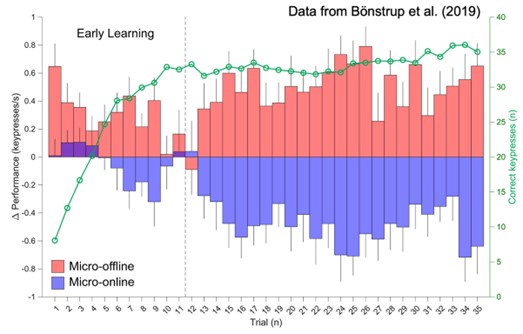
      Evidence documented in that paper (Bonstrup et al., 2020) showed that micro-offline gains during early skill learning were: 1) replicable and generalized to subjects learning the task in their daily living environment (n=389); 2) equivalent when significantly shortening practice period duration, thus confirming that they are not a result of recovery from performance fatigue (n=118); 3) reduced (along with learning rates) by retroactive interference applied immediately after each practice period relative to interference applied after passage of time (n=373), indicating stabilization of the motor memory at a microscale of several seconds consistent with rapid consolidation; and 4) not modified by random termination of the practice periods, ruling out a contribution of predictive motor slowing (N = 71) (Bonstrup et al., 2020). Altogether, our findings were strongly consistent with the interpretation that micro-offline gains reflect memory consolidation supporting early skill learning. This is precisely the portion of the learning curve (Pan & Rickard, 2015) refer to when they state “…rapid learning during that period masks any reactive inhibition effect”.

      This interpretation is further supported by brain imaging evidence linking known memory-related networks and consolidation mechanisms to micro-offline gains. First, we reported that the density of fast hippocampo-neocortical skill memory replay events increases approximately three-fold during early learning inter-practice rest periods with the density explaining differences in the magnitude of micro-offline gains across subjects (Buch et al., 2021). Second, Jacobacci et al. (2020) independently reproduced our original behavioral findings and reported BOLD fMRI changes in the hippocampus and precuneus (regions also identified in our MEG study (Buch et al., 2021)) linked to micro-offline gains during early skill learning. These functional changes were coupled with rapid alterations in brain microstructure in the order of minutes, suggesting that the same network that operates during rest periods of early learning undergoes structural plasticity over several minutes following practice (Deleglise et al., 2023). Crucial to this point, Chen et al. (2024) and Sjøgård et al (2024) provided direct evidence from intracranial EEG in humans linking sharp-wave ripple density during rest periods (which are known markers for neural replay (Buzsaki, 2015)) in the human hippocampus (80-120 Hz) to micro-offline gains during early skill learning.

      Thus, there is now substantial converging evidence in humans across different indirect noninvasive and direct invasive recording techniques linking hippocampal activity, neural replay dynamics and offline performance gains in skill learning.

      On the contrary, recent evidence questions this interpretation (Gupta & Rickard, npj Sci Learn 2022; Gupta & Rickard, Sci Rep 2024; Das et al., bioRxiv 2024). Instead, there is evidence that micro-offline gains are transient performance benefits that emerge when participants train with breaks, compared to participants who train without breaks, however, these benefits vanish within seconds after training if both groups of participants perform under comparable conditions (Das et al., bioRxiv 2024).

      The recent work of (Gupta & Rickard, 2022, 2024) does not present any data that directly opposes our finding that early skill learning (Bonstrup et al., 2019) is expressed as micro-offline gains during rest breaks. These studies are an extension of the Rickard et al (2008) paper that employed a massed (30s practice followed by 30s breaks) vs spaced (10s practice followed by 10s breaks) experimental design to assess if recovery from reactive inhibition effects could account for performance gains measured after several minutes or hours. Gupta & Rickard (2022) added two additional groups (30s practice/10s break and 10s practice/10s break as used in the work from our group). The primary aim of the study was to assess whether it was more likely that changes in performance when retested 5 minutes after skill training (consisting of 12 practice trials for the massed groups and 36 practice trials for the spaced groups) had ended reflected memory consolidation effects or recovery from reactive inhibition effects. The Gupta & Rickard (2024) follow-up paper employed a similar design with the primary difference being that participants performed a fixed number of sequences on each trial as opposed to trials lasting a fixed duration. This was done to facilitate the fitting of a quantitative statistical model to the data.

      To reiterate, neither study included any analysis of micro-online or micro-offline gains and did not include any comparison focused on skill gains during early learning trials (only at retest 5 min later). Instead, Gupta & Rickard (2022), reported evidence for reactive inhibition effects for all groups over much longer training periods than early learning. In fact, we reported the same findings for trials following the early learning period in our original 2019 paper (Bonstrup et al., 2019) (Author response image 4). Please, note that we also reported that cumulative microoffline gains over early learning did not correlate with overnight offline consolidation measured 24 hours later (Bonstrup et al., 2019) (see the Results section and further elaboration in the Discussion). We interpreted these findings as indicative that the mechanisms underlying offline gains over the micro-scale of seconds during early skill learning versus over minutes or hours very likely differ.

      In the recent preprint from (Das et al., 2024), the authors make the strong claim that “micro-offline gains during early learning do not reflect offline learning” which is not supported by their own data. The authors hypothesize that if “micro-offline gains represent offline learning, participants should reach higher skill levels when training with breaks, compared to training without breaks”. The study utilizes a spaced vs. massed practice groups between-subjects design inspired by the reactive inhibition work from Rickard and others to test this hypothesis.

      Crucially, their design incorporates only a small fraction of the training used in other investigations to evaluate early skill learning (Bonstrup et al., 2020; Bonstrup et al., 2019; Brooks et al., 2024; Buch et al., 2021; Deleglise et al., 2023; F. Jacobacci et al., 2020; Mylonas et al., 2024). A direct comparison between the practice schedule designs for the spaced and massed groups in Das et al., and the training schedule all participants experienced in the original Bönstrup et al. (2019) paper highlights this issue as well as several others (Author response image 5):

      Author response image 5.

      This figure shows (A) Comparison of Das et al. Spaced & Massed group training session designs, and the training session design from the original (Bonstrup et al., 2019) paper. Similar to the approach taken by Das et al., all practice is visualized as 10-second practice trials with a variable number (either 0, 1 or 30) of 10-second-long inter-practice rest intervals to allow for direct comparisons between designs. The two key takeaways from this comparison are that (1) the intervention differences (i.e. – practice schedules) between the Massed and Spaced groups from the Das et al. report are extremely small (less than 12% of the overall session schedule) (gaps in the red shaded area) and (2) the overall amount of practice is much less than compared to the design from the original Bönstrup report (Bonstrup et al., 2019) (which has been utilized in several subsequent studies). (B) Group-level learning curve data from Bönstrup et al. (2019) (Bonstrup et al., 2019) is used to estimate the performance range accounted for by the equivalent periods covering Test 1, Training 1 and Test 2 from Das et al (2024). Note that the intervention in the Das et al. study is limited to a period covering less than 50% of the overall learning range (end of figure legend).
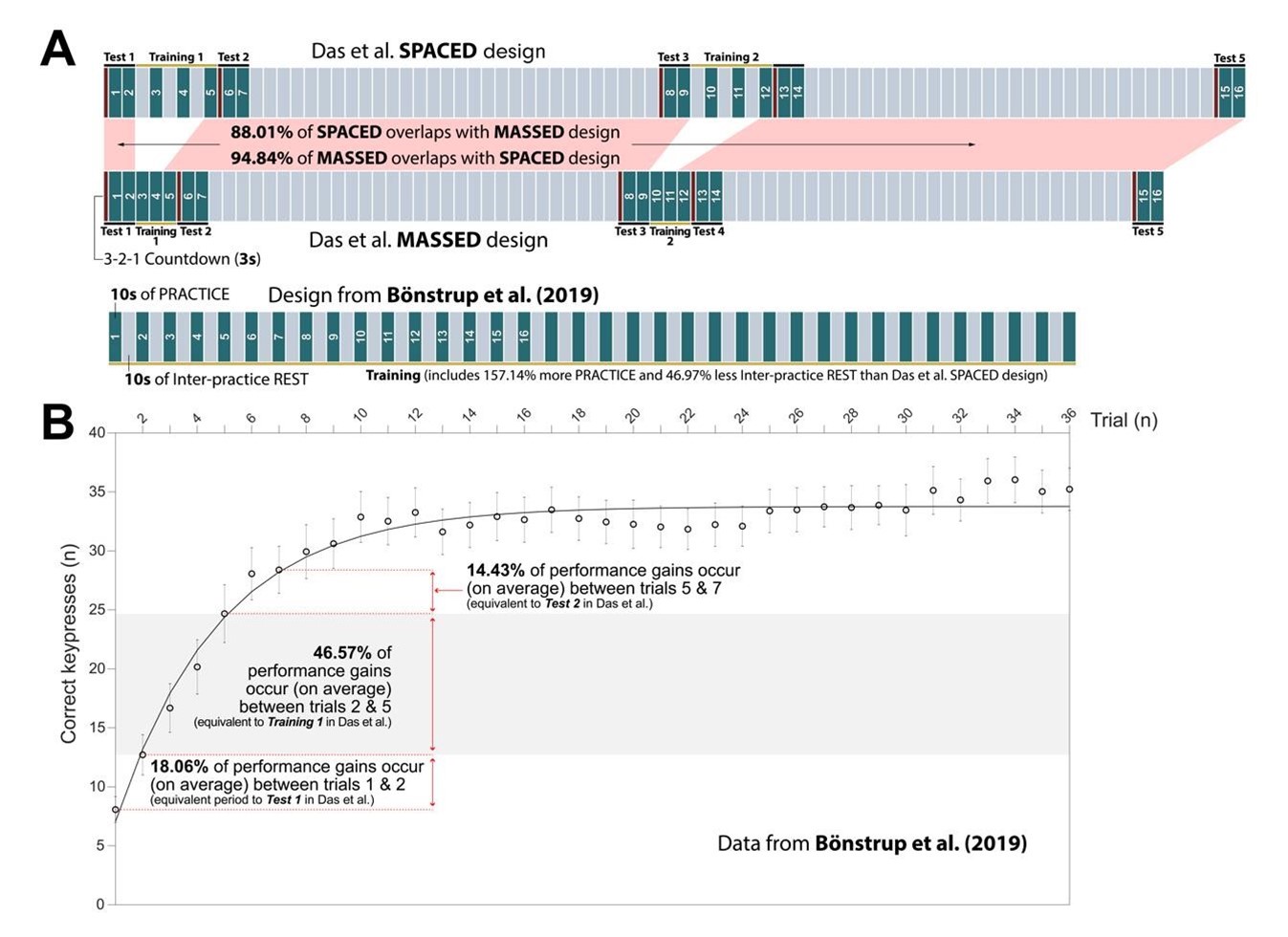
      Participants in the original (Bonstrup et al., 2019) experienced 157.14% more practice time and 46.97% less inter-practice rest time than the Spaced group in the Das et al. study (Author response image 5). Thus, the overall amount of practice and rest differ substantially between studies, with much more limited training occurring for participants in Das et al.

      In addition, the training interventions (i.e. – the practice schedule differences between the Spaced and Massed groups) were designed in a manner that minimized any chance of effectively testing their hypothesis. First, the interventions were applied over an extremely short period relative to the length of the total training session (5% and 12% of the total training session for Massed and Spaced groups, respectively; see gaps in the red shaded area in Author response image 5). Second, the intervention was applied during a period in which only half of the known total learning occurs. Specifically, we know from Bönstrup et al. (2019) that only 46.57% of the total performance gains occur in the practice interval covered by Das et al Training 1 intervention. Thus, early skill learning as evaluated by multiple groups (Bonstrup et al., 2020; Bonstrup et al., 2019; Brooks et al., 2024; Buch et al., 2021; Deleglise et al., 2023; F. Jacobacci et al., 2020; Mylonas et al., 2024), is in the Das et al experiment amputated to about half.

      Furthermore, a substantial amount of learning takes place during Das et al’s Test 1 and Test 2 periods (32.49% of total gains combined). The fact that substantial learning is known to occur over both the Test 1 (18.06%) and Test 2 (14.43%) intervals presents a fundamental problem described by Pan and Rickard (Pan & Rickard, 2015). They reported that averaging over intervals where substantial performance gains occur (i.e. – performance is not stable) inject crucial artefacts into analyses of skill learning:

      “A large amount of averaging has the advantage of yielding more precise estimates of each subject’s pretest and posttest scores and hence more statistical power to detect a performance gain. However, calculation of gain scores using that strategy runs the risk that learning that occurs during the pretest and (or posttest periods (i.e., online learning is incorporated into the gain score (Rickard et al., 2008; Robertson et al., 2004 .”

      The above statement indicates that the Test 1 and Test 2 performance scores from Das et al. (2024) are substantially contaminated by the learning rate within these intervals. This is particularly problematic if the intervention design results in different Test 2 learning rates between the two groups. This in fact, is apparent in their data (Figure 1C,E of the Das et al., 2024 preprint) as the Test 2 learning rate for the Spaced group is negative (indicating a unique interference effect observable only for this group). Specifically, the Massed group continues to show an increase in performance during Test 2 and 4 relative to the last 10 seconds of practice during Training 1 and 2, respectively, while the Spaced group displays a marked decrease. This post-training performance decrease for the Spaced group is in stark contrast to the monotonic performance increases observed for both groups at all other time-points. One possible cause could be related to the structure of the Test intervals, which include 20 seconds of uninterrupted practice. For the Spaced group, this effectively is a switch to a Massed practice environment (i.e., two 10-secondlong practice trials merged into one long trial), which interferes with greater Training 1 interval gains observed for the Space group. Interestingly, when statistical comparisons between the groups are made at the time-points when the intervention is present (Figure 1E) then the stated hypothesis, “If micro-offline gains represent offline learning, participants should reach higher skill levels when training with breaks, compared to training without breaks”, is confirmed.

      In summary, the experimental design and analyses used by Das et al does not contradict the view that early skill learning is expressed as micro-offline gains during rest breaks. The data presented by Gupta and Rickard (2022, 2024) and Das et al. (2024) is in many ways more confirmatory of the constraints employed by our group and others with respect to experimental design, analysis and interpretation of study findings, rather than contradictory. Still, it does highlight a limitation of the current micro-online/offline framework, which was originally only intended to be applied to early skill learning over spaced practice schedules when reactive inhibition effects are minimized (Bonstrup et al., 2019; Pan & Rickard, 2015). Extrapolation of this current framework to postplateau performance periods, longer timespans, or non-learning situations (e.g. – the Nonrepeating groups from Das et al. (2024)), when reactive inhibition plays a more substantive role, is not warranted. Ultimately, it will be important to develop new paradigms allowing one to independently estimate the different coincident or antagonistic features (e.g. - memory consolidation, planning, working memory and reactive inhibition) contributing to micro-online and micro-offline gains during and after early skill learning within a unifying framework.

      Recommendations for the authors:

      Reviewer #1 (Recommendations for the authors):

      (1) I found Figure 2B too small to be useful, as the actual elements of the cells are very hard to read.

      We have removed the grid colormap panel (top-right) from Figure 2B. All of this colormap data is actually a subset of data presented in Figure 2 – figure supplement 1, so can still be found there.

      Reviewer #2 (Recommendations for the authors):

      (1) Related to the first point in my concerns, I would suggest the authors compare decoding accuracy between correct presses followed by correct vs. incorrect presses. This would clarify if the decoder is actually taking the MEG signal for subsequent press into account. I would also suggest the authors use pre-movement MEG features and post-movement features with shorter windows and compare each result with the results for the original post-movement MEG feature with a longer window.

      The present study does not contain enough errors to perform the analysis proposed by the Reviewer. As noted above, we did re-examine our data and now report a new control regression analysis, all of which indicate that the proximity between keypresses does not explain contextualization effects.

      (2) I was several times confused by the author's use of "neural representation of an action" or "sequence action representations" in understanding whether these terms refer to representation on the level of whole-brain, region (as defined by the specific parcellation used), or voxels. In fact, what is submitted to the decoder is some complicated whole-brain MEG feature (i.e., the "neural representation"), which is a hybrid of voxel and parcel features that is further dimension-reduced and not immediately interpretable. Clarifying this point early in the text and possibly using some more sensible terms, such as adding "brain-wise" before the "sequence action representation", would be the most helpful for the readers.

      We now clarified this terminology in the revised manuscript.

      (3) Although comparing many different ways in feature selection/reduction, time window selection, and decoder types is undoubtedly a meticulous work, the current version of the manuscript seems still lacking some explanation about the details of these methodological choices, like which decoding method was actually used to report the accuracy, whether or not different decoding methods were chosen for individual participants' data, how training data was selected (is it all of the correct presses in Day 1 data?), whether the frequency power or signal amplitude was used, and so on. I would highly appreciate these additional details in the Methods section.

      The reported accuracies were based on linear discriminant analysis classifier. A comparison of different decoders (Figure 3 – figure supplement 4) shows LDA was the optimal choice.

      Whether or not different decoding methods were chosen for individual participants' data

      We selected the same decoder (LDA) performance to report the final accuracy.

      How training data was selected (is it all of the correct presses in Day 1 data?),

      Decoder training was conducted as a randomized split of the data (all correct keypresses of Day 1) into training (90%) and test (10%) samples for 8 iterations.

      Whether the frequency power or signal amplitude was used

      Signal amplitude was used for feature calculation.

      (4) In terms of the Methods, please consider adding some references about the 'F1 score', the 'feature importance score,' and the 'MRMR-based feature ranking,' as the main readers of the current paper would not be from the machine learning community. Also, why did the LDA dimensionality reduction reduce accuracy specifically for the voxel feature?

      We have now added the following statements to the Methods section that provide more detailed descriptions and references for these metrics:

      “The F1 score, defined as the harmonic mean of the precision (percentage of true predictions that are actually true positive) and recall (percentage of true positives that were correctly predicted as true) scores, was used as a comprehensive metric for all one-versus-all keypress state decoders to assess class-wise performance that accounts for both false-positive and false-negative prediction tendencies [REF]. A weighted mean F1 score was then computed across all classes to assess the overall prediction performance of the multi-class model.”

      and

      “Feature Importance Scores

      The relative contribution of source-space voxels and parcels to decoding performance (i.e. – feature importance score) was calculated using minimum redundant maximum relevance (MRMR) and highlighted in topography plots. MRMR, an approach that combines both relevance and redundancy metrics, ranked individual features based upon their significance to the target variable (i.e. – keypress state identity) prediction accuracy and their non-redundancy with other features.”

      As stated in the Reviewer responses above, the dimensionality of the voxel-space feature set is very high (i.e. – 15684). LDA attempts to map the input features onto a much smaller dimensional space (number of classes-1; e.g. – 3 dimensions for 4-class keypress decoding). It is likely that the reduction in accuracy observed only for the voxel-space feature was due to the loss of relevant information during the mapping process that resulted in reduced accuracy. This reduction in accuracy for voxel-space decoding was specific to LDA. Figure 3—figure supplement 3 shows that voxel-space decoder performance actually improved when utilizing alternative dimensionality reduction techniques.

      (5) Paragraph 9, lines #139-142: "Notably, decoding associated with index finger keypresses (executed at two different ordinal positions in the sequence) exhibited the highest number of misclassifications of all digits (N = 141 or 47.5% of all decoding errors; Figure 3C), raising the hypothesis that the same action could be differentially represented when executed at different learning state or sequence context locations."

      This does not seem to be a fair comparison, as the index finger appears twice as many as the other fingers do in the sequence. To claim this, proper statistical analysis needs to be done taking this difference into account.

      We thank the Reviewer for bringing this issue to our attention. We have now corrected this comparison to evaluate relative false negative and false positive rates between individual keypress state decoders, and have revised this statement in the manuscript as follows:

      “Notably, decoding of index finger keypresses (executed at two different ordinal positions in the sequence) exhibited the highest false negative (0.116 per keypress) and false positive (0.043 per keypress) misclassification rates compared with all other digits (false negative rate range = [0.067 0.114]; false positive rate range = [0.020 0.037]; Figure 3C), raising the hypothesis that the same action could be differentially represented when executed within different contexts (i.e. - different learning states or sequence locations).”

      (6) Finally, the authors could consider acknowledging in the Discussion that the contribution of micro-offline learning to genuine skill learning is still under debate (e.g., Gupta and Rickard, 2023; 2024; Das et al., bioRxiv, 2024).

      We have added a paragraph in the Discussion that addresses this point.

      Reviewer #3 (Recommendations for the authors):

      In addition to the additional analyses suggested in the public review, I have the following suggestions/questions:

      (1) Given that the authors introduce a new decoding approach, it would be very helpful for readers to see a distribution of window sizes and window onsets eventually used across individuals, at least for the optimized decoder.

      We have now included a new supplemental figure (Figure 4 – figure Supplement 2) that provides this information.

      (2) Please explain in detail how you arrived at the (interpolated?) group-level plot shown in Figure 1B, starting from the discrete single-trial keypress transition times. Also, please specify what the shading shows.

      Instantaneous correct sequence speed (skill measure) was quantified as the inverse of time (in seconds) required to complete a single iteration of a correctly generated full 5-item sequence. Individual keypress responses were labeled as members of correct sequences if they occurred within a 5-item response pattern matching any possible circular shifts of the 5-item sequence displayed on the monitor (41324). This approach allowed us to quantify a measure of skill within each practice trial at the resolution of individual keypresses. The dark line indicates the group mean performance dynamics for each trial. The shaded region indicates the 95% confidence limit of the mean (see Methods).

      (3) Similarly, please explain how you arrived at the group-level plot shown in Figure 1C. What are the different colored lines (rows) within each trial? How exactly did the authors reach the conclusion that KTT variability stabilizes by trial 6?

      Figure 1C provides additional information to the correct sequence speed measure above, as it also tracks individual transition speed composition over learning. Figure 1C, thus, represents both changes in overall correct sequence speed dynamics (indicated by the overall narrowing of the horizontal speed lines moving from top to bottom) and the underlying composition of the individual transition patterns within and across trials. The coloring of the lines is a shading convention used to discriminate between different keypress transitions. These curves were sampled with 1ms resolution, as in Figure 1B. Addressing the underlying keypress transition patterns requires within-subject normalization before averaging across subjects. The distribution of KTTs was normalized to the median correct sequence time for each participant and centered on the mid-point for each full sequence iteration during early learning.

      (4) Maybe I missed it, but it was not clear to me which of the tested classifiers was eventually used. Or was that individualized as well? More generally, a comparison of the different classifiers would be helpful, similar to the comparison of dimension reduction techniques.

      We have now included a new supplemental figure that provides this information.

      (5) Please add df and effect sizes to all statistics.

      Done.

      (6) Please explain in more detail your power calculation.

      The study was powered to determine the minimum sample size needed to detect a significant change in skill performance following training using a one-sample t-test (two-sided; alpha = 0.05; 95% statistical power; Cohen’s D effect size = 0.8115 calculated from previously acquired data in our lab). The calculated minimum sample size was 22. The included study sample size (n = 27) exceeded this minimum.
      This information is now included in the revised manuscript.

      (7) The cut-off for the high-pass filter is unusually high and seems risky in terms of potential signal distortions (de Cheveigne, Neuron 2019). Why did the authors choose such a high cut-off?

      The 1Hz high-pass cut-off frequency for the 1-150Hz band-pass filter applied to the continuous raw MEG data during preprocessing has been used in multiple previous MEG publications (Barratt et al., 2018; Brookes et al., 2012; Higgins et al., 2021; Seedat et al., 2020; Vidaurre et al., 2018).

      (8) "Furthermore, the magnitude of offline contextualization predicted skill gains while online contextualization did not", lines 336/337 - where is that analysis?

      Additional details pertaining to this analysis are now provided in the Results section (Figure 5 – figure supplement 4).
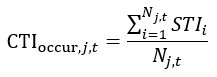
      (9) How were feature importance scores computed?

      We have now added a new subheading in the Methods section with a more detailed description of how feature importance scores were computed.

      (10)  Please add x and y ticks plus tick labels to Figure 5 - Figure Supplement 3, panel A

      Done

      (11) Line 369, what does "comparable" mean in this context?

      The sentence in the “Study Participants” part of the Methods section referred to here has now been revised for clarity.

      (12) In lines 496/497, please specify what t=0 means (KeyDown event, I guess?).

      Yes, the KeyDown event occurs at t = 0. This has now been clarified in the revised manuscript.

      (13) Please specify consistent boundaries between alpha- and beta-bands (they are currently not consistent in the Results vs. Methods (14/15 Hz or 15/16 Hz)).

      We thank the Reviewer for alerting us to this discrepancy caused by a typographic error in the Methods. We have now corrected this so that the alpha (8-14 Hz) and beta-band (15-24 Hz) frequency limits are described consistently throughout the revised manuscript.

      References

      Albouy, G., Fogel, S., King, B. R., Laventure, S., Benali, H., Karni, A., Carrier, J., Robertson, E. M., & Doyon, J. (2015). Maintaining vs. enhancing motor sequence memories: respective roles of striatal and hippocampal systems. Neuroimage, 108, 423-434. https://doi.org/10.1016/j.neuroimage.2014.12.049

      Albouy, G., King, B. R., Maquet, P., & Doyon, J. (2013). Hippocampus and striatum: dynamics and interaction during acquisition and sleep-related motor sequence memory consolidation. Hippocampus, 23(11), 985-1004. https://doi.org/10.1002/hipo.22183 Albouy, G., Sterpenich, V., Vandewalle, G., Darsaud, A., Gais, S., Rauchs, G., Desseilles, M., Boly, M., Dang-Vu, T., Balteau, E., Degueldre, C., Phillips, C., Luxen, A., & Maquet, P. (2012). Neural correlates of performance variability during motor sequence acquisition. NeuroImage, 60(1), 324-331. https://doi.org/10.1016/j.neuroimage.2011.12.049

      Andersen, R. A., & Buneo, C. A. (2002). Intentional maps in posterior parietal cortex. Annu Rev Neurosci, 25, 189-220. https://doi.org/10.1146/annurev.neuro.25.112701.142922 112701.142922 [pii]

      Ashe, J., Lungu, O. V., Basford, A. T., & Lu, X. (2006). Cortical control of motor sequences. Curr Opin Neurobiol, 16(2), 213-221. http://www.ncbi.nlm.nih.gov/entrez/query.fcgi?cmd=Retrieve&db=PubMed&dopt=Citati on&list_uids=16563734

      Bansal, A. K., Vargas-Irwin, C. E., Truccolo, W., & Donoghue, J. P. (2011). Relationships among low-frequency local field potentials, spiking activity, and three-dimensional reach and grasp kinematics in primary motor and ventral premotor cortices. J Neurophysiol, 105(4), 1603-1619. https://doi.org/10.1152/jn.00532.2010

      Barratt, E. L., Francis, S. T., Morris, P. G., & Brookes, M. J. (2018). Mapping the topological organisation of beta oscillations in motor cortex using MEG. NeuroImage, 181, 831-844. https://doi.org/10.1016/j.neuroimage.2018.06.041

      Bassett, D. S., Wymbs, N. F., Porter, M. A., Mucha, P. J., Carlson, J. M., & Grafton, S. T. (2011). Dynamic reconfiguration of human brain networks during learning. Proc Natl Acad Sci U S A, 108(18), 7641-7646. https://doi.org/10.1073/pnas.1018985108

      Battaglia-Mayer, A., & Caminiti, R. (2019). Corticocortical Systems Underlying High-Order Motor Control. J Neurosci, 39(23), 4404-4421. https://doi.org/10.1523/JNEUROSCI.2094-18.2019

      Berlot, E., Popp, N. J., & Diedrichsen, J. (2020). A critical re-evaluation of fMRI signatures of motor sequence learning. Elife, 9. https://doi.org/10.7554/eLife.55241

      Bonstrup, M., Iturrate, I., Hebart, M. N., Censor, N., & Cohen, L. G. (2020). Mechanisms of offline motor learning at a microscale of seconds in large-scale crowdsourced data. NPJ Sci Learn, 5, 7. https://doi.org/10.1038/s41539-020-0066-9

      Bonstrup, M., Iturrate, I., Thompson, R., Cruciani, G., Censor, N., & Cohen, L. G. (2019). A Rapid Form of Offline Consolidation in Skill Learning. Curr Biol, 29(8), 1346-1351 e1344. https://doi.org/10.1016/j.cub.2019.02.049

      Brawn, T. P., Fenn, K. M., Nusbaum, H. C., & Margoliash, D. (2010). Consolidating the effects of waking and sleep on motor-sequence learning. J Neurosci, 30(42), 13977-13982. https://doi.org/10.1523/JNEUROSCI.3295-10.2010

      Brookes, M. J., Woolrich, M. W., & Barnes, G. R. (2012). Measuring functional connectivity in MEG: a multivariate approach insensitive to linear source leakage. NeuroImage, 63(2), 910-920. https://doi.org/10.1016/j.neuroimage.2012.03.048

      Brooks, E., Wallis, S., Hendrikse, J., & Coxon, J. (2024). Micro-consolidation occurs when learning an implicit motor sequence, but is not influenced by HIIT exercise. NPJ Sci Learn, 9(1), 23. https://doi.org/10.1038/s41539-024-00238-6

      Buch, E. R., Claudino, L., Quentin, R., Bonstrup, M., & Cohen, L. G. (2021). Consolidation of human skill linked to waking hippocampo-neocortical replay. Cell Rep, 35(10), 109193. https://doi.org/10.1016/j.celrep.2021.109193

      Buneo, C. A., & Andersen, R. A. (2006). The posterior parietal cortex: sensorimotor interface for the planning and online control of visually guided movements. Neuropsychologia, 44(13), 2594-2606. https://doi.org/10.1016/j.neuropsychologia.2005.10.011

      Buzsaki, G. (2015). Hippocampal sharp wave-ripple: A cognitive biomarker for episodic memory and planning. Hippocampus, 25(10), 1073-1188. https://doi.org/10.1002/hipo.22488

      Chen, P.-C., Stritzelberger, J., Walther, K., Hamer, H., & Staresina, B. P. (2024). Hippocampal ripples during offline periods predict human motor sequence learning. bioRxiv, 2024.2010.2006.614680. https://doi.org/10.1101/2024.10.06.614680

      Churchland, M. M., Cunningham, J. P., Kaufman, M. T., Foster, J. D., Nuyujukian, P., Ryu, S. I., & Shenoy, K. V. (2012). Neural population dynamics during reaching. Nature, 487(7405), 51-56. https://doi.org/10.1038/nature11129

      Classen, J., Liepert, J., Wise, S. P., Hallett, M., & Cohen, L. G. (1998). Rapid plasticity of human cortical movement representation induced by practice. J Neurophysiol, 79(2), 1117-1123. http://www.ncbi.nlm.nih.gov/entrez/query.fcgi?cmd=Retrieve&db=PubMed&dopt=Citati on&list_uids=9463469

      Colclough, G. L., Brookes, M. J., Smith, S. M., & Woolrich, M. W. (2015). A symmetric multivariate leakage correction for MEG connectomes. NeuroImage, 117, 439-448. https://doi.org/10.1016/j.neuroimage.2015.03.071

      Colclough, G. L., Woolrich, M. W., Tewarie, P. K., Brookes, M. J., Quinn, A. J., & Smith, S. M. (2016). How reliable are MEG resting-state connectivity metrics? NeuroImage, 138, 284-293. https://doi.org/10.1016/j.neuroimage.2016.05.070

      Das, A., Karagiorgis, A., Diedrichsen, J., Stenner, M.-P., & Azanon, E. (2024). “Micro-offline gains” convey no benefit for motor skill learning. bioRxiv, 2024.2007.2011.602795. https://doi.org/10.1101/2024.07.11.602795

      Deleglise, A., Donnelly-Kehoe, P. A., Yeffal, A., Jacobacci, F., Jovicich, J., Amaro, E., Jr., Armony, J. L., Doyon, J., & Della-Maggiore, V. (2023). Human motor sequence learning drives transient changes in network topology and hippocampal connectivity early during memory consolidation. Cereb Cortex, 33(10), 6120-6131. https://doi.org/10.1093/cercor/bhac489

      Doyon, J., Bellec, P., Amsel, R., Penhune, V., Monchi, O., Carrier, J., Lehéricy, S., & Benali, H. (2009). Contributions of the basal ganglia and functionally related brain structures to motor learning. [Review]. Behavioural brain research, 199(1), 61-75. https://doi.org/10.1016/j.bbr.2008.11.012

      Doyon, J., Song, A. W., Karni, A., Lalonde, F., Adams, M. M., & Ungerleider, L. G. (2002). Experience-dependent changes in cerebellar contributions to motor sequence learning. Proc Natl Acad Sci U S A, 99(2), 1017-1022. http://www.ncbi.nlm.nih.gov/entrez/query.fcgi?cmd=Retrieve&db=PubMed&dopt=Citati on&list_uids=11805340

      Euston, D. R., Gruber, A. J., & McNaughton, B. L. (2012). The role of medial prefrontal cortex in memory and decision making. Neuron, 76(6), 1057-1070. https://doi.org/10.1016/j.neuron.2012.12.002

      Euston, D. R., Tatsuno, M., & McNaughton, B. L. (2007). Fast-forward playback of recent memory sequences in prefrontal cortex during sleep. Science, 318(5853), 1147-1150. https://doi.org/10.1126/science.1148979

      Flint, R. D., Ethier, C., Oby, E. R., Miller, L. E., & Slutzky, M. W. (2012). Local field potentials allow accurate decoding of muscle activity. J Neurophysiol, 108(1), 18-24. https://doi.org/10.1152/jn.00832.2011

      Frankland, P. W., & Bontempi, B. (2005). The organization of recent and remote memories. Nat Rev Neurosci, 6(2), 119-130. https://doi.org/10.1038/nrn1607

      Gais, S., Albouy, G., Boly, M., Dang-Vu, T. T., Darsaud, A., Desseilles, M., Rauchs, G., Schabus, M., Sterpenich, V., Vandewalle, G., Maquet, P., & Peigneux, P. (2007). Sleep transforms the cerebral trace of declarative memories. Proc Natl Acad Sci U S A, 104(47), 1877818783. https://doi.org/10.1073/pnas.0705454104

      Grafton, S. T., Mazziotta, J. C., Presty, S., Friston, K. J., Frackowiak, R. S., & Phelps, M. E. (1992). Functional anatomy of human procedural learning determined with regional cerebral blood flow and PET. J Neurosci, 12(7), 2542-2548.

      Grover, S., Wen, W., Viswanathan, V., Gill, C. T., & Reinhart, R. M. G. (2022). Long-lasting, dissociable improvements in working memory and long-term memory in older adults with repetitive neuromodulation. Nat Neurosci, 25(9), 1237-1246. https://doi.org/10.1038/s41593-022-01132-3

      Gupta, M. W., & Rickard, T. C. (2022). Dissipation of reactive inhibition is sufficient to explain post-rest improvements in motor sequence learning. NPJ Sci Learn, 7(1), 25. https://doi.org/10.1038/s41539-022-00140-z

      Gupta, M. W., & Rickard, T. C. (2024). Comparison of online, offline, and hybrid hypotheses of motor sequence learning using a quantitative model that incorporate reactive inhibition. Sci Rep, 14(1), 4661. https://doi.org/10.1038/s41598-024-52726-9

      Hardwick, R. M., Rottschy, C., Miall, R. C., & Eickhoff, S. B. (2013). A quantitative metaanalysis and review of motor learning in the human brain. NeuroImage, 67, 283-297. https://doi.org/10.1016/j.neuroimage.2012.11.020

      Heusser, A. C., Poeppel, D., Ezzyat, Y., & Davachi, L. (2016). Episodic sequence memory is supported by a theta-gamma phase code. Nat Neurosci, 19(10), 1374-1380. https://doi.org/10.1038/nn.4374

      Higgins, C., Liu, Y., Vidaurre, D., Kurth-Nelson, Z., Dolan, R., Behrens, T., & Woolrich, M. (2021). Replay bursts in humans coincide with activation of the default mode and parietal alpha networks. Neuron, 109(5), 882-893 e887. https://doi.org/10.1016/j.neuron.2020.12.007

      Hikosaka, O., Nakamura, K., Sakai, K., & Nakahara, H. (2002). Central mechanisms of motor skill learning. Curr Opin Neurobiol, 12(2), 217-222. http://www.ncbi.nlm.nih.gov/entrez/query.fcgi?cmd=Retrieve&db=PubMed&dopt=Citati on&list_uids=12015240

      Jacobacci, F., Armony, J. L., Yeffal, A., Lerner, G., Amaro, E., Jr., Jovicich, J., Doyon, J., & Della-Maggiore, V. (2020). Rapid hippocampal plasticity supports motor sequence learning. Proc Natl Acad Sci U S A, 117(38), 23898-23903. https://doi.org/10.1073/pnas.2009576117

      Jacobacci, F., Armony, J. L., Yeffal, A., Lerner, G., Amaro Jr, E., Jovicich, J., Doyon, J., & DellaMaggiore, V. (2020). Rapid hippocampal plasticity supports motor sequence learning.

      Proceedings of the National Academy of Sciences, 117(38), 23898-23903. Karni, A., Meyer, G., Jezzard, P., Adams, M. M., Turner, R., & Ungerleider, L. G. (1995). Functional MRI evidence for adult motor cortex plasticity during motor skill learning. Nature, 377(6545), 155-158. https://doi.org/10.1038/377155a0

      Kennerley, S. W., Sakai, K., & Rushworth, M. F. (2004). Organization of action sequences and the role of the pre-SMA. J Neurophysiol, 91(2), 978-993. https://doi.org/10.1152/jn.00651.2003 00651.2003 [pii]

      Kleim, J. A., Barbay, S., & Nudo, R. J. (1998). Functional reorganization of the rat motor cortex following motor skill learning. J Neurophysiol, 80, 3321-3325.

      Kornysheva, K., Bush, D., Meyer, S. S., Sadnicka, A., Barnes, G., & Burgess, N. (2019). Neural Competitive Queuing of Ordinal Structure Underlies Skilled Sequential Action. Neuron, 101(6), 1166-1180 e1163. https://doi.org/10.1016/j.neuron.2019.01.018

      Lee, S. H., Jin, S. H., & An, J. (2019). The difference in cortical activation pattern for complex motor skills: A functional near- infrared spectroscopy study. Sci Rep, 9(1), 14066. https://doi.org/10.1038/s41598-019-50644-9

      Lisman, J. E., & Jensen, O. (2013). The theta-gamma neural code. Neuron, 77(6), 1002-1016. https://doi.org/10.1016/j.neuron.2013.03.007

      Mollazadeh, M., Aggarwal, V., Davidson, A. G., Law, A. J., Thakor, N. V., & Schieber, M. H. (2011). Spatiotemporal variation of multiple neurophysiological signals in the primary motor cortex during dexterous reach-to-grasp movements. J Neurosci, 31(43), 15531-15543. https://doi.org/10.1523/JNEUROSCI.2999-11.2011

      Molle, M., & Born, J. (2009). Hippocampus whispering in deep sleep to prefrontal cortex--for good memories? Neuron, 61(4), 496-498. https://doi.org/10.1016/j.neuron.2009.02.002

      Morris, R. G. M. (2006). Elements of a neurobiological theory of hippocampal function: the role of synaptic plasticity, synaptic tagging and schemas. [Review]. The European journal of neuroscience, 23(11), 2829-2846. https://doi.org/10.1111/j.1460-9568.2006.04888.x

      Mylonas, D., Schapiro, A. C., Verfaellie, M., Baxter, B., Vangel, M., Stickgold, R., & Manoach, D. S. (2024). Maintenance of Procedural Motor Memory across Brief Rest Periods Requires the Hippocampus. J Neurosci, 44(14). https://doi.org/10.1523/JNEUROSCI.1839-23.2024

      Pan, S. C., & Rickard, T. C. (2015). Sleep and motor learning: Is there room for consolidation? Psychol Bull, 141(4), 812-834. https://doi.org/10.1037/bul0000009

      Penhune, V. B., & Steele, C. J. (2012). Parallel contributions of cerebellar, striatal and M1 mechanisms to motor sequence learning. Behav. Brain Res., 226(2), 579-591. https://doi.org/10.1016/j.bbr.2011.09.044

      Qin, Y. L., McNaughton, B. L., Skaggs, W. E., & Barnes, C. A. (1997). Memory reprocessing in corticocortical and hippocampocortical neuronal ensembles. Philos Trans R Soc Lond B Biol Sci, 352(1360), 1525-1533. https://doi.org/10.1098/rstb.1997.0139

      Rickard, T. C., Cai, D. J., Rieth, C. A., Jones, J., & Ard, M. C. (2008). Sleep does not enhance motor sequence learning. J Exp Psychol Learn Mem Cogn, 34(4), 834-842. https://doi.org/10.1037/0278-7393.34.4.834

      Robertson, E. M., Pascual-Leone, A., & Miall, R. C. (2004). Current concepts in procedural consolidation. Nat Rev Neurosci, 5(7), 576-582. http://www.ncbi.nlm.nih.gov/entrez/query.fcgi?cmd=Retrieve&db=PubMed&dopt=Citati on&list_uids=15208699

      Sawamura, D., Sakuraba, S., Suzuki, Y., Asano, M., Yoshida, S., Honke, T., Kimura, M., Iwase, Y., Horimoto, Y., Yoshida, K., & Sakai, S. (2019). Acquisition of chopstick-operation skills with the non-dominant hand and concomitant changes in brain activity. Sci Rep, 9(1), 20397. https://doi.org/10.1038/s41598-019-56956-0

      Schendan, H. E., Searl, M. M., Melrose, R. J., & Stern, C. E. (2003). An FMRI study of the role of the medial temporal lobe in implicit and explicit sequence learning. Neuron, 37(6), 1013-1025. https://doi.org/10.1016/s0896-6273(03)00123-5

      Seedat, Z. A., Quinn, A. J., Vidaurre, D., Liuzzi, L., Gascoyne, L. E., Hunt, B. A. E., O'Neill, G. C., Pakenham, D. O., Mullinger, K. J., Morris, P. G., Woolrich, M. W., & Brookes, M. J. (2020). The role of transient spectral 'bursts' in functional connectivity: A magnetoencephalography study. NeuroImage, 209, 116537. https://doi.org/10.1016/j.neuroimage.2020.116537

      Shadmehr, R., & Holcomb, H. H. (1997). Neural correlates of motor memory consolidation. Science, 277, 821-824.

      Sjøgård, M., Baxter, B., Mylonas, D., Driscoll, B., Kwok, K., Tolosa, A., Thompson, M., Stickgold, R., Vangel, M., Chu, C., & Manoach, D. S. (2024). Hippocampal ripples mediate motor learning during brief rest breaks in humans. bioRxiv. https://doi.org/10.1101/2024.05.02.592200

      Srinivas, S., Sarvadevabhatla, R. K., Mopuri, K. R., Prabhu, N., Kruthiventi, S. S. S., & Babu, R. V. (2016). A Taxonomy of Deep Convolutional Neural Nets for Computer Vision [Technology Report]. Frontiers in Robotics and AI, 2. https://doi.org/10.3389/frobt.2015.00036

      Sterpenich, V., Albouy, G., Darsaud, A., Schmidt, C., Vandewalle, G., Dang Vu, T. T., Desseilles, M., Phillips, C., Degueldre, C., Balteau, E., Collette, F., Luxen, A., & Maquet, P. (2009). Sleep promotes the neural reorganization of remote emotional memory. J Neurosci, 29(16), 5143-5152. https://doi.org/10.1523/JNEUROSCI.0561-09.2009

      Toni, I., Ramnani, N., Josephs, O., Ashburner, J., & Passingham, R. E. (2001). Learning arbitrary visuomotor associations: temporal dynamic of brain activity. Neuroimage, 14(5), 10481057. http://www.ncbi.nlm.nih.gov/entrez/query.fcgi?cmd=Retrieve&db=PubMed&dopt=Citati on&list_uids=11697936

      Toni, I., Thoenissen, D., & Zilles, K. (2001). Movement preparation and motor intention. NeuroImage, 14(1 Pt 2), S110-117. https://doi.org/10.1006/nimg.2001.0841

      Tse, D., Langston, R. F., Kakeyama, M., Bethus, I., Spooner, P. A., Wood, E. R., Witter, M. P., & Morris, R. G. (2007). Schemas and memory consolidation. Science, 316(5821), 76-82. https://doi.org/10.1126/science.1135935

      van Kesteren, M. T., Fernandez, G., Norris, D. G., & Hermans, E. J. (2010). Persistent schemadependent hippocampal-neocortical connectivity during memory encoding and postencoding rest in humans. Proc Natl Acad Sci U S A, 107(16), 7550-7555. https://doi.org/10.1073/pnas.0914892107

      van Kesteren, M. T., Ruiter, D. J., Fernandez, G., & Henson, R. N. (2012). How schema and novelty augment memory formation. Trends Neurosci, 35(4), 211-219. https://doi.org/10.1016/j.tins.2012.02.001

      Vidaurre, D., Hunt, L. T., Quinn, A. J., Hunt, B. A. E., Brookes, M. J., Nobre, A. C., & Woolrich, M. W. (2018). Spontaneous cortical activity transiently organises into frequency specific phase-coupling networks. Nat Commun, 9(1), 2987. https://doi.org/10.1038/s41467-01805316-z

      Wagner, A. D., Schacter, D. L., Rotte, M., Koutstaal, W., Maril, A., Dale, A. M., Rosen, B. R., & Buckner, R. L. (1998). Building memories: remembering and forgetting of verbal experiences as predicted by brain activity. [Comment]. Science (New York, N.Y.), 281(5380), 1188-1191. http://eutils.ncbi.nlm.nih.gov/entrez/eutils/elink.fcgi?dbfrom=pubmed&id=9712582 &retmode=ref&cmd=prlinks

      Wolpert, D. M., Goodbody, S. J., & Husain, M. (1998). Maintaining internal representations: the role of the human superior parietal lobe. Nat Neurosci, 1(6), 529-533. https://doi.org/10.1038/2245