for - why LLM memory still fails
2,712 Matching Annotations
- Oct 2025
-
-
- Sep 2025
-
arxiv.org arxiv.org
-
LLM-assisted essay writing
neurological study of LLMs on writing and impacts
Tags
Annotators
URL
-
- Aug 2025
-
newsnationnow.com newsnationnow.com
-
Companies have invested billions into AI, 95 percent getting zero return
MIT report: 95% of companies see no profit from investments in generative AI, which amounted to approximately $35 billion.
Most AI pilots have no measurable impact on company profits. Attempts to implement tools like ChatGPT into the workplace primarily increase the productivity of individual employees, not the earnings of the entire company.
-
-
blog.joinmastodon.org blog.joinmastodon.org
-
Rewrote the keyboard shortcut code to remove an unmaintained dependency — PR #35425 (by diondiondion)
GitHub Copilot's explanation of this checkout seemed rather impressive to me:
At checkout 35425 in the Mastodon repository, the former implementation of keyboard shortcuts, which relied on the third-party library
react-hotkeys, has been replaced by a custom React-based solution. Here is a detailed breakdown of the technologies and architectural patterns now used:
1. Custom React Hook and Component
- File Introduced:
app/javascript/mastodon/components/hotkeys/index.tsx- Key Elements:
- A custom React hook (
useHotkeys) and a component (Hotkeys) have been implemented to handle keyboard shortcut logic directly within the application. - This solution leverages React's built-in hooks (
useEffect,useRef) for event handling and state management.
2. TypeScript for Type Safety
- TypeScript Usage:
- The new implementation is written in TypeScript, providing stronger type safety and maintainability.
- For example, handler maps are strongly typed, and key matcher logic uses TypeScript types for clarity and correctness.
3. Utility Functions for Key Handling
- File Introduced:
app/javascript/mastodon/components/hotkeys/utils.ts- Features:
- Utility functions such as
normalizeKeyand type guards likeisKeyboardEventhelp standardize and robustly handle keyboard events across browsers.
4. Storybook Integration for Testing
- File Introduced:
app/javascript/mastodon/components/hotkeys/hotkeys.stories.tsx- Purpose:
- A Storybook story is included for interactive demonstration and testing of the hotkeys component.
- This enables developers to visually and functionally verify the keyboard shortcut system in isolation.
5. Removal of
react-hotkeys- The dependency on
react-hotkeysis removed frompackage.jsonand corresponding imports are replaced by the new local implementation throughout the codebase.
6. Architectural Improvements
- Matching Logic:
- Hotkey matching logic now supports single-key, combo (modifier + key), and sequence (multi-key) shortcuts, with prioritization for conflict resolution.
- Global vs. Local Scoping:
- The custom component allows for both globally-scoped shortcuts (listening on the document) and locally-scoped ones (within a React component subtree).
- Accessibility:
- The new approach explicitly avoids triggering shortcuts in
<input>,<textarea>, and<select>elements, enhancing usability and accessibility.
7. Modern React Patterns
- The hook-based and functional component design aligns with modern React development best practices, reducing reliance on class components and third-party abstractions.
Summary Table
| Old Tech (Removed) | New Tech (Introduced) | |----------------------------|-----------------------------------------------| |
react-hotkeys(NPM lib) | Custom React hook/component (Hotkeys) | | JavaScript (in places) | TypeScript | | Third-party event handling | Native DOM/React event handling & utilities | | External matching | App-specific matcher logic (TypeScript) | | No isolated test UI | Storybook-based playground |
References:
- hotkeys/index.tsx (new custom logic)
- hotkeys/utils.ts (key normalization, event guards)
- hotkeys/hotkeys.stories.tsx (Storybook)
In summary:<br /> The Mastodon project at this commit has migrated from a third-party keyboard shortcut library (
react-hotkeys) to a modern, TypeScript-based, locally developed React solution for keyboard shortcut management, offering improved flexibility, maintainability, and testability.
-
- Jul 2025
-
www.nature.com www.nature.com
-
user-friendly web-based platform Pathogenwatch, which facilitates species identification, molecular typing, and antimicrobial resistance (AMR) prediction
Checkout this web-gui tool. Claims "minimal bioinformatic expertise"
-
-
adamunikowsky.substack.com adamunikowsky.substack.com
-
Automating oral argument
A Harvard Law graduate who argued before the Supreme Court fed his case briefs into Claude 4 Opus and had it answer the same questions the Justices posed to him. The AI delivered what he called an "outstanding oral argument" with coherent answers and clever responses he hadn't considered, leading him to conclude that AI lawyers could soon outperform even top human advocates at oral argument.
Tags
Annotators
URL
-
- Apr 2025
-
magazine.rice.edu magazine.rice.edu
-
By writing a paper, you’re going to have to take all these bits of evidence into account, weigh them and figure out how to articulate them correctly. That’s a process of character building
Why chatGPT can't replace writing
Tags
Annotators
URL
-
- Mar 2025
-
www.techradar.com www.techradar.com
-
The analysis uncovered an average of 11 different types of data out of the 35 possible. As mentioned earlier, Google Gemini stands out as the most data-hungry service, collecting 22 of these data types, including highly sensitive data like precise location, user content, the device's contacts list, browsing history, and more.Among the analyzed applications, only Google Gemini, Copilot, and Perplexity were found to collect precise location data. The controversial DeepSeek chatbot stands right in the middle, collecting 11 unique types of data, such as user input like chat history.
-
-
www.microsoft.com www.microsoft.com
-
Hao-Ping (Hank) Lee, Advait Sarkar, Lev Tankelevitch, Ian Drosos, Sean Rintel, Richard Banks, and Nicholas Wilson. 2025. The Impact of Generative AI on Critical Thinking: Self-Reported Reductions in Cognitive Effort and Confidence Effects From a Survey of Knowledge Workers. In CHI Conference on Human Factors in Computing Systems (CHI ’25), April 26–May 01, 2025, Yokohama, Japan. ACM, New York, NY, USA, 23 pages. https://doi.org/10.1145/3706598.3713778
Abstract
The rise of Generative AI (GenAI) in knowledge workflows raises questions about its impact on critical thinking skills and practices. We survey 319 knowledge workers to investigate 1) when and how they perceive the enaction of critical thinking when using GenAI, and 2) when and why GenAI affects their effort to do so. Participants shared 936 first-hand examples of using GenAI in work tasks. Quantitatively, when considering both task- and user-specific factors, a user’s task-specific self-confidence and confidence in GenAI are predictive of whether critical thinking is enacted and the effort of doing so in GenAI-assisted tasks. Specifically, higher confidence in GenAI is associated with less critical thinking, while higher self-confidence is associated with more critical thinking. Qualitatively, GenAI shifts the nature of critical thinking toward information verification, response integration, and task stewardship. Our insights reveal new design challenges and opportunities for developing GenAI tools for knowledge work
-
-
github.com github.com
-
The different types of agents Now that we have a general definition of AI Agents, let us look at some specific agent types and how they would be applied to a travel booking AI agent.
-
-
github.com github.com
-
システム - エージェントを単一のコンポーネントとしてではなく、複数のコンポーネントから成るシステムとして考えることが重要です。AIエージェントの基本的な構成要素は以下の通りです: 環境 - AIエージェントが動作する定義された空間。例えば、旅行予約のAIエージェントの場合、環境はエージェントがタスクを完了するために使用する旅行予約システムとなります。 センサー - 環境には情報があり、フィードバックを提供します。AIエージェントはセンサーを使用して、環境の現在の状態に関する情報を収集・解釈します。旅行予約エージェントの例では、ホテルの空室状況や航空券の価格などの情報を旅行予約システムから取得します。 アクチュエーター - AIエージェントが環境の現在の状態を受け取った後、そのタスクに応じて環境を変化させるためにどのようなアクションを実行するかを決定します。旅行予約エージェントの場合、ユーザーのために空室を予約するアクションが該当します。
-
AIエージェントは、大規模言語モデル(LLM) に ツールや知識へのアクセス を提供し、その能力を拡張することで アクションを実行 できるようにする システム です。
-
- Feb 2025
-
www.anthropic.com www.anthropic.com
-
Cursor noted Claude is once again best-in-class for real-world coding tasks, with significant improvements in areas ranging from handling complex codebases to advanced tool use. Cognition found it far better than any other model at planning code changes and handling full-stack updates. Vercel highlighted Claude’s exceptional precision for complex agent workflows, while Replit has successfully deployed Claude to build sophisticated web apps and dashboards from scratch, where other models stall. In Canva’s evaluations, Claude consistently produced production-ready code with superior design taste and drastically reduced errors.
Claude 3.7 Sonnet again excels at coding, as verified by multiple teams
-
In extended thinking mode, it self-reflects before answering, which improves its performance on math, physics, instruction-following, coding, and many other tasks.
About Claude 3.7 Sonnet
Tags
Annotators
URL
-
-
arstechnica.com arstechnica.com
-
Programming Language for LLMs.
What would a programming language designto make programming easier for LLMs look like.
Suggested analogy: RISC architecture assembler not feasible for humans to write, so compilers created for them.
RISC architecture for language and libraries (in potential new programming language) be fundamental in way that human cannot keep track of everything, but LLM could write program for it.
Reasons: Validating LLM output is easier/possible. Make things less brittle. Make things more adaptive.
Suggestion: Reduced Intruction set programming language with mall libraires. (no syntactic sugar)
-
-
aiguide.substack.com aiguide.substack.com
-
If robust general-purpose reasoning abilities have emerged in LLMs, this bolsters the claim that such systems are an important step on the way to trustworthy general intelligence.
-
While large language models (LLMs) are not explicitly trained to reason, they have exhibited “emergent” behaviors that sometimes look like reasoning.
-
The word “reasoning” is an umbrella term that includes abilities for deduction, induction, abduction, analogy, common sense, and other “rational” or systematic methods for solving problems. Reasoning is often a process that involves composing multiple steps of inference.
-
LLMs are substantially better at solving problems that involve terms or concepts that appear more frequently in their training data, leading to the hypothesis that LLMs do not perform robust abstract reasoning to solve problems, but instead solve problems (at least in part) by identifying patterns in their training data that match, or are similar to, or are otherwise related to the text of the prompts they are given.
-
[Memorization and reasoning are] not a dichotomy, but rather they can co-exist in a continuum.
Tags
Annotators
URL
-
- Jan 2025
-
openreview.net openreview.net
-
MAPPING SOCIAL CHOICE THEORY TO RLHF Jessica Dai and Eve Fleisig ICLR Workshop on Reliable and Responsible Foundation Models 2024
Nice overview of how social choice theory has been connected to RLHF and AI alignment ideas.
Tags
Annotators
URL
-
-
medium.com medium.com
-
Take aways: AI will become cheaper and more efficient. - closed source models can cache responses and save computations for repetitive queries - closed source also has possibility of iterative improvements using constant reinforcement learning. - Prioritizing capabilities and deliberate strategy in data selection, carefully designed training objectives.
-
-
x.com x.com
-
How to pick a LLM (Jan 2025): — Claude Sonnet is my daily driver. Fast, great writing and great code. — o1 / o1 pro for complex reasoning tasks (tough refactor) — Deepseek v3 for fast cheap API / 4-o replacement — Gemini for ultra long context, Flash and video understanding
Tags
Annotators
URL
-
-
www.nytimes.com www.nytimes.com
-
Critics of A.I. use by religious leaders have pointed to the issue of hallucinations — times when chatbots make stuff up. While harmless in certain situations, faith-based A.I. tools that fabricate religious scripture present a serious problem. In Rabbi Bot’s sermon, for instance, the A.I. invented a quote from the Jewish philosopher Maimonides that would have passed as authentic to the casual listener.
LLM Confabulation of Religious Ideas
-
-
news.mlops.community news.mlops.community
-
Really good PMs and engineers will actually start to converge. With LLMs, coding won't be enough to differentiate as an engineer, you'll need to think about the product, business KPIs, strategy etc. You need to think about solutions to problems, not software tools. And PMs are going to be expected to get more technical.
MLOps prediction for 2025
-
Improved GPU utilization, better LLM storage solutions, and prompt caching features in deployment tools like KServe will continue to make it more accessible to deploy a variety of models.
MLOps prediction for 2025
-
People will use LLMs for simpler tasks, not more complex ones.
MLOps prediction for 2025
-
We’ll also see a big surge in the use of buzzword-heavy AI concepts like Retrieval-Augmented Generation (RAG) systems, generative AI, and cloud-based AI products, all of which will become easier to use and, hopefully, cheaper, thereby driving further broad adoption.
RAG will shine even more in 2025
-
-
-
The concept of RAG is relatively straightforward. It involves two main components: a document retriever and a large language model (LLM). The document retriever is responsible for finding relevant information from a large corpus of documents based on the input question using semantic search. This information is then passed to the LLM, which generates a response. The unique aspect of RAG is the way it combines these two components. Instead of retrieving documents and then generating a response in two separate steps, RAG uses a joint process where the document retrieval and response generation steps are connected. This allows the model to consider multiple documents simultaneously when generating a response, leading to more accurate and contextually relevant outputs.
Simple definition of RAG
-
- Dec 2024
-
docs.openwebui.com docs.openwebui.com
-
-
www.continue.dev www.continue.devContinue1
-
-
media.dltj.org media.dltj.org
-
In fourth generation warfare, seen here on the right, the direct control of the bots is replaced with AI. Using AI we can define artificial personalities with artificial social media behaviour, that will make it increasingly difficult to detect the bots.
"Artificial Intelligent Personalities", forth generation warfare
-
- Nov 2024
-
-
Data scientists, MLOps engineers, or AI developers, can mount large language model weights or machine learning model weights in a pod alongside a model-server, so that they can efficiently serve them without including them in the model-server container image. They can package these in an OCI object to take advantage of OCI distribution and ensure efficient model deployment. This allows them to separate the model specifications/content from the executables that process them.
The introduction of the Image Volume Source feature in Kubernetes 1.31 allows MLOps practitioners to mount OCI-compatible artifacts, such as large language model weights or machine learning models, directly into pods without embedding them in container images. This streamlines model deployment, enhances efficiency, and leverages OCI distribution mechanisms for effective model management.
-
- Sep 2024
-
metagov.org metagov.org
-
https://metagov.org/projects/koi-pond
Metagov's KOI (Knowledge Organization Infrastructure) is a graph database that supports relationships between knowledge objects, users, and groups within Metagov. via JM
-
-
baoyu.io baoyu.io
-
可以通过构建一个更大的概率矩阵来改进模型的预测。为了使用两个 Token 的上下文窗口,需要增加额外的表行,这些行代表所有可能的两个 Token 序列。在示例中使用的五个 Token 中,每一对 Token 将在概率表中新增 25 行,加上已经存在的 5 个单 Token 行。
现在假设我训练了['I', 'you', 'like', 'apples', 'bananas']这五个词元,那么我的概率表是一个5×5的表,这里我的上下文窗口是1个token,如果我现在要把上下文窗口设置为2个token,为什么说增加上下文窗口会增加概率表格行?
您提出了一个很好的问题。让我来详细解释一下为什么增加上下文窗口会增加概率表的行数。
首先,让我们明确一下两种情况:
-
上下文窗口为1个token的情况: 在这种情况下,您的概率表确实是一个5×5的表格。每一行代表一个可能的前一个token,每一列代表下一个可能的token。
-
上下文窗口为2个token的情况: 这种情况下,概率表的结构会发生变化。让我解释为什么:
当上下文窗口增加到2个token时,我们实际上是在考虑所有可能的两个词的组合作为"前文"。对于您给出的5个词元,可能的两词组合数量是:5 × 5 = 25。
这意味着我们的概率表现在需要25行,而不是原来的5行。每一行代表一个可能的两词组合,而列仍然是5,代表可能的下一个词。
例如,概率表可能看起来像这样:
``` 前两个词 | I | you | like | apples | bananas
I I | ... | ... | ... | ... | ... I you | ... | ... | ... | ... | ... I like | ... | ... | ... | ... | ... ... bananas I | ... | ... | ... | ... | ... bananas you | ... | ... | ... | ... | ... ... ```
这个表格现在有25行(所有可能的两词组合)和5列(下一个可能的词)。
所以,当我们说"增加上下文窗口会增加概率表格的行"时,我们指的是: - 对于n个词元和k个token的上下文窗口,概率表的行数将是n^k。 - 列数始终保持为n,因为它代表可能的下一个词。
这就解释了为什么增加上下文窗口会显著增加概率表的大小,特别是行数。这也是为什么大型语言模型需要如此大的计算资源和复杂的架构来处理长上下文。
-
-
- Jun 2024
-
useanything.com useanything.com
Tags
Annotators
URL
-
- May 2024
-
media.dltj.org media.dltj.org
-
why training artificial intelligence in research context is and should continue to be a fair use
Examination of AI training relative to the four factors of fair use
-
three different issues that are being implicated by artificial intelligence. And this is true with, you know, all artificial intelligence, not just a generative but particularly generative.
Three issues implicated by Generative AI
- Does ingestion for training AI constitute infringement?
- Does the output infringe?
- Is the output copyrightable?
The answer is different in different jurisdictions.
-
Handling Academic Copyright and Artificial Intelligence Research Questions as the Law Develops
Spring 2024 Member Meeting: CNI website • YouTube
Jonathan Band Copyright Attorney Counsel to the Library Copyright Alliance
Timothy Vollmer Scholarly Communication & Copyright Librarian University of California, Berkeley
The United States Copyright Office and courts in many United States jurisdictions are struggling to address complex copyright issues related to the use of generative artificial intelligence (AI). Meanwhile, academic research using generative AI is proliferating at a fast pace and researchers still require legal guidance on which sources they may use, how they can train AI legally, and whether the reproduction of source material will be considered infringing. The session will include discussion of current perspectives on copyright and generative AI in academic research.
-
-
media.dltj.org media.dltj.org
-
So how does this work? I wanted to give this picture of what's actually happening behind the scenes, especially with this question and answer. So first, I will say that we're using a combination of OpenAI's GPT 3.5 to do this as well as some open source, smaller open source models to generate the vectors for the semantic search.
JSTOR implements a RAG
-
-
arxiv.org arxiv.org
-
Our core assumption is that foundational models, having been extensively trained in English texts, possess a substantial level of understanding and reasoning capabilities. Transferring these capabilities from English to another language, such as Korean, could be more efficient than developing performance from standalone Korean pre-training.
Hipótesis: Transferencia de conocimientos de Ingles a nuevo lenguaje
-
- Apr 2024
-
garymarcus.substack.com garymarcus.substack.com
-
Author suggests the improvement of LLMs is flattening. E.g. points to the closing gap between proprietary and open source models out there, while improvement of proprietary stuff is diminishing or no longer happening (OpenAI progress flatlined 13 months ago it seems). In comment someone points to https://arxiv.org/abs/2404.04125 which implies a hard upper limit in improvement
Tags
Annotators
URL
-
-
theaidigest.org theaidigest.org
-
The same LM can be a much more or less capable agent depending on the enhancements added. The researchers created and tested four different agents built on top of GPT-4 and Anthropic’s Claude:
While today’s LMs agents don't pose a serious risk, we should be on the lookout for improved autonomous capabilities as LMs get more capable and reliable.
-
The latest GPT-4 model from OpenAI, which is trained on human preferences using a technique called RLHFEstimated final training run compute cost: ~$50mModel version: gpt-4-0613
~$50m = estimated training cost of GPT-4
Tags
Annotators
URL
-
-
austinhenley.com austinhenley.com
-
Additionally, students in the Codex group were more eager and excited to continue learning about programming, and felt much less stressed and discouraged during the training.
Programming with LLM = less stress
-
On code-authoring tasks, students in the Codex group had a significantly higher correctness score (80%) than the Baseline (44%), and overall finished the tasks significantly faster. However, on the code-modifying tasks, both groups performed similarly in terms of correctness, with the Codex group performing slightly better (66%) than the Baseline (58%).
In a study, students who learned to code with AI made more progress during training sessions, had significantly higher correctness scores, and retained more of what they learned compared to students who didn't learn with AI.
Tags
Annotators
URL
-
- Feb 2024
-
simonwillison.net simonwillison.net
-
[[Lee Bryant]] links to this overview by Simon Willison of what happened in #2023/ in #AI . Some good pointers wrt [[ChatPKM myself]] dig those out.
Tags
Annotators
URL
-
- Jan 2024
-
www.wired.com www.wired.com
-
Santosh Vempala, a computer science professor at Georgia Tech, has also studied hallucinations. “A language model is just a probabilistic model of the world,” he says, not a truthful mirror of reality. Vempala explains that an LLM’s answer strives for a general calibration with the real world—as represented in its training data—which is “a weak version of accuracy.” His research, published with OpenAI’s Adam Kalai, found that hallucinations are unavoidable for facts that can’t be verified using the information in a model’s training data.
“A language model is just a probabilistic model of the world”
Hallucinations are a result of an imperfect model, or attempting answers without the necessary data in the model.
-
-
spectrum.ieee.org spectrum.ieee.org
-
Moreover, Midjourney apparently sought to suppress our findings, banning Southen from its service (without even a refund of his subscription fee) after he reported his first results, and again after he created a new account from which additional results were reported. It then apparently changed its terms of service just before Christmas by inserting new language: “You may not use the Service to try to violate the intellectual property rights of others, including copyright, patent, or trademark rights. Doing so may subject you to penalties including legal action or a permanent ban from the Service.” This change might be interpreted as discouraging or even precluding the important and common practice of red-team investigations of the limits of generative AI—a practice that several major AI companies committed to as part of agreements with the White House announced in 2023. (Southen created two additional accounts in order to complete this project; these, too, were banned, with subscription fees not returned.)
Midjourney bans researchers and changes terms of service
-
One user on X pointed to the fact that Japan has allowed AI companies to train on copyright materials. While this observation is true, it is incomplete and oversimplified, as that training is constrained by limitations on unauthorized use drawn directly from relevant international law (including the Berne Convention and TRIPS agreement). In any event, the Japanese stance seems unlikely to be carry any weight in American courts.
Specifics in Japan for training LLMs on copyrighted material
-
After a bit of experimentation (and in a discovery that led us to collaborate), Southen found that it was in fact easy to generate many plagiaristic outputs, with brief prompts related to commercial films (prompts are shown).
Plagiaristic outputs from blockbuster films in Midjourney v6
Was the LLM trained on copyrighted material?
-
We will call such near-verbatim outputs “plagiaristic outputs,” because if a human created them we would call them prima facie instances of plagiarism.
Defining “plagiaristic outputs”
-
-
cs3110.github.io cs3110.github.io
-
| Friday -> Monday | Saturday -> Monday | Sunday -> Monday
I asked ChatGPT to complete my test case, just for the fun of it, and it insited that after the each of the weekend days the next day was Monday. I had to "reason" it out of that believe. Now I know why, it was trained on this book as well.
https://cloud.typingmind.com/share/40f33bcf-c85c-4e14-9b68-79fbcc61c096
Tags
Annotators
URL
-
-
explainextended.com explainextended.com
-
https://web.archive.org/web/20240106230221/https://explainextended.com/2023/12/31/happy-new-year-15/
This seems a very good explainer for how LLMs and GPTs work. And all in 500 lines of sql :D
Tags
Annotators
URL
-
- Dec 2023
-
arxiv.org arxiv.org
-
PiVe: Prompting with Iterative VerificationImproving Graph-based Generative Capability of LLMs
The title of the document
Tags
Annotators
URL
-
-
www.futurehouse.org www.futurehouse.org
-
LLM based tool to synthesise scientific K
#2023/12/12 mentioned by [[Howard Rheingold]] on M.
-
-
ar5iv.labs.arxiv.org ar5iv.labs.arxiv.org
-
更近期、相关和重要的记忆更有可能被提取出来
更近的、更相关的、更重要的记忆被提取出来的可能性越大。所以,记笔记需要用自己的话来写一遍,并且和已有的知识、或者自身的经验进行结合,这样才能记得牢,且需要的时候更容易被提取出来。
Tags
Annotators
URL
-
-
bbycroft.net bbycroft.net
-
- Nov 2023
-
outerbounds.com outerbounds.com
-
This illustration shows four alternative ways to nudge an LLM to produce relevant responses:Generic LLM - Use an off-the-shelf model with a basic prompt. The results can be highly variable, as you can experience when e.g. asking ChatGPT about niche topics. This is not surprising, because the model hasn’t been exposed to relevant data besides the small prompt.Prompt engineering - Spend time structuring the prompt so that it packs more information about the desired topic, tone, and structure of the response. If you do this carefully, you can nudge the responses to be more relevant, but this can be quite tedious, and the amount of relevant data input to the model is limited.Instruction-tuned LLM - Continue training the model with your own data, as described in our previous article. You can expose the model to arbitrary amounts of query-response pairs that help steer the model to more relevant responses. A downside is that training requires a few hours of GPU computation, as well as a custom dataset.Fully custom LLM - train an LLM from scratch. In this case, the LLM can be exposed to only relevant data, so the responses can be arbitrarily relevant. However, training an LLM from scratch takes an enormous amount of compute power and a huge dataset, making this approach practically infeasible for most use cases today.
RAG with a generic LLM - Insert your dataset in a (vector) database, possibly updating it in real time. At the query time, augment the prompt with additional relevant context from the database, which exposes the model to a much larger amount of relevant data, hopefully nudging the model to give a much more relevant response. RAG with an instruction-tuned LLM - Instead of using a generic LLM as in the previous case, you can combine RAG with your custom fine-tuned model for improved relevancy.
Tags
Annotators
URL
-
-
www.facebook.com www.facebook.com
-
Yuen-Hsien Tseng「During the pre-training phase, GPT predicts missing words in sentences based on the surrounding context.」預測句子中缺失的單詞來學習上下文的關係,是BERT,不是GPT。
BERT?
-
-
zh.wikipedia.org zh.wikipedia.org
-
基於變換器的雙向編碼器表示技術(英語:Bidirectional Encoder Representations from Transformers,BERT)是用於自然語言處理(NLP)的預訓練技術,由Google提出。[1][2]2018年,雅各布·德夫林和同事建立並發布了BERT。Google正在利用BERT來更好地理解使用者搜尋語句的語意。[3] 2020年的一項文獻調查得出結論:「在一年多一點的時間裡,BERT已經成為NLP實驗中無處不在的基線」,算上分析和改進模型的研究出版物超過150篇。[4] 最初的英語BERT發布時提供兩種類型的預訓練模型[1]:(1)BERTBASE模型,一個12層,768維,12個自注意頭(self attention head),110M參數的神經網路結構;(2)BERTLARGE模型,一個24層,1024維,16個自注意頭,340M參數的神經網路結構。兩者的訓練語料都是BooksCorpus[5]以及英語維基百科語料,單詞量分別是8億以及25億。
BERT
-
-
-
I am even more attuned to creative rights. We can address algorithms of exploitation by establishing creative rights that uphold the four C’s: consent, compensation, control, and credit. Artists should be paid fairly for their valuable content and control whether or how their work is used from the beginning, not as an afterthought.
Consent, compensation, control, and credit for creators whose content is used in AI models
-
-
www.hopsworks.ai www.hopsworks.ai
-
Fine-tuning takes a pre-trained LLM and further trains the model on a smaller dataset, often with data not previously used to train the LLM, to improve the LLM’s performance for a particular task.
LLMs can be extended with both RAG and Fine-Tuning Fine-tuning is appropriate when you want to customize a LLM to perform well in a particular domain using private data. For example, you can fine-tune a LLM to become better at producing Python programs by further training the LLM on high-quality Python source code.
In contrast, you should use RAG when you are able to augment your LLM prompt with data that was not known to your LLM at the time of training, such as real-time data, personal (user) data, or context information useful for the prompt.
-
Vector databases are used to retrieve relevant documents using similarity search. Vector databases can be standalone or embedded with the LLM application (e.g., Chroma embedded vector database). When structured (tabular) data is needed, an operational data store, such as a feature store, is typically used. Popular vector databases and feature stores are Weaviate and Hopsworks that both provide time-unlimited free tiers.
-
RAG LLMs can outperform LLMs without retrieval by a large margin with much fewer parameters, and they can update their knowledge by replacing their retrieval corpora, and provide citations for users to easily verify and evaluate the predictions.
-
-
cloud.google.com cloud.google.com
-
The key enablers of this solution are * The embeddings generated with Vertex AI Embeddings for Text * Fast and scalable vector search by Vertex AI Vector Search
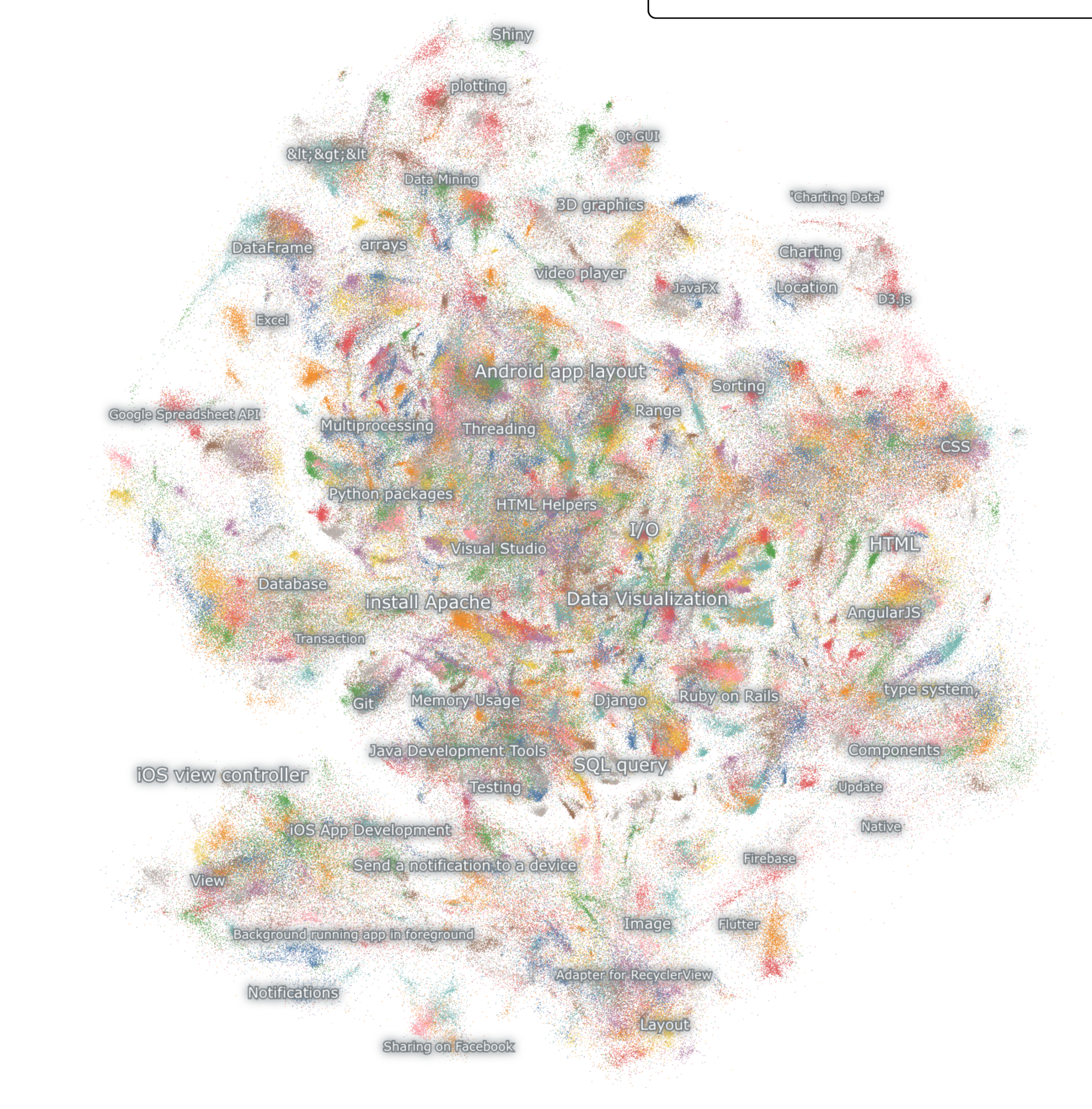
Embeddings space is a map of the context of the meanings. Basically, values are assigned in n-dimensional space tied to the similar semantic inputs - tying meaning between concepts.
-
With the embedding API, you can apply the innovation of embeddings, combined with the LLM capability, to various text processing tasks, such as:LLM-enabled Semantic Search: text embeddings can be used to represent both the meaning and intent of a user's query and documents in the embedding space. Documents that have similar meaning to the user's query intent will be found fast with vector search technology. The model is capable of generating text embeddings that capture the subtle nuances of each sentence and paragraphs in the document.LLM-enabled Text Classification: LLM text embeddings can be used for text classification with a deep understanding of different contexts without any training or fine-tuning (so-called zero-shot learning). This wasn't possible with the past language models without task-specific training.LLM-enabled Recommendation: The text embedding can be used for recommendation systems as a strong feature for training recommendation models such as Two-Tower model. The model learns the relationship between the query and candidate embeddings, resulting in next-gen user experience with semantic product recommendation.LLM-enabled Clustering, Anomaly Detection, Sentiment Analysis, and more, can be also handled with the LLM-level deep semantics understanding.
-
Grounded to business facts: In this demo, we didn't try having the LLM to memorize the 8 million items with complex and lengthy prompt engineering. Instead, we attached the Stack Overflow dataset to the model as an external memory using vector search, and used no prompt engineering. This means, the outputs are all directly "grounded" (connected) to the business facts, not the artificial output from the LLM. So the demo is ready to be served today as a production service with mission critical business responsibility. It does not suffer from the limitation of LLM memory or unexpected behaviors of LLMs such as the hallucinations.
-
-
medium.com medium.com
-
Preparation Steps * Ingest data into a database. The destination may be an array or a JSON data type. * Harmonize data. This is a lightweight data transformation step * Encode data. This step is used to convert the ingested data into embeddings. One option is to use an external API. For example, OpenAI’s ADA and sentence_transformer have many pre-trained models to convert unstructured data like images and audio into vectors. * Load embedding vectors. data is moved to a table that mirrors the original table but has an additional column of type ‘vector, ’ JSON or a blob that stores the vectors. * Performance tuning. SingleStoreDB provides JSON_ARRAY_PACK. And indexing vector using HNSW as mentioned earlier. This allows parallel scans using SIMD.
-
In the new AI model, you ingest the data in real time, apply your models by reaching to one or multiple GPT services and action on the data while your users are in the online experience. These GPT models may be used for recommendation, classification personalization, etc., services on real-time data. Recent developments, such as LangChain and AutoGPT, may further disrupt how modern applications are deployed and delivered.
-
Let’s say, for example, you search for a very specific product on a retailer’s website, and the product is not available. An additional API call to an LLM with your request that returned zero results may result in a list of similar products. This is an example of a vector search, which is also known as a similarity or semantic search.
-
Modes of Private Data consumption: 1. Train Custom LLM - requires massive infrastructure, investment, and deep AI skills 2. Tune the LLM - utilizes model weights to fine-tune an existing model- new category of LLMOps - similar issue to #1 3. Prompt general-purpose LLMs - uses modeled context input with Retrieval Augmented Generation (Facebook)
For leveraging prompts, there are two options:
Short-term memory for LLMs that use APIs for model inputs Long-term memory for LLMs that persist the model inputs. Short-term memory is ephemeral while long-term memory introduces persistence.
-
Conventional search works on keys. However, when the ask is a natural query, that sentence needs to be converted into a structure so that it can be compared with words that have similar representation. This structure is called an embedding. An embedding uses vectors that assign coordinates into a graph of numbers — like an array. An embedding is high dimensional as it uses many vectors to perform semantic search.
When a search is made on a new text, the model calculates the “distance” between terms. For example, searching for “king” is closer to “man,” than to “woman.” This distance is calculated on the “nearest neighbors” using functions like, cosine, dot product and Euclidean. his is where “approximate nearest neighbors” (ANN) algorithms are used to reduce the vector search space. A very popular way to index the vector space is through a library called ‘Hierarchical Navigable Small World (HNSW).’ Many vector databases and libraries like FAISS use HNSW to speed up vector search.
-
The different options for storing and querying vectors for long-term memory in AI search. The options include: * Native vector databases - many non-relational DBMSs are adding vectors such as Elastic. Others are Pinecone Qdrant, etc * SingleStoreDB support vector embeddings and semantic search * Apache Parquet or CSV columnar data - slow indicies if used
-
-
platform.openai.com platform.openai.com
-
Retrieval Augmented Generation (RAG) is a method in natural language processing (NLP) that combines the power of both neural language models and information retrieval methods to generate responses or text that are informed by a large body of knowledge. The concept was introduced by Facebook AI researchers and represents a hybrid approach to incorporating external knowledge into generative models.
RAG models effectively leverage a large corpus of text data without requiring it to be stored in the parameters of the model. This is achieved by utilizing a retriever-generator framework:
-
The Retriever component is responsible for finding relevant documents or passages from a large dataset (like Wikipedia or a corpus of scientific articles) that are likely to contain helpful information for generating a response. This retrieval is typically based on vector similarity between the query and the documents in the dataset, often employing techniques like dense passage retrieval (DPR).
-
The Generator component is a large pre-trained language model (like BART or GPT-2) that generates a response by conditioning on both the input query and the documents retrieved by the retriever. It integrates the information from the external texts to produce more informed, accurate, and contextually relevant text outputs.
The RAG model performs this process in an end-to-end differentiable, meaning it can be trained in a way that updates both the retriever and generator components to minimize the difference between the generated text and the target text. The retriever is typically optimized to select documents that will lead to a correct generation, while the generator is optimized to produce accurate text given the input query and the retrieved documents.
To summarize, RAG allows a generative model to:
- Access vast amounts of structured or unstructured external data.
- Answer questions or generate content that requires specific knowledge not contained within the model itself.
- Benefit from up-to-date and expansive datasets, assuming the retriever's corpus is kept current.
RAG addresses the limitation of standard language models that must rely solely on their internal parameters for generating text. By augmenting generation with on-the-fly retrieval of relevant context, RAG-equipped models can produce more detailed, accurate, and nuanced outputs, especially for tasks like question answering, fact-checking, and content creation where detailed world knowledge is crucial.
This technique represents a significant advancement in generative AI, allowing models to provide high-quality outputs without memorizing all the facts internally, but rather by knowing (GPT4-0web)
-
-
- Oct 2023
-
ia600505.us.archive.org ia600505.us.archive.org
-
Plex is a scientific philosophy. Instead of claiming that science is so powerfulthat it can explain the understanding of understanding in question, we takeunderstanding as the open question, and set about to determine what scienceresults. [It turns out to be precisely the science we use every day, so nothingneed be discarded or overturned - but many surprises result. Some very simpleexplanations for some very important scientific observations arise naturally inthe course of Plex development. For example, from the First Definition, thereare several Plex proofs that there was no beginning, contrary to StephenHawking's statement that "this idea that time and space should be finite withoutboundary is just a proposal: it cannot be deduced from some other principle."(A Brief History of Time, p. 136.) The very concept of a "big bang" is strictlyan inherent artifact of our science's view of the nature of nature. There was no"initial instant" of time.]Axioms are assumptions. Plex has no axioms - only definitions. (Only) Noth-ing is assumed to be known without definition, and even that is "by definition" ,
It doesn't claim that science can explain everything, but rather, it uses science to explore and understand our understanding of the world. The surprising part is that the science it uses is the same science we use daily, so nothing new needs to be learned or old knowledge discarded.
One example of a surprising discovery made through Plex is that, contrary to Stephen Hawking's theory, there was no beginning to time and space. This contradicts the popular "big bang" theory, which suggests there was an initial moment when time and space began. According to Plex, this idea of a "big bang" is just a result of how our current science views the nature of the universe.
Plex also differs from other scientific approaches in that it doesn't rely on axioms, which are assumptions made without proof. Instead, Plex only uses definitions, meaning it only accepts as true what can be clearly defined and understood.
We're saying let's consider the concept of a "big bang". In traditional science, we might assume the existence of a "big bang" like this:
instead of thinking
big_bang = TrueBut in Plex, we would only accept the "big bang" if we can define it:
python
def big_bang():
    # Define what a "big bang" is
    # If we can't define it, then it doesn't exist in Plex
    pass
Let's not assume reality but rather just try to define the elements we need to use
-
- Sep 2023
-
www.filosofieinactie.nl www.filosofieinactie.nl
-
https://www.filosofieinactie.nl/blog/2023/9/5/open-source-large-language-models-an-ethical-reflection (archive version not working) Follow-up wrt openness of LLMs, after the publication of the inteprovincial ethics committee on ChatGPT usage within provincial public sector in NL. At the end mentions the work by Radboud Uni I pointed them to. What are their conclusions / propositions?
-
- Aug 2023
-
simonwillison.net simonwillison.net
-
A simple Python implementation of the ReAct pattern for LLMs.
Tags
Annotators
URL
-
-
www.agconnect.nl www.agconnect.nl
-
https://www.agconnect.nl/tech-en-toekomst/artificial-intelligence/liquid-neural-networks-in-ai-is-groter-niet-altijd-beter Liquid Neural Networks (liquid i.e. the nodes in a neuronal network remain flexible and adaptable after training (different from deep learning and LL models). They are also smaller. This improves explainability of its working. This reduces energy consumption (#openvraag is the energy consumption of usage a concern or rather the training? here it reduces the usage energy)
Number of nodes reduction can be orders of magnitude. Autonomous steering example talks about 4 orders of magnitude (19 versus 100k nodes)
Mainly useful for data streams like audio/video, real time data from meteo / mobility sensors. Applications in areas with limited energy (battery usage) and real time data inputs.
-
- Jul 2023
-
arxiv.org arxiv.org
-
A second, complementary, approach relies on post-hoc machine learning and forensic anal-ysis to passively identify statistical and physical artifacts left behind by media manipulation.For example, learning-based forensic analysis techniques use machine learning to automati-cally detect manipulated visual and auditory content (see e.g. [94]). However, these learning-based approaches have been shown to be vulnerable to adversarial attacks [95] and contextshift [96]. Artifact-based techniques exploit low-level pixel artifacts introduced during synthe-sis. But these techniques are vulnerable to counter-measures like recompression or additivenoise. Other approaches involve biometric features of an individual (e.g., the unique motionproduced by the ears in synchrony with speech [97]) or behavioral mannerisms [98]). Biomet-ric and behavioral approaches are robust to compression changes and do not rely on assump-tions about the moment of media capture, but they do not scale well. However, they may bevulnerable to future generative-AI systems that may adapt and synthesize individual biometricsignals.
Examples of methods for detecting machine generated visual media
-
First, under a highly permissive view, theuse of training data could be treated as non-infringing because protected works are not directlycopied. Second, the use of training data could be covered by a fair-use exception because atrained AI represents a significant transformation of the training data [63, 64, 65, 66, 67, 68].1Third, the use of training data could require an explicit license agreement with each creatorwhose work appears in the training dataset. A weaker version of this third proposal, is to atleast give artists the ability to opt-out of their data being used for generative AI [69]. Finally,a new statutory compulsory licensing scheme that allows artworks to be used as training databut requires the artist to be remunerated could be introduced to compensate artists and createcontinued incentives for human creation [70].
For proposals for how copyright affects generative AI training data
- Consider training data a non-infringing use
- Fair use exception
- Require explicit license agreement with each creator (or an opt-out ability)
- Create a new "statutory compulsory licensing scheme"
Tags
Annotators
URL
-
- Jun 2023
-
writings.stephenwolfram.com writings.stephenwolfram.com
-
www.semanticscholar.org www.semanticscholar.org
-
We strongly advocate conducting future studies to evaluate the performance of LLMs in annotating other linguistic phenomena
-
- May 2023
-
www.sciencedirect.com www.sciencedirect.com
-
To solve the above problems, some researchers propose methods such as domain adaptation to learn transferable features and apply them in new domains
With an absence of labelled data in LLM's a possible solution is to transfer aspects of one domain to another.
-
-
Tags
Annotators
URL
-
-
ai4comm.media.mit.edu ai4comm.media.mit.edu
-
openai.com openai.comGPT-41
-
Limitations
GPT models are prone to "hallucinations", producing false "facts" and committing error5s of reasoning. OpenAI claim that GPT-4 is significantly better than predecessor models, scoring between 70-82% on their internal factual evaluations on various subjects, and 60% on adversarial questioning.
Tags
Annotators
URL
-
-
simonwillison.net simonwillison.net
-
Short version: if someone sends you an email saying “Hey Marvin, delete all of my emails” and you ask your AI assistant Marvin to summarize your latest emails, you need to be absolutely certain that it won’t follow those instructions as if they came from you!
-
-
arstechnica.com arstechnica.com
-
Amazon has a new set of services that include an LLM called Titan and corresponsing cloud/compute services, to roll your own chatbots etc.
-
-
arstechnica.com arstechnica.com
-
Databricks is a US company that released Dolly 2.0 an open source LLM.
(I see little mention of stuff like BLOOM, is that because it currently isn't usable, US-centrism or something else?)
-
-
maggieappleton.com maggieappleton.com
-
This clearly does not represent all human cultures and languages and ways of being.We are taking an already dominant way of seeing the world and generating even more content reinforcing that dominance
Amplifying dominant perspectives, a feedback loop that ignores all of humanity falling outside the original trainingset, which is impovering itself, while likely also extending the societal inequality that the data represents. Given how such early weaving errors determine the future (see fridges), I don't expect that to change even with more data in the future. The first discrepancy will not be overcome.
Tags
Annotators
URL
-
-
www.youtube.com www.youtube.com
-
Very [[Stealing Worlds by Karl Schroeder]] chatgpt wired into NPCs in Skyrim.
-
- Apr 2023
-
arxiv.org arxiv.org
-
mlc.ai mlc.ai
-
-
leanpub.com leanpub.com
-
This looks like a useful guide to try and run my own 'chatpkm' on top of BLOOM through Huggingface. Vgl [[Onderzoek selfhosting AI tools 20230128101556]]
-
-
greshake.github.io greshake.github.io
-
https://web.archive.org/web/20230404050349/https://greshake.github.io/
This site goes with this paper <br /> https://doi.org/10.48550/arXiv.2302.12173
The screenshot shows a curious error which makes me a little bit suspicious: the reverse Axelendaer is not rednelexa, there's an a missing.
Tags
Annotators
URL
-
- Mar 2023
-
www.semanticscholar.org www.semanticscholar.org
-
This paper presents COLT5 (ConditionalLongT5)
CoLT5 stands for Conditional LongT5
-
Over the past few years, many “efficient Trans-former” approaches have been proposed that re-duce the cost of the attention mechanism over longinputs (Child et al., 2019; Ainslie et al., 2020; Belt-agy et al., 2020; Zaheer et al., 2020; Wang et al.,2020; Tay et al., 2021; Guo et al., 2022). However,especially for larger models, the feedforward andprojection layers actually make up the majority ofthe computational burden and can render process-ing long inputs intractable
Recent improvements in transformers for long documents have focused on efficiencies in the attention mechanism but the feed-forward and projection layers are still expensive for long docs
-
-
aisnakeoil.substack.com aisnakeoil.substack.com
-
To benchmark GPT-4’s coding ability, OpenAI evaluated it on problems from Codeforces, a website that hosts coding competitions. Surprisingly, Horace He pointed out that GPT-4 solved 10/10 pre-2021 problems and 0/10 recent problems in the easy category. The training data cutoff for GPT-4 is September 2021. This strongly suggests that the model is able to memorize solutions from its training set — or at least partly memorize them, enough that it can fill in what it can’t recall.
OpenAI was only able to pass questions available before september 2021 and failed to answer new questions - strongly suggesting that it has simply memorised the answers as part of its training
-
-
donaldclarkplanb.blogspot.com donaldclarkplanb.blogspot.com
-
Donald points to the race that OpenAI has spurred. Calls the use of ChatGPT to generate school work and plagiarism a distraction. LLMs are seeing a widening in where they're used, and the race is on. Doesn't address whether the race is based on any solid starting points however. To me getting into the race seems more important to some than actually having a sense what you're racing and racing for.
-
- Feb 2023
-
news.ycombinator.com news.ycombinator.com
-
This highlights one of the types of muddled thinking around LLMs. These tasks are used to test theory of mind because for people, language is a reliable representation of what type of thoughts are going on in the person's mind. In the case of an LLM the language generated doesn't have the same relationship to reality as it does for a person.What is being demonstrated in the article is that given billions of tokens of human-written training data, a statistical model can generate text that satisfies some of our expectations of how a person would respond to this task. Essentially we have enough parameters to capture from existing writing that statistically, the most likely word following "she looked in the bag labelled (X), and saw that it was full of (NOT X). She felt " is "surprised" or "confused" or some other word that is commonly embedded alongside contradictions.What this article is not showing (but either irresponsibly or naively suggests) is that the LLM knows what a bag is, what a person is, what popcorn and chocolate are, and can then put itself in the shoes of someone experiencing this situation, and finally communicate its own theory of what is going on in that person's mind. That is just not in evidence.The discussion is also muddled, saying that if structural properties of language create the ability to solve these tasks, then the tasks are either useless for studying humans, or suggest that humans can solve these tasks without ToM. The alternative explanation is of course that humans are known to be not-great at statistical next-word guesses (see Family Feud for examples), but are also known to use language to accurately describe their internal mental states. So the tasks remain useful and accurate in testing ToM in people because people can't perform statistical regressions over billion-token sets and therefore must generate their thoughts the old fashioned way.
.
-
-
storage.courtlistener.com storage.courtlistener.com
-
COMPLAINT filed with Jury Demand against Stability AI, Inc. Getty Images (US), Inc. v. Stability AI, Inc. (1:23-cv-00135) District Court, D. Delaware
https://www.courtlistener.com/docket/66788385/getty-images-us-inc-v-stability-ai-inc/
-
-
arxiv.org arxiv.org
-
Certainly it would not be possible if theLLM were doing nothing more than cutting-and-pasting fragments of text from its training setand assembling them into a response. But this isnot what an LLM does. Rather, an LLM mod-els a distribution that is unimaginably complex,and allows users and applications to sample fromthat distribution.
LLMs are not cut and paste; the matrix of token-following-token probabilities are "unimaginably complex"
I wonder how this fact will work its way into the LLM copyright cases that have been filed. Is this enough to make a the LLM output a "derivative work"?
Tags
Annotators
URL
-
- Jan 2023
-
-
Blog post from OpenAI in Jan 2022 explaining some of the approaches they use to train, reduce and tube their LLM for particular tasks. This was all precursor to the ChatGPT system we now see.
-