XRD analysis historically required hours of scientific judgment, drawing on experimental conditions, simulations, and prior results.
【数据】这段文字提供了传统X射线衍射分析的时间成本数据,表明它需要数小时的科学判断。这一具体时间数据强调了AI在这一领域可能带来的效率提升,但未说明他们的模型具体将处理时间缩短到什么程度,以及在不同复杂度实验中的表现差异。
XRD analysis historically required hours of scientific judgment, drawing on experimental conditions, simulations, and prior results.
【数据】这段文字提供了传统X射线衍射分析的时间成本数据,表明它需要数小时的科学判断。这一具体时间数据强调了AI在这一领域可能带来的效率提升,但未说明他们的模型具体将处理时间缩短到什么程度,以及在不同复杂度实验中的表现差异。
Building an AI agent to help clients adjust to changing tax regulations used to take weeks and required teams to switch between multiple tools and chat windows
文章提到构建AI助手从'需要数周'到'只需几分钟'的转变,但没有提供具体的时间节省比例。此处缺乏量化依据,无法准确评估效率提升幅度。如果真的从数周缩短到几分钟,效率提升将超过90%,这将是一个显著的突破,但需要更多数据支持这一说法。
One senior accountant who spent 180 hours on tax prep last year spent only 15 hours on it this year.
这是一个极具说服力的效率提升数据:从180小时减少到15小时,减少了91.7%的时间投入。这意味着会计师可以将节省的时间用于客户服务和业务拓展,如文章所述。这种级别的效率提升可能彻底改变会计行业的商业模式和服务方式。
Security work that took hours now takes minutes
安全工作从需要几小时缩短到只需几分钟,这是一个时间数量级的显著提升。虽然缺乏具体数字,但'小时到分钟'的转变表明了AI在安全响应方面的革命性影响。这一数据点强调了AI在时间敏感型任务中的价值。
Breakthroughs in understanding the Earth that previously required complex analytics and years of iteration are now made possible in a matter of minutes.
大多数人认为地理空间分析需要复杂计算和长时间迭代,但作者认为AI已经将这个过程缩短到几分钟,这代表了地理信息科学领域的范式转变,挑战了传统地理数据分析的时间框架。
humans can do this in well under half an hour.
人类能在半小时内完成IKEA家具组装任务,而AI系统仅达到40%的准确率,这一对比突显了AI在需要实际操作理解的任务上与人类的显著差距。时间效率的差异也强调了基准测试中时间维度的重要性。
Overall, it usually takes me about two hours to do this task. If only it were as simple as a single copy and paste, life would be so much easier — or so I thought.
作者完成文章发布任务通常需要约2小时,而AI在这一任务上表现极差。这一时间对比数据点突显了AI在看似简单任务上的局限性,支持了莫拉维克悖论的观点。然而,作者没有提供AI完成该任务的具体时间数据,这使得比较不够完整。
On average, it takes roughly 10 to 15 years to go from target discovery to regulatory approval for a new drug in the United States.
这一数据揭示了药物研发的极端时间成本,暗示AI可能带来的变革性影响。如果GPT-Rosalind能显著缩短这一时间线,将彻底改变制药经济学和患者获取治疗的时间框架。
Four researchers and software engineers estimated that a skilled human engineer would take 2 to 17 weeks to reimplement gotree, as AI successfully did in this work.
这一对比数据极具启发性,它量化了AI在特定任务上相对于人类的时间优势。这种时间压缩效应可能重塑软件开发流程,但也引发了关于AI能力与人类创造力本质差异的深层思考。
It achieves state-of-the-art performance on streaming benchmarks and supports a real-time demo system with ASR and TTS running at 2 FPS on two 80G accelerators
大多数人认为实时视频处理需要极高的计算资源和帧率才能有效,但作者仅用两块80G加速器就实现了2 FPS的实时系统,并达到了最先进的性能。这一结果挑战了高性能视频处理需要大量计算资源的共识,暗示通过优化算法和架构可以显著降低实时视频处理的计算门槛。
https://en.wikipedia.org/wiki/Stakhanovite_movement
How much of the 1935 Stakhanovite movement was propaganda vs. reality and how much of it used the ideas of scientific management from the late 1800s/early 1900s?
If we overlay the four steps of CODE onto the model ofdivergence and convergence, we arrive at a powerful template forthe creative process in our time.
The way that Tiago Forte overlaps the idea of C.O.D.E. (capture/collect, organize, distill, express) with the divergence/convergence model points out some primary differences of his system and that of some of the more refined methods of maintaining a zettelkasten.
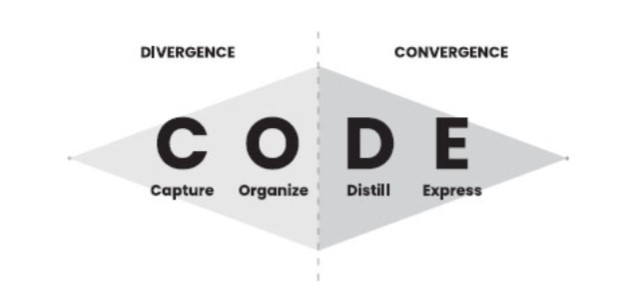 <small>Overlapping ideas of C.O.D.E. and divergence/convergence from Tiago Forte's book Building a Second Brain (Atria Books, 2022) </small>
Forte's focus on organizing is dedicated solely on to putting things into folders, which is a light touch way of indexing them. However it only indexes them on one axis—that of the folder into which they're being placed. This precludes them from being indexed on a variety of other axes from the start to other places where they might also be used in the future. His method requires more additional work and effort to revisit and re-arrange (move them into other folders) or index them later.
Most historical commonplacing and zettelkasten techniques place a heavier emphasis on indexing pieces as they're collected.
Commonplacing creates more work on the user between organizing and distilling because they're more dependent on their memory of the user or depending on the regular re-reading and revisiting of pieces one may have a memory of existence. Most commonplacing methods (particularly the older historic forms of collecting and excerpting sententiae) also doesn't focus or rely on one writing out their own ideas in larger form as one goes along, so generally here there is a larger amount of work at the expression stage.
Zettelkasten techniques as imagined by Luhmann and Ahrens smooth the process between organization and distillation by creating tacit links between ideas. This additional piece of the process makes distillation far easier because the linking work has been done along the way, so one only need edit out ideas that don't add to the overall argument or piece. All that remains is light editing.
Ahrens' instantiation of the method also focuses on writing out and summarizing other's ideas in one's own words for later convenient reuse. This idea is also seen in Bruce Ballenger's The Curious Researcher as a means of both sensemaking and reuse, though none of the organizational indexing or idea linking seem to be found there.
This also fits into the diamond shape that Forte provides as the height along the vertical can stand in as a proxy for the equivalent amount of work that is required during the overall process.
This shape could be reframed for a refined zettelkasten method as an indication of work
Forte's diamond shape provided gives a visual representation of the overall process of the divergence and convergence.
But what if we change that shape to indicate the amount of work that is required along the steps of the process?!
Here, we might expect the diamond to relatively accurately reflect the amounts of work along the path.
If this is the case, then what might the relative workload look like for a refined zettelkasten? First we'll need to move the express portion between capture and organize where it more naturally sits, at least in Ahren's instantiation of the method. While this does take a discrete small amount of work and time for the note taker, it pays off in the long run as one intends from the start to reuse this work. It also pays further dividends as it dramatically increases one's understanding of the material that is being collected, particularly when conjoined to the organization portion which actively links this knowledge into one's broader world view based on their notes. For the moment, we'll neglect the benefits of comparison of conjoined ideas which may reveal flaws in our thinking and reasoning or the benefits of new questions and ideas which may arise from this juxtaposition.
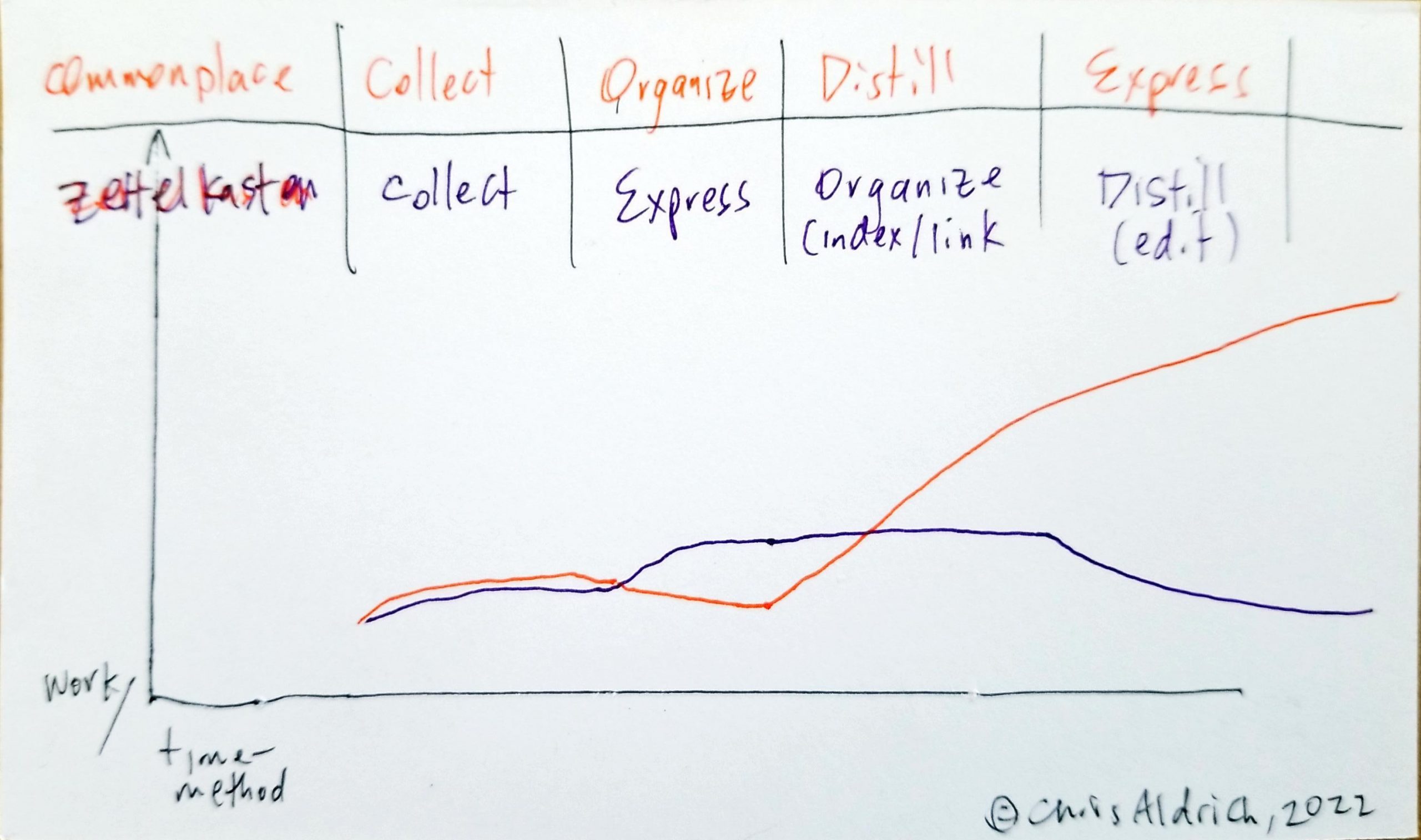
This sketch could be refined a bit, but overall it shows that frontloading the work has the effect of dramatically increasing the efficiency and productivity for a particular piece of work.
Note that when compounded over a lifetime's work, this diagram also neglects the productivity increase over being able to revisit old work and re-using it for multiple different types of work or projects where there is potential overlap, not to mention the combinatorial possibilities.
--
It could be useful to better and more carefully plot out the amounts of time, work/effort for these methods (based on practical experience) and then regraph the resulting power inputs against each other to come up with a better picture of the efficiency gains.
Is some of the reason that people are against zettelkasten methods that they don't see the immediate gains in return for the upfront work, and thus abandon the process? Is this a form of misinterpreted-effort hypothesis at work? It can also be compounded at not being able to see the compounding effects of the upfront work.
What does research indicate about how people are able to predict compounding effects over time in areas like money/finance? What might this indicate here? Humans definitely have issues seeing and reacting to probabilities in this same manner, so one might expect the same intellectual blindness based on system 1 vs. system 2.
Given that indexing things, especially digitally, requires so little work and effort upfront, it should be done at the time of collection.
I'll admit that it only took a moment to read this highlighted sentence and look at the related diagram, but the amount of material I was able to draw out of it by reframing it, thinking about it, having my own thoughts and ideas against it, and then innovating based upon it was incredibly fruitful in terms of better differentiating amongst a variety of note taking and sense making frameworks.
For me, this is a great example of what reading with a pen in hand, rephrasing, extending, and linking to other ideas can accomplish.
Tech support works with scripts. Just get to know these scripts by heart and answer all questions from the script you can in one long sentence, before they ask it. Like in "Hi I have a problem with this and that...I have restarted the router, I have checked the cables, the red light is on, the green light is off, not other lights are blinking......etc.etc.etc. That way the person at the other end of the line can just go click-click-click and you'll be 10 steps further in their script in 5 seconds.
COVID-19 and the Labor Market. (n.d.). IZA – Institute of Labor Economics. Retrieved October 11, 2020, from https://covid-19.iza.org/publications/dp13749/
Dou, Z., Stefanovski, D., Galligan, D., Lindem, M., Rozin, P., Chen, T., & Chao, A. M. (2020). The COVID-19 Pandemic Impacting Household Food Dynamics: A Cross-National Comparison of China and the U.S. [Preprint]. SocArXiv. https://doi.org/10.31235/osf.io/64jwy