Day of Digital Humanities
Must look this up.
Day of Digital Humanities
Must look this up.
Selected images from the Desmond FitzGerald Photographs collection in UCD Archives were used to illustrate Conor Mulvagh's video presentation, "The Destruction of Dublin, 1916," issued as part of the UCD Decade of Centenaries web site; it is also available on youtube.

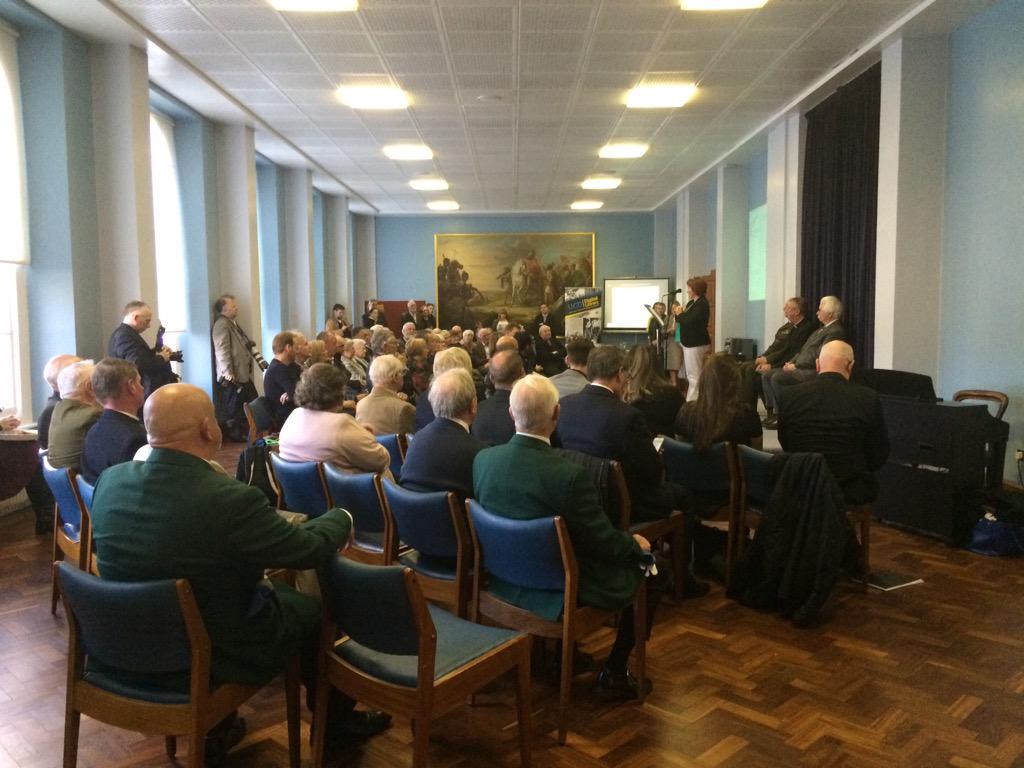
The Fr. Francis A. Gleeson Papers digital collection was officially launched on Monday April 27 by the Archbishop of Dublin, Diarmuid Martin at a reception in Holy Cross Diocesan Centre, in Clonliffe. The event was attended by members of Fr Gleeson’s family as well as the British and French Ambassadors to Ireland and Archbishop Michael Jackson.
For press commentaries on this collection see:
Recent surveys and data, interviews with educators and industry officials, and K-12 companies' development of new products underscore the enduring, widespread demand for textbooks and other paper-based materials in the nation's schools.
What efforts have been made to help students better interact with digital content?
reading might be described as the continual redisposition of levels of address in this manner
Another useful (and cool) definition
Physical texts were already massively addressable before they were ever digitized, and this variation in address was and is registered at the level of the page, chapter, the binding of quires, and the like.
Always like seeing acknowledgement that scholarly primitives haven't changed, just our means for doing them. Stephen Ramsay's Reading Machines is a good, quick read about this in terms of digital humanities algorithmic criticism.
massive flexibility in levels of address
The ability to fluently read/react with a text at a given level of address be treated as a literacy.
The book or physical instance, then, is one of many levels of address.
Definition for manifestations of the text. Maybe useful in discussing interface as the encountered work?
Now, we are discussing ideal objects here: addressability implies different levels of abstraction (character, word, phrase, line, etc) which are stipulative or nominal: such levels are not material properties of texts or Pythagorean ideals; they are, rather, conventions.
Might be useful in thinking about what an “edition” is—must it include all items most editions currently include, or are those conventions or manifestations of values, and not necessary values themselves?
Because a text can be queried at the level of single words and then related to other texts at the same level of abstraction: the table of all possible words could be defined as the aggregate of points of address at a given level of abstraction (the word, as in Google’s new n-gram corpus).
I like this idea of defining a level of text and than comparing across texts—would like to see more of this at the level of code and interface design and tool design decisions (e.g. how do different digital archives deal with making sure visitors see more than the alphabetically or chronologically first few items in the collection? how do different DH sites allow people to comment? what is the difference among moderation or voting systems?).
a text is a text because it is massively addressable at different levels of scale
I think this is my favorite definition of “text” (as humanities scholars use the term) that I’ve encountered.
What does it mean to be an “item” or “computational object” within this collection? What is such a collection?
This is a great example of the type of critical thinking involved in scholarly digital building—often such projects include hard thinking about the exact nature of scholarly objects. Patrick Murray-John has a fantastic article that further discusses “where the theory is” when scholars design and build (Theory, Digital Humanities, and Noticing). The penultimate paragraph in particular lists some of the critical questions that arise out of designing for an “item” in a digital archives platform.
New experiments provide opportunities for thought that precede the results.
And even if we don’t yet have a way to run and experiment and/or gather results, we can use “speculative experiments” to learn about digital objects (such as a digital edition) by imagining and designing for a hypothetical and/or future circumstance.
looped (oder: loopable) research
Es wäre an dieser Stelle zu klären, wie sich die Idee der looped research zum Gedanken einer 'looped scholarship' (vgl. Über Digital Humanities, Human Computing und Looped Scholarship. Eine Notiz./ LIBREAS.Tumblr) verhält.
Scholars, intellectuals, and bricoleurs
Eine Zusammenfassung zu diesem Aufsatz unter besonderer Berücksichtigung des Verhältnisses der Wissenspraxis Bricolage zu den Digital Humanities gibt es auch im Redaktions-Tumblr von LIBREAS.
Claudia Müller-Birn unterscheidet drei Annotationsebenen:
mit zunehmender Vernetzungskomplexität.
Anna von Veh
Other articles on fanfiction and publishing by Anna von Veh
von Veh, Anna. 12 June 2012. What Can Trade Publishers Learn from Fanfiction?. Publishing Perspectives. von Veh, Anna. 12 October 2012. Why Fanfics are Like Startups. Publishing Perspectives. von Veh, Anna. 25 June 2013. Kindle Worlds: Bringing Fanfiction Into Line But Not Online?.
Interviews
Lenz, Daniel. 31 May 2013. Anna von Veh über Perspektiven der „Kindle Worlds“. buchreport. Molinari, E, Draghi E. 11 February 2014. Anna von Veh: «Ecco perchè le fanfiction sono il prossimo business model per l'editoria»Giornale della Libreria. Frossard, Flavia. 29 January 2014. Digital Publishing Market and FanFiction – An Interview with Anna Von Veh. Widbook blog. Webb, Jen. 3 October 2011. The agile upside of XML. Interview with Anna von Veh and Mike McNamara. O'Reilly Tools of Change for Publishing.
Articles and posts on tech/art in publishing
von Veh, Anna. 10 May 2012. Let’s Improvise! Jazz as a Metaphor for Publishing Progress. Publishing Perspectives. von Veh, Anna. Musings on Digital: a collection of blog posts
Personally, I think Digital Humanities is about building things,” said Ramsay in a polarizing talk at the MLA convention in 2011, printed in Defining Digital Humanities. Unlike many theorists, however, he was willing to make this demand concrete: “Do you have to know how to code? I’m a tenured professor of digital humanities and I say ‘yes.’ ”
http://www.one-tab.com/page/Nx--r0sKQNir8QoKxnU-0g
https://www.google.com/search?q=mla+2011+ramsay+defining+digital+humanities&oq=mla+2011+ramsay+defining+digital+humanities&aqs=chrome..69i57.13899j0j7&sourceid=chrome&es_sm=106&ie=UTF-8 http://dhdebates.gc.cuny.edu/debates http://stephenramsay.us/text/2011/01/08/whos-in-and-whos-out/ http://www.briancroxall.net/buildingDH/ http://townsendcenter.berkeley.edu/blog/lines-sand-or-growing-pains-stephen-ramsay-and-digital-humanities-2011-mla http://journalofdigitalhumanities.org/1-1/introduction-theory-and-the-virtues-of-digital-humanities-by-natalia-cecire/ http://sites.library.northwestern.edu/dh/ https://www.google.com/search?q=stephen+ramsay+humanities&oq=stephen+ramsay+humanities&aqs=chrome..69i57j0.4522j0j7&sourceid=chrome&es_sm=106&ie=UTF-8 http://cdrh.unl.edu/about/faculty/ramsay.php https://twitter.com/CDRH_UNL http://www.amazon.com/Reading-Machines-Algorithmic-Criticism-Humanities/dp/0252078209 http://www.unl.edu/english/faculty/profs/sramsay.html http://stephenramsay.us/ http://stephenramsay.us/2013/09/25/dh-job/ http://stephenramsay.us/2013/09/12/why_im_in_it/
In the preface to the study, European Commission Vice-President, Neelie Kroes, wrote: ’Now is the time for open standards regarding e-books’.
Digital Humanities can look at authors and publishers and the relationships they have with one another.
Born-digital, open source, media-rich scholarly publishing that’s as easy as blogging
Scalar's mission statement