In the case of aircraft, most nations cooperate on things like safety standards and air traffic control.
大多数人认为颠覆性技术必然导致国家间竞争加剧。但作者以航空业为例,说明即使存在竞争,国家间仍能在安全标准等领域合作。这一类比暗示AI可能遵循类似发展路径,技术竞争不必然排除安全合作,挑战了技术民族主义叙事。
In the case of aircraft, most nations cooperate on things like safety standards and air traffic control.
大多数人认为颠覆性技术必然导致国家间竞争加剧。但作者以航空业为例,说明即使存在竞争,国家间仍能在安全标准等领域合作。这一类比暗示AI可能遵循类似发展路径,技术竞争不必然排除安全合作,挑战了技术民族主义叙事。
Fn Eraise of qcribes
for - book - In Praise of Scribes - Author Johannes Trithemius - history - progress - technology - printing press
And the same will apply to the objection that theSystem is unusual. Seldom have there been any newsuggestions which have not been condemned as ' un-us
Kells, Lyman M., Willis F. Kern, and James R. Bland. K+E Slide Rules: A Self Instruction Manual. New York: Keuffel & Esser Co., 1955.
TheSateliteCombinationCard IndexCabinetandTelephoneStand
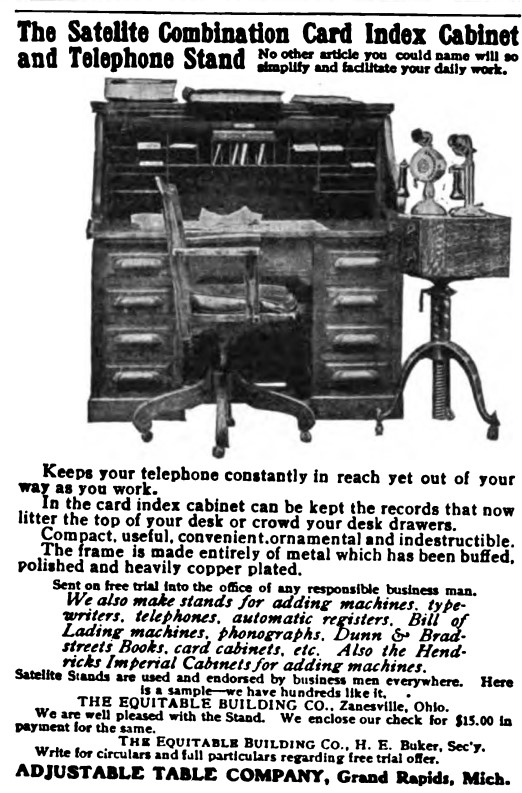
A fascinating combination of office furniture types in 1906!
The Adjustable Table Company of Grand Rapids, Michigan manufactured a combination table for both telephones and index cards. It was designed as an accessory to be stood next to one's desk to accommodate a telephone at the beginning of the telephone era and also served as storage for one's card index.
Given the broad business-based use of the card index at the time and the newness of the telephone, this piece of furniture likely was not designed as an early proto-rolodex, though it certainly could have been (and very well may have likely been) used as such in practice.
I totally want one of these as a side table for my couch/reading chair for both storing index cards and as a temporary writing surface while reading!
This could also be an early precursor to Twitter!
Folks have certainly mentioned other incarnations: - annotations in books (person to self), - postcards (person to person), - the telegraph (person to person and possibly to others by personal communication or newspaper distribution)
but this is the first version of short note user interface for both creation, storage, and distribution by means of electrical transmission (via telephone) with a bigger network (still person to person, but with potential for easy/cheap distribution to more than a single person)
Ryan Randall @ryanrandall@hcommons.socialEarnest but still solidifying #pkm take:The ever-rising popularity of personal knowledge management tools indexes the need for liberal arts approaches. Particularly, but not exclusively, in STEM education.When people widely reinvent the concept/practice of commonplace books without building on centuries of prior knowledge (currently institutionalized in fields like library & information studies, English, rhetoric & composition, or media & communication studies), that's not "innovation."Instead, we're seeing some unfortunate combination of lost knowledge, missed opportunities, and capitalism selectively forgetting in order to manufacture a market.
https://hcommons.social/@ryanrandall/109677171177320098
This is an interesting article. It gives a historical perspective on a societal pattern in which technological changes lead to changes in architecture, which in turn changes how families and communities and societies changes.
The one thing they seem to have overlooked is the existence of a room called a "study". It was a thing, and now, perhaps, the "home office" will become the modern study.
Edgerton (2008) - The shock of the old
Thus the idea that ancient Greeks could develop a James Watt style steam engine without advanced guns, wind mills, machining tools, improved mass production systems for iron production etc is rather unthinkable. It is a bit like thinking a society could make a space rocket before having created trains, cars and calculators.
This idea of past flory is spread among present-day Greeks.
The mechanical clock, which came into common use in the 14th century, provides a compelling example. In Technics and Civilization, the historian and cultural critic Lewis Mumford described how the clock “disassociated time from human events and helped create the belief in an independent world of mathematically measurable sequences.” The “abstract framework of divided time” became “the point of reference for both action and thought.”
Description of how a technology the clock changed the human landscape.
Similar to the way humans might practice terraforming on their natural environment, what should we call the effect our natural environment has on us?
What should we call the effect our technological environment has on us? technoforming?
Evolution certainly indicates that there's likely both short and long-term effects.
Who else has done research into this? Do we have evidence of massive changes with the advent of writing, reading, printing, telegraph, television, social media, or other technologies available?
Any relation to the nature vs nurture debate?
The internet is not the first promising technology to have quickly turned dystopian. In the early 20th century, radio was greeted with as much enthusiasm as the internet was in the early 21st. Radio will “fuse together all mankind” wrote Velimir Khlebnikov, a Russian futurist poet, in the 1920s. Radio would connect people, end war, promote peace!Almost immediately, a generation of authoritarians learned how to use radio for hate propaganda and social control. In the Soviet Union, radio speakers in apartments and on street corners blared Communist agitprop. The Nazis introduced the Volksempfänger, a cheap wireless radio, to broadcast Hitler’s speeches; in the 1930s, Germany had more radios per capita than anywhere else in the world.** In America, the new information sphere was taken over not by the state but by private media companies chasing ratings—and one of the best ways to get ratings was to promote hatred. Every week, more than 30 million would tune in to the pro-Hitler, anti-Semitic radio broadcasts of Father Charles Coughlin, the Detroit priest who eventually turned against American democracy itself.
There is definitely a history of fast enthusiasm marked by misuse and abuse for many communication technologies.
It may be urged that they are only fit to be placed in the hands of a being who has learned to control himself, and that man armed with science is like a baby with a box of matches.
Giving society cheap, abundant energy would be the equivalent of giving an idiot child a machine gun.
— Paul Ehrlich
Other situations might admit changes requiring years of special training, very expensive equipment, or the use of special drugs.
My reply to another post about historical context might be helpful. https://hyp.is/R07lQCldEem5RmPv1ywB5g/worrydream.com/Engelbart/
transportation networks were evolved
In this sentence, Berger refers to how transport and industrial activity expanded heavily over this time period when many Americans were moving out west. This is a massive part of North American history because of the opportunities it opened up for rich and poor people alike. The first railroads in North America were established in the 1820's and quickly altered the face of life on the continent. The rapid expansion of the railroad industry led to the development of other industries like oil and steel. For a time in the 19th century these were the largest economic factors in the United States and whoever controlled these essentially controlled the country. However, Berger here is referring to the opportunities that railroads opened up for expansion across the west and north. The incredible development of railroads made travel to the west coast of America much easier than it ever was before. This changed the idea of the "frontier" in many people's mind. Because travel was much easier, the idea of the west in North America being a rustic and dangerous environment changed overtime and culminated in western economic opportunities like the Gold Rush. "Gold discoveries in the Far West preceded the gold rush of 1849 and encouraged migration from eastern cities." As western movement became more and more popular, the idea of a pristine, wild, and natural American west began to fade. The idea of a getting rich quick from the California Gold Rush was translated to the Klondike Gold Rush in the Yukon of Canada in 1896. This had similar affects on how people viewed the Northwest region of Canada and its wilderness.
"Railroad Promotion and Economic Expansion at Council Bluffs, Iowa, 1857-1869." Annals Of Iowa 42, no. 5 (Summer1974 1974): 371-389. America: History and Life with Full Text, EBSCOhost (accessed April 6, 2017).
George Dyson, Turing's Cathedral: The Origins of the Digital Universe (New York: Pantheon Books, 2012), ix.