Dryness gets a moisturizer. Oil gets a clarifier. Thinning gets a thickener.
dryness gets moisturized, oil gets clarified, and thinning gets thickening
Dryness gets a moisturizer. Oil gets a clarifier. Thinning gets a thickener.
dryness gets moisturized, oil gets clarified, and thinning gets thickening
One System Nine Functions Every wash. Every product. All nine. 01 Density 02 Microbiome 03 Color 04 Shine 05 Protection 06 Volume 07 Moisture 08 Strength 09 Frizz Control
remove this
{{ person|lookup:'first_name'|default:'Hi' }},
remove the personalization
Vegan. Cruelty-free. Dermatologist tested. Made in Los Angeles.
remove this
What We Left Out
make this into the icons
What other affordances might social annotation tools offer?
You could use it as a way to store your own personal thoughts, and let others follow your thought process
#audience, #word-Choice, #ethos, #structure, and #style
huh. Maybe I should try that next time
As you share your thinking and begin to participate in marginal conversa-tions, you may find yourself wanting a way to sort and organize the notes.Enter hashtags
People use # to organize annotations? I always just either use a line or numbers
Of course, just like in class, you don’t need an extended monologuethat leaves no room for anyone to respond
Good, because there's no way I could write for that long
If you’ve ever annotated a paperback book, you’ve probably found yourselfshort on space to write notes
yeah. It's not easy. most of the time, I just write on a scrap piece of paper and staple it to the thing I'm annotating (on the rare occasions I'm actually annotating)
As a writer, you can use this annotation to reflect on when andhow you might choose to use technical vocabulary to make your own writ-ing more accessible for a wider audience
So you can go the route where you make things simple, the route where your vocabulary is exemplary, or a mix of the two. it just depends on who and what you're writing for
Shared annotations can also help us to understand theresponses readers might have to an authors’ writing choices.
So they can give context? guess that makes sense
Have you ever wondered about the inspiration for the lyrics to yourfavorite song?
several times. maybe I'm just not creative enough, but I don't understand how some people can write an entire song based off a relatively simple image or a short phrase that doesn't mean much
Community is an important aspect of social annotation.
I'd upgrade it to a Vital aspect, as annotation would be useless without community
It got me thinking more and now I’m reading it once again just tosee what the author meant by that term
I know this is somewhat unrelated, but I think its worth mentioning. One of the things my high school introduced was talking to a rubber duck when things didn't make sense. the crazy thing is, it actually worked. I still do it sometimes
Many of my students that find it difficult to speak up in whole-classdiscussions
Yeah, usually. for me, its like "what should I say? oh someone already beat me to it. oh well" I've had that thought process a few times
Whether written into the margins of texts, integratedinto the print, or digitally superimposed, in what contexts have you encoun-tered annotations written by another person? In what ways have you sharedyour annotations with other readers?
There's here for starters. In a book that I have, part of the experience is that it exists in universe and one of the characters has written annotations.
Whether you are an annotation expert or novice, I invite you to makeand share your own annotations on this chapter.
I know that my annotations are meager, but hopefully by the end they're at least somewhat decent.
Annotation has been practiced for thousands of years as a way to improvereading.
Thank you for my daily fun fact
You might also be interested in seeing how annotators have con-tributed to historical documents in Speculative Annotation hosted by theLibrary of Congress (https://labs.loc.gov/work/experiments/annotation) orliterary texts like Frankenstein (https://www.frankenbook.org).
I didn't know these annotation websites existed until now. I'll have to check them out sometime.
Through socialannotation, you can contribute to conversations about reading and writingto enrich learning in the course, much like when you participate in classdiscussions.
This was how I usually engaged with texts in school. We would read the text, then discuss it with our table mates.
Thank You for
Combine with the AWAREBIO complex email
What Happens Next
please remove
Dear {{ person|lookup:'first_name'|default:"friend" }}, Thank you for your order. AWARE was born in my salon after four decades as a stylist and trichologist. I set out to translate my salon-tested methods into a simple, holistic ritual - one that supports long-term scalp wellness and leaves your hair looking and feeling its best. Together with my daughter, Jade, we create small-batch formulas that pair high-purity natural bioactives with clinically proven ingredients. I use AWARE daily on real clients and see the difference firsthand. It's the kind of standard only a mother would insist on, and a simple ritual you can truly trust. Your order is being prepared with care. Here's what to expect.
Dear friend, Thank you for your order. AWARE Hair was born in my salon after seeing countless clients (including my own daughter) struggle with scalp issues. After 40 years of helping clients as a stylist and trichologist, I I set out to translate my salon-tested methods into a simple, holistic ritual - one that supports long-term scalp wellness and leaves your hair looking its best.
Together with my daughter, Jade, our mission is to create professional-grade formulas that actually work, without any of the harsh tradeoffs. Made in small batches, each formula pairs high-purity natural and organic antioxidants with clinically-proven bioactives to reset the scalp barrier, balance the microbiome, and defend against environmental stress. I use AWARE daily on real clients and see the difference firsthand. It’s the standard only a mother would insist on, and a simple ritual you can truly trust.
Your order is being prepared with care. Here's what to expect.
Uses per set
please mention "average, varies based on usage"
a and Jade
add the footer
Our Guarantee 14 days to seethe difference.
remove this
Recommendto friends 98% ◆ Saw resultsday one 92% ◆ Fuller hairat 6 weeks
please reduced the gaps
What Our Customers Report
change to "What our customers say"
Results youcan see.
Change this to "Results you can feel and see"
Or your money back.
Change this to "guaranteed"
Are we allowed to eat snacks during class?
What are we expected to do during each class meeting? Or is most of our work completed online?
Do we only need the book that the professor mentioned on the first day of class?
Can I submit the assignment late? What should I do to make it up?
Can I submit the assignment late? What should I do to make it up?
Our grade is determined by our assignments and exams, and the exams mainly focus on writing essays.
We are not allowed to use AI to help us complete our assignments.
When we read articles, we should annotate them to organize our thoughts and questions.
In this course, we have to read a lot and write a lot.
We meet our proI will meet with our professor every Thursday morning, but this is a hybrid course, so we also need to complete online assignments.
Conversational forms
i believe this was only presented in research
Quick reply configuration Report incorrect codeCopyAsk AI
AI agents dont support this in this iteration
Pattern types
I will check with Bogdan Raduta, I believe for this iteration we will support semantic matching, not regex or keyword
Intent Classification
we decided on Intent Classification instead of Routing
Process-linked
for now chat interface is only available in UI flows.
Platform documentation - Built-in FlowX.AI knowledge
it applies for build agents (ai assistant etc) not to agents from workflows
Model selection - Choose the LLM for processing Temperature - Control creativity vs consistency Max tokens - Limit output length
we don't expose these settings to the end user, can be configured only per environment at setup
Custom Agent node allows you to create agents with advanced capabilities using MCP tools.
knowledge base is also only available on custom agent
AI-assisted building The Agent Builder includes AI assistance for creating agents:
we still don't offer this
Use AI chat to describe what you want your agent to do
we do not support generating AI agents with AI for now.
Go forth and annotate!
OKayyyy
When social media companies like Facebook hire moderators, they often hire teams in countries where they can pay workers less. The moderators then are given sets of content to moderate and have to make quick decisions about each item before looking at the next one. They have to get through many posts during their time, and given the nature of the content (e.g., hateful content, child porn, videos of murder, etc.), this can be traumatizing for the moderators:
I had never truly considered how moderators of social media platforms must feel- and its incredibly sad to know that their job results in them having trauma. I would feel like that's an incredibly difficult thing to have to deal with, especially when it's your job. I hope that these platforms switch to automated bots to moderate this type of content, I dont feel a person should be subjected to trauma, just because it's their job.
This section focuses on the hidden labor behind content moderation. It explains that companies often outsource moderation work to lower-wage countries and require workers to make quick decisions about disturbing content, such as violent or hateful posts. This can cause serious psychological trauma.
When social media companies like Facebook hire moderators, they often hire teams in countries where they can pay workers less. The moderators then are given sets of content to moderate and have to make quick decisions about each item before looking at the next one. They have to get through many posts during their time, and given the nature of the content (e.g., hateful content, child porn, videos of murder, etc.), this can be traumatizing for the moderators: Facebook Is Ignoring Moderators’ Trauma: ‘They Suggest Karaoke and Painting’ In addition to the trauma, by finding places where they can pay workers less and get them to do undesirable work, they are exploiting current inequalities to increase their profits. So, for example, “[Colombia’s Ministry of Labor has launched an investigation into TikTok subcontractor Teleperformance [for content moderators], relating to alleged union-busting, traumatic working conditions and low pay]”(https://time.com/6231625/tiktok-teleperformance-colombia-investigation/)
This shows that content moderation is not just a technical or policy issue, but also a labor ethics issue shaped by inequality, outsourcing, and profit incentives. Platforms depend on moderators to keep sites usable, yet often expose them to severe trauma and poor working conditions while minimizing costs.
undesirable work, they are exploiting current inequalities to increase their profits.
I've never actually thought about how exploitative this type of work is. It is such a huge pattern among all industries that emotionally taxing labor is usually underpaid and targeted towards minority groups.
Feelings are weather. Logs are coordinates.
The Systemic Explanation: In systemic navigation, particularly "dead reckoning," a vessel calculates its current position by using a previously determined position and advancing that position based upon known or estimated speeds, elapsed time, and course. Your emotions (anxiety, temporary peace, frustration) are environmental forces—they push against the hull like wind or current. If you steer by the weather, your vector will constantly shift, resulting in drift. A written log provides objective, fixed coordinates. It allows you to calculate exactly how far the "weather" has pushed you off course so you can recalibrate your trajectory back to true north.
God keeps a book of remembrance. If Heaven records, you should too.
The Scripture: The Hebrew concept of remembrance (zakar) is fundamentally different from the Western idea of passive mental recall. In Scripture, zakar is an active, covenantal accounting. It is doing something tangible to honour a truth. In Malachi 3:16, a "book of remembrance" (sepher zikkaron) was written before the Lord for those who feared Him. Kingdom architecture relies on the written word because it bridges the spiritual and the material. By keeping a physical log, you are participating in the divine mechanics of zakar—moving a spiritual revelation out of the ether and locking it into the physical realm where it can govern your behaviour.
The mind is a processor, not a hard drive.
The Neuroscience: Your brain’s working memory—housed primarily in the prefrontal cortex—is designed to process incoming data, not store it indefinitely. It has a severely limited capacity. When you attempt to hold daily spiritual and emotional coordinates purely in your working memory, you create massive cognitive friction. This forces the brain into "survival mode," where it drops nuanced data (like profound lessons or subtle lies) to conserve energy. By writing the data down, you mechanically offload this burden. Externalisation transfers the information from the volatile "processor" to a permanent physical ledger, freeing the prefrontal cortex to remain regulated and present.
p.s. Want the visual map? You'll find a full FieldNote Sketch Summary of this inside the 'hidden' layer. Click this highlight to see the synthesis, share it with someone you know needs it and save a copy for yourself.
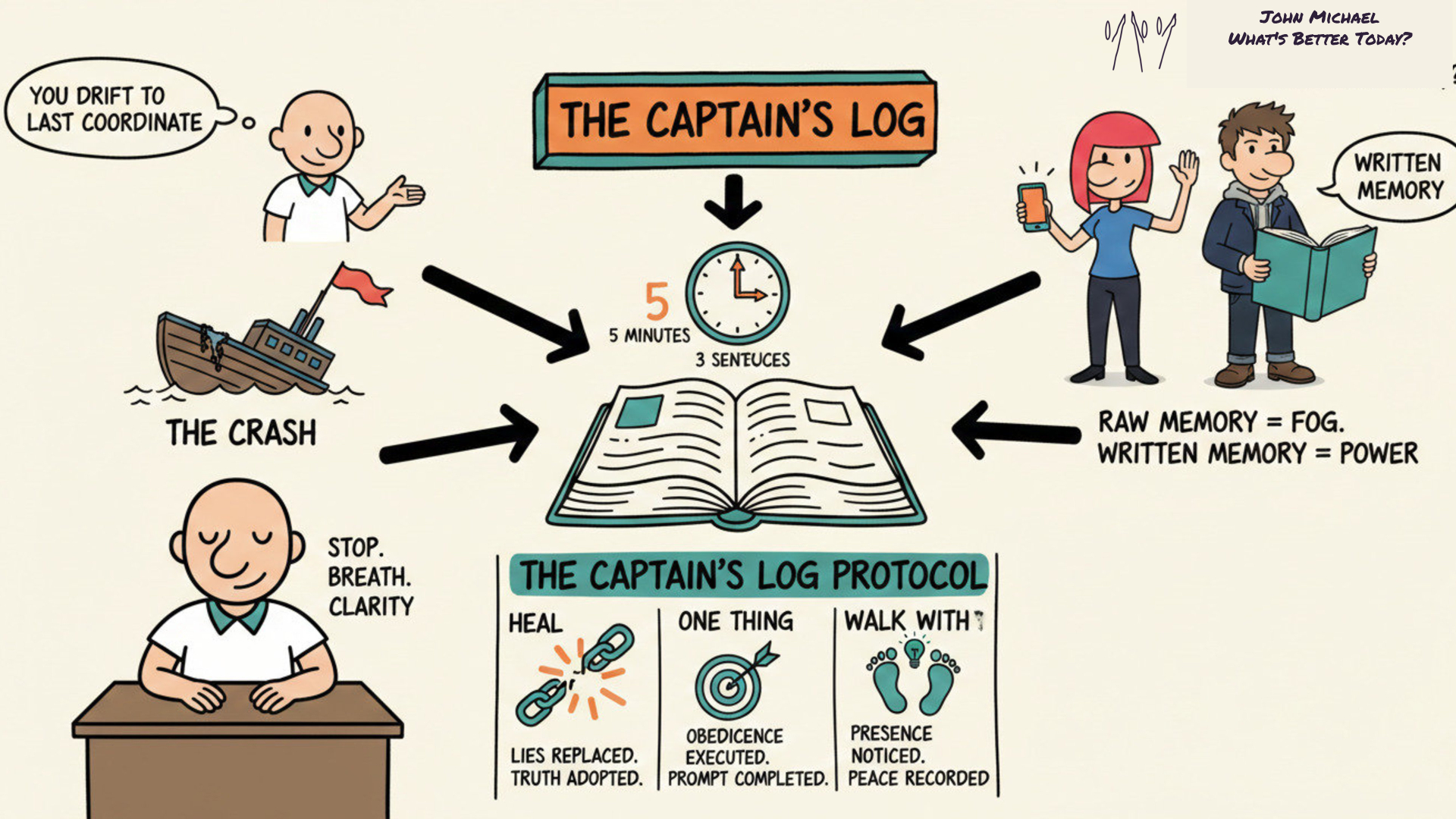 Download this SketchNote for your own notes and to share
Some browsers expose an interface for querying the approximate amount of storage that your origin is using, along with the upper limit, via navigator.storage.estimate().
storage estimate
This section explains why social media platforms moderate content under the idea of “quality control.” Even platforms that claim to support free speech still block spam, scams, and mass-produced advertisements. The text argues that without moderation, platforms would become filled with unwanted content, and users would leave.
Social media sites also might run into legal concerns with allowing some content to be left up on their sites, such as copyrighted material (like movie clips) or child pornography. So most social media sites will often have rules about content moderation, and at least put on the appearance of trying to stop illegal content (though a few will try to move to countries that won’t get them in trouble, like 8kun is getting hosted in Russia). With copyrighted content, the platform YouTube is very aggressive in allowing movie studios to get videos taken down, so many content creators on YouTube have had their videos taken down erroneously.
I think its really interesting to see just how seriously different platforms consider copyright content being posted on their websites. YouTube is well-known for giving strikes to creators who play a 10-second clip of copyrighted music, even resorting to banning creators from posting content. Meanwhile, TikTok is much more lenient, so much so that users make frequent comments about watching full movies on TikTok through clips that are posted online. I wonder why TikTok is much more lenient on their copyright policies compared to TikTok, however, I'm sure a lot of it has to do with the fact that most YouTubers create monetized videos, while TikTok is mostly a platform where monetization isn't that popular, unless creators are sponsored to advertise a product.
In order to make social media sites usable and interesting to users, they may ban different types of content such as advertisements, disinformation, or off-topic posts. Almost all social media sites (even the ones that claim “free speech”) block spam, mass-produced unsolicited messages, generally advertisements, scams, or trolling.
I find it interesting that content moderation is not only about ethics, but also about platform survival and economic incentives. The categories mentioned—quality control, legal concerns, safety, and offensive content—show that moderation decisions are often driven by business considerations as much as moral ones.
Another category is content that users or advertisers might find offensive. If users see things that offend them too often, they might leave the site, and if advertisers see their ads next to too much offensive content, they might stop paying for ads on the site. So platforms might put limits on language (e.g., racial slurs), violence, sex, and nudity. Sometimes different users or advertisers have different opinions on what should be allowed or not. For example, “The porn ban of 2018 was a defining event for Tumblr that led to a 30 percent drop in traffic and a mass exodus of users that blindsided the company.”
This really highlights how content moderation is not just about ethics, but also about competing interests. What feels like necessary protection to one group can feel like censorship to another. It makes it clear that platforms are constantly balancing user experience, advertiser pressure, and profitability, not just abstract principles about free expression.
Another concern is for the safety of the users on the social media platform (or at least the users that the platform cares about). Users who don’t feel safe will leave the platform, so social media companies are incentivized to help their users feel safe. So this often means moderation to stop trolling and harassment.
One of the chief reasons for moderation is to protect the safety of users.
To solve problems, researchers may employ a range of methods. Each discipline has its own methods for making or vetting knowledge claims. In Psychology, for example, experimentation with human subjects is quite common, but it is less common in Mathematics. Part of becoming a skilled researcher is learning the epistemology of one’s discipline. Say a mathematician was trying to solve an equation that had not yet been solved. If the approach was to put twenty people in a room and watch how they solved it, other scholars in the discipline would not take the results seriously, but if something similar were done by a psychologist, the results could be quite important (see Research
Different subjects use different ways to solve problems, so good researchers learn which methods make sense for their specific field.
Now imagine that you are doing academic work or professional research. You are a member of a discipline or profession and you have a good idea of the foundational texts for your research topic. A bit of reading you have done has caught your attention: perhaps a text, newspaper article, or journal article. You begin to question how this reading fits in with what you know about your discipline. First you search to see if scholars have been writing about this question (textual research). They may have answered it, but most likely, they have not yet come to a firm conclusion. You decide to do some research on your own to try to answer the question.
When something you read makes you curious, you start asking questions, look at what others have already studied, and then do your own research to better understand it.
Thus, as they engage in inquiry, researchers will choose methods based on the values of the Communities of Practitioners in their disciplines. They may sift through research publications across disciplines with hopes of synthesizing published information in a new way; test past research claims in a lab; or interview people.
Researchers select the methods that make the most sense for their field, enabling them to understand their questions better and learn something meaningful.
On the other hand, doing research for other reasons than to answer a question can be half-hearted or sloppy.
This made me think of how motivation affects the quality of work. When research is done just to complete an assignment, it may not be as thoughtful as research driven by curiosity.
People (and research communities) are constantly revising research questions.
This makes me wonder: how do researchers know when to stop revising their questions and commit to one direction?
the Research as Inquiry Framework
This stood out to me because it shows that research is not just about finding the answers but about continuing a conversation. I like the idea that one study can lead to more questions instead of just ending the discussion.
Now imagine that you are doing academic work or professional research
When conducting research for an academic or professional project, annotations assist you in thinking about what you are reading in a more profound way. They enable you to make connections between ideas, pose questions, and determine how a source will be used in your project.
You are a member of a discipline or profession and you have a good idea of the foundational texts for your research topic
This implies that you already know the important books or articles related to your field of study. This background knowledge will help you understand your topic better and will also make your research stronger and more focused.
They may have answered it, but most likely, they have not yet come to a firm conclusion. You decide to do some research on your own to try to answer the question.
The author may have attempted to answer the question, but they likely have not come to a conclusion. One question I have for the author is why they have not come to a conclusion on the answer to the question. As a result, I would like to conduct research on the topic.
You begin to question how this reading fits in with what you know about your discipline
You begin to wonder how this reading relates to what you already know about your field of study. One of the questions that arise is whether the ideas presented in this reading support what you have learned or contradict it.
p.s. Want the visual map? You'll find a full FieldNote Sketch Summary of this inside the 'hidden' layer. Click this highlight to see the synthesis, share it with someone you know needs it and save a copy for yourself.
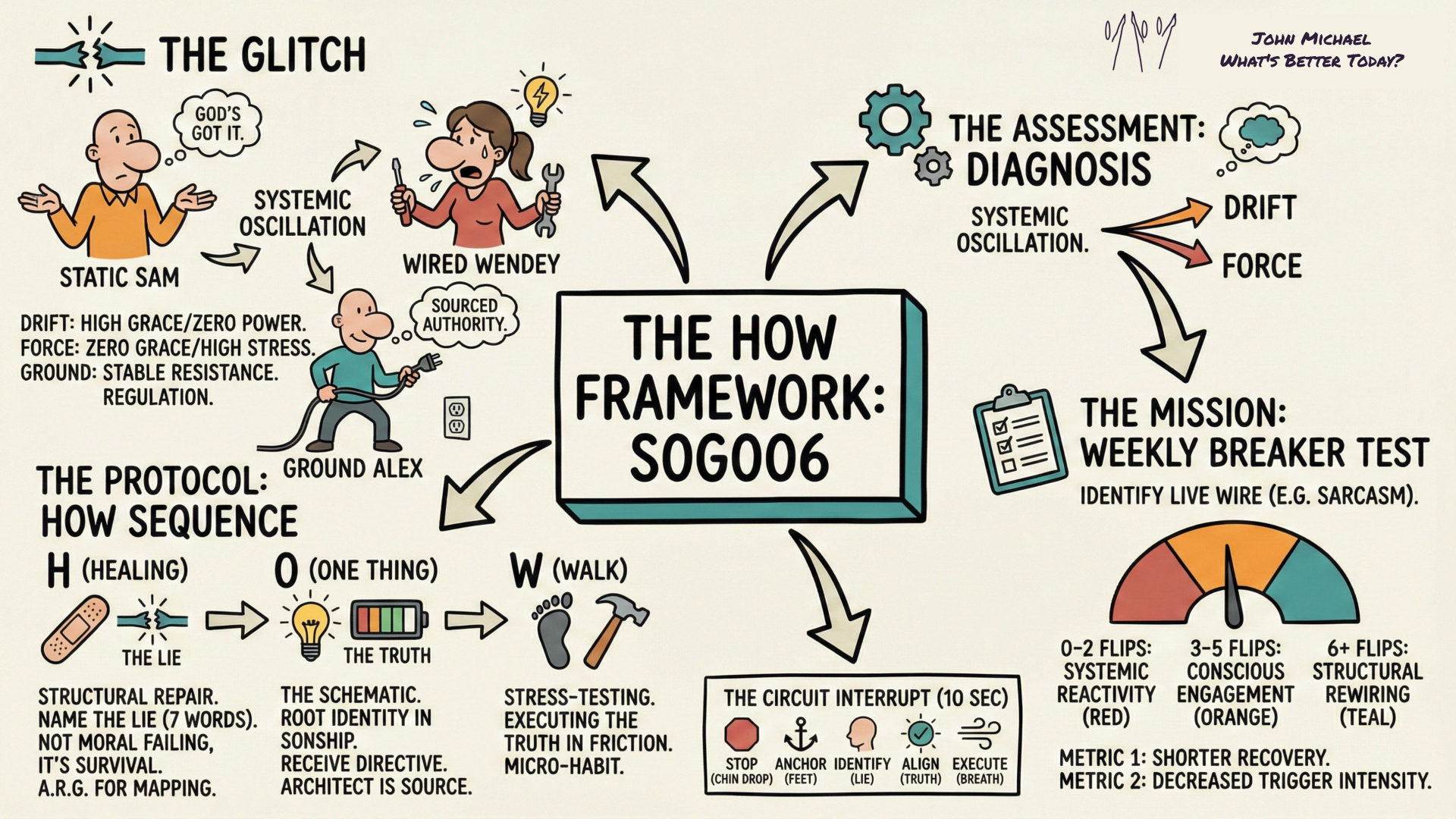 Download this SketchNote of the HOW Framework for your own notes and to share.
He is the source of rest. Root your identity in Sonship.
The Scriptural Foundation: In the Biblical framework, "rest" is not a synonym for taking a nap; it is an active state of governance. The Hebrew concept of Menuha implies a secure, ordered settling where chaos has been subdued (much like God resting on the seventh day to rule His ordered creation). Furthermore, the Greek term for Sonship, Huiothesia (adoption as heirs), guarantees that your standing in the Kingdom is inherited, not earned through frantic output. Sonship is the legal and spiritual access point to Menuha. You cannot access the Kingdom's power grid while operating like an anxious employee.
Diagnosis: Systemic Oscillation.
The Systemic Explanation: In control systems engineering, "oscillation" occurs when a system continuously overcorrects, swinging wildly between extremes without ever finding equilibrium. When you lack a stable centre ("Ground"), you operate like an undamped pendulum. The anxiety of passive disengagement (Drift) eventually forces you into a panic of hyper-performance (Force), which inevitably leads to a crash, sending you back to Drift. Breaking this cycle requires a "dampener"—a grounding mechanism that absorbs the chaotic kinetic energy and settles the system into a stable, sustainable third state.
The Lie is not a moral failing. It is the story your nervous system learned to survive.
The Biological Reality: When we experience early friction or trauma, the brain’s threat-detection centre (the amygdala) forms rapid, deeply rutted neural pathways to protect us. It prioritises survival over objective truth. If "Force" or "Drift" kept you safe in the past, your nervous system chemically mapped that behaviour as a vital survival mechanism. Therefore, the "Lie" you believe is not a conscious rebellion; it is a highly efficient, misfiring biological script. Rewiring it requires consistent, regulated physiological experiences to prove to your brain that the old circuitry is no longer required.
Before using a particular transitional word or phrase, be sure you completely understand its meaning and usage. For example, if you use a word or phrase that indicates addition (“moreover,” “in addition,” “further”), you must actually be introducing a new idea or piece of evidence. A common mistake with transitions is using such a word without actually adding an idea to the discussion. That confuses readers and puts them back on rickety footing, wondering if they missed something.
Understanding what you are gonna say
For a period of time, most news organizations allowed comments on their articles, but around 2013 many of these sites simply removed the possibility of leaving comments, as they felt allowing comments did more harm than good.
This is very interesting, because they remove the opportunity for feedback, because it wasn't doing good - but debate should be encouraged especially on news sites. It's the public service that news channel can do - allow users to engage and speak their opinions about the news, or the angle taken in the article. That's the dilemma about moderation in my opinion, because when does it go from a good thing, to a censorship?
14.3.1. 4chan/8chan (minimal moderation)# Sites like 4chan and 8chan bill themselves as sites that support free-speech, in the sense that they don’t ban trolling and hateful speech, though they may remove some illegal content, like child pornography. One thing these sites do ban though, is spam. While much of spam is certainly legal, and a form of speech, this speech is restricted on these sites. If the chat boards filled up with spam, the users would find it boring and leave, so for practical reasons, these sites still moderate for spam (though they may allow some uses of ironic spam, copypasta). 14.3.2. Reddit (subreddits with volunteer moderators)# Reddit is composed of many smaller discussion boards, called subreddits. These subreddits range from friendly to very toxic, with different moderators in charge of each subreddit. Reddit as a larger platform decided to ban and remove some of its most toxic and hateful subreddits, including r/c***town (note: I censored out a racial slur for Black people), and r/fatpeoplehate. In a study of what happened after this ban: Post-ban, hate speech by the same users was reduced by as much as 80-90 percent. […] “Members of banned communities left Reddit at significantly higher rates than control groups. […] Migration was common, both to similar subreddits (i.e. overtly racist ones) and tangentially related ones (r/The_Donald). […] However, within those communities, hate speech did not reliably increase, although there were slight bumps as the invaders encountered and tested new rules and moderators. 14.3.3. Facebook (hired moderators)# Facebook uses hired moderators to handle content moderation on the platform at large (though Facebook groups are moderated by users). When users (or computer programs) flag content, the hired moderators will look at it and decide what to do. Facebook also discovered in internal research that, “the more likely a post is to violate Facebook’s community standards, the more user engagement it receives, because the algorithms that maximize engagement reward inflammatory content.” 14.3.4. Removing the option of feedback# For a period of time, most news organizations allowed comments on their articles, but around 2013 many of these sites simply removed the possibility of leaving comments, as they felt allowing comments did more harm than good. 14.3.5. Public Figure Exception# Twitter, Facebook, and other platforms had an exception to their normal moderation policies for political leaders, where they wouldn’t ban them even if they violated site policies (most notably applied to Donald Trump). After the January 6th insurrection at the US Capital, Donald Trump was banned first from Twitter, then from Facebook, and Facebook announced an end to special treatment for politicians. 14.4. Government Censorship# Governments might also have rules about content moderation and censorship, such as laws in the US against Child Sexual Abuse Material (CSAM). China additionally censors various news stories in their country, like stories about protests. In addition to banning news on their platforms, in late 2022 China took advantage of Elon Musk having fired almost all Twitter content moderators to hide news of protests by flooding Twitter with spam and porn.
This section shows that even platforms that promote “free speech” still moderate content in practice, such as banning spam, because complete freedom can harm user experience. I found the Reddit example especially interesting, since banning hateful communities significantly reduced hate speech. It also highlights how platform policies and algorithms shape user behavior. Overall, moderation is not just about censorship, but about how systems influence online communities.
14.3.1. 4chan/8chan (minimal moderation)# Sites like 4chan and 8chan bill themselves as sites that support free-speech, in the sense that they don’t ban trolling and hateful speech, though they may remove some illegal content, like child pornography. One thing these sites do ban though, is spam. While much of spam is certainly legal, and a form of speech, this speech is restricted on these sites. If the chat boards filled up with spam, the users would find it boring and leave, so for practical reasons, these sites still moderate for spam (though they may allow some uses of ironic spam, copypasta).
I find it interesting that even platforms like 4chan and 8chan, which claim to support “free speech,” still engage in selective moderation. The fact that they ban spam shows that no platform can operate without some form of content control. If spam were allowed without restriction, the site would become unusable and users would leave. This suggests that even so-called minimal moderation platforms must make practical decisions about what kinds of speech are acceptable.
Governments might also have rules about content moderation and censorship, such as laws in the US against Child Sexual Abuse Material (CSAM). China additionally censors various news stories in their country, like stories about protests. In addition to banning news on their platforms, in late 2022 China took advantage of Elon Musk having fired almost all Twitter content moderators to hide news of protests by flooding Twitter with spam and porn.
This shows how content moderation can be used for very different purposes, from preventing clear harm like CSAM to suppressing political information and public dissent. It also highlights how weak moderation systems can be exploited strategically, not just by individual trolls but by powerful actors trying to control what people see.
Post-ban, hate speech by the same users was reduced by as much as 80-90 percent
I think this is a super interesting statistic, as it shows that often a feeling of community/camraderie is what emboldens people to share their hateful opinions. It definitely applies to modern day, too, as we see the rise of hate speech and extremist views now that our administration is extremist and fascist.
14.3.2. Reddit (subreddits with volunteer moderators)# Reddit is composed of many smaller discussion boards, called subreddits. These subreddits range from friendly to very toxic, with different moderators in charge of each subreddit. Reddit as a larger platform decided to ban and remove some of its most toxic and hateful subreddits, including r/c***town (note: I censored out a racial slur for Black people), and r/fatpeoplehate. In a study of what happened after this ban: Post-ban, hate speech by the same users was reduced by as much as 80-90 percent. […] “Members of banned communities left Reddit at significantly higher rates than control groups. […] Migration was common, both to similar subreddits (i.e. overtly racist ones) and tangentially related ones (r/The_Donald). […] However, within those communities, hate speech did not reliably increase, although there were slight bumps as the invaders encountered and tested new rules and moderators. 14.3.3. Facebook (hired moderators)
I think volunteers are generally worse than hired moderators given the inclination of the most devoted of a community to volunteers. This can result in more extremist policies and annoying ego-trips that would deter growth in some communities. However, this is sporadic.
Examples of Appropriate Thesis Statements The societal and personal struggles of Troy Maxon in the play “Fences” symbolize the challenge of black males who lived through segregation and integration in the United States. Shakespeare’s use of dramatic irony in Romeo and Juliet spoils the outcome for the audience and weakens the plot. J. D. Salinger’s character in Catcher in the Rye, Holden Caulfield, is a confused rebel who voices his disgust with phonies, yet in an effort to protect himself, he acts like a phony on many occasions. Compared to an absolute divorce, no-fault divorce is less expensive, promotes fairer settlements, and reflects a more realistic view of the causes for marital breakdown. Exposing children from an early age to the dangers of drug abuse is a sure method of preventing future drug addicts. In a crumbling job market, a high school diploma is not significant enough education to land a stable, lucrative job.
Thesis statements are kind of hard for me to grasp.
ruination.
pax romana's fall as an empire(разрушение)
Discuss the questions you have while reading to better understand the purpose.
Understanding the purpose of the article helps you understand what you are reading.
ArticleDeps
インポートが必要?
完全版をexample_5.py
完全版がどこにも書かれていない? snippet_2.py を修正したものですかね?
ArticleList
この後にコメントで、 # 事前に定義したPydanticモデルをインポート などと説明を入れると丁寧かと思います。
snippet_6.py
このファイル名が、snippet_1.pyから繋がっているのかな?みたいに感じたので、(実際は繋がってないですすよね?)ファイル名別ものに変えた方がよさそうかなと思いました。
SAMPLE_HTML
ここで、SAMPLE_HTMLも渡す必要があるのでしょうか? ちょっと、この2つのパラメータを渡した時のイメージができなかったので、もし必要なら説明があるとよいと思いました。
article_common
これは、どこかにでてきていますか?
Pydantic AIでは、deps_typeパラメータで依存リソースの型を宣言し、RunContextを通じてツールやインストラクションの中からそのリソースにアクセスできます。
この一文がここにあると、少し意味がわかりずらく、??となったので(すぐ下のコードにもdeps_typeなどがでてきていないため)、省いしてしまって、下記に続くコードの説明のなかでああった方がよいかなと思いました。
確認できます。
以下の実行にもキャプションがあると良いと思いました。
metric_type="COSINE"
用余弦相似度进行判定?
cv2.putText(query_display_area, "Query"
显示文字效果
Ash, Lorinda
Lorinda Ash
Jey Leto
Jay Leto
Jack Goldberger
Jack goldberger
Your Excellency---it may scarcely appear necessary to lay before Your Excellency any lengthened details of what has taken place between the Orange Free State and myself.
It is a polite way of saying, We both know what’s going on here, so let's get straight to the point.
15.2. Example Moderator Set-ups# Let’s look in more detail at some specific examples of moderator set-ups: 15.2.1. Reddit# Reddit is divided into subreddits which are often about a specific topic. Each subreddit is moderated by volunteers who have special permissions, who Reddit forbids from making any money: Reddit is valued at more than ten billion dollars, yet it is extremely dependent on mods who work for absolutely nothing. Should they be paid, and does this lead to power-tripping mods? A post starting a discussion thread on reddit about reddit In addition to the subreddit moderators, all Reddit users can upvote or downvote comments and posts. The reddit recommendation algorithm promotes posts based on the upvotes and downvotes, and comments that get too many downvotes get automatically hidden. Finally, Reddit itself does some moderation as a platform in determining which subreddits can exist and has on occasion shut down some. Reflection Question:# What is your take on the ethical trade-offs of unpaid Reddit moderators? What do you think Reddit should do? 15.2.2. Wikipedia# Wikipedia is an online encyclopedia that is crowdsourced by volunteer editors. You can go right now and change a Wikipedia page’s content if you want (as long as the page isn’t locked)! You can edit anonymously, or you can create an account. The Wikipedia community gives some editors administrator access, so they can perform more moderation tasks like blocking users or locking pages. Editors and administrators are generally not, paid, though they can be paid by other groups if they disclose and fill out forms Wikipedia exists in multiple languages (each governed somewhat independently). When looking at the demographics of who writes the English Wikipedia articles, editors of Wikipedia skew heavily male (around 80% or 90%), and presumably administrators skew heavily male as well. This can produce bias in how things are moderated. For example, Donna Strickland had no Wikipedia page before her Nobel. Her male collaborator did: “Articles on Strickland had been drafted on the online encyclopedia before in May 2018 — but the draft was rejected by moderators. ‘This submission’s references do not show that the subject qualifies for a Wikipedia article,’ the moderators wrote, despite the fact that the original author linked to a page that showed Strickland was once president of the Optical Society, a major physics professional organization and publisher of some of the field’s top journals.” Reflection Question:# How should Wikipedia handle their editor/administrator demographics? 15.2.3. Facebook# While Facebook groups and individual pages can be moderated by users, for the platform as a while, Facebook has paid moderation teams to make moderation decisions (whether on content flagged by bots, or content flagged by users). As Facebook has grown, it has sought users from all over the globe, but as of 2019: Facebook had menus and prompts in 111 different languages, which were deemed to be “officially supported” Facebook’s “Community standards” rules were only translated into 41 of those languages Facebook’s content moderators know about 50 languages (though they say they hire professional translators when needed) Automated tools for identifying hate speech only work in about 30 languages
This section highlights how moderation structures reflect power, labor, and representation. I found the Wikipedia example especially striking, since the gender imbalance among editors can directly shape whose knowledge is recognized. It shows that moderation is not neutral—it reflects who participates and who has authority. The Facebook language gap also raises concerns about global fairness, suggesting that moderation systems often privilege certain regions and languages over others.
The Detriments of British Rule: In the Cause of Humanity: Nothing. Everything, therefore, is in your favor under this heading.
It’s a backhanded compliment.It mocks the British for thinking their empire was a charity project when it was actually about power and profit.
15.1.1. No Moderators# Some systems have no moderators. For example, a personal website that can only be edited by the owner of the website doesn’t need any moderator set up (besides the person who makes their website). If a website does let others contribute in some way, and is small, no one may be checking and moderating it. But as soon as the wrong people (or spam bots) discover it, it can get flooded with spam, or have illegal content put up (which could put the owner of the site in legal jeopardy). 15.1.2. Untrained Staff# If you are running your own site and suddenly realize you have a moderation problem you might have some of your current staff (possibly just yourself) start handling moderation. As moderation is a very complicated and tricky thing to do effectively, untrained moderators are likely to make decisions they (or other users) regret. 15.1.3. Dedicated Moderation Teams# After a company starts working on moderation, they might decide to invest in teams specifically dedicated to content moderation. These teams of content moderators could be considered human computers hired to evaluate examples against the content moderation policy of the platform they are working for. 15.1.4. Individuals moderating their own spaces# You can also have people moderate their own spaces. For example: when you text on the phone, you are in charge of blocking numbers if you want to (though the phone company might warn you of potential spam or scams) When you make posts on Facebook or upload videos to YouTube, you can delete comments and replies Also in some of these systems, you can allow friends access to your spaces to let them help you moderate them. 15.1.5. Volunteer Moderation# Letting individuals moderate their own spaces is expecting individuals to put in their own time and labor. You can do the same thing with larger groups and have volunteers moderate them. Reddit does something similar where subreddits are moderated by volunteers, and Wikipedia moderators (and editors) are also volunteers. 15.1.6. Automated Moderators (bots)# Another strategy for content moderation is using bots, that is computer programs that look through posts or other content and try to automatically detect problems. These bots might remove content, or they might flag things for human moderators to review.
This section clearly shows that moderation is not just about rules, but about who is doing the moderating and how the system is structured. I found the comparison between volunteer moderators, paid moderation teams, and automated bots especially helpful because it highlights trade-offs in labor, expertise, and fairness. It also made me realize that moderation always involves resource decisions, not just ethical ones.
Letting individuals moderate their own spaces is expecting individuals to put in their own time and labor. You can do the same thing with larger groups and have volunteers moderate them. Reddit does something similar where subreddits are moderated by volunteers, and Wikipedia moderators (and editors) are also volunteers.
This made me think about how much invisible labor goes into keeping online spaces functional. Volunteer moderators often do emotionally draining work for free, which benefits the platform as a whole. It raises the question of whether companies should rely so heavily on unpaid community labor to maintain order.
These teams of content moderators could be considered human computers hired to evaluate examples against the content moderation policy of the platform they are working for.
I found it interesting that they hire actual people to do this job, rather than having technology moderate content
Three traits of professions are especially noteworthy
Rigorous standards, significant autonomy, considerable prestige and identification with the profession
The Social Control of Medicine
Stop for Monday
When lilacs last in the dooryard bloom’d, And the great star early droop’d in the western sky in the night, I mourn’d, and yet shall mourn with ever-returning spring.
in this poem, whitman is comparing or using the death of these lilacs to the death of a star or person. here the flowers and stars represent people or a person and how now each season with the bloom of the lilacs it reminds him of the loss of the person. he uses nature to grieve and to express his feelings on grieving a year or years after someone has passed
By
This section helped me understand moderation not just as a technical policy decision, but as an ethical concept rooted in virtue ethics and social contract theory. I found Rawls’s “veil of ignorance” especially useful for thinking about how fair moderation rules should be created. Mills’s critique also adds an important perspective by showing how power shapes social contracts. Overall, this reading deepens the idea that moderation is not only about limiting speech, but about whose values and interests are being protected.
Rawls proposed a famous thought experiment. Imagine we were going to redesign America. A huge lottery was done to gather people from all walks of life into a committee to decide how the society should be structured and how it should function. Naturally, they will all have their own interests in mind, so Rawls proposed that they all be hidden behind a “veil of ignorance”, making it so that while they are on the committee, the people have no idea who they are, or what sort of life they will have once the new design is implemented. (The veil of ignorance is not a real thing, and it is extremely unclear how such an obscuring could be accomplished, although science fiction writers have had fun trying to imagine it.) Rawls’s thought was that if you don’t know whether you will be in one of society’s more powerful roles or more disadvantaged roles, then you will have the motivation to make sure you will be okay, whatever role you get in the end. Therefore, the committee members would design a just and fair society, so that they would be okay no matter where they end up. The design the committee agrees to forms the basis of a new “social contract”, or agreement about how society works.
I like this idea in theory and somewhat in practice. If it could produce the results it purports, it would be pretty just. However, I don't think it would last due to the rot by self selection that all societies face. That is, in the long run positions of power are sought more and more by those with ulterior motives.
How about changing “The 12th day of the month of April” to “April 12th?” As you revise, look for overly-complicated sentences and substitute simpler ones for clarity.
I try to make it complicated to kept interest. Now I see a simple approach isn't bad either.
Then, share the paper with someone who fits the description of the audience for whom the document is intended
I usually just read through it myself. I don't have anyone to read it.
Jove
GILL : "Jove knows" (Zeus) PENGUIN : "Love knows" Cupid)
Jude
India
thrall
thrall - bondage
rough Jades
rough jades - horses of inferior breeding
I saw a brandisht fire encrease in strength,Which being not shakt, I saw it dye at length.
I saw a brandishing fire increase in strength; when not shaken, I saw it die at length
praise
Praise (Gill); Sprays (Penguin) - sprays -> a slender shoot/twig
Mirtle
Myrtle - mark of Venus; love
Girt
Girt - encircle
warblest
Warble: - (birds) to sing clearly, sweetly - tune, melody - a small, hard tumor - shake/vibrate
Elegian Muse,
elegian muse - muse of elegy (love poetry)
impe
Imple - child of the devil
In wooddie groves ist meete that Ceres raigne?And quiver-bearing Dian till the plaine
We are devoted to the Muses, not to Eros. What would happen if Ceres lorded over the forest; Diana, over the farmland?
tooke_one foote away
Concerning poetry - tooko one foote away in relation to the length of poetry. Taking one foote away, turning it into a love poem
love
love lowercased in Gills edition; Love capitalized in Penguin editions, denoting the god of Love, Cupid
alarmes
alarmes - call to arms ; warning
upreard
upreard - raised up
Conflict occurs between two opposing sides in a story, usually centering on characters' values, needs, or interests.
Definition of conflict (brings a reason for the story)
dynamic.
A main character should be dynamic to have an arc in their personal narrative
describe the strategies that an author uses to present and develop the characters in a narrative.
Definition of characterization
whether it is to identify, empathise, or sympathise with them; to dislike or disapprove of them; or to pass judgement on their actions, behaviour and values.
In some way we need to care about a character
Through a process guided by principles of consensus building, 21 the IPC working group members grouped the list of evidence-based enablers by frequency and theme. This yielded 29 key enablers that were vetted for organizational relevance and alignment against hospital strategic plans. The key enablers underwent a second thematic grouping by the IPC working group who selected and synthesized the set of enablers based on their diverse expertise, knowledge, and experience to construct six core competencies.
Interprofessional collaboration not only improves patient outcomes but also enhances workforce satisfaction and reduces burnout. Research suggests collaborative environments improve team cohesion and reduce professional conflict (Hall, 2005). This reinforces that collaboration is essential to sustainable healthcare systems.
Hall, P. (2005). Interprofessional teamwork: Professional cultures as barriers. Journal of Interprofessional Care.
A 10-member IPC working group comprised of representatives from interprofessional education, professional practice, and organizational development and leadership was established. The IPC working group executed each step of the development process and led the stakeholder consultation process. A larger stakeholder consultation group was established which included clinical and non-clinical staff representing a variety of roles and expertise. The stakeholder consultation process included distribution of materials for review and feedback to directors of operation, patient care managers, nurse practitioners, health professions leaders, advanced practice nurses, clinical educators, and patient and student representation, as well as the Interprofessional Education Committee and the Education Advisory Committee.
Professionalism is foundational to effective interprofessional collaboration. The framework emphasizes mutual respect, accountability, ethical behavior, and clearly defined roles.
According to the Interprofessional Education Collaborative (IPEC, 2016), core competencies include values/ethics, roles and responsibilities, communication, and teamwork. The framework presented aligns with these competencies, demonstrating that professionalism extends beyond individual conduct and becomes a shared team responsibility.
Interprofessional Education Collaborative. (2016). Core competencies for interprofessional collaborative practice.
The development of core competencies for interprofessional collaboration at Sunnybrook was part of a wider IPC strategy to become a system-wide leader in advancing a culture of interprofessionalism and foster the highest quality, compassionate and person-centred care. 20 A collaborative bottom-up approach was taken to the development and implementation of the framework to optimize acceptance and adoption of the competencies by the various clinical and non-clinical teams
The scenarios attribute several outcomes to interprofessional collaboration, including improved patient safety, clearer communication, enhanced role clarity, and coordinated care delivery.
Team-based care has been shown to reduce medical errors and strengthen shared decision-making (Reeves et al., 2017). The article also addresses barriers such as hierarchical structures and communication breakdowns by emphasizing structured competencies and shared leadership approaches.
Reeves, S., et al. (2017). Interprofessional collaboration to improve professional practice and healthcare outcomes. Cochrane Database of Systematic Reviews.
The framework was developed using a comprehensive literature search and consensus building by a multi-stakeholder working group and supported by a broad consultation process that included patient representation, organizational development and leadership, and human resources.
The authors demonstrate proper plagiarism avoidance by citing research when integrating prior findings into their framework. Rather than copying exact wording, they paraphrase and attribute ideas appropriately.
To avoid plagiarism, writers must quote directly with citation, paraphrase in their own words with citation, or summarize with attribution (APA, 2020). This article models academic integrity, which reflects professionalism in both scholarship and healthcare practice.
American Psychological Association. (2020). Publication manual of the American Psychological Association (7th ed.).
Many organizations have adopted existing interprofessional frameworks that define the competencies of individual health professionals that are required to meet practice standards and advance interprofessional goals.
In this section, the authors paraphrase prior research by restating definitions of interprofessional collaboration in new wording while maintaining the same level of detail. Paraphrasing keeps the meaning but changes the language (American Psychological Association [APA], 2020).
The article also summarizes broader findings when it condenses multiple studies into key themes about team competencies. Summarizing reduces detailed information into core concepts. The distinction matters because paraphrasing engages closely with a specific idea, while summarizing synthesizes larger bodies of research.
American Psychological Association. (2020). Publication manual of the American Psychological Association (7th ed.).
https://doi.org/10.1177/00169862221128299Gifted Child Quarterly 1 –22© 2022 National Association forGifted ChildrenArticle reuse guidelines: sagepub.com/journals-permissionsDOI: 10.1177/00169862221128299journals.sagepub.com/home/gcqFeature ArticleAddressing racial and ethnic underrepresentation in the sci-ence, technology, engineering, and mathematics (STEM) workforce is a national priority (American Society of Mechanical Engineers, 2021; National Academies of Sciences, Engineering, and Medicine [NASEM], 2011; National Science Foundation [NSF], 2021).
Did not know this, but great that this is a national priority
En la neblina del amanecer, cuando aún no se oía el zumbar de las moscas ni crujido alguno, Lope solía despertar, con la techumbre de barro encima de los ojos
Esto me hace pensar que la techumbre de barro es figurativo del dolor que le causa estar tan lejos de la ciudad a Lope. Tambien puede ser obstáculos figurativos que lo ciegan de oportunidades.
Veeam Data Cloud Vault
Veeam Data Cloud
User Authentication. Veeam Data Cloud Vault integrates with several authentication mechanisms, for example Microsoft Entra ID or SAML-based Single Sign-On (SSO).Permissions Model. Access control is managed using basic user roles and permissions. Note that Role-Based Access Control (RBAC) is not available.
I think we should clarify that these relate to the Veeam Data Cloud Management portal, not the vaults themselves. Perhaps just say Veeam Data Cloud not Veeam Data Cloud Vault, since these functions are not specific to Vault, and it highlights the fact that this applies to VDC not the storage accounts themselves
Veeam Backup & Replication
supported Veeam products such as Veeam Backup & Replication
Veeam Backup & Replicatio
A vault can be accessed by supported Veeam products, for example Veeam Backup & Replication,
Data at rest is encrypted with the AES-256 standard.
I think we should call out that the Vault's themselves are encrypted and that a further layer of encryption is applied by the source product (e.g. VBR or Kasten)
/'1J'1!
Output is usually measured by GDP = C + I + G + (X − M)
trophies, the effect of these mechan-ics becoming so solidly integrated into videogame culture is that theirgravitational pull changes how games are played and interpreted. Lea-derboards are a clear place where players are compared with one an-other. A former highly competitive Madden NFL player writes thatleaderboards are “a devilish feature,” as they transform “Madden froman escapist pastime into another stage on which to prove your self-worth.”36 Gamerscore is a measure that turns abstract effort in a gameinto concrete results that are intelligible to others at a mere glimpse.
I 110% this hard game and you didn't heh...
Fucking Plato virtue signaling from its cave...
And data are never neutral; they are always the biased output of unequalsocial, historical, and economic conditions: this is the matrix of domination onceagain.
The authors explain that data shows what is happening in the world it comes from. So, if a society has inequality, its data will reflect that inequality as well.
This is the privilege hazard: the phenomenon that makes those who occupy the mostprivileged positions among us—those with good educations, respected credentials, andprofessional accolades—so poorly equipped to recognize instances of oppression in theworld
I like how this explains why biased systems continue to exist. It is not because people want to cause harm. Sometimes, they just do not notice the problem since the system benefits them. This makes bias more difficult to spot and address.
“What we choose to measure is a statement of what we value inhealth,” he explains.
If something is not being measured, does that mean society has decided it is not important?
Basic Orienting Facts-Lets the reader know who, when, where, and what is happening. Organization-The reason you order your content the way you do. Structure-The order in which you choose to present your events to your reader Scene-Vivid descriptions of the setting and what you said in order to feel immersed in a story. Scene is the opposite of summary. Use scene sparingly when you want to slow down and focus on an important part of the story. Summary– A way to manage time. When you tell the reader what used to happen in your family, for example, you could explain, “My mother used to cook Sunday dinner for the family. She often made a roast.” You are summarizing what used to happen in the past. If you were to write about a specific Sunday, and you fleshed out what happened in scene with dialogue, included details about the sound of vegetables being chopped, described the smells in the kitchen, and told the reader what your mother was wearing, and reflected on the conversation you had, that would be a scene. Summary condenses information in both academic and creative writing, but in creative writing, summary is linked to time management. Persona– The character of you that you construct. It’s not literally you, because you are not words on the page, right? You are flesh and bone and you have a rich inner life. Use that rich inner life to develop your persona. Persona comes from the Latin word for mask. It’s the version of you that you would like to illustrate for the reader in your memoir. This is a complicated concept. One way to think of your persona is you in relationship to the situation or people in the story. The persona can also be shaped by time: who and what you were like when you were twelve, for example. It can be shaped by relationship to your topic: who and what you are like in relationship to your mother or third grade teacher or your sergeant in boot camp. Readers Trust in You-Readers won’t automatically question your credibility as a narrator on the page, but if you seem very infallible or somehow superhuman while everyone else in the story is tragically flawed, then the reader will wonder about the truthfulness of your own self-depiction. You are accountable to telling the story to your reader as truthfully as you can, while using craft elements to engage the reader. It’s a daunting task. Also, readers like protagonists who are flawed, so be truthful about your mistakes. Setting-Where and when the story takes place. Mood-The emotional weight or atmosphere of a story, created through details, description, and other craft features, for example, sometimes setting can help create a mood. Imagery-An image in a story, or in a poem, is a description that appeals to one of the five senses. An image should also convey additional meaning, either emotional and/or intellectual. It’s not an image to say green gelatin. Green gelatin is meaningless until the reader injects the gelatin with meaning. You can, however, create an image if you were to write, “The Frog Eye Salad recipe that my beloved grandmother used to make for Sunday picnics.” The latter description is specific and contains emotional content. Reflection-The sense and interpretation that you make of the events that transpired in your memoir and how you feel and/or think about them. You can also reflect on the story and relate the events to the universal meaning or theme you would like to include in the story.
Adding these key point can help you with making your story come to life and with your world building.
Plot – The events as they unfold in sequence Characters -The people who inhabit the story and move it forward. Typically, there are minor characters and main characters. The minor characters generally play supporting roles to the main character, or the protagonist. Characters are fleshed out not only through how the author describes them, but also through their actions, dialogue, and thoughts. Conflict -The primary problem or obstacle that unfolds in the plot that the protagonist must solve or overcome by the end of the narrative. The way in which the protagonist resolves the conflict of the plot results in the theme of the narrative Theme – The ultimate message the narrative is trying to express; it can be either explicit or implicit. The theme of a story is also what makes it significant. If the story has lasting meaning to you, it will be meaningful to your readers.
These are important parts of writing a good story. It can help you with adding depth and interest to your story.
How a character behaves, both alone and in response to actions from other characters, is a critical aspect of characterization.
Sometimes even without dialogue, a persons actions can prove the type of person they are without even saying anything. This is a critical part of character development.
The words that come out of a character's mouth, in dia-logue, are a very powerful means of characterization.
Regarding this statement, I think the dialogue gives a character a sense of who they are. Their manner can be rude or nice. Every part of their inner and outer dialogue forms the character of what type of person they are.
This is one of the most basic wavs of introducing and defining character: through description of his or hn ph\·sical ch,iractl'ristics vici straight narrative.
This always helps me visualize the story. Getting to know the character, including what they look like, helps pull me into a good book.
When we read ,1 book of fiction, 01w of the things we're most focused on (whether we realizl' it or not) is character.
I never thought about it this way but it makes sense because something I do without realizing is judge the character of the book and if I do not like them, I do not continue the book. If the character is fun and outgoing then I am into a book a lot more.
Counting and classification can be powerful parts of the process of creating knowledge.But they’re also tools of power in themselves.
I think this is the main point of the chapter. Data is not neutral. Counting can help people get noticed, but it can also be used to control or hurt them. It all comes down to who is counting and for what reason.
Lurk-ing under the surface of so many classification systems are false binaries and impliedhierarchies, such as the artificial distinctions between men and women, reason andemotion, nature and culture, and body and world.
I like how this line makes it clear that categories aren’t just simple labels. They often hide power differences. When we treat something as a strict either/or, we ignore the complexity in between and usually end up privileging one group over another.
“What gets counted counts,” feminist geographer Joni Seager has asserted, andMunir is one person who understands that.
if being counted gives people visibility and resources, how do we balance that with the risk of making vulnerable groups more exposed?
On the 27th, we bought two more horses, and two miles upstream from the mouth of the Oualla-Oualla, we encountered a band of Indians camped there for the night. This river is 180 feet wide and rises in the same mountains as the Oumatalla; beavers, otters, and deer frequent its vicinity. The nation that gives it its name lives near its confluence with the Columbia; these Indians are quite gentle, but do not know the art of hunting fur-bearing animals; their number is 200. The inhabitants of these townships have, compared to those near the falls, few means of subsistence, because their land is poorly endowed with suitable fishing grounds, and fishing is not plentiful there. They are therefore forced to subsist, for most of the year, on a small quantity of game and roots, which they have great difficulty obtaining; so that those who find this way of life too arduous hasten to the falls. It is with scoundrels of this kind that the most famous fishing spots are populated; and, for this reason, they can be called, like our large cities, the capitals of depravity (17 m.).
les oualla-ouallas.
but i wonder why the people who don't like subsistence life are scoundrels
Emotions are also useful for creative tasks, because positive individuals tend to be more creative and open to new ideas. In addition to helping with employee creativity, companies such as Microsoft Corporation often want to understand which features of their products produce not just high ratings for usability but also high emotional ratings. Individuals with strong positive emotional reactions are more likely to use their product and recommend it to others (Weler, 2008). This is something Apple Inc. has been known for doing well, as their products tend to evoke strong positive emotions and loyalty from their users. Figure 7.4.10: By creating products that users feel an emotional reaction to, Apple has revolutionized the way music is experienced. Wikimedia Commons – CC BY-SA 3.0. Negative emotions such as anger, fear, and sadness can result from undesired events. In the workplace, these events may include not having your opinions heard, a lack of control over your day-to-day environment, and unpleasant interactions with colleagues, customers, and superiors. Negative emotions play a role in the
!
or they do not harmonise with the rest of collective experience and do not fit in with its organising forms, for example, with the chain of causality”
What is kind of interesting about t his is the fact that the spiritual phenomenon is absolutely universal across cultures. A lot can be said about what that means.
Varroa destructor
Meet the varroa mite! 
Information literacy is a life skill that will help you apply critical thinking and reflection to locate, evaluate, and use quality information.
It's always good to have information literacy, because information is EVERYWHERE, and it is very important to know how to analyze and/or use it. It's also good to not fall for everything that you see and/or hear.
Find ways to reduce distractions. Some things that can help include muting phone notifications, using time management apps, and finding quiet places to study.
I have a big problem with doomscrolling on my phone, even when I have a lot of assignments due. I've been able to get a lot more productive on some days by putting my phone on the opposite end of the room that I am in, in order to resist using it when I'm not supposed to. Putting it out of reach is a much better practice than leaving it near me, because I'm so bad at defeating my temptations to use it whenever it's near me at home.
Time management is frequently a problem for most individuals at one point or another. For students, feeling overwhelmed with college studies, illness, and/or personal issues are all common factors that may lead to missing deadlines.
I relate so much to this, as I've been very overwhelmed with other classes in the past few weeks, which is why I'm doing this assignment on the last night possible, three weeks after it was due.
The Institute for Student Research and Creative Activity (ISRCA) coordinates research, scholarship & creative activity opportunities for students. The institute facilitates programming to support faculty-student collaborative scholarly work and funds students’ research opportunities.
I'm not sure whether I've heard of this before. If I have, then I just didn't pay as much attention or I just forgot. Anyways, it is nice to read about this. It sounds like a cool program / resource.
In arts integration, teachers generally use two strategies for establishing performance criteria: checklists or rubrics. These are the same strategies used in any performance assessment.4 (As students become familiar with the criteria, they also are able to play a role in assessing their progress.)
How do checklists and rubrics help clarify performance criteria in arts integration, and how can involving students in the assessment process support their learning?
Making the Formative Assessment Process visible and exploring its connection to the creative process helps us to reflect on how we use formative assessment during arts integration.
How does making the formative assessment process visible during arts integration support both student learning and the creative process?
Turn the cards over for a set of questions that will help you apply these concepts.
The first card did bring up a good question: "is this information authoritative or was it just easy to find". This is a good question, because many people prefer to use sources that are easier to find, however, they may not necessarily be as good as other sources. Sources being boosted by the algorithm are not necessarily better.
Outside of class, you consume and create content for social media, seek answers to questions, and read about issues that impact you directly.
This is a good way to connect this topic to the real world. Basically, information is everywhere, and there is always a need to collect and analyze it.
Risk-Free ◆
match to the other email
◆ Why AWARE ◆
add button in dark green "Complete checkout"
4-day money-back guarantee. Try it risk-free.
rephrase this everywhere: "Satisfaction guaranteed within 14 days"
★★★★★
add two more reviews
Cart Total
remove cart total
Return to Your Cart
make button green and say "Complete purchase now" and move it up closer to the cart.
◆ Checkout ◆
remove this
add two more reviews
Arguing that “anyinvestment made in terminal elevators . . . would be a waste of the people’s money as well as a humiliatingdisappointment to the people of the state,” the committee came out “strongly against the expenditure by thestate of any money for the erection of new terminal elevators.”
Farmers will not be happy
Townley grew up on a farm.
Farmers were and are at the bottom of the US capitalist hierarchy chain
he wasn’t like the city socialists. He saw more from thefarmer’s standpoint.
He gonsta redistribute
mitt itu
in the middle
sträng
stern
lättnad
relif
skakade
shook
stilla
quietly
åstadkom
accomplished
panna
skin
rörde
touched
dimmiga
foggy
kraft
power
Böjlig
flexible
kusliga
creepy
pil
willow
svänga
swing