Ruby has some really nice libraries for working with linked data. These libraries allow you to work with the data in both a graph and resource-oriented fashion, allowing a developer to use the techniques that best suit his or her use cases and skills.
242 Matching Annotations
- Jul 2020
-
-
-
json-ld.org json-ld.org
-
- May 2020
-
github.com github.com
-
"Content Relations"
-
-
developer.enonic.com developer.enonic.com
-
References to other content are specified by this input type.
-
-
en.wikipedia.org en.wikipedia.org
-
The goal of the W3C Semantic Web Education and Outreach group's Linking Open Data community project is to extend the Web with a data commons by publishing various open datasets as RDF on the Web and by setting RDF links between data items from different data sources.
-
The above diagram shows which Linking Open Data datasets are connected, as of August 2014.
-
-
agilitycms.com agilitycms.com
-
Easily create one-to-one and one-to-many relationships between content items.
Tags
Annotators
URL
-
- Jan 2020
-
www.w3.org www.w3.org
-
-
en.wikipedia.org en.wikipedia.org
Tags
Annotators
URL
-
-
www.infoworld.com www.infoworld.com
-
Annotation extends that power to a web made not only of linked resources, but also of linked segments within them. If the web is a loom on which applications are woven, then annotation increases the thread count of the fabric. Annotation-powered applications exploit the denser weave by defining segments and attaching data or behavior to them.
I remember the first time I truly understood what Jon meant when he said this. One web page can have an unlimited number of specific addresses pointing into its parts--and through annotation these parts can be connected to an unlimited number of parts of other things. Jon called it: Exploding the web! How far we've come from Vannevar Bush's musings...
-
- Nov 2019
-
www.culturecreates.com www.culturecreates.com
Tags
Annotators
URL
-
- Sep 2019
-
batumi.estate batumi.estate
Tags
Annotators
URL
-
-
www.semantic-web-journal.net www.semantic-web-journal.net
- Aug 2019
-
zoia.org zoia.org
-
Context notes are used as a map to a series of notes. A context note that outlines a more complex concept or broader subject, using links to other notes in the process. For example, while I’m reading a book, I build an outline of the things I find relevant, based on my highlights and notes of the book. Each of the outline’s items links to a separate note explaining the idea in more detail, and usually contains the highlighted text of the book.
-
The basic idea behind Zettelkasten is to build a repository of the knowledge you gain through the years. The idea is similar to what Paul Jun, of Creative Mastery, writes about keeping a Commonplace Book, or Ryan Holiday’s notecard system. Zettelkasten adds the powerful idea of linking notes to create a web of interlinked knowledge.
-
- Apr 2019
-
www.arl.org www.arl.org
-
-
pretty great intro to knowledge graphs
-
- Mar 2019
-
www.archivogeneral.gov.co www.archivogeneral.gov.co
-
Normalización de las entradas descriptivas: Personas, Lugares, Instituciones (utilización de Linked Open Data (LOD) cuando sea posible.
¿Qué sistema de organización de conocimiento se los posibilita? ¿Qué están usando para enlazar datos y en qué formato?
-
- Nov 2018
-
www.experts-exchange.com www.experts-exchange.com
-
ALTER DATABASE SET trustworthy on
Database may have to me made trustworthy to initiate linked server connection
-
-
support.microsoft.com support.microsoft.com
-
n the Advanced Security Settings dialog box, make sure that SELF is listed under Permission entries. If SELF is not listed, click Add, and then add SELF.Under Permission entries, click SELF, and then click Edit.In the Permission Entry dialog box, click the Properties tab.On the Properties tab, click This object only in the Apply onto list, and then click to select the check boxes for the following permissions under Permissions:Read servicePrincipalNameWrite servicePrincipalName
Permissions needed for AD account to write SPN name
-
rant delegation permission to the SQL Server service account domain user account.
Computer and SQL service accounts need to be grated delegation permissions in AD users and computers
-
-
docs.microsoft.com docs.microsoft.com
-
The client and server computers must be part of the same Windows domain, or in trusted domains. A Service Principal Name (SPN) must be registered with Active Directory, which assumes the role of the Key Distribution Center in a Windows domain. The SPN, after it is registered, maps to the Windows account that started the SQL Server instance service. If the SPN registration has not been performed or fails, the Windows security layer cannot determine the account associated with the SPN, and Kerberos authentication will not be used.
2 main criteria for linked servers to pass through AD credentials
- be on the same domain
- have an SPN registered for the AD account running the SQL service
-
- Oct 2018
-
github.com github.com
-
The Linked General Transit Feed Specification (Linked GTFS) is a mapping of the GTFS in CSV reference towards RDF.
Tags
Annotators
URL
-
- Nov 2017
-
files.eric.ed.gov files.eric.ed.gov
-
Embracing an Entrepreneurial Culture on Campus go.nmc.org/uni(Tom Corr, University Affairs, 4 May 2016.) The Ontario Network of Entrepreneurs is gaining global recognition for its efforts to bolster students’ business skills through investing in multiple campus events and programs. For example, the success of Ontario Centres of Excellence has led to the establishment of similar innovation hubs throughout North America, the UK, Australia, and Asia.
What’s fascinating here is that the province might be cutting a major part of the funding for the Ontario Centres of Excellence, particularly the part which has to do with Entrepreneurship Programs. (My current work is associated with Lead To Win, a Campus-Linked Accelerator out of Carleton University.)
-
-
www.imsglobal.org www.imsglobal.org
-
An institution has implemented a learning management system (LMS). The LMS contains a learning object repository (LOR) that in some aspects is populated by all users across the world who use the same LMS. Each user is able to align his/her learning objects to the academic standards appropriate to that jurisdiction. Using CASE 1.0, the LMS is able to present the same learning objects to users in other jurisdictions while displaying the academic standards alignment for the other jurisdictions (associations).
Sounds like part of the problem Vitrine technologie-éducation has been tackling with Ceres, a Learning Object Repository with a Semantic core.
-
-
events.educause.edu events.educause.edu
-
Moving to a Web of Linked Data for Credential Ecosystems
Oh? Credentials going Semantic? CBE going TBL?
Might be worth a deeper discussion with @jeffgrann, at some point.
-
- Sep 2017
-
signposting.org signposting.org
-
Signposting is an approach to make the scholarly web more friendly to machines. It uses Typed Links as a means to clarify patterns that occur repeatedly in scholarly portals. For resources of any media type, these typed links are provided in HTTP Link headers. For HTML resources, they are additionally provided in HTML link elements. Throughout this site, examples use the former approach.
A kind of light-weight linked data approach to connecting web pages?
Tags
Annotators
URL
-
- Feb 2017
-
en.lodlive.it en.lodlive.it
Tags
Annotators
URL
-
- Jun 2016
-
blog.jonudell.net blog.jonudell.net
-
Annotation can help us weave that web of linked data.
This pithy statement brings together all sorts of previous annotations. Would be neat to map them.
-
- Apr 2016
-
dauwhe.github.io dauwhe.github.io
-
Is it possible to add information to a resource without touching it?
That’s something we’ve been doing, yes.
-
- Mar 2016
-
opentextbc.ca opentextbc.ca
-
Open data
Sadly, there may not be much work on opening up data in Higher Education. For instance, there was only one panel at last year’s international Open Data Conference. https://www.youtube.com/watch?v=NUtQBC4SqTU
Looking at the interoperability of competency profiles, been wondering if it could be enhanced through use of Linked Open Data.
-
- Dec 2015
-
-
add tags for categorization and search
Well-structured annotations can pave the way towards Linked Open Data.
-
-
iso-sc36.auf.org iso-sc36.auf.org
-
tout enregistrement MLR conforme au profil Normetic 2.0 est automatiquement conforme au profil d’application MLR de base.
L’interopérabilité est essentielle à l’avènement du Web des données liées (en éducation comme ailleurs).
-
-
www.meanboyfriend.com www.meanboyfriend.com
-
Among the most useful summaries I have found for Linked Data, generally, and in relationship to libraries, specifically. After first reading it, got to hear of the acronym LODLAM: “Linked Open Data for Libraries, Archives, and Museums”. Been finding uses for this tag, in no small part because it gets people to think about the connections between diverse knowledge-focused institutions, places where knowledge is constructed. Somewhat surprised academia, universities, colleges, institutes, or educational organisations like schools aren’t explicitly tied to those others. In fact, it’s quite remarkable that education tends to drive much development in #OpenData, as opposed to municipal or federal governments, for instance. But it’s still very interesting to think about Libraries and Museums as moving from a focus on (a Web of) documents to a focus on (a Web of) data.
-
- Nov 2015
-
europa.eu europa.eu
-
That's why I say that data is the new oil for the digital age
-
- Oct 2015
-
web.hypothes.is web.hypothes.is
-
why not annotate, say, the Eiffel Tower itself
As long as it has some URI, it can be annotated. Any object in the world can be described through the Semantic Web. Especially with Linked Open Data.
-
- Sep 2015
-
docs.google.com docs.google.com
-
In a nutshell, an ontology answers the question, “What things can we say exist in a domain, and how do we describe those things that relate to each other?”
-
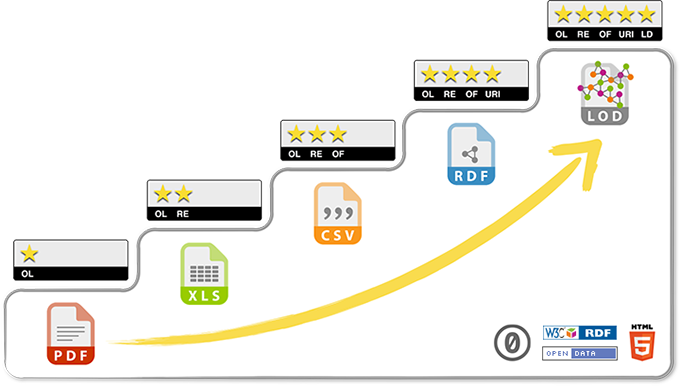
According to inventor of the World Wide Web, Tim Berners-Lee, there are four key principles of Linked Data (Berners-Lee, 2006): Use URIs to denote things. Use HTTP URIs so that these things can be referred to and looked up (dereferenced) by people and user agents. Provide useful information about the thing when its URI is dereferenced, leveraging standards such as RDF, SPARQL. Include links to other related things (using their URIs) when publishing data on the web.
-
In section 4.1.3.2 of the xAPI specification, it states “Activity Providers SHOULD use a corresponding existing Verb whenever possible.”
-
- Aug 2015
-
hypothes.is hypothes.is
-
publisher or museum
Potential for LODLAM!
-
-
www.w3.org www.w3.org
-
I feel that there is a great benefit to fixing this question at the spec level. Otherwise, what happens? I read a web page, I like it and I am going to annotate it as being a great one -- but first I have to find out whether the URI my browser is used, conceptually by the author of the page, to represent some abstract idea?
-
- May 2015
-
-
periods have proven to work poorly with Linked Data principles, which require well-defined entities for linking.
-