51 Matching Annotations
  1. Feb 2026
    1. Met de new competition tool (NCT), ook omschreven in het beroemde Draghi report (pagina 302), is het mogelijk bedrijven bindende aanwijzingen te geven als er effectief geen concurrentie mogelijk is. Als voorbeeld, als het praktisch onmogelijk is om te concurreren met Google of Microsoft voor email en agendabeheer kan je hiermee een bindende aanwijzing geven dat deze bedrijven het mogelijk moeten maken om als nieuwe speler mee te doen in hun ecosysteem. Zo’n verplichting is er nu soms ook al, maar alleen onder hele specifieke omstandigheden. Met de NCT kan het ook onder de algemene voorwaarde dat er van een niet-concurrerende markt sprake is.

      ACM krijgt beschikking over 'new competition tool' NCT a la Draghi , bindende aanwijzing nieuwe spelers toe te laten.

  2. Oct 2025
    1. Author response:

      The following is the authors’ response to the current reviews.

      Reviewer #1 (Public Review):

      Overall the authors provide a very limited data set and in fact only a proof of concept that their sensor can be applied in vivo. This is not really a research paper, but a technical note. With respect to their observation of clustered activity, they now provide an overview image, next to zoomed details. However, from these images one cannot conclude 'by eye' any clustering event. This aligns with the very low r values. All neurons in the field show variable activity and a clustering is not really evident from these examples. Even within a cluster, there is variability. The authors now confirm that expression levels are indeed variable but are independent from the ratio measurements. Further, they controlled for specificity by including DAPT treatments, but opposite to their own in vitro data (in primary neurons) the ratios increased. The authors argue that both distance and orientation can either decrease or increase ratios and that the use of this biosensor should be explored model-by-model. This doesn't really confer high confidence and may hinder other groups in using this sensor reliably.

      Secondly, there is still no physiological relevance for this observation. The experiments are performed in wild-type mice, but it would be more relevant to compare this with a fadPSEN1 KI or a PSEN1cKO model to investigate the contribution of a gain of toxic function or LOF to the claimed cell non-autonomous activations. The authors acknowledge this shortcoming but argue that this is for a follow-up study.

      For instance, they only monitor activity in cell bodies, and miss all info on g-sec activity in neurites and synapses: what is the relevance of the cell body associated g-sec and can it be used as a proxy for neuronal g-sec activity? If cells 'communicate' g-sec activities, I would expect to see hot spots of activity at synapses between neurons.

      Without some more validation and physiologically relevant studies, it remains a single observation and rather a technical note paper, instead of a true research paper.

      The effect size was small, as stated in the original and revised manuscripts and the point-by-point responses to the 1st round review. Such subtle effects will likely be challenging to detect by eye. However, our unbiased quantification allowed us to detect a statistically significant linear correlation between the 720/670 ratio in each neuron and the average ratio in neighboring neurons, which we have verified using many different approaches (Figure 3, Figure 3—figure supplement 2, and Figure 4), and the correlation was canceled by the administration of g-secretase inhibitor (Figure 5). Such objective analysis made us more confident to conclude that g-secretase affects g-secretase in neighboring neurons.

      We would also like to make clear the design of the C99 720-670 biosensor. Both C99, the sensing domain that is cleaved by g-secretase, and the anchoring domain fused to miRFP670 are integrated into the membrane (Figure 1A). Therefore, how these two domains with four transmembrane regions are embedded in the membrane should affect the orientation between the donor, miRFP670, and the acceptor, miRFP720. As noted in our point-by-point responses to the initial review, we have previously validated that pharmacological inhibition of g-secretase significantly increases the FRET ratio in various cell lines, including CHO, MEF, BV2 cells, and mouse cortical primary neurons (Maesako et al., 2020; Houser et al., 2020, and unpublished observations). On the other hand, FRET reduction by g-secretase inhibition was found in mouse primary neurons derived from the cerebellum (unpublished observations) as well as the somatosensory cortex neurons in vivo (this study). While we could not use the exact same imaging set-up between cortical primary neurons in vitro and those in vivo due to different expression levels of the biosensor, we could do it for in vitro cortical primary neurons vs. in vitro cerebellum neurons. We found by the direct comparison that 720/670 ratios are significantly higher in the cerebellum than the cortex neurons even in the presence of 1 mM DAPT (Author response image 1), a concentration that nearly completely inhibits g-secretase activity. This suggests a different integration and stabilization pattern of the sensing and anchoring domains in the C99 720-670 biosensor between the cortex and cerebellum primary neurons, and thus, orientation between the donor and acceptor varies in the two neuronal types. We expect a similar scenario between cortical primary neurons in vitro and those in vivo. Of note, we have recently demonstrated that the cortex and cerebellum primary neurons exhibit distinct membrane properties (Lundin and Wieckiewicz et al., 2024 in revision), suggesting the different baseline FRET could be related to the different membrane properties between the cortex and cerebellum primary neurons. On the other hand, this raises a concern that 720/670 ratios can be affected not only by g-secretase activity but also by other cofounders, such as altered membrane properties. However, a small but significant correlation between the 720/670 ratio in a neuron and those ratios in its neighboring neurons is canceled by g-secretase inhibitor (Figure 5), suggesting that the correlation between the 720/670 ratio in a neuron and those in its neighboring neurons is most likely dependent on g-secretase activity. Taken together, we currently think orientation plays a significant role in our biosensor and would like to emphasize the importance of ensuring on a model-by-model basis whether the cleavage of the C99 720-670 biosensor by g-secretase increases or decreases 720/670 FRET ratios.

      Author response image 1.
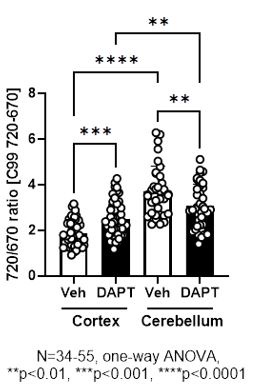
      Furthermore, we co-expressed the C99 720-670 biosensor and visible range fluorescence reporters to record other biological events, such as changes in ion concentration, in cortex primary neurons. Interestingly, several biological events uniquely detected in the neurons with higher 720/670 ratios, which are expected to exhibit lower endogenous g-secretase activity, are recapitulated by pharmacological inhibition of g-secretase (unpublished observations), ensuring that higher 720/670 ratios are indicative of lower g-secretase activity in mouse cortex primary neurons. Such multiplexed imaging will help to further elucidate how the C99 720-670 biosensor behaves in response to the modulation of g-secretase activity.

      Lastly, the scope of this study was to develop and validate a novel imaging assay employing a NIR FRET biosensor to measure g-secretase activity on a cell-by-cell basis in live wild-type mouse brains. However, we do appreciate the reviewer’s suggestion and think employing this new platform in FAD PSEN1 knock-in (KI) or PSEN1 conditional knockout (cKO) mice would provide valuable information. Furthermore, we are keen to expand our capability to monitor g-secretase with subcellular resolution in live mouse brains in vivo, which we will explore in follow-up studies. Thank you for your thoughtful suggestions.

      Reference

      - Maesako M, Sekula NM, Aristarkhova A, Feschenko P, Anderson LC, Berezovska O. Visualization of PS/γ-Secretase Activity in Living Cells. iScience. 2020 Jun 26;23(6):101139.

      - Houser MC, Hou SS, Perrin F, Turchyna Y, Bacskai BJ, Berezovska O, Maesako M. A Novel NIR-FRET Biosensor for Reporting PS/γ-Secretase Activity in Live Cells. Sensors (Basel). 2020 Oct 22;20(21):5980.

      - Lundin B, Wieckiewicz N, Dickson JR, Sobolewski RGR, Sadek M, Armagan G, Perrin F, Hyman BT, Berezovska O, and Maesako M. APP is a regulator of endo-lysosomal membrane permeability. 2024 in revision

      Reviewer #2 (Public Review):

      Regarding the variability and spatial correlation- the dynamic range of the sensor previously reported in vitro is in the range of 20-30% change (Houser et al 2020) whereas the range of FR detected in vivo is between cells is significantly larger in this MS. This raises considerable doubts for specific detection of cellular activity.

      One direct way to test the dynamic range of the sensor in vivo, is to increase or decrease endogenous gamma-secretase activity and to ensure this experimental design allows to accurately monitor gamma-secretase activity. In the previous characterization of the reporter (Hauser et al 2020), DAPT application and inhibition of gamma-secretase activity results in increased FR (Figures 2 and 3 of Houser et al). This is in agreement with the design of the biosensor, since FR should be inversely correlated with enzymatic activity. Here, the authors repeated the experiment, and surprisingly found an opposite effect, in which DAPT significantly reduced FR.

      The authors maintain that this result could be due to differences in cell-types, However, this experiment was previously performed in cultures cortical neurons and many different cell types, as noted by the authors in their rebuttal.

      Instead, I would argue that these results further highlight the concerns of using FR in vivo, since based on their own data, there is no way to interpret this quantification. If DAPT reduces FR, does this mean we should now interpret the results of higher FR corresponds to higher g-sec activity? Given a number of papers from the authors claiming otherwise, I do not understand how one can interpret the results as indicating a cell-specific effect.

      In conclusion, without any ground truth, it is impossible to assess and interpret what FR measurements of this sensor in vivo mean. Therefore, the use of this approach as a way to study g-sec activity in vivo seems premature.

      Please find our response to reviewer 1’s similar critique above. Here, we again would like to re-clarify the design of our C99 720-670 biosensor. The orientation between the donor, miRFP670, and acceptor, miRFP720, is dependent on how C99, the sensing domain that is cleaved by g-secretase, and the anchoring domain are integrated into the membrane (Figure 1A). Although it was surprising to us, it is possible that g-secretase inhibition decreases 720/670 ratios if 1) the donor-acceptor orientation plays a significant role in FRET and 2) the baseline structure of the C99 720-670 biosensor is different between cell types. This appears to be the case between the cortex and cerebellum primary neurons (i.e., DAPT increases 720/670 ratios in the cortex neurons while decreasing in the cerebellum neurons), and we expect it in cortical neurons in vitro vs. in vivo as well. Hence, we recommend that users first validate whether the cleavage of the C99 720-670 biosensor by g-secretase increases or decreases 720/670 FRET ratios in their models. If DAPT increases 720/670 ratios (like in cortex primary neurons, CHO, MEF, and BV2 cells that we have validated), the results of higher ratios should be interpreted as lower g-secretase activity. If DAPT reduces 720/670 ratios (like in cerebellum primary neurons and the somatosensory cortex neurons in vivo), we should interpret the results of higher ratios corresponding to higher g-secretase activity. From a biosensing perspective, although we need to know which is the case on a model-by-model basis, we think whether g-secretase activity increases or decreases the 720/670 ratio is not critical; rather, if it can significantly change FRET efficiency is more important. Thank you for your critical comments.

      Reviewer #3 (Public Review):

      This paper builds on the authors' original development of a near infrared (NIR) FRET sensor by reporting in vivo real-time measurements for gamma-secretase activity in the mouse cortex. The in vivo application of the sensor using state-of-the-art techniques is supported by a clear description and straightforward data, and the project represents significant progress because so few biosensors work in vivo. Notably, the NIR biosensor is detectable to ~ 100 µm depth in the cortex. A minor limitation is that this sensor has a relatively modest ΔF as reported in Houser et al, which is an additional challenge for its use in vivo. Thus, the data is fully dependent on post-capture processing and computational analyses. This can unintentionally introduce biases but is not an insurmountable issue with the proper controls that the authors have performed here.

      The following opportunity for improving the system didn't initially present itself until the authors performed an important test of the FRET sensor in vivo following DAPT treatment. The authors get credit for diligently reporting the unexpected decrease in 720/670 FRET ratio. In turn this has led to a suggestion that this sensor would benefit from a control that is insensitive to gamma-secretase activity. FRET influences that are independent of gamma-secretase activity could be distinguished by this control.

      From previous results in cultured neurons, the authors expected an increase in FRET following DAPT treatment in vivo. These expectations fit with the sensor's mode-of-action because a block of gamma-secretase activity should retain the fluorophores in proximity. When the authors observed decreased FRET, the conclusion was that the sensor performs differently in different cellular contexts. However, a major concern is that mechanistically it is unclear how this could occur with this type of sensor. The relative orientation of fluorophores indeed can contribute to FRET efficiency in tension-based sensors. However, the proteolysis expected with gamma-secretase activity would release tension and orientation constraints. Thus, the major contributing FRET factor is expected to be distance, not orientation. Alternative possibilities that could inadvertently affect readouts include an additional DAPT target in vivo sequestering the inhibitor, secondary pH effects on FRET, photo-bleaching, or an unidentified fluorophore quencher in vivo stimulated by DAPT. Ultimately this new FRET sensor would benefit from a control that is insensitive to gamma-secretase activity. FRET influences that are independent of gamma-secretase activity could be distinguished by this control.

      Given that the anchoring domain is composed of three transmembrane regions and the linker connecting the donor, miRFP670, and the acceptor, miRFP720, is highly flexibility, we are still not sure if the orientation constraint of the C99 720-670 biosensor is canceled by g-secretase cleavage. This means that the orientation between the donor and acceptor in the cleaved form of the sensor can be different between model and model. As explained in response to the similar critique of reviewer 1, we found that the 720/670 ratio is significantly higher in the cerebellum than in the cortex neurons even in the presence of DAPT (Figure 1 for the review only). Therefore, we currently think the donor-acceptor orientation, both in the cleaved and non-cleaved forms of the sensor, plays a role in determining whether g-secretase activity increases or decreases the 720/670 ratio (but this view may change depends on the future discoveries).

      As the reviewer pointed out, the NIR g-secretase biosensor with no biological activity is important; however, a point mutation in the transmembrane region of the C99 sensing domain could also result in altered orientation between the donor, miRFP670, and the acceptor, miRFP720, since C99 is connected to the acceptor, which may bring additional complexity. Also, as noted in our point-by-point responses to the initial review, the mutation(s) that can fully block C99 processing by g-secretase has not been established. Therefore, we asked if a subtle but significant correlation we found between the 720/670 ratio in a neuron and those ratios in its neighboring neurons is canceled by g-secretase inhibitor administration. Since the correlation was abolished (Figure 5), it suggests that the correlation between the 720/670 ratio in a neuron and those ratios in the neighboring neurons depends on g-secretase activity.

      It is not fully established how g-secretase activity is spatiotemporally regulated; therefore, the development of more appropriate control biosensors and further validation of our findings with complementary approaches would be crucial in our follow-up studies. Thank you for your valuable comments.


      The following is the authors’ response to the original reviews.

      Reviewer #1 (Public Review):

      (1) Overall the authors provide a very limited data set and in fact only a proof of concept that their sensor can be applied in vivo. This is not really a research paper, but a technical note. With respect to their observation of clustered activity, the images do not convince me as they show only limited areas of interest: from these examples (for instance fig 5) one sees that merely all neurons in the field show variable activity and a clustering is not really evident from these examples. Even within a cluster, there is variability. With r values between 0.23 to .36, the correlation is not that striking. The authors herein do not control for expression levels of the sensor: for instance, can they show that in all neurons in the field, the sensor is equally expressed, but FRET activity is correlated in sets of neurons? Or are the FRET activities that are measured only in positively transduced neurons, while neighboring neurons are not expressing the sensor? Without such validation, it is difficult to make this conclusion.

      We appreciate the reviewer’s comment. We agree with the reviewer that this study is not testing a new hypothesis but rather developing and validating a novel tool. However, we do believe such a “technical note” is as important as a “research paper” since advancing technique(s) is the only way to break the barrier in our understanding of complex biological events. Therefore, this study aimed to develop and validate a novel imaging assay employing a recently engineered NIR FRET biosensor to measure γ-secretase activity (Houser et al., 2020) on a cell-by-cell basis in live mouse brains, enabling us for the first time to examine how γ-secretase activity is regulated in individual neurons in vivo, and uncover that γ-secretase activity may influence γ-secretase in neighboring neurons. Like the reviewer, we found that the cell-to-cell correlation is not that striking, as we clearly stated in the original manuscript: “Although the effect size is modest, we also found a statistically significant correlation between…” 

      We were also aware that there is variability in a cluster of neurons exhibiting similar γ-secretase activities. Per the reviewer’s request, the images have been expanded to the entire imaging field of view (new Figure 3A). Although the effect size is small, our unbiased quantification showed a statistically significant linear correlation between the 720/670 ratio in each neuron and the average ratio in five neighboring neurons (Figure 3, Figure 3—figure supplement 2, and Figure 4), and the correlation was canceled by the administration of γ-secretase inhibitor (Figure 5). These findings made it impossible to conclude that γ-secretase does not affect γ-secretase in neighboring neurons.

      Regarding the expression levels and pattern of the sensor, an AAV-based gene delivery approach employed in this study results in the expression of the sensor not in all but in selected neurons. We have newly performed immunohistochemistry, showing that approximately 40% of NeuN-positive neurons express the C99 720-670 biosensor (new Figure 1—figure supplement 2A and 2B).

      Reference

      - Houser MC, Hou SS, Perrin F, Turchyna Y, Bacskai BJ, Berezovska O, Maesako M. A Novel NIRFRET Biosensor for Reporting PS/γ-Secretase Activity in Live Cells. Sensors (Basel). 2020 Oct 22;20(21):5980. 

      (2) Secondly, I am lacking some more physiological relevance for this observation. The experiments are performed in wild-type mice, but it would be more relevant to compare this with a fadPSEN1 KI or a PSEN1cKO model to investigate the contribution of a gain of toxic function or LOF to the claimed cell non-autonomous activations. Or what would be the outcome if the sensor was targeted to glial cells?

      The AAV vector in this study encodes the human synapsin promoter and our new immunohistochemistry demonstrates that nearly 100% of the cells expressing the C99 720-670 sensor are NeuN positive, and we hardly detected the sensor expression in Iba-1 or GFAP-positive cells (new Figure 1— figure supplement 2A and 2C). 

      The mechanism underlying the cell non-autonomous regulation of γ-secretase remains unclear. As discussed in our manuscript, one of the potential hypotheses could be that secreted abeta42 plays a role (Zoltowska et al., 2023 eLife). Whereas this report focuses on the development and validation of a novel assay using wildtype mice, future follow-up studies employing FAD PSEN1 knock-in (KI) and PSEN1 conditional knockout (cKO) mice would allow us test the hypothesis above since abeta42 is known to increase in some FAD PSEN1 KI mice (Siman et al., 2000 J Neurosci, Vidal et al., 2012 FASEB J) while decreases in PSEN1 cKO mice (Yu et al., 2001 Neuron).  

      Reference

      - Siman R, Reaume AG, Savage MJ, Trusko S, Lin YG, Scott RW, Flood DG. Presenilin-1 P264L knockin mutation: differential effects on abeta production, amyloid deposition, and neuronal vulnerability. J Neurosci. 2000 Dec 1;20(23):8717-26. 

      - Vidal R, Sammeta N, Garringer HJ, Sambamurti K, Miravalle L, Lamb BT, Ghetti B. The Psen1-L166Pknock-in mutation leads to amyloid deposition in human wild-type amyloid precursor protein YAC transgenic mice. FASEB J. 2012 Jul;26(7):2899-910. 

      - Yu H, Saura CA, Choi SY, Sun LD, Yang X, Handler M, Kawarabayashi T, Younkin L, Fedeles B, Wilson MA, Younkin S, Kandel ER, Kirkwood A, Shen J. APP processing and synaptic plasticity in presenilin-1 conditional knockout mice. Neuron. 2001 Sep 13;31(5):713-26. 

      - Zoltowska KM, Das U, Lismont S, Enzlein T, Maesako M, Houser MC, Franco ML, Moreira DG, Karachentsev D, Becker A, Hopf C, Vilar M, Berezovska O, Mobley W, Chávez-Gutiérrez L. Alzheimer's disease linked Aβ42 exerts product feedback inhibition on γ-secretase impairing downstream cell signaling. eLife. 2023. 12:RP90690

      (3) For this reviewer it is not clear what resolution they are measuring activity, at cellular or subcellular level? In other words are the intensity spots neuronal cell bodies? Given g-sec activity are in all endosomal compartments and at the cell surface, including in the synapse, does NIR imaging have the resolution to distinguish subcellular or surface localized activities? If cells 'communicate' g-sec activities, I would expect to see hot spots of activity at synapses between neurons: is this possible to assess with the current setup? 

      Since this study aimed to determine how γ-secretase activity is regulated on a cell-by-cell basis in live mouse brains, the FRET signal was detected in neuronal cell bodies. While our current set-up for in vivo can only record γ-secretase activity with a cellular resolution, we previously detected predominant γ-secretase activity in the endo-lysosomal compartments (Maesako et al., 2022 J Neurosci) as well as in certain spots of neuronal processes (Maesako et al., 2020 iScience) in cultured primary neurons using the same microscope set-up. Therefore, future studies will expand our capability to monitor γ-secretase with subcellular resolution in live mouse brains in vivo.

      Reference

      - Maesako M, Sekula NM, Aristarkhova A, Feschenko P, Anderson LC, Berezovska O. Visualization of PS/γ-Secretase Activity in Living Cells. iScience. 2020 Jun 26;23(6):101139. 

      - Maesako M, Houser MCQ, Turchyna Y, Wolfe MS, Berezovska O. Presenilin/γ-Secretase Activity Is Located in Acidic Compartments of Live Neurons. J Neurosci. 2022 Jan 5;42(1):145-154. 

      (4) Without some more validation and physiological relevant studies, it remains a single observation and rather a technical note paper, instead of a true research paper.

      Please find our response above to the critique (1).  

      Reviewer #2 (Public Review):

      (1) Regarding the variability and spatial correlation- the dynamic range of the sensor previously reported in vitro is in the range of 20-30% change (Houser et al 2020) whereas the range of FR detected in vivo is between cells is significantly larger (Fig. 3). This raises considerable doubts for specific detection of cellular activity (see point 3).

      Please find our response below to the critique (2).

      (2) One direct way to test the dynamic range of the sensor in vivo, is to increase or decrease endogenous gamma-secretase activity and to ensure this experimental design allows to accurately monitor gamma-secretase activity. In the previous characterization of the reporter (Hauser et al 2020), DAPT application and inhibition of gammasecretase activity results in increased FR (Figures 2 and 3 of Houser et al). This is in agreement with the design of the biosensor, since FR should be inversely correlated with enzymatic activity. Here, while the authors repeat the same manipulation and apply DAPT to block gamma-secretase activity, it seems to induce the opposite effect and reduces FR (comparing figures 8 with figures 5,6,7). First, there is no quantification comparing FR with and without DAPT. Moreover, it is possible to conduct this experiment in the same animals, meaning comparing FR before and after DAPT in the same mouse and cell populations. This point is absolutely critical- if indeed FR is reduced following DAPT application, this needs to be explained since this contradicts the basic design and interpretation of the biosensor.

      We appreciate the reviewer’s comment. In our hand, overexpression of γ-secretase four components (PSEN, Nct, Aph1, and Pen2) is the only reliable and reproducible approach to increase the cellular activity of γ-secretase, which we successfully employed in vitro but not in vivo yet. Therefore, a γ-secretase inhibitor was used to determine the dynamic range of our FRET biosensor in vivo. FRET efficiency depends on the proximity and orientation of donor and acceptor fluorescent proteins. In our initial study, we engineered the original C99 EGFP-RFP biosensor (C99 R-G), and the replacement of EGFP and RFP with mTurquoise-GL and YPet, respectively, expanded the dynamic range of the sensor approximately 2 times. Moreover, extending the linker length from 20 a.a. to 80 a.a. increased the dynamic range 2.2 times (Maesako et al., 2020 iScience). Of note, the C99 720-670 NIR analog, which has the same 80 a.a. linker but miRFP670 and miRFP720 as the donor and acceptor, exhibited a slightly better dynamic range than the C99 Y-T sensor (Houser et al., 2020 Sensor). Our interpretation, at that time, was that the cleavage of the C99 720-670 biosensor by γ-secretase results in a longer distance between the donor and acceptor, and thus, the FRET ratio always increases by γ-secretase inhibition (i.e., proximity plays a more significant role than orientation in our biosensors). As expected, a significantly increased FRET ratio was detected in various cell lines by γ-secretase inhibitors, including CHO, MEF, BV2 cells, and mouse cortical primary neurons. Moreover, to further ensure the C99 720-670 biosensor records changes in γ-secretase activity, the multiplexing capability of the biosensor was utilized. In other words, we co-expressed the C99 720-670 biosensor and visible range fluorescence reporters to record other biological events, such as changes in ion concentration, etc., in cortex primary neurons. Strikingly, several biological events uniquely detected in the neurons with diminished endogenous γ-secretase activity, i.e., neurons with higher FRET ratios, are recapitulated by pharmacological inhibition of γ-secretase (unpublished observation). This approach has allowed us to ensure that increased FRET ratios are indicative of decreased endogenous γ-secretase activity in mouse cortical primary neurons. 

      However, as recommended by the reviewer, we have performed a new experiment to compare the FRET ratio before and after DAPT, a potent γ-secretase inhibitor, administration in the same mouse and cell populations. Surprisingly, we found that of DAPT significantly decreases 720/670 ratios, which is included in our revised manuscript (Figure 2—figure supplement 2C). This unexpected FRET reduction by γ-secretase inhibition was also found in mouse primary neurons derived from the cerebellum (unpublished observation). These findings suggest that orientation plays a significant role in our γ-secretase FRET biosensor and whether the FRET ratio is increased or decreased by the γ-secretase-mediated cleavage depends on cell types. Of note, the difference in FRET ratios with and without DAPT was comparable between primary cortex neurons (24.3%) and the somatosensory cortex neurons in vivo (22.1%). Our new findings suggest that how our biosensors report γ-secretase activity (i.e., increased vs. decreased FRET ratio) must be examined on a model-by-model basis, which is clearly noted in the revised manuscript: 

      Reference

      - Houser MC, Hou SS, Perrin F, Turchyna Y, Bacskai BJ, Berezovska O, Maesako M. A Novel NIRFRET Biosensor for Reporting PS/γ-Secretase Activity in Live Cells. Sensors (Basel). 2020 Oct 22;20(21):5980. 

      - Maesako M, Sekula NM, Aristarkhova A, Feschenko P, Anderson LC, Berezovska O. Visualization of PS/γ-Secretase Activity in Living Cells. iScience. 2020 Jun 26;23(6):101139. 

      (3) For further validation, I would suggest including in vivo measurements with a sensor version with no biological activity as a negative control, for example, a mutation that prevents enzymatic cleavage and FRET changes. This should be used to showcase instrumental variability and would help to validate the variability of FR is indeed biological in origin. This would significantly strengthen the claims regarding spatial correlation within population of cells.

      We fully agree with the reviewer that having a sensor version containing a mutation, which prevents enzymatic cleavage and thus FRET changes, as a negative control is preferable. In our previous study, we developed and validated the APP-based C99 Y-T and Notch1-based N100 Y-T biosensors (Maesako et al., 2020 iScience). It is well established that Notch1 cleavage is entirely blocked by Notch1 V1744G mutation (Schroeter et al., 1998 Nature; Huppert et al., 2000 Nature), and therefore, we introduced the mutation into N100 Y-T biosensor and used it as a negative control. On the other hand, such a striking mutation has never been identified in APP processing. To successfully monitor γ-secretase activity in deep tissue in vivo, we replaced Turquoise-GL and YPet in the C99 Y-T and N100 Y-T biosensors with miRFP670 and miRFP720, respectively. While the APP-based C99 720-670 biosensor allows recording γ-secretase activity (Houser et al., 2020 Sensors), we found the N100 720-670 sensor exhibits a very small dynamic range, not enabling to reliably measure γ-secretase activity. Taken together, there is not currently available NIR γ-secretase biosensor with no biological activity.

      Reference

      - Houser MC, Hou SS, Perrin F, Turchyna Y, Bacskai BJ, Berezovska O, Maesako M. A Novel NIRFRET Biosensor for Reporting PS/γ-Secretase Activity in Live Cells. Sensors (Basel). 2020 Oct 22;20(21):5980. 

      - Huppert SS, Le A, Schroeter EH, Mumm JS, Saxena MT, Milner LA, Kopan R. Embryonic lethality in mice homozygous for a processing-deficient allele of Notch1. Nature. 2000 Jun 22;405(6789):966-70. 

      - Maesako M, Sekula NM, Aristarkhova A, Feschenko P, Anderson LC, Berezovska O. Visualization of PS/γ-Secretase Activity in Living Cells. iScience. 2020 Jun 26;23(6):101139. 

      - Schroeter EH, Kisslinger JA, Kopan R. Notch-1 signalling requires ligand-induced proteolytic release of intracellular domain. Nature. 1998 May 28;393(6683):382-6. 

      (4) In general, confocal microcopy is not ideal for in vivo imaging. Although the authors demonstrate data collected using IR imaging increases penetration depth, out of focus fluorescence is still evident (Figure 4). Many previous papers have primarily used FLIM based analysis in combination with 2p microscopy for in vivo FRET imaging (Some examples: Ma et al, Neuron, 2018; Massengil et al, Nature methods, 2022; DIaz-Garcia et al, Cell Metabolism, 2017; Laviv et al, Neuron, 2020). This technique does not rely on absolute photon number and therefore has several advantage sin terms of quantification of FRET signals in vivo.

      It is therefore likely that use of previously developed sensors of gamma-secretase with conventional FRET pairs, might be better suited for in vivo imaging. This point should be at least discussed as an alternative.

      The reviewer notes that 2p-FLIM may provide certain advantages over our confocal spectral imaging approach for detecting in vivo FRET. In our response below, we will address both the FRET detection method (FLIM vs. spectral) and microscope modality (2p vs. confocal). 

      As noted by the reviewer, we do acknowledge that 2p-FLIM has been utilized to detect FRET in vivo. On the other hand, the ratiometric spectral FRET approach has also been utilized in many in vivo FRET studies (Kuchibhotla et al., 2008 Neuron; Kuchibhotla et al., 2014 PNAS; Hiratsuka et al., 2015 eLife; Maesako et al., 2017 eLife; Konagaya et al., 2017 Cell Rep; Calvo-Rodriguez et al., 2020 Nat Communi; Hino et al., 2022 Dev Cell). We think both approaches have advantages and disadvantages, as discussed in a previous review (Bajar et al., 2016 Sensors), but they complement each other. Indeed, we regularly employ FLIM in cell culture studies (Maesako et al., 2017 eLife; McKendell et al., 2022 Biosensors; Devkota 2024 Cell Rep), and our recent study also utilized 2p-FLIM for in vivo NIR imaging (although not for detecting FRET) (Hou et al., 2023, Nat Biomed Eng); therefore, we are confident that 2p-FLIM can be adapted in our follow-up studies for γ-secretase recording.

      Regarding microscope modality, we agree with the reviewer’s point that generally two-photon microscopy can achieve larger penetration depths than confocal microscopy and is therefore more ideal for in vivo FRET imaging. However, in this study, since our aim was to quantify γ-secretase activity in the superficial layers of the cortex (<200 microns in depth), both NIR confocal and multiphoton microscopies could be used to achieve this imaging objective. Additionally, we chose to use confocal microscopy with our NIR C99 720-670 probe due to the probe’s slightly but higher sensitivity compared to our C99 Y-T probe (Houser et al., 2020 Sensors). Imaging γ-secretase activity with our NIR C99-720-670 probe has the additional advantage that it will allow us in future studies to multiplex with visible FRET pairs using multiphoton microscopy in the same brain region. Furthermore, our demonstration of in vivo FRET imaging using NIR confocal microscopy avoids some of the issues associated with multiphoton microscopy, including potential phototoxicity due to high average and peak laser powers and the high complexity and costs of the instrumentation. For future studies aimed at interrogating γ-secretase activity in deeper cortical regions, multiphoton microscopy could be applied for FLIM or ratiometric spectral imaging of either our NIR or visible FRET probes. Per the reviewer’s request, we have added multiphoton FRET imaging as an alternative in the discussion section. 

      Reference

      - Bajar BT, Wang ES, Zhang S, Lin MZ, Chu J. A Guide to Fluorescent Protein FRET Pairs. Sensors (Basel). 2016 Sep 14;16(9):1488.  

      - Calvo-Rodriguez M, Hou SS, Snyder AC, Kharitonova EK, Russ AN, Das S, Fan Z, Muzikansky A,

      Garcia-Alloza M, Serrano-Pozo A, Hudry E, Bacskai BJ. Increased mitochondrial calcium levels

      associated with neuronal death in a mouse model of Alzheimer's disease. Nat Commun. 2020 May

      1;11(1):2146  

      - Devkota S, Zhou R, Nagarajan V, Maesako M, Do H, Noorani A, Overmeyer C, Bhattarai S, Douglas JT, Saraf A, Miao Y, Ackley BD, Shi Y, Wolfe MS. Familial Alzheimer mutations stabilize synaptotoxic γ-secretase-substrate complexes. Cell Rep. 2024 Feb 27;43(2):113761. 

      - Hino N, Matsuda K, Jikko Y, Maryu G, Sakai K, Imamura R, Tsukiji S, Aoki K, Terai K, Hirashima T, Trepat X, Matsuda M. A feedback loop between lamellipodial extension and HGF-ERK signaling specifies leader cells during collective cell migration. Dev Cell. 2022 Oct 10;57(19):2290-2304.e7.

      - Hiratsuka T, Fujita Y, Naoki H, Aoki K, Kamioka Y, Matsuda M. Intercellular propagation of extracellular signal-regulated kinase activation revealed by in vivo imaging of mouse skin. eLife. 2015 Feb 10;4:e05178.  

      - Hou SS, Yang J, Lee JH, Kwon Y, Calvo-Rodriguez M, Bao K, Ahn S, Kashiwagi S, Kumar ATN, Bacskai BJ, Choi HS. Near-infrared fluorescence lifetime imaging of amyloid-β aggregates and tau fibrils through the intact skull of mice. Nat Biomed Eng. 2023 Mar;7(3):270-280.  

      - Houser MC, Hou SS, Perrin F, Turchyna Y, Bacskai BJ, Berezovska O, Maesako M. A Novel NIRFRET Biosensor for Reporting PS/γ-Secretase Activity in Live Cells. Sensors (Basel). 2020 Oct 22;20(21):5980. 

      - Konagaya Y, Terai K, Hirao Y, Takakura K, Imajo M, Kamioka Y, Sasaoka N, Kakizuka A, Sumiyama K, Asano T, Matsuda M. A Highly Sensitive FRET Biosensor for AMPK Exhibits Heterogeneous AMPK Responses among Cells and Organs. Cell Rep. 2017 Nov 28;21(9):2628-2638.  

      - Kuchibhotla KV, Goldman ST, Lattarulo CR, Wu HY, Hyman BT, Bacskai BJ. Abeta plaques lead to aberrant regulation of calcium homeostasis in vivo resulting in structural and functional disruption of neuronal networks. Neuron. 2008 Jul 31;59(2):214-25  

      - Kuchibhotla KV, Wegmann S, Kopeikina KJ, Hawkes J, Rudinskiy N, Andermann ML, Spires-Jones TL, Bacskai BJ, Hyman BT. Neurofibrillary tangle-bearing neurons are functionally integrated in cortical circuits in vivo. Proc Natl Acad Sci U S A. 2014 Jan 7;111(1):510-4  

      - Maesako M, Horlacher J, Zoltowska KM, Kastanenka KV, Kara E, Svirsky S, Keller LJ, Li X, Hyman BT, Bacskai BJ, Berezovska O. Pathogenic PS1 phosphorylation at Ser367. Elife. 2017 Jan 30;6:e19720.  

      - McKendell AK, Houser MCQ, Mitchell SPC, Wolfe MS, Berezovska O, Maesako M. In-Depth

      Characterization of Endo-Lysosomal Aβ in Intact Neurons. Biosensors (Basel). 2022 Aug 20;12(8):663. 

      (Recommendations For The Authors):

      (5) Minor issues- Figure 4 describes the analysis procedure, which seems to be standard practice in the field. This can be described in the methods section rather than in the main figure.

      Per the reviewer’s suggestion, this figure has been moved to Figure 2—figure supplement 1. 

      Reviewer #3 (Public Review):

      (1) This paper builds on the authors' original development of a near infrared (NIR) FRET sensor by reporting in vivo real-time measurements for gamma-secretase activity in the mouse cortex. The in vivo application of the sensor using state of the art techniques is supported by a clear description and straightforward data, and the project represents significant progress because so few biosensors work in vivo. Notably, the NIR biosensor is detectable to ~ 100 µm depth in the cortex. A minor limitation is that this sensor has a relatively modest ΔF as reported in Houser et al, which is an additional challenge for its use in vivo. Thus, the data is fully dependent on post-capture processing and computational analyses. This can unintentionally introduce biases but is not an insurmountable issue with the proper controls that the authors have performed here.

      We appreciate the reviewer’s overall positive evaluation. As described in our response to the Reviewer 2’s critique (2), ΔF in vivo has been characterized (Figure 2—figure supplement 2C).

      (2) The observation of gamma-secretase signaling that spreads across cells is potentially quite interesting, but it can be better supported. An alternative interpretation is that there exist pre-formed and clustered hubs of high gamma-secretase activity, and that DAPT has stochastic or differential accessibility to cells within the cluster. This could be resolved by an experiment of induction, for example, if gamma-secretase activity is induced or activated at a specific locale and there was observed coordinated spreading to neighboring neurons with their sensor.

      We agree with the reviewer that the stochastic or differential accessibility of DAPT to cell clusters with different γ-secretase can be an alternative interpretation of our data, which is now included in the Discussion of the revised manuscript. Undoubtedly, the activation of γ-secretase would provide valuable information. However, as described in the response above to Reviewer 2’s critique #2, overexpressing the four components of γ-secretase (PSEN, Nct, Aph1, and Pen2) is the only reliable and reproducible approach to increasing the cellular activity of γ-secretase, which was achieved in our in vitro study but not yet in vivo. Our future study will develop and characterize the approach to induce γ-secretase activity to further perform detailed mechanistic studies.

      (3) Furthermore, to rule out the possibility that uneven viral transduction was not simply responsible for the observed clustering, it would be helpful to see an analysis of 670nm fluorescence alone.

      Our new analysis comparing 670 nm fluorescence intensity and that in five neighbor neurons shows a positive correlation (Figure 3—figure supplement 1A), suggesting that AAV was unevenly transduced. On the other hand, the 720/670 ratio (i.e., γ-secretase activity) is not correlated with 670 nm fluorescence intensity (i.e., C99 720-670 biosensor expression) (Figure 3—figure supplement 1B). This strongly suggests that, while C99 720-670 biosensor expression was not evenly distributed in the brain, the uneven probe expression did not impact the capability of γ-secretase recording.  

      Reviewer #3 (Recommendations For The Authors):

      (4) One minor suggestion might be to consider Figures 6-7 as orthogonal supporting analyses rather than "validation". It might then be helpful to present them together with Figure 5.

      We have moved the initial Figure 6 and 7 to Figure 3—figure supplement 2 and Figure 4, respectively.

  3. Jul 2025
    1. Author response:

      The following is the authors’ response to the original reviews

      Public Reviews:

      Reviewer #1 (Public review):

      This work provides a new potential tool to manipulate Tregs function for therapeutic use. It focuses on the role of PGAM in Tregs differentiation and function. The authors, interrogating publicly available transcriptomic and proteomic data of human regulatory T cells and CD4 T cells, state that Tregs express higher levels of PGAM (at both message and protein levels) compared to CD4 T cells. They then inhibit PGAM by using a known inhibitor ECGC and show that this inhibition affects Tregs differentiation. This result was also observed when they used antisense oligonucleotides (ASOs) to knockdown PGAM1.

      PGAM1 catalyzes the conversion of 3PG to 2PG in the glycolysis cascade. However, the authors focused their attention on the additional role of 3PG: acting as starting material for the de novo synthesis of serine.

      They hypothesized that PGAM1 regulates Tregs differentiation by regulating the levels of 3PG that are available for de novo synthesis of serine, which has a negative impact on Tregs differentiation. Indeed, they tested whether the effect on Tregs differentiation observed by reducing PGAM1 levels was reverted by inhibiting the enzyme that catalyzes the synthesis of serine from 3PG.

      The authors continued by testing whether both synthesized and exogenous serine affect Tregs differentiation and continued with in vivo experiments to examine the effects of dietary serine restriction on Tregs function.

      In order to understand the mechanism by which serine impacts Tregs function, the authors assessed whether this depends on the contribution of serine to one-carbon metabolism and to DNA methylation.

      The authors therefore propose that extracellular serine and serine whose synthesis is regulated by PGAM1 induce methylation of genes Tregs associated, downregulating their expression and overall impacting Tregs differentiation and suppressive functions.

      Strengths:

      The strength of this paper is the number of approaches taken by the authors to verify their hypothesis. Indeed, by using both pharmacological and genetic tools in in vitro and in vivo systems they identified a potential new metabolic regulation of Tregs differentiation and function.

      We are grateful to the reviewer for their thoughtful and constructive consideration of our work. We appreciate their comment that the number of approaches taken to test our hypothesis represents a strength that increases confidence in the conclusions.

      Weaknesses:

      Using publicly available transcriptomic and proteomic data of human T cells, the authors claim that both ex vivo and in vitro polarized Tregs express higher levels of PGAM1 protein compared to CD4 T cells (naïve or cultured under Th0 polarizing conditions). The experiments shown in this paper have all been carried out in murine Tregs. Publicly available resources for murine data (ImmGen -RNAseq and ImmPRes - Proteomics) however show that Tregs do not express higher PGAM1 (mRNA and protein) compared to CD4 T cells. It would be good to verify this in the system/condition used in the paper.

      This is a fair comment. Although our pharmacologic and genetic studies demonstrated the importance of PGAM in Treg differentiation and suppressive function in murine cells, thereby corroborating the hypothesis formed based on human CD4 cell expression data, we agree that investigating PGAM expression in murine Tregs is important in the context of our work. In reviewing the ImmPres proteomics database, the reviewer is correct that PGAM1 expression was not higher in iTregs compared to other subsets, including Th17 cells. However, when compared to other glycolytic enzymes, expression of PGAM1 increases out of proportion in iTregs. In particular, the ratio of PGAM1 to GAPDH expression is much greater in iTregs compared to Th17 cells. This data is now shown in the revised Figure S5. The disproportionate increase in PGAM1 expression is consistent with the regulatory role of PGAM in the Treg-Th17 axis via modulation of 3PG concentrations, a metabolite that lies between GAPDH and PGAM in the glycolytic pathway. The divergent expression changes between GAPDH and PGAM furthermore support the conclusion that GAPDH and PGAM play opposite roles in Treg differentiation.

      It would also be good to assess the levels of both PGAM1 mRNA and protein in Tregs PGAM1 knockdown compared to scramble using different methods e.g. qPCR and western blot. However, due to the high levels of cell death and differentiation variability, that would require cells to be sorted.

      We appreciate this comment. As noted by the reviewer, assessing PGAM1 expression via qPCR and Western blot would require cell sorting, which we do not currently have the resources to pursue. However, we measured the effect of ASOs on PGAM1 protein expression using anti-PGAM1 antibody via flow cytometry, which allowed gating on viable cells. As shown in Figure S3A, PGAM-targeted ASOs led to an approximately 40% decrease in PGAM1 expression, as measured by mean fluorescence intensity (MFI). Furthermore, we now show in revised Figure S2 that ASO uptake was near-complete in our cultured CD4 cells.

      It is not specified anywhere in the paper whether cells were sorted for bulk experiments. Based on the variability of cell differentiation, it would be good if this was mentioned in the paper as it could help to interpret the data with a different perspective.

      Cells were not sorted for bulk experiments. In the revised manuscript, this point is made clear in the text, figure legends, and Methods. It is worth noting that all bulk experiments were conducted on samples with greater than 70% cell viability (greater than 90% for stable isotope tracing studies).

      Reviewer #2 (Public review):

      Summary:

      The authors have tried to determine the regulatory role of Phosphoglycerate mutate (PGAM), an enzyme involved in converting 3-phosphoglycerate to 2-phosphoglycerate in glycolysis, in differentiation and suppressive function of regulatory CD4 T cells through de novo serine synthesis. This is done by contributing one carbon metabolism and eventually epigenetic regulation of Treg differentiation.

      Strengths:

      The authors have rigorously used inhibitors and antisense RNA to verify the contribution of these pathways in Treg differentiation in-vitro. This has also been verified in an in-vivo murine model of autoimmune colitis. This has further clinical implications in autoimmune disorders and cancer.

      We very much appreciate these comments about the rigor of the work and its implications.

      Weaknesses:

      The authors have used inhibitors to study pathways involved in Treg differentiation. However, they have not studied the context of overexpression of PGAM, which was the actual reason to pursue this study.

      We appreciate this comment and agree that overexpression of PGAM would be an excellent way to complement and further corroborate our findings. Unfortunately, despite attempting several methods, we were unable to consistently induce overexpression of PGAM1 in our primary T cell cultures.

      Recommendations for the authors:

      Reviewer #1 (Recommendations for the authors):

      I would suggest increasing the font size for flow cytometry gates. Percentages are the focus of the analysis, and it is very hard to read any.

      We have increased the font size on all flow cytometry gates, as suggested.

      Moreover, most of the flow data show Tregs polarization based on CD25 and FOXP3 expression. However, Figure 3 A, Figure 4D and Figure S3 show Tregs polarization based on FSC and Foxp3. Is there any reason for this?

      Antibody staining against CD25 was poor in the experiments noted, which is why Foxp3 alone was used to identify Treg cells in these experiments.

      Especially for Figure 3A, other cells could also express Foxp3 making interpretation difficult.

      This is a fair comment. With respect to Figures 4D and S3 (now revised Figure S4), these experiments were conducted in isolated CD4 cells, in which the population of CD25-Foxp3+ cells is minimal following Treg polarization (as evident in our other figures). Regarding Figure 3A, previous work has found minimal expression of Foxp3 in circulating non-T cells (Devaud et al., 2014, PMID 25063364), such that we have confidence the identified Foxp3 expressing cells are, in fact, Treg cells. Notably, Figure 3A was already gated on CD4+ T cells, and in the periphery of wild-type mice, these would be reasonably referred to as Tregs, although this does not apply to diseased states or specific cases such as the tumor microenvironment.

      The level of murine Tregs differentiation varies a lot among experiments. The % of CD4+CD25+FOXP3+ is ranging from 14% to 77% (controls). It would be good to understand and verify why such differentiation variability.

      For most of our Treg polarization experiments, % differentiation in the control group falls within the 35 – 55% range. We found that treatment with ASOs (even scrambled control ASOs) tended to decrease Treg polarization overall, leading to lower numbers of Foxp3 expression in these experiments. Differentiation was similarly low in a few experiments that did not involve the use of ASOs, which we believe was caused by batch variability in the recombinant TGF-b that was used for polarization. Despite this variability, experiments were conducted with sufficient independent experiments and biological replicates to observe consistent trends and to have confidence in the results, as corroborated by statistical testing and the wide variety of experimental approaches used to verify our conclusions. Notably controls were run in every experiment, allowing accurate comparisons to be made in each individual experiment.

      Similar comments apply to the level of cell death observed in the cultures of polarizing Tregs.

      Although there was some variability in cell viability between experiments, flow cytometry experiments were always gated on live cells, and we believe concerns about reproducibility are substantially mitigated by the number of independent experiments, biological replicates, and distinct experimental approaches used for verification of the experimental findings. For all bulk experiments, cell viability was greater than 70% and equal across samples. For the flux studies, viability was greater than 90% and equal across samples.

      Figure 2 B and D: EGCG has been used at two different concentrations. Is it lower in Figure 2D because of one condition being a combination of inhibitors or is it a typo?

      The doses stated in the original legend are correct. Yes, drug doses were optimized for combination-treatment experiments. This point is now clarified in the figure legend.

      Figure 2G: The description in the results does not match figure legend - Text - serine/glycine-free media or control (serine/glycine-containing) media; figure legend - serine/glycine-free media or media containing 4 mM serine.

      We thank the reviewer for pointing out this discrepancy, which was an error in the text. The two conditions used were 1) serine/glycine-free media, and 2) serine/glycine-free media supplemented with 4 mM serine. The text and figure legend have both been updated to clarify this point.

      Figure 3 F and G: the graphs do not show the individual points.

      Individual points were not shown in these graphs because they are derived from scRNA-seq data, with SCFEA calculated from individual cells. As such, there are far too many data points to display all individual values.

      CD4+ T-cell isolation and culture: cells were cultured in 50%RPMI and 50% AIM-V.

      I thought that AIM-V medium was intended to be for human cultures. Could some of the conditions explain the low level of differentiation observed in some experiments? If there is such variability it might be because the conditions used are not optimal and therefore not reproducible.

      We appreciate this critique. Although AIM-V media is often used for ex vivo human T cell cultures, it can similarly be used for mouse T cell culture with the addition of b-mercaptoethanol, as suggested by ThermoFisher and as used in prior publications, such as PMID 36947105. As outlined in the responses above, the differentiation we observed was consistent in most experiments, with some variability based on experimental conditions (such as lower differentiation in the setting of ASO treatment). Furthermore, we believe the number of independent experiments, biological replicates, and independent experimental approaches used in the study supports the reproducibility of our findings.

      Figures S1 A, S2 B, and S4: the flow data are shown using both heights (FSC) and area (zombie NIR dye). It would be better to use areas for both parameters.

      In the revised manuscript, areas are now used on both the x- and y-axes for these figures.

      Figure S1 B and S2 C: The bar graphs are both showing proliferation index, however, the graphs are labelled differently in the two figures and in the legend (proliferation index -Fig S1 B; division index -Fig S2 C and replication index in the legend of Fig S2 C). The explanation of how the index has been calculated should probably go in the legend of the first figure that shows it.

      We thank the reviewer for this comment. In the revised manuscript, we have ensured consistency in the terminology (“proliferation index” is now used consistently), and the explanation of the proliferation index calculation is now included in the legend to Figure S1, where the proliferation index first appears.

      Were Tregs PGAM1 KD used for RNAseq sorted or not? Based on the plots shown in Figure S2 B there is ~ 50% death which needs to be taken into consideration for the analysis if not depleted.

      Similar question for all bulk experiments. It is not specified in the methods or figure legends.

      The cells used for RNAseq and other bulk experiments were not sorted. This point is now made clear in the text, figure legends, and Methods. However, cultures were only used for bulk analyses if the viability in those particular experiments was greater than 70%. Given the sensitivity of stable isotope tracing analyses, cultures were only analyzed for those studies if viability was greater than 90%. In these experiments, viability was similar across samples.

      It was mentioned in Figure 1 that the PGAM KD led to transcriptional changes that impacted MYC targets and mTORC1 signalling. It would be good to validate these findings maybe with more targeted experiments.

      We appreciate this suggestion and agree that validation and further investigation of these critical targets would be worthwhile. However, because of limitations to resources and the fact that these findings are not critical to the main conclusions of the study, we consider these experiments as future directions beyond the scope of the current work.

      Reviewer #2 (Recommendations for the authors):

      Here are a few suggestions and recommendations to improve the research study.

      (1) The authors have used the word 'vehicle' in most of the figures, however, this word is not explained well in the figure legend. The authors may want to clarify to readers whether vehicle is a plasmid or a solvent for control purposes. For example, in Figure 1D, if vehicle is a plasmid, then another sample for vehicle +/-EGCG should be considered for the rigor in results.

      Thank you for identifying this point of confusion. For all drug treatment experiments, vehicle controls consisted of solvent alone without drug. For ASO experiments, the control condition consisted of scrambled ASO. This point is now made clear in the Methods (“Drug and ASO Treatments” section) as well as in the main text. Furthermore, the figure legends and axes have been edited such that “vehicle” is only used to refer to drug experiments (in which solvent vehicle alone was used as control), and “control” is used to refer to ASO experiments (in which scrambled ASO served as control).

      (2) Figure 1H represents the RNAseq data for knockdown of PGAM1. It might be interesting to see similar data for the overexpression of PGAM1.

      We appreciate this comment and agree that overexpression of PGAM1 would be an excellent way to complement and further corroborate our findings using PGAM1 knockdown and pharmacologic inhibition. Unfortunately, despite attempting several methods, we were unable to consistently induce overexpression of PGAM1 in our primary T cell cultures.

      (3) The font in most of the data from flow cytometry experiments (for example 1I) is not legible. Please increase the font size to make it legible.

      Font sizes have been increased.

      (4) Figure S2, PGAM expression was measured by Flow cytometry experiments. A similar experiment using western Blot, the direct measurement of protein expression, will strengthen the evidence.

      We appreciate this comment. As noted in the public reviews, Western blot would require sorting of viable cells, and unfortunately we do not currently have the resources to conduct additional experiments with FACS. However, we respectfully note that assessing protein expression via flow cytometry quantifies protein levels based on antibody binding, similar to Western blot (or in-cell Western blot), while also allowing gating on viable cells. We also note that nearly 100% of cultured CD4 cells took up ASO, as shown in revised Figure S2.

      (5) Figure 1J, it is mentioned in the text that 10 datasets were studied. a normalized parameter such as overexpression or suppression could be studied with the variance. It will be good to understand the variability in response among different datasets.

      We thank the reviewer for the opportunity to clarify this data. This data was taken from a single published dataset (Dykema et al., 2023, PMID 37713507) in which 10 distinct subsets of tumor-infiltrating Tregs (TIL-Tregs) were identified, rather than from 10 distinct datasets. After identifying the Activated (1)/OX40hiGITRhi cluster of TIL-Tregs as a highly suppressive subset that correlates with resistance to immune checkpoint blockade, Dykema et al. compared gene expression in this subset to the bulked collection of the other 9 subsets, and the data shown in Figure 1J is derived from this analysis. As such, the data in Figure 1J is, indeed, a normalized parameter of overexpression, showing overexpression of PGAM1 in this highly suppressive subset versus other subsets, out of proportion to proximal rate-limiting glycolytic enzymes. The main text and figure/figure legend have been edited to clarify this point.

      (6) It will be good to rephrase that the roles of PGAM and GAPDH are opposite, this paragraph is confusing since words such as "supporting Treg differentiation" and "augments Treg differentiation" have been used, although the data in S3 and 1D are opposite. Any possible explanation for the opposing roles of PGAM and GAPDH, despite their involvement in the same pathway of glycolysis, can be added to build up the interest of readers. What is the comparison of the expression of GAPDH and PGAM in Figure 1J?

      We thank the reviewer for this comment, as we appreciate that the language used in our initial manuscript was confusing. We have edited the main text, in both the Results and Discussion section, in order to clarify this point and provide explanation as suggested. Indeed, our experimental data indicate that GAPDH and PGAM play opposing roles in Treg differentiation; whereas inhibiting GAPDH activity leads to greater Treg differentiation (shown in revised Figure S4 and our previously published work), similarly inhibiting PGAM leads to diminished Treg differentiation. We view this point (that enzymes within the same glycolytic pathway can have divergent roles in T cells) as a primary implication of these findings, with the explanation that individual enzymes within the same pathway can differentially regulate the concentrations of key immunoactive metabolites. In our study, we identified 3PG as a key immunoactive metabolite whose concentration would be differentially impacted by GAPDH activity versus PGAM activity, since it lies downstream of GAPDH but upstream of PGAM.

      To provide further evidence for the opposing roles of GAPDH and PGAM, we analyzed existing datasets. In the revised Figure S5, we show that the PGAM1/GAPDH expression ratio increases in both human and mouse Tregs compared to other CD4 subsets.

      (7) Figure 2C, what is M+1, M+2 etc. Does it represent the number of hrs? If so, why are the results for 6 hrs are not shown since the study was for 6 hrs? And what is happening with M+2?

      We appreciate the opportunity to clarify this point and apologize for prior confusion. The terminology “M+n” refers to mass-shift produced by incorporation of 13-carbon. When a metabolite incorporates a single 13-carbon atom, it has a mass-shift of one (M+1), whereas incorporation of three 13-carbon atoms produces a mass-shift of three (M+3). Because we used uniformly 13-carbon labeled glucose, 3PG derived from the labeled glucose will have all three carbons labeled (M+3), as will serine that is newly synthesized from 3PG. Because serine can enter the downstream one-carbon cycle and be recycled, we also see the appearance of recycled serine with a single 13-carbon (M+1). The critical point in Figure 2C is that labeled serine is higher in Th17 versus Treg cells, demonstrating that de novo serine synthesis from glycolysis is greater. The main text has been edited to clarify this important point.

      (8) Including the quantification of inhibition and rescuing effect of EDCG and NCT will be helpful to readers.

      The inhibition and rescuing effects of these drugs are quantified in Figures 2D and 2E as they relate to Treg differentiation. The reviewer may be referring to quantification of relative effects on 3PG levels and serine synthesis. If so, we unfortunately do not have the resources to complete these studies, which would require large-scale quantitative mass spectrometry studies or enzyme activity assays.

      (9) Figure 2D and 2E: The authors could also experiment with a dose dependence curve on EGCG and NCT on this phenotype for Treg differentiation. That can help understand the balance between serine pathways and glycolysis pathways. Similarly, the dose dependence of 3PG for Figure 2E and comparing it to the kinetic constants of these enzymes involved and cellular concentrations, these details will be helpful to understand the metabolic dynamics, because this phenotype could be an interplay of both 3PG and serine concentrations.

      We appreciate this suggestion and agree that establishing detailed dose-dependence curves and relating these findings to enzyme kinetics would yield additional insights into the biochemical regulation provided by PGAM and PHGDH. Unfortunately we do not have the resources to pursue these additional studies, which therefore lie beyond the scope of our current work.

      (10) Figure 4: Explanation for no effect of methionine supplementation?

      Thank you for raising this point. We speculate that methionine supplementation had minimal effect because physiologic levels of serine were sufficient to provide basal substrates for the one-carbon cycle. On the other hand, eliminating methionine produced enough of a decrease in one-carbon metabolism to potentiate the effects of excess serine. This point is now briefly addressed in the text.

      (11) For direct connection between PGAM and methylation, methylation experiments could be worked out with NCT1 and SHIN1 (as in Figure 4H).

      We very much appreciate this suggestion, which we agree would provide a strong complementary approach. Unfortunately we do not have the resources to pursue these studies currently. However, we believe the increased methylation observed following PGAM knockdown (Figure 4G) as strong evidence that PGAM activity directly modulates methylation.

  4. Feb 2025
    1. Pour un document de synthèse pour un briefing, en utilisant les sources à disposition et notre conversation, on peut tirer les informations suivantes du webinaire sur l'habitat privé dans les quartiers prioritaires:

      • Contexte du webinaire: Le webinaire avait pour but de mieux faire connaître les spécificités de l’habitat privé dans les quartiers prioritaires. L'étude présentée fait suite à une première étude menée en 2018 et a été commanditée par la NCT et la direction générale de l’aménagement du logement et de la nature.

      • Objectifs de l'étude: L'étude visait à calculer des indicateurs sur la situation du parc privé dans les quartiers prioritaires, en s'appuyant sur trois sources de données. Elle couvre désormais les départements et régions d'outre-mer et apporte des indicateurs sur les quartiers de veille active, permettant d'apprécier l'évolution des indicateurs dans le temps.

      • Méthodologie:

        • Sources de données: L'étude s'appuie sur les fichiers fonciers (base de données d'origine fiscale), la base de données DB3S relative aux transactions foncières immobilières, et la base de données Fidéli de l'INSEE, qui permet d'étudier l'occupation des logements.
        • Périmètre d'analyse: Les indicateurs sont calculés à l'échelle précise des quartiers, en comparant la situation du quartier à celle de son unité urbaine de référence. Le parc privé est défini comme l'ensemble des logements qui ne sont pas locatifs sociaux.
        • Segmentation du parc: Les logements sont segmentés en logements vacants, logements locatifs et logements occupés par des propriétaires occupants.
      • Résultats clés:

        • Diversité des quartiers: Il existe une grande diversité de taille des quartiers, avec une hausse du nombre de logements entre 2016 et 2021.
        • Parc social: La spécificité du parc social est importante dans ces quartiers, avec un pourcentage de 64% en 2021, contre 26% dans les espaces de référence. La part du logement social diminue légèrement entre 2016 et 2021.
        • Locatif: Le segment locatif représente environ 44% du parc privé dans ces quartiers, contre 31% dans les espaces de référence.
        • Typologie des logements: Les logements collectifs sont fortement dominants, avec 9 logements sur 10 de type collectif.
        • Ancienneté: Les logements sociaux datent majoritairement des années 60, tandis qu'il y a une sur-représentation des logements datant d'avant 49 pour le parc privé des QPV.
        • Vacance: Le taux de vacance de longue durée est en hausse sur l'ensemble des segments et touche davantage les QPV que les espaces de référence, particulièrement pour le parc privé.
        • Niveau de vie: Le niveau de vie des ménages est plus faible dans les QPV, notamment sur le parc social.
        • Sur-occupation: La sur-occupation du parc privé est sur-représentée par rapport à l'espace de référence.
        • Marché immobilier: Le décrochage du marché immobilier est en moyenne de 25% entre le quartier et son espace de référence.
      • Outils et ressources:

        • Outil cartographique: Un outil cartographique a été créé pour permettre aux acteurs locaux de se saisir des résultats de l'étude.
        • Fichier d'indicateurs: Un fichier d'indicateurs propres à chaque quartier est accessible en téléchargement.
        • Typologies de QPV: Deux typologies de QPV ont été développées pour rendre compte de la diversité des quartiers.
      • Veille active: Les quartiers en veille active sont en moyenne plus petits, avec un taux de logement social plus faible, un locatif du parc privé moins important, un habitat collectif moins fréquent, une vacance de longue durée moins présente et une pauvreté moins forte.

      • Accès aux données et à la cartographie: Les données sont relativement homogènes sur le territoire national, malgré quelques exceptions. La cartographie est accessible via un lien, et il est possible qu'un compte soit nécessaire pour y accéder.

      Ce briefing permettra de donner un aperçu des principaux résultats de l'étude et des outils mis à disposition des acteurs locaux pour mieux comprendre les enjeux de l'habitat privé dans les quartiers prioritaires.

  5. Nov 2024
    1. Author response:

      The following is the authors’ response to the original reviews.

      Public Reviews:

      Reviewer #1 (Public Review):

      Summary:

      This study reports single-cell RNA sequencing results of lung adenocarcinoma, comparing 4 treatment-naive and 5 post-neoadjuvant chemotherapy tumor samples.<br /> The authors claim that there are metabolic reprogramming in tumor cells as well as stromal and immune cells after chemotherapy.

      The most significant findings are in the macrophages that there are more pro-tumorigenic cells after chemotherapy, i.e. CD45+CD11b+ARG+ cells. In the treatment-naive samples, more anti-tumorigenic CD45+CD11b+CD86+ macrophages are found. They sorted each population and performed functional analyses.

      Strengths:

      Comparison of the treatment-naive and post-chemotherapy samples of lung adenocarcinoma.

      Weaknesses:

      (1) Lengthy descriptive clustering analysis, with indistinct direct comparisons between the treatment-naive and the post-chemotherapy samples.

      Thank you for your detailed review and valuable feedback. We have simplified the descriptive clustering analysis by removing redundant parts and retaining only the key content relevant to our findings. This should help readers to more easily grasp and focus on the main results.

      (2) No statistical analysis was performed for the comparison.

      We appreciate your constructive feedback and are committed to improving our research methodology and reporting to enhance the scientific rigor of our studies.

      (3) Difficult to match data to the text.

      Thank you for your feedback. We understand that there were difficulties in matching the data to the text. We have reviewed the manuscript carefully to ensure that all data points are clearly linked to the corresponding sections in the text.

      (4) ARG1 is a cytosolic enzyme that can be detected by intracellular staining after fixation. It is unclear how the staining and sorting was performed to measure function of sorted cells.

      We apologize for the error caused by miscommunication within our research team. We are currently using both ARG1 and CD206 antibodies in our studies. Due to a communication error, the technician mistakenly assumed ARG1 was another name for CD206 (MRC1), resulting in the incorrect labeling of CD206 as ARG1 in our experimental records. In reality, we used the CD206 antibody, which is consistent with the same surface marker shown in figure 6e. We have made corrections in the manuscript and experimental figures. Thank you for pointing this out, and we regret any misunderstanding this may have caused.

      Reviewer #2 (Public Review):

      In this study, Huang et al. performed a scRNA-seq analysis of lung adenocarcinoma (LUAD) specimens from 9 human patients, including 5 who received neoadjuvant chemotherapy (NCT), and 4 without treatment (control). The new data was produced using 10 × Genomics technology and comprises 83622 cells, of which 50055 and 33567 cells were derived from the NCT and control groups, respectively. Data was processed via R Seurat package, and various downstream analyses were conducted, including CNV, GSVA, functional enrichment, cell-cell interaction, and pseudotime trajectory analyses. Additionally, the authors performed several experiments for in vitro and in vivo validation of their findings, such as immunohistochemistry, immunofluorescence, flow cytometry, and animal experiments.

      The study extensively discusses the heterogeneity of cell populations in LUAD, comparing the samples with and without chemotherapy. However, there are several shortcomings that diminish the quality of this paper:

      • The number of cells included in the dataset is limited, and the number of patients from different groups is low, which may reduce the attractiveness of the dataset for other researchers to reuse. Additionally, there is no metadata on patients' clinical characteristics, such as age, sex, history of smoking, etc., which would be valuable for future studies.

      Thank you for your insightful feedback. We recognize that the limited number of cells and the small number of patients from different groups in our dataset may affect its appeal for reuse by other researchers. Additionally, we acknowledge the absence of metadata on patients' clinical characteristics, such as age, sex, and smoking history, which would indeed be valuable for future studies. We have compiled statistics on the patient's metadata and other information in the Supplementary Table 2.

      We appreciate your suggestions and will consider incorporating these aspects in future research to enhance the dataset's utility and attractiveness.

      • Several crucial details about the data analysis are missing: How many PCs were used for reduction? Which versions of Seurat/inferCNV/other packages were used? Why monocle2 was used and not monocle3 or other packages? Also, the authors use R version 3.6.1, and the current version is 4.3.2.

      Thank you for your detailed review and valuable suggestions. Below are our responses to the points you raised:

      Principal Components (PCs) Used for Reduction: We used the first 20 principal components (PCs) for dimensionality reduction. This choice was based on preliminary tests showing that 20 PCs captured the major variation in our data effectively.

      Versions of Packages: The versions of the packages used are as follows:

      Seurat: Version 4.0.1

      inferCNV: Version 1.18.1

      monocle2: Version 2.14.0

      Choice of monocle2 over monocle3 or Other Packages: We chose monocle2 because it performed better on our specific dataset, and its algorithms suited our research needs. Additionally, we are more familiar with the functionalities and outputs of monocle2, which allowed us to better interpret and apply the results.

      R Version: We used R version 3.6.1 at the beginning of our study to ensure consistency and reproducibility throughout the analysis. Although the current version of R is 4.3.2, we maintained the same version throughout our research. We will consider upgrading to the latest version of R and re-testing for compatibility and performance in future studies.

      We appreciate your attention to these details and will include this information in the revised manuscript.

      • It seems that the authors may lack a fundamental understanding of scRNA-seq data processing and the functions of Seurat. For instance, they state, 'Next, we classified cell types through dimensional reduction and unsupervised clustering via the Seurat package.' However, dimensional reduction and unsupervised clustering are not methods for cell classification. Typically, cell types are classified using marker genes or other established methods.

      Thank you for your insightful comments. We appreciate your guidance on the proper understanding and application of scRNA-seq data processing and the functions of Seurat.

      You are correct in noting that dimensional reduction and unsupervised clustering are not methods for cell classification. We apologize for the confusion in our original statement. What we intended to convey was that we performed dimensional reduction and unsupervised clustering using the Seurat package as preliminary steps in our analysis. Following these steps, we classified cell types based on established marker genes.

      "Therefore, to identify subclusters within each of these nine major cell types, we performed principal component analysis" (Line 127). Principal component analysis is a method for dimensionality reduction, not cell clustering.

      The authors did not mention the normalization or scaling of the data, which are crucial steps in scRNA-seq data preprocessing.

      Thank you for your insightful comments. We apologize for any confusion caused by our description in the manuscript. You are correct that principal component analysis (PCA) is primarily a method for dimensionality reduction rather than cell clustering. To clarify, we used PCA to reduce the dimensionality of our single-cell RNA-seq (scRNA-seq) data, which is a preliminary step before clustering the cells.

      In the revised manuscript, we have provided a more detailed description of our data preprocessing pipeline, including the normalization and scaling steps that are indeed crucial for scRNA-seq data analysis. Specifically, we performed the following steps:

      Normalization: We normalized the gene expression data to account for differences in sequencing depth and other technical variations.

      Scaling: We scaled the normalized data to ensure that each gene contributes equally to the PCA, which mitigates the effect of highly variable genes dominating the analysis.

      Following these preprocessing steps, we conducted PCA to reduce the dimensionality of the data, which facilitated the subsequent clustering of cells into subclusters.

      We hope this addresses your concerns, and we appreciate your valuable feedback that helped us improve the clarity and accuracy of our manuscript.

      • Numerous style and grammar mistakes are present in the main text. For instance, certain sections of the methods are written in the present tense, suggesting that parts of a protocol were copied without text editing. Furthermore, some sections of the introduction are written in the past tense when the present tense would be more suitable. Clusters are inconsistently referred to by numbers or cell types, leading to confusion. Additionally, the authors frequently use the term "evolution" when describing trajectory analysis, which may not be appropriate. Overall, significant revisions to the main text are required.

      Thank you for your detailed review and valuable feedback on our manuscript. We highly appreciate your suggestions and have made the following revisions to address the issues you pointed out:

      Tense Consistency: We have thoroughly reviewed and corrected the use of tenses throughout the manuscript. The Methods section now consistently uses the past tense, while the Introduction section uses the present tense where appropriate, ensuring coherence and consistency.

      Cluster Naming Consistency: We have standardized the naming conventions for clusters, consistently using either numbers or cell types to avoid any confusion.

      Appropriate Terminology: We have reviewed our use of the term "evolution" in the context of trajectory analysis. Where necessary, we have replaced it with more accurate terms such as "trajectory progression" or "developmental pathway" to better convey the intended meaning.

      • Some figures are not mentioned in order or are not referenced in the text at all, such as Figure 5l (where it is also unclear how the authors selected the root cells). Additionally, many figures have text that is too small to be read without zooming in. Overall, the quality of the figures is inconsistent and sometimes very poor.

      Thank you for your detailed review and valuable feedback on our manuscript. We have addressed the issues you raised as follows:

      Unreferenced Figures in the Text:

      We acknowledge the oversight regarding Figure 5l not being mentioned in the text. In the revised version, we will ensure that all figures are properly referenced and discussed within the relevant sections of the manuscript.

      Text Size in Figures:

      We understand the difficulty in reading small text within the figures. We will redesign all figures to ensure that text and annotations are legible at normal viewing sizes. This will involve increasing the resolution and text size in all figures to enhance readability.

      Inconsistent Quality of Figures:

      To address the inconsistency in figure quality, we will standardize the formatting of all figures and ensure they meet a high standard of clarity and presentation. This will improve the overall visual quality and professionalism of the manuscript.

      The results section lacks clarity on several points:<br /> • The authors state that "myofibroblasts exclusively originated from the control group". However, pathways up-regulated in myofibroblasts (such as glycolysis) were enhanced after chemotherapy, as indicated by GSVA score. Similarly, why are some clusters of TAMs from the control group associated with pathways enriched in chemotherapy group?

      Thank you for your insightful comments and questions regarding our manuscript. We appreciate the opportunity to clarify these points.

      Regarding the statement that "myofibroblasts exclusively originated from the control group," we acknowledge the confusion and would like to provide a more detailed explanation. While the initial identification indicated that myofibroblasts were predominantly found in the control group, subsequent analyses, including the Gene Set Variation Analysis (GSVA), revealed that certain pathways up-regulated in myofibroblasts, such as glycolysis, were indeed enhanced following chemotherapy. This suggests that chemotherapy may induce or enhance specific functional states in these cells that are not initially apparent from their origin alone.

      Similarly, the observation that some clusters of Tumor-Associated Macrophages (TAMs) from the control group are associated with pathways enriched in the chemotherapy group can be explained by the dynamic nature of cellular responses to treatment. TAMs, like other immune cells, can exhibit plasticity and adapt to the tumor microenvironment altered by chemotherapy. This plasticity may result in the activation of pathways typically associated with a chemotherapy response, even in cells originating from the control group.

      We will revise the manuscript to better articulate these findings and include additional data to support our explanations. This will help clarify the observed discrepancies and provide a more comprehensive understanding of the cellular dynamics in response to chemotherapy.

      • Further explanation is necessary regarding the distinctions between malignant and non-malignant cells, as well as regarding the upregulation of metabolism-related pathways in fibroblasts from the NCT group. Additionally, clarification is needed regarding why certain TAMs from the control group are associated with pathways enriched in the chemotherapy group.

      Thank you for your detailed review and for highlighting the areas that require further clarification. We appreciate the opportunity to provide additional explanations and improve our manuscript.

      We recognize the need to more clearly differentiate between malignant and non-malignant cells in our manuscript. We will include additional details on the criteria and markers used to distinguish these cell types. Specifically, we will elaborate on the molecular and phenotypic characteristics that were used to identify malignant cells, such as specific genetic mutations, aberrant signaling pathways, and distinct cell surface markers, as opposed to those used for identifying non-malignant cells.

      As mentioned above, the association of certain TAMs from the control group with pathways enriched in the chemotherapy group can be attributed to the inherent plasticity and adaptability of TAMs. We will provide a more detailed explanation of how TAMs can exhibit different functional states based on microenvironmental cues. This will include a discussion on the potential pre-existing heterogeneity within TAM populations and how even in the absence of direct chemotherapy exposure, some TAMs may display pathway activities similar to those seen in the chemotherapy group due to microenvironmental influences or intrinsic properties.

      • In the section titled 'Chemo-driven Pro-mac and Anti-mac Metabolic Reprogramming Exerted Diametrically Opposite Effects on Tumor Cells': The markers selected to characterize the anti- and pro-macrophages are commonly employed for describing M1 or M2 polarization. It is uncertain whether this new classification into anti- and pro-macrophages is necessary. Additionally, it should be noted that pro-macrophages are anti-inflammatory, while anti-macrophages are pro-inflammatory, which could lead to confusion. M2 macrophages are already recognized for their role in stimulating tumor relapse after chemotherapy.

      Thank you for your feedback. We appreciate the opportunity to clarify the rationale behind our terminology and the focus on functional phenotypic changes in macrophages before and after chemotherapy.

      Our intention in introducing the terms "pro-macrophages" and "anti-macrophages" was to highlight the distinct functional phenotypic changes in macrophages observed before and after chemotherapy. These terms were chosen to emphasize the functional roles these macrophages play in the tumor microenvironment in response to chemotherapy, rather than strictly adhering to the conventional M1/M2 polarization paradigm.

      We acknowledge that M2 macrophages are well-documented in stimulating tumor relapse after chemotherapy. Our use of "pro-macrophages" is intended to build on this established knowledge by providing a more nuanced understanding of their role in the post-chemotherapy tumor microenvironment. Similarly, "anti-macrophages" highlight the macrophages' role in mounting an anti-tumor response.

      • The authors suggest that there is "reprogramming of CD8+ cytotoxic cells" following chemotherapy (Line 409). It remains unclear whether they imply the reprogramming of other CD8+ T cells into cytotoxic cells. While it is indicated that cytotoxic cells from the control group differ from those in the NCT group and that NCT cytotoxic T cells exhibit higher cytotoxicity, the authors did not assess the expression of NK and NK-like T cell markers (aside from NKG7), which may possess greater cytotoxic potential than CD8+ cytotoxic cells. This could also elucidate why cytotoxic cells from the NCT and control groups are positioned on separate branches in trajectory analysis. Overall, with 22.5k T cells in the dataset, only 3 subtypes were identified, suggesting a need for improved cell annotations by the authors.

      Thank you for your valuable feedback regarding the classification and characterization of CD8+ cytotoxic cells following chemotherapy, and the need for improved cell annotations.

      We appreciate your point on the potential ambiguity around the "reprogramming of CD8+ cytotoxic cells" post-chemotherapy. In our study, we observed that CD8+ T cells from the control and NCT groups differ significantly in their cytotoxic profiles, with the NCT group's cytotoxic T cells displaying enhanced cytotoxicity. However, we did not imply the reprogramming of other CD8+ T cells into cytotoxic cells. Instead, our findings suggest a shift in the functional state of existing CD8+ cytotoxic cells, driven by chemotherapy, which aligns with the upregulation of genes associated with cytotoxic functions.

      We acknowledge that the expression of NK and NK-like T cell markers (apart from NKG7) was not comprehensively assessed. We agree that these markers may possess greater cytotoxic potential and could elucidate the separation observed in the trajectory analysis between cytotoxic cells from the NCT and control groups. This distinction may be attributed to differential cytotoxic potentials and functional states induced by chemotherapy.

      Furthermore, with 22,530 T cells in the dataset, only three subtypes were initially identified. We recognize the need for more refined cell annotations to capture the full spectrum of T cell diversity. This could involve a deeper analysis of additional markers to distinguish between various cytotoxic populations, including NK and NK-like T cells, and their respective roles in the tumor microenvironment post-chemotherapy.

      Recommendations for the authors:

      Reviewer #1 (Recommendations For The Authors):

      I would recommend simplifying the manuscript and focusing on the differences between the treatment-naive and post-chemotherapy samples.

      Thank you for your valuable feedback on our manuscript. We greatly appreciate your suggestions and have carefully considered the proposed modifications.

      Upon re-evaluating our manuscript, we believe that the current structure and content most effectively convey our research findings. Our study aims to not only compare the treatment-naive and post-chemotherapy samples but also to highlight several important secondary findings that are integral to the overall research.

      Nevertheless, we understand your recommendation to simplify the manuscript. To address this, we have made some subtle adjustments to improve the readability and conciseness of the text. Additionally, we have included a section in the discussion that more explicitly highlights the differences between the treatment-naive and post-chemotherapy samples.

      IRB number for the human sample collection as well as animal experiments need to be provided.

      Thank you for your thorough review and for highlighting the need for the inclusion of the IRB number for the human sample collection and animal experiments.

      We apologize for this oversight and appreciate your attention to this important detail. The Institutional Review Board (IRB) approval number for the human sample collection is [B2019-436].

      This number has been added to the Methods section of our revised manuscript to ensure compliance with ethical standards and to provide transparency for our research.

      I put a question on the macrophage sorting experiment in the public review. Please clarify how the ARG1 staining was achieved with the preservation of cell viability.

      We apologize for the error caused by miscommunication within our research team. We are currently using both ARG1 and CD206 antibodies in our studies. Due to a communication error, the technician mistakenly assumed ARG1 was another name for CD206 (MRC1), resulting in the incorrect labeling of CD206 as ARG1 in our 0experimental records. In reality, we used the CD206 antibody, which is consistent with the same surface marker shown in figure 6e. We have made corrections in the manuscript and experimental figures. Thank you for pointing this out, and we regret any misunderstanding this may have caused.

      Reviewer #2 (Recommendations For The Authors):

      Minor comments:

      • Line 65- "Chemotherapy drugs, however, are very toxic and are prone to invalid". Line 75-77: "This heterogeneity in the TME includes the differences between tumor cells and tumor cells and the differences between various stromal cells and immune cells. Actively exploring the changes of multiple cells in the TME of LUAD after chemotherapy may finally find an excellent way to overcome chemotherapy resistance for LUAD." Please rewrite these parts.

      Thank you for your valuable comment. We have revised the manuscript according to your suggestion:

      Original (Line 65): "Chemotherapy drugs, however, are very toxic and are prone to invalid." Revised: "However, chemotherapy drugs are highly toxic and can often become ineffective."

      Original (Line 75-77): "This heterogeneity in the TME includes the differences between tumor cells and tumor cells and the differences between various stromal cells and immune cells. Actively exploring the changes of multiple cells in the TME of LUAD after chemotherapy may finally find an excellent way to overcome chemotherapy resistance for LUAD."

      Revised: "The heterogeneity within the tumor microenvironment (TME) encompasses not only the variations between different tumor cells but also among various stromal and immune cell types. Investigating the dynamic changes in multiple cell populations within the TME of LUAD following chemotherapy may provide crucial insights into overcoming chemotherapy resistance in LUAD."

      • Line 87: "The internal processes of the cells respectively drive immune cells and cancer cells to obtain glucose and glutamine preferentially."-> The internal metabolic changes in the cells drive...

      Thank you for your valuable comment. We have revised the manuscript according to your suggestion:

      Original (Line 87): "The internal processes of the cells respectively drive immune cells and cancer cells to obtain glucose and glutamine preferentially."

      Revised: "The internal metabolic changes in the cells drive immune cells and cancer cells to preferentially obtain glucose and glutamine."

      • Line 93: "an essential feature that affects the effect of chemotherapy"-> an essential feature that affects chemotherapy.

      Thank you for your valuable comment. We have revised the manuscript according to your suggestion:

      Original (Line 93): "Metabolic reprogramming in various cell types in the tumor microenvironment after undergoing chemotherapy may be an essential feature that affects the effect of chemotherapy."

      Revised: "Metabolic reprogramming in various cell types in the tumor microenvironment after undergoing chemotherapy may be an essential feature that affects chemotherapy."

      • Line 84: What do the immune cells depend on glucose for?

      Thank you for your valuable comment. We have revised the manuscript according to your suggestion:

      Original (Line 84): "However, recent studies have shown that tumor-infiltrating immune cells depend on glucose and immune cells especially macrophages consume more glucose than malignant cells."

      Revised: "However, recent studies have shown that tumor-infiltrating immune cells rely on glucose for their energy needs and functionality, with immune cells, particularly macrophages, consuming more glucose than malignant cells."

      • Line 223: "According to previous research, myofibroblast has been described"-> myofibroblasts have been described.

      Thank you for your valuable comment. We have revised the manuscript according to your suggestion:

      Original (Line 223): "According to previous research, myofibroblast has been described as a cancer-associated fibroblast that participated in extensive tissue remodeling, angiogenesis, and tumor progression."

      Revised: "According to previous research, myofibroblasts have been described as cancer-associated fibroblasts that participate in extensive tissue remodeling, angiogenesis, and tumor progression."

      • Line 239: "Considering the essential fibroblasts"-> Considering the essential role of fibroblasts.

      Thank you for your valuable comment. We have revised the manuscript according to your suggestion:

      Original (Line 239): "Considering the essential fibroblasts and their complicated function in shaping the tumor microenvironment..."

      Revised: "Considering the essential role of fibroblasts and their complicated function in shaping the tumor microenvironment..."

      • Line 251: "Further in vitro studies were required to elucidate these notable fibroblasts' potential function..." -> are required.

      Thank you for your valuable comments. We have revised the manuscript according to your suggestions:

      Original (Line 251): "Further in vitro studies were required to elucidate these notable fibroblasts' potential function..."

      Revised: "Further in vitro studies are required to elucidate these notable fibroblasts' potential function..."

      • Line 309: "Interestingly, we found that two subtypes, Anti-mac and Mix, can be converted to Pro-mac through pseudotime time analysis." -> via trajectory analysis we found that two subtypes...

      Thank you for your valuable comments. We have revised the manuscript according to your suggestions:

      Original (Line 309): "Interestingly, we found that two subtypes, Anti-mac and Mix, can be converted to Pro-mac through pseudotime time analysis."

      Revised: "Interestingly, via trajectory analysis we found that two subtypes, Anti-mac and Mix, can be converted to Pro-mac."

      • Line 458: "the interactions between malignant and macrophages"-> the interactions between malignant cells and macrophages.

      Thank you for your valuable comments. We have revised the manuscript according to your suggestions:

      Original (Line 458): "the interactions between malignant and macrophages"

      Revised: "the interactions between malignant cells and macrophages."

      • Line 486: "The 5-year survival rate is still gloomy" -> The 5-year survival rate is still low.

      Thank you for your valuable comments. We have revised the manuscript according to your suggestions:

      Original (Line 486): "The 5-year survival rate is still gloomy."

      Revised: "The 5-year survival rate is still low."

      • Line 491: "More and more efforts are devoted to targeted metabolism to overcome chemoresistance" -> More efforts are devoted to target cell metabolism...

      Thank you for your valuable comments. We have revised the manuscript according to your suggestions:

      Original (Line 491): "More and more efforts are devoted to targeted metabolism to overcome chemoresistance."

      Revised: "More efforts are devoted to targeting cell metabolism to overcome chemoresistance."

      • Line 594: "Repeat the above steps twice" -> This procedure was repeated twice.

      Thank you for your valuable comments. We have revised the manuscript according to your suggestions:

      Original (Line 594): "Repeat the above steps twice."

      Revised: "This procedure was repeated twice."

      • Line 620: How were the new potential markers verified? List the exact genes and experiments or a reference to a Figure.

      Thank you for your valuable comments. We have provided detailed information on how the new potential markers were verified, including the exact genes involved and the specific experiments conducted. A reference to the relevant Figure has also been added to the manuscript.

      • Line 637: Which immune cells were used as a background in CNV analysis? All immune cells or just T cells?

      Thank you for your valuable comments. In this study, all immune cells were used as background control cells.

      • Line 658: in a single cell

      Thank you for your valuable comments. We have revised the manuscript according to your suggestions.

      • Line 672: "a variety of environmental factors potentially affect" -> potentially affects/ may potentially affect.

      Thank you for your valuable comments. We have revised the manuscript according to your suggestions:

      Original (Line 672): "a variety of environmental factors potentially affect"

      Revised: "A variety of environmental factors may potentially affect"

      • Line 683: Which metabolites were tested?

      The metabolites tested included those related to glycolysis and oxidative phosphorylation (OXPHOS), such as glucose and various metabolites indicative of mitochondrial activity. The contents of these metabolites were analyzed to verify consistency with gene expression levels as mentioned in the analysis of metabolic pathways section.

      • Line 718: Required or acquired?

      The correct term should be "acquired" in the context of discussing drug resistance in tumor cells. The sentence likely refers to the "acquired drug resistance" of tumor cells, which is a common challenge in chemotherapy.

      • Line 726: What are the A549 cells?

      A549 cells are a human lung adenocarcinoma cell line commonly used in cancer research, particularly for studying lung cancer. In this study, A549 cells were used in animal experiments, mixed with tumor-associated macrophages (TAMs), and implanted into nude mice to study tumor formation and progression.

      • Line 631: "we set the following cut-off thresholds to reveal the marker genes of each cluster: adjusted P-value <0.01 and multiple changes >0.5." What metric is "multiple changes"? Commonly used measures are adjuster P-value and average Log2FC.

      Thank you for your valuable comment. We have revised the manuscript according to your suggestion. The term "multiple changes" was indeed a misstatement. The correct metric should be "log2 fold change (Log2FC)," which is a commonly used measure in gene expression studies. We have updated the manuscript to reflect this, using "adjusted P-value <0.01 and average Log2FC > 0.5" instead of "multiple changes > 0.5."

      • Figure 1f: "Samplied" -> Samples. What do the numbers on the left side of each column mean?

      Thank you for your valuable comment. The term "Samplied" was indeed a typographical error and has been corrected to "Samples". The numbers on the left side of each column likely represent cluster IDs or sample identifiers corresponding to the different patient samples or clusters analyzed in the study. We have clearly labeled these numbers in the figure to avoid any confusion.

      • Figure 2b: Please add a scale.

      Thank you for your valuable comment. We agree that adding a scale bar is crucial for accurately interpreting the size of the cells or structures shown in the figure. We have now included an appropriate scale bar during the figure preparation stage to provide this reference.

      • Figure 3d/4c: What is the matrix_27/3 metric? Is it average expression?

      Thank you for your valuable comment. The term "matrix_27/3" refers to a specific metric used in our analysis. This metric indeed represents the average expression levels of genes within a particular subset of the dataset. We will clarify this in the figure legend and the methods section to ensure that readers have a clear understanding of what the metric represents. Additionally, we will make sure that all such metrics are consistently and accurately described throughout the manuscript.

      • Figure 6e: Why CD206 staining is shown instead of ARG if ARG was chosen as the main gene for classification of Pro-macrophages?

      We apologize for the confusion regarding the use of CD206 staining in Figure 6e. This issue arose due to a miscommunication within our research team. While ARG1 was initially intended as the primary marker for Pro-macrophages, the technician mistakenly assumed ARG1 was another name for CD206 (MRC1), leading to the incorrect labeling of CD206 as ARG1 in our experimental records. In actuality, CD206 was used for the staining, which is consistent with the surface marker shown in Figure 6e. We have corrected this error in the manuscript and updated the experimental figures accordingly. We sincerely apologize for any misunderstanding this may have caused and appreciate the reviewer for bringing this to our attention.

      • Figures 6h and k: Please explain why do NCT Anti-macrophages show higher glucose and lactate uptake than the Anti-macrophages from the control group, while the size of tumors is the lowest in NCT Anti-macrophages in vivo?

      Thank you for your insightful comment. The observation that NCT Anti-macrophages exhibit higher glucose and lactate uptake while the tumor size is lowest could be attributed to the metabolic reprogramming induced by chemotherapy. It is possible that the enhanced metabolic activity in Anti-macrophages, characterized by increased glucose and lactate uptake, is linked to a more aggressive anti-tumor response in the NCT group. This heightened metabolic activity could reflect an increased energy demand necessary for sustaining enhanced immune functions, ultimately contributing to the reduction in tumor size. We will expand upon this explanation in the revised manuscript to provide a clearer interpretation of these findings.

      • The supplementary Table 1 needs a better legend/more explanation.

      Thank you for your valuable feedback. We have revised the legend for Supplementary Table 1 to provide a more detailed explanation of its contents.

      • No tSNE plot showing epithelial cells colored by patient, which may be important for observation of cell heterogeneity, especially in the epithelial cell population.

      Thank you for pointing this out. We agree that a tSNE plot showing epithelial cells colored by patient would be valuable for observing cell heterogeneity within the epithelial population.

      • Several acronyms not explained in the text (for example GSVA, NMF).

      Thank you for bringing this to our attention. We have ensured that all acronyms, including GSVA (Gene Set Variation Analysis) and NMF (Non-negative Matrix Factorization), are clearly defined in the text at their first mention.

      • Availability of data and material section: Please describe "other experimental data" in more detail.

      Thank you for your suggestion. We have expanded the "Availability of Data and Material" section to provide a more detailed description of the "other experimental data" referenced. This will include specific types of data generated, their formats, and 10how they can be accessed by other researchers. This clarification will enhance transparency and facilitate the reuse of our data by the research community.

  6. Sep 2024
    1. Résumé de la vidéo [00:00:03][^1^][1] - [00:23:05][^2^][2]:

      Cette vidéo présente l'appel à candidatures pour le label des cités éducatives, en expliquant les modalités d'obtention et les critères d'éligibilité. Elle met en avant l'importance de la coopération entre les différents acteurs éducatifs pour lutter contre les inégalités.

      Moments forts: + [00:00:03][^3^][3] Introduction et objectifs * Présentation par Patrice Durand et Frédéric Bourtoumieux * Importance de l'école pour lutter contre les inégalités * Coopération entre acteurs institutionnels et non institutionnels + [00:03:00][^4^][4] Coordination et pilotage * Pilotage interministériel par la NCT et le ministère de l'Éducation nationale * Importance de l'alliance éducative * Rôle des services départementaux + [00:08:00][^5^][5] Modalités de candidature * Présentation du cahier des charges * Importance de la vision éducative partagée * Coordination des acteurs éducatifs + [00:14:00][^6^][6] Cellule de pilotage * Composition de la cellule de pilotage * Flexibilité et adaptation selon les territoires * Inclusion d'autres acteurs comme la CAF et les départements + [00:19:00][^7^][7] Calendrier et accompagnement * Détails sur le calendrier de candidature * Importance de la concertation et de la construction du projet * Rôle de la coordination nationale dans l'accompagnement des territoires

      Résumé de la vidéo [00:23:08][^1^][1] - [00:43:54][^2^][2]:

      Cette vidéo présente l'appel à candidatures pour les collectivités intéressées par les cités éducatives. Elle détaille les critères d'éligibilité, les étapes de soumission des dossiers, et les éléments à inclure dans le dossier de candidature.

      Moments forts: + [00:23:08][^3^][3] Critères de validation des dossiers * Transmis à un comité national * Notification de la décision en 3 mois * Soumission aux ministres concernés + [00:24:06][^4^][4] Contenu du dossier de candidature * Maximum 20 pages avec annexes * Inclure des partenariats et diagnostics * Avis du DAEN et du préfet requis + [00:25:06][^5^][5] Critères d'éligibilité * Présence d'un QPV sur le territoire * Identification précise des établissements scolaires * Informations sur le territoire et les programmes en cours + [00:31:00][^6^][6] Diagnostic partagé * Indicateurs scolaires et socio-économiques * Explication des forces et faiblesses du territoire * Objectifs stratégiques définis localement + [00:35:00][^7^][7] Pilotage opérationnel * Nomination d'un chef de projet * Stratégie de communication et d'évaluation * Gouvernance stratégique et articulation avec les dispositifs existants

      Résumé de la vidéo [00:43:56][^1^][1] - [01:04:01][^2^][2]:

      Cette vidéo présente l'appel à candidatures pour les cités éducatives, en expliquant les critères, les priorités et les modalités de financement.

      Moments forts: + [00:43:56][^3^][3] Prise en charge globale des élèves * Importance d'intégrer les lycées * Pas de priorité d'âge spécifique * Diagnostic pour déterminer les priorités + [00:46:02][^4^][4] Traitement des tranches d'âge * Importance de couvrir de 0 à 25 ans * Intégration de l'existant * Articulation avec le PEDT + [00:49:00][^5^][5] Critères de labellisation * Neuf critères dans le cahier des charges * Modèle de dossier à remplir * Importance de la clarté et de la précision + [00:52:01][^6^][6] Fonds d'amorçage * Processus mis en place en 2024 * Financement des dépenses d'ingénierie * Possibilité de renouvellement en 2025 + [00:57:01][^7^][7] Chef de projet et gouvernance * Rôle du chef de projet opérationnel * Importance de la collaboration entre les acteurs * Flexibilité selon les territoires

      Résumé de la vidéo [01:04:03][^1^][1] - [01:23:34][^2^][2]:

      Cette vidéo présente l'appel à candidatures pour les collectivités intéressées par le label "Cités éducatives". Elle détaille les critères, les financements, et les démarches nécessaires pour obtenir ce label.

      Moments forts : + [01:04:03][^3^][3] Critères de labellisation * Labellisation pour 3 ans * Convention triennale 2025-2027 * Importance du temps pour l'installation du label + [01:06:01][^4^][4] Budget et financement * Dépend du vote du budget national * Capacité à s'engager sur 3 ans * Dotation d'amorçage et dotation pleine + [01:07:54][^5^][5] Plan d'action et budget prévisionnel * Modèle de budget disponible * Adaptation possible du modèle * Importance de l'avis du préfet + [01:09:01][^6^][6] Fonds d'amorçage * Financement de l'ingénierie * Possibilité de financer des actions * Critères de cofinancement plus souples + [01:14:01][^7^][7] Appel à projet * Pas obligatoire pour les cités éducatives * Subventions attribuées par le ministère de la Ville * Variété de fonctionnement selon les territoires

  7. Jun 2024
    1. Note: This response was posted by the corresponding author to Review Commons. The content has not been altered except for formatting.

      Learn more at Review Commons


      Reply to the reviewers

      *Reviewer #1 (Evidence, reproducibility and clarity (Required)): ** Summary

      The nucleus is recognised as a core component of mechanotransduction with many mechano-sensitive proteins shuttling between the nucleus and cytoplasm in response to mechanical stimuli. In this work, Granero-Moya et al characterise a live florescent marker of nucleocytoplasmic transport (NCT) and how it responds to a variety of cues. This work follows on from the authors previous study (Andreu 2022) where they examined the response of passive and active NCT to mechanical signalling using a series of artificial constructs. One of these constructs (here named Sencyt) showed a differential localisation depending on substrate stiffness, accumulating in the nucleus on stiffer substrates (which the authors previously showed was due to differences in mechano-sensitivity of passive versus facilitated NCT). Here the authors use Sencyt as a tool to probe how different cues affect NCT and thus nuclear force-sensing in two different cell lines (one epithelial, one mesenchymal). *

      They have established a 3D image segmentation pipeline to measure both the nuclear/cytoplasmic ratio of Sencyt and 3D nuclear shape parameters. As a proof-of -principle, they show that hypoosmotic shock (which inflates the nucleus and would be expected to increase nuclear tension) and hyper-osmotic shock (which shrinks and deforms the nucleus) alter Sencyt nuclear-cytoplasmic ration as expected. They then show that inhibiting acto-myosin, which would be expected to block force transduction to the nucleus, reduces NCT, although interestingly this is without any changes to nuclear morphology. They then examine how cell density affects NCT and show that Sencyt localisation correlates only weakly with density but much more strongly with nuclear deformation (especially as measured by solidity). This is surprising considering that mechano-sensitive transcription factors such as YAP have been shown to exit the nucleus at high cell densities. Therefore, the authors directly compare Sencyt and Yap nucleo/cytoplasmic localisation and show that Sencyt behaves differently to YAP with YAP localisation correlating strongly with cell density. This reveals an added layer of complexity in YAP regulation beyond pure changes to NCT.* Major points *

      The data presented throughout this work are high quality and rigorous. The controls used are appropriate (including the use of a freely diffusing mCherry to illustrate the specificity of the Sencyt probe in osmotic shock experiments - figure S2). Experiments are properly replicated and the statistical analysis is appropriate. The data are beautifully presented in figures and the manuscript is well written and very clear. Overall this is a high quality work.

      We thank the reviewer for the positive assessment of the manuscript.

      * The discussion is careful and the conclusions are supported by the data. My only small concern is that the authors place too much emphasis on how this work is in 'multicellular systems' as opposed to their previous work in single cells (for example "Here, we demonstrate that mechanics also plays a role in multicellular systems, in response to both hypo and hyper-osmotic shocks, and to cell contractility. L212). Cell density is only controlled in figures 3 and 4 and in some of the earlier experiments, cells look quite sparse (eg Figure 2). It's also debatable how far a monolayer of cancer cells, which lack contact inhibition of growth, is a multicellular system. Furthermore, the authors don't specifically look at cell/cell adhesion or observe major differences between the epithelial or mesenchymal lines. For this reason, the authors should tone down this discussion before publication. *

      • *

      We agree with the reviewer that properly assessing cell-cell adhesion is important in the context of the work. To this end, we have stained for E-cadherin in both cell lines. As expected and as described previously, the results confirm that MCF7 cells do have clear cadherin-mediated cell-cell adhesions, with a cadherin staining localized specifically in cell-cell junctions. Also as expected, C26 cells show much lower cadherin expression, without a clear pattern. Further confirming this difference, MCF7 cells show clearly distinct actin organizations in their apical and basal sides, whereas C26 cells do not. Thus, we believe that the two cell models do represent a reasonable assessment of epithelial versus mesenchymal phenotypes, in a multicellular context. The data are presented in new supplementary fig. 1, and discussed in page 3 of the manuscript (first paragraph). We have also included a paragraph in the discussion to comment on the differences between cell types (page 7, 2nd paragraph).

      * Optional experimental suggestions: For me, the most compelling finding is that nuclear deformation has a greater correlation with NCT than cell density and that this is different from the behaviour of YAP. To cement the importance of nuclear deformation, the authors could induce deformation in single cells, for example by culture on very thin micropatterned lines and assess the localisation of Sencyt and YAP. It would also be interesting to assess the role of force transduction in this context or in different densities by removing actin, which affects NCT without inducing nuclear shape changes. These functional experiments would allow the authors to draw stronger conclusions about the role of nuclear shape and deformation but they aren't necessary for publication. *

      • *

      This is a very interesting suggestion. Following the reviewer's advice, we have now carried out experiments in which we have seeded cells on micropatterns of different sizes, and measured both sencyt and YAP ratios. In C26 cells, we have found as expected that increasing spreading leads to progressive nuclear deformation (as measured through nuclear solidity) and progressive increase in both sencyt and YAP ratios. Interestingly, cell spreading in MCF7 did not affect nuclear solidity, sencyt ratios, or YAP ratios. This further confirms the relationship between nuclear deformation and nucleocytoplasmic transport, and shows as well that different cell lines have different sensitivities. The lack of response of MCF7 cells is consistent with the lower sencyt response, and lower sencyt/nuclear shape correlation measured in fig. 4. It suggests that MCF7 cells may have mechanisms to shield the nucleus from deformation, something which we have reported in a different context (Kechagia et al., Nat. Mater. 2023). The new results are reported in new fig. 3, and supplementary fig. 8, and discussed in pages 5 (1st paragraph) and 6 (1st paragraph) of the manuscript results.

      • *

      Minor points

      * - I'd like to see better examples of 3D reconstructions of nuclei (ie fig 1C but bigger) in different conditions. This is especially important in figure 3 where it would be helpful to see examples of nuclei with high or low solidity. The differences in oblateness are clear to see from the images in 3a and 3f but solidity could be better illustrated. *

      • *

      We have now added 3D reconstructions as requested, which illustrate the nuclear shape changes that take place. This is shown in figs. 1, 4 (which corresponds to figure 3 in the previous version of the manuscript), s3, and s7.

      *

      • Where Sencyt index is plotted, it would be clearer to add labels to at least figure 1 which indicate whether it is more cytoplasmic or nuclear. *
      • *

      We have done this as requested in figure 1.

      * Reviewer #1 (Significance (Required)): *

      * In this work, Granero-Moya et al characterise a new tool for measuring NCT and show that it is mechanically regulated. Given the importance of NCT in mechano-transduction, this tool will be a great asset to the mechano-biology community and will likely be adopted by multiple groups in the future. The findings about the effects of cell density on NCT and differences from YAP are interesting but could be further fleshed out. This work is likely to be of greatest interest to a specialised audience working in the fields of mechano-biology and nuclear transport. *

      • *

      We thank the reviewer for the positive assessment.

      * *

      • *

      *Reviewer #2 (Evidence, reproducibility and clarity (Required)): *

      * The study conducted by Granero Moya and colleagues describes the application of a synthetic protein which is observed to enter the nucleus in response to mechanical strains, rather than being influenced by cell density. However, the novelty of this work is minimal since the conceptual framework and the utilization of this identical or similar tool have been previously reported by the same team in earlier publications. *

      • *

      We respectfully disagree with the assessment of the reviewer. Please see below for a detailed response regarding novelty.

      • *

      *In their experiments, they employ this GFP-based sensor, referred to as Sencyt, in cells subjected to osmotic shocks. These shocks are highly stressful and impact a range of cellular processes, including stress response pathways MAPK and others; Osmoregulatory pathways; cell cycle regulations, autophagy and death pathway; ion channel regulations and others. The second findings are on cells treated with a combo of drugs affecting the actin cytoskeleton. The justification for using a combination of two specific drugs remains unclear, as the study does not adequately explain the rationale behind this choice. Additionally, there is a lack of information regarding the full range of targets these drugs affect. This raises questions about the comprehensiveness and applicability of the findings, as understanding the complete scope of the drugs' targets is crucial for interpreting the results within a minimal frame of physiological context. *

      • *

      The two drugs used are paranitroblebbistatin (a photostable version of blebbistatin) and Ck666. We apologize for not explaining in more detail the action of these drugs, both of which have been characterized and used extensively in the literature. Paranitroblebbistatin binds to myosin, preventing its ATPase activity and therefore impairing actomyosin contractility (https://doi.org/10.1002/anie.201403540). It acts on different myosin isoforms, including non-muscle myosin II, the main type of myosin responsible for actomyosin contractility in non-muscle cells. CK666 binds to and inhibits arp2/3, a protein responsible for nucleating branched actin (https://doi.org/10.1016/j.chembiol.2013.03.019). This impairs lamellipodial formation and therefore cell spreading (see for instance https://doi.org/10.1371/journal.pone.0100943).

      The rationale for using both drugs in combination was explained in page 4 of the manuscript. In our previous work, we determined that myosin inhibition with blebbistatin is not sufficient to inhibit nuclear mechanotransduction. Indeed, in an epithelial context, we observed that due to reduced contractility, blebbistatin-treated epithelial cells in fact spread more on their substrate. This leads to more deformed (flattened) nuclei, leading to the counterintuitive result that YAP nuclear localization increases rather than decreases. If cell spreading is impaired by interfering with branched actin nucleation, then this spreading is prevented, and the combination of drugs leads to reduced nuclear deformation, and reduced YAP nuclear localization (see supplementary fig. 7 in Kechagia et al, Nat. Mater. 2023, https://doi.org/10.1038/s41563-023-01657-3). Similar results had been published previously by the group of Clare Waterman (https://doi.org/10.1074/jbc.M115.708313).

      Thus, the combination of drugs was designed to ensure that we were impairing nuclear mechanotransduction. Of course, we agree with the reviewer that all perturbations have potential side effects. Osmotic shocks will affect a range of cellular processes (as mentioned in the discussion of the manuscript), and any drug treatment can potentially have off-target effects. However, the fact that two orthogonal perturbations with different potential side effects (osmotic shocks versus actomyosin-targeting drugs) lead to the same effects in sencyt strongly suggests that the effect is mediated by mechanics, and not other factors. To reinforce this, we have now added an additional mechanical manipulation: seeding cells on micropatterned islands of different sizes. As spreading increases, cells are known to increase actomyosin contractility, and nuclear deformation (https://doi.org/10.1529/biophysj.107.116863, https://doi.org/10.1073/pnas.0235407100, https://www.nature.com/articles/ncomms1668, https://doi.org/10.1073/pnas.1902035116). As expected, nuclear solidity, sencyt ratios, and Yap ratios all increased with cell spreading. Interestingly, this occurred only for C26 and not MCF7 cells, where no changes were measured in solidity, sencyt, or YAP. The lack of response of MCF7 cells is consistent with the lower sencyt response, and lower sencyt/nuclear shape correlation measured in fig. 4. It suggests that MCF7 cells may have mechanisms to shield the nucleus from deformation, something which we have reported in a different context (Kechagia et al., Nat. Mater. 2023).

      The new results are shown in figs. 3 and s8. We have also expanded the explanation of drug treatments in page 4 (3rd paragraph).

      * The novelty is on the specificity of this synthetic fusion protein for these manipulations and not on cell density. Yet, the reasons behind this selective response remain unexplained, potentially attributable to the unique characteristics or sensitivity thresholds of their synthetic probe. As comparison, YAP localization and this is sensitive to both inputs, but this is also already published (fig4). The focus is anyway on Sencyt for which they offer simple observations and quantifications. *

      • *

      The main novelty of the work lies in the characterization of the role of nucleocytoplasmic transport in mechanotransduction, in the context of multicellular systems. We and others had shown that nucleocytoplasmic transport responds to mechanical force in the context of single cells (see for instance Andreu et al. 2022 from our group, but also https://doi.org/10.1126/science.abd9776 from the Martin Beck group). However, to what extent this applies to multicellular systems was unknown. It is true that in multicellular systems, the response of YAP and other mechanosensitive transcription factors has been characterized (such as in our Elosegui-Artola 2017 paper, mostly done at the single cell level but including one figure panel on epithelial cell monolayers). The reviewer argues here and in the consultation comments with other reviewers (see below) that this demonstrated the role of nucleocytoplasmic transport in multicellular systems. However, we respectfully disagree. As also noted by reviewer 3 in the consultation, the response of YAP, and of any transcription factor, may include effects on nucleocytoplasmic transport, but will also likely include effects caused by the complex biochemical signalling pathways that regulate them. Disentangling such effects requires a sensor that only responds to nucleocytoplasmic transport, and this is precisely what Sencyt provides.

      The reviewer also states that our manuscript does not explain why sencyt responds to mechanics and not cell density. We disagree: sencyt responds to mechanics for the reasons explained in our previous work (Andreu et al., Nat. Cell Biol. 2022), and there is no reason to expect a specific response to cell density. In this regard, we don't think there are any sensitivity thresholds to detect cell density, as the probe is not designed to sense this parameter in the first place. The fact that YAP responds to both mechanics and cell density shows that the response to density cannot be merely explained by mechanics, and is rather due to signalling through other means. Of course, we agree that we do not explain the mechanism by which YAP senses cell density, but we think this lies clearly out of the scope of our manuscript.

      In terms of novelty, our work also characterizes a tool to assess nucleocytoplasmic transport live in cells. We agree with the reviewer that the specific construct had been reported in our previous paper, but it had not been characterized in detail. This is done here, enabling its use by the community as a tool to measure nucleocytoplasmic transport in any context, be it related to mechanics or not.

      • *

      When reviewing the figures presented, I find it challenging to detected marked differences, despite their quantitative data suggesting otherwise.

      • *

      We assume here that the reviewer refers to differences in sencyt nuclear localization, that is, the sencyt index. We have now checked the example images showing changes in sencyt index, in figures 1 and 2. In figure 1, the example cells under hypo-osmotic shocks increase their sencyt index from 1.2 to 1.45 (C26). In figure 1, the example cells under hyper-osmotic shocks decrease their sencyt index from 0.9 to 0.3 (MCF7) and from 1.4 to 0.5 (C26). In figure 2, the example cells increase their sencyt index upon drug washout from 0.2 to 1.4 (MCF7) and from 0 to 0.9 (C26). Of course, these individual values don't reflect exactly average values, but they do reflect the reported average trends and their magnitudes faithfully. Here we note that even though sencyt changes with the different treatments, it is always more nuclear than cytosolic (sencyt index >0, as it has an NLS). Thus, to the naked eye, sencyt always seems to show a "bright" nucleus, and it is hard to intuitively see changes in its localization. Further, we also note that osmotic shocks lead to overall changes in fluorescence levels due to volume changes (as GFP molecules get diluted or concentrated in hypo or hyper osmotic shocks, respectively). This does not affect ratiometric quantifications as assessed with our mcherry control, but means that changes in ratios are hard to see by eye. To help in this visualization, we have now changed the images from green to grayscale, which is better perceived by the human eye. We have also specified the issue of fluorescence intensity changes in the legend of the figure.

      In addition to this, we have seen that there is indeed a case in which examples were not following average trends. In the case of hypo-osmotic shocks in figure 1, example MCF7 cells were barely changing their sencyt index with treatment. We apologize for choosing this non-representative image for the figure, we have now changed the figure to show more representative cells.

      • Furthermore, the study attempts to correlate the behavior of Sencyt with the nuclear geometric parameter of solidity, a connection that seems to lack a clear basis in cell biology and could potentially lead to misconceptions. *
      • *

      Mechanical effects on nucleocytoplasmic transport are mediated by mechanical tension application to nuclear pores, which are embedded in the nuclear membrane (nuclear envelope). Whereas nuclear envelope tension is very challenging to measure directly, it can be indirectly related to nuclear shape. Indeed, a tense membrane will tend to even out membrane irregularities and appear rounded, whereas a membrane under low tension will tend to show wrinkles. Nuclear solidity is a geometric parameter that compares actual nuclear volume to the volume of the convex hull (intuitively, the volume of the smallest wrinkle-free object containing all of the nucleus). Thus, it is the geometric parameter that best reflects the presence of wrinkles, folds or irregularities, and as such the one that should best correlate to membrane tension. Of course, this correlation is not perfect, and there could be many situations in which changes in membrane tension may not directly affect nuclear solidity. But we do believe that solidity is the geometrical parameter that should best reflect membrane tension, and this is why we focus on it. Consistent with our hypothesis, solidity is the geometrical parameter that best correlates with sencyt. To further clarify this, we now explain this rationale in detail in page 4 of the manuscript (1st paragraph).

      * Reviewer #2 (Significance (Required)): *

      * In sum, I think the MS is of interest for a very specialistic audience. There are no clear interpretations. The work is done in one or two cellular model systems in vitro; and the general significance of these observations is of very limited impact and no novelty. *

      We strongly disagree. The study is done on two cellular models, one with epithelial and the other with mesenchymal phenotype, and thus highly relevant for multicellular systems. Following suggestions by reviewers 1 and 2, we have now characterized the epithelial/mesenchymal behaviour of the cell types in detail (see supp. fig. 1). The results are novel in that they demonstrate the role of nucleocytoplasmic transport in multicellular systems, something which as argued above had not been done before. The difference with YAP, and the disentanglement between transport and signalling, is also novel. Finally, we believe the manuscript will be impactful because of this novelty, but also because of the availability of sencyt as a tool for the community. In fact, since placing this manuscript in biorxiv, we have received many requests (directly and through addgene) to share sencyt, which is currently being used in several labs across the world.

      • *

      *Reviewer #3 (Evidence, reproducibility and clarity (Required)): *

      • *

      In this very well-written manuscript, Pere Roca-Cusachs and colleagues investigated the response of nucleocytoplasmic transport (NCT) to mechanical stress and tested whether this response is similar in epithelial and mesenchymal cells using a combination of quantitative approaches. This study builds upon their earlier findings, which elegantly demonstrated that NCT is sensitive to mechanical forces transmitted to the nuclear membrane. Using a similar approach to their recent work, they quantitatively analyzed NCT and compared the two cell types using various treatments that impact nuclear membrane tension. The study is straightforward and experimentally sound, with an adequate number of replicates and independent experiments. While one might consider the limitations given their previous work, none have demonstrated that NCT is mechanosensitive in epithelial cells. Additionally, they provide a simple approach to measure NCT, which should be of interest in the field. However, it is unclear how the authors defined the epithelial phenotype in this work and whether they solely based this characterization on the tissue/cell's origin. Epithelia can be defined ultrastructurally with reference to their apico-basal polarity and specific cell-cell junctions (Alberts et al., 1994; Davies and Garrods, 1997). Changing cell density should affect cell/cell adhesion, but the authors provide no evidence that the cells tested in the study are attached to their neighbors on all sides and form an epithelium. While I recognize that the objective of this study is not to mimic the in vivo behavior of epithelial tissue, the authors should at least ensure that cells form a monolayer by quantitatively assessing cell-cell junctions (or they should adjust their conclusions adequately). This control is specifically important for Figure 3 and 4, whose objective is to test the impact of cell/cell contacts. But it would also be important to provide this essential control for Figure 1 and 2, as it is unclear from the images provided if MCF7 cells are forming an epithelium (and form cell/cell junctions).

      • *

      We thank the reviewer for the positive assessment of our work. We fully agree with the reviewer that properly assessing cell-cell adhesion is important in the context of the work. To this end, we have stained for E-cadherin in both cell lines. As expected and as described previously, the results confirm that MCF7 cells do have clear cadherin-mediated cell-cell adhesions, with a cadherin staining localized specifically in cell-cell junctions. Also as expected, C26 cells show much lower cadherin expression, without a clear pattern. Further confirming this difference, MCF7 cells (but not C26 cells) show a clear apico-basal polarization, with distinct actin organizations in their apical and basal sides. Thus, we believe that the two cell models do represent a reasonable assessment of epithelial versus mesenchymal phenotypes, in a multicellular context. The data are presented in new supplementary fig. 1. We have also included a paragraph in the discussion to comment on the differences between cell types (page 7, 2nd paragraph).

      • Reviewer #3 (Significance (Required)): *

      • *

      The mechanosensitivity of NCT is an important question central to many aspects of cell biology. One might consider the impact of the proposed work limited, given their previous research. However, none have demonstrated that NCT is mechanosensitive in epithelial cells, making it a crucial question that needs to be addressed. Additionally, they provide a simple approach to measure NCT, which should be of interest to a broad audience.

      We thank again the reviewer for this positive assessment.

      • *

      *Referees cross-commenting *

      * Here comments from all 3 reviewers are reported *

      * Reviewer 1: *

      * I disagree with R2's comment that there is 'no novelty' here. Although this work is going to be of greater interest to a specialised rather than general audience, it characterises in depth a simple tool to measure NCT which will be useful for mechanobiology field. Also, using 'two cellular model systems in vitro' is very standard in the field when assessing subcellular processes like NCT. Using this approach in vivo would be very interesting but challenging and would be an entirely different study . *

      • *

      *I agree with R2's comments that the authors should better justify their combination of two actin inhibitors and R3s point on better assessing cell/cell junctions. *

      • *

      We thank the reviewer for these comments. Both issues have been addressed, as described in the response to reviewers above.

      * Reviewer 2 *

      * About Reviewer 3's comments, I believe it's a stretch to highlight the strength and novelty based on "NCT's mechanosensitivity in epithelial cells has not been demonstrated,". There are thousands of papers on the Hippo pathway, that is known to be mechanosensitive, on the regulation of YAP, that enters in the nucleus in Hippo inhibited conditions and exits to the cytoplasm in Hippo induced cells, including downstream of mechanical signals. The phenomenon of nuclear-cytoplasmic shuttling being a common event from neurons to endothelial and multiple types of epithelial, immune, and fibroblast cells is already established through NCT of this and other endogenous proteins. This is simply an accepted fact. Then, The Nature cell Biology 2022 was offering a very general claim. No warning that conclusions could have been cell type specific. In the Artola 2017 Cell paper they also showed NCT in mammary epithelial cells. We should definitively conclude that NCT's mechanosensitivity in epithelial cells has been well demonstrated. *

      • *

      We disagree with this assessment, for the same reasons also exposed by reviewer 3 below. Previous work on YAP and other transcription factors cannot be seen as a demonstration of the role of nucleocytoplasmic transport per se. The localization of any transcription factor is highly regulated by complex signalling pathways, and can be affected by many factors. One of them is nucleocytoplasmic transport, but signalling events (for instance through phosphorylation) could change localization by promoting binding to cytosolic or nuclear binding partners, by promoting protein degradation, by masking nuclear localization signals, and others. To isolate the role of nucleocytoplasmic transport, a probe sensitive only to this factor should be designed. This is exactly what sencyt provides. In fact, this has allowed us to answer an important open question: is the sensitivity of YAP to cell density mediated by mechanics and nucleocytoplasmic transport, or is it mediated by some other factor? Our results suggest that some other factor, likely mediated by the Hippo pathway and not necessarily mechanotransduction, explains this sensing of cell density. This is a novel finding, which was not provided in either our Elosegui-Artola 2017 paper or our Andreu 2022 paper.

      * About Reviewer 1: I find it challenging to grasp the point made in the comment. On novelty, in their previous study in NBC 2022 Syncet was already shown to undergo NCT. The reviewer states that the study presents "a simple tool to measure nuclear-cytoplasmic transport (NCT) beneficial for the mechanobiology field, and evidence that this demonstrates a novel layer of regulation in hippo signaling (also because this is observational and not a mechanistic study). The tool in question is far from simple. Its application requires transfection into cell cultures, conducting live imaging, etc. If one aims to measure NCT of endogenous proteins, straightforward immunofluorescence or live imaging of endogenous proteins (like GFP-tagged YAP, Twist, Smads, etc.) using the same experimental setup should suffice to demonstrate relevance, without necessitating any additional experiments. What then, is the unique benefit of this proposed tool? Given it's an artificial construct combining NLS-GFP with a bacterial protein, questions arise about the effects of the forced nuclear localization signal (NLS) or the bacterial component. It is an empirical artificial construct and there is no mechanism to explain its behavior.The comparison of Syncet with YAP seems to me questionable and of limited utility. *

      As also noted by reviewer 3 below, the use of genetically encoded fluorescent sensors that require transfection is by now absolutely standard in biology, and cannot be considered to be "far from simple". And as stated above, imaging of endogenous transcription factors (which also requires transfection if it is done live) does not isolate the role of nucleocytoplasmic transport. We also disagree that "there is no mechanism to explain its behaviour". Sencyt was developed in our previous andreu et al 2022 paper, where the mechanism is explained in detail.

      • *

      *It's unsurprising that an artificial construct only mirrors some aspects of what is considered a genuine mechanosensitive protein. The utility of a synthetic tool lies in its ability to replicate actual phenomena, not in what it fails to do. In comparison to their NBC 2022 study, this manuscript focuses on what their reporter fails to detect. *

      We disagree that a synthetic tool is only useful if it replicates the behaviour of endogenous proteins. A synthetic tool, precisely due to its engineered, artificial nature, can be made to respond only to specific factors (in this case, nucleocytoplasmic transport). This can then be used to disentangle the role of such specific factors, as done here.

      The osmotic shock was the assay in their 2017 Cell paper. Here they demonstrate that a combination of Blebbistatin+CK (an unclear choice of drugs) is ineffective, as is cell density. Are there other specific peculiarities associated with this construct?

      Here, we note that our osmotic shock experiments in our 2017 paper were done for YAP (not nucleocytoplasmic transport in general). Regarding the choice of drugs, please refer to our answer to the reviewer comments above for a full explanation. Also, we want to clarify that this combination is not ineffective, as it leads to clear changes in sencyt. * *

      * My other concern is on the minor quantitative changes reported, which seem inconsistent with the provided representative images, where significant differences are difficult to appreciate. For instance, the claim that the transfected sensor differs from an endogenous NCT protein, YAP, after cell density treatment, is hard to detect in their images. In Figure 4, comparing YAP and Syncet in C26 cells, YAP appears uniformly nuclear at high cell density, potentially more nuclear than the synthetic sensor, which is not coherent with their claim.*

      • *

      Regarding the concern of the minor changes seen in images, please refer to our full response to the reviewer comments above. Regarding the comparison between sencyt and YAP, we want to clarify that in our manuscript we do not compare the absolute values of nuclear localization between YAP and sencyt. As the reviewer notes, these are two different proteins, so which one is more nuclear does not really provide useful information. So whether YAP is more or less nuclear than sencyt is unrelated to (not incoherent with) our claim. What we state in figure 4 is that YAP responds to cell density, whereas sencyt does not. This is clear from the quantifications and also from the images.

      • *
      • From the Hippo perspective, there is really an unusual amount of nuclear YAP left in their cells. This should be almost completely cytoplasmic from prior contact inhibition studies in the Hippo field. Syncet could be simply less sensitive than YAP in these borderline conditions. Although there's a more noticeable cytoplasmic noise in dense cells with YAP compared to Syncet, this could be attributed to several factors, including differences in protein degradation rates, which I suspect to be quicker for a synthetic protein. From a technical perspective it is complex to get strong conclusions after comparing something so unrelated with each other. One is a live GFP detection and the other is a staining by immunofluorescence. the nature of the background is also different and so conclusions from comparisons between unrelated systems is not justified. *
      • *

      In conditions of high density, average YAP ratios are close to one (zero in logarithmic scale, as reported in the figures) for MCF10A cells, so there is no nuclear localization. This is similar to what we and others have previously reported in similar conditions (Elosegui Artola et al 2017, Kechagia et al. 2023, for example). In C26 cells, YAP levels at high density are a bit higher. This is likely due to their mesenchymal nature, and therefore diminished cell-cell contact inhibition (as assessed in detail in this revision). This in fact further suggests that the response of YAP to cell-cell contacts is different from a mere mechanical factor, supporting our hypothesis. Regarding the issue of noise, background noise is removed from quantifications, and potential noise coming from non-specificities or autofluorescence is also cancelled by the fact that we compute fluorescence ratios between nucleus and cytoplasm (and not absolute values). Thus, we don't think noise is an issue. Further, we note again that we do not directly compare values between sencyt and yap.

      * This suggests caution on what is heralded as the main claim here put forward. *

      * Reviewer 1: *

      *I do have some sympathy with R2s comments in the consultation. I agree that showing that NCT is mechanosensitive in an epithelium is not new. I also agree that sometimes it is difficult to see the quantitative differences by eye. This second point could be addressed by including more details of the segmentation and analysis in the supplemental material (along with some example images). *

      • *

      We thank the reviewer for the suggestions. Regarding the novelty, please see above for a detailed discussion, and also the comments of reviewer 3 below (previous work studied not NCT but transcription factors, affected by many parameters). Regarding quantitative differences, we have now addressed this issue by showing images in grayscale rather than green, and also by replacing one example cell in figure 1 which indeed did not reflect the average measured trends. We now also show examples of 3D rendered images of the nuclei in different conditions. We have also gone through the methods and clarified in detail how ratios are calculated, the segmentation procedure is also explained in detail.

      * Regarding novelty, I would be interested to know if R2 thinks that there are experiments that the authors could do to improve the work. Or do they need to simply tone down their claims? It's perfectly acceptable to publish a well characterised tool with a series of observations and it's beneficial to the community to do so.*

      • Reviewer 3 *

      * Thanks to Reviewers #1 and #2 for using this consultation option; I truly appreciate their feedback on my comments and find it extremely valuable. I agree with Reviewer #1 that the method proposed here is relatively simple. Transfecting cells and conducting live fluorescent imaging can hardly be considered difficult. I believe the construct used/designed by the authors is the main advantage as it provides a specific way to quantitatively assess NCT and not limit the analysis to a single nuclear protein (such as YAP). Reviewer #2 suggests using immunofluorescence staining of YAP or live imaging of fusion fluorescent protein (following transfection) to analyze NCT, but this approach would yield a readout not only based on NCT but also on the many other interacting partners/mechanisms that regulate the candidate localization, resulting in an unspecific readout (and similar transfection/live imaging set-up). *

      • *

      We thank the reviewer for this comment, we fully agree and have elaborated on this in our responses above.

      * Regarding the impact of the study, I agree that it is certainly not as impactful as previous publications on this topic. Although I find reviewer#2 argument on Yap irrelevant, as YAP is not the main focus of this paper. Some experiments have been done with cells of epithelial origin, but NCT mechanosensitivity has not been clearly tested in epithelial monolayer, which is the main claim of the proposed study here. The 2017 Cell paper focused on YAP transport into the nucleus (and not NCT in general) and they showed a correlation between YAP nuclear localization and traction force in MCF10A. I am not sure if one would say that "NCT mechanosensitivity has been well demonstrated in epithelial cells" based on this single panel. The impact of the proposed study is certainly not outstanding but offering a thorough analysis in epithelial cells (as monolayers and not as individual cells) and presenting a well-defined experimental approach should be of interest in the field. I agree with comments from reviewer#2 that some reported effects in graph are unclear on main images. More experimental details should hopefully clarify this aspect.*

      • *

      We fully agree with the reviewer. Regarding quantitative differences, we have now addressed this issue by showing images in grayscale rather than green, and also by replacing one example cell in figure 1 which indeed did not reflect the average measured trends.

    2. Note: This preprint has been reviewed by subject experts for Review Commons. Content has not been altered except for formatting.

      Learn more at Review Commons


      Referee #3

      Evidence, reproducibility and clarity

      In this very well-written manuscript, Pere Rochas-Cusachs and colleagues investigated the response of nucleocytoplasmic transport (NCT) to mechanical stress and tested whether this response is similar in epithelial and mesenchymal cells using a combination of quantitative approaches. This study builds upon their earlier findings, which elegantly demonstrated that NCT is sensitive to mechanical forces transmitted to the nuclear membrane. Using a similar approach to their recent work, they quantitatively analyzed NCT and compared the two cell types using various treatments that impact nuclear membrane tension. The study is straightforward and experimentally sound, with an adequate number of replicates and independent experiments. While one might consider the limitations given their previous work, none have demonstrated that NCT is mechanosensitive in epithelial cells. Additionally, they provide a simple approach to measure NCT, which should be of interest in the field. However, it is unclear how the authors defined the epithelial phenotype in this work and whether they solely based this characterization on the tissue/cell's origin. Epithelia can be defined ultrastructurally with reference to their apico-basal polarity and specific cell-cell junctions (Alberts et al., 1994; Davies and Garrods, 1997). Changing cell density should affect cell/cell adhesion, but the authors provide no evidence that the cells tested in the study are attached to their neighbors on all sides and form an epithelium. While I recognize that the objective of this study is not to mimic the in vivo behavior of epithelial tissue, the authors should at least ensure that cells form a monolayer by quantitatively assessing cell-cell junctions (or they should adjust their conclusions adequately). This control is specifically important for Figure 3 and 4, whose objective is to test the impact of cell/cell contacts. But it would also be important to provide this essential control for Figure 1 and 2, as it is unclear from the images provided if MCF7 cells are forming an epithelium (and form cell/cell junctions).

      Significance

      The mechanosensitivity of NCT is an important question central to many aspects of cell biology. One might consider the impact of the proposed work limited, given their previous research. However, none have demonstrated that NCT is mechanosensitive in epithelial cells, making it a crucial question that needs to be addressed. Additionally, they provide a simple approach to measure NCT, which should be of interest to a broad audience.

    3. Note: This preprint has been reviewed by subject experts for Review Commons. Content has not been altered except for formatting.

      Learn more at Review Commons


      Referee #1

      Evidence, reproducibility and clarity

      Summary

      The nucleus is recognised as a core component of mechanotransduction with many mechano-sensitive proteins shuttling between the nucleus and cytoplasm in response to mechanical stimuli. In this work, Granero-Moya et al characterise a live florescent marker of nucleocytoplasmic transport (NCT) and how it responds to a variety of cues. This work follows on from the authors previous study (Andreu 2022) where they examined the response of passive and active NCT to mechanical signalling using a series of artificial constructs. One of these constructs (here named Sencyt) showed a differential localisation depending on substrate stiffness, accumulating in the nucleus on stiffer substrates (which the authors previously showed was due to differences in mechano-sensitivity of passive versus facilitated NCT). Here the authors use Sencyt as a tool to probe how different cues affect NCT and thus nuclear force-sensing in two different cell lines (one epithelial, one mesenchymal).

      They have established a 3D image segmentation pipeline to measure both the nuclear/cytoplasmic ration of Sencyt and 3D nuclear shape parameters. As a proof-of -principle, they show that hypoosmotic shock (which inflates the nucleus and would be expected to increase nuclear tension) and hyper-osmotic shock (which shrinks and deforms the nucleus) alter Sencyt nuclear-cytoplasmic ration as expected. They then show that inhibiting acto-myosin, which would be expected to block force transduction to the nucleus, reduces NCT, although interestingly this is without any changes to nuclear morphology. They then examine how cell density affects NCT and show that Sencyt localisation correlates only weakly with density but much more strongly with nuclear deformation (especially as measured by solidity). This is surprising considering that mechano-sensitive transcription factors such as YAP have been shown to exit the nucleus at high cell densities. Therefore, the authors directly compare Sencyt and Yap nucleo/cytoplasmic localisation and show that Sencyt behaves differently to YAP with YAP localisation correlating strongly with cell density. This reveals an added layer of complexity in YAP regulation beyond pure changes to NCT.

      Major points

      The data presented throughout this work are high quality and rigorous. The controls used are appropriate (including the use of a freely diffusing mCherry to illustrate the specificity of the Sencyt probe in osmotic shock experiments - figure S2). Experiments are properly replicated and the statistical analysis is appropriate. The data are beautifully presented in figures and the manuscript is well written and very clear. Overall this is a high quality work.

      The discussion is careful and the conclusions are supported by the data. My only small concern is that the authors place too much emphasis on how this work is in 'multicellular systems' as opposed to their previous work in single cells (for example "Here, we demonstrate that mechanics also plays a role in multicellular systems, in response to both hypo and hyper-osmotic shocks, and to cell contractility. L212). Cell density is only controlled in figures 3 and 4 and in some of the earlier experiments, cells look quite sparse (eg Figure 2). It's also debatable how far a monolayer of cancer cells, which lack contact inhibition of growth, is a multicellular system. Furthermore, the authors don't specifically look at cell/cell adhesion or observe major differences between the epithelial or mesenchymal lines. For this reason, the authors should tone down this discussion before publication.

      Optional experimental suggestions: For me, the most compelling finding is that nuclear deformation has a greater correlation with NCT than cell density and that this is different from the behaviour of YAP. To cement the importance of nuclear deformation, the authors could induce deformation in single cells, for example by culture on very thin micropatterned lines and assess the localisation of Sencyt and YAP. It would also be interesting to assess the role of force transduction in this context or in different densities by removing actin, which affects NCT without inducing nuclear shape changes. These functional experiments would allow the authors to draw stronger conclusions about the role of nuclear shape and deformation but they aren't necessary for publication.

      Minor points

      • I'd like to see better examples of 3D reconstructions of nuclei (ie fig 1C but bigger) in different conditions. This is especially important in figure 3 where it would be helpful to see examples of nuclei with high or low solidity. The differences in oblateness are clear to see from the images in 3a and 3f but solidity could be better illustrated.
      • Where Sencyt index is plotted, it would be clearer to add labels to at least figure 1 indicting which indicate whether it is more cytoplasmic or nuclear.

      Referees cross-commenting

      Here comments from all 3 reviewers are reported

      Reviewer 1:

      I disagree with R2's comment that there is 'no novelty' here. Although this work is going to be of greater interest to a specialised rather than general audience, it characterises in depth a simple tool to measure NCT which will be useful for mechanobiology field. Also, using 'two cellular model systems in vitro' is very standard in the field when assessing subcellular processes like NCT. Using this approach in vivo would be very interesting but challenging and would be an entirely different study .

      I agree with R2's comments that the authors should better justify their combination of two actin inhibitors and R3s point on better assessing cell/cell junctions.

      Reviewer 2

      About Reviewer 3's comments, I believe it's a stretch to highlight the strength and novelty based on "NCT's mechanosensitivity in epithelial cells has not been demonstrated,". There are thousands of papers on the Hippo pathway, that is known to be mechanosensitive, on the regulation of YAP, that enters in the nucleus in Hippo inhibited conditions and exits to the cytoplasm in Hippo induced cells, including downstream of mechanical signals. The phenomenon of nuclear-cytoplasmic shuttling being a common event from neurons to endothelial and multiple types of epithelial, immune, and fibroblast cells is already established through NCT of this and other endogenous proteins. This is simply an accepted fact. Then, The Nature cell Biology 2022 was offering a very general claim. No warning that conclusions could have been cell type specific. In the Artola 2017 Cell paper they also showed NCT in mammary epithelial cells. We should definitively conclude that NCT's mechanosensitivity in epithelial cells has been well demonstrated.

      About Reviewer 1: I find it challenging to grasp the point made in the comment. On novelty, in their previous study in NBC 2022 Syncet was already shown to undergo NCT. The reviewer states that the study presents "a simple tool to measure nuclear-cytoplasmic transport (NCT) beneficial for the mechanobiology field, and evidence that this demonstrates a novel layer of regulation in hippo signaling (also because this is observational and not a mechanistic study). The tool in question is far from simple. Its application requires transfection into cell cultures, conducting live imaging, etc. If one aims to measure NCT of endogenous proteins, straightforward immunofluorescence or live imaging of endogenous proteins (like GFP-tagged YAP, Twist, Smads, etc.) using the same experimental setup should suffice to demonstrate relevance, without necessitating any additional experiments. What then, is the unique benefit of this proposed tool? Given it's an artificial construct combining NLS-GFP with a bacterial protein, questions arise about the effects of the forced nuclear localization signal (NLS) or the bacterial component. It is an empirical artificial construct and there is no mechanism to explain its behavior. The comparison of Syncet with YAP seems to me questionable and of limited utility. It's unsurprising that an artificial construct only mirrors some aspects of what is considered a genuine mechanosensitive protein. The utility of a synthetic tool lies in its ability to replicate actual phenomena, not in what it fails to do. In comparison to their NBC 2022 study, this manuscript focuses on what their reporter fails to detect. The osmotic shock was the assay in their 2017 Cell paper. Here they demonstrate that a combination of Blebbistatin+CK (an unclear choice of drugs) is ineffective, as is cell density. Are there other specific peculiarities associated with this construct?

      My other concern is on the minor quantitative changes reported, which seem inconsistent with the provided representative images, where significant differences are difficult to appreciate. For instance, the claim that the transfected sensor differs from an endogenous NCT protein, YAP, after cell density treatment, is hard to detect in their images. In Figure 4, comparing YAP and Syncet in C26 cells, YAP appears uniformly nuclear at high cell density, potentially more nuclear than the synthetic sensor, which is not coherent with their claim. From the Hippo perspective, there is really an unusual amount of nuclear YAP left in their cells. This should be almost completely cytoplasmic from prior contact inhibition studies in the Hippo field. Syncet could be simply less sensitive than YAP in these borderline conditions. Although there's a more noticeable cytoplasmic noise in dense cells with YAP compared to Syncet, this could be attributed to several factors, including differences in protein degradation rates, which I suspect to be quicker for a synthetic protein. From a technical perspective it is complex to get strong conclusions after comparing something so unrelated with each other. One is a live GFP detection and the other is a staining by immunofluorescence. the nature of the background is also different and so conclusions from comparisons between unrelated systems is not justified. This suggests caution on what is heralded as the main claim here put forward.

      Reviewer 1: I do have some sympathy with R2s comments in the consultation. I agree that showing that NCT is mechanosensitive in an epithelium is not new. I also agree that sometimes it is difficult to see the quantitative differences by eye. This second point could be addressed by including more details of the segmentation and analysis in the supplemental material (along with some example images).

      Regarding novelty, I would be interested to know if R2 thinks that there are experiments that the authors could do to improve the work. Or do they need to simply tone down their claims? It's perfectly acceptable to publish a well characterised tool with a series of observations and it's beneficial to the community to do so.

      Reviewer 3

      Thanks to Reviewers #1 and #2 for using this consultation option; I truly appreciate their feedback on my comments and find it extremely valuable. I agree with Reviewer #1 that the method proposed here is relatively simple. Transfecting cells and conducting live fluorescent imaging can hardly be considered difficult. I believe the construct used/designed by the authors is the main advantage as it provides a specific way to quantitatively assess NCT and not limit the analysis to a single nuclear protein (such as YAP). Reviewer #2 suggests using immunofluorescence staining of YAP or live imaging of fusion fluorescent protein (following transfection) to analyze NCT, but this approach would yield a readout not only based on NCT but also on the many other interacting partners/mechanisms that regulate the candidate localization, resulting in an unspecific readout (and similar transfection/live imaging set-up). Regarding the impact of the study, I agree that it is certainly not as impactful as previous publications on this topic. Although I find reviewer#2 argument on Yap irrelevant, as YAP is not the main focus of this paper. Some experiments have been done with cells of epithelial origin, but NCT mechanosensitivity has not been clearly tested in epithelial monolayer, which is the main claim of the proposed study here. The 2017 Cell paper focused on YAP transport into the nucleus (and not NCT in general) and they showed a correlation between YAP nuclear localization and traction force in MCF10A. I am not sure if one would say that "NCT mechanosensitivity has been well demonstrated in epithelial cells" based on this single panel. The impact of the proposed study is certainly not outstanding but offering a thorough analysis in epithelial cells (as monolayers and not as individual cells) and presenting a well-defined experimental approach should be of interest in the field. I agree with comments from reviewer#2 that some reported effects in graph are unclear on main images. More experimental details should hopefully clarify this aspect.

      Significance

      In this work, Granero-Moya et al characterise a new tool for measuring NCT and show that it is mechanically regulated. Given the importance of NCT in mechano-transduction, this tool will be a great asset to the mechano-biology community and will likely be adopted by multiple groups in the future. The findings about the effects of cell density on NCT and differences from YAP are interesting but could be further fleshed out. This work is likely to be of greatest interest to a specialised audience working in the fields of mechano-biology and nuclear transport.

  8. May 2024
    1. Reviewer #2 (Public Review):

      In this study, Huang et al. performed a scRNA-seq analysis of lung adenocarcinoma (LUAD) specimens from 9 human patients, including 5 who received neoadjuvant chemotherapy (NCT), and 4 without treatment (control). The new data was produced using 10 × Genomics technology and comprises 83622 cells, of which 50055 and 33567 cells were derived from the NCT and control groups, respectively. Data was processed via R Seurat package, and various downstream analyses were conducted, including CNV, GSVA, functional enrichment, cell-cell interaction, and pseudotime trajectory analyses. Additionally, the authors performed several experiments for in vitro and in vivo validation of their findings, such as immunohistochemistry, immunofluorescence, flow cytometry, and animal experiments.

      The study extensively discusses the heterogeneity of cell populations in LUAD, comparing the samples with and without chemotherapy. However, there are several shortcomings that diminish the quality of this paper:

      • The number of cells included in the dataset is limited, and the number of patients from different groups is low, which may reduce the attractiveness of the dataset for other researchers to reuse. Additionally, there is no metadata on patients' clinical characteristics, such as age, sex, history of smoking, etc., which would be valuable for future studies.<br /> • Several crucial details about the data analysis are missing: How many PCs were used for reduction? Which versions of Seurat/inferCNV/other packages were used? Why monocle2 was used and not monocle3 or other packages? Also, the authors use R version 3.6.1, and the current version is 4.3.2.<br /> • It seems that the authors may lack a fundamental understanding of scRNA-seq data processing and the functions of Seurat. For instance, they state, 'Next, we classified cell types through dimensional reduction and unsupervised clustering via the Seurat package.' However, dimensional reduction and unsupervised clustering are not methods for cell classification. Typically, cell types are classified using marker genes or other established methods.<br /> "Therefore, to identify subclusters within each of these nine major cell types, we performed principal component analysis" (Line 127). Principal component analysis is a method for dimensionality reduction, not cell clustering.<br /> The authors did not mention the normalization or scaling of the data, which are crucial steps in scRNA-seq data preprocessing.<br /> • Numerous style and grammar mistakes are present in the main text. For instance, certain sections of the methods are written in the present tense, suggesting that parts of a protocol were copied without text editing. Furthermore, some sections of the introduction are written in the past tense when the present tense would be more suitable. Clusters are inconsistently referred to by numbers or cell types, leading to confusion. Additionally, the authors frequently use the term "evolution" when describing trajectory analysis, which may not be appropriate. Overall, significant revisions to the main text are required.<br /> • Some figures are not mentioned in order or are not referenced in the text at all, such as Figure 5l (where it is also unclear how the authors selected the root cells). Additionally, many figures have text that is too small to be read without zooming in. Overall, the quality of the figures is inconsistent and sometimes very poor.<br /> • At times, the authors' statements are incomplete (ex. Lines 67-69, Line 177, Line 629, Lines 646-648 and 678).

      The results section lacks clarity on several points:<br /> • The authors state that "myofibroblasts exclusively originated from the control group". However, pathways up-regulated in myofibroblasts (such as glycolysis) were enhanced after chemotherapy, as indicated by GSVA score. Similarly, why are some clusters of TAMs from the control group associated with pathways enriched in chemotherapy group?<br /> • Further explanation is necessary regarding the distinctions between malignant and non-malignant cells, as well as regarding the upregulation of metabolism-related pathways in fibroblasts from the NCT group. Additionally, clarification is needed regarding why certain TAMs from the control group are associated with pathways enriched in the chemotherapy group.<br /> • In the section titled 'Chemo-driven Pro-mac and Anti-mac Metabolic Reprogramming Exerted Diametrically Opposite Effects on Tumor Cells': The markers selected to characterize the anti- and pro-macrophages are commonly employed for describing M1 or M2 polarization. It is uncertain whether this new classification into anti- and pro-macrophages is necessary. Additionally, it should be noted that pro-macrophages are anti-inflammatory, while anti-macrophages are pro-inflammatory, which could lead to confusion. M2 macrophages are already recognized for their role in stimulating tumor relapse after chemotherapy.<br /> • The authors suggest that there is "reprogramming of CD8+ cytotoxic cells" following chemotherapy (Line 409). It remains unclear whether they imply the reprogramming of other CD8+ T cells into cytotoxic cells. While it is indicated that cytotoxic cells from the control group differ from those in the NCT group and that NCT cytotoxic T cells exhibit higher cytotoxicity, the authors did not assess the expression of NK and NK-like T cell markers (aside from NKG7), which may possess greater cytotoxic potential than CD8+ cytotoxic cells. This could also elucidate why cytotoxic cells from the NCT and control groups are positioned on separate branches in trajectory analysis. Overall, with 22.5k T cells in the dataset, only 3 subtypes were identified, suggesting a need for improved cell annotations by the authors.

    1. Author response:

      The following is the authors’ response to the original reviews.

      Public Reviews:

      Reviewer #1 (Public Review): Weaknesses:

      However, the molecular mechanisms leading to NPC dysfunction and the cellular consequences of resulting compartmentalization defects are not as thoroughly explored. Results from complementary key experiments using western blot analysis are less impressive than microscopy data and do not show the same level of reduction. The antibodies recognizing multiple nucleoporins (RL1 and Mab414) could have been used to identify specific nucleoporins that are most affected, while the selection of Nup98 and Nup107 is not well explained.

      The results for the Western blots are less impressive than single nuclei imaging analysis because the protocol for isolating brain nuclei is heterogeneous and includes non-neuronal cells. For this reason, we selected specific nucleoporins for Western blot studies to complement the nonspecificity of pan-NPC antibodies for which the detection is based on the glycosylated moieties. We reasoned that a combination of pan-NPC and select NUPs will give the strongest complementary validation for the mutant phenotype. We have discussed the rationale of NUP selection in discussion. In brief, we selected NUP107 as it is a major component of the Yscaffold complex and is a long-lived subunit of the NPCs (Boehmer et al., 2003; D'Angelo et al., 2009). NUP98 is a mobile nucleoporin and is associated with the central pore, nuclear basket and cytoplasmic filaments. Both NUPs have been implicated in degenerative disorders. (Eftekharzadeh et al., 2018; Wu et al., 2001).

      There is also no clear hypothesis on how Aβ pathology may affect nucleoporin levels and NPC function. All functional NCT experiments are based on reporters or dyes, although one would expect widespread mislocalization of endogenous proteins, likely affecting many cellular pathways.

      We agree that the interaction between Aβ pathology and the NPC remains a work in progress. We decided to rigorously characterize Aβ-mediated deficits in App KI neurons – using different approaches and in more than one animal model – before moving on to explore mechanisms in subsequent studies, which we think deserves more extensive experiments. We seek your understanding and have included in the discussion, possible mechanisms for direct and indirect Aβ-mediated disruption of NPCs. We have also included an additional study to show the disruption in the localization of an endogenous nucleocytoplasmic protein – CRTC1 (cAMP Regulated Transcriptional Coactivator), which is CREB coactivator responsive to neural activity. We observed under basal and also in tetrodotoxin-silenced conditions, there is much higher CRTC1 in the nucleus in App KI neurons relative to WT. This reflects the compromised permeability barrier that we observed via FRAP studies. (Supplementary Figure S15).

      The second part of this manuscript reports that in App KI neurons, disruption in the permeability barrier and nucleocytoplasmic transport may enhance activation of key components of the necrosome complex that include receptor-interacting kinase 3 (RIPK3) and mixed lineage kinase domain1 like (MLKL) protein, resulting in an increase in TNFα-induced necroptosis. While this is of potential interest, it is not well integrated in the study. This potential disease pathway is not shown in the very simple schematic (Fig. 8) and is barely mentioned in the Discussion section, although it would deserve a more thorough examination.

      The study of necroptosis is meant to showcase a single cellular pathway that requires nucleocytoplasmic transport for activation that is compromised and is relevant for AD. We agree there is much more to explore in this pathway but feel is outside the scope of this study. We have included a new illustration that models how damage to NPCs and permeability barrier results in enhanced vulnerability of App KI neurons for necroptosis (Supplemental figure S12).

      Reviewer #2 (Public Review):

      (1) Adding statistics and comparisons between wild-type changes at different times/ages to determine if the nuclear pore changes with time in wild-type neurons. The images show differences in the Nuclear pore in neurons from the wild-type mice, with time in culture and age. However, a rigorous statistical analysis is lacking to address the impact of age/development on NUP function. Although the authors state that nuclear pore transport is reported to be altered in normal brain aging, the authors either did not design their experiments to account for the normal aging mechanisms or overlooked the analysis of their data in this light.

      All our quantifications and statistical comparisons in neuron cocultures are time-matched between WT and App KI neurons, and thus independent of age and maturity of the neurons in culture. The accelerated loss of NUP expression is evident across all time groups. However, we cannot compare across age groups in cultured neurons as the time-matched WT and App KI samples for each time point were processed and imaged separately as neurons matured over time (Fig. 1B-C). An experiment must be done simultaneously across all age groups to compare agerelated effects for WT and App KI neurons in order to account for time-dependent changes. Given the unique challenges of studying “aging” in culture systems, we opted to be more conservative in our interpretation of the results and as such, we were careful to describe the accelerated nuclear pore deficits in App KI neurons relative to time-matched WT expression and speculate its relationship to normal brain aging only in the discussion section. We seek your understanding in this matter. That said, we are able to capture the decline of the NPC in histology of brain sections and observed a statistically significant drop in WT NUP levels in animal sections across age groups where we quantified and compared the raw nuclear intensities from brain sections that were processed and imaged simultaneously across independent experiments (Fig. 1D-E). We have included a statement in the results section to highlight that point.

      (2) Add experiments to assess the contribution of wild-type beta-amyloid accumulation with aging. It was described in 2012 (Guix FX, Wahle T, Vennekens K, Snellinx A, Chávez-Gutiérrez L, Ill-Raga G, Ramos-Fernandez E, Guardia-Laguarta C, Lleó A, Arimon M, Berezovska O, Muñoz FJ, Dotti CG, De Strooper B. 2012. Modification of γ-secretase by nitrosative stress links neuronal ageing to sporadic Alzheimer's disease. EMBO Mol Med 4:660-673, doi:10.1002/emmm.201200243) and 2021 (Burrinha T, Martinsson I, Gomes R, Terrasso AP, Gouras GK, Almeida CG. 2021. Upregulation of APP endocytosis by neuronal aging drives amyloid-dependent synapse loss. J Cell Sci 134. doi:10.1242/jcs.255752), 28 DIV neurons are senescent and accumulate beta-amyloid42. In addition, beta-amyloid 42 accumulates normally in the human brain (Baker-Nigh A, Vahedi S, Davis EG, Weintraub S, Bigio EH, Klein WL, Geula C. 2015. Neuronal amyloid-β accumulation within cholinergic basal forebrain in ageing and Alzheimer's disease. Brain 138:1722-1737. doi:10.1093/brain/awv024), thus, it would be important to determine if it contributes to NUP dysfunction. Unfortunately, the authors tested the Abeta contribution at div14 when wild-type Abeta accumulation was undetected. It would enrich the paper and allow the authors to conclude about normal aging if additional experiments were performed, namely, treating 28Div neurons with DAPT and assessing if NUP is restored.

      Your point is well-noted. We are intrigued at the potential contribution of WT Aβ to the decline in NUPs and NPC but decided to focus on mutant Aβ for this manuscript. We have observed negligible MOAB2-positive Aβ signals in WT neurons across all age groups (data not shown) but acknowledge the potential contributions of aging toward a reduction in NPC function. Instead, we have included a section in the discussion to highlight the aging-related expression of Aβ in WT neurons and a subset of the citations above to indicate a possible link with normal decay of NPCs.

      Reviewer #3 (Public Review):

      Weaknesses:

      (1) It does not consider the relationship of the findings here to other published work on the intraneuronal perinuclear and nuclear accumulation of amyloid in other transgenic mouse models and in humans.

      We have updated the discussion to further elaborate on intraneuronal and perinuclear accumulation of amyloid and how that relates to our NPC phenotype.

      (2) It appears to presume that soluble, secreted Abeta is responsible for the effect rather than the insoluble amyloid fibrils.

      At present, our data cannot fully discount the role of fibrils or other forms of Aβ causing the NPC deficits, but our studies do show that external presence of Aβ (e.g. addition of synthetic oligomeric Aβ or App KI conditioned media) leads to intracellular accumulation and NPC dysfunction. We are aware that endogenous formation of fibrils could also contribute to the NPC dysfunction but refrained from drawing any conclusions without further studies. We have stated this in the discussion.

      (5) It is not clear when the alteration in NUP expression begins in the KI mice as there is no time at which there is no difference between NUP expression in KI and Wt and the earliest time shown is 2 months. If NUP expression is decreased from the earliest times at birth, then this makes the significance of the observation of the association with amyloid pathology less clear.

      The phenotype we observed early in neuronal cultures and in very young animals is subtle and in all our studies, the severity of the NUP phenotypes consistently correlates with elevated intracellular Aβ. We expect that by looking at earlier/younger neurons, the deficits will not be present. However, neurons before DIV7 are immature, and hence we chose not to include those in our observations. In animals, we observed Aβ expression in neuronal soma in young mice (2 mo.), but it is not clear when the deficits manifests and how early to look. While the NUP expression is reduced at an early stage, we speculate in discussion that cellular homeostatic mechanisms can compensate for any compromised nuclear functions and to maintain viability to the point where age-dependent degradation of cellular mechanisms will eventually lead to progression of AD.

      Reviewer #1 (Recommendations For The Authors):

      While the App KI model is suitable for modeling one key aspect of human AD, the use of the term "AD neurons" throughout the manuscript is misleading and should be avoided when describing experiments with "App KI neurons".

      Noted and corrected.

      The claim that Aβ pathology causes NPC dysfunction via reduced nucleoporin protein expression would be stronger if it was better supported by biochemical evidence based on western blots (WBs) to complement the strong microscopy data. The results shown in Figure 2H show a very weak effect compared to microscopy data that does not appear to match the quantification (e.g. Lamin-B1 staining appears reduced after 2 months in WB but not the graph). It is also not clear why nuclear fractionation is required. WB analyses with RL1 and MAB414 (that recognizes multiple FG-Nupsin ICCs and WBs) would help identify Nups that are most affected by Aβ pathology.

      The weaker Western blot results is due to the heterogeneity of the nuclei we isolated from the whole brain which includes non-neuronal cells. We reasoned that isolating the nuclear fraction would give us a cleaner Western blot with fewer background bands as the input lysate is more specific. We also decided to use antibodies against specific NUPs as a way to complement the pan-NPC antibodies that detect glycosylation-enriched epitopes in the nucleus. We reasoned that Western blot identification of individual subunits should provide complementary and stronger evidence for the reduction of NUPs at the peptide level. Overall, we used four different nuclear pore antibodies (RL1, Mab414, NUP98, NUP107) to demonstrate the same mutant phenotype in App KI neurons.

      While the observed NCT defects are discussed in detail, the authors do not present any potential mechanisms to be tested, how intracellular Aβ may impact NPCs. Does Aβ pathology affect nucleoporin expression or stability?

      We have observed the presence of Aβ adjacent to the nuclear membrane and also in the cytosol via high resolution confocal microscopy (Supplementary Figure S14). Our primary goal in this paper is to provide convincing evidence – using different assays and in more than one mouse model – for the reduction of NUPs and lower NPC counts. We feel mechanistic details of Aβdriven NPC disruption requires more extensive experimentation more suitable for subsequent publications.

      The very simple schematic just represents the loss of compartmentalization, without illustrating more complex concepts. It would also be improved by representing the outer and inner nuclear membrane fusing around the NPCs with a much wider perinuclear space between the membranes. As shown now, the nuclear envelope almost looks like a single membrane, while >60kDa proteins are shown at a similar size as the 125MDa NPC.

      We have updated the illustration along with a new schematic for necroptosis (Supplementary Figure S12). We have refrained from giving specific details of the damage to the nuclear pore complex because it is not yet clear the nature of these deficits.

      Misspelling of "Hoechst" as "Hochest" in several figures (Fig. 1, 2, S5, S7).

      Noted and corrected

      Reviewer #2 (Recommendations For The Authors):

      (1) Additional data analysis is required concerning the wild-type controls. The figures show clear differences in the wild-type neurons with time in culture (referring to figures 1A, 1B, 1C; 2A, 2B, 2C, 2D,6E, 6F, 6G, s4) and in different ages (2E, 2F, 2G, 5B, 5C, 5D). The data analysis is shown for knockin vs the time-matched wild-type condition. The effect of time in wild-type neurons/mice should also be analyzed. All the data is suggested to be normalized to 7 DIV/2month wild-type neurons/mice. Were these experiments done with different time points of the same culture? This would be the best to conclude on the effect of time.

      We have noted a decline of NUPs in WT neurons over time in primary cultures and in animal sections. This is not surprising since the NPC and nuclear signaling pathways deteriorate with age (Liu and Hetzer, 2022; Mertens et al., 2015). However, we are unable to do a direct comparison across age groups in cultured neurons as the time-matched WT and App KI neuronal samples for each time point were processed and imaged separately as neurons matured over time (Fig. 1B-C). Hence, we perform statistical analysis for each time-matched WT and App KI neurons. To be clear, multiple independent experiments across different cultures were performed at each time point. Given the inherent challenges of studying aging in culture systems, we opted to be more conservative in our interpretation of the results and as such, we were careful to describe the accelerated nuclear pore deficits in App KI neurons relative to WT levels without inferring the effect of time and speculate its relationship to normal brain aging only in the discussion section. That said, we are able to capture the decline of the nuclear pore complex across different age groups in histology of brain sections where we observed a drop in WT NUP levels in animal sections when we quantified and compared the raw nuclear intensities from brain sections that were processed and imaged simultaneously across independent experiments (Fig. 1D-E).

      Similarly, in Figure 2H, why aren't 2 months compared with 14 months? Why were these ages chosen? 2 months is a young adult, and 14 months is a middle-aged adult. To conclude, aging should have included an age between 18 and 24 months old.

      As with cultures, we isolated age-matched WT and App KI animals separately. We chose 2 to 14 months as they represent young and middle-aged adults as we wanted to showcase the nuclear pore deficits induced by the presence of Aβ without drawing a conclusion on the effects of age or time. That said, we do show histology of brain sections at 18 months of age with individual NUPs. We agree that the temporal aspects of NPC loss in WT neurons is interesting, however, given our experimental parameters, we cannot draw conclusions across different age groups at the moment.

      In Figure 3, statistics between wild type should have been included.

      Similar to the above comment, samples were processed and imaged independently across different groups, hence we cannot compare the datapoints across time.

      (4) Additional quantification: The intensity of MOAB2 at 2 and 13 months should be measured as in Figure 3C.

      Intracellular Aβ signal in 2-mo. old App KI mice is diffuse throughout the soma but in older animals, they are punctate. This observation was similarly described by Lord et al. for tgAPPArcSwe mice (Lord et al., 2006). We have included a confocal micrograph of MOAB-2 immunocytochemistry of a 13-mo. App KI brain section in supplemental figures (Supplementary Figure S13). We found it challenging to differentiate whether the signal is localized intracellularly or as an extracellular aggregate. Regardless, the differences in the quality and uneven distribution of Aβ signal makes any direct comparison of soma intensity across the different age groups harder to interpret in the context of the mutant phenotype.

      (5) Additional experiments: Because primary neurons differentiate, mature, and age with time in culture, they are required to control for the developmental stage of your cultures. Analyzing neuronal markers such as doublecortin for neuronal precursors, MAP2 (or Tau) for dendritic/axonal maturation, synapsin for synaptic maturation, and accumulation of senescenceassociated beta-galactosidase (SA-Beta-Gal) as an aging marker.

      As part of the maintenance of cultures, we stain cultures for axodendritic markers (e.g. MAP2), glial cell distribution (e.g GFAP) and excitatory vs. inhibitory neuronal subpopulations (e.g. Gad65) and synaptic markers (e.g. PSD95) to ensure that growth, survival and viability of neurons are not compromised (data not shown). These markers for maturity are routinely tracked to ensure proper development. We also test the health of the cultures (e.g. apoptosis, necrosis) and to look for cytoskeletal disruption or fragmentation for neuronal processes.

      (6) Additional methods: The quantification of Abeta intensity in Figure 3 is not clearly explained in the methods. Was the intensity measured per field, per cell body?

      The quantifications for Aβ are done for each MAP2-positive cell body and have included that statement in the methods.

      (7) Missing in discussion integration and references to these papers:

      a. Mertens J, Paquola ACM, Ku M, Hatch E, Böhnke L, Ladjevardi S, McGrath S, Campbell B, Lee H, Herdy JR, Gonçalves JT, Toda T, Kim Y, Winkler J, Yao J, Hetzer MW, Gage FH. 2015. Directly Reprogrammed Human Neurons Retain Aging-Associated Transcriptomic Signatures and Reveal Age-Related Nucleocytoplasmic Defects. Cell Stem Cell 17:705-718. doi:10.1016/j.stem.2015.09.001

      b. Guix FX, Wahle T, Vennekens K, Snellinx A, Chávez-Gutiérrez L, Ill-Raga G, Ramos-Fernandez E, Guardia-Laguarta C, Lleó A, Arimon M, Berezovska O, Muñoz FJ, Dotti CG, De Strooper B. 2012. Modification of γ-secretase by nitrosative stress links neuronal ageing to sporadic Alzheimer's disease. EMBO Mol Med 4:660-673. doi:10.1002/emmm.201200243

      c. Burrinha T, Martinsson I, Gomes R, Terrasso AP, Gouras GK, Almeida CG. 2021. Upregulation of APP endocytosis by neuronal aging drives amyloid-dependent synapse loss. J Cell Sci 134. doi:10.1242/jcs.255752),

      Neuronal amyloid-β accumulation within cholinergic basal forebrain in ageing and Alzheimer's disease. Brain 138:1722-1737. doi:10.1093/brain/awv024).

      We have cited a subset of the papers in the discussion section and also expanded the discussion to include the possibility of time-dependent changes for Aβ expression in WT neurons.

      Reviewer #3 (Recommendations For The Authors):

      Specific comments:

      (1) Fig. 1D,E. Fig. 2E, F. This shows the change in NUP IR with time for the APP-KI, but there is also a difference between Wt and KI from the earliest time shown. How early is this difference apparent? From birth? The study should go back to the earliest time possible as the timing of the staining for NUP is important to correlate this with other events of intraneuronal Abeta and amyloid IR. Is the difference between 4 and 7-month ko mice in Figures 2G and 2F statistically significant? If not, perhaps we need a larger N to determine the timing accurately.

      The point is well taken. We have not examined the WT and App KI brains before 2-mo. of age. At this early time point, the extracellular amyloid deposits are very low but intracellular Aβ can be readily detected in neuronal soma. We expect that as the animal ages, the Aβ inside cells will directly impact the NPC mutant phenotype, but it is unclear how early this phenotype manifests in animals and when we should look. To be clear, in less mature neurons (DIV7), the phenotype is very subtle and can only be observed via high resolution microscopy. The differences between 4-7 mo. old animals (Fig. 2F and G) in terms of severity of the reduction cannot be assessed as the age-matched animals for each time point were processed separately, but at each time point, we observed a significant reduction of NPC relative to WT. Nevertheless, in Figure 1E, we performed immunohistochemistry experiments with pan-NPC antibodies and quantified raw intensities to show a difference between 4/7-mo. with 13-mo. old animals.

      (2) Similarly, the increase in Abeta IR is only shown for cultured neurons and only a single time point of 2 months is shown for CA1 in KI brain. Since a major point is that the decrease in NUP IR is correlated with an increase in Abeta IR, a more convincing approach would be to stain for both simultaneously in KI brain, especially since Abeta IR is quite sensitive to conformational variation between APP, Abeta, and aggregated forms and whether they are treated with denaturants for "antigen retrieval". The entire brain hemisphere should be shown as the pathology is not limited to CA1. There are many different Abeta antibodies that are specific to the amyloid state so it should be possible to come up with a set of antibodies and conditions that work for both Abeta and NUP staining.

      The intracellular Aβ signal in 2-mo. old App KI mice is diffuse throughout the soma but in older animals, they are punctate. We have included a confocal micrograph of MOAB-2 immunocytochemistry of a 13-mo. App KI brain section (Supplementary Figure S13). We did not quantify Aβ as it was challenging to differentiate if the signal is intracellular Aβ or amyloid β plaques. Regardless, the differences in the quality and uneven distribution of Aβ signal makes any direct comparison of soma intensity across the different age groups much harder to interpret.

      (3) Figure 3A. The staining with MOAB 2 and 82E1 appears qualitatively different with 82E1 exhibiting larger perinuclear puncta. Both antibodies appear to stain puncta inside the nucleus consistent with previously published reports of intranuclear amyloid IR. If these are flattened images, then 3D Z stacks should be shown to clarify this. Figure 3H shows what appears to be Abeta immunofluorescence quantitation in DAPT-treated cells, but the actual images are apparently not shown. The details of this experiment aren't clear or what antibody is used, but this may not be Abeta as many APP fragments that are not Abeta also react with antibodies like MOAB2.

      Since 82E1 detects a larger epitope (aa1-16 as compared to 1-4 in MOAB-2), it is possible some forms of Aβ are differentially detected inside the cell. MOAB-2 is shown to detect the different forms of Aβ40 and 42, with a stronger selectivity for the latter. However, it is not known to react with APP or APP/CTFs (Youmans et al., 2012). DAPT-treated cells were processed and imaged as with other experiments in figure 3 using MOAB-2 antibodies to detect Aβ. We have included that information in the figure legends.

      The way we image the cell is to collect LSM800 confocal stacks and use IMARIS software to render the nucleus in a 3D object prior to quantifying the intensity or coverage. In this way, we are capturing and quantifying the entire volume of the nucleus and not just a single plane. The majority of signal for MOAB-2 positive Aβ are punctate signals in the cytosol with a subset adjacent to the nucleus (Supplementary Figure 14; Airyscan; single plane). We also detected MOAB-2 signals coming from within the nucleus. The nature of this interaction between Aβ and the nuclear membrane/perinuclear space/nucleoplasm remains unclear.

      (4) P20 L12. "We demonstrate an Aβ-driven loss of NUP expression in hippocampal neurons both in primary cocultures and in AD mouse models" It isn't clear that exogenous or extracellular Abeta drives this in living animals. All the data that demonstrate this is derived from cell culture and things may be very different (eg. Soluble Abeta concentration) in vivo. It is OK to speculate that the same thing happens in vivo, but to say it has been demonstrated in vivo is not correct.

      We have rewritten the opening statement in the paragraph to narrowly define our observations in the context of App KI. We understand the caveats of our studies in primary cultures, but we have done our due diligence to study the phenomenon in different assays, using at least four different nuclear pore antibodies, and in more than one mouse model to show the deficits. We mentioned Aβ-driven loss but did not conclude which Aβ peptide (e.g. 40 vs. 42) or form (e.g. fibrillar) that drives the deficits. However, we have shown some data that oligomers and not monomers as well as extracellular Aβ can accumulate in the soma and trigger NPC deficits. We also state in the discussion that other possible mechanisms of action, mainly via indirect interactions of Aβ with the cell, could result in the deficits.

      (5) P21, L21 "Inhibition of γ-secretase activity prevented cleavage of mutant APP and generation of Aβ, which led to the partial restoration of NUP levels". What the data actually shows is that treatment of the cells with DAPT led to partial restoration of NUP levels. Other studies have shown that DAPT is a gamma secretase inhibitor, so it is reasonable to suspect that the effect to gamma secretase activity, but the substrates and products are assumed rather than measured, so a little caution is a good idea here. For example, CTF alpha is also a substrate, producing P3, which is not considered abeta. The products Abeta and P3 also typically are secreted, where they can be further degraded. Abeta and P3 can also aggregate into amyloid, so whether the effect is really due to Abeta per se as a monomer or Abeta-containing aggregates isn't clear.

      The point is noted. DAPT inhibition of -secretase can impact more than one substate as the complex can cleave multiple substrates. However, we have measured Aβ intensity which increases with DAPT, and while a singular experiment is insufficient to show direct Aβ involvement, we have performed other experiments that show a correlation of Aβ levels inside the soma and the degree of NPC reduction. This includes the direct application of synthetic Aβ42 oligomers. We agree the data cannot fully exclude the involvement of other -secretase cleavage products, but we feel there is strong enough evidence that Aβ – in whatever form - is at least partially if not, the main driver that promote these deficits.

      (6) Discussion. The authors point to "intracellular Abeta" as a potential causative agent for decreased NUP expression and function and cite a number of papers reporting intracellular Abeta. (D'Andrea et al., 2001; Iulita et al., 2014; Kimura et al., 2003; LaFerla et al., 1997; Oddo et al., 2003b; Takahashi et al., 2004; Wirths et al., 2001). Most of these papers report immunoreactivity with Abeta antibodies and argue about whether this is really Abeta40 or 42 and not APP or APP-CTF immunoreactivity. What is missing from these papers and the discussion in this manuscript is that this is not just soluble Abeta, but Abeta amyloid of the same type that ends up in plaques because it has the same immunoreactivity with Abeta amyloid fibril-specific antibodies and even the classical anti-Abeta antibodies 6E10 and 4G8 after antigen retrieval as shown in papers by Pensalfini, et al., 2014 and Lee, et al., 2022 (1,2) who describe the evolution of neuritic plaques and their amyloid core beginning inside neurons. The term "dystrophic neurite" is a misnomer because the structures that resemble "neurites" morphologically are actually autophagic vesicles packed with Abeta and APP immunoreactive material which has the detergent insolubility properties of amyloid plaques. See (1,2). The apparent intranuclear IR of MOAB2 and 82E1 mentioned in comment 3 is relevant here. In Lee et al., the 3D serial section EM reconstruction of one of these neurons with perinuclear and nuclear amyloid shows abundant amyloid fibrils in the remnant of the nucleus. The nuclear envelope appears to break down as evidenced by the redistribution of NeuN immunoreactivity (Pensalfini et al.,) and other nuclear markers and the EM evidence (Lee et al.,). These papers are also improperly cited as evidence for a hypothetical intracellular source for soluble Abeta.

      We have devoted a section of the discussion to highlight some of these findings in the context of Pensalfini et al. 2014 and Lee et al. 2022. Lee et al. tested multiple animal strains to observe the Panthos structures but did not use the App KI mouse model. Since none of our experiments directly tested their observations (e.g. perinuclear fibrils or acidity of autophagic vesicles) in App KI, we decided to take a more conservative approach in our interpretations by framing the NPC deficits without specifying the nature of the intracellular Aβ. We note in discussion that it is entirely possible that App KI animals also show the same Panthos phenotypes and the perinuclear accumulation of Aβ which results in damaged NUPs. To do that, the Panthos phenotype must first be established in App KI mice.

      (7) The authors also cite the work of Ditaranto et al., 2001 and Ji et al., 2002 for Aβ-induced lysosomal leakage from these vesicular structures but overlook the original publications on Abeta-induced lysosomal leakage by Yang et al., (3) who further show that this is correlated with aggregation of Abeta42 upon internalization which also leads to the co-aggregation of APP and APP-CTFs in a detergent-insoluble form (4) and pulse-chase studies demonstrate that metabolically-labeled APP ultimately ends up as insoluble Abeta that have "ragged" N-termini (5). This work seems relevant to the results reported here as the perinuclear amyloid that the authors report here is likely to be the same insoluble, aggregated APP and APP-CTF-containing amyloid as that reported in references 1 and 2.

      We have included the literature references in the discussion, highlighting the possibility of lysosomal leakage contributing to the NPC damage.

      Minor points.

      (1) P2, L28 "permeability barrier facilities passive" should be 'facilitates'.

      (2) P7, L24 "homogenate and grounded for 5 additional strokes" One of the peculiarities of English is that the past tense of grind is ground. Grounded means something else.

      (3) P8, L9 "For synthetic Aβ experiments," Abeta what? 42? 40? It makes a difference and if it is Abeta42, you should be specific in the rest of the text where it is used.

      (4) P11, L14. "To determine if Aβ can trigger changes in nuclear structure and function" It seems a little early to start by presupposing that it is Abeta that triggers changes in nuclear structure and function. It sounds like you are starting out with a bias.

      (5) P11, L16,17 "While Aβ pathology is robustly detected in App KIs" At some point in the manuscript, either here or in the introduction, it would be useful to include a couple of sentences about what the pathology is in these mice along with the timing of the development of the pathology to compare with the results presented here. There are several types of amyloid deposits, "neuritic" plaques, diffuse plaques, and cerebrovascular amyloid. This is important because the early "neuritic" plaques are intraneuronal at least early on before the neuron dies. See (1,2).

      (6) P19, L10. "LMB is an inhibitor or CRM-1 mediated" should be of

      All minor points have been addressed in the manuscript and figures.

      References

      (1) Pensalfini, A., Albay, R., 3rd, Rasool, S., Wu, J. W., Hatami, A., Arai, H., Margol, L., Milton, S., Poon, W. W., Corrada, M. M., Kawas, C. H., and Glabe, C. G. (2014) Intracellular amyloid and the neuronal origin of Alzheimer neuritic plaques. Neurobiol Dis 71C, 53-61

      (2) Lee, J. H., Yang, D. S., Goulbourne, C. N., Im, E., Stavrides, P., Pensalfini, A., Chan, H., Bouchet-Marquis, C., Bleiwas, C., Berg, M. J., Huo, C., Peddy, J., Pawlik, M., Levy, E., Rao, M., Staufenbiel, M., and Nixon, R. A. (2022) Faulty autolysosome acidification in Alzheimer’s disease mouse models induces autophagic build-up of Abeta in neurons, yielding senile plaques. Nat Neurosci 25, 688-701

      (3) Yang, A. J., Chandswangbhuvana, D., Margol, L., and Glabe, C. G. (1998) Loss of endosomal/lysosmal membrane impermeability is an early event in amyloid Aß1-42 pathogenesis. J. Neurosci. Res. 52, 691-698

      (4) Yang, A. J., Knauer, M., Burdick, D. A., and Glabe, C. (1995) Intracellular A beta 1-42 aggregates stimulate the accumulation of stable, insoluble amyloidogenic fragments of the amyloid precursor protein in transfected cells. J Biol Chem 270, 14786-14792

      (5) Yang, A., Chandswangbhuvana, D., Shu, T., Henschen, A., and Glabe, C. G. (1999) Intracellular accumulation of insoluble, newly synthesized Aßn-42 in APP transfected cells that have been treated with Aß1-42. J. Biol. Chem. 274, 20650-20656

      References

      Boehmer, T., Enninga, J., Dales, S., Blobel, G., and Zhong, H. (2003). Depletion of a single nucleoporin, Nup107, prevents the assembly of a subset of nucleoporins into the nuclear pore complex. Proc Natl Acad Sci U S A 100, 981-985.

      D'Angelo, M.A., Raices, M., Panowski, S.H., and Hetzer, M.W. (2009). Age-dependent deterioration of nuclear pore complexes causes a loss of nuclear integrity in postmitotic cells. Cell 136, 284-295.

      Eftekharzadeh, B., Daigle, J.G., Kapinos, L.E., Coyne, A., Schiantarelli, J., Carlomagno, Y., Cook, C., Miller, S.J., Dujardin, S., Amaral, A.S., et al. (2018). Tau Protein Disrupts Nucleocytoplasmic Transport in Alzheimer's Disease. Neuron 99, 925-940 e927.

      Liu, J., and Hetzer, M.W. (2022). Nuclear pore complex maintenance and implications for agerelated diseases. Trends Cell Biol 32, 216-227.

      Lord, A., Kalimo, H., Eckman, C., Zhang, X.Q., Lannfelt, L., and Nilsson, L.N. (2006). The Arctic Alzheimer mutation facilitates early intraneuronal Abeta aggregation and senile plaque formation in transgenic mice. Neurobiol Aging 27, 67-77.

      Mertens, J., Paquola, A.C., Ku, M., Hatch, E., Bohnke, L., Ladjevardi, S., McGrath, S., Campbell, B., Lee, H., Herdy, J.R., et al. (2015). Directly Reprogrammed Human Neurons Retain Aging-Associated Transcriptomic Signatures and Reveal Age-Related Nucleocytoplasmic Defects. Cell stem cell 17, 705-718.

      Wu, X., Kasper, L.H., Mantcheva, R.T., Mantchev, G.T., Springett, M.J., and van Deursen, J.M. (2001). Disruption of the FG nucleoporin NUP98 causes selective changes in nuclear pore complex stoichiometry and function. Proc Natl Acad Sci U S A 98, 3191-3196.

      Youmans, K.L., Tai, L.M., Kanekiyo, T., Stine, W.B., Jr., Michon, S.C., Nwabuisi-Heath, E., Manelli, A.M., Fu, Y., Riordan, S., Eimer, W.A., et al. (2012). Intraneuronal Abeta detection in 5xFAD mice by a new Abeta-specific antibody. Molecular neurodegeneration 7, 8.

  9. Jan 2024
    1. Reviewer #1 (Public Review):

      Summary:<br /> This manuscript describes a deficiency in nuclear pore complexes (NPCs) to maintain proper compartmentalization between the nucleus and cytoplasm in a mouse model of AD-related Aβ pathology. Experiments demonstrate NPC dysfunction in cultured neurons and mouse tissue as a result of intracellular Aβ, which may cause reduced levels of certain nucleoporins, leading to a reduced number of NPCs, and their dysfunction in nuclear protein import and maintaining nucleocytoplasmic compartmentalization. In addition, the authors also report a potential mechanism for how NPC dysfunction may result in increased vulnerability to inflammation-induced necroptosis, where core components are reportedly activated via phosphorylation through nucleocytoplasmic shutting. Overall, the study is interesting and well conducted and reveals striking NCT defects in a Aβ pathology disease model that may have important implications for our understanding of AD pathology.

      Strengths:<br /> Previous studies have found nucleocytoplasmic transport (NCT) defects in other models of age-related neurodegenerative diseases, including Huntington's disease, tauopathy, C9orf72-linked frontotemporal dementia / amyotrophic lateral sclerosis (FTD/ALS), and TDP-43 proteinopathy in FTD/ALS. Typically, NCT defects have been linked mechanistically to aberrant co-aggregation of nucleoporins with e.g. TDP-43 and tau found in disease models and sometimes also human autopsy tissue. This study is novel, in that it describes NCT defects that are caused by Alzheimer's disease (AD) related Aβ pathology, using a human APP knock-in mouse model (AppNL-G-F/NL-G-F) that exhibits robust Aβ pathology in the CNS. The main focus of this study is on the barrier dysfunction of the NPCs leading to compartmentalization defects, while previous publications in the field have focused more on active protein import and RNA export defects. This is of considerable interest since an age-dependent decline in NPC barrier function has been observed in transdifferentiated neurons derived from normal-aged fibroblasts (Mertens et al., 2015). The potential link of NPC dysfunction to an increased vulnerability to inflammation-induced necroptosis may also be relevant to other neurodegenerative disorders with NCT dysfunction. Experiments are largely focused on either dissociated neuronal cultures, or studies using mouse tissue at different stages of disease progression. Experiments are mostly based on immunocytochemistry (ICC) and histochemistry (IHC) of nucleoporins to show morphological NPC defects and fluorescent reporter constructs and dyes of defined MW to show NPC dysfunction. The experiments using an anti-nuclear pore O-linked glycoprotein antibody [RL1], which recognizes multiple metazoan nucleoporins that are modified via post-translational O-GlcNAcylation, show a very striking reduction in staining intensity that is also replicated with antibodies specific for the FG-motif rich Nup98 and the very stable and essential NPC component Nup107. Taken together, the fluorescence microscopy studies convincingly support the claim of NPC dysfunction leading to defective compartmentalization between the nucleus and cytoplasm.

      Weaknesses:<br /> However, the molecular mechanisms leading to NPC dysfunction and the cellular consequences of resulting compartmentalization defects are not as thoroughly explored. Results from complementary key experiments using western blot analysis are less impressive than microscopy data and do not show the same level of reduction. The antibodies recognizing multiple nucleoporins (RL1 and Mab414) could have been used to identify specific nucleoporins that are most affected, while the selection of Nup98 and Nup107 is not well explained. There is also no clear hypothesis on how Aβ pathology may affect nucleoporin levels and NPC function. All functional NCT experiments are based on reporters or dyes, although one would expect widespread mislocalization of endogenous proteins, likely affecting many cellular pathways. The second part of this manuscript reports that in App KI neurons, disruption in the permeability barrier and nucleocytoplasmic transport may enhance activation of key components of the necrosome complex that include receptor-interacting kinase 3 (RIPK3) and mixed lineage kinase domain1 like (MLKL) protein, resulting in an increase in TNFα-induced necroptosis. While this is of potential interest, it is not well integrated in the study. This potential disease pathway is not shown in the very simple schematic (Fig. 8) and is barely mentioned in the Discussion section, although it would deserve a more thorough examination.

    1. Author Response

      The following is the authors’ response to the original reviews.

      We thank the Editor and the referees for their questions and remarks. In this document we provide a point-by-point response to revisions requested by the reviewers.

      Public Reviews:

      Reviewer #1 (Public Review):

      Jafarinia et al. have made an interesting contribution to unravelling the molecular mechanisms underlying pathological phenotypes of repeat expansion of the C9orf72 gene. The repeat expression leads to the expression of polyPR proteins. Using coarse-grained molecular dynamics simulations, the authors identify putative binding partners involved in nucleocytoplasmic transport (NCT), and that conjecture that polyPR affects essential processes by binding to NCT-related proteins. The results are well-reported, but only putative, and need experimental support to be more conclusive. Also, a comparison with results from all-atom MD simulations in explicit water could help verify the results. But even without these, the work is very useful as a first step to unravel the role of polyPR and related peptides.

      We greatly appreciate the reviewer's positive assessment of our work and the suggestions. We acknowledge the need for more experimental validation of the binding behavior of some of the transport components. Our results coincide with the experimental findings of Hutten et al. [1] ([16] in our paper) for example regarding the binding of polyPR to Kapβs and Impαs, but experimental validation of additional transport components, especially for RanGAP, would be valuable. We hope that our work will inspire colleagues from the field to actually perform such experiments.

      We also agree with the reviewer's suggestion that all-atom simulations can provide further details on the molecular conformations at the local NTR-PR binding regions. Nonetheless, such simulations for all transport components, particularly for interactions involving large conformational flexibility of longer polyPR chains such as PR50, would require significant computational expenses. In a recent publication (Jafarinia et al. [2]) we reported on the close resemblance in binding behavior between our coarse-grained MD data and the all-atom MD simulations of (Nanaura et al. [3]), both showing polyPR binding to a negatively-charged cavity of Kapβ2. We expect future MD simulations to elucidate more atomistic detail with the continuously increasing power of high-performance computing clusters.

      Reviewer #2 (Public Review):

      This study used coarse-grained molecular dynamics simulation to explain how the binding of polyPR might interfere with distinct stages of the transport cycle. This finding shows that the interaction between polyPR and transport components is driven by electrostatic interactions and is correlated with the salt concentration and the length of polyPR, providing an important basis for subsequent exploration of the impact of C9orf72 R-DPRs on NCT disruption.

      We appreciate the reviewer's positive feedback and the recognition of the significance of our work.

      Reviewer #3 (Public Review):

      Onck and co-workers present in this work the identification of binding partners and sites of polyPR on various nuclear transport components and elucidate how polyPR might potentially influence the transport process. It's interesting to note that some interaction sites on transport components also serve as their inherent/functional binding sites. The difference in the effects between short polyPR (PR7) and long polyPR (PR50) is also evident, although the authors might need to clarify the mechanisms better. Overall, the manuscript is well organized and concisely written, and it would greatly enhance our understanding of the toxicity induced by polyPR. In general, the 1-bead per atom force field model used in the study is well-tuned for studying the interactions between polyPR and proteins, as the essential cation-pi interactions (between Arg and Phe/Tyr/Trp) were included using an 8-6 LJ model.

      We thank the reviewer for recognizing the suitability of our 1-bead-per-amino-acid force field for studying R-DPRs' interactions with transport components and for acknowledging our work's contribution to understanding polyPR toxicity mechanisms. Below we comment on the mechanisms describing the difference between short and long polyPR molecules.

      Recommendations for the authors:

      1) Regarding Figure 2 (also see below for more specific comments), there is a major concern that the dipole moment is not included in Fig 2b (as the correlation is better with f=0), but the authors still conclude that this is generally important (lines 258-261). As a minimum, this needs to be discussed more carefully. Is f (i..e. the importance of dipole moment for binding) dependent on the specific binding partner, or what is going on? Maybe, there is a good explanation?

      Indeed, the significance of the dipole moment depends on the specific type of transport component involved. Our analysis reveals that for Kapβs, see figure 2b, the best-fit is obtained with f=0, indicating that the separation of charge within Kapβs has a relatively minor effect on their interaction with polyPR. Instead, the primary determinant for polyPR-Kapβ interaction appears to be the net charge per residue (NCPR), with a more negative NCPR leading to stronger interactions.

      We attribute this behavior to the structural characteristics of Kapβs, particularly the superhelical structure which features inner and outer surfaces with differing charge distributions. Importantly, this structural arrangement creates an inner surface characterized by a negative electrostatic potential. As demonstrated in our previous work, polyPR predominantly binds to this negatively charged cavity within Kapβs. Consequently, the separation of charges on the Kapβ surface becomes less influential compared to the overall charge. Other transport components, however, depicted in figure 2a, do not share this feature and the distribution of charges over the surface becomes a more critical factor in polyPR interactions. We have now added this explanation to page 6, and emphasized in the conclusion section that the effect of dipole moment is only observed for the transport components in figure 2a.

      2) Write out nucleoporin, Nup, at first appearance (line 51).

      We have changed it in line 51.

      3) Fig 1: a (representative) CG structure of polyPR (PR7,PR20 and PR70) would be very useful.

      We have added a CG representation of PR7 and PR20 to figure 1.

      4) Please use chi-square, not R-square, to evaluate the fit, as chi-square takes experimental errors into account.

      We use R-square as a standard measure to assess the quality of the fit in the simulations, as it considers the summation of residuals. This choice aligns with the methodology we have used in our previous publications and therefore prefer to use this measure here as well.

      5) Please use a dot (not a full stop) for multiplication in line 151 and Figure 2 legend.

      We made the adjustment in line 151, the caption of figure 2, and the y-axis label of figure S2.

      6) 330: it is very unconventional to plot half the std dev as an error bar. Please plot the std dev (standard error) of the mean.∙

      We made the suggested change and now the error bars in figure 2 are standard errors of the mean (SEM) calculated from block averaging with three blocks at equilibrium. We also amended the caption of figure 2 and the Methods section.

      7) Please write an explicit equation for the linear relation that is plotted in Figure 2. Something like: C_t = a(NCPR - fM/Rg)+b ? That would make it easier to read.

      We have now added the linear equation of the fit to a new table S4, and included a reference to it in the caption of figure 2.

      8) Fig 2: why is the fit to PR7 not reported/shown?

      The fits for PR7 resulted in R2 values of 0.89 (a) and 0.83 (b) for 200M and of 0.7 (a) and 0.59 (b) for 100 mM. Because of the low R2 values for 100 mM, the fits for PR7 are not shown. We have added this explanation to the caption of figure 2.

      9) Fig 4: isn't the blue shape KapB (and not importin)?

      We changed "importin" to "Kapβ Imp" for consistency.

      10) In the interest of reproducibility, a recommendation is to make the scripts for setting up, running, and analyzing the simulations freely available, e.g. at GitHub. This will increase reproducibility and transparency.

      At the moment we do not have the scripts available on GitHub. However, codes can be provided by the authors upon reasonable request, as also mentioned in the data availability statement in the paper.

      11) Can the authors explain the salient advances in this article versus the one published last year?

      In our previous work, we showed that polyPR binds to the Kapβ family of nuclear transport receptors (NTRs), consistent with experimental findings. While this provided valuable insights, it was essential to broaden our investigation as C9orf72 toxicity not only affects the Kapβ family of NTRs but also disrupts other key regulators of NCT. For instance, recent literature (see lines 87-91 in our paper) showed that Ran and its regulators RanGAP and RanGEF are mislocalized in cells expressing R-DPRs, and genetic screening studies have identified several nucleocytoplasmic transport genes as modifiers of R-DPR-mediated toxicity.

      In the present study, we therefore delved deeper into the underlying mechanisms of polyPR-modification of NCT. We focused on exploring whether polyPR directly interacts with Impα isomers, CAS/Cse1, RanGEF, RanGAP, Ran, and NTF2. By doing so, we unveiled a network of direct interactions between polyPR and a remarkably wide range of NCT components. This newfound insight is valuable for interpreting existing experimental findings, such as the mislocalization of RanGAP. We also demonstrate that polyPR binding is influenced not only by factors such as the net charge per residue and the polyPR chain length, as previously observed for Kapβs, but also by the spatial separation of charges, incorporated by an additional dependence on dipole moments in influencing the total number of contacts with polyPR. This sheds new light on how polyPR interacts with numerous targets within the cellular environment, providing a valuable reference for future (experimental) investigations of R-DPR-compromised nuclear transport. These points are explained in the last paragraph of the introduction and paragraphs 2,3 of the conclusion section. Paragraph 2 of the conclusion is also modified for clarification.

      12) In Figure 2(a), the vertical coordinates of the first graph do not match the others.

      We have now modified figure 2a left panel to match the others.

      13) When the polyPR length is large enough, it seems that the binding of polyPR to RanGEF and NTF2 is not significantly improved.

      The binding behavior depends on polyPR length, as well as on the net charge per residue and the dipole moment (expressed as NCPR-fM/R_g). We note that the number of contacts in figure 2 is normalized by the polyPR length so that for both NTF2 and RanGEF the total number of contacts increase with length (PR7 to PR20) when binding occurs. Specifically, for RanGEF, especially at lower ion concentrations (100 mM), PR7 and PR20 exhibit a similar number of contacts per unit length of polyPR. This implies that the absolute number of contacts between PR20 and RanGEF is higher than that of PR7. However, as we extend the polyPR length to PR50, there is a reduction in the number of contacts per unit length of polyPR. This phenomenon indicates that the more extended PR50 has regions that make little to no contact with RanGEF, resulting in a smaller number of contacts per unit length for PR50. Lines 188-195 are now modified to put more emphasis on the difference between number of contacts and number of contacts normalized by polyPR length.

      14) The representation of the mechanism in Figure 4 is not intuitive enough and the color scheme still needs to be improved.

      We have tried to improve clarity by including the names of each transport component next to their schematic representations.

      15) Figure 3 shows that the longer polyPR exhibits a higher contact probability with individual residues compared to a shorter polyPR, is this result in conflict with Figure 2?

      We re-iterate here that the number of contacts in figure 2 is normalized by the polyPR length, while the results in Fig. 3 are not.

      Figure 3 and figure S4 demonstrate that as the length of polyPR increases, the contact probability of individual residues of transport components for interaction with polyPR also increases.

      In figure 2, we have normalized the time-averaged number of contacts by the length of polyPR. For example, in the top-right panel of figure 2a, when comparing results for PR7 with PR50 interaction with RanGAP, a higher value for PR7 indicates that PR7 makes more contacts per unit of its length with RanGAP. In terms of absolute number of contacts, however, the PR50 chain makes more contacts with RanGAP, resulting in a higher contact probability. We now added a sentence (see lines 188-189) for clarification.

      In summary, when a short polyPR strongly binds to a transport component (evidenced by a relatively large number of contacts), it makes more contacts per unit length than a large poyPR. This occurs because for shorter polyPRs most of the residues come into contact with the target protein. In contrast, for longer polyPRs, only certain parts of the chain are in contact with the transport components, while other regions make fewer or no contacts. This is explained in lines 188-195.

      16) In S2 and S3, does the data require an error bar?

      NCPR, defined as total charge divided by sequence length of the transport components, is a constant and therefore figure S3 does not require an error bar.

      In figure S3 we have added error bars (standard deviation) for the dipole moment calculated from 2.5 us simulations of the isolated transport components.

      17) What is the physiological significance when the salt concentration is 100 mM?

      We conducted simulations at two different salt concentrations: 200 mM, which aligns with in vitro conditions as reported in Hutten et al. [1], and a lower 100 mM salt concentration. The inclusion of the 100 mM salt concentration enables us to assess the significance of salt concentration, and to confirm the dominance of electrostatic interactions in polyPR binding. We also note that this range of salt concentration is commonly used in in-vitro experiments [1, 4, 5].

      18) Please introduce abbreviation NLS in the abstract.

      We added the full name of NLS to the abstract.

      19) Given the high number of Arg residues in its sequence, polyPR should interact with many proteins. It would be beneficial to discuss the frequency of binding/non-binding interactions of polyPR with nuclear transport components in comparison to general proteins.

      We appreciate the reviewer's comment. While such a comparison is indeed interesting, our study primarily focused on elucidating the interactions between polyPR and crucial nuclear transport components, aiming to provide insights into potential defects in nucleocytoplasmic transport. The broader comparison of polyPR interactions with different protein classes in the proteome is indeed an interesting direction for future research, but out of the scope of the current manuscript.

      20) The authors should provide a convergence check to determine whether the 2.5 µs simulations are sufficient for sampling the interaction modes, particularly with the long PR50.

      We have included a new figure (figure S5) and additional text in the Methods section to verify that extending the simulation duration does not alter the contact probabilities (which are indicators of binding modes) presented in figure 3a, confirming convergence of our computations.

      21) In reference to Figure 4, the upper panel merely summarizes the known transport mechanisms, while the lower part (A-H) provides potential novel insights from this study. Unfortunately, these novel insights are not sufficiently detailed. It is recommended to include more details to make these relevant plots clearer by expanding the corresponding discussions (currently, only the last paragraph in the Results section addresses these). If possible, the authors should also carry out some CG simulations of the most relevant processes to further elucidate the interference caused by polyPR.

      We have taken the reviewer's feedback into consideration and made the suggested revisions. Specifically, we have expanded the last paragraph of the discussion to provide more detailed explanations of the insights derived from our computational model. For each mechanism, we begin by presenting the reader with the baseline understanding of normal function of the transport component. Subsequently, we discuss how the findings presented in figures 2 and 3 offer insights into polyPR's potential interference with the function of NCT components. Furthermore, we have made improvements to the schematic representation of mechanisms in figure 4 to enhance clarity.

      At the moment, accurately capturing the binding of NCT components to their native binding targets and the competition with polyPR are best resolved by all-atom molecular dynamics simulations, which come with significant computational demands. This level of detail and computation-intensive analyses is beyond the scope of the current study, but we hope that our results will provide the groundwork for future, more detailed investigations.

      References

      1. Hutten, S., et al., Nuclear Import Receptors Directly Bind to Arginine-Rich Dipeptide Repeat Proteins and Suppress Their Pathological Interactions. Cell Rep., 2020. 33(12): p. 108538.

      2. Jafarinia, H., E. Van der Giessen, and P.R. Onck, Molecular basis of C9orf72 poly-PR interference with the β-karyopherin family of nuclear transport receptors. Sci. Rep., 2022. 12(1): p. 21324.

      3. Nanaura, H., et al., C9orf72-derived arginine-rich poly-dipeptides impede phase modifiers. Nat Commun, 2021. 12(1): p. 5301.

      4. Brady, J.P., et al., Structural and hydrodynamic properties of an intrinsically disordered region of a germ cell-specific protein on phase separation. Proceedings of the National Academy of Sciences, 2017. 114(39): p. E8194-E8203.

      5. Fisher, R.S. and S. Elbaum-Garfinkle, Tunable multiphase dynamics of arginine and lysine liquid condensates. Nat. Commun., 2020. 11(1): p. 4628.

  10. Dec 2023
    1. Reviewer #1 (Public Review):

      Jafarinia et al. have made an interesting contribution to unravel the molecular mechanisms underlying pathological phenotypes of repeat expansion of the C9orf72 gene.

      The repeat expression leads to expression of polyPR proteins. Using coarse-grained molecular dynamics simulations, the authors identify putative binding partners involved in nucleocytoplasmic transport (NCT), and conjecture that polyPR affects essential processes by binding to NCT-related proteins.

      The results are well-reported, but only putative, and need experimental support to be more conclusive. Also, comparison with results from all-atom MD simulations in explicit water could help verify the results. But even without these, the work is very useful as a first step to unravel the role of polyPR and related peptides.

    2. Reviewer #3 (Public Review):

      Summary:<br /> Onck and co-workers present in this work the identification of binding partners and sites of polyPR on various nuclear transport components and elucidate how polyPR might potentially influence the transport process. It's interesting to note that some interaction sites on transport components also serve as their inherent/functional binding sites (Figure 3). The difference in the effects between short polyPR (PR7) and long polyPR (PR50) is also evident, although the authors might need to clarify the mechanisms better. Overall, I find this manuscript well organized and concisely written, and it would greatly enhance our understanding of the toxicity induced by polyPR.

      Strengths:<br /> The 1-bead per atom force field model used in the study is well-tuned for studying the interactions between polyPR and proteins, as the essential cation-pi interactions (between Arg and Phe/Tyr/Trp) was included using a 8-6 LJ model.

      Weaknesses:<br /> To cite the author's response: "At the moment, accurately capturing the binding of NCT components to their native binding targets and the competition with polyPR are best resolved by all-atom molecular dynamics simulations, which come with significant computational demands. This level of detail and computation-intensive analyses is beyond the scope of the current study."

  11. Nov 2023
    1. Author Response

      The following is the authors’ response to the original reviews.

      Public Reviews:

      Reviewer #1 (Public Review):

      The authors have previously employed micrococcal nuclease tethered to various Mcm subunits to the cut DNA to which the Mcm2-7 double hexamers (DH) bind. Using this assay, they found that Mcm2-7 DH are located on many more sites in the S. cerevisiae genome than previously shown. They then demonstrated that these sites have characteristics consistent with origins of DNA replication, including the presence of ARS consensus sequences, location of very inefficient sites of initiation of DNA replication in vivo, are free of nucleosomes, they contain a G-C skew and they locate to intergenic regions of the genome. The authors suggest, consistent with published single molecule results, that there are many more potential origins in the S. cerevisiae genome than previously annotated.

      The results are convincing and are consistent with prior observations. The analysis of the origin associated features is informative.

      Reviewer #2 (Public Review):

      By mapping the sites of the Mcm2-7 replicative helicase loading across the budding yeast genome using high-resolution chromatin endogenous cleavage or ChEC, Bedalov and colleagues find that these markers for origins of DNA replication are much more broadly distributed than previously appreciated. Interestingly, this is consistent with early reconstituted biochemical studies that showed that the ACS was not essential for helicase loading in vitro (e.g. Remus et al., 2009, PMID: 19896182). To accomplish this, they combined the results of 12 independent assays to gain exceptionally deep coverage of Mcm2-7 binding sites. By comparing these sites to previous studies mapping ssDNA generated during replication initiation, they provide evidence that at least a fraction of the 1600 most robustly Mcm2-7-bound sequences act as origins. A weakness of the paper is that the group-based (as opposed to analyzing individual Mcm2-7 binding sites) nature of the analysis prevents the authors from concluding that all of the 1,600 sites mentioned in the title act as origins. The authors also show that the location of Mcm2-7 location after loading are highly similar in the top 500 binding sites, although the mobile nature of loaded Mcm2-7 double hexamers prevents any conclusions about the location of initial loading. Interestingly, by comparing subsets of the Mcm2-7 binding sites, they find that there is a propensity of at least a subset of these sites to be nucleosome depleted, to overlap with at least a partial match to the ACS sequence (found at all of the most well-characterized budding yeast origins), and a GC-skew. Each of which is a characteristic of previously characterized origins of replication.

      Overall, this manuscript greatly broadens the number of sites that are capable of loading Mcm2-7 in budding yeast cells and shows that a subset of these additional sites act as replication origins. Although these sites do have a propensity to include a match to the ACS, these studies suggest that the mechanism of helicase loading in yeast and multicellular organisms is more similar than previously thought.

      Reviewer #1 (Recommendations For The Authors):

      Specific Comments:

      1. The proposal, based on this study, that replication in S. cerevisiae is similar to that in Human cells (mentioned in the abstract, introduction and end of discussion) is not supported by the evidence, either in this paper or elsewhere. The authors suggest that even these inefficient origins are directed by specific sequences that load Mcm2-7 DH, but there is no evidence that this occurs outside a limited clade of budding yeasts and certainly no in human cells. Furthermore, the distribution and efficiency of origins of replication Human cells has not been shown to parallel the findings in this paper. Thus, the conclusion should be removed since it makes a statement that S. cerevisiae and Human cells have similar mechanisms for origin location. This might confuse non-specialists who do not appreciate the subtleties.

      The reviewer's concern that we could confuse non-specialists is well-founded. We have made the following changes to emphasize the point that, while a wider distribution of origins makes S phase in yeast more like that in humans, the genome replication programs in the two organisms remain distinctly different:

      1) The last sentence of the abstract was changed as follows:

      a. These results shed light on recent reports that as many as 15% of replication events initiate outside of known origins, and they reveal S phase in yeast to be surprisingly similar to that in humans.

      b. These results shed light on recent reports that as many as 15% of replication events initiate outside of known origins, and this broader distribu5on of replica5on origins suggest that S phase in yeast may be less dis5nct from that in humans than is widely assumed.

      1. A sentence in the results was changed as follows:

      a. Another characteris5c of known origins that we could use as a criterion to assess the nature of Mcm binding sites is the presence of an ACS.

      b. Another characteris5c of known origins in S. cerevisiae (although not in most other organisms) that we could use as a criterion to assess the nature of Mcm binding sites is the presence of an ACS.

      1. We changed the last sentence of the Discussion as follows:

      a. On the other hand, the sharply focused nature of its replication origins made S phase in yeast appear distinct from that in other organisms. Our discovery that sites of replica5on ini5a5on in yeast are much more widely dispersed than previously believed, with at least 1600 and possibly as many as 5500 origins, emphasizes its continued relevance to understanding genome duplication in humans.

      b. On the other hand, the sharply focused nature of its replication origins made S phase in yeast appear dis?nct from that in other organisms. Although by no means elimina5ng this dis5nc5on, our discovery that sites of replication ini5a5on in yeast are much more widely dispersed than previously believed, with at least 1600 and possibly as many as 5500 origins, emphasizes yeast's continued relevance to understanding S phase in humans.

      1. The authors discuss in the introduction that origins in S. cerevisiae are equivalent to ARS sequences. Why didn't they ask if the inefficient origins also confer ARS activity? This would be a valuable addition and a very simple experiment.

      The inefficient origins are not expected to confer ARS activity, because origins that are not licensed in essentially every G1 will be diluted out by cell division. We confirmed the absence of our inefficiently licensed origins in a data set generated by high throughput sequencing of a genomic library that was selected for origin activity (PMID: 23241746), but we did not note the results of this analysis in our manuscript, because the low complexity of the library used made this negative result uninformative. To clarify this point, we added the bolded clauses to the following sentences in the Introduction and Discussion:

      1. Origins vary widely in their efficiency, with some being used in almost every cell cycle while others may be used in only one in one thousand S phases (Boos and Ferreira, 2019), with only the former being capable of supporting plasmid replication in the traditional ARS assay.
      2. "Thus, we can detect Mcm complexes that are loaded in as few as 1 in 500 cells (Foss et al., 2021), even though such low affinity Mcm binding sites are not expected to be capable of supporting autonomous replication of a plasmid."
      1. While the authors have shown that Mcm2-7 is loaded adjacent to the principal ARS consensus sequence, consistent with biochemical studies on pre-RC assembly, two reports have shown that the Mcm2-7 ChIP is dependent on the B2 element of ARS1, but the ORC ChIP is not, suggesting that Mcm2-7 is loaded there (See Lipford and Bell, Mol. Cell 2007 and Zou and Stillman, Mol. Cell. Biol. 2000).

      We have added the following two sentences in the Results section to note these reports:

      "Furthermore, in the case of ARS1, two reports have demonstrated a requirement for the B2 element for Mcm loading, though not for Orc binding, suggesting that Orc may bind to the ACS but then load Mcm at the B2 element (Zou and Stillman 2000; Lipford and Bell 2001). This would still leave Mcm loaded downstream of the ACS, but we note this result to emphasize that not all details of Mcm loading in vitro have been definitively established."

      **Reviewer #2 (Recommendations For The Authors):>>

      Specific points:

      1. The authors state "It is notable that the Mcm-ChEC panel of Figure 3A shows no obvious change in Mcm stoichiometry across the entire range, from low abundance, at the bottom, to high abundance, at the top." The ChEC method does not intrinsically measure stoichiometry so this conclusion needs more explanation. The authors appear to be referring to the distribution of Mcm2-7 reads being similar across all origins, but this does not measure how many double hexamers are present at an origin. If the stoichiometry argument is based on a finding that each origin has only a single 60 bp region that is protected by Mcm2-7 (rather than a distribution of 60 bp regions spread across the origin), then the authors should provide more compelling evidence than what is shown in Fig. 3A.

      We agree with the reviewer that our conclusion needs more explanation, and we have therefore made the following change, which we believe clarifies the point that we were trying to convey:

      We agree with the reviewer that our conclusion needs more explanation, and we have therefore made the following change, which we believe clarifies the point that we were trying to convey:

      1. Original version: It is notable that the Mcm-ChEC panel of Figure 3A shows no obvious change in Mcm stoichiometry across the entire range, from low abundance, at the bottom, to high abundance, at the top. This argues against models in which higher replication activity at more active origins reflect the loading of more Mcm double-hexamers at those origins within a single cell.

      2. Updated version: It is notable that, when Mcm is present, it is present predominantly as a single double-hexamer (right panel of Figure 3A), and that this remains true across the entire range of abundance shown in Figure 3A. This argues against models in which higher replication activity at more active origins is caused by the loading of more Mcm double-hexamers at those origins within a single cell, since such models predict that multiple Mcm footprints should be more prevalent at the top (high abundance) of the Mcm-ChEC heat map in Figure 3A than at the bottom.

      1. The authors state "we estimate that ~1-2 % cells have an Mcm complex loaded at the Mcm binding sites in the eighth cohort (ranks 1401-1600)" but it is not clear how this estimate is calculated. An explanation would help the reader to understand this statement.

      We have expanded on our earlier statement to clarify how we arrived at the estimate:

      1. Original version: Based on our previous analysis of MCM occupancy (Foss et al., 2021), which showed that approximately 90% cells have an MCM complex loaded at one of the most active known replication origins, we estimate that ~1-2 % cells have an Mcm complex loaded at the Mcm binding sites in the eighth cohort (ranks 1401-1600).

      2. Updated version: We have previously used Southern blodng to demonstrate that approximately 90% of the DNA at one of the most active known origins (ARS1103) is cut by Mcm-MNase (Foss et al., 2021), and to thereby infer that 90% of cells have a doublehelicase loaded at this origin. Using this as a benchmark, we estimate that ~1-2 % cells have an Mcm complex loaded at the Mcm binding sites in the eighth cohort (ranks 14011600).

      1. Although there is evidence that some subset of the CMBS sites exhibit nucleosome depletion, an ACS, and a GCskew, the authors should do a better job of making the reader aware that it is likely that a decreasing percentage of the individual origins in a group include these characteristic and that this is a likely factor explaining the increasingly rare use of these sites as Mcm2-7 loading sites and origins of replication.

      We have added the following text to the Discussion to draw the reader's attention to this possibility, while also noting that we do not believe it to be a major factor in the increasingly rare use of sites within the first 5,500 CMBSs as replication origins:

      Furthermore, it is possible that, as one moves to lower abundance groups of CMBSs within the most abundant 5500 sites, a smaller fraction of sites within those groups have any origin function at all. If one takes this model to the extreme, it would suggest that the continuous decline in replication activity seen in Figure 2B between the group comprised of ranks 1-200 and that comprised of ranks 1401-1600 reflects an ever increasing fraction of CMBSs with zero origin activity. At the other extreme, the decline in replication activity could be interpreted within a framework in which 100% of CMBSs in each group function as replication origins, but that their replication activity declines with rank, perhaps because continuously decreasing fractions of cells in the population contain a single double-hexamer. While the truth presumably lies between these two extremes, we favor a model that tilts toward the latter view, because of the abruptness of the transition that appears around rank 5,000 in (1) nucleosomal architecture (Figures 3A, 3B and S3); (2) intergenic versus genic localization and transcription levels (Figure 4A); (3) EACS position weight matrix scores (Figure 5B); and (4) GC skew (Figure 6B). By these criteria, the CMBSs below rank 5000 appear relatively homogeneous, while still showing a gradual decline in replication activity with MCM abundance within the range of detection (11600). Our assumption is that the qualitative homogeneity is more consistent with a quantitative, but not qualitative, change in CMBSs with declining MCM abundance among the top 5000 CMBSs.

      1. The argument that there are as many as 5,500 origins is not well justified. Similarly, the evidence that there are even 1,600 origins is not compelling. As the authors state, to see the peaks observed in the various analyses (ssDNA association, nucleosome depletion, etc.) of the increasingly less populated CMBSs (e.g. those with fewer ChEC reads), only a small subset of the CMBS are likely to have a given characteristic. Given that the loading of a Mcm2-7 double hexamer makes any site a potential origin, it would be more appropriate to say that there could be as many as 5,500 potential origins but many if not most are unlikely to ever direct initiation.

      The reviewer is correct that, because many of our analyses rely on group averages rather than individual measurements, we are oien unable to make statements that can be applied to every member of a group. We had tried to emphasize this point in our original manuscript with the following two sentences (in bold), which were in the Results and Discussion, respectively:

      1. First, clear peaks of ssDNA signal extend down to the eighth cohort (brown line), which corresponds to CMBSs ranked 1401-1600. Of course, this does not imply that all of these sites function as replication origins, and nor does it imply that no sites below that rank do so, since we have reached the limits of detection of this ssDNA-based assay. Nonetheless, it suggests that replication activity is common among sites extending at least down to rank 1600.

      2. Of course, we do not conclude that all CMBSs with ranks lower than 5500 function as replication origins, nor that none with ranks above 5500 do so, but only that the number of replication origins is likely to be approximately an order of magnitude higher than widely believed.

      We have now added a third sentence to further underline this point (in bold):

      Second, by averaging signals of replication from multiple Mcm binding sites, we were able to extract weak signals of replication. This is due to the fact that noise, which is randomly distributed, will tend to cancel itself out, while signals of replication will consistently augment the signal at the midpoint of the origin (Figure 2). An inevitable shortcoming to this approach is that it precludes analysis of specific sites; in other words, not every member of the group will share the average characteristic of that group.

      A separate issue that this touches on is the distinction between a replication origin and a site at which Mcm2-7 has been loaded. While it strikes us as unlikely that a loaded Mcm complex would be completely incalcitrant to activation, it is a formal possibility. To alert the reader to this issue, we have added the following clause, in bold, to the Abstract, and we have also added the sentence below that to the Discussion:

      We conclude that, if sites at which Mcm double-hexamers are loaded can function as replication origins, then DNA replication origins are at least 3-fold more abundant than previously assumed, and we suggest that replication may occasionally initiate in essentially every intergenic region.

      Finally, it is important to note that, in equating Mcm binding sites with potential replication origins, we are assuming that if an Mcm double-hexamer is loaded onto the DNA, then it is conceivable that that complex can be activated.

      1. The author's discussion of the relationship between Mcm2-7 location relative to the ACS and the mechanism of of Mcm2-7 loading does not consider that Mcm2-7 double hexamers can slide on DNA after loading (for example, Remus et al., 2009 PMID: 19896182). Thus, the authors are not looking at sites of loading only the distribution of Mcm2-7 molecules after loading. In addition, biochemical experiments do not predict a particular Mcm2-7 position relative to the ACS. Indeed, at ARS1, one would predict that the close proximity of the second weak match to the ACS (the B2 element) to the primary ACS would lead the Mcm2-7 double hexamer being initially formed at a site overlapping the ARS1 ACS. It is much more likely that the explanation for the distribution of Mcm2-7 locations relative to the ACS is that the ORC-bound ACS and the nucleosomes immediately flanking the origin prevents Mcm2-7 from occupying the right-side of the origin as illustrated in Fig. 5D.

      We have tried to emphasize this point more clearly. In our original manuscript, we had brought up the possibility of Mcms sliding after being loaded in the following context (see bolded clause):

      Specifically, in 112 out of 146 instances in which a peak of Mcm signal was within 100 base pairs of a known ACS, that peak was downstream of the ACS. The 34 exceptions may reflect (1) incorrect identification of the ACS; (2) incorrect inference of the directionality of the site; or (3) sliding of the Mcm complex after it has been loaded.

      We have now added the following to further emphasize the point:

      In interpreting the results above, it is important to remember that the locations at which we are detecting Mcm complexes by ChEC do not necessarily reflect the locations at which those complexes were loaded, since Mcm double-hexamers can slide along the DNA after loading (Remus et al. 2009; Gros et al. 2015; Foss et al. 2019).

      We have also softened the following conclusion by changing "confirmation of" to "support for":

      "...our results...provide in vivo support for in vitro predictions of the directionality of Mcm loading by Orc..."

      There are missing references in several places:

      1. "For example, 15 of the 56 genes that contained a high abundance site have been implicated in meiosis and sporulation and are not expressed during vegetative growth (~5 out of 56 expected from random sampling), consistent with previous observations (Mori and Shirahige, 2007)." Should include Blitzblau et al., 2012 (PMC3355065) which showed that Mcm2-7 loading was impacted by differences in meiotic and mitotic transcription.

      2. "In contrast to the low abundance sites, the most abundant 500 sites showed a preference for convergent over divergent transcription (left of vertical dotted line in Figure 4B), in agreement with a previous report (Li et al., 2014)." This preference was first pointed out in MacAlpine and Bell, 2005 (PMID: 15868424).

      3. "This sequence is recognized by the Origin Recognition Complex (Orc), a 6-protein complex that loads MCM (Broach et al., 1983; Deshpande and Newlon, 1992; Eaton et al., 2010; Kearsey, 1984; Newlon and Theis, 1993; Singh and Krishnamachari, 2016; Srienc et al., 1985)." This list should include a reference to Bell and Stillman, 1992 (PMID: 1579162), which first described ORC and showed that it recognized the ACS. It would also be more helpful to the reviewer to distinguish the references that identified that ACS from those concerning ORC binding to it.

      We thank the reviewer for pointing out these missing references, and we have added them. We have also separated the references that note the identification of the ACS sequence from those that demonstrate Orc binding to that sequence.

  12. Sep 2023
    1. Reviewer #1 (Public Review):

      Jafarinia et al. have made an interesting contribution to unravelling the molecular mechanisms underlying pathological phenotypes of repeat expansion of the C9orf72 gene. The repeat expression leads to the expression of polyPR proteins. Using coarse-grained molecular dynamics simulations, the authors identify putative binding partners involved in nucleocytoplasmic transport (NCT), and that conjecture that polyPR affects essential processes by binding to NCT-related proteins. The results are well-reported, but only putative, and need experimental support to be more conclusive. Also, a comparison with results from all-atom MD simulations in explicit water could help verify the results. But even without these, the work is very useful as a first step to unravel the role of polyPR and related peptides.

    2. Reviewer #2 (Public Review):

      This study used coarse-grained molecular dynamics simulation to explain how the binding of polyPR might interfere with distinct stages of the transport cycle. This finding shows that the interaction between polyPR and transport components is driven by electrostatic interactions and is correlated with the salt concentration and the length of polyPR, providing an important basis for subsequent exploration of the impact of C9orf72 R-DPRs on NCT disruption.

  13. Mar 2023
    1. Note: This rebuttal was posted by the corresponding author to Review Commons. Content has not been altered except for formatting.

      Learn more at Review Commons


      Reply to the reviewers

      General Statements:

      We want to thank the reviewers for their time in assessing our study, their positive feedback and their constructive comments that we address here. We have carefully assessed each reviewers’ comments and address them point-by-point below. We appreciate that the reviewers consider our study to be relevant and advance the field in better understanding mitochondrial stress responses.

      There is a consensus as to why we have inhibited rather than depleted PHGDH via genetic means. PHGDH knockout is developmentally lethal at embryonal day 13.5, and therefore whole-body knockout crossings were not an option (Yoshida et al. JBC 2004). Furthermore, we and colleagues have shown that mitochondrial disease induces a complex systemic response including e.g., metabokines FGF21 and GDF15, secreted by the affected muscle and heart and modifying metabolism in the whole organism, indicating that tissue-specific knockouts are not optimal to resolve mechanisms in pathophysiology. Further, potential serine supplementation from other tissues could mask the effects on the muscle. Next, the slowly progressive phenotype of the mitochondrial myopathy mouse, fully manifesting close to 2 years of age, make double-transgenic strategies resource-intensive. Therefore, a PHGDH inhibitor, the specificity of which we carefully explore, was the approach of choice.

      Serine rich diet: We did consider a serine-rich diet. However, our evidence indicates that exogenous serine is not sufficient to rescue the phenotype in cultured cells. This suggests that the enzymatic intracellular localization of de novo serine synthesis is of crucial importance.

      Off-target effects: We agree and are aware that using a small-molecule molecule for pharmacological inhibition bears risks of off-target effect, as Arlt et al. 2021 reported for NCT-503 neuroblastoma cells lines. In agreement with the reviewers about the relevance of our results, the observation that we do not observe any meaningful alterations in WT muscle, even at the advanced age where metabolic muscle fitness is already challenged, whilst the myopathy phenotype worsens in myopathic mice support an on-target effect of NCT-503.

      Therefore, we had carefully considered the suggested experiments during the initial study and decided that PHGDH inhibitor was the best choice to answer our questions about importance of de novo serine biosynthesis.

      Reviewer #1 (Evidence, reproducibility and clarity):

      In this manuscript the authors describe interesting results regarding amino acid metabolism under conditions of mitochondrial stress. The authors used a selective PHGDH inhibitor (compound NCT503), and document that de novo serine synthesis is essential to sustain phospholipid biosynthesis, redox homeostasis, mitochondrial function, and mitochondrial protein synthesis in Deletor mice and in cell culture under mitochondrial stress. Interestingly, serine supplementation does not rescue those metabolic alterations, indicating a specific mitochondrial stress-dependent mechanism of serine utilization by the cells.<br /> In addition, the authors attempted to explore the role of serine in phospholipid biosynthesis under in vivo and ex vivo mitochondrial stress, and this is the weakest part of the manuscript. The specific reduction of mitochondrial PE using the PHGDH is interesting, and it can provide some clues into how mitochondrial membranes are synthetized under mitochondrial stress, but additional experimental approaches should be incorporated to generate a more robust body of evidence.

      In summary, the manuscript should be improved by using additional experimental approaches. In addition, genetic intervention through PHGDH gain or loss of function can help to elucidate the molecular mechanisms.

      We thank the reviewer for this proposition. As explained above in detail, knockout of PHGDH in mice is lethal in embryogenesis. Secondly, the cell culture studies show that in a mitochondrial disease background, cell-intrinsic de novo serine biosynthesis becomes essential. Therefore, the phenotype of a conditional knockout in skeletal muscle is likely to be drastic and does not reflect the situation of an adult-onset disease. Thirdly, if the gain- and loss of mutant double transgenics would live, the Deletor mice are an actual slowly progressing disease model, which manifests the phenotype at around two years. Therefore, this experiment takes three years, is not feasible and was considered to be of little informativeness. We carefully explored the specificity of PHGDH inhibition by NCT503 and found it to serve best the questions asked.

      The authors could also incorporate metabolomic studies using C13 serine or C13 glucose supplemented culture medium to differentiate carbons that come from extracellular serine or from de novo synthesis.

      We thank reviewer #1 for her/his comments. The exogenous serine supplementation shows minor rescue of the phenotype in cultured cells but decreases somewhat the mitochondrial integrated stress response markers in serine-containing medium, suggesting some amelioration of the PHGDH inhibition.

      We have now incorporated new data of D3-serine flux in cells to the manuscript (p.14, FigS3G, p.33). These data indicate that some serine uptake occurs by the cells and that is not significantly affected by mitochondrial translation inhibition (actinonin), even if the combination of PHGDH plus actinonin is not viable.

      Manuscript Figure S3G. D3-serine uptake in C2C12 cells with and without actinonin. Normal non-labelled serine was used as a negative control for D3-serine contamination. D3-serine amounts were measured in culture media and in cells; biological replicates (n=3). In media, fold change (FC) was calculated relative to the sample with normal serine media without actinonin. In cells, FC was determined against cells in D3-serine without actinonin. No traces of D3 label were detected in normal serine samples. ACT = actinonin.

      Additional questions: Is PHDGH subcellular localization modulated under mitochondrial stress conditions?

      This is an interesting question. The insufficient resolution in muscle sections did not give a conclusive answer. We have, however, performed new immunofluorescence experiments in cells to investigate this potential mechanism and used a newly generated PHGDHKO cell line as a negative control (Rev Fig.1). The conclusions have been added to the manuscript (page 14, FigS4E,F, p.34). In essence, no altered localization of PHGDH in cells is observed – the localization appears to be cytoplasmic. The increasing PHGDH amount in increasing actinonin concentration is apparent, however.

      Revision Figure 1. Immunofluorescent staining of HEK293 and C2C12 cells. WT and PHGDHKO HEK293 cells were used as controls for the PHGDH antibody. (Hoechst staining of nucleus, blue; anti-PHGDH, green; mitochondrial outer membrane protein TOM20, red. EtOH = ethanol; ACT = actinonin; INH = PHGDH inhibitor.

      Is the extracellular serine uptake impaired under mitochondrial stress?

      As explained above, we have now incorporated data of D3-labeled serine uptake in cells to the manuscript, quantifying the uptake from the media and the levels in the cells. Mitochondrial translation inhibition by actinonin does not affect uptake, indicating that the uptake per se is not impaired. However, the de novo synthesis being essential in metabolic stress strongly points to the intracellular site to be important.

      While the extracellular serine can only little compensate for de novo synthesis, our new data, qPCR analysis on muscle of all mouse groups to quantify serine tRNA levels (MTTS1) indicates the levels to be increased, suggesting insufficient charging of the tRNA (MTTL1 as negative control; Rev Fig. 2). In addition, the presumed mitochondrial serine transporter SFXN1 is upregulated on protein level (p.11, Fig S2H, p.32). These data suggest that cell-intrinsic serine synthesis supports mitochondrial translation in metabolic stress situations.

      Revision Figure 2. RNA expression of mitochondrial tRNAs for leucine (MTTL1) and serine (MTTS1) in skeletal muscles of wild type (WT) and Deletor (DEL) mice; RT-qPCR. WT VEH n=6, DEL VEH n=5, WT INH n=7, DEL INH n=8. VEH = vehicle; INH = PHGDH inhibitor; FC = fold change.

      ATF4 is a transcription factor that regulates amino acid transport. In this connection, is ATF4-dependent serine transporters modulated under mitochondrial stress or under PHGDH treatment?

      As explained above, SFXN1 transporter was upregulated in protein level. In postmitotic skeletal muscle, the responses are under ATF5, as shown in Forsström, Jackson et al. Cell Metab 2019.

      Regarding the alteration in redox homeostasis, mitochondrial function and mitochondrial protein synthesis. Is the alteration of phospholipid synthesis upstream of all of those mitochondrial alterations?

      The authors are unclear of what the reviewer means by “all those mitochondrial alterations”. The disease in the Deletor mice is caused by dominant patient-homologous mutation of mitochondrial DNA helicase Twinkle, and in the cell culture model we block mitochondrial protein synthesis with actinonin. Therefore, the primary defect in both mice and cells is intramitochondrial, in mtDNA replication and protein synthesis, and the stress responses are a consequence of the primary mitochondrial dysfunction. The consequent secondary stagewise mitochondrial integrated stress response, ISRmt, affects both mitochondria and rest of the cell, with effects in metabolism and nuclear genome transcription. We have pioneered the discovery of ISRmt in mice and humans with mitochondrial defects/diseases in several studies (e.g., Cell Metab 2016, 2017, 2019, 2020). This response includes a remarkable remodeling of one-carbon metabolism, with major changes in methyl cycle, transsulfuration and nucleotide synthesis of the whole cell. PS synthesis is dependent of methyl groups deriving from the one-carbon cycle -driven methyl cycle. Therefore, the original mitochondrial replisome dysfunction causes a stagewise, progressive disease process, which is upstream of all the other responses. Phospholipid synthesis alteration, however, has high potential to modify mitochondrial membranes that can aggravate disease during its progression.

      The temporal metabolomics of cultured cells did show PE accumulation at later time points than on mitochondrial translation or other crucial cellular metabolites, suggesting its alterations to be a consequence rather than upstream. Indeed, further studies are needed to dig deeper into the dynamics of phospholipid synthesis in mitochondrial dysfunction.

      Additionally, in my opinion the results should be reorganized, because in the current format the manuscript is fragmented, and several panels lose the symmetry.

      The authors are unclear what the reviewer means by the panels losing symmetry. Without suggestions it is hard to make changes, but we have carefully reviewed the clarity of the presentation.

      Major concerns.

      Figure 1

      The authors should incorporate the Deletor mice amino acid levels in muscle. How does the PHGDH inhibitor treatment modulate the other non-essential amino acids?

      We have quantified all 11 non-essential amino acids from Deletor muscle by targeted metabolomics in combination or individually and added the new graphs (p.10, Figure S2D,E, p.32).

      Manuscript Figure S2D. Total non-essential amino acid quantification (NEAAs) from targeted metabolomics of skeletal muscles of WT and DEL mice. WT VEH n=6, DEL VEH n=5, WT INH n=7, DEL INH n=8. VEH = vehicle; INH = PHGDH inhibitor. Significance levels: n.s. = p > 0.05; * p ≤ 0.05; ** p ≤ 0.01; *** p ≤0.001.

      Manuscript Figure S2E. Individual NEAAs from targeted metabolomics of skeletal muscles of WT and DEL mice. WT VEH n=6, DEL VEH n=5, WT INH n=7, DEL INH n=8. VEH = vehicle; INH = PHGDH inhibitor. Significance levels: n.s. = p > 0.05; * p ≤ 0.05; ** p ≤ 0.01; *** p ≤0.001.2. The authors should incorporate the data of WT + vehicle and wt + NCT503 mice in figures 1C, 1D, 1F and 1G, in order to compare properly the effects of PHGDH inhibitorThe authors should incorporate the data of WT + vehicle and wt + NCT503 mice in figures 1C, 1D, 1F and 1G, in order to compare properly the effects of PHGDH inhibitor.The authors should incorporate the data of WT + vehicle and wt + NCT503 mice in figures 1C, 1D, 1F and 1G, in order to compare properly the effects of PHGDH inhibitor.

      The authors should incorporate the data of WT + vehicle and wt + NCT503 mice in figures 1C, 1D, 1F and 1G, in order to compare properly the effects of PHGDH inhibitor.

      We agree with the reviewer`s notion to depict all groups. No COX- fibres exist in our vehicle or inhibitor-treated WT mice and we have added this data into the manuscript in p.31, commented on in p.6, Figure S1B, also below).

      Manuscript Figure S1B. Histochemical analysis of combined cytochrome-c-oxidase (COX) and succinate dehydrogenase (SDH) activity in muscles of treated WT mice. (Brown fibres indicate high COX activity, translucent – low COX activity). Lower panel shows immunohistochemical detection of the mTORC1 downstream target - phosphorylated ribosomal S6 (p-S6). INH = PHDGH inhibitor.

      Figure 1H. Are there any effect of PHGDH in the mtDNA of WT mice? The authors might incorporate this information, to show properly that mitochondrial stress led to dependence of serine to sustain muscle homeostasis.

      In addition to the mtDNA deletion analysis, we have assessed mtDNA copy number via qPCR (p.27, Figure S1D). No mtDNA deletions exist in WTs and their mtDNA copy number raised slightly. These new data are included in p. 6 and Figure S1D, p.31.

      Manuscript Figure S1D. Mitochondrial DNA copy number analysis in muscles of WT and DEL mice. Measured with qPCR (n=5-8/group). VEH = vehicle; INH = PHGDH inhibitor. Significance levels: n.s. = p > 0.05; * p ≤ 0.05; ** p ≤ 0.01; *** p ≤0.001.

      Figure 2.<br /> Interestingly the authors observe a decrease in total mitochondrial lipids content, and an increase in mitochondrial PE content in Deletor mice compared to WT mice. These results suggest an alteration in the phospholipids flux between mitochondria and endoplasmic reticulum in this model of mitochondrial disease. Moreover, PHGDH treatment appears to be able to rescue this alteration. Some question related this issue: What is the expression of genes involved in the balance PC, PE, PS? Are the PSS1, PSS2, PSD and PEMT expression altered?

      Previous Deletor muscle studies cohorts showed non-altered PEMT in diseased mice of similar age nor was PEMT and PSD significantly altered RNAseq data from patients in contrast to PHGDH (Forsstrom et al., 2019; Rev Fig.3). 20-months old Deletor do not show any alteration in PEMT (qPCR quantification below) when analysed from total muscle. Whether these are changed in single fibers (mosaic manifestation of the disease) we cannot exclude.

      Revision Figure 3. Left: RNA expression of PEMT in skeletal muscles of 20-months-old WT and DEL mice. Measured with qPCR; n=9. Right: Gene expression of PEMT, PSD, and PHGDH enzymes in muscles of mitochondrial myopathy patients. Measured with RNA-Seq; n=8 in control; n=4 in patients. Significance levels: n.s. = p > 0.05; * p ≤ 0.05; ** p ≤ 0.01; *** p ≤0.001.

      Regarding the phospholipid synthesis. Is mitochondria or endoplasmic reticulum ultrastructure altered in Deletor mice muscle? The authors should explain the possible mechanisms.

      We have extensively characterized the pathology in Deletor muscle in publications previously (Tyynismaa et al. PNAS 2005; Tyynismaa Hum Mol Genet 2010 for morphology, especially, but also as a part of the physiology studies Nikkanen et al. Cell Metab 2016; Khan et al. Cell Metab 2017; Forsström, Jackson et al. Cell Metab 2019 and Mito et al. Cell Metab 2022). The morphological changes in mitochondria are quite extensive, and these are comparable to those found in patients with similar mutations: enlarged mitochondria with distorted and few cristae, various inclusions. We presume the reviewer means sarcoplasmic reticulum in skeletal muscle. The extent of the muscle pathology in vivo suggests that ER structure is changed as everything else is: the diseased muscle fibers are full of abnormal mitochondria in the Deletors, with only few traces of myofibers or fibrils. These fibers become more prevalent after PHGDH inhibition. Furthermore, the mice – WT and Deletors – show age-induced prevalence of non-pathology-related accumulation of sacroplasmic aggregates (so called tubular aggregates) as a known feature of C57Bl6 mice.

      New Figure S1 C, p.31 and below (Rev Fig.4): Ultrastructure of Deletor muscle shows enlarged mitochondria both inside the fibers (Fig S1C left panel, arrows) and subsarcolemmally, further aggravated by PHGDH inhibition. Tubular aggregates, as shown in the inhibitor treated Deletor in the Figure S1C seen in the light-microscopic image on the right (arrows), are part of the mouse substrain characteristics, not disease associated. These changes are also, as white aggregates inside the fibers in all genotypes and treatment groups We now added the light and electron microscopic image analysis to Figure S1 C. We now added the electron microscopic images to the manuscript as S1C (commented on p.6), indicating the aggravated phenotype of PHGDH inhibitor.

      Revision Figure 4. Left: Panel from the Manuscript Fig. S1C. Representative images of transmission electron microscopy (TEM) in skeletal muscles of WT and DEL mice. Black arrows – enlarged mitochondria. Right: Representative images from light microscopy (LM) of muscles of the same groups as in Left. Black arrows – tubular aggregates. VEH = vehicle; INH = PHGDH inhibitor.

      We have also performed analysis of mitochondrial ultrastructure in cells (see below) showing specific lipid accumulation. As mentioned above the alterations in PE levels are detected metabolically at later time points and after substantial loss of mitochondrial translation.

      We added this new data as Figure S3E, p.33, commented on p.6.

      Manuscript Figure S3E. Representative images of TEM analysis of 12h-treated C2C12 cells. The cells were incubated in media with or without serine and treated with either actinonin, PHGDH inhibitor or a combination of both. White arrow – myelinosome-like membranous lipid aggregates; M = mitochondria. INH = PHGDH inhibitor; ACT = actinonin; Ser = serine.

      Supplementary figure 3D<br /> Based on the metabolomic studies, the authors propose a time-dependent decrease in PSAT1 and phosphoserine in cells under mitochondrial stress (Figure S3D). To elucidate the direct role of PHGDH, the authors should analyze the phosphoserine and different phospholipid (described in figure 2E) in presence of PHGDH inhibitor. This will help to understand the link between the endogenous serine synthesis and mitochondrial PE accumulation.

      The temporal metabolomics show a time-dependent decrease of the metabolite phosphoserine (not PSAT1). Here, we show the PE and PC dynamics at 6 and 24 hours. These data have now been added to the manuscript, figure S3I, p.33, commented on page 14.

      Manuscript Figure S3I. Normalised PC and PE pools in C2C12 cells measured with untargeted metabolomics after treatments with actinonin, PHGDH inhibitor, or a combination of two for 6 and 24 hours. n=6-11/group; ACT = actinonin; INH = PHGDH inhibitor.

      Figure 3H shows a decrease in phosphoserine in the presence of PHGDH inhibitor but this figure is asymmetric compared to figure 3I. Can the authors use another experimental approach to detect the specific mitochondria phospholipid levels (used in Figure 2 for instance)?

      Figure 3H shows a decrease in phosphoserine in the presence of mitochondrial dysfunction induced through actinonin alone. Figure 3I shows a further decrease in phosphoserine when actinonin-treated cells are treated with the PHGDH inhibitor (phosphoserine is marked now also in our genetic model of mtDNA depletion, Figure 3I). The data are from untargeted metabolomics, parallel analysed samples, and therefore are comparable for the levels.

      We have now grouped the time-wise dynamics of the annotated phospholipids from the untargeted metabolomics decreasing at a late stage of the temporal treatment, suggesting that the consequences on of mitochondrial dysfunction by translation inhibition clearly precede phospholipid alterations in cells. (Figure below, also added to the manuscript as Figure S3D, p.33, and commented in the text in p. 13)

      Manuscript Figure S3D. Heatmap of selected top significantly altered metabolites in primary human myoblasts temporally treated with actinonin; untargeted metabolomics (n=5-6, run in technical duplicates). ACT = actinonin.

      The authors should incorporate mitochondrial PE analysis in figure 3 to link the cellular studies described in this figure with the studies done in Deletor mice muscle.

      Figure 3 I-K. The authors suggest an alteration in glutathione redox state and a further increase in mitochondrial superoxide production in cells treated with the PHGDH inhibition under mitochondrial stress. What are the total glutathione levels under these conditions? Could GSH regeneration improve the mitochondrial function and mitochondrial protein synthesis? Is extracellular serine able to rescue the reduced glutathione levels?

      We have previously shown in vivo (Nikkanen et al. Cell Metab 2016), in Deletors, that in the skeletal muscle and the heart glucose carbons show flux via serine to glutathione, without changes in steady-state levels of glutathione, indicating high usage. In our targeted metabolomics assay from muscle, the steady-state glutathione amount was below the limit of quantitation. The levels of glutathione oxidized vs reduced are dynamic, however. Our untargeted set shows a trend towards an increase. The GSSG/GSH data (Rev Fig.5 Right) was included already in the original manuscript, as Figure S2C, and the time-wise dynamics is here shown for the reviewer (Rev Fig.5 Left).

      Revision Figure 5. Left: Ratio between oxidized (GSSG) and reduced (GSH) glutathione temporally measured in primary human myoblasts with untargeted metabolomics; n=10-16/group. Right: Ratio between glutathione forms in muscles of WT and DEL mice. Measured by targeted metabolomics; WT VEH n=6, DEL VEH n=5, WT INH n=7, DEL INH n=8; VEH = vehicle; INH = inhibitor. Significance levels: n.s. = p > 0.05; * p ≤ 0.05; ** p ≤ 0.01; *** p ≤0.001.

      Minor concerns. Figure 3B,C does not show the statistical analysis so please incorporate this information.<br /> Include quantification of figure 3 E and supplementary figure S3E.

      We have added this information to both figures.

      Figure S3E. Improve flow cytometry histogram, the cell population data values cannot be observed.

      We have improved the resolution.

      Some methods and primers included in the material and methods section are not used in the manuscript.

      We have carefully edited the materials and methods sections for any unnecessary data.

      Reviewer #1 (Significance):

      In this manuscript the authors describe interesting results regarding amino acid metabolism under conditions of mitochondrial stress. The authors used a selective PHGDH inhibitor (compound NCT503), and document that de novo serine synthesis is essential to sustain phospholipid biosynthesis, redox homeostasis, mitochondrial function, and mitochondrial protein synthesis in Deletor mice and in cell culture under mitochondrial stress. Interestingly, serine supplementation does not rescue those metabolic alterations, indicating a specific mitochondrial stress-dependent mechanism of serine utilization by the cells.<br /> This data will be relevant to better understand the connection between alterations in mitochondrial function and amino acid metabolism in cells, and in organisms.

      We thank the reviewer #1 for the constructive comments and acknowledgement of interesting results and significance.

      Reviewer #2 (Evidence, reproducibility and clarity):

      Experiments reported in this manuscript indicate that NCT-530- an inhibitor of the de novo serine biosynthetic enzyme PHGDH- worsens mitochondrial pathology.<br /> Systemic administration of NCT-503 decreased serine levels only in Deletor mice- ubiquitously expressing a homologous dominant patient mutation in mitochondrial twinkle helicase.<br /> NCT-503 treatment induced a further increase of the mitochondrial integrated stress response in Deletor mice. Moreover, the metabolic profile and lipid balance was further modified by NCT-503 administration to Deletor mice. The relevance of NCT-503 treatment was finally evaluated in cellular systems exposed with different treatments inducing mitochondrial insults.

      COMMENTS:

      NCT-530 specificity should be confirmed by reducing PHGDH levels by either siRNA or even better by CRISPR-Cas9-mediated gene deletion.

      Firstly, we find clear results in Deletor mice but no pathology in WT mice treated with NCT-530. We interpret the reviewer to mean our cellular model, because in vivo siRNA or CRISPR-Cas9 approach is not feasible in mice that manifest the disease at 2 years of age. The compound is inhibiting the activity of PHGDH. The specificity has been described in the paper of Pacoult et al. (2016) previously, and as we find decreased serine and response of increased PHGDH transcript, the results are well consistent to what has previously been described. However, to respond to this reviewer, we have now added new data on a PHGDHKO in HEK293 cells (Figure S4E,F,p34 and below, commented on page 14).

      Manuscript Figure S4F. Quantification of population doublings of WT and PHGDHKO cells treated with actinonin, PHDGH inhibitor or a combination of both. Immunofluorescence images are presented in Rev Fig 1. The data is presented as average values of three independent experiments; VEH = vehicle; INH = inhibitor; ACT = actinonin; KO = knockout; EtOH = ethanol. Significance levels: n.s. = p > 0.05; * p ≤ 0.05; ** p ≤ 0.01; *** p ≤0.001; **** p ≤0.0001.

      If the serine biosynthetic pathway is causally relevant to worsen the mitochondrial pathology, supplementing Deletor mice with a serine-rich diet or intraperitoneal injection of serine is expected to improve pathology.

      This is an exciting suggestion which we did consider. However, based on our cell experiments, we show that in the context of mitochondrial disease, the de novo serine synthesis becomes essential for cellular viability, and this cannot be compensated by extracellular serine supplementation alone. This suggests that the intracellular localization of serine synthesis is essentially important, which is an interesting finding and warrants further investigation, not in the scope of this paper.

      Reviewer #2 (Significance):

      Limited significance in the field.

      Reviewer #3 (Evidence, reproducibility and clarity):

      This study concludes that de novo serine biosynthesis fueled by PHGDH activity is an adaptive mechanism counteracting defects in mitochondrial function observed in mitochondrial myopathies, while being dispensable for mitochondrial function of healthy muscle. By using a mouse model of mitochondrial myopathies, as well as cells treated with different mitochondrial poisons, authors show that de novo serine biosynthesis is specifically needed to preserve phospholipid synthesis, some degree of mitochondrial function, and mitigate mitochondrial ROS production. These conclusions are drawn mostly from the data obtained from experiments treating cells and mutant mice with NCT-503, an inhibitor of PHGDH. The main limitation is that the approach does not allow us to discern whether the phenotypes observed are explained by on-target and muscle autonomous actions of NCT-503. The list of major concerns are as follows:

      We thank reviewer #3 for her/his comments.

      1) The authors do not cite the study by Vandekeere et al. Cell Metabolism 2018 that define the KO of PHGDH in endothelial cells. This study demonstrates that serine derived from PHGDH is required to synthesize heme to preserve mitochondrial function in endothelial cells. In addition, they demonstrate that the absence of PHGDH increases mitochondrial ROS and decreases electron transport chain function. These previous studies can indicate that the worsening of the muscle phenotype in the mice treated with NCT-503 might be driven by its actions in endothelial cells, and not in muscle. In addition, it raises the question on why NCT-503 has no effect on muscle of 24-month-old mice, which have a decline in metabolic fitness.

      This is an interesting comment, and we indeed have now included the missing reference. Firstly, we find it interesting as well that NCT-503 has no significant health-related effect in WT background in the tissues that we analysed but shows harmful effects upon mitochondrial dysfunction. Our aged WT mice, even at the age of 24 months, show no signs of respiratory chain deficiency in skeletal muscle and this is consistent with numerous other studies on old mice. Therefore, the metabolic fitness decline that the reviewer mentions does not make PHGDH induction essential in normal aging.

      Secondly, we are aware of the Vandekeere et al. study on endothelial cells. Our mouse is a constitutive transgenic mouse, and therefore isolated changes in single tissues as in the endothelial KO mouse, because of metabolite signaling between cell types, is hard to compare with ours. In our mice, expressing a dominant patient mutation in the mitochondrial replicative helicase Twinkle, PHGDH induction in the skeletal muscle is a key component of the mitochondrial integrated stress response (ISRmt) as we described in e.g., in Tyynismaa et al. 2010 and Forsström, Jackson et al. Cell Metab 2019. Similar findings have been reported by Kuhl et al. ELife 2017 and other groups. We have also shown that PHGDH expression is dependent on prior induction of FGF21 in the skeletal muscle (Cell Metab 2019). We cannot fully exclude a contribution of endothelial cells in the Deletor phenotype, but the upregulation of PHGDH is robust exactly in the Deletor muscle, and endothelial cells show no phenotype in ultrastructural analysis of these mice. Therefore, our strong view is that in order to study the effect of PHGDH induction caused by primary mitochondrial disease in the skeletal muscle, the use of an inhibitor is the first choice.

      Hence, we find that the Vandekeere et al. study supports our findings in that increasing PHGDH could represent an adaptive response to support electron transport chain function and decreasing mitochondrial ROS in a tissue where PHGDH is induced.

      In this respect, we would also like to emphasize that a 1-month treatment of old mice, as in our study, differs from a life-long tissue-specific knockout, which is not a natural disease presentation nor an avenue to understand whether the opposite – increasing PHGDH activity – could represent a viable treatment option.

      2) No experiments with PHGDH knockdown are performed in vitro (or ideally in vivo using muscle electroporation if possible) to confirm the specificity of NCT-503. This is validation is key in muscle, as the on-target actions of NCT-503 were mostly shown in different cancers with low and high PGHDH expression (Pacold et al). Therefore, whether there are no off-target effects of NCT-503 in muscle is still unknown and should be defined.

      Firstly, we find effects in serine levels and also response to PHGDH expression, and effects on ISRmt. As argued, full-body genetic ablation is associated with lethality in early embryogenesis and is not an option. Muscle-specific PHGDH-KO was considered, but with a late-manifesting mouse is a several-year experiment and therefore was not considered to be in the scope of this article. In an addition to the arguments, we raised above, muscle electroporation or intramuscular AAV infection would represent the only option, but with limited spreading in adult aged mice (our own and colleagues’ experience), and in a mosaic disease would offer low information.

      We have however, now added data on a PHGDHKO HEK293 cell line with and without pharmacologically inducing mitochondrial dysfunction, p.14, Fig S4E,F.

      3) The data showing that exogenous serine supplementation cannot override the effects of NCT-503 treatment on mitochondria could also be compatible with an off-target effect of NCT-503 in models of mitochondrial dysfunction (see point 2). If the experiments suggested in point number 2 demonstrate on-target action of NCT-503, authors should then decrease the expression of the mitochondrial transporter of serine (SFXN1) to demonstrate that specific intracellular pools of serine are needed to mitigate mitochondrial dysfunction. If the authors' conclusion is conclusive, knock-down of SFXN1 should be highly toxic in in vitro and in vivo models of mitochondrial myopathies, while having barely any effect in controls (similarly to serine deprivation in vitro being almost harmless).

      Thank you for the comment. To our knowledge and based on our own experience elsewhere, the role of SFXN1 as the only serine transporter is still somewhat unclear (Kory et al, Science 2018; see also below). Therefore, the relevant metabolomic serine-dependent changes, PHGDH response and effects on the relevant stress response to our opinion are strong evidence of on-target-effects.

      4) The authors list SFXN1 in the antibodies used in the paper, but I could not find any data. Are the protein levels of SFXN1 changed in mice with mitochondrial myopathies? Do they strongly correlate with PHGDH expression?

      We actually had probed SFXN1 ab in the muscle but because of the extent of the data in the paper, had decided to omit the data – but accidentally left it in the methods. We do see an increase in the abundance of SFXN1 in treated Deletors. However, as also explained above, although SFXN1 has been described as a serine transporter, it is not fully characterized, also transports other amino acids, and has some redundancy with other SFXN family members requiring multiple KDs to get the required effect (Kory et al., Science 2018).

      These data are now included to Figure S2H (p.32 and below) and commented in page 11.

      Manuscript Figure S2H. Evaluation of SFXN1 protein expression in muscles of WT and DEL mice with Western Blotting. Left: image of the SFXN1 bands and the total protein lanes. Right: quantification of the band intensities. n=5/group; VEH = vehicle; INH = inhibitor. Significance levels: n.s. = p > 0.05; * p ≤ 0.05; ** p ≤ 0.01; *** p ≤0.001.

      4) Serine tracing experiments would be required to conclude that serine is needed for phospholipid synthesis. Otherwise, the defects observed can just be downstream of mitochondrial dysfunction and ISRmt activation.

      Thank you for the point. Our study aims to characterize the role of PHGDH in skeletal muscle, in a mitochondrial disease. In vivo tracing experiments would be out of the scope for this study. We have modified our conclusions in respect to this in page 11.

      5) Authors use isolated mitochondria from muscle to determine whether OPA1 processing is changed in mice with mitochondrial myopathy and treated with NCT-503. The blots show higher total OPA1 content per mitochondria in the group with the greatest mitochondrial dysfunction, depolarization, and ROS production (myopathy + NCT-503). These data strongly suggest that dysfunctional mitochondrial from dysfunctional fibers do not survive the isolation procedure, showing just OPA1 content of resilient mitochondria surviving isolation. Indeed, heme depletion (as expected from PHGDH inhibition Vadekeere et al. Cell Metabolism 2018) and OPA1 processing catalyzed by OMA1 activation by ROS and depolarization can both activate the mitochondria ISR, via HRI. Therefore, authors should analyze OPA1 processing in total lysates to include mitochondria from dysfunctional fibers. Maybe increased OMA1 activity as a result of increased mitochondrial ROS and depolarization could explain the exacerbation of the mitochondrial ISR induced by NCT-503 treatment.

      The notion that stress-induced OPA1 processing present in mitochondrial myopathy is a valid one, which we did ask in a previous study in the Deletor mouse (Forsstrom et al., Cell Metabolism 2019). Surprisingly, we did not detect any significant levels of OPA1 processing in the Deletors, in the total cell lysates in that paper, nor in a previous paper of mitochondrial myopathy treated with Atkins diet (Ahola et al. EMBO Mol Med, 2016). The differential centrifugation protocol is unlikely to induce selection bias at the high centrifugation forces used (10000xg). We have previously described the increase in stress-related proteins in mitochondria-enriched fractions (Forsstrom et al., Cell Metabolism, 2019) and Rev Fig.6, below from the current study.

      Revision Figure 6. Immunoblot analysis of mitochondria-enriched fractions from skeletal muscles of all treatment groups from this study. n=5/group; VEH = vehicle; INH = inhibitor.

      Reviewer #3 (Significance):

      This study is significant, as it aims to understand the pathways that mediate adaptation to mitochondrial myopathies and such knowledge is necessary to find novel therapeutic targets. It could be of high interest to basic researchers studying metabolism and mitochondrial regulation, as well as to clinicians treating mitochondrial diseases.

      We appreciate the reviewer noting its importance and emphasizing the significance of this pathway for its clinical relevance.

    2. Note: This preprint has been reviewed by subject experts for Review Commons. Content has not been altered except for formatting.

      Learn more at Review Commons


      Referee #3

      Evidence, reproducibility and clarity

      This study concludes that de novo serine biosynthesis fueled by PHGDH activity is an adaptive mechanism counteracting defects in mitochondrial function observed in mitochondrial myopathies, while being dispensable for mitochondrial function of healthy muscle. By using a mouse model of mitochondrial myopathies, as well as cells treated with different mitochondrial poisons, authors show that de novo serine biosynthesis is specifically needed to preserve phospholipid synthesis, some degree of mitochondrial function, and mitigate mitochondrial ROS production. These conclusions are drawn mostly from the data obtained from experiments treating cells and mutant mice with NCT-503, an inhibitor of PHGDH. The main limitation is that the approach does not allow us to discern whether the phenotypes observed are explained by on-target and muscle autonomous actions of NCT-503. The list of major concerns are as follows:

      1. The authors do not cite the study by Vadekeere et al. Cell Metabolism 2018 that define the KO of PHGDH in endothelial cells. This study demonstrates that serine derived from PHGDH is required to synthesize heme to preserve mitochondrial function in endothelial cells. In addition, they demonstrate that the absence of PHGDH increases mitochondrial ROS and decreases electron transport chain function. These previous studies can indicate that the worsening of the muscle phenotype in the mice treated with NCT-503 might be driven by its actions in endothelial cells, and not in muscle. In addition, it raises the question on why NCT-503 has no effect on muscle of 24-month-old mice, which have a decline in metabolic fitness.
      2. No experiments with PHGDH knockdown are performed in vitro (or ideally in vivo using muscle electroporation if possible) to confirm the specificity of NCT-503. This is validation is key in muscle, as the on-target actions of NCT-503 were mostly shown in different cancers with low and high PGHDH expression (Pacold et al). Therefore, whether there are no off-target effects of NCT-503 in muscle is still unknown and should be defined.
      3. The data showing that exogenous serine supplementation cannot override the effects of NCT-503 treatment on mitochondria could also be compatible with an off-target effect of NCT-503 in models of mitochondrial dysfunction (see point 2). If the experiments suggested in point number 2 demonstrate on-target action of NCT-502, authors should then decrease the expression of the mitochondrial transporter of serine (SFXN1) to demonstrate that specific intracellular pools of serine are needed to mitigate mitochondrial dysfunction. If the authors' conclusion is conclusion, knock-down of SFXN1 should be highly toxic in in vitro and in vivo models of mitochondrial myopathies, while having barely any effect in controls (similarly to serine deprivation in vitro being almost harmless).
      4. The authors list SFXN1 in the antibodies used in the paper, but I could not find any data. Are the protein levels of SFXN1 changed in mice with mitochondrial myopathies? Do they strongly correlate with PHGDH expression?
      5. Serine tracing experiments would be required to conclude that serine is needed for phospholipid synthesis. Otherwise, the defects observed can just be downstream of mitochondrial dysfunction and ISRmt activation.
      6. Authors use isolated mitochondria from muscle to determine whether OPA1 processing is changed in mice with mitochondrial myopathy and treated with NCT-503. The blots show higher total OPA1 content per mitochondria in the group with the greatest mitochondrial dysfunction, depolarization, and ROS production (myopathy + NCT-503). These data strongly suggest that dysfunctional mitochondrial from dysfunctional fibers do not survive the isolation procedure, showing just OPA1 content of resilient mitochondria surviving isolation. Indeed, heme depletion (as expected from PHGDH inhibition Vadekeere et al. Cell Metabolism 2018) and OPA1 processing catalyzed by OMA1 activation by ROS and depolarization can both activate the mitochondria ISR, via HRI. Therefore, authors should analyze OPA1 processing in total lysates to include mitochondria from dysfunctional fibers. Maybe increased OMA1 activity as a result of increased mitochondrial ROS and depolarization could explain the exacerbation of the mitochondrial ISR induced by NCT-503 treatment.

      Significance

      This study is significant, as it aims to understand the pathways that mediate adaptation to mitochondrial myopathies and such knowledge is necessary to find novel therapeutic targets. It could be of high interest to basic researchers studying metabolism and mitochondrial regulation, as well as to clinicians treating mitochondrial diseases.

    3. Note: This preprint has been reviewed by subject experts for Review Commons. Content has not been altered except for formatting.

      Learn more at Review Commons


      Referee #2

      Evidence, reproducibility and clarity

      Experiments reported in this manuscript indicate that NCT-530- an inhibitor of the de novo serine biosynthetic enzyme PHGDH- worsens mitochondrial pathology.

      Systemic administration of NCT-503 decreased serine levels only in Deletor mice- ubiquitously expressing a homologous dominant patient mutation in mitochondrial twinkle helicase.

      NCT-503 treatment induced a further increase of the mitochondrial integrated stress response in Deletor mice. Moreover, the metabolic profile and lipid balance was further modified by NCT-503 administration to Deletor mice. The relevance of NCT-503 treatment was finally evaluated in cellular systems exposed with different treatments inducing mitochondrial insults.

      Comments:

      1. NCT-530 specificity should be confirmed by reducing PHGDH levels by either siRNA or even better by CRISPR-Cas9-mediated gene deletion.
      2. If the serine biosynthetic pathway is causally relevant to worsen the mitochondrial pathology, supplementing Deletor mice with a serine-rich diet or intraperitoneal injection of serine is expected to improve pathology.

      Significance

      Limited significance in the field.

  14. Feb 2023
    1. In 2017, belantamab mafodotin was awarded Breakthrough Therapy designation from the FDA and PRIME designation from the EMA. Belantamab mafodotin is currently in clinical development in patients with RRMM and other advanced hematological malignancies expressing BCMA but is not yet approved for use.

      Update 8-5-2020

      The approval status and information regarding Belantamab mafadotin has been updated, as noted below:

      • Belantamab mafadotin, an anti-BCMA antibody conjugated to the cytotoxic monomethyl auristatin F via a non-cleavable linker, received accelerated approval for relapsed or refractory multiple myeloma in August, 2020. Approval was based on the open-label, multicenter trial DREAMM-2 (NCT 03525678). Because of the risks of ocular toxicity, belantamab mafodotin is only available through a restricted program under a Risk Evaluation and Mitigation Strategy (REMS), called the BLENREP REMS.
  15. text-gen.com text-gen.com
    1. 打开主菜单 维基百科 搜索 拍摄您的当地文化,帮助维基百科并获胜! 隐藏 维基百科:引用来源 项目页面 说话 语言 看 编辑 有关在维基百科条目中引用引文的信息,请参阅帮助:脚注和维基百科:内联引文。有关在维基百科之外的工作中使用维基百科条目的信息,请参阅维基百科:引用维基百科。 “WP:CITE”和“WP:REF”重定向到这里。有关“需要引文”信息页面,请参阅 WP:CITENEED。有关参考台,请参阅WP:REFD。 蓝色勾号 本页记录了英语维基百科内容指南。 这是编辑应该尝试遵循的普遍接受的标准,尽管最好用常识来对待它,偶尔可能会有例外。对本页的任何实质性编辑都应反映共识。如有疑问,请先在讨论页上讨论。 快捷方式 WP:CS WP:CITE WP:参考文献 简而言之,此页面:引用可靠的来源。您可以通过从编辑框顶部的下拉菜单“引用”中进行选择来添加引文。在标记中,您可以使用 ref 标记手动添加引文。下面详细介绍了更详细和有用的引用来源的方法。 新来的?欢迎!此页面有一个简化版本,请访问帮助:初学者参考。 引文,也称为参考文献,[注1]唯一标识信息来源,例如:

      里特,R.M.(2003)。牛津风格手册。牛津大学出版社,第1页。国际标准书号978-0-19-860564-5。 维基百科的可验证性政策要求在条目空间的任何地方对任何受到质疑或可能受到质疑的材料以及所有引用进行内联引用。

      文章中的引用或参考文献通常由两部分组成。在第一部分,基于外部来源或引用外部来源的每个文本部分都用内联引用进行标记。内联引文将是上标脚注编号。引文或参考文献的第二个必要部分是完整参考文献列表,它提供了有关来源的完整、格式化的详细信息,以便任何阅读文章的人都可以找到它并验证它。

      本页介绍如何放置引文的两个部分并设置其格式。每篇文章应始终使用一种引用方法或风格。如果一篇文章已经有引用,请使用该方法保持一致性,或者在更改之前在讨论页上寻求共识(该原则在§引用方法的变化中进行了审查)。虽然您应该尝试正确编写引文,但最重要的是您提供足够的信息来识别来源。如果需要,其他人将改进格式。请参阅:“帮助:初学者参考”,有关如何在维基百科文章中放置参考文献的简要介绍;并在可视化编辑器中引用模板,关于引用的图形方式,包含在维基百科中。 维基百科指南 指南列表 策略列表 行为 假设诚信利益冲突礼貌消失破坏性编辑不要咬新人不要为了表达观点而破坏礼仪不要玩弄系统用户页面其他行为准则WMF 友好空间政策 讨论 讨论页指南签名 内容 引用来源 外部链接可靠的来源 医学边缘理论非自由内容 冒犯性材料不要复制长文本不要制造恶作剧专利废话其他内容准则 编辑 文章大小加粗编辑摘要可理解性其他编辑准则 组织 类别、列表、模板分类消除歧义 风格 样式内容列表表手册 删除 删除过程快速保留管理员删除准则 项目内容 项目页面 维基项目模板用户页面 用户框快捷方式子页面 其他 命名约定知名度 VTE 引文类型 何时以及为何引用来源 要包含哪些信息 内联引文 快捷方式 WP:煽动 WP:内联引用 更多信息:维基百科:内联引用 内联引用允许读者将文章中的给定材料与支持它的特定可靠来源相关联。内联引文使用脚注(长脚注或短脚注)添加。本节介绍如何添加任一类型,还介绍如何创建完整书目引文列表以支持缩短的脚注。

      第一个向文章添加脚注的编辑必须创建一个要显示这些引文的部分。

      脚注 另请参阅:帮助:脚注 如何创建引文列表 捷径 WP:REFLIST 如果需要,此部分通常标题为“注释”或“参考文献”,并放置在文章底部或附近。有关文章末尾章节的顺序和标题的更多信息(其中也可能包括“进一步阅读”和“外部链接”部分),请参阅维基百科:页脚。

      除了下面讨论的一些例外情况外,引文显示在仅包含标签或模板的单个部分中。例如:<references />{{Reflist}}

      == References == {{Reflist}} 然后,脚注将自动列在该节标题下。文本中的每个带编号的脚注标记都是指向相应脚注的可单击链接,每个脚注都包含一个链接回文本中相应点的插入符号。

      捷径 WP:ASL 切勿使用滚动列表或滚动框中显示的引文列表。这是因为可读性、浏览器兼容性、辅助功能、打印和站点镜像存在问题。[注2]

      如果一篇文章包含一般参考文献列表,则通常将其放在单独的部分中,例如标题为“参考文献”。这通常紧跟在列出脚注的部分(如果有)之后。(如果一般参考文献部分称为“参考文献”,则引文部分通常称为“注释”。

      如何使用 ref 标签放置内联引文 捷径 WP:CITEFOOT 更多信息:脚注:基础知识 要创建脚注,请在文章文本中的适当位置使用语法,例如:<ref>...</ref>

      Justice is a human invention.<ref>Rawls, John. ''A Theory of Justice''. Harvard University Press, 1971, p. 1.</ref> It ... 将显示为类似以下内容:

      正义是人类的发明。[1] 它... 还需要生成脚注列表(实际显示引文文本的位置);为此,请参阅上一节。

      与上面的例子一样,引文标记通常放在相邻的标点符号之后,例如句点(句号)和逗号。有关例外情况,请参阅 WP:样式手册 § 标点符号和脚注。另请注意,引文标记前不添加空格。引文不应放在章节标题内或与章节标题在同一行。

      引文应添加到其支持的材料附近,提供文本来源的完整性。如果某个单词或短语特别有争议,可以在句子中的该单词或短语旁边添加内联引用,但通常只需将引用添加到从句、句子或段落的末尾就足够了,只要清楚哪个来源支持文本的哪个部分。

      将引文与解释性脚注分开 另请参阅:维基百科:样式/布局手册§注释和参考文献,以及帮助:解释性注释 捷径 WP:EXPLNOTESECT 如果一篇文章同时包含脚注引文和其他(解释性)脚注,则可以(但不是必需)使用脚注组将它们分成两个单独的列表。然后,解释性脚注和引文被放置在单独的部分中,分别称为(例如)“注释”和“参考文献”。

      将解释性脚注与脚注引用分开的另一种方法是使用 {{efn}} 作为解释性脚注。该系统的优点是,在这种情况下,解释性脚注的内容可以用脚注引用来引用。当解释性脚注和脚注参考文献不在单独的列表中时,{{refn}} 可用于包含脚注引文的解释性脚注。

      避免杂乱无章 快捷方式 WP:杂乱无章 WP:内联杂波 WP:INLINECITECLUTTER 内联引用可能会使编辑窗口中的wiki文本明显膨胀,并且可能变得难以管理和混乱。有两种主要方法可以避免编辑窗口中的混乱:

      例如,通过在参考文献列表模板 {{reflist}} 中收集完整的引文代码,然后使用缩短的参考文献标签将它们插入文本中,使用列表定义的参考文献。<ref name="Smith 2001, p99" /> 插入简短的引文(见下文),然后引用源文本的完整列表 与其他引文格式一样,文章不应在没有达成共识的情况下进行格式之间的大规模转换。

      但请注意,不能再使用可视化编辑器编辑引用列表模板中定义的引用。

      重复引用 更多信息:脚注:多次使用一个来源 对于同一内联引文或脚注的多次使用,可以使用命名引用功能,选择一个名称来标识内联引文,然后键入 。此后,通过键入以前的引用名称,可以在定义使用之前或之后重复使用任意次数的同一命名引用,如下所示:。在前面使用斜杠表示标签是自闭合的,而用于闭合其他引用的不得另外使用。<ref name="name">text of the citation</ref><ref name="name" />></ref>

      文本几乎可以是任何东西——除了完全是数字。如果在 的文本中使用空格,则必须将文本放在双引号内。将所有命名引用放在双引号内可能对不知道该规则的未来编辑者有所帮助。为了帮助页面维护,建议 的文本与内联引文或脚注有联系,例如“作者年份页面”:。namenamename<ref name="Smith 2005 p94">text of the citation</ref>

      使用直引号将引用名称括起来。不要使用弯引号。大花标记被视为另一个字符,而不是分隔符。如果在首次命名引用时使用一种引号样式,而在重复引用中使用另一种样式,或者在重复引用中使用混合样式,则页面将显示错误。"“”

      引用同一来源的多个页面 快捷方式 WP:IBID WP:OPCIT 更多信息:帮助:参考文献和页码 当一篇文章引用来自同一来源的许多不同页面时,为了避免许多大的,几乎相同的完整引用的冗余,大多数维基百科编辑使用以下选项之一:

      使用 {{cite}} 模板的 |pages= 参数将命名引用与页码组合列表结合使用(最常用的,但对于大量页面可能会造成混淆) 命名引用与 或 模板一起指定页面{{rp}}{{r}} 短引文 不鼓励使用同上、同上或类似的缩写,因为随着新参考文献的添加,它们可能会被破坏(同前的问题较少,因为它应该明确提及文章中的引用;但是,并非所有读者都熟悉这些术语的含义)。 如果同上广泛使用,请使用 {{同上}} 模板标记文章。

      重复引用 快捷方式 WP:杜普西特 WP:DUPREF 结合精确重复的完整引文,与现有引文风格(如果有的话)保持一致。在这种情况下,“精确复制”意味着具有相同的内容,不一定是相同的字符串(“纽约时报”与“纽约时报”相同;不同的访问日期并不重要)。不要阻止编辑,特别是没有经验的编辑,在使用来源适当时添加重复引用,因为重复总比没有引用好。但是任何编辑都应该随意将它们组合在一起,这样做是维基百科的最佳实践。

      对同一来源的不同页面或部分的引用也可以组合(保留引用的不同部分),如上一节所述。可以使用任何与现有引文风格(如果有的话)一致的方法,或者可以寻求共识来改变现有风格。

      通过检查参考文献列表来查找重复的引文是很困难的。有一些工具可以提供帮助:

      AutoWikiBrowser(AWB)将识别并(通常)纠正<ref>之间的精确重复...</ref>标记。请参阅文档。 网页和文本的 URL 提取器可以识别具有完全相同 URL 但在其他方面可能不同的 Web 引文。有时,对同一网页的引用后可能会跟有不同的不重要的跟踪参数 (, ),并且不会作为重复项列出。?utm ...#ixzz... 步骤1:输入维基百科文章的URL,然后单击“加载”, 第 2 步:勾选“仅显示重复的 URL 地址”(取消勾选“删除重复地址”) 可选:勾选单选按钮“不显示”,勾选其行首的框,然后进入框web.archive.org,wikipedia,wikimedia,wikiquote,wikidata 步骤3:点击 提取. 然后将列出重复项,并且必须手动合并。经常会出现误报; 特别是 URL 很麻烦,因为它们包含原始 URL,显示为重复项。步骤 2 的可选部分消除了存档 URL,但不幸的是,重复项列表包括存档的页面。维基* 网址问题不大,因为它们可以被忽略。web.archive.org 短引文 快捷方式 WP:CITESHORT WP:SFN 主页面: 帮助:缩短脚注 一些维基百科条目使用简短的引用,提供有关来源的摘要信息以及页码,如 。这些与完整的引文一起使用,这些引文提供了来源的完整详细信息,但没有页码,并列在单独的“参考文献”部分中。<ref>Smith 2010, p. 1.</ref>

      使用的短引文形式包括作者日期引用(APA 样式、哈佛样式或芝加哥样式)以及作者标题或作者页面引用(MLA 样式或芝加哥样式)。和以前一样,脚注列表在“注释”或“脚注”部分中自动生成,该部分紧接在包含来源完整引用的“参考文献”部分之前。短引文可以手动编写,也可以使用 {{sfn}} 或 {{harvnb}} 模板或 {{r}} 引用模板编写。(请注意,未经共识,不应将模板添加到已使用一致引用样式的文章中。短引文和完整引文可以链接,以便读者可以单击短注释以查找有关来源的完整信息。有关常见问题的详细信息和解决方案,请参阅模板文档。有关带模板和不带模板的变体,请参阅完整参考的维基链接。有关一组实际示例,请参阅这些示例。

      以下是短引文在编辑框中的外观:

      The Sun is pretty big,<ref>Miller 2005, p. 23.</ref> but the Moon is not so big.<ref>Brown 2006, p. 46.</ref> The Sun is also quite hot.<ref>Miller 2005, p. 34.</ref>

      == Notes == {{reflist}}

      == References == * Brown, Rebecca (2006). "Size of the Moon", ''Scientific American'', 51 (78). * Miller, Edward (2005). ''The Sun''. Academic Press. 这是它们在文章中的样子:

      太阳很大[1],但月亮没有那么大。[2] 太阳也很热。[3]

      注意事项

      ^米勒,2005年,第23页。 ^布朗,2006年,第46页。 ^米勒,2005年,第34页。

      引用

      布朗,丽贝卡(2006)。“月球的大小”,《科学美国人》,51(78)。 米勒,爱德华(2005)。太阳。学术出版社。 使用标题而不是出版日期的缩短注释在文章中如下所示:

      笔记

      ^米勒:《太阳报》,第23页。 ^布朗,“月亮的大小”,第46页。 ^米勒,《太阳报》,第34页。 使用手动链接时,很容易引入错误,例如重复的锚点和未使用的引用。脚本User:Trappist the monk/HarvErrors将显示许多相关错误。可以使用 W3C 标记验证服务找到重复的定位点。

      Parenthetical referencing Shortcut WP:PAREN Since September 2020, inline parenthetical referencing has been deprecated on Wikipedia. This includes short citations in parentheses placed within the article text itself, such as (Smith 2010, p. 1). This does not affect short citations that use tags, which are not inline parenthetical references; see the section on short citations above for that method. As part of the deprecation process in existing articles, discussion of how best to convert inline parenthetical citations into currently accepted formats should be held if there is objection to a particular method. <ref>

      This is no longer in use:

      ☒ 太阳很大(米勒 2005,第 1 页),但月亮没有那么大(布朗 2006,第 2 页)。太阳也很热(米勒 2005,第 3 页)。

      引用 布朗,R.(2006)。“月球的大小”,《科学美国人》,51(78)。 米勒,E.(2005)。《太阳报》,学术出版社。 引文风格 捷径 WP:CITESTYLE 虽然引文应旨在提供上面列出的信息,但维基百科没有单一的风格,尽管任何给定条目中的引文都应遵循一致的风格。存在许多引文样式,包括维基百科文章中描述的引文样式,APA样式,ASA样式,MLA样式,芝加哥样式手册,作者日期引用,温哥华系统和蓝皮书。

      尽管几乎可以使用任何一致的样式,但请避免使用 YYYY-MM-DD 以外的全数字日期格式,因为哪个数字是月份,哪个是日期存在歧义。例如,可以使用 2002-06-11,但不能使用 11/06/2002。在任何情况下,YYYY-MM-DD 格式都应限于年份在 1582 年之后的公历日期。由于它很容易与年份范围混淆,因此不使用格式 YYYY-MM(例如:2002-06)。

      有关引用作品大写的更多信息,请参阅维基百科:样式/大写字母手册§所有大写字母和小写字母。

      引用方法的变化 快捷方式 WP:CITEVAR WP:WHENINROME 编辑不应仅仅基于个人偏好,使其与其他文章相匹配,或者在没有首先寻求更改共识的情况下尝试更改文章的既定引用风格。[注3]

      与拼写差异一样,通常的做法是遵循第一个主要贡献者使用的风格或已经在页面上工作的编辑的共识所采用的风格,除非已经达成共识。如果您正在编辑的文章已经在使用特定的引用样式,则应遵循它;如果您认为它不适合文章的需要,请在讨论页上寻求更改的共识。如果您是第一个为文章添加引用的贡献者,您可以选择您认为最适合该文章的样式。但是,自 2020 年 9 月 5 日起,内联括号引用是英语维基百科上弃用的引用样式。

      如果文章中的所有或大部分引用都由裸露的URL组成,或者未能提供所需的书目数据 - 例如来源名称,所咨询文章或网页的标题,作者(如果已知),出版日期(如果已知)和页码(如果相关) - 那么这将不算作“一致的引用风格”,可以自由更改以插入此类数据。提供的数据应足以唯一标识来源,允许读者找到它,并允许读者在不检索来源的情况下初步评估来源。

      要避免 当文章已经一致时,请避免:

      在主要引文风格之间切换或将一个学科的首选风格替换为另一个学科的风格 - 除非远离弃用的风格,例如括号引用; 将引文模板添加到已经使用没有模板的一致系统的文章,或从一致使用引文模板的文章中删除引文模板; 更改引用的定义位置,例如,将引用列表中的引用定义移动到散文中,或将引用定义从散文移动到引用列表中。 通常认为有帮助 以下是标准做法:

      通过添加缺失的信息来改进现有引文,例如将裸露的URL替换为完整的书目引文:这是一项改进,因为它有助于可验证性,并防止链接腐烂; 用内联引用替换部分或全部一般参考文献:这是一项改进,因为它为读者提供了更多可验证的信息,并有助于保持文本来源的完整性; 对引用样式不一致的文章强加一种样式(例如,脚注中的一些引用和其他作为括号引用):这是一种改进,因为它使引用更易于理解和编辑; 修复引文编码中的错误,包括错误使用的模板参数和标记问题:改进,因为它有助于正确解析引文;<ref> 合并重复引用(见上文§重复引用)。 将括号引用转换为可接受的引用样式。 将不透明的命名参考名称替换为常规名称,例如“Einstein-1905”而不是“:27”。 处理引文中的链接 如上文“应包括哪些信息”一节所述,在可用时包括指向源材料的超链接是有帮助的。在这里,我们注意到有关这些链接的一些问题。

      避免嵌入链接 捷径 WP:CS:嵌入 指向外部网站的嵌入式链接不应用作内联引用的一种形式,因为它们极易受到链接腐烂的影响。维基百科在早期允许这样做 - 例如通过在句子后添加一个链接,例如:[http://media.guardian.co.uk/site/story/0,14173,1601858,00.html],它被渲染为:[1]。 不再建议这样做。不建议使用原始链接来代替正确写出的引文,即使放置在 ref 标签之间,就像这样。由于任何准确识别来源的引用都比没有好,因此不要恢复部分引用的善意添加。它们应被视为临时的,并尽快替换为更完整、格式正确的引文。<ref>[http://media.guardian.co.uk/site/story/0,14173,1601858,00.html]</ref>

      嵌入式链接绝不应用于在文章内容中放置外部链接,例如:“Apple Inc. 宣布了他们的最新产品......”。

      便利链接 更多信息:维基百科:版权 § 链接到受版权保护的作品,和 帮助:引文样式 1 § 在线资源 捷径 WP:CONLINK 便利链接是指向原始出版商或作者以外的人提供的网页上来源副本的链接。例如,报纸网站上不再提供的报纸文章的副本可能托管在其他地方。在提供便利链接时,重要的是要合理地确定便利副本是原件的真实副本,没有任何更改或不适当的评论,并且不侵犯原始出版商的版权。当托管网站看起来可靠时,可以假设准确性。

      对于学术来源,便利链接通常是由开放访问存储库提供的重印本,例如作者所在大学的图书馆或机构存储库。这种绿色开放获取链接通常比付费或其他商业和非自由来源更可取。

      如果多个网站托管材料的副本,则选择作为便利链接的网站应该是其一般内容最符合维基百科:中立观点和维基百科:可验证性的网站。

      指示可用性 捷径 WP:INDICATEAVAIL 如果您的资源无法在线获得,则应在信誉良好的图书馆、档案馆或馆藏中提供。如果没有外部链接的引文被质疑为不可用,则以下任何一项都足以证明该材料是合理可用的(尽管不一定可靠):提供 ISBN 或 OCLC 编号;链接到有关来源(作品、作者或出版商)的既定维基百科文章;或直接在讨论页上引用材料,简要地和上下文。

      来源链接 捷径 WP:源链接 对于以硬拷贝、缩微形式和/或在线形式提供的来源,在大多数情况下,省略您阅读的源。虽然引用作者、标题、版本(第 1、第 2 等)和类似信息很有用,但引用 ProQuest、EBSCOhost 或 JSTOR 等数据库通常并不重要(请参阅学术数据库和搜索引擎列表)或链接到需要订阅或第三方登录的此类数据库。您提供的基本书目信息应该足以在任何具有来源的数据库中搜索源。请勿添加嵌入了部分密码的 URL。但是,您可以提供 DOI、ISBN 或其他统一标识符(如果有)。如果发布者提供了指向来源或其摘要的链接,而该链接不需要付款或第三方登录即可访问,您可以提供该链接的URL。如果来源仅在线存在,即使访问受到限制,也要提供链接(请参阅WP:PAYWALL)。

      预防和修复死链接 另请参阅:维基百科:链接腐烂和帮助:存档源 捷径 WP:DEADREF 为了帮助防止死链接,某些源可以使用持久标识符。一些期刊文章具有数字对象标识符 (DOI);一些在线报纸和博客,以及维基百科,都有稳定的永久链接。当永久链接不可用时,请考虑在撰写文章时制作引用文档的存档副本;按需 Web 归档服务,如 Wayback Machine (https://web.archive.org/save) 或 archive.today (https://archive.today),相当易于使用(请参阅抢占式归档)。

      不要仅仅因为 URL 不起作用而删除引文。如果可能,应修复或更换死链接。如果您遇到用作支持文章内容的可靠来源的无效 URL,请在删除之前按照以下步骤操作:

      确认状态:首先,检查链接以确认它已失效且未暂时关闭。搜索网站以查看它是否已重新排列。在线服务“现在关闭了吗?”可以帮助确定网站是否关闭,以及任何已知的信息。 检查同一网站上是否有更改的 URL:页面经常移动到同一网站上的不同位置,因为它们会成为存档内容而不是新闻。网站的错误页面可能有一个“搜索”框;或者,在Google和DuckDuckGo搜索引擎中 - 以及其他搜索引擎 - 可以使用关键字“site:”。例如:site:en.wikipedia.org “新西兰警车标记和涂装”。 检查网络存档:存在许多网络存档服务(有关完整列表,请参阅:维基百科:维基百科上的网络存档列表);链接到他们的网址内容存档(如果有)。例子: Internet Archive 拥有数十亿个存档网页。参见维基百科:使用时光机。 archive.today参见维基百科:使用 archive.today WebCite拥有数十亿个存档网页。参见维基百科:使用WebCite。但是,自 2019 年 7 月起,WebCite 不接受任何新的存档请求;自 2021 年 10 月起,无法访问以前存档的页面。 英国政府网络档案馆 (https://www.nationalarchives.gov.uk/webarchive/) 保存了 1500 个英国中央政府网站。 Mementos 界面允许您使用 Memento 协议通过单个请求搜索多个存档服务。不幸的是,Mementos 网页界面会删除与 URL 一起传递的任何参数。如果 URL 包含“?”,则不太可能正常工作。手动将 URL 输入 Mementos 界面时,最常见的更改是将 “” 更改为 “”。虽然在所有情况下仅进行此更改是不够的,但它在大多数情况下都有效。下表中的书签将对 URL 进行正确编码,以便搜索有效。?%3F 如果有多个存档日期可用,请尝试使用最有可能是在 上输入参考文献的编辑者看到的页面内容的日期。如果未指定该参数,则可以搜索文章的修订历史记录,以确定何时将链接添加到文章中。|access-date= 对于大多数引文模板,存档位置是使用 和 参数输入的。在以下情况下,主链路将切换到存档链路。这将保留原始链接位置以供参考。|archive-url=|archive-date=|url-status=|url-status=dead 如果网页现在指向完全不同的网站,请设置为在引文中隐藏原始网站链接。|url-status=usurped 注意:一些档案馆目前在链接公开之前会延迟~18个月。因此,编辑者应该在链接首次标记为死后等待~24个月,然后再声明不存在Web存档。指向可靠来源的无效 URL 通常应使用 标记,以便您可以估计链接失效的时间。{{dead link|date=February 2023}} 用于检查当前页面存档的常见存档站点的书签: Archive.org javascript:void(window.open('https://web.archive.org/web/*/'+location.href)) archive.today / archive.is javascript:void(window.open('https://archive.today/'+location.href)) 纪念品界面 javascript:void(window.open('https://www.webarchive.org.uk/mementos/search/'+encodeURIComponent(location.href)+'?referrer='+encodeURIComponent(document.referrer))) 删除便利链接:如果材料是在纸上发表的(例如,学术期刊、报纸文章、杂志、书籍),则不需要死 URL。只需删除无效 URL,保留引用的其余部分不变。 查找替代来源:在 Web 上搜索引用的文本、文章标题和部分网址。考虑联系最初发布参考文献的网站/人员,并要求他们重新发布。请向其他编辑者寻求帮助,以在其他地方查找引用,包括添加引用的用户。找到一个不同的来源,说的与所讨论的参考基本相同。 删除无可救药丢失的纯网络来源:如果源材料离线不存在,并且没有网页的存档版本(请务必等待~24个月),并且如果您找不到该材料的另一个副本,则应删除死引用,如果没有其他支持引用,则应将其支持的材料视为未经验证。如果是政策特别要求具有内联引用的材料,请考虑将其标记为 .您可能适合将引文移至讨论页并附上解释,并通知添加现已失效链接的编辑。{{citation needed}} 文本-源完整性 快捷方式 WP:TSI WP:诚信 “WP:INTEGRITY”重定向到这里。有关WikiProject Integrity,请参阅WP:WPINTEGRITY。 使用内联引文时,保持文本源的完整性非常重要。内联引用的目的是让读者和其他编辑看到引用支持材料的哪一部分;如果引文没有明确放置,这一点就会丢失。材料与其来源之间的距离是一个编辑判断的问题,但在没有明确说明来源的情况下添加文本可能会导致原创研究、违反来源政策甚至抄袭的指控。

      保持引文接近 编辑在重新排列或插入材料时应谨慎行事,以确保保持文本-源关系。参考文献不需要仅仅为了保持脚注在文章中出现的时间顺序而移动,如果这样做可能会破坏文本-来源关系,则不应移动。

      如果一个句子或段落带有来源的脚注,那么在没有新文本来源的情况下,在句子/段落中添加现有来源不支持的新材料,如果看起来引用的来源支持它,则具有高度误导性。在段落中插入新文本时,请确保现有或新源支持该文本。例如,编辑文本原文时

      太阳很大。[1]

      注意事项

      ^米勒,爱德华。太阳。学术出版社,2005年,第1页。 不暗示新材料得到相同引用支持的编辑是

      太阳很大。[1] 太阳也很热。[2]

      注意事项

      ^米勒,爱德华。太阳。学术出版社,2005年,第1页。 ^史密斯,约翰。太阳的热量。学术出版社,2005年,第2页。 不要在完全引用的段落或句子中添加其他事实或断言:

      太阳很大,但月亮没有那么大。[1] 太阳也很热。[2]

      注意事项

      ^米勒,爱德华。太阳。学术出版社,2005年,第1页。 ^史密斯,约翰。太阳的热量。学术出版社,2005年,第2页。 包括支持新信息的来源。有几种方法可以编写此内容,包括:

      检查

      太阳很大[1],但月亮没有那么大。[2] 太阳也很热。[3]

      注意事项

      ^米勒,爱德华。太阳。学术出版社,2005年,第1页。 ^布朗,丽贝卡。“月球的大小”,科学美国人,51(78):46。 ^史密斯,约翰。太阳的热量。学术出版社,2005年,第2页。 捆绑引文 快捷方式 WP:CITEBUNDLE WP:捆绑 主页面: 帮助:引文合并 另请参阅:帮助:缩短脚注§捆绑引文,和维基百科:引文矫枉过正 有时,如果将多个引文捆绑到一个脚注中,则文章更具可读性。例如,当给定句子有多个来源,并且每个来源应用于整个句子时,可以将来源放在句子的末尾,如下所示。[4][5][6][7]或者它们可以捆绑在句子或段落末尾的一个脚注中,就像这样。[4]

      如果每个源都支持前面文本的不同部分,或者如果源都支持相同的文本,则捆绑也很有用。捆绑有几个优点:

      它可以帮助读者和其他编辑一目了然地看到哪个来源支持哪个点,保持文本源的完整性; 它避免了句子或段落中多个可点击脚注的视觉混乱; 它避免了在句子之后单独列出多个来源的混淆,没有指示要检查文本的每个部分的来源,例如这个。[1][2][3][4] 这使得在重新排列文本时无意中移动内联引文的可能性较小,因为脚注清楚地说明了哪个来源支持哪个点。 要连接同一内容的多个引用,可以使用分号(或适合文章风格的其他字符)。或者,使用消除歧义页面模板:多个引用中列出的模板之一。

      太阳很大,明亮而炽热。[1]

      注意事项

      分号 ^米勒,爱德华。太阳。学术出版社,2005年,第1页;布朗,丽贝卡。“太阳系”,科学美国人,51(78):46;史密斯,约翰。地球之星。学术出版社,2005年,第2页 对于单个脚注中的多个引文,每个引文都引用特定的陈述,有几种可用的布局,如下图所示。在给定的文章中,只应使用单个布局。

      太阳很大,但月亮没有那么大。太阳也很热。[1]

      注意事项

      子弹 ^ 有关太阳的大小,请参阅米勒,爱德华。太阳。学术出版社,2005年,第1页。 有关月球的大小,请参阅布朗,丽贝卡。“月球的大小”,科学美国人,51(78):46。 关于太阳的热量,见史密斯,约翰。太阳的热量。学术出版社,2005年,第2页。 换行符 ^有关太阳的大小,请参阅米勒,爱德华。太阳。学术出版社,2005年,第1页。 有关月球的大小,请参阅布朗,丽贝卡。“月球的大小”,科学美国人,51(78):46。 关于太阳的热量,见史密斯,约翰。太阳的热量。学术出版社,2005年,第2页。 段 ^有关太阳的大小,请参阅米勒,爱德华。太阳。学术出版社,2005年,第1页。有关月球的大小,请参阅布朗,丽贝卡。“月球的大小”,科学美国人,51(78):46。关于太阳的热量,见史密斯,约翰。太阳的热量。学术出版社,2005年,第2页。 但是,使用换行符分隔列表项违反了WP:Accessibility § Nobreaks:“不要用换行符(<br>)分隔列表项。 {{Unbulleted list citebundle}} 是专门为此目的而制作的;同样可用的是{{非项目符号列表}}。 文本内属性 捷径 WP:INTEXT 更多信息:维基百科:中立观点§归属和指定有偏见的陈述,以及维基百科:风格手册§观点 文本内归属是句子内材料对其来源的归属,以及句子后的内联引用。文本内归属应与直接语音一起使用(引号之间的来源单词或作为块引用);间接语音(来源的单词被修改为不带引号);并关闭释义。当用你自己的话松散地总结一个来源的立场时,也可以使用它,并且它应该始终用于有偏见的意见陈述。它避免了无意的抄袭,并帮助读者了解立场的来源。内联引用应跟在署名之后,通常在相关句子或段落的末尾。

      例如:

      ☒为了作出公平的决定,各方必须像无知的面纱一样考虑问题。[2]

      检查 约翰·罗尔斯(John Rawls)认为,为了做出公平的决定,各方必须像无知的面纱一样考虑问题。[2]

      检查 约翰·罗尔斯(John Rawls)认为,为了做出公平的决定,各方必须将问题视为“位于无知的面纱后面”。[2]

      使用文本内归因时,请确保它不会导致无意中违反中立性。例如,以下暗示了来源之间的平等,而没有明确达尔文的立场是多数人的观点:

      ☒ 查尔斯·达尔文说人类是通过自然选择进化而来的,但约翰·史密斯写道,我们是从火星乘豆荚来到这里的。

      检查人类是通过自然选择进化而来的,正如查尔斯·达尔文(Charles Darwin)的《人类的后裔》(The Descent of Man, and Selection in Relation to)中所解释的那样。

      除了中立性问题,文本归因还有其他方式可能会产生误导。下面的句子表明,只有《纽约时报》做出了这一重要发现:

      ☒据《纽约时报》报道,今晚太阳将在西边落山。

      检查每天傍晚,太阳从西边落下。

      最好不要将信息弄得乱七八糟,最好留给参考文献。有兴趣的读者可以点击参考文献查找出版期刊:

      ☒在2012年发表在《柳叶刀》上的一篇文章中,研究人员宣布发现了新的组织类型。[3]

      检查研究人员于2012年首次发表了这种新组织类型的发现。[3]

      像这样的简单事实可以内联引用可靠的来源,以帮助读者,但通常文本本身最好保留为没有文本归属的纯语句:

      检查按质量计算,氧是宇宙中仅次于氢和氦的第三丰富的元素。[4]

      一般参考文献 捷径 WP:流派f 一般引用是对支持内容的可靠来源的引用,但不通过内联引用链接到文章中的任何特定文本。一般参考文献通常列在文章末尾的“参考文献”部分,通常按作者或编辑的姓氏排序。一般参考部分最有可能在不发达的文章中找到,特别是当所有文章内容都由单一来源支持时。一般参考文献的缺点是文本-源的完整性会丢失,除非文章很短。它们经常被后来的编辑重新加工成内联引用。

      一般参考文献部分的外观与上面关于简短引用和括号参考文献的部分中给出的外观相同。如果同时存在引用和未引用的参考文献,则可以使用单独的章节名称突出显示它们的区别,例如“参考文献”和“一般参考文献”。

      处理无源材料 快捷方式 WP:诺西特 WP:BLPCITE 如果一篇文章根本没有参考文献,那么:

      如果整篇文章都是“专利废话”,请使用标准 G1 将其标记为快速删除。 如果文章是活着的人的传记,可以用{{subst:prod blp}}标记以建议删除。如果它是一个活着的人的传记并且是一个攻击页面,那么应该使用标准 G10 将其标记为快速删除,这将空白页面。 如果文章不属于上述两类,那么考虑自己寻找参考文献,或者在文章讨论页或文章创建者的讨论页上发表评论。您也可以使用模板标记文章,并考虑将其提名删除。{{unreferenced}} 对于没有参考文献支持的文章中的个人权利要求:

      如果文章是活着的人的传记,那么任何有争议的材料都必须立即删除:见活着的人的传记。如果缺乏参考的材料严重不合适,则可能需要将其隐藏起来,在这种情况下,请请求管理员协助。 如果添加的材料似乎是虚假的或表达意见,请将其删除并通知添加无来源材料的编辑。该模板可以放在他们的讨论页上。{{uw-unsourced1}} 在任何其他情况下,请考虑自己查找参考文献,或在文章讨论页或添加无源材料的编辑的讨论页上发表评论。您可以在添加的文本上放置 or 标签。{{citation needed}}{{dubious}} 引文模板和工具 捷径 WP:CITECONSENSUS 更多信息:维基百科:引文模板和帮助:引文工具 有关使用模板和手写引文的引文的比较,请参阅维基百科:不同方法的引用来源/示例编辑§脚注。 引文模板可用于以一致的方式设置引文格式。既不鼓励也不鼓励使用引文模板:在没有充分理由和共识的情况下,不应在模板化和非模板化引文之间切换文章——参见上文“引文方法的变化”。

      如果在文章中使用引文模板,则参数应准确。将参数设置为 false 值会导致模板呈现为以模板通常生成的样式(例如 MLA 样式)以外的某种样式编写是不合适的。

      元数据 引文可能附有元数据,但不是强制性的。维基百科上的大多数引文模板都使用 COinS 标准。诸如此类的元数据允许浏览器插件和其他自动化软件使用户可以访问引文数据,例如通过提供指向其图书馆引用作品的在线副本的链接。在手动格式化引文的文章中,可以根据 COinS 规范在跨度内手动添加元数据。

      引文生成工具 捷径 WP:CITEGENERATORS 维基百科可视化编辑器现在只需提供 DOI、URL、ISBN 等即可帮助用户格式化、插入和编辑源。 用户:Ark25/RefScript,一个JavaScript书签 - 一键创建引用,适用于许多报纸 User:V111P/js/WebRef,一个脚本或书签,用于自动填充 {{cite web}} 模板。您在要引用的页面上使用脚本。 用户:Badgettrg,生物医学引文制作者。使用 Pubmed ID (PMID) 或 DOI 或 PMCID 或 NCT。添加指向 ACP 期刊俱乐部和循证医学评论的链接(如果存在)。 WP:ReFill – 将标题添加到裸 URL 引用和其他清理中 模板:参考文献信息,可以帮助评估撰写文章时使用的引用样式 基于Citoid: 在可视化编辑器中引用模板 User:Salix alba/Citoid mw:citoid 服务器的客户端,它从 url 生成引文样式 1 模板。 参考标签: 编号对象标识符的参考标签 纽约时报的参考标签 维基百科 DOI 和 Google Books Citation Maker 托管于 tools.wmflabs.org: Wikipedia:refToolbar 2.0,在源代码编辑器中使用 引文机器人 Yadkard:一个基于网络的工具,用于使用Google Books URL,DOI或ISBN生成缩短的脚注和引用。还支持一些新闻网站。 维基百科模板填充 – 从 PMID(PubMed ID)生成温哥华风格的引文。 编程工具 参见:帮助:引文工具 § 工具 Wikicite是一个免费程序,帮助编辑者使用引文模板为其维基百科贡献创建引文。它是用Visual Basic .NET编写的,因此它只适合在Windows上安装了.NET Framework的用户,或者对于其他平台,Mono替代框架。维基引用及其源代码是免费提供的;有关更多详细信息,请参阅开发人员页面。 用户:Richiez具有一次自动处理整篇文章引用的工具。将出现的 {{pmid XXXX}} 或 {{isbn XXXX}} 转换为格式正确的脚注或哈佛样式的引用。用 Ruby 编写,需要使用基本库进行工作安装。 pubmed2wikipedia.xsl 一个 XSL 样式表,将 PubMed 的 XML 输出转换为 Wikipedia refs。 参考管理软件 参考文献管理软件可以输出多种样式的格式化引文,包括 BibTeX、RIS 或维基百科引文模板样式。

      参考文献管理软件的比较 – 各种参考文献管理软件的并排比较 维基百科:使用Zotero引用来源 - 关于使用Zotero快速为文章添加引用的文章。Zotero(由Roy Rosenzweig Center for History and New Media提供;许可证:Affero GPL)是带有本地参考数据库的开源软件,可以通过在线数据库在多台计算机之间同步(无需付费,最大300 MB)。 EndNote(汤森路透提供;许可证:专有) Mendeley(爱思唯尔提供;许可证:专有) Paperpile (by Paperpile, LLC;许可证:专有) 论文(施普林格;许可证:专有) 参见 如何引用

      维基百科:参考资料 该做和不该做 – 本页一些最重要指南的简明摘要 帮助:初学者参考 – 入门的简单实用指南 帮助:如何挖掘来源 – 从引用材料中获取最大信息的操作指南 维基百科:验证方法 – 列出维基百科条目中引用最常用的使用方式的示例 维基百科:改进参考文献工作 - 关于为什么参考文献很重要的文章 维基百科:引文模板 – 引用各种材料的各种风格的完整列表 维基百科:不同方法的引用来源/示例编辑 - 显示不同引用方法和技术的比较编辑模式表示 维基百科:引用来源/进一步考虑 - 引用来源的其他注意事项 维基百科:内联引文 – 有关内联引文的更多信息 维基百科:嵌套脚注 – “嵌套”脚注操作指南 维基百科:样式/布局手册§延伸阅读 - 有关“延伸阅读”部分的信息 维基百科:外部链接 – 有关“外部链接”部分的信息 维基百科:剽窃 § 公共领域来源 – 涵盖将材料纳入公有领域的指南 维基百科:科学引文指南 – 处理科学和数学文章的指南 维基百科:维基项目资源交换/共享资源 – 查找资源的项目指南 MediaWiki:Extension:Cite – 支持解析器钩子的软件的详细信息<ref> 引文问题

      模板:不相关的引用 – 用于注释来源的内联模板与材料无关 模板:需要更多引用 – 在引用不足的情况下添加到文章(或部分)的模板 模板:文本源 – 添加到文本源完整性受到质疑的文章(或部分)的模板 维基百科:需要引用 – 标记需要引用的语句的模板说明 维基百科:引文矫枉过正 – 为什么对一个事实的过多引用可能是一件坏事 维基百科:版权问题 – 如果文本被逐字复制不当 维基百科:链接腐烂 – 防止链接腐烂指南 维基百科:你不需要引用天空是蓝色的——一篇文章建议:不要引用已经很明显的信息 维基百科:你确实需要引用天空是蓝色的 - 一篇文章建议:仅仅因为某些事情对你来说很明显并不意味着它对每个人都是显而易见的 维基百科:视频链接 – 一篇讨论使用链接到YouTube和其他用户提交的视频网站的引文的文章 维基百科:WikiProject 引文清理 – 一群致力于清理引文的人 维基百科:参考数据库 – 论文/提案 更改引文样式格式

      WP:CITEVAR 笔记 像引用和参考这样的词在英语维基百科上可以互换使用。在讨论页上,语言可以更非正式,或者在考虑空间的编辑摘要或模板中,参考文献通常缩写为ref,带有复数refs。脚注可以特指使用 ref 标签格式的引文或解释性文本;尾注特指放在页面末尾的引文。另请参阅:维基百科:词汇表。 有关为什么不应使用滚动参考文献列表的更多详细信息,请参阅 2007 年 7 月的讨论。 仲裁委员会在2006年裁定:“维基百科没有在许多不同领域强制要求风格;其中包括(但不限于)美式与英式拼写、日期格式和引文样式。如果维基百科没有强制要求特定的风格,编辑者不应该试图将维基百科转换为他们自己喜欢的风格,也不应该仅仅为了将文章转换为他们喜欢的风格,或删除他们不喜欢的风格的例子或引用。 延伸阅读 “在线风格指南”。新的牛津风格手册。英国牛津: 牛津大学出版社. 2016.国际标准书号978-0198767251。 芝加哥风格手册(第17版)。芝加哥: 芝加哥大学出版社. 2017.国际标准书号978-0226287058。 “学术写作:引用来源”。作家工作坊。伊利诺伊大学。 “引文风格指南和管理工具”。图书馆指南。刘波. “引用:帮助和操作方法”。康考迪亚大学图书馆。 “引文帮助”。主题指南。爱荷华大学。 “引文风格指南”。新闻资源。爱荷华大学。 “图书馆:引用来源和引文生成器”。首都社区学院。 “研究和引用资源”。在线写作实验室。普渡大学。 “作家手册:文档”。写作中心。威斯康星大学麦迪逊分校。 “ACS 风格指南”。研究指南。威斯康星大学麦迪逊分校。 “期刊文章作者的格式化参考文献样本”。MEDLINE 和 PubMed:资源指南。美国国家医学图书馆。摄于2018年4月26日。 外部链接

      维基共享资源有与所需引文相关的媒体。 “重新填充”。工具锻造。WP:重新填充。 –半自动扩展裸引用的工具 维基百科编辑基础:引用来源(第1部分)(YouTube)。维基媒体基金会。 维基百科编辑基础:引用来源(第2部分)(YouTube)。维基媒体基金会。 最后编辑 12小时前 由 BhamBoi 维基百科 除非另有说明,否则内容在 CC BY-SA 3.0 下可用。 隐私策略 使用条款桌面

  16. Nov 2022
    1. Partners Group, CVC Team Up to Rival Celanese for CeramTecBC said to seek over $4.7 billion for technical-ceramics makerNext-round bids due around July 19 as buyout activity surgesByDinesh Nair, Jan-Henrik Foerster, and Kiel Porter+FollowJuly 14, 2021 at 12:51 PM EDTUpdated onJuly 15, 2021 at 3:49 AM EDTShare this articleCopiedFollow the authors@DNair5+ Get alerts forDinesh Nair@JanFoe+ Get alerts forJan-Henrik Foerster@kielporter+ Get alerts forKiel PorterBuyout firms Partners Group Holding AG and CVC Capital Partners have teamed up against chemicals company Celanese Corp. in the bidding for German technical-ceramics maker CeramTec GmbH, according to people familiar with the matter.Owner BC Partners has called for next-round bids around July 19 and is seeking a valuation of at least 4 billion euros ($4.7 billion), the people said, asking not to be identified because discussions are private.LIVE ON BLOOMBERGWatch Live TVListen to Live RadioVideo Player is loading.Play VideoPlayUnmuteCurrent Time 0:00/Duration 0:00Loaded: 0%Progress: 0%Stream Type LIVERemaining Time -0:00 Playback Rate1xChaptersChaptersCaptionscaptions settings, opens captions settings dialogcaptions off, selectedFullscreenThis is a modal window.An error has occurred. Reload the web page or use another browser. Error 3Beginning of dialog window. Escape will cancel and close the window.TextColorWhiteBlackRedGreenBlueYellowMagentaCyanTransparencyOpaqueSemi-TransparentBackgroundColorBlackWhiteRedGreenBlueYellowMagentaCyanTransparencyOpaqueSemi-TransparentTransparentWindowColorBlackWhiteRedGreenBlueYellowMagentaCyanTransparencyTransparentSemi-TransparentOpaqueFont Size50%75%100%125%150%175%200%300%400%Text Edge StyleNoneRaisedDepressedUniformDropshadowFont FamilyProportional Sans-SerifMonospace Sans-SerifProportional SerifMonospace SerifCasualScriptSmall CapsReset restore all settings to the default valuesDoneClose Modal DialogEnd of dialog window.Play Again {"contentId":"QW88EUT1UM0W01","position":"box1","dimensions":{"small_desktop":[[300,600],[300,250],[3,3],[1,1],"fluid"],"large_desktop":[[300,600],[300,250],[3,3],[1,1],"fluid"]},"positionIncrement":1,"targeting":{"position":"box1","positionIncrement":1,"url":"/news/articles/2021-07-14/partners-group-cvc-team-up-against-celanese-in-ceramtec-bidding"},"containerId":"box-7030"}Most ReadTechnologyBillionaire Investor Carl Icahn Is Betting Against GameStop SharesMarketsFTX Latest: Hearing Ahead; Trabucco Used Poker Tactics to TradeBusinessweekTech Layoffs Send H-1B Visa Holders Scrambling for New JobsIndustriesWhen Disney Decided to Dump its CEO, the Change Happened FastBusinessDisney Shares Jump on Optimism Over Iger’s Surprise Return var _____WB$wombat$assign$function_____ = function(name) {return (self._wb_wombat && self._wb_wombat.local_init && self._wb_wombat.local_init(name)) || self[name]; }; if (!self.__WB_pmw) { self.__WB_pmw = function(obj) { this.__WB_source = obj; return this; } } { let window = _____WB$wombat$assign$function_____("window"); let self = _____WB$wombat$assign$function_____("self"); let document = _____WB$wombat$assign$function_____("document"); let location = _____WB$wombat$assign$function_____("location"); let top = _____WB$wombat$assign$function_____("top"); let parent = _____WB$wombat$assign$function_____("parent"); let frames = _____WB$wombat$assign$function_____("frames"); let opener = _____WB$wombat$assign$function_____("opener"); let arguments; { window._brandmetrics = window._brandmetrics || []; window._brandmetrics.push({ cmd: "_loadsurvey" }); }}{"story":{"audios":[],"abstract":["BC said to seek over $4.7 billion for technical-ceramics maker","Next-round bids due around July 19 as buyout activity surges"],"adCode":"bloomberg\/markets\/deals\/article","adTargeting":{"suid":"QW88EUT1UM0W01","page":"articlejav","currentResource":"Story|QW88EUT1UM0W01","ni":["ASSETMGMT","AUTOMOTIVE","BON","BUSINESS","EQUITYKEY","FAMOFFNEWS","FIALL","FIASST","FIN","INI","MARKETS","PE"],"tagr":[],"kwl":["biz_cartier","biz_googlelisttwo","biz_schwab","biz_generic","biz_lexus2","biz_singlecountry2","biz_United","biz_BMW","biz_boeing","biz_att6","biz_facebook1","biz_facebook2","biz_mulberry","biz_Fidelity_investopedia","biz_hsbcpb","biz_jpmorgan","biz_morg","biz_morgan1","biz_mobkoivca","biz_mobkoirichemont19","biz_kpmg","biz_socgenoctnov19","biz_wellspop","biz_porsche","biz_porsche2019","biz_burberryhk","biz_porsche2020","biz_kpmgpg","biz_mobkoifacebookpolicyaffairs","biz_mstouts2020","biz_signet","biz_cartier3","biz_signet2","biz_mobkoiintel","biz_socgen2020","biz_vancleef1","biz_cigna","biz_vca","biz_mobkoiintel2","biz_mobkoicastrol","biz_msci","biz_facebookpgemea21","biz_vacheron_2021","biz_iwc_2021","biz_panerai","biz_vancleef_2022","biz_cartier2022","biz_vcawatches2022","biz_Chanel","biz_chanelbleu","biz_vac2022"],"sites":["markets","deals"],"tickers":[],"language":"en","gs_cat":["hnwi_aiq_custom","csuite3_aiq_custom","sme2_aiq_custom","gs_economy_markets","travel_aiq_custom","gs_economy","pos_ibm","gs_science_misc","gs_business_sme","private_equity_custom","gs_science","gs_auto_misc","gv_safe"]},"archived":true,"assistance":["Aaron Kirchfeld"],"attributor":"bn","authoredRegion":"Global","authors":[{"id":"18657817","name":"Dinesh Nair","slug":"ARyyGQR8v_w\/dinesh-nair","title":null,"bio":null,"columnist":false,"contributor":false,"editorialBoard":false,"headshot":{"id":"386512166","baseUrl":"https:\/\/assets.bwbx.io\/images\/users\/iqjWHBFdfxIU\/iAHQo9umsWls\/v1\/200x200.jpg","origWidth":2000,"origHeight":2000,"caption":null,"type":"image","themes":null},"facebookHandle":null,"facebookUrl":null,"twitterHandle":"DNair5","twitterUrl":"https:\/\/www.twitter.com\/DNair5"},{"id":"17673321","name":"Jan-Henrik Foerster","slug":"AQ2saY71wbs\/janhenrik-foerster","title":null,"bio":null,"columnist":false,"contributor":false,"editorialBoard":false,"headshot":{"id":"386352019","baseUrl":"https:\/\/assets.bwbx.io\/images\/users\/iqjWHBFdfxIU\/ifa_pJeO2tgQ\/v2\/200x200.jpg","origWidth":2000,"origHeight":2000,"caption":null,"type":"image","themes":null},"facebookHandle":null,"facebookUrl":null,"twitterHandle":"JanFoe","twitterUrl":"https:\/\/www.twitter.com\/JanFoe"},{"id":"18043877","name":"Kiel Porter","slug":"ARNT5T6VBW0\/kiel-porter","title":null,"bio":null,"columnist":false,"contributor":false,"editorialBoard":false,"headshot":{"id":"110348767","baseUrl":"https:\/\/assets.bwbx.io\/images\/users\/iqjWHBFdfxIU\/iodhiLzBpXTw\/v1\/200x200.jpg","origWidth":160,"origHeight":211,"caption":null,"type":"image","themes":null},"facebookHandle":null,"facebookUrl":null,"twitterHandle":"kielporter","twitterUrl":"https:\/\/www.twitter.com\/kielporter"}],"blensQuoteIds":[{"id":"7473980Z:FP"},{"id":"CE:US"},{"id":"3711Z:GR"},{"id":"PGHN:SW"},{"id":"1872421D:LN"}],"body":"<div class=\"inline-newsletter-top\"><\/div><p>Buyout firms <a href=\"\/quote\/PGHN:SW\" title=\"Company Overview\"><meta content=\"PGHN SW Equity\"><meta content=\"SecurityLink\">Partners Group Holding AG<\/a> and <a href=\"\/quote\/2270Z:LN\" title=\"Company Overview\"><meta content=\"2270Z LN Equity\"><meta content=\"SecurityLink\">CVC Capital Partners<\/a> have teamed up against chemicals company <a href=\"\/quote\/CE:US\" title=\"Company Overview\"><meta content=\"CE US Equity\"><meta content=\"SecurityLink\">Celanese Corp.<\/a> in the bidding for German technical-ceramics maker <a href=\"\/quote\/3711Z:GR\" title=\"Company Overview\"><meta content=\"3711Z GR Equity\"><meta content=\"SecurityLink\">CeramTec GmbH<\/a>, according to people familiar with the matter.<\/p><p>Owner <a href=\"\/quote\/7473980Z:FP\" title=\"Company Overview\"><meta content=\"7473980Z FP Equity\"><meta content=\"SecurityLink\">BC Partners<\/a> has called for next-round bids around July 19 and is seeking a valuation of at least 4 billion euros ($4.7 billion), the people said, asking not to be identified because discussions are private.<\/p>\n <div id=\"outstream-video-1-QW88EUT1UM0W01\" class=\"outstream-ad outstream-ad--default paywall\" data-position=\"outstream-video\" data-ad-placeholder=\"Advertisement\">\n \n <script type=\"application\/javascript\">window.__bloomberg__.ads.enqueue(\"outstream-video-1-QW88EUT1UM0W01\");<\/script>\n <script class=\"params\" type=\"application\/json\">{\"contentId\":\"QW88EUT1UM0W01\",\"position\":\"outstream\",\"dimensions\":{\"large_desktop\":[[300,250],[1,8],[3,3]],\"small_desktop\":[[300,250],[1,8],[3,3]],\"tablet\":[[300,250],[1,8],[3,3]]},\"strategy\":\"viewable\",\"type\":\"Outstream Video Native Ad\",\"targeting\":{\"position\":\"outstream\",\"url\":\"\/news\/articles\/2021-07-14\/partners-group-cvc-team-up-against-celanese-in-ceramtec-bidding\"},\"containerId\":\"outstream-video-1-QW88EUT1UM0W01\"}<\/script>\n \n <\/div>\n \n <div id=\"outstream-video-2-QW88EUT1UM0W01\" class=\"outstream-ad outstream-ad--mobile paywall\" data-position=\"outstream-video\" data-ad-placeholder=\"Advertisement\">\n \n <script type=\"application\/javascript\">window.__bloomberg__.ads.enqueue(\"outstream-video-2-QW88EUT1UM0W01\");<\/script>\n <script class=\"params\" type=\"application\/json\">{\"contentId\":\"QW88EUT1UM0W01\",\"position\":\"outstream\",\"dimensions\":{\"mobile\":[[300,250],[1,8],[3,3]]},\"strategy\":\"viewable\",\"type\":\"Outstream Video Native Ad\",\"targeting\":{\"position\":\"outstream\",\"url\":\"\/news\/articles\/2021-07-14\/partners-group-cvc-team-up-against-celanese-in-ceramtec-bidding\"},\"containerId\":\"outstream-video-2-QW88EUT1UM0W01\"}<\/script>\n \n <\/div>\n <p class=\"paywall\">Other investment firms and companies have also looked at the asset, the people said. Bloomberg News <a href=\"https:\/\/www.bloomberg.com\/news\/articles\/2021-07-01\/bc-partners-said-to-explore-options-for-4-billion-ceramics-firm\" title=\"BC Partners Said to Mull Options for $4 Billion Ceramic Firm (1)\" target=\"_blank\"><meta content=\"QVLX12T1UM0W\"><meta content=\"StoryLink\">reported<\/a> earlier this month that BC Partners started exploring options, including a sale or initial public offering, in a deal that could value the business at 3.5 billion euros or more.<\/p><aside class=\"left-rail-newsletter paywall\"><\/aside><p class=\"paywall\">CeramTec produces industrial and technical ceramics for the medical, automotive, electronics and chemicals industries, making everything from hip joints to car parts. The company, which traces its <a href=\"https:\/\/www.ceramtec-group.com\/en\/about-us\/history\" title=\"History\" target=\"_blank\" rel=\"noopener\"><meta content=\"WebLink\">roots<\/a> back to a porcelain factory from 1903, employs more than 3,400 globally and had over 550 million euros in 2020 sales, according to its <a href=\"https:\/\/www.ceramtec-group.com\/en\/about-us\" title=\"related website\" target=\"_blank\" rel=\"noopener\"><meta content=\"WebLink\">website<\/a>.<\/p><p class=\"paywall\">Private equity firms&#x2019; divestments in Europe have risen more than 150% to $70 billion this year, according to data compiled by Bloomberg. <a href=\"\/quote\/277924Z:LN\" title=\"Company Overview\"><meta content=\"277924Z LN Equity\"><meta content=\"SecurityLink\">TDR Capital<\/a> agreed <a href=\"https:\/\/www.bloomberg.com\/news\/articles\/2021-06-27\/brookfield-unit-said-to-near-deal-for-tdr-backed-modulaire-group\" title=\"Brookfield Unit to Buy TDR-Backed Modulaire Group for $5 Billion\" target=\"_blank\"><meta content=\"QVEGAXT1UM0Z\"><meta content=\"StoryLink\">last month<\/a> to sell Modulaire Group, a designer of modular work spaces, to <a href=\"\/quote\/BBU-U:CN\" title=\"Company Overview\"><meta content=\"BBU-U CN Equity\"><meta content=\"SecurityLink\">Brookfield Business Partners LP<\/a> for about $5 billion.<\/p>\n <div id=\"box-jc6JU4A\" class=\"mobile-box page-ad paywall\" data-position=\"mobile-box\" data-ad-placeholder=\"Advertisement\">\n \n <script type=\"application\/javascript\">window.__bloomberg__.ads.enqueue(\"box-jc6JU4A\");<\/script>\n <script class=\"params\" type=\"application\/json\">{\"contentId\":\"QW88EUT1UM0W01\",\"position\":\"box\",\"dimensions\":{\"mobile\":[[300,250],[3,3],[1,1],\"fluid\"]},\"type\":\"Mobile Body Box Ad\",\"positionIncrement\":1,\"targeting\":{\"position\":\"box1\",\"positionIncrement\":1,\"url\":\"\/news\/articles\/2021-07-14\/partners-group-cvc-team-up-against-celanese-in-ceramtec-bidding\"},\"containerId\":\"box-jc6JU4A\"}<\/script>\n \n <\/div>\n <div class=\"for-you__wrapper paywall\"><\/div><p class=\"paywall\">No final decisions have been made, and there&#x2019;s no certainty talks will lead to a transaction, the people said. Representatives for BC Partners, Celanese, CVC and Partners Group declined to comment.<\/p>\n <div id=\"desktop-in-article-1-QW88EUT1UM0W01\" class=\"desktop-in-article page-ad paywall\" data-position=\"desktop-in-article\" data-ad-placeholder=\"Advertisement\">\n \n <script type=\"application\/javascript\">window.__bloomberg__.ads.enqueue(\"desktop-in-article-1-QW88EUT1UM0W01\");<\/script>\n <script class=\"params\" type=\"application\/json\">{\"contentId\":\"QW88EUT1UM0W01\",\"position\":\"desktop-in-article1\",\"dimensions\":{\"large_desktop\":[[300,250],[5,4],[3,3]],\"small_desktop\":[[300,250],[5,4],[3,3]]},\"type\":\"Desktop in article Native Ad\",\"targeting\":{\"position\":\"desktop-in-article1\",\"url\":\"\/news\/articles\/2021-07-14\/partners-group-cvc-team-up-against-celanese-in-ceramtec-bidding\"},\"containerId\":\"desktop-in-article-1-QW88EUT1UM0W01\"}<\/script>\n \n <\/div>\n <p class=\"paywall\">A consortium led by BC Partners <a href=\"https:\/\/www.bcpartners.com\/news\/bc-partners-led-consortium-including-psp-investments-and-ontario-teachers-acquires-ceramtec-a-leading-international-manufacturer-and-supplier-of-technical-ceramic\" title=\"Link\" target=\"_blank\" rel=\"noopener\"><meta content=\"WebLink\">agreed<\/a> to acquire CeramTec from private equity firm <a href=\"\/quote\/9990648Z:LN\" title=\"Company Overview\"><meta content=\"9990648Z LN Equity\"><meta content=\"SecurityLink\">Cinven<\/a> in 2017. Canada&#x2019;s Public Sector Pension Investment Board and Ontario Teachers&#x2019; Pension Plan also joined the deal. That acquisition valued CeramTec at about 2.6 billion euros including debt, Bloomberg News <a href=\"\/news\/terminal\/OXM9ER6KLVRX\" title=\"Cinven Is Said Near $3 Billion CeramTec Sale to BC Partners (1)\" class=\"terminal-news-story\" target=\"_blank\"><meta content=\"OXM9ER6KLVRX\"><meta content=\"StoryLink\">reported<\/a> at the time.<\/p><p class=\"paywall\">Elsewhere in Germany, BC Partners this month agreed to take a <a href=\"\/news\/terminal\/QVZJPOT0AFBE\" title=\"BC Partners Reaches Deal for German Laboratories Group Tentamus\" class=\"terminal-news-story\" target=\"_blank\"><meta content=\"QVZJPOT0AFBE\"><meta content=\"StoryLink\">stake<\/a> in Tentamus Group GmbH amid strong private equity demand for laboratory assets in Europe. The deal values the food and pharmaceutical-testing company at about 1 billion euros, people familiar with the matter said.<\/p>\n <div id=\"in-article-1-QW88EUT1UM0W01\" class=\"in-article page-ad hide_on_small_desktop hide_on_large_desktop paywall\" data-position=\"in-article\" data-ad-placeholder=\"Advertisement\">\n \n <script type=\"application\/javascript\">window.__bloomberg__.ads.enqueue(\"in-article-1-QW88EUT1UM0W01\");<\/script>\n <script class=\"params\" type=\"application\/json\">{\"contentId\":\"QW88EUT1UM0W01\",\"position\":\"in-article1\",\"dimensions\":{\"mobile\":[[5,19],[300,250],[3,3],[1,1],\"fluid\"],\"tablet\":[[5,11],[728,90],[1,1]]},\"type\":\"In Article Flex Native Ad\",\"positionIncrement\":1,\"targeting\":{\"position\":\"in-article1\",\"positionIncrement\":1,\"url\":\"\/news\/articles\/2021-07-14\/partners-group-cvc-team-up-against-celanese-in-ceramtec-bidding\"},\"containerId\":\"in-article-1-QW88EUT1UM0W01\"}<\/script>\n \n <\/div>\n <p class=\"paywall\"><em>&#x2014; With assistance by Aaron Kirchfeld<\/em><\/p><div class=\"trashline paywall\">(<span>Adds BC Partners Germany deal in final paragraph.<\/span>)<\/div><ol class=\"noscript-footnotes paywall\"><\/ol><div class=\"inline-newsletter-bottom paywall\"><\/div>","brand":"markets","canonical":"https:\/\/www.bloomberg.com\/news\/articles\/2021-07-14\/partners-group-cvc-team-up-against-celanese-in-ceramtec-bidding","byline":"Dinesh Nair, Jan-Henrik Förster and Kiel Porter","categories":["markets"],"charts":[],"checksum":"6638bc1c8e358f7bda223c21d7a55eba","columnists":[],"corrected":false,"dek":null,"disableAds":false,"disclaimer":"","embeds":[],"facebookStatus":"Buyout firms Partners Group Holding AG and CVC Capital Partners have teamed up against chemicals company Celanese Corp. in the bidding for German technical-ceramics maker CeramTec GmbH, according to people familiar with the matter.","featureVersion":null,"footer":"<meta itemprop=\"NewsFooterAttributionType\" content=\"http:\/\/bloomberg.com\/StoryFormat\/NewsIndividualAttribution\"><p class=\"news-rsf-assists\">--With assistance from <span itemscope=\"itemscope\" itemtype=\"http:\/\/schema.org\/Person\"><link itemprop=\"additionalType\" href=\"http:\/\/bloomberg.com\/StoryFormat\/ContactInfo\"><meta itemprop=\"url\" content=\"bbg:\/\/people\/profile\/15014888\"><meta itemprop=\"pepl\" content=\"15014888\"><meta itemprop=\"uuid\" content=\"3925253\"><meta itemprop=\"email\" content=\"akirchfeld@bloomberg.net\"><meta itemprop=\"telephone\" content=\"+44-20-35258830\"><span itemprop=\"workLocation\" itemscope=\"itemscope\" itemtype=\"http:\/\/schema.org\/Place\"><meta itemprop=\"name\" content=\"London\"><\/span><meta itemprop=\"role\" content=\"assist\"><span itemprop=\"attribution\" itemscope=\"itemscope\"><meta itemprop=\"indicator\" content=\"assist\"><meta itemprop=\"ordinal\" content=\"4\"><\/span><span itemprop=\"name\">Aaron Kirchfeld<\/span><\/span>.<\/p><p class=\"news-rsf-contact-reporter\">To contact the reporters on this story:<br><span itemscope=\"itemscope\" itemtype=\"http:\/\/schema.org\/Person\"><link itemprop=\"additionalType\" href=\"http:\/\/bloomberg.com\/StoryFormat\/ContactInfo\"><meta itemprop=\"url\" content=\"bbg:\/\/people\/profile\/18657817\"><meta itemprop=\"pepl\" content=\"18657817\"><meta itemprop=\"uuid\" content=\"11900697\"><meta itemprop=\"telephone\" content=\"+44-20-35253212\"><meta itemprop=\"role\" content=\"by\"><meta itemprop=\"role\" content=\"reporter\"><span itemprop=\"attribution\" itemscope=\"itemscope\"><meta itemprop=\"indicator\" content=\"by\"><meta itemprop=\"indicator\" content=\"reporter\"><meta itemprop=\"ordinal\" content=\"1\"><\/span><span itemprop=\"name\">Dinesh Nair<\/span> in <span itemprop=\"workLocation\" itemscope=\"itemscope\" itemtype=\"http:\/\/schema.org\/Place\"><span itemprop=\"name\">London<\/span><\/span> at <span itemprop=\"email\">dnair5@bloomberg.net<\/span><\/span>;<br><span itemscope=\"itemscope\" itemtype=\"http:\/\/schema.org\/Person\"><link itemprop=\"additionalType\" href=\"http:\/\/bloomberg.com\/StoryFormat\/ContactInfo\"><meta itemprop=\"url\" content=\"bbg:\/\/people\/profile\/17673321\"><meta itemprop=\"pepl\" content=\"17673321\"><meta itemprop=\"uuid\" content=\"11757890\"><meta itemprop=\"telephone\" content=\"+44-20-35254287\"><meta itemprop=\"role\" content=\"by\"><meta itemprop=\"role\" content=\"reporter\"><span itemprop=\"attribution\" itemscope=\"itemscope\"><meta itemprop=\"indicator\" content=\"by\"><meta itemprop=\"indicator\" content=\"reporter\"><meta itemprop=\"ordinal\" content=\"2\"><\/span><span itemprop=\"name\">Jan-Henrik F&#xF6;rster<\/span> in <span itemprop=\"workLocation\" itemscope=\"itemscope\" itemtype=\"http:\/\/schema.org\/Place\"><span itemprop=\"name\">London<\/span><\/span> at <span itemprop=\"email\">jforster20@bloomberg.net<\/span><\/span>;<br><span itemscope=\"itemscope\" itemtype=\"http:\/\/schema.org\/Person\"><link itemprop=\"additionalType\" href=\"http:\/\/bloomberg.com\/StoryFormat\/ContactInfo\"><meta itemprop=\"url\" content=\"bbg:\/\/people\/profile\/18043877\"><meta itemprop=\"pepl\" content=\"18043877\"><meta itemprop=\"uuid\" content=\"10594416\"><meta itemprop=\"telephone\" content=\"+1-312-443-5967\"><meta itemprop=\"role\" content=\"by\"><meta itemprop=\"role\" content=\"reporter\"><span itemprop=\"attribution\" itemscope=\"itemscope\"><meta itemprop=\"indicator\" content=\"by\"><meta itemprop=\"indicator\" content=\"reporter\"><meta itemprop=\"ordinal\" content=\"3\"><\/span><span itemprop=\"name\">Kiel Porter<\/span> in <span itemprop=\"workLocation\" itemscope=\"itemscope\" itemtype=\"http:\/\/schema.org\/Place\"><span itemprop=\"name\">Chicago<\/span><\/span> at <span itemprop=\"email\">kporter17@bloomberg.net<\/span><\/span><\/p><p class=\"news-rsf-contact-editor\">To contact the editors responsible for this story:<br><span itemscope=\"itemscope\" itemtype=\"http:\/\/schema.org\/Person\"><link itemprop=\"additionalType\" href=\"http:\/\/bloomberg.com\/StoryFormat\/ContactInfo\"><meta itemprop=\"url\" content=\"bbg:\/\/people\/profile\/6720026\"><meta itemprop=\"pepl\" content=\"6720026\"><meta itemprop=\"uuid\" content=\"2920049\"><meta itemprop=\"jobTitle\" content=\"Executive Editor:Deals &amp; Corporate Finance\"><meta itemprop=\"telephone\" content=\"+1-212-617-1697\"><span itemprop=\"workLocation\" itemscope=\"itemscope\" itemtype=\"http:\/\/schema.org\/Place\"><meta itemprop=\"name\" content=\"New York\"><\/span><meta itemprop=\"role\" content=\"editor\"><meta itemprop=\"role\" content=\"responsible\"><span itemprop=\"attribution\" itemscope=\"itemscope\"><meta itemprop=\"indicator\" content=\"editor\"><meta itemprop=\"indicator\" content=\"responsible\"><meta itemprop=\"ordinal\" content=\"6\"><\/span><span itemprop=\"name\">Daniel Hauck<\/span> at <span itemprop=\"email\">dhauck1@bloomberg.net<\/span><\/span><br><span class=\"news-rsf-editor-byline\"><span itemscope=\"itemscope\" itemtype=\"http:\/\/schema.org\/Person\"><link itemprop=\"additionalType\" href=\"http:\/\/bloomberg.com\/StoryFormat\/ContactInfo\"><meta itemprop=\"url\" content=\"bbg:\/\/people\/profile\/21714985\"><meta itemprop=\"pepl\" content=\"21714985\"><meta itemprop=\"uuid\" content=\"29472435\"><meta itemprop=\"email\" content=\"fsahloul@bloomberg.net\"><meta itemprop=\"telephone\" content=\"+44-20-35253357\"><span itemprop=\"workLocation\" itemscope=\"itemscope\" itemtype=\"http:\/\/schema.org\/Place\"><meta itemprop=\"name\" content=\"London\"><\/span><meta itemprop=\"role\" content=\"editor\"><meta itemprop=\"role\" content=\"primary\"><span itemprop=\"attribution\" itemscope=\"itemscope\"><meta itemprop=\"indicator\" content=\"editor\"><meta itemprop=\"indicator\" content=\"primary\"><meta itemprop=\"ordinal\" content=\"5\"><\/span><span itemprop=\"name\">Fareed Sahloul<\/span><\/span><\/span><\/p>","footnotes":{},"franchise":"deals","headline":"Partners Group, CVC Team Up to Rival Celanese for CeramTec","headlineText":"Partners Group, CVC Team Up to Rival Celanese for CeramTec","hedAndDekPosition":"above","id":"QW88EUT1UM0W01","isPressRelease":false,"isTrending":false,"imageAttachments":{"373530619":{"id":"373530619","baseUrl":"https:\/\/assets.bwbx.io\/images\/users\/iqjWHBFdfxIU\/i6CB2JgDX_TI\/v0\/-1x-1.jpg","origWidth":811,"origHeight":608,"caption":null,"type":"image","alt":"ceramtec","themes":null},"373530732":{"id":"373530732","baseUrl":"https:\/\/assets.bwbx.io\/images\/users\/iqjWHBFdfxIU\/i2B9vOvxzOdU\/v0\/-1x-1.jpg","origWidth":1215,"origHeight":608,"caption":null,"type":"image","alt":"ceramtec SOCIAL","themes":null},"373752001":{"id":"373752001","baseUrl":"https:\/\/assets.bwbx.io\/images\/users\/iqjWHBFdfxIU\/ikeljb901_vY\/v0\/-1x-1.jpg","origWidth":1215,"origHeight":608,"caption":null,"type":"image","alt":"Partners Group, CVC Team Up to Rival Celanese for CeramTec","themes":null}},"label":null,"language":"en","ledeAttachment":null,"ledeCaption":null,"ledeCredit":null,"ledeDescription":null,"ledeImageUrl":null,"ledeKind":"not_quite_full_width","ledeMediaKind":"","ledeSize":"","locale":"en","magazine":null,"magazineMetadata":null,"marketcards":[],"metadata":{"hiddenInlineAttachments":[],"magazine":false,"suppressComments":false,"excludeFromPaywall":false,"theme":null,"background":null,"isMetered":false,"newsletterSlug":null,"newsletterToutLabel":null,"cobrand":null,"terminalBlogId":null},"mostRelevantTags":["Capital Partners","Private Equity","Valuation","IPOs","Automotive","Europe"],"moved":false,"pillar":null,"premium":false,"primaryCategory":"markets","primarySite":"markets","publishedAt":"2021-07-14T16:51:30.758Z","readings":{"url":"https:\/\/assets.bwbx.io\/s3\/readings\/QW9WWDT0AFB41626336911620.mp3","durationMs":135262},"relatedStories":[],"resourceType":"Story","revision":"QW9WWDT0AFB4","secondaryBrands":["markets","business"],"seoHeadline":"Partners Group, CVC Team Up to Rival Celanese for CeramTec","slug":"2021-07-14\/partners-group-cvc-team-up-against-celanese-in-ceramtec-bidding","socialDescription":"Buyout firms Partners Group Holding AG and CVC Capital Partners have teamed up against chemicals company Celanese Corp. in the bidding for German technical-ceramics maker CeramTec GmbH, according to people familiar with the matter.","socialHeadline":"Partners Group, CVC Team Up to Rival Celanese for CeramTec","socialImageUrl":"https:\/\/assets.bwbx.io\/images\/users\/iqjWHBFdfxIU\/i2B9vOvxzOdU\/v0\/1200x600.jpg","storythreads":[],"summary":"Buyout firms Partners Group Holding AG and CVC Capital Partners have teamed up against chemicals company Celanese Corp. in the bidding for German technical-ceramics maker CeramTec GmbH, according to people familiar with the matter.","summaryText":"","suppressComments":false,"textHeadline":"Partners Group, CVC Team Up to Rival Celanese for CeramTec","theme":"markets","timeline":{},"topic":"Capital Partners","trashline":"(<span itemprop=\"description\">Adds BC Partners Germany deal in final paragraph.<\/span>)","twitterDescription":"Buyout firms Partners Group Holding AG and CVC Capital Partners have teamed up against chemicals company Celanese Corp. in the bidding for German technical-ceramics maker CeramTec GmbH, according to people familiar with the matter.","twitterHandle":"markets","twitterText":"Partners Group and CVC have teamed up against chemicals company Celanese in the bidding for German technical-ceramics maker CeramTec, sources say","twitterTitle":"Partners Group, CVC Team Up to Rival Celanese for CeramTec","type":"archived","updatedAt":"2021-07-15T07:49:08.909Z","url":"\/news\/articles\/2021-07-14\/partners-group-cvc-team-up-against-celanese-in-ceramtec-bidding","videoAttachments":{},"webOriginal":false,"wssTags":[{"id":"Europe","type":"Region","directScore":0.5449411764705883,"derivedScore":8.858547871735478},{"id":"DE","type":"Country","directScore":0.1251764705882353,"derivedScore":5.632072944712481},{"id":"CA","type":"Country","directScore":0.23294117647058823,"derivedScore":0.4639285714285714},{"id":"1125977D:GR","type":"Company","directScore":0.09835294117647059,"derivedScore":0.09835294117647059},{"id":"BBU-U:CN","type":"Company","directScore":0.3952941176470588,"derivedScore":0.3952941176470588},{"id":"1872421D:LN","type":"Company","directScore":0.42023529411764704,"derivedScore":0.42023529411764704},{"id":"PGHN:SW","type":"Company","directScore":3.824317135549872,"derivedScore":3.824317135549872},{"id":"3711Z:GR","type":"Company","directScore":5.629854175079643,"derivedScore":5.629854175079643},{"id":"CE:US","type":"Company","directScore":6.306546237717054,"derivedScore":6.306546237717054},{"id":"7473980Z:FP","type":"Company","directScore":7.619764705882353,"derivedScore":7.619764705882353},{"id":"food","type":"Topic","directScore":0.048,"derivedScore":0.048},{"id":"debt","type":"Topic","directScore":0.15058823529411763,"derivedScore":0.15058823529411763},{"id":"pension-plan","type":"Topic","directScore":0.2,"derivedScore":0.2},{"id":"automotive","type":"Topic","directScore":0.6291764705882353,"derivedScore":0.6291764705882353},{"id":"ipos","type":"Topic","directScore":0.7049411764705882,"derivedScore":0.7049411764705882},{"id":"valuation","type":"Topic","directScore":0.8536470588235294,"derivedScore":0.8536470588235294},{"id":"private-equity","type":"Topic","directScore":1.6324705882352941,"derivedScore":1.6324705882352941},{"id":"capital-partners","type":"Topic","directScore":3.8010741687979537,"derivedScore":3.8010741687979537},{"id":"markets","type":"Classification","directScore":0,"derivedScore":6},{"id":"finance","type":"Classification","directScore":0,"derivedScore":8.210859861717834},{"id":"GB","type":"Country","directScore":0,"derivedScore":0.42023529411764704},{"id":"industrials","type":"Topic","directScore":0,"derivedScore":0.3952941176470588},{"id":"FR","type":"Country","directScore":0,"derivedScore":7.619764705882353},{"id":"infrastructure","type":"Topic","directScore":0,"derivedScore":0.6291764705882353},{"id":"US","type":"Region","directScore":0,"derivedScore":6.322191868855642},{"id":"fixed-income","type":"Topic","directScore":0,"derivedScore":0.15058823529411763},{"id":"CH","type":"Country","directScore":0,"derivedScore":3.824317135549872},{"id":"materials","type":"Topic","directScore":0,"derivedScore":6.317207134650508},{"id":"bonds","type":"Topic","directScore":0,"derivedScore":0.15058823529411763},{"id":"US","type":"Country","directScore":0,"derivedScore":6.306546237717054},{"id":"transportation","type":"Topic","directScore":0,"derivedScore":0.6291764705882353},{"id":"technology","type":"Classification","directScore":0,"derivedScore":8.81943180439255},{"id":"UK","type":"Country","directScore":0,"derivedScore":0.42023529411764704}],"validatedAt":"2022-11-22T16:52:27.557Z","teaserBody":"<p>Buyout firms <a href=\"\/quote\/PGHN:SW\" itemprop=\"StoryLink\" itemscope=\"itemscope\" title=\"Company Overview\"><meta itemprop=\"security\" content=\"PGHN SW Equity\"><meta itemprop=\"type\" content=\"SecurityLink\">Partners Group Holding AG<\/a> and <a href=\"\/quote\/2270Z:LN\" itemprop=\"StoryLink\" itemscope=\"itemscope\" title=\"Company Overview\"><meta itemprop=\"security\" content=\"2270Z LN Equity\"><meta itemprop=\"type\" content=\"SecurityLink\">CVC Capital Partners<\/a> have teamed up against chemicals company <a href=\"\/quote\/CE:US\" itemprop=\"StoryLink\" itemscope=\"itemscope\" title=\"Company Overview\"><meta itemprop=\"security\" content=\"CE US Equity\"><meta itemprop=\"type\" content=\"SecurityLink\">Celanese Corp.<\/a> in the bidding for German technical-ceramics maker <a href=\"\/quote\/3711Z:GR\" itemprop=\"StoryLink\" itemscope=\"itemscope\" title=\"Company Overview\"><meta itemprop=\"security\" content=\"3711Z GR Equity\"><meta itemprop=\"type\" content=\"SecurityLink\">CeramTec GmbH<\/a>, according to people familiar with the matter.<\/p><p>Owner <a href=\"\/quote\/7473980Z:FP\" itemprop=\"StoryLink\" itemscope=\"itemscope\" title=\"Company Overview\"><meta itemprop=\"security\" content=\"7473980Z FP Equity\"><meta itemprop=\"type\" content=\"SecurityLink\">BC Partners<\/a> has called for next-round bids around July 19 and is seeking a valuation of at least 4 billion euros ($4.7 billion), the people said, asking not to be identified because discussions are private.<\/p>"},"greenDataSnippet":{"js":"","css":"","html":""},"coronavirusDataSnippet":{"js":"","css":"","html":""},"isNewsletter":false,"mostPopular":[{"brand":"technology","site":"technology","byline":"","headline":"Billionaire Investor Carl Icahn Is Betting Against GameStop Shares","summary":"","url":"https:\/\/www.bloomberg.com\/news\/articles\/2022-11-21\/carl-icahn-said-to-hold-large-gamestop-short-position","authors":[],"updatedAt":"2022-11-22T15:28:14.413Z","publishedAt":"2022-11-21T22:56:20.025Z","thumbnail":{"id":"393699102","baseUrl":"https:\/\/assets.bwbx.io\/images\/users\/iqjWHBFdfxIU\/i637E6R.YXeI\/v0\/-1x-1.jpg","origWidth":1000,"origHeight":667,"caption":null,"type":"image","alt":"Key Speakers At The Leveraged Finance Fights Melanoma Event","themes":null}},{"brand":"markets","site":"markets","byline":"","headline":"FTX Latest: Hearing Ahead; Trabucco Used Poker Tactics to Trade","summary":"","url":"https:\/\/www.bloomberg.com\/news\/articles\/2022-11-21\/ftx-latest-genesis-bankruptcy-warning-buffets-crypto-markets","authors":[],"updatedAt":"2022-11-22T13:55:19.544Z","publishedAt":"2022-11-21T23:13:02.022Z","thumbnail":{"id":"393710641","baseUrl":"https:\/\/assets.bwbx.io\/images\/users\/iqjWHBFdfxIU\/ir9iuF0h9HzU\/v0\/-1x-1.jpg","origWidth":2000,"origHeight":1334,"caption":null,"type":"image","alt":"FTX's Crypto Contagion Infects Firms From BlockFi To Voyager","themes":null}},{"brand":"businessweek","site":"businessweek","byline":"","headline":"Tech Layoffs Send H-1B Visa Holders Scrambling for New Jobs","summary":"Hundreds of people in the US on temporary work visas may need to leave the country if they can’t find new sponsors.","url":"https:\/\/www.bloomberg.com\/news\/articles\/2022-11-21\/2022-tech-layoffs-leave-h-1b-visa-holders-in-limbo","authors":[],"updatedAt":"2022-11-21T11:00:12.018Z","publishedAt":"2022-11-21T11:00:12.017Z","thumbnail":{"id":"393641100","baseUrl":"https:\/\/assets.bwbx.io\/images\/users\/iqjWHBFdfxIU\/iBSApks1Zt_g\/v0\/-1x-1.jpg","origWidth":2200,"origHeight":1467,"caption":null,"type":"image","alt":null,"themes":null}},{"brand":"industries","site":"industries","byline":"","headline":"When Disney Decided to Dump its CEO, the Change Happened Fast","summary":"","url":"https:\/\/www.bloomberg.com\/news\/articles\/2022-11-22\/when-disney-decided-to-dump-its-ceo-the-change-happened-fast","authors":[],"updatedAt":"2022-11-22T14:32:42.357Z","publishedAt":"2022-11-22T02:42:07.788Z","thumbnail":{"id":"393710385","baseUrl":"https:\/\/assets.bwbx.io\/images\/users\/iqjWHBFdfxIU\/ijILhvKfCTVE\/v0\/-1x-1.jpg","origWidth":2000,"origHeight":1500,"caption":null,"type":"image","alt":"Walt Disney Co. CEO Bob Iger Speaks At The ECNY","themes":null}},{"brand":"business","site":"bbiz","byline":"","headline":"Disney Shares Jump on Optimism Over Iger’s Surprise Return","summary":"","url":"https:\/\/www.bloomberg.com\/news\/articles\/2022-11-21\/disney-says-bob-iger-will-return-as-ceo-succeeding-bob-chapek","authors":[],"updatedAt":"2022-11-21T17:03:20.443Z","publishedAt":"2022-11-21T03:07:17.325Z","thumbnail":{"id":"393668822","baseUrl":"https:\/\/assets.bwbx.io\/images\/users\/iqjWHBFdfxIU\/iecm1xBCQOHQ\/v0\/-1x-1.jpg","origWidth":2000,"origHeight":1328,"caption":null,"type":"image","alt":"Vox Media's 2022 Code Conference - Day 2","themes":null}}],"mostReadEnabled":true} {"id":"QW88EUT1UM0W01","contentType":"Story","contentTags":[{"id":"Europe","type":"Region","directScore":0.5449411764705883,"derivedScore":8.858547871735478},{"id":"DE","type":"Country","directScore":0.1251764705882353,"derivedScore":5.632072944712481},{"id":"CA","type":"Country","directScore":0.23294117647058823,"derivedScore":0.4639285714285714},{"id":"1125977D:GR","type":"Company","directScore":0.09835294117647059,"derivedScore":0.09835294117647059},{"id":"BBU-U:CN","type":"Company","directScore":0.3952941176470588,"derivedScore":0.3952941176470588},{"id":"1872421D:LN","type":"Company","directScore":0.42023529411764704,"derivedScore":0.42023529411764704},{"id":"PGHN:SW","type":"Company","directScore":3.824317135549872,"derivedScore":3.824317135549872},{"id":"3711Z:GR","type":"Company","directScore":5.629854175079643,"derivedScore":5.629854175079643},{"id":"CE:US","type":"Company","directScore":6.306546237717054,"derivedScore":6.306546237717054},{"id":"7473980Z:FP","type":"Company","directScore":7.619764705882353,"derivedScore":7.619764705882353},{"id":"food","type":"Topic","directScore":0.048,"derivedScore":0.048},{"id":"debt","type":"Topic","directScore":0.15058823529411763,"derivedScore":0.15058823529411763},{"id":"pension-plan","type":"Topic","directScore":0.2,"derivedScore":0.2},{"id":"automotive","type":"Topic","directScore":0.6291764705882353,"derivedScore":0.6291764705882353},{"id":"ipos","type":"Topic","directScore":0.7049411764705882,"derivedScore":0.7049411764705882},{"id":"valuation","type":"Topic","directScore":0.8536470588235294,"derivedScore":0.8536470588235294},{"id":"private-equity","type":"Topic","directScore":1.6324705882352941,"derivedScore":1.6324705882352941},{"id":"capital-partners","type":"Topic","directScore":3.8010741687979537,"derivedScore":3.8010741687979537},{"id":"markets","type":"Classification","directScore":0,"derivedScore":6},{"id":"finance","type":"Classification","directScore":0,"derivedScore":8.210859861717834},{"id":"GB","type":"Country","directScore":0,"derivedScore":0.42023529411764704},{"id":"industrials","type":"Topic","directScore":0,"derivedScore":0.3952941176470588},{"id":"FR","type":"Country","directScore":0,"derivedScore":7.619764705882353},{"id":"infrastructure","type":"Topic","directScore":0,"derivedScore":0.6291764705882353},{"id":"US","type":"Region","directScore":0,"derivedScore":6.322191868855642},{"id":"fixed-income","type":"Topic","directScore":0,"derivedScore":0.15058823529411763},{"id":"CH","type":"Country","directScore":0,"derivedScore":3.824317135549872},{"id":"materials","type":"Topic","directScore":0,"derivedScore":6.317207134650508},{"id":"bonds","type":"Topic","directScore":0,"derivedScore":0.15058823529411763},{"id":"US","type":"Country","directScore":0,"derivedScore":6.306546237717054},{"id":"transportation","type":"Topic","directScore":0,"derivedScore":0.6291764705882353},{"id":"technology","type":"Classification","directScore":0,"derivedScore":8.81943180439255},{"id":"UK","type":"Country","directScore":0,"derivedScore":0.42023529411764704}],"brand":"markets","franchise":"deals","archived":true,"metadata":{"hiddenInlineAttachments":[],"magazine":false,"suppressComments":false,"excludeFromPaywall":false,"theme":null,"background":null,"isMetered":false,"newsletterSlug":null,"newsletterToutLabel":null,"cobrand":null,"terminalBlogId":null,"authors":[{"id":"18657817","name":"Dinesh Nair","slug":"ARyyGQR8v_w/dinesh-nair","title":null,"bio":null,"columnist":false,"contributor":false,"editorialBoard":false,"headshot":{"id":"386512166","baseUrl":"https://assets.bwbx.io/images/users/iqjWHBFdfxIU/iAHQo9umsWls/v1/200x200.jpg","origWidth":2000,"origHeight":2000,"caption":null,"type":"image","themes":null},"facebookHandle":null,"facebookUrl":null,"twitterHandle":"DNair5","twitterUrl":"https://www.twitter.com/DNair5"},{"id":"17673321","name":"Jan-Henrik Foerster","slug":"AQ2saY71wbs/janhenrik-foerster","title":null,"bio":null,"columnist":false,"contributor":false,"editorialBoard":false,"headshot":{"id":"386352019","baseUrl":"https://assets.bwbx.io/images/users/iqjWHBFdfxIU/ifa_pJeO2tgQ/v2/200x200.jpg","origWidth":2000,"origHeight":2000,"caption":null,"type":"image","themes":null},"facebookHandle":null,"facebookUrl":null,"twitterHandle":"JanFoe","twitterUrl":"https://www.twitter.com/JanFoe"},{"id":"18043877","name":"Kiel Porter","slug":"ARNT5T6VBW0/kiel-porter","title":null,"bio":null,"columnist":false,"contributor":false,"editorialBoard":false,"headshot":{"id":"110348767","baseUrl":"https://assets.bwbx.io/images/users/iqjWHBFdfxIU/iodhiLzBpXTw/v1/200x200.jpg","origWidth":160,"origHeight":211,"caption":null,"type":"image","themes":null},"facebookHandle":null,"facebookUrl":null,"twitterHandle":"kielporter","twitterUrl":"https://www.twitter.com/kielporter"}]},"adConfig":{"adCode":"bloomberg/markets/deals/article"},"adCodes":["5262/bloomberg/markets/deals/article"]} var _____WB$wombat$assign$function_____ = function(name) {return (self._wb_wombat && self._wb_wombat.local_init && self._wb_wombat.local_init(name)) || self[name]; }; if (!self.__WB_pmw) { self.__WB_pmw = function(obj) { this.__WB_source = obj; return this; } } { let window = _____WB$wombat$assign$function_____("window"); let self = _____WB$wombat$assign$function_____("self"); let document = _____WB$wombat$assign$function_____("document"); let location = _____WB$wombat$assign$function_____("location"); let top = _____WB$wombat$assign$function_____("top"); let parent = _____WB$wombat$assign$function_____("parent"); let frames = _____WB$wombat$assign$function_____("frames"); let opener = _____WB$wombat$assign$function_____("opener"); let arguments; { document.dispatchEvent(new CustomEvent('contentMetadata:ready', { detail: {"id":"QW88EUT1UM0W01","contentType":"Story","contentTags":[{"id":"Europe","type":"Region","directScore":0.5449411764705883,"derivedScore":8.858547871735478},{"id":"DE","type":"Country","directScore":0.1251764705882353,"derivedScore":5.632072944712481},{"id":"CA","type":"Country","directScore":0.23294117647058823,"derivedScore":0.4639285714285714},{"id":"1125977D:GR","type":"Company","directScore":0.09835294117647059,"derivedScore":0.09835294117647059},{"id":"BBU-U:CN","type":"Company","directScore":0.3952941176470588,"derivedScore":0.3952941176470588},{"id":"1872421D:LN","type":"Company","directScore":0.42023529411764704,"derivedScore":0.42023529411764704},{"id":"PGHN:SW","type":"Company","directScore":3.824317135549872,"derivedScore":3.824317135549872},{"id":"3711Z:GR","type":"Company","directScore":5.629854175079643,"derivedScore":5.629854175079643},{"id":"CE:US","type":"Company","directScore":6.306546237717054,"derivedScore":6.306546237717054},{"id":"7473980Z:FP","type":"Company","directScore":7.619764705882353,"derivedScore":7.619764705882353},{"id":"food","type":"Topic","directScore":0.048,"derivedScore":0.048},{"id":"debt","type":"Topic","directScore":0.15058823529411763,"derivedScore":0.15058823529411763},{"id":"pension-plan","type":"Topic","directScore":0.2,"derivedScore":0.2},{"id":"automotive","type":"Topic","directScore":0.6291764705882353,"derivedScore":0.6291764705882353},{"id":"ipos","type":"Topic","directScore":0.7049411764705882,"derivedScore":0.7049411764705882},{"id":"valuation","type":"Topic","directScore":0.8536470588235294,"derivedScore":0.8536470588235294},{"id":"private-equity","type":"Topic","directScore":1.6324705882352941,"derivedScore":1.6324705882352941},{"id":"capital-partners","type":"Topic","directScore":3.8010741687979537,"derivedScore":3.8010741687979537},{"id":"markets","type":"Classification","directScore":0,"derivedScore":6},{"id":"finance","type":"Classification","directScore":0,"derivedScore":8.210859861717834},{"id":"GB","type":"Country","directScore":0,"derivedScore":0.42023529411764704},{"id":"industrials","type":"Topic","directScore":0,"derivedScore":0.3952941176470588},{"id":"FR","type":"Country","directScore":0,"derivedScore":7.619764705882353},{"id":"infrastructure","type":"Topic","directScore":0,"derivedScore":0.6291764705882353},{"id":"US","type":"Region","directScore":0,"derivedScore":6.322191868855642},{"id":"fixed-income","type":"Topic","directScore":0,"derivedScore":0.15058823529411763},{"id":"CH","type":"Country","directScore":0,"derivedScore":3.824317135549872},{"id":"materials","type":"Topic","directScore":0,"derivedScore":6.317207134650508},{"id":"bonds","type":"Topic","directScore":0,"derivedScore":0.15058823529411763},{"id":"US","type":"Country","directScore":0,"derivedScore":6.306546237717054},{"id":"transportation","type":"Topic","directScore":0,"derivedScore":0.6291764705882353},{"id":"technology","type":"Classification","directScore":0,"derivedScore":8.81943180439255},{"id":"UK","type":"Country","directScore":0,"derivedScore":0.42023529411764704}],"brand":"markets","franchise":"deals","archived":true,"metadata":{"hiddenInlineAttachments":[],"magazine":false,"suppressComments":false,"excludeFromPaywall":false,"theme":null,"background":null,"isMetered":false,"newsletterSlug":null,"newsletterToutLabel":null,"cobrand":null,"terminalBlogId":null,"authors":[{"id":"18657817","name":"Dinesh Nair","slug":"ARyyGQR8v_w/dinesh-nair","title":null,"bio":null,"columnist":false,"contributor":false,"editorialBoard":false,"headshot":{"id":"386512166","baseUrl":"https://assets.bwbx.io/images/users/iqjWHBFdfxIU/iAHQo9umsWls/v1/200x200.jpg","origWidth":2000,"origHeight":2000,"caption":null,"type":"image","themes":null},"facebookHandle":null,"facebookUrl":null,"twitterHandle":"DNair5","twitterUrl":"https://www.twitter.com/DNair5"},{"id":"17673321","name":"Jan-Henrik Foerster","slug":"AQ2saY71wbs/janhenrik-foerster","title":null,"bio":null,"columnist":false,"contributor":false,"editorialBoard":false,"headshot":{"id":"386352019","baseUrl":"https://assets.bwbx.io/images/users/iqjWHBFdfxIU/ifa_pJeO2tgQ/v2/200x200.jpg","origWidth":2000,"origHeight":2000,"caption":null,"type":"image","themes":null},"facebookHandle":null,"facebookUrl":null,"twitterHandle":"JanFoe","twitterUrl":"https://www.twitter.com/JanFoe"},{"id":"18043877","name":"Kiel Porter","slug":"ARNT5T6VBW0/kiel-porter","title":null,"bio":null,"columnist":false,"contributor":false,"editorialBoard":false,"headshot":{"id":"110348767","baseUrl":"https://assets.bwbx.io/images/users/iqjWHBFdfxIU/iodhiLzBpXTw/v1/200x200.jpg","origWidth":160,"origHeight":211,"caption":null,"type":"image","themes":null},"facebookHandle":null,"facebookUrl":null,"twitterHandle":"kielporter","twitterUrl":"https://www.twitter.com/kielporter"}]},"adConfig":{"adCode":"bloomberg/markets/deals/article"},"adCodes":["5262/bloomberg/markets/deals/article"]} })); }} Terms of Service Do Not Sell My Info (California) Trademarks Privacy Policy ©2022 Bloomberg L.P. All Rights Reserved Careers Made in NYC Advertise Ad Choices Help {"adCode":"bloomberg/markets/deals/article","archived":true,"premium":false,"attributor":"bn","authors":[{"id":"18657817","name":"Dinesh Nair","slug":"ARyyGQR8v_w/dinesh-nair","title":null,"bio":null,"columnist":false,"contributor":false,"editorialBoard":false,"headshot":{"id":"386512166","baseUrl":"https://assets.bwbx.io/images/users/iqjWHBFdfxIU/iAHQo9umsWls/v1/200x200.jpg","origWidth":2000,"origHeight":2000,"caption":null,"type":"image","themes":null},"facebookHandle":null,"facebookUrl":null,"twitterHandle":"DNair5","twitterUrl":"https://www.twitter.com/DNair5"},{"id":"17673321","name":"Jan-Henrik Foerster","slug":"AQ2saY71wbs/janhenrik-foerster","title":null,"bio":null,"columnist":false,"contributor":false,"editorialBoard":false,"headshot":{"id":"386352019","baseUrl":"https://assets.bwbx.io/images/users/iqjWHBFdfxIU/ifa_pJeO2tgQ/v2/200x200.jpg","origWidth":2000,"origHeight":2000,"caption":null,"type":"image","themes":null},"facebookHandle":null,"facebookUrl":null,"twitterHandle":"JanFoe","twitterUrl":"https://www.twitter.com/JanFoe"},{"id":"18043877","name":"Kiel Porter","slug":"ARNT5T6VBW0/kiel-porter","title":null,"bio":null,"columnist":false,"contributor":false,"editorialBoard":false,"headshot":{"id":"110348767","baseUrl":"https://assets.bwbx.io/images/users/iqjWHBFdfxIU/iodhiLzBpXTw/v1/200x200.jpg","origWidth":160,"origHeight":211,"caption":null,"type":"image","themes":null},"facebookHandle":null,"facebookUrl":null,"twitterHandle":"kielporter","twitterUrl":"https://www.twitter.com/kielporter"}],"brand":"markets","secondaryBrands":["markets","business"],"byline":"Dinesh Nair, Jan-Henrik Förster and Kiel Porter","wssTags":["Europe","DE","CA","1125977D:GR","BBU-U:CN","1872421D:LN","PGHN:SW","3711Z:GR","CE:US","7473980Z:FP","food","debt","pension-plan","automotive","ipos","valuation","private-equity","capital-partners","markets","finance","GB","industrials","FR","infrastructure","US","fixed-income","CH","materials","bonds","US","transportation","technology","UK"],"franchise":"deals","locale":"en","id":"QW88EUT1UM0W01","isPressRelease":false,"paywallType":"additive","primaryCategory":"markets","categories":["markets"],"primarySite":"markets","publishedAt":"2021-07-14T16:51:30.758Z","revision":"QW9WWDT0AFB4","resourceType":"Story","seoHeadline":"Partners Group, CVC Team Up to Rival Celanese for CeramTec","slug":"2021-07-14/partners-group-cvc-team-up-against-celanese-in-ceramtec-bidding","textHeadline":"Partners Group, CVC Team Up to Rival Celanese for CeramTec","theme":"markets","topic":"Capital Partners","twitterHandle":"markets","twitterText":"Partners Group and CVC have teamed up against chemicals company Celanese in the bidding for German technical-ceramics maker CeramTec, sources say","type":"archived","url":"/news/articles/2021-07-14/partners-group-cvc-team-up-against-celanese-in-ceramtec-bidding","canonical":"https://www.bloomberg.com/news/articles/2021-07-14/partners-group-cvc-team-up-against-celanese-in-ceramtec-bidding","webOriginal":false,"metadata":{"isMetered":false}} var _____WB$wombat$assign$function_____ = function(name) {return (self._wb_wombat && self._wb_wombat.local_init && self._wb_wombat.local_init(name)) || self[name]; }; if (!self.__WB_pmw) { self.__WB_pmw = function(obj) { this.__WB_source = obj; return this; } } { let window = _____WB$wombat$assign$function_____("window"); let self = _____WB$wombat$assign$function_____("self"); let document = _____WB$wombat$assign$function_____("document"); let location = _____WB$wombat$assign$function_____("location"); let top = _____WB$wombat$assign$function_____("top"); let parent = _____WB$wombat$assign$function_____("parent"); let frames = _____WB$wombat$assign$function_____("frames"); let opener = _____WB$wombat$assign$function_____("opener"); let arguments; {window.__bloomberg__.abba=[{"targetId":"tc2t6","priority":-101,"condition":"{\"and\":[{\"or\":[{\"indicator_value\":\"\",\"indicator_comparator\":\"\",\"value\":\"wolf.bloomberg.com/wolf\",\"comparator\":\"nct\",\"id\":\"url\",\"type\":\"string\",\"store\":\"url\",\"path\":\"url\"}]},{\"or\":[{\"indicator_value\":\"\",\"indicator_comparator\":\"\",\"value\":\"https://www.bloomberg.com/features/2022-the-crypto-story\",\"comparator\":\"ct\",\"id\":\"url\",\"type\":\"string\",\"store\":\"url\",\"path\":\"url\"}]}]}","config":"{\"rewards\":{\"recurring\":false,\"rewardType\":\"verification\",\"articleCount\":1,\"rewardDuration\":43200,\"subscriberTrial\":false,\"subscriberOnlyContentIncluded\":false},\"verification-wall\":{\"type\":\"banner\",\"enabled\":true,\"boldText\":\"Get Started\",\"limitText\":\"Register to read more.\",\"headerText\":\"Create an account to read The Crypto Story.\",\"subHeaderText\":\"Register to read more on Bloomberg.com\",\"mobileHeaderText\":\"Register to unlock more content on Bloomberg.com\"}}","experiments":[{"experimentId":"e2ktf","population":1,"startTime":"2022-10-24T19:37:00.000Z","endTime":"2023-01-31T20:37:00.000Z","locked":false,"buckets":[{"bucketId":"bdvmw","config":"{}"},{"bucketId":"bhuhp","config":"{}"},{"bucketId":"b66q4","config":"{\"rewards\":{\"recurring\":false,\"rewardType\":\"verification\",\"articleCount\":1,\"rewardDuration\":43200,\"subscriberTrial\":false,\"subscriberOnlyContentIncluded\":false},\"verification-wall\":{\"type\":\"banner\",\"enabled\":true,\"boldText\":\"Get Started\",\"limitText\":\"Register to read more.\",\"headerText\":\"Create an account to read The Crypto Story.\",\"subHeaderText\":\"Register to read more on Bloomberg.com\",\"mobileHeaderText\":\"Register to unlock more content on Bloomberg.com\"}}"}]}]},{"targetId":"tz05c","priority":-100,"condition":"{\"and\":[{\"or\":[{\"value\":\"US\",\"comparator\":\"eq\",\"id\":\"geoIp\",\"type\":\"string\",\"store\":\"geo\"},{\"value\":\"US\",\"comparator\":\"not\",\"id\":\"geoIp\",\"type\":\"string\",\"store\":\"geo\"}]}]}","config":"{\"navi-subscription\":{\"subscribeUrl\":\"https://www.bloomberg.com/subscriptions?in_source=nav-c_original\"}}","experiments":[{"experimentId":"ebkyi","population":1,"startTime":"2022-11-16T21:00:00.000Z","endTime":"2022-11-30T21:30:00.000Z","locked":false,"buckets":[{"bucketId":"bjmx7","config":"{}"},{"bucketId":"bmzfv","config":"{}"},{"bucketId":"beojj","config":"{\"navi-subscription\":{\"subscribeUrl\":\"https://www.bloomberg.com/subscriptions?in_source=nav-cm22_t1_unlimited\",\"subscriptionText\":\"Get Unlimited Access\",\"subscriptionColor\":\"white\",\"subscriptionBackgroundColor\":\"black\"}}"},{"bucketId":"bz3hl","config":"{\"navi-subscription\":{\"subscribeUrl\":\"https://www.bloomberg.com/subscriptions?in_source=nav-cm22_t2_flashsale\",\"subscriptionText\":\"Flash Sale\",\"subscriptionColor\":\"white\",\"subscriptionBackgroundColor\":\"black\"}}"},{"bucketId":"bwqzn","config":"{\"navi-subscription\":{\"subscribeUrl\":\"https://www.bloomberg.com/subscriptions?in_source=nav-cm22_t3_cybermondaysale\",\"subscriptionText\":\"Cyber Monday Sale\",\"subscriptionColor\":\"white\",\"subscriptionBackgroundColor\":\"black\"}}"}]}]},{"targetId":"tllfj","priority":-1,"condition":"{\"or\":[{\"and\":[{\"value\":\"chrome\",\"comparator\":\"eq\",\"id\":\"userAgent\",\"type\":\"enumeration\",\"store\":\"userAgent\"}]},{\"and\":[{\"value\":\"firefox\",\"comparator\":\"eq\",\"id\":\"userAgent\",\"type\":\"enumeration\",\"store\":\"userAgent\"}]},{\"and\":[{\"value\":\"opera\",\"comparator\":\"eq\",\"id\":\"userAgent\",\"type\":\"enumeration\",\"store\":\"userAgent\"}]},{\"and\":[{\"value\":\"samsung\",\"comparator\":\"eq\",\"id\":\"userAgent\",\"type\":\"enumeration\",\"store\":\"userAgent\"}]}]}","config":"{\"webpushprompt\":{\"title\":\"Cut through the chaos with real time updates on the news affecting the global economy.\",\"titleBold\":\"Enable Notifications.\",\"variation\":\"wide\",\"turnonText\":\"Enable\",\"nothanksText\":\"Later\",\"shouldDisplay\":true,\"deferMinAfterClose\":300,\"showAfterPageViews\":5,\"deferMinAfterIgnore\":100}}","experiments":[]},{"targetId":"tn4lo","priority":-1,"condition":"{\"or\":[{\"and\":[{\"indicator_value\":\"\",\"indicator_comparator\":\"\",\"value\":\"desktop\",\"comparator\":\"not\",\"id\":\"device\",\"type\":\"enumeration\",\"store\":\"device\"}]}]}","config":"{\"for-you-module\":{\"position\":\"hidden\"}}","experiments":[{"experimentId":"e8awq","population":1,"startTime":"2022-08-15T14:45:56.839Z","endTime":"2022-12-16T22:45:00.000Z","locked":false,"buckets":[{"bucketId":"b3eq9","config":"{}"},{"bucketId":"br61f","config":"{}"},{"bucketId":"bmq0b","config":"{\"for-you-module\":{\"position\":\"bottom\"}}"},{"bucketId":"bq1pw","config":"{\"for-you-module\":{\"position\":\"bottom\"}}"}]}]},{"targetId":"t95ib","priority":-1,"condition":"{\"and\":[{\"or\":[{\"indicator_value\":\"\",\"indicator_comparator\":\"\",\"value\":\"DIGITAL\",\"comparator\":\"eq\",\"id\":\"subscriptionType\",\"type\":\"enumeration\",\"store\":\"userInfo\",\"path\":\"subscriptionType\"}]},{\"or\":[{\"indicator_value\":\"\",\"indicator_comparator\":\"\",\"value\":\"end-of-intro\",\"comparator\":\"eq\",\"id\":\"introPeriodStatus\",\"type\":\"enumeration\",\"store\":\"userInfo\",\"path\":\"introPeriodStatus\"}]},{\"or\":[{\"indicator_value\":\"\",\"indicator_comparator\":\"\",\"value\":\"Month\",\"comparator\":\"eq\",\"id\":\"billingPeriod\",\"type\":\"enumeration\",\"store\":\"userInfo\",\"path\":\"billingPeriod\"}]},{\"or\":[{\"indicator_value\":\"\",\"indicator_comparator\":\"\",\"value\":120,\"comparator\":\"gte\",\"id\":\"daysSubscribed\",\"type\":\"numeric\",\"store\":\"userInfo\",\"path\":\"daysSubscribed\"}]},{\"or\":[{\"indicator_value\":\"\",\"indicator_comparator\":\"\",\"value\":270,\"comparator\":\"lte\",\"id\":\"daysSubscribed\",\"type\":\"numeric\",\"store\":\"userInfo\",\"path\":\"daysSubscribed\"}]}]}","config":"{\"upsell-offer\":{\"title\":\"Exclusive offer – save 40% by switching to annual billing.\",\"subtitle\":\"Lock in your discounted rate now\",\"ratePlanId\":\"2c92a0087c1b0da1017c28b1ce3667ba\"},\"upsell-offer-banner\":{\"outlet\":\"banner\",\"templateId\":313,\"Text_460_color\":\"white\",\"Text_644_color\":\"white\",\"renderStrategy\":\"on-load\",\"Text_460_content\":\"\",\"Text_644_content\":\"\",\"CloseButton_549_theme\":\"white\",\"Text_460_mobileContent\":\"\",\"Text_644_mobileContent\":\"\",\"PrimaryButton_723_label\":\"Claim My Offer\",\"PrimaryButton_723_theme\":\"opinion-blue\",\"PrimaryButton_723_title\":\"Claim My Offer\",\"Text_460_desktopContent\":\"Exclusive offer – save 40% by switching to annual billing.\",\"Text_644_desktopContent\":\"Lock in your discounted rate now\",\"CloseButton_549_modalRenderId\":313,\"PrimaryButton_723_modalRenderId\":313,\"FlexibleColumnContainer_222_color\":\"black\",\"Render_Manager_daysAfterLastShown\":1,\"Render_Manager_daysAfterLastClosed\":7,\"FlexibleColumnContainer_222_columnCount\":2}}","experiments":[]},{"targetId":"t6zao","priority":3,"condition":"{\"or\":[{\"and\":[{\"indicator_value\":\"\",\"indicator_comparator\":\"\",\"value\":\"https://www.bloomberg.com/graphics/electric-vehicles/\",\"comparator\":\"ct\",\"id\":\"url\",\"type\":\"string\",\"store\":\"url\",\"path\":\"url\"}]}]}","config":"{\"rules\":{\"isMeteredOverride\":false,\"enableVerificationWall\":true},\"verification-wall\":{\"type\":\"modal\",\"enabled\":true,\"buttonText\":\"Create account\",\"headerText\":\"Create an account to access this article\",\"nextModule\":\"none\",\"subTitleCopy\":\"Read more about green power and green ratings for electric vehicles.\",\"isDismissible\":false,\"subHeaderText\":\"Read more about green power and green ratings for electric vehicles.\"}}","experiments":[]},{"targetId":"tkrgd","priority":10,"condition":"{\"and\":[{\"or\":[{\"value\":0.5,\"comparator\":\"lt\",\"id\":\"subscription_propensity_v2\",\"type\":\"numeric\",\"store\":\"byzantium\",\"path\":\"Metadata.action\"}]},{\"or\":[{\"value\":false,\"comparator\":\"eq\",\"id\":\"subscriber\",\"type\":\"boolean\",\"store\":\"userInfo\",\"path\":\"subscriber\"}]},{\"or\":[{\"value\":1,\"comparator\":\"gt\",\"id\":\"calendarMonthSinceFirstVisit\",\"type\":\"numeric\",\"store\":\"byzantium\",\"path\":\"Metadata.attribute.calendarMonthSinceFirstVisit\"}]},{\"or\":[{\"indicator_value\":\"\",\"indicator_comparator\":\"\",\"value\":\"bloomberg.co.jp\",\"comparator\":\"nct\",\"id\":\"url\",\"type\":\"string\",\"store\":\"url\",\"path\":\"url\"}]},{\"or\":[{\"indicator_value\":\"\",\"indicator_comparator\":\"\",\"value\":\"/letters/\",\"comparator\":\"nct\",\"id\":\"url\",\"type\":\"string\",\"store\":\"url\",\"path\":\"url\"}]},{\"or\":[{\"indicator_value\":\"\",\"indicator_comparator\":\"\",\"value\":\"/newsletters/\",\"comparator\":\"nct\",\"id\":\"url\",\"type\":\"string\",\"store\":\"url\",\"path\":\"url\"}]},{\"or\":[{\"indicator_value\":\"\",\"indicator_comparator\":\"\",\"value\":\"/storythreads/\",\"comparator\":\"nct\",\"id\":\"url\",\"type\":\"string\",\"store\":\"url\",\"path\":\"url\"}]},{\"or\":[{\"indicator_value\":\"\",\"indicator_comparator\":\"\",\"value\":\"/press-releases/\",\"comparator\":\"nct\",\"id\":\"url\",\"type\":\"string\",\"store\":\"url\",\"path\":\"url\"}]},{\"or\":[{\"indicator_value\":\"\",\"indicator_comparator\":\"\",\"value\":false,\"comparator\":\"eq\",\"id\":\"registered\",\"type\":\"boolean\",\"store\":\"userInfo\",\"path\":\"registered\"}]}]}","config":"{\"rewards\":{\"recurring\":false,\"rewardType\":\"verification\",\"articleCount\":2,\"rewardDuration\":43200,\"subscriberTrial\":false,\"subscriberOnlyContentIncluded\":false},\"meter-config\":{\"type\":\"expandable\",\"color\":\"dark\",\"boldText\":\"Explore Offers\",\"meterUrl\":\"https://www.bloomberg.com/subscriptions/checkout?id=2c92a0086614a669016615eb9d965f86\",\"buttonUrl\":\"https://www.bloomberg.com/subscriptions/checkout?id=2c92a0086614a669016615eb9d965f86\",\"limitText\":\"Get unlimited access today.\",\"buttonText\":\"Claim This Offer\",\"headerText\":\"Subscribe now for uninterrupted access. \",\"subHeaderText\":\"Global news that uncovers a new tomorrow, for $1.99/month. Cancel anytime.\",\"renderStrategy\":\"default\"},\"paywall-config\":{\"type\":\"banner\",\"color\":\"dark\",\"boldText\":\"Explore Offers\",\"limitText\":\"Get unlimited access today.\",\"buttonText\":\"Claim This Offer\",\"headerText\":\"Subscribe now for uninterrupted access. \",\"paywallUrl\":\"https://www.bloomberg.com/subscriptions/checkout?id=2c92a0086614a669016615eb9d965f86\",\"subHeaderText\":\"Global news that uncovers a new tomorrow, for $1.99/month. Cancel anytime.\",\"mobileHeaderText\":\"Get uninterrupted access to global news for $1.99/month. Cancel anytime.\"},\"navi-subscription\":{\"subscribeUrl\":\"https://www.bloomberg.com/subscriptions/67obqkd5zdp5lj8\"},\"verification-wall\":{\"type\":\"banner\",\"enabled\":false,\"headerText\":\"Create an account and unlock 2 bonus articles.\",\"nextModule\":\"none\",\"subHeaderText\":\"Register to read more on Bloomberg.com\"},\"super-elastic-rules\":{\"enabled\":true,\"dailyMax\":\"3\",\"dailyMin\":0,\"monthlyMax\":\"7\",\"monthlyMin\":1,\"STRThreshold\":0.85,\"realTimeBlocking\":true,\"weightingVersion\":\"v1\",\"aggregationVersion\":\"v1\",\"decisionTreeVersion\":\"v6\"}}","experiments":[]},{"targetId":"tllyq","priority":10,"condition":"{\"and\":[{\"or\":[{\"value\":false,\"comparator\":\"eq\",\"id\":\"subscriber\",\"type\":\"boolean\",\"store\":\"userInfo\",\"path\":\"subscriber\"}]},{\"or\":[{\"value\":1,\"comparator\":\"eq\",\"id\":\"calendarMonthSinceFirstVisit\",\"type\":\"numeric\",\"store\":\"byzantium\",\"path\":\"Metadata.attribute.calendarMonthSinceFirstVisit\"}]},{\"or\":[{\"indicator_value\":\"\",\"indicator_comparator\":\"\",\"value\":false,\"comparator\":\"eq\",\"id\":\"registered\",\"type\":\"boolean\",\"store\":\"userInfo\",\"path\":\"registered\"}]}]}","config":"{\"rules\":{\"paywallTriggerCount\":0,\"enableVerificationWall\":true,\"meterRenderingStrategy\":\"show\"},\"rewards\":{\"recurring\":false,\"rewardType\":\"verification\",\"articleCount\":1,\"rewardDuration\":43200,\"subscriberTrial\":false,\"subscriberOnlyContentIncluded\":false},\"meter-config\":{\"type\":\"expandable\",\"color\":\"dark\",\"boldText\":\"Explore Offer\",\"meterUrl\":\"https://www.bloomberg.com/subscriptions/checkout?id=2c92a0086614a669016615eb9d965f86\",\"buttonUrl\":\"https://www.bloomberg.com/subscriptions/checkout?id=2c92a0086614a669016615eb9d965f86\",\"limitText\":\"Get unlimited access today.\",\"buttonText\":\"Claim This Offer\",\"headerText\":\"Subscribe now for unlimited access to Bloomberg.com and the Bloomberg app\",\"subHeaderText\":\"Global news that uncovers a new tomorrow. Cancel anytime.\",\"renderStrategy\":\"hide\",\"mobileHeaderText\":\"Get uninterrupted access to global news. Cancel anytime.\"},\"paywall-config\":{\"type\":\"banner\",\"color\":\"dark\",\"boldText\":\"Explore Offer\",\"limitText\":\"Get unlimited access today.\",\"buttonText\":\"Claim this offer\",\"headerText\":\"Subscribe now for unlimited access to Bloomberg.com and the Bloomberg app\",\"paywallUrl\":\"https://www.bloomberg.com/subscriptions/checkout?id=2c92a0086614a669016615eb9d965f86\",\"subHeaderText\":\"Global news that uncovers a new tomorrow. Cancel anytime.\",\"mobileHeaderText\":\"\"},\"verification-wall\":{\"type\":\"banner\",\"enabled\":true,\"boldText\":\"Get Started\",\"limitText\":\"Register to read more.\",\"headerText\":\"Create an account and unlock 1 bonus article.\",\"nextModule\":\"none\",\"isDismissible\":true,\"subHeaderText\":\"Register to read more on Bloomberg.com\",\"mobileHeaderText\":\"Register to unlock more content on Bloomberg.com\"}}","experiments":[]},{"targetId":"td4ip","priority":10,"condition":"{\"and\":[{\"or\":[{\"value\":0.5,\"comparator\":\"gte\",\"id\":\"subscription_propensity_v2\",\"type\":\"numeric\",\"store\":\"byzantium\",\"path\":\"Metadata.action\"}]},{\"or\":[{\"value\":false,\"comparator\":\"eq\",\"id\":\"subscriber\",\"type\":\"boolean\",\"store\":\"userInfo\",\"path\":\"subscriber\"}]},{\"or\":[{\"value\":1,\"comparator\":\"gt\",\"id\":\"calendarMonthSinceFirstVisit\",\"type\":\"numeric\",\"store\":\"byzantium\",\"path\":\"Metadata.attribute.calendarMonthSinceFirstVisit\"}]},{\"or\":[{\"indicator_value\":\"\",\"indicator_comparator\":\"\",\"value\":\"bloomberg.co.jp\",\"comparator\":\"nct\",\"id\":\"url\",\"type\":\"string\",\"store\":\"url\",\"path\":\"url\"}]},{\"or\":[{\"indicator_value\":\"\",\"indicator_comparator\":\"\",\"value\":\"/letters/\",\"comparator\":\"nct\",\"id\":\"url\",\"type\":\"string\",\"store\":\"url\",\"path\":\"url\"}]},{\"or\":[{\"indicator_value\":\"\",\"indicator_comparator\":\"\",\"value\":\"/press-releases/\",\"comparator\":\"nct\",\"id\":\"url\",\"type\":\"string\",\"store\":\"url\",\"path\":\"url\"}]},{\"or\":[{\"indicator_value\":\"\",\"indicator_comparator\":\"\",\"value\":\"/newsletters/\",\"comparator\":\"nct\",\"id\":\"url\",\"type\":\"string\",\"store\":\"url\",\"path\":\"url\"}]},{\"or\":[{\"indicator_value\":\"\",\"indicator_comparator\":\"\",\"value\":\"/storythreads/\",\"comparator\":\"nct\",\"id\":\"url\",\"type\":\"string\",\"store\":\"url\",\"path\":\"url\"}]},{\"or\":[{\"indicator_value\":\"\",\"indicator_comparator\":\"\",\"value\":false,\"comparator\":\"eq\",\"id\":\"registered\",\"type\":\"boolean\",\"store\":\"userInfo\",\"path\":\"registered\"}]}]}","config":"{\"rewards\":{\"recurring\":false,\"rewardType\":\"verification\",\"articleCount\":2,\"rewardDuration\":43200,\"subscriberTrial\":false,\"subscriberOnlyContentIncluded\":false},\"meter-config\":{\"type\":\"expandable\",\"color\":\"dark\",\"boldText\":\"Explore Offers\",\"meterUrl\":\"https://www.bloomberg.com/subscriptions/checkout?id=2c92a0086614a669016615eb9d965f86\",\"buttonUrl\":\"https://www.bloomberg.com/subscriptions/checkout?id=2c92a0086614a669016615eb9d965f86\",\"limitText\":\"Get unlimited access today.\",\"buttonText\":\"Claim This Offer\",\"headerText\":\"Subscribe now for uninterrupted access\",\"subHeaderText\":\"Global news that uncovers a new tomorrow, for $1.99/month. Cancel anytime.\",\"renderStrategy\":\"default\"},\"paywall-config\":{\"type\":\"banner\",\"color\":\"dark\",\"boldText\":\"Explore Offers\",\"limitText\":\"Get unlimited access today.\",\"buttonText\":\"Explore Offers\",\"headerText\":\"2,700 journalists. 120 countries. Unlimited insights.\",\"paywallUrl\":\"https://www.bloomberg.com/subscriptions/checkout?id=2c92a0086614a669016615eb9d965f86\",\"subHeaderText\":\"Global news that uncovers a new tomorrow. Cancel anytime.\",\"mobileHeaderText\":\"2,700 journalists. 120 countries. Unlimited insights. Cancel anytime.\"},\"navi-subscription\":{\"subscribeUrl\":\"https://www.bloomberg.com/subscriptions/4Kad5a9HW77vW8b\"},\"verification-wall\":{\"type\":\"banner\",\"enabled\":false,\"headerText\":\"Create an account and unlock 2 bonus articles.\",\"nextModule\":\"none\",\"subHeaderText\":\"Register to read more on Bloomberg.com\"},\"super-elastic-rules\":{\"enabled\":true,\"dailyMax\":\"3\",\"dailyMin\":\"0\",\"monthlyMax\":\"7\",\"monthlyMin\":\"1\",\"STRThreshold\":\"0.85\",\"realTimeBlocking\":true,\"weightingVersion\":\"v1\",\"aggregationVersion\":\"v1\",\"decisionTreeVersion\":\"v4\"}}","experiments":[]},{"targetId":"tbx19","priority":10,"condition":"{\"and\":[{\"or\":[{\"indicator_value\":\"\",\"indicator_comparator\":\"\",\"value\":true,\"comparator\":\"eq\",\"id\":\"registered\",\"type\":\"boolean\",\"store\":\"userInfo\",\"path\":\"registered\"}]},{\"or\":[{\"indicator_value\":\"\",\"indicator_comparator\":\"\",\"value\":false,\"comparator\":\"eq\",\"id\":\"subscriber\",\"type\":\"boolean\",\"store\":\"userInfo\",\"path\":\"subscriber\"}]}]}","config":"{\"rules\":{\"paywallTriggerCount\":1,\"meterRenderingStrategy\":\"show\"},\"meter-config\":{\"type\":\"expandable\",\"color\":\"dark\",\"boldText\":\"Explore Offer\",\"meterUrl\":\"https://www.bloomberg.com/subscriptions/checkout?id=2c92a0076c297df1016c3eb3f3237096\",\"limitText\":\"Special offer: $99 for 6 months.\",\"buttonText\":\"Claim this offer\",\"headerText\":\"Get 6 months of unlimited access for $99.\",\"subHeaderText\":\"Global news that uncovers a new tomorrow. Cancel anytime.\",\"mobileHeaderText\":\"Get 6 months of unlimited access for $99. Cancel anytime.\"},\"paywall-config\":{\"type\":\"banner\",\"color\":\"dark\",\"boldText\":\"Explore Offers\",\"limitText\":\"Special offer: $99 for 6 months.\",\"buttonText\":\"Claim This Offer\",\"headerText\":\"Get 6 months of unlimited access for $99.\",\"paywallUrl\":\"https://www.bloomberg.com/subscriptions/checkout?id=2c92a0076c297df1016c3eb3f3237096\",\"subHeaderText\":\"Global news that uncovers a new tomorrow. Cancel anytime.\",\"mobileHeaderText\":\"Get 6 months of unlimited access for $99. Cancel anytime.\"}}","experiments":[]},{"targetId":"t1pr5","priority":12,"condition":"{\"and\":[{\"or\":[{\"indicator_value\":\"\",\"indicator_comparator\":\"\",\"value\":0.9,\"comparator\":\"gte\",\"id\":\"subscription_propensity_v2\",\"type\":\"numeric\",\"store\":\"byzantium\",\"path\":\"Metadata.action\"}]},{\"or\":[{\"indicator_value\":\"\",\"indicator_comparator\":\"\",\"value\":false,\"comparator\":\"eq\",\"id\":\"subscriber\",\"type\":\"boolean\",\"store\":\"userInfo\",\"path\":\"subscriber\"}]},{\"or\":[{\"indicator_value\":\"\",\"indicator_comparator\":\"\",\"value\":false,\"comparator\":\"eq\",\"id\":\"registered\",\"type\":\"boolean\",\"store\":\"userInfo\",\"path\":\"registered\"}]},{\"or\":[{\"indicator_value\":\"\",\"indicator_comparator\":\"\",\"value\":1,\"comparator\":\"gt\",\"id\":\"calendarMonthSinceFirstVisit\",\"type\":\"numeric\",\"store\":\"byzantium\",\"path\":\"Metadata.attribute.calendarMonthSinceFirstVisit\"}]}]}","config":"{\"meter-config\":{\"type\":\"expandable\",\"color\":\"dark\",\"boldText\":\"Explore Offer\",\"meterUrl\":\"https://www.bloomberg.com/subscriptions/checkout?id=8a12801c81429f1f01814dd78a303bf0\",\"limitText\":\"Save $120 with a special offer.\",\"buttonText\":\"Claim this offer\",\"headerText\":\"Subscribe now and save $120 with our annual plan.\",\"subHeaderText\":\"Global news that uncovers a new tomorrow. Cancel anytime.\",\"mobileHeaderText\":\"Get uninterrupted access to global news and save $120 with our annual plan. Cancel anytime.\"},\"paywall-config\":{\"type\":\"banner\",\"color\":\"dark\",\"boldText\":\"Explore Offer\",\"limitText\":\"Save $120 with a special offer.\",\"buttonText\":\"Claim this offer\",\"headerText\":\"Subscribe now and save $120 with our annual plan.\",\"paywallUrl\":\"https://www.bloomberg.com/subscriptions/checkout?id=8a12801c81429f1f01814dd78a303bf0\",\"subHeaderText\":\"Global news that uncovers a new tomorrow. Cancel anytime.\",\"mobileHeaderText\":\"Get uninterrupted access to global news and save $120 with our annual plan. Cancel anytime.\"},\"super-elastic-rules\":{\"enabled\":true,\"dailyMax\":3,\"dailyMin\":0,\"monthlyMax\":7,\"monthlyMin\":1,\"STRThreshold\":null,\"realTimeBlocking\":true,\"weightingVersion\":\"v1\",\"aggregationVersion\":\"v1\",\"decisionTreeVersion\":\"v4\"}}","experiments":[]},{"targetId":"tvr9j","priority":50,"condition":"{\"or\":[{\"and\":[{\"indicator_value\":\"\",\"indicator_comparator\":\"=\",\"value\":\"https://www.bloomberg.com/graphics/covid-vaccine-tracker-global-distribution/\",\"comparator\":\"ct\",\"id\":\"url\",\"type\":\"string\",\"store\":\"url\",\"path\":\"url\"}]}]}","config":"{\"rules\":{\"paywallTriggerCount\":1,\"enableRegistrationWall\":false,\"enableVerificationWall\":true}}","experiments":[]},{"targetId":"t8uc1","priority":120,"condition":"{\"and\":[{\"or\":[{\"indicator_value\":\"\",\"indicator_comparator\":\"\",\"value\":\"GB\",\"comparator\":\"eq\",\"id\":\"geoIp\",\"type\":\"string\",\"store\":\"geo\"}]},{\"or\":[{\"indicator_value\":\"\",\"indicator_comparator\":\"\",\"value\":false,\"comparator\":\"eq\",\"id\":\"subscriber\",\"type\":\"boolean\",\"store\":\"userInfo\",\"path\":\"subscriber\"}]}]}","config":"{\"rules\":{\"paywallTriggerCount\":0,\"meterRenderingStrategy\":\"show\"},\"rewards\":{\"recurring\":false,\"rewardType\":\"verification\",\"articleCount\":1,\"rewardDuration\":43200,\"subscriberTrial\":false,\"subscriberOnlyContentIncluded\":false},\"meter-config\":{\"type\":\"expandable\",\"color\":\"dark\",\"boldText\":\"Claim today\",\"meterUrl\":\"https://www.bloomberg.com/subscriptions/uk\",\"limitText\":\"Get unlimited access today.\",\"buttonText\":\"Claim today\",\"headerText\":\"Limited time offer. Just 99p/month for 3 months.\",\"subHeaderText\":\"Get global insights, local perspectives and data-backed analysis. Cancel anytime.\",\"mobileHeaderText\":\"\"},\"paywall-config\":{\"type\":\"banner\",\"color\":\"dark\",\"boldText\":\"Claim today\",\"limitText\":\"Get unlimited access today.\",\"buttonText\":\"Claim today\",\"cancelText\":\"\",\"headerText\":\"Limited time offer. Just 99p/month for 3 months.\",\"paywallUrl\":\"https://www.bloomberg.com/subscriptions/uk\",\"subHeaderText\":\"Get global insights, local perspectives and data-backed analysis. Cancel anytime.\",\"mobileHeaderText\":\"\"},\"verification-wall\":{\"type\":\"banner\",\"enabled\":true,\"boldText\":\"Get Started\",\"limitText\":\"Register to read more.\",\"headerText\":\"Create an account and unlock 1 bonus article.\",\"nextModule\":\"none\",\"subHeaderText\":\"Register to read more on Bloomberg.com\"}}","experiments":[{"experimentId":"ekqsw","population":1,"startTime":"2022-11-16T21:00:00.000Z","endTime":"2022-11-30T23:00:00.000Z","locked":false,"buckets":[{"bucketId":"bhqd9","config":"{}"},{"bucketId":"b5r43","config":"{}"},{"bucketId":"bz8ri","config":"{\"rules\":{\"paywallTriggerCount\":0,\"meterRenderingStrategy\":\"show\"},\"rewards\":{\"recurring\":false,\"rewardType\":\"verification\",\"articleCount\":1,\"rewardDuration\":43200,\"subscriberTrial\":false,\"subscriberOnlyContentIncluded\":false},\"meter-config\":{\"type\":\"expandable\",\"color\":\"dark\",\"boldText\":\"Claim today\",\"meterUrl\":\"https://www.bloomberg.com/subscriptions/uk\",\"limitText\":\"Get unlimited access today.\",\"buttonText\":\"Claim today\",\"headerText\":\"Limited time offer. Just 99p/month for 3 months.\",\"subHeaderText\":\"Get global insights, local perspectives and data-backed analysis. Cancel anytime.\"},\"paywall-config\":{\"type\":\"banner\",\"color\":\"dark\",\"boldText\":\"Claim today\",\"limitText\":\"Get unlimited access today.\",\"buttonText\":\"Claim today\",\"headerText\":\"Limited time offer. Just 99p/month for 3 months.\",\"paywallUrl\":\"https://www.bloomberg.com/subscriptions/uk\",\"subHeaderText\":\"Get global insights, local perspectives and data-backed analysis. Cancel anytime.\"},\"verification-wall\":{\"type\":\"banner\",\"enabled\":true,\"boldText\":\"Get Started\",\"limitText\":\"Register to read more.\",\"headerText\":\"Create an account and unlock 1 bonus article.\",\"nextModule\":\"none\",\"mobileHeaderText\":\"Register to read more on Bloomberg.com\"}}"}]}]},{"targetId":"tsrfj","priority":130,"condition":"{\"or\":[{\"and\":[{\"value\":true,\"comparator\":\"eq\",\"id\":\"churnStatus\",\"type\":\"boolean\",\"store\":\"byzantium\",\"path\":\"Metadata.attribute.churnStatus\"}]}]}","config":"{\"meter-config\":{\"type\":\"expandable\",\"color\":\"dark\",\"boldText\":\"Explore Offers\",\"buttonUrl\":\"https://www.bloomberg.com/subscriptions/checkout?id=2c92a01073d12ea20173dee0b7df0e11\",\"buttonText\":\"Claim This Offer\",\"headerText\":\"Come back to unlimited access today.\",\"subHeaderText\":\"Global news that uncovers a new tomorrow, for $290/year. Cancel anytime.\",\"renderStrategy\":\"default\"},\"paywall-config\":{\"type\":\"banner\",\"color\":\"dark\",\"boldText\":\"Explore Offers\",\"buttonText\":\"Claim This Offer\",\"headerText\":\"Come back to unlimited access today.\",\"paywallUrl\":\"https://www.bloomberg.com/subscriptions/checkout?id=2c92a01073d12ea20173dee0b7df0e11\",\"subHeaderText\":\"Global news that uncovers a new tomorrow, for $290/year. Cancel anytime. \",\"mobileHeaderText\":\"\"},\"super-elastic-rules\":{\"enabled\":false,\"STRThreshold\":\".85\",\"realTimeBlocking\":true,\"weightingVersion\":\"v1\",\"aggregationVersion\":\"v1\"}}","experiments":[]},{"targetId":"t3618","priority":999,"condition":"{\"or\":[{\"and\":[{\"indicator_value\":\"\",\"indicator_comparator\":\"\",\"value\":\"winb-auto-em1\",\"comparator\":\"ct\",\"id\":\"url\",\"type\":\"string\",\"store\":\"url\",\"path\":\"url\"}]}]}","config":"{\"meter-config\":{\"type\":\"expandable\",\"color\":\"dark\",\"boldText\":\"Explore Offers\",\"buttonUrl\":\"https://www.bloomberg.com/subscriptions/checkout?id=2c92a00f74e99eb90175042d1f9b210a&in_source=winb-auto-em1\",\"buttonText\":\"Claim This Offer\",\"headerText\":\"Subscribe now for uninterrupted access. Limited time offer.\",\"subHeaderText\":\"Global news that uncovers a new tomorrow, for $199/year. Cancel anytime. \",\"renderStrategy\":\"default\"},\"paywall-config\":{\"type\":\"banner\",\"color\":\"dark\",\"boldText\":\"Explore Offers\",\"buttonText\":\"Claim This Offer\",\"headerText\":\"Subscribe now for uninterrupted access. Limited time offer.\",\"paywallUrl\":\"https://www.bloomberg.com/subscriptions/checkout?id=8a1290688180b1b0018187ff444334cf&in_source=winb-auto-em1\",\"subHeaderText\":\"Global news that uncovers a new tomorrow, for $199/year. Cancel anytime. \"},\"super-elastic-rules\":{\"enabled\":false,\"STRThreshold\":\"0.85\",\"realTimeBlocking\":false,\"weightingVersion\":\"v1\",\"aggregationVersion\":\"v1\"}}","experiments":[]},{"targetId":"td7cx","priority":999,"condition":"{\"or\":[{\"and\":[{\"indicator_value\":\"\",\"indicator_comparator\":\"\",\"value\":\"winb-auto-em2\",\"comparator\":\"ct\",\"id\":\"url\",\"type\":\"string\",\"store\":\"url\",\"path\":\"url\"}]}]}","config":"{\"meter-config\":{\"type\":\"expandable\",\"color\":\"dark\",\"boldText\":\"Explore Offers\",\"buttonUrl\":\"https://www.bloomberg.com/subscriptions/checkout?id=2c92a007749612d001749dd904ab0dd8&in_source=winb-auto-em2\",\"buttonText\":\"Claim This Offer\",\"headerText\":\"Subscribe now for uninterrupted access. Limited time offer.\",\"subHeaderText\":\"Global news that uncovers a new tomorrow, for $99/6 months. Cancel anytime. \",\"renderStrategy\":\"default\"},\"paywall-config\":{\"type\":\"banner\",\"color\":\"dark\",\"boldText\":\"Explore Offers\",\"buttonText\":\"Claim This Offer\",\"headerText\":\"Subscribe now for uninterrupted access. Limited time offer.\",\"paywallUrl\":\"https://www.bloomberg.com/subscriptions/checkout?id=8a1291128180c1a301818802755e7fdf&in_source=winb-auto-em2\",\"subHeaderText\":\"Global news that uncovers a new tomorrow, for $99/6 months. Cancel anytime. \"},\"super-elastic-rules\":{\"enabled\":false,\"STRThreshold\":\"0.85\",\"realTimeBlocking\":false,\"weightingVersion\":\"v1\",\"aggregationVersion\":\"v1\"}}","experiments":[]},{"targetId":"tdh0p","priority":1000,"condition":"{\"or\":[{\"and\":[{\"indicator_value\":\"\",\"indicator_comparator\":\"\",\"value\":\"RU\",\"comparator\":\"eq\",\"id\":\"geoIp\",\"type\":\"string\",\"store\":\"geo\"}]},{\"and\":[{\"indicator_value\":\"\",\"indicator_comparator\":\"\",\"value\":\"BY\",\"comparator\":\"eq\",\"id\":\"geoIp\",\"type\":\"string\",\"store\":\"geo\"}]},{\"and\":[{\"indicator_value\":\"\",\"indicator_comparator\":\"\",\"value\":\"UA\",\"comparator\":\"eq\",\"id\":\"geoIp\",\"type\":\"string\",\"store\":\"geo\"}]}]}","config":"{\"tout\":{\"meterRendering\":\"none\"},\"rules\":{\"isMeteredOverride\":false}}","experiments":[{"experimentId":"efp9k","population":1,"startTime":"2022-04-01T15:00:00.000Z","endTime":"2023-05-01T21:08:00.000Z","locked":false,"buckets":[{"bucketId":"bf4dc","config":"{}"},{"bucketId":"bdiim","config":"{}"},{"bucketId":"bujpk","config":"{\"rules\":{\"isMeteredOverride\":false},\"quote-rules\":{\"isMetered\":false}}"}]}]},{"targetId":"tlrc1","priority":999999,"condition":"{\"and\":[{\"or\":[{\"indicator_value\":\"\",\"indicator_comparator\":\"\",\"value\":0.5,\"comparator\":\"lte\",\"id\":\"churn_propensity\",\"type\":\"numeric\",\"store\":\"byzantium\",\"path\":\"Metadata.action\"},{\"indicator_value\":\"\",\"indicator_comparator\":\"\",\"value\":\"RU\",\"comparator\":\"nct\",\"id\":\"geoIp\",\"type\":\"string\",\"store\":\"geo\"}]},{\"or\":[{\"indicator_value\":\"\",\"indicator_comparator\":\"\",\"value\":true,\"comparator\":\"eq\",\"id\":\"subscriber\",\"type\":\"boolean\",\"store\":\"userInfo\",\"path\":\"subscriber\"}]},{\"or\":[{\"indicator_value\":\"\",\"indicator_comparator\":\"\",\"value\":\"DIGITAL\",\"comparator\":\"eq\",\"id\":\"subscriptionType\",\"type\":\"enumeration\",\"store\":\"userInfo\",\"path\":\"subscriptionType\"}]},{\"or\":[{\"indicator_value\":\"\",\"indicator_comparator\":\"\",\"value\":\"Month\",\"comparator\":\"eq\",\"id\":\"billingPeriod\",\"type\":\"enumeration\",\"store\":\"userInfo\",\"path\":\"billingPeriod\"}]},{\"or\":[{\"indicator_value\":\"\",\"indicator_comparator\":\"\",\"value\":240,\"comparator\":\"lte\",\"id\":\"daysSubscribed\",\"type\":\"numeric\",\"store\":\"userInfo\",\"path\":\"daysSubscribed\"}]},{\"or\":[{\"indicator_value\":\"\",\"indicator_comparator\":\"\",\"value\":\"BY\",\"comparator\":\"nct\",\"id\":\"geoIp\",\"type\":\"string\",\"store\":\"geo\"}]},{\"or\":[{\"indicator_value\":\"\",\"indicator_comparator\":\"\",\"value\":\"UA\",\"comparator\":\"nct\",\"id\":\"geoIp\",\"type\":\"string\",\"store\":\"geo\"}]}]}","config":"{\"upsell-offer\":{\"title\":\"Save 30% with annual billing\",\"subtitle\":\"Lock in your discounted rate.\",\"ratePlanId\":\"8a1297638180b1b601818800caf271ff\",\"toutBoldCopy\":\"Continue reading for less.\",\"toutRegularCopy\":\"Upgrade to an annual subscription and save up to $120 every year.\"}}","experiments":[]},{"targetId":"t3hjp","priority":999999,"condition":"{\"and\":[{\"or\":[{\"indicator_value\":\"\",\"indicator_comparator\":\"\",\"value\":0.5,\"comparator\":\"gt\",\"id\":\"churn_propensity\",\"type\":\"numeric\",\"store\":\"byzantium\",\"path\":\"Metadata.action\"}]},{\"or\":[{\"indicator_value\":\"\",\"indicator_comparator\":\"\",\"value\":\"DIGITAL\",\"comparator\":\"eq\",\"id\":\"subscriptionType\",\"type\":\"enumeration\",\"store\":\"userInfo\",\"path\":\"subscriptionType\"}]},{\"or\":[{\"indicator_value\":\"\",\"indicator_comparator\":\"\",\"value\":\"Month\",\"comparator\":\"eq\",\"id\":\"billingPeriod\",\"type\":\"enumeration\",\"store\":\"userInfo\",\"path\":\"billingPeriod\"}]},{\"or\":[{\"indicator_value\":\"\",\"indicator_comparator\":\"\",\"value\":true,\"comparator\":\"eq\",\"id\":\"subscriber\",\"type\":\"boolean\",\"store\":\"userInfo\",\"path\":\"subscriber\"}]},{\"or\":[{\"indicator_value\":\"\",\"indicator_comparator\":\"\",\"value\":\"RU\",\"comparator\":\"nct\",\"id\":\"geoIp\",\"type\":\"string\",\"store\":\"geo\"}]},{\"or\":[{\"indicator_value\":\"\",\"indicator_comparator\":\"\",\"value\":\"UA\",\"comparator\":\"nct\",\"id\":\"geoIp\",\"type\":\"string\",\"store\":\"geo\"}]},{\"or\":[{\"indicator_value\":\"\",\"indicator_comparator\":\"\",\"value\":\"BY\",\"comparator\":\"nct\",\"id\":\"geoIp\",\"type\":\"string\",\"store\":\"geo\"}]}]}","config":"{\"upsell-offer\":{\"title\":\"Save 30% with annual billing\",\"subtitle\":\"Lock in your discounted rate.\",\"ratePlanId\":\"8a1297638180b1b601818800caf271ff\",\"toutBoldCopy\":\"Continue reading for less.\",\"toutRegularCopy\":\"Upgrade to an annual subscription and save up to $120 every year.\"}}","experiments":[]},{"targetId":"tbvvi","priority":1000000,"condition":"{\"and\":[{\"or\":[{\"indicator_value\":\"utm_medium\",\"indicator_comparator\":\"eq\",\"value\":\"email\",\"comparator\":\"eq\",\"id\":\"queryParameters\",\"type\":\"string\",\"store\":\"url\",\"path\":\"urlUtmValues.queryParams\"}]},{\"or\":[{\"indicator_value\":\"utm_source\",\"indicator_comparator\":\"eq\",\"value\":\"subs-offer\",\"comparator\":\"eq\",\"id\":\"queryParameters\",\"type\":\"string\",\"store\":\"url\",\"path\":\"urlUtmValues.queryParams\"}]},{\"or\":[{\"indicator_value\":\"utm_campaign\",\"indicator_comparator\":\"eq\",\"value\":\"ups-99c-upsell-dollar\",\"comparator\":\"eq\",\"id\":\"queryParameters\",\"type\":\"string\",\"store\":\"url\",\"path\":\"urlUtmValues.queryParams\"},{\"indicator_value\":\"utm_campaign\",\"indicator_comparator\":\"eq\",\"value\":\"ups-1.99-upsell-percent\",\"comparator\":\"eq\",\"id\":\"queryParameters\",\"type\":\"string\",\"store\":\"url\",\"path\":\"urlUtmValues.queryParams\"},{\"indicator_value\":\"utm_campaign\",\"indicator_comparator\":\"eq\",\"value\":\"ups-fp-monthly-user-upsell-dollar\",\"comparator\":\"eq\",\"id\":\"queryParameters\",\"type\":\"string\",\"store\":\"url\",\"path\":\"urlUtmValues.queryParams\"}]},{\"or\":[{\"indicator_value\":\"utm_term\",\"indicator_comparator\":\"eq\",\"value\":\"43645\",\"comparator\":\"eq\",\"id\":\"queryParameters\",\"type\":\"string\",\"store\":\"url\",\"path\":\"urlUtmValues.queryParams\"},{\"indicator_value\":\"utm_term\",\"indicator_comparator\":\"eq\",\"value\":\"44276\",\"comparator\":\"eq\",\"id\":\"queryParameters\",\"type\":\"string\",\"store\":\"url\",\"path\":\"urlUtmValues.queryParams\"},{\"indicator_value\":\"utm_term\",\"indicator_comparator\":\"eq\",\"value\":\"44529\",\"comparator\":\"eq\",\"id\":\"queryParameters\",\"type\":\"string\",\"store\":\"url\",\"path\":\"urlUtmValues.queryParams\"},{\"indicator_value\":\"utm_term\",\"indicator_comparator\":\"eq\",\"value\":\"44555\",\"comparator\":\"eq\",\"id\":\"queryParameters\",\"type\":\"string\",\"store\":\"url\",\"path\":\"urlUtmValues.queryParams\"},{\"indicator_value\":\"utm_term\",\"indicator_comparator\":\"eq\",\"value\":\"44556\",\"comparator\":\"eq\",\"id\":\"queryParameters\",\"type\":\"string\",\"store\":\"url\",\"path\":\"urlUtmValues.queryParams\"}]},{\"or\":[{\"indicator_value\":\"utm_content\",\"indicator_comparator\":\"eq\",\"value\":\"cta-button\",\"comparator\":\"eq\",\"id\":\"queryParameters\",\"type\":\"string\",\"store\":\"url\",\"path\":\"urlUtmValues.queryParams\"},{\"indicator_value\":\"utm_content\",\"indicator_comparator\":\"eq\",\"value\":\"hero-img\",\"comparator\":\"eq\",\"id\":\"queryParameters\",\"type\":\"string\",\"store\":\"url\",\"path\":\"urlUtmValues.queryParams\"},{\"indicator_value\":\"utm_content\",\"indicator_comparator\":\"eq\",\"value\":\"chart-img\",\"comparator\":\"eq\",\"id\":\"queryParameters\",\"type\":\"string\",\"store\":\"url\",\"path\":\"urlUtmValues.queryParams\"}]}]}","config":"{\"upsell-offer\":{\"title\":\"Switch to annual and save.\",\"subtitle\":\"Upgrade to an annual subscription and save $120.\",\"ratePlanId\":\"8a1297638180b1b601818800caf271ff\"},\"upsell-offer-banner\":{\"outlet\":\"banner\",\"templateId\":313,\"Text_460_color\":\"white\",\"Text_644_color\":\"white\",\"renderStrategy\":\"on-load\",\"CloseButton_549_theme\":\"white\",\"PrimaryButton_723_label\":\"Claim my offer\",\"PrimaryButton_723_theme\":\"opinion-blue\",\"PrimaryButton_723_title\":\"Claim my offer\",\"Text_460_desktopContent\":\"Switch to annual and save.\",\"Text_644_desktopContent\":\"Upgrade to an annual subscription and save $120.\",\"CloseButton_549_modalRenderId\":313,\"PrimaryButton_723_modalRenderId\":313,\"FlexibleColumnContainer_222_color\":\"black\",\"Render_Manager_daysAfterLastShown\":1,\"Render_Manager_daysAfterLastClosed\":7,\"FlexibleColumnContainer_222_columnCount\":2}}","experiments":[]},{"targetId":"tspxd","priority":1000000,"condition":"{\"and\":[{\"or\":[{\"indicator_value\":\"utm_medium\",\"indicator_comparator\":\"eq\",\"value\":\"email\",\"comparator\":\"eq\",\"id\":\"queryParameters\",\"type\":\"string\",\"store\":\"url\",\"path\":\"urlUtmValues.queryParams\"}]},{\"or\":[{\"indicator_value\":\"utm_source\",\"indicator_comparator\":\"eq\",\"value\":\"subs-offer\",\"comparator\":\"eq\",\"id\":\"queryParameters\",\"type\":\"string\",\"store\":\"url\",\"path\":\"urlUtmValues.queryParams\"}]},{\"or\":[{\"indicator_value\":\"utm_campaign\",\"indicator_comparator\":\"eq\",\"value\":\"ups-99c-upsell-percent\",\"comparator\":\"eq\",\"id\":\"queryParameters\",\"type\":\"string\",\"store\":\"url\",\"path\":\"urlUtmValues.queryParams\"}]},{\"or\":[{\"indicator_value\":\"utm_term\",\"indicator_comparator\":\"eq\",\"value\":\"43648\",\"comparator\":\"eq\",\"id\":\"queryParameters\",\"type\":\"string\",\"store\":\"url\",\"path\":\"urlUtmValues.queryParams\"}]},{\"or\":[{\"indicator_value\":\"utm_content\",\"indicator_comparator\":\"eq\",\"value\":\"hero-img\",\"comparator\":\"eq\",\"id\":\"queryParameters\",\"type\":\"string\",\"store\":\"url\",\"path\":\"urlUtmValues.queryParams\"},{\"indicator_value\":\"utm_content\",\"indicator_comparator\":\"eq\",\"value\":\"chart-img\",\"comparator\":\"eq\",\"id\":\"queryParameters\",\"type\":\"string\",\"store\":\"url\",\"path\":\"urlUtmValues.queryParams\"},{\"indicator_value\":\"utm_content\",\"indicator_comparator\":\"eq\",\"value\":\"cta-button\",\"comparator\":\"eq\",\"id\":\"queryParameters\",\"type\":\"string\",\"store\":\"url\",\"path\":\"urlUtmValues.queryParams\"}]}]}","config":"{\"upsell-offer\":{\"title\":\"Switch to annual and save.\",\"subtitle\":\"Upgrade to an annual subscription and save 30%.\",\"ratePlanId\":\"8a1297638180b1b601818800caf271ff\"},\"upsell-offer-banner\":{\"outlet\":\"banner\",\"templateId\":313,\"Text_460_color\":\"white\",\"Text_644_color\":\"white\",\"renderStrategy\":\"on-load\",\"CloseButton_549_theme\":\"white\",\"PrimaryButton_723_label\":\"Claim my offer\",\"PrimaryButton_723_theme\":\"opinion-blue\",\"PrimaryButton_723_title\":\"Claim my offer\",\"Text_460_desktopContent\":\"Switch to annual and save.\",\"Text_644_desktopContent\":\"Upgrade to an annual subscription and save 30%.\",\"CloseButton_549_modalRenderId\":313,\"PrimaryButton_723_modalRenderId\":313,\"FlexibleColumnContainer_222_color\":\"black\",\"Render_Manager_daysAfterLastShown\":1,\"Render_Manager_daysAfterLastClosed\":7,\"FlexibleColumnContainer_222_columnCount\":2}}","experiments":[]}]; }} var _____WB$wombat$assign$function_____ = function(name) {return (self._wb_wombat && self._wb_wombat.local_init && self._wb_wombat.local_init(name)) || self[name]; }; if (!self.__WB_pmw) { self.__WB_pmw = function(obj) { this.__WB_source = obj; return this; } } { let window = _____WB$wombat$assign$function_____("window"); let self = _____WB$wombat$assign$function_____("self"); let document = _____WB$wombat$assign$function_____("document"); let location = _____WB$wombat$assign$function_____("location"); let top = _____WB$wombat$assign$function_____("top"); let parent = _____WB$wombat$assign$function_____("parent"); let frames = _____WB$wombat$assign$function_____("frames"); let opener = _____WB$wombat$assign$function_____("opener"); let arguments; {window["jvln-asset-prefix"] = "https://assets.bwbx.io/s3/javelin"; }} { "js": [ "/public/javelin/js/core_vitals/core_vitals-f1dac682b9.js", "/public/javelin/js/components/event_bus/event_bus-462b234ebc.sync.js", "/public/javelin/js/components/preact/required/preact-41b1a5add6.sync.js", "/public/javelin/js/reg-ui-client/reg-ui-client-de8fd4852c.js", "/public/javelin/js/sparkle/initialize/initialize_sparkle-c03496d88c.js", "/public/javelin/js/abba/abba-158011eb0f.js", "/public/javelin/js/foundation/transporter/foundation_transporter-ce88b020e3.js", "/public/javelin/js/foundation/OverlayAd/OverlayAd-8088e33bb8.entry.js", "/public/javelin/js/foundation/LeaderboardAd/LeaderboardAd-69cfbbb338.entry.js", "/public/javelin/js/foundation/SuperburstAd/SuperburstAd-45930d0d20.entry.js", "/public/javelin/js/byzantium/byzantium-710babd7a5.js", "/public/javelin/js/components/video_player/video_player-eb21d0ec7f.js", "/public/javelin/js/foundation/ArticleBody/ArticleBody-d58303647e.entry.js", "/public/javelin/js/analytics/geoip/geoip-7c8d29aa6e.js", "/public/javelin/js/dependencies/dependencies-ab77720231.js" ], "css": [ "/public/javelin/css/application/application-f84a6c413e.css", "/public/javelin/css/application/application-1488c77cf2.mobile-tablet.css", "/public/javelin/css/print_foundation/print-65335d1881.css", "/public/javelin/css/sparkle/initialize/initialize_sparkle-28c3bb1bed.css", "/public/javelin/css/components/skiplink/skiplink-684dc5ecd7.css", "/public/javelin/css/foundation/LeaderboardAd/LeaderboardAd-399413a06a.css", "/public/javelin/js/foundation/ArticleBody/ArticleBody-e544ef3112.entry-jsx.css", "/public/javelin/css/foundation/ArticleBody/ArticleBody-e7f41abd18.tsx.css", "/public/javelin/css/foundation/ArticleBody/AudioPlayer-ea9e346b2d.css", "/public/javelin/css/foundation/ArticleBody/BodyAds-464967946a.css", "/public/javelin/css/foundation/ArticleBody/BodyContent-743d4afb1f.css", "/public/javelin/css/foundation/ArticleBody/Charts-0c90d3fdcb.css", "/public/javelin/css/foundation/ArticleBody/LazyImage-943dc1c3c4.css", "/public/javelin/css/foundation/ArticleBody/Sizes-d41d8cd98f.css", "/public/javelin/css/foundation/ArticleBody/postr_recirc-e75d1b96c5.css", "/public/javelin/css/foundation/ArticleBody/BodyContent-c520e5e7f2.desktop.css", "/public/javelin/css/foundation/ArticleBody/Charts-ed3eb13025.desktop.css", "/public/javelin/css/foundation/ArticleBody/BodyContent-5a031c4c0f.large_desktop.css", "/public/javelin/css/foundation/ArticleBody/BodyContent-b50507ca95.mobile.css", "/public/javelin/css/foundation/ArticleBody/BodyContent-21025c68da.tablet.css" ] } var _____WB$wombat$assign$function_____ = function(name) {return (self._wb_wombat && self._wb_wombat.local_init && self._wb_wombat.local_init(name)) || self[name]; }; if (!self.__WB_pmw) { self.__WB_pmw = function(obj) { this.__WB_source = obj; return this; } } { let window = _____WB$wombat$assign$function_____("window"); let self = _____WB$wombat$assign$function_____("self"); let document = _____WB$wombat$assign$function_____("document"); let location = _____WB$wombat$assign$function_____("location"); let top = _____WB$wombat$assign$function_____("top"); let parent = _____WB$wombat$assign$function_____("parent"); let frames = _____WB$wombat$assign$function_____("frames"); let opener = _____WB$wombat$assign$function_____("opener"); let arguments; {(function(w,d,s,l,i){w[l]=w[l]||[];w[l].push({'gtm.start':new Date().getTime(),event:'gtm.js'});var f=d.getElementsByTagName(s)[0],j=d.createElement(s),dl=l!='dataLayer'?'&l='+l:'';j.defer=true;j.src='https://www.googletagmanager.com/gtm.js?id='+i+dl;f.parentNode.insertBefore(j,f);})(window,document,'script','dataLayer','GTM-MNTH5N'); }} <iframe src="https://viahtml.hypothes.is/proxy/if_/https://www.googletagmanager.com/ns.html?id=GTM-MNTH5N&nojscript=true" height="0" width="0" style="display:none;visibility:hidden"></iframe> var _____WB$wombat$assign$function_____ = function(name) {return (self._wb_wombat && self._wb_wombat.local_init && self._wb_wombat.local_init(name)) || self[name]; }; if (!self.__WB_pmw) { self.__WB_pmw = function(obj) { this.__WB_source = obj; return this; } } { let window = _____WB$wombat$assign$function_____("window"); let self = _____WB$wombat$assign$function_____("self"); let document = _____WB$wombat$assign$function_____("document"); let location = _____WB$wombat$assign$function_____("location"); let top = _____WB$wombat$assign$function_____("top"); let parent = _____WB$wombat$assign$function_____("parent"); let frames = _____WB$wombat$assign$function_____("frames"); let opener = _____WB$wombat$assign$function_____("opener"); let arguments; {(function(d){var s=d.createElement("script");s.async=true;s.src="https://www.bloomberg.com/tophat/assets/v2.6.4/that.js";s.type="text/javascript";d.head.appendChild(s);})(document); }} var _____WB$wombat$assign$function_____ = function(name) {return (self._wb_wombat && self._wb_wombat.local_init && self._wb_wombat.local_init(name)) || self[name]; }; if (!self.__WB_pmw) { self.__WB_pmw = function(obj) { this.__WB_source = obj; return this; } } { let window = _____WB$wombat$assign$function_____("window"); let self = _____WB$wombat$assign$function_____("self"); let document = _____WB$wombat$assign$function_____("document"); let location = _____WB$wombat$assign$function_____("location"); let top = _____WB$wombat$assign$function_____("top"); let parent = _____WB$wombat$assign$function_____("parent"); let frames = _____WB$wombat$assign$function_____("frames"); let opener = _____WB$wombat$assign$function_____("opener"); let arguments; {!function(){window._pxAppId="PX8FCGYgk4";var e=document.getElementsByTagName("script")[0],t=document.createElement("script");t.async=1,t.src="/8FCGYgk4/init.js",e.parentNode.insertBefore(t,e)}() }} <div style="position:fixed; top:0; left:0; display:none" width="1" height="1"> <img src="/proxy/im_/https://www.bloomberg.com/8FCGYgk4/xhr/api/v1/collector/noScript.gif?appId=PX8FCGYgk4" alt="PxPixel"> </div> var _____WB$wombat$assign$function_____ = function(name) {return (self._wb_wombat && self._wb_wombat.local_init && self._wb_wombat.local_init(name)) || self[name]; }; if (!self.__WB_pmw) { self.__WB_pmw = function(obj) { this.__WB_source = obj; return this; } } { let window = _____WB$wombat$assign$function_____("window"); let self = _____WB$wombat$assign$function_____("self"); let document = _____WB$wombat$assign$function_____("document"); let location = _____WB$wombat$assign$function_____("location"); let top = _____WB$wombat$assign$function_____("top"); let parent = _____WB$wombat$assign$function_____("parent"); let frames = _____WB$wombat$assign$function_____("frames"); let opener = _____WB$wombat$assign$function_____("opener"); let arguments; { window.__bloomberg__ = window.__bloomberg__ || {}; const bridge = new window.bridgeWebModule(); window.__bloomberg__.byzantium = new window.msByzantiumCoreModule.ByzantiumCore(bridge, { coordinatorServiceUrl: "https://coordinator.cm.bloomberg.com/coordination" }); const contentMetadataElement = document.querySelector("#article-info-QW88EUT1UM0W01"); const contentMetadata = JSON.parse(contentMetadataElement.textContent); window.__bloomberg__.byzantium.setContentMetadata(contentMetadata); window.__bloomberg__.byzantium.refreshCoordinatorServiceData().then(function() { performance.mark("fortress:byzantium-refresh"); }); }} var _____WB$wombat$assign$function_____ = function(name) {return (self._wb_wombat && self._wb_wombat.local_init && self._wb_wombat.local_init(name)) || self[name]; }; if (!self.__WB_pmw) { self.__WB_pmw = function(obj) { this.__WB_source = obj; return this; } } { let window = _____WB$wombat$assign$function_____("window"); let self = _____WB$wombat$assign$function_____("self"); let document = _____WB$wombat$assign$function_____("document"); let location = _____WB$wombat$assign$function_____("location"); let top = _____WB$wombat$assign$function_____("top"); let parent = _____WB$wombat$assign$function_____("parent"); let frames = _____WB$wombat$assign$function_____("frames"); let opener = _____WB$wombat$assign$function_____("opener"); let arguments; {!function(e,c,n){function t(n,t){t.forEach(function(t){!function(n,t){if(e.matchMedia(n).matches){var i=c.createElement("script");i.src=t,i.type="text/javascript",i.async=!0,c.body.appendChild(i)}}(n,t)})}e[n]?e[n].injectScriptsForMedia=t:e[n]={injectScriptsForMedia:t}}(window,document,"jvln-dependencies"); }} var _____WB$wombat$assign$function_____ = function(name) {return (self._wb_wombat && self._wb_wombat.local_init && self._wb_wombat.local_init(name)) || self[name]; }; if (!self.__WB_pmw) { self.__WB_pmw = function(obj) { this.__WB_source = obj; return this; } } { let window = _____WB$wombat$assign$function_____("window"); let self = _____WB$wombat$assign$function_____("self"); let document = _____WB$wombat$assign$function_____("document"); let location = _____WB$wombat$assign$function_____("location"); let top = _____WB$wombat$assign$function_____("top"); let parent = _____WB$wombat$assign$function_____("parent"); let frames = _____WB$wombat$assign$function_____("frames"); let opener = _____WB$wombat$assign$function_____("opener"); let arguments; {window["jvln-dependencies"].injectScriptsForMedia("all", [ "https://assets.bwbx.io/s3/javelin/public/javelin/js/core_vitals/core_vitals-f1dac682b9.js", "https://assets.bwbx.io/s3/javelin/public/javelin/js/reg-ui-client/reg-ui-client-de8fd4852c.js", "https://assets.bwbx.io/s3/javelin/public/javelin/js/sparkle/initialize/initialize_sparkle-c03496d88c.js", "https://assets.bwbx.io/s3/javelin/public/javelin/js/abba/abba-158011eb0f.js", "https://assets.bwbx.io/s3/javelin/public/javelin/js/foundation/transporter/foundation_transporter-ce88b020e3.js", "https://assets.bwbx.io/s3/javelin/public/javelin/js/foundation/OverlayAd/OverlayAd-8088e33bb8.entry.js", "https://assets.bwbx.io/s3/javelin/public/javelin/js/foundation/LeaderboardAd/LeaderboardAd-69cfbbb338.entry.js", "https://assets.bwbx.io/s3/javelin/public/javelin/js/foundation/SuperburstAd/SuperburstAd-45930d0d20.entry.js", "https://assets.bwbx.io/s3/javelin/public/javelin/js/byzantium/byzantium-710babd7a5.js", "https://assets.bwbx.io/s3/javelin/public/javelin/js/components/video_player/video_player-eb21d0ec7f.js", "https://assets.bwbx.io/s3/javelin/public/javelin/js/foundation/ArticleBody/ArticleBody-d58303647e.entry.js", "https://assets.bwbx.io/s3/javelin/public/javelin/js/analytics/geoip/geoip-7c8d29aa6e.js", "https://assets.bwbx.io/s3/javelin/public/javelin/js/dependencies/dependencies-ab77720231.js" ]); }} var _____WB$wombat$assign$function_____ = function(name) {return (self._wb_wombat && self._wb_wombat.local_init && self._wb_wombat.local_init(name)) || self[name]; }; if (!self.__WB_pmw) { self.__WB_pmw = function(obj) { this.__WB_source = obj; return this; } } { let window = _____WB$wombat$assign$function_____("window"); let self = _____WB$wombat$assign$function_____("self"); let document = _____WB$wombat$assign$function_____("document"); let location = _____WB$wombat$assign$function_____("location"); let top = _____WB$wombat$assign$function_____("top"); let parent = _____WB$wombat$assign$function_____("parent"); let frames = _____WB$wombat$assign$function_____("frames"); let opener = _____WB$wombat$assign$function_____("opener"); let arguments; { (function(w, n) { w[n] = w[n] || {}; w[n].cmd = w[n].cmd || []; })(window, "PlugClient"); }} var _____WB$wombat$assign$function_____ = function(name) {return (self._wb_wombat && self._wb_wombat.local_init && self._wb_wombat.local_init(name)) || self[name]; }; if (!self.__WB_pmw) { self.__WB_pmw = function(obj) { this.__WB_source = obj; return this; } } { let window = _____WB$wombat$assign$function_____("window"); let self = _____WB$wombat$assign$function_____("self"); let document = _____WB$wombat$assign$function_____("document"); let location = _____WB$wombat$assign$function_____("location"); let top = _____WB$wombat$assign$function_____("top"); let parent = _____WB$wombat$assign$function_____("parent"); let frames = _____WB$wombat$assign$function_____("frames"); let opener = _____WB$wombat$assign$function_____("opener"); { (function(){window.__piiRedact=window.__piiRedact||!1;var k=function(f){var c=[{name:"EMAIL",regex:/[^\/]{4}(@|%40)(?!example\.com)[^\/]{4}/gi,group:""},{name:"SELF-EMAIL",regex:/[^\/]{4}(@|%40)(?=example\.com)[^\/]{4}/gi,group:""},{name:"TEL",regex:/((tel=)|(telephone=)|(phone=)|(mobile=)|(mob=))[\d\+\s][^&\/\?]+/gi,group:"$1"},{name:"NAME",regex:/((firstname=)|(lastname=)|(surname=))[^&\/\?]+/gi,group:"$1"},{name:"PASSWORD",regex:/((password=)|(passwd=)|(pass=))[^&\/\?]+/gi,group:"$1"},{name:"ZIP", regex:/((postcode=)|(zipcode=)|(zip=))[^&\/\?]+/gi,group:"$1"}],d=function(a){return(a||document.location.search).replace(/(^\?)/,"").split("\x26").map(function(b){return b=b.split("\x3d"),_____WB$wombat$check$this$function_____(this)[b[0]]=decodeURIComponent(b[1]),_____WB$wombat$check$this$function_____(this)}.bind({}))[0]},h=function(a){return Object.keys(a).map(function(b){return b+"\x3d"+encodeURIComponent(a[b])}).join("\x26")},e=d(f),g;for(g in e)c.forEach(function(a){e[g].match(a.regex)&&(e[g]=e[g].replace(a.regex,a.group+"[REDACTED "+a.name+"]"))});return h(e)};if(!window.__piiRedact){window.__piiRedact= !0;try{var l=window.navigator.sendBeacon;window.navigator.sendBeacon=function(){if(arguments&&arguments[0].match(/google-analytics\.com.*v=2&/)){var f=arguments[0].split("?")[0],c=arguments[0].split("?")[1];c=k(c);var d=[];arguments[1]&&arguments[1].split("\r\n").forEach(function(h){d.push(k(h))});arguments[0]=[f,c].join("?");arguments[1]&&0<d.length&&d.join("\r\n")}return l.apply(this,arguments)}}catch(f){return l.apply(this,arguments)}}})(); }}function getIP(a){dataLayer.push({event:"ipEvent",ipAddress:a.ip})}; var _____WB$wombat$assign$function_____ = function(name) {return (self._wb_wombat && self._wb_wombat.local_init && self._wb_wombat.local_init(name)) || self[name]; }; if (!self.__WB_pmw) { self.__WB_pmw = function(obj) { this.__WB_source = obj; return this; } } { let window = _____WB$wombat$assign$function_____("window"); let self = _____WB$wombat$assign$function_____("self"); let document = _____WB$wombat$assign$function_____("document"); let location = _____WB$wombat$assign$function_____("location"); let top = _____WB$wombat$assign$function_____("top"); let parent = _____WB$wombat$assign$function_____("parent"); let frames = _____WB$wombat$assign$function_____("frames"); let opener = _____WB$wombat$assign$function_____("opener"); { (function(){var b=/US~US/.test(google_tag_manager["GTM-MNTH5N"].macro(29))?"https://cdn.brandmetrics.com/tag/002bd45403b64f0698cb2579a9094574/US.js":/US~CA/.test(google_tag_manager["GTM-MNTH5N"].macro(30))?"https://cdn.brandmetrics.com/tag/002bd45403b64f0698cb2579a9094574/CAN.js":/Asia~/.test(google_tag_manager["GTM-MNTH5N"].macro(31))?"https://cdn.brandmetrics.com/tag/002bd45403b64f0698cb2579a9094574/APAC.js":/(Europe|Africa|Middleeast)~/.test(google_tag_manager["GTM-MNTH5N"].macro(32))?"https://cdn.brandmetrics.com/tag/002bd45403b64f0698cb2579a9094574/EMEA.js":"https://cdn.brandmetrics.com/tag/002bd45403b64f0698cb2579a9094574/ROW.js"; if(google_tag_manager["GTM-MNTH5N"].macro(33)){var a=document.createElement("script");a.async=1;a.setAttribute("src",b);document.head.appendChild(a)}})(); }}var _____WB$wombat$assign$function_____ = function(name) {return (self._wb_wombat && self._wb_wombat.local_init && self._wb_wombat.local_init(name)) || self[name]; }; if (!self.__WB_pmw) { self.__WB_pmw = function(obj) { this.__WB_source = obj; return this; } } { let window = _____WB$wombat$assign$function_____("window"); let self = _____WB$wombat$assign$function_____("self"); let document = _____WB$wombat$assign$function_____("document"); let location = _____WB$wombat$assign$function_____("location"); let top = _____WB$wombat$assign$function_____("top"); let parent = _____WB$wombat$assign$function_____("parent"); let frames = _____WB$wombat$assign$function_____("frames"); let opener = _____WB$wombat$assign$function_____("opener"); { (function(a){var b=a.body;a=a.createElement("div");a.innerHTML='\x3cspan id\x3d"parsely-cfg" data-parsely-site\x3d"bloomberg.com"\x3e\x3c/span\x3e';a.id="parsely-root";a.style.display="none";b.appendChild(a)})(document); (function(a,b,d){var e=d.location.protocol,f=b+"-"+a,c=d.getElementById(f),g=d.getElementById(b+"-root");b="https:"===e?"d1z2jf7jlzjs58.cloudfront.net":"static."+b+".com";c||(c=d.createElement(a),c.id=f,c.async=!0,c.src=e+"//"+b+"/p.js",g.appendChild(c))})("script","parsely",document); }}var _____WB$wombat$assign$function_____ = function(name) {return (self._wb_wombat && self._wb_wombat.local_init && self._wb_wombat.local_init(name)) || self[name]; }; if (!self.__WB_pmw) { self.__WB_pmw = function(obj) { this.__WB_source = obj; return this; } } { let window = _____WB$wombat$assign$function_____("window"); let self = _____WB$wombat$assign$function_____("self"); let document = _____WB$wombat$assign$function_____("document"); let location = _____WB$wombat$assign$function_____("location"); let top = _____WB$wombat$assign$function_____("top"); let parent = _____WB$wombat$assign$function_____("parent"); let frames = _____WB$wombat$assign$function_____("frames"); let opener = _____WB$wombat$assign$function_____("opener"); { (function(){window._pxParam3="true"===google_tag_manager["GTM-MNTH5N"].macro(60)?1:0;window._pxParam4="logged_in"===google_tag_manager["GTM-MNTH5N"].macro(61)?1:0;window._pxParam6=google_tag_manager["GTM-MNTH5N"].macro(62);if(!window._pxAppId){window._pxAppId="PX8FCGYgk4";var b=document.getElementsByTagName("script")[0],a=document.createElement("script");a.async=1;a.src="/8FCGYgk4/init.js";b.parentNode.insertBefore(a,b)}})(); }} <div style="position:fixed; top:0; left:0; display:none" width="1" height="1"> <img src="/proxy/im_/https://www.bloomberg.com/8FCGYgk4/xhr/api/v1/collector/noScript.gif?appId=PX8FCGYgk4" alt="PxPixel"> </div> var _____WB$wombat$assign$function_____ = function(name) {return (self._wb_wombat && self._wb_wombat.local_init && self._wb_wombat.local_init(name)) || self[name]; }; if (!self.__WB_pmw) { self.__WB_pmw = function(obj) { this.__WB_source = obj; return this; } } { let window = _____WB$wombat$assign$function_____("window"); let self = _____WB$wombat$assign$function_____("self"); let document = _____WB$wombat$assign$function_____("document"); let location = _____WB$wombat$assign$function_____("location"); let top = _____WB$wombat$assign$function_____("top"); let parent = _____WB$wombat$assign$function_____("parent"); let frames = _____WB$wombat$assign$function_____("frames"); let opener = _____WB$wombat$assign$function_____("opener"); { (function(){var a="12098",d="ksg",c="lotame_"+a+"_auds";window.googletag=window.googletag||{};window.googletag.cmd=window.googletag.cmd||[];try{var e=window.localStorage.getItem(c)||"";e&&googletag.cmd.push(function(){window.googletag.pubads().setTargeting(d,e.split(","))})}catch(f){}var b=function(f){var g=f.getAudiences()||[];googletag.cmd.push(function(){window.googletag.pubads().setTargeting(d,g)})};b={clientId:Number(a),audienceLocalStorage:c,onProfileReady:b};c={behaviors:{"int":"dataLayer : brand : markets;dataLayer : contentType : content-archived;dataLayer : pageType : content;dataLayer : refresh : false;dataLayer : topic : Capital Partners;dataLayer : transporter : false".split(";")}, thirdParty:{namespace:"BLPI",value:"undefined"}};b=b||{};a=window["lotame_"+a]={};a.config=b;a.data=c||{};a.cmd=a.cmd||[]})(); }} var _____WB$wombat$assign$function_____ = function(name) {return (self._wb_wombat && self._wb_wombat.local_init && self._wb_wombat.local_init(name)) || self[name]; }; if (!self.__WB_pmw) { self.__WB_pmw = function(obj) { this.__WB_source = obj; return this; } } { let window = _____WB$wombat$assign$function_____("window"); let self = _____WB$wombat$assign$function_____("self"); let document = _____WB$wombat$assign$function_____("document"); let location = _____WB$wombat$assign$function_____("location"); let top = _____WB$wombat$assign$function_____("top"); let parent = _____WB$wombat$assign$function_____("parent"); let frames = _____WB$wombat$assign$function_____("frames"); let opener = _____WB$wombat$assign$function_____("opener"); { (function(){var m="https://tracking.bloomberg.com/psz/pixel.gif",n="Author Bond City Classification Commodity Company Country Currency Dataarticle Event External Feature Fund Index Interactive Location Newsletter Organization Person Quicktake Region Section Series Slideshow Storythread Story Topic Tracker Video".split(" "),p={author:"Author",article:"Story",breaking_news:"Story",data_article:"Dataarticle",feature:"Feature",interactive:"Interactive",quicktake:"Quicktake",slideshow:"Slideshow",tracker:"Tracker", video:"Video"},q={extend:function(){var c=[].slice.call(arguments),a=c.shift();return[].reduce.call(c,function(b,d){for(var e in d)b[e]=d[e];return b},a)}},g=function(c,a){return function(b){if(window[c])b(window[c]);else{var d=function(e){window.removeEventListener(a,d);b(e.detail)};window.addEventListener(a,d)}}},r=g("_geoIpInfo","geo-ip-ready"),t=g("_regUserInfo","reg-user-info-ready"),u=function(c){return Object.keys(c).filter(function(a){a=c[a];return!(void 0===a||null===a||""===a)}).map(function(a){var b= encodeURIComponent(a);a=encodeURIComponent(c[a]);return b+"\x3d"+a}).join("\x26")},v=function(c,a){var b=new Image;b.src=c+"?"+u(a);b.onload=function(){b=null}},w=function(c,a){a.blocked="false";a.timezoneOffset=6E4*(new Date).getTimezoneOffset();r(function(b){a.bb_country=b.country;a.region=b.region;t(function(d){a.session_id=d.sessionId;a.session_key=d.sessionKey;a.agent_id=d.agentId;a.breg=d.userId;v(c,a)})})};g=function(c,a,b,d,e){if(!b||0>n.indexOf(a))throw Error("Invalid resource");var h=a+ "|"+b;try{var k=window.localStorage,x=k.getItem(h);k.removeItem(h);var f=JSON.parse(x);"string"===typeof f&&(f=JSON.parse(f));var l="object"===typeof f?f:{}}catch(y){l={}}q.extend(e,l,{site:c,referrer:d.replace(/&/g,"---"),resourceType:a,resourceId:b});w(m,e)};g(google_tag_manager["GTM-MNTH5N"].macro(63),p[google_tag_manager["GTM-MNTH5N"].macro(64)]||google_tag_manager["GTM-MNTH5N"].macro(65),google_tag_manager["GTM-MNTH5N"].macro(66),google_tag_manager["GTM-MNTH5N"].macro(67),{resourceSubType:google_tag_manager["GTM-MNTH5N"].macro(68),interactionType:"VIEW",exp_pref:google_tag_manager["GTM-MNTH5N"].macro(69)})})(); }} var _____WB$wombat$assign$function_____ = function(name) {return (self._wb_wombat && self._wb_wombat.local_init && self._wb_wombat.local_init(name)) || self[name]; }; if (!self.__WB_pmw) { self.__WB_pmw = function(obj) { this.__WB_source = obj; return this; } } { let window = _____WB$wombat$assign$function_____("window"); let self = _____WB$wombat$assign$function_____("self"); let document = _____WB$wombat$assign$function_____("document"); let location = _____WB$wombat$assign$function_____("location"); let top = _____WB$wombat$assign$function_____("top"); let parent = _____WB$wombat$assign$function_____("parent"); let frames = _____WB$wombat$assign$function_____("frames"); let opener = _____WB$wombat$assign$function_____("opener"); { function udm_(c){var k="comScore\x3d",a=document,b=a.cookie,r="",t="indexOf",l="substring",w="length",x=2048,m,n="\x26ns_",p="\x26",d,e=window,u=e.encodeURIComponent||escape;if(b[t](k)+1){var f=0;b=b.split(";");for(d=b[w];f<d;f++){var g=b[f][t](k);g+1&&(r=p+unescape(b[f][l](g+k[w])))}}c+=n+"_t\x3d"+ +new Date+n+"c\x3d"+(a.characterSet||a.defaultCharset||"")+r;c[w]>x&&0<c[t](p)&&(m=c[l](0,x-8).lastIndexOf(p),c=(c[l](0,m)+n+"cut\x3d"+u(c[l](m+1)))[l](0,x));a.images?(g=new Image,e.ns_p||(ns_p=g),g.src= c):a.write("\x3c","p","\x3e\x3c",'img src\x3d"',c,'" height\x3d"1" width\x3d"1" alt\x3d"*"',"\x3e\x3c","/p","\x3e")}"undefined"==typeof _comscore&&(_comscore=[]); (function(){var c="length",k=self,a=k.encodeURIComponent?encodeURIComponent:escape,b=".scorecardresearch.com",r="//app"+b+"/s2e/invite",t=Math,l="script",w="width",x=/c2=(\d*)&/,m,n=function(d){if(d){var e=[];var u=0,f="";for(h in d){var g=typeof d[h];if("string"==g||"number"==g)e[e[c]]=h+"\x3d"+a(d[h]),"c2"==h?f=d[h]:"c1"==h&&(u=1)}if(!(0>=e[c]||""==f)){var v=d.options||{};v.d=v.d||document;if("string"==typeof v.url_append){d=v.url_append.replace(/&/,"\x26").split("\x26");var h=0;for(g=d[c];h<g;h++)f= d[h].split("\x3d"),2==f[c]&&(e[e[c]]=f[0]+"\x3d"+a(f[1]))}e=["http","s"==v.d.URL.charAt(4)?"s://sb":"://b",b,"/b?",u?"":"c1\x3d2\x26",e.join("\x26").replace(/&$/,"")];udm_(e.join(""),function(){var q=v;if(!(0>this.src.indexOf("c1\x3d2"))&&q.d.createElement&&(q.force_script_extension||2==_____WB$wombat$check$this$function_____(this)[w]&&this.height>t.round(100*t.random()))){var y=q.d.createElement(l),z=q.d.getElementsByTagName(l)[0];q=[q.script_extension_url||r,"?c2\x3d",this.src.match(x)[1]].join("");z&&(y.src=q,y.async=!0,z.parentNode.insertBefore(y, z))}})}}},p=function(d){d=d||_comscore;for(var e=0,u=d[c];e<u;e++)n(d[e]);_comscore=[]};p();(m=k.COMSCORE)?(m.purge=p,m.beacon=n):COMSCORE={purge:p,beacon:n}})(); (function(){function c(b,r){for(b=b.toString();b.length<r;)b="0"+b;return b}function k(){var b=new Date;return b.getFullYear()+"-"+c(b.getMonth(),2)+"-"+c(b.getDate(),2)+" "+c(b.getHours(),2)+":"+c(b.getMinutes(),2)+":"+c(b.getSeconds(),2)}var a={name:google_tag_manager["GTM-MNTH5N"].macro(70),bb_localhour:k(),bb_c_type:google_tag_manager["GTM-MNTH5N"].macro(71),bb_cg_3:window.document.title,bb_brand:google_tag_manager["GTM-MNTH5N"].macro(72)||google_tag_manager["GTM-MNTH5N"].macro(73),bb_screensize:window.screen.availWidth+"x"+window.screen.availHeight,bb_viewport:window.innerWidth+ "x"+window.innerHeight,bb_focus:google_tag_manager["GTM-MNTH5N"].macro(74),bb_refresh:"true"===google_tag_manager["GTM-MNTH5N"].macro(75)?"1":"0",bb_region:google_tag_manager["GTM-MNTH5N"].macro(76)||"US",bb_exp:google_tag_manager["GTM-MNTH5N"].macro(77)||"AMER",c1:2,c2:"3005059",c7:window.document.URL,c8:window.document.title,c9:"",bb_userid:google_tag_manager["GTM-MNTH5N"].macro(78),ns_site:google_tag_manager["GTM-MNTH5N"].macro(81)};google_tag_manager["GTM-MNTH5N"].macro(82)&&(a.bb_cg_2=google_tag_manager["GTM-MNTH5N"].macro(83));google_tag_manager["GTM-MNTH5N"].macro(84)&&(a.bb_groupid=google_tag_manager["GTM-MNTH5N"].macro(85),a.bb_attributor=google_tag_manager["GTM-MNTH5N"].macro(86), a.bb_author=google_tag_manager["GTM-MNTH5N"].macro(87),a.bb_pub_d=google_tag_manager["GTM-MNTH5N"].macro(88),a.bb_cg_3=google_tag_manager["GTM-MNTH5N"].macro(89),a.bb_transporter="true"===google_tag_manager["GTM-MNTH5N"].macro(90)?"1":"0",a.bb_slug=google_tag_manager["GTM-MNTH5N"].macro(91),a.bb_topic1=google_tag_manager["GTM-MNTH5N"].macro(92),a.bb_topic2=google_tag_manager["GTM-MNTH5N"].macro(93),a.bb_people=google_tag_manager["GTM-MNTH5N"].macro(94),a.bb_category=google_tag_manager["GTM-MNTH5N"].macro(95),a.legacy_bb_contentage=google_tag_manager["GTM-MNTH5N"].macro(98),google_tag_manager["GTM-MNTH5N"].macro(99)&&(a.bb_topic_opinion=google_tag_manager["GTM-MNTH5N"].macro(100)));COMSCORE.beacon(a)})(); }} var _____WB$wombat$assign$function_____ = function(name) {return (self._wb_wombat && self._wb_wombat.local_init && self._wb_wombat.local_init(name)) || self[name]; }; if (!self.__WB_pmw) { self.__WB_pmw = function(obj) { this.__WB_source = obj; return this; } } { let window = _____WB$wombat$assign$function_____("window"); let self = _____WB$wombat$assign$function_____("self"); let document = _____WB$wombat$assign$function_____("document"); let location = _____WB$wombat$assign$function_____("location"); let top = _____WB$wombat$assign$function_____("top"); let parent = _____WB$wombat$assign$function_____("parent"); let frames = _____WB$wombat$assign$function_____("frames"); let opener = _____WB$wombat$assign$function_____("opener"); { !function(d,e,f,a,b,c){d.qp||(a=d.qp=function(){a.qp?a.qp.apply(a,arguments):a.queue.push(arguments)},a.queue=[],b=document.createElement(e),b.async=!0,b.src=f,c=document.getElementsByTagName(e)[0],c.parentNode.insertBefore(b,c))}(window,"script","https://a.quora.com/qevents.js");qp("init","7f95fe1a74cb492e8656a1e2ab719ad4");qp("track","ViewContent"); }} <img height="1" width="1" style="display:none" src="https://viahtml.hypothes.is/proxy/im_/https://q.quora.com/_/ad/7f95fe1a74cb492e8656a1e2ab719ad4/pixel?tag=ViewContent&amp;noscript=1" alt=""> var _____WB$wombat$assign$function_____ = function(name) {return (self._wb_wombat && self._wb_wombat.local_init && self._wb_wombat.local_init(name)) || self[name]; }; if (!self.__WB_pmw) { self.__WB_pmw = function(obj) { this.__WB_source = obj; return this; } } { let window = _____WB$wombat$assign$function_____("window"); let self = _____WB$wombat$assign$function_____("self"); let document = _____WB$wombat$assign$function_____("document"); let location = _____WB$wombat$assign$function_____("location"); let top = _____WB$wombat$assign$function_____("top"); let parent = _____WB$wombat$assign$function_____("parent"); let frames = _____WB$wombat$assign$function_____("frames"); let opener = _____WB$wombat$assign$function_____("opener"); { !function(b,e,f,g,a,c,d){b.fbq||(a=b.fbq=function(){a.callMethod?a.callMethod.apply(a,arguments):a.queue.push(arguments)},b._fbq||(b._fbq=a),a.push=a,a.loaded=!0,a.version="2.0",a.queue=[],c=e.createElement(f),c.async=!0,c.src=g,d=e.getElementsByTagName(f)[0],d.parentNode.insertBefore(c,d))}(window,document,"script","https://connect.facebook.net/en_US/fbevents.js");fbq("init","227995338998622");fbq("trackSingle","227995338998622","PageView"); }} <img height="1" width="1" style="display:none" src="https://viahtml.hypothes.is/proxy/im_/https://www.facebook.com/tr?id=227995338998622&amp;ev=PageView&amp;noscript=1" alt=""> var _____WB$wombat$assign$function_____ = function(name) {return (self._wb_wombat && self._wb_wombat.local_init && self._wb_wombat.local_init(name)) || self[name]; }; if (!self.__WB_pmw) { self.__WB_pmw = function(obj) { this.__WB_source = obj; return this; } } { let window = _____WB$wombat$assign$function_____("window"); let self = _____WB$wombat$assign$function_____("self"); let document = _____WB$wombat$assign$function_____("document"); let location = _____WB$wombat$assign$function_____("location"); let top = _____WB$wombat$assign$function_____("top"); let parent = _____WB$wombat$assign$function_____("parent"); let frames = _____WB$wombat$assign$function_____("frames"); let opener = _____WB$wombat$assign$function_____("opener"); { !function(d,e,f,a,b,c){d.twq||(a=d.twq=function(){a.exe?a.exe.apply(a,arguments):a.queue.push(arguments)},a.version="1.1",a.queue=[],b=e.createElement(f),b.async=!0,b.src="//static.ads-twitter.com/uwt.js",c=e.getElementsByTagName(f)[0],c.parentNode.insertBefore(b,c))}(window,document,"script");twq("init","nzex3");twq("track","PageView"); }} var _____WB$wombat$assign$function_____ = function(name) {return (self._wb_wombat && self._wb_wombat.local_init && self._wb_wombat.local_init(name)) || self[name]; }; if (!self.__WB_pmw) { self.__WB_pmw = function(obj) { this.__WB_source = obj; return this; } } { let window = _____WB$wombat$assign$function_____("window"); let self = _____WB$wombat$assign$function_____("self"); let document = _____WB$wombat$assign$function_____("document"); let location = _____WB$wombat$assign$function_____("location"); let top = _____WB$wombat$assign$function_____("top"); let parent = _____WB$wombat$assign$function_____("parent"); let frames = _____WB$wombat$assign$function_____("frames"); let opener = _____WB$wombat$assign$function_____("opener"); { (function(c,d,f,g,e){c[e]=c[e]||[];var h=function(){var b={ti:"5820275"};b.q=c[e];c[e]=new UET(b);c[e].push("pageLoad")};var a=d.createElement(f);a.src=g;a.async=1;a.onload=a.onreadystatechange=function(){var b=this.readyState;b&&"loaded"!==b&&"complete"!==b||(h(),a.onload=a.onreadystatechange=null)};d=d.getElementsByTagName(f)[0];d.parentNode.insertBefore(a,d)})(window,document,"script","//bat.bing.com/bat.js","uetq"); }}var _____WB$wombat$assign$function_____ = function(name) {return (self._wb_wombat && self._wb_wombat.local_init && self._wb_wombat.local_init(name)) || self[name]; }; if (!self.__WB_pmw) { self.__WB_pmw = function(obj) { this.__WB_source = obj; return this; } } { let window = _____WB$wombat$assign$function_____("window"); let self = _____WB$wombat$assign$function_____("self"); let document = _____WB$wombat$assign$function_____("document"); let location = _____WB$wombat$assign$function_____("location"); let top = _____WB$wombat$assign$function_____("top"); let parent = _____WB$wombat$assign$function_____("parent"); let frames = _____WB$wombat$assign$function_____("frames"); let opener = _____WB$wombat$assign$function_____("opener"); { var DATALAYER_OBJECT_NAME="dataLayer",referrerOverride=function(d){var c=window[DATALAYER_OBJECT_NAME]||[];c.push({event:"optimizely-referrer-override","optimizely-referrer":d})},sendCampaignData=function(d,c,f,h,g,k,b,a,e){optimizely&&"function"===typeof optimizely.get&&(h=optimizely.get("data")&&optimizely.get("data").campaigns[c]&&optimizely.get("data").campaigns[c].integrationSettings&&optimizely.get("data").campaigns[c].integrationSettings.google_universal_analytics&&optimizely.get("data").campaigns[c].integrationSettings.google_universal_analytics.universal_analytics_slot)&& (d=d?d+"("+c+")":c,f=f.join(","),g=g?g+"("+k+")":f+"("+k+")",b=b?b+"("+a+")":a,e=e?"holdback":"treatment",e=[d,g,b,e].join(":"),b=window[DATALAYER_OBJECT_NAME]||[],b.push({event:"campaign-decided","optimizely-dimension-value":e,"optimizely-dimension-number":h}))},initNewOptimizelyIntegration=function(d,c){var f=!1,h=function(b){var a=window.optimizely.get&&window.optimizely.get("state"),e=a.getRedirectInfo()&&a.getRedirectInfo().referrer;!f&&e&&(d(e),f=!0);a=a.getCampaignStates({isActive:!0});a=a[b]; e=a.campaignName;if(0<a.audiences.length){var m=a.audiences.map(function(l){return l.name});var n=a.audiences.map(function(l){return l.id})}else m=["everyone_else"],n=[0];var p=a.experiment.name,q=a.experiment.id,r=a.variation.name,t=a.variation.id;c(e,b,m,n,p,q,r,t,a.isInCampaignHoldback)},g=function(){window.optimizely=window.optimizely||[];window.optimizely.push({type:"addListener",filter:{type:"lifecycle",name:"campaignDecided"},handler:function(b){b=b.data.campaign.id;h(b)}})},k=function(){var b= window.optimizely.get&&window.optimizely.get("state");if(b){b=b.getCampaignStates({isActive:!0});for(var a in b)h(a)}};k();g()},initOptimizelyIntegration=function(d,c){window.optimizely&&"function"===typeof window.optimizely.get&&initNewOptimizelyIntegration(d,c)};initOptimizelyIntegration(referrerOverride,sendCampaignData); }}var _____WB$wombat$assign$function_____ = function(name) {return (self._wb_wombat && self._wb_wombat.local_init && self._wb_wombat.local_init(name)) || self[name]; }; if (!self.__WB_pmw) { self.__WB_pmw = function(obj) { this.__WB_source = obj; return this; } } { let window = _____WB$wombat$assign$function_____("window"); let self = _____WB$wombat$assign$function_____("self"); let document = _____WB$wombat$assign$function_____("document"); let location = _____WB$wombat$assign$function_____("location"); let top = _____WB$wombat$assign$function_____("top"); let parent = _____WB$wombat$assign$function_____("parent"); let frames = _____WB$wombat$assign$function_____("frames"); let opener = _____WB$wombat$assign$function_____("opener"); { _linkedin_partner_id="403593";window._linkedin_data_partner_ids=window._linkedin_data_partner_ids||[];window._linkedin_data_partner_ids.push(_linkedin_partner_id); }}var _____WB$wombat$assign$function_____ = function(name) {return (self._wb_wombat && self._wb_wombat.local_init && self._wb_wombat.local_init(name)) || self[name]; }; if (!self.__WB_pmw) { self.__WB_pmw = function(obj) { this.__WB_source = obj; return this; } } { let window = _____WB$wombat$assign$function_____("window"); let self = _____WB$wombat$assign$function_____("self"); let document = _____WB$wombat$assign$function_____("document"); let location = _____WB$wombat$assign$function_____("location"); let top = _____WB$wombat$assign$function_____("top"); let parent = _____WB$wombat$assign$function_____("parent"); let frames = _____WB$wombat$assign$function_____("frames"); let opener = _____WB$wombat$assign$function_____("opener"); { (function(){var b=document.getElementsByTagName("script")[0],a=document.createElement("script");a.type="text/javascript";a.async=!0;a.src="https://snap.licdn.com/li.lms-analytics/insight.min.js";b.parentNode.insertBefore(a,b)})(); }} <img height="1" width="1" style="display:none;" alt="" src="https://viahtml.hypothes.is/proxy/im_/https://dc.ads.linkedin.com/collect/?pid=403593&amp;fmt=gif"> var _____WB$wombat$assign$function_____ = function(name) {return (self._wb_wombat && self._wb_wombat.local_init && self._wb_wombat.local_init(name)) || self[name]; }; if (!self.__WB_pmw) { self.__WB_pmw = function(obj) { this.__WB_source = obj; return this; } } { let window = _____WB$wombat$assign$function_____("window"); let self = _____WB$wombat$assign$function_____("self"); let document = _____WB$wombat$assign$function_____("document"); let location = _____WB$wombat$assign$function_____("location"); let top = _____WB$wombat$assign$function_____("top"); let parent = _____WB$wombat$assign$function_____("parent"); let frames = _____WB$wombat$assign$function_____("frames"); let opener = _____WB$wombat$assign$function_____("opener"); { (function(b,a){b.cmd=b.cmd||[];if(a){a=a.split(":");a=atob(a[1]);a=JSON.parse(a);a=a.ipc_id;for(var e=1,f=73,c=!1,d=0;d<a.length&&!(c=+a[d],c=c>=e&&c<=f);d++);c&&b.cmd.push(function(){"pubads"in b&&b.pubads().setTargeting("ss","on")})}})(window.googletag||{},google_tag_manager["GTM-MNTH5N"].macro(101)); }} var _____WB$wombat$assign$function_____ = function(name) {return (self._wb_wombat && self._wb_wombat.local_init && self._wb_wombat.local_init(name)) || self[name]; }; if (!self.__WB_pmw) { self.__WB_pmw = function(obj) { this.__WB_source = obj; return this; } } { let window = _____WB$wombat$assign$function_____("window"); let self = _____WB$wombat$assign$function_____("self"); let document = _____WB$wombat$assign$function_____("document"); let location = _____WB$wombat$assign$function_____("location"); let top = _____WB$wombat$assign$function_____("top"); let parent = _____WB$wombat$assign$function_____("parent"); let frames = _____WB$wombat$assign$function_____("frames"); let opener = _____WB$wombat$assign$function_____("opener"); { function cb(a){dataLayer.push({"Private Browser":a})}function isChrome(){return!!("undefined"!==typeof window&&window.navigator&&window.navigator.userAgent&&/Chrome/.test(window.navigator.userAgent)&&window.navigator.vendor&&/Google Inc/.test(window.navigator.vendor))}function isSafari(){return!(!("undefined"!==typeof window&&window.navigator&&window.navigator.userAgent&&/Safari/i.test(window.navigator.userAgent))||/Chrome/i.test(window.navigator.userAgent))} function isIEorEdge(){return!("undefined"===typeof window||!window.PointerEvent&&!window.MSPointerEvent)}function isFirefox(){return!!("undefined"!==typeof document&&document.documentElement&&document.documentElement.style&&"MozAppearance"in document.documentElement.style)}function retry(a,c){var e=0,f=50,b=!1,d=window.setInterval(function(){a()&&(window.clearInterval(d),c(b));e++>f&&(window.clearInterval(d),b=!0,c(b))},10)} if(isChrome())navigator&&navigator.storage&&navigator.storage.estimate?navigator.storage.estimate().then(function(a){12E7>a.quota?cb(!0):cb(!1)}):cb(!1);else if(isSafari())try{window.openDatabase(null,null,null,null),cb(!1)}catch(a){cb(!0)}else if(isFirefox()){var db;try{db=window.indexedDB.open("test")}catch(a){is_private=!0}"undefined"===typeof is_private&&retry(function(){return"done"===db.readyState?cb(!0):cb(!1)},function(a){a||(is_private=db.result?cb(!1):cb(!0))})}else if(isIEorEdge()){try{if(!window.indexedDB)throw Error("private mode"); }catch(a){cb(!0)}cb(!1)}cb(!1); }} var _____WB$wombat$assign$function_____ = function(name) {return (self._wb_wombat && self._wb_wombat.local_init && self._wb_wombat.local_init(name)) || self[name]; }; if (!self.__WB_pmw) { self.__WB_pmw = function(obj) { this.__WB_source = obj; return this; } } { let window = _____WB$wombat$assign$function_____("window"); let self = _____WB$wombat$assign$function_____("self"); let document = _____WB$wombat$assign$function_____("document"); let location = _____WB$wombat$assign$function_____("location"); let top = _____WB$wombat$assign$function_____("top"); let parent = _____WB$wombat$assign$function_____("parent"); let frames = _____WB$wombat$assign$function_____("frames"); let opener = _____WB$wombat$assign$function_____("opener"); { !function(a,b){if(!a.rdt){var c=a.rdt=function(){c.sendEvent?c.sendEvent.apply(c,arguments):c.callQueue.push(arguments)};c.callQueue=[];a=b.createElement("script");a.src="https://www.redditstatic.com/ads/pixel.js";a.async=!0;b=b.getElementsByTagName("script")[0];b.parentNode.insertBefore(a,b)}}(window,document);rdt("init","t2_1095cgk5");rdt("track","PageVisit"); }} var _____WB$wombat$assign$function_____ = function(name) {return (self._wb_wombat && self._wb_wombat.local_init && self._wb_wombat.local_init(name)) || self[name]; }; if (!self.__WB_pmw) { self.__WB_pmw = function(obj) { this.__WB_source = obj; return this; } } { let window = _____WB$wombat$assign$function_____("window"); let self = _____WB$wombat$assign$function_____("self"); let document = _____WB$wombat$assign$function_____("document"); let location = _____WB$wombat$assign$function_____("location"); let top = _____WB$wombat$assign$function_____("top"); let parent = _____WB$wombat$assign$function_____("parent"); let frames = _____WB$wombat$assign$function_____("frames"); let opener = _____WB$wombat$assign$function_____("opener"); { !function(d,e,f,a,b,c){d.qp||(a=d.qp=function(){a.qp?a.qp.apply(a,arguments):a.queue.push(arguments)},a.queue=[],b=document.createElement(e),b.async=!0,b.src=f,c=document.getElementsByTagName(e)[0],c.parentNode.insertBefore(b,c))}(window,"script","https://a.quora.com/qevents.js");qp("init","546596e768e74822a47e1fae12063d1a");qp("track","PageView"); }} <img height="1" width="1" style="display:none" src="https://viahtml.hypothes.is/proxy/im_/https://q.quora.com/_/ad/546596e768e74822a47e1fae12063d1a/pixel?tag=ViewContent&amp;noscript=1"> var _____WB$wombat$assign$function_____ = function(name) {return (self._wb_wombat && self._wb_wombat.local_init && self._wb_wombat.local_init(name)) || self[name]; }; if (!self.__WB_pmw) { self.__WB_pmw = function(obj) { this.__WB_source = obj; return this; } } { let window = _____WB$wombat$assign$function_____("window"); let self = _____WB$wombat$assign$function_____("self"); let document = _____WB$wombat$assign$function_____("document"); let location = _____WB$wombat$assign$function_____("location"); let top = _____WB$wombat$assign$function_____("top"); let parent = _____WB$wombat$assign$function_____("parent"); let frames = _____WB$wombat$assign$function_____("frames"); let opener = _____WB$wombat$assign$function_____("opener"); { !function(a,b){if(!a.rdt){var c=a.rdt=function(){c.sendEvent?c.sendEvent.apply(c,arguments):c.callQueue.push(arguments)};c.callQueue=[];a=b.createElement("script");a.src="https://www.redditstatic.com/ads/pixel.js";a.async=!0;b=b.getElementsByTagName("script")[0];b.parentNode.insertBefore(a,b)}}(window,document);rdt("init","t2_1095cgk5");rdt("track","ViewContent"); }} var _____WB$wombat$assign$function_____ = function(name) {return (self._wb_wombat && self._wb_wombat.local_init && self._wb_wombat.local_init(name)) || self[name]; }; if (!self.__WB_pmw) { self.__WB_pmw = function(obj) { this.__WB_source = obj; return this; } } { let window = _____WB$wombat$assign$function_____("window"); let self = _____WB$wombat$assign$function_____("self"); let document = _____WB$wombat$assign$function_____("document"); let location = _____WB$wombat$assign$function_____("location"); let top = _____WB$wombat$assign$function_____("top"); let parent = _____WB$wombat$assign$function_____("parent"); let frames = _____WB$wombat$assign$function_____("frames"); let opener = _____WB$wombat$assign$function_____("opener"); { !function(d,e,f,a,b,c){d.qp||(a=d.qp=function(){a.qp?a.qp.apply(a,arguments):a.queue.push(arguments)},a.queue=[],b=document.createElement(e),b.async=!0,b.src=f,c=document.getElementsByTagName(e)[0],c.parentNode.insertBefore(b,c))}(window,"script","https://a.quora.com/qevents.js");qp("init","546596e768e74822a47e1fae12063d1a");qp("track","ViewContent"); }} <img height="1" width="1" style="display:none" src="https://viahtml.hypothes.is/proxy/im_/https://q.quora.com/_/ad/546596e768e74822a47e1fae12063d1a/pixel?tag=ViewContent&amp;noscript=1"> var _____WB$wombat$assign$function_____ = function(name) {return (self._wb_wombat && self._wb_wombat.local_init && self._wb_wombat.local_init(name)) || self[name]; }; if (!self.__WB_pmw) { self.__WB_pmw = function(obj) { this.__WB_source = obj; return this; } } { let window = _____WB$wombat$assign$function_____("window"); let self = _____WB$wombat$assign$function_____("self"); let document = _____WB$wombat$assign$function_____("document"); let location = _____WB$wombat$assign$function_____("location"); let top = _____WB$wombat$assign$function_____("top"); let parent = _____WB$wombat$assign$function_____("parent"); let frames = _____WB$wombat$assign$function_____("frames"); let opener = _____WB$wombat$assign$function_____("opener"); { window.liQ=window.liQ||[];window.liQ.push({event:"viewContent",contentType:"Product"}); }} var _____WB$wombat$assign$function_____ = function(name) {return (self._wb_wombat && self._wb_wombat.local_init && self._wb_wombat.local_init(name)) || self[name]; }; if (!self.__WB_pmw) { self.__WB_pmw = function(obj) { this.__WB_source = obj; return this; } } { let window = _____WB$wombat$assign$function_____("window"); let self = _____WB$wombat$assign$function_____("self"); let document = _____WB$wombat$assign$function_____("document"); let location = _____WB$wombat$assign$function_____("location"); let top = _____WB$wombat$assign$function_____("top"); let parent = _____WB$wombat$assign$function_____("parent"); let frames = _____WB$wombat$assign$function_____("frames"); let opener = _____WB$wombat$assign$function_____("opener"); { var __nspid="grdq0w",__nsptags=[];(function(a,c){var d=function(){var b=c.createElement("script");b.type="text/javascript";b.async=!0;b.src="http"+("https:"===c.location.protocol?"s://cs":"://c")+".ns1p.net/p.js?a\x3d"+__nspid;c.body.appendChild(b)};a.addEventListener?a.addEventListener("load",d,!1):a.attachEvent?a.attachEvent("onload",d):a.onload=d})(window,document); }} var _____WB$wombat$assign$function_____ = function(name) {return (self._wb_wombat && self._wb_wombat.local_init && self._wb_wombat.local_init(name)) || self[name]; }; if (!self.__WB_pmw) { self.__WB_pmw = function(obj) { this.__WB_source = obj; return this; } } { let window = _____WB$wombat$assign$function_____("window"); let self = _____WB$wombat$assign$function_____("self"); let document = _____WB$wombat$assign$function_____("document"); let location = _____WB$wombat$assign$function_____("location"); let top = _____WB$wombat$assign$function_____("top"); let parent = _____WB$wombat$assign$function_____("parent"); let frames = _____WB$wombat$assign$function_____("frames"); let opener = _____WB$wombat$assign$function_____("opener"); { (function(a,b,d){if(!a.snaptr){var c=a.snaptr=function(){c.handleRequest?c.handleRequest.apply(c,arguments):c.queue.push(arguments)};c.queue=[];a="script";r=b.createElement(a);r.async=!0;r.src=d;b=b.getElementsByTagName(a)[0];b.parentNode.insertBefore(r,b)}})(window,document,"https://sc-static.net/scevent.min.js");snaptr("init","a3122455-b81e-4771-b727-9863f4dd20d6",{user_email:""});snaptr("track","PAGE_VIEW"); }} var _____WB$wombat$assign$function_____ = function(name) {return (self._wb_wombat && self._wb_wombat.local_init && self._wb_wombat.local_init(name)) || self[name]; }; if (!self.__WB_pmw) { self.__WB_pmw = function(obj) { this.__WB_source = obj; return this; } } { let window = _____WB$wombat$assign$function_____("window"); let self = _____WB$wombat$assign$function_____("self"); let document = _____WB$wombat$assign$function_____("document"); let location = _____WB$wombat$assign$function_____("location"); let top = _____WB$wombat$assign$function_____("top"); let parent = _____WB$wombat$assign$function_____("parent"); let frames = _____WB$wombat$assign$function_____("frames"); let opener = _____WB$wombat$assign$function_____("opener"); { (function(a,b,e){if(!a.snaptr){var c=a.snaptr=function(){c.handleRequest?c.handleRequest.apply(c,arguments):c.queue.push(arguments)};c.queue=[];var d="script";a=b.createElement(d);a.async=!0;a.src=e;b=b.getElementsByTagName(d)[0];b.parentNode.insertBefore(a,b)}})(window,document,"https://sc-static.net/scevent.min.js");snaptr("init","a3122455-b81e-4771-b727-9863f4dd20d6",{user_email:""});snaptr("track","VIEW_CONTENT"); }} var _____WB$wombat$assign$function_____ = function(name) {return (self._wb_wombat && self._wb_wombat.local_init && self._wb_wombat.local_init(name)) || self[name]; }; if (!self.__WB_pmw) { self.__WB_pmw = function(obj) { this.__WB_source = obj; return this; } } { let window = _____WB$wombat$assign$function_____("window"); let self = _____WB$wombat$assign$function_____("self"); let document = _____WB$wombat$assign$function_____("document"); let location = _____WB$wombat$assign$function_____("location"); let top = _____WB$wombat$assign$function_____("top"); let parent = _____WB$wombat$assign$function_____("parent"); let frames = _____WB$wombat$assign$function_____("frames"); let opener = _____WB$wombat$assign$function_____("opener"); { !function(a,e,f,k,h,g,c,b,d){a.AppsFlyerSdkObject=h;a.AF=a.AF||function(){(a.AF.q=a.AF.q||[]).push([Date.now()].concat(Array.prototype.slice.call(arguments)))};a.AF.id=a.AF.id||c;a.AF.plugins={};b=e.createElement(f);d=e.getElementsByTagName(f)[0];b.async=1;b.src="https://websdk.appsflyer.com?"+(0<g.length?"st\x3d"+g.split(",").sort().join(",")+"\x26":"")+(0<c.length?"af_id\x3d"+c:"");d.parentNode.insertBefore(b,d)}(window,document,"script",0,"AF","pba,banners",{pba:{webAppId:"1cfcf625-e923-4494-a876-4b28f5086046"}, banners:{key:"63dbce54-a34f-4323-a052-5f4e03364ea8"}});AF("banners","showBanner"); }}var locale=navigator.userLanguage||navigator.languages&&navigator.languages.length&&navigator.languages[0]||navigator.language||navigator.browserLanguage||navigator.systemLanguage||"en";AF("pba","event",{eventType:"EVENT",eventName:"af_Content_View",eventValue:{af_content:google_tag_manager["GTM-MNTH5N"].macro(102),af_content_type:google_tag_manager["GTM-MNTH5N"].macro(103),af_author:google_tag_manager["GTM-MNTH5N"].macro(104),af_franchise:google_tag_manager["GTM-MNTH5N"].macro(105),af_subbrand:google_tag_manager["GTM-MNTH5N"].macro(106),af_content_id:google_tag_manager["GTM-MNTH5N"].macro(107),language:locale}}); fbq("trackSingle","227995338998622","ViewContent",{content:google_tag_manager["GTM-MNTH5N"].macro(108),content_type:google_tag_manager["GTM-MNTH5N"].macro(109),author:google_tag_manager["GTM-MNTH5N"].macro(110),franchise:google_tag_manager["GTM-MNTH5N"].macro(111),subbrand:google_tag_manager["GTM-MNTH5N"].macro(112),content_id:google_tag_manager["GTM-MNTH5N"].macro(113),language:locale}); sessionStorage.setItem("my_ip",google_tag_manager["GTM-MNTH5N"].macro(149));Register to read more. Already

      CVC looks like Ceramic with the "era" starting with "emblem"

      ** not affiliated with QWERTY either. ECMA

  17. Aug 2022
  18. Jan 2022
    1. SciScore for 10.1101/2022.01.20.477133: (What is this?)

      Please note, not all rigor criteria are appropriate for all manuscripts.

      Table 1: Rigor

      NIH rigor criteria are not applicable to paper type.

      Table 2: Resources

      <table><tr><th style="min-width:100px;text-align:center; padding-top:4px;" colspan="2">Software and Algorithms</th></tr><tr><td style="min-width:100px;text=align:center">Sentences</td><td style="min-width:100px;text-align:center">Resources</td></tr><tr><td style="min-width:100px;vertical-align:top;border-bottom:1px solid lightgray">These approaches include keyword mapping from LitCovid, logical mapping from NCT Clinical Trials metadata, the aforementioned terms search iteration, and citizen science curation of Zenodo and Figshare datasets.</td><td style="min-width:100px;border-bottom:1px solid lightgray"><div style="margin-bottom:8px"><div>Zenodo</div><div>suggested: (ZENODO, RRID:SCR_004129)</div></div></td></tr></table>

      Results from OddPub: Thank you for sharing your code.


      Results from LimitationRecognizer: We detected the following sentences addressing limitations in the study:
      For example, the ONS Deaths Analysis does not have a unique identifier as assigned by Imperial College London, lacks any citation metadata fields, and instead mentions a potential linkage to an Imperial College London report in its mention of limitations (Imperial College COVID-19 Response Team, n.d.). Although preprints from bioRxiv and MedRxiv may have links to the corresponding peer-reviewed manuscript on the bioRxiv site, this information is not accessible via their API necessitating the use of algorithms to generate these links. In the case of epidemiology data, much of the region-specific data harmonization and integration was already performed by our sources, though challenges in terminological harmonization, geospatial standardization and data scaling remained. For example, the definition of a “confirmed case” could vary between county and country, and changes in the definition during the course of the pandemic were challenging to address (Perhne, 2020)(John Hopkins University, 2020). Geographic boundaries could also be outdated or in need of normalization. For example, Basse-Normandie is an out-of-date name of a region in the genomics data that needed to be updated in order to map to the corresponding region in the epidemiology data. Within the eighteen months since SARS-CoV-2 was first identified as the infectious agent of the COVID-19 pandemic, there have been over 170 million cases and nearly 4 million deaths. As those numbers continue to grow, so too does the res...

      Results from TrialIdentifier: No clinical trial numbers were referenced.


      Results from Barzooka: We did not find any issues relating to the usage of bar graphs.


      Results from JetFighter: We did not find any issues relating to colormaps.


      Results from rtransparent:
      • Thank you for including a conflict of interest statement. Authors are encouraged to include this statement when submitting to a journal.
      • Thank you for including a funding statement. Authors are encouraged to include this statement when submitting to a journal.
      • No protocol registration statement was detected.

      Results from scite Reference Check: We found no unreliable references.


      <footer>

      About SciScore

      SciScore is an automated tool that is designed to assist expert reviewers by finding and presenting formulaic information scattered throughout a paper in a standard, easy to digest format. SciScore checks for the presence and correctness of RRIDs (research resource identifiers), and for rigor criteria such as sex and investigator blinding. For details on the theoretical underpinning of rigor criteria and the tools shown here, including references cited, please follow this link.

      </footer>

  19. Nov 2021
    1. SciScore for 10.1101/2021.11.17.21265440: (What is this?)

      Please note, not all rigor criteria are appropriate for all manuscripts.

      Table 1: Rigor

      <table><tr><td style="min-width:100px;margin-right:1em; border-right:1px solid lightgray; border-bottom:1px solid lightgray">Ethics</td><td style="min-width:100px;border-bottom:1px solid lightgray">IRB: The study was approved by the ethics committee of the Terrassa Health Consortium (THC) on April 8 (ref 02-20-161-021) and the observational clinical trial was posted on April 29 (NCT 04367883).</td></tr><tr><td style="min-width:100px;margin-right:1em; border-right:1px solid lightgray; border-bottom:1px solid lightgray">Sex as a biological variable</td><td style="min-width:100px;border-bottom:1px solid lightgray">not detected.</td></tr><tr><td style="min-width:100px;margin-right:1em; border-right:1px solid lightgray; border-bottom:1px solid lightgray">Randomization</td><td style="min-width:100px;border-bottom:1px solid lightgray">not detected.</td></tr><tr><td style="min-width:100px;margin-right:1em; border-right:1px solid lightgray; border-bottom:1px solid lightgray">Blinding</td><td style="min-width:100px;border-bottom:1px solid lightgray">not detected.</td></tr><tr><td style="min-width:100px;margin-right:1em; border-right:1px solid lightgray; border-bottom:1px solid lightgray">Power Analysis</td><td style="min-width:100px;border-bottom:1px solid lightgray">not detected.</td></tr></table>

      Table 2: Resources

      <table><tr><th style="min-width:100px;text-align:center; padding-top:4px;" colspan="2">Software and Algorithms</th></tr><tr><td style="min-width:100px;text=align:center">Sentences</td><td style="min-width:100px;text-align:center">Resources</td></tr><tr><td style="min-width:100px;vertical-align:top;border-bottom:1px solid lightgray">The types of chronic treatments were classified according to the Anatomical Therapeutic Chemical (ATC) classification system [12].</td><td style="min-width:100px;border-bottom:1px solid lightgray"><div style="margin-bottom:8px"><div>ATC</div><div>suggested: None</div></div></td></tr></table>

      Results from OddPub: We did not detect open data. We also did not detect open code. Researchers are encouraged to share open data when possible (see Nature blog).


      Results from LimitationRecognizer: We detected the following sentences addressing limitations in the study:
      Limitations: One limitation of the study is the lack of a gold standard technique for confirming COVID-19. False-negative rates of 38% on the day of symptom onset and 20% three days later have been reported [30] during 2020. Consequently, other than when analyzing the relationship with vaccination and comorbidity, we only included PCR-positive cases (Table 2). In 2021, all cases had positive antigen or PCR tests, suggesting that the diagnostic techniques have improved this year in real-world setting. Another limitation is that a second private hospital services the same health region as the THC, meaning that hospitalization rates could be underestimated. Nevertheless, it is feasible that the patients diagnosed in the other facility were comparable to our own.

      Results from TrialIdentifier: We found the following clinical trial numbers in your paper:<br><table><td style="min-width:95px; border-right:1px solid lightgray; border-bottom:1px solid lightgray">Identifier</td><td style="min-width:95px; border-right:1px solid lightgray; border-bottom:1px solid lightgray">Status</td><td style="min-width:95px; border-right:1px solid lightgray; border-bottom:1px solid lightgray">Title</td></tr><tr><td style="min-width:95px; border-right:1px solid lightgray; border-bottom:1px solid lightgray">NCT04367883</td><td style="min-width:95px; border-right:1px solid lightgray; border-bottom:1px solid lightgray">Recruiting</td><td style="min-width:95px; border-right:1px solid lightgray; border-bottom:1px solid lightgray">Influenza Vaccination, ACEI and ARB in the Evolution of SARS…</td></tr></table>


      Results from Barzooka: We did not find any issues relating to the usage of bar graphs.


      Results from JetFighter: We did not find any issues relating to colormaps.


      Results from rtransparent:
      • Thank you for including a conflict of interest statement. Authors are encouraged to include this statement when submitting to a journal.
      • Thank you for including a funding statement. Authors are encouraged to include this statement when submitting to a journal.
      • No protocol registration statement was detected.

      Results from scite Reference Check: We found no unreliable references.


      <footer>

      About SciScore

      SciScore is an automated tool that is designed to assist expert reviewers by finding and presenting formulaic information scattered throughout a paper in a standard, easy to digest format. SciScore checks for the presence and correctness of RRIDs (research resource identifiers), and for rigor criteria such as sex and investigator blinding. For details on the theoretical underpinning of rigor criteria and the tools shown here, including references cited, please follow this link.

      </footer>

  20. Oct 2021
    1. SciScore for 10.1101/2021.10.07.21257459: (What is this?)

      Please note, not all rigor criteria are appropriate for all manuscripts.

      Table 1: Rigor

      <table><tr><td style="min-width:100px;margin-right:1em; border-right:1px solid lightgray; border-bottom:1px solid lightgray">Ethics</td><td style="min-width:100px;border-bottom:1px solid lightgray">Consent: Subjects were enrolled after informed consent under IRB-approved protocols Pro00045352 and Pro00053511 (Advarra IRB, Columbia, MD) (NCT#04883164).</td></tr><tr><td style="min-width:100px;margin-right:1em; border-right:1px solid lightgray; border-bottom:1px solid lightgray">Sex as a biological variable</td><td style="min-width:100px;border-bottom:1px solid lightgray">not detected.</td></tr><tr><td style="min-width:100px;margin-right:1em; border-right:1px solid lightgray; border-bottom:1px solid lightgray">Randomization</td><td style="min-width:100px;border-bottom:1px solid lightgray">not detected.</td></tr><tr><td style="min-width:100px;margin-right:1em; border-right:1px solid lightgray; border-bottom:1px solid lightgray">Blinding</td><td style="min-width:100px;border-bottom:1px solid lightgray">not detected.</td></tr><tr><td style="min-width:100px;margin-right:1em; border-right:1px solid lightgray; border-bottom:1px solid lightgray">Power Analysis</td><td style="min-width:100px;border-bottom:1px solid lightgray">not detected.</td></tr></table>

      Table 2: Resources

      No key resources detected.


      Results from OddPub: We did not detect open data. We also did not detect open code. Researchers are encouraged to share open data when possible (see Nature blog).


      Results from LimitationRecognizer: An explicit section about the limitations of the techniques employed in this study was not found. We encourage authors to address study limitations.

      Results from TrialIdentifier: No clinical trial numbers were referenced.


      Results from Barzooka: We did not find any issues relating to the usage of bar graphs.


      Results from JetFighter: We did not find any issues relating to colormaps.


      Results from rtransparent:
      • Thank you for including a conflict of interest statement. Authors are encouraged to include this statement when submitting to a journal.
      • Thank you for including a funding statement. Authors are encouraged to include this statement when submitting to a journal.
      • Thank you for including a protocol registration statement.

      Results from scite Reference Check: We found no unreliable references.


      <footer>

      About SciScore

      SciScore is an automated tool that is designed to assist expert reviewers by finding and presenting formulaic information scattered throughout a paper in a standard, easy to digest format. SciScore checks for the presence and correctness of RRIDs (research resource identifiers), and for rigor criteria such as sex and investigator blinding. For details on the theoretical underpinning of rigor criteria and the tools shown here, including references cited, please follow this link.

      </footer>

  21. Sep 2021
    1. SciScore for 10.1101/2021.09.07.21263194: (What is this?)

      Please note, not all rigor criteria are appropriate for all manuscripts.

      Table 1: Rigor

      <table><tr><td style="min-width:100px;margin-right:1em; border-right:1px solid lightgray; border-bottom:1px solid lightgray">Ethics</td><td style="min-width:100px;border-bottom:1px solid lightgray">not detected.</td></tr><tr><td style="min-width:100px;margin-right:1em; border-right:1px solid lightgray; border-bottom:1px solid lightgray">Sex as a biological variable</td><td style="min-width:100px;border-bottom:1px solid lightgray">not detected.</td></tr><tr><td style="min-width:100px;margin-right:1em; border-right:1px solid lightgray; border-bottom:1px solid lightgray">Randomization</td><td style="min-width:100px;border-bottom:1px solid lightgray">Each study was analyzed for the following variables: NCT identifier, recruitment, randomization strategy, type of control arm, baseline patient status, median neutralizing antibody (nAb) titer in both recipients (before CCP transfusion) and CCP units, type of viral neutralization test (VNT), primary endpoint, signals of efficacy, and reasons for failure At the same date, the ClinicalTrials.gov database was searched for CCP RCTs worldwide having as status “completed”, “active, not yet recruiting” or “recruiting”.</td></tr><tr><td style="min-width:100px;margin-right:1em; border-right:1px solid lightgray; border-bottom:1px solid lightgray">Blinding</td><td style="min-width:100px;border-bottom:1px solid lightgray">not detected.</td></tr><tr><td style="min-width:100px;margin-right:1em; border-right:1px solid lightgray; border-bottom:1px solid lightgray">Power Analysis</td><td style="min-width:100px;border-bottom:1px solid lightgray">not detected.</td></tr></table>

      Table 2: Resources

      <table><tr><th style="min-width:100px;text-align:center; padding-top:4px;" colspan="2">Software and Algorithms</th></tr><tr><td style="min-width:100px;text=align:center">Sentences</td><td style="min-width:100px;text-align:center">Resources</td></tr><tr><td style="min-width:100px;vertical-align:top;border-bottom:1px solid lightgray">On September 7, 2021, we searched PubMed (which is also indexing the medrXiv prepublishing server) for clinical trials of CCP in COVID19, focusing on RCTs and PSM studies only.</td><td style="min-width:100px;border-bottom:1px solid lightgray"><div style="margin-bottom:8px"><div>PubMed</div><div>suggested: (PubMed, RRID:SCR_004846)</div></div></td></tr></table>

      Results from OddPub: We did not detect open data. We also did not detect open code. Researchers are encouraged to share open data when possible (see Nature blog).


      Results from LimitationRecognizer: An explicit section about the limitations of the techniques employed in this study was not found. We encourage authors to address study limitations.

      Results from TrialIdentifier: We found the following clinical trial numbers in your paper:<br><table><td style="min-width:95px; border-right:1px solid lightgray; border-bottom:1px solid lightgray">Identifier</td><td style="min-width:95px; border-right:1px solid lightgray; border-bottom:1px solid lightgray">Status</td><td style="min-width:95px; border-right:1px solid lightgray; border-bottom:1px solid lightgray">Title</td></tr><tr><td style="min-width:95px; border-right:1px solid lightgray; border-bottom:1px solid lightgray">NCT04359810</td><td style="min-width:95px; border-right:1px solid lightgray; border-bottom:1px solid lightgray">Completed</td><td style="min-width:95px; border-right:1px solid lightgray; border-bottom:1px solid lightgray">Plasma Therapy of COVID-19 in Severely Ill Patients</td></tr><tr><td style="min-width:95px; border-right:1px solid lightgray; border-bottom:1px solid lightgray">NCT04338360</td><td style="min-width:95px; border-right:1px solid lightgray; border-bottom:1px solid lightgray">Approved for marketing</td><td style="min-width:95px; border-right:1px solid lightgray; border-bottom:1px solid lightgray">Expanded Access to Convalescent Plasma for the Treatment of …</td></tr><tr><td style="min-width:95px; border-right:1px solid lightgray; border-bottom:1px solid lightgray">NCT04361253</td><td style="min-width:95px; border-right:1px solid lightgray; border-bottom:1px solid lightgray">Terminated</td><td style="min-width:95px; border-right:1px solid lightgray; border-bottom:1px solid lightgray">Evaluation of SARS-CoV-2 (COVID-19) Antibody-containing Plas…</td></tr><tr><td style="min-width:95px; border-right:1px solid lightgray; border-bottom:1px solid lightgray">NCT04421404</td><td style="min-width:95px; border-right:1px solid lightgray; border-bottom:1px solid lightgray">Completed</td><td style="min-width:95px; border-right:1px solid lightgray; border-bottom:1px solid lightgray">Effects of COVID-19 Convalescent Plasma (CCP) on Coronavirus…</td></tr><tr><td style="min-width:95px; border-right:1px solid lightgray; border-bottom:1px solid lightgray">NCT04397757</td><td style="min-width:95px; border-right:1px solid lightgray; border-bottom:1px solid lightgray">Completed</td><td style="min-width:95px; border-right:1px solid lightgray; border-bottom:1px solid lightgray">COVID-19 Convalescent Plasma for the Treatment of Hospitaliz…</td></tr></table>


      Results from Barzooka: We did not find any issues relating to the usage of bar graphs.


      Results from JetFighter: We did not find any issues relating to colormaps.


      Results from rtransparent:
      • Thank you for including a conflict of interest statement. Authors are encouraged to include this statement when submitting to a journal.
      • Thank you for including a funding statement. Authors are encouraged to include this statement when submitting to a journal.
      • No protocol registration statement was detected.

      Results from scite Reference Check: We found no unreliable references.


      <footer>

      About SciScore

      SciScore is an automated tool that is designed to assist expert reviewers by finding and presenting formulaic information scattered throughout a paper in a standard, easy to digest format. SciScore checks for the presence and correctness of RRIDs (research resource identifiers), and for rigor criteria such as sex and investigator blinding. For details on the theoretical underpinning of rigor criteria and the tools shown here, including references cited, please follow this link.

      </footer>

    1. SciScore for 10.1101/2021.09.14.459961: (What is this?)

      Please note, not all rigor criteria are appropriate for all manuscripts.

      Table 1: Rigor

      <table><tr><td style="min-width:100px;margin-right:1em; border-right:1px solid lightgray; border-bottom:1px solid lightgray">Ethics</td><td style="min-width:100px;border-bottom:1px solid lightgray">IRB: All experiments involving SARS-CoV-2 or its derivatives were performed in Biosafety Level 3 (BSL-3) facilities at the Medical University of Vienna and performed after approval by the institutional review board of the Austrian Ministry of Sciences (BMBWF-2020-0.253.770) and in accordance with the directives of the EU.</td></tr><tr><td style="min-width:100px;margin-right:1em; border-right:1px solid lightgray; border-bottom:1px solid lightgray">Sex as a biological variable</td><td style="min-width:100px;border-bottom:1px solid lightgray">not detected.</td></tr><tr><td style="min-width:100px;margin-right:1em; border-right:1px solid lightgray; border-bottom:1px solid lightgray">Randomization</td><td style="min-width:100px;border-bottom:1px solid lightgray">not detected.</td></tr><tr><td style="min-width:100px;margin-right:1em; border-right:1px solid lightgray; border-bottom:1px solid lightgray">Blinding</td><td style="min-width:100px;border-bottom:1px solid lightgray">not detected.</td></tr><tr><td style="min-width:100px;margin-right:1em; border-right:1px solid lightgray; border-bottom:1px solid lightgray">Power Analysis</td><td style="min-width:100px;border-bottom:1px solid lightgray">not detected.</td></tr><tr><td style="min-width:100px;margin-right:1em; border-right:1px solid lightgray; border-bottom:1px solid lightgray">Cell Line Authentication</td><td style="min-width:100px;border-bottom:1px solid lightgray">Authentication: Filter samples were analyzed for levels of APN01 using high performance liquid chromatography (HPLC) with UV wavelength detection according to a validated method.</td></tr></table>

      Table 2: Resources

      <table><tr><th style="min-width:100px;text-align:center; padding-top:4px;" colspan="2">Experimental Models: Cell Lines</th></tr><tr><td style="min-width:100px;text=align:center">Sentences</td><td style="min-width:100px;text-align:center">Resources</td></tr><tr><td style="min-width:100px;vertical-align:top;border-bottom:1px solid lightgray">After one-hour incubation at 37°C, the dilutions were transferred to wells containing Vero E6 target cells (MOI 0.001).</td><td style="min-width:100px;border-bottom:1px solid lightgray"><div style="margin-bottom:8px"><div>Vero E6</div><div>suggested: RRID:CVCL_XD71)</div></div></td></tr><tr><th style="min-width:100px;text-align:center; padding-top:4px;" colspan="2">Experimental Models: Organisms/Strains</th></tr><tr><td style="min-width:100px;text=align:center">Sentences</td><td style="min-width:100px;text-align:center">Resources</td></tr><tr><td style="min-width:100px;vertical-align:top;border-bottom:1px solid lightgray">Activity of APN01 in a mouse model of SARS-CoV-2 infection: Ten-week-old BALB/c mice (Charles River) received daily intranasal treatments with 100 µg APN01 or the respective dilution of vehicle in endotoxin-free PBS (Gibco).</td><td style="min-width:100px;border-bottom:1px solid lightgray"><div style="margin-bottom:8px"><div>BALB/c</div><div>suggested: None</div></div></td></tr><tr><th style="min-width:100px;text-align:center; padding-top:4px;" colspan="2">Software and Algorithms</th></tr><tr><td style="min-width:100px;text=align:center">Sentences</td><td style="min-width:100px;text-align:center">Resources</td></tr><tr><td style="min-width:100px;vertical-align:top;border-bottom:1px solid lightgray">Blank well readings were subtracted from sample dilution readings, and nonlinear regression to derive EC50 values was performed through a 4-parameter logistic equation by GraphPad Prism v.</td><td style="min-width:100px;border-bottom:1px solid lightgray"><div style="margin-bottom:8px"><div>GraphPad Prism</div><div>suggested: (GraphPad Prism, RRID:SCR_002798)</div></div></td></tr></table>

      Results from OddPub: We did not detect open data. We also did not detect open code. Researchers are encouraged to share open data when possible (see Nature blog).


      Results from LimitationRecognizer: We detected the following sentences addressing limitations in the study:
      A limitation of our toxicology results is that only a single species of experimental animals is included. Additional confidence in the results could be generated by including non-human primates in the analysis. Of note, mice also did not show any signs of pathologies when they received APN01 or mouse soluble ACE2 into their respiratory system for 5 day efficacy studies. Moreover, the prior experience in clinical administration of APN01 in severe COVID-19 patients via the i.v. route, without serious adverse events (manuscript in preparation), supports moving ahead with Phase I testing using a conservative dose escalation strategy. A starting clinical dose of ¼ the maximum feasible concentration for 15 minutes provides an estimated 100-fold safety margin assuming 100% aerosol deposition when compared to the NO(A)EL observed in dogs. Escalation to twice per day and then increasing concentrations of ½ to the maximum feasible concentration is the anticipated design. A Phase I trial for safety and tolerability of aerosolized APN01 in healthy volunteers is currently underway (NCT number pending) which will be followed by Phase II trials in individuals infected with SARS-CoV-2. The latter trials will use viral clearance as the primary endpoint with severe disease and hospitalization as secondary endpoints. In summary, our study demonstrates both the potent preclinical activity of locally administered APN01 in a mouse model of COVID-19 as well as the feasibility and excellent safety p...

      Results from TrialIdentifier: We found the following clinical trial numbers in your paper:<br><table><td style="min-width:95px; border-right:1px solid lightgray; border-bottom:1px solid lightgray">Identifier</td><td style="min-width:95px; border-right:1px solid lightgray; border-bottom:1px solid lightgray">Status</td><td style="min-width:95px; border-right:1px solid lightgray; border-bottom:1px solid lightgray">Title</td></tr><tr><td style="min-width:95px; border-right:1px solid lightgray; border-bottom:1px solid lightgray">NCT04335136</td><td style="min-width:95px; border-right:1px solid lightgray; border-bottom:1px solid lightgray">Completed</td><td style="min-width:95px; border-right:1px solid lightgray; border-bottom:1px solid lightgray">Recombinant Human Angiotensin-converting Enzyme 2 (rhACE2) a…</td></tr><tr><td style="min-width:95px; border-right:1px solid lightgray; border-bottom:1px solid lightgray">NCT04647695</td><td style="min-width:95px; border-right:1px solid lightgray; border-bottom:1px solid lightgray">Recruiting</td><td style="min-width:95px; border-right:1px solid lightgray; border-bottom:1px solid lightgray">IFN-beta 1b and Remdesivir for COVID19</td></tr></table>


      Results from Barzooka: We did not find any issues relating to the usage of bar graphs.


      Results from JetFighter: We did not find any issues relating to colormaps.


      Results from rtransparent:
      • Thank you for including a conflict of interest statement. Authors are encouraged to include this statement when submitting to a journal.
      • Thank you for including a funding statement. Authors are encouraged to include this statement when submitting to a journal.
      • No protocol registration statement was detected.

      Results from scite Reference Check: We found no unreliable references.


      <footer>

      About SciScore

      SciScore is an automated tool that is designed to assist expert reviewers by finding and presenting formulaic information scattered throughout a paper in a standard, easy to digest format. SciScore checks for the presence and correctness of RRIDs (research resource identifiers), and for rigor criteria such as sex and investigator blinding. For details on the theoretical underpinning of rigor criteria and the tools shown here, including references cited, please follow this link.

      </footer>

  22. Jul 2021
    1. SciScore for 10.1101/2021.06.28.21259338: (What is this?)

      Please note, not all rigor criteria are appropriate for all manuscripts.

      Table 1: Rigor

      <table><tr><td style="min-width:100px;margin-right:1em; border-right:1px solid lightgray; border-bottom:1px solid lightgray">Ethics</td><td style="min-width:100px;border-bottom:1px solid lightgray">IRB: Prospective study design: The study (NCT# 04910971) was performed in accordance with standard ethical principles and approved by the LifeBridge Health local Institutional Review Board under Protocol # 1707882.<br>Consent: All participants provided written consent.</td></tr><tr><td style="min-width:100px;margin-right:1em; border-right:1px solid lightgray; border-bottom:1px solid lightgray">Sex as a biological variable</td><td style="min-width:100px;border-bottom:1px solid lightgray">not detected.</td></tr><tr><td style="min-width:100px;margin-right:1em; border-right:1px solid lightgray; border-bottom:1px solid lightgray">Randomization</td><td style="min-width:100px;border-bottom:1px solid lightgray">not detected.</td></tr><tr><td style="min-width:100px;margin-right:1em; border-right:1px solid lightgray; border-bottom:1px solid lightgray">Blinding</td><td style="min-width:100px;border-bottom:1px solid lightgray">not detected.</td></tr><tr><td style="min-width:100px;margin-right:1em; border-right:1px solid lightgray; border-bottom:1px solid lightgray">Power Analysis</td><td style="min-width:100px;border-bottom:1px solid lightgray">not detected.</td></tr></table>

      Table 2: Resources

      <table><tr><th style="min-width:100px;text-align:center; padding-top:4px;" colspan="2">Antibodies</th></tr><tr><td style="min-width:100px;text=align:center">Sentences</td><td style="min-width:100px;text-align:center">Resources</td></tr><tr><td style="min-width:100px;vertical-align:top;border-bottom:1px solid lightgray">For comparative analysis, anti-RBD IgG and anti-NCP antibody data in a cohort of healthy volunteers from the pre-pandemic era (n = 200), and COVID-19 patients hospitalized (n = 34) from a previous study (NCT# 04493307) confirmed by positive reverse transcription polymerase chain reaction (RT-PCR) tests were included.</td><td style="min-width:100px;border-bottom:1px solid lightgray"><div style="margin-bottom:8px"><div>anti-RBD IgG</div><div>suggested: None</div></div><div style="margin-bottom:8px"><div>anti-NCP</div><div>suggested: None</div></div></td></tr><tr><td style="min-width:100px;vertical-align:top;border-bottom:1px solid lightgray">A mixture of diluted anti-RBD IgG/IgM purified antibodies as signal normalizer was loaded into the neighboring well on the same row as each sample tested, and a blank control (10% FBST only) was included on each biochip; 3) Secondary antibody incubation: each well was subsequently incubated with a mixture of 4 nM iFluor™820-labeled anti-human IgG secondary antibody, 4 nM CF647-labeled anti-human IgM secondary antibody, and 4 nM iFluor™820-labeled streptavidin in a 2% BSA solution for 30 minutes at room temperature.</td><td style="min-width:100px;border-bottom:1px solid lightgray"><div style="margin-bottom:8px"><div>anti-RBD IgG/IgM</div><div>suggested: None</div></div></td></tr><tr><th style="min-width:100px;text-align:center; padding-top:4px;" colspan="2">Recombinant DNA</th></tr><tr><td style="min-width:100px;text=align:center">Sentences</td><td style="min-width:100px;text-align:center">Resources</td></tr><tr><td style="min-width:100px;vertical-align:top;border-bottom:1px solid lightgray">Avidity is always below the value of 1, since the denaturing urea tends to weaken antibody binding to antigens immobilized on pGOLD™.</td><td style="min-width:100px;border-bottom:1px solid lightgray"><div style="margin-bottom:8px"><div>pGOLD™</div><div>suggested: None</div></div></td></tr><tr><th style="min-width:100px;text-align:center; padding-top:4px;" colspan="2">Software and Algorithms</th></tr><tr><td style="min-width:100px;text=align:center">Sentences</td><td style="min-width:100px;text-align:center">Resources</td></tr><tr><td style="min-width:100px;vertical-align:top;border-bottom:1px solid lightgray">Definitions: ROC (receiver operating characteristics) curve analysis was performed based on the quantification of antibody levels of pre-pandemic healthy subjects, vaccinees, and COVID-19 patients by MedCalc 20 (MedCalc Software Ltd, Ostend, Belgium).</td><td style="min-width:100px;border-bottom:1px solid lightgray"><div style="margin-bottom:8px"><div>MedCalc</div><div>suggested: (MedCalc, RRID:SCR_015044)</div></div></td></tr><tr><td style="min-width:100px;vertical-align:top;border-bottom:1px solid lightgray">A p value < 0.05 was considered statistically different between two groups (COVID-19, pre-vaccination D0, D19-28, D33-55, D61-83, D89-108, and D112-146) in this study (OriginPro 2021b, OriginLab Corporation, Northampton, Massachusetts, USA).</td><td style="min-width:100px;border-bottom:1px solid lightgray"><div style="margin-bottom:8px"><div>OriginPro</div><div>suggested: None</div></div><div style="margin-bottom:8px"><div>OriginLab Corporation</div><div>suggested: (Origin, RRID:SCR_014212)</div></div></td></tr></table>

      Results from OddPub: We did not detect open data. We also did not detect open code. Researchers are encouraged to share open data when possible (see Nature blog).


      Results from LimitationRecognizer: We detected the following sentences addressing limitations in the study:
      Limitations of our current study include the small sample size that is unequal among groups, missing data at some timepoints, and the limited population diversity.

      Results from TrialIdentifier: We found the following clinical trial numbers in your paper:<br><table><td style="min-width:95px; border-right:1px solid lightgray; border-bottom:1px solid lightgray">Identifier</td><td style="min-width:95px; border-right:1px solid lightgray; border-bottom:1px solid lightgray">Status</td><td style="min-width:95px; border-right:1px solid lightgray; border-bottom:1px solid lightgray">Title</td></tr><tr><td style="min-width:95px; border-right:1px solid lightgray; border-bottom:1px solid lightgray">NCT04910971</td><td style="min-width:95px; border-right:1px solid lightgray; border-bottom:1px solid lightgray">Recruiting</td><td style="min-width:95px; border-right:1px solid lightgray; border-bottom:1px solid lightgray">Quantification of Binding and Neutralizing Antibody Levels i…</td></tr></table>


      Results from Barzooka: We did not find any issues relating to the usage of bar graphs.


      Results from JetFighter: We did not find any issues relating to colormaps.


      Results from rtransparent:
      • Thank you for including a conflict of interest statement. Authors are encouraged to include this statement when submitting to a journal.
      • Thank you for including a funding statement. Authors are encouraged to include this statement when submitting to a journal.
      • No protocol registration statement was detected.

      Results from scite Reference Check: We found no unreliable references.


      <footer>

      About SciScore

      SciScore is an automated tool that is designed to assist expert reviewers by finding and presenting formulaic information scattered throughout a paper in a standard, easy to digest format. SciScore checks for the presence and correctness of RRIDs (research resource identifiers), and for rigor criteria such as sex and investigator blinding. For details on the theoretical underpinning of rigor criteria and the tools shown here, including references cited, please follow this link.

      </footer>

  23. Apr 2021
    1. SciScore for 10.1101/2021.04.08.21255115: (What is this?)

      Please note, not all rigor criteria are appropriate for all manuscripts.

      Table 1: Rigor

      <table><tr><td style="min-width:100px;margin-right:1em; border-right:1px solid lightgray; border-bottom:1px solid lightgray">Institutional Review Board Statement</td><td style="min-width:100px;border-bottom:1px solid lightgray">IRB: The Mayo Clinic Institutional Review Board (IRB), the central IRB for the registry, approved the protocol (IRB #20-0033412, NCT#: NCT04338360), all amendments, and provided regulatory oversight for all sites and investigators.<br>Consent: A single consent form, available in eight languages, was used by all participating sites.</td></tr><tr><td style="min-width:100px;margin-right:1em; border-right:1px solid lightgray; border-bottom:1px solid lightgray">Randomization</td><td style="min-width:100px;border-bottom:1px solid lightgray">not detected.</td></tr><tr><td style="min-width:100px;margin-right:1em; border-right:1px solid lightgray; border-bottom:1px solid lightgray">Blinding</td><td style="min-width:100px;border-bottom:1px solid lightgray">not detected.</td></tr><tr><td style="min-width:100px;margin-right:1em; border-right:1px solid lightgray; border-bottom:1px solid lightgray">Power Analysis</td><td style="min-width:100px;border-bottom:1px solid lightgray">not detected.</td></tr><tr><td style="min-width:100px;margin-right:1em; border-right:1px solid lightgray; border-bottom:1px solid lightgray">Sex as a biological variable</td><td style="min-width:100px;border-bottom:1px solid lightgray">To maximize access to COVID-19 convalescent plasma, no exclusion criteria were used, thereby, enabling access to vulnerable adult populations who may not be eligible for clinical trials, including pregnant women and prisoners.</td></tr></table>

      Table 2: Resources

      <table><tr><th style="min-width:100px;text-align:center; padding-top:4px;" colspan="2">Software and Algorithms</th></tr><tr><td style="min-width:100px;text=align:center">Sentences</td><td style="min-width:100px;text-align:center">Resources</td></tr><tr><td style="min-width:100px;vertical-align:top;border-bottom:1px solid lightgray">Study data: Demographic and clinical characteristics of enrolled patients were collected using the Research Electronic Data Capture system (REDCap, v.9.1.15 – v10.0.33 Vanderbilt University, Nashville, TN) [24, 25].</td><td style="min-width:100px;border-bottom:1px solid lightgray"><div style="margin-bottom:8px"><div>REDCap</div><div>suggested: (REDCap, RRID:SCR_003445)</div></div></td></tr></table>

      Results from OddPub: Thank you for sharing your data.


      Results from LimitationRecognizer: We detected the following sentences addressing limitations in the study:
      Limitations: Numerous challenges were encountered during the development and implementation of this national registry. Given the constraints on health care resources during the COVID-19 pandemic [42], this national registry used a modern design with creative solutions to overcome the epidemiological and contextual challenges of the pandemic [43]. These creative solutions included a central academic IRB for oversight, streamlined registration for sites and physicians, simple online data collection forms, robust support center accessible via email or telephone, limited patient exclusion criteria, limited restrictions on concomitant therapies, and no initiation or monitoring site visits. Several important limitations resulted from this design, however, including adjustments in required data collection elements which were inversely related to the number of cases of COVID-19 in the US, unavailable data due to abridged data collection forms, and missing data due to the nature of a national registry. Additionally, the EAP was designed to provide access to convalescent plasma at hospitals and acute care facilities that were not already part of a clinical trial or did not have the infrastructure to support complex clinical trials. This registry also did not require training of the local investigators or study team members. The design of this national registry provided widespread access to convalescent plasma and easy to complete data collection forms during a worldwide pandemic. This ...

      Results from TrialIdentifier: We found the following clinical trial numbers in your paper:<br><table><td style="min-width:95px; border-right:1px solid lightgray; border-bottom:1px solid lightgray">Identifier</td><td style="min-width:95px; border-right:1px solid lightgray; border-bottom:1px solid lightgray">Status</td><td style="min-width:95px; border-right:1px solid lightgray; border-bottom:1px solid lightgray">Title</td></tr><tr><td style="min-width:95px; border-right:1px solid lightgray; border-bottom:1px solid lightgray">NCT04338360</td><td style="min-width:95px; border-right:1px solid lightgray; border-bottom:1px solid lightgray">Approved for marketing</td><td style="min-width:95px; border-right:1px solid lightgray; border-bottom:1px solid lightgray">Expanded Access to Convalescent Plasma for the Treatment of …</td></tr></table>


      Results from Barzooka: We found bar graphs of continuous data. We recommend replacing bar graphs with more informative graphics, as many different datasets can lead to the same bar graph. The actual data may suggest different conclusions from the summary statistics. For more information, please see Weissgerber et al (2015).


      Results from JetFighter: We did not find any issues relating to colormaps.


      Results from rtransparent:
      • Thank you for including a conflict of interest statement. Authors are encouraged to include this statement when submitting to a journal.
      • Thank you for including a funding statement. Authors are encouraged to include this statement when submitting to a journal.
      • No protocol registration statement was detected.

      <footer>

      About SciScore

      SciScore is an automated tool that is designed to assist expert reviewers by finding and presenting formulaic information scattered throughout a paper in a standard, easy to digest format. SciScore checks for the presence and correctness of RRIDs (research resource identifiers), and for rigor criteria such as sex and investigator blinding. For details on the theoretical underpinning of rigor criteria and the tools shown here, including references cited, please follow this link.

      </footer>

  24. Mar 2021
    1. SciScore for 10.1101/2020.11.09.20228551: (What is this?)

      Please note, not all rigor criteria are appropriate for all manuscripts.

      Table 1: Rigor

      <table><tr><td style="min-width:100px;margin-right:1em; border-right:1px solid lightgray; border-bottom:1px solid lightgray">Institutional Review Board Statement</td><td style="min-width:100px;border-bottom:1px solid lightgray">IRB: The study protocol was approved by the appropriate Investigational Review Boards (IRB) and national regulatory authority for each site, and was registered with ClinicalTrials.gov (Identifier: NCT 04449276).<br>Consent: All participants provided written informed consent at enrollment.</td></tr><tr><td style="min-width:100px;margin-right:1em; border-right:1px solid lightgray; border-bottom:1px solid lightgray">Randomization</td><td style="min-width:100px;border-bottom:1px solid lightgray">After assessing safety data for 60 hours, the iSRC and DSMB approved the vaccination of the remaining participants of that dosage group (including placebo subjects and subjects known to be seropositive for SARS-CoV-2, randomized and blinded) and the sentinels of the next higher dosage group.</td></tr><tr><td style="min-width:100px;margin-right:1em; border-right:1px solid lightgray; border-bottom:1px solid lightgray">Blinding</td><td style="min-width:100px;border-bottom:1px solid lightgray">The first-in-human, placebo-controlled, blinded phase 1 trial of CVnCoV enrolled healthy adults (18 to 60 years).</td></tr><tr><td style="min-width:100px;margin-right:1em; border-right:1px solid lightgray; border-bottom:1px solid lightgray">Power Analysis</td><td style="min-width:100px;border-bottom:1px solid lightgray">not detected.</td></tr><tr><td style="min-width:100px;margin-right:1em; border-right:1px solid lightgray; border-bottom:1px solid lightgray">Sex as a biological variable</td><td style="min-width:100px;border-bottom:1px solid lightgray">Also excluded were active smokers within the previous year, pregnant or breastfeeding women, study sponsors, and study staff employees or relatives.</td></tr><tr><td style="min-width:100px;margin-right:1em; border-right:1px solid lightgray; border-bottom:1px solid lightgray">Cell Line Authentication</td><td style="min-width:100px;border-bottom:1px solid lightgray">not detected.</td></tr></table>

      Table 2: Resources

      <table><tr><th style="min-width:100px;text-align:center; padding-top:4px;" colspan="2">Antibodies</th></tr><tr><td style="min-width:100px;text=align:center">Sentences</td><td style="min-width:100px;text-align:center">Resources</td></tr><tr><td style="min-width:100px;vertical-align:top;border-bottom:1px solid lightgray">The main secondary objectives were the evaluation of the humoral immune response measured by SARS-CoV-2-S protein-specific IgG and RBD IgG (ELISA) antibodies, as well as SARS-CoV-2 virus neutralizing antibodies.</td><td style="min-width:100px;border-bottom:1px solid lightgray"><div style="margin-bottom:8px"><div>RBD IgG</div><div>suggested: None</div></div></td></tr><tr><th style="min-width:100px;text-align:center; padding-top:4px;" colspan="2">Experimental Models: Cell Lines</th></tr><tr><td style="min-width:100px;text=align:center">Sentences</td><td style="min-width:100px;text-align:center">Resources</td></tr><tr><td style="min-width:100px;vertical-align:top;border-bottom:1px solid lightgray">Afterwards, semi-confluent Vero E6 cells (ATCC, Cat.1586) were incubated with the virus - serum mixtures at 37°C 5% CO2 for 3 days.</td><td style="min-width:100px;border-bottom:1px solid lightgray"><div style="margin-bottom:8px"><div>Vero E6</div><div>suggested: None</div></div></td></tr></table>

      Results from OddPub: We did not detect open data. We also did not detect open code. Researchers are encouraged to share open data when possible (see Nature blog).


      Results from LimitationRecognizer: An explicit section about the limitations of the techniques employed in this study was not found. We encourage authors to address study limitations.

      Results from TrialIdentifier: We found the following clinical trial numbers in your paper:<br><table><td style="min-width:95px; border-right:1px solid lightgray; border-bottom:1px solid lightgray">Identifier</td><td style="min-width:95px; border-right:1px solid lightgray; border-bottom:1px solid lightgray">Status</td><td style="min-width:95px; border-right:1px solid lightgray; border-bottom:1px solid lightgray">Title</td></tr><tr><td style="min-width:95px; border-right:1px solid lightgray; border-bottom:1px solid lightgray">NCT04449276</td><td style="min-width:95px; border-right:1px solid lightgray; border-bottom:1px solid lightgray">Active, not recruiting</td><td style="min-width:95px; border-right:1px solid lightgray; border-bottom:1px solid lightgray">A Study to Evaluate the Safety, Reactogenicity and Immunogen…</td></tr></table>


      Results from Barzooka: We did not find any issues relating to the usage of bar graphs.


      Results from JetFighter: We did not find any issues relating to colormaps.


      Results from rtransparent:
      • Thank you for including a conflict of interest statement. Authors are encouraged to include this statement when submitting to a journal.
      • Thank you for including a funding statement. Authors are encouraged to include this statement when submitting to a journal.
      • No protocol registration statement was detected.

      <footer>

      About SciScore

      SciScore is an automated tool that is designed to assist expert reviewers by finding and presenting formulaic information scattered throughout a paper in a standard, easy to digest format. SciScore checks for the presence and correctness of RRIDs (research resource identifiers), and for rigor criteria such as sex and investigator blinding. For details on the theoretical underpinning of rigor criteria and the tools shown here, including references cited, please follow this link.

      </footer>

    1. SciScore for 10.1101/2020.11.29.20240614: (What is this?)

      Please note, not all rigor criteria are appropriate for all manuscripts.

      Table 1: Rigor

      NIH rigor criteria are not applicable to paper type.

      Table 2: Resources

      <table><tr><th style="min-width:100px;text-align:center; padding-top:4px;" colspan="2">Software and Algorithms</th></tr><tr><td style="min-width:100px;text=align:center">Sentences</td><td style="min-width:100px;text-align:center">Resources</td></tr><tr><td style="min-width:100px;vertical-align:top;border-bottom:1px solid lightgray">For every clinical trial under consideration, AI4CoV applies a preprocessing step to split its eligibility criteria into a text file with each line containing three columns: a criteria sentence, “in” or “ex” depending on whether the criteria is an inclusion or exclusion, and the NCT number of the trial assigned by ClinicalTrials.</td><td style="min-width:100px;border-bottom:1px solid lightgray"><div style="margin-bottom:8px"><div>ClinicalTrials</div><div>suggested: (ClinicalTrials.gov, RRID:SCR_002309)</div></div></td></tr></table>

      Results from OddPub: We did not detect open data. We also did not detect open code. Researchers are encouraged to share open data when possible (see Nature blog).


      Results from LimitationRecognizer: An explicit section about the limitations of the techniques employed in this study was not found. We encourage authors to address study limitations.

      Results from TrialIdentifier: We found the following clinical trial numbers in your paper:<br><table><td style="min-width:95px; border-right:1px solid lightgray; border-bottom:1px solid lightgray">Identifier</td><td style="min-width:95px; border-right:1px solid lightgray; border-bottom:1px solid lightgray">Status</td><td style="min-width:95px; border-right:1px solid lightgray; border-bottom:1px solid lightgray">Title</td></tr><tr><td style="min-width:95px; border-right:1px solid lightgray; border-bottom:1px solid lightgray">NCT04252664</td><td style="min-width:95px; border-right:1px solid lightgray; border-bottom:1px solid lightgray">Suspended</td><td style="min-width:95px; border-right:1px solid lightgray; border-bottom:1px solid lightgray">A Trial of Remdesivir in Adults With Mild and Moderate COVID…</td></tr><tr><td style="min-width:95px; border-right:1px solid lightgray; border-bottom:1px solid lightgray">NCT04343729</td><td style="min-width:95px; border-right:1px solid lightgray; border-bottom:1px solid lightgray">Active, not recruiting</td><td style="min-width:95px; border-right:1px solid lightgray; border-bottom:1px solid lightgray">Methylprednisolone in the Treatment of Patients With Signs o…</td></tr></table>


      Results from Barzooka: We did not find any issues relating to the usage of bar graphs.


      Results from JetFighter: We did not find any issues relating to colormaps.


      Results from rtransparent:
      • Thank you for including a conflict of interest statement. Authors are encouraged to include this statement when submitting to a journal.
      • Thank you for including a funding statement. Authors are encouraged to include this statement when submitting to a journal.
      • No protocol registration statement was detected.

      <footer>

      About SciScore

      SciScore is an automated tool that is designed to assist expert reviewers by finding and presenting formulaic information scattered throughout a paper in a standard, easy to digest format. SciScore checks for the presence and correctness of RRIDs (research resource identifiers), and for rigor criteria such as sex and investigator blinding. For details on the theoretical underpinning of rigor criteria and the tools shown here, including references cited, please follow this link.

      </footer>

    1. SciScore for 10.1101/2020.12.11.20238410: (What is this?)

      Please note, not all rigor criteria are appropriate for all manuscripts.

      Table 1: Rigor

      <table><tr><td style="min-width:100px;margin-right:1em; border-right:1px solid lightgray; border-bottom:1px solid lightgray">Institutional Review Board Statement</td><td style="min-width:100px;border-bottom:1px solid lightgray">IRB: The clinical study received ethical approval from WCG Institutional Review Board and all participants provided informed consent (NCT 04557046 clinicaltrials.gov).<br>Consent: Nasal swab samples were provided by a commercial supplier (MRN Diagnostics, Florida, USA), and also collected from an at-risk population (LumiraDx Stirling, UK), under approved protocols and informed consent.</td></tr><tr><td style="min-width:100px;margin-right:1em; border-right:1px solid lightgray; border-bottom:1px solid lightgray">Randomization</td><td style="min-width:100px;border-bottom:1px solid lightgray">not detected.</td></tr><tr><td style="min-width:100px;margin-right:1em; border-right:1px solid lightgray; border-bottom:1px solid lightgray">Blinding</td><td style="min-width:100px;border-bottom:1px solid lightgray">They were subsequently retested in a blinded manner.</td></tr><tr><td style="min-width:100px;margin-right:1em; border-right:1px solid lightgray; border-bottom:1px solid lightgray">Power Analysis</td><td style="min-width:100px;border-bottom:1px solid lightgray">not detected.</td></tr><tr><td style="min-width:100px;margin-right:1em; border-right:1px solid lightgray; border-bottom:1px solid lightgray">Sex as a biological variable</td><td style="min-width:100px;border-bottom:1px solid lightgray">not detected.</td></tr></table>

      Table 2: Resources

      No key resources detected.


      Results from OddPub: We did not detect open data. We also did not detect open code. Researchers are encouraged to share open data when possible (see Nature blog).


      Results from LimitationRecognizer: An explicit section about the limitations of the techniques employed in this study was not found. We encourage authors to address study limitations.

      Results from TrialIdentifier: We found the following clinical trial numbers in your paper:<br><table><td style="min-width:95px; border-right:1px solid lightgray; border-bottom:1px solid lightgray">Identifier</td><td style="min-width:95px; border-right:1px solid lightgray; border-bottom:1px solid lightgray">Status</td><td style="min-width:95px; border-right:1px solid lightgray; border-bottom:1px solid lightgray">Title</td></tr><tr><td style="min-width:95px; border-right:1px solid lightgray; border-bottom:1px solid lightgray">NCT04557046</td><td style="min-width:95px; border-right:1px solid lightgray; border-bottom:1px solid lightgray">Recruiting</td><td style="min-width:95px; border-right:1px solid lightgray; border-bottom:1px solid lightgray">Performance Evaluation of LumiraDx COVID-19 (SARS-CoV-2) Ag …</td></tr></table>


      Results from Barzooka: We did not find any issues relating to the usage of bar graphs.


      Results from JetFighter: We did not find any issues relating to colormaps.


      Results from rtransparent:
      • Thank you for including a conflict of interest statement. Authors are encouraged to include this statement when submitting to a journal.
      • Thank you for including a funding statement. Authors are encouraged to include this statement when submitting to a journal.
      • No protocol registration statement was detected.

      <footer>

      About SciScore

      SciScore is an automated tool that is designed to assist expert reviewers by finding and presenting formulaic information scattered throughout a paper in a standard, easy to digest format. SciScore checks for the presence and correctness of RRIDs (research resource identifiers), and for rigor criteria such as sex and investigator blinding. For details on the theoretical underpinning of rigor criteria and the tools shown here, including references cited, please follow this link.

      </footer>

    1. SciScore for 10.1101/2020.04.28.20083451: (What is this?)

      Please note, not all rigor criteria are appropriate for all manuscripts.

      Table 1: Rigor

      <table><tr><td style="min-width:100px;margin-right:1em; border-right:1px solid lightgray; border-bottom:1px solid lightgray">Institutional Review Board Statement</td><td style="min-width:100px;border-bottom:1px solid lightgray">IRB: Human Subjects Research: Studies were approved by the Cincinnati Children’s Hospital Institutional Review Board (IRB 2015-8514 & 2017-1345) and registered with ClinicalTrial.gov (NCT#03539783).</td></tr><tr><td style="min-width:100px;margin-right:1em; border-right:1px solid lightgray; border-bottom:1px solid lightgray">Randomization</td><td style="min-width:100px;border-bottom:1px solid lightgray">not detected.</td></tr><tr><td style="min-width:100px;margin-right:1em; border-right:1px solid lightgray; border-bottom:1px solid lightgray">Blinding</td><td style="min-width:100px;border-bottom:1px solid lightgray">not detected.</td></tr><tr><td style="min-width:100px;margin-right:1em; border-right:1px solid lightgray; border-bottom:1px solid lightgray">Power Analysis</td><td style="min-width:100px;border-bottom:1px solid lightgray">not detected.</td></tr><tr><td style="min-width:100px;margin-right:1em; border-right:1px solid lightgray; border-bottom:1px solid lightgray">Sex as a biological variable</td><td style="min-width:100px;border-bottom:1px solid lightgray">not detected.</td></tr></table>

      Table 2: Resources

      <table><tr><th style="min-width:100px;text-align:center; padding-top:4px;" colspan="2">Software and Algorithms</th></tr><tr><td style="min-width:100px;text=align:center">Sentences</td><td style="min-width:100px;text-align:center">Resources</td></tr><tr><td style="min-width:100px;vertical-align:top;border-bottom:1px solid lightgray">Clinical and biometric parameters at the times of enrollment and specimen collection were recorded in a RedCap database.</td><td style="min-width:100px;border-bottom:1px solid lightgray"><div style="margin-bottom:8px"><div>RedCap</div><div>suggested: (REDCap, RRID:SCR_003445)</div></div></td></tr><tr><td style="min-width:100px;vertical-align:top;border-bottom:1px solid lightgray">Statistical Analysis: Clusters were defined using Euclidean distance and principal component analysis in DESeq2 version 1.22.2. 22 For upstream analyses, ToppGene 23 and Ingenuity Pathway Analysis (v 20.0)24 were used with Bonferroni-corrected p-value (q-value) of less than 0.1 considered significant.</td><td style="min-width:100px;border-bottom:1px solid lightgray"><div style="margin-bottom:8px"><div>DESeq2</div><div>suggested: (DESeq, RRID:SCR_000154)</div></div><div style="margin-bottom:8px"><div>ToppGene</div><div>suggested: ( ToppGene Suite , RRID:SCR_005726)</div></div><div style="margin-bottom:8px"><div>Ingenuity Pathway Analysis</div><div>suggested: (Ingenuity Pathway Analysis, RRID:SCR_008653)</div></div></td></tr><tr><td style="min-width:100px;vertical-align:top;border-bottom:1px solid lightgray">R-v3.5.3 was used for all statistical analyses using ggplot2 and finalfit v-1.0.0 25 with p-values of <0.05 considered significant using Fisher Exact test for nominal and ordinal data and Wilcoxon-Rank Sum and Kruskal-Wallis tests with Dunn’s post hoc text for continuous data.</td><td style="min-width:100px;border-bottom:1px solid lightgray"><div style="margin-bottom:8px"><div>ggplot2</div><div>suggested: (ggplot2, RRID:SCR_014601)</div></div></td></tr></table>

      Results from OddPub: We did not detect open data. We also did not detect open code. Researchers are encouraged to share open data when possible (see Nature blog).


      Results from LimitationRecognizer: An explicit section about the limitations of the techniques employed in this study was not found. We encourage authors to address study limitations.

      Results from TrialIdentifier: We found the following clinical trial numbers in your paper:<br><table><td style="min-width:95px; border-right:1px solid lightgray; border-bottom:1px solid lightgray">Identifier</td><td style="min-width:95px; border-right:1px solid lightgray; border-bottom:1px solid lightgray">Status</td><td style="min-width:95px; border-right:1px solid lightgray; border-bottom:1px solid lightgray">Title</td></tr><tr><td style="min-width:95px; border-right:1px solid lightgray; border-bottom:1px solid lightgray">NCT03539783</td><td style="min-width:95px; border-right:1px solid lightgray; border-bottom:1px solid lightgray">Recruiting</td><td style="min-width:95px; border-right:1px solid lightgray; border-bottom:1px solid lightgray">Identifying PARDS Endotypes</td></tr></table>


      Results from Barzooka: We did not find any issues relating to the usage of bar graphs.


      Results from JetFighter: We did not find any issues relating to colormaps.


      Results from rtransparent:
      • Thank you for including a conflict of interest statement. Authors are encouraged to include this statement when submitting to a journal.
      • Thank you for including a funding statement. Authors are encouraged to include this statement when submitting to a journal.
      • No protocol registration statement was detected.

      <footer>

      About SciScore

      SciScore is an automated tool that is designed to assist expert reviewers by finding and presenting formulaic information scattered throughout a paper in a standard, easy to digest format. SciScore checks for the presence and correctness of RRIDs (research resource identifiers), and for rigor criteria such as sex and investigator blinding. For details on the theoretical underpinning of rigor criteria and the tools shown here, including references cited, please follow this link.

      </footer>

    1. SciScore for 10.1101/2020.05.30.20117523: (What is this?)

      Please note, not all rigor criteria are appropriate for all manuscripts.

      Table 1: Rigor

      <table><tr><td style="min-width:100px;margin-right:1em; border-right:1px solid lightgray; border-bottom:1px solid lightgray">Institutional Review Board Statement</td><td style="min-width:100px;border-bottom:1px solid lightgray">not detected.</td></tr><tr><td style="min-width:100px;margin-right:1em; border-right:1px solid lightgray; border-bottom:1px solid lightgray">Randomization</td><td style="min-width:100px;border-bottom:1px solid lightgray">not detected.</td></tr><tr><td style="min-width:100px;margin-right:1em; border-right:1px solid lightgray; border-bottom:1px solid lightgray">Blinding</td><td style="min-width:100px;border-bottom:1px solid lightgray">The protocol during the second review remained unchanged and researchers were blinded to the results of the first review.</td></tr><tr><td style="min-width:100px;margin-right:1em; border-right:1px solid lightgray; border-bottom:1px solid lightgray">Power Analysis</td><td style="min-width:100px;border-bottom:1px solid lightgray">not detected.</td></tr><tr><td style="min-width:100px;margin-right:1em; border-right:1px solid lightgray; border-bottom:1px solid lightgray">Sex as a biological variable</td><td style="min-width:100px;border-bottom:1px solid lightgray">not detected.</td></tr></table>

      Table 2: Resources

      No key resources detected.


      Results from OddPub: We did not detect open data. We also did not detect open code. Researchers are encouraged to share open data when possible (see Nature blog).


      Results from LimitationRecognizer: We detected the following sentences addressing limitations in the study:
      However, the proportion of studies with results available in the academic literature is an approximation and there are several limitations to our study. Firstly, our trial population was limited only to those registered on ClinicalTrials.gov. While ClinicalTrials.gov is the largest registry in the world, with over 340,000 registrations as of writing and an order of magnitude greater than the next largest journal, additional trials on these therapies may have been registered elsewhere. However, it is unlikely that these would be expected to report at a different rate than those registered to ClinicalTrials.gov. Secondly, our strategy for locating publications included only those listed on ClinicalTrials.gov and identified through searches on PubMed and Google Scholar, which are open-access resources that should cover a majority of published clinical research. While including proprietary databases like Scopus or Ovid may have located some additional publications, we do not believe this would have substantially impacted our overall results (34). Thirdly, we are aware that trials that were not registered at all or published in non-English language journals without inclusion of the NCT number would not have been captured by our methodology. Finally, searcher heterogeneity and difficulty identifying results publication in the academic literature limits accuracy in any manual publication search, however, our search strategy was standardised and produced a high level of agreement bet...

      Results from TrialIdentifier: No clinical trial numbers were referenced.


      Results from Barzooka: We did not find any issues relating to the usage of bar graphs.


      Results from JetFighter: We did not find any issues relating to colormaps.


      Results from rtransparent:
      • Thank you for including a conflict of interest statement. Authors are encouraged to include this statement when submitting to a journal.
      • No funding statement was detected.
      • No protocol registration statement was detected.

      <footer>

      About SciScore

      SciScore is an automated tool that is designed to assist expert reviewers by finding and presenting formulaic information scattered throughout a paper in a standard, easy to digest format. SciScore checks for the presence and correctness of RRIDs (research resource identifiers), and for rigor criteria such as sex and investigator blinding. For details on the theoretical underpinning of rigor criteria and the tools shown here, including references cited, please follow this link.

      </footer>

    1. SciScore for 10.1101/2020.05.15.20103341: (What is this?)

      Please note, not all rigor criteria are appropriate for all manuscripts.

      Table 1: Rigor

      <table><tr><td style="min-width:100px;margin-right:1em; border-right:1px solid lightgray; border-bottom:1px solid lightgray">Institutional Review Board Statement</td><td style="min-width:100px;border-bottom:1px solid lightgray">IRB: Characterization of these samples was performed under a protocol approved by the Institutional Review Board of Stanford University (protocol #55718).<br>Consent: Written informed consent was obtained from all study participants.</td></tr><tr><td style="min-width:100px;margin-right:1em; border-right:1px solid lightgray; border-bottom:1px solid lightgray">Randomization</td><td style="min-width:100px;border-bottom:1px solid lightgray">50 samples were obtained from a Ugandan cohort of women and children enrolled in PROMOTE (NCT 02163447), a randomized clinical trial of novel antimalarial chemoprevention regimens in Eastern Uganda 26.</td></tr><tr><td style="min-width:100px;margin-right:1em; border-right:1px solid lightgray; border-bottom:1px solid lightgray">Blinding</td><td style="min-width:100px;border-bottom:1px solid lightgray">Investigators were blinded to study subjects diagnoses during screening; COVID-19 patients and children were not known by investigators at the time of ELISA screening for RBD reactivity of serum or by investigators involved in relative quantitation of Fc glycoforms and IgG subclasses by mass spectrometry.</td></tr><tr><td style="min-width:100px;margin-right:1em; border-right:1px solid lightgray; border-bottom:1px solid lightgray">Power Analysis</td><td style="min-width:100px;border-bottom:1px solid lightgray">not detected.</td></tr><tr><td style="min-width:100px;margin-right:1em; border-right:1px solid lightgray; border-bottom:1px solid lightgray">Sex as a biological variable</td><td style="min-width:100px;border-bottom:1px solid lightgray">50 samples were obtained from a Ugandan cohort of women and children enrolled in PROMOTE (NCT 02163447), a randomized clinical trial of novel antimalarial chemoprevention regimens in Eastern Uganda 26.</td></tr></table>

      Table 2: Resources

      <table><tr><th style="min-width:100px;text-align:center; padding-top:4px;" colspan="2">Antibodies</th></tr><tr><td style="min-width:100px;text=align:center">Sentences</td><td style="min-width:100px;text-align:center">Resources</td></tr><tr><td style="min-width:100px;vertical-align:top;border-bottom:1px solid lightgray">The various secondary antibodies used for isotyping were 1:5000 dilutions of HRP-conjugated Goat Anti-Human IgG Fc (Southern Biotech)</td><td style="min-width:100px;border-bottom:1px solid lightgray"><div style="margin-bottom:8px"><div>Anti-Human IgG</div><div>suggested: None</div></div></td></tr><tr><td style="min-width:100px;vertical-align:top;border-bottom:1px solid lightgray">The following morning, cell culture media was replaced with complete RPMI containing anti-CD107a antibody (BioLegend; clone H4A3).</td><td style="min-width:100px;border-bottom:1px solid lightgray"><div style="margin-bottom:8px"><div>anti-CD107a</div><div>suggested: None</div></div></td></tr><tr><th style="min-width:100px;text-align:center; padding-top:4px;" colspan="2">Software and Algorithms</th></tr><tr><td style="min-width:100px;text=align:center">Sentences</td><td style="min-width:100px;text-align:center">Resources</td></tr><tr><td style="min-width:100px;vertical-align:top;border-bottom:1px solid lightgray">All other data were analyzed with GraphPad Prism 8.0 software.</td><td style="min-width:100px;border-bottom:1px solid lightgray"><div style="margin-bottom:8px"><div>GraphPad Prism</div><div>suggested: (GraphPad Prism, RRID:SCR_002798)</div></div></td></tr></table>

      Results from OddPub: We did not detect open data. We also did not detect open code. Researchers are encouraged to share open data when possible (see Nature blog).


      Results from LimitationRecognizer: We detected the following sentences addressing limitations in the study:
      A limitation of the present study is the absence of in vivo experimental data to define this due to the current lack of a humanized FcγR animal model for COVID-19 that would enable such mechanistic studies. In vivo models with well characterized FcγR-IgG interactions and signaling outcomes will be essential for defining the role of antibodies in SARS-CoV-2 immunity and disease. Interestingly, prior studies have found high levels of afucosylated IgG1 in patients with severe dengue virus infections and elevated maternal anti-dengue afucosylation predicted risk for dengue disease in their infants10, 12. Mechanistic studies have shown that afucosylated anti-dengue immune complexes and the associated enhancement in FcγRIIIa ITAM signaling can modulate diverse aspects of dengue virus-host interactions10, 12. These studies show that production of pro-inflammatory IgG antibodies was more common in severe cases of COVID-19. Future longitudinal studies including analysis of pre- and post-infection samples will be needed to determine whether these Fc structures can be used as a pre-infection biomarker for risk of progression to severe COVID-19.

      Results from TrialIdentifier: We found the following clinical trial numbers in your paper:<br><table><td style="min-width:95px; border-right:1px solid lightgray; border-bottom:1px solid lightgray">Identifier</td><td style="min-width:95px; border-right:1px solid lightgray; border-bottom:1px solid lightgray">Status</td><td style="min-width:95px; border-right:1px solid lightgray; border-bottom:1px solid lightgray">Title</td></tr><tr><td style="min-width:95px; border-right:1px solid lightgray; border-bottom:1px solid lightgray">NCT04331899</td><td style="min-width:95px; border-right:1px solid lightgray; border-bottom:1px solid lightgray">Active, not recruiting</td><td style="min-width:95px; border-right:1px solid lightgray; border-bottom:1px solid lightgray">Single-Blind Study of a Single Dose of Peginterferon Lambda-…</td></tr><tr><td style="min-width:95px; border-right:1px solid lightgray; border-bottom:1px solid lightgray">NCT01967238</td><td style="min-width:95px; border-right:1px solid lightgray; border-bottom:1px solid lightgray">Active, not recruiting</td><td style="min-width:95px; border-right:1px solid lightgray; border-bottom:1px solid lightgray">An Open Label Study of IgG Fc Glycan Composition in Human Im…</td></tr><tr><td style="min-width:95px; border-right:1px solid lightgray; border-bottom:1px solid lightgray">NCT02163447</td><td style="min-width:95px; border-right:1px solid lightgray; border-bottom:1px solid lightgray">Completed</td><td style="min-width:95px; border-right:1px solid lightgray; border-bottom:1px solid lightgray">Reducing the Burden of Malaria in HIV-uninfected Pregnant Wo…</td></tr></table>


      Results from Barzooka: We did not find any issues relating to the usage of bar graphs.


      Results from JetFighter: We did not find any issues relating to colormaps.


      Results from rtransparent:
      • Thank you for including a conflict of interest statement. Authors are encouraged to include this statement when submitting to a journal.
      • Thank you for including a funding statement. Authors are encouraged to include this statement when submitting to a journal.
      • No protocol registration statement was detected.

      <footer>

      About SciScore

      SciScore is an automated tool that is designed to assist expert reviewers by finding and presenting formulaic information scattered throughout a paper in a standard, easy to digest format. SciScore checks for the presence and correctness of RRIDs (research resource identifiers), and for rigor criteria such as sex and investigator blinding. For details on the theoretical underpinning of rigor criteria and the tools shown here, including references cited, please follow this link.

      </footer>

  25. Sep 2020
    1. What is collective conscience?Collective consciousness (sometimes collective conscience or conscious) is a fundamental sociological concept that refers to the set of shared beliefs, ideas, attitudes, and knowledge that are common to a social group or society.Evolution of collective conscience:‘Collective conscience of society’ as a ground to justify death penalty was first used by the Supreme Court in the 1983 judgment of Machhi Singh v. State of Punjab.In that case, the court held that when “collective conscience of society is shocked, it will expect the holders of the judicial power centre to inflict death penalty”.It was, however, most famously used by the top court in its 2005 judgment in the Parliament attack case in which it awarded capital punishment to convict, Afzal Guru.Collective conscience found its most recent endorsement in the 2017 judgment of the Supreme Court in the December 2012 Delhi gang rape case of Mukesh v. State of NCT of Delhi.

      What is collective conscience and when was it first invoked in India ?

  26. Jul 2020
    1. SciScore for 10.1101/2020.07.25.20161992: (What is this?)

      Please note, not all rigor criteria are appropriate for all manuscripts.

      Table 1: Rigor

      NIH rigor criteria are not applicable to paper type.

      Table 2: Resources

      <table><tr><td style="min-width:100px;text-align:center; padding-top:4px;" colspan="2">Experimental Models: Organisms/Strains</td></tr><tr><td style="min-width:100px;text=align:center">Sentences</td><td style="min-width:100px;text-align:center">Resources</td></tr><tr><td style="min-width:100px;vertical-align:top;border-bottom:1px solid lightgray">γsr + η + d3 )Ii (t), (3.1) Ṙi (t) = γar Ai (t) + γsr Ii (t) − d4 Ri (t), Ḋi (t) = ηIi (t), subject to the following initial conditions at time t = 0: Si = Si0 ≥ 0, Ei = Ei0 ≥ 0, Ai = Ai0 ≥ 0, Ii = Ii0 ≥ 0, Ri = Ri0 ≥ 0, Di = Di0 ≥ 0.</td><td style="min-width:100px;border-bottom:1px solid lightgray"> <div style="margin-bottom:8px"> <div>γsr + η + d3 )Ii</div> <div>suggested: None</div> </div> </td></tr><tr><td style="min-width:100px;vertical-align:top;border-bottom:1px solid lightgray">Let tin g N ̂i( t ) = N i (t )− Di(t),iti s easytos eetha td N̂i ≤Λ−dN ̂i,whe re d = mind0, d1, d2,η+d 3, d4.</td><td style="min-width:100px;border-bottom:1px solid lightgray"> <div style="margin-bottom:8px"> <div>d1 , d2 , η + d3</div> <div>suggested: None</div> </div> </td></tr><tr><td style="min-width:100px;vertical-align:top;border-bottom:1px solid lightgray">γsr + η + d3 ) β(χ + d1 )(</td><td style="min-width:100px;border-bottom:1px solid lightgray"> <div style="margin-bottom:8px"> <div>γsr + η + d3 ) β(χ + d1 )</div> <div>suggested: None</div> </div> </td></tr><tr><td style="min-width:100px;vertical-align:top;border-bottom:1px solid lightgray">γsr + η + d3 ) + β(χ + d1 )γas = , (χ + d1 )(γar + γas + d2 )(</td><td style="min-width:100px;border-bottom:1px solid lightgray"> <div style="margin-bottom:8px"> <div>γsr + η + d3 ) + β(χ + d1</div> <div>suggested: None</div> </div> </td></tr><tr><td style="min-width:100px;vertical-align:top;border-bottom:1px solid lightgray">γsr + η + d3 ) β(χ + d1 )(γar + γas + d2 ) = .</td><td style="min-width:100px;border-bottom:1px solid lightgray"> <div style="margin-bottom:8px"> <div>γsr + η + d3 ) β(χ + d1</div> <div>suggested: None</div> </div> </td></tr><tr><td style="min-width:100px;vertical-align:top;border-bottom:1px solid lightgray">γsr + η + d3 ) a11 = a12 a13 R0 is the maximum of the absolute eigenvalues of the next generation matrix F W −1 .</td><td style="min-width:100px;border-bottom:1px solid lightgray"> <div style="margin-bottom:8px"> <div>γsr + η + d3 ) a11 = a12 a13 R0</div> <div>suggested: None</div> </div> </td></tr><tr><td style="min-width:100px;vertical-align:top;border-bottom:1px solid lightgray">γsr + η + d3 ) (3.3) If Λ = 0, dj = 0 (j = 0, 1, 2, 3, 4), then R0 = βα βγar (1 − α) + βγas</td><td style="min-width:100px;border-bottom:1px solid lightgray"> <div style="margin-bottom:8px"> <div>γsr + η + d3 </div> <div>suggested: None</div> </div> </td></tr><tr><td style="min-width:100px;vertical-align:top;border-bottom:1px solid lightgray">The non-zero roots, also three in number, are obtained as roots of the cubic equation y 3 + a1 y 2 + a2 y + a3 = 0, (3.5) whose coefficients a1 , a2 , a3 are as follows: a1 = γar + γas + χ +</td><td style="min-width:100px;border-bottom:1px solid lightgray"> <div style="margin-bottom:8px"> <div>y 3 + a1 y 2 + a2 y + a3</div> <div>suggested: None</div> </div> </td></tr><tr><td style="min-width:100px;vertical-align:top;border-bottom:1px solid lightgray">γsr + η − β > 0.</td><td style="min-width:100px;border-bottom:1px solid lightgray"> <div style="margin-bottom:8px"> <div>γsr + η − β > 0</div> <div>suggested: None</div> </div> </td></tr><tr><td style="min-width:100px;vertical-align:top;border-bottom:1px solid lightgray">− d0 S ∗ , N β ∗ (A + I ∗ )S ∗ − (χ + d1 )E ∗ , N 0 = αχE ∗ − (γar + γas + d2 )A∗ , 0= ∗ ∗ (3.11) ∗ 0 = (1 − α)χE + γas A − (γsr + η + d3 )I , 0 = γar A∗ + γsr I ∗ − d4 R∗ .</td><td style="min-width:100px;border-bottom:1px solid lightgray"> <div style="margin-bottom:8px"> <div>γsr + η + d3 )I</div> <div>suggested: None</div> </div> </td></tr><tr><td style="min-width:100px;vertical-align:top;border-bottom:1px solid lightgray">βAN +βI N − (χ+ d 1 ) β S Nβ SN 0.</td><td style="min-width:100px;border-bottom:1px solid lightgray"> <div style="margin-bottom:8px"> <div>AN + β IN − ( χ + d1</div> <div>suggested: None</div> </div> </td></tr><tr><td style="min-width:100px;vertical-align:top;border-bottom:1px solid lightgray">Oth ere i g env a l u e s ar er ootsofthe e quation βχS∗( λ+ d0) λ+αm4 +(1−α) m3 + α γas=0λ +m1 (λ+m2) (λ +m3)(λ+m4)− N( 3.15 )whereβA∗βI∗ m1=++ d0> 0,m2=χ +d 1>0 ,NN(3 .16 )m3=γar+γa s+ d2> 0,m4=γ sr+η+d3> 0,Mo r e s u cc i nct ly,equation(3.1 5)mayb eexp re ssedasλ4 +a1λ3+a2λ2+a3 λ+ a4= 0 ,(3.17)w ithcoefficie nts a1=m1+m 2+ m3 + m 4 , βχ S ∗, Nβχ S∗a3=(m1+m2)m3m 4+(m3+ m4 )m1m 2− (αm4+(1−α )m3 +αγas+d0),Nβ χS∗(αm4 +(1−α)m3+α γas) .∗ ∗N(A +I )R0χαm4+(1−α) m3 +αγa s(3.1 9)Makinguseo f(3.19),expre ss i on sof a3,a4ma yberew ri tteninthefo llowingf or m establ ishingth eirpositiv ityβχS ∗βχ S∗ a3= m1(m3m 4+m2m3+m2m 4)−d0>d 0m 3 m4+m2m3+m2 m4−>0 ,N NβA∗βI∗a 4=m1m2m3m4−d 0m2 m3m4=+m2m3m4 >0.</td><td style="min-width:100px;border-bottom:1px solid lightgray"> <div style="margin-bottom:8px"> <div>m1 ( λ + m2 ) ( λ + m3 ) ( λ + m4 ) − N</div> <div>suggested: None</div> </div> <div style="margin-bottom:8px"> <div>βI ∗ m1 = + + d0 > 0 , m2 = χ + d1 > 0</div> <div>suggested: None</div> </div> <div style="margin-bottom:8px"> <div>λ4 + a1 λ3 + a2 λ2 + a3 λ + a4 = 0</div> <div>suggested: None</div> </div> <div style="margin-bottom:8px"> <div>m1 + m2 + m3 + m4</div> <div>suggested: None</div> </div> <div style="margin-bottom:8px"> <div>m1 + m2 )m3 m4 + ( m3 + m4 )m1 m2 −</div> <div>suggested: None</div> </div> <div style="margin-bottom:8px"> <div>βχS ∗ a3 = m1 ( m3 m4 + m2 m3 + m2 m4 ) − d0 > d0 m3 m4 + m2 m3 + m2 m4 − > 0</div> <div>suggested: None</div> </div> <div style="margin-bottom:8px"> <div>m1 m2 m3 m4 − d0 m2 m3 m4 = + m2 m3 m4 > 0</div> <div>suggested: None</div> </div> </td></tr><tr><td style="min-width:100px;vertical-align:top;border-bottom:1px solid lightgray">Fin all y , toe s t a b l is ht helastcon d itionin theRo ut h-H urwit zCrite ri o n (3.18) ,it isenou gh toverifythe fo llow ingtwoinequa litie s:a 1a2a3> 2a 23⇒ a1a2> 2a3 ,(3.20)a1a 2a 3>2 a21a4⇒ a2a3>2a1 a4.( 3 . 2 1 )T o pro veinequality(3. 20),we begi nw ithβχS∗a 1a2−2a3=(m1+m 2+ m3+ m 4)(m1+m2 )(m3+m4)+m1m 2+m 3m4−−N2 m1 m3 m 4 + ( m3 + m4 )m1 m2.</td><td style="min-width:100px;border-bottom:1px solid lightgray"> <div style="margin-bottom:8px"> <div>a1 a2 a3 > 2a23 ⇒ a1 a2 > 2a3</div> <div>suggested: None</div> </div> <div style="margin-bottom:8px"> <div>a2 a3 > 2a21 a4 ⇒ a2 a3 > 2a1 a4</div> <div>suggested: None</div> </div> <div style="margin-bottom:8px"> <div>βχS ∗ a1 a2 − 2a3 = ( m1 + m2 + m3 + m4 ) ( m1 + m2 ) ( m3 + m4 ) + m1 m2 + m3 m4 − − N 2 m1 m3 m4 + ( m3 + m4 )m1 m2</div> <div>suggested: None</div> </div> </td></tr><tr><td style="min-width:100px;vertical-align:top;border-bottom:1px solid lightgray">Fol low i n gso m e s i m pl ea lgebraicm a nipulat ions, we get 12a1a 2−2a3= m1 m 3 +m21m4 +m2 1m2+m1 m2 2+m1m23+m1m 24 +m3m 24+m23m4+P1m 1m3m4 +m2 m3m4(α m4 +(1 −α)m3 +αγ as)+C1,whe re P1= αm4+(1 −α)m3+αγ asan d C 1 = (m 2 2m3</td><td style="min-width:100px;border-bottom:1px solid lightgray"> <div style="margin-bottom:8px"> <div>a2 − 2a3 = m1 m3 + m21 m4 + m21 m2 + m1 m22 + m1 m23 + m1 m24 + m3 m24 + m23 m4 + P1 m1 m3 m4 + m2 m3 m4</div> <div>suggested: None</div> </div> </td></tr><tr><td style="min-width:100px;vertical-align:top;border-bottom:1px solid lightgray">m22 m3( 1 − α)m 3 + α γ a s+ m2 2m4(αm4+α γ as)+2m2 m3(1− α) m3+ αγas+ m2m3m4 (α m 4 +αγas) +m2 m24(αm 4+ αγas)+m2m3m 4( 1−α) m3+αγas>0.</td><td style="min-width:100px;border-bottom:1px solid lightgray"> <div style="margin-bottom:8px"> <div>m22 m3 ( 1 − α)m3 + αγas + m22 m4</div> <div>suggested: None</div> </div> </td></tr><tr><td style="min-width:100px;vertical-align:top;border-bottom:1px solid lightgray">Nex twe r e wri t e t h e ex pr essionfor a 2a3−2a1 a4βχS ∗m 1m3 m4+a2 a3−2a1 a4 = ( m1+m2) (m3 +m4)+m 1m 2+m3m4−N(m3 +m 4)m1 m2−2(m1+m2+m 3+m4) (m1 m2m3m4 −d 0m2 m3m4) .</td><td style="min-width:100px;border-bottom:1px solid lightgray"> <div style="margin-bottom:8px"> <div>a2 a3 − 2a1 a4 βχS ∗ m1 m3 m4 + a2 a3 − 2a1 a4 = ( m1 + m2 ) ( m3 + m4 ) + m1 m2 + m3 m4 − N ( m3 + m4 )m1 m2 − 2 ( m1 + m2 + m3 + m4 ) ( m1 m2 m3 m4 − d0 m2 m3 m4</div> <div>suggested: None</div> </div> </td></tr><tr><td style="min-width:100px;text-align:center; padding-top:4px;" colspan="2">Software and Algorithms</td></tr><tr><td style="min-width:100px;text=align:center">Sentences</td><td style="min-width:100px;text-align:center">Resources</td></tr><tr><td style="min-width:100px;vertical-align:top;border-bottom:1px solid lightgray">Analysis based on real data In this subsection, we numerically simulate (using Python based solver) the SEAIRD control model (4.1) laced with the social distancing function (4.3) and match the computed results with real COVID-19 data of India till May 15, 2020.</td><td style="min-width:100px;border-bottom:1px solid lightgray"> <div style="margin-bottom:8px"> <div>Python</div> <div>suggested: (IPython, RRID:SCR_001658)</div> </div> </td></tr></table>

      Results from OddPub: We did not detect open data. We also did not detect open code. Researchers are encouraged to share open data when possible (see Nature blog).


      Results from LimitationRecognizer: An explicit section about the limitations of the techniques employed in this study was not found. We encourage authors to address study limitations.


      Results from Barzooka: We did not find any issues relating to the usage of bar graphs.


      Results from JetFighter: We did not find any issues relating to colormaps.


      About SciScore

      SciScore is an automated tool that is designed to assist expert reviewers by finding and presenting formulaic information scattered throughout a paper in a standard, easy to digest format. SciScore is not a substitute for expert review. SciScore checks for the presence and correctness of RRIDs (research resource identifiers) in the manuscript, and detects sentences that appear to be missing RRIDs. SciScore also checks to make sure that rigor criteria are addressed by authors. It does this by detecting sentences that discuss criteria such as blinding or power analysis. SciScore does not guarantee that the rigor criteria that it detects are appropriate for the particular study. Instead it assists authors, editors, and reviewers by drawing attention to sections of the manuscript that contain or should contain various rigor criteria and key resources. For details on the results shown here, including references cited, please follow this link.

    1. SciScore for 10.1101/2020.03.13.991455: (What is this?)

      Please note, not all rigor criteria are appropriate for all manuscripts.

      Table 1: Rigor

      <table><tr"><td style="min-width:100px;margin-right:1em; border-right:1px solid lightgray; border-bottom:1px solid lightgray">Institutional Review Board Statement</td><td style="min-width:100px;border-bottom:1px solid lightgray">EXPERIMENTAL MODEL AND SUBJECT DETAILS Human lung tissues and bronchial branches All subjects gave their informed consent for inclusion before they participated in the study .</td></tr><tr"><td style="min-width:100px;margin-right:1em; border-right:1px solid lightgray; border-bottom:1px solid lightgray">Randomization</td><td style="min-width:100px;border-bottom:1px solid lightgray">not detected.</td></tr><tr"><td style="min-width:100px;margin-right:1em; border-right:1px solid lightgray; border-bottom:1px solid lightgray">Blinding</td><td style="min-width:100px;border-bottom:1px solid lightgray">not detected.</td></tr><tr"><td style="min-width:100px;margin-right:1em; border-right:1px solid lightgray; border-bottom:1px solid lightgray">Power Analysis</td><td style="min-width:100px;border-bottom:1px solid lightgray">not detected.</td></tr><tr"><td style="min-width:100px;margin-right:1em; border-right:1px solid lightgray; border-bottom:1px solid lightgray">Sex as a biological variable</td><td style="min-width:100px;border-bottom:1px solid lightgray">Although the first reported cases suggested higher infection rates for males [ Chen et al. ( 2020) , Huang et al. ( 2020)] , no significant differences in the infection rate of males and females were found with increasing numbers of COVID-19 patients [ Wang et al. ( 2020b) , Brussow ( 2020) , Zhang et al. ( 2020a)] .</td></tr></table>

      Table 2: Resources

      <table><tr><td style="min-width:100px;text-align:center; padding-top:4px;" colspan="2">Software and Algorithms</td></tr><tr><td style="min-width:100px;text=align:center">Sentences</td><td style="min-width:100px;text-align:center">Resources</td></tr><tr><td style="min-width:100px;vertical-align:top;border-bottom:1px solid lightgray">Lukassen , Chua , Trefzer , Kahn , Schneider et al. ( 2020 ) 11 SARS-CoV-2 was shown to comprise a FURIN cleavage site that is absent in SARSCoV [ Coutard et al. ( 2020) , Wu et al. ( 2020b)] .</td><td style="min-width:100px;border-bottom:1px solid lightgray"> <div style="margin-bottom:8px"> <div>SARSCoV</div> <div>suggested: None</div> </div> </td></tr><tr><td style="min-width:100px;vertical-align:top;border-bottom:1px solid lightgray">ACKNOWLEDGEMENTS Cryopreserved surgical lung tissues from patients were kindly provided from the Lung Biobank Heidelberg , a member of the accredited Tissue Bank of the National Center for Tumor Diseases ( NCT ) Heidelberg , the BioMaterialBank Heidelberg and the Biobank platform of the German Center for Lung Research ( DZL) .</td><td style="min-width:100px;border-bottom:1px solid lightgray"> <div style="margin-bottom:8px"> <div>BioMaterialBank</div> <div>suggested: None</div> </div> </td></tr><tr><td style="min-width:100px;vertical-align:top;border-bottom:1px solid lightgray">Afterwards , ALI cultures were characterized for their proper differentiation using Uteroglobin/CC10 ( #RD181022220-01 , BioVendor)</td><td style="min-width:100px;border-bottom:1px solid lightgray"> <div style="margin-bottom:8px"> <div>BioVendor</div> <div>suggested: (BioVendor Laboratory Medicine, SCR_005143)</div> </div> </td></tr><tr><td style="min-width:100px;vertical-align:top;border-bottom:1px solid lightgray">Pictures were assembled using Photoshop CS6 ( Adobe) .</td><td style="min-width:100px;border-bottom:1px solid lightgray"> <div style="margin-bottom:8px"> <div>Photoshop</div> <div>suggested: (Adobe Photoshop, SCR_014199)</div> </div> </td></tr><tr><td style="min-width:100px;vertical-align:top;border-bottom:1px solid lightgray">Low-quality cells were removed during pre-processing using Seurat version 3.0.0 ( https://github.com/satijalab/seurat ) based on the following Lukassen , Chua , Trefzer , Kahn , Schneider et al. ( 2020 ) 20 criteria: ( a ) >200 or , depending on the sample , <6000 – 9000 genes ( surgical lung tissues)/ <3000 – 5000 genes ( ALI cultures) , ( b ) <15 % mitochondrial reads ( Supp . Fig . 7) .</td><td style="min-width:100px;border-bottom:1px solid lightgray"> <div style="margin-bottom:8px"> <div>Seurat</div> <div>suggested: (SEURAT, SCR_007322)</div> </div> </td></tr><tr><td style="min-width:100px;vertical-align:top;border-bottom:1px solid lightgray">QUANTIFICATION AND STATISTICAL ANALYSIS Statistical analyses Statistical analyses were performed using R and Python 3.7.1 with scipy 0.14.1 and statsmodels 0.9.0 .</td><td style="min-width:100px;border-bottom:1px solid lightgray"> <div style="margin-bottom:8px"> <div>Python</div> <div>suggested: (IPython, SCR_001658)</div> </div>

            <div style="margin-bottom:8px">
              <div><b>scipy</b></div>
              <div>suggested: (SciPy, <a href="https://scicrunch.org/resources/Any/search?q=SCR_008058">SCR_008058</a>)</div>
            </div>
          </td></tr><tr><td style="min-width:100px;vertical-align:top;border-bottom:1px solid lightgray">Gene set enrichment analysis were performed using Metascape Zhou et al. ( 2019) ] on the KEGG , Canonical pathways , GO , Reactome , and Corum databases .</td><td style="min-width:100px;border-bottom:1px solid lightgray">
            <div style="margin-bottom:8px">
              <div><b>Metascape</b></div>
              <div>suggested: (Metascape, <a href="https://scicrunch.org/resources/Any/search?q=SCR_016620">SCR_016620</a>)</div>
            </div>
      
            <div style="margin-bottom:8px">
              <div><b>KEGG</b></div>
              <div>suggested: (KEGG, <a href="https://scicrunch.org/resources/Any/search?q=SCR_012773">SCR_012773</a>)</div>
            </div>
      
            <div style="margin-bottom:8px">
              <div><b>Corum</b></div>
              <div>suggested: (CORUM, <a href="https://scicrunch.org/resources/Any/search?q=SCR_002254">SCR_002254</a>)</div>
            </div>
          </td></tr></table>


      Results from OddPub: We did not detect open data. We also did not detect open code. Researchers are encouraged to share open data when possible (see Nature blog).


      About SciScore

      SciScore is an automated tool that is designed to assist expert reviewers by finding and presenting formulaic information scattered throughout a paper in a standard, easy to digest format. SciScore is not a substitute for expert review. SciScore checks for the presence and correctness of RRIDs (research resource identifiers) in the manuscript, and detects sentences that appear to be missing RRIDs. SciScore also checks to make sure that rigor criteria are addressed by authors. It does this by detecting sentences that discuss criteria such as blinding or power analysis. SciScore does not guarantee that the rigor criteria that it detects are appropriate for the particular study. Instead it assists authors, editors, and reviewers by drawing attention to sections of the manuscript that contain or should contain various rigor criteria and key resources. For details on the results shown here, including references cited, please follow this link.

  27. Jul 2018
    1. On 2014 May 11, Hilda Bastian commented:

      An important reminder that multiple publication bias - which can lead to double-counting of patients - in meta-analysis has not disappeared (PMC full text). Choi and colleagues point to a recent study suggesting the incidence of duplicate publication in the field of otolaryngology didn't change over 10 years (Cheung VW, 2014), although it may have reduced in some other fields.

      Systematic reviewers weed out most duplicate reporting, but as this new study shows, some still slip through. In a meta-analysis, the magnification of events can tip the balance of evidence. A study a decade ago showed that authorship was an unreliable criterion for detecting duplicate publication of trial data (von Elm E, 2004), and the publications don't cross-reference each other, either. Choi and colleagues don't raise the issue of the importance of clinical trial registration here: Antes and Dickersin pointed to this as a key strategy to address this problem (Antes G, 2004).

      There is also duplicate registration of trials in different registers, though (Zarin DA, 2007, Califf RM, 2012). ClinicalTrials.gov aims to identify and resolve duplicate registration of trials (Zarin DA, 2007), and most registered trials are included there. Consistent citation of trial registration numbers, especially the ClinicalTrials.gov identification (NCT number), in all systematic reviews of trials would be useful for readers and those trying to identify studies. It might help reduce reviewers' workload in weeding out duplicate reports, too.

      (I work on projects related to systematic reviews at NCBI (National Center for Biotechnology Information, U.S. National Library of Medicine), which is also responsible for ClinicalTrials.gov.)


      This comment, imported by Hypothesis from PubMed Commons, is licensed under CC BY.

    1. On 2016 Sep 07, Nalini M Rajamannan commented:

      Thank you to open trials.net, we are grateful for your stringent checking of clinical trials.gov registration number. You are correct the exact registration number is NCT0014491.

      The number 1 in the middle of the registration was missing in the final publication,

      The typo was brought to our attention, and we did request for the final number 1 to be added to the publication, but the time to correct the typo was not possible due to the date of the original publication in 2007, according to the editorial office.

      We agree that the discovery of the published NCT number: "The ID given is NCT0014491. We believe the correct ID, which we have found in the text in an embedded link, is NCT00114491."

      On behalf of the RAAVE investigators, we are grateful for your diligent work and the correction of our registration in Clinicaltrials.gov as listed in PubMed Commons.

      Sincerely

      Nalini M. Rajamannan, MD


      This comment, imported by Hypothesis from PubMed Commons, is licensed under CC BY.

  28. Jun 2018
  29. Feb 2018
    1. On 2016 Sep 07, Nalini M Rajamannan commented:

      Thank you to open trials.net, we are grateful for your stringent checking of clinical trials.gov registration number. You are correct the exact registration number is NCT0014491.

      The number 1 in the middle of the registration was missing in the final publication,

      The typo was brought to our attention, and we did request for the final number 1 to be added to the publication, but the time to correct the typo was not possible due to the date of the original publication in 2007, according to the editorial office.

      We agree that the discovery of the published NCT number: "The ID given is NCT0014491. We believe the correct ID, which we have found in the text in an embedded link, is NCT00114491."

      On behalf of the RAAVE investigators, we are grateful for your diligent work and the correction of our registration in Clinicaltrials.gov as listed in PubMed Commons.

      Sincerely

      Nalini M. Rajamannan, MD


      This comment, imported by Hypothesis from PubMed Commons, is licensed under CC BY.

    1. On 2014 May 11, Hilda Bastian commented:

      An important reminder that multiple publication bias - which can lead to double-counting of patients - in meta-analysis has not disappeared (PMC full text). Choi and colleagues point to a recent study suggesting the incidence of duplicate publication in the field of otolaryngology didn't change over 10 years (Cheung VW, 2014), although it may have reduced in some other fields.

      Systematic reviewers weed out most duplicate reporting, but as this new study shows, some still slip through. In a meta-analysis, the magnification of events can tip the balance of evidence. A study a decade ago showed that authorship was an unreliable criterion for detecting duplicate publication of trial data (von Elm E, 2004), and the publications don't cross-reference each other, either. Choi and colleagues don't raise the issue of the importance of clinical trial registration here: Antes and Dickersin pointed to this as a key strategy to address this problem (Antes G, 2004).

      There is also duplicate registration of trials in different registers, though (Zarin DA, 2007, Califf RM, 2012). ClinicalTrials.gov aims to identify and resolve duplicate registration of trials (Zarin DA, 2007), and most registered trials are included there. Consistent citation of trial registration numbers, especially the ClinicalTrials.gov identification (NCT number), in all systematic reviews of trials would be useful for readers and those trying to identify studies. It might help reduce reviewers' workload in weeding out duplicate reports, too.

      (I work on projects related to systematic reviews at NCBI (National Center for Biotechnology Information, U.S. National Library of Medicine), which is also responsible for ClinicalTrials.gov.)


      This comment, imported by Hypothesis from PubMed Commons, is licensed under CC BY.

  30. Sep 2017
    1. Besides their brightness, NCT also revealed differences in the mobility of polysomes. We quantified this by measuring the mean squared displacement of tracked polysomes as a function of time.

      Using the FLAG tag described above, the authors measured how quickly the ribosomes translated the proteins by determining when the ribosomes left the mRNA after translation.

  31. Feb 2017
    1. nw mon IOOIOdou Ulu1tmdon of an effort to manlpulm md alter a disoourse of 'Bymn's liwd mmdve ·Of cdiehW:y aewaHy oeeurm{, konicaUy, after his death: the huming of his Memoirs at Murny's London office on Mq 17, 1824, just three days afier news of Byron's ~ reached 1Bn~l1l)nct

      I believe that the author is, understandably, angry that his work was burned.