473 Matching Annotations
  1. Jun 2024
    1. Also are the key caps supposed to be that yellow or is that from cigarettes.

      For yellowed glass keys on typewriters, there's usually a key top covered by a piece of paper with the key glyph on it which is sandwiched in with a small piece of glass and a metal ring that holds it down with several metal tabs underneath the key to hold it all in place. There are custom keyring pliers for quickly removing and replacing the papers which needs care not to crack the glass. Otherwise you can manually bend the metal tabs on all your key rings to remove them and replace the papers. (This is generally a LOT of work either way.) See: https://www.reddit.com/r/typewriters/comments/1csni4d/neat_find_on_clients_kmg/

      I prefer the yellowed patina of the older key papers, so I tend to leave them versus spending the time and effort to replace them.

  2. May 2024
    1. To be more specific on solvents for beginners, potentially try mineral spirits (white spirit in UK), paint thinner, naphtha (lighter fluid), kerosene, varnish remover, PB B'laster, or carburetor or brake cleaner. Be careful as many of these are flammable and some can remove paint or decals; use all of them in a well ventilated area. You may see some recommend household variations of alcohol, but these do contain water and generally aren't very effective solvents for the types of oil/grease/dust you'll probably want to remove; professional typewriter repair shops would not use alcohol on a machine. And for those in the back, no one but a psychopath would use WD-40 on a machine's internals.

      https://www.youtube.com/watch?v=xjumGF9NFE8 is a pretty solid cleaning primer. Searching YouTube will uncover some potential additional advice in addition to what you can find at https://site.xavier.edu/polt/typewriters/tw-restoration.html

      Good luck. That's a lovely machine!

    1. Don't feel bad. Your not the only one. This misconception has been going on for years simply because no typewriter repairman has stood up and said " Now wait a minute! " The collectors have done all the talking and publishing while the typewriter man isn't heard. Consequently, it's the big typewriter collectors that are heard. They never talk about how many times they had to reclean a machine. They often have several and may only use 1 or 2. Also there isn't that many of us real typewriter repairman left to do the talking.

      Due to the nature of online communication, it may often be the case that typewriter collectors and their colloquial advice may drown out the more experienced and professional typewriter repair people.

    2. Most typewriter shops did not use alcohol as it was ineffective and contained water. Industrial alcohols contained keytones and acetones that will melt plastic and remove paint.

      Solvents for typewriters used in repair shops: - White mineral spirits with a squeeze bottle. (Sometimes also called Varsol, Stoddard's Formula, and possibly Inhibisol) - Naphtha (aka lighter fluid; used in Zippo lighters, and frequently seen in Europe). PB B'laster is essentially pressurized naphtha in a can. - Auto carb and brake cleaners, usually pressurized in a can. These usually have acetone in them and will melt plastic. Will remove WD-40 if accidentally used on a typewriter.

      For cleaning typeslugs, one can use naphtha or mineral spirits with a brass bristle brush.

      For platen cleaning try mineral spirits or fedron.

      Only oil the carriage rails for the bearings or trucks.

      (This is all colloquial advice, albeit with experience, so check specific facts about what certain products contain.)

    1. These were sometimes used to assist in the learning of touch typing. Clients would have their local repair person install these little black paper circles to cover the letters so they wouldn't be tempted to stare at the keyboard. Fairly rare, I've not seen them used on any of the 500+ machines I've serviced in the past 7 or so years. There were also dedicated blank caps designed to go over the keytops that were used, those are much more common than the blackout paper method.
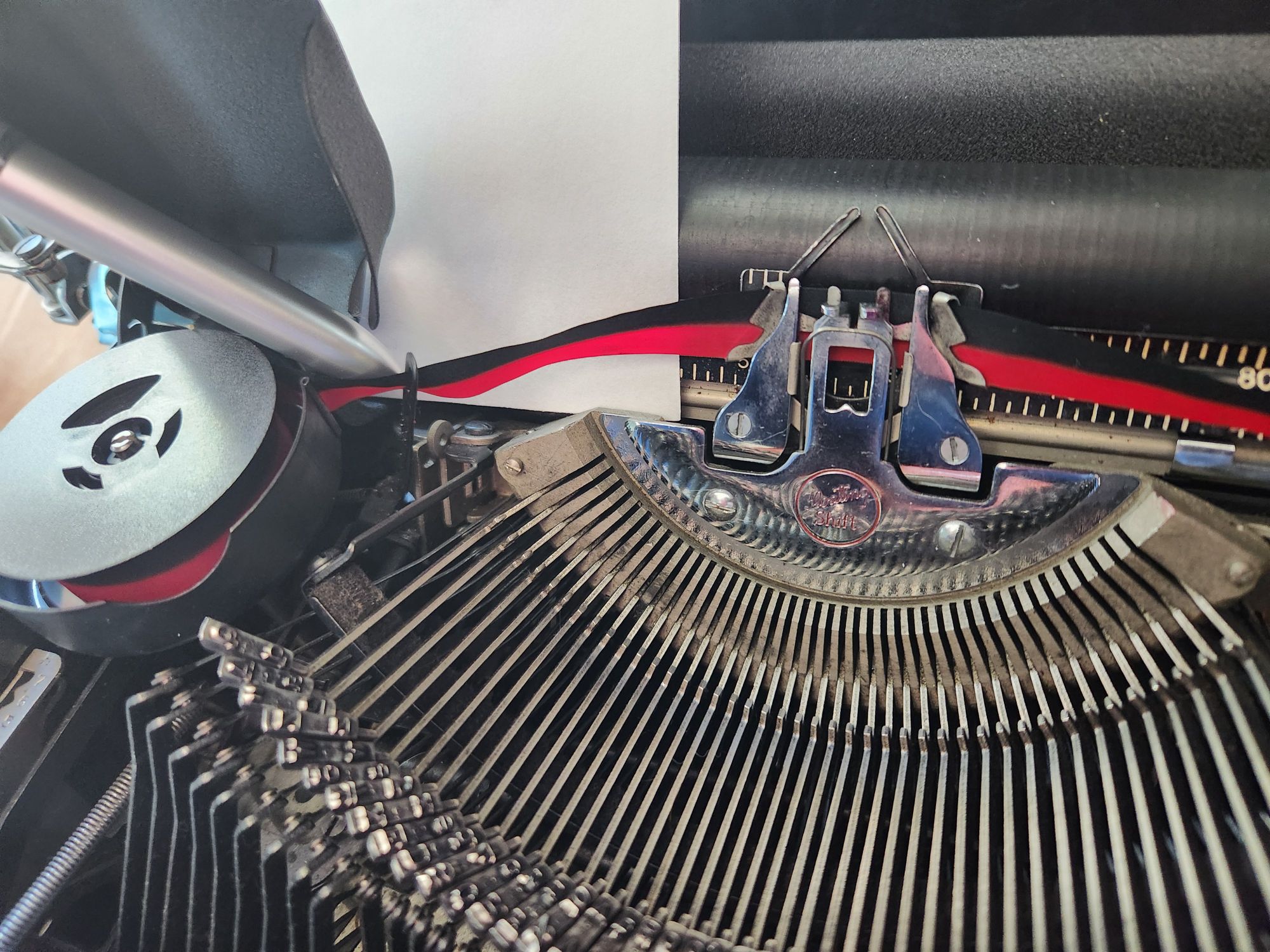
    1. Most Smith-Coronas in the 40s and 50s have similar ribbon set ups. Hopefully this photo and description will help:

      (Alt Text) Smith-Corona typewriter ribbon thread sample. A view into the type basket with the hood of the typewriter raised showing the ribbon coming out of a spool on the left, through a black ribbon guide (which actuates the autoswitch when the eyelet at the end of a spool gets stuck between it and the spool) next to the spool cup, and then into the two metal guides of the ribbon vibrator on either side of the the typing point. A silver pen's tip is pointing to the ribbon guide next to the spool cup at about the point where an eyelet clipped onto the middle of the end of a length of a ribbon would trip the ribbon auto switch.

      If your ribbon auto-switch isn't working one can usually switch the direction manually with the ribbon reverse lever usually found on the front left side of most machines.

      To speed up changing the ribbon on many machines, it can often help to switch the color selector to the red setting and then simultaneously press the G and H keys gently so that they're stuck together almost at the typing point which will raise the ribbon vibrator and make accessing the slots for threading the ribbon easier. Once the ribbon is installed, release the G and H typebars and select the correct color setting for the portion of the ribbon you want to use.

  3. Apr 2024
    1. Replacing the key cap [as a means of switching from QWERTZ to QWERTY] isn't going to help at all, it's just a label. You'd have to swap out internal parts too. Depending on the model, you'd either have to remove and swap typebars or remove the head off the typebar and resolder it onto the appropriate alternate (and ensure that it's properly aligned, not an easy task). Then you'd have to swap the key caps (labels). It's definitely a mechanically doable process, but it's probably almost never done in practice. Doing it as a newbie probably isn't recommendable; you're better off having a repair shop do it for you if you decide to go this route. Depending on the keyboard/model, you'd also have to deal with accents, umlauts, etc.

      Given the difficulty (or cost) of the process and the potential end results, you're assuredly better off locating a QWERTY machine and paying a bit more for shipping to your area if necessary.

      Your mileage may vary depending on model.

      reply to u/imprisoningmymemory at https://www.reddit.com/r/typewriters/comments/1cg1avp/replacing_keys/

    1. EquivalentHead3589[S] 0 points1 point2 points 2 hours ago (1 child)Yes to all that! I agree and understand.

      reply to u/EquivalentHead3589 at https://www.reddit.com/r/typewriters/comments/1cbzx1n/how_do_you_price_typewriters/

      The primary difference is that listing prices don't indicate actual value. That is only determined by actual sales price. Things are worse for the listings which don't indicate much about condition as you're probably more likely to need to have the machine serviced and/or replace or recondition parts. This can often add a few hundred dollars (or significant research and time, tools, and elbow grease) to the bottom line to be able to use a machine.

      I do recall a burgundy Olympia SM3 which sold in the last 4 months for right at $300 which was regularly used (loved) and serviced and in excellent condition with some fantastic photos. If you compare it to this Burgundy/Gray machine (https://www.ebay.com/itm/404901285037) for $299, but which has a missing key cap, and a damaged case, and may likely have other hiding issues. If you consider that you'll likely need to put a minimum of another $100 into this to get it up to the fighting shape that the first was in and it's still got damage, you'll start seeing the stark difference. The people with listings at $550-800 know they're not selling and they're just sitting there, so why not email them and ask more specific questions about condition and get a typed typeface sample of all the keys. Then make an offer for $200 +/- with some wiggle room for service costs once you've gotten it to see if they'll sell?

      As an example, look at https://www.ebay.com/itm/226016437104 which is a Gray SM3 originally listed for $549 and now on sale for $428. The seller knows it's not moving. They state that they got it at an estate sale (probably for around $25) and they definitely did no work other than quick check of the keys. If you demonstrate that you've savvy enough to know the specific machine (what shape are the rubber washers on the frame next to the feet to prevent the carriage from rubbing against the frame? how what is the durometer measurement on (how hard is) the platen?), the market (in top shape maybe $300), and what servicing/repair costs are, they'd probably accept an offer of $150-200 and you're off to the races and they've made a solid profit.

      The biggest issue in the typewriter market at present is the broad lack of information and knowledge about them on both the buyer and seller side. If you can demonstrate you've got more knowledge than the other side, you'll be in a far better position to negotiate, otherwise a seller can sit and wait an undetermined amount of time waiting for a sucker who will likely never show up.

    1. https://www.reddit.com/r/typewriters/comments/1caofcz/how_to_get_my_silentsuper_to_not_rotate_to_the/

      Because of aging, the rubber feet of many typewriters can harden thereby reducing their friction against the table on which they sit. As a result, this can cause one's typewriter to "walk" across the table as they type for extended periods necessitating their recentering from time to time. To remedy this, one could use custom made typewriter mats with rubber bottoms to prevent this walking as well as to protect the table underneath. Other options which may also work are either wool or felt pads from fabric stores or from Chinese/Japanese calligraphy stationers. In Japanese these mats are called shitajiki.

  4. Mar 2024
  5. Dec 2023
  6. Jul 2023
  7. Jun 2023
  8. May 2023
    1. I buy exclusively from Ribbons Unlimited since their products and service are superb. I have purchased from Amazon suppliers if I need a ribbon "pronto", but the biggest problem that I run into with their supplier's ribbons is the fact that they normally don't have reversing grommets installed at the end of the ribbons, and unless your machine can sense ribbon tension and reverse the ribbon, you have to reverse the ribbon direction manually. I purchased a grommet installation tool to try and capitalize on the cheap price of Amazon ribbons, but found that it's not really worth the effort (plus my hands got really "inky") - I always come back to Ribbons Unlimited.

      Some cheap typewriter ribbon spools don't have grommets on them to force auto-reverse of the spool. Without grommets, some machines may sense ribbon tension for reversal, otherwise one needs to switch direction manually.

      There are grommet installation tools that one can use, but this often requires getting one's hands dirty to install them.

      Ribbons Unlimited has a good reputation in the r/typewriters community for providing good sales and service.

    1. Typewriter Cleaning and Repair Basics #3 Bell Fixed

      Keep in mind that some typewriters don't have hard mechanical margin stops, but rely on the user to hear the bell to know the margin is approaching and return the line manually.

      Bell hammer mechanisms may simply need to be cleaned to get them into functioning order. Dirt and grime may prevent the hammer mechanism from having enough force to strike the bell. Beyond this replacing the spring may be necessary.

  9. Apr 2023
  10. Jun 2022
  11. May 2022
    1. VIN locks began in car-engines. Auto manufacturers started to put cheap microcontrollers into engine components and subcomponents. A mechanic could swap in a new part, but the engine wouldn’t recognize it — and the car wouldn’t drive — until an authorized technician entered an unlock code into a special tool connected to the car’s internal network.

      VIN Locks and Right-to-Repair

  12. Apr 2022
    1. Fence Repair and ContractingStarting out as humble fencing contractors, we know a thing or two about boundaries. Whether it’s keeping people out

      Looking for a fencing contractor? We are Cambia, providing garden fence repairs, domestic and Industrial Fencing in Luton and Dunstable. Get a no obligation quote today!

  13. Apr 2021
  14. Mar 2021
  15. Jan 2021
    1. I’m so grateful to my friend, John who introduced me to ROOTKITS CREDIT SPECIALIST who proved to me that they have professionals that can get the job done in time with no hiccups. I have been trying to get a home but got rejected due to bad credit score of 528 which also made it difficult to get loan approval but after I had a deal with this team my score was sky rocketed to 790 in just 72 hours. You can reach them on rootkitscreditspecialist at gmail dot com for quick repair.

  16. Sep 2020
  17. Jan 2020
  18. Oct 2015