856 Matching Annotations
  1. May 2016
    1. PULSE, 1916. http://www.broadsheet.ie/2016/05/11/fingers-on-the-pulse-of-1916/

      The Dublin Metropolitan Police (DMP) Prisoners Books for 1905-1908 and 1911-1918 are amongst the most valuable new documents to come to light on the revolutionary decade.

      They include important information on social and political life in the capital during the last years of the Union, from the period of widespread anticipation of Home Rule, to the advent of the 1913 Lockout, the outbreak of the First World War in 1914, the Easter Rising and its aftermath in 1916, and including the conscription crisis of 1918.

      They will also be invaluable to those interested in criminology, genealogy, and family history.

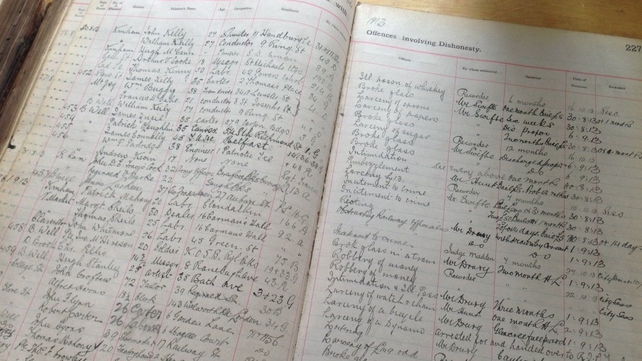
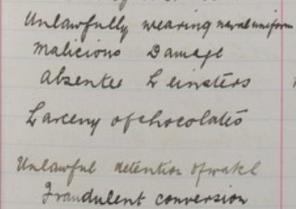
      The collection comprises of four large leather bound, double ledger volumes containing hand written entries that record the details of daily charge sheets issued by DMP members to offenders or alleged offenders.

      Each volume contains the name, age, address, occupation, alleged offence and, in most cases, outcome of cases involving over 30,000 people arrested by the DMP.

      Each volume also contains an index of prisoners with references to the pages containing details of the charge. The information in these volumes serves, therefore, to provide new perspectives on life in Dublin during a time of war and revolution.
    2. Dublin Metropolitan Police's Prisoners Books released," Irish Geneology News (2016-05-12) http://www.irishgenealogynews.com/2016/05/dublin-metropolitan-polices-prisoners.html

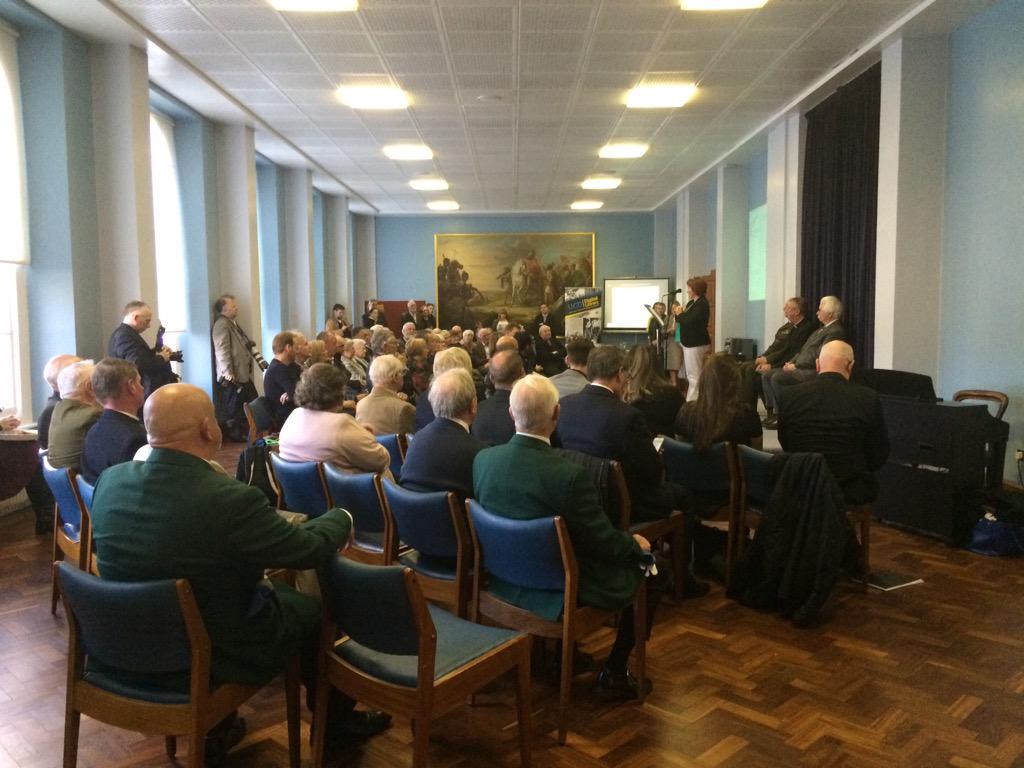
      Launched yesterday at Liberty Hall, these records date from Ireland's revolutionary era and include all manner of crimes listed in register pages headed 'Prisoners charged with offences involving dishonesty'. ...

    3. "Dublin Metropolitan Police Prisoner Books 1905-1918," The British GENES blog (2016-05-12) http://britishgenes.blogspot.ie/2016/05/dublin-metropolitan-police-prisoner.html

      University College Dublin's Digital Library (http://digital.ucd.ie) has just uploaded digitised editions of four Dublin Metropolitan Police prisoners books from 1905-1908, and 1911-1918, at http://digital.ucd.ie/view/ucdlib:43945.

    4. "Historic police records showing Connolly and Larkin arrests found in skip," Irish Independent (2016-05-11) http://www.independent.ie/irish-news/historic-police-records-showing-connolly-and-larkin-arrests-found-in-skip-34707471.html

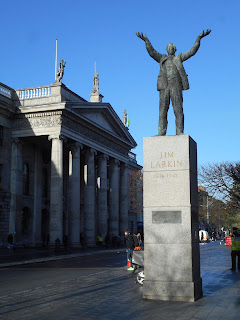
      The four missing volumes of 'Prisoner Books' listing the arrests of more than 30,000 people between 1905 and 1918 include the "crimes" of labour leaders Jim Larkin (seditious conspiracy), James Connolly (incitement to crime), revolutionary Maud Gonne MacBride (defence of the realm) and suffragette Hanna Sheehy Skeffington, (glass-breaking with other suffragettes).

    5. "Records of 1916 Rising arrests published online," Irish Examiner (2016-05-12)

      Reports containing details of 30,000 arrests by the Dublin Metropolitan Police more than 100 years ago have been published online, writes Dan Buckley.

      They contain details of prisoners during the Lockout of 1913, the outbreak of the First World War and the 1916 Easter Rising.

  2. Apr 2016
    1. Ebenso wie ich für human centered urban spaces plädiere, plädiere ich auch für human centered libraries, deren itterative Planungs- und Umsetzungsverfahren möglichst viele stakeholder einbeziehen.

      Interesting thought: human-centered libraries

  3. Mar 2016
    1. But I see some promising changes that align with the emphasis in the Framework on creating rather than consuming, on understanding systems of information rather than how to find stuff, on context and making critical judgments that go beyond making convenient consumer choices. If we think about information as something communities create in conversation within a social and economic context rather than as a consumer good, we may put less emphasis on being local franchises for big information conglomerates and put more time, resources, and creativity into supporting local creativity and discovery. We may begin to do better at working across boundaries to support and fund open access to research rather than focusing most of our efforts on paying the rent and maintaining the security of our walled gardens. And as we make this shift, we may be able to stop teaching students how to shop efficiently for information that won’t be available once they graduate. We may help them think more critically about where knowledge comes from and how they can participate in making sense of things.

      Nice!!!

  4. Feb 2016
    1. Polldaddy for iOS was a great option for this type of assessment. The layout and design are optimized for the iPad’s screen, and survey results are loaded offline. Be-cause an Internet connection is not required to administer a survey, the researcher has more flexibility in location of survey administration.

      Polldaddy did not require wireless internet access, making it a more flexible survey-software option

    2. A two-question survey was designed to pilot the iPadas a survey delivery device in GSU Library. The first survey question was ―Why did you come to the library today? Please choose the primary reason.‖ Ten response options were listed in alphabetical order, and survey takers were allowed to select one option. The tenth response option was ―other,‖ with a text field in which survey takers could enter their own explanations. This question was included because the library is extremely busy, with an average daily door count of 10,000 during a typical semester. The door count data show heavy use of the building, but the library has little means of finding out what visitors do while they are in the buildings. The second survey question was ―What is your major?,‖ which was an open-text field.

      Georgia State Library test-survey (two questions).

    3. Over the past few years, the market research literature has reflected a concern about the quality of face-to-face market research as compared to online surveys and polls. Manfreda, Bosnjak, Berzelak, Haas, and Vehovar (2008) analyzed other studies that compared response rates from Web-based surveys to response rates of at least one other survey delivery method. Web survey responses were, on average, eleven percent lower than the other methods investigated. In their study of face-to-face survey responses as compared to online survey responses, Heerwegh and Looseveldt (2008) concluded that responses to Web surveys were of poorer quality and, overall, less suffi-cient than responses to surveys conducted face-to-face.

      face-to-face surveying produces greater results than web-based surveys.

  5. Jan 2016
    1. albums produced between 1908 and 1913 by developers and the real estate industry to entice potential middle and upper class tenants to New York City’s “principal high class apartment houses,” declares one volume’s subtitle. Each featured apartment house is briefly described, and illustrated with an exterior photograph and one or more floor plans.

      Mauricio Geraldo made a game out of the floor plans.<br> http://publicdomain.nypl.org/mansion-maniac/<br> http://github.com/nypl-publicdomain/mansion-maniac

  6. Dec 2015
  7. Nov 2015
    1. Les représentants de la Bibliothèque nationale de France (BnF) annoncèrent leur objectif de ramener le délai de traitement des documents à six semaines en moyenne

      C’était long, en 2002! Où en est la BnF, aujourd’hui? D’une certaine façon, ce résumé semble prédire la venue des données, la fédération des catalogues, etc. Pourtant, il semble demeurer de nombreux obstacles, malgré tout ce temps. Et si on pouvait annoter le Web directement?

  8. Sep 2015
  9. Aug 2015
    1. Only a limited understanding of the oil consumption mechanism appears to exist, especially oil consumption under transient engine operating conditions. This is probably due to the difficulty in engine instrumentation for measuring not only oil consumption, but also for measuring the associated in-cylinder variables. Because of this difficulty, a relatively large number of experiments and tests are often necessary for the development of each engine design in order to achieve the target oil consumption that meets the requirements for particulate emissions standards, oil economy, and engine reliability and durability.

      this is important

  10. Jul 2015
    1. Sec. 15-7. - Injuring or defacing library property. Whoever willfully injures or defaces any book, newspaper, magazine, pamphlet, manuscript, or other property belonging to the city library by writing, marking, tearing, breaking, or otherwise mutilating shall be fined as provided in section 1-8. (Code 1964, amended, § 19.19(A)) Cross reference— Damage to public property, § 17-26. State Law reference— Criminal mischief, V.A.P.C. § 28.03; reckless damage of property, § 28.04.
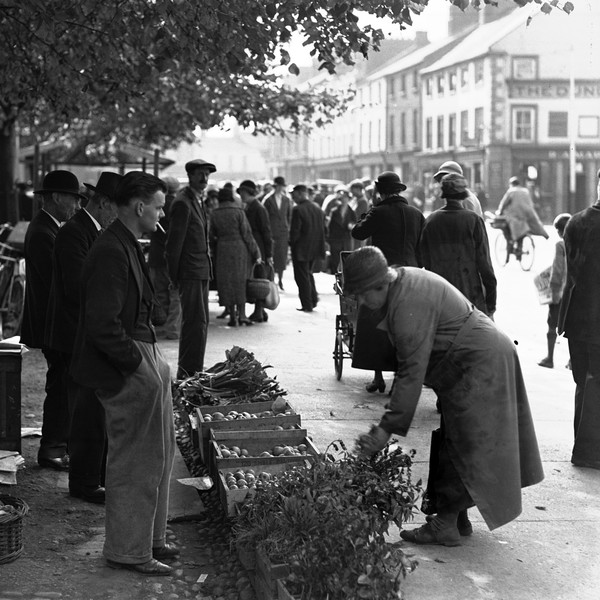
    1. Dundalk market day, Co. Louth

      The Dundalk Market Square web site offers the following history of the Dundalk market:

      In the 17th century, Lord Limerick (later James Hamilton, 1st Earl of Clanbrassil) created the modern town we know today. He was responsible for the construction of streets leading to the town centre; his ideas came from many visits to Europe. In addition to the demolition of the old walls and castles, he had new roads laid out eastwards of the principal streets. The most important of these new roads connected a newly laid down Market Square, which still survives, with a linen and cambric factory at its eastern end, adjacent to what was once an army cavalry and artillery barracks (now Aiken Military Barracks).

      In the 19th century, the town grew in importance and many industries were set up in the local area. This development was helped considerably by the opening of railways, the expansion of the docks area or 'Quay' and the setting up of a board of commissioners to run the town.

      The present photograph was captured by the Coimisiún Béaloideasa Éireann (CBÉ) / Irish Folklore Commission (1935).

      Dundalk market day, 1935

  11. Jun 2015
    1. Jennifer Purrenhage from the Department of Natural Resources and the Environment, has this to say about her team librarian, Jennifer Carroll: “She has jumped on several seeds I mentioned early on, and has sent me materials to consider for my courses — materials that I did not know existed, and are great candidates.

      UNH OER pilot

  12. May 2015
    1. Fundamental questions for the library revolve around issues of: stewardship (what types of annotations are appropriate for library ownership, vs. say a course platform), persistence (how long should different types of annotations be persisted and preserved), costs (who will fund annotation storage over time) access (what privacy and distribution controls need to be placed on access to annotations.)
  13. Mar 2015
  14. Feb 2014
    1. These rights are quali- fied, however, by the application of various limitations set forth in the next several sections of the Act, §§107 through 122. Those sections, typically entitled “Limitations on exclusive rights,” include, for example, the principle of “fair use” (§107), permission for limited library archival reproduction, (§108), and the doctrine at issue here, the “first sale” doctrine (§109)
      • §107 - the principle of “fair use”
      • §108 - permission for limited library archival reproduction
      • §109 - the “first sale” doctrine