maior ou igual a 2
Maior ou igual a 2 !? Então a nossa base não é a 10?
maior ou igual a 2
Maior ou igual a 2 !? Então a nossa base não é a 10?
A aritmética usada nos computadores não respeita as regras da aritmética usual.
Por causa dos arredondamentos automáticos da máquina.
Épsilon
o que significa Épsilon?
Suburbs are more diverse than their pop-cultural image usually suggests
This first sentence struck out to me because it could not be more true. Suburbs all represent houses which typically tend to look different but have the same format. Its outside looks generally similar but the people inside of it vary from age, economic status, race, and more. But, suburbs may be receiving different access to resources or even none at all due to residential discrimination.
On the other hand, some bots are made with the intention of harming, countering, or deceiving others. For example, people use bots to spam advertisements at people. You can use bots as a way of buying fake followers [c9], or making fake crowds that appear to support a cause (called Astroturfing [c10]).
I feel like that hurting other people has always existed, but harm on the internet can sometimes feel even more serious. In real life, people are more limited by laws and rules, but online rules are often harder to enforce, so people may feel more free to attack others and cause greater harm.
Although high rates of poor adherence/persistence to ADHD pharmacotherapy have been documented, there is a lack of research targeting the issue (Biederman et al., 2019). Evidence from the studies in our review shows that interventions are promising, at least in the short term. The most promising interventions involve psychoeducational, behavioural and technological interventions.
What the authors' concluded from the studies. The most promising forms of intervention revolve around psychoeducational, behavioral, and technological interventions. However, there needs to be more research targeting the issue so that better modes of intervention can be brought to light.
Other theoretical frameworks have been applied to medication adherence. For example, the Unified Theory of Behaviour Change (UTBC) suggests that targeting knowledge and skills through education may be an important strategy to improve adherence and persistence. For ADHD, increased knowledge and associated attitudes that using medication is safe and effective increases willingness to use medication (Bussing et al., 2012). However, while knowledge may increase willingness to try medication treatment, it is not clearly associated with long-term use (Corkum et al., 1999) - repeated educational support is likely necessary for any successful intervention.
This aligns with the topic that I am doing my research on. Being more educated about the medication one is taking can increase the likelihood they use it for treatment since they know what the medication does, how it will help them, how it may affect them longterm, and how to properly use the medication.
For ADHD, combining psychoeducational and behavioural strategies has been reported as necessary to affect change in attitude and behaviour, particularly for children with comorbid conditions such as ODD (Kamimura-Nishimura et al., 2019). To date, there has been no RCT using a combined approach. However, if behavioural strategies are to be used as interventions, potential challenges in terms of cost and time need to be considered and minimised. For a successful intervention to be implemented, it must be inexpensive and not burdensome to patients and families.
Combining psychoeducational and behavioral strategies are more likely to show beneficial affects in attitude and behavior. However, there are no RCTs that used the combined approach. The authors' emphasized the importance of taking time and cost into consideration if this strategy (or other behavioral strategies) were to be used as interventions, since it must be inexpensice and not burdensome to patients and families.
In our review, there is a general lack of consistency in the measurement of adherence and persistence to pharmacotherapy, as well as in the definitions used – this challenge has been documented by other researchers (Gajria et al., 2014; Aoki et al., 2021) and makes it difficult to compare the effectiveness of individual interventions.
A main reason as to why more studies need to be done in relation to this topic.
4.1. Synopsis of findings
The authors' found that psychoeducation showed improvements in adherence/persistence and five of them showing improvements in ADHD ratings. However, nearly all of the studies had issues with maintaining adherence rates long term. They concluded by saying that there needs to be more studies done addressing current limitations in order for more effective and sustainable interventions to be developed.
2.2. Inclusion/Exclusion criteria
The criteria used to determine what literature to include/exclude from the review. Since it is a systematic review the criteria is much more strict to make sure the literature aligns with the target topic.
An extensive search for published literature was conducted including the databases of Embase, Pubmed, PsychINFO, CINAHL, the Cochrane Library and Web of Science from January 1980 until January 2021.
Where the authors' got their literature for the review.
Although medication is safe and effective in treating ADHD, non-adherence to stimulant treatment is generally high (Adler and Nierenberg, 2010; Gajria et al., 2014; Pelsser et al., 2017), with an estimated 50% of patients choosing to discontinue pharmacotherapy (Rashid et al., 2018). Studies focused on adults only have also reported poor adherence (Olfson et al., 2007). A significant reduction in medication continuation can occur in adolescent years (Emilsson et al., 2017; Charach and Fernandez, 2013). Adolescents have been reported to regard medications for ADHD less favourably than their parents/guardians (Bussing et al., 2012).
This is specifically why I chose my topic. The stigma surrounding ADHD medication can make it hard for adults with ADHD or parents/guardians of children with ADHD to choose medication as a form of treatment. This is also a personal experience to me since I was taken off of medication when I was younger since my parents weren't education enough on the medication I was taking.
ADHD can result in negative consequences such as social and family life problems, low educational attainment/learning disabilities, low self-esteem, impaired emotional development, occupational difficulties and relationship issues (Dias et al., 2013).
This isn't the main topic in the review, but these consequences of ADHD are another reason why education about disorders is so important. Especially since ADHD is often described as a "lack of discipline" or "laziness" by those who aren't educated on the disorder. This has lead to a pretty "harsh" stigma surrounding ADHD, which includes the medication involved in treatment.
Attention-deficit/hyperactivity disorder (ADHD) is a common neurodevelopmental behavioural disorder in childhood and adolescence. The disorder tends to occur more in boys than girls (Charach et al., 2011), and is also known to persist into adulthood (Adler and Cohen, 2004; Charach et al., 2011; Pelsser et al., 2017; Elliott et al., 2020).
Introducing what ADHD is so the audience can have a better idea as to why this review is important. Also, recent studies suggest that it's harder to diagnose women/girls with ADHD since they are more likely to have the inattentive type. Which is why men/boys are often diagnosed more often since they are more likely to have the hyperactive type. However, this is not always the case since ADHD is a spectrum disorder, so anyone can have any type.
We believe future interventions should involve combinations of strategies, have a theoretical framework and target the most common reasons for non-adherence. Interventions should also be integratable into routine care and include patient input to maximise sustainability.
The authors' idea based on the studies reviewed. Going for a combined approach that can be integrated into a daily routine makes sense since everyone and every family structure is different. So having interventions that can be integrated into many different routines can potentially lead to higher adherence rates.
An extensive search was conducted from January 1980 until January 2021. Thirteen studies were identified involving interventions based on psychoeducation, behavioural therapy, combined psychoeducation/behavioural therapy, technology-based interventions, written informed consent and a nursing support line.
Over 41 years they found 13 studies that covered a lot of different psychoeducation methods. Since the problem they are looking into has limited research it makes sense why it took 41 years to find enough studies to do the review.
systematic review
This is a systematic review, which means it will be structured and focused around on specific topic.
These services range from those that provide care to individualsand families to those concerned about larger public health issues and to education and research activitiesrelated to the prevention, detection, and treatment of disease.
I find this a fascinating definition of the health care system, and it leads me to question is this truly what our health care system represents today?
How are people’s expectations different for a bot and a “normal” user?
I think that people expect a normal user to share their real thoughts, feelings, and experiences in order to get some feeling feedback. However, a bot is usually expected to to some specific tasks automatically. For example, I would not expect a bot to have real emotions, but I would want it to be faster and more accurate.
The economics literature on racial residential segregation also firmly establishes theharmful effects on economic and social mobility and other economic outcomes. Higherlevels of racial segregation are associated with lower median and per capita incomes forBlack and Latino Americans. It is also associated with unemployment andidleness. Racial residential segregation is also strongly associated with disparities inlending practices and access to credit
I find that the limitation and harmful effects on economic and lower social mobility for Black and Latino Americans to represent injustice and inequality endured and to me highlights the "domino effect" of racism in America. If an individual continuously gets denied a job or access to resources because of the color of their skin, they are unable to have a stable financial state. If an individual does not have a stable financial state, then they would not be able to purchase or live in home and care for their basic necessities. And with unemployment and racial residential segregation, it leads to disparities in lending practices and access to credit. All of this "domino effect" makes me uncomfortable as America has failed its systems and people.
Indeed, the Act helped breakdown barriers to integration and reduce the prevalence of housing discrmination, but itwas comparatively weak in terms of proactively integrating existing segregatedcommunities
I think that this comment heavily relates to my previous annotation about education and spread of information in America. Yes, the Act helped break down barriers to integration, but it was still weak. If educating Americans in the U.S. breaks down barriers and informs people about past events, it becomes proactive, but there is still active racism and even existing segregates communicate in the present. So in relation to housing discrimination: An Act was put in place but was still not enough to set a precedent for these communities who were in need of help.
Out of every metropolitan region in the United States with more than 200,000residents,81 percent (169 out of 209) were more segregated as of 2019 thanthey were in 1990
I find this key report finding to be eye opening because as a student from California who learned about segregation of African Americans in America during my elementary school years, the curriculum and media has made it seem like discrimination and injustice has "decreased." This is not to say that I was taught that racism in America was solved or "fixed," I just find this statistic to be staggering. It has definitely made me realize that America has become more educated about it, but it doesn't mean that systemic discrimination has disappeared.
Document de Briefing : Santé Mentale des Jeunes, Prévention et Dispositifs d'Accompagnement en Milieu Scolaire
Ce document de briefing synthétise les interventions de la table ronde organisée par le Conseil scientifique de l'Éducation nationale (CSEN), réunissant des experts de la santé publique, de la recherche épidémiologique, du secteur associatif et du ministère de l'Éducation nationale et de la Jeunesse.
La santé mentale des jeunes élèves en France fait face à des défis majeurs, caractérisés par un sentiment d'isolement croissant, une pression scolaire ressentie et un manque de soutien social pour une frange significative de la population scolaire.
Face à ce constat, les experts s'accordent sur la nécessité d'agir sur les déterminants sociaux et environnementaux de la santé, en dépassant la seule approche des facteurs de risque individuels pour renforcer les facteurs de protection.
L'action sur l'environnement et le climat scolaire : L'intégration de la santé dans toutes les politiques éducatives, l'aménagement des espaces physiques (accès à la nature, cours d'école) et l'amélioration du capital social de l'établissement (affiliation, participation des élèves).
La littératie en santé mentale et la déstigmatisation : L'utilisation d'outils pédagogiques évalués comme le « Cosmos Mental » du Psycom, permettant de lever le tabou, d'envisager la santé mentale comme un continuum dynamique et de responsabiliser l'ensemble des acteurs non-médicaux.
Le développement du secourisme en santé mentale : La montée en puissance du programme citoyen Premiers Secours en Santé Mentale (PSSM) et son adaptation aux jeunes (PSSM Jeune et projet PSSM Junior / vigies), visant à former des « passeurs » capables de repérer et d'orienter.
La stratégie institutionnelle de l'Éducation nationale : La mise en œuvre du cadre de l'« École promotrice de santé » et de l'« École inclusive », s'appuyant sur un protocole formalisé, la formation de Secouristes en Santé Mentale (SSM) internes et un circuit d'adressage optimisé par les équipes pluridisciplinaires ressources (médecins, infirmiers, psychologues, assistants sociaux).
Mariam Melchior (directrice de recherche à l'INSERM, équipe d'épidémiologie sociale) rappelle les chiffres clés issus des enquêtes nationales et internationales (en classe, HBSC) concernant la santé mentale des collégiens et lycéens :
| Indicateur / Problématique | Proportion d'élèves touchés | | --- | --- | | Sentiment d'isolement (fin collège / début lycée) | 20 à 30 % des jeunes filles<br>15 % des garçons | | Insatisfaction vis-à-vis de l'école | Environ 15 % | | Pression scolaire forte ressentie | 1/4 à 1/3 (25 à 33 %) | | Absence ou insuffisance de soutien social (pairs ou adultes de l'école) | 10 à 15 % |
Ces données mettent en évidence une inadéquation entre les contraintes environnementales auxquelles les élèves font face et les ressources internes ou externes qu'ils sont en mesure de mobiliser pour gérer leur stress.
Au-delà du développement des compétences psychosociales individuelles, la recherche souligne l'importance d'agir sur l'écosystème global de l'élève :
Il évalue une intervention combinant une application smartphone/ordinateur pour la gestion du stress chez les élèves, doublée d'un accompagnement des enseignants et des parents pour mieux repérer les difficultés.
Le programme porte une attention particulière aux déterminants sociaux pour s'assurer que les élèves en difficulté de lecture ou en filières professionnelles s'en saisissent.
L'environnement physique : L'aménagement des espaces (accès à la nature en ville, organisation des cours de récréation) modifie directement les modes de sociabilité et les interactions entre enfants.
Le capital social et le climat scolaire : L'expérimentation australienne Gatehouse Project a démontré qu'en modifiant la dynamique d'établissement, les hiérarchies et les échanges élèves-adultes (renforcement du sentiment d'affiliation), on observe une baisse des interdictions/violences, une réduction des symptômes d'anxiété et de dépression, une diminution de l'usage de substances et une amélioration de la réussite scolaire.
En référence aux travaux de la Commission de l'OMS sur les déterminants sociaux de la santé (présidée par Michael Marmot), il est préconisé d'intégrer la santé dans toutes les politiques publiques.
À ce titre, Mariam Melchior formule une interrogation critique sur l'impact de la récente réforme du baccalauréat : en individualisant les parcours, en éclatement les groupes-classes et en multipliant les intervenants, cette réorganisation risque d'aller à l'encontre de la création de collectifs, du travail d'équipe et du sentiment d'affiliation, facteurs pourtant essentiels au bien-être des lycéens.
Céline Loubières présente l'action du Psycom, organisme public d'information sur la santé mentale opérant au niveau national depuis 30 ans.
Le Psycom œuvre pour faire évoluer la perception publique, historiquement centrée sur la psychiatrie et la maladie, vers une vision globale de la santé mentale.
      ```
      [ FUSÉE ] (L'Individu)
          │
          ├──► [ Planètes Ressources ] (Forces internes, environnement favorable, soutien)
          │
          └──► [ Planètes Obstacles ]  (Stress extrême, environnement complexe)
```
Développé il y a 10 ans, cet outil pédagogique repose sur une métaphore spatiale :
La Fusée représente l'individu au cours de sa vie.
Le Cosmos représente l'environnement dans lequel il évolue.
Les Planètes Ressources (ressources internes et collectives comme un environnement scolaire bienveillant).
Les Planètes Obstacles (réponses au stress extrême, environnements complexes).
L'objectif est d'enseigner que la santé mentale concerne tout le monde, qu'elle n'est pas figée (ni tout blanc, ni tout noir), qu'elle évolue en permanence et qu'un rétablissement est toujours possible, même après un trouble ou un suivi psychiatrique.
Le clip vidéo de présentation cumule plus de 120 000 vues.
Une évaluation en trois temps a été réalisée par le cabinet externe Le B auprès de 184 utilisateurs (entretiens quantitatifs, évaluations qualitatives et observations de terrain) :
85 % des utilisateurs se sentent mieux équipés pour parler de santé mentale.
79 % comprennent mieux les facteurs qui influencent leur propre santé mentale et celle d'autrui.
56 % déclarent parler plus souvent de santé mentale après l'atelier.
L'évaluation révèle que moins d'un quart (25 %) des utilisateurs de l'outil sont des professionnels de la santé mentale.
La grande majorité provient du milieu éducatif, de la formation et du secteur social.
Cela démontre que les acteurs du terrain scolaire peuvent légitimement s'emparer du sujet sans être des experts médicaux.
François Pilet (instructeur PSSM, vice-président de l'UNAFAM) présente le programme PSSM, adapté du modèle australien créé il y a 25 ans.
En France, PSSM a été introduit en 2018 avec le soutien de la Direction Générale de la Santé (DGS) et de Santé Publique France.
Il repose sur un trépied associatif et institutionnel :
Soin Santé Mentale France- Linfip (organisme de formation)
UNAFAM (Union nationale des familles et amis de personnes malades/handicapées psychiques
apport de l'expérience usager/familles)
Le programme propose une formation citoyenne généraliste de 14 heures (généralement dispensée sur 2 jours consécutifs), sans aucun prérequis.
Il s'appuie sur un conseil scientifique présidé par le Professeur Nicolas Franck.
L'objectif n'est pas de former des soignants ou des diagnostiqueurs, mais des passeurs capables de :
Déstigmatiser les troubles psychiques.
Modifier le regard porté sur la maladie ("un autre regard").
Savoir agir et orienter face à un épisode psychique au lieu de tourner la tête, de se moquer ou de contacter systématiquement les forces de l'ordre.
Promouvoir la notion de rétablissement tout au long de la vie.
Dans le monde : Présent dans 29 pays, plus de 7 millions de secouristes formés.
En France (2018-2024) : Près de 150 000 secouristes et 1 500 formateurs formés en seulement 4 ans d'activité effective (hors période de pandémie).
Milieux d'intervention spécifiques : PSSM a permis de pénétrer des milieux très fermés tels que les gardiens de prison (visite de la quasi-totalité des maisons d'arrêt et centres d'internement), la Protection Judiciaire de la Jeunesse (PJJ) et les Maisons des adolescents.
PSSM Standard : À destination du grand public adulte.
PSSM Jeune : Développé depuis 3 ans, ciblant spécifiquement les adultes vivant ou travaillant avec des jeunes (parents, enseignants, éducateurs, agents de la PJJ).
PSSM Junior / Vigies (En cours de finalisation) : Programme visant à former directement les élèves au sein des classes (2 à 3 « vigies » par classe) pour donner l'alerte en cas de dysfonctionnement ou de détresse d'un pair.
Phase d'expérimentation lancée au 4e trimestre pour un déploiement visé en janvier.
Dr Brigitte Moltrecht (conseillère médicale à la DGESCO) détaille la politique ministérielle visant à rendre l'élève « disponible aux apprentissages » en veillant à son bien-être physique et psychique (principe posé par Stanislas Dehaene).
La politique de la DGESCO s'adosse sur deux cadres internationaux et systémiques :
Elle privilégie des actions pérennes inscrites dans la politique de l'établissement.
[Repérage au quotidien] ──► [Évaluation Interne] ──────► [Adressage Externe] ──► [Suivi et Aménagement]
(Enseignants, CPE, AED,     (Médecins, Infirmiers,       (Soin / Prise en charge   (PPRE, PAP, PAI,
 Secouristes / Paires)       Psychologues, As. Sociaux)   médicale ciblée)          PPS)
Repérage de proximité : Assuré par la communauté éducative quotidienne (enseignants, CPE, AED, AESH) et aidé par des pairs-référents ou des secouristes en santé mentale.
Évaluation par les personnels ressources internes : Recours aux équipes médicales et sociales de l'Éducation nationale (médecins, infirmiers, psychologues de l'Éducation nationale, assistants sociaux).
Ces professionnels effectuent un bilan multidisciplinaire interne.
Adressage externe ciblé : L'existence de ce filtre interne permet d'éviter les errances diagnostiques et le regorgement inutile des services de soins externes (il est estimé que sans ce filtre, environ 1/3 des bilans externes sont réalisés pour rien).
Suivi et accompagnement au long cours : Utilisation des dispositifs d'aménagements scolarités existants (PPRE, PAP, PAI, PPS).
Formalise et clarifie le rôle de chaque acteur.
Précise le circuit de communication vers les familles en garantissant les règles de confidentialité.
Évite la stigmatisation en se concentrant sur le repérage des signes d'alerte et des répercussions scolaires (notamment via la plateforme Cap école inclusive).
Déploiement des Secouristes en Santé Mentale (SSM) de l'Éducation Nationale : Le ministère a créé son propre module « SSM » (différent mais complémentaire du PSSM associatif).
Entre janvier et mai, l'institution a formé 500 formateurs et 2 500 secouristes en santé mentale internes (prioritairement des CPE et enseignants).
Pilar Arcella-Giraux (DGS) rappelle l'existence d'outils et de cadres juridiques transversaux :
Circulaire Interministérielle de février 2022 : Prévue dans la Feuille de route nationale Santé mentale et Psychiatrie, elle incitait les employeurs des trois fonctions publiques à faciliter la formation PSSM pour les agents volontaires et à former des instructeurs en interne.
Plateforme Mentor : Propose un premier module de sensibilisation à la santé mentale accessible aux agents, en cours d'enrichissement par un second module dédié aux premiers secours en santé mentale.
Académie pilote : L'Académie de Lyon a engagé un partenariat avec l'UNAFAM et PSSM pour traiter la santé mentale sous l'angle de la gestion des ressources humaines et du soutien aux personnels enseignants en souffrance.
Les échanges avec la salle ont mis en exergue des vives tensions concernant la démographie des professionnels de santé à l'école :
En croisant ce ratio avec les données épidémiologiques, environ 200 élèves par secteur nécessiteraient un suivi ou une attention particulière, ce qui représente une charge irréalisable sur les 144 jours de classe annuels (moins de 6 heures disponibles par enfant concerné).
Appel à un recrutement massif : Des intervenants soulignent le manque d'effectifs dans les équipes pluridisciplinaires (médecins, infirmiers, psychologues, assistants sociaux) et demandent si le protocole s'accompagne d'un plan de recrutement.
Nouveautés institutionnelles : Brigitte Moltrecht confirme la création récente (au 1er octobre) d'un poste de psychologue conseillère technique pour la santé mentale au sein du bureau de la santé et de l'action sociale de la DGESCO.
La journée se conclut sur la nécessité d'évaluer scientifiquement les dispositifs :
L'Éducation nationale réalise actuellement l'évaluation des processus (flux de personnes formées) et prévoit d'évaluer les résultats à 2-3 ans, mais l'évaluation d'impact à long terme nécessite des partenariats de recherche.
Mariam Melchior conclut qu'il n'existe pas de solution unique ou magique (les outils digitaux ne remplaceront jamais les psychologues), mais qu'il convient de déployer un éventail complet d'interventions à différentes échelles : numéros d'urgence (3114, Fil Santé Jeunes), applications de gestion du stress, formations citoyennes, équipes pluridisciplinaires scolaires et filières psychiatriques spécialisées.
Résumé de la vidéo [00:00:10][^1^][1] - [00:22:09][^2^][2]:
Cette table ronde aborde les facteurs de protection et de risque en santé mentale, ainsi que les outils et interventions pour améliorer le bien-être des jeunes.
Temps forts: + [00:00:10][^3^][3] Introduction et remerciements * Présentation des intervenants * Importance des facteurs de protection et de risque * Objectifs de la prévention + [00:03:00][^4^][4] Recherche sur les déterminants sociaux * Statistiques sur le bien-être des jeunes * Importance de l'environnement scolaire * Programme Improva pour gérer le stress + [00:08:12][^5^][5] Environnement physique et social * Impact des espaces verts * Capital social à l'école * Projet Gatehouse en Australie + [00:14:00][^6^][6] Outils pédagogiques du Psycom * Présentation du Cosmos Mental * Importance de la littératie en santé mentale * Évaluation de l'outil et résultats + [00:19:00][^7^][7] Rôle des enseignants et du personnel éducatif * Importance de parler de santé mentale * Soutien et accompagnement par le Psycom * Encouragement à utiliser les outils disponibles
Résumé de la vidéo [00:22:11][^1^][1] - [00:48:35][^2^][2]:
Cette vidéo discute des premiers secours en santé mentale (PSSM), un programme de formation originaire d'Australie et adapté en France. Le programme vise à former des secouristes en santé mentale pour aider à destigmatiser les troubles psychiques et offrir un soutien approprié.
Temps forts: + [00:22:11][^3^][3] Introduction du PSSM * Programme de formation en santé mentale * Adapté de l'Australie * Trois piliers en France: soin, formation, expérience + [00:24:16][^4^][4] Historique et développement * Introduit en France en 2018 * Soutien de la DGS et Santé Publique France * Formation citoyenne et généraliste + [00:27:17][^5^][5] Objectifs et impact * Destigmatiser les troubles psychiques * Former des secouristes en santé mentale * 150,000 secouristes formés en France + [00:31:03][^6^][6] Programmes spécifiques * Programme pour les jeunes * Cible les parents, enseignants, éducateurs * Importance de la destigmatisation et du rétablissement + [00:35:01][^7^][7] Approche de l'éducation nationale * École promotrice de santé * Importance de la santé physique et psychique des élèves * Formation des personnels éducatifs et ressources
Résumé de la vidéo [00:48:36][^1^][1] - [00:56:25][^2^][2]:
Cette vidéo aborde les défis et les initiatives liés à la santé mentale dans le secteur de l'éducation, en mettant l'accent sur la formation et le soutien des enseignants et des personnels éducatifs.
Points forts : + [00:48:36][^3^][3] Formation et soutien des enseignants * Importance de la formation continue * Risques de burnout * Collaboration avec la RH + [00:50:00][^4^][4] Circulaire interministérielle * Février 2022 * Promotion de la formation en santé mentale * Facilitation de la formation des formateurs + [00:51:00][^5^][5] Plateforme Mentor * Sensibilisation à la santé mentale * Modules disponibles * Recommandation d'utilisation + [00:52:00][^6^][6] Équipes pluridisciplinaires * Rôle des médecins, infirmiers, psychologues * Besoin de renforcement * Impact sur la santé mentale des élèves + [00:54:00][^7^][7] Recrutement et évaluation * Politique de recrutement massive * Importance de l'évaluation de l'impact * Propositions pour améliorer la situation
onmiddellijke vertegenwoordiging.
dit heeft volgens mij kale volmacht, en het volgende subject is onmiddelijke vertegenwoordiging?
“I type very quickly, very badly, with many errors [ fautes],” Jacques Derrida confessed in a late interview. This paper proposes that the typographical error – usually viewed as a mere “accident” – may in fact be understood as a productive site for deconstructive reading and thought. Drawing on Nietzsche’s suggestion that the typewriter acts as a “collaborator” in thinking, this paper examines Derrida’s use of the typewriter, with particular attention to his typos. Following Derrida’s reading in the Geschlecht series and his own typographical practice, this paper argues that the typo should be thought of as the condition of possibility of every type – and as a defining difference between Derrida and Heidegger.
Chenoweth, Katie. 2021. “Faute de Frappe: Derrida’s Typos.” Research in Phenomenology 51(1): 61–77. doi:10.1163/15691640-12341464.
(Ecuación 2–15)
proporciona una aproximación del tiempo necesario para alcanzar el estado de equilibrio después de que se inicie o se cambie un régimen de dosificación
Document de Briefing : Reconceptualiser le Stress Adolescent et l'Intervention Synergique sur les États d'Esprit
Ce document de briefing synthétise l'intervention du Dr David Yeager, psychologue spécialisé dans l'adolescence, présentée dans le cadre du Conseil scientifique (CSEN).
L'analyse porte sur la manière dont les jeunes gèrent le stress lors des transitions difficiles, en particulier en milieu scolaire, et propose une approche novatrice pour transformer leur réponse au stress.
Constats et Messages Clés :
Les tâches quotidiennes les plus anodines (lever la main, rendre une copie) déclenchent parfois un stress aigu mal interprété.
La réaction (stress response) dépend de l'évaluation cognitive (appraisal) de l'individu, mesurée par le rapport entre les exigences de la situation et les ressources perçues pour y faire face.
Réponse de Menace vs Réponse de Défi :
Défi (Ressources suffisantes pour répondre aux exigences) : Provoque une dilatation vasculaire (meilleure oxygénation du cerveau et des muscles), une baisse du cortisol et un gain de performance.
L'Intervention Synergique sur les États d'Esprit (Synergistic Mindsets) : Publiée dans Nature, cette intervention de 20 minutes combine l'état d'esprit de croissance (growth mindset) et l'état d'esprit selon lequel le stress est un stimulant (stress-is-enhancing mindset).
Elle réduit la constriction vasculaire lors d'épreuves sociales intenses comme le Trier Social Stress Test (TSST).
À l'inverse, la réévaluation cognitive (reappraisal), qui recadre les réactions corporelles comme des ressources d'énergie pour réussir, améliore considérablement la santé mentale et physiologique.
Les données expérimentales révèlent que des actions quotidiennes en classe déclenchent des réactions physiologiques et psychologiques intenses chez les élèves :
Rendre un examen ou lever la main : Provoque un emballement cardiaque, des palpitations, une accélération de la respiration, des mains moites et des maux d'estomac.
Erreurs d'interprétation des élèves : Les jeunes assimilent ces symptômes physiques à un manque de compétences ou à un défaut d'appartenance (ex. : penser qu'on n'a pas sa place dans des classes de niveau supérieur ou que les élèves « intelligents » ne ressentent pas cela).
Le piège du choix binaire
L'incompréhension du stress amène les élèves à opter pour deux voies sous-optimales :
Réduire le travail scolaire et se désengager pour préserver leur santé mentale à court terme.
Maintenir leur engagement académique mais subir un stress permanent et handicapant.
L'objectif de la recherche du Dr Yeager est d'introduire une troisième voie : embrasser le défi intellectuel tout en développant une résilience face au stress.
Pour traiter le problème, il convient de différencier le facteur déclencheur de la réponse biologique et psychologique.
+-------------------+      +-----------------------+      +-----------------------+
| Facteur de stress | ---> | Évaluation Cognitive  | ---> | Réponse au stress     |
|    (Stressor)     |      |      (Appraisal)      |      |   (Stress Response)   |
+-------------------+      +-----------------------+      +-----------------------+
Définition : Tout événement ou exigence demandant une réponse du corps et de l'esprit (ex. : passer un test, lever la main, gérer un conflit, présenter un discours, ou faire face aux injustices du monde).
Nature : Neutre. Un facteur de stress n'est en soi ni bon ni mauvais.
Définition : La réaction physiologique (palpitations, transpiration, respiration) et psychologique à l'événement.
Nature : Peut être bénéfique ou nocive selon la manière dont le facteur de stress est évalué.
Inspirée des travaux de James Gross en psychologie clinique, l'évaluation cognitive est le processus mental par lequel l'individu attribue une valeur à la situation en mesurant le ratio entre :
Ratio d’eˊvaluation\=Ressources disponiblesExigences de la situation
Erreur fréquente des adultes : Quand un adolescent dit « je suis stressé », l'adulte pense que le facteur de stress est trop intense et tente de le supprimer.
En réalité, l'adolescent a besoin d'aide pour adopter une meilleure réponse au stress par le biais d'une évaluation cognitive ajustée.
Lorsque l'exigence d'une situation est élevée, le corps peut adopter deux profils physiologiques distincts :
| Caractéristiques | Réponse de Menace (Threat Response) | Réponse de Défi (Challenge Response) | | --- | --- | --- | | Évaluation cognitive | Exigences > Ressources (Sentiment de ne pas pouvoir faire face). | Exigences ≤ Ressources (Sentiment d'avoir les moyens de gérer). | | Physiologie vasculaire | Constriction vasculaire : Le sang est retenu au centre de la cavité thoracique, réduisant le flux sanguin oxygéné vers la périphérie (cerveau et muscles). | Dilatation vasculaire : Le sang circule librement vers la périphérie, le cerveau et les muscles. | | Profil hormonal | Taux élevé de cortisol. | Taux de cortisol plus bas, présence accrue de testostérone. | | Origine évolutive | Mécanisme de survie face aux prédateurs physiques pour éviter de vider son sang en cas de blessure. | Mobilisation d'énergie pour la poursuite d'un objectif ou un affrontement positif. | | Stress moderne | Transposé aux menaces sociales (peur de la mort sociale, du cyberharcèlement, de l'exclusion ou de la honte). | Associé à la volonté de réussir, de convaincre ou d'apprendre. | | Impact à long terme | Dégradation de la santé mentale et des performances. | Amélioration de la santé mentale et approche active des difficultés. |
Les deux piliers du message
L'intervention associe deux concepts psychologiques en une seule intervention de 20 minutes (exercice de lecture et d'écriture) :
L'état d'esprit de croissance (Growth Mindset) :
Apport : L'épreuve est une occasion de progresser.
L'état d'esprit stimulant du stress (Stress-Is-Enhancing Mindset) :
Apport : Le cœur qui bat rapidement et la respiration accélérée envoient de l'oxygène au cerveau et aux muscles pour aider à réussir.
Procédure : Les participants sont connectés à des appareils de mesure physiologique, puis informés à l'improviste qu'ils doivent prononcer un discours public sur la popularité devant des évaluateurs impartiaux vêtus de blouses blanches et munis de grilles d'évaluation.
Résultats : Une seule session de 20 minutes d'intervention synergique a réduit de manière significative la constriction vasculaire des adolescents durant l'épreuve, en particulier pendant la phase de prise de parole (le moment le plus stressant).
Conclusion : Changer la représentation mentale du stress modifie directement la réponse biologique du corps humain.
L'analyse des retours d'expériences montre une divergence nette entre les méthodes qui fonctionnent et celles qui échouent.
   ```
   [ Sensibilité au Stress ]
               |
 +-------------+-------------+
 |                           |
 v                           v
[ Réévaluation Cognitive ] [ Suppression / Invalidation ] (Reappraisal) (Suppression / Dampening) | | +-> Utilise le stress +-> Cherche à détruire le stress +-> Améliore la santé +-> Aggrave l'anxiété +-> Réponse de Défi +-> Réponse de Menace ```
Cette méthode découle de la croyance que le stress est intrinsèquement mauvais.
Elle cherche à étouffer la réaction physiologique.
Cette méthode utilise la réponse physiologique comme un moteur pour faire face à l'exigence.
Phrases types réévaluées par les élèves performants :
« Un peu de stress signifie que je suis face à un problème difficile et que mon cerveau apprend à le conquérir. »
« Le stress est une ressource pour mobiliser mon énergie et atteindre mes objectifs. »
Résultat : Basculement physiologique vers la dilatation vasculaire et amélioration des résultats en matière de bien-être.
Les adultes (enseignants, parents) ont tendance à appliquer des méthodes d'apaisement ou de réduction des exigences pour protéger les jeunes.
Les recherches démontrent que la clé consiste au contraire à :
Maintenir un niveau d'exigence élevé tout en offrant le soutien nécessaire.
Enseigner la réévaluation du stress afin que les adolescents interprètent leurs réactions physiques non pas comme un signe d'échec imminent, mais comme la préparation de leur organisme à la réussite.
Diffuser l'intervention synergique auprès des équipes éducatives pour changer le discours institutionnel sur le stress scolaire, la prise de parole et l'évaluation.
It looks like this citation might be mistaken?
Document de Briefing : Le Développement des Compétences Psychosociales (CPS) chez les Jeunes
Ce document de briefing synthétise les interventions et débats de la table ronde organisée par le Conseil scientifique de l'Éducation nationale (CSEN) sur le thème « Développer les compétences psychosociales ».
Le développement des compétences psychosociales (CPS) est désormais reconnu comme un facteur protecteur majeur en santé mentale et un levier d'amélioration du bien-être et de la réussite scolaire.
Historiquement ancré dans le secteur de la santé, le sujet fait aujourd'hui l'objet d'une stratégie interministérielle globale (2022) pilotée conjointement par le ministère de la Santé et le ministère de l'Éducation nationale, impliquant neuf départements ministériels.
Cette politique fixe un objectif générationnel pour 2037 : faire en sorte que chaque enfant puisse bénéficier d'un accompagnement au développement de ses CPS dans tous ses milieux de vie.
Les points clés à retenir sont :
Preuves scientifiques solides : Les méta-analyses (notamment la plus récente de 2023 portant sur plus de 570 000 élèves) démontrent des effets protecteurs contre les troubles anxieux, les conduites à risque (addictions, consommation de substances), les comportements agressifs et le harcèlement, tout en favorisant la réussite scolaire et les relations constructives.
Changement de paradigme : Le déploiement ne repose plus sur des actions ponctuelles ou « au coup par coup », mais sur la création d'un environnement favorable via la formation globale de tous les adultes en position d'éducation (enseignants, professionnels de santé, parents).
Déclinaison dans l'Éducation nationale : L'intégration des CPS devient systémique.
Elle s'appuie sur deux approches complémentaires : les interventions ciblées d'experts de santé/médico-sociaux et l'intégration pédagogique explicite au quotidien dans les classes et les programmes scolaires (futur socle commun).
Production d'outils et de savoirs : Santé publique France et la DGESCO développent des référentiels théoriques et opérationnels (ex. le Kit empathie et un référentiel opérationnel de plus de 300 pages) basés sur une approche intégrative croisant données scientifiques, savoirs expérientiels de terrain et vécu des publics.
Tensions méthodologiques : Le passage à l'échelle soulève un débat entre l'urgence de l'action publique sur le terrain et la nécessité de procéder à des évaluations scientifiques rigoureuses (essais randomisés contrôlés) pour éviter la dilution de l'efficacité des programmes.
Initialement définies par l'Organisation mondiale de la santé (OMS) comme la capacité à maintenir un état de bien-être favorisant des comportements appropriés lors des interactions sociales et environnementales, les CPS ont été affinées en France par Santé publique France à travers une classification regroupant trois grandes catégories de compétences :
| Catégorie de CPS | Description et Exemples d'Aptitudes | | --- | --- | | Cognitives | Capacité à identifier ses compétences, ses limites et ses valeurs ; capacité à résoudre des problèmes et à prendre des décisions éclairées. | | Émotionnelles | Capacité à identifier, comprendre et réguler ses propres émotions et son stress. | | Sociales | Capacité à coopérer, à communiquer efficacement et à résoudre les conflits relationnels. |
L'élévation des CPS au rang de priorité nationale s'appuie sur un corpus de données probantes accumulées depuis plus de deux décennies.
Une méta-analyse majeure publiée en 2023, analysant des interventions en milieu scolaire auprès de plus de 570 000 élèves, démontre scientifiquement leurs impacts positifs :
Santé mentale : Effet protecteur direct contre les troubles internalisés (anxiété, dépression).
Conduites à risque : Retard de l'âge d'initiation aux substances psychoactives et diminution substantielle des risques d'addiction.
Troubles externalisés : Baisse significative des comportements agressifs, des violences et des situations de harcèlement scolaire.
Climat scolaire et réussite : Amélioration des résultats académiques et établissement de relations plus constructives (élève-élève et enseignant-élève).
Mentionnées dès 2011 dans le Plan national d'action contre le suicide, puis intégrées aux plans de lutte contre les addictions, les CPS font l'objet depuis 2022 d'une stratégie intersectorielle inédite réunissant 9 ministères, sous le copilotage de la Direction générale de la Santé (DGS) et de la DGESCO.
L'Enseignement agricole et l'Enseignement supérieur.
La Protection judiciaire de la jeunesse (PJJ) et l'Aide sociale à l'enfance (ASE).
Le secteur de la Formation/Insertion professionnelle.
Le ministère des Sports, la Vie associative et le ministère de la Culture.
La stratégie repose sur le passage d'une logique de « programmes au coup par coup » à la formation systématique des professionnels.
L'ambition affichée est un objectif générationnel pour 2037 : garantir à l'ensemble des enfants (de 3 à 25 ans) un cadre de développement harmonieux de leurs CPS, impliquant également la sensibilisation et l'acculturation des parents d'élèves.
Cette stratégie est déclinée localement à travers des comités territoriaux (COTER) copilotés par les DASEN, les Agences régionales de santé (ARS) et les Conseils départementaux.
Béatrice Lamboy (Santé publique France) précise que l'appui technique à cette stratégie s'inscrit dans un paradigme d'intervention fondée sur les données probantes (evidence-based), croisant trois cercles de connaissances :
Les meilleures données de la recherche scientifique.
Les savoirs expérientiels et l'expertise des praticiens de terrain (plus de 30-40 ans de pratique en France).
Le vécu et les retours d'expérience des populations cibles (via des pré-tests systématiques).
```
[ Connaissances Scientifiques ]
             \     /
              \   /
   [ Mobilisation au Centre ]
              /   \
             /     \
[ Savoirs Expérientiels ] --- [ Vécu des Publics ] ```
Synthèse des Livrables Clés de Santé Publique France
Référentiel théorique (2022) : Publication d'un état des lieux de la littérature scientifique et d'une classification commune des CPS (version longue et synthèse courte).
Référentiel opérationnel (Fin 2024 - Début 2025) : Un ouvrage socle de plus de 300 pages en deux tomes, explicitant le fonctionnement de chaque CPS et fournissant des illustrations d'activités pour les formateurs et experts.
Outils grand public et vulgarisation : Fiches courtes et illustrées par compétence, brochures d'information et stratégie de communication visant la psychoéducation de la population générale.
Programme R&D en ligne pour adultes (2025) : Développé avec l'Université de Lyon (Rebecca Shankland), l'Université de Reims et l'Institut Jean Bergeret, ce programme vise à développer les CPS des adultes en position d'éducation et des jeunes de 16 à 25 ans.
Évaluation (Axe 4) : Élaboration de supports méthodologiques d'évaluation de terrain et participation aux travaux d'enquêtes internationaux (OCDE).
Claire Bé (DGESCO) souligne que depuis la circulaire de rentrée 2022, la priorité accordée au bien-être est hissée au même niveau que les apprentissages fondamentaux.
Les CPS constituent un levier au sein de l'« École promotrice de santé et de bien-être ».
Cadrage institutionnel : Rédaction d'une feuille de route opérationnelle ; intégration des CPS dans les futurs programmes scolaires et en tant qu'axe complet du futur socle commun de connaissances, de compétences et de culture.
Pilotage : Création en mai 2023 de Délégations académiques CPS (groupes de 4 experts par académie) et mobilisation des DASEN pour co-piloter les comités territoriaux.
Formation : Mise en place d'un « Lab formatif » pour Former environ 20 formateurs académiques leaders, visant la transformation des postures professionnelles.
Articulations Pédagogiques :
Entrée Pédagogique en classe : Enseignement explicite des CPS dans le quotidien de la classe, adossé aux disciplines scolaires (ex. maîtrise de la langue, démarches collaboratives, conseils d'élèves) pour stimuler la réflexivité (autoréflexivité) des élèves.
Déployé entre janvier et juin auprès de 1 200 écoles volontaires, ce dispositif visant à développer l'empathie et les comportements pro-sociaux a fait l'objet d'évaluations (DGESCO, Santé publique France, CSEN) :
Impact quantitatif : Alors qu'au niveau national les indicateurs de violence scolaire s'aggravaient sur la période, ils se sont stabilisés dans 50 % des écoles test et améliorés dans les 50 % restantes.
Impact qualitatif : Les équipes pédagogiques ont fait état d'un apaisement du climat de classe, d'une transformation positive du regard porté sur l'élève, d'une meilleure cohésion d'équipe et de progrès constatés sur les compétences langagières des élèves.
Thomas Villemonteix (Université Paris 8) a présenté les résultats de l'évaluation du programme École des émotions (adapté du programme américain Kindness Curriculum après une phase d'adaptation culturelle et institutionnelle avec des enseignants de Saint-Denis).
Méthodologie : Essai randomisé contrôlé (RCT) mené en école maternelle (moyenne section), incluant des cotateurs masqués pour observer le comportement des élèves.
Résultats : L'étude démontre une réduction significative des troubles émotionnels, relationnels et comportementaux chez les jeunes enfants ayant suivi le programme (à raison d'une heure par semaine mise en œuvre par les enseignants formés).
Extension (Projet "Vivre ensemble Free for mobery") : Lancement d'une étude longitudinale de grande ampleur en partenariat avec la DGESCO et la Ligue de l'enseignement.
Elle suivra 100 000 élèves de la Petite Section au CM2 dans plus de 250 établissements pour mesurer l'impact de la continuité pédagogique des CPS sur la prévention précoce du harcèlement.
Un échange majeur est survenu entre la recherche fondamentale et les décideurs publics concernant le niveau de preuve requis avant la généralisation d'un programme :
              DÉBAT SUR LE DÉPLOIEMENT DES CPS

    Position de la Recherche (ex. Franck Ramus)
"Ne pas déployer nationalement sans preuve préalable d'efficacité locale (RCT).
Risque de dilution et perte d'effet si l'action est déformée par les pratiques individuelles." vs Position des Acteurs Publics (DGS / SpF / DGESCO) "Urgence de santé publique et forte demande du terrain.
Nécessité de combiner recherche et faisabilité. Manque de laboratoires dédiés à la recherche interventionnelle en France."
L'appropriation libre par chaque enseignant (ex. intégration de pratiques comme la médiation canine ou la pédagogie Freinet) risque de diluer le contenu des programmes jusqu'à leur faire perdre toute efficacité objective.
La France souffre d'un manque de laboratoires et de moyens dédiés à la recherche interventionnelle.
La posture retenue privilégie l'autonomisation (empowerment) des enseignants par l'acculturation et la mise à disposition transparente d'outils dont le niveau de preuve doit être clairement étiqueté.
Julie Barrois (DGS) : « La nouveauté aujourd'hui, c'est la grande mobilisation et le consensus autour des compétences psychosociales... On passe du déploiement de programmes un peu au coup par coup [...] à on va former les professionnels qui sont au contact des enfants pour pouvoir créer un environnement favorable. »
Béatrice Lamboy (Santé publique France) : « La démonstration de la preuve, c'est une logique de chercheur et il faut vraiment continuer à avancer [...] Mais on a un vrai problème en France sur la recherche interventionnelle : il nous manque des chercheurs, des laboratoires et des moyens. »
Claire Bé (DGESCO) : _« Depuis la circulaire de rentrée de 2022, la priorité au bien-être est affichée au même niveau que les apprentissages fondamentaux...
C'est un engagement fort. [Notre deuxième entrée] c'est comment faire en sorte que les CPS deviennent un objet d'apprentissage explicite, conscientisé en classe. »_
Thomas Villemonteix (Université Paris 8) : _« Dans cette démarche en amont d'importation [de programmes étrangers], on a eu une phase d'adaptation culturelle et institutionnelle.
Cela rejoint ce besoin d'allier savoir expérientiel et savoir scientifique quand on cherche à apporter des outils qui vont répondre aux besoins du terrain. »_
Franck Ramus (Chercheur / Public) : _« On ne devrait jamais déployer nationalement quelque chose qui n'a pas fait la preuve de son efficacité dans notre contexte local...
Sinon le contenu du programme est totalement dilué et on ne peut absolument pas garantir le moindre effet. »_
This preprint was published on Sept. 22 in eLife. Could you please update accordingly? All citations going forward should be to eLife.
One study foundthat in 2007, perhaps 62 percent of all bankruptcies filed in the United Stateshad a medical cause; notably, three-quarters of those individuals actually hadhealth insurance at the time of the illness that caused their bankruptcy.
The author argues that underinsurance is a problem, but I wish he explained how "medica cause" was defined and who made that choice. If this was subjective, then 62% might be miscalculated. Relying on "perhaps" and "one study" seems week for an important point. Without reliable context, its hard to know if 62% is truly accurate.

Potentially one of the Coronamatic line: 1200 or 2200.
Might be a Coronet XL, but his looks like it has the Smith-Corona badging/name on the front left where the Coronet XL name was typically placed. https://typewriterdatabase.com/Smith+Corona.Coronamatic+Coronet+XL.86.bmys
The shape of the top of the 2500 isn't quite right: https://typewriterdatabase.com/Smith+Corona.Coronamatic+2500.86.bmys
The shapes of the Coronamatic 7000 and 8000 are wrong for this.
See also guesses at https://www.reddit.com/r/typewriters/comments/1wzwzvi/what_typewriter_did_derrida_use/
Document de Synthèse : Santé Mentale, Gestion du Stress et Stratégies d'Adaptation chez les Adolescents
Ce document de synthèse analyse les travaux et la présentation de David Yeager, chercheur en psychologie spécialisé dans l'adolescence, ancien enseignant et auteur principal d'une étude publiée dans la revue Nature.
L'intervention cherche à résoudre un dilemme central de l'éducation moderne : la mise en opposition apparente entre la santé mentale à court terme des jeunes et leur réussite académique ou économique à long terme.
Les données démontrent que les situations scolaires les plus banales (lever la main en classe, rendre une copie d'examen) déclenchent chez de nombreux adolescents des réactions physiologiques intenses (palpitations, hyperventilation, sueurs).
Ces symptômes sont fréquemment interprétés par les élèves comme une preuve d'incompétence ou d'inaptitude, ce qui les pousse soit à abandonner l'effort académique pour préserver leur bien-être, soit à subir un stress chronique néfaste.
Pour dépasser ce dilemme, David Yeager propose une approche fondée sur la reconfiguration de l'évaluation cognitive du stress.
En s'appuyant sur le modèle d'évaluation de James Gross, la recherche distingue le stresseur (l'événement neutre) de la réponse au stress (la réaction physiologique et psychologique).
Une réponse de type « menace » (threat) provoque une constriction vasculaire et une hausse du cortisol, tandis qu'une réponse de type « défi » (challenge) génère une dilatation vasculaire, irriguant préférentiellement le cerveau et les muscles en sang oxygéné.
L'étude valide l'efficacité d'une intervention courte de 20 minutes combinant deux états d'esprit : un esprit de croissance (growth mindset) et un esprit du stress comme levier (stress-is-enhancing mindset).
Expérimentée via le Trier Social Stress Test (TSST), cette méthode modifie la réponse physiologique du corps humain sous stress aigu.
Le document conclut sur la nécessité pour les éducateurs de bannir les stratégies de suppression du stress (ex. « détends-toi », « ne stresse pas ») au profit de stratégies de réévaluation cognitive (reappraisal).
Les expériences vécues par les élèves révèlent que des actes académiques ordinaires génèrent des détresses physiologiques et psychologiques disproportionnées :
Les élèves associent souvent cette réaction physique à l'idée qu'ils ne sont « pas à leur place » dans des cours de niveau avancé.
L'élève interprète ces signaux corporels comme le signe d'un échec inévitable.
Ces réactions s'expliquent par la préoccupation intense des adolescents concernant leur image sociale, leur réputation et le jugement d'autrui.
Si des événements anodins provoquent un tel stress, les situations à plus forte charge émotionnelle (premières relations, cyberharcèlement) entraînent des répercussions encore plus severes.
Ce constat place les jeunes et le système éducatif face à un dilemme :
Renoncer aux exigences académiques : Réduire l'effort et l'engagement scolaire pour préserver sa santé mentale à court terme, au détriment des perspectives économiques et de carrière à long terme.
Maintenir l'engagement au prix de la santé mentale : S'imposer des défis intellectuels stimulants mais subir un stress toxique et continu.
La recherche scientifique propose une troisième voie : embrasser le défi intellectuel tout en développant une résilience physiologique et psychologique face au stress.
Pour transformer la relation des jeunes avec le stress, il convient de décomposer scientifiquement le phénomène en distinguant le stresseur de la réponse qu'il suscite.
[ Événement / Stresseur ] ---> [ Évaluation Cognitive (Appraisal) ] ---> [ Réponse Physiologique / Mentale ]
  (Ex: Rendre un examen)        (Ratio Demandes vs Ressources)             (Dilatation ou Constriction)
Distinction entre Stresseur et Réponse au Stress
Un stresseur est en lui-même neutre : il n'est ni intrinsèquement bon ni intrinsèquement mauvais.
Elle englobe la perception mentale de la situation et les réponses corporelles (mains moites, rythme cardiaque accéléré).
La réponse peut être bénéfique ou nocive.
Lorsqu'un adolescent déclare « je suis stressé », il exprime généralement que sa réponse au stress est négative.
Les adultes (parents, enseignants) interprètent à tort que c'est le stresseur qui est trop intense.
La tentation des adultes est alors de supprimer la demande ou l'exigence.
Or, la solution efficace consiste à aider le jeune à construire une meilleure réponse face au stresseur.
L'évaluation cognitive (appraisal) est le processus mental par lequel un individu évalue la valeur et la portée d'une expérience.
Cette évaluation repose sur la comparaison constante entre :
Les exigences de la situation (Demands) : La difficulté ou l'intensité du stresseur.
Les ressources disponibles (Resources) : Les capacités et outils perçus par l'individu pour faire face à cette demande.
Lorsque les exigences perçues dépassent largement les ressources disponibles, l'évaluation déclenche une réponse au stress négative.
Une situation perçue comme exigeante peut déclencher deux types de réponses physiologiques radicalement différentes selon la nature de l'évaluation cognitive.
| Paramètre | Réponse de Menace (Threat Response) | Réponse de Défi (Challenge Response) | | --- | --- | --- | | Évaluation Cognitive | Demandes > Ressources (« Je ne peux pas faire face ») | Demandes élevées, mais Ressources suffisantes (« Je peux y arriver ») | | Réponse Vasculaire | Constriction vasculaire (sang concentré dans la cavité thoracique, réduction dans les extrémités) | Dilatation vasculaire (flux sanguin accru vers les muscles périphériques et le cerveau) | | Profil Hormonal | Niveaux élevés de cortisol | Moins de cortisol, niveau plus élevé de testostérone | | Origine Évolutive | Survie face à un danger physique (ex. attaque d'ours) pour limiter l'hémorragie externe | Mobilisation d'énergie pour la compétition ou l'effort physique | | Déclencheurs Modernes | Menaces sociales (cyberharcèlement, exclusion, honte publique) | Objectifs personnels stimulants, défis scolaires, séduction | | Impact à Long Terme | Dégradation de la santé mentale, évitement | Amélioration des performances et de la santé mentale, approche proactive |
Sur le plan évolutif, la constriction vasculaire permettait à l'organisme de retenir le sang au centre du corps en cas de combat physique perdu d'avance contre un prédateur, réduisant ainsi le risque de saignement mortel dans les membres.
Chez l'adolescent moderne, les menaces ne sont plus physiques mais sociales (peur de « mourir socialement » en cas de ridicule).
Si l'adolescent évalue une situation sociale comme une menace insurmontable, son corps réagit par une constriction vasculaire : le cerveau et les muscles reçoivent alors un sang moins oxygéné, ce qui altère ses capacités cognitives et augmente la détresse psychologique.
Pour modifier l'évaluation cognitive déplacée entre les exigences et les ressources, les chercheurs ont élaboré une intervention combinant deux mentalités clés.
+-----------------------------------------------------------------------------------+
|                        INTERVENTION "ESPRITS SYNERGIQUES"                         |
+---------------------------------------------------+-------------------------------+
|             Esprit de Croissance                  |  Esprit du Stress comme Levier|
|              (Growth Mindset)                     |  (Stress-is-Enhancing Mindset) |
+---------------------------------------------------+-------------------------------+
| "Mes compétences et mon intelligence peuvent se   | "Ma réponse physique au stress|
|  développer grâce à l'effort et aux bons appuis." |  est une ressource pour mieux |
|                                                   |  performer et alimenter mon   |
|                                                   |  cerveau en oxygène."         |
+---------------------------------------------------+-------------------------------+
                                        |
                                        v
                    [ ÉVALUATION COGNITIVE RECONFIGURÉE ]
                                        |
                                        v
                    [ RÉPONSE PHYSIOLOGIQUE DE DÉFI ]
Les deux piliers de l'intervention
L'Esprit de Croissance (Growth Mindset) : La croyance que les capacités et compétences peuvent se développer avec du soutien et du travail (opposé à l'état d'esprit fixe).
L'Esprit du Stress comme Levier (Stress-is-Enhancing Mindset) : La croyance que les réactions physiques du stress peuvent être mobilisées comme une ressource pour optimiser les performances (opposé à la croyance que le stress est intrinsèquement dégradant).
Le message délivré aux élèves lors des modules de formation s'articule ainsi :
_« Lorsque nous luttons pour accomplir quelque chose qui nous tient à cœur — qu'il s'agisse d'un problème de mathématiques difficile, d'une compétence sportive ou musicale, ou d'un objectif personnel important — nous devenons anxieux.
Nous avons tendance à considérer cela comme une mauvaise chose [...]. Mais la vérité est que cette réponse au stress est exactement ce dont votre cerveau a besoin pour relever des défis difficiles et en tirer des enseignements. »_
Pour évaluer l'impact biologique de cette intervention (publiée dans la revue Nature), un protocole expérimental rigoureux a été déployé :
Format de l'intervention : Un exercice unique de lecture et d'écriture de 20 minutes.
Mise en situation de stress aigu (TSST) : Les participants sont connectés à des instruments de mesure physiologique, puis informés à l'improviste qu'ils doivent prononcer un discours public sur le thème : « Ce qui rend une personne comme vous populaire ».
Évaluateurs : Le discours est prononcé devant deux juges impassibles vêtus de blouses blanches, munis de grilles d'évaluation sur réglettes.
Résultats mesurés : L'intervention de 20 minutes a réduit de manière significative la constriction vasculaire chez les adolescents durant l'épreuve, l'effet le plus prononcé étant observé pendant le discours lui-même.
La simple modification de la représentation mentale du stress a physiquement transformé la réponse cardiovasculaire du corps humain sous pression.
L'analyse des verbalisations des élèves ayant le plus progressé comparées à celles des élèves restés en situation de stress toxique met en évidence deux mécanismes d'adaptation opposés.
Les élèves ayant obtenu les meilleures améliorations physiologiques et psychologiques (passant du dernier quart au premier quartile de résilience) ont réinterprété le sens biologique de leurs symptômes.
Mais en réalité, ma respiration et mon cœur qui s'accéléraient étaient mon corps me soutenant pour surmonter des défis difficiles.
Un peu de stress de temps en temps est une bonne chose parce que cela signifie que vous êtes confronté à des problèmes difficiles et que vous apprenez à les vaincre. »
C'est bien de stresser un peu parce que cela aide à atteindre vos objectifs et à finir votre travail. »
À l'inverse, les élèves ayant présenté les pires réponses physiologiques sont ceux qui ont tenté d'étouffer, de masquer ou de supprimer la réaction de stress, en s'appuyant sur l'idée sous-jacente que « le stress est toujours mauvais ».
Verbatim d'élèves en échec d'adaptation (stratégies de suppression) :
Ne stresse pas pour ça. »
Vous n'avez pas besoin de vous en débarrasser, la seule chose que vous pouvez faire est de vous détendre ou de feindre d'être détendu. »
Les conseils traditionnellement prodigués par les adultes reposent souvent, de manière involontaire, sur un modèle de suppression qui renforce la croyance négative de l'élève face au stress.
| Stratégies Nocives à Éviter (Suppression / Invalidation) | Stratégies Efficaces à Privilégier (Réévaluation / Levier) | | --- | --- | | « Ne t'inquiète pas pour ça. » | « Utilise ce stress comme un avantage. » | | « Fais juste ce que tu peux, prends ton temps. » | « Ce stress aide ton corps à se dépasser. » | | « Prends une grande inspiration et calme-toi. » | « Ton cœur bat vite parce que ton corps se prépare et se mobilise. » | | « Fais-toi un compliment, crois en toi. » | « Ce sentiment montre que ton cerveau est en train de s'adapter et d'apprendre. » | | « Détend-toi ou fais semblant d'être détendu. » | « Ton corps te fournit l'énergie et l'oxygène nécessaires pour réussir ce défi. » |
Pour accompagner durablement les adolescents lors des transitions clés (entrée au collège, au lycée, à l'université), l'action éducative doit se structurer autour de trois axes :
Mettre à disposition les interventions d'esprit synergique auprès des enseignants et des professionnels de santé scolaire.
Former les adultes (enseignants, parents) à identifier leurs propres réflexes de suppression verbales afin de substituer les consignes de « calme forcé » par des messages de réévaluation du stress.
Normaliser la difficulté intellectuelle et sociale, en apprenant aux jeunes à interpréter les réactions physiologiques intenses non pas comme un signal d'incompétence ou d'exclusion, mais comme un moteur biologique d'adaptation et de croissance.
The gifter. 35 to 55, buying for someone who loves the game.No one remembers who gave them a thirty-dollar ball. The player. 16 to 30, replaces a ball every one to two years. The tastemaker. Buys objects for how they are made. The coach and lover of the game. The most credible voice.
I like this, but we need to illustrate the buyers along with projections of total opportunity to sell into.
PerformanceMeaningScale CyclingTrek, SpecializedSells speedRaphaThe romantic amateurSold to the Walton family for £200 million in 2017 RunningNike, HokaSells paceTracksmithThe committed amateurPrivate; about $25 million a year by outside estimates GolfTitleist, CallawaySells distanceMalbonGolf without the clubApproaching $100 million a year SoccerNike, AdidasSells the prosOpenThe American soccer believerThe largest sport on earth The sport-adjacent meaning aisle. Rapha: Cyclingnews, 2017. Tracksmith: ECDB estimate, 2025. Malbon: Shop Eat Surf Outdoor, 2025.
this is already touched on above. this is a good illustration though. so we need to figure out where this lives in deck. To discuss.
, behind basketball and baseball
get rid of
Each horizon opens the next. A craft ball that sells earns the right to be the brand of the craft ball, known across the game: that is Horizon 2. A brand known across the game earns the right to become the American soccer brand, the meaning brand, in game-adjacent wear, performance and casual, and in boots: that is Horizon 3. This raise is for Horizon 1 only. The company is being built for Horizon 3.
don't need this. already obvious
Establish the entire ball line. The Field, Heritage and Makers Series, all three on sale within the year. Tell the story. Trusted people, on camera, saying what the ball is. Coaches and soccer creators show it up close to the people who already listen to them. Prove the demand. The evidence that people buy the ball when they are told what it is.
Make this more pronounced at "Horizon 1: Plan to Execution"
Every brand that came to stand for something larger than what it sold started with one object, made better than anyone else's, adopted by the people who use it hardest. The trust was earned on the object first. Everything else was built on it. Hayworth is three quarters of the way through Horizon 1. The hardest part is done: the ball is built, 152 prototypes deep, made by hand at Good Stitch in Monguí, and already on a major best-balls list. What remains in Horizon 1 is proving demand. This raise funds that proof, in three moves.
Too many words again. No one will read. you already paint paragraph 1 by showing this prior in deck. Don't need second paragraph to explain. Already discussed previously.
The craft ball brand.Known across the game.
get rid of this.
The meaning brand.Game-adjacent, performance and casual wear. Boots.
get rid of this. Leave just as The American soccer brand or The artisanal soccer brand (something like that)
A new category: the craft soccer ball. Hand-stitching a ball is a craft the industry is abandoning fast. Five years ago it was 80 to 90 percent of what Sialkot, Pakistan made; today it is about 20 percent, and the makers there expect it to leave mainstream production within a decade. A machine finishes 50 to 70 balls a day. A hand stitcher finishes two or three. Monguí, which has made balls for more than ninety years, held on to the handmade craft. Hayworth is built on the people who never stopped, and it pays them properly for it. In every category where a factory took over, a craft tier has since grown beside it. Beer had Budweiser. It got Sierra Nevada. Cast iron had Lodge. It got Field Company. Ice cream had Breyers. It got Ben & Jerry’s. Soccer has only ever had Budweiser, Lodge, and Breyers. Hayworth is its Sierra Nevada. The workshop, Monguí. Tizne Films. · · · Nobody needs to buy a craft soccer ball. So why would anyone pay $135 for one when a $30 ball plays the same game? They already do it in every other aisle: a Field Company skillet costs six times a Lodge, a Sierra Nevada about a third more than a Budweiser, a pint of Ben & Jerry’s about twice a Breyers. For the same reason anyone buys a craft anything: a handmade object is understood to carry its maker’s care, so people value it more, pay more for it, and choose it first when the gift is for someone they love. Visible hours of work read as quality. A named place and a real history are believed where a logo is not. A factory cannot make any of that, because the factory is the thing it is not. That is the moat. Fuchs, Schreier and Van Osselaer, Journal of Marketing, 2015. Kruger and others, Journal of Experimental Social Psychology, 2004. Beverland, Journal of Management Studies, 2005.
Great Image.
too many words, no one will read this in a pitch deck. Simply lay out the history/decline of hand stitched balls. Show a graph showing decline in it over last decade or so.
I think you can keep paragraph two about Mongui, but make it even tighter and less words.
Move the third paragraph to above where you talk about Rapha and other sport comps. You can talk sport and other industries in general there
152 prototypes before the first ball was sold.
Move to top and walk through this a bit more, less words, succinct journey
4.98 from 57 owners.
link to reviews
Stocked by the two largest soccer retailers in the country.
who? need to show this. Link as well
On Soccer.com's Best Soccer Balls of 2026.
link this to show where
Cycling has Rapha. Running has Tracksmith. Golf has Malbon. Every sport has a brand that sells what the game means instead of what it measures. And every sport has an object the player becomes one with: the bike, the shoe, the putter, the glove. Soccer is the largest sport on earth, and no brand sells what it means, because the object it would draw that meaning from lost it. The craft was abandoned to machines. The people who still make the ball by hand were long forgotten. The player was taught to treat it as a throwaway. And now the most important part of the game, the only thing you need to play it, is the most neglected piece of the game.
Too many words. Need to turn this into a simple to read illustration or graph showing other sports comparables
Terms: to be set with the investor.
Structure/Terms: SAFE note capped at $5M valuation or a 20% discount on next round
We make beautiful handmade soccer balls, and we would like to make more of them. Your investment helps us tell the world about Hayworth.
get rid of this
$150,000At close. Pays for the first year. $75,000Committed at close. Assessed at the end of year one against the three cases in the plan.
$150k-$200k today, second half at end of year 1
$225,000
let's up this to $300k. Aim high, assume it'll come in less
The Hayworth Pitch
get rid of this. it's obvious that is what this is.
Ballmakers
add "Artisan" or something to that effect above....maybe italics
The final condition required US delegates to the WHO to be graduates of recognizedmedical schools and have three to five years’ field experience as a physician in theUnited States. This excluded people with careers in international health and, mostimportantly, public health professionals like Parran, who had previously aimed tobecome the WHO’s first secretary general (‘World Health Job Poised for Parran’,1946). Again, Congress’ conditions for WHO approval very clearly demarcated theAMA’s exclusive command of domestic health policy.
This condition says a lot about who was allowed to define health. By requiring delegates to be practicing physicians, Congress excluded public health professionals like Parran and protected the AMA's control over domestic health policy. Nurses and others who deal with the social side of health would also have been shut out. This connects to Conrad and Barker's point that medical knowledge is shaped by claims-makers and interested parties. The definition of health was broad, but the group allowed to act on it was kept narrow.
Sigerist rephrases the definition in Socialized Medicine in the Soviet Union (1937),where he praises the Soviet approach for being rational, scientific, future-oriented, andthe first to fully integrate prevention and treatment. He concludes that ‘in such a society[i.e. socialist], health means more than the absence of disease. It has become somethingpositive, a joyful attitude toward life’ (Sigerist, 1937: 97–8). Here, the health definitionhas both a political meaning referring to socialism and a historical meaning concerningthe progress of medicine.
I had always read the WHO definition as a neutral and somewhat idealistic statement, so it was surprising to learn it traces back to a book praising the Soviet health system. Gautier deliberately concealed where the language came from because he expected political resistance, and he let others take credit for it. A definition that is now quoted in nearly every introductory health course was shaped by a political fight over government's role in health care. It makes me wonder how many other accepted definitions in health care carry assumptions we no longer notice because they have been repeated so often.
Take the case ofpain management. Despite its vast technical arse-nal, medicine is simply unable to see or measurepain. For this reason, physicians have often trivial-ized the pain of patients who lack a visible injuryto account for their suffering. More aggressivepain management may be mandated, however,once we take seriously and develop appropriatemeans of evaluating the vivid accounts of chronicpain sufferers.
This is something I see regularly in perioperative care. Pain after surgery is usually taken seriously because there is an incision to account for it. Patients with chronic pain and no clear source are often treated with more suspicion, and that suspicion can follow them through every encounter in the chart. The authors suggest that taking patient narratives seriously can help authenticate pain that tests cannot confirm. For nursing, this seems like a reminder that pain assessment is based on the patient's report, and that our own assumptions about whether the pain is "justified" can shape the care they receive.
Obese women report avoidingroutine gynecological exams, despite havinghigher rates of gynecological cancers than non-obese women, because of the stigma of obesityand the corresponding negative attitudes of healthcare professionals toward overweight people (Amy,Aalborg, Lyons, and Keranen 2006).
This passage shows that stigma is not only a social problem outside the clinic but something that can be produced inside it. These women have higher rates of gynecological cancers, so they are the patients who would benefit most from screening, yet the attitudes of providers keep them from coming in. A screening program could be well designed and well funded and still fail for this reason. It makes me wonder how much of what gets labeled as patients "not engaging with care" is actually patients avoiding the way they have been treated.
The skills and knowledge gainedthrough this program will pre-pare students to lead the way indeveloping these solutions, en-suring that agriculture remainsa viable and sustainable industryfor generations to come.
I think this is probably the main point of the article. Agriculture education still needs traditional skills, but it also has to keep up with new technology.
By equipping students withthe skills and knowledge theyneed to succeed in the rapidlyevolving field of AgTech, thispartnership is helping to ensurethat the next generation of agri-cultural professionals is preparedto meet the demands of a grow-ing global population.
The biggest takeaway for me is that students need exposure to these technologies while they are still in school so they feel prepared to use them later.
tu-dents participat-ing in the roboticssection will haveto build a robotwith the samematerials butdifferent mecha-nisms for the task.
The robotics part adds engineering and creativity because students have to build something that solves an agricultural problem
CDE)
This stood out to me because students are actually applying what they know instead of only memorizing information.
AI canbe used to develop predictive mod-els that help farmers make betterdecisions regarding planting times,irrigation needs, and pest control
These are good examples of how AI can have a practical purpose on a farm instead of just being something abstract.
AgAID Institute and Its Rolein AgTech Education:
I like that the article points out AI is not just about replacing people. It is more about helping people make better agricultural decisions
70% of that growth beingdirectly linked to technological in-novations that increase efficiencyand sustainability in agriculture
This really shows why students need to learn technology in agriculture now instead of waiting until they enter the workforce
globalpopulation of 10 billion by 2050.
Agriculture is going to have to produce more food for more people, so technology is going to be really important for increasing production efficiently
“Agriculture 4.0,”
This is basically the idea that agriculture is becoming more technology-driven, with things like AI, robotics, drones, and data becoming a bigger part of the industry.
Agricultural Innovations CDE: Preparing Students for Agriculture 4.0.................43by Lily Oliphant
Emily will annotate this article
Comentario de prueba del sistema de interacción con lectores de la Revista Seguridad, Ciencia & Defensa. Esta nota permite verificar que los comentarios pueden publicarse y consultarse correctamente. Prueba realizada el 7 de octubre de 2026.
legal medical malpractice
I wonder if these medical malpractice issues have anything to do with race, or if people of color and minorities are disproportionately affected by this? I also wonder how much of this medical malpractice goes undetected or unreported.
deprofessionalization theory
This also makes me draw a connection to how people think that doctors should just prescribe medicine rather than actually treat or assess the issue. I feel like this is leading to a trend in distrust or lack of respect and credibility in doctors and medical professionals.
eLife Assessment
This study investigates the temporal dynamics of neural activity preceding self-initiated movements and makes a valuable contribution to this field. To overcome methodological and analytical limitations in previous work the authors introduce a matched control condition in which no response is required to assess when neural activity is predictive of self-initiated movement (using electro- and magnetoencephalography). Applying solid methods and machine-learning analyses, the authors show that a late-stage neural event is most predictive of upcoming movements (~100 ms before the response), whereas earlier neural activity is less informative. This finding contradicts previous work that suggested that earlier build-up of neural activity (e.g., starting 500 ms before the response) reflects the planning and preparation of movement.
Reviewer #2 (Public review):
Summary:
The authors set out to investigate how well the onset of a self-initiated movement could be predicted at different times prior to action onset. To do so, they collected EEG and MEG data across 15 human participants who watched natural landscape images on a screen. These participants performed active self-initiated movements, or observed passive actions, to have a new image appear. By comparing the neural activity prior to active and time-matched passive actions, the authors found that even though a build-up of neural activity is visible close to 1s prior to action, action onset could only be reliably predicted around 100ms prior to action. These results confirm what was already suggested in previous literature: the commitment to action is only clear from the late stages in the visible neural ramp-up to action onset.
Strengths:
(1) The paper presents a well thought out methodology to assess the predictive value of neural activity prior to a self-initiated movement and passively observed action, while keeping all other experimental factors identical. This methodology can be applied outside the specific scope of this paper as well, in efforts to assess the correspondence of a neural signature with an observed behavior.
(2) The results are a strong confirmation of what was suggested less clearly in previous research (Trevena & Miller, 2010, Consciousness & Cognition; Schmidt et al., 2016, Neuroscience & Biobehavioral Reviews; Travers et al., 2020, NeuroImage).
Comments on revised version.
I thank the authors for addressing my concerns in the Introduction and Discussion of their paper. I don't require any further edits at this point.
Author response:
The following is the authors’ response to the original reviews.
Public Reviews:
Reviewer #1:
Summary:
Jeay-Bizot and colleagues investigate the neural correlates of the preparation of, and commitment to, a self-initiated motor action. In their introduction, they differentiate between theoretical proposals relating to the timing of such neural correlates relative to the time of a recorded motor action (e.g., a keypress). These are categorised into 'early' and 'late' timing accounts. The authors advocate for 'late' accounts based on several arguments that align well with contemporary models of decision-making in other domains (for example, evidence accumulation models applied to perceptual decisions). They also clearly describe prevalent methodological issues related to the measurement of event-related potentials (ERPs) and time-frequency power to gauge the timing of the commitment to making a motor action. These methodological insights are communicated clearly and denote potentially important limitations on the inferences that can be drawn from a large body of existing work.
To attempt to account for such methodological concerns, the authors devise an innovative experiment that includes an experimental condition whereby participants make a motor action (a right-hand keypress) to make an image disappear. They also include a condition whereby the stimulus presentation program automatically proceeds at a set time that is matched to the response timing in a previous trial. In this latter condition, no motor action is required by the participant. The authors then attempt to determine the times at which they can differentiate between these two conditions (motor action vs no motor action) based on EEG and MEG data, using event-related potential analyses, time-frequency analyses, and multivariate classifiers. They also apply analysis techniques based on comparing M/EEG amplitudes at different time windows (as used in previous work) to compare these results to those of their key analyses.
When using multivariate classifiers to discriminate between conditions, they observed very high classification performance at around -100ms from the time of the motor response or computer-initiated image transition, but lower classification performance and a lack of statistically significant effects across analyses for earlier time points. Based on this, they make the key claim that measured M/EEG responses at the earlier time points (i.e., earlier than around -100ms from the motor action) do not reliably correlate with the execution of a motor action (as opposed to no such action being prepared or made). This is argued to favour 'late' accounts of motor action commitment, aligning with the well-made theoretical arguments in favour of these accounts in the introduction. Although the exact time window related to 'late' accounts is not concretely specified, an effect that occurs around -100ms from response onset is assumed here to fall within that window.
Importantly, this claim relies on accepting the null hypothesis of zero effect for the time points preceding around -100ms based on a somewhat small sample of n=15 and some additional analyses of individual participant datasets. Although the authors argue that their classifiers are sensitive to detecting relevant effects, and the study appears well-powered to detect the (likely to be large magnitude) M/EEG signal differences occurring around the time of the response or computer-initiated image transition, there is no guarantee that the study is adequately sensitive to detect earlier differences in M/EEG signals. These earlier effects are likely to be more subtle and exhibit lower signal-to-noise ratios, but would still be relevant to the 'early' vs 'late' debate framed in the manuscript. This, along with some observed patterns in the data, may substantially reduce the confidence one may have in the key claim about the onset timing of M/EEG signal differences.
We thank the reviewer for this thorough summary and for providing the opportunity to clarify our claims in light of the concerns identified by this review. Our key claim we make is not that there are no early signals. Rather it is that the well-known and reliable signals (e.g. the RP) that could be construed as evidence for early commitments do not have the characteristics of early commitment signals (i.e. they are not predictive). Based on our main results (Figure 3) we can classify the presence of those early signals using traditional approaches rather well (time-based approach), but when we control for autocorrelation in the data (task-based approach), this classification performance goes away – indicating that those particular signals might not contain movement or intention specific information. Further, we do have evidence that our paradigm was sensitive enough to detect small differences between the two conditions as is evidenced in Appendix 1, Figure 12 with above chance AUC right after trial start, a period during which participants likely recall the trial type (Active vs. passive). We have now added individual peak AUC to the figure to illustrate that our approach was sensitive to these differences (See Figure S12).
We do however fully agree that absence of evidence is not evidence of absence. We have therefore effected the following changes to mitigate misinterpretations of our results: Abstract: “…it was not useful in predicting movement.” “ “Our results substantially constrain the interpretation that early EEG antecedents, including the RP, reflect a commitment to act, instead indicating that EEG-detectable evidence consistent with such a commitment emerges closer to movement onset, in line with the timing of conscious intention and the capacity for late movement inhibition.
Introduction:
“We show that, once appropriate controls are introduced, there is little evidence that cortical EEG contains reliable predictive information much earlier than ~100 ms before movement. Those results better align with late-decision accounts, which posit that the final neural commitment to initiate movement arises very close to the time of movement onset, in the context of self-initiated movements that are not pre-planned.”
“[…] and at odds with the presence of predictive early signals indicative of a commitment to move – from the vantage point of cortical activity.”
Discussion:
“Instead, the data better align with the more recent late-decision accounts”
“We show here that the data, once properly controlled for, do not support this early neural commitment.”
“Importantly, the significance of these findings lies not in whether premovement neural activity exists, but in what that activity can legitimately be interpreted to reflect. Our results suggest that although early ramping activity precedes self-initiated movement, this ramping activity may not reflect a true commitment to initiate movement. Instead, they may reflect broader preparatory neural dynamics that bias action likelihood without determining action outcome. Importantly, our findings do not establish whether the relationship between premovement activity, intention, and action is causal or merely correlational. Rather, they constrain interpretations that equate the presence of early neural antecedents with evidence that a specific voluntary decision has already been unconsciously determined one or more seconds before movement onset.”
Figure S12
Added individual peak AUCs post slide appearance
Caption: “Individual peaks after the appearance of the slide are displayed as black circular dots in the figure.”
Notably, there is some indication of above-chance (above 0.5 AUC) classification performance at time points earlier than -100ms from the response, as visible in Figure 3A for the task-based EEG analyses (EEG OC dataset, blue line). While this was not statistically significantly above chance for their n=15 sample, these results do not appear to be clear evidence in favour of a zero-effect null-hypothesis. In Figures 2A-B, there are also visible differences in the ERPs across conditions, from around the time that motor action-related components have been previously observed (around -500ms from the response). The plotted standard errors in the data are large enough to indicate that the study may not have been adequately powered to differentiate between the conditions.
We agree with the reviewer that our data does not support the strong claim that there are no early signals. In particular, we agree that the absence of statistically significant decoding does not demonstrate the absence of any underlying signal, especially for potentially subtle effects. However, our central claim is more specific. We do not argue that no early signals exist, rather, we argue that signals previously taken to be evidence of early commitment to move (like the RP) do not exhibit the characteristics expected of a cortical EEG signature of commitment: namely being predictive.
The slow ramping that we observed, despite its early onset, was not reliably predictive of upcoming movement. It is precisely the contrast between the early presence of ERPs without reliable early decoding that supports our main claim that those signals do not reflect commitment-like processes.
Classifiers specifically designed to pick up the clearly observable slow ramping activity (e.g. basic-slope LDA in Figure 5) or trained on a large search space of features (e.g. Haar-Adaboost) failed to produce strong or reliable early decoding.
Importantly, Haar-AdaBoost was not restricted to slow ramping activity or the RP. Its feature space included spatial, temporal, and time-frequency information, allowing it to detect other potentially informative EEG features beyond slow ramping activity, including changes in spectral power. Our key claim is not that no early neural signals exist. Rather, we found little reliable early predictive information across a broad range of EEG features. Our classifiers were sensitive to slow ramping activity (like the RP), spatial patterns, and changes in spectral power, yet robust discrimination emerged only close to movement onset. Thus, any earlier commitment signal would need either to differ from the RP and the other features accessible to our analyses, or to be largely invisible to scalp EEG and MEG. We have revised the abstract and selected sections to clarify that our findings concern early predictive information detectable by our classifiers in EEG more broadly, including but not limited to the RP. These revisions do not rule out an early neural commitment represented in signals inaccessible to EEG or MEG or to our classifiers.
Abstract:
“Although early ramping activity was present, our classifiers found little reliable predictive information in the EEG until about 100 ms before movement, when classification accuracy rose abruptly.”
“Our results substantially constrain the interpretation that early EEG antecedents, including the RP, reflect a commitment to act, instead indicating that EEG-detectable evidence consistent with such a commitment emerges closer to movement onset, in line with the timing of conscious intention and the capacity for late movement inhibition.”
Introduction:
“Here, we introduce a paradigm that tests whether early antecedents detectable in EEG—including the RP, but not limited to slow ramping activity—distinguish epochs culminating in self-initiated movement from well-matched epochs not culminating in movement, thereby assessing whether early EEG activity contains reliable outcome-specific information consistent with a commitment to act.”
“Thus, the analysis was not restricted to the RP nor to other slow potentials, but could exploit temporal, spatial, and spectral differences throughout the EEG signal.”
Results:
“Our results show that the slow buildup observed in movement-locked averages was not reliably predictive under more carefully controlled conditions (i.e. when classified against a control condition using the task-based approach). More broadly, classifiers sensitive to diverse temporal, spatial, and spectral features found little reliable early predictive information in the EEG.”
Discussion:
“Our results cannot rule out the possibility of an early neural commitment that is undetectable in EEG or MEG. Rather, neither the RP nor slow ramping nor other early EEG/MEG features accessible to our classifiers exhibited reliable commitment-like predictability. Any earlier commitment signal would therefore need to be distinct from the RP and either largely invisible to EEG/MEG or too weak, distributed, or otherwise inaccessible for the present decoding methods to recover.”
Further, we agree that our study may be underpowered to detect extremely small early effects. However, several observations suggest that any such effects are weak and unlikely to reflect a robust commitment. First, the slight early above-chance decoding visible in Figure 3A is primarily driven by a small number of participants and disappears following outlier exclusion (Figure S7). Second, even when present, early decoding remained extremely weak (approximately AUC ≈ 0.52–0.55), far below the level expected from a stable neural commitment to a specific action outcome. Third, when examining the earliest time points at which single trials became consistently and continuously classifiable until movement onset (EDT analysis), decoding emerged only very close to movement onset (~100 ms on average, with the most extreme participant remaining below ~200 ms). This pattern was additionally replicated in the now-expanded Libet dataset (N = 8; Figure S4), despite early onset of low-decoding performance at the group level, single trials EDTs or non-outlier group onsets were also very close to movement onset.
Importantly, these conclusions were robust across multiple classifier architectures, parameter choices, and preprocessing pipelines. We additionally reprocessed the EEG data using a 0.05–80 Hz band-pass filter, a 58–62 Hz notch filter, and down-sampling to 512 Hz, following the reviewer’s recommendations (below). Although this preprocessing marginally increased early above-chance decoding, the effect again depended primarily on a single outlier participant (participant 6), and single-trial EDTs remained below ~200 ms even for the outliers (Figure S14). Excluding this participant eliminated the apparent early decoding.
We therefore agree that early signals may exist. However, our findings suggest that the classical premovement ramping previously interpreted as evidence for an early decision does not behave like a commitment signal. At best, the early decoding observed in outliers could reflect weak biases or task compliance rather than early commitments to a specific course of action. Our conclusions do not depend on proving the complete absence of early information. Rather, they depend on showing that the early signals traditionally invoked in support of early-decision accounts lack the reliability and predictive strength that would be expected if a neural commitment to act were represented by a stable EEG signal.
In addition to the changes presented earlier, we have made the following changes to the manuscript to accommodate the above:
Introduction:
“Although very weak sustained above-chance classification was observed at early time points (Figure 3), these effects were driven by outliers (Figure S7). Crucially, this above-chance classification does not provide evidence for a commitment to initiate movement. Instead, it indicates that upcoming movements can be weakly discriminated from a matched control condition only in a small subset of participants and trials. Moreover, classifiers trained exclusively on slow ramping activity performed comparably—but not better—during the pre-movement period (Figure 5).”
Results:
“…we could decode only slightly better than chance…”
“…could only be classified reliably very close to movement onset…”
“Indeed, once outliers were excluded, classification remained at chance until very close to movement onset (Figure S7).”
“This single-trial EDT suggests that commitment, defined as sticking to a course of action, arises only late in time, close to movement onset.”
“This single-trial EDT suggests that commitment, defined as sticking to a course of action, arises only late in time, close to movement onset.”
“Additionally, while ramping activity is observable in multiple participants (Figure S3) it disappears when a high-pass filter with a 0.1 Hz cutoff is applied (Figure S14). This suggests that the effect may be driven by very slow fluctuations, slower than typical anticipatory signals, and may therefore reflect non-neural or artifactual processes.”
Discussion:
“, when using a classifier based solely on these slow ramping signals (basic slope LDA), performance also hovered around chance levels before movement, indicating that early ramping activity is not predictive of upcoming movements (Figure 5).”
“Some readers may note a slight above-chance performance in early time windows (Fig. 3). However, this effect was driven by outliers (Fig. S7). Even when present, such weak performance (e.g., AUC ≈ 0.53) falls far short of what would be expected from a reliable neural signature of commitment. Moreover, analyses of EDTs derived from correct classifications at the single-trial level show that correct predictions emerge and are sustained only very close to movement onset. This indicates that the underlying predictive signal itself arises only late. Together, these results suggest that the signal supporting early classification is not commitment-like.”
“In our primary analyses, we deliberately avoided filtering to preserve even the slowest fluctuations in the signal. However, this choice may have allowed low-frequency noise to remain, potentially obscuring smaller effects. To address this possibility, we re-analyzed the data using a 0.05–80 Hz band-pass filter, applied a band-stop filter to attenuate line noise, and down-sampled the data to 512 Hz (rather than 500 Hz, to minimize loss of frequency information). The filtered analysis (Fig. S14) revealed broadly similar patterns, with two notable differences: the slow drift in the passive ERP was no longer present, and group-level AUC onsets (both by-eye and 90\% criteria) appeared earlier. However, these early onsets were driven by a single outlier (participant 6; figure S14). When considering mean EDTs at the participant level, or when excluding this outlier, onset estimates remained late (figure S14) and consistent with our main findings (Figure 3).”
New figure in the appendix Figure S14
New figure with filtered data
Caption: “Decoding performance and MRCPs from filtered EEG data. EEG data were sampled at 512 Hz to avoid loss of frequency content during downsampling. Line noise was attenuated using a 58–62 Hz band-stop filter, and signals were further filtered using a 0.05–80 Hz one-pass zero-phase FIR filter (FieldTrip, firws) to reduce artifactual activity. (A) Grand-average movement-related cortical potentials (MRCPs) at electrode C3 for active (blue) and passive (red) trials, aligned to slide transition (t = 0; dotted gray line). Shaded areas indicate the standard error of the mean. MRCP onsets are marked by dashed gray lines. (B) Grand-average time course of validation AUC (10-fold cross-validation) for the task-based decoding approach (blue line). The x-axis reflects the leading edge of the sliding window relative to slide transition (t = 0; dotted gray line). Shaded areas indicate the standard error of the mean. AUC onsets are marked by dashed gray lines. Despite early apparent onsets at the group level (AUC onset-by-eye and 90% method > 1 s before movement), classification performance remains near chance and does not exceed ~0.55 until close to movement onset. At the participant level, both AUC onsets and single-trial EDTs average -0.09 s. Excluding participant 6 shifts group-level AUC onset estimates to -0.44 s (by eye) and -0.32 s (90% onset method), indicating that early onsets are driven by outliers.”
Although the authors acknowledge this limitation in the discussion section of their manuscript, their counter-argument is that the classifiers could reliably differentiate between conditions at time points very close to the motor response, and in the time-based analyses where substantive confounds are likely to be present, as demonstrated in a set of analyses. Based on this data, the authors imply that the study is sufficiently powered to detect effects across the range of time points used in the analyses. While it's commendable that these extra analyses were run, they do not provide convincing evidence that the study is necessarily sensitive to detecting more subtle effects that may occur at earlier time points. In other words, the ability of classifiers (or other analysis methods) to detect what are likely to be very prominent, large effects around the time of the motor response does not guarantee that such analyses will detect smaller magnitude effects at other time points.
In summary, the authors develop some very important lines of argument for why existing work may have misestimated the timing of neural signals that precede motor actions. This in itself is an important contribution to the field. However, their attempt to better estimate the timing of such signals is limited by a reliance on accepting the null hypothesis based on non-statistically significant results, and arguably a limited degree of sensitivity to detect subtle but meaningful effects.
Strengths:
This manuscript provides compelling reasons why existing studies may have misestimated the timing of the neural correlates of motor action preparation and execution. They provide additional analyses as evidence of the relevant confounds and provide simulations to back up their claims. This will be important to consider for many in the field. They also endeavoured to collect large numbers of trials per participant to also examine effects in individuals, which is commendable and arguably better aligned with contemporary theory (which pertains to how individuals make decisions to act, rather than groups of people).
The innovative control condition in their experiment may also be very useful for providing complementary evidence that can better characterise the neural correlates of motor action preparation and commitment. The method for matching image durations across active and passive conditions is particularly well thought-out and provides a nice control for a range of potential confounding factors.
Weaknesses:
There is a mismatch between the stated theoretical phenomenon of interest (commitment to making a motor action) and what is actually tested in the study (differences in neural responses when an action is prepared and made compared to when no action is required). The assumed link between these concepts could be made more explicit for readers, particularly because it is argued in the manuscript that neural correlates of motor action preparation are not necessarily correlates of motor action commitment.
We thank the reviewer for highlighting this important conceptual distinction. When proposing a matched control condition, the primary requirement was that the two conditions differ in the presence versus absence of a commitment to act. We argue that our two conditions (active vs. passive) satisfy this criterion. In the active condition, participants are instructed to execute a self-initiated motor action to advance from one slide to the next. In the passive condition, participants are not preparing or committing to any action during the slideshow.
We agree, however, that the two conditions are not matched in all other respects. Most notably, as pointed out by the reviewer, they also differ in the presence versus absence of movement itself as well as of accompanying movement preparation. As such, any differences observed between the conditions could in principle reflect motor-related processes, intention-related processes, or both. Importantly however, this ambiguity does not weaken our main conclusion. If early commitment-related signals were present and robust, they should still contribute to reliable discrimination between conditions. Yet despite the presence of visible premovement ramping activity in the averaged ERPs, classification remained weak and unreliable until very close to movement onset.
We have made the following changes to the manuscript accordingly:
Introduction:
“While the two conditions differ in the presence or absence of movement, they also differ in the presence or absence of an intention to move. As such, any early differences, if present, could reflect either motor-related or intention-related processes. However, this ambiguity is not a concern here, as we only observe differences at later time points.”
Discussion:
“A recent study (Derchi et al., 2023) contrasted volitional blinks with spontaneous blinks, thereby keeping the occurrence of movement constant while varying the presence of intention. Such an approach would avoid the movement-versus-no-movement contrast inherent to our paradigm. Importantly however, matching motor outcomes across conditions would likely make classification substantially more difficult, since motor-related information could no longer contribute to decoding performance.”
As mentioned in the summary, the main issue is the strong reliance on accepting the null hypothesis of no differences between motor action and computer initiation conditions based on a lack of statistically significant results from the modest (n=15) sample. Although a larger sample will increase measurement precision at the group level, there are some EEG data processing changes that could increase the signal-to-noise ratio of the analysed data and produce more precise estimates of effects, which may improve the ability to detect more subtle effects, or at least provide more confidence in the claims of null effects.
See our responses above regarding accepting the null. Also, we included an additional 5 participants to the Libet task (See updated Figure S4) to slightly improve our sample size. Although as previously stated in our manuscript, the number of trials matter more than the number of participants for a decoding study and with 1400 trials representing about 4 hours of data collection, should such early signals exist yet remain undetectable even with extensive trial counts and multiple decoding approaches, our results would suggest that EEG and MEG may have limited utility for studying them.
We have emphasized this point in our revised version of the manuscript:
Discussion:
“Some of our participants contributed up to 1400 trials, totaling up to 4 hours of data collection over 2 to 4 sessions in the EEG or MEG. Should such early signals exist yet remain undetectable even with extensive trial counts and multiple decoding approaches, our results would suggest that EEG and MEG may have limited utility for studying them.”
“[…] in eight additional participants and we found more or less identical results […]”
Figure S4:
Figure was updated to reflect an additional 5 participants
Caption updated to “AUC and ERP of Libet-task participants. Machine learning and ERP results for eight participants that we ran with a spontaneous movement initiation task based on Libet et al. (1983). (A) Readiness potential at Cz for the eight participants. In blue are the averages of the press trials and in red the averages of the no-press trials. Time 0 is the time of the trial end (dotted black line). Shaded areas are the standard errors of the mean. RP onsets using the 3 methods on press trials are reported and accordingly labeled (dashed grey lines) (B) Validation AUC for the eight participants using the task-based approach. Time 0 is the time of slide transition (dotted gray line). The AUC is aligned to the leading edge of the sliding window. Shaded areas are the standard errors of the AUC. AUC onsets using the three onset detection methods are reported and labeled accordingly (dashed grey lines). Our slideshow paradigm, while providing a more ecologically valid task, is agnostic as to the spontaneity of the participants’ movement decisions. To ensure that our task would generalize to more standard paradigms in the field of self-initiated action, we performed our analyses on data from a spontaneous voluntary movement paradigm based on (Libet et al., 1983). Here we collected eight further participants (4 female, 4 males, age M=24, 1 left-handed, 7 right-handed). They performed 350 trials of a task similar to the task performed by participants at OC except for the fact that there were no pictures, simply a fixation cross. Furthermore, the instructions for the manual trials were for participants to wait for a minimum of 3 seconds then start monitoring inwards for an urge to move. Whenever they detected such urge they were instructed to press as abruptly and spontaneously as possible, ending the trial. In the automatic trials, participants were instructed to do the same (monitor introspectively for an urge), except that they should not act on the urge if/when they felt it, but rather to wait for the next urge passively, and repeat such process until the trial ended automatically. This paradigm is much closer to the seminal studies on self-initiated actions (Libet et al., 1983; Kornhuber & Deecke., 1965). Here movements are performed spontaneously, and the matched condition (automatic) is identical in most regards apart from it not containing or terminating in a movement. All preprocessing and data analysis applied were the same. We found no strong qualitative difference with our main result (Figures 2A and 3A), suggesting that our task would generalize to other types of self-initiated actions.”
First, it is stated in the EEG acquisition and preprocessing section that the 64-channel Biosemi EEG data were recorded with a common average reference applied. Unless some non-standard acquisition software was used (of which we are not aware exists), Biosemi systems do not actually apply this reference at recording (it is for display purposes only, but often mistaken to be the actual reference applied). As stated in the Biosemi online documentation, a reference should be subsequently applied offline; otherwise, there is a substantial decrease in the signal-to-noise ratio of the EEG data, and a large portion of ambient alternating current noise is retained in the recordings. This can be easily fixed by applying a referencing scheme (e.g., the common average reference) offline as one of the first steps of data processing. If this was, in fact, done offline, it should be clearly communicated in the manuscript.
We did perform common average reference during the data preprocessing (lines 200-204 Slideshow2025/preprocess.m at main · lucasjeaybizot/Slideshow2025 · GitHub). We however clarified this description in the methods to clarify that this was performed offline:
Methods:
“We recorded EEG using a 64-channel BioSemi system keeping electrode offsets below 10 mV.”
The CAR was moved down for clarity.
“Data was re-referenced to the common average offline.”
In addition, the data is downsampled using a non-integer divisor of the original sampling rate (a 2,048 Hz dataset is downsampled to 500 Hz rather than 512 Hz). Downsampling using a non-integer divisor is not recommended and can lead to substantial artefacts in raw data as a result, as personally observed by this Reviewer in Biosemi data.
We had initially downsampled to 500 Hz to keep our analyses consistent from PF to OC. However, this is a very valid point, we have therefore re-analyzed the data using a downsampling to 512 Hz. Results did not change qualitatively nor quantitatively. Descriptions can now be found in the new supplementary Figure S14 and as referenced in the main manuscript (see changes below).
Discussion:
“In our primary analyses, we deliberately avoided filtering to preserve even the slowest fluctuations in the signal. However, this choice may have allowed low-frequency noise to remain, potentially obscuring smaller effects. To address this possibility, we re-analyzed the data using a 0.05–80 Hz band-pass filter, applied a band-stop filter to attenuate line noise, and downsampled the data to 512 Hz (rather than 500 Hz, to minimize loss of frequency information). The filtered analysis (Fig. S14) revealed broadly similar patterns, with two notable differences: the slow drift in the passive ERP was no longer present, and group-level AUC onsets (both by-eye and 90% criteria) appeared earlier. However, these early onsets were driven by a single outlier (participant 6; figure S14). When considering mean EDTs at the participant level, or when excluding this outlier, onset estimates remained late (figure S14) and consistent with our main findings (Figure 3).”
Finally, although a 30 Hz low-pass filter is applied for visualisation purposes of ERPs, no such filter is applied prior to analyses, and no method is used to account for alternating current noise that is likely to be in the data. As noted above, much of the alternating current noise will be retained when an offline reference is not applied, and this is likely to further degrade the quality of the data and reduce one's ability to identify subtle patterns in EEG signals. Changes in data processing to address these issues would likely lead to more precise estimates of EEG signals (and by extension differences across conditions).
In order to assess whether line noise or the absence of filtering in our main analyses could explain the absence of strong early decoding, we re-processed our data with a low pass filter at 80 Hz, a high pass filter at 0.01 Hz and a notch filter from 58 to 62 Hz. We further downsampled our data from 2048 Hz to 512 Hz to maximally retain spectral features. We then ran this preprocessed data through our algorithm. These changes are all comprised in new figure S14 and described above (see response to previous comment).
With regard to possible effects extending hundreds of milliseconds before the response, it would be helpful for the authors to more precisely clarify the time windows associated with 'early' and 'late' theories in this case.
We agree this is a very important clarification for the readers and as it stands is only implied in the literature. We now formalized it as follows, an early signal is a signal that would precede the time participants become aware of their intentions to move. In the case of self-initiated action, a recent meta-analysis suggests the lower bound of the 95% predictability intervals lands at -257 ms (Braun et al., 2021).
We have made the following modifications to the manuscript to reflect this definition:
Introduction:
“According to early-decision accounts, decisions (i.e., commitments to a course of action) occur early at the neural level, before participants typically report becoming aware of them. The lower bound of meta-analytic estimates of awareness, at ~250 ms before movement onset (Braun et al., 2021), can be used as a pragmatic threshold to classify neural signals as “early” (more than 250 ms before movement onset) or “late” (less than 250 ms before movement onset).”
“[…] well in advance, prior to the typical range during which participants report becoming aware of having decided (Braun et al., 2021).”
“[…] in time to movement onset, during the typical range during which participants report becoming aware of having decided (Braun et al., 2021).”
Discussion:
“Early-decision accounts posit that there is an early neural commitment to a decision that occurs prior to the subjective awareness of the decision.”
The EEG data that would be required to support 'early' theories is also not made sufficiently clear. For example, even quite early neural correlates of motor actions in this task (e.g., around -500ms from the response, or earlier) could still be taken as evidence for the 'late' theories if these correlates simply reflect the accumulation of evidence toward making a decision and associated motor action, as implied by the Leaky Stochastic Accumulator model described by the authors. In other words, even observations of neural correlates of motor action preparation that occur much earlier than the response would not constitute clear evidence against the 'late' account if this neural activity represents an antecedent to a decision and action (rather than commitment to the action), as the authors point out in the introduction.
We thank the reviewers for pointing out a set of two very pivotal assumptions in our work: early models predict that there are early commitment signals and that those signals both, (1) precede the subjective experience of the decision and, (2) are highly specific to the decisions’ outcome.
Assumption (1) rests on a set of findings that participants report being first aware of their decision up until very close to movement onset (Libet et al., 1983) which, according to a recent meta-analysis occurs up to around ~250 ms before movement onset (Braun et al., 2021). It is additionally supported by a large corpus of literature on movement inhibition: participants can inhibit their movement up until within ~225 ms from executing them (Vergbruggen et al, 2019). A similar time is also reported specifically for self-paced arbitrary movements (Schultze-Kraft et al., 2016). As such we take it that early-decision accounts, to satisfy (1), predict the early signal to be present more than ~250 ms before movement onset.
Assumption (2) relates to the conceptualization of decisions. Early-decision accounts posit that decisions are made early. A decision can be viewed as an act of settling on a plan of action. That is, unless new information interferes, the plan of action that was settled on by the act of deciding will be carried out. Maintaining this settled plan of action until it is carried out implies that once a decision has occurred, its accompanying plan of action must be maintained somewhere in the brain. In other words, there should be a brain signal that could in theory be used to predict with high accuracy an upcoming action. While ‘high accuracy’ is a vague concept, another prediction is that it should be equally useful over time to predict the decision, in other words, once a trial begins being correctly classified, it should remain so until movement onset.
In our paradigm, evidence for early theories would therefore be EDTs (Figure 3B) that occur more than 250 ms before the slide transition.
We have added the following section to clarify this in our manuscript:
Discussion:
“Evidence for early accounts would require EDTs that occur earlier than the ~250 ms lower boundary of meta-analytic estimates of the subjective awareness of the decision (Braun et al., 2021). In our data, no participants' EDTs (Figure 3B) occurred earlier than 250 ms before slide transition. While AUC onsets computed on the group data did occur earlier than 250 ms (Figure 3A), this was driven by outliers (Figure S7) and not present at the individual level.”
In addition, there is some discrepancy regarding the data that is used by the classifiers to differentiate between the conditions in the EEG data and the claims about the timing of neural responses that differentiate between conditions. Unless we reviewers are mistaken, the Sliding Window section of the methods states that the AUC scores in Figure 3 are based on windows of EEG data that extend from the plotted time point until 0.5 seconds into the past. In other words, an AUC value at -100ms from the response is based on classifiers applied to data ranging from -600 to -100 milliseconds relative to the response. In this case, the range of data used by the classifiers extends much earlier than the time points indicated by Figure 3, and it is difficult to know whether the data at these earlier time points may have contributed (even in subtle ways) to the success of the classifiers. This may undermine the claim that neural responses only become differentiable from around -100ms from response onset. The spans of these windows used for classification could be made more explicit in Figure 3, and classification windows that are narrower could be included in a subset of analyses to ensure that classifiers only using data in a narrow window around the response show the high degree of classification performance in the dataset. If we are mistaken, then perhaps these details could be clarified in the method and results sections.
The reviewer correctly describes the plotted data. However, it is important to note that because of two reasons (1 and 2 below), the concern of the onset of the AUC of the leading edge of the sliding window not reflecting the onset of the outcome-specific brain activity, can be substantially reduced. (1) The analysis we conducted is a sliding window, which means that an onset detected at -100 ms is above chance performance when classifying data taken from -600 to -100 ms but no such classification for the previous window from -620 to -120 ms. While this could mean that the entire window of activity was necessary for classification, it also suggests that only when incorporating data from the -120 ms to -100 ms window can the classifier perform above chance. (2) We used Haar features of different sub-window length combined with AdaBoost. AdaBoost selects the most informative features given the data, under this circumstance an increase in performance occurring only when including data from -120 ms to 100 ms indicates that data from that window was necessary for this increase in performance.
Additionally, to ensure more precision we now tested window of 250 ms and 100 ms (updated figure S11), the results of which align with what we previously report.
Discussion:
“Another potential concern is that predictive performance observed in wide sliding windows (e.g., -600 to -100 ms) could reflect information present as early as the beginning of the window. However, this interpretation is inconsistent with the temporal profile of decoding performance. For example, if the -620 to -120 ms window is non-predictive whereas the -600 to -100 ms window becomes predictive, the most parsimonious interpretation is that predictive information emerges near the newly included time points close to -100 ms, rather than being present throughout the entire window. This interpretation is further supported by the comparable performance observed across different window widths (figure S11), suggesting that the classifier was able to localize informative features within broader windows.”
Figure S11
Figure was updated to include analysis run with 250 ms window and 100 ms window Figure caption: “Evaluation of the sliding window widths. (A) Average validation AUC of Haar-Adaboost of the three participants of the PF EEG dataset using a sliding window (light blue) or growing window approach (pink) with the task-based approach. Time 0 is the time of slide transition (dotted gray line). The AUC is aligned to the leading edge of the sliding window. Shaded area is the standard error of the mean. A growing window analysis is similar to the sliding window analysis except that at each iteration, instead of sliding the window, the window width is increased by 0.02 s. This means that for an epoch beginning 3 s before movement, the window of analysis for the leading edge aligned to the slide transition would be 3 s wide from -3 s to 0 s (while for the sliding window method it would be 0.5 s wide from -0.5 s to 0 s). While it enables the capture of more patterns, it is a computation heavy analysis. To ensure that we were not missing out on some substantial longer-term patterns with sliding window, we ran a growing window on our PF EEG data. We found no improvement of using growing window over sliding window. (B) Average validation AUC of Haar-AdaBoost on the main OC EEG dataset using sliding windows of 100 ms (light blue), 250 ms (medium blue), and 500 ms (dark blue). Shaded areas represent the standard error of the mean. While clear classification differences emerged following movement onset, no substantial differences were observed prior to movement onset. This indicates that the 500 ms window was not too large to obscure finer temporal patterns. Furthermore, these results suggest that Haar-AdaBoost can identify localized informative features within larger windows, supporting the interpretation that the leading edge of the sliding window approximates the earliest time point at which predictive information becomes available.”
Reviewer #2:
Summary:
The authors set out to investigate how well the onset of a self-initiated movement could be predicted at different times prior to action onset. To do so, they collected EEG and MEG data across 15 human participants who watched natural landscape images on a screen. These participants performed active self-initiated movements or observed passive actions to have a new image appear. By comparing the neural activity prior to active and time-matched passive actions, the authors found that even though a build-up of neural activity is visible close to 1s prior to action, action onset could only be reliably predicted around 100ms prior to action. These results confirm what was already suggested in previous literature: the commitment to action is only clear from the late stages in the visible neural ramp-up to action onset.
Strengths:
(1) The paper presents a well-thought-out methodology to assess the predictive value of neural activity prior to a self-initiated movement and passively observed action, while keeping all other experimental factors identical. This methodology can be applied outside the specific scope of this paper as well, in efforts to assess the correspondence of a neural signature with an observed behavior.
(2) The results are a strong confirmation of what was suggested less clearly in previous research (Trevena & Miller, 2010, Consciousness & Cognition; Schmidt et al., 2016, Neuroscience & Biobehavioral Reviews; Travers et al., 2020, NeuroImage).
Weaknesses:
(1) Although the authors conducted a solid confirmatory study, the importance of this confirmation is less clear to me. How do the current results change our interpretation of the relation between conscious intention and neural preparation for action? Do these results affect our interpretation of free will? Why does it matter at all whether we see neural preparatory activity prior to the report of a conscious intention to act, or prior to action observation? This study does not clarify the relationship between the observed neural phenomenon, the action or the experienced intention. It does not explain whether this relation is causal, correlational or something else.
We thank the reviewer for their review. While it was previously suggested that the commitment to action comes late (Schultze-Kraft et al. 2016) and mechanisms were proposed to explain the early ramp-up in light of this late commitment (Schurger et al., 2012; Schmidt et al., 2016). Our main contribution is not merely confirmatory. Rather, our study introduces a matched control condition together with a classifier-based framework specifically designed to test whether early premovement activity is sufficiently predictive to qualify as a commitment-like signal.
Trevena & Miller 2010 differ largely from our approach, their control condition being matched for ‘decision’ but differing only in motor output. Their results are therefore still consistent with the RP being a decision-following signal. In contrast, our paradigm directly tests whether the early ramping activity reliably distinguishes epochs culminating in self-initiated movement from well-matched epochs not culminating in movement. Travers et al. 2020, while more directly testing the question of the specificity of the RP to self-initiated actions, provided ambiguous and contradictory interpretations, stating both that “[RP-like events] occur to the same degree in control data” and that “these events do not support the hypothesis that Readiness Potentials happen in the absence of action” with results allowing for multiple interpretations. Our study addresses this ambiguity directly by testing whether these early signals contain reliable outcome-specific information predictive of an upcoming action.
More broadly, while our findings are relevant to debates surrounding free will, our primary goal is neuroscientific rather than philosophical. Specifically, we address whether the signals traditionally interpreted as evidence for early decisions actually possess the properties expected of an early commitment signal. Our findings suggest that they do not.
Our data therefore invites a reinterpretation of the signals previously taken to challenge views of free will that require decisions to be made consciously. Specifically, the slow ramping signals traditionally interpreted as markers of decisions occurring very early in the brain do not exhibit the characteristics expected of a commitment-like signal. Rather than reflecting a stable and outcome-specific commitment to act, these early ramping signals may instead reflect broader preparatory dynamics that bias action likelihood without determining action outcome.
Our findings do not establish whether the relationship between premovement neural activity, intention, and action is causal or merely correlational. Addressing that question would require causal interventions beyond the scope of the present study. However, if early premovement activity were causally related to a settled commitment to act, one would expect it to contain strong and reliable predictive information regarding the upcoming action outcome. Our results do not support this account.
To clarify these points further, we have revised the manuscript accordingly and added the following text to the Introduction and Discussion sections.
Intoduction:
“Previous work showed that these early ramping signals were not specific to the outcome of a motor decision (Trevena & Miller, 2010). However, because their analyses remained time-locked to decision outcomes, they could not directly test whether the observed slow buildup specifically reflected a commitment-like process. Related work further suggested that RP-like patterns can emerge elsewhere in ongoing neural activity as features of spontaneous low-frequency fluctuations (Travers et al., 2020). Here, we introduce a paradigm that explicitly tests whether these early ramping signals distinguish epochs culminating in self-initiated movement, where a motor intention is present, from well-matched epochs not culminating in movement, where no motor intentions were present, thereby assessing whether they reliably reflect a commitment to act.”
Discussion:
“Our data therefore invites a reinterpretation of the signals previously taken to challenge views of free will that require decisions to be made consciously. Specifically, the slow ramping signals traditionally interpreted as markers of decisions occurring very early in the brain do not exhibit the characteristics expected of a commitment-like signal. Rather than reflecting a stable and outcome-specific commitment to act, this early antecedent ramp-like buildup may instead reflect broader preparatory dynamics that bias action likelihood without determining action outcome.”
(2) Whereas Derchi et al. (2023, Scientific Reports) were able to keep the entire experimental context similar across intended and unintended conditions, Jeay-Bizot et al. have one big difference between their passive and active conditions: the presence of a movement. Therefore, the present results explain the presence or absence of a movement rather than the presence or absence of an intention to act.
We thank the reviewer for pointing us to this very relevant and elegant paradigm introduced in Derchi et al., 2023. We agree that our active and passive conditions are not matched for movement itself, and therefore that any differences observed between these conditions could in principle reflect motor-related processes, intention-related processes, or both.
However, our primary goal was not to isolate a pure neural correlate of intention independent of movement, but rather to test whether the early premovement signals traditionally interpreted as markers of commitment contain reliable outcome-specific information predictive of an upcoming action. In that respect, the presence of an additional movement-related difference between conditions would be expected to increase, rather than decrease, decodability. Consequently, if reliable early commitment-like signals were present, they should still have contributed to reliable early classification performance in our paradigm.
More closely matching the motor output across conditions, as in Derchi et al. (2023), would likely make classification substantially more difficult by removing movement-related information from the decoding problem altogether. Importantly, despite movement differing between our two conditions, reliable decoding still emerged only very close to movement onset.
In addition to our modifications made with respect to a similar comment by reviewer #1 (see above), we have added the following paragraph:
Discussion:
“Our goal was not to isolate intention, but to test whether the signals traditionally interpreted as commitment signals actually possess commitment-like predictive properties. A recent study (Derchi et al., 2023) contrasted volitional eyeblinks with spontaneous eyeblinks, thereby keeping the occurrence of movement constant while varying the presence of intention. Such an approach would avoid the movement-versus-no-movement contrast inherent to our paradigm. However, matching motor outcomes across conditions would likely make classification substantially more difficult, since motor-related information could no longer contribute to decoding performance. More importantly, our paradigm is focused on the neural antecedents that are specific to whether or not a movement is initiated. This is a fundamentally different question from Derchi et al, which is focused on whether or not an intention is present. The two questions are complementary, however, and taken together, our study and the Derchi study contribute significantly to our understanding of spontaneous voluntary action.”
RATE
This connects to the idea of social determinants of health because where someone lives can affect their health and quality of life. I think it is interesting that two people living in the same city can have very different health outcomes depending on their neighborhood and the resources available to them.
LIFE
my question is why are we 30th for life expectancy ? is it something that we are consuming, is it poor living areas or can it be that most americans don't have the access or the means to get health care
BABIES
I was surprised when they mentioned that we have one of the highest rates of death. Im wondering if it is something to do with healthcare or something we are doing wrong ?
vacuum cleaners
[/ˈvæk.juːm ˌkliː.nɚ/ ] a machine that cleans floors and other surfaces by sucking up dust and dirt![]
nurses advance health, lead change,and impact society through contributions to population health, public health, and community health.
The authors statement that nurses "advance health, lead change and impact society" is important because it captures what I see as the heart of nursing, advocacy. Nurses assess continuously, at the bedside, clinics, home, communities, and that habit of always watching is what lets us notice patterns other people miss. When it comes to seeing something like the disparity of preeclampsia outcomes for Black women, and it starts to show up as a population level rather than an isolated case it proves its time to act. That's when we need to push for new education for staff and patients on signs/symptoms, plus bias training to decrease this statistic. But is the problem a knowledge gap, access gap or provider bias? In reality it's likely all three, which is why education along won't close the gap. Access and prover bias have to be addressed too.
Worth asking for code Survey and elicitation data; FRI has released data from earlier tournaments, so a request is reasonable.
bold yellow background is too bright
attention research
explain 'attention research'
prioritization dashboardThis is a topic-focused working collection within the shared research-prioritization project. Each brief links to its dashboard record for scores, source material, and ratings. The dashboard contains a broader AI collection; these briefs are candidate assessments, not completed Unjournal evaluations or commissioning decisions..
this should also have a link to the dashboard in addition to the tooltip
he Little Prince has become, since its original French publication in 1943, one of the most frequently translated texts on planet Earth.
why is it the most translated
The Little Prince, a charmingly illustrated story of a small boy who lives on an asteroid and travels across the universe, discovering friendship, love, and loss, and gaining knowledge about adults and their peculiar interests.
.
thy crown and hearted throne
Iago sits in the armchair at the exact moment Othello says the word "throne." In Khan's version, Iago is also sitting, but he is a prisoner being freed by Othello. In my staging, Iago is sitting too, but as the master of the scene. Same position, opposite meanings.
Now do I see ’tis true.
Iago takes the handkerchief out of his pocket for a brief moment, which is ironic because Othello claims to see but does not see it.
yet
He is the one giving orders, so he should be the one moving. On "She may be honest yet," he stops directly in front of Othello and holds a pause before "yet," the word that keeps the doubt alive. Khan cuts those lines; I build on them.
případně se počet bytů v projektu od zahájení změní
na stavebním řádu říkali, že toto je právě poměrně běžné, že dochází ke změně stavby před dokončení a počet bytů u kolaudace je jiný než u zahájení - pravděpodobně zejména ve spojení s kupujícími. Proto i v novém stavebním zákoně není taková podrobnost dokumentace ke schválení (tzn. již se nemusí žádat o změnu stavby kvůli změně počtu bytů v projektu). To jen pro zajímavost....
998 až 2010
Ke grafu -- v tootlipu bych dala buď jen tisíce tzn. např. 16 tis. nebo by tam měl být oddělovač tisíců (mezera), přehlednější by byla ale první varianta s jedním desetinným místem.
ČR
Česku, ČR ve zprávě nepoužíváme
463 na 554
no když já nevím, jestli můžeme ten počet bytů takto porovnávat mezi sčítáními, ona se ta metodika toho sběru změnila.
Sčítání v roce 2021
tady bych možná dala přímo citaci sčítání?
—
tady je taky ta dlouhá pomlčka - měla by být en dash, em dash se v češtině prý nepoužívá říkala AI
The Little Prince by Antoine de Saint-Exupéry
a young prince who travels from planet to planet and meets different adults. he learns about love, friendship, loneliness, responsibility, and what really matters in life.
Who is the third who walks always beside you?
I am curious about who Eliot means when he speak of "the third" who walks beside you, and who the other two are before the third. I would imagine that the individual themself is the first, and likely their shadow is the second, since a shadow is nothing more than a copy of the body. I believe the third to be god, as Psalm 63 says, " early will I seek thee: my soul thirsteth for thee, my flesh longeth for thee in a dry and thirsty land, where no water is;" and Eliot discusses the sound of water dripping, yet there is no water to be found. This begs the question: Where is the sound of water coming from? Since God is refered to as a quenching of the thirst in the psalm, I would argue that God is really the third, since he quenches the metaphorical thirst of the chracter, and is the water sound without there needing to be real water present.
Rock and no water and the sandy road The road winding above among the mountains
I believe this line and passage to be an allusion to Psalm 63. Psalm 63 says "O God, thou art my God; early will I seek thee: my soul thirsteth for thee, my flesh longeth for thee in a dry and thirsty land, where no water is". both mention lack of water and dry land. The line "The road winding above among the mountains" leads me to believe it is a literal representation of a road to God because it says a road above the mountains.
After the torchlight red on sweaty faces After the frosty silence in the gardens After the agony in stony places The shouting and the crying Prison and palace and reverberation Of thunder of spring over distant mountains He who was living is now dead We who were living are now dying With a little patience
This entire passage appears to reference the crucifixion of Jesus Christ. The garden references the place where Jesus prayed the night before his crucifixion, and the agony in stony places references the place where Christ was crucified. However, while Christ prays in the garden, most of his disciples sleep. Judas, who betrayed him, brings the Romans to his location: "Judas then, having received a band of men and officers from the chief priests and Pharisees, cometh thither with lanterns and torches and weapons." Judas, his betrayer, sleeps as Jesus prays in the gardens. His conscience appears less heavy than that of the one who shall die for all of humanity's sins. As John narrates, "That the saying of Jesus might be fulfilled, which he spake, signifying what death he should die." Christ is bound to die. "He who was living is now dead./ We who were living are now dying/ With a little patience" Christ represented hope for humanity, and yet, he was betrayed and put to depth. Similarly, in the wake of war, humanity betrays all that inspires hope and unity in the name of personal selfishness, and the consequences are far reaching. Humanity, and even single powerful humans, are capable of destroying that which unites or works for them in honor of their own personal greed. It is not that the majority of humanity, for instance, desires war. Rather, a few in power and close may demand it. Similarly, while many desire to see Christ crucified, only the man close to him in Judas is able to see that it is done.
The Series Combination of Capacitors
Review this section for Mini-homework 4, due Friday, 8:30 AM.
that of the camera as it records the profilmicevent, that of the audience as it watches the final product, and that of the char-acters at each other within the screen illusion
lookers are the camera, audience and characters (male)
entif
circle back to this. wtf is three dimensional?
Camera technology (as exemplified by deep focus in particular) andcamera movements (determined by the action of the protagonist), combined withinvisible editing (demanded by realism) all tend to blur the limits of screen space.
film is realistic, therefore adds to the audience's sense of control
hose of the more perfect, more complete, more powerful ideal ego con-ceived in the original moment of recognition in front of the mirror
male lead is the audience's ego ideal
nostalgically reminiscent of that presubjective momentof image recognition
being invested in the film's narrative is forgetting your place, which is reminscient of the time when you were still whole with the Real mOther
birth of the long love affair/despairbetween image and self-image which has found such intensity of expression in filmand such joyous recognition in the cinema audience
narcissistic attraction towards the mirror image and simulatneously hatred that you can never be the mirror image is why looking, and watching cinema, is underlaid with pleasure and despair
misrecogni-tion as superior projects this body outside itself as an ideal ego
he recognises the mirror image as a superior, whole version of himself. because he realises that the mirror image is superior and not actually himself, he is alienated from it
projection of the repressed desire on to the performer
the spectator's desire to be looked at (to be erotically desired) is projected onto the performer. the performer is imagined as desiring their erotic validation
memory of maternal plen-itude and memory of lack
object petit a is the absolute wholeness that a subject has lost
it is her desire to make good the lack that the phallus signi-fies
because the woman lacks penis, she must compensate (by being a visual spectacle i assume?)
deductie
Dit hoort bij nature, dus aangeboren kennis.
Volgens
Hello world
bajo inerti
error ortográfico
I když průměrná hodnota indikátoru rostla v posledních letech relativně málo, lze krátkodobý trend označit za zhoršování situace.
opravdu - nemělo by to tedy být stabilní?
šetřením
co znamená to šetření?
This is a valuable and really interesting dataset; multi-basin, multi-FFG mixing-model estimates of allochthony across a broad climatic gradient are rare, and the non-perennial coverage is especially welcome. I want to raise one concern about the central conclusion that air temperature is the dominant driver, because the Table 2 model comparison may be carrying more interpretive weight than it actually supports.
By the paper's own LOO framework (Vehtari et al. 2017), the top model is not distinguishable from its nearest competitors. Temperature (M7) leads aridity (M9) by ΔLOOic = 1.4 with se_dLOOic = 2.1; C:N (M10) by 2.1 ± 1.6; precipitation (M8) by 2.8 ± 2.4. In each case the standard error of the difference equals or exceeds the difference itself, which suggests these models have indistinguishable expected predictive performance. Temperature carries the most model weight (0.389), but that leaves over 60% distributed across the other models, none of which are clearly beaten by the temperature model. Notably, the basin-only null (M1) is only 5.6 ± 5.6 LOOic behind temperature in the full data (within one SE), so the evidence that any single continuous climate predictor beats the simple nulls can be interpreted as weak.
The sharpest version of this may be temperature versus C:N of allochthonous sources. These predictors are collinear (r = −0.65), both track the allo -> auto shift (Fig. 3A,C), and are statistically tied (2.1 ± 1.6 in Table 2; 0.7 ± 1.4 in Table S4). A bottom-up resource-quality mechanism fits the ranking as well as the consumer-metabolic one, and the two make different, testable predictions.
Two more points regarding the mechanism:
The predictor is 800-m PRISM mean annual air temperature, and the metabolic chain invoked (air -> water temperature -> metabolic demand -> GPP -> algal availability; L377–389) is cited rather than measured (no water temperature, stream metabolism, GPP, or feeding measured). While STIC loggers were deployed to measure intermittency, could you use the recorded in-stream temperature measurements (when reaches were flowing) or at least compare them against air temperatures to confirm the air x water temperature relationship the interpretation relies on?
An independent line of evidence cuts against temperature as the operative driver. On the south-central Texas precipitation gradient (Kinard 2024, PhD dissertation; Strickland et al. 2026, Ecology), mean annual air temperature is nearly constant across sites while annual precipitation spans roughly 60–135 cm. Despite this, that system reproduces the same endpoint: rising autochthonous assimilation, a shift to fish herbivory, shorter food chains, and wider isotopic niche in the drier (not warmer) streams, with the mechanism attributed to nutrient concentration, flow stability, reduced scour, and light. A near-isothermal moisture gradient yielding the same outcome suggests temperature is not necessary to generate it. (Disclosure: I am a coauthor on Strickland et al.)
None of this is to say climate is unimportant! The thermal/resource-quality axis clearly tracks allochthony better than stream size or FFG alone. The narrower point is that the data support "allochthony declines along a correlated temperature–litter-quality gradient" more than "air temperature is the dominant driver," and the ~15 °C threshold in particular rests on the crossover of two posterior ribbons (Fig. 3A) whose 95% intervals overlap across most of the sampled range. I'd suggest softening the causal language around temperature, or adding an analysis able to separate temperature from C:N.
But ultimately, all of the candidate models perform very similarly and making the case for one model (temperature) being the most important thing in determining allochthony in food webs is difficult based on the model comparisons reported here.
Referenced works if you're interested: Stickland et al: https://doi.org/10.1002/ecy.70501 Kinard: https://scholarworks.wm.edu/server/api/core/bitstreams/e6220cc9-157a-455d-9705-0026df4b8424/content
There are 12 pairs of cranial nerves, referred to by either name or Roman numeral (Fig 8–1 and Table 8–1). Some authorities contend that the olfactory peduncle (see Chapter 19) and the optic nerve (see Chapter 15) are not true nerves but rather fiber tracts of the brain, whereas nerve XI (the spinal accessory nerve) is derived, in part, from the upper cervical segments of the spinal cord. The remaining nine pairs relate to the brain stem.
Pay attention to this
Ce travail d'analyse s'appuie sur la grille d'évaluation épistémologique, zététique et de fact-checking appliquée aux échanges et interventions de l'émission Restons Courtois (Radio Courtoisie) du 17 décembre 2025, recevant Michel Valadier (Fondation pour l'école) et Bérénice Levet (philosophe).
Avant d'analyser le contenu des affirmations, le statut d'autorité revendiqué par les intervenants (Directeur de fondation éducative, enseignante-chercheuse/philosophe, essayiste) s'articule autour de trois strates distinctes :
Cependant, cela ne confère aucune prérogative de puissance publique ni de pouvoir jurisprudentiel sur la légalité des inspections de l'Éducation nationale ou sur la définition légale des obligations budgétaires des collectivités.
La valorisation de ces données dépend de la prise en compte intégrale des coûts cachés (infrastructures, régimes de retraite, périscolaire, sélectivité sociale).
Thèse principale : L'« humanisme de gauche » moderne constituerait un oxymore : sous couvert d'émancipation et de droits individuels, le progressisme désaffilie l'individu de son héritage culturel, historique et spirituel, le plongeant dans un vide existentiel contrôlé par l'ingénierie étatique et la consommation.
Thèse secondaire : L'État et les collectivités territoriales de gauche (ex: Mairie de Paris) mèneraient une offensive idéologique, administrative et inquisitoriale contre l'enseignement libre (sous et hors contrat) via des refus de subventions ou des inspections abusives visant à éradiquer le « caractère propre » confessionnel.
| Affirmation / Chiffre | Verdict | Analyse (Donnée vs Message) | Score de crédibilité | | --- | --- | --- | --- | | « La mairie de Paris refuse de verser à l'école Stanislas le forfait communal de 1,3 million d'euros qu'elle lui doit [...] c'est une dépense publique obligatoire. » [02:45] | 🟠 VRAI MAIS TROMPEUR | Fait : Le forfait d'association (loi Debré) est en effet une dépense obligatoire pour les communes concernant les élèves domiciliés dans la commune pour le niveau élémentaire et pré-élémentaire.<br>
<br>Manipulation : Omission des conditions d'attribution et des contentieux administratifs.
La suspension temporaire de subventions ou de forfaits par certaines collectivités s'appuie fréquemment sur des contrôles de conformité au contrat d'association (respect de la liberté de conscience, mixité, règles administratives).<br>
<br>Réalité Scientifique : Si la jurisprudence du Conseil d'État confirme le caractère obligatoire du forfait de fonctionnement, elle subordonne également le versement au respect strict des clauses du contrat d'association et du cadre légal de l'Éducation nationale. | 6/10 | | « Une école publique pour fonctionner a besoin de 9 000 € par élève, une école sous contrat 6 000 à 6 500 €, une école hors contrat coûte 3 000 € aux parents. L'État économise un tiers. » [21:29] | 🟠 VRAI MAIS TROMPEUR | Fait : Les chiffres moyens de dépense par élève (DEPP / Ministère de l'Éducation nationale) montrent effectivement une dépense publique directe moyenne par élève plus élevée dans le public que dans le privé sous contrat.<br>
<br>Manipulation : Biais de sélection et omission de variables de confusion majeurs.
La différence de coût ne s'explique pas par une « meilleure gestion », mais par :<br>
<br>1. La prise en charge par le public d'élèves à besoins éducatifs particuliers (ULIS, SEGPA, handicap) qui coûtent plus cher.<br>
<br>2. Le coût des infrastructures amorties différemment.<br>
<br>3. Les restes à charge payés par les familles dans le privé.<br>
<br>Réalité Scientifique : Les études de l'INSEE et de la DEPP démontrent que la comparaison brute des coûts par élève entre public et privé sans pondération par l'indice de position sociale (IPS) et l'accueil des publics en difficulté est économiquement invalide. | 5/10 | | « Les lois de contrôles (Gatel 2018, Séparatisme 2021) et les inspections servaient à cibler les 58 écoles musulmanes, mais on vient inspecter les écoles catholiques par prétexte. » [42:13] | 🟡 HORS CONTEXTE | Fait : La loi Gatel (2018) et la loi « Séparatisme » (2021) ont renforcé le régime de contrôle et de fermeture administrative des écoles hors contrat.<br>
<br>Manipulation : Procès d'intention et théorie de l'instrumentalisation.
Présenter le contrôle d'État comme une persécution politique ciblée contre le catholicisme en dédouanant les établissements ciblés de tout manquement réglementaire.<br>
<br>Réalité Scientifique : Les rapports de l'Inspection générale de l'Éducation nationale (IGÉSR) montrent que les contrôles s'appliquent à l'ensemble des établissements hors contrat et sous contrat, en vérifiant le respect du socle commun de connaissances, la sécurité, et le respect des libertés fondamentales garanties par la Constitution. | 4/10 | | « L'humanisme de gauche est un oxymore. » [00:35] | 🔴 FAUX | Fait : Affirmation philosophique et politique présentée comme une démonstration scientifique.<br>
<br>Manipulation : Reconstitution d'un homme de paille (Strawman) redéfinissant arbitrairement l'humanisme de gauche comme l'éradication de tout lien social et spirituel.<br>
<br>Réalité Scientifique : En histoire des idées et en philosophie politique, l'humanisme de gauche (de Jaurès à Camus ou Sartre) se définit au contraire par la recherche de l'émancipation humaine, la justice sociale et l'universalisme des droits, en s'opposant aux aliénations matérielles et dogmatiques.
Qualifier cette tradition d'« oxymore » relève d'un jugement de valeur idéo-centré et non d'une vérité constatée. | 2/10 |
L'Indice d'Impact sur la Distorsion (IID) évalue le degré de déformation de la réalité sur une échelle de 1 à 10 :
La Motte Castrale (Motte & Bailey) (IID : 8/10 - Majeur) Mécanisme : L'émission utilise la défense de la transmission culturelle classique, de la littérature et du patrimoine (la « Motte » : « il faut transmettre Molière, Racine et le sens de l'Histoire aux enfants ») pour faire valoir une position politique bien plus radicale et contestable (le « Château fort » : « l'État républicain moderne est totalitaire, les lois de bioéthique et la laïcité sont une entreprise de déshumanisation »).
Sophisme de l'Epouvantail / Homme de Paille (IID : 8/10 - Majeur) Mécanisme : Réduire l'Éducation nationale et la pédagogie publique à des caricatures (les tables obligatoirement disposées en U ou en îlots, l'interdiction de la chronologie, des inspecteurs agissant comme la « Stasi »). Impact : Ce biais invalide la critique institutionnelle en remplaçant la réalité complexe des programmes scolaires par des anecdotes extrêmes ou décontextualisées.
Fausse Équivalence et Généralisation Abusive (IID : 7/10 - Significatif) Mécanisme : Assimiler les contrôles administratifs et pédagogiques de l'État dans les écoles à des méthodes totalitaires ou inquisitoriales. Rapprocher les dérives d'individualisme hyper-moderne (réseaux sociaux, consommation) à l'essence même du projet politique de la gauche démocratique.
Biais de Confirmation / Effet de Sélection (IID : 6/10 - Significatif) Mécanisme : Sélectionner uniquement des témoignages à charge sur les inspections pédagogiques pour étayer le récit d'un harcèlement d'État, tout en concédant à demi-mot que 30 à 40 % des inspections se passent très bien ou que des régularisations administratives étaient nécessaires.
Reconstruction factuelle du constat : Les débats entourant l'enseignement privé (sous et hors contrat) en France s'inscrivent dans un cadre juridique précis défini par la loi Debré (1959) et les lois ultérieures (loi Gatel, loi Séparatisme).
L'État a le devoir constitutionnel de financer les établissements sous contrat d'association tout en veillant au respect du socle commun de connaissances, de la liberté de conscience et des normes administratives.
La hausse de la demande pour l'enseignement privé reflète des dynamiques de évitement de la carte scolaire et de recherche d'homogénéité sociale et éducative.
Décalage avec la source : La source transforme ces tensions réglementaires et sociologiques en un conflit idéologique binaire.
En opposant une tradition classique idéalisée à une modernité étatique décrite comme destructrice, le discours présenté :
Masque les réalités économiques et budgétaires des coûts de l'éducation (pondération par la charge sociale).
Caricature la mission d'inspection publique en la comparant à un contrôle totalitaire, tout en éludant le rôle légal de protection des mineurs et du respect des programmes nationaux.
Postule une incompatibilité philosophique artificielle entre « humanisme » et « engagement de gauche », en reniant les fondements historiques de la philosophie politique contemporaine.
If there were water we should stop and drink Amongst the rock one cannot stop or think
This is interesting because when in water, you cannot stop and think, as you will drown. But when with water, you should stop and drink. This paradoxical relationship is interesting. However, among rocks, one can neither drink nor drown just exists. Water either saves or kills, but rocks are indifferent and do little.
注册回调不代表一定会切换线程。
future.thenApply(value -> value.length());
The registration of callback function does NOT guarantee which thread (new or old) will server to do this logic.
Middle East
this is nothing man
SAST produces false positives and therefore needs tuning.
This statement could be more precise. You could either explain the cause, for example "SAST analyses code without running it, so it lacks runtime context and reports false positives. Findings must be triaged and rules tuned." Or you could frame it as a comparison with DAST, for example: "SAST produces more false positives than DAST because it analyses code without running it, so it needs more triage and tuning."
This closes a loop with Session 5, because the immutable infrastructure of the cloud-native world is what makes the pipeline trustworthy: every environment is built fresh from the same tested definition, so there is no drift between what was tested and what runs.
Immutable infrastructure contributes to consistency and reduces configuration drift, but pipeline security also involves areas such as access control, secrets management, and protection of the build and deployment process.
Definition 8.3 (Web application firewall) A web application firewall (WAF) describes a component placed in front of a web application that inspects incoming HTTP requests at the application layer and blocks those that match patterns of attack, such as SQL injection, cross-site scripting and the application-layer floods of Session 3, before they reach the application.
This seems too absolute. A WAF can mitigate and block many SQL injection attempts, but it does not guarantee protection against all SQL injection attacks. The underlying vulnerability still needs to be fixed.
The application is a layer no network control reaches
This statement seems too absolute. Network-based security controls can operate at the application layer, with a WAF being an obvious example discussed in the same chapter. Wouldtraditional network-layer controls alone cannot address all application-layer vulnerabilities be more accurate?
Preparing this manuscript for submission to some journal we performed some additional controls and found that some of our key results may be in fact not reliable. The authors thus recommened not to use this work until an updated version is posted here.This applies to the data on nucleases activity and centricones usage. All the data on bacteriophage effects in the host cultures of different age were not reconsidered. We apologize for the inconvinience this may cause. Hope to update the MS version shortly.
laasunciónde queesprecisamenteelefecto delatestosterona enelcerebromasculinolo queconviertealoschicos jóvenesenhombres esterco-tipadosy,por lo tanto,quelaausencia deesta hacealaschicas femeninas.
Siento que todas estas teorías biológicas sobre diferencias sexuales implican una falta de reconocimiento de otras identidades fuera de la masculinidad y feminidad encarnada por personas blancas del norte global. Si la testosterona es lo que convierte a los chicos jóvenes en hombres estereotipados, ¿por qué los estereotipos asociados a los hombres afroamericanos son distintos a los de los hombres blancos? ¿qué significa "chica femenina"? ¿todas las mujeres con ausencia de testosterona son iguales? Estas teorías buscan generalizar expresiones de género que en un mundo tan diverso como el nuestro pueden llegar a ser millones. Como titula Sarah Mele su investigación sobre identidades de género diversas: "Existen tantos géneros como personas hay en el mundo".
For prefilling, DeepSeek reports that they use 32 GPUs for this stage, meaning that each GPU holds around 8 routed experts and one shared
The flip side - 32 GPUs for prefill, vs 144 GPUs total for decode.
The more GPUs used the lower the number of experts.
Works about to be about two experts per GPU for decode, and 8+ per GPU for prefill
instead of testing one configuration, we run each pruned model across a range of expert parallelism levels, from EP1 up through EP8, covering everything from a single accelerator holding the full pruned model to spreading it across 8 accelerators
Gives an indication of how the model might work on a small deployment with little use, vs a larger one with lots of use
each time a token is generated, it is utilizing the compute equivalent of 4 GPUs (8 routed experts ÷ 2 experts-per-GPU), not the full 144 GPUs that the model is spread across
This suggests a typo. As decoding is more relevant for generating the tokens
during decoding, each individual GPU is really only ever responsible for holding and computing a small handful of experts, around 2
Would this not be 8?
According to this, the DeepSeek V3 model runs with an expert parallelism degree of 144 for decoding
Different numbers for decoding vs prefill. Decoding uses way more than the prefill
realistic AI serving stack is designed to batch requests aggressively and to run at a high, sustained batch size as much as possible. This assumption matters for the rest of the AI pipeline, since it means that the batch size ranges we are aiming to mimic and the throughput and power curves we build around them should be weighted toward the higher end of what we benchmark, rather than toward the low batch size regime, which would only apply to a lightly used deployment
Low utilised servers still use a significant amount of power because it’s not that much more expensive to answer to queries in a batch than not one query in a batch, as long as there is the memory to handle both
Prefilling is the first step, which processes the input prompt to generate the initial KV (key-value) cache values in addition to the first generated token. This phase is parallelized but compute-bound (Delavande et al. 2026), which means it is limited by pure mathematical calculation speed on the accelerator and usually leads to saturation in terms of compute and power
This process is memory-bound, which means it is limited by how fast the hardware can stream model weights and cache data from memory. By default (i.e., with no optimization), this usually leads to low utilization, with a GPU generally running at 30-60% of its total capacity in terms of power draw and memory utilization
I have not realised that the decode phase was so much less energetically expensive
In recent decades, the scientific model of medicine has been combined with the more traditional model of holistic medicine, an approach to health care that emphasizes the prevention of illness and takes into account a person’s entire physical and social environment. Holistic practitioners agree on the need for drugs, surgery, artificial organs, and high technology, but they emphasize treatment of the whole person rather than just symptoms and focus on health rather than disease. There are three foundations of holistic health care, which is also now known as integrative health care (American Holistic Health Association, 2017):
This passage caught my attention because I strongly believe in the idea of holistic medicine and treating a person as a whole instead of only focusing on their symptoms. I think there can be more to someone's health than just what is physically happening at that moment. A person's environment, stress, emotions, relationships, and lifestyle can all affect how they feel and how they take care of themselves. I especially liked the idea of focusing on health instead of only focusing on disease. It made me wonder why traditional medicine and holistic approaches have sometimes been viewed as separate when they could potentially work together to treat different parts of a person's overall well-being.
This paper has now been published in PLoS Biology (doi: 10.1371/journal.pbio.3002926)
iodiversité e
Il y a une faute
Lots of fun!
This article analyzes intermedial1 artworks in the form of “poetry objects”, which combine poetic text with various forms of visual art – sculpture, painting, photography
je fais une annotation pour l'auteur
This article analyzes intermedial1 artworks in the
essai de com
The underlying data have been published in DataverseNO (Hansen et al., 2026).
different formatting here than in the examples above
They went up through the maze of parked and cruising cars to the bright-lit, fly-infested restaurant, their faces pleased and expectant as if they were entering a sacred building that loomed up out of the night to give them what haven and blessing they yearned for.
The specific description of the restaurant makes me feel uncomfortable , especially the “fly-invested” make me confusing that why Connie and their friend would like to go there
the music was always in the background, like music at a church service; it was something to depend upon.
I think the comparison to a church service is interesting because church is usually associated with safety, faith, and guidance, while the music Connie listens to eventually becomes connected to something dangerous.
mít kvalitní vzdělání nebo i na celkovou kvalitu života.
jen komentář, tohle je zásadní i pro děti, nestabilita rodiny kvůli bydlení...dopadá na jejich vzdělání, zdraví a celkovou kvalitu života...
a
zajímavé, že to kleslo..čekala bych naopak nárůst, čím to může být způsobeno?
Evropy
tady jak se v tom odstavci, který je pod grafem, a hovoří se o ČR i Evropě, vracela jsem se ke grafu a hledala, zda ten graj je o ČR nebo v Evropě
Vývoj podílu mladých domácnosti bydlící ve vlastních formách bydlení
hodně zajímavý graf, takže podíl mladých, kteřísi pořizují vlastní bydlení bez hypotéky roste? co je příčina? a s hypotékou klesá?
22 %
23?
22 %
23?
6,3 p.b
6,4?
4,1 p.b
4,2? možná to je zaokrouhlením v grafu
05 / OUR DIRECTION. OUR C.O.R.E.What moves usforward.A shared direction for our business.A consistent standard for every customer.OUR VISIONTo be India's top Intelligent logistics platform, making fulfilment smarter, faster and more profitable for every brand we serve.OUR MISSIONTo make every delivery intelligent, predictable and delightful.OUR C.O.R.E.What defines how we show up — every day, for each other and our customers.CCustomer CentricityWe exist to delight — not just to deliver. Every shipment is a brand promise. We go beyond completion to create a reliable, transparent and memorable customer experience – every single time.OOwnership & Outcome FocusedWe act decisively, deliver what we commit to and stay with the problem until it is resolved. When we own outcomes fully, our clients & colleagues feel it in every interaction: in response times, in commitments kept, and in problems that do not recur.RRespect & ProfessionalismWe value our colleagues and diverse viewpoints, and succeed through collaboration, respect and mutual support. We communicate with precision, we are clear of what is expected from us and from others, and no one is left to guess. We follow through on commitments, honor defined policies & processes, and hold ourselves to a consistent standard.EEmbracing Technology & InnovationWe believe technology is not a tool we use — it is the way we think. We stay curious, challenge the status quo, and actively seek smarter ways to solve
This section is not required.
03 / THE NEXT CHAPTERThe next chapterof intelligent fulfilment.Our operating foundation is evolving into fulfilment intelligence infrastructure: connecting the customer promise with the decisions that keep it.From moving orders through a network to intelligently deciding how every order should move.Explore what’s live & what’s next LIVE THE FOUNDATIONIntelligence you can explore today.The ShipDelight Intelligence Engine connects signals and decisions. Start with the live products relevant to your business.Control TowerShipment visibility and operational context in a shared view.Enquire Promise / EDD EngineDelivery estimates connected to the customer promise.Enquire Ops IntelligenceRevenue AssuranceRapid Commerce EngineReturns & Exchange IntelligenceNetwork IntelligenceIN DEVELOPMENT THE ROAD AHEADFrom visibility to better decisions.Next, we’re building orchestration that connects fulfilment decisions with action across your stack.Agentic FulfilmentNext: Agentic Commerce Connecting customer intent with fulfilment decisions.Discuss the product roadmap Explore the full intelligence architectureCUSTOMER / ORDER-FACINGPromiseEDD · confidence · rapid deliveryProtectDelay · NDR · RTO · OFDExperienceTracking · alerts · returns · exchangeAgentic CommerceNEXTThe next customer-facing layerCORE ENGINELIVEShipDelightIntelligence EngineFulfilment Intelligence PlatformPredictDecideOptimiseInterveneLearnPROMISEWhat can we promise?Evaluate delivery expectations before the order is placed.Observe → Orient → Decide → Act → LearnAgentic Fulfilment OrchestratorROADMAPBRAND / OPS-FACING MODULESControl TowerLIVEPromise / EDD EngineLIVEOps IntelligenceLIVERevenue AssuranceLIVERapid Commerce EngineLIVEReturns & Exchange IntelligenceLIVENetwork IntelligenceLIVEAgentic FulfilmentROADMAPCOMMERCE + LOGISTICS STACKOMSWMSERPCarrier networkShopify / StorefrontCRM / WhatsAppWarehouse / Dark storeEXPLORE THE MODULEControl TowerLIVEShipment signals and operational context in a shared view so teams see what needs attention.Discuss this moduleAll brand and ops-facing modules shown are live except Agentic Fulfilment, which remains on the roadmap. Deployment scope will be confirmed separately.
Use simplieifed content and visuals , d2c brands cant relate whats in this for them in future.
THE PLATFORM IN PRACTICEFrom order to action.A shared view.Booking, tracking, exceptions and customer updates—connected across your logistics journey.PlanMoveResolveTHROUGH THE JOURNEYEvery movement. In view.Follow shipments across partners and see the next milestone.See it with your team
Too cluttered and not able to understand, show how d2c brands can visualise the offerings.
01 / LOGISTICS SERVICES TODAYFour ways to move.One partner to connect them.Built for every way your business moves—from everyday fulfilment to rapid delivery and returns.01B2C & D2C shipping02B2B logistics03Quick commerce04Reverse pickups & returnsB2C / LOGISTICSCheckout to doorstep.Smarter carrier decisions, clearer tracking and better delivery outcomes for online orders.Carrier selection and allocationTracking and customer updatesNDR insights with COD visibilityReview my D2C shippingOnline orderCarrier allocationYour customerB2B / LOGISTICSWarehouse to business.Connect warehouse, distributor and store movements with coordination and visibility.Lane and shipment planningPickup and delivery coordinationTracking and proof of deliveryDiscuss my B2B requirementsWarehouseBusiness movementStore / distributorQ2C / LOGISTICSA faster local route.Shape same-day and next-day delivery around the right pickup points and partners.Store and warehouse pickupSame-day and next-day workflowsDelivery coordination and trackingPlan my quick-commerce setupStore / warehouseLocal fulfilment
Show how their brand can get help in each service offering.d2c brands dont understand b2b logstics use simple terms.
BUILT AROUND YOUR BUSINESSWhere do youwant to grow?Enterprise & retailConnect warehouses, stores, channels and carriers. Bring complex logistics operations together with greater visibility and control.Plan an enterprise solution D2C & growing brandsBring shipping, delivery and returns together with the technology and support you need to scale efficiently.Find my shipping setup
Content Does not talk to the prospect.
Proof from brands that move.At retail and D2C scale.Real customer stories showing how ShipDelight supports complex logistics relationships.Anchor StoryLifestyle · Max · EasybuyA connected logistics relationship spanning store and online fulfilment, with reverse logistics in the loop.ChallengeComplex commerce across formats and channels.OutcomeOne gateway approach for B2C, B2B and returns to work together.National retail networkCoordinated shipping and delivery workflows for a complex multi-store retail brand.ChallengeEnterprise fulfilment at retail scale.OutcomePriority and next-day options where the network supports them.D2C growth journeyForward shipping connected to reverse pickups and returns, keeping the entire journey visible.ChallengeD2C growth with returns in the journey.OutcomeA clearer path from order to doorstep — and back when needed.Platform-led operationsSoftware workflows that keep movement visible to the team and easier to operate day to day.ChallengePlatform-led logistics operations.OutcomeA SaaS-led operating model for day-to-day logistics.
The testimonials does not show the the impact, content needs to be redone.
UNIFIED LOGISTICS GATEWAY FOR ENTERPRISE TEAMS & D2C BRANDSEvery channelEvery movementOne ShipDelightOneShipDelightPlatformPartnerShipDelightPowering B2C, B2B, quick commerce and reverse logistics through one connected platform.Find my logistics solutionExplore the platform Discover The Next ChapterONE GATEWAY / EVERY DIRECTIONB2CD2C & eCommerceB2BBusiness deliveriesQ2CQuick commerceReverse pickupsReturns & exchangesSHIPDELIGHTUnified Logistics GatewayOrders · carriers · workflows · visibilityPlatformConnect & controlServicesExecute & supportPowered by i
This sections is especially the diagram and visual not understanble, better show their brand's entire lifecycle and where it will be helpful.
D2C brands wont understand
within three working days
see earlier comments on this. can all institutions commit to 3 days at all times? if not, maybe better to not promise too much here...
This allows the curation team to assist with preparing an anonymized dataset version if required and to support secure sharing with editors and reviewers.
I suggest putting this in a single paragraph with the sentence above
f you provide both a preferred preservation format and an original working format, use identical file names except for the file extension. Example: experiment_01.csv and experiment_01.xlsx.
repetition from earlier?
upload
I think I commented on this elsewhere. Not sure it is clear for everyone. Maybe put "(e.g., a folder)" after upload?
Remember to explicitly acknowledge the Indigenous community’s collective rights over the data in the dataset documentation. Include information both in the README file and the metadata, e.g. in the Contributor field
While of course important, is this a common enough situation that it warrants a "pop up box" in the guide? I for one have not come across this situation in the datasets I have curated over the last couple of years
Manuscripts under review
I recommend adding a part here about that the Related Publication metadata field can be updated with the complete article citation at a later stage when the article is published. A new version of the dataset is then published. You can perhaps provide a link to Step 5.
Each keyword should be entered in its own keyword field.
this is one of the single most common issues curators have to fix. maybe highlight it in some way. maybe a separate box?
Look up the author via ORCID by typing the author’s name and selecting the correct match from the results list. Enter the name manually if an ORCID record is not available.
see comment about ORCID above
Click your username in the top right corner, select Account Information, click Add Authenticated ORCID, and follow the instructions.
Not sure if it is worth mentioning, here or elsewhere, that deponents should verify that their names (surname, first name) are correctly entered into their ORCID profile, otherwise there might be problems when their names are harvested into DataverseNO metadata
share
be shared?
deposit.
deposition?
You do not need to get everything perfect from the start.
but maybe point out somewhere that it will save a lot of time during the curation process if the dataset is prepared according to the guidelines
Step 1: Prepare your data: provides the full guidance on organizing, documenting, and preparing your dataset for publication.
Not very clear here that this is the first out of five steps.
Maybe write something like "Follow the complete deposit guidelines: starting with Step 1, which provides full guidance..."
questions and answers
aspects?
The guidelines explain how to (1) prepare your data, (2) deposit them in the repository as a dataset, (3) publish it, (4) refer to it, and if needed, (5) modify your dataset after it is published.
this part if perhaps a bit redundant, considering considering the same text/info is shown immediately below
(Multi-factor authentication) Multi-factor authentication
Redundance?
eLife Assessment
This study introduces a valuable simulation-based inference (SBI) framework to identify degenerate compensatory mechanisms that stabilize network activity despite neuronal hyperexcitability, a feature common to many brain disorders. By estimating posterior distributions of network parameters, the authors highlight factors such as threshold potential and interneuron-to-principal cell connectivity as key compensators for increased intrinsic excitability and interneuron loss. The approach is promising and can become a convincing tool for probing network degeneracy.
Joint Public Review:
[Editors' note: this version has been assessed by the Reviewing Editor without further input from the original reviewers. The authors have addressed the comments raised in the previous round of review.]
Summary:
This manuscript couples a 32-parameter model with simulation-based inference (SBI) to identify parameter changes that can compensate for three canonical hyperexcitability perturbations (interneuron loss, recurrent-excitatory sprouting, and intrinsic depolarisation). The study demonstrates a careful implementation of SBI and offers a practical ranking of "compensatory levers" that could, in principle, guide therapeutic strategies for epilepsy and related network disorders.
Strengths:
(1) By analysing three mechanistically distinct hyper-excitable regimes within the same modelling and inference framework, the work reveals how different perturbations require different compensatory interventions.
(2) The authors adopt posterior estimation to systematically rank the efficiency of different mechanisms in balancing hyperexcitability.
(3) Code and data are available.
Author response:
The following is the authors’ response to the previous reviews.
Joint Public Reviews:
(1) The manuscript states that simulation-based calibration showed the amortized posterior estimator was unreliable (85-88), but these results are not shown. The manuscript explicitly states that simulation-based calibration demonstrated substantial failures of the amortized posterior estimator, yet the corresponding analyses are not presented. Since these results motivate the transition to sequential NPE and are central to assessing inference reliability, they should be reported quantitatively, either in the main text or supplementary material.
We agree and have therefore added the simulation-based calibration result as a supplementary figure.
(2) The authors present two independently trained estimators and show strong agreement between them. This is a useful robustness analysis. However, the rebuttal occasionally presents this as addressing concerns regarding cross-validation and generalization. The new analysis does not constitute cross-validation in the usual sense and does not directly assess generalization to held-out targets or posterior accuracy.
I recommend that the authors explicitly describe Figure 4 as a reproducibility analysis and avoid presenting it as a substitute for validation.
We are sorry for causing confusion with our response in the rebuttal. But we hope that the manuscript text is clearer than our rebuttal. We refer to the results as a “replication of the posterior estimator”. Regarding cross-validation, Figure 1 D shows additional simulations of posterior parameters that were not part of the training dataset.
(3) Posterior correlations are useful for generating hypotheses about compensatory mechanisms, but they should not be interpreted as direct evidence of compensation. The compensatory interpretation should instead be supported by the perturbation analyses (e.g., Figure 6), which provide mechanistic validation.
The manuscript consistently treats posterior correlations and conditional posterior shifts as direct evidence of compensatory mechanisms. These are consistent with compensatory mechanisms, but they do not by themselves establish that the corresponding biological parameters causally compensate for the perturbation. I recommend clarifying this distinction and emphasizing that the conditional posterior analyses generate hypotheses regarding compensation, which are then partially supported by the perturbation experiments shown later in the manuscript.
The language throughout the manuscript should therefore be softened.
We agree and have added hedging phrases to communicate the caveats of the results. For example, we now refer to “putative compensatory mechanisms” and adjusted the language in many other parts of the manuscript to highlight that our results provide estimates of mechanisms rather than the mechanisms themselves.
(4) The manuscript repeatedly suggests that the inferred conditional distributions may be useful for identifying precise interventions or guiding personalized treatments (examples include lines 24-29, lines 217-223, lines 242-246, lines 277-282, lines 283-286). These claims go beyond what is directly demonstrated.
The study does not evaluate treatment outcomes, patient-specific inference, intervention efficacy, or clinical decision-making. Rather, it demonstrates differences in inferred parameter distributions within a computational model. While these results are valuable and may generate clinically relevant hypotheses, they do not yet establish predictive utility for treatment selection or precision medicine. I therefore recommend substantially softening these translational claims and emphasizing that the current findings generate hypotheses that could be tested experimentally in future work.
You are correct. We are currently working to use our approach on patient data, but the present manuscript does not test the translational potential of the method and therefore some of our previous claims are unsupported. We have therefore deleted references to clinical potential in large parts of the manuscript and add qualifying phrases where we kept discussions of translational potential.
(5) The revised manuscript still mixes presentation of findings with interpretation.
For example, lines 217-226 largely continue to describe findings from Figure 6 and would fit better in the Results section. The Discussion would be strengthened by focusing more exclusively on biological implications, limitations, and future directions.
A similar issue appears later in the discussion comparing posterior correlations and conditional distributions. Much of this section effectively reinterprets Figures 2 and 3 rather than discussing broader implications.
We agree that the main function of the discussion is to put results into a broader context. But we also believe that repeating results at different levels of detail, different wording, and different interpretation can be to the benefit of some readers. We have therefore left the discussion largely intact except for the changes relating to above points 3 & 4.
(6) The discussion around lines 271-282 overstates what can be concluded from the inferred posteriors.
The statement that correlations "discover broadly applicable mechanisms" whereas conditionals "identify specific mechanisms" is stronger than the presented evidence supports. Likewise, the conclusion that conditional distributions are more useful for precision treatments is speculative and not directly demonstrated.
I recommend reformulating these statements as interpretations or hypotheses rather than conclusions.
We have deleted the reference to personalized treatment and refer to the mechanisms as “hypotheses” in other parts of the discussion.
(7) Around line 84, the manuscript introduces q(theta|x) without clearly defining θ, x, or q. Readers unfamiliar with SBI may struggle to follow the notation. All quantities should be defined when first introduced.
We have added definitions of theta and x. We hope that q is sufficiently defined when we call it the “posterior estimate”.
(8) The manuscript equates larger KS distances between conditional posteriors with greater compensatory potential. While KS distance provides a useful measure of posterior redistribution, it is not obvious that it should be interpreted as a measure of biological efficacy.
We hope that the changes described above make it clear that we view the KS distance as an estimate of putative compensatory mechanisms in the simulator, rather than direct measures of biological efficacy.
(9) The manuscript would benefit from a discussion of parameter identifiability. The inference problem maps 32 model parameters to 7 summary statistics, implying substantial nonidentifiability. While complete identifiability analysis is likely beyond the scope of the current work, this limitation should be discussed explicitly.
Non-identifiability is indeed an important aspect of simulation-based inference. We allude to it in the introduction where we mention degeneracy. But since we do not present results directly quantifying non-identifiability, we believe an explicit discussion goes beyond the scope of our manuscript.
All in all, the revised manuscript is significantly improved and addresses several concerns raised in the previous review. However, important issues remain as discussed above.
We thank you for the comments that led to the improved revision and for your constructive feedback on this revised version.
eLife Assessment
This is a very helpful study that presents an easy to use and reliable alternative to conventional and UV-based tetramers for the identification of antigen-specific CD8 T cells. The authors demonstrate that tetramers for a number of HLA alleles can be subjected to specific temperatures that facilitate peptide exchange whilst maintaining structural integrity, thereby generating detection reagents. They provide convincing evidence for this method, and the approach is likely to provide a useful alternative to generating reagents for examining T cell specificities.
Reviewer #1 (Public review):
Summary:
A fundamental technique for the identification of peptide-specific CD8 T cells is the use of fluorophore-conjugated and peptide loaded MHC tetramers. Classically, refolding of specific peptides with MHC monomers can be labour intensive, and not optimal for screening large numbers of different peptides. Hence, UV-exchanged tetramers have been developed to upscale this, however, still has some associated challenges such as UV-mediated damage to peptide complexes. Here, Pothast, C.R. et al demonstrate the efficacy of using temperature exchanged tetramers for the prevalent alleles HLA-A*03:01, A*11:01, B*07:02, and C*07:02. Building upon their previous work with HLA-A*02:01, H-2Kb, and HLA-E. They first demonstrate the complex stability of tetramers with different affinity peptides at high temperature, showing complex destabilisation can be rescued with higher affinity peptides. This is followed by an optimisation of peptide exchange temperatures, tailored for each allele. The authors then demonstrate successful binding to clonal T cell lines, and then a step further with viral peptides against PBMCs from individuals with confirmed infection history. For the latter they compare to conventional tetramers and demonstrate comparable signal.
Due to the prevalence of these 4 alleles, the ease-of-handling, and short time requirements, these tetramers are likely to show high utility.
Strengths:
The manuscript is well-written and results are solid, although more detail may add clarity to some of the results, in particular figure 1 and 2. Other than the points reported below, the study uses accurate controls to demonstrate the specificity of the tetramers, and the data is convincing.
Overall, their interpretation of the results is accurate and the discussion thorough, additional comments may be included to cover potential tetramer batch variability, and differences in the stability of different alleles. Specifically, whether certain alleles require higher affinity peptides to be stable, compared to others.
Comments on revised version.
The authors addressed the weaknesses highlighted in the previous version, specifically addressing that they do not conclude that thermal peptide exchange is not superior to existing technologies, but may be more feasible, as well as including a section on the stability of the different alleles and template peptides. The authors also updated the labelling and description of figures, making them much more interpretable. Addition of the LILRB1 reporter cell line to demonstrate successful peptide exchange and stability adds extra validity to the results.
Reviewer #2 (Public review):
Summary:
This work highlights a new approach to build an array of highly stable peptide MHC-I using temperature exchange, which can be used to identify antigen specific CD8+ T cells.
Strengths:
In this work, the authors have proposed an alternative method to reload the peptide MHC-I molecule. Their temperature-exchange approach is distinct from current reloadable peptide MHC technologies involving photolabile peptide, empty MHC-I (Nat Commun 11, 1314 (2020). https://doi.org/10.1038/s41467-020-14862-4), tapasin/TAPBPR chaperone-assisted (eLife 7:e40126.), enzyme exchangeable (https://pubmed.ncbi.nlm.nih.gov/31201791/) and small alcohol (Curr Res Immunol. 2022 Aug 18;3:167-174. doi: 10.1016/j.crimmu.2022.08.002) approaches
Weaknesses:
The temperature-exchange approach identifies antigen-specific T cells at the same frequency of the photolabile peptide MHC-I molecules. The time saved using temperature-exchange protocol may not be a pull factor as the photolabile peptide MHC-I approach is not unreasonably laborious.
As with other exchange systems, performance can vary by HLA allele and complex stability, so each new allele needs empirical optimization.
In short, temperature-based pMHC exchange is a practical and fast loading strategy with good utility for multimer generation, but its main limitation is dependence on thermal stability and careful template selection.
Author response:
The following is the authors’ response to the original reviews.
Public Reviews:
Reviewer #1 (Public review):
Summary:
A fundamental technique for the identification of peptide-specific CD8 T cells is the use of fluorophore-conjugated and peptide loaded MHC tetramers. Classically, refolding of specific peptides with MHC monomers can be labour intensive, and not optimal for screening large numbers of different peptides. Hence, UV-exchanged tetramers have been developed to upscale this, however, still has some associated challenges such as UV-mediated damage to peptide complexes. Here, Pothast, C.R. et al demonstrate the efficacy of using temperature exchanged tetramers for the prevalent alleles HLA-A*03:01, A*11:01, B*07:02, and C*07:02. Building upon their previous work with HLA-A*02:01, H-2Kb, and HLA-E. They first demonstrate the complex stability of tetramers with different affinity peptides at high temperature, showing complex destabilisation can be rescued with higher affinity peptides. This is followed by an optimisation of peptide exchange temperatures, tailored for each allele. The authors then demonstrate successful binding to clonal T cell lines, and then a step further with viral peptides against PBMCs from individuals with confirmed infection history. For the latter they compare to conventional tetramers and demonstrate comparable signal.
Due to the prevalence of these 4 alleles, the ease-of-handling, and short time requirements, these tetramers are likely to show high utility.
Strengths:
The manuscript is well-written and the results are solid, although more detail may add clarity to some of the results, in particular Figures 1 and 2. Other than the points reported below, the study uses accurate controls to demonstrate the specificity of the tetramers, and the data are convincing.
Overall, the interpretation of the results is accurate, and the discussion is thorough. Additional comments may be included to cover potential tetramer batch variability and differences in the stability of different alleles. Specifically, whether certain alleles require higher-affinity peptides to be stable, compared to others.
Weaknesses:
The authors demonstrate the equivalence of temperature-exchanged tetramers to conventional ones, however, as they are an advancement on UV-exchange, it would be useful to show data on how their stability, exchange efficacy, and binding to T cell lines compare to UV-based tetramers. It would be supportive to show that temperature does not impact fluorophore intensity as well.
Reviewer #2 (Public review):
Summary:
The majority of CD8+ T cell responses rely on the proper presentation of antigens through stable MHC-I (but not requiring a stable immunological synapse). This work highlights a new approach to build an array of stable peptide MHC-I using temperature exchange, which can be used to identify antigen-specific CD8+ T cells.
Strengths:
In this work, the authors have proposed an alternative method to reload the peptide MHC-I molecule. Their temperature-exchange approach is distinct from current reloadable peptide MHC technologies involving photolabile peptide, empty MHC-I (Nat Commun 11, 1314 (2020). https://doi.org/10.1038/s41467-020-14862-4), tapasin/TAPBPR chaperone-assisted (eLife 7:e40126.), enzyme exchangeable (WO2020226570) and small alcohol (Curr Res Immunol. 2022 Aug 18;3:167-174. doi: 10.1016/j.crimmu.2022.08.002) approaches.
Weaknesses:
However, the proposed temperature-exchange approach does not substantially improve the quality of antigen-specific T cells that can be identified using the photolabile peptide MHC-I molecules.
The time saved using the temperature-exchange protocol may not be a pull factor as the photolabile peptide MHC-I approach is not unreasonably laborious.
Reviewer #3 (Public review):
Summary:
The study by Pothast and colleagues outlines an extension of their previously described temperature-based MHC-I peptide exchange method on 4 common HLA alleles, to enable the generation of peptide/MCH-I tetramers for characterization of antigen-specific T cells by flow cytometry.
Strengths:
This work outlines a protocol for generating MHC-I tetramers on 4 common HLA allotypes, which can then be applied to monitor T cell responses by flow cytometry studies. The work provides conditional ligands for exchange on each HLA and demonstrates proof of concept studies using clonotypic T cells and CD8+ PBMCs.
The results support that the temperature-exchanged tetramers can perform similarly to conventional tetramers in some settings.
Weaknesses:
Given that there are several proposed methodologies addressing the same task (including UV-mediated, disulfide-bond based stabilization of empty MHC-I conformers, and chaperone-based methods), the relevance of the proposed temperature-mediated technology is questionable.
More specifically, important limitations of the study include:
(1) A lack of quantification of exchanged molecules relative to molecules that retain the original placeholder peptides, or completely empty molecules present in the same sample.
(2) A lack of validation that peptide exchange has occurred in the absence of a reporter T cell line appears to be a significant limitation of the methodology for antigen / T cell discovery.
(3) The sub-optimal exchange efficiency relative to conventional prepared pMHC-I molecules, shown in Figure 4, is a significant limitation of the approach.
(4) There are no data to support that exchange proceeds through the generation of empty molecules during the temperature cycle, or by peptide binding on empty molecules that are already present in the sample. Understanding the mechanism of exchange is important for the necessary improvements to the methodology.
(5) It is possible that the temperature cycle causes protein aggregation or other irreversible changes to the sample - this should be explicitly quantified and addressed in the paper, since misfolded MHC-I molecules can lead to high levels of background staining.
(6) These potential limitations should limit detection of low-affinity/low-avidity interactions between TCRs and their cognate pMHC antigens - this should be addressed explicitly in a model antigen setting.
(7) The approach appears to be limited to the HLAs showing high thermal stability, which have been explored in this study. However, a large fraction of HLAs show sub-optimal thermal stabilities. It seems that explicit validation of peptide exchange would be required for any new HLA allele introduced into this process.
(8) Whether the approach can be used to load suboptimal peptides with lower thermal stabilities that are emerging immunotherapy targets is not addressed in the present study.
Because of these limitations, the present manuscript does not conclusively support the claim that temperature-based exchange can be used as a robust methodology to generate pMHC-I tetramers with desired peptide specificities.
As a result, the scope of applications using these suboptimal exchanged pHLA tetramers is limited, and should be addressed with further improvements of the methodology, including better characterization of exchange efficiency, demonstration of functionality across a broader range of HLA allotypes with varying thermal stability profiles, and validation with clinically relevant low-affinity peptides that would strengthen the potential utility of this approach in immunotherapy development and basic T cell biology research.
We are submittng a revised version that addresses the major points raised. We believe that the manuscript in its present form clearly communicates the development of a robust and versatile temperature-based peptide exchange platform applicable across multiple HLA class I alleles, with relevance for both fundamental and clinical immunology. While we appreciate the constructive feedback provided, we feel that the core findings and conclusions are already well supported and suitable for publication.
Recommendations for the authors:
Reviewer #1 (Recommendations for the authors):
The main recommendation here is to include a stability and staining comparison to UV-exchanged tetramers, as this will directly address why temperature-exchanged tetramers are superior. It could also be discussed that research groups may have better access to temperature-regulating equipment than UV. Other minor corrections may include:
We thank the reviewer for this suggestion. We have previously demonstrated that HLA‑A*02:01 and H‑2Kb remain stable as frozen monomers, and similarly showed the stability of thermal peptide exchange for HLA‑E, both at the monomer stage and after multimerization into thermal‑exchange HLA‑E tetramers. In addition, we have directly compared these reagents with conventional tetramers (see Figure 5). Conventional monomers and tetramers are routinely stored at −80 °C for several months without loss of staining performance, and we applied the same storage conditions to thermal‑exchange HLA‑E tetramers. Consistent with conventional tetramers, thermal‑exchange tetramers maintained their ability to stain TCR‑expressing cells for up to six months, with optimal staining preserved at both −20 °C and −80 °C. These findings have been published previously and are discussed in the current manuscript.
We would like to emphasize that we do not conclude that thermal peptide exchange is superior to existing technologies. Our intention is to demonstrate that this approach is feasible and to present its advantages and limitations, which are discussed in detail in the manuscript.
In the discussion we have included a sentence about the accessibility of heat exchange in relation to the equipment needed for UV exchange.
“Moreover, the broader availability and simplicity of equipment needed for thermal exchange compared to UV sources enables wider adoption of this approach.”
(1) Greater explanation of the different coloured curves in Figures 1 and 2, and whether all curves represent samples that are incubated at 50 degrees Centigrade.
We have now clarified in the figure legends that the different coloured curves represent the distinct peptide–HLA complexes analysed, and we explicitly state which curves correspond to samples incubated at 50 °C.
(2) Addition of X-axis title for Figures 1 and 2.
An X‑axis title was already present in Figures 1 and 2, but it was minimal; we have now revised it to make the labeling clearer and more informative.
(3) Clarify whether the background signal (negative) increases with the addition of more tetramer in Supplementary Figure 3 (non-specific binding).
The background (negative) signal did not appreciably increase with the addition of higher tetramer concentrations, indicating minimal non-specific binding under these conditions. This is consistent with observations in the MHC class I multimer field, where non-specific binding is generally limited under optimized staining conditions, and MHC class I multimers can be reliably used to detect antigen-specific T cells.
(4) Address stability of different alleles, or whether they are similar.
Peptide stability varies for each peptide–HLA combination rather than being strictly allele‑specific. We have therefore clarified this point in the manuscript. In addition, as requested by the reviewer, we have included a dedicated section describing the stability of the thermal‑exchange template peptides.
“The peptides that formed stable complexes at 4°C but unstable complexes at 20–32°C and 50°C showed affinities ranging from 4 to 11 µM. Such low affinities are uncommon for endogenous peptides and are unlikely to have physiological relevance, given that the complexes are highly unstable at 37°C.”.
(5) Measure fluorescence signal of tetramer before and after temperature exchange, compared to UV, to show fluorophore stability.
Fluorescent streptavidin forms a highly stable complex. During UV-mediated peptide exchange, reagents are exposed to heat generated by the UV lamp, which can partially denature MHC-I proteins. For this reason, it is necessary to centrifuge the complexes after UV exchange to remove denatured protein aggregates. Importantly, the fluorescence of streptavidin itself is not affected by this process. In contrast, thermal exchange is performed at substantially lower temperatures than UV-mediated exchange and does not compromise MHC-I protein integrity. Therefore, in our view, it does not pose a significant risk to fluorophore stability. In addition, UV may destroy fluorescence by simple bleaching, which cannot be an issue with temperature-dependent peptide exchange.
(6) Use HPLC to show stability of tetramer following temperature exchange versus UV.
HPLC analysis of tetramers is not possible and this is also not performed by others. The reason is that the tetramers are very heterogeneous (clustering of streptavidin together and the amount of MHCI monomers attached to streptavidin). As discussed above we do not claim to be better or worse compared to UV-exchange. This technology has a some additional benefits compared to UV-exchange, such as the tetramerization can be done before the peptide exchange. Additional it does not need a calibrated UV lamp but just an heatblock is needed for the peptide exchange making the exchange less complicated and in our opinion easier to implement. The UV exposure may oxidize amino acids, which is unlike to occur under temperature dependent conditions.
Reviewer #2 (Recommendations for the authors):
Minor in figure:
The authors should explain what "inputs" are in the figure legend.
We have now clarified in the figure legends that the different coloured curves represent the distinct peptide–HLA complexes analysed, and we explicitly state the nature of the “inputs”.
Minor in text:
The authors should also state two important limitations when designing temperature-sensitive peptide MHC-I, which are peptide binding affinity and subsequent T cell recognition. Poorly designed peptides can result in unexchanged peptide MHC-I complexes that may be recognized by the CD8 T cells, leading to false positives.
We have adjusted this in the text (discussion) although we did not make poorly designed peptides. The peptide presented in this manuscript are only stable at 4°C and unstable from 20°C and higher. As the T cell staining are performed at room temperature, there will be no peptide MHC-I complex of the original thermal-exchange peptide present as this is disintegrated. Only the stable, higher-affinity peptide-exchanged MHC-I is in complex. This does pose a problem for peptide exchange with low-affinity peptides, which is mentioned in the current version. However, this does not differ from the other loading technologies as in each case the mother peptide has to be exchanged for a proper peptide and a low-affinity peptide will be lost in time in each other case as well
The authors should include other recent reloadable peptide MHC technologies, e.g. chaperone-assisted, enzyme-exchangeble, and small alcohol treatment.
We apologize for not including these technologies and in the current manuscript they are included in the introduction. (see text below)
“Several technologies have since been developed to allow the parallel production of multiple MHC-I multimers, facilitating high-throughput analysis. For instance, dipeptides have been used as catalysts for peptide exchange[7-10][FS1] , UV-sensitive conditional MHC ligands have been a widely adopted approach [11, 12], in which a photocleavable peptide is cleaved upon UV exposure. Additional peptide exchange technologies include: chaperone-mediated peptide exchange[13, 14] enzymatic cleavage of low-affinity peptides that are covalently linked [15] and small alcohol peptide exchange [16].”
Major in data:
The authors should show if any T cell was detected using the original unexchanged peptide MHC-I in cytometry, as the interpreted use of an irrelevant peptide also depends on the existence of antigen-specific T cells in circulation.
The unexchanged peptide–MHC‑I complex cannot be used for T‑cell staining under our standard conditions because the template peptide dissociates at room temperature, leading to disintegration of the complex. Since our T‑cell staining protocol is performed at room temperature, unexchanged complexes would not remain intact long enough to allow reliable detection. Performing this experiment would require modifying the standard protocol and carrying out all staining steps strictly at 4°C. We choose not to change the staining protocol to perform this experiment.
In addition, the thermal‑exchanged peptide–MHC‑I complexes do not produce elevated background staining. As shown in Figure 5, background staining would appear as single‑positive events (PE or APC only), which we do not observe. This indicates that the thermal exchange approach does not introduce nonspecific tetramer binding.
Reviewer #3 (Recommendations for the authors):
(1) The proportion of exchanged molecules should be quantified relative to those retaining the original placeholder peptides and completely empty molecules present in the sample, using quantitative mass-spectrometry analysis. This would provide critical information about exchange efficiency and help assess the method's reliability.
We thank the reviewer for this point. We have performed this experiment and quantified the efficiencies. This is in the current version in figure 2b.
(2) Validation studies demonstrating peptide exchange in the absence of reporter T cell lines should be included. This would strengthen the methodology's applicability for antigen/T cell discovery applications where such reporter lines may not be available.
We thank the reviewer for raising this important point. Indeed, incomplete or unstable peptide exchange is a general concern inherent to all MHC-I peptide exchange protocols. To address this, we implemented a T cell–independent validation strategy based on LILRB1 binding. The innate immune receptor LILRB1 selectively recognizes properly folded peptide–MHC-I complexes by interacting with β2-microglobulin (β2M) and the α3 domain of the MHC heavy chain in a peptide-independent manner.
Critically, in our system the conditional template peptides are thermally unstable and dissociate during the exchange step. As a result, only successfully exchanged complexes containing a stabilizing peptide remain intact. Consequently, LILRB1 binding serves as a functional readout of successful peptide exchange and pMHC stability.
To assess this, we used K562 cells retrovirally transduced with LILRB1 and stained them with the corresponding fluorophore-conjugated pMHC multimers. Flow cytometric analysis enables clear discrimination between stable (successfully exchanged) and unstable complexes.
This assay is fully independent of TCR-based reporter systems and can therefore be broadly applied in antigen discovery settings where such reagents are not available. Importantly, it complements our HPLC-based quantification of peptide exchange efficiency (Figure 2B) by providing a scalable quality-control readout of structural integrity (Figure 2C).
We have now included this analysis in the Results section and updated the Discussion and Materials and Methods accordingly.
(3) Optimization strategies to improve exchange efficiency should be explored, along with direct comparisons with established methods.
In the revised manuscript, we have included the quantified exchange efficiencies of the thermal peptide exchange reaction, as determined by HPLC analysis on monomeric complexes. In addition, we now present a novel assay that enables routine quality control of each peptide exchange. This analysis is performed using LILRB1<sup>+</sup> cells and can be readily applied to any peptide–MHC complex using standard flow cytometry.
Our data demonstrate that the exchange efficiencies obtained with our method are robust, and for the HLA alleles included in this study no further optimization was required. With respect to comparisons with established technologies, we chose to benchmark our approach against conventionally folded tetramers (Fig. 5). As stated above, we do not claim superiority over other peptide-exchange platforms; rather, we aim to present an alternative workflow with distinct practical advantages.
(4) Potential protein aggregation or other irreversible structural changes resulting from temperature cycling should be quantified and addressed. Since misfolded MHC-I molecules can contribute to high background staining, this characterization is essential for assessing the method's reliability. This can be done using DLS studies, which should report on the fraction of misfolded, high MW species present in the sample upon temperature treatment.
We thank the reviewer for raising this important point regarding potential aggregation or irreversible structural changes during temperature cycling. We agree that the presence of misfolded or aggregated MHC-I complexes could contribute to nonspecific staining and affect the reliability of the method.
Although we did not perform dynamic light scattering (DLS), we addressed this concern using complementary biochemical and functional approaches. First, monomeric peptide–MHC complexes were analyzed by size-exclusion HPLC throughout the study. These analyses consistently showed well-defined peaks corresponding to properly folded complexes, without detectable high–molecular weight species that would indicate aggregation (Figures 1 and 2).
Second, and importantly, we assessed the functional consequences of any potential misfolding or aggregation at the multimer level. If aggregated or misfolded MHC-I complexes were present, this would be expected to result in increased nonspecific binding and elevated background staining. However, across all experiments using both clonal T cell lines and primary PBMCs, we consistently observed low background staining and clear antigen-specific populations (Figures 3–5), arguing against the presence of aggregation-prone or sticky multimer species.
Third, we incorporated an additional quality control step based on LILRB1 binding (Figure 2C). Because LILRB1 selectively recognizes properly folded peptide–MHC-I complexes, this assay provides a sensitive readout for structural integrity. Unstable or improperly folded complexes do not bind LILRB1, allowing discrimination between functional and non-functional pMHC complexes.
Taken together, these complementary analyses indicate that temperature-based peptide exchange does not induce detectable aggregation or irreversible structural damage under our experimental conditions, and that the resulting multimer reagents are structurally intact and suitable for downstream applications. We have clarified this in the revised manuscript.
(5) The method's capacity to detect low-affinity/low-avidity TCR-pMHC interactions in a well-characterized model antigen system should be explicitly addressed. This would define the sensitivity limits of the approach compared to established methods.
The reviewer raises a valid and broadly relevant point that applies to all MHC-based technologies. However, we consider a full discussion of this topic to be outside the scope of the current manuscript. We do address this limitation for low-affinity peptides in the Discussion, where we write: “This technology is most likely not optimal for low-affinity peptides, as the template peptide itself must also have low affinity.” However, this problem may be universal since low-affinity peptides will simply release all MHC class I-peptide exchanged complexes during the staining process.
(6) Since the current study focuses on HLAs with high thermal stability, the approach should be tested with HLA alleles exhibiting lower thermal stability profiles. A validation framework could be developed that could be applied when introducing new HLA alleles to this process.
We thank the reviewer for this insightful comment. To our knowledge, there is no established classification of HLA alleles strictly based on “high” versus “low” intrinsic thermal stability; rather, stability is largely determined by the peptide–HLA combination.
Regarding the development of a validation framework for additional HLA alleles, our data indicate that suitable template peptide affinities generally fall within a range of approximately 4–11 µM. We anticipate that this range may vary between alleles, and therefore each HLA allele will require empirical identification of an optimal template peptide to achieve appropriate thermal stability and efficient peptide exchange.
This can be accomplished using the workflow presented in our study: first, assessing complex stability at 50 °C in the absence or presence of a high-affinity peptide (Fig. 1), followed by stepwise temperature reduction to determine optimal exchange conditions and incubation times (Fig. 2). In addition, LILRB1-based quality control can be incorporated to confirm the formation of properly folded and stable peptide–MHC complexes.
(7) It is encouraged that the approach be explored for its ability to effectively load suboptimal peptides with lower thermal stabilities. Demonstrating this capability would significantly enhance the method's clinical relevance.
We agree with the reviewer that evaluating the performance of the approach on suboptimal, low‑affinity peptides would be highly valuable and would further strengthen the clinical relevance of the method. In the current study, however, this falls outside our experimental scope. We are working on this in a follow-up project. We have now acknowledged the limitation of low-affinity peptides in the revised manuscript, noting that low‑affinity peptides are less suitable to this technology because the template peptide itself must also possess low affinity. Future work will be needed to systematically explore template design and exchange conditions optimized for such peptides.
eLife Assessment
This important study reports a novel phenomenon of maternal growth during pregnancy that is independent of growth hormone (GH), adding a new dimension to maternal biology of reproduction. The evidence is convincing and supported by state-of-the-art methodologies conducted in mice and persuasive, interesting and unique observations in humans with hereditary isolated GH deficiency.
Reviewer #1 (Public review):
This work evaluates the impact of reproductive history on growth, body weight and body composition in mammals. In mice, somatic growth is stimulated by the first pregnancy while the second pregnancy increases body weight mainly by increasing adiposity. To probe the role of pituitary growth hormone (GH), the key regulator of somatic growth in these processes, this was addressed by comparing the impact of reproduction on growth in normal ("wild type") and genetically GH-deficient females and by detailed characterization of the profile of fluctuations in circulating GH levels in both types of animals. Additional studies addressed the possible role of other endocrine pathways (ghrelin and estrogen) in the pregnancy-related growth. Surprisingly, reproduction-related growth was independent of GH, ghrelin and estrogen. To determine whether these results may apply ("translate") to human physiology, data on various parameters of somatic growth were collected from women with hereditary GH deficiency. The findings indicate that GH-independent stimulation of growth by reproductive events also occurs in women.
Use of multiple animal models, rigorous characterization of GH levels in normal and GH-deficient females, and inclusion of data derived from a unique and well-characterised population of people with hereditary isolated GH deficiency and no GH replacement therapy are important strengths of these elegant and innovative studies. The results address a broader and clinically significant issue of permanent changes in body size, composition and function that result from pregnancy and lactation. This work also provides important background for further studies aimed at the identification of the mechanism involved and the role of specific reproductive events in the regulation of growth.
Reviewer #2 (Public review):
This manuscript describes the fascinating phenomenon of growth hormone (GH)-independent growth occurring in the mother during pregnancy. This growth was most pronounced in dwarf mice that are lacking the receptor for growth hormone-releasing hormone (GHRH) and therefore showing isolated GH deficiency. However, the pregnancy-induced growth could also be observed in wild-type mice, suggesting that it is a normal part of the maternal adaptation to pregnancy. The study falls short of identifying the mechanism(s) driving this pregnancy-induced growth response, but it certainly reveals a novel insight into maternal physiology. The authors have completed a range of experiments in mice to prove that, as well as being GH independent, the pregnancy-induced growth also did not require GH signaling in the liver (i.e., not another pregnancy-specific ligand operating through the GHR to promote IGF). They also provided complementary data from a population of humans with untreated isolated GH deficiency that are broadly consistent with the hypothesis. While it is important to consider the significant species differences between rodents and humans, both in terms of growth physiology and also in terms of evolution of placental somato-mammotrophic hormones, this unique population is a valuable resource and adds credence to the study. Overall, I find this a compelling research story, but somewhat unfinished. There are some areas where additional information could improve the ability to interpret the data, and some additional concepts that could be considered in the discussion. There are also areas where additional experiments might provide important insights. However, I think that such suggestions can be considered as appropriate for future research, rather than delaying the dissemination of the findings in the current manuscript.
Reviewer #3 (Public review):
Summary:
The study describes an increase in body growth and body composition in both mice and women. In mice, the impact on growth is mainly seen during the first pregnancy, and the changes postpartum on body composition are also different during the first and second pregnancies. The study has used various knockout models in the growth hormone axis to understand these changes as well as some gene expression analysis related to GH, IGF-1 and estrogen signalling pathways.
Strengths:
(1) The inclusion of various knock-out mouse models that allow for exploration of mechanisms related to the above-mentioned changes.
(2) The investigation of gene expression of GHR, IGF-1R and ER pathways.
Author response:
The following is the authors’ response to the original reviews.
eLife Assessment:
This important study reports a novel phenomenon of maternal growth during pregnancy that is independent of growth hormone (GH), adding a new dimension to maternal biology of reproduction. The evidence is convincing and supported by state-of-the-art methodologies conducted in mice and persuasive observations in humans with hereditary isolated GH deficiency. Revised discussion should focus on possible mechanisms, including the role of IGF2, and on directions for future research.
We thank the editors for these valuable suggestions. In response, we assessed hepatic Igf2 mRNA expression. As shown in Author response image 1, hepatic Igf2 mRNA expression was higher in Ghrhr<sup>lit/lit</sup> mice but was not significantly affected by pregnancy. However, we recognize that IGF-2 is produced by multiple tissues, particularly at the maternal-fetal interface, as well as by other maternal tissues, exerting endocrine or paracrine effects. Therefore, we believe that hepatic Igf2 expression alone provides only a limited view of the potential contribution of IGF-2 to the maternal adaptations induced by pregnancy. For this reason, we chose not to include these data in the revised manuscript. Instead, we expanded the Discussion to address the potential role of IGF-2 in the observed phenotypes and to highlight important directions for future research, as suggested.
Author response image 1.
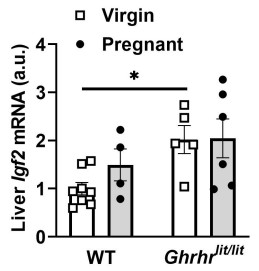
Public Reviews:
Reviewer #1 (Public review):
This work evaluates the impact of reproductive history on growth, body weight and body composition in mammals. In mice, somatic growth is stimulated by the first pregnancy while the second pregnancy increases body weight mainly by increasing adiposity. To probe the role of pituitary growth hormone (GH), the key regulator of somatic growth in these processes, was addressed by comparing the impact of reproduction on growth in normal ("wild type") and genetically GH-deficient females and by detailed characterization of the profile of fluctuations in circulating GH levels in both types of animals. Additional studies addressed the possible role of other endocrine pathways (ghrelin and estrogen) in the pregnancy-related growth. Surprisingly, reproduction-related growth was independent of GH, ghrelin and estrogen. To determine whether these results may apply ("translate") to human physiology, data on various parameters of somatic growth were collected from women with hereditary GH deficiency. The findings indicate that GH-independent stimulation of growth by reproductive events also occurs in women.
Use of multiple animal models, rigorous characterization of GH levels in normal and GH-deficient females, and inclusion of data derived from a unique and well-characterised population of people with hereditary isolated GH deficiency and no GH replacement therapy are important strengths of these elegant and innovative studies. The results address a broader and clinically significant issue of permanent changes in body size, composition and function that result from pregnancy and lactation. This work also provides important background for further studies aimed at the identification of the mechanism involved and the role of specific reproductive events in the regulation of growth.
We sincerely thank the reviewer for this thoughtful and highly positive evaluation of our work and for recognizing its novelty, rigor, and potential physiological and clinical significance.
Reviewer #2 (Public review):
This manuscript describes the fascinating phenomenon of growth hormone (GH)-independent growth occurring in the mother during pregnancy. This growth was most pronounced in dwarf mice that are lacking the receptor for growth hormone-releasing hormone (GHRH) and therefore showing isolated GH deficiency. However, the pregnancy-induced growth could also be observed in wild-type mice, suggesting that it is a normal part of the maternal adaptation to pregnancy. The study falls short of identifying the mechanism(s) driving this pregnancy-induced growth response, but it certainly reveals a novel insight into maternal physiology. The authors have completed a range of experiments in mice to prove that, as well as being GH independent, the pregnancy-induced growth also did not require GH signaling in the liver (i.e. not another pregnancy-specific ligand operating through the GHR to promote IGF). They also provided complementary data from a population of humans with untreated isolated GH deficiency that are broadly consistent with the hypothesis. While it is important to consider the significant species differences between rodents and humans, both in terms of growth physiology and also in terms of evolution of placental somato-mammotrophic hormones, this unique population are a valuable resource and adds credence to the study. Overall, I find this a compelling research story, but disappointingly unfinished. There are some areas where additional information could improve the ability to interpret the data, and some additional concepts that could be considered in the discussion. There are also areas where additional experiments might provide important insights. However, I think that such suggestions can be considered as appropriate for future research, rather than delaying consideration of the current manuscript.
Main comments:
(1) Data in Figure 1 are remarkable - not so much the growth in pregnancy in the wildtype mice, because while elevated GH is well known in pregnancy, but growth in the dwarf mice is indicative of GH-independent growth. From these data, it seems that there is good evidence that growth in pregnancy is an adaptive function. However, it is possible that growth is achieved in dwarf mice and that in wildtype mice may have been mediated through different mechanisms. The dwarf mice showed an increase in liver and plasma IGF1, suggestive of an additional ligand driving IGF in pregnancy. One could hypothesize that such an effect could be mediated by an additional pregnancy-specific ligand activating the GH receptor. In humans, placental growth hormone could be such a ligand, but as far as we know, there is no placental GH in mice. In contrast, the wildtype animals showed suppression of liver and circulating IGF1, and low levels of pSTAT5 in the liver during pregnancy. These data (in Figure 5) are very surprising. Given the high circulating GH in pregnancy, as well as high placental lactogen (which would be expected to activate STAT5 in the liver through the Prlr), the low levels of pSTAT5 are unexpected and would seem to indicate some sort of acquired insensitivity to GH. Is this entirely driven by down-regulation of STAT5b protein, or could there be activation of other, negative regulators of STAT signalling, such as SOCS? What is causing such a profound suppression of STAT5? Regardless of the mechanism, this suggests that pregnancy-induced growth in wildtype mice is independent of circulating IGF1 (potentially a different mechanism or in addition to that seen in IGHD mice).
We thank the reviewer for this insightful comment. The mechanisms underlying the reduced hepatic STAT5b protein expression observed during pregnancy remain unknown. Previous studies have also reported desensitization of hepatic JAK2/STAT5 GH signaling during pregnancy, associated with increased expression of negative regulators of STAT signaling, including CIS (Miquet et al., Am J Physiol Endocrinol Metab 289–E607, 2005). In the current manuscript, we also observed increased Cish mRNA expression in the liver of pregnant mice. We have incorporated this information into the revised manuscript. In addition, we expanded the Discussion to acknowledge the possibility that pregnancy-induced growth may occur through distinct mechanisms in wild-type and GH-deficient mice and that, in wild-type mice, this response may involve liver-derived IGF-1-independent mechanisms.
The data shown in Figure 6 are a major strength of the study, showing that the pregnancy-induced changes are not specific to one particular transgenic model, but still occur in a variety of models affecting GH through different approaches. Given the pregnancy-specific nature of the changes, however, it seems an oversight not to have evaluated the role of placental lactogens. Prlr is highly expressed in the liver, but the function of this hormone in the liver is not well established. Could the extremely high levels of PL be mediating this growth response? Given the low expression of STAT5 in the liver and the fact that plasma IGF1 is not markedly elevated, it seems more likely that this growth response may be mediated by locally produced IGF1 in target tissues.
We thank the reviewer for this important suggestion. Although we were not able to investigate the role of prolactin receptor signaling using mouse models in the present study, we agree that prolactin may contribute to pregnancy-induced growth. Accordingly, we revised the Discussion to acknowledge this possibility and to include the potential roles of placental lactogens and locally produced IGF-1 as additional mechanisms that may underlie pregnancy-induced body growth.
I think these possibilities could be addressed by an expanded discussion of species variation in placental hormones, to highlight that humans have expansion of the GH locus, but rodents have expansion of the prolactin axis (see Soares, M. J. The prolactin and growth hormone families: pregnancy-specific hormones/cytokines at the maternal-fetal interface. Reprod Biol Endocrinol 2, 51, 2004). Importantly, placental GH and chorionic somatomammotropins (CSM) in humans are all variants of the GH gene, but CSM have preferential activity at Prlr. This seems to be a fundamental species difference in pregnancy biology, but has been interpreted as an example of convergent evolution, with conservation of prolactin and GH-like functions at the maternal-fetal interface, mediated by different mechanisms, likely contributing to the metabolic adaptations of the mother (see Newbern D, Freemark M. Placental hormones and the control of maternal metabolism and fetal growth. Curr Opin Endocrinol Diabetes Obes. 2011; 18: 409-416). While the preceding function has focused on explaining the evolution of placental lactogens (either prolactin or GH variants), the present data suggest that there are also mechanisms to maintain growth in pregnancy, independent of GH (even in the absence of a placental GH).
Thank you very much for this observation and suggestion. In the Introduction, we succinctly mention species-specific differences in the GH locus (see Introduction). Since our study focused primarily on mice, we believe expanding on this information would detract from the study's focus, especially given that such details are available in other publications. However, we have added a sentence to the discussion noting that, despite significant species-specific differences in the GH locus, there has been evolutionary conservation in the maintenance of pregnancy-induced growth, potentially involving distinct mechanisms in rodents and humans, though both appear to be GH-independent.
“However, important differences are observed between humans and rodents. Humans, but not rodents, possess the GH2 gene, which encodes the placental growth hormone (GH) variant, whose production progressively replaces pituitary GH (derived from the GH1 gene) secretion during pregnancy (Liao et al., 2018). In contrast, rodents maintain pituitary GH secretion throughout gestation (Gatford et al., 2017; Liao et al., 2018). Additionally, human GH, both pituitary and placental variants, as well as chorionic somatomammotropins, can activate both the GH receptor (GHR) and the prolactin receptor (PrlR), explaining their lactogenic effects. In contrast, murine GH activates only the GHR (Bartke and Kopchick, 2015).”
(2) The human data are very interesting, and my initial impression was that it seemed unlikely to be the same phenomenon. Was there any real evidence for "growth" in pregnancy? Pubertal maturation of long bone growth might be expected to prevent further growth in adulthood. However, these issues were appropriately discussed, and it seems well justified to evaluate this unique population of women with IGHD who underwent pregnancy. It would be very interesting to know if these women experienced elevated IGF1 during pregnancy, indicative of placental GH contributing to growth. Mechanistically, this might be more like the dwarf mouse situation of IGHD, that the situation in wildtype mice (associated with liver insensitivity to GH and low IGF1).
We thank the reviewer for this comment. Unfortunately, the pregnancies of the women with IGHD occurred with limited medical assistance, and no additional clinical information is available, particularly regarding changes in circulating IGF-1 levels during pregnancy. Therefore, the evidence presented and discussed in the current manuscript represents the only information currently available on pregnancy-induced growth in this unique population.
(3) It would be useful to include investigations that isolate the effects of pregnancy and the placental hormones. Such studies could include evaluating growth in pseudopregnant mice with IGHD (pregnancy-like changes in hormones but lacking the placental contribution) and in IGHD animals that experience pregnancy but not lactation (pups removed at birth). I accept that this might be too large an additional study to add for the present manuscript.
We thank the reviewer for this valuable suggestion and agree that this experiment could provide valuable information regarding the role of placental hormones in pregnancy-induced growth. Interestingly, previous work has shown that female mice housed with vasectomized males exhibit increased body weight compared with non-reproductive females, although this increase is substantially smaller than that observed in females with successive litters (Garratt et al., Proc Natl Acad Sci U S A 117:15748–15754, 2020). We discuss this study in the current manuscript. However, this study did not provide additional information on whether this increase reflects greater adiposity, enhanced body growth, or both. Unfortunately, we are unable to perform these time-intensive experiments. We appreciate the reviewer's understanding and agree that this important question should be addressed in future studies.
(4) It is an important and translationally relevant observation that pregnancy increased the risk of long-term weight gain, and that after the first pregnancy, the pregnancy-induced growth response was more directed to promoting fat deposition. Does this provide any mechanistic insight? Could a metabolic adaptation result in growth?
We thank the reviewer for this thoughtful comment. At present, we do not have additional data to explain the mechanisms underlying the pregnancy-induced increases in body growth and adiposity or to determine whether these processes are mechanistically linked. In the revised manuscript, we have expanded the Discussion to address potential mechanisms that may contribute to the observed post-pregnancy growth, including hormonal and metabolic factors, while acknowledging that these possibilities remain speculative and require further investigation.
Reviewer #3 (Public review):
Summary:
The study describes an increase in body growth and body composition in both mice and women. In mice, the impact on growth is mainly seen during the first pregnancy, and the changes postpartum on body composition are also different during the first and second pregnancies. The study has used various knock-out models in the growth hormone axis to understand these changes as well as some gene expression analysis related to GH, IGF-1 and estrogen signalling pathways.
Strengths:
(1) The inclusion of various knock-out mouse models that allow for exploration of mechanisms related to the above-mentioned changes.
(2) The investigation of gene expression of GHR, IGF-1R and ER pathways.
Weaknesses:
The human findings are dependent on the patient's recollection of bodily changes after their pregnancies.
Conclusion:
The authors have partly achieved their aim of describing changes in growth and body composition that remain after pregnancy and the mechanisms behind these changes. This study may have importance for a wide variety of research areas as well as in the clinical setting. The study is also unique in its attempt to bridge findings in mice to a unique human model of congenital GH deficiency.
We sincerely thank the reviewer for the thoughtful evaluation of our study, for recognizing its novelty and potential significance, and for highlighting the strengths of our experimental approach. We have revised the manuscript to further acknowledge the limitations of the human data, as suggested.
Recommendations for the authors:
Reviewer #1 (Recommendations for the authors):
The findings presented in this study are novel, exciting and important. I believe it would help the readers to include a diagram showing the timing of the various measurements and tissue collection in relation to conception, parturition and weaning. It would also be helpful to expand the discussion to include the author's thoughts on the possible role of various placental hormones, pituitary prolactin, metabolic changes and/or other factors in the observed growth. Finally, humans from whom the data were obtained should probably be referred to as individuals or subjects rather than patients.
We thank the reviewer for these helpful suggestions. We included Figure 7 in the revised manuscript, which summarizes the study's experimental timeline. Additionally, we expanded the Discussion as recommended and replaced the term "patients" with "subjects" throughout the manuscript.
Reviewer #2 (Recommendations for the authors):
In addition to my comment above about addressing the different evolution of placental hormones, the following minor suggestions are provided:
(1) Abstract line 23 "most" could be "some" (because lots of evidence that pregnancy-induced adaptations are long-term - e.g. brain structure, maternal behavior, endocrine changes) - see below.
Done.
(2) Is "reproductive experience" the best term? Or is it "pregnancy"? (likely specifically due to the presence of placental hormones and/or maternal patterns of hormones, rather than other aspects of "reproductive experience) e.g. mating, parturition or lactation?
We appreciate the reviewer's point. However, because we cannot exclude potential contributions of mating, parturition, or lactation to the observed increases in body growth and adiposity, we prefer to retain the term "reproductive experience," as the mice in the present study underwent all of these processes rather than pregnancy alone.
(3) Potentially, the introduction could add references to brain changes in humans in pregnancy (this is a particularly topical area of research where long-term changes have been reported; e.g. Pritschet L, Taylor CM, Cossio D, Faskowitz J, Santander T, Handwerker DA, Grotzinger H, Layher E, Chrastil ER, Jacobs EG. Neuroanatomical changes observed over the course of a human pregnancy. Nat Neurosci. 2024 Nov;27(11):2253-2260; Martínez-García M, Paternina-Die M, Barba-Müller E, Martín de Blas D, Beumala L, Cortizo R, Pozzobon C, Marcos-Vidal L, Fernández-Pena A, Picado M, Belmonte-Padilla E, Massó-Rodriguez A, Ballesteros A, Desco M, Vilarroya Ó, Hoekzema E, Carmona S. Do Pregnancy-Induced Brain Changes Reverse? The Brain of a Mother Six Years after Parturition. Brain Sci. 2021 Jan 28;11(2):168. There is also a significant literature on long-term effects of reproductive experience (Bridges RS. Long-term alterations in neural and endocrine processes induced by motherhood in mammals. Horm Behav. 2016 Jan;77:193-203).
We thank the reviewer for this helpful suggestion. Accordingly, we incorporated these references into the Introduction to further emphasize the long-term effects of reproductive experience.
(4) Figure 1: Why show body weight as a "delta" for primiparous animals, and "absolute "values for multiparous? Similarly, it seems that body length is an informative readout for these experiments, but this is only reported for one model, and most models are only shown as body weight and lean mass.
We thank the reviewer for this comment. For the primiparous mice, we chose to present the change (Δ) in body weight and lean mass because it more directly illustrates the effects of the first reproductive experience relative to each animal's baseline while avoiding redundant presentation of both absolute and Δ values, as both analyses yielded the same statistical conclusions. For the multiparous mice, absolute values were presented to facilitate comparison with the corresponding images and to allow direct comparison of body size between wild-type and Ghrhr<sup>lit/lit</sup> mice. Regarding body length, these measurements were collected only in the multiparous cohort and were not obtained after the first reproductive experience. Therefore, we are unable to provide body length data for the primiparous groups.
(5) It seems it would be better to present all of the mouse data first, then the supporting human data.
Done.
(6) The manuscript includes a high-quality investigation of GH secretion - particularly the pulsatile secretion of GH. Is it possible to have matching IGF data (at least multiple time points in pregnancy)?
We agree with the reviewer that serial measurements of circulating IGF-1 during pregnancy would provide valuable additional information. Unfortunately, this analysis is not feasible because the limited blood volume collected during the study did not allow sufficient sample storage for additional measurements.
(7) Line 221 - "GHRH signaling is required for pregnancy-induced increases in GH secretion...". Can you actually make that conclusion, or is it possible that the lack of GHRH developmentally has permanently altered the pituitary gland, so it cannot respond to other GH secretagogues?
We thank the reviewer for this important comment. We agree that the congenital absence of GHRH signaling may cause developmental alterations in the pituitary that impair the response to other GH secretagogues. Therefore, we cannot distinguish whether the lack of pregnancy-induced increases in GH secretion reflects the absence of GHRH signaling per se or the developmental defects resulting from GHRH deficiency. We removed the aforementioned phrase from Results and have revised the Discussion to acknowledge this important limitation and to clarify that the observed phenotype may be secondary to impaired pituitary development.
(8) Line 238 - "GHR signaling stimulates hepatic insulin-like growth factor 1 (IGF-1) secretion, particularly by activating the signal transducer and activator of transcription 5b (STAT5b) pathway" for this point, should probably cite: Davey HW, Xie T, McLachlan MJ, Wilkins RJ, Waxman DJ, Grattan DR. STAT5b is required for GH-induced liver IGF-I gene expression. Endocrinology. 2001 Sep;142(9):3836-41.
Thank you for this suggestion; we added this reference.
(9) Line 240 - "GH action in the liver is not only controlled by the pattern of GH secretion...". should probably cite Waxman's work regarding patterns of GH secretion (e.g reviewed in Waxman DJ, O'Connor C. Growth hormone regulation of sex-dependent liver gene expression. Mol Endocrinol. 2006 Nov;20(11):2613-29.).
This reference was included in this sentence.
(10) Methods: Check statistics - some of the analysis should have been repeated measures?
We thank the reviewer for this comment. We carefully re-evaluated all statistical analyses and did not identify any experiment for which a repeated-measures analysis would have been appropriate. Therefore, no changes to the statistical analyses were necessary.
Reviewer #3 (Recommendations for the authors):
(1) Introduction: The context of the sentence "Furthermore, historically, females have been underrepresented in studies" is unclear.
We thank the reviewer for this observation. Our intention was to emphasize that, because pregnancy is unique to females and females have historically been underrepresented in biomedical research, pregnancy-related physiology has received comparatively less attention. However, we agree that this statement was not essential in this context. Thus, we have removed it from the revised manuscript.
(2) Introduction: Based on the paper, the main aim seems to be to study the lasting effects of pregnancy on the mother and not primarily to study the hormonal changes during pregnancy.
We thank the reviewer for this helpful observation. We agree that our study primarily focuses on the long-term effects of pregnancy on the maternal organism rather than the hormonal changes that occur during pregnancy. Accordingly, we revised this sentence to better reflect the main objective of the study: “Therefore, the goal of this study is to investigate the lasting effects of pregnancy on the maternal organism and the possible involvement of the somatotrophic axis in these changes.”
(3) Other endocrine factors could affect the changes seen after pregnancy in mice and humans, such as the insulin level and activation of the IR.
We thank the reviewer for this valuable suggestion. In the revised manuscript, we expanded the Discussion to acknowledge the potential contribution of several endocrine factors, including insulin signaling, to pregnancy-induced growth.
(4) The receptor activation in tissues other than the liver has not been studied, such as in the growth plate, adipose tissue and muscle.
We thank the reviewer for this important comment. We agree with this point and have addressed this possibility in the revised Discussion.
(5) Information on the age of the patient at the time of pregnancy could be included as well as the patient's height and weight before pregnancy and at follow-up.
This information was added as Table 1.
Note d'Information : Mobilisation Lycéenne, Inégalités Structurelles et Maintien de l'Ordre
La récente vague de contestation lycéenne, partie le 17 septembre d'un établissement de Créteil et ayant rassemblé jusqu'à 400 000 jeunes selon les organisations de jeunesse, met en lumière une crise sociale et institutionnelle profonde.
Les revendications portent sur des conditions matérielles et pédagogiques dégradées (absence prolongée de professeurs remplaçants en français et mathématiques, manque d'infirmières, vagues de chaleur dans les classes) dans un contexte anxiogène marqué par les séquelles du Covid-19, le changement climatique et le fonctionnement de la plateforme Parcoursup.
L'analyse croisée des sociologues Nicolas Duvoux (spécialiste des inégalités et de la pauvreté) et Sébastien Rocher (directeur de recherche au CNRS, spécialiste de la police) permet d'articuler deux constats majeurs :
Alors que les inégalités économiques et patrimoniales atteignent des niveaux historiques en France selon l'INSEE, la capacité à se projeter positivement est confisquée pour les classes populaires et périphériques par la dégradation des services publics et la dépendance envers des algorithmes scolaires opaques.
Face à ce constat de rupture démocratique, la réponse exclusivement sécuritaire apparaît comme le « degré zéro de l'écoute », alors que des modèles alternatifs de participation institutionnelle existent.
Selon Nicolas Duvoux, la capacité à concevoir l'avenir de manière positive dépend directement des ressources économiques, scolaires et sociales disponibles au présent.
Impact des carences éducatives : L'absence de professeurs non remplacés pendant des semaines ou des mois dans des matières fondamentales perturbe directement la trajectoire des élèves et suscite une angoisse existentielle quant à leur avenir.
Niveau record des inégalités : L'Institut national de la statistique et des études économiques (INSEE) a publié des données indiquant que les inégalités en France atteignent leur niveau le plus élevé depuis la création des séries statistiques.
Tensions territoriales : La crise touche de plein fouet les quartiers populaires et périphériques, atteignant une « masse critique » qui diffuse la crise sociale à l'ensemble du territoire.
Nicolas Duvoux met en évidence une transformation majeure de la structure des inégalités en France sur un demi-siècle :
Les inégalités scolaires et culturelles étaient alors les plus prépondérantes.
Le patrimoine ne représente pas seulement un stock financier, mais procure du temps, de la sécurité et des possibilités.
Il s'agit d'un « contrôle du passé sur l'avenir » (par exemple, la perception de loyers équivalant au contrôle d'une partie du temps salarial d'autrui).
Le mur budgétaire de la dette, sanctionné par les marchés, bloque les investissements nécessaires dans l'avenir, notamment dans l'éducation et les infrastructures scolaires.
La sélection s'est déplacée des savoir-être culturels vers les mathématiques puis vers des plateformes algorithmiques.
                ```
                ┌────────────────────────────────────────────────────────┐
                │                      PARCOURSUP                        │
                └───────────────────┬────────────────────────────────────┘
                                    │
         ┌──────────────────────────┴──────────────────────────┐
         ▼                                                     ▼
┌─────────────────────────┐ ┌─────────────────────────┐ │ EFFETS POSITIFS │ │ EFFETS NÉGATIFS │ ├─────────────────────────┤ ├─────────────────────────┤ │ • Hausse des candidatures│ │ • Dépendance envers un │ │ universitaires │ │ algorithme opaque │ │ • Diversification des │ │ • Cristallisation d'une │ │ profils reçus │ │ angoisse collective │ └─────────────────────────┘ │ • Sentiment d'absence │ │ de prise sur son sort │ └─────────────────────────┘ ```
Contrairement à la période antérieure où l'inégalité scolaire séparait ceux qui accédaient au supérieur de ceux qui en étaient exclus, la sélection actuelle s'opère à l'intérieur du système, entre des filières plus fines.
Nicolas Duvoux observe également que le système scolaire et économique français échoue à valoriser une diversité de compétences, notamment techniques et manuelles.
Sébastien Rocher rappelle que le maintien de l'ordre est la fonction policière la plus directement dirigée par l'exécutif (Ministère de l'Intérieur).
Bien que nuancée ultérieurement à l'Assemblée nationale, cette consigne a cadré les interventions.
Sébastien Rocher qualifie ces arrestations d'instrument de communication politique : la grande majorité des gardes à vue sont levées sans poursuites par les procureurs, faute de preuves ou de délit imputable, démontrant que l'objectif premier est de vider les manifestations et d'afficher l'image d'une « police forte ».
Un changement profond d'attitude est survenu dans la police des foules depuis les années 2010 :
| Paramètre | Doctrine des années 2000-2010 | Doctrine actuelle | | --- | --- | --- | | Philosophie globale | Apogée de la « mise à distance », pacification, absorption des coups. | Usage de la force rapprochée, recherche du contact et de l'interpellation. | | Unités déployées | Unités professionnalisées et formées (CRS, Gendarmerie mobile). | Unités de police urbaine non formées au maintien de l'ordre (BAC). | | Armement intermédiaire | Usage très limité des Lanceurs de Balles de Défense (LBD). | Usage multiplié du LBD et recours aux grenades explosives/assourdissantes. |
Sébastien Rocher répute infondée la grille de lecture gouvernementale sur l'« ensauvagement » de la jeunesse (terme d'Emmanuel Macron) ou le « retour aux origines ethniques » (terme de Bruno Retailleau).
Les lycéens appliquent des méthodes classiques et routinisées de blocage d'établissements, sans pillages (contrairement aux émeutes de 2023 à la suite de la mort de Nahel, qui avaient compté 1 000 pillages de magasins) ni attaques de commissariats.
Port du masque interdiction par la police mais pratiqué sur le terrain.
Absence systématique du numéro d'identification (RIO), malgré deux rappels à l'ordre du Conseil d'État.
Tirs de grenades explosives lancées « en cloche » au lieu d'être tirées au rasant du sol.
Non-respect des distances minimales d'usage pour les armes sublétales (LBD).
Évolution récente : Le Directeur général de la Police nationale (DGPN) a suspendu l'utilisation des grenades assourdissantes lors des mobilisations lycéennes, à la suite des blessures graves subies par un jeune homme à Laon.
Sébastien Rocher note qu'un précédent existe en 2010 sous Nicolas Sarkozy, lorsque le ministre Brice Hortefeux avait suspendu le LBD dès la première mutilation.
COMPARATIF HISTORIQUE DES CRISES ET RÉPONSES
─────────────────────────────────────────────────────────────────────────────
1986 (Loi Devaquet) : Décès de Malik Oussekine sous les coups des « voltigeurs ».
                      ➔ Shock d'opinion et suppression des unités à moto.
─────────────────────────────────────────────────────────────────────────────
2010 (Protestations) : Première mutilation par tir de LBD.
                      ➔ Suspension immédiate du LBD par Brice Hortefeux.
─────────────────────────────────────────────────────────────────────────────
Période Actuelle    : Mutilations multiples (LBD/grenades), 5 000 interpellations.
                      ➔ Maintien des armes, rhétorique de fermeté, suspension
                         sélective des seules grenades assourdissantes par le DGPN.
─────────────────────────────────────────────────────────────────────────────
Citant le philosophe Jacques Rancière, Nicolas Duvoux souligne que la politique consiste à accorder une voix à « ceux qui n'ont pas de part » dans les choix collectifs.
La réponse policière systématique constitue le « degré zéro de l'écoute démocratique » et renforce la défiance envers l'ensemble des institutions, sentiment qui s'étend désormais aux classes moyennes confrontées à la hausse du coût du logement et de l'enseignement supérieur privé.
Pour sortir de l'oscillation entre répression violente et grands débats nationaux perçus comme des gadgets sans traduction décisionnelle, Nicolas Duvoux propose d'institutionnaliser la délibération démocratique :
Ce dispositif crée une « brèche dans la rationalité dominante » en faisant entrer la réalité vécue par les personnes concernées dans l'arène de la décision publique.
Ongeveer de helft van de jongeren heeft al eens aan politieke participatie gedaan
Highlight
Een essentieel onderdeel van een gezonde democratie is participatie van burgers.
Highlight
Document de Briefing : Interventions Policières, Protection des Mineurs et Réalités Juridiques de Terrain
Ce document de briefing rassemble les constatations, faits et analyses tirés d'interventions menées par les forces de l'ordre au sein de trois commissariats français (Béthune, Toulouse et Montpellier).
Ces situations illustrent la complexité du travail policier face aux détresses sociales, aux violences intrafamiliales et aux contraintes légales.
Face à un contexte de violences conjugales sur fond d'alcoolisme chronique (consommation quotidienne), le parquet des mineurs a ordonné le placement provisoire de deux jeunes filles pour une durée de 15 jours.
En deçà de ce délai, les forces de l'ordre peuvent procéder à l'expulsion et à l'interpellation des occupants pour dégradations ; au-delà, les propriétaires se trouvent démunis face à des procédures d'expulsion longues, créant un décalage perçu entre justice morale et application strict de la loi.
L'opération a révélé l'absence d'enlèvement et conduit à des poursuites pénales contre l'auteure du signalement pour dénonciation de crime imaginaire.
Au commissariat de Béthune, la Brigade de Ligne Protection de la Famille (BLPF), représentée notamment par les policières Ingrid et Caroline, a pris en charge une mère de famille venue se réfugier au commissariat avec ses deux fillettes suite à des coups portés par son mari.
État des personnes : L'auteur des faits (interpellé à domicile) ainsi que la mère se trouvaient en état d'ivresse forte lors de la prise en charge.
Historique : L'analyse des mains courantes révèle de multiples interventions antérieures au domicile familial pour des différends sur fond de prise d'alcool.
Les violences physiques et verbales durent depuis environ 6 ans, à une fréquence de 4 à 5 fois par mois.
Elles expriment explicitement leur lassitude, leur tristesse et leur souhait de voir ces disputes cesser.
Après concertation avec la substitut du procureur de la République (parquet des mineurs), la décision a été prise d'isoler les enfants du milieu familial :
Mesure d'urgence : Placement provisoire des deux filles chez une assistante familiale pour une durée initiale de 15 jours, afin de réaliser une évaluation de la famille.
Réaction parentale : La mère exprime un profond désarroi et un sentiment d'injustice (« Je vous appelle au secours et vous m'enlevez mes enfants »), allant jusqu'à formuler des intentions suissidaires.
Les policiers soulignent la nécessité de faire preuve de fermeté pour provoquer un « électrochoc » susceptible d'inciter les parents à entamer un parcours de soin.
À Toulouse, l'équipage de police secours mené par Frédéric (23 ans de service) et l'Officier de Police Judiciaire (OPJ) Camel ont traité le cas d'une maison familiale occupée illégalement par une dizaine d'individus accompagnés de chiens.
| Élément | Situation Juridique (< 48 heures) | Situation Juridique (> 48 heures) | | --- | --- | --- | | Pouvoir d'éviction | Expulsion immédiate possible par la police. | Procédure civile d'expulsion (longue et complexe). | | Poursuites pénales | Interpellation pour dégradation de domicile / effraction. | Impossibilité pour la police de déloger sans décision de justice. | | Rôle de la police | Constat, prise de plainte et arrestation. | Orientation du propriétaire vers les voies légales. |
Enquête de voisinage : Les policiers ont tenté d'établir l'heure d'entrée des occupants auprès des voisins, sans obtenir de confirmation précise immédiate.
Décision du Parquet : Suite au dépôt de plainte du propriétaire et à l'analyse des éléments (effraction de cadenat, dégradations récentes), le parquet a ordonné l'expulsion et l'interpellation des squatteurs.
Constat sur les lieux : En moins de 48 heures, l'intérieur du bien a subi de lourdes détériorations (saletés, excréments, urine, détérioration du mobilier). 4 à 5 individus ont été placés en garde à vue.
Profil d'un occupant : Johann, 26 ans, récidiviste du squat sans ressources, justifie son acte par la recherche d'un abri contre le froid face à la saturation des foyers d'hébergement, tout en reconnaissant la honte causée par la dégradation des biens d'autrui.
Guillaume, enquêteur au service du quart, a reçu les parents d'une jeune fille interpellée à la suite d'un vol à l'étalage commis par une connaissance récente dans un magasin de vêtements.
L'intervention policière a permis de clarifier la situation auprès de la mère paniquée et de lever toute charge contre l'adolescente.
David (chef des unités territorialisées) et Daniel (major à la BAC) ont coordonné une opération d'urgence suite au signalement de l'enlèvement d'un enfant de 7-8 ans dans un véhicule par un individu présenté comme armé et dangereux.
Dispositif déployé : Intervenants multiples incluant la BAC, la Compagnies Départementale d'Intervention (CDI), la police municipale, la gendarmerie et un appui héliporté.
Opération de terrain : Encerclement et vérification minutieuse d'un campement de la communauté des gens du voyage (contrôle d'identité systématique de l'ensemble des enfants et des occupants).
Issue judiciaire : L'enfant recherché n'était pas sur place.
L'interpellation du suspect et les vérifications d'usage ont révélé l'absence totale d'enlèvement.
Il s'agissait d'une dénonciation imaginaire formulée par la grand-mère sous le coup de la panique.
Cette dernière fait l'objet de poursuites ordonnées par le parquet.
Le tableau ci-dessous répertorie les déclarations significatives illustrant les tensions opérationnelles, morales et légales rapportées par les intervenants :
| Intervenant / Acteur | Contexte / Lieu | Citation Extaite du Texte | Portée / Thématique | | --- | --- | --- | --- | | Ingrid (BLPF) | Prise en charge des enfants (Béthune) | « En tout état de cause on pouvait pas laisser ces petites filles avec les parents \[...\] la priorité c'est leur sécurité c'est leur vie. » | Primauté de la protection de l'enfance. | | Mère de famille | Annonce du placement (Béthune) | « J'ai été victime de violence et en fin de compte vous m'enlevez mes enfants. » | Sentiment d'injustice de la victime. | | Frédéric (Police Secours) | Squat immobilier (Toulouse) | « S'ils sont là depuis 48h on peut pas les mettre dehors. S me sont là depuis moins de 48h on peut les faire sortir. La loi elle est comme ça. » | Contrainte du cadre juridique. | | Camel (OPJ) | Dépôt de plainte squat (Toulouse) | « Le problème qui se pose à nous policiers c'est qu'il y a l'injustice morale et après par contre il y a la loi à côté. Nous on est là pour faire appliquer la loi. » | Tension entre morale et application de la loi. | | Johann (Squatteur) | Audition / Interpellation (Toulouse) | « J'ai même honte limite de faire ça à des gens comme ça \[...\] Mais sinon je passe à la rue. » | Conflit entre précarité et dégradation du bien d'autrui. | | David (Chef d'unité) | Recherche d'enfant (Montpellier) | « Ce qu'on demande à un policier c'est quand il gère sa mission de pas faire état de ses sentiments \[...\] Il faut se forger une carapace. » | Nécessité de neutralité émotionnelle en intervention. |
L'ensemble des interventions témoigne du rôle transversal de la police nationale face aux failles sociales et humaines.
Les fonctionnaires sont appelés à appliquer strictement le Code pénal et le Code de procédure pénale tout en gérant l'impact psychologique de leurs décisions sur les usagers (séparation d'enfants, garde à vue, expulsion).
Pour préserver leur équilibre personnel face à la détresse, à la violence et à la mort, les policiers soulignent la nécessité d'établir une frontière étanche entre leur activité de service et leur vie privée.
eLife Assessment
By integrating RelB proximity labeling with targeted CRISPR screening, the authors identify several potential regulators of HIV latency and provide evidence implicating RelB, KAT7, and p300 in AZD5582-mediated HIV reactivation. While the study is important, the current work is incomplete, as it needs to establish physiological relevance. The findings require validation in primary latency models, and the unusually high basal RelB expression in the experimental system raises concerns about whether the observed effects accurately reflect endogenous mechanisms regulating HIV latency.
Reviewer #1 (Public review):
Summary:
Bussey-Sutton, Gray, Wu et al. combine RelB proximity-labeling proteomics (BioID) with a custom, BioID-informed HIV-CRISPR screen to map the chromatin/transcriptional network that links non-canonical NF-κB (RelB/p52) activation by the SMAC mimetic AZD5582 to HIV-1 latency reversal. They identify a broad basal RelB interactome (chromatin remodelers, RNA-binding proteins, transcription machinery) that is partially reshaped, rather than replaced, by AZD5582 treatment. A targeted CRISPR screen against the BioID hit list then functionally separates these interactors into pro-reactivation factors (KAT7/HBO1, NSD2, SIN3A) and restrictive factors (p300, CHD4, USP7, UHRF1, DNMT1).
Pharmacological inhibition of the two acetyltransferase hits (KAT7i and p300i) validates opposing phenotypes predicted by the screen, and a comparative TNF-α (canonical NF-κB) screen argues that at least the p300 and, more selectively, the KAT7 pharmacology are biased toward the ncNF-κB axis. The dataset is a useful resource, and the BioID, CRISPR, pharmacology pipeline is a nice template for functionally triaging proximity-proteomics hits rather than treating them as a static interactome.
Strengths:
This study takes an integrative approach in which proximity proteomics is used to define candidate RelB-associated regulators, a purpose-built targeted CRISPR library tests these candidates directly for a functional phenotype, and pharmacological inhibition cross-validates the two acetyltransferase hits with an orthogonal, catalytic-activity-specific perturbation. This funneling from unbiased proteomic discovery to targeted functional testing to mechanistic pharmacology is an efficient and logical pipeline for converting a large interactome into a smaller set of high-confidence, functionally validated regulators.
The comparison of basal versus AZD5582-stimulated RelB interactomes is conceptually useful, as it shows that RelB engages a largely pre-existing chromatin and transcriptional regulatory scaffold upon ncNF-κB activation, rather than recruiting an entirely new complex. This is a finding with potential implications for non-canonical NF-κB signaling beyond the HIV latency context specifically.
The inclusion of a parallel HIV-CRISPR screen using TNF-α to activate canonical NF-κB signaling is a valuable control, allowing the authors to distinguish regulators that are broadly required for NF-κB-dependent HIV expression from those more selectively linked to AZD5582-driven ncNF-κB signaling. This comparison strengthens the authors' claims of pathway specificity for hits such as KAT7 and p300.
Finally, pharmacological validation of the top acetyltransferase hits was performed across two independent latency models (J-Lat 10.6 and N6), which helps address, at least in part, the concern that phenotypes are specific to a single clonal integration site. Together with the deposited proteomics and screen datasets, this provides a genuinely useful resource for the field.
Weaknesses:
(1) BioID inherently reports both direct and indirect (proximal) interactions, and no individual hits are validated by an orthogonal method (e.g., co-IP, PLA). As a transcription factor, RelB would be expected to reside near transcriptional/chromatin machinery, so this enrichment alone isn't surprising, making it hard to distinguish functionally relevant RelB complexes from bystander proteins in the same active chromatin neighborhood. At least a subset of top hits should be validated independently.
(2) BioID interactome was defined in a single clonal cell line, limiting generalizability across latent cell types. The RelB BioID proteomics, which forms the entire basis for the downstream targeted CRISPR library generation, was performed in one engineered Jurkat N6 clone. Both RelA/RelB pathway dependency and the baseline expression of the chromatin regulators identified as RelB interactors (e.g., DNMT1, UHRF1, SWI/SNF subunits, NSD2) can vary considerably across cell lines, latency clones, and primary CD4+ T cells. Since the CRISPR screen, and thus all functional hits in the paper, is entirely constrained by this single-cell-line interactome, any RelB interactor that is absent or differently regulated elsewhere would never have been tested, regardless of its true biological importance. To support claims of a broadly relevant RelB/ncNF-κB regulatory network, the authors should at least partially validate the basal and AZD5582-induced interactome (e.g., by co-IP/western for key hits) in a second cell line or primary CD4+ T cells, to distinguish clone-specific interactions from generalizable ones.
(3) Is KAT7/HBO1's contribution to reactivation a direct interaction/synergy with AZD5582, or an independent parallel requirement? The data show that KAT7/HBO1 knockout and catalytic inhibition (WM-3835) both reduce AZD5582-induced reactivation, and that KAT7 was detected as AZD5582-enriched in the RelB BioID. However, it remains unclear from the current data whether KAT7/HBO1 acts as a direct downstream effector in the ncNF-κB/RelB signaling axis (i.e., is recruited by or acts together with RelB/p52 at the LTR specifically upon AZD5582 stimulation), or whether it represents a more general/parallel chromatin requirement for HIV reactivation that is simply necessary regardless of the activating stimulus (and happens to also associate with RelB). Distinguishing these possibilities matters for interpretation: the former would support a model in which AZD5582 and KAT7 act synergistically through the same pathway (i.e., acetylation is mechanistically coupled to ncNF-κB activation), whereas the latter would suggest KAT7-mediated acetylation and RelB/p52 signaling are two independent, simultaneously required mechanisms that converge on the same locus without being mechanistically linked. The comparative TNF-α data (Figure 3C), where the genetic screen shows a shared dependency but the pharmacological inhibitor does not phenocopy this for TNF-α, adds to this ambiguity rather than resolving it. Clarifying whether KAT7/HBO1 functions upstream, downstream, or in parallel with RelB/p52 (e.g., via RelB ChIP after KAT7 knockdown, or KAT7 recruitment kinetics relative to RelB/p52 at the LTR) would strengthen the mechanistic claims in this section.
(4) A major limitation of the study is that screen results were validated in only two cell line models, and neither is a primary cell system. Different latency models are known to have distinct dominant transcriptional blocks, not just different genetic backgrounds. J-Lat clones, U1, ACH2, and other transformed lines differ substantially in why the provirus is silent; some are more Tat/P-TEFb-limited, some more chromatin/Polycomb-restricted, some more dependent on transcription factor availability (NF-κB, NFAT, AP-1). A regulator that is rate-limiting in J-Lat 10.6 specifically (a single integration site, clonally selected for a particular chromatin environment around the LTR) may therefore be irrelevant, or could even act in the opposite direction, in a model where the block is elsewhere.
(5) HIV latency and LRA responsiveness are well known to be strongly integration-site and clone-dependent. Pharmacological validation of CRISPR screen hits extends to N6, but the primary screen hits themselves are not confirmed in a second genetic background. This is an important caveat that should be discussed explicitly, and ideally at least the top hits (KAT7, NSD2, SIN3A, p300, CHD4) should be individually knocked out (not just inhibited) in a second model to confirm the genetic phenotype generalizability, not just the pharmacology.
(6) More importantly, no validation was performed in primary CD4+ T cells or ex vivo resting CD4+ T cells from people with HIV, which remain the field's benchmark for confirming that a candidate regulator is relevant to authentic latency rather than to a transformed cell line. Basal chromatin state, NF-κB pathway, and expression of the chromatin regulators identified here (e.g., DNMT1, UHRF1, SWI/SNF subunits) can differ substantially between transformed lines and primary resting T cells. Given this, the current claims of a broadly applicable "chromatin regulator" network should be tempered, and at least the top hits (e.g., KAT7/HBO1, NSD2, SIN3A, p300) should ideally be tested in a primary cell model before being generalized as regulators of HIV latency and reactivation more broadly.
(7) The finding that p300 restricts AZD5582-driven reactivation is framed as consistent with Horvath & Sadowski (ref 36), but p300/CBP is also a well-established Tat/LTR coactivator in many contexts (Kiernan et al., Marzio et al). The Discussion would benefit from a slightly more developed treatment of how these findings can be reconciled rather than citing a single concordant paper.
Reviewer #2 (Public review):
Summary:
Bussey-Sutton et al. investigate the RelB interactome in the presence and absence of the SMAC mimetic AZD5582. They combined RelB BioID with CRISPR screening and highlighted multiple potential transcriptional regulators that may contribute to the maintenance or reversal of HIV latency. However, there are several technical limitations and gaps in validation in the current version of the work.
Strengths:
The overall topic is of clear interest; the RelB interactome and CRISPR screens provide interesting hits.
Weaknesses:
From a technical standpoint, RelB is expressed using a doxycycline-inducible system, yet the fusion protein (Figure S1A) appears to be expressed at high levels even in the absence of doxycycline (and does not seem to respond to doxycycline supplementation). As this is the key model system used in the paper to identify RelB interactors, this limitation should be discussed and potentially addressed.
It would also be important to include some orthogonal validation (e.g., co-immunoprecipitation) of top novel RelB interactors identified by BioID.
In Figure 2C, two non-targeting controls appear among the most highly enriched hits. This raises the question that other top hits might reflect nonspecific effects or assay noise. Consistent with this concern, the effects observed following siRNA-mediated depletion of the top CRISPR-screen candidates in Figure 2D and Figure 3 appear relatively modest.
More broadly, the absence of validation in primary-cell models is a further limitation, as the chromatin environment and transcriptional regulation of HIV latency in the two cell-line models used here are likely to differ substantially from those in primary CD4+ T cells.
Minor point:
Endogenous RelB remains present in the RelB-BioID cells and could compete with the miniTurbo-RelB fusion protein for physiological binding partners. Moreover, the effect of two sources of constitutive RelB expression (see comment above) on the physiologic RelB interactome is not obvious. Controlling for this is not trivial, but this potential confounding factor should be acknowledged (and further reinforces the need for orthogonal targeted validations of interactors in cells with endogenous RelB).
Reviewer #3 (Public review):
The study is built on the premise that the SMAC mimetic AZD5582 can reverse HIV latency via the RelB-mediated non-canonical NF-kB pathway activation; however, its molecular regulators remain undefined. The authors use an inducible BioID RelB reporter system in Jurkat N6 cells containing an integrated HIV-1 provirus and identify both the basal and the AZD5582-activated chromatin and transcriptional regulatory network of the non-canonical NF-kB pathway. To further explore the role of the identified regulators, an HIV-CRISPR latency screening approach was used, and based on enrichment or depletion of guide RNAs in the supernatant, genes that inhibited or activated virus reactivation, respectively, were identified. Genes like LRPPRC (RNA-binding protein), KAT7 (acetyltransferase), NSD2 (H3L36 methyltransferase), SIN3A (part of histone deacetylase complex), and others were identified to be essential for HIV reactivation. Nearly half of the identified factors were found to be negative regulators of reactivation, notably CBP/p300 (acetyltransferase), CHD4, USP7, UHRF1, and DNMT1. The roles of KAT7 and p300 were validated through the use of specific inhibitors. To narrow down regulators that are specific for nc NF-kB HIV reactivation vs NF-kB dependent HIV expression, a parallel CRISPR screen was performed with TNF-alpha, which reconfirmed the role of RelB, KAT7, and p300 in AZD5582-mediated HIV reactivation.
Overall, this is a solid and well-designed study that combines complementary approaches to deliver a valuable resource.
The study's strength lies in integrating two high-throughput approaches of RelB proximity labelling and targeted CSIPR screening to identify molecular regulators of the HIV reactivation pathway. A parallel CSIPR screen with TNF-alpha provides key insights into pathway-specific vs shared regulators of latency reversal.
The limitation of the study, as indicated by the authors, is that the assays are based only on HIV output. Additionally, some of the identified interactors may be indirect or context-dependent and may not represent all HIV reservoirs in vivo.
Author response:
We greatly appreciate the editors and reviewers for their time and careful evaluation of our manuscript. It was clear that the reviewers valued our study that integrated RelB proximity proteomics with targeted HIV-CRISPR screening to identify chromatin and transcriptional regulators of AZD5582-mediated HIV reactivation. We appreciate all of the constructive comments and agree that the manuscript can be further strengthened by clarifying several technical points, correcting text and figure issues, and more clearly defining the scope of the study.
A recurring theme of the reviews is the need to better define which RelB-associated factors are functionally meaningful regulators of HIV reactivation. We agree with the reviewers’ point that BioID/miniTurbo proximity labeling does not by itself establish direct physical interaction. That said, the method provides an in vivo cell measurement of protein proximity and can capture core complex interactions as well as transient, weak, or chromatin-associated interactions. Notably, such transient interactions are often lost during cell lysis and extraction, as well as co-IP. In the revised manuscript, we will clarify this distinction and emphasize that the BioID dataset identifies RelB-proximal candidate regulators rather than exclusively direct binding partners. We will also consider orthogonal validation of key hits using either co-IP or an orthogonal in cell proximity assay like PLA, which would preserve the cellular context of RelB-associated regulatory complexes.
The reviewers also raised a fair concern regarding physiological relevance and the use of transformed latency models. We agree that primary cell validation would be an important next step for determining how broadly these findings apply to HIV regulation. At the same time, the present study was intended to be an initial resource of RelB-associated factors that contribute to HIV transcription in tractable latency models. Nonetheless, we will temper any language that implies broad generalization across all latency contexts and further discuss the limitations of clonal and transformed latency models. Additionally, and as the reviewers suggested, we will also test whether the KAT7/HBO1 and p300 inhibitor phenotypes extend to a primary CD4+ T-cell latency model.
We also appreciate comments regarding the RelB-miniTurbo system; notably concerns with the basal expression of the fusion protein and presence of endogenous RelB. We will revise the manuscript to better describe these limitations and discuss how they may affect interpretation of the BioID data. In particular, we will emphasize that the dataset should be viewed as a resource for candidate RelB-associated regulatory factors that require functional and orthogonal follow-up.
Several reviewers identified figure and text issues that will be addressed in the revised manuscript. Specifically, we will correct the Figure 1 legend and reference errors, the duplicated sentence, and other typos mentioned. We will also clarify the number of biological replicates and statistical thresholds used for the BioID comparisons, improve the Supplementary Table 1 annotation, and expand the discussion of p300/CBP to better reconcile our findings with prior literature.
Overall, the revised manuscript will more clearly separate what this study establishes from what remains to be tested. Our goal for revision will be to enhance the value of the study while more clearly highlighting the limitations and what this resource provides for future directions.
You will normally receive an initial response from a curator within three working days after submitting the dataset for review.
this part can perhaps be deleted. i am sure this is not always the case for every partner institution