“game atoms,”
The idea of hierarchical structure of games
“game atoms,”
The idea of hierarchical structure of games
. Vision is not generally held by committees, and it has to be someone’s job to hold the vision.
just as there is one person in the committee who matters
hey are therefore a bit of a visual artist, a bit of a programmer, a bit of a logician and a bit of a philosopher, a bit of a psychologist and a bit of a manipulator.
traits of a game designer
Programmers are irrelevant to computer game design.
Hmm. That is one premise to our course too.
Explain why they disliked a film without being in the slightest capable of making one.
What makes critiquing anything possible, even if we do not posses that skill to produce what is being criticised?
It is absorbed by the intuition, not by the mind, and it is learned by doing. It is not taught.
hence a practice based course is needed
e. An artist’s name, or brand name, or company’s name, are only as good as their product.
What about academics?
”how did he do that?”
Do we become experts in the field once we are able to answer questions like these?
There is no area of human endeavor which lacks antecedents
We all look further by standing on the shoulders of giants...
there are no arts that are not also crafts.
Hmm. Can't think of any counter examples? But what exactly is a difference between the two?
“The only legitimate use of a computer is to play games.”
Of course :)
Our lives are full of ways that we connect with other people—the food we serve and share, the rings and gifts we exchange—and we understand these objects primarily from the point at which they arrive in our lives.
Phones give us such joy and make our lives so much easier, but the phone game taught us how difficult we are making the lives of slaves in the Congo. It sucks to think that my need for a phone is more important then their need for freedom, because I don't think that it is.
Yet children stood a few feet from the soldiers, complaining about the disruption to their soccer game.
This is extremely sad, show how use to this they are, it did not even phase them.
I’m thinking about video games, and how I learn playing them.
Important anecdote for thinking about "gamification". The idea that games produce their own learning, without social structures or personal reflection processes, is over-simplistic.
(Sidebar: a colleague once said to me "Gamification means making a (crummy) game. I want to make good games with my students.")
Week after week, worker after worker has been climbing all the way up to the tops of these enormous buildings, and then throwing themselves off, killing themselves in a brutal and public manner, not thinking very much about just how bad this makes Foxconn look. Foxconn's response to month after month of suicides has been to put up these nets.
This is quite reminiscent of the "Phone Story" game we played just yesterday...it is rather horrifying to think about.
We’ve made an annual thing out of doing it every year over the Super Bowl. We have an event called Break the Super Bowl, where kids are looking at Super Bowl ads and then remixing them. Then we throw them back up online, if they’re fair use, in real time. We get a bunch of kids together for the Super Bowl and it looks like a regular Super party. We’ve got pizza, and Doritos, and wings, and soda, and all the junk food. But then they’re all working in teams on laptops, and they’re remixing the actual ads from the Super Bowl that go up that night. We have the game playing on a larger screen so that it has a fun party atmosphere, but they’re actually doing something.
This feels like a great example for anecdote / color / something creative in the final report
Perelman says his Babel Generator also proves how easy it is to game the system. While students are not going to walk into a standardized test with a Babel Generator in their back pocket, he says, they will quickly learn they can fool the algorithm by using lots of big words, complex sentences, and some key phrases - that make some English teachers cringe. "For example, you will get a higher score just by [writing] "in conclusion,'" he says.
On 2014 May 20, Iffat Sumia commented:
Now there's a game-changing paper.
On 2013 Oct 27, David Basanta commented:
In a way I am just testing the Pubmed commons system but this paper is the first one I am aware of that explore the idea of using game theory in order to understand the dynamics between different subpopulations of tumour cells. A couple of very simple game theoretical models highlight how even a very simple mathematical formulation can shed light on the evolutionary mechanisms behind tumour progression toward increasingly more malignant phenotypes.
On 2017 May 22, Lydia Maniatis commented:
Part 1 This publication is burdened with an unproductive theoretical approach as well as methodological problems (including intractable sampling problems). Conclusions range from trivial to doubtful.
Contemporary vision science seems determined to take organization of the retinal stimulation out of the picture, and replace it with raw numbers, whether neural firing rates or statistics. This is a fundamental error. A statistical heuristic strategy doesn’t work in any discipline, including physics. For example, a histogram of the relative heights of all the point masses in a particular patch of the world wouldn’t tell anything about the mechanical properties of the objects in that scene, because it would not tell us about distribution and cohesiveness of masses. (Would it tell us anything of interest?)
In perception, it is more than well established that the appearance of any point in the visual field –with respect to lightness, color, shape, etc - is intimately dependent on the intensities/spectral compositions of the points in the surrounding (the entire) field (specifically their effects on the retina) and on the principles of organization that the visual process effectively applies to the stimulation. Thus, a compilation of, for example, the spectral statistics of Purves’ colored cube would not allow us either to explain or predict the appearance of colored illumination or transparent overlays. Or, rather, it wouldn’t allow us to predict these things unless we employed a very special sample of images, all of which produced such impressions of colored illumination. Then we might get a relatively weak correlation. This is because, within this sample, a preponderance of certain wavelengths would tend to correlate with e.g. a yellow, illumination impression, rather than being due, as might be true for the general case, to the presence of a number of unified apparently yellow and opaque surfaces. Thus, we see how improper sampling can allow us to make better (and, I would add, predictable) predictions without implying explanatory power. In perception, explanatory power strictly requires we take into account principles of organization.
In contrast, the authors here take the statistics route. They want to show, or rather, don’t completely fail to corroborate the observation that when surfaces are wet, their look colors are deeper and more vivid, and also to corroborate the fact that changes in perception are linked to changes in the retinal stimulation. Using a set of ready-made images (criteria for the selection of which are not provided), they apply to them a manipulation (among others) that has the general effect of increasing the saturation of the colors perceived. One way to ascertain whether this manipulation causes a surface to appear wet would be to simply ask observers to describe the surface, without any clues to what was expected. Would the surface be spontaneously be described as “wet” or “moist”? This would be the more challenging test, but is not the approach taken.
Instead, observers are first trained on images (examples of which are not provided - I have requested examples) that we are told appear very wet (and the dry versions), and include shape-based cues, such as drops of water or puddles. They are told to use these as a guide to what counts as very wet, or a rating of 5. They are then shown a series of images containing both original and manipulated images (with more saturated colors, but lacking any shape-based cues), and asked to rate wetness from 1 to 5.
The results are messy, with some transformed images getting higher ratings than the originals and others not, though on average they are more highly rated. But the ratings for all the images are relatively low; and we have to ask, how have the observers understood their task? Are they reporting an authentic perception of wetness or moistness, or do they believe are they trying to guess at how wet a surface actually is, based on a rule of thumb adopted during the training phase, in which, presumably, the wet images were also more color-saturated? (In other words, is the task authentically perceptual, or is it more cognitive guesswork?) What does it mean to rate the wetness of a surface at e.g. the “2” level?
The cost of ignoring the factor of shape/structure is evident in the authors’ attempt to explain why the ratings for all images were so low, reaching 4 in only one case. They explain that it may be because their manipulation didn’t include areas that looked like drops or puddles. Does this mean that the presence of drops or puddles actually changes the appearance of the surrounding areas, and/or that perhaps those very different training images included other organized features that were overlooked and that affected perception? Did the training teach observers to apply a cue in practice that by itself produces somewhat different perceptual outcomes? I suppose we could ask the observers about their strategy, but this would muddy the facade of quantitative purity.
At any rate, the manipulation (like most ad hoc assumptions) fails as a tool for prediction, leading the authors to acknowledge that “The image transformation greatly increased the wetness rating for some images but not for others…” (Again, it isn’t clear that “wetness rating” correlates with an authentically perceptual scale). Thus, relative success or failure of the transformation is image-specific, and thus sample-specific; some samples and sample sets would very likely not reach statistical significance. Thus the decision to investigate further (Experiment 1b) using (if I’m reading this correctly) only a single custom-made image that was not part of the original set (on what basis was this chosen?) seems unwise. (This might seem to worsen the sampling problem, but the problem is intractable anyway. As there is no possible sample that would allow the researchers to generate reliable statistics-based predictions for the individual case, any generalization would be instantly falsifiable, and thus lack explanatory power).
The degree to which any conclusions are tied to the specific (and unrationalized) sample is illustrated by the fact that the technical manipulations were tailored to it (from Experiment 1a): “In deciding [the] parameters of the WET transformation, we preliminarily explored a range of parameters and chose ones that did not disturb the apparent naturalness of all the images used in Experiment 1a.” Note the lack of objective criteria for “naturalness.”). (We’re not told on what basis the parameters in Experiment 1b were chosen). In short, I don’t think this numbers game can tell us anything more from a theoretical point of view than casual observation and e.g., trial and error by artists, already have.
On 2016 Sep 19, Prashant Sharma, MD, DM commented:
Very interesting... This would certainly upgrade more than a few cases. Hopefully the WHO is listening, and other large centres are reanalyzing their marrow differentials for confirming/refuting this "game-changing" paper.
What about the blast% in remission status marrows from acute leukemia patients? Its currently mostly done from TNCs, but based on this study is it possible that calculating it from NECs would provide better prognostication?
On 2016 May 22, Lydia Maniatis commented:
It would be great if vision articles stopped using the straw man of "border contrast" or lateral inhibition to frame cosmetic debates. Here, for example, we learn in the abstract that "The competing accounts for perceptual constancy of surface lightness fall into two classes of model: One derives lightness estimates from border contrasts, and another explicitly infers [meaning?] surface reflectance."
The former "model" of lightness perception hasn't been credible for almost one hundred years. The reason it hasn't been viable is that it has been falsified. The reason that these "debates" still persist is that in the current culture, ad hoc accounts are given a free pass while falsifications merely indicate need for "more research." Oikonnen et al (2016) know (or should know) that half of the argument is a straw man:
"Although this framework is attractive in its simplicity, it fails to explain some well-known lightness phenomena, such as the effect of spatial configuration on perceived lightness (e.g., Adelson, 1993; Anderson & Winawer, 2008; Bloj & Hurlbert, 2002; Gilchrist, 1977; Hillis & Brainard, 2007b; Knill & Kersten, 1991; Purves, Shimpi, & Lotto, 1999; Schirillo, Reeves, & Arend, 1990)."
Thus, Oikonen et al (2016) propose to "adjudicate" between two "frameworks," one of which has already failed. What is gained by beating a dead horse? Until and unless the proponents of the failed models resolve the difficulties by redeeming the failures on a theoretical basis, their account is not in the game.
Short version: Ad hoc "successes" don't outweigh falsifications, so there's no need to keep falsifying over and over. It's just redundant.
Schools select for each successive level those who have, at earlier stages in the game, proved themselves good risks for the established order
And how often have these standards changed over time?
On 2016 May 17, Lydia Maniatis commented:
(My two PubPeer comments)
Here's the funny thing about vision science these days.
We are told about a prolific area of research - 'visual averaging': “New research tools and imaging techniques coupled with solid psychophysical work have added substantially to the large base of work done in the 20th century.”
Then we learn (caps mine) that: “Some lively debates regarding the scope of the putative sampler/averager and EVEN ITS EXISTENCE have sharpened the questions being asked and reminded researchers to consider scaling issues, experimenter and observer bias, and the multidimensional nature of stimuli and ensembles.”
It is the nature of a dogma and the school that collects around it to act on the basis of assumptions that are never challenged. Research projects are designed so that they cannot challenge the dogma, but only answer questions in its terms. (That something like this is going on here is evidenced by the author's concession that claims of possible non-existence of “averagers” remain viable despite decades of research activity.) It's the nature of science to test its fundamental assumptions before proceeding to elaborate on them. If a claim is falsifiable, in a healthy research environment it will be quickly falsified. (If it cannot be tested even in principle, then it's outside the game of science and cannot constitute a legitimate field of empirical investigation). In the type of environment we have now, it will remain in good standing for the foreseeable future. (This is the case, for example, with the bizarre notion of “spatial frequency filters.”)
On some of the absurdities coming out of “averaging” proponents, see comments here: https://pubpeer.com/publications/90941136CC181AFE4896477BF5BB44 and here:
https://pubpeer.com/publications/26067519
The faith-based tendency to accumulate evidence (supposedly) in favour of the dogma is related to this field's (invalid) adoption of inductive procedures rather than hypothesis-testing. If we just keep measuring things and fitting algorithms to the data, the truth will naturally emerge:
"The psychophysical function and the environmental information on which it is based should be allowed to emerge without predilection, lest the true mental algorithm be obscured by expectation (Anderson, 1968; Levin, 1975).... It is well known that psychological measurement is not impervious to the effects of context, scaling, measurement error, and other issues that can hinder the revelation of the true psychophysical relationship." Expectations, aka hypotheses, should stay well away lest they interfere with revelation.
Despite decades of patient effort and mountains of "evidence," we're still waiting for the true psychophysical function to be revealed. What if it doesn't exist? What if it can never be spotted amongst the confounds, known and unknown?
As we wait, we might ask what it means that "perceptual averages" have never been perceived? In what sense is an unperceived percept perceptible? (If averages were perceptible, there would be no question of their existence; we would be trying to explain perceptual facts rather than waiting for these facts to be revealed.)
On 2015 Oct 08, Jaime A. Teixeira da Silva commented:
Mike, once again, thank you for taking the time to respond. I guess you never imagined what a response your editorial would bring. Again, you should be praised for bringing the topics of anonymity and post-publication peer review or PPPR to the table among more respectable plant scientists. As you now know well, I have been struggling for years to convince plant scientists (and I have been in contact with several tens of thousands already) that there are very serious problems with the publishing process like traditional peer review, with what I perceive to be pseudo-ethics by some of the mainstream STM publishers, or at least double standards, and problems that range from small to serious in a wide range of plant science journals. I have even seen some comments critiquing Plant Physiology papers. This then tells me, as you have already confirmed, that there are some very fundamental problems. And one of the reasons why some of the most basic problems do not appear to be resolved is because of what I call an "editorial firewall". In other words, editors and publishers who are actively resisting correcting the literature for sometimes some very valid reasons, such as no pay, no time, or too much stress. Their excuses are sometimes valid, but the truth of the matter is that the problems remain and the issues don't get resolved. And this is ultimately their responsibility. Editors benefit from the glory of their positions, journals benefit from gambling the impact factor, which brings with it tremendous economic benefits since the IF is literally used as a form of currency in some countries. That is why individuals like me stand up against what we perceive to be hypocrisy, failure in leadership, double standards, lack of editorial ethics, common sense and professionalism, and cronyism.
I know, like you, that those who hold a position in academia have much to lose, including their position, salary, benefits, travel funding and of course research funding and grants. So, the vast majority most likely do not see any benefit in getting involved with PPPR, because it does not benefit them. This is the true sad part about the plant science community: it’s ultimately selfish. Indeed, some will argue ferociously about this claim, but think about it, for whose good exactly are you serving when you are serving as the EIC of Plant Physiology? What is the end game and final objective? Actually, I suspect that in your particular case, the objective is noble and the means to achieve it are thorough. So, it is not individuals like you whose integrity I am questioning. I am questioning the integrity of editors who have abused their power and positions, as I have documented abundantly about Elsevier’s Scientia Horticulturae and some editors in Taylor and Francis journals. Revelations about other editors in other publishers’ journals are likely going to surface as this “ban Jaime” trend expands.
But we will expand on these issues in more detail later on because they are intricately linked with your editorial.
To answer your question: yes, I am a science vigilante. When searching for the term vigilante online, it tends to result in a definition that is associated with anti-governance, anti-law, anti-establishment and, most importantly, using criminal methods. At least that is the predominant definition in the Anglo-Saxonic literature, and thus based upon which your editorial’s title has been based. Yet, in Latino cultures, the term “vigilante” means to be vigilant, or aware, or conscious. And it is within this framework that I would like to consider myself as a vigilante, as one who is aware of the issues, is concerned with them, and who is taking a pro-active stance to resolve them. Yet, I use no illegal methods or weapons, even though I have often described the state we are in in science and science publishing as a war. So, those who criticize my methods of criticism, who emphasize tone over facts and who prefer to point out politically-insensitive language over academically unsound literature are, very unfortunately, those who are in power. In editor boards, serving as the front-line of academic defense (actually farce) for publishers, and serving as PR managers for the publishers’ share-holders. I get it know. They really don’t like my voice. But they do lke to make profit from my intellect… do you understand what I’m getting at, Mike?
If in fact you did manage to see the move I pointed to, you will see a common thread between the grass-roots struggle. That is why I believe that the anonymous voice must never be removed, despite its darker side, because it serves to balance the scales of excessive and abusive power and injustice. It is this powerful elite that is hoping to expand, as Pope Francis so eloquently describes as the “globalization of indifference”. Have a good day Mike. Hope to continue this conversation at PMC.
On 2014 Nov 20, Bernard Carroll commented:
This report breaks some new ground in design – the between-site train-and test exercise and the cross-validation of case assignment to unipolar or bipolar groups. As the authors stated, the data are not sufficiently strong for clinical use. My comments are intended to improve the quality of reporting of this and similar studies.
There is selective highlighting of some results and a failure to present all the important findings clearly. In particular, the performance of the classification algorithms in distinguishing patients from normal control subjects was relegated to the Supplementary Material. It can be calculated from eTable 7 that between 27.5% and 38% of controls would be misclassified in the 1-way comparison with unipolar depressed cases. The corresponding Kappa coefficients of concordance would be fair at 0.48 for the SVM method and poor at 0.28 for the GPC method. Results for the bipolar contrast with control subjects were similarly weak. If the method cannot do better than this with normal subjects then clinical use is a very long way away. These sobering data properly belong in the main body of the paper.
The cross-site training - testing results for the algorithms were described as “highly significant” (page 1226). Actually, for the train (Munster) and test (Pittsburgh) exercise the Kappa values that can be calculated from Table 3 were weak at 0.28 for SVM and 0.24 for GPC methods. They were only slightly better for the Pittsburgh – Munster exercise (Kappas each 0.38).
P-values were given in Table 3 and in eTables 5,6,7 – but there is no statement of what statistical analyses generated these P-values. Were they Goodness of Fit Chi-squared tests? Standard tradecraft requires that such analyses be clearly described.
No correction of P-values was made for multiple comparisons. That is another aspect of standard tradecraft.
No data were shown for test-retest reliability of the algorithm-derived group assignments.
All the analyses were predicated on the untenable assumption that the clinical diagnoses were 100% accurate. As the DSM-5 field trials taught us, that is far from the case in the real world of clinical assessment – the Kappa value for major depressive disorder diagnoses averaged over 4 sites was poor at 0.28 (Regier et al 2013). The authors failed to consider whether this confound degraded the strength of their findings (see a discussion of this issue in Carroll BJ 1989). At the very least, a statement of diagnostic reliability for the cases in this study is needed.
References
Carroll BJ. Diagnostic validity and laboratory studies. Rules of the game.<br> In: The Validity of Psychiatric Diagnosis, eds., L.N. Robins and J.E. Barrett, Raven Press, New York, 1989, pp. 229-245.
Regier DA et al. DSM-5 Field Trials in the United States and Canada, Part II: Test-Retest Reliability of Selected Categorical Diagnoses. Amer J Psychiatry 2013; 170: 59-70.
On 2014 Aug 22, Hilda Bastian commented:
It's great to see such a thorough and rigorous body of work on this subject. This group provides a good overview of the portion downsizing issue, and the limited evidence base on interventions, at Vermeer WM, 2014.
A key part of the intervention in this trial (Poelman MP, 2015) is the interactive web-based PortionSize@warenessTool. Its development and trialing is described at Poelman MP, 2013, with these elements: background reading, an interactive flash game with photos of popular food products in the Netherlands, a flash game where you can upsize/downsize portions on screen, self-test score, information on portions for children and more.
It would be helpful if details about the availability of this intervention could be provided (e.g. where it can be viewed, if the code is open source, and if the license allows translation). The TIDieR checklist (Hoffmann TC, 2014) - the template for intervention description and replication - is a good framework for this. More details on the components of interventions is important for enabling better practice (Glasziou P, 2010).
On 2014 Aug 22, Serge Ahmed commented:
This study is interesting and also quite embarrassing. It is interesting because of the important questions that it asks. It is embarrassing because it shows that when given a choice, most rats prefer cocaine over sweet water – a finding that is strictly the opposite of what we and others have found over the past few years. Of course, contradiction and refutation are the “game of science”. We should not be embarrassed by them and instead welcome them.
My embarrassment comes from the fact that these opposite outcomes were obtained by a former master student of mine – Nathalie Vanhille who is the first author of this study – using a choice protocol initially developed in our lab. When Nathalie was working in our lab using this protocol, she observed that most rats preferred sweet water over cocaine – the opposite of what she now reports in this study despite the use of an identical choice protocol.
But were the choice protocols really identical? Of course not! Like always, the devil lurks into the details and details can sometimes matter a lot! Apparently, this study differs from our previous choice studies in the way rats were given access to sweet water. In our study, access to sweet water was pretty straightforward. Rats had to press a lever to fill a nearby receptacle with sweet water. Then they could obtain additional volumes of sweet water during 20s by continually licking the receptacle. In this study, however, access to sweet water was really contrived for reasons that remain unclear until one reaches the middle of the Discussion. In fact, despite my best efforts and those of other members of the team, we were unable to get a clear final picture of how rats get access to sweet water in this study.
So here is my challenge for the interested readers and researchers: I would really appreciate if someone could help me figure out how exactly rats get access to sweet water in this study.
Thank you!
On 2014 Apr 02, Daniel J Simons commented:
I wrote an extensive post-publication "HI-BAR" review of this paper on my blog (stands for Had I Been A Reviewer). You can access it at http://blog.dansimons.com/2014/04/hi-bar-benefits-of-lumosity-training.html
I posted a list of my concerns about the paper as a comment on the article at PLoS, and I've duplicated that list below. The blog post gives a more detailed discussion and explanation of each point. If the authors respond on PLoS, I'll update my comment and add a link to their response here as well.
In short, I do not think the paper permits the conclusion that game training produced any reliable benefits on the reported outcome measure.
List of questions and concerns:
1) The sample size of 15 in the training group and 12 in the control group is problematically small, especially for correlational analysis, but also for the primary analyses.
2) The "limited-contact" control group does not permit an inference that anything specific to the training led to the transfer effects. See http://pps.sagepub.com/content/8/4/445.full
3) The paper includes no corrections for multiple tests, and the core findings likely would not be significant with correction.
4) The paper does not report the means and variability for the accuracy data, leaving open the possibility of a speed-accuracy tradeoff.
5) The choice of response time cutoffs and exclusions were somewhat arbitrary, so it's not clear how robust these effects would be to other cutoffs.
6) The contrasts used to measure alertness and distraction were not defined. Which conditions were compared?
7) The alertness and distraction tests do not include a test of the difference between the training and control group. The fact that the training group difference was significant (but see below) and the control group difference was not does not mean that the difference between the groups was significant.
8) The training improvements for the alertness and distraction outcome measures were reported to be p=.05 and p=.04. But, they were truncated from p=.0565 and p=.0451. The first was not significant, and truncating the p-values is inappropriate. (Note that neither would be significant after correcting for multiple tests.)
9) The paper reports 20 correlations (each outcome measure with each of the 10 games in the training condition), but does not correct for multiple tests. And, correlations based on N=15 are of questionable reliability anyway. Moreover, correlations between training improvements and improvements on an outcome measure do not provide evidence for the efficacy of training.
10) The conclusion claims support for the idea that training improved "attention filtering," but the study does not test the mechanism that improved (and, the evidence that anything improved is uncertain).
11) The clinicaltrials.gov registration linked from the paper was posted after the paper was first submitted for publication. It is not a pre-registration.
12) The clinicaltrials.gov registration mentions a number of outcome measures that were not reported in the paper and were not mentioned on the PLoS Protocol and Consort Checklist (in the supplementary materials). If these measures were collected, they should be reported in the paper and in the supplemental materials. It is unclear whether these outcome measures just were not significant or were withheld for other reasons. In either case, the presence of unreported outcome measures makes it impossible to interpret the p-values for the one outcome measure reported in the paper.
13) The clinicaltrials.gov registration also lists a 24-week testing session that wasn't mentioned in the paper. Was the reported testing session an interim one?
On 2015 Apr 14, Björn Brembs commented:
“Standing on the shoulders of giants” is what scientists say to acknowledge the work they are building on. It is a statement of humility and mostly accompanied by citations to the primary literature preceding the current work. In today’s competitive scientific enterprise, however, such humility appears completely misplaced. Instead, what many assume to be required in the struggle to survive is to convince everyone that they are the giant, the genius, the prodigy who is deserving of the research funds, the next position, tenure.
The Nature Neuroscience article “Temporal structure of motor variability is dynamically regulated and predicts motor learning ability” by Wu et al. with its accompanying news-type article “Motor variability is not noise, but grist for the learning mill” by Herzfeld and Shadmehr (linked above) can only be described as over-hyping an otherwise very interesting discovery. Both articles claim that the researchers have made the game-changing discovery that something long thought to be a bug in our movement system is actually a spectacular feature. It is argued that this discovery is such a huge surprise, because nobody in their right mind would have ever thought this “unwanted characteristic” to actually serve some purpose.
The problem with this line of argument is that probably most people in the field thought it should be obvious, even to be expected – and not surprising at all. Skinner is largely credited with the analogy of operant conditioning and evolution. This analogy entails that reward and punishment act on behaviors like selection is acting on mutations in evolution: an animal behaves variably and encounters a reward after it initiated a particular action. This reward will make the action now more likely to occur in the future, just as selection will make certain alleles more frequent in a population. Already in 1981, Skinner called this “Selection by Consequences“ (Science Vol. 213 no. 4507 pp. 501-504, DOI: 10.1126/science.7244649). Skinner’s analogy sparked wide interest, e.g. an entire journal issue (Behavioral and Brain Sciences 7(04), 1984), which later appeared in book form (The Selection of Behavior: The Operant Behaviorism of B. F. Skinner: Comments and Consequences. A. Charles Catania, Stevan R. Harnad, Cambridge University Press). Clearly, the idea that reinforcement selects from a variation of different behaviors is not a novel concept at all, but more than three decades old and rather prominent. This analogy cannot have escaped anybody working on any kind of operant/motor learning, except those seriously neglecting the most relevant literature. This interaction of variability and selection is a well-known and not overly complicated concept, based in evolutionary biology and psychology/neuroscience. Consequently, numerous laboratories have been studying various aspects of this interaction for a long time. Skinner’s projection was that increased behavioral variability leads to increased operant learning rates, just like increased mutations rates lead to increased rates of evolutionary change. More than a dozen years ago, Allen Neuringer showed this to be the case in rats (Psychonomic Bulletin & Review 2002, 9 (2), 250-258, doi: 10.3758/BF03196279), but there are studies in humans as well (Shea, J. B., & Morgan, R. B. (1979). Contextual interference effects on the acquisition, retention, and transfer of a motor skill. Journal of Experimental Psychology: Human Learning and Memory, 5, 179–187). That such variability is beneficial, rather than detrimental has been shown even in situations where the variability is so high, that the acquisition rate is reduced, but post-training performance is enhanced (Schmidt RA, Bjork RA (1992): New conceptualizations of practice: Common Principles in Three Paradigms Suggest New Concepts for training. Psychological Science, 3(4): 207-217).
Wu et al. confirm both Skinner’s conjecture as well as previously published reports (some cited above) that indeed the rate of learning in operant conditioning is increased in subjects where the initial variability in the behavior is higher. This is an important and relevant finding. However, instead of citing the wealth of earlier work, Wu et al. claim that their results were surprising: “Surprisingly, we found that higher levels of task-relevant motor variability predicted faster learning”. Herzfeld and Shadmehr were similarly stunned: “These results provide intriguing evidence that some of the motor variability commonly attributed to unwanted noise is in fact exploration in motor command space.”
I regard it as highly unlikely that none of the seven authors in total should have never heard of Skinner or the work over the last four decades by many human movement scientists that have explored the temporal structure of human movement variability and its relationship with motor learning. The work by senior scientists such as Karl Newell, Michael Turvey, Richard Schmidt, and their students published in books and hundreds of journal articles is completely ignored, just as the work by several younger mid-career scientists such as Nick Stergiou, Jeff Hausdorff, Thurmon Lockhart, Didier Dilignieres, and many others. After a thorough review of this literature the authors may realize that some of their results are neither new nor novel. If indeed the authors were unaware of this entire section of literature so relevant to their own research, it would be an indictment in its own right.
It needs to be emphasized explicitly, that the above does not call into question the validity of the research results, nor does it imply that the described results do not merit publication. Clearly, the research described in Wu et al. is relevant, interesting and it was absolutely correct to publish it in its entirety. What ought to have happened, however, is to encourage the authors to include the relevant references in the appropriate sections of their articles.
(Much of this comment was drafted together with Dr. Nick Stergiou)
On 2013 Oct 05, Daniel J Simons commented:
The paper implies that game training allows adults to perform as well as 20 year olds when multitasking. What it actually shows is that after training on the game, older adults perform as well as younger adults who are playing that same game for the first time. It does not show that training allows the older adults can multitask as well as the younger subjects in any other context. For example, the training did not lead to differential improvements on an a dual-task outcome measure.
The study had a small sample size (about 15/condition), and the analysis did not correct for multiple tests, meaning that it is not clear whether training led to any reliable improvements on the outcome measures.
The paper also did not control for expectations in the training and control group, meaning that any differential improvements upon re-testing could be due to differential placebo effects.
I have posted an extensive post-publication review of the paper here: http://blog.dansimons.com/2013/09/19-questions-about-video-games.html
On 2014 Jan 03, Ian Lyons commented:
In this paper, Park and Brannon showed that training adult subjects on an approximate, nonsymbolic arithmetic task (adding and subtracting estimates of the number of dots in various dot arrays) led to improvement on a symbolic arithmetic task (i.e., using Indo-Arabic numerals). The authors suggest this result points to a causal role for the ‘approximate number system’ (ANS) in more complex, symbolic math processing and may thus inform the development of interventions designed to improve mathematical competence in children and adults. We believe the authors’ work takes an important step forward in terms of understanding the building blocks of mathematical performance, and, using their work as a jumping board, we offer several points of reflection concerning (1) the nature of the ANS, and (2) what it means to train performance on a task versus the process it is meant to measure.
Park and Brannon’s crucial experimental condition trained participants using approximate, nonsymbolic addition. This differs from tasks used more commonly in the literature to measure individual differences in the ANS – adaptation and comparison – which involve simply distinguishing between two approximate quantities (e.g., in comparison tasks, one typically decides which of two arrays contains more dots). The difference in tasks is significant because previous attempts to train participants on just a nonsymbolic comparison task failed to show significant improvement in individuals’ symbolic math performance [Wilson et al., 2006 (http://www.ncbi.nlm.nih.gov/pubmed/16734906); DeWind & Brannon, 2012 (http://www.ncbi.nlm.nih.gov/pubmed/22529786)]. Why, then, does training on nonsymbolic arithmetic lead to improvement in symbolic arithmetic skills, but training on nonsymbolic comparison does not, even though both have been shown to correlate with symbolic arithmetic [e.g., Gilmore et al., 2010 (http://www.ncbi.nlm.nih.gov/pubmed/20347435); Halberda et al., 2012 (http://www.ncbi.nlm.nih.gov/pubmed/22733748)]? One possible conclusion is that it is not enough simply to tap the ANS; instead, accessing the ANS must be structured in a manner that more directly parallels the target skill – symbolic arithmetic. From a broader perspective, such a conclusion suggests that it is time to take a deeper look at what exactly we mean by an ‘approximate number system’, as Park and Brannon’s results may in fact point to an important division between approximate quantity representation and manipulation within the ANS. The view that the ANS is not a unitary construct is also leant support by the fact that performance on nonsymbolic quantity comparison and nonsymbolic arithmetic tasks are uncorrelated [Gilmore et al., 2011 (http://www.ncbi.nlm.nih.gov/pubmed/21846265)].
That nonsymbolic arithmetic (but not nonsymbolic comparison) training leads to improved symbolic arithmetic brings us to a second point: It is crucial to make a distinction between a task meant to measure or be an index of some underlying process, and the process itself. To cure a fever, one does not build a more precise thermometer; and by extension, if one demonstrated that using a more precise thermometer indeed failed to reduce one’s fever, it would be rather rash to conclude ambient bodily temperature is irrelevant to one’s health. A nonsymbolic number comparison task may act like a thermometer, where the underlying process it indexes is ANS acuity. Training on nonsymbolic comparison tasks does not improve math skills (Wilson et al., 2006; DeWind & Brannon, 2012), but this does not mean that the ANS is irrelevant for math. By training on nonsymbolic arithmetic instead of nonsymbolic comparison, Park and Brannon showed that one’s training regimen simply needs to tap the ANS in a way that better parallels the types of cognitive operations used in symbolic arithmetic.
One sees a similar distinction between tasks that index versus train an underlying process elsewhere in the numerical domain: when a person is asked to mark the location of a number on a number line, the linearity of their estimates predicts math achievement [Booth & Siegler, 2006 (http://www.ncbi.nlm.nih.gov/pubmed/16420128), 2008 (http://www.ncbi.nlm.nih.gov/pubmed/18717904)]; but rather than train on this task per se, researchers found success using a board game that trained children to linearize their visuo-spatial representations of symbolic numbers – i.e., the underlying process that was presumably being measured by the number line task. Training on the board game improved performance on both the numberline task as well as math achievement [Siegler & Ramani, 2009 (http://psycnet.apa.org/journals/edu/101/3/545/)].
Further, we believe that Park and Brannon’s own dataset provides yet another example illustrating the distinction between a task meant to measure or be an index of some underlying process, and the process itself. The authors show a correlation between numerical ordering ability and symbolic math ability, replicating our previous work [Lyons & Beilock, 2011 (http://www.ncbi.nlm.nih.gov/pubmed/21855058)]. Nevertheless, training on the ordering task did not lead to improvement in symbolic math beyond what was seen for vocabulary training. If one concludes from this result that understanding ordinality is irrelevant for developing math skills, one is in danger of mistaking a means of measurement for the thing being measured – much as one might have done with the dot comparison or number-line tasks discussed above.
In conclusion, Park and Brannon’s recent paper showing a causal relation between nonsymbolic and symbolic arithmetic, represents a step toward understanding the building blocks of complex arithmetic. Perhaps missed in the excitement, though, is that this work underscores the need for researchers – especially those interested in educational applications – to carefully consider what their tasks and paradigms truly mean with respect to the processes and representations they aim to investigate. Failing to do so risks conflating the means of measurement with what is being measured, and may in turn lead to recommendations for educators to train the wrong thing.
Signed, Ian Lyons and Sian Beilock
On 2015 May 04, Peter Good commented:
I asked Dr. Cynober whether oral arginine, citrulline, or glutamine would be the best source of arginine for brain nitric oxide and creatine in ASD children. He replied it was controversial whether oral arginine or glutamine produces more citrulline in the intestines. Citrulline enters the brain, he said, but whether it generates creatine there, and the balance between production of nitric oxide (NO) and creatine from citrulline-derived arginine, is unclear.[personal communication 2015]
Their 2010 paper [Cynober L, 2010] presented much evidence critical to autistic disorders (ASD). Citrulline (CIT) is not normally present in protein; its usual sources are arginine (ARG) and glutamine in dietary proteins, which produce CIT in the intestines: “CIT is almost absent from natural foods, watermelon being a notable exception.” CIT bypasses the liver and forms ARG in the kidneys, which limits wasting of nitrogen as urea, and provides ARG to many other tissues, including the brain.
“[D]irect supplementation of CIT should be more useful than ARG supplementation, leaving the kidney to convert CIT into ARG, so avoiding heavy first-pass splanchnic extraction of the ARG and the possible harmful effects of an excessive ARG [therefore NO] supply. . . . CIT is able to sustain NO production through eNOS but not iNOS. . . . CIT could also be a safe way to deliver ARG to endothelial and immune cells, and can certainly prevent excessive uncontrolled nitric oxide production. . . . [A]ntioxidant properties, together with the ability to generate NO, make CIT an excellent candidate for the treatment of pathological situations characterized by oxidative stress and decreased arginine availability . . . .”
Because CIT stimulates protein synthesis when dietary proteins (i.e. ARG and glutamine) are low, it should be given in the postabsorptive state (3–5 hrs after meals) or fasted state (before breakfast). 10–15g/day of oral citrulline in healthy adults showed high bioavailability and no adverse effects. Because CIT is synthesized almost exclusively in the intestines, it may also be a useful biomarker of functional gut tissue.[Cynober L, 2010]
In their 2005 paper [Curis E, 2005] Cynober and colleagues discussed other aspects of citrulline metabolism: “Citrulline presents the common reactivity of the α-amino acid family. In particular, it can form peptide bonds; hence it can therefore be present in proteins. However, since there is no known codon in the genetic table for this amino acid, its presence in a protein must always result from a post-translational modification of the protein. . . .
“The main reason for this citrulline metabolism split between two organs [gut and kidney] is related to the efficacy of the capture of arginine by the liver. In fact, without metabolic adaptation, almost all the arginine coming from food supply would be withdrawn from the portal blood by the liver, leaving only very low amounts of available arginine for other organs. . . .
“[M]any cell types which are able to metabolize arginine into NO are able to uptake circulating citrulline, which explains why citrulline induces certain of the NO effects . . . . The figure seems to be even more complex in the brain, since the recycling of citrulline into arginine is split between various cell types, defining a unique inter-cell-type cycle. Indeed, the brain neurones producing NO are not able to reconvert citrulline into arginine since they do not express the [necessary] enzymes. Hence, citrulline is released from the neurons and taken up by surrounding neural cells where return-conversion to arginine is performed.”[Curis E, 2005]
Romero and colleagues presented other valuable information about citrulline [Romero MJ, 2006]: “With development, intestinal synthesis of L-arginine from glutamine decreases and the small intestine gradually becomes the major site of net L-citrulline production. . . . L-citrulline is largely taken up and metabolized by the kidney, which in turn releases arginine equivalent to ~75% of the L-citrulline taken up. Thus, much of the L-citrulline produced by enterocytes reaches the systemic circulation as L-arginine. This L-arginine/L-citrulline homeostasis allows a proper supply of L-arginine for the whole body. About 60% of dietary L-arginine makes it into the hepatic portal circulation, while the rest is metabolized in the intestine. . . . L-citrulline synthesis in many tissues also occurs as a byproduct of NOS activity. . . . Although NOS is widely distributed throughout the body, its activity does not contribute substantially to whole body L-citrulline flux under normal conditions. . . .
“[A]cute oral administration of L-citrulline appears to be considerably more efficient raising plasma levels of L-arginine than L-arginine itself. Additionally, a recent study in children and young adults showed that five oral doses of L-citrulline every 12 hours (1.9 g/m2/dose) for a total dose of 9.5 g/m2 resulted in 57 and 85% increases in mean plasma levels of L-arginine and L-citrulline, respectively. . . . L-citrulline is generally recognized as safe for oral consumption. In fact, L-citrulline can prevent some of the untoward effects of L-arginine supplementation. . . . L-citrulline is a natural and apparently safe means of providing L-arginine for constitutive NOS production of NO.”[my emphasis] [Romero MJ, 2006]
Deutz also presented important observations about plasma concentrations and interorgan transport of glutamine, citrulline, and arginine [Deutz NE, 2008]: “In daily practice, the plasma concentration is usually viewed as a parameter of production. This is not always correct as the plasma concentration can be high due to an increased production of the substrate and/or a reduced capacity of the body to dispose [of] this substrate. This means that the level of plasma concentration can be misleading and does not always give reliable information whether there is actually an intracellular deficiency of a certain substrate. . . .
“The quantitative main production site [of glutamine] in the body is muscle and the main consumption sites are the gut, liver and the kidney. Liver plays a dual role as it can both produce and consume glutamine, depending on the metabolic state (fasting/fed). . . . [A]bout 80–90% of the citrulline is derived from the gut glutamine to citrulline conversion. Therefore, whole body citrulline production is related to the quantity of gut glutamine conversion to citrulline, and is most likely influenced by the amount of active gut tissue.”
Most important conclusions for ASD: (1) oral citrulline bypasses the liver and becomes arginine in the kidneys, making arginine more available to other tissues, including the brain; (2) oral citrulline supports production of constitutive nitric oxide but not inducible nitric oxide; (3) in light of the benefit of casein-free/gluten-free diets in ASD children, citrulline’s stimulation of protein synthesis when dietary protein is low may be invaluable; (4) citrulline synthesis may be a useful marker of functional gut tissue in these children; (5) oral citrulline is safer than oral arginine. The evidence speaks for itself.
Peter Good Autism Studies www.autismstudies.net autismstudies1@gmail.com
Curis E, Nicolis I, Moinard C, et al. Almost all about citrulline in mammals. Amino Acids 2005;29:177–205.
Cynober L, Moinard C, De Bandt J-P. The 2009 ESPEN Sir David Cuthbertson. Citrulline: A new major signaling molecule or just another player in the pharmaconutrition game? Clin Nutrit 2010;29:545–551.
Deutz NEP. The 2007 ESPEN Sir David Cuthbertson Lecture: Amino acids between and within organs. The glutamate-glutamine-citrulline-arginine pathway. Clin Nutrit 2008;27:321–327.
Romero MJ, Platt DH, Caldwell RB, Caldwell RW. Therapeutic use of citrulline in cardiovascular disease. Cardiovasc Drug Rev 2006;24:275–290.
On 2015 Apr 06, Peter Good commented:
To PubMed Commons: comment to Frye RE, 2013.<br> Frye et al. [2010] previously reported that sapropterin, a synthetic form of tetrahydrobiopterin (BH4), improved behavior in children with autism spectrum disorders (ASD) [Frye RE, 2010]. Their 2013 study [Frye RE, 2013] was intended to test whether sapropterin’s benefit was due to BH4’s role as cofactor for synthesis of the monoamine neurotransmitters dopamine and serotonin (as previous investigators suspected), or BH4’s role as cofactor for nitric oxide synthase (NOS), which produces the critical gaseous molecule nitric oxide (NO). Frye et al. concluded that improvements in communicative language in these children from sapropterin were due to restoration of NOS “coupling” disrupted by lack of BH4, which dysregulated nitric oxide metabolism. In support of their conclusion they cited evidence by Sweeten et al. [Sweeten TL, 2004] and others of high levels of nitric oxide metabolites nitrite and nitrate in blood of ASD children. In their previous study Frye et al. concluded: “[I]t is possible that BH4 in ASD could be depleted by the overactivation of the immune system and inflammatory processes during an excessive production of nitric oxide.” [Frye RE, 2010]
There may, however, be more to this story. A few months after publication of Frye et al. 2013, Stanhewicz et al. reported sapropterin increased reflex vasodilation in aging human skin by increasing release of nitric oxide by endothelial and neuronal nitric oxide synthases [Stanhewicz AE, 2013]. Nitric oxide, the primary dilator of blood vessels in the body, is produced by three different forms of nitric oxide synthase – two constitutive forms present in blood vessel endothelial cells (eNOS) and neurons (nNOS), and a third form (iNOS) induced in brain microglia and other cells of the immune system in response to infections and other agencies. Endothelial nitric oxide maintains the vasodilator tone of blood vessels. Neuronal nitric oxide may be largely responsible for neurovascular coupling – dilation of nearby blood vessels when brain neurons fire. Faraci & Brian: “. . . NO appears to mediate cerebral vasodilatation in response to local neuronal activation.” [Faraci FM, 1994]. Koehler et al.: “. . . NO is required as a mediator of neurovascular coupling in the cerebellum, whereas NO acts as a modulator in the cerebral cortex.” [Koehler RC, 2009]. Inducible nitric oxide is released in large quantities to flush infective agents and toxins, and kill damaged cells.
If nitric oxide is too high in autistic disorders, inducible nitric oxide is the form likely responsible, Frye et al. concluded. Sweeten et al. concluded likewise: “[I]t is reasonable to hypothesize that iNOS is involved in the elevated NO production in autism.” [Sweeten TL, 2004]. Yet inducible nitric oxide is often released to compensate deficiencies of constitutive nitric oxide [Hecker M, 1999;Kubes P, 2000]. One indication neuronal nitric oxide is deficient in children with autistic disorders is their failure of neurovascular coupling – their brains are often hyperexcitable, yet brain blood flow is consistently low [e.g. Ohnishi T, 2000]. Nitrite and nitrate also serve as reservoir forms to deliver nitric oxide elsewhere [Dejam A, 2005]. Lundberg & Weitzberg: “[N]itrate and nitrite should probably be viewed as storage pools for NO rather than inert waste products.” [Lundberg JO, 2005].
Did sapropterin increase endothelial and neuronal nitric oxide in the brains of ASD children in Frye et al. 2013? Why would endothelial and neuronal nitric oxide be deficient in these children? One explanation is deficiency of BH4. Another is deficiency of the amino acid arginine – only substrate for nitric oxide [Wiesinger H, 2001]. Frye et al. found higher baseline levels of blood arginine in these children, and higher ratios of arginine to citrulline, were associated with greater improvements in language from sapropterin. They noted blood arginine and the arginine/citrulline ratio did not change significantly during sapropterin treatment – but also stated improvements in language were greater in children with “an attenuated increase in arginine.” [Frye RE, 2013]
Considerable evidence argues that arginine is deficient in ASD children: (a) high levels of inducible nitric oxide; (b) consistently low brain creatine (arginine + glycine) [Friedman SD, 2003]; (c) frequent high blood ammonia [Filipek PA, 2004] which requires arginine to detoxify to urea; and (d) high levels of arginine vasopressin in autistic boys [Carter CS, 2007; Momeni N, 2005]. Furthermore, NOS produces harmful oxidants superoxide and peroxynitrite when NOS “uncouples” from lack of BH4 – or when arginine is deficient [Xia Y, 1996]. Because most supplemental arginine is taken up by the liver (thus unavailable to other tissues), citrulline (arginine’s precursor) or glutamine (citrulline’s precursor) may be better sources of arginine for NOS [Cynober L, 2010]. The evidence speaks for itself.
Peter Good Autism Studies La Pine, OR www.autismstudies.net autismstudies1@gmail.com
Carter CS. Sex differences in oxytocin and vasopressin: implications for autism spectrum disorders? Behav Brain Res 2007;176:170–186.
Cynober L, Moinard C, De Bandt J. The 2009 ESPEN Sir David Cuthbertson. Citrulline: A new major signaling molecule or just another player in the pharmaconutrition game? Clinical Nutrition 2010;29:545–551.
Dejam A, Hunter CJ, Pelletier MM, et al. Erythrocytes are the major intravascular storage sites of nitrite in human blood. Blood 2005;106:734–739.
Faraci FM, Brian Jr. JE. Nitric oxide and the cerebral circulation. Stroke 1994;25:692–703.
Filipek PA, Juranek J, Nguyen MT, et al. Relative carnitine deficiency in autism. J Autism Dev Disord 2004;34:615–623.
Friedman SD, Shaw DW, Artru AA, et al. Regional brain chemical alterations in young children with autism spectrum disorder. Neurology 2003;60:100–107.
Frye RE, Huffman LC, Elliott GR. Tetrahydrobiopterin as a novel therapeutic intervention for autism. Neurotherapeutics. 2010;7(3):241–249.
Hecker M, Cattaruzza M, Wagner AH. Regulation of inducible nitric oxide synthase gene expression in vascular smooth muscle cells. Gen Pharmacol 1999;32:9–16.
Koehler RC, Roman RJ, Harder DR. Astrocytes and the regulation of cerebral blood flow. TINS 2009;32(3):160–169.
Kubes P. Inducible nitric oxide synthase – a little bit of good in all of us. Glia 2000;47:6–9.
Lundberg JO, Weitzberg E. NO generation from nitrite and its role in vascular control. Arterioscler Thromb Vasc Biol 2005;25:915–922.
Momeni N, Nordström BM, Horstmann V, et al. Alterations of prolyl endopeptidase activity in the plasma of children with autistic spectrum disorders. BMC Psychiatry 2005;5:27–32.
Ohnishi T, Matsuda H, Hashimoto T, et al. Abnormal regional cerebral blood flow in childhood autism. Brain 2000;123(Pt. 9):1838–1844.
Stanhewicz AE, Alexander LM, Kenney WL. Oral sapropterin acutely augments reflex vasodilation in aged human skin through nitric oxide-dependent mechanisms. J Appl Physiol 2013:115:972–978.
Sweeten TL, Posey DJ, Shankar S, McDougle CJ. High nitric oxide production in autistic disorder: a possible role for interferon-gamma. Biol Psychiatry 2004;55(4):434–437.
Wiesinger H. Arginine metabolism and the synthesis of nitric oxide in the nervous system. Prog Neurobiol 2001;64(4):365–391.
Xia Y, Dawson VL, Dawson TM, et al. Nitric oxide synthase generates superoxide and nitric oxide in arginine-depleted cells leading to peroxynitrite-mediated cellular injury. Proc Natl Acad Sci USA 1996;93:6770–6774.
On 2014 May 06, Madhusudana Girija Sanal commented:
Dr. Norman is picturing the great progress in education as a result of the information distribution revolution as if it is an ‘unavoidable evil’! Probably, many of his generation expresses high inertia, still consider, 'physical' universities, libraries, books, lecture halls etc. very much essential! I understand their nostalgia! You know what this means for humanity? Rich countries such as USA hold only a small fraction of the world’s population. Through virtual universities more and more people across the world, irrespective of rich and poor, would be able to attend the best schools and courses. They would be able to take the same exams and get ranked along with the most privileged, rich or intelligent. This would be great! This is 'new' justice! (Although I believe “Justice is ‘man made’ or artificial”). All we want is better tools to evaluate human intellectual qualities, online. I do not think face to face lectures will be better than online recorded, interactive lectures, may be multidimensional (3D-4D-5D) lectures by several professors of the learner’s choice. Lectures will be ranked and paid by based on their quality by student communities and not by bureaucrats or by administrators and politicians. This system is great especially when I consider the advantages! On demand, personalized lectures would be "ready-made" for commonly observed (student) personality traits -say there are 100 personality subtypes and intellectual levels! Custom lectures are available for them all because there are much more people to teach online-lectures need not be real time. You can learn from a "personality" who matches your rare personality, perhaps, one who lived 10 years back. His lectures had to wait for ten years for a student like you! Is not this a very exciting possibility? However, I do agree that face to face lectures can be more individualized and beneficial (for the rich, because they only have money to ‘buy’ good teachers!) Nevertheless, I do not think there is a huge benefit for extreme personalization except for exceptional children who are extremely out-of-the-box in a positive or negative way. It may be, however, noted that overall poor but brilliant students have a better opportunity to come out and stand before the world. This global free learning system will benefit specially those brilliant minds in less privileged countries. Do Dr. Norman has any evidence to support his statements in the editorial? I do not know what Dr. Norman will write if tomorrow we find a new technology which allows direct transmission of knowledge to brains! Then what will happen? Think! Everyone will have equal opportunity to accumulate the same amount of information if he or she wants. Now who will win this game? Those who have money? Probably not! Those fractions of the society who are blessed with right genome, epigenome and the best neural connections!
On 2017 Apr 12, Antony J. Williams commented:
Egon, Unfortunately I am no longer involved with either ChemSpider or the Spectral Game. The spectral game was picked up by Andy Lang for maintenance purposes and while there have been a lot more data added to ChemSpider I am not aware of anyone there engaging with Andy to provide an update to the data. The intention was always to provide access to the data via service based calls so that updates could be ongoing but I am not aware that this was implemented and made available to serve the game. I will follow up with people at RSC and make them aware of this discussion and encourage them to work with Andy Lang if they see it to be of value. In terms of a new spectral viewer to replace the applet the Javascript viewer from Bob Hanson via the JMol approach would be most appropriate I think. Cheers
On 2013 Oct 29, Michael Eisen commented:
According to recent Frontline documentary "League of Denial" http://www.pbs.org/wgbh/pages/frontline/league-of-denial/ this paper was the first step in a chain of events that has finally led to the NFL acknowledging that repeated head trauma can potentially cause long term problems for professional football players, and to a series of changes in the game designed to reduce head injuries.
Note that, according to Frontline, the NFL originally disputed the finding and attacked the work and its author - see Casson IR, 2006.
On 2016 May 22, Lydia Maniatis commented:
(Third comment) Arbitrary methodological choices, data presentation
The title of the paper is “Seeing sets,” and question of interest is said to be “to determine what observers know about the members of a set and what they know about the statistical properties of the set (mean and distribution)” and that “sets of objects could be represented in a qualitatively different way than single items.”
These are quite broad objectives, and don't imply any particular methodology.
The author uses a very specific methodology that places demands on subjects that go beyond straightforward perception, and imposes conditions that compromise straightforward perception.
He uses brief presentation times, 500ms for the first figure and 500s for the comparison figure, with no blank space in between.
This means that there is time for about two saccades and fixations (barely), and involves potential masking effects. How did he choose these parameters? Do they matter? Would we expect the same results with longer presentation times? With a blank interval? Also, the circles increase in size geometrically, not linearly and the mean that we are talking about is the geometric, not the arithmetic mean. Why not a linear progression and an arithmetic mean?
It's been understood for a long time that by adjusting experimental conditions we can get pretty much any result we want, which is why such conditions should come with a theoretical rationale attached. Because the author's choices here seemingly make the task much more difficult than it should be given the goal, they need to be explained, not just flatly asserted.
Another blank check is to be found in a footnote referring to a “small study” which was the basis for selecting/describing one of the parameters in the reported study (“members differed in size from non-members by at least 18%, about three times the size-discrimination threshold for sets of same-size spots [as determined in the “small study”].” In a personal communication, Ariely told me that this study used about ten subjects, and was mostly about studying “within-subject variation.” Such a study could also have given an indication of between-subject variation. Given the link between the two studies, and the oddity of using only two observers (why only two?), some more specific info on results/methods of this "small study" would seems called for.
The presentation of the data is also rather weird. For the mean-discrimination experiment, we aren't given information on the proportions of correct answers the two observers achieved. Maybe this information is hidden in the opaque measure that is provided (and which assumes normality in the data without any justification - isn't that a problem?). This measure is the "mean-discrimination threshold" derived using "a standard profit analysis (Finney, 1971) ...to determine the mean-discrimination threshold (the standard deviation of the best-fitting cumulative normal distribution." Is best-fitting the same thing as "well-fitting"?
Given the method, and assuming that it really is the case that subjects were better at guessing the mean rather than the size of individual members, I could speculate on why that might be. First of all, observers never had to play the "yes-no" game with means (why not?). All they had to do was say "larger-smaller." This seems like an inherently easier task. Further, given the time constraint, there wasn't enough time to inspect each of the four different circle sizes individually. Observers only had time for one or two. So for half of each set, at least, they were out of luck on each trial in the individual member task. For the mean estimation, if they could learn to target the middle two on each trial - not the largest, not the smallest - then they could ballpark the mean. Who knows? The situation is as Runeson (1995) has described for a different type of vision study:
"For perception and cognition research in general, it is noteworthy that the cue-based style of theorising exhibits a certain lack of inherent correctives for ineffectual experiments because of its emphasis on weak and irregular performance. Thus, an experiment that is unsuitable in design or procedure could easily provide supportive-looking data at least as long as cues, salience limits, and trade-off functions are not specified in detail....data that represent suboptimal observer performance seem to have provided spurious support for untenable theoretical commitments,... "
WHERE TO FIND FLOWFlow tends to occur when a person faces a clear set of goals that require appropriate responses. It is easy to enter flow in games such as chess, tennis, or poker, because they have goals and rules that make it possible for the player to act without questioning what should be done, and how. For the duration of the game the player lives in a self-contained universe where everything is black and white. The same clarity of goals is present if you perform a religious ritual, play a musical piece, weave a rug, write a computer program, climb a mountain, or perform surgery. In contrast to normal life, these "flow activities" allow a person to focus on goals that are clear and compatible, and provide immediate feedback.article continues after advertisementgoogletag.cmd.push(function() { googletag.display('div-gpt-ad-1404853927369-9'); });Flow also happens when a person's skills are fully involved in overcoming a challenge that is just about manageable, so it acts as a magnet for learning new skills and increasing challenges. If challenges are too low, one gets back to flow by increasing them. If challenges are too great, one can return to the flow state by learning new skills.How often do people experience flow? If you ask a sample of typical Americans, "Do you ever get involved in something so deeply that nothing else seems to matter and you lose track of time?" roughly one in five will say that this happens to them as much as several times a day, whereas about 15 percent will say that this never happens to them. These frequencies seem to he quite stable and universal. For instance, in a recent survey of 6,469 Germans, the same question was answered in the following way: Often, 23 percent; Sometimes, 40 percent; Rarely, 25 percent; Never or Don't Know, 12 percent.A more precise way to study flow is the Experience Sampling Method, or ESM, which I developed at the University of Chicago in the early 1970s. This method provides a virtual filmstrip of a person's daily activities and experiences. At the signal of a pager or watch, which goes off at random times within each two-hour segment of the day, a person writes down in a booklet where she is, what she is doing, what she is thinking about, and whom she is with, then she rates her state of consciousness on various numerical scales. At our Chicago laboratory, we have collected over the years a total of 70,000 pages from about 2,300 respondents. Investigators in other parts of the world have more than tripled these figures.article continues after advertisementgoogletag.cmd.push(function() { googletag.display('div-gpt-ad-1456244145486-0'); });The ESM has found that flow generally occurs when a person is doing his or her favorite activity--gardening, listening to music, bowling, cooking a good meal. It also occurs when driving, talking to friends, and surprisingly often at work. Very rarely do people report flow in passive leisure activities, such as watching television or relaxing.Almost any activity can produce flow provided the relevant elements are present, so it is possible to improve the quality of life by making sure that the conditions of flow are a constant part of everyday life.FLOW AT WORKAlthough adults tend to be less happy than average while working, and their motivation is considerably below normal, ESM studies find more occasions of flow on the job than in free time. This finding is not that surprising: Work is much more like a game than most other things we do during the day. It usually has clear goals and rules of performance. It provides feedback either in the form of knowing that one has finished a job well done, in terms of measurable sales or through an evaluation by one's supervisor. A job tends to encourage concentration and prevent distractions, and ideally, its difficulties match the worker's skills.Nevertheless, if we had the chance most of us would like to work less. One reason is the historical disrepute of work, which each of us learn as we grow up.Yet we can't blame family, society, or history if our work is meaningless, dull, or stressful. Admittedly, there are few options when we realize that our job is useless or actually harmful. Perhaps the only choice is to quit as quickly as possible, even at the cost of severe financial hardship. In terms of the bottom line of one's life, it is always better to do something one feels good about than something that may make us materially comfortable but emotionally miserable. Such decisions are notoriously difficult and require great honesty with oneself.article continues after advertisementgoogletag.cmd.push(function() { googletag.display('div-gpt-ad-1468856734952-0'); });Short of making such a dramatic switch, there are many ways to make one's job produce flow. A supermarket clerk who pays genuine attention to customers, a physician concerned about the total well-being of patients, or a news reporter who considers truth at least as important as sensational interest when writing a story, can transform a routine job into one that makes a difference. Turning a dull jot into one that satisfies our need for novelty and achievement involves paying close attention to each step involved, and then asking: Is this step necessary? Can it be done better, faster, more efficiently? What additional steps could make my contribution more valuable? If, instead of spending a lot of effort trying to cut corners, one spent the same amount of attention trying to find ways to accomplish more on the job, one would enjoy working--more and probably be more successful. When approached without too many cultural prejudices and with a determination to make it personally meaningful, even the most mundane job can produce flow.The same type of approach is needed for solving the problem of stress at work. First, establish priorities among the demands that crowd into consciousness. Successful people often make lists or flowcharts of all the things they have to do, and quickly decide which tasks they can delegate or forget, and which ones they have to tackle personally, and in what order. The next step is to match one's skills with whatever challenges have been identified. There will be tasks we feel incompetent to deal with. Can you learn the skills required in time? Can you get help? Can the task be transformed, or broken into simpler parts? Usually the answer to one of these questions will provide a solution;that transforms a potentially stressful situation into a flow experience.
They may gain short-term goals (a seat at a prestigious school) but they lose the long game of acquiring more seats for everyone:
Do people care about acquiring more seats for everyone? Or has everyone in the US bought into the idea that the individual is more important than the collective?
The archival community needs game changers and iconoclasts. In some areas we need to directly challenge the established order and refuse to accept some practices and institutions as they currently stand. We need to show a willingness to adopt a DIY approach based on necessity; and we need to push ourselves forward, so we are seen and heard standing up for what we believe in (even those of us who consider ourselves introverts). Bring in the Clash or the Dead Kennedys and you get a strong sense of political and social justice. With Patti Smith comes a fusion of genres. With the Ramones at their best comes a stripped back, short, sharp shock. With riot grrrl comes a refusal to accept oppression based on gender, sexuality or class.
This contains a some pretty good ideas around what 'a hacker in the archives' or 'archive hacking' might be.
Why can’t Statler and Waldorf annotate?
I love it! What a great idea! It's groundbreaking! Well, it's new anyway. Eh, not that new, we're from the '70s. It'll never work. It's too much work! Boo! Get off the stage you crazy bear... er, dog.
;-)
(Serious comment - I do like this idea. But I think "heckling" only works on websites where people know they're playing a game. Statler and Waldorf stay in their box for a reason. A more alchemical approach might work, though, if there were a game culture of the characters being relatively respectful to the original writer.)
Mechanism design studies solution concepts for a class of private-information games. Leonid Hurwicz explains that 'in a design problem, the goal function is the main "given", while the mechanism is the unknown. Therefore, the design problem is the "inverse" of traditional economic theory, which is typically devoted to the analysis of the performance of a given mechanism.'[1] So, two distinguishing features of these games are: that a game "designer" chooses the game structure rather than inheriting one that the designer is interested in the game's outcome
Advantages over traditional game theory for token econimics:
ackstraws;
a game played with a heap of small rods, in which players try to remove one at a time without disturbing the others.
HY 300-013 History of Games: Game Archive
This is from two years ago - is anyone still using this?
In Genesis, once Adam has eaten the fruit of the tree of knowledge, he covers his nudity and is sentenced to a life of cultivating food by harsh labor. This is the cost of divine knowledge. In Gilgamesh, when Enkidu becomes estranged from the animals, Shamhat tells him that he has become “like a god.” Later, on his deathbed, Enkidu laments his removal from a state of nature, only to be reminded by the god Shamash that while civilized life is more fraught with difficulty and the knowledge of one’s own mortality, it is a worthwhile price for cultural knowledge and awareness.
I think it is amusing that the main thing that differentiates us from other animals is the fact that we wear clothes. Note that I used the phrase “other animals.” Sure, we don’t walk around naked and we have essentially removed ourselves from nature. That aside, homo sapiens are still animals. Our intelligence makes us constantly search for reason and meaning behind everything, including our origins. That is where religious texts come in. I don’t think we have divine knowledge. “How did we get here?” is a great question, and everybody has a lot of guesses, but I think the truth is that we just don’t know yet. Perhaps the stories are similar because those events really did happen, and they have been passed down and changed slightly like in a game of telephone. Or perhaps they are just stories. That’s why our intelligence is a blessing and a curse. I highly doubt my cat lays on the windowsill and ponders the meaning of life.
Chess masters perceive chunks of meaningful information, which affects their memory for what they see. Chess masters are able to chunk together several chess pieces in a configuration that is governed by some strategic component of the game.
Chunking content into categories is critical for memory, but I also think that it is important to fit content into multiple categories to allow the content to be accessed from may different angles.
Students were asked toset particular types of goals for themselves, suchas completing of a certain number of math home-work problems, and to self-record their effectivenessin achieving these goals.
What happens when the student sets their goals too low? Don't we rely on the subject expert (teacher) to identify how many and which problems need to be solved in order to develop skills? Or are these students setting "sub goals" - e.g. I'll do 5 problems and then play a video game for 15 minutes, then do 5 more problems until I finish my homework?
historically accumulated and culturallydeveloped bod[ies] of knowledge and skills essential for household or individual functioning andwell-being
What is the meme version of of historically accumulated. Clearly memes are deeply influenced by funds of knowledge as evident by Black Twitter yet they are more temporal and draw heavily on pop culture. At the same time having a deep meme game also signifies status in digital culture.
by going to the local source we can start with a cleaner version of the facts
This is like a game of telephone, where a phrase, or story is shared along a line of people. It is often very different by the time it gets to the end of the line. The only way to know what the original source said is to go back to it.
It’s all part of an elaborate video game that allows paying customers to watch real people slaughtered according to the horror of choice
This is the second Reed review I've clicked out of curiosity why he gave such abysmally low scores to popular movies, and the second in which he's said things where he says things in his review that betray that he didn't watch the movie. "Allows paying customers to watch real people slaughtered ... the game ends only if the virgin survives"? What movie is he talking about? That isn't in Cabin In The Woods, yet he spends several sentences on it here. Once again it looks like Reed hasn't actually watched a movie he gave an abysmally low score to, or at least, didn't watch it closely enough to detect major plot points. Did he nod off while watching it?
Am I eating out? With friends? At a sports game? Is it hot and sunny? My diet etc.
the app here and there..
This may, and often will, involve some degree of gaming or game-like activities in classrooms not because they are games and many kids happen to like games, nor because it is a fun way to get some content across, but, rather, because the learning principles that games encapsulate can be leveraged for educational
I read a book about this called Reality is Broken Great analysis of games and their educational value.
As the quote below highlights, teaching is not just about engaging students in content. It is also about ensuring students have the resources necessary to understand. Student learning and understanding can be gauged more accurately through a backward design approach since it leverages what students will need to know and understand during the design process in order to progress. “In teaching students for understanding, we must grasp the key idea that we are coaches of their ability to play the ‘game’ of performing with understanding, not tellers of our understanding to them on the sidelines.”
Benefits of Backward Design - Teaching is about ensuring students have the resources necessary to understand. This can work in a backward design approach since it leverages what students will needto know and understand during the design process in order to progress.
if (stristr($result['msg'], 'win') || stristr($result['msg'], 'over')) { $hangman->newGame();
If the message we recieved from processGuess contains the the string "win" or "over" (the search is case insensitive), we have finished the game and we need to start a new one.
} else if (isset($_POST['guess'])) {
We don't have a POST key of pageLoad but do have a key of guess, meaning we are playing an existing game.
echo json_encode($result);
We're playing an existing game here, so we need to return the results of processGuess to display to the user.
if (isset($_POST['pageLoad'])) {
Inside our POST request, we are looking a key named pageLoad. If it exists, we are starting a new game.
else if (count($this->incorrectLetters) === 6) {
Otherwise, if we've made six incorrect guesses, we lose the game.
Why six? Because that's how many images I made for the gallows.
if (count($this->correctLetters) === $wordLen) {
If the length of the array of correct letters is equal to the number of letters in the word that the user needed to guess (which excludes any whitelisted characters), the user wins the game.
return count(explode(' ', $this->word)) >= 2 ? 'The Words Are' : 'The Word Is';
Lots of fun stuff in this one line.
condition ? true statement : false statement.true, return the string
'The Words Are'.false, return the string 'The Word Is'.for ($i = 0; $i < iconv_strlen($this->word); $i += 1) {
Iterate through every character in the current game word. iconv_strlen is almost certainly a bug waiting to happen. Getting the length of a string in PHP... is not the most straightforward. Changing it to strlen is probably a good idea.
$_SESSION['clearCache'] = true;
This is where we set that session key that indicates if we are starting a new game or not. The function name and resulting session key name indicates a poor naming choice for the key should probably be renamed to newGame for clarity.
} else {
Obviously, if the above condition was if we were starting a new game, this block is for when we are playing an existing game.
$chosenWord = $this->selectRandomWord(); $this->word = $chosenWord['word']; $this->hint = $chosenWord['hint'];
Since we're starting a new game, we need a word to guess. We get this by calling the class method selectRandomWord (we'll see this later). It returns a key-value pair, which we unpack into the proper class properties.
if (isset($_SESSION['clearCache']) || !isset($_SESSION['gameWord'])) {
Here the session we started comes into play. We are accessing two session keys: clearCache and gameWord. We check if the first key is set or (||) that an existing word has not been set. In either case, it means we're starting a new game.
“Do we need to gamify it more? Do we have character unlocks? Do we have to integrate scoring, or a quiz?”
Interesting. The developers clearly come from a video game design standpoint rather than an educational one, prompting these questions
Jean hopes that Discovery Tour can appeal to and edify a much wider range of people than the 18-rated Assassin’s Creed games have before.
I feel as if it will, it opens up to a new group of individuals. For example, I would be interested in this game. It would be beneficial to school children and fun for adults.
When 300 10-year-old students in eight different schools played around in Discovery Tour’s ancient Egypt as part of their classes, their teachers found that it helped students to retain a lot more information
This is a perfect example of how technology can heighten information and make it more immersive and interesting for students and others to learn from. The technology adds to the experience, and by taking away the characters and timeline, there are no distractions from the information like there was when it was in a game format.
2009
that's only 2 years after the first game was launched
The difference between Assassin’s Creed Origins and a museum, though, is that you are immersed, walking the streets of a village as an Egyptian child or riding a horse in the shadow of the great pyramids.
This sounds really fun and would appeal to a wider audience of people extending beyond the video game community
you’ll probably have heard of Assassin’s Creed
I've heard of the game but I didn't know what it was about before reading this article. Since the title uses the word "assassin," I imagined it would be a violent, brutal game -- something that I have no interest in. However, the history research used to create the game helped redeem my view of the it.
The Discovery update, as it’s called, removes all combat, missions and story from Assassin’s Creed Origins, leaving you free to explore its detailed recreation of ancient Egypt at leisure.
This allows the user to explore all of the features and time put into creating this, taking away the mission of the game.
Emerging technologies is, can be, should be a driving force of this evolution towards Education 3.0. Information access, communication methods, the ability for creative express is qualitatively different than any other time in history due to technological advances.
This truly depicts where we are in society and the advances we are working towards perfecting. Technology has truly been a game changer over the recent years, and is becoming more relevant as many classrooms are having 1:1 devices in the room.
I don't mean a video game. If we brought the activities, the problem solving, the living in the worlds of chemistry and algebra,
As educators we have to be VERY clear about the connections between the "games"/activities and course material. I find this to be one of the more challenging this with social studies, history in particular. For example, part of the ancient Rome unit is to compare & contrast the Roman Empire with the modern United States. Throughout the unit the students will make comments like "oh Rome was just like us!" or "we do that today!" But then we get to the lessons where we look at the big picture of overall, whether or not the U.S. like the Roman Empire and the kids just can't seem to get it. The vast majority of them will say "no, the US and Rome are nothing alike" and then the basis of their argument is that the time periods are too far apart. So yes, I do think that games and "fun" activities obviously hold value, but the value isn't really there if the students don't make the connections. If they are simply having fun and not improving on a skill or understanding, then really the activity has lost its purpose.
And the fourth concerns the idea of the adjacent possible. It just may be the case that biospheres on average keep expanding into the adjacent possible. By doing so they increase the diversity of what can happen next. It may be that biospheres, as a secular trend, maximize the rate of exploration of the adjacent possible.
For biospheres (as autonomous agents): expanding into the adjacent possible, at a maximized but secure rate, will put them in an advantage in evolution.
For an idea (in Popperian World 3): knowing its 'genes' and the boundary it operates within leads to the exploration of the adjacent possible. This is before it can start 'evolving' in the complex game of idea development.
And kiss me, Kate
Throughout the play, numerous references to kisses and matrimony as a whole are made, yet none are as perplexing as Petruchio’s first, vague command to Katherine in Act Two. While Katherine’s extensive monologue at the end of the play is famed for its variety of interpretations (ranging from the sincerity of a loyal, timid wife to the dripping disdain of the witty shrew) the future tone of the work hinges on the foundations established in this first scene.
Shakespeare’s intention for the blocking of this scene is elusive, yet in the context of Petruchio’s other demands for a kiss, the semblance of a meaning can be discerned. In Act 2, Petruchio commands Katherine to kiss him following the establishment of the legitimacy of the wedding by Baptista. While the kiss on the surface appears like the seal of a contract, the fact that it follows a lengthy scene of wordplay taints the business-element of Petruchio’s demand. It has a nifty duality - the power dynamic is established, characterized by resentment embodied in the separate exits of the actors. Petruchio, debatably, wants Katherine to continue to rebel; he finds pleasure in watching her circumnavigate his challenges - especially reveling in her shortcomings. Each character has met their match; they are indeed two fires are colliding as Petruchio says.
The second possibility of a kiss surfaces much later in Act Five. Kate displays a modesty in avoiding direct intimacy with Petruchio in the street (5.2.147). This again shifts the power dynamic into Katherine’s hands in a subtle way. While not ashamed of Petruchio himself, the kiss is considered to be indecent. The intellectual dynamic has expanded to encompass the vast concept of sexuality. Katherine alludes to the secret nature demanded of an intimate couple - possibly indicating of her recognition of autonomy in one realm of their looming relationship.
The final reference to kissing in the play follows Katherine’s speech on the duties of women. This kiss is completely up to directorial discretion making it highly interesting. Shakespeare leaves virtually no clues to detect authorial voice or the intent of the characters. This is partially why the comedy of the work is so malleable and the dramatic undertones can be manipulated for any audience.
The first command retains its importance in light of this analysis. If Katherine and Petruchio are playing an elaborate game of cat-and-mouse perhaps the kiss is a coy taunt; if they are in the midst of a battle of the sexes and Elizabethan norms it is a demonstration of a vulgar form of masculinity and marital imbalance. This kiss, the brief passing mention, carries great weight in the scope of the piece - it establishes tone and dynamic with ease. It subtly lends itself to this task - avoiding the elaborate wordplay and lengthy monologues that entangle the audience audience.

This drawing displays a still from the Shakespeare in the Park adaption of Taming of the Shrew. This depicts the first time that Petruchio kisses Kate. The director of this rendition of the play chose to make this kiss tension filled - which further complicates the dynamic between the two characters.
If that be jest, then all the rest was so.
Since the start of the play, Katherine has been depicted as the harsh, cruel, and independent older sister to the angelic, subservient, and younger Bianca. The two sisters constantly compete with one another and epitomize sibling rivalry. Sibling rivalry, as a concrete theory, states that siblings naturally compete with one another for the dominance of resources; in the case of Bianca and Katherine, the resource they compete for is their father’s love and attention. In these lines, we become privy to the competition between the two. Bianca refers to a “him” in the first line and implies Kate is jealous of all the suitors Bianca has. She resents Katherine for not marrying and for forcing her to remain unwed because of it. However another analysis of the “him” refers to Sig Baptista. Because Baptista so obviously favors Bianca over Katherine, Katherine has developed an inferiority complex which feeds the reactions and decisions she makes throughout the play, Katherine’s reactions, as seen in these lines, where she has physically tied her sister’s hands together, are physically abusive and callous. Further on in this excerpt, the sisters mention jesting. A jest is something said for amusement, usually in a biting manner; the sisters jest with each other to inflict emotional pain and abuse on one another. By choosing the word, “jest” when Bianca is speaking, Shakespeare is understating the level of dislike they have for each other and the severity of the situation. However, in the last line, when Katherine speaks, she inverts the meaning and questions her relationship with Bianca. By asking if all was a joke to Bianca she is verbally questioning their relationship and all the pain they have caused each other. Was it all for nothing, all their fighting, what good came from it? Was all the pain Bianca inflicted on Katherine just a joke and a game for her?
Forward, I pray, since we have come so far, And be it moon, or sun, or what you please:
The Undoing of the Shrew
Intending to craft a milder woman He counters her word, negates her actions Reduces her to the shell of what has been
With her comfort in mind, he scorns them Breaking her down with a distraction, Intending to craft a milder woman
Riles her up, creates the illusion Of love, of kindness, all in good fashion Reduces her to the shell of what has been
Presenting himself a worthy husband He controls all of her, not a fraction Intending to craft a milder woman
Small changes he makes and shouldn’t Depriving her of pleasant interactions Reduces her to the shell of what has been
Succeeding at last, he wears her quite thin Succeeding at last, without attraction Intending to craft a milder woman Reduces her to the shell of what has been
Petruchio in Love:
Love is not violent It is not a game or joke. There is no love here.
A reflection on a “Feminist Text”
The wild Katherine, the untamable Shrew Tortured by a man to prove he can. This “feminist text” makes a comedy Of a story about domestic abuse.
There is no consent in this “feminist text”. There is no love in the family. Neither sister is offered humanity. One is animal, the other a doll/ The animal is traded and tamed By means of psychological torment-- Quick witty Shakespeare banters that pokes fun At a toxic portrayal of what love is.
While the charming Petruchio feigned love And the tamed Katherine “feigned” her servitude The man never forfeited his power But the woman was forced to yield her’s. The Taming of The Shrew is no feminist text.
The first two poems reflect on Petruchio’s treatment of Kate, shamelessly breaking her down to nothing. “The Undoing of the Shrew” refers to the beginning of Kate’s taming, with Petruchio doing everything in his power to weaken Katherine’s strong will. The following haiku is meant to illustrate the faults in their relationship. Their marriage is void of love because of Petruchio’s desire to create the perfect wife. His version of a happy marriage is skewed: a life unbothered is better than a positive relationship to Petruchio. The final poem reflects the interpretations of Petruchio’s actions. Within the play he’s regarded as brilliant for taming Katherine. This only furthers and reinforces the expectation that a women must remain submissive, with the sole intent of pleasing their husband. Phoebe John and Sofia Zarzuela
Pardon, old father, my mistaking eyes, That have been so bedazzled with the sun That everything I look on seemeth green: Now I perceive thou art a reverend father; Pardon, I pray thee, for my mad mistaking.
Here, the reader witnesses a dramatic shift in Katherine’s behavior and attitude as she falls prone to Petruchio’s demands. After Katherine agrees that the blazing sun is in fact the moon, Petruchio tests her once more, insisting that an old man is actually a young maid. Katherine immediately agrees before Petruchio reverses his claim and tells her the “maid” was actually an old man all along. In these lines, Katherine demonstrates her complacency, giving into the “game” that Petruchio is playing. She states that she has been mistaken, apologizing for her error and ultimately agreeing that the man is old. The apparent disappearance of her previously wild and “shrewish” behavior indicates that Katherine has been “tamed” for the sake of pleasing Petruchio. Katherine is now the product of Petruchio’s desires, embodying the characteristics expected of a woman and wife at this time.
The more my wrong, the more his spite appears: What, did he marry me to famish me? Beggars, that come unto my father’s door, Upon entreaty have a present aims; If not, elsewhere they meet with charity:
In this excerpt, Katherine grows skeptical of Petruchio’s strange behavior. She uses a comparison to draw a parallel between herself and the beggars who ask for food at her father’s doorstep, for in her eyes, they are better off than she is presently. The short incorporation of anaphora as a literary technique at the start of this section highlights the correlation of causality Katherine attempts to make in regards to her most recent treatment. Katherine is helpless; she has lost her stature and power to fight back. However, the difference between her and the beggar is that the latter is able to scavenge for food and spare change elsewhere when turned down. Katherine, on the other hand, has nowhere to go and no one to turn to. She is trapped with her newlywed husband in his house. Katherine is losing in her power struggle with Petruchio. She is forcibly starved and denied proper care in extremely manipulative ways, so much that it catches her off guard. Petruchio’s lack of direct confrontation changes the rules of the game for Katherine, for she is not used to being treated this way. Because of her spiteful nature, Katherine has been treated with disdain from members of the town and prospective husbands. By contrast, Petruchio hides his abusive intentions between a facade of love, falsely claiming that Katherine’s mistreatment is a mere result of his lust for her. The reference to “beggars” additionally showcases the bride’s confusion because it is unclear to her if she is being treated with care or with neglect. Part of her wishes to believe that she is in good hands, for she appears to be living a luxurious life at first. However, in reality, she is worn out and starving. Furthermore, the allusion could even be interpreted as comparing the people of the lowest financial status to women, both second-class citizens for their time: the two are treated in inferior ways than other members of society.
The Taming of the Shrew appears to be one of Shakespeare’s more complex comedies. The play commences with an induction that describes what is really happening in reality, and then continues on to become a play within a play. Christopher Sly, a poor drunkard, begins the play and of course, he is drunk. Shakespeare’s irony is not lost on the audience with this character considering he is a drunk, who has no money to afford his addiction, and unfortunately any money he could ever make would go to feeding his habit. As per usual, Sly ends up passing out somewhere from his various drunken excursions. Unfortunately for him, while he is passed out, a lord who is the exact opposite of Sly, sees him lying somewhere and decides to play a little game with him. When reading the induction, it seems as if there is more to say about the story between Sly and the lord; however, once the induction ends, there is no more said about these two characters or anything in their reality. Almost as if Shakespeare’s goal was to coax the audience into watching or reading a play that they wouldn't necessarily be interested by reeling them in with another. The way that “The Taming of the Shrew” begins adds a sinister yet comical theme to the beginning of the play. It is depressing that it takes so long for the lord to convince Sly that he is a nobleman. Sly has just been poor and lonely for a long period of time, so it seems unreal that something so good could happen to him. The lord says, “Call home thy ancient thoughts from banishment, And banish hence these abject lowly dreams” (Ind. scene 2 lines 30-31). Christopher Sly has been poor for so long that the idea of that life all being a dream seems impossible to fathom. When the lord says this, he makes it seem as if Christopher Sly is safe with him, as if he belongs there. He uses the word “home” to imply a sense of peace and support that a true safe haven could provide. Interestingly enough, as soon as the lord convinces Sly of his “real” status, Sly automatically takes his “rightful” place as a true nobleman. It doesn’t seem to bother him that the lord has been referring to his lifestyle as beneath him and implying that what he had recently experienced was just a “lowly dream”. However, Sly does not hesitate to start acting like a nobleman as soon as he starts to believe the lord. He seems to just flip a switch that allows him to easily play the part of a wealthy and pompous ass who doesn’t care about others. After the lord convinces Sly, Shakespeare swiftly transitions into the play that is “The Taming of the Shrew”.
Persuade him that he hath been lunatic; And when he says he is, say that he dreams, For he is nothing but a mighty lord.
In accordance with one of Shakespeare’s most infamous sayings, “To be or not to be, that is the question,” these lines reveal the common theme that Shakespeare utilizes in his greatest works: The theme of becoming the actor and playing another role. In the context of Taming of The Shrew, the Lord is putting the role of a mighty lord upon Christopher Sly’s shoulders, making him believe that he is truly something that he is not. He is unintentionally playing the part of someone of high status, when in actuality, he is nothing more than a beggar. In comparison to this, Shakespeare’s work, Hamlet, also incorporates the idea of playing a part. The protagonist Hamlet plays the role of a mad man on a mission to discover the truths of his father’s death, that the ghost of his father had insinuated. Through this concept of playing a part that is not one’s own, Shakespeare is spreading the message that we never truly know our own identity and are constantly trying to find ourselves in this game of life.
you are only a click away from scans of many of the declassified primary sources Suri used to develop his argument. This gives the reader a radically transparent view into the source material supporting the case Suri argues.
This is a game changer because with such easy access to a historians sources it almost forces them to be more diligent in terms of ensuring the research that they have done and and the content used to back their claims is credible.
We consider NPS to be harmful. It’s easy to game NPS to look like you’ve made experience improvements when you may have made it worse.
Wow. Seems so true.
Students have taken the technology and used it for what the technology is able to do."
Ok, so here are the real points I was trying to make:
1) Quizlet (which I see in use in college quite a bit, but which I am more intimately familiar with because my kiddo is a first-year public high school student and Quizlet is probably about half of her homework and study time) is a banking model technology. Yeah, I am pulling out the Freire for this stupid story. Because if you want to pretend to talk about teaching, at least really try to TALK ABOUT TEACHING. What's cool is that students have taken that regurgative software and shifted it into a communication and collaboration tool. This seems compelling to me because "digital" stuff is much more interesting for how it can connect students and allow them to creatively contribute to architectures and ideas than it is for how it can enable notetaking or flashcards or whatever (this is why the laptop ban "research" is so annoying, right?). So first off, cool hacking done by students to show how the web connects them.
2) the "cheating" thing has nothing to do with Quizlet, really. I mean, THE GOOGLE (the Duck Duck Go, whatever) can retrieve all the factual information on the planet. Then it can also retrieve all the WRONG FACTS on the planet (Quizlet does this too, which is funny). Punishing students for retrieving facts using the net is way less helpful than showing students how to improve their search and retrieval skills, their critical evaluative skills, and their general digital literacy.
3) Quizlet may have been founded by a student who wanted to study French more effectively. Love that! But hey, it's funded by like 12+ million dollars of venture capital companies, most of which have no real mission related to education. So sit around and talk about how students are naughty if you want. I'd rather ask larger questions about what the end game is for these venture capitalists who want to scale quizlet so that instead of 1 in every 2 high school students using it, it is 1 in 1 high school students. I think Quizlet has like 20 million users a month (don't quote me. I'm not writing an article, I'm DOING HOTHEADED MARGINALIA!). Please exaplin to me what the end game is. Do we think there is no expected return on investment for all the millions sunk into this app? Do we think there is no real reason these "disruptive" companies focus so much on scaling? Who is the product if we can't easily see the product or understand where the money flows here. The problem with Quizlet is not students. The problem with Quizlet is that it's part of a larger commercial edtech trend that is becoming ubiquitous and which we don't question because we are too busy casting side-eye on small-potatoes distractions like DO THEY SHARE EXAM ANSWERS (like they have done since the first caveman exam BTW).
4) Watch how Quizlet proliferates cheaters. Demonize said cheaters. Create software programs to catch cheaters funded by same venture capitalists who proliferate them. TRACK EYEBALLS OF CHEATERS. Get bad cheaters and their families to send their taxpayer dollars to the venture capitalists to pay for all of it. Begin again. (Don't make me whip out Foucault, people.)
That is what I was trying to say.
But what about women’s equality in the workplace. What’s the game plan by those in charge?
I use concept maps to visualize complex problems. In this one I show that people in poverty face many challenges that need to be addressed. In any movement someone needs to be mapping this complexity so that others can adopt different parts of the problem, which each offer their own complexity. 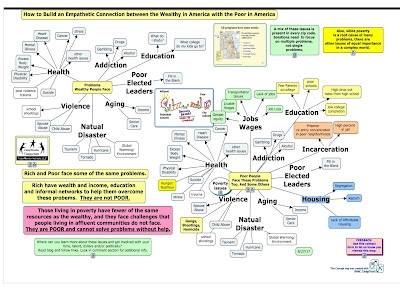
pools at quadrille
Quadrille, according to David Parlett was a wildly popular card game of the period. "A notable characteristic of Quadrille is that it was always more popular with women than with men." The pool is the main stake of each round, like the collected bets in poker.
whist
"A game of cards played (ordinarily) by four persons, of whom each two sitting opposite each other are partners, with a pack of 52 cards, which are dealt face downwards to the players in rotation, so that each has a hand of 13 cards" (OED).
lottery tickets
"a numbered ticket bought in order to participate in a lottery," (OED). Resembling the modern version, "lottery tickets" is a game of chance. It is detailed in full by Edmond Hoyle in his guide, Hoyle's Games: Containing Laws & Directions for Playing the Various Games Now Prevalent : with Many Improvements and Additions.
Some even compare the two systems.75
 <br>
<br>
Analytic note: We found Khong’s ideas here to be well-crafted but lacked the space to engage them in the original article. Khong proposes that the United States, like the traditional portrait of the Chinese “tributary system”, serves as “the chief patron of a system of client states” (p. 2). In particular, he argues that the United States, also like China, seeks recognition by its tributaries and emulation of its domestic system by those tributaries. We think that this analogy could be interrogated more if we envision imperial systems as incorporating elements of “international” systems within themselves, but the larger point is to draw on the idea that the U.S. repertoire had parallels in the Chinese system during the eras in which we were also interested.
Source excerpt: “America has more in common with China than is generally recognized. In this article, I employ the idea of the tributary system—most often associated with China’s international relations from antiquity—to interpret how America relates to the rest of the world (ROW). I argue tha the United States has instituted the most successful tributary system the world has ever seen. … Through an equally impressive array of international institutions and organizations, many of which it created, the United States transmits and imposes its values and its preferred rules of the game on the international system.” (Khong 2013, 1-2)
Creating a game for VR makes this doubly important due to simulation sickness.
I think it'd be really useful to mention Oculus early on the post so the reader understands why / how this article is relevant to them and why it's showing on the Oculus blog (otherwise they're not mentioned until the end of the post). Something around wanting to create their own games for the Rift, and some of the hurdles they may come across. One of them being simulation sickness, which isn't fun as a player. That kind of thing to ease them into the post. You nailed it in the Multiplayer post with 'So you want to make a multiplayer game? It’s one of the hardest types of game to make. But if you’re a fan of multiplayer games, then you know you just can’t beat playing directly with players all around the world.'
rBody.velocity = new Vector2(rBody.velocity.x, jumpSpeed);
It's crazy how this just works
isSwinging
where are these booleans coming from?
if (groundCheck)
what does groundcheck mean?
var force = perpendicularDirection * swingForce;
where does swing force come from?
// 2 - Inverse the direction to get a perpendicular direction Vector2 perpendicularDirection; if (horizontalInput < 0) { perpendicularDirection = new Vector2(-playerToHookDirection.y, playerToHookDirection.x); var leftPerpPos = (Vector2)transform.position - perpendicularDirection * -2f; Debug.DrawLine(transform.position, leftPerpPos, Color.green, 0f); } else { perpendicularDirection = new Vector2(playerToHookDirection.y, -playerToHookDirection.x); var rightPerpPos = (Vector2)transform.position + perpendicularDirection * 2f; Debug.DrawLine(transform.position, rightPerpPos, Color.green, 0f); }
Should put this in its own function
Circular controls
Very few people know about the luxury boxes in Conte, even though they are right under the jumbotron on the south side of the forum. Whoever knows about them being used as a study location do not tell anyone because they do not want their spot to be taken the next time they want to use it. The boxes are slightly hidden from sight if one does not look carefully. The slope of the ceiling above the boxes and the jumbotron hits them at such an angle that it obstructs any view from high up in the bleachers. Unlike the normal stadium seating in the other sections of the forum, the box has a more exclusive feel. During games, the entrance to the boxes is blocked by guards. One cannot even think about getting near the boxes without showing proof that you purchased seats in one. The boxes are tightly guarded because you can only sit in one if you purchase the box in advance for a hockey, basketball, or football game. The guards wear blue suits, white shirts, and black tie with glasses and an ear piece, which makes them look like they are a part of the secret service. They wait outside the boxes for the duration of a game and if anyone tries to enter, they ask for proper identification and will not let them in and they will escort them out if they fail to do so. The boxes, themselves, are set up in a peculiar way. As you walk in, you must go up a couple stairs and instantly turn right into a door that is usually locked and then walk through a small hallway until you appear at the door of the actual seating area. The box is set up in a way that there are half of the seats facing the hockey rink with a bar, while behind that and down some stairs are some seats that overlook the Alumni Stadium. Each one is designed the same on the inside and huge panes of glass separates each one from the other. All entrances to the individual boxes are connected by a single walkway that is suspended above the student section on the south side of the forum. Even though I have not had the luxury of sitting in a box in an actual game, if you purchase the one, you can order concessions and food from a select menu that they deliver right to your box at any time you order it during a game.
Looking back on these paragraphs, I never had any main idea here. I am still working on how to tie background ideas in with my actual main idea of my essay. Even though I did a good job at describing the way the boxes are set up and how they are exact mirrors of each other, I never fully described how this ties in to the meditation essay itself. I was trying to explain how the boxes are very exclusive and that not many people know they even exist in the first place. Even though I did a good job describing how they are exclusive, I did not add any personal experiences on how I have had to get there in the past. When the box doors are locked at night time, I have had to climb in and unlock the door from the inside. If I were to put an example like this in the essay, I think it would have given the reader a better idea on how complicated it would be to get to this place to study, and they would appreciate it more if they went and tried to go study there for themselves.
The Conte forum can be one of the most crowded places on Boston College’s campus at any point during the year. Hundreds of die-hard fans and casual sports watchers come from across the state and the region to watch hockey and basketball games that take place in Conte. The sheer magnitude of noise in the forum during a game is enough to make one deaf. When the basketball team needs a confidence boost, an animation plays on the jumbotron. It reads “Lets Make Some Noise!” When those words are displayed on the screen, everybody gets gradually louder so that the opposing team becomes intimidated and the home team gains confidence from the cheering and the noise in general. Sometimes during the games, it can get to be so loud that you can not even hear the person next to you screaming at the top of their lungs. Conte can be arguably the loudest place on campus, but what if there was a certain time and place in the forum where you could not hear any voices at all? What if there was a place in the forum that is completely silent? That place is the luxury boxes in Conte.
While I was writing the introduction for my meditation on place essay, describing Conte Forum was arguably the part where I struggled most. I found it hard to describe exactly what I saw through words in an essay. I was trying to depict Conte when it was its loudest so I could then set myself up for the rest of the essay which would describe Conte as a quiet place to study, contrary to popular belief. While I was writing this, I fund it hard to pick exactly which words would spark interest in the sights and sounds of Conte when it is at its loudest. Over the course of FWS, I have learned to get a better understanding of how to soak in everything that is going on around me and to pay close attention to detail. By doing that, in my final draft, I think I was able to describe my experiences more accurately and give the reader a better understanding on what it is like to be in Conte when it is at its loudest.
It turns into a kind of game: How old do you think he is? Do you think they’re dating or just friends? What is their story?
This portion of the piece is an addition to the original. Here, I open with an example that my audience will find relatable: people-watching. I close the paragraph with questions that bring people back to a specific memory. These three questions are all taken from real conversations I have had with my friends when people-watching. I want to get my audience thinking about the situations they have been in, in which they probably thought about similar questions. The first two questions begin to uncover concrete details about other people's lives. The third question is more abstract and thought-provoking, transitioning into the idea of sonder in the next paragraph.
. BDSM occupies a dark space where sex and violence meet, and while it may be seen as a “ game, ” the pain that sometimes occurs is not pretend.
....ummm.....no? If the subject of BDSM is going to be discussed then please use sources beyond 50 shades of gray. That is not a valid source to base a claim on.
There is the formidable Gasson Hall with its tall tower will a bell and fascinating interior. There is also the industrious Merkert chemistry building, tucked away in its own little spot, home to many chemistry classes and shattered test tubes. Despite their size and grandeur, these places are not as meaningful as a simple wooden court. It is a court that is overlooked by people as they play a game of basketball or volleyball or even futsal. It is just a court numbered only as nine.
I included this to create a contrast between some of the buildings on campus and the small dinky court I was going to write about. That is why I wrote the "formidable" Gasson Hall and the "industrious" Merkert chemistry building. I wanted my introduction to create a sense of "huh?, there are all these cool places to write about and he chose to write about a small wooden court?". By doing this, I sort of force the reader to pay attention to the how small this court is compared to other buildings, but at the same time, how this small little court is much more meaningful to me than these other large buildings. By making the reader acknowledge the simplicity of the court, I can tell my story with the court and show how meaningful it is to me despite its simplistic nature
Books in the background:
"Great by Choice" - James Collings & Morten Hansen.
??
??
??
"The Earth is Flat" - Thomas Friedman.
"Elon Musk" - Ashlee Vance.
"Yes, And" - Kelly Leonard and Tom Yorton.
"Getting to Plan B" - John Mullins, Randy Komisar.
"The Hard Thing About Hard Things" - Ben Horowitz.
"??"
"Conscious Business" - Fred Kofman.
"The Martian" - Andy Weir.
"The Monk and the Riddle" - Randy Komisar.
"Organizing Genius" - Warren Bennis, Patricia W. Biederman.
"The Checklist Manifesto" - Atul Gawande
"Thriving on Chaos" - Tom Peters
"Option B" - Sheryl Sandberg
"Being Mortal" - Atul Gawande.
?
?
"Lean In" - Sheryl Sandberg.
"The everything store" - Brad Stone.
"Codenames Duet" (board game).
"Codenames Pictures" (board game).
"#GamerGate" is an online movement ostensibly concerned with ethics in game journalism and with protecting the "gamer" identity.
This was the primary concern when we discussed the "doxing" of members of the media. Female gamers and journalists were targeted and their information leaked to the public, including a group of individuals who were already angry at the women in question for fighting the standard of their community. This connects heavily with how social media platforms and even search engines protect information, as it is possible to get information such as schools, general locations, etc. through the correct google searches.
you need to make sure the scripts on your player Prefab instance are “aware” of whether the player controlling the instance is using the host computer (the computer that is managing the game) or a client computer (a different computer to the one that is managing the game).
Why?!
that player’s GameObject
I guess this is a reference to the GameObject that has a script component that inherits NetworkBehavior.
My question is what happens if each person who plays with this game controls multiple characters in the game. Does each of those charachters (GameObjects) become "local player" ?
I am an art teacher and also I am a student in our 5320 class. I was interested in reading this article because as an art teacher I have not ever heard of the gaming strategy taking place within an art classroom and I wanted to hear how and why it was used. After all of our recent readings I have become intrigued by the idea of gaming/ learning taking a foot hold some how within our curriculum, I am just not really sure how this would take place. Would it be a trivia type game or maybe a first person type of game where you live the life of a dramatized artist? The premise for this paper was that researchers were looking for a way to supplement the education of elementary students who did not have access to an art education. The game in which they were using to do this was a web based flash game called “Color in motion.”
从自行车行政村四川省上档次四川省
Violence Will Only Hurt the Trump Resistance
Does cooperation with the police to avoid protests from becoming violent weaken the power of social movements? Explain.
Defenders of black bloc tactics, which also include rioting and “Nazi-punching,” argue that these actions are necessary and legitimate against powerful opponents. They believe such tactics help to protect nonviolent activists—particularly those from marginalized communities—from militarized police.
But they also believe that appeals for nonviolent action are for the privileged and the sell-outs.
Nonviolent action seems to disturb people without alienating them
The FBI did this during the Civil Rights movement, and more recently, during Occupy.Repeated efforts to plant agents provocateurs who endorse violent flanks should send a clear signal: The authorities want movements to play the game the state knows best.
Student responding to a question based on an image about an illustration of children playing a soccer game match:
really helpful the way that you have conextualized each example
For Emily, going to places where her peers gather is a freedom—even if she isn’t actually watching the game or buying clothes.
I can relate to this because in high school being with my friends was freedom too.
A solution to this would be to provide students with tables with built-in power outlets and LCD screens so that students may stay connected and continuously monitor their progress when it comes to the classroom game.
While this is a great idea, before any of it can become a reality, we're going to need to work on getting enough funding so schools can actually afford it.
An example would be a situation where, as a student gathers experience and time with a concept, he or she earns points that are tracked either manually or automatically. With gamification, teachers can manage, motivate and engage their students by transforming their classroom into a role-playing game.
I wish I thought about this for the online discussion, all I spoke about was grades when I could've also thrown in team work.
The Oregon Trail is one of the earliest instances of game-based-learning (GBL), an approach to education where students explore subject-relevant video games with defined learning outcomes.
I think having games like this are very important for some students.
With gamification, teachers can manage, motivate and engage their students by transforming their classroom into a role-playing game.
This sounds like fun technique that will help students become engaged to the learning material being introduced.
Stories like CBS’s Cam Ne piece exposed a “credibility gap,” the yawning chasm between the claims of official sources and the increasingly evident reality on the ground in Vietnam.
It is interesting to see here how the war was becoming almost a game of cat and mouse for the public to know the truth.The government, wanting to placate its citizens and convince them to support the war effort, told white lies and mislead people to believe the war was going much better. Journalists, on the other hand, saw the reality of what was happening in vietnam and the atrocities being committed. They were hampered by a source that is supposed to be truthful, the government, and tried to let their countrymen know what was happening. The truth kept jumping through and the government would try to distract its people from the reality of the war, the reality that America was losing
One fruitful strategy for reducing this gap is building the capacity of parents and mentors alongside that of children. Intergenerational learning experiences can strengthen family ties while giving parents and children new skills to ex-plore new domains
Give them something in common. For example: Pokemon Go. My daughter learned how to read, how to do advanced math (division and multiplication), problem solving, and critical thinking skills due to our shared interest in the game. We used it as an opportunity to explore educational concepts even though the game would not be categorized as "educational."
Is Glitch Game still available? Free?
ulum, I am just not really sure how this would take place. Would it be a trivia type game or maybe a first person type of game where you live the life of a dramatized artist? The premise for this paper was that researchers were looking for a way to supplement the education of elementary students who did not have ac
我是测试的
games could be beneficial for a number of reasons. Firstly, it is claimed that in gamesknowledge or skills learned and practiced are more likely to transfer than when practiced on a single kind of problem. Once mastered, theknowledge and skills are practiced further to provide overlearning. This leads to the knowledge and skills becoming automatized and con-solidated in memory, so that the learner can begin to focus consciously on comprehending or applying new information
Research has shown that students are significantly more engaged and concentrate much harder when challenged in classrooms. Literature in the game-based context reflects similar understanding of the phenomenon that the challenge in games may drive a player's sense of engagement. As Fotini Paraskeva in "Multiplayer online games as educational tools: Facing new challenges in learning" writes, "Games seem to put the learner in the role of decision-maker, pushing players through ever harder challenges, and learning is accomplished through trial and error" (Paraskeva 499). Prior research by James Paul Gee in "What video games have to teach us about learning and literacy", and John Kirriemuir in "The relevance of video games and gaming consoles to the higher and further education learning experience" — which Paraskeva cites to corroborate her findings — also shows that challenge in game-based learning increased learning outcomes as well as satisfaction.
Games model learning by doing perfectly, as they demand the active participation of players all along the way. This is one reason games have such potential as tools for learning: they are really nothing more than complex problems waiting to be solved by players in a way that is both fun and challenging.
As new technologies allow for increasingly sophisticated game experiences, the potential for the integration of games and learning becomes ever more crucial. Learning environments have been largely limited to the traditional classroom: the teacher stands in front of the class and relays knowledge to a listening group of students. But gaming environments are quite unlike that. As Katie Salen Tekinbas in Guide to Digital Games + Learning writes, "Games . . . demand the active participation of players all along the way" (Shapiro 4). Through their use of immersive experiences, games like Mafia, Dragonbox, and Crayon Physics Deluxe — all social games referenced by Tekinbas — provide an opportunity for play which can result in a myriad of rich experiences.
Take a stroll through “The Educational Gaming Industry Timeline”. Click and read about the key games, developers and innovations that shaped the industry’s history. Each key date is complete with a short description, as well as videos, games, and links to further information.
It is clear that as a result of the ubiquitous digital environment and the sheer volume of their interaction with it, today's students think and process information fundamentally differently from their predecessors. Brendan Alexander points out that "with the proliferation of the internet . . . people [can] play, share, and learn together from thousands of miles away". To give readers an idea of the growth of the Educational Gaming Industry, Alexander provides a link to "The Educational Gaming Industry Timeline". The timeline explores the evolution of overall game-based learning from the year 1967, to the present. In the final section of his blog, Alexander asks readers their thoughts, and invites them to share further examples that would benefit other readers.
Gamification in learning is an established trend, and uses the core elements of what make games fun – mastery, narrative, instant feedback, competition, and reward, to create new ways for learners to internalize information.
According to Susannah Holz, "gamification" is an emergent approach to learning instruction. It facilitates learning and encourages motivation using game elements and game-based thinking. In this case, the goal may be to increase student effort or simply to convey to students that "games [can] make learning . . . fun and interactive". In addition, Holz references other blogs that deal with gamification and digital game-based learning (DGBL), such as Alex Calhoun's "'Vanished' Teaches Children to Save the Future with Science" and Vicki Davis' "Gamification in Education". In short, this blog seems to explore the relationship between game-based learning experience and learning and related outcomes.
playing video games and eating.
How many game's do you play in a day and how much food you eat while playing the game?
One thing that’s hard for sportswriters to understand is that writing an article is by its nature an aggressive act. Every time we write, we are claiming a piece of the game for ourselves: I understand this in a way that you, the athlete, do not.
Implication of those who are sportswriters actually writing about sports
Moneyball II is an older war. It’s about who really owns the game. It’s about a group of people whose jobs by their very nature threaten another group of people. You may know this war by another name. It’s called sportswriting.
heres the crux...sportswriting is intentionally supposed to be threatening, perhaps because when people are threatened there is a greater sense to do something productive. AND, if "they" dont (the people/organizations being written about) act with productivity and urgency, what comes next is SAM HINKIE #TTP
Some athletes also hold it against writers who never played the game. Personal expertise: does it matter? How many presidential biographers held office; how many music writers could play “Misty” for you?
"Who" are sportswriters? (What type of people?)
play a laterality recognition game on the ipad
How does this integrate with the client values? Clarify this one piece for approval. I think you did an excellent job of selecting your examples.
Training would be much more e!ective if it was more interactive, like a game, with input and interaction with the system. I don’t mind whether it’s a computer or a person, it just has to be more interactive than just reading
Well put.
early 1980s
Gen Xers first video game generation? Millennials in a different more interactive and higher percentage than Gen Xers. Current young students are growing up with technology in an even more present way. Here's an interesting article on the subject.
Games and their powerful interactivity and reinforcement of particular behaviors, as opposed to the one way delivery of television, have created an entirely new individual —and as a result, new and di!erent needs for trainin
I believe this is an important point. Many of our current business and school leaders likely grew up with television with minor video game play on old gaming systems. The skills and perspectives created from these experiences are completely different.
piquet
"A trick-taking card game for two players, using a 32-card pack consisting of the seven to the ace only" (OED).
Vingt-un
“A round game of cards in which the object is to make the number twenty-one or as near this as possible without exceeding it, by counting the pips on the cards, court-cards counting as ten, the ace one or eleven as the holder chooses”(OED).
loo
"A round card-game played by a varying number of players. The cards in three-card loo have the same value as in whist; in five-card loo the Jack of Clubs (‘Pam’) is the highest card. A player who fails to take a trick or breaks any of the laws of the game is ‘looed’, i.e. required to pay a certain sum, or ‘loo’, to the pool." (OED)
cassino
Also spelled casino; "a card game for two to four people" (Pool, What Jane Austen Ate…, 281).
quadrille
"A card game played by four people with forty cards that was the fashionable predecessor of whist" (Pool, What Jane Austen Ate…, 360).
survey found that adolescents who play more than one hour of video or computer games daily were rated as having more attention difficulties
Maybe it is because they are sidetracked by what they did wrong in the game?
* Practiced Liar Bully: A child exhibiting this genre of bullying can produce a convincing account at any moment that hides his violent acts. Such bullies excel at deception, and their ability to deceive should never be underestimated. * Jekyll and Hyde Bully: This bully is ruthless and vindictive in private, but is innocent and helpful in front of witnesses. A common attribute, and a warning sign, is displaying excessive charm in front of those in authority. * Shallow, Superficial Bully: The Shallow, Superficial Bully has exceptional verbal ability, butno substance to support his/her often illogical arguments, which are designed to hurt others. This bully generally talks a "big game," but does not follow up on commitments and cannot be trusted or relied upon. The Shallow, Superficial Bully tends to create conflict to undermine and destroy anyone he/she perceives to be an adversary or a potential threat capable of unmasking this bully. * Highly Critical Bully: This bullying type of ten uses covert tactics to humiliate, embarrass, degrade, or put down others. Such bullies rely on mimicry, taunting, teasing, embarrassing questioning, and refusals to value others. * Lobbying Bully: Lobbying bullies use their persuasive powers to repeatedly convince others to accept their views and perceptions. These bullies employ rumor and innuendo with great skill to destroy others' reputations. They exhibit arrogance, along with a superior sense of entitlement and audacity, while believing they are invulnerable and untouchable. * Evasive Bully: These bullies seldom give a straight answer and flit from topic to topic to avoid accountability for their transgressions against others. They are quick to discredit others and neutralize anyone who has incriminating information about them. * Bully Saboteur: Saboteur Bullies have an exaggerated belief that they are not receiving their fair share of praise or rewards, and they display highly manipulative tendencies. This bully often demonstrates prejudice and contempt for others and gains gratification when denying other people that to which he/she believes he/she is entitled.
This information provides me with different types of bullying and scenarios that are commonly associated with it.
One treatment session in which I felt like I'd really succeeded with using client motivation was my invention of "Marble Town". I had a client in my pediatrics rotation who needed to work on handwriting in order to improve his participation in occupations at school, but he really did not enjoy it, and he had enough cognitive impairment that "first-then" negotiation rarely worked. During one session, I noticed that he loved a new toy that involved building a track with ramps and funnels for marbles to go through. The next session, I created a worksheet for him to fill out before he played with the marble game called "Marble Town" in which he envisioned what a whole town of marbles would be like by choosing the town's mayor, official animal, etc. Normally, he would ask to abbreviate words during writing exercises or pick a very short word wherever possible, but when I asked him to choose the town song of Marble Town, he wrote out the longest phrase I'd seen yet: "Plunk Goes the Marble." He was so excited to be writing about something he found interesting, and I was very pleased that he formed more letters during that session than in the previous two or three combined.
I love this. You tapped into his motivation for sure.
Due to the fact that not many were literate, lessons were passed on verbally.
This reminds me of the game telephone. There must have been a lot of false information going around. Not intentionally but I cant believe that all information was passed on exactly the same as it was told the first time by Plato himself.
Gagan Shakti is the biggest military exercise in decades undertaken by India to showcase its air dominance over the entire extended area of the Indian Ocean Region (IOR).
In a massive show of strength, the Indian Air Force (IAF) is conducting 'Gagan Shakti 2018', the biggest ever war combat game exercise on the Pakistan and China border.
“Directors [of firms] know each other, they have followed the activities of their ‘neighbors’ for many years and, accordingly, they have a good conception of what to expect from them, and what is better to not count on”
<br>
Source Excerpt: Все начинается с индивидуального уровня. Движение к легалицации требует принятия личных решений владельцев и высших менеджеров бизнеса, которые готовы в этом случае взять на себе неизбежные дополнительные издержки. Однако индивидуальных решений в таком деле явно не достаточно. Ни у кого из российских участников рынка нет достаточных сил, чтобы легализоваться в одиночку, не обращая внимания на то, что делают конкуренты. Это означает, что представители ведущих компаний должны договориться между собой о новых правилах игры.
Здесь возникают вполне понятные объективные и субъективные трудности. Кто-то лично не ладит друг с другом (говорят: «так сложилось»). Но главное – многие являются прямыми конкурентами. И о полной откровенности и открытости в вопросах явно коммерческого характера говорить не приходиться. Впрочем, как правило, речь идет уже не об открытом недоверии (которое в значительной степени преодолено), а скорее, о несколько осторожном отношении бизнесменов друг к другу. Установлению более доверительных отношений на интересующем нас рынке электробытовой и компьютерной техники способствует особая ситуация, когда корпус руководителей максимально однороден по составу – по возрасту, уровню и профилю образования. Это, несомненно, облегчает контакты. Вдобавок, руководители знают друг друга, следят за деятельностью «соседей» в течение многих лет и, следовательно, имеют представление о том, чего можно ожидать от них, а на что лучше не рассчитывать. (Radaev 2002, 48)
Source Excerpt Translation: It all begins at the individual level. The movement toward legalization requires personal decisions by owners and top managers of the business, who are ready in this case to take the inevitable additional expenses on themselves. However, individual decisions in this matter clearly are not enough. None of the Russian partcipants in this market have enough strength to legalize by themselves without paying attention to what their competitors are doing. This means that representatives of leading companies must come to agreement among themselves about new rules of the game.
Here arises fully understandable objective and subjective difficulties. Someone doesn't get along with someone. But importantly – many of them are direct competitors. And we shouldn't even speak of full openness and sincerity in commercial matters. However, as a rule, the issue isn't even about outright distrust (which to a significant degree can be overcome), but more likely about the somewhat cautious attitude of businesspeople toward each other. In the electronics and computer market in which we are interested the establishment of more trusting relationships is faciliated by a unique situation in that the main body of directors is maximally similar in composition – similar age, level, and educational profile. This, undoubtedly, makes contact easier. Additionally, directors [of firms] know each other, they have followed the activities of their ‘neighbors’ for many years and, accordingly, they have a good conception of what to expect from them, and what is better to not count on. (Radaev 2002, 48)
Data Source: https://data.qdr.syr.edu/file.xhtml?fileId=2802
Full Citation: Radaev, Vadim. 2002. Institutsionalnaya Dinamika Rynkov i Formirovanie Novych Konseptsii Kontrolya [Institutional Market Dynamics and the Formation of New Concepts of Control]. Higher School of Economics working paper.
The fun comes from the feeling of mastery.
Again, intrinsic motivation. Ryan, Rigby and Przybylski showed that, "motivation is accounted for by how well the game satisfies our three basic psychological needs - autonomy, competence, and relatedness" How do you think this game meets these needs?
EVE Online’s designers have cast it as an extension of the game’s broader fiction.
Although the game offers a variety of extrinsic motivation, there is a definite attempt to employ intrinsic motivation by appealing to the player's higher motivations. Become a part of the scientific community working to solve real problems such as cancer, Alzheimers, and other diseases. You don't need a degree in a scientific field in order to contribute.
simple game within the game, finding commonalities and differences between some thirteen million microscope images
Check out this brief video introduction.
the tremendous amount of time and energy that people put into games could be co-opted in the name of human progress.
Taking advantage of the addictive, repetitive qualities of gaming. Ara Shirinian (game designer) states, "Repetition" is usually a bad word -- and in games, often associated with grinding. Can it be the path to unlocking something more rewarding for players when properly utilized?"
the problem is that, in providing players with a sense of accomplishment, games may distract our species from genuine achievement
A different take on the perils of playing video games. How do we find a lasting and fulfilling sense of accomplishment? Video games don't typically provide anything but in game satisfaction. Revaz and Szantner found a way to combine community service with playing video games.
looking to work as a social media intern at a local video game start-up I found on Twitter,
Putting this at the end I believe is what they call "burying the lede"...Start with this surprising, intriguing fact/statement and your reader will 1. view you as more of an expert on this topic and 2. want to keep reading to find out more.
But I wish you may not have discouraged him from any future Attempt;
are they turning this into a game?
motivating
And you could make it a game like the tennis ball suggestion.
activity
Very cute! I can see how you could make it a competitive game by having a die with one side blank and another side that said "remove" (or remove a certain number). Then the first person to feed all of the chips to his or her tennis ball would be the winner. You could also use cards instead of dice.
r
3 or 4 days - per game - so it takes alot of time and doing things
t
single - program - different game - more and more - watch the stream of the video game and more and more - video.
! ACTIVE AI 2 MAIN MENU About ▾About Us Our TeamResearchSponsorsMaster TrainersiOS DonorsNews & Events ▾In The NewsStoriesTeam BlogApp of the MonthResources ▾Get StartedTeachDocumentationTutorialsBooksResourcesForumsTroubleshooting Create Button <!--//--><![CDATA[// ><!-- var gotoappinventor = function() { var referrer = document.WB_wombat_location.pathname; var patt = /.*hour-of-code.*/; if (referrer.match(patt)) { window.open("http://code.appinventor.mit.edu/", "new"); } else { window.open("http://ai2.appinventor.mit.edu/", "new"); } } //--><!]]> Create apps! Top Headline Block Anyone Can Build Apps That Impact the World (function() { var cx = '005719495929270354943:tlvxrelje-e'; var gcse = document.createElement('script'); gcse.type = 'text/javascript'; gcse.async = true; gcse.src = (document.WB_wombat_location.protocol == 'https:' ? 'https:' : 'http:') + '//www.google.com/cse/cse.js?cx=' + cx; var s = document.getElementsByTagName('script')[0]; s.parentNode.insertBefore(gcse, s); })(); × App Inventor 2 Social Icons Firebase Authentication in App Inventor Using Javascript This tutorial shows you how to create your own Firebase Authenticator by running javascript code through the WebViewer component. Read more about Firebase Authentication in App Inventor Using Javascript WebView Javascript Processor for App Inventor This tutorial shows you how to incorporate “traditional” programming into your apps. The technique involves using the WebViewer component as a javascript processor, Read more about WebView Javascript Processor for App Inventor Hello Codi! Hello Codi is the Hello World tutorial for App Inventor. This simple exercise takes you through the very basics of App Inventor. In a very short time you will create a button that has a picture of a bee on it, and then program the button so that when it is clicked a "buzz" sound plays. Read more about Hello Codi! LEGO EV3 Color Search This tutorial shows you how to build a mobile app that instructs an EV3 LEGO robot to search for a certain color on a white surface bordered by black. The user can pick one color out of red, green, blue, or yellow for the robot to search. The robot will search across the white surface and turn around if it gets to the black border. Here is a demonstration video. Read more about LEGO EV3 Color Search Lego EV3 Pet Robot This tutorial helps you to build an app that allows the user to instruct an EV3 LEGO robot to do certain maneuvers and actions through voice commands. The user can pick one of several commands: forward, backward (reverse), stop, forward slow, forward fast, disconnect, circles, right turn (turn right), left turn (turn left). The robot will follow the user’s voice commands and perform the action for half a second before prompting the user for another command. If the user provides no commands, the previous command will be executed until another command is registered. Read more about Lego EV3 Pet Robot LEGO ® EV3 Tilt-to-Drive Tutorial This tutorial lets you make an app that drives around an EV3 LEGO robot by tilting a phone or tablet. Tilting forward makes the bot go forward, back --> back, right --> right, left -->left. A steeper pitch will make the robot drive faster… etc.Go to tutorial. Read more about LEGO ® EV3 Tilt-to-Drive Tutorial Photo Booth App This tutorial demonstrates how to develop a Photo Booth app. You’ll build an app that let’s you take pictures, assign pictures to canvases and share pictures via email. Go to Photo Booth app Read more about Photo Booth App Oh My Spikes This tutorial by Saj Dutta shows how to create a complete game from scratch. The game is variant of the popular spikes games and uses App Inventor sprites. Go to tutorial Read more about Oh My Spikes Sharing Component: send files and text with the app of your choice In this 3-minute video, App Inventor Developer José Dominguez shows you how to use the File Sharing component in App Inventor 2 to share text and/or files from your App Inventor app to any messaging-capable service on your device (e.g. Gmail, Twitter, G+, WhatsApp, Messaging, etc.). Read more about Sharing Component: send files and text with the app of your choice QuizMe for App Inventor 2 QuizMe is a trivia game about baseball, but you can use it as a template to build quizzes on any topic. This tutorial is especially useful for learning about working with information in Lists. Lists are useful data structures for keeping track of many items of the same type, especially when you want to cycle through those items. Read more about QuizMe for App Inventor 2 Pages1234next ›last » <!--/*--><![CDATA[/* ><!--*/ #footer-nav { width: 60%; margin: 0 auto; left: 30px; margin-bottom: 20px; overflow: hidden; position: relative; } a strong { text-decoration: underline; } #footer-nav ul{ width: 24%; list-style: none; display: block; float: left; } /*--><!]]>*/ Home About About Us Our Team Sponsors News & Stories In The News Stories Team Blog App of the Month Resources Get Started Teach Documentation Tutorials AI Classic Resources Forums Troubleshooting This work is licensed under a Creative Commons Attribution-ShareAlike 3.0 Unported License © 2012-2017 Massachusetts Institute of Technology Contact Us
es una buena pagina para la creación de aplicaciones móviles la recomiendo para cualquier programador no muy avanzado interesado
If the system can perform a command in less than 100 milliseconds, then it will seem instantaneous, or near enough.
When we play the online game, we can see ping time. Usually, if ping time is larger than 100 milli second, people cannot play the online game normally.
ToanyonewhohasbeeninBalianylengthoftime,thedeeppsychologicalidentificationofBalinesemenwiththeircocksisunmistakable.Thedoubleen-tendrehereisdeliberate.Itworksinex-actlythesamewayinBalineseasitdoesinEnglish,eventoproducingthesametiredjokes,strainedpuns,anduninven-tiveobscenities.
Later on in the account Geertz notes that the depth of a particular cockfight is based upon the status of the players--if a player is higher-class, more experienced, better at choosing and playing their cocks, then the game becomes more entertaining, more stimulating, in spite of the massive risks associated with betting a cock or betting money on a cock.
Also this paragraph is just hilarious.
1.Betweennearstatusequals(and/orper-sonalenemies)2.BetweenhighstatusindividualsTHEDEEPERTHEMATCH.
So when one takes into account the matches between addicts or those of lower class, it's not considered as deep because there is less weight granted to the players. Status acts as a performative property here, because Geertz later says that you can't ascend or descend in status because of a game. The entertainment comes not from what can be lost or gained, but from the prestige of the players.
if you can spare a minute of your time... or 106.
Here is a link to a forum on "True Achievements" for some advice if you are looking to learn the game in less time, through an affinity space.
106 minutes according to my death counter, I had unearthed only 37 percent of its secrets
This quick progress makes it unique to may other games. Do you think this is a strength or a weakness of the design?
Jukio Kallio.
Click here to visit Kallio's site where you can listen to the soundtrack to Minit. It is interesting that the music is so simplistic.
rewarding players for reading into a subtle line of dialogue and approaching obtuse obstacles with unique perspectives.
These skills apply perfectly to the idea of gaming in education. We want to reward students who are most willing to think outside the box and approach problems with unique solutions.
hero’s journey
Joseph Campbell's Ideas of life and rebirth in the Hero's Journey seem to fit Minit perfectly.
wildly creative fashion
It is amazing that a game with such basic graphics can be deemed so creative. This really demonstrates the fact that a game's unique storyline might be more paramount in how the game is received by an audience.
Minit
Minit introduction on Steam (http://store.steampowered.com/app/609490/Minit/)
trial and error can you make sense of Minit’s world.
Trial and Error Gameplay! This is an interesting learning system. This idea might turn some players away, while others could be intrigued to learn the criteria of the game. This is a great skill that fits perfectly into the idea of tying video games into an educational setting.
ready to start anew.
How do you think this quality of the game effects strategy? How do you think this quality of the game effects motivation?
progress, education,
These two concepts seem very similar in this context. Further progress is the result of the education that a player is receiving through their trial and error.
only through death can you learn
"What makes activities feel enjoyable or worth pursuing for their own sake is that they satisfy basic psychological needs like autonomy, relatedness, or competence" (Deterding 2014). This idea of dying in order to learn might be part of this psychological desire for competence.
are learning and dying.
This is the most simplistic description of the idea of gaming, and it seems to work perfectly!
the current push on serious games focuses mainly on the educational content of the game while overlooking the engaging parts which make the video games fun for students
Again, by the definitions I have found on serious games are games without the entertainment.
The language of the men in Their Eyes is almost always divorced from any kind of interiority, and the men are rarely shown in the process of growth. Their talking is either a game or a method of exerting power.
What powerful form of irony is at work when two attitudes about the same subject row up, though one comes from ignorance (white people) and the other from direct experience (black women)?
t creating a “supervisor” is almost impractical. For example, in a chess game, there are tens of thousands of moves
there is no point - to have a supervisior.
Larry Graykin, a language arts teacher at Barrington Middle School in New Hampshire
Also known as "Game Master of the Kingdom of Diddorol" "Within my class, when I introduce an assignment, it's embedded within a storyline," he said."I'm making up a story as I go, often strongly influenced by suggestions from the students. They'll create an entire subplot basically, but, basically it's a reason. The reason you need to take this test is because there is a peril in the kingdom and we need people to go up against this
Even failure is attractive in the game universe,
This is also different from traditional education. "Beginning at an early age, mistakes or errors are not embraced as a positive outcome in the current educational system, at least not in the USA." Simpson A., Maltese A. (2016)
Not being a teacher by training, he says, he ran his class in traditional fashion: one person lecturing, everyone else listening, the typical dr
"Every 'multiplayer class' started life as a standard lecture course, so I admit I was somewhat in stealth mode. I did mention the idea to my colleagues at Indiana University, including my chair. Some liked it, some didn’t. But no one told me I couldn’t do it, so I did....My courses were simply taught in a different manner from the sessions taught by colleagues"- Lee Sheldon (2011)
Lee Sheldon
Currently at Worcester Polytechnic Institute, Lee Sheldon is still active with games and learning, including a best selling book The Multiplayer Classroom: Designing Coursework as a Game, and developing applied game projects like Secrets: A cyber-culture mystery game.
The other reason people have stopped watching is because they believe the game has become too soft, they think the referees are throwing penalty flags at will to make sure players are safe.
edit for comma splice
Colin Kaepernick starting an anthem protest for social justice revolutionized the game and the world today he was the first to do the protest and many followed after, not about at least 1 player on every NFL team is now taking a knee or holding up their fist.
please edit for punctuation (fused sentence), here and elsewhere
Teachers I’ve spoken with have said that online courses can “run themselves,” and that students get higher grades in online courses because it’s easier to game the system when no one’s watching.
20 years is a long time to generalize about the nature of online courses. I've been in the business just as long and worked with hundreds of teachers. In the last 5 years, I haven't met one that said teaching online was easier, took less time, or that they "run themselves."
"Emotions Jenga" game,
Wow! This is awesome.
A Game of Chess
Middleton Play--women are complicit in maintaining hierarchical structures. The queen (chess piece) is the most powerful, but she serves the least powerful (the king).
Adding Steam Controller support is something that happens outside of Unity. What you do is create a game that supports KBM or a standard controller (ideally both) and create a preset for the Steam Controller from within Steam's Big Picture mode. The SC isn't a regular controller. When you plug it in, it acts as keyboard, mouse and generic controller at once and has to be configured with a proper preset. So rather than adding SC support to your game, you add support for your game to the SC. It's the other way around.
Interesting. How do I test steam controller locally without having submitted to steam store
ned eye to detect the counterfeits, and promptly every single one of them is detecte
game begins - try to out perform - and again and again.
With the computer you have to play the game the way it’s designed.
I do think that this would eliminate students who tend to sit out or avoid the activity in a regular gym class.
autism
Ah, okay. This is true. However, I would counter that some kids with ADHD, ADD, SPD, and even autism are completely overwhelmed in regular gym but could be more invested in something like a video game that could be more customized to them without the class all involved.
potential pitfalls
I wonder what her idea of pitfalls are. I am thinking that kids won't learn the basics of different sports, etc., but then I have to ask if that really matters. If I don't play volleyball, do I really need to know the rules and techniques?
“how can we find a way to make them active a little more – while they are not realizing they are training or exercising…
It sounds like it could be more adaptive and personalized for various student needs.
“It’s like dodgeball – but more fun.”
It mentions 25 different games, but are they all versions of dodge ball?
$28,000
That seems a little steep, though I guess it does replace all other P.E. equipment.
a few minutes to get the hang of newfangled games that were part-dodgeball, part-basketball, and part-Super Mario Brothers
It only took a few minutes? Interesting. Sometimes it takes students all year to figure out how to do something in class! Could it be because it was a game instead of something that seemed more like education?
Gym class that's like 'stepping into a video game'
[Our Princess is in Another Castle" (https://pdfs.semanticscholar.org/deef/f2e6acc0a02318958f952633a6e23841b8da.pdf) is an article that discusses using gaming for all subject areas including physical education.
What’s even odder is what is not sold: souvenirs. It’s hard to imagine an American baseball game without jerseys and autographed balls and bobble-head dolls being hawked for outrageous sums. There’s none of that in Cuba.
The fact that their are no souvenirs has changed the way baseball is experienced in Cuba compared to the US.
Oh, lots. In addition to the instructive change in the nature of the game from two players to three, Carcassonne is a territory-acquisition game with no combat mechanism at all. Tactical combat is arguably overused in computer gaming, so much so that a multiplayer game that doesn't feature it seems almost like a different kind of creature.
create a mutliplauer gane w/o combat
7. Pente
Look this game up again
Realizing that game-ending conditions other than winning could be discarded entirely was an amazing insight, and possibly marks the origins of the structure seen in 95% of games to this day: play until death, then send the player back to a checkpoint or previous save. While most of these games will boldly declare "Game Over" when the player runs out of health, considering you can always resume from the last checkpoint it's really not over at all. It's arguably an overused design now, but it wasn't back when Pitfall II did it.
Pitfall 2 introduced checkpoints
In other words: they used a pseudo-random generator, seeded with set values tied to each sector of game world, to algorithmically create terrain and contents.
Skyrim had computer generated content
fairly sophisticated game
this is the single biggest failure of gamification in education. Lame games.
About 72% of students who voluntarily took the course last year for extra credit said the game increased their knowledge, and 85% said the gaming activities were related to the learning tasks.
Interesting stats.
the game is the course
It's fascinating to think about the implications of this in a larger academic context.